Everything Costs More These Days. What About Electricity?
by Preston Knight, Communication Manager
We’ve landed in the month affiliated with so-called madness. That’s usually taken figuratively on the college basketball court, but emotions can also elevate for those who find the “sticker shock” of seasonally high electric bills when the calendar turns to March.
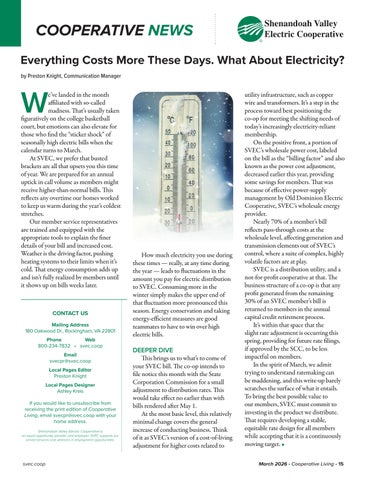
At SVEC, we prefer that busted brackets are all that upsets you this time of year. We are prepared for an annual uptick in call volume as members might receive higher-than-normal bills. This reflects any overtime our homes worked to keep us warm during the year’s coldest stretches.
Our member service representatives are trained and equipped with the appropriate tools to explain the finer details of your bill and increased cost. Weather is the driving factor, pushing heating systems to their limits when it’s cold. That energy consumption adds up and isn’t fully realized by members until it shows up on bills weeks later.
CONTACT US
Mailing Address
180 Oakwood Dr., Rockingham, VA 22801
Phone Web
800-234-7832 • svec.coop
Email svecpr@svec.coop
Local Pages Editor
Preston Knight
Local Pages Designer Ashley Kreis
If you would like to unsubscribe from receiving the print edition of Cooperative Living, email svecpr@svec.coop with your home address.
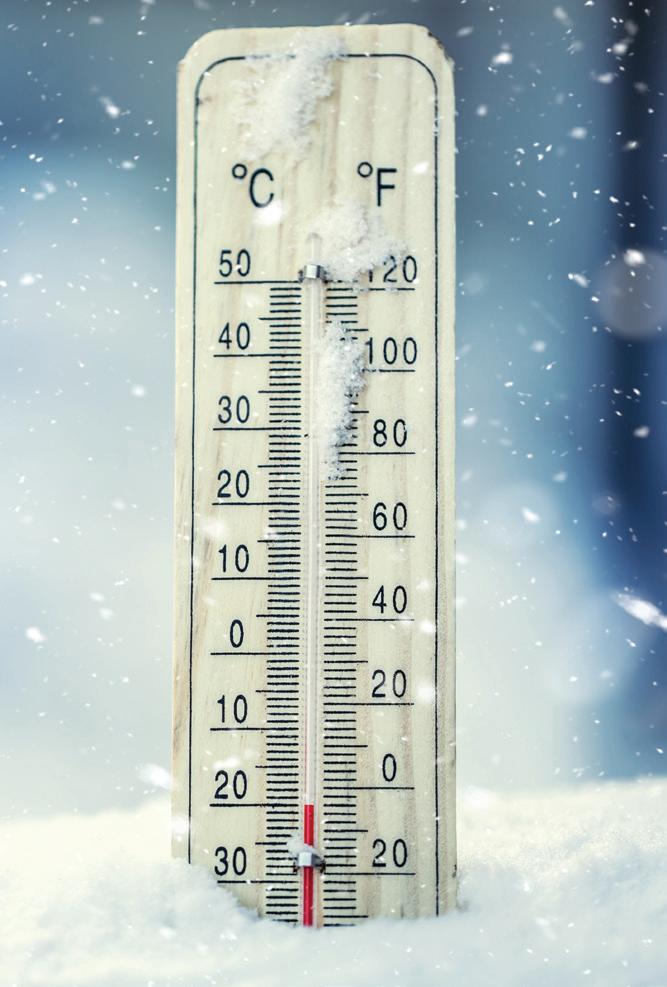
How much electricity you use during these times — really, at any time during the year — leads to fluctuations in the amount you pay for electric distribution to SVEC. Consuming more in the winter simply makes the upper end of that fluctuation more pronounced this season. Energy conservation and taking energy-efficient measures are good teammates to have to win over high electric bills.
DEEPER DIVE
This brings us to what’s to come of your SVEC bill. The co-op intends to file notice this month with the State Corporation Commission for a small adjustment to distribution rates. This would take effect no earlier than with bills rendered after May 1.
At the most basic level, this relatively minimal change covers the general increase of conducting business. Think of it as SVEC’s version of a cost-of-living adjustment for higher costs related to
utility infrastructure, such as copper wire and transformers. It’s a step in the process toward best positioning the co-op for meeting the shifting needs of today’s increasingly electricity-reliant membership.
On the positive front, a portion of SVEC’s wholesale power cost, labeled on the bill as the “billing factor” and also known as the power cost adjustment, decreased earlier this year, providing some savings for members. That was because of effective power-supply management by Old Dominion Electric Cooperative, SVEC’s wholesale energy provider.
Nearly 70% of a member’s bill reflects pass-through costs at the wholesale level, affecting generation and transmission elements out of SVEC’s control, where a suite of complex, highly volatile factors are at play.
SVEC is a distribution utility, and a not-for-profit cooperative at that. The business structure of a co-op is that any profit generated from the remaining 30% of an SVEC member’s bill is returned to members in the annual capital credit retirement process.
It’s within that space that the slight rate adjustment is occurring this spring, providing for future rate filings, if approved by the SCC, to be less impactful on members.
In the spirit of March, we admit trying to understand ratemaking can be maddening, and this write-up barely scratches the surface of what it entails. To bring the best possible value to our members, SVEC must commit to investing in the product we distribute. That requires developing a stable, equitable rate design for all members while accepting that it is a continuously moving target. •
An Ode to the Utility Pole
by Preston Knight, Communication Manager
They often get misidentified as telephone poles.
They are under attack by bears and woodpeckers, not to mention being sitting ducks for wayward vehicles.
They are asked to carry more weight now than ever.
The wooden utility pole may be simple and generally blend into the Valley surroundings, but it should be far from underappreciated for its role in providing an essential service. Its story, especially the background of poles specifically used for electric distribution cooperatives such as SVEC, is an interesting one. Who else will tell it but us?
LOOK KIDS, A CO-OP POLE
Certain passionate co-op employees might make it a hobby of theirs to identify a co-op pole in their daily travels. We feel sorry for spouses and children subject to that, but the point is a good one — there are co-op structures and then there are other ones.
The equipment and design of co-op lines have subtle differences from those of other utility systems. Rural Utilities Service, a part of the U.S. Department of Agriculture, approves the construction standards of all electric cooperative
infrastructure and lends money to build power lines. Investor-owned utilities and municipal-owned utilities do not fall under the purview of RUS.
“That’s how a co-op in Montana or Texas has the same material as we do,” says Joe Nelson, SVEC’s system operations construction manager. “For the most part, materials are exactly the same.”
That familiarity helps lineworkers when they are called to help another cooperative. Through mutual aid agreements, cooperatives provide a coordinated front in the face of widespread outages.
“Otherwise, it’s like sending a Chevrolet mechanic to work on a Ford,” Nelson says. “They could do it, but it’s a different setup.”
There are exceptions. At SVEC, those are often found in Page County or the northern part of the service territory, where an investor-owned utility previously operated. Generally, however, co-op lines and poles have several other distinct features that help identify them as belonging to a co-op.
Most noticeable might be the distance between energized and neutral wires. Energized cable for SVEC carries 7,200 and 14,400 volts of electricity from a substation, while neutral wire serves as a line back
to the substation and is tied to the ground to balance the electricity on the system.
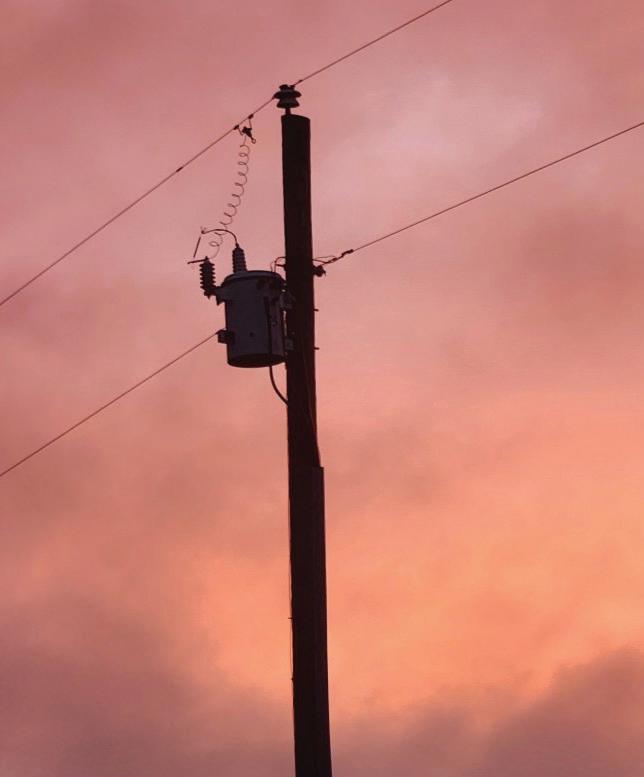
An investor-owned utility might have its neutral lower, perhaps where de-energized phone and cable lines run. Their transformers are often found between primary and neutral lines. Co-ops place transformers, which reduce those 7,200 and 14,400 volts of electricity to then serve your home, below their higher-placed neutral line.
“The transformer is a telltale sign,” Nelson says. “If it’s between the neutral cable and the phase line, it’s most likely investor-owned.”
For co-ops, there’s history behind the setup of a higher-hanging neutral. As electric service to rural America
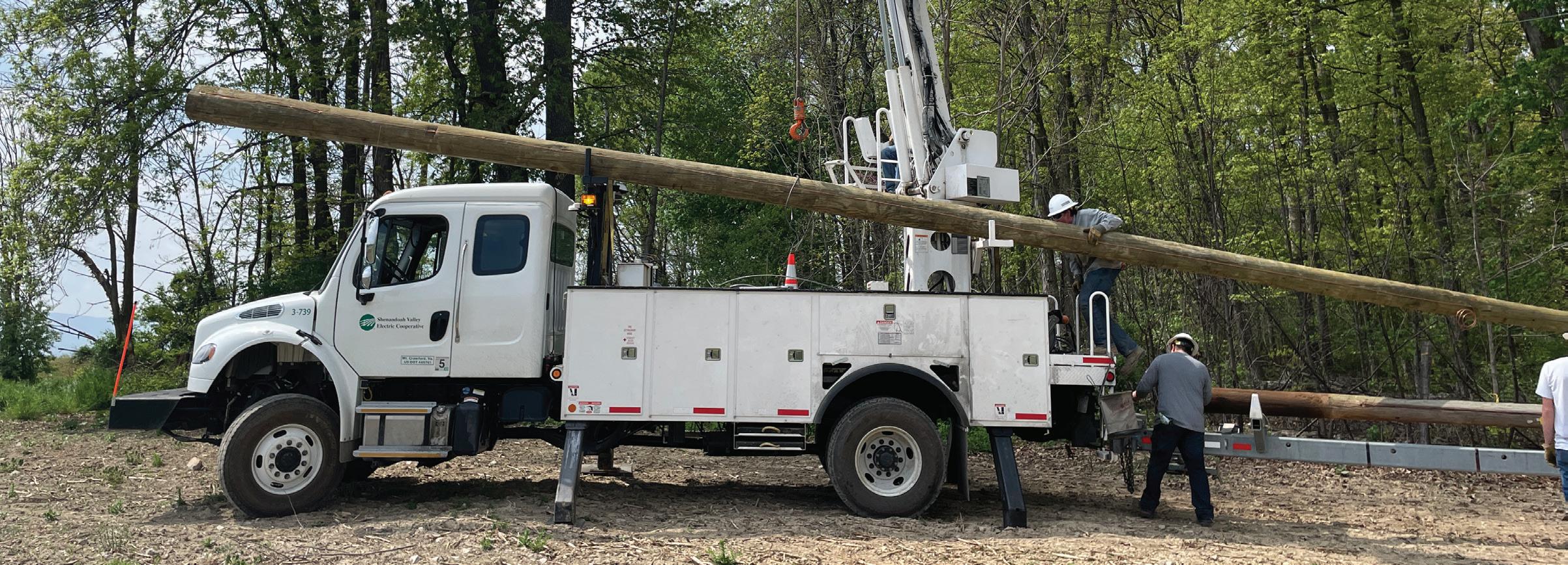
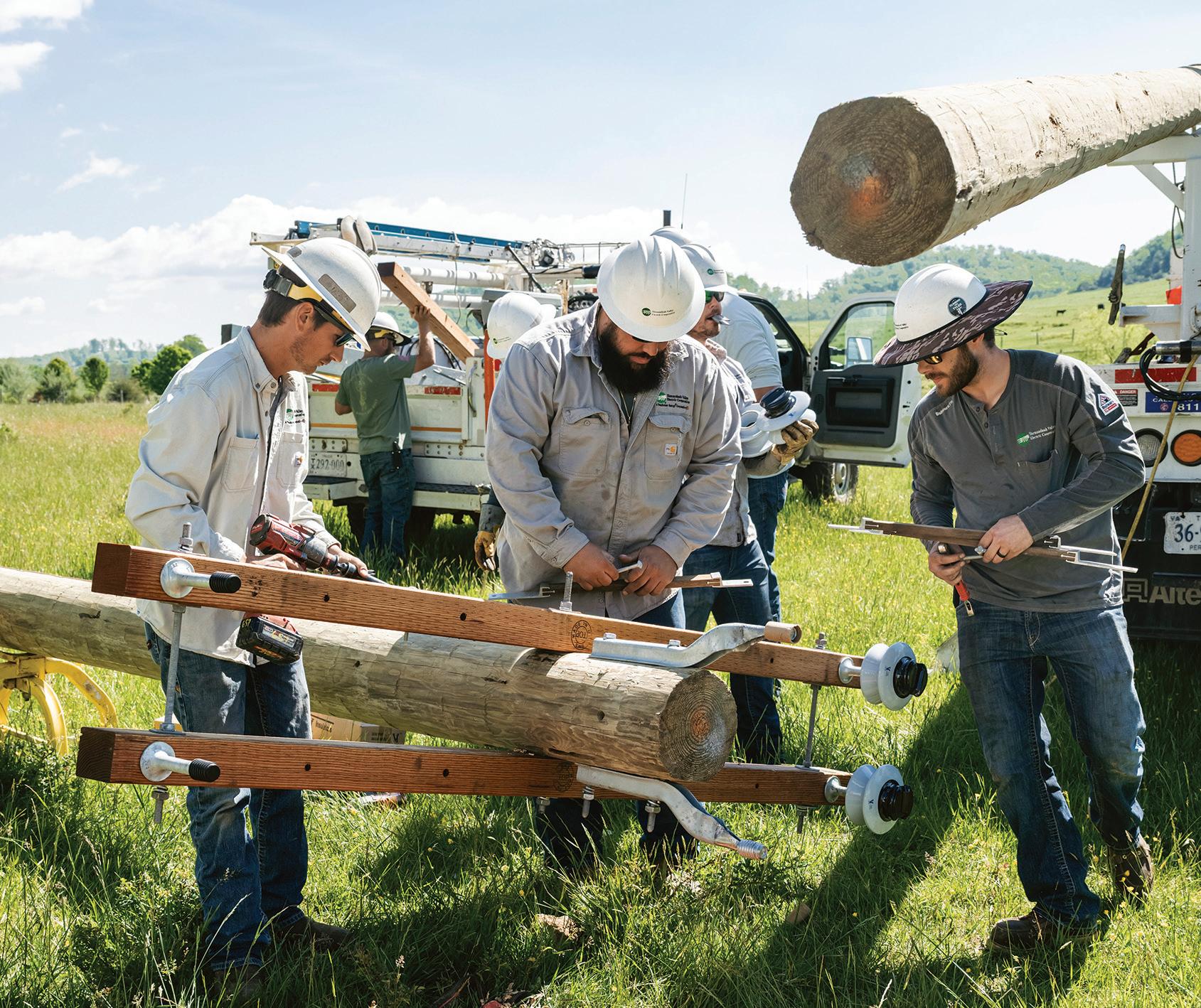
SVEC crews prepare to set a pole. But its path just to reach this point is a long one. Co-op utility poles have a certain look to meet federal standards.
spread with cooperatives created in the wake of the Rural Electrification Act of 1936, poles were mostly set on farmland. Farmers needed clearance from overhead lines to run equipment, Nelson says, and standard co-op poles were shorter then, roughly 30-35 feet tall. That led to higher neutral lines, which continues today even as poles are lengthier, up to 100 feet, and set at varied depths underground.
WHERE DO THEY COME FROM?
Poles do not magically arrive at SVEC’s doorstep. It’s quite a process to get them ready to carry wires to power our everyday lives.
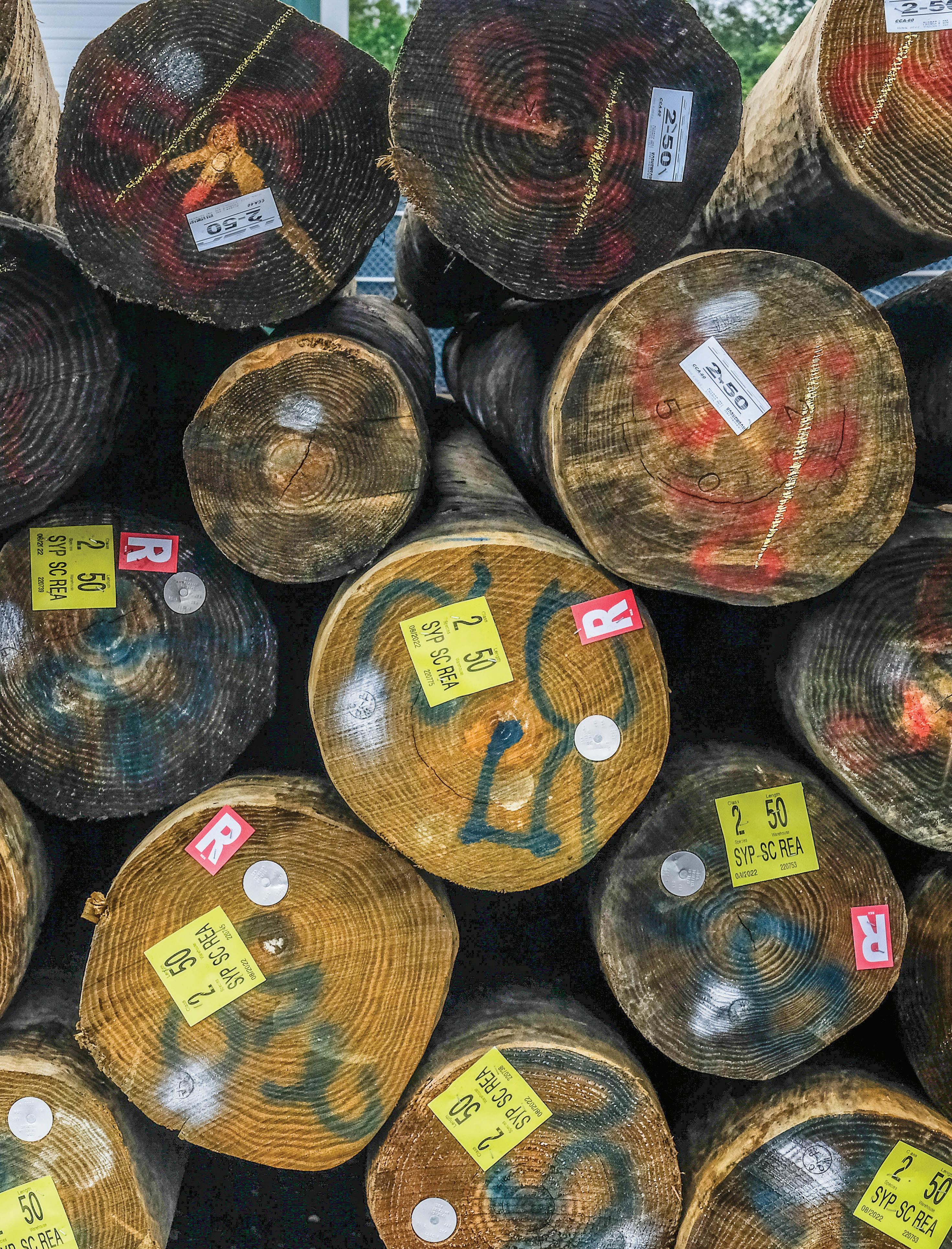
Wooden poles east of the Rocky Mountains are predominantly made from southern yellow pines, says Thomas Lane, a senior sales manager for Koppers, which supplies poles to SVEC. There is an abundance of locally grown southern yellow pines in the eastern U.S., he adds, and they have considerable strength for loadbearing applications.
“[This] makes it the perfect choice for utility poles and other lumber,” Lane says. “The vast majority of poles are purchased from private landowners who replant after harvest.”
During the life cycle of a southern yellow pine, carbon dioxide is removed from the atmosphere and stored inside the tree, he explains. When a pole is then produced, only the bark and outer cadmium layers are removed, leaving the carbon inside the tree for transportation.
“The main CO2 contributors in the production and distribution of a wood pole are drying and transportation,” Lane says. “Metal and steel [poles] take large amounts of energy to produce, and still have the transportation emissions to contend with, making wood poles much more environmentally friendly.”
Once a tree is harvested and
transported to a pole-manufacturing plant, it is peeled on a pole mill, dried in a kiln to remove water from its cells and taken to a framing yard, he says. At that point, it is inspected and predrilled for the holes necessary for the end user, such as SVEC.
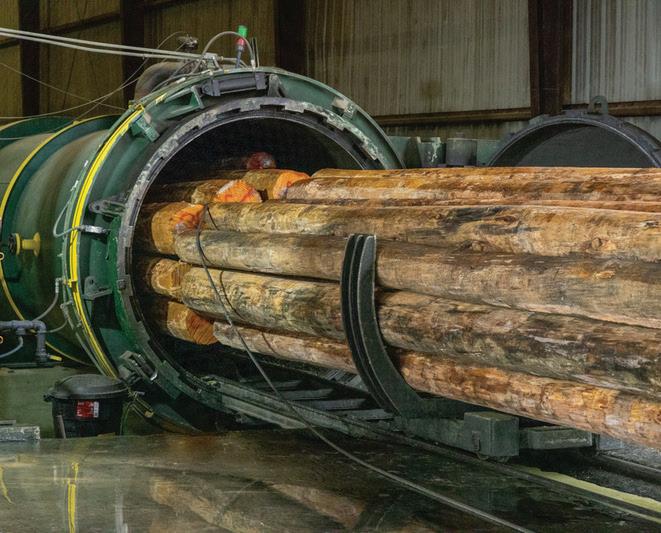
The pole is then inserted into a pressure cylinder, where a treatment solution is forced into the wood cells vacated of water after drying, Lane says. Upon removal from the treating cylinder, the pole is left on a drip pad to dry before final inspection and delivery to the customer.
grows. SVEC is assisting internet companies in their work by entering agreements to attach non-electric wires to poles, but the co-op itself is not directly providing broadband service.
However, SVEC is building a fiber utility network to connect infrastructure. It’s a significant investment in electric reliability that will allow the co-op to better understand system needs and pinpoint issues as they arise. About 200 miles of fiber have been constructed to date.
Poles are expected to generally last 50 years, Lane says. SVEC routinely inspects poles to ensure they are up to standard.
“Almost all timber harvested for a southern yellow pine pole is found within 150 miles of a supporting treating plant,” Lane says. “Most plants are in rural areas, making timber harvesting a vital part of rural economies.”
All of this means many co-op poles look busy today as they support much more than electric lines. They do mighty good work,
GROWING TO-DO LIST
For SVEC’s system today, a lot is asked of poles. There are record numbers of pole replacements and attachments ongoing as the push to expand broadband internet service
even if it’s easy to look past them.
“It is fair to say a lot more is asked of a pole in today’s world, and we have to make sure everything is safe for our crews and members,” Nelson says. “We are taking the necessary steps to keep up with the times.” •
Before poles get to SVEC, they are treated in a specialized cylinder.
Crews prep a pole with distribution equipment.
PHOITO COURTESY KOPPERS
Big Operations, Local Roots
A look inside a business that keeps our region moving, literally
by Lydia Weaver, Community Relations Specialist
You may have seen its name traveling local highways, but what exactly does InterChange Group do?
Specializing in warehousing, logistics and commercial land development, some of the mystery around the company may simply come from the general public’s inability to succinctly define “logistics.”
As InterChange’s Chief Operating Officer Cliff Alt puts it, logistics are, “everything from when a product is produced to when it gets to the end user.”
While SVEC is powering much of its operation, Rockingham County-based InterChange is busy fueling the needs of its customers throughout the Valley and beyond. With state-of-the-art storage facilities ranging from freezer space to hot rooms, land and building leasing options and hundreds of trucks in its fleet, InterChange is equipped to handle the needs of its customers, whether local or international, while continuing to expand offerings.
AMPLE OPTIONS
Several factors set InterChange apart from other third-party logistics companies, with the biggest being the variety of storage options it offers. With dry ambient, temperature-controlled, frozen and refrigerated offerings available, there’s something for everyone, but cold storage is the highlight of its storage solutions.
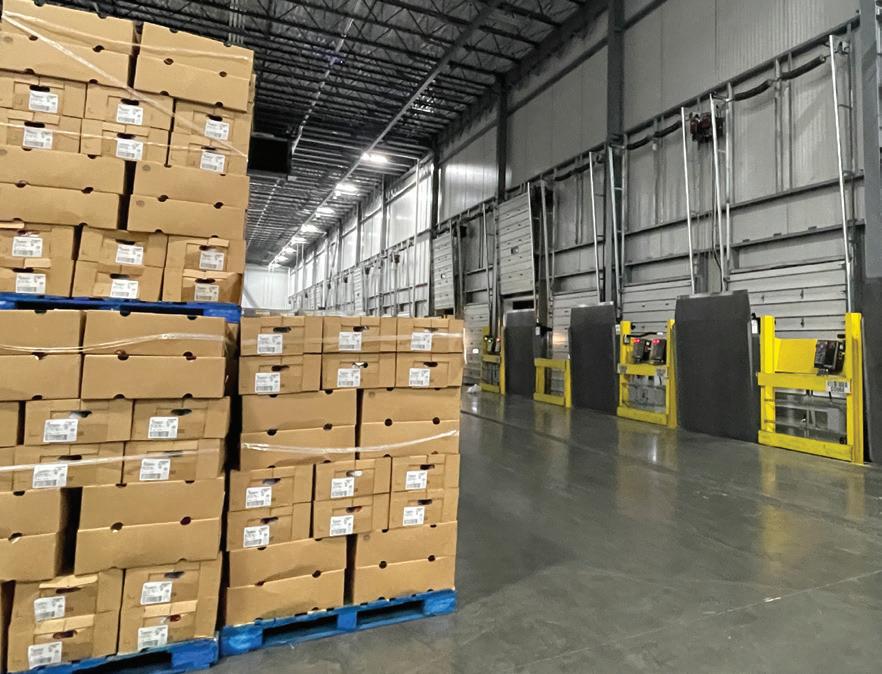
Thanks to InterChange’s blast-freezing capabilities, fresh meat from Valley poultry processing plants can be quickly frozen and stored at a consistent, food-safe temperature, ranging from minus 10 degrees to 34 degrees Fahrenheit in its largest cold storage facility. InterChange has the advantage of a refrigerated loading dock, meaning products remain chilled for picking, sorting and loading or unloading as deliveries make their way on and off refrigerated trucks.
InterChange Group’s director of sales. “It’s that wholistic approach. Our cold storage is designed for finished goods, the actual products you’re going to consume. But all the other components — the packaging material, the corrugated board, the empty bottles, the empty cans — we store all of that stuff so you can make the finished product.
“So, it’s food, beverage and pharmaceutical, but maybe it’s the components that make the product too.”
Alt adds, “We have just about every certification and regulatory piece you need for any customer in the Valley when it comes to food and beverage.”
Familiar product names and grocery store staples fill the shelves inside the facilities. Of those consumer products stored or packed locally by InterChange, many supply the entire nation. To make it happen, customers can take advantage of value-added services.
“It’s amazing how much is in the Valley that fits that food, beverage, pharma category,” says Tim Cognata,
These services encapsulate a wide range of extra packing steps that cater to fulfillment specifics, like grouping variety packs, kitting different products together, packing sets for club stores and more. This ever-changing solution allows customers to continue manufacturing in the most efficient way, while letting InterChange handle the variations.
ENHANCING CAPABILITIES
InterChange Group has more than 400 employees with around-the-clock shifts. Those workers span more than 20 warehouses across seven campus locations. All but one fall within the Valley, with the exception in Portsmouth for international port access. Aligning with that port access is a Front Royal location, a stone’s throw from Virginia’s Inland Port. However, InterChange
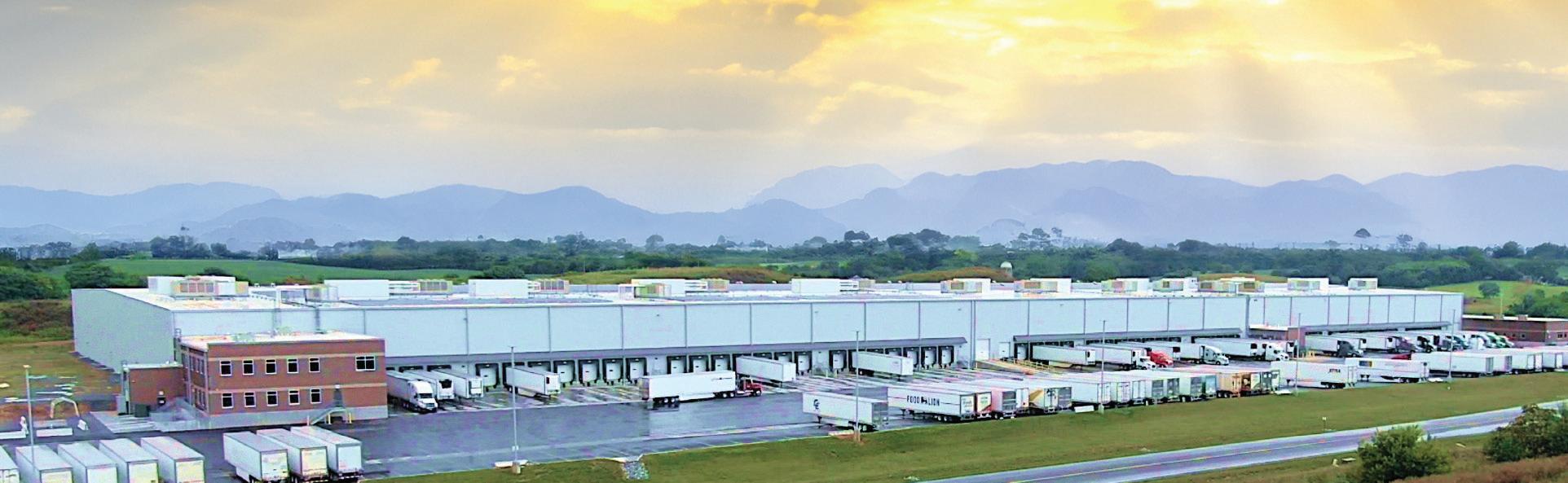
The cold storage facility features a fully refrigerated loading dock.

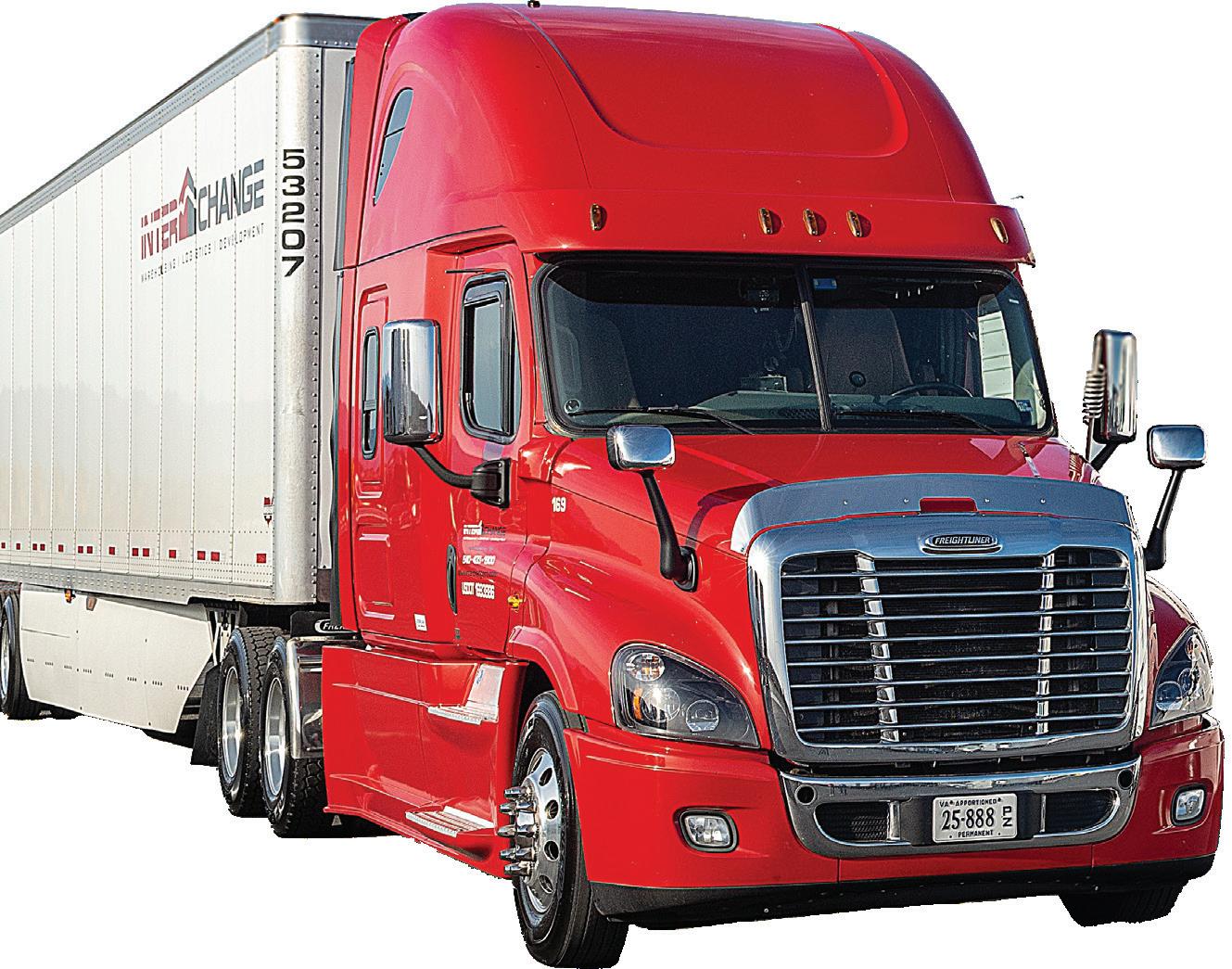
Express, as its trucking operations are known, runs throughout the country.
“Unlike most transportation companies, we own most of our assets,” Cognata says. “The actual cabs, as well as the trailers, which is very unique for our industry.”
Though it boasts hundreds of thousands of square feet in warehouse space, the company does not take room for granted. In fact, advanced technological measures are in place to maximize the capacity. For example, in InterChange’s cold storage warehouse, aisles are narrow and shelves are high, meaning 85-90% of the space is used.
To manage this, InterChange employs automation and robotics to its advantage. The forklifts used in these areas are oriented with the forks extending from the side, rather than the front, so turning clearance to face the
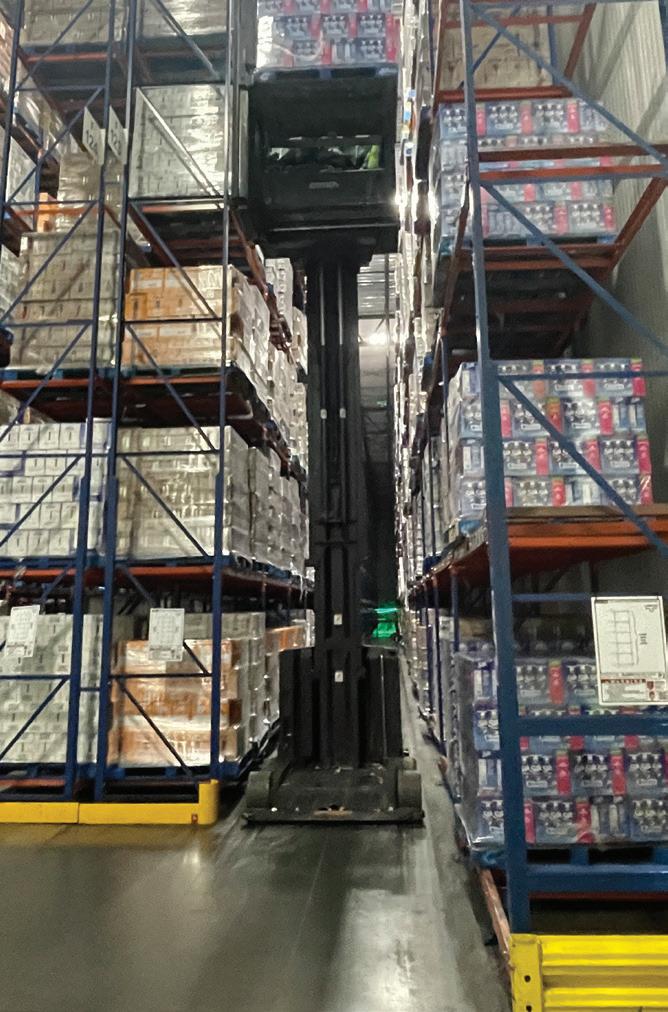
shelves isn’t necessary. Drivers align the forklifts to the guides on the floor that allow for self-driving to the location of the product designated on the forklift’s computer, which eliminates potentially bumping into shelves. The computer knows which section of the shelf’s aisle to stop in and which level to extend to.
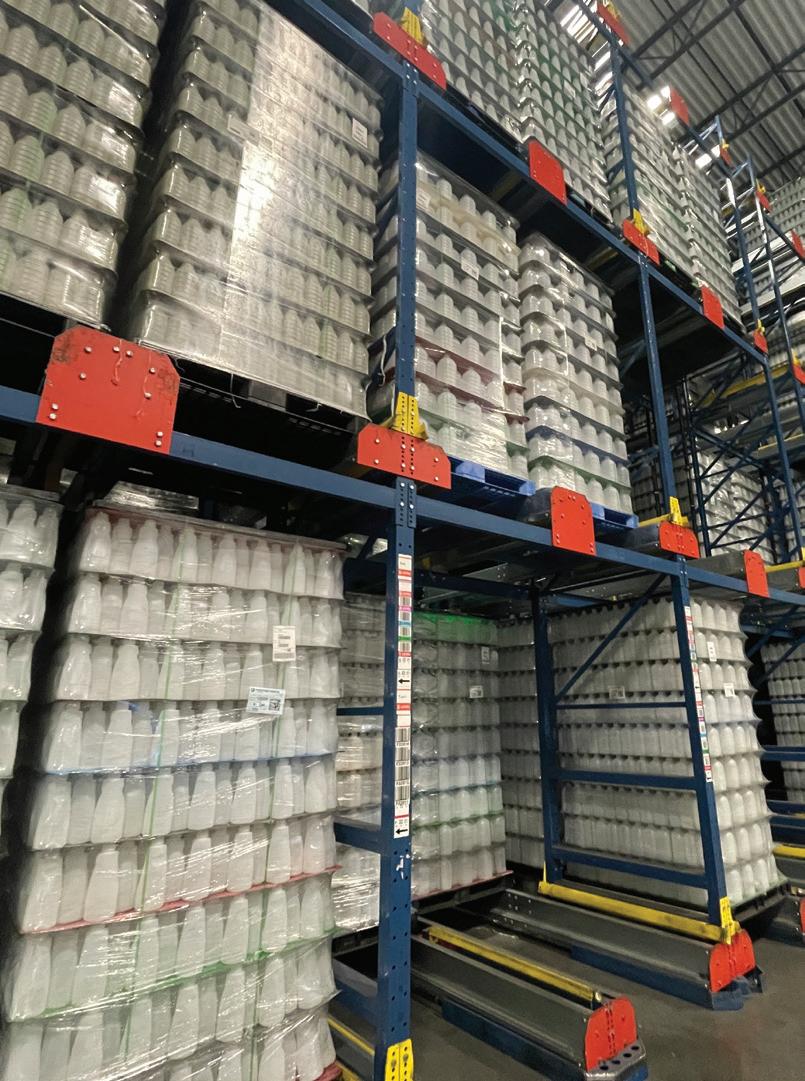
Another warehouse features a pallet mole, a semi-automatic system that shuttles pallet positions, maximizing space by eliminating the need for aisles. This high-density storage system has rails under each level that the “robot” travels on to allow accessible lifting, even from the innermost shelves, to bring pallets to the outer edge for transport. These tightly stacked racks are especially useful when storing large quantities of the same product and allow for much faster inventory shifting as multiple moles can be used simultaneously.
Expanding automation is increasingly necessary as more customers
InterChange cold storage facility in Mt. Crawford.
request loads to be filled by varying cases rather than entire production pallets. Alt says by the end of 2027, the company expects to be individually picking, or selecting from shelves, up to 90,000 cases per day from just one of its cold storage facilities.
“It’s back-breaking work, picking up cases 24/7,” Cognata says. “The volume is so intense that it makes more sense to automate it and let the automation do the work. It’s done more efficiently.”
POWERING WHAT’S NEXT
Even though features like automated systems and temperature-controlled facilities need a lot of electricity to function, InterChange is offsetting use with a vast amount of solar-powered generation. The company has claimed the industry’s largest solar power system in Virginia for several years now. The arrays produce about 40% of the electrical demand at the facilities where they operate. Since they are working at such a large scale, that generation equates to powering more than 800 homes for a full year, each year.
With more industrial land ready to develop, whether sold or leased, InterChange Group shows no signs of slowing down. Rather, they intend to expand beyond state lines due to demand from customers who value the partnership and want to use InterChange in more locations nationwide for their businesses.
Adding to its industry reputation is the strong company culture that InterChange Group prides itself in.
“We, as a company, [thrive] on culture,” Alt says. “Two major aspects of that are adaptability and being innovative.” •
A semi-automated pallet moving system maximizes space by eliminating the need for forklift or personnel access.
Narrow aisles with guides on the floor allow compact forklifts to maneuver with ease.

This is How Power is Restored
by Preston Knight, Communication Manager
It might not be widely known just what power restoration looks like.
While we try to give you a glimpse of it in these pages and on our social media, those snapshots do not capture everything that goes into a broader, coordinated effort. If it takes a village to raise a child, as the saying goes, then it takes a co-op village to raise a downed line.
Here is a more detailed look at the general process our SVEC villagers take to restore service.
OUTAGES REPORTED
Every co-op member can be part of outage restoration. Since electric service is not always guaranteed, we advise members to be prepared for outages at any time. For example, animals contacting SVEC facilities — a virtually unavoidable, unpredictable occurrence — accounted for over 100 outages in October and November last year.
Every member needs to report their outage because they may be the only account that is out of service. As more reports come in, SVEC system operators can better pinpoint the location of an issue for field crews to visit. Assuming a neighbor will report the outage could lead to a longer restoration time if the outage is isolated to just one member.
OPERATORS TAKE CONTROL
Upon receiving outage tickets from member service representatives or through automated means, system operators, who staff an around-the-clock control room, compile information and relay it to crews. By referencing our mapping software in conjunction with information members have provided, we are able to give the crews a location to investigate.
The crews are managed and dispatched based on the size of existing outages and available manpower and equipment.
CREWS SPRING INTO ACTION
Lineworkers mobilizing is not quite like the visual of firefighters who spring from their seats and slide down a station’s pole, if that’s still a thing. Lineworkers could be anywhere when a call comes, including on a separate job site. In major weather events, they are more likely to be ready at their district office, knowing outages could occur.
Preparation can include sharpening tools, testing equipment and checking their inventory, working alongside district material specialists to ensure they are ready when operators come calling.

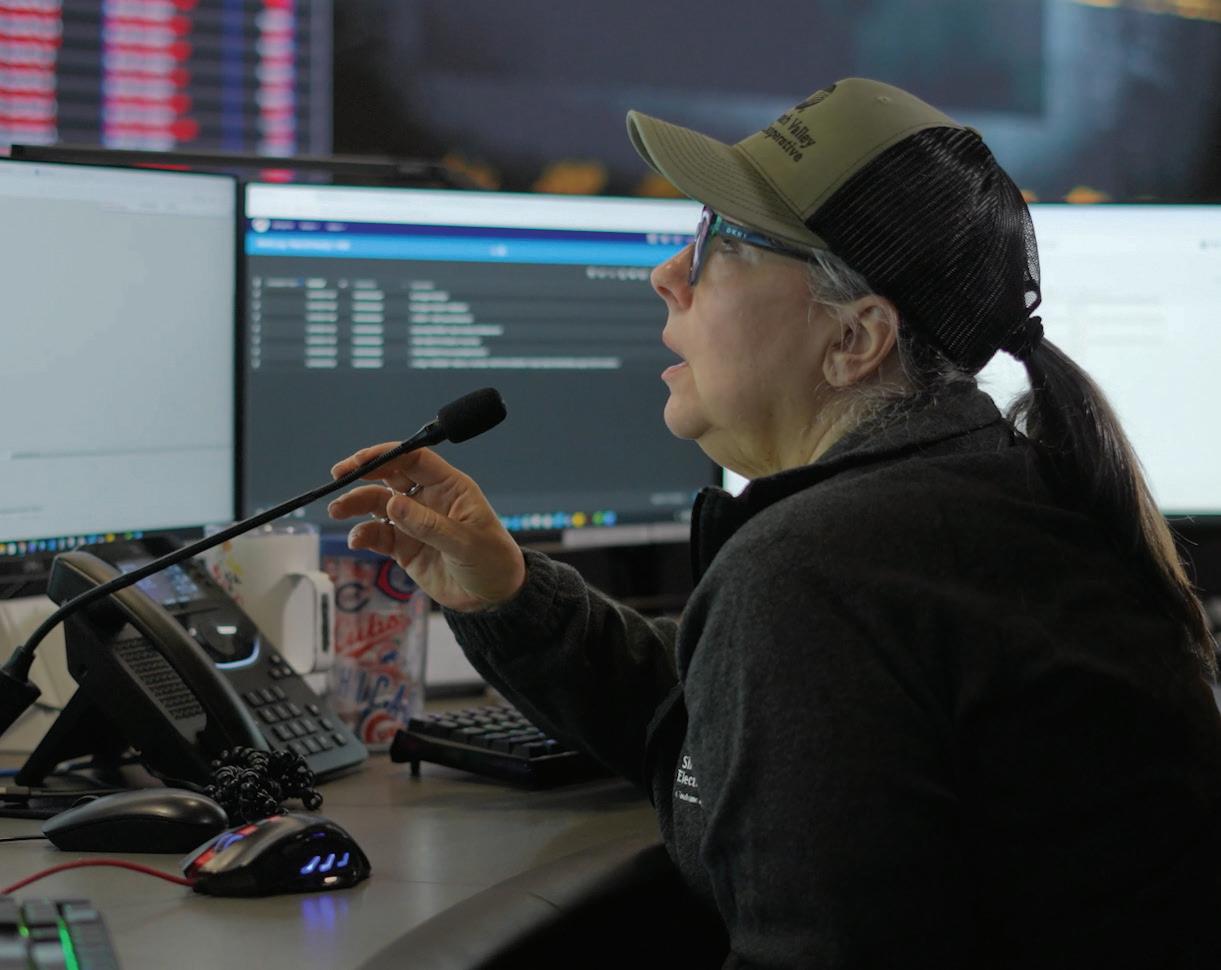
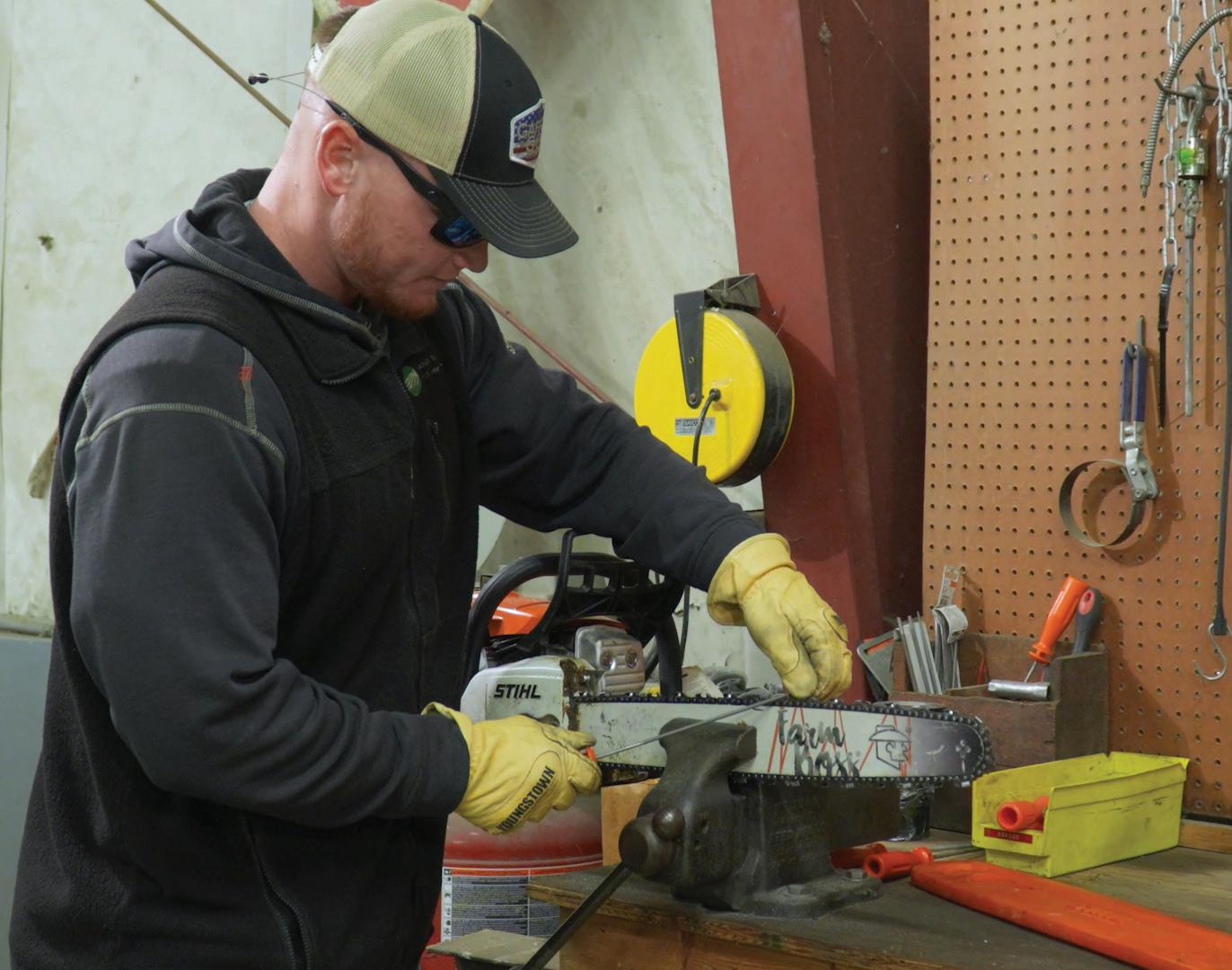
Outages Reported
Operators Take Control
Crews Spring Into Action

TEST, TAG, GROUND
Crews will patrol the area of the reported outage, looking for the source of the problem, be it at a substation or transformer farther down a line. This is where member reports are key to assist in zeroing in on the trouble spot.
Once the location of a problem is identified, crews follow a test, tag and ground protocol. Test the line for voltage. Tag the area where they are working so others know their presence. Ground lines on both sides of their workspace so any electricity that might flow will go to the ground, not to the worker. After these steps are taken, crews know a site is de-energized and safe to work on. When they must work on energized lines, they use additional safety gear.
HUDDLING UP
Before repairs can take place, crews gather at a vehicle to review everything they know about the outage and to assign tasks. This gets them on the same page, identifying and understanding roles for the remainder of the job. In football parlance, this is their huddle before the snap.
These “tailgate” meetings conclude with every participant involved signing off that they know specifically what they are responsible for to get the lights back on.
LET’S GET TO WORK
At this point, the physical act of power restoration begins. This is where a mix of creative troubleshooting and time-tested practices get the lights back on. In play for lineworkers could be removing trees from lines, setting a new pole, running new wire or any number of other duties. Each fix has its own set of procedures to follow, with weather and terrain among the factors that determine the level of difficulty.
What must be done is not fully realized until crews get to a location. Given the unknown, calculating an estimated time for restoration may not always be possible.
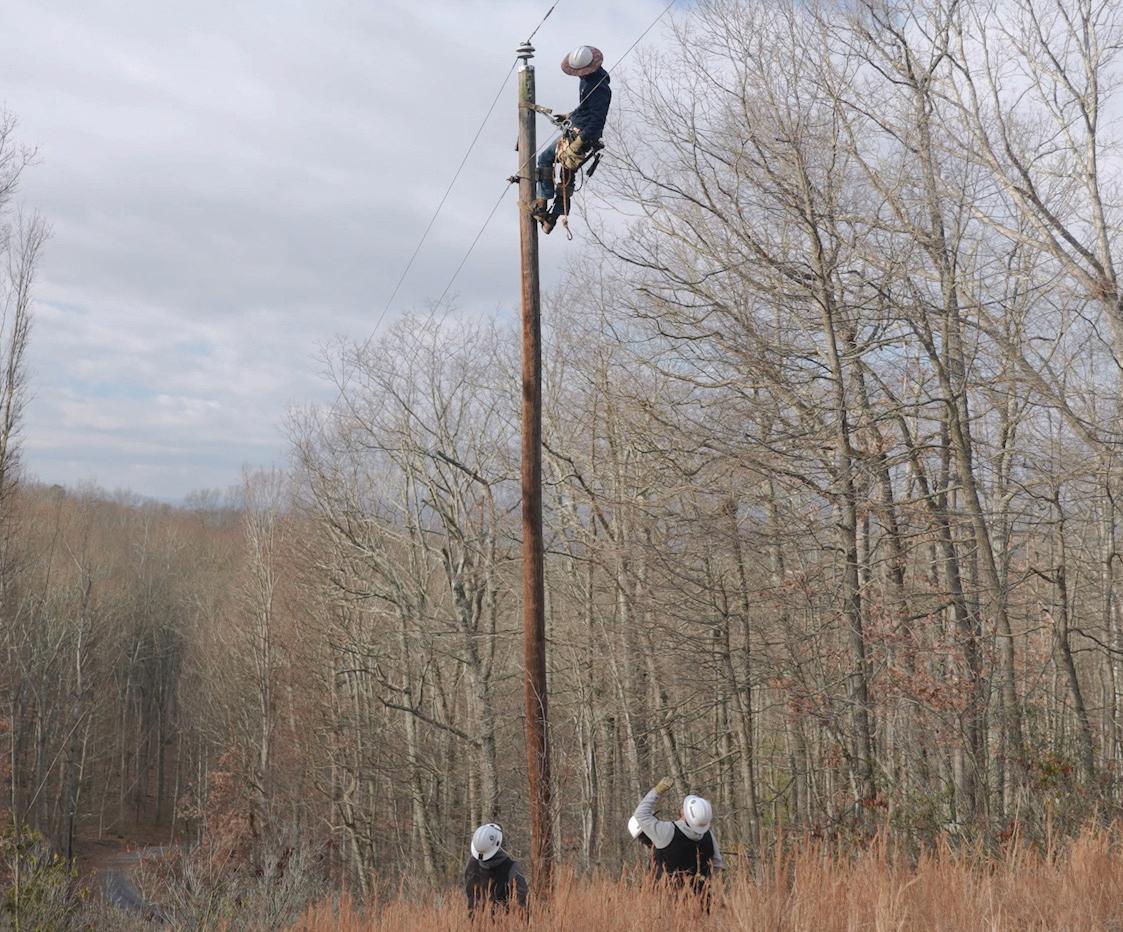
Depending on the access to a site, crews might use bucket trucks or climb poles. For the latter, an assortment of climbing gear must be hauled to the site, which can bring an added toll on an already long, grueling day of restoring service.
ALL CLEAR
In communicating outage restoration to members, we are persistent in noting crews are working as safely and quickly as possible. Power restoration is not a race, and crews are never instructed to compromise safety for the sake of getting electrons flowing again.
Upon completion of their work, crews contact system operators, who document the final information needed to indicate all is clear. With that, power is restored. •
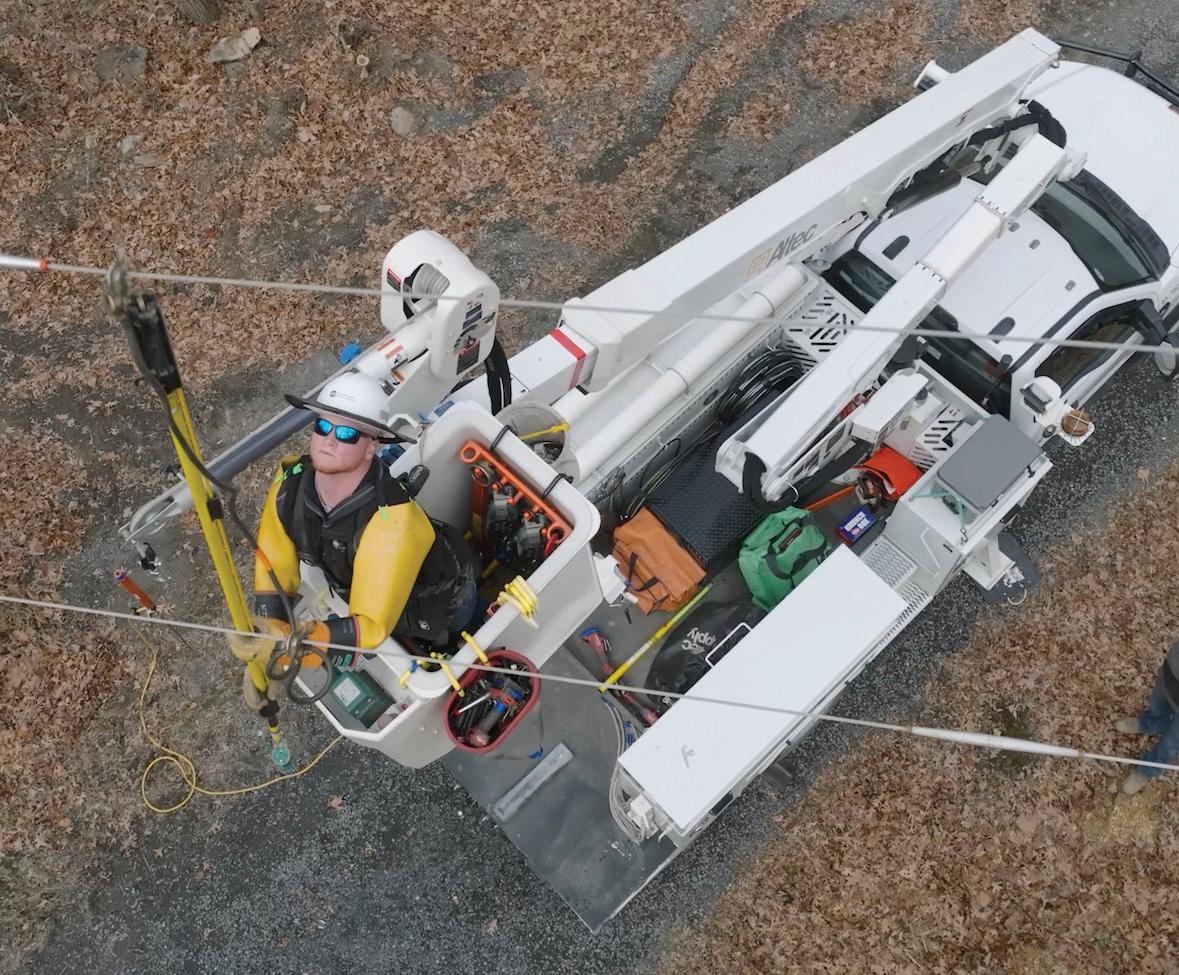
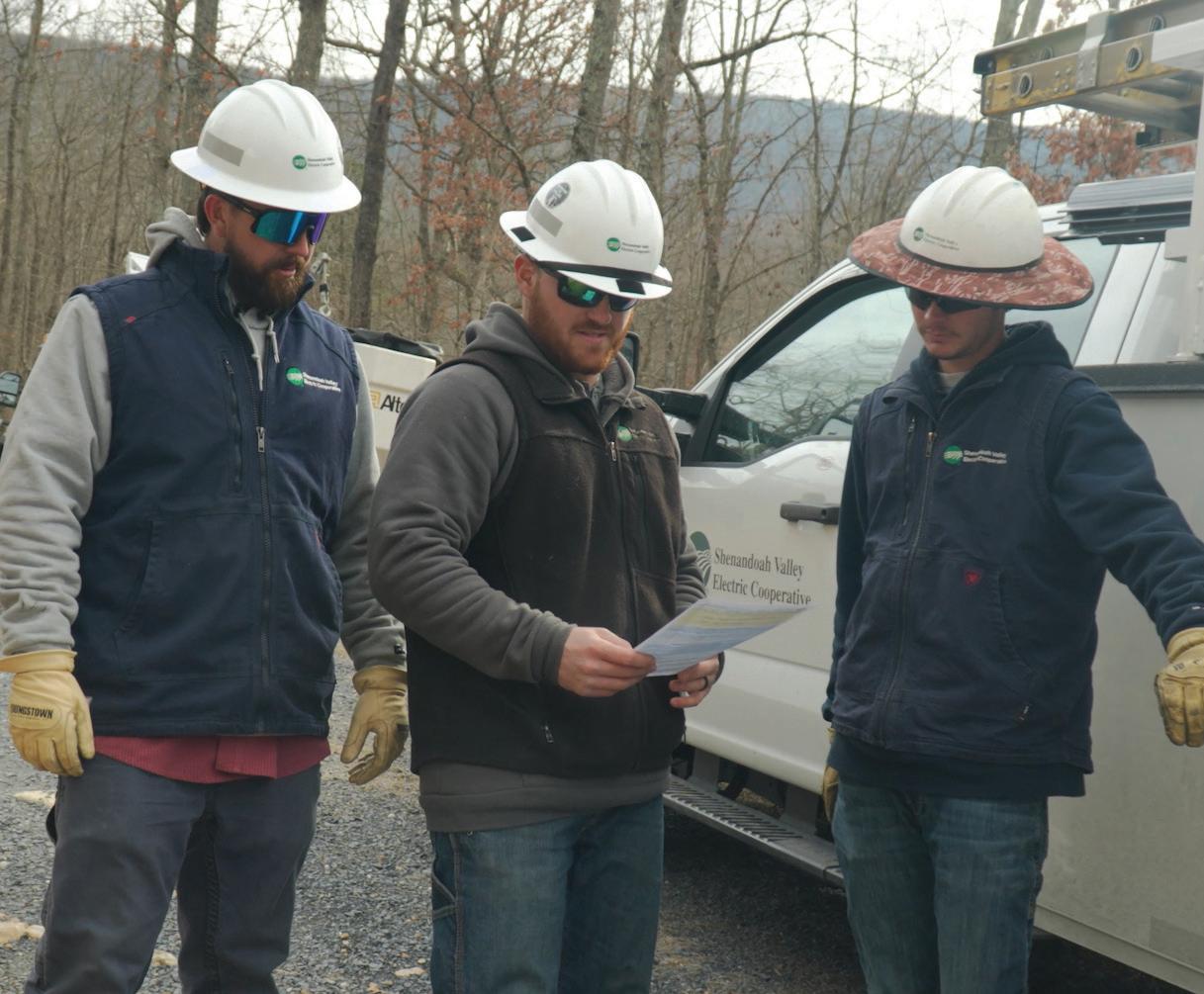
Getting to Work
Huddling Up
Test, Tag, Ground
Petition Deadline Nears for Board Seats
The clock is ticking for anyone interested in running for SVEC’s board of directors in 2026.
The co-op has three seats on the ballot this year, one each from board-designated northern, central and southern regions. That means any member in good standing could run for the nine-person panel. Board members serve three-year terms.
To get on the ballot with incumbent directors who seek reelection, a candidate must submit a petition signed by at least 50 SVEC members by 4 p.m. Wednesday, April 1. A qualifications committee will confirm a petitioner’s eligibility later in April.
To learn more about the election process, visit svec.coop/ election. If you are interested in running for the board, call our dedicated phone line at 540-574-7272.