SVEC Enters Its 90th Year of Providing the ‘Greatest Thing’
The following passages are from the 2006 book “The Light Still Shines: Celebrating 70 Years as Shenandoah Valley Electric Cooperative” by Wayne and Sally Hannah
Aloan was secured from the REA (Rural Electrification Administration) and our Cooperative was on the verge of beginning what would be a new era in the Shenandoah Valley. This was the very first rural electric unit in the nation embracing both lines and a generating plant accepted through the REA loan program.
The beginning of construction on the original lines of the system was just a short time away. The plan was to transmit and distribute energy in Rockingham and Augusta counties over 125 miles of line. The lines would begin at Cootes Store in northwest Rockingham — go south to Singers Glen, then west to Mt. Clinton and Lilly — on to Sangersville and into Mt. Solon and Mt. Zion in Augusta County. However, initially, only 47 miles of lines would be electrified.
Although the REA was of great help to the infant Cooperative, there were times when the two entities bumped
CONTACT US
Mailing Address
180 Oakwood Dr., Rockingham, VA 22801
Phone Web
800-234-7832 • svec.coop Email svecpr@svec.coop
Local Pages Editor
Preston Knight
Local Pages Designer Ashley Kreis
If you would like to unsubscribe from receiving the print edition of Cooperative Living, email svecpr@svec.coop with your home address.
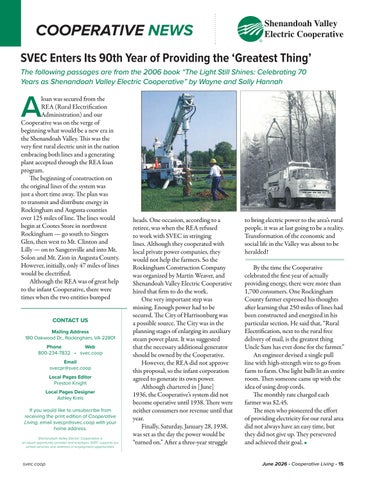
heads. One occasion, according to a retiree, was when the REA refused to work with SVEC in stringing lines. Although they cooperated with local private power companies, they would not help the farmers. So the Rockingham Construction Company was organized by Martin Weaver, and Shenandoah Valley Electric Cooperative hired that firm to do the work.
One very important step was missing. Enough power had to be secured. The City of Harrisonburg was a possible source. The City was in the planning stages of enlarging its auxiliary steam power plant. It was suggested that the necessary additional generator should be owned by the Cooperative.
However, the REA did not approve this proposal, so the infant corporation agreed to generate its own power.
Although chartered in [June] 1936, the Cooperative’s system did not become operative until 1938. There were neither consumers nor revenue until that year.
Finally, Saturday, January 28, 1938, was set as the day the power would be “turned on.” After a three-year struggle
to bring electric power to the area’s rural people, it was at last going to be a reality. Transformation of the economic and social life in the Valley was about to be heralded!
By the time the Cooperative celebrated the first year of actually providing energy, there were more than 1,700 consumers. One Rockingham County farmer expressed his thoughts after learning that 250 miles of lines had been constructed and energized in his particular section. He said that, “Rural Electrification, next to the rural free delivery of mail, is the greatest thing Uncle Sam has ever done for the farmer.”
An engineer devised a single pull line with high-strength wire to go from farm to farm. One light bulb lit an entire room. Then someone came up with the idea of using drop cords.
The monthly rate charged each farmer was $2.45.
The men who pioneered the effort of providing electricity for our rural area did not always have an easy time, but they did not give up. They persevered and achieved their goal. •
Director Elections: Meet the Candidates

Three seats on the SVEC Board of Directors appear on the ballot this year. The following pages introduce you to the seven members running, and we outline the most important considerations for members below.
What to Know
• All co-op members can vote for all races.
• The election opens June 22 and closes Aug. 3.
• Members can vote online (an email will be sent to those with one on file) or by mail with paper ballots arriving around June 22.
• Three jurisdictional seats are on the ballot, covering these areas:
» Northern region: Clarke County, Frederick County, City of Winchester
» Central region: Page County, Shenandoah County, Warren County
» Southern region: Augusta County, Greene County, Highland County, Rockingham County, city of Staunton, any other county bordering Augusta
• Candidates are incumbents seeking reelection or challengers who submitted a required petition with the signature of at least 50 SVEC members.
• Directors serve three-year terms and represent the entire SVEC membership, even if they come from designated jurisdictions.
• Nine co-op members comprise the board.
• Results of the election will be shared during the annual meeting on Thursday, Aug. 6.
• Learn more about the meeting, election process and candidates at svec.coop/ election.
BILL ORNDOFF
Northern Region
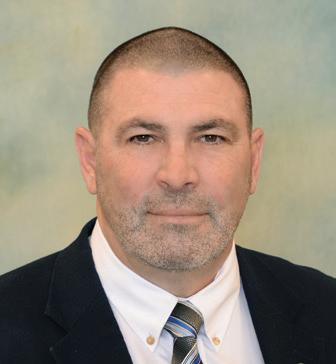
Board member Bill Orndoff seeks a fourth term as director, saying he has grown more comfortable in the role, which he believes leads to more substantive contributions.
“Over the past several years, I’ve gained a deeper understanding of both the cooperative model and the rapidly changing energy industry,” says Orndoff, who was first elected in 2015. “I feel a responsibility to continue using that experience to serve our members well and help guide SVEC with steady, informed leadership.”
Within electric cooperatives, Orndoff is credentialed at the highest board level, Director Gold, through the National Rural Electric Cooperative Association. He says he is most proud of the board’s “thoughtful and disciplined” approach to decision-making.
“It has been important to me to ask good questions, listen carefully and ensure that decisions are made with the membership in mind — not personal interest,” Orndoff says.
A Stephenson resident, he is pastor of Rockland Community Church in Front Royal and is active in the ministry and farming communities. Orndoff holds an associate degree in applied science with a focus on agricultural business management from Laurel Ridge Community College.
“As a pastor and lifelong farmer, I understand the importance of stewardship, accountability and serving others,” he says. “I approach decisions with patience, a commitment to understanding all the facts and a desire to represent the best interests of [SVEC] members as a whole.”
While unopposed, Orndoff is hopeful members will support him by voting for him as a sign that a “balanced perspective,” shaped by leadership and real-world experience, matters to them.
“The energy industry continues to evolve, and it is critical that we remain proactive and responsible in how we respond,” he says. “That includes making wise investments, maintaining strong infrastructure and always keeping the needs of our members at the center of every decision.”

Southern Region
BRENT ARBOGAST
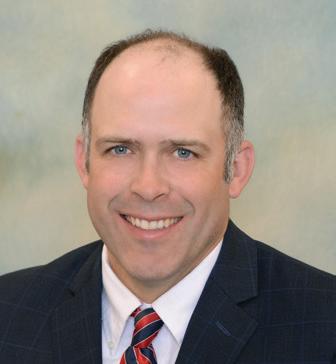

Secretary/Treasurer Brent
Arbogast’s pursuit of a third term is tied to his interest in being part of strategic decisions that ensure affordable and reliable electricity for members.
“My goal for the next term is to continue to help the board run smoothly and help my fellow board members make strategic decisions that benefit our members,” he says. “I also want to continue with my educational classes.”
Arbogast is a self-employed livestock and poultry farmer, farrier and agricultural fence contractor in the Lacey Spring area of Rockingham County. First elected to SVEC’s board in 2018, he has the highest level of training for directors offered by the National Rural Electric Cooperative Association, known as Director Gold.
That achievement, Arbogast says, is part of his ongoing education as a co-op director and is what he is most proud of during his time with the board.
“I am also proud that we continue to make decisions that are best for our members, our employees, our co-op and our community,” he says.
Arbogast is president of the Rockingham Feeder Cattle Association. He graduated from Broadway High School before attending Virginia Tech, where he earned an associate degree in animal science.
Arbogast garnered numerous young farmer awards in the years before he added the title of co-op director to his name. He says his years of bringing “good business sense” to SVEC make him a director worth supporting.
“I also bring the core Christian values to the board that I know our members like and appreciate,” Arbogast says.
KEITH CLARK
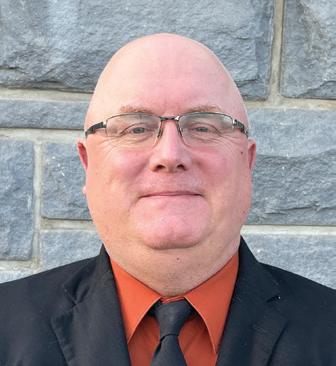
Augusta County resident Keith Clark wants to pull from his experiences serving in the military and working closely on the issue of affordable housing to be a resource for SVEC members as a director.
“I believe in transparent leadership, responsible financial management and thoughtful infrastructure investment to meet future energy needs while protecting cooperative members from unnecessary costs,” he says. “I am committed to listening to members and helping guide the cooperative in a way that benefits our entire community.”
Clark, who lives in Churchville, is a retired U.S. Army veteran, whose duties included time as a military lineman, providing him firsthand experience in electric infrastructure and reliability. A Valley native, he holds a master’s degree in accounting from Liberty University, which, he says, gives him additional relevant background in financial oversight and budgeting.
Clark is a Class A building contractor and president of the Contractor Collective Inc., an Augusta Countybased organization that builds multifamily properties and rehabilitates individual properties for resale. He serves as treasurer on the executive board of the Staunton-Augusta-Waynesboro Habitat for Humanity, supporting affordable housing and community development across the region.
Clark previously served on the Broadway Town Council. A return to an elected office, with the electric cooperative, is now on his mind.
“I am running … to support reliable service, affordable rates and strong member representation. As a retired veteran, former military lineman and small business owner, I understand how critical dependable electricity is to homes, farms and businesses throughout our region,” Clark says. “I am committed to responsible leadership, dependable service and representing the interests of cooperative members.”
Central Region
JERRY DOFFLEMYER
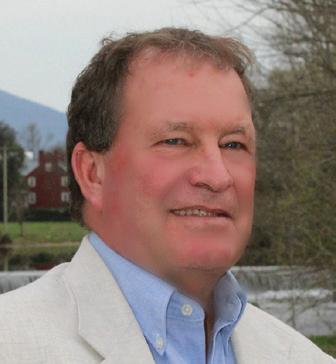
As Board Chair Jerry Dofflemyer sees it, his time spent on SVEC’s board represents an investment, and he wants to continue to provide a return on it for co-op members.
“Serving in several key board positions, [as] finance chairman, secretary, vice chairman and currently chairman, has given me excellent insight into board procedures,” he says. “My hope is to justify the investment the co-op has made in me, and it’s my desire to use the leadership skills I have developed to continue to help make SVEC a strong, well-managed co-op.”
Dofflemyer, who is a lifelong Valley resident and JMU graduate, seeks a third term on SVEC’s board, having served since 2019. He has achieved the highest level of training for directors offered by the National Rural Electric Cooperative Association, known as Director Gold.
In his time on the SVEC board, Dofflemyer is most proud of the cooperative’s response to the 2020 pandemic.
“Our dedicated staff and employees were tasked with not only performing their regular jobs but asked to learn new skills and help fill in for vacancies from others suffering from the pandemic,” he says. “They never wavered or faltered and continued to provide the crucial electrical services our members expected and needed, while dealing with childcare issues, fractured schedules and the emotional loss of loved ones and friends.”
Dofflemyer is a current member of the Luray Town Council, where he previously served as mayor, and is past president of the Luray-Page Chamber of Commerce. Among other community affiliations are the Cub Scouts/Boy Scouts, the Luray Caverns Shrine Club and a charter member of the Hawksbill Greenway Foundation.
Dofflemyer is a small business operator and former ranger for Shenandoah National Park. This “broad spectrum” of experience, he says, has made him a good fit for the board and members.
“The current board has a very good mix of directors with different vocations from many walks of life,” Dofflemyer says. “My goal is to always keep in mind the mission statement of our co-op, ‘We Exist to Serve Our Members.’”
DAVID FERGUSON
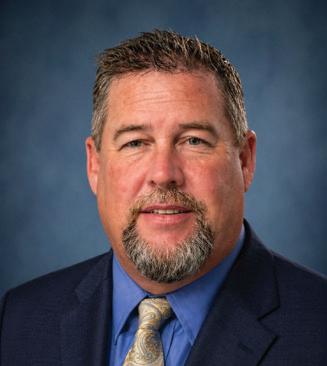
David “Davy” Ferguson cites his background in public safety as a key reason he is seeking a seat on the SVEC board.
“My approach to service has been shaped by a lifelong foundation of faith and a commitment to caring for others,” he says. “That principle has guided me from an early age, beginning when I joined the Edinburg Volunteer Fire Department at 14, and continuing through my career and community involvement.”
A lifelong Shenandoah County resident, Ferguson is a grants program analyst with the Federal Emergency Management Agency. Before FEMA, Ferguson worked for 25 years for the Shenandoah County Department of Fire and Rescue, including leadership roles of fire marshal and deputy emergency management coordinator. Those years led him to work closely with SVEC, which he views as important experience to joining the co-op board.
“I believe in the cooperative model and the responsibility of serving the community through thoughtful, accountable leadership,” Ferguson says. “Throughout my career, I have worked within structured organizations that require clear roles, accountability and strong decision-making. … This experience closely aligns with how SVEC operates.”
Ferguson holds an associate degree in emergency services from Laurel Ridge Community College. He has served on several community and professional boards, including the American Red Cross, the Virginia International Association of Arson Investigators — where he served as president — and the Woodstock Rotary Club.
Ferguson and his wife live on a 20-acre Edinburg farm known as Lost Bottoms, where they focus on community connection, such as annually offering a free sunflower field experience. He sees the same potential for relationships with co-op members as one of their directors.
“As a member-owned organization, SVEC plays a critical role in the daily lives of its members, and I see this as an opportunity to continue serving the community I have called home my entire life,” Ferguson says. “I am committed to making decisions that support reliable service, responsible growth and a strong future for SVEC and its members.”
Central Region con’t
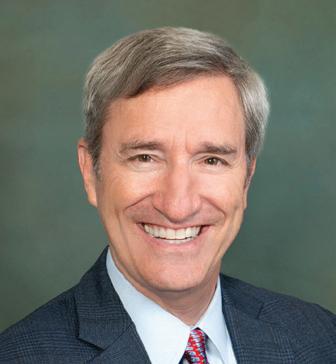
Retired U.S. Navy Capt. Marvin Heinze, of Page County, seeks a seat on the board that builds on his experience and education in business leadership, mechanical engineering and the law.
“I am committed to service, be it my nation, my faith or my community,” he says. “I have served my country as a successful Naval officer and senior civil servant and am proud of my service. I am now focusing locally to help my community. I am particularly proud of the opportunities I’ve had to mentor young men and women to become strong, reliable and faithful citizens.”
Heinze graduated from the University of Virginia and spent 28 years in the Navy as a special operations officer specializing in explosive ordnance disposal. After his service, he was a senior federal civilian with the Navy’s Mine Warfare Task Force, focusing on protecting U.S. ports and harbors from underwater explosives. Heinze continues his support for the military as the vice chairman of the Military Officers Association of America, a 350,000-member organization.
He has served as a local elected official in California, where he and his wife maintain a house, and, more recently, has become more involved with his community in the town of Shenandoah in Page County. Heinze has been a speaker at the town’s Memorial Day ceremony and is active with Town Council meetings and the Town of Shenandoah Museum and Welcome Center.
All of this, he says, leads to a natural progression to serving SVEC and its members.
“Having served on both local and national boards of directors, I have the experience and education to provide direction for our electric cooperative,” Heinze says. “Our electricity costs keep rising. The electric cooperative must serve its membership by providing reliable energy at the lowest possible cost. I also want our cooperative to engage our membership for their feedback and ideas and to provide the best customer service in the state.
“As a member-owned company, we must always focus on improving our members’ lives.”
WES SHIFFLETT
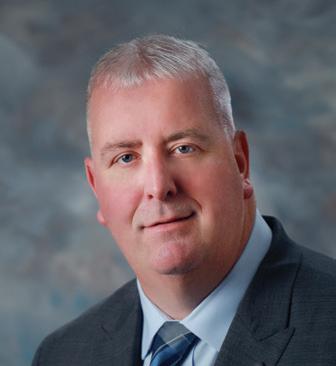
Wes Shifflett has long served the area as a first responder, giving him confidence that he can be effective as a director for SVEC.
“My goal is to learn the operations, policies and responsibilities of the cooperative while keeping member needs at the center of every decision,” he says. “My background in emergency services taught me the value of teamwork, communication and putting the community first. That experience has taught me how to listen, collaborate and make decisions with others in mind, which I believe makes me a strong fit for the board.”
A lifelong Valley resident and Page County High School graduate, Shifflett worked for more than 26 years as a firefighter/paramedic for the Rockingham County Department of Fire & Rescue. He retired from there in 2023 and now is a fire investigator for a large insurance company, while also maintaining a family beef cattle farm with his wife in the Grove Hill area of Page County.
Shifflett is a volunteer with the McGaheysville Volunteer Fire Co. in Rockingham County and is one of only 2,400 people worldwide holding a Certified Fire Investigator designation through the International Association of Fire Investigators. He graduated from Eastern Kentucky University with a bachelor’s degree in fire, arson and explosives investigation. Shifflett also holds associate degrees in fire science technology and emergency services technology.
Shifflett is a member of Farm Credit of the Virginias, Shenandoah Moose Lodge 2176 and Rockingham Petroleum Cooperative. Serving on the electric co-op board will allow him to continue giving back to his community, he says.
“I am particularly interested in ensuring member voices are heard and that decisions are made with both current and future needs in mind,” Shifflett says. “I’m most proud of serving my community and helping others through some of the hardest moments of their lives and doing my best to make a difference when it mattered most.”
MARVIN HEINZE
Guiding Lights
Two co-op employees spend time on hallowed grounds, educating the public
by Preston Knight, Communication Manager
Jasan Hileman won his battle. For five months, he spent almost every night immersed in all things Civil War and the Battle of Gettysburg, preparing for a rarely administered, six-hour test — half fillin-the-blank, half a set of eight one-page essays — for consideration as a licensed guide at the historic Pennsylvania site.
Finishing 24th out of 155 test takers, Hileman advanced to additional evaluation, including a multi-day assessment and an oral exam with senior leaders, which included a dry run of the real two-hour tour a guide would provide, if hired. Hileman’s practice version ran six minutes too long, but identifying areas to tighten his presentation ultimately helped him secure one of 13 spots in his class to join an exclusive club.
“More people have been launched into outer space than have been guides at Gettysburg,” he says.
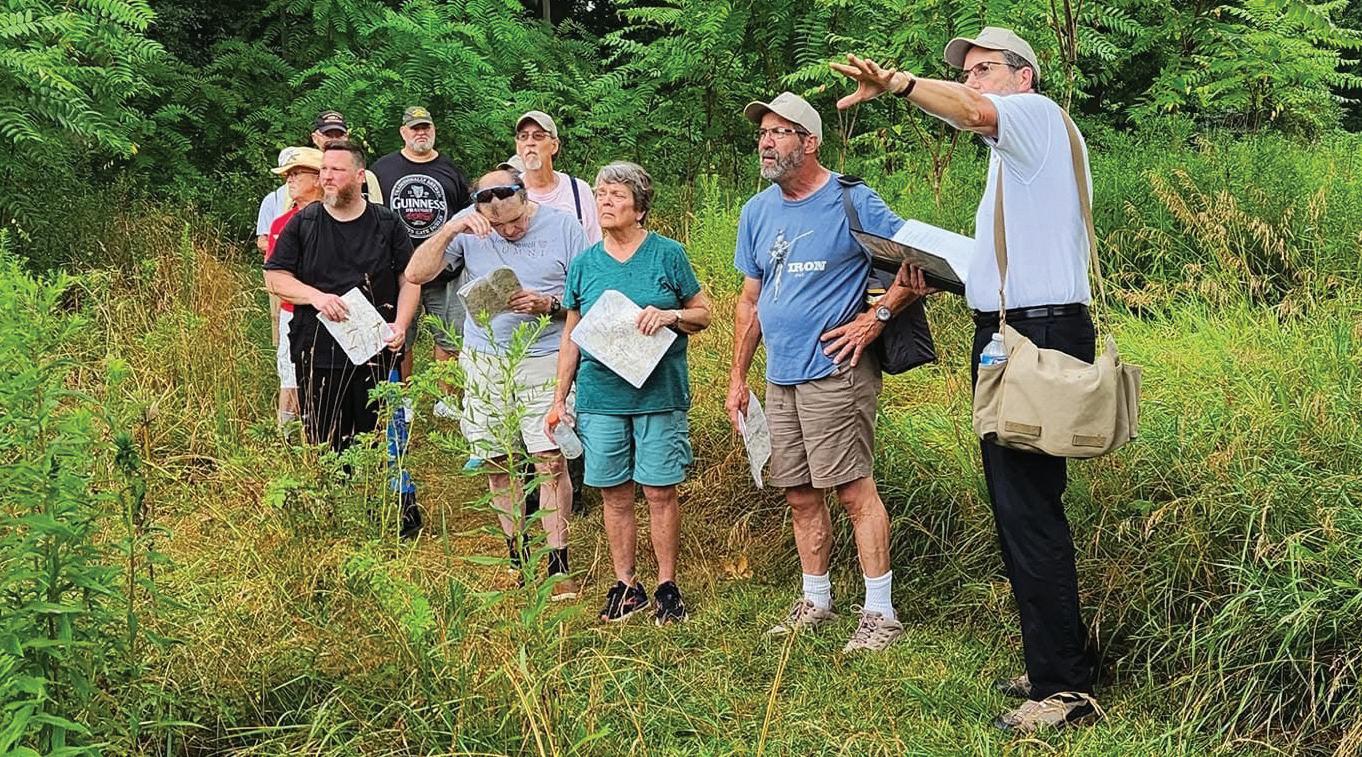
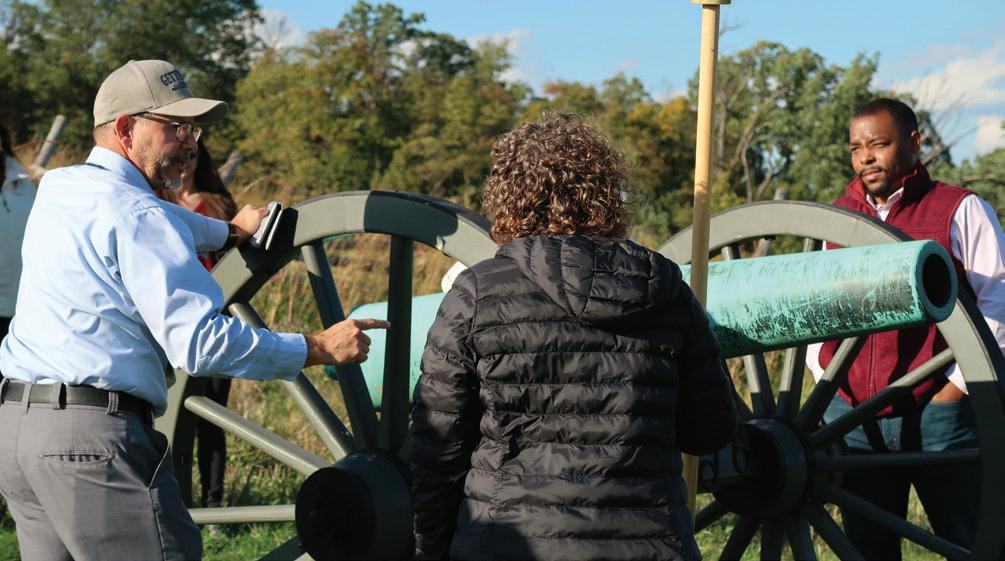
Perhaps even more unusual, Hileman, a field engineering representative, is one of two SVEC employees in the Winchester office who spend their time informing visitors on a popular battlefield. Economic Development Manager Lucas Cade is a guide at Antietam National Battlefield in Maryland.
“For a company to have a guide at two places,” Hileman says, “the chances of that are just off the charts.”
LIFETIME ACHIEVEMENTS
Within the guiding world, entry into becoming one at Gettysburg National Military Park has become an exercise in determination and intellect. Cade says it hasn’t always been as rigorous as it seems today, though it’s never been easy. He recalls passing the test twice — in the 1990s and then again in the 2000s — but not going further in the process because of family commitments.
“Part of the difficulty now is they’ve wanted to weed people like me out who took the test and couldn’t follow through with it,” Cade says. “It has become very competitive, requiring knowledge of every last detail of the Gettysburg battle, or the applicant will likely not progress to the end.
pursue the guide license.
The test is only occasionally offered, Hileman says. He took it in 2015 — the 100th anniversary of federally licensed guides at Gettysburg — and for the 2024 CBS piece, it had been seven years since one was offered, he says.
This largely speaks to the staying power of the licensed guides. Once you pass all the steps, you are a guide for life, Hileman says. The roster presently sits at about 130 guides.

“The first time I took it, I was thinking about how many blanks I left on the sheet. Some of it I aced. Some of it I had no clue. Despite my misgivings, I made a high enough score to advance to the second level. It was a difficult test.”
The exam was featured in a CBS News segment, which Hileman was in the background briefly, in late 2024. The basis of the piece is the great lengths people go to
The knowledge barriers to guiding at Gettysburg make sense, given historical context. In 1915, the Gettysburg National Park Commission, under the guidance of the U.S. War Department, created a licensing procedure after an uptick in unqualified people leading visitors.
“The veterans took that as an insult, as well they should,” Hileman says of people without the right facts leading tours. “To them, they wanted their story and what they did there to be told correctly. … Why they made it so difficult is to honor their memory.
“And it works. That’s why it’s nationally recognized.”
At Antietam, Cade and close to 30 other guides there are certified by the National Park Service to perform their duties, as opposed to the federal
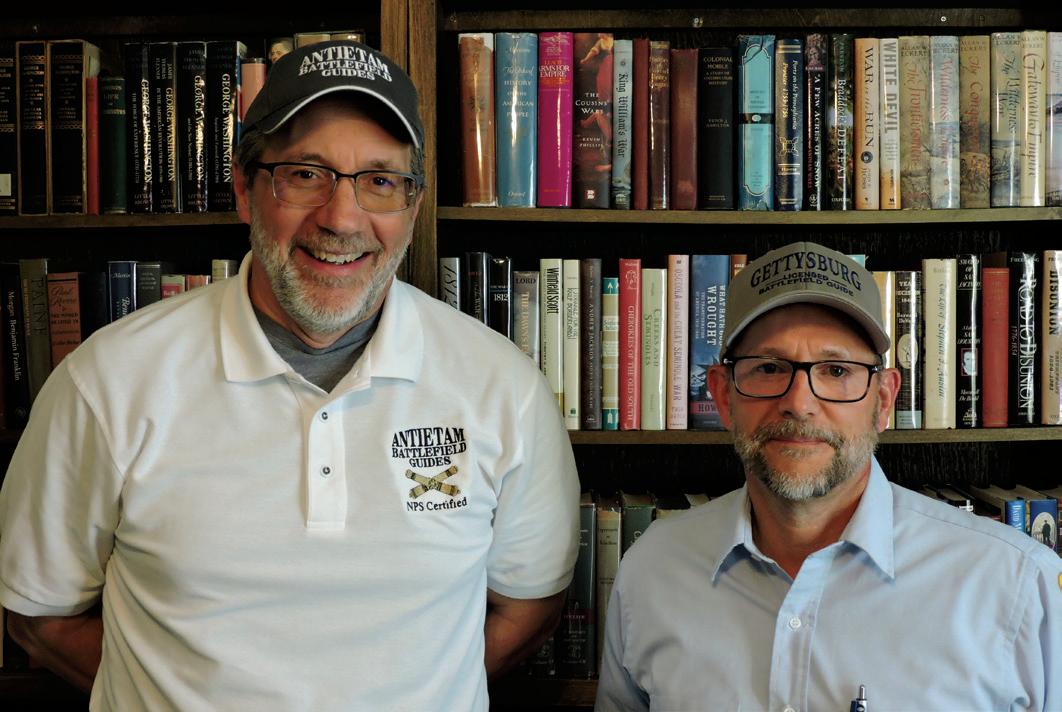
Outside their day jobs, SVEC employees Lucas Cade (left) and Jasan Hileman are battlefield tour guides.
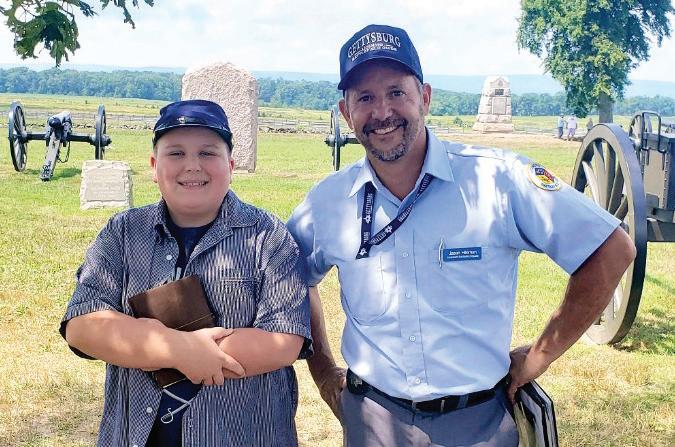
Hileman with a young visitor to Gettysburg National Military Park. “That is the reason I guide,” he says.
licensing process at Gettysburg. The literal walk in the park is still not one, figuratively.
To be certified, Cade passed a fourand-a-half-hour, 200-question test in 2020. He had to score 90 or above to advance to oral training.
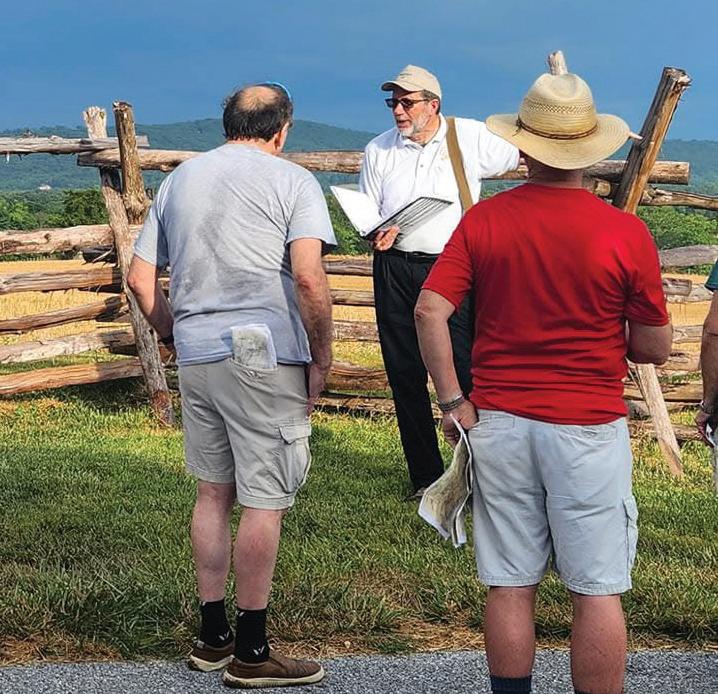
“Once I’m in, I’m in,” he says of not needing to be re-certified. “One of the better aspects about guiding is that I don’t have to coax people to be engaged. When somebody pays for a tour, they have a definite interest in the particular thing that’s most important to them. … You can tailor the tour as you go.”
The hundreds of tours Cade and Hileman have provided seem to be just the start of many more to come.
“There is nothing better that can ground a visitor. It’s an immense story. It’s an immense place. It can be tough to understand,” says Hileman, who receives $72 for a typical two-hour driving tour at Gettysburg. “A two-hour tour just launches you into your knowledge base.”
‘HAM SANDWICH’
Cade enjoyed history from an early age, growing up in Georgia. He has a degree in history and education. Cade and battlefield guiding always seemed to be on a collision course.
“I’ve always loved American history,” he says. “Just a few years ago, I started thinking, now that the children are gone, I’d kind of like to give back and see what I could do. It was not an easy undertaking, even for somebody who’s
read for a long time and immersed himself in it.
“But I do it because Antietam is a cornerstone event, not just in the Civil War, but in our American history.”
The one day of fighting at Antietam led to more than 23,000 casualties, the single worst day of battle losses in U.S. history.
Meanwhile, Hileman, whose background is in electrical engineering, arrived as a history buff thanks to a brother 12 years his senior. When his brother was once working on a history project, Hileman took interest in a Civil War book, and the rest is, literally, history.
That brother passed the Gettysburg test and is waiting for his oral exam. He surely has turned to his youngest sibling for guidance, and Hileman is well documented in giving it. He has recorded several interviews over the years with a history podcast, “Addressing Gettysburg,” including one in October 2024 on advice he would give to those taking the licensed guide exam and then those fortunate enough to pass.
In the latest interview, he mentions a tutor who emphasizes approaching tours as building a basic ham sandwich — no condiments, no extras, just the meat.
“This is what you’re creating with your tour, a ham sandwich,” Hileman says on the podcast. “It’s not about you showing the guest your knowledge.”
As licensed and certified guides, Hileman and Cade are charged with making sense of everything. The experience of visiting the hallowed grounds of Gettysburg and Antietam is best with people like them leading the way.
“The guide component allows us to present the history in a way that synthesizes everything into an impactful message and not just talk about tactics, the battle and the fighting,” Cade says. “We can describe the strategy behind it, why it was important, and even give compelling human-interest stories. We put it all together in a meaningful flow because it can be extraordinarily overwhelming.”
Hileman says: “It’s about the power of the place. The American Civil War is an American tragedy. … What people endured and went through and why, and being the person who can convey that, that’s what’s meaningful. That’s what keeps you coming back.” •
Of the countless facts Hileman shares on a Gettysburg tour, an ironic one is often among his favorites.
“Yes, the southern army came from the north, and the northern army came from the south at Gettysburg,” he says. “It makes perfect sense, doesn’t it?”

The 163rd Gettysburg Civil War Battle Reenactment will be held July 3-5. Guided tours are offered throughout the year. Learn more about battlefield guides at gettysburgtourguides.org and antietamguides.com.
Cade has six years of guiding experience at Antietam National Battlefield.
Cade has always loved American history, he says, and views Antietam as a “cornerstone event.”
Hileman passed a rarely administered, six-hour test to become a licensed Gettsyburg guide in 2015.

Join Beat the Peak This Summer
Beat the Peak is a simple, voluntary progam that helps keep electricity costs down for all co-op members.
Sign up for free.
Shift your use.
Save together.
We’ll send alerts when a peak will occur.
Adjust thermostat, delay use of big appliances, etc.
Lower wholesale power costs.
What is a peak?
Peaks happen when lots of members use more power at once, usually on the hottest and coldest days. In the summer months, peaks occur from 4-8 p.m.
Why does it matter?
Small shifts in your routine during peak hours help the co-op avoid costly energy spikes. This helps keep wholesale power costs lower.