COOPERATIVE NEWS Petitions Available for Director Seats by Preston Knight, Communication Manager
I
f you enjoyed a few weeks of reading your favorite news source and not seeing the word “election” splashed everywhere, sorry to disappoint. This is somewhat of an election story. But as a not-for-profit electric cooperative, SVEC must spread word about how we’re built differently than other utility types, and that includes, if not is highlighted by, our governance. A member-elected board of directors oversees the policies and financial status of the organization; the co-op does not have investors. To elect SVEC members to the board, a slate of member candidates must be selected. Incumbent directors, if they are interested in another threeyear term, appear on the ballot alongside any qualifying member who fills out a petition. In 2026, board seats from all three co-op regions are up for reelection, which means any member can seek candidacy. Members have until 4 p.m. Wednesday, April 1, to confirm their interest via a petition signed by at least 50 other SVEC account holders. CONTACT US Mailing Address 180 Oakwood Dr., Rockingham, VA 22801 Phone Web 800-234-7832 • svec.coop Email svecpr@svec.coop Local Pages Editor Preston Knight Local Pages Designer Ashley Kreis If you would like to unsubscribe from receiving the print edition of Cooperative Living, email svecpr@svec.coop with your home address. Shenandoah Valley Electric Cooperative is an equal opportunity provider and employer. SVEC supports our armed services and veterans in employment opportunities.
svec.coop
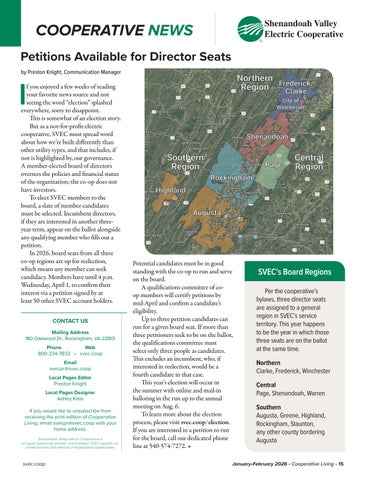
Northern Region Frederick/ Clarke City of Winchester
Shenandoah
Southern Region
Page
Central Region
Rockingham Highland Augusta
Potential candidates must be in good standing with the co-op to run and serve on the board. A qualifications committee of coop members will certify petitions by mid-April and confirm a candidate’s eligibility. Up to three petition candidates can run for a given board seat. If more than three petitioners seek to be on the ballot, the qualifications committee must select only three people as candidates. This excludes an incumbent, who, if interested in reelection, would be a fourth candidate in that case. This year’s election will occur in the summer with online and mail-in balloting in the run up to the annual meeting on Aug. 6. To learn more about the election process, please visit svec.coop/election. If you are interested in a petition to run for the board, call our dedicated phone line at 540-574-7272. •
SVEC’s Board Regions Per the cooperative’s bylaws, three director seats are assigned to a general region in SVEC’s service territory. This year happens to be the year in which those three seats are on the ballot at the same time. Northern Clarke, Frederick, Winchester Central Page, Shenandoah, Warren Southern Augusta, Greene, Highland, Rockingham, Staunton, any other county bordering Augusta
January-February 2026 • Cooperative Living • 15
Co-op Grants Provide ‘Lifeline,’ Bring Joy by Preston Knight, Communication Manager
I
n October, SVEC’s Operation Round Up Committee awarded $30,000 to area organizations, capping a year in which nearly $90,000 was distributed around the Valley. Through the charitable contributions of co-op members, who voluntarily round up their monthly bills, and a corporate contribution, Operation Round Up makes a significant mark in communities the coop serves. Applications for the first round of grants for 2026 are due Feb. 2. To learn more about how you can be part of Operation Round Up, visit svec.coop/ ORU.
• Shenandoah Volunteer Fire Co.: to
update the department’s four gas meters. New gas meters will ensure firefighter safety and detect lethal and explosive levels of gases.
ROCKINGHAM • Open Doors: to help sustain daily
operations, staffing and essential services that support guests on their path toward stability at its year-round, low-barrier emergency shelter.
SHENANDOAH • Shenandoah County SEARCH: to
pave the backyard walking path, two uneven ground areas and the gravel van parking area, which will improve safety, accessibility and mobility for residents. • Shen-Paco Industries: to provide a variety of art supplies and other creative materials for adults with intellectual and developmental disabilities, as well as fund field trips and participation in other community events. “[T]he program strengthens self-esteem and pride,” Outreach Coordinator Ingrid Thompson wrote in her application. “This grant will ensure access to programs that bring joy, growth and meaningful engagement to the adults we serve, while promoting awareness of their abilities within the community.”
AUGUSTA/HIGHLAND • Elegius Mini Equine Sanctuary: to
create an owner support fund that would assist owners with short-term care needs of their equines who are on the group’s waitlist and otherwise might be sent off to auction and slaughter. “We know that in the scope of the needs of the world, a home for such animals, or support for them in their current situations, is not a huge priority, but to the owners of these animals, the lifeline for them is a great source of hope and relief,” Elegius CEO Koressa Malcolm wrote in her application. • Valley Career and Technical Center: to purchase a wool shredder and a wool pellet machine, which will demonstrate to students how to add value to wool product and help farmers improve their environmental stewardship.
Equipment & Endowment: to meet the high demand for bathroom safety items, particularly tub benches, that far exceeds available supply. The bathroom remains the leading location for falls, yet essential safety bathroom equipment is not covered by insurance. • Highland Food Pantry: for its Eggcellent Protein program, which purchases eggs to provide clients with a high protein source. • Shenandoah Scholars Latino Initiative: to support its scholars in Winchester in 2026 through various continued growth activities such as new academic challenges and leadership responsibilities, evaluating careers and majors, applying for college admittance and seeking financial aid. “SLI helps students and their families with the entire college application process, applying for FAFSA and mentorships once they’re in college. It was so heartwarming to hear real testimonies and how it will impact their cause,” says Berkley Wentz, an SVEC employee who presented a check on behalf of the Operation Round Up Committee. •
WINCHESTER/FREDERICK/ CLARKE • Access Independence: to
PAGE • Blue Ridge Youth Theater: toward
its Christmas production, to include expenses related to royalties, costumes and advertising. • Hawksbill Greenway Foundation: to support the greenway’s extension and historic park final design for construction blueprints and permit costs.
16 • Cooperative Living • January-February 2026
purchase durable medical equipment and assistive devices for its consumers and build ramps. • Adult Care Center of Northern Shenandoah Valley: to cover an emergency need for relocation funds for its space to offer a day program for adults who are coping with physical or cognitive challenges caused by Alzheimer’s disease. • FREE Foundation for Rehabilitation
SVEC’s Berkley Wentz presents a check to Christopher Clymer Kurtz of Scholars Latino Initiative in Rockingham County. Shenandoah Valley Electric Cooperative
Here’s how a high school senior can earn $2,000
H
by Preston Knight, Communication Manager
igh school seniors can now apply for one of 10 scholarships SVEC offers. Those who read this article can get an inside track. Co-op members who comprise the panel that review applications were asked to offer advice for students. One consistent message was the importance of applicants to portray their true selves, especially in the 500-word essay that constitutes part of the initial review of documents. “One common mistake is submitting generic applications that don’t reflect who you are or why you’re passionate about your goals,” committee member Brian Walsh says. “I encourage students to take the time to personalize their essays. Tell us your story, your challenges and what drives you.” It’s important to note this isn’t an essay contest, though the write-up is heavily influential, adds committee member Suzanne Grant. “When reviewing scholarship applications, I am looking closely at the entire package, transcripts, essays and references,” she says. “However, a heartfelt and thoughtful essay allows the committee to get a sense of the applicant’s motivation, drive and prior experiences. “I like to read about what has inspired the student to select a particular path and what they’ve done to prepare for their secondary education beyond the classroom, such as volunteering or work.” Selecting references who can represent students “holistically” in letters of recommendation is another important factor, Grant says. She encourages applicants to suggest elements they feel are important for their references to include in the letters. For Walsh, one of those elements is community engagement. “I’m always drawn to applicants who demonstrate a genuine commitment to their community,” he says. “Whether it’s through volunteer work, leadership in school or local organizations, or a clear vision for how they want to make a difference, that sense of purpose really stands out. Academic achievement is important, but character and community involvement often speak louder.” Grant draws from personal experience for one more piece of advice. Her son once saw a scholarship for a study abroad program and indicated he wasn’t going to apply because he felt he didn’t stand up to others, she says. His parents encouraged him to apply to show the scholarship committee who he was, what inspired him, his interests and his challenges. He earned the scholarship, Grant says, and it changed the trajectory of his life. “I hope that more students put themselves out there and apply,” she says. “Don’t count yourself out. The lesson to learn is to believe in yourself and tell the committee why you are a standout in your own special way.” •
Scholarship applications are due 4:30 p.m. Friday, Jan. 30, and are available at svec.coop. Eligible students must be high school seniors whose parents or guardians are SVEC members, and whose primary residence is in SVEC territory. svec.coop
January-February 2026 • Cooperative Living • 17
Beat the Peak? Sounds Good to Us by Preston Knight, Communication Manager
A
fter 10 years, the game is still on. Beat the Peak, SVEC’s voluntary energy conservation program, hits a decade of existence this year, a notable milestone in the competition that pits the coop against rising power costs at a broader industry level. Nearly 7,000 residential members participate in the program, in which they receive a text and/or email alert informing them of a pending period when electricity is expected to be in high demand — and cost the most. As they choose, these members take energy-conservation measures, such as delaying the use of major appliances during any peak-demand period. Beat the Peak alerts come during the hottest and coldest months of the year. During the winter, alerts seek conservation from 6-9 a.m. and/or 4-8 p.m. Energy-saving tactics taken during these times help reduce costs SVEC incurs from its generation and transmission provider, Old Dominion Electric Cooperative. Every member’s experience is different. Individual members may not necessarily see a decrease in their monthly bill from SVEC, however, collective conservation by thousands of people
has had a meaningful impact on your way to paying a little less than rates, as the co-op has not needed you might otherwise to keep your to recover costs associated with the lights on and body warm this winter. peak savings. A popular phrase in the industry is Energy-saving tactics taken during that the cheapest these times help reduce costs watt of electricity is one that is never SVEC incurs from its generation produced. That is and transmission provider, Old part of the challenge Dominion Electric Cooperative. of calculating a definitive dollar figure on how much members have saved through their • Set your thermostat to 68, or as Beat the Peak actions over the years. low as you feel comfortable. Every But we can assure you there degree can matter to put less has been significant impact, and as strain on your heating system. attempts to beat peaks continue, • Use space heaters only to heat those hard-to-pinpoint savings you, not a room. Turn them will increase with greater program off when you exit a room, for participation. As the competition (the efficiency and safety reasons. peak) makes itself an even more • Limit use of hot water, such as formidable challenger by way of shortening the length of showers increased energy demand and costs, and only doing laundry on a cold SVEC is ready and willing to prepare wash setting. members for the ongoing battle. • Open blinds to bring in the sun’s warmth during the day. WAYS TO SAVE • Use the air-dry cycle instead of Regardless of your Beat the Peak heat dry on your dishwasher. participation, energy efficiency and conservation measures are at your To learn more and sign up for Beat fingertips this winter. Consider any of the Peak, visit svec.coop/BTP. • the following, and you could be on
18 • Cooperative Living • January-February 2026
Shenandoah Valley Electric Cooperative
Backfeed Explained
Backfeeding danger Preventive measures
Backfeed on power lines happens when electricity flows in the opposite direction from its intended path, typically from an improperly connected residential generator or solar array back onto the distribution system. It can be extremely dangerous for utility workers, particularly during outage restoration, when crews may believe all lines are de-energized. Here’s how backfeed works and some key ways to protect against it.
Service drop
Sends power to residence from the grid, but can also be energized from the home.
Solar panels
Distributed generation like rooftop solar can backfeed if improperly wired.
Lockout/Tagout
Crews lock main breaker and solar panel disconnects in off position.
Automatic anti-islanding inverter Monitors grid and shuts off power output in an outage.
Meter settings
Some newer meters can be set to automatically detect backfeed during an outage or maintenance work.
Transfer switch
Ensures connection to grid through the service panel is severed when a generator is connected.
Line testing Lineworkers test feeders to ensure they’re de-energized, but may not expect power to be coming from the service drop.
Generator
Must be connected to a transfer panel to avoid backfeeding. Improper connection can cause short circuits, fire, damage to grid components like transformers, and injury to working crews.
Downed line
svec.coop
January-February 2026 • Cooperative Living • 19
Sustainability’s Highest Calling PHOITOS COURTESY SHENANDOAH COUNTY PUBLIC SCHOOLS
Regional airport continues area electrification trend, adding first plane charger
by Preston Knight, Communication Manager
W
hatever the future of electricity holds in the Valley, Regional Airport Commission, SHD sees about 100 aircraft it would no longer be accurate to say the sky is the operations on an average day. limit. UNIVERSAL AVAILABILITY That height was reached in the fall when SVEC member Ream says electric-aircraft charging works like charging an Shenandoah Valley Regional Airport (SHD) in Weyers Cave electric car, and the BETA Charge Cube can power ground added an electric plane charger, the first of its kind in the area. vehicles. In fact, she adds, since no electric aircraft were on site BETA Technologies, a Vermont-based aerospace company, during installation, testing was performed using electric cars. approached the airport to install one of its Charge Cubes, a Installing the charger was a “significant” infrastructure four-foot-tall compartment capable of delivering up to 320 project, taking roughly 70 days and involved trenching about kW for fast charging. That’s about 30 times more than a 250 feet for underground utilities, laying conduit and wiring, common household electric vehicle charger. and more, Ream says. SVEC worked alongside the airport for Like their four-wheel counterparts’ impact at the ground much of the process. level, electric aircraft are beneficial in the sky above in that “From the engineering teams handling the early planning they produce zero emissions and dramatically reduce the and design to the field crews managing the installation, they’ve environmental footprint of regional aviation, officials say. They always been an exceptional partner to SHD,” Ream says. fall under the industry’s new concept of advanced air mobility, “Power interruptions at a commercial service airport are a which the FAA defines as “an umbrella term for aircraft that serious matter, and whenever an issue occurs, SVEC responds are typically highly automated, electrically powered and have quickly to restore service as soon as possible. That same vertical take-off and landing capability.” commitment to quality was evident throughout this project as “It’s pretty remarkable that a regional airport like SHD is well.” one of the first in Virginia to have an electric Part of BETA’s aircraft charger up and running,” says Heather mission is to build Ream, the airport’s director of marketing and a broad charging communications. “While many larger airports network along are still talking about the future of electric the East Coast. A new electric aviation, we’ve already put real infrastructure Virginia Tech’s plane charger for in place. Shenandoah Valley Montgomery “This shows that innovation isn’t limited to Regional Airport can Executive Airport large hub airports; regional airports can drive deliver about 30 was the first airport significant progress in [advanced air mobility] times more power in Virginia to development.” than a common install a BETA Operated by the Shenandoah Valley household electric vehicle charger.
20 • Cooperative Living • January-February 2026
Shenandoah Valley Electric Cooperative
Manassas-based company Electra visited the Weyers Cave airport in November.
“As battery performance continues to improve,” she says, “these ranges are projected to grow.” As of November, neither Ream nor any of her colleagues had yet flown in an electric plane, but there were still some personal tie-ins among airport personnel. Several mechanics from Classic Aviation, an aircraft maintenance shop based at SHD, worked on Electra’s hybrid-electric aircraft when it was in development. That aircraft, from a Manassas company, stopped by in early November, the first of its kind to visit upon the charger’s installation.
svec.coop
PHOITO COURTESY GUS BUS
Human Services. The electric bus, the third in the program’s fleet, was made possible through a partnership with Matthew Wade, deputy director of Virginia the local Virginia Clean Cities, checks out the new electric Clean Cities Gus Bus, a program through JMU. organization. The mobile classroom ALONG FOR THE E-RIDE can now expand its reach to provide There is no denying breakthroughs academic support to more students in in electrification are all around us, with need, Program Director Rachel Gagliardi the plane charger the latest and perhaps says. biggest example. Standard electric “Beyond the financial benefits, it vehicles have certainly given way to offers a powerful teaching moment more elaborate pieces in the Valley, to — showing students the importance also include freight trucks, school buses of reducing their carbon footprint and U.S. Postal Service carriers. and embracing eco-friendly solutions Elsewhere in the commonwealth, whenever possible,” she says. the Eastern Shore of Virginia holds As more of these types of initiatives events for electric boats. A Richmond come online in its service territory, business, RVATukTuk, offers SVEC will remain an active partner and three-wheeled, all-electric, open advocate, aligning with the cooperative’s air-limos for sightseeing and own clean-power goals. What’s the limit? special events. Time will tell, but we know from recent At the Virginia Department experience that it’s beyond the sky. of Transportation’s Staunton “Electric aviation is moving from an District, changes are underway to idea to a quickly emerging industry,” its non-vehicle equipment, such Ream says. “Much like gas stations were as deploying electric-powered salt needed before cars became mainstream, spreaders in snowplow trucks, airports need [charging] technology Communications Manager Ken before electric aviation becomes Slack says. widespread. Less outside-the-box, but “[Our] charger positions SHD to no less impactful, is the recent welcome operators who are prioritizing unveiling of an electric Gus Bus, for an sustainability and helps our community academic after school program in JMU’s take an early step toward lower-carbon Institute for Innovation in Health and air transportation.” •
PHOITO COURTESY GUS BUS
charger. The Weyers Cave version provides universal charging for all electric or hybrid aircraft in development, laying the groundwork for Valley airspace to have electric cargo missions, medical flights, business trips and, eventually, regional passenger shuttles to larger cities, such as Washington, D.C., and Richmond, officials say. Today’s electric aircraft are designed primarily for short- to mid-range regional missions, Ream says, typically carrying fewer than nine passengers. Most current models can fly roughly 150 to 350 miles on a single charge, she adds. Hybrid-electric aircraft in development are expected to extend that range farther, reaching 400 miles or more, which would make them suitable for many of the regional routes flown in the U.S. today, Ream says.
The electric Gus Bus is the program’s third vehicle overall. January-February 2026 • Cooperative Living • 21
Helicopter Trimming Returns This Month
S
VEC uses the services of Aerial Solutions to cut rights-ofway in areas that are difficult to reach with ground crews. The versatility and speed of the helicopter’s aerial saw provides an efficient and cost-effective alternative to conventional side-trimming methods in all types of terrain with little to no environmental impact. Postcards have been mailed to members expected to have cutting in their area this year. During cutting, sporadic blinking to electric service may occur. As a precaution, affected members should call SVEC if they have livestock that may be disturbed by the helicopter. The following general areas can expect to see the helicopter cutting over the next several months. The helicopter will spend about two weeks, in order, in each of the assigned localities before the rotation starts over until completion. PHOITO COURTESY AERIAL SOLUTIONS
Frederick/Winchester: Albin, Jordan Springs, Martinsburg Pike, Middle Road, Round Hill, Stephenson, Weems Lane Page: Battle Creek, Fairview, Leakesville, Luray, Morning Star, Stony Man, White House, Valleyburg Rockingham: Briery Branch, Clover Hill, Dayton, Rawley Springs, Rushville, Sangerville, Silver Lake, Singers Glen Augusta: Buffalo Gap, Spring Hill, Swoope
Meter Project Crosses Finish Line It’s done! Thanks to the work of our contractors over nearly three years, SVEC finished its advanced metering infrastructure installation at the end of 2025.
A contractor finishes a member’s meter exchange.
22 • Cooperative Living • January-February 2026
With the new residential meters, the co-op will have the best capability we’ve ever had to measure the demand for electricity on our distribution system. By committing to these upgrades, SVEC is moving forward in providing the best possible value to our members.
Shenandoah Valley Electric Cooperative