Ski-Boat May 2026

Page 1


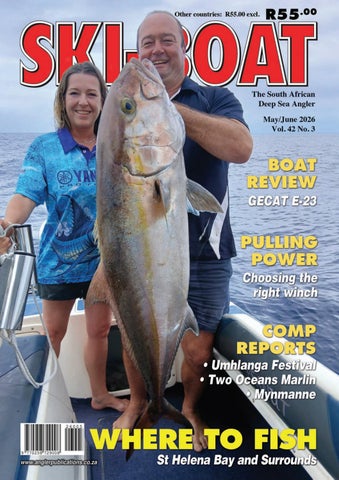
COVER:Mike Tyson met his Match

Lyn Oakley and Trevor Harvey with a beautiful,hard-fighting 31kg KwaZulu-Natal amberjack.

Publisher: Erwin Bursik

Editor: Sheena Carnie

Advertising Executive: Mark Wilson

Editorial Assistant: Lynette Oakley

Contributors: Erwin Bursik, Pierre de Wit, Helen Fenwick, Peter Jacobs, Lindie Janse

van Rensburg, Mary Kane, Carl Krause, Briers van Rensburg, and Thomas A. Wernars

ADVERTISING – National Sales:

Mark Wilson, Manager — 073 748 6107

Lyn Oakley — 082 907 7733

Lyn Adams — 083 588 0217

Velia Tonkin — 072 218 6383

Publishers:

Angler Publications cc POBox 20545, Durban North 4016 Telephone: (031) 572-2289

e-mail: angler@mags.co.za

Subscriptions to SKI-BOAT: R270 per annum (six issues).

New subscriptions and renewals: SKI-BOAT Subscriptions Department Telephone: (031) 572-2289

• e-mail: angler@mags.co.za

• Through www.anglerpublications.co.za, or E-zine through <www.issuu.com>

Printing: Novus Print, Cape Town

Distribution: On The Dot <Portia.Nguyuza@onthedot.co.za>

Full production is done in-house by Angler Publications & Promotions on Apple Macintosh software and hardware.

SKI-BOAT Magazine, ISSN 0258-7297, is published six times a year by Angler Publications & Promotions cc, Reg. No. CK 88/05863/23, and is distributed by On the Dot, as well as directly by the publishers to retail stores throughout South Africa.

• Copyright of all material is expressly reserved and nothing may be reproduced in part or whole without the permission of the publishers.

• While every effort is made to ensure the accuracy of the contents of this magazine, the publishers do not accept responsibility for omissions or errors or their consequences.

Views expressed in this magazine are not necessarily those of the publishers, the managing editor, editor, editorial staff or the South African Deep Sea Angling Association.

BOONORBANE?

TECHNOLOGY! An offshore angler’s dream come true or a gamefish’s worst nightmare?

Bombarded as I am these days with news of new products pouring into the industry aligned to offshore boating and fishing is making me feel even more like a tech dinosaur. As exciting as these new developments can be, I sometimes feel a bit overwhelmed when I board a craft fitted with the full range of accessories –the trolling motor on the bow, a helm station ablaze with sonar equipment, autopilots, gauges that are there to supposedly tell one everything, fly-by-wire controls and joysticks to virtually take over one’s steering wheel, saltwater pumps, switches, and two gleaming motors that one is afraid to even open.

In the past I could have got a motor going if it stopped, but now I just hope that they don’t stop, because even opening the cowlings would be an overload of technology. I guess it’s like the modern motor vehicles – if you can’t see any obvious problem you have to just shut the bonnet and call the Automobile Association (AA), except they don’t help boats at sea.

In the 1960s my boat had two motors – a 30hp and a 5hp – Johnson outboards attached to the transom with turnbolts, featuring hand-twist throttle levers to guide the “ship”. We often had to change spark plugs, sheer pins, fuel lines and pull cords while out at sea.

Our “safety equipment” consisted of old canvas-covered cork jackets and a toolbox containing spare spark plugs and sheerpins, and a length of starter cord. Indeed, if a starter cord broke and you did not have a spare, it was a long way home on just one motor.

There were no radios or cellphones in those days, so if there was a “buster” coming through, a small aircraft would be sent up to drop streamers near the boats, to warn us to head for land.

Our sonar of the day was an anchor dropped to the seabed yard by yard (in the days before metric measurements) and we located the reefs by tying off the anchor rope after lifting it up two yards from the seabed, and drifting until it hooked up. “Ah! A reef!” Visual landmarks were then recorded in a notebook for future use – if the “found” reef produced fish. And yes, we actually caught fish – at times an embarrassingly large number of them.

That’s how Number One Reef off Durban was found and marked. I still remember the main Number One pinnacle marks. Thanks to modern technology, I can now sound over them to see just how accurate our old marks were.

Nowadays even anchors are becoming dispensable. There will be a lot less muscle build up for the crew as “pulling pick” is becoming a thing of the past on boats belonging to skippers who can afford trolling motors. These modern skippers see a marking on their large sounder screens, press a button, and the forward-mounted trolling motor jumps into action. Regardless of the challenges of wind and/or current, these motors can hold your craft over that exact mark until you have caught your bag limit of the fish holding on that reef.

What’s next – a sonar that will show you in graphic terms exactly what fish and how many make up that localised fish showing?

With all the latest technological developments in our industry, and the way this equipment enables those with the wherewithal to catch more fish quicker than others, many questions are bound to come to the fore, especially when it comes to competitive angling.

I well remember that on one occasion after my first sounder was installed, I was due to fish in a competition and I had to remove the unit from my boat and lodge it in the Durban Ski-Boat Club office to level the playing field for teams drawn on boats that had no sounders.

Interesting times lie ahead!

Till the next tide -- or the next innovation.

Erwin Bursik

BACKTOBASICS

Part 25:St Helena Bay and Surrounds

IN this installment of the Where to Fish series,we will be covering the Cape west coast from Langebaan up to Elands Bay.Our experiences and skill levels differ considerably from those of Vic Warrington who so ably

covered the area around Dassen Island, so bear in mind that all the info we share is anecdotal.

This area can be divided into four distinct areas.

•Langebaan Lagoon and Saldanha Bay area up to Paternoster;

•Berg River estuary;

•Inshore fishing,up to 15 miles,in St. Helena Bay;

•Offshore up to 40 miles.

The maps indicate some of the places where we typically start our searches,but obviously the fish move with the food sources,and we move with the fish.

Anlé de Wit with a beaut of a yellowtail caught off St Helena Bay.

AREAS & FISHTOTARGET

A.The Saldanha Bay/Langebaan Lagoon area.Garrick,shad,white stumpnose and hottentot.

B.The Pinnacle;40km due west of the Saldanha Harbour entrance.Tuna.

C.From Saldanha entrance to Columbine.Crawfish and hottentot.

D.When we’re targeting tuna,we move between the areas marked B and D,staying in the warmer water around the 200m contour.

E.South Blinder/Britannia Blinder. Huge area that comes up from 40m to 6m.Snoek,occasionally yellowtail,hottentot.

F.North Blinder.The search for snoek and yellowtail begins here,typically going north west.

G.This is a general area known as the ABSA Banke,but there are no obvious features.Mainly snoek and occasionally yellowtail.

H.Berg River Estuary.The river is navigable up to 40km from the estuary, with the water temperature rising from as little as 12°C up to 25°C, with an inverse decrease in salinity. Garrick,shad,white steenbras,white stumpnose,sea barbel and an array of flat sharks.

I.The Groyne or the “Groan”. Hottentot,gurnard and the occasional yellowtail.

J.This is normally our last resort when we can’t find the snoek anywhere else.The Elands Bay boats sometimes travel south towards StHelena Bay for the same reason.

On the West Coast,the weather will unfortunately dictate when you can go to sea,so a whole week can be spent in your accommodation,waiting for the weather to clear.But when you hit the perfect conditions it more than makes up for the delay.

As is obvious from the map,the entire bay is basically featureless,with the exception of the North Blinder,the Britannia/South Blinder,and the wreck of the Jacob Rose which is shown on some sounders.

LANGEBAAN

The Langebaan area is better known for its kite- and board surfing than its fishing,but at certain times of the year you’ll get good catches of shad,garrick, white stumpnose,yellowtail and the odd kob in the bay area.

At one time the area was well known for its thresher sharks,but they have mysteriously disappeared.It seems they have been replaced by bronze whalers.These whalers are known to sit under your boat and wait for you to bring them their lunch.

There are a number of permitting requirements to fish in the lagoon area, so it is important that you familiarise yourself with these if you plan to fish there.

Generally,the water is cold,i.e.,less than 14°C,and the wind is your constant companion.The best times of year to fish this area are around March/April and again September/October.

Crawfish/West Coast rock lobster are also available in this area,mainly outside Saldanha Bay,but again,permitting is very strict.The bag limit is four per person per day,but you are only allowed to target them for about 12 days between late December and late March.Obviously you have to have the necessary license to catch them. PLEASE,do not buy crawfish from vendors along the side of the road.

Stumpnose are good eating and have gradually taken over in the Saldanha Bay area,whereas these waters used to be dominated by hottentot.We suspect this has to do with the

Briers vanRensburg and Pierre de Wit with yellowtail weighing 8kg and 12kg.

A beautiful garrick/leervis about to be released.

The big tuna are caught far offshore, but the trip out to the deep is worth it when you land southern bluefin tuna and yellowfin tuna like these caught by Pierre de Wit and Idé de Wit.

proliferation of black mussel farming, which is now widespread in the bay.

The mussels,being filter feeders, clear the water under and around the rafts,resulting in very clear water.A dive under them will reveal numerous decent stumpnose.The black mussels are cheap and delicious,but don’t pick them off the rocks yourself,as toxic tides are common and they can make you very sick.This applies to the entire West Coast.

Inside Saldanha Bay,the stretch between the marina at Mykonos and the iron ore loading terminal,is well known for flat sharks and the odd kob. “Die Dam”,which is now off limits, used to produce huge white steenbras around 15kg in weight.

Launching sites in this area are limited to Mykonos,Langebaan yacht club, and the public slip in Saldanha at Pepperbaai,immediately north of the Saldanha yacht club.

BERG RIVER ESTUARY

This river only drops by around 1m over the last 40km of its journey to the sea,so it is relatively wide and slow.The estuary is prone to changing sandbanks,though,which makes it dangerous for the casual boat visitor.In addition,there are a number of no-wake zones,so this area needs much caution. Make sure you get some up-to-date local advice before attempting to navigate it.

This area is best fished in summer, with white steenbras being the staple from September to December.Bait for steenbras is mainly sand- or mud prawns.Big steenbras are rare but are great fun for catch and release.

From December until April,shad and garrick are also found in the estuary,with the very rare appearance of kob.When targeting shad,use pilchards/sardines or mullet for bait,or use small lures.Garrick are mostly caught with live mullet or surface poppers,generally for catch and release. The Afrikaans name for garrick is leervis (leather fish) which gives fair warning that they’re not great eating.

Other species that are randomly caught here are eagle rays,guitar sharks,sea barbel,flathead/springer mullet,white stumpnose and double sash butterfly fish.This little fish is only caught by net and is very pretty. Another common,random catch in your net will be pipe fish which are family of the sea horse.In winter,you can also catch carp,which bite on sand/mud prawns.

Do not keep the estuary-caught white stumpnose for the pot;due to their changed diet,they taste horrible while those from the Saldanha area are great eating.It seems to be a general rule that estuary fish are less palatable than those caught at sea.

Prawns can be pumped in most

places around the estuary,and the common “bokkom harders”(southern mullet) caught in this area also make decent bait.They can be caught with a throw net.Remember,there are permitting requirements for both.

The fish move with the tide,so knowing where to be when is vital.Get some local advice on this when you arrive.

Boats can be launched at the Port Owen Marina,or at “Rooibaai”.Rooibaai is not great,but for small boats,it will do.Larger boats,5m or bigger,will have to use Port Owen.

ST HELENA BAY

The bottom of the bay is basically featureless,but,unlike the bay topography, the climate is very changeable.

The wind doesn’t play around here. In a howling south wind,the water temperature drops to around 10°C,while it improves with a north breeze,and may reach 18°C.

An oddity of the bay is that,when the current lines change,warm water enters the bay from the north,travelling south,in the opposite direction to the Benguela current,and warms the bay.

The most common fish caught here is snoek,and they are mostly caught from May to August.Snoek are mainly caught on very thick nylon handlines. Lures are typically called “bokstange”, but many variations are available on the market.

When targeting these fish,it is best to load your snoek hook with half a pilchard and drop it to where you think the fish are.Work the bokstang up to

the surface and repeat.At the same time,also have a number of other baited hooks with varying sinker sizes, floating away from the boat.The current will keep them at various depths.

Chum is essential to get the fish into a feeding frenzy.If you get that right, you will have your 40 snoek (bag limit is ten per angler per day) in under 30 minutes.

Snoek have very sharp teeth,similar to those of king mackerel/ ’cuda,so extreme caution is required when handling them on the boat.Their necks also have to be broken when they’re landed to ensure they bleed,otherwise the flesh will quickly decompose.

Catching the snoek is only half the adventure – then begins the trek home to clean,salt and prepare the fish for the freezer.Cleaning these fish is an artform,and for the untrained it is backbreaking work.It’s worth taking a trip to Sandy Point at the St Helena Bay Harbour to watch the way the local ladies clean a snoek in two minutes.

Hottentots are the most common inshore fish that we catch,and they are caught just outside the kelp beds. Pichards,white mussels,worms and sand prawns all work as bait.These fish are an acquired taste,but are highly regarded locally.

Yellowtail are also fairly regular visitors to our bay around April/May and September.They are mostly caught by trolling subsurface lures.Deep divers are preferred,and they should run at 30–40ft.It’s not a bad idea to use a short steel trace,just in case the odd snoek is still around.

When the weather is good and water temperatures are above 12°C, fishing for yellowtail with a spoon is great fun.You need to be able to cast far,though,as they spook easily.Jigging is also successful when they hug the bottom.

We catch yellowtail in three ways: •Dragging feathers or squid behind the boat,either on a rod or bungee; •Spinning with 7–9cm light tinned lures,50–60g weights,7–9cm Magnum-type lures of various colours,or Ashley Reid-type snake lures 8–12cm long.This style of sight fishing is commonly used around Cape Point and Dassen Island when the sea is glassed out. •Jigging.Our fish are smaller than those caught at Struisbaai (5kg vs 10kg) so smaller jigs work better here;probably 60–100g.

The yellowtail love to take you into the kelp to cut you off when fishing off the Groyne/Groan,so try to limit their opportunities for that.

Other regular spots to target them are around the North- and South Blinder,and at ABSA Banke.

Other species which are regularly caught in between the yellowtail,are

The most common fish caught in StHelena Bay is snoek. Marié van Rensburg was thrilled with this 5kg specimen.

Atlantic bonito,the odd skipjack,slender tuna,and very rarely frigate tuna.

I believe a world record is just waiting for someone to claim,as it appears that the All Tackle Record for slender tuna is around 11kg,and many 10kg fish of that species are caught in this region.Slender tuna are regarded as kat kos (cat food) around here,but they are highly prized in New Zealand and the Far East.They are very oily,but when properly prepared,make a meal fit for a king.

INSHORE UPTO15 MILES

Inshore fish are limited to kob,hottentot,gurnard and the now very rare galjoen.Gurnard can get up to 50cm in size and make excellent eating if you know how to clean them.Kob are mostly caught off the rocks in Jacobs Bay, but only average around the 2–3kg range.Hottentots are a staple catch in or near the kelp beds,along with gurnard and,occasionally,galjoen.

Boats can launch into StHelena Bay from the harbour at StHelena Bay/Sandy Point,at Port Owen, Rooibaai,and the beach at Paternoster. Jacobs Bay can also be used,but only for tiny boats a maximum of 4m in length.

OFFSHORE UPTO40 MILES

Offshore fishing can only be done when the weather allows.It is a long run of around two-and-a-half hours,and requires a full day of good weather.

The deep blue,warm Atlantic water needs to have pushed close to shore for us to have success within our 40 mile

limit,and the water temp needs to be at least 16°C,but if that happens,it can be a very rewarding day’s fishing.

Common species caught are longfin tuna,which get up to 30kg,then there are large yellowfin tuna (up to 100kg) and big eye tuna,as well as the occasional southern bluefin tuna.

It is not uncommon to run into large schools of slender tuna out there, as well as the smaller yellowtail.

For the big tuna,heavy boat rods rigged with either bait or lures are used,while a decent spinning rod will work for the slender tuna and yellowtail.

Mako,blue sharks and orcas are also occasionally encountered.Our infamous orcas nicknamed “Port”and “Starboard”are regular visitors;they are reputed to have chased all the great

white sharks out of False Bay.Whales are a constant hazard,particularly humpbacks,but Bryde’s and southern right whales are also often present.

The sea is fairly featureless,but the “Pinnacle”(B on the map) which is almost directly 40km west of Saldanha Bay,sometimes produces good tuna and yellowtail catches.You won’t find the pinnacle on any map – you just have to look around for it on your sounder when you’re 40km offshore.

If we don’t find the fish at the pinnacle,we just head west until we pick up a temperature break,normally around the 200m contour.

It is worth keeping a long gaff on board in case you happen upon a longliner,and want to pick up some kingklip or hake that have come off their hooks.Due to barotrauma,these fish cannot get back down,and nothing beats a fresh hake for supper.

If you want to head offshore,you can launch from Port Owen,St Helena Bay,Saldanha/Pepperbaai,Langebaan yacht club or Mykonos Marina. Paternoster and Yzerfontein are also options,but launching a large boat off Paternoster could be quite a challenge, and Jacobs Bay is too shallow for a 20ft boat.

About 70% of South Africa’s Total Allowable Catch (TAC) is caught off the West Coast,but this number is largely limited to the companies with boats that stay out for weeks at a time.

The distance from shore,along with the harsh weather,limits our access to this resource,but when all the stars align,it can be very rewarding.

Adriaan Viljoen with a decent yellowtail.
Les Greene with a 42cm gurnard. They make excellent eating if you know how to clean them.
Anlé de Wit and dad Pierre with a 30kg longfin tuna.

GECAT E-23 By GECAT Marine

STEPPING into the GECAT Marine factory in St Francis on South Africa’s south east coast was a nostalgic experience for me,as well as one loaded with great expectations of coming face to face with the much lauded GECAT E-23.

Many years ago I visited a good friend,Errol Plowes,at his boat building factory in the industrial area of the then

blossoming hamlet of St Francis,while on a coastal run up the coast from Cape Town to Durban.

Errol and his father,Howard,were once doyens of the Umkomaas Ski-Boat Club and the many interclub competitions held from that facility.Howard and his boat, Lone Reef,were legends – they would vanish into the blue and come back to the scales with a good number

of very special fish.

I had the honour of fishing with Howard on a few occasions,but to my great disappointment I could never pinpoint the locations of “his”reefs.There was no GPS in those days,and visual landmarks were a tad far south for me to target from my base at Durban SkiBoat Club,so the “Lone Reef”stayed safe.

Errol and Howard later “migrated” further south,eventually ending up in the southern Cape coastal area.Errol gained custody of Lone Reef, and when I heard he’d started a boat factory,I popped in to visit him on my trip up to Durban.

When I got there,I was delighted to hear that Errol and a stalwart of the Durban Ski-Boat Club,George van

Reenen,had got together to build the GECAT in St Francis.The G is for George and E is for Errol.George was the undisputed king of ’cuda fishing in the 1960s and’70s until his relocation to Port Elizabeth.Seeing George’s Big Blues in the factory’s reception brought back some truly great memories.

Many years have passed since that day,and in March 2026 I was back in St

Francis to put the GECAT E-23 through her paces.

This craft is hugely impressive,not only in size,but also when you take in the finesse of her finishings.She made me want to get onto the water immediately to see what the beast under the beauty performed like on the sea.

I didn’t have to wait long,and was soon down at the sizeable marina in St Francis looking at the GECAT E-23 and her big sister the GECAT 42 lying side by side on moorings.

The high quality of the finishes and creature comforts that come with this craft were immediately obvious when I boarded the GECAT E-23 and got into position at the helm station to prepare to exit port for the high seas.

For once we were blessed with great sea conditions for a boat review in Cape waters.There wasn’t much sun, which meant the photographs were a bit dull,but the conditions were perfect for putting a craft this size through her paces,and I was able to fully assess her ride and performance over water as well as her long distance performance at 20 knots.

A large number of chokka boats were anchored in the surrounding area, which meant I had to travel a fair distance west (although to this Natalian it felt like we were going south) to a location where I could throw the GECAT E23 about without complaints from the chokka fleet.

TESTINGHERLIMITS

This “play time”is what I love:feeling the craft’s vibrant hull-over-water movement in response to the twin 115hp Yamahas as I work her throttles.There is no feeling as electric as when a craft, especially a new one,gets properly unleashed as the props bite and the hull lifts her forward section out of the water and onto the plane.

It was during these first few seconds that I fell in love with the GECAT E-23 that my friend Errol,sadly now watching from above,had partially built and passed on to the new owners just two months before his passing.It was lovely to hear that the GECAT E-23 has been named thus in honour of Errol who always wanted a 23ft craft but always sold the boats he produced before he could claim one as his own.

I was grateful to have this opportunity,and eager to maximise my time aboard the craft to fully appreciate the time,thought and expertise that had gone into her conception and birth.

In a moderate sea with cross section swells,she climbed out of very tight turns,addressing her own wake and doing all I expected of her.She was balanced into the turn and held her exit as her bow shouldered the cresting water and stabilised her forward movement with fluid yet exciting momentum.

One of the most telling ways of assessing any craft’s finesse and ability is to test their out-the-hole response and stability during a speedy take off.I undertook these trials in numerous variations,exposing her to many of the “funnies”the sea can throw up when you’re playing in rough water,especially in surf work.

The GECAT E-23 performed beautifully.

Each time her bow lowered,preparing to take on the next demand expected of her,she was ready to take on a facing wave or swell,with sufficient guts to either turn on her axis or directly confront a nasty peaking up in front of her.

Throughout these “cowboy”trials, I used various permutations of trim settings as well as power/thrust applications which I found exhilarating.I had complete faith in the twin 115hp Yamahas,both in smooth power applications as well as out-thehole thrust,which is the most important application in outboard motor performance on ski-boats that surf launch.

ASSESSING HER COMFORT

Finally,with the surf launching trials over,once our adrenalin had subsided I could relax and set the GECAT’s course for a long run.

One of my personal desires when ski-boating is to be able to enjoy long, comfortable rides in moderate wind and sea conditions.For this test,I set a course expecting to cover say a 12- to 25 nautical mile ride to one’s favourite hotspot,like I do when I run up to Mabibi after launching at Sodwana Bay.

I want to get there before the other boats,but I also want to do so in comfort,while being able to chat to those aboard.Off Sodwana I’ll set a course, engage autopilot and then adjust trim –both lateral as well as forward movement – to take into account the wind and sea conditions and,most importantly,craft trim to ensure a ride of say 17to 20 knots and motor revs touching the 4000rpm mark.After the ideal settings have been achieved,one can relax,sit back and enjoy the ride.

I did just that with the GECAT E-23, testing her in every conceivable direction – all while talking boating with

Markus van Aswegen,one of GECAT’s directors,who had to put up with me during the boat review.

I enjoyed that run immensely.Not only could I feel the GECAT’s ride under every conceivable sea condition, but I could also glean information on all this craft’s idiosyncrasies.Overall,she performed exceptionally well,and I believe she would be very comfortable to skipper and crew when trolling long distances to and from the fishing grounds,whether off Sodwana Bay, Cape Town or somewhere else.

One caveat to the above:I did not experience heavy sea- and wind conditions,so I cannot comment on how she will perform in those circumstances. Howver,I am personally convinced she will handle those as well as most craft in her category.

APPRAISING HER FINISHES

The very first test I do with any craft I am about to review,while still on land, is walk the length of the craft with my hand sliding along her side surface just above the water line.This tells me a great deal about the craft’s finish and

the smoothness of the moulding and lay up.Try it and you will be surprised how much you can learn.

The GECAT E-23’s overall lines and finishes are excellent,and after spending hours aboard her at sea and inspecting her on land,my first impressions were confirmed.GECAT Marine take a bow,I was very impressed.

Considering the size of this craft and all the facilities she boasts,it must have been a designer’s nightmare to figure out how to include so many creature comforts and yet make it so practical for the offshore angler.

On the GECAT E-23 I reviewed,the foredeck is accessible around the sides of the substantial cabin and helm station that has high sides and features handholds to ease access in rough waters.

The aft deck,with its twin livebait wells,rigid transom-mounted rod holders,and well upholstered seating,will provide most offshore anglers with the space,comfort and fishability they need to fish any southern african waters.

Cabins on ski-boats,especially on

craft in the 22–28ft class,are always a compromise,with the siting and size needing to take into account both comfort and protection,but also practicality and aesthetics.I believe GECAT Marine have accomplished that very difficult balancing act.

I am a fairly large fellow,but thanks to the substantial helm station I never felt constrained.I was fully able to skipper the craft and still had the support and seating facility to allow me to enjoy the ride throughout our many hours at sea.

Whatever challenges the designers faced fitting all these facilities into a craft of this size,they have overcome them.I believe anglers will find the GECAT E-23 exceptionally comfortable and practical whether they’re at the West Coast hot spots,the turbulent seas off Cape Point,Sodwana’s marlin waters or Moçambique.For those who have specific requirements,this manufacturer is very open to discussing adjustments.

On the return trip to Durban,Ryan Hansen and I towed the GECAT E-23

behind his Toyota Land Cruiser 200 series,and I was very pleasantly surprised at how easy it was compared to when I tow my own ski-boat which is the same length and weight. Considering this,I believe it would be very practical to tow this craft to Moçambique.

Nothing beats seeing the boat in person,but the accompanying photographs should give readers an idea of the versatility and onboard niceties that are standard on the GECAT E-23.To get a better idea of whether she is the best boat for you,I recommend a visit to one of the four distributors of this incredible craft.

In conclusion,I salute GECAT Marine directors who took on the challenge of running this big boat manufacturing company which produces craft up to 40ft in length.The enthusiasm and hands-on work ethicof them and their staff,many of whom have over 20 years of service and are fully committed,must ensurea positive future for GECAT Marine.

FURUNO’s legacy of innovation continues with the new TZMAP9 (9”) and TZMAP13 (13”) stand-alone multifunction displays (MFD).These new units offer the ultimate combination of simplicity,power and precision, all in a single stand-alone unit.

They’re designed for ski-boaters who demand reliable navigation,precision fish finding,and industry-leading charts in a simplified,easy-to-use and easy-to-install package.

Whether you’re fitting out a 16ft ski-boat or adding a dedicated station to the console of a larger boat,these stand-alone MFDs put a lot of Furuno power into one package.

TOUCHSCREEN SIMPLICITY, TZTOUCHXL POWER

These units feature sleek,glass-front TFT displays with responsive,sunlight-readable multi-touch control.They’re powered by a streamlined version of Furuno’s popular,easy-to-use swipe and tap TZtouchXL operating system,delivering the same intuitive experience in a stand-alone unit for compact spaces and smaller consoles.Now everyone can access simple Tap & Go route planning and AI Routing that automatically calculates the best route to your destination while factoring in chart data,depth,and known hazards.

TZMAPS & BATHYVISION FISHING CHARTS

BathyVision Fishing Charts,with single-touch adjustable contour lines and depth shading detail,are groundbreaking!

Highlight depths,apply terrain shading,or instantly adjust colour themes to fit your needs.

BUILT-IN FISH FINDER

Furuno’s TruEcho CHIRP Fish Finder Technology (or Standard 50/200kHz) with CHIRP Side-Scan compatibility punches way above its weight.It’s compatible with most Airmar CHIRP transducers,and upgrading to the TZMAP allows for a wide range of transducer options,no matter what you’re targeting.

THE GAME CHANGER – BUILT-IN TZWEATHER APP

With a TZMAP MFD on board,you do not need multiple weather apps on your phone to decipher weather forecasts or oceanographic data.Simply download the latest free weather data (requires data connection from your phone) directly onto your TZMAP MFD and view the forecasted wind conditions as well as wave height and direction,while important oceanographic data such as current speed and direction,sea surface height,sea surface temp and chlorophyll levels are overlayed on your chart in colour,enabling you to pinpoint the most productive fishing areas for the day.

GP-1971F UPGRADE TIP!

The TZMAP9 is a simple drop-in fit-and-form installation for the popular Furuno GP-1971F.It even uses the same mounting bracket,although the power cable is different).

This TZWeather overlay shows high chlorophyll levels at the mouth of the Tugela River in KwaZulu-Natal.

Celebrating the 2026

THE first Umhlanga Festival,held way back in the mid 1970s,was really the first ski-boat festival ever staged in South Africa.Since then,this event has grown,not only in size but also in support from the sponsors and competitors.This year’s event proved this once again,with a total prize value of over R1.1m,making this the biggest festival hosted at the Twilight Drive clubhouse.

The 2026 Umhlanga Festival opened on Friday 27 March with the registration and briefing at the club.Anglers were thrilled to hear that the prize categories were a repeat of last year’s event,with a slight change to the prize structure for the four species categories,namely:Yellowfin Tuna,King

Mackerel/’Couta,Snoek and Other Gamefish.

The top three fish in each of those categories were all awarded prizes.First place in any category would earn you R40000 in cash with an additional R20000 worth of prizes (an increase on last year’s prize value),second place received R15000 in cash and an additional R15000 worth of prizes, and third place received R10000 in cash and an additional R10000 in prizes.

This competition is a favourite on the angling calendar, and this year the club welcomed back many anglers who have been loyal supporters over the years,as well as some new faces.This year’s event saw 223 anglers from all over South Africa coming to compete,with 15 ladies and 19 juniors in the mix.A total of 92 vessels took part;66 boats,nine jetskis and 17 fishing kayaks.

Umhlanga Festival

The 2026 competition also opened up the “playing field”, with no boundaries on launch sites or fishing areas,which meant more strategic choices having to be made by the competitors.Evidence of this was seen in the wide variety of species including ’cuda,wahoo,tuna,dorado,bonito,prodigal son and snoek which were displayed at the weigh station in the marquee at the Umhlanga Ski-Boat Club.

The weather on Saturday 28 March didn’t make things easy,with light rain and lightning on the Friday night,and threats of a westerly coming through late on Saturday. However,that didn’t deter the anglers who set off from their various launch sites in the morning.

A couple of teams got punished by waves and sharks,but many good stories were shared over a cold beverage at the club later in the day.

When the scales opened at 2pm,there was a huge buzz of excitement as some exciting quality fish were brought to be weighed.The Tuna,’Couta and Other Gamefish categories had a minimum weight of 6kg,and the Snoek category had a minimum of 4kg.By the time weigh in closed on the Saturday,the various category leaders were two ’cuda of 18.52kg,a tuna of 14.98kg,a 6.54kg snoek and a 17.08kg wahoo.

The weather looked a bit more promising for Sunday 29 March with calmer seas in the morning,but the day started with a light drizzle.The conditions changed throughout the day,but the anglers were determined to go out and prove they had what it took to win.And,indeed,they did!

The scales opened at 1pm,and the fish got bigger and bigger as the time ticked on.Some very impressive ’cuda,dorado and wahoo shook up the leaderboard and kept everyone

guessing until prize giving.

The impressive quality and quantity of fish weighed is a solid indication of the resilience and extent of the resource that the offshore anglers have at their disposal off the KwaZulu-Natal coast.

The fish wasn’t the only commodity in ample supply at this year’s festival.Interest in the event and camaraderie were also at an all time high.The fun had out on the ocean and the social interaction off the water ensured that a huge number of anglers,families and spectators all got to participate and enjoy the weekend’s activities.Delicious meals from Julio’s on the Ridge and a variety of food vendors,as well as sponsors display tables in the Vendor Village,meant everyone had access to great food and fantastic merchandise.

Prize giving on Sunday night was peppered with lots of lucky draws,raffles and giveaways all made possible by our sponsors’generosity.The beauty of the current Umhlanga Festival prize format is that it means numerous anglers are able to win in the top prize categories.

It was also encouraging to see all the promising junior anglers who are really showing what they’re made of as they measure up against some of the country’s top men and lady anglers.

The event was incredibly well supported again this year, and we would like to take this opportunity to thank our loyal and generous sponsors.Your support is what ensures the success of our prestigious competition.

To all the competitors who keep coming back,and to those who joined us for the first time this year,thank you for your support,and we hope to see you again next year.

To all the winners,congratulations on your achievements! The titles are now yours to defend,so we look forward to hosting you again next year.

Well done to the Festival Committee and everyone involved in the long hours and back-breaking work put in behind the scenes to make this competition the success that it was.We are committed to making this tournament one of the highlights of the fishing calendar.

A round of applause for all the category winners! Nick Landzanakis and Ruli Sofilas from Natal Power Boats were on hand to present the prizes.

Nick Landzanakis and Ruli Sofilas from Natal Power

hand over the top junior prize to Max de Robillard.

FINAL PLACINGS

Biggest Tuna

1.Phillip Irving, Hurrikane . . . . . .15.44kg

2.Jason Pretorius,Seas The Day . .14.98kg

3.Ryan Pellew, Albacore . . . . . . . .14.54kg

Biggest ’Cuda

1.Johan Joubert, Jubalani . . . . . . .21.84kg

2.Leon Swart, Metanoia . .

3.Janine Hunlun, Stealth . .

Biggest Snoek

.21.16kg

.20.14kg

1.Steven Whitaker,kayak . . . . . . . .6.62kg

2.Matthew Victor, FI-FO . . . . . . . .6.54kg

3.Alister Franz, Ali kat . . . . . . . . . .4.68kg

Biggest Other Gamefish

1.Fluffy Dunbar, Navigate . . . . . . .17.08kg wahoo

2.Gabriel Landzanakis, EOS . . . . . .13.48kg wahoo

3.Brenton Gaul, Longshank . . . . .12.98kg prodigal son

Top Juniors

1.Max de Robillard, Put Shots . . . .16.6kg ’cuda

2.Jack Gaul, Longshank . . . . . . . .12.98kg ’cuda

3.Ross Cole, Albacore . . . . . . . . .9.34kg ’cuda

Top Ladies

1.Andie Griffin, Albacore . . . . . . .17.06kg ’cuda

2.Sarah Stern, Explora . . . . . . . . . .16.82kg ’cuda

3.Annelise Bornman, Finatic . . . . .15.02kg ’cuda

Boats
Nick Landzanakis (NPB), Cathi Warriner (CMI) and Ruli Sofilas (NPB) congratulate Andie Griffin, the top lady angler.

HOPEFULLY parts one and two of this series have grabbed your attention and you now have a shiny new accessory on the bow of your boat,ready to take you to fishing heaven.

As much as I would like to refer you to your user manual,we all know that most folks will seldom page through that silly document that comes with their new prized possession.To shorten the learning curve and fast track you to legend status at your local club’s scales, I’m going to give you a cheat sheet...

CALIBRATION

Before you can start fishing,you need to calibrate your unit.Without calibration, you’re scratching the surface of what your new investment can do.

You need to calibrate the following:

Bow offset: This aligns your motor so that it points dead ahead once deployed, so that your motor knows that is the “zero”or home position.Every time you deploy your motor,it will start at that position.

Steering alignment: This sets how many turns your motor can do left and right so that the system knows when it has reached its end stop.If you keep turning in one direction,you’ll bind up the cable and have steering issues.

Internal GPS compass: You need to calibrate the GPS compass so that your motor can accurately hold you on a spot or follow a heading.Without this,you’ll only be able to manually control the motor.You also need the GPS calibrated to use the navigation features.

Remote control: The remote control needs to be calibrated so that you can use the gesture control feature,allowing you to point the remote control in the direction you want to travel or manoeuvre the boat quickly.

If you purchased your motor from an approved dealer and they installed it for you,these calibrations steps should have been done before you take delivery,as part of a water test.If not,don’t panic! It’s easy to do and there are multiple support pages and videos that will guide you through the process.You literally just follow the steps on the screen.

Justin Paynter was thrilled with this 18.1kg amberjack caught off Umdloti while vertical jigging. Using a trolling motor enables him to hold on the spot while fighting these titans.

Gareth Dicks (below) with a lovely amberjack, and Nick Reits (right) with a big black musselcracker (released). These fish were caught on Andy Fyvie’s Yeld Cat, Pikanini, on a recent trip to Santa Maria. Andy has just installed a Garmin trolling motor and it allowed him to target these gangsters of the reef in an area with strong current.

PAIRING

You also need to pair your remote control to your motor,and your motor to your chart plotter.

Ideally,you want your chart plotter brand to match that of your trolling motor,for full integration.If your chart plotter brand is different from your trolling motor you can still use your motor,you just won’t be able to make full use of all the features available to you.Features such as route following, navigation and chart plotter control only work if you can integrate with the chart plotter.

Software:the swear word all dealers hate.Software gets updated to iron out small glitches in the system and to make your equipment perform better. New features can be added and functionality improved,all by doing a simple software update.Make sure you’re on the latest versions,both on your trolling motor and your chart plotter.

“Okay,so everything has been paired,calibrated and integrated … can we fish now?”

Nearly;first you have to figure out what all the buttons do.

The first time you hit the water,take ten minutes to learn how your system works.Most guys are so fixated on being able to push the anchor lock button that they miss out on 90% of the features available to them.

Here’s what the different modes mean to you on the water and how to use them effectively.

ANCHOR LOCK

Your days of anchoring and pulling umfaan are over.Find the showing, press this button,and you’re fishing right on the spot.

It’s a game changer for bottomfishing,jigging and bait fishing.I promise you,your crew and their lower backs will thank you.Your hatch will start looking healthier too.

I even jump off and spearfish while my trolling motor does its thing keeping my boat on the mark.I’ll admit it was a bit nerve wracking the first few times,but it hasn’t skipped a beat.It’s

also amazing to see how much more relaxed the fish are on the bottom, without having to avoid blunt force trauma by anchor.A bonus for the environment is that the reef is untouched.

ACHOR LOCK JOG

If the showing moves slightly,use the Anchor Lock Jog feature to move your boat slightly to be over the fish again. With the push of a few buttons,you’ve just saved two anchor pulls,a chiro visit,and you haven’t disturbed the bottom once.Heaven!

HEADING HOLD

Like an autopilot,Heading Hold will keep you on a selected heading line. The difference here is you are silent, can go as slow as you like (if conditions allow),and you can make small adjustments on the fly.

It’s a game changer when fishing for ’cudaor garrick,as you can run baits right behind the boat with no prop wash and you can control your speed accurately.

The beauty of full integration.

I have set the trolling motor to Heading Hold function, following a specific contour line. I can easily adjust my speed and my heading using the chart plotter toolbar. I’m also silent, which means I can run baits close to the boat (right behind my flasher) without outboard motor noise spooking any wary fish.

Moving from one waypoint to another (as shown in the bottom image) is as simple as selecting it and engaging the trolling motor. No anchor pulls, no disturbing the reef, 0just a few buttons to push.

The kayak fishermen have outfished ski-boats at many comps in the past, and I believe silence and stealth are often the difference between a bite or a blank.

I’ll often engage Heading Hold to keep the boat moving dead ahead when I’ve had a run.This keeps the other lines straight and keeps tension on the fish while I sort out the rest of the rods.If you pair Heading Hold with the turbo function as you get that bite, it does a great job of keeping tension and creating some distance between your fish and the other lines that may be in the way.

Heading Hold also works a treat when you want to make your way slowly up a ledge while spinning/popping for gamefish like yellowtail and GTs. When you’re drifting a ledge,you’ll often be blown onto it by the wind and the swell.With Heading Hold you can stay in deeper water almost a full cast away from the shallow ledge,so that you have more chance of pulling the fish away from the reef and landing it.

ROUTE FOLLOW

This function allows you to draw a route on your chart plotter and ask your trolling motor to follow that route. I’ll often use Route Follow if I’ve worked out what depth line the gamefish are on that day.I draw a route following a specific contour line on the reef,and let the trolling motor do its thing.At the end of a route,you can either go into anchor lock or carry on following that specific heading.

CRUISE CONTROL

If you’ve worked out the ’cuda are only eating dead mackerel pulled at 5km/h, you can use Cruise Control to keep your speed constant no matter your direction of travel relative to the wind or current.Set it and the motor adjusts its speed to keep you in the sweet spot.

NAVIGATE TO/GO TO

If you want to fish a specific spot,select the waypoint on your chart plotter and select “Go To”.Once you confirm you want your trolling motor to be engaged,

you’ll be taken to your spot at your desired speed.You can either go directly to the mark or you can navigate to it, following a route that ends at that point.This is absolute bliss when you want to pull baits over a few of your hot spots on a reef.

Another great way to use this feature is to turn off your outboards short of a known hotspot and let your trolling motor silently take you the rest of the way.You won’t spook any fish like wahoo that may be close to the surface, and the fish will be more likely to react to your baits.Recently we found a FAD off Ballito and it was amazing how close we could get to it without spooking the dorado and wahoo hiding beneath.Had we motored up to the FAD,we likely would have scattered the wahoo and missed out on those fish.

VESSEL ALIGN

If you’re doing a drift along a line (think Cape Vidal,drifting for dorado),you can have your trolling motor keep your boat beam-on to the sea.This way you

can keep your lines straight off the beam and fish more baits without tangling due to the boat swinging around.

GESTURE CONTROL

If you need to change direction quickly or swing the boat around, hold the manual button and point the remote where you want to go. Like a magic wand,the motor follows.This is really handy when the snoek or bonnies pop up next to you and you want to have a quick go with a flick stick.It’s also handy when your mate is leaning over the side having a wee and you need to wake him up with a morning swim.

PRACTICE MAKES PERFECT

As with all things new,the more you practise the easier it gets.Soon using your new machine will be second nature and you’ll struggle to understand how you managed without it for so many years. Initially it may be a bit of a learning curve,though.More than once I caught myself turning my steering wheel or using my throttles while staring at my non-responsive trolling motor,much to my crew’s delight.A day at the dam or in the harbour will go a long way towards shortening the learning curve. There’s no right or wrong way to use your new trolling motor,only the way that works best for you.

THE CHERRY ON TOP

One of my favourite things about trolling motors is how they have freed me up to fish more on my boat and not be at the helm all day long.It’s almost like having another crew member on board doing the

The built in GPS in the trolling motor allows you to use it as a stand-alone unit, if you have a chart plotter from a different company. Using the remote control, you can still use the Anchor Lock and Heading Hold functions.

driving for you,except he sits on the nose and looks a bit like a robot character from Star Wars.I have spoken to countless clients and friends who have made the upgrade to go electric,and the common thread is, “It’s so nice that I can also fish for a change!”

BE CONSIDERATE

There’s no doubt that trolling motors have changed the offshore fishing industry,and in our local waters,anglers have embraced the newer technology.Species that previously required great skill in terms of boat handling and anchoring are now being effectively targeted by more anglers due to the ease of use of these motors.We can also now fish areas that were a nightmare to anchor in,due to the current and depth.However,as they say in the movies:with great power comes great responsibility.Be conscious of anglers around you and don’t be greedy.

If anglers are already anchored on a spot or are doing repeated short drifts,ask permission to go on Anchor Lock or rather move to a different spot.

Similarly,once you’ve caught your fair share of fish,let other anglers have a go.If you’re on a bait mark,catch your bait quickly and move off so you don’t block other boats from getting bait as well.It’s all about sharing the ocean with your fellow anglers and ensuring everyone can have a great experience.

As technology advances and makes it easier for us to target our favourite species,we owe it to our fellow anglers and to the environment to be responsible and limit our catch.

The 20th TwoOceans Marlin Tournament

FEBRUARY2026 saw Suipunt

Deep Sea Angling Club once again host one of Struisbaai’s most cherished traditions – the Two Oceans Marlin Tournament.This year attendees celebrated the 20th anniversary of this event.From 21 to 27 February 2026,anglers from across South Africa gathered for a week of excitement,camaraderie,and unforgettable moments on the water.

THEHISTORY

This annual marlin catch–measure–

release competition came about after the late Meirion Williams of Huck Finn fame chatted with a local commercial fisherman,Traill Whitthuhn,who told him he had once landed a striped marlin off Struisbaai.Meirion believed it would be worth investigating the population and sizes of marlin in the Agulhas area,and the idea of hosting a tournament took hold.

Of course,organising an event like this is never the work of just one person.Others such as Gawie Bruwer, Hannes Schreuder,Gerard De Kock, Johan Jooste and Johan van der Walt also played crucial roles in turning the

idea into a reality.

After four years of discussion,Gawie Bruwer finally made it happen.He drove the practical organisation that transformed the idea into the first official tournament in 2007,crafted the very first credo,laid the foundation for how the tournament would run,and set the standard that is still followed today.

During the 2026 opening function, Suidpunt Diepsee Hengelklub’s president,Dudley Rosslee,invited Gawie to read the credo and then presented him with a special certificate of appreciation in recognition of his pivotal role in founding the TOMT.

THE TEAMS

This year,20 boats entered in the tournament.While some of the anglers and boats were participating for the first time,it’s wonderful to see how many are committed repeat “offenders”.

Gawie’s boat, Indigo ,has entered each of the 20 events,but there are a number of other longstanding supporters like Gwaza which has participated 19 times, Marco Polo which has entered 18 times, Bad Company which has entered 15 times,and Dory which has entered 14 times.The combination of this history and the fresh faces makes for a special mix.

THEFISHING

The weather committee – Trevor Brinch (Spotter One),Marc Maximus,Julian Nina,Rikus de Beer and Ron Penninkhof – are responsible for ensuring safety at sea,so each day they did battle,begging the weather gods to play fair.

The first fishing day was called off, but on Monday 23 February 2026 the weather gods relented,and the fleet went to sea.Lines in was called at 08h00,and the search for the mighty marlin began.

There was brief excitement during the morning when one or two hook-

ups were called over the airwaves,but they were either on–offs or “mako marlin”,which don’t count.

However,by the afternoon,it was action all the way.

We didn’t hear Mike on Bad Company call in a hook-up as he was having radio problems,but Matthew Paulsen was busy fighting a fish nonetheless.He released a striped marlin just south of the 12-mile bank after a 22 minute battle.

You can read his first-hand report overleaf.

The weather gods graciously allowed the boats to go out again on

The crew aboard Bad Company, left, were thrilled to take top honours at this year’s Two Oceans Marlin Tournament.

the Thursday and Friday,but sadly no more marlin were measured and released,leaving Bad Company the clear winners of the 2026 tournament.

THE SPONSORS

For two decades,the Two Oceans Marlin Tournament has stood as one of Struisbaai’s most cherished annual events.What began as a small,passionate initiative has grown into a milestone tournament that brings together anglers from across South Africa.The organisers are the hands and feet,but the sponsors are the power behind its long-running success.

Year after year,some incredible businesses have fuelled the heart of the tournament.Many have stood with us since the very beginning,believing in what the tournament represents:community,integrity,sportsmanship,and the preservation of big game angling in the Agulhas waters.Their loyalty is not just appreciated,it is foundational to the event’s sustainability and spirit.

A competition of this scale simply cannot happen without sponsors.Their contributions support everything from logistics,safety,and infrastructure to prizes,hospitality,and the overall experience that anglers look forward to.

To every sponsor over the years: thank you.Your belief in this tournament,your steady support,and your contribution to Struisbaai’s angling

community have helped shape 20 years of unforgettable moments on and off the water.You are all truly appreciated.

THE HEART

The Two Oceans Marlin Tournament isn’t only about the thrill of the chase out on the water – it’s equally about the magic that unfolds when the weary and hungry anglers stumble into the Suidpunt Deep Sea Angling Clubhouse. There,they find a calm haven where camaraderie,laughter and shared stories of the one that got away come together as they raise a glass to each other.

Grant,our unflappable Tournament Manager,keeps every detail running smoothly,ensuring that the nights are as much fun as the daytime angling.And then there’s Andrew,whose quick wit and effortless rapport turn every gathering into a fun occasion.Under his guidance,spirits stay high,jokes fly,and the anglers find themselves revived.

But at the centre of it all is Marinda. Her catering skills have become legendary.After gruelling days at sea,hungry anglers return to feasts that are not only plentiful but also crafted with care.She and her team put heart and soul into all that they do.

What makes this team truly unforgettable is the heart of hospitality that underpins everything.

There is another quiet anchor in the

background of the Suidpunt Diepsee Hengelklub:Dahlene,the club’s bookkeeper,and the custodian of accuracy and order.

Our sincere thanks to every single one of these people who make this tournament what it is.

THE PRIZE-GIVING

After three days of fishing,it was finally time for the prize-giving.

The theme for the week was “I can’t believe you’re wearing that to TOMT!” The anglers aboard Gambler dressed up as gangsters and molls,and were the hands-down winners for the most imaginative costumes.

Marlin may have been few and far between this year,but the same could not be said for the prizes.There were prizes for the anglers,a special award for Gawie,a bottle of wine for the owner of Chas Everitt who has supported the TOMT for 19 years,and loads of other lucky draw prizes.

I may be biased,but this year Team Simrad – an all ladies team – was my favourite,and they received the award for the most mischievous team!

Finally,it was time to announce the winner of the 20th Two Oceans Marlin Tournament: Bad Company

With the 20th event all wrapped up, it’s now time to start looking forwardf to the 21st event in February 2027.See you there!

ANGLER’S TALE

How to win the Two Oceans Marlin Tournament

There’s always an overwhelming sense of excitement in February,knowing that we’ll all be heading down to Struisbaai for the annual TOMT event.The anticipation of possibly catching a marlin keeps our group of friends returning year after year.

After a good catch-up with the crew on Sunday evening and a good night’s rest,it was down to the harbour on Monday morning at around 06:00.Marlin Control confirmed that the comp was on,and we set our course for the 12mile bank.

The weather forecast predicted a south-westerly swell of 2.1m and a westerly wind of about 15–18 knots.For us on Company ,that meant putting on the waterproof jackets and holding on tight. The plan was to run out to the 100m contour line,put out our lines,and plod our way into the weather towards the back of the bank.

About a mile from the 100m contour line,we started having comms issues and couldn’t seem to figure out why.Mike fiddled with almost every setting he could find on the radio and still couldn’t sort it out.After about an hour and a half of scratching our heads,Stuart realised that it could be a loose connection between the antenna and the radio,and he managed to find the problem.The fitting behind the radio had not been screwed in all the way,and that earned Mike a sniff of snuff and a strafdop at the club that evening!

With our problem solved,we steamed west towards the 12mile bank,staring at the water for any signs of birds working or bait fish splashing.Eventually,we came across a huge flock of birds working some bait fish on the surface,but could not catch up with them.

Just then,Jaques from Mojo over the radio to say that he,too had just been behind the birds and could not catch them.It is incredible to see how quickly the fish move in the water.After losing sight of the birds,we decided to stay in that area for a while.

pop,and a reel started screaming.We were ON!

That’s when the chaos began.

We weren’t prepared for it at all! Luckily,the crew made quick work of clearing the lines so we could start fighting the fish.Only once I had cleared the first line did I realise that I was due to fight the fish!

I pulled the rod out of the gunnel only to find that I had not yet put a harness on.In fact,we didn’t even know where they were on the boat.After scratching around frantically, Mike found one and made his way towards me.Getting the harness adjusted to fit me was another ten-minute fiasco. All I could do was hang onto the rod for dear life. The fish was incredibly strong and took about 500m of line off the reel on its first run.

An hour went by and nothing.Another hour,nothing.

We decided to turn the boat and troll with the wind, which gave us a bit of a breather from clenching onto the rails.Once we had turned east and managed to dry off a bit, we started seeing some signs of life in the water again.

We noticed more and more birds diving and bait fish splashing.A big shoal of bait fish popped up about 100m in front of us,and we headed straight for it.Once we were in the middle of the feeding frenzy,we heard one of the outriggers

With the harness on,I was finally able to start the fight.Trying to follow the line in the water and figure out where the fish was,was very difficult;I needed to see it jump.Eventually I saw a huge splash in the distance and was almost sure it was a marlin.Once I put sufficient tension on the fish I was able to turn it and start bringing it in towards the boat.The crew and I waited for it to jump again but it didn’t,causing us to wonder whether it was actually a marlin and or maybe a mako marlin.

It felt like it took forever to gain a bit of line,but slowly it started getting closer.I couldn’t take my eyes off the line waiting to see what it was. Eventually I saw the dark shape coming towards the boat and its distinct colours lit up.It was beautiful!

It was also a first for me. Until then I had not yet had the opportunity to be up close with one of these magnificent fish.The surge of adrenaline running through my body caused my mouth to dry out,my arm muscles to cramp up,and my hands to shake.A huge sip of cool drink helped,and I was soon back into it.

Up until this point we had forgotten to radio in and ask Marlin Control for a designated colour,so we quickly did that.Andrew gave us a colour and we could finally start landing the fish.Stuart was the trusty leader man,and once he touched the leader it was all up to him.The fish came up to the boat easily,but once Richie grabbed the bill it was a different story.The fish went absolutely crazy! Fortunately Richie was able to hang on,Stuart got the hooks out,and we put the tape measure on the fish.After that it was time for the release.

What an amazing feeling being able to watch the fish swim away strongly.With its colours still lit up,it took off to the depths to fight another day.

WHATAGREAT DAYONTHESEA!

ON Saturday 28 March,my dad and Uncle Mark took Jed and me fishing in the Umhlanga Comp. The day started slowly.We tried for snoek early on but didn’t get a bite.We eventually managed to find a load of small mozzies for bait and headed out deep to find yellowfin,stopping at the ships along the way.

After no luck at the first three ships,we were heading to a fourth when Dad saw a small dorrie jump in front of the boat.We stopped and threw live bait,immediately hooking a sailfish.It was crazy – I held the rod as tight as I could while the line peeled off the reel with Jed screaming in the background.After a 20-minute fight,the line broke!

We went back to the front of the ship and put out the livies again.Dad saw a dorrie swim past,and two seconds later Jed was onto a nice fish.Jed landed the dorado,and we ended up getting five dorries in total off three different ships.

I was feeling a little worried since I didn’t have a fish worth weighing yet,so we decided to go for couta.Dad and

Uncle Mark said we should fish on the turn of the tide.We started at Umdloti,but it was dead,so we moved toward Peppermint Palace.On the way,we saw small bonnies jumping.Uncle Mark threw the bait jigs and got a full string,and we managed to keep one alive.We put it out,but it wasn’t long before the bonnie was chopped in half,missing the hooks.

We then put out a dead bonnie with “Tails Up”wings to make it swim straight.The reel screamed off,Dad handed me the rod,and the fight began.Uncle Mark drove the boat to keep the fish off the side while Dad helped me through the fight and Jed cheered in the background.

After two big runs,we got the fish next to the boat.Dad gaffed it and pulled it onboard.We were all screaming and high-fiving – it was epic!

That 16.6kg couta earned me first place in the Junior Division of the Umhlanga Comp! Thanks to my dad,Uncle Mark,and Jed for a great day,and thanks to URSBC for a wonderful competition.

MORETHANJUSTAPIECEOFPAPER

The real value of your Certificate of

IN many industries,the term Certificate of Fitness,or COF,is often treated as a simple box-ticking exercise.It is seen as just another document required to satisfy legislation, insurers,or governing bodies.

In reality,a Certificate of Fitness carries far more weight than most people give it credit for.It is not merely administrative compliance;it is a critical safety instrument designed to protect lives, safeguard assets,and ensure that operations remain sound and responsible.

At its core,a Certificate of Fitness is issued after a formal inspection confirms that a vessel,structure,or piece of equipment complies with prescribed safety standards.These standards are not arbitrary.They are defined through national legislation,industry regulations,and manufacturer specifications,all of which are developed to reduce risk and prevent failure.The purpose is straightforward but essential:to ensure that whatever is being operated is fit for its intended use and does not pose an unacceptable risk to people or property.

In the context of ski-boating,this becomes especially relevant.

Fitness SADSAA NEWS & VIEWS

A ski-boat operates in an environment that is constantly changing. Conditions can shift quickly,increased distances offshore can increase exposure to risk,and the margin for error is often far smaller than many realise.A COF is one of the few structured checks that ensures the vessel has been objectively assessed against minimum safety criteria before it is put to use.

From a technical perspective,a COF inspection is a systematic and thorough

process.It is not based on opinion or assumption,but on measurable standards.Inspectors evaluate multiple aspects of the vessel,including structural integrity,mechanical condition,safety equipment,operational systems,and supporting documentation.

The hull,for example,is examined for signs of damage,fatigue,or poor repair work.Cracks,delamination,or weakened sections can compromise the strength of the vessel,particularly under the stresses of offshore running or rough water.

In foam-filled ski-boats,buoyancy is another critical factor.Any indication that water has entered the foam structure raises concern,as it can significantly affect flotation and stability over time.

Mechanical systems are equally important.Engines must be securely installed and capable of reliable operation.Fuel systems are checked for leaks, correct routing,and proper fittings.Even a minor fuel issue can escalate quickly into a serious hazard,particularly in a confined engine-bay environment where vapours can accumulate.

Steering and control systems are assessed to ensure they operate smoothly and predictably.At high-speed or in surf launch conditions,precise control is

not optional,it is essential.Any stiffness, excessive movement or wear can compromise the skipper’s ability to respond effectively to the situation at hand.

The electrical system,often overlooked by owners,is another key focus area.Marine environments are harsh on wiring and connections.Corrosion, loose terminals,or poorly installed circuits can lead to failures at critical moments.A loss of power at sea is not simply inconvenient;it can place the vessel and its occupants at real risk.

Safety equipment forms a visible and important part of the inspection, but it is also one of the most commonly misunderstood areas.It is not enough to simply have the required items on board;life jackets,flares,fire extinguishers,anchors,and communication devices must also all be in good condition,within their service dates,and readily accessible.Expired or poorly maintained equipment offers little to no protection when it is actually needed.

One of the key points often overlooked is that a Certificate of Fitness is time-bound.It represents the condition of the vessel at the exact time of inspection,nothing more.It is not a blanket guarantee of safety for the duration of its validity period.From the moment the inspection is complete,factors such as wear and tear,environmental exposure,modifications and maintenance practices begin to influence the ongoing condition of the vessel.

Saltwater,sun,vibration and regular use all contribute to gradual degrada-

tion.Components wear out,seals fail, and systems lose reliability.Without consistent maintenance,a vessel that met all requirements during inspection can fall below acceptable standards long before the certificate expires.This is precisely why periodic inspections and renewals are mandatory;they provide a structured opportunity to reassess and confirm compliance.

Accountability is another critical aspect of the COF process.The issuing authority or examiner certifies compliance based on what they observe during the inspection.However,the owner or operator is responsible for maintaining that level of safety.Any alterations, neglect,or operation outside approved parameters can effectively invalidate the certificate,even within its official validity period.

Modifications made after the COF is issued regularly cause problems.Skiboat owners often upgrade or customise their vessels – sometimes by fitting additional electronics,changing the fuel systems or making structural alterations.While these changes can enhance the craft’s performance or usability,they can also introduce new risks if they’re not done in accordance with accepted standards.

Even seemingly minor adjustments can have unintended consequences if they affect balance,load distribution,or system integrity.

From a broader safety perspective, the true value of a Certificate of Fitness lies in prevention.

Many serious incidents do not occur because of sudden,unpredictable failures.They occur because of small,overlooked issues that were allowed to persist.A worn hose,an expired flare,or a loose electrical connection can escalate into an emergency when conditions are unforgiving.

The COF process forces these issues into the open.It creates a structured and objective assessment that identifies risks before they develop into failures, injuries,or worse.In doing so,it acts as one of the most effective tools available for reducing avoidable incidents.

For both the public and those within the boating community,understanding the purpose of a Certificate of Fitness is key to shifting the mindset from compliance-driven behaviour to safety-driven responsibility.It is not about passing an inspection or satisfying a requirement;it is about ensuring that every person who steps onto that vessel has the best possible chance of returning home safely.

In the end,a Certificate of Fitness should never be viewed as a mere formality.It is a technical confirmation that a vessel meets established safety standards.It is a legal safeguard that protects both operators and passengers. Most importantly,it is a commitment to responsible boating.

When taken seriously,it becomes far more than just a piece of paper.It becomes a standard that guides how a vessel is maintained,operated,and respected over time.

Choosing the right winch for your application

ICLEARLY remember standing on a slipway many years ago,watching a frustrated boat owner wrestle with a winch handle while his ski-boat stubbornly refused to climb the trailer.The ramp was wet,the sun was setting, and the audience of fellow boaters was growing by the minute.Eventually,with one last groan from the winch and a loud snap from the cable,everything came to an abrupt stop. Fortunately,no one was injured that day,but the lesson stayed with me:a winch is not just a convenience – it is a safety system.

Over the years,working in the winch industry,I have seen

countless failures that were not caused by bad products,but by poor selection.Too small.Too weak.Incorrectly mounted. Or simply misunderstood.For many ski-boat owners,the winch is an afterthought – until the day it becomes the most important piece of equipment on the trailer or vehicle.

In this article I plan to answer three questions every boat owner should ask:

•Why does winch selection matter?

•What should I consider when choosing one?

•How do I calculate the correct winch capacity I’ll need?

THE RIGHT WINCH MATTERS

Ski-boats,and their accessories like trailers and winches,operate in one of the harshest environments imaginable:water,

sand,corrosion,high loads on inclined ramps,and enormous friction when boats are winched up on the beach.Every time you retrieve your boat,your winch is fighting gravity,friction, and momentum.When something goes wrong,it usually goes wrong quickly and without warning.

An undersized winch can result in:

•Cable failure

•Loss of load control

•Damage to the boat

•Trailer distortion

•Physical injury

A correctly selected winch provides:

•Smooth controlled loading

•Reduced physical effort

•Long service life

•Safe operation in wet and steep conditions

From an engineering perspective,the goal is simple:the winch must always have more pulling capacity than the worst conditions it will ever face.

UNDERSTANDING THE FORCES AT WORK

When pulling a boat up a slipway or up the beach,the winch must overcome two main forces:

•The gravity pulling the boat back down the ramp/slope

•Friction from rollers,bunks,bearings,and sand

These forces are affected by boat mass,slope/ramp angle, a friction coefficient,and a safety margin.This is not guesswork,it’s physics.

WHICH WINCH?

To establish which winch will be best for your application, there are some complicated calculations you can go through that take into account all the variables,but in general,I suggest you take advice from an experienced winch expert.

In brief,there are a number of aspects to take into consideration.

1. The boat’s weight

Most owners underestimate their boat’s true weight because they forget that they must include everything that will be hauled up onto the trailer.In this scenario,you must include: hull,engine,fuel,battery,equipment (fishing gear,anchors, coolers,etc.),and anything else you leave on the boat because it’s easier to keep it there.

2. Ramp/slope angle

Slipways and beaches vary dramatically.Some slipways have a shallow ramp of around 8°,while a typical ramp is between 12°and 15°,and a steep ramp may be 18°or more.Obviously

you’re not going to get out the equipment to measure the angle of the slope you’re winching your boat up,but you’ll know where you launch most often and whether that beach or slipway has a shallow or steep gradient.

3. Friction

Even with rollers,resistance exists.Naturally,there’s a lot more friction involved if you’re dragging your boat up a beach.

In order to calculate the pulling force required,we use an equation that take all three of these aspects into account,but that alone is not enough to determine the safe pulling strength.

THE SAFETY FACTOR

In engineering,we never design to the exact load;we design to a multiple of it to make sure there is a wide margin for error in case things don’t go to plan.For winching systems,a safety factor between two and two-and-a-half is ideal.

Bear in mind that wet,algae-covered ramps increase resistance;beach environments come with numerous challenges; bearings wear;rollers seize;wind loads change;and operators make mistakes.

Having a safety margin is not luxury,it’s necessity.

GEAR RATIO: THE SILENT POWER MULTIPLIER

A winch’s pulling power is also influenced by its gear ratio.A high gear ratio produces higher torque,slower line speed,and greater mechanical advantage.

This is why two winches with the same rating can behave very differently.Torque,not speed,is what moves boats uphill.

A SIMPLE RULE OF THUMB

For practical selection,the following guideline works well when a safety factor is included:

Boat weight Recommended minimum (fully loaded)winch capacity

500kg 1000kg

1000kg 2000kg

1500kg 3000kg

2000kg 4000kg

2500kg 5000kg

3000kg 6000kg

3500kg 7000kg

These figures assume typical trailer friction and moderate ramp/beach gradients.In practice,choosing the next size up is always beneficial because winches operate more efficiently when they are not working near their maximum capacity.

It’s vital that you choose the right winch for your application, otherwise you can end up with cable failure, loss of load control, damage to the boat, trailer distortion or even physical injury.

OVERSIZING IS SMART ENGINEERING

A winch working near its maximum capacity:

•Overheats

•Wears rapidly

•Becomes unpredictable

•Is prone to failure

A winch operating at 40–60% of its capacity:

•Runs cooler

•Lasts longer

•Is safer

•Is easier to control

This is why experienced engineers always over-specify critical lifting and pulling devices.

MANUAL VS ELECTRIC WINCHES

Over the years,I have learned that there is no “one-size-fits-all” solution,but here are a few general guidelines:

Manual winches are best suited for:

•Boats under 800kg

•Occasional use

•Shallow ramps

The advantages of these winches are that they’re low cost, have simple designs and have no electrical dependency. However,there are some limitations to these winches,notably the physical strain,the slower retrieval,and the risk of uncontrolled rollback.

Electric winches are ideal for:

•Boats over 1000kg

•Steep ramps

•Frequent launching

•Solo operators

The advantages of these winches are the controlled pulling,reduced effort,consistent torque,and improved safety they offer.

Some anglers with very big boats,have both manual and electric winches to handle different aspects of the retrieval. Many experienced skippers retrieve their boats by driving them onto the trailer and then use the winch only for the final positioning and securing.

In those cases,the winch is not doing the full pulling

work;it primarily stabilises the bow and secures the boat firmly against the bow stop.Using a secondary manual winch or stabilising line,is good practice because it provides additional control if the boat shifts during loading.

However,even when the winch is used only for the final part of the retrieval process,it is still advisable to select a winch rated for the full potential load,as there are times when the engine may not be able to assist with loading.

MOUNTING STRENGTH: THE FORGOTTEN FACTOR

Remember that a winch is only as strong as it’s attachment or the thing it’s attached to.I have seen perfectly rated winches tear off weak trailer posts.The mounting structure on your trailer or vehicle must be able to withstand at least the same rated load as the winch – preferably more.Bolts,brackets,and welds are all part of the system and need to be carefully inspected on a regular basis to ensure they are strong enough for what’s required of them.

CABLE AND ROPE SELECTION

Steel cable is strong,but it’s prone to corrosion and dangerous recoil if it snaps.From a safety perspective,synthetic rope is becoming the preferred option for boat trailers,because it’s lighter,safer,easier to handle,and resistant to corrosion.

However,many boat owners still use steel cable due to its lower cost.While synthetic rope has safety advantages,steel cable can perform very well if properly maintained.

For boaters launching on beaches,the following maintenance practices are particularly important:

•Regular rinsing.After each use in saltwater,the cable should be rinsed thoroughly with fresh water to remove salt and sand.

•Drying before storage.If possible,extend the cable slightly and allow it to dry before winding it tightly onto the drum.

•Lubrication.A light penetrating oil or marine-grade cable lubricant should be applied periodically.This helps to reduce corrosion,maintain flexibility,and prevent internal wire fatigue.

Whether your winch is mounted on your trailer, your 4x4 vehicle or a tractor, make sure the mounting structure (including bolts, brackets and welds) can withstand at least the same rated load as the winch – preferably more.

Many boat owners still use steel cables rather than synthetic rope on their winches, largely because it’s cheaper, but steel cables are susceptible to corrosion and dangerous recoil if they snap, so it’s important to maintain the cables well and inspect them regularly for wear and tear. Always rinse and dry your steel cables after use, and lubricate them regularly.

•Inspection.The cable should be checked regularly for broken strands,kinks,flattened sections,and rust buildup If any significant damage is present,replacement is strongly recommended because a weakened cable can fail suddenly under load.

SPOOLING TECHNIQUE

When rewinding the cable,it should be kept under slight tension so it layers evenly on the drum.Poor spooling can lead to crushing or kinking of the cable.

With proper care,a steel cable can last for many seasons even in beach-launch conditions.

BEACH VS SLIPWAY RETRIEVAL

Beach launching and recovery naturally introduces different forces compared with slipway use.On a concrete slipway,the trailer rollers carry most of the boat’s weight once it makes contact with the trailer.The winch thus primarily assists with controlled loading.

On a beach,however,the situation changes significantly.To start with,sand increases resistance dramatically.The whole operation is also different because the winch often acts less as the primary pulling device and more as a stabilising and guiding system while the vehicle positions the trailer.On the beach,the boat may also partially settle into the sand before retrieval begins,requiring more force to move it.Of course

saltwater and sand also accelerate wear on moving parts.

For beach operations,I would recommend selecting a larger winch capacity than is normally required for slipway use. Ensure the winch has good corrosion protection,and keep the winch drum and gearing well maintained to prevent sand contamination.

FINAL THOUGHTS

Every time you pull your boat up a ramp or beach,you are performing a controlled engineering operation.Gravity does not care how expensive your boat is,and friction does not care how experienced you are;physics always wins.

The difference between a smooth retrieval and a dangerous failure is often one simple decision made long before you reach the water:choosing the correct winch.

A winch should never be selected based on price alone;it should be selected based on boat weight,ramp/beach angle, friction,safety margin,and reliability.When chosen correctly, your winch becomes invisible.It simply works – quietly,safely, every time.In my experience,that is exactly what good engineering should feel like.

Before investing in a winch,make sure you speak to other boat owners who regularly use a winch,and speak to a winch expert.If readers have any further questions they’re welcome to call us at Winch-In on 0823756051 or visit our website www.winch-in.co.za.

A Legacy written on the water

MYNMANNE 2026 was more than just a fishing competition,it was a living story of resilience,tradition,and the unbreakable bond between generations.

From the moment the first boats launched,there was a sense that this year carried something deeper.Not just the thrill of competition,but also the weight – and pride – of a legacy that continues to grow stronger with time.

TESTED BY THE OCEAN

The opening day set the tone in the most humbling way possible.The ocean was quiet.Fish were hard to find.Teams pushed hard,but the weigh-in told the story – this was going to be a tough competition.Few of the teams managed to bring in catches,and many returned with nothing but lessons and determination.

But if there’s one thing Mynmanne anglers understand,it’s this:a slow start doesn’t define the outcome.

THE OCEAN TAKES CONTROL

If Day One tested patience,then Day Two tested acceptance. The wind came in strong,and just like that,the ocean shut the competition down.Boats were kept ashore,plans were paused,and not a single fish was weighed in.

A complete blowout.

But even in stillness,Mynmanne proved what it’s truly about.The Daily Formalities at the ski-boat club were alive with conversation,laughter,and shared stories.We even held an arm wrestling match to keep every one’s spirits buoyed. Competitors became companions,and the spirit of camaraderie stood strong,reminding everyone that this event is about more than just the catch.

EVERYTHING ON THE LINE

With only two scoring days remaining,the stakes couldn’t have been higher.

Wednesday and Thursday became the defining moments of Mynmanne 2026.For many teams,it was do or die – the last chance to climb the ranks,to fight back,to leave their mark on this year’s competition.

Every rod positioned carried pressure.Every strike could change everything.And that’s exactly what makes Mynmanne what it is – unpredictable,unforgiving,and unforgettable.

CHAMPIONS OF 2026

After days of grit,patience,and strategic execution,the final standings were as follows:

Gamefish Division Winners

My Lady (Team Qeqesha-FAM)

Nkosana .

Mrs Seevarkie

Billfish Division Winners

Naughty Cat (Team Adendorff)

points

These teams didn’t just perform,they adapted,endured, and delivered when it mattered most.

First place winner of the billfish division, Team Adendorf on the boat Naughty Cat.
First place winner of the gamefish division, Team Qeqesha on the boat My Lady
Double Trouble took second place in the billfish division.
Second place in the gamefish division went to Nkosana.

A BROTHERHOOD THAT GROWS STRONGER EVERY YEAR

But beyond the scores,the standings,and the trophies,there is something far more powerful at the heart of Mynmanne: the camaraderie.

Every year,it grows stronger.Not just among teammates, but also across boats,across the mining and mineral sector companies,across families,across generations.It’s seen in shared stories at the ski-boat club,in helping hands,and in the respect between competitors who understand the challenge of the ocean.

Mynmanne isn’t just about fishing,it’s about camaraderie.

A LEGACY CARRIED THROUGH GENERATIONS

As Mynmanne approaches a monumental milestone – 50 years in 2027 – there’s a deep sense of pride in what this competition represents.

This is a legacy that has been passed down from generation to generation.Fathers who once stood as young competitors now return alongside their sons and daughters,sharing not just a sport,but also a tradition.

It is an honour to still have members of the very first generation of Mynmanne anglers out on the water today fishing side by side with their families,continuing a story that began decades ago.

That is something truly rare,and truly special.

MORE THAN A COMPETITION

Mynmanne 2026 reminded us all why this event means so much.It’s not just about who catches the biggest fish.It’s about the early mornings,the long days,the lessons learned, and the memories made.

It’s about resilience,unity,and legacy.

And as we look ahead to celebrating 50 years of Mynmanne in 2027,one thing is certain:this is more than a competition.It’s a tradition that lives on – stronger,deeper, and more meaningful with every passing year.

Third place in the gamefish division went to Mrs Seevarkie.
Third place in the billfish division went to Bite Me.

SILENCE probably isn’t the first word that springs to mind when you think of Namibia,but on a recent trip to our north-eastern neighbour,I realised that in many ways that country thrives because of the silence of the desert and that of the two mighty rivers bordering some of its northern front.

The Kavango and the Zambezi,as mighty as they are magnificent,silently slipped past the lodges I recently visited.

During my stay at Zambezi Mubala Lodge,40km east of Katima Mulilo,I watched,mesmerised,as the Zambezi flowed past directly in front of the villa I’d been assigned.This massive volume of water moves relentlessly,day after day,night after night,taking the lifeblood it represents right across Africa to the Indian Ocean.

The mighty Zambezi and the Kavango River,which flows from the Angolan Highlands and feeds the Okavango Swamps,are two spectacular waterways in the Caprivi Strip pan handle of northern Namibia.

Although I had clear sight of the rushing river outside my villa,the Zambezi’s power and size can only truly be appreciated when one watches it plummet over the 1700m-wide Victoria Falls in Zimbabwe.Our group got to witness that majestic sight the day before we reached Mubala.It truly is a spectacular visual manifestation of this river’s power and volume.

These two river systems are the playgrounds of countless anglers in pursuit of the ferocious tigerfish and the tenacious “bulldogs”of the river –nembwe,humpback- and three spot bream – but they also form a highway for boats,both those used for recreation and transport.

It was for this reason that Ryan Hansen and I were visiting some of the Gondwana Collection lodges based along these rivers.

Gondwana’s skippers transport countless visitors on these waterways, both to move from A to B,and to engage in the water-based activities on offer – bird watching,game viewing and,of prime importance,evening cruises to imbibe the tranquility of the river and its surroundings against the backdrop of the unbelievable sunsets for which these rivers are renowned. Ryan and I had been asked to reappraise and update the skippers’boat handling skills,and provide refresher courses on river safety in general,and craft- and onboard safety in particular.

Gondwana Collection has entrenched very high standards to ensure their guests’safety on the rivers, and numerous reviews testify that the skippers’improved efficiency,together with their local knowledge of the river-

TAKINGTO

Getting the measure of Namibia’s

THEWATER

silent,mighty waterways

ine ecosystem,play a meaningful role in ensuring the guests’appreciation of the area,especially over the last ten years since this training was initiated.

Although many of the lodges are situated on Namibia’s magnificent waterways,they aren’t all the same,and the skippers at each one – from Hakusembe Lodge in the far west alongside the Kavango River,and Namushasha Lodge at the entrance to the Okavango Swamps,to Mabula Camp and Mabula Lodge on the mighty Zambezi River – require specific boat handling skills suited to their particular environment,so every training session has to take that into account.

Moving still further east, Gondwana’s Chobe River Camp that was recently superbly restyled and renovated is sited on the internationally acclaimed game-rich Chobe flood plain shared by Botswana and Namibia.The Chobe River is bolstered by a push back when the Zambezi rises and creates a labyrinth of channels.

In order to successfully navigate this area,skippers require extensive local knowledge and top notch boat handling skills.Our group was treated to an incredible sunset cruise led by one of the skippers who had attended our training course.His local knowledge, boat handing capabilities and game viewing narrative really impressed us, and ensured we had an extremely enjoyable on-water “game drive”.

Both Ryan and I were encouraged to see that the tuition has most decisively enriched that boat skipper’s ability and thereby his worth to the lodge.

This is my fourth training sortie to Namibia – initially with the late Dick Pratt and now with the very knowledgeable Ryan Hansen – and it’s clear that the skippers’boat handling skills have definitely been enhanced.Equally important is the huge improvement in their confidence and,consequently, their interactions with guests and others utilising on-water craft.

In our last session on this trip it was exciting to be introduced to some women skippers too.Not only did they interact well with the guests they transported,but they also calmly mastered the handling of these large craft in some very tight conditions,and that was impressive.

Accessing the Caprivi Pan Handle is easy,with flights either via Victoria Falls or Botswana’s Kasane Airport,and this makes these Gondwana destinations desirable and affordable to South African “tigerfish hunters”as well as tourists wishing to experience the waterways of northern Namibia.

Take a trip on the wildside ...and when you get there,give my regards to your efficient,safety-conscious skipper.

Erwin Bursik outside Chobe River Lodge.
Ryan Hansen was thrilled with his feisty tigerfish.
The two groups of skippers were presented with certificates of achievement.

APPLICATION FORM

I hereby apply for The Excellence in Angling Awards, powered by Basil Manning, in the category:

Meritorious Fish Outstanding Catch

Tick the appropriate box and supply us with the following information.

PLEASE REMEMBER TO PRINT CLEARLY!

Applicant’s Details:

Name: ...................................................

Address: ................................................

...................................... Code: .............

Tel No: ..................................................

E-mail:

Club (if member): .....................................

I, the undersigned, agree to abide by the rules of this award.

Signature: ..............................................

Meritorious Fish

Species: ................................................

Weight: ..................................................

Date of Capture: ...................................

Where Caught: ......................................

Skipper's Name: ....................................

Outstanding Catch Category applied for

3:1 5:1 7:1 10:1

(tick appropriate box):

Species: ................................................

Weight: ..................................................

Line class: .............................................

Date of Capture: ....................................

Where Caught: ......................................

Skipper’s Name: ....................................

Digital emailed photographs should be high-resolution and sent to angler@mags.co.za

YOUR favourite offshore angling magazine, SKI-BOAT, in conjunction with Basil Manning and the South African Deep Sea Angling Association, is proud to offer all South African skiboaters the unique opportunity to win awards for excellence in angling.

All deep sea anglers who achieve laid down standards of excellence will be entitled to apply for The Excellence in Angling Awards, powered by Basil Manning.Upon ratification by a panel of adjudicators,the angler will receive a handsome digital certificate,suitably inscribed.

The Excellence in Angling Awardwill be made for fish caught in two sections:

1)

Meritorious Fish

This award is for a fish that’s a memorable achievement for the angler,if not a personal best,and is not confined to the species listed below.Tackle used is of no consideration here,the fish's weight or release status being the main criterion.

2)

Outstanding Catch

To satisfy the requirements for this award, anglers can catch any recognised fish species.As a guideline,the weight of that fish must equal or exceed the suggested weights below,or certain laid down fish weight:line class ratios.

Awards will be made in the following ratio categories:

3:1 – Bronze Award

5:1 – Silver Award

7:1 – Silver Award

10:1 – Gold Award.

Applies to IGFA line class 1kg,2kg,4kg,6kg, 10kg,15kg,24kg,37kg and 60kg.

RULES:

There is no restriction on the number of awards which can be applied for.

Award applicants must submit a photograph of the relevant fish with the application form and a photograph of the angler with the fish.

SKI-BOAT reserves the right to use the photograph as it sees fit.

Entries must be on the official form which is included in all issues of the magazine. Entries must be received within 45 days of capture. No witnesses of the catch are required. The award is made in the true spirit of sportsmanship and relies on the integrity of the angler to make a just claim.

Aselection of award winners’names will be announced in future issues of SKIBOAT, along with relevant photographs. Award applicants should allow 30-45 days for processing of applications. There is no charge for these awards.

(Ignobilis) 20kg

RELEASED BILLFISH AND GT (Ignobilis) KINGFISH

With the strong trend towards releasing these and other fish, we have decided to amend the award rules to provide for acknowledgement of all released fish.

All we need is a photo of the fish being released or prior to release (e.g. GT held next to the boat) and the approximate weight of the fish which should fall in line with the stipulated weights set out above.

In line with this trend we will not be carrying photographs on the awards page of any billfish or GTs aside from those that are released. SPECIES: SUGGESTED

He

and released this

has

awarded a Gold Meritorious Award for

Henry

has been awarded a Gold Meritorious Award for his 19kg wahoo caught off

Yasin Moula has been awarded a Gold Meritorious Award for this stunning 20kg ’cuda caught off Zinkwazi on 11 March 2026.

Francois Smith has been awarded a Gold Meritorious Award for his 20.1kg giant kob caught off the Breede River (Witsand) on 1 January 2026.

Willie le Grange earns a Gold Meritorious Award.
Ursula Strydom
been
her ±15kg shortbill spearfish caught off St Lucia on 26 Dec 2025.
Devine
Sodwana Bay.
caught
stunning blue marlin off Sodwana Bay on 9 November 2025.

YEAR — 6 ISSUES R 3 3 0 Yes! Enter my subscription to SKI-BOAT Magazine I save 18% on the newsstand price! 1 Year (6 issues) only R270.00.Save R60.00! New

Mischief on the horizon

THE 2026 Two Oceans Marlin Tournament in Struisbaai delivered a mix of anticipation,changing weather, great fishing moments and plenty of stories to tell afterwards.

For our all-women crew – Wilana Oosthuizen,Maretha van der Heever,Melinda Snyman and Lindie Janse van Rensburg –the week turned into an unforgettable adventure.

Sponsored by Simrad,we were fishing aboard the 760 CarryCat Piromero with skipper Robin Vermaak and gillie Iaan Viljoen.They had the challenging task of keeping both the boat and crew under control,and they would have been forgiven for getting dikbek on more than one occasion!

As with most big tournaments,the excitement started at the opening function on Saturday evening.Teams gathered, stories flowed,and predictions about the coming week’s fishing were already making the rounds.Sunday morning,however,reminded everyone that the ocean always has the final say. Strong winds and rough conditions resulted in a blow-out.

Determined not to give up too quickly,Robert suggested we take a quick run out just to have a look and stretch the boat’s legs.That quick run turned into a very quick decision to head straight back to the harbour.The sea had made it clear that it wasn’t interested in cooperating!

On the Monday we all headed out to sea for the official first day of fishing,and we all managed to at least reel in a small by-catch.We didn’t feel too bad about our score when we realised only one boat in the whole fleet, Bad Co ,had caught a marlin.

Tuesday and Wednesday brought more blow-out conditions,but rather than sitting around moping,our team decided to make the most of our unexpected free time.

A trip to Baardskeerdersbos for a seafood lunch turned into a relaxed afternoon filled with good food and even better company.The following day we were treated to massages and pedicures – not exactly standard tournament preparation,but certainly no one was complaining.

By midweek we joked that we might be the only team that had logged almost as many spa hours as sea hours!

When the weather finally gave us an opportunity to get back on the water on Wednesday,we decided to change tactics and focus on yellowtail for the Calcutta prize.

The decision paid off,and each member of the team landed two yellowtail.Three of the fish were particularly good, with Melinda landing one that tipped the scale at over 11kg. That fish secured seventh place in the category and earned her a transducer for her boat.

The final fishing day brought renewed hope for a marlin.

Early in the day we hooked into one,and for while the excitement on board was electric.Unfortunately,the fish threw the hook before the fight could properly begin.

After that,the ocean went quiet.We found bait balls and saw skipjacks moving through the area,but nothing seemed interested in taking a lure.Then,with just seven minutes left before lines-up,everything suddenly happened at once.

A violent strike,a splash behind the spread,and a screaming reel had us convinced we were finally connected to a striped marlin.Excitement levels on board spiked immediately as we prepared for the fight.

But as the fish came closer to the boat,the truth revealed itself:it was a mako shark,not the marlin we had hoped for!

We could have succumbed to the Rapala Lip syndrome, but we’re not that kind of a team.While the marlin may have eluded us,the week delivered something just as valuable –unforgettable memories and a lot of laughter.

Somewhere along the way,our team earned the unofficial title of the crew responsible for the most mischief during the tournament.

One of the more memorable moments involved Maretha “borrowing”the ski-boat club’s fire extinguisher,which had to be politely returned the following day.She claims it was purely for safety purposes,but the exact emergency we were preparing for remains unclear.

By the end of the week,our skipper may well have concluded that it’s sometimes easier to hook a marlin than it is to manage four enthusiastic anglers on the same boat.

A sincere thank you to our sponsor Simrad for the support that made this experience possible.To our skipper and gillie, thank you for your patience and guidance,and for keeping spirits high throughout the week.

Fishing tournaments are always about more than just the fish,and this one was no exception.If there’s one thing the ocean taught us during that week,it’s that the biggest catches don’t always hang on the end of a line – sometimes they lie in the laughter,the friendships and the adventure.

Turn static files into dynamic content formats.

Create a flipbook