Ski-Boat March 2026

Page 1


CONTENTS

March/April 2026 Volume 42 Number 2

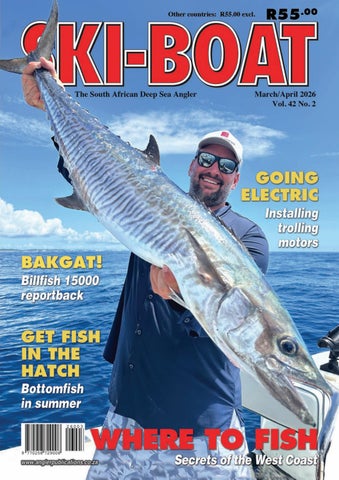
COVER:King of the Mackerel

Warren Bennett with a gloriously fresh king mackerel (’cuda) caught on Jeremiah Reef off Inhaca Island,Moçambique.

FEATURES

7Don’t Come Home Empty Handed

Remember the bottomfish in the gamefish season—by Mark Justham

15Where to Fish

Part 24:Secrets of the Cape’s West Coast —by Vic Warrington

22Bakgat!

2025 Billfish 15000 reportback —by Blyde Pretorius

28The Winners Take it All!

How to win the Billfish 15000 — byRene Jansen van Vuuren

41Going Electric!

Part 2:Installing your saltwater trolling motor —by Peter Jacobs

48Mounted!

Preserving the memories of noteworthy catches —by Erwin Bursik

56Balancing Act

Gyro tech brings lateral stability to big boats —by Erwin Bursik

DEPARTMENTS

4Editorial — by Erwin Bursik

32SADSAA News

55Awards for Excellence in Fishing

58Shimano Reel Kids

59Subscription Page

61Mercury Junior Anglers

63Business Classifieds & Directory

64Rapala Lip — Last Word from the Ladies

Publisher: Erwin Bursik

Editor: Sheena Carnie

Advertising Executive: Mark Wilson

Editorial Assistant: Lynette Oakley

Contributors: Erwin Bursik, Liana Cronje, Peter Jacobs, Rene Jansen van Vuuren, Mark Justham, Craig Maas, Blyde Pretorius, and Vic Warrington

ADVERTISING – National Sales:

Mark Wilson, Manager — 073 748 6107

Lyn Oakley — 082 907 7733

Lyn Adams — 083 588 0217 Velia Tonkin — 072 218 6383

Publishers:

Angler Publications cc POBox 20545, Durban North 4016 Telephone: (031) 572-2289

e-mail: angler@mags.co.za

Subscriptions to SKI-BOAT: R270 per annum (six issues).

New subscriptions and renewals:

SKI-BOAT Subscriptions Department Telephone: (031) 572-2289

• e-mail: angler@mags.co.za

• Through www.anglerpublications.co.za, or E-zine through <www.issuu.com>

Printing: Novus Print, Cape Town Distribution: On The Dot <Portia.Nguyuza@onthedot.co.za>

Full production is done in-house by Angler Publications & Promotions on Apple Macintosh software and hardware.

SKI-BOAT Magazine, ISSN 0258-7297, is published six times a year by Angler Publications & Promotions cc, Reg. No. CK 88/05863/23, and is distributed by On the Dot, as well as directly by the publishers to retail stores throughout South Africa.

• Copyright of all material is expressly reserved and nothing may be reproduced in part or whole without the permission of the publishers.

• While every effort is made to ensure the accuracy of the contents of this magazine, the publishers do not accept responsibility for omissions or errors or their consequences.

Views expressed in this magazine are not necessarily those of the publishers, the managing editor, editor, editorial staff or the South African Deep Sea Angling Association.

SHARKSONTHERISE

SHARK populations seem to be spreading extensively along South Africa’s eastern seaboard, invading areas they never used to frequent.

“So what?” some non-anglers may wonder, simply seeing these apex predators as an addition to the natural diversity of our inshore ecosystem. To us sport anglers, though, their intrusion – and above all the ever increasing area of the intrusion – is more than alarming.

I have personally fished Durban’s inshore area since 1962, with our primary target species being king mackerel (’cuda). In the old days, the loss to sharks was miniscule. The occasional body-less head we boated to retrieve our carefully made ’cuda trace did not create undue unhappiness, although when we retired to Mahogany Reef at the end of the day, someone invariably asked: “Did you get any heads today?”

Shark predation on the KwaZulu-Natal coast really started to become an irritation when, with the opening of the Sonny Evans slipway at Shelly Beach, an increasing number of boats started to target tuna off Protea Reef.

Those of us interested in competition angling in that area became greatly disheartened by the extremely high rate of hooked tuna that were savaged and taken by sharks. Eventually all the anglers fishing that area accepted that if you wanted to target yellowfin tuna, you had to accept a loss of well over 50% of the fish hooked. Thankfully, we off Durban – and in fact, right up to Sodwana – remained “shark free”, with only the very odd ’cuda being lost.

During the last 15 to 20 years, though, this has changed. The shark plague has steadily increased and moved up the coast from Aliwal Shoal to the shallow reefs of the north coast. Over the last decade, sharks have entrenched themselves in this area, and now they’ve carried the ’cuda stealing habit well into Moçambique. In fact, Ricky Jacobs, who has fished the Bazaruto archipelago more than any other South African I know, complained to me recently that the sharks off Baz are so bad that any fish hooked – even sailfish and marlin in shallow water – fall prey to shark packs that have never in living memory been so prolific in that area.

Is this a cyclical phenomenon? Is it possible that we may see the time come when what’s now “ten pulls for two boated” becomes a nightmare of the past?

When the sharks first started taking our ’cuda off Durban more and more frequently, I hoped it would be short-lived, but after talking to ’cuda anglers the full length of our eastern seaboard, it seems the situation is getting worse, not better.

Another angler told me this week that he doesn’t even fish with wire anymore, so that any ’cuda targeting his live bait will nip it off and swim free and not end up as shark food.

It’s a sad story, and one our scientific community seems shy to even talk about, let alone voice any opinions on why catch predation by sharks has escalated not only in specific areas, but virtually along the entire eastern coastline.

To the scientists out there, I would genuinely appreciate receiving a scientifically based opinion on this matter that we could publish in SKI-BOAT magazine. I would also like to know what the prognosis is likely to be, and what ’cuda anglers can expect in the years to come, or what resolution is likely to manifest.

Till the next tide.

Erwin Bursik

Remember the bottomfish in the summer gamefish season

WITH the summer gamefish season in full swing along the KwaZulu-Natal (KZN) coast,many anglers are focused on dorado,’cuda and other pelagics.But while the surface action grabs the attention,the reefs below are quietly producing some exceptional fish too.If you’re willing to change tactics once the bite slows,the rewards can be outstanding.

A STRONG START

The summer gamefish season got off to a flying start during November and December,with good numbers of dora-

do moving steadily along both the north and south coasts of KZN.Water temperatures climbed early in December,reaching an impressive 25.5°C,and with that warm,clean water came exactly what every offshore angler hopes for:active fish and consistent action.Some excellent dorado were landed,with the fish spread out and feeding aggressively.

As we moved into January,the dorado remained around,and reports continued to come in from various launch sites along the coast of good catches being made.

Alongside the dorado,there have also been encouraging signs on the ’cuda front.While the numbers hadn’t

yet exploded by the end of January,several exceptional-sized ’cuda had already been landed.The shoal ’cuda are still expected,and all signs point toward what could be a very strong ’cuda season in late summer and early autumn.

OPPORTUNITIESONTHEBOTTOM

While most of the focus during summer is understandably on gamefish,these months also offers some of the best bottomfishing of the whole year.Warmer water pushing in over the reefs brings with it bigger fish,stronger bites,and a far wider variety of species.

The warmer conditions often result in larger soldiers and slingers moving onto the reefs,along with lovely big

Neil Stewart is all smiles with hisMiss Lucy taken from the reef out deep.

When the gamefish aren’t biting, even in summer, send your line down deep and you might just come up with something tasty. Mark Justham shows off a beautiful amberjack while Neil Stewart was thrilled with his solid kob.

rockcod.Added to that,you still encounter the odd daga and geelbek, which makes every drop worthwhile.

This is also a very productive period for yellowtail and amberjack,particularly on deeper structure and prominent reef edges.These fish fight hard,test tackle properly,and are an exciting bonus when you’re working the bottom.

ADAPTING YOUR GAMEPLAN

My advice is that you don’t get locked onto just one set of tactics for an outing.If you do,you can miss out on some really good catches.

Most gamefishermen,myself included,start the day targeting ’cuda or

snoek in the early morning.Trolling the colour lines,working bait balls,and covering ground makes perfect sense while the fish are active.

But once mid-morning arrives, things inevitably begin to quieten down.Still,many boats continue trolling long after the bite has died off.That’s often when frustration sets in if you don’t implement a change of plan.

Instead of heading home emptyhanded,this is the perfect time to change tactics.

Shooting offshore to work the reefs for bottomfish can completely transform a slow day,and a few good soldiers or slingers in the hatch ensure there’s something solid – and delicious

– coming home for the frying pan.

Over the December and January period,we landed daga,geelbek, Captain Fine rockcod,catface rockcod, yellowtail,amberjack,soldiers,king soldiers,slingers,Scotsman and John Dory while fishing the bottom.This variety alone highlights why bottomfishing should never be overlooked during summer.Every drop holds potential, and you never know what’s coming up next.

Consider the following “game plan” off Durban,for example,to maximise your time out on the sea,without substantially increasing your fuel bill…

After a morning spent hunting gamefish,as mentioned above,head vir-

After a morning spent hunting gamefish off Durban, the author suggests heading straight out to sea off Umdloti River mouth to the 50 metre/28 fathoms area known as The Flats, to target bottomfishh before heading home.

tually straight out to sea off Umdloti River mouth to the 50 metre/28 fathoms area known as The Flats,which shows a small dropoff with a number of small pinnacles or reefs running parallel to the shoreline.

Fishing this area on the way back to Durban doesn’t increase your mileage home by much,and gives you opportunities to increase your catch for the day.

In addition to the bottomfish I have mentioned above,anglers also catch the occasional dorado,wahoo,tuna and ’cuda if a livebait is dropped fairly close to the bottom.Not surprisingly,we have also seen the odd sailfish and marlin swimming southwards along this line.

One can either anchor or drift over these small reefs.I personally prefer anchoring because I think it’s far more “intelligent”fishing over a reef if I see fish accumulating there,rather than drifting and having to continually up lines,livebait etc.,and then reposition the boat before recommencing fishing a specific area.

Instead of following the gameplan

above,if the purple water is in and conditions are reasonable,some skippers are prepared to sacrifice a “fry or two” and take a round-about return to base. They loop out to the 130/180m (70/100 fathom) lines,either trolling Rapalas or smallish straight-swimming lures.

They generally end up in the area around the John Ross wreck before heading back in towards No 1 reef and home.Many anglers have landed some beautiful “lucky shot”billfish,tuna and even wahoo this way.

WHY MANY ANGLERS STRUGGLE ON THE BOTTOM

In my opinion,one of the biggest reasons anglers return unsuccessful from a day of bottomfishing isn’t a lack of fish – it’s a lack of understanding of their fishfinder or sounder.

Modern electronics are incredibly powerful,but only if they’re correctly set up and accurately interpreted. Incorrect gain,poor colour palettes,or a misunderstanding of what the screen

is actually showing can easily result in a skipper driving straight past productive reefs without even realising it.

A very good starting point is to contact the supplier or distributor of your sounder.Most are more than willing to help you optimise your settings for local conditions.Another valuable resource is the group of experienced anglers at your local club,especially those running the same or similar units.

Learning what different colours, marks and shapes on your screen represent will dramatically improve your ability to identify reef structure,distinguish fish from bottom,recognise bait and feeding activity,and decide when to stop and fish.

They say,you can’t catch a fish unless you have a hook in the water,so in my opinion,if you have to travel the ocean going home anyway,you may as well wander a bit and have a chance of finding a fish instead of flying back, burning copious amounts of fuel,and missing opportunities to fill your hatch.

When top footwear and top fishing come together

“THE trace snapped,and the marlin was lost.That’s fishing for you. But when we close our eyes,we still see that marlin jumping!”

This epic adventure all began when a friend mentioned that people from a specific company wanted to go on a fishing charter.That’s how I got in touch with Stephen Palmer,the owner of Strike Footwear and Apparel.Little did I know just what an adventure I would be in for!

The charter was soon set up at Sodwana Bay with Rampala Fishing Charters.From the moment I met Stephen and his friends – a lively group of serious fishermen who live for fishing – I knew that I was in for an exciting trip.

Day one immediately challenged us. The surf was tricky,and the current ran from south to north,which was not the cold marlin water we were all used to. Days two and three threw reverse currents,with no fish in sight.

On day four,we decided to go deep into the ocean to look for the good water and clear current lines.During the day,the weather turned suddenly, and a tropical storm blowing up from Mozambique caught us out at sea.

For about 40 minutes the ocean became rough and jumpy as the cyclone pushed through.Fortunately I was wearing my Strike boots which gave me the confidence to move around safely on deck despite the weather.The grip on these boots was phenomenal,even when the sea threw everything it could at us.

Around midday,we saw blue bottles and birds working.Shortly afterwards, when the blue water was at 26°C,and bait fish were jumping,we put out our small lures.We got a skipjack and pinned it live,hoping it would tempt something big.

Ten minutes later,I spotted our quarry:“Marlin under the bait!”

We stopped,let the bait sink,and held our breath ...Finally,we all heard the click click click of the reel,and the

game was on!

The stunning blue marlin leapt behind the boat,and our crew couldn’t hold in the screams of pure jubilation!

Sandro was in the chair,doing his best to get the marlin under control. Then,after the third jump,the trace snapped and the marlin was lost.

Well,that’s fishing for you.No fish in hand,but when we close our eyes,we still see that marlin jumping.

Adventures like this are not easy to forget.And this is what Strike is all about:the love of the chase,the thrill of the adventure,and the shared moments with the crew on deck,that we’ll remember forever – with or without the catch.

To our readers reliving their own epic adventures through ours:keep on fishing!

Strike footwear is sold at Cable & Co stores throughout SouthAfrica. For further info email online@medicus.co.za, visit https://www.cableandco.co.za/ brands/strikeor call 076 177 2944.

Part 24:Secrets of the Cape’s West Coast

Looking for outsized tuna? Look no further than the Cape West Coast! Vic Warrington landed some truly noteworth tuna there in 2025, like a 137.6kg big eye tuna (left) caught at Dassen Gat, and an 89kg yellowfin tuna (right) landed off Saldanha Bay.

THE West Coast of the Cape is a treasure chest just waiting to be opened.The time has come to share the secrets of this amazing coastline that stretches from Dassen Island to Port Nolloth.

For many years,fishermen held the secrets of this area close to their chests.Before the advent of social media,the stories of specific spots and fish were only discussed around a fire.You dared not share,unless you were part of that inner

circle.Of course the inner circle encompassed a wide variety of people – commercial line fishermen,crayfishermen,bottomfishermen and the tuna manne

Their stories are brilliant,funny,and do vary as time goes by,but that’s the Wes Kus,where men are men and women are also men,they say,and the truth is stretched big time.

One of these closely guarded secrets was Dassen Gat.I discovered the Gat several years ago when I was invited to join a boat to that area.The coordinates were sketchy,as it’s a large area and no specific spot was known as the actual “gat”.

However,as GPS technology improved over time,we discovered the hole known as Dassen Gat about 34 nautical miles west (270 degrees) of Dassen Island.

That area is almost an extension of the Canyon from south of Cape Point,and as it is situated in the Mozambique current,the water is generally 20–22°C and a stunning blue colour.

What makes this area unique is that when the Canyon stops producing tuna – normally after the summer months that feature the howling south-easter – then winter’s north-wester starts blowing and the small pelagic fish move in towards the Gat,with the bigger pelagic fish in hot pursuit.

The first signs that it’s time to fish the Gat is when the warm water moves into the 20mile area and the poling boats, which mostly target longfin tuna, move towards that area from Hout Bay,Cape Town and the West Coast.

By the time the longfin,yellowfin, bluefin and big eye tuna reach the Gat area,they are much bigger than the summer fish,and as winter progresses,they become monsters of note.

The tuna generally move towards the first pinnacle area when the north-wester starts blowing,and hang around that area until the south-easter starts blowing again.Then they simply move out to sea and beyond our 40 mile limit.

In 2025 I caught some truly fabulous fish out at the Gat, including a colossal big eye tuna weighing 136.7kg that took me about 45 minutes to land.A few smaller ones were also landed on back lines and on bait.

I also went vas on a 103.4kg bluefin tuna that gave me a three-hour long fight of note.We actually went three-up that day,but lost two to line burn.Plenty of yellowfin tuna are also caught in that area,most of them weighing 60- to 100kg.

Tuna aren’t the only treasures the Gat holds.Last year I was very fortunate to hook up on a black marlin estimated to weigh between 250- and 300kg.I hooked it on a new spreader bar that I designed called a “teasler”.The marlin leapt into the air about six times,then ran and spooled me,as I did not have a marlin-worthy skipper on the wheel.We have since lost two more marlin.A few other guys have also hooked up on marlin,but lost them because those weren’t the target fish and the anglers weren’t prepared for them.One boat actually hooked a marlin on a Rapala lure,and also saw the typical acrobatics before it broke loose.

There’s real treasure to be mined here if you come prepared,and I think this marlin fishery is ripe for harvest.

Vic Warrington caught this 103kg South Atlantic bluefin tuna at Dassen Gat off the West Coast.

As you venture further up the coast towards Port Nolloth,you will find yellowtail and snoek quite far out.There seems to be trend lately that all the bigger pelagic fish are staying further out,beyond our 40 mile jurisdictions.

Let’s take a brief look at some of the main fishing areas up this coastline...

LANGEBAAN

Langebaan Lagoon offers excellent,year-round fishing for species like white stumpnose, geelbek,kabeljou (kob) and elf, with prime spots near sand banks and deep channels.

Both shore angling and boat fishing are popular,and the lagoon also offers good light-tackle fishing and saltwater fly-fishing on the sand flats.Prime locations include the deeper channels,particularly on the incoming tide.

Take note:The lagoon is part of the West Coast National Park,which has various designated fishing zones:a Controlled Zone (fishing allowed),a Restricted Zone (no fishing,only non-powered vessels),and a Sanctuary Zone (no access).Make sure you know where you’re allowed to fish before you set off.

Fishing is generally good throughout the year,but many species are more active in the warmer months and during specific tidal movements.

SALDANHA BAY

Saldanha Bay offers exceptional,year-round fishing opportunities in one of South Africa’s largest natural,sheltered bays.Key species include white stumpnose,kob,galjoen,hottentot,elf, garrick,yellowtail and snoek.

Small boats can launch and fish within the protected bay for white stumpnose,the primary target,while the deeper waters outside the bay produce snoek in winter and gamefish in summer.

Saldanha harbour is a major centre for the local fishing industry,offering access to deeper waters,while nearby Langebaan Lagoon provides calmer,shallow water fishing.

Note that certain areas within the bay are subject to marine protected area (MPA) regulations,particularly closer to the Langebaan Lagoon.

ST HELENA BAY

St Helena Bay is renowned for winter snoek,rock lobster,and a variety of shore-based species.Popular catches include

The West Coast offers anglers access to a multitude of species including yellowtail, tuna, snoek and katonkel.

snoek,hottentot,kabeljou (kob),hake and yellowtail.Sandy Point Harbour serves as a primary fishing and launching hub. Laaiplek,located near the Berg River mouth,is also popular for boat and shore fishing.

Winter is prime time for snoek,while other species are caught throughout the year.

LAMBERT’S BAY

This premier West Coast fishing destination is known for productive linefishing and rock lobster harvesting.Primary catches include snoek,hottentot,kabeljou (kob),stumpnose,red Roman,carpenter and yellowtail.Snoek is the most common offshore species caught here and their season runs mainly from April to July.If you’re going to target rock lobster,remember that there’s a closed season,so make sure you adhere to the regulations.

The best time to fish is when the northerly winds are blowing as they bring warmer water and increase fish activity.

As with many of South Africa’s waters,this region is known for challenging sea conditions,so be extra careful if you’re not a regular skipper in this area.Also take note of the marine protected area regulations.

PORT NOLLOTH

This Northern Cape fishing town is renowned for its commercial and recreational fishing,with a primary focus on crayfish (rock lobster) alongside linefish species like snoek,yellowtail, hottentot,galjoen,white stumpnose,and kob.The local industry is heavily supported by theAukotowa Small-scale Fisheries Cooperative.

Crayfish is the main economic driver,with a season typically running from November to April.Popular linefish species in this area include snoek and yellowtail.

This is a general overview of a really special part of our coastline.Go on,take a trip to the West Coast and find out just what treasure is waiting to be discovered!

WFISH IT DRIFT IT

Catching Furuno’s drift

IND and currents have minds of their own,so wouldn’t it be awesome if you could line up your fishing spot and let the plotter do all the hard work by calculating your drift line and time? Now you can with Furuno’s FISH IT – DRIFT IT,a feature unique to NavNet TZT plotters.

It’s easy to overthink and complicate the calculation of setting up a drift,and is frustrating when you miss the spot, but clever software built in as a standard feature to TZT2 and TZT3 plotters removes the guess work.No more wasting time when the boat drifts in a completely differently direction to your best guess.

HOW DOES IT WORK?

Furuno’s DRIFT IT feature will tell you where to start your drift so that the vessel will drift in the direction of the waypoint,all the time giving you heading,speed and distance information,and tracking your progress to the waypoint.

As this is a DRIFT feature,you first need to stop the vessel and wait for the forward momentum from the motors to cease.Next,select your waypoint.This can be a waypoint saved from a favourite fishing spot or a mark on the sounder that’s got your interest and looks suitable for dropping a few baits or jigs while you drift over the mark.

Once the boat is settled into a drift,tapping the plotter screen to fish the mark will bring up a menu.Select the FISHIT option.A menu pops up showing important information like Distance To Waypoint (DTW),Speed Over Ground (SOG), Speed Through Water (STW) and Course Over Ground (COG). A fish icon with a solid yellow line to the vessel indicates that the FISH-IT mode is active.Range rings appear on the plotter to help with easily judging distance.This is important information for the next step:DRIFT-IT.

To active the DRIFT-IT mode,tap the DRIFT-IT icon on the screen.Using the DTW,SOG,STW and COG information,the plotter software can calculate the optimum position to start the drift.A message “Drifting to Compute Drift-it Start Point”will be displayed.The vessel will need to drift for about 30m to accurately determine the drift speed and direction under current conditions.

Once the plotter has calculated the vessel drift,it knows where to position the vessel for

the optimum drift line.A purple course line will join the vessel’s position to the DRIFT-IT spot.Tapping on the icon opens a pop-up menu that allows you to select the time to drift.You can select 3,5,10,15 or 20 minutes,and the purple icon will move to accommodate the time required to hit the mark. Most people use the shortest option of three minutes.

Motor over to the purple spot and again ensure that all forward momentum from the motors has stopped.

That’s it – the DRIFT-IT feature gives you the best drift line so the skipper can get a line wet and not have one hand on the wheel and the other checking which way the wind is blowing.

Scan this QR code to watch a YouTube video showing how the FISH IT –DRIFT IT feature works.

The 39th Billfish 15000 – where legends are born

“You knocked it out of the park!”and “A really fantastic,well-organised event!”were just some of the accolades shared by sponsors and anglers who participated in the 2025 Billfish 15000 Deep Sea Fishing Tournament.

Hosted by the Dorado Ski-Boat Club,the 39th edition of this iconic event took place from 9 to 14 November 2025 in Sodwana Bay and was hailed as one of the most successful tournaments in its long and proud history.Drawing anglers from across South Africa and abroad,the Billfish 15000 once again confirmed its status as one of the country’s premier sportfishing events.

SETTING THE STAGE Preparations began on Saturday,8 November,with the Dorado Ski-Boat Club committee transforming the Sodwana Ski-Boat Club venue into a world-class tournament hub.That evening,sponsors were honoured at an exclusive thank-you dinner,providing an opportunity for industry leaders, organisers,and partners to connect ahead of the week’s action.

Sunday’s registration ran seamlessly,and the skippers’briefing saw approximately 500 anglers, sponsors and ground crew packed into the hall before the spectacular grand opening ceremony kicked off.Violinist Lynette delivered a breathtaking performance that left the audience spellbound.Plentiful refreshments,generously provided by Halewood South Africa and SAB,with local Maak ’n Jol staff helping in the bar,set the tone for an exciting week ahead.

First place at the 2025 Billfish 15000 went to Team Bakgat.

COMPETITION ON THE WATER

Launching on the first day of fishing went off without a hitch,thanks to outstanding cooperation from iSimangaliso,Ezemvelo KZN Wildlife, and an efficient beach control team.

All 86 boats entered launched smoothly under near-perfect conditions.A memorable sight greeted spectators,because each boat carried a pink flag on its outriggers – a heartfelt initiative sponsored by Maverick ,raising awareness and support for families and friends battling cancer.

Fishing action was strong from the outset.Twelve billfish were released on Day One,with Tails Up taking the early lead after releasing a striped marlin. Every angler who successfully released a billfish received a special numbered trophy,proudly sponsored and crafted by Jean Meintjies,recognising the importance of conservation and ethical angling.

On Day Two, Tails Up maintained their lead with another striped marlin release,while Bakgat began steadily climbing the leaderboard.With 11 billfish releases on day two,and points extremely close,it was clear that the tournament would likely be decided only on the final day.

MIDWEEK MOMENTUM

On Wednesday (Day Three),the favourable weather continued,and team strategies started to come together.With 13 billfish released that day, weigh-ins and verifications intensified at Castle Corner,and anticipation grew ahead of the evening’s prize-giving. Teams enjoyed pre-booked dinners provided by The Tree,while Dorado SkiBoat Club treated all the teams to a special Wednesday dinner prepared by Sodwana Bay Lodge.

That evening also featured a charity auction,raising funds for Droogte Hulp

and the Benjamin Osmers Foundation, supporting communities and individuals in need.Boats finishing in the top ten that had not secured their own vessel at registration were auctioned as well,adding to the excitement.The atmosphere was electric,and Stephe emerged as the new leaders.

WEATHER CHALLENGES AND FINAL PUSH

Thursday (Day Four) saw all 86 boats heading out once more,with the tournament still wide open.Sadly,conditions deteriorated and fishing proved tough.The day was called off early for safety reasons,with beach control –expertly handled by Mariette Hendriksz and Lizelle Els – ensuring every boat returned safely to shore.Only six billfish were released,tightening the points race even further.By the end of the day, Bienkie had taken the lead, with Gwawa close behind.

Billfish galore for the teams aboard Brothers, Real Passion and Black Pearl II.

Where exactly were those fish caught? The stats tell the story.

That evening,MC Jaco Hendriksz warned that Friday’s final day might be a blow-out,but that the weather committee would assess conditions carefully before making a launch decision.

A LEGENDARY FINISH

On the Friday,Day Five,the weather committee waited patiently before finally giving the go-ahead at 09:00.The remaining contenders rose to the challenge,with the leaders separated by only a single release.

Despite a shortened fishing window,four billfish were released – releases that would ultimately decide the tournament.

In total,46 billfish were caught and released during the week,including striped-,black- and blue marlin,as well as sailfish – a testament to both the quality of fishing and the skill of the anglers.

Following a moving closing sermon by the tournament director,Willie Pretorius,the winners were announced at a spectacular finale.

CHAMPIONS CROWNED

The crown ultimately belonged to Bakgat ,who claimed victory at the 2025 Billfish 15000.Competing for the 30th time in 2025,they had consistently been among the top contenders,and

their perseverance finally paid off.Their name is now permanently etched on the Billfish 15000 Wall of Fame,earning them “legend”status.Well done to Marius,Tiaan and Wanda Jansen van Vuuren,Iaan Viljoen and Robin Vermaak

The team walked away with an extraordinary prize package,headlined by a SeaCat 636 with twin Yamaha F130hp outboards,fully rigged and trailered – a prize valued at approximately R1.3million,sponsored by Yamaha. Additional prizes included boat insurance sponsored by Club Marine,as well as premium electronics and equipment from Airmar,Pulsator,Lowrance,A2H Clothing,Jack’s Paint,Columbia,and many more.In total, Bakgat accumulated prizes worth approximately R2million over the course of the week.

Second place went to Bienkie,and they received top-of-the-range marine electronics and gear sponsored by Lowrance,Airmar and Pulsator.

Third place was claimed by Gwawa, who walked away with some very impressive prizes including a WARN Zeon XD 12000lb winch,advanced weather equipment from Airmar,and additional sponsor rewards.

The Calcutta of R60000 for the Biggest By-Catch went to Elton Marshall from My Lady ,who caught a wahoo weighing 18.9kg.

LOOKING AHEAD

The Dorado Ski-Boat Club Committee congratulates all the teams,and sincerely thanks every sponsor,official,volunteer,angler,family member,and supporter who contributed to another outstanding and safe tournament at Sodwana Bay.

As 2026 marks the 40th anniversary of the Billfish 15000,major plans are already underway to make it a milestone event.With increased international interest and growing participation, the next chapter promises to be even bigger and better.

We look forward to welcoming everyone back to Sodwana Bay from 8 to 13 November 2026.

Tight lines till then!

TOPTENBOATS

1. Bakgat .

2. Bienkie .

3. Gwawa

. . .637 points

. .610 points

.511 points 4. Stephe

points 5. Brothers

points 6. Jakkalas

points 7. Tails Up

points 8. Skylar Blue

.481 points 9. Captain Fine

.355 points

.480 points 10. SeaDucer

A beaut of a wahoo was the best bycatch
The Billfish 15000 committee.
Second place went to Bienkie.
Third place went to Gwava.

THE WINNERS

THE Billfish 15000 is one of the largest surf-launch marlin competitions in the world,and one that appears on many anglers’ bucket lists.The Dorado Ski-boat Club is the backbone of this event,which takes place annually in Sodwana.Their excellent organisation is part of what makes the competition so popular,ensuring that boats return year after year to fight for the title.What an incredible honour and privilege it is to compete against the best anglers in the country.

Bakgat is well-known in the coastal town of Sodwana Bay in KwaZuluNatal,and the crew who fish aboard this Cobra Cat 700 have a deep love for catching marlin and for the camaraderie that comes with it.It is a family boat for a crew who enjoys God’s creation and strives to offer friends and family the opportunity to fish together.

Not only was this the 30th time that Bakgat has competed in the Billfish 15000,but 2025 was also the year the owners,Marius and Wanda Jansen van Vuuren,celebrated their 30th wedding anniversary – and the year they emerged as the winners of the Billfish 15000!

Tiaan and Wanda have also nurtured a love of fishing in their two children,Madhi and Tiaan,and this year’s winning team consisted of Marius,Tiaan, Iaan Viljoen and Robin Vermaak. Iaan and Robin,with Tiaan as skipper,also represented the Western Province in the National Heavy Tackle Tournament and won it twice,in 2021 and 2022;a dream team if ever there was one!

Despite their extensive experience fishing for billfish at Sodwana,the week of 9–14 November 2025 can best be described as nerve-wracking – and blessed – for the team aboard Bakgat

The week started off fast and furious,with the first screaming reel of the tournament being found on Bakgat ! Five minutes into the fight,the billfish showed its sail,and the team’s joy was immeasurable.Beach control was immediately contacted,and once it got close to the boat,Tiaan took the massive sailfish by the bill and,with a grateful and excited heart,released it back into the sea.

On the second day of the competition it was Robin’s turn to test himself against the power of a blue marlin.He really felt the adrenaline in the fighting chair during this mammoth battle.The fish at the end of the line was on fire! It showed off with acrobatic leaps and put on quite a spectacle.Robin did an excellent job of taming it,and after a quick fight and several shouts of “Turn left! Turn left!”and “Wind!

was at the boat and more points were added to the scoreboard.

Of course at these events there’s also plenty of action off the boats.Every evening the committee ensured there was heaps of fun and entertainment at the daily prize giving.Stories were exchanged,the day’s footage was shown,and everyone laughed together. The atmosphere in the hall is always warm and full of good spirit.Even if you’ve caught nothing but a sunburn all day,you will still go to bed with a full heart after the function.

It’s not all fun and games,though.If you want to have a chance at winning, there’s a lot of work involved too.Every angler can testify to the hours of preparation they put in:every hook lovingly sharpened,every line measured out with precision,and every lure handselected one by one.

The week is filled with early mornings,late nights,and hours of anticipation.That’s exactly what makes it so brutal when no fish seem to have an appetite for your hand-picked

Pulsator Lures all-you-can-eat buffet. Unfortunately,you get days like that at sea.In a competition,when your spirits start flagging,it’s best to turn up the music and keep believing the fish will eventually get hungry.That is exactly what Team Bakgat did on the third and fourth days.

The secret,however,is to be happy for the boats that do catch fish,regardless of what your own scorecard looks like.That way,when grace reaches you,you’ll be surrounded by people who share in your joy.

TAKE IT ALL!

On the final day of the competition, Team Bakgat’s dreams came true.Two hours before lines-up,Iaan got into the chair to begin the fight with what would be their winning fish.It’s hard to imagine the stress and tension these men felt during those minutes when their nerves were stretched as taut as the line.

When the fish finally reached the boat,it was identified as a black marlin! After the hook was removed and “Blackie”splashed everyone thoroughly, the marlin swam calmly back home.The team,however,could not remain calm; they were ecstatic! Their lures immediately went back into the water for the final hour of fishing.

The crew will no doubt argue that it was seawater on their cheeks,but we know tears of joy were shed when all

Bakgat walked away with first place at the 2025 Billfish 15 000.

the boats had to return to shore and they knew their efforts had been enough.After a week of perseverance, concentration,and plenty of laughter, they ended the competition with three species and 637 points! Bakgat opened the competition with the first fish,and closed it with the last.

The Bakgat crew shared some thoughts on the competition with their fellow competitors:

‘‘To God be the glory! He blessed us with His nature,turned prayers into dreams,and filled our hearts with joy and love.’’— Robin

‘‘Eyes lifted upward.Just keep believing.Sun,sea,and wind.Friends tied together.’’— Marius

‘‘Together we fish,together we stand.Friendship and teamwork steering the plan.With belief in each other

and our Creator,we chased every story and reeled in the win,crowned in our glory.’’— Iaan

‘‘Eyes up,feet on the ground,flags in the air!’’— Tiaan

Naturally,the question everyone asks is:“How do you win the Billfish 15000?”If only it were that easy and there were a secret formula! The obvious answer is:enter! Of course that’s essential,but the real answer is:find a remarkable team,pray that God will send fish your way,and believe He will make it possible.Everything happens in His time,even if it takes 30 years.

The prize money is just a bonus –the title is the true dream;a prayer come true.Billfish 15000,it is a true honour to carry the title,but we’re not waiting another 30 years to win again.

See you next year!

A CHANGING TIDE

The Evolution of Competitive Deep Sea Angling in South Africa

COMPETITIVE deep sea angling in South Africa has always been about more than just catching fish.It is a sport that demands preparation,discipline, teamwork,and a deep understanding of the ocean.In order to be successful offshore,an angler has to read currents,track seasonal fish movements, choose the right tackle,and perform consistently under pressure.Hours spent at sea,often in challenging weather and rough conditions,test an angler’s resilience and mental strength as much as their physical skill.

Over the decades,competitive deep-sea angling in South Africa has evolved from a small,informal sporting niche into a structured,inclusive,and internationally respected discipline. This growth has been driven by committed administrators,passionate anglers,and a shifting culture that recognises excellence based on performance,not background,gender or age.The rise of women and junior anglers into the national spotlight illustrates how deeply the sport has changed.

The milestones achieved between 2024 and 2026,in particular,reflect not just individual success,but also decades of collective effort to grow the sport and broaden its reach.The selection of the first all-ladies Protea teams,and the debut of the first Junior Protea Under-19 team on the international stage,represent a new tide in South African deep sea angling history.

FROM COASTLINE TO COMPETITION: THE UNIQUE CHALLENGES OF SOUTH AFRICAN WATERS

South Africa’s coastline spans more than 3000kilometres,stretching from the tropical waters of the east coast to

the cold Atlantic currents of the south and west.This extraordinary range of environments makes the country one of the most diverse and challenging arenas in the world for deep sea angling.Species diversity,shifting currents,varying water temperatures,and changing seasonal patterns demand that anglers constantly adapt their techniques and strategies.

In this environment,deep sea anglers develop an intimate understanding of the ocean.They learn to read subtle signs on the water,adjust drift patterns,and choose baits that appeal to specific species under specific conditions.In competition,this knowledge separates good anglers from great ones,because decisions must be made quickly and under pressure.

When organised competition began in South Africa,this depth of knowledge was shared among a relatively small group of dedicated anglers. Participation was,by tradition and circumstance,male dominated.Access to boats,the cost of equipment,and social norms limited broader involvement.

The first ladies’interprovincial was held in East London in 1988,but later the women anglers opted to compete directly against the men with no concessions and no reduced expectations.

Despite these hurdles,women angler pioneers began to make their mark.Their achievements laid early foundations for what would become a more inclusive competitive culture.

THE SPRINGBOK ERA AND EARLY PIONEERS

Until the end of 1994,national sporting honours in South African angling were awarded as Springbok colours. This period,now often referred to as the Springbok era,holds a special place in the sport’s history.It was dur-

Anton van den Berg SADSAAPresident
Joey Terblanche was one of the first women to earn Springbok colours for offshore fishing. She subsequently earned Protea colours too.

In 2024, Michelle Richards captained the first all-ladies Protea team on home soil at the SADSAA Bottomfish International and Nationals. She also won the prize for most meritorious fish on 6kg line.

ing this time that women first broke through into gaining national recognition in deep sea angling.

In 1992,Arlene Joubert and Joey Terblanche were among some of the earliest women to earn Springbok colours for their achievements in offshore competition.Their selection was based purely on performance and consistency.They stood shoulder to shoulder with male peers,proving that deep sea angling rewards skill,patience,and strategic thinking regardless of gender.

Their achievements were significant not only for their personal success,but also for the message they sent to the broader angling community. They were proof that women could compete and excel at the highest level of South African deep sea angling.Their success helped shift perceptions and opened doors for those who followed.

These women fished under the same rules and conditions as their male counterparts.There were no divisions, no allowances,no separate categories. The sport’s culture,while traditional in its participant makeup,held fast to the idea that performance in competition is the ultimate measure of merit.

TRANSITION TO PROTEA COLOURS AND A GROWING NATIONAL IDENTITY

At the end of 1994,South African sport underwent a symbolic shift in how national honours were presented. Springbok colours were retired,and athletes across many disciplines, including angling,began to represent the nation under Protea colours.This change aligned angling with the broader sporting identity of the country and marked a new chapter for national

competition.

The transition did not lower standards or change the way athletes were selected.Performance remained the sole criterion for earning national colours.What changed was the flag under which athletes competed,and a broader sense of unity and national pride attached to sporting representation.

One figure who bridges the two eras is Joey Terblanche.After earning Springbok colours in 1992,she went on to earn Protea colours in 1995.Her journey symbolises continuity and resilience,showing that the essence of competitive excellence transcended changing uniforms and sporting symbols.

As the Protea era took hold,more women began to compete regularly in provincial and national competitions. Their participation shifted from exceptional to expected.With each season, more female anglers gained experience,honed their skills,and demonstrated that excellence offshore was not limited by gender.

THE RISE OF WOMEN IN THE PROTEA ERA

The late 1990s and early 2000s marked a period of steady growth for women in South African competitive deep sea angling.More female anglers began to earn Protea colours based on merit, building on the groundwork laid by earlier pioneers.

In 1995,Lizette Walker and Dorothy Uys earned Protea colours,further normalising the presence of women at national level.In 1998,Joelle Row joined the ranks.Sue Tapson and Mearl Buyskes earned Protea honours in

2000,followed by Lynette Adams and Lynn Beattie in 2001.Each of these anglers contributed to a growing presence of women in competition,not as anomalies but as respected competitors.

What distinguished this period was not just the awarding of colours,but also the depth of skill displayed by women offshore.Female anglers were no longer isolated participants.They competed consistently,adapted to diverse conditions,and brought strategic insight to their approach.They stood as equals in a sport that leaves nothing to chance.

Despite these gains,progress was gradual.Women still represented a smaller portion of competitors compared to men,and barriers related to access and visibility persisted.Yet the momentum was building,and the sport was changing.

A NEW GENERATION EMERGES IN THE 2020S

The 2020s marked a renewed surge in female participation and success at national level.Improved access to competitions,stronger development pathways,and increased visibility of role models helped fuel this growth.

In 2023,Mariëtte Hendriksz earned Protea colours,marking the start of a new wave of female representation.In 2024,Michelle Richards,Belinda Fischl, and Jacqueline Luef followed.In 2025, Candice Coetzer was added to this growing list.These women represented a generation that had grown up with role models before them,and with clearer pathways into elite competition.Their rise was marked by dedication,teamwork,and consistency across

Lynn Beattie was thrilled when she earned her Protea Colours in 2001.

increasingly competitive seasons.

For the first time,the depth of female talent made the selection of allladies Protea teams possible.This was not symbolic inclusion,but a recognition of excellence built over many seasons.

HISTORIC SELECTIONS AND INTERNATIONAL REPRESENTATION

In 2024,South Africa fielded its first all-ladies Protea team on home soil at the SADSAA Bottomfish International and Nationals.Michelle Richards captained the team,with Belinda Fischl and Jacqueline Luef alongside her. Their selection was based solely on performance,and their presence marked a milestone in the sport’s history.

The following year,South Africa took the next step.At the 84th International Light Tackle Tournament Association (ILTTA) event in Guatemala,the nation sent its first allladies Protea team to compete internationally.Mariette Hendriksz captained the team,with Michelle Richards and Candice Coetzer rounding out the lineup.They faced experienced international competition in demanding offshore conditions,reaffirming that South African women are not just capable of national excellence,but also of competing on the global stage.

These selections did more than make history.They showed young anglers,especially girls,that the highest levels of competitive deep sea angling are within reach based on skill,discipline,and consistent performance.

JUNIOR DEVELOPMENT: BUILDING THE FUTURE OF THE SPORT

While the advancement of women represents one major evolution,the development of junior anglers has become equally central to the sport’s future.Structured pathways now introduce young talent to competitive environments where they learn not only technical skills,but also safety, teamwork,and decision-making at sea. Early exposure to real offshore conditions builds confidence and competence,laying the foundation for sustainable competitive careers.

Mentorship is central to junior development.Experienced anglers, including Protea representatives,share knowledge about boat etiquette,fish handling,strategy,and tournament discipline.This shared learning environment has strengthened the overall standard of competition and gave junior anglers a smoother transition into senior ranks.

In many ways,junior development is where the sport’s future is shaped. It is where passion meets guidance, where raw potential is honed into skill,and where the next generation learns to handle pressure with confidence.

THE FIRST JUNIOR PROTEA UNDER-19 TEAM

The culmination of structured junior development came in February 2026, when South Africa fielded its first Junior Protea Under-19 team at the El Gouna International Tournament in Egypt.The team was captained by Juandre Wasserman,with Matthew Shepard and Ruben Els completing

the lineup. Their participation marked a historic step for junior deep sea angling. Competing internationally at a young age requires technical ability,mental composure and adaptability.The South African juniors demonstrated they were ready.Their presence in Egypt confirmed that SADSAA’s development pathways are producing anglers capable of performing on the world stage.

This achievement also ensures continuity for South African competitive angling.As senior ranks evolve,a new cohort of trained,experienced, and confident junior anglers is ready to step up.

Some top junior anglers are also coming through the ranks. This Southern Gauteng team took gold in the U16 division at the 2024 Junior Gamefish Nationals.
Candice Coetzer, Mariëtte Hendriksz and Michelle Richards proudly represented South Africa at the 84th ILTTA event in Guatemala in 2025.

MERIT AS THE CORNERSTONE OF SELECTION AND SUCCESS

Through every phase of its evolution, South African competitive deep sea angling has remained anchored in one principle:merit.

National colours,whether Springbok or Protea,have always been awarded based on performance,consistency,and the ability to deliver results under pressure.

The rise of women and juniors within the sport has not resulted from lowered standards or special treatment.Instead,it reflects a broader pool of talented anglers,clearer development pathways,and a culture that

recognises and rewards hard work and results.This merit-based approach has helped raise the overall standard of competition,making South African anglers more competitive at provincial,national,and international levels.

LOOKING AHEAD: A STRONG FUTURE ON THE WATER

The sport stands at an exciting point in its history.

With experienced pioneers,a strong cohort of Protea women,and a new generation of juniors progressing through structured pathways,South African competitive deep sea angling is well positioned for continued

growth and international success.

The milestones achieved between 2024 and 2026 mark more than historic firsts.They signal a shift in culture,opportunity,and expectation. They show that the sport continues to evolve while staying true to its core values of discipline,preparation,and respect for the ocean.

As the next generation of anglers prepares to take to the water,the legacy of those who came before continues,carried forward one tournament, one team,and one tide at a time.South African deep sea angling is changing, and the future looks brighter than ever.

Matthew Shepard, Ruben Els and Juandre Wasserman at their capping ceremony ready to represent South Africa at the El Gouna International Tournament in Egypt in February 2026.

Part 2: Installing your saltwater trolling motor

IN the previous two issues of SKIBOAT we outlined what trolling motors can do for you.Hopefully this has got you thinking,and you are now ready to take the leap into the future! Before you jump head first into fishing bliss,though,there are a few key considerations to keep in mind.

To put it plainly,significant investment is required to install one of these trolling motors,and you need to be sure your boat is suitable for this application and,most importantly,that you choose the correct unit to suit your vessel.

CHOOSING THE RIGHT MOTOR

This is a crucial step in the process and cannot be overlooked.

You must correctly size the trolling motor shaft length to the bow-to-waterline measurement of your boat.If you go too short,the propeller will not be deep enough in the water to hold your boat in position.

Most decent brands on the market are all rated at around the 100- to 110foot-pound thrust rating regardless of shaft size;it is only the length of shaft that differs.

It might be convenient to have a shorter shaft motor installed as it takes

up less space on the gunnels when stowed,but you will sacrifice performance and longevity of your equipment if you go too short.

It is also important to consider where and how you are fishing.

If there are often large waves present where they fish,I will advise clients to up-size the length of the shaft so that the propeller stays in the water when swell and wind chop make the ocean rough.

If the propeller consistently comes out of the water when the sea gets rough,the motor must work harder to maintain the boat’s position.This will waste power and it will make the boating experience uncomfortable as the motor works harder to move you back onto your chosen mark.

It also puts strain on both your trolling motor mountings and the shaft, as the shaft will “whip”when it loses and gains resistance from the water. These are not good things if you want your investment to last.

Lastly,if you have a motor coming in and out of the water often,it will put strain on the fibreglass bow of your boat,as the torque increases and decreases when you gain and lose water contact.

If you’re on the edge or between

two sizes,always size up.If you fish in big chop or swell,size up.

On the Garmin Force Kraken,you can easily adjust the shaft up or down using the depth adjustment collar,so there really is no harm in going slightly longer.

I prefer having the shaft stick up a bit on the bow after using the collar to adjust it,because this allows me to easily see where the head of the motor is pointed when I’m at the helm,so that I have a visual reference when engaging the motor.

In summary:when in doubt,size up or chat to your dealer/brand rep to get a recommendation on the best size for your boat and fishing application.

WHERE DO I INSTALL THIS THING?

Trolling motors are designed to pull your boat from the bow.It’s far more efficient to pull a hull through the water and have the length of the boat follow a central pivot/pull point than to push the hull from the back.You can also make smaller adjustments to your heading to effect a greater change in course,and at much slower speeds.

Trolling motors can,theoretically,be mounted on forward- and centre console boats,but it’s significantly easier on centre console boats.

This 90inch Garmin Force Kraken is installed on a Seacat 63x. Here I’ve adjusted the depth collar to effectively shorten the shaft, as the sea is calm. This allows me to quickly reference where the motor is pointed, even from the stern. If conditions worsen and a large chop is present, I can easily drop the shaft down to sit deeper in the water to prevent losing contact.

Note the use of a custom mounting bracket on this Raptor 660 to allow the shaft to clear the bow’s rub rail. This motor has a 90 inch shaft length, allowing the angler to use spot lock in a rough sea when required.

If you have a forward console boat, you will need to carefully consider where to mount the trolling motor,and you may have to install an offset mounting plate on the side of the gunnel to find a suitable spot.It can be done,but I would advise consultation with the boat builder.Stowing and deploying also becomes difficult in this situation,as you would have to climb up and around to be able to reach the motor.It’s not impossible,but is not simple either.

On centre console monohull boats, you can install in one of two ways: crossing the centre line to deploy off the front,or staying on the port or starboard side to deploy directly forward. Both are equally as efficient,the only dif-

ference being practicality in terms of what’s in the way and how much space you have to stow and deploy the motor.

On catamaran style ski-boats,which is 90% of our local market,you will choose either the port or starboard side of the bow and mount it along the gunnel,deploying forward.

It’s often necessary to fabricate and install a mounting plate for the base of the motor,to get the motor far enough forward to deploy without hitting the front of the bow.These plates also serve as reinforcement of the bow.

Until recently boat builders didn’t really have too much reason to make the bow super strong,other than where the anchor bollard is installed.Boat

builders are now,however,realising how popular trolling motors are becoming,and will reinforce the bow for you with a few extra layers of fibreglass to handle the strain – if you let them know that you are considering installing one. They are also now running forward electrical conduit to the bow to make it easy to run power cables to the trolling motor from the battery bank.

To make stowing and deploying even easier,and to avoid having to install a plate off the front of the bow, you can also opt to install a swivel style base plate to deploy the motor forward and out to the side a bit.

This is a great compromise as you don’t have to mount the motor over the

In the photo above, the trolling motor has been installed on an Atomic 22 monohull with a swivel bracket to make stowing and deploying the trolling motor effortless. The shaft support arm is essential to protect your boat and trolling motor when towing and in rough seas.

The photo on the left shows the trolling motor in the deployed position, with the swivel bracket locked. Note how the swivel bracket allows easy use of the trolling motor and windlass.

bow and can keep it running along the gunnel so that is completely out of the way when stowed.When you need it, you swivel the base out to the side and deploy the motor quickly and easily. Until recently,your only option was to import these swivel bases from the USA at a hefty price tag,but local manufacturer Atomic Power Boats has engineered their own solution that works very well.I have installed a few of these and they make stowing and deploying an absolute dream.

Once you have found a good spot to install your motor,it’s a good idea to check the strength of the bow.Trolling motors are relatively new in our market, and slightly older boats most likely won’t be reinforced in the bow.It can’t hurt to have your local dealer put a few extra layers of fibreglass into the underneath of the bow to be sure it can handle the strain the motor will put on it.

If the bow is too weak,you could cause damage that will be more costly to repair than it would have been to reinforce it in the first place.Worst case scenario is you make an expensive new FAD for the guys to catch bait on,and no one wants that to happen!

HARD MOUNT OR REMOVABLE?

Once you have decided on a location that works,you need to decide if you will bolt the motor on permanently or if

you would like to remove it sometimes.

If you want to bolt it on and forget about it,that’s easy,but personally I like that I can quickly remove my motor if I need to clean underneath the mount,or if I need to store it if the boat needs to be serviced.

When I’m towing on rough roads and into Moçambique,I also remove the motor and transport it on the deck of my boat in a padded bag similar to a chill bag,to avoid unnecessary strain on my bow or motor mountings.

To facilitate this,I have installed a quick-release plate as well as a power receptable and plug.To remove the motor,I simply unplug it from the receptacle and pop the unit off the quick release mount.If you store the boat away from home or on mooring, you can put a small lock on the quick release mount to prevent any sticky fingers walking away with your prized possession.

I also highly recommend some form of shaft support for your motor when in the stowed position.These mount on to the gunnel and clamp around the shaft of the motor close to the head.They serve a dual purpose.Firstly,they support the shaft and head to avoid excess movement when travelling at sea or towing,which can damage the motor’s steering mountings.Secondly,they prevent the head of the trolling motor from

slamming into your gunnel in a rough sea,damaging not only your trolling motor head,but also your gelcoat.For a little bit of extra investment,this is a no brainer for me.

POWER!

Now that we’ve mounted our new pride and joy,we need to give it life.For me there is only one choice these days,and that’s to go lithium.

These motors are designed to run on 24V and 36V power supplies,with the best efficiency and maximum thrust rating being achieved with 36V.To have a 36V system installed using traditional lead acid batteries,you would need to link up three 12V lead acid batteries in series to multiply the voltage to the required 36V.This takes up a lot of space and is heavy.The smarter approach is to use lithium-ion batteries rated at either 24V or 36V.

The main benefits are the longer lifespan and lower weight of lithium batteries compared to alternatives.They are designed to charge and discharge for more cycles than lead-acid batteries,so they last longer.They are also much lighter and smaller in size,making them easier to install,especially on smaller boats.For all-day fishing power you can install two 36V 60Ah lithium batteries weighing 18kg each,which is a small footprint and is only 36kg total weight.

When compared to three 105Ah 12V lead acid batteries coming in at 23kg apiece,the benefit is easy to understand.

The only drawback is the cost. Lithium batteries are more expensive than lead acid batteries,but you are paying for a generally far superior lifespan and often a rock-solid warranty with the bigger brands.They also have built-in bluetooth battery monitoring systems (BMS) which allow you to monitor consumption and battery capacity on the move.

In terms of capacity,to give a rough idea,you should get around 4-6 hours of fishing on a single 36V 60Ah Lithium battery,fishing on spots like the High Points in a 3–4 knot current.This is normally the starting point for all the installations I assist with,and if more capacity is needed you can simply add another battery to double the capacity.The bigger the boat,the more capacity you’ll need,as the motor will draw more power as vessel size increases.

You’ll need a 220V shore-based charger to charge your system between trips,and I also like to install DC–DC chargers that will charge the batteries “on-the-run”while your outboard motors are running.

I’m not going to get into too much technical detail on wiring or charging system options as there are many different solutions and ways to approach this, based on the system you choose.What I can tell you is that unless you have a very good understanding of marine electrical wiring,it is best to leave this job to the professionals.A badly wired system is not only inefficient and frustrating, but it can also be dangerous.Fire on a boat is no joke,and a bad wiring job with a high amperage item such as a trolling motor is not something I recommend.

A well installed system, correctly fused and grounded to maximise safety and reliability. The 36V lithium battery has been connected to a DC-to-DC charger, which will charge the battery when the outboard is running, as well as an AC charger that can be plugged in when the skipper is at home. If you’re trying to save money, this is not the place to be cutting costs.

BUY ONCE, CRY ONCE

A trolling motor is a significant investment for any boat,and it will change the way you fish.As you can see from the information in this article,there are a few considerations that you need to be aware of before you can become the spot-lock king (or queen).

To ensure you get maximum enjoyment from your upgrade,I urge you to spend the money up front on professional installation at an approved dealer/installer who has been trained by the brand you decided to install.Taking shortcuts is seldom a good idea,and many DIY jobs are doomed from the start unless you are technically capable.

To enjoy the full warranties on offer from reputable companies,it is important that these items are installed as per

user manual instructions,ideally by an authorised dealer.

I personally try to assist my dealers with as many installations of the Garmin trolling motors as I can reasonably get to,so that I can ensure that the customer leaves with an installation that is as good as we can make it.Ultimately,I want the customer to have a system that is installed correctly and that gives them years of trouble-free fishing with their friends and family.

Right,now let’s go fishing!

In the next article in this series Peter will get into some practical uses of trolling motors and what they can actually do, including some tips and tricks. If you’ve made it this far, hang in there, it’s about to get fun!

Preserving the memories of noteworthy catches

SINCE the early days of man’s sporting challenges,trophies were awarded to acknowledge particular achievements or the complexity of an event,and to help preserve the memories once the accolades faded.Some things never change,and the anticipation of receiving such a trophy or acknowledgement remains

today,whether the achievement is winning a school sporting event,setting a new Olympic record,or catching a trophy fish.

In our world of angling,some pursue the competition route and proudly wear their provincial or national colours,framing their caps and mounting the trophies/medals that remind them of their personal achievements. Purely recreational anglers are equally

proud of their top catches,though,and often want some permanent reminder of the achievement.

Over the last 50-odd years photographs have played a large role in retaining the memories,but many anglers hanker for a more tangible trophy than just a photo of the fish alongside the boat,especially if they’ve caught something especially significant.

In the past,a notable catch – per-

haps a 27kg sailfish,for example –might have been retained for mounting. These days the fish (especially billfish and GTs) are often released and photos and/or measurements are sent to a taxidermist or fish replica specialist who is asked to create a model of the fish –usually from an array of moulds he already has.In this way,the sailfish can be left happily swimming off our coast while its likeness is immortalised in the

angler’s “man cave”as a constant reminder of a time when the a lifelong dream was realised.

That’s all well and good for more manageably sized fish,but what about those extra special trophy catches like record marlin? Over the last 40 years

SKI-BOAT magazine has carried many photographs of rampant marlin being leadered alongside deep sea craft. Magnificent as they are,the photos lack

one thing:a true embodiment of the fish’s size and presence.Equate this to the many,many photos we see of magnificent African elephants,compared to the awe one feels when a live bull elephant comes close to your vehicle in a game reserve.That’s the difference!

Ryan Williamson,an ardent offshore angler and internationally renowned marlin charter captain,was the captain who helped Ben Vorster landed his

Ryan Williamson with the mould of a 1370lb blue marlin caught off Cape Verde in 2022.

magnificent 1370lb blue marlin off Cape Verde in 2022.It was the largest blue marlin caught in Cape Verde to date,and the second biggest out of the Atlantic;truly the fish of a lifetime.

Back on land,Ben took measurements of the grander and wanted to get a full mount of the fish,but the companies in the USA who specialise in moulds had nothing to that scale and couldn’t help him.Ryan had an idea he could get it done in South Africa…

He spoke to Greg Coles who is exceptional with CAD drawings and has extensive experience in CNC machining various products.Once Greg agreed

to take on the project,they started the design process with the fish’s exact measurements,and then starting scaling and proportioning to make the fish look as realistic as possible.After many hours of Ryan,Greg and Ben collaborating to get the drawing exactly the way they wanted it,Greg was ready for the next step.The digital marlin was cut into four pieces and a CNC machine was used to shape blocks of high density foam into the exact image of the computerised drawing.Next,moulds of the bill,fins and tail were made.

Finally it was time for Grant Thompson to step in.A glassfibre fish

mount specialist based on the KwaZuluNatal South Coast,Grant’s mounts of tigerfish,trout,tarpon and other marine gamefish are admired and acquired by anglers around the world.It took some pushing from Ryan,but Grant accepted the grander marlin challenge.

Once he had the foam moulds of the marlin,Grant made the full-sized mould in two halves.After they were cast and reinforced,the pieces were bonded together to produce the raw marlin,and its tail,fins and bill were added to complete the trophy mount.

Then came the major task:the painting and colour layup.

The marlin’s measurements were turned into a 3D rendering, carefully scaled to make it as realistic as possible.
The 1370lb blue marlin on the leader (above) in Cape Verde, and (right) Greg Coles with the replica marlin shaped from high density foam.

They say it’s all in the eye of the beholder,but there are very few anglers who have actually seen the full colour display of one of these fish.Ryan says standing up on the flybridge of his sportfisher gives him the most precise view of the marlin as they’re being subdued alongside the boat,and he drew on that experience and countless photos of rampant blue marlin to advise Grant on the colouration of this mount.

Grant is a master with a spraygun and airbrush,using techniques he learned in the USA and has perfected over many years while working on thousands of fish mounts,and he undertook this job under Ryan’s eagle eye with numerous tweaks being made to the mould’s colouring and markings.

At last it was done – an enormous mount that’s 4.8m long and 1.42m high from the top of the dorsal to the stomach.The final product is simply outstanding and a world-class tribute to all involved.Anyone with personal experience of the physical power of these

mighty beasts and who has witnessed their full beauty as they come towards one’s craft all lit up,will instantly relive those moments when they see the mould.The first impression,both of its size and realistic colouration,is enough to make one gasp;it almost looks realistic enough to swim off the wall.

Ben got the first replica of his marlin,and Ryan has the second;it proudly adorns a wall of the extension he had to build specially to hold it.

Although these mounted replicas come at a pretty price,they’re phenomenal trophies to commemorate noteworthy catches,and don’t have to involve killing the fish if measurements can be taken alongside the boat.

Greg and Grant have proved yet again that South African craftsmen can hold their heads high in world-class company.

For further information contact Grant on gcthompson14@gmail.comor Greg on gregcoles@telkomsa.net.

The full size marlin mould, ready to be painted by Grant and delivered.

APPLICATION FORM

I hereby apply for The Excellence in Angling Awards, powered by Basil Manning, in the category:

Meritorious Fish Outstanding Catch

Tick the appropriate box and supply us with the following information.

PLEASE REMEMBER TO PRINT CLEARLY!

Applicant’s Details:

Name: ...................................................

Address: ................................................

...................................... Code: .............

Tel No: ..................................................

E-mail:

Club (if member): .....................................

I, the undersigned, agree to abide by the rules of this award.

Signature: ..............................................

Meritorious Fish

Species: ................................................

Weight: ..................................................

Date of Capture: ...................................

Where Caught: ......................................

Skipper's Name: ....................................

Outstanding Catch Category applied for

3:1 5:1 7:1 10:1

(tick appropriate box):

Species: ................................................

Weight: ..................................................

Line class: .............................................

Date of Capture: ....................................

Where Caught: ......................................

Skipper’s Name: ....................................

Digital emailed photographs should be high-resolution and sent to angler@mags.co.za

YOUR favourite offshore angling magazine, SKI-BOAT, in conjunction with Basil Manning and the South African Deep Sea Angling Association, is proud to offer all South African skiboaters the unique opportunity to win awards for excellence in angling.

All deep sea anglers who achieve laid down standards of excellence will be entitled to apply for The Excellence in Angling Awards, powered by Basil Manning.Upon ratification by a panel of adjudicators,the angler will receive a handsome digital certificate,suitably inscribed.

The Excellence in Angling Awardwill be made for fish caught in two sections:

1)

Meritorious Fish

This award is for a fish that’s a memorable achievement for the angler,if not a personal best,and is not confined to the species listed below.Tackle used is of no consideration here,the fish's weight or release status being the main criterion.

2)

Outstanding Catch

To satisfy the requirements for this award, anglers can catch any recognised fish species.As a guideline,the weight of that fish must equal or exceed the suggested weights below,or certain laid down fish weight:line class ratios.

Awards will be made in the following ratio categories:

3:1 – Bronze Award

5:1 – Silver Award

7:1 – Silver Award

10:1 – Gold Award.

Applies to IGFA line class 1kg,2kg,4kg,6kg, 10kg,15kg,24kg,37kg and 60kg.

RULES:

There is no restriction on the number of awards which can be applied for.

Award applicants must submit a photograph of the relevant fish with the application form and a photograph of the angler with the fish.

SKI-BOAT reserves the right to use the photograph as it sees fit.

Entries must be on the official form which is included in all issues of the magazine. Entries must be received within 45 days of capture. No witnesses of the catch are required. The award is made in the true spirit of sportsmanship and relies on the integrity of the angler to make a just claim.

Aselection of award winners’names will be announced in future issues of SKIBOAT, along with relevant photographs. Award applicants should allow 30-45 days for processing of applications. There is no charge for these awards.

(Ignobilis) 20kg

RELEASED BILLFISH AND GT (Ignobilis) KINGFISH

With the strong trend towards releasing these and other fish, we have decided to amend the award rules to provide for acknowledgement of all released fish.

All we need is a photo of the fish being released or prior to release (e.g. GT held next to the boat) and the approximate weight of the fish which should fall in line with the stipulated weights set out above.

In line with this trend we will not be carrying photographs on the awards page of any billfish or GTs aside from those that are released. SPECIES: SUGGESTED

This stunning ±120kg tarpon caught and released off Kwanza in Angola earned Francois Smith a Gold Meritorious Award.

Trevor O’Donoghue has been awarded a Gold Meritorious Award for his 17.4kg wahoo caught off Sodwana Bay.

Waldo Freese has been awarded a Gold Meritorious Award for his first blue marlin caught and released off Sodwana Bay.

Christian Smith has been awarded a Gold Meritorious Award for this beautiful 21.57kg dusky kob caught off Kwanza in Angola.

Bianca Pretorius has been awarded a Gold Meritorious Award for this beautiful 23.3kg king mackerel caught off Mtunzini.

Gyro tech brings lateral stability to big boats

STABILITY on a craft at sea,especially when fishing,is a major factor for everyone aboard.Many of us have spent countless rough sea days hanging on or wedged into onboard support in order to either fish or watch our lures or baits in the water aft of the boat.

In my experience,it can be terrifying if you’re trying to climb up from a big sportfisher’s deck to the flybridge when you have lengthy outriggers deployed in a cross sea.One needs to be a cross between an acrobat and a monkey,whether one is climbing up or trying to get down to grab hold of a reel that is screaming its head off.

I have often considered this aspect, whether it’s while reviewing big sportfishers or fishing for big,big fish.

When one considers the dynamics of say a 30ft craft with a flybridge and Ttop and lengthy outriggers,whether deployed or stowed upright,it becomes

very apparent that any such craft is going to sway substantially in side-sea conditions.It’s par for the course,as any sportfishing captain will tell you.

For many years now,stabilisers have been installed in cruise vessels.They have achieved remarkable success in ensuring the onboard comfort of passengers on these vessels.It was therefore not surprising,I suppose,that those involved in the top end of the sportfishing industry began to consider how to control lateral stability on their craft. Initially,they modified hull designs to attempt to reduce this inconvenience, but didn’t have much success.Then someone came up with the idea of using a gyroscope to enhance stability.

Fast forward a few years and the Anti Rolling Gyro (ARG) has now been perfected and is being used in the offshore boating world.

An ARG 175 has been fitted into B’s Nest,Brad Kidd’s 54ft Riviera sportfisher,and I recently had the opportunity to spend a day aboard her off Richards

Bay,specifically to experience the gyro’s effect on the sportfisher’s lateral stability.I have undertaken many fishing expeditions on this magnificent craft over the last 25 years,so I had a good base for comparison.

Craig Stephen of Marine Components has already fitted two of these gyros to South African craft – the Riviera 47 and a 9m Citation – and is in the process of installing a few others. On the day I was aboard B’s Nest,Brad, Craig and I were joined by Ryan Williamson,an extremely well known marlin captain who skippered the Citation off Bazaruto for six weeks during the 2025 marlin season.

“The gyro totally changed the dynamics and fishability of the craft,” Ryan said,“both when we were pulling lures and when we were trolling live baits,as it reduced the whipping effect one gets on smaller craft as opposed to larger sportfishers.”

The ARG has been installed in the hull slightly aft of the fighting chair on

B’s Nest .Its considerable weight and the fact that it runs at 4500rpm mean it requires an extremely solid base.In this instance,stainless steel plates were laid across two of the craft’s main longitudinal beams as well as the keel.This support base looks impressive,and Craig assures me it is exceptionally strong.

The ARG is electrically powered.It does not have a high start-up draw,but a step-up power requirement until it reaches maximum rpm.To accommodate this, B’s Nest now has a high output alternator to an inverter to supply power,with a back up generator for overnight on anchor when stabilisation is required without motor/alternator intervention.This method is also used on smaller ski-boat type boats,to stabilise them.

It takes at least 30 minutes for the gyro to get up to full speed,and when it’s shut down,it also takes at least 30 minutes before it stops completely.

Once the deck hatch is closed over the gyro,the sound generated is barely audible;it is certainly not obtrusive on the aft deck,and within the salon area it’s not an issue at all.

Now for the big question:Does it reduce or stop the lateral roll of the craft,especially once her substantial outriggers are deployed and two lines are run from them,trolling large marlin lures?

It’s complicated,is the simplified answer.

Firstly,we had to take into account the steadily increasing north-easterly that was blowing – minimally in the early morning,reaching about 15/20 knots in the afternoon.Then one has to consider the trolling pattern that had us steering into a head sea and side sea, with short periods of running with the notorious Richards Bay north-easterly. The five of us on board – all experienced skippers and marlin anglers –then had to evaluate these parameters

and discuss our observations while waiting for a marlin strike.

Opinions varied quite extensively regarding the overall lateral stability achieved when using the gyro compared to the short periods when we had it switched off.Our assessment was complicated by the fact that it’s not a quick on–off situation,and because our course and the conditions changed between one session and the next.

Ryan came up with what he calls the “Coke can experiment”:He lay a full can of Coke longitudinally on the solid teak deck,and watched it over time. When thee gyro was on,the can would start to roll sideways,then it would stop,and would then roll back – about 25cm each time.When the gyro was off,the can rolled freely from port to starboard and back again.

My own personal experiment was to start by look aft,focusing on the horizon and watching to see how much the top of the transom moved.Then I sat facing aft with my eyes closed and my bare feet on the deck.That way I could better feel the magnitude of the craft’s port–starboard roll.I could definitely feel when the gyro effect kicked in.

Whenever I do a boat test I like to stand behind the helm,barefoot,and feel the movement of the hull over water through the soles of my feet. Laugh if you like,but don’t mock it till you’ve tried it.When I did this on the 54ft B’s Nest ,it told me many stories, including when the gyro cushioned or supported the hull when it wanted to heel to port or starboard.

Those of us aboard all discussed our opinions about the degree of damping the hull received and how much it was affected by the swell,wind and sidechop we experienced.

Although I definitely felt some benefits,I personally query just how much assistance one would get from the gyro in the really big side sea that is prevalent off Richards Bay when wind and

current combine to push up against the dropoff along this stretch of coast.

B’s Nest is much bigger and heavier than the Citation,and has a lot more superstructure (including a 30 foot tuna tower),plus longer,heavier outriggers that will be affected by sea conditions. However,it also has extra weight and inherent lateral stability in its favour.

With the minimal exposure on a big, heavy craft as opposed to a comparatively light 30ft ski-boat,I’m not surprised the feel of the gyro’s effect does change perceptions.

Ryan was,of course,in a better position to judge its perceived effectiveness in relation to the performance of both craft,and he filled me in on the differences he noted.

His outspoken appreciation of the positive effects the gyro had on the stability of the 9m Citation during six weeks of marlin fishing off Bazaruto a few months ago,speaks volumes.

Based on my limited exposure to the workings of the ARG,and taking into account the large displacement area of B’s Nest in the water,and my perception of the effects the gyro had on this 54ft craft,I’m not surprised that Ryan was so impressed with the way it worked on a 30ft outboard-driven craft.

Craig certainly has the experience necessary to install these machines,and the incredible workmanship he has shown in the work he has done on many South African-based sportfishers and numerous big ski-boats at Sodwana speaks volumes about his ability as a whole.

I hope to spend more time aboard B’s Nest in the near future,enjoying more experiences of her performance off Richards Bay and gaining a better feel for the craft’s lateral stability with the gyro.

For more information on the ARG, contact Craig Stephen on <craig@marinecomponents.co.za>.

Here the gyro disk is visible inside the ARG unit. The ARG is located in the hull slightly aft of the fighting chair.

MYSNOEKDERBYEXPERIENCE

LAST year my mom took me and my brothers,De la Rey (6) and Junior (5),to our very first deep sea fishing competition in St Lucia.It was called the Snoek Derby.We were very excited.We even made crew outfits and counted the sleeps until we could go.

I was excited but also a little bit nervous.Uncle Danie and Aunt Yolande were part of our crew.They looked after us the whole time and made sure we were safe. They also taught us a lot about fishing and boats,which was very cool.

On the first day we did not catch any snoek.I was a bit disappointed,but we still caught other fish.It was fun to go to the weigh-in and see all the big fish that other people caught.We played at the club and had some food,then we went to bed early because the next day was very important.Before I fell asleep,I prayed that we would catch a big snoek.

The next morning we woke up very early while it was still dark.Not long after we started fishing,Aunt Yolande caught the first snoek.We were all so excited because now we were on the board.Then the line started screaming and it was my turn.I held the rod very tight and reeled the fish in.My arms were sore,but I didn’t give up.It was a nice big snoek and I was so happy.

At the weigh-in our snoek were some of the biggest fish of the day.At the prize giving all the kids got medals and prizes.It made me feel special.My snoek weighed 7.4kg and I won Top Junior Angler.Aunt Yolande also won Top Lady Angler,so our crew felt like champions.

I also made lots of new friends who love fishing like I do.I can’t wait to see them again at the Snoek Derby this year. This was the best fishing competition ever,and I can’t wait to go again with my mom and dad.I am hooked!

YEAR — 6 ISSUES R 3 3 0 Yes! Enter my subscription to SKI-BOAT Magazine I save 18% on the newsstand price! 1 Year (6 issues) only R270.00.Save R60.00! New

JANUARY 2025 started fantastically for Zayne McGill (8) who went fishing off Umtentweni and landed an 18kg black musselcracker (pictured right).

That fish has now made him the lucky 2025 Mercury Junior Angler of the Year,and landed him the prize of a 2.5hp Mercury outboard motor courtesy of Rutherford Marine.

If you’re under 16 and have caught a deep sea fish in the last six months,send a high res photo and all the details of the angler and fish through to angler@mags.co.zaand your photo will appear in SKI-BOAT magazine.Your name will also be entered into the annual lucky draw to win a 2.5hp Mercury outboard motor courtesy of Rutherford Marine.

Our sincere thanks to Rutherford for their ongoing support of our next generation of anglers through their generous sponsorship of this feature.

Our 2025 Mercury Junior Angler of the year is Zayne McGill! The keen young angler was thrilled to receive his two-stroke 2.5hp Mercury outboard courtesy of Rutherford Marine, which was presented by Steve Curtis and Gareth Dreyer from Rutherford Marine.

IFYOUKNOW,YOUKNOW

AFTER a year of hard work, planning and organising, the 2025 Billfish 15000 kicked off with an amazing opening evening. Some individuals clearly have Limitless Cash Flow ,and even sponsored a violinist who was On Fire

With loads of prizes up for grabs,everyone had Real Passion and hope that a Lucky Strike would Viseker them a win at this prestigious tournament.

Captain Fine warned his crew there would be no time for a Smoke Break during the week,but The Rebel on board was more of a Watcher and simply Double Trouble

With 86 boats in the fleet,it felt like we were living in a Fanta Sea as everyone made their way to the bay in the early hours of Day One.Pink flags in support of cancer awareness brightening the sky like a Firefly added a special touch.

Tank’s crew had No Limits on Buffelsfontein Brandewyn, and being caught sleeping on the boat earned them “moer a boer”on Day One.

Bakgat thought it was a good idea to import some assistance from Cape Town,and hoped that Robin,with “197 stripies released in one day”in Mexico,would be their Life Wire.On Day Four Bakgat all became gietergat,though,and left all the crew feeling blue.

On Day Two, Oom C-Breeze launched into the sea like a Rocket Ship,showing his Real Passion for marlin fishing.The light Sea Breeze of the morning quickly turned into a Fish Buster and some decided to beach early.

That’s when Silver Fox spotted Mrs Seevarkie and turned into a real Sea Ducer.He made plans to meet her at Maak ’n Jol for Happy Hour ,where they ran into Lauriska and Bientjie who were having Brangus steaks for lunch.

Waltie and Stephe joined Pepe at the bar,and while nibbling on a Peanut ,started flirting with Bia Bella who had already had a bit too much.She was singing Kokomo,dancing like Marlin Monroe, and shouting, “Bite Me!”

Majestic struggled to land their fish,and remembered a story about having to give something to the sea god.

Some crew members thought they had the looks of Maverick,and nearly went the Full Monte hoping that their looks and dancing skills would secure them a prize,as fishing this tournament was clearly not going to.

Some of the guys Vat ’n Bietjie more than what they should,and got so Hammered that they forgot to call in after launching.If they hadn’t got a hook-up,nobody would have known they even went to sea,while rough conditions chased Champ back to shore early.Crews not calling in left Beach Control shaking their heads: Ay-Ya-Yay

On the C-Cruiser,bad seas and windy conditions are not a problem,but getting too comfortable in your lazyboy will get you a shot on the sack.

Day Three ended with celebrations for Jasper who successfully caught and released a Premium Catch 600lb blue marlin.

The Poepol from 4-Boys was now on duty,giving the Jolly Boys the Satisfaction of actually staying dry while catching fish.

Baraki had been trying hard the entire week to reach Climax, and Against All Odds succeeded on the 800 at Rondekop where Jakkalas was ready with some potato juice,which is Viseker appreciated more than Black Pearl.

Unfortunately the day ended on a low with Shag ’n Release ending in the surf,but Alain Khan was to Beach Control,and although the rattle in the mayday call left everyone wondering if VHF works underwater,it was a great relief for all to hear that apart,from bruised egos,everyone was okay. C’Est La Vie.

Day Three was the most successful day of the week,with 13 billfish released! It did,however,end on a more challenging note with Beach Control repeatedly warning all about the simple surfer in the bay during beaching.

This really upset Kemosabe,and after many attempts to find out why,he shouted:“Because she is My Lady! and with her stupidity, It’s My Life!”

He was offered a Kit-Kat for all that Emotion

Skylar Blue was the star of the day with not just one Tail Walker but two.

Everyone was thrilled for Christo,because after a conrod shot through his engine,he really felt Galletjies

We all know there are not many rules at Sodwana,but like rules of the road,there are also rules out on the ocean.It seems that some don’t know the difference between red and green lights,and scratch on the dog’s balls like a Mad Marly

Bulldog and Shibi heard about this and had their own ideas on how to sort it out,but Azura decided this was Bullsh!p and suggested to Big Duchman, Brothers and Fin Diesel that they each go fetch a knob Kierie

Their friends, Devine and Jorrie didn’t like this aggressive attitude at all,and tried really hard to convince everyone to rather invite Captain Havoc to Hennies for a drink,and to focus on Rule #1 on the menu:“Don’t be a Gwawa!”

With all the support behind him there was one Certainty: one should not mess with Basjan,just see what happened to Wally on Thursday!

Snowy Owl was a bit of a Late Runner and landed the biggest bycatch on Day Four.They had no points on the board but could at least enjoy lekker Fish & Chips that night.

This tournament was yet another fascinating Odyssey in the history of the Billfish 15000! A big shout-out to the organisers,legendary sponsors,and everyone who entered,supported and watched the live streams.What would life be without people like you creating and participating in good times away?

Turn static files into dynamic content formats.

Create a flipbook