Refrigeration:
Commercial and Industrial Refrigeration with Natural Refrigerants

Europe, Asia, North America, Latin America, South Africa, Australia and New Zealand
Our Supporters


Europe, Asia, North America, Latin America, South Africa, Australia and New Zealand
The information in this research or upon which this research is based has been obtained from sources the authors believe to be reliable and accurate. While reasonable efforts have been made to ensure that the contents of this research are factually correct, ATMOsphere does not accept responsibility for the accuracy or completeness of the contents and shall not be liable for any loss or damage that may be occasioned directly or indirectly through the use of, or reliance on, the contents of this research.
© 2025 ATMOsphere All rights reserved. Originally published in April 2026.
ATMOsphere’s annual report on natural refrigerants in commercial and industrial refrigeration would not be possible without the industry’s support. Each year manufacturers, contractors, installers, end users and more contribute data and invaluable insights that enable us to provide the market a clear picture on the growth of natural refrigerants in commercial and industrial refrigeration. The following is a list of companies that contributed to ATMOsphere’s 2025 “Natural Refrigerants in Commercial and Industrial Refrigeration” report and who gave us permission to acknowledge them by name.
The following companies contributed data to the report and gave us permission to mention them by name.
Biaggini Frigoriferi
Copeland
Eletrofrio Refrigeração
Enex Technologies
Euroklimat
Evapco LMP
Friga-Bohn
Future Green Now Hillphoenix
Intarcon JORDÃO
Koxka
Kysor Warren Epta
Scantec
TEKO
Zudek
Founded in 2007 as shecco, ATMOsphere is a global, independent market accelerator for clean cooling and heating solutions using natural refrigerants and refrigerant-free technology. The company’s global team is located in Europe, the United States and Japan and boasts more than 50 years of industry experience.
ATMOsphere combines the company’s extensive natural refrigerant expertise with the power of its wider network of like-minded experts who share an ambition for scaling up the global clean cooling and heating economy.
ATMOsphere’s business includes news, a product marketplace, events and market research. As of December 2025, the company has held 86 events around the world. In 2022, ATMOsphere launched its natural refrigerants label, which serves as a global gold standard highlighting best-in-class manufacturers and contractors of natural refrigerant systems and components. Since 2025, the natural refrigerants label has included data on avoided TFA emissions.
The ATMOsphere platform offers a one-stop solution for investors, end users, original equipment manufacturers, component manufacturers, contractors and others with the goal of scaling up clean cooling and heating solutions.
The ATMOsphere core team includes journalists, analysts, engineers, event organizers, designers and other highly skilled individuals with diverse backgrounds. As industry experts in this field, the team offers unique insights into trends and market size.
However, the real power of the ATMOsphere brand lies in its network. It spans the globe and includes more than 50,000 industry stakeholders – from policymakers and end users to academia, manufacturers and everyone in between.
ATMOsphere is not just a company but a community of people who believe that the future of cooling and heating is clean and natural.
For more information, visit atmosphere.cool
Lead Author and Editor
Michael Hines
ATMOsphere Founder & CEO
Marc Chasserot
ATMOsphere Co-Founder & COO
Jan Dusek
Contributing Authors
Michael Garry
Jae O. Haroldsen
Cinzia Verzeletti
Editors
Michael Garry Jossi Herzog
Researchers Sabrina Munao
Art Direction & Design
Vlad Koert
Anna Salhofer
Ad Sales & Coordination
Silvia Scaldaferri
In 2008 ATMOsphere estimated there were just 140 installations of transcritical CO 2 refrigeration systems worldwide, all of which were in Europe. In our 2025 “Refrigeration: Commercial and Industrial Refrigeration with Natural Refrigerants” report, we estimate there are 111,650 installations of transcritical CO 2 refrigeration systems in Europe alone. This includes 106,000 installations in supermarkets and grocery stores.
Europe also leads the world in the installation of self-contained hydrocarbon cases (19.7 million) and low-charge ammonia systems (5,650). These figures make it clear that the conversation around natural refrigerants in commercial and industrial refrigeration in Europe has entered a new stage. Previously the focus was on growth, but now we’re looking at a market entering a maturation phase, one that will be marked by increased technical sophistication and energy efficiency.
The technical advancements made in Europe will help to fuel the rapidly expanding market for natural refrigerants in commercial and industrial refrigeration in North America. Transcritical CO 2 is again leading the charge, with manufacturers anticipating “hockey stick” growth in the coming years. The fact that the market is accelerating in the face of such uncertain economic and regulatory conditions should not be overlooked.
In general there is growing adoption of natural refrigerants in commercial and industrial refrigeration around the world. This report features data from countries on six continents, the majority of which have well-established and growing markets for transcritical CO 2 , self-contained hydrocarbon cases and low-charge ammonia systems. Perhaps the greatest result of the proliferation of natural refrigerants in commercial and industrial refrigeration is the synergy created with other sectors of the HVAC&R industry.
Companies have taken what they’ve learned in refrigeration and applied it to a wide variety of sectors, including commercial HVAC, district heating and even mobile air-conditioning. Natural refrigerants have gone from the fringe of the HVAC&R industry to big business with hundreds of suppliers fighting for a piece of the ever-growing pie. Those developments will be covered in future reports.
For now, I invite you to dive into the 2025 edition of “Natural Refrigerants: Commercial and Industrial Refrigeration,” which has been expanded to include data from China, South Africa, South Korea and Southeast Asia. It’s the world’s most comprehensive look at the market for natural refrigerants in commercial and industrial refrigeration yet. As always, please let us know what else you’d like to see covered in future versions of the report as we endeavor to improve it every year.
Jan Dusek Co-Founder and COO ATMOsphere
For the past few years it’s been a question of “when” and not “if” Europe would reach more than 100,000 installations of transcritical CO 2 refrigeration systems. We finally have an answer for that question, and it’s 2025. In ATMOsphere’s 2025 “Refrigeration: Commercial and Industrial Refrigeration with Natural Refrigerants” report, Europe is estimated to have 111,650 total installations of transcritical CO 2 refrigeration systems: 106,000 in supermarkets and grocery stores and 5,650 in industrial sites.
It’s easy to see this outcome as inevitable given the growth trends of the past few years, especially in commercial refrigeration. However, when ATMOsphere started 20 years ago, the first transcritical CO 2 refrigeration system had just been installed in a grocery store. CO 2 ’s success was far from assured, which is why the natural refrigerants industry should celebrate this for what it is: a milestone years in the making.
Of course, the industry can’t spend too much time celebrating. There is still work to be done. While natural refrigerants are the future of commercial and industrial refrigeration in Europe, the same can’t be said for the rest of the world yet. It’s wise to start thinking ahead and setting some new goals.
Here are a few that come to mind: How long until there are 10,000 supermarkets and grocery stores in North America using transcritical CO 2 refrigeration systems? When will there be 50 million self-contained hydrocarbon cases installed in food retail stores around the world? When will we reach 10,000 installations of low-charge ammonia systems worldwide?
You’ll know just how close we are to meeting those goals after reading this report, which serves as an annual reminder that natural refrigerants are reshaping commercial and industrial refrigeration year by year. Perhaps you’ll even be inspired to set some of your own.
Michael Hines Lead Author ATMOsphere
In the 2025 edition of “ Refrigeration: Commercial and Industrial Refrigeration with Natural Refrigerants,” ATMOsphere investigates the state of the market for key natural refrigeration technologies in commercial and industrial applications in Europe, North America and Japan, the leading and fastest growing markets for natural refrigeration in the world. The report also examines the emerging markets in Australia and New Zealand, China, South Korea, and South Africa, along with the regions of Latin America and Southeast Asia.
To fully understand and analyze these markets, ATMOsphere used a combination of qualitative and quantitative research methods, leveraging our expansive knowledge and experience with the subject matter, as well as ATMOsphere’s global network of natural refrigerant experts. The following methods were used:
Desk research was conducted into the current state of the commercial and industrial refrigeration markets, policy trends and the available natural refrigerant-based options. ATMOsphere leveraged a combination of external reports and academic publications, along with its own articles and reports, to build an understanding of the market. As the leading market accelerator for natural refrigerants, ATMOsphere is powered by a database of natural refrigerant and clean cooling information, diligently constructed over the years by its analysts and journalists.
The primary source of data for this report came from an industry survey designed by the ATMOsphere team and sent to key manufacturers of natural refrigerant-based CO 2 systems (racks and/or condensing units), low-charge (below 1.3kg/kW or 10.1/lbs/TR) ammonia systems and hydrocarbon-based self-contained retail cabinets. In addition to an industry survey, ATMOsphere also gathered data from interviews with end users and leading contractors.
We also leveraged public data on natural refrigerant system installations from other manufacturers available on their websites, provided at conferences, in interviews with ATMOsphere journalists or other sources. Additional data was gathered with the help of industry associations. ATMOsphere also contacted a number of end users, academics and other experts to improve its understanding of current trends and the state of the market for natural refrigeration installations.
In all regions, manufacturers of CO 2 racks and condensing units were asked to provide the approximate number of stores (new and existing) and/or industrial facilities (new or existing) that have installed their equipment.
Manufacturers of low-charge ammonia systems (packaged or centralized, including NH 3 /CO 2 systems) were asked to provide the approximate number of industrial facilities (such as cold storage or food processing, new or existing) that have installed their equipment.
Manufacturers of hydrocarbon-based self-contained refrigerated- and/or frozen-food retail cabinets were asked to provide the approximate number of units (air- and water-cooled) they have sold. In addition to manufacturers, our estimates for hydrocarbon-based self-contained cabinets were informed by trusted industry sources.
All survey respondents were asked to provide an approximation of their market share of stores and/ or industrial facilities using their equipment or their market share for hydrocarbon cabinets. All survey respondents were guaranteed that their data would be kept in confidence and only used anonymously in combination with data received from other respondents to create an aggregate picture at the marketplace.
The survey and interviews received responses from manufacturers of transcritical CO 2 equipment, low-charge ammonia equipment and hydrocarbon cabinets that together represent a substantial share of the market for natural refrigerant equipment in Europe, North America, Japan, Australia, New Zealand, Latin America and South Africa. In China, South Korea and Southeast Asia our data represents a snapshot of the market, one designed to show the minimum number of installations rather than a completely representative picture.
Our data indicate the number of sites (locations, whether stores or industrial facilities) using CO 2 or ammonia equipment. An individual site could use more than one system. However, the number of units is indicated for hydrocarbon-based cabinets.
The European market is defined as encompassing the European Union, the U.K., Norway, Switzerland, Iceland, non-EU Balkan states, Ukraine, Belarus, Moldova and the European part of Russia.
The North American market is defined as the United States and Canada.
Latin America as we’ve defined it consists of 20 countries divided into three sub-regions: Mexico, Central America and South America. Southeast Asia comprises eight countries.
• Belize
• Costa Rica
• El Salvador
• Guatemala
• Honduras
• Nicaragua
• Panama
• Argentina
• Bolivia
• Brazil
• Chile
• Colombia
• Ecuador
• Guyana
• Paraguay
• Peru
• Suriname
• Uruguay
• Venezuela
• Brunei
• Cambodia
• Indonesia
• Laos
• Malaysia
• Philippines
• Singapore
• Thailand
• Vietnam
AIM Act – American Innovation and Manufacturing Act
APAFAM – Asociación Panameña de Facility Management
CapEx – Capital Expenditures
CDU – Condensing Unit
DEC (New York) – Department of Conservation
EAL – Environmental Action Levels
ECHA – European Chemicals Agency
EIA – Environmental Investigation Agency
EiF – Enters Into Force
EPA (U.S.) – Environmental Protection Agency
HEER – Hazard Evaluation and Emergency Response
IGA – Independent Grocers of Australia
JARW – Japan Association of Refrigerated Warehouses
LATAM – Latin America
LT – Low-Temperature
MAC – Mobile Air-Conditioning
M&S – Marks & Spencer
MOE (Japan) – Ministry of the Environment
MT – Medium-Temperature
NASRC – North American Sustainable Refrigeration Council
NNS – Nihon Netsugen Systems
PAN – Pesticide Action Network
PFAS – Per- and Polyfluoroalkyl Substances
PFOA – Perfluorooctanoic Acid
PFOS – Perfluorooctanesulfonic Acid
RAC – Risk Assessment Committee (ECHA)
REACH – Registration, Evaluation, Authorisation and Restriction of Chemicals
RO – Restriction Option
SEAC – The Committee for Socio-economic Analysis (ECHA)
SEC – Specific Energy Consumption
SRT – Sistemas de Refrigeración Totales
SST – Saturated Suction Temperature
TFA – Trifluoroacetic Acid
Natural Refrigerants
R717 – Ammonia (NH3)
R744 – Carbon Dioxide (CO 2)
R290 – Propane
R1270 – Propylene/Propene
R600a – Isobutane
Water – R718
Air – R729
All figures in this report are estimations made as of December 2025 unless otherwise stated. All figures are for total installations unless otherwise stated.
Our estimations for China, South Korea and Southeast Asia are referred to as a “snapshot” because they provide a minimum estimate of the current number of natural refrigerant systems installed in these markets. ATMOsphere intends to build upon this initial effort in the coming years as our data collection process, as well as the model underpinning our analysis, is continually refined.
There were approximately 106,000 food retail stores in Europe using transcritical CO 2 systems; of these 88,000 used a centralized system (one or more racks), and 18,000 used condensing units. Year-over-year the number of stores with racks grew by 15% from 76,200, while the number with condensing units grew by 24% from 14,500.
The market penetration of transcritical CO 2 systems in food retail stores – the percentage of all food retail stores in Europe using transcritical CO 2 installations (including condensing units) – is 34%
There were 19.7 million self-contained hydrocarbon cabinets (mostly R290) installed in food retail stores in Europe. This is an increase of 15% from the 17 million installed in December 2024.
There were 5,650 industrial sites using transcritical CO 2 refrigeration systems, an increase of 15% from the 4,900 installed by December 2024. In total there were 111,650 transcritical CO 2 sites in Europe (commercial and industrial). Year-over-year the total number of sites using transcritical CO 2 refrigeration increased 16% from 95,600.
There were 4,100 industrial sites using low-charge (below 1.3kg/kW or 10.1lbs/TR) ammonia systems in Europe. This represents a growth rate of 14% from December 2024 when there were 3,600 such sites.
Major European retailers are moving beyond pilot programs into full-scale implementation, with several chains reporting that natural refrigerants now power the majority of their operations:
• ALDI South and Migros Group lead the sector, with 88% and 80% of their respective European stores using natural refrigerants.
• Wholesaler METRO is investing an estimated €1.1 billion ($1.3 billion) to transition its global store and distribution network away from HFCs.
• The industrial sector is seeing a massive scale-up in CO 2 adoption, exemplified by Maersk’s new 35,000m2 (375,740ft 2) distribution center in the Netherlands, which uses a 5.5MW (1,563TR) CO 2 refrigeration system.
2025 marked a definitive pivot point in European policy, transitioning from a gradual phase-down into a rigorous phase-out of synthetic refrigerants:
• The revised EU F-gas Regulation: The implementation of Regulation (EU) 2024/573 has collapsed the HFC quota to just 24% of the 2011–2013 baseline and introduced a prohibition on virgin f-gases (GWP ≥ 2,500) for servicing most equipment.
• The Universal PFAS Restriction proposal: The European Chemicals Agency continues to evaluate a proposal submitted by five nations to restrict the use of PFAS (per- and polyfluoroalkyl substances) in refrigerants, among other products.
• Certification standards: For the first time, technician certification has been expanded to include mandatory competence in handling flammable and high-pressure natural refrigerants, ensuring the workforce can support the rapid technological shift.
There were approximately 5,120 food retail stores in North America using transcritical CO 2 systems. Year-over-year the number of food retail stores using transcritical CO 2 refrigeration systems grew 25%
from 4,100. Of these 5,120 food retail stores, 3,460 are in the U.S. and 1,660 are in Canada. The number of food retail stores with transcritical CO 2 refrigeration systems in the U.S. increased 23% from 2,800 and 27% from 1,300 stores in Canada.
The market penetration of transcritical CO 2 systems in North American supermarkets and grocery stores is 6% . When considering convenience stores as well, the market penetration rate is 2%
There were 4.2 million self-contained hydrocarbon cases installed in food retail stores in the U.S. and 900,000 installed in Canadian food stores for a total of 5.1 million . This is a year-over-year increase of 11% from the 4.6 million total cases installed by December 2024. Year-over-year the number of installed cases in the U.S. increased by 10% from 3.8 million, and in Canada the number of installed cases increased by 12% from 800,000.
There were 1,240 industrial sites using transcritical CO 2 in North America, for a total of 6,360 transcritical CO 2 sites. The 1,240 industrial sites, which represent a 42% increase from the 870 industrial sites in December 2024, consists of 540 in the U.S. (up from 380 in 2024) and 700 in Canada (up from 490 in 2024).
There were 1,480 industrial sites using low-charge ammonia systems in North America: 220 with packaged units and 1,260 with central systems. This is a year-over-year increase of 20% from the 1,230 industrial sites with low-charge ammonia systems.
The 1,480 industrial sites comprise 1,020 sites (840 with central and 180 with packaged systems) in the U.S. and 460 (420 with central and 40 with packaged systems) in Canada.
The adoption of natural refrigerants in North America is being driven by corporate sustainability goals and efficiency gains, even as the federal regulatory environment in the United States shifts toward more flexible guidelines.
• ALDI U.S. remains a primary adopter with nearly 800 stores using natural refrigeration systems and a goal to transition its entire fleet of stores by 2035.
• Walmart has implemented ultra-low-GWP refrigerants in 8% of its facilities, while Kroger mandated transcritical CO 2 for all new stores starting in 2025.
• Canadian retailers Loblaws, Metro and Sobeys are retrofitting existing locations and prioritizing natural refrigerants for new builds.
The regulatory landscape in the U.S. is being reshaped by the EPA's reconsideration of the Technology Transitions rule. Regarding environmental and health policy, there is an ongoing debate concerning the classification of f-gases and trifluoroacetic acid (TFA) as PFAS:
• The U.S. EPA has pursued a reconsideration of its Technology Transitions rule, moving from absolute mandates to flexible guidelines and designating the enforcement of original 2026 deadlines as a low priority.
• New York State has taken a more aggressive path, using 20-year GWP values and setting a long-term goal for natural refrigerant adoption across most commercial applications by 2034.
• Maine and Minnesota have enacted state-level laws that could eventually prohibit the use of PFAS-containing refrigerants and equipment. North American researchers continue to detect TFA in the environment and human blood serum, with ongoing studies investigating potential links between exposure and biomarkers of thyroid disease.
There were 14,350 stores, including 13,500 convenience stores and 850 supermarkets, using transcritical CO 2 systems (mostly condensing units), a 17% year-over-year increase from 12,250 stores (12,250 convenience stores/750 supermarkets). With 580 industrial site installations, the total number of transcritical CO 2 installations in Japan is 14,930 sites.
The market penetration of transcritical CO 2 in Japan’s convenience stores is 24% . The market penetration of transcritical CO 2 in Japan’s supermarkets and grocery stores is 4% . The market penetration of transcritical CO 2 across all food retail stores in Japan is 18% .
The 580 industrial sites (mostly cold storage facilities) using transcritical CO 2 systems (mostly condensing units) in Japan’s industrial refrigeration sector is a year-over-year increase of 23% from 470 industrial sites.
Natural refrigerant adoption in Japan is primarily centered on the convenience store sector’s use of CO 2 condensing units, with leading supermarket operators also establishing long-term transition commitments. Manufacturers are supporting these transitions by refining existing CO 2 technologies for retail and extending industrial temperature ranges for food processing and logistics applications.
• Lawson has installed CO 2 -based refrigeration in approximately 8,300 stores as of early 2025, representing 56% of its total network, while AEON has introduced natural refrigerant systems to over 1,700 of its Japanese locations.
• Panasonic updated its commercial line with a space-saving side-flow CO 2 condensing unit and a new series of propane-based refrigerated showcases for frozen food applications.
• Industrial manufacturers Mayekawa and Nihon Netsugen Systems are expanding government-subsidized CO 2 projects in logistics centers and extending operating temperatures to –50°C (–58°F) for cold storage and processing.
There were 400 food retail stores using transcritical CO 2 systems in Australia, a year-over-year increase of 21% from 330 food retail stores. The market penetration of transcritical CO 2 in the Australian food retail sector is 8.5% . With 25 industrial site installations, the total number of transcritical CO 2 installations in Australia is 425
There were 75 industrial sites using low-charge ammonia systems in Australia, a year-over-year increase of 25% from the 60 industrial sites. Survey respondents indicated that the majority of low-charge ammonia installations are for central systems.
There were 250 food retail stores using transcritical CO 2 systems in New Zealand, a year-over-year increase of 4% from 240 food retail stores. The market penetration of transcritical CO 2 in the New Zealand food retail sector is 23% . With 70 industrial sites – a year-over-year increase of 16% from 60 industrial sites – the total number of transcritical CO 2 installations in New Zealand is 320
The food retail sectors in Australia and New Zealand are largely dominated by a small group of companies that are increasingly adopting transcritical CO 2 Major chains such as Woolworths and Coles are progressively equipping stores with natural refrigerant-based systems and exploring advanced heat recovery methods.
• Woolworths and Coles have transitioned more than 230 combined locations in Australia to natural refrigerant systems as of 2025, and New Zealand’s Foodstuffs South Island has implemented CO 2 refrigeration across 84% of its New World stores.
• Recent projects demonstrate efficiency gains, such as Maersk’s new Ruakura Superhub, which has a transcritical CO 2 refrigeration system and is the first cold storage facility to earn a 6-star rating in the country’s Green Star Design & As-Built sustainability assessment.
• Manufacturers and contractors are experimenting with new technologies, including systems using indirect evaporative cooling to maintain subcritical operation in ambient temperatures up to 43°C (109°F).
Industrial end users are also implementing natural solutions, with companies such as Scantec and SCM Ref NZ delivering dozens of low-charge ammonia and transcritical CO 2 installations for cold storage and food processing.
There were 710 food retail stores using transcritical CO 2 systems in Latin America, a year-over-year increase of 22% from 580 food retail stores. With 130 industrial site installations – a year-over-year increase of 30% from 100 industrial sites – the total number of transcritical CO 2 installations is 840
There were 9.4 million self-contained hydrocarbon cases installed in food retail stores in Latin America, a year-over-year increase of 10% from 8.5 million cases. Of those, 2.9 million are installed in Mexico and 6.5 million are installed in Central and South America, year-over-year increases of 11% from 2.6 million cases and 10% from 5.9 million cases, respectively.
The implementation of natural refrigerants in Latin America is expanding across the commercial and industrial sectors. In the industrial sector, large-capacity CO 2 racks and ammonia cascade systems are being used for distribution centers and food-processing facilities in Costa Rica, Peru and Chile.
• Walmart opened a Costa Rican distribution center with a 1.7MW (483TR) CO 2 rack and several CO 2 stores across Central America, while Mexican manufacturer FB Industrial launched a new line of indirect propane chillers for high- and medium-temperature applications.
• Colombian and Mexican end users are reporting efficiency improvements through the use of natural refrigerants and specialized architectures like propane waterloop systems that can reduce refrigerant charge by 90% compared to conventional R404A units.
• National governments in Colombia, Ecuador and Chile are providing financial support through tax deductions, tariff exemptions and pilot project funding to encourage the adoption of low-GWP technologies and facilitate technician training.
There were 650 food retail stores using transcritical CO 2 systems in South Africa and 10 industrial sites, for a total of 660 sites.
Major South African food retailers are implementing natural refrigerants across stores, distribution centers and transportation fleets.
• Woolworths has equipped 44% of its stores with CO 2 refrigeration systems as of 2024, and Pick n Pay reported that 15% of its locations used natural refrigerants by 2025.
• Shoprite employs natural refrigerants in all 32 of its distribution centers and maintains a fleet of 278 trailers that use nitrogen for refrigeration.
• In November 2025, Makro opened a new store featuring a 1.6MW (455TR) integrated CO 2 system designed to meet the store’s total refrigeration, air-conditioning and heating requirements.
There were 25 food retail stores using transcritical CO 2 systems in China and 10 industrial sites, for a total of 35 sites.
There were 4 food retail stores using transcritical CO 2 systems in South Korea and 6 industrial sites, for a total of 10 sites.
There were 35 total sites (food retail and industrial) using transcritical CO 2 refrigeration in Southeast Asia.
The adoption of natural refrigerants in Asia is expanding through significant advancements in manufacturing capacity in China, government-backed projects in South Korea and a growing number of installations across Southeast Asia.
• Haier Carrier’s new automated production line in China is expected to increase its CO 2 rack manufacturing capacity eight-fold, while other major players like the Bingshan Group expand natural refrigerant projects across supermarkets, ice rinks and cold storage.
• South Korea’s first transcritical CO 2 supermarket, commissioned in 2023, achieved a 57% reduction in annual electricity costs compared to a comparable R404A system. Further government-supported collaborations are underway to develop sustainable cold chain technologies.
• The Philippines has seen several notable milestones in natural refrigerant-based refrigeration in recent years, including the opening of its first cold storage facility with a transcritical CO 2 refrigeration system in 2023.
106,000
14,350
5,120
(as of December 2025)
4.2
Europe is the world’s biggest market for natural refrigerants in food retail by a long shot. Some of the bloc’s biggest supermarket operators are moving aggressively to remove synthetic refrigerants from their stores and distribution centers. While financial figures can be tough to come by, in one instance the transition is estimated to cost more than €1 billion ($1.1 billion).
Below is the progress major European food retailers have made in adopting natural refrigerants based on publicly available data.
The Schwarz Group operates 14,200 stores between its Lidl and Kaufland brands and was Europe’s top food retailer by turnover in 2024.1 As of 2024, 4,635 of its stores (32%) used chillers with either CO 2 (R744) or propane (R290) refrigerant, with 4,818 buildings "across the Schwarz Group equipped with corresponding technology," according to the company's 2024 sustainability report.2
Ahold Delhaize operated 5,748 supermarkets in nine European countries as of 2024, of which 40% used CO 2 -based refrigeration systems (2,299 stores).3 The company said it intends to convert more than 1,500 refrigeration systems to natural refrigerants by 2040. One of the supermarkets under Ahold Delhaize’s banner, Albert Heijn, said 72% of its 1,276 stores (918 stores) in the Netherlands and Belgium used CO 2 refrigeration systems as of 2024.4
ALDI South operates more than 7,593 supermarkets in 11 countries, 4,490 of which are located in Europe.5 More than 6,700 of those use natural refrigerants (88%), which includes CO 2 -based refrigeration systems and R290 self-contained cases.6
Supermarkets under the Jerónimo Martins corporate banner are present in Poland, Portugal, the Czech Republic and Slovakia, with a total number of 4,612 as of 2024, the vast majority of which (3,730 stores) are in Poland.7 The company said 57% of its global stores – Jeronimo Martins also has 1,438 stores in Colombia – use centralized refrigeration systems (3,448 stores) with natural refrigerants and 86% (5,203 stores) use natural refrigerant-based self-contained cabinets and freezers. Additionally, 70% of its global distribution centers (24) use natural refrigerant-based refrigeration systems.
Carrefour counted 3,548 company-owned stores in eight EU countries in 2024, with 24% of those (851 stores) using “natural or hybrid refrigeration systems.” 8 The company has committed to phasing out HFCs and phasing in CO 2 refrigeration systems by 2030. Notably, 77% of company-owned Carrefour supermarkets in Belgium (64 stores) and 30% of franchised locations (188 stores) used CO 2 refrigeration systems as of November 2024. Carrefour had 713 stores in Belgium as of 2024: 84 company-owned stores and 629 operating under franchise agreements.
The U.K.-based Co-op had 2,348 food retail locations as of 2024, of which 21.9% (514 stores) used natural refrigerants.9 At ATMO Europe 2024, Co-op gave a presentation detailing its use of natural refrigerants in which it said it had begun installing CO 2 -based refrigeration systems in 2017.10 The company also detailed the use of CO 2 refrigeration with heat recovery paired with R290 heat pumps in its small-format stores.
Wholesaler METRO continued its work to phase out synthetic refrigerants from its operations last year. As of October 2025 59% of METRO’s 658 stores and distribution centers (388 locations total) used natural refrigerants exclusively in their refrigeration systems.11 New natural refrigerant-based equipment was installed in 41 stores in 2025.
The Environmental Investigation Agency (EIA) released “Cooling the Climate Crisis,” a report that analyzed the impact of supermarket refrigeration on the climate, in June 2025.12 In it the EIA said that METRO has invested €1.1 billion ($1.3 billion) to transition its stores from HFCs to natural refrigerants.
Switzerland’s Migros Group , which operates 600 supermarkets, has said that 80% of its stores (480 stores), food production and logistics facilities use natural refrigerants.13 The company’s policy is to replace existing refrigeration systems with CO 2 ones when they reach their end of life, and integrated systems that reuse waste heat for heating/and or domestic hot water are standard in nearly all stores.
Norway’s four major supermarket chains are also moving toward operating free of synthetic refrigerants.15 NorgesGruppen , the country’s largest food retail group with 1,759 stores, “primarily” uses
CO 2 refrigeration in its stores and has cut its HFC emissions by 97.1% compared to 2010 levels. Rema 1000 has transitioned 82% of its 1,240 stores (1,016 stores) to CO 2 and plans to be HFC-free by 2029.
COOP Norge says it is “nearly” HFC-free across its 1,140 stores, with CO 2 ’s being its refrigerant of choice. Bunnpris , which operates 240 stores, says 80% of its locations (219 stores) use natural refrigerant refrigeration systems, primarily CO 2 . The chain’s goal is to be HFC-free by 2030.
U.K. retailer Marks and Spencer (M&S) announced it would build 10 new food stores in 2025, all of which would use natural refrigerants.15 The company said its goal is to “phase out harmful refrigerants” by 2030. M&S has worked with natural refrigerants previously, with 80 of its 540 food halls using CO 2 , largely in cascade with either R134a or hydrocarbons. The company installed its first transcritical CO 2 refrigeration system in 2015.
While Italy’s DEM Supermarkets only operates 27 locations, its protocol is to install CO 2 refrigeration systems at new stores. The company opened three new stores in 2025, all of which were equipped with transcritical CO 2 refrigeration systems from Arneg.16
In addition to being the leading market for natural refrigerants in commercial refrigeration, Europe is also where much of the industry’s evolution is occurring, whether it’s the use of new technologies or system architectures. In industrial refrigeration the focus is more on the increasing competition between CO 2 and ammonia.
Tesco is the first major food retailer in Europe to incorporate natural refrigerants into its transportation fleet. In 2024 Tesco began trialing ECOOLTEC’s TM182 transport refrigeration units, which use CO 2 / propylene (R1270).17 In September 2025 it announced it would add five more TM182 units to its fleet. About a third of Tesco’s stores use natural refrigerants.
As CO 2 refrigeration systems become the standard in commercial refrigeration across Europe, retailers are beginning to experiment with new components that increase efficiency. One of these is Energy Recovery’s PX G1300 pressure exchanger, which uses high-pressure energy that would have been lost during the expansion process to provide compression. A Hungarian hypermarket saw the energy efficiency of its transcritical CO 2 refrigeration system increase by up to 15% after the installation of the PX G1300.18 The system reportedly supported reliable system operation in ambient conditions up to 45°C (113°F).
Along with new components, CO 2 refrigeration system architectures are changing. French retail group Auchan said that it opted for a decentralized CO 2 system featuring three Copeland CO 2 condensing units rather than a transcritical rack during the retrofit of a store in France.19 By eliminating the need for a machine room, the company said it cut the project’s capital expenditures (CapEx) by 6%, with the CapEx reduction for new stores estimated to be up to 10%.
On the R290 front, the “world’s largest autonomous supermarket” opened in 2025 in Leiria, Portugal, with 34 propane-based plug-in display cases
manufactured by Jordão. 20 The store is 1,200m 2 (12,917ft 2) and uses cameras, sensors and artificial intelligence to offer a “smart checkout” experience.
Danish shipping giant Maersk opened a 35,000m 2 (375,740ft 2 ) distribution center in Rotterdam, the Netherlands, in February 2025 equipped with a 5.5MW (1,563TR) capacity CO 2 refrigeration system.21 Advansor supplied six of its SteelXL racks, which provided 2.4MW (682TR) of cooling, 700kW (199TR) of freezing and 2.4MW of heating. The new Rotterdam facility has more than 34,000 pallet spaces and 16 cold rooms.
Over in Corby, England, Star Refrigeration doubled the frozen storage capacity of a NewCold high-bay automated warehouse by installing a 2.75MW (782TR) ammonia (R717) expansion system. The installation completed the second phase of a three-phase project. It added 75,000 pallet positions, bringing the total capacity of the facility to 150,000 pallet positions.22
Dachser opened a new logistics center in Landsberg, Germany, featuring a 1.5MW CO 2 refrigeration system built by TEKO. 23 The 18,000m 2 (193,750ft 2) warehouse provides refrigerated storage for 25,000 pallet positions and turns over 100 metric tons of cooled products daily.
European manufacturers continued to expand the market for natural refrigerants in commercial and industrial refrigeration in 2025 by releasing new products. Low is a snapshot of the new natural refrigerant products manufacturers announced in 2025 – as well as a few products announced last year that haven’t hit the market yet.
Advansor launched an upgrade of its CO 2 -based ValuePack refrigeration unit, raising the standard operating pressure to 130bar (1,885psi) from 120bar (1,740psi). 24 This facilitates higher cooling capacities, improves operational efficiency and safety, and makes the ValuePack, often used for food retail, suitable for cold storage and light industrial applications, according to Advansor. The upgrade allows the placement of seven compressors to provide up to 139kW (39.5TR) of cooling capacity, 30kW (8.5TR) of freezing, 141kW (40.1TR) of heating and 25kW (7.1TR) of air-conditioning.
Panasonic continues to drive forward the market for CO 2 condensing units (CDU) in Europe. The company had sold 7,000 CO 2 CDUs as of October 2025 and estimates that it has more than a 30% market share in Europe. 25 Panasonic struck a deal with a Polish grocery store chain to install CO 2 CDUs in 60 of its new stores over the next two years. The Japanese manufacturer offers 2HP, 4HP, 10HP and 20HP CO 2 CDUs and will release a 1HP model in 2026.
Enex released two new CO 2 racks targeted at medium and large supermarkets and industrial applications: the Senna XtraSmart and the KUBE.26 The Senna XS offers nominal medium-temperature (MT) cooling capacities from 50‒400kW (14.2‒113TR) and low-temperature (LT) from 8‒150kW (2.8‒42.7TR). The subcritical Kube rack has a cooling capacity of 10‒270kW (2.8‒76.8TR) with options for brine, refrigerant and water cooling.
Sanhua will begin supplying “complete packages of coordinated and compatible components” for CO 2 and propane commercial refrigeration systems. 27 Its package for CO 2 condensing units will include “all critical components,” including pulse expansion valves, smart sensors, heat exchangers, controllers and safety valves. The propane plug-in package includes filters, solenoid valves, thermostatic expansion valve, electronic expansion valve, exchangers, taps, sensors, electronic controllers, inverters and thermostats. There are three types of product packages for R290 waterloops: basic (with mechanical valve), smart (with electronic valve and sensors) and plus (with inverter and digital controller).
Advansor also launched a new version of its SteelXL CO 2 rack with a maximum cooling capacity of 2.7MW (767TR), 1.9MW (540TR) of freezing, up to 4MW (1,137TR) of heating and 0.5MW (142TR) of air-conditioning, all on one frame. 28 The SteelXL rack can provide a max cooling capacity of 50MW (14,217TR) when connected in parallel.
While Crea did not announce a new product, the Italian industrial refrigeration manufacturer did shed some insight into its work with CO 2 . The company said it has installed more than 500 industrial CO 2 racks, with the majority of its business being in Italy.29 The company’s largest rack to date has been 2MW (568TR). Crea said heat recovery makes CO 2 one of the best choices for industrial refrigeration because it provides a total thermal solution.
Typhon Technologies, which manufacturers sensors and switches for commercial and industrial refrigeration systems, is working on what it calls a “breakthrough” feature for level sensors in ammoniabased refrigeration systems.30 The solution detects oil buildup in standpipes and provides a secondary milliampere output while compensating for the oil in the main level measurement. It also integrates temperature compensation by measuring the temperature in the refrigerant medium. The product was undergoing a pilot as of July 2025.
In January 2023 the authorities of Denmark, Germany, the Netherlands, Norway and Sweden submitted their initial proposal to the European Chemicals Agency (ECHA) for what is known as the Universal PFAS (per- and polyfluoroalkyl substances) Restriction. ECHA regulates chemicals under the EU’s REACH (Registration, Evaluation, Authorisation and Restriction of Chemicals) regulation.30
The proposal aims to “reduce PFAS emissions into the environment and make products and processes safer for people,” said the ECHA These PFAS emissions include several HFO refrigerants as well as the atmospheric degradation product of these refrigerants, trifluoroacetic acid (TFA), which is distributed throughout the environment in rainfall; HFO-1234yf converts entirely to TFA in the atmosphere in about 12 days via photo-oxidation. TFA is also created via the breakdown of certain pesticides and pharmaceuticals and from sewage treatment and industrial pollution.
The cost of removing PFAS from the environment in Europe, including “emerging” PFAS like TFA, would be €100 billion ($108 billion) per year, or €2 trillion ($2.2 trillion) after 20 years, according to the “Forever Pollution” 31 study published by a group of journalists and scientists. 33 Rather than follow a substance-by-substance approach to PFAS, the restriction proposal offers “the possibility to define a broad chemical scope, thereby avoiding regrettable substitution of one PFAS by another PFAS,” it said.
The five state authorities, acting as the Dossier Submitter, updated their initial restriction proposal following an evaluation of more than 5,600 scientific and technical comments received from third parties during the 2023 consultation. 34 Released in August 2025, this updated report, called the Background
Document, forms the basis for the opinions of the ECHA’s risk assessment committee (RAC) and socio-economic analysis committee (SEAC). 35 This document may still be updated further, based on the evaluation of the committees.
The RAC and SEAC committees continue to evaluate the proposed restriction. The ECHA said it aims to provide the European Commission with a “transparent, independent and high-quality RAC and SEAC opinion as soon as possible.” SEAC’s final opinion will be published and subject to public comment; RAC too will publish its final opinion but the public cannot comment on it.
Depending on the feedback to the SEAC opinion, the final opinions of SEAC and RAC will be sent to the Commission before the end of 2026, possibly in November or shortly after the November RAC and SEAC meetings. The Commission will ultimately decide on the restriction in consultation with the EU member states. The Universal PFAS Restriction is expected to take effect in 2028.
In the updated proposal, which is still subject to change, most restrictions on PFAS refrigerants remain the same, though some refrigerant applications are given a longer exemption period. The updated PFAS proposal offers two main restriction options (ROs). The first (RO1) is a full ban with a transition period of 18 months following the date the restriction regulation enters into force (EiF).
The second (RO2) establishes a ban with use-specific, mostly time-limited exemptions (derogations) lasting five years (6.5 including the transition period) or 12 years (13.5 including the transition period) following the EiF date. The third option (RO3) allows continued use under strict conditions that minimize PFAS emissions over a product’s full life cycle.
Most HVAC&R applications continue to fall under RO1, several are covered under RO2 and a few under RO3. Many HVAC&R applications targeted for exemptions under the original proposal retain their original PFAS refrigerant exemption period under the new proposal:
• PFAS refrigerants in low-temperature refrigeration below −50°C (−58°F) can be used until 6.5 years after the EiF date.
• PFAS refrigerants used in transport refrigeration other than marine applications can be used until 6.5 years after the EiF date. Marine applications have no exemption beyond the transition period.
• PFAS refrigerants in laboratory test and measurement equipment can be used until 13.5 years after the EiF date.
• PFAS refrigerants in refrigerated centrifuges can be used until 13.5 years after the EiF date.
However, under the new proposal, PFAS refrigerants in mobile air-conditioning (MAC) systems in combustion engine vehicles with mechanical compressors, which were originally given 6.5 years after the date when the regulation enters into force, now have a 13.5-year total exemption, including the transition period. PFAS refrigerants used in light-duty electrical vehicles (such as passenger cars and vans), which did not have an exemption in the original proposal beyond the transition period, now have a 6.5-year total exemption.
PFAS refrigerants used for the maintenance and refilling of existing HVAC&R equipment for which no drop-in alternatives exist originally had an exemption of 13.5 years. They now have a “time-unlimited” exemption. This applies to equipment already in use when the restriction enters into force or equipment that has been put into operation within any of the relevant derogations.
Finally, PFAS refrigerants used in HVAC&R-equipment in buildings where national safety standards and building codes prohibit the use of alternatives can continue to be used. “It is expected that [building codes] will over time be changed through technical developments and recognition of safe operation of alternatives,” said the proposal.
PFAS refrigerants include both HFCs and HFOs, such as HFC-125, HFC-134a, HFC-143a, HFO-1234yf, HFO-1234ze(E), HFO-1336mzz(Z) and HFO-1336mzz(E). The proposal would apply to trifluoracetic acid, an atmospheric degradation product of, notably, HFO-1234yf (100% conversion) and HFC-134a (up to 20% conversion). TFA is absorbed in rainfall, spreads throughout the environment and has raised concerns about its potential impact on human health. 36 The updated PFAS restriction proposal separately addresses TFA.37
The ECHA defines PFAS as containing at least one fully fluorinated methyl or methylene carbon atom, without any hydrogen, chlorine, bromine or iodine attached to it. This aligns with the OECD definition of PFAS published in 2021, which is widely accepted by the international scientific community. 38 PFAS encompass thousands of almost exclusively synthetic substances that are used in numerous applications globally. In addition to refrigerants, these include textiles, food packaging, lubricants, electronics, construction and many more.
The main concern for all PFAS and their degradation products in the scope of the restriction proposal is their very high persistence. Emblematic of that persistence is TFA, formed by the complete breakdown over a few weeks of commonly used HFO-1234yf after it leaks into the atmosphere. Further supporting concerns regarding PFAS, added to the restriction proposal, are bioaccumulation, mobility, long range transport potential, accumulation in plants, global warming potential and ecotoxicological effects.
“With the constantly increasing concentrations of [PFAS] in the environment due to their persistence and ongoing emissions, the exposure of humans and the environment to these substances will inevitably lead to negative effects,” said the proposal.
The proposal also pointed out something missing in the EU’s F-gas Regulation and the MAC Directive. Those pieces of legislation primarily target the GWP of f-gases, but fail to address the risks identified in this restriction proposal: those associated with the formation of very persistent degradation products (e.g. TFA) in the environment. “Therefore, it is appropriate to explore whether existing legislation for f-gases remains appropriate to control these other identified risks,” the proposal said.
In 2025 at the 47 th Open-Ended Working Group of the Parties to the Montreal Protocol in Bangkok, delegates from the EU and Norway encouraged the application of the precautionary principle in regard to regulating HFOs and TFA.39
In May 2025, three German government agencies – the Federal Institute for Occupational Safety and Health, the Federal Institute for Risk Assessment and the Federal Environment Agency – announced in May that they had formally submitted their evaluation of TFA and its trifluoroacetate salts to The ECHA. In that assessment, the substances are classified as reproductively toxic, very persistent and very mobile.40 It was provided for consideration under the EU’s Classification, Labelling and Packaging (CLP) Regulation.
The ECHA’s consultation and expert evaluation of the German TFA proposal began last year, with the scientific committee for risk assessment discussing the assessment and the comments received from stakeholders. By the end of 2026, the committee’s opinion will be submitted to the EU Commission, which will then propose a corresponding draft regulation to update the CLP Regulation.
In another regulation, the European Commission announced on January 12, 2026, 41 that, under new rules in the EU’s recast Drinking Water Directive, member states must begin monitoring “in a harmonized way” PFAS substances levels in drinking water to ensure compliance with new EU limit values. 42 The directive calls for the states to limit “PFAS total” (encompassing more than 10,000 substances) to 0.5 mcg/L or the “sum” of 20 specific PFAS to 0.1mcg/L. Notably the former limit includes trifluoroacetic acid, though the latter does not.
The Pesticide Action Network (PAN) Europe, a Brussels-based NGO, last year released a report that challenged industry interpretations of animal studies looking at the toxicity of TFA.43 The report, “Manufacturing Doubt: How the Industry Downplays TFA’s Toxicity,” is based on PAN Europe’s analysis of chemical manufacturer-supported studies “to watchdog whether the industry would attempt to cast doubt on the toxicity of the substance in order to secure weaker regulation of TFA and TFA-emitting chemicals.”
The structural shifts initiated by the 2025 hard reset of the European f-gas landscape have become clearly defined. The implementation of Regulation (EU) 2024/573 during the previous year represented a definitive pivot point, transitioning the commercial and industrial refrigeration sectors from a gradual phase down into a rigorous phase out of fluorinated greenhouse gases.44 The most immediate disruption occurred within the self-contained refrigeration segment.
As of January 1, 2025, the market entry for new plug-in or standalone refrigeration systems became restricted to refrigerants with a GWP of less than 150. This mandate effectively fossilized the use of traditional HFCs in retail and food service applications, forcing an industry-wide adoption of natural refrigerants and low-GWP HFO blends. For many operators, 2025 served as the final year that legacy HFC equipment could be legally commissioned for these specific applications.
2025 saw the HFC quota system enter its most aggressive contraction phase to date. The maximum quantity of HFCs permitted on the Union market was capped at 42.9 million metric tons of CO 2 e, a volume representing only about 24% of the 2011–2013 consumption baseline.
This transition was not merely a quantitative reduction; it was a fiscal one. The European Commission institutionalized a quota allocation fee of €3 ($3.56) per metric ton of CO 2 e for the 2026 allocation cycle. By requiring this payment in advance, the Commission successfully filtered the market, ensuring that only committed participants retained access to high-GWP refrigerants. This mechanism artificially induced scarcity, driving up the cost of virgin gases and accelerating the transition toward reclaimed gases and natural alternatives.
Administrative requirements have become increasingly rigorous. Operators must now adhere to a refined leak-checking protocol: Any repair of a detected leak must be verified by a certified professional between 24 hours and one month after the repair is completed.46
The 2025 reporting cycle (covering 2024 data) introduces a lower threshold: any entity placing more than 10 metric tons of CO 2 e in pre-charged equipment on the market must report via the F-Gas Portal by March 31, 2025. 47 For larger entities exceeding 1,000 metric tons of CO 2 e, an independent audit verification is mandatory by April 30, 2025. Furthermore, the auditors must be an independent third party and must be registered in the F-Gas Portal before they can upload the verification report.
Another critical aspect that took effect under Regulation (EU) 2024/573 was the expansion of technician certification. 48 Under the new rules, certification became mandatory not only for HFCs but also for natural refrigerants and HFO blends. For the first time technicians were required to demonstrate competence in handling flammable and high-pressure alternatives. A seven-year refresher cycle began in 2025, requiring all certified personnel to undergo regular training to keep pace with rapid technological advancements.
New labelling requirements, which became applicable on January 1, 2025, significantly enhanced equipment transparency. All f-gas containers and equipment must now feature updated labels stating the chemical name, weight in kilograms and the total CO 2 e. Crucially, for the service market, labels must explicitly state if the gas is “reclaimed” or “recycled,” along with the batch number and the name of the reclamation facility. This push for traceability was designed to combat illegal trade and ensure that the circular economy for refrigerants remains auditable.
The activation of Article 13(3) was another operational shift. It officially prohibits the use of virgin f-gases with a GWP of 2,500 or more for the servicing and maintenance of refrigeration equipment. This ban primarily targets legacy systems running on high GWP f-gases. As of January 1, 2025, technicians were strictly forbidden from using new or virgin stock of these gases.
Instead, operators were forced to rely exclusively on reclaimed or recycled refrigerants, a transition that saw the price of reclaimed R-404A skyrocket throughout the year.49 While an exception remained for equipment designed to cool products to temperatures below −50°C (−58°F) and for military applications, the message was clear: For standard commercial and industrial cooling, the lifecycle of high-GWP HFCs has reached its end.
The total addressable market in Europe for food retail outlets, including hypermarkets, supermarkets and grocery stores, is estimated at 305,000 stores. This is a slight increase from 2024 when we estimated a market size of 300,000 stores.
In this report, Europe is defined as including the EU, U.K., Norway, Switzerland, Iceland, non-EU Balkan states, Ukraine, Belarus, Moldova and the European part of Russia.
According to data collected by ATMOsphere, as of December 2025, there were approximately 106,000 food retail stores in Europe that use transcritical CO 2 systems; of these, 88,000 used a centralized system (one or more racks), and 18,000 used condensing units. The number of stores with racks grew by 15% from 76,200 in December 2024, while the number with condensing units grew by 24% from 14,500.
There were an estimated 5,650 industrial sites using this technology, an increase of 15% from 4,900 in December 2024. In total there were 111,650 transcritical CO 2 sites in Europe (commercial and industrial), up 16% from 95,600 last year.
The market penetration of transcritical CO 2 systems in stores, the percentage of all food retail stores estimated to feature transcritical CO 2 installations (including condensing units), has increased this year to 34%. This is up from 30% in December 2024 and 23% in December 2023.
ATMOsphere began collecting survey data on commercial transcritical CO 2 systems installed in new builds and retrofits beginning with its 2024 refrigeration report. In 2024 the new build–retrofit split for transcritical CO 2 racks was 54%–46%, and for condensing units it was 51%–49%. In 2025 the new build–retrofit split for transcritical CO 2 racks was 51%–49% and 53%–47% for condensing units.
For 2025, ATMOsphere also began asking manufacturers for data about the cooling capacity of their units sold. For transcritical CO 2 racks, 42% of respondents said their units were <100kW (28.4TR), while 50% said they were between 100 and 300kW (28.4–85.3TR). For transcritical CO 2 condensing units, the majority (71%) offered between 11 and 20kW (3.1–5.6TR) of cooling capacity, with 10% offering <5kW (1.4TR), 9% offering between 5 and 10kW (1.4–2.8TR) and 6% offering more than 50kW (14.2TR).
Using data collected from a survey of OEMs as well as insights from trusted industry sources, ATMOsphere estimates that 19.7 million self-contained hydrocarbon cabinets have been installed in Europe as of December 2025. This represents an increase of 16% from the 17 million cases installed as of December 2024.
Natural refrigerants reached a major milestone in Europe in 2025 as the number of food retail stores using transcritical CO 2 systems broke 100,000. In December 2022 there were just 55,000 stores using transcritical CO 2 refrigeration systems.50
Transcritical CO 2 racks are continuing to mature and become more efficient as manufacturers evolve their products (see chapter 1.3). On the condensing unit front, Panasonic is continuing its charge in Europe, led by its acquisition of Area Cooling in 2024.51 The company now manufactures CO 2 CDUs in Poland while continuing to import them from Japan. In 2025 Panasonic struck a deal with a Polish grocery store chain to install CO 2 CDUs in 60 of its new stores over the next two years.
While the growth of transcritical CO 2 refrigeration in the European food retail sector remained strong in 2025, the total growth in racks and condensing units year-over-year was less than from 2023 to 2024. From 2024 to 2025 there was an increase of 11,800 and 3,500 CO 2 racks and condensing units, respectively, while from 2023 to 2024 there was a total increase of 16,200 and 6,000 CO 2 racks and condensing units, respectively.
Some of this is attributable to variations in survey responses as manufacturer participation is not always consistent year to year. That said, the continued headwinds faced by the European food retail sector are also hampering the growth of CO 2 refrigeration systems in the commercial sector.
The industry saw just 0.1% of real growth (grocery sales above the food price inflation rate) in 2024, which was the first time real growth was recorded since 2020.52 Annual growth is expected to be 2.6% per year from 2025–2030, although that is largely attributable to inflation.53
A segment of the industry that is finding success are discounters, such as ALDI and Lidl, which continue to take market share from supermarkets and hypermarkets. Notably, Lidl uses CO 2 or hydrocarbon chillers rather than racks or condensing units in its stores.
In general the trend is toward smaller-format stores, which reflects the shifting preferences of many European consumers.54 Looking ahead, this means racks <100kW of cooling capacity (or right around that) and condensing units could end up driving the surge to 200,000 CO 2 stores in Europe alongside retrofits of existing stores.
For self-contained cabinets the outlook is easier to divine as hydrocarbons are now the de facto refrigerant for this equipment type. Growth will continue to be steady as f-gas cabinets – and older hydrocarbon-based cabinets – are replaced with newer models. The move to smaller stores will continue to benefit this equipment type as plug-in cabinets enable more compact stores to be spun up and opened faster than those served by remote systems.
(as of December 2025)
111,650
sites with transcritical CO2
111,650 sites with transcritical CO2 88,000 18,000
Stores with a Centralized System
Stores with Condensing Units
5,650 Industrial Sites
76,200 Stores with a Centralized System
14,500 Stores with Condensing Units
4,900 Industrial Sites
95,600 Total Sites 2024
88,000 Stores with a Centralized System
18,000 Stores with Condensing Units
5,650 Industrial Sites
111,650 Total Sites 2025
Figure 7: Transcritical CO₂ Commercial Refrigeration Market Penetration in Europe
305,000 total stores
34% transcritical CO₂ stores
Figure 8: Transcritical CO₂ Installation Growth in Europe (stores and industrial facilities)
2022
2023
57,000 71,800
95,600
111,650 2024 2025
(stores and industrial sites)
Note: Prior to 2020, most installations were at stores.
111,650
88,000 18,000
5,650
Stores with a Centralized System
Stores with Condensing Units
Industrial Sites
(as of December 2025) 19.7 Million cases
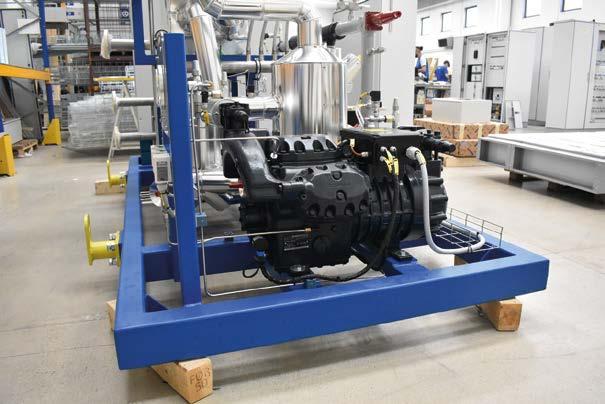
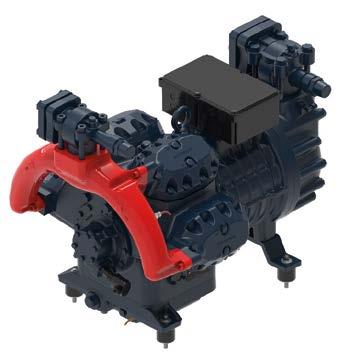

The first high-temperature cutting edge compressors, the right solution for a


Thanks to its innovative compression technology the New HEX EM Dorin range of compressors for heat pumps uses R600, R600a and R290 to achieve exceptional condensing temperatures of up to 140 °C and evaporating temperatures up to 65 °C.
• RANGE FEATURES
• Displacement volume: 42 to 245 m³/h • External manifold* that allows operation up to 140° discharge temperature • Special components to ensure lubrication even under extreme conditions • Patented oil containment system for
The Market Today
As of December 2025 there were an estimated 5,650 industrial sites using transcritical CO 2 refrigeration, accounting for 5% of the 111,650 transcritical CO 2 sites in Europe (the rest being food retail stores). These 5,650 sites represent a growth of 15% from the 4,900 industrial sites using transcritical CO 2 a year ago (5.1% of the total 95,600 transcritical CO 2 sites).
Historically, there were an estimated 2,000 industrial sites using transcritical CO 2 systems in December 2022 and 3,300 in December 2023.55 The number of industrial sites using transcritical CO 2 systems has more than doubled since 2022.
For 2025, ATMOsphere asked survey respondents for the split between their transcritical CO 2 refrigeration projects installed in new builds and retrofits. This year the split was 50–50 between project types.
ATMOsphere also began asking manufacturers for data about the cooling capacity of their units sold. The majority of respondents (55%) said their units were between 100–500kW (28.4–142TR), while 34% reported units between 500kW and 1MW (142–284TR). A total of 8% of units were under 100kW in cooling capacity, while just 3% were 1–5MW (284–1,421TR) in size.
As of December 2025, ATMOsphere estimates there were 4,100 industrial sites (69% central and 31% packaged) using low-charge (below 1.3kg/kW or 10.1lbs/TR) ammonia systems in Europe. This represents a growth rate of 14% year over year, when there were an estimated 3,600 such sites. In 2025 manufacturers reported a 66%–34% split between systems sold for new builds and retrofits.
The versatility of low-charge ammonia is shown by manufacturers surveyed by ATMOsphere: 23% reported selling units that offered between 100 and 300kW (28.4–85.3TR) of cooling capacity, 24% sold units with capacities between 500kW–1MW, and an additional 24% sold units with more than 1MW of cooling capacity. The remaining 13% were for units with under 100kW of capacity.
In addition to larger compressors and components to increase efficiency, manufacturers released more racks designed for larger industrial applications in 2025 (see chapter 1.3).
Along with new products, manufacturers continued to normalize the use of CO 2 refrigeration systems in larger applications. At the 2025 Industrial Refrigeration Network (IRN) conference in Germany, both SCM Frigo and TEKO spoke about their work on CO 2 systems with 1.5MW (426TR) of cooling capacity.
SCM Frigo’s rack was installed at a cosmetics and pharmaceutical processing facility in France and is a plug-and-play system that offers heat reclaim for space heating and hot water production.56 TEKO’s rack was for an 18,000m2 (193,750ft 2) logistics center in Germany and consisted of three 500kW racks that also offered heat reclaim for space heating.57
The increased cooling capacity offered by CO 2 refrigeration systems is making them a fit for larger industrial refrigeration applications. The plug-and-play design of these systems simplifies installation and ensures efficiency at part loads. The ability for these systems to be plug-and-play in design simplifies installation, and their modular nature offers increased part-load efficiency. 58 The increased proximity of logistics facilities to urban centers also provides a boost for CO 2 as it’s a non-toxic refrigerant.
The toxicity of ammonia and its status as a refrigerant used in larger industrial refrigeration applications mean that its growth numbers year over year will not resemble those of transcritical CO 2 . That said, it remains the go-to refrigerant for large-scale refrigeration applications, and, as ATMOsphere’s survey data shows, it’s competitive with CO 2 in smaller to mid-size cold storage facilities.
Despite U.S. regulatory uncertainty, end users continue to adopt natural refrigerants in an effort to increase energy efficiency and meet corporate sustainability goals. In Canada, adoption of CO 2 refrigeration is slower in food retail but there are some encouraging signs. Below is the progress major North American food retailers have made in adopting natural refrigerants based on publicly available data.
Walmart said that 408 of its “facilities” (8% of its stores) fully or in-part use ultra-low-GWP refrigerants, including CO 2 , glycol and ammonia, as of 2025.59 Walmart says that 57% of its Scope 1 emissions are attributable to onsite refrigerant emissions and that its equipment conversion schedule is based on end-of-life and local commercial technology availability. Walmart has 4,700 stores in the U.S.60
As of May 2025, Target operates 124 stores using CO 2 -based refrigeration systems, or 6% of the company’s total store count (2,066 stores).61 The company added 23 new CO 2 stores in 2023 and has a goal to use HFC-free refrigerants by 2040. The retailer is testing Skycool’s heat-rejection panels for improved refrigeration efficiency through subcooling and desuperheating, with one Texas CO 2 store operating throughout the summer of 2025.62
ALDI U.S. is the leading adopter of natural refrigerants among food retailers in North America. The company has “nearly 800 stores using natural refrigeration systems,” (32% of its total stores) according to its 2024 sustainability report.63 ALDI U.S. has also fully equipped almost 30 new stores with propane-based display cases and walk-ins for medium- and low-temperature refrigeration, including nine “hybrid” stores with R290 cases and R448A walk-ins.64
The company’s goal is to transition all of its U.S. stores to natural refrigerants by 2035, and it currently implements natural refrigerant-based refrigeration systems in new and remodeled stores at a rate of
about 70 to 100 stores per year as of November 2024. ALDI U.S. operates more than 2,500 stores and plans to open 180 new stores in 2026.65
Costco has more than 900 locations globally, of which more than 700 are in the United States and Canada, and the company has selected CO 2 as its primary refrigerant for new stores.66 Globally, the company opened 31 stores (3% of total stores) from 2023 to 2025 that use CO 2 -based refrigeration, with nine existing locations retrofitted with CO 2 systems in the same time span.67
Kroger, which has 2,700 supermarkets, said in July 2024 that all of its new stores would use transcritical CO 2 refrigeration systems starting in 2025.68 The company had 12 CO 2 stores at the time of the announcement. Kroger also had more than 16,000 propane self-contained cases in its stores as of 2025 and said that all new self-contained cases would use propane.69
Loblaws said in 2024 that “the majority” of its new grocery stores would be built with natural refrigerant-based refrigeration systems.70 It opened two new stores in 2024 with CO 2 refrigeration systems: one in Kelowna, British Columbia, and another in Contrecœur, Quebec. Loblaws, which operates 2,400 stores, announced in February 2025 that it would open 80 new stores in 2025.71
Metro has 1,640 locations across Canada, and in 2025 the company retrofit 54 of its stores (3% of its total stores) with refrigeration equipment using “lower GWP” refrigerant gases, which includes CO 2 72
Sobeys is also transitioning to lower GWP refrigerants and has retrofitted the refrigeration systems at 100 of its stores (6% of its total stores).73 This project includes CO 2 , with the company opening a new CO 2 store in Waterloo, Ontario.
Along with major food retailers with thousands of stores across the country, smaller and regional supermarket brands are also moving to transcritical CO 2 refrigeration in new and remodeled stores. Along with ammonia and transcritical CO 2 , an end user also detailed its experience with an emerging industrial refrigeration technology in North America: hydrocarbon chillers.
Pharmacy chain Walgreens deployed an integrated transcritical CO 2 system at its Evanston, Illinois, store in August 2024.74 Manufactured by U.S.-based OEM Zero Zone, the 38TR (133.6kW)-capacity Genesys CO 2 Transcritical System delivers low- and medium-temperature refrigeration, air-conditioning, space heating and hot water. It is powered primarily by wind turbines, geothermal wells and onsite solar panels.
Data presented at ATMO America 2025 showed that on June 1, 2025, the store consumed only 269kWh of power, with the system supplying low- and medium-temperature refrigeration, air-conditioning, space heating and hot water. A standard Walgreens store uses about 780kWh of power per day. The energy savings were primarily attributed to the high operating efficiency of the CO 2 rack, which results from lower gas cooler pressures achieved through the use of geothermal wells.
In a move to future-proof its business and reduce energy use, Connecticut retailer Cingari Family Markets is upgrading refrigeration systems to CO 2 -based technologies across its 12 ShopRitebranded supermarkets.75 The company’s first CO 2 retrofit was completed in 2024 at its Commerce Street location in Stamford, Connecticut, replacing an aging R404A system.
The new 512.6kW (145.7TR)-capacity CO 2 system from Hillphoenix has reduced the store’s energy use by approximately 5% and is projected to cut its carbon emissions by more than 1,500 metric tons of CO 2 e annually.
With its legacy system’s annual leak rate exceeding 300%, Brattleboro Food Co-op is replacing the R404A refrigeration system in its 14,000ft 2 (1,301m2) Vermont co-owned grocery store with transcritical CO 2 . 76 The co-op will install the sustainable solution despite the potential loss of its $500,000 (€422,000) USDA grant that was frozen as part of the Trump administration’s spending overhaul.
California-based BriarPatch Food Co-op sees refrigerants as a means to reduce its greenhouse gas emissions.77 The co-op installed a CO 2 system in its new 10,000ft 2 (929m2) store in Auburn, opened in 2023. It is seeking state funding to support retrofitting its Grass Valley HFC legacy store to CO 2
Ralph’s Supermercado y Mayorista opened the “first ever” CO 2 -based supermarket in Puerto Rico in December 2024, according to Hillphoenix.78 Compared to a similarly sized Puerto Rican store with an R404A system, the CO 2 store shows a 30% drop in overall Kwh consumption.
Cold storage logistics provider Americold said at ATMO America 2025 that it sees packaged low-charge ammonia and transcritical CO 2 refrigeration as blueprints for new construction and legacy system retrofits.79 Two new 2025 projects include a 2.1MW (600TR) low-charge packaged ammonia system in a warehouse in Kansas City, Missouri, and a 844kW (240TR) transcritical CO 2 rack in a facility in Saint John, New Brunswick (Canada).
While hydrocarbon chillers are not used in great numbers in the United States for process cooling, some end users are adopting them. Aiming to achieve climate neutrality by 2030, Colorado-based craft brewery New Belgium Brewing installed a 30TR (105.5kW) propane chiller, manufactured by Oregon-based G&D Chillers. 80 The unit supplies glycol at approximately 28°F (−2.2°C) to rapidly cool the fermentation gas stream, with an EER of 8.85, according to G&D Chillers.
Even with the uncertain regulatory landscape, North American manufacturers and European suppliers continued to expand the market for natural refrigerants in the region in 2025. This movement includes new CO 2 , R290 and ammonia products, energy-saving collaborations and Americanized adaptations of European equipment.
To support the transition to natural refrigerants, Zero Zone announced a new service division in October that includes installation, maintenance, training and parts in a single organization. 81 The company also launched its first self-contained propane merchandiser that supports medium- and low-temperature applications. It’s designed to give rural small-format retailers, including dollar stores, a natural refrigerant option. Zero Zone said at ATMO America 2025 that it has installed more than 500 transcritical CO 2 systems in the U.S.
Hussmann launched its Protocol CO 2 rack in June, which is available in capacities from 90–400MBH (7.5–33.3TR/26.4–117.2kW). 82 The rack, designed for indoor installation with multiple pre-engineered configurations, comes with optional heat reclaim. Key performance features include three to five variable-speed medium-temperature scroll compressors with direct vapor injection, enabling precise capacity modulation, reduced discharge temperatures and higher efficiency. For low-temperature applications, the system uses two or three digital scroll compressors for fine-tuned energy control. All compressors are supplied by Copeland.
Danfoss updated its transcritical CO 2 condensing unit in February, giving it the capability to support low-temperature applications in addition to medium-temperature ones.83 The unit has a cooling capacity of 86,000BTU (25.3kW/7.2TR) and supports remote cases. Danfoss said it expected to install the updated unit in up to 50 stores by the end of 2025, depending on production capacity and the capabilities of local contractors to work with CO 2
Copeland is prioritizing the adoption of CO 2 refrigeration with openly available papers and a collaborative CO 2 lab featuring a refrigeration system with MT capacity of 360,000BTU (105.5kW/30TR) and LT capacity of 120,000BTU (35kW/10TR).84 The company
reports engaging with over 60 companies to develop energy-saving strategies in the lab’s first two years of operation. On November 13, 2025, Copeland, backed by the private equity firm Blackstone, took its first step toward public listing with the confidential filing of a proposed initial public offering with the U.S. Securities and Exchange Commission.85
In June Hillphoenix reported that 85% of its new transcritical CO 2 racks were being sold with ChargeSecure, a charge preservation system that began shipping last November. 86 Designed specifically for Hillphoenix’s transcritical CO 2 systems, ChargeSecure minimizes downtime during power outages and service events by maintaining the CO 2 charge, enabling the system to restart immediately.
In November Energy Recovery shared performance data gathered from supermarkets in Canada and California with CO 2 refrigeration systems equipped with its PX G1300 pressure exchanger. 87 Data collected from more than 100,000 cumulative hours of operation showed the Canadian store achieved an average daily COP lift of approximately 10%.
At a grocery store that uses an adiabatic gas cooler in the Sonoran Desert region of California, the PX G1300 saved an estimated around 460,000gal (1,741,289L) or 46% of water annually, said Energy Recovery. Another California store did not need to turn on its adiabatic system over a period of 18 months while reducing the CO 2 rack’s annual energy consumption by 19MWh.
Carel said in March that its MPXPRO case controller, compatible with propane and CO 2 , had been adapted for the U.S. market.88 By monitoring the energy flow, the unit controls load and guarantees closure in power failure events, according to the manufacturer. The new +net module Americanizes the unit with Modbus/IP and BACnet/IP communication capabilities.
Hillphoenix launched AdvansorUltra, its first industrial CO 2 rack platform, in November.89 The rack has cooling capacities of up to 450TR (1,583kW) and provides storage temperatures from −25 to 20°F (−32 to −7°C) and freezing temperatures as low as −54°F (−48°C). Optional features include Bitzer or Dorin compressors; dry air gas cooler or adiabatic gas cooler; copper or stainless steel pipes; 90bar (1,305psi) standstill rating; parallel compression; air, water or hydronic heat reclaim; and Hillphoenix’s ChargeSecure charge-preservation system.
CO 2 Refrigeration Systems released Switch in March, its first standard transcritical CO 2 walk-in skid package. Available in two sizes – 60 and 90TR (211 and 317kW) – the package offers an saturated suction temperature SST range from −32 to 35°F (−35.6 to 1.7°C) with the ability to extend the SST range down to −50°F (−45.6°C) for colder applications.
Danfoss said NeoCharge, a three-piece package consisting of a controller, motorized control valve and sensor that is designed to enable ammonia and CO 2 refrigeration systems to work more efficiently, could save industrial refrigeration facilities up to $200,000 (€185,000) per year in energy costs.91 The savings estimate, shared in March, comes from eliminating superheat in direct expansion systems and lowering the recirculation ratio in recirculated systems. NeoCharge was released in October 2023, and as of March 2025 it had been installed in 25 industrial refrigeration facilities, including four in North America.
PRO Refrigeration released a new CO 2 chiller, the PROGreen50, designed for dairies, food producers and craft beverage companies in July.92 Using a dual-loop heat recovery system, the unit provides process cooling with capacities ranging from 55 to 105 kW (15.6 to 29.8 TR) and glycol supply temperatures between 19.4°F and 35.6°F (−7°C to 2°C), while simultaneously producing hot water at temperatures up to 180°F (82.2°C).
With the evolution of CO 2 technology, Bitzer and CoolSys revisited a CO 2 -based distribution center in western Maryland ‒ originally built in 2021 with 1,328 TR (4.67 MW) of cooling capacity ‒ to assess the impact of intelligent eight-cylinder CO 2 compressors and adjustable ejectors on operating costs and estimated capital requirements. 93 Simulation results presented in July showed that the updated technology could reduce the number of required compressors by roughly 50% and increased full-load COP by approximately 17%.
The anticipated job-site reality of late 2025 has been fundamentally reshaped by the U.S. Environmental Protection Agency (EPA)’s pivot toward a more flexible, legacy market-centric approach. While the overarching framework of the American Innovation and Manufacturing (AIM) Act remains the law of the land, its practical application has evolved from a series of climate mandates into a strategy that prioritizes legacy industry stability and supply-chain resilience over reductions in high-GWP refrigerants.
The Technology Transitions rule is one of three pillars of the AIM Act, enacted in 2020 at the end of the first Trump administration. The EPA released the final version of this rule in October 2023 to accelerate the ongoing transition to more efficient and climate-safe technologies in new refrigeration, heating and cooling systems and other products by restricting the use of HFCs where alternatives are already available.94
The original rule bans HFCs in certain new equipment and sets a limit on the GWP of the HFCs that can be used in each subsector, with compliance dates ranging from 2025 to 2028. It sets GWP limits of 150 for many refrigeration uses. In March 2025 the EPA announced it would pursue “reconsideration” of the Technology Transitions rule.95
The Technology Transitions Reconsideration was published in late 2025 and took the rule from an absolute mandate to a flexible guideline. While the legal status remains “proposed” and is not yet final, on December 5, 2025, the EPA’s Office of Enforcement and Compliance Assurance issued an enforcement statement addressing the conflict between existing 2026 deadlines and the agency’s new, more flexible deregulation proposals.97
This enforcement statement serves as a critical regulatory pivot by explicitly designating the auditing and enforcement of original, stricter deadlines for several sectors as a low priority.98 This shift effectively grants industry stakeholders the latitude to adhere to newly proposed higher GWP limits while the rulemaking process remains underway. The new proposed rule would do the following:
• Retail food: On January 1, 2027, change the GWP limit of 150 or 300 (depending on charge size and equipment configuration) to 1,400. Change the starting date for GWP limits of 150 or 300 from January 1, 2027, to January 1, 2032. Same applies to remote condensing units except the original date was January 1, 2026, not 2027.
• Cold-storage warehouses: On January 1, 2026, change the GWP limit of 150 or 300 (depending on charge size and equipment configuration) to 700. Change the starting date for GWP limits of 150 or 300 from January 1, 2026, to January 1, 2032.
By establishing this compliance bridge, the agency signaled to the market that companies will not face penalties for missing the January 1, 2026, compliance deadline, addressing the immediate pressure of the transition period until the formal Technology Transitions Reconsideration is finalized in mid-2026.
Going beyond mere prioritization, the agency extended a formal “No Action Assurance” to specialized sectors, including refrigerated intermodal containers and semiconductor manufacturing.99 This rare legal commitment ensures that the EPA will refrain from pursuing enforcement actions within these specific areas for a set duration, providing necessary stability for complex industrial operations.
Furthermore, the statement clarifies a strategic realignment of agency resources, moving away from the scrutiny of domestic recordkeeping for small-scale operators and focusing instead on the illegal importation of bulk HFCs. This reallocation reflects a policy view that illicit global trade poses a more significant threat to market integrity than the localized installation delays occurring during this period of regulatory adjustment.
This stance has provided a soft landing for facility managers, although a significant portion of the market continues to adopt digital tracking solutions to ensure future-proofing against more stringent state-level regulations in jurisdictions such as California and New York.
While the federal regulatory landscape has shifted toward flexibility, New York State has taken a distinctly different path, establishing some of the most ambitious HFC reduction mandates in the United States. In December 2024, the New York State Department of Environmental Conservation (DEC) finalized sweeping amendments to its 6 NYCRR Part 494 regulations, which impose restrictions on HFC refrigerants that in many cases exceed federal requirements.100
A key distinguishing feature of New York’s approach is its use of 20-year GWP values rather than the traditional 100-year GWP metric employed by the EPA and most other jurisdictions. This shorter time horizon results in significantly higher GWP values
for the same refrigerants, creating a more stringent regulatory framework. For supermarket systems, remote condensing units, cold-storage warehouses and industrial process refrigeration, the state has prohibited the use of refrigerants with a GWP20 greater than 580 for equipment with a refrigerant charge capacity of 50 pounds (22.6kg) or greater, effective January 1, 2026. For smaller systems with less than 50 pounds of refrigerant, the threshold is set at a GWP20 of 943. Most significantly, the regulations establish a long-term goal of a GWP20 no greater than 10 by January 1, 2034, effectively mandating the adoption of natural refrigerant solutions across most commercial refrigeration applications.
The implementation of these regulations faced immediate legal challenges. The Air-Conditioning, Heating, and Refrigeration Institute and Heating, Air-Conditioning & Refrigeration Distributors International filed suit in April 2025 seeking to void the amended regulations, citing concerns about enforcement feasibility, economic impact and the availability of compliant refrigerants.101 However, on December 22, 2025, a New York State court ruled decisively against the industry groups, upholding the state’s authority to implement its proactive HFC reduction program.102 The trade associations subsequently filed an appeal in January 2026, though the regulations remain in effect during the appeal process.
Crucially, the New York regulations do not mandate the replacement of existing equipment prior to the end of its useful life, addressing a primary concern among facility operators. The rules apply exclusively to newly manufactured systems and newly installed field-charged systems. Additionally, following industry feedback, the state delayed enforcement of the bulk virgin refrigerant sales prohibition by three months until April 9, 2025, and temporarily allowed the sale of R404A and R507A, two high-GWP refrigerants commonly used in supermarkets, restaurants, and convenience stores, through the end of 2025. Notably, the regulations permit the use of reclaimed HFC refrigerants for servicing existing systems, following a model established by California, which helps alleviate concerns about refrigerant availability for system maintenance.
Washington State passed new HFC regulations in May 2025 designed to promote the transition to low-GWP or natural refrigerants and further the use of reclaimed instead of virgin HFCs.103 The regulations were passed as part of HB 1462 and included prohibitions on the sale of newly produced refrigerants with a GWP that exceeds 1,500, beginning January 1, 2030, and refrigerants with a GWP that exceeds 750 beginning January 1, 2033.
In addition, HB 1462 calls for the creation of a refrigerant transition task force of approximately 16 members. The task force will study opportunities for and barriers to adoption of climate-friendly refrigerants and ways to enhance refrigerant recovery, recycling, reclamation and destruction.
The bill also aims to “enhance industry compliance and stakeholder collaboration through education, training and financial incentives, ensuring alignment with national and international climate objectives.”
The new law was developed with input from a wide range of stakeholders including environmental organizations and industry associations representing air-conditioning, refrigeration and heating manufacturers, distributors, contractors, reclaimers and end users, including supermarkets and HVAC contractors.
In contrast to the deregulatory trend in the United States, Canada has maintained a rigorous trajectory under its Ozone-Depleting Substances and Halocarbon Alternatives Regulations.104 Beginning January 1, 2025, Canada prohibited the import and manufacture of chillers using refrigerants with a GWP above 750. Additionally, the final 2025 milestone establishing a total ban on R22 servicing has forced Canadian industrial operators into a much stricter compliance regime than their American counterparts.
This has resulted in a “two-speed” North American market, requiring multinational firms to navigate two distinct and increasingly incompatible compliance profiles, balancing the flexibility of the U.S. market against the accelerating environmental mandates in Canada.
In the U.S. the Environmental Protection Agency has taken the position that f-gases and the f-gas breakdown product trifluoroacetic acid don’t fall under the definition of PFAS, contrary to the findings of scientists worldwide.
However, in Canada, the government is collecting feedback on its proposal to regulate PFAS as a class, including HFOs and TFA. TFA is generated in the atmosphere by the breakdown of certain HFOs, notably HFO-1234yf, which converts entirely to TFA in about 12 days.
It is then absorbed in rainfall and deposited throughout the environment, including surface water, groundwater and soil. While atmospheric deposition is regarded as a major source of TFA, it is also generated as a degradation byproduct of certain pesticides, pharmaceuticals and other PFAS, as well as from industrial releases and sewage treatment.
TFA is regarded by scientists as an ultrashort-chain PFAS, or “forever chemical,” that persists in the environment: It has two carbon atoms, one attached to three fluorine atoms.105 Longer-chain PFAS, such as PFOA (perfluorooctanoic acid) and PFOS (perfluorooctanesulfonic acid), are linked to thyroid disease and to kidney and testicular cancer in the case of PFOA, among other adverse health outcomes.106
At the U.S. state level, there has been some movement to regulate f-gases and TFA as PFAS. Maine has enacted a law banning PFAS refrigerants and HVAC&R equipment using PFAS refrigerants in 2040. Reclaimed PFAS refrigerants are already exempt from the prohibition.
Minnesota, which passed one of the most aggressive PFAS laws in the U.S. in 2023, is engaged in rulemaking to establish a process to determine whether PFAS refrigerants and other products are “essential” to avoid prohibition in 2032.107 Minnesota has also initiated a toxicity review of trifluoroacetate, the anion that forms when TFA dissolves in water or reacts with other substances.108
But, in California, the legislature decided in 2025 to exclude f-gases and TFA from its latest PFAS law proposal, which was ultimately vetoed by Governor Newsom.109 New PFAS laws enacted by Illinois and New Mexico last year authorize significant regulations of PFAS but specifically exclude refrigerants that are deemed acceptable by the EPA such as HFO-1234yf.110
Hawaii, which regulates PFAS in food packaging and firefighting foam, is the only U.S. state that has issued guidance on acceptable levels of trifluoroacetate in groundwater and soil.
Hawaii’s trifluoroacetate guidance levels – what the state calls Environmental Action Levels (EALs) –were first published in November 2024 by the Hazard Evaluation and Emergency Response (HEER) Office in the state’s Department of Health. Trifluoroacetate’s EALs are listed with those of 25 other PFAS for soil and groundwater in a document called “Interim Soil and Water Environmental Action Levels (EALs) for Perfluoroalkyl and Polyfluoroalkyl Substances (PFASs),” which was updated in January 2026.111 The document also includes EALs for the vapor intrusion of trifluoroacetate into buildings.
EALs are non-enforced guidance for trifluoroacetate, explained John Jacob, State Toxicologist in the HEER Office. When setting regulatory action levels for PFAS, Hawaii “looks at the cumulative Hazard Index of PFAS” to assess risk in soil and groundwater “rather than comparing each PFAS to its respective EAL,” he added. Whereas EALs represent an initial, rapid site survey, hazard indices are a more in-depth assessment of combined risk.
Groundwater EALs were calculated to reflect whether the groundwater is more than 150m (492ft) from surface water or less than 150m (there is no difference for trifluoroacetate) and whether the groundwater is a current or potential source of drinking water. The EAL for trifluoroacetate in groundwater that is a current or potential drinking water source is 47mcg/L; for non-drinking water it is 100mcg/L. The EAL for trifluoroacetate in soil is 0.39mg/kg and 2.1mg/kg, respectively.
The noncancer toxicity factors used for the report’s EALs and assessment of risk for trifluoroacetate come from a 2024 report by Gibb & O’Leary Epidemiology Consulting.112 The report recommended a reference concentration for inhalation exposure of .063mg/m 3 and a reference dose of 0.018mg/kg-day. In addition, drinking water ingestion rates relative to body weight, proposed by the U.S. Environmental
Protection Agency in 2023, were used for calculation of drinking water action levels. For trifluoroacetate this was found to be 0.0520L/kg bw-day for children up to six years old.
Hawaii’s EAL for trifluoroacetate in groundwater (which can be a source of drinking water) is higher than guidelines that several European countries have issued for acceptable levels of TFA in drinking water, except for Germany, which has a health-based guideline value of 60mcg/L (with a “precautionary measure” of 10mcg/L). Denmark has set a TFA drinking water threshold of 9mcg/L, while the Netherlands has listed the lowest drinking water advisory: 2.2mcg/L. In the EU as a whole, the recast Drinking Water Directive limits “PFAS total” (including TFA) in drinking water to 0.5 mcg/L as of January 2026; member states can use this or a 0.1mcg/L limit for 20 specific PFAS, not including TFA.113
Trifluoroacetate and ultrashort-chain perfluoropropanoate are currently the only PFAS compound categorized as “volatile” in the Hawaii report. Thus the report also provides a soil vapor screening level for trifluoroacetate of 50,000mcg/L for highly vulnerable drinking water aquifers that are exposed to leachate from the vadose-zone, a soil layer that conveys pollutants from landfills or other contaminated sites. The target groundwater screening level in these cases is 18mcg/L.
In addition the report offers EALs for trifluoroacetate in indoor air and shallow soil vapor, what it calls vapor intrusion hazards for overlying buildings. For indoor air the EAL for trifluoroacetate in residential buildings is 66mcg/m 3 while for commercial/ industrial buildings it is 280mcg/m 3 . For shallow soil vapor, the EAL for trifluoroacetate for residential buildings is 130,000mcg/m 3 while for commercial/ industrial buildings it is 1.1M mcg/m3.
The PFAS compounds have thus far been only identified in water and in areas that do not pose a vapor intrusion risk to nearby buildings, the report said. However, it added that direct testing of soil vapors and/or indoor air will be recommended if potential vapor emission or vapor emission risks from contaminated soil or groundwater are identified in the future.
Meanwhile scientists in North America continue to find TFA in the environment and in human blood serum. For example, researchers at the University of Rhode Island detected TFA in 66% of 320 drinking water samples collected in the state, with median concentrations of 580ng/L and a maximum concentration of 2,400ng/L.114
Researchers at York University in Toronto, Canada, found that the amount of TFA in the atmosphere declined during the COVID-19 pandemic in 2020 by a factor of 2–5, suggesting that sources of TFA in Toronto are mainly short-lived HFO precursors like HFO-123yf.115 In an ongoing study of North Carolina
firefighters, Duke University researchers are examining a potential link between PFAS exposure and biomarkers of thyroid dysfunction and disease.116
The Duke investigation includes TFA and is one of the first studies to investigate human health outcomes related to TFA exposure. While the researchers found that levels of one thyroid antibody was correlated in a small number of firefighters who had TFA in their blood serum, the results to date are inconclusive.
In 2025 there were an estimated 76,230 supermarkets and grocery stores and 151,975 convenience stores in the U.S. and an estimated 8,880 supermarkets and grocery stores and 9,620 convenience stores in Canada. In total, there were approximately 85,110 supermarkets and grocery stores along with 161,595 convenience stores in North America for a combined 246,705 retail food stores. The total number of food retail stores in North America increased by 6% (14,315 total stores) from 2024 to 2025.117
According to data collected by ATMOsphere, as of December 2025 there were approximately 5,120 food retail stores in North America using transcritical CO 2 systems, up 25% from 4,100 in 2024. Of these 5,120 food retail stores, 3,460 are in the U.S. and 1,660 are in Canada. There were also 1,240 industrial sites using transcritical CO 2 in North America for a total of 6,360 transcritical CO 2 sites.
The market penetration of transcritical CO 2 systems in the estimated 85,110 North American supermarkets and grocery stores is 6% , up from 5.8% a year ago. When considering convenience stores as well, the market penetration out of 246,705 retail food stores in North America is 2%, up from 1.8% in 2024.
ATMOsphere began collecting survey data on commercial transcritical CO 2 systems installed in new builds and retrofits beginning with its 2024 refrigeration report. For 2025, the first year data was collected for North America, the new build–retrofit split for transcritical CO 2 racks was 87%–13%.
For 2025, ATMOsphere also began asking manufacturers for data about the cooling capacity of their units sold. For transcritical CO 2 racks, 46% of respondents said their units were <100kW (28.4TR), while 51% said they were between 100 and 300kW (28.4–85.3TR). The remaining 3% of systems were between 300 and 500kW of capacity. Respondents did not differentiate between the capacity of racks sold in the United States or Canada.
ATMOsphere estimated 5.1 million self-contained hydrocarbon (mostly R290) cases were installed in North American food retail stores as of December 2025: 4.2 million installed in the United States and 900,000 in Canada. ATMOsphere estimated there were 4.6 million self-contained hydrocarbon cases – 3.8 million in the U.S. and 800,000 in Canada – in December 2024.
Major supermarket chains continue to push forward natural refrigerants in the North American food retail sector (see chapter 2.1). ALDI U.S. has committed to natural refrigerants in new stores and plans to open 180 new stores across the United States in 2026.118 Along with large stores, retailers with fewer locations are also helping establish natural refrigerants in food retail despite the evaporation of some sources of federal funding (see chapter 2.2).
Some states have stepped in to fill the funding gap left by the federal government. In New York City two Key Food stores received $175,000 (€151,070) each in state grants from the New York State Department of Environmental Conservation to replace HFC-based self-contained cases with ones using propane.119 The DEC provided funding in 2024 that enabled an ALDI in Buffalo and a Walgreens in Islandia to install a transcritical CO 2 rack and a CO 2 condensing unit, respectively.120
In California, funding is available through the state’s F-gas Reduction Incentive Program, which is administered by the North American Sustainable Refrigeration Council (NASRC). The NASRC also helps the DEC administer its grants. Up to $2 million (€1.7 million) is available for commercial and industrial end users doing a full or partial system replacement of an f-gas based-system with one using a refrigerant with <10 GWP.121
Funding barriers are further being reduced through the introduction of more equipment to the market
(see chapter 2.3), which includes condensing units. While transcritical CO 2 racks are still predominant, the number of condensing units on the market has increased sharply in recent years, and ATMOsphere will begin tracking data on this equipment type for the North American commercial refrigeration market starting with next year’s report. Canadian refrigeration systems and heat pump manufacturer Vitalis said in May 2025 that it would soon begin manufacturing TEKO – the two are owned by the same parent company – CO 2 condensing units and racks at its factory in Kelowna, British Columbia.122
While funding is a constant challenge, so too is the lack of technicians trained to work with natural refrigerants. The NASRC has continued tackling this with its workforce development programs and has a goal of training 15,000 technicians to work with natural refrigerants by 2027. Manufacturers are also recognizing the challenge – and opportunity – with commercial and industrial refrigeration systems manufacturer Zero Zone announcing the launch of its services division in October 2025.124
(as of December 2025)
1,660 Stores
700 Industrial Sites
2,360 Total Sites Canada
6,360 sites with transcritical CO2
3,460 Stores
540 Industrial Sites
4,000 Total Sites U.S.
Stores
490 Industrial Sites 1,790 Total Sites
Stores
700 Industrial Sites 2,360 Total Sites
2,800 Stores
380 Industrial Sites
3,180 Total Sites
3,460 Stores
540 Industrial Sites 4,000 Total Sites
2% transcritical CO₂ stores total stores 246,600
6% transcritical CO₂ stores supermarkets and grocery stores 85,000
2,930 2023 4,100 2024 5,120 2025 1,850 2023 2,800 2024 3,460 2025 U.S. 1,660 2025 1,080 1,300 2023 2024 Canada
(as of December 2025)
5.1 Million cases
4,200,000 U.S. Canada
900,000
As of December 2025 there were 1,240 industrial sites using transcritical CO 2 in North America, 19% of the total of 6,360 transcritical CO 2 sites. The 1,240 industrial sites, which represents a 42% increase from the 870 sites in 2024, consists of 540 in the U.S. (up from 380 in 2024) and 700 in Canada (up from 490 in 2024).
For 2025 ATMOsphere asked survey respondents for the split between their transcritical CO 2 refrigeration projects installed in new builds and retrofits. This year the split between new builds and retrofits was 74%–26%.
ATMOsphere also began asking manufacturers for data about the cooling capacity of their units sold. The majority of respondents (69%) said their units were between 100 and 500kW, while 27% reported units between 500kW and 1MW. The rest (4%) were under 100kW in cooling capacity.
As of December 2025 ATMOsphere estimates there were 1,480 industrial sites using low-charge (below 1.3kg/kW or 10.1lbs/TR) ammonia systems in North America, 220 with packaged units and 1,260 with central systems. This represents an increase of 20% over the 1,230 total low-charge ammonia systems installed in December 2024.
The 1,480 industrial sites equate to 1,020 sites (840 with central and 180 with packaged systems) in the U.S. and 460 (420 central and 40 packaged) in Canada.
In December 2024, there were 1,230 industrial sites with installations of low-charge ammonia systems in North America, including 152 with packaged units and 1,078 with central systems.
In the U.S. there were 842 industrial sites (717 with central and 125 with packaged systems), and in Canada there were 388 (361 central and 27 packaged).
The number of North American industrial sites using transcritical CO 2 refrigeration has grown 2.5 times since 2023, according to data collected by ATMOsphere.125 Driving that growth has been increased manufacturer support for the segment. Hillphoenix put a new industrial CO 2 rack on the market alongside relative newcomer CO 2 Refrigeration Systems (see chapter 2.3) in 2025. Much like in Europe, the modularity of CO 2 refrigeration systems and the refrigerant’s non-toxicity make it competitive against ammonia in smaller to mid-size industrial applications.
Unlike in commercial refrigeration, Canada leads the United States in the uptake of CO 2 refrigeration systems in industrial refrigeration. There are numerous factors that contribute to this, including a more temperate climate that enables these systems to run in subcritical mode more days throughout the year, abundant and cheap hydroelectric power and Canadian companies with decades of experience with CO 2 , including Evapco LMP, M&M Carnot, RefPlus and Ceptek. There is also government support, including up to CA$5 million (US$3.6 million/€3.1 million) from Natural Resources Canada for manufacturing facilities for projects that enhance energy efficiency, such as installing new zero-emissions heating and refrigeration systems.126
From 2023 to 2025 industrial sites using low-charge ammonia have grown at a rate of 1.4 times, although the installed base for these ammonia systems was much higher than for transcritical CO 2 systems (1,045 industrial sites vs. 498). Ammonia remains firmly entrenched in industrial refrigeration in North America, and manufacturers are continuing to find ways to maximize its efficiency (see chapter 2.3).
Figure 20: Installations of Low-Charge Ammonia Systems in North America
Packaged: 180
Central: 840
Packaged: 40
Central: 420
1,480
Figure 21: Growth of Low-Charge Ammonia in the U.S.
The adoption of natural refrigerants in the Japanese commercial refrigeration sector has been primarily driven by convenience stores and their use of CO 2 condensing units. While adoption in supermarkets has been slower, one of the country’s leading supermarket operators, AEON, has committed to transitioning to natural refrigerants by 2040 and has already begun the process of introducing CO 2 - and hydrocarbon-based refrigeration units to its stores.
Below is the progress major Japanese food retailers have made in adopting natural refrigerants based on publicly available data.
Lawson has 14,600 convenience stores in Japan.127 As of February 2025, it had installed CO 2 -based refrigeration systems in approximately 8,300 of its stores (56% of its total stores).128 The company also said it has installed CO 2 -based refrigeration systems in 80% of new stores and renovated stores requiring new refrigeration systems.
There are 16,407 FamilyMart convenience stores in Japan.129 Of those, the company said 1,600 stores (9% of its total stores) were using CO 2 -based refrigeration as of February 2024.130 FamilyMart’s goal is to have 20% of its refrigeration and freezing systems use natural refrigerants by 2030, 50% by 2040 and 80% by 2050. Family Mart also said it aims to “introduce natural refrigerant equipment” in more than 50% of new stores and stores undergoing renovations.131
7-Eleven has a massive presence across Japan with 21,883 stores in the country.132 As of March 2025, 7-Eleven 1,631 stores (7% of its total stores) used CO 2 refrigeration systems, a 29% increase from 2024.134
Multinational retailer AEON operates 16,000 stores in Japan, of which around 8,000 are supermarkets, convenience stores and drug stores.134 As of February 2024, the “number of stores introducing freezers and refrigerators using natural refrigerants” topped 1,700 (21% of its total food retail and drug stores).135
AEON has committed to transitioning all refrigeration and freezer units in its Japanese stores to natural refrigerants by the end of fiscal year 2040.136 The company, which has been installing CO 2 - and hydrocarbon-based refrigeration units at its new stores since 2015, is now working to gradually replace f-gas equipment at its existing stores, prioritizing older units. AEON aims to convert 4% of its systems by the end of this fiscal year and 30% by 2030.
New natural refrigerant products released in 2025 for the Japanese market included two Panasonic offerings for the commercial refrigeration sector. One of these, a new transcritical condensing unit, is an evolution of an existing product and demonstrates how CO 2 refrigeration systems have begun to evolve in mature markets. On the industrial side, Mayekawa made an update to its COPEL industrial transcritical CO 2 condensing unit while Nihon Netsugen Systems (NNS) offered details about the growth of its industrial CO 2 refrigeration business.
Panasonic announced a new 10HP side-flow CO 2 condensing unit in October 2025, which serves as the successor to its previous top-flow 10HP model.137 The new condensing unit “achieves approximately 25% space savings compared to the current model,” according to Panasonic. Its two-stage compressor and revised heat exchanger increases its freezing capacity by 2kW (0.5TR) and provides a 7% improvement in COP compared to the outgoing model.
Earlier in the year, Panasonic also released a new flat refrigerated showcase with glass doors that uses propane refrigerant.138 The EFRIO series consists of four models designed to accommodate ice cream and frozen foods. It is available in lengths of 6ft (1.8m), 7ft (2.1m) and 8ft (2.4m) as well as an end case.
Mayekawa announced in March 2025 that its COPEL CO 2 transcritical condensing unit, designed for use in cold storage and food processing, had its operating temperature extended to −50°C (−58°F).139 The specific models with the newly extended operating temperatures are the COPEL-F30 and F70 models; the manufacturer said this enables them to now be used as brine coolers.
In February 2025, Yamaichi Suisan opened a new freezing factory for fish paste in Monbetsu City equipped with Mayekawa’s NewTon ammonia/ CO 2 refrigeration system.140 The facility pairs four NewTon F-600s with a continuous contact freezer with automatic loading and unloading, with the equipment subsidized by the Japanese government.
Mayekawa also provided the NewTon, an ammonia/ CO2-based cooling systems for a cold storage facility that opened in the city of Kuki in November 2025.141 The Kuki Low Temperature Logistics Center is a 16,000m 2 (172,222ft 2 ) food and beverage storage facility that can hold 210,000 cases of frozen products and 50,000 cases of chilled products.
Nihon Netsugen Systems detailed the growth of its industrial transcritical CO 2 condensing unit business in an August 2025 interview with NaturalRefrigerants. com. which is published by ATMOsphere. Katsuhiko Harada, President of NNS, said the company has 620 CO 2 condensing units operating in 230 industrial refrigeration projects in Japan.142 He noted that sales for CO 2 refrigeration systems have remained steady at around 120 units over the past few years, but that figure is projected to rise in the coming years to 150 to 160 units annually.
CO 2 refrigeration systems for cold storage warehouses and logistics centers make up 50–60% of NNS’s business, with many of these projects receiving financial support from the Japanese government. Harada added that NNS is seeing increasing demand from the food and dairy industries for its CO 2 brine chillers.
There were an estimated 56,000 convenience stores in Japan as of December 2025, an increase of 0.5% from 2024 (55,692). There were an estimated 21,450 supermarkets in Japan as of December 2025, an increase of 0.8% from the previous year (21,261). Combined, this amounted to 77,450 food retail outlets in Japan in 2025, an increase of 0.6% from the prior year (76,953).
As of December 2025, there were 14,350 stores, including 13,500 convenience stores and 850 supermarkets, using transcritical CO 2 systems (mostly condensing units), up 17% from the 12,250 stores (11,500 convenience stores/750 supermarkets) reported in December 2024. With 580 industrial site installations, the total number of transcritical CO 2 installations in Japan was 14,930 sites.
In 2025, the convenience store sector’s installations of transcritical CO 2 grew by 17% while the supermarket sector’s installations increased by 13%
The market penetration of transcritical CO 2 in convenience stores is 24% , an increase from 20% in 2024. The market penetration of transcritical CO 2 in supermarkets is 4% , up from 3.5% in 2024. The market penetration of transcritical CO 2 across all food retail stores in Japan is 18% , up from 16% in 2024.
As of December 2025, there were an estimated 580 industrial sites (mostly cold storage facilities) using transcritical CO 2 systems (mostly condensing units) in Japan’s industrial refrigeration sector, up 23% from the 470 reported in 2024.
Large convenience store chains continue to be the biggest adopters of transcritical CO 2 refrigeration in Japan (see chapter 3.1) as they seek to decarbonize their operations. The small footprint of these stores means they’re well-served by condensing units, and Japan is home to one of the leading providers of CO 2 condensing units, Panasonic.
Transcritical CO 2 continues to make inroads in industrial refrigeration, and combined with ammonia/ CO 2 secondary cooling systems (see chapter 3.2) it is reshaping the refrigerants mix in the sector. The Japan Association of Refrigerated Warehouses (JARW), which represents approximately 90% of the industry, conducts an annual survey on its members’ refrigerant use.143
For 2024, 52.1% of respondents said they used natural refrigerants, up slightly from the 51.4% that reported using naturals in 2023. A total of 36.4% of operators use ammonia/CO 2 secondary systems, 7.6% used ammonia systems, and 7.8% used transcritical CO 2 . The use of natural refrigerants by JARW’s membership has increased by 12.2% from 2020. In that time period the use of ammonia/CO 2 secondary systems grew from 28.1% to 36.4% while CO 2 increased from 1.7% to 7.8%, with ammonia decreasing from 10.3% to 7.6%.
One company exemplifying this shift is Yokorei, a cold chain logistics company. The company began introducing natural refrigerants into its new warehouses in 2000, and as of December 2025 natural refrigerants made up 74.6% of its refrigerant mix.144 Yokorei had the second most frozen and chilled warehouse capacity in Japan as of 2024.145
While natural refrigerants make up the bulk of the refrigerant mix in Japan’s cold storage sector, 36% of end users still use R22. The reason being is the age of the country’s cold storage sector, with 34% of warehouses 40 years or older as of 2023.146 While these aging cold storage facilities keep the industrial sector’s use of R22 high, their retirement will create further opportunities for natural refrigerants in the sector.
Another major driver of transcritical CO 2 adoption in Japan, both in industrial and commercial refrigeration, continues to be the subsidies offered by the Japanese Ministry of the Environment (MOE).147 Applicants defined as “large companies” can receive a grant to cover up to one-third of the costs of natural refrigerant-based refrigeration equipment, while small businesses can receive a grant for up to 50% of costs.
Both cold storage warehouses and food retailers are eligible for the MOE grants, which are awarded to both retrofits and new builds. The budget for the grant program in 2025 was ¥7 billion (€38 million/$44 million).
In addition, the Tokyo Metropolitan Government offers a subsidy program that subsidizes the installation of refrigeration equipment using non-fluorocarbon refrigerants for food retailers, convenience stores and drug stores.148 Large companies can receive a max grant of covering one-third of their costs while small- and medium-sized companies can half up to one-half of their costs covered. The Tokyo grant can be stacked with the MOE grant, but the value of the MOE grant is deducted from the project’s total cost when determining the Tokyo grant.
(as of December 2025)
13,500 Convenience Stores
850 Supermarkets
580 Industrial Sites
14,930 sites with transcritical CO2
Figure 24: Transcritical CO₂
Installation Growth in Japan
6,630 2022 8,385 2023
Installation Growth in Japan (stores)
14,930 2025 12,250 2024
Figure 25: Transcritical CO₂ Historical
Number of Installations
Note: Prior to 2020, most installations were at stores.
Australia and New Zealand both have food retail sectors dominated by a handful of companies, with a smattering of independent making up the rest of the market. Of these companies, only one – Woolworths – is present in both markets.
In Australia, R744 was first adopted in a cascade setup with HFCs, with more than 1,250 such refrigeration systems in the market as of 2024.149 Transcritical CO 2 is becoming more popular in both markets though, and, while uptake in New Zealand has been slower, the country’s temperate climate makes it a great fit for the natural refrigerant.
Below is the progress major Australian and New Zealand food retailers have made in adopting natural refrigerants based on publicly available data.
Woolworths has 1,715 grocery stores and distribution centers in Australia and New Zealand, and the company has been equipping its stores with transcritical CO 2 refrigeration systems since 2016.150 As of 2025, 127 (7% of its total stores) of its stores use CO 2 refrigeration systems. In 2025 Woolworths said transcritical CO 2 refrigeration systems were installed in 26 new or existing stores, and in 2024 all new self-contained fridges were transitioned to natural refrigerants across all of its Australian stores.
Coles operates 860 supermarkets and 988 liquor stores in Australia as of 2025.151 Of those, 104 supermarkets (12% of its total supermarkets) and 80 liquor stores (8% of its total liquor stores) use natural refrigerant-based refrigeration systems.152 The company added 26 natural refrigerant supermarkets and 24 liquor stores to its tally in 2025. Its goal is to transition to natural refrigerants fully by 2050 at a rate of 20 to 30 stores per year.
ALDI has 600 stores in Australia as of May 2025. The company has not yet said how many of those use transcritical CO 2 refrigeration systems,153 but it did say at ATMO Australia 2019 that its goal was to have 100 CO 2 stores by 2025.154 The supermarket chain installed its first transcritical CO 2 refrigeration system in Australia in 2015.155
Foodstuffs South Island has 185 grocery stores in New Zealand and 179 liquor stores as of 2025.156 Of those, all 12 stores under its Pak’nSAVE brand and 33 of its New World stores (84% of total New World stores) use CO 2 refrigeration systems.
ATMO Australia made its return in 2025, the first time the event was held since 2019. The event showed just how far natural refrigerants have come in Australia and New Zealand in six years. Outside of CO 2 , low-charge ammonia continued to make its mark in Australia, particularly direct expansion systems. Over in New Zealand, big news was made in the cold storage space.
Woolworths is exploring ways to enhance the heat recovery of its CO 2 refrigeration systems.157 The company has mounted an evaporator on the condenser deck of the CO 2 refrigeration systems at two of its stores, it said during a presentation at Refcon 2025 in March. From a 100kW (28TR) MT capacity CO 2 refrigeration system, the company believes it can recover almost 140kW (40TR) of heat for space heating.
Australian supermarket chain Ritchies Stores increased the footprint of its Balnarring location by 71% during a remodel, but the store used 15% less energy than before after replacing its R404A refrigeration system with an integrated CO 2 cooling system.158 Ritchies shared data on the project, carried out in 2023 and 2024, during ATMO Australia. The store was expanded from 1,530 to 2,630m2 (16,500 to 28,300ft 2).
The refurbished store increased the connected cooling, heating and refrigeration load by 230%, but a year’s worth of data showed a drop in energy consumption of 15%. The CO 2 system provides 32kW (9.1TR) of low-temperature capacity and 160kW (45.5TR) of medium-temperature capacity for display cases and cold rooms. The system provides domestic hot water from the LT waste heat, 150kW (42.7TR) of space heating from the MT waste heat and 150kW of cooling from a DX coil in the air-handling unit duct.
Jefferies Supermarket said at ATMO Australia that its recently opened second store, located in Melbourne, is equipped with an outdoor CO 2 compressor pack incorporating an adiabatic gas cooler manufactured by SCM Frigo.159 With 9 kW (2.6 TR) of LT and 81 kW (23 TR) of MT cooling capacity, the new CO 2 store supports a 35% higher refrigeration load than Jefferies’ original R404A store yet consumes 10% less energy.
Danish shipping giant Maersk’s Ruakura Superhub cold storage facility near Hamilton, New Zealand, received a 6 Star rating in November, the highest in the country’s Green Star Design & As-Built sustainability assessment.160 The rating marks the facility as a “project among world leaders in green building” design and construction, according to the New Zealand Green Building Council. It is the first cold storage facility in the country to achieve a 6 Star rating.
Seven SteelXL CO 2 racks produced by Danish manufacturer Advansor supply 0.9MW (256TR) of cooling capacity to the cold storage facility, 2.1MW (597TR) of blast freezing, 1.7MW (483TR) of freezing, 0.15MW (43TR) of air-conditioning and 2MW of heating. The facility provides 16,000m2 (172,223ft 2) of fully convertible, temperature-controlled space, ranging from −25 to 15°C (−13 to 59°F) and has a capacity of 21,000 pallet positions. It provides meat blast freezing at −45°C (−49°F). Heat recovery from the CO 2 racks supplies defrosting, floor heating and hot domestic water, with the permanent magnet motor compressors providing an extra energy savings of 7‒8%, according to Advansor.
Sausage manufacturer Slape & Sons told attendees at ATMO Australia that it installed a 1MW (284TR) CO 2 refrigeration system designed by contractor MB Group Solutions at its new Adelaide production plant.161 A 2,500L (660gal) CO 2 separation vessel, pressurized at 38bar (551psi), feeds both the DX and pumped liquid overfeed circuits for production and cold storage requirements, with heat reclaim providing sanitation and subfloor heating.
Supermarket chain Foodstuffs North Island said in August that it will invest NZ$70 million (US$42 million/€35.6 million) in a new chilled and frozen distribution center in Mangere, New Zealand.162 Set to open in 2028, the 28,128m 2 (302,800ft 2) facility will feature a CO 2 refrigeration system with the floor fully convertible from chiller to freezer, according to the retailer.
Victoria-based refrigerated logistics and cold storage provider Cold Xpress installed a CO 2 refrigeration system in its newest facility, with an Advansor SteelXL DX transcritical CO 2 booster providing 460kW (131TR) of MT capacity, 416kW (118TR) of LT capacity, hot gas defrost and heat recovery for underfloor heating.163 At ATMO Australia, Cold Xpress said that its experience with R404A and ammonia refrigeration led it to choose CO 2 as a safer, eco-friendly alternative with lower maintenance requirements.
Australian manufacturer Scantec Refrigeration Technologies delivered multiple low-charge DX ammonia installations nationwide, including a project in Truganina that consolidated three HFC-based cold-storage sites totaling 30,000m 3 (1,059,000ft 3) into a single 60,000m 3 (2,119,000ft 3) facility.164 Although the expansion doubled the size of the Fernhurst cold storage and blast-freezing operation, the new ammonia system reduced annual electrical consumption by 64.8%.
Other Scantec installations included a 600kW (171TR) facility for transport refrigeration provider Minus 1 in New South Wales, a 610kW (173TR) facility for logistics company JCT Transport Group in Western Australia and a 1.13 MW (132TR) system for a cold storage facility in Melbourne.165
The growth of natural refrigerants in Australia and New Zealand’s commercial refrigeration sector depends largely on imports. In 2025 Hussmann Australia significantly expanded its product offerings for transcritical CO 2 refrigeration systems. Local stakeholders also made strides in the sector, particularly with regard to adapting transcritical CO 2 racks to the Australian climate. In industrial refrigeration, one of the leading names in low-charge ammonia provided insight into the Australian market. In New Zealand, SCM Ref NZ detailed the work it’s done with CO 2 refrigeration in the commercial and industrial refrigeration sectors.
Hussmann Australia, a Panasonic subsidiary, announced the release of a 20HP transcritical CO 2 outdoor condensing unit in Australia in March 2025.166 The larger unit, launched by Panasonic in Europe in 2024, extends the company’s CO 2 lineup in Australia, which includes 2HP, 4HP and 10HP CDUs. The line supports food retail and process cooling applications, including chilled and frozen display cases, blast chillers, freezers and walk-in cold rooms.
Hussmann Australia made more news in May 2025 when it announced a strategic partnership with Refra to distribute its transcritical CO 2 racks and R290 heat pumps and chillers.167 The agreement enables Hussmann Australia, a wholly owned subsidiary of Panasonic, to expand its natural refrigerant product lineup. It currently offers CO 2 condensing units for low-temperature and medium-temperature applications that range in size from 2–20HP as well as self-contained R290 cabinets.
Refra’s transcritical CO 2 racks have a cooling capacity of between 15 and 800kW (1.4 and 227TR) and can be made to order. Its seven different types of transcritical CO 2 racks can operate in ambient temperatures up to 40°C (104°F). The partnership will also enable Hussmann to offer Refra’s complete portfolio of R290 chillers and heat pumps.
Australian HVAC&R contractor MB Group had installed more than 50 CO 2 refrigeration systems across the country as of May 2025.168 The systems – including transcritical booster racks, chillers and heat pumps – have been deployed in a range of facilities, from supermarkets and refrigerated warehouses to breweries and food-processing sites. The majority of the 50 CO 2 systems MB Group has installed have been designed and manufactured at the company’s Bayswater facility.
A commercial CO 2 refrigeration system equipped with indirect evaporative technology and installed at a Coles supermarket in Adelaide managed to operate in subcritical mode even in ambient temperatures up to 43°C (109°F).169 It was created by HVAC&R contractor Glaciem and the University of South Australia (UNISA) and features dew-point coolers found in Seeley air-conditioning units. Glaciem presented performance data from the unit at Refcon 25 in Melbourne.
The CO 2 system installed at the Coles supermarket included 34kW (9.6TR) of low-temperature capacity, 185kW (52.6TR) of medium-temperature, 250kW (71TR) of high temperature for air-conditioning and 60kW (17TR) of heat recovery. It uses indirect cooling to cool the incoming ambient air, followed by evaporative cooling to reduce the temperature to 12.5°C (55°F). The cooled air is then passed over the CO 2 refrigeration system’s gas cooler coil to maintain a condensing temperature of 21°C (70°F).
Stefan Jensen, Managing Director of Scantec Refrigeration Technologies, shared information about the state of the low-charge ammonia market in Australia and the advantages of the technology at ATMO Australia 2025.170 Jensen noted that Scantec has nearly 50 low-charge, centralized ammonia plants in operation in Australia, China and Malaysia. Around 30 of those are in Australia, and several more plants are currently under construction.
The specific energy consumption (SEC) values are measured in kilowatt-hours per cubic meter per year, where the volume refers to the total refrigerated volume of the warehouse. He said that those values for transcritical CO 2 refrigeration systems at sea level in Australia are 1.4 to 1.5 times higher than for equivalent direct expansion low-charge ammonia systems.171
Auckland-based SCM Ref NZ, a subsidiary of Beijer Ref, had supplied over 80 transcritical CO 2 systems in New Zealand as of September 2025.172 These range from 6kW to 1.2MW (1.7 to 341TR).173 SCM Ref NZ has primarily installed CO 2 systems for food industry applications, including cold storage, meat processing plants and supermarkets. Recently the company has seen growing adoption of the technology in a wider range of applications, including small-format installations. The largest single CO 2 rack installed by the company is a 790kW (1,454TR) unit manufactured by fellow Beijer Ref company SCM Frigo.
There were an estimated 4,700 supermarkets and grocery stores in Australia and 1,090 supermarkets and grocery stores in New Zealand as of December 2025. Data was not gathered for convenience stores because survey respondents only reported on transcritical CO 2 installations in Australian supermarkets.
There were an estimated 400 supermarkets and grocery stores using transcritical CO 2 systems in Australia as of December 2025. This is an increase of 21% from the 330 stores that ATMOsphere estimated used transcritical CO 2 refrigeration as of December 2024. The market penetration of transcritical CO 2 in the Australian supermarket sector is 8.5% , up from 7.7% in 2024.
There were an estimated 250 supermarkets and grocery stores using transcritical CO 2 systems in New Zealand as of December 2025. This is an increase of 4% from the 240 stores that ATMOsphere estimated used transcritical CO 2 refrigeration as of December 2024. The market penetration of transcritical CO 2 in the New Zealand supermarket sector is 23% , up from 22% in 2024.
As of December 2025 there were an estimated 25 industrial sites using transcritical CO 2 , an increase of 25% from the 20 industrial sites ATMOsphere estimated in December 2024. With 25 industrial site installations, the total number of transcritical CO 2 installations in Australia was 425
There were an estimated 70 industrial sites using transcritical CO 2 in New Zealand as of December 2025, an increase of 16% from the 60 industrial sites ATMOsphere estimated in December 2024. With 70 industrial site installations, the total number of transcritical CO 2 installations in New Zealand was 320
As of December 2025 there were an estimated 75 industrial sites using low-charge ammonia. This is an increase of 15% from the 60 industrial sites ATMOsphere estimated in December 2024.
(as of December 2025)
400 Stores
25 Industrial Sites
425 Total Sites Australia
250 Stores
70 Industrial Sites
320 Total Sites
Figure 28: Transcritical CO₂ Commercial Refrigeration Market Penetration in Australia
8.5% transcritical CO₂ stores
Figure 29: Transcritical CO₂ Commercial Refrigeration Market Penetration in New Zealand
Half of Australia’s supermarkets and grocery stores are operated by three companies: Woolworths, Coles and ALDI.174 All three are currently transitioning their stores to natural refrigerant-based refrigeration systems (see chapter 4.1) and will continue to drive the shift to transcritical CO 2 for years to come. Absent national regulations, this change in refrigerants has been driven primarily by corporate sustainability goals, with Woolworths stating that moving to natural refrigerants will help it cut emissions 89% by 2030 compared to a baseline from 2006.175
Along with major brands, Australia also has a thriving independent grocer segment, with many companies operating under the Independent Grocers of Australia (IGA) banner. Of the 1,300 IGA stores in Australia, 70 (5.3% of total IGA stores) use transcritical CO 2 refrigeration systems, according to survey respondents. One of those is Ritchies, which operated 155 stores and liquor stores as of June 2025.176 Of those, at least eight used transcritical CO 2 refrigeration.177 Liquor store operator Dan Murphy’s has also shown that operators of smaller-format stores are interested in CO 2 refrigeration. It installed seven transcritical CO 2 systems in stores in 2025.178
A similar dynamic is playing out in New Zealand, which like Australia has a handful of companies that operate the vast majority of its supermarkets and grocery stores: Foodstuffs North Island, Foodstuffs South Island and Woolworths. New Zealand’s temperate climate has made adopting transcritical CO 2 an easier decision than in Australia, where summer highs can exceed 40°C (104°F) across the country. CO 2 refrigeration systems can operate subcritical 90% of the year in New Zealand with COPs of 4 to 5, and CO 2 is 96% cheaper than R404A and 92% cheaper than R449A.179
Supporting these food retailers is a refrigeration equipment market that continues to grow, both through increased imports and local manufacturing (see chapter 4.3). MB Group, based in the Perth suburbs, was founded in 2007 and began designing and manufacturing its own CO 2 refrigeration systems in 2021. SCM Ref New Zealand, one of the leading suppliers of CO 2 commercial and industrial refrigeration systems in the country, designed, built and tested what it believes is one of the first CO 2 ice builder packages in 2025.
While the market for transcritical CO 2 systems in industrial refrigeration continues to grow in Australia and New Zealand, expansion in the former is moving much slower than in the latter. The MB Group noted at ATMO Australia 2025 that a challenge for industrial end users in the country is a lack of awareness. Uptake in New Zealand has been higher due to a more temperate climate, support from manufacturers such as SCM Frigo and the country’s levy on synthetic refrigerants.180
In Australia, transcritical CO 2 continues to face stiff competition in the industrial refrigeration sector from low-charge ammonia (and ammonia more broadly). Along with the sector’s general familiarity with ammonia, low-charge ammonia has a lower SEC – measured in kilowatt-hours per cubic meter per year where the volume refers to the total refrigerated volume of the warehouse – value than liquid overfeed and transcritical CO 2 (see chapter 4.3).
Walmart opened both new stores and a distribution center in two countries in Latin America that use CO 2 -based refrigeration systems. The region also saw a notable installation of an R290 waterloop system. In the industrial sector, along with Walmart’s CO 2 distribution center, end users also shared information about ammonia-based refrigeration systems for cold storage and food processing applications.
Walmart opened three new stores in Costa Rica in 2025 with CO 2 refrigeration systems.181 The stores operate under its Palí and Masxmenos brands and are located in the cities of Palmichal de Acosta, Cartago and Liberia. Walmart operates 343 stores across all of its brands in Costa Rica.
In addition, the company also announced that a new Walmart store in the city of Santa Tecla, El Salvador, would be equipped with a CO 2 refrigeration system.182 Walmart operates 102 stores in El Salvador across all of its brands.
Colombian hypermarket chain Alkosto opened its first transcritical CO 2 store in 2025 in Bogotá’s Mosquera suburb.183 The system was a project of TEKO Americas, a collaboration between Germany-based TEKO and Colombia-based Weston.
The CO 2 refrigeration system ‒ manufactured by TEKO ‒ provides 162kW (46.1TR) of medium-temperature and 24kW (6.8TR) of low-temperature cooling capacity. In addition to the CO 2 system, the company installed 30 propane self-contained islands in the Alkosto store, which is 31,600m2 (388,600ft 2).
In addition to CO 2 , Weston also did notable work with propane, including installing what it said was the first waterloop system in a Mexican supermarket.184 The company shared news of the installation during ATMO LATAM 2025 in March.
A circuit connects each piece of equipment in the small-format store, which is located in Jalisco, via a plate heat exchanger, with heat rejected through a dry cooler outside the store. The propane waterloop replaced an R404A-based refrigeration system, with the R290 system cutting the store's refrigerant charge by 90%. The company has also installed the system in a 85kW (24.2TR) refrigeration capacity warehouse in Mexico.
Mexican supermarket chain Casa Ley shared data at ATMO Latin America (LATAM) 2025 in March on a transcritical CO 2 refrigeration system installed at a store in 2018 that had a payback period of 3.7 years.185 The store, a new build in the city of Caliacán, is 7,000m 2 (75,347ft 2 ). The system has delivered annual efficiency savings of 8–10% compared to a conventional R404A system, with energy consumption depending on ambient temperatures each year. This installation was Casa Ley’s first transcritical CO 2 store.
The system meets the supermarket’s low- and medium-temperature cooling demands, providing 23kW (6.5TR) for frozen food storage and 129kW (36.7TR) for refrigerated display cases. It operates with saturated suction temperatures of −28.9°C (−20°F) for low-temperature applications and −6.7°C (20°F) for medium-temperature applications. The system comprises a parallel rack and refrigerated display cases from U.S.-based manufacturer Kysor Warren, an adiabatic gas cooler from Güntner, compressors from Bitzer and controllers from Danfoss.
In Panama, 40% of major supermarkets use transcritical CO 2 refrigeration in their new stores, according to APAFAM (Asociación Panameña de Facility Management).186 APAFAM noted that the refrigerant arrived in the country’s food retail sector around 2020.
Along with its CO 2 stores, Walmart also opened a distribution center in Costa Rica in 2025 that features what Advansor called the “largest single CO 2 rack” in Latin America.187 The 1.7MW (483TR) SteelXL unit was installed in a distribution center in San José and provides 950kW (270TR) of medium-temperature cooling capacity, 510kW (145TR) of low-temperature capacity and 246kW (70TR) for heating.
To increase efficiency, the rack uses parallel compression and permanent magnet motors to drive the compressors. The seasonal energy performance ratio of the MT system is 3.56 and 1.96 for the LT system. Walmart reportedly chose to go with CO 2 for several reasons, including lower capital expenditure and onsite implementation costs compared to other natural refrigerant solutions.
Cold chain-logistics company Frialsa said at ATMO LATAM 2025 that 22 of its cold-storage facilities use natural refrigerants.188 The company operates 29 warehouses in Mexico and two in Peru. Of its 22 cold-storage warehouses that use natural refrigerants, 13 use ammonia systems, and nine use ammonia/CO 2 cascade systems. Frialsa, founded in 1983, first used natural refrigerants in its operations in 2010, with its largest facilities accommodating up to 40,000 pallets.
Marine Farm , a Chilean fish producer, shared details of a new ammonia refrigeration system installed at its cooling and storage facility in Quellón during ATMO LATAM 2025.189 The 2MW (569TR)-capacity ammonia refrigeration system helped cut its annual energy consumption by 360MWh and significantly reduced its operating costs compared to its old R22-based refrigeration system.
The Quellón processing plant, which opened in 2006, can freeze up to 160 short tons (145,150kg) of fish per day and offers cold storage capacity of 500 short tons (453,592kg). All three of Marine Farm’s processing plants in Chile use ammonia-based refrigeration systems.
Shipping giant Maersk opened a new cold packaging and cold storage facility in Olmos, Peru, in July that uses a cascade ammonia-CO 2 refrigeration system. The facility is 17,500m2 (188,368ft 2) and has 2,088 pallet positions. Maersk operates four cold storage facilities in South America as of 2026.
TEKO and Weston shared in March that they had built three transcritical CO 2 racks to be used in a 10,000m2 (107,639ft 2) distribution center in South America.192 Each rack has eight medium-temperature compressors and four low-temperature compressors, with 1.6MW (454TR) of MT capacity and 780kW (221TR) of LT capacity.
In addition to transcritical CO 2 , propane chillers are also used in commercial and industrial refrigeration in Latin America. These chillers use propane as both the primary refrigerant and as a subcooler for other natural refrigerants.
FB Industrial, a Mexican manufacturer of commercial and industrial refrigeration equipment, launched its Ecoflex line of indirect propane hillers for the Mexican market in March.193 The new line offers an 8‒85TR (28‒299kW) capacity range for high-temperature applications up to 50°F (10°C) and a 5‒50TR (17‒176kW) range for medium-temperature applications down to 10°F (−12.2°C). The design keeps the refrigerant outside the facility by using a circulating glycol/water mixture.
The chillers use Copeland scroll compressors and have an R290 charge from 4 to 17kg in a single factory-installed circuit, with a 70kg total maximum per unit. To manage the A3 refrigerant, the unit is ATEX (explosive atmosphere) certified, and it houses a leak detector inside the cabinet, which triggers automatic ventilation. FB Industrial’s natural refrigerants product portfolio includes transcritical CO 2 boosters and ammonia and chillers as well as condensing units and gas coolers.
At ATMO LATAM 2025, Mexican contractor Sistemas de Refrigeración Totales (SRT) said it sees propane as an immediate solution for medium-temperature applications, both as a primary refrigerant and to subcool CO 2 194 SRT installed an Ice-Square R290 chiller for 0°C (32°F) storage of approximately 30 metric tons of raw material in a Grupo Bimbo (a Mexican multinational food company) facility in Mexico City. A −8°C (17.6°F) glycol secondary loop cools the chamber.
SRT said in March that it was in the final stages of installing an Ice-Square R290 chiller in a minimarket application, with support from SEMARNAT (Mexico’s Ministry of Environment and Natural Resources) and GIZ (German Society for International Cooperation). The unit uses a dry cooler with glycol circulating at −10°C (14°F) to condense a CO 2 system in cascade and maintain the temperatures in refrigeration chambers between −2 (28.4°F) and 0°C.
The cascade system and dry cooler use Copeland scroll compressors with inverter technology. In addition to providing cooling for the mini market, the refrigeration system will also be used to train technicians.
In February, Luis Gerard, President of FB Industrial, was interviewed by NaturalRefrigerants.com about natural refrigerants in Latin America.195
“Several Latin American countries are making significant progress in adopting natural refrigerants, including Bolivia, Chile, Colombia, Ecuador and Honduras,” he said. “Their advancements are largely driven by government-led economic incentives that promote sustainable technologies. Colombia and Chile have developed ambitious climate strategies, while Costa Rica has built a strong knowledge base within its industry. These markets are paving the way for other countries to develop their own roadmaps.”
At ATMO LATAM 2025, representatives from the Colombian Ministry of Environment and Sustainable Development and the United Nations Industrial Development Organization (UNIDO) in Ecuador spoke about their respective country’s government support for natural refrigerants.196 Both countries recognize that financial support and other funding incentives are needed to support the market’s move toward adopting natural refrigerants. In addition to the information shared at ATMO LATAM, Chile announced a pilot project supporting natural refrigerants in industrial refrigeration in July.
Colombia installed its first commercial CO 2 refrigeration system in 2013, and since then 150 such systems have been installed across the country. Financial support for natural refrigerant-based refrigeration equipment is available in the form of purchase incentives and energy-efficiency benefits.
There are government incentives for purchasing refrigerant-based equipment with a GWP of less than 100, including tariff exemptions for imported products, exclusion of the 19% value-added tax, an income-tax deduction of 50% of the equipment’s value and an accelerated depreciation rate. End users can also apply for an additional tax benefit related to the equipment’s energy efficiency.
Past projects have shown the efficiency of propane in commercial and industrial applications. When it comes to CO 2 systems, Colombia has found large-scale applications efficient. However, the country has yet to see the same efficiency in small-format stores but a pilot program is currently underway.
Funding for pilot projects in Ecuador has come from both local sources and international development organizations as part of the Montreal Protocol, with local funding covering 60% of the costs and supportive national governments contributing the remaining 40%. But to scale up local natural refrigerant resources and production, Ecuador
is seeking to work with the International Finance Corporation – an arm of the World Bank focused on the private sector – and international manufacturing companies.
Hydrocarbon chillers have been the focus of several pilot projects. A 2020 cold storage project for a floral company’s processing and storage facility replaced an R22 chiller with an R290 one, which cut energy consumption by 37%. Ecuador has two additional retrofit pilot projects in progress that will see synthetic chillers swapped out for R290 ones: a fish processing center in Manta is replacing its 30TR (106kW) R22 chiller and a food bank in Quito will swap out its R507 chiller.
To support the uptake of sustainable refrigerant options, Ecuador has initiated several technician-training initiatives in the past two years, including ammonia training days and the opening of hydrocarbon technician-training centers in Quito and Guayaquil.
Chile announced a pilot project that will see transcritical CO 2 heat pumps used in industrial refrigeration, with funding provided by the Montreal Protocol’s Multilateral Fund.197 The project will be developed by the Chilean Ministry of the Environment’s Ozone Unit and implemented with support from the United Nations Development Programme. A public call for funding will be announced shortly, according to the Ozone Unit, and the project will run until May 2028.
In addition to providing funding, the pilot will also develop energy efficiency guidelines for the CO 2 heat pumps in industrial refrigeration applications. Chile has a small but growing number of CO 2 refrigeration systems in both the commercial and industrial sectors. Its first commercial transcritical CO 2 refrigeration system in a supermarket was installed in 2017 in a project led by the Ozone Unit.
Latin America as defined in this report encompasses Mexico, Central and South America.
Central America:
• Belize
• Costa Rica
• El Salvador
• Guatemala
• Honduras
• Nicaragua
• Panama
South America:
• Argentina
• Bolivia
• Brazil
• Chile
• Colombia
• Ecuador
• Guyana
• Paraguay
• Peru
• Suriname
• Uruguay
• Venezuela
Because 20 countries make up the LATAM region, no count for supermarket and grocery stores was done for the region.
The Food Retail Market Today
As of December 2025, there were an estimated 710 supermarkets and grocery stores in Latin America using transcritical CO 2 refrigeration systems. This is an increase of 22% from the 580 stores ATMOsphere estimated in December 2024.
There were an estimated 130 industrial sites using transcritical CO 2 systems in Latin America as of December 2025. This is an increase of 30% from the 100 sites ATMOsphere estimated in December 2024. With 130 industrial site installations, the total number of transcritical CO 2 installations in LATAM was 840 sites.
ATMOsphere estimates there are 9.4 million self-contained hydrocarbon (mostly R290) cases installed in food stores in Latin America as of December 2025. Of those, there were an estimated 2.9 million cases installed in Mexico and 6.5 million cases installed in Central and South America combined.
This is an increase of 10% from the 8.5 million self-contained hydrocarbon cases ATMOsphere estimated were installed in the region as of December 2024. In Mexico, the number of cases increased 11% from the 2.6 million estimated in December 2024 while in Central and South America the total increased by 10% from the estimated 5.9 million cases installed.
As of December 2025 there were an estimated 65 industrial sites using low-charge ammonia. This is an increase of 8% from the 60 industrial sites ATMOsphere estimated in December 2024.
There were 150 transcritical CO 2 systems installed in Colombian supermarkets and grocery stores as of December 2025, 21% of the total number in Latin America.198 While Colombia’s temperate climate is suited for CO 2 refrigeration systems, the country also incentivizes the use of R744 and other natural refrigerants via government incentives that lower purchasing and installation costs (see chapter 5.3).
Colombia also benefits from local manufacturing support. TEKO Americas, a partnership between two refrigeration systems manufacturers, the Colombia-based Weston and the Germany-based TEKO, was formed in 2019 and has installed more than 100 transcritical CO 2 refrigeration systems in the region. While the company has traditionally imported equipment from Germany, in May 2025 it announced that it had assembled its first-ever CO 2 rack – for an industrial user – in Colombia.199 In addition to TEKO, Italy-based commercial refrigeration systems manufacturer Epta, which also manufacturers CO 2 systems, announced in March 2025 that it had established a new headquarters in Santiago, Chile.200
While a temperate climate, government incentives and local manufacturing are supporting transcritical CO 2 in Colombia, uptake is growing in countries that lack these factors, such as Panama (see chapter 5.1). In general, major supermarket chains in Latin America are moving to decarbonize their operations by switching to natural refrigerants. Chile-based food retailer Cencosud , which has stores in Chile, Argentina, Brazil, Peru and Colombia, has converted 22 stores to transcritical CO 2 : 17 in Chile, two in Colombia and one each in Peru, Argentina and Brazil. 201 In 2026, 10 to 12 more stores will be converted to transcritical CO 2 , which will also be used by all new stores.
CO 2 is also a popular refrigerant in cascade systems, with survey respondents stating that more than 500 f-gas/CO 2 cascade refrigeration systems were installed in Latin American supermarkets and grocery stores in 2025. Propane is also a popular refrigerant whose use isn’t just limited to self-contained cases.
Propane chillers and CO 2 /propane cascade refrigeration systems are both used in commercial refrigeration, with the latter particularly popular in Brazil. The country’s first natural refrigerant training laboratory opened in 2025 and was fitted with a simulated mini-supermarket CO 2 /propane cascade system, with the lab’s goal being to train 150 technicians to work with the systems by the end of the year.202
Like the rest of the world, Latin America is increasingly seeing larger transcritical CO 2 systems in its industrial refrigeration sector. Walmart installed a 1.7MW rack at a distribution center in Costa Rica in 2025, while TEKO and Weston built an industrial rack with 1.6MW of MT capacity and 780kW of LT capacity (see chapter 5.1). Along with size, these systems are designed for energy efficiency, with the Walmart rack featuring parallel compression, an adiabatic system and a desuperheater.
Like elsewhere in the world, low-charge ammonia is carving out a niche in higher-capacity industrial refrigeration systems in LATAM. Contractors are also pushing the boundaries of these systems, with Mexican contractor SRT achieving a first in the region in 2025.
Speaking at ATMO LATAM 2026 in Bogotá, SRT shared details about a Nestlé plant in Mexico that already had ammonia but transitioned to low-charge ammonia/glycol chiller for comfort cooling and food processing. The system features a microchannel condenser as well as an adiabatic condenser instead of a cooling tower – the first such condensing configuration with low-charge ammonia in Latin America.
(as of December 2025)
840 sites with transcritical CO2
680 total sites
840
sites with transcritical CO2
710
Grocery Stores and Supermarkets
130 Industrial Sites
(as of December 2025)
9.4 Million cases
South African food retailers have shown great interest in natural refrigerants. This extends beyond transcritical refrigeration systems for stores and self-contained hydrocarbon cabinets. Natural refrigerants are also present in distribution centers and in transportation refrigeration.
Below is the progress major South African food retailers have made in adopting natural refrigerants, based on publicly available data.
Pick n Pay operates 2,269 supermarkets, which includes 74 stores in Zimbabwe, as of 2025.203 This also includes stores under the Boxer brand. A total of 340 of its stores (15% of its total stores) use natural refrigerants, with its policy being to install transcritical CO 2 refrigeration systems in all new and refurbished stores.204
There were 388 Woolworths supermarkets in South Africa in 2024, and 171 of those (44% of its total stores) used CO 2 refrigeration systems. 205 The company said that in 2025 18 new or refurbished stores were fitted with CO 2 refrigeration systems.206
Shoprite had 2,896 supermarkets and liquor stores in South Africa in 2025. In addition to Shoprite, its brands include Checkers, OK and Usave. 207 The company said that all of its distribution centers and “most” of its plug-in refrigeration cabinets use natural refrigerants. Shoprite operates 32 distribution centers as of May 2025. 208 The company’s transportation refrigeration fleet also uses natural refrigerants, with 278 of its trailers nitrogen-based refrigeration systems.
Wholesale retailer Makro , part of the Massmart Group, opened an integrated 1.6MW (455TR) CO 2 store in New London in November 2025 that it called a “first-of-its-kind” for the country. 209 The central CO 2 plant, designed by South Africa-based engineering firm Future Green Now, meets all of the store’s thermal energy loads, which include low- and medium-temperature refrigeration, air-conditioning and heating for the retail area and administrative offices, and domestic hot water.
The design incorporates two CO 2 racks with Danfoss Bock semi-hermetic compressors. The 1.6MW capacity is split between the refrigeration and air-conditioning systems via stainless-steel pipes. The Massmart Group has more than 300 stores in eight sub-Saharan countries.
There were an estimated 7,600 grocery stores and supermarkets in South Africa as of December 2025. Convenience stores were not included in the store count.
As of December 2025 there were 650 supermarkets and grocery stores using transcritical CO 2 refrigeration systems in South Africa and 10 industrial sites for a total of 660 sites. The market penetration of transcritical CO 2 in commercial refrigeration is 8.5%
The last time ATMOsphere gathered data on natural refrigerants in South Africa was May 2020. The estimate for total transcritical CO 2 installations –commercial and industrial – then was at least 220.210
South Africa was an early adopter of CO 2 for commercial refrigeration, with Woolworths installing a transcritical CO 2 refrigeration system in a store in 2010. Since then all of South Africa’s major supermarket chains have adopted CO 2 in some fashion (see chapter 6.1).
However, growth has occurred slowly, in part due to the relatively high rate of franchising in the country’s food retail sector. Nearly half of Pick n Pay’s stores were franchised as of March 2025, while Spar operates exclusively on a voluntary trading model similar to a franchise. 211 The first transcritical CO 2 system in a South African Spar was installed in 2019.
Under a franchise model, part or all of the cost burden of a refrigeration system upgrade is on the independent store owner. That, coupled with a history of high electricity prices, has contributed to the slow growth of transcritical CO 2 in food retail despite South Africa’s relatively early start with the technology. Uptake has nevertheless improved as system efficiency has improved and the notion of the CO 2 equator has been dispelled.
Manufacturer support has also increased, with SCM Ref Africa building its first transcritical CO 2 refrigeration system locally in 2021. As of October 2025 the company had manufactured almost 100 CO 2 racks for end users in food retail, agriculture and logistics, including in regions where summer temperatures can reach up to 42°C (107°F). 212 Technician training has also improved substantially since Commercial Refrigeration Services opened the first-ever training facility in Johannesburg in 2016.213
While the number of industrial sites using transcritical CO 2 refrigeration systems in South Africa is low, the systems themselves are quite large. In 2021 Maersk opened an 11,000m2 (118,403ft 2) cold storage facility in Hammarsdale with a 5.2MW (1,478TR) transcritical CO 2 refrigeration system, the largest in Africa at the time. 214 The system has 3.7MW of medium-temperature capacity and 1.5MW (426TR) of low-temperature capacity.
In March 2024 MEDLOG Cold Storage opened a 15,000m2 (161,458ft 2) facility in Durban with space for 10,000 pallets of chilled and frozen goods – all cooled using CO 2 refrigeration systems.215
(as of December 2025)
660 sites with transcritical CO2
650 Supermarkets
10 Industrial Sites
(as of December 2025)
8.5% transcritical CO₂ stores total stores
This chapter provides an overview of natural refrigerants in commercial and industrial refrigeration in China, South Korea and Southeast Asia. Southeast Asia as defined in this report comprises:
• Brunei
• Cambodia
• Indonesia
• Laos
• Malaysia
• Philippines
• Singapore
• Thailand
• Vietnam
All of the countries in this chapter have ratified the Kigali Amendment to the Montreal Protocol as of March 24, 2026.216
This chapter offers only a snapshot of natural refrigerants in commercial and industrial refrigeration in China, South Korea and Southeast Asia because the data presented are minimum estimates. ATMOsphere aims to offer a clearer picture of the market in subsequent reports.
As of December 2025 there were an estimated 25 stores and 10 industrial sites using transcritical CO 2 refrigeration systems for a total of 35 sites. Transcritical CO 2 has been present in the food retail sector since 2015, although early adoption of CO 2 as a refrigerant centered on cascade/secondary systems using HFCs and ammonia. 217 International retailers, including Tesco and METRO, were the early drivers of CO 2 refrigeration in China’s food retail section.
The growth in natural refrigerants in commercial and industrial refrigeration around the world has in part been led by Chinese companies, both local manufacturers and subsidiaries of foreign companies. These companies are not just manufacturing components, either.
In January 2026, Haier Carrier announced the completion of China’s first automated production line for CO 2 racks, which was estimated to increase production capacity eight-fold. 218 The Bingshan Group, co-owned by Panasonic holdings, is also a major player in the country’s developing market for transcritical CO 2 refrigeration solutions. Bingshan’s CO 2 projects in China consisted of two ice rinks, one Nestlé cold storage facility, six projects with Sam’s Club , one Chaoshifa supermarket and outdoor condensing units at two Lawson convenience stores as of May 2024.219
Although hydrocarbon self-contained cases initially received a lukewarm welcome in China, Bfresh and other local companies do manufacture them.220 Food retailers have also experimented with waterloop systems.221
The growth of low-charge ammonia in China has been largely inhibited by two accidents in 2013 involving ammonia leaks and fires. However, Australian industrial refrigeration contractor Scantec has worked on low-charge ammonia projects in the country, 222 as has components manufacturer Hansen Technologies.223
As of December 2025 there were an estimated 4 stores and 6 industrial sites in South Korea using transcritical CO 2 refrigeration systems for a total of 10 sites. One of the earliest installations was in 2021 at a convenience store in Seoul, which opted for a transcritical CO 2 condensing unit manufactured by Arneg, with a cooling capacity of 3.7kW (1.1TR).224
In 2023 the country saw its first-ever installation of a transcritical CO 2 refrigeration system in a supermarket at a Nonghyup Hanaro Mart store in Jangseong-gun. 225 The system has a cooling capacity of 38kW (10.8TR) for its MT applications and 6kW (1.7TR) for its LT cold room and cabinet and was manufactured by Arneg. The store’s annual electricity costs were 57% lower compared to a similar store using an R404A-based refrigeration system.
In August 2024 American compressor and refrigeration systems manufacturer Copeland announced a collaboration with South Korean commercial refrigeration manufacturer CRK. 226 The partnership was launched to support the development of sustainable CO 2 cold chain technologies in the country as part of a “large-scale government project,” according to Copeland. Copeland said it will share its technical expertise with CRK through education and training. In addition, the company will provide its integrated CO 2 compressors, controls and monitoring systems.
As of December 2025 there were an estimated 45 total sites (food retail and industrial) using transcritical CO 2 refrigeration systems in Southeast Asia. The lion’s share of these installations are in Malaysia and Indonesia.
Japan’s Nihon Netsugen Systems has installed transcritical CO 2 refrigeration systems at 15 small-scale cold storage facilities in Malaysia. 227 Its first installation was at a cold storage facility in Kuala Lumpur in 2021. 228 Scantec has also worked on low-charge ammonia projects in Malaysia. Indonesian food retailer Alfamidi installed transcritical CO 2 refrigeration units in 12 stores as part of a pilot project in 2017.229
While the Philippines has fewer installations than Malaysia and Indonesia, the market for natural refrigerants in commercial and industrial refrigeration has started to develop in recent years. In 2019 the country’s first all-R290 supermarket opened, with Royal Duty Free retrofitting one of its supermarkets with a plug-in waterloop system.230 In 2023 the Philippines’ first cold storage facility with a transcritical CO 2 refrigeration system opened, equipped with a 34kW (9.7TR) condensing unit from Nihon Netsugen Systems. 231 The industry is supported by the Cold Chain Innovation hub, which provides technical resources, training and knowledge-sharing and facilitates stakeholder collaboration.
In October 2025 AHT Cooling Systems published a case study on Thai retailer Golden Place that said one of the company’s stores saw a 12% reduction in its annual electricity consumption after replacing its R404A rack with AHT’s propane-based semi-plug-in display cases and waterloop system.232 The installation was implemented under Thailand’s Cooling Innovation Fund, a pilot program supporting advanced cooling systems.
(stores and industrial sites as of December 2025)
(as of December 2025)
35 sites with transcritical CO2
25 Stores
10 Industrial Sites
(as of December 2025)
sites with transcritical CO2
4 Stores
6 Industrial Sites
(as of December 2025) 45 total sites (stores and industrial)
1. European Supermarket Magazine, September 6, 2024, “Top 10 Supermarket Retail Chains in Europe,” https://www.esmmagazine.com/retail/top-10-supermarket-retail-chains-in-europe-243076
2. Schwarz Group, Accessed January 2026, “Sustainability Report of the Companies of the Schwarz Group,” https://drive.google.com/file/d/1fF0k4YgNZTCDmBFkWWQhmfg6djCknR8P/view?usp=sharing
3. Ahold Delhaize, Accessed January 2026, “Growing Together: Our Annual Report 2024,” https://drive.google. com/file/d/1DHahb0qNPtAcqBp95ScI2_0SdtwBYxMW/view?usp=sharing
4. Albert Heijn, Accessed January 2026, “Duurzaamheidsverslag 2024,” https://drive.google.com/file/d/1x3q1Xlzzh-Mb3hZImJZObNP3VpttgZSL/view?usp=sharing
5. ALDI South Group, Accessed January 2026, “Our ALDI Markets,” https://sustainability.aldisouthgroup.com/ en/about-aldi/national-markets
6. ALDI South Group, Accessed January 2026, “Climate,” https://sustainability.aldisouthgroup.com/stories/ aldi-cutting-down-operational-emissions
7. Jeronimo Martins, Accessed January 2026, “2024 Annual Report,” https://drive.google.com/file/d/1AQkk6JpazLrvlQOSuKTk-Dr9PVG0riAL/view?usp=sharing
8. Carrefour, Accessed January 2026, “Universal Registration Document: Annual Financial Report 2024,” https://drive.google.com/file/d/1WWeZe6j7wk5AtmBbomxL7LPi1sz2kgbk/view?usp=sharing
9. Co-op, Accessed January 2026, “Our Members’ Social Value and Sustainability Report 2024,” https://drive. google.com/file/d/1rMzdieEXmhSsrYxDebJDxoYQ1VzRfDUJ/view?usp=sharing
10. Dickinson, I. et. al, The Co-op Group et. al, Accessed January 2026, “Innovative Cooling (CO2) & Heating (R290) in a Coop Convenience Store, https://drive.google.com/file/d/11DMSx2q2l3l7k3uwMpE_9K5sY7gUccwW/view?usp=sharing
11. Hayes, C., NaturalRefrigerants.com, October 23, 2025, “Refrigeration in METRO Slovakia Stores is Now 100% R744, Says Wholesaler,” https://naturalrefrigerants.com/news/refrigeration-in-metro-slovakia-storesis-now-100-r744-says-wholesaler/
12. EIA, June 2025, “Cooling the Climate Crisis: Why Investing in Sustainable Refrigeration is Crucial for Decarbonising Supermarkets,” https://drive.google.com/file/d/1vJrGCkjFZWZpwNzvXnMCONpjGRmyWCmb/ view
13. Hines, M., NaturalRefrigerants.com, August 29, 2025, “The Migros Group on CO2 Refrigeration in Its Supermarkets and the Progress It’s Making Toward Using Only Naturals by 2040,” https://naturalrefrigerants. com/news/the-migros-group-on-co2-refrigeration-in-its-supermarkets-and-the-progress-its-making-towardusing-only-naturals-by-2040/
14. Haroldsen O., J., NaturalRefrigerants.com, April 11, 2025, “More Than 80% of Stores Operated by 4 Major Norwegian Supermarket Chains Use Natural Refrigerants,” https://naturalrefrigerants.com/news/morethan-80-of-stores-operated-by-4-major-norwegian-supermarket-chains-use-natrefs/
15. Hayes, C., NaturalRefrigerants.com, June 16, 2025, “U.K. Retailer Marks and Spencer Opts for Natural Refrigerants in New Stores in 2025,” https://naturalrefrigerants.com/news/u-k-retailer-marks-and-spenceropts-for-natural-refrigerants-in-new-stores-in-2025/
16. Haroldsen O., J., NaturalRefrigerants.com, September 19, 2025, “Italy’s DEM Supermarkets Installing CO2 Refrigeration Systems to Cut Greenhouse Gas Emissions, Says Arneg,” https://naturalrefrigerants. com/news/italys-dem-supermarkets-installing-co2-refrigeration-systems-to-cut-greenhouse-gas-emissions-says-arneg/
17. Hayes, C., NaturalRefrigerants.com, September 23, 2025, “Tesco Expands Use of ECOOLTEC’s Hydrocarbon/CO2 Transport Refrigeration Units,” https://naturalrefrigerants.com/news/tesco-expands-use-of-ecooltecs-hydrocarbon-co2-transport-refrigeration-units/
18. Hayes, C., NaturalRefrigerants.com, September 17, 2025, “Adaptation 2025: Pressure Exchanger Boosts Efficiency of Transcritical CO2 System by 15% in Hungarian Hypermarket,” https://naturalrefrigerants. com/news/adaptation-2025-pressure-exchanger-boosts-efficiency-of-transcritical-co2-system-by-15-inhungarian-hypermarket/
19. Haroldsen O., J., NaturalRefrigerants.com, “ATMO Europe: Copeland’s Decentralized CO2 Solution Cuts Auchan Supermarket Retrofit Cost by 6% Compared to Conventional CO2 Rack,” https://naturalrefrigerants. com/news/atmo-europe-copelands-decentralized-co2-solution-cuts-auchan-supermarket-retrofit-cost-by-6compared-to-conventional-co2-rack/
20. Hayes, C., NaturalRefrigerants.com, February 11, 2025, “R290 Refrigeration Units Serve the ‘World’s Largest’ Autonomous Supermarket,” https://naturalrefrigerants.com/news/r290-refrigeration-units-serve-the-worlds-largest-autonomous-supermarket/
21. Haroldsen O., J., NaturalRefrigerants.com, June 30, 2025, “Advansor Installs 5.5MW CO2 Refrigeration System for Maersk Rotterdam Distribution Center,” https://naturalrefrigerants.com/news/advansor-installs5-5mw-co2-system-for-maersk-rotterdam-distribution-center/
22. Haroldsen O., J., NaturalRefrigerants.com, July 25, 2025, “Star Refrigeration Adds 2.75MW of New Ammonia Refrigeration Capacity at NewCold Cold Storage Facility in the U.K.,” https://naturalrefrigerants.com/ news/star-refrigeration-adds-2-75mw-of-new-ammonia-refrigeration-capacity-at-newcold-cold-storagefacility-in-the-u-k/
23. Haroldsen O., J., NaturalRefrigerants.com, July 17, 2025, “IRN 2025: Teko Highlights Efficiency Measures in New Dachser Logistic Center’s 1.5MW CO2 Refrigeration,” Systemhttps://naturalrefrigerants.com/news/irn2025-teko-highlights-efficiency-measures-in-new-dachser-logistic-centers-1-5mw-co2-refrigeration-system/
24. Haroldsen O., J., NaturalRefrigerants.com, January 22, 2025, “Advansor Launches a CO2 ValuePack Upgrade with 130bar Standard Operating Pressure,” https://naturalrefrigerants.com/news/advansor-launches-a-co2-valuepack-upgrade-with-130bar-standard-operating-pressure/
25. Dusek, J., NaturalRefrigerants.com, October 27, 2025, “Interview: Panasonic Has Sold 7,000 CO2 Condensing Units in Europe, with 2,500 Sold in 2025 Alone, Says Managing Director,” https://naturalrefrigerants. com/news/interview-panasonic-has-sold-7000-co2-condensing-units-in-europe-with-2500-sold-in-2025alone-says-managing-director/
26. Noordover, M., NaturalRefrigerants.com, January 14, 2025, “Enex Technologies Launches New CO2 Transcritical Booster and CO2 Subcritical Rack,” https://naturalrefrigerants.com/news/enex-technologies-launches-new-co2-transcritical-booster-and-co2-subcritical-rack/
27. Dusek, J., NaturalRefrigerants.com, December 11, 2024, “Sanhua to Offer ‘Complete Packages’ of Components for CO2 and Propane Commercial Refrigeration Systems,” https://naturalrefrigerants.com/news/sanhua-to-offer-complete-packages-of-components-for-co2-and-propane-commercial-refrigeration-systems/
28. Noordover, M., NaturalRefrigerants.com, January 29, 2025, “Advansor’s New SteelXL CO2 Rack Offers a 2.7MW Cooling Capacity,” https://naturalrefrigerants.com/news/advansors-new-steelxl-co2-rack-offers-a-27mw-cooling-capacity/
29. Haroldsen O., J., NaturalRefrigerants.com, June 25, 2025, “Heat Recovery and a Custom-Tailored Design Makes CO2 One of the ‘Best Choices’ for Industrial Applications, According to Crea,” https://naturalrefrigerants.com/news/heat-recovery-and-a-custom-tailored-design-makes-co2-one-of-the-best-choices-for-industrial-applications-according-to-crea/
30. Hines, M., NaturalRefrigerants.com, July 16, 2025, “Typhon Technologies CEO on the Company’s ‘Breakthrough’ Ammonia Product and Emerging Trends in Liquid Level Sensors,” https://naturalrefrigerants.com/ news/typhon-technologies-ceo-on-the-companys-breakthrough-ammonia-product-and-emerging-trends-inliquid-level-sensors/
31. Trevisan, T., NaturalRefrigerants.com, February 10, 2023, “European Chemical Agency Publishes Proposal to Restrict PFAS Chemicals, Including Some F-Gases and TFA,” https://naturalrefrigerants.com/news/european-chemical-agency-publishes-proposal-to-restrict-pfas-chemicals-including-some-f-gases-and-tfa/
32. Garry, M., NaturalRefrigerants.com, March 28, 2025, “Study Puts Annual Cost of Removing PFAS from the Environment in Europe, Including TFA, at €100 Billion,” https://naturalrefrigerants.com/news/study-puts-annual-cost-of-removing-pfas-in-europe-including-tfa-at-e100-billion/
33. Garry, M., NaturalRefrigerants.com, March 28, 2025, “Study Puts Annual Cost of Removing PFAS from the Environment in Europe, Including TFA, at €100 Billion,” https://naturalrefrigerants.com/news/study-puts-annual-cost-of-removing-pfas-in-europe-including-tfa-at-e100-billion/
34. Garry, M., NaturalRefrigerants.com, September 16, 2025, “ECHA’s Updated PFAS Proposal Retains Most Restrictions on PFAS Refrigerants,” https://naturalrefrigerants.com/news/echas-updated-pfas-proposal-retains-most-restrictions-on-pfas-refrigerants/
35. European Chemicals Agency, Accessed February 2026, “Committee for Risk Assessment (RAC) Committee for Socio-economic Analysis (SEAC) Background Document to the Opinion on the Annex XV dossier proposing restrictions on Per- and polyfluoroalkyl substances (PFASs),” https://drive.google.com/ file/d/19zqtOIYbr9CcZ0WTuC-kahS5g-ZvnLBL/view?usp=sharing
36. ATMOsphere, July 2025, “The Rising Threat of HFOs and TFA to Health and the Environment,” https://atmosphere.cool/hfo-tfa-report-2025/
37. Garry, M., NaturalRefrigerants.com, “More Regulation of F-Gases May Be Needed Because of TFA Link, Says ECHA’s Updated PFAS Proposal,” https://naturalrefrigerants.com/news/more-regulation-of-f-gases-may-beneeded-because-of-tfa-link-says-echas-updated-pfas-proposal/
38. Garry, M., NaturalRefrigerants.com, June 20, 2025, “Scientists Publish Statement Defending PFAS Definition that Includes F-Gases and TFA,” https://naturalrefrigerants.com/news/scientists-publish-statement-defending-pfas-definition-that-includes-f-gases-and-tfa/
39. Garry, M., NaturalRefrigerants.com, July 9, 2025, “The EU, Norway Urge Precautionary Approach to TFA at 47th OEWG,” https://naturalrefrigerants.com/news/the-eu-norway-urge-precautionary-approach-to-tfa-at47th-oewg/
40. Garry, M., NaturalRefrigerants.com, May 27, 2025, “Germany’s Linkage of TFA to Reproductive Toxicity Officially Submitted to EU,” https://naturalrefrigerants.com/news/germanys-linkage-of-tfa-to-reproductive-toxicity-officially-submitted-to-eu/
41. European Commission, January 12, 2026, “New EU-wide Protections Against PFAS in Drinking Water Come Into Effect,” https://environment.ec.europa.eu/news/new-eu-rules-limit-pfas-drinking-water-2026-01-12_en
42. European Union, December 16, 2020, “Directive (EU) 2020/2184 of the European Parliament and of the Council of 16 December 2020 on the Quality of Water Intended for Human Consumption,” https://eur-lex. europa.eu/eli/dir/2020/2184/oj
43. Garry, M., NaturalRefrigerants.com, October 14, 2025, “Pesticides NGO Disputes Chemical Companies’ Interpretation of TFA Toxicity Studies,” https://naturalrefrigerants.com/news/pesticides-ngo-disputes-chemical-companies-interpretation-of-tfa-toxicity-studies/
44. European Environment Agency, November 11, 2025, “Hydrofluorocarbon Phase Out in Europe,” https://www. eea.europa.eu/en/analysis/indicators/hydrofluorocarbon-phase-down-in-europe
45. European Commission, Accessed February 2026, “F-gases in Bulk,” https://climate.ec.europa.eu/eu-action/ fluorinated-greenhouse-gases/stakeholder-obligations/f-gases-bulk_en
46. AREA, October 2024, “F-gas Guide,” https://drive.google.com/file/d/1xxwnu4JdDpd9-VRQUz0tTIohbrteZ5e_/view?usp=sharing
47. European Commission, Accessed February 2026, “F-gas Portal,” https://climate.ec.europa.eu/eu-action/ fluorinated-greenhouse-gases/f-gas-portal_en
48. Cooling Post, May 15, 2024, “EU publishes new F-gas certification proposals,” https://www.coolingpost. com/world-news/eu-publishes-new-f-gas-certification-proposals/
49. Cooling Post, February 26, 2025, “Significant Price Rise for Higher GWP Refrigerants,” https://www.coolingpost.com/world-news/significant-price-rise-for-higher-gwp-refrigerants/
50. ATMOsphere, Accessed March 2026, “Natural Refrigerants: State of the Industry. Commercial and Industrial Refrigeration in Europe, North America and Japan,” https://issuu.com/shecco/docs/2022_atmo_marketreport
51. Garry, M., NaturalRefrigerants.com, July 9, 2024, “Panasonic to Acquire CO2 Condensing Unit OEM Area Cooling,” https://naturalrefrigerants.com/news/panasonic-to-acquire-co2-condensing-unit-oem-area-cooling/
52. EuroCommerce, April 8, 2025, “European Grocery Retail Searching for Growth in a Challenging Environment in 2025,” https://www.eurocommerce.eu/2025/04/european-grocery-retail-searching-for-growth-in-a-challenging-environment-in-2025/
53. Savills, February 24, 2026, “Spotlight: European Grocery Report – Q4 2025,” https://www.savills.be/research_articles/261873/388107-0
54. YouGov, January 29, 2021, “When It Comes to Grocery Retail, Do People Want Small or Large Store Formats?,” https://yougov.com/articles/33927-when-it-comes-grocery-retail-do-people-want-small-
55. ATMOsphere estimated an increase from 3,300 to 4,900 industrial sites using transcritical CO2 refrigeration systems from 2023 to 2024. This increase was due in part to underestimations in previous reports. ATMOsphere’s 2025 report contains no such adjustments.
56. Hayes, C., NaturalRefrigerants.com, July 11, 2025, “SCM Frigo Continues Expansion into Megawatt-Scale Industrial CO2 Systems with 1.5MW Pharmaceutical Installation,” https://naturalrefrigerants.com/news/ scm-frigo-continues-expansion-into-megawatt-scale-industrial-co2-systems-with-1-5mw-pharmaceuticalinstallation/
57. Haroldsen O., J., NaturalRefrigerants.com, July 17, 2025, “IRN 2025: Teko Highlights Efficiency Measures in New Dachser Logistic Center’s 1.5MW CO2 Refrigeration System,” https://naturalrefrigerants.com/news/irn2025-teko-highlights-efficiency-measures-in-new-dachser-logistic-centers-1-5mw-co2-refrigeration-system/
58. Koegelenberg, I, RefIndustry, July 15, 2025, “CO2 Gains Ground in Industrial Refrigeration Applications,” https://refindustry.com/articles/techguides/co2-gains-ground-in-industrial-refrigeration-applications/
59. Walmart, Accessed January 2026, “Delivering Shared Value: FY2025 ESG Report,” https://drive.google.com/ file/d/1Ne6wofMZkH48mS4wjxlGCwXB3rnxIOxS/view?usp=sharing
60. Walmart, Accessed January 2026, “U.S. Impact,” https://corporate.walmart.com/about/location-facts/united-states
61. Target, Accessed January 2025, “2025 Sustainability and Governance Report,” https://drive.google.com/ file/d/1g2lNXbP1tjL3tzkTME_6nIzMGtAcAuvT/view?usp=sharing
62. Haroldsen O., J., NaturalRefrigerants.com, November 7, 2025, “FMI 2025: Target Prioritizing Skycool Heat Rejection Panels for Subcooling and Desuperheating Refrigeration Systems, Including CO2,” https://naturalrefrigerants.com/news/fmi-2025-target-prioritizing-skycool-heat-rejection-panels-for-subcooling-and-desup erheating-refrigeration-systems-including-co2/
63. ALDI U.S., Accessed January 2026, “Advancing Our Ambition to Make Sustainability Affordable and Accessible for All: 2024 Highlights,” https://drive.google.com/file/d/1BK_joNtfSlNUx7bZZJNtAVjgbdPjpzSV/ view?usp=sharing
64. Garry, M., NaturalRefrigerants.com, November 15, 2024, “ALDI US Is Up to 745 Transcritical CO2 Stores, Plus Almost 30 R290-Only Stores, in NatRef Rollout,” https://naturalrefrigerants.com/news/aldi-us-is-up-to-745transcritical-co2-stores-plus-almost-30-r290-only-stores-in-natref-rollout/
65. ALDI U.S., Accessed January 12, 2026, “ALDI US Doubles Down on Growth in 2026 with Plans to Open 180 New Stores, Announces Plans for Continued Westward Expansion into Colorado,” https://corporate.aldi.us/ newsroom/news/aldi-us-doubles-down-on-growth-in-2026
66. Garry, M., NaturalRefrigerants.com, “ATMO America: Costco, IIAR’s Schrift and Bitzer Win ATMO Awards,” https://naturalrefrigerants.com/atmo-america-costco-iiars-schrift-and-bitzer-win-atmo-awards/
67. Costco, Accessed January 2026, “2025 Annual Sustainability Report,” https://drive.google.com/file/d/1a1XeTobdw0d0N_g_uhbcx_BP9NF2dO2x/view?usp=sharing
68. Thapa, S., NaturalRefrigerants.com, July 2, 2024, “ATMO America: Kroger Will Use CO2 Refrigeration in New Stores Starting in 2025,” https://naturalrefrigerants.com/news/atmo-america-kroger-will-use-co2-refrigeration-in-new-stores-starting-in-2025/
69. Kroger, Accessed January 2026, “2025 Responsible Business Report,” https://drive.google.com/ file/d/14ifXfnWjWs7pJ1w_-MzyPVSz4fXBjWxg/view?usp=sharing
70. Loblaw, Accessed January 2026, “2024 ESG Report,” https://drive.google.com/file/d/1OOXPS6AZmJ_ cEAwborHi7zp9-s54hsyv/view?usp=sharing
71. Mae Silvestre, I., DailyHive, February 19, 2025, “Loblaw to Open 80 Stores in Canada This Year, Creating 8,000 Jobs,” https://dailyhive.com/canada/loblaw-opening-80-stores-canada
72. Metro, Accessed January 2026, “Corporate Responsibility Report 2025 Fiscal Year,” https://drive.google. com/file/d/1HfCTnuSfEAtZj3oE2FWzgUncBwAUEKUY/view?usp=sharing
73. Sobeys, Accessed January 2026, 2025 Sustainable Business Report,” https://drive.google.com/ file/d/1R7A5lSa3mVdZ4GIMejctPcxrVsqNvk5z/view?usp=sharing
74. Hayes, C., NaturalRefrigerants.com, August 1, 2025, “ATMO America: Integrated Transcritical CO2 System Supports Walgreens’ Net-Zero Energy Store,” https://naturalrefrigerants.com/news/atmo-america-integrated-transcritical-co2-system-supports-walgreens-net-zero-energy-store/
75. Hayes, C., NaturalRefrigerants.com, July 28, 2025, “ATMO America: Connecticut Retailer Begins Transition to ‘Future-Proof’ CO2 Refrigeration,” https://naturalrefrigerants.com/news/atmo-america-connecticut-retailer-begins-transition-to-future-proof-co2-refrigeration/
76. Garry, M., NaturalRefrigerants.com, April 22, 2025, “Food Co-op in Vermont Moves Forward with CO2 Project Despite Freezing of Grant Money,” https://naturalrefrigerants.com/news/food-co-op-in-vermont-moves-forward-with-co2-project-despite-freezing-of-grant-money/
77. Garry, M., NaturalRefrigerants.com, April 24, 2025, “Refrigerants Are California Food Co-op’s ‘Greatest Opportunity’ to Cut Emissions,” https://naturalrefrigerants.com/news/refrigerants-are-california-food-co-ops-greatest-opportunity-to-cut-emissions/
78. Noordover, M., NaturalRefrigerants.com, January 8, 2025, “‘First-Ever’ CO2 Supermarket Opens in Puerto Rico, Says Hillphoenix,” https://naturalrefrigerants.com/news/first-ever-co2-supermarket-opens-in-puertorico-says-hillphoenix/
79. Haroldsen, O., J., NaturalRefrigerants.com, “ATMO America: Packaged Low-Charge Ammonia and Transcritical CO2 Systems are Blueprints for Future Cold Storage, Says Americold,” https://naturalrefrigerants.com/ news/atmo-america-packaged-low-charge-ammonia-and-transcritical-co2-systems-are-blueprints-for-future-cold-storage-says-americold/
80. Hayes, C., NaturalRefrigerants.com, “ATMO America: New Belgium Brewing Sees Energy Efficiency Ratio of 8.85 with New Propane Chiller,” https://naturalrefrigerants.com/news/atmo-america-new-belgium-brewingsees-energy-efficiency-ratio-of-8-85-with-new-propane-chiller/
81. Haroldsen O., J., NaturalRefrigerants.com, October 28, 2025, “Zero Zone Launches New Services Division and Its First R290 Self-Contained Merchandiser,” https://naturalrefrigerants.com/news/zero-zone-launchesnew-services-division-and-its-first-r290-self-contained-merchandiser/
82. Hayes, C., NaturalRefrigerants.com, June 10, 2025, “Hussmann Launches Protocol CO2 Rack for Commercial Refrigeration Applications in U.S.,” https://naturalrefrigerants.com/news/hussmann-launches-protocol-co2-rack-for-commercial-refrigeration-applications-in-u-s/
83. Haroldsen, O., J., NaturalRefrigerants.com, February 21, 2025, “AHR 2025: Danfoss Showcases Transcritical CO2 Condensing Unit for Medium- or Low-Temperature Applications,” https://naturalrefrigerants.com/ news/ahr-2025-danfoss-showcases-transcritical-co2-condensing-unit-for-medium-or-low-temperatureapplications/
84. Haroldsen O., J., NaturalRefrigerants.com, August 21, 2025, “ATMO America: Copeland Prioritizing CO2 Refrigeration Adoption in North America, Says Director of Solutions Strategy,” https://naturalrefrigerants.com/ news/atmo-america-copeland-prioritizing-co2-refrigeration-adoption-in-north-america-says-director-of-solutions-strategy/
85. Haroldsen O., J., NaturalRefrigerants.com, November 28, 2025, “Copeland Takes Step Toward Public Listing With Confidential U.S. IPO Filing,” https://naturalrefrigerants.com/news/copeland-takes-step-toward-publiclisting-with-confidential-u-s-ipo-filing/
86. Garry, M., NaturalRefrigerants.com, June 9, 2025, “Hillphoenix’s Charge Preservation System Becoming Standard Part of Its CO2 Racks,” https://naturalrefrigerants.com/news/hillphoenixs-charge-preservationsystem-becoming-standard-part-of-its-co2-racks/
87. Garry, M., NaturalRefrigerants.com, November 3, 2025, “Pressure Exchanger Device for CO2 Refrigeration Found to Cut Energy and Water Use at Stores in U.S. and Europe,” https://naturalrefrigerants.com/news/ pressure-exchanger-device-for-co2-refrigeration-found-to-cut-energy-and-water-use-at-stores-in-u-s-and-europe/
88. Haroldsen O., J., NaturalRefrigerants.com, March 11, 2025, “AHR 2025: Carel Adapts R290/CO2 Case Controller for the U.S. Market,” https://naturalrefrigerants.com/news/ahr-2025-carel-adapts-r290-co2-casecontroller-for-the-u-s-market/
89. Garry, M., NaturalRefrigerants.com, November 17, 2025, “Hillphoenix Launches First Industrial CO2 Rack Platform, the AdvansorUltra,” https://naturalrefrigerants.com/news/hillphoenix-launches-first-industrial-co2-rack-platform-the-advansorultra/
90. Haroldsen, O., J., NaturalRefrigerants.com, March 18, 2025, “IIAR 2025: U.S. Manufacturer CRS Releases 60 and 90TR Transcritical CO2 Skid Packages,” https://naturalrefrigerants.com/news/iiar-2025-u-s-manufacturer-crs-releases-60-and-90tr-transcritical-co2-skid-packages/
91. Hines, M., NaturalRefrigerants.com, March 10, 2025, “IIAR 2025: NeoCharge Can Save Industrial Facilities Up to $200,000 in Energy Costs, According to Danfoss,” https://naturalrefrigerants.com/news/iiar-2025-neocharge-can-save-industrial-facilities-up-to-200000-in-energy-costs-according-to-danfoss/
92. Hines, M., NaturalRefrigerants.com, July 3, 2025, “PRO Refrigeration Launches the PROGreen50 CO2 Industrial Chiller for North America,” https://naturalrefrigerants.com/news/pro-refrigeration-launches-the-progreen50-co2-industrial-chiller-for-north-america/
93. Haroldsen O., J., NaturalRefrigerants.com, July 8, 2025, “ATMO America: ‘Intelligent’ 8-Cylinder CO2 Compressors with Adjustable Ejectors Are Efficient Solution for Large-Scale Projects, Says Bitzer,” https://naturalrefrigerants.com/news/atmo-america-intelligent-8-cylinder-co2-compressors-with-adjustable-ejectorsare-efficient-solution-for-large-scale-projects-says-bitzer/
94. Garry, M., NaturalRefrigerants.com, October 8, 2023, “U.S. EPA Announces Final ‘Technology Transitions’ Rule and Proposed Refrigerant Management Rule Under AIM Act,” https://naturalrefrigerants.com/news/us-epa-announces-final-technology-transitions-rule-and-proposed-refrigerant-management-rule-under-aimact/
95. Garry, M., NaturalRefrigerants.com, March 13, 2025, “U.S. EPA Plans ‘Reconsideration’ of Technology Transitions Rule,” https://naturalrefrigerants.com/news/u-s-epa-plans-reconsideration-of-technology-transitions-rule/
96. U.S. EPA, Accessed March 2026, “Regulatory Actions for Technology Transitions,” https://www.epa.gov/climate-hfcs-reduction/regulatory-actions-technology-transitions
97. U.S. EPA, December 5, 2025, “Office of Enforcement and Compliance Assurance: Memorandum,” https:// drive.google.com/file/d/1hW86JDjtiX8vdEVmJM_BUQ97mISWwx1S/view?usp=sharing
98. Garry, M., NaturalRefrigerants.com, “U.S. EPA Says Enforcement of January 2026 Deadlines for Technology Transitions Rule ‘a Low Priority’,” https://naturalrefrigerants.com/news/u-s-epa-says-enforcement-of-january-2026-deadlines-for-technology-transitions-rule-a-low-priority/
99. U.S. EPA, Accessed March 2026, “Office of Enforcement and Compliance Assurance,” https://drive.google. com/file/d/1B_sodq_VTjbAc27vBrs-zr11YG1gf4AV/view?usp=sharing
100. Garry, M., NaturalRefrigerants.com, January 7, 2025, “New York Finalizes Ambitious Update to HFC Regulations,” https://naturalrefrigerants.com/news/new-york-finalizes-ambitious-update-to-hfc-regulations/
101. Garry, M., NaturalRefrigerants.com, April 17, 2025, “U.S. Trade Groups File Lawsuit Against New York Over New HFC Regulations,” https://naturalrefrigerants.com/news/u-s-trade-groups-file-lawsuit-againstnew-york-over-new-hfc-regulations/
102. Garry, M., NaturalRefrigerants.com, January 8, 2026, “New York Supreme Court Rules Against Challenge to HFC Regulations,” https://naturalrefrigerants.com/news/new-york-supreme-court-rules-againstchallenge-to-hfc-regulations/
103. Garry, M., NaturalRefrigerants.com, May 30, 2025, “Washington State Enhances Its HFC-Reduction Regulations,” https://naturalrefrigerants.com/news/washington-state-enhances-its-hfc-reduction-regulations/
104. Government of Canada, Accessed March 2026, “Ozone-depleting Substances and Halocarbon Alternatives Regulations (SOR/2016-137),” https://laws-lois.justice.gc.ca/eng/regulations/SOR-2016-137/page-7. html
105. Garry, M., NaturalRefrigerants.com, June 20, 2025, “Scientists Publish Statement Defending PFAS Definition that Includes F-Gases and TFA,” https://naturalrefrigerants.com/news/scientists-publish-statementdefending-pfas-definition-that-includes-f-gases-and-tfa/
106. Chiovato, L. et. al, National Library of Medicine, November 11, 2016, “Thyroid Disruption by Perfluorooctane Sulfonate (PFOS) and Perfluorooctanoate (PFOA),” https://pubmed.ncbi.nlm.nih.gov/27837466/; ATSDR, July 22, 2025, “How PFAS Impacts Your Health,” https://www.atsdr.cdc.gov/pfas/about/health-effects.html
107. Garry, M., NaturalRefrigerants.com, January 29, 2025, “Minnesota Works on Process to Assess Whether PFAS Refrigerants Would be Banned in 2032,” https://naturalrefrigerants.com/minnesota-works-on-processto-assess-whether-pfas-refrigerants-would-be-banned-in-2032/
108. Garry, M., NaturalRefrigerants.com, April 28, 2025, “Minnesota Starts Toxicity Review of TFA, an HFO By-Product,” https://naturalrefrigerants.com/news/minnesota-starts-toxicity-review-of-tfa-an-hfo-by-product/
109. Garry, M., NaturalRefrigerants.com, June 27, 2025, “California Drops F-Gases from PFAS Bill, Bowing to Industry Pressure,” https://naturalrefrigerants.com/news/california-drops-f-gases-from-pfas-bill-bowing-toindustry-pressure/
110. Garry, M., NaturalRefrigerants.com, September 5, 2025, “Illinois and New Mexico Exclude F-Gas Refrigerants from PFAS Laws,” https://naturalrefrigerants.com/news/illinois-and-new-mexico-exclude-f-gas-refrigerants-from-pfas-laws/
111. Hawai’i State Department of Health, January 2026, “Interim Soil and Water Environmental Action Levels (EALs) for Perfluoroalkyl and Polyfluoroalkyl Substances (PFASs),” https://drive.google.com/file/d/1o761OIbjoJQbsTzr2TOGfESwozlf7p4e/view?usp=sharing
112. Gibb & O’Leary Epidemiology Consulting, November 8, 2024, “Proposed RfD and RfC for Trifluoroacetic Acid (TFA): Report to the Hawaii State Department of Health,” https://drive.google.com/file/d/1pWSNOnqjNKZ8ol3_lq8CWpVkF83pttCg/view?usp=sharing
113. Garry, M., NaturalRefrigerants.com, January 14, 2026, “Monitoring of PFAS, Including TFA, Begins Under EU Drinking Water Directive,” https://naturalrefrigerants.com/news/monitoring-of-pfas-including-tfa-begins-under-eu-drinking-water-directive/
114. Garry, M., NaturalRefrigerants.com, July 2, 2025, “ATMO America: Researchers Find TFA in Two-Thirds of Drinking Water Samples in Rhode Island,” https://naturalrefrigerants.com/news/atmo-america-researchers-find-tfa-in-two-thirds-of-drinking-water-samples-in-rhode-island/
115. Garry, M., NaturalRefrigerants.com, February 3, 2026, “Canadian Researchers Find Marked Decline of Atmospheric TFA During COVID,” https://naturalrefrigerants.com/news/canadian-researchers-find-marked-decline-of-atmospheric-tfa-during-covid/
116. Garry, M., NaturalRefrigerants.com, February 2, 2026, “Duke University Researchers Study Potential Link Between PFAS, Including TFA, and Thyroid Dysfunction in Firefighters,” https://naturalrefrigerants.com/ news/duke-university-researchers-study-potential-link-between-pfas-including-tfa-and-thyroid-dysfunction-in-firefighters/
117. The growth is primarily attributable to IBISWorld measurements for supermarkets and grocery stores in the United States in 2024, which were inaccurate and updated for 2025.
118. ALDI U.S., January 12, 2026, “ALDI US Doubles Down on Growth in 2026 with Plans to Open 180 New Stores, Announces Plans for Continued Westward Expansion into Colorado,” https://corporate.aldi.us/ newsroom/news/aldi-us-doubles-down-on-growth-in-2026
119. Garry, M., NaturalRefrigerants.com, April 30, 2025, “New York State Helps Two Inner-City Stores Switch to R290 Cases,” https://naturalrefrigerants.com/news/new-york-state-helps-two-inner-city-stores-switch-tor290-cases/
120. Garry, M., NaturalRefrigerants.com, March 12, 2024, “ALDI and Walgreens Retrofit Two New York Stores with CO2 Systems in Disadvantaged Areas,” https://naturalrefrigerants.com/aldi-and-walgreens-retrofit-twonew-york-stores-with-co2-systems-in-disadvantaged-areas/
121. NASRC, Accessed March 2026, “F-Gas Reduction Incentive Program,” https://www.fripfunding.com/
122. Hayes, C., NaturalRefrigerants.com, May 20, 2025, “Canadian CO2 Heat Pump Manufacturer Vitalis Opens New Facility to Double Production Capacity,” https://naturalrefrigerants.com/news/canadian-co2-heat-pump-manufacturer-vitalis-opens-new-facility-to-double-production-capacity/
123. Haroldsen O., J., NaturalRefrigerants.com, August 14, 2025, NASRC Launches R-TRADE Supporters Program to Accelerate Natural Refrigerants Training for Technicians,” https://naturalrefrigerants.com/news/ nasrc-launches-r-trade-supporters-program-to-accelerate-natural-refrigerants-training-for-technicians/
124. Haroldsen O., J., NaturalRefrigerants.com, October 28, 2025, “Zero Zone Launches New Services Division and Its First R290 Self-Contained Merchandiser,” https://naturalrefrigerants.com/news/zero-zonelaunches-new-services-division-and-its-first-r290-self-contained-merchandiser/
125. ATMOsphere, Accessed March 2026, “Natural Refrigerants: State of the Industry: 2023 Edition,” https:// issuu.com/shecco/docs/2023_atmo_marketreport
126. Hayes, C., NaturalRefrigerants.com, September 5, 2025, “Natural Resources Canada Announces Funding for Industrial Energy Efficiency Projects,” https://naturalrefrigerants.com/news/canada-announces-funding-for-industrial-energy-efficiency-projects/
127. Lawson, January 2026, “Monthly Operations Summary FY2024 (Jun 2024),” https://www.lawson.jp/en/ ir/monthly/2024/2024_6.html
128. Lawson, January 2026, “Installation of Store Equipment to Advance Energy Conservation and Energy Creation,” https://www.lawson.jp/en/csr/energy_saving/stores/
129. FamilyMart, December 31, 2025, “Number of Stores,” https://www.family.co.jp/english/company/store. html
130. FamilyMart, June 25, 2024, “Progress Report on ‘FamilyMart Eco Vision 2050’ Environmental Goals Released,” https://www.family.co.jp/company/news_releases/2024/20240625_01.html
131. FamilyMart, January 2026, “Climate Change Mitigation and Adaptation,” https://www.family.co.jp/sustainability/material_issues/environment/carbon.html
132. 7-Eleven, January 2026, “Number of Stores in Each Administrative Division,” https://www.sej.co.jp/company/en/n_stores.html
133. Seven & i Holdings, January 2026, “Environmental Management,” https://www.7andi.com/en/sustainability/theme/theme3/enviroment.html
134. AEON, January 2026, “Group Overview: Business Expansion,” https://drive.google.com/file/d/1QuqXciVQZuGEQW6yo8GLJBCG455Ap4kK/view?usp=sharingAEON
135. AEON, February 29, 2024, “Sustainability Data Book: Reporting Period FY2023,” https://drive.google. com/file/d/1VyZo87VcC7Mm7f-nAmbG6OYr93yMdA-u/view?usp=sharing
136. Hayes, C., NaturalRefrigerants.com, August 8, 2026, “AEON Commits to 100% Natural Refrigerant-Based Refrigeration in Japan By 2040,” https://naturalrefrigerants.com/news/aeon-commits-to-100-naturalrefrigerant-based-refrigeration-in-japan-by-2040/
137. Panasonic, October 1, 2025, “Newly developed ‘CO2 Refrigerant-Based Non-Freon Refrigerator’ 10 Horsepower Model with Side Flow for Both Freezing and Refrigeration,” https://news.panasonic.com/jp/ press/jn251001-3
138. Panasonic, July 8, 2025, “New Release of ‘EFRIO,’ a Flat, Refrigerated Showcase with a Glass Door and No Freon,” https://news.panasonic.com/jp/press/jn250708-2
139. Mayekawa Manufacturing, PR Times, June 2, 2025, “CO₂ Condensing Unit ‘COPEL’ Compatible with Ultra-Low Temperature Range (-50°C) and Brine Cooler,” https://prtimes.jp/main/html/ rd/p/000000006.000163164.html
140. Mayekawa, February 9, 2025, “Yamaichi Suisan Builds a New Freezing Factory to Work Towards a Sustainable Future,” https://www.mayekawa.co.jp/ja/answers/14/
141. The Japan Food News, October 31, 2025, “Nippon Access' ‘Kuki Low Temperature Logistics Center’ Strengthens Frozen Logistics in the Tokyo Metropolitan Area, Addressing Environmental and Logistics Issues,” https://shokuhin.net/133605/2025/10/31/ryutu/%E7%89%A9%E6%B5%81/
142. Haroldsen O., J., NaturalRefrigerants.com, August 11, 2025, “Nihon Netsugen Systems Sees 15‒20% Annual Growth in CO2 Equipment Sales, Says President,” https://naturalrefrigerants.com/news/nihon-netsugen-systems-sees-15%e2%80%9220-annual-growth-in-co2-equipment-sales-says-president/
143. JARW, Accessed March 2026, “Refrigerant Trends in Cold Storage Warehouses (FY 2013–2024),” https://drive.google.com/file/d/1hupzglqF4e9EVX2j4Qxd_8jLyzfTGIGo/view?usp=sharing
144. Yokorei, Accessed March 2026, “Use of Natural Refrigerants,” https://www.yokorei.co.jp/sustainability/ environment/refrigerants/
145. Mitsui & Co, November 2024, “The Cold Chain: Current State and Outlook – Directions for Sophisticated Food Distribution in Japan,” https://drive.google.com/file/d/11FnoQBzJY0wi1YPx0gb9xhXc1M7gGG4q/ view?usp=sharing
146. Komoto, K., The World Folio, “Technology and Social Impact Drive Kasumigaseki Capital's Success,” https://www.theworldfolio.com/interviews/technology-and-social-impact-drive-kasumigaseki-capitals-success/6595/
147. MOE, Accessed March 2026, “Global Warming and Refrigeration Technology,” https://www.env.go.jp/ earth/ozone/cn_naturalrefrigerant/grant/
148. Tokyo Metropolitan Government: Bureau of the Environment, March 31, 2025, “Promotion of Energy-Saving, Non-Fluorocarbon Equipment,” https://www.kankyo.metro.tokyo.lg.jp/safety/cfc/nonfron-go
149. Australian Government, Accessed February 2026, “Cold Hard Facts 4: 2024,” https://drive.google.com/ file/d/1DmxsvlBSoqZxUwI5OFcAyMdVd_lzrEAD/view?usp=sharing
150. Woolworths, Accessed February 2026, “2025 Sustainability Report,” https://drive.google.com/ file/d/1AfPrGyQgE-drwmfTqyyaBX3yeP0oFuy9/view?usp=sharing
151. Coles, Accessed February 2026, “2025 Annual Report,” https://drive.google.com/file/d/1lW-Q2c_HLtT5LA3V51x7i93HdcoXHkDK/view?usp=sharing
152. Coles Group, Accessed February 2026, “2025 Sustainability Report,” https://drive.google.com/ file/d/18ZB2J3VMStFfscrQenBTgYkVtqd6l9SI/view?usp=sharing
153. ALDI, May 29, 2025, “ALDI Doubles Down in Australia With the Opening of Its 600th Store,” https://www. aldiunpacked.com.au/aldi-doubles-down-in-australia-with-the-opening-of-its-600th-store/
154. Yoshimoto, D., R744.com, June 24, 2019, “ALDI Australia Aims for 100 Transcritical R744 Stores by 2025,” https://r744.com/aldi-australia-aims-for-100-transcritical-co2-stores-by-2025/
155. Garry, M., Accelerate, Accessed February 2026, “ALDI Turns to Water-loop CO2 in Melbourne,” https:// issuu.com/shecco/docs/aaunz_1901/32
156. Foodstuffs South Island, Accessed February 2026, “2025 Annual Report,” https://drive.google.com/ file/d/1BeoYsD-nWrjRf3eBtmjmO2b4xAlaWmvy/view?usp=sharing
157. Haroldsen O., J., NaturalRefrigerants.com, April 4, 2025, “Refcon 2025: Woolworths Enhances Transcritical CO2 Heat Recovery with Condenser Deck-Mounted Evaporator,” https://naturalrefrigerants.com/news/ refcon-2025-woolworths-enhances-tc-co2-heat-recovery-with-evaporator-mounted-on-the-condenser-deck/
158. Haroldsen O., J., NaturalRefrigerants.com, May 26, 2025, “ATMO Australia: Remodeled Ritchies Store Grows in Size by 71% While Cutting Energy Use by 15% with New Transcritical CO2 HVAC&R System,” https://naturalrefrigerants.com/news/atmo-australia-remodeled-ritchies-store-grows-in-size-by-71-whilecutting-energy-use-by-15-with-new-transcritical-co2-hvacr-system/
159. Brown, C., Condi Refrigeration, ATMO Australia 2025, May 13, 2025, “Jefferies Supermarket Journey to CO2 and Why,” https://drive.google.com/file/d/1FA1VsCGZ6cqQeBiC1OBnc6hIeAxkPNt5/view
160. Haroldsen O., J., NaturalRefrigerants.com, November 25, 2025, “Maersk’s Ruakura CO2 Cold Storage Facility Awarded New Zealand’s Highest Green Star Rating, https://naturalrefrigerants.com/news/maersksruakura-co2-cold-storage-facility-awarded-new-zealands-highest-green-star-rating/
161. Haroldsen O., J., NaturalRefrigerants.com, June 5, 2025, “ATMO Australia: MB Group Provides 1MW CO2 Refrigeration System to Sausage Manufacturer Slape & Sons,” https://naturalrefrigerants.com/news/ atmo-australia-mb-group-provides-1mw-co2-refrigeration-system-to-sausage-manufacturer-slape-sons/
162. Foodstuffs North Island, August 12, 2025, “Foodstuffs North Island invests $70 million in new chilled and frozen distribution centre to futureproof Upper North Island supply chain,” https://www.foodstuffs. co.nz/news-room/2025/foodstuffs-north-island-invests-70-million-in-new-chilled-and-frozen-distributioncentre
163. Di Losa, J., Cold Xpress, ATMO Australia 2025, May 12, 2025, “Case Study - CO2 Transcritical Refrigeration with Heat Reclaim and Hot Gas Defrost,” https://drive.google.com/file/d/1ITElb3nnYqwkq9YtJ1kidGHOdUzuySDC/view
164. Jensen, S., Scantec Refrigeration Technologies, ATMO Australia 2025, May 12, 2025, “Why Low Charge NH3 is the Smart Choice for Industrial Refrigeration,” https://drive.google.com/file/d/1Jh6Cyd-PWwIrAANhSYKvPY_-2nL6a96e/view
165. Scantec Refrigeration Technologies, 2025, LinkedIn, https://www.linkedin.com/company/scantec-refrigeration-technologies/posts/?feedView=all
166. Haroldsen O., J., NaturalRefrigerants.com, March 7, 2025, “Hussman Releases 20HP Transcritical CO2 Condensing Unit in Australia,” https://naturalrefrigerants.com/news/hussman-releases-20hp-transcritical-co2-condensing-unit-in-australia/
167. Dusek, J., NaturalRefrigerants.com, May 12, 2025, “ATMO Australia: Hussmann Australia to Distribute Refra’s Transcritical CO2 Racks and R290 Chillers and Heat Pumps After Signing ‘Strategic Partnership,’” https://naturalrefrigerants.com/news/atmo-australia-hussmann-australia-to-distribute-refras-transcritical-co2-racks-and-r290-chillers-and-heat-pumps-after-signing-strategic-partnership/
168. Haroldsen O., J., NaturalRefrigerants.com, May 15, 2025, “ATMO Australia: MB Group Has Installed 50 CO2 Systems in Australia,” https://naturalrefrigerants.com/news/atmo-australia-mb-group-has-installed-50co2-systems-in-australia/
169. Haroldsen O., J., NaturalRefrigerants.com, April 18, 2025, “Refcon 25: Indirect Evaporative Cooling Keeps CO2 Refrigeration System in Subcritical Mode at 43°C Ambient, Says Glaciem Cooling Technologies,” https://naturalrefrigerants.com/news/refcon-25-indirect-evaporative-cooling-keeps-co2-refrigerationsystem-in-subcritical-mode-at-43c-ambient-says-glaciem-cooling-technologies/
170. Jensen, S., Scantec Refrigeration Technologies, May 12, 2025, “Industrial Refrigeration Market Trends,” https://drive.google.com/file/d/1HYTpxFXyaUEZF5XBMBGWlQr5jnZFmFyu/view
171. Hines, M., NaturalRefrigerants.com, May 7, 2025, “The Expert Opinion: Low-charge Ammonia Is Much More Than That,” https://naturalrefrigerants.com/news/the-expert-opinion-low-charge-ammonia-is-muchmore-than-that/
172. Haroldsen O., J., NaturalRefrigerants.com, September 24, 2025, “SCM Ref NZ has Supplied Over 80 Transcritical CO2 Systems in New Zealand, According to Product Development Manager,” https://naturalrefrigerants.com/news/scm-ref-nz-has-supplied-over-80-transcritical-co2-systems-in-new-zealand-accordingto-product-development-manager/
173. Haroldsen O., J., NaturalRefrigerants.com, September 24, 2025, “SCM Ref NZ has Supplied Over 80 Transcritical CO2 Systems in New Zealand, According to Product Development Manager,” https://naturalrefrigerants.com/news/scm-ref-nz-has-supplied-over-80-transcritical-co2-systems-in-new-zealand-accordingto-product-development-manager/
174. Scrape Hero, February 23, 2026, “10 Largest Grocery Chains in Australia in 2026,” https://www.scrapehero.com/location-reports/10-largest-grocery-chains-in-australia/
175. Haroldsen O., J., NaturalRefrigerants.com, June 10, 2025, “ATMO Australia: Natural Refrigerants to Help Woolworths Slash Carbon Emissions 89% by 2030 Compared to 2006,” https://naturalrefrigerants. com/news/atmo-australia-natural-refrigerants-to-help-woolworths-slash-carbon-emissions-89-by-2030compared-to-2006/
176. Wagner, C., IGA, June 24, 2025, “Fred Harrison Celebrates 50 Years with Ritchies IGA,” https://www.iga. com/insights/fred-harrison-celebrates-50-years-with-ritchies-iga
177. Haroldsen O., J., NaturalRefrigerants.com, May 26, 2025, “ATMO Australia: Remodeled Ritchies Store Grows in Size by 71% While Cutting Energy Use by 15% with New Transcritical CO2 HVAC&R System,” https://naturalrefrigerants.com/news/atmo-australia-remodeled-ritchies-store-grows-in-size-by-71-whilecutting-energy-use-by-15-with-new-transcritical-co2-hvacr-system/
178. Endeavour Group, Accessed March 2026, “Sustainability Report,” https://drive.google.com/file/d/1c6shHkOItMEMK3R39A9uPCMVmjQKQr-g/view?usp=sharing
179. Haroldsen O., J., NaturalRefrigerants.com, August 22, 2025, “SCM Ref New Zealand Designs, Builds and Tests ‘First’ CO2 Ice Builder,” https://naturalrefrigerants.com/news/scm-ref-new-zealand-designs-buildsand-tests-first-co2-ice-builder/
180. New Zealand Legislation, September 22, 2025, “Climate Change (Synthetic Greenhouse Gas Levies) Amendment Regulations 2025,” https://www.legislation.govt.nz/secondary-legislation/pco-drafted/2025/211/en/latest/#LMS1512567
181. Walmart, October 22, 2025, “Walmart Continues Its Expansion With Three New Stores,” https://www. walmartcentroamerica.com/noticias/2025/10/walmart-continua-expansion-con-tres-nuevas-tiendas
182. Walmart, August 28, 2025, “Walmart of Mexico and Central America Announce USD $260 Million Investment in El Salvador,” https://corporate.walmart.com/news/2025/08/28/walmart-of-mexico-and-centralamerica-announce-usd-260-million-in-el-salvador
183. Haroldsen O., J., NaturalRefrigerants.com, October 1, 2025, “Colombian Hypermarket Chain Alkosto Opens its First Transcritical CO2 Store,” https://naturalrefrigerants.com/news/colombian-hypermarket-chain-alkosto-opens-its-first-transcritical-co2-store/
184. Haroldsen O., J., NaturalRefrigerants.com, May 29, 2025, “Weston Says It Has Installed Mexico’s ‘First’ Waterloop System in a Supermarket Using Self-Contained R290 Cases,” https://naturalrefrigerants.com/ news/weston-says-it-has-installed-mexicos-first-waterloop-system-in-a-supermarket-using-self-containedr290-cases/
185. Hayes, C., NaturalRefrigerants.com, March 27, 2025, “ATMO LATAM: Mexican Supermarket Reports 3.7-Year Payback Period on Transcritical CO2 System,” https://naturalrefrigerants.com/news/atmo-latammexican-supermarket-reports-3-7-year-payback-period-on-transcritical-co2-system/
186. Cruz, A., APAFAM, February 23, 2025, “February 23 Air Conditioning: Development of Refrigeration Systems in Panama During the Last Decade,” https://www.apafam.com.pa/climatizadora-desarrollo-de-los-sistemas-de-refrigeracion-en-panama-durante-la-ultima-decada/ https://www.apafam.com.pa/climatizadora-desarrollo-de-los-sistemas-de-refrigeracion-en-panama-durante-la-ultima-decada/
187. Haroldsen O., J., NaturalRefrigerants.com, August 27, 2025, “Advansor Said It Has Installed Latin America’s ‘Largest Single CO2 Rack’ in a Costa Rican Walmart Distribution Center,” https://naturalrefrigerants. com/news/advansor-said-it-has-installed-latin-americas-largest-single-co2-rack-in-a-costa-rican-walmartdistribution-center/
188. Haroldsen, O., J., NaturalRefrigerants.com, February 26, 2025, “ATMO LATAM: Warehouses with Natural Refrigerant Systems are the Most Efficient, Says Frialsa,” https://naturalrefrigerants.com/news/atmo-latam-warehouses-with-natural-refrigerant-systems-are-the-most-efficient-says-frialsa/
189. Hayes, C., NaturalRefrigerants.com, April 10, 2025, “ATMO LATAM: Ammonia System Saves Chilean Fish Producer 360MWh Annually,” https://naturalrefrigerants.com/news/atmo-latam-ammonia-system-saves-chilean-fish-producer-360mwh-annually/
190. Híjar, C., ExpoFrío, Accessed February 2026, “Maersk Inaugurated a Plant With a Refrigeration System in Catri, Peru,” “https://revistaexpofrio.com/maersk-inauguro-planta-con-sistema-de-refrigeracion-de-catri-peru/
191. Maersk, Accessed February 2026, “Cold Chain Reliability for Latin American Fresh Produce,” https:// www.maersk.com/local-information/latin-america/cold-chain-logistics/cold-storage
192. Weston, Accessed February 2026, “German Equipment Manufacturing in Colombia: A Milestone for the Country and the Region,” https://weston.com.co/fabricacion-de-equipos-alemanes-en-colombia-un-hito-para-el-pais-y-la-region/
193. Haroldsen O., J., NaturalRefrigerants.com, March 26, 2025, “FB Industrial Launches Ecoflex R290 Chiller Line for Mexican Market,” https://naturalrefrigerants.com/news/fb-industrial-launches-ecoflex-r290-chiller-line-for-mexican-market/
194. Haroldsen O., J., NaturalRefrigerants.com, April 2, 2025, “ATMO LATAM: Mexican Contractor SRT Sees Propane as Immediate Solution for Medium-Temperature Applications,” https://naturalrefrigerants.com/ news/atmo-latam-mexican-srt-sees-propane-as-immediate-solution-for-medium-temperature-applications/
195. Hayes, C., NaturalRefrigerants.com, February 3, 2025, “FB Industrial: A Diverse Product Portfolio is ‘Essential’ to Support Latin America’s Natural Refrigerant Transition,” https://naturalrefrigerants.com/news/ fb-industrial-a-diverse-product-portfolio-is-essential-to-support-latin-americas-natural-refrigerant-transition/
196. Haroldsen O., J., NaturalRefrigerants.com, March 31, 2025, “ATMO LATAM: Regulations, Incentives and Pilots Driving Uptake of Natural Refrigerants in Colombia and Ecuador,” https://naturalrefrigerants. com/news/atmo-latam-regulations-incentives-and-pilots-driving-uptake-of-natural-refrigerants-in-colombia-and-ecuador/
197. Hines, M., NaturalRefrigerants.com, September 3, 2025, “Chile to Launch Pilot Project Providing Public Funding for Transcritical CO2 Heat Pumps in Industrial Refrigeration,” https://naturalrefrigerants.com/news/ chile-to-launch-pilot-project-providing-public-funding-for-transcritical-co2-heat-pumps-in-industrial-refrigeration/
198. Haroldsen O., J., NaturalRefrigerants.com, March 31, 2025, “ATMO LATAM: Regulations, Incentives and Pilots Driving Uptake of Natural Refrigerants in Colombia and Ecuador,” https://naturalrefrigerants. com/news/atmo-latam-regulations-incentives-and-pilots-driving-uptake-of-natural-refrigerants-in-colombia-and-ecuador/
199. Restrepo, L., ACR LatinoAmerica, May 7, 2025, “TEKO Assembles Equipment for the First Time in Colombia: A Technological Milestone for Latin America,” https://www.acrlatinoamerica.com/en/news/ latest-news/348-enterprises/20752-teko-assembles-equipment-for-the-first-time-in-colombia-a-technological-milestone-for-latin-america.html
200. Epta, March 24, 2025, “Epta’s Natural Refrigeration Wins Hearts and Minds in Latin America: New Headquarters in Santiago de Chile Now Inaugurated,” https://www.eptarefrigeration.com/en/newsroom/news/ eptas-natural-refrigeration-wins-hearts-and-minds-latin-america-new-headquarters
201. Garry, M., NaturalRefrigerants.com, “ATMO LATAM: End Users Outline Success with Natural Refrigerants in Latin America,” https://naturalrefrigerants.com/news/atmo-latam-end-users-outline-success-with-natural-refrigerants-in-latin-america/
202. Haroldsen O., J., NaturalRefrigerants.com, July 18, 2025, “Brazil Announces Opening Its First Natural Refrigerant Training Laboratory,” https://naturalrefrigerants.com/news/brazil-announces-opening-its-first-natural-refrigerant-training-laboratory/
203. Pick n Pay, Accessed February 2026, “ESG Performance Data Matrix 2025,” https://drive.google.com/ file/d/17TyO7YykgA6vkneNOPIdm43rijODblCu/view?usp=sharing
204. Pick n Pay, Accessed February 2026, “Sustainability Policy Document,” https://drive.google.com/ file/d/1KUhrylkcOYCKFAlL1VBubztGtE82efs2/view?usp=sharing
205. Woolworths, Accessed February 2026, “Good Business Journey Report 2024,” https://drive.google. com/file/d/1MPRJJ6x61qlv1wzKjrfBznToQwE9yZwx/view?usp=sharing
206. Woolworths, Accessed February 2026, “Good Business Journey Report 2025,” https://drive.google. com/file/d/1asZnUpLsYSYXkK2kI9VN-XhjEabaXy_h/view?usp=sharing
207. Shoprite, Accessed February 2026, “2025 Sustainability Report,” https://drive.google.com/ file/d/1EOO8C3qKIJENOVlrO18Ax7V4y4NW8do3/view?usp=sharing
208. Haroldsen O., J., NaturalRefrigerants.com, May 2, 2025, “South Africa’s Shoprite Group Exclusively USes Natural Refrigerants in Its 32 Distribution Centers,” https://naturalrefrigerants.com/south-africas-shopritegroup-exclusively-uses-natural-refrigerants-in-its-32-distribution-centers/
209. Haroldsen O., J., NaturalRefrigerants.com, November 4, 2025, “Makro Opens ‘First-of-Its-Kind’ Integrated 1.6MW CO2 Store in South Africa,” https://naturalrefrigerants.com/news/makro-opens-first-of-its-kindintegrated-1-6mw-co2-store-in-south-africa/
210. Koegelenberg, I., ATMOsphere, Accessed March 2026, “World Guide to Transcritical CO2 Refrigeration” https://issuu.com/shecco/docs/r744-guide/60
211. BusinessTech, September 23, 2025, “Big changes for Pick n Pay stores in South Africa,” https://businesstech.co.za/news/business/838211/big-changes-for-pick-n-pay-stores-in-south-africa/
212. Ryan, E., Cold Link Africa, October 1, 2025, “CO2 Finds Its Niche in Industrial Refrigeration,” https://coldlinkafrica.co.za/co2-finds-its-niche-in-industrial-refrigeration/
213. Green Cooling Initiative, Accessed March 2026, “Success Story: First CO2 Training Facility in South Africa,” https://www.green-cooling-initiative.org/network/best-practice/success-story-first-co2-training-facility-in-south-africa
214. Brits, B., Cold Link Africa, April 13, 2021, “Africa’s Largest Transcritical CO2 Cold Storage Facility,” https://coldlinkafrica.co.za/africas-largest-transcritical-co2-cold-storage-facility/
215. MEDLOG, Accessed March 13, 2024, “MSC South Africa Inaugurates MEDLOG Cold Store Facility, Revolutionizing Trade Dynamics in the Region,” https://www.medlog.com/es/news/msc-south-africa-inaugurates-medlog-cold-store-facility,-revolutionizing-trade-dynamics-in-the-regio; MSC, Accessed March 20, 2026, “Durban’s Premier Cold Chain Hub,” https://www.msc.com/en/local-information/africa/south-africa/ cold-storage
216. United Nations Treaty Collection, March 24, 2026, https://treaties.un.org/Pages/ViewDetails.aspx?src=IND&mtdsg_no=XXVII-2-f&chapter=27&clang=_en
217. Masson, N., ATMOsphere, April 15, 2016, “NR in the World, An Update on Market & Technology Trends,” https://drive.google.com/file/d/1skiAA-x5QzRCZ9JWzg7f15xsygEk-KF4/view?usp=sharing
218. Dusek, J., NaturalRefrigerants.com, January 23, 2026, “Haier Carrier CO2 Heat Pump Provides Comfort Heating and Cooling for New AstraZeneca Pharmaceutical Park in China,” https://naturalrefrigerants.com/ news/haier-carrier-co2-heat-pump-provides-comfort-heating-and-cooling-for-new-astrazeneca-pharmaceutical-park-in-china/
219. Hayes, C., NaturalRefrigerants.com, May 28, 2024, “Bingshan Group Pioneers Carbon Capture with Transcritical CO2 in China’s Marine Sector,” https://naturalrefrigerants.com/news/bingshan-group-pioneers-carbon-capture-with-transcritical-co2-in-chinas-marine-sector/
220. Haroldsen O., J., NaturalRefrigerants.com, June 11, 2025, “China Refrigeration Expo 2025: Exhibitors Showcase Ammonia, CO2 and R290 Products,” https://naturalrefrigerants.com/news/china-refrigerationexpo-2025-exhibitors-showcase-ammonia-co2-and-r290-products/
221. Garry, M., Hydrocarbons21.com, December 22, 2021, “Greater Charges Will Mean Fewer Components, and a Less Expensive System,” https://archive.hydrocarbons21.com/articles/9874/cooling_in_2021_higher_charge_limit_to_boost_r290_systems
222. Hu, A., et. al., Shanghai Fortune Foodstuff Engineering and Scantec Refrigeration Technologies, April 11, 2018, “Low-Charge Ammonia Chinese Style,” https://drive.google.com/file/d/1RpU8R8j1VM1zsSKXGFivfFr5YROoXHCT/view?usp=sharing
223. Moren R., M., Hansen Technologies, April 11, 2019, “Safe Use of Ammonia in China’s Cold Chain Industry,” https://drive.google.com/file/d/1-3qxNklpIEfw6Tsdny1FhxqllqOJTlfu/view?usp=sharing
224. Hayes, C., NaturalRefrigerants.com, September 13, 2022, “ATMO APAC: Arneg Transcritical CO2 Condensing Unit Cuts Emissions at South Korean Store by 67%,” https://naturalrefrigerants.com/news/atmoapac-arneg-transcritical-co2-condensing-units-cut-emissions-at-south-korean-store-by-67/
225. Haroldsen O., J., NaturalRefrigerants.com, March 18, 2024, “ATMO APAC: South Korea’s ‘First-Ever’ Transcritical CO2 Supermarket Saves 57% on Its Annual Electricity Bill vs. Store Using R404A, Says Arneg,” https://naturalrefrigerants.com/news/atmo-apac-south-koreas-first-ever-supermarket-with-transcriticalco2-saves-57-on-its-annual-electricity-bills-compared-to-store-using-r404a-says-arneg/
226. Hines, M., NaturalRefrigerants.com, August 26, 2024, “Copeland to Collaborate on CO2 Cold Chain Technology in South Korean Government Project,” https://naturalrefrigerants.com/news/copeland-to-collaborate-on-co2-cold-chain-technology-in-south-korean-government-project/
227. Haroldsen O., J., NaturalRefrigerants.com, July 30, 2025, “President of Nihon Netsugen Systems Details the Company’s Growth in Southeast Asia,” https://naturalrefrigerants.com/news/president-of-nihon-netsugen-systems-details-the-companys-growth-in-southeast-asia/
228. Hayes, C., NaturalRefrigerants.com, September 6, 2022, “ATMO APAC: First Industrial Transcritical CO2 System Installed in Malaysia,” https://naturalrefrigerants.com/atmo-apac-first-industrial-transcritical-co2-system-installed-in-malaysia/
229. Zulhasni, B., Indonesian Ministry of the Environment and Forestry, Accessed March 24, 2026, “HVAC&R Industry in Indonesia and Kigalia Agreement,” https://drive.google.com/file/d/1nWfAJ5rAviTz6ie4eHVOa0TI97Kx2GB6/view?usp=sharing
230. Yoshimoto, D., NaturalRefrigerants.com, July 11, 2019, “Royal Duty Free Is First in Philippines with All-R290 Store,” https://naturalrefrigerants.com/news/royal-duty-free-is-first-in-philippines-with-all-r290store/
231. Hayes, C., NaturalRefrigerants.com, October 23, 2023, “First Transcritical CO2 Cold Storage Facility Opens in the Philippines,” https://naturalrefrigerants.com/news/first-transcritical-co2-cold-storage-facility-opens-in-the-philippines/
232. Hayes, C., NaturalRefrigerants.com, October 15, 2025, “AHT R290 Plug-In Cases and Waterloop System Cut Thai Supermarket’s Energy Use by 12% Compared to R404A Rack,” https://naturalrefrigerants.com/ news/aht-r290-plug-in-cases-and-waterloop-system-cut-thai-supermarkets-energy-use-by-12-compared-tor404a-rack/