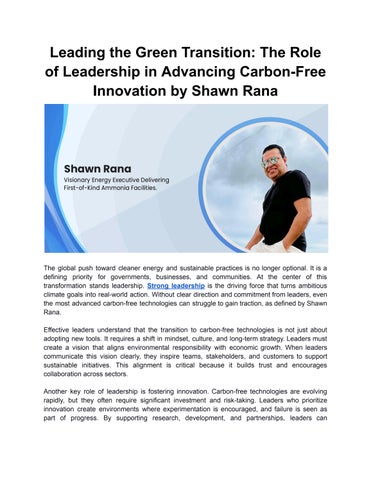
Leading the Green Transition: The Role of Leadership in Advancing Carbon-Free Innovation by Shawn Rana

The global push toward cleaner energy and sustainable practices is no longer optional. It is a defining priority for governments, businesses, and communities At the center of this transformation stands leadership Strong leadership is the driving force that turns ambitious climate goals into real-world action. Without clear direction and commitment from leaders, even the most advanced carbon-free technologies can struggle to gain traction, as defined by Shawn Rana.
Effective leaders understand that the transition to carbon-free technologies is not just about adopting new tools. It requires a shift in mindset, culture, and long-term strategy. Leaders must create a vision that aligns environmental responsibility with economic growth When leaders communicate this vision clearly, they inspire teams, stakeholders, and customers to support sustainable initiatives. This alignment is critical because it builds trust and encourages collaboration across sectors
Another key role of leadership is fostering innovation. Carbon-free technologies are evolving rapidly, but they often require significant investment and risk-taking Leaders who prioritize innovation create environments where experimentation is encouraged, and failure is seen as part of progress By supporting research, development, and partnerships, leaders can
accelerate breakthroughs in renewable energy, clean transportation, and sustainable manufacturing. These advancements are essential for reducing emissions at scale.
Leadership also plays a crucial role in shaping policy and influencing regulatory frameworks. Business leaders, in particular, have the power to advocate for policies that support carbon reduction and the adoption of renewable energy When leaders engage with policymakers and industry groups, they help create conditions that make sustainable choices more accessible and affordable This proactive approach ensures that the transition is not only possible but also practical for organizations of all sizes
Equally important is the ability of leaders to drive cultural change within their organizations Employees look to leadership for guidance on priorities and values When leaders demonstrate a genuine commitment to sustainability, it sets the tone for the entire organization. This can lead to more responsible decision-making at every level, from supply chain management to product design. Over time, this cultural shift strengthens the organization’s ability to adapt and thrive in a low-carbon economy
The transition to carbon-free technologies is a complex journey, but it offers significant opportunities Organizations that embrace this change can gain a competitive edge, attract environmentally conscious consumers, and contribute to a healthier planet Leadership is the catalyst that makes this transformation possible. By setting a clear vision, encouraging innovation, influencing policy, and fostering a culture of sustainability, leaders can guide their organizations toward a more sustainable future