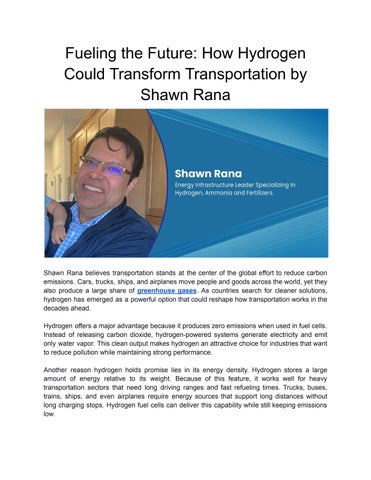
Fueling the Future: How Hydrogen Could Transform Transportation by Shawn Rana
Shawn Rana believes transportation stands at the center of the global effort to reduce carbon emissions. Cars, trucks, ships, and airplanes move people and goods across the world, yet they also produce a large share of greenhouse gases. As countries search for cleaner solutions, hydrogen has emerged as a powerful option that could reshape how transportation works in the decades ahead. Hydrogen offers a major advantage because it produces zero emissions when used in fuel cells. Instead of releasing carbon dioxide, hydrogen-powered systems generate electricity and emit only water vapor. This clean output makes hydrogen an attractive choice for industries that want to reduce pollution while maintaining strong performance. Another reason hydrogen holds promise lies in its energy density. Hydrogen stores a large amount of energy relative to its weight. Because of this feature, it works well for heavy transportation sectors that need long driving ranges and fast refueling times. Trucks, buses, trains, ships, and even airplanes require energy sources that support long distances without long charging stops. Hydrogen fuel cells can deliver this capability while still keeping emissions low.