Flow State













Loyalty Checking












S I G N S O F T E E N D A T I N G V I O L E N C E
Excessive jealousy, Invasions of privacy
Unexpected anger, rage, moodiness
Blame for problems in the relationship
Controlling tendencies
Explosive temper Preventing you f rom going out with or talking to other people; Always tracking your phone or checking in to see what you are doing and who you are with at all times

W H A T T O D O A S A Y O U T H ?
R e a c h i n g o u t t o a t r u s t e d f r i e n d , t e a c h e r , p a r e n t , o r
m e n t o r
G e t i n v o l v e d i n a c t i v i t i e s a l l o w i n g y o u t o a s s o c i a t e
w i t h p o s i t i v e p e o p l e S e e k t h e g u i d a n c e o f a s c h o o l c o u n s e l o r o r t h e r a p i s t
A N D F O R A D U L T S . . . .
B u i l d K n o w l e d g e b y e d u c a t i n g y o u t h h e a l t h y v s u n h e a l t h y
r e l a t i o n s h i p s
E m p o w e r Y o u t h t o t r u s t i n w h a t t h e y k n o w a n d t o l i s t e n t o t h e i r i n n e r v o i c e T a k e A c t i o n t o p r o m o t e t h e g r o w t h o f h e a l t h y r e l a t i o n s h i p s a n d
d i s c o u r a g e e n g a g e m e n t i n u n h










GROCERIES ON A BUDGET (PART 1)
One month into the new year, if you’re still on track to get healthy and eat well — or if you’re not but want to be — you’ll realize making healthy choices can be an expensive goal. This month and next, I’ll share tips on how I stay on track at the grocery store.

Plan ahead. Making a plan is a key ingredient to maintaining a budget. Look at your weekly calendar, decide when you have time to cook and plan some old favorites or look for new recipes — check out Pinterest or allrecipes.com. On the nights when you don’t have time to cook, consider quick meal options that take just a little time in the microwave or on the stove or find slow cooker meals to prepare in the morning. Write these plans on a calendar that you can refer to each morning as you’re planning your day so you know when you need to get started on meal preparation.
Build your shopping list. If you use a digital list like Google Keep, you can re-organize the list in the order you’ll find your items at the grocery store — keeping you on track and less likely to be sidetracked by aisles and items you don’t need. Another benefit to a digital list: you can add to it any time you think of something or run out of something, and you can share it with your family so they can do the same. If you link it to a digital assistant like Google, Alexa or Siri, you can even add to your list using vocal commands — something I do often, even in the middle of cooking.
Check back in next month to see what it looks like to stay on track once you’re in the store.
Angela Rowland is an OBU graduate and a stay-at-home mother of four. She enjoys finding new ways to stretch the paycheck and sharing her favorite tips and deals.







Rowland
'EAT REAL FOOD': UNDERSTANDING CHANGES MADE TO DIETARY GUIDELINES IN 2026
n January 7, 2026, the U.S. Departments of Agriculture (USDA) and Health and Human Services (HHS) released the 2025–2030 Dietary Guidelines for Americans (DGA), marking a ma jor shift in federal nutrition policy aimed at com bating chronic disease and promoting healthier eating nationwide.
A central theme of the new guidelines is a clear message to “eat real food.” This concept emphasizes whole, nutrientdense foods like vegetables, fruits, high-quality proteins, dairy, healthy fats, and whole grains while recommending a dramatic reduction in highly processed foods, refined carbo hydrates, added sugars and artificial additives.

One of the most notable changes is the increased focus on protein. The guidelines now recommend prioritizing protein at every meal and set a new intake target of 1.2–1.6 grams per kilogram of body weight per day, a significant increase from the previous general recommendation of about 0.8 g/kg. This change reflects an emphasis on supporting muscle health and overall nutrition.
Another major shift is the inclusion of full-fat dairy products as part of a healthy eating pattern as long as added sugars are
Pomegranate Power Salad
Salads are a go-to for me for lunches because I can easily pack them, put them together quickly and change them up quite a bit so that they don’t get boring. I love the texture and combination of these ingredients on a salad.
Ingredients:
2 cups chopped leafy lettuce of choice
½ cup chopped fresh broccoli
½ cup chopped cucumber
¼ cup feta
1/8 cup pumpkin seeds

1/8 cup chopped walnuts
½ cup pomegranate seeds
2 Tbsp balsamic vinaigrette
Add 3oz of protein of choice (not included in nutrition facts)
Directions: Place all ingredients in a bowl and mix. Add vin-
avoided, which contrasts with past editions that primarily promoted low-fat or non-fat dairy.
The guidelines also integrate healthy fats from whole foods like olive oil, nuts, avocados and even traditional fats in moderation.
The visual representation of healthy eating has also changed: an inverted food pyramid that places vegetables, quality proteins, healthy fats and fruits at the top, with grains (especially whole grains) lower down.
The guidelines take a stronger stance against added sugars, suggesting very limited intake and emphasizing “no amount” as part of a healthy diet. They also soften previous numeric alcohol limits in favor of general advice to “consume less alcohol.”
Overall, the 2025–2030 DGA refocuses national nutrition advice on whole, minimally processed foods and higher protein intake while reshaping how Americans and federal programs approach healthy diets.
Below is a recipe to help you put it all together.
Saturated Fat: 6g
Total Fat: 30g
Cholesterol: 25mg
Sodium: 520mg Carbohydrates: 32g
Fiber: 7g Protein: 12g
Nutrition 101: Pomegranate seeds are quite the powerhouse food. They provide fiber, vitamin C and antioxidants. Pomegranates have been talked about since the days of the Bible. The Bible portrays pomegranates as symbols of abundance, fertility and divine provision. They represent God’s blessing, fruitful living and are associated with righteousness. So after that, I say give them to me daily. Don’t forget to add your protein of choice to complete this meal. Chicken, tuna or salmon would all be great options with these ingredients.
S
Andrea Beck, a registered dietitian and personal trainer, received her master’s degree in nutrition and dietetics from the University of Central Oklahoma in Edmond. She offers personal training and nutrition education through an online platform, StrongHER along with functional nutrition and labs through Laser Focus. For inquiries, visit strongherwithandrea.com, or the Facebook page, Nutrition and Exercise 101 with Andrea.


art of the matter
FAIRY TALE
Russian Folk Tales Have Inspired Fine Art, Familiar Stories
SUBMITTED BY DELAYNNA TRIM, CURATOR OF COLLECTIONS
MABEE-GERRER MUSEUM OF ART
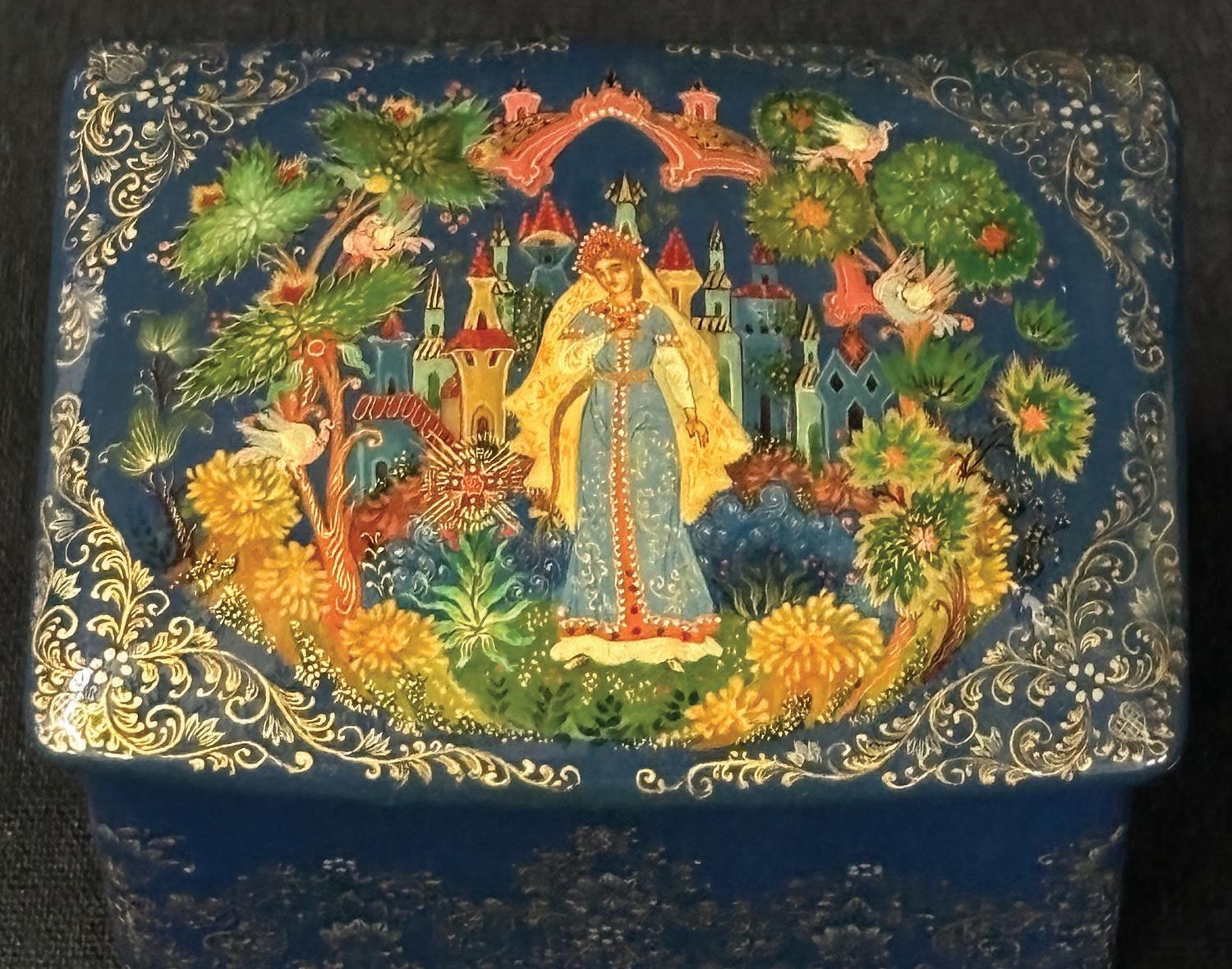
With the weather turning cold and love in the air with Valentine’s Day, it got me thinking about Russian folk tales like “The Snowmaiden” or “Father Frost and the Maiden,” otherwise known as “Morozko.”
Many Russian folk tales are the basis for our classic fairy tales like “Snow White,” “Cinderella,” “Beauty and the Beast” and more. Just like the “Grimms’ Fairy Tales,” Russian folk tales tend to be grimmer than we are used to.
“The Scarlet Flower” is very similar to the “Beauty and the Beast” fairy tale where a girl asks her father for a scar-
let flower that leads to her living with the “beast” who, of course, turns into a handsome prince at the end.
“The Princess and the Seven Bogatyrs” is remarkably close to “Snow White and the Seven Dwarves” except the Bogatyrs are taller and more handsome like medieval knights.
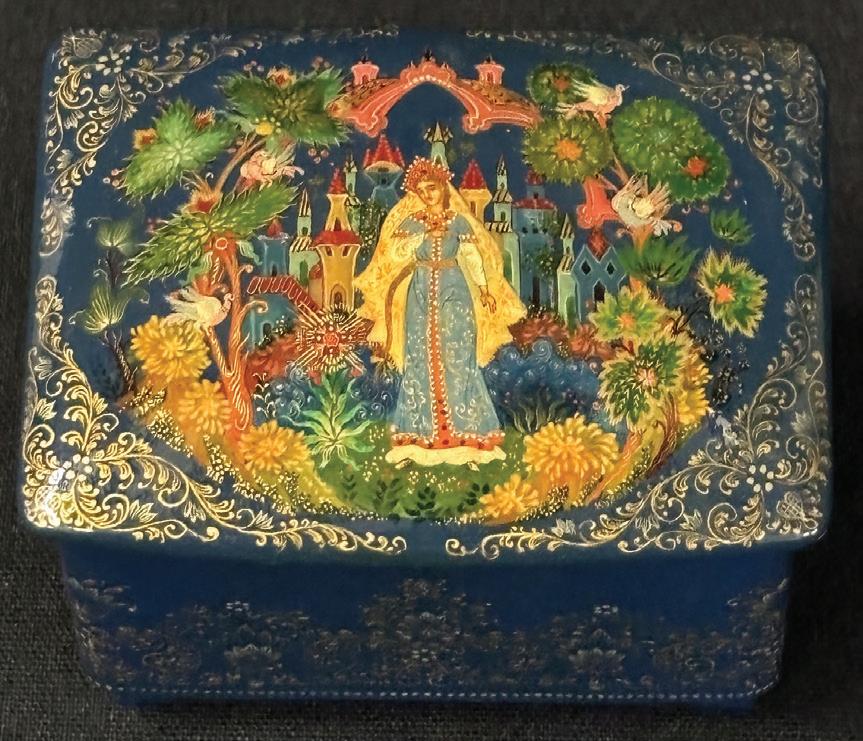
Many of these folk tales are painted onto Russian lacquer boxes. Did you know that many of them are painted with two- and three-hair brushes?
To create the papier mâché boxes, thin sheets of cardboard are sliced, glued and pressed together. While the glue is still wet, they are wrapped around various forms, including rect-
Paintings on Russian lacquer boxes featured masterfully painted scenes from folk stories that resemble familiar fairy tales.
angular, square, round or cylindrical. Then, it is placed in a hot linseed oil bath and dried over a period of 30 days.
The outside of the box is covered with two or three coats of black lacquer, waiting a day between each coat. The inside is covered with two to three coats of red lacquer, again waiting a day between coats. Then, the box is covered with several coats of clear lacquer, both inside and out. Now, the box is ready for painting.
The artist outlines the design on the box, coats it with zinc, aluminum or titanium for a metallic ground layer, and then they begin painting. Extremely
fine brushes are used, often sable or fur from the tail of a squirrel.
After the painting is finished, the box is then polished and lacquered several more times. It usually takes 45-60 days to create a box using this method.
Make Your Own Russian Box
Supplies: papier mâché box (from a craft supply store), paint and brushes, or paint markers
Paint the bottom part of the box, and the sides of the lid black

Paint the top of the lid white to make it easier to decorate
Draw your design onto the white lid
Paint your design using paint markers or paint and small brushes
Paint the inside of the bottom of the box red
For this and Valentine’s Day related art visit, www. mgmoa.org/art-projects or scan the QR code.










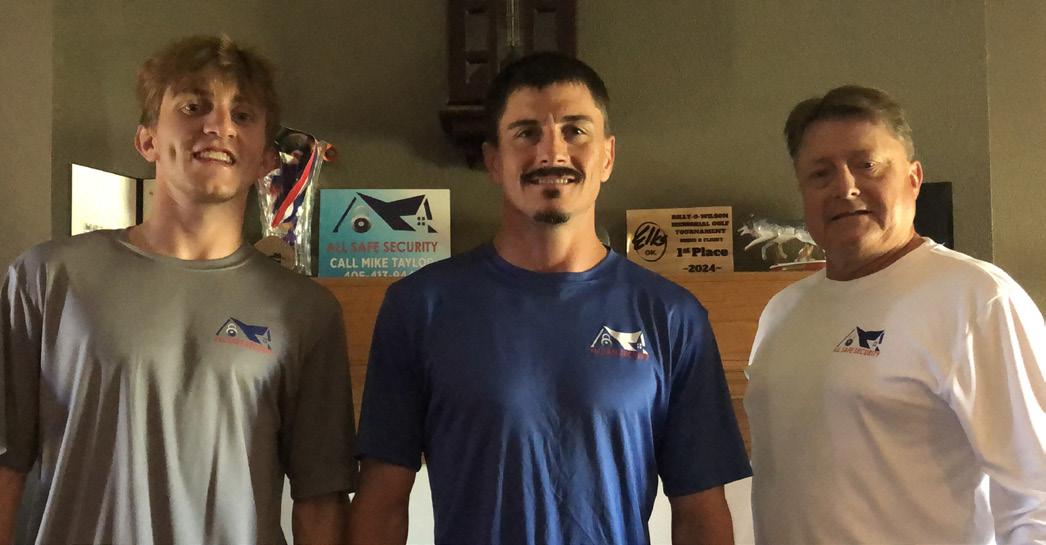
Jacob


David
Chris
G over the fence
PRINCIPAL’S OFFICE
Try To Find Space Between Feelings, Response
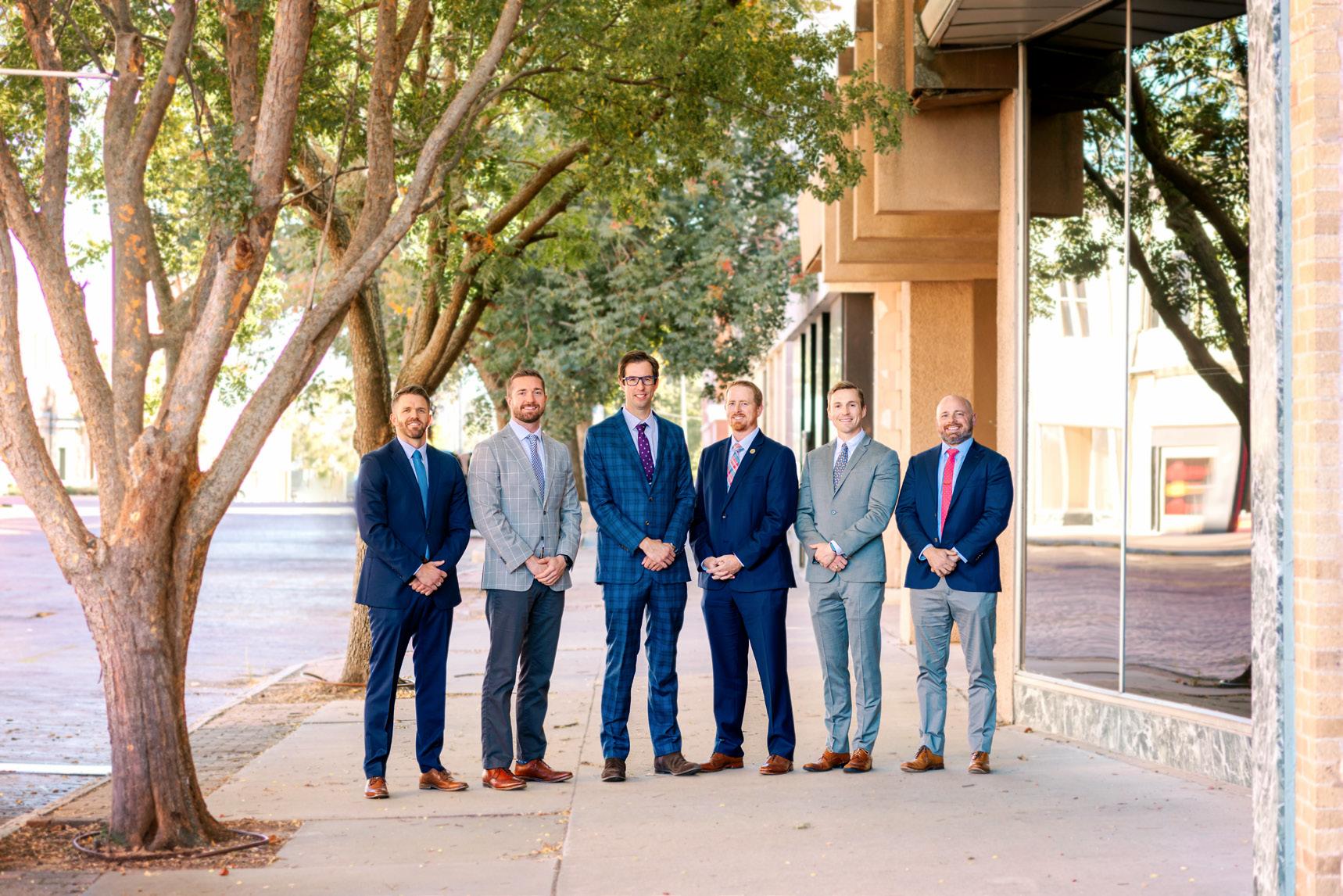
BY BRANDON DYER, EXECUTIVE DIRECTOR COMMUNITY RENEWAL OF POTTAWATOMIE COUNTY
etting called to the principal’s office as a kid had a way of getting your attention pretty quickly. It always got mine anyway, the handful of times my fool self did something knuckleheaded enough to land me there. Looking back — although I may not have thought so at the time — I think each principal was pretty fair with me, and I did my best to learn from each experience.
Perhaps some of you can relate, but have you ever been called to the principal’s office as an adult? Yeah, I hadn’t either.
Years ago, when my youngest daughter was 5, I got a phone call from her principal explaining that she had gotten in trouble and the principal wanted to speak with me about it. On the way there, I thought to myself, “She’s only in kindergarten. What could she have possibly done?”
It turns out that my sweet baby girl had punched a boy in the face at recess and made him cry. Uh oh.

against a boy. What really struck me about the whole thing, however, was her reaction. She felt so bad and apologized over and over. Through tears she said to me, “Dad, I didn’t want to punch him, but I didn’t want to be nice either!” From the mouth of babes.
She is the youngest of four children and has two older brothers, so it’s not like she hadn’t witnessed a sibling tussle or two or learned to stand her ground the best she could. But this was very uncharacteristic of her. Something had to have provoked her tiny fists of fury. Indeed something had.
Apparently, this little boy had a bit of a crush on my daughter and made a decision he would soon come to regret. Assuming his kindergarten crush would respond in kind, he confessed his love by blurting out, “You’re my girlfriend!” That was the moment he first learned that love hurts.
The principal handled the situation like a seasoned pro.
“Obviously, Mr. Dyer, we can’t condone violence around here.”
“No ma’am, of course not.”
“I trust you will help your daughter remember that there are better ways to handle our problems.”
“Yes ma’am, I will indeed.”
No one was mortally injured, so I hope you will forgive me when I tell you that it was all I could do to keep a straight face as I walked out of the principal’s office. Perhaps the playground punch was out of line, but I must admit I still carry a little grin on my face to this day thinking about that story and knowing that any boy who has interest in my daughter is going to have their work cut out for them.
On the way home, I reminded her that we don’t punch people. I also told her that for future reference I would happily go to the principal’s office any time she feels she needs to defend herself
We’ve all felt what she was expressing. Just like in the cartoons, sometimes we find ourselves in a moment where it’s as if there is a little angel on one shoulder encouraging us one way and a little devil on the other giving us the opposite advice. One is supposed to be right, the other wrong. But what happens when neither response seems appropriate? That’s where she found herself, in a moral catch 22, unsure of what was right for her to do.
We live in a time where it seems we are frequently caught in this same space, unsure of what is the right response to a world that appears to have lost its mind. We are bombarded daily with images and stories that generate strong, unsettling feelings inside us all. What are we to do when our circumstances seemingly leave us with no good options to express our anger or sorrow?
Viktor Frankl’s words come to mind.
“Between stimulus and response there is a space. In that space is our power to choose our response. In our response lies our growth and freedom.”
Too often it seems to us that there is no space between stimulus and response. We just react. Someone is rude to us; we fire back an angry response. Someone cuts us off in traffic; we tailgate to make a point.
The wisdom Viktor offers is that we do not have to be ruled by our impulsive reactions, which rarely make us happier. We possess the power to choose a different path. The space between what upsets us and what we do about it offers us the opportunity to pause and the power to choose better, on the playground, in traffic and in life.
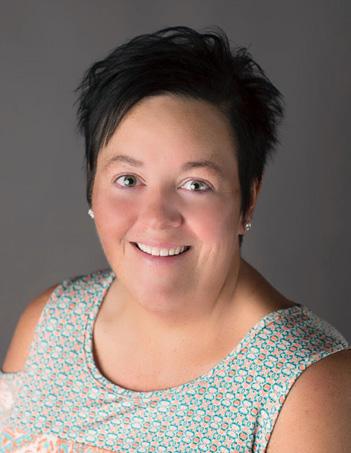
Dyer







community 'HOPEFUL SORROW’
Local Author Explores Faith Among Lament In Second Published Book
BY DAVID DINSMORE
It started with a moment of honesty.
Julie Busler — as part of the planning committee for a women’s event at her church — offered to share her mental health journey, which at one point included stays in institutions in Oklahoma and in Turkey where she was working as a missionary.
She shared her journey of reconciling faith with medical and therapeutic options for addressing mental health struggles, not knowing how listeners from her fellow church members would receive these ideas.
And if sharing this part of her life had not been on radar, attending a workshop that eventually led to an agreement to publish her story in permanent book form was way outside what she had planned for the future.
Nevertheless, “Joyful Sorrow: Breaking Through the Darkness of Mental Illness” hit virtual bookshelves in 2022, and soon Busler began receiving invitations to tell the story of her journey and the concepts presented in her book to
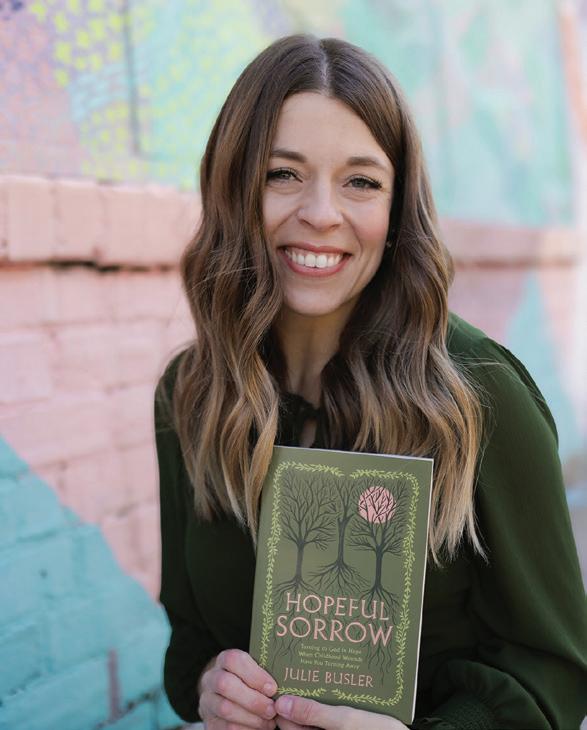
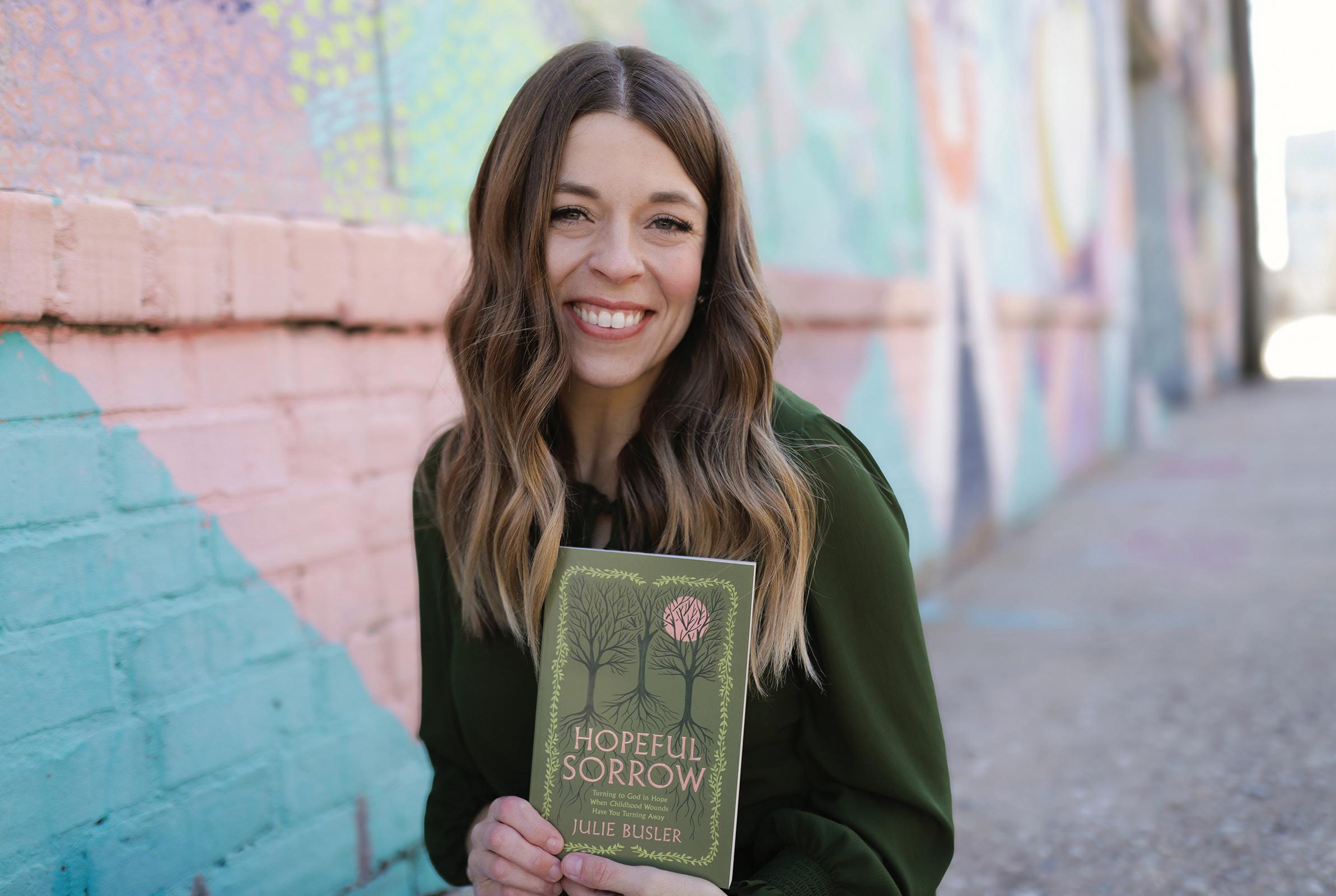
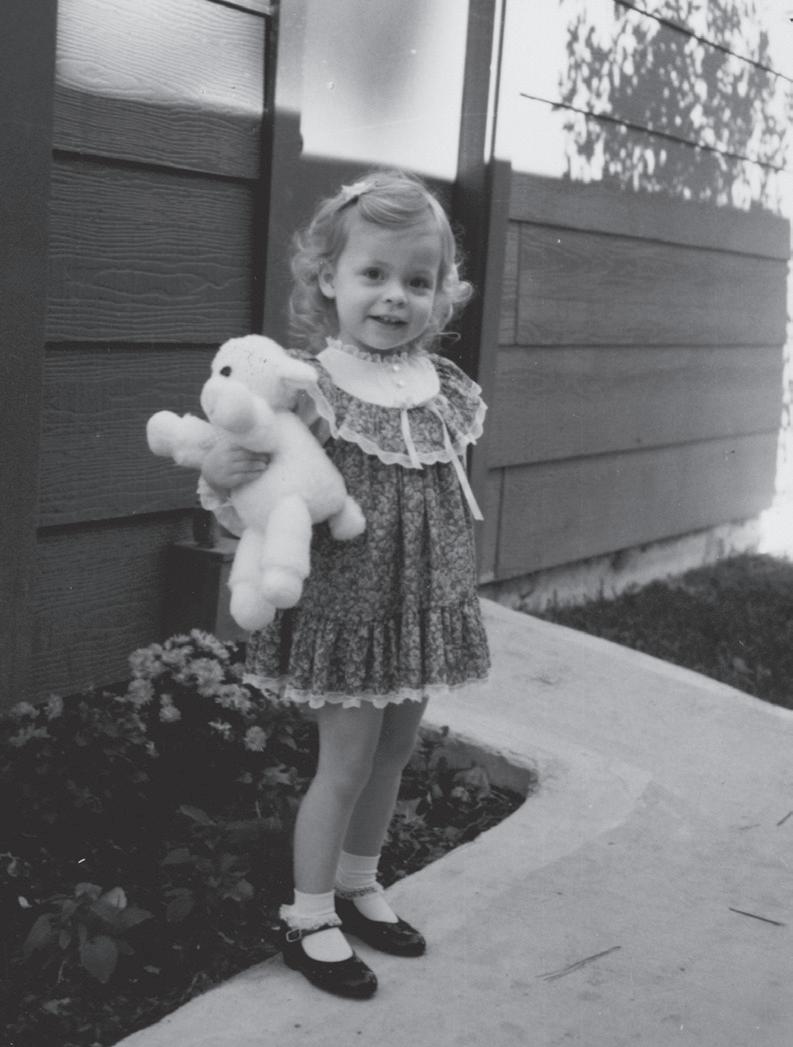
Julie Busler released her second book, “Hopeful Sorrow,” in 2025 after Christian publisher Lifeway saw the impact of her first book addressing the intersection of faith and mental health. Her latest book dives deeper into the childhood experiences that led to her own mental health struggles and the importance of learning how to lament. — Photos submitted
wider audiences.
“I started to tour around and to speak as different events and churches would reach out to me,” Busler said. “I kind of thought that was just going to die down and be it.”
She also began to realize how much her story resonated with other people facing their own struggles, and she received opportunities to share her story on television, radio shows, podcasts and other media.
“A lot of people would contact me and just tell me how they didn't feel so alone once they read my story,” Busler said. “I just wanted to share my life as a witness.”
Busler continued to share and encourage through online
platforms hoping it may make an impact on those who saw her content, but she did not realize the attention her work was garnering from one of the largest Christian publishers and resource providers in the United States.
In late 2023, Lifeway reached out to Busler to ask if she had any ideas for another book to follow “Joyful Sorrow.”
She had been working with therapists and doing the work to uncover the experiences in her life that led to the severe depression that led the mother of four to consider ending her own life in one of her darkest moments. An idea had begun to form in her mind about “how to cry out to God in honesty and hope, but then investigates how childhood wounds such as emotional neglect, fear of abandonment, emotional/verbal abuse may be hindering someone from turning to Him as a father and doing so.”
Yet even with one book to her name, she still found the publishing world daunting and was not sure how she may find the opportunity to pursue this idea — until the online conference call with Lifeway.
“I presented the idea to them … and they offered me a book contract,” Busler said. “God really is the one who opened that door.”
“It's good to tell God exactly how you feel, and so I'm thinking, ‘But I just can't. Something is blocking me from being open with God about things like how I don't like my story.’”
Busler looked to present not only explanations of what lament can be but also some possible reasons people may not feel comfortable or allow themselves to express these feelings in ways that may be beneficial for them
The result became “Hopeful Sorrow: Turning to God in Hope When Childhood Wounds Have You Turning Away,” which Lifeway published in September 2025.
One of the main concepts Busler looked to address was the idea of lament, which was something that seemed to be understood by cultures in the past but not often explored in modern life.
“It’s crying out to God; it means to wail,” Busler said. “It's expressing your grief and how you really feel to God.

In some ways, this latest book was harder to write than the story she shared in her first book as she balances exploring the childhood experiences that shaped her struggles with mental illness while still respecting her parents, both of whom passed away years prior to her seeking this help.
“I want to honor them, even though I do write about things like emotional neglect or verbal emotional abuse and how these things have shaped me,” Busler said.
“At the same time, I believe that we need to tell the truth of what God has done, which includes the whole story. Sugar coating our past does not help us in any way to heal and grow through that and grow from it.”
The book also required extensive research as Busler looked to provide information and insights that could make a difference in readers’ lives. She coordinated reviews of the content with a professional psychiatrist, licensed professional counselor and psychiatric nurse practitioner.
“I'm not a trained mental health professional, but I'm living the story,” Busler said. “I did have professionals in the field review it so that I can still present something that I believe is accurate in the field of mental health.”
Busler not only found it helpful to do the work to more


Welcome Home
Welcome Home

What’s better than fun and free? When you host a Mary Kay® party, you could earn FREE* Mary Kay® products! Whether in person or virtually, get some friends together, and you

deeply understand her own experiences, but in her interactions with people she has met since publishing her first book, she learned those insights may help others to look more deeply into their own backgrounds.
“When people came to me and told me their stories, I was seeing some repeating themes and people would say things like, ‘Well, I didn't really have it that bad in childhood, so I don't know why I struggle,’” Busler said. “I think people can minimize what happened to them as children, especially if it's something like emotional neglect.”
Another concept Busler explores in “Hopeful Sorrow” are ideas of how churches and their members can provide support and a setting where people can lament together, and she has seen firsthand the benefits of allowing this vulnerability to occur in her own life.
“It's painful for me to share these stories,” Busler said. “Then to see people’s response, it just continually encourages me that God is bringing good from these bad things that have happened in my life.”
For more information, visit juliebusler.com or follow her on Facebook and Instagram. S
Consultant www.marykay.com/dconway5 405-788-6353











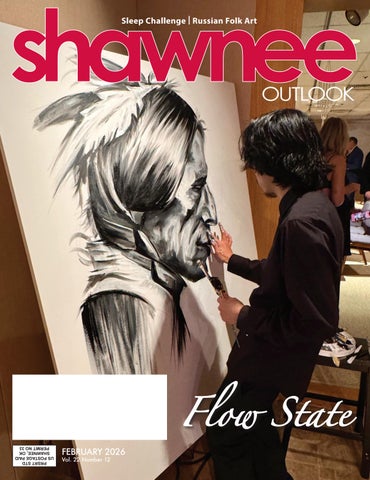
FLOW STATE
Shawnee High Senior Impresses With Portrait Creation Live During Community Events
BY DAVID DINSMORE
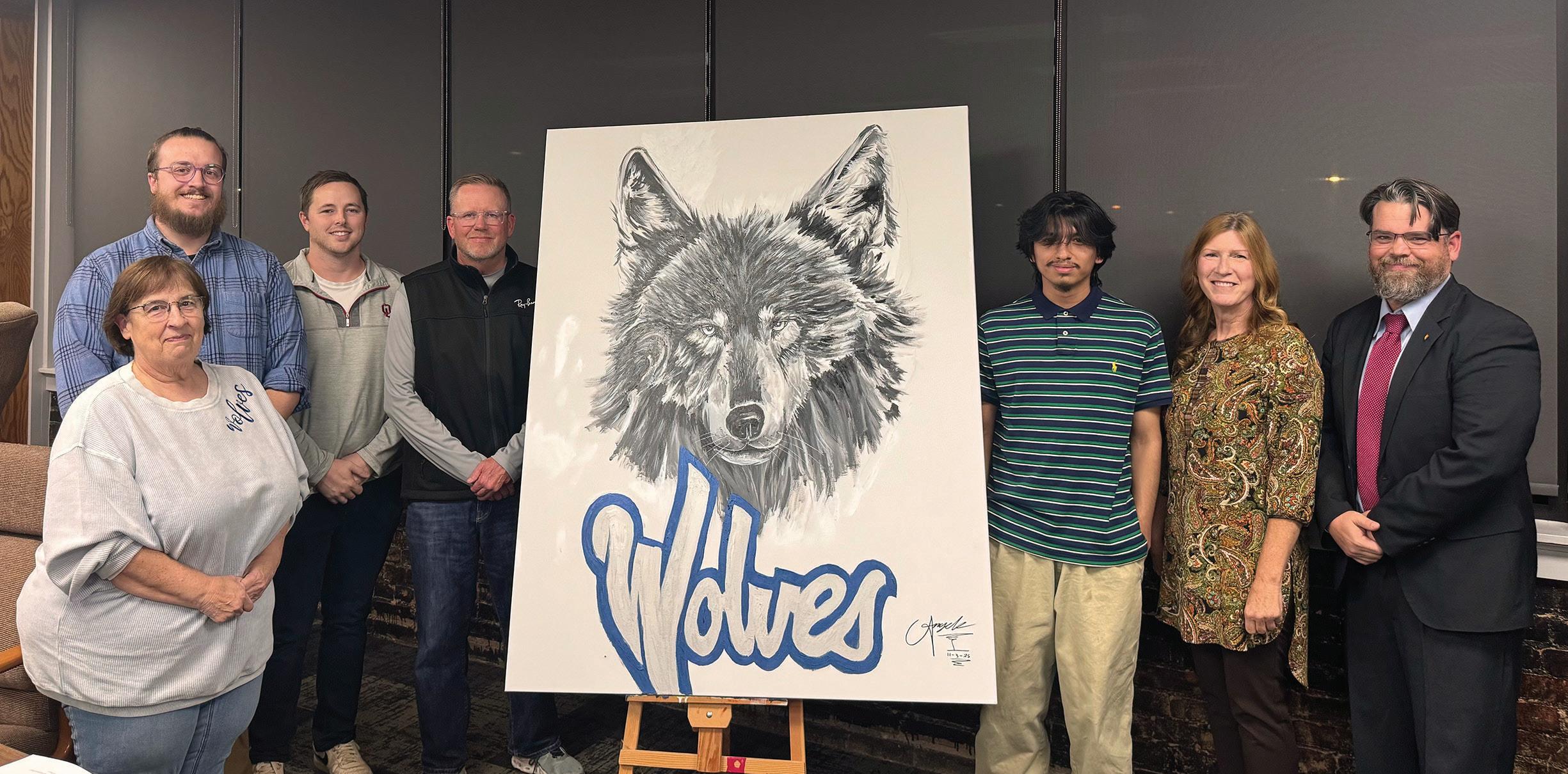
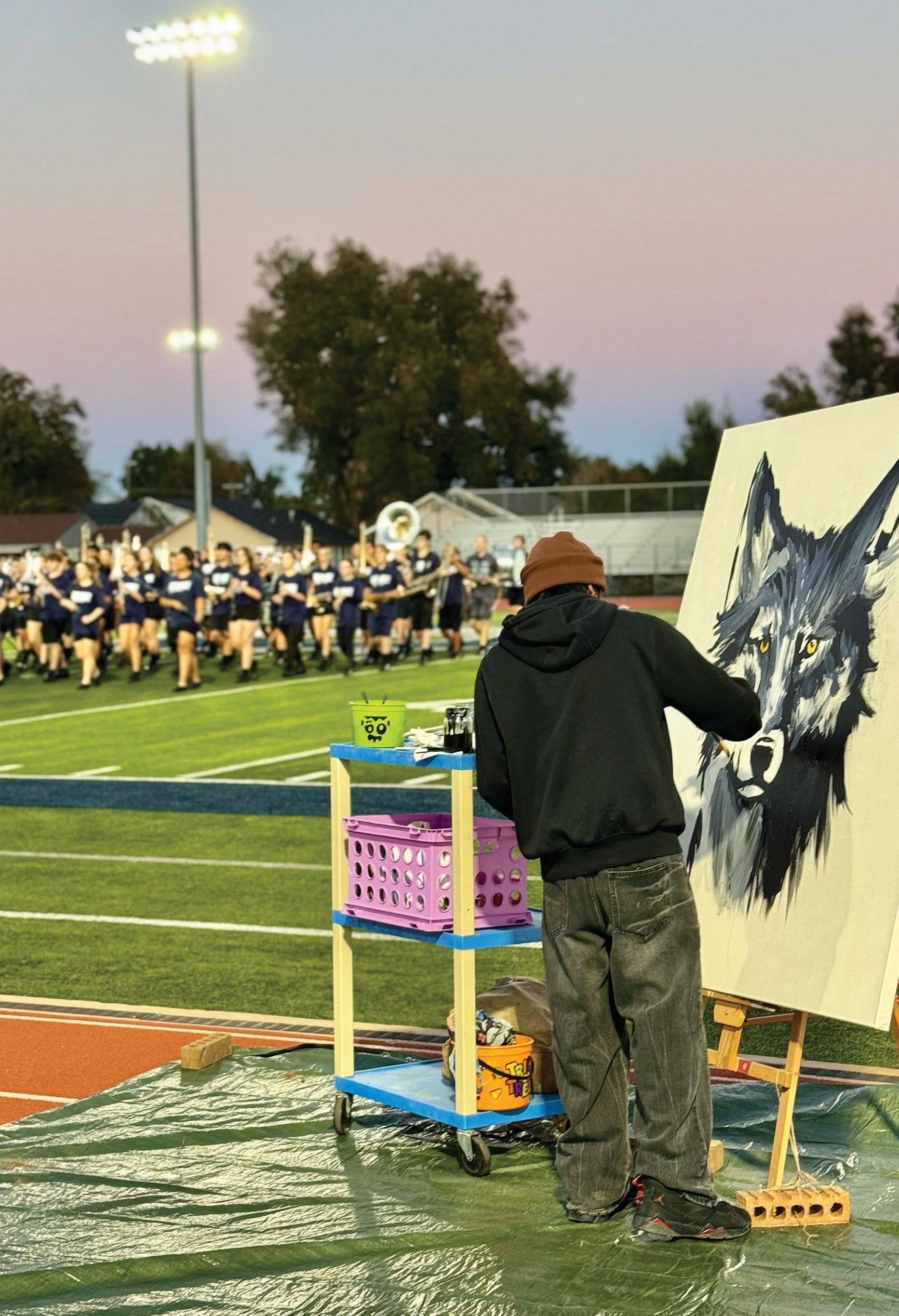
Shawnee High School senior Angel Cazares had work to do.
Sure, there were a lot of distractions;t was a pep rally, after all.
Some of his fellow Wolves also had to focus on the task at hand, whether they were band and spirit leaders setting the tone for the festivities or student athletes trying to hype the crowd.
For Cazares, however, all of that activity had to pass into the background. He was there to create and needed to enter a “flow state” merging his thoughts and actions as he created a charcoal portrait of a wolf from start to finish during the event.
“I try to put all my focus into what I am putting down,” Cazares said of the experience of creating an entire portrait live.
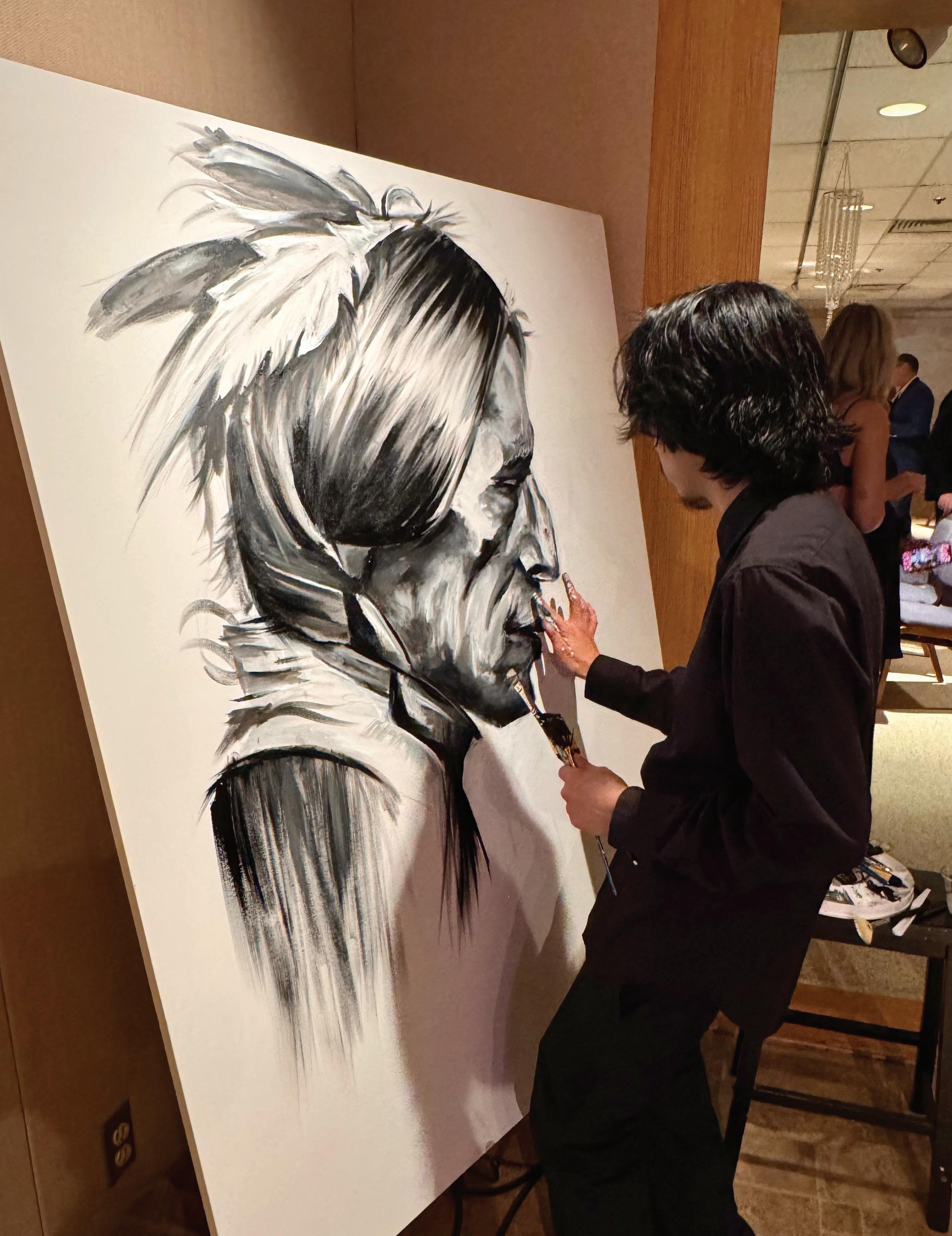
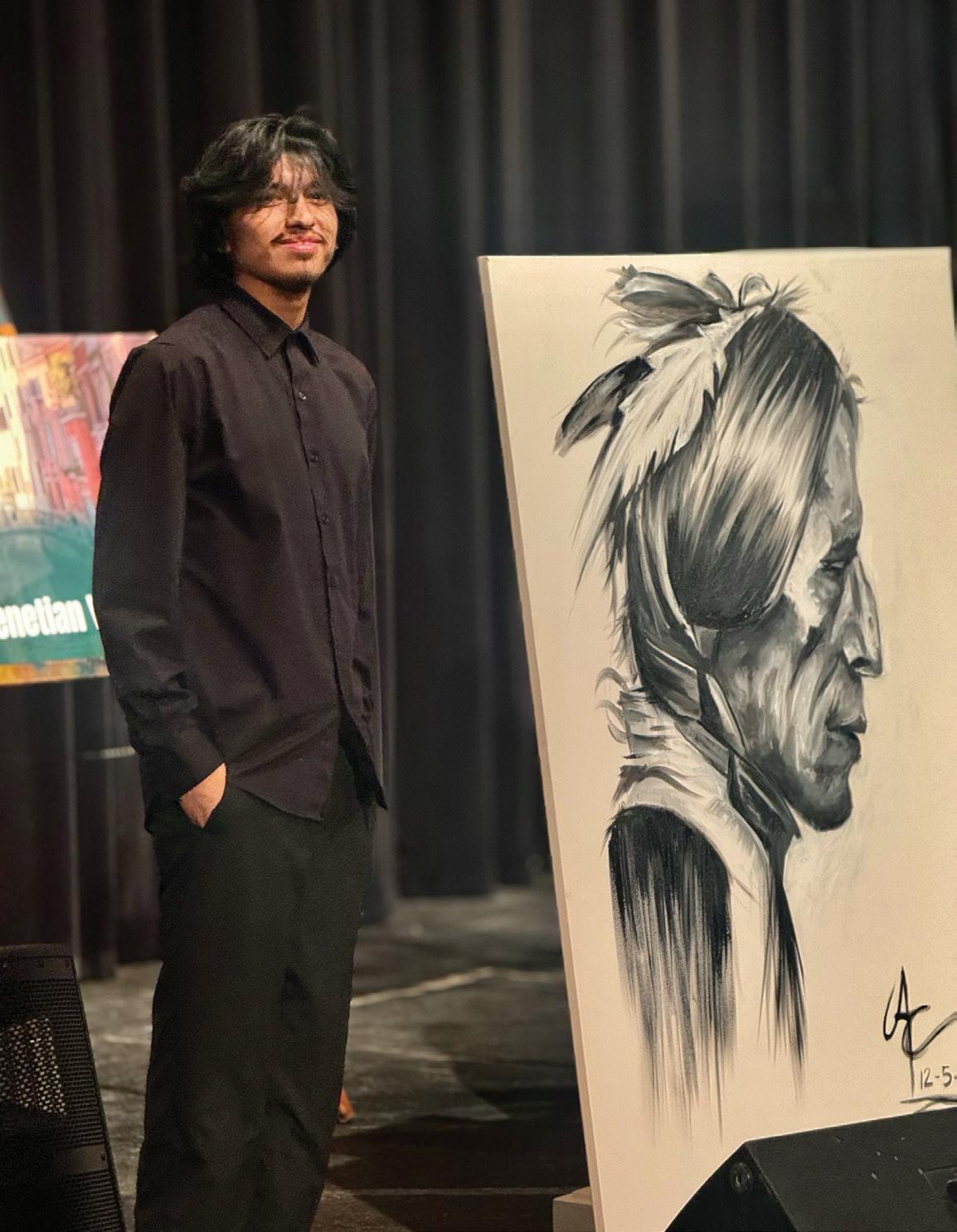
Shawnee High School senior Angel Cazares created charcoal portraits live from start to finish during a pep rally in October and a museum fundraiser gala in December, showcasing a talent for realism and focus to detail under pressure. — Photos submitted by Shawnee Public Schools
This opportunity to create art live in front of a crowd was reminiscent of one of the artists whom Cazares admires most. New York-based artist Devon Rodriguez, a New York-based first gained recognition for drawing a series of realistic portraits of commuters on the New York City subway in real time and has since become one the most followed visual artists in the world with tens of millions of people watching his work on social media and at events.
“His artwork is incredible and inspires me to do stuff like that,” Cazares said. “His accuracy is insane.”
In the time since the pep rally,
Cazares has gotten other opportunities to showcase his own skills, including being asked to create another charcoal portrait live at a fundraising gala event at the Mabee-Gerrer Museum of Art.
During the first two hours of the event, the high school student brought out from the canvas the portrait of a Native American man in honor of the people of Oklahoma. The portrait went for auction at the event and sold for a price tag higher than Cazares had expected.
Before he was impressing crowds at local events in recent months, his art journey began as a young kid watching
animation and videos of artists creating and trying to emulate their work.
“It’s always been my thing,” Cazares said.
Starting out, he would take the screen with a drawing or image on it and put a piece of paper over it to trace what he saw, but as he began to grow and hone his own abilities, he began to find inspiration in things he saw in the world around him.
Cazares began to pursue his own ideas, creating fonts and letters with a graffiti style along with his own characters. He pulled inspiration from his dad’s own Chicano-inspired art creations. He felt drawn to realistic images with his own embellishments like one may find in tattoo artistry.
One of his biggest inspirations comes from creating images that represent communities, he said, such as the wolf for the high school or the man’s portrait representing people of Shawnee and Oklahoma. He especially finds himself drawn to the challenge of the subtleties and expressions found in the faces of people.
His talent began to shine among his peers particularly in middle school, especially when his art teacher asked him as an eighth grader to lead a class about the finer points of creating using charcoal.
For him, the creative process is less about what he can put onto paper and more about bringing out the image he sees in the world as it passes through his




































































































































































mind and hands. While he has drawn piece after piece to work on his skills, it has been less of a conscious effort and more of a pursuit to make the image fit what he perceives it to be.
And in that time — particularly since the pep rally last October — Cazares has received opportunities to share these perspectives with an audience within his circle, whether for personal or “official” purposes. For instance, one teacher asked for a piece in connection to an upcoming wedding while another asked for a mural to be part of the school’s aviation class.
Cazares would like to see this trajectory continue as he moves through the rest of his high school career and into the next phase of his life. He has had the opportunity to meet college professors and is eyeing possible scholarship opportunities to pursue the next level of education.
In addition to visual art, Cazares also plays multiple instruments — including drum kit in the Shawnee High School jazz band — and would like to find a way to also share his passion for music.
With a wide variety of possible paths and a passion to create, Cazares has enjoyed the chances he’s had in recent months to share his art as he looks for ways to continue growing his audiences and inspire other young artists at home and at large.
“I want my art to take me out as far as possible,” Cazares said. “I want my art to give me that same kind of passion.” S











Let's GO
SLEEP CHALLENGE
Partners Unite To Make Sleep A Community Health Priority In Shawnee
SUBMITTED BY PARTNERS OF POTTAWATOMIE GO
Awell-rested Shawnee is a stronger Shawnee. This March, community partners are coming together around a simple but powerful idea: better sleep leads to a healthier and safer community.
Pottawatomie Go (Pogo), Shawnee Public Schools, SSM Health St. Anthony Hospital — Shawnee, Shawnee Public Library (part of the Pioneer Library System), and the Pogo Mental Well-Being Coalition are launching the first annual Pottawatomie County Sleep Challenge — held in recognition of National Sleep Awareness Month.
According to the 2024 Pottawatomie County Community Health Needs Assessment, 37 percent of adults reported sleeping fewer than seven hours per night, which can lead to significant drops in concentration and alertness as well as increased instances of depression, anxiety and other chronic disorders and diseases. Learn more about the CHNA at www.gopogo.org/chna.
Sleep is often overlooked in conversations about health and wellness, yet it plays a critical role in how students learn, how adults work and how we all respond to stress and care for one another. This challenge is an invitation for adults across our community to pause, reflect and recommit to the value of restorative rest.
Mike Dominguez, Assistant Superintendent of Shawnee Public Schools
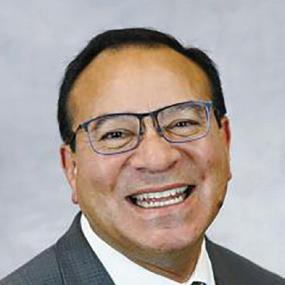
This event is a heartfelt invitation for our incredible staff, inspiring students and supportive families to come together and cherish the gift of restful sleep. We deeply recognize that quality sleep is essential. For our amazing students, it’s the quiet foundation that supports learning, memory and the bright energy they bring to the classroom.
For our dedicated educators and staff who give so much, rest nurtures focus, creativity and the joy you bring to your roles. For every member of our Shawnee family, healthy sleep is a gentle guardian of emotional balance, immune strength and wellness. Guided by research from the Centers for Disease Control and the American Academy of Sleep Medicine, we understand that restorative sleep is a cornerstone of a fulfilling life. This challenge is a shared promise


HITSNOOZE
Pottawatomie County Sleep Challenge
MARCH 8-21


to care for ourselves and each other. Let’s prioritize rest and support one another as we build a healthier, more resilient and more connected community.
Gary Revas, Vice President of Operations at SSM Health St. Anthony Hospital — Shawnee
Historically, sleep awareness lacks the same significance as other community health-focused interventions, such as nutrition and exercise. Sleep is a biological necessity and a public health priority.

The American Academy of Sleep Medicine position statement underscores that insufficient sleep and untreated sleep disorders erode safety, learning, productivity and cardiometabolic health. Sleep isn’t just downtime. It’s a cornerstone of health for children, teens
SCAN TO SIGN UP!
Mike Dominguez
Gary Revas
and adults alike. It fuels our minds, stabilizes our moods and protects our hearts and brains.
Science is clear — shortterm sleep loss and long-term deprivation wreak havoc on mental health, physical wellbeing and public safety. Chronic insufficient sleep is linked to a myriad of health conditions. It’s not just an individual problem; it’s a societal burden.

The good news? Extending nightly sleep for those who habitually skimp on rest brings measurable health benefits. Simple changes — such as limiting screen time before bed and developing consistent rest/wake routines — can have a dramatic impact on a person’s overall health. Restorative sleep allows the body to repair and heal itself from the challenges of the day. Along with this, many sleep-related issues can be resolved with minimal medical intervention, allowing the individual to have more control over their own health objectives.
It is our goal to help make sleep a priority in the community. As we move closer to the start of this challenge, we are

looking forward to strengthening our community and making sleep a public health priority — because a well-rested Shawnee is a safer, smarter and stronger Shawnee.
How to Participate
All adults age 18 and older are invited to join the Pottawatomie County Sleep Challenge through the Wellbeing+ app. Students can also engage with their families via worksheets upon launch. Participation is free, open to the entire community and designed to support individuals as they focus on healthier sleep habits during the challenge period. We sincerely hope you’ll join us in this warm and meaningful initiative.
To participate, simply track your sleep throughout the challenge dates and share your experiences with our community. Together, we can rest well, live well and thrive as one caring Shawnee family.
Stay connected on Facebook at Pogo — A Blue Zones Certified Community or give us a follow on Instagram at @go.pogo.


Volunteers are on a journey. Along the way, they seek to find personal satisfaction by using and developing their skills and talents and to make a difference to people and organizations who need help. No other area of volunteering provides the opportunities that hospice volunteers have. At the end of life, the stakes are high. The needs are big. The laughs (and tears) are real.
BLOWING THROUGH
City Familiar With Historic Storms Before Possible Recent ‘Tornado Alley’ Relocation
BY ANN MCDONALD, COURTESY POTT CO HISTORICAL SOCIETY MEMBER
Oklahoma citizens are so used to our changing weather that we expect heat in the summer, wind in the fall, frost in the winter and the spring to bring tornadoes.
It was a surprise soon after the first of this new year for Shawnee residents to hear the blare of the tornado sirens early one morning just as everyone was heading to work and school.
It was a surprise, but local folks knew what to do. We have one of the best warning systems in the country plus knowledge of what to do. Everyone scrambled to protect themselves and those nearby. TVs, phones and computers blared with the news while everyone watched those dangerous clouds creep across the state. There was relief when funnels disappeared with only minimal damage to less populated areas.
Shawnee’s history with these killer storms is not easy to pass over, but according to the National Oceanic and Atmospheric Administration, Oklahoma may be on the way out of being part of Tornado Alley. Recent information is that the “alley” is moving east. Central states like Nebraska, Kansas and Missouri have been historically the most likely to experience tornadoes, but recently that’s changed.
Texas had the highest number of these types of storms in 2025 with a total of 162, but part of that is due to the size of the state. The surprise came in that Illinois was No. 2 in the country with 146 verified tornadoes last year followed by Missouri with 120; Mississippi 111; and Alabama and North Dakota each with 72. Oklahoma didn’t even make the list of top five in 2025.
Some weather experts are citing a gradual change in that “atmospheric collision” that causes the funnels. Oklahomans don’t wish a weather disaster on any fellow Americans, especially with some people possibly not being as prepared as we have learned to be. And we’re willing to share our knowledge to save lives, but we can’t save property.
That was the case here in 1924 when nine citizens died and 69 were injured. Fortunately, people already knew enough of what they then called a cyclone to “hide” from the roaring clouds, but that funnel came from just north of St. Benedict Church through the largest housing area in town. The
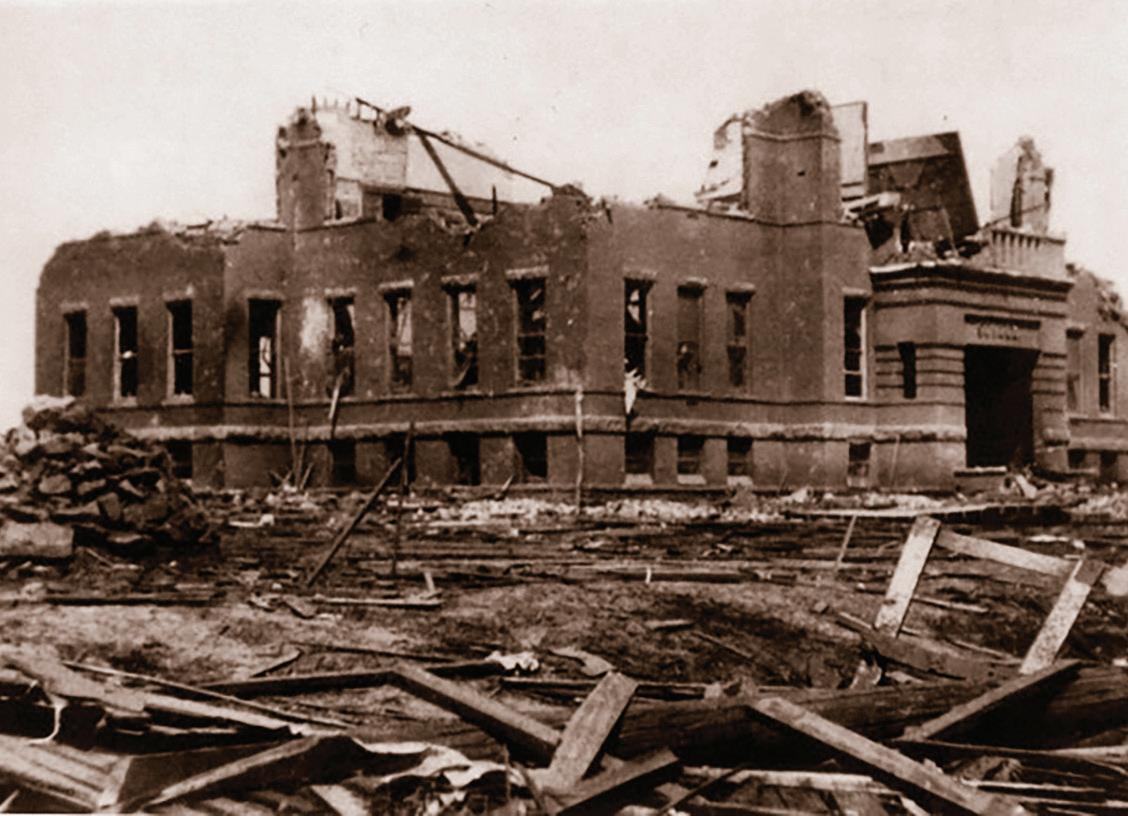
first two victims were a man and his son who died just two blocks away from Jefferson School. Fortunately, the principal had sent the children home early, because the building itself sustained serious damage that could have resulted in worse tragedy.
The building was saved by putting on a new roof and classes continued on the first floor and basement. The school was replaced seven or eight years later as the first of President Franklin D. Roosevelt’s Public Works Administration buildings in Oklahoma.
That tornado went through the 800 to 1000 blocks from Park to Broadway. Several died, and there were many injuries as the storm headed eastward. Just past the city limits, a farmer and his two granddaughters fell victim to the storm.
Local funeral homes had free services for those who were lost.
There were other less devastating storms, including one in 1946 near the railroad tracks and another in 1953 east of town with damage along Highland. Several people were injured the following year when a storm swept near the area of the Elks Club.
Jefferson School suffered damage in the deadly 1924 tornado that killed nine area residents, but loss of life has decreased as warning systems, technology and experience have improved in facing more recent storms. — Photo submitted >
Another major tornado that resulted in loss of life was in October 1970. While attempting to alert citizens with the sirens at City Hall, the building suffered an outage after being struck. Despite the loss of life and destruction on the north side of Shawnee’s downtown, it could have been worse if it had not hit just before 5 p.m with people getting off work and out on the streets. The funnel danced across the city doing damage to buildings including Sequoyah School before finally disappearing after striking a trailer park. Four citizens died, 80 were injured and the estimated damage was estimated at $33 million — which would have been about $274 million today.
In 2013, a funnel caused a lot of damage as it swept northwest near Shawnee Twin Lakes and other parts west of the city and claimed two lives.
Of course, the most recent tornado to hit locally was an EF2 and several other tornadoes struck the heart of the city and surrounding areas in 2023 that caused widespread damage to homes, schools, community centers, group residences and businesses but resulted in no loss of life thanks to aforementioned warning systems, technology and experience.
Whether we are losing our spot on the top five tornado alley list, Oklahomans have learned what really matters. We know how to protect our family, friends and ourselves — and how to rebuild. S 3 3 3 3 3
AUTO-SECURED loans INSTALLMENT loans SIGNATURE loans
AFFORDABLE monthly payments
NOT A PAYDAY LOAN
DEBIT CARD payments accepted
QUICK APPROVAL process WE ACCEPT ITIN NUMBERS

Call or visit us, and we’ll help you get your loan quickly, with monthly payments you can afford! redrivercredit.com




OUT OF ORDER
Facing Childhood Grief After Loss of Peer
BY PAULANN CANTY, MARRIAGE & FAMILY THERAPIST, MS, LMFT

Paulann Canty is a licensed marriage and family therapist and longtime Shawnee resident whose practice, Growthlines LLC, has decades of experience helping community members with a range of issues. She believes seeking therapy takes courage, and she will be answering questions from the community in the Shawnee Outlook every month. Have a question for Paulann? E-mail your question to editor@shawneeoutlook.com with the subject line, “Ask Paulann.”
Katherine, I am sorry to hear about your family’s heartbreaking loss. I am grateful for your willingness to ask questions and have conversation about grief, which is a topic so universal and yet often unexpressed.
My child is in the third grade. His cousin died recently in a car accident. Our son hasn’t had much experience with loss through death, certainly not someone close to him in age. He isn’t talking much about it and seems to be doing okay, but I worry that we’re missing signs that it is affecting him in ways that will create problems for him later. My husband and I want to do what is best for our son, but we aren’t sure what that is. This has shaken our whole family. — Katherine
Writing about grief is a little intimidating, like stepping onto hallowed ground. My hope is that this conversation will be helpful, and that at the least, it will do no harm.
We all grieve each in our own way. Grief as a fact is universal. Grief as an experience is personal.
There are common themes, but even those are shaped by our individual story. Regardless of your way of grieving, it’s important to remember two things. Loss may be an event. Grief is a process across time.
What we know in theory, sometimes becomes blurry in reality. We bring our
own histories and personalities to this partnership with grief. We are still at risk of assuming that others grieve like we grieve. We forget that differences –such as our age or the number of times we have encountered grief – affect how we feel our grief. Our experience in the dance of loss affects how we show our grief. The power of those unrecognized differences is especially impactful when family members are grieving at the same time. We can be comforted by not being alone and distressed by our misunderstanding and lack of awareness of what others’ grief looks like.
Our acquaintance with grief begins in childhood and continues through adolescence. Friends move away. We lose pets. Grandparents die. Painful lessons about life and the passage of time happening in an order we don’t like, but we come to accept these as life’s way. Sometimes loss happens out of order,
Paulann
bringing painful lessons about time cut short. This is the case for your son as he experiences the permanent loss of his cousin. His loss of a peer and the way he expresses it will be different than that of the adult family members. A family loss can be especially hard because everyone is initially swallowed up in their own grief. For children, that sometimes means they feel they’ve lost those present as well as those who are gone. How to help our kids can feel like a daunting task and a burden to us as adults, but we can also choose to lean in to the process as an important chance to be the “messenger” to our children telling and showing them that it’s okay to be human, to struggle, to weep, to rail, to question, and ultimately, to just continue living.
And so, dear mom and dad, perhaps the greatest gift you can offer your third grader is presence and space for him to express in a number of ways what he’s feeling, asking and what he wants you to know.
may be insensitive to the ways their life has been disrupted.
• Not displaying emotion doesn’t mean a child isn’t feeling something. Are we modeling a variety of ways to express feelings? Are we respectful of their need to be with us and to have time alone? We may fail to acknowledge the hole left in their lives if we assume that silence means there is no hole.
I was in junior high school the first time I faced the death of a peer. He was a year younger than me. We didn’t go to the same school, or even live in the same town. We weren’t best friends or extremely close. Perhaps it made a difference that we had become friends on our own. Our parents didn’t know each other. Our respective friends didn’t know each other. I met him during the summer when I visited my grandparents. We rode horses together, talking about incidentally important teenage topics. At the end of the summer, he stayed in the country, and I went back to the city.
Then the news came that he had killed himself over a girl. He left a note.
“She doesn’t love me anymore.”
I traveled the 50 miles by myself on a Greyhound bus to attend his funeral at the local high school. The gymnasium was filled with people from the rural community and beyond. There were junior high and high school students. Young people facing the loss of a peer, a death out of order. I was there to pay my respects to a brief friendship and perhaps to stand with other teenagers as we each found our voice of grief.
I lost and grieved other peers – all too young to die – as I finished adolescence and stepped into young adulthood. In the years that followed, I have sat with grieving children and teenagers as they found their own way through loss that came too soon, to those too young. What should we take from young grief? Who should we be to the children and teenagers in our lives who are facing overwhelming and traumatic loss?
We’re used to learning from the wisdom of age and experience. When children grieve, we discover there are things to learn and lessons to be reminded of from the wisdom of innocence. For the sake of the young, let’s remember:
• They are not empty human-like containers who are here but devoid of feelings until they reach the magic age of majority at 18. Our failure to recognize this means we
• They are not adults in smaller bodies. They are not fully equipped to identify, feel and express the complex range of emotions related to loss. We may explain away their emotion by referring to their displays of grief as adolescent drama. Defining their grief as overstated may allow us to hide our own discomfort with grief in understated ways. Will we risk being uncomfortable to be with them in these raw moments?
• They will accommodate us at their own risk if they believe we can’t handle shared grief. If the things they need to say or the questions they need to ask “make” us cry or shut down, they will take care of us by keeping their thoughts and their questions to themselves. We get to help them know it’s okay to cry, okay to be quiet, okay to step outside. We get to show them how to grieve, even as grief continues to be our teacher. It’s not our grieving that harms but our determination to leave it the unnamed presence in our midst and children to wrestle with it alone and in hiding.
And so, dear mom and dad, perhaps the greatest gift you can offer your third grader is presence and space for him to express in a number of ways what he’s feeling, asking and what he wants you to know. At his age, his “language” will often be more behavioral than verbal and may look like acting out. Take time to “hear” the feelings and respond first. Then necessary consequences can be given for unacceptable behavior.
Let him know you are sad too. Show him that you both are capable of handling his sharing his grief across time. Not at your convenience, but as he is ready.
Thank you again for the courage and care to start this conversation. May it be a conversation that continues across time.
Please see below for a few grief resources for families:
• Ten Best Bereavement Books for Children 2026 10bestspot.com
• Calm Waters Center for Children and Families calmwaters.org
• National Alliance for Children’s Grief (NACG) nacg.org
• The Dougy Center www.dougy.org
• Rainbows for All Children rainbows.org
• Winston’s Wish winstonswish.org (free crafty make and talk activities for bereaved children) S
Feb. 1-15: The Mabee-Gerrer Museum of Art presents the exhibit, Madonna and Child: Medieval to Modern, at 1900 W. MacArthur St. This exhibit explores the complex and changing imagery of the Virgin Mary and the Christ Child from Medieval figures to modern prints, sponsored in part by Allied Arts, Oklahoma Arts Council, National Endowment for the Arts, Avedis Foundation and the Mr. and Mrs. R.J. Wissinger Memorial Fund. There will be a free gallery talk and reception at 7 p.m. on Jan. 30. Information: mgmoa.org
Feb. 7: Blacktop Mojo with special guest Brayden Stewart will rock the stage with a show starting at 8 p.m. at the Historic Ritz Theater at 10 W. Main. Information: facebook. com/theritzofshawnee
Feb. 8: Farmers Market at OneSixty presents a Galentine’s Day Market from 1-6 p.m. at the American Legion Post 16 at 522 W. Saratoga. Attendees can enjoy shopping, food, drinks and fun as they find Valentine’s Day gifts for their loved ones. Information: facebook.com/people/Farmers-Market-atOneSixty or (405) 788-6713
Feb. 10: Join the Shawnee Public Library at 5:30 p.m. in its community room at 101 N. Philadelphia for Connection Corner as they bring people together to watch A Minecraft Movie (rated PG) and get to know others who share a similar
interest. Discover new techniques and perspectives as guests meet with others to learn about others’ experiences while sharing their own. Popcorn and water will be provided and guests can bring any materials to help support their experience and comfort. Information: (405) 275-6353
Feb. 12, 26: The Shawnee Public Library will host two Eat Smart classes in February focusing on how small affordable nutritional choices can help you eat better and maintain a healthy and sustainable lifestyle. Registration is required for each program, which starts at 5:30 p.m. in the community room at the library at 101 N. Philadelphia. The first class will feature a Greek theme, and the second will focus on making a chili bar. Information: (405) 275-6353
Feb. 13: Citizen Potawatomi Nation celebrates Valentine’s Day with its annual Flapjacks & Friends featuring all you can eat pancakes and sausage 7 a.m.-2 p.m. Tickets are available for purchase at the tribal administration offices, Grand Casino offices, FireLake Discount Foods and at the door that day. Proceeds benefit CPN tribal members and employees in need. Information: potawatomi.org
Feb. 13: Country trio Midland will let it roll with its double platinum resurgent sound fashioned to unite classic country fans with modern music audiences. The acclaimed band >



will take the stage at 8 p.m. at the Grand Event Center at 777 Grand Casino Blvd. Information: grandboxoffice.com
Feb. 14: Community Art Gallery will host Date with a Dinosaur from 3-8 p.m. inside Shawnee Mall at 4901 N. Kickapoo where attendees can choose a night of open paint or a workshop on how to make candy flowers all while playfully assisted by a friendly T-Rex. Information: facebook.com/ shawneeokarts or (405) 432-7676
Feb. 14: Adam D. Tucker – aka Vegas McGraw – brings his tribute to Tim McGraw to the Historic Ritz Theater with a show starting at 8 p.m. at 10 W. Main. Information: facebook. com/theritzofshawnee
Feb. 17: Join the Shawnee Public Library at 5:30 p.m. in its community room at 101 N. Philadelphia for Connection Corner as they come together to learn the art of traditional book folding to create a work of art. The class will have a few patterns available to choose from, ranging in difficulty level. Books and supplies will be provided for this program designed for teens and adults. Registration is required. Information: (405) 275-6353
Feb. 19: The Third Thursday Poetry Reading welcomes back Paul Juhasz, author of “Ronin,” an unusual collection of poems and essays. Paul figures that any Oklahoma poem needs to have dirt, wind, sky, birds, but above all a soul running free – or maybe just the last. The reading will begin at 7 p.m. at the Lunch Box at 217 E. Main St. followed by an open mic session for attendees to read up to two poems of their own or from a favorite poet. The Lunch Box will have desserts and drinks available.
Feb. 21: Oklahoma Baptist University will host a 24-Hour Theatre Fundraiser with performances starting at 6 p.m. featuring original student-produced short plays created and staged in just one day. Tickets are $1 at the door. Proceeds from the fundraiser will support the spring production of William Shakespeare’s “A Midsummer Night’s Dream” in April. Information: okbu.edu/programs/theatre
Feb. 21: Get ready for a night of pure country-rock adrenaline with J’Some Aldean, the ultimate Jason Aldean tribute experience, taking the stage at 8 p.m. at the Historic Ritz Theater at 10 W. Main. Information: facebook.com/theritzofshawnee
Feb. 24-26: Check out the Pottawatomie County Junior Livestock Show featuring the hardworking members of area 4-H clubs and FFA chapters as they display their prized animals. Information: facebook.com/ PottawatomieCountyJuniorLivestockShow
Feb. 26: Take on the late-winter blues with a Shawnee Peace & Praise Community Choir concert featuring gospel, contemporary praise and toe-tapping crowd pleasers
starting at 7:30 p.m. at the First Christian Church of Shawnee at 1625 N. Broadway. Information: facebook.com/ shawneepeaceandpraise
March 1: Locomotive Operators of Central Oklahoma will host its monthly public run 1-4 p.m. at 29626 Lake Drive in McLoud. Ride the rails on powered ⅛-scale locomotives right outside of Shawnee Twin Lakes. Information: locotrains.org
March 6: Songwriter Night @ Music Unlimited is back with a collection of featured artists every month starting at 7 p.m. at 1109 W. Kickapoo Spur. Information: www.mu1978.com
March 6: Nashville recording artist Jason McPhail returns to his central Oklahoma roots with a show starting at 8 p.m. at the Historic Ritz Theater at 10 W. Main. Information: facebook.com/theritzofshawnee
March 7: Come support emerging young talent with the recently formed band, The Shawp, featuring up and coming musicians with a love of classic blues and rock. The show starts at 8 p.m. at the Historic Ritz Theater at 10 W. Main St. Information: facebook.com/theritzofshawnee
If you know of any events you would like to see featured, email editor@shawneeoutlook.com.

REDISCOVER SOUND