
TODAY’S FARM
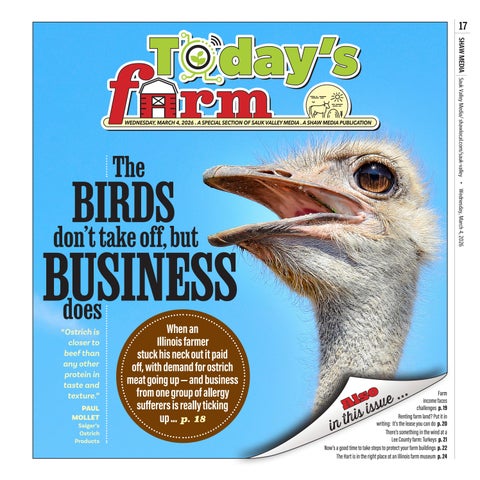
His birds didn’t take off, but business did
When an Illinois farmer stuck his neck out it paid off, with demand for ostrich meat going up
By KIM HILL Illinois Farm Bureau Partners
RED BUD — You’ve probably heard it before: When someone tries to get you to try an unfamiliar meat, they’ll tell you: “It tastes like chicken.” But you won’t hear Paul Mollet say that. He’ll tell you: “It tastes like beef.”
Just what is “it”? Well, “it” is a bird most people have seen, but probably never tasted. It’s not native to Illinois, and it could get a speeding ticket if it ran down a city street.
“It” is the ostrich, and the beefy bird is a big part of Mollet’s business — and the fleet-footed flightless ones (they can run nearly 40 mph and sprint even faster) are becoming a bigger part of people’s diets, too.
Salger’s Ostrich Products in Red Bud (in southwest Illinois about 20 minutes south of St. Louis) offers a red meat alternative, meeting a need within growing market demand.
He chuckles when he’s asked if ostrich meat tastes like chicken.
“Ostrich is closer to beef than any other protein in taste and texture,” says Mollet, who runs Salger’s with his wife, Erica. “You cook it like beef, and it’s very similar to a lean beef, except it’s lower in fat.”
Erica and her brother, Nathan, grew up on a farm. Their parents, Kathleen and Fred Salger, entered the ostrich industry after purchasing a neighboring dairy farm at auction in 1992.
That 40 acres wasn’t enough for a large livestock or row crop operation, so Fred began researching viable ideas for the land. He discovered raising ostriches takes a third of the land and water it takes to raise a cattle herd of similar size.
And while both Salger and Kathleen had always raised a few cattle, goats, donkeys, sheep and chickens, they soon discovered ostriches were a big step in a different direction.
Feathers and family
In 1994, Salger started with two birds and an incubator in his basement, gradually acquiring more birds over the years to build a flock.
“Back in the early 1990s, raising ostrich was going to be this big, booming business where everybody was going to get rich,” Salger said, but added: “There were a lot of growing pains in the early years.”
Today, the family business is divided into two divisions: Salger Livestock as the farming side and Salger Ostrich Products as the retail side. Salger, Kathleen, Nathan and his wife, Patty, raise the ostrich flock, numbering about 300 birds on average.
Salger says one of the greatest challenges in raising ostriches is the incubation stage.
“A hen lays an egg every other day on average during laying season, which typically runs March to early October,” Salger says. “We collect the eggs from the pens every night.”

Early development is very difficult due to many factors that are out of the farmer’s control.
“If an egg gets rained on or is laid in the mud outside of the pen, for example, we’ve learned it’s not worth our time to try to incubate it,” Salger says. “Learning the optimum humidity levels and temperature levels has been one of the toughest things over the years.”
Eggs are placed on a roller tray and rotated for a few days before they are incubated for about 42 days.
“We have a specialized building for our incubation and hatchery with controlled temperatures, humidity levels and sanitary conditions,” Salger says. “Once you get a chick past 10 to 12 weeks, ostriches have great immune systems.”
Chicks weigh approximately 3 pounds once hatched. The ostriches are fed a mixture of alfalfa grass, corn and soybean meal. Salger and Nathan raise all the hay and corn used in the ostrich feed and mix it on-site. They also raise the soybeans that are ground into the soybean meal.
Salger’s Ostrich Products focuses on the sale of meat products. About 90 pounds of meat can be processed from one bird. Ostrich meat is lower in fat than either beef or pork.
“It’s very comparable to beef filet mignon in that there is very little fat,” Mollet says. “There are no bones in the meat unless you get wings.”
A safe Alpha bet
While some consumers purchase ostrich because it carries less fat and cholesterol than beef or pork, the largest market for Salger Ostrich Products is the alphagal syndrome community.
Alpha-gal syndrome is a serious, potentially life-threatening allergic condition that can occur after a tick bite. Symptoms typically occur after people con-
Erica, Paul and Amber Mollett; Brandyn and Meghan Fadler; Fred and Kathleen Salger; and Nathan; and Patty Salger run Salger’s Livestock and Salger’s Ostrich Products in Red Bud.
sume red meat or are exposed to other products derived from mammals. Even though ostrich meat has the appearance of beef, it is poultry, making it safe for those with alpha-gal syndrome.
“I get calls daily from people around the country who say they’ve just been diagnosed with alpha-gal, and they found us online,” Mollet says. “It’s unbelievable how many people have it. We try to help people learn more and make them aware of what they can eat that we produce. In the seven years I’ve been involved with the business, I’ve learned as much about alpha-gal as I have about ostriches.”
Direct to consumers
The farm’s offerings include prime-cut filets, roast, ground ostrich, wings, burgers and even ostrich summer sausage.
“We are one of just a few ostrich suppliers that have as many products as we do,” Mollet says.
Local customers can shop at the Farm Store in Randolph County, or find Salger products at select farmers markets in the region. Products can also be ordered at salgersostrichproducts.com. The farm ships within the continental U.S. — but cannot ship to PO boxes — and orders are shipped nationwide weekly.
“Everything gets to its location within two days no matter where it’s going in the U.S.,” Mollet says.
The farm’s focus is providing fresh, delicious ostrich meat direct from their farm to consumers’ tables.
“We cater to the direct consumer, having the product ready for them to cook at home rather than selling or shipping to meat markets,” Mollet says.
This story was distributed through a cooperative project between Illinois Farm Bureau and the Illinois Press Association. For more food and farming news, visit ILFBpartners.com.
Photo: Nathan Lambrecht/Journal Communications
TODAY’S FARM
Farm income forecast spotlights challenges
By DANIEL GRANT FarmWeek
USDA’s farm income forecast released last month projects another challenging year ahead for most farmers, except those in the beef sector.
Overall, net farm income, a broad measure of profits, is forecast at $153.4 billion in 2026, a decrease of $1.2 billion relative to 2025 in nominal dollars.
USDA also revised its estimates for 2025 with net farm income projected at $154.6 billion, down $25 billion from the September forecast, while production expenses soared to a record-high $473.1 billion. The farm income forecast was USDA’s first since September, following interruptions from the government shutdown last fall.
“Together, these revisions suggest the farm economy is experiencing a generational downturn rather than a temporary slowdown,” American Farm Bureau Federation economists Daniel Munch and Faith Parum noted in a Market Intel report. “Outside of the cattle sector, most commodity markets are weakening.”
USDA forecasted cash crop receipts this year

These revisions suggest the farm economy is experiencing a generational downturn rather than a temporary slowdown.
American Farm Bureau Federation Market Intel report
could increase by $2.8 billion. However, after adjusting for inflation, crop receipts are projected to decline by nearly 1%, reflecting continued pressure across most crop markets, the AFBF economists noted.
Meanwhile, hog receipts were predicted to decline nearly 1% while milk receipts could fall by $6.2 billion (12.8%) this year, according to the USDA report. The lone bright spot in the projections is cattle and calf receipts, which were projected to increase by $5.2 billion (4.1%) this year as tight supplies support higher prices.
The report revealed other issues in an increasingly fragile farm economy. Farm sector debt is forecast to increase by $30.8 billion (5.2%) to $624.7 billion in 2026. Debt-to-asset levels for the sector are forecast to
increase slightly to 13.75% in 2026 while working capital could decrease 9.2% this year compared to 2025.
“The updated forecast further cements that the expectations of a strong income rebound for 2025 did not come to fruition and this reinforces that farm profitability last year was more fragile than previously believed,” Munch and Parum noted. “USDA’s first look at 2026 points to continued pressure in the farm economy.”
USDA did forecast a $13.8 billion increase in direct government payments this year compared to 2025 as a result of the Farmer Bridge Assistance Program.
“Even at these elevated levels, government payments do not fully offset the scale of losses farmers have absorbed in recent years,” the AFBF economists added. “With production costs still high and market prices under pressure, many operations remain below breakeven, even after accounting for disaster and economic assistance, leaving significant financial gaps.”
This story was distributed through a cooperative project between Illinois Farm Bureau and the Illinois Press Association.
For more food and farming news, visit FarmWeekNow.com.


FARM
Put it in writing: It’s the lease you can do
Renting farm land? Both parties need to do their due diligence before sealing the deal
By KEVIN BROOKS University of Illinois Extension
Having a well-written farm lease is vital in today’s farm rental marketplace. The purpose of this article is to provide tips to consider when constructing a cash farm lease in Illinois.
Landowners and farmers can find templates for farm and other leases at the University of Illinois farmdoc website (at farmdoc.illinois.edu/) with lease templates available in the Agricultural Law section, at farmdoc.illinois.edu/ agricultural-law

Both the landowner and farmer should want a written lease to protect their interests and should seek professional legal advice before signing the contract. This article is meant only for educational purposes and is not exhaustive or to be considered legal advice.
Hire an attorney — Hiring an attorney to help construct your farm lease is vital to the success of your farm. Templates are generic and not specific to your farm and situation. An attorney with agricultural experience will help you avoid pitfalls associated with leasing your land, which could save you legal expenses in the future.
Protect your identity — Lease templates often include a space for the parties to provide their tax identification numbers. There are reasons why the parties in the lease need to share tax numbers; however, leases can end up being passed around by different people, physically lost, stolen by hackers, or sent to the incorrect email address. Sharing your tax ID on the lease form may not be in your best interest.
Property description — The landowner can find the legal description for the farm on the deed, which a licensed surveyor crafted. Use an exact copy of the legal description when identifying the property. Have your attorney review your legal description for errors. Disputes can arise over property boundaries and acreage in the lease.
Tenure length — When livestock farms were common, it made sense to have lease terms run from March 1 to the end of February. For cash grain farms, it has become more common for leases to run from Jan. 1 to the end of December. This change can help avoid conflict should an existing tenant be terminated, as it gives the new tenant more time to prepare the farm for planting.
Unneeded information — Legal experts design generic lease forms to cover various leasing methods and scenarios, some of which do not pertain to your farm. Have your attorney customize your lease for your farm. This will remove the unnecessary information. Reviewing duties is your duty — Read your lease duties carefully. Parties sometimes sign lease agreements without a clear understanding of these duties.
For example, many templates include wording for the landowner to provide limestone for pH adjustments, but this duty now commonly falls on the farmer. The U of I provides recommendations for maintaining optimal soil test levels of phosphorus, potassium and soil pH. Landowners can include university-recommended levels for these fertilizers and lime in the lease, which the farmer is responsible for maintaining. Landowners should be aware of these recommendations or hire someone to review them on their behalf and require their farmers to provide soil test records.
The duties of farmers in lease templates are vague. Consider the responsibilities carefully and provide specific details. If necessary, request more detailed information about the responsibilities outlined in the lease, including conservation practices and the storage of chemicals.
Some leases specify that the farmer co-insure the landowner against liability if the farmer’s actions cause damages to others.
Landowners can require or prohibit specific farm practices, which should be detailed in the lease contract. Farm-
ers should be specific about what they are willing to provide.
Conservation Reserve Program waterways need to be respected as part of the duties. Some farmers’ tillage and chemical programs can reduce and damage CRP areas, and these areas should be monitored and repaired. As the mowing and maintenance of the CRP constitutes an additional expense for the farmer, the owner should consider including a provision for compensation within the contract.
Guaranteeing payment — Many leases still require an initial lease payment in March of the production year, followed by another in the fall to cover the remaining rent. However, lease payment due dates range from 100% payment before planting to 50% upfront. If the landowner is concerned about payment, your legal adviser will have suggestions, such as the Illinois state-prescribed “Landowners’ Lien,” as per the state’s compiled statutes or other remedies such as a bank guarantee letter.
Terminations — Both parties should be clear about the requirements for terminating the lease. Landowners are reluctant to inform a farmer about a non-renewal. Harvest season may not be the best time to terminate, as planning begins before harvest.
Other considerations ...
• Landowners should require yield reporting, which the farmer can prove yields through a combination of eleva -
tor receipts, combine harvest records and farmer-reported crop insurance yields. Yield records are crucial for understanding the farm’s performance.
• Farm Service Agency Form 578 contains acreage information and maps showing crop locations. Providing copies to the landowner may be required. Acreage should closely match the harvest combine records and contracted acres.
• Artificial intelligence and other information generated by modern crop production on farms are expanding rapidly. Landowners should consult legal professionals on the handling of information disclosures.
• Read the lease carefully before signing. Requiring initials on each page provides evidence that both parties have reviewed and acknowledged the content of the entire document.
• Two- and three-year leases are standard; however, either party may be disappointed by changes in grain markets over time. Renegotiating a new contract annually or utilizing a flexible lease can help mitigate issues surrounding changing economic conditions. Extensions can lead to a cursory review, missing errors, or needed changes.
Kevin Brooks is a farm business management and marketing educator serving Fulton, Mason, Peoria and Tazewell counties for University of Illinois Extension.


Brooks
TODAY’S FARM
There’s something in the wind: Turkeys
The big birds are more than just a Thanksgiving
By PHYLLIS COULTER FarmWeekNow
Turkeys are more than just part of the family business at Windsweep Farm in Lee County.
For Renee Koster, the feathered gobblers are the curious creatures that can’t wait to see her. “They are funny. Our building is open on one side. They all come running when they see you,” she said.
For her son, Colin Koster, they’re a way to learn about earning money, a 4-H project, and a pet.
And for customers, they’ve been the centerpiece for many a holiday meals — and the same goes for the Kosters, but just not the meal you might be thinking of. For their family’s feasts, the turkey is the bird of choice for another holiday: Easter.
Koster farms near Dixon with her dad, Leonard Sheaffer, and her husband, Peter Koster, focusing on direct marketing diverse natural products. The farm sells beef, pork, lamp, milk and dairy products, and eggs.
Windsweep is diversified and substantially self-sustaining, with its animals pasture-raised and non-confined. No hormones or antibiotics are used, except when needed to aid in recovery from injury or illness, and the livestock is fed with a homegrown vegetarian diet. Hay, soybeans, wheat and corn are grown on the farm; and cattle, hogs, sheep, goats, chickens, cats and dogs all call Windsweep home.
ones help on the farm,” Koster told FarmWeek.
The fourth-generation family farm started with dairy cattle. Leonard’s grandfather, John Sheaffer, moved from Pennsylvania to the Sauk Valley in the early 1900s. Leonard’s father, Harold, started milking in 1946, and Leonard joined him in 1972. Renee followed in the family footsteps, first milking Holstein cattle when she was 14. Leonard sold his herd in the 1990s, and Renee moved into specialty products, partnering with her father.
As for the turkeys, they’re “just one thing we do,” said Koster, along with laying hens and broilers. She added turkeys to the mix about 7 years ago, and today keeps a flock of 40. Koster said there’s not much demand for turkeys outside of the traditional time of the year when everyone wants a golden brown bird on their table for Thanksgiving or Christmas — but if the Kosters’ mid-year menu catches on, turkeys could be a rising star on the Easter table, too.

The family has been breaking with tradition by serving turkey at Easter. Last year, it was a 32-pounder for 35 guests. She quartered it to make it easier to handle and brined it to add flavor and moisture. She smoked half and roasted the rest.
What’s Koster’s best tip for cooking a turkey? “For roasting, make sure it’s covered really well. Give it plenty of time. Cook it low and slow until it’s fork-tender,” she said.
nois Corn Growers Association, raises nearly 3 million turkeys each year.
More info
Windsweep Farm — 320 Palmyra Road, Dixon; 815-973-3224 Online: windsweepfarm.com and on Facebook and Instagram
The family raises two turkey breeds. Koster started with Broad Breasted White turkeys because they are docile and fast-growing. After research, she found the more colorful Narragansett would be a good addition to their flock.
“Narragansetts are docile, which was one of the main reasons I chose them, as my son wanted a pet turkey, so temperament was important,” she said.
Koster soon discovered the minimum order for poults (baby turkeys) from an Arizona supplier was 15, so son Colin lent a hand and started his farmer career.
Colin paid for a quarter of the feed costs, and when the turkeys were sold he earned a quarter of the income. He also
The farm has been in the family for seven decades, and everyone pitches in.
“We have five children. The older
Though their flock is relatively small, Windsweep Farm is part of a turkey business in the state that, according to the Illi-
kept two breeding hens and a male turkey, Tom, and exhibited them at the Lee County 4-H and Junior Show and took them to other local farm promotion events.
“Tom is calm. You can go up to him and pick him up,” she said. Some people say turkeys, which take about four months to reach butcher weight, are hard to raise. But not for Koster.
“In my experience, they are just as easy as raising broilers,” she said.
Usually, the Kosters get the poults in July because they need warmth when young, and the timing works well for them to be ready for the holiday season.
This story was distributed through a cooperative project between Illinois Farm Bureau and the Illinois Press Association. For more food and farming news, visit FarmWeekNow.com.


Photo courtesy of Renee Koster
Colin Koster holds his Narragansett turkey, Tom. Colin raises Narragansetts for sale, breeding, 4-H projects, showing at promotional events and as pets on Windsweep Farm in Dixon, a family-run farm for seven decades.
TODAY’S FARM Take steps to protect your farm buildings
Now is a good time of the year for a walk-through, and walk-around, inspection
By PHYLLIS COULTER FarmWeekNow
MORTON — While crop scouting is the priority for farmers in the growing season, this time of year their time is well spent walking inside and outside farm buildings.
According to Jeremiah Fairbanks, general manager of repairs and renovations with Morton Buildings, this is an ideal time to check farm buildings for possible damage and to consider making any changes to improve efficiency.
“The longer problems are left uncorrected, the higher the risk of it becoming more significant damage,” Fairbanks told RFD Radio Network’s Jim Taylor.
BUILDINGS cont’d to page 23

Experts say farmers should inspect their buildings inside and out, and this is a good time of year to do it.
higher the risk of it becoming more significant damage,”

Provided photo/Morton Buildings
“The longer problems are left uncorrected, the
said Jeremiah Fairbanks, general manager of repairs and renovations with Morton Buildings.
TODAY’S FARM
“So, we recommend a walk-through of the building.” The first thing to look for is water damage. From inside the building, with everything shut, if there’s light coming in due to storm damage or a nail hole, there is potential for leaks, he said, encouraging farmers to make notes of repairs needed and to get them scheduled.
Naturally, there are going to be dents and dings on farm buildings, but what farmers need to look for is whether there is damage where ever two sheets of steel come together. If problems are there, it could produce leaks, which could lead to damage to equipment and materials stored inside.
Checking the roof is also important, but safety is essential. He advised against getting up on the roof and to leave it to those who are experienced, adding that many issues are visible from the ground. If there’s a problem with the ridge cap or a ridge vent, farmers should have it inspected and repaired because the elements can get inside these areas.
Problems overheard aren’t the only ones farmers should check for during inspections; they should look down, too. Check the splash board at the bottom of the buildings. “It’s really where the elements of the building meet the ground,” Fairbanks said. “Make sure there are no gaps or rot on your splash board that could impact the structural integrity of your building.”
Also check sliding doors for gaps or sagging panels that can reduce energy efficiency, and faulty door mechanisms (such as seized or misaligned rollers)
that can cause a door to stick or come loose and fall from its tracks, risking injury to people or animals.
Structural integrity is a key consideration of determining whether a building can be repaired or should be replaced, Fairbanks said. If the damage and wear-and-tear are impacting the foundation or the trusses, the building may be beyond repair. If trusses are cracked, it may require removing the entire roof to replace a truss, so the return on investment might not be there.
But if it’s something like a rotted post, that’s an easy fix. “So, it really comes down to structural integrity when it comes to [making decisions about whether or when] to replace or repair,” Fairbanks said.
Any emergency repairs can be made now, and less urgent ones can be planned for future updates.
It may also be time to consider whether an area, with a space heater to improve working conditions, should be converted to a shop, possibly with an insulation package and added interior steel. Or, if the amount of equipment parked outside means it’s time to consider an extension or making other changes to improve storage capacity.
Like other modern farm equipment, buildings are more complex these days, so it might be worthwhile to have an expert visit the farm and provide some input to help farmers make the right decisions about changing farm buildings, Fairbanks said.
This story originally appeared in the Illinois Farm Bureau’s FarmWeekNow. To read more ag news, go to farmweeknow.com/


Agency Inc. Oregon 815-732-3148
Leffelman & Associates Amboy – 815-857-2125
LaMoille – 815-638-2171
Sublette – 815-849-5219


The Hart is in the right place
An Illinois museum is home to a one-of-a-kind piece of farm history: ‘We’re very lucky to have it here’
By TOM C. DORAN tdoran@shawmedia.com
PENFIELD, Ill. — The oldest surviving mass-produced gasoline tractor in the nation may have gotten its start in Iowa, spent some time in New York, and ended up in our nation’s capital, but it feels right at home in Illinois, where it’s among the displays at the I&I Antique Tractor & Gas Engine Club Museum in Penfield, about 3 hours southwest of the Sauk Valley.
The club began housing the Hart-Parr 3 in 2003 after it was loaned to them by the Smithsonian Institute’s National Museum of American History, on the 100th anniversary of the tractor’s rollout.
The tractor was the fourth built by Charles Hart and Charles Parr in Charles City, Iowa, which produced 15 tractors in 1903. The one on display at Penfield is the last surviving tractor from that era.
The two-cylinder engine has a hit-and-miss firing cycle that produces 30 horsepower at the belt and 18 at the drawbar.
The Hart-Parr 3 was last used on the George Mitchell farm near Charles City for 23 years for his custom threshing operation.
“After a certain period of time, it got parked, but Oliver (which had absorbed Hart-Parr) decided they were going to start a campaign to go out and find the longest running tractor. They researched back and found that this was it,” said Sherry Schaefer of Greenfield, who was among those instrumental in restoring it for the I&I Museum.
“They bought it for scrap price in 1929, brought it back to Charles City, Iowa, and got it running again. They didn’t do a thorough restoration, just got it running.”
Oliver brought the historic tractor to shows for demonstrations for 20 years.
In 1949, Oliver loaned it to the Farmer’s Museum in Cooperstown, N.Y., and that was the last known record of the Hart-Parr 3 running under its own power. Oliver then gifted it to the Smithsonian in 1960.
Restoration
Its journey to Illinois began back in to the early 2000’s, when Oliver was to be the featured brand at the club’s annual Historic Farm Days event in 2003, so I&I representatives who had contacts at the Smithsonian reached out to them, asking if there was a way to get the tractor, restore it, get it running and have it at the Penfield show.
They traveled to Washington, D.C., and the move was approved by the Smithsonian in January 2003.
“They put together a plan, and along with the help of the Hart-Parr Oliver collectors who ended up selling a toy that’s a replica of this to help fund the restoration, I&I picked their team,” Schaefer said.
“The Smithsonian had to approve them all. They

went through background checks, driver’s tests, everything, and I was one of those lucky ones who passed. So, I got to be on the team to restore it.”
The restoration team of I&I members, select historians and Hart-Parr authorities included Schaefer, her father, Oliver Schaefer, John W. Tichenor, Doug Strawser and Todd Stockwell.
“We took it down to my father’s shop,” Schaefer said. “It was seized up because sometimes the best place to have a tractor aren’t actually the best places. They didn’t want oil in the Smithsonian, so they pressure washed the inside of this engine and let it sit. So, it was seized up. We had to make a few parts for it, got it all broke loose and got it back in running condition,” she said.
Three, two, one … This Model 3 Hart-Parr tractor has two cylinders and is one-of-akind, and it’s the centerpiece of the I&I Museum in Penfield. This iron horse is the oldest surviving internal combustion engine tractor still operational in the United States. Sherry Schaefer was a member of the team that restored the tractor, which is on loan from the Smithsonian Institute.
AgriNews photo/ Tom C. Doran
to the various shows.
“We took an old photograph of the tractor, put lines on it, got it to scale, knew how big it was, even how far apart the nails were, and I built a canopy in my garage. The beams on it are from 100-year-old oil refinery that was torn down because I wanted to use as authentic wood as I could.”
More info
For more information about the I&I Antique Tractor & Gas Engine Club’s museum, including who to contact to schedule an appointment, go to historicfarmdays.com/museum. The museum is open by appointment from April through September. It’s also open during the club’s Historic Farm Days in July, with the next one scheduled for Thursday, July 9-Sunday, July 12, 2026. Gates open at 7 a.m. and admission is $10 per person, or $25 for a multi-day pass. Ages 10 and younger admitted free.
“Their job at the Smithsonian is not to restore things. It’s to preserve things. They wanted it to look like what it looked like back then. They didn’t want any dents taken out because every dent tells a story.”
The original Hart-Parr 3 had a canopy, but this tractor’s had been removed when it was transported by rail
With the restoration completed, the Hart-Parr 3 finally pulled into the driveway of the I&I grounds in July 2003 for the show.
“It is still on loan from the Smithsonian,” Schaefer said. “They’re comfortable with it here. They monitor it every year. They send someone by to look at it. They measure humidity in here for preservation. There’s a lot to it. We’re very lucky to have it here. If the Smithsonian takes it back, we will never see it again. It needs to be out here where people go see it.”
“It runs, but now they changed the board at the Smithsonian, so you have to have permission to do everything. So, if we wanted to take it out and run it, we’d probably have to paper trail.”