Rock Falls Chamber celebrates 70 years of connections
Baker carries on family legacy that’s been part of the area for 3 generations
Turning back the clock: A look at Sterling and Rock Falls in 1926
Lisa’s in the House, and she rolled out the welcome mat at her bar and grill
Publisher/Ad Director
Jennifer Heintzelman
Magazine editor & Page design
Rusty Schrader For Advertising
Contact Jill Reyna at 815-631-8774 or jreyna@saukvalley.com
Published by Sauk Valley Media
113 S. Peoria Ave., Dixon, IL 61021 815-284-2222
Have a story idea for Sterling-Rock Falls Living? E-mail rschrader@saukvalley.com
Articles and advertisements are the property of Sauk Valley Media. No portion of Sterling-Rock Falls Living may be reproduced without the written consent of the publisher. Ad content is not the responsibility of Sauk Valley Media. The information in this magazine is believed to be accurate; however, Sauk Valley Media cannot and does not guarantee its accuracy. Sauk Valley Media cannot and will not be held liable for the quality or performance of goods and services provided by advertisers listed in any portion of this magazine.
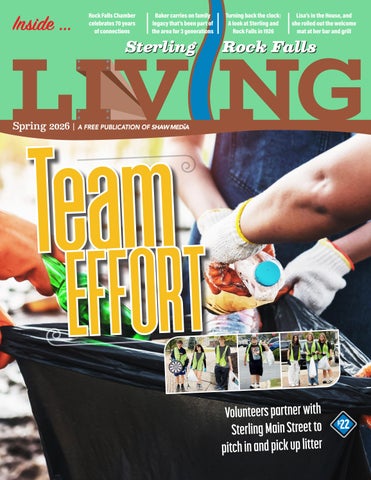
22 A Team effort
Sterling’s beauty is everyone’s duty, and volunteers are doing their duty downtown by pitching in to pick up and pitch out the trash that litters streets and sidewalks.
6 Rooted in Rock Falls
For 70 years, Rock Falls’ Chamber of Commerce has worked to keep the community connected.
14
Keeping tradition fresh
Just like his made-from-scratch dough, a Rock Falls baker still rises before dawn, carrying on a family legacy that’s been part of the Twins Cities for three generations and more than 80 years.
32 Turning back the clock
From a teacher who fiddled around with his invention to an NFL football player, the Twin Cities’ past has some fascinating stories.
40 Lisa is in the House
... and she’s serving up hospitality, hometown pride and homestyle food at her downtown Sterling bar and grill.
Steel
Sights & Sounds
HotDayDog
Connections build communities.
In offices and storefronts across Rock Falls, business owners open their doors each morning knowing they are part of something larger than themselves — and helping them keep connected is the Chamber of Commerce’s mission.
Founded Sept. 28, 1956, the Rock Falls Chamber of Commerce is an independent nonprofit organization that exists to connect local businesses with one another and with the people they serve, strengthening both the city’s economic and civic life.
Editor’s note: It was announced after the deadline for this publication had passed that Sam Kersey decided to step down from her role with the Rock Falls Chamber of Commerce. The story is being presented as it was written: before Kersey announced her decision.
For president and executive director Sam Kersey, the daily work is rooted as much in relationships today as it was 70 years ago.
“The Rock Falls Chamber is the connection in the community,” Kersey said. “We are that piece that connects families with our local businesses, creating opportunities and bringing our business owners together. We really achieve more when we come together versus working individually, especially in such a small community.” The Chamber operates independently from the City of Rock Falls and receives no government dollars or tax revenue. Its budget is sustained entirely through memberships and fundraising
The Rock Falls Chamber of Commerce has always celebrated its hometown, but this year it’s got something else to celebrate, too: 70 years of fostering growth, keeping the community connected, and creating opportunities
efforts, placing its success squarely in the hands of the business community it serves.
Kersey joined the Chamber in April 2019 as an assistant. In 2023, she became program coordinator, and she now serves as president and executive director. Alongside her is Marissa Razo, the Chamber’s full-time program coordinator, and Gayla Kolb, who works part time as bookkeeper and office assistant. Oversight comes from a 10-member volunteer Board of Directors.
Kolb has worn several hats for the Chamber over the past 25 years, and chaired some of its committees. She has worked as a local credit union executive and then served as Rock Falls Community Development Corp.’s program director, and her pulse remains with the community.
CHAMBER cont’d to page 9
Sam Kersey, president and executive director of the Rock Falls Chamber of Commerce, is a lifelong Rock Falls resident whose work leading the Chamber is rooted in relationships. “The Rock Falls Chamber is the connection in the community,” she said.
“We are that piece that connects families with our local businesses, creating opportunities and bringing our business owners together. We really achieve more when we come together versus working individually” CODY CUTTER/CCUTTER@ SHAWMEDIA.COM
“It’s hugely important because it’s needed to help get businesses to communicate with each other, as well as trying to communicate with the public,” Kolb said. “We try very hard to pass that kind of information along to the public, as well as to the businesses. We try to help the businesses become as visible in the community as we possibly can.”
The staff size may be modest, but the scope of their work is not. “We really get a lot done with two-and-a-half employees,” Kersey said.
Membership currently hovers around 200 businesses, ranging from home-based entrepreneurs — web designers, candle makers and other small-scale creators — to brickand-mortar retailers and large factories. Some operate within Rock Falls city limits;
others are based in neighboring communities but join the Chamber to maintain a strong interest in building connections there.
The Chamber’s efforts extend beyond networking events. It provides one-on-one counseling for businesses, assists with marketing efforts and organizes ribbon cuttings to celebrate new openings, remodels and ownership transitions. This year, it began hosting a CPR class and a tax seminar during the early months of the year, offering practical tools designed to help business owners operate more confidently and responsibly.
It also serves as a platform to recognize people and places in the community.
The Chamber’s Annual Dinner and Community Awards Celebration, held during the early winter months, honors individuals and businesses who have made a lasting impact on the community for Business of the Year, awards for Professional and Meritorious service, a Rising Star, and Shoulder to the Wheel Awards for organizations, individuals and youth in the community.
For Kersey, the Chamber’s programs, partnerships and public celebrations all trace back to a belief that Rock Falls is worth investing in. For her, it’s personal — it’s home.
“I grew up here, so this is more than just a dot on the map to me or a place I work,” Kersey said. “This is where my family and where my friends are. I love our hometown. I love our local businesses. I love what we have to offer, whether it’s exploring the parks and canal with my dog or going down to the dam fishing with my dad, I’m just really passionate about this area and hope that it succeeds — not just today and tomorrow, but for years to come. I’m really honored to be a part of that mission.”
Even as the Chamber marks its 70th anniversary this year, its roots stretch back further.
CHAMBER cont’d to page 10
An informal predecessor, the Rock Falls Business Association, was formed in 1945 and later merged into the Chamber when 26 business leaders officially organized the Rock Falls Chamber of Commerce in 1956. Before that formation, Chamber assistance for Rock Falls was overseen by the Sterling-Rock Falls Chamber of Commerce. In 1963, at the request of local leadership, the Rock Falls name was removed from Sterling’s, establishing a fully independent identity.
In its early years, the Chamber operated out of downtown offices before moving into the community center. Membership grew rapidly during the 1960s, doubling from 100 to 200 between 1963 and 1967. Kersey is the eighth executive director in its history. Linda Thurm, who was in the position from 1983 to 2004, is its longest-serving director. When Thurm retired, there was some discussion about merging the Chamber back with Sterling’s, but it never materialized.
Each year has a theme, and this year’s is “Rooted in history and continuing to root for our local businesses.”
“It’s really honoring the growth and the progression over the last 70 years,” Kersey said. “The Chamber would be nothing without our local businesses, so it’s celebrating them — celebrating 70 years of how far they’ve come, and the progress they have made. So many have done a great job helping our community and helping us grow. We can’t move forward without knowing where we came from.”
A Chamber also can’t move forward without knowing where it’s going, too, and its calendar helps point the way. Each year is dotted with events designed to draw crowds and direct attention toward local businesses. Some are long-standing traditions while others are newer experiments in collaboration.
Among the most popular is Spring Bingo. Held this year at the McCormick Event Center on March 19, it regularly draws around 350 people and boasts prizes that include a 50cc dirt bike, a 360 video drone and a 34-piece pots-andpans set. Proceeds fund Chamber programming.
The game is a popular event for the Chamber: Tailgate Bingo is returning this year after last being held in 2022; and another Bingo event is woven into Hometown Holidays festivities in November.
Tailgate Bingo was born during coronavirus pandemic restrictions, when the Chamber moved its Bingo game outdoors to the high school, where participants played from their cars. The concept ran from 2020 through 2022 and proved that even in isolation, people could still be connected.
CHAMBER cont’d to page 11
That same adaptive mindset continues to guide event planning today.
“We had to think about the ways to change how we did business, and how we were involved,” Kersey said. “Everything was different after Covid. Unfortunately some businesses didn’t survive. We had to think innovatively, creatively and come together to think about how we had to adjust these events for today’s world.”
the Businesses, a week-long event built around teamwork, collaboration and a measure of friendly competition. Each day will feature a different game, encouraging participating businesses to engage customers in new ways while fostering camaraderie among owners and staff. Additional details are expected to be announced soon.
For those seeking more direct connections, Speed Networking offers a different pace. Participants rotate through timed, one-on-one conversations, meeting as many as 20 people in a single evening in a structured environment designed to spark partnerships.
Then there are traditional favorites, like Hometown Holidays, held the week before Thanksgiving. What began in 1983 as a parade has expanded into a downtown Christmas Walk and a series of holiday ceremonies. The Chamber also coordinates the Love Light Tree during the Christmas season, honoring the memories of former residents and community members. The tree’s first ceremony was in 1988 as a fundraiser for Christmas light pole decorations In recent years, the event had centered on RB&W Park, but has since steered back toward the downtown corridor.
While some events, like Tailgate Bingo, are making a comeback, others that don’t make as much of a splash anymore are bring retired. Summer Splash, a seasonal fixture in past years, will not take place this year. Instead, the Chamber has chosen to redirect its energy toward other initiatives, Kersey said.
One of the newest additions is Battle of
“Our mission is on local businesses, so we’ve redirected that event and moved it back to downtown so that it’s supporting the local businesses,” Kersey said. “It gets people over there instead of just the park. One of the things I’ve heard was that people were coming down to the park, having a good time for 30 or 40 minutes, and then they were leaving and not visiting across First Avenue.”
The Chamber operates in the east wing of the municipal complex, including the Rock Falls Community Building event center and the Brant Room conference space. Tourism and business information is available inside the office.
CHAMBER cont’d to page 13
Specialty Magazines
To request your FREE copy, simply call 815-632-2566 or email your requests and address to: knull@shawmedia.com
The Rock Falls Business Association, formed in 1945, served as the Chamber’s informal predecessor. Otis Humphrey was its first president. The association helped bring the Rock Falls National Bank back to town after a 12-year absence following the Great Depression. It coordinated land purchases for major civic projects including the Armory, Hinders Field and the Whiteside County Airport. It launched a Civic Fund and supported local Scouts and a Youth Council. For a decade, it hosted an annual minstrel show at Merrill School. Proceeds helped establish the community center in 1966 – today known as the Louis J. Pignatelli Municipal Complex.
The Chamber’s first operations were overseen by administrator F.F. Morrison under board president Dwaine Tompkins. Lewis J. Walker assumed leadership in 1962. Early offices were located at the Illinois Kitchen Center and S&K Clothing Store before moving into the newly built community center.
The first Shoulder to the Wheel Award was presented in 1960 to the Rock Falls Kiwanis Club.
The 2025 Rock Falls Chamber Annual Awards were presented to the Valor Support Project, Rising Star; OnCall Imaging, Business of the Year; Suzy Perino, Professional Service Award; Betty Clementz, Meritorious Service Award; Piper Grazulis, Individual Shoulder to the Wheel; Sauk Valley Community College’s Impact Program, Youth Shoulder to the Wheel; and NAMI Sauk Area, Organization Shoulder to the Wheel.
The Chamber led the effort to establish the marigold as Rock Falls’ City Flower in 1988.
(This year’s awards were presented during the annual dinner on March 5, which took place after this magazine’s press deadline.)
The Brant Room at the Municipal Complex is operated by the Chamber. Used for conferences, it is named for Clyde and Edith Brant. Clyde owned a Sinclair gas station in town from the 1920s to the 1940s and later served as president of the Whiteside County Housing Authority.
In each decision from the Chamber’s office, whether reviving Bingo, launching a new competition or reshaping a holiday tradition, the common thread remains the same, and it’s one that ties people together, keeping them connected to commerce close to home.
It’s an ongoing mission.
“We’re continuing to focus on our missions of growth, connections and community,” Kersey said. “We’re continuing to grow our local economy, grow opportunities for our businesses, connect the general public with our businesses. We’re here for families, too. We’re bringing core memories to those families as well. They’re going to remember how they felt when they were at that event, they’re going to remember connecting with their families.” n
Shaw Media reporter Cody Cutter can be reached at 815-632-2532 or ccutter@shawmedia.com.
The Rock Falls Chamber of Commerce is located at the Louis Pignatelli Municipal Complex, 601 W. 10th St. Call 815-625-4500 to learn about its activities or for additional information.
Online: Find it on Facebook and Instagram, or go go to rockfallschamber.com.
What’s on the calendar?
• April 23 & Oct. 15: Speed Networking
• May through October: Farmers market
•May 15-17: Spring Garage Sales
•May 16: Market Day at the Farmers Market
•June 12: Tailgate Bingo
•June 20: Battle of the Businesses
• Aug. 7: Dinner Show
•Sept. 11-13: Fall Garage Sales
•Oct. 30: Biz Boo! Trick or Treat
•Nov. 19-21: Hometown Holidays
hen the town goes to sleep, Jim Helle is just starting his day.
It’s the life of being in the baking business, and that’s what three generations of Helle’s family have done for 84 years.
Helle keeps the family baking traditions alive as owner of Folsom’s Bakery in Rock Falls. While he’s a Helle, he has the Folsom genes: his grandfather Lawson “Red” Folsom kneaded his first batch of dough in 1942, and his uncle Jerry followed in Lawson’s floured footsteps in a long baking career as well.
Folsom's Bakery owner Jim Helle balances tradition with keeping up with the times. He’s grown his Rock Falls bakery in recent years, expanding both his footprint and his product line, but still prides himself on sticking with tried and true methods:
“When you go with a mix … the quality is not there. It’s not the same taste.”
CODY CUTTER/CCUTTER@SHAWMEDIA.COM
At the heart of the family legacy is a tried and true way of making donuts fresh each morning: from scratch and one ingredient at a time. It’s a tradition that’s beginning to fade from the baking industry, Helle said, but one that he’s proud to uphold, while still keeping up with the times. He’s expanded the business in recent years to the wholesale market, baking bread and buns for businesses throughout northern Illinois, all while navigating the challenges that come with running a small business.
Machines do much of the work these days, but even with mechanical helpers, Helle still takes matters into his own hands. The former welder will fix the mixers and other machines himself, rather than outsource the work.
“I think about how Grandpa used to cut donuts by hand, and I can’t even imagine doing it now,” Helle said. “Grandpa had smaller mixers and stuff like that. It’s little things like that and how things have changed, and how we’ve had to change, because times change. If I don’t change a little bit, the big box stores are going to wipe us out.”
Folsom’s makes and sells donuts, cookies, cakes and bread, all with a busy fleet of stainless steel machines and pieces of equipment from the family’s past, including a cast iron Duchess machine his grandfather used.
FOLSOM’S cont’d to page 16
Since the coronavirus pandemic, Helle has expanded in recent years to include pizza and cold cut sandwiches. Pizza is served from noon to 7 p.m. Fridays, with a from-scratch crust and a little inspiration from the former Gig’s Pizza in town, with sausage crumbles instead of chunks, he said.
“We’ve had hiccups that Covid brought, and I was trying to find
Surgeons at Morrison Hospital
more ways to make money to pay bills,” Helle said. “I talked with my wholesale customers and they kept telling me to make pizza. I started working on a pizza dough recipe. I knew what I wanted. I wanted something different.”
When he began expanding distribution, buns for Italian beef sandwiches were the first order of business, and an Amboy business was the first order. Joe Mazzarisi, owner of Maria’s Pizza in Amboy, needed a sturdy bun that could stand up to gravy-soaked beef.
“It took a couple of trials and errors, but I made it work,” Helle said. “It was a hit. It was a home run.”
Today, Folsom’s supplies buns for Arthur’s Deli sandwiches and distributes throughout the Rockford area, the Quad Cities, the LaSalle-Peru area and DeKalb County. In mid-February, the bakery produced 1,200 paczki shells for a bakery in Sandwich, ahead of Fat Tuesday.
To keep pace, Helle added a 30-by-30-foot back building in September 2025, relieving what had become a space crunch in the kitchen. The extra space allows him to buy ingredients by the skid, trimming costs and stabilizing supply. In the kitchen, three mixers hum — the largest capable of handling 325 pounds of dough at once — alongside a cookie machine that can turn out 1,300 cookies or 6,000 thumbprints in a day.
FOLSOM’S cont’d to page 17
Tradition is a big part of Folsom’s story, from the family name on the front of the building to the machines behind the scenes, some of which date back to the original Folsom’s Bakey when it was in Sterling, from 1960-68, like this Dutchess dough divider, right.
cont’d from page 16
Even with all the machines, there’s still a lot of labor in the mix. Fifty-pound bags of flour are hoisted into mixers, and Helle’s days can stretch to 18 hours. Even at home with his life partner, Helen Heckman, he’s often planning the next batch.
He approaches baking like a science, weighing and recalibrating recipes to preserve the bakery’s signature madefrom-scratch taste. “You’re using flour, sugar, salt, milk or white powder and shortening — that’s from scratch,” Helle said. “When you go with a mix … the quality is not there. It’s not the same taste.”
While Folsom’s slogan is “Family tradition since 1942,” the business itself doesn’t have 84 candles on its freshly made birthday cake.
The family tradition of baking stretches back to World War II, when Lawson started work in 1942 at Cameron’s Bakery and Luncheonette at 319 First Ave. in Sterling. He later worked at the Federal Bakery in town, and then for a brief time at Jul’s Danish Farm in Rock Falls. By 1958 he was ready to strike out on his own, and he and a business partner opened Avenue Bakery in the former Cameron’s location. When the partnership dissolved two years later, Folsom’s Bakery was born, lasting until 1968, when a rent increase pushed Lawson out of business. He later worked for SuperValu as a consultant for the establishment of bakeries at its grocery stores, and also worked for a time at Tiffany Bakery at Northland Mall in the early 1970s.
To
Our Customers
&
Friends:
A major decision has been made to close our
Thanks to our many customers that allowed us to
Helle’s staff continues the work he begins in the wee hours of the morning, both in the kitchen and at the front counter. Lisa Hughes works in both settings, serving customers their favorite treats from the cases, and designing cookies. “I get to be creative on the cookies,” she said. “ ... I like to see people’s faces when they come in and go, ‘Those are real nice!.’”
FOLSOM’S cont’d from page 17
Helle, whose mother Karen is a daughter of Lawson’s, recalls spending quality time as a young child with Grandpa while he worked at the Mall.
“I remember spending my summers going out with Grandpa and being out there,” Helle said. “We’d spend all night out there, and when we got done we’d go down to the river and fish for several hours, go back to his place and take a nap, and I’d go back [to work] with him the next day.”
Lawson’s son, Jerry, worked for his father at the original Folsom’s until it closed in 1968, before moving on to McCaslin’s Bakery when Kenny McCaslin opened it the same year on West Third Street in downtown Sterling.
FOLSOM’S cont’d to page 19
FOLSOM’S cont’d from page 18
Helle has expanded in recent years to offer pizza and cold cut sandwiches. Pizza is made with a from-scratch crust and a little inspiration from the former Gig's Pizza in town, with sausage crumbles instead of chunks.
Jerry and his then-wife Barb worked at various times over the years for McCaslin’s, which relocated a few blocks east in 1976; and that’s also where Helle worked his first job, washing dishes and mopping floors for Kenny in the mid-1980s.
When McCaslin’s closed in 1999, Jerry, who by then was bakery manager at County Market in Sterling, resurrected the family business in Rock Falls — coincidentally in a location that shared the same address as the family business in Sterling: 319 First Ave. — with Roxanne and sons J.J. and Jason. Helle worked for a brief time at the new Folsom’s and later came back to the business as a part-owner in 2007 when Jerry, who also taught baking classes at Sauk Valley Community College, Lewis University in Romeoville and Dixon Correctional Center, retired.
FOLSOM’S cont’d to page 20
Helle assumed sole ownership a few years later. He keeps in touch with family members, as well as the McCaslins. Their advice has helped a great deal, including when the Food and Drug Administration began its ban on trans fats in 2015.
“That messed up all of our recipes,” Helle said. “The trans fat was everything. They told me to go back to the drawing board. They told me what to start using again. I adjusted my shortening and did a lot of adjustments and rebuilt everything back to what it needed to be.
“It’s actually better now with the way I had to rebuild it.”
The trans fat overhaul forced him to rethink formulas he had grown up with, reinforcing what the older bakers had always preached: adapt or get left behind.
“Kenny told me years ago to just keep up,” Helle said. “Once you get it in your head, no one can ever take it away from you. When I came back, I met with Kenny and he said, ‘You know, son, you made it a complete circle.’ I told him, ‘It was
More info
Folsom’s Bakery, 319 First Ave. in Rock Falls, is open from 6 a.m. to 4 p.m. Tuesday through Thursday, 6 a.m. to 7 p.m. Friday, and 5 a.m. to 1 p.m. Saturday. Find it on Facebook and TikTok or call 815-622-7870 for custom orders or for more information.
meant to be.’ God put me on this journey, and he knew I’d be here.”
Helle’s staff continues the work he begins in the wee hours of the morning, both in the kitchen and at the front counter. Lisa Hughes works in both settings, serving customers their favorite treats from the cases, and designing cookies.
“I get to be creative on the cookies,” Hughes said. “For Valentine’s Day, I could do all of the hearts I want. When it comes to the holidays, I can get some good designs and go wild on them. I like to see people’s faces when they come in and go, ‘Those are real nice!’”
Helle keeps up a family trade shaped by long nights, rebuilt recipes, expanding routes and lessons passed down from one baker to the next. From Lawson’s hand-cut donuts to Helle’s wholesale bun orders, the work has changed with the times, but its survival has always depended on the same thing: the people who walk through the front door.
“I always say to shop small,” Helle said. “If it wasn’t for our customers, we wouldn’t have a job and we wouldn’t be here.” n Shaw Media reporter Cody Cutter can be reached at 815-632-2532 or ccutter@shawmedia.com.
A candy wrapper tossed here. A cigarette butt flicked there. Alone, they may not seem like much, but multiplied across blocks of sidewalks, curbs and alleys, a little litter here and there can speak volumes about a city’s pride — and it doesn’t have anything good to say.
That’s why a group of volunteers have banded together to make their own statement about a problem that can quietly reshape how a downtown feels, and what they’re saying is: Don’t mess with Sterling.
Team Up 2 Clean Up program is a volunteer effort that hits the streets to pick up and clean up in the city’s downtown. It’s an effort led by Sterling Main Street, a volunteerdriven nonprofit organization dedicated to revitalizing, promoting and preserving downtown Sterling.
CLEAN-UP cont’d to page 24
PHOTOS PROVIDED BY ANNA GARCIA
CLEAN-UP cont’d from page 23
On a single Saturday a month from March to October, this dedicated team takes time to take out the trash from the city’s downtown.
For Main Street executive director Janna Groharing, one of the program’s most meaningful outcomes has been watching people begin to connect their everyday habits to the condition of their own downtown.
“Throwing a candy or gum wrapper out your window may seem like a little thing,” Groharing said, “but they are seeing how the ripple effect of that is a big deal, and why you shouldn’t do that.”
Main Street formerly hosted a single-day “Green and Clean” event around Earth Day in April for about a decade, an effort that included planting flowers and spreading mulch to help spruce up downtown. But in recent years, with fewer planting projects on the calendar, the initiative slipped to the back burner, Groharing said.
It wasn’t until 2023 that the idea returned, but this time in a more focused and flexible form.
CLEAN-UP cont’d to page 25
When the Sterling Main Street Board was looking for projects to do, it found one downtown: picking up litter. “Garbage pickup was one thing that really needed to be done,” said executive director Janna Groharing (right). Today, thanks to the efforts of volunteers in the monthly Team Up 2 Clean Up program, it’s getting done. Sterling Main Street board member Anna Garcia (left) leads the monthly effort to make a clean sweep of Sterling’s downtown.
CODY CUTTER/CCUTTER@SHAWMEDIA.COM
“Once a month, my board kept asking what other projects could we do,” Groharing said. “Garbage pickup was one thing that really needed to be done. The litter just blows in. That’s the one thing that really makes an impact on how downtown looks.”
The name itself comes from that of a beautification trailer owned by the City of Sterling, loaned to volunteer groups for cleanup and improvement projects in parks and neighborhoods. When Main Street revived its own cleanup initiative, the name felt like a natural fit, Groharing said.
What began as a handful of Team Up 2 Clean Ups in its first year — including one day dedicated to repainting the white benches at the Grandon Civic Center — evolved into a rhythm of its own in 2024, when it became a monthly fixture on the calendar.
The increased frequency made a difference. Instead of a one-off event, it became part of the seasonal pulse of downtown. In turn, it also found a powerful partner
in Sauk Valley Community College’s Impact Program, which allows eligible high-schoolers to earn tuition-free attendance by completing 100 hours of community service before graduation, as well as meeting other eligibility requirements.
One draw of the program is that anyone can do it. Picking up trash requires no special skill set, and it doesn’t demand a long-term commitment. It simply asks people to show up and care — and they have.
Main Street board member Anna Garcia leads the monthly effort, arriving around 9:30 a.m. to set up at Dale Park with garbage grabbers, brightly colored vests and trash bags. She typically cleans the park herself while assigning other volunteers to different sections of downtown. Participants return their filled bags to the park, where the trash is deposited in a nearby dumpster behind Main Street’s office.
“For the students in the Impact program, it gives them an opportunity to earn their Impact hours to attend Sauk tuition-free, and that’s when we wanted to start making this a monthly event,” Garcia said. “I knew these students needed their hours, so why not get them to come downtown and clean up the downtown to get those hours?”
Last year, close to 100 volunteers participated from across various ages and backgrounds. Families have signed up together. Local students from Key Club and National Honor Society have pitched in. The Sauk Valley Under 40 Group has planned participation along the riverfront in April. Some participants have even been walk-ins who learned about the opportunity and decided to stop by and learn more.
CLEAN-UP cont’d to page 26
RIDES For All Ages!
There is a sign-up form on Main Street’s website, which helps organizers estimate attendance, but it’s not required — all it takes is a willingness to help. In fact, Groharing makes it clear that the spirit of Team Up 2 Clean Up extends beyond any single event. Simply raising awareness of the problems of litter can make a difference. Maybe it’ll discourage people from littering, or encourage people to pick up trash when they see it.
“You don’t need to be part of our event to make a difference,” she said. Aside from the benefits to the city, Garcia has also seen the event make a difference in people’s lives. She’s watched friendships form in real time, a benefit she said she didn’t expect when the program started.
CLEAN-UP cont’d to page 28
Picking up a thing
or two
... You never know what you’ll find when you’re picking up litter — a bicycle seat, a dart board, a coin with Christ on it — but it all adds up to one thing: an unsightly sight. “A clean downtown is a pride of ownership,” said Janna Groharing. “ ... We should have that pride of ownership and take care of it, and that includes picking up the garbage.”
PHOTOS PROVIDED BY ANNA GARCIA
“Once they started coming, they started making friendships,” Garcia said. “It’s so cool. It’s been so cool to see them exchange contact information and to come back the next month together when they didn’t know each other before, and students from so many different towns are participating.”
The cleanup has also become a networking space of sorts, and has even led to tangible opportunities: Garcia has served as a job reference for at least one volunteer who demonstrated reliability and work ethic through the program.
“Self care is a big thing,” Garcia said. “What’s better than going outside, being in the fresh air, cleaning up the town, and setting a good example? How can you beat that? It’s good for people.
It’s not just for these students, but it’s good for everybody to get out there and make an impact that you can literally see. When you turn in that bag of trash, you literally and physically see the impact you just made. It feels good.”
And those aren’t the only benefits. Civic pride can even turn a profit.
Participants, especially those who may not regularly spend time downtown, have noticed businesses they overlooked before, and that can translate into a return visit for lunch or shopping later.
Then there are the small, unexpected moments that become part of a memorable story, such as a time when a group found a coin with Jesus Christ on it.
“It was a funny thing — they found Jesus,” Garcia said. “Two girls came back and told me, ‘Look what we found!’ It was a gold coin with the image of Jesus on one side and The Last Supper on the other side. I told them I had to take a picture of it because you literally found Jesus. That was really cool.”
Moments like that can spark conversations and connections that don’t always happen in a classroom or behind a screen.
“One of the boys that was there that day asked if he could have the coin, and they gave it to him,” Garcia said. “Then he asked if anyone would want to go to church with him on Sunday.”
It’s stories like that keep Groharing and others coming back for more, and hoping they’ll find less — litter, that is.
“When I go downtown to eat, when I go downtown to shop, I don’t want to see trash,” Garcia said. “Removing the trash is the first step in beautifying the downtown.”
“Resthave Home and Staff are amazing! I love the fact that You treat the Residents with such Dignity and Respect in this phase of life. If I lived in the area, I would volunteer at Resthave. It would be an Honor and a Privilege to do so! Keep up the good work, as God will reward you one day!”
Marriean T.
HURRY! ONLY 2 ASSISTED LIVING APARTMENTS AVAILABLE!
Morrison IL
Groharing agrees that the aesthetic effect is immediate. Litter accumulates quickly, especially after winter. As snow melts, debris hidden for months become visible, and that’s when the volunteers become visible, helpers of all ages who come together for a common cause: Cleaning up.
“The kids are a little more aware of just how much litter is out there, and just how much people litter and how much of a lasting impact that does make,” Groharing said. “Hopefully we’re getting them to think twice before they think about throwing that candy wrapper out the window or something like that.”
The program’s growth has been steady, but both Groharing and Garcia see even more potential ahead. At its core, the program is about stewardship,
and about a community’s collective responsibility for shared spaces.
“A clean downtown is a pride of ownership,” Groharing said. “Downtown belongs to everyone. We say that downtown is everyone’s back yard. When the snow melts, what do you do? You clean up the yard. Who does that for downtown? We all have an ownership stake in the downtown – it’s not just a building or a business, downtown belongs to everybody. We should have that pride of ownership and take care of it, and that includes picking up the garbage.” n Shaw Media reporter Cody Cutter can be reached at 815-632-2532 or ccutter@shawmedia.com.
Go to sterlingmainstreet.org/ events/cleangreen to learn more about Sterling Main Street's Team Up 2 Clean Up program. Find Sterling Main Street on Facebook and Instagram, go to sterlingmainstreet. org, or call 815-626-8610 to learn more about Sterling Main Street and its events and initiatives.
who fiddled around with a football player, Rock Falls and filled with
ew people in Sterling and Rock Falls today can remember what life was like 100 years ago, and even those whose memories can gaze back that far are seeing things through the eyes of a child.
The memories have likely faded with age, but were the city’s centenarians able to restore the polish to the past, they’d see a pair of cities firmly established and full of potential, with factories forging a path ahead — industry and innovation leading them through the Roaring 20s, years before a black cloud would bring a Wall crashing down.
The Twin Cities — Sterling founded in 1834 and Rock Falls in 1867 — were still growing, experimenting, inventing and dreaming, finding their way in a world that was doing the same. A century later, the decisions made, plans laid out, and everyday pursuits form a surprisingly rich snapshot of what the communities were becoming.
A century ago, horses still shared the streets with automobiles. Communication was still evolving, with radio connecting communities to the world around them and TV’s reign still decades away. And two cities separated by a Rock but only a stone’s throw away from one another were still growing.
Though carving out a character of their own, Sterling and Rock Falls mirrored many cities similar in size.
Communities were beginning to modernize even as tradition remained firmly rooted. Downtown storefronts were the heart of the business community. Manufacturing was a powerhouse fueled by ingenuity and industry. Civic leaders debated how to prepare the towns not just for the next year, but for the next generation.
Some ideas burned brightly but briefly, others endured, and some adapted to changing times.
Let’s turn the page and turn back the clock to 1926 — a year when Sterling and Rock Falls were laying down pieces of their future, one careful step, bold idea and enduring story at a time. They remind us that history is more than just major milestones: It’s made in barber chairs, blueprints, workshops, classrooms, patrol routes, athletic fields and even unfinished plans.
Photo: An early 1900s view of The First Avenue bridge, going from Sterling to Rock Falls.
Sterling Barber Shop, 4 E. Third St., has been lowering ears since 1926, and is observing its 100th anniversary.
The business has always been downtown. Ray and Annabelle Blum opened the Blum Barber Shop and Annabelle Beauty Parlor on the street level of the former Galt Hotel in 1926 as the town’s only combined men’s-and-women’s hair salon. After a few years, the business moved next to the Sterling Theater. Its building (and the theater) suffered a fire in late 1943. James Bradley joined Blum in 1927, and he took over the business in 1944 and rebuilt the shop. It has been in the same location since, and also has maintained its threebooth setup.
Upon acquiring the business, Bradley renamed it to Bradley’s Barber Shop. He owned it until 1968, when Wayne Larson and Fred Mann bought it and gave it its current Sterling Barber Shop name. Larson later became sole owner until his death in 1990. Tim Regan, who had been cutting for Larson since 1970, and Jean Dempsey (since 1986) took over the shop when Larson died. Regan and Dempsey sold it in 2008 to current owner Richie Jomant, who has since decked the place out with golf and Chicago sports memorabilia, a flat-panel television and an aquarium.
True to the old style barber shops, the familiar red, white and blue barber’s pole remains outside the front door. A 1969 ad for the Sterling Barber Shop
Sterling’s Chamber of Commerce (then called the Association of Commerce) asked its members in 1926 about what their town needed. The idea that received the most attention was the building of a coliseum: a public meeting place that would eventually serve as today’s home to city government. Other popular ideas were the expansion of Sterling Community Hospital, which built a new wing in 1927, and the paving of state Route 88 south of Rock Falls to near Sheffield.
The genesis of the coliseum idea came from issues during the town’s Pageant of Progress event that year,
where tent rentals became a budgetary concern. The idea was brought up during a Chamber dinner at the Elks Club in January 1926 by B.F. Kreider, an executive with the Senneff-Herr candy company in town, who talked about how the town had no building that could accommodate large crowds, and that Sterling would miss out on attracting conventions that would seek cities that had one. Financing plans were made by Chicago financier George Mohrbacher in October 1926 during a meeting at the Lincoln Tavern.
In the five years that followed, construction costs, site selection and the Great Depression delayed the building of the Coliseum, which was completed in 1931 and overseen by architect Elmer Behrns. It was built on the former property of the Rock Falls Manufacturing Co. According to a May 6, 1931, issue of the Gazette, the new Coliseum combined “modernistic unity and classic beauty.” The building once had a roof garden where dances were held, on a floor made of smooth-as-glass Haydite concrete. Over the years, several renovations have made the building exclusively into an office setup.
Carlo Pignatelli (right) is the first Twin Citian to play professional football. Before he played for the Cleveland Indians of the National Football League, the Rock Falls native honed his gridiron skills at the local high school, where he graduated in 1926.
Pignatelli, a halfback and left guard, led his high school teams to an undefeated 1924 Rock River Conference championship (9-0) and runner-up the following year (8-1). He also was the first Rock Falls High School athlete to earn letters in three varsity sports in each of his four years attending it, having also played basketball and track. Initially, Pignatelli attended the University of Iowa on a basketball scholarship, but later turned his sights toward football, where he was a Hawkeyes quarterback for three years. In 1930, Pignatelli played for the Ironton Tanks semi-professional Ohio League and played on a team that scored victories against two National Football League teams: the Chicago Bears and New York Giants. Pignatelli would join the NFL ranks the following year, playing seven games and starting in three of them as a halfback for the Indians. He later lived in Sterling, where he died in 1964. His brother, Louis, served as Rock Falls’ mayor for 17 years.
Eureka Manufacturing Co. in Rock Falls was established in 1871 and made classroom equipment, hotel and church furniture and stock cutters before adding hearses and ambulances to its fold in 1910, mirroring the rise of automobiles at the time.
During the 1920s, each vehicle was manufactured one by one, unlike assembly line production. Wilbur S. Myers joined Eureka in 1921 as a body builder, and five years later developed a threeway, side-loading hearse. The invention resulted in the table in a hearse being pulled out three ways: from each side and through the rear door.
The table extended out three feet from either side to allow for easy loading and unloading of a casket. The driver’s and rightfront passenger’s seat slid forward underneath the dashboard giving the table-mounted casket suf ficient room rotate into the coach. Upon getting a patent approval, Eureka had exclusive rights to build the tables for 10 years, and also built them for competitors.
Myers eventually rose in the company ranks to become president in 1945. Eureka closed its doors in 1965.
Sterling businessmen A.W. Wheeler and J.W. Allen, and attorney John Stager purchased the Mogul Battery Company in Plano in April 1926 and brought it to Sterling. The company was founded in 1920 by W.K. Henning, who sought to improve the functionality of automotive, radio and farm lighting batteries. As automobiles became more commonplace during the Roaring ‘20s, demand soared and distribution challenges led to the sale of the company. Wheeler owned Hardware Products Co. in town, and had been distributing Mogul’s batteries for the past two years.
The factory also sold Champion and AC spark plugs and other automotive equipment from its facility at 406 Ave. A — a building that served many purposes until it was razed in 1993. Mogul closed in 1931.
Radio communication is commonplace in police communication today, but it took much more work to communicate to those on the beat 100 years ago. This changed in Sterling in the fall of 1926 so that on-duty officers throughout town didn’t have to return to the police station to be informed of things.
Sterling City Council approved the purchase of eight signal units from the Gamewell Company of Chicago to place throughout the city: seven units placed within the business and manufacturing areas in town, and one more in the First Ward. Each box was equipped with a telephone so an officer could call into the station or receive instructions from it (noted by a glowing light at the station).
The only golf option in the Twin Cities available to residents 100 years ago was the Rock River County Club east of Rock Falls. Bringing a course north of the river was an idea of Sterling resident LaVerne A. Miller, who designed other courses throughout Illinois. Miller also built some of the first airplane han gars at the former Sterling Munici pal Airport (where Benny’s Red Apple is today) in 1929.
In 1926, he proposed an 18hole course, nine more than Rock River had at the time, clubhouse, 25-acre lake and children’s play area at I-Del-Wood, located on the Lincoln Highway near Blue Goose Road west of town. However, this ambitious project was aban doned not long after construction began. Miller would go on to start an engineering company in Streator. Sterling finally got a golf course of its own when Prairie View (now Emerald Hill) opened in 1939 east of town, and the now-closed Lake View Country Club opened west of town on Hazel Road in 1963.
Edwin Berge, a music teacher at schools in both Sterling and Rock Falls, sought a way to teach more students on string instruments without the costly expense of buying the actual instruments. In 1926, Berge began work on the Fiddle-ette (at left), a smaller and cheaper fiddle-like instrument that could teach students concepts such as bowing and fingering. Playing on them also resulted in a sound that was lighter than that of the real thing. After three years, Berge’s invention came to fruition with the help of local manufacturer Carl W. Mott, who owned a factory behind his Dixon Avenue home. Mott, who had begun his career by making butter churns and wood wheels for Rich Toys, began production of the Fiddle-ette in 1929. The lineup was later expanded to include the Viola-ette, Cello-ette, and Bass-ette. Although Mott manufactured the product, distribution was handled by the Gamble Hinged Music Company of Chicago, whose logo graced each product.
Unfortunately for Berge, his budding business became a casualty of the Great Depression when the Gamble Hinged Music Company closed. Today, Berge’s “Fiddle-ette” and other off-springs are rare collectibles. n
When customers stop by a downtown Sterling bar and grill to grab a bite to eat, they can usually hear it before they see it.
It’s a steady sizzle that cuts through conversation and clinking glasses and comes from the sound of patties pressed fresh, pork chops heating up and wings crisping in a cozy kitchen.
And if that sounds good, then wait ’til you catch a whiff and a taste — of what the Brick is cooking.
The sound and aroma catch customers’ senses quickly at Lisa’s Brick House, where the compact kitchen is a big part of a place built on familiarity, first names and the kind of warm
welcome that comes naturally, whether the staff is serving dinner for one or a family meal.
For owner Lisa Escamilla, that’s just how she wants it.
“We have regulars we know on first-name basis, what they drink, what they eat, who their kids and family members are,” Escamilla said. “We live in a small, close-knit community where we usually already know of each other anyway. They’ll ask out-of-towners, ‘What are you doing in town?’ Or, ‘Are you traveling for work?’ We get a lot of blue collar-type customers who are traveling for the railroad, construction or utility work,
stuff like that. We have people from out-of-state come back and see us. Someone said, ‘We wanted to come back for your wings, they were great!’”
Escamilla was born and raised in Sterling. Before she owned the place, she was a bartender there, hired in 2004 by Denny Strader, who operated Champ’s Bar and Grill in the same space. Strader also owned banquet space connected to the bar — located elsewhere on the block off East Third Street — and in January 2018, Escamilla purchased the bar space from him. (Strader continues to own the banquet business under the Champ’s name.)
As a kid, Escamilla imagined owning a business someday, even flirting with the idea of running a hotel. Instead, years of working under Strader helped her evolve from a bartender to a bar owner, instilling the value of hospitality built from the ground up. She credits Strader as a mentor who taught her everything she needed to know, she said. In addition to the Brick House, Escamilla also owns two bars in Rock Falls: Hammer Headz and Bubba’s Hideaway, both drink-only establishments a few blocks from one another on First Avenue.
cont’d to page 42
SVM
LISA’S
When she opened the Brick House, she made the space her own, pulling down drywall to expose a brick wall, updating finishes and putting her own touch on what had already been a neighborhood fixture. For most of the past 70 years, the place had been a bar: starting with Fould’s Tavern, then the Monkey Inn, Helen’s Hideaway, and Spend-a-Buck before it became Champ’s. The bones were good; they just needed some breathing room.
“I enjoy customer service and meeting new people,” Escamilla said. “I feel like hospitality is something that I’m good at — making people feel comfortable and needed, and accommodating their needs. We do that here: greeting people, making them feel comfortable, wanting them to come back.”
Escamilla is deliberate about the people she hires and the tone they set from behind the bar. She can teach someone how to pour a drink or run food. Personality, though, is different. “I’m particular about who can work here,” she said. “It’s really about personality.”
Much of the place’s menu carries over from Champ’s days: Its signature House Burger, ribeyes, pork chops, Philly sandwiches (beef or chicken), patty melts, BLTs, jumbo fish sandwiches, grilled cheese, chicken strips and sliders. Since opening, newer additions to the menu have included fish tacos and a Reuben
sandwich. For appetizers, wings come mild, hot, Asian or BBQ. Fries, tater tots, cheese curds and onion rings round out the fryer side.
Sauces are homemade: ranch, bleu cheese and the customerfavorite “boom sauce.” Nearly anything with a bun can be ordered and served without it as a “Roxanne,” named for a regular customer who would rather not have the bun. “She was probably one of the first customers to order something without a bun,” Escamilla said. “We thought it would be cool to kind of throw her name on the menu.”
Escamilla also takes pride in offering creative alternatives. Special requests are common, from an extra patty on the House Burger, to a chicken Philly on tortillas, and a pork chop sandwich tossed in buffalo sauce.
“I like that we have the capability of creating homestyle cooked food, not only with what’s on the menu, but also with a variety of flavors and items,” Escamilla said. “I like that we can create different things, and not necessarily stay within the box.”
Behind the grill, the job of wielding the spatulas is an intense one, she said. Being a one-person kitchen with a 24-by-24-inch flat top grill requires timing, prep work and consistency, and she’s proud of her cooks’ skills.
LISA’S cont’d to page 43
Simply Timeless.....
LISA’S cont’d from page 41
“I’ve been very fortunate where the people who have cooked here are very talented, and it can be a tough job because it’s a one-person job,” Escamilla said. “You’re in charge of prepping, cooking and time management, and making sure you’re consistent. We have talented individuals who work here, and they are skilled to where they can turn it out quickly, and have good, quality food.”
Creativity continues behind the bar, where the whiskey lineup hovers around 20 selections, including a few over 100 proof. Old-fashioneds, in particular, have built a following.
Saleena Surratt, the bar’s mixologist, brings years of experience from local restaurants and a willingness to nudge customers just slightly outside their comfort zone.
“I enjoy making people drinks that they may not have had, especially old-fashioneds,” Surratt said. “I never wake up and not want to come to work. I am a people person and I love my job. I make friends and family with most of my customers. I learn their first names and what they eat and drink, and I like working here because it’s a set schedule.”
LISA’S cont’d to page 44
Escamilla, seen here with bar mixologist Saleena Surratt, is a big believer in creating the kind of place where people feel welcome and look forward to coming back, and having the right staff — from the cooks to the bartenders — goes a long way in doing that. “I’m particular about who can work here,” she said. “It’s really about personality.”
LISA’S cont’d from page 43
Bloody Marys are made from scratch and the mix can be dialed up or down: customers have requested them spicier, milder, with varying ratios of tomato juice, built with horseradish vodka and even once made with pickle whiskey. Virgin versions are welcome, too.
“There are a lot of people who like to travel around and try a lot of different Bloody Marys at different places,” Escamilla said. “It’s kind of nice when you do it from scratch, then you can control the flavor. If you want it hot, or not hot, or if you want a virgin, or not a virgin. There’s a community of people who are Bloody Mary enthusiasts who will travel around to try Bloody Marys.”
An entertainment schedule keeps the bar lively. DJs spin on Thursdays and Saturdays bring karaoke. It also participates in local pub crawls, and hosts occasional live entertainment.
It hasn’t all been smooth, however. In October 2021, a fire in the basement forced the restaurant to close for six months. The shutdown followed closely on the heels of the coronavirus pandemic, making for a rough one-two punch. Perseverance has paid off, though.
LISA’S cont’d to page 46
Lisa’s Brick House, 216 Locust St. in Sterling, is open 10 a.m. to 10 p.m. Sunday,
“The fire was very traumatic for me and my employees,” Escamilla said. “I have a close relationship with everyone who works here, so it was definitely a hardship, especially for my full-time people. This place, whether it was Champ’s or the Brick House, it’s been home away from home. I’ve always felt comfortable here. If I need to get away from the house, I can come here and sit and hang out. So it was really hard.”
Reopening brought a new perspective for Escamilla, helping her see the power of a helping hand, especially from fellow bar owners. Now, she’s willing to offer the same in return.
“Everything’s a learning lesson, and I learned how to cope with issues,” she added. “There can be several. It’s all been a learning curve, and learning how to handle the problems, and learning who to go to when I needed advice.”
Through the learning curves and curve balls, Escamilla has learned a lot, but she says the clearest affirmation of her approach to business still comes from the people who walk through the door, whether they’re pulling up a bar stool or sliding into a booth with their kids.
11 a.m. to 10 p.m. Monday through Wednesday, and 11 a.m. to 1 a.m. Thursday through Saturday; its grill closes at 8 p.m. daily. Find it on Facebook or call 815-590-5472 for more information.
“I like when we get customers who come in to experience the place for themselves, and then realize that this can be a place where they can bring their kids to come and eat,” Escamilla said. “There was once a young man who has twin daughters, and the girls now love to come in and eat with him. I love that we can accommodate families and individuals alike.” n Shaw Media reporter Cody Cutter can be reached at 815-632-2532 or ccutter@shawmedia.com.