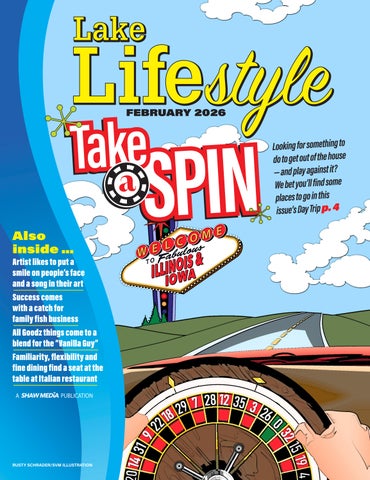

TakeSPIN
Also inside ...
Artist likes to put a smile on people’s face and a song in their art
Success comes with a catch for family fish business
All Goodz things come to a blend for the “Vanilla Guy”
Familiarity, flexibility and fine dining find a seat at the table at Italian restaurant

Looking for something to do to get out of the house — and play against it? We bet you’ll find some places to go in this issue’s Day Trip p. 4


CONTACT INFO
PUBLISHER Jennifer Heintzelman
EDITING & PAGE DESIGN Rusty Schrader
PUBLISHED BY Sauk Valley Media, 113 S. Peoria Ave. , Dixon, IL 61021
STORY IDEA FOR LAKE LIFESTYLE? E-mail rschrader@saukvalley.com FOR ADVERTISING
Contact Jill Reyna at 815-631-8774 or jreyna@saukvalley.com
ADDRESS CHANGE FOR LAKE LIFESTYLE? E-mail info@golakecarroll.com


spin TakeTake n p a s
Looking for something to do to get out of the house — and play against it? Casinos offer a chance to try your luck, take in a show, grab a bite to eat, and more
With warmer weather settled in for a long winter’s nap and cases of cabin fever on the rise, odds are that you’re itching for something to do that will get you out of the house — and spending a little scratch at a casino might be just what you need to take care of that itch.
While casinos are open year-round, winter is well-suited to hanging out with Lady Luck. The flashing lights, the clinking of coins, the adrenaline rush of anticipation: The lights and sounds of a casino might be just what you need to rouse the senses from their winter hibernation — and you don’t even need to go to the Las Vegas strip to try your luck. Several casinos are within driving distance of Lake Carroll.
The door to casinos in Illinois and Iowa was opened back in the early 1990s, beginning when lawmakers floated the idea of letting riverboat casinos open for business, a move designed in part to bolster the economy after the agriculture economy took a nosedive in the ’80s. Once legislation was passed, casinos wasted little time in giving gamblers a place to go, with boats popping up on rivers and docked alongside cities beginning in 1991. Since then, changes in the law have allowed casinos to establish land-based operations, too.
Casinos have also evolved through the years, becoming more than just a place to drop some coins and cash. They’ve become destinations for live entertainment (with some attracting big names to the stage), sports betting, food, and hotel stays. In northwest Illinois and eastern Iowa, seven casinos have increasingly positioned themselves as multipurpose destinations in large urban areas.
Hard Rock Casino Rockford, the newest gambling and entertainment arrival, anchors its gaming with live music venues tied to the brand’s entertainment roots. Along the Mississippi River, long-established properties such as Bally’s Quad Cities, Isle Casino Hotel Bettendorf, Rhythm City Casino Resort, Q Casino + Resort, Wild Rose Casino and Hotel, and Diamond Jo Casino each offer their own blend of slots, table games, sportsbooks to predict outcomes at sports events, restaurants and performance spaces.
Diamond Jo and Q are both in Dubuque, Iowa, giving visitors twice the options of things to do while in town. Bally’s, Isle and Rhythm City are each in the Quad Cities area (Bettendorf and Davenport in Iowa, and Rock Island and Moline in Illinois) – three options within just 10 miles of each other. Both Iowa and Wisconsin also have Indian-based casinos on tribal property, and a new one – HoChunk in Beloit, Wisc. – will open this summer. Each casino, including Ho-Chunk, are within a 90-minute drive from Lake Carroll. Are you ready to place your bets? From Rockford to the Mississippi River and back again, the casinos on the following pages offer plenty of ways to roll the dice, grab a meal, catch a show, and make a night — or a weekend — out of it.
The area’s newest casino, in August 2024 just off Interstates 90 and 39, and like all of the other casinos in the chain, also has a collection of music and pop culture memorabilia.
roulette, and mini baccarat. More unique offer ings, such as Ultimate Texas Hold’em and Three Card Poker (fewer cards and a quicker pace), add variety for players looking for something beyond traditional tables. Guests also have access to a dedicated poker room and an on-site sportsbook, where they can wager on a wide range of sporting events in addition to traditional casino play.
Dining options tastes and experiences. The musicthemed Hard Rock Cafe and Council Oaks Steaks and Seafood serve everything from burgers to more elaborate menu op tions, and both venues double as spaces for live music performances, giving visitors a chance to pair food with entertainment throughout their visit.


Wild Rose Casino and Hotel in Clinton, Iowa, opened in 2008 after operating for decades as the Mississippi Belle, a riverboat casino once docked downtown. Today, the land-based property sits on the west end of town.
The casino operates a gaming floor with more than 500 slot machines, along with a mix of live and electronic table games. Table offerings typically include blackjack and its variations, craps, Mississippi Stud, Ultimate Texas Hold ’Em, and What the Flush, a poker variation focused on flush outcomes, as well as electronic blackjack and roulette machines. Sports wagering is available through a DraftKings sportsbook.
Dining options include Lucky’s Sports Grill and the Roundhouse Bar, and Lucky’s also offers off-track horse betting, covering a variety of thoroughbred and harness tracks nationwide.


When you’re not ready for a nursing home, our Bounce Back Program is the answer!
Program Includes:
•Interdisciplinary team of experienced professionals
•State-of-the-art therapy equipment
•Full range of rehabilitative therapiesphysical, occupational, and speech
•Case management to oversee insurance and Medicare to maximize your benefits
•Beautiful suites completely furnished including TV and phone hookups

Program Goals:
•Increase or restore range of motion and strength
•Teach positioning, mobility, transfers and walking skills
•Reduce pain through use of modalities and adaptive equipment
•Improve cognitive and communication skills
•Promote safe swallowing
Together we can get you on the road to recovery. Let us show you how to Bounce Back!
2170 W. Navajo Drive, Freeport


Owned by Boyd Gaming, Diamond Jo Casino offers a full-scale entertainment experience along the Mississippi River. The casino floor is open 24 hours a day, which gives guests round-the-clock access to more than 700 slot machines, including a dedicated high-limit room, along with 18 live table games such as blackjack, craps, roulette, Mississippi Stud, Wild Stud Poker — where players aim for a higher hand than a designated player at the table — and more.
Sports fans can also watch major games and place wagers in the on-site sportsbook.
Dining options span casual to upscale. Woodfire Grill serves classic steakhouse fare, while The Game Sports Bar offers a relaxed atmosphere for drinks, food, and live sports. Bell Street Eatery will be the casino’s newest food option, planned for a grand opening early this year, adding a convenient comfort-food option for guests on the go. Beyond gaming and dining, Diamond Jo features Alley Cats Bowling, complete with private lanes for groups or families, and live music and events at the Mississippi Moon Bar.

Like Wild Rose in Clinton, Diamond Jo also made the transition from boat to land-based in 2008, keeping its original name.


LAW-JONES

Dining and entertainment play a big role at Rhythm City Casino and Resort in Davenport, where options include Draft Day Sports Lounge, Robert’s Buffet and Ruthie’s Steak and Seafood. Entertainment spaces include the Rhythm Room, located just off the gaming floor, and the larger Rhythm City Event Center, which hosts concerts and events throughout the year.
The casino itself operates more than 1,000 slot machines, along with a mix of live and electronic table games. Table offerings typically include blackjack, craps, roulette, baccarat, Mississippi Stud, Ultimate Texas Hold’em and Pai Gow Poker with dealer cards face up, with Three Card Poker available on Friday and Saturday evenings. A sportsbook lounge is also located on site.
Isle Casino Hotel Bettendorf sits on the banks of the Mississippi River in Bettendorf, Iowa.
The gaming space includes nearly 1,000 slot and video poker machines, along with 20 table games featuring classics like blackjack, craps and roulette; as well as unique games such as Mississippi Stud, Three Card Poker and Fortune Pai Gow — played like traditional Pai Gow, but with a side bet based on one’s top hand among their cards.
The casino also has a Caesars Sportsbook for sports wagering. Dining options span casual to sit-down, including Keller’s American Grill, Keller’s Express and the Midwest Bites diner. Both Isle (originally known as Lady Luck Casino) and Rhythm City operated boats on the Mississippi River until moving on land in 2016.


Located on the west side of Dubuque on Chaplain Schmitt Island on the Mississippi River, Q Casino and Resort offers roughly 500 slot machines with a variety of live and electronic table games such as blackjack, craps and roulette. Poker-style variations on the tables include Mississippi Stud, Ultimate Texas Hold-em, Wild Stud Poker, and Faceup Pai Gow Poker (with revealed dealer hands). A sportsbook space and betting kiosks give guests the chance to place wagers on major sporting events.
Live entertainment venues include the indoor Q Showroom and the outdoor Back Waters Stage, which will relocate elsewhere on site to become the Iowa Amphitheater this summer. For food and drink, options include Houlihan’s or Island Social Kitchen and Bar.
Formerly the Mystique Casino until 2017, Q Casino originally opened as Iowa’s first greyhound racetrack in 1984, and became a casino in 1995. Racing ceased in 2022.

Jennifer Sturtevant
105 S Broad St Lanark, IL 61046-1203
https://www.countryfinancial.com/jen.sturtevant jen.sturtevant@countryfinancial.com 2187392233


Formerly Jumer’s Casino on the Mississippi River in downtown Rock Island, Bally’s Quad Cities relocated to its current Interstate 280 site in 2008 and was acquired by Bally’s Corporation in 2021. Today, the Rock Island casino operates a gaming floor with nearly 800 slot machines, including video poker options, along with table games such as blackjack, craps, roulette, Ultimate Texas Hold’em, Mississippi Stud and Three Card Poker.
A dedicated poker area is also part of the casino layout.
Sports wagering is available through the Bally Bet Sportsbook and Bar, which offers betting alongside food and drink service.
Dining options include the Player’s Buffet, featuring all-you-can-eat meals during select hours, and Blue Square Cafe, which serves breakfast items and casual, quick-service fare. n Shaw Media reporter Cody Cutter can be reached at 815-632-2532 or ccutter@shawmedia.com.


hen people walk through the doors of Basil Tree Ristorante, Mili Dalipi hopes his restaurant speaks to them — and that it tells them: “Welcome home.”
On a quiet corner of downtown Dixon, Dalipi has created a place where the warm embrace of its ambiance provides people a respite from the routine of the world outside the restaurant’s doors: a place to relax, enjoy a meal, and get away from it all — all the way to Italy. It’s the kind of place where waiting for your meal doesn’t feel like waiting at all, as your eyes wander around the walls and soak in the scenery, taking in the character Dalipi has created for the restaurant he opened in 2009.
Time takes a break at Basil Tree Ristorante, where things slow down while friends and family enjoy an Italian dish or couples enjoy a date-night dinner. Quiet conversations linger at the tables covered in white tablecloths while light pools softly over them. The walls are filled with framed photos, old-world textures and visual surprises that reveal themselves depending on where you sit.
The setting’s surroundings are intentional, designed to make customers feel welcome and comfortable.
“When we designed this place, we wanted it to look like an old Italian home, like you’re in Italy,” Dalipi said. “It worked out really good because this is actually one of the oldest buildings here in town, and it’s pretty historic.”
The building itself dates back to 1895 and has lived many lives: a hotel, bank, YMCA, library, and Moose and Elks clubs. When Basil Tree moved in, Dalipi added another chapter to its story, not so much by glossing over that past but absorbing it, adding touches of his own. In spring and summer, electric candles glow at the tables. In fall, locally grown flowers appear. Winter brings lamps and warmth. The effect is subtle but intentional, transforming the dining room into something closer to a shared living space than a restaurant floor.
“It looks real nice for dinner,” Dalipi said. “It makes it a real nice, cozy environment.”
BASIL TREE cont’d to page 14


The broad menu is rooted in classic Italian-American cooking, with familiar comfort dishes balanced with a range of traditional preparations. Appetizers include bruschetta, calamari, mussels served scampi-style or fra diavolo, mozzarella fritti, ricotta meatballs and Italian sausage with roasted peppers. Soups and salads feature a rotating soup of the day, house and Caesar salads and burrata paired with prosciutto and tomatoes.
Baked dishes such as manicotti and lasagna bolognese also are available. Chicken and veal entrées are prepared in classic styles including Marsala, Parmesan, Francese and Vesuvio. Steaks, risotto and seafood dishes such as shrimp scampi, salmon piccata, halibut Livornese, scallops with risotto, and a traditional seafood stew round out the menu.
Pasta is Basil Tree’s centerpiece — and there’s plenty to pick from. The menu invites customers to “create your pasta dish,” with nine different kinds of pasta and nine different sauces made in-house, and options to add chicken, Italian sausage, meatballs, shrimp or vegetables. All told, 405 different combinations can be made from these pasta options, or 81 without an add-on.


Windows That Do More


Pasta selections include angel hair, spaghetti, linguine, fettuccine, penne, gnocchi, ravioli, tortellini or gluten-free. Included among the sauces are the basilica (tomato sauce, basil, wine and garlic), vodka (tomato sauce, vodka, cream) and the newest option: creamy pesto (garlic, basil and cream), which Dalipi introduced last year.
The flexibility is by design: Rather than steering diners toward a single signature dish, Dalipi’s approach emphasizes choice and accommodation, allowing guests to tailor meals around their tastes or dietary needs. For him, the goal is less about limiting options and more about meeting diners where they are.
“There are different types of pasta you can pick from, and different kinds of sauces that we make fresh to order, and you can add some [meat] or veggies to make it your own,” Dalipi said. “If there’s someone who doesn’t like onions, there is something that doesn’t have any onions on it, and if you’re gluten-free, we have gluten-free options. Ninety percent of the menu can be made gluten-free. We try to accommodate everybody.”

Whether it’s dinner for 2 or 20, the team at Basil Tree is ready to serve — and no matter the number, Dalipi wants customers to feel right at home, be it in the main dining area or the private party area, which can seat up to 45 people.


BASIL TREE cont’d from page 15
Dalipi’s philosophy has carried over through the years as the menu has evolved. While many staples have remained unchanged — “These are traditional items that we’ve kept all throughout our 17 years,” Dalipi said — Basil Tree isn’t afraid to branch out. The kitchen regularly introduces new dishes, often as daily specials first. In recent years, that experimentation has leaned more heavily into seafood. Shrimp, halibut Livornese, and scallops risotto (introduced last year) have all expanded the menu’s reach without straying from its roots.
“We get people here who usually get what they are used to, or try to stick with something that they’re used to.” — but that doesn’t mean they’re not open to trying something new, and Dalipi is more than happy the encourage them. “If they come more than once, we’ll try and kind of push them to something else.”
The approach has served Dalipi well, helping him build up many regulars through the years.
Certain days bring their own rhythm. Valentine’s Day is one of the restaurant’s biggest nights, drawing both regulars and first-timers.
“Valentine’s Day is a huge day for us,” Dalipi said. “We go heavy on specials for that night. We get a lot of first-timers and people who may only go out once a year, so we’ll try to go a little toward something that they may be familiar with.”
BASIL TREE cont’d to page 17


Another holiday that draws customers: Mother’s Day. Though the restaurant is normally closed on Sundays, it makes an exception for moms’ special day.
Downstairs, there’s a private party area that can seat up to 45 people, often booked for birthdays, anniversaries and family gatherings. Dalipi says he has bigger ideas for the space — such as a speakeasy-style concept he’d like to carve out someday — but for now it serves the same purpose as the rest of the restaurant: bringing people together.
Inside the lobby, a wall of fame quietly documents the restaurant’s brush with celebrity. Autographed photos and signatures line the space from musicians and actors who’ve passed through Dixon, many after performing at the nearby Dixon Historic Theater. They include notable names such as Styx, REO Speedwagon, Cheap Trick and Ed Asner — and there’s more coming attractions, Dalipi said.

“As long as we’ve been here, we’ve had people come along who are famous, or are in some real cool bands,” Dalipi said. “I probably have about 30 more [people] to put up there.”
Rooted in history, built on familiarity, and shaped by choice, Basil Tree blends atmosphere and tradition with flexibility in tastes. It’s an approach Dalipi says guides everything he and his staff do.
“With great food and a great atmosphere, we try to please everybody,” Dalipi said. “I have a great staff that’s been here for a long time. We try to accommodate everybody.” n
Shaw Media reporter Cody Cutter can be reached at 815-632-2532 or ccutter@shawmedia.com.

Basil Tree Ristorante, 123 E. First St. in Dixon, is open from 4 to 9 p.m. Monday through Saturday. Find it on Facebook, go to basiltree2008. com or call 815-288-7555 for reservations or for more information.


Make Solar Your New Years


proudly serve homes, businesses, and farms with custom solar solutions designed to meet your unique needs. As your local solar experts, and your neighbors, we’re committed to building a stronger, more sustainable community.
Solar incentives are still available, including valuable state & utility programs. Our team can help you understand which incentives may apply to you when you own your system!


Tonya Hardy is happy to be a part of Oregon’s vibrant art community.
She’s found the city to be a welcoming home to someone like her, who enjoys making things by hand so much so that she decided to provide other creative minds a place to call home.
Hardy owns Happily Handmade 815, an art studio and gift shop in downtown Oregon that offers hands-on classes for all ages and a place where local artists can showcase their work — and art isn’t all that’s made there. Hardy hopes the studio can help people make something else too: “A better world, one person at a time,” she said.

HAPPY cont’d to page 20


While that may seem like a tall order, when it comes to art the Oregon area has a history of standing tall with its creative community. Just north of town and across the river, the 50-foot tall Eternal Indian (“Black Hawk”) statue, created by artist and Eagle’s Nest Art Colony founder Lorado Taft, has stood watch over the city for more than a century. Today, Taft’s legacy lives on in Oregon’s Eagle’s Nest Art Group, and the city is also home to the Coliseum Museum of Art, Antiques and Americana.
The studio, whose name is a nod to the local area code, opened in November 2022 and has grown into its own thriving art community. Hardy helps people tap into their inner artist and unlock their imagination, offering year-round classes such as pottery wheel throwing and hand-building with clay, as well as fiber arts, drawing and soap making. About 20 artists or crafters contribute by teaching or creating in the space, and some students have gone on to sell their work in the shop alongside Hardy’s pottery and other local goods.


Hardy, who began selling her own claybased works as a child growing up in rural Kane County, has taught for more than two decades. Over the years, she developed an emphasis on adapting her teaching techniques to different learning styles so that her students can gain confidence in their creativity.
Anything can be art, if you just put your mind to it, including chunks of wood. Happily Handmade’s Tonya Hardy uses various different kinds of creative projects to engage people — clay, paint, felt, wood and more.
“My big reason for opening up was to have a place for all ages, from toddlers to adults,” Hardy said. “They can create, check out art or figure things out. We’re just trying to provide a safe space for people to create.”
“The biggest thing I’ve learned from being a student to teaching is learning to teach different ways,” Hardy said. “Teaching the same thing, but being able to teach it in different ways so everyone can understand it. Hands-on, visual and audio are your three main learning skills, so being able to incorporate all of those and observing the students — their body language and what they’re actually saying versus what they think they’re saying to explain something — is a really big part of it. There’s a lot of psychology with it.”
HAPPY cont’d to page 22


Instilling a passion for art in children is a primary goal for Hardy, whose own inspiration came from her mother Clara’s slip cast ceramic works. In the clay classes, for example, students can be as young as four years old, or eight to learn how to wheel throw. Clara used to paint and sell her works from her family home and Tonya would help on occasion. Hardy grew up also enjoying face painting and drawing cartoon characters, both from sight and from how-to books, but when she first got her hands on a lump of clay, the infinitely moldable medium became her favorite art form.
“When she bought my first 25 pounds of clay, I pretty much went off to the races with the hand-building,” Hardy said. “We hand-built at school and I told my mom that this was really cool, like what she did but a different way to do it.”
When Tonya started to make her own pieces and sell them at shows on her own, she would bring a few of Mom’s with her.
Hardy learned how to wheel throw — shaping clay on a spinning pottery wheel — in 2006, and her passion for it led to teaching opportunities at kids camps and personal development courses at Kishwaukee College in Malta. She also taught art classes in Rochelle and Sycamore before coming to Oregon in 2021, finding the community a welcoming


place, she said, to share her talents. The studio not only nurtures individual expression, but also revives art projects often cut from school programs, giving the community a place to rediscover creativity, connect and celebrate the joy of making things. Hardy has often heard from parents of children who are happy to find that forms of art once commonplace at schools years ago can now be found in Oregon.
She enjoys helping people find these lost experiences at her studio.
“I’ll have parents who’ll say, ‘All of the art stuff we did in school, they don’t do anymore,’” Hardy said. “We’ve been bringing back some projects and they’re now like, ‘I remember making this, and they don’t make these anymore.’ I’m like, ‘I know, that’s why we brought it back.’ We’re bringing some of the fun back, and teaching them to problem solve.”
Class schedules change seasonally and are posted on the studio’s website and social media platforms. Hardy likes to introduce art forms that people may have not heard of before, like bark carving, which Hardy anticipates having in the near future. The technique uses piece of a tree, such as limbs or logs, and retains the bark as part of the design. Weaving and fiber spinning are other ideas she also has plans for.
Even those who don’t picture themselves as an artist can help the creative cause. Have extra paint or brushes lying around the house or garage? Hardy will gladly accept them to help her reduce supply costs.

Though classes are held at scheduled times, the studio also has business hours when students can come in and work or seek inspiration or feedback from fellow artists. Hardy and her artists also set up at events such as Mount Morris’ Jamboree concert nights during the summer, as well as the town’s Strawfest in August; and celebrate Happily Handmade’s yearly anniversary during Oregon’s Candlelight Walk in November. The place gets busy during the fall, when Halloween, Thanksgiving and Christmas decorations fill its space.
“I like giving everybody a space to be themselves,” Hardy said. “That’s a great thing. The way the world is in general, people need a place that’s safe to create what they want to create in art.”
Though it’s her job to help inspire others, she finds inspiration of her own in students.
“Sometimes you get some really interesting pieces,” Hardy said. “I’m like, ‘I never would have thought ...,’ but those colors look great together. That’s what’s great about kids: before they hit that stage in school where they’re told the sky is blue and trees are green. No, trees are multiple different colors. It’s really cool to see them come in with that mindset. You’re creating, it’s unique and one-of-a-kind, and it doesn’t have to be perfect.”
Hardy and her team of artists have grown Happily Handmade 815 into a place where artist achievement comes in all shapes and sizes from all ages, where sparks of creativity ignite a passion for art and feelings of confidence and faces beam with pride.
“There’s nothing better than seeing a student, no matter what their age is, go ‘Oh, I get it,’ and they light up,” Hardy said. “That’s the best feeling in the world.” n
creative Get


Happily
Handmade 815, 312 W. Washington St., suite A, in Oregon, is open 11 a.m. to 4 p.m. Friday through Monday, and 1 to 6 p.m. Wednesday. Find it on Facebook and Instagram, go to happilyhandmade815.com, email happilyhandmade815@gmail.com or call 815-790-1981 for class schedules or more information.
Shaw Media reporter Cody Cutter can be reached at 815-632-2532 or ccutter@shawmedia.com.


situation.

Mike Schafer, owner of Schafer Fisheries in Fulton, has grown his family business from a small operation founded by his father in 1955 to the largest one in the nation that deals with Asian carp. Its retail store sells a wide variety of fish and seafood.


asting nets from his father’s wooden boat out on the Mississippi River as a child, Mike Schafer’s love of fishing started at an early age. Today, he’s casting the net a lot wider, as the owner of the largest fishery in the United States that deals with Asian carp, caught from the same river and sold at, and processed very close to, his shop near Lock and Dam 13 north of Fulton.
For nearly 50 years, Schafer has built the second-generation family business, Schafer Fisheries, into one that caters to customers both at home and around the world, attracting people to its retail store to whet their appetite with a variety of fish and seafood, and shipping products internationally. He’s even helping the farm community and people with a green thumb by selling fish-based fertilizer made from his stock at its processing plant just across the county line in Thomson.
In an industry that’s faced its share of challenges through the years — a pandemic and international tariffs just in recent years — the business has held its own. Schafer can remember a time when there used to be 20 different fish markets within 30 miles up and down the river. It’s a point of pride for him, not just because of the business’ growth, but because it’s part of his family’s legacy. His father Donald started it in 1955.
“He opened this, caught a lot of fish, and I remember fishing with him when I was very small,” Schafer said. “It’s in my blood and in my roots. We’ve grown the company from a very small mom-and-pop operation, with retail and a few restaurants back in the day, to where we’re nationwide now,” Schafer said. “On fresh fish, we have our product shipped to California, New York, and a lot of points in between; and we’re worldwide on frozen.”
SCHAFER cont’d to page 26

Schafer Fisheries retail manager Nonie Schaver shows some of the various kinds of seafood and fish products sold at the Fulton store.
“It’s fun for people to stop in who have never been here before, see the live fish, and see the process with the way we work,” she said.
While grocers have grown too, with neighborhood shops replaced by bigbox stores with miles of aisles, they don’t offer the same selection as a place like Schafer’s. Products competing for freezer space and the demand for bigger profit margins have left chain stories with a more limited line-up, much of it processed and frozen.
That’s where a place like Schafer’s has the edge. Its focus is on fresh fish, a larger seafood selection, and personalized service. It attracts fish fans from all backgrounds — from those who simply enjoy it to those who find it’s an important part of their diet — who can choose from a larger selection, learn about its health benefits, and explore different ways to utilize it, such as smoked salmon and carp spreads.
Schafer employs a fleet of fishers who haul in catches from the Mississippi River and elsewhere and bring their fish to the store for processing and sale. Dressing — removing the inedible parts to prepare the fish for cooking — is done only a line-cast way from where shoppers shop, and it’s one of the unique sights that customers can check out when they visit, retail manager Nonie Schaver said.
“It’s fun for people to stop in who have never been here before, see the live fish, and see the process with the way we work,” Schaver said. “It’s different than most retail environments you go into. We try to be extremely helpful with people finding things that they’ve never tried before, or things that they’re looking for.”
cont’d to page 27


In addition to all kinds of fish caught in rivers and streams, Schafer’s has a wide variety of seafood and fish-based products that it sells from other companies: lobster, king crab, snow crab, octopus, calamari, alligator and crawfish; and ocean fish such as orange ruffle, red snapper and sea bass.
Tristan Schoenhaar (right) of Savanna unloads his catch from a recent day on the water on a boat owned by Terry Theissen (below) of Savanna at Schafer Fisheries in Fulton. The delivery process happens only feet away from where customers can shop for their fish.
“You can’t walk into Walmart or Hy-Vee and find Sturgeon caviar,” Schaver said. “You can’t walk in and find octopus, things like that. We have all types of seafood that you can think of. It’s very interesting.”
Fish can also be used as a less-expensive substitute for ground beef, Schaver said. Samples are offered on occasion, and have included spaghetti, sloppy joes, chili and tacos, all made with fish instead of beef. “They’re astounded to know that it’s fish,” she said.
SCHAFER cont’d to page


The future is fiber internet.


SCHAFER cont’d from page 27
Asian carp wasn’t meant to be a big seller 40 years ago, but the Great Flood of 1993 changed that: It was initially imported to control algae in fish farms, but many escaped into the Illinois River during the flood, and made their way to the Mississippi River a few years later.
All told, the fishery handles between 8 to 10 million pounds of various kinds of fish each year.
While fish can have health benefits for people, it’s good for Mother Earth’s diet, too.
Nearly 20 years ago, Schafer began making fertilizer from parts previously considered waste, including the head and innards, as well as from fish that didn’t make the cut for human consumption. The practice, however, goes back a lot longer than that. When Pilgrims came to America during the 1600s, Squanto, a Patuxet Native American, showed them how fish could be used to fertilize their crops.
Today, the SF Organics line is sold both on the consumer level — in quarts, half-gallons and gallons — as well as in larger quantities to farmers. Much of Schafer’s clientele for the fertilizer are from Amish, Mennonite and Hutterite farms, he said.
SCHAFER cont’d to page 29


“Fish do a wonderful job in increasing soil nutrition,” Schafer said “Dairy farmers spread it on their pastures and it raises the relative feed value of the grasses. A cow only eats what it needs to sustain itself, so they can graze a lot more cattle on the same amount of land. It’s very beneficial to them.”
Schafer’s unique stock of fish and seafood, as well as its fertilizer, makes it a destination for customers from all over looking to add some variety to their menu but can’t find what they want at a big-box store. Their fish is also eligible for those on SNAP assistance, who can use their Illinois Link card to do some fishing from Schafer’s freezer. Regardless of the reason they walk through the door for the first time, it likely that they’ll walk through it again.
And when they do, Schafer and his staff will be happy to see them.
“You get to know them and talk to them like a friend instead of just another person across the counter, it’s very family oriented,” Schaver said. “It’s interesting and fun that we get a very wide variety of nationalities who come here. It’s real fun for people to come in and be able to pick out their fish. The kids like to come and see the fish in the tank. Some people think it’s fascinating to see us dress fish, others may not like it so much. It’s an interesting place, especially for people who have never been in here.”
While the farm-to-table movement has grown in popularity in recent years, Schafer enjoys being part of a river-to-table movement, introducing folks to the benefits of fresh fish — and once they get a taste of it, he hopes they’ll be hooked on it just like he was all those years ago, when he and his dad would put up the “Gone fishing” sign and head out on a mighty river.
“It’s pretty unique, it really is,” Schafer said. “We have a lot of people who stop in and see what we’re all about.” n

More info
Schafer Fisheries, 21985 Waller Road/state Route 84 in Fulton, is open from 8 a.m. to 5 p.m. daily. Find it on Facebook, go to schafersmokedfish.com and sf-organics. com or call 815-589-3368 for more information.
Shaw Media reporter Cody Cutter can be reached at 815-632-2532 or ccutter@shawmedia.com.


Tim LeClere took some time on his hands and turned it into vanilla, teaching himself how to make the favored flavor of cooks everywhere. Today he and his wife Jolene sell the tasty teaspoon treat through their home business , Homespun Goodz. Tim is seen here at the Mount Carroll Farmers Market, a frequent stop for the couple.


ife as empty nesters didn’t leave Tim and Jolene LeClere empty-handed — it left them with some time on their hands.
When their son Austin graduated from high school and went out on his own 15 years ago, Tim found himself needing something to do — and he found it down and an internet rabbit hole with a bunch of beans.
What began for Tim as an idea to create a do-it-yourself Mother’s Day gift has become a business, Homespun Goodz, where the LeCleres make vanilla extracts in various flavors from their basement workshop in Forreston, along with other kinds of extract such as cinnamon, espresso and pecan;
Meet the couple with the Goodz ... The Mount Carroll Farmers market runs Saturdays 8 a.m.-noon from May to October at the intersection of East Market and North Main streets.
along with vanilla sugar mixes and bean paste.
Vanilla extract is made by soaking vanilla beans in alcohol, which acts as a solvent to draw out the flavor and aroma compounds from the beans. The LeCleres make their pure vanilla extracts using liquors such as vodka, white rum, bourbon and Captain Morgan Spiced Rum. Their products come in various sizes and are sold through the Northern Illinois Local Food Collective online farmer’s market in Forreston, or through Etsy. The LeCleres also make occasional appearances at local pop-up events in Oregon and Mount Morris, and they’re also are regular vendors at the Mount Carroll Farmers Market each Saturday from May to October.
“When our son graduated from high school, we found ourselves as empty nesters,” Tim said. “I was looking for a hobby and was also looking for a do-it-yourself Mother’s Day gift. I stumbled across some stuff on the internet and tried it, and that’s how we started.”
Tim is known as “The Vanilla Guy” wherever they set up (a friend made a display with his nickname that is at their table), but both he and Jolene work as a team, setting up at events together; Jolene also helps with the vanilla sugar and vanilla bean paste — and she’s taken on another task: the all-important taste-tester.
Producing real vanilla extract— not the imitation version of vanilla found at many retailers — is a timeconsuming task that depends on a lot of factors coming together. It takes 12 months to make the basic vanilla with vodka, 14 months for white rum, and anywhere between 18 to 24 months with the bourbon and spiced rums.
The journey to the jars that line the LeCleres’ basement shelves begins on the other side of the globe, on the African island country of Mada-
gascar, where the beans they use are grown before being shipped to the Florida supplier that the LeCleres buy their beans from.
Vanilla crops can only be produced in hot, tropical climates, Tim said, and vanilla orchids bloom only one day a year. They are manually pollinated, which requires manual labor, and any number of factors can conspire to drive supplies down and prices up — civil unrest, natural disasters, tariffs. In 2023, the most recent year statistics are available, the country accounted for 42 percent of the global vanilla production.
Fans of the real deal, though, say the work is worth it, offering a richer flavor.
“The one thing that I can’t stress enough is that our vanilla is a real quality product,” Tim said. “There aren’t any chemicals. The big companies use chemicals to extract to lessen the time; they don’t spend a year making a product. They’ll use heat, chemicals and pressure, and when they pull the beans out, they’ll use more chemicals to have everything clot together and pull everything out. We buy real good, high quality, grade-A Madagascar beans.” Their beans are also GMO-free.
Making good vanilla is also a matter of remembering the tried and true rule: Haste makes waste. The longer the beans sit in the alcohol, the better the end product is, Tim said, so you don’t want to rush the process. That’s why you’ll find some beans at the bottom of some bottles, which helps lengthen the extraction process and brings out more flavor.
VANILLA cont’d to page 33


“You can buy it in May and start
he said.
Another use for the beans: vanilla bean paste, made by blending the beans with agave nectar and vanilla extract — a discovery Tim made when faced with what to do with some leftover beans.
“Instead of throwing them away, we have a brand new product,” Tim said. “It’s a thick, syrupy, sweet product that you can drizzle like honey or you can bake with it and exchange it with vanilla extract in your recipes. You can get that extra sweetness from that agave.”
While their extracts don’t pack a punch — you can barely taste the liquor in them — not everyone can get into the spirits. That’s why Homespun Goodz also offers an alcohol-free extract, made with vegetable glycerin.

It wasn’t something that was originally offered when the business started, but came about by happenstance. Tim is a software engineer at OSF Saint Katharine Medical Center in Dixon, where he works with people from different cultural backgrounds, including those whose religion forbids the consumption of alcohol.
“I had a physician at the hospital ask me for some one day, and I gave her some of the regular pure vanilla,” Tim said. “She brought it back the next day, and asked: ‘Tim, does this have alcohol in it?’ Her religion prevented her from consuming alcohol. I said, ‘Yeah, that’s all alcohol.’ So then I started an alcohol-free version, and it really turned out nice.”
When set up at markets and events, Tim enjoys seeing how customers go from vendor to vendor to find the perfect ingredients for their recipe or just the right flavor combination — something he likes to do, too. When he picked up some cinnamon raisin sourdough bread from the Mount Carroll market, he drizzled some vanilla bean paste on it and topped it off with another of their products — vanilla sugar — sprinkling it on top.
“When I talk to customers at shows and suggest, ‘You can put this in your ...’ or ‘This particular type of vanilla goes well with ...’ they light up sometimes,” Tim said. “They’ll go, ‘I had not heard of that!’”
Exchanges like that make the months of waiting and the long hours of preparation worth the work for the LeCleres — sharing ideas, inspiring creativity and making lasting connections with their customers.
VANILLA cont’d to page 36


The “Vanilla Guy’s” method for making vanilla follows a tried and true technique. The journey from jar to bottle begins with Madagascar beans, which are soaked in various liquors for a year, which draws out the beans’ distinctive flavor. “The one thing that I can’t stress enough is that our vanilla is a real quality product,” Tim said.
“We buy real good, high quality, grade-A Madagascar beans.” He also makes other kinds of extract such as cinnamon, espresso and pecan; along with vanilla sugar mixes and bean paste.


If you’ve ever spent any time mixing things up the kitchen, you’ve topped off a teaspoon or two with vanilla — but how much do you know about it? Here are a few facts, courtesy of Rodelle, a leading manufacturer of vanilla …
HISTORY
Vanilla is one of the most ancient flavors, dating back to the early 1500s.
President Thomas Jefferson was the first American to bring vanilla to the U.S., in 1789 following his tenure as ambassador to France. Today, the U.S. is the largest consumer of vanilla in the world, followed by Europe.
a few facts
About 2,000-2,500 tons of vanilla beans are produced worldwide each year.
Vanilla is the most popular ice cream flavor in the U.S.
Vanilla is the world’s second most labor-intensive agricultural crop.
The word vanilla is derived from the Spanish word vainilla meaning “little pod.”
uses
Vanilla beans can drive spiders away.
Vanilla vines grow 30-50 feet tall, supported by a host tree or posts.
It can grow only in a hot (75°-85°F), moist, tropical climate, found 10-20 degrees north of south of the equator.
THE PLANT
The vanilla vine is actually an orchid, and one of the few that produces fruit. The orchid blooms for only 24 hours and must be pollinated or dies. Due to its size only the tiny melipona bee can naturally pollinate it. However, the beans can be hand pollinated, using a stick the size of a toothpick.
There are over 150 varieties of vanilla plants.
Vanilla isn’t just for sweet treats; a few drops can be added to most recipes that contain fruits, vegetables, meat or fish. A few drops will cut the acidity of tomatobased foods. It also has many industrial applications, including flavoring medicines and as a fragrance to conceal the strong smell of rubber tires, paint and cleaning products.
Vanilla’s aroma can be calming, relaxing, and even sensual, and is used as an aphrodisiac in some cultures.
To read more facts about vanilla, go to rodellekitchen.com/ resources/learning/ vanilla-fun-facts/


“The best part about being at the markets or a show is when someone comes up to you and they go, ‘I’ve used your stuff and I’ve been out for a while, and I couldn’t wait to come back and get some more,’” Tim said. “They’ll tell their friends, and there’s a repeat customer and a new customer. That’s the most satisfying thing, to have someone come back and say, ‘I’m so glad I found your stuff; it’s so good.’”
With families making special meals and sweet treats for the holidays, Thanksgiving and Christmas are a busy time for the LeCleres. They added pecan extract to their offerings last year, and plan to introduce a new holiday medley blend in time for the fall; those beans arrived in early January, Tim said.
“There are a lot of people who are thinking about holiday recipes with fruits, nuts and spices; all of those things go real well with the [extracts we make from] spiced rum and the bourbon rum,” Tim said. “A lot of people only bake during the holidays, and if you’re going to bake sugar cookies, our other ones are great for them: the regular, the alcohol-free and even the white rum — when you get a touch of that rum to come through, that’s real good in cookies.”

Go to homespungoodz.etsy.com to shop for vanilla products from Homespun Goodz in Forreston. Find it on Facebook and Instagram or email homespungoodz@gmail.com for updates on pop-up events, arrange for orders or for more information.
For the LeCleres, what started as a homemade Mother’s Day gift has become a shared passion that’s been part of their lives for years, perfecting their extracts. Every batch is part of their story — the lessons they’ve learned from their years in business and the inspiration they’ve found in family, including Jolene’s mother, whose love of baking she carries with her.
Tim has also enjoyed being able to disconnect and connect with his craft — like a retreat that where he can turn his talents into an ingredient for treats to eat.
“This is super low-tech,” said Tim, who spends his days at work behind a keyboard. “I just needed something to get me to unplug. It’s peaceful and low-tech, and that’s why I grabbed onto it. It doesn’t require a lot of overthinking. n
Shaw Media reporter Cody Cutter can be reached at 815-632-2532 or ccutter@shawmedia.com.


Whether you are looking renovate your current home, purchase a new home or build the home of your dreams, our team is
move forward.


A Guide To Lake Carroll Real Estate


VACANT LOTS
Country View | 12-50 Birchbark Lane | $1
Country View | 18-16 Lake Carroll Blvd. | $1,000
Wooded | 13-102 Quail Hollow Dr. | $2,000
Wooded | 12-245 Birchbark Ct. | $3,900
Country View | 17-73 Lakeview Drive | $4,500
Wooded | 26-18 Westwood Ct | $10,500
Country View | 31-65 Wakonda Dr. | $25,000


