Cute little critters get a helping hand from some squirrel foster parents
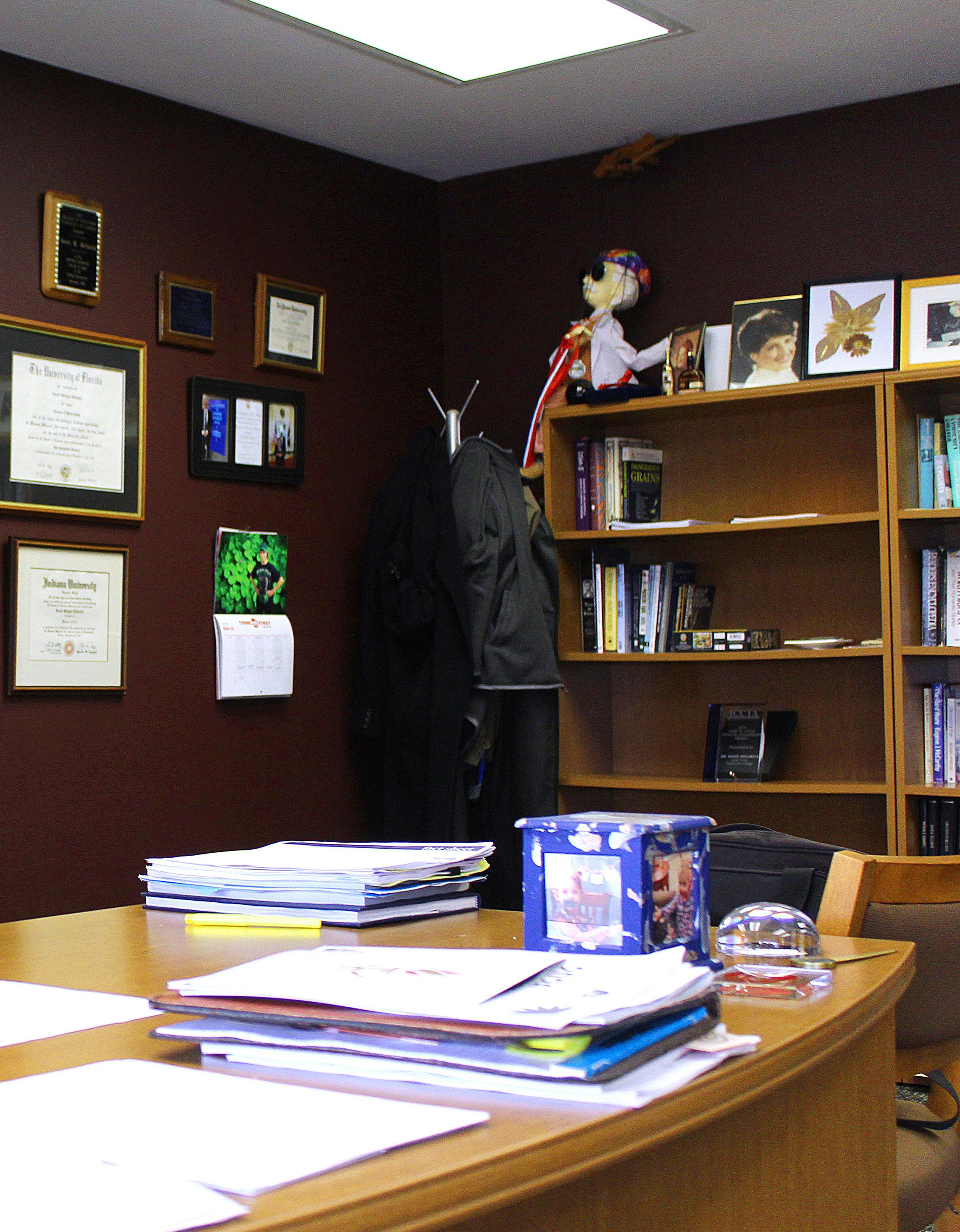
College president gets ready to turn over the Hellm at Sauk
From fitness to faces: Artist enjoys creating bodies of work
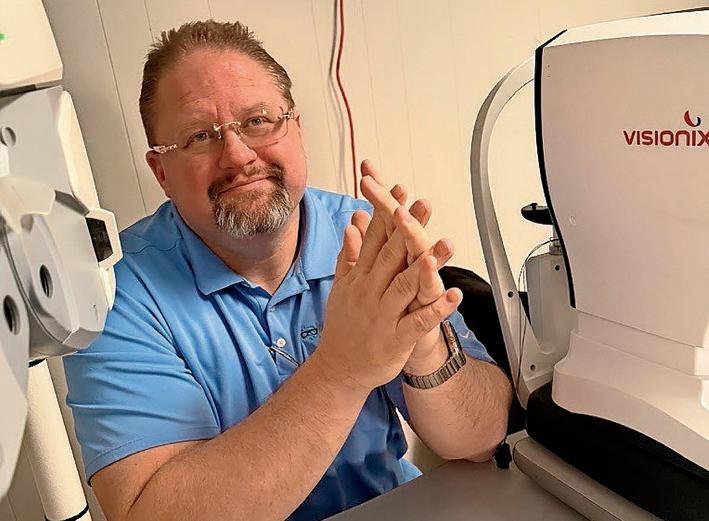
A Dixon man is helping educators learn to see eye-to-AI with the future
Publisher/Ad Director
Jennifer Heintzelman
Magazine editor & Page design
Rusty Schrader For Advertising
Contact Jill Reyna at 815-631-8774 or jreyna@saukvalley.com
Published by Sauk Valley Media
113 S. Peoria Ave., Dixon, IL 61021 815-284-2222
Have a story idea for Dixon Living?
E-mail rschrader@saukvalley.com
Articles and advertisements are the property of Sauk Valley Media. No portion of Dixon Living may be reproduced without the written consent of the publisher. Ad content is not the responsibility of Sauk Valley Media. The information in this magazine is believed to be accurate; however, Sauk Valley Media cannot and does not guarantee its accuracy. Sauk Valley Media cannot and will not be held liable for the quality or performance of goods and services provided by advertisers listed in any portion of this magazine.
4 Watch and learn
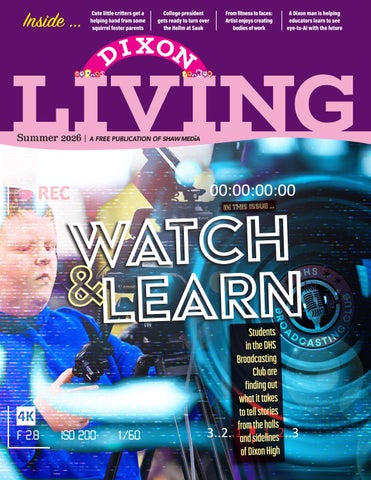
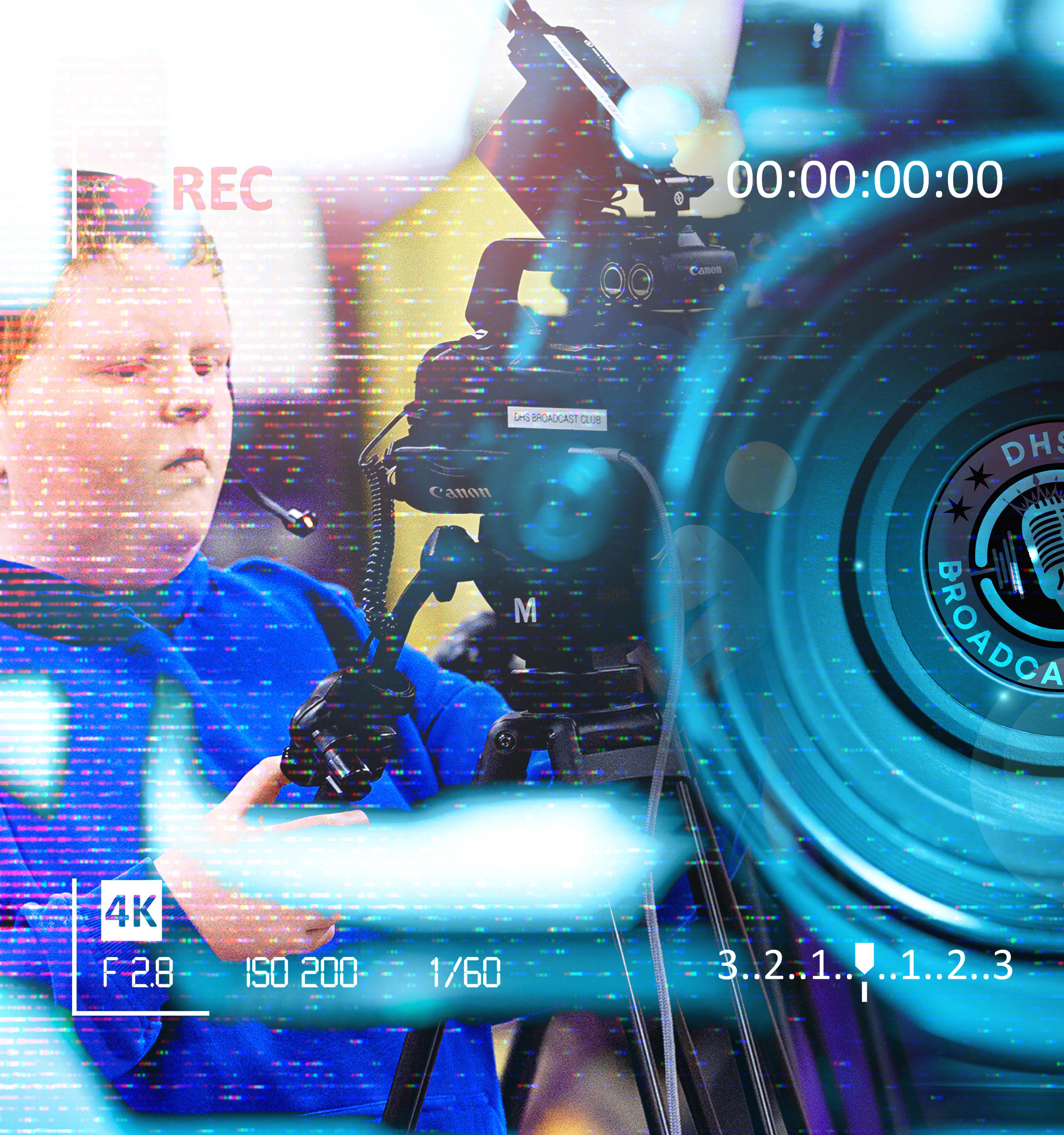
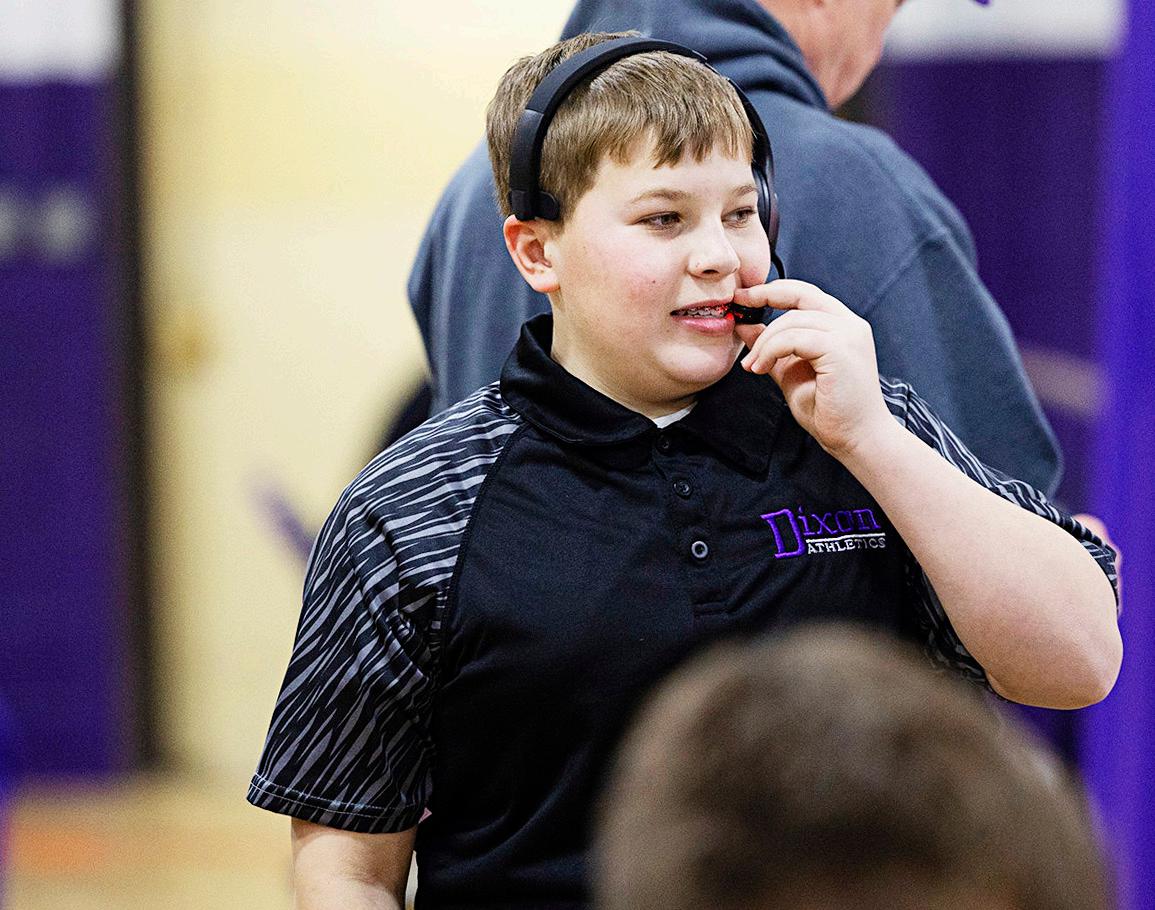
Students in the DHS Broadcasting Club are finding out what it takes to tell stories from the halls and sidelines of Dixon High.
12
Giving their kits a better future
Squirrels’ foster parents have helped hundreds of the furry little critters recover from a rocky start.
21
Turning over the Hellm
David Hellmich wanted to be able to wrap up his career at a place where he could make a real difference, and he found it — as president of Sauk Valley Community College.
32
Bodies of work
Ryan Jandrey’s profession is the human form, but his passion is forming human connections in the portraits he creates.
26 A ll I’s on the future
A Dixon man is helping educators understand that these days, the most important letters in “teacher” can be T, E, C, H.
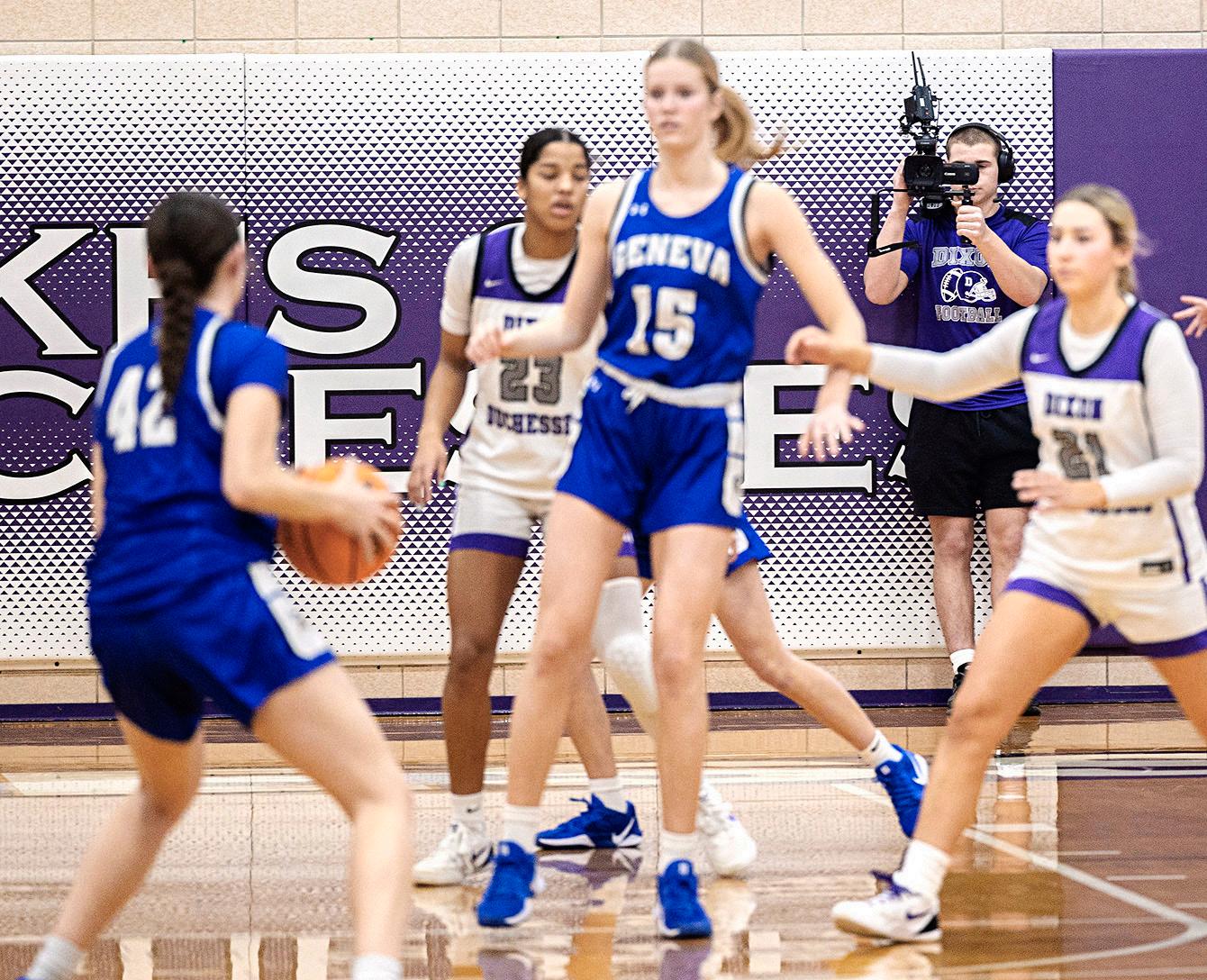
hen football takes over A. C. Bowers Field at Dixon High School, all eyes are on the players — including the eyes behind the lens.
Their focus? Friday night lights, camera and action. It’s the job of a group of students off the field to capture the moments and moves on the field, the maneuvers that can change in a split second and the memories that can last a lifetime — and they’re doing it live on a student-run broadcast.
Behind the broadcast, and the cameras, are a group of students who play a starring role in sharing what’s going on at their high school, while learning a variety of skills: communication, cinematography, story-telling, technical know-how, promotion, and more.
They’re the members of the DHS Broadcasting Club, and they can be found throughout the school showcasing and sharing high school happenings, from filming sporting events to making features on teachers to shining a light on the arts and student activities. Their productions end up on the club’s YouTube channel, where anyone who can get online can tune in to what the Dukes are doing.
Behind the broadcasts is a program built on trial and error, something advisor Bob Wendt, who has about 30 years in communication and multimedia, leans into by letting students learn through doing.
“I show the kids a lot, but I also let them make mistakes,” Wendt said. “That first season we had one camera that panned, zoomed and you could control it remotely, and we had one microphone that sat on a table. They quickly learned a lot of things in that first season.”
The club began in spring 2024, sparked by student interest, and quickly expanding into school and community coverage. Its earliest broadcasts were far from seamless, including one girls soccer game where students were tasked with filling a 10-minute halftime segment. The three commentators also crowded around a single microphone to work through live production while figuring out the rhythm of their routine in real time.
cont’d to page 6
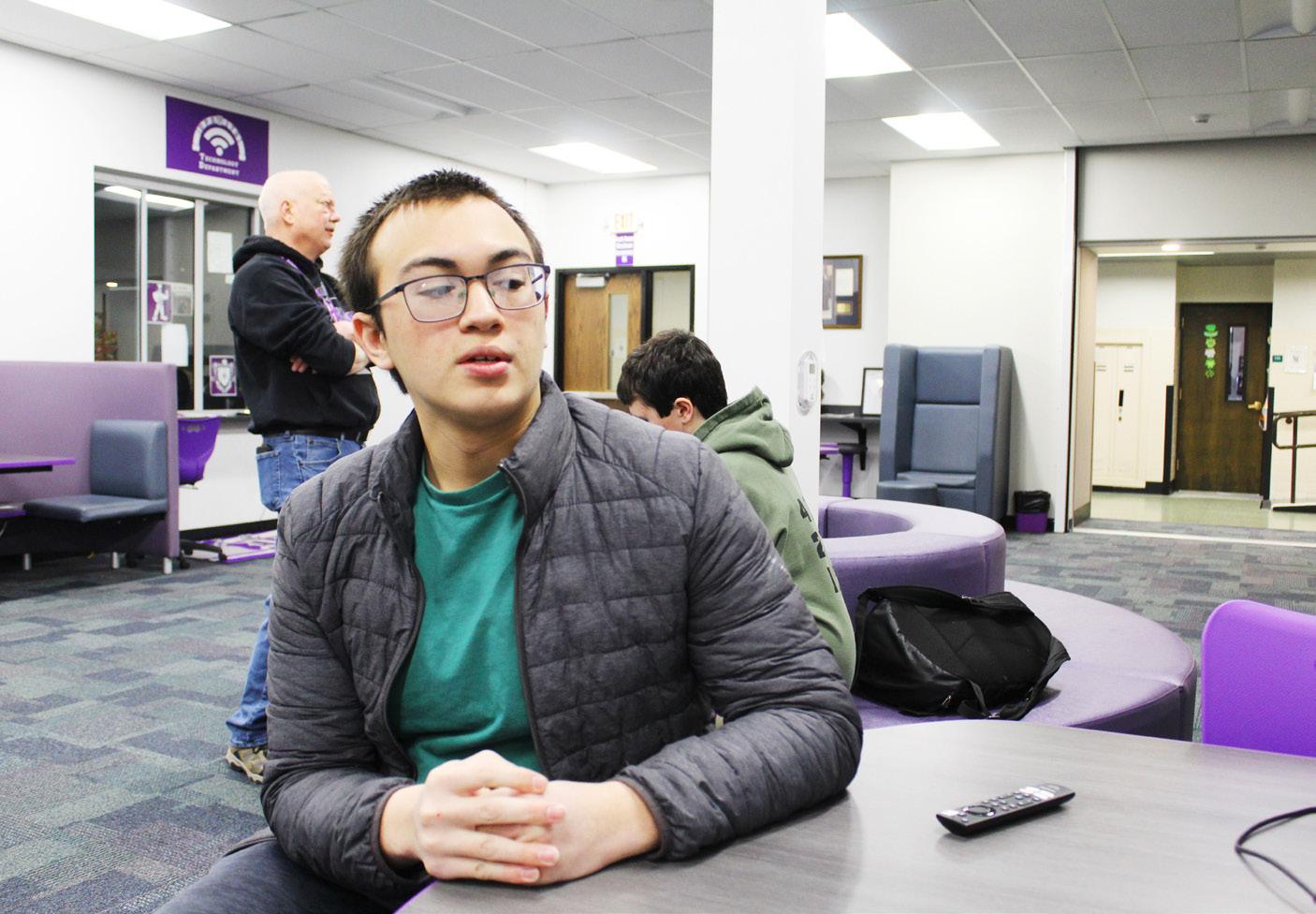
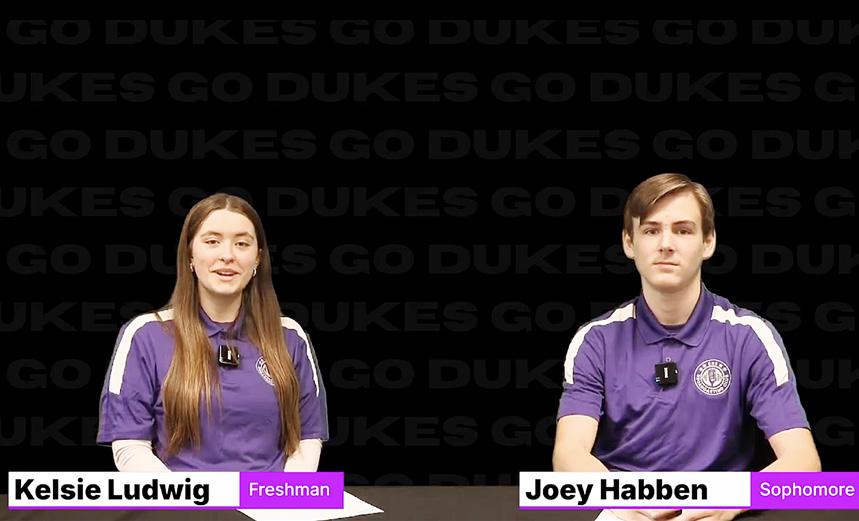
Sebastian Seibel, president of the DHS Broadcasting Club, leads the production and direction of online broadcasts of the school's sports, arts and special events. Below: Students Kelsie Ludwig and Joey Habben anchor a feature segment with Dixini student newspaper reports.
“I warned them to bring information for halftime that you can talk about on the air,” Wendt said. “It’s 10 minutes. ‘Oh, we got lots of statistics.’ They blew through it in two minutes.
But, he said, “By the end of that spring, we learned a lot with that same gear,” and the foundation for the club had been set. Progress came quickly, and by the next school year students had found their footing, honing their skills in execution and problem-solving.
“We cut our teeth a lot,” Wendt said. “We went into the fall season having issues, but the kids overcame them. They figured out solutions, and we were able to put together some really cool broadcasts. We added more cameras and more basketball games, and we really improved through basketball season with the multiple cameras.”
Community support accelerated that growth.
A $9,000 grant from the Canterbury Foundation in spring 2025 and a $20,000 grant from the Donaldson Foundation that summer allowed the club to expand its equipment, improve production quality and operate more like a small, professional broadcast team, adding multiple cameras and more advanced capabilities.
BROADCASTING cont’d to page 7
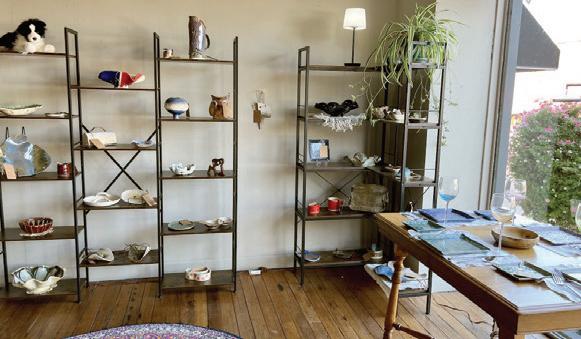
DOG TROT POTTERY
Shop for unique handbuilt items at our new showroom in downtown Dixon
308 W. 1st St. • Dixon
Open noon-5pm Thursday-Saturday & during all downtown Dixon events
Now working with a consistent group of 12 students, the club has expanded not only its equipment, but awareness among students and the public. Further ambitions continue, such as live interviews during games.
Freshman Kelsie Ludwig didn’t come to the club on just a lark. It started with a future she could already see — one framed by cameras, weather maps and the steady cadence of a voice delivering forecasts. Watching weather documentaries and local TV helped shape her vision, but stepping into the club is making it a reality.
“At first, [I joined] mostly because of the job that I plan on doing when I’m older, to be a meteorologist,” Ludwig said. “I wanted to be able to manage cameras, and to be on television with that as well. It’s hard to get that far, but I want to at least try.”
Her ambition quickly met reality the moment she first appeared on camera. While nerves were unavoidable during those early appearancew, they were replaced by confidence and growth, one recording at a time.
“I got more comfortable in front of the camera,” Ludwig said. “At first, I was kind of scared because I wasn’t sure how I was going to be able to talk to the camera without being stiff and scared, but then I was able to manage.”
Behind the lens, the experience is just as demanding. With a headset guiding each move and live direction coming in real time, Ludwig and her fellow camera crew-members have learned to anticipate moments before they happen, whether they are covering football under the lights or tracking a rally on the volleyball court.
“With recording, there’s a headset and we get told what camera is going,” Ludwig said. “You have to know when you are going to be on, so you usually should just record the whole time you’re doing it. It’s easier when I know I’m on, so I need to make sure I keep up.”
For fellow freshman Cade Kirchhoff, the pull of the program draws him toward sports, with the rhythm and unpredictability of live games. Whether he’s stationed behind a camera or stepping into a play-by-play role, the experience has given him a front-row seat to the games he loves to watch. He has enjoyed doing play-by-play for baseball games, and picked up some tricks of the trade by watching his favorite baseball team.
“You got to know about the sport and what happens during it, and the rules,” Kirchhoff said. “I get some advice from watching some Cubs games. You’re thinking ahead of what they could do and what pitch he might throw.”
When he’s not guiding viewers through a game, he’s behind the camera at other events. The same sense of anticipation carries over in that role, where instinct and timing matter just as much as technical skill.
BROADCASTING cont’d to page 9
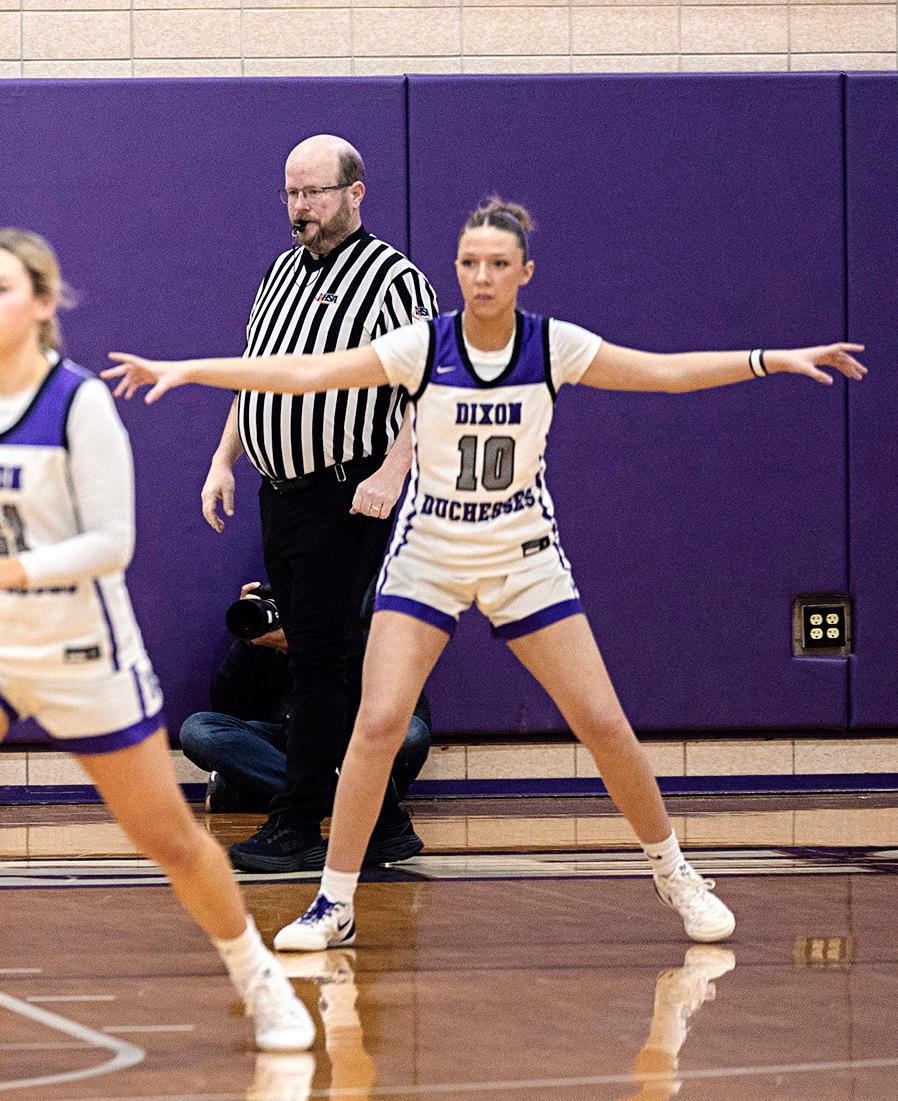
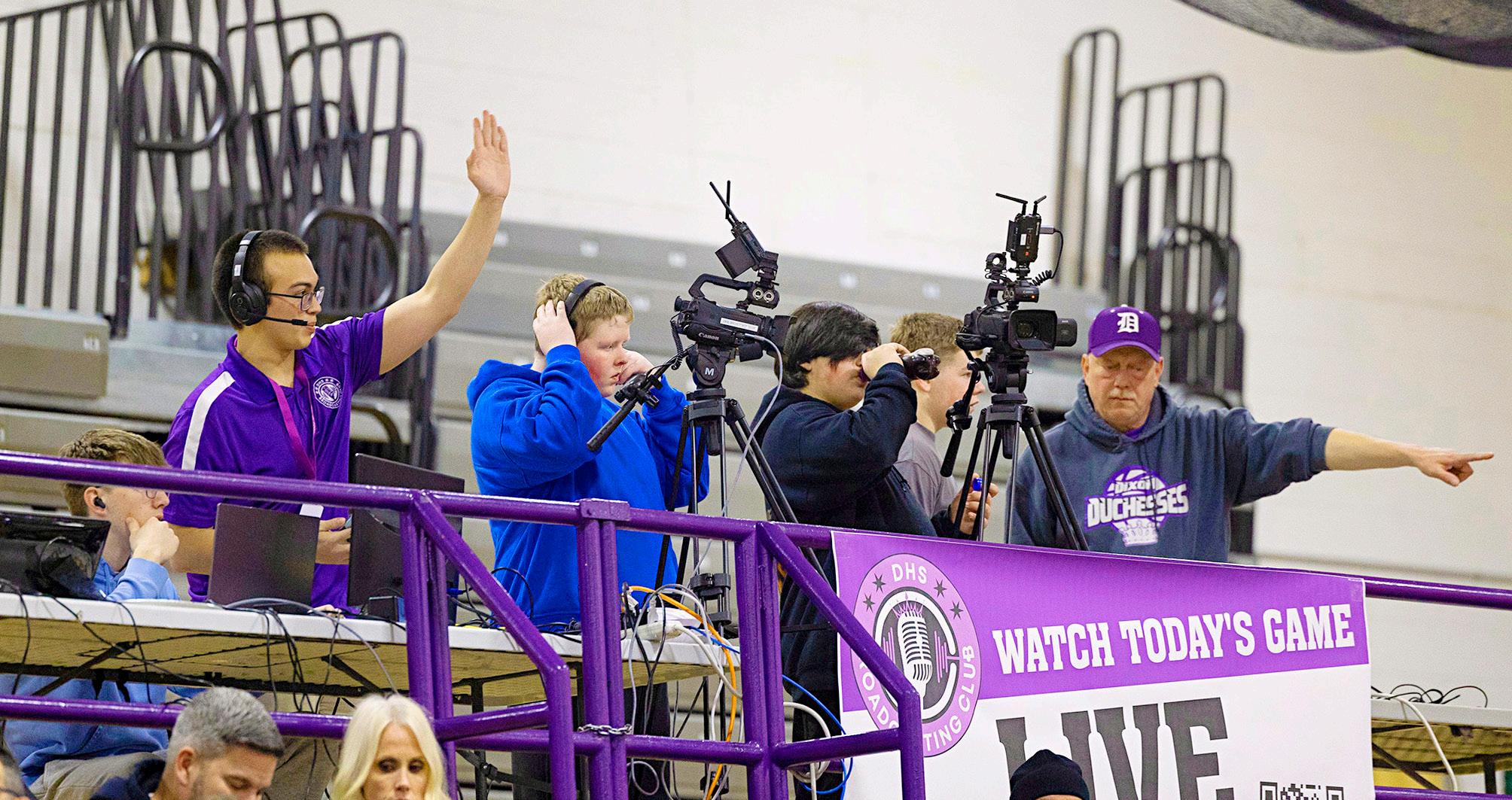
Athletics are a big part of the Broadcasting Club’s schedule, and members do everything from coordinate coverage, film the game, do play-by-plays, and design graphics. Facing page: DHS Broadcasting Club members Jake Lohse (left) and Cade Kirchhoff (right) work the Class 3A girls basketball regional title game Feb. 19 at Lancaster Gymnasium.
“I can expect what’s going to happen more,” Kirchhoff said. “I know where I can move the camera. You have to be steady and not move the camera a lot.”
Junior Sebastian Seibel leads much of the production. As the club’s president, his work involves directing, producing and making sure each broadcast comes together as planned. What keeps him invested is the realization that the experience reaches far beyond the screen.
“As Bob likes to say — and I full agree with it — this is something that anybody can get into,” Seibel said. “There are a lot of skills that can be pulled from this, such as being able to communicate on the flow, the technical aspects behind the scenes, and some responsibility because people show up to these games and we count on them. Plus an interview aspect and coming up with questions. There’s a plethora of skills that can be pulled from this, it just matters what type of person you are.”
Multi-faceted roles are common among the students; even Seibel’s experience as a former high school wrestler has been called upon at times to explain holds, scoring scenarios and how a dual meet or tournament works. “I used to wrestle, so sometimes I’ll hop on the microphone for that,” Seibel said. “Most of the time, I’ll be behind the scenes and working with the cameras.” BROADCASTING cont’d from page 7
BROADCASTING cont’d to page 11
“From
Start to Finish”
BROADCASTING cont’d from page 9
While the club’s work is often noticed by fellow students, their families and community members, their talents are on display well beyond their familiar confines., especially with sports broadcasts. During a Class 4A football playoff game in November against Coal City, Seibel noticed something that underscored the reach of their work: viewers tuning in from outside Dixon, including supporters of the opposing team.
“In the playoffs, we were able to reach out to some people from Coal City, and I’ve heard from families who have watched sports that aren’t from here,” Seibel said. “It’s really nice.”
Beyond live broadcasts, the club is expanding into interviews, student journalism and covering student performances.
At the same time, much of the creativity fueling the broadcasts happens in the digital layers done behind the scenes. Graphics, animations and social media promotion have become another way for students to leave their mark. Seibel especially enjoys working on those aspects.
“I’ve pushed out new graphics that I like to design,” Seibel said. “We’ve also used templates that we’ve made which have been nice for us, and I’ve gone into Adobe After Effects and have made animations for the broadcast itself. There’s a lot of work that we’ve done behind the scenes with graphic design and motion design and working all of these aspects into a broadcast.”
Though the occasional challenges
The DHS Broadcasting Club has recorded several sports events and school functions on its YouTube page. Go to youtube.com/@ dhsbroadcastingclub to view videos. Call the school at 815-453-4966 for more information on the club.
still pop up, the program has come a long way.
“We’ve seen it become a lot more reliable,” Seibel said. “When we started, we were running maybe one or two cameras that were not very reliable and would just bail out on us. We now have more reliable equipment, and have doubled or tripled it. We’ve still seen bumps, but not as often as we did before. The consistency of our productions has become more reliable.”
Skills learned take shape in different ways for each student, whether it’s finding confidence on camera or behind it, learning to anticipate the next play, or solving problems in the control room. But one of the most rewarding parts comes when all of those moving pieces align, Seibel said.
“I like seeing people being engaged,” Seibel said. “They love to work in this environment. That’s real nice, especially when everything comes together and you have a full broadcast with people — it takes people to operate cameras and do all of this work. It’s really satisfying to see when all of this comes together for a complete project. They’ve done a great job. We definitely have fun around here, and that’s definitely something I like seeing.”
In the end, the broadcasts themselves may capture the action on the field or the stage, but behind every frame is a group of students learning and creating something bigger than any one role, one camera or one voice.
In the end, the broadcasts may seem seamless to the people watching, but behind every frame is a group of students learning and creating something bigger than any one role, one camera or one voice.
For Wendt, the value of the program stretches into a media landscape where video is everywhere, and the skills students build now carry forward in ways both expected and unexpected.
“There will always be a need for camera people, producers and directors,” Wendt said. “Our world now revolves around video — not only in TV, but with YouTube and all of that. We have some kids who are naturals, and have that knack of knowing. Things like lighting, camera angles, when to zoom in and out; if they can get some skills and do something that they might not have done on their own, even if they’re making their own TikToks, we consider that a win.” n Shaw Media reporter Cody Cutter can be reached at 815-632-2532 or ccutter@shawmedia.com.
ALEX T. PASCHAL/APASCHAL@SHAWMEDIA.COM
DHS Broadcasting Club members film a girls basketball game Feb. 19.
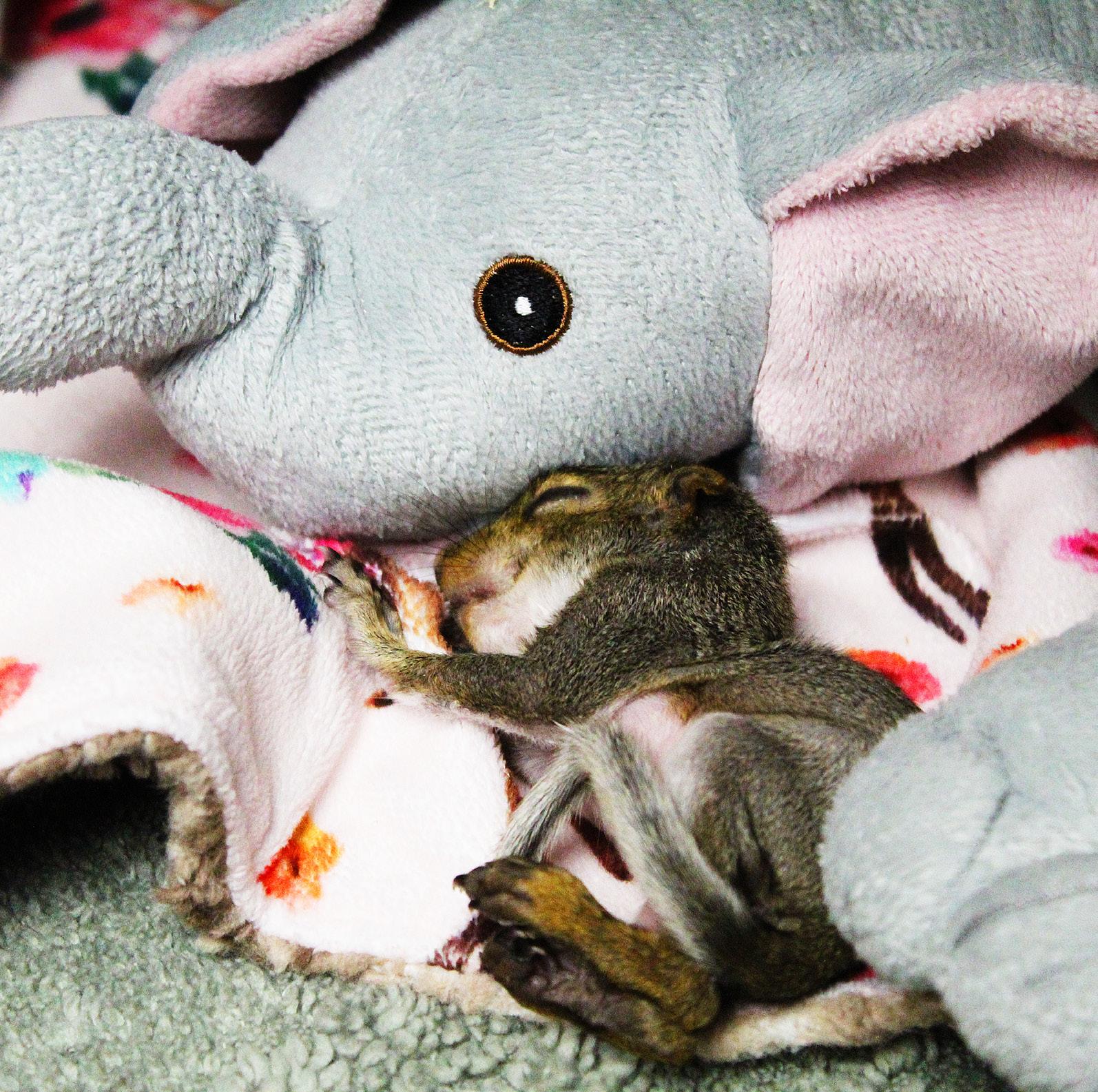
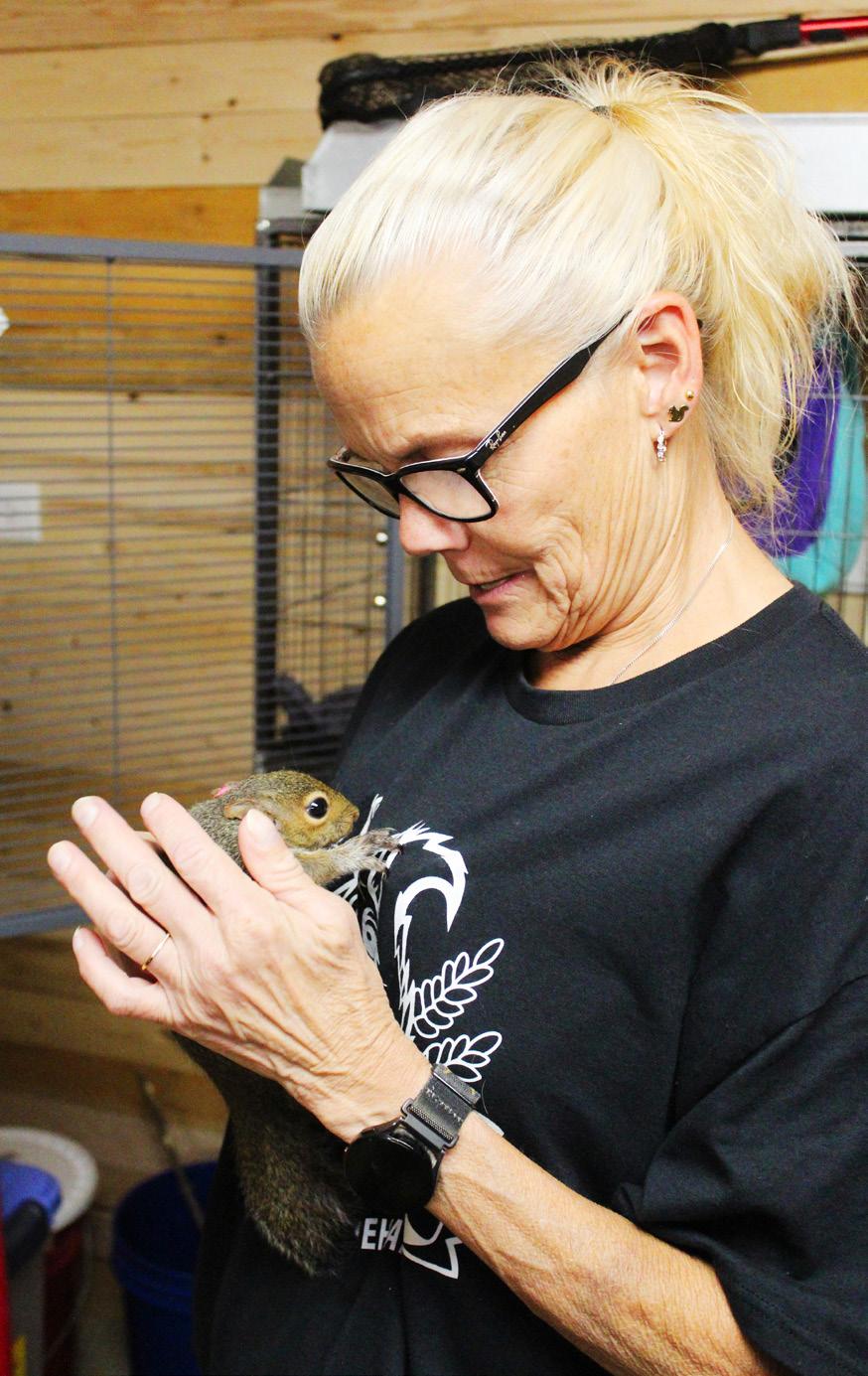
Joe and Kris Bajko have helped rescue and rehab hundreds of squirrels. Here, blankets and stuffed animals help keep a kit warm.
ny parent who raises a child knows that their little one will eventually leave the nest.
Joe and Kris Bajko are no different, except that when the little ones they raise leave their nest, they just go to another one — in a tree.
The Lost Lake couple have been the foster parents of a whole scurry of squirrels through the years, nurturing the little nut-gatherers from tiny, furless creatures to the fleet-footed tree climbers that skitter to and fro in backyards everywhere.
It’s been a natural progression for the pair, who’ve spent their lives loving animals, and for the past decade they’ve channeled their passion for Mother Nature’s children into operating a squirrel rescue from their home that’s helped hundreds of fluffy-tailed foster children who need a helping paw to make their way into the wild.
The Bajkos are the faces of Squirrels Gone Wild, a licensed nonprofit wildlife rescue dedicated to rehabilitating and releasing native Illinois squirrels, across several counties in northern Illinois.
What started with a single rescue in their basement about a decade ago has grown into a full-time, year-round commitment to helping orphaned and injured squirrels that peaks in the warmer months when calls for help come in at all hours. For Kris, her connection to animals stretches back further than that first rescue, rooted in a belief that every life has a value and developed from a squirrel she admired as a child.
SQUIRREL cont’d to page 14
“I grew up absolutely loving animals,” Kris said. “We had a squirrel when I was a child that used to climb up on our deck, and for years we would feed her. We used to call her Mama Squirrel.”
Kris’ love for animals eventually led her to volunteer work that would lay the foundation for what was to come.
While living in the Chicago suburbs, and even after moving to Lost Lake, a private lake community in southern Ogle County, 22 years ago for its wooded surroundings, Kris volunteered at the Fox Valley Wildlife Center in Elburn, where she learned to care for a variety of animals. She later continued that work with Oaken Acres Wildlife Center in Sycamore.
“The rehabbing network is an interesting group — everybody tries to help everybody out,” Kris said. “We know who specializes in what. We got a raccoon call one morning, and we don’t do raccoons, but I sent them to the right people. It’s great to work with all of the rehabbers.”
Kris and Joe Bajko of Lost Lake have helped a lot of squirrels return to the wild, courtesy of their nonprofit rehabilitation and rescue operation, Squirrels Gone Wild. “Phone calls are coming in all day and all night pretty much,” says Joe, of the need for their service.
SQUIRREL cont’d from page 14
About 10 years ago, the couple took their first step into running a rescue of their own. It started with a single squirrel in their basement, cared for in a fish tank atop a heating pad. Since then, they’ve cared for around 500 squirrels, now averaging about 100 rescues each year.
The growth comes with a demanding routine, especially during the busiest months between April and November.
“During the spring and summer, we have a full house and are feeding every three hours,” Kris said. “It’s very hands-on. Baby squirrels cannot regulate their own body temperature. Even if you find a baby squirrel and put it on a towel, it’s not going to help that animal because they actually need a heat source. Now we have several incubators with all professional equipment.”
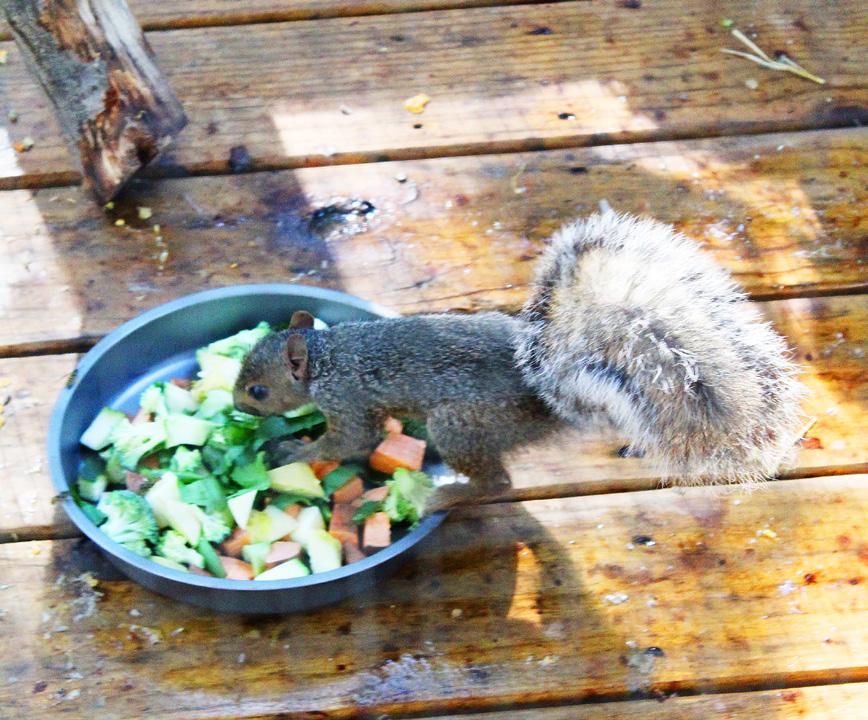
On any given day, their schedule revolves entirely around the needs of the animals, and with Joe being retired and Kris semi-retired, they have the flexibility to care for the squirrels. The animals’ diet includes fresh fruits and vegetables, as well as nutritious “squirrel blocks.” Trips to the grocery store for fresh produce average at about every other day.
“Phone calls are coming in all day and all night pretty much,” Joe said. “We get a lot of babies orphaned during storms. In a typical day, the first thing we do when we get up in the morning is make plates of food for the squirrels. It’s not just lots of seeds and moving on; [the food is] all fresh and cut up.”
SQUIRREL cont’d to page 16
PHOTOPROVIDEDBYKRISBAJKO
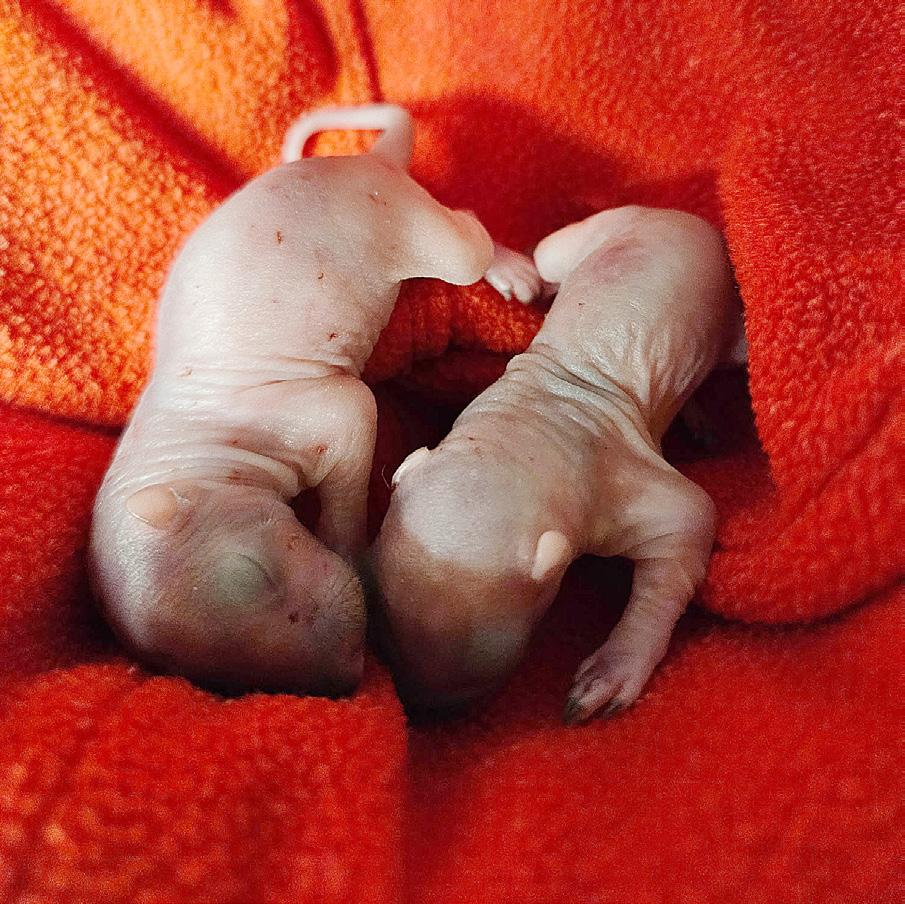
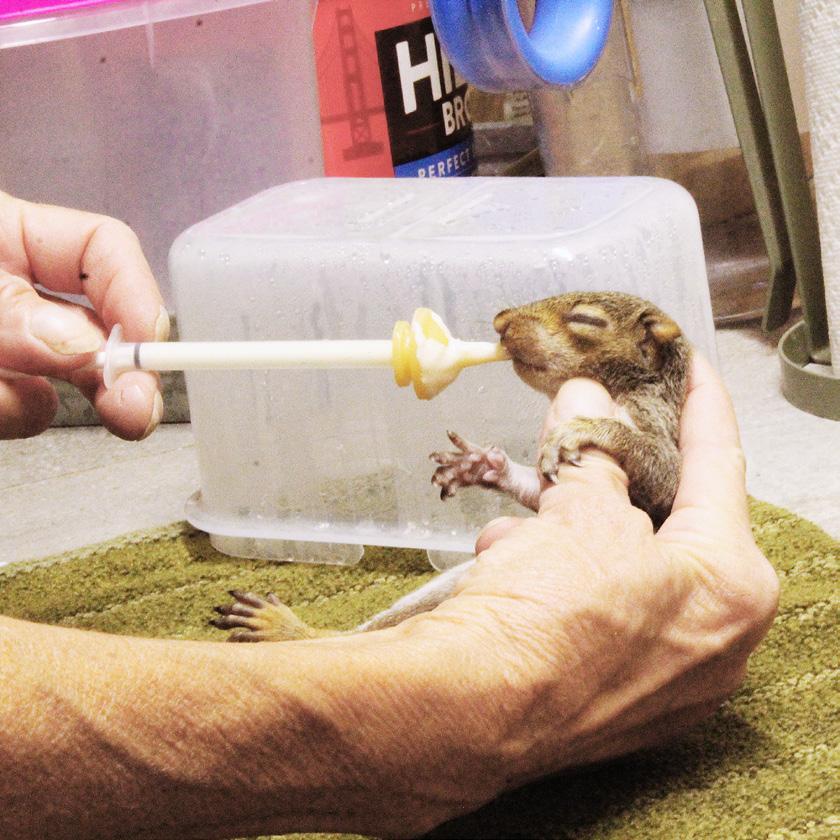
Inside their home, the smallest squirrels, known as “pinkies,” require the most intensive care, including feedings every three hours, even through the night.
“Pinkies are challenging because they have tiny mouths and tiny stomachs,” Kris said. “You have to feed them slowly and carefully because if food goes in the wrong way, it can asphyxiate and they get pneumonia.”
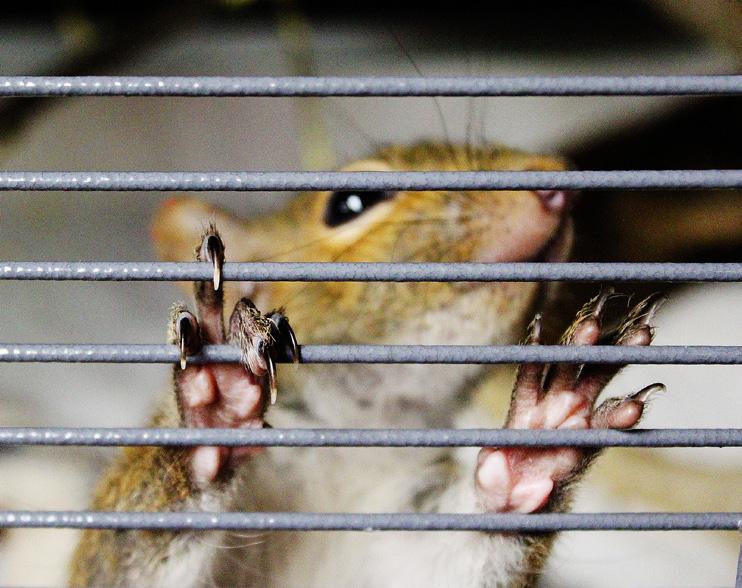
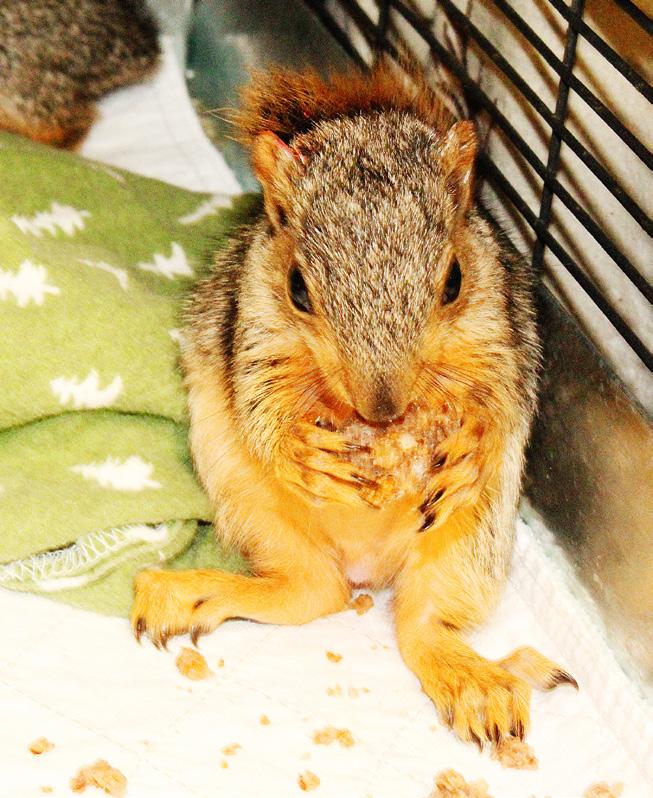
As the squirrels grow, so does their independence. They move from incubators to small indoor enclosures, where they begin eating on their own and learning to climb. The early stages are a shift from constant, hands-on care to preparing them for the outside world.
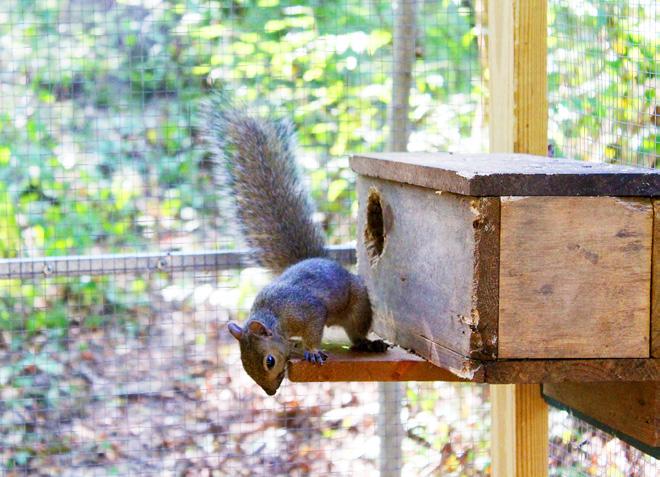
It takes patience, devotion, a watchful eye and a tender touch to raise baby squirrels (called kits).
The Bajkos spend much of their time caring for the squirrels. The couple uses incubators and professional equipment to keep the little ones alive. Feeding begins with a small syringe — the kits have to be fed slowly and carefully — before they transition to solids: fruits and veggies and nutritious squirrel blocks. They’re eventually moved to a cage, then into a transitional area outside, where they become acclimated to nature before they’re sent scampering on their way.
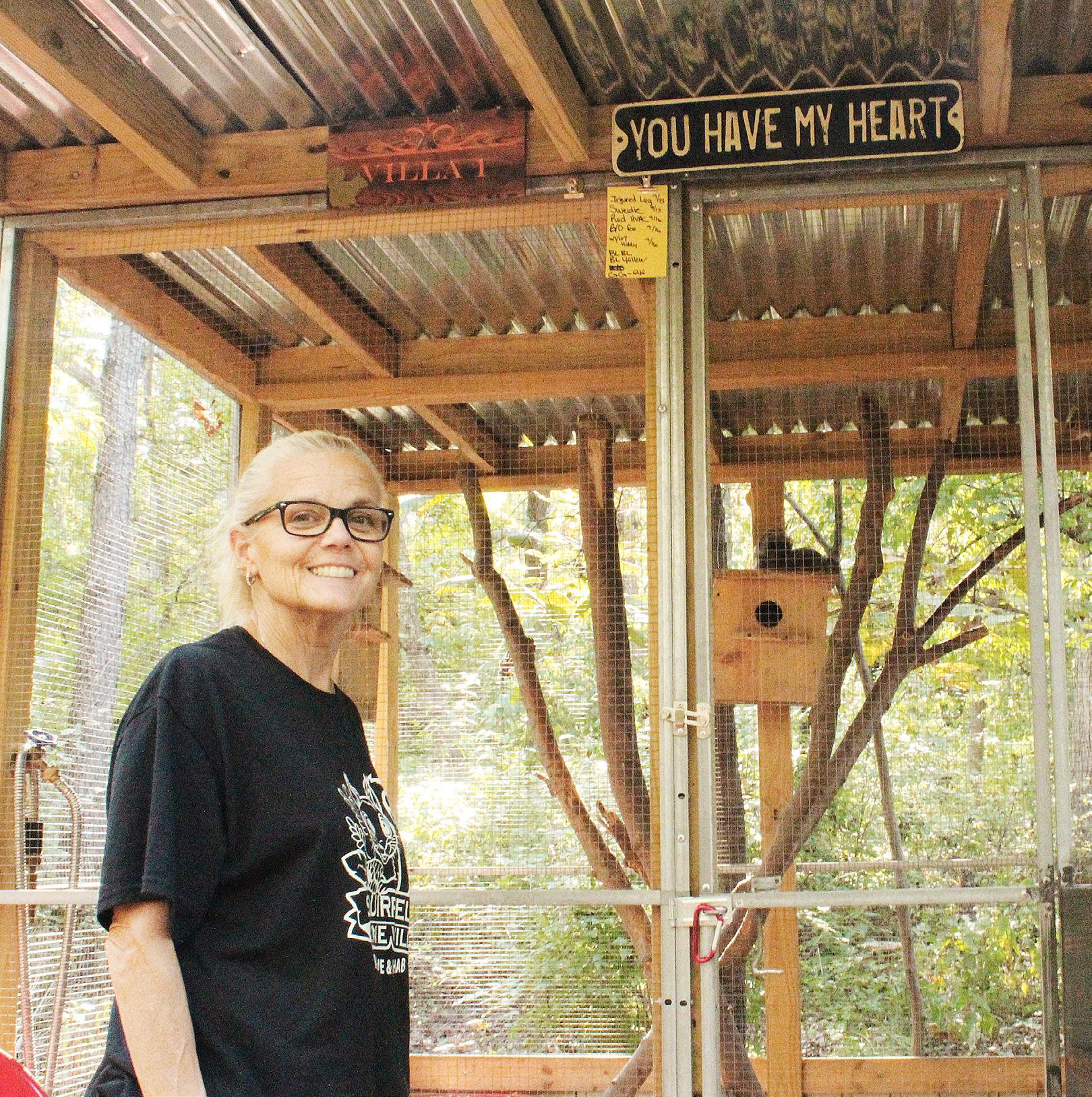
Eventually, they transition outdoors into what the Bajkos call their “villas,” large release enclosures built by Joe, who has a background in home construction. Squirrels spend around six weeks adjusting to the natural environment, building strength and awareness before reaching the wild. The entire process takes about 4 months, from infancy to release.
“They learn about sounds of outdoors, and get acclimated to weather changes,” Kris said. “Downstairs it’s pretty much a contained environment, but out there, there’s wind and rain. They’re still in a covered thing, but there’s sounds of hawks, and squirrels and learn about being outside.”
SQUIRREL cont’d from page 15
Watching a squirrel eventually return to the wild comes with great satisfaction to the couple. Those moments can even be emotional.
“We had some that were three days old when we got them, and successfully got them through everything,” Kris said. “The first time they climbed a tree, I just started crying. They come out the of cage and start hopping around, and then it finds a tree. We have climbing stuff for them in the cages, but once they start climbing that tree, and continue going up and up and up. ... There are some that you work so hard on, and so many hours on, like those little guys, and to get to see them get to be a squirrel and to do the things that they are supposed to do, that’s the whole thing. It’s freedom and nature how it should be.”
Not every story ends that way though.
“The hardest part is the heartbreak,” Kris said. “Not all of them make it. You get attached. I cry over each one of them I lose. It’s heartbreaking. I pour so much energy and love into them, and when one of them doesn’t make it, it kills me.”
Orphaned squirrels often emerge from nests in search of food, linger on the ground, or even approach people directly, sometimes climbing up a pant leg in a desperate attempt to find care.
“A lot of times it can be storms that take down trees, and people find babies out of the nest and the mom is nowhere around,” Kris said. “We’ve had instances where people are cutting down trees, and for some reason or another they can’t reunite with the mother. That’s always the first thing you do, is to try and reunite. When the mother doesn’t come back, then we get the babies.”
SQUIRREL cont’d to page 18
Through it all, the Bajkos not only provide care, but also work to educate the public on how to respond in those situations. They have educational posts on Facebook that share information about squirrels, what they can and can’t eat, and how people can aid in their longevity. Though their natural lifespan can be longer, a typical squirrel in the wild usually only lives about three years because of predators, starvation and lack of proper food.
When people do encounter an injured or orphaned squirrel, the Bajkos emphasize that the first step is not intervention, but patience. In many cases, the best outcome is reuniting the animal with its mother. If that’s not possible, they advise against giving food or water, which can do more harm than good, especially for young squirrels. Instead, the animal should be placed in a small box with a soft
cloth and a gentle heat source, then brought directly to a licensed wildlife rehabilitator. Unlike some rescues, animals are not picked up; the responsibility to transport them often falls on the person who found them.
Offering guidance is part of a broader effort to help people better understand how their actions impact wildlife.
“We also try to educate the general population regarding small mammals and rescuing, and about taking care of animals in your yard,” Joe said. “When people are feeding animals in their back yard, it’s okay to give them a peanut once in a while, but doing so every day creates bone diseases and they don’t have calcium.”
Coming to the rescue
Operating as a nonprofit, that mission is sustained largely through personal sacrifice and community support. Money is used for vet bills, food, medicine, formula; the average rehab cost per squirrel is about $35 a week. Even with the financial and physical demands, the couple remains committed to the work they’ve built together, one rescue at a time.
“Every life has value,” Kris said. “My whole existence is to try and not hurt things, but to make things better. If we can help some little life, we’re doing something good. Every creature has a mom. Every creature has value. Everybody has worth.” n
Shaw Media reporter Cody Cutter can be reached at 815-632-2532 or ccutter@shawmedia.com.
If you have a squirrel in need of help, call Squirrels Gone Wild at 815440-9104 and await further instructions and where to take them. Find it on Facebook for more information. Want to donate? Go to the Facebook page, call, or email squirrelsgonewildrescueandrehab@yahoo.com.
Start Here
Better Day focuses on making every moment meaningful by combining compassionate care with purposeful initiatives:
Moments of Joy Memory Treasures Better Together
Celebrating the small, daily moments that bring happiness, like a favorite song, a warm smile, or a cherished memory.
Collaborating with residents and families to honor life stories and experiences, and create emotional connections that last.
Every aspect of the program—from the way team members connect with residents to the design of daily activities—is intentionally crafted to bring joy, dignity, and purpose to each day.
It’s more than a care approach; it’s a commitment to living out our mission in every interaction.
Actively involving families in care decisions, offering support groups, and providing resources to educate.
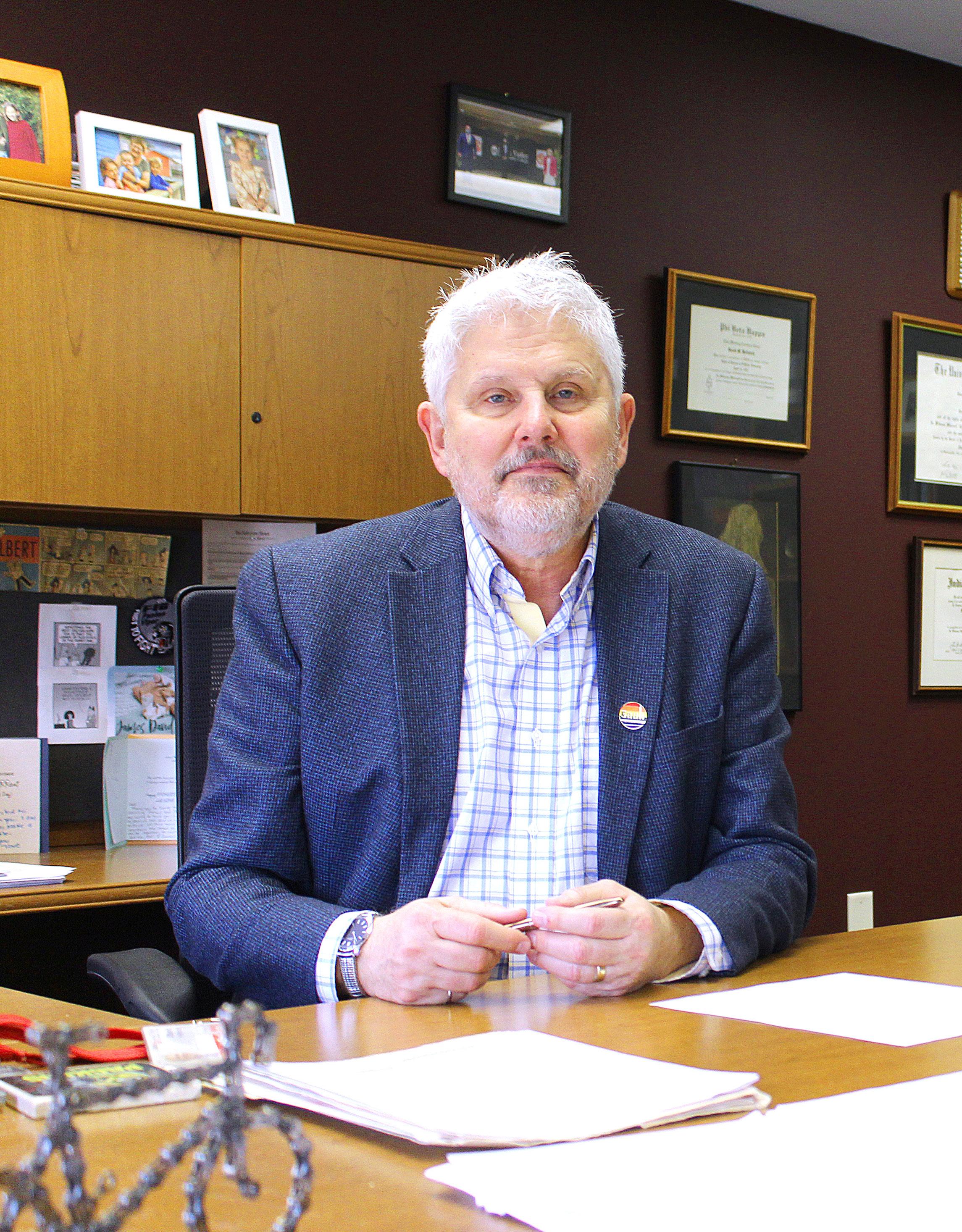
For more than a decade, Sauk Valley Community College President David Hellmich has put the emphasis on two words in the name of the institution he led: “Community” and “College.”
During his tenure there, he devoted his time to bringing the two closer together, and his influence can be seen in both, as he helped pave the way for the college to become further woven into the fabric of the community. His work reached beyond Sauk’s walls and halls and into the faces and places it served. Sauk’s president is a title he’s been proud to hold.
Now he’s getting ready to devote his time to another title he wears proudly: Grandpa.
A few weeks after commencement, Hellmich will wrap up a long career in higher education, stepping down as president of Sauk Valley Community College in May after 11 years. He leaves not only as an educational leader, but as a community connector who built relationships with service clubs, local governments and businesses, all to help strengthen not only Sauk Valley Community College, but the Sauk Valley.
The decision to retire coincides with the reason why Hellmich’s career has taken him to various points across the nation: spending time with family. He and his wife Linda raised a family in Minnesota, moved to Kentucky to be closer to relatives, came to the Sauk Valley as a midpoint, and will retire to Minnesota to be near their four grandchildren.
HELLMICH cont’d to page 22
“We love the Sauk Valley, but there are four reasons why we’re moving, and those are the four grandchildren we have,” Hellmich said. “We wanted to get closer to the grandkids; otherwise we’d stay here because we love it here.”
Hellmich’s career in community colleges spans nearly 40 years. After leadership roles in Florida, Minnesota and Kentucky, he became president of Sauk Valley Community College in 2015. During his time, he helped strengthen partnerships, launched initiatives such as the IMPACT earned tuition program, and guided the college through financial strain and the coronavirus pandemic.
Wanting to be a strong advocate for the region, Hellmich often describes the Sauk Valley as a “jewel,” citing its resources, location and momentum, while championing growth, access and deep community connection.
“I think the Sauk Valley is one of the real jewels of not only Illinois, but the country,” he said. “It’s amazing what the Sauk Valley has. We have water, and there are parts of the country that are fast running out of water. We have transportation. We have rail. We have interstates. We have airports. We are
rural, but we’re not rural — we’re an hour-and-a-half from O’Hare, the Quad Cities and Rockford, but you get the best of small town, the best of rural, while you still have access.”
Raised in Greensburg, Indiana, Hellmich grew up in an area not unlike the Sauk Valley: a small-town agricultural community. After a decade as vice president of academics at Bluegrass Community and Technical College in Lexington, Kentucky, he and Linda sought a return to that environment. The Sauk Valley offered a professional and personal midpoint aligned with their family priorities.
When George Mihel retired from Sauk in 2015, the board of trustees narrowed its search to three finalists, including Hellmich. Learning the board wanted a stronger community presence, he was drawn to the role. Upon landing the job, he and Linda, who recently retired as a psychologist at KSB, settled in Dixon.
“This area is so much like where I grew up, with small towns and lots of manufacturing, and even more agriculture,” Hellmich said. “I remember driving by Jefferson School in Dixon, and Linda looked at me and said, ‘This is just like your hometown, this is just like Greensburg.’ We were just so impressed with the people here.”
From the outset, Hellmich looked at community connections as central to his role. He examined where faculty and staff were already engaged — boards, nonprofits and volunteer work — and identified gaps. From there, he and his leadership team expanded the college’s presence, which included launching a regional leadership program with local chambers of commerce and increasing outreach to service and economic development groups.
HELLMICH cont’d to page 24
Jill at 815-631-8774 or
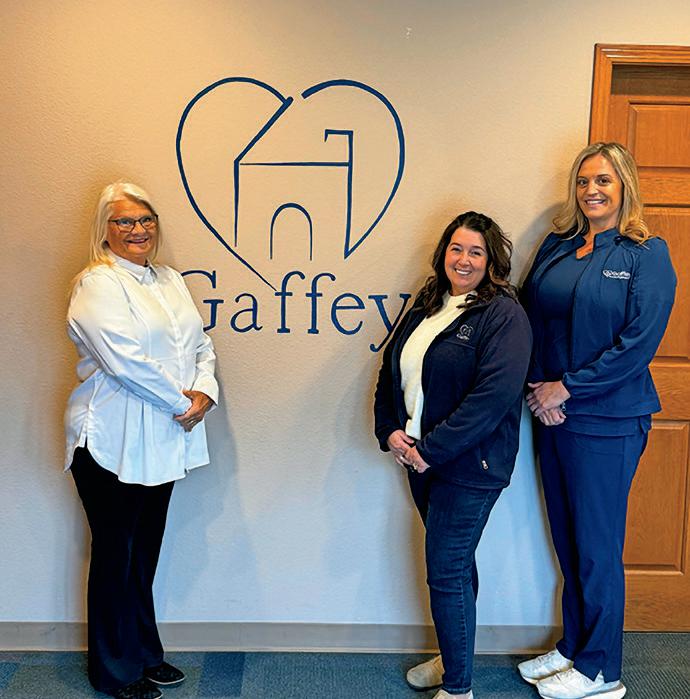
Gaffey has been a trusted home health care provider in the Sauk Valley Area for 35 years Celebrating 35 years 1991-2026
“ THE TOP CHOICE FOR COMPASSIONATE, LOCAL HOME HEALTH CARE
TESTIMONIALS
A God send for my family.
Gaffey was a literal God send for my family. All of the nurses went above and beyond to make sure my uncle was well taken care of in his final two months. They even have private duty helpers to come in and help when it’s needed. The social worker Anita is awesome with words and is a genuinely good soul! Kallie is a literal walking angel! She is so sweet, passionate, and caring. She is amazing at what she does! Even after having to come to my home 3 times in one day she show nothing but sympathy and kindness! The nurse went out of her way multiple times to help out and bring stuff that was needed. She was also so compassionate and caring. Deb from private care was also very helpful and made us feel very comfortable with everything that was going on at the very end and gave my family a much needed rest after 2days of no sleep bless her heart! I highly recommend Gaffey Home Nursing & Hospice for anyone needing end of life care or even just some help on the home!!! Thank you guys for EVERYTHING all of you have done for the Darden/Danner family!!!
GAFFEY Home Nursing & Hospice is a class act.
My wife, Penny Hammer, had dealt with Hodgkin’s lymphoma for 13 years. Four chemotherapy regiments and two stem cell transplant over those years had got her into remission and she was feeling good. Then she developed very aggressive uterine cancer. After surgery, chemotherapy, and radiation the cancer kept growing. She finally made the decision to stop all medications and let nature take it’s course. She just felt that treatments and medications were not providing proper quality of life. She made a decision to bring in hospice to help navigate those final days. There was no hesitation in her decision as she picked GAFFEY Home Nursing & Hospice. She had worked with them before through her job at the hospital and knew them to be knowledgeable and caring.
From our first meeting with a nurse we were both put at great ease. She laid things out to let us know what to expect and what GAFFEY would do for us during that time. She had such a positive attitude and warm spirit that we knew we were in good hands. Sarah was there with nurse to help us wrap our heads around what was happening and what we could do. She answered all our questions with such positivity and comfort. Kaitlyn provided personal care and bathing and did so with such gentleness and kindness. Although service was it we’re only need it for about three weeks, we cannot say enough thanks for the services provided.
After my wife passed away I dealt with a lot of grief anxiety. Sarah, through GAFFEY services, provided excellent help to help me get through it. She provided materials and weekly conversations at my home to help me understand that everything I was going through was very normal. Her soft-spoken nature with the knowledge she possess was instrumental in helping me get the reassurances I needed.
From the very top administration to those wonderful people that provide house visits for hospice patients, GAFFEY Home Nursing & Hospice is a class act. I recommend them to anyone who needs this special service.
Lynn Hammer
College presidents having an interest in the community “is absolutely critical,” he said. “You can’t really be a community college if you’re not the community’s college. You can’t be effective if you’re isolated.”
Hellmich arrived during a critical period in Illinois education, as the state entered a prolonged budget impasse from 2015-17, but retreating from long-term goals and initiatives was not an option, he said. Instead, campus-wide discussions invited input from faculty and staff to reinforce their mission.
Despite financial strain, the college preserved adult education programs and reestablished a Small Business Development Center. They were funded internally when state support stalled.
“It was a chance for us to come together and say, ‘What are we going to do?’”
Hellmich said. “We had college-wide meetings, we had opportunities for people to give points of view, and that helped bring us together.” Another test came with the onset of the coronavirus pandemic. Within days, Sauk transitioned nearly entirely online. Hellmich had previously dealt with a similar contingency plan when Bird Flu became a potential concern in Kentucky, and he drew upon some of those plans to help guide Sauk through this crisis.
Jon Mandrell, Vice President for Academics and Student Services, will take over for Hellmich when he retires.
“I am very proud of how we handled that,” Hellmich said. “There are times I think that it helps being a smaller institution. We didn’t have some of the complexities that some of the other colleges had, being in one building. Eric Epps, who at the time was our technology director, did a phenomenal job interfacing with external agencies and being our lead. We didn’t have any faculty who refused to teach online. We didn’t have any staff who refused to do their job.”
Among Hellmich’s most cherished initiatives is Sauk’s IMPACT program, designed to expand access to higher education while strengthening community ties. The program, which began in 2021, allows in-district students to earn up to three years
of tuition and mandatory fees by completing 100 hours of community service before graduation and meeting other eligibility requirements.
Hellmich and Sauk vice president of advancement Lori Cortez worked on building the idea. Despite early skepticism from consultants, they pressed forward to refine the model to include an earned tuition through volunteer service. About $8.5 million has been raised, with a goal of serving 1,200 students by 2028.
Hellmich recalls stories of students who once saw college as out of reach — including one from Cortez who told him about a young girl who said she simply wanted “a bedroom of her own” someday, and how she found a pathway forward.
“We thought this was going to be important to the community to have this free labor, and it be important for these kids to get to know their communities,” Hellmich said. “We had no idea how important this was going to be, but it was amazing with the feedback we got from the communities and agencies like the Rotary Club, the YMCA, the YWCA, and church groups. They had a hard time getting help. Now they have an abundance of help, largely from high school kids. It’s made their lives so much better and more rewarding because they find themselves volunteering along with other 15-, 16-, 17-year-olds.”
Being a leader is a role that Hellmich takes seriously, having also published essays on leadership throughout his career, and editing the book “Ethical Leadership in the Community College: Bridging Theory and Daily Practice,” in 2007. He took leadership courses while studying for his doctorate in higher education at the University of Florida, and established his own curriculum while serving as dean of instruction at South Central College in Faribault, Minn. He also taught leadership courses at St. Mary’s University of Minnesota in Minneapolis, where future governor Tim Walz was once a student in his class.
But despite the impressive resumé, there’s one leader he still looks up to.
“[It was] my mother, who never graduated from high school, and got married and had her first child before she was out of high school,” Hellmich said.
As he steps away, Hellmich has confidence in his successor. Vice president of academics Jon Mandrell will become the first president in the college’s 61-year history to be an internal hire, having been chosen by the board of trustees in September. Man-
drell has already made his own impact on Sauk, leading both the development of the college’s police academy and the return of its agriculture program.
“I do think it’s the right time,” Hellmich said. “Jon Mandrell is going to come in and he’s going to be amazing, and I think people are going to be stunned about how well the college does under his leadership. I like to think we’ve done well, but I think the best is yet to come.”
As he reflects on his tenure, Hellmich points less to personal accomplishments and more to the foundation he’s had a role in building at Sauk, and the people positioned to carry it forward.
“I hope that things keep going,” Hellmich said. “I would like to think there’s not a focus on me any more than anyone else. We have such a strong leadership team. We have such a strong, committed board and foundation board, great faculty and stuff, and community relationships. I’m really proud of what we’ve been doing the last 11 years. My goal was to be able to end my career at a place where I thought I could make a difference.” n Shaw Media reporter Cody Cutter can be reached at 815-632-2532 or ccutter@ shawmedia.com.
en Sondgeroth’s job is teaching teachers, and in an ever-evolving world of technology, it’s one that’s keeping him increasingly busy.
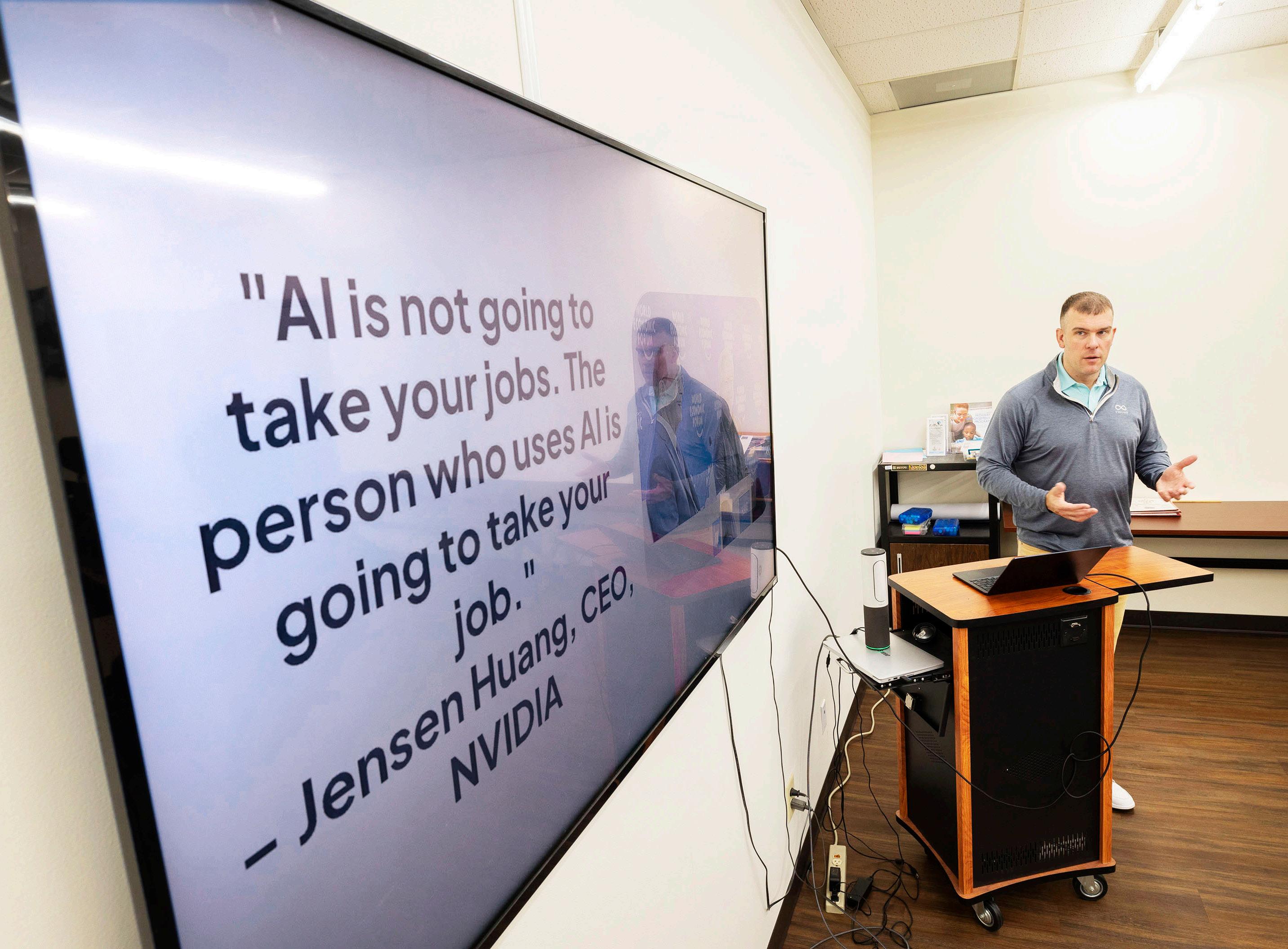
At workshops and presentations, rows of teachers often sit quietly, eyes fixed on glowing screens as he clicks through slides and reveals what he believes is the future of education in real time. Some lean forward. Others hesitate, thinking about what this means for their classrooms.
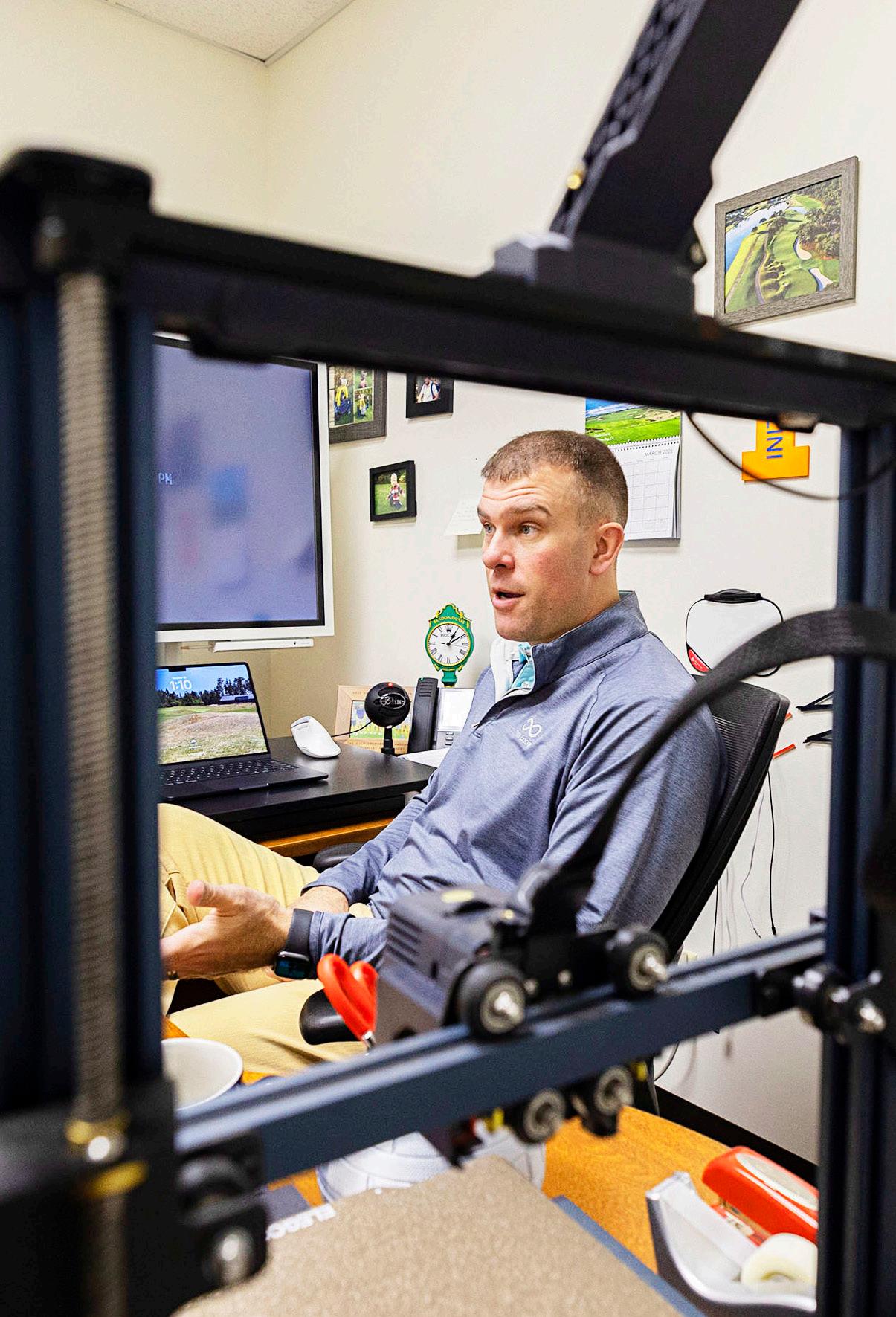
Sondgeroth keeps a tab on what’s new in technology, interprets it, and teaches it to educators throughout northwest Illinois as a lead regional educational technology coordinator for the Learning Technology Center of Illinois, an Illinois State Board of Education program. He is one of five in his position — each serving a specific region of the state — and is based out of the Lee-Ogle-Whiteside County Regional Office of Education in Sterling, where his father, Robert, once served as regional superintendent.
His job involves preparing and hosting workshops and presentations for educators who find themselves in a world of technology that’s evolving and adapting at almost breakneck speed, especially with artificial intelligence. Three to four days a week, he is on the road hosting workshops and roundtables, and the mileage stacks up fast as he moves between districts of different sizes to answer questions like: What’s changing? What matters?
How do we keep up? In a twomonth stretch from early January to early March alone, he logged 33 presentations and roughly 3,800 miles behind the wheel.
And wherever he goes, he makes it his mission to be in the lead.
“The rewarding part of this is that my job is to be at the forefront of how these schools work, of updates, and being able to take those updates and new technology and being able to explain it in a way that makes sense,” Sondgeroth said. “There’s always a new tool and a new update, especially in the age of AI where there’s something new every single day.”
AI cont’d to page 28
Sondgeroth also facilitates tech roundtables for each regional education office in his territory that bring together school technology leaders. In those open forums, they collaborate and compare notes on everything from artificial intelligence to internet infrastructure.
When he’s not teaching teachers and pulling a chair up at roundtables, he’s teaching the public about tech efficiency and how AI can make life easier — as long as people know how to use it. He’s addressed businesses, service clubs and community groups that are trying to understand what AI means to them.
For many, AI is already part of their daily lives, whether they’re using it to search for information, solve a problem or create a caricature. However, sometimes doing things the old-fashioned way is better.
“I use it every day, for all sorts of different stuff,” Sondgeroth said. “Sometimes I have to reflect on whether I should be using
it for this task. Sometimes the answer is to just do it yourself, and be better off looking that up on your own.”
Being immersed in new and evolving technologies began when Sondgeroth was a rookie teacher. Growing up in a family of educators in Rock Falls, he wasn’t what one might call a tech nerd: baseball and history were his passions, and he went to college at Sauk Valley Community College and the University of Indianapolis to become a teacher while calling pitches behind the plate for their baseball teams.
It was only when he became a high school history teacher and baseball coach at Morrison High School in 2010 that Sondgeroth became enthralled with how technology could enhance the educational experience. The district was one of the first in the area to work with one-to-one Chromebook devices, and it became more meaningful to him when he saw what it could do for his students.
“It’s been a real fun path,” he said. “I started as a high school history teacher, and through that, I was able to teach with technology. I wanted to be on the leading edge of how to implement technology in the district with iPads. I got the bug of wanting to share that with educators.”
Sondgeroth began rethinking how students engaged with the material, especially in subjects where storytelling sits at the core.
“When I was spending more time in the computer lab with my kids than in the classroom, I felt like this was how I could make them have fun learning in a different way,” he said. “Especially for a course like history. I’m not talking at them, I’m letting them tell the story. It just kind of sparked something in me that I kind of liked this, and liked the technology. It’s kind of the marriage of how to bring the new school in with history, and make it come to life.”
AI cont’d to page 29
He eventually became Morrison’s technology director, where the work expanded to implementation, policy and support. Eventually that momentum carried him out of the district entirely and onto a national stage working with EdTechTeacher, a professional learning provider that helps educators solve the challenges of a changing classroom environment where technology and teaching go hand in hand. For two years, he traveled across 16 states, worked in dozens of schools, and saw firsthand how different regions approached the same challenges.
The traveling didn’t last long before Sondgeroth started a family and decided to settle down in Dixon. His next job was closer to home: In 2018, he joined the Learning Technology Center of Illinois. These days, his travel is closer to home, within Boone, Bureau, Carroll, Henry, Jo Daviess, La Salle, Lee, McHenry, Marshall, Ogle, Rock Island, Stark, Stephen-
son, Whiteside and Winnebago counties. But even within that smaller footprint, there’s no shortage of variety. The region ranges from suburban communities to small towns.
“It was really cool, being on a lot of planes and seeing a lot of spots,” Sondgeroth said, “but then my son was born, and I didn’t want to get on a plane three days a week anymore.”
What he brought back from his EdTechTeacher experience was a clearer sense of how varied teaching styles could be, even when the mission of educating stayed consistent.
One of Sondgeroth’s biggest challenges over the years is handling how to help veteran teachers understand the value of new technologies. Rather than pushing change, he learned to frame technology as a way for them to enhance lessons, save time and better engage students, and that, he said,
gradually brought more experienced educators on board.
If the early years of his career were about new devices and access to them, the current moment is defined by dealing with AI. Artificial intelligence has moved quickly from a curiosity in the classroom to an expectation, and Sondgeroth is one of the people tasked with helping others make sense of it.
In each school district he visits, the questions are immediate and often uneasy: How should students use it? When is it helpful? When does it cross a line between usefulness and convenience? The answers, he said, are still evolving in real time.
“I have to tell people all of the time who ask me ‘Does it do this?’ and if it doesn’t, I just say, ‘Not yet,’ he said — but that doesn’t mean it won’t be able to. “I can’t definitively say it can never do that.”
AI cont’d to page 30
AI has come a long way in a short time, and it’s still evolving, now faster than before. But, Sondergoth stresses, like any tool it has to be used properly. “You can use AI if you’re brainstorming to write something, but you better write it. You can also use AI to help you get feedback on it. That’s good. But as long as that middle part is still you, that’s the important part.”
loved one.
Over the past few years, Sondgeroth has delivered well over a hundred presentations on AI, each one tailored to the audience he’s addressing. In each session, the focus isn’t just on what AI can do, but how to keep learning at the center of it.
“It’s been fun trying to open that door up a little bit,” Sondgeroth said. “I love my job with the LTC, and I also love helping people, and showing them how they can leverage technology to help themselves and make them more efficient. Especially people who are retired, they can’t believe what it’s capable of doing; a lot of them go, ‘I wish I had that when I working.’”
With efficiency, though, comes caution. Used without honest intention, the same tools that can enhance education can make it easier for students to fall into the trap of using it to do their work for them, and ultimately, end up not know-
Go to ltcillinois.org/person/bensondgeroth to learn about how Ben Sondgeroth works with regional educators on implementing the latest technologies for their classroom. Interested in having Sondgeroth present a professional development tech topic? Go to exploringedtech. com to learn about his presentations and for booking inquiries.
ing the subject matter. He encourages exploration without losing control of it.
“We keep the human in the middle,” Sondgeroth said. “You can use AI if you’re brainstorming to write something, but you better write it. You can also use AI to help you get feedback on it. That’s good. But as long as that middle part is still you, that’s the important part. Can they demonstrate the knowledge they gained?”
Outside of artificial intelligence, Sondgeroth’s curiosity continues to branch into other forms of technology, including 3D printing — he owns a number of printers and has led workshops on
them — and even drone operation, which he has also helped introduce to schools.
The tools are more complex and the pace is faster than ever, but Sondgeroth’s goal remains steady.
“I get to, as much as AI is dominating what I do right now, have the freedom to explore pretty much any topic I want in educational technology, and help schools implement it,” Sondgeroth said. “If it touches tech, I get to be part of the conversation, and still learn new things that are something that I never would have thought.” n
Shaw Media reporter Cody Cutter can be reached at 815-632-2532 or ccutter@shawmedia.com.
Great Food.. Great Value.. Great S er vic e!
the quiet hours between appointments, and when his day job finally gives way to the night, Ryan Jandrey studies faces the way others study maps, searching for structure, balance and truth. Each line carries weight, each shadow a decision that cannot be rushed or undone.
They’re works of art, which is what Jandrey enjoys creating in his spare time — and is also reaping awards from it.
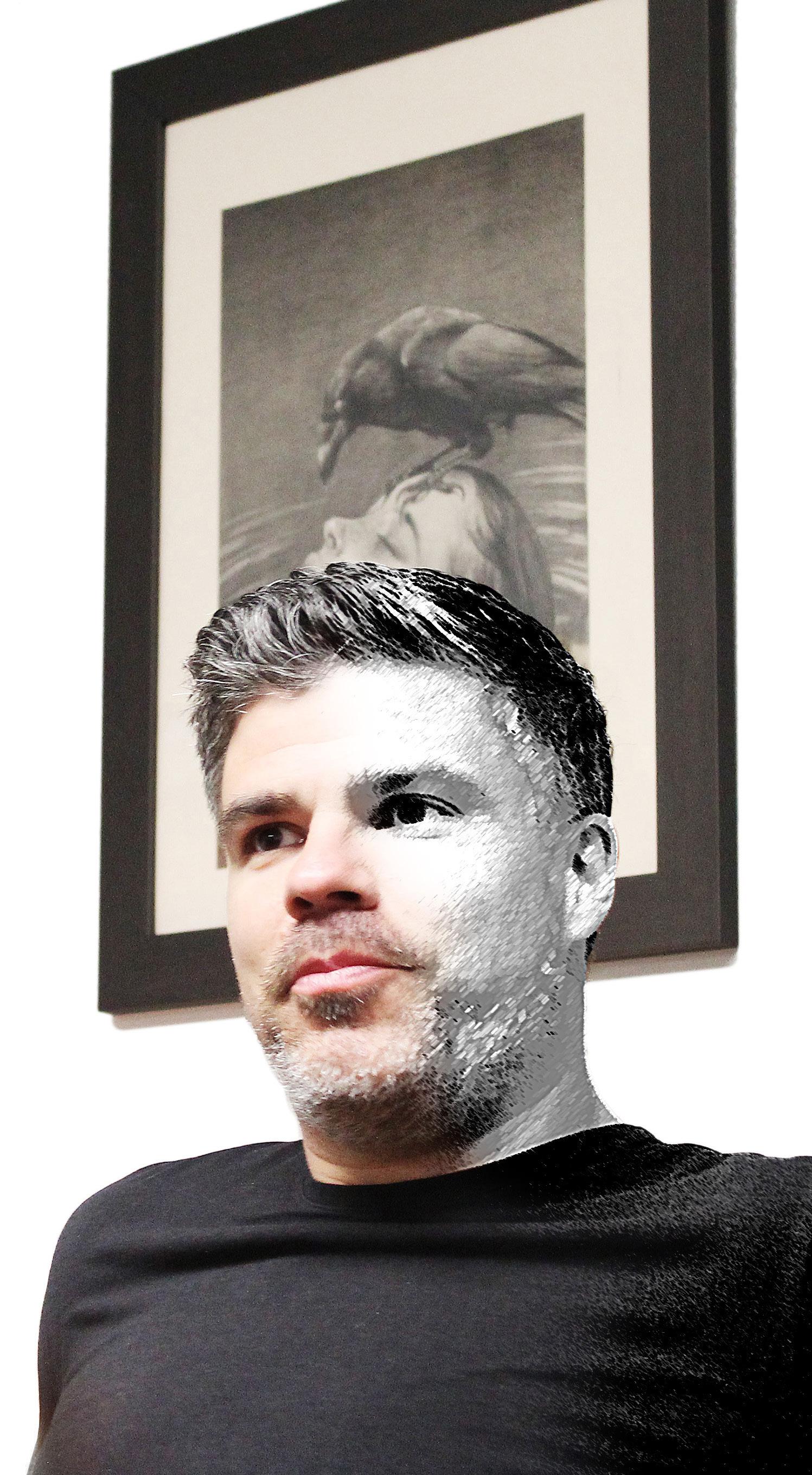
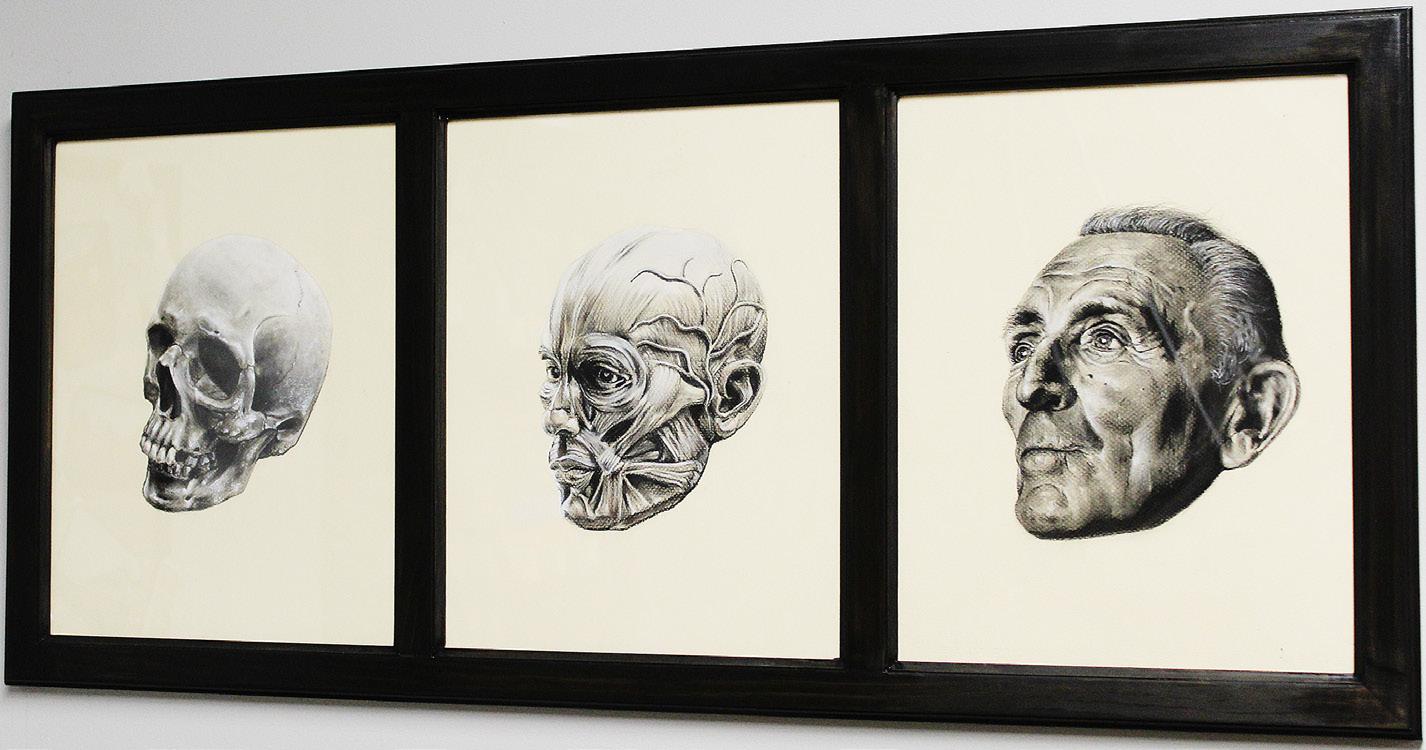
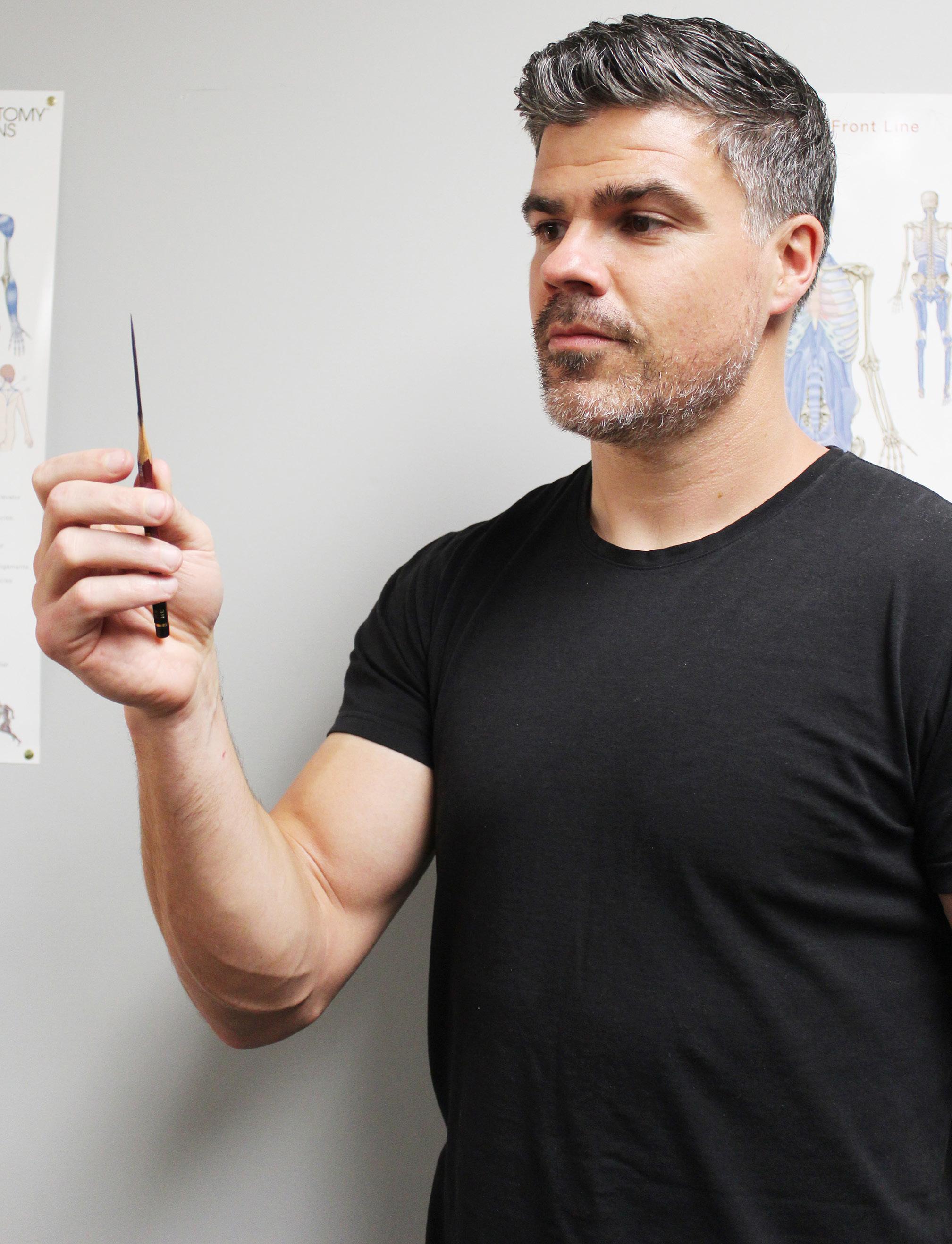
In a room where muscle charts hang beside framed portraits of his work, Jandrey’s two worlds meet. By day, he works with clients at Bodyworx at Westwood
Sports Complex in Sterling. By night, and sometimes in the margins between, he studies the human form again at his Dixon home studio, this time not as a trainer but as an artist, translating structure, symmetry and subtle expression onto paper with pencil, charcoal and graphite .
“I like the human form,” Jandrey said. “I like faces. I like symmetry in faces. I like the bone structure and the musculature. You wouldn’t notice them unless you spent a lot of time looking at something. It’s the way my mind works — looking into details and figuring out how I can put those details onto a page. I like the challenge.”
Like the rich and varied contours of the face, Jandrey’s life in art wasn’t a straight line. What began as a childhood fascination eventually faded, but then returned about a decade ago, when he got some coal for Christmas — not a lump in his stocking, but artist’s charcoal.
JANDREY cont’d to page 34
Pencil, graphite, charcoal — no matter the medium, art plays a large part in Ryan Jandrey’s life. “The weight of everything else in the world right now can just be melted away by just sitting down and picking up a pencil,” the Dixon
CODY CUTTER/CCUTTER@SHAWMEDIA.COM
artist said.
“I really enjoyed it,” Jandrey said. “I realized that I was somehow not that bad at it. Even after taking all of that time off, I was decent. So I picked it back up from there and got more seriously into it. It’s become part of what I do on a daily basis now.”
Constant repetition, online study and a self-imposed expectation to improve brought Jandrey’s focus to lean heavily toward portraiture, drawn to it by both its difficulty and its demand for precision. He has drawn occasional stilllife and landscape works, but prefers the portraits. Even painting has been on his mind, and he hasn’t dismissed the idea of venturing into that one day.
The largest work in his office is a 30-by-40-inch drawing of his girlfriend, Michele Kreczmer. It was completed in 2025 with graphite, charcoal and a touch of white chalk on hand-toned and stretched Stonehenge paper. With this, and his other portraitures, Jandrey takes plenty of reference pictures to guide him on his journey from what he sees in his mind to what he puts on paper.
He said it can be hard to capture the likeness of a subject in a piece and have someone look at it and recognize who it is immediately, especially if it’s someone they know.
“If they immediately recognize that it’s him or her, there’s a skill there, he said. “Not everything you draw has to look exactly like your reference photo, but getting the likeness is always a challenge that I like to meet.”
JANDREY
JANDREY cont’d to page 35
The challenge pulls him deeper into the details most people overlook, such as the quiet architec ture beneath a face. Even the materials themselves demand adaptation. Early on, Jandrey had to unlearn what he thought he knew about drawing, such as using a charcoal pencil like he would a typical graphite one. He then learned more about charcoal’s advantag es, moving it around the page, smudging and blending it to create smooth gradiations of tone, he said.
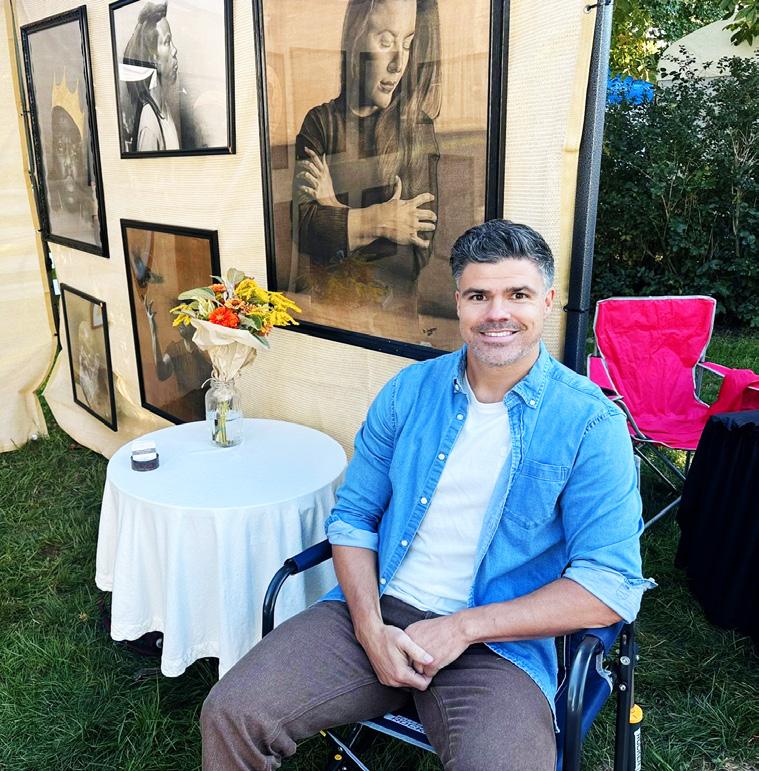
For the first couple of years, the work stayed mostly private. Then came a gradual shift of sharing pieces, accepting commissions and stepping into galleries. Jandrey first showed at The Next Picture Show in Dix on in 2021, and has taken his works throughout northern Illinois, including an exhibit in 2025 at NCI ArtWorks in Peru.
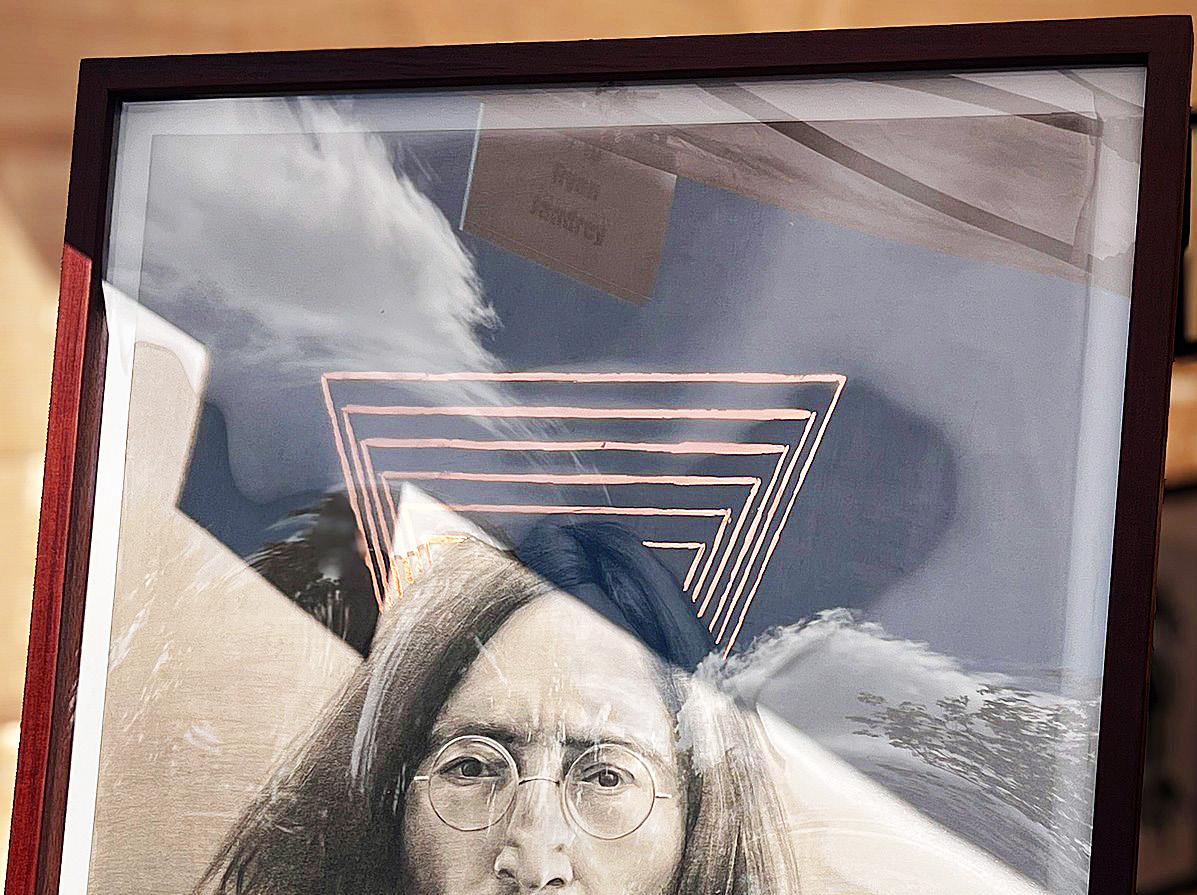
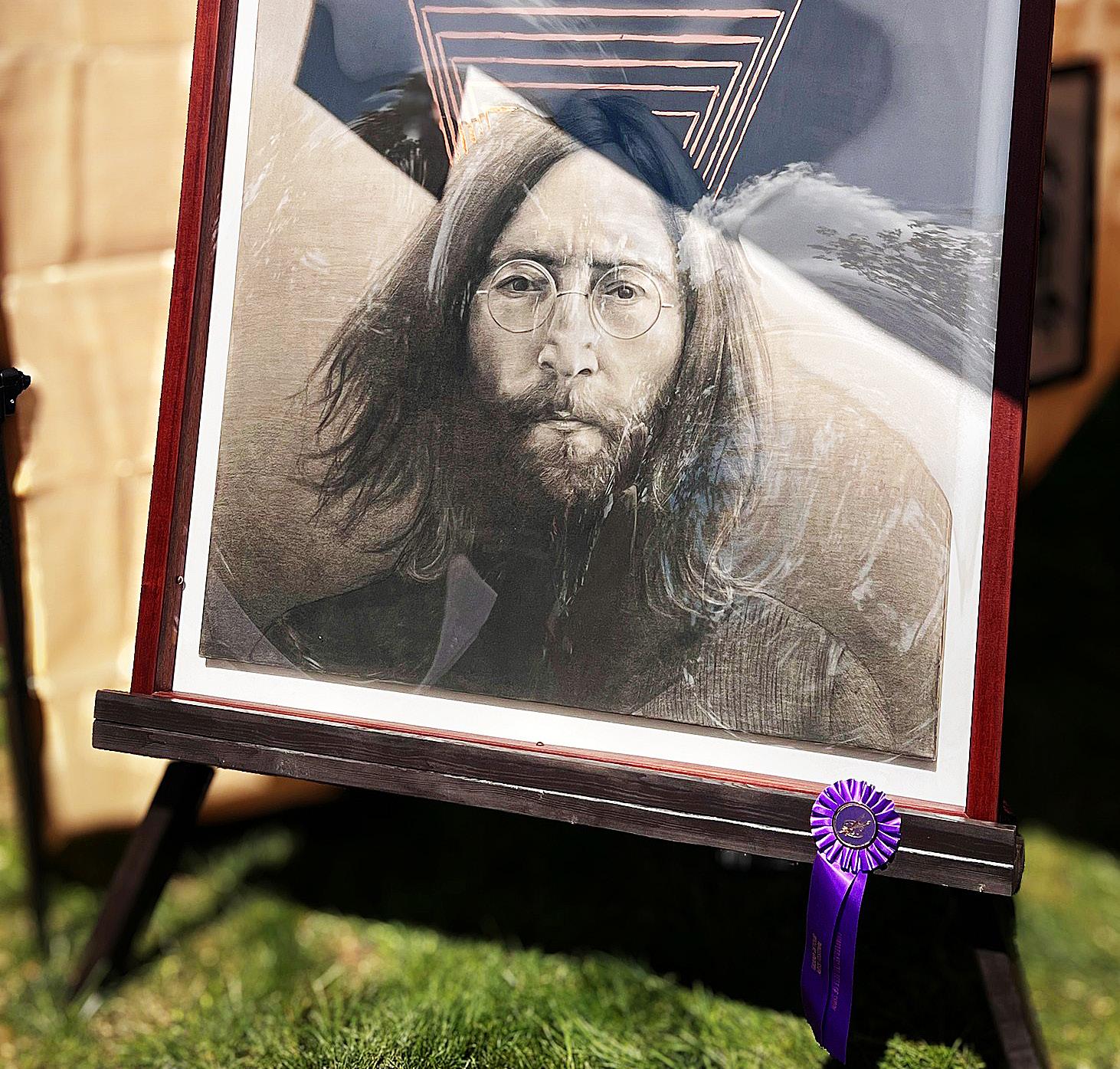
Shining a public light on his work brought him recognition — such was the case at the 76th Grand Detour Arts Festival in 2025. Along with some smaller pieces, Jandrey brought a piece that was as physically demanding as it was artistically ambitious: a large portrait of John Lennon, referencing a photograph of him from The Beatles’ “Abbey Road” period, built in layers across a stretched, toned surface.
The work, commissioned by Tipsy owner Linda Burkitt for her downtown bar, won Best of Show.
“It was a lot of layering of charcoal, carbon, graph ite, some white chalk and some charcoal powder just because it’s such a big space,” Jandrey said. “I took it to Grand Detour, and that was honestly the most nerve-wracking thing because it probably weighs about 80 pounds with the really nice frame. It was set up and a lot of people were stopping to look at it, and I thought that, yeah, it was resonating with people and they were digging it. And it got people to come to my booth and check out the rest of my stuff.”
JANDREY cont’d to page 37
Jandrey prefers portraiture, but says that it can be difficult to capture a someone’s likeness so that people immediately recognize the person — “there’s a skill there,” he said — but, he adds, it’s “a challenge that I like to meet.” At right: This drawing of his girlfriend, Michele Kreczmer, is a 30-by-40-inch work completed in 2025 with graphite, charcoal and a touch of white chalk on hand-toned and stretched Stonehenge paper. Facing page: His portrait of John Lennon earned him the Charles Kested Best of Show Award at the 2025 Grand Detour Arts Festival, an honor he wasn’t expecting when he set up at the show. “It was the best I could hope for,” he said.
The piece changed how he saw his own work in the public space. When the recognition came, it wasn’t something he had been building toward; it arrived almost incidentally after the goal had already been met.
“I wasn’t expecting that,” Jandrey said. “All I wanted to do with get a clean show and get that piece back to Tipsy in one piece, meet some people and network with people — that’s all I expected. And to maybe sell a few pieces, which I did. It was the best I could hope for.”
Added confidence followed, but so did a broader sense of possibility, not just in where the work could go, but in who might connect with it along the way. Despite the recognition, the work itself hasn’t become easier. If anything, tension remains part of the process, such as an almost predictable point in each larger piece where doubt creeps in. When that happens, he’s learned, it’s not a signal to stop, but to push on.
JANDREY cont’d to page 38
Hawk Raptor
Carribbean
“Almost every large scale drawing that I’ve done, and those I’ve put a lot of time into, there is a point where I start to not like it and literally rip off of the birchwood and just throw it in the trash,” Jandrey said. “You get over that because you learn to trust the process. You learn to put more hours into this, and eventually it’s going to look good. It’ll look good, and I’ll trust myself to get it there.”
Having trust in the process anchors everything else. It’s what allows him to sit down, tune out the noise of the day and focus on the slow build of tone, line and form. Those quieter stretches make the work become something more than just putting pencil to paper.
“I like the aspect of art that allows you to kind of tune everything else out,” Jandrey said. “The weight of everything else in the world right now can just be melted away by just sitting down and picking up a pencil, putting headphones on, turning on some music and getting to work. You have to make decisions and think with art, too, but you can shut the brain off and turn the feeling on, and just let it ride.”
When the work finally leaves Jandrey’s hands, whether it’s hung on a wall, placed in a client’s
home, or gazed at by a stranger, there’s a thought about what it might mean to someone else.
Want to see more of Jandrey’s artwork? Look him up on Instagram @jansauce85 and Facebook at Ryan Jandrey.
“If someone looks at my art and it evokes some kind of emotion, then it’s awesome,” Jandrey said. “That’s the goal. It’s also going to be different for everybody who looks at it, depending on their past experience and whatever they bring to the art.” n Shaw Media reporter Cody Cutter can be reached at 815-632-2532 or ccutter@shawmedia.com.