

![]()


By RENEE TOMELL
Shaw Local News Network correspondent
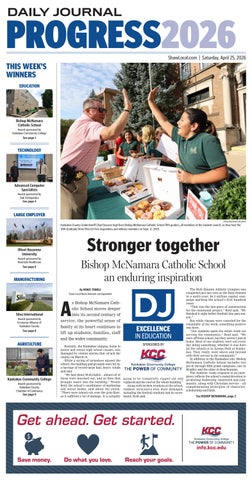
As Bishop McNamara Catholic School moves deeper into its second century of service, the powerful sense of family at its heart continues to lift up students, families, staff and the wider community.
Recently, the Kankakee campus, home to junior and senior high school classes, was damaged by violent storms that struck the county on March 10.
While a string of tornadoes missed the school, the building and grounds were hit by a barrage of record-large hail, heavy winds and rain.
“We had about 30 skylights – almost all of those were knocked out, and so then that brought water into the building,” Wendy Reid, the school’s coordinator of marketing and social media, said about the storm.
“There were (about) six over the gym floor, so it suffered a lot of damage. It is actually


going to be completely ripped out and replaced and the roof on the whole building.”
Along with broken windows at the school, outdoor structures also were damaged, including the football stadium and its scoreboard, Reid said.
The Rich Zinanni Athletic Complex was completed just last year as the final element in a multi-year, $4.5 million capital campaign marking the school’s first hundred years.
“That was the last piece of construction for the centennial project,” Reid said. “We finished it right before football this past season.”
But while classes were canceled for the remainder of the week, something positive was born.
“Our students spent the entire week out serving the community,” Reid said. “We were off from school, but they weren’t just at home. Most of our students were out every day doing something, whether it was here [at the school] or in Aroma Park or Kankakee. They really went above and beyond with their service to the community.”
In addition to the Kankakee site, Bishop McNamara Catholic School includes two pre-K through fifth grade campuses, one in Bradley and the other in Bourbonnais.
The students’ ready response in an emergency reflects the school’s stated devotion to promoting leadership, teamwork and community, along with Christian service – all complementing principles of character, scholarship and faith.
BISHOP MCNAMARA, page 2
Kaelyn Bess, president of Bishop McNamara Catholic School, and also principal for the Kankakee campus, has three children enrolled – Kade in eighth grade, Finegan in fifth and Austyn in second grade.
“The legacy that is Bishop McNamara Catholic School is inspiring to me,” Bess said in an email. “The century of commitment to faith, family and community defines being a part of the Fightin’ Irish legacy. The McNamara community is one that shows up for each other in good times and in bad.
“This year, we watched the bleachers fill up to cheer on our teams, we came together to raise money for the family of a staff member who we lost to cancer, and this month, when recovering from the storm, we showed up to help the school recover and help our neighbors recover,” she said.
The roots of the high school date back to its founding in Kankakee in 1922 as St. Patrick High School. The co-ed school moved to its current location in 1956 and became St. Patrick Central.
The school was renamed Bishop McNamara High School in the 1964-65 academic year, honoring the first bishop of the Joliet Diocese, following a major expansion in 1963. Bishop Martin McNamara had been instrumental in the school’s development.
In 2016, the Catholic elementary and secondary schools of Kankakee, Bourbonnais and Bradley consolidated to create one regionalized entity, referred to as Bishop McNamara Catholic School.
It now numbers 870 students in pre-K through 12th grade, and tallies about 27,500 hours of Christian service each year.
The future of the school is bright, Bess said, with a new strategic plan set to take effect this summer following goal planning by dozens of stakeholders.
“Our enrollment is increasing every year, especially in our elementary and junior high schools. This is a testament to the exceptional educators,” Bess said. “We predict that some of our classes will max out enrollment with registration this summer.”
High school students are able to enroll in the Kankakee Area Career Center, attend Kankakee Community College dual-credit courses during the day at Bishop McNamara that are taught by KCC-approved instructors, and take various pre-advanced placement and AP courses meant to prepare students for their future educational endeavors, Bess said.
Looking ahead, the Kankakee campus will come back refreshed this fall following restoration projects this summer, Bess said, adding that the sports program will see the addition of girls flag football.
Learn more at bishopmac.com.


Stroke

Speech therapy is often associated with pronunciation, but its scope is much broader. It supports communication, thinking skills, social interaction, voice issues, and swallowing— helping people of all ages function more safely and confidently in daily life.
Beyond Sounds and Words
Speech therapy for children goes beyond correcting speech sounds. Camille Joly, a speech-language pathologist at Riverside Healthcare, explains that therapy may begin with forming sounds like “S” or “R” or reducing stuttering. However, many children—especially those with conditions such as autism—benefit from support with social skills, language comprehension, and communication strategies.
Adult Speech Therapy: Improving Communication and Cognitive Skills
Speech therapy is equally important for adults. Speech-language pathologists work alongside physical therapists, occupational therapists, and neurologists to support individuals recovering from stroke, managing memory challenges, or living with conditions that affect movement and speech, such as Parkinson’s disease.
Treatment may include strategies to improve communication, support memory and thinking, build confidence when speaking, and alleviate safe swallowing difficulties, also known as dysphagia. These are common after a neurological illness. Speech therapy helps patients relearn safe eating and drinking techniques to prevent food or liquid from entering the airway.
Advanced Technology in Speech Therapy Riverside uses area-exclusive, advanced technology to evaluate and treat speech, voice, and swallowing disorders.
Video stroboscopy uses a strobe light and camera to capture detailed images of the vocal cords, allowing specialists to diagnose voice disorders and identify causes of symptoms such as hoarseness, breathiness, vocal fatigue, pain when speaking, and frequent throat clearing. VitalStim™ is a noninvasive therapy that uses electrical stimulation to treat swallowing disorders by helping muscles regain strength and coordination.
Therapy can also include the use of adaptive devices and technologies. “Can we figure out a voice for that person who needs to communicate in a different way?
For example, on an AAC device, which looks like an iPad or tablet, kids press different buttons and icons to help speak for them,” says Joly.
The Riverside Approach: Personalized, Collaborative Care
Joly encourages people to think differently about speech therapy.
“My title of ‘speech-language pathologist’ is kind of hard because people tend to think, ‘I speak fine,’ and then brush it aside,” she says.
“We work with each individual based on their needs and look far beyond the medical diagnosis. You can be surprised how much you learn and how much you’ll progress over the course of therapy.”
To learn more about Riverside Healthcare’s Speech Therapy services, call (815) 935-7496 or visit myrhc.net/speechtherapy
Riverside Speech Therapy
Outpatient Therapy - Kankakee 44 Meadowview Center Kankakee, IL 60901
Riverside Pediatric Therapy 100 Fitness Drive Bourbonnais, IL 60914 riversidehealthcare.org


By RENEE TOMELL
Shaw Local News Network correspondent
In the role of sentinel and strategic advisor for businesses and organizations reliant on information technology is Advanced Computer Specialists in Bradley, which celebrated its 20th anniversary last year.
The banner year was capped Dec. 10 at The Beverly Hilton in Beverly Hills, California, where the 2025 MSP Titans of the Industry Awards ceremony saw multiple finalist honors go to Advanced Computer Specialists for excellence in serving the government/public sector and the Midwest.
“To have a culmination of having some recognition for 20 years of hard work was pretty awesome,” President and CEO Jason Hamende said about his firm, a managed services provider, or MSP, that essentially is the outsourced IT department for its customers.
Clients, primarily small to midsize, range from local government and nonprofit organizations to auto dealers,-

contractors, accounting firms, law offices and health care.
ACS also serves as a contractor for some larger enterprises with their own internal IT departments.
“We provide strategic planning, budgeting, we provide

hardware, networking, cybersecurity, backup and communication solutions,” Hamende said, noting ACS is a Xerox dealer and offers a cloud-hosted business communications system.
“The 5G rollout in our area has been pretty awesome … immensely improved,” Hamende said of the surrounding rural region’s faster cellular network. He views artificial intelligence technology as a requisite in today’s business world, both inside ACS and for its clients.
“You have to use it, otherwise you’ll be left behind,” Hamende said, adding he agrees with industry leaders and experts who say, “AI is mankind’s single greatest invention,” putting it right up there with fire making and the wheel.
“We’re rapidly working on developing ways to incorporate [AI] into our internal business processes, but also leverage it to help our clients assist with their workloads and operations … helping businesses integrate AI into their existing workflows,” Hamende said.
His team offers training for clients’ staff. ACS also has planned a webinar with an industry leader on AI to help business owners and leaders develop their own custom 24/7 AI employee or avatar.
An example is creating an AI employee that works around the clock on marketing materials and emails, using a written communication style that mirrors the client’s brand image and voice.
Hamende said that through prompts, one can train an AI worker to understand its target market and acquire knowledge on a brand, region and industry to become an expert in the related field in an hour.
People still provide human oversight, but gain valuable
See ADVANCED COMPUTER SPECIALISTS, page 5
time for their higher-value activities. When it comes to IT, ACS embraces a proactive service delivery model rather than a reactive one, Hamende said.
The goal is prevention when it comes to potential problems – preventing fires rather than putting fires out.
“Just this last month, we helped a nonprofit get a better business phone system, faster, more reliable internet and save around $200 a month,” Hamende said. “We helped a car dealer in the last quarter take their internet phone bill from $2,000 a month to $800 a month. That’s part of that strategic planning and budgeting that comes in with our process. We’re not just fixing people’s problems, we’re helping their businesses do better, whether it’s cutting costs, mitigating risk, becoming more efficient, better performance, product evaluations. We call it our technology success process. … I coach other MSPs.”
About 98% of all IT fixes can be handled remotely, he said. ACS offers a 24/7 help desk ready to respond to any request, and is glad to provide such gentle prompts as a reminder to check whether there’s paper in the printer tray, as one example of what Hamende calls the human problems they field.
“Cybercrime is becoming easier and easier for less talented criminals … [it’s] at an all-time high,” Hamende said, noting AI and the internet are helping criminals misrepresent people, even using AI-generated speaking voice replicas.
“Phishing [is] getting more rampant, the scam calls. The best defense is a multilayered approach, like an onion. With cybersecurity, you have to have multiple layers,” he said. “So, if they peel back, there’s another layer. With that said, there are attacks that circumvent all the layers, and that’s the human element. They don’t have to hack you in order to perpetrate some kind of cybercrime. It’s manipulating people.”

A new client came to ACS after losing $3 million because a criminal monitored the company’s payment process by breaching one of its vendors. With perfect timing, the thief inserted what appeared to be a valid payment address change request in the vendor’s genuine email, which was the compromised account, Hamende said.
ACS trains clients’ staff in many ways not to be fooled.
“We do security awareness training, phishing simulations and things like that to teach people to prevent them from doing things that are still technically cybercrimes, but couldn’t have been prevented by other means,” Hamende said. With eight full-time employees plus part-time staff, the company serves clients in Kankakee, Iroquois and Will counties. Learn more at acsweb.biz.


By RENEE TOMELL
Shaw Local News Network correspondent
The community impact of Olivet Nazarene University is reflected in cultural, business and financial benefits throughout Kankakee County.
The university has called Bourbonnais home since 1940, with roots extending back to 1907.
It has 775 full- and part-time employees, not counting part-time adjunct instructors, said Susan Wolff, Olivet’s associate vice president for institutional advancement.
About 67% of the staff reside in Kankakee County.
A study last year by Paul Koch, professor of economics emeritus at Olivet, examined the economic impact of the university’s presence in the county. He analyzed such categories as business-to-business transactions, dubbed an indirect element, and the “induced” effects of household spending by employees and their suppliers.
“The total impact would be the sum of the direct, indirect and induced effects of university spending,” Koch said about the most recent information available. “For 2023,

that estimated amount would be (about) $125 million.”
He explained the study’s focus in the school’s magazine last summer.
“The key theme is value added,” Koch said. “We are looking for the local multiplier effect. For every dollar spent by those employed by Olivet, directly and indirectly, what is the resulting additional amount of economic activity, production of goods and services?”
Businesses and nonprofits in the community see another type of tangible benefit through Olivet’s internship programs across all its disciplines.
Students pursuing licensing or accreditation prove their competency in clinical settings, said Amber Residori, dean of Olivet’s College of Professional Studies, citing community partners that range from businesses, schools, hospitals and nursing homes to nonprofits.
Students preparing for teaching careers spend a semester at local schools, while nursing students might complete clinical rotations at the Veterans’ Home at Manteno. Riverside Healthcare provides a multitude of learning opportunities.
“We like to partner with companies like Riverside, because we want to keep good talent in our community,” Residori said.
Interior and architectural design students have partnered with organizations across the county, she said, citing Play Palz daycare, Tucci’s restaurant, Kankakee County Animal Control and a hotel.
Students collaborate with clients on ways to improve their space and work up artist renderings. While it’s hands-on experience for students to work with mock customers, clients gain ideas they could then build, Residori said.
“In the 2024-2025 academic year, just in the College of Professional Studies, our students did 119,207 hours involving 1,285 students,” Residori said. “Those partnerships are everywhere. The majority are within Kankakee County. … We look for ways to give them hands-on experience that also benefits our county.”
See OLIVET NAZARENE, page 7


• OLIVET NAZARENE
From page 6
The senior year for social work students entails macro-level social work.
“A few years ago, our students did a needs assessment to help Kankakee County pursue a $2.2 million grant to enhance mental health services for children,” Residori said. “Our students spent a semester researching, doing the needs assessment: what services already exist, what are duplications, what are gaps. And that report helped Kankakee County get the $2.2 million grant and birth Project SUN [Strong and Unified Network], which is
now a not-for-profit that exists in our county.”
Volunteer service to the community by students, faculty, staff and their families has been another local boon. The work ranges from park cleanup to interpretation services, small-business marketing assistance and mentoring youth.
Accounting students annually produce about 600 tax returns for members of the community who perhaps can’t afford the service or who need help, Residori said, calling it great experience for the students, who are overseen by Olivet’s accounting professors, who all are certified public accountants.
Olivet is home to about 3,200 undergrad,
graduate and early scholars from 45 states, three U.S. territories and 28 countries, representing dozens of religious denominations.
The 275-acre campus, replete with an accredited arboretum, welcomes the public. Calling Olivet a vibrant hub of creativity, expression and cultural enrichment, Wolff invites people to visit olivet.edu/ events for details on theater, concerts and visual arts.
“From family planetarium shows to weekly athletic competitions to organ recitals to incredible chapel speakers to plays and musicals, the list goes on,” Wolff said.
The university’s reach includes its
Shine.FM/89.7 radio station, broadcasting Christian music from Illinois into several neighboring states.
Affiliated with Church of the Nazarene, the university cites its mission: education with a Christian purpose.
“We tell our students we really feel like there is a calling on their life,” Residori said, noting they cultivate cultural and spiritual sensitivity. “We want them to use their gifts and talents to not just benefit themselves, but to really show God’s love and also to minister and to make things around them better – to improve your community, to be a good neighbor. You kind of see that at the heart of our Olivet grads.” Learn more at olivet.edu.


SPONSORED CONTENT
It’s happening. Kankakee County is moving forward and gaining speed. We are experiencing significant growth in business, industry, tourism, educational and training opportunities, and overall community development. It’s clear by the numbers:
• $4.3B in capital investment announced over five years
• 7,300+ businesses operating in Kankakee County
• 104% more manufacturing jobs than the national average
• $9.4B exported from Kankakee County over five years
• $130.7M generated by Kankakee Community College generates in annual economic impact
Capital Investment
Strategic transportation access: more than 40,000 cars a day pass through Kankakee County on I-57. With six interstate exits, freight rail service, and proximity to major regional airports, the area supports efficient movement of goods and talent.
Skilled and growing workforce: Employers benefit from a large, diverse labor pool with strong training pipelines and workforce readiness partnerships. More than 2.8 million people are available within a 45-minute drive of our community.
Competitive cost of doing business: Affordable operating costs, competitive utilities, and available sites help businesses maximize their investment.
Business friendly, partnership driven: Responsive local leadership helps companies navigate utilities, incentives, and resources. Local, state, and federal partners work to create a smooth path for growth.

Prediabetes captures 1 in 3 adults. But you can reverse it and prevent or delay type 2 diabetes. Take the 1-minute risk test today.


CSL announced the largest capital investment in recent years with a $1.5 billion expansion at their Kankakee County site. Occupying 150 acres at the county’s busiest intersection of Route 50 and Armour Road, CSL will add another building to its footprint. For 75 years the site has been a pharmaceutical manufacturer and CSL has continued to grow, investing more than $2 billion in buildings, utilities, employees, and equipment. While this shows stability in our region, it also shows that a global manufacturer believes Kankakee County is the right place to continue expansion.
“The residents and businesses of Kankakee County continue to demonstrate an innate ability to rise as the region’s beacon of opportunity,” said Angela Morrey, President and CEO of the Economic Alliance of Kankakee County. “We are moving forward with momentum, working to expand the opportunities to live, work, and do business in Kankakee County.”
The Economic Alliance of Kankakee County plays a crucial role in guiding this growth. As a public/private partnership, the Alliance works to retain industries in the region and attract new businesses to Kankakee County. By continuing to focus on business retention, recruitment, and strategic investment, the Alliance ensures that Kankakee County remains a thriving economic hub well into the future.

Be your own hero at DoIHavePrediabetes.org


For more information about the region’s economic growth or opportunities in Kankakee County, visit kankakeecountyed.org or call 815-935-1177.


From life-saving therapies to lazy rivers, the Village of Bradley’s announcement of a $90 million waterpark showcases additional investment into the tourism industry of Kankakee County. The Mattel Wonder Waterpark, set to break ground in early summer, will build on other nearby attractions like the 315 Sports Complex, the Kankakee River Walk, the Kankakee River State Park, the Bourbonnais Grove Campus, and the Manteno Legacy Park. These investments, along with investments by Silva International for a building expansion and additional equipment, Riverside Healthcare for their behavioral health services, and new restaurants and retail coming to Kankakee and the Villages of Bradley and Bourbonnais, the momentum in Kankakee County continues to gain speed.


By RENEE TOMELL Shaw Local News Network correspondent
You won’t see the company name on grocery shelves, but Silva International in Momence has cultivated a reputation for providing premium, all-natural, dried vegetables, herbs and select fruits to food industry manufacturers.
The Kankakee County company describes its reach: “Our good-for-you ingredients are used in a wide variety of applications, including seasoning blends, salad dressings and salad products, sauces, soups and stews, pasta products, hummus, rice products, chips and snacks, bakery items, cheese and dairy products, meats and sausages and ready meals.”
Its ingredients also turn up in pet food and in health and wellness products.
Silva’s Illinois roots go back to 1979, but it wasn’t until 1994 that it opened its first processing facility in Momence, now its headquarters.
The company has been on a growth trajectory at that site ever since. Employees number about 265 currently, said Mark Vanderzee, human resources manager.
“We’re actually in the process of adding more (production lines),” Vanderzee said. The company sources raw material from more than 25 countries around the world, he said. Silva provides custom blending capabilities tailored for clients, offering about 70 products ranging from apples, asparagus, green beans, beets, blueberries, broccoli and Brussels sprouts to cabbage, carrots, corn, mushrooms,


herbs and spices. Their preparation varies from flakes and dices to granules and powders.
Whether it’s creating a premix of vegetables, herbs or spices in specific ratios or producing ingredients at particular cut sizes for different applications, the business states its customized ingredient solutions give manufacturers flexibility.
The new Tech Center building, completed last year, includes a collaborative kitchen space for creating product concept ideas for customers. Silva processes foods and also procures dried items from carefully selected providers.
Its website states that as consumers demand more transparency in how food is sourced and made, assumed trust has given way to documented accountability.
Silva notes its traceable dried ingredients help manufacturers maintain clarity from farm to finished product.
One focus is on ensuring clean labels and preserving nutritional value. The company writes about 2026 food trends, noting that consumers expect more interesting taste experiences from everyday products.
With Silva’s processing of ingredients designed to maintain their aromatic qualities and flavor intensity, the firm offers an array of wares that allow manufacturers to create layered flavor profiles without artificial compounds.
The trend report notes that finished products that include multiple vegetables, herbs and whole food ingredients align with a preference for dietary diversity. For example, combining dried carrots, beets,
spinach and sweet potatoes in a single formulation creates products with diverse vitamin and mineral content alongside fiber, antioxidants and natural color.
And with a federal ban planned on numerous synthetic food dyes, Silva’s plantbased ingredients offer a clean alternative. It’s been five years since Universal Corp., an international agribusiness, announced its acquisition of the formerly privately held Silva International for $170 million in cash.
The Momence-based core team has been together for decades.
Last June, Silva International announced a major leadership transition, with longtime president Kent DeVries retiring after more than 30 years of service, succeeded by Jeff Weidenaar as president, with Darren Van Essen appointed vice president of sales. Learn more at silva-intl.com.


By STEPHANIE MARKHAM smarkham@shawmedia.com
Of all the places one could study agriculture, Kankakee County has to be among the best.
With farming deeply ingrained in the community, there’s no shortage of chances to learn about the subject.
Kankakee Community College takes full advantage of that fact.
KCC’s Agriculture and Horticulture program, formally called Agri-Hort Technology, centers on hands-on learning and realworld industry experience and connections.
For providing opportunities that fuel the culture and economy of agriculture in the county, KCC is recognized as an Innovator in Agriculture for the Daily Journal’s 2026 Progress Awards.
Katelynn Ohrt, assistant dean of business, technology and human services, has overseen the program for 12 years. She is a graduate of Herscher High School and the University of Illinois Urbana-Champaign, where she com -


pleted a master’s degree in agricultural leadership, education and communication.
In addition to her passion for education, agriculture
The Kankakee County Chamber of Commerce connects businesses, builds relationships, and strengthens our local economy. Learn how Chamber membership can help your business grow!


and horticulture, Ohrt said she enjoys helping others find their passion.
Ohrt and four adjunct professors teach a variety of courses within the program, which has about 40 students enrolled.
Degree options include an agriculture associate of science degree or an agri-hort technology associate of applied science degree.
Certificates include an agriculture advanced certificate, horticulture advanced certificate, or smaller certificates in the areas of agriculture, horticulture and local foods.
The program is “stackable,” meaning students can start off with a smaller certificate, then take more courses to obtain the advanced certificate and continue stacking courses toward an associate’s degree.
Some of the courses are soil science, plant science, animal science, engineering applications, integrated pest management, introduction to farm steading, fruit and vegetable production, introduction to horticulture science, greenhouse operations and plant propagation.
“It’s a diverse degree,” Ohrt said. “There are lots of different specialties within agriculture and horticulture.”
Students get their hands dirty tending to plants in a 2,500-square-foot greenhouse, which includes an aquaponics unit with goldfish and koi.
Students can also grow plants outside in a garden area and a high tunnel.
“In the class, we might talk about the proper use of tools, then we are able to go outside and do some pruning and practice safe use of those tools,” Ohrt said.
See AGRICULTURE, page 10


AGRICULTURE
From page 9
Guest speakers visit the classroom to share industry knowledge, and field trips are taken to local businesses.
“The local industry is very supportive of the program,” Ohrt said.
The special topics course is for students interested in entrepreneurship.
In the course, they conduct industry research, make a business plan and present it at the end of the semester.
Additionally, students can join KCC’s horticulture club, which meets monthly.
Within the associate of applied science degree, students are required to complete an internship of 160 hours or a special topics course. Internships have been completed at a grain elevator, plant nurseries, greenhouses and agricultural manufacturers.
The club has assisted Catholic Chari -
ties with its raised garden beds, the city of Kankakee’s 5th Avenue Community Garden, and the Kankakee Kultivators Garden Club.
“Our connection with the community is really strong,” Ohrt said.
The club is now preparing for the KCC commencement ceremony, as members grow the geraniums that line the front of the stage for graduation.
Ohrt has a lot of student success stories.
One student got his start in the horticulture pathway and went on to become successful in the cannabis industry. He now serves on the advisory committee for the Agriculture and Horticulture program. Other students have gone into agricultural sales, become part owner of a local greenhouse, work as local florists or gone on to a university to become agriculture teachers.
Learn more at kcc.edu.


