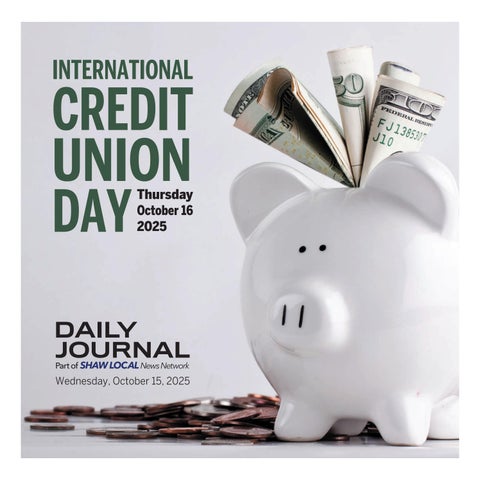
INTERNATIONAL
CREDIT UNION DAY Thursday October 16 2025
Wednesday, October 15, 2025
Daily Journal / shawlocal.com/daily-journal • Wednesday, October 15, 2025
CREDIT UNION
2
What parents can do to build financial security The daily life of a parent of a schoolaged child can be hectic. In addition to busy work schedules, parents with school-aged youngsters must contend with school schedules, extracurricular activity commitments, meal planning and preparation, and a host of additional obligations. The fast-paced nature of daily life can make it hard for parents to find time to focus on longterm goals, including financial security, which many moms and dads admit is a significant concern. A study from Ameriprise Financial released in April 2025 indicated that 60 percent of parents are concerned that balancing financial trade-offs will affect their long-term financial goals. That study surveyed more than 3,000 American parents, more than half of whom felt tradeoffs like expensive family vacations were invaluable but still compromising long-term financial goals like having enough money in retirement. Balancing short-term family needs and wants with long-term financial goals can be difficult, but parents can try various strategies to protect their financial futures. • Avoid taking on credit card debt. Debt
is a complicated topic. The vast majority of homeowners go into debt to buy their homes, and real estate is considered a sound investment, even if people must borrow and pay interest on loans to purchase a place to call their own. But not all debt is created equal, and some forms of debt are particularly detrimental to long-term financial security. A recent study from the credit reporting agency Experian found that the average American carried $6,730 in credit card debt in the third quarter of 2024. Consumer debt also is a problem in Canada, where TransUnion reported the average credit card debt in the fourth quarter of 2024 was $4,681. Credit cards typically charge high interest rates, which makes it easy for debts to snowball when card holders cannot pay their balances in full. When parents have substantial amounts of credit card debt, they’re more likely to miss out on wealth-building opportunities like investing for retirement. • Take advantage of opportunities to build wealth. Wealth in retirement is not an unattainable goal, but it’s one that will require sacrifices. Retirement investment vehicles like employer-spon-
ILLIANA FINANCIAL CREDIT UNION
0000 0000 0000 0123
GOLD 9.9% APR*
PLATINUM 8.75% APR*
CLASSIC 12.84% APR*
NO BALANCE TRANSFER FEE-NO ANNUAL FEE- NO CASH ADVAN DV CE FEE DVAN APPLY ONLINE TODA APPL DAYY WWW WWW.ILLIANA.ORG .ILLIANA.ORG OR CALL FOR MORE INFOO (708) 891-7800
1130 ARMOUR RD, BOURBONNAIS, IL 60914
RATES SO GOOD, IT’S SPOOKY! ALL THREE VISA CARDS ARE ACCEPTED AT AT MORE THAN 3 MILLION STORES, HOTELS, RESTA T URANTS, AND AIRLINES WORLDWIDE. EACH CARD FEATURE TA FEA S A 25DAY A GRACE PERIOD FOR PURCHASES, A MINIMUM P AY PA AYMENT OF 2% OR $15 (WHICHEVER IS GREATER AYMENT GREA ), NO ANNUAL FEE, AND A _FIXED ANNUAL PERCENTA CENT GE CENTA RATE. A ATE. * *APR = ANNUAL PERCENTA CENT GE RATE CENTA A ATE FOREIGN TRANSACTION FEE: 1.00% OF EACH CH MUL MULTIPLE CURRENCY CURRENCY IN U.S. DOLLARS, 0.80% OF EACH SINGLE CURRENCY CURRENC TRANSACTION IN U.S. DOLLARS LATE LA TE P PA AYMENT FEE: $30.00 VVVSTA AYMENT TATEMENT TA ATEMENT COPY Y FEE: $5.00 RUSH FEE: $55.00 EMERGENCY GENC CARD REPLACEMENT GENCY CEMENT FEE: $55.00
sored 401(k) programs and individual retirement accounts (IRAs) can help parents grow their money for retirement. Parents who need to catch up on retirement savings can save more by increasing 401(k) contributions by an additional percentage point each year. That won’t have a dramatic effect on take-home pay, but over time that additional investment can grow 401(k) balances by a significant amount. The same goes for IRAs, which can start out with smaller contributions and gradually increase to meet the maximum allowable amount each year. Parents can automate such contributions so they are not tempted to spend that money on more expensive vacations or other purchases that can threaten their
long-term financial security. • Make long-term financial security a top priority. It seems simple, but prioritizing long-term financial security is how many people make it to retirement without financial concerns. The temptation to spend lavishly on vacations, entertainment and luxury items can be significant, but such expenditures threaten parents’ long-term financial security. By prioritizing retirement savings, parents can secure their financial futures and still create lasting memories with their children. A significant percentage of parents are concerned about their long-term financial security, but there are ways to meet long-term goals and enjoy a comfortable retirement. FP25B293
3
Riverside Community Credit Union - Proudly serving the community since 1976 with two locations in Bourbonnais and Kankakee.
Elite Community Credit Union located at 515 S Main Street, Bourbonnais
2 Rivers Area Credit Union Bilingual Staff (L to R): Damaris Garcia, Chanel Rico, & Leticia Keasey. Not pictured: Oved Garcia.
2 Rivers Area Credit union staff (L to R): Nicole Christensen, Chanel Rico, Danita Swanson, Damaris Garcia, & Leticia Keasey. Not pictured: Oved Garcia & Aubreannah Labit.
2 Rivers Credit Union in Kankakee
SERVICE is our #1 Priority! Bilingual Services
Full-Service Credit Union
Auto Loans
Member’s Eligibility includes:
Signature Loans
Chartered in 1951 Serving over 4,000 members
Electronic Statements Mobile App
Credit Cards
NOW : offering
NOW : offering
Instant Issue Debit Card - no waiting
Direct Deposit Payday in advance: 1 to 2 days early deposit
Any persons living in or working in Kankakee, Will, & Iroquois Counties
Danita Swanson, Nicole Christensen, Damaris Garcia, Leticia Keasey, Oved Garcia, Chanel Rico, Aubreannah Labit 296 W. Jeffery St., Kankakee • (815) 935-2270 • Fax (815) 935-1310 • www.2riversacu.com SM-CL2277367
M-F 7:30 am-5:15 pm • Shapiro Center Paydays 7 am-5:15 pm
CREDIT UNION Daily Journal / shawlocal.com/daily-journal • Wednesday, October 15, 2025
Illiana Financial located at 1130 Armour Rd., Bourbonnais
Daily Journal / shawlocal.com/daily-journal • Wednesday, October 15, 2025
CREDIT UNION
4
A guide to mortgage interest rates Buying a home is the most expensive purchase many people make in their lifetime. Some people do it only once, while others are in the market with greater frequency. In any instance when the home buying process involves securing a mortgage, buyers can benefit from knowing a thing or two about mortage interest rates. A mortgage interest rate can help buyers determine if a given home is affordable or beyond their budget. Rocket Mortgage says mortgage interest rates can have a major impact on long-term costs, so it is imperative to seek the lowest rates possible. However, an assortment of economic variables affect mortgage interest rates, and conditions unique to each buyer also can affect the rate they’re eligible to obtain. Understanding home loan rates can help potential buyers better navigate the complex process of buying a home. WHAT IS MORTGAGE INTEREST? When a person buys a home with a mortgage, he or she doesn’t just pay back the amount borrowed, which is called the principal. The loan also re-
quires paying interest, which is essentially the cost of borrowing money. Mortgage interest is calculated as a percentage of the remaining principal, says Investopedia. HOW ARE MORTGAGE RATES SET? Mortgage rates are not determined by a single variable. They are derived from a combination of factors that includes the Federal Reserve’s monetary policy, economic conditions and a borrower’s personal financial situation. The Federal Reserve (in the United States) influences the overall rates by adjusting the federal funds rate, or the rate at which banks lend to each other overnight. This not only impacts mortgage rates, but also additional interest rates, according to Fannie Mae. Lenders will ultimately decide on the specific rates to offer borrowers. HOW DOES A BORROWER’S FINANCIAL SITUATION AFFECT MORTGAGE RATES? Lenders will conduct a thorough assessment of a potential borrower’s creditworthiness. They will look at, among other things, a borrower’s credit score and debt-to-income ratio.
A higher credit score typically results in a lower interest rate. A lower DTI indicates a lower risk to the lender, also potentially resulting in a lower interest rate. Squaring away finances well in advance of applying for a mortgage can help home buyers secure lower interest rates that could save them considerable sums of money over the life of their mortgages. HOW DO LOAN TYPES AFFECT MORTGAGE INTEREST? A home buyer will pay interest no matter the mortgage type, but there are options to select a fixed or adjustable interest rate, or even interest-only mortgages. According to Bankrate, with a fixedrate mortgage, the interest rate remains the same throughout the life of the loan, meaning the payment for principal and interest will remain consistent. Additional charges that are wrapped into mortgage payments could change, however. Property taxes and homeowners’ insurance charges could increase, for example. Fixed rates tend to be lower when the term of the mortgage is shorter. So borrowers can opt
for a 20-year mortgage over a 30-year to save some money on interest. An adjustable-rate mortgage (ARM) will see the interest rate change during the repayment period. It may start with a low introductory rate for the first several years of the loan, but then can go up or down depending on market indexes and benchmarks. Many lenders put a cap on how high the interest rate can go, however. Various factors determine mortgage interest rates for home buyers, including market conditions, credit standing, federal rates, the type of loan, and term length. TF256949
Furever Loyal Just Like Your Credit Union Since 1976
Kankakee • Bourbonnais • 815-933-1101 • www.riversidecu.com Riverside Community Credit Union is federally insured by the National Credit Union Administration.
The digital era has its benefits. People from all over are able to connect almost instantaneously. Computers have made fast work of many tasks that once took hours or days to complete. Information or even funds can be shared at the click of a button. But for all of the benefits technology has provided, there is a darker side to the connectivity of the modern world. What has become easier for the general public also has become easier from those looking to take advantage of others. Scams and internet crimes are now commonplace. The Federal Bureau of Investigation reported that a record $16.6 billion in losses due to scams were reported to them in 2024. The Pew Research Center indicates 73 percent of adults in the United States have experienced some kind of online scam or attack. The office of Ken Paxton, the Attorney General of Texas, reports various ways to recognize scams, and that spotting these tactics can help people avoid being taken advantage of. • Someone contacts you. When a party contacts you first, you can’t be
certain of their legitimacy. Also, email addresses and caller ID can be faked. • Easy money is offered. Many scammers dangle a promise of some sort of financial gain, whether it’s a prize or an easy loan. These are usually too good to be true. • Personal information is requested. Be on alert any time someone asks for personal information, whether it’s a bank account number or other identifying information. You could become a victim of identity theft. • A request for money up front. If someone requests money to pay off a debt or to receive a prize, it is likely a scammer trying to take your money. There are many types of scams, and the following are some prominent ones. • Counterfeit merchandise: A scammer can replicate the look of a legitimate retailer’s website. Purchasing items online through a link may lead you to a counterfeit site selling merchandise that is not legitimate and/or will not even arrive. • Charity and disaster fraud: Charity fraud scams typically emerge in the wake of a natural disaster or another
sudden, tragic event. Scammers may target generous individuals through email, social media posts, crowdfunding platforms, and cold calls. Never donate to charities you have not verified as legitimate. • Cryptocurrency investment fraud: Scammers convince victims to deposit more and more money into financial investments using cryptocurrency. These investments are fake and all the money is under control and stolen by overseas criminal actors, says the FBI. • Bogus debts: You may receive a message or threatening correspondence that demands payment on a debt that you haven’t heard of. These scams work because some people are scared and take the bait. Legitimate creditors will produce proof of an actual debt. • Home repair scams: Unsolicited companies may offer a “limited-time deal” and rope you into having a job done with “materials left over from another job.” Be very cautious in these scenarios, as they may take money and run. • Emergency scams: These are sometimes called Grandparent Scams because they often target the elderly. A
criminal may claim to be a friend or family member in dire need and request money. Some scammers sound like the person a senior knows thanks to technology that enables them to do so. Scams are a continuous problem and everyone needs to be on their guard. Safeguard your personal information and avoid paying out any money without first conducting thorough research. TF25A236
Serving Our Community Since 1957
Proudly serving anyone who lives or works in Kankakee or Iroquois Counties! At Elite Community Credit Union, we’re more than just a financial institution. Where you experience better rates, fewer fees, and friendly, local service. Our Products & Services: Savings & Checking Accounts | Visa® Credit & Prepaid Cards | Vehicle & Personal Loans Certificates of Deposit (CDs) Cash-n-Dash |
Coming Soon:
Mortgages & Home Equity Loans!
Join the credit union that’s been putting people first for nearly 70 years!
515 S. Main St. Bourbonnais, IL | 2525 S. Kensington Ave., Kankakee, IL | 815-933-7711 Visit us today or learn more at www.eliteccu.com
CREDIT UNION Daily Journal / shawlocal.com/daily-journal • Wednesday, October 15, 2025
Watch out for scams all around us
5
Daily Journal / shawlocal.com/daily-journal • Wednesday, October 15, 2025
CREDIT UNION
6
What you need to know about home equity loans (BPT) - If you have large or unexpected expenses on the horizon, you may have access to an untapped resource: your home. You could use some of the equity you’ve built up in your house to meet financial goals, depending on how much equity you have and how you use it. Here’s a guide from the experts at Navy Federal Credit Union to explain how home equity loans work and when you should - or shouldn’t - use your home’s equity. WHAT IS A HOME EQUITY LOAN? In basic terms, a home equity loan is money you’re borrowing using your home as collateral. The equity in your home equals how much of your home’s value you actually own (not counting the mortgage you’re still paying off). Home equity loans are frequently offered at lower interest rates than other loans, so they may be a great option for consolidating debt on higher interest credit cards, or large home improvement projects. You can determine how much equity you have in your home, and how much your home equity loan payments are likely to be, using online calculators. Here are the two most common types of home equity loans: Fixed-rate equity loan: This is a lump sum amount you’ll draw from your home’s equity, paying back monthly at a fixed interest rate for the life of the loan, so you’ll know exactly what to expect. Fixed-rate home equity loans are typically used for: • Home improvements/repairs • Debt consolidation • Large purchases • Life events
Home equity line of credit (HELOC): This is a line of credit secured by the home, which lets you borrow funds if and when needed, up to a set maximum credit limit. You only have to repay the funds you borrow. HELOCs are typically used for: • Home improvements • Emergency funds • Medical expenses • Debt consolidation The best use of a home equity loan or home equity line of credit is when the money you borrow increases your home’s value via renovations or repairs, as this continues building the equity you’re borrowing against. You may also have tax benefits for using the loan toward home improvements, so it’s recommended to consult a tax professional. WHEN NOT TO USE A HOME EQUITY LOAN OR HELOC Because these loans use your home as collateral, remember that you’ll want to be sure you can stay on track with loan repayments. For this reason, financial experts advise against using home equity to borrow for things including: A car purchase: An auto loan is usually a better choice for purchasing a new or used vehicle. Interest rates on auto loans tend to be similar or lower than home equity loans, and auto loans usually require little paperwork and fewer fees. Vacations: It’s better to save up for nearterm wants like vacations or large-screen TVs than using your home’s equity for something offering no financial return. College: Consider all options - including
federal student loans, scholarships, grants and private student loans - before tapping into home equity. A home equity loan may be a consideration if current mortgage rates are significantly lower than federal student loan rates, especially for graduate or professional degrees. But unlike federal student loans, if you use home equity to pay for college, you won’t qualify for income-driven repayment plans or loan forgiveness programs. Starting a business: Your best bet for launching a business is a business loan through a financial institution or the U.S. Small Business Administration (SBA). If your business fails and you have a home equity loan or HELOC you can’t repay, you’re putting your home on the line. Recurring expenses: Using home equity to cover everyday bills can be a slippery slope. Consider your long-term ability to repay the loan. Since your home is your collateral, missed payments could lead to foreclosure. MAKE A SMART PLAN Your home equity is a valuable resource for managing your finances. Planning ahead and understanding your repayment responsibilities is crucial for making the best use of a home equity loan or home equity line of credit. For more information and to explore your home equity options, visit NavyFederal. org/equity. Navy Federal is federally insured by NCUA. Equal Housing Lender.
Avoiding debt is a key to long-term financial stability. However, data from the Federal Reserve Bank of New York indicates households throughout the United States began 2024 with a record high of $17.3 trillion of debt. Debt also is a problem in Canada, where a recent survey from NerdWallet found that 55 percent of Canadians had credit card debt, which marked a 12 percent increase from the previous year. Perhaps even more telling is that 51 percent of survey respondents indicated they expect it will take them six months or more to pay off their credit card debt. Debt may seem unavoidable in a time marked by high inflation, when the cost of everything from groceries to entertainment has increased significantly. Thankfully, various strategies can help individuals avoid falling into debt. • Prioritize an emergency fund. Unforeseen expenses, whether it’s major auto repairs or unexpected medical bills, can quickly land con-
sumers in financial hot water. In fact, a recent survey from the Kaiser Family Foundation found that more than half of all adults in the United States report going into debt in the previous five years due to medical or dental bills. Roughly one in five respondents indicate they don’t ever anticipate paying off such debts. One way to avoid such a fate is to prioritize building an emergency fund that can be accessed whenever sizable, unforeseen expenses threaten to derail your finances. Resist any temptation to tap into an emergency fund during non-emergencies, and continue to grow the fund with routine contributions each month. • Utilize automatic transfers via your bank. Banks
enable account holders to set up automatic transfers, which make it easier than ever to save money and thus avoid debt. Consumers can examine their finances and determine how much from each paycheck they can automatically transfer into a savings or retirement account. Once that number is determined, set up the transfers so you are not tempted to spend the money come payday. • Build and maintain a good credit rating. A strong credit rating is advantageous for many reasons, not the least of which is the cost savings associated with such a reputation. When borrowing money for big-ticket items like homes and vehicles, individuals with high credit scores generally receive better lending terms, including lower interest rates. Over time, the
money saved by earning a lower interest rate on a mortgage can equal tens of thousands of dollars, and those cost savings can help consumers avoid utilizing credit cards to pay for unforeseen expenses like home repairs or medical bills. • Become a disciplined consumer. Online shopping has made it easier than ever to spend beyond one’s means. A new wardrobe and expensive concert tickets are only a few mouse clicks away, and that accessibility can tempt consumers to spend beyond their means and accrue a substantial amount of debt. By resolving to remain a disciplined, savings-first consumer, individuals can avoid the pitfalls of debt. Debt can have both short- and longterm consequences. A few simple strategies can decrease the chances individuals join the debt-riddled masses even during a time when cost of living is especially high. MM24C472
CREDIT UNION Daily Journal / shawlocal.com/daily-journal • Wednesday, October 15, 2025
Tips to avoid falling into debt
7
Daily Journal / shawlocal.com/daily-journal • Wednesday, October 15, 2025
CREDIT UNION
8
International Credit Union Day October 16, 2025 Credit unions are different. We’re not-for-profit, member-owned, and built on the idea of People Helping People. • Lower loan rates and higher savings return • Fewer fees and more personal service • A strong commitment to our community • Most Credit Unions memberships are open to those who live or work in the community Celebrate with us and discover the credit union difference!
Sponsored by the Kankakee Valley Chapter of Credit Unions: 2 Rivers Area Credit Union • CommonWealth Credit Union Elite Community Credit Union • Fieldstone Credit Union • Kankakee Federation of Teachers Maternity BVM Credit Union • Riverside Community Credit Union