Sharpen math skills (Metro)
No two students are the same. What makes for a challenging course for one student may be a breeze for another, and vice versa. Successful students learns to navigate the obstacles of their most challenging subjects, but no one makes that journey alone. Educators, tutors, parents, and even fellow students can make up a support network that plays a pivotal role in helping students understand challenging subjects. As effective as a strong support network is, students also should recognize that they are their own advocates as well. Such recognition can ensure students get the help they need with challenging subjects, including math. Math has garnered increased attention in academic settings throughout the twenty-first century, when grade schools, middle schools, high schools, and colleges have touted the importance of STEM (science, technology, engineering, and mathematics). A greater emphasis on mathematics is understandable, but students struggling in math may feel a little lost. While math can easily frustrate, these approaches can help students sharpen their skills in this important subject.
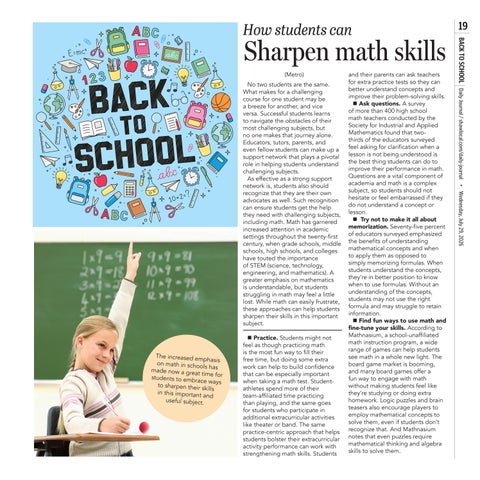
The increased em phasis on math in school s has made now a grea t time for students to embr ace ways to sharpen their skills in this important and useful subject.
n Practice. Students might not feel as though practicing math is the most fun way to fill their free time, but doing some extra work can help to build confidence that can be especially important when taking a math test. Studentathletes spend more of their team-affiliated time practicing than playing, and the same goes for students who participate in additional extracurricular activities like theater or band. The same practice-centric approach that helps students bolster their extracurricular activity performance can work with strengthening math skills. Students
and their parents can ask teachers for extra practice tests so they can better understand concepts and improve their problem-solving skills. n Ask questions. A survey of more than 400 high school math teachers conducted by the Society for Industrial and Applied Mathematics found that twothirds of the educators surveyed feel asking for clarification when a lesson is not being understood is the best thing students can do to improve their performance in math. Questions are a vital component of academia and math is a complex subject, so students should not hesitate or feel embarrassed if they do not understand a concept or lesson. n Try not to make it all about memorization. Seventy-five percent of educators surveyed emphasized the benefits of understanding mathematical concepts and when to apply them as opposed to simply memorizing formulas. When students understand the concepts, they’re in better position to know when to use formulas. Without an understanding of the concepts, students may not use the right formula and may struggle to retain information. n Find fun ways to use math and fine-tune your skills. According to Mathnasium, a school-unaffiliated math instruction program, a wide range of games can help students see math in a whole new light. The board game market is booming, and many board games offer a fun way to engage with math without making students feel like they’re studying or doing extra homework. Logic puzzles and brain teasers also encourage players to employ mathematical concepts to solve them, even if students don’t recognize that. And Mathnasium notes that even puzzles require mathematical thinking and algebra skills to solve them.
19 BACK TO SCHOOL Daily Journal / shawlocal.com/daily-journal • Wednesday, July 29, 2026
How students can