Visit IV Leader online: https://ivleader.com/
Volume 61 | Issue 6| February 26, 2026
In this issue: PAGE 2: Registration for fall and summer classes starts April 1. PAGE 5: Super Bowl halftime show protest not about faith. PAGE 6: Cast announced for spring musical. PAGE 8: Basketball teams finish seasons.
IV Leader photo/Casey Chapulis
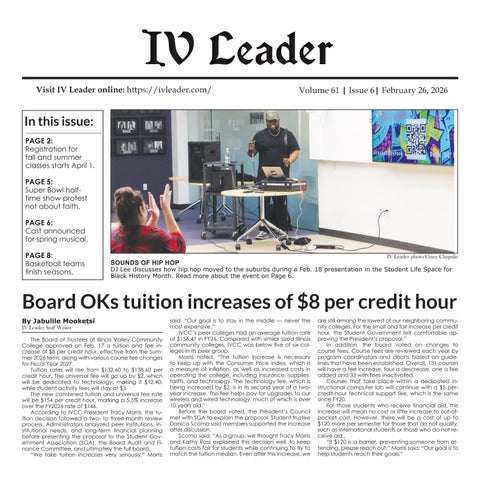
SOUNDS OF HIP HOP DJ Lee discusses how hip hop moved to the suburbs during a Feb. 18 presentation in the Student Life Space for Black History Month. Read more about the event on Page 6.
Board OKs tuition increases of $8 per credit hour By Jabulile Mooketsi IV Leader Staff Writer
The Board of Trustees of Illinois Valley Community College approved on Feb. 17 a tuition and fee increase of $8 per credit hour, effective from the Summer 2026 term, along with various course fee changes for Fiscal Year 2027. Tuition rates will rise from $132.60 to $138.60 per credit hour. The universal fee will go up by $2, which will be dedicated to technology, making it $12.40, while student activity fees will stay at $3. The new combined tuition and universal fee rate will be $154 per credit hour, marking a 5.5% increase over the FY2026 rate of $146. According to IVCC President Tracy Morris, the tuition decision followed a two- to three-month review process. Administrators analyzed peer institutions, institutional needs, and long-term financial planning before presenting the proposal to the Student Government Association (SGA), the Board Audit and Finance Committee, and ultimately the full board. “We take tuition increases very seriously,” Morris
said. “Our goal is to stay in the middle — never the most expensive.” IVCC’s peer colleges had an average tuition rate of $156.47 in FY26. Compared with similar sized Illinois community colleges, IVCC was below five of six colleges in its peer group. Morris noted, “The tuition increase is necessary to keep up with the Consumer Price Index, which is a measure of inflation, as well as increased costs in operating the college, including insurance, supplies, tariffs, and technology. The technology fee, which is being increased by $2, is in its second year of a twoyear increase. This fee helps pay for upgrades to our wireless and wired technology, much of which is over 10 years old.” Before the board voted, the President’s Council met with SGA to explain the proposal. Student trustee Danica Scoma said members supported the increase after discussion. Scoma said, “As a group, we thought Tracy Morris and Kathy Ross explained this decision well, to keep tuition costs fair for students while continuing to try to match the tuition median. Even after this increase, we
are still among the lowest of our neighboring community colleges. For the small and fair increase per credit hour, the Student Government felt comfortable approving the President’s proposal.” In addition, the board voted on changes to course fees. Course fees are reviewed each year by program coordinators and deans based on guidelines that have been established. Overall, 131 courses will have a fee increase, four a descrease, one a fee added and 33 with fees inactivated. Courses that take place within a dedicated instructional computer lab will continue with a $5 percredit-hour technical support fee, which is the same since FY20. For those students who receive financial aid, this increase will mean no cost or little increase to out-ofpocket cost. However, there will be a cost of up to $120 more per semester for those that do not qualify, such as international students or those who do not receive aid.. “If $120 is a barrier, preventing someone from attending, please reach out,” Morris said. “Our goal is to help students reach their goals.”