living
WINTER ISSUE 2014
A Special Supplement to
Harvey’s Chicken Inn This Iowa Rock and Roll Music Association Hall of Fame inductee is a dance hot spot with rich history. ■
By SARAH BROWN
CNA staff reporter sbrown@crestonnews.com
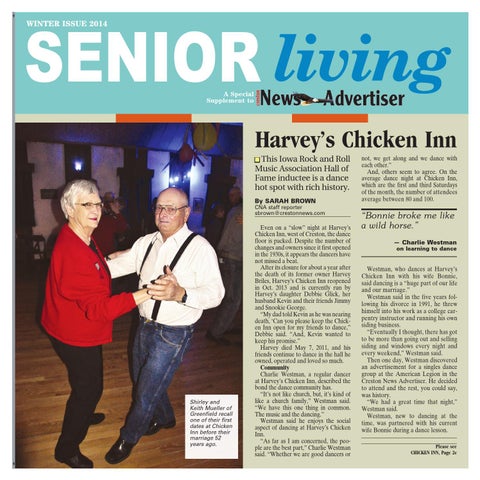
Shirley and Keith Mueller of Greenfield recall one of their first dates at Chicken Inn before their marriage 52 years ago.
Even on a “slow” night at Harvey’s Chicken Inn, west of Creston, the dance floor is packed. Despite the number of changes and owners since it first opened in the 1930s, it appears the dancers have not missed a beat. After its closure for about a year after the death of its former owner Harvey Briles, Harvey’s Chicken Inn reopened in Oct. 2013 and is currently run by Harvey’s daughter Debbie Glick, her husband Kevin and their friends Jimmy and Snookie George. “My dad told Kevin as he was nearing death, ‘Can you please keep the Chicken Inn open for my friends to dance,” Debbie said. “And, Kevin wanted to keep his promise.” Harvey died May 7, 2011, and his friends continue to dance in the hall he owned, operated and loved so much. Community Charlie Westman, a regular dancer at Harvey’s Chicken Inn, described the bond the dance community has. “It’s not like church, but, it’s kind of like a church family,” Westman said. “We have this one thing in common. The music and the dancing.” Westman said he enjoys the social aspect of dancing at Harvey’s Chicken Inn. “As far as I am concerned, the people are the best part,” Charlie Westman said. “Whether we are good dancers or
not, we get along and we dance with each other.” And, others seem to agree. On the average dance night at Chicken Inn, which are the first and third Saturdays of the month, the number of attendees average between 80 and 100.
“Bonnie broke me like a wild horse.” — Charlie Westman on learning to dance
Westman, who dances at Harvey’s Chicken Inn with his wife Bonnie, said dancing is a “huge part of our life and our marriage.” Westman said in the five years following his divorce in 1991, he threw himself into his work as a college carpentry instructor and running his own siding business. “Eventually I thought, there has got to be more than going out and selling siding and windows every night and every weekend,” Westman said. Then one day, Westman discovered an advertisement for a singles dance group at the American Legion in the Creston News Advertiser. He decided to attend and the rest, you could say, was history. “We had a great time that night,” Westman said. Westman, new to dancing at the time, was partnered with his current wife Bonnie during a dance lesson. Please see CHICKEN INN, Page 2c
Page 2c— Creston News Advertiser — Wednesday, December 31, 2014
CHICKEN INN: Continued from Page 1c
“Bonnie broke me like a wild horse,” Westman said. Together, Westman learned how to waltz, twostep, cha-cha and a couple of line dances. “I loved polka and waltz, which, is all beat music. One, two three ... one, two three,” Westman said. “The exercise is wonderful.” Westman said he continues to go because he loves the music and the people.
He hopes more “young” people will attend dances and Wednesday night jam sessions at Harvey’s Chicken Inn. “We would love to see it continue,” Westman said. Harold Walter, 93, of Prescott said he was 16 when he first attended Harvey’s Chicken Inn. “There is always a crowd,” Walter said. Walter recalls his early days at the Chicken Inn. “The louder the music
got, the louder the crowd got.” Walter said one thing that has remained constant about Harvey’s Chicken Inn is that it’s a good place for teens and adults. “They don’t serve alcohol,” Walter said. “It’s a safe place to go.” Walter said he started dancing at house parties and barn dances in Nodaway as a teenager. “There was one lady that taught me how to
dance ... Wilma O’Riley (of Nodaway),” Walter said. Walter said O’Riley taught him how to two-step. He later learned to polka after meeting a girl in Massachusetts. And, 77 years after first learning how to waltz, Walter still enjoys going to Harvey’s Chicken Inn. “I just love to dance,” Walter said. “I like it bePlease see CHICKEN INN, Page 3c
Calendar of events • New Year’s Eve, dance and jam session, 6 to 9 p.m. Dec. 31, $5 cover. • Coon Ridge Country, 6 to 9 p.m. Jan. 3, $6 cover.* •Jam session, 6 to 9 p.m. Jan. 7, $5 cover.** • Classic Country band, 6 to 9 p.m. Jan. 17, $6 cover.*** • Habitat for Humanity benefit dance featuring Coon Ridge Country band, 6 to 9 p.m. Feb. 14, $6 cover. • Kennison Family Band of Wahoo, Neb., 7 to 10 p.m. July 25, no cover charge. *Coon Ridge Country performs the first Saturday of the month. **Jam sessions are held 6 to 9 p.m. every Wednesday. *** Classic Country band performs the third Saturday of every month.
CNA photo by SARAH BROWN
Debbie Glick, co-owner of Harvey’s Chicken Inn and daughter of Harvey Briles, waltzes with Harold Walter of Prescott.
CNA photo by SARAH BROWN
Classic Country performs 6 to 9 p.m. the third Saturday of the month at Harvey’s Chicken Inn. Pictured, from left are, Norma Crawford (bass guitar), Kevin Creveling (guitar), John Griffiths (drums), Bill Livingston (guitar) and Harvey’s Chicken Inn co-owner Jim George.
PRINTED WITH
PARKINSON’S AND LIMITED MOBILITY CLASS
All events are open to the public. All ages are welcome.
“Friends You Can Depend On”
641-782-6555
HELPING YOU LIVE BETTER
Bruce Pearson, Funeral Director
www.pearsonfuneralhomes.com
This class is designed to help adults of all ages maintain an active lifestyle while focusing on cardiovascular conditioning, flexibility and balance. Class includes 60 minutes of group exercise under the leadership of a certified instructor. MONDAY, WEDNESDAY 9:00-10:00 AM YMCA Members: FREE! Participants $25
SOUTHERN PRAIRIE YMCA
1201 W Townline, Creston 641-782-9622 www.southernprairieymca.com
Mom loved stirring up “family favorites” and having the girls help! They will enjoy those treasured recipes as they grow up and remember the times spent together in the Grandma’s kitchen! “We love to help celebrate all of it.”
Powers
Funeral Homes Creston & Afton
641-782-7036 www.powersfh.com
Creston News Advertiser — Wednesday, December 31, 2014 — Page 3c
CHICKEN INN: Continued from Page 2c
cause it’s a real decent place to go and they are so friendly there.” Hall of Fame Harvey’s Chicken Inn was inducted to the Iowa Rock and Roll Music Association (IRRMA) Hall of Fame Sept. 2011. The history of the Chicken Inn, documented on the Iowa Rock and Roll website, is mostly told by Harvey. According to the IRRMA website, the founders of the Chicken Inn, Harold and Elsa Collings, who owned and operated a small restaurant in the 1930s on the edge of Creston. As the restaurant became popular they decided to relocate and expand. It was in 1936 when the Collings purchased a
vacant “roadhouse” called “The Maples,” which is where Harvey’s Chicken Inn is located today. With the prohibition-era over, the Collings renamed “The Maples” to “The Inn.” There, they opened the restaurant and bar and raised their own chickens for their specialty chicken dishes. As their new location grew in popularity, customers began referring to it as “The Chicken Inn.” Today, the “Inn” no longer serves its once famous Chicken Dinners, but, has been renamed “Harvey’s Chicken Inn” in memory of Harvey Briles. Whether you are a seasoned or beginner dancer, Harvey’s Chicken Inn is the place to be. And, in between dances, you’ll be sure to hear stories of yesteryear as you
experience a bit of Americana during the bi-monthly down-home dance parties. Harvey’s Chicken Inn Kevin Glick is the M.C. during open “jam sessions” 6 to 9 p.m. every Wednesday. Admission on jam night is $5. Coon Ridge Country, a country and western band based in Stuart, performs 6 to 9 p.m. the first Saturday of each month. Classic Country, made up of Jim George (guitar), Norma Crawford (bass guitar), Bill Livingston (guitar/drums), John Griffiths file photo (drums) and Kevin Crevel- The Chicken Inn Ballroom, four miles west of Creston on Highway 34, offers CNA weekly jam ing (guitar, fiddle), performs sessions and bi-monthly dances. The music venue was inducted into Iowa Rock and 6 to 9 p.m. the third Satur- Roll Music Association Hall of Fame on Sept. 4, 2011. day of the month. During the spring and The Creston News Advertiser offers high summer months, dance quality photo copies at competitive prices! nights are 7 to 10 p.m. Admission to dance nights is $6. 503 W. Adams Street • 8am - 5pm • Monday - Friday
COPIES COPIES COPIES COPIES COPIES
High Efficiency Laundry Center • Wash and dry a full load in just 60 minutes • Dry clothes more precisely, reducing wrinkles with DrySense™ Technology. • Cleaner, fresher laundry using advanced rinse technology that incorporates a Fresh Water Rinse.
FFLE2022MW
B
oyd Appliance Center Inc.
220 N. Pine • Uptown Creston, IA • (641) 782-2163
Selling Amana, KitchenAid, Maytag, Frigidaire, Electrolux, Speed Queen and Traeger Grills
Servicing most makes and models ~ Locally Owned and Operated Weekdays: 8:30-5:30 • Saturdays: 9:00-12:00
www.boydappliance.net
Page 4c— Creston News Advertiser — Wednesday, December 31, 2014
Wrinkle-busting skin care tips for boomer women (BPT) - Time brings plenty of changes, yet the desire to have healthy, good-looking skin transcends age. While some skin-care tactics - sunscreen and moisturizing - apply to skin of any age, baby boomers need to update their skin care and makeup strategies to ensure their skin stays healthy and youthful-looking as long as possible. “Fine lines, wrinkles and discoloration are only the most visible symptoms of aging skin,” says Anna De La Crus, a skincare expert for glo therapeutics. “Others are less obvious but every bit as damaging. Dehydration, loss of elasticity and slower cell regeneration also affect skin health, and how good you look at any age.” If you’re a baby boomer, it’s important to update your skin care and makeup regimen to keep your skin healthy and looking its best. Here are four skin care secrets every boomer woman should know: 1. It’s not the number of years, it’s how well you’ve cared for your skin during them. Age causes certain changes in the skin; cell turnover and renewal slows down, skin cells become less adept at retaining moisture, and skin becomes more sensitive. Taking care of your skin throughout your life - moisturizing, exfoliating and using sunblock - can help skin stay healthier and more youthful longer. “As we age, lifestyle habits start catching up to us, some of which have been decades in the making before we see the visible proof,” says De La Cruz. “While it can seem as if a wrinkle appears overnight, there is no fountain of youth or instant cure.” It’s also never too late to start taking better care of your skin, and it is possible to enhance skin health at any age.
For wrinkles and fine lines, look for products that contain firming ingredients that will help stimulate collagen production, antioxidants to help protect against free radical damage, and smoothing ingredients to encourage cell renewal. 2. Your clothing and hair style have changed in the past 20 years; your skin care products should, too. The moisturizer you used in your 20s may not be a good fit for your skin’s needs when you’re in your 50s. Baby boomers should look for skin care and makeup products
“Dehydration, loss of elasticity and slower cell regeneration also affect skin health, and how good you look at any age.” — Anna De La Crus
Skincare expert
specifically designed to address common concerns of aging skin, such as wrinkles, fine lines and hyperpigmentation. The leading edge in addressing the appearance of wrinkles and fine lines is phytostem technology. Plant stem cells and firming active ingredients in the Cyto-luxe collection by glo therapeutics work to lift and tighten skin, as well as promote healthy cells and collagen production to reduce the appearance of wrinkles. Two new formulas, Vitamin C , which contains 20 percent L-ascorbic acid, and Hydration , address the top two causes of aging: sun damage and moisture loss. To learn more about this luxury line of 10
products, visit www.gloprofessional.com. For boomer women concerned about hyperpigmentation, daily sunscreen should provide protection of 30 SPF or higher, and include ingredients that brighten and lighten skin, such as retinol and glycolic acid. 3. Update your diet to include the nutrients skin needs to age more gracefully. Good nutrition is important throughout life. Healthful nutrition is good for overall health, and it can help improve the skin’s appearance. Vitamins A, C and D are vital for skin health, and topical applications of A and C are also good for the skin. De La Cruz recommends boomer women stay on top of hydration by drinking lots of water. Incorporate plenty of fresh fruits and vegetables, too - especially those containing key vitamins. 4. Your look has matured and so should your makeup routine. The wrong makeup application can actually amplify the appearance of fine lines, wrinkles and pores. As skin matures, a “less is more” approach is often more flattering. “I advise women in their 50s and 60s to explore a clean, classic look,” says Janeena Billera, National Makeup Artist for glo minerals. “To achieve this, use natural foundations that illuminate and hydrate the skin. Choose neutral shades of matte to satin eye shadows, apply eyeliner tight to the lashline, maintain wellgroomed eyebrows and add a natural flush to the cheek.” Finally, Billera advises, growing older doesn’t mean you have to give up being trendy and fun. “Use current trends as an inspiration and simply tweak or tone down the look, always keeping placement and blending in mind.”
Rehab to Home NOW OPEN
Post Surgical Rehab Services • Professional outpatient therapy services • Outpatient and short-term inpatient therapy services • Beautiful private rooms
• • • •
New spacious therapy gym New private entrance New spa tub suite New nurses’ station
Creston Nursing & Rehab Center A Care Initiatives facility 1001 Cottonwood, Creston, IA 641-782-8511 www.careinitiatives.org
Creston News Advertiser — Wednesday, December 31, 2014 — Page 5c
Is vision loss inevitable with age? The answer may surprise you More than 2 million Americans age 50 and older suffer from age-related macular degeneration
of AMD. Finally, zinc helps deliver vitamin A from the liver to the retina in order to produce melanin, a protective pigment in the eyes. Get your fill of at least five servings of colorful fruits and vegetables, as well as nuts and legumes, per day to obtain these essential vitamins and minerals. Even when striving to follow an optimal diet, it’s difficult to get the recom-
■
(BPT) - Eighty-three percent of U.S. adults believe their eyesight will worsen as they age, no matter what preventive steps they take, according to a recent DSM Nutritional Products survey. While genetics and lifestyle factors do play a role for some serious eye conditions that cause vision loss such as age-related macular degeneration (AMD), years of proper nutrition may protect vision in the long term. More than 2 million Americans age 50 and older suffer from AMD, and it is especially prevalent among Caucasian women. “You don’t want to reach your 40s and realize that you’re beginning to have vision problems,” says Dr. Kimberly Reed, optometrist and Ocular Nutrition Society board member. “Following a few simple recommendations can help support your vision - and your family’s vision - now and in the future.” Reed offers these tips for maintaining eye health and supporting vision in the long term: 1. See your diet in color Many brightly colored fruits and vegetables contain lutein and zeaxanthin, two powerful antioxidants that research shows are beneficial in maintaining macular health. Intake of 12 mg per day of lutein and zeaxanthin offers the best protection, but only 10 percent of Americans are getting enough of these essential nutrients, according to the American Optometric Association. For
mended amounts of essential vitamins and nutrients from food alone, so nutritional supplements can play an important role in maintaining eye health. Several products specifically formulated to support eye health and vision are available, so ask your eye health professional at your next appointment. For more nutrition information, visit www.vitaminsinmotion.com.
Convenience — and your —
Prescriptions
weekly meal planning this year, choose colorful fruits and vegetables that provide these important antioxidants, like spinach, kale, and other dark leafy greens, as well as corn, peas, broccoli, and orange and red peppers. 2. Omega-3 fatty acids for eye health A study published in the American Journal of Clinical Nutrition showed that people with higher intakes of omega-3 fatty acids may experience a lower incidence of dry eye syndrome (DES). For patients who suffer regularly from dry eyes, omega-3 intake can significantly improve symptoms and increase quality tear production. Adults should get at least 1,500 mg per day of DHA and EPA either by consuming fatty fish, such as salmon, mackerel, and sardines, or taking high-quality fish oil and algae supplements. Be sure to check with your physician if you are taking medications that affect blood clotting before increasing your intake of omega-3s to this level. For women who are pregnant or
nursing, DHA is an essential nutrient to support infant visual development. 3. Remember your vitamins and minerals An array of vitamins and minerals also play an important role in maintaining eye health. For instance, A and B vitamins perform many
complex and critical functions throughout the body, including the eyes. And, according to a study published in Ophthalmology, vitamins C and E, which function as antioxidants, are also essential to eye health and have been shown to impact the progression of certain forms
When you are under the weather, don’t forget...we
Deliver FREE of charge! Or use our...
Drive-Thru Service Or we can even
your prescription!
“Always accurate, quality prescriptions... “Always accurate, quality prescriptions ...we’ll always make time for you!we’ll always make time for you! 405 S. Sumner Creston — 405 S. Sumner • — Creston
641-782-6558 641-782-6558
Jeff Longstaff, RPh • Wayne “Skip” Carlson, “Skip” RPh • Taryn Thompson, PharmD Jeff Longstaff, R. Ph. • Wayne Carlson, R. Ph. Mon-Fri 8am-5:30pm • Sat 8:30am-1pm
Page 6c— Creston News Advertiser — Wednesday, December 31, 2014
Understanding different types of financial advisors (BPT) - What’s in a name? When choosing a brand of paper towels or laundry detergent, one name may be as good as another. When it comes to selecting a financial advisor, however, consumers should know there are different types of advisors who are held to significantly different professional standards. Registered investment advisors (RIAs), for example, are regulated by the Securities and Exchange Commission (SEC) or individual states. They are held to a “fiduciary” standard of care, which means they have a legal duty to place the interests of their clients first. Brokers, or registered representatives, are regulated by the Financial Industry Regulatory Agency (FINRA) and are generally not considered investment advisors by federal regulators. They are held to a lower “suitability” standard, although FINRA views that as including a “best interest” of the client standard. While more than half of U.S. investors use a professional financial advisor (a catch-all phrase that some might see as including financial planners, accountants, brokers, RIAs and even insurance salespeople), four in 10 don’t know which standards govern their advisor, according to a 2013 survey conducted by TD Ameritrade Institutional. Yet it is a key distinction. “It’s not uncommon for investors to think a broker is the same as a registered investment advisor,” says Skip Schweiss, managing director of advisor advocacy and industry affairs for TD Ameritrade Institutional. “Even savvy investors may not know the difference. But different types of advisors deliver different types of services and are held to differ-
ent professional standards. Before you invest with any advisor, it’s important to understand what their credentials mean, and under what accountability standards they operate.” Fiduciary vs. suitability There are two basic standards for financial advisors: fiduciary and suitability. Of these two standards, Schweiss says, the fiduciary standard for RIAs is the higher one. Under the fiduciary standard, RIAs are bound by a 74-year-old federal act - and regulated by the SEC and state regulators. While both RIAs and brokers are required to act in their client’s best financial interests, RIAs are required to put their client’s interest first, even above their own or their company’s interests. Brokers (also known as registered representatives) operate under the suitability standard. They are required to have reasonable grounds for believing that securities recommendations are suitable based on information provided by the customer regarding other security holdings, financial and tax status, and investment objectives, and other information that would reasonably need to be considered. “Financial advice can
come from practically anywhere these days,” Schweiss says. “Some of it will be good, some will be spurious. When you’re investing your money, it’s important to do your homework and not only research the individual or firm who is helping to manage your money, but the laws and standards to which they are held accountable.” Schweiss also offers these tips for choosing an advisor: * Know who regulates the advisor you’re considering. The regulatory body he or she answers to can clarify what standards he or she operates under. * Ask how he or she is compensated. By companies
selling investment products? Fees paid by clients? Commissions? Compensation type may give you an idea of any potential conflicts of interest between what’s best for your money and what puts the most money in the advisor’s pocket. * Learn whether the advisor has been disciplined in the past for dishonesty or inappropriate behavior. You can find background information on financial advisors through the websites of the SEC, FINRA, National Association of Personal Financial Advisors, Certified Planning Board of Standards and the Financial Planning Association. Information may also be available through your state securities agency. * Ask how frequently your advisor’s firm conducts audits, and if your portfolio assets will be handled by a third-party custodian. A custodian will provide a monthly statement of your assets to both you and your advisor. “Information is an investor’s greatest asset,” Schweiss says. “While investing always carries an array of different risks, selecting the right advisor and knowing
Specializing in Person Centered Care Janet Wuebker, certified trainer for person centered care for residents with dementia. Training sponsored by the Alzheimer’s Assoc. All employees are being trained in the concept of person centered care.
Afton Care Center
Phone: 641-347-8416 • Fax: 641-347-5497 E-mail: aftoncarecenter@iowatelecom.net www.aftoncarecenter.com
how he or she operates can help ensure your investments are in alignment with your plans and risk tolerance. Investors can help themselves by choosing an advisor who works to help them pursue their own goals.” Provided by: TD Ameritrade Holding Corporation, brokerage services provid-
ed by TD Ameritrade, Inc. member FINRA/SIPC. About the survey: An online survey was conducted by True North Market Insights on behalf of TD Ameritrade. The survey was conducted among a representative sample of 1,000 general population consumers between May 14 and May 21, 2013.
Creston News Advertiser — Wednesday, December 31, 2014 — Page 7c
5 questions you should ask your pharmacist (BPT) — A visit to the pharmacy can be about more than just picking up prescriptions or supplies for the medicine cabinet. It can actually be an important, and convenient, time to ask your pharmacist key questions that could impact your health. Dr. Andria Fetterman, a faculty member in South University Savannah’s School of Pharmacy, encourages people to use their pharmacist as a resource for information about everything from prescription medication to lifestyle changes. Fetterman says there are five key questions you should frequently ask your pharmacist. What can I expect from this medication? Fetterman says whether you’re picking up an overthe-counter remedy or a prescription, you should feel free to ask your pharmacist what to expect from the medication. “Many medications have potential side effects that you should be aware of before you take them,” advises Fetterman. “It may be something as mild as a little stomach discomfort or drowsiness, but knowing what to expect will help you handle any potential side effects. Also, knowing what to expect could keep you from blaming any new, unrelated symptoms on your medication.” You should also ask how long it will take for your medication to make you feel better. Fetterman says most antibiotics should have you feeling better in three to five days, but an anti-depressant may need to be in your system for three weeks before you begin to feel its effects. If a prescription medicine doesn’t seem to be working in the proper time frame,
you should let your doctor know. Remember that sudden discontinuation of some medications, without proper professional advice, can be costly to your health. How long should I take an over the counter medication before I call my doctor? Over-the-counter medicines can provide relief for a number of ailments, but sometimes you need to see a doctor either for a prescription or a correct diagnosis of your symptoms. Fetterman says your pharmacist can help guide you when you’re not sure if it is time to see a doctor. “A pharmacist can give you advice on how quickly you should see symptom relief with an over-the-counter medication,” says Fetterman. “Many times, people will treat themselves too long with over-the-counter medicine or will switch from one product to another looking for relief, and many times don’t go to a physician when they need to.” How do I manage my condition? “When someone leaves the doctor’s office after a diagnosis, they may be scared or shell-shocked,” Fetterman explains. “There may be questions about medication or daily management that they didn’t think to ask. That’s where a pharmacist can help.” Fetterman uses Type 2 diabetes and high blood pressure as examples. “A pharmacist can counsel you about weight loss, healthy eating and ways to promote cardiovascular activity. With proper disease management, some patients can actually reduce or eliminate their need for prescription medication altogether.” Do these medicines mix? Fetterman says it is im-
“Many medications have potential side effects that you should be aware of before you take them.” — Dr. Andria Fetterman
portant to ask a pharmacist about whether any new medication will mix well with other things you are already taking. “Dietary supplements, herbal supplements and over-the-counter medicines can interact or interfere with prescription medications. When you are having a prescription filled, your pharmacist should ask you about all other medications that you’re taking. If you’re on prescription medication, check with the pharmacist before beginning any new over-the-counter supplements or medication to make sure it is safe.” What should I do about my persistent, minor symptoms? Fetterman says you should never hesitate to ask a pharmacist about a persistent, minor symptom that might be bothering you. “If you’re having a non-specific or persistent symptom that you think is minor, you should still ask your pharmacist about it,” says Fetterman. “A pharmacist can recommend an overthe-counter medicine that may relieve symptoms, but can also advise you to see a doctor about your symptom rather than ignoring it. “A pharmacist can be a great source of health information. All you have to do is ask.”
Making a Difference in Every Life We Touch ...and always striving for excellence in Care and Integrity.”
Nursing Home Services: QHC Winterset North* 411 E. Lane Street • Winterset 515-462-1571
Dementia/Alzheimer’s Secure Unit
*
QHC Winterset South 715 S. 2nd Avenue • Winterset 515-462-4040
• Semi-private and private rooms available • Offering respite care/adult day care and rehabilitation after surgery or illness
Contact: Terry Cooper, Administrator
Assisted Living & Memory Care QHC Madison Square • Private full service apartments 209 W. Jefferson • Winterset 515-462-5087
with affordable rates for everyone!
Contact: Tina Brayton, Manager
Page 8c— Creston News Advertiser — Wednesday, December 31, 2014
Helping people with diabetes keep their feet healthy (BPT) - A diabetes diagnosis can be daunting, but a simple attitude adjustment can make a world of difference in how well you fare while living with the disease. By proactively taking steps to monitor key health indicators, experts agree that it’s possible to prevent some of the most severe risks of diabetes, including lower limb amputation. People ages 20 and older who are living with diabetes account for about 60 percent of non-traumatic lower-limb amputations, according to the Centers for Disease Control and Prevention’s 2014 National Diabetes Statistics Report. “The CDC says the occurrence of diabetes-related foot and lower-leg amputation has decreased by 65 percent since 1996,” says American Podiatric Medical Association (APMA) President Dr. Frank Spinosa. “Working together, podiatrists and their patients
Whirlpool 4 Piece Stainless Steel Kicthen Package
with diabetes can reduce the number of amputations even more. People with diabetes may be less aware of cuts or wounds on their feets due to the nerve damage related to their disease, Spinosa points out. “Regular and vigilant foot care can help catch
$1499 save $400 MSRP $1799
Whirlpool Refrigerator (WRF535SMBM)
• FreshFlow Produce Preserver • Temperature-Controlled Full-Width Pantry
problems before they develop into a health crisis.” The APMA offers advice to help people with diabetes protect their foot health: * Inspect your feet daily, checking the entire foot and all 10 toes for cuts, bruises, sores or changes
$499
save $100
Whirlpool Dishwasher (WDF520PADM)
• AccuSense Soil Sensor • Triple Filtration System
MSRP $549
to the toenails, such as thickening or discoloration. Treat wounds immediately and see your podiatrist if a problem persists or infection is apparent. * Exercise by walking, which can help you maintain a healthy weight and improve circulation. Be sure to wear appropriate athletic shoes appropriate for the type of exercise you’re doing. * When you buy new shoes, have them properly measured and fitted. Foot size and shape can change over time, and ill-fitting shoes are a leading cause of foot pain and lesions. Certain types of shoes, socks and custom orthotics are available for people with diabetes, and they may be covered under Medicare. You can find a list of podiatrist-approved footwear and products for people with diabetes on the APMA website. * Keep your feet covered and
$399
save $70 MSRP $419
Cook Video & Appliance Financing Available with Qualified Credit
Whirlpool Over-theRange Microwave (WMH53520CS)
• CleanRelease Non-Stick Interior • Sensor & Steam Cooking
never go barefoot even at home. The risk of cuts and infection is too great. * See a podiatrist to remove calluses, corns or warts - don’t tackle them yourself and don’t ask a unlicensed non-professional to do it. Over-the-counter products can burn your skin and injure your foot. Podiatrists are specially trained to address all aspects of foot health for people with diabetes. * Get checkups twice a year. An exam by your podiatrist is the best way to ensure your feet stay healthy. “For people with diabetes, taking charge of your own foot health can help you avoid foot-related complications like amputation,” Spinosa says. “Work with today’s podiatrist to help you safeguard your foot health.” To learn more about foot care for people with diabetes or to find a podiatrist, visit www.apma.org.
$899
save $250 MSRP $949
Whirlpool Electric Range (WFE540H0AS)
• TimeSavor Plus True Convection Cooking System • AquaLift Self-Cleaning System
Hwy. 34 East • Creston
641-782-5112
Mon-Fri 8:30am - 5:30pm • Sat 8:30am - 2pm