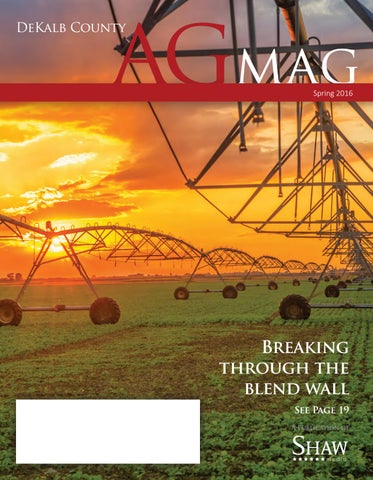
agmag
DeKalb County
Spring 2016
Breaking through the blend wall See Page 19 A Publication of
2 | DeKalb County AG Mag | Spring 2016
KISH HEALTH SYSTEM IS NOW PART OF
agmag
Spring 2016| DeKalb County AG Mag | 3
DeKalb County
Table of Contents
4
Kishwaukee College
8
2016 Yields
Conditions critical
Offers Agriculture Transfer, Diesel Programs
10 Some Thing Old, Some Thing New
Farm show brings farmers, suppliers from around the country to Northern Illinois University
12 Presidential Candidates
19 Breaking through the blend wall 22 First National Bank Supports Local FFA Chapters
Don’t Miss Out on the Fall Edition Deadline Date: October 14th Mail Date: November 2016
Where They Stand
agmag
DeKalb County
Published by Shaw Media Publisher: Karen Pletsch Project Manager: Lisa Angel Design & Layout: Allison LaPorta
Articles and advertisements are property of Shaw Media. No portion of DeKalb County Ag Mag may be produced without written consent of the publisher.
Cover credit - Cover Illustration by Shaw Media for DeKalb County AgMag
4 | DeKalb County AG Mag | Spring 2016
Kishwaukee College Offers Agriculture Transfer, Diesel Programs By AIMEE BARROWS For DeKalb County AgMag Photos taken by: Danielle Guerra • dguerra@ shawmedia.com
Agriculture education is more than teaching students how to be a farmer. In Kishwaukee College’s Agriculture Transfer program, students are exposed to the many opportunities an agriculture education can provide them.
Students can earn an Associate of Science degree with an emphasis in agriculture. Sara Pohl, dean of math, science and business at Kishwaukee College, taught many classes in the agriculture program before becoming an administrator. Pohl said that the classes at Kishwaukee College will transfer to agriculture programs at any of Illinois’ four-year public universities. She said that the career choices in the field of agriculture are “really wide open.” “Careers can be in all facets of agribusiness, sales or service,” Pohl said. “Students can go through our ag transfer program and then go onto a four-year program and become an agronomist. There are lots of science related careers. Or, people can become farmers. Illinois is a huge agriculture state and there are lots of ag-related occupations that need people who are trained in agriculture.” The Agriculture Transfer program is one of the oldest at Kishwaukee College. Pohl said one reason it’s been around so long is because this area is “known for all things agriculture.” Students enrolled in the program will take Intro to Crop Science, Intro to Soils and Fertilizer, Intro to Ag Mechanization, Intro to Animal Science and Intro to Ag Careers. “Students will learn about major Midwest agriculture crops, cultural practices in terms of raising crops and tillage practices, planting, seeding and pest control,” Pohl explained. “In the soils and fertilizer class, they learn about the chemical and physical properties of soils and the best practices in management.” In the Intro to Animal Science class, Pohl said students discuss different breeds of livestock animals and livestock judging, and learn what characteristics make one animal better than another in terms of products. She said most students are more interested in the application of knowledge, so the program focuses on applied practices. Some of the program’s instructors have jobs in farming operations, and Pohl said that in the past, a veterinarian has taught Intro to Animal Science.
Spring 2016| DeKalb County AG Mag | 5
Custom Configured Systems Designed To Keep You In The Field. SureFire Liquid Application systems seamlessly integrate with John Deere & other Rate Controllers. They are custom configured to meet your specific needs. Not only does SureFire allow growers to variable rate accurately, they offer In-Furrow & 2x2 Applications. Call us today for more information.
FFA Meter Program: Support your local FFA Chapter by having WPS run your meters. For every meter brought in, we will donate $5/meter to the FFA Chapter of your choice. *Promotion ends 3/31/16
Witmer Precision Services is proud to offer Yetter Farm Equipment's full line of products. Yetter offers the latest in production solutions. Call today for more info on the complete line.
"Providing High Performance Solutions the Entire Growing Season" 4098 W. Midtown Rd. Mt. Morris, IL 61054 815-734-6236 www.witmerprecision.com
6 | DeKalb County AG Mag | Spring 2016 Hintzsche’s students learn about a variety of things related to agriculture, including DNA in agriculture, animal systems, food science and sanitation problems. Recently, they’ve been learning about horticulture and planted a vegetable garden near the school that they are running like a business. “There are 321 ag programs at the secondary education level in Illinois and we’re fortunate that schools are now realizing what ag education is,” he said. “Schools are bringing back basic technical skills programs because they realize that not every student will go onto college. Ag education sets up students to develop real-life skills that helps them be successful after high school.” Pohl said there is a need for more agriculture education majors to teach at the high school level, in part because “there is a whole crop of us nearing retirement.” “There’s a big push in Illinois to open new ag programs at the secondary level,” she said. “People understand that career or occupational programs engage students, especially at the high school level. Ag is such an amazing field and there are many things people can do with that degree.”
“Our programs do a good job of preparing students and it’s easy for our students to find employment if they’re well-prepared,” she said. “But many jobs require a four-year degree so this is a good start. We recommend that students get a four-year degree because our program is designed for that. Or they need more specialized training that will make them more marketable.” The majority of students in the Agriculture Transfer program are “traditional” college-aged students around 18 to 20 years old, but Pohl said she’s had middle-aged students in her classes. She said some students come from a farming background, while others enroll in the program because they’re interested in learning more about the discipline. “A lot of students are interested in the environment and the outdoors but a lot of people don’t know how to translate that into a career, and agriculture is an option for those students,” she said. “People need to understand that an ag program can be a viable option. Students need to be aware of that. What sets Kish apart is we have small class sizes, and a lab or shop component, which is a critical piece.” One former student, Riley Hintzche, 25, has nothing but positive things to say about his time in Kishwaukee’s Agriculture Transfer program. He graduated with his Associate’s degree in 2011, and transferred to Western Illinois University where he earned his Bachelor’s degree. Hintzsche is now an agricultural educator at Streator Township High School in Streator. “I loved my time at Kish and I can’t say enough about the instructors,” he said. “They challenged me and they took time out of their day to make sure students understood the material. I had some very inspirational and motivating instructors. The program definitely prepared me for the fouryear program.” Hintzsche said the status of agriculture education is often misunderstood, and that it’s not just “tractors and planters or cows, sows and plows” anymore. He explained that agriculture education relates to just about everything in daily life. “There are so many different aspects to ag education, from food science, to environmental science to plant science and physical science,” he said. “Ag education is a hands-on education that ties into every other class students take in high school. My students have to write press releases, they have to talk to community members and they have to solve math problems.”
Pohl believes it’s important that young people have some type of agricultural education because many people don’t know much about modern agriculture, and should know what goes into food production. “There’s a whole generation of kids who don’t know where their food comes from, and to me, that’s problematic,” she said. “How do you make good choices about what you eat if you don’t know where food comes from or have a sense of what it took to produce the food?” One program is working to educate elementary school students about agriculture. “Ag in the Classroom” offers presentations for DeKalb County elementary students in first- through fourth-grades. Rhodora Collins, agriculture literacy coordinator at the DeKalb County Farm Bureau, said each grade receives a different lesson. Students learn everything from planting soybeans and corn to dairy farming to mapping Illinois agriculture. Like Pohl, Collins believes that people have a responsibility to know more about where their food comes from. “So few of us have a direct connection to the farm anymore, unlike two or three generations ago, and the disconnect is growing larger,” she said. “A lot of kids want to know and understand. I hope we can inspire students to think of agriculture as a career and to make them aware of the many opportunities in the agriculture industry because it goes well beyond farming.” The Diesel Power Technology program at Kishwaukee College offers students another option to consider in the agriculture industry. It is very popular at the college because it’s the only diesel program offered at a public institution in Northern Illinois. Students in the two-year program learn how to diagnose
Spring 2016| DeKalb County AG Mag | 7
Increasing yields isn’t the only way to increase profits
and fix the diesel engines in heavy vehicles and equipment, including farm machinery. John Boesche, a diesel instructor, said about 50 percent of his students have an agriculture background and want to stay in the ag industry. “There is good job demand in the diesel industry and it’s becoming incredibly technical because engines are computer-monitored,” he said. Students might also be interested in Kishwaukee’s horticulture program. Pohl said there’s a push for more local and sustainable foods, and students can learn how to grow and produce vegetables. “The horticulture program relates to agriculture and is a part of ag programming. We don’t focus on food production, but students learn how to grow,” she said. “There’s a lot of interest in getting closer to how food is produced and people can make a connection back to the land. That’s a huge thing.”
NEW OFFICE,
Agricultural Loans
Trust Services
Farm Management
hbtAgServices.com Lisa Anderson, 815-498-2396 Derek Fetzer, 815-875-4444 Agricultural Services
SAME ADDRESS, SAME COMPANY!
After 137 years of mutual insurance service to the area, Peru Waltham Mutual has built a new office building to better service their policyholders. Please stop by and see the new office, at the same great location‚ 1724 Peoria Street, Peru. We continually strive to serve our policyholders, by providing great coverage at a great price. We are excited to share our continued efforts with our policyholders and the community. Please call one of our great agents for a quote. Visit us in the office, online at www.perumutual. com, or “like” our Facebook page! We look forward to serving the area for years to come!
PERU WALTHAM SERVING YOUR HOME & FARM INSURANCE NEEDS SINCE 1878 Frank McConville McConville Insurance Agency Mendota & Tonica, IL 815-539-9714 815-442-3116
Call an agent today!
Bart Hartauer Hartauer Insurance Agency LaSalle, IL 815-223-1795
Ryan Harvey Gonet Insurance Agency Peru, IL 815-223-1782
Mike Gonet Gonet Insurance Agency Granville, IL 815-339-2411
Pete Mangold Princeton Insurance Group Princeton, IL 815-875-4464
Richard Bend & Beth White Bend Insurance Agency Waterman, IL 815-739-6687
Alan Peters & Timothy Peters Alan Peters Insurance Agency LaSalle, IL 815-224-3497
Visit us online at www.perumutual.com
8 | DeKalb County AG Mag | Spring 2016
2016
Y i e l d s Conditions critical BY CHRISTOPHER HEIMERMAN and AMY BARROWS For DeKalb County Ag Mag
Sycamore farmer Paul Rasmussen throws brush on a burn pile as he cleans along the water run off on his property that leads to Coon Creek to prepare for this spring’s planting. Rasmussen had new pipes put in to drain his field after the last harvest. Photos taken by: Danielle Guerra • dguerra@ shawmedia.com
Weather and prices challenge farmers to make 2016 a break-even year Farming veterans have been here, seen this before. El Niño drenched farmlands at the tail end of 2015. Commodity prices are in the cellar. But what about the young farmer who hasn’t yet lived through a 1987, 1998 or a 2001?
Photo above: Farmer Paul Taylor holds a chunk of soil with his Esmond farm in the background. Taylor practices conservation tillage and planted cereal rye over the left-over corn from the fall harvest. This ground cover once the soybeans are planted will allow the soil to hold moisture longer and stay cool which is important since this summer is predicted to be warmer because of El Nino. Photo below: Farmer Paul Taylor (left) and farmhand Rodney “Rooster” Engelkes look at the condition of the field cultivator on Taylor’s Esmond farm.
“Those years really teach you that you’d better be paying attention to what’s going on, because they turn, they turn quickly, and they get ugly in a hurry,” said Jim Schielein, a 51-year-old former State Farm Board member who’s been in business for himself since 1990, before he worked “forever” for his dad. “Cash is king. In this type of situation, cash is always king, and you’ve got to keep your leverage ratio as low as possible.” In 2015, the DeKalb county average for corn was 182.9 bushels per acre, which is on par with the county’s five-year average of 183 bushels an acre. There were 222,500 acres of corn grown in DeKalb County in 2015. The soybean yield in 2015 was slightly higher than average, with 61.2 bushels per acre compared with the county’s five year average of 58 bushels per acre. There were 113,500 acres of soybeans grown in 2015.
Weather hurt yields without price boost In the final two months of 2015, U.S. farmland took on more rain than it had in 120 years, a sign that corn and soybean yields will shrink. DeKalb County was drenched last spring and early summer, causing some drainage problems for area farmers, including Genoa-based farmer Paul Rasmussen. He said just about every area farmer faced issues because of the excessive rain, which was partially why his corn yield was down last year.
Spring 2016| DeKalb County AG Mag | 9
“The weather has greater impact on corn than it does soybeans,” he said. “But there’s no way to solve the problem when there’s that much rain. You can put in more tiles, but in an extreme situation like that, you’re still going to have problems.” Leland farmer Roy Plote said he had close to 30 inches of rain in some of his fields during last year’s growing season, which he said destroyed some of his corn and “didn’t allow it to do what it’s supposed to do.” “Even if there are tiles in the field, with so much water coming at one time, it can only take a maximum capacity when the drainage canals are full,” he explained. “You can’t force it. There is only so much you can do. It comes down to how much rain you get at one time.” All of the rain led to a lower corn yield in 2015, yet prices of corn still remain low. In the past 15 months, farmers had only two bona fide opportunities to seize market rallies: around Christmas 2014 and late June 2015, said Scott Stoller, a grain merchandiser with the Dixon-based, family-owned grain consulting firm AgPerspective. “Unfortunately, from the low to the high to the low again in the marketplace was 5 weeks,” he said. “Did growers take advantage of that? How worried were they about their own yields? If they were originally thinking 180 or 190 bushels, when the crops were damaged, did they pare their yield back to 140 at that point?”
Prices plunged after 2012 drought The financial climate hasn’t been much kinder to farmers than the actual climate lately. Corn prices in 2012 hit record highs of around $10 per bushel. That was after a drought. In mid-September of last year, that price had plunged to around $3.60. The prospects for price hikes in 2016 are slim. In mid-January, corn futures were selling between $3.70 and $3.80. The current corn price per bushel is $3.40. The market has been brutal on beans, too. Soybeans hit a high of more than $17 a bushel in 2012, largely due to the same drought that caused shortages and price spikes in the corn market. By last fall, prices were hovering around $8.65 a bushel. Bean futures in mid-January were about only 10 cents higher. The current price of soybeans is $8.40 per bushel. Rasmussen said that corn prices are down for everyone, in part because the demand for farmers’ products isn’t as great worldwide as it once was. He said some of his product can be used for direct human consumption, but most of his corn goes to animal feed. “Corn and soybean production is about turning it into animal protein for human consumption,” he said. “When people or countries have less money to spend, they don’t spend much on animal protein. When people have more money to spend, they are able to buy higher levels of protein for their diets.” Plote said prices have dropped about 30 percent because of the excess supply, thanks to the high yields in recent years. “Demand is dropping, partly because of the dollar exchange rate,” Plote said. “The U.S. dollar is very strong now. When the dollar is strong, it’s cheaper for importers to buy from other countries that have lower-value currency.”
Between low market prices and El Niño living up to its soggy reputation, Stoller said bank lenders would play a huge role this year. “Unfortunately, the lender is probably going to be a bigger part of that than he should be,” he said. “Some decisions have been pushed off until this calendar year as they decide what they can or can’t afford. But agronomic decisions are not necessarily best based on what can I afford or not afford today. It’s what does the plant need, and how does it need to be fed?”
Hope for ‘16: A break-even year Local lenders are counting on their borrowers to hold things together in what promises to be a challenging year. Kevin McArtor, director of commercial and agriculture lending at Resource Bank, said his bank has long-term relationships with its clients, and he understands that there are ups and downs in agriculture. “There are swings in the farm economy, but we’re optimistic that most of our borrowers will be financially sound,” he said. “But some farming operations that have sustained heavy losses and project that 2016 losses will continue, could have a hard time securing financing at some banks.” McArtor agreed that 2015 was a tough year for area farmers, and he expects 2016 won’t be much better. “Most farmers broke even at best in 2015 with some showing heavy losses, and current outlook projects that prices and expenses in 2016 will also be tight,” he said. “But we do have a program for beginning farmers who are just entering the business and were continuing to offer that program. We believe the future of agriculture is bright and farm incomes will improve in the near future.” Stoller said many farmers are going from corn-heavy rotations to the 50/50 splits planted by a past generation. The bottom line, he said, is for farmers to keep their ear to the ground, and jump on what few price spikes could occur this year. “Is there any reason to think that at some point in the calendar year, we won’t have a chance to make money?” Stoller said. “You still have to be cautiously optimistic, and ready to move.” Plote believes that things won’t be much different for the 2016 crop. “Many farmers had a loss in 2015, and 2016 looks to be a break-even year,” he said. “If you can do that, you’ll be good.” One thing that hurt prices in 2015 was the tremendous amount of 2014 corn that went unsold. When the market rallied in the summertime, few new crop sales were made because the old crop had to go first. “That is no different than where we stand today,” Stoller said. “We would need to see a rally of 30 or 40 cents in corn, and about the same in soybeans, before you’d see just a rash of selling. Because of that, the 2015 crop will get sold first, before the 2016 crop does. “We’re fishing behind the net right now, with not being able to get caught up and focus on the problem at hand: the 2016 crop.” Eric Engel contributed to this story.
10 | DeKalb County AG Mag | Spring 2016
Some things old, some things new Farm show brings farmers, suppliers from around the country to Northern Illinois University By BRITTANY KEEPERMAN - bkeeperman@shawmedia.com
Severe weather awareness, drones and local and national farm suppliers were among the offerings at this year’s Northern Illinois Farm Show.
Photo taken by: Danielle Guerra • dguerra@ shawmedia.com
The annual farm show, held in January each year, brings visitors from around the Midwest and vendors from around the country to the Northern Illinois University Convocation Center. There are nearly 200 booths at the show and barely any sat empty Wednesday. The show is put on by IDEAg group, which also hosts trade shows in Texas, Florida, Minnesota and South Dakota, according to its website. The tornado that destroyed Fairdale on April 9 was
11 | DeKalb County AG Mag | Spring 2016
Spring 2016| DeKalb County AG Mag | 11
truly a “perfect storm,” and one of the most-documented weather phenomena the National Weather Service has seen, Candice King, chief meteorologist with WTVO-TV in Rockford, said during a presentation at the show. The Fairdale tornado was one of 11 that touched down in Illinois that day. At its strongest, the twister was an EF4, which means winds reached speeds from 166 to 200 mph. It was an EF3 storm when it hit Fairdale, with winds between 136 and 165 mph and more than half-a-mile wide at its base, she said. The disaster left two dead, many injured and a rural community was nearly leveled in its wake. It’s rare to see such extreme weather, but April 9 was a day when all the factors clicked to make it happen, King said.
Photo taken by: Danielle Guerra • dguerra@ shawmedia.com
“These thunderstorms, as they started to develop, kind of crossed over the boundary of the warm front,” King said. “Because there is spin already going on in the atmosphere, … that’s what you need to get a wall cloud and eventually a tornado. ... It just had a lot of wind shear and a lot of moisture to work with.” Drones aren’t just toys, either. The aerial perspective the unmanned flying machines can provide help farmers monitor their crops for signs of disease or other problems. Camille Gan, with San Diego-based drone maker TopGan Drone Aerial Services, said the show was one of about 50 the company presents at each year, she said.
Photo taken by: Danielle Guerra • dguerra@ shawmedia.com
Use of drones is a growing trend and the company provides services to farmers around the nation, Gan said. “There are a lot of farmers that are stepping into drones nowadays,” she said. “It’s been great.” Some vendors didn’t have to travel quite as far to make the show. A variety of local companies were represented, including Rochelle-based Maplehurst Farms, which provides grain, agronomy, trucking, crop insurance and excavation services. “We have customers over in this area and we want to have our presence known,” said Ron Darin, grain quality inventory product manager for Maplehurst. ‘It’s just good to touch base and keep in contact with your customers.”
Photo taken by: Danielle Guerra • dguerra@ shawmedia.com
12 | DeKalb County AG Mag | Spring 2016
Where they stand
Agriculture rarely takes center stage during the presidential campaign, but the candidates have taken positions on ag issues that matter. By PAM EGGEMEIER and AMY BARROWS For DeKalb County Ag Mag
If you’re wondering where the presidential candidates stand on important agriculture issues, you’re not alone.
Although the presidential election kicked off in Iowa, both parties’ candidates have managed to dodge what’s most important to Midwest farmers.
U.S. Representative
Adam Kinzinger (R) “I think our next president needs to empower our agribusinesses, and allow them to continue driving our economy without fear of costly and burdensome regulations,” Kinzinger said. “It will be important to keep the standards of the 2014 House Farm Bill intact, and I hope that our next president gives greater attention to reigning in the overreaching EPA.”
“If it weren’t for there being such an important early primary in Iowa, we might not hear anything about ag from the candidates,” said Adam Nielsen, director of national legislation and policy development for Illinois Farm Bureau. Farmers say renewable fuels is about the only issue that has brought much input from the candidates because of the U.S. Environmental Protection Agency’s November ruling on biofuel requirements. Paul Taylor, a farmer in Esmond, said there are several issues he’s concerned about this election year, especially renewable fuel standards. He said he wants some Congressional program to continue to require 10 percent ethanol. The biofuel growth between 2005 and 2012 helped fund the country’s rural economy, Taylor said. “I fully support biofuels,” he said. “It gave us an opportunity to get our income from the marketplace.” Nielsen said farmers are challenged by a cyclical downturn, and while this environment certainly isn’t reminiscent of the great farm crisis of the 1980s, lower commodities prices should merit some discussion. “We’re just coming out of the ‘glory days’ where income was high, and farmers were able to make investments,” Nielsen said, “and now income is running behind production costs.” Plunging commodities prices, especially for oil and metals, are shaking the global economy, leaving farmers wondering how low ag-related commodities could go. Taylor said there’s a strong correlation between oil prices and corn prices, so when oil is cheap, so is corn.
13 | DeKalb County AG Mag | Spring 2016
“Low oil prices are stressful on farmers,” he said. “Long term, if oil stays cheap, under $50 a barrel, that could potentially lead to a deflationary period. But we’ll see. “Roy Plote, a farmer in Leland, said the drop in oil prices makes it more difficult for ethanol to compete. However, cheap oil has also reduced his fuel costs by 30 to 40 percent from last summer’s costs. While the 2014 farm bill has brought a workable safety net, farmers fear crop insurance might fall woefully short if corn drops below the $3-a-bushel level. That scenario could have farmers calling for the return of the ad hoc disaster system that disappeared in the farm bill. Plote said that most farmers do purchase crop insurance, which has allowed them to break even or slightly above in the past, but that isn’t the case this year. “Crop insurance will not guarantee a profit because the base prices have come down so much,” he said. “Costs haven’t dropped fast enough. Most farmers are still paying too much for fertilizer and other input costs aren’t coming down fast enough.” The importance of finding new markets grows as crop prices drop, pushing trade issues near the top of Farm Bureau’s legislative priority list this year. Ag leaders are struggling to find a candidate in either party who can make strides on exports. “There is a protectionist strain that runs through both parties now, and they are equally bad on trade,” Nielsen said. Ag interests are pushing for the enactment of the Trans-Pacific Partnership, or “TPP,” a trade agreement with 12 Pacific Rim nations that, among many other things, would lower trade barriers for Midwest farmers. Negotiations between the U.S. and 11 other Pacific Rim nations that started almost 8 years ago wrapped up in October, but the pact faces stiff headwinds in Congress and with presidential candidates of both parties. Taylor also supports open trade, not only with Mexico and Canada, but also European countries and Asia. Plote agreed. He believes the passage of the Trans-Pacific Partnership will help U.S. farmers. “I’m looking for that to be a similar boost to agriculture product exports, like NAFTA,” Plote said. “Unions are against it, but when it comes to agriculture, it promotes our products abroad.” Taylor is also concerned with administrative and regulatory overreach, including genetically modified crops. There needs to be a consensus as to where we’re going as a nation on biotechnology issues, as well as GMOs,” Taylor said. “Are we going to be fact-based or emotion-based? Some people want GMOs to be labeled, but is it something to be concerned about when the EPA, USDA and FDA have deemed them safe? GMOs are probably the most tested food product ever.” Some of ag’s top issues mirror those of business at large, so the candidates have addressed them in a general fashion. Immigration would be a prime example, and Nielsen fears the issue is one of many to have fallen victim to theatrics. “Farm bureau has worked hard on immigration for the last few years, and it’s obvious that we need a clearer policy,” Nielsen said. “The candidates haven’t talked about it much in reference to ag, and it’s almost turned into a competition to see who’s most anti-immigrant.”
Spring 2016| DeKalb County AG Mag | 13 The immigration issue also is a good example of how difficult it can be to figure out the candidates’ positions on an issue. Several have flip-flopped on their immigration policy stances since the campaign began, and complicated conditions are often attached to those positions. Political analysts are struggling to find clarity, so it’s no surprise that voters are as well. The farm bureau doesn’t formally endorse presidential candidates, but it takes a key leadership position in fleshing out candidates’ positions on their prioritized issues. That task was made more difficult by the GOP logjam, which saw 11 candidates still in the race going into the Feb. 1 Iowa caucus. By late March, Donald Trump was leading the Republican field for the party’s presidential nomination, while Hillary Clinton was ahead of rival Bernie Sanders for the Democratic nomination. The ag lobby wields considerable influence in both parties, but political pundits contend there are some dynamics at play that have made it riskier for candidates to line up with ag interests. “The ag lobby is still powerful, but it has generally fallen out of favor with both parties,” said Scot Schraufnagel, a political science professor at Northern Illinois University in DeKalb. With the number of farmers declining and those who remain running bigger businesses, it can make it a tougher sell to get political strategists to support many key ag issues. “With fewer small farms, Democrats that used to identify with the family farm are less inclined to support farmers who now are running a large corporation,” Schraufnagel said. He said the GOP is hesitant to be linked with such issues as price supports and ethanol while espousing fiscal conservatism. Political strategists usually advise ignoring an issue you can’t win, and many ag issues can be painted as lose-lose propositions. “While candidates don’t want to offend the ag lobby, openly supporting the ag lobby can be perceived as support of more government spending,” Schraufnagel said. U.S. Rep. Cheri Bustos is one Democrat who still openly identifies with the family farm. Bustos, of East Moline, represents Illinois’ 17th Congressional District, said there is a lot at stake in this presidential election, including for the agriculture community. She said it’s important to keep building on the wins secured in a long-term farm bill. “Looking toward the future, we need to make sure that our family farmers have access to the capital they need to be successful,” Bustos said. “There’s also a lot of potential to invest in clean and renewable energy.” Bustos said the most pressing issue for ag is to elect a presidential candidate who will fight for rural communities and family farmers. She said that candidate is Democratic front-runner Hillary Clinton. “We’ve seen Hillary Clinton lay out a plan for rural America, and I’m pleased to see her focusing on so many of the issues farmers discuss with me every day,” Bustos said. Regulatory pressures on farmers are a key concern every year, but the ag lobby has pushed back hard against the implementation of the Waters of the United States, or WOTUS, rule.
14 | DeKalb County AG Mag | Spring 2016 14 | DeKalb County AG Mag | Spring 2016 The rule would pinpoint the reach of the nation’s Clean Water Act, bringing some smaller waterways such as streams and wetlands under federal jurisdiction. Farmers using those areas would be forced to meet environmental permit requirements of the EPA and the Army Corps of Engineers. The issue has stalled along party lines, with Republicans calling the rule another example of “executive overreach”, and a violation of the rights of states and private property owners. “We’re hoping they’ll take their foot off the accelerator on regulations when ag prices are down,” Nielsen said. U.S. Rep. Adam Kinzinger, R-Channahon, formed an agriculture committee in the 16th Congressional District. Kinzinger, whose district includes most of DeKalb County’s farmland, said he also has his eye on the regulatory hurdles faced by agriculture. “I think our next president needs to empower our agribusinesses, and allow them to continue driving our economy without fear of costly and burdensome regulations,” Kinzinger said. “It will be important to keep the standards of the 2014 House Farm Bill intact, and I hope that our next president gives greater attention to reigning in the overreaching EPA.”
888-414-2220 815-948-2591 Maple Park, IL Hooppole, IL www.apgrainsystems.com www.vernsfarmsupply.com adno=0360166
Kinzinger, who endorsed Jeb Bush and later Marco Rubio in the race for his party’s nomination, said he, too, is disappointed in the lack of meaningful conversation about several important ag-related issues. He said he holds out hope that something of substance will come up in future debates. “I do wish there was more discussion of what the candidates plan to do to tackle the WOTUS regulation, address the EPA’s slow rollout of RFS levels, expand trade with foreign countries, and other areas that are still in flux,” Kinzinger said. Don Temple, president of the Whiteside County Farm Bureau, raises corn and soybeans a few miles south of Fulton. He also ran a hog business, but has retired from that operation. As a former livestock producer, he said he is closely watching the regulatory and immigration issues. “I think the biggest issue now is the Waters of the U.S. rule, and broader concerns over the reach of the EPA,” Temple said. Historically, the use of undocumented workers has been more commonly associated with large dairy and livestock operations.
SCHAEFFER LUBRICANT DISTRIBUTOR ALL FARM AND FUEL LUBRICANTS
“There have been a lot of migrant workers in the hog industry, but while it’s true we have people here to do the work, it’s work they usually don’t want to do,” Temple said.
BUDGET PLANS AVAILABLE SPECIAL DISCOUNTS ON TRANSPORT DELIVERIES
We offer DEF in package and Bulk Delivery
Call Toll-Free
1-877-522-3521
401 W. Main, Kirkland • 1-815-522-3521 www.blakeoil.com
adno=0360168
Temple said a smaller ag voting bloc is cause for concern, and it could help explain why candidates haven’t come out strong on ag-specific issues. He said a protectionist president would make it difficult for the industry to steady itself in a downward pricing cycle. “A bright spot is that ag has been strong the last few years, but now we need to get prices back up ñ and the way to do that is to find more markets to export to,” Temple said.
15 | DeKalb County AG Mag | Spring 2016
Spring 2016| DeKalb County AG Mag | 15 Temple also wants to see higher renewable fuel requirements in the future. The low-price commodities environment is making it tougher for ethanol producers to expand. “Cheap oil is hurting the industry, and grain farmers are concerned because ethanol is already using a large part of what we are producing,” Temple said. Temple said the crowded presidential field has drifted away from substance at a time when it is desperately needed. “I’m concerned that this election is spinning into never-never land,” Temple said. “Over the last 16 years, we seem to be going down the same road, and I’m not liking the direction we’re taking.” I would like this to go as a sidebar with the agriculture and the campaign story.
Where the remaining Republican and Democratic candidates stand on three important agriculture issues:
Donald Trump (R) Trans-Pacific Partnership trade pact: Says the TPP is “insanity.” “That deal should not be supported and it should not be allowed to happen,” Trump told the conservative online news site Breitbart.com in November. He said part of the reason the deal is so bad is that it does not address currency manipulation.
AP Photo
Immigration: Build a permanent border wall spanning the length of the U.S. border with Mexico, which Mexico will pay for. Triple the number of Immigration and Customs Enforcement officers. Implement a nationwide e-verify system. End birthright citizenship for children of illegal immigrants. Enhance penalties for overstaying a visa. Biofuels: Has expressed “very strong” support for the Renewable Fuel Standard in Iowa. “As president, I would encourage regulators to end restrictions that keep higher blends of ethanol and biofuel from being sold,” Trump has said.
Ted Cruz (R) Trans-Pacific Partnership trade pact: Was at first noncommittal, later saying he intended to vote against the trade deal in the Senate. Argues it would take jobs away from working-class Americans and undermine immigration laws.
AP Photo
Immigration: Build a wall that works. Triple the number of border patrol agents. Rescind Obama’s executive orders granting quasi-legal status and work permits to up to 5 million people who entered the U.S. illegally as children or who have children who are American citizens. Strengthen e-verify system and ensure that illegal immigrants do not receive financial benefits. Biofuels: Wants to abolish the Renewable Fuel Standard, the federal mandate that requires fuels made from corn, sugarcane, and other biological sources to be mixed into the nation’s gasoline supply. Cruz says the federal mandate equates to the government “picking winners and losers.”
16 | DeKalb County AG Mag | Spring 2016
John Kasich (R) TPP: Said at a Republican debate in January that he is a “free trader” who supports NAFTA and believes the TPP is important because some of the 11 other countries involved are interfacing against China.
AP Photo
Immigration: The governor said the U.S. needs to secure the border and create a guest-worker program, but that he would not support mass deportation or driving out the entire 11 million-person undocumented population. Kasich said he would present an immigration plan to Congress within his first 100 days as president and that he thinks it would pass. Biofuels: Supported ending the ethanol subsidy while in Congress in 1990s. Would let the current Renewable Fuel Standards remain in place until 2022, but argues they shoud be phased out over time.
Hillary Clinton (D) TPP: Supported the deal while Secretary of State in the Obama administration, has now switched her position. “... It didn’t meet my standards,” Clinton said in an October debate. “My standards for more new, good jobs for Americans, for raising wages for Americans.”
AP Photo
Immigration: America needs comprehensive reform with a pathway to citizenship. Enable workers to come out of the shadows. End family detention, close private immigrant detention centers. Defend Obama’s executive actions to provide deportation relief. Conduct humane, targeted immigration enforcement. Biofuels: Her “Plan for a Vibrant Rural America” includes provision to “strengthen the Renewable Fuel Standard, so that it drives the development of advanced cellulosic and other advanced biofuels, protects consumers, improves access to E-15, E-85, and biodiesel blends, and provides investment certainty.”
Bernie Sanders (D) TPP: Calls the trade deal another win for Wall Street and big corporations. Says it will hurt consumers and cost American jobs, and has vowed to fight it in the Senate.
AP Photo
Immigration: Calls for a “fair and humane immigration policy” that would regulate future flow of immigrants by modernizing the visa system and rewriting bad trade agreements. Allow immigrants to purchase health coverage under the Affordable Care Act. Issue whistleblower visas for workers who report abuse and employer violations. Dismantle inhumane deportation programs and private detention centers. Biofuels: Voted for RFS in the Senate in 2007 and still supports it. Says country should put more emphasis on cellulosic ethanol, which he says is a more efficient form of biofuel than we currently have.
Spring 2016| DeKalb County AG Mag | 17
We believe that individuals with enough drive, know-how, and elbow grease should be given the opportunity to show what they can accomplish when given a chance. Make Resource Bank the first place you visit when you are starting a new farm business. Our Be A Farmer program can help you get established with what you need to make your agricultural dreams a reality. Our no-down payment program can help you get established on your own. For more information, call an Agricultural Advisor at (815) 756-6321.
(815) 756-6321 (800) 845-4122
ResourceBank.com Member FDIC
Cortland DeKalb Genoa Hampshire Hinckley Malta Shabbona Somonauk Sycamore adno=0360169
18 | DeKalb County AG Mag | Spring 2016
Hearing aids: good or bad? Most people say both! FACT: Nobody wants to wear hearing aids. FACT: Hearing aids are the best option for clearer conversations.
Mary Kay Soesbe Illinois Licensed Hearing Specialist
Not sure if hearing aids are right for you? That’s understandable and that’s why we’re so excited about this offer. Hearing Help Express presents the most advanced hearing aids with the special offer to try them at home without upfront cost, commitment or risk! Located in DeKalb, Hearing Help Express is among a handful of providers nationwide allowed to offer the Flex:trial™ program, developed by hearing aid manufacturer Unitron.
Flex:trial uses a unique three-step approach to hearing healthcare and consumer satisfaction: 1. Free hearing test. If hearing aids are right for you, you can take them home the same day! Flex:trial lets you try the newest hearing technology at home risk-free. 2. Try them risk-free. Wear Flex:trial hearing aids at home, at your favorite restaurant, at family gatherings, wherever your busy life takes you. Better yet...no upfront cost or obligation. 3. You decide. At the end of the trial period, you decide whether you want to continue with easy listening…or walk away and owe nothing. It’s that simple. “Other trial programs require consumers to pay for the hearing aids in advance and then go through the process of obtaining a refund if they’re not satisfied,” explains hearing specialist, Mary Kay Soesbe. “The Flex:trial program removes the upfront cost for participating patients – and the fear of getting stuck with hearing aids they don’t like. In fact, the risk is all ours.”
If you wish to participate in the Flex:trial program, call today: 815-758-0157. Hurry! Supply of Flex:trial hearing aids are limited.
No-money-down hearing aid trial
1
TRY IT RISK-FREE
Take home Flex:trial hearing aids with no money down.
2
WEAR IT
AT WORK, HOME AND PLAY Try it everywhere you want to hear better.
3
LOVE IT THEN DECIDE TO BUY
Decide if you love the hearing aids or walk away and owe nothing.
Customer Care Center 1300 S 7th Street DeKalb, IL 60115
Call today to schedule your appointment. • FREE hearing check • FREE 2-week trial • Try now, pay later
815-758-0157 www.HHEcenters.com
ext. 87-760 adno=0357149
Spring 2016| DeKalb County AG Mag | 19
Breaking through the blend
wall By DAVE FOX and AMY BARROWS For DeKalb County Ag Mag
Ethanol has come a long way in the American marketplace since it was introduced as “gasohol� in the early 1970s. Then, it was a response to a gasoline shortage that had quickly driven prices of regular gas from about 25 cents a gallon to more than 75 cents. The blend of ethanol and gasoline was widely met with skepticism, as naysayers questioned the performance of engines running on gasohol. Today, ethanol still is considered an alternative fuel, but is established and popular. Its positive impacts on the environment (cleaner emissions), geopolitics (less dependence on foreign oil), and the U.S. agriculture economy (outlet for domestic corn crops) are generally accepted. More fuel ethanol is produced domestically now than ever, a record 14.3 billion gallons in 2014, according to the U.S. Energy Information Administration. That’s 1.02 billion gallons more than was produced in 2013. EIA estimates for the first nine months of 2015 show a 3.6 percent increase over the same period in 2014. But how does that supply match with demand? During those first nine months of 2015, the EIA said, domestic consumption of ethanol was up 4 percent from the previous year. Total consumption in 2015 was expected to reach almost 14 billion gallons, almost all of that being conventional ethanol made from corn.
20 | DeKalb County AG Mag | Spring 2016
The University of Illinois Extension reports that U.S. - produced ethanol consumption in 2016 “could be about 200 million gallons larger than projected, requiring an additional 70 million bushels of feedstock.” That, the report said, would indicate a combination of a larger increase in domestic gasoline consumption, a larger consumption of higher ethanol blends, and an increase in ethanol exports.
“Those who use E-85 say they only get about 75 percent of the fuel efficiency with that as they would with gas (with a lower ethanol blend),” he said. “Because of the difference in mileage you get between both types of fuel, there needs to be about a dollar a gallon difference in price between the two to make it worthwhile to burn E-85.”
Those increases would not only be good for the U.S. economy, but it also would improve corn markets, helping to reduce surplus stockpiles that are common to good crop years.
As with any fuel, gasoline prices fluctuate, sometimes daily. “When the cost difference is a dollar or more (a gallon), there is generally an increase in the sale of E-85,” Johnson said.
A better blend
Ethanol loses momentum for now
A “blend wall” stands in the way of more consumption of higher-percentage ethanol blends. Now, most gas is an E-10 blend - 90 percent gasoline, 10 percent ethanol. Vehicles produced in the past 30 to 40 years run well on that blend, and exhaust emissions have shown to be greatly reduced. But the ethanol industry has pushed for more E15 gasoline. That would require the oil industry to invest in blender pumps, storage tanks, and other infrastructure compatible with E-15-and-higher ethanol blends. Flex fuel also has gained in popularity, the most common being E-85, a blend with 85 percent ethanol. E-85 fuel can be burned only in vehicles with motors built to be flex-fuel capable. Mileage per gallon drops somewhat with this of mixture, but prices at the pump generally are considerably lower than prices for the E-10 blend. E-85 proponents point to the reduced dependence on petroleum and further reductions in emissions from exhaust fumes. For the farmer, the more ethanol that is burned, the more corn is used to produce it. Leland farmer Roy Plote said that as a corn producer, he’d like to see all vehicles use an E-40 blend if it was available. “Locally we don’t have many stations that offer E-85 but if you go to Iowa or Nebraska, you see it at almost every gas station,” Plote said. “I think we should look at ethanol as a way to promote mileage efficiency.” Art Johnson, owner of Rock Falls-based Johnson Photos taken by: Danielle Guerra • dguerra@ shawmedia.com
Oil, explained why price comparisons between E-10 and E-85 make a difference in which type of fuel is purchased at the pump.
At the end of 2015 and into early 2016, gasoline prices had dropped below $2 a gallon and are still hovering in the $2 range, causing many Americans to wonder if prices would remain low in the long term, or were only a blip. There are many factors in gasoline pricing, including availability and supply, the world economy and petroleum markets, and the cost of crude oil in the commodities marketplace. “Oil is a commodity,” Johnson said, “and just like any other commodity, it is subject to change at any time. I’ve been in this business since 1949 and have never had a crystal ball; no one does. Prices are always subject to change, and no one can accurately predict what the trends will be.” That being said, it stands to reason that increases in ethanol production, and possibly an increase in the standard ethanol blend, might steady prices at the pump and provide some assurance of stability for the American consumer. While the blend wall is largely a federal issue, states also can enact legislation to facilitate the necessary infrastructure. “There had been talks of increasing the ethanol blend to 15 percent,” state Sen. Tim Bivins, R-Dixon, said, “but then it fell back. There is some opposition to it. “... There was a push for it here last year, but it fell back because the state budget woes are kind of the dominating things [in Springfield] right now.” Bivins, whose district includes part of DeKalb County, pointed out that because subsidies for grain, ethanol, and fuel come from Washington,
21 | DeKalb County AG Mag | Spring 2016
D.C., increases in the blend wall are dependent more on the federal government than from state lawmakers. Although in favor of things that would help farmers, the economy, and the environment, Bivins said there are a number of issues getting in the way of increasing the blend wall. “The increased blend is talked about and brought up by the lobbyists every so often,” he said, “and so far they’re keeping it alive in Springfield, but the state budget is the main focus of things right now so not much else will likely get done until the budget is approved to keep the state running.” Ethanol “is an alternative fuel,” he said, “and just like with any kind of alternative, I don’t think it was ever meant to be a replacement for gas.” He said, though, that he is not opposed to increased ethanol usage, citing a vehicle he used to drive regularly. “In that car, I burned E85 all the time,” Bivins said. “There wasn’t any difference at all in the performance, but I did get less mileage. When regular gas prices were higher, it came out about the same cost-wise. It was good to burn the higher ethanol because of its impact on Illinois agriculture and cleaner emissions.”
Surpluses and profits Corn, like oil, also is a commodity, and record yields in recent years have caused a price drop and led some farmers to store their grain. Higher exports of U.S. produced ethanol could help reduce those surplus stockpiles, Bivins said. “The foreign market for ethanol was growing steadily, at least until a year or so ago,” he said. Foreign export markets for American ethanol likely will continue to grow, but other countries producing corn-based ethanol will probably also see increased exports. And increase in the blend wall, should it happen, would also create greater demand for domestic ethanol. Gilbert Hostetler, president of Prairie Hybrids, a nonGMO seed corn producer based south of Tampico, said increasing the blend wall “is definitely a good way to go.” “For one thing, the emissions from vehicles using it are much cleaner, which is good for the environment,” he said. “And the increased use of corn is a good way to use up the corn surplus that we see in good crop
Spring 2016| DeKalb County AG Mag | 21
years.” Reducing the surplus of corn would help drive up profits for farmers, he said, in a market where corn production costs have increased steadily in past years but profits have stayed roughly the same, meaning farmers have to produce even more corn each year to keep profits on par with inflation. That increased production, however, contributes to the grain surplus, creating a cycle that’s difficult to break Increases in ethanol use and production in the U.S. would be a way to end that circle. Illinois farmers have seen sharp drops in incomes the past couple of years after a surge in profits and productivity from 2006 to 2014, the State JournalRegister reported in December. According to that story, grain farmers are likely to have lower incomes for the next several years. “The average $20,000 profit projected (in 2015) compared with $104,000 in 2014 would be at levels not seen since 1998 through 2002. “The 81 percent drop follows eight years of mostly rising prices, yields and income, as a result of increased use of corn for ethanol production. Farmland prices also rose to record highs during the period.” The article also said that “Illinois corn yields averaging 168 bushels (in 2015), compared with 200 bushels in 2014, and overall lower commodity prices contributed to the drop in income ... based on current demand and price trends, lower farm income likely will carry over into 2016 and beyond.” Genoa farmer Paul Rasmussen said all farmers are feeling the pinch because of falling commodity prices, paired with input costs that haven’t fallen at the same rate. “Our income side has dropped considerably, but the input costs have flat lined,” he said. “Fertilizer has dropped a little, but chemical and seed costs have remained status quo. I’m seeking every way that I can to cut costs.” Esmond farmer Paul Taylor echoed that sentiment, saying costs haven’t come down nearly enough as they should. “It still costs around $100 to $120 or more to seed an acre of corn,” he said. “Expenses went up a lot between 2005 and 2014- they almost doubled- but now the prices of crops have dropped by 40 percent and the costs aren’t down 40 percent. You just have to balance the budget by using less fertilizer, not buying new machines and using cheaper seed.”
First National Bank Supports Local FFA Chapters
22 | DeKalb County AG Mag | Spring 2016
Donations will provide funding for multiple local FFA chapters and serve as an investment in the future of agriculture DeKalb, Illinois. March 16, 2016. – First National Bank is supporting the Illinois FFA and investing in the future of agriculture by donating to six local chapters, announced Tim Struthers, Market President. The bank will donate a total of $2,500 to the following FFA chapters: DeKalb, Harvard, Sycamore, Somonauk-Leland-Sandwich, Hinckley-Big Rock and Indian Creek. First National Bank’s contribution is part of its broader efforts to celebrate National Agriculture Week and will help provide positive educational experiences for the students enrolled in agricultural education in Illinois. “As the fifth largest Agribusiness lender in the nation, First National Bank and our affiliates are proud to support the agriculture industry and join in FFA’s mission of developing premier leadership, personal growth and career success for the next generation of farmers,” said Struthers. First National Bank is also donating to the Nebraska FFA Foundation and Colorado FFA Foundation. First National Bank is a subsidiary of First National of Nebraska. First National of Nebraska is the largest privately owned banking company in the United States. First National and its affiliates have $20 billion in assets and 5,000 employee associates. Primary banking offices are located in Nebraska, Colorado, Illinois, Iowa, Kansas, South Dakota and Texas.
First time your passion paid off. It’s the firsts in our lives that make us who we are are. They open us up to adventure and fearlessness. Push us out of our comfort zone. And we celebrate and support them as we travel this journey with you. Because the firsts are what life is all about. When was the first time you made it happen? #UnforgettableFirsts UnforgettableFirsts.com
Local FARMERS MARKETs DeKalb County Community Gardens DeKalb • 793-0950 • dekalbgardens.org
DeKalb Farmers Market
Every Thursday 10am-2pm (June - September) Van Buer Plaza, Corner of North Second & Locust Street, DeKalb 756-6306 • dekalb.org
Genoa Farmers Market
Starts Saturday May 21st from 9am-2pm (Check website for other dates) Corner of Genoa & Main St., Genoa 784-2212 • genoaareachamber.com
Hinckley Farmers Market
Every Saturday 9am - 12pm (Mid-June to Mid-Oct. depending on weather) Hinckley Fresh Market parking lot, corner of Rt. 30 and Somonauk Rd., Hinckley 590-4069
Sandwich Farmers Market
Every Saturday 9am-Noon (Summer months) Moose Parking Lot - 1002 E. Church St., Sandwich • 786-7111
Sycamore Farmers Market
fnbil.com
Every Tuesday 3pm-7pm (June - September) Corner of Somonauk & Elm Street, Sycamore 895-3456 • discoversycamore.com
Member FDIC
Spring 2016| DeKalb County AG Mag | 23
Family Owned. Farmer Trusted.
27128 Malta Rd. Clare, IL 60111 Visit us on the web at: http://SandersonAg.com
Channel Seed Seed Treatment Services GPS/Mapping Services Data Management
Trent, Kurt, Jerry, Dale & Dan
Now offering Cover Crop Seed & Services! Contact Trent for more info (815) 751-2304 adno=0360287
“ I’VE PLANTED 100% DEKALB
®
FOR SEVERAL YEARS. I’M VERY IMPRESSED WITH
THE HARVESTABILITY, STANDABILITY
AND DISEASE PACKAGE FOR EACH PRODUCT.
DEKALB SIMPLY PERFORMS BETTER.”
ROGER REUM – GIBSON CITY, IL
VISIT DEKALB.COM/DEALER TO FIND AN EXPERT DEALER NEAR YOU.
Individual results may vary, and performance may vary from location to location and from year to year. DEKALB and Design® and DEKALB® are registered trademarks of Monsanto Technology LLC. All other trademarks are the property of their respective owners. ©2016 Monsanto Company. 41585 ED 2/12/16