SEPTEMBER 2026
WE MAKE INVESTING EASIER
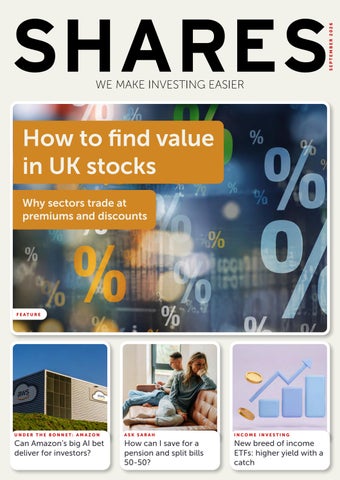
How to find value in UK stocks Why sectors trade at premiums and discounts
FEATURE
UNDER THE BONNET: AMAZON
ASK SARAH
INCOME INVESTING
Can Amazon’s big AI bet deliver for investors?
How can I save for a pension and split bills 50-50?
New breed of income ETFs: higher yield with a catch
Money & Markets podcast Weekly discussions on everything investing from the teams at AJ Bell, all available on your favourite streaming platforms. The easy way to stay up to speed with the investing world with new episodes each week from Dan Coatsworth, Charlene Young and Danni Hewson.
LISTEN NOW
Contents 04 EDITOR’S VIEW
US-Iran war: why the oil price threat has not gone away
12
05 MONTH AHEAD
Sold-out chips, soaring profits: what next for Micron?
07 UNDER THE BONNET
Can Amazon’s big AI bet deliver for investors?
10 UNDER THE BONNET
Johnson Matthey’s major reset: can it deliver for shareholders?
12 FEATURE
Why some UK sectors command premium valuations while others trade at a discount
16 SECTOR REPORT
UK retailers battle for consumer wallets against a tricky backdrop
20
24
20 ASK SARAH
My boyfriend earns more but wants to split bills 50:50. How can I still save for my pension?
22 RETIREMENT IN FOCUS
What the TTFAC? The pension acronym that can cause tax-free cash confusion
24 INCOME INVESTING
New breed of income ETFs: higher yield with a catch
26 ASK RUSS
Why are US government bond yields rising and why is it impacting my investments?
29 DISCLAIMER IMPORTANT
29 MY PORTFOLIO
How I invest: prioritising my ISA, cutting costs and riding out volatility
31 FUNDS
Healthcare funds have roared back, but investors need to know what they’re buying
35 ASK RACHEL
I live outside the UK, will my beneficiaries pay UK inheritance tax on my pension?
35
Shares magazine is published by AJ Bell, authorised and regulated by the Financial Conduct Authority. It’s here to inform, not to give personal advice. Please don’t base your investment decisions on it alone. If you’re unsure, speak to an independent adviser. And remember: past performance isn’t a guide to the future. Tax benefits depend on your circumstances and tax rules may change.
September 2026 | SHARES | 03
Editor’s View: Tom Sieber
US-Iran war: why the oil price threat has not gone away
W
hen the US-Iran war started in late February 2026 some of the warnings about the impact on energy markets were dire – with oil prices expected to spike well above $100 per barrel. Seen through that lens, the actual outcome six months on has been relatively benign. Oil has flirted with the $100 mark at regular intervals but not traded consistently above that level for any length of time and fuel shortages have mainly been localised. This speaks to some resilience on the part of the global economy but also to the stop-start nature of the war, with Tehran and Washington oscillating between peace efforts and renewed hostilities. Markets have also absorbed the shock better than some had feared, helped by continuing strength in corporate earnings. As we write though, we are back in a hot phase of the conflict and Brent crude oil, the global benchmark, is above $98 per barrel. With the world’s stockpiles depleted and autumn and winter likely to prompt increased consumption of energy in the northern hemisphere, it makes sense to think again about what the impact might be if we don’t get a resolution to the crisis in the near term. Berenberg chief economist Holger Schmieding comments: “Since late April, we had based our economic forecasts on the assumption that the price of Brent crude would decline to $75 by the end of this year. This forecast assumed traffic through the Strait of Hormuz would gradually recover from the near closure after the start of the Iran war. “Until mid-July, oil prices normalised even a bit faster than we had anticipated. At the margin, this may have contributed to the upside surprise in Eurozone and UK growth in Q2. But that luck seems
04 | SHARES | September 2026
Oil prices have been elevated since the Iran conflict Brent crude oil $120 110 100 90 80 70 60 2022
2023
2024
2025
2026
Source: LSEG
to have run out. While active hostilities with heavy mutual bombardment may be over for now, the Strait of Hormuz remains virtually closed with no apparent resolution in sight.” This seems a fair assessment of the situation. The debate now is what impact this will have on wider inflation and, as a corollary of that, interest rates. The obvious implication of rising prices is that rates will go up to contain them. Though Berenberg’s Schmieding argues such an approach could be misguided. He says: “Central banks cannot do anything about adverse supply shocks. They should not react with rates to the direct effects of such disruptions, which raise prices but hurt growth at the same time.” He notes we are yet to see much evidence of the surge in energy prices permeating into other areas like wages, the so-called ‘second order’ effects which central banks tend to be particularly sensitive to. The period since February 2026 is a reminder not to panic as the worst-case scenarios often end up proving to be overdone, and that remains the case today. But staying watchful and making sure portfolios remain suitably diversified is a sensible approach given what remains a volatile backdrop.
Month Ahead
Sold-out chips, soaring profits: what next for Micron? Memory chip maker Micron Technology has been one of the big beneficiaries of the AI boom but, after a gravity-defying run which saw it become the latest name to hit a $1 trillion valuation, the shares have endured some turbulence of late. Surging demand for advanced AI data storage chips has pushed the highly cyclical semiconductor industry into a severe shortage, which analysts expect to persist for at least the next two years. As a result, the electronics industry has been
left short of capacity, driving up DRAM (Dynamic Random-Access Memory) prices. DRAM refers to temporary system memory. AI applications require hundreds of gigabytes of ultrafast memory to operate effectively. Much of this demand is for HBM (High Bandwidth Memory), a specialised form of memory that only a handful of companies, including Micron, can produce at the scale required by the AI data centre build-out.
Micron Technology $1,200 1,000 800 600 400 200 0 2022
2023
2024
2025
2026
Source: LSEG
September 2026 | SHARES | 05
Month Ahead
Chips sold out amid bumper demand
In third-quarter numbers released in June 2026 Micron revealed its advanced HBM3E and HBM4 chips were completely sold out through the end of calendar 2027, with demand stretching into 2028. Revenue for the period came in at $41.5 billion, 15.7% ahead of the consensus forecast and up 346% year-on-year, while earnings per share hit $25.11 against the $20.78 which had been pencilled in by analysts. Despite this stellar performance, Micron shares have pulled back in the interim as investors have taken some profit, with global counterparts in the memory chip space also seeing some weakness. When it puts up its fourth-quarter results on 30 September several key points are likely to be in focus. They include visibility on the timelines for the HBM chips Micron is fabricating for Nvidia’s new Vera Rubin AI architecture. Micron is set to earn a higher margin on these components but there are risks that capacity limits might affect the timelines on the roll-out of Vera Rubin chips.
UK Stocks
Micron Q4 forecasts Revenue Earnings per share
$50.8bn $31.39
Source: Zacks
Kier (FY)
15-Sep
Barratt Redrow (FY)
16-Sep
Next (HY)
17-Sep
Kingfisher (HY)
22-Sep
JD Sports Fashion (HY)
23-Sep
Halma (TU)
24-Sep
AG Barr (HY)
29-Sep
JD Wetherspoon (FY)
02-Oct
Key economic announcements
Profitability in general will be in focus, with investors watching closely to see if input costs are starting to eat into Micron’s 85% gross margin. Another key area of focus will be the company’s capital expenditure plans. An increase is likely given the need to increase capacity, but the market will want reassurance that Micron is retaining some financial discipline.
06 | SHARES | September 2026
Overseas stocks Oracle (Q2) ☼
14-Sep
Costco (Q4) ☽
24-Sep
Micron (Q2) ☼
29-Sep
UK CPI inflation
16-Sep
US interest rates
16-Sep
UK interest rates
17-Sep
US Core PCE Index (Aug)
30-Sep
US jobs
02-Oct
Key: Q=Quarter. HY= Half year. FY=Full year. TS= Trading statement. ☽ = After market close. ☼ = Before market open
Under the Bonnet: Amazon
Can Amazon’s big AI bet deliver for investors?
F
or many people Amazon is a ubiquitous part of their day-to-day lives. The familiar brown cardboard boxes with their signature black smile logo making their way to doorsteps up and down the country at regular intervals. But while Amazon is principally known at a consumer level for its e-commerce operations, it is the much higher margin Amazon Web Services (AWS) business which is the key engine of growth, and it is here where much of the excitement around the stock can be found. While AWS represents less than 20% of sales, it accounts for nearly 60% of its profit.
A major player in AI
Amazon is a major participant in the AI arms race, one of the so-called ‘hyperscalers’ spending hundreds of billions of dollars on the infrastructure behind the artificial intelligence push. The key question for investors is whether that spending will deliver commensurate returns or if, instead, Amazon ends up being unable to justify the scale of the outlays. The market seems to have been at least partly
Amazon Key stats Share price: $258.90 2027 forecast PE: 24.5 2027 forecast dividend yield: n/a PE = price to earnings Source: Company supplied consensus
won over by recent earnings reports which hint that Amazon is starting to see some tangible benefits from this mountain of capital expenditure. The improved sentiment is reflected in its performance in 2026 to date, where it has outpaced other hyperscalers like Alphabet, Meta and Microsoft. Even if it is still lagging these rivals on a five-year view. Both on a total returns basis. September 2026 | SHARES | 07
Under the Bonnet: Amazon
Amazon has lagged other hyperscalers over five years Total return (%) Amazon
Meta Platforms
Microsoft
Alphabet
150% 140% 100 77% 64%
50
49% 0 −50 2022
2023
2024
2025
2026
Source: LSEG
The company has progressed the development of its own in-house Trainium chips and is also expanding its Bedrock cloud-based service which allows clients to use powerful generative AI models without building or managing their own heavy computer hardware.
Lowering the costs of artificial intelligence
margin advantage versus relying on others’ chips for inference.” The idea that Amazon might make access to AI more affordable and accessible is an interesting one which connects with the value credentials which have arguably been one of the key drivers for its e-commerce arm. Although a risk for the business is the competitive threat posed by Chinese AI operators which have demonstrated their own ability to reduce the costs of the technology.
In the 2025 annual report, CEO Andy Jassy commented: “Virtually all AI thus far has been done on Nvidia chips, but a new shift has started. Backing for the strategy We have a strong partnership with Nvidia, will Bank of America analyst Justin Post thinks always have customers who choose to run Nvidia, Amazon’s long-term strategy can work: and we will continue to make AWS the best “We believe Amazon’s AI positioning place to run Nvidia. However, customers has improved significantly in the want better price-performance. What is agentic AI? past 12 months, with AI revenues “Having our own hotly A system that makes its growing to 15% of total Cloud demanded AI chip opens up many revenues, benefiting from possibilities, but perhaps none own decisions and takes rapid capacity additions, larger than the ability to lower independent actions Trainium improvements, costs for customers and secure to reach a specified and accelerating Bedrock better economics for AWS. At goal without significant demand. scale, we expect Trainium will “While higher 2026 capex will save us tens of billions of capex human input. pressure free cash flow, we believe dollars per year, and provide several Amazon is building an asset base hundred basis points of operating 08 | SHARES | September 2026
Under the Bonnet: Amazon
How Amazon's valuation compares to hyperscaler peers Amazon 12-month forecast PE PE
Meta Platforms 12-month forecast PE
Microsoft 12-month forecast
Alphabet 12-month forecast PE
35 30 25
25 23
20
20 19
15 10 Oct 2024
Jan 2025
Apr
Jul
Oct
Jan 2026
Apr
Jul
PE = price to earnings ratio Source: LSEG
that will have high returns, and that Amazon is well positioned to further benefit from the upcoming inference wave driven by agentic AI. We expect multiple years of 20% growth ahead for AWS, driven by multi-year corporate adoption of AI.” Discussing the latest quarterly numbers from July, BofA’s Post notes that while Amazon increased its capital expenditure projection for 2026 by $20 billion to $220 billion – partly thanks to the industry-wide increase in memory chip costs – it also provided a clear indication of the returns on investment from data centres. Buildings are expected to have a 30-year life, servers and networking assets are expected to have payback periods of less than three years and strong returns over the remaining three years of their useful lives. Post also highlights an encouraging increase in AWS margins from 32.9% and 39%.
What about other areas of the business?
Outside of AI, Amazon is seeing strong advertising growth – with ad sales of $19.8 billion in the second quarter. These come from expanded advertising on its Prime Video streaming platform and sponsored products on Amazon Prime. The e-commerce business as a whole continued to deliver strong growth as the company benefits from offering an increased volume of logistics services to third parties. Comparing its valuation to other hyperscalers, Amazon trades at a discount to Microsoft but a premium to Meta and Alphabet as the chart shows. Though its forecast price to earnings ratio is at a two-year low. By Tom Sieber Editor
September 2026 | SHARES | 09
Under the Bonnet: Johnson Matthey
Johnson Matthey’s major reset: can it deliver for shareholders?
F
or more than a decade, science and technology business Johnson Matthey has flattered to deceive on the stock market. The perceived threat to its catalytic convertors from the shift to electric vehicles (EVs) among the main factors weighing on sentiment. But the company is now at a big inflexion point. The sale of its Catalyst Technologies business to US industrial giant Honeywell completed in midAugust 2026 with £800 million of the £1 billion proceeds returned to shareholders through a special dividend.
Johnson Matthey Total return (%) 20% 0 −20 −40
2018
2020
2022
2024
2026
Source: LSEG
Catalyst Technologies licenses specialised process technology and manufactured components used in sustainable fuels and other areas.
What does Johnson Matthey do?
The slimmed down Johnson Matthey, which has enjoyed a share price recovery from the 2025 lows, 10 | SHARES | September 2026
Johnson Matthey Key stats Share price: £22.40 March 2028 PE: 11 March 2028 Dividend yield: 3.8% PE = price to earnings Source: Company supplied consensus
retains a key focus on catalytic converters which form the core of its largest division – Clean Air. The more uncertain pace of the transition of EVs and the popularity of hybrid options means demand has proved more resilient here than anticipated and self-help measures have helped boost margins. Another remaining division is PGM Services. A leading refiner of platinum group metals, a family of six rare, precious, and chemically related metallic elements known for their high melting points, exceptional corrosion resistance, and powerful catalytic properties. Catalytic being a process where a substance speeds up a chemical reaction without being used up or permanently altered by it. Its smaller Hydrogen Technologies arm is focused on components for green hydrogen. The retained businesses are arguably more established, and Johnson Matthey is looking to lean into its expertise in PGMs, while pursuing efficiency gains and prioritising cash generation. The company is targeting £250 million in annual free cash flow and £200 million in shareholder returns from the March 2028 financial year onwards. It will hope achieving these goals can win
Under the Bonnet: Johnson Matthey
Johnson Matthey sales breakdown for March 2026 financial year Division
Proportion of sales (%)
Clean Air
82.5%
PGM Services Hydrogen Technologies
15.5% 2.0%
Excluding discontinued operations Source: Johnson Matthey
over a sceptical market. Paul Wood, chief investment officer of Woodhill Asset Management, observes: “After the disposal, Johnson Matthey will be a much more focused business built around its specialist expertise in platinum group metals. Its remaining operations serve a wide range of industrial and environmental applications where the company has longestablished technical advantages and strong market positions. “While analysts currently expect only modest revenue growth over the next few years, earnings per share are forecast to increase materially, driven largely by the substantial reduction in the number of shares outstanding through the buyback programme.”
What are the main risks facing the business?
Though the threat is not as existential as it seemed to be at some point, growing adoption of EVs remains a challenge for Johnson Matthey. EVs do not need catalytic converters and a previous attempt to adjust by shifting into manufacturing its own EV battery materials ended in failure. A longer-term drop in scrap catalytic converters would also remove a major source of the recycled platinum, palladium and rhodium refined by PGM Services. However, Johnson Matthey expects demand for converters to continue well into the 2030s thanks to the aforementioned popularity of
hybrid vehicles. The heavy-duty truck and commercial transport markets have also been slower to go electric thanks to weight and range constraints. For those remaining vehicles with internal combustion engines, emissions regulations are getting stricter which should drive higher margins and value per vehicle, potentially offsetting volume declines. In terms of other risks, the company is also investing in a new UK refinery and has had issues at its older US refinery. Getting the new refinery up to speed and improving the existing facility come with some operational risk. To add some diversification the company has unveiled the $360 million acquisition of data centre focused gas turbine catalyst maker Cormetech. Berenberg analyst Sebastian Bray says this deal helps address the ‘managed decline’ narrative around the shares. “We estimate that stationary emissions control, primarily for data centres, could account for over 10% of group earnings by 2029,” he says. CEO Liam Condon has been in post for four-anda-half years having joined from German chemicals firm Bayer to help revive the business after its failed battery materials effort.
What about the valuation?
Based on consensus earnings forecasts for the March 2028 financial year, the company trades on a price to earnings ratio of around 11 times earnings and offers a dividend yield of 3.8%. The company’s closest lookalike on the stock market is Belgium’s Umicore which is a global advanced materials and recycling group. It trades at a premium to Johnson Matthey at 13 times consensus forecast 2027 earnings. If the valuation remains depressed Johnson Matthey might attract takeover interest, Woodhill’s Wood adding that the company, in its more simplified state, “could prove an attractive acquisition target for a larger industrial or speciality chemicals group”.
By Tom Sieber Editor
September 2026 | SHARES | 11
Feature: UK stocks
Why some UK sectors command premium valuations while others trade at a discount
S
ome parts of the UK stock market trade at a premium price to earnings or PE ratio while others trade at a discount to the market. While there are many factors which can influence the PE ratio, this article explains the most prevalent reasons and reveals the sectors with the highest/lowest PEs. Before that, it is worth asking what the PE ratio is and why it is a popular measure. The PE ratio is calculated by dividing the stock price by earnings per share. Markets are forward looking, so investors often use analysts’ forecast earnings over the next 12-months, rather than historical or trailing earnings, to calculate the PE. Trailing PE = share price / last 12-months earnings per share. Forward PE = share price / next 12-months earnings per share estimate.
Example: Rolls Royce
Price £14.82 / 2025 EPS 59.2p = trailing PE of 25 Price £14.82 / 2026 expected EPS 42.6p = forward PE of 34.8 12 | SHARES | September 2026
The simplicity of the PE ratio is what makes it a popular measure with investors looking to determine how a stock is priced relative to its earnings potential. Essentially, the PE tells you how many years of current earnings you are paying to own the stock at the current price. Its meaning comes from what it implies about growth, risk and quality of earnings. A high PE ratio can reflect strong growth expectations or investor confidence while a low PE may signal lower growth or underlying concerns about the business. A stock’s PE can be contextualised by comparing it with its historical range, industry peers and the broader market. A disadvantage of the PE is that it is meaningless when earnings are negative or when they are heavily distorted by one-off items. It is also less meaningful for cyclical industries which generate volatile earnings. Finally, it is also worth pointing out that single valuation measures like the PE should never be used in isolation. It is a starting point for further research not a reliable signal of whether an investment will prove a success or failure.
Feature: UK stocks
Sector PEs (lowest to highest) FTSE 350 sector
Forecast PE
Oil & Gas
8.2
Banks
10.9
Housebuilders
11.9
Food & Tobacco
12.2
Investment services
12.7
Media
12.8
Insurance
12.8
Utilities
12.9
Food retailers
13.7
Telecommunications
13.9
Retailers
14.1
Beverages
14.7
Hospitality
14.9
Healthcare
14.9
Construction & Engineering
15.2
Personal & Household
16.1
Metals & Mining
16.8
Chemicals
17.2
growth firms commanding higher PE multiples. As the table shows, the technology sector trades at a premium to the market, implying investors are willing to pay a higher multiple of earnings because they anticipate a higher growth rate. This means more value is coming from distant earnings rather than near term earnings and this makes high PE more interest rate sensitive than lower PE firms. A recent example is 2022 when central banks pushed up official interest rates to fight rising inflation coming out of the pandemic. Many technology and biotech companies underperformed the market during this period, leading to a compression of PE ratios.
Technology Company
Forecast PE
Sage
18.7
Bytes Technology
19.3
Computacenter
22.5
Kainos
24.3
Softcat
24.9
Raspberry Pi FTSE 350
45 12.8
PE = price to earnings ratio
Professional services
20.9
Machinery & Equipment
21.1
Technology
21.1
Aerospace & Defence
22.2
PE = price to earnings ratio Source: Stockopedia, LSEG
Why the technology sector trades at a premium
The most important factor determining the PE ratio is the expected earnings growth rate with higher
Source: Stockopedia, LSEG
In addition to superior earnings growth, technology companies tend to have higher-thanaverage operating margins of between 20% and 30%, which supports higher PEs. Valued-added IT reseller Computacenter has outperformed some of the largest US technology firms over the last two years driven by strong demand from the AI boom at its US division which supplies technology to hyperscalers. Analysts have struggled to keep up with business momentum which can be seen in the strong earnings revisions trend with consensus earnings estimates around 20% higher than they were a September 2026 | SHARES | 13
Feature: UK stocks year ago. Historically, Computacenter has grown its earnings at a modest growth rate of around 8% a year, but with the company experiencing a growth surge, investors have pushed the PE to around 22 compared with 14 times it traded at in 2022, prior to the emergence of generative AI. With its firsthalf results in September 2026 spurring another round of upgrades. Although accounting software provider Sage trades at a premium to the market, it sits at the lower end of the technology sector due to fears that AI could disrupt its business model. These fears have subsided in recent months as the market has reassessed the threat from AI and companies like Sage have articulated a strategy to embed autonomous AI agents directly into its platform. Raspberry Pi has experienced a rollercoaster ride since floating on the stock market in 2024. After rallying to almost 800p post-IPO (initial public offering) the shares dropped back below the 280p issue price in 2025 as investors feared margin pressures from higher memory component costs. These fears were quicky extinguished in early 2026 when it became clear that industrial demand had become a key driver for the company as corporations embed Raspberry Pi’s high-end, lowpower boards to host AI-assistants. First-half adjusted EBITDA (earnings before interest, tax, depreciation and amortisation) nearly doubled, triggering a massive recovery in the shares to more than £10, before profit taking took the shares back to around 600p.
that the surge in profits will prove a one-off with analysts calling for them to fall 2027. This relatively high earnings uncertainty and the fact that oil companies cannot control prices is why the market has consistently ascribed a PE discount to the sector. Generally, economically sensitive sectors which suffer from wide swings in profitability through the cycle tend to trade on PEs lower than the market. BP trades on a lower PE than Shell due to it carrying a higher debt burden, although management has initiated a plan to get borrowings down.
Oil & Gas Company Harbour Energy BP Shell
Forecast PE 5.8 7.5 8.8
Ithaca Energy FTSE 350
Oil giants Shell and BP sit at the opposite end of the valuation spectrum with single-digit PEs representing a 40% discount to the market. This may seem counter-intuitive when 2026 earnings are projected to almost double, as higher oil and gas prices related to the US-Iran war feed through to profits. The reason is that markets are anticipating 14 | SHARES | September 2026
12.8
PE = price to earnings ratio Source: Stockopedia, LSEG
Capital intensive, cyclical or highly leveraged sectors like banks, miners and airlines tend to trade on lower PEs for these reasons. In these sectors high PEs can indicate trough earnings and low PEs can indicate peak earnings.
Dizzy heights for defence sector
Oil companies on single digit PEs
14.1
The aerospace and defence sector trades at a significant valuation premium, representing a decoupling from history where the sector has traditionally traded in line with or slightly below the market PE. This reflects a step-change in military spending amid a rearmament of UK and European countries following pressure from the US to boost spending as a percentage of GDP. BAE Systems recently flagged a record order book as it continues to benefit from strong munitions demand from the US and Britain pushed
Feature: UK stocks
higher returns on equity. Bank earnings can easily be wiped out by a bad year because they carry a low equity buffer compared to companies in other sectors.
Why the PE is not a good measure for banks
Banks make up a significant proportion of the FTSE 350 index, representing around a fifth of the market. Unfortunately, the PE ratio is less useful a measure for banks because earnings are distorted by high leverage and provisioning cycles for non-performing or bad loans. This is why they are often valued by price to tangible equity or ‘through cycle’ PE ratios. A premium to tangible book value is supported by
Aerospace & Defence Company
Forecast PE
QinetiQ
14.2
Babcock
15.3
Avon Technologies
20.2
BAE Systems
23.5
Chemring
26.7
Rolls Royce FTSE 350 PE = price to earnings ratio Source: Stockopedia, LSEG
34.7 12.8
Example: Lloyds Bank Lloyds had total assets of £944 billion in 2025 and equity of £48 billion, which means assets were roughly 20 times larger. Roughly 95% of Lloyds’ balance sheet is funded by liabilities (mostly customer deposits and wholesale funding), with only about a 5% equity cushion absorbing losses. Equity to assets = 5.1% (48/944) equating to leverage of 19.7 times. This means a small percentage move in asset quality (loan losses, impairments) translates into a large percentage move in equity and earnings. It is worth highlighting that banks are allowed to risk-weight their assets and on this basis all UK banks are comfortably above the regulatory minimum capital requirements and generating surplus capital. This explains why Lloyds and other UK banks have been buying back shares and paying healthy dividends in recent years. ahead with submarine and fighter jet programmes. The company provides the US with combat vehicles, electronic warfare systems and space capabilities, and has seen its order book almost double since Russia invaded Ukraine in 2022. Meanwhile, a combination of recovering civil aviation and a growing defence order book has benefited defence/civil aerospace hybrid RollsRoyce which has a forward PE of 34.7 times. The sector re-rating may turn out to be durable as orders reflect multi-year government commitments but there is also a risk that investor expectations have run ahead of the delivery of profits. This makes the PEs vulnerable to a change in sentiment if the rearmament narrative decelerates. By Martin Gamble Shares and Markets Writer
September 2026 | SHARES | 15
Sector Report: UK retail sector
UK retailers battle for consumer wallets against a tricky backdrop
T
he UK retail sector is enduring its latest challenging period. Modest economic growth and stabilising sales volumes are being offset by increased costs partly due to 2025’s increases to the living wage and employer national insurance contributions. These factors have combined with reductions in business rates relief to squeeze margins.
FTSE 350 Retailers vs FTSE 350 Total return (%) FTSE 350 Retailers
FTSE 350 289%
200% 100
114%
0 2010
2015
Source: LSEG
16 | SHARES | September 2026
2020
2025
Shoppers remain cautious due to persistent inflationary pressures and higher household energy costs, linked to the crisis in the Middle East, which means consumers are prioritising value over splurges in discretionary spending. This trend can clearly be seen in lower-income households where nearly half of income goes on essential items like rent, food and drink, according to consultancy Retail Economics. By contrast so-called ‘new age affluents’ only spend around 26% of their income on necessities which leaves more headroom for discretionary and luxury spending. While a smaller group by size, representing around 15% to 20% of UK households, this affluent minority drives discretionary spending.
How Next has bucked the gloom
The challenging consumer backdrop has not proved a problem for clothing bellwether Next, partly due to strong execution under CEO Simon Wolfson who has built a reputation for under promising and overdelivering. To be a successful retailer it’s important to get the right products in front of the right customers
Sector Report: UK retail sector
at the right times and in the right places at a price they’re willing to pay. It sounds deceptively simple but it’s hard to execute and it’s something which Next has refined to a fine art.
UK retailers one-year total return Company
One-year total return
Watches of Switzerland
109.0%
Halfords
101.0%
Currys
34.8%
Next
35.0%
Kingfisher
26.3%
Frasers
22.0%
FTSE 350
20.2%
M&S
14.6%
B&M European Retail
2.4%
JD Sports Fashion
−11.1%
Burberry
−15.8%
Dunelm
−22.3%
Data as at 31 August 2026 Source: Sharescope
Next has been the best performing FTSE 100 retailer with the shares recently trading near record highs, driven by repeated upgrades to guidance and disciplined shareholder returns. Trading from more than 800 stores in the UK and Ireland as well as an online operation serving the UK and overseas, Next recently upgraded its annual outlook for the third time in 2026 after reporting a 9.2% rise in second quarter full-price sales. Next attributed the outperformance to exceptionally warm weather and unanticipated pent-up demand in the Middle East and Northern Europe after a weak first quarter. In addition, Next said it was able to spend more on profitable marketing than expected. The group now expects pre-tax profit of £1.243 billion for the year ended January 2027, versus prior guidance of £1.218 billion.
M&S draws a line under cyber-attack
Storied UK food and clothing retailer Marks & Spencer forecast a return to profit growth this year (to end March 2027) after performance was impacted by a cyber-attack in April 2025 which took down its click-and-collect business, online ordering and contactless payments. The recovery in 2026 has been food-led with sales up 7%, taking M&S’s share of the Britain’s grocery market to 4.1% and 4.6% including sales sold through Ocado, as the company looks achieve its long-term goal of doubling food sales. M&S has flagged plans to increase shareholder returns with details being revealed later this year. Chief financial officer Alison Dolan said: “I would expect that over the course of this current financial September 2026 | SHARES | 17
Sector Report: UK retail sector year (2026-27) we will be in a position to be clearer about our policy in that regard and the timing of those returns.” The retailer ended its last financial year with net funds excluding lease liabilities of £338 million, providing M&S with financial headroom to enhance returns while investing for growth.
Other retailers with a winning formula
Electronics retailer Currys has engineered a genuine turnaround from a low-margin box-shifter into a multichannel ‘technology-as-a-service’ focused business. The company recently posted a better-thanexpected 18% increase in full year adjusted pre-tax profit with like-for-like sales up 4% and ended the period with net cash on the balance sheet. Currys doubled the divided and announced a £50 million share buyback. The recovery was led by outgoing CEO Alex Bladock, who is now tasked with replicating a turnaround at Boots the chemist, Currys now generates around a third of sales in UK & Ireland from higher margin services offerings. The company has rolled out dedicated businessto-business hubs inside its physical retail outlets serving small businesses seeking technology and cash flow management. Home improvement retailer Kingfisher, encompassing B&Q and Screwfix in the UK and Castorama and Brico Depot in France, has leant into trade and ecommerce penetration to mitigate soft ‘big ticket’ demand. Trade sales grew 23% in the full year to the end of January with penetration reaching 30% of group sales and ecommerce penetration reaching 21% as its third-party online marketplace grew 58% to £518 million.
Frasers aims for elevation
The last 12 months have been a busy period of expansion via mergers and acquisitions for sports retailer Frasers driven by its multi-year ‘Elevation Strategy’. The Mike Ashley-led group’s latest foray saw it rescue the iconic 200-year-old Harvey Nichols out of administration, with plans to restore the department chain to profitability. In July Frasers announced it has built a 4% stake in luxury fashion house Burberry, becoming its third 18 | SHARES | September 2026
largest shareholder. In June the company launched a takeover of German fashion house Hugo Boss for £1.73 billion, which the board rejected. Undiscouraged, Frasers increased its direct stake to 47.9% and said it would actively pursue further market purchases past 50%. In July 2026 Frasers reported full year adjusted pre-tax profit of £538 million, down 4% year-onyear, missing guidance and declined to provide a profit outlook for the April 2027 financial year.
Top of the charts
The best performer over the last year has been luxury watch retailer Watches of Switzerland, reflecting strong performance in the US and improving trading in the UK. The performance of the shares speaks volumes on the divide between high- and low-income households on both sides of the Atlantic, as wealthy shoppers continue to snap up luxury timepieces from the likes of like Rolex and Tag Heuer. It has also been reported that the company has held talks with potential bidders as management believes the stock market undervalues the company despite the recent strong share price performance. At the recent annual general meeting the company reiterated its outlook for the year to April 2027 amid broad-based demand across its luxury brands. The company projects organic revenue growth
Sector Report: UK retail sector
Valuation comparison Company
Forecast PE
JD Sports Fashion
7.4
Frasers
7.8
Forecast dividend yield (%) 1.6%
N/A
B&M European Retail
10.7
Dunelm
10.9
Currys
11.1
Kingfisher
11.7
M&S
11.7
Watches of Switzerland
13.3
Halfords
13.8
4.3% 5.4%
Next Burberry
2.1% 4.2% 1.7%
N/A 3.8% 18.7
2.5% 28.3
N/A
PE = price to earnings ratio Source: Stockopedia. LSEG
in the range of 5% to 10% and an expansion of its adjusted earnings before interest margin of between 0.4% and 0.8%. It plans to continue selective US acquisitions and increasingly focus on fewer, higher-quality stores in the medium term.
Retail laggards
Homewares group Dunelm has been on the back foot after warning in January that pre-tax profit would land at the lower end of analysts’ consensus £214 million to £227 million range, impacted by competitor discounting which led to a sharp slowdown in sales growth. The shares have recovered off the May lows and were given a further boost after the company posted a positive full year trading update in July which showed sales up 3.1% and pre-tax profit in line with consensus expectations, which have been revised down to £210 million. British fashion house Burberry has been impacted by geopolitical uncertainties which
dented tourist spending across Europe, Middle East and Africa in its April to June quarter. Although Burberry swung back to a full year profit in the year to March 2026, and delivered double-digit sales growth in its core outwear categories, management’s decision to scrap the dividend has weighed on the shares.
How do the companies compare on valuations?
Most of the retailers sit on a PE (price-to-earnings) ratio of between 10.7- and 11.7-times consensus analyst earnings estimates for 2027, while Dunelm has the highest dividend yield of 5.4%. The outliers at the low end of the spectrum are Frasers and JD Sports Fashion while Burberry and Next are outliers at the high end of the spectrum. By Martin Gamble Shares and Markets Writer
September 2026 | SHARES | 19
Ask Sarah: Your questions answered
My boyfriend earns more but wants to split bills 50:50. How can I still save for my pension? Ask the experts Sarah Coles is on hand to answer your personal finance questions. If you’d like a question considered for a future edition send it in now. My boyfriend earns much more than me and insists we pay 50:50 for household expenses, but I’m worried it doesn’t leave me with enough to pay into my pension. Is this fair? Sam Sarah Coles, Head of Personal Finance, says:
There’s no definitively correct way to manage money between you in any relationship, so what most couples aim for is something that feels fair to both of you. That doesn’t seem to be the case for 20 | SHARES | Septembert 2026
you, so you have a few options. The first step is to diagnose the problem, and for that you need to draw up a budget of your own costs. Include pension contributions, because these should be non-negotiable. Then add in your share of the bills and detail your other spending. There’s a very rough rule of thumb that around 50%-60% of your spending should be on things you need – so the bills plus other essentials, then around 20% should go on savings, pensions and debt repayment, leaving you with around 20%-30% to spend on the rest. These figures will be different for everyone, but if they’re wildly different, you’ve identified the source of the problem.
What’s leaving you short for pension contributions?
If the reason you can’t put money aside for the future is that you’re spending a much larger percentage of your income on nice-to-haves, this should be the focus of cuts. If you’re spending too
Ask Sarah: Your questions answered
much on the essentials, then you need to be paying less into joint expenses, and you need to talk to your partner about a better solution. If your partner needs help to see why things need to change, it’s worth talking to him about how he wants your retirement to look – assuming you’re still together at that point. If he expects you to continue to pay for 50% of the outgoings, you need the opportunity to build a pension of your own so you can afford it. If he is happy paying for the lion’s share of these expenses in retirement, then why not now? And even if you’re convinced he would pick up more of the expenses later in life, you need to be aware of the risk you’re taking, because if you were to split up before retirement, without getting married, you would have no right to his pension. If you agree that things need to change, you have two options. You can propose that you both contribute proportionally towards the essentials instead, so if 75% of the household income is earned by one person, they cover 75% of the joint household expenses. This is a very common approach. If your partner isn’t happy that this is robust, you can go into more detail. He can also draw up a budget, and you can set up your contributions so you’re both spending the same percentage of your income on the essentials. If he is fundamentally uncomfortable with putting more into joint expenses, the alternative is that you both pay less into this account, so you’re paying at a level you can afford, and then trim down the cost of the essentials. You can downsize where you live, cancel media packages, trade down at the supermarket and tighten your belt. That way you can both afford to split expenses 50:50,
without compromising your long-term security. If your partner wants to boost their lifestyle beyond this level, they can do so with their own money. It’ll just be up to them whether they do it for both of you, or choose to spend it all on themselves.
Is it an emotional rather than a financial issue?
If, after all this, he still won’t consider a different division of expenses, it can help to ask him why 50:50 is so important to him, to see if this is an emotional problem rather than a financial one. It could be down to anything from not wanting the pressure of being responsible for more spending, to wanting to avoid making the same mistakes as his parents or being worried he couldn’t afford to keep up with the lifestyles of his friends if he covered more of the joint costs. You may be able to find a solution to the emotional problem that opens the door to a financial one. None of this is easy, so you might be tempted to skip the whole conversation, carry on paying 50%, and put off thinking about your pension for another day. However, not only will this have a horrible impact at retirement, it’s also unsustainable. If you stay together, over the course of a lifetime, things will change. You could end up out-earning him or covering all the costs if he has to stop work. Alternatively, it might be you who takes a break from work and him who needs to foot the bill. Rigidly sticking to 50:50 throughout all of this isn’t going to be workable, so you need to do the hard yards now and work out a solution that will stand you in good stead for whatever life throws at you.
September 2026 | SHARES | 21
Charlene Young: Retirement in focus
What the TTFAC? The pension acronym that can cause tax-free cash confusion
W
hile the abolition of the lifetime allowance for pensions was largely welcomed, it also brought a new collection of jargon. Near the top of that list sits the transitional tax-free amount certificate, or TTFAC. Most people will not need a TTFAC. But it is worth investigating if you accessed pension benefits before 6 April 2024 and took less tax-free cash than the standard calculation assumes. The key is to check the figures before applying or taking further benefits. While a certificate can increase your remaining lump sum allowance, it can also reduce it and once a valid certificate has been issued it cannot be undone.
allowance), after their death (the lump sum and death benefit allowance) and if they transfer the pension overseas (the overseas transfer limit). The maximum permitted tax-free lump sum for a pension holder is still the lower of two amounts, but they are now: • the remaining ‘new’ lump sum allowance (LSA); and • 25% of the funds crystallising. If you accessed a pension before 6 April 2024, there’s a standard calculation that tells you how much of the new lump sum allowances you’re deemed to have used.
Old vs new rules
Before the lifetime allowance was abolished, taxfree lump sums were limited by the lower of two amounts: • 25% of the value of the funds crystallising; and • 25% of the remaining lifetime allowance. Since 6 April 2024, there is no longer a lifetime allowance, but a new set of allowances that limit the value of tax-free cash that can be taken in both a pension holders’ lifetime (the lump sum 22 | SHARES | September 2026
STANDARD CALCULATION = % LIFETIME ALLOWANCE USED X £1,073,100* X 25% *If you hold lifetime allowance protection, substitute your protected allowance here
Charlene Young: Retirement in focus
Rather than looking at what tax-free lump sum(s) you’ve received, it assumes that 25% of any lifetime allowance used before 6 April 2024 was taken as tax-free cash. For many people that assumption works perfectly well, but it’s not always the case.
Where TTFACs come in
A TTFAC is a record of the monetary value of tax-free cash you received before 6 April 2024, rather than relying on the standard calculation assumption. If you accessed pension benefits under the old lifetime allowance regime but took less tax-free cash than the standard calculation assumes, then applying for a TTFAC might leave you with a higher remaining LSA in the future. That’s because it deducts the actual amount of tax-free lump sums taken. A TTFAC is most likely to be worth investigating if you have taken pension benefits in the past but didn’t maximise your tax-free cash entitlement. Examples of pension holders who might have a higher LSA under the TTFAC rules include: • Those who accessed their funds but took less than 25% of the value as a pension commencement lump sum at the time. • Those who accessed their pension benefits in the four tax years where the lifetime allowance was lower than £1,073,100.
But beware: it doesn’t always help
In some cases, the standard transitional calculation is more generous than a certificate based on actual historic benefits. A TTFAC could therefore leave someone with a lower remaining allowance than they would otherwise have had. There is also no undo button. If you obtain a certificate and later realise the standard calculation would have given you a bigger allowance, you can’t reverse the decision. If you started taking pension benefits before the lifetime allowance came into force on 6 April 2006, and this is your only pension, you cannot apply for a certificate. Your lump sum allowances will be reduced by 25% of the capital value of your pension in payment when you come to access further benefits. If you had a pre commencement pension in payment and took further benefits in
the period between 6 April 2006 and 5 April 2024, you can apply, but the calculation will assume you took 25% tax-free cash at the time (rather than what you actually took), regardless of whether you apply for a TTFAC or not.
Timing is also crucial
If you want to rely on a TTFAC, you must apply before your first relevant benefit crystallisation after 5 April 2024. This is usually the first time you take further benefits and examples include taking a pension commencement lump sum, an uncrystallised funds pension lump sum or a standalone lump sum. Once that first post-April 2024 event has happened, the opportunity to obtain a certificate is lost. This means anyone considering a TTFAC should compare their remaining allowance under both methods before making an application or the first new crystallisation event. Before you act, it’s worth checking three things: 1. Whether you took benefits before 6 April 2024, 2. Whether your actual tax-free cash was lower than the standard calculation assumption, and 3. Whether you can evidence every relevant payment. You should also consider regulated financial advice, as a TTFAC can reduce rather than increase your remaining allowance, or your circumstances might mean it isn’t worth applying for one. You’ll have to pay a fee for advice, but a personal recommendation can help you avoid any costly mistakes. By Charlene Young Senior Pensions and Savings Expert
September 2026 | SHARES | 23
Dan Coatsworth: Income investing
New breed of income ETFs: higher yield with a catch
T
he range of income-generating investments has expanded in recent years with the launch of new funds. Some investors may already know about funds labelled ‘income maximiser’, which aim to offer higher yields than standard equity income funds but potentially lower capital growth. Now, a variation of these products has arrived, and they’re all exchange-traded funds (ETFs). Covered call option funds, as this category of product is often known, typically offer yields in the region of 7%, although this can vary widely. They combine exposure to a portfolio of stocks with an option-writing strategy. By selling call options, the fund generates additional income today, but in return may sacrifice some of the future gains if stock markets perform strongly. Income investors might be happy with this outcome, even if it is important to recognise that these types of funds can be left behind during strong bull markets. Some of the new ETFs in this category might produce bigger total returns than traditional income maximiser funds if they often don’t go in as deep with call options, but that also means they might not offer as much additional income. Here’s a breakdown of how they work.
How do coverall call options work in practice?
It is important to understand how these types of funds work. While their headline yield might seem enticing, they may not perform in the same way as standard equity funds. Let’s say a fund buys a share at £100. The fund sells an option on that stock that gives the counterparty the right to buy the shares at £110 in one month’s time. In exchange, the fund receives a £2 fee for selling the option. If the stock ends the month below £110, the option expires and the 24 | SHARES | September 2026
fund keeps the shares and collects the £2 premium which helps to top up dividends to more generous levels. If the price rises above £110, the option buyer keeps most of the upside beyond this level. In this situation, the amount the option buyer receives will depend on how the deal was structured. For instance, the fund might own £100 of a certain share but it may only sell options on £50 worth of exposure. In this case if the share price rises to £120, the fund would enjoy the full upside on half of its holding but is capped at gains up to £110 for the other half. If the option agreement works in the buyers’ favour, the option is exercised and the counterparty buys the shares from the fund. However, that doesn’t always happen. Often, you’ll see the fund buy back existing options before expiry, sell new options for the next month, and settle any gains and losses in cash.
How do traditional fund and ETF versions differ?
Schroder Income Maximiser is perhaps the bestknown example of a traditional fund that follow this strategy. Launched 21 years ago, the fund has £933 million assets under management and aims to deliver 7% income per year from a portfolio of UK companies. The charges are 0.9%, approaching the higher end for actively managed funds. The newer breed of covered call option funds includes JPM Global Equity Premium Income Active UCITS ETF. This has a 0.35% ongoing charge, currently yields 7.4% and currently has £1.1 billion of assets under management. It invests in a portfolio of shares from around the world and sells equity and/or equity index call options to generate additional income. This is an actively managed portfolio. The
Dan Coatsworth: Income investing
Covered call ETFs Ranked by fund size
ETF
Code
Fund size
Current dividend yield
JPMorgan Nasdaq Equity Premium Income Active UCITS ETF
JEQP
£2.8bn
9.4%
JPMorgan Global Equity Premium Income Active UCITS ETF
JEGP
£1.1bn
7.4%
Global X Nasdaq 100 Covered Call UCITS ETF
QYLP
£612m
11.8%
JPMorgan US Equity Premium Income Active UCITS ETF
JEIP
£394m
6.7%
Global X S&P 500 Covered Call UCITS ETF
XYLP
£157m
5.6%
Global X Euro Stoxx 50 Covered Call UCITS ETF
SXYD
£96m
11.1%
Source: Just ETF
principal differences versus a traditional income maximiser fund are the charges and the investment structure. The ETF trades on a stock market and its price can change throughout the trading day instead of being priced once a day like a traditional fund. Some of these ETFs are actively managed, while others are passive and track an index. Examples include GlobaIncome investingl X S&P 500 Covered Call UCITS ETF which has a portfolio designed to match the performance of S&P 500 index and it also seeks to replicate a ‘buy-write’ index by selling covered calls. It charges 0.45% a year and has £157 million of assets under management. Both the JPMorgan ETF and Global X ETF only launched three years ago, and fund performance is typically judged on a longer time frame. Markets have generally done well during much of those three years which means it is normal to expect a level of underperformance. As mentioned at the start of this article, the price for achieving higher levels of income is giving up some of the gains in a rising market. Investors shouldn’t expect them to show significant outperformance. These funds are bought primarily for the generous income stream, and capital growth is a secondary consideration.
The figures speak for themselves. JP Morgan Global Equity Premium Income Active has achieved a 17.6% total return since launch in December 2023 including dividends versus 58.1% from the MSCI World benchmark index up to 19 August 2026, according to FE Analytics data. However, the current 7.4% yield is approximately five times better than you’d get directly from the benchmark. Global X S&P 500 Covered Call has returned 29% since its launch in July 2023 versus 60.7% from the S&P 500 – but again, its dividend yield is far superior to the 1% currently offered by the US benchmark index. Investors should carefully consider their financial goals, risk tolerance, and the role these products might play in their portfolio. Whether opting for a traditional income fund, an income maximiser version or exploring the newer covered call ETF options, the key is to ensure the investment aligns with your overall strategy and longterm objectives. By Dan Coatsworth Head of Markets
September 2026 | SHARES | 25
Ask Russ: Your questions answered
Why are US government bond yields rising and why is it impacting my investments? Ask the experts Russ Mould is on hand to answer your queries about the financial markets. If you’d like a question considered for a future edition send it in now. I’ve noticed some losses in my portfolio as US government bond yields are going up. Why is this happening and why didn’t the US Treasury’s attempt to bring yields down work? Greg Russ Mould, AJ Bell Investment Director, says:
America is trying to massage down the oil price by releasing its strategic reserves, buoy the yen by selling euros against it and cap its own borrowing costs by buying long-dated government bonds, or treasuries, and issuing near-term treasury bills instead. Throw in a near-10% shareholding in Intel and investments in a range of private companies in industries that range from mining to defence to technology, not to mention an ever-changing list of tariffs and, in some ways, America no longer looks like the land of the indefatigable invisible hand that it claims to be. Rather than fighting shy and applying higher equity risk premia (and thus lower valuations), the US stock market continues to take this in its stride, at least for now. Holders of fixed-income instruments look less happy, however, and the bond market could yet have a far greater say across all of the asset classes in investors’ portfolios, and that includes those where there is any exposure to American assets or not. 26 | SHARES | September 2026
Treasury yields close to financial crisis levels
US bond yields are creeping higher to such a degree that 10-year and 30-year treasury yields stand near their highest levels since 2007-2008.
US Government bond yields have moved inexorably higher 10-year 5%
30-year
5.27% 4.73%
4 3 2 1 0 2022
2023
2024
Source: LSEG Refinitiv data
2025
2026
Ask Russ: Your questions answered
US Government benchmark bond prices have fallen sharply this decade 10-year 10-year
30-year 30-year
5.27 5.27 4.73 4.73
4 4 2 2 0 0 2022 2022
2023 2023
2024 2024
2025 2025
2026 2026
Source: Source: LSEG LSEG Refinitiv Refinitiv data data
Back then, the trajectory was down, whereas three fears are now exerting a strong upward pull. The first is inflation. Based on the consumer price index, the US rate of inflation has exceeded the US Federal Reserve’s 2% target every month since March 2021, bar one. In response the US Federal Reserve has raised the headline Fed Funds rate from 0.25% to 3.75% since 2022. The second is the arrival of new Fed chair Kevin Warsh. He has talked tough on inflation and been particularly critical of how the US central bank has a bloated balance sheet, as a legacy of quantitative easing (QE) and bond-buying programmes that were designed to keep borrowing costs low and drive demand for credit. Warsh’s desire to reduce the Fed’s bond holdings removes a buyer from the market. The new chair is also scrapping ‘forward guidance,’ so markets no longer get a steer on what is coming next and have to set the price of money for themselves. That is a laudable aim, but right now markets do not like what they see. That is because of reason three, namely galloping growth in American government borrowing. July showed a monthly deficit of $432 billion, the worst figure since March 2021 and one big enough to take total US public debt to $40 trillion, double
where it was just a decade ago. President Trump is still calling for money defence spending, to cover the campaign in the Middle East, and November’s mid-term polls will fire the starting gun on the race to the White House in 2028’s ballot, with neither early-stage Republican nor Democratic candidates thus far espousing any policies that lean toward austerity. More borrowing means increased issue of treasuries and if the supply of something goes up then its price tends to go down. That is exactly what is happening in the US government bond market.
Let’s twist again
Enter US Treasury Secretary Scott Bessent, who can see the danger posed by rising bond yields, as they add to America’s interest bill. This is already running at an annualised rate of $1.25 trillion, or a fifth of the Government’s tax take, compared to around a tenth in the UK. The average maturity is also barely six years, compared to more than 13 in the UK, according to figures from the Congressional Budge Office and UK Debt Management Office respectively, so America is more exposed to higher bills as old bonds mature and new ones are issued, if headline interest rates stay where they are or go higher. September 2026 | SHARES | 27
Ask Russ: Your questions answered
Gold is taking a keen interest in America’s challenges higher returnsfiscal on bonds may tempt investors away
America’s federal interest bill is rocketing US Federal interest bill ($ billion) 1,247
1,000
from equities and also act as a brake on demand 30-year for10-year credit, economic activity and ultimately 5.27 corporate earnings, just when investors are 5 paying record-high multiples for record-high US 4.73 4.5 company profits. 4 3.5 Gold is taking a keen interest in
America’s fiscal challenges 3
500
2.510-year 0 Q1 2000
Q2
Q3
Q4
Q1 2025
Source: FRED – St. Louis Federal Reserve database
Bessent’s currency market interventions are designed to dissuade Japan from selling its $1.1 trillion in treasury holdings as a source of dollars so the Bank of Japan can use them to buy yen, while the Federal Reserve is returning to something that looks like 2011’s Operation Twist (OT) under Janet Yellen, as it sells long-dated bonds and issues shorter-dated ones to cap yields and borrowing costs. But operations worth $4 billion a time are not going to really move the cost of a $40 trillion debt mountain, and bond markets are responding with understandable scepticism. Bessent seems to be watching the 5% threshold on the 10- and 30year yield, and investors should be, too. After all, 28 | SHARES | September 2026
30-year
2 5
5.27
1.5 4.5
4.73
14 0.5 3.5 0 3 2.5
2022
2023
2024
* 2025
2026
2 *As of July 2026, with two months to go for fiscal 2026. **As of 24 August 2026
1.5
Source: FRED – St. Louis Federal Reserve
1database, LSEG Refinitiv data 0.5
The stakes could not be higher, and the gold price is taking note. Its latest upward surge could 2022Warsh’s 2023bluff, 2024 2025 the2026 be calling in the view Fed will not raise rates because America cannot afford it and *As July monthswith to goinflation for fiscal instead, or let of the US2026, takewith itstwo chances 2026. **As of 24 August 2026 it could even be saying that OT will be followed by Source: FRED – St. Louis Federal more QE and balance sheetReserve expansion.
0
database, LSEG Refinitiv data
My portfolio
How I invest: prioritising my ISA, cutting costs and riding out volatility
S
ometimes the biggest challenge in investing is having the discipline to continue making contributions, even if other expenses get in the way. Luke, a just turned 25-year-old intelligence analyst at an educational tech firm, has demonstrated a commitment to adding to his ISA pot through thick and thin. Luke started investing in his Stocks and shares ISA in January 2023 with £1,000 he had saved up. He’s diligently added to this pot every month even during periods when he was less than flush with cash. “I put in a pretty fixed amount and it’s the first thing I put into when I get paid,” he says. Luke has just bought his first home using his Lifetime ISA and while he was saving for that he found it tough to continue adding to his other investment pot as much as he’d like to, but rather than doing nothing he simply changed from a monthly to a weekly routine, adding in whatever he could at the end of the week, always with the goal of adding to the pot even if it couldn’t be the ‘perfect’, systematic amount repeating each time. His end goal? There’s no deadline yet at which he wants to retire, so long as he’s putting his money to work and it’s growing, Luke is happy. The combination of regular contributions and investment growth has taken his portfolio value to £30,000.
What is Luke invested in?
At the beginning, Luke started off in one of the ready-made investment portfolios available on his initial platform but after just over a year he switched to AJ Bell and took his portfolio into his own hands. To stay on top of things, Luke reviews his portfolio to ensure it’s maintaining a broad, global diversification with each market around the world. Luke also really wanted to get his overall costs, down as the platform and fund fees were adding
Luke’s portfolio ETF
Ongoing charge
iShares Core MSCI World ETF
0.20%
iShares Core MSCI EM IMI UCITS ETF
0.18%
Vanguard S&P 500 ETF
0.07%
Xtrackers NASDAQ 100
0.20%
Source: AJ Bell, investor’s own records
September 2026 | SHARES | 29
My portfolio up to “tens of pounds every month”, while keeping his total growing. The resulting portfolio encompasses the iShares Core MSCI World ETF, taking up around 60%, with the iShares Core MSCI EM IMI UCITS ETF in support, and smaller positions in the Vanguard S&P 500 ETF and Xtrackers NASDAQ 100. He’s interested in companies but want to spread the risk. Luke says he deliberately chose not to invest in single stocks and opted for funds instead to bolster his diversification, but that doesn’t mean he isn’t absorbed by the underlying companies themselves. “SpaceX was an interesting one,” he says, recalling the widespread conversations going on about what became the biggest IPO in stock market history. He chose not to participate in the IPO directly, but he says was hungry for the discussion and information around it. Apple, Microsoft, SanDisk, Samsung and SK Hynix have all been big topics of debate in stock markets as well, especially the past year when memory and semiconductor chips have seen soaring AI-related demand and all names Luke enjoyed diving into. “It’s interesting how such big companies can be involved in so many things. But with the memory story, how we’ve almost come into a new cycle the past two years has been really interesting,” he says. Luke has exposure to all these stocks through his various ETFs. Apple, SanDisk and Microsoft are part of the iShares MSCI World ETF and Vanguard S&P 500 ETF and Xtrackers NASDAQ 100 funds, while Samsung and SK Hynix are both part of the iShares Core MSCI EM IMI UCITS ETF.
Avoiding more niche products
But while the chip story has intrigued Luke and he’s optimistic about the investment outlook for that theme, he made a deliberate choice to only gain exposure via these broader funds rather than a more niche products after seeing the volatility the more niche ETFs tend to experience. “The swings would have been more violent, and that would have been on my mind,” he says. “I prefer not to have something that volatile and not be constantly thinking about it.” Over the past 12 months, this approach has 30 | SHARES | September 2026
delivered a 22% return, adding nicely to the sum he’s been building over the past three years. Out of the four ETFs, the EM fund has generated the highest returns so far, up 32% since this time last year, according to data from FE Analytics. This is largely thanks to the likes of SK Hynix and Samsung, which have each had their strongest year on record, respectively, as they became more central to the AI theme. It has also been his most volatile holding though, as Samsung and SK Hynix have seen wild swings as sentiment towards the AI theme as a whole waxes and wanes. So, while it’s still up materially on a 12-month view, it is about 10% off its summer highs.
Getting used to volatility
Luke hasn’t been too perturbed by this. Although he prefers to avoid volatility where he can, he understands that investing in anything comes with ups and downs and he’s learned not to let it panic him. Luke got his first taste of this after ‘Liberation Day’ in 2025, the first time his portfolio wasn’t just rising steadily. “When the tariffs hit, that was also the first time my portfolio had really taken a hit,” Luke says. Going by the four ETFs mentioned above, each one would have between sitting on yearto-date losses of around 17% in the wake of the announcement of sweeping US tariffs on imported goods. With much of this damage repaired after President Trump’s rapid U-turn. “I just had to accept this was part of it and that portfolios go up and down,” even if Luke acknowledges this was easier said than done given this was the first time he had seen any significant losses and up until that point the portfolio had just been continually “just growing and growing and growing”. “But I think for me it was more I’ve just got to ride it out, recognise this is part of the process, just let it happen, and since then obviously it’s recovered,” he says. By Eve Maddock‑Jones Funds and Investment Trust Writer
Funds: Healthcare
Healthcare funds have roared back, but investors need to know what they’re buying
T
he healthcare and biotechnology sector has undergone a major turnaround in performance in recent months, going from one of the more lacklustre parts of the equity market to delivering some of the highest returns available. The average open and closed-ended fund returned about 17-20% over five years, with the sector ranking among the bottom half of its peers. In contrast, the average tech fund made more than 80% since 2021. But zooming into more recent performance, and tech has been displaced by healthcare and biotech. It ranked top out of 51 sectors during the summer months, and this rally has dragged the sector’s one year ranking up into the top 10. The sector was abuzz with headlines over the summer, with Moderna, one of the biggest pharmaceutical companies in the world, seeing its share price more than double after very positive results from trials of a skin cancer vaccine. This stock-specific breakthrough comes alongside the ongoing march of weight-loss drugs, with cheaper and easier to take pill options coming to market. All of this might prompt investors to pay this once out-of-favour sector a bit more attention. Should they do so, they may realise that it’s more complex than it seems. It is also one that is changing all the time as use of artificial intelligence and more nascent technologies like quantum computing promise to transform the industry.
Healthcare funds have climbed up the rankings
IA Healthcare and Biotechnology
IA Technology & Technology Innovation
Three months
12.1%
9.2%
Rank
1/51
3/51
Three years
17.3%
87.1%
Rank
33/51
1/51
Five years
13.2%
83.1%
Rank
30/51
1/51
10 years
96.5%
434.8%
Rank
17/51
1/51
Sector
Data is accurate to end of July. All returns rebased in sterling Source: FE Analytics
September 2026 | SHARES | 31
Funds: Healthcare
What does the healthcare sector contain?
A key reason for investing in health care historically has been its defensive qualities with spending in this area perceived as being less exposed to fluctuations in the economy. There are 22 funds and seven trusts covering this area of the market, including eight tracker funds. Inside is a vast range of options, from specialists covering oncology or ‘global life sciences’ alongside more ‘generalist’ global healthcare funds. Biotech funds were formerly part of the IA Specialist sector but following a consultation earlier this spring, the Investment Association (IA) ruled they were “less visible” here and allowed them to be housed alongside healthcare funds “giving investors improved visibility over an important part of the healthcare landscape, highlighted by the Life Sciences place in the UK government’s industrial strategy”. To understand this sector, Thomas McMahon, head of investment trust research at Kepler, says you need to split it into two areas.
On one side is biotech. Which typically offers higher growth, as it is full of early-stage innovative companies, but also comes with higher risks. Whereas the healthcare portion encompasses businesses which are more mature. They do share a lot in common, both in terms of jargon and their respective focus on diagnosing, treating, and preventing human diseases. But it is important to factor in their differences. “Treat them separately with regards to the type of investment you’re going to have in terms of the maturity and potential risk return profile there,” McMahon says. Indeed, in the IA’s conclusion about the recategorisation it observed that: “Some funds may have a thematic approach (for example healthcare innovation). Some funds may have a specific industry focus on biotechnology or life sciences. These funds may exhibit different characteristics from diversified healthcare funds and investors should take extra care when making comparisons.”
It’s easiest to think about the Healthcare and Biotechnology sector in two parts:
Healthcare
Biotech
A broad sector encompassing multiple distinct sub-sectors: medical technology, generic pharmaceuticals, contract manufacturing, diagnostics, healthcare services, and pharmacy benefit managers, among others. These subsectors carry very different risk and return profiles but generally, the companies are more mature.
Biotech is focused on the discovery and development of novel therapeutics, sits at the higher-risk, higher-return end of the spectrum, driven by the binary nature of clinical development and the potential for transformative value creation upon successful drug approval or acquisition.
32 | SHARES | September 2026
Source: IBT
Funds: Healthcare
What caused the recent rally?
Alongside individual company stories, the performance boost for health care was driven by several factors. Most of the rally came from the biotech side, which saw a significant amount of M&A activity. Ailsa Craig and Marek Poszepczynski, portfolio managers at International Biotechnology Trust (IBT), note that “M&A is a powerful mechanism for value creation for a biotech company with limited commercial capabilities to extract the most from a successful product launch”. They explain that the “current wave is a continuous way the industry operates” because “the structural driver is well-established: pharmaceutical companies face a patent cliff of significant scale, with an estimated $300 billion or more in cumulative lost sales projected into the early 2030s as blockbuster drugs lose exclusivity”. This phenomenon “creates an attractive exit environment for smaller biotechnology companies and should provide a continued tailwind to M&A activity”, according to Alex Trett, a research analyst on the investment trust research team at Winterflood Securities. Biotech has also enjoyed a period of bumper IPOs, with six drugmakers securing a combined $1.7 billion in Q1 this year. One of which was Kailera Therapies, which develops weight management therapies and secured one of the biggest stock market debuts in the sector’s history with a $2.1 billion valuation, which climbed to $3 billion following the first day of trading. “All growth areas were under pressure and then
you added in the political element that we were going into a US presidential cycle and drug pricing is a massive battleground there, and the debates around healthcare were weighing on the market,” McMahon says. “But over last year, basically all of those clouds seem to have lifted. There’s no obvious pinprick that burst the bubble, but there were a lot more positive sounds coming out of the regulators, and the rates environment was a little bit eased. It didn’t look like the tariffs were going to push over the global economy. Whatever reason, there was just massive relief, and you had these high returns.”
Comparing top performers
Two of the best performers among funds which are focused on the biotech space are RTW Biotech Opportunities and International Biotechnology Trust, both of which have different approaches to the space. Winterflood’s Trett says RTW is a “stand out given their specialist expertise and focus on biotechnology and healthcare innovation” and it has been a major beneficiary of M&A. The trust can invest in both public and private stocks which allows them to invest in companies at “any stage of their lifecycle”, Oliver Kenyon, senior director, business & corporate development at RTW explains, allowing them to buy into very early-stage concepts, albeit with all the risks this brings. Kenyon describes biotech as the lifeblood for what becomes a much bigger pharma market. He says: “About two-thirds of all drugs developed in September 2026 | SHARES | 33
Funds: Healthcare
What risks are IBT’s managers focusing on?
recent years originated in biotechs. Big Pharma doesn’t innovate in the same way that it used to. It used to have huge R&D departments but those simply don’t exist anymore. Those companies acquire small and mid-cap biotechs in order to acquire that innovation”. Kenyon highlighted China as a huge source of opportunity because it’s switching from being a consumer of external innovation to becoming a producer of domestic innovation. “About one third of all drugs entering clinical trial pipelines globally in the last few years are now Chinese. That’s second only behind the US,” he adds. The Chinese government has made healthcare innovation a core part of its 2030 growth plan, partly driven by the demands of its ageing population, according to the World Health Organization. Kepler’s McMahon describes International Biotechnology as a less volatile option for exposure to this sector. “It’s more risk conscious about how it manages its portfolio and how it allocates between large and small caps. It did well in some tough markets for biotech.” IBT concentrates most of its portfolio in the biotech sphere, where the higher growth potential is but takes more defensive positions in the broader healthcare universe including through businesses which deliver more predictable profit and cash flow such as medical services. “You’re less likely to be down and less likely to be down by so much,” McMahon says. “It’s a steadier way of approaching it. Although to be clear neither trust is a ‘safe’ option... the sector is unlikely to be the core of your portfolio.” 34 | SHARES | September 2026
Long-time IBT managers Craig and Poszepczynski pinpointed three key risks they were keeping an eye beyond 2026. Clinical risk: A permanent risk to investing in biotech and healthcare as trials will sometimes fail, often due to insufficient efficacy or unexpected safety findings. Companies must demonstrate superiority over existing therapies across efficacy, safety, tolerability, and dosing convenience to achieve commercial success. Regulator risk: The pair say the “considerable turbulence” in the Food and Drug Administration (FDA) since Donald Trump took office has “weighed on biotech investor sentiment”. The US is the main market when it comes to healthcare and biotech, and a lack of any clear regulatory outlook has been tough. Commissioner Marty Makary, who took office in early 2025, oversaw a period of significant staff reductions and leadership clashes before departing amid internal turmoil, with more inhouse fighting so far in 2026. Macro and interest rate risk: Higher interest rates hurt more growth-focused parts of the market and IBT says the commercial complexity of next-generation treatments creates execution risks that disproportionately disadvantage smaller companies without large pharma support. Overall, an allocation to Healthcare & Biotechnology can provide a combination of diversification, structural growth, and exposure to one of the most innovative sectors and some of the biggest current investment themes can be found there. But it takes a bit of your own research to ensure you’re getting the type of exposure you’re after. By Eve Maddock‑Jones Funds and Investment Trust Writer
Ask Rachel: Your retirement questions answered
I live outside the UK, will my beneficiaries pay UK inheritance tax on my pension? Ask the experts Rachel Vahey is here to answer questions on pensions. If you’d like a question considered for a future edition send it in now. I have a question on pensions and inheritance tax (IHT). I have a SIPP with AJ Bell and a work pension with another provider. I’ve filled up the expressions of wishes forms for both the SIPP and work pension. As I now live in Singapore, I’ve also applied for the NT tax code under the UK-Singapore tax treaty such that my pension withdrawals will not be subject to UK tax but will be subject to Singapore tax. In the event of my death, will my beneficiaries be subject to UK IHT rules? I’m now 63 and my beneficiaries also live in Singapore. John John
Rachel Vahey, AJ Bell Head of Public Policy, says:
First, the UK-Singapore tax treaty deals with income
tax, and your NT code is concerned with the tax treatment of your pension withdrawals while you’re alive. However, inheritance tax (IHT) is a different tax, and the fact that you can receive your pension without it being subject to UK income tax does not mean the pension will be outside IHT when you die. The rules for IHT and pension funds are changing. From 6 April 2027, unused pension funds will be included in someone’s estate when working out if IHT is due. Unused pensions are usually any pension funds you have not yet accessed, or unused drawdown funds. Generally, a non-UK resident may be able to take their worldwide assets outside the UK for inheritance tax purposes. But, since April 2025, there is a new residency-based scheme which affects non-UK domiciled individuals when determining whether IHT is due. The test is now whether a person has been resident in the UK for 10 years prior to the tax year in which the death (the chargeable event) happened, as well as keeping a person in scope for up to 10 years after leaving the UK (depending on how long you had lived in the UK). September 2026 | SHARES | 35
Ask Rachel: Your retirement questions answered
be paid to beneficiaries as a lump sum or as beneficiary’s drawdown. However, many pension schemes restrict new arrangements for non-residents due to compliance and banking restrictions, and it’s likely that your beneficiaries will only have the option of a lump sum payment. Unless your beneficiary already has a SIPP with AJ Bell, we wouldn’t set up a new one for a Singapore resident. You may want to check the situation with your workplace pension provider.
IHT is not the only tax to think about A UK registered pension will face IHT under the new rules However, a UK registered pension – whether it’s your SIPP or your workplace pension – is a UK-situated asset. So, it will stay within UK IHT regardless of where you live or how long you have been away. Furthermore, even though your beneficiaries are resident outside the UK they still have to pay UK IHT on all UKsituated assets. Generally, IHT is due at a rate of 40% on money in the estate above the nil-rate bands; that includes the standard nil rate band of £325,000 plus the residence nil-rate band of £175,000 which applies if a residential property is passed to a direct descendant. For estates worth more than £2 million the residence nil rate band is gradually tapered away, until it disappears if the estate is valued at or above £2.35 million. The IHT due is proportioned between each pension scheme and any other UK-situated assets. It’s important to note, that if the beneficiary is a UK-resident spouse or civil partner they would be treated as an excluded beneficiary and unlimited wealth can be passed to them tax free. However, if the spouse is not a longterm UK resident, that tax-free limit drops to the standard nil-rate band of £325,000. The spouse could possibly elect to be treated as a long-term UK resident to unlock unlimited exemptions, but this brings their worldwide assets into the UK tax net, though tax advice should be sought to ensure they comply with the rules surrounding this. Drawdown pension benefits can generally 36 | SHARES | September 2026
However, IHT is not the only UK tax that may apply to your UK pensions on your death. If you die under the age of 75, then your beneficiaries won’t have to pay any income tax on their lump sum payment. But if you die aged 75 or over then their withdrawals could be subject to UK income tax. Like you, they may be able to apply for the NT code as under UK-Singapore tax treaty the lump sum is likely to only be taxable in the country of residence. This is a complex area, so it would be sensible to seek advice from a specialist overseas tax adviser dealing with the UK/Singapore double taxation agreement and UK/Singapore taxes to understand all the potential implications for your family.
DISCLAIMER IMPORTANT
Shares magazine is published by AJ Bell, authorised and regulated by the Financial Conduct Authority. It’s here to inform, not to give personal advice. Please don’t base your investment decisions on it alone. If you’re unsure, speak to an independent adviser. And remember: past performance isn’t a guide to the future. Tax benefits depend on your circumstances and tax rules may change.