

Money & Markets podcast
Weekly discussions on everything investing from the teams at AJ Bell, all available on your favourite streaming platforms.
The easy way to stay up to speed with the investing world with new episodes each week from Dan Coatsworth, Laura Suter, Charlene Young, Laith Khalaf and Danni Hewson.
LISTEN NOW



04
The dangers of hopping on the latest hot theme
05 INCOME INVESTING
How REITs let you use the stock market to get property income
08 MONTH AHEAD
What to expect from a Buffett-less Berkshire Hathaway
10 SECTOR REPORT
Mining merger mania: The story behind the redhot commodities sector
15 UNDER THE BONNET
How Google is looking to storm into the lead in the AI race
19
RETIREMENT IN FOCUS
Remove pension stress with a pre-retirement checklist
21 FEATURE
Out-of-favour stocks with quietly accelerating earnings
24 MY PORTFOLIO
How I invest: Taking responsibility for managing the pension pot
26 ASK LAURA
Is it worth chasing the best savings rate or should I just pick and stick?
28 ASK PAUL
My retirement pot is in cash, why should I invest with UK stocks at all-time highs?
30 FUNDS
Bonds are flying under the radar: are passive or active funds best for exposure?
32
ASK RUSS
Is now the time to shine a light on emerging markets?
35 UNDER THE BONNET
Trainline shares have gone off the rails: can they get back on track?
38 DEEP DIVE
Has Fundsmith lost the Midas touch?
41 ASK RACHEL
My daughter’s in the Navy — where should she start with her pension?




Shares magazine is published by AJ Bell, authorised and regulated by the Financial Conduct Authority. It’s here to inform, not to give personal advice. Please don’t base your investment decisions on it alone. If you’re unsure, speak to an independent adviser. And remember: past performance isn’t a guide to the future. Tax benefits depend on your circumstances and tax rules may change.

The dangers of hopping on the latest hot theme
As I write it feels like the world has gone gold crazy. The precious metal not just taking out all-time highs in nominal terms but also trading way above its ‘real’ or inflation-adjusted highs before turning sharply lower.
This column is not going to attempt a guess at where gold might go next but it is just the latest in countless examples of people latching on to a ‘hot’ theme. Whether that’s the fashion for ESGrelated investments a few years back, the meme stocks which came alive in the pandemic period or even, AI.
For as long as there have been financial markets there have been periods of exuberance centred on or in particular areas.
Why it can be hard to predict how a theme will play out
That doesn’t mean investors should dismiss every emerging trend as a passing fad or inevitable bubble.
But it is true that the trajectory and pace at which a theme translates into investment returns can be hard to predict. This is neatly illustrated by both the dotcom boom and the bust which followed in its wake.
With the benefit of hindsight there is no questioning the transformative impact of the internet, However, 25 years ago it was difficult to identify the winners and the losers and investors weren’t applying a great deal of discrimination.
Having gone on a tear in 1999 and 2000, Amazon was one of the loss-making companies caught up in the subsequent correction and only eked out its first profit in 2003. In 2026 it dominates e-commerce and has the world’s leading cloud computing business.
Thematic investment products, such as trackers and ETFs, often face criticism that they launch after most of the profits have already been made.

Asset managers usually wait until a theme is widely popular with investors before offering these products to ensure they attract enough interest to be commercially successful.
Indices tracked by ETFs are updated periodically, but they lack the flexibility of actively managed portfolios. This can result in them holding underperforming investments that dilute returns.
An actively managed fund can, in theory, target emerging themes more effectively, though at a higher cost than ETFs. Managers can quickly respond to trends, cover multiple themes, and spot opportunities early. However, identifying thematic funds may require extra research, as their focus is not always obvious from their names.
A core-satellite approach
When considering the incorporation of thematic investments within a broader investment portfolio, the ‘core-satellite’ strategy can offer a useful framework. Under this approach, the portfolio’s core consists of long-term holdings that provide broad exposure across financial markets.
Complementing these are satellite investments, which are typically more focused and opportunistic—such as thematic stocks and funds. While satellite assets may be more volatile than the stable core positions, they also have the potential to deliver higher returns.

How REITs let you use the stock market to get property income

Property has long been a popular choice for people looking to achieve a regular income. Buy-to-let properties were particularly in demand in the first half of the last decade but an increase in tax and regulation has resulted in many people abandoning this option.
Research from the estate agency Hamptons shows the share of homes bought by a landlord in Britain dropped from 15.8% in 2015 to 10.8% in 2025. That is the lowest level since 2007, when it started collecting the data.
Investing for income
The stock market offers an alternative and more straightforward way of getting income from property in the form of real estate investment trusts – known as REITs for short.
These listed vehicles are allowed, in return for extra regulation, a tax regime that almost replicates the situation you would face if holding property directly. The core business of REITs is protected from corporation tax, allowing the distribution of rental payments from tenants to flow straight through to your dividends without being hit by extra levies.
In theory, a REIT should provide good levels of income as they are forced to pay out 90% of the profits from their core business within one year, meaning a steady stream of dividends. Several REITs feature in the FTSE 350 index: including British Land and Land Securities.
A further benefit of investing in a REIT is diversification. Unless you are blessed with substantial amounts of capital then you are unlikely to be able to buy more than one or two properties at most directly. With a REIT you are typically buying exposure to a much larger portfolio of property assets.
REITs’ structural advantage
During spells of volatility, REITs are arguably at an advantage compared to open-ended property funds because they do not expand or contract in size depending on fund inflows and outflows.
They do not have to sell properties to meet redemptions during periods of market panic. Though they may trade at a discount to the estimated value of their assets.
A spate of withdrawals in the wake of the EU referendum and problems with valuing properties following during the Covid-19 pandemic led to the suspension of trading in several open-ended property funds.
The fundamental problem is one of providing the ability to trade daily in a fund which invests in an asset which can take a lot longer to buy or sell. REITs’ structure helps them get round this issue.

What do REITs invest in and how have they performed?
Commercial property can be split into three broad categories: offices, retail (shopping centres and retail parks) and industrial (warehouses). However, there are REITs which invest in more niche areas like care homes, GP practices, social housing, science labs and gyms.
Some specialise in a specific category of property, while others take more of a pick and mix approach. REITs, in common with investment trusts more generally, have suffered in an elevated interest rate environment, which has increased the return people can get on their cash without taking on additional risk.
Something else the REIT space shares with the wider investment trust universe is being targeted by activist investor Saba. Both flexible office space provider Workspace and Life Science REIT, which, as its name suggests, rents properties to the life sciences sector, are in Saba’s crosshairs.
REITs may get some respite in 2026 assuming UK interest rates continue to come down, with many of them offering generous yields.
Among the best performers in the REIT space are Schroder Real Estate and AEW UK REIT, both of which take a diversified approach and invest across offices, warehouses and retail assets.
Investment company REITs vs equity REITs
A distinction is sometimes drawn between investment company REITs and equity REITs.
Investment company REITs are typically externally managed, with a property adviser or manager paid an annual management fee — and sometimes a performance fee — to make investment decisions for the property portfolio.
These decisions remain subject to oversight by an independent board, which ensures the trust continues to meet its stated investment objectives.
In contrast, equity REITs are generally internally managed, making them closer in structure to conventional listed companies. British Land and Land Securities are examples of this model.
Equity REITs are more commonly held by institutional investors such as asset managers and sovereign wealth funds. Investment company REITs, meanwhile, tend to appeal to retail investors and wealth managers, with income often forming a larger component of total returns.
How selected REITs have performed
Five-year
Only includes REITs with market valuations of £100 million or more
Source: Association of Investment Companies. Data as at 21 January 2026
How to check on dividend sustainability
To check on a REIT’s ability to keep paying dividends you can look at its historic track record and its ‘EPRA earnings’ which measure a property company’s core recurring income, excluding volatile items like property revaluations and gains from disposals.
It’s sensible to monitor the level of debt, and particularly the occupancy rate and direction of rental rates, given it is the income from tenants from which dividends are ultimately paid. It is worth looking beyond these key metrics too. AEW, for example, uses profit from property disposals to supplement regular income, allowing it
to pay dividends in excess of its EPRA earnings.
A final point. It is important to be aware that ongoing charges on REITs tend to be higher than for other types of fund thanks to the greater costs and complexity involved in managing a portfolio of properties compared with investing in stock and shares. Even in this context the ongoing charges for Regional REIT are exceptionally high at 9.1%, a number which is inflated by vacancy costs.

By Dan Coatsworth Head of Markets
What to expect from a Buffett-less Berkshire Hathaway
For the first time in six decades Omaha-based Berkshire Hathaway will release its fourth quarter results on 27 February without Warren Buffett at the helm, after he stepped down as CEO at the end of 2025.
Under his leadership the company’s value has seen a cumulative gain of over 5,500,000% compared with 39,000% for the S&P 500 index. Incoming chief executive Greg Abel has big shoes to fill.
Interestingly, the announcement of Buffett’s retirement at the shareholders meeting in May 2025 marked the peak in Berkshire’s share price, and they have since lost around a tenth of their value compared with a 22% gain in the S&P 500. Buffett does remain chair of Berkshire for now.
Why the cash pile will be in focus
A big area of focus for investors will on how Abel intends to address the company’s record $382 billion cash pile which is expected to grow further after Berkshire announced its potential exit from

Kraft Heinz, a stake worth nearly $8 billion. The ill-fated Kraft Heinz investment is a rare misjudgement by Buffett who has admitted he underestimated how the ‘moat’ around
Source: LSEG

Overseas
☽ 25-Feb
Salesforce (Q4) ☽ 4-Mar
Costco (Q2) ☼ 5-Mar
Kroger (Q4) ☽ 5-Mar
Oracle (Q3) ☽ 9-Mar
Target (Q4) ☼ 10-Mar
UK Stocks
BAE Systems (FY) 18-Feb
Rio Tinto (FY) 19-Feb
Centrica (FY) 19-Feb
HSBC (FY) 25-Feb
Rolls-Royce (FY) 26-Feb
London Stock Exchange (FY) 26-Feb
Ocado (FY) 26-Feb
IAG (FY) 27-Feb
Peason (FY) 27-Feb
Reckitt Benckiser (FY) 5-Mar
Talylor Wimpey (FY) 5-Mar
Key economic announcements
UK inflation (Jan) 18-Feb
Eurozone Consumer confidence (Feb) 19-Feb
UK retail sales (Jan) 20-Feb
US core PCE (Dec) 20-Feb
US GDP (Q4) 20-Feb
Michigan consumer sentiment (Feb) 28-Jan
Key: Q=Quarter. HY= Half year. FY=Full year. TS= Trading statement. ☽ = After market close. ☼ = Before market open.
traditional brands has shrunk in recent years, at the expense of unbranded items from value retailers like Walmart and Costco.
Berkshire has not repurchased any of its own shares since early 2025, marking the longest period of inactivity since 2018.
Buffett has been very disciplined around share buybacks, arguing that they should only be made when the company is trading at a discount his estimate of fair value.
Dividends have also been off the menu for Berkshire with Buffett prioritising growth over direct shareholder payouts. The company last paid a dividend in 1965, after which, Buffett joked he must have been in the bathroom when the decision was made.
With the cash pile likely to have risen to over $400 billion, all eyes will be on Abel’s capital allocation priorities in a new era for Berkshire. Buffett has said Abel will oversee capital allocation decisions as CEO.
What are analysts expecting Berkshire to report?
Berkshire beat consensus estimates in the last quarter and ahead of the February report it is expected to report adjusted EPS (earnings per share) of $4.89, down 27% on the prior year.
For the full year Berkshire is expected to report EPS of $20.89, down around 5% on 2024 on flat revenue of $384.28 billion, while 2026 estimates imply a further decline of 4% to $19.98 according to Zacks data.
Berkshire Hathaway cash pile as proportion of market
Source: Berkshire regulatory filings, Macrotrends
Mining merger mania: The story behind the redhot commodities sector

It has been an eventful start to 2026 for the mining sector with extreme levels of volatility in global metals markets and talks over a blockbuster $260 billion merger between Rio Tinto and Glencore.
While a Rio/Glencore merger is off the table for now, both of these developments reveal a truth that, for all its reputation as an ‘old economy’ industry, mining is central to the ‘new economy’ of renewable energy, electric vehicles and AI and, in particular, the electrification of global infrastructure required to facilitate this shift to a new era.
Why miners matter
The manager of investment trust BlackRock World Mining, Evy Hambro, says: “Governments are now acutely focused on securing materials – whether through policy or tariffs. That’s made the sector far more topical politically and highlighted the long-term robustness of demand. Investors are starting to reassess what the right price is for these assets, given their strategic importance and scarcity.”
The focus of this article is on the global diversified miners of industrial metals as opposed to the precious metals mining space which has benefited from rapidly rising gold and silver prices.
Miners are dwarfed in terms of their market weighting relative to say technology companies –accounting for less than 4% of the MSCI All-Country World Index currently compared with more than
10% at the mid-noughties peak. However, the sector has performed strongly in recent years as commodity prices have surged.
Global mining shares have enjoyed strong gains
ACWI = All Country World Index
Source: LSEG
A recent pullback in metals prices has created a lot of noise around the sector but Berenberg analyst Richard Hatch argues the underpinnings of global metal prices remain intact: “We fundamentally believe that we are in the early stages of a mining super cycle, underpinned by a range of different demand drivers, with price moves exacerbated by tight supply and dislocation of physical commodities from end-markets, creating physical tightness.”
What drives the mining sector?
In the short term, and as a general rule, what happens in China, the world’s largest consumer of a broad spread of commodities, often dictates sentiment towards mining stocks. In the longer term though, investors need to consider the role of mining companies in these emerging themes.
These themes are perhaps most obvious in the copper market which is trading close to record levels. Copper has long been seen as a good barometer of the health of the global economy, earning it the nickname ‘Dr Copper’. The metal is a critical component in the manufacturing of electronics, homes and infrastructure.
The roll-out of AI, electric vehicles and renewable energy are all heavily reliant on copper thanks to its role as a critical component in electrical systems. Copper is a highly conductive metal which transports electricity more efficiently than almost all alternatives, is resistant to corrosion and has high thermal resistance which prevents overheating.
Bloomberg Intelligence analyst Alon Olsha says: “Big miners’ exposure to copper is rising and set for a multi-year high of over 35% of EBITDA (earnings before interest, tax, depreciation and amortisation) in 2026, up from 14% eight years ago. Much of that shift reflects higher copper prices and non-core asset sales that have concentrated portfolios rather than expanded copper volumes.
“Rio Tinto is a notable exception. Helped by the ramp-up of Oyu Tolgoi [a mine in Mongolia], it has grown copper output by 54% since 2019, while BHP has made more modest gains of 11%.”

JARGON BUSTING –KEY TERMS AND METRICS
Resources and reserves
The Joint Ore Reserves Committee (JORC) code is a widely used mineral deposit classification, particularly among UK-listed miners.
• Inferred resources: Estimates of tonnage, grade, and mineral content made with low confidence.
• Indicated resources: Economically viable mineral occurrences sampled sufficiently to estimate metal, grade, and tonnage with reasonable confidence.
• Measured resources: Indicated resources with further sampling, allowing high confidence estimates of grade, tonnage, and physical characteristics.
• Mineral reserves: The economically mineable portion of measured or indicated resources.
Tailings
Material remaining after valuable minerals are extracted from ore. As mining techniques have improved, tailings have often been reprocessed to recover additional minerals.
Grade
The concentration of a valuable mineral or metal in ore, usually expressed as a percentage or per tonne. Ore is mined and then refined to extract the mineral. Below certain grades, mining or processing is not economically viable; these thresholds vary by project. For copper, a typical good grade is around 1%, though some mines operate profitably at 0.5% or lower.
Why is M&A happening?
As Olsha observes, the scramble to increase copper output is a key driver for M&A in the sector which according to data from law firm White & Case hit a 13-year high of $93.7 billion in 2025: ‘Materially reweighting earnings toward copper can’t be achieved through organic growth alone, suggesting dealmaking will remain a defining feature of the sector for years.”
The manager of investment trust BlackRock World Mining, Evy Hambro, agrees copper has helped push deals in the mining space but also flags the role of other metals.
“As long as it remains cheaper to buy than build, M&A will stay attractive. In many cases, it’s more economical to buy an asset that’s already in production than to develop a project from scratch.
“It’s not just about copper – there’s a huge amount happening across rare earths and other critical materials. But on copper specifically, the outlook is very attractive. We see stronger demand growth than in the past and ongoing risks to the supply side. Existing assets are ageing and becoming less productive, while adding new supply is increasingly difficult. That supply demand dynamic looks compelling.”
As companies react to the increased demand implied by emerging technologies by investing in new projects and technologies, there is a risk the capital discipline and accompanying generous dividends which have been a marked feature of the sector in the past decade or so will be abandoned.
Dividends have already started to retreat from the high-water mark seen in 2021 and 2022 when significant inflation in commodity prices lifted earnings and cash flow.
Hambro says: “With scars from the last cycle are still fresh we’re less likely to see a repeat of the excesses seen 15 years ago when headline grabbing M&A and big capex plans were common.”
However, Hambro does make a case for why returning cash to shareholders is important. “When commodity prices generate margins in excess of needs, those surplus returns should be fairly shared with the investors who back the companies. Strengthening balance sheets is essential, but so is returning capital in a consistent, disciplined way rather than reinvesting everything.”
DIFFERENT APPROACHES TO MINING
There are three main mining methods:

UNDERGROUND MINING
Used for deeper deposits and more expensive. Access is via horizontal or vertical shafts, with explosives and machinery used to blast and tunnel through rock.
SURFACE AND OPEN-PIT MINING
Used for shallower, often lower-value deposits, extracting minerals from an open pit at the surface.
Basic materials (mining) as a proportion of global dividends
IN-SITU MINING
Dissolves the mineral in place and processes it at the surface without removing rock.
Source: Janus Henderson
What makes a successful miner?
The investment criteria employed by Hambro when looking at the mining sector encompasses several different means of identifying value. “We always start with the fundamentals.
Value begins with geology – what’s in the ground determines everything. Then we look at location and fiscal terms, because those shape the risk profile. And finally, we assess management: do they deliver, and do they allocate capital responsibly?”
“The biggest driver of future returns is the commodity price – and its volatility – and how cash flow from the mines is reinvested or returned to shareholders. Management has complete control over that. It’s why we spend so much time with teams: understanding strategy, reviewing investment plans and gauging discipline.”
Challenges facing the mining sector
As well as managing costs and dealing with geological and operational issues, a key potential challenge for miners is contending with so-called
‘resource nationalism’ whereby governments assert greater control or even seize resources in their country.
Hambro acknowledges this as a risk. “Mining assets are immobile, which makes them easy targets for governments facing rising debt, higher social spending and growing defence bills. The risk is that governments try to take too much, which ultimately deters inward investment.”
A further battle miners face is to make improvements on ESG (environmental, social and governance) factors to ensure potential purchasers of their raw materials are comfortable with the way their businesses are being run.
What are investors’ options in the mining space?
Through a mixture of listing changes and mergers the number of diversified miners listed in London has reduced significantly. With the list set to get even smaller if the tie-up between Rio Tinto and Glencore were to be revived. The table shows the remaining industrial metals mining outfits in the FTSE 350.
FTSE 350 miners (excluding gold miners)

MSCIACWI Metals & Mining 12-month forward PE (x)
Source: Sharescope, data to 5 February 2026
It is worth noting that valuations in the mining sector have begun to catch up with higher metals prices and expectations for future growth as the chart demonstrates.
ACWI = All-Country World Index PE = price to earnings ratio
Source: LSEG
Diversified exposure to mining is possible through funds. The aforementioned BlackRock World Mining offers diversified exposure to global miners with ongoing charges of 0.95%. A lowercost alternative is tracker fund Van Eck S&P Global Mining ETF which has ongoing charges of 0.5% and tracks a basket of global mining firms including BHP, US-listed Freeport-McMoRan and Brazil’s Vale.

By Tom Sieber Editor

How Google is looking to storm into the lead in the AI race
Google-owner Alphabet has enjoyed a renaissance over the last 12 months with the shares gaining 71%, handsomely outperforming the technology-focused Nasdaq Composite index.
The strong rally has recently pushed Alphabet’s market capitalisation through the $4 trillion mark, becoming only the fourth company in history to achieve this milestone, alongside Nvidia, Microsoft and Apple.
Forecast Dividend Yield: 0.25%
Source: Stockopedia, S&P Global, LSEG
The investment narrative has shifted from a company with a vulnerable ‘legacy’ search business playing catch up to a leading AI player and potential competitor to chip designer Nvidia.
What is Gemini 3 and why has it made such a splash?
On 18 November 2025 Google began the roll out of Gemini 3, its most significant large language model to date and, unlike prior releases it was integrated across the entire Google ecosystem from day one. This had the effect of accelerating real world adoption because it was directly available to billions of users across Google search, the Gemini Alphabet
Key stats
Under the Bonnet: Alphabet
app and Google’s developer platforms.
Gemini 3 seems to have laid down a serious challenge to competitor models including ChatGPT, owned by OpenAI, and Claude, owned by Anthropic, which is looking to IPO the business in 2026 at a market value of up to $350 billion.
Alphabet’s custom-made AI chips could be a game changer
An important difference with Gemini 3 is that it was built with custom made TPU (Tensor Processing Unit) chips, co-designed with Broadcom, which are specifically made to accelerate machine learning.
Google’s TPUs provide performance and efficiency at a lower cost than Nvidia’s advanced Blackwell chips, which means they could challenge Nvidia’s dominance and provide a new revenue stream for Alphabet.
Google and Apple recently announced a multiyear collaboration whereby the next generation of Apple products will be based on Google’s Gemini models and cloud technology.
The two tech giants are no strangers to working together. Google pays Apple an estimated $20 billion a year to be the default search engine on Apple’s Safari web browser in a revenue sharing deal.
Google receives a 37% share of the advertising

revenue earned on searches made on Safari.
In another big tech tie-up, it has been reported that Alphabet is in discussions with Meta Platforms for the Facebook owner to rent custom-made chips from Google Cloud.
What about the threat to Google from declining searches?
Google reconfigured its search engine into a ‘question engine’ with the introduction of AI-mode in mid-2025 which, provides comprehensive, conversational answers using generative AI.
These summaries sit at the top of results, synthesizing information from dozens of sources to provide an immediate answer.
They have transformed Search into a chatbotstyle interface that handles complex, multi-step queries by breaking them into multiple research streams. Google recently introduced a feature called Search Live which allows users to interact via a microphone.
Google has optimised its algorithm to prioritise citations within AI summaries rather than just ranking for a link. If a brand is cited by Gemini as the authoritative source, it gains a ‘trust seal’ that google uses to drive traffic.
The company claims that links provided within AI summaries often receive more clicks than traditional clicks because they are highly targeted.
How does Alphabet make money?
Advertising revenue contributes more than twothirds of Alphabet’s total revenue, with cloud services and subscriptions contributing the rest.
For over 20 years Google’s proprietary search technology has helped advertisers and publishers power their digital marketing businesses.
In the early days Google’s model was based on its search interface sending traffic to external publisher websites, but the introduction of ChatGPT has impacted this channel (referred to as Google Network) and reduced its importance over time.
Today, more than 90% of Google’s advertising revenue flows to properties inside the Google ecosystem including Search and YouTube.
Alphabet is very profitable with the business generating 32% operating margins and annual free cash flows of $73.3 billion, equivalent to 64% of revenues.
Alphabet revenue by division Q4 2025

What is Alphabet’s strategy?
CEO Sundar Pichai has pivoted Alphabet’s strategy to a vertically integrated ‘AI-First’ powerhouse, rather than trying to defend its legacy search business.
One of the implications of this shift has been a significant increase in capital expenditures to fund global data centres and scale its custom TPU chips and servers.
Data centres are power hungry, so a new leg of the strategy is to invest in energy infrastructure to secure power for the data centres. The $4.75 billion acquisition of Intersect in December 2025 is part of Alphabet’s ambition to secure clean energy and bypass potential power grid bottlenecks.
Alphabet is aiming to monetise the Gemini ecosystem with the launch of Enterprise AI agents for businesses, integrating directly with Google Workspace and Google Cloud.
Source: Alphabet
A good example is the recent landmark strategic partnership with value retailer Walmart which effectively turns Gemini into a digital storefront with instant checkout features.
Under the Bonnet: Alphabet

What about Alphabet’s ‘moonshots’?
Alphabet’s X division is increasingly spinning out moonshot projects as independent companies through a dedicated venture fund.
The most significant projects are autonomous driving company Waymo and drone delivery business Wing.
Waymo is targeting one million weekly paid rides by late 2026 and recently announced plans to enter the UK.
The company’s drone delivery business Wing has completed hundreds of thousands of deliveries across three continents.
In the US the business operates in the Dallas-Fort Worth area, working with Walmart, serving 60,000 homes from two Supercentres.
Finally, there is an actual moonshot, in the shape of Alphabet’s roughly $900 million investment in SpaceX, made in 2015.
SpaceX is currently valued at around $800 billion in private markets, but it is reportedly targeting a valuation as high a $1.5 trillion for an IPO (initial public offering) which could happen in 2026 or early 2027. This would value Alphabet’s stake at around $110 billion.
There is a strategic angle to the investment in SpaceX related to Alphabet’s AI infrastructure needs because Space-based infrastructure offers unlimited solar energy.
Proponents argue that space data centres
can rely on solar power, avoid cooling costs and operate at a fraction of the cost of ground-based equivalents.
According to consultancy Research and Markets, the space data centre market could grow from $176.7 million in 2029 to $3.9 billion by 2035, small in absolute terms, but significant as a new infrastructure category
Business performing well, but capex questions raise doubts
Alphabet revealed a blow-out set of earnings on 4 February with fourth quarter revenues increasing 18% year-on-year to $113.8 billion, ahead of analysts’ forecasts of $111.4 billion.
Operating income increased 32% to $35.9 billion equating to a margin of 32% while EPS (earning per share) was 31% ahead at $2.82 compared with $2.63 expected by analysts.
Google cloud continued to see strong demand as quarterly revenues increased by 48% to $17.7 billion.
YouTube registered over 325 million paid subscriptions, led by strong adoption of Google One and Premium YouTube.
Google’s Gemini app exited the quarter with more than 750 million monthly active users while Google Search saw more usage than ever before, with AI continuing to drive an expansionary moment.
However, investors were taken aback by Alphabet’s projection for capital expenditures which are projected to double in 2026 to a range of $175 billion to $185 billion.
For context, 2026 capital expenditures will be more than the combined expenditures over the last three years ($176.3 billion) and more than double 2026 free cash flow of $73.3 billion.
How does Alphabet’s valuation compare with peers?
Alphabet trades on a similar forward PE (price to earnings) ratio to Amazon of around 29 times, which is a premium to both Meta Platforms and Microsoft which are on 22 times forward earnings.

Martin Gamble Shares and Markets Writer

Remove pension stress with a pre-retirement checklist
Retirement should not mean spreadsheets and sleepless nights. While you might not be able to control markets, inflation, or interest rates, you can control how prepared you are, and a bit of admin now could buy years of confidence later.
Here are seven things that you can check off now to help you get organised before you enter retirement, whatever that might look like for you. If you’d like to know more about your options, our retirement hub has plenty of information, including short videos to help explain the options.
1. Round up your current pensions
This could include workplace pensions through to personal pensions like SIPPs. Your providers might write to you once you reach age 50 with information on your options, but you don’t need to wait until then. Log in to your accounts today to find out how much they’re worth, where your money is invested and whether they have any special features or valuable guarantees.
If you’ve had more than one employer, there’s a chance you’ve lost track of all your pensions – and some may be quietly gathering dust. Providers like AJ Bell offer pension finding services to help you track down lost pensions, and even combine into a single, low-cost pot that is easier to manage.
2. Check when you can access them
You can start accessing most pensions from age 55, although this is rising to age 57 from 6 April 2028. But defined benefit pensions (sometimes called final salary schemes) might not allow you to access them until you are older without a reduction in your starting pension.
You should also keep in mind that the age at which you can claim the state pension is increasing gradually to 67 from April this year.

3. Get a state pension forecast
Speaking of the state pension, an official forecast will give you information on your qualifying years and any gaps so far, how much you might expect to receive from the state pension, and when. The quickest way to get a get one is online or via the HMRC app. Although the full new state pension will be just over £12,500 year from April 2026, what you’ll be able to claim when the time comes will depend on your own National Insurance record.
While your state pension could provide a great foundation for your retirement income, it’s unlikely to be anywhere near enough for a more comfortable retirement.
4. Work out how much income you’ll need
This leads us on what you want your retirement to look like and working out how much this might cost you. This number will be personal to you, but research from Pensions UK might be able to help you work it out.
They’ve put an annual cost (pre-tax) on typical living standards in retirement, ranging from a minimum standard covering the bare essentials, to a moderate and then a comfortable lifestyle in retirement.
More information on the living standards can be found in our saving for retirement page.
How much will you need in retirement?
Couple (between two people)
6. Consider topping up your savings
Our pensions calculator lets you see if your savings are on track and allows you to model how increasing your regular pension contributions and/ or making annual top ups can boost your projected pot value.
You’ve still got time to plug gaps in your retirement savings, especially if you’re at the top of your earnings potential.
Most people can pay in up to the lower of their annual UK earnings or £60,000 per tax year and enjoy the full benefits of pension tax relief. But you’re not just restricted to pensions, ISAs offer tax-free withdrawals and shelters investments from HMRC with a generous overall allowance of £20,000 a year, but without the upfront tax relief.
Comfortable
£43,900
Source: Pensions UK Retirement Living Standards 2025/26. Figures are in today’s money.
5. Look at the options to access your pension
You don’t need to decide just yet, but you should get to grips with what the options and what your plans could give you.
Your main options are:
• Drawdown – up to 25% tax free cash, with the remainder left invested to take flexible income
• Pension lump sums – cash lump sums with tax on anything above the 25% tax-free portion
• Annuity – swap all or part of your pot for a guaranteed income for life
Once you’ve reached age 50, you can get free information and guidance on your options from the government’s Pension Wise service. But if you’d like to know what option is best for own situation, you should seek advice from a suitably qualified financial adviser. You’ll have to pay a fee, but it can help you avoid costly mistakes.
7. Review your investments
As retirement approaches, you should check if your pension investments still match your retirement objectives. Some pension funds start to reduce risk and move into cash as you approach a certain age, assuming you’ll buy an annuity. But if you’re considering a more flexible option, your funds might need to last you another 30 years from now which means you’ll want to avoid inflation eroding your spending power over time and moving into cash may not make sense.
And a final touch of pensions housekeeping
A sneaky eighth point for the checklist – think about who you’d like to take over when you might need them to.
Most pensions are set up under trust, meaning they aren’t covered by your will and until April 2027, will not form part of your estate. It’s crucial you tell your provider who your preferred pension beneficiaries are and keep your nominations up to date.
Making a will tells your loved ones what you’d like to happen to the rest of your estate when you die, and making a power of attorney means someone can manage your affairs in your lifetime if you’re unable to.

Charlene Young Senior Pensions and Savings Expert
Out-of-favour stocks with quietly accelerating earnings

Stock prices can move around quite a lot in the short term, usually driven by emotional factors and popular narratives.
This is one of the reasons why stocks trend, both up and down, with strong/weak price momentum creating a positive feedback loop, leading to further gains/losses.
However, it is always worth remembering investor Terry Smith’s sage observation that in the long run stock prices follow profits, not the other way around.
These opposing dynamics mean that, at some point stock prices can move so far away from their underlying value that the risk/reward proposition becomes potentially worthy of further research.
What are we looking for?
With this framework in mind, we thought it might be useful to create a stock screen which identifies stocks trading close to their 52-week lows, where analysts have revised their earnings estimates upwards over the prior quarter.
It is worth pointing out that just because a stock is trading at a new low for the year, doesn’t mean it can’t keep falling.
However, if consensus earnings estimates are moving in the opposite direction, it suggests the
share price may have overshot to the downside.
Using Stockopedia, we have created the following table featuring UK companies valued at more than £400 million which are trading close to their 52-week low.
We have added a column of earnings revisions to identify those names which have seen the largest upward revisions in the last quarter.
What jumps out is the number of stocks on the list caught up in the recent sell-off related to Anthropic’s release of an AI tool which could displace services provided by existing companies operating across legal, software and data services.
For the purposes of this article, we are going to ignore these names due to the increased uncertainty.
Companies under pressure from this emerging narrative include accounting software company Sage, insurer Admiral, Autotrader, the London Stock Exchange, Experian, Pearson and Relx
Why Raspberry Pi shares have struggled
Low-cost, high performance computing company Raspberry PI has seen its shares drop from over 700p to plumb new lows around 270p in recent weeks.
Selection of UK stocks trading near 52-week lows
Source: Stockopedia, LSEG. Data to 6 February 2026
It has been a rough journey for investors after a high-profile IPO (initial public offering) in June 2024 saw the shares surge to more than 780p in early 2025.
The primary reason for the sell-off has centred on the rising cost of memory chips used in many of Raspberry PI’s products, with ongoing supply chain issues.
This is largely driven by vendors diverting manufacturing capacity to meet the surge in AI data centre investment.
The latest US earnings season revealed that big technology firms are projecting more than $600 billion worth of spending in 2026 to build out data centres and cloud services.
Surprisingly, against this backdrop, Raspberry PI issued a positive trading update on 13 January with the board confirming it expects adjusted 2025 EBITDA (earnings before interest, tax, depreciation, and amortisation) to be ahead of market consensus, at not less than $45 million.
Consensus analyst earnings forecasts have increased by around a fifth over the last three months suggesting the company’s positive trading update caught analysts by surprise.
What’s put Intertek on the back foot?
Product testing and quality assurance group Intertek is trading close to 52-week lows with the shares underperforming the FTSE 100 by around a third over the last year.
Slowing organic sales growth which missed consensus estimates and lagging the stronger performance from European peers such as Bureau Veritas, has been behind this weak showing.
In a November 2025 trading statement, the company said it was well-positioned to deliver 2026 mid-single digit revenue growth and margin progression towards its 18.5% target, alongside strong cash generation.
Some analysts have pointed to a disconnect between weak investor sentiment and a quality business throwing off strong cash and maintaining a dividend yield of around 3.5%.
Consensus earnings estimates have increased in the last three months after spending several months in a decline.

Leadership change weighs on Convatec stock
Despite receiving upward earnings revisions for the last few months, wound care specialist Convatec has seen its shares languish near 52-week lows.
Like many global medical device makers, Convatec has suffered a hit to margins from US tariffs, but an equally important factor weighing on the shares was the change in leadership following the unexpected passing of CEO Karim Bitar in late 2025.
Bitar was the architect of the firm’s successful turnaround. The transition to new CEO Jonny Mason has been swift and he gave a positive outlook for 2026, projecting 5% to 7% organic sales growth and double-digit EPS (earnings per share) growth.
The company confirmed it remains on track to reach mid-20% operating margins by 2026/27 and maintained a progressive dividend policy. Convatec is scheduled to release full-year results for 2025 on 25 February 2026.

Martin Gamble Shares and Markets Writer
How I invest: Taking responsibility for managing the pension pot

For the past few decades, Ian’s life has been a whirl of raising two children with his wife and trekking up the corporate ladder to become a chief technology officer, while fitting in a few nice holidays along the way.
But now, he’s taking some welldeserved rest. Ian is in his late 50s and both of his children have flown the nest to start university. A few months ago, he decided to retire, at least from the hustle and bustle of senior management. When I speak to him, he’s sat in what looks like his home office in East Anglia. He’s accompanied by a steaming hot brew.
originally had the money in an account with a group of advisers, who did their own stock picking. But after four years of sticking with it, his portfolio was down 10% from where he started. So, he decided it was time to take matters into his own hands.
The trigger for Ian to start managing his own pension was a 10% decline in the value of his portfolio over four years when it was being managed by a group of advisers
Ian is not sure exactly what his work life holds next. He’s toying with doing some consulting but is currently focusing on using his IT skills to help advise charities each week.
“I’ve got 30-plus years of experience in IT now,” Ian says. “I spent most of that time, well, pretty much all of that time, working for companies and earning them money. I suppose I’m just looking for ways to give back.”
Why did he start managing his own pension?
Ian has also taken on a different project to occupy some of his time: He’s chosen to take over some of his pension management through a SIPP. Ian
This is not Ian’s first rodeo when it comes to investing. He had a similar situation come up with his Stocks and shares ISA years before. Ian began with a financial adviser that he had a nice relationship with, but when the adviser retired, his account was given to another group that disappointed him over time.
“I really didn’t feel like they were adding much value to the process,” Ian says.
Ian decided to test his own investing prowess. At the beginning, he kept the portfolio the same as the advisers left it and observed how the different pieces performed. After a few months, he was able to identify a group of funds that had been consistently dragging down his performance. He decided to sell these and found alternatives.
“I did some research, and decided to make changes here and there,” Ian says. “Having done that, I then saw the performance kick in. So obviously I was doing the right sort of thing, and I’ve just gone on from there.”
As Ian takes on the challenge of his pension as
well, he has a slightly more established system in place. He’s decided to stick with choosing funds instead of individual stocks and chooses a variety of sectors, looks for a balance of growth and income. He also holds a mix of passive and actively managed funds.
A strict policy on fees
When it comes to selecting a fund, he is strict on fees and says that he doesn’t hold any funds with an ongoing charge fee of over 1%. Ratings from Trustnet and Morningstar also guide his research process.
Ian has decided his expertise does not lie in stock picking. He said his worst pick was a purchase of shares in XL Media, and then a second purchase after the stock fell. Eventually, he called it quits and sold the holding, for a 90% loss. The shares subsequently exited the stock market
“I’ve always found whenever I try and pick shares myself, they go horribly wrong. So I now steer very well clear of that and mainly focus on funds,” Ian says.
It’s fair to say this focus on funds has served him much better, and he doesn’t mind looking for more niche areas of the market. He recently made
Portfolio help: why and when to rebalance
There is a common misconception that rebalancing a portfolio is all about maximising returns.
While it can sometimes help with that, it is more about good risk management and maintaining adequate diversification to meet your investment goals.
There are times when personal circumstances change, such as getting married, buying a home or approaching retirement which may require a wholesale review of a portfolio.
Another reason to rebalance a portfolio is related to changes in the shape or composition of a portfolio, due to the natural ups and downs of markets.
For example, if your stocks perform exceptionally
a timely sale of a position in iShares Physical Gold, which secured a near 45% return in a year.
For his SIPP portfolio as a whole, it’s also been a strong start. In the past four months, he has built up a return of 7%.
Sticking to a diversified approach
“I just try to avoid putting all my eggs in one basket. The more diverse you can be, the more protected you are,” Ian says. “I’ve been through some lumps and bumps along the way. The pandemic crash is one of them. But in each of the scenarios I’ve seen the investments come back and come back better than they were before. So, I’ve gotten quite used to riding out those scenarios.”
Despite his investment success, Ian doesn’t have any big long-term plans for his money. He says one day, perhaps they could fund a move to be closer to wherever his children settle. But for now, he’s happy using his savings to continue enjoying the life he has.

well, they might grow from say, 60% to 80% of the portfolio. Without rebalancing, you are carrying significantly more risk than originally intended.
This is referred to as threshold rebalancing, and it has the advantage of forcing you to lock-in gains during market spikes and recycling the cash into underperforming parts of the portfolio, smoothing returns.
A different approach is to apply a fixed quarterly or bi-annual review of the portfolio. This has the advantage of being lower maintenance and prevents ‘tinkering’ or obsessively checking markets.
But remember that trading activity detracts from your overall returns, so keeping costs low is a good discipline too.
The best of both approaches might be a hybrid one whereby you check your portfolio on a set schedule, say every six months, but only make changes if your allocation to different types of investment has drifted more than 10% from your target.
Hannah Williford AJ Bell Content Writer


Is it worth chasing the best savings rate or should I just pick and stick?
If you’d like a question considered for a future edition send it in now. Ask the experts
Laura Suter is on hand to answer your personal finance questions.
I know that lots of people will move their savings around each time a new top deal lands, to get the most from their savings, while other people leave it sitting in their current account or an old savings account probably earning nothing. I’m somewhere in between, where I move my cash savings around every few years but should I be doing it more often and is it really worth switching every time a higher interest rate is available?
AH, Norfolk

Laura
Suter, AJ Bell Director of Personal Finance, says:
This is a question that crops up every time savings rates move, and in recent years they have moved
a lot. Banks are constantly tweaking their offers and often a new account is hitting the top of the interest rate tables, which means it can feel like a full-time job trying to keep up.
Like you say, the temptation is either to chase every extra fraction of a percent, or to give up entirely and park your cash somewhere for years. The right answer, as ever, probably sits somewhere in the middle.
To work out whether chasing the best rate is worth it, you need to understand how much difference those headline rates actually make to your money.
What does a higher rate really get you?
Let us start with a simple example. Suppose you have £20,000 in an easy-access savings account. Bank A pays 4.5% and Bank B pays 4.8%. On the face of it, Bank B looks clearly better.
Over a year, £20,000 at 4.5% would earn £900 in interest. At 4.8%, you would earn £960. That means the difference is £60 over the 12 months.
If switching takes you half an hour and a bit of form filling, you might decide £60 is worth it. But if the rate gap is smaller, the benefit quickly becomes less compelling. For example, a difference between
4.7% and 4.8% on £20,000 is just £20 a year. That is £1.67 a month. At that point, many people would reasonably decide their time and hassle are worth more than that.
The sums matter even more if you have a smaller pot. Let’s look at £5,000 of cash savings, the difference between 4.0% and 4.8% is just £15 a year, which for many wouldn’t be worth it. And in the example of a rate difference between 4.7% and 4.8% it’s just £5 a year. You would struggle to notice it.
When chasing rates can pay off
There are situations where shopping around absolutely makes sense. The first is when your existing rate has fallen well behind the market. Many easy-access accounts are ‘best buy’ accounts when they launch, then they quietly slide down the tables. If you are earning 2% when you could easily get 4.5%, that is a meaningful gap. On £20,000, 2% interest gives you £400 a year. At 4.5%, you get £900. That £500 difference will be worth some effort switching for lots of people.
The second situation is when you are dealing with a large balance. Someone with £100,000 in cash will see five times the impact of the examples above. A 0.3 percentage point difference on £100,000 is £300 a year. That’s worth paying attention to, even if it does feel like hassle switching or you’re not normally a rate chaser.
the top of the tables, otherwise everyone would be doing it. One is the sheer admin. Multiple accounts mean more passwords, more statements and more scope to lose track of where your money is.
There is also the issue of tax. Many people forget that interest above your Personal Savings Allowance is taxable. Basic-rate taxpayers can earn £1,000 of interest tax free, while higher-rate taxpayers get a £500 tax free limit, and additionalrate taxpayers nothing at all.
If you are already over your allowance, the extra interest from a slightly better rate may be partly lost to tax. For a higher-rate taxpayer paying 40% tax, with the original example cited above, that £60 of extra interest becomes £36 after tax. Suddenly the incentive to chase looks weaker.
A good enough approach

The third case is when you are locking money away. With fixed-rate savings, you are committing for one, two or even five years. Getting the rate wrong at the outset can be costly because you cannot easily fix it later or get out of that account.
For example, £50,000 fixed for two years at 4% would earn roughly £4,000 in interest over the term. At 4.5%, you would earn about £4,500. That £500 difference is baked in for the full two years, so a bit of rate-chasing upfront is sensible.
The hidden costs of constant switching But, there are downsides to relentlessly chasing
For most people, the sensible compromise is to aim for a competitive rate, but not necessarily always chasing the very best. Being within 0.2 or 0.3 percentage points of the top rate is usually fine, particularly for easy-access cash. The key is to avoid complacency. Checking your savings rate once or twice a year is enough to make sure you are not being left behind. If your account slips badly down the rankings, then it is time to move. If it is still broadly competitive, you could decide to safely ignore the noise. It can also help to simplify. Some savers keep one easy-access account for flexibility and one or two fixed-rate accounts for longer-term money. That limits admin while still ensuring most of the cash is working reasonably hard. Another option is using a cash savings hub, where you can manage several different accounts in one place – that helps to take away some of the admin burden of remembering a host of different logins and passwords.
Using tax efficient accounts like Cash ISAs is another way to boost your returns. If you’re near or over your personal savings allowance, a slightly lower ISA rate can still leave you better off after tax than a higher rate but taxable account.

Ask Paul: Your investment questions answered

My retirement pot is in cash, why should I invest with UK stocks at all-time highs?
Ask the experts
Paul Angell is on hand to answer your questions about investments.
If you’d like a question considered for a future edition send it in now.
My SIPP holding is currently all in cash. Why should I invest now with the FTSE at such a high? Simon

Paul Angell, AJ Bell Head of Investment Research, says:
Whether your SIPP (or other pension) is mainly invested in equities, bonds or cash should primarily be determined by how far away you are from retirement.
The benefit of having your money in cash is that you don’t risk losing your savings from a fall in the market. But keeping your money in cash creates significant risks as well, because cash can lose value due to inflation and relying on savings without
stock market growth may not be enough to meet your goals in retirement.
For those more than 10 years away from retirement, there’s significant time for growth, and an ample chance for your savings to recover value in the case of a market drop. Once you get closer to retirement, there’s less opportunity for the market to recover, which is typically when people become a bit more cautious with their investments.
Historically, equity markets have massively outperformed cash in the long term. So, for investors who do have the time, equity investments could leave them with a much larger pension pot.
UK stocks versus the broader market
In your question, you ask specifically about the highs of the FTSE. But when diving into equities, it’s also worth considering investments abroad. This can help resolve some of the worries about high valuations of the FTSE, or any other market for that matter.
This is the approach we take in the AJ Bell fund range. By spreading our equities across the UK, emerging markets, China, Europe, Japan and the
Ask Paul: Your investment questions answered
US, it diversifies our market risk, as these markets are exposed to all sorts of varying economic factors, as well as being made up of different types of businesses that themselves will be driven by different factors. This creates the opportunity for some better performing region to offset a region performing poorly, and to protect against an event that affects one market more dramatically than another.
For example, last February following AI progress in China surrounding DeepSeek, MSCI’s China index gained over 10%, while the S&P 500 (a proxy for US equity markets) lost 2.6%*. By being invested in both regions, you would have smoothed out the losses of the S&P 500 with the success of China. This regional diversity allows for less reliance on a single market’s success while still having the opportunity to enjoy the growth that the equity market can bring.
Why is the FTSE so high?
It’s understandable that the FTSE’s all-time high would ring some alarm bells, especially after the UK’s economic malaise over the past few years. However, many of the companies in the UK stock market are not actually dependant on a thriving UK economy. The stock market has therefore been able to have a really good run, as more traditional businesses like banks and defence companies have become more profitable amidst higher interest rates and increasing geopolitical tensions respectively.
How else can I value the market
It’s important to actually look behind the FTSE’s headline valuation. One way to do this it to consider the market’s price relative to the earnings of its companies. When assessed in this light, the price of the FTSE All-Share being about 13.2 times the earnings currently, is actually within a very typical range for the market (which over the past 15 years has been as high as 16 times earnings and as low as nine times earnings**). Therefore, although the level at which you would be buying into the FTSE is now higher, you’re getting companies with better projected earnings than at lower FTSE levels.
*Source: FE Analytics, from 1 February 2025 to 28 February 2025

Think of it like buying a sweet shop. You’re first offered the shop for £200, but the shop looks tired, the candy in the bins is stale and the shelves are heavy on liquorice and flake bars. Later, the shop gets a makeover, and the shelves are filled with Tony’s Chocoloney, bringing in much more business. The cost of the shop is now £500, but with much better prospects for the future.
With markets, as with sweet shops, it’s smart to be wary of prices that shoot up. But when those prices are backed by strong company revenues and balance sheets, it might just mean that there’s more growth potential for the companies, or they’re now being valued more fairly.
Investors nearing retirement
That said, if you are in the final years before retirement, you likely won’t want to risk it all on a sweet shop. Instead, this is when many people start holding more of their savings in cash. But it’s important to remember that your pension will have to last through your entire retirement, assuming there’s no other savings you plan to draw on.
Instead of going completely to cash, many choose bonds, or more risk-averse equity income funds to keep a flow of income coming into their account without drawing too heavily on their starting pension balance. If you have a sizeable pot, this can mean that the value of your pot continues to rise in your first years of retirement, as the withdrawals are not as large as the returns you are making on your investments. Some income funds, including the AJ Bell income funds, offer a monthly payment, which can allow you to stay in the same income rhythm as you had when receiving a salary.
**Source: Refinitiv, 12-month forward looking PE ratios of the FTSE All-Share

Bonds are flying under the radar: are passive or active funds best for exposure?
Equity markets have kept investors on their toes in the last year. Between a stream of tariff announcements, policy shifts, and AI speculation, there have been more than enough factors to keep track of.
While equity markets often take the spotlight, bonds have been chugging along in the background with their own share of changes. So, what do investors considering an investment in bond funds need to know about the current environment and what’s the best way to approach this market?
How have bond funds performed over the last year?
The somewhat underwhelming star of the show over the last 12 months was corporate bonds, with global corporate bond funds generating an average total return of 4.3%. The global government bond fund sector average return was 1.3%, while global high yield bond funds averaged 1.8%.*
In the context of past returns, this is not a strong year for government bonds and an extremely weak year for high yield. Over the past 20 years, the high yield sector has averaged a return of 6.35%, a near five-percentage point difference compared with the last year. Global government bonds also typically do materially better at an average 2.9%.**
One of the reasons the past year was so challenging for high yield bonds was because of the
geopolitical volatility. High-yield bonds tend to be more sensitive to these changes than other parts of the bond market, so Trump’s tariff announcements last April took a significant toll on the market. While the fall wasn’t as dramatic for high-yield bonds as it was for areas of the equity market, the recovery was more faltering. In 2025 the sector did not manage to eke out a positive return on the year until the end of September.
The shifting environment between government and corporate bonds
One topic that has repeatedly resurfaced of late is worries about government debt. These conversations have been prevalent for the UK and US. This can cause more hesitation when it comes to gilts and treasuries, which make up a significant amount of the global government bond market.
Stephen Snowden, head of fixed income at Artemis, believes the concern about the US and UK as well as the sturdiness of investment-grade corporate bonds in past years has created a possible opportunity.
“I’d say things have shifted and I’m not sure bond markets are reflecting that. To my mind that makes corporate bonds more attractive relative to the bonds of increasingly indebted governments than they were a year or two ago,” Snowden says.
“The fact that this shift is not fully priced
How different bond fund categories performed over last 12 months
Source: FE Analytics, 21 January 2025 to 21 January 2026
into bond markets feels like an investment opportunity to me. I’m not saying government bonds are suddenly going to default. But the risk of government default is higher than it was.”
Default risk is of course not the only risk factor when it comes to bond investing, and Aegon High Yield Global Fund managers Thomas Hanson and Mark Benbow argue that that the ability of countries to print currency provides a large degree of flexibility around default risk.
“Ultimately a government that issues debt in its own currency will not have default risk since it retains the ability to simply print more money to fulfill its obligations. There are plenty of other risks, however, including interest rate risk, inflation concerns, and volatility associated with political noise,” Hanson and Benbow observe.
“In a risk-off scenario where a flight-toquality effect is in full swing, there is little doubt government bonds should outperform here: duration will be your friend, and the lack of default risk will be supportive. In times of positive economic growth, with a backdrop of solid corporate fundamentals and strong technicals, it is not unreasonable to assume investment grade corporate bonds might be a better option as spreads tighten.”
Have passive or active funds been more successful investing in bonds?
Another interesting trend has emerged in the type of bond fund which has been successful. In an interesting inverse to the situation with equity funds, a recent study by AJ Bell Investments showed that active bond funds have outperformed their index-tracking counterparts.
“In bonds, we see a consistent pattern of a majority of active strategies beating benchmarks,” says Terry McGivern, AJ Bell Investments’ senior research analyst.
“The disparity isn’t massive, but our study highlighted active bond funds outperforming a representative passive benchmark in seven out of nine fixed income asset classes, over a three-year period to the end of July 2025.”
For a passive equity fund, you buy the same holdings as the underlying index. This is relatively
*Source: FE Analytics, 21 January 2025 to 21 January 2026
** Source: FE Analytics, 21 January 2006 to 21 January 2026
easy to do because these are listed companies, and even the largest indices only have a few thousand names. However, bond indices often have upwards of 20,000 holdings. This is much harder for bond funds to replicate because the costs that come along with purchasing holdings eat into investor returns, and it’s not always possible to purchase the same bonds that are being held in the indices.
“The benchmark does not face trading costs and receives perfect allocations to new issues. On the other hand, the ETF must incur trading costs and is forced to buy the bonds at the current market price in an effort to replicate benchmark holdings. This turnover can result in meaningful trading costs for an asset class that tends to have a wider bid-ask spread (difference between the price at which you buy and sell],” Hanson and Benbow note.
“In times of stress, the liquidity factor may become increasingly important as replicating index holdings becomes more challenging, the ETF is forced to buy bonds regardless of the price.”
Active managers can take advantage of a more flexible approach
In addition to these technical limitations, there is also the factor of what fund managers are able to capitalise on by actively choosing their holdings. Snowden says that in bond markets there are significant inefficiencies that bond managers are able to exploit.
“That’s because one company might have dozens of different bonds on the market – of differing durations and in differing currencies. That creates a lot of short-term mispricing we can take advantage of if we’re quick and alert,” Snowden adds.
“Another reason is that passive bond funds tend to weight their holdings by the amount of debt a company has in issuance. A thoughtful investor might decide that having most exposure to the company with the biggest debt is not necessarily smart. So, a good active manager has a lot of opportunity to outperform passive bond funds.”
Hannah Williford AJ Bell Content Writer


Is now the time to shine a light on emerging markets?
Ask the experts
Russ Mould is on hand to answer your queries about the financial markets.
If you’d like a question considered for a future edition send it in now.
Amid all the talk about Trump it feels like emerging markets are being ignored, what is their outlook like in the current market environment?
Michael Russ

Mould,
AJ Bell Investment Director, says:
This column cannot pretend it knows what America’s President, Donald J. Trump, is going to
say, or do, next, or what the full implications of his policies on issues such as Greenland, interest rates and the US Federal Reserve and tariffs and trade could be. But it does know that US equities are trading in the top 10% of valuation ranges on any metric you care to mention, relative to their history.
As such, US stock markets are not priced for any sustained bout of turbulence, be it geopolitical, economic or financial. It would be logical to expect any investors who are of a nervous disposition, and fear further policy, and financial market, volatility to consider doing one of two things:
Apply a higher equity risk premium and demand a higher return from equities relative to the riskfree rate, for which the local 10-year government bond yield is a good proxy. In plain English, this means paying a lower valuation for assets, as this increases the potential for positive returns.
Diversify, and look for markets whose valuations are more attractive than the multiples currently afforded to American stocks, in absolute terms, and also relative to both their own history and the US.
Intriguingly, US assets have gently underperformed since December 2024, when the S&P 500’s market capitalisation peaked at 64.3% of that of the FTSE All-World index. That weighting now stands at 61.5%, so perhaps markets are already subtly sending the message that the era of
US exceptionalism is fully priced in, and there may be better value to be had elsewhere, especially as the S&P 500 topped out at 59.2% of the AllWorld benchmark in early 2002, by which time the technology, media and telecoms (TMT) bubble had already started to burst.
Emerging option
One area which may be worthy of further research, at least for risk-tolerant contrarians, is emerging markets. This column is not a specialist in the field of technical research, and the taking of signals from price charts, but two things jump out from the next one to even the most casual observer.
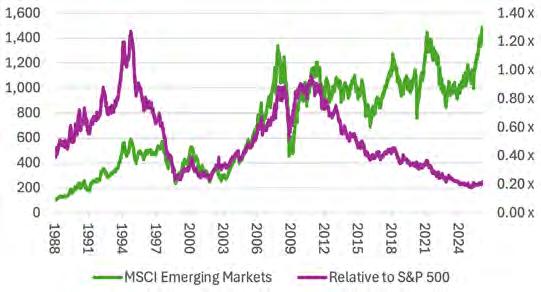
First, the MSCI Emerging Markets (EM) index looks to be breaking out above its former all-time high. Chartists often say that this can signal further strong momentum to come, if the move away from prior peaks proves decisive.
Second, the emerging markets benchmark trades near all-time relative lows compared to the S&P 500.
None of this guarantees further upside in the MSCI EM benchmark. But a weaker dollar is traditionally seen as a boost for emerging markets, as it makes it easier for those nations who borrow in dollars to service their debts, and
rising commodity prices can be a tailwind for them, too, as many developing nations are major producers of precious and industrial metals, as well as oil and gas and agricultural crops. And, right now, the dollar is weakening, and many commodities are surging to all-time, or at least multi-year highs, most notably gold, silver, copper and platinum.
Range of options
Careful research is still required, as emerging markets are not homogenous by any means, and
Emerging markets trade near all-time relative lows compared to S&P 500

they come with a range of risks, including politics, currency movements, corporate governance and how easy it is (or otherwise) to buy and sell on local exchanges. Investors could be forgiven for seeking broad-brush exposure via actively or passively managed funds, which will provide access to a basket of countries and industry sectors in either equities or bonds, or both, rather than tackling the nitty-gritty of individual stock selection.
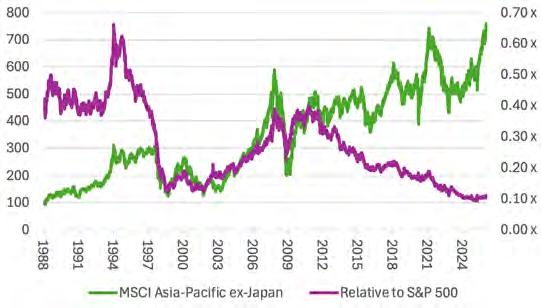
But it is possible that at least some of those not-so-hidden dangers are already factored into EM valuations. The MSCI Asia-Pacific ex-Japan index is currently benefiting from the technology exposure provided by Taiwan’s TSMC, Korea’s Samsung Electronics and SK Hynix and the AI magic dust associated with Chinese internet giants Alibaba and Tencent. The index is hitting new all-time highs, but the index’s relative rating compared to the S&P 500 is near historic lows.
Asia-Pacific region trades near all-time lows relative to the S&P 500…
Source:
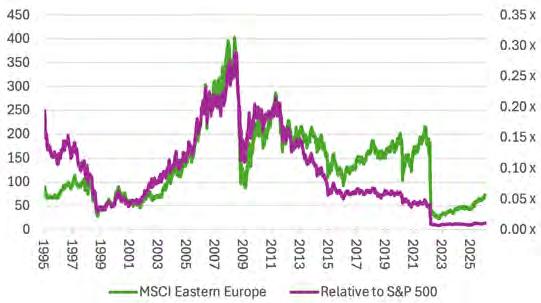
Eastern Europe may just be too tricky for some, given the proximity of the war in Ukraine and
Russia’s fall from grace in 2022 when it sanctioned the invasion of its neighbour.
…as does Eastern Europe…
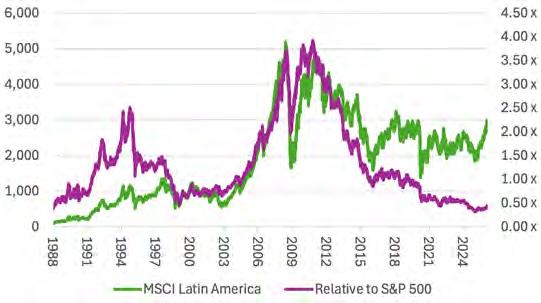
Latin America has a tiny weighting in the AllWorld indices, with Brazil, Chile, Colombia and Mexico chipping in barely 1% of the benchmark’s capitalisation. But the MSCI index is rallying, helped by a rightward shift in politics in Argentina, Peru and Bolivia, scope or interest cuts as reforms put a lid on inflation and strong industrial and precious metal prices.
…and Latin America, where the headline index is trying to set new 10-year highs
LSEG Refinitiv data
Source: LSEG Refinitiv data
Source: LSEG Refinitiv data
Trainline shares have gone off the rails: can they get back on track?

Towards the end of 2024 Trainline was chugging along quite nicely. Finally trading solidly above the 350p at which its 2019 IPO was priced after years of ups and downs. The company having been heavily disrupted by the pandemic and facing undulating concern over competitive threats.
Then on 4 December 2024 news of the Labour Government’s Great British Railways proposals to renationalise the rail network emerged to derail the shares. The plans encompass the launch of a unified ticketing portal which could be disruptive for Trainline.
Today, the shares are 41% below the level at which they were listed and 64% below the all-time high of 562.5p they hit in the early weeks of 2020 before Covid intervened. In this article we look at how justified the concerns about Trainline are and what could determine the direction of travel for the stock in the future.
How does Trainline make money?
Many of you may be familiar with and potentially even be users of Trainline’s services. It operates the leading digital rail ticketing platform in the UK, with a market share of around 60%. It also operates overseas in countries including France, Italy, Spain and Germany as well as other parts of Europe.
Trainline
Key stats
Share price: 205p
Market value: £818.1 million
Forecast PE 2027: 8.89
Forecast dividend yield 2027: n/a
February year end
Source: Stockopedia
The company derives revenue from commissions on ticket sales from train operating companies and booking fees. In the UK these come in at 4.5% for every ticket sold and between 50p and a few pounds respectively.
It also has a Trainline Solutions arm which provides booking technology to businesses, travel firms and even rail operators themselves and sells ancillary products like travel insurance, hotel bookings and advertising on its platform.
The strategy has been one of reinforcing its dominant position in the UK and thereby
Under the Bonnet: Trainline
HOW TRAINLINE AND INVESTMENT ANALYSTS SEE THE THREAT FROM GBR

As discussed, Great British Railways, or GBR for short, will have its own ticketing platform, but the suggestion is the Government still wants to see a competitive market in this area. A further risk for Trainline is a simplification of ticket pricing would reduce the need for travellers to use its platform to help secure a good deal.
In a conversation with Deutsche Numis in January 2026 Pete Wood, Trainline’s chief financial officer, acknowledged the concern but said his company could even offer its white label or booking technology services to the nationalised service: “Of course we have a white label business, and we’ll look at interest if a procurement process [for GBR] comes our way. But to park that and talk about the business model, we will continue to innovate, and we’re confident with how we will show up against GBR.”
He added that there was a variety of work to be done before the GBR plans were brought to fruition, and that in the meantime Trainline would continue to invest and innovate and work to widen the gap.
Wood also acknowledged that it was unlikely that GBR will charge booking fees. “I don’t know that for sure,” he said. “But that’s our working assumption. Of course, that is true of all the train operating sites today. None of them have booking fees; they’re actually not allowed to charge them.”
Wood observed that Uber had entered the market around four years earlier without charging booking fees and had even offered credits for each train ride. He noted that although Uber gained a little share, it soon levelled off, which he viewed as evidence of the strength and trust in Trainline’s model.
Outside of the company, Berenberg analyst Alex Short says: ‘We continue to believe the perceived risks relating to the UK government’s plan to renationalise the train operating companies and simplify the fare structure are overdone, and we think the installed base of 18 million users in the UK and Trainline’s outstanding user experience will drive strong user retention and act as a competitive moat.’
Panmure Liberum analyst Sean Kealy does see conflicts of interest within the GBR setup which could hurt Trainline but does note mitigations in the consultation bill published in November 2025. He says: “Our view is that these mitigations are supportive for Trainline, but not perfect. A more supportive outcome would have been for industry management functions to be rolled into the Office of Rail and Road (not GBR), or for the retail arm of GBR to be setup as an independent entity.
“Equally, a less supportive outcome would have included no structural mitigations to any conflicts of interest.”
positioning itself to benefit as an increasing proportion of tickets are sold online. Around half of UK rail tickets are still sold offline – which implies scope for future growth. The company has also been driving European expansion, though here the company has been somewhat stymied by stateowned operators resisting the liberation of these markets.
How is Trainline performing and what is its valuation?
The company reported strong first-half results in November. Adjusted EBITDA (earnings before interest, tax, depreciation and amortisation) for the six-month period to 31 August 2025 was up 14% to £93 million with net ticket sales up 8% and adjusted free cash flow nudging 2% higher to £79 million. The company also lifted its guidance for full-year results. With EBITDA expected to increase by 10% to 13% up from the previous range of between 6% and 9%.
Trainline’s main lookalike and rival, Berlin-based Omio, is not listed on the stock market although is reportedly valued at around $1 billion despite apparently having lower ticket sales and EBITDA than Trainline.
Trainline has a market value in sterling of £818.1 million, a little more than $1.1 billion at current exchange rates, and trades on 8.9 times 12-month forecast earnings. This compares with an average price to earnings ratio of 17.7 times over the last two years. The company does not currently pay a dividend but is engaged in a £150 million share buyback programme.

Source: LSEG
What about the threat from AI?
Another competitive threat facing the business is AI agents which are already being used by people to book items like concert tickets. However, whether the providers would build their own underlying infrastructure to sell rail tickets is debatable and the company is developing its own capabilities in this area while also talking to AI platform operators about how its tech might be integrated with chatbots.
By Tom Sieber Editor

Has Fundsmith lost the Midas touch?

If you ask professional fund selectors what the most challenging part of their job is, deciding what to do about an underperforming fund manager will come near the top of the list. DIY investors often face the same conundrum, which is unjustly made harder the more thorough you have been with your fund selection. If you do your homework properly, you will have high conviction in the manager, and that makes it harder to walk away.
This scenario might sound familiar if you’re invested in the Fundsmith Equity fund, which did extremely well for an extended period after launch but has since fallen on harder times. The fund has now underperformed the global stock market for the last five calendar years, and in a strongly rising market in 2025, the fund eked out a return of just 0.8%.
The fund manager Terry Smith is no shrinking violet, and his pugilistic defence of his investment strategy stands in stark contrast to the deeply apologetic tone struck by Nick Train, another star fund manager with a similar investment style, who is also going through a rough patch.
Are passive funds distorting the market?
Passive funds are in Smith’s sights. As he says in his latest letter to shareholders: “The increasing proportion of equities held by index funds are invested without any regard to the quality or
valuation of the shares bought which produces dangerous distortions.”
In particular Smith is referring to the huge proportion of stock market returns which are coming from a small number of very big US technology companies. Index funds work by buying the biggest stocks in the market, and the contention is that large flows into passive vehicles are driving the share prices of these companies upwards without due regard for the quality of the businesses.
This analysis has a lot of merit and raises legitimate concerns about concentration risk and valuations in the US stock market. One could even describe Smith’s recent underperformance differently and say that rather than Fundsmith Equity falling behind the market, the market has actually pulled ahead of the fund. This comes to the same thing for investors of course, but it’s arguably a more illuminating way of looking at things.
Smith is far from alone in facing this predicament. AJ Bell’s latest Manager versus Machine report found that just 13% of active managers in the Global sector had outperformed a comparable index tracker over the last decade. That level of passive dominance suggests at the very least an environment which has been extremely favourable to index funds, and at worst, a market which is losing sense of economic fundamentals because so much money is being invested passively, purely on the basis of a company’s size.


Smith has never had the ‘Midas touch’
So where does this leave Fundsmith Equity investors? The fund has now fallen behind the MSCI World Index over 10 years. But it’s still ahead of the average fund in its sector and looking a bit further back to the launch of the fund in 2011, it’s still well ahead of both the global stock market and its peers.
At no point in this journey has Smith wielded some supernatural knack, the so-called ‘Midas touch’, which is so often attributed to successful fund managers, only to be ripped off when they falter. The reality is for a while Fundsmith’s returns were flattered by low interest rates, which proved a tailwind to Smith’s investment style. Now the shoe is on the other foot as his preference for quality stocks has struggled to beat other parts of the market.
What’s reassuring is that across these periods of performance, Smith has been consistent in applying a well-articulated investment strategy, similar to that employed by Warren Buffett. Recent performance has of course been disappointing, but investors should take reassurance from the fact Smith is sticking to his guns. His longer-term track record also puts some credit in the bank, and suggests along the way he has exercised skill, as well as experiencing his share of both favourable and adverse conditions.
How to approach an underperforming fund
It may be helpful to think about how you approach fund underperformance in terms of your broad
Fundsmith has underperformed of late but still outperformed since launch
Total Return %
Total return in GBP to 31 December 2025
Source: FE, Fundsmith

AJ Bell’s latest Manager versus Machine report found that just 13% of active managers in the Global sector had outperformed a comparable index tracker over the last decade
approach to investing, rather than solely in relation to Fundsmith Equity. As an investor do you want to cut and run when a fund manager underperforms, or stick with them in the hope of a turnaround? Remember switching funds comes with costs attached, and jumping ship from one active fund to another doesn’t provide immunity from underperformance.
Bear in mind it’s not an all-or-nothing decision either. If you have less conviction in Fundsmith Equity, you can reflect that by selling some of your holding rather than all of it. Some investors may go the other way, believing underperformance to have created an attractive buying opportunity, perhaps re-allocating money to the fund from other areas which have done better.
Ultimately, if you’re an active fund investor, you have to accept the fallow with the fertile, and occasionally face tough judgement calls. This is a hard discipline, and may be another reason so many investors are turning to passive funds. Then
again, if there is a rotation in market leadership away from big tech, active investors may yet have the last laugh.

By Laith Khalaf AJ Bell Head of Investment Analysis
Listen for more
You can access the free AJ Bell Money & Markets Deep Dive podcast in the usual podcast places. It looks at a range of investment topics in detail.


My daughter’s in the Navy — where should she start with her pension?
Ask the experts
Rachel Vahey is here to answer questions on pensions.
If you’d like a question considered for a future edition send it in now.
My daughter has just completed her first year in the Navy and is considering setting up a personal pension because she has an excess of cash, what can you suggest?
I have a SIPP with you but not sure I want the responsibility of her pension too, since at the moment she does not have the time or knowledge herself to manage it, although this may change in the future. She has a shares ISA that I manage, savings and a few investments. We look forward to hearing from you.
Chloe

Rachel Vahey, AJ Bell Head of Public Policy, says:
Congratulations to your daughter for completing her first year in the Navy; that is a great milestone.
It’s no wonder at this juncture that she is starting to think seriously about her future finances, and it’s good she realises she’s in a place to save more for her later life.
Your daughter will probably have been automatically enrolled into the Armed Forces Pension Scheme (AFPS), and unless she opted out, she will be building up a pension under this scheme.
This is an extremely generous defined benefit pension scheme, which promises to pay her a pension income linked to her salary and how long she is in the Navy for. She doesn’t have to pay any contributions into this pension scheme but will still receive this pension at her retirement age.
How can you supplement a naval pension?
It’s possible for her to save more for her pension through the AFPS. If she pays Member Voluntary Contributions (MVCs) she can buy ‘added pension’. This option lets members pay extra to boost the amount they’ll get from their main pension scheme. Your daughter should check the details to see how much extra pension she can buy, but it’s likely to offer good value and could make a
Ask Rachel: Your retirement questions answered

real difference to her retirement income. Plus, the money she receives from her pension should go up every year once she starts getting it.
She may want to make these enquiries whilst she is still young. The cost of buying the same amount of additional pension will increase as she gets older, so if she currently has the funds to make this investment then this may represent very good value for her at this moment in time, rather than waiting until she is older.
These are complicated decisions and your daughter may want to speak to the AFPS or ask a regulated financial adviser for a personal recommendation.
What about a SIPP?
She could also consider setting up a pension, such as a SIPP, in her own name. There are many different types of SIPP, and it’s possible to set up a low-cost ‘ready-made’ pension that is simple and easy to manage. These are usually set up and maintained through an app and are designed to make investing easy for beginners by cutting-out jargon and offering straightforward investment options. Backing them will be a raft of useful support from the provider.
These types of pensions fit in well with a ‘handsoff’ approach and are a useful introduction into the world of investing. Once your daughter has more time and knowledge, she could then move to a different type of SIPP with more investment options.
People can save into as many pensions as they want at the same time. There are limits on how much she can save tax-efficiently. She can personally save as much as her UK earnings. There is also a total limit on the amount that can be
saved in her pensions each tax year which is usually £60,000. This includes the value of the pension benefits built up in the AFPS that year. The AFPS will work out what counts towards this limit –known as the ‘pension input amount’ – and they can let her know how much of her allowance she used last year.
Don’t forget about ISAs
One final thing. Your daughter may also want to consider increasing the amount she pays into her ISAs, especially if she wants to maintain the flexibility to access her money. She can then gradually increase the amount she saves into a pension as her earnings increase.




Shares magazine is published by AJ Bell, authorised and regulated by the Financial Conduct Authority. It’s here to inform, not to give personal advice. Please don’t base your investment decisions on it alone. If you’re unsure, speak to an independent adviser. And remember: past performance isn’t a guide to the future. Tax benefits depend on your circumstances and tax rules may change.