TEACHER OF THE YEAR Activities
Tried-and-true favorites your students will love.
Elementary PE (Grades 3-5)
Middle School PE (Grades 6-8)
High School PE (Grades 9-12)
Adapted PE (Grades PreK-2)
Health Education (Grades 9-12)
Back to School 2026: Start Strong With Standards

Hoop Hustle
Activity Length: 15 minutes
Before beginning, teachers should offer accommodations specifically mentioned in a student’s IEP to support their ability to participate in the activity
National Standards
Standard 1: Develops a variety of motor skills.
1519 Demonstrates dribbling with hand in nondynamic and dynamic practices tasks
Standard 2: Applies knowledge related to movement and fitness concepts
2.5.4 Demonstrates knowledge of appropriate movement concepts for efficient performance of manipulative skills
Activity Progression
Set Up
Grade Level: 3-5
Objectives: By the end of the activity, students will be able to maintain control of a basketball while traveling around the gym to get into an available hula hoop. use spatial awareness and movement concepts (speed, pathways, and open space) to successfully move to an available hula hoop when signaled
Materials Needed
Hula hoops (5 less than number of students per class)
Basketballs (5 less than number of students per class)
Cones or polyspots (optional)
Place hula hoops evenly spaced in a circle or square around the gym There should be five less hula hoops than there are students If you have 30 students set up 25 hula hoops
Select five students who will perform basketball-like movements in the center of the gym; they will not need a basketball The rest of the students will stand inside or near a hula hoop with a basketball
How To Play
Start the Round
When the music plays, the students with basketballs begin dribbling their basketballs around the circle of hoops in the same direction.
The 5 students in the center perform basketball-like exercises (e.g., jumping jacks, lunges, vertical jump, back pedal, and side shuffles).
When the Music Stops
All 30 students (with or without basketballs) attempt to quickly get into a hula hoop. Students with basketballs must dribble into a hoop as fast as possible.
Students without basketballs must sprint into a hoop, trying to be the first to reach and get in
Sharedby:TomGelardi,2025SHAPEAmericaNationalElementaryPhysicalEducationTeacheroftheYear
Hoop Hustle
Activity Length: 15 minutes
Determining Who Gets In
The first students to reach get into a hoop occupy those hoops
Grade Level: 3-5
The remaining 5 students regardless of whether they are dribbling or sprinting now become the new students in the middle for the next round.
Start the Next Round
If a student with a basketball gets into a hoop, they keep their basketball If a student without a basketball gets into a hoop, they take a basketball. The new students in the center perform basketball-like movements again.
Continue for several rounds focusing on proper cues for dribbling.
Modifications/Differentiations
Add more hoops to increase success
Allow students to choose their locomotor movement
Provide more time between rounds
Add specific tasks before returning to the hoops (eg, dribble 10 times before returning to your hoop)
Add spots or obstacles they must dribble around
Provide visual cues so students know when to move
Check for Understanding/Assessment Strategies
During gameplay, look for students keeping their eyes up rather than constantly watching the ball
Questions to ask throughout the activity: "What can you do if the hoop you are heading toward gets filled?" "What helped you keep control of your dribble when moving quickly to a hoop?"
Dolphin Golf
Activity Length: 40 minutes
Before beginning, teachers should offer accommodations specifically mentioned in a student’s IEP to support their ability to participate in the activity.
National Standards
Standard 1: Develops a variety of motor skills 1814 Demonstrates sending and receiving in combination with locomotor skills in a variety of smallsided games
Middle School PE
Grade Level: 6-8
Objectives: By the end of the activity, students will be able to complete catches and throws to demonstrate the “give and go” skill required for many activities and sport concepts. identify the cues of the “give and go.”
Materials Needed
Tennis balls
Frisbees
Deck rings
Activity Progression
SkillPractice
Rubber ducks
Badminton birdies
Tall cones
Hula hoops
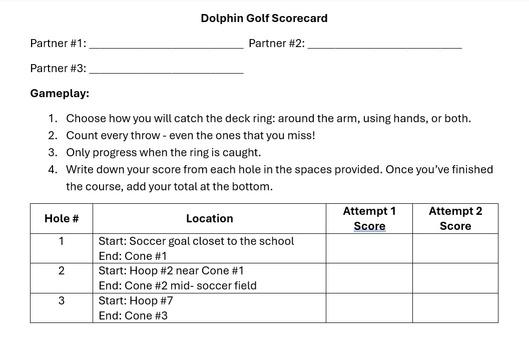
Scorecards
Pencils
Demonstratethe“giveandgo”skillandexplaintostudentsthisskillisusedinavarietyofactivitiesand sports Studentswillpracticethe“giveandgo”skilldowntheplayareawithapartnerusingavarietyof equipment
Tennisball:tossandcatchwithoneortwohands Rubberduck:tossandcatchwithonehand Frisbee:tossandcatchwithoneortwohands Badmintonbirdie:tossandcatchwithonehand Deckring:tosscanand“catch”byringingitaroundthearm
SetUp
Onafieldorlargeopenspace,setup10-12“holes.”Eachholeshouldhaveahulahoopwherestudentswill startandaconetheywillendat;labeleachconeandhoopnumerically.Holesdonothavetocoordinate withtheirnumberedconeorhoop.Forexample,usingthediagrambelow,Hole#3canstartatHoop7 andendatCone3.
DolphinGolf
1 Studentsareorganizedintogroupsof2or3basedonclasssize Eachgroupshouldhaveascorecard (seeexampleattheendoftheactivity)andpencil
2 Eachgroupshouldstartatadifferent“hole”topreventcongestiononthecourse 3Onestudentwillstartbytossingthedeckringtotheirpartnerorteammate Thepartnerorteammate willcatchthedeckringbyringingitaroundtheirarm
Dolphin Golf
(continued)
Activity Length: 40 minutes
Grade Level: 6-8
4 Tossers will start inside the hula hoop at each hole and will end at the designated tall cone
a All start/end points for each hole are on the scorecard
b Players do not have to toss the ring onto the cone, but just need to be close enough to place the ring over the top of the cone
5 Every throw counts at a “stroke” even if it is dropped
a If caught by the hand, it does not count
b Once caught, they stand still and the partner advances toward the target, simulating the “give and go” skill
6 Every throw counts as a “stroke” including drops
a Students can only progress once the ring is caught
7 After each hole, groups will record how many throw it took them to get to their target on the scorecard
a Students will want to have the lowest score (like in golf)
8 Once the course has been completed, groups will add up their total scored and record it on their scorecard.
Modifications/Differentiations
Offer various equipment to toss at each station for students to choose their level of difficulty
Allow students to catch the deck ring with their hands or on their arms
Assign points to how they catch (ex 1 point=hands, 2 points=around the arm)
Allow one drop per hole
Allow students to replay a hole to improve their score
Check for Understanding/Assessment Strategies
What sports or activities might use the “give and go” skill?
Which pieces of equipment were the most challenging to catch? Easiest to catch? Why?
What cue can you focus on to ensure a successful “give” to your partner?
What cue can you focus on to ensure a successful catch?
How did you and your partner ensure a successful “give and go”?
High School PE
Real World Fitness Circuit
Activity Length: 30 minutes
Before beginning, teachers should offer accommodations specifically mentioned in a student’s IEP to support their ability to participate in the activity.
National Standards
Standard 1: Develops a variety of motor skills.
1126 Demonstrates appropriate technique in muscular strength and endurance training
Standard 2: Applies knowledge related to movement and fitness concepts
2.12.9 Evaluates perceived exertion during physical activity and adjusts effort
Standard 4: Develops personal skills, identifies personal benefits of movement, and chooses to engage in physical activity
4.12.9 Reflects on movement experiences during physical education to develop understanding of how movement is personally meaningful
Activity Progression
Functional Fitness Circuit
Grade Level: 9-12
Objectives: By the end of the activity, students will be able to …
Complete five functional fitness stations with proper form and self-selected intensity
Rate their perceived exertion at each station and adjust effort on the next round
Explain the purpose and real-life application of each exercise (ex: lifting groceries, stair climbing, sports related).
Materials Needed
Kettlebells
Jump ropes
Plyo Boxes
Medicine Balls
Music and Timer
Markers
Chart paper per station
Sticky notes
Explain to students that they will rotate through five functional fitness stations At each station they will perform the exercise and reflect on activity to determine how each exercise has a real life connection Students will write their response on a sticky note and place it on the chart paper and transition to the next station. Additionally, have students rate their perceived effort. Have students determine if they need to adjust their effort based on the type of activity.
Station Type of Movement
Kettlebell Swings
Hinge movement
Box Jumps or StepUps Lower body explosive power
Jump Rope
Wall Balls (Medicine Ball to a Target)
Bear Crawl or High Knees
Coordination and cardio
Squat and overhead throw
Core and full body control
Sharedby:DerekThomas,2025
When do you lift weight from ground to overhead?
How is this like climbing stairs, curbs, or hiking?
When might quick footowork or sustained effort help you in daily life?
What daily tasks mimic this movement?
How can a strong core help with daily movements? Give examples
High
School
Real World Fitness Circuit
(continued)
Activity Length: 30 minutes
Grade Level: 9-12
Have students spend about 5 minutes at each station. Give them 3-4 minutes to perform the exercise and then about 1 minute to record responses to the prompts. Allow students about 1 minute to transition to the next station. Move through the stations and ask students about their responses.
As students are transitioning to the next station, have them show by hands their perceived exertion with 10 being maximum intensity. Have students determine if they need to adjust their intensity level for the next station Provide them with prompts to consider to determine if they need to adjust their intensity
Potential prompts:
Is your form being compromised?
Is your heart rate too high or not high enough?
Is it hard for you to keep a conversation?
Was it challenging? Or could you keep going and going?
Suggested sets and reps for each exercise:
Kettlebell swings: 3 sets of 10
Jump rope: How many can do you complete before messing up?
Bear crawl: 4 crawls forward and 4 crawls back for 4 times
High knees: 30 seconds on and 15 seconds of rest
Box jumps: 3 sets of 8 jumps
Step-ups: Using a fitness step, 20 step-ups alternating legs for 30 sets
Modifications/Differentiations
Wall Balls ➝ Seated shoulder press with light medicine ball
Jump Rope ➝ Line jumps or marching in place
Bear Crawl ➝ Forward arm raises from tabletop position
Box Jumps➝ Use 3 foot in plyo box or fitness step and step on and step off
Use visual station cues like arrows to show which direction to move
Provide pictures at each station or GIFs of how each movement should be performed
Allow students to work with partners
Check for Understanding/Assessment Strategies
In an exit slip or think-pair-share, ask students: What factors did you use to determine how you adjusted your intensity level between stations? How can fitness benefit your everyday life and in your daily movements?
PE Sharedby:DerekThomas,2025SHAPEAmericaWesternDistrictHighSchoolPhysicalEducationTeacheroftheYear
Create Your Own Dance
Activity Length: 15 minutes
Before beginning, teachers should offer accommodations specifically mentioned in a student’s IEP to support their ability to participate in the activity.
National Standards
Standard 1: Develops a variety of motor skills.
1215 Demonstrates locomotor, non-locomotor, and manipulative movements based on a variety of dance form
Standard 2: Applies knowledge related to movement and fitness concepts
225 Demonstrates knowledge of non-locomotor, locomotor and movement concepts used in dance and rhythms
Activity Progression
Creating Dance Cards
Objectives: By the end of the activity, students will be able to
Perform a self-created dance routine using locomotor and non-locomotor skills
Select four or more dance moves to create their own routine
Materials Needed
Index Cards or copy paper cut into 10-12 pieces
Create a “bank” or large collection of dance cards There should be at least 5x more cards than there are students
Have students suggest movements to put on the cards
Movements can be repeated on multiple cards to be used by many students or groups
For larger class sizes or limited time, collect dance moves ideas ahead of time You can do this during transitions or during prior lessons
Always have a few blank cards for “day of” ideas
Younger students will benefit from the teacher making the cards and including a simple picture
Older students, with support, may be able to create the cards
Tip: Save laminated scraps to create dance cards that can be used again with a dry eraser marker!
Create Your Own Dance Activity
Have students individually, or in small groups, pick 2-3 cards Students should have prior knowledge of personal space Students should remain in a relatively small personal space area when beginning so all have space to move This will also allow space to lay down the Dance Cards in sequence on the floor
Working in groups of one often works best initially
Student choice is a key element
Students then sequence the moves in any order they desire, assigning the number of repetitions that they choose
Counts of 4-8-12-16 work best
Students will perform the dance routine to a song Allow students to choose from 2-3 song choices
Everyone is dancing at the same time, no individual or group should be put “on display” or in front of the class while dancing
Consider having a student as the “DJ” this will allow the teacher to circulate and support students more and allow for that student to “warm-up” to the activity if there is any reluctance
Students will not be dancing for 30-45 seconds at a time when starting and expanding the time from there
Create Your Own Dance
(continued)
Activity Length: 15 minutes
Grade Level: PreK-2
After a 30-35 second round, allow individuals/groups to reflect on their routine and then make adjustments for the next round As confidence grows, students can choose or make additional cards to add to their routine
There is no limit to the length of a routine; it can continue for as long as the song goes if students desire to.
Modifications/Differentiations
Adaptations
Supply dance moves that can be done while seated or while standing and stationary
Students can work in a teacher-led group for the first round or two
Use familiar movements for the Dance Cards such as “hand wave”, “foot stomp”, “head roll”, etc
Permit students to repeat dance moves, or even sections of several moves, in their dance
Provide verbal cues such as counting the beats during the song
Remind students that each movement does not have to be one beat; for example, a single movement could take two beats
Extensions
Students can create new Dance Cards
Students can change their dance moves with increased frequency during the song such as with every 8 beats instead of every 16 beats
Student can create “special cards” such as “repeat,” “reverse,” “opposite,” “with a partner,” or “double speed” to add to their routine
The teacher can suggest new dance moves the student may not yet be familiar with
Check for Understanding/Assessment Strategies
Have students identify the four steps or movements they included in their dance routine
Check in with each group or individual during rounds to observe four dance moves have been selected for each routine
Health Education
Relationship Behavior Continuum
Activity Length: 20 minutes
Before beginning, teachers should offer accommodations specifically mentioned in a student’s IEP to support their ability to participate in the activity.
National Standards
Standard 4: Use interpersonal communication skills to support health and well-being of self and others
4122 Apply communication skills and strategies within a variety of interpersonal contexts.
Activity Progression
Grade Level: 9-12
Objectives: By the end of the activity, students will be able to …
Identify relationship behaviors that are healthy and unhealthy and explain why the behavior is healthy or unhealthy
Materials Needed
Strips with relationship related behaviors
Tape/small magnets
White Board
Dry erase marker
Ask students what they think of when they hear “red flag” A red flag is a sign that lets you know that something might not be right Explain to students that lots of times there are red flags early on in a relationship that warn you of future problems
Explain that today we are going to analyze a variety of behaviors related to dating relationships and determine whether they are healthy or unhealthy
Create 8-10 strips that have a variety of healthy and unhealthy behaviors on them
Examples of behaviors:
My partner tells me they can’t live without me
When I hang out with other friends or family, my partner calls or texts the entire time
My partner encouraged me to try out for the volleyball team even though I was nervous
My partner thinks my friends are annoying or insults them often
My partner likes to pick out my clothes or suggest things to wear
My partner and I have lots of silly jokes
My partner likes to take me to school and the places I need to go because they want me to be safe
My partner wanted to do something I didn’t feel comfortable with and they said it was okay.
My partner and I talk about a lot of different topics.
My partner and I share our locations.
I felt like I had to lie to my partner about talking to my ex after class.
You and your partner got into an argument. Your partner asks if they can talk to you about their feelings.
My partner tells me they love me all the time.
I feel like my partner would be upset if I went a long time without texting them.
My partner likes to plan fun things for us to do
My partner wants to get to know my family and friends
Create multiple sets for a large class so that they can work in groups to organize the behaviors as healthy, unhealthy, or somewhere in the middle
During the activity, monitor the students for collaboration skills, and prompt them to think deeply about the behaviors
Sharedby:KristenAllen,2025SHAPEAmericaEasternDistrictHealthEducationTeacheroftheYear
Relationship Behavior Continuum
Activity Length: 20 minutes
Once the groups are satisfied with where they put everything, draw a double sided arrow on the board. Label one side “healthy” and one side “unhealthy.”
Allow a student from each group to come up and place a behavior on the continuum using tape. Create discussion around how to handle situations where your partner is exhibiting some of the unhealthy behaviors (for example, insisting on driving you everywhere). Challenge students thinking where a behavior may initially be healthy, but can turn unhealthy (for example, sharing location). Create discussion about how/who to ask for help if a student finds themself in an unhealthy relationship, and how to support a friend
Modifications/Differentiations
Have a few blank strips so that students can add other relationship behaviors Only give a few behaviors strips at a time, then provide each group with 1-2 more after the group discussion
Check for Understanding/Assessment Strategies
Create an exit ticket with a list of 3-4 relationship behaviors and have students identify whether they are health or unhealthy