8 Essential Deep Learning Courses
You Should Consider
Deep learning continues to be the engine behind the most significant AI breakthroughs of 2026, from multimodal generative models to sophisticated autonomous systems. Whether you are a software engineer looking to pivot or a researcher aiming for the cutting edge, choosing the right curriculum is essential.
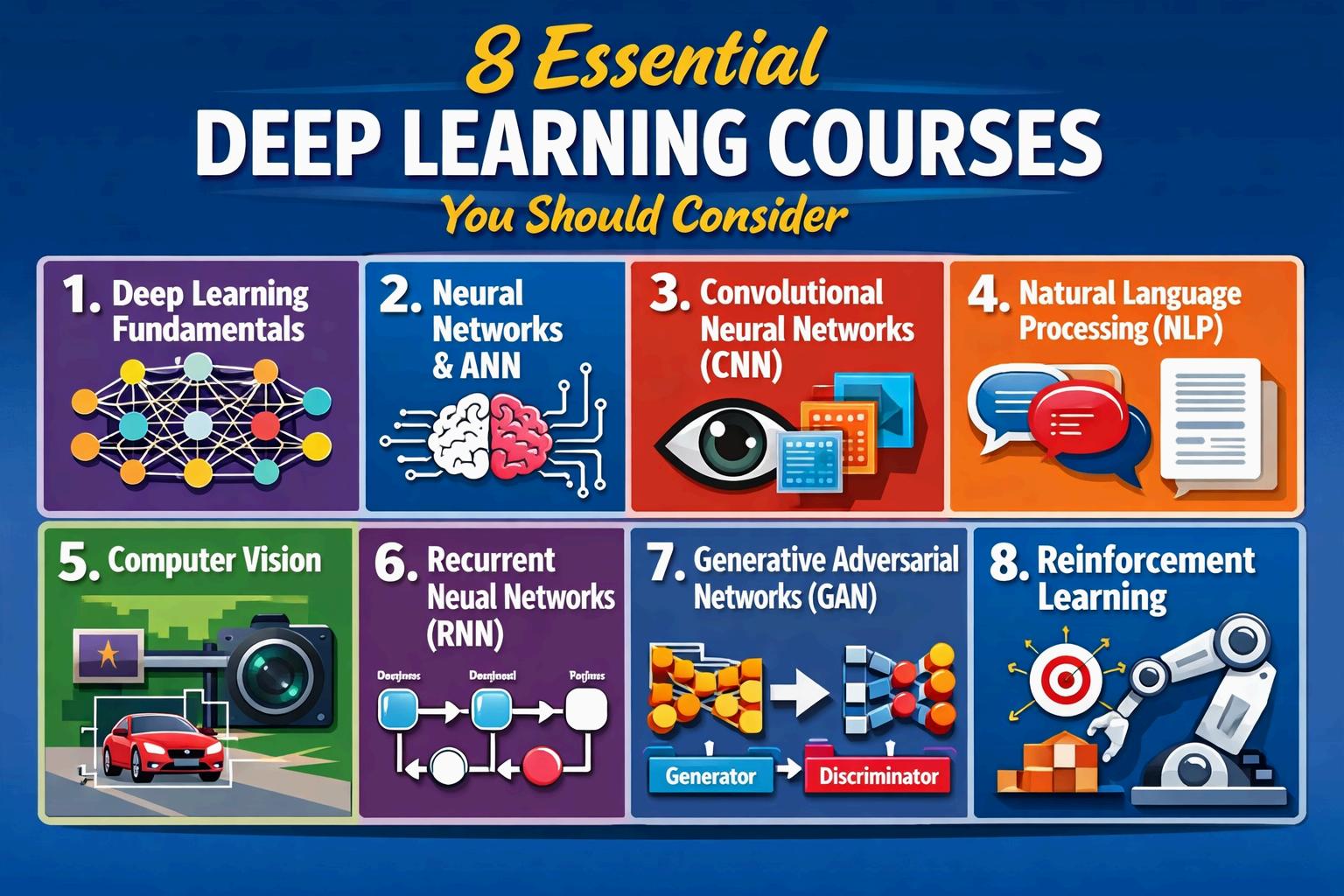
Here are 8 essential deep learning courses, categorized by their focus and learning style, to help you navigate the field in 2026.
1. Deep Learning Specialization (DeepLearning.AI)
Widely considered the "gold standard" for entering the field, this Coursera specialization led by Andrew Ng has been updated for 2026 to include modern transformer architectures and generative AI basics.
Best For: Ambitious beginners and intermediate learners.
Key Topics: Neural Network foundations, Hyperparameter tuning, CNNs, and Sequence Models (RNNs/LSTMs).
Platform: Coursera.
2. Practical Deep Learning for Coders (fast.ai)
This course flips the traditional academic model on its head. Instead of starting with calculus, you start by building a world-class image classifier in the first lesson.
Best For: Software engineers who prefer a "top-down," code-first approach.
Key Topics: PyTorch, fastai library, Computer Vision, and NLP.
Cost: Completely Free.
3. MIT 6.S191: Introduction to Deep Learning
This is a rigorous, fast-paced "bootcamp" style course. It offers high production value and covers the latest research trends, including the mathematics of deep generative models.
Best For: Those who want a blend of academic rigor and modern application. Key Topics: Deep Generative Modeling, Reinforcement Learning, and Evidential Deep Learning.
Platform: MIT OpenCourseWare / YouTube.
4. Deep Learning Nanodegree (Udacity)
If you need hands-on mentorship and human feedback on your code, this Nanodegree is a strong contender. It focuses heavily on building a portfolio of projects.
Best For: Learners seeking career support and structured project reviews. Key Topics: Generative Adversarial Networks (GANs), Sentiment Analysis, and Model Deployment.
Platform: Udacity.
5. IBM AI Engineering Professional Certificate
This is a massive, 6-course program that goes beyond just "learning the math." It focuses on the engineering side how to scale and deploy models in a professional environment.
Best For: Professionals aiming for "AI Engineer" or "MLOps" roles. Key Topics: Keras, PyTorch, Scikit-learn, and Scaling models with Apache Spark.
Platform: Coursera.
6. CS231n: Deep Learning for Computer Vision (Stanford)
If your goal is to master how machines "see," this is the definitive course. While technically an on-campus course, the materials and lectures are legendary in the AI community.
Best For: Intermediate to advanced learners specializing in Computer Vision. Key Topics: Image Classification, Detection, and Segmentation using CNNs. Cost: Free (Audit).
7. NVIDIA Deep Learning Institute (DLI)
NVIDIA offers short, intensive, and highly technical modules that focus on GPU acceleration. These are perfect if you need to learn how to optimize your models for high-performance hardware
Best For: Developers needing to master hardware-level optimization and CUDA.
Key Topics: Accelerated Computing, SDKs like TensorRT, and Omniverse integration.
Platform: NVIDIA.
8. Kaggle Deep Learning Track
For those who have zero time for long lectures and just want to "do," Kaggle’s micro-courses provide the most direct path to writing functional deep learning code
Best For: Rapid skill acquisition and competition preparation.
Key Topics: TensorFlow, Keras, and tabular deep learning. Cost: Free.