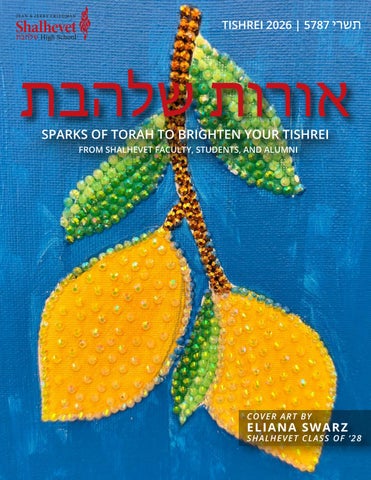
COVER ART BY
ELIANA SWARZ
SHALHEVET CLASS OF ‘28
Welcome to Orot Shalhevet
RABBI DAVID BLOCK HEAD OF SCHOOL
Dear Shalhevet Community,
Every so often, a song comes along and takes the Jewish music world by storm. Here’s a litmus test: If other artists are playing the song at their concerts, you know it’s made it. Over the summer, my family and I had the zechus to go to a few concerts in Israel, and not only did Hanan ben Ari play his now-popular “Hashiveinu,” but Zusha played it at their concert, too. And we sang it with the NCSY Kollel at their Tisha B’av kumzitz at the kotel. (I’m proud to say that we at Shalhevet were early adopters; we sang it well before it ever officially recorded. But for another time.) To me, the song is so moving not only because of its post-October 7th significance, but because of how brilliantly the tune matches - and accentuates - the spirit of its message. But, popularity has a way of dulling our senses; when we sing a song enough, it's easy to stop thinking critically about what we're actually saying. The words are likely familiar to us – from Eicha (the source), selichos, and each time we return a Sefer Torah to the aron. But when we consider them carefully, we may notice something quite curious. “ השבינו ה׳ אליך ונשובה- return us, Hashem, to you, and we will return.” First, are we really putting the onus of Teshuva on Hashem? It’s not Hashem’s job to return us – it’s our job to return! Chazal already highlight precisely this tension (Eicha Rabba, Yoma 39). Further, how are we to understand the second part of the phrase: Return us, Hashem – and then we will return. Yes, obviously so: If Hashem returns us, then we will have returned. How are we to make sense of it all? The Ho’il Moshe (R’ Moshe Yitzchak Ashkenazi, 19th century) offers an elegant, compelling insight. The word “ ”“ונשובהis strange – and, ostensibly, not grammatically sound. “And we will return” would simply be ““ונשוב.” The extra letter הat the end changes the regular (imperfect) verb into what is grammatically called a “cohortative verb” – which implies not just action, but desire. The Builders of Migdal Bavel said, “ ָה ָבה נִ לְ ְּבנָ ה לְ ֵבנִ ים, let’s make bricks!” (Bereishis 11:3). Paraoh said, “הבה נתחכמה לו, let’s outsmart them!” (Shemos 1:10). It’s a verb form that projects passion, excitement, desire. We want to return! And if so, it forces us to reinterpret the first clause. “השבינו,” then, is not a demand but a plea; “ ”ונשובהis not a description but a dream. Hashem, sometimes the distance feels unbridgeable, like we've wandered too far to ever find our way back. But You should know how deeply we want to bridge that gap. We want to be close to You. We ache for it. So please: reach out to us, show us a path back to You. And the moment we see it, we won't walk. We'll run, breathlessly, home. ונשובה. The voices of our students, alumni, and faculty radiate the call of “ ”ונשובהAnd it’s our hope that their gorgeous, stirring words of Torah help us find our way back. Wherever you are for the chagim, take Orot Shalhevet with you and share that kedusha with others. It is my bracha that the voices and insights of our community infuse your holidays with meaning and joy, and that the beautiful artwork within serves as a hiddur mitzvah, enhancing the Torah we live by. Our students, faculty, and alumni are the Orot that form our dazzling Shalhevet. Wishing you a Shana Tovah, Rabbi David Block
3 RABBI ABRAHAM LIEBERMAN
THE 13 ATTRIBUTES OF MERCY: THE HEART OF SELICHOT
6 DR. SHEILA
TULLER KEITER
BECOMING THE CORNERSTONE
8 MAX MESSINGER KAPPAROT ALEKHA: EXAMINING AN ODD MINHAG
11 M S . M I K A S H A L O M THE MONTH WITH A MISSION
13 L O N D O N B R A K H A WHAT HAPPENS AFTER THE SHOFAR STOPS?
15 R A B B I A R I
SCHWARZBERG :בכסה ליום חגנו
THE HIDDEN NATURE OF ROSH HASHANA
18 T A Y L O R G R U E N B A U M
21 Y O S E F I S E N B E R G WHAT EVEN ARE THE "DAYS OF REPENTANCE?"
23 A R I E H E L A D THE KETORET OF YOM KIPPUR
25 M S . T O V A H G O L D M A N THE POWER OF POTENTIAL
27 N A T H A N I E L K U R Z B A N PARTNERING WITH HASHEM
29 A Y A L A B I C K K A T Z
YOM KIPPUR: AN INTERGENERATIONAL OPPORTUNITY
31 G A V I K A T R I K H
TESHUVA AND SIMCHA ON YOM KIPPUR AND SUKKOT
33 N O A M L E R N E R
REPENTING AS ONE: MOSHE, AARON, AND THE GOLDEN CALF
ZICHRON: THE ESSENCE OF TESHUVA
thank you
TO THE FOLLOWING SUPPORTERS WHO HAVE GENEROUSLY SPONSORED THIS EDITION OF OROT SHALHEVET. WE ARE GRATEFUL TO THEM FOR HELPING TO PROMOTE THE SPREAD OF MEANINGFUL TORAH LEARNING AND SPIRITUAL GROWTH IN OUR COMMUNITY. PLEASE ENJOY THE TORAH YOU WILL FIND WITHIN IN THEIR MERIT.
KAREN & AVI ASHKENAZI MAYA & NEIL COHEN ELISA & BRAD DELSON DRS. JENNIFER & YARON ELAD SHARON & KOVI ELKUS MOLLY & SAEED JALALI BATSHEVA & SHELDON KASDAN SIMONE & JASON KBOUDI STACY & RANON KENT DEENA & DAN MESSINGER
SARAH & TZVIKA NISSEL GWEN & JEREMY ROSENTHAL JANELLE & BENJAMIN ROSS NAOMI & RABBI ARI SCHWARZBERG TAALY & ADAM SILBERSTEIN TAMAR MESZAROS & DAVID SILBERSTEIN JENNIFER & MARK SMITH LESLEE & ALEX SZTUDEN SHANNON & JUSTIN WEISSMAN TAL & JACOB ZOKAEIM
Limudei Kodesh Faculty
RABBI ABRAHAM LIEBERMAN RABBI ABRAHAM LIEBERMAN IS A MEMBER OF THE LIMUDEI KODESH FACULTY AT SHALHEVET HIGH SCHOOL. HE PREVIOUSLY SERVED AS THE HEAD OF SCHOOL AT YULA GIRLS HIGH SCHOOL. RABBI LIEBERMAN LEARNED AT YESHIVA UNIVERSITY AND RECIEVED SEMIKHA FROM EMEK HALAKHA IN BROOKLYN. HE RECIEVED HIS M.A. IN JEWISH HISTORY FROM THE BERNARD REVEL GRADUATE SCHOOL (YU), WHERE HE IS CURRENTLY WORKING TOWARDS HIS DOCTORATE.
The 13 Attributes of Mercy: THE HEART OF SELICHOT
Am Yisrael is deeply connected to time. From measuring a halachic day, to determining the beginning and end of Shabbat, to observing the different seasons and their associated mitzvot, the sensitivity of a Jew to time is enormous. The period leading up to Yom Kippur spans forty days and is divided into three stages, all centered around teshuva: 1 The month of Elul 2 The Ten Days of Repentance, beginning with Rosh Hashanah 3 Yom Kippur
The segment of time starting with Rosh Chodesh Elul is a very inspiring and meaningful one. As human character is difficult to change overnight, Hashem grants us an extended period during which we can gradually pursue spiritual growth, repair our relationships with Him and other people, and prepare ourselves for Yom Kippur. Two minhagim (with different variations among Ashkenazim and Sephardim) accompany the month of Elul in order to deepen our focus on teshuva; namely, the blowing of the Shofar and the recital of Selichot. The focal point of Selichot, both those recited during this period as well as those recited on communal fast days, is the repeated recitation of the Thirteen Attributes of Mercy. What makes these verses so central and significant? The origin of these Attributes lies in the aftermath of the Chet Ha-Egel (the Sin of the Golden Calf), when Moshe ascended Har Sinai a second time for forty days to pray for forgiveness for Am Yisrael. When forgiveness is granted, Moshe requests of Hashem: “Show me Your Glory” (Shemot 33:18). Within the narrative that follows, Hashem reveals to Moshe the Thirteen Attributes (Shemot 34:5-7). Moshe ultimately descends from Har Sinai on Yom Kippur with the second set of Tablets and the assurance of complete forgiveness. The significance of this revelation is explained by the Talmud (Rosh Hashana 17b): ְמ ַל ֵּמד ׁ ֶש ִ ּנ ְת ַע ֵּטף ַה ָ ּקדוֹ ׁש ָּבר ּו ְך.ֹ ִאלְ ָמ ֵלא ִמ ְק ָרא ָּכת ּוב ִאי ֶא ְפ ׁ ָשר לְ אוֹ ְמרו: ָא ַמר ַר ִּבי יוֹ ָחנָ ן,""וַ ַ ּי ֲעבוֹ ר ה' ַעל ּ ָפנָ יו וַ ִ ּי ְק ָרא וַ ֲאנִ י,ש ּו לְ ָפנַ י ַּכ ֵּס ֶדר ַה ֶ ּז ה ַ ִה ּוא ִּכ ׁ ְשל ׂ יַ ֲע,ש ָר ֵאל חוֹ ְט ִאין ׂ ְ ָּכל זְ ַמן ׁ ֶש ִ ּי: ֹ ָא ַמר לו. וְ ֶה ְר ָאה לוֹ לְ מ ׁ ֶֹשה ֵס ֶדר ְּת ִפ ָ ּלה,יח ִצ ּב ּור .מוֹ ֵחל ָל ֶהם “And the Lord passed by before Him and proclaimed” (Exodus 34:6). Rabbi Yochanan said: Were it not explicitly written in the verse, it would be impossible to say this [as it would be insulting to God’s honor]. [The verse] teaches that the Holy One, Blessed be He, wrapped Himself [in a prayer shawl] like a prayer leader and showed Moses the structure of the order of the prayer. He said to him: Whenever the Jewish people sin, let them act before Me in accordance with this order [i.e., let the prayer leader wrap himself in a prayer shawl and publicly recite the Thirteen Attributes of Mercy], and I will forgive them.
This statement is followed by the following teaching: "."ה ֵ ּנה ָאנ ִֹכי ּכוֹ ֵרת ְּב ִרית ִ : ׁ ֶש ֶ ּנ ֱא ַמר,ש ֵרה ִמ ּדוֹ ת ׁ ֶש ֵאינָ ן חוֹ זְ רוֹ ת ֵר ָיקם ׂ ְ ְּב ִרית ְּכר ּו ָתה לִ ׁ ְשל ֹׁש ֶע:ָא ַמר ַרב יְ ה ּו ָדה 3
Rav Yehuda said: A covenant was made with the Thirteen Attributes that they will not return empty-handed [meaning that if one mentions them, he will certainly be answered], as it is stated in this regard: “Behold, I make a covenant” (Exodus 34:10). These two statements explain both the importance and the significance of the Thirteen Attributes of Mercy. A prayer taught by Hashem Himself, accompanied by a promise that it will not be in vain, is a very precious gift. It is therefore understandable that these verses have been adopted as a central component of Selichot. These pesukim are even classified with the special status of a davar shebekedusha (prayer with holiness, such that a minyan is required to recite it), as the Shulchan Aruch states: ְ ּד ָד ָבר ׁ ֶש ִּב ְק ֻד ׁ ּ ָשה ֵהם; ֲא ָבל ִאם ָּבא לְ אוֹ ְמ ָרם,ש ֵרה ִמ ּדוֹ ת ֶ ּד ֶר ְך ְּת ִפ ָ ּלה ּו ַב ָ ּק ׁ ַשת ַר ֲח ִמים ׂ ְ ֵאין ַה ָ ּי ִחיד ַר ׁ ּ ַשאי לוֹ ַמר ׁ ְשל ֹׁש ֶע . אוֹ ְמ ָרם,יאה ְּב ָעלְ ָמא ָ ֶ ּד ֶר ְך ְק ִר “An individual [without a minyan] is not allowed to recite the Thirteen Attributes of Mercy as a prayer or request for mercy, since they constitute a davar shebekedusha. However, one may recite them simply as reading the Torah [rather than as a prayer]. (Shulchan Aruch, O.H. 565:5) The importance of the Thirteen Attributes of Mercy grew to such an extent that, beyond their recitation during Selichot, it began to be recited three consecutive times on a weekday Yom Tov when the Torah is removed from the Aron Kodesh. Some authorities even suggested reciting them on Rosh Hashana and Yom Kippur when those days fall on Shabbat. The Gaon of Vilna (Rabbi Eliyahu ben Shlomo Zalman, 1720-1791), however, opposed this entire custom and did not recite the Thirteen Attributes on Yom Tov, not even on Rosh Hashana or Yom Kippur. (Siddur Azur Eliyahu, Nusach Ha-Gra, p.66; see footnote “13 Middot”; for a detailed discussion of the sources regarding the recitation of the 13 Middot on Shabbat and Yamim Tovim, see the Seforim Blog, https://seforimblog.com/2017/09/blog-pos-4/ ). The most obvious day to recite the Thirteen Middot would be on Yom Kippur, during the Selichot that are recited as part of the tefilla. But one may still wonder at which of the five prayers of the day, Ma’ariv, Shacharit, Musaf, Minchah, and Neilah, should Selichot and the Thirteen Middot be recited. Interestingly, the opinions vary considerably and range from being recited with each of the tefillot except for Musaf to only reciting them at Neilah. Even among those who recite them throughout the day, opinions differ between reciting seven to thirteen times (Machzor Ha-Rav, Yom Kippur, Hanhagos Harav # 38). Yet this almost begs an additional question. Is the recitation of the Thirteen Middot some sort of “magic” formula? What kind of prayer is it? At its most basic level, it is simply Hashem’s description of His own attributes. Why, then, is its recitation considered so significant? Most prayers contain explicit requests of Hashem, whereas this passage contains no request at all – not even one for forgiveness or mention of teshuvah. Rabbeinu Bachya ben Asher (1255-1340) writes in his commentary on the Torah (Shemot 34:6) that today, while we still await complete redemption, lack the Beit Hamikdash, and do not have a king or a prophet to lead us, our only assurance lies in the Thirteen Middot. However, he adds an important condition: וצריך אתה לדעת כי כל המבין שלש עשרה מדות ויודע פירושן ועקרן ומתפלל בהם בכוונה אין תפלתו חוזרת .ריקם “You should know that whoever understands the Thirteen Attributes and knows their meaning and fundamental principles and recites them with kavanah (concentration) will not have his prayer return unanswered.” Rabbeinu Bachya teaches that merely reciting the words is not enough. The effectiveness of the Thirteen Attributes depends upon making the effort to learn them, understand their meaning, and recite them with concentration. The Hida (Rabbi Hayyim Yosef David Azulai, 1724-1806), in his commentary to the Shulchan Aruch (Birkei Yosef, OH 581:4) also adopts this understanding. A similar idea is espoused by Rabbi Moshe Cordovero (1522-1570), also known as the Ramak, one of the great mekubalim of Safed, and the author of many foundational works of Kabbalah. In his classic Tomer Devorah, he develops the principle of emulating Hashem (imitatio Dei) in our daily lives. He argues that the Thirteen Middot are not just descriptions of Hashem’s conduct; they are qualities that we should integrate as our own, using them as the model for how to interact with others. Just as Hashem is merciful, patient, and forgiving, so too should we strive to embody those same traits in our daily lives. According to the Ramak, the Thirteen Middot are not simply a liturgical formula to be recited during Selichot and at other times; they are a practical guide for growth that require action. For this reason, it has 4
become a widespread custom to study Tomer Devorah during the month of Elul. By learning how Hashem relates to His world, we learn how we should relate to one another. (for further discussion of this custom, see the אביר יעקבwebsite) The timing of our recitation of the Thirteen Middot is equally significant. The final forty days that Moshe spent on Har Sinai pleading for forgiveness on behalf of the Jewish people. At the conclusion of those forty days, on Yom Kippur, Moshe descended with the second set of Luchot and the promise of complete forgiveness. The overarching message of the Thirteen Middot is that Hashem’s essential relationship with us is one of rachamim, mercy. It therefore follows that the period from Rosh Chodesh Elul through Yom Kippur is especially characterized by Divine mercy. Accordingly, we, too, follow the same spiritual journey each year with a forty-day cycle beginning on Rosh Chodesh Elul and culminating on Yom Kippur. It is most fitting, then, that we recite the Thirteen Attributes of Mercy numerous times during this period. This heightened awareness of Divine mercy is beautifully captured in the well-known Hasidic teaching of “The King is in the Field.” This famous metaphor describes God as a King who leaves His royal palace during the month of Elul and goes out into the fields to meet His people. Instead of requiring strict protocols or intermediaries, He makes Himself approachable, greeting everyone with warmth and a smiling face. The primary source for this metaphor is Rabbi Shneur Zalman of Liadi (1745–1812), the founder of Chabad Hasidism, who is widely known as the Alter Rebbe or the Baal HaTanya. Rabbi Shneur Zalman first presented this teaching as a Maamar (Hasidic discourse), which was later compiled and published by his grandson in the foundational text Likkutei Torah (Parshat Re'eh, p. 32b). Since then, the concept has been developed and discussed by numerous Hasidic Masters in their discourses on the month of Elul. Although they do not always employ the same wording , the fundamental idea is the same: during the month of Elul, Hashem’s love and mercy are especially accessible. He lowers Himself, so to speak, to this mundane world, and is present for us even in our darkest moments. It is during this time, when the King is in the field, that we recite Selichot, centered upon the Thirteen Middot. Slowly, over the course of these forty days, we can grow in our observance, reach more of our potential, and become more worthy of our calling to serve as the chosen nation. May our study of the Thirteen Attributes of Mercy, our heartfelt recitation of Selichot, and our sincere efforts at teshuvah enable us to experience Hashem's abundant mercy during these precious days. Ketivah V’chatimah Tovah!
NOA VAAKIL
SHALHEVET CLASS OF ‘28
5
Limudei Kodesh & General Studies Faculty
DR. SHEILA TULLER KEITER DR. SHEILA TULLER KEITER IS A LIMUDEI KODESH AND GENERAL STUDIES TEACHER AT SHALHEVET. SHE HAS A B.A. IN HISTORY FROM UCLA, A JD FROM HARVARD LAW SCHOOL, AND RECEIVED HER PHD IN JEWISH STUDIES FROM UCLA. DR. KEITER IS THE AUTHOR OF PERILS OF WISDOM: THE SCRIPTURAL SOLOMON IN JEWISH TRADITION AND SERVES AS THE COMMUNITY SCHOLAR FOR CONGREGATION B'NAI DAVID-JUDEA.
Becoming
THE CORNERSTONE
Among the challenges of Tishrei, aside from all that cooking, is riding the religious and spiritual roller coaster the holidays launch. Make sure all restraints are properly fastened. Even before the holidays begin, the month of Elul invites us to contemplate judgment for the coming year. Rosh Hashanah is a day of judgment, but it also offers us hope, joy, and the promise of a new year. The dread of judgment culminates on Yom Kippur with our final pleas for forgiveness. We then quickly transition into the joyful celebrations of Sukkot, Shemini Atzeret, and Simchat Torah. But even as we celebrate these final holidays, we fret about rain and pray for Hashem to save us – Hoshanah! It is enough to induce whiplash. Still, we can distinguish between the yamim noraim (the High Holy Days of Rosh Hashanah and Yom Kippur) and zmanei simchateinu (the times of our rejoicing, i.e., Sukkot, Shemini Atzeret, and Simchat Torah). The divide is highlighted by the fact that we do not recite Hallel on Rosh Hashanah and Yom Kippur yet say it continuously over the course of the final cycle of holidays. We traditionally reserve Hallel for times of celebration. Yet, Hallel itself is also a bit of a thrill ride. Parts of it are joyous: ֹוה עוֹ ָ'להםַל ַּו עְלטוֹיִּכב ִּבכ יֹוטלְ יִּכ ָהוֹ ְדדס ּוַח ַל ם ֹּו, “Give thanks to Hashem for His kindness is ה'לֹוִּכ י ֹח ְדס ּד ו ָ ֹוהש ִ ׁ ֹה'ִׁשהו everlasting!” (Ps 118:29). Parts of it tap into the deepest recesses of human desperation: יעהאָּ ָ ּננָאא 'ה ָא ּ ָ ּנָנ אהָעי, “Please, Hashem, save, please!” (Ps 118:25). I want to examine one line from Hallel, one that never ceases to steal my attention, one that beautifully encapsulates all these emotions in six short words: (כב: )תהילים קיח.ֹאש ּ ִפ ָ ּנה ׁ ֶא ֶבן ָמ ֲאס ּו ַה ּבוֹ נִ ים ָהיְ ָתה לְ ר “The stone that the builders despised has become a cornerstone” (Ps 118:22). Understood literally, the pasuk describes a stone that was deemed unfit by builders. It seemed unsuitable for their project, so they rejected it altogether. They failed to appreciate its value, its finer qualities. Yet, somehow, the stone is ultimately recognized and elevated, becoming the cornerstone, the stone that holds the entire building together, the most important of all the building’s stones. In short, the pasuk depicts a complete reversal of fortune. I do not know how strong your interest in masonry is, but I feel pretty sure this pasuk demands allegorical interpretation. This can be, and has been done, on multiple levels. Since so many of the tehillim have been attributed to King David, one can interpret this verse in light of David’s experiences. Indeed, the Targum, the loose Aramaic translation of Tehillim, reads the verse precisely this way: ְ ִיכ ַליָ א ֲהוָ ה ְבנֵ י ָבנַ יָ א ְדיִ ׁ ַשי וְ זַ ָּכ ָאה לְ ִא ְת ַמנָ ָאה לִ ְמל ( כב, תהילים קיח,יך וְ ׁש ּולְ ָטן )תרגום ְ ַטלְ יָ א ׁ ְש ִביק ּו ַא ְר ִד “The young man the stone-setters abandoned was of the sons of Yishai, and he merited to be appointed as king and ruler” (Targum, Psalms 118:22). This interpretation reflects King David’s rise to power. The prophet Shmuel was instructed to anoint one of Yishai’s sons as the new king to eventually replace the failed Shaul. One after another, Yishai presented his sons to Shmuel, only for Hashem to reject each in turn. Yishai almost forgot that he had a youngest son, David, relegated to herding the family’s sheep. It was the most forgettable and neglected of Yishai’s sons whom Hashem elevated to become the greatest of 6
Israelite kings (1 Sam. 16), transforming the forgotten stone into the cornerstone of all Israel. Another common approach to the pasuk is to read it as an allegory about the Jewish people as a whole, particularly during their sufferings in galut, in exile. Medieval commentators Rashi, Ibn Ezra, and Radak (R. David Kimchi) all read this verse this way. Israel is the stone reviled by the nations as unfit, as inferior. Even today we recognize this interpretation all too well as we continue to watch so many instinctively and senselessly vilify the Jewish State and the Jewish people. Yet, in this reading, Hashem will eventually redeem Am Yisrael, restore them to their glory, and the entire world will rely on their accomplishments. According to this interpretation, the eventual triumph of the rejected has not yet come fully into fruition, and the degraded rock still awaits its vindication. Still, the psalm offers this vision as one of hope to Hashem’s beleaguered people. While both these traditional readings of this single verse ring true, I would like to suggest yet another approach. I believe this pasuk speaks to each of us as individuals as well. There are times when each of us feels neglected, underappreciated, or even rejected. Even worse, when this happens, we may begin to question our own self-worth. Yet the pasuk assures us that our talents and virtues will eventually be recognized and celebrated. One of the challenges in education is not just to appreciate the talents and virtues of every one of our students, but to help them recognize and build upon what they have to offer. The progression from underappreciation and self-doubt to appreciation and self-worth finds its parallel in the progression of the holidays themselves. Rosh Hashanah forces us to ask uncomfortable questions: Who will be written in the Book of Life, and who will not? Do I merit divine blessing or punishment? This anxiety reaches its peak on Yom Kippur. We may very well conclude that we do not deserve Hashem’s mercy. But we pledge to do better. Teshuvah is about returning to Hashem. Genuine atonement makes us worthy of His company. We can then rejoice with Him in the sukkah for seven days and ultimately dance with His Torah. We transform from unworthy rock to honored cornerstone. All well and good, except that this redemptive process does not necessarily track with our lived experiences. The holidays do not magically transform us from zero to hero, even if our teshuvah is genuine and heartfelt. There are times in our lives when we struggle for extended periods, fighting for love and appreciation without success. We continue to cry out to Hashem from the straits and still feel unheard, feeling every bit the maligned rock waiting to be recognized. I cannot speak to God’s ways and wisdom, but I will venture a couple of thoughts. First, while the pasuk does not specify when the disparaged stone will become the crucial cornerstone, it does promise eventual redemption. This may take a long time, but it is crucial that we have faith that it will. As Winston Churchill said in October 1941 after England emerged from the Blitz, “Never give in, never, never, never.” Never give up on yourself. See yourself as the cornerstone you want to become and do everything you need to do to get there. Second, consider exactly what a cornerstone does. Certainly, the cornerstone is highly visible. It might sport a lovely inscription. But the role of the cornerstone is to lay a foundation and support the rest of the building. Appreciation often comes as the result of real leadership in the sense of serving and supporting others. So often we find the redemption we seek not through serving our own interests but through serving others. Through giving we receive. On Rosh Hashanah and Yom Kippur, we examine the stone with a critical eye. But we also try to improve the stone. On Sukkot, Shemini Atzeret, and Simchat Torah, we celebrate what the stone can do. There are so many ways we can contribute and support those around us, whether in the context of our families, our community, or even all of Am Yisrael. The holidays annually invite us to remake ourselves. How will you become the cornerstone you were meant to be?
7
Class of 2024
MAX MESSINGER
MAX MESSINGER GRADUATED SHALHEVET IN 2024. HE SPENT TWO YEARS LEARNING AT YESHIVAT HAR ETZION AND IS NOW AT YESHIVA UNIVERSITY.
Kapparot Alekha:
EXAMINING AN ODD MINHAG
Picture the scene: It is Erev Yom HaKippurim, and the most important day of the year is approaching. Jews are preparing for a day of fasting and intensity, the final meal before the fast is being prepared, and the final preparations for the Yom Kippur tefillot in shul are being arranged. But what’s this – why are those people swinging live chickens around their heads? The minhag known as “kapparot,” the plural of kapparah, often translated as “atonement,” is one of the stranger ones known to our people. The practice involves slaughtering a chicken on the eve of Yom Kippur, apparently as some sort of “replacement,” with the chicken being shechted for a person’s sins. Nowhere does the Talmud, and certainly not the Torah, make any reference to such a practice. Let’s take a look at where the minhag comes from and how it has evolved until today. The earliest references to kapparot are found in responsa from the Geonim, from the 7th–10th centuries. They write about the practice with an understanding that it is already well known; Rav Natronai Gaon comments that “most people in Babylon are accustomed to it.”1 It follows that the custom emerged sometime after the sealing of the Talmud, perhaps between the sixth and eighth centuries. Some of the questions sent to these Geonim were regarding the very nature of kapparot.2 Babylonian Jews knew it was something they did, but they were apparently confused as to why. Rav Natronai in his response compares kapparot to the custom of eating sweet foods on Rosh HaShanah in the hope of having a sweet year. He then describes a more elaborate ritual, how a live chicken was passed around the head of each member of the household while they recited, “this for that, this replaces that,” after which the chicken was slaughtered and distributed to the poor. The symbolism appears to be that the chicken dies in place of those who have sinned. Interestingly, Rav Natronai assumes that this is done on Erev Rosh HaShanah, but he notes that some do it on Erev Yom Kippur, and that some even do it with rams and sheep. Along with the declaration that the chicken is replacing the person, the Geonim write that one should recite certain pesukim from Tehillim 107.3 This mizmor contains themes of God’s salvation from the depths, so the relevance appears to be that because the chicken dies instead of the person, God saves the person from the punishment they deserved. Interestingly, in modern times, Tehillim 107 is customarily recited on Yom HaAtzmaut and Yom Yerushalayim, as it also features clear themes of exiles returning to Israel. The Mordechai (13th-century Germany) cites another responsum of the Geonim that is no longer extant.4 In it, the questioner asks how kapparot are even permitted in light of the prohibition of nichush (divination), as swinging dying poultry in the interest of receiving atonement appears somewhat superstitious. The Torah states multiple times that this is forbidden,5 and the Gemara explains this prohibition as one who “divines” based on animals.6 The answer cited by the Mordechai defends the practice, similar to the explanation of Rav Natronai Gaon, comparing it to the simanim of Rosh HaShanah and insisting that those who do so have the proper intention. The wording of the answer does not make it clear what those intentions are, although they may be that the kapparot are symbolic instead of real divination. Further opposition developed to the custom in the Middle Ages. The Ramban (13th-century Spain) is cited as forbidding 1 Teshuvot Rav Natronai Gaon (Brody), Orach Chaim 179. 2 Teshuvot HaGeonim, Sha’arei Teshuva 299; Teshuvot HaGeonim Musafiya 8. 3 Teshuvot HaGeonim HaChadashot (Emanuel) 10. 4 Mordechai, Yoma, Perek Shiv’at Yamim. 5 Vayikra 19:26, Devarim 18:10. 6 Sanhedrin 66a. See also Rambam Sefer HaMitzvot, Lo Ta’aseh 33.
8
the minhag due to “Amorite ways,”7 a category used in the Mishnah and the Talmud to refer to forbidden divination.8 This, at least in part, is likely what led the Rashba, a student of the Ramban, to pen a fiery responsum against kapparot.9 The Rashba writes that people in his community had performed rituals like this, along with others, which he went to great lengths to curb due to “Amorite ways.” Although his community did listen to him “thanks to God’s mercy,” he does acknowledge that Jews in Ashkenaz continued to practice kapparot, though this did not at all cause him to doubt his own opposition to the matter. Going slightly out of chronology for a moment, the Radbaz (15th/16th-century Spain) argues that the Rashba only forbade kapparot when the chicken was eaten by those trying to achieve atonement. However, in a case where one donates the chicken to the poor afterward, the Rashba would permit doing so.10 However, this does not seem as simple as the Radbaz presents it: the Rashba appears to take issue with the very idea of using a chicken for atonement, so merely changing the ultimate use of the chicken may not necessarily render the practice less problematic. Returning to the Middle Ages, we do not find much criticism of the practice among Ashkenazi authorities. The Maharil (13th-14th century Germany/Austria), for example, simply lists all of the various halakhot involved, assuming that his readers observe this minhag like any other.11 Later Chasidim even find kabbalistic significance in it (though I do not fully understand it myself).12 Rav Yosef Karo in the Shulchan Arukh recommends avoiding the minhag entirely,13 in light of the opinion of the Ramban and Rashba, whom he cites in his longer work, the Beit Yosef.14 The Rema, however, goes to battle defending the practice, citing the Geonim who did it and describing the whole matter as a “beautiful custom.” Thus, the disagreement falls across Sefardi–Ashkenazi lines, just as the Rashba described. We do find Ashkenazi works that are not quite as in favor of kapparot as the Rema. The Chayyei Adam (18th century) discusses a concern that the people have come to believe that the atonement of Yom Kippur rests on slaughtering this chicken.15 As an alternative, he suggests performing the same ritual but with money instead of a chicken, which is then donated to the poor. He notes that this is already the practice of people who cannot acquire a chicken on Erev Yom Kippur. The Chayyei Adam and other poskim also raise concerns about the kosher status of the chickens when a shochet is asked to slaughter many birds in one day. His hands may become heavy and his knife dull, leading to improper slaughter and treif meat. For example, the Arukh HaShulchan (late 19th-century Eastern Europe) writes that for this reason, there were many efforts to put a stop to kapparot. Nevertheless, they were to no avail, as the laypeople of the community were very attached to the minhag and were loath to cease it. At the very least, he suggests starting the shechting a few days earlier to avoid problems of treif.16 Today, many do kapparot with money instead of fowl, as the Chayyei Adam described. Having surveyed the historical and halakhic development of the custom,17 let us return to the Maharil. The Maharil writes that one should try to acquire a white chicken due to a verse in Yeshayahu (1:18): “Come now, and let us reason together,” says Hashem. “Though your sins are as scarlet, they shall be as white as snow. Though they are red like crimson, they shall be as wool.” According to the Maharil, the white of the chicken symbolizes dark sins turning white and disappearing with God’s forgiveness. Later authorities clarify that while a white chicken is preferable if available, one should not seek it out, as that may resemble “Amorite ways” even more so.18 Yet the broader context of that very chapter points in a somewhat different direction. That chapter is filled with critiques 7 Orchot Chaim vol. 1, Erev Yom HaKippurim. 8 Shabbat 67a. 9 Shut HaRashba vol. 1, 395. 10 Shut Radbaz vol. 2, 740. 11 Sefer Maharil, Hilkhot Erev Yom HaKippurim. 12 Toldot Ya’akov Yosef, Parshat Shelach. 13 Shulchan Arukh, Orach Chaim 605. 14 Beit Yosef ibid. 15 Chayyei Adam vol. 2–3, 144:4. 16 Arukh HaShulchan ibid., se’if 5. 17 For further reading, see Rashi Shabbat 81a, s.v. “hai parpisa”; Pri Chadash, Orach Chaim 605; Shut Yechave Da’at (Rav Ovadya Yosef) 2:71; Shut Mayim Chaim, Orach Chaim 1:354. 18 Bach, Orach Chaim 605. 9
of the people for focusing too much on sacrifices and ritual. God is furious with the people for coming to the Temple and appearing to be religious, but then having no morality on the outside. The nation looks as though they serve God, as they bring every sacrifice necessary – yet their society is entirely corrupt. Yeshayahu calls them “Sedom and Amorah,” the ultimate places of immorality: (10) Hear the word of Hashem, you rulers of Sodom. Give ear to the law of our God, you people of Gomorrah. (11) “To what purpose is the multitude of your sacrifices to Me,” says Hashem. “I am full of the burnt-offerings of rams and the fat of fed beasts. And I do not delight in the blood of bullocks, or of lambs, or of he-goats. (12) When you come to appear before Me, who has requested this of your hand, to trample My courts?” Due to their immorality, God has no desire for the korbanot. Instead, He wants them to do real teshuvah and improve their ways: (16) Wash yourselves, cleanse yourselves, put away the evil of your doings from before My eyes. Cease to do evil. (17) Learn to do well. Seek justice, relieve the oppressed, judge the fatherless, plead for the widow. (18) Come now, and let us reason together,” says Hashem. “Though your sins are as scarlet, they shall be as white as snow. Though they are red like crimson, they shall be as wool. Interestingly, the Maharil only refers to verse 18, as noted earlier, but does not mention verses 16–17. It is clear from there that the condition for Israel’s sins being washed away is not merely more sacrifices. Instead, the people need to improve their society and fix their behavior. Of course, ritual and mitzvot are important, even critical to being keepers of the Torah, and the Maharil himself was a strong proponent of adhering to custom. But we should remember that real teshuvah comes from reflection and working on oneself, not from just swinging a chicken. This is the fast that I have chosen – to loosen the pangs of wickedness, to undo the bands of the yoke, and to let the oppressed go free… (Yeshayahu 58:6; haftarah for Yom HaKippurim) May we all merit true teshuvah and a gemar chatimah tovah.
HANNAH SCHWARTZ SHALHEVET CLASS OF ‘28
10
Limudei Kodesh Faculty & Student Activities Coordinator MS. MIKA SHALOM
MS. MIKA SHALOM IS A LIMUDEI KODESH TEACHER OF TANACH AND HALACHA AND SHALHEVET'S STUDENT ACTIVITIES COORDINATOR.
The Month
WITH A MISSION
We often view the month of Tishrei as a collection of holidays, each with its own set of rules and themes. Yet when we take a step back, Tishrei begins to reveal itself as one continuous journey, with each chag stripping away the many illusions we naturally rely on. Rosh Hashanah: Hashem is in Control “Hashem Melech!” We begin the year proclaiming, “Hashem is King.” Before submitting our requests for the year, we need to hand Hashem the wheel and acknowledge that He is in control. We spend the year making plans, setting goals for ourselves, and writing our own stories. Then Rosh Hashanah arrives and reminds us that we are responsible for our ש ֲע ׂ ֶ ִֵׂכ ְּכֹוֵדניֹו ׁ ֶצש ְַר ּי ֲעה,צ ָרך hishtadlut, our effort, but we are not the sole authors of the book. We learn in Pirkei Avot, “שהֲע ְ ְצוֹ נ כ ְךְרנֹו ָ,ִ עיְׁרֶשצוֹיֵדּנוְֹכ ַּשה ֲ ׂ ֵ ֶׂה ֹ” ְרצוֹ נְ ָך ִכ ְרצוֹ נו, “Make His will your will, so that He will make your will His will” (Avot 2:4). Before asking Hashem to fulfill our plans, we first need to align ourselves with His. This is where the first illusion of Tishrei falls: I am not in control, Hashem is. Yom Kippur: Hashem Sees Me Beyond My Past Once we recognize that it is Hashem who holds our future, He asks us to stop allowing our past to define us. The foundation of teshuvah is built on the belief that no person is trapped by their yesterday. Our mistakes help shape us into the people we strive to be, but they do not define us. When we wake up each morning and recite Modeh Ani, we thank Hashem for returning our neshamot. Every day He shows us that He believes we are capable of becoming better today than 1 we were yesterday. On Yom Kippur, that message is magnified. Hashem doesn’t just look at where we have been or what we have done; He sees our potential and who we are capable of becoming. And now the second illusion of Tishrei falls: My past does not define me.
...
Sukkot: Hashem Secures Me After we surrender control and release ourselves from the weight of our past, Hashem asks us to take one step further and leave one more thing behind: our sense of security. The center of Sukkot is the sukkah, which the Zohar describes as the “”צילא דמהימנותא, the “shade of faith.” When we leave the comfort of our homes and move into the sukkah, we do so not because the sukkah is stronger, but because our homes are not the true source of our protection. The sukkah reminds us that our security has always rested in the hands of Hashem. Now, the third illusion has fallen: My possessions do not secure me; Hashem does. Simchat Torah: At the End of the Day, It Is Hashem Who Remains After an entire month of learning to let go, Hashem gives us one thing to hold on to. On Shemini Atzeret and Simchat Torah, Hashem invites us to remain with Him for just a little longer. As Chazal explain, Hashem declares קשה עלי פרידתכם, “your departure is difficult for Me,” so we are given a final day (or two) to remain in His presence. Here we link arms and begin to dance with the Torah, celebrating the one thing we can never lose. Wealth, comfort, status, and all the things that must eventually be left behind are temporary. At the end of the day, it is our relationship with Hashem and the Torah that remains. We see on Shemini Atzeret and Simchat Torah that this relationship is not distant; it is within reach. The final lesson: The one thing I carry with me, no matter what, is my relationship with Hashem. 11
Tishrei is more than a month of holidays; it is one long conversation between us and Hashem. Having true emunah and bitachon is not about believing that life will unfold exactly the way we planned it. It means discovering that even after letting go of the things we depend on, we are still being held by the One Who truly supports us – Hashem. This is the mission of Tishrei: helping us discover what is worth holding onto and what is worth letting go.
GABRIELLA BROUMANDI SHALHEVET CLASS OF ‘28
12
Class of 2026
LONDON BRAKHA
LONDON BRAKHA GRADUATED SHALHEVET IN 2026. HE IS CURRENTLY STUDYING AT REISHIT YERUSHALAYIM BEFORE HEADING TO TULANE UNIVERSITY.
What Happens
AFTER THE SHOFAR STOPS?
Tishrei is probably the easiest month of the Jewish year during which to feel inspired. We hear the shofar, spend hours in shul, fast on Yom Kippur, build a sukkah, and dance on Simchat Torah. For a few weeks, Judaism takes over our calendar. The harder question is what happens after the shofar stops, the sukkah comes down, and life returns to normal. That question matters because there is a big difference between being motivated and actually changing. Motivation is a feeling. Change is what remains after the feeling disappears. In my own life, whether it is school, work, or taking on something difficult, the first day is usually not the real test. The real test is the ordinary day weeks later when no one is watching and there is no excitement left. Tishrei seems to be built in a manner that addresses this exact problem. On Rosh Hashanah, the shofar wakes us up. Rambam explains that although blowing the shofar is a decree of the Torah, it also carries a message: “ ”ע ּור ּו יְ ׁ ֵשנִ ים ִמ ׁ ּ ְשנַ ְת ֶכם, “Wake up, sleepers, from your sleep” (Hilchot Teshuvah 3:4). He is not talking about physical sleep. He means the kind of sleep in which a person moves through life without stopping to ask who he is becoming. The shofar interrupts that routine. It forces us to look honestly at the direction in which we are going. But waking up is only the beginning. A person can hear a powerful speech, make a serious promise, and still return to the same habits the next week. That is why Yom Kippur asks more from us. The Rambam asks, “?” ֵאי זוֹ ִהיא ְּת ׁש ּו ָבה ְ ּגמ ּו ָרה “What is complete repentance?” He answers that it is when the same situation returns as when one sinned previously, and the person still has the ability to fail, but chooses differently because of teshuvah (Hilchot Teshuvah 2:1). Real change is not proven in the synagogue while everyone is fasting. It is proven when the old situation returns. This also explains a teaching of Rabbi Yitzchak in Masechet Rosh Hashanah 16b: “…ַא ְר ָּב ָעה ְ ּד ָב ִרים ְמ ָק ְר ִעין ְ ּגזַ ר ִ ּדינוֹ ׁ ֶשל ָא ָדם שה ׂ ֶ וְ ׁ ִשינּ ּוי ַמ ֲע, ׁ ִשינּ ּו י ַה ׁ ּ ֵשם, ְצ ָע ָקה, ” ְצ ָד ָקהFour things can tear up a person’s harsh decree: tzedakah, crying out to God, changing one’s name, and changing one’s actions. The most direct one is changing one’s actions. Tishrei is not meant to produce a slightly more emotional version of the same person. It is supposed to change what that person actually does. Then comes Sukkot, which at first seems almost out of place. After the seriousness of Rosh Hashanah and Yom Kippur, we suddenly leave our homes and enter a fragile hut, which seems to have no connection to the previous holidays. But maybe Sukkot is the next step in the same process. The Torah does not command us only to pray in the sukkah. We eat there, spend time there, and make it our home. The Gemara explains, “ —” ֵּת ׁ ְשב ּו ְּכ ֵעין ָּתד ּור ּוwe should dwell in the sukkah as we normally dwell in our homes (Sukkah 28b). Holiness has to enter regular life. There is something else powerful about the sukkah: it is temporary. Its roof is made from natural materials, and its walls do not provide the same feeling of security as a house. The Torah may be teaching us that growth begins when we stop pretending that we control everything. During the year, we often build our identity around comfort, success, appearance, or what other people think of us. The sukkah removes some of those walls. It reminds us that our strongest foundation is not always the one that appears strongest from the outside. The order of Tishrei now makes sense. Rosh Hashanah wakes us up. Yom Kippur demands honesty and responsibility. Sukkot brings those ideas into the way we eat, sit, and live. Finally, Simchat Torah turns commitment into joy. The month does not end with guilt. It ends with dancing, because Judaism does not want us to remain trapped in regret. Regret is useful only if it helps us move. This is why the message of Tishrei is deeper than simply “start fresh.” Starting fresh sounds as if the past disappears. Teshuvah teaches almost the opposite: we face the past, learn from it, and then use it to make a different choice. Reish 13
Lakish teaches, “” ְ ּגדוֹ ָלה ְּת ׁש ּו ָבה ׁ ֶש ְ ּז דוֹ נוֹ ת נַ ֲעשׂוֹ ת לוֹ ִּכזְ ֻכ ּיוֹ ת, “great is repentance, because intentional sins can be transformed into merits when teshuvah is done out of love” (Yoma 86b). The mistakes themselves are not good, but they can become the reason a person grows. Judaism does not ask us to erase our story. It asks us to change where the story is going. By the end of Tishrei, most of us will have had at least one meaningful moment. The challenge is not creating that moment. The challenge is deciding what it will change. One small commitment kept after the holidays may be worth more than ten dramatic promises made during them. The shofar eventually stops. The real question is whether we keep moving after the sound is gone.
JONAH HIRSCH
SHALHEVET CLASS OF ‘28
Limudei Kodesh Faculty & 12th Grade Dean
RABBI ARI SCHWARZBERG
RABBI ARI SCHWARZBERG IS A LIMUDEI KODESH TEACHER AND THE 12TH GRADE DEAN AT SHALHEVET HIGH SCHOOL. RABBI SCHWARZBERG RECEIVED HIS SEMIKHA FROM YESHIVA UNIVERSITY AND HOLDS A MASTERS OF THEOLOGICAL STUDIES FROM HARVARD DIVINITY SCHOOL.
:בכסה ליום חגנו
THE HIDDEN NATURE OF ROSH HASHANA Each of our חגיםhas a unique identity: Pesach celebrates Yetziat Mitzrayim. Shavuot commemorates Matan Torah. Sukkot recalls the ענני הכבודand the divine protection in the מדבר. And each is rooted in a defining historical event that gives shape and meaning to its observance. The particular mitzvot of each day also commemorate that past event – the sukkah, eating matzah, the seder, the עבודהof the Kohen Gadol. Each commemorates a defining event that took place in Jewish history. Rosh Hashanah is strikingly different. The Torah introduces the day with striking ambiguity. Vayikra (23:24) refers to it, somewhat unremarkably, as זכרון תרועה מקרא קודש- “a remembrance of the shofar blast.” In Bamidbar (29:1) it is called: יום תרועה יהיה לכם- “a day of shofar blasts.” What the Torah does not do is identify the day as the anniversary of Creation–the Day of Judgment. It never speaks of kingship, never mentions teshuvah, and never connects it with Yom Kippur as our ימים נוראים. All we have is a reference, and an inconsistent one at that, to the תרועה. While the Torah’s description of Rosh Hashana does not offer much guidance on the essence of the day, there is another pasuk in Tanach that does. The Gemara in (. מסכת ראש השנה )חsources Rosh Hashana as the Day of Judgement based 1 a פסוקin תהלים: on ֵאיזֶ ה ּו ַחג ׁ ֶש ַהח ֶֹד ׁש ִמ ְת ַּכ ֶּסה ּבוֹ — ֱהוֵ י אוֹ ֵמר זֶ ה,״ת ְקע ּו ַבח ֶֹד ׁש ׁשוֹ ָפר ַּב ֵּכ ֶסה לְ יוֹ ם ַח ֵ ּגנ ּו ״ ִּ :ִמ ַּמאי ְ ּד ִת ׁ ְש ִרי ה ּוא? ִ ּד ְכ ִתיב .ש ָר ֵאל ה ּוא ִמ ׁ ְש ּ ָפט ֵלאל ֵֹהי יַ ֲעקֹב״ ְׂ ִ״כי חֹק לְ י ִּ : ּו ְכ ִתיב.ֹאש ַה ׁ ּ ָשנָ ה ׁ ר From where is it known that [the day of judgment] is in Tishrei? As it is written: “Blow a shofar at the New Moon, at the covered time for our Festival day” (Psalms 81:4). Which is the Festival day on which the moon is covered? You must say that this is Rosh HaShana. And it is written in the next pasuk: “For this is a statute for Israel, a judgment of the God of Jacob” (Psalms 81:5). Here, Rosh Hashana is referred to as the “covered” time and its connection to judgement is based on the words חק (statute) and ( משפטjudgement) in the second half of the pasuk. A straightforward interpretation is that Rosh Hashanah is the only holiday that falls on the day when the moon is hidden from our view. Here, “ ”בכסהsimply refers to the concealed moon. But perhaps the pasuk concerns more than just a description of the moon’s appearance at the start of the month. In the pasuk, the – חגnot only the moon – is associated with “concealment.” This is as opposed to terms we more commonly associate with Rosh Hashana – shofar, judgment, kingship. Which begs the question: why is כיסוי, concealment, chosen to describe the ?חג We can offer an explanation based on the comments of the Kli Yakar (טז:)ויקרא כג, who observes a similar omission elsewhere in the Torah. Just as the Torah never explicitly identifies Rosh Hashanah as the Day of Judgment, it also never directly identifies Shavuot as the anniversary of Matan Torah. The reason for both omissions, he argues, is the same. שעל מתן תורה לא רצה ה' להגביל יום ידוע לפי שצריך האדם שיהיה דומה לו בכל יום...וטעם שניהם אחד הוא כדי שלא, וזה הטעם גם כן העלים יום דין של ראש השנה...ויום מימות השנה כאילו באותו יום קיבלה מהר סיני 15
אשר בו ישב על,'ילך אדם בשרירות לבו ויסגל עוונות כל ימות השנה ויחשוב לתקן מעשיו בהיותו קרוב ליום ה וע"י זה יהיה כל יום, אלא ידמה בנפשו כאילו בכל יום ויום ה' יושב על כסא למשפט ומתבקר פנקסו,כסא דין .ויום בתשובה The reason for both is the same... With regard to the giving of the Torah, God did not wish to assign it to a specifically identified day, because a person must regard every single day of the year as though it were the very day on which he received the Torah at Mount Sinai. For this same reason, the Day of Judgment of Rosh Hashanah was also concealed, so that a person would not follow the desires of his heart, accumulating sins throughout the year while thinking that he could simply mend his ways as the Day of God approached, when He would sit upon the Throne of Judgment. Rather, a person should imagine that every single day God sits upon the Throne of Judgment, and that his record is examined. As a result, every day will be a day of repentance. To summarize: if the Torah had designated a single day as “the day of Torah,” a person might mistakenly conclude that accepting the Torah is an annual event rather than a daily obligation. Instead, the Torah leaves the date unstated so that a person aspires to live every day as though he received the Torah anew that very day. So, too, with Rosh Hashanah. Had the Torah referred to it as the Day of Judgment, a person might leave repentance and self-reflection for Rosh Hashana. Instead, the Torah conceals the identity of the day to ensure that judgement and teshuva remain ubiquitous parts of Jewish life. The Kli Yakar gets us only halfway, however. While his insight explains the Torah’s lack of definition for Rosh Hashana, it fails to account for ’חז״לs linking the day to the idea of כיסוי. We might suggest, then, that it is not incidental that the Torah hides Rosh Hashana’s identity, but rather, that the day itself is about concealment. In other words, perhaps the very קדושת היוםof ראש השנהis expressed through the ideas of הסתר and כיסוי- hiddenness and concealment. It is here that the Pachad Yitzchak, Rav Yitzchak Hutner, in his opening מאמרon Rosh Hashana, offers an incredible insight. Rav Hutner explains that there are matters in our lives that are too fundamental to be treated as objects - we cannot and should not try to analyze, investigate, or express them. Rav Hutner explains that this incorporeality is the essence of Rosh Hashanah. The ימים נוראיםcall upon us to return to “התהוותם של הנבראים,” the emergence of created existence. To put a finer point on it: we are compelled to recognize that we exist not only because God created the world long ago, but because He continuously calls us into being. This hidden awareness is the holiness of בכסה. Rosh Hashana is a day not of explaining ourselves (hence the absence of סליחות, וידוי, & על חטאfrom the Tefillah on Rosh Hashanah, which are instead deferred to Yom Kippur), but of standing before our Creator and allowing ourselves to be, fundamentally, His creations. Throughout the year – and especially on Yom Kippur – we focus on the reality of our actions: our successes, our failures, our sins, and the work of repairing them. Rosh Hashanah renews our life with something at once much more basic and far deeper. Before a person can ask how he has lived, he must first remember that he lives. Before we are righteous or sinful, successful or unsuccessful, we are, nothing more and nothing less than, God’s handiwork. Hence the expression of Rosh Hashana as “hiddenness”: a day that is meant to put everything else aside and allow us to concentrate on our existence. It is not a day to commemorate a historical event or to pound our chests while listing our sins; Rosh Hashana’s kedusha lies in what is hidden, what is beneath the surface, what cannot be articulated - it is – ליום חגינו בכסהthe holiday that is concealed. This is yet another layer of meaning behind the day’s symbol being the shofar, with its sound that is distinctly inarticulate, yet captures everything we need to say. Only after we embrace this truth can we begin the work of Yom Kippur; only after remembering who we are may we confront what we have done. Rosh Hashanah does not elide the teshuvah process by ignoring sin; it precedes teshuvah because it addresses something even more fundamental. Before God asks us to change our lives, He asks us to stand before Him, as His creations, and to marvel that our quintessence is not what we have or have not achieved, but what we are: the creations and the children of God. 16
ADAM GILOH & EIDAN ATIAS
SHALHEVET CLASS OF ‘27
10
Class of 2027
TAYLOR GRUENBAUM
TAYLOR GRUENBAUM '27 LEARNS IN SHALHEVET'S BEIT MIDRASH TRACK (BMT). SHE IS THE CO-CAPTAIN OF THE VARSITY FIREHAWKS BASKETBALL TEAM AND A MEMBER OF THE CHESED COMMITTEE.
Zichron:
THE ESSENCE OF TESHUVA
Every year, as Rosh Hashanah approaches, our attention naturally turns to teshuvah. We begin thinking about the past year, the choices we’ve made, and the people we hope to become in the coming year. But this year – when decided to actually look at some of the sources about Rosh Hashanah – I noticed something that completely surprised me. The Torah describes Rosh Hashanah with two remarkably similar pesukim: .יעי ְּב ֶא ָחד ַלח ֶֹד ׁש יִ ְהיֶ ה ָל ֶכם ׁ ַש ָּבתוֹ ן זִ ְכרוֹ ן ְּתר ּו ָעה ִמ ְק ָרא ק ֶֹד ׁש ִ ש ָר ֵאל ֵלאמֹר ַּבח ֶֹד ׁש ַה ׁ ּ ְש ִב ׂ ְ ִַ ּד ֵּבר ֶאל ְּבנֵ י י “Speak to the children of Yisra'el, saying, In the seventh month, on the first day of the month, shall you have a sabbath, a memorial of blowing of horns, a holy gathering.” (כ״ד:)ויקרא כ״ג .ש ּו יוֹ ם ְּתר ּו ָעה יִ ְהיֶ ה ָל ֶכם ֶ ק ֶֹד ׁש יִ ְהיֶ ה ָל ֶכם ָּכל ְמ ֶל-יעי ְּב ֶא ָחד ַלח ֶֹד ׁש ִמ ְק ָרא ִ ּו ַבח ֶֹד ׁש ַה ׁ ּ ְש ִב ׂ אכת ֲעב ָֹדה ל ֹא ַת ֲע “In the seventh month, on the first day of the month, you shall observe a sacred occasion: you shall not work at your occupations. You shall observe it as a day when the horn is sounded.” (א:)במדבר כ״ט The Torah never actually says that Rosh Hashanah has to do with teshuvah. When it introduces Rosh Hashanah, the Torah calls it זכרון תרועהand יום תרועה. It tells us to refrain from מלאכה, to hear the sound of the shofar, and to treat the day as מקרא קודש. Yet nowhere does it tell us that Rosh Hashanah is a day of teshuvah. It never commands us to repent, confess, or even reflect on our actions. Instead, the Torah introduces the day with one simple word: זכרון- remembrance. But remembrance of what? What exactly are we being asked to remember? More importantly, how did a day the Torah describes as one of זכרוןbecome the day that marks the beginning of our journey toward teshuvah? Perhaps the first step towards understanding this שוּבה ׁ זכרוֺן ־ תconnection is to look at how Chazal understand the day in the following excerpts from the Mishnah and Gemara in tractate Rosh Hashanah: ֹאש ַה ׁ ּ ָשנָ ה ָּכל ָּב ֵאי ָהעוֹ ָלם עוֹ ְב ִרין לְ ָפנָ יו ִּכ ְבנֵ י ָמרוֹ ן ׁ ְּבר.…ְּב ַא ְר ָּב ָעה ְפ ָר ִקים ָהעוֹ ָלם נִ ּדוֹ ן At four times divine judgment is passed on the world: ...on Rosh Hashanah, all creatures pass before God like bnei maron. (Mishnah, Rosh Hashanah 16a) The Gemara explains: ַמאי ִכ ְבנֵ י ָמרוֹ ן? ָה ָכא ַּת ְר ִ ּגימ ּו ִכ ְבנֵ י ִא ַמ ְרנָ א What is the meaning of “like bnei maron?” Here in Bavel it was translated, like a flock of sheep [i.e., passing through a narrow gate in order to be counted one by one. The word maron is Aramaic for sheep.] (Rosh Hashanah 18a) The Torah speaks about זכרון, while the Mishnah introduces a new level: דין- judgement. Every person passes before Hashem individually - but how did we get from one to the other? How does Chazal get from זכרוןto ?דיןThe answer may already be embedded in the Torah’s own language. It never describes Rosh Hashanah as simply a day of זכרון, but rather זכרון תרועה, intertwining remembrance with the sound of the shofar. But that’s strange. Are we meant to remember the sound of a shofar? If so, which shofar? 18
The section of Shofarot during Mussaf on Rosh Hashanah may give us a clue: ַ ּגם ָּכל.ט ַהר ֹ ֽ יהם ְּב ַע ְר ְפ ֵלי ֶ ֽית ֲע ֵל ָ ִמן ַה ׁ ּ ָש ַ ֽמיִ ם ִה ׁ ְש ַמ ְע ָּתם קוֹ ֶל ָֽך וְ נִ גְ ֵל.ֽית ַּב ֲענַ ן ְּכבוֹ ֶ ֽד ָך ַעל ַעם ָק ְד ׁ ֶש ָך לְ ַד ֵּבר ִע ָּמם ָ ַא ָּתה נִ גְ ֵל ָ ָ ָהעוֹ ָלם ֻּכלּ וֹ ָחל ִמ ּ ָפ ֶנ .ל־הר ִסינַ י לְ ַל ֵּמד לְ ַע ְּמך ּתוֹ ָרה ּו ִמ ְצווֹ ת ַ אשית ָח ְרד ּו ִמ ֶּ ֽמ ָךּ ְּב ִה ָ ּגלוֹ ְת ָך ַמלְ ֵּכֽנ ּו ַע ִ ׁ ֽיך ּו ְב ִר ּיוֹ ת ְּב ֵר . יהם הוֹ ָ ֽפ ְע ָּת ֶ ֽית ּו ְבקוֹ ל ׁשוֹ ָפר ֲע ֵל ָ יהם נִ גְ ֵל ֶ ְּבקוֹ לוֹ ת ּו ְב ָר ִקים ֲע ֵל.יעם ֶאת הוֹ ד קוֹ ֶל ָֽך וְ ִד ְּברוֹ ת ָק ְד ׁ ְש ָך ִמ ַ ּל ֲהבוֹ ת ֵא ׁש ֵ וַ ַּת ׁ ְש ִמ “You were revealed in Your cloud of glory to Your holy people to speak to them. From the heavens, You let them hear Your voice, and revealed Yourself to them in pure clouds. So too, the entire world quivered before You, and the works of creation trembled before You, when You, our King revealed Yourself upon Mount Sinai to teach Your people Torah and mitzvos. You let them hear the majestic splendor of Your voice, and Your holy words from flames of fire; amidst thunder and lightning You revealed Yourself to them, and with the sound of a shofar, You appeared to them.” Suddenly, the Torah’s phrase of זכרון תרועהtakes on a new meaning. The shofar is not simply accompanying remembrance – it is creating it. The sound of the shofar brings us back to Har Sinai, not simply as a historical event, but as a living experience. It is calling us back to the experience of standing before Hashem and hearing His voice. Perhaps that is how זכרוןleads us to דין. The moment we truly remember Whom we are standing before, we can’t help but look at ourselves differently. Standing before Hashem naturally leads us to ask: Who have I become? Am I living the life I was created to live? Perhaps this is what the Rambam was building on as well. When describing the mitzvah of shofar, he writes: ש ּו ַ ַאף ַעל ּ ִפי ׁ ֶש ְּת ִק ׂ ַח ּ ְפ... זִ ְכר ּו ּבוֹ ַר ֲא ֶכם... ע ּור ּו יְ ׁ ֵשנִ ים ִמ ׁ ּ ְשנַ ְת ֶכם: ֹ ֶר ֶמז יֵ ׁש ּבו,ֹאש ַה ׁ ּ ָשנָ ה ְ ּגזֵ ַרת ַה ָּכת ּוב ׁ יעת ׁשוֹ ָפר ְּבר . וְ ִחזְ ר ּו ִּב ְת ׁש ּו ָבה...יכם ֶ ש ׂ ֵ ְּב ַמ ֲע "Although the sounding of the shofar on Rosh Hashanah is a decree of the Torah, it contains an allusion: Wake up, you who sleep, from your slumber... Remember your Creator... Examine your deeds... Return in teshuvah." (Rambam, Hilchos Teshuvah 3:4) The Rambam does not begin his explanation of the shofar with teshuvah. He does not even begin with examining our actions. Instead, he begins with something entirely different: “ – זכרו בוראכםRemember your Creator.” Only then does he continue with “ – חפשו במעשיכםExamine your deeds.” And only after that does he conclude with – וחזרו בתשובה “Return in teshuvah.” In what way does the Shofar remind us of our Creator? They seem entirely unrelated. But perhaps the Rambam is alluding to what we uncovered above: The first Shofar was sounded at Har Sinai, the beginning of our relationship with our Creator. Hearing the Shofar brings us back to that moment - it reminds us of our first encounter with our Creator. The Rambam’s order seems very intentional. Teshuvah is not the first step. Before we can honestly examine ourselves, first we have to remember. We have to step back from the distractions of everyday life and reconnect with the One before Whom we stand. Only then are we capable of looking at ourselves truthfully, and only then can genuine teshuvah begin. If so, perhaps there are two dimensions of memory. Yes, the shofar reminds us of our Creator. But perhaps the Torah’s use of the word זכרון, memory, is intentional for another reason as well. It is not only about recalling the sound of the shofar; it is about the idea of memory itself. Memory is a core element of introspection, repentance, and growth. But how are we meant to understand that? Rav Hirsch offers a perspective that may answer this question. Commenting on the Torah’s description of Rosh Hashanah in Bamidbar, he writes that the day “calls upon us to reflect and look back critically to see what fruits freedom, the Law, material blessings, and the great institutions of the Sabbath, the New Moons, the festivals, and the sanctuaries have borne in and upon us” (Rav Samson Raphael Hirsch on Bamidbar 29:1). Rav Hirsch does not describe Rosh Hashanah as a day to immediately fix what is wrong. Instead, he asks us to first stop and honestly examine the “fruit” of the year that has passed. What have my choices produced? Who have I become? What kind of person has this year shaped me into? Suddenly, the Torah’s choice of the word זכרוןbegins to make sense. Remembering is not simply recalling the past. It is the willingness to step back from the noise of everyday life and recover what we’ve slowly lost sight of throughout the 19
year. The Rambam begins with זכרו בוראכם- Remember your Creator. Rav Hirsch continues by asking us to remember ourselves: to honestly confront the person we’ve become and the life our choices have produced. Together, they reveal that זכרוןis not a single memory, but a process of returning to what truly matters. This also gives me a new perspective on a question I’ve always had: Why does Rosh Hashanah come before Yom Kippur? If Yom Kippur is the day most closely associated with teshuvah, why doesn’t the process begin there? Perhaps it is because Yom Kippur cannot be the beginning. Before we can ask for forgiveness, we first have to understand what we’re asking forgiveness for. Before we can change our actions, we have to honestly recognize the person who performed them. Only after remembering Hashem, standing individually before Him in judgement, and honestly confronting the “fruit” our lives have produced are we ready to begin the work of teshuvah. Real teshuvah does not begin the moment we decide to become someone new – it begins the moment we have the courage to honestly see the person we’ve already become. That is the deeper meaning of זכרון. It is not simply remembering the past. It is remembering Hashem, remembering ourselves, and remembering what we’ve slowly lost sight of throughout the year. Only then can teshuvah become more than a moment of regret. It can become a genuine return. Perhaps that’s why the Torah never calls Rosh Hashanah a day of teshuvah. Before it asks us to return, it teaches us how to remember.
NOA VAAKIL
SHALHEVET CLASS OF ‘28 18
Class of 2029
YOSEF ISENBERG
YOSEF ISENBERG '29 LEARNS IN OUR ADVANCED GEMARA TRACK. HE IS ON THE BASKETBALL TEAM AND A MEMBER OF MASMIDIM AND THE MEDICAL SOCIETY.
What Even Are The
"DAYS OF REPENTANCE?"
Jews around the world spend the days from Rosh Hashanah until Yom Kippur repenting for the sins they have committed in the past year. But the question is, why? What is the basis for designating these particular days as the “Aseres Yemei Teshuvah”? The question I’m delving into might sound extremely provocative to some, but if you think about it, it actually makes sense. Neither the Torah nor the Mishnah ever explicitly command us to pour our hearts out to Hashem and say sorry for the sins we have committed, nor do they say anything about Hashem judging us for our actions during the Aseres Yemei Teshuvah. Additionally, in Parshas Pinchas, the Torah describes the first of Tishrei as a “yom teruah,” and then lists a number of korbanos that are brought on that day. In Parshas Emor, it describes the first of Tishrei as a day of “zichron teruah" (remembrance of the shofar). Nothing about it seems to have anything to do with repenting for sins and crying out to ֶ יתם ֶאת־נַ ְפ ׁש ֵֹת ֶ ”וְ ִע ִ ּנ Hashem. Similarly, in Parshas Pinchas, the Torah says that the tenth of Tishrei is the day on which “יכם (you should afflict your souls), which, yes, is what we do on Yom Kippur through practices that include fasting and not wearing leather shoes (Mishnah, Yoma 8:1), but it gives no details about why. So what gives? Why dedicate these days specifically to repenting to Hashem? And what exactly must one do to properly repent? To answer our first question, let us first note that although the Torah in Parshas Pinchas does not provide the reason for fasting and afflicting ourselves on Yom Kippur, Parshas Acharei Mos does provide the broader context. In describing the service in the Beis Hamikdash performed by the Kohen Gadol on Yom Kippur, the Torah explains that Yom Kippur is a day of atonement on which Hashem grants forgiveness to the Jewish people. Concerning the significance of the ten days before Yom Kippur, the Gemara (Rosh Hashanah 18a) brings a source from Yeshayahu: "Dirshu Hashem b'himatzo, kera'uhu bihyoto karov," "Seek Hashem when He may be found; call upon Him when He is near" (Yeshayahu 55:6). The Gemara asks, when is Hashem (especially) found? The Gemara answers that this refers to the ten days between Rosh Hashanah and Yom Kippur. To further explain this answer, the Rambam, in the Mishneh Torah (Hilchos Teshuvah 2:6), says that although crying out to Hashem is always effective, during the ten days between Rosh Hashanah and Yom Kippur ours prayers as individuals are more readily accepted. We can now understand why these ten days are so significant: they enable us to prepare properly for receiving forgiveness from Hashem on Yom Kippur by calling out to Him at a time when He is especially close and our prayers are more readily accepted. But our question of how to do teshuvah properly is still unanswered. The Rambam, in his Sefer Hamitzvos (positive commandment 73), clarifies for us, what, in his opinion, one should do after sinning. He writes that when a person repents, the repentance is only complete if one confesses one’s sins. According to the Rambam, vidui (confession), which is indeed mentioned in the Torah (see Bamidbar 5:7), is actually the central mitzvah required by the Torah, while simply resolving internally to improve, without honestly acknowledging one's sins before Hashem, does not fulfill this mitzvah. So we might think at first glance that teshuvah simply means trying to become a better person in the future. But the Rambam teaches that the foundation of teshuvah is honest acknowledgement of what you did wrong. Vidui is not for Hashem's benefit, since Hashem already knows our actions. Rather, it is for our benefit. Spelling out our mistakes aloud forces us to confront them, take responsibility, and begin the process of growth. Only after acknowledging our failures 21
can we genuinely commit to changing. This is a lesson that applies not only during the Aseres Yemei Teshuvah, but throughout life: real growth begins when we stop making excuses and honestly recognize where we need to improve. If the foundation of teshuvah is vidui, then we can understand better the role that the Aseres Yemei Teshuvah play. These ten days are when we finally stop running from ourselves and can admit what we have done wrong. Throughout the year, we justify our actions and stay busy. We don't spend ten days doing teshuvah because Hashem forgets us during the rest of the year. We spend ten days doing teshuvah because we so often forget to examine ourselves. Elul and the Aseres Yemei Teshuvah remind us that before we can become better, we first have to be honest about who we are today.
RONI KANER
SHALHEVET CLASS OF ‘28
Class of 2026
into Rosh Hashanah and Yom Kippur this year, I’m bringing more with me than just memories. I'm bringing derstanding of who I am as a person, and more importantly, as a Jew. It’s something I’ve been building for a st revealing and insightful during my four years at Shalhevet, where I was first exposed to Jewish learning, A R I E H Before E L A D high G R Aschool, D U A T EIDdidn’t S H Athink L H E Vtoo E T deeply I N 2 0about 2 6 . Hwhat E IS CURRENTLY ty, and honest conversations about faith and identity. STUDYING AT YESHIVAT HAR ETZION BEFORE ATTENDING HARVARD o be Jewish. But at Shalhevet, I got an initial taste of what it meant to be a part of the Jewish story. Through my UNIVERSITY. es and relationships, I started to feel that Judaism wasn’t just something I inherited – it was something I owned.
ARIEH ELAD
The Ketoret
OF YOM KIPPUR The scene is truly awe-inspiring: the Kohen Gadol emerges from the Beit Hamikdash, his face radiating with holiness after completing the sacred service of Yom Kippur. The people wait with bated breath, and as they see him emerge in peace, a wave of joy and relief spreads through the crowd. Today, even in a world without the Mikdash or korbanot, we continue to honor the beauty and radiance of the Kohen Gadol, whose presence reflected the closeness between Am Yisrael and Hashem at that powerful moment. Amid a day of vulnerability and transcendence, we rejoice and sing: “”א ֶמת ַמה ֶ ּנ ְה ָ ּדר ָהיָ ה ּכ ֵֹהן ָ ּגדוֹ ל ְּב ֵצאתוֹ ִמ ֵּבית ָק ְד ׁ ֵשי ַה ֳ ּק ָד ׁ ִשים ְּב ׁ ָשלוֹ ם ְּבלִ י ֶ ֽפגַ ע ֱ “Truly how glorious was the high priest, when he emerged from the holy of holies, safely without harm!” This piyyut divides naturally into two distinct sections: the first recognizes the beauty of the Kohen Gadol, while the second expresses gratitude for his safe departure from the Mikdash. It is this second section, this expression of gratitude, that acknowledges the serious danger inherent in completing the detailed process of the Yom Kippur Avodah. At the beginning of the portion in the Torah outlining Aharon’s responsibilities as the Kohen Gadol on Yom Kippur, Hashem prefaces the service with a warning: ָ ל־א ֲהרֹן ָא ִח ל־ה ָארֹן ָ ל־פנֵ י ַה ַּכ ּפ ֶֹרת ֲא ׁ ֶשר ַע ְ ּ ל־ה ּק ֶֹד ׁש ִמ ֵּבית ַל ּ ָפר ֶֹכת ֶא ַ ל־עת ֶא ֵ יך וְ ַאל־יָ בֹא ְב ׇכ ַ ֹאמר ה' ֶאל־מ ׁ ֶֹשה ַ ּד ֵּבר ֶא ֶ וַ ּי פ ֶרת׃ ֹ ֽ ּ ל־ה ַּכ ַ וְ ל ֹא יָ מ ּות ִּכי ֶּב ָֽענָ ן ֵא ָר ֶאה ַע “God said to Moses: Tell your brother Aaron that he is not to come at will into the Sanctuary behind the curtain, in front of the cover that is upon the ark, lest he die; for I appear in the cloud over the cover” (Vayikra 16:2). The only person permitted to enter the קודש הקדושיםwas the Kohen Gadol, and even he could only enter on Yom Kippur. On that single day, he entered four times to perform specific sacrificial and incense services that atoned for the sins of the Jewish people. To prepare for the Avodah, the Kohen Gadol spent the seven days before Yom Kippur isolated from the public in the Lishkat Palhedrin. There, the elders of the court instructed him in the details of the service and required him to study the procedure himself. He underwent purification and meticulously rehearsed every aspect of the Avodah to ensure that no mistake would be made on the day itself and everything would be performed exactly as commanded. Indeed, a recurring theme throughout the Seder Haavodah is the precision it demands. From the specific garments he wore, to the purification process, to the precise order in which the korbanot were selected and offered, the Kohen Gadol was required to fulfill every minor detail exactly as the Torah instructs. Following this pattern, one would expect that the Ketoret, the incense offering, also requires a similar degree of precision with respect to the quantity to be brought. Furthermore, as the spiritual climax of the Avodah, when the Kohen Gadol first enters the קודש הקדושים, an exact procedure should logically be required. But from Vayikra 16:12, this does not seem to be the case: י־א ׁש ֵמ ַעל ַה ִּמזְ ֵּב ַח ִמ ִּל ְפנֵ י ה' ּו ְמל ֹא ׇח ְפנָ יו ְקט ֶֹרת ַס ִּמים ַ ּד ָ ּקה וְ ֵה ִביא ִמ ֵּבית ַל ּ ָפ ֽרֹ ֶכת׃ ֵ א־ה ַּמ ְח ָּתה גַּ ֲֽח ֵל ַ ֹ וְ ָל ַקח ְמ ֽל “And he shall take a panful of glowing coals scooped from the altar before God, and two handfuls of finely ground aromatic incense, and bring them behind the curtain.” 23
Simply two handfuls? A subjective measurement for the holiest person, in the holiest place, on the holiest day of the year, in the midst of the service defined by remarkable precision? This results in varying amounts each year, depending on the size of the Kohen Gadol’s hands, in addition to the fact that it is less precise than the daily Ketoret, which was offered outside of the קודש הקדושים, was measured with a designated measuring vessel. In his Likkutei Sichos on Achrei Mos, the Lubavitcher Rebbe zt”l offers a profound insight into this contrast between the daily incense and that of Yom Kippur. He contrasts a "( "כליvessel), which has a rigid shape, with "( "חפניוhandfuls), which are more flexible. A vessel represents structure, limits, and clearly defined boundaries. It can only gather what fits into its rigid form. On Yom Kippur, the Kohen Gadol is forbidden from using a vessel; he must use his bare hands. The Rebbe notes that the human hand, unlike an artificial vessel, is flexible, dynamic, and can wrap itself around objects of every shape. This, suggests the Rebbe, represents a level of divine service that transcends intellectual or structured boundaries. By using his bare hands to gather every speck of the incense, the Kohen Gadol symbolically reaches down into the darkest, most distant places to gather the souls of Jews who have fallen completely outside the "vessel" of conventional Torah life, and lifts them into the קודש הקדושים. In that sense, the chafina (two handfuls) is the most precise procedure of them all. Through this intentional act, the Kohen Gadol carries the entirety of Bnei Yisrael in his hands, as he seeks atonement not only for himself, but for the entire nation. The symbolism of the Kohen Gadol’s offering the Ketoret becomes even stronger when we consider the ingredients of the Ketoret itself. The Ketoret consisted of eleven spices (Keritot 6a), one of which was, surprisingly, the Chelbanah (galbanum). On its own, Chelbanah possesses a pungent odor, yet the Torah commands that it must nevertheless blended into the recipe with the other, more pleasant smelling, spices. While discussing the Ketoret, the Gemara (Keritot 6b) makes a fascinating comparison between a communal fast and the Chelbanah. ׁ ֶש ֲה ֵרי ֶחלְ ְּבנָ ה,ש ָר ֵאל ֵאינָ ּה ַּת ֲענִ ית ׂ ְ ִ ׇּכל ַּת ֲענִ ית ׁ ֶש ֵאין ָּב ּה ִמ ּפוֹ ׁ ְש ֵעי י:ָא ַמר ַרב ָחנָ א ַּבר ִּבזְ נָ א ָא ַמר ַר ִּבי ׁ ִש ְמעוֹ ן ֲח ִס ָידא .יח ּה ַרע ּו ְמנָ ָא ּה ַה ָּכת ּוב ִעם ַס ְמ ָמנֵ י ְקט ֶֹרת ָ ֵר “Rav Hana bar Bizna says that Rabbi Shimon Hasida says: Any fast that does not include the participation of some of the sinners of the Jewish people is not a fast, as the smell of galbanum is foul and yet the verse lists it with the ingredients of the incense.” Building on this statement, Abaye quotes a pasuk in Sefer Amos: ״וַ ֲאגֻ ָ ּדתוֹ ַעל ֶא ֶרץ יְ ָס ָד ּה״: ֵמ ָה ָכא:ַא ָּביֵ י ָא ַמר “Abaye says that this is derived from here: [‘It is He Who builds His upper chambers in the heavens] and has established His bundle on the earth’ (Amos 9:6).” Only when we are united as a bundle across the religious spectrum can we become a firmly established nation. Hence, by including Chelbanah in the incense, the Kohen Gadol carries with him both those who adhere to the will of Hashem and those who have strayed from it. Only an incense that includes even the most unpleasant ingredient, the Chelbanah, can be truly pleasing before Hashem. Once the Kohen Gadol completed the Avodah and exited the Beit Hamikdash, he returned to his nation. Together, they would celebrate, accompany him to his house, and the Kohen Gadol would mark it as a ‘יום טוב לאוהביו,’ a festive day for his friends. The Avodah of Yom Kippur, a day devoted to the connection בין אדם למקום, between man and God, also thus teaches profound lessons about the connection בין אדם לחבירו, between man and his fellow. We can see this emphasis in our observance of Yom Kippur today as well. When we utter the vidui and atone for ourselves, we recite our confessions in the plural. This is not because we are confessing for another person’s wrongdoings, but rather because we recognize that everyone in our community is linked together, and that each of us shares a duty to improve one another and the entire world. Likewise, when we sin against another person (rather than against Hashem), Yom Kippur alone cannot bring atonement. We must first approach the person we wronged and apologize directly (Mishna, Yoma 8:9). Although the central focus of Yom Kippur is reflection and improving our serving of Hashem, it simultaneously reminds us of the sacred value of our connection toward one another. In a time of so much division, let us put our differences aside and use this Yom Kippur to grow together, both in our connection to Hashem and in our connection to each other. For one truly cannot exist without the other. 24
Limudei Kodesh Faculty & Director of Chessed
MS. TOVAH GOLDMAN
MS. TOVAH GOLDMAN IS THE DIRECTOR OF CHESSED AND LIMUDEI KODESH TEACHER. SHE EARNED HER TEACHING DEGREE FROM SEMINAR YERUSHALAYIM AND A TEACHING CERTIFICATE FROM MATAN BELLOWS ESHKOLOT EDUCATORS INSTITUTE.
The Power
OF POTENTIAL
The first thing that comes to my mind when I think of Rosh Hashanah is Unetaneh Tokef. As a child, we were fortunate to have an incredible chazzan in our shul. His haunting melody for Unetaneh Tokef would stay with us for days. I vividly remember my brother humming it after shul and continuing to sing it long after Rosh Hashanah had ended. When I was younger, reading the English translation of this tefillah felt daunting, even frightening. The imagery of judgment and the uncertainty of the coming year filled me with fear. Today, however, I find myself reading and singing those very same words with a deep sense of gratitude to Hashem. You might wonder how a tefillah that speaks so openly about judgment could inspire gratitude rather than fear. The answer begins with a pasuk that we read just before Rosh Hashanah. In Parshat Nitzavim, as the Torah discusses the mitzvah of teshuvah, according to the Rambam’s interpretation of the pasuk it tells us: ָ ְּב ִפ,יך ַה ָ ּד ָבר ְמאֹד ָ י־קרוֹ ב ֵא ֶל ָ ִּכ ֹש ֹתו ׂ יך ּו ִבלְ ָב ְב ָך ַל ֲע "For this matter is very close to you; it is in your mouth and in your heart to do it." (Devarim 30:14)
This is not just a beautiful song that we sing here at Shalhevet. It teaches one of the Torah’s most profound lessons about teshuvah. The Torah tells us that teshuvah is "very close." But how can that be? Change is difficult. Admitting that we have made mistakes is uncomfortable. Looking honestly at ourselves can feel overwhelming. 1 Often, when things go wrong, our instinct is to look outward. We blame our circumstances, other people, or bad luck. We convince ourselves that our situation is someone else’s fault and that there is nothing we can do ... to change it. The Torah tells us otherwise. Ki karov eilecha hadavar me'od – The ability to change is already within us. Beficha – through viduy, honestly acknowledging where we have fallen short. Uvilvavcha – through sincere reflection and a genuine desire to grow. La’asoto – by taking action. Teshuvah asks us to stop waiting for everyone else to change first. Instead, it asks us to take responsibility for our own lives. That can be frightening, but it is also incredibly empowering. We are never destined to remain the people we were yesterday. Hashem believes we can become better, and He gives us the opportunity to do so every single year. Rav Yosef Dov Soloveitchik teaches that Rosh Hashanah is not only about evaluating our past, but about recognizing the person we are capable of becoming. In his writings on teshuvah, he emphasizes that Judaism believes in humanity's ability to recreate itself through repentance and spiritual growth. Perhaps that is why Unetaneh Tokef no longer fills me with fear. Instead, it fills me with gratitude -gratitude that Hashem believes in our ability to change. One of the most striking lines in Unetaneh Tokef (based on the Mishnah) tells us that all of humanity passes before Hashem on Rosh Hashanah:
25
""וכל באי עולם יעברון לפניך כבני מרון “And all of those who enter the world pass before You like ‘bnei maron.’” The Gemara (Rosh Hashanah 18a) offers three different images to help us understand the moment of judgment described here, and the meaning of the phrase “kivnei maron”: like sheep passing before their shepherd (maron being similar to the Aramaic word for sheep), like people ascending a narrow mountain path one at a time (maron would refer to a location with that name), and like the soldiers of David HaMelech before going out to battle (maron would come from the word for master, since the king is the master over the soldiers). Why does the Gemara offer three different descriptions? Rav Elyada Goldwicht explains in his weekly Parsha shiur that each image represents a different dimension of Hashem’s judgment. The first is that of sheep passing before their shepherd. Here, Hashem judges us based on the unique gifts and abilities with which we were born. Each of us has our own personality, talents, and potential. The question is: What have we done with the gifts that Hashem entrusted to us? The second image is that of people climbing a narrow mountain path, one by one. Rav Goldwicht explains that the order in which people reach the top is often not due to talent or effort alone. Sometimes, it is simply a matter of circumstance – or what we might call “luck.” In life, some people are blessed with opportunities they never expected: financial success, influential connections, good health, or simply being in the right place at the right time. These blessings are not meant only for our own benefit. Hashem asks us: How did you use the blessings I gave you? Did you use your good fortune to lift up your brothers and sisters in Klal Yisrael? Did your success become a source of kindness, generosity, and chesed for others? Finally, the Gemara compares us to the soldiers of David HaMelech. A soldier is not the same person at the end of training as he was at the beginning. Through discipline, perseverance, and hard work, he develops new strengths and abilities. Hashem judges us not only on the qualities we were born with, but also on the person we have worked to become. What middot have we refined? What strengths have we acquired? And are we using those newly developed abilities to serve Hashem and make a positive impact on the world? As we enter this new year, may we hear the message of Unetaneh Tokef not as one of fear, but as one of hope. Hashem believes that change is possible. He reminds us that teshuvah is not far away – it is already within our reach. May we each use the talents we were given, the opportunities with which we have been blessed, and the strengths we have worked so hard to develop to make a positive impact on those around us. May we continue to grow as individuals and as a community, and may Hashem bless our entire Shalhevet family with a year filled with health, happiness, growth, and countless brachot. כתיבה וחתימה טובה
NOA DELSON
SHALHEVET CLASS OF ‘28 26
Class of 2027
NATHANIEL KURZBAN
NATHANIEL KURZBAN '27 IS THE CHAIR OF THE AGENDA COMMITTEE. HE IS ON THE FLAG FOOTBALL AND TENNIS TEAMS AND IS THE PRESIDENT OF THE WEIGHT LIFTING CLUB.
Partnering
WITH HASHEM The month of Tishrei often feels like we’re being pushed through a tightly packed schedule filled with doubleheaders and away games, with little time to be ourselves. Rosh Hashanah, Yom Kippur, Sukkot, Shemini Atzeret, and Simchat Torah arrive one after another, forming a rhythm we follow every single year. Because of this, Tishrei is usually described as the month that establishes the structure of the Jewish year. But to understand the deeper meaning of that structure, we need to look at a powerful set of ideas from the Sforno (Vayikra 23). The Sforno points out that only one holy day is fixed by God Himself: Shabbat. As the Gemara (Pesachim 117a) says, “אנפשה שבת היא דקבעה,” “Shabbat establishes itself.” It arrives automatically every seventh day, independent of human action. But the chagim are different. Their dates are not fixed by God alone; they are established through our actions. The Gemara in Rosh Hashanah (25a) expresses this idea through the following statement: “ ַא ֶּתם, ַא ֶּתם ֲא ִפיל ּו ְמזִ ִידין,ַא ֶּתם ֲא ִפיל ּו ׁשוֹ גְ גִ ין ” ֲא ִפיל ּו מ ּו ְט ִעין, “You [the Jewish people, determine the dates of the chagim], whether by mistake, whether intentionally, or even if you were deceived.” The chagim occur when the Jewish people declare them, even if the declaration is not perfect. Hashem entrusts the Beit Din with sanctifying the calendar, and once they do so, Hashem accepts their decision. We are thus partners with Hashem in establishing the holy days, and even when the Sages might have committed an error, Hashem still accepts our calendar. The sanctity of sacred time is not a forced schedule; it is something we ourselves declare. Hashem could have fixed every festival on the calendar, just as He fixed Shabbat. Instead, He entrusted that responsibility to the Jewish people, teaching that holiness is not meant to be entirely passive. We are meant to participate in creating it. This is the deeper message of Tishrei. It is not merely a month in which we follow a rigid, pre-made schedule. It is the month in which we create the schedule itself and help shape its meaning. It is the month that reminds us that we have a measure of autonomy even within Hashem's bigger picture. The holidays of Tishrei are not only about following Hashem’s schedule; they are also about our role in the process, which includes determining our own schedule and bettering ourselves, even when we make mistakes. Human partnership with Hashem, however, does not end with establishing the calendar. Just as Hashem entrusts us with determining when the festivals occur, He also entrusts us with determining what those festivals accomplish within us and how we experience them. Citing the Gemara's principle (Pesachim 68a) of chatzio laHashem v'chatzio lachem, the Seforno explains that Yom Tov is designed to combine rejoicing with engagement in Torah and matters of holiness. The festivals are not days to step away from spiritual growth; they are opportunities to deepen it in the midst of celebration. Here too, we partner with Hashem in combining our physical enjoyment with striving for greater spiritual elevation and connection to Hashem. Perhaps we can extend the Sforno's idea one step further. The balance between " "'להand " "לכםreminds us that even the לכםaspect of Yom Tov is meant to elevate us. Physical enjoyment is not an escape from avodat Hashem; it is part of it. The festivals challenge us not only to grow spiritually, but also to become better people. Yom Kippur, however, stands apart. Whereas the other festivals combine celebration with spiritual engagement, Yom Kippur asks us to set everything else aside. Explaining the prohibition of work, the Sforno writes:“ ִּכי ָרא ּוי ְּביוֹ ם ָּכזֶ ה לִ ְפנוֹ ת ילה וְ ַכ ּ ָפ ָרה ָ שיג ְמ ִח ׂ ִ ּ “ ” ִמ ׁ ּ ְש ָאר ֲע ָס ִקים ָל ֵתת ֵלב לְ ַהFor on a day like this, it is fitting to turn away from other pursuits in order 27
to devote one's heart to achieving forgiveness and atonement.” (Sforno on Vayikra 23:28) Yom Kippur teaches that there are moments when the distractions of everyday life must give way entirely to honest self-examination and renewed closeness to Hashem. The rest of Tishrei then builds on that foundation. Having first stripped away life's distractions, we are then able to experience the remaining festivals with a renewed sense of purpose, using each one to deepen our relationship with Hashem while continuing the process of growth that Yom Kippur begins. Holiness is not something that simply happens because the calendar reaches another holiday. We are called upon to participate in it actively by examining ourselves, learning from our mistakes, and choosing to become better. As Tiger Woods once said, “No matter how good you get, you can always get better.” In many ways, this captures the theme of Tishrei. As we return to these same holidays every year, we recognize that we are never exactly the same person we were the year before. Tishrei gives us the opportunity to reflect on who we are, who we want to become, and how we can strengthen our relationship with Hashem. The true beauty of Tishrei is that Hashem gives us the opportunity for change, but it is our responsibility to make that change happen.
IDO GOLDFARB
SHALHEVET CLASS OF ‘28
25
Class of 2028
AYALA BICK KATZ
AYALA BICK KATZ '28 LEARNS IN SHALHEVET'S BEIT MIDRASH TRACK (BMT). SHE IS A LIEUTENANT FOR MODEL UN, AGENDA VICE CHAIR, EDITOR OF NITZOTZEI TORAH, AND ON THE TENNIS TEAM.
Yom Kippur:
AN INTERGENERATIONAL OPPORTUNITY On Yom Kippur, the ( י"ג ִמ ּדוֹ ת ָה ַר ֲח ִמיםthirteen attributes of mercy) are a central part of our tefillot. At multiple times over the course of the day, we declare (Shemot 34:6): וְ נַ ֵ ּקה, וְ ַח ָּט ָאה, וָ ֶפ ׁ ַשע,שא ָעוֹ ן ֶ וְ ַר, ֶא ֶר ְך ַא ּ ַפיִ ם, וְ ַחנּ ּון, ַרח ּום,ל- ֵא,' ה,'ה ׂ ֵ ֹנ, נ ֵֹצר ֶח ֶסד ָל ֲא ָל ִפים, וֶ ֱא ֶמת,ב־ח ֶסד “Hashem, Hashem, G-d, Compassionate, Gracious, Slow to anger, Abundant in kindness, Truth, Preserver of kindness for thousands [of generations], Forgiver of iniquity, and of willful transgression, and of error, and Who cleanses.”
These are the attributes of Hashem, revealed by Hashem himself to Bnai Yisrael after the sin of the ֵעגֶ ל ַה ָ ּז ָהב, which ultimately saved them despite their failure. They express Hashem’s foundational qualities of mercy and kindness, and on Yom Kippur we ask Hashem to relate to us through these attributes as we daven and commit ourselves to doing teshuva. The pasuk adds that this mercy and kindness is so powerful that it will extend for thousands of generations – ""נ ֵֹצר ֶח ֶסד ָל ֲא ָל ִפים. But in our tefillot, we deliberately stop mid-verse at " – "וְ נַ ֵ ּקהwithout reciting the continuation of the pasuk: ל־ר ֵּב ִעים ִ ל־ש ֵ ּל ׁ ִשים וְ ַע ִ ׁ ל־בנֵ י ָבנִ ים ַע ְּ ל־בנִ ים וְ ַע ָּ וְ נַ ֵ ּקה ל ֹא יְ נַ ֶ ּקה ּפ ֵֹקד ֲעוֹ ן ָאבוֹ ת ַע “... But he does not cleanse, visiting the iniquity of fathers upon children and upon children's children, upon the third and fourth [generations].” The continuation of the verse teaches that when teshuva is not done, sins will be visited upon the third and fourth generations. It is obvious why we omit this part of the pasuk from our tefillot – we do not want to focus on what happens if we fail to do teshuva. But this also raises an obvious question. How can Hashem visit iniquity upon the third and fourth generations? Isn’t that unfair? Moreover, doesn’t that seem to minimize our own ability to do teshuva, if we must bear the consequences of the sins of previous generations? Rabbi Elazar, cited in the Gemara (Yoma 86a), addresses this question by reading “ ”וְ נַ ֵ ּקה ל ֹא יְ נַ ֶ ּקהas two separate ideas: וְ ֵאינוֹ ְמנַ ֶ ּקה לְ ׁ ֶש ֵאינָ ן ׁ ָש ִבים,ְמנַ ֶ ּקה ה ּוא ַל ׁ ּ ָש ִבים “He cleanses those who repent, and He does not cleanse those who do not repent.” If we do teshuva after sinning, then our sins will not be visited upon future generations. But this is not a completely satisfactory answer, because it still leaves us wondering: if someone does not repent, how can his or her sins be visited upon the third and fourth generations? Those descendants do not deserve to be punished for sins they did not commit! To answer this question, we first need to consider the impact of our actions. We know intuitively that what we do matters, not only to us, but to our children and future generations. That is part of what makes our choices so important. We have 29
tremendous power to do good, and we can impact upon our children and future generations, as well as the entire world, through our positive actions. But the other side of this tremendous power is that if we do bad, our actions also have significant impact, in this case, it is negative. So before we act, we need to consider the significant impact of our choices, and that realization should motivate us to act well. We see this in the world around us. People with good parents and positive role models often experience better outcomes themselves. Unfortunately, but necessarily, the opposite is also true: people with poor role models may choose a more problematic path and ultimately face much greater challenges. With this in mind, let us return to our original question. Isn’t it unfair that Hashem visits sins upon innocent descendants for three or four generations? In light of our previous discussion, we can suggest that Hashem is teaching us that our actions do indeed have tremendous impact on future generations. However, in His infinite kindness, He also tells us that our good actions have a far greater impact than our bad actions. Good actions can impact upon a thousand generations. Negative actions also necessarily have consequences, but Hashem limits their effects to only three or four generations. Perhaps there is an even deeper message. By contrasting the thousands of generations influenced by our good deeds with the much smaller number of three or four generations affected by our bad deeds, and by using the imprecise expression of “three or four” generations rather than specifying an exact number, Hashem is telling us that this is ַלאו ַ ּדוְ ָקא. Even if we are not lucky enough to have good role models, and instead emulate those who do not follow the proper path, our future is not fixed. We can overcome the negative choices of our ancestors. It may be difficult, but Hashem has given us the innate ability to make good choices and overcome the shortcomings of previous generations. Given how powerful negative role models can be, the fact that Hashem gives us the ability to overcome them through teshuva is itself an expression of His great kindness and mercy. The nature of human beings is to be deeply impacted by what they are taught, but even when they are taught poorly, Hashem still gives them the ability to choose differently, and to do teshuva if they make mistakes. Our fate is never predetermined. In that sense, by making good choices, we are not only redeeming ourselves through teshuva, we are also “redeeming” our ancestors and rectifying their choices, which may not have always been the right ones. Perhaps that is also what Rabbi Elazar means when he explains the power of teshuva: וְ ֵאינוֹ ְמנַ ֶ ּקה לְ ׁ ֶש ֵאינָ ן ׁ ָש ִבים,ְמנַ ֶ ּקה ה ּוא ַל ׁ ּ ָש ִבים The cleansing power of teshuva goes both forward and backward. If the third and fourth generations do teshuva, they not only cleanse themselves, but may also help repair the consequences of the sins committed by their ancestors. This highlights another aspect of the remarkable gift Hashem gives us through teshuva. Our teshuva is so powerful that it impacts not only ourselves and our descendants, but even the legacy of our ancestors. So this Yom Kippur, may we be זוֹ ֶכהto seize the incredible opportunity Hashem has given us to do teshuva – not only for our own sake, but for the sake of everyone who came before us.
30
Class of 2028
GAVI KATRIKH
GAVI KATRIKH '28 LEARNS IN SHALHEVET'S BEIT MIDRASH TRACK (BMT). HE IS ON THE ROBOTICS AND MOCK TRIAL TEAMS AND IS A WRITER FOR THE BOILING POINT.
Teshuva and Simcha
ON YOM KIPPUR AND SUKKOT Yom Kippur and Sukkot, at first glance, seem to be polar opposites. Yom Kippur is a fast day, while Sukkot consists of seven days in which there is a mitzvah to eat meat and drink wine. The Rambam explicitly says that Yom Kippur lacks the simcha yeteirah, the additional joy of Yom Tov (Hilchot Chanukah 3:6), while Sukkot is the holiday he characterizes precisely as a time of simcha yeteirah. And, interestingly, Yom Kippur is the most particularist day of the year, turning inwards and focusing on the individual, while Sukkot is arguably the most universalist, focusing more broadly on the Jewish people and on humanity as a whole. But Chazal and Halacha treat these two holidays as deeply connected. Needless to say, the two moadim are right next to each other on the calendar, but they are connected in other ways as well. We do not say Tachanun from the end of Yom Kippur until the beginning of Sukkot. The obligation to begin building the Sukkah immediately after Yom Kippur is stated twice in the Rama, both in the last halachah of Hilchot Yom Kippur and again in the first halachah of Hilchot Sukkah. This raises two puzzling questions: Why are Yom Kippur and Sukkot so closely linked, when they seem to represent completely opposite aspects of our religious experience? And why is simcha yeteirah absent on Yom Kippur but so central to Sukkot? Firstly, Sukkot is our most universal holiday. The Navi Zecharya (יז-טז: )ידprophesies about a messianic age when all of humanity will celebrate specifically Sukkot. ות ולחג את חג-"והיה כל הנותר מכל הגוים הבאים על ירושלם ועלו מדי שנה בשנה להשתחות למלך ה' צבא ות ולא עליהם יהיה- והיה אשר לא יעלה מאת משפחות הארץ אל ירושלם להשתחות למלך ה' צבא.הסכות ".הגשם “Then the survivors from all the nations that have attacked Jerusalem will go up year after year to worship the King, the Lord Almighty, and to celebrate the Holiday of Sukkot. If any of the peoples of the earth do not go up to Jerusalem to worship the King, the Lord Almighty, they will have no rain.” Chazal understand the seventy bulls offered over the course of Sukkot to correspond to the seventy nations of the world. The Mishnah in Rosh Hashanah (1:2) states explicitly that on Sukkot, the world is judged regarding water. Sukkot is a holiday that relates to the world’s need for rain. The Mishnah and the pesukim both emphasize that all of humanity needs rain; all of humanity is dependent on Hashem. On the other hand, Yom Kippur is perhaps the most individual-focused day of the year. Every element of the day has to do with turning inwards. We self-reflect on our mistakes in al cheit and vidui. Only you can do teshuvah for yourself. And yet, Rav Soloveitchik points out that at Mincha of Yom Kippur, we stop turning inward for a moment and read the story of Yonah. The story of Yonah is entirely about universalism: Hashem has mercy on an entirely non-Jewish city, offering the opportunity for teshuvah not only to Jews. Yom Kippur is a day that needs that interjection of universalism precisely because it is so particularist. So why are these two days, which are so different in character, also so closely linked? I think Rav Soloveitchik’s broader description of the Jewish religious experience offers a beautiful answer. The Rav describes a fundamental duality in Jewish commitment. The first is our commitment to shmirat hamitzvot, which is the private individual connection and 31
relationship to Hashem. The second is our commitment to Knesset Yisrael, the collective historical experience of the Jewish people as a nation. He argues that between these two, there is a necessary order of precedence. The Rav cites a midrash that states that parah adumah (purification from the red heifer), which purifies the individual, must come before korban pesach, which brings a person into the national-historical story of Yetziat Mitzrayim. He writes that the collective, historical experience “cannot cleanse the individual man; it is not a cathartic.” Only the discipline of individual commitment to Hashem and mitzvot can do that, because “we cannot start with the collective experience; we must begin with the individual commitment” (Reflections of the Rav, R. Abraham R. Besdin, p.107-116). This is precisely the relationship between Yom Kippur and Sukkot. Yom Kippur is the ultimate example of the individual’s commitment to shmirat hamitzvot and the process of purification that the Rav describes. Sukkot, on the other hand, represents Knesset Yisrael on its broadest scale. It reflects not only Am Yisrael as a historical nation, but also its place within the broader history of all seventy nations, as Zecharya describes. The sequence of these two festivals is therefore also very significant. Just like the parah adumah precedes korban pesach, preparing the individual through purification before it can participate in the national korban, so too, the individual must first undergo the purification of Yom Kippur before entering the broader, collective experience embodied by Sukkot. That is why Yom Kippur’s individual teshuvah has to happen before Sukkot’s more universal simchah is possible. That leaves us with the second question: why does Yom Kippur, the day of the individual, lack simchah yeteirah, while Sukkot, the more outward focused day immediately afterward, is defined by it? The Rambam answers this question in a halacha in the Mishneh Torah that has nothing to do with Yom Kippur or Sukkot specifically. In Hilchot Yom Tov (6:18), while laying out the laws of Yom Tov generally, the Rambam writes that when a person eats and drinks on Yom Tov, he is obligated to feed the ger, the yatom, and the almanah – the stranger, orphan, and widow – along with the rest of the poor. He then adds that one who locks the gates of his courtyard and eats and drinks only with his wife and children, “אין זו שמחת מצוה אלא שמחת כריסו,” “this is not the simchah of a mitzvah, but rather the simchah of his stomach.” This answers the second question. Yom Kippur’s entire structure is based on turning inward; it's about your aveirot, your teshuvah, your kapparah. There is nothing about the day itself that is focused on helping or sharing with others. By the Rambam’s own logic, a day like that cannot, by definition, produce simchah. It is now clear why Sukkot contains simchah yeteirah: we are not only helping the ger, yatom, and almanah, we are davening for the rain of the entire world, and bringing seventy bulls for the seventy nations. The festival that the Rambam calls simchah yeteirah is the festival that reaches the furthest outward. This ties both questions into one idea. Yom Kippur has to come first, and Yom Kippur has to lack simchah, for the same reason: it’s the day of pure shmirat hamitzvot, when the individual stands alone before Hashem, doing the purifying work that a person can only do alone. That work is not supposed to reach outward; it is turned entirely inward, and that is precisely why it cannot reach the Rambam’s standard of simchah. But that same inward purification is exactly what qualifies a person to step into Sukkot. Once you have done the individual work, you are finally in the position to bring guests into your sukkah, feed them, and pray for rain for the nations of the world. The particularist day that can’t have simchah is exactly what makes the universalist day’s simchah possible, not in spite of its inwardness, but precisely because of it.
32
Class of 2028
NOAM LERNER
NOAM LERNER '28 IS A SOPHOMORE AT SHALHEVET. HE IS IN THE BEIT MIDRASH TRACK (BMT). HE IS ON THE ROBOTICS, MOCK TRIAL, AND CROSS COUNTRY TEAMS. HE IS ALSO A CONTRIBUTOR TO NITZTOZEI TORAH, SHALHEVET'S STUDENT TORAH PUBLICATION.
Repenting as One:
MOSHE, AARON, AND THE GOLDEN CALF
I think all readers of this article would safely assume these three components of Hashem's relationship with the world. First, that Hashem is omniscient: He knows everything. Second, that Hashem is “good” and wishes to do good for us. And lastly, that Hashem affords us free will. Using these assumptions, let us explore the concept of prayer. Particularly, let us explore how asking for something operates within this framework. How exactly are we able to ask Hashem for something? If Hashem is perfect, wouldn’t he already have given it to us? If so, what is the purpose of asking for something at all? And regarding teshuva, why would He grant us forgiveness only after we ask? Shouldn’t we already be absolved of our transgressions automatically if forgiveness were meant to be granted? C.S. Lewis argues in his essay “Work and Prayer” that the same questions that apply to prayer apply equally to all physical actions. Here I will use his general concepts, but I will apply them from a Jewish perspective. Judaism has its own divinely pre-planned path. Eventually, through divine providence, we will arrive at the time of Mashiach, regardless of our own actions. The manner in which we arrive, and the amount of time it takes, though, are contingent upon our own actions. Although Hashem has a storyboard, it is left to us to color in the gaps. How we act and what we ask for are left to us. I think it is interesting to note that in Judaism we are not allowed to pray for impossibilities. The fact that both prayer and action follow similar boundaries -- action by its very nature, and prayer because of its relationship to action, shows the connection between the two. C.S. Lewis writes, “Pascal says that God ‘instituted prayer in order to allow His creatures the dignity of causality.’ It would perhaps be truer to say that He invented both prayer and physical action for that purpose.” They thus have the same nature. Each, therefore, contributes to the improvisation in the middle of the play. The observant reader will have noticed that I asked the question about teshuva separately, creating a distinction between it and other forms of prayer. I make this distinction because teshuva is, by nature, non-physical. If we consider prayer and action to be causal, then teshuva would seem to require its own explanation. I would therefore like to propose my own answer to why davening for teshuva makes sense. When we daven on Yom Kippur before Hashem and ask Him to grant us forgiveness, we are supposed to list our transgressions. Lehitpallel literally means to judge oneself (sorry, I know it’s a cliche), and when we lay out our transgressions and ask for forgiveness, we must acknowledge our shortcomings and confront our past actions. By participating in this process, we work on ourselves, and we become better people, which is the primary purpose of teshuva in the first place. As we approach Yom Kippur, we have to realize that asking for teshuva happens within a two-sided relationship. The Rambam says we have to truly recognize our wrongdoings in order to be granted forgiveness. After we take the first step, teshuva becomes a second chance for us to improve ourselves. A person will still sin again after Yom Kippur, but hopefully they will commit fewer transgressions. As a result of genuine change, and a sincere willingness to grow, such a person is granted forgiveness, and his prayer for teshuva has achieved its purpose.
33
GABRIELLA BROUMANDI SHALHEVET CLASS OF ‘28
10
910 SOUTH FAIRFAX AVE. LOS ANGELES, CA 90036