JANUARY/FEBRUARY 2026
&
Southern Utah
Health Wellness FITNESS | NUTRITION | CULTURE | HEALTH | ACTIVE AGING | MIND BODY | ECONOMICS | FAMILY
Tiny Habits, Big Rewards - Page 12 THE HIDDEN POWERHOUSE OF WOMEN’S HEALTH: Understanding Your Hormones - Page 16 Why Relationships Are the Real Health Revolution - Page 28 Becoming an Elite Listener - Page 52
Sports Spine & Injury Center
CALL OR TEXT - (435) 688-1665 Sports Spine & Injury Center 2891 E. Mall Dr., Ste. 200 St. George, UT 84790
Vista Healthcare’s Sports Spine & Injury Center offers expert, integrated care for complete recovery from injuries, pain, and more—all in one convenient location.
Collaborative Care for Complete Recovery CHIROPRACTOR
RUSS JEPSON, DC
S P O R T S & A U T O A C C I D E N T I N J U R I E S | N E C K A N D B A C K PA I N P R E - A N D P O S T- S U R G I C A L C A R E
Our team of specialists supports your journey to wellness every step of the way, saving you time and ensuring the best results.
www.vista-hc.com/ssic
2 Southern Utah Health & Wellness | Jan/Feb 2026
PHYSICAL THERAPIST
ALEC WALL, DPT
| HEADACHE, BALANCE, CONCUSSION
| B U L G I N G A N D H E R N I AT E D D I S C S
At SSIC, treatment goes beyond symptom relief and is focused on fully coordinated, personalized care.
L E A R N M O R E A N D G E T S C H E D U L E D AT
PHYSICAL THERAPIST
SYLVAN JOHNSON, DPT
Multidisciplinary care available under one roof CHIROPRACTIC CARE P H YS I CA L T H E R A PY MASSAGE THERAPY N E U RO LO GY PA I N M A N A G E M E N T
SHAWN B. DAVIS, DMD
Say Goodbye to Dentures!
Board-Certified Oral & Maxillofacial Surgeon
TEETH-IN-A-DAY ALL-ON-4© • You'll never have to worry about your teeth slipping or falling out • No need for adhesive • Eat and smile like you have had these teeth for your whole life • Prevent bone loss and gum recession while preserving the jawbone and maintain a more youthful facial structure
FREE
Exam & CT Scan!
• An investment that can last a lifetime • Increased chewing capacity—eat foods like apples, steak, corn on the cob, and more
Scan the QR code to schedule your appointment with us today!
• Same day full-arch restoration with only four implants • No more traditional dentures & no more denture sores • Easy to clean and care for
Best Medical Facility
Best Oral & Maxillofacial Surgeon
Best Doctor
BEFORE & AFTER
AWA R D E D S I N C E 2 0 1 9 A C R O S S A L L C AT E G O R I E S
WWW.UTAHOMS.COM INFO@UTAHOMS.COM 1098 E RIVERSIDE DR, ST. GEORGE, UT 84790 P 435.628.1100
Jan/Feb 2026 | Southern Utah Health & Wellness 3
! G N I N ! WAR
Fake supplements are flooding the market. Don’t take chances with your health, or waste your money. We carry only vetted, high-quality products from trusted vendors. YOUR HEALTH DESERVES THE REAL THING! SCAN THE QR CODE TO BE TAKEN TO OUR ONLINE SHOP. Or Visit us at: FusionOnlinePharmacy.com
www.FusionSpecialtyPharmacy.com 4 Southern Utah Health & Wellness | Jan/Feb 2026
SANTA CLARA 1100 Canyon View Dr, Suite C Santa Clara, UT 84765 Phone: (435) 703-9680 Fax: (855) 853-3465 Email: rx@rx-fusion.com
ST. GEORGE | RIVERSIDE MEDICAL 617 E. Riverside Dr., Suite 104 St. George, UT 84790 Phone: (435) 656-2059 Fax: (435) 656-3059 Email: fp@rx-fusion.com
Jan/Feb 2026 | Southern Utah Health & Wellness 5
Table of Contents | Southern Utah Health & Wellness
Prosperity & Purpose Cybersecurity in Healthcare: Why Protecting Patient Data Has Never Been More Critical ................................................................24 Managing Possible Perils in Retirement Transition ................................................... 62
Health & Fitness
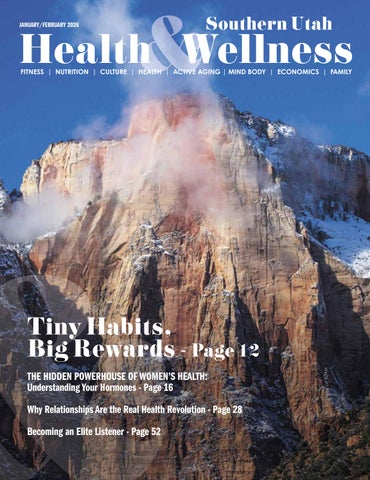
On The Cover:
Tiny Habits, Big Rewards ................. 12
Tiny Habits, Big Rewards ......................12 The Hidden Powerhouse of Women’s Health: Understanding Your Hormones ...16 Where Healing Begins: Collaborative Chiropractic and Physical Therapy at Vista Healthcare............................................. 18
Community & Culture
Featured Story
The Hidden Powerhouse of Women’s Health: Understanding Your Hormones.................... 16
Mind & Body The Competence Connection: How Mastering a Skill Shapes Emotional Healing ......30 Healing in Motion: Finding Your Pace .....32 New Year, New You: A Traditional Chinese
Letter from the Editor ....................................7 Mayor’s Message...........................................9 Trailblazer Nation........................................ 10 Ring in the New You: City of St. George Offers Fitness Options for Everyone .......... 14 New Year. New Home Goals...................... 23
Testing the Limits: Utah Tech’s New Center Helps the Community Thrive ...................... 38 A Family Diagnosis: Matt’s Story ............ 59 Buy Local: Solatube/Canyon Kitchen & Bath .............. 65
Winter Reset: Practical Steps for a Healthy Start to the New Year .............................. 20 What’s Around the Corner?..................... 26 Your Dentist’s New Assistant: Artificial Intelligence .................................................... 27 Prediabetes: Your Body’s Early Warning System.................................................. 34 Cataract Surgery: What to Expect and How to Choose the Right Lens........................ 36 Plant-Fueled Wellness: How a Plant-Based Diet Supports Women’s Health ............... 42 Beyond the Doctor’s Office: The Power of Social Influence on Wellness ................. 48 Discovering Winter Magic on Zion’s Rim . 50 Healing from the Inside Out: Mickell’s Journey into the Unconventional .............. 60
Medicine Approach to the New Year........46 New Year, New Script: How Small Shifts in Your Language Can Create Positive Changes in Your Life ............................................54 Midlife Renaissance: Why Your 40s and 50s Are the Prime Years for a Mental Upgrade ...............................................56
Relationships & Connection The Power of Connection: Why Relationships Are the Real Health Revolution ................28 Is Your Dog or Cat Getting Chunky?........ 40 You Take the High Road… ...................... 44 Becoming an Elite Listener….................. 52
The opinions, beliefs, and viewpoints expressed by the various authors and forum participants in this magazine do not necessarily reflect the opinions, beliefs, and viewpoints of Southern Utah Health & Wellness Magazine, its owners, or its staff.
6 Southern Utah Health & Wellness | Jan/Feb 2026
GROWING FORWARD: Embracing What’s Next
C
hange has a funny way of showing up at our door whether we invite it or not. Someone once told me that change is inevitable, but growth and improvement are optional. The older I get, the truer that line feels. Change arrives like a knock you can’t ignore. Growth waits quietly in the corner and says, “Only if you choose me.” My first real lesson in change came when I was ten years old. My family packed up our brand-new home in Sandy, Utah, and headed south to a place I had only heard about. St. George was a distant dot on the map to me. I had friends up north, cousins down the street, and a life I understood. And then everything shifted. We rolled into town in the middle of summer, the kind of summer that laughs at your expectations and teaches you who’s really in charge. I remember opening the car door and feeling as though the desert reached up and punched me right in the face. I had never felt heat like that. It didn’t simply warm you, it confronted you. It wrapped around your body and whispered, “Good luck trying to play outside.” I wondered how any kid could survive here. I wondered if this move meant I was leaving behind more than I would ever gain. Yet that’s the tricky thing about change: it rarely reveals its gift until after you’ve walked through the uncomfortable part. Eventually, my body adjusted to the heat. The shock wore off. I began exploring new neighborhoods and making new friends— friends who are still in my life today. It amazes me that we’ve stayed connected for more than forty years. My entire childhood in Southern Utah became a series of experiences I never would have had if my family had decided that comfort mattered more than growth. Even this magazine is tied to that move. My life in Southern Utah opened doors that eventually led me here, writing to you. The change that felt so big to a ten-year-old boy became part of the foundation for my entire adult life. Which brings me to something important. This magazine is changing, too. We’ve grown. Our reach has expanded. Our mission has widened. And because of that, we are stepping forward with a new name: Southern Utah Health & Wellness Magazine. This change reflects who we have become and who we are becoming. It helps us grow and improve so we can remain a trusted source of insight, inspiration, and education. My hope is that every time you pick up an issue of Southern Utah Health & Wellness Magazine, something inside you shifts for the better, because even a small idea can spark a quiet improvement that ripples through your life. And here’s my invitation to you: when you read something that changes you, share it. Pass it along to someone who might be standing at the edge of their own new beginning. Growth multiplies when we hand it to one another. Change is coming for all of us. It always has been. So let’s not run from it. Let’s move with it. Learn from it. Grow because of it. And, if we’re lucky, walk through it together. Brendan Dalley, Editor
&
Southern Utah
Health Wellness FITNESS | NUTRITION | CULTURE | HEALTH | ACTIVE AGING | MIND BODY | ECONOMICS | FAMILY
Jan/Feb 2026 | Southern Utah Health & Wellness 7
Advertising Sales & Community Liason Laci Wall - Life Integrated Trish DeMarcus - Elemental DNA & Detox Tyson Remington - Community Liason BRENDAN DALLEY Executive Editor
KOBY TAYLOR, PharmD
Executive Editor, Publisher
DIANE K. DEL TORO Editor-In-Chief
Design & Editing Diane Del Toro - Southern Utah Health & Wellness Magazine Shannon Mondry - Mondry Design
Digital & Social Media Tyson Koford - Found Local Marketing SCOTT ALLEN, MD
BRIGIT ATKIN
Author, Health & Wellness
Author, Mind & Body
ERIN DEL TORO, ACHE Clinical Hypnotherpist Author, Mind & Body
Guest Contributors Silene Brown, Refresh Beauty & Wellness Kelli Charlton, Memory Matters Matt Crosby, Integrated Healing Centers Richard Preston, Preston Office Solutions
ANITA DELELLES, LMT, LAMT Author, Pet Wellness
BRANDEN DUCHARME Author, Financial Health
CHRIS ESCHLER, Life Coach Author, Health & Wellness
Dr. Marcos Reyes, St. George Eye Center
Are You In It? For information on how to contribute or advertise with us, visit our website at www.SUHealthAndWellness.com,
MATT ESCHLER, PhD, LMFT
Author, Relationships & Family
TIFFANY GUST, MS, NBC-HWC USA Triathlon Certified Coach Author, Health & Fitness
LYMAN HAFEN
Author, Relationships & Connection
email connect@SUHealthAndWellness.com or call us at (435) 236-2966. Cover Image: Mark Wade
MARIANNE HAMILITON
Author, Community & Culture
ANNELIES NEWMAN, RDN, CD Author, Nutrition & Healthy Eating
WILLIAM PLUMB, DDS Author, Oral Health
Southern Utah Health & Wellness Magazine, proudly published in St. George, Utah
MARK WADE
Author, Outdoor Adventure
DR. GRACE WATHEN, DAMC, L.Ac., MS Author, Mind & Body
8 Southern Utah Health & Wellness | Jan/Feb 2026
The publisher is not responsible for the accuracy of the articles in Southern Utah Health & Wellness Magazine. The information contained within has been obtained from sources believed to be reliable. Neither the publisher nor any other party assumes liability for loss or damage as a result of reliance on this material. Appropriate professional advice should be sought before making decisions. Outside of our staff authors, articles written by providers or professionals are invited authors and represent the opinions of that particular individual, business, group or organization. If an article is a paid advertisement, we will place the word “Advertisement” or “Advertorial” to identify it as such. ©Copyright 2026.
MAYOR’S MESSAGE
I
t’s an honor to address you as your mayor. Having served on the City Council, I understand the significant responsibility entrusted to the mayor’s office. I am dedicated to doing my best to serve the people of St. George.
I was born and raised here, when St. George had fewer than 8,000 residents. A lot has changed since then. Our city is growing quickly. With that growth comes energy and opportunity—and it also tests our roads, water, housing, and sense of community. My approach as mayor is straightforward: steady and focused leadership rooted in common-sense values and respect for your hard-earned dollars. Since 2011, I’ve served on the City Council with a simple principle: respect the taxpayer. Your dollars must be used efficiently, transparently, and for projects that truly benefit the public. In the years ahead, we aim to:
• Keep public safety strong by supporting police, fire, and emergency communications. • Take care of the basics—well-maintained streets, parks, and trails. • Protect our water future through conservation, efficiency, and smart infrastructure investment. • Expand housing choices by encouraging a variety of options while preserving neighborhood character. • Strengthen our local economy by helping small businesses thrive and by leveraging many of our great healthcare and educational assets, such as Intermountain Health, Utah Tech University, Dixie Technical College, and others.
• Plan infrastructure before rooftops so growth pays for itself and existing residents aren’t left holding the bill. • And above all else, listen to you, our residents! I bring the perspective of a small business owner and rancher. My wife, Tawny, and I operate Hughes Mortuary and our family cattle ranch on the Arizona Strip. Those experiences remind me that municipal government exists to serve people and that good stewardship requires diligence, humility, and hard work. You can expect open communication, sound budgeting, and decisions grounded in data and community values. If you have questions, concerns, or ideas, I want to hear them. Feel free to email me at jimmie.hughes@sgcityutah.gov or call or text me at 435-772-6208. Mayor Jimmie Hughes City of St. George Jan/Feb 2026 | Southern Utah Health & Wellness 9
TESTING
TRAILBLAZER NATION THE LIMITS:
additional scholarship has provided me with peace of mind Dear Neighbors and Friends, this and eased the stress of affording the next semester.” This New ByYear, Katie Utah Tech
University is letting light guide the path forward. As I shared in my presidential inauguration address this past fall, when light shines—when inspiration, positivity, and love illuminate our path—we see clearly. With that in mind, our university community is focusing on sharing kindness with unwavering generosity and allowing goodness to shape our vision for the betterment of our students and the communities we serve.
One of the best ways we can let our light shine is by paying our successes and attainments forward to the thinkers, leaders, and doers of tomorrow. I can think of no better way to do this than by supporting students as they earn an education for the betterment of not only their own lives but also their families’ lives for generations to come. To this end, Utah Tech is beyond proud to support the Marcia Wade and Dorothy Orton Pay It Forward Scholarship, which honors the remarkable legacy of service from these two women, whose countless hours of dedication have transformed student lives. In fact, the Pay It Forward Scholarship has provided $1.9 million in scholarships to more than 1,000 students, including Courtney Wolfe, who is studying in our Physical Therapist Assistant program. “This scholarship has not only allowed me to financially continue in my educational journey, but has allowed my spare time to be filled with other community and campus involvements,” Courtney shared. “Though I have always worked part-time through college, 10 Southern Utah Health & Wellness | Jan/Feb 2026
One way we raise support for the Pay It Forward Scholarship—and, ultimately, our students—is through hosting the annual Fire and Ice Scholarship Gala, an impactful celebration of student success and community support. In its twenty-second year, this event has been pivotal in providing need-based scholarships to Utah Tech University students. This year’s Fire and Ice Scholarship Gala is set to feature a social hour, complete with live student experiences, dinner, and entertainment beginning at 5:30 p.m. on March 20, 2026, in Utah Tech’s M. Anthony Burns Arena. Registration, event details, and more about the impact the Marcia Wade and Dorothy Orton Pay It Forward Scholarship is having are available at utahtech.edu/ fireandice. By coming together, we honor the spirit of “paying it forward” and change the lives of countless students. I would love to have you join me in attending, supporting our students, and making a difference. Sincerely,
Shane B. Smeed Utah Tech University President
We are excited to announce our newest Doctor of Optometry, Dr. Taylor Hutchins! He specializes in Neuro Vision Training and Sports Vision and he speaks Spanish! Providing comprehensive eyecare to ensure that your vision is performing at its best so you can see clearly and live confidently.
INTRODUCING
Dr. Taylor Hutchins
14
Call Us to Schedule Today
435.673.5577 965 E. 700 S. Suite 100, St. George, UT www.SouthWestVision.com
Jan/Feb 2026 | Southern Utah Health & Wellness 11
TINY HABITS, BIG REWARDS By Tiffany Gust
E
very new year brings a fresh desire to improve our health, energy, and overall well-being. Yet most resolutions fade not because we lack determination, but because we rely solely on willpower—something human biology isn’t designed for. Sustainable change comes from understanding how habits are formed and using science-backed strategies to support them. As a board-certified health and wellness coach trained in evidence-based behavior change methods, I’ve seen firsthand that small, consistent actions produce the biggest long-term rewards. Here’s how to make this the year your habits finally stick. Start with What Matters to You What is important to you? Research shows that people are significantly more successful in changing behavior when motivation comes from their own values—not external pressure or guilt. Reflect on: • Why do I want this habit in my life? • What benefits do I hope to feel in the next few months? • How will this change support my long-term well-being?
to existing routines, and repeated consistently. Similarly, BJ Fogg’s Behavior Model emphasizes that confidence—not intensity—predicts adherence. Try tiny actions such as: • Walking for 5–10 minutes. • Drinking one extra glass of water. • Stretching for 2 minutes in the morning. • Adding one colorful vegetable to meals. • Taking three slow breaths when transitioning between tasks. Small steps accumulate into lasting change because they don’t trigger resistance or ambivalence. Set Up Your Environment to Support You Environmental cues shape behavior more strongly than willpower— especially when life gets busy. Evidence shows that simple adjustments, like changing what is visible, accessible, or convenient, significantly improve follow-through on healthy behaviors.
Small Steps Are Scientifically More Effective Behavior-change research consistently shows that starting small is a winning strategy.
Examples: • Put walking shoes near the door. • Place a water bottle at your workspace. • Keep healthier foods at eye level. • Charge your phone outside the bedroom to support better sleep.
A meta-analysis in Health Psychology Review found that habit formation is most successful when new behaviors are simple, tied
When your environment nudges you in the right direction, healthy choices become the easy ones.
Your “why” creates direction, and your habits create momentum.
12 Southern Utah Health & Wellness | Jan/Feb 2026
Becoming… Positive psychology research, including the broaden-and-build theory (Fredrickson, 2001), shows that focusing on strengths and positive identity increases motivation and resilience. When you see yourself as someone who cares for their health, your actions begin to align with that identity. Try reframing your self-talk: • “I’m becoming someone who moves daily.” • “I’m someone who prioritizes self-care.” • “I am building habits that support my future.” Identity-based habits grow roots. Obstacles Are Part of the Process According to the Transtheoretical Model of Change, setbacks are normal and expected. The key is planning for them with compassion. Ask yourself: • What might get in the way of this habit? • What is my backup plan on a challenging day? • How will I respond if I miss a day or two? One missed day does not erase progress. What matters is returning gently to your intention.
Tiny Habits Lead to Big Rewards Tiny habits truly can lead to big rewards. By starting small, staying consistent, and grounding your changes in personal meaning, you’re using the same strategies supported by decades of research—not quick fixes or unrealistic expectations. This year, let your habits grow one small step at a time. Your future self will thank you.
Your Brain Responds to Rewards—So Celebrate! Positive emotion reinforces new behavior. Studies on habit formation demonstrate that celebrating small wins strengthens neural pathways, making habits feel more natural and automatic. Consider: • Marking your habit on a calendar • Tracking small milestones • Acknowledging effort rather than perfection • Sharing progress with someone supportive • Every repetition is proof that you are moving toward the life you want to create.
Jan/Feb 2026 | Southern Utah Health & Wellness 13
RING IN THE NEW YOU: CITY OF ST. GEORGE OFFERS FITNESS OPTIONS FOR EVERYONE
T
BY MARIANNE HAMILTON
his is the year you’re going to do it, right? You’re going to get outside, get some exercise, get fit, and get rid of those extra pounds. Great!
But what about doing all of that when it’s winter? Even when you have the very best intentions, Mother Nature may have other ideas. Lucky for you, the City of St. George has you covered. Take a peek at the City’s sports programs website, and you’ll find more than thirty different options, including a number hosted at the St. George Recreation Center that are perfect during the chilly months. From cornhole to racquetball, basketball to lawn bowling, water aerobics to volleyball—and much more—you can start 2026 off with a host of fun ways to stay active while connecting with your community. After your workout, enjoy a different kind of date night at the Rec Center by throwing a pot or trying your hand at crafting jewelry. And of course, warmer days will bring the full complement of outdoor sports and leagues, with eight programs designed exclusively for adults. They all fill quickly, so don’t miss your chance to sign up! “We have so many amazing opportunities to recreate in St. George,” said Deputy Director of Recreation Cody Schmitt. “Even on those days when it’s cold, you can still go to Sand Hollow Aquatic Center and swim or take a water aerobics class. We now have classes from 6:00 to 11:00 a.m., Monday through Friday, and one on Saturday morning. Also, our Rec Center is one of the rare facilities that offers racquetball. You can work out in the gym or take an exercise class; you can play basketball, volleyball, cornhole—the possibilities are almost endless.” 14 Southern Utah Health & Wellness | Jan/Feb 2026
Rain or shine, the City will also continue to present its packed slate of races and events for athletes of all levels. Is this the year you’ll attempt your first 5K? Want to take a stroll with your favorite furry friend? Have a hankering to be chased by an SG City cop? Or could you be the Last One Standing? St. George Races will offer no fewer than fifteen events welcoming runners, walkers, cyclists, kids, seasoned athletes, and beginners from January through December. Michelle Graves, assistant director of parks and community services with the City of St. George, noted, “You don’t have to be an elite athlete to take part in our events. Our Last One Standing Ultra is a perfect example. You can walk, bike, or jog the first circuit of the Mayor’s Loop with your family and head home, you can stay and do a longer distance, or you can do the whole 24-hour race. And this year, we’re adding a team option, so you and four of your friends can run together or do it as a relay—and in between, you can party in the park with everyone else!” Don’t forget: This year marks the 50th anniversary of the St. George Marathon! In celebration, St. George will welcome a record field of 10,000 participants. Plus, for the first time, the City will offer a prize package totaling one hundred thousand dollars, with an eye toward attracting elite runners from around the world. Expect plenty of exciting events leading up to the October 3rd edition of the race—and global visibility for St. George. With this many fun, fabulous fitness options, you can finally keep that New Year’s resolution!
Recreation Programs A–Z Aerobics, Strength Training, and Cycling Ballet Pottery, Ceramics, and Clay Creations Fishing Derby Flag Football Futsal Karate and Japanese Swordsmanship
Kickball Lacrosse Lapidary and Jewelry Making Lifeguarding Lawn Bowling Pickleball Racquetball Rugby Safety Town
Soccer Softball, Baseball, and T-Ball Summer Day Camps Superhero Training Camp Swimming Lessons Tennis Tumbling Volleyball Water Aerobics
RECREATION PROGRAMS
The Place to Race in 2026 January 17 – Dragon’s Tail Stair Climb Challenge January 31 – I Heart Pets Walk/Run February 14 – Virgin River Half Marathon March 7 – Roxsand Gravel Bike Race March 21 – Lake to Lake Relay April 4 – Art Attack 1 Mile and 5K April 11 – St. George Triathlon May 16 – Cops & Robbers 10K/5K/1K
June 12 – Fire Hose Frenzy 5K July 4 – Uncle Sam 4K September 20 – Dixie Days Dash October 3 – St. George Marathon/Half Marathon/10K/5K/Mayor’s Walk November 14 – Snow Canyon Half Marathon/10K/5K/Fun Run Walk ’n’ Roll November 22 – Turkey Trot and Food Drive December 12–13 – Last One Standing Ultra
THE PLACE TO RACE
ABOUT THE AUTHOR
Marianne L. Hamilton is a veteran journalist and marketing writer whose work appears in regional and national publications. When not race walking on one of our local trails, she serves on the board of the Kayenta Arts Foundation and supports the City of St. George as a grants writer for arts and recreation programs. She and her husband, Doug, are also co-administrators of the Southern Utah Wine Club, founders and co-directors of the United State Power Walking Association, and race directors for the Huntsman World Senior Games. The former Ms. Senior Universe 2022-2023, Marianne is a proud breast cancer survivor and a member of the Intermountain Health Oncology Patient-Family Advisory Council.
Jan/Feb 2026 | Southern Utah Health & Wellness 15
THE HIDDEN POWERHOUSE OF WOMEN’S HEALTH:
Understanding Your Hormones By Silene Brown, FNP-BC, Refresh Beauty & Wellness
H
ormones are often talked about in whispers, as if they are something private, mysterious, or “too complicated to understand.” But the truth is this: your hormones are the command center of your body, shaping the way you think, feel, sleep, love, age, and show up every single day. In my practice, I see women of all ages struggling with fatigue, weight changes, mood fluctuations, low libido, brain fog, hair thinning, irritability, and persistent anxiety. Many have been told these symptoms are “normal,” “just aging,” or “something you have to live with.” Symptoms are signals, and understanding your hormones gives you the power to respond rather than simply react. Let’s break it down in a way that finally makes sense. Sex Hormones: The Silent Drivers of Women’s Health While many hormones influence the body, a woman’s sex hormones— estrogen, progesterone, and testosterone—play a central and often underappreciated role. They affect everything from metabolism and sleep to memory, muscle tone, mood, and long-term health. When these hormones shift, women feel it physically, emotionally, and mentally. For some, the changes come gradually. For others, they seem to arrive overnight, leaving you wondering where the old you went. Estrogen: The Master Communicator Estrogen is one of the most influential hormones in the female body. Beyond menstrual regulation, it supports brain function, bone density, heart and blood vessel health, collagen production, metabolism, and emotional stability.
16 Southern Utah Health & Wellness | Jan/Feb 2026
When estrogen begins to decline, which can start years before menopause, women often describe feeling “off,” overwhelmed, foggy, or unlike themselves. Hot flashes, night sweats, vaginal dryness, irritability, mood swings, and changes in hair and skin are common signs of this important hormonal transition—one that deserves attention, not dismissal. Progesterone: Your Body’s Natural Calming Signal Progesterone helps women feel calm, grounded, and emotionally steady. It supports deeper sleep, balances estrogen, and regulates menstrual cycles. As progesterone drops, women may experience anxiety, restless sleep, heavier or irregular periods, increased emotional sensitivity, or that familiar “wired but tired” feeling. Stress can worsen this decline. For many, the earliest signs of hormonal imbalance are not hot flashes but rising anxiety and disrupted sleep. Testosterone: Yes, Women Need It Too Although commonly associated with men, testosterone is crucial for women as well. It influences libido, muscle tone, strength, energy, motivation, and metabolic health. When testosterone is low, women may feel fatigued, lose sexual desire, struggle to build muscle, or battle stubborn weight gain despite consistent effort. Many describe low testosterone as “losing their spark”, a subtle but powerful decline in confidence and drive.
Hormones Function Best in Harmony Each hormone has its own job, but they are designed to work together, much like an orchestra. Estrogen energizes, progesterone balances, and testosterone strengthens and motivates. When one shifts, the others compensate, and symptoms appear.
Years later, follow-up analyses showed the initial risks were overstated or misinterpreted. But the damage was done. An entire generation of women was left to struggle through symptoms and long-term consequences without the support bioidentical hormones could have offered.
This is why two women can share similar complaints—fatigue, mood changes, or weight gain—yet have entirely different hormonal patterns. One may have adequate estrogen but low progesterone, leading to anxiety and insomnia. Another may have healthy progesterone but low testosterone, resulting in low libido and decreased strength.
Today, we have strong evidence that appropriately dosed, wellmonitored bioidentical hormones are safe and effective for many women. The key is individualized care, something the WHI was never designed to study.
There is no universal pattern, and that’s why individualized care matters. The Advantage of Optimizing Women’s Hormones Balancing hormones isn’t about turning back the clock. It’s about restoring the chemistry your body needs to function well. When hormones are optimized using bioidentical therapies, women often experience transformative improvements in mood, sleep, energy, mental clarity, libido, and overall quality of life. Hormone optimization also supports long-term health and longevity. Estrogen protects the cardiovascular system and bones. Testosterone supports muscle mass and metabolism. Progesterone promotes sleep, reduces anxiety, and helps estrogen function effectively.
A Woman’s Body Deserves Personalization, Not a One-Size-FitsAll Plan Women are not meant to fit into a template. Their hormones shift with stress, sleep, inflammation, nutrition, and age. Each woman’s hormonal experience is uniquely her own. This is why personalized hormone care is essential. A thoughtful, integrative approach considers symptoms, labs, medical history, lifestyle, thyroid and adrenal health, nutrition, inflammation, and goals. The most effective plan honors complexity and treats women as whole, integrated beings, not just lab numbers or age categories. Hormone health isn’t about perfection. It’s about alignment and helping a woman feel grounded, strong, clear, and energized in her own body.
When these hormones decline, especially after menopause, risks rise for osteoporosis, metabolic disease, heart disease, and cognitive decline. Optimizing hormones isn’t vanity medicine; it’s preventive care. How an Entire Generation of Women Was Underserved In the early 2000s, the Women’s Health Initiative (WHI) study ignited panic around hormone therapy. Women were told hormones increased the risk of breast cancer and heart disease. As a result, millions were abruptly taken off therapy. What most people don’t know is that the WHI used synthetic, nonbioidentical hormones—not the natural hormones found in the human body. The average participant was sixty-three years old, far beyond the ideal window for initiating hormone therapy, and many had pre-existing health concerns.
ABOUT THE AUTHOR
Silene Brown, FNP-BC, a native of St. George, Utah, brings more than twenty years of nursing expertise to Refresh Beauty & Wellness. With a foundation in hospice and home health and advanced training as a Family Nurse Practitioner from United States University, she blends compassionate care with a modern, science-based approach to functional, integrative, and aesthetic medicine. At Refresh Beauty & Wellness, Silene specializes in hormone health, metabolic and weightloss medicine, wellness optimization, injectables, and advanced skin treatments. Her practice centers on individualized, root-cause-focused care that helps clients feel energized, balanced, and confident from the inside out. She is committed to creating an experience where clients feel seen, supported, and empowered in their long-term health and aesthetic goals. Outside the clinic, Silene enjoys hiking, playing pickleball, spending time with her family, and exploring the outdoors that first inspired her passion for wellness.
Jan/Feb 2026 | Southern Utah Health & Wellness 17
WHERE HEALING BEGINS: COLLABORATIVE CHIROPRACTIC AND By the Vista Healthcare Team
A
new year often brings a renewed commitment to wellness, but true healing isn’t about quick fixes or short-term resolutions. It’s about creating balance, awareness, and connection between the body and mind. At Vista Healthcare’s Sports Spine and Injury Center, this philosophy guides everything they do. “Chiropractic, physical therapy, and massage aren’t separate paths; they are partners in helping the body remember how to heal,” said Dr. Russ Jepson, DC, chiropractor and clinic director. “Each discipline brings a unique strength to the healing process. Chiropractic care restores structural alignment and optimizes nervous system communication, physical therapy retrains movement and builds stability, and massage therapy releases stored tension and promotes circulation. When these approaches work together, they don’t just relieve pain, they help the body reawaken its natural ability to self-correct and heal.”
PHYSICAL THERAPY AT VISTA HEALTHCARE “We look beyond isolated injuries to help the body move as one connected system. Each session builds trust between the patient and their own body again.” Small Steps, Big Change: Every Visit Is a New Beginning Dr. Alec Wall, DPT, agrees. “We focus on small, consistent improvements,” he said. “Every visit, every stretch, every exercise, and every moment of healing is a new beginning. The body is constantly seeking balance, and with the right support and consistency, it has an incredible capacity to recover, rebuild, and begin again.” The new year is the perfect time to start fresh and prioritize health. For some, that means healing from an injury or chronic pain. For others, it’s about maintaining strength, flexibility, and resilience to keep doing the things they love, whether that’s hiking the red rocks, golfing year-round, or simply keeping up with their grandchildren.
Healing Together: A Team Approach You Can Feel This collaborative approach is what makes the Sports Spine and Injury Center so effective and so unique in Southern Utah. Patients benefit from having chiropractors, physical therapists, and massage therapists all working side by side, sharing insights and progress to create individualized treatment plans for every patient.
Connecting Body, Mind, and Southern Utah Living “The spine is more than structure; it’s the bridge between body and mind,” said Dr. Jepson. “When alignment is restored and movement becomes easier, people feel more centered, more focused, and more aware of their own strength.”
With pain management, neurology, and rheumatology specialists located just downstairs, Vista Healthcare offers a seamless continuum of care, making it a one-stop destination for comprehensive healing in Southern Utah.
At Vista Healthcare’s Sports Spine and Injury Center, that’s what healing really means: helping the body rediscover its natural rhythm and guiding each person toward lasting wellness—because every new year and every patient deserves a new beginning.
According to physical therapist Dr. Sylvan Johnson, DPT, collaboration is key to long-term recovery. “When patients start to move better, they feel better physically and mentally,” he explained.
Vista Healthcare’s Sports Spine and Injury Center is located at 2891 East Mall Drive, Suite 200, St. George, Utah. Call or text 435-688-1665 or visit vista-hc.com to schedule an evaluation.
18 Southern Utah Health & Wellness | Jan/Feb 2026
Jan/Feb 2026 | Southern Utah Health & Wellness 19
r e t n i W
t e s e R
A
s the new year unfolds and cooler air settles over Southern Utah, winter offers a natural reset. With slower days, quieter evenings, and the busy holiday season behind, it’s a good time to refocus on what keeps us steady: our health, routines, and sense of connection. Here are a few practical ways to start the year feeling grounded and strong. 1. Keep moving, even when it’s cold. Shorter days and chilly mornings can make staying active a challenge, but movement is one of the best ways to maintain both physical and mental health through winter. • Take brisk walks during daylight hours or enjoy a local indoor gym or pool. • Stretch or use light resistance training at home to stay mobile and strong. • If you’re at a desk for much of the day, stand and move for a few minutes each hour. You don’t need to totally reinvent your daily schedule. Small changes can be enough to keep circulation, mood, and energy steady. 2. Prioritize sleep and routine. The change in daylight can throw off our internal clocks. Maintaining consistent routines helps your body and mind adjust. • Get exposure to natural light early in the day. • Limit screens and bright lights before bedtime. • Keep regular sleep and wake times, even on weekends. Good sleep is one of the most effective forms of preventive health care. It improves focus, immunity, and stress control. 3. Eat warm, balanced meals. Winter naturally calls for hearty comfort foods, but nutrition doesn’t have to take a back seat. Choose foods that nourish as well as satisfy. • Warm soups, roasted vegetables, and whole grains offer steady energy. • Include lean proteins to support muscle and immune strength. • Drink plenty of water or herbal tea; dry air and indoor heating can quickly dehydrate you.
PRACTICAL STEPS FOR A HEALTHY START TO THE NEW YEAR By Lori Wright, CEO Family Healthcare Eating with balance keeps your body fueled and your mood stable through the season. 4. Manage stress and mental clutter. A new year can inspire motivation, but it can also bring pressure to set big goals. Start simple and realistic. • Take five-minute breaks during the day to stretch or breathe deeply. • Write down small, achievable goals instead of sweeping resolutions. • If winter blues or fatigue persist, don’t hesitate to talk with a professional. Even simple daily habits, like short breaks, stretching, or mindful moments, can give you the chance to notice stress and respond before it builds. 5. Stay connected Even though winter encourages time indoors, social connection is essential for wellness. • Schedule lunch or walks with friends. • Join a fitness class, book club, or community project. • Volunteer or check in on a neighbor: simple gestures make a real difference. Being part of a community keeps motivation and mood strong, especially during slower months. A Season for Steady Progress Winter is more than a break between holidays; it’s a natural pause that allows us to rebuild healthy habits and routines. By moving regularly, eating well, resting deeply, and maintaining social ties, you give your body and mind a chance to reset for the year ahead. At Family Healthcare, our providers are here to support you every step of the way. Whether it’s managing daily wellness and stress or addressing a specific health concern, our team is ready to provide guidance, care, and resources to help you and your family thrive. This winter, take small steps toward balance to help you feel stronger, calmer, and ready for what’s next.
ABOUT THE AUTHOR Lori serves on a variety of committees across the state and throughout Washington and Iron Counties. She is a member of the St. George Area Chamber Board of Governors and Association of Community Health Centers Board. She also serves on the AUCH Health Center Control Network and is a member of Intermountain Health’s Proactive Care’s Clinically Integrated Committee. Lori has completed a BS in Community/Public Health and holds a Master of Public Administration from Brigham Young University, Marriott School of Management.
20 Southern Utah Health & Wellness | Jan/Feb 2026
Jan/Feb 2026 | Southern Utah Health & Wellness 21
YOUR CANCER TREATMENT CHOICES MATTER... and the right technology can make all the difference.
5D CANCER SERVICES ARRIVES IN ST. GEORGE! As Utah’s only “Adaptive” Radiation Center, 5D focuses your daily cancer treatments more precisely than ever before. To a patient, that means the most effective, safest, and efficient outcomes with fewer side effects.
Experience the future of Radiation Cancer Care now!
Call Us Today: (435) 900-7060 SCAN TO LEARN MORE
1308 E 900 S Ste B., Saint George, UT 84790 — In the former GammaWest location —
www.5dcancerservices.com 22 Southern Utah Health & Wellness | Jan/Feb 2026
New Year. New Home Goals By the Washington County Board of Realtors
A
s Southern Utah rolls into a new year, it’s the perfect time to make sure your living spaces align with your current and future life and goals. Whether you are looking to buy a first home, approaching a new season of life and looking to adjust home size, tackling a remodel, or simply refreshing your space, take a mindful approach. Success is best achieved when you set clear intentions and then take practical steps with local knowledge and market insight. Washington County’s housing stats are best viewed close to the source: the Washington County Board of REALTORS® publishes monthly reports that are drawn directly from the local MLS. This covers new listings, median home and property prices, days on market, and inventory. These reliable numbers are vital as you consider your next steps while working alongside a trusted agent. Ready to buy? Consider this: Be mindful about your needs. Take time to write down your non-negotiables. These often include schools, commute, home layout, and property size. Compare this list with items that might fall under the “niceto-have” category, and then work with a
REALTOR® to align those goals with your budget and current inventory. Your agent can help turn that wish list into an action plan.
the exterior, changes like updated house numbers, a fresh color on the front door, and adjustments to landscaping also top ROI lists and are budget-friendly options.
Need to downsize or right-size? Consider this: Clarify what less or more means to you. Are you looking for a smaller yard or an age-inplace home? Do you need more space for a multi-generational family? In addition to finding these perfect properties, an agent can help you determine if it’s in your best interest to sell first or to buy first based on current local reports.
As you decide where you want to go in this new year, consider a quick consultation with a REALTOR® to review your goals and create actionable steps to get you there. A REALTOR® can help you unlock doors with local, vetted connections, provide market intelligence, create negotiation strategies, and more. Be mindful in your approach and plan so that your living space supports the beautiful life you’re building here in Southern Utah.
Want to renovate? Consider this: Choose projects that not only hold resale value but that improve your daily life. While there is historically strong ROI for exterior upgrades like garage doors, entry doors, and stone accents, specific interior updates that avoid major overhauls are useful when you want to improve your current living and create returns on your hard work. Simply looking for a refresh? Consider this: Some of the smallest interior changes can have a big impact. These include new paint, lighting, and window treatments. For Jan/Feb 2026 | Southern Utah Health & Wellness 23
Cybersecurity in Healthcare:
Why Protecting Patient Data Has Never Been More Critical By Richard Preston, Preston Office Solutions
H
ealthcare organizations are at the forefront of a digital revolution, but with innovation comes risk. The rapid adoption of electronic health records (EHRs), telemedicine, and cloud-based platforms has created an environment where sensitive patient data is constantly in motion. Unfortunately, this also means cybercriminals have more entry points than ever before. According to the Department of Health and Human Services, healthcare data breaches affected over 100 million individuals in 2023, underscoring the urgency for robust cybersecurity measures. One of the most significant challenges facing healthcare providers is resource allocation. Smaller hospitals and private practices often lack the budget and personnel to implement enterprisegrade security solutions, leaving them vulnerable to ransomware attacks, phishing schemes, and insider threats. Ransomware has become the most common type of cyberattack in healthcare, with criminals demanding exorbitant payments to restore access to critical systems. For providers, downtime can delay patient care and put lives at risk. Recognizing these realities and understanding that many smaller medical offices struggle to afford robust protection, Preston Office Solutions has developed cybersecurity solutions that make enterprise-level safeguards accessible to any size practice. Rather than relying on reactive measures, they emphasize layered security strategies that include advanced firewalls, endpoint protection, and continuous monitoring. “Cybersecurity isn’t a one-time project; it’s an ongoing commitment,” says Richard Preston. “Our goal is to give healthcare professionals peace of mind so they can focus on outcomes.” Education is another critical component of cybersecurity. Technology alone cannot prevent breaches if employees aren’t trained to recognize threats. Preston Office Solutions provides tailored training programs that teach staff how to identify phishing
24 Southern Utah Health & Wellness | Jan/Feb 2026
emails, secure mobile devices, and follow best practices for password management. This human-centric approach reduces the likelihood of accidental breaches, which remain one of the leading causes of data loss in healthcare. Looking ahead, the integration of artificial intelligence and machine learning into cybersecurity frameworks offers promising opportunities. These technologies can detect anomalies in network traffic, predict potential vulnerabilities, and automate responses to threats in real time. However, implementing such solutions requires expertise and strategic planning—areas where managed service providers like Preston Office Solutions excel. Ultimately, safeguarding patient data is not just a regulatory requirement; it’s a moral obligation. Patients trust healthcare providers with their most intimate information, and that trust must be protected at all costs. By partnering with experienced technology providers, healthcare organizations can build resilient systems that withstand evolving cyber threats. The bottom line: Cybersecurity is no longer optional; it’s missioncritical. Healthcare leaders must act now to fortify their defenses.
ABOUT THE AUTHOR Richard Preston, owner and CEO of Preston Office Solutions in St. George, Utah, has been a trusted name in business technology for over forty years. Under his leadership, Preston Office Solutions has earned a solid reputation for exceptional sales, service, and support of office multifunction printers and large-format printing products across Southern Utah and southern Nevada. Preston Office Solutions is more than just a print solutions provider. As a dependable IT partner, the company delivers a comprehensive suite of technology products and services—all designed to support the success and growth of every client. To learn more, contact Preston Office Solutions at 435-628-2997 or visit www.prestonoffice.com.
WE MAKE CONNECTING YOUR BUSINESS SO EASY! Agile, cloud-based communication systems that grow with your business and team. Whether you’re a startup or looking to replace your existing system, Preston Office Solutions can help. Our partnership with Zultys has made communication systems simple and effective for many local businesses. Call us today to schedule a review of our products.
PRINT · IT · CYBERSECURITY · PHONE SYSTEMS
IT •
CYBERSECURITY
•
PHONE SYSTEMS
•
•
435-628-2997
•
PrestonOffice.com
FEEL YOURSELF AGAIN
HORMONES - WEIGHTLOSS - ENERGY Affordable Blood Work
Infrared Sauna + Cold Plunge
Hormone Replacement Therapies
Local Family Owned Clinic
Affordable IVs
BioScanning + Recovery Machines
Weight-loss + Peptides
(435)-414-7223 elementalhealthcontact@gmail.com Scan QR Code For More Information
elementaltrt.com
“Locally Owned. Community Focused”
Jan/Feb 2026 | Southern Utah Health & Wellness 25
WHAT’S AROUND THE CORNER W
hat do you suppose is around that next bend? I’ve asked that of myself—or my riding partner du jour—hundreds of times. There’s an allure to the invisible, to what’s just over the next rise or around the next corner, hidden behind trees, a boulder, or the shape of the hill you’re riding toward. I can’t count the times I’ve been riding for a long while on an out-and-back trail; I’m getting tired, I’m already at (or past) my turnaround point, and for some unknown reason, I want to keep going—simply because there’s a corner I can’t see around. The hidden curve keeps me from knowing what fun piece of singletrack might await just over there! And of course, it’s a lovely corner, too. Enticing. All smooth and flowy, maybe just a little damp so your tires are extra grippy. You just know that sweet corner must become a straightaway where you can hammer the pedals down in an ecstatic speed run. Or maybe there’s a set of corners that interconnects with the one you can see, leading you to S-turn heaven. Or jumps! Maybe jumps! Perhaps an incredible view? It’s a mystery—and there’s only one way to solve it. Maybe I’ll ride just a little farther... But then there’s the next corner, with more promised fun just out of view. This is where you can get yourself into trouble. “Just one more corner” can turn into many more miles of solving trail mysteries when you push your end point out farther—and then have to retrace your tire tracks back to the trailhead. Did you bring enough water? Nutrition? Do you even have enough energy to get back? When you’re at the halfway point, you’re generally feeling quite good still, so adding a few more corners couldn’t hurt, right? But the last few miles of your ride could end up being a suffer-fest when you’re completely tanked from doing “just one more corner” ten to twelve times! 26 Southern Utah Health & Wellness | Jan/Feb 2026
BY JAY BARTLETT
Even a trail you’ve ridden before can do this to you. If a trail has had a weather event—like the deluge-like rainstorms we often get these days—the next section may have changed drastically since the last time you were on it. What’s it like now, just around that corner? Is it rutted? Are there new lines? A new rock garden to navigate? Sometimes I just need to find out! As luck would have it, while writing this article, I encountered this exact predicament on a ride. I went out to see if I could find a long-neglected trail that I hadn’t been on in quite a few years (I think you can see where this is going...). The last time I rode it, it took some route-finding just to get around it. It was vague then, to say the least. Now what’s left of it resides close to the Southern Corridor Highway, where off-road traffic has really increased, and the trail I was looking for has either faded away or been turned into a moto or side-by-side trail. That didn’t keep me from trying, though. Maybe just over this next hill, or just around that ledge, I might find traces of the original trail… I didn’t find it. But that doesn’t mean I didn’t have fun trying! A great thing about mountain biking is the adventure—and that adventure often comes when you ask, “What’s around the next corner?”
ABOUT THE AUTHOR
Mountain bike veteran, amateur filmmaker, and lover of long rides, Jay Bartlett has been riding trails in Southern Utah for over thirty years. Jay has over a decade of experience as a bike mechanic at St. George’s oldest bike shop, Bicycles Unlimited.
YOUR DENTIST’S NEW ASSISTANT:
Artificial Intelligence By Dr. William Plumb, Plumb Dentistry
I
t happens every day in my practice. A patient has a dental issue, which I try to explain as we review their X-rays together. Digital radiographs are incredible. I remember taking X-rays in dental school. The patient would have to wait while I walked the film to the darkroom, opened up each photo packet, and dipped them in various solutions to develop the image. Now the image is digital and pops up on the computer screen almost instantaneously. Once on the computer, I can manipulate the brightness and contrast. I can also zoom in on areas. This perhaps makes it easier for the patient to see, but being able to pick out subtle variations in the grayscale on a radiograph only comes after years of study and practice. Many times, a patient will respond with, “Well, okay, if you say so.” I’ve been carefully watching the advent of artificial intelligence applications in the dental field, and I’m super excited about its potential to transform the practice of dentistry. One way we’re already seeing a positive impact is in diagnostic accuracy. It’s estimated that the human eye can detect between thirty and five hundred shades of gray. Some of the leading dental AI software can detect over four thousand shades of gray. As AI continues in its development, it’s able to learn, and its accuracy improves. At this point, the software does not diagnose, but it measures and highlights aspects of the radiograph, alerting the dentist to potential issues that may exist. Dentists have suc-
cessfully diagnosed dental and periodontal disease for decades without the aid of AI, but studies show that one hundred percent of dentists are more accurate when diagnosing problems with AI’s help. The way these programs highlight and colorize the radiographs makes it much easier for patients to see and understand what their providers are trying to teach them about their oral health. Check out these two images: one is a standard radiograph, and the other is the same radiograph after AI analysis. It’s much easier to identify the natural structures of the tooth—the enamel and dentin—as well as the nerve tissue. Restorations are also simple to see.
Standard Radiograph
and precise billing, which will streamline patient care and improve the overall experience. About 35 percent of dental offices are currently using AI, and that number will continue to grow as the systems become smarter and more clinicians are introduced to the outstanding benefits that AI provides. I’m sorry to say that currently there isn’t anything artificial intelligence can do for the pinch of the needle or the sound of the drill, but I’m excited for all the ways AI will improve the dental experience for my patients. Plumb Dental offers general dentistry for the entire family, including preventative care, root canals, implant restoration, cosmetic work—even whole smile makeovers. To schedule an appointment, call (435) 673-9606 or visit their website at plumbdental.com.
A.I. Radiograph Analysis
What’s really cool are the measurements that show exact amounts of bone loss that have occurred from periodontal disease, as well as the slight variations that indicate areas of possible tooth decay. Using AI, dentists will be able to detect problems when they’re smaller and easier to repair. Artificial intelligence won’t simply improve diagnostic capabilities and patient education. It will also make dental offices more efficient with smarter scheduling, insurance verification, referrals to specialists,
ABOUT THE AUTHOR Dr William Plumb graduated from the State University of New York School of Dentistry in 2006. He opened Plumb Dental in St George in 2009. He has received extensive continuing education in cosmetic dentistry as well as oral surgery and implantology. He loves living in Southern Utah with his wife Kari and their four children.
Jan/Feb 2026 | Southern Utah Health & Wellness 27
THE POWER OF Why Relationships Are the
CONNECTION: REAL HEALTH REVOLUTION By Diane Del Toro
I
In a world where screens often replace face-to-face conversations and busyness takes precedence over bonding, it’s easy to forget that human connection is vital.
t’s easy to feel isolated these days. Even before the pandemic, many of us were spending more time online than in the company of loved ones, glued to devices instead of each other. With the lockdowns during COVID-19, this trend was amplified, leaving countless people disconnected from family, friends, and community. And while technology allows us to communicate faster than ever, it doesn’t fully replace the deep, nourishing effects of human connection. I know from my own life and from conversations with readers that connection isn’t just about avoiding loneliness—it’s about thriving. Science agrees. One of the most extensive studies on human health, the Harvard Study of Adult Development, followed 724 men over more than seventy-five years, making it one of the longest-running longitudinal studies in history. The study tracked two cohorts: the original 1938 Harvard College sophomores and a later group of inner-city Boston men, gathering detailed information on physical health, mental health, relationships, and life satisfaction. The findings are profound: close relationships, more than money, fame, or even genetics, are what keep people happy, healthy, and resilient. Strong social bonds protect against physical decline, improve mental health, and even lengthen life. According to Dr. Julianne Holt-Lunstad, professor of psychology and neuroscience at Brigham Young University, “Strong social relationships increase the likelihood of survival by 50 percent. That’s comparable to quitting smoking.”
28 Southern Utah Health & Wellness | Jan/Feb 2026
Dr. Vivek Murthy, former U.S. Surgeon General, calls loneliness a “hidden health crisis.” His research shows that chronic social isolation can be as harmful to your health as smoking fifteen cigarettes a day. “The opposite of loneliness is not simply being around people; it is the quality of our connections,” he emphasized. Conversely, regular meaningful interactions—sharing meals as a family, laughing with a friend, or listening intently in a conversation— can lower stress, reduce inflammation, and improve heart health. Relationships truly are a prescription for the body and soul. For families, friendships, and communities, the benefits are tangible. Children thrive in nurturing, connected households. Adults who maintain friendships report higher life satisfaction, and older adults with strong social networks experience slower cognitive decline and better mobility. Positive connections even help build what Barbara Fredrickson, professor of psychology and neuroscience at the University of North Carolina at Chapel Hill, called the “psychological and physiological resources we need to thrive.” In short, connection is medicine. But here’s the challenge: we live in a culture that values productivity over presence, scrolling over talking. Many of us get so caught up in work, errands, and digital life that we neglect the relationships that sustain us. That neglect has consequences—both emotional and physical. Loneliness can manifest as anxiety, depression, weakened immunity, and even higher risk of cardiovascular disease. The cost of disconnection is high.
5. Balance digital life. Technology isn’t the enemy, but it shouldn’t replace real-world interaction. Device-free boundaries during social activities fosters meaningful presence. Studies in social neuroscience reveal that face-to-face interactions trigger the release of oxytocin, reduce cortisol, and improve cardiovascular and mental health, effects that digital communication alone cannot replicate. Connection also influences other aspects of health. People who engage socially are more likely to exercise, eat well, and seek preventive care. They manage stress better and recover more quickly from illness. Even economics plays a role: socially connected people often have stronger networks for professional opportunities, financial guidance, and community support.
So what does a health revolution focused on relationships look like? It starts with small, intentional acts. Consider these strategies: 1. Prioritize quality time with family. Even ten focused minutes a day—putting phones aside, asking questions, listening deeply—strengthens bonds. Research from the Harvard Study of Adult Development shows that strong family relationships are one of the biggest predictors of long-term happiness and health. 2. Reconnect with friends. Friendships are not luxuries; they are essential to mental and physical well-being. A study published in PLOS Medicine found that adults with strong social connections were 50 percent more likely to survive over a given period than those with weak or no connections. “Connection is why we are here; it gives purpose and meaning to our lives,” said Brené Brown, research professor at the University of Houston Graduate College of Social Work. “I define connection as the energy that exists between people when they feel seen, heard, and valued . . . when they derive sustenance and strength from the relationship.” 3. Engage in community. Volunteering, joining clubs, or attending local events creates social ties that improve mood, lower stress, and provide a sense of purpose. Evidence from behavioral science shows that volunteering is linked to lower blood pressure, reduced depression, and increased life satisfaction. 4. Practice empathy and respectful communication. Every interaction is an opportunity to reinforce connection. Psychologist John Gottman reminds us, “It’s often the small things that we do every day that can make or break the emotional connection we have with our partners.” His research shows that turning toward a partner’s “bids” for connection—even simple gestures like asking how someone’s day was or offering a kind word—builds trust, emotional intimacy, and long-term relationship stability.
Consider the story of a local family I know here in southern Utah. After the pandemic, they realized they had drifted apart. Meal times were silent, weekend activities were solo, and screens dominated conversations. They decided to reclaim connection, using weekly family walks, Saturday cooking sessions, and scheduled calls with grandparents to rebuild their relationships. Within weeks, moods improved, the teenagers communicated more openly, and parents reported lower stress. Connection had transformed their home.
As we move into a new year, consider what connection means to you. Who in your life could use more of your attention? Which relationships have been neglected? The real health revolution isn’t found in a new workout plan, supplement, or diet trend. It is found in the hands we hold, the conversations we share, and the bonds we nurture. As we begin this year, let’s commit to a simple, powerful resolution: reconnect, deepen relationships, and honor the profound truth that our health is inseparable from our connections. When we invest in relationships, we invest in ourselves. ABOUT THE AUTHOR
Diane Del Toro is a graduate of Utah Tech University, where she earned a degree in English Literature. She teaches music lessons and plays the piano, combining her love of art and education. At home, she enjoys quilting, cooking, hiking, and camping— adventures that fuel her creativity. Diane is also a proud mother to her six children and a devoted grandmother of twenty-four grandchildren.
Jan/Feb 2026 | Southern Utah Health & Wellness 29
the competence connection How Mastering a Skill Shapes Emotional Healing By Matt Crosby, Founding Partner, Integrated Healing Centers
B
y the time Yo-Yo Ma was nine years old, he was already practicing the cello for hours each day. Under the exacting eye of Leonard Rose at Juilliard’s preparatory division, he drilled scales, refined bowing, and internalized music until every note had both precision and meaning. Lessons were mercilessly detailed: intonation corrected by fractions of a millimeter, phrasing repeated until it breathed naturally, discipline woven into every movement of hand and arm. The road to mastery required not only talent but the persistence to fail, correct, and repeat—again and again. And yet, upon the death of his teacher in 1984, what Yo-Yo Ma most remembered was not the hours of technical exercises but Rose’s kindness and patience—his humanity. “He was much more than my teacher,” Ma said. “He was my mentor and friend. He was a genuinely nice man.” This is the paradox of skills-based, competency-oriented instruction: the pursuit of mastery often produces relationships that transcend the skill itself. Apprentices remember carpenters for their steadiness, not just their chisels. Athletes recall coaches’ fairness long after the mechanics of a swing fade away. It is not uncommon to hear the sentiment, “I never talked with my baseball coach about anything other than how to throw, catch, and hit a ball, but I think about him all the time for the kind of person I want to be.” In the realm of healing and personal growth, however, competency is often the first casualty of the effort to make every activity therapeutic. Well-meaning programs transform art classes into “expressive therapy,” music into “experiential processing,” horses into “equine therapy”—while quietly letting the art, music, and horse-
30 Southern Utah Health & Wellness | Jan/Feb 2026
manship themselves slide into the background. The discipline is drained of rigor so that the therapeutic frame can sit, unchallenged, at the center. The result is that the very context that should foster growth and resilience becomes flattened: frustration is avoided rather than endured, expectations are blurred rather than clarified, and the possibility of authentic achievement is lost. The cost of sidelining competency is high. When people are denied the chance to wrestle with the universal challenge of being bad at something and getting better, they lose the growth that comes from patience, persistence, and finally mastery. At the same time, there’s a risk of becoming “good at therapy” rather than “good at life.” Too often, insight and clever self-observation are praised, while the real-world skills embedded in the task itself are ignored. The dignity of genuine accomplishment fades. When “anything counts,” nothing counts deeply; the satisfaction of competence never arrives. Give people real challenges—a cello to practice, a loaf of bread to master, a horse to ride—and the healing dynamics emerge on their own. Struggle, growth, frustration, triumph, humility, joy: all of these are naturally embedded in the pursuit of competency. The task itself provides the crucible. Healing doesn’t need to be extracted from the experience; it grows there organically. And here we return to relationships. The connection between teacher and learner, mentor and student, guide and participant, is as old as human development itself. It has endured every shift in philosophy and every change in method because it rests on respect and shared purpose. Skills-based, competency-oriented
instruction may be one of the surest ways to cultivate that connection. When clear expectations are set—“You didn’t do as well at that; let’s figure out how you can improve next time”—the message is that growth matters and that effort is worth investing in. That kind of investment forges trust and respect. So teach someone something. Lead a music session where the goal is to actually learn a song. Hold a bread-baking group where the crust really matters. Take someone riding and show them how to sit a horse well. Or simply share your grandmother’s chocolate chip cookie recipe. These moments of real instruction invite struggle, foster growth, and—most importantly—lay the foundation for the kind of relationships that outlast any single skill. Just as Yo-Yo Ma remembered his teacher’s humanity more than his technique, so too will those we guide remember not the tasks themselves, but the character revealed in the process of learning together. Integrated Healing Center is dedicated to helping clients harness the power of therapy to excel in life, not just in sessions. Our mission is to offer holistic, client-centered programs that promote healing, community, and the development of life skills essential for thriving beyond treatment. For more information, call 435-288-2211.
ABOUT THE AUTHOR
Matt Crosby is the cofounder and visionary behind Integrated Healing Centers, a revolutionary intensive outpatient program located in Washington, Utah. With twentyfive years of experience in residential treatment, he brings a rare depth of clinical sophistication into a community-based model. Matt is passionate about helping families access meaningful, practical healing—not just therapy sessions, but real-life transformation. His leadership is centered on connection, courage, and creating spaces where clients rediscover their competence and resilience.
Jan/Feb 2026 | Southern Utah Health & Wellness 31
HEALING IN MOTION:
Finding Your Pace By Chris Eschler, Health and Well-Being Life Coach
Y
ears ago, I worked with young cross-country runners. Inevitably, one would trip and fall during the season. Feeling the sting of scraped knees and seeing the blood, these young athletes often believed the pain was too great to continue. From experience, having hit the ground a few times myself, I knew it was usually best to get up and move before the body stiffened. After checking for injuries and rinsing scrapes with water from my hydration bottle, I’d encourage them to start running again— slowly—shaking out their arms and hands as they went. The pain, I promised, would ease with time and gentle movement. It always amazed me how certain they were that they couldn’t go on. Yet, by the time we returned to base, they’d gone from limping to running normally again, chatting and smiling with their teammates. Even then, I would remind them that pain often resurfaces once the adrenaline fades. Then I’d send them home with a recovery plan: rest, ice, gentle stretching, and patience. The next day, they’d show up eager to run full out, convinced they were ready. Still, I’d check their scrapes and bruises, urge caution, and remind them that healing takes time. Only when I was sure they’d recovered did I let them push hard again, even when their patience grew thin with the simplified workouts. 32 Southern Utah Health & Wellness | Jan/Feb 2026
Just like these young runners, we all experience moments when we fall—physically or emotionally. Our brains are hardwired to protect us, so when pain strikes, our instincts are usually twofold: give up or rush back to “normal.” Both responses make sense. We’re trying to avoid further hurt, and we don’t want setbacks to undo the progress we’ve worked so hard to build. But healing is a process that requires time and patience. Although this story centers on physical injury, the same pattern shows up with emotional injury or trauma. We can become so focused on returning to our old baseline that we try to skip the healing process altogether, only to end up frustrated that we can’t keep up with what once felt easy. I often hear clients express frustration after trauma or loss, saying, “I’m useless since it happened.” Many people don’t even recognize they have experienced a trauma—they got back up too quickly, brushed off the dust, moved on, and never tended to their emotional wounds. On the outside, they looked fine. But inside, they hadn’t given themselves permission to heal.
Recovery isn’t about rushing ahead and ignoring pain; it requires slowing down, getting adequate rest, and listening to physical and emotional needs. When trauma, pain, and grief knock you down, it’s tempting to push through at full speed without taking stock of the healing process. Genuine healing happens when you honor the pace your body and mind require. It’s important to note that healing isn’t about going back to who you were before. Healing refines you into a new version of yourself. Just because you’re not doing all the things you once did doesn’t mean you’re ruined. Maybe you no longer bake bread for all your friends in your spare time like you used to. Perhaps you now offer hugs, presence, and words of encouragement instead. That doesn’t mean you’ve lost something essential. It means you’re a new version of yourself with your energy reserved for more important matters. Rather than seeing yourself as a failure, celebrate your new superpower: evolving from a person of doing into a person of being— full of love and grace. That gift reaches farther than any baking skill. Each intentional, unrushed step through pain builds resilience and clarity and deepens your understanding of yourself and others. Healing in Motion: Pacing Tips Keep moving—but go slow. Gentle motion prevents stiffness, physically and emotionally, but overdoing it prolongs healing. Incorporate balance and trust in yourself. Care for your body and mind. Prioritize rest, eat nourishing foods, move gently, take breaks, and spend time with supportive people and comforting activities. Allow for tears. When pain strikes, a full range of emotions follow. Give yourself permission to feel and acknowledge each one. As you heal, new emotions surface unexpectedly with ebb and flow; that is
a natural part of the process. It’s helpful to keep a list of emotions that arise, serving as a gentle reminder that you’ve acknowledged each one. Track your growth. Take time to reflect on where you’ve been and where you are now. Notice the new strengths, insights, and abilities you’ve developed along the way. These are your emerging superpowers—signs of how far you’ve come and how much you’ve grown. Have a check-in partner. A loved one, coach, or therapist can help you understand the impact of the trauma, process your emotions, reflect back the progress you may not see in yourself, and support you in finding balance along the way. Avoid comparisons. Healing doesn’t follow a schedule, so try not to place a deadline on “getting over it.” Resist comparing yourself to your past self or to others. Chances are, you’re doing far more than you give yourself credit for. Keep in mind, you are not returning to who you were. You are refining into a stronger, more resilient version of yourself, and that takes time and energy. Find your center. Seek comfort, direction, and gratitude through prayer and meditation. When the time feels right, gently explore new hobbies or reconnect with old ones in ways that express who you are becoming. You might even create a personal mission statement, something that reflects your growth and honors your ongoing work in progress. Healing, like running, takes patience, pacing, and faith that you’ll regain your stride. The goal isn’t to pretend the fall never happened, but to rise, move forward, and trust that strength will return with time, care, and rest. With true healing, you often discover new strengths you never even knew were possible.
ABOUT THE AUTHOR
Chris Eschler earned a BS in marriage and family sciences at Brigham Young University-Idaho. As a life coach at Ascend Counseling and Wellness. Chris works with individuals to develop their skills and provides a safe, accepting environment for exploring a wide range of thoughts and feelings. Chris knows that you are the expert of your life and that she is simply a guide. She currently sees couples with her husband, licensed therapist Matt Eschler. Together they assist couples with all couples issues, specializing in high conflict couples work. To schedule an appointment with Chris for life coaching, call Ascend Counseling and Wellness at 435-6881111 or visit https://ascendcw.com/.
Jan/Feb 2026 | Southern Utah Health & Wellness 33
P R ED I A B E T E S : Your Body’s Early Warning System By Lisa Larson
W
ith cases of type 2 diabetes increasing at an alarming rate, even more attention is being paid to the diagnosis that comes before diabetes—a medical stage known as prediabetes. Determined by a ninety-day average of a person’s blood glucose, known as an A1C, between 5.7 and 6.4, prediabetes often goes undetected. “Often patients come to see me for a regular checkup or some other issue, and during the course of routine bloodwork, we discover their blood glucose levels are elevated to the point of being prediabetic,” said Dr. Travis Jones, internal medicine physician with Intermountain Cedar City Hospital. 34 Southern Utah Health & Wellness | Jan/Feb 2026
The reason people may not realize their glucose levels are approaching a danger zone is that many of the symptoms of type 2 diabetes do not appear until their A1C rises above 6.4. Still, it is far better for a person’s overall health to take action during the prediabetes stage rather than waiting for a diabetes diagnosis. “Classically speaking, health complications such as neuropathy, kidney issues, and eye problems are more associated with diabetes,” Dr. Jones said. “But in the prediabetes stage, the same underlying process is still at work and can lead to inflammation in the blood vessels, putting the patient at greater risk for cardiovascular disease, stroke, high blood pressure, and more.”
Although the news that a person’s blood glucose is in the prediabetic range may come as a surprise, it’s important for patients to consider the changes that can improve their health at this stage. This often starts with talking to their healthcare provider. “It’s important for them to ask their provider what factors they can control in their personal life to decrease their risk of diabetes,” Dr. Jones said. “In many cases, they may benefit from a consultation with a nutritionist or from specific programs offered through their health insurance that are geared toward helping patients with prediabetes.” In many cases, making changes to diet and exercise routines can make a big difference in whether prediabetes eventually becomes full-scale diabetes. In Dr. Jones’s experience, the outcome is determined heavily by the motivation and willingness of the patient. “Often, if a person can lose 5 to 10 percent of their body weight, that can make a clinically significant impact on a prediabetes diagnosis,” Dr. Jones said.
in all of this,” Dr. Jones said. “However, even if diabetes is something a patient cannot avoid despite their best efforts, they are still going to be in a much better position to deal with the diagnosis if they are doing things to promote overall health. Life with poorly controlled diabetes is much different from life with well-controlled diabetes.” Things like exercising at least thirty minutes each day and eating a diet filled with nutrient-dense foods while limiting carbohydrates go a long way toward better health. “I recommend patients make sustainable changes to their eating habits, not just latch onto the latest diet fad,” Dr. Jones said. “Similarly, they should find a form of exercise that feels like a hobby or an enjoyable activity that helps them elevate their heart rate for at least thirty minutes.” For people who have done all they can with diet and exercise, Dr. Jones encourages them to discuss further options with their healthcare provider.
Other major risk factors besides being overweight include smoking, a history of gestational diabetes, and leading a sedentary lifestyle. “Even if you’re eating healthy, if you’re not moving enough, a sedentary lifestyle increases the risk,” Dr. Jones said. Another component that can be more difficult to work around is genetics. “At the end of the day, sometimes genetics do play a role
ABOUT THE AUTHOR
Lisa Larson is a freelance writer with a background in public relations and public speaking and a passion for sharing great stories. You might spot Lisa with her husband and three children enjoying the downtown carousel or exploring one of the area’s hiking trails. She also enjoys reading and baking, and she is looking to rekindle her romance with running. You can find Lisa on Twitter @LisaGLarson or at www.facebook.com/larsonlisa.
Your Health. Our Priority. Find Your Primary Care Provider Today. Our skilled primary care providers in Southwest Utah are now accepting new patients. We’re here to make your healthcare experience easy and convenient. Why Choose a Primary Care Provider? Health Partner: Your go-to for preventive care and managing health over time. Comprehensive Care: Get expert help for most health concerns close to home, avoiding unnecessary ER visits. Convenient Access: Local providers make it easy to get care when you need it.
Scan the QR code to explore locations and find a provider that is right for you.
intermountainhealthcare.org/SWUTPCP
New Patients Welcome. Explore and Schedule Today. It’s easier than ever to find care.
Jan/Feb 2026 | Southern Utah Health & Wellness 35
CATARACT SURGERY: What to Expect and How to Choose the Right Lens
C
By Dr. Marcos Reyes, St. George Eye Center
ataract surgery is one of the most successful and frequently performed procedures in modern medicine, restoring clear vision to millions each year. Over time, the eye’s natural lens can become cloudy—a condition called cataracts—leading to blurred or dim vision, glare, and difficulty with everyday tasks such as reading or driving at night. During cataract surgery, the cloudy lens is gently removed through a tiny incision and replaced with a clear artificial lens called an intraocular lens (IOL). The procedure usually takes about fifteen minutes. Most patients remain awake but relaxed, with the option for additional medication if needed. How Lens Power and Size Are Determined Before choosing which IOL to implant, your surgeon must determine the exact power and size that will provide the clearest vision. This begins with a series of precise measurements, called biometry, which assess the length of the eye, the curvature of the cornea, and the depth of the anterior chamber. These measurements are entered into sophisticated formulas to estimate which lens power will best focus light onto the retina. Because every eye is unique, these formulas can only extrapolate— not perfectly predict—the final outcome. Variations in healing, corneal shape, or how the lens settles can subtly affect vision,
36 Southern Utah Health & Wellness | Jan/Feb 2026
much like clothing tailored to measurements that may still fit slightly differently. Understanding Lens Implant Options Once your measurements are complete, the next step is choosing the lens type that aligns best with your visual goals and lifestyle. There is no “perfect” implant: each offers trade-offs between range of vision, clarity, and potential side effects. Your surgeon’s role is to guide you toward the choice that best suits your eyes and daily needs. Monofocal Lenses: The most common (and usually insurancecovered) option, monofocal intraocular lenses (IOLs) provide clear vision at a single distance but do not correct astigmatism. Because roughly one-third of patients have little to no astigmatism, that same group can achieve excellent distance correction without glasses using monofocal lenses. If you choose distance correction, expect to need glasses for midrange activities such as computer work, cooking, or dashboard viewing, as well as reading glasses for close-up tasks like texting or reading. Conversely, if you choose near correction, you’ll need glasses for driving and other distance activities. Toric Lenses: If you have astigmatism—where the cornea’s shape
causes blurred or distorted vision—toric lenses can correct that irregularity and provide a crisper image. Toric options are available in both monofocal and advanced lens designs. Multifocal Lenses: Multifocal lenses are premium implants designed to reduce dependence on glasses by splitting light into multiple focal points. This allows vision at both near and far distances, giving patients freedom from spectacles for tasks like reading a menu or watching television. However, this design can lead to halos or rings around lights at night and some reduction in contrast sensitivity. For patients who value independence from glasses and can tolerate minor optical artifacts, multifocals can be a very satisfying option. Extended-Depth-of-Focus (EDOF) Lenses: EDOF lenses provide a smoother, elongated range of focus rather than distinct near and far zones. This typically results in good distance and intermediate vision—ideal for driving, using a computer, or viewing a dashboard. However, patients should understand that EDOF lenses do not provide true near vision; reading glasses are still needed for close work. EDOF lenses tend to cause fewer night halos and less glare than multifocals, making them a strong choice for patients seeking clarity, range, and visual comfort.
Most post-surgery dissatisfaction arises from unrealistic expectations of “perfect” vision, often combined with inadequate explanation of what the surgery can and cannot achieve. Some patients are more tolerant of minor imperfections, such as halos or slight blurriness, while others are bothered by even subtle changes. Open discussion with your surgeon about your goals and expectations is essential to ensuring the best experience. Artificial Lenses Cannot Fully Replicate a Young Eye While modern IOLs can provide excellent clarity and reduce dependence on glasses, it’s important to understand their limitations. A natural lens in a healthy twenty-year-old eye has remarkable flexibility, contrast sensitivity, and the ability to focus across a continuous range of distances. Artificial lenses, by contrast, are static; they cannot fully replicate the dynamic focusing and subtle optical qualities of a youthful natural lens. Even the most advanced multifocal or adjustable lenses aim to approximate, not replace, the extraordinary vision of a young eye.
What to Expect: Accuracy and Outcomes With today’s technology, about 90 percent of patients achieve their desired visual outcome after surgery. The remaining 10 percent may experience slight deviations, though these are usually minor. For patients who have had previous corneal surgery, such as LASIK, PRK, or radial keratotomy (RK), predicting the correct lens power becomes more challenging, lowering the probability of hitting the target to around 75 percent. For these cases, many surgeons recommend the Light Adjustable Lens (LAL), which can be finetuned after surgery to optimize focus, raising accuracy to roughly 98.5 percent. If patients do not select the Light Adjustable Lens, the only alternatives are to wear glasses to fine-tune vision or, in uncommon cases, undergo an IOL exchange (replacing the implant with a different power) if the result is significantly off target. These situations are rare but important to understand ahead of time, as they can influence both satisfaction and recovery expectations. Personality and expectations also play a role in visual satisfaction.
Seeing Your Best After Surgery Cataract surgery today is not only about restoring vision. It’s about customizing it to your lifestyle and goals. Through careful measurements, informed lens choice, and modern technology, most patients can look forward to sharper, brighter, and more comfortable vision than they’ve had in years.
ABOUT THE AUTHOR
As a glaucoma specialist, Dr. Reyes is trained in the latest glaucoma techniques. He taught these techniques as a professor for many years before settling in Southern Utah. Dr. Reyes obtained a Bachelor of Science degree at Brigham Young University. He obtained his Doctor of Medicine degree at Texas Tech Health Sciences Center and completed residency training in ophthalmology at the University of Texas Health Sciences Center, where he simultaneously received in-depth training in refractive surgery (LASIK and PRK) at the United States Air Force Warfighter Refractive Surgery Center. He completed a fellowship in glaucoma at the prestigious Dean McGee Eye Institute in Oklahoma City. He then taught clinical and surgical ophthalmology at the University of Missouri. Dr. Reyes is a member of the American Academy of Ophthalmology, the American Society of Cataract and Refractive Surgery, and the American Glaucoma Society. His writing has been featured in numerous ophthalmology textbook chapters, in popular ophthalmic magazines, and in peer reviewed journals. Dr. Reyes’s family is the most important part of his life. He and his wife, Raina, are the proud parents of four children. They love sports, hiking, fishing, and binge-watching TV shows.
Jan/Feb 2026 | Southern Utah Health & Wellness 37
TESTING
THE LIMITS: By Katie Walker
U
tah Tech University recently created a center dedicated to advancing the frontiers of extreme human performance. UT’s Center for Endurance and Extreme Human Performance is located on the university’s campus and examines the limits of human capability. Initially, the center provided athletes with a way to test body composition, resting and metabolic rates, and muscle mass. It was founded in conjunction with the St. George IRONMAN race. Over time, the center has shifted its focus from high-performing athletes to the broader community. The center now offers testing services to both community members and students. Milan Pantovic, center director and professor at Utah Tech, said the goal is for people to come in, be tested, and receive feedback. From there, staff can provide recommendations and offer support in specific areas of need, resulting in healthier lifestyles and greater awareness of individual health. “The idea for the center is to go out and explain the importance of checkups, a healthy lifestyle, and prevention,” said Pantovic. Many of the tests conducted at the center are geared toward older adults, not just college students or professional athletes. Assessments include fall risk evaluations, bone density testing, and nutrition consultations. The center also provides strength-training guidance tailored to each individual. The center is operated in partnership with Utah Tech students. Four student interns currently work in the facility, reflecting UT’s polytechnic academic model and its commitment to handson learning. The interns are trained on the equipment and are responsible for running tests for participants. “We have a good program within the exercise science degree for building a solid foundation, but opportunities like this—and some of our other classes where we get to apply those skills—are super beneficial,” said Jackson Lambert, a senior exercise science major at Utah Tech who interns at the center.
38 Southern Utah Health & Wellness | Jan/Feb 2026
The services offered at the Center for Endurance and Extreme Human Performance are available at a fraction of the typical cost. For example, a DEXA scan—which measures body composition and bone density— can range from $100 to $400 in the community. At Utah Tech, the center charges just $80 for community members and $20 for students. In addition to providing affordable services, the center has undergone extensive review by the Institutional Review Board (IRB) to ensure that all tests and procedures meet safety and ethical standards. The Center for Endurance and Extreme Human Performance exemplifies Utah Tech University’s commitment to hands-on education and its dedication to improving and serving the community. For more information, visit health.utahtech.edu/health-humanperformance/ceehp.
ABOUT THE AUTHOR Katie Walker is a full-time student at Utah Tech University. She moved from northern Utah to St. George to pursue a bachelor’s degree in digital media with an emphasis in public relations. She will graduate in Spring 2026 and has loved her time at Utah Tech, serving as a student ambassador, television news anchor, and Miss Utah Tech.
utahtech.edu
Jan/Feb 2026 | Southern Utah Health & Wellness 39
IS YOUR DOG OR CAT GETTING
Chunky? Chunkyy? Chunk
HOW TO SPOT IT AND WHAT TO DO ABOUT IT By Anita DeLelles, LMT
L
et’s be honest. Most of us think our pets are perfect just the way they are. That’s part of the problem. We love their chubby bellies and squishy sides. We think it’s cute the way they waddle to the food bowl like it’s the best part of the day. But those extra pounds can mean real trouble: joint pain, diabetes, heart problems, and a shorter, less energetic life. So how do you tell if your furry friend is overweight, and how can you help them slim down without turning dinnertime into a drama? The Hands-On Fat Test Forget the scale for a moment. The best way to tell if your pet is overweight starts with your hands. Run your fingers along your dog or cat’s ribs. You should be able to feel the ribs easily without pressing hard—like feeling the back of your hand. If you have to dig around under a soft layer of fluff (or, let’s be honest, fat), your pet is probably carrying extra weight. Next, take a look from above. Your pet should have a visible waist, a slight inward curve behind the ribs. Cats, in particular, should not look like loaves of bread from every angle. A sagging belly or “swag bag” (that pouch under your cat’s stomach that swings side to side like a furry hammock) isn’t necessarily fat; it’s a natural skin fold. But if the whole underside looks like a stuffed duffel bag, it’s time for action.
40 Southern Utah Health & Wellness | Jan/Feb 2026
Still unsure? Your vet can use the Body Condition Score (BCS): a way to determine if your pet is too fat, too skinny, or just right. The BCS uses a scale of one to nine to evaluate your pet’s fitness level, where a score of four or five is ideal. Most overweight pets land in the six to eight range, meaning a few extra pounds are sneaking up. And because pets are smaller than we are, even a few pounds matter. A five-pound weight gain for a cat or small dog can be like a person gaining thirty or forty pounds! Exercise: The Fun Kind Weight loss doesn’t have to mean boot camp. Think playtime with purpose. Dogs: Swap your regular walk for a brisk one, or play fetch with a twist—throw uphill or into tall grass. Try agility games, swimming, or hydrotherapy for low-impact exercise. Cats: They’re stealth athletes. Encourage their inner predator with feather wands, catnip mice, or treat puzzles. Cats follow the routine of hunt, eat, wash, nap, repeat. Even ten minutes of intense “hunt” play twice a day can help. If your pet seems lazy, start slow. Don’t expect your dog to run five miles tomorrow. Gradual consistency beats weekend marathons every time.
It’s All About the Food Exercise helps, but diet is where the magic happens. Start by cutting out extras, like people snacks, crusts, and those “just one chip” moments. Those bites add up fast. Many pet treats are calorie bombs, so beware. Look for high-protein, moderate-fat, low-carb foods. Protein keeps your pet full longer and preserves muscle as they lose fat. For cats—natural carnivores—carbs are particularly sneaky villains. Avoid foods with corn, wheat, or soy fillers. Dogs can handle more variety, but watch for ingredients like potatoes, peas, and other fillers. Foods to Avoid (No Matter How Much They Beg!) • Table scraps, especially anything greasy, fried, or seasoned • Processed human foods: Bread, chips, cheese, and sugary snacks • Toxic items: Grapes, onions, chocolate, and xylitol (a sugar substitute)
Substitute healthy treats like fruit, non-starchy vegetables, and dehydrated meats, but all in moderation. Keep It Up for Life Weight management is a long game. Weigh your pet monthly. Use a measuring cup for every meal. Make activity part of your pet’s routine, not a temporary diet phase. And remember, pets don’t know they’re dieting—they just know they love you. Give affection instead of snacks. A good belly rub, a longer walk, or a few minutes of catnip chaos will do more for their health and happiness than any cookie ever could. To schedule a free wellness assessment for your pet, stop by WOOF! Wellness Center & Training Academy in Santa Clara or call 435-275-4536. To learn more, visit woofcenter.com.
© 2024 APOP Assocaition for Pet Obesity Prevention
ABOUT THE AUTHOR Anita DeLelles, LMT, is a certified equine and small animal acupressure practitioner with accreditation from the Tallgrass Animal Acupressure Institute and a member of IAAMB. Her Tallgrass training has included two consecutive summers in Bath, England, near where she lived as a child, as well as coursework in Colorado and northern California. Additionally, Anita is certified in animal massage from the Northwest School of Animal Massage as well as human massage in the state of Utah and is a graduate of UNLV. In 2013, Anita and her husband, Ron, opened WOOF! Wellness Center & Training Academy to serve pets and their health-conscious pet parents. WOOF! is dedicated to improving the quality of life for companion and competitive animals through fitness and conditioning, education, and proper nutrition. Anita shares her life with Ron and their overly-pampered cats in Santa Clara, Utah
Jan/Feb 2026 | Southern Utah Health & Wellness 41
P L A N T- F U E L E D W E L L N E S S : How a Plant-Based Diet Supports Women’s Health By Annelies Newman, RDN, CD
H
ave you ever wondered if women should be eating differently from men? To be honest, plants, healthy meats, and fats are beneficial for everyone. The difference may lie in how those plants and nutrients are utilized according to the unique needs of men and women. Many of the nutrients found in plants play a vital role in supporting the female cycle and overall lifespan. For example, phytoestrogens are plant-derived hormones that closely resemble estradiol in structure. They bind to estrogen receptors, helping protect the body from environmental toxins such as xenoestrogens. They may also help raise estrogen levels in women who are low in this hormone. There is a long list of benefits associated with eating natural sources of phytoestrogens. For women, these include a lowered risk of hot flashes and osteoporosis, as well as a reduced risk of cardiovascular disease, obesity, metabolic syndrome, and type 2 diabetes. Phytoestrogens are also protective against cognitive decline and breast and colon cancers. To eat more phytoestrogens, consider ways to add foods that are naturally rich in them. Leafy green vegetables are excellent sources and can be eaten daily in salads. Legumes, such as lentils, chickpeas, tofu, tempeh, and soymilk are also great suppliers. To be efficient, make a pot of beans or lentils, then pour the hot soup over dark leafy greens. It’s a simple and delicious way to enjoy all of them together. Some women are cautious about soy and should consult a physician if they have concerns. The main reason to avoid soy is a history of estrogen receptor–positive cancer. If you’re unsure, err on the side of variety. Eat from the wide range of legumes available rather than relying on soy alone. In addition to phytoestrogens, there are even more benefits to eating plants. Did you know that over 25,000 additional phytochemicals have been discovered in
42 Southern Utah Health & Wellness | Jan/Feb 2026
plants? Fruits and vegetables are packed with these powerful compounds. If you want to optimize your health, this is where to start. From your first menstrual cycle through pregnancy, womanhood, and menopause, every stage of life can be positively influenced by diet. Here are some known benefits specifically for women: • Women who eat a plant-based diet are less likely to experience menstrual pain. • Higher folate levels in the blood are associated with more regular periods, improved fertility, and better mood. Increased leafy green intake also appears to be associated with higher luteal-phase progesterone levels. • Diets rich in fruits and vegetables, omega-3 fatty acids from fish, and ample supplies of calcium and vitamin D are linked to a decreased risk of endometriosis. Conversely, diets high in red meat, coffee, and trans fats appear to increase that risk. • Higher rates of anovulatory infertility have been observed in women who consume more meat-based diets compared with those who eat more plant proteins. • Eating green vegetables and fruits may decrease the risk of developing uterine fibroids. We don’t have the space here to list all the specific benefits, but you can be confident that eating more plants supports healthier cycles, fertility, menopause, and aging. Consider tracking how many servings—or how many different types—of plants you eat each day. Then plan ahead so that you can improve your diet, staying on a plant-based healthy eating plan. This doesn’t mean avoiding meat altogether; healthy proteins are still an important part of a balanced diet. Having plants as your foundation simply means choosing more fruits, vegetables, and whole foods than dairy, meat, or processed items. A plant-based diet nourishes every stage of a woman’s life—supporting health, energy, balance, and vibrant living.
ABOUT THE AUTHOR Annelies Newman, RDN, CD, received her bachelor’s degree from Brigham Young University with a major in nutrition and dietetics and a minor in music. She is a speaker and presenter on nutrition related topics. Currently, she owns a private practice guiding individuals to make changes for better health and wellness. On the side, she enjoys adventuring with her husband and three little boys outdoors. She believes that real food is good for the body and should be enjoyed! Jan/Feb 2026 | Southern Utah Health & Wellness 43
YOU TAKE THE HIGH ROAD… BY LYMAN HAFEN
A
year ago last October, my wife and I visited our son and daughter-in-law in Rochester, New York. Of course, we went to Niagara Falls. While the three of them hiked up and down the cliffs and rode a boat through the falls’ majestic mist, I sat on a park bench with a partial view of one of the world’s greatest wonders and could do no more than let its soft roar and heavy concussion pulse through me.
surgeon, Dr. Randy Clark, and his excellent staff at Revere Health, and to a whole corps of physical therapists who dragged and talked me through all the contortions it took to get back on my feet.
My knee hurt so much I could hardly walk.
The difference between those two October adventures was night and day. These days, I possess a deeper empathy and respect for the physically disabled. I realize now what a gift it is to be mobile. I value it, appreciate it, and wonder why it was so easy to take for granted.
A year later, this past October, my wife and I met another son and daughter-in-law, along with our teenage granddaughter and grandson, in Edinburgh, Scotland. They live in Bonn, Germany, just a couple of blocks from the Rhine River. We don’t get to see them often. This time, we decided to meet in Scotland for a week together in a place we had all dreamed of visiting someday.
Ever since I was a kid, I’ve been haunted by the sound of bagpipes. I think that’s what fed the longing in me to go to Scotland. I know there’s some Scottish DNA in my genes, though most of my lineage is through Switzerland, Denmark, and Mother England. But I guess those Scottish strands carry a lot of weight, and I was not disappointed when I finally made it there.
Someday had finally come. It was the perfect trip. Travel connections were smooth and efficient. We got to spend focused and treasured time with our loved ones. My son did all the driving on the wrong side of the road. We saw places and things we’d dreamed of seeing all our lives. It didn’t rain until the day we left. And, most important of all, I could walk.
I can imagine no place where story and landscape are more intertwined. We stayed with the MacDonald family in their home on the Isle of Skye for three days. From our bedroom window, we could see an inlet from the Atlantic Ocean, and from there, our eyes traced the Highland skyline up and up and up into the perfect white clouds of an ice-blue sky. I wondered about that landscape and wished I could know the stories that came from it.
The difference between the two Octobers was the knee replacement surgery I had in March. It took several months to recover, but by October I was ready to stand on my own two feet and walk about the Isle of Skye with no pain. For that, I’m indebted to my orthopedic 44 Southern Utah Health & Wellness | Jan/Feb 2026
I asked Mrs. MacDonald if it was public land, like our open spaces in the United States. She smiled and, in her delightful brogue, informed me that everything we could see was MacDonald land.
“We’ve [the MacDonald Clan] had the run of this place for four hundred years,” she said. Regardless of who it belonged to, it was breathtakingly majestic, and I could have spent weeks there hiking into its bonnie glens on my brand-new knee. We stayed one night on the shore of Loch Lomond, and I spent an early morning hour on the deck imagining Rob Roy coming down through the heather to the edge of the lake from the steep Highland ridges that surround it. I thought how we Americans are just as awe-struck by the Scottish Highlands and the likes of Rob Roy, Mary Queen of Scots, Robert the Bruce, and William Wallace as modern Scots are with a place like Zion National Park and the likes of Butch Cassidy and the Sundance Kid. Most of it, on both sides of the ocean, is myth. But it’s that haunting connection of story and place that squeezes us into the cramped economy seats of 747s and sends us crossing each other over the Atlantic in search of something we can’t quite define. When I was a little kid, I told my mom I wanted to play the bagpipes. My dear mom looked far and wide for a set but never found one. It’s just as well she didn’t. I settled for bongo drums and a guitar. But sixty years later, I spent my first several days in Scotland looking for a bagpipe shop. We didn’t find one until we got to Stirling, and there, the bagpipe maker spent a long time telling me all about the instrument. It was fascinating and tempting, but I resisted buying a set. And it’s just as well I didn’t—my Santa Clara neighbors can be grateful I resisted. We took a mystical boat ride on Loch Ness. Much to my grandchildren’s distress, we did not sight the monster. I chuckled as I thought of all those Scottish visitors hiking the forests of the American Northwest who were having no more luck than we were in their search for Bigfoot. We took a long, steep walk up the hill to Stirling Castle. Once I reached it, I sat down next to a man who spoke in a strong accent. It wasn’t Scottish, though. He was from South Carolina. He’d recently retired. He and his wife had come to Scotland on their dream trip. As we talked, we discovered we were the same age. He told me he had barely made it up the hill to the castle.
His knee was in such pain he didn’t know how he would get back down. In fact, his wife was off looking for a wheelchair to carry him down to the train. You can guess where the conversation went from there.
ABOUT THE AUTHOR
Lyman is the author of a dozen books intent on connecting landscape and story in the American Southwest. He was founding director of the Zion National Park Forever Project and president of the national Public Lands Alliance. He was founding editor of St. George Magazine in 1983, has been recognized with several literary awards from the Utah Arts Council, and won the Wrangler Award from the National Cowboy and Western Heritage Museum. He currently hosts the podcast Not Forgotten: Stories of Utah’s Dixie, found on Apple Podcasts and Spotify. His books are available at LymanHafen.com. He lives in Santa Clara, Utah, with his wife Debbie. They have six children and eighteen grandchildren.
Jan/Feb 2026 | Southern Utah Health & Wellness 45
NEW YEAR, NEW YOU: A Traditional Chinese Medicine Approach to the New Year By Dr. Grace Wathen, DACM, L.Ac., MSTCM
46 Southern Utah Health & Wellness | Jan/Feb 2026
T
he turn of a year always feels like a fresh start—but when we align that with the wisdom of Traditional Chinese Medicine (TCM) and the celebration of the Chinese New Year, it becomes a deeper opportunity to reset, renew, and realign. As we approach the Lunar New Year of 2026—the Year of the Fire Horse—the energetic stage is set for transformation, boldness, and renewed vitality. Winter —> Spring: The Energetic Bridge In TCM, winter aligns with the Water element, which governs the Kidneys and invites us to rest, reflect, and conserve our deep essence (jing). As the season shifts toward spring, the energetic current moves from stillness into movement— and the Lunar New Year marks that pivot. This year, the Fire Horse energy brings heat, ambition, and forward momentum.
Before diving into full-speed motion, it’s wise to use the remaining winter days to ground yourself: protect your lower back and feet from cold, enjoy warm nourishing foods, and prioritize restful practices. Once the Lunar New Year arrives, you’ll be ready to ride the energetic wave instead of being swept away by it.
foundation. Make space for returning to stillness, for nourishing your essence, for recalibrating.
Integrating the Chinese New Year Tradition At the celebration level, clean your space, invite a fresh energy flow, and choose the color vermillion red (a strong color for 2026) to reflect vitality and courage. Use this time to symbolically sweep away old energetic baggage. As you step What the Year of the Fire Horse Brings The Fire Horse pairing (Yang Fire + Horse) is dynamic, fast- into the Year of the Fire Horse, may you ride with intention, moving, passionate—and a wake-up call to action. According power, and grounded grace. to the forecasts: • The year invites bold moves, new projects, expansions, and stepping into leadership. • But it also demands balance: the risk of impulsiveness, burnout, or acting before full alignment is high. • For certain zodiac signs (e.g., Tiger, Goat, Monkey), the energies align more easily; for others (e.g., Rat, Rabbit), the year may feel more challenging—especially around adjusting and adapting. TCM-Inspired Intentions for the Year Ahead 1. Strengthen your foundation (Kidneys/Water element). Warm up your routines: slow breakfasts, soups and stews, gentle movement, fewer late nights. Even as the Fire energy picks up, your safety and power come from a wellrested base. 2. Work with the Fire Horse energy; don’t fight it. This is a year to act, yes—but to act wisely. In TCM terms, balance your yang drive (Fire) with enough yin support (rest, reflection). Before launching big projects, check your root energy—your health, your emotional terrain, your support systems. 3. Set clear, value-based intentions, not rushed resolutions. With the Fire Horse’s momentum, it’s easy to sprint. But TCM reminds us that deep change happens through consistent, aligned effort. Choose intentions that reflect your authentic self and build them in layers—root, trunk, branch.
ABOUT THE AUTHOR
4. Use energetic checks throughout the year. Watch for signs of overexertion (like racing pulse, difficulty sleeping, irritability). These show where the Fire may be outpacing the
She is a licensed acupuncturist and herbalist. Dr. Grace is a proud horse mom, dog mom, and cat mom. You can contact her at www. drgracewellness.com.
Dr. Grace Wathen holds a doctoral degree in Acupuncture and Chinese Medicine and a Master of Science degree in Traditional Chinese Medicine.
Jan/Feb 2026 | Southern Utah Health & Wellness 47
E H T D N O Eess: BEY S OFFIC lln e ’ W R n o O T ence u fl C n I l cia o DO S f o r e Powe Th
olee
By Dr. C
A
s we enter a new year and start thinking about health, wellness, and New Year’s resolutions and goals, it’s important to be aware of the network of information available to us. We are bombarded every day by medical providers, physical trainers, magazine articles, television shows, friends and neighbors, advertisements, and social media. Who should we believe? It can be overwhelming and confusing. Is the information right, or is it wrong? Why is it that some people will believe and follow what a social influencer says on social media before they will listen to the advice of a licensed medical professional? What gives a layperson the credibility to discuss medical diseases and treatment options online? And is artificial intelligence good or bad? The answers, of course, depend on the situation—just like most things in life. But it’s important to know how to proceed. 48 Southern Utah Health & Wellness | Jan/Feb 2026
estyles
althy Lif
ss, He n Andru
Defining Wellness Wellness is the active pursuit of good health and a state of physical and mental well-being, as well as the absence of disease. It is a conscious, ongoing process that involves making self-directed lifestyle choices that lead to a higher quality of life. To remain vital suggests maintaining a lively, energetic state of health. To remain fit means being in great physical shape and having the strength to stay active. Despite the increase in metabolic syndrome, obesity, and poor metabolic health, there is also a significant rise in the desire to be whole—free from illness and injury, robust and resilient, and in a sound state of mental health. More and more people are striving to live a more successful and happier existence. Everyone is searching for the magic answer, the “correct, quick way” to make it happen.
People are turning to sources outside their own physicians and routine medical practices to find the perfect fit. Maybe a social media influencer looks a certain way, and the audience wants to be that person because that person appears beautiful and fit. Maybe it’s about cost, convenience, lack of trust in the healthcare system, time limitations, embarrassment, the desire to be better all around, or the need for recognition and approval.
The Dangers of Social Media Excessive social media use has been linked to higher risks of anxiety, depression, and other mental health issues. Constant comparison to the curated lives of others can lead to feelings of inadequacy. Cyberbullying can also contribute to anxiety, depression, and even suicidal thoughts.
The Role of Social Media Social media can be helpful. However, one must approach influencers with a healthy dose of skepticism, as trust depends on the individual influencer’s transparency and the nature of their content. While some influencers are perceived as authentic and can be sources of reliable recommendations, others may lack disclosure, promote unrealistic lifestyles, or lack genuine expertise, making them untrustworthy. It’s important to verify an influencer’s claims and check for disclosure of sponsored content, especially when it involves financial or health advice. The longer you follow an influencer, the more likely you are to trust what they say. But don’t get “sucked in.” Before Engaging with a Social Influencer 1. Verify credentials and determine qualifications. Do they have a degree, license, or certification from a reputable body in a relevant field? Experience does not equal expertise. One is not an expert because of a personal result. Just because someone lost fifty pounds does not make that person qualified to promote their methods to others without formal training. Reputable influencers often include disclaimers stating they are not health professionals and that their content is for informational purposes only. 2. Cross-reference and fact-check claims before incorporating them into your life. There is a great deal of misinformation on social media. Use what you learn as a stepping stone to a conversation with your healthcare provider to verify what you’ve heard.
Avoid addiction and excessive scrolling. It can distract you from school, work, exercise, and in-person relationships. Social media platforms can expose users to predators who use fake profiles to exploit or extort them. Privacy can be compromised through oversharing personal information or location data, as well as through targeted advertising. Social media feeds can spread biased, incorrect, or misleading information, leading to a distorted view of reality. Moving Forward As we go into the new year, utilize whatever tools and information you can to bring yourself to a healthier place in 2026. But proceed with caution. Create a happier, healthier you—not by following “magic” solutions, but by using common sense to develop a plan that is reasonable, realistic, and sustainable for the long term.
3. Be aware of commercial bias. Influencers may monetize their platforms through sponsored content, product sales, or affiliate programs. Watch for tags such as #ad or #sponsored; these can be red flags. Evaluate product claims carefully. Science-based health advice rarely involves selling a single, expensive, cure-all product (although science-based programs that include products can sometimes be beneficial). 4. Beware of unrealistic goals. Recognize the unattainable ideals often portrayed by influencers and realize that one path does not fit all. Wellness must be individualized. Focus on something realistic and sustainable for you. Don’t let influencers cause anxiety or feelings of inadequacy through their comments, photos, or comparisons.
ABOUT THE AUTHOR
Dr. Coleen Andruss practiced as an internist for ten years and has specialized in weight management for twenty-nine years. She and her staff have personally experienced weight management issues and have a compassionate understanding of patients in the Healthy Lifestyles program. Dr. Andruss’s internal medicine background helps her to see underlying medical problems when formulating individual plans that work.
Jan/Feb 2026 | Southern Utah Health & Wellness 49
DISCOVERING
WINTER MAGIC ON ZION’S RIM By Mark Wade
H
igh above the main canyon of Utah’s Zion National Park, the upper east rim offers a serene winter escape that feels worlds away from the summer bustle. Even in winter, the main canyon can draw weekend warriors, but venture on top of this 6,500-foot plateau—another 2,500 feet above the valley floor—and you’ll find a hushed wonderland, especially right after a fresh snowfall. Most winter storms blanket the upper plateau with a modest two to eight inches, though some squalls can dump two feet or more— enough white-stuff for gliding along on cross-country skis or highstepping on snowshoes. General snow depths are regularly light enough to lace up your boots for a straightforward hike. Trails to stunning overlooks, like Observation Point and Cable Mountain,
50 Southern Utah Health & Wellness | Jan/Feb 2026
start from the park’s eastern boundary, winding about three miles one way (six round-trip) across the forested plateau—a moderate adventure that is perfect for any winter enthusiast. Seasonal Benefits The snow amplifies the park’s iconic red rocks, turning wet sandstone into a vivid palette of rich crimson and bronze. Cooler temps invite longer explorations without the summer sweat, and the low-angled winter sun paints the landscape in longer shadows and golden hues—ideal for snapping photos or simply soaking in the panoramas from a quiet perch. Snag better rates at nearby lodgings, breeze into restaurants and shops, and savor the park’s tranquility with fewer fellow visitors. For
prime access, consider basing yourself at Zion Ponderosa Ranch Resort, which owns the land leading to the east rim trails: think “cozy cabins” as your launchpad for rim treks. Echoes of Ingenuity: The Cable Mountain Story Before Zion became a national treasure, David Flanigan revolutionized local lumber acquisition. In 1901, long before the Zion Tunnel was built, he grew tired of the grueling five-day wagon treks around the canyon from Springdale to fetch timber on the plateau. His solution? A daring cable system that lowered logs more than 2,000 feet to the valley floor in just two minutes. Talk about a zooming zip-line. Flanigan built a sturdy wooden draw-works structure (captured in historic photos), ingeniously bypassing the rugged canyon terrain. Lightning strikes and fires twice toppled the framework—in 1911 and again in the 1920s—but each time, it was rebuilt, operating successfully until 1927. Today, structural remnants whisper of that pioneering spirit, adding a layer of more recent human history to your snowy hikes. Track the snowstorms and step onto the east rim of Zion this winter. You’ll be chasing serene scenic views as you walk in the footsteps of frontier innovation.
ABOUT THE AUTHOR Mark Wade is active in hiking, writing, photography, and videography. He works as a tourism marketing consultant, for which he has won numerous awards. For five years, he was a weekly guest on the KSL Outdoors radio show. Mark is the former Director of Tourism for southwestern Utah and has served on the board of directors for various tourism associations.
Wade’s Walkabout Find Meaning and Healing in the Outdoors For destination ideas, visit
www.UtahGuide.com
Also on Facebook and Instagram
Jan/Feb 2026 | Southern Utah Health & Wellness 51
Becoming an
ELITE LISTENER BY MATT ESCHLER
52 Southern Utah Health & Wellness | Jan/Feb 2026
I
meet with couples every single day who struggle with being married. The rumor is that high conflict in relationships revolves around money, sex, contempt, and infidelity. I agree that these reasons can wreck a marriage; however, the most fixable marriage destroyer is the misunderstanding caused by not listening.
Elite Listeners always do these four things:
Not listening to your spouse isn’t really more convenient or easier than listening. It seems that so many people have simply built habits around the shortcuts involved in not listening. These shortcuts create misunderstandings, mistrust, and nearly all conflicts involving money, sex, infidelity, and contempt between spouses.
• Elite Listeners always hold their tongue until the
If you wanted to be the worst listener alive, here’s exactly how to do it. This is the behavioral blueprint for destroying conversations!
• Interrupt your spouse as soon as possible. Don’t
wait until they finish a thought—cut right in. Make sure that your pace is honored, not theirs.
• Assume you already know what your spouse means. Remember every other conversation, and don’t let new information interrupt your assumptions. Jump right to your own conclusion. Be the impatient psychic and really impress your spouse.
• Elite Listeners always stay on topic. The person who begins the conversation gets to choose the topic. When it’s your turn to listen, never run away with the conversation by hijacking or changing it.
speaker is finished sharing. They don’t interrupt with assumptions; instead, they ask deepening questions to get more information from their spouse.
• Elite Listeners are intentional about listening
with a clear mind. They never form their responses while listening to their spouse’s point of view. They stay curious about what’s being said. They pay attention to the tone and body language. Everything matters to an elite listener.
• Elite Listeners will always validate their spouses.
They show empathy by walking in their partner’s shoes and by being able to feel what their spouse is feeling without judgment. Validation with empathy is pure respect—and the foundation for the connection you will enjoy.
• Be thinking about your response to what you believe
The key to creating romantic feelings, finding connection, discussing hard things, and making healthy agreements depends on being an Elite Listener.
• Minimize your spouse’s feelings. Say things like,
Here’s a challenge: no matter what your New Year’s goals are and no matter how well you’re doing on the resolutions you’ve already set, make being an Elite Listener the one thing you make happen in 2026!
your spouse is saying. Don’t really listen—you’ve heard it all before. It’s important to get to your turn to speak.
“You’re overreacting!” or “You’re not thinking this through very well!” Don’t allow your spouse to feel things that make you uncomfortable.
• Disappear periodically by checking your phone in case something comes up that you can use to get out of the conversation. Never ask clarifying questions to seek deeper meaning. Make certain you listen just enough to defend yourself, if necessary.
I hope you can see how the connection you share as a couple is either destroyed or strengthened by your ability to listen to each other and respond well. To be an Elite Listener, there are rules you can follow. Some might suggest it takes two to make this work. The fact is, it only takes one person to change the trajectory of communication.
ABOUT THE AUTHOR
Matt lives in St. George, Utah, where he and his wife, Chris, are enjoying their life with each other. Since their children have grown up and moved out to pursue their dreams, Matt and Chris travel the world. They want to visit 200 countries before they are done. Matt and Chris are active in their community and enjoy working out, training for marathons, and spending time participating in numerous activities with their adult children. Matt received a PhD in psychology. He is focused on the arena of resolving personal conflicts and improving interpersonal relationships. In addition to his doctorate degree, Matt has earned a master’s degree in marriage and family therapy, studied criminal justice and received a category one license with Peace Officer Standards and Training, and received a degree in the Arts of Business Management. Matt is a professor at Dixie State University and hopes to be part of the positive growth of Southern Utah.
Jan/Feb 2026 | Southern Utah Health & Wellness 53
NEW YEAR,
N E W S C R I P T: How Small Shifts in Your Language Can Create Positive Changes in Your Life By Brigit Atkin
D
o you ever catch yourself saying, “That’s just my luck,” “I never find the right partner,” or “Bad things always happen to me”? Do you realize that when you repeat negative phrases about yourself and your circumstances, you create more of the same? Since you are always using words, you might as well use them for your good. Stepping into a new year is the perfect time to turn this around and write yourself a new script going forward.
the rainstorm that might interrupt your party, an emergency that requires your attention), you do have control over your perceptions, expectations, responses, words, and general happiness. In her book Feelings Buried Alive Never Die, author Karol K. Truman advises us to be aware of the scripts that go through our minds. She suggests that while being mindful of your feelings and thoughts, you would also be wise to be conscious and aware of the words you speak, as words have vibrational energy. Words are spoken thoughts that are generated by your feelings.
A script is simply a series of words and phrases used to give direction to your actions. Similar to a movie script, you are the director of how your life plays out. You write the script and hand it off to the “actors”—in this case, the thoughts that go When you say things like “I am sick and tired…,” you are literally through your brain. While there are, of course, many things in wiring your brain to become sick and tired. There is always a your life you have little or no control over (other people’s actions, direct correlation between your words and your health. If you 54 Southern Utah Health & Wellness | Jan/Feb 2026
suffer from depression and you refer to it as “my depression,” you are claiming possessive ownership of that condition. Just think how hard it is to heal from it in this way! So let’s focus now on a new approach—a new script. Let’s take the above phrases and give them new direction: Old Script: That’s just my luck. New Script: I learned something from this. Next time will be better. Old Script: I never find the right guy/girl. New Script: I’m worthy and deserving of the right person for me. Old Script: Bad things always happen to me. New Script: I’m worthy and deserving of the right person for me.
“
WO RD S A RE RE AL , W I TH RE A L E N E RGY.
”
U S E T HE M
W I S E LY
Old Script: I am sick and tired… New Script: I can do this! I see my way through it.
By taking these steps toward a more fulfilling and satisfying life, you are putting yourself in a position to gain control, where you become the master of your life’s circumstances rather than remaining a victim. Have fun with this! Watch how your new direction aligns with the happiness you want and deserve. Also notice how your health improves over time. Words are real, with real energy. Use them wisely. Use your new skills as a scriptwriter to attract happier circumstances and a healthier mind and body. You’ve got this!
ABOUT THE AUTHOR Brigit Atkin–Brigit of Brightworks helps improve the lives of others facing challenges and difficulties. She is certified in the SimplyALIGNTM method and was trained by founder Carolyn Cooper herself. For more information, visit www.brightworksbybrigit.com.
Jan/Feb 2026 | Southern Utah Health & Wellness 55
Midlife Renaissance:
Why Your 40s and 50s Are the Prime Years for a Mental Upgrade By Erin Del Toro, CCHt
W
e tend to think of midlife as the tipping point toward decline—a stage where the brain slows, memories slip, and change becomes harder. The phrase midlife crisis suggests panic, regret, and a scramble to reclaim youth. But emerging neuroscience tells a different story: the brain in midlife is not shutting down; it’s restructuring, refocusing, and becoming primed for profound transformation. Experience-based neuroplasticity is readily available to create and set change.
can teach a midlife brain new tricks, and those changes have a high probability of sticking, depending on the methods you use to integrate them.
This means that the very years many people fear are actually ripe for a personal renaissance. You are not running out of time; you are entering one of the most powerful windows for change your brain will ever have. Studies on aging and cognition reveal that while certain skills, like rapid recall, may slow slightly over time, many of the abilities that matter most for happiness and success actually improve. Complex problem-solving, emotional regulation, and the ability to integrate lessons from lived experience grow stronger as the brain matures. Your 40s and 50s are when you finally have enough perspective to see the big picture, and your brain has the wiring to do something meaningful with it.
So if this period is so full of neural pathway–rewiring potential, why do so many people feel stuck, discouraged, or disconnected? Because by age forty and beyond, many neural pathways—especially emotional and behavioral habits—have been reinforced for decades. If someone has lived with • perfectionism, • avoidant attachment, • stress responses rooted in childhood, • shame around coping mechanisms, • emotional numbing, • or impulsive habits like pornography or overeating, their brain has practiced those responses hundreds of thousands of times, at a bare minimum.
A 2012 review confirmed that adults between ages forty and sixty still demonstrate robust, experience-dependent neuroplasticity, meaning the brain continues forming and strengthening neural pathways when learning new skills or building new habits. You
Neuroplasticity doesn’t discriminate between what helps you and what hurts you. Whatever you repeat becomes your reality. So midlife is not the moment you lose the ability to change; it’s when you finally recognize the need to.
56 Southern Utah Health & Wellness | Jan/Feb 2026
Better yet, the lifestyle choices we make in midlife have an outsized effect on long-term brain health. Stress management, movement, meaningful relationships, and new learning all protect and enhance cognitive function for the long haul.
This brings us to the subconscious—the deeper operating system of the mind. Research makes one thing clear: to rewrite long-standing patterns, the conscious mind isn’t enough. Willpower alone cannot rewire the brain, especially not when the roots lie in subconscious beliefs like: • “I’m not enough.” • “This is just who I am.” • “It’s too late for me.” This is where hypnotherapy becomes a powerful tool for midlife transformation. More than ever, you know what you want to feel. More than ever, you know what you want life to be like. Getting your entire brain on board with that, especially the part that runs on automated programs 95 percent of each waking moment, is the key to maximizing this time period for shift and growth. During hypnosis, the brain enters the theta state—the same state where childhood learning and emotional imprinting occurred. It is the state in which the brain is most open to rewiring and most capable of changing deeply encoded patterns. In theta, we are able to change the brain at nearly 400 times the rate of the conscious thinking mind. Hypnotherapy gives direct access to the subconscious, allowing a person to • release outdated mental frameworks. • install new belief systems that align with their values and future. • retrain emotional reactions and stress responses. • break compulsive or shame-driven habits. • strengthen identity, confidence, and self-leadership. • reconnect with purpose, love, and direction. In other words, it uses your brain’s natural plasticity to help you become who you truly mean to be.
Many midlife adults realize they’ve spent years on autopilot, focused on performance, responsibilities, or survival. They wake up one day and ask, “Is this it?” But that question isn’t a crisis; it’s an awakening. Healthy midlife transformation looks like less people-pleasing, less surviving, and less fear and more living, more authenticity, more confidence, and more calm. This shift doesn’t come from trying harder; it comes from rewiring the mind where the patterns actually live. We used to believe brain change slowed dramatically after childhood. We now know the opposite: the brain can and does reinvent itself, especially when we engage it intentionally. This chapter of life isn’t about clinging to the past; it’s about releasing what no longer serves you. It is a second chance. If you’re in your middle-age era, get ready for the best time of your life. With the right tools—especially subconscious rewiring utilizing theta waves during hypnotherapy—the midlife brain can heal, grow, strengthen, and reinvent. It’s not too late at all; you are primed and ready for your second half to be your strongest half.
ABOUT THE AUTHOR
Erin Del Toro is an ACHE-registered clinical hypnotherapist, the owner of Luma Theta Hypnotherapy, and the Mindset Director at Movara Fitness Resort. She is passionate about helping others change the effects of trauma, rewrite unwanted habits and behaviors, and unlock the power of their true potential. Erin lives in St. George, where she enjoys mountain biking, hiking, exploring the outdoors of beautiful Southern Utah, and spending time with her twin daughters.
Jan/Feb 2026 | Southern Utah Health & Wellness 57
Mgnify Your Health
Soak in the Benefits of Magnesium
TRANSDERMAL MAGNESIUM SOAKS MAY HELP:
COULD YOU BE LOW IN MAGNESIUM?
• Reduce stress and anxiety • Improve sleep quality • Ease sore muscles and cramps • Support bone and heart health • Boost energy and mental clarity
• Fatigue or brain fog • Muscle cramps or restless legs • Headaches or migraines • Trouble sleeping • Mood swings or irritability
Scan for 20% Off Your First Soak (Use code: RELAX20)
&
Southern Utah
Health Wellness FITNESS | NUTRITION | CULTURE | HEALTH | ACTIVE AGING | MIND BODY | ECONOMICS | FAMILY
SPONSOR AN AD FOR YOUR FAVORITE NON-PROFIT!
JANUARY/FEBRUAR
Y 2026
FITNESS | NUTR
ITION | CULT
Be part of something meaningful. Join us in highlighting your business and the nonprofit you support to our community of informed and engaged readers who value purpose-driven living. CONTACT US TODAY! (435) 236-2966 Connect@SUHealthAndWellness.com
58 Southern Utah Health & Wellness | Jan/Feb 2026
&
Health WSoeutlhern Utah lness URE | HEAL TH | ACTIVE
AGING | MIND
,
Tiny Habits, Big Rewar ds -
Page 12
THE HIDDEN POW Understanding YourERHOUSE OF WOMEN’S HEALTH: Hormones - Page 16 Why Relationship s Are the Real Heal th Revolution - Page 28 Becoming an Elite Listener - Page 52
BODY | ECO NOM
ICS | FAMI LY
A Family Diagnosis: Matt’s Story BY KELLY CHARLTON
N
early 200,000 Americans under age sixty-five are living with early-onset Alzheimer’s, according to the Alzheimer’s Association. While the disease is commonly associated with older adults, younger families face uniquely overwhelming challenges—managing careers, raising children, and stepping into caregiving roles long before they ever expected to. When symptoms progress quickly, many families are left feeling frightened, unprepared, and isolated.
For Amanda, the shift was gradual at first. Her husband, Matt, began showing subtle cognitive changes—forgotten routes while driving, misplaced tools, conversations left unfinished. What started as minor lapses slowly became persistent, troubling patterns. Over time, Amanda watched her husband’s memory fade in ways that were impossible to ignore. The search for answers took years, and when the diagnosis finally came, it was devastating: early-onset Alzheimer’s disease. At just fifty-three years old, Matt was no longer the quick-witted, hardworking father of seven he had always been. As his symptoms advanced, he required constant supervision. Meanwhile, life at home didn’t slow down. Amanda was still juggling teenagers, toddlers, and the relentless demands of caregiving. Adding to the stress were medical appointments, financial uncertainty, temporary homelessness, and the emotional burden of explaining to their children why their dad was changing. Like so many caregivers, she battled exhaustion, burnout, and profound loneliness. Then a medical provider introduced her to Memory Matters Utah, a nonprofit dedicated to supporting individuals with memory loss and their families. Amanda made a call that would change everything. Instead of judgment, she was met with compassion. Staff members helped her navigate resources and enroll Matt in the Memory Activity Club—a structured, engaging day program that provides cognitive games, music, exercise, art, and meaningful social interaction. Designed to help families keep loved ones at home, the program also creates much-needed respite time for caregivers. Four days a week, Matt now spends his time laughing, singing, crafting, and even playing with therapy puppies. Surrounded by people who understand his journey, he feels connection and joy. The club also offers free transportation to and from the facility, removing one of the biggest barriers for families like the Barlows. For Amanda, those hours of respite are invaluable. They give her
time to clean the house, attend to her children, run errands, go to the doctor, rest, or simply catch her breath. Memory Matters Utah provides more than daytime care. Caregiver education, one-on-one consultations, and multiple support groups help families plan for the future and cope with the realities of progressive memory loss. Amanda found comfort in meeting others who truly understood her fears and frustrations. “It’s like someone turned on the lights,” she said. “For the first time, I didn’t feel like I was drowning.” While Alzheimer’s has no cure, research shows that routine, social interaction, and cognitive stimulation can improve quality of life and slow symptom progression. Memory Matters Utah offers exactly that— not only for those living with dementia butBRAND for theSTYLE entireGUIDE family, because a dementia diagnosis is never just one person’s diagnosis. It changes life for everyone. Today, Amanda and her children live one day at a time. The challenges remain—confusion, grief, and difficult moments—but so do laughter, support, and community. Memory Matters Utah has become their anchor, proving that while Alzheimer’s changes much, it does not have to erase hope or joy. THE FOLLOWING WEBSITE PROVIDE ADDITIONAL INFORMATION ABOUT ALZHEIMER'S DISEASE: Alzheimer's Association: www.alz.org. Alzheimer's Disease and Dementia Research Center (USU): https://cehs.usu.edu/adrc/. Lorenzo’s House, group support for children with parents of early onset dementia or cognitive loss: www.Lorenzoshouse.org.
ABOUT THE AUTHOR
Kelli Charlton is the business development manager for Stapley Pharmacy and Compounding. She fills her free time as the area director for Toastmasters International and as the board president for Memory Matters Utah.
Jan/Feb 2026 | Southern Utah Health & Wellness 59
HEALING FROM THE
OUT
INSIDE
Mickell’s Journey into the Unconventional By KOBY TAYLOR, PharmD
A
s a pharmacist, I’ve come to believe that healing rarely follows a straight line. It’s often found in unexpected places— where modern medicine meets courage, curiosity, and the willingness to explore something new. This year, I want to focus on stories of healing: the journeys themselves, the people who walk alongside us, the lessons learned, and the wisdom that can be passed on to you, the reader. In my practice, I see patients every day who carry experiences that could inspire, uplift, or offer perspective to someone else. Here is Mickell Westbrook’s story. Mickell’s Story Back in 2022, I was in a ZONE class—a high-intensity workout that I absolutely adored—when all of a sudden, I felt an incredibly intense pain. It was similar to the pain I’d experienced before my appendix was removed but deeper, sharper, and far more alarming. I left the class and somehow managed to drive myself home, telling myself that if I could just rest for a while, I would be fine. After enough encouragement from both my gym friends and my husband, I finally agreed to go to the ER. The ER team ran a series of tests and concluded that I was fine. They were also able to get the pain under control—but only temporarily. Just two days later, the pain struck again—just as severe, if not worse—sending me back to the hospital. 60 Southern Utah Health & Wellness | Jan/Feb 2026
They ran a second CT scan (with some convincing from my doctor to do it again), and that’s when I learned what was really happening. I was diagnosed with polyarteritis nodosa (PAN), a form of vasculitis, in a rare and very specific location: my celiac artery. The scan showed that my blood flow resembled a “string of pearls,” a visual pattern characteristic of this condition. Hearing the diagnosis was surreal. It didn’t even seem possible. I had always been healthy, active, careful. Because the diagnosis was so serious, I was able to see a rheumatologist quickly. I was immediately placed on high doses of steroids, immunosuppressants, and anti-rejection medications. I remember feeling terrified by why such heavy medications were necessary. It was overwhelming, frightening, and foreign to every part of my identity. During this time, I talked often with my friend and neighbor, Koby Taylor. He listened as I processed the fear, the shock, and the confusion surrounding my diagnosis and treatment plan. When I learned that the next step—if the medications didn’t work—would be chemotherapy, my fear only deepened. Concerned, Koby encouraged me to let him help support my body during this process. He believed there were things I could do to strengthen myself while continuing my medical treatment. We talked about healing my gut, reducing inflammation, and incorporating nutrients that could support my system rather than overwhelm it.
Opening my mind to these ideas felt right. Koby helped me see that if what I was doing wasn’t enough on its own, it was worth exploring what else might help, something that worked with my body instead of against it. Around this time, my mother’s friend shared the contact information of a Chinese doctor in New York, Dr. Wong, a highly respected herbalist who has since passed away. I decided to email him and share my story, not expecting much, especially not on a weekend. But to my surprise, he wrote back on a Saturday. That alone gave me hope.
“
I wasn’t abandoning my medical team; I was expanding it and
”
stepping into a more active role in my own healing.
Our conversations centered around principles of traditional Chinese medicine: specifically whether I was a “hot” or “cold” person. Based on his assessment, he advised me to avoid certain foods, including nightshades (a family of plants that includes tomatoes, eggplant, potatoes, and peppers) and anything highly acidic. He also formulated a custom herbal tea and instructed me to drink it three times a day. It was a completely different approach from anything I had learned in Western medicine, but something about it felt right—supportive rather than suppressive.
My doctor said, “Whatever it is you’re doing, keep doing it. I’ll see you in six months.”
At that point, I made a decision. I informed my doctor and my family that I intended to follow Dr. Wong’s protocol while also continuing with the dietary and supplemental guidance Koby was giving me. I committed wholeheartedly. I wasn’t abandoning my medical team; I was expanding it and stepping into a more active role in my own healing.
I took a hard look at my life: my food, my stress, my rest, my mindset. I started practicing meditation and affirmations daily, and I’ve continued those practices long after the crisis faded because they bring me peace and clarity.
After drinking the tea consistently for four or five months, it was time for a follow-up CT scan. I went in with cautious hope, trying not to let my optimism get ahead of reality. When my doctor came into the room smiling, I knew something had shifted. He told me my scan was clear. I felt a wave of relief, gratitude, and disbelief wash over me. After everything—the pain, the fear, the medications, the diet changes, the tea, the emotional and mental work—it was the first concrete proof that my body was healing.
That moment changed everything. Looking back now, I know healing didn’t come from just one thing. It came from being willing to look beyond what I had always considered “normal.” It came from staying open-minded, willing to try approaches I had never considered.
I took charge of my decisions. I took charge of the way I approached my health. And through that, I learned a powerful truth: Healing is not passive. It’s something you participate in, something you nurture, something you choose every single day. Our bodies are capable of healing if we listen, trust, and act on what feels right. It is now late 2025, and I am still symptom-free and disease-free. The practices I adopted, the mindset I cultivated, and the support I opened myself up to continue to bring me peace and clarity.
ABOUT THE AUTHOR
Koby Taylor, PharmD, is the owner and pharmacist of Fusion Pharmacy. Working as a retail pharmacist early in his career, Koby began to see that pharmacy patients needed to have access to available alternative medications. He realized that pharmacy in its truest form is compounding, and he wanted to be able to provide patients with customized medications. He also desired more personalized interactions with patients in order to truly help their health and well-being. To fulfill his passion for improving the health of patients and educating them about compounding, Koby opened the doors of Fusion Pharmacy in 2013. Today, Fusion is nationally accredited with PCAB. It is licensed in and ships to 27 states. Fusion is proud to have two locations to better serve the southern Utah community. Koby graduated from Brigham Young University with a degree in molecular biology in 1995 and from the University of Utah with his Doctorate of Pharmacy in 2000. For more information aboout Fusion Pharmacy visit: www.FusionSpecialtyPharmacy.com.
Jan/Feb 2026 | Southern Utah Health & Wellness 61
Managing Possible Perils in Retirement Transition By Branden DuCharme, CMT
O
ne of the greatest risks we face as investors transitioning into retirement is often not discussed at all—and if it is, it’s typically by a smooth-talking salesperson trying to sell an annuity that may not be in your best interest. In financial terms, this risk is referred to as sequence-of-returns risk. It simply means that we should not trust the average. This concept is crucial as we prepare for and transition into retirement. Simply put, an average return may look acceptable over the long term; however, hidden in the data set may be very unfavorable years. Does anyone remember 2000, 2008, 2018, or 2022? Most portfolios still averaged a fair rate of return across those years. The problem arises when those down years occur near retirement—either just before or just after. This timing can devastate a financial plan, because early on, you are often selling assets to create income at a much faster pace than your portfolio can recover. To be fair, if you have “knock-it-out-of-the-park” years early on, they can give your plan a significant boost. Risk almost always cuts both ways. The key to managing this risk is to run a portfolio, both leading up to retirement and in the early years of retirement, that tightens the distribution probability of outcomes. In plain English: reduce volatility—commonly referred to by financial advisors as risk. For three decades beginning in the 1980s, the easy solution was simply to own more bonds, which produced solid returns and smoothed out stock-market swings. However, that period benefited from a long secular trend of declining interest rates, which allowed bonds to generate stock-like returns in many years. A fundamental shift occurred in 2020 that changed how bonds function inside a portfolio. They stopped acting as reliable hedges and became riskier, low-expected-return assets. The problem is that if your financial plan calls for a 7–9 percent expected rate of return over the life of the plan, most bond index funds will likely fall short.
Their yields are still too low. Over-allocating to bonds early on can drag down long-term returns and still place the entire plan at risk. One solution worth considering is a high-yielding structured note. These notes are often custom-designed to meet investor needs in terms of return expectations and risk profiles. The downside is that they are usually less liquid. However, adding this type of allocation in a retirement plan can provide a stock-market-like yield with endogenous return—meaning the return is generated within the contract itself and is not entirely subject to the same market forces that drive stock performance. The value lies in meeting long-term return expectations while generating current income and tightening the expected-return distribution curve. Structured notes are not without their own flaws though. Potential illiquidity is often the largest, but they do still carry risk as does any investment. They are subject to losses that vary depending on how your financial advisor designs them. They are also tax inefficient, as are almost all income producing investments. A final risk investors should be aware of is that in order for these investments to produce an expected return in the form of income payments, they forgo the ability to participate in the upward movement of the broader stock market over time. In my opinion, this is one of the main reasons why these are not ideal fits for most people in the growth phase of life or for investors deep into retirement with less sequence of returns risk. As always when dealing with a more complicated financial instrument and the nuances of your own plan, ensure you work with a trusted fiduciary investment advisor and financial planner that can help you navigate your own unique situation while acting in your best interest at all times.
Disclosure: Information presented is for your educational purposes only and should not be regarded as a complete analysis of the subjects discussed. Discussions and answers to questions do not involve the rendering of personalized investment advice but are limited to the dissemination of general information. A professional advisor should be consulted before implementing any of the options presented. Encompass More Asset Management LLC is a registered investment adviser with the U.S. Securities and Exchange Commission (SEC) and only transacts business in states where it is properly registered or is excluded or exempted from registration requirements. Local office: (435) 288-3396
ABOUT THE AUTHOR Branden DuCharme prides himself on being a husband, father and community member. Professionally, Branden is specialized in portfolio and investment management, helping clients balance risk and return as a Charted Market Technician. He is a managing partner at DuCharme Wealth Management and a graduate of Utah Tech, with a Bachelor Degree in Finance. Additionally, Branden shares financial insights as the host of the DuCharme Wealth Management Podcast.
62 Southern Utah Health & Wellness | Jan/Feb 2026
STAY UP-TO-DATE: LOCAL & BREAKING NEWS ENTERTAINMENT LOCAL SPORTS
DOWNLOAD TODAY
Jan/Feb 2026 | Southern Utah Health & Wellness 63
SOUTHERN UTAH
64 Southern Utah Health & Wellness | Jan/Feb 2026
HOW SOLATUBE DAYLIGHTING CAN ELEVATE YOUR EVERYDAY WELLNESS
TRANSFORM YOUR HOME, ELEVATE YOUR LIFESTYLE
Spending most of your time indoors? You might be missing the essential benefits of natural sunlight. Solatube’s tubular lighting and skylights bring natural light into your home, enhancing brightness, comfort, and energy efficiency. Whole-home ventilation solutions improve air quality, creating a healthier living space. Natural light enhances focus, productivity, sleep cycles, and cognitive function. It can lower blood pressure by stimulating nitric oxide production, supporting heart health. Sunlight reduces stress and anxiety, promoting emotional balance. It’s vital for vitamin D production, which activates T-cells for immune defense and supports over 200 bodily functions, including bone and muscle health. Sunlight boosts serotonin and endorphins, lifting mood and energy and combating Seasonal Affective Disorder Natural light supports vision health, reduces nearsightedness risks, and fosters indoor plant growth, which purifies air and boosts mood. Sunlight-triggered serotonin helps curb appetite and manage weight. Visit our showroom at 1316 S. 400 E. Suite C1, St. George, Utah, or call 435-673-4774 for a free consultation. Learn how Solatube can transform your space with natural light and improved ventilation.
“I’m just so happy and excited about our new Solatube and Ventilation fan that was installed today. This company is first class in everything they do. They made this dark bathroom bright and beautiful. I truly can’t say too many great things about them.” “I recently did a bathroom remodel through Canyon Kitchen & Bath. This company has a high standard of quality. They took extra time to help me find exactly what I was looking for and provided frequent updates. They paid attention to detail and did exceptional installation work. The whole crew was a joy to work with. I’m extremely happy with the results, and I would gladly use Canyon Kitchen & Bath again. Highly recommended!”
Experience Exceptional Home Remodeling with Canyon Kitchen & Bath At Canyon Kitchen & Bath, we understand that home remodeling is more than just a project; it’s about transforming your space into a place you love. With years of experience serving Southern Utah, we guide you through every step, from consultation to the finishing touches. Our team listens closely to your vision, ensuring your unique style and needs are reflected in every detail. We prioritize clear communication and personalized service, so you feel confident and supported throughout your journey. From custom kitchen designs that blend beauty and function to luxurious bathroom upgrades, we strive to exceed expectations and create spaces that inspire. Canyon Kitchen and Bath’s commitment to quality craftsmanship and customer satisfaction sets us apart. We make the remodeling experience smooth, enjoyable, and rewarding. Bring your home transformation to life. Visit our showroom at 1316 S. 400 E. Suite C1, St. George, Utah, or call 435-673-4774 for a free consultation. See how we can help you create your dream home. Jan/Feb 2026 | Southern Utah Health & Wellness 65
66 Southern Utah Health & Wellness | Jan/Feb 2026
DON’T LET ONE BUG TAKE DOWN THE ENTIRE CREW....
FUSION IMMUNE IS FOR
THE WHOLE FAMILY! BY FUSION PHARMACY
FUSION IMMUNE
KIDS FORMULA
Packed with a mix of 13 vitamins, herbs, amino acids and a viral bug killer, FUSION IMMUNE GETS EVERYONE BACK TO FEELING FANTASTIC!
SCAN TO BUY NOW!
FUSION IMMUNE
ADULTS ADULT FORMULA SCAN TO BUY NOW!
SANTA CLARA
ST. GEORGE
(435) 703-9680
(435) 656-2059
Canyon View Dr. & Sunset Blvd. 1100 Canyon View Dr., Suite C Santa Clara, UT 84765 Fax: (855) 853-3465 Email: rx@rx-fusion.com
Riverfront Medical Center
PHARMACY & WELLNESS
617 E. Riverside Dr., Suite 104 St. George, UT 84790 Fax: (435) 656-3059 Email: fp@rx-fusion.com
Conventional Prescription Pharmacy, Specialized Compounding, and Natural Alternative Therapies Jan/Feb 2026 | Southern Utah Health & Wellness 67
68 Southern Utah Health & Wellness | Jan/Feb 2026