SEPTEMBER/OCTOBER 2026
Southern Utah
Health Wellness FITNESS | NUTRITION | CULTURE | HEALTH | ACTIVE AGING | MIND BODY | ECONOMICS | FAMILY
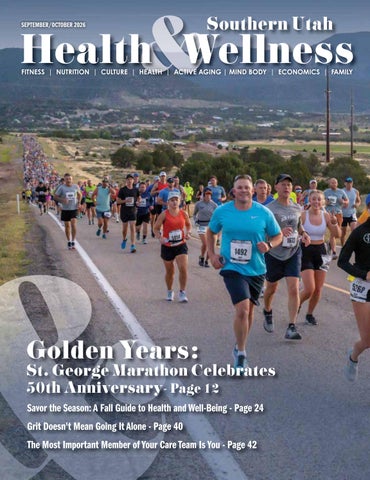
Golden Years:
St. George Marathon Celebrates 50th Anniversary- Page 12 Savor the Season: A Fall Guide to Health and Well-Being - Page 24 Grit Doesn't Mean Going It Alone - Page 40 The Most Important Member of Your Care Team Is You - Page 42
Your path to back pain relief begins at SWSP At Southwest Spine & Pain, we help patients reclaim their lives from chronic pain with cutting-edge treatments and expert care.
SPECIALIZING IN MINIMALLY-INVASIVE TREATMENTS FOR A WIDE RANGE OF PAIN CONDITIONS, INCLUDING: • Back Pain • Neck Pain • Knee Pain
• Joint Pain • Carpal Tunnel • Nerve Pain
FOR MORE INFORMATION
Voted Southern Utah’s #1 Pain Management Group 7 years in a row!
ST. GEORGE (435) 656-2424
2891 E. Mall Dr., #101 | St. George, UT 84790 CEDAR CITY | HEBER CITY | HOLLADAY | HURRICANE | LOGAN | MESQUITE, NV | MT. PLEASANT | PARK CITY PAYSON | PRESTON, ID | RICHFIELD | SARATOGA SPRINGS | SPANISH FORK | TREMONTON | VINEYARD
2 Southern Utah Health & Wellness | September/October 2026
Say Goodbye to Dentures! SHAWN B. DAVIS, DMD Board-Certified Oral & Maxillofacial Surgeon
TEETH-IN-A-DAY
FREE Exam & CT Scan!
You'll never have to worry about your teeth slipping or falling out No need for adhesive
Scan the QR code to schedule your appointment
Eat and smile like you have had these teeth for your whole life Prevent bone loss and gum recession while preserving the jawbone and maintain a more youthful facial structure An investment that can last a lifetime
BEFORE
AFTER
Increased chewing capacity—eat foods like apples, steak, corn on the cob, and more Same day full-arch restoration with only four implants No more traditional dentures & no more denture sores Easy to clean and care for
Best Medical Facility
Best Oral & Maxillofacial Surgeon
Best Doctor
WWW.UTAHOMS.COM | INFO@UTAHOMS.COM September/October 2026 | Southern Utah Health & Wellness 3 1098 E RIVERSIDE DR, ST. GEORGE, UT 84790 P 435.628.1100
The Core 5
SIMPLE. ESSENTIAL. FOUNDATIONAL. We’ve made it easy to cover the basics. Core 5 provides foundational support for your daily health. Order online or visit one of our local locations.
YOUR SHOPPING CART IS READY. SCAN THE CODE AND CHECK OUT.
SANTA CLARA
ST. GEORGE
(435) 703-9680
(435) 656-2059
Canyon View Dr. & Sunset Blvd. 1100 Canyon View Dr., Suite C Santa Clara, UT 84765 Conventional Prescription Pharmacy, Specialized Compounding, and Natural Alternative Therapies Fax: (855) 853-3465 Email: rx@rx-fusion.com www.FusionSpecialtyPharmacy.com • #FusionIsBetterMedicine
Riverfront Medical Center 617 E. Riverside Dr., Suite 104 St. George, UT 84790 Fax: (435) 656-3059 Email: fp@rx-fusion.com
Table of Contents | Southern Utah Health & Wellness
Health & Fitness
On The Cover:
Golden Years: St. George Marathon Celebrates 50th Anniversary ........... 12
Community & Culture Letter from the Editor......................................7 Mayor’s Message ............................................9 Utah Tech University President’s Message .....10 Local Elections Shape Everyday Life ..............16 Why Would I Ever Want to Leave Home? .....28 From Crayons to Cardiac Care: Utah Tech University Graduate Follows Her Dream ......37 Angelica’s Mexican Grill Is the Answer to Your Food Cravings for Authentic Mexican Food ............................................................63
Mgnify: Expertly Crafted to Restore Natural Equilibrium ..................................................65
Orthopedic Urgent Care Offers Specialized Treatment for Bone and Joint Injuries........ 18 Close the Wellness Gap............................... 20 Feeling Sand Hollow? When Dry Eye Starts at the Eyelids ............................................. 22 Too Many Teeth, Not Enough Jaw ..............23 Savor the Season: A Fall Guide to Health and Well-Being ............................................. 24 It’s Just A Bad Day ....................................... 27 Southwest Spine and Pain Center Expands Access to World-Class Pain Management in Southern Utah ........................................ 30 Empowered Choices: Your Personal Breast Health and Early Detection Strategy ............ 44 Diet and Sleep ....................................... 50 Metabolic Stress: Understanding the Good Versus the Bad ....................................... 52
Mind & Body Grit Doesn’t Mean Going It Alone ............. 40 The Most Important Member of Your Care Team Is You ........................................... 42 Ancient Healing for Modern Life: How Chinese Cupping Therapy Can Support Overall Wellness .................................... 48 Trust Your First Instinct: Why We Overthink and How to Stop.................................... 56 The Architecture of Change..................... 58 Climbing the Summit to Better Health ..... 60
Featured Story: Grit Doesn’t Mean Going It Alone ...........40
Prosperity & Purpose The Hidden Cybersecurity Risks of Workplace AI........................................... 34 How Long-Term Thinkers Might Use Trump Accounts .................................................... 36
Relationships & Connection Adventure-Ready Pets: A Guide to Lifelong Fitness and Injury Prevention… ................ 32
A Path of Quilts….................................... 38 The Case for Premarital Counseling ........... 54
The opinions, beliefs, and viewpoints expressed by the various authors and forum participants in this magazine do not necessarily reflect the opinions, beliefs, and viewpoints of Southern Utah Health & Wellness Magazine, its owners, or its staff. The way we talk about sexual violence matters. Our words can be used to foster a culture of safety, respect, and equality that stops sexual violence before it happens; to show support for survivors; to shut down harmful misconceptions; to promote consent; and to practice healthy communication with children. Our voices matter now more than ever. How will you use your voice to help end sexual assault, harassment, and rape? DOVE Center is our local resource for those who have experienced domestic abuse and sexual assault. DOVE can help. Please reach out. 24-HOUR HELPLINE: 435-628-0458 | DOVE CENTER | SHELTER • ADVOCACY • COUNSELING | DOVECENTER.ORG
Y
Is This Your Poop?
ears ago, our front lawn had a problem. It was not grubs, fungus, or one of those mysterious Southern Utah sprinkler issues where one patch gets enough water to qualify as a wetland while the rest resembles Mars. It was dog poop. Lots of it. This was especially puzzling because we did not own a dog. Apparently, neighborhood canines had reviewed our property and awarded it five stars for outdoor restroom facilities. Each morning brought a new surprise. I would walk outside, admire the sunrise, take a deep breath, and suddenly begin moving like a contestant on a very unpleasant version of Dance Dance Revolution. Left foot. Right foot. Sidestep. Pivot. Do not look down. Eventually, polite frustration gave way to creative communication. We placed a large sign in the yard that read, “We Do Not Own a Dog. Is This Your Poop?” Then we added paper plates throughout the lawn, each one pointing toward the evidence and clearly labeled “Poop.” Was it mature? Probably not. Was it effective? Absolutely. The incident became one of our favorite family stories, but it also taught us an important lesson about health and wellness. Sometimes the things causing stress are not enormous. They are small, repeated problems that quietly pile up. One pile might be a cluttered counter. Another might be poor sleep, a neglected medical appointment, an uncomfortable conversation, or the exercise plan we keep promising to start next Monday. Individually, these issues may seem manageable. Together, they can turn life into an emotional minefield. One careless step, and suddenly we are muttering words that would make our mothers raise an eyebrow. The first lesson is simple: deal with small problems before they become a lawn full of them. You do not have to fix everything today. Start with one thing that regularly drains your energy. Make the appointment. Clear one drawer. Walk for ten minutes. Prepare one healthier meal. Have the conversation you have been avoiding. Small actions matter. Regular physical activity supports brain health, strengthens the body, and helps prevent or delay many health concerns as we age. Even one session can provide immediate benefits. The second lesson is that humor helps. We could have spent every morning fuming about irresponsible dog owners. Instead, we created a neighborhood art installation made from poster board, paper plates, and mild public shame. Laughter can reduce stress, relax muscles, and improve mood. Humor does not remove every problem, but it can change how heavily we carry it. Sometimes wellness looks like a workout. Sometimes it looks like a salad. Sometimes it looks like laughing at something that would otherwise ruin your day. The third lesson is that healthy communities require consideration. Our choices affect the people around us, whether we are returning a shopping cart, checking on a neighbor, listening without interrupting, or carrying a plastic bag while walking the dog. That is also the purpose of this magazine. Inside this month’s edition, you will find articles about exercise, nutrition, mental wellness, prevention, and practical ways to feel better. You may not need every article today, but one idea could help you address an issue before it grows into something larger. Read with curiosity. Try something new. Share an article with someone you care about. And when life leaves an unexpected mess on your lawn, deal with it, learn from it, and keep your sense of humor.
Brendan Dalley, Editor
Just watch where you step. September/October 2026 | Southern Utah Health & Wellness 7
Advertising Sales & Community Liaison Laci Wall - Life Integrated Trish DeMarcus - Elemental DNA & Detox
Design & Editing BRENDAN DALLEY Executive Editor
KOBY TAYLOR, PharmD
Executive Editor, Publisher
DIANE K. DEL TORO Editor-In-Chief
Diane Del Toro - Southern Utah Health & Wellness Magazine Shannon Mondry - Mondry Design
Digital & Social Media Tyson Koford - Found Local Marketing Konner Taylor - Digital Intern BRIGIT ATKIN
Author, Mind & Body
JAY BARTLETT
Author, Health & Fitness
ERIN DEL TORO, CCHt Author, Mind & Body
Guest Contributors Dr. Shane Andrews, DVM, Solace Veterinary Specialty Center Michele Bettridge, Snow Canyon Retirement Community Brad Gillman, Intermountain Health McKinley Hatch, Utah Tech University, Dr. Jayson Malufau, DO, Primestin Care
ANITA DELELLES, LMT, LAMT Author, Pet Wellness
BRANDEN DUCHARME, CMT Author, Financial Health
CHRIS ESCHLER, Life Coach Author, Health & Wellness
Sierra Meade, SoUTH Summit Richard Preston, Preston Office Solutions
Are You In It? MATT ESCHLER, PhD, LMFT
Author, Relationships & Family
TIFFANY GUST, MS, NBC-HWC USA Triathlon Certified Coach Author, Health & Fitness
MARIANNE HAMILTON
Author, Community & Culture
For information on how to contribute or advertise with us, visit our website at www.SUHealthAndWellness.com, email connect@SUHealthAndWellness.com or call us at (435) 236-2966. Cover Image: Courtesy of the St. George Marathon @ SUHealthandWellnessMagazine @ SouthernUtahHealthandWellness
ANNELIES NEWMAN, RDN, CD Author, Nutrition & Healthy Eating
WILLIAM PLUMB, DDS Author, Oral Health
DR. YANA SYMONENKO, L.Ac Author, Mind & Body
Southern Utah Health & Wellness Magazine, proudly published in St. George, Utah
MARK WADE
Author, Outdoor Adventure
8 Southern Utah Health & Wellness | September/October 2026
The publisher is not responsible for the accuracy of the articles in Southern Utah Health & Wellness Magazine. The information contained within has been obtained from sources believed to be reliable. Neither the publisher nor any other party assumes liability for loss or damage as a result of reliance on this material. Appropriate professional advice should be sought before making decisions. Outside of our staff authors, articles written by providers or professionals are invited authors and represent the opinions of that particular individual, business, group or organization. If an article is a paid advertisement, we will place the word “Advertisement” or “Advertorial” to identify it as such. ©Copyright 2026.
MAYOR’S MESSAGE
The Dixie Sunbowl is more than just a venue. It is a living symbol of St. George’s community strength, the Dixie Spirit, and generations of shared tradition. Built in the years following World War II, the Sunbowl came to life through the determination and generosity of volunteers, St. George Lions Club members, and residents who gave both their time and resources to make it possible. In 1947, after months of grassroots organizing and fundraising, the Sunbowl opened in time for the Dixie Roundup Rodeo. Since that day, it has stood as a beloved downtown St. George gathering place. Over the decades, the Sunbowl has hosted everything from rec league, high school and college football, high school graduations, festivals, concerts, and rodeos. These traditional events are so crucial to the fabric of our community. In fact, I can count on one hand the number of Dixie Roundup Rodeos I’ve missed during my life. The passage of time, however, made it clear that significant improvements were necessary to preserve the Sunbowl for future generations. That’s why we went to you, the voters, to see if you would allow for an extensive renovation to take place. We put the Trails, Parks and Recreation General Obligation Bond on the ballot in 2023, and it passed in resounding fashion! The voter-approved funds made the renovation possible. I consider it an investment in both heritage and function. It allows us to maintain the character and importance of this historic facility while making it safer, more comfortable, and better equipped to serve the public. The improvements bring the facility into the modern era while honoring its legacy. The renovated Sunbowl has increased capacity to approximately 7,300 people, allowing more residents and visitors to enjoy major events. By reducing the central rodeo surface and bringing seating closer, the design will improve sightlines and enhance the overall spectator experience. More shade, enhanced restrooms, concessions, lighting, sound infrastructure, circulation, and service access make the venue safer, more functional, and welcoming to all. We will host the Dixie Sunbowl Grand Reopening on September 10, 2026, at 6 p.m. This is a free event. We hope you will join us to take a glimpse of this renovated community treasure.
Mayor Jimmie Hughes City of St. George
Rendering of Dixie Sunbowl Renovation
September/October 2026 | Southern Utah Health & Wellness 9
UTAH TECH UNIVERSITY Dear Neighbors and Friends, As thousands of students are making Utah Tech University their home this fall, campus is alive with the energy, optimism, and promise that accompany a new academic year. Adding to the excitement, we have a lot to celebrate this fall. For example, the university added 19 new academic programs this semester, ranging from a Master of Science in Genomics and several programs in cybersecurity to associate degrees in dance and music. Additionally, we officially dedicated America First Performing Arts Center, the new home of the Southern Utah Heritage Choir, Southwest Symphony, Utah Tech Live, and the Utah Tech University College of the Arts. I am excited for this state-of-the-art facility to be a community hub for creativity, performance, and coming together. My goal is for this enthusiasm to extend beyond campus into our amazing community. To this end, I'd like to personally invite you to Utah Tech University's State of the University Address. This annual tradition is a wonderful time of sharing updates on the university's achievements, priorities, and vision for the future. The State of the University is a celebration of our community's support and engagement. During the address, we'll highlight meaningful "active
10 Southern Utah Health & Wellness | September/October 2026
learning. active life." experiences our students have participated in and preview Uniting Trailblazers: Strategic Plan 2030, the bold vision that will strengthen our impact across the region. Please join me on Wednesday, September 23, at 11:00 a.m. in America First Performing Arts Center on campus. A light lunch will be served immediately following the address. Full event details are available at utahtech.edu/stateoftheuniversity. In addition to celebrating Utah Tech's continued impact and growth together, I invite you to remain engaged with the university in all kinds of ways. Attend a performance, cheer on our student-athletes, visit an art exhibition, mentor a student, or simply spend time on campus. Utah Tech belongs to Southern Utah, and our success is inseparable from the success of the communities we serve. On behalf of our students, alumni, faculty, and staff, thank you for your continued support of Utah Tech University. We look forward to another year of learning, discovery, and partnership as we work together to build a healthier and stronger Southern Utah. With gratitude and optimism,
Shane B. Smeed, Utah Tech University President
Want to save more? Bundle your Home, Auto and Umbrella policies with us.*
Call or scan to get your personalized quote today. Sally White, Agent Sally M White Agency Inc Saint George (435) 673-3459 sallywhiteagency.com
BUNDLE & SAVE UNDER OUR ROOF
*Discount and savings amounts and product eligibility will vary by state, property type, policy form and company. Discounts may not apply to a policy or certain coverages on your policies. Some restrictions may apply. American Family Mutual Insurance Company, S.I. & its Operating Companies, 6000 American Parkway, Madison, WI 53783 ©2025 23309-EG – 2/25 – 27826803
Trust your eyes to the Best in Eye & Skin Care Comprehensive Eye Exams with our Advanced Technology Friendly Doctors and Staff for Relaxing Visits Relaxing Visits Stylish Frames Options that Flatter Your Face
435.673.5577
965 E 700 S, Suite 100, St. George, Utah
435.635.1170
85 S 2600 W, Suite 101 Hurricane, Utah
NOW SERVING SOUTHERN UTAH IN ST. GEORGE AND HURRICANE
September/October 2026 | Southern Utah Health & Wellness 11
GOLDEN YEARS: ST. GEORGE MARATHON CELEBRATES Ultramarathoner/Grandmom Ashley Paulson
50TH ANNIVERSARY Shatters World Record(s) for 100-Milers
12 Southern Utah Health & Wellness | September/October 2026
“…Five…four…three…two…one…GO!” Just before dawn on a frigid November 5, 1977, the countdown rang out. And with those words, 42 excited runners began the inaugural Pioneer Marathon. All but four covered the entire 26.2-mile distance that day.
“One of Four Marathons to Build a Vacation Around,” “One of Ten Most Scenic Marathons in the U.S.,” “People’s Choice: Most Organized Event,” and a “Cream of the Crop Marathon.” CNN also has joined in the accolades, deeming SGM one of “7 Marathons Worth the Trip.”
Fifty years later, what is now the St. George Marathon (SGM) is about to welcome a record 10,000 runners and walkers. Traditionally, a 50th anniversary sees gifts of gold bestowed, signifying wisdom, strength, and a love that has stood the test of time. While the wisdom of running a marathon may be open to debate, the strength and love of every SGM participant, as well as the community that has supported the event for five decades, cannot be overstated.
How did a small-town race make it into running’s biggest leagues? Credit goes to former City of St. George Parks & Recreation Director Sherm Miller and his successor, Director of Leisure Services Kent Perkins, for their vision and dedication to creating a world-class event. Sherm, himself a dedicated runner who’d organized a host of fun runs for local residents, stepped up to the starting line of the Deseret News Marathon in 1975. When he finished the race, beating his estimated time by a full hour, he decided that St. George needed a marathon of its own.
Today, SGM ranks among the top 10 marathons in the country. Runner’s World magazine has, at various times, cited the race as
Back then, the planning and execution of the event were more seat-of-the-pants than precise. For example, Sherm mapped out
the marathon course he’d selected along Highway 18 by driving his Volkswagen van back and forth five times. Today, course certification is a very exacting process requiring prescribed equipment, plus a dizzying number of measurements and calculations conducted multiple times.
in 2021, almost didn’t finish that first race. “A hay truck and Debbie nearly collided at mile 21, as traffic wasn’t stopped for the race back then,” Mike laughs. “Steve Naylor from northern Utah was the overall champion that first year, and when he finished, his comment was, ‘That was tougher than I thought it would be.’”
Mike Schramm—a 27-time marathoner who’s run SGM 11 times—is one of the race’s historians and statistics gurus. He notes that during the first edition of SGM, aid stations were a scarcity on the course. “They were few and far between, about 2.5 miles between each one,” Mike said. “Mainly they were staffed by the same few people who just kept hopscotching down the course, giving water to the runners every few miles.”
Barbara Peterson was just 20 years old when she became the first women’s overall champion, finishing almost 20 minutes ahead of the second-place female. Curt Brinkman took top honors in the wheelchair division, despite his use of a conventional chair versus a racing rig, resulting in a finishing time of roughly three hours—twice that of present-day wheelchair athletes.
Mike adds that local running icon Debbie Zockoll, a kindergarten teacher who ran the St. George Marathon 43 times before her passing
As word spread about the mostly downhill, extraordinarily scenic course, as well as the unparalleled kindness of the St. George community, SGM quickly became a “must-do” race, with registration September/October 2026 | Southern Utah Health & Wellness 13
for the 1978 event quadrupling that of the inaugural year. In 1979, the “Pioneer Marathon” name was officially retired; the race has since been known as the St. George Marathon. Over time, the City of St. George allocated more funds and resources to SGM’s presentation, significantly increasing its number of participants. One of the most crucial factors in the event’s growth was the dedication of supporters and community volunteers, who have worked tirelessly each year to ensure the best possible experience for all marathoners. “We’ve had multigenerational staffers at our aid stations,” said Michelle Graves, the City’s Assistant Director of Parks & Community Services. “Every year, families have turned out at ‘their’ stations, with music, decorations, costumes, and all sorts of fun things to keep our runners’ spirits up. Time and time again, the most consistent feedback we receive on our post-race surveys is that we have the nicest, most caring group of volunteers of any marathon in the country.” Such a can-do attitude can be traced back to Kent Perkins, who became SGM Race Director in 1982 and served in the role for 34 years. Admittedly, his tenure with the event had challenging beginnings.
the ensuing decades, Kent helped recruit and retain what has become SGM’s dedicated coterie of volunteers; as many as 2,000 now support the race annually. He also assembled the kind souls known as “catchers,” who aid runners crossing the finish line in distress and ensure they receive medical assistance if needed. Additionally, in 1989 Kent introduced the Mayor’s Walk, a casual two-mile stroll through downtown that lets walkers, accompanied by the St. George mayor, experience the excitement of crossing the marathon finish line. Perhaps most importantly, Kent took the lead in creating the “sister city” relationship with the Ibigawa Marathon. SGM’s top finishers now compete each year in Japan, and Ibigawa sends a delegation to St. George as well. “Every person who’s ever gone over there has always come back saying it was one of their best-ever life experiences,” Kent says. “Our relationship with Ibigawa is still strong to this day. In my opinion, it’s one of the best things to come out of the St. George Marathon.”
“The first year I was with the race, the runners congregated in what was basically a trash collection area with a circle of dumpsters, so that was less than positive,” he recalls ruefully. “There were a few porta-johns, but not nearly enough.”
Throughout his tenure at the helm of SGM, Kent’s constant quest for improvement was a significant factor in the event’s enthusiastic accolades from runners, the running media, sponsors, volunteers; indeed, virtually everyone who was, or continues to be, a part of the St. George Marathon. Almost immediately after each race, Kent pressed his staff to consider what could be done better the next time, and he kept careful notes about process improvements. With the marathon’s golden anniversary imminent, Kent deserves the gratitude of runners worldwide.
“Over the years,” Kent continues, “we graded the area, brought in gravel, got it cleaned up, and brought in every port-o-potty that was available in two counties. We also built a long stretch of bonfires for runners to warm themselves in the early morning. Now the site is one big, well-maintained area with light towers, music, and flags for all the countries and states represented in the race each year.”
Asked to reflect on his three decades at the helm of SGM, Kent says, “I’m happy with what we’ve left St. George. My goal was to do my best to help the city and the marathon be better than when I got there; to contribute in some way. I didn’t create anything. But I’d like to think that I was part of a process that helped make some wonderful things happen in St. George.”
In
Part of Kent’s legacy was the creation of St. George Races (SGR), an entire department devoted to producing SGM, as well as a bevy of running, walking, and cycling events, a triathlon, a 24-hour endurance race, and, for the past two years, a stair-climbing competition at Tech Ridge. Appropriately, SGR is headed by Aaron Metler, a fourtime St. George Marathon champion and the 2025 Masters Men’s champion here (the latter title earned him a berth in the exclusive Masters Men’s division at the 2026 Boston Marathon). Aaron and his team have spent months preparing for the 50th edition of SGM, planning special events and implementing initiatives aimed at attracting the most accomplished field of competitors. A first-ever prize purse totaling $100,000 proved highly attractive. Registrations filled completely within days of opening, and all 50 states and many nations will be represented at this year’s event. SGM also has produced a commemorative book, 50 Years Running: St. George Marathon 1977–2026, which is available through the SGM website.
14 Southern Utah Health & Wellness | September/October 2026
“As we celebrate the 50th running of the St. George Marathon, we are incredibly grateful to the community that has been home to this race for five decades,” Michelle Graves said. “Our sincere thanks go to the volunteers, spectators, and the 10,000 runners who will commemorate this milestone event. This will be a truly special year, and we hope everyone involved can feel the extra love, care, and excitement that has been poured into making the 50th anniversary ‘like no other.’” For more information about the October 3, 2026 St. George Marathon, visit the marathon website at www.sgcityutah.gov/activity/special_events/ st._george_marathon/
ABOUT THE AUTHOR
Marianne L. Hamilton is a veteran journalist and marketing writer whose work appears in regional and national publications. When not race walking on one of our local trails, she serves on the board of the Kayenta Arts Foundation and supports the City of St. George as a grants writer for arts and recreation programs. She and her husband, Doug, are also coadministrators of the Southern Utah Wine Club, founders and co-directors of the United States Power Walking Association, and race directors for the Huntsman World Senior Games. The former Ms. Senior Universe 2022-2023, Marianne is a proud breast cancer survivor and a member of the Intermountain Health Oncology Patient-Family Advisory Council.
September/October 2026 | Southern Utah Health & Wellness 15
Local Elections Shape Everyday Life By the Washington County Board of REALTORS®
I
n Washington County, a handful of votes decide how our communities grow, and showing up matters more than you might think. Every election is a chance to have a direct hand in the place we call home. County elections are especially powerful that way. They’re small enough that a single vote carries real weight, and big enough that the decisions ripple through every city and neighborhood in Washington County. Showing up isn’t just a civic duty; it’s one of the most effective ways any of us can shape our own backyard. County commissioners oversee the issues that touch daily life most directly: public safety, roads, public health, economic development, budgeting, and long-range planning. These aren’t abstract policy debates. They’re the decisions behind how quickly an ambulance reaches your neighborhood, whether the road you drive to work gets widened, and how the county’s budget balances growth with the services people rely on. It’s worth understanding why county government matters in a way that’s different from city government. Individual cities and towns each make their own decisions, but many of the biggest challenges we face don’t stop at city limits. Traffic, water, housing, and growth spill across boundaries. The county is what ties those pieces together: it manages development in unincorporated areas, supports shared infrastructure, and coordinates regional planning so that neighboring com-
munities aren’t working against each other. When county leaders do this well, every city in Washington County benefits, not just the biggest ones. That coordination matters more here than almost anywhere else in Utah. Washington County is one of the fastest-growing counties in the state, with population up roughly 58% since 2010 and another 60,000 or so residents expected within the next seven years. The Washington County Board of REALTORS® ranks the county third-highest in the state for housing demand, behind only Salt Lake and Utah Counties. Local REALTORS® have been valuable advocates in this conversation. Because they work with buyers and sellers every day, they see firsthand where housing supply is falling short and where infrastructure hasn’t kept pace with growth. Many actively engage with county leaders to push for smart, sustainable planning that keeps homeownership within reach for local families. Their perspective is a good reminder that housing affordability isn’t just a personal issue; it’s a communitywide one, and county leadership plays a direct role in the outcome. When residents participate in county elections, they help shape how tax dollars are invested, how neighborhoods grow, and what opportunities exist for the next generation. It’s a chance to weigh in on the future of the place you call home, and it starts with something as simple as filling out a ballot.
16 Southern Utah Health & Wellness | September/October 2026
General election: Tuesday, November 3, 2026. Ballots are typically mailed about 21 days beforehand. Check your registration and ballot status at elections.washco.utah.gov or vote.utah. gov, or call 435-301-7248. Vote in person at 111 East Tabernacle Street, St. George, UT 84770.
Not Every Elevated PSA Means Cancer Know your numbers. Understand your risk. Move forward with confidence.
PSA
PIT STOP
E DUCATE • EVALUATE • EM POWER
PSA Pit Stop combines education, specialized evaluations, and actionable information to empower men to make informed decisions and confidently take the next steps in managing their prostate health. Your PSA Pit Stop Consultation Includes: • PSA trend analysis and personalized risk assessment.
• Specialist review with individualized recommendations.
• Advanced diagnostic testing when appropriate, including biomarkers and MRI.
• Our findings are shareable with your urologist to support informed discussions and coordinated care.
Contact Us Today For a Consultation PSAPitStop.com · Info@PSAPitStop.com · (435) 900-7060 St. George, UT 1308 E 900 S., Suite B, St. George, UT 84790
Mesquite, NV 1301 Bertha Howe Ave., Suite 6, Mesquite, NV 89027
PSA Pit Stop is a consultation service provided in partnership with 5D Cancer Services. To learn more, visit www.5dcancerservices.com September/October 2026 | Southern Utah Health & Wellness 17
ORTHOPEDIC URGENT CARE OFFERS SPECIALIZED TREATMENT FOR BONE AND JOINT INJURIES By Brad Gillman
When patients need urgent medical care, not every condition requires a trip to the emergency room. For those experiencing orthopedic injuries or pain, Southwest Ortho Urgent Care at Intermountain St. George Regional Hospital provides a convenient option for timely, specialized treatment. “It’s like an InstaCare just for orthopedics,” said Dr. Warren Butterfield, orthopedic surgeon at St. George Regional Hospital. The clinic serves patients with orthopedic injuries and conditions who need prompt attention but are otherwise stable. Common concerns include sprains, strains, fractures, sports injuries, joint pain, shoulder injuries, knee arthritis, and other musculoskeletal issues. “In the past, many of these patients would have to be seen in the emergency department, but they didn’t necessarily need that level of urgent care,” Butterfield said. “This clinic allows them to receive the urgent orthopedic care they need while helping keep emergency resources available for patients with more serious or life-threatening conditions.” When looked at from the perspective of the patient, the Intermountain system, and the providers, it’s a win-win-win. “From the patient perspective, it saves a lot of time, usually less than an hour from arrival to discharge, and it saves them money,” 18 Southern Utah Health & Wellness | September/October 2026
Butterfield said. “From the Intermountain system perspective, it helps relieve pressure on the emergency department, and for providers, it allows us to offer a higher level of care and give patients more direct access to the providers. It’s been a tremendous benefit for everyone involved.” Patients are often seen, treated, and discharged in less time than a typical emergency department visit. Because the clinic is staffed by orthopedic specialists, patients also receive targeted evaluation and treatment without the need for multiple appointments or referrals.
“It’s a faster path to orthopedic care,” Butterfield said. “We’re not trying to circumvent primary care providers, but they’re so busy that it can be difficult to get an evaluation on the same day. For a lot of people’s busy lifestyles, this meets a need.” Located inside the Outpatient Services Center at St. George Regional Hospital, Southwest Ortho Urgent Care has become an important resource for Southern Utah residents seeking specialized care for orthopedic injuries and conditions. “It’s rewarding to see the impact this service has on our patients and community,” Butterfield said. “It raises the level of orthopedic care available locally and provides easier access to the expertise people need when an injury occurs.” Southwest Ortho Urgent Care is located inside the Outpatient Services Center at Intermountain St. George Regional Hospital. Walk-in hours are 8:00 a.m. to 7:00 p.m., Monday through Saturday.
ABOUT THE AUTHOR
Brad Gillman is the Media Manager for the Intermountain Health Desert Region, where he leads the development and execution of media strategies to effectively communicate the organization’s mission and achievements. With a passion for storytelling and a sharp eye for detail, Brad works closely with the communications team to ensure impactful and engaging content across all platforms. His expertise in media relations and content creation helps elevate the profile of healthcare in the community.
Wednesday, November 18 to Saturday, November 21 Dixie Convention Center
Benefiting St. George Regional Hospital
September/October 2026 | Southern Utah Health & Wellness 19
CLOSE THE WELLNESS
GA P
By Tiffany K. Gust, MS, Exercise Physiologist
W
hat if the most important health goal after age 50 wasn’t just losing weight, but maintaining the ability to hike Southern Utah trails, travel with confidence, play with grandchildren, and continue doing the activities you love? Living longer is only part of the story. The true goal is extending your healthspan—the years you remain active, independent, and able to enjoy life on your own terms. The good news? Healthy aging is not simply about adding years to your life. It is about maintaining the strength, endurance, balance, and mobility needed to live those years well. Research continues to highlight five important pillars that support healthy longevity. The Five Pillars of Healthy Aging 1. Cardiorespiratory Fitness: Your Engine Your heart and lungs provide the energy needed for everyday activities. One of the most meaningful measurements of cardiovascular fitness is VO2 max, which reflects how efficiently your body uses oxygen during exercise.
• Improve your engine: Walk briskly, cycle, swim, hike, or participate in activities that elevate your heart rate. Adding short intervals of faster effort followed by recovery can help improve fitness.
2. Strength: Your Foundation Muscle is one of your greatest assets as you age. Strength helps protect bones, improves metabolism, supports balance, and allows you to remain independent. Grip strength is a simple measurement that provides insight into overall strength and function. Lower grip strength has been associated with increased risk of falls, disability, and loss of independence.
• Build strength: Include resistance training two or more days
per week with exercises such as chair sit-to-stands, squats, step-ups, resistance band rows, push-ups, and farmer’s carries.
Higher levels of cardiorespiratory fitness are associated with improved health outcomes and a greater ability to perform activities such as hiking, traveling, gardening, and recovering from illness.
3. Balance: Your Protection Against Falls Falls can dramatically impact independence, but they are not an inevitable part of aging. Balance, strength, and coordination can improve at any age.
• Improve balance: Practice standing on one leg while holding support, perform heel-to-toe walking, strengthen your ankles with heel raises, and consider activities such as tai chi.
20 Southern Utah Health & Wellness | September/October 2026
• Balance on one leg for at least 30 seconds. • Carry two full grocery bags comfortably. • Climb one flight of stairs without stopping. If one or more of these activities feels difficult, it is not a reason to stop; it is a reason to start. Strength, endurance, balance, and mobility are all qualities that can improve with the right training approach.
4. Mobility and Flexibility: Your Freedom to Move Mobility allows you to bend, reach, rotate, and move confidently through daily life.
• Stay mobile: Regularly stretch your hips, hamstrings, calves, chest, and shoulders. Activities such as yoga and mobility exercises can help maintain healthy movement.
Know Your Numbers and Protect Your Future Many people wait until pain, injury, or declining ability forces them to make a change. A better approach is to understand your current fitness level and create a plan to stay strong and independent. At Intermountain Sports Performance, we offer comprehensive Functional Fitness Assessments that help adults understand where they are today and identify opportunities for improvement.
5. Functional Movement: Your Independence The true measure of fitness is not just how much weight you lift or how fast you move; it is your ability to perform everyday tasks. Can you get up from a chair? Carry groceries? Climb stairs? Move safely through your home and community? Functional fitness assessments help identify strengths and opportunities for improvement before small limitations become larger challenges. Can You Pass the Longevity Check? Healthy aging isn’t about being perfect; it’s about maintaining the ability to do the things that matter most. Try these simple self-checks: • Walk briskly for 30 minutes without needing an extended recovery. • Stand up from a chair 10 times without using your hands.
Assessments may include: • VO2 Max Testing • Grip Strength Assessment • Balance and Fall Risk Assessment • Mobility and Flexibility Evaluation • Functional Movement Screening • Personalized Exercise Recommendations Discover your strengths, identify areas for improvement, and create a plan to stay active for years to come. Schedule your Functional Fitness Assessment today by calling Intermountain Sports Performance at 435-251-2256. Closing the wellness gap is not about perfection. It is about making intentional investments today that protect your health, confidence, and independence tomorrow. Longevity isn’t measured by the candles on your birthday cake; it’s measured by your ability to keep living the life you love.
September/October 2026 | Southern Utah Health & Wellness 21
For patients struggling with chronic lid-margin buildup or meibomian gland dysfunction, adding a professional eyelid-hygiene visit to their care plan could make all the difference. In-Office Eyelid Hygiene We recently introduced a specialized in-office procedure to gently and thoroughly cleanse the eyelid margins. This treatment lifts away debris and buildup that home scrubs often leave behind.
FEELING SAND HOLLOW? When Dry Eye Starts at the Eyelids By Dr. Taylor Hutchins
A
trip to Sand Hollow Reservoir guarantees sand in your boots, your truck, and eventually your house. But if you feel a gritty, sandy sensation in your eyes while sitting in your living room, the desert landscape may not be the only culprit. That persistent scratchiness often begins much closer to home, right along the edges of your eyelids. The Eyelid Connection When patients visit SouthWest Vision complaining that their eyes feel like sandpaper, they often expect to hear that they are not producing enough tears. However, the most common cause of evaporative dry eye is a condition called meibomian gland dysfunction (MGD). Your eyelids contain dozens of tiny glands that secrete oils to coat your tears and prevent them from evaporating into our dry Utah air. If those glands become blocked or if the oil thickens, your tears evaporate too quickly. The resulting dryness, burning, and irritation can make every blink feel uncomfortable.
It is essentially a professional deep clean for your eyelids. For some patients prone to recurring buildup, we may recommend having the lid margins evaluated about every six months to help maintain comfort, much like a routine dental cleaning. The right interval is always individualized based on your specific needs. Advanced Options for Stubborn Glands If an examination reveals more significant gland obstruction or inflammation, a simple cleaning may not be enough. In those cases, we may consider advanced in-office treatments. One option is TearCare, which applies controlled, localized heat to the eyelids before we manually express the obstructed glands to restore better oil flow. For other patients, Intense Pulsed Light, or IPL, therapy may be recommended to target underlying inflammation and abnormal blood vessels contributing to the dysfunction. These advanced procedures involve an out-of-pocket cost and are tailored to patients who need more than surface hygiene. When to Seek Care While dry eye is incredibly common, not every gritty sensation is harmless. Persistent redness, pain, light sensitivity, discharge, sudden vision changes, or a new problem affecting only one eye should never be ignored because these symptoms require prompt medical attention. If you are tired of feeling that Sand Hollow grit when you are nowhere near the water, we are here to help. We can evaluate your tear film, check your meibomian glands, and build a plan that fits your eyes. Call 435-673-5577 or visit SouthWestVision.com to schedule your appointment today. Your eyes, and your peace of mind, will thank you.
A Dental Approach to Eye Care Many of us are diligent about brushing our teeth at home and visiting the dentist every six months to clear away plaque we cannot reach. Eyelid hygiene follows a similar philosophy. Daily home care remains the foundation of healthy eyelids. Warm compresses and gentle lid scrubs can help keep oil flowing and debris at bay. But just as daily brushing cannot prevent all dental plaque, home eyelid care sometimes is not enough to clear stubborn buildup and debris along the lash line. 22 Southern Utah Health & Wellness | September/October 2026
ABOUT THE AUTHOR
Dr. Hutchins recently joined SouthWest Vision and is now accepting new patients. His background includes specialization in sports vision, concussion rehabilitation, and neurovisual training. He has worked with professional and elite athletes, including MLB players, U.S. Air Force personnel, and the U.S. Olympic Ski Team.
TOO MANY TEETH, NOT ENOUGH JAW By Dr. William Plumb, Plumb Dental
E
xtracting wisdom teeth has become one of my favorite dental procedures. It is challenging and invasive, but with proper technique and a lot of practice, it can be done safely, efficiently, and predictably. I’m grateful for talented surgeons who took me under their wing years ago and mentored me as I sought to become not only proficient but expert in third molar extractions. A question that I get a lot is why we even have wisdom teeth to begin with. This is a fairly recent change in human anatomy, and one we’ve brought upon ourselves. For most of human history, there was plenty of room for third molars, and they were greatly needed for proper function. Up until this modern era, our ancestors consumed foods that were harder and more fibrous. Very little of what was eaten was processed. This mechanical loading, particularly during childhood, stimulated jaw growth, resulting in broader, longer arches with room for all 32 teeth. A harder diet consisting of coarse foods such as grains and seeds contributed to tooth wear. As other teeth decreased in size, it left more room in the dental arch for wisdom teeth. Also, having an extra set of molars was a great insurance policy. Though it’s likely that people suffered less from dental decay because they weren’t eating all the sugar that we eat today, having an extra set of molars come in when an individual was a little older would have been a huge benefit if function had been compromised because of tooth damage or loss. Today, softer, processed diets mean kids don’t chew hard enough during jaw development to stimulate full arch growth. The jaw ends up smaller than the genetic blueprint calls for, and the wisdom teeth have nowhere to go. This is sometimes referred to as “jawtooth discordance.” Encouraging your children to eat a diet rich in fresh fruits, vegetables, and grains is a great way to help their bodies develop properly. We are learning more and more about how essential good nutrition is, not only for maintaining our health, but also for proper anatomical development. Research today shows that even when there is anatomic space for third molars, it is still indicated to have them removed because
they are so hard to maintain. It is more likely you’ll have problems, such as increased plaque accumulation, pericoronitis, and damage to adjacent teeth, if you leave them in place than if you have them removed. That includes the risk of complications associated with wisdom tooth removal surgery. In my opinion, there’s an ideal time to have them removed. The difficulty is that people develop at different rates, so the ideal time varies for each individual. The key is to have regular dental visits with radiographs to monitor third molar development. I prefer extracting the teeth when the crowns of the molars are fully formed but the roots have not fully formed. This usually happens around age 18, but there is a lot of variability. The procedure becomes more difficult at around age 26. By that point, the teeth are fully formed, the bone is mature and less flexible, and I think that makes recovery a little harder. One more thing worth considering is sedation for this surgery. The lower wisdom teeth tend to be positioned closely to the inferior alveolar nerve, which is the main nerve for the lower part of your face. Even when the area is numbed using local anesthetic, there is still a lot of pressure experienced because of the IAN’s proximity. Sedation allows you to be relaxed and comfortable during the procedure. Wisdom teeth are a fascinating window into how profoundly our lifestyle shapes our biology. While we can’t undo thousands of years of dietary change, we can make smart choices, for our children’s development and for our own dental health. If you have questions about your wisdom teeth or your child’s, don’t wait for a problem to arise. A proactive conversation with your dentist, paired with regular monitoring, is the best path to a comfortable and timely outcome.
ABOUT THE AUTHOR
Dr William Plumb graduated from the State University of New York School of Dentistry in 2006. He opened Plumb Dental in St George in 2009. He has received extensive continuing education in cosmetic dentistry as well as oral surgery and implantology. He loves living in Southern Utah with his wife Kari and their four children.
September/October 2026 | Southern Utah Health & Wellness 23
SAVOR S ON: S AVOR T HE S E A AS
A FALL GUIDE TO HEALTH AND WELL-BEING By Lori Wright, CEO Family Healthcare
A
fter months of triple-digit heat, fall arrives in Southern Utah like a deep breath. Mornings turn crisp, the trails call our names again, and local markets fill with the colors of the harvest. It is a short and beautiful season, and it offers something summer rarely does: perfect conditions for caring for yourself, inside and out. Celebrate the Fall Harvest Autumn brings some of the healthiest eating of the year. Local farmers markets and produce stands are stocked with winter squash, apples, pears, peppers, pumpkins, and leafy greens. Meals built around colorful produce, whole grains, and lean protein help keep blood pressure and blood sugar steady, support a healthy weight, and strengthen the immune system heading into winter. Try roasting a pan of fall vegetables for an easy weeknight side, simmering a pot of butternut squash soup, or letting the kids pick out a new apple variety to taste. Cooking a seasonal meal together is good nutrition and good family time rolled into one. Get Outside While the Weather Is Perfect Fall is prime time for outdoor activity in Southern Utah. With daytime highs finally comfortable again, the Virgin River Trail, Snow Canyon State Park, and the paths of Zion National Park are waiting. Hike, bike, or simply take an evening walk and watch the light change on the red rocks. You do not need an ambitious plan to benefit. Thirty minutes of movement most days lifts mood, improves sleep, strengthens the heart, and eases stress. Pack water, wear layers for cool mornings, and bring the whole family along. Make Self-Care a Habit, Not a Reward As school routines and holiday planning fill the calendar, self-care is often the first thing we drop. This fall, treat it as a habit instead of a reward. Protect your sleep. Say no to commitments that drain you. Step outside for a few quiet minutes each day.
Self-care also means paying attention when something feels off. Ongoing fatigue, brain fog, mood changes, poor sleep, or simply not feeling like yourself are not things you have to accept as normal. For women, these symptoms may signal perimenopause or menopause. For men, these symptoms can be signs of declining testosterone. Family Healthcare now offers dedicated Perimenopausal and Menopausal Hormone Health visits, as well as Testosterone and Men’s Health visits. Each visit is led by a board-certified provider who takes time to listen and develops a care plan tailored to your needs. Tend to Your Mental Health Seasonal change affects more than our schedules. Shorter days and fuller calendars can stir up stress and anxiety, even in a season we love. Simple practices make a real difference: a daily walk outside, a few slow breaths before a busy morning, a gratitude note at the end of the day, and regular time with people who lift you up. If you find yourself feeling overwhelmed, stuck, or persistently down, please reach out. Family Healthcare’s behavioral health providers are here to listen and help, judgment-free. Know Your Numbers Before Winter Fall is also a smart time for a health check-in. Nearly half of American adults have high blood pressure, and most feel no symptoms at all. Family Healthcare’s new Blood Pressure Management visit includes accurate monitoring, medication management if needed, and practical lifestyle counseling. For those living with diabetes, our comprehensive Diabetes Management visit can help. A Season to Savor Fall in Southern Utah is a gift: fresh food on the table, cool air on the trails, and a natural invitation to slow down and take care of ourselves. At Family Healthcare, we are here to support you through every season, with clinics in St. George, Hurricane, Cedar City, and Springdale offering medical, dental, optometry, behavioral health, and pharmacy services. To schedule a visit or learn more about our new care bundles, call 435-986-2565 or visit familyhc.org. We will see you at the market and on the trails!
ABOUT THE AUTHOR Lori serves on a variety of committees across the state and throughout Washington and Iron Counties. She is a member of the St. George Area Chamber Board of Governors and Association of Community Health Centers Board. She also serves on the AUCH Health Center Control Network and is a member of Intermountain Health’s Proactive Care’s Clinically Integrated Committee. Lori has completed a BS in Community/Public Health and holds a Master of Public Administration from Brigham Young University, Marriott School of Management.
24 Southern Utah Health & Wellness | September/October 2026
YourAccessible Accessible Primary Your Primary Health Care Home Health Care Home Locations in St. George, Hurricane, Cedar City and Locations in St. George, Hurricane, Cedar City and Springdale Springdale
Welcoming new patients Walk-In and same-day care medical, behavioral, dental & vision care. Integrated Welcoming newManagement patients of acute and chronic conditions Treatment of illness, injury, and chronic Women’s health care conditions Integrated medical, behavioral, dentalcare & vision care Walk-In and urgent Sliding scale feesDiscount based on income andpharmacy family size drive-thru in Springdale Discount drive-thru pharmacy* Sliding scale fees based on income and family size Compassionate, experienced providers Compassionate, experienced providers
OPEN NOW
Family FamilyHealthcare HealthcareProvider ProviderTeam Team
Best Family Physician and Best Primary Care Provider
Support SupportaaStrong Strongand andHealthy HealthyCommunity! Community! Ways to give: Scanthe theQR QRcode code • Scan
Your support helps ensure that all community members, regardless of their circumstances, can access the primary health care they need without fear of being turned away. Give the gift of community health today!
Mailyour yourdonation donationto to276 2276 • Mail E. E. Riverside Riverside Drive, St.UT George, Drive, St. George, 84770 UT 84770
Donations are tax-deductible under section 501 (c)(3) of the IRS code. Tax ID #35-2163112
• Donate online at familyhc.org/give
Volunteerby bycalling calling435-986-2565 435-986-2565 • Volunteer
St.St. George/Hurricane/Cedar City/Springdale George/Hurricane/Cedar City/Springdale| |435-986-2565 435-986-2565| familyhc.org | familyhc.org *St. George Riverside Clinic Southwest Utah Community Health Center, doing business as Family Healthcare, is a registered nonprofit organization. Information concerning Family Healthcare, including financial information and charitable purposes, may be obtained without costs from Family Healthcare, 2276 E. Riverside Dr. St. George, Utah, 84790. Family Healthcare is committed to donor St. George Health & Wellness Magazine | May/June 2022 privacy and does not rent or sell our mailing lists. St. George Health & Wellness Magazine | November/December 2025
25 25
utahtech.edu
26 Southern Utah Health & Wellness | September/October 2026
It’s Just A
Bad Day By Jay Bartlett
S
ometimes it’s just not your day. You start out with intentions for a good, fun ride. You’re fit for the ride you have planned. It should be easy enough: go out, turn some pedals, twist some turns, sweat some sweat, maybe attack some climbs and finish with a blistering downhill. Fun! Then it happens. You hop on the bike and BAM, you feel like a turd. You have little to no power in your legs. Maybe your lungs don’t want to work too well, and you suck wind on every climb. Or, if it’s a really unfortunate day, it can feel like someone installed a rock magnet in your front tire by the way you seem to hit every rock on the trail, bouncing around in a frustrating, ping-pong-ball-like lack of control. The problem is that just having one of these things happen can snowball into the others. If your brain gets grumpy from, say, the lack of power in your legs, it could set off the rock magnet in your wheel, then get hung up on the lack of enthusiasm from your lungs! How did you get here? It should have been just another ride. Did you stay up a bit late? Eat poorly? Are you stressed? I mean, you’ve ridden under less-than-ideal conditions plenty of times and had a blast. So why, oh why, poor me, did this ride on a beautiful day, on a beautiful trail full of sweeping turns and rolling dips and rises, turn into, “If I can only keep my cool and not toss my bike into the bushes, I’ll get through this, and I can go home and lick my psychological wounds?” Sorry to say, sometimes it just happens. Sure, if you really got into analyzing it, you could maybe say that the second adult beverage you had, the big bowl of ice cream, or the dog waking you up in the middle of the night to go pee is the root cause of your mediocre performance and general feelings of ineptness and disappoint-
ment. But, like I said, you’ve been through all that before, so you should just accept that this, too, is part of mountain biking (and life at large, really). Sometimes the stars don’t align, your chakras aren’t in place, or you’re lacking Zen in your life. It could even be that the mountain biking gods want to remind you how great this pastime is because you’ve started taking it for granted. Perhaps you need a bad ride occasionally to really appreciate the many good ones you get to have! Even professional riders have bad days, and, incredibly, they can bounce back the very next day! You can do it too, if you don’t let the negative thoughts that brew when a ride goes wrong get in your way. It’s not always easy when you’ve banged into the umpteenth rock that made you stall and almost tip over, but if you focus on the few things that do go right, you might even have some fun by the end. Look! A butterfly! A pretty flower! Oh wow, I just made it through that rock garden without putting a foot down! A positive attitude is a wonderful thing that perpetuates itself and can turn a bad ride into (at least) a decent one. Face it: if you’re on a bike, you’re probably going to have fun. So if this ride doesn’t work out, there’s a fair chance the next one will. Get out and pedal and prove the bad ride wrong!
ABOUT THE AUTHOR
Mountain bike veteran, amateur filmmaker, and lover of long rides, Jay Bartlett has been riding trails in Southern Utah for over thirty years. Jay has over a decade of experience as a bike mechanic at St. George’s oldest bike shop, Bicycles Unlimited.
September/October 2026 | Southern Utah Health & Wellness 27
Why Would I Ever Want to Leave Home? By Michele Bettridge, Sales Director for Snow Canyon Retirement Community
So Why Would Someone Choose Senior Living? Freedom from yard work, repairs, plumbing issues, and snow removal. • A built-in social life. • Health and wellness support. • Peace of mind. Maybe the better question is “What kind of life do I want next?” Senior living isn’t about giving up. It’s about simplifying. It’s about connection. It’s about choosing support before life forces the decision through crisis, illness, injury, or isolation. For many residents, the surprise is not what they gave up—it’s what they gained. They didn’t lose their life; they got their life back. “I worked my whole life for my home. Why would I leave it now?” It’s one of the most honest questions older adults ask when the topic of senior living comes up. For many people, home represents independence, memories, comfort, familiarity, and identity. It’s where birthdays were celebrated, grandchildren played, holidays were hosted, and life unfolded room by room. So when someone suggests senior living, the first reaction is often: • “I’m not ready.” • “I’m healthier than the people who live there.” • “I don’t want to lose my freedom.” • “I’m not giving up my house.” • “I don’t want to be told what to do.” • “What if I don’t fit in?” • “I’d rather stay where everything is familiar.” And honestly, those feelings make sense. So What Keeps People at Home? Many older adults stay home longer because: • The house feels safe. • They fear losing independence. • They don’t want to spend the money. • They think senior living is “for old people.” • They don’t want to leave their memories. 28 Southern Utah Health & Wellness | September/October 2026
Don’t Just Take It From Us . . . Hear from a Few of Our Residents and Their Families “We waited too long. That’s the honest truth. My parents didn’t lose independence. They gained connection, support, and a better everyday life. Now they say it all the time: ‘We should have done this twenty years ago.’” —Mark F.
“We have lived here at Snow Canyon for almost a year now and are so glad we made the decision to declutter and downsize from our home in St. George. As residents in independent living, all of our needs are met. We especially enjoy the exercise classes and the gym. We also enjoy playing pool! There are so many activities and entertainment options in the evenings. But most important are the friendships we’ve made here with both residents and staff!” —Marilyn C.
It’s not like home. It is home.
TM
An exceptional setting to gather, connect, and experience life with loved ones — surrounded by the timeless allure of Southern Utah.
SCAN CODE OR CALL TO LEARN MORE
September/October 2026 | Southern Utah Health & Wellness 29
SOUTHWEST SPINE & PAIN CENTER EXPANDS ACCESS TO WORLDCLASS PAIN MANAGEMENT IN SOUTHERN UTAH
By the Vista Healthcare Team
F
or patients living with chronic or complex pain, having access to specialized care close to home can make a meaningful difference. For seven years in a row, Southern Utah patients have voted Southwest Spine and Pain Center as the Gold Winner for Pain Management in the Best of Southern Utah Awards. That continued recognition reflects the trust patients have placed in the practice year after year. Expanding Access in Cedar City As Southern Utah grows, Southwest Spine and Pain Center is growing with it. Dr. Jon Obray, Dr. Rick Obray, and Dr. Derek Frieden will continue caring for patients in St. George while also expanding their availability in Cedar City alongside Dr. Casey Muir and Dayne Johnson, PA-C. For patients throughout Southern Utah, that means access to fellowship-trained interventional pain specialists, fewer barriers to treatment, and advanced pain care without having to travel to a larger city.
Center focuses on identifying the source of pain and creating a treatment plan based on each patient’s needs, goals, and lifestyle. “Pain is very individualized,” said Dr. Bryt Christensen during a recent educational seminar. “Nobody feels pain the same way because our brains interpret pain differently. Our job is to understand each patient’s story and create a treatment plan that fits their needs.” Treatment options may include minimally invasive procedures such as epidural injections, spinal cord stimulation, kyphoplasty, the Intracept Procedure, and other advanced therapies designed to reduce pain and improve function. As part of the Vista Healthcare network, Southwest Spine and Pain Center patients also have access to neurology, rheumatology, physical therapy, and chiropractic care, making it easier to coordinate the care they need without a long wait.
“We’ve had the privilege of growing alongside these communities,” said Dr. Jon Obray. “This recognition means a great deal because it comes directly from the people we serve.” Advanced Training, Local Care Southwest Spine and Pain Center brings an exceptional level of training to the region. Dr. Jon Obray and Dr. Rick Obray both received training from Johns Hopkins and Mayo Clinic, while Dr. Derek Frieden completed fellowship training in interventional pain management at Harvard Medical Center. In Cedar City, Dr. Casey Muir also brings Mayo Clinic training to the team, with residency training in Physical Medicine and Rehabilitation and fellowship training in pain medicine. Together, the team offers care for painful spinal conditions, nerve pain, sciatica, spinal stenosis, compression fractures, post-surgical pain, and other acute and chronic pain disorders. Personalized Treatment for Real-Life Pain Pain is rarely simple, and two patients with similar symptoms may need very different treatment plans. Southwest Spine and Pain 30 Southern Utah Health & Wellness | September/October 2026
Seven years of Gold is a meaningful honor, but for the team, the goal remains the same: helping patients get back to living their lives with less pain and more confidence. To learn more or request an evaluation, visit SWSP.com or call (435) 215-0257.
Healthy Lifestyles
Michelle Macfarlane, PA-C
Coleen M. Andruss, MD
Board Certified Obesity & Internal Medicine Specializing in Obesity Medicine for 30 Years
• Nutritional Counseling • Meal Planning • Appetite Suppressants • GLP-1 Injections • Natural Supplements • Exercise Counseling • B12 Injections
Kylee Mecham, NP
• Thyroid Care Best Weight Loss Clinic • Body Fat Testing 7 years • Metabolic Testing in a Row • HCG • Hormone Therapy • Specialized Medical Illness Diets • Unicity Feel Great Program and Products
435.986.3800 | 1173 S. 250 W. Blackridge Terrace #110 | St. George, Utah 84770 drhealthylifestyle.com | Facebook: Dr. Coleen Andruss – Healthy Lifestyles | Instagram: @dr_andruss
September/October 2026 | Southern Utah Health & Wellness 31
ADVENTURE-READY PETS: A GUIDE TO LIFELONG FITNESS AND INJURY PREVENTION By Anita DeLelles, LMT
S
A simple way to assess body condition is the “rib test.” You should be able to feel your pet’s ribs easily with gentle pressure, but they should not be prominently visible. If the ribs are difficult to feel beneath a layer of fat, your pet may be overweight.
Many injuries occur in “weekend-warrior” pets that spend most of the week inactive before suddenly tackling a long hike, run, or vigorous game of fetch. Fortunately, a little planning and consistency can help keep your pet active and injury-free for years to come.
Maintaining a healthy weight starts with portion control and balanced nutrition. Measure meals, limit table scraps, and be mindful of treats, which can quickly add excess calories. If you’re unsure about your pet’s ideal weight, contact a professional who can assess body condition and develop a nutrition and fitness plan.
Why Activity Matters Regular exercise is essential for your pet’s overall health. It helps maintain a healthy weight, strengthens muscles and joints, supports cardiovascular fitness, and provides valuable mental stimulation. Consistent activity can also reduce boredom-related behaviors and improve overall quality of life.
Beyond Hiking and Running Exercise doesn’t always have to involve high-impact activities. Swimming is an excellent low-impact option for senior pets, those with degenerative joint disease or arthritis, or pets recovering from injury. Water supports body weight while providing a full-body, lowimpact workout, improving strength and cardiovascular fitness.
The key is regular movement throughout the week. Daily exercise, even in smaller amounts, is generally safer and more beneficial than occasional bursts of intense activity.
Another effective option is hydrotherapy using an underwater treadmill. These specialized systems allow pets to exercise in a controlled aquatic environment where buoyancy reduces stress on joints while water resistance helps build muscle and improve mobility. Hydrotherapy is commonly used for arthritis management, weight loss, conditioning, and pre- and postsurgical rehabilitation and is available locally at WOOF! Wellness Center.
outhern Utah is built for adventure. Whether you’re exploring local parks, hiking scenic trails, or enjoying daily neighborhood walks, many of us bring our four-legged companions along. Like human athletes, however, pets can experience strains, sprains, and overuse injuries if they aren’t properly conditioned.
Warm Up and Cool Down Just like people, pets benefit from warming up before exercise. A 5to 10-minute walk before a hike, run, or vigorous play session helps increase blood flow, improve flexibility, prepare muscles and joints for activity, and ultimately decrease the chances of injury. Cooling down is equally important. After exercise, gradually decrease activity with a slow walk for several minutes. This helps normalize heart rate, reduce muscle stiffness, and support recovery. Avoid going directly from resting on the couch to intense exercise—or from a strenuous hike straight into the car without a brief recovery period. Be sure your pet has plenty of water before, during, and after any type or duration of exercise, particularly in hot weather. Maintaining a Healthy Weight Excess weight places additional stress on joints, particularly the hips, elbows, and knees, increasing the risk of arthritis, mobility problems, and injury. 32 Southern Utah Health & Wellness | September/October 2026
Use caution when considering natural bodies of water. Harmful algal blooms can develop in warm, stagnant water and may produce toxins that are dangerous or even fatal if ingested by pets. Supervised swimming facilities and hydrotherapy programs are often safer alternatives. When to Call Your Veterinarian Even with proper conditioning, injuries can still occur. Contact your veterinarian if you notice:
• Limping that persists beyond 24 hours or comes and goes • Repeated licking or chewing at a specific leg or joint • Reluctance to jump, climb stairs, or get into the car • Stiffness that doesn’t improve with rest • Unusual panting or signs of discomfort
• Swelling or heat around a limb or joint • Decreased activity levels or reluctance to exercise Common musculoskeletal injuries include muscle strains, ligament sprains and tears, tendon injuries, and worsening arthritis. Never give human pain medications unless specifically directed by a veterinarian, as many can be toxic to pets. Annual wellness examinations are another important tool for injury prevention, helping identify mobility changes, arthritis, and weight concerns before they become more serious problems.
A Lifetime of Adventure By focusing on regular exercise, proper conditioning, healthy weight management, and early recognition of injuries, you can help your pet stay active, comfortable, and ready for life’s adventures. With consistent care and preparation, your best friend can enjoy many years of safe movement and memorable experiences by your side. Visit woofcenter.com, call 435-275-4536, or stop by the Santa Clara location for more information.
ABOUT THE AUTHOR Dr. Shane Andrews is the owner of Solace Veterinary Specialty Center and is a board-certified veterinary surgeon who specializes in advanced surgical procedures, particularly orthopedic injuries. He works closely with local veterinarians to help ensure pets stay healthy and active.
ABOUT THE AUTHOR Anita DeLelles, LMT, is a certified equine and small animal acupressure practitioner with accreditation from the Tallgrass Animal Acupressure Institute and a member of IAAMB. Her Tallgrass training has included two consecutive summers in Bath, England, near where she lived as a child, as well as coursework in Colorado and northern California. Additionally, Anita is certified in animal massage from the Northwest School of Animal Massage as well as human massage in the state of Utah and is a graduate of UNLV. In 2013, Anita and her husband, Ron, opened WOOF! Wellness Center & Training Academy to serve pets and their health-conscious pet parents. WOOF! is dedicated to improving the quality of life for companion and competitive animals through fitness and conditioning, education, and proper nutrition. Anita shares her life with Ron and their overly-pampered cats in Santa Clara, Utah
E R E H N BEA AT H T E N O D W WHAT? O
I’M INSURED. N
Real-world guidance for insurance, Medicare KNOW YOUR COVERAGE. USE YOUR COVERAGE.
LIVE YOUR LIFE.
MEDICARE & BENEFITS
CLAIMS & DENIALS HELP
HOLD THE LINE INSURANCE
claims, denials, advocacy, and the everyday reality after you get coverage.
PATIENT ADVOCACY
EVERYDAY INSURANCE
FIRE FAMILIES FIRST RESPONDERS
CALL OR TEXT BEAN
435.632.9259
*Educational information only. Not legal advice. Coverage varies by carrier, policy, and situation.
September/October 2026 | Southern Utah Health & Wellness 33
The Hidden Cybersecurity Risks of Workplace AI:
How Businesses Can Protect Sensitive Data While Taking Advantage of Artificial Intelligence
A
By Richard Preston, Preston Office Solutions
rtificial intelligence (AI) is becoming an increasingly common tool in today’s workplace. Employees use it to draft emails, summarize reports, analyze spreadsheets, write marketing materials, troubleshoot technical problems, and automate repetitive tasks. Many businesses are exploring AI because it can help employees complete certain tasks more efficiently. For business owners who haven’t explored AI, think of it as an intelligent digital assistant. You ask it questions or give it a task, and within seconds it can generate written content, organize information, analyze data, brainstorm ideas, or even write computer code. It’s important to remember, however, that AI is not a person, nor does it “know” information the way humans do. It generates responses by recognizing patterns in enormous amounts of data. While it can be remarkably helpful, it can also make mistakes, misunderstand instructions, or produce inaccurate information. For that reason, AI-generated work should always be reviewed by a knowledgeable person before it is relied upon or shared. At the same time, many people don’t realize that using public AI tools can create cybersecurity risks if confidential business information is entered into them. According to a January 2026 report from BlackFog, 86 percent of employees use AI at least weekly for work-related tasks, and nearly half admit using AI without employer approval. Those numbers suggest that AI adoption is happening faster than many workplace policies can keep pace. Businesses have spent years strengthening their cybersecurity defenses through firewalls, multifactor authentication, endpoint protection, email security, encrypted backups, and continuous network monitoring. However, even the strongest cybersecurity defenses can be undermined if employees enter confidential customer information, financial records, legal documents, proprietary business processes, or other sensitive data into public AI platforms. “Organizations have worked incredibly hard to secure their networks and protect financial records, employee information, and customer data,” says Richard Preston, president and CEO of Preston Office Solutions. “The challenge now is that employees are using AI tools independently, often without realizing the potential consequences of where that information may be going.”
Not all AI systems are designed the same way. Many people are familiar with public AI tools that are freely available online. Some organizations, however, choose AI platforms designed specifically for business use because they offer additional administrative controls and privacy features, such as encryption, user permissions, audit logs, and security settings that help protect confidential information. “The majority of your staff are already utilizing AI in some form, whether employers officially approve it or not,” Preston says. “That means they need to understand the liabilities they can inadvertently expose the business to when using these tools.” Practical Steps Every Business Can Take Whether your organization has five employees or five hundred, developing guidelines for AI use is becoming an important part of protecting your business. Consider these best practices: • Develop a written policy outlining appropriate AI use. • Train employees on what information should never be entered into public AI tools. • Avoid entering confidential customer, financial, legal, medical, or proprietary business information into public AI platforms. • Review AI-generated work before sharing it or using it to make important business decisions. • Consider using AI platforms designed for business when handling sensitive information. • Review cybersecurity policies regularly as AI technology continues to evolve. “AI has quickly become one of the most powerful productivity tools ever created,” Preston says. “But the organizations that succeed long term won’t necessarily be the ones using the most AI. They’ll be the ones using it securely, responsibly, and strategically.” Whether an organization chooses to adopt AI today or in the future, business leaders should understand both its capabilities and its risks. Like any technology, AI requires thoughtful policies, employee training, and appropriate safeguards. Organizations that take the time to establish clear expectations will be better prepared to protect sensitive information while making informed decisions about how AI fits into their operations. For more information about how to protect your business, visit prestonoffice.com, call (435) 628-2997, or email admin@ prestonoffice.com.
ABOUT THE AUTHOR Richard Preston, owner and CEO of Preston Office Solutions in St. George, Utah, has been a trusted name in business technology for over forty years. Under his leadership, Preston Office Solutions has earned a solid reputation for exceptional sales, service, and support of office multifunction printers and large-format printing products across Southern Utah and southern Nevada. Preston Office Solutions is more than just a print solutions provider. As a dependable IT partner, the company delivers a comprehensive suite of technology products and services—all designed to support the success and growth of every client. To learn more, contact Preston Office Solutions at 435-628-2997 or visit www.prestonoffice.com.
34 Southern Utah Health & Wellness | September/October 2026
Did you know ChatGPT and Claude are NOT secure unless you do this...
Our solution combines AI platforms and securely locks them down so your company is no longer at risk.
CALL US TODAY!
(435) 628-2997
prestonoffice.com
Follow your passion. Payroll, bookkeeping, and tax strategy, structured to grow with your business.
We’ll follow the numbers.
216 W St George Blvd, Ste 100, St George, UT 84770 info@stgcpas.com· (435) 674-1314 · https://stgcpas.com September/October 2026 | Southern Utah Health & Wellness 35
HOW LONGTERM THINKERS MIGHT USE TRUMP ACCOUNTS By Branden DuCharme, CMT
O
n July 4, 2026, a new type of investment account became available. While there is an IRS code section (code section 530A) that regulates them, they are being referred to as Trump Accounts. In practice, they are a retirement account that can be contributed to for the benefit of a minor. Funds should grow over time in a tax-deferred manner with no option for withdrawal until age 18, when the account is automatically converted into a traditional IRA. While many are celebrating this newfound access to the stock market for the next generation, I’d like to explore a different angle: the newfound tax strategies for savvy long-term thinkers looking to benefit future generations. Sometimes deferring taxes stinks, especially as assets grow. However, in this case, it helps avoid tax issues with the “kiddie tax” as a result of minors making too much investment income. Certainly, while it would be nice to just pay the taxes today and enjoy the benefits of tax-free growth like a Roth IRA, that isn’t so. Not all is lost, however. Remember that traditional IRA funds are eligible for a conversion to Roth IRA funds by electing to pay taxes in the present. Income is realized, thus taxed, but no penalties are assessed. So a key part of this concept is that this new Trump Account, which can receive $5,000 per year in contributions (without even having earned income!), can now grow, and it will eventually become a traditional IRA as the child turns 18. So here is the question: When are a person’s lowest-income-earning years? I’d argue probably right at the beginning. This presents an opportunity to execute massive Roth conversions on that traditional IRA at a time that is still both early in life and likely in very low income tax brackets.
Performing this strategy could significantly help children or grandchildren get ahead. After a Roth conversion, these retirement funds can grow tax-free and provide valuable tax flexibility later in life. Even more importantly, they may substantially reduce—or even eliminate—the need for the child to save for retirement from future earnings, freeing that money for other financial priorities: funding the down payment on a home, making a mortgage payment easier, or helping cover the costs associated with raising their own children someday. Be advised there are a lot of ways for this to go wrong. There are proper tax reporting requirements and records that need to be kept. There are additional advanced strategies to enhance tax savings for some, even. Most importantly, though, this plan is most susceptible to execution risk. Remember, this account legally becomes the child’s property at age 18. At that point, you cannot prevent access to the money, nor can you help manage or use the funds without the child first realizing that the account is entirely his or hers to control. Play this wrong, and you could be handing over the keys to tens or hundreds of thousands of dollars to an 18-year-old. Having once been 18 myself, I recommend that turning over the keys to such assets (which will be out of your control) come with a significant amount of preparation, training, and guidance. In all, for those with the capacity to gift money to a younger generation, you may now be able to significantly change the trajectory of their financial lives. The ultimate outcome is far more likely to be determined by intentionality, behavior, and discipline than by faith or market performance.
ABOUT THE AUTHOR Branden DuCharme prides himself on being a husband, father and community member. Professionally, Branden is specialized in portfolio and investment management, helping clients balance risk and return as a Chartered Market Technician. He is a managing partner at DuCharme Wealth Management and a graduate of Utah Tech, with a bachelor degree in finance. Additionally, Branden shares financial insights as the host of the Tall Oaks podcast. Disclosure: Information presented is for your educational purposes only and should not be regarded as a complete analysis of the subjects discussed. Discussions and answers to questions do not involve the rendering of personalized investment advice but are limited to the dissemination of general information. A professional advisor should be consulted before implementing any of the options presented. Encompass More Asset Management LLC is a registered investment adviser with the U.S. Securities and Exchange Commission (SEC) and only transacts business in states where it is properly registered or is excluded or exempted from registration requirements. Local office: (435)288-3396
36 Southern Utah Health & Wellness | September/October 2026
FROM CRAYONS TO
CARDIAC CARE: Utah Tech University Graduate Follows Her Dream By McKinley Hatch
F
ive-year-old Sarah sat quietly in the back of a college nursing classroom with a box of crayons spread across the desk in front of her.
While her mom scribbled notes during the lecture, Sarah colored anatomy diagrams, sketched diseases on scraps of paper, and "operated" on gummy bears with a paper clip. To everyone else, it looked like a child entertaining herself through class. To Sarah, it was the beginning of a dream. After Sarah's father had suffered a heart attack, her mother returned to school to become a nurse, unsure whether she would need to become the family's sole provider. With medical bills piling up and childcare out of reach, Sarah tagged along to class with her mother, unknowingly receiving an education of her own.
patients and my coworkers. The more education I gained, the more I was able to help those around me." That drive led her to earn both a Family Nurse Practitioner degree and a Doctor of Nursing Practice degree from Georgetown University. She is now pursuing a Master of Business Administration as she continues her commitment to growth and leadership. Her message to students is simple: "First, don't give up. Don't give up on your dreams. Don't limit yourself. Look for ways to help others, and pursue them wholeheartedly. Don't put limits on your potential." The little girl who once colored anatomy diagrams in the back of a nursing classroom never outgrew her dream. She simply grew into it.
"My whole life, I wanted to be nothing except a nurse," Sarah said. That certainty brought her to Utah Tech University, where she followed in the footsteps of her mom and brother, both proud alumni. Her path, however, had its setbacks. "It's been a long but rewarding journey," Sarah said. "I was accepted into the nursing program at Utah Tech, but I didn't make it through the first time. After failing one of my classes, I was released from the program. Looking back, it's really been a story of resilience." With support from faculty, she earned her way back into the program, later serving as class president and receiving the "Student of the Year" award. "School taught me discipline. It taught me how to do hard things even when I didn't want to because they were for the greater good." After graduation, Sarah entered cardiac nursing and spent five years in the ICU. "When I first graduated from Utah Tech, all I ever wanted was to be a bedside nurse," she said. "Once I became a nurse, I realized I wanted to continue learning so I could do even more for my
ABOUT THE AUTHOR McKinley Hatch is the assistant director of marketing and public relations at Utah Tech University, where she leads the university’s marketing and social media strategy while supporting its storytelling efforts. A proud Utah Tech alumna, she earned a bachelor’s degree in media studies with an emphasis in public relations before completing a master’s degree in professional communication at Southern Utah University. She is passionate about telling meaningful stories that showcase the people, purpose, and impact of higher education
September/October 2026 | Southern Utah Health & Wellness 37
A Path of
A
QUILTS By Mark Wade
few years ago, I had the opportunity to join with a group of locals in the Panguitch, Utah, area to write a script and visually recreate the following story.
In the mid-1800s, members of The Church of Jesus Christ of Latterday Saints were establishing many of the new communities in the Utah Territory. One such community was Fairview, now known as Panguitch, which was initially established in 1863. The valley where the pioneers settled sits at an elevation of 6,600 feet, and this made for a short growing season and a difficult place to produce good crops. In the second winter, as deep snow came too early, the wheat had not matured and was still green and therefore difficult to grind into 38 Southern Utah Health & Wellness | September/October 2026
flour. The pioneers resorted to boiling the wheat, but it was barely palatable. The men hunted and fished but were competing with the local Native Americans for available meat. Without a solution, the pioneers were facing starvation. Leaders decided that they would send out two groups to obtain flour. One party headed north for Gunnison, 110 miles away. The other group began a 45-mile trek west over a high mountain pass toward Parowan. Due to heavy snows blocking the way toward Gunnison, the northbound party returned almost immediately. Those headed to Parowan traveled initially by wagon, but as they reached a mountain pass, their wagon team foundered in the deeper snow, and the journey necessarily proceeded on
foot. Feelings of exhaustion came quickly as the men overexerted themselves while their legs sank deep into the snow, fighting what seemed to be a losing battle. Under these conditions, and unprepared to travel in deep snow, it was apparent that the journey was likely impossible.
as far up the mountain as was possible. In the deepest snows, where walking on quilts was again required, the men of Fairview shouldered their own burdens and continued on alone. Meanwhile, the wives and children who remained in Fairview anxiously anticipated the long-overdue return of these men. Many in the community feared the worst. Little is recorded of the return journey, where the men not only carried the sacks of flour over the mountains but also faced the task of spreading and recovering their quilts. It is likely no one wanted to remember this exhausting portion of the trek. A journey estimated to have taken seven to ten days finally brought the men back to Fairview. This event, the famous Quilt Walk, is still celebrated every year in the town of Panguitch.
It was at this point that they laid out bedding on the snow and knelt to pray. In the course of their petitioning God for help, the realization came that the quilts on which they knelt were providing a broader surface on the snow and thereby supporting their weight. This inspired an effort to continue their trek by painstakingly laying one blanket after another to create a quilted pathway across the mountain. The men undoubtedly appreciated the women who crafted these quilts, which not only provided warmth but also served as a means of conquering the deep snow.
ABOUT THE AUTHOR Mark Wade is active in hiking, writing, photography, and videography. He works as a tourism marketing consultant, for which he has won numerous awards. For five years, he was a weekly guest on the KSL Outdoors radio show. Mark is the former Director of Tourism for southwestern Utah and has served on the board of directors for various tourism associations.
Wade’s Walkabout - Find Meaning and Healing in the Outdoors The weary party finally reached Parowan, where they were anxiously received by fellow settlers. With little time for recuperation, they acquired as many sacks of flour as they could carry. On the more arduous return trip, several people from Parowan assisted the group
For destination ideas, visit www.UtahGuide.com Also on Facebook and Instagram
September/October 2026 | Southern Utah Health & Wellness 39
Grit Doesn’t Mean Going It Alone By Chris Eschler, Health and Well-Being Life Coach
M
y husband and I were vacationing on the beach, enjoying the waves and the warm ocean water, a welcome change from the Southern Utah desert we call home. While playing in the water, we noticed a woman in trouble motioning for help. The waves had carried her too far out on an inflatable floatie, and she was unable to make it back to shore.
had headed out confidently on a rescue mission to save someone else. It wouldn’t be right for the rescuers to need rescuing!
After dropping the woman off at the shore, the jet-skier circled back and picked up my husband, noticing his signal for help. Since I had gotten farther ahead than him on the swim and had made no indication that I was struggling, it was assumed that I was fine, and they rode We swam after her, not thinking ahead about how we would help. off. My legs and arms grew more and more weary with each stroke Luckily, a jet-skier came to her rescue, and we assisted as he helped until my body went completely numb. I was so close to shore, and yet her onto the jet ski. Before leaving, he asked if we were okay. We one more stroke felt impossibly far away. It was a lonely feeling, left assured him that we were, and he drove off, taking the woman to safety. to myself in that predicament. The salt in my eyes was a mixture of tears, sweat, and ocean water. I was determined not to give up, but As we began swimming back toward shore, we realized we had my strength had failed me. By pure grit and a miracle, I staggered exhausted ourselves on the rescue swim, and the shore was much out of the water, completely depleted. farther away than we had realized. We kept paddling our arms and kicking our legs to no avail; the shore wasn’t getting any closer. It was Looking back on the situation, I’ve learned a valuable lesson. While too embarrassing to call out for help. After all, we were the ones who grit is one of my strengths, I realized it has also been my downfall
40 Southern Utah Health & Wellness | September/October 2026
ABOUT THE AUTHOR
Chris Eschler earned a BS in marriage and family sciences at Brigham Young University-Idaho. As a life coach at Ascend Counseling and Wellness. Chris works with individuals to develop their skills and provides a safe, accepting environment for exploring a wide range of thoughts and feelings. Chris knows that you are the expert of your life and that she is simply a guide. She currently sees couples with her husband, licensed therapist Matt Eschler. Together they assist couples with all couples issues, specializing in high conflict couples work. To schedule an appointment with Chris for life coaching, call Ascend Counseling and Wellness at 435-688-1111 or visit https://ascendcw.com/.
Angela Duckworth, the expert and author of Grit: The Power of Passion and Perseverance, said it well: “Grit isn’t something you develop alone; it’s supported by the people who refuse to let you quit on a bad day.” Grit doesn’t mean treading water until you exhaust yourself; it entails finding a support team to buoy you up. Undoubtedly, there will be troubled waters that lie ahead, yet navigating the worst of currents can feel attainable when buoyed by love and support, even on the worst of days. Research on achievement and resilience generally suggests that grit is most effective when paired with supportive relationships. Grit Alone • Can lead to isolation, depression, and loneliness. • Carries a higher risk of burnout and exhaustion. • Limits perspective. • May slow progress.
whenever it became my default response, even when it no longer served me. It reflects how I’ve moved through life: determined, yet too often choosing to face the riptides alone, staying caught in the treacherous currents far longer than necessary.
Grit with Support • Increased stamina and endurance. • Additional perspectives and insight. • Greater emotional stability. • Higher likelihood of success. • Stronger relationships and connections.
No matter how broken down or fatigued I felt, asking for a lifeline somehow seemed harder than simply digging deeper and relying on my individual grit. Grit is admirable, but it should never come at the cost of our well-being. When we’re pushed beyond our limits, it can be difficult to recognize that help is available and within reach.
Tips for Building Supportive Grit • Believe you are valuable and worthy of love, time, and support. • Break down walls and accept love. • Recognize your limitations and ask for help early. • Practice asking for feedback. • Build a support team before you need one. • Ask for support with a project or goal.
Whatever the reason for trying to carry everything alone, wearing yourself down to the point of numbness isn’t sustainable, healthy, or the way forward. If there’s one thing the school of hard knocks has taught me, it’s this: reaching for a lifeline at the first sign of struggle is far wiser than waiting until you’re drowning. Strength isn’t found only in enduring the current; it’s also found in knowing when to accept the help back to shore.
Looking back, I no longer remember the embarrassment of signaling for help nearly as much as I remember the lesson the ocean taught me. There are seasons when courage means pressing forward, and there are seasons when courage means reaching out. We were never meant to face every riptide alone. True grit isn’t measured by how long we can struggle in silence, but by having the wisdom to accept the hand that helps us safely back to shore. September/October 2026 | Southern Utah Health & Wellness 41
The Most Important Member of Your Care Team Is You!
By Shannon Mondry
Instead of my usual column, I’m pleased to share the story of one of my patients, who describes her experience combining conventional cancer treatment with evidence-informed complementary approaches. Her story is not intended to recommend a particular path, but rather to encourage thoughtful conversations, informed decisions, and active participation in one’s own care. Cancer changes you long before treatment ever begins.
T
he moment I heard the words, “You have breast cancer,” my life divided into three chapters: before, during, and after. Like so many women, I entered a world of appointments, scans, specialists, pathology reports, and decisions I never imagined I would have to make. My cancer was estrogen receptor-positive, a type I was told was “common.” I understand the intention behind trying to find a brighter side in those words, but from the very beginning, there was nothing that felt common about it. This was my life, my future, and there was nothing ordinary about facing cancer. When the diagnosis came, something unexpected took over me. It wasn’t fear so much as an unbridled determination. I became frustrated and angry with cancer: angry that millions of women continue to hear those same words every day and angry that we live in a world where we can carry computers in our pockets and instantly connect with someone on the other side of the globe, yet breast cancer continues to affect millions of women and their families. I couldn’t change that reality, but I could decide how I was going to face it. So I got to work. Between diagnosis and treatment is a period of waiting—a space filled with uncertainty. I wasn’t willing to spend that time simply waiting. Since there wasn’t a classroom where I could learn how to navigate breast cancer, I created my own. Every book, physician, survivor, podcast, test result, and conversation became another lesson. I read. I researched. I listened. Much of it didn’t make sense at first, but I trusted that eventually the pieces would come together. 42 Southern Utah Health & Wellness | September/October 2026
The first people I reached out to were the women in my life who had already walked this road. Nothing prepares you like another woman’s story. I borrowed their questions, listened to their experiences, learned what they wished they had known, and began building my own list of questions. I spent countless hours on the phone and online gathering information, searching for understanding, and preparing myself for what lay ahead. As my experience unfolded, I realized I was the only constant in my care. I was the common thread connecting every appointment, every test result, every recommendation, and every decision. While each physician and specialist brought valuable expertise, I was the only person present for every conversation, carrying the complete picture from one provider to the next. That realization changed everything. I stopped thinking of myself as a patient receiving care and began thinking of myself as an active partner in it. I learned to ask questions, challenge assumptions, explore every option, seek multiple perspectives, and make informed decisions. From that point on, every decision became intentional. One of the first additional resources I pursued was the Research Genetic Cancer Center test through Dr. Rick Jensen. I wanted a clearer understanding of my cancer and whether conventional treatment was the right course for me or whether other options should be considered. The information the test provided answered many of my questions and opened the door to a different way of thinking about how I could support my body during treatment. Rick Jensen recommended a supportive supplement program, which led me to Koby Taylor at Fusion Specialty Pharmacy. Koby helped me understand that prescription and over-the-counter medications can deplete the
body of important vitamins and minerals. That insight reinforced something I was beginning to understand: caring for myself during treatment meant more than focusing on the cancer itself. It also meant supporting the body that was carrying me through treatment and would continue to sustain me long after it ended. Upon reviewing the results, asking more questions, and weighing everything I had learned, I chose to move forward with conventional treatment. That decision wasn’t made blindly. I felt I had taken the time to gather the information I needed to make an informed choice. I also consulted physicians researching newer approaches to breast cancer treatment, including Dr. Dennis Holmes in Los Angeles, whose work with cryoablation interested me. Although I wasn’t a candidate for the procedure, I was grateful to have connected with him and his caring team, who answered my questions and took the time to talk with me. My research gradually shifted from finding the right treatment to preparing my body for the battle ahead. I began focusing on the things I could control—nutrition, movement, mindset, and supporting my body as though I were preparing for the greatest endurance event of my life. My endocrinologist at University of California San Francisco (UCSF) reminded me that chemotherapy can significantly affect the gut, which in turn can interfere with the absorption of my thyroid medication. That conversation reinforced my conviction that caring for my overall health was just as important as treating the cancer itself. As I searched for information, I intentionally looked beyond the traditional medical model to better understand every option available to me. Resources such as Chris Wark’s Chris Beat Cancer, The Breast Cancer Conqueror by Dr. Veronique Desaulniers, and the Gerson Therapy approach emphasize nutrition and lifestyle as primary tools for healing, often in place of conventional treatment. While I ultimately chose to follow a conventional treatment plan, these resources helped shape the nutritional and lifestyle protocols I adopted alongside my medical care. Rather than viewing them as competing approaches, I used them together to support my body throughout treatment and recovery. Together, they reinforced something I had always believed: healing isn’t only about treating disease; it’s also about creating the healthiest environment possible for your body to recover. During treatment, I became even more intentional about nourishing my
body with real, nutrient-dense foods. It wasn’t simply about eating healthier. It was one of the most meaningful ways I could help my body build resilience and endure treatment. I realized that if I wanted the kind of care I was looking for, I was going to have to build my own team. That team extended well beyond my oncology clinic. Some of the people on it never knew one another, but each contributed something important to my care. I became the common thread, bringing their knowledge and recommendations together as I made decisions for myself. Koby Taylor and Travis Snow at Fusion Specialty Pharmacy became an important part of that team. They helped manage treatmentrelated side effects with a customized pain cream, reviewed my hormone testing with me, and continue to support my health today. As I continued building my team and gathering information, I also learned that sometimes self-advocacy means asking for something you are told you don’t need. I advocated for genetic testing after my initial request was denied. When the test was finally approved, it revealed that I carry a CHEK2 gene mutation inherited through my father’s side of the family. That information gave me a deeper understanding of my cancer and, just as importantly, provided invaluable knowledge for my family. I reached out to cancer centers around the country, asking about their treatment philosophies, support programs, survivorship care, and follow-up protocols. I wanted every decision I made to be informed by as much knowledge as I could gather because I believe every perspective has something to teach us. Throughout this experience, I met physicians who genuinely cared and patiently worked through my endless questions. My oncologist, Dr. Haslem, treated me with kindness and compassion and continues to do so. Dr. Grant in Radiation Oncology took the time to answer my questions and made me feel seen—not just scheduled. Nisha Anderson, NP, and Dr. Klomp were also invaluable, offering thoughtful guidance and unwavering support. If my experience offers one lesson to someone facing a diagnosis, it’s this: Don’t be afraid to ask questions. Seek second opinions. Learn everything you can. Support your body with the best nutrition you can give it. Your physicians bring expertise. Your loved ones bring support. But you are the one constant throughout your care. No one has a greater stake in your health than you do. You are the most important member of your care team.
ABOUT THE AUTHOR
Koby Taylor, PharmD, is the owner and pharmacist of Fusion Pharmacy. Working as a retail pharmacist early in his career, Koby began to see that pharmacy patients needed to have access to available alternative medications. He realized that pharmacy in its truest form is compounding, and he wanted to be able to provide patients with customized medications. He also desired more personalized interactions with patients in order to truly help their health and well-being. To fulfill his passion for improving the health of patients and educating them about compounding, Koby opened the doors of Fusion Pharmacy in 2013. Today, Fusion is nationally accredited with PCAB. It is licensed in and ships to 27 states. Fusion is proud to have two locations to better serve the southern Utah community. Koby graduated from Brigham Young University with a degree in molecular biology in 1995 and from the University of Utah with his Doctorate of Pharmacy in 2000. For more information about Fusion Pharmacy visit: www.FusionSpecialtyPharmacy.com.
September/October 2026 | Southern Utah Health & Wellness 43
EMPOWERED CHOICES: Your Personal Breast Health and Early Detection Strategy By Dr. Jayson Malufau, Primestin Care
B
reast cancer touches the lives of so many women worldwide, yet breast cancer risk and screening needs vary. Genetic testing, risk-assessment tools, and modern imaging can help you and your health care professional build an individualized plan. Screening is a vital tool for catching cancer early, though it cannot guarantee the detection of every case or prevent the disease from developing. Understanding Your Risk Risk may be higher because of a harmful gene change linked to cancer risk, a strong family or personal history, prior chest radiation, certain biopsy findings, breast density, or a calculated lifetime risk of about 20% or greater. The American College of Radiology recommends breast cancer risk assessment by age 25 so people at increased risk can begin appropriate screening on time. Ask your provider which validated risk model and guideline apply to you. Genetic Insight Genetic testing is most useful when guided by personal and family history and, when appropriate, genetic counseling. Multigene panels may include:
• ATM and CHEK2: Some gene changes may moderately increase
risk; recommendations depend on the variant and individual history. A negative test result does not mean your cancer risk is zero because genes are only one part of your overall health. A “variant of uncertain significance” means we do not yet know whether a gene change affects your health, so it should not be treated as a positive result or used alone for major medical decisions. Review your results with your doctor, a geneticist, or a specialized surgeon. Breast Imaging Options Mammography remains the primary screening test for most women. 3D mammography improves breast cancer detection and reduces patient callback rates compared to standard 2D mammography. For selected higher-risk patients, breast MRI may be added. Ultrasound, contrast-enhanced mammography, or molecular breast imaging may be considered when clinically appropriate or when MRI is unavailable or unsuitable. Supplemental tests can also lead to false positives, additional procedures, contrast exposure, or radiation, depending on the test. Breast Density
• BRCA1 and BRCA2: Certain gene changes substantially increase Breast density is determined from a mammogram, not by touch. breast cancer risk. • PALB2: Certain gene changes increase breast cancer risk.
44 Southern Utah Health & Wellness | September/October 2026
Dense tissue can both increase breast cancer risk and make cancers harder to see on mammography. Density alone does not automatically
Primestin Care offers a relationship-based approach focused on early detection, ongoing support, and long-term wellness. They use a membership-based model, meaning members pay the same predictable monthly fee for their care, helping them avoid surprise bills, deductibles, and complicated claims. Your membership connects you with medical providers, mental health support, and a care team who can coordinate appointments, specialist referrals, in person visits, and more. For additional information or to schedule an appointment, visit primestin.care or call 435-659-3869.
mean that supplemental imaging is required. Discuss your overall risk, benefits, and limitations with your provider. Suggested Screening Discussion Timeline By Age 25 Complete a formal risk assessment, especially if you have a family history, known genetic variant, or prior chest radiation. Ages 25–29 Some high-risk patients may begin annual breast MRI during their 20s. The starting age depends on the risk factor and applicable guideline. Age 30 Many screening plans for high-risk patients add annual mammography Managing Scanxiety by about age 30. Some clinicians stagger MRI and mammography, Anxiety before imaging is not uncommon. These steps may help: but this approach is not required for everyone. • Ground: Use slow, paced breathing for three to five minutes. • Prepare: Follow the facility’s instructions. For mammography, Age 40 and Beyond avoid deodorant, powder, lotion, or perfume on the breasts or National guidelines differ. The USPSTF recommends mammogunderarms on the day of the examination. raphy every two years from ages 40–74. The ACR recommends annual screening beginning at age 40. The American Cancer • Share your concerns: Working with your technologist can help alleviate your concerns. Society allows annual screening at ages 40–44, recommends annual screening at ages 45–54, and permits annual or biennial screen• Support: Bring a trusted person, if permitted, and plan calming ing beginning at age 55. Continue screening while early detection audio for the commute or waiting room. remains beneficial. • Reframe: Remind yourself, “This appointment is an important step in caring for my future health.” At Any Age New symptoms, such as a lump, nipple discharge, skin changes, or If you require a follow-up visit, your first instinct might be to panic. persistent focal pain, require clinical evaluation and should not wait Please take a deep breath. Callbacks are a routine part of screening for routine screening. Dense breasts, a prior breast cancer, atypical mammography. biopsy findings, or other risk factors may support additional imaging after shared decision-making with your medical provider. Educational Notice: This material is for general education only and is not medical advice, diagnosis, or a substitute for individualized Your screening plan should reflect your age, health, personal prefer- care. Screening recommendations vary among organizations and ences, and complete risk profile. Review it regularly with a qualified may change. Consult a qualified health care professional about your health care professional as your history or medical guidance changes. specific risks, symptoms, testing options, and screening schedule.
ABOUT THE AUTHOR
Dr. Jayson Malufau, DO, serves as Medical Director of Primestin Care, a Direct Primary Care practice that expands access to healthcare through a combination of in-person care in Southern Utah and flexible virtual appointments available in multiple states. Passionate about preventive medicine and addressing the root causes of disease, Dr. Malufau partners closely with patients to build practical, sustainable lifestyle habits that support long-term health and help prevent chronic illness. Outside of medicine, he enjoys exploring the outdoors and spending time with his family. Learn more at Primestin.care.
September/October 2026 | Southern Utah Health & Wellness 45
Our Long Awaited Provider Directory is
NOW AVAILABLE!
&
Restore Strength & Stability Let us help you in preventing re-injury and support your long-term mobility and wellness!
Southern Utah
Health Wellness DIRECTORY
The trusted resource for finding and referring health and wellness providers in our community.
• Readers rely on it to find trusted care.
• Providers use it to attract new patients and build referral relationships.
Personalized Post Rehabilition Training If you’re a health or healing practitioner, help us beta test our new digital site. Create a free account TODAY!
· Improve Balance & Core Strength · Build Strength Safely · One-on-One Guidance · Increase Functional Capacity · Improve Movement Mechanics
JOIN THE DIRECTORY www.SUWellnessDirectory.com
1495 S. Black Ridge, Ste.A230, St. George, Utah
www.synergymassagefitness.com | (435) 688-2554
September/October 2026 | Southern Utah Health & Wellness 47
Ancient Healing FOR MODERN LIFE
How Chinese Cupping Therapy Can Support Overall Wellness By Dr. Yana Symonenko, L.Ac
H
ave you ever watched the Olympic Games and wondered about the mysterious circular marks on the backs and shoulders of elite athletes? One of my patients affectionately refers to them as “octopus kisses.” What may appear to be a modern wellness trend is actually an ancient healing practice with roots stretching back thousands of years. Cupping therapy gained worldwide attention after Olympic swimmers and other professional athletes proudly displayed their distinctive circular marks. Yet long before athletes and social media brought this therapy into the spotlight, cupping was a trusted tool within Chinese medicine. Doctors have long used it to relieve pain, support recovery, improve circulation, and promote overall well-being. Chinese medicine is an ancient holistic system that recognizes the deep connection between the body, mind, spirit, and the universe around and within us. Rather than focusing solely on symptoms, it seeks to identify and address the underlying patterns of imbalance that contribute to discomfort and disease. Among its many therapeutic techniques, cupping continues to offer a natural, effective approach to healing that remains remarkably useful in our modern world. What Is Cupping Therapy? Cupping therapy is one of the oldest treatment methods in Chinese medicine, using cups to create suction on the skin and underlying tissues. Unlike many modern interventions, cupping does not introduce substances into the body, making it a noninvasive treatment.
48 Southern Utah Health & Wellness | September/October 2026
Instead, it works by stimulating the body’s own natural healing responses and supporting its ability to restore balance. From a Chinese medicine perspective, pain and dysfunction often arise when the flow of Qi (vital energy) and blood becomes restricted because of injury, stress, overuse, poor posture, or emotional strain. The gentle suction created by the cups lifts the skin and fascial layers, increasing circulation to the treated area. This e nhanced blood flow may help nourish tissues, relax tight muscles, and support the removal of metabolic waste products that contribute to soreness and discomfort. Many patients describe feeling lighter, looser, more relaxed, and experiencing improved mobility after treatment. Although cupping marks may resemble bruises, they form through a very different process. Bruises result when direct impact or force damages blood vessels. Cupping uses negative pressure instead, drawing blood toward the skin’s surface without causing the same type of tissue injury associated with a bruise. The color and intensity of the marks vary from person to person and may reflect the degree of stagnation and circulation in the treated area. As healing progresses, the marks gradually fade without the color changes typically associated with traumatic bruising. In Chinese medicine, practitioners also use the appearance of these marks as one of many diagnostic clues to help guide future treatment. Today, cups are commonly made from glass, silicone, or medicalgrade plastic. Cupping is used for musculoskeletal pain, sports
lancet before the cup is applied, allowing a small amount of blood to be drawn. This bloodletting technique should be performed by a licensed acupuncturist because it requires additional training and sterile technique and is not appropriate for everyone. Many modern acupuncture clinics primarily use dry cupping and cupping massage. One of the most common questions I hear is, “Does cupping hurt?” In most cases, the answer is no. While the sensation is unusual, it is often described as a deep stretching or pulling feeling. Safety and Contraindications Cupping therapy is generally considered safe when performed by a licensed acupuncturist. However, it may not be appropriate for everyone. It is typically avoided over open wounds, burns, active skin infections, fractures, sunburn, known skin cancers or tumors, swelling of unknown origin, or areas affected by deep vein thrombosis. Individuals taking blood-thinning medications or those with certain bleeding disorders may require modifications or should avoid treatment. A practitioner will also determine whether cupping is suitable for people with a history of fainting, anemia, pregnancy, or extreme exhaustion or dehydration.
recovery, stress-related tension, and respiratory conditions such as seasonal allergies, asthma, congestion due to influenza, and bronchopneumonia. Different Types of Cupping Dry cupping, sometimes called bloodless cupping, is the most common form used in modern acupuncture clinics. A cup is placed on the skin, and suction is created using either heat or a mechanical pump. The skin gently rises into the cup, producing increased circulation and a therapeutic response in the tissues beneath. Cupping massage combines suction with movement. After applying oil to the skin, the practitioner glides the cup across the treatment area. This technique is particularly useful for muscle tightness, “knots,” and areas of chronic tension. Wet cupping, also known as blood cupping, is a traditional technique in which tiny superficial skin openings are made with a medical
Despite its ancient origins, cupping therapy remains remarkably relevant in today’s fast-paced world. Those distinctive circular marks seen on Olympic athletes represent far more than a passing wellness trend. They reflect one of the oldest healing traditions still practiced today. While modern research continues to explore the mechanisms behind cupping, many people seek this therapy because it supports a fundamental principle shared by both traditional and modern healthcare: the body has an incredible ability to heal when given the right support.
“If you dismiss and neglect the experience of the ancients and believe that you will find the right path only in the newest treatments, you fool yourself and the people around you.” —Hippocrates
ABOUT THE AUTHOR
Dr. Yana Symonenko is the founder of AcupunctureRocks in Santa Clara and holds a doctorate in acupuncture and Chinese medicine from Pacific College of Health & Science. Guided by an “East Meets West” approach, she combines the wisdom of ancient healing practices with a strong foundation in Western medicine to provide personalized, holistic care that addresses the physical, emotional, and spiritual dimensions of health. Through acupuncture, she helps patients restore balance, enhance well-being, and deepen their connection to self-awareness and consciousness. Outside of her practice, Dr. Symonenko enjoys yoga and breathwork, hiking with her dogs, traveling, preparing nourishing meals, expanding her medical knowledge, and building a strong, supportive community centered on health and wellness. Visit AcupunctureRocks to learn more.
September/October 2026 | Southern Utah Health & Wellness 49
DIET & SLEEP By Annelies Newman, RDN, CD
C
an healthy food choices help us fall asleep and stay asleep? The answer is yes. While many lifestyle factors can affect sleep, our eating habits can play an important role in improving both sleep quality and duration. When it comes to nutrition and sleep, there are three areas to keep in mind. First, consider the foods and beverages that promote sleep. Next, consider those that can make it more difficult to fall asleep or disrupt deep, restful sleep. Finally, consider meal and beverage timing. Foods to Add Tryptophan-Rich Foods You’ve probably heard of the “Thanksgiving food coma.” While it’s not caused by turkey alone, turkey is a rich source of tryptophan, an
50 Southern Utah Health & Wellness | September/October 2026
essential amino acid. Tryptophan is converted into serotonin, which in turn is converted into melatonin in the pineal gland. These two hormones help regulate your sleep cycle. Other excellent sources of tryptophan include chicken, fish such as salmon, mozzarella cheese, and eggs. Plants that supply a good amount of tryptophan per serving include soybeans, pumpkin seeds, chia seeds, black walnuts, oats, and quinoa. Magnesium This mineral helps calm the central nervous system, supports muscle relaxation, and plays a role in regulating melatonin. Magnesium is found in foods like almonds, pumpkin seeds, spinach, and avocados. While supplements are popular, you should be careful about side effects and take small doses or talk with your health care provider before taking them.
Complex Carbohydrates Unlike simple carbohydrates, which can cause rapid spikes and crashes in blood sugar, complex carbohydrates provide a steady source of energy. They may also help promote the release of serotonin. Focus meals on whole grains like brown rice, whole wheat pasta, quinoa, whole fruits, beans, and lentils. All of these provide a good source of complex carbohydrates. Natural Melatonin While our bodies naturally produce melatonin to improve sleep, there are also foods that contain natural melatonin. Tart cherries, tart cherry juice (go easy on the added sugars), kiwis, and pistachios are all good ways to increase melatonin directly from the diet and improve sleep quality. Foods to Limit Before Bed High-Fat and High-Protein Foods Fatty or high-protein foods can be difficult to digest when consumed too close to bedtime. If your stomach is uncomfortably full, it can be hard to sleep. Fried foods and foods high in saturated fat are similarly disruptive to sleep patterns.
caffeine differently, it’s difficult to recommend a specific amount or time to limit intake. Alcohol While many people enjoy alcohol with dinner because it can have an initial sedative effect that helps them fall asleep, it ultimately decreases sleep quality. Once the effects of alcohol wear off, individuals may find themselves waking up and struggling to fall asleep again. Alcohol suppresses REM sleep, which is considered the most restorative stage of sleep. Healthy Sleep Habits To support the ideas mentioned above, consider eating meals at regular times to help maintain your body’s natural sleep rhythm. Dinner should be at least two to three hours before bedtime, if not more. This gives your body time to empty the stomach and digest food before you rest. If you have a high-fat meal planned, consider allowing an even larger window, such as three to four hours before bedtime.
Spicy Foods Foods cooked with a lot of spice can lead to painful heartburn. Heartburn, in turn, worsens when you lie down, making it harder to fall asleep. Because spicy foods can also raise body temperature, they may cause you to feel too warm in bed, delaying the time it takes to fall asleep.
Drinking water and other fluids earlier in the day can help those who find themselves waking during the night with a full bladder. Some people avoid fluids because of this, but doing so can decrease the body’s ability to digest food properly, along with contributing to other health concerns. Be sure to drink plenty of fluids earlier in the day.
Caffeine This stimulant keeps us alert and thus prevents sleep. Drinking caffeine or eating foods that contain caffeine is a potential sleep disruptor for many people. Because individuals are affected by
The foods and beverages we choose each day do more than fuel our bodies; they also influence how well we sleep. While no single food is a cure for poor sleep, a balanced diet, thoughtful meal timing, and healthy evening habits can help create the conditions for more restful nights. Small, consistent changes to your nutrition and routine can add up over time, helping you wake up feeling more refreshed and ready for the day ahead.
ABOUT THE AUTHOR Annelies Newman, RDN, CD, received her bachelor’s degree from Brigham Young University with a major in nutrition and dietetics and a minor in music. She is a speaker and presenter on nutrition related topics. Currently, she owns a private practice guiding individuals to make changes for better health and wellness. On the side, she enjoys adventuring with her husband and three little boys outdoors. She believes that real food is good for the body and should be enjoyed! September/October 2026 | Southern Utah Health & Wellness 51
METABOLIC STRESS: UNDERSTANDING THE GOOD VERSUS THE BAD By Dr. Coleen Andruss, Healthy Lifestyles
M
etabolic stress is a physiological state consisting of a hormonal imbalance and an imbalance between energy supply and demand. When energy demand exceeds supply, a hormonal cascade occurs that stimulates cortisol and adrenaline, our stress hormones. The body’s energy-producing processes become overwhelmed. This response may be acute or chronic. Metabolic flexibility is the body’s ability to adapt.
immediate survival. Protein synthesis cannot keep up with demand; the body breaks down protein in skeletal muscle to supply energy and support immune function, leading to severe muscle wasting. Lastly, cells are unable to remove waste products efficiently, resulting in a severe inflammatory response marked by rapid heart rate, rapid breathing, fever, and fluid retention. Examples include acute trauma, burns, major medical illnesses, and rapid weight loss.
In the controlled fitness and health context, metabolic stress can be beneficial for muscle growth. When a person performs strength training with the goal of building muscle, especially during highrepetition training with short rest periods, the muscles rely on anaerobic energy pathways. This leads to the buildup of metabolic byproducts, which cause cellular swelling. This is the familiar “burn.” This swelling, combined with restricted blood flow and reduced oxygen availability, triggers hormonal release and the activation of surrounding cells, which facilitate repair and growth. Initially, this may appear as temporary weight gain due to inflammation and, eventually, as increased muscle mass.
In chronic, uncontrolled metabolic stress, the hormonal cascade continues over the long term, resulting in prolonged elevation of cortisol. While cortisol signals the body to release stored fat for energy, it also increases fat storage in the abdomen because of the high concentration of cortisol receptors in visceral fat cells. At the same time, cortisol stimulates the liver to produce more glucose, increasing blood sugar levels. As insulin becomes less effective at moving glucose into cells, visceral fat cells become overloaded. This ultimately contributes to abdominal obesity.
In the less controlled medical context, cells are unable to maintain adequate energy production. This leads to elevated blood sugar, even in people without diabetes, as the body attempts to fuel 52 Southern Utah Health & Wellness | September/October 2026
This hormonal dysregulation produces chronic metabolic fatigue, metabolic syndrome, diabetes, insulin resistance, cardiovascular disease, inflammation, brain fog, difficulty concentrating, anxiety, depression, fatigue, weight gain, insomnia, and hair loss, to name just a few.
Chronic metabolic fatigue isn’t simply feeling tired. It is a deep, persistent exhaustion that leaves the body unable to produce adequate energy. Routine tasks become major hurdles. Cortisol triggers the need to replenish energy, creating cravings. Erratic blood sugar and hormone fluctuations lead to brain fog, poor concentration, and memory problems. In the gut, changes in the microbiome and reduced blood flow may contribute to irritable bowel symptoms, indigestion, and bacterial overgrowth. Abrupt blood sugar fluctuations can also trigger headaches that differ from ordinary headaches.
and shifts to burning fat at rest or while fasting. When this flexibility is compromised, the body struggles. Metabolic flexibility means having steady energy that allows five to six hours between meals without experiencing brain fog, becoming “hangry,” or suffering a severe energy crash. Metabolically healthy individuals generally have greater exercise endurance because their blood sugar remains stable without dramatic spikes and crashes, and their bodies can easily access stored fat for fuel when energy intake is lower than energy expenditure. This promotes easier weight management and improved insulin sensitivity while helping reduce abdominal fat. Stress-related hair loss, or telogen effluvium, causes excessive shedding two to three months after a major physical or emotional stressor. High cortisol levels can push a large number of hair follicles prematurely into the resting phase, causing them to shed simultaneously during brushing or washing and resulting in diffuse thinning across the scalp. Stress may also trigger an autoimmune condition in which the immune system attacks hair follicles, producing patchy bald spots. Hair loss has also become a concern with the newer GLP-1 weight-loss medications because rapid, significant weight loss can trigger metabolic stress. In addition, GLP1 receptors are present within hair follicles, and ongoing research continues to explore their potential role in hair growth. Stress from poor nutrition and lack of exercise in our daily lives leads to metabolic inflexibility and metabolic stress. Metabolic flexibility is essential for survival because it allows the body to switch seamlessly between burning carbohydrates and fat for energy, depending on immediate availability and demand. A flexible metabolism efficiently utilizes carbohydrates during intense activity
Managing the effects of metabolic stress requires a focus on balanced nutrition, stable blood glucose, regular physical activity, and stress-reduction techniques such as good sleep hygiene and mindfulness. Eat balanced meals that include lean protein, fiberrich vegetables, and healthy fats, which slow digestion and help prevent blood sugar spikes. Avoid constant grazing, and allow at least five to six hours between meals to give insulin levels time to fall and encourage fat burning. Use strength training to build muscle and improve glucose utilization and storage, and include cardiovascular exercise to increase calorie expenditure and improve metabolic efficiency. Prioritize consistent, high-quality sleep. Lastly, practice effective stress management to help keep hormones and energy systems functioning properly. Keep your metabolic balance in check. Metabolic syndrome is one of the most common and significant health problems worldwide. Healthy habits and a healthy lifestyle can help prevent metabolic stress from becoming a chronic health problem.
ABOUT THE AUTHOR
Dr. Coleen Andruss practiced as an internist for ten years and has specialized in weight management for twenty-nine years. She and her staff have personally experienced weight management issues and have a compassionate understanding of patients in the Healthy Lifestyles program. Dr. Andruss’s internal medicine background helps her to see underlying medical problems when formulating individual plans that work.
September/October 2026 | Southern Utah Health & Wellness 53
–∞ –
THE CASE FOR PREMARITAL COUNSELING
–∞ –
By Matt Eschler, PhD, LMFT
G
whole self into the marriage. Then the two of you combine those statements. Bringing your personal mission statements together into one marital Governing Purpose is a powerful beginning to a life of eternal bliss.
I have counseled engaged couples for three decades. Over the years, I’ve found that five anchors are key to launching a couple into family life together. They provide a framework for building a strong and lasting marriage. Whether you are preparing for marriage or have been married for decades, these five anchors can strengthen your relationship.
Friendship Are you friends? Have you spent enough time talking to each other? Do you discuss important, values-based, fun, and serious topics together? Can you honestly say that you admire each other? Is your knowledge of each other’s purposes in life complete enough to know that you are compatible? Couples who enjoy a friendship, follow their Governing Purpose, and share a common vision love more deeply and enjoy more romance throughout their lives.
etting premarital counseling is not an admission that your relationship is weak or in trouble before it begins. It indicates that you are one of the few couples who take building a marriage seriously. A wedding can be planned in months; an eternal marriage must be built over a lifetime. Beginning this journey armed with tools for success is a worthy pursuit.
Five Anchors of a Strong Marriage Meaning Couples who share life purposes, values, and direction do much better in marriage. One of the first assignments I give couples in premarital counseling is developing a Governing Purpose for their relationship. This becomes their marital North Star, guiding decisions they make together and individually. To create this Governing Purpose, each person first develops a personal purpose for this life and beyond. Knowing who you are and what you stand for means bringing your 54 Southern Utah Health & Wellness | September/October 2026
Conflict Can you disagree without cruelty, coercion, or withdrawal? Couples who understand the rules of healthy conflict will enjoy their lives together more fully. To engage in conflict—or argue fairly—the couple must always be on the same team. They stand together as they seek to understand each other. They listen intentionally to each other’s point of view. They seek common ground and negotiate agreements where differences remain. Couples who fight fairly check in often on the agreements they made during conflict. They look out for each other as they resolve the issues they face.
Repair A repair is a bid for peace offered by one partner, but it takes both partners to make it work. One must reach out, and the other must be willing to receive the attempt. It never matters who reaches out first, only that one of you reaches out and begins the process of repair. During the repair of marital struggles, it is most important to remember that you are on the same team. Never compete with each other to be right. Proving who is right rarely helps you reach the right agreements for love and romance to thrive.
Commitment Bringing together two whole people who choose the marriage without keeping one foot out the door is powerful. The goal is not a conflict-free marriage. It is a marriage in which friendship is strong, differences are handled respectfully, repair happens quickly, and both partners protect the relationship. Commitment means being teammates who never compete but always stand together. Commitment is what pulls it all together for the good of the union.
Premarital counseling cannot guarantee an eternal marriage. Agency remains real, and hardships will come. But it gives couples a stronger foundation: friendship, truthful expectations, conflict-management skills, spiritual purpose, and a dependable process for creating repair and maintaining connection.
ABOUT THE AUTHOR
Matt lives in St. George, Utah, where he and his wife, Chris, are enjoying their life with each other. Since their children have grown up and moved out to pursue their dreams, Matt and Chris travel the world. They want to visit 200 countries before they are done. Matt and Chris are active in their community and enjoy working out, training for marathons, and spending time participating in numerous activities with their adult children. Matt received a PhD in psychology. He is focused on the arena of resolving personal conflicts and improving interpersonal relationships. In addition to his doctorate degree, Matt has earned a master’s degree in marriage and family therapy, studied criminal justice and received a category one license with Peace Officer Standards and Training, and received a degree in the Arts of Business Management. Matt is a professor at Dixie State University and hopes to be part of the positive growth of Southern Utah.
September/October 2026 | Southern Utah Health & Wellness 55
TRUST YOUR FIRST INSTINCT: WHY WE OVERTHINK AND HOW TO STOP By Brigit Atkin
A
number of years ago, I was enrolled in a business law course. One day, I arrived late to class and immediately realized that everyone was taking one of the professor’s unannounced quizzes. I approached the professor, and he handed me the test. As he did so, he looked at me with deep sympathy and said, “You have one minute. Good luck.” I quickly reached my seat, whipped out my pen, and began. I literally had no time to think about my answers, let alone overthink or secondguess anything. I quickly read through the questions, circled the answers I thought were right, and finished within that final one minute. At the end of class, the professor handed back our tests; I had scored 100 percent! I could only stare and laugh. 56 Southern Utah Health & Wellness | September/October 2026
I had heard my whole life that your first instinct is usually correct, and I had just proven that theory right. With no time to overthink, I let my instincts take over, and they were completely right. Why do we overthink? According to Carolyn Cooper, a mentor of mine and the founder of SimplyALIGN, one significant reason is the false belief that it is not safe to make a mistake. Beliefs like this often begin in childhood. If our parents held us to high expectations or criticized us when we failed to do something perfectly, we may have learned to associate mistakes with judgment. The thought process may sound something like this: “If I make a mistake, I’ll be judged harshly. But if I consider every possible step
and detail, maybe I’ll be safe.” When you become stuck in a loop of overanalyzing, you may be trying to control uncertainty and protect yourself from overlooking something. I’m sure we have all made a decision and later thought, “I didn’t think about that part.” Our brains remember that experience: “OK, I missed something once before, and I never want to do that again.” We begin trying to solve every possible problem mentally before making a decision. But many good decisions come from how something feels just as much as from careful thought. Carolyn offers this advice: Get still and consider everything you know from the information you have gathered. Then listen for the small, quiet voice humming in the back of your mind. What is it telling you? That instinct is often right. Just as in my business law class, you may have studied the material and know that the information is already in your brain. When you use your knowledge in tandem with your instincts, you can retrieve that information quickly and accurately. Overthinking only disrupts the process, causing you to second-guess yourself and feel doubtful. Tap into the part of your mind that knows. Use information alongside intuition, and don’t be afraid to make a mistake. Listen to the little voice in the back of your mind that tells you what is right. You’ve got this!
ABOUT THE AUTHOR Brigit Atkin–Brigit of Brightworks helps improve the lives of others facing challenges and difficulties. She is certified in the SimplyALIGNTM method and was trained by founder Carolyn Cooper herself. For more information, visit www.brightworksbybrigit.com.
September/October 2026 | Southern Utah Health & Wellness 57
THE ARCHITECTURE OF
CHANGE By Erin Del Toro, CCHt
S
ometimes change happens remarkably quickly. You learn a better way to communicate, and your relationship improves. You start eating healthier, and you feel healthier. You structure your mornings differently, and it becomes routine. And then there are the other changes—the ones that don’t respond so neatly. You set the goal. Download the app. Read the book. Maybe you even succeed for a while. Then somehow, you’re right back where you started. The same intervention that transforms one person’s life may barely affect another’s. Even within ourselves, one problem may change with information while another persists despite years of understanding. So how do we change the things that are stubborn? Levels of Change Decades of research across psychology, neuroscience, behavioral science, and physiology have shown that what we do is influenced by multiple interacting systems. Knowledge matters. Skills matter. Repetition, environment, and emotion matter. Expectations, beliefs, and identity matter. Previous experiences matter. And our physiological responses to safety, stress, and threat matter. Put those pieces together, and a nested architecture begins to emerge—a way of understanding where change may need to occur. It’s called the Hierarchy of Human Change. At the top are results—the visible outcomes of our lives: health, relationships, performance, habits, achievement, and well-being. Sometimes the gap between where we are and where we want to be is purely behavioral. We need information, a new skill, a better strategy, a different environment, or more consistent practice. But each level of the Hierarchy is heavily influenced by the levels beneath it. Behavior is influenced by emotion. If you feel confident, calm, and capable, certain actions become easier. When behavior
58 Southern Utah Health & Wellness | September/October 2026
isn’t changing as naturally as we’d like, emotion may be the next place to look. But emotions don’t come out of nowhere either. They are influenced by the meaning our brains have encoded from previous experiences— the neural pathways that help create our belief lens and identity narrative: what we expect from ourselves and others, what feels possible or impossible, and the story we’ve come to believe about who we are. Those learned patterns continually help the brain subconsciously predict what may happen next and prepare us to respond. Long before we’ve consciously reasoned through any situation, the brain and body are processing: Is this safe? Have I experienced something like this before? What should I prepare for? And “safe” doesn’t mean only physical survival. Human beings also respond to rejection, disconnection, failure, and other social threats as unsafe. Every experience we have gives us personalized feedback about how the world operates and who we are, but the experiences themselves aren’t the creators of the neural pathways that are encoded. The meanings we subconsciously apply to them are. This helps explain why two people can walk into the same room, receive the same feedback, or face the same challenge—and have completely different emotional responses. The circumstances may be identical. The meaning their brains assign to it is not. Over time, these responses become remarkably automatic: a racing heart, tightening chest, or sudden urge to withdraw, fight, freeze, please, avoid, or escape. Sometimes the body has begun responding before the conscious mind has finished deciding what it thinks. This creates a cascade through the Hierarchy: our nervous system and somatic experience influence our learned beliefs and expectations; those influence emotional states; emotional states influence actions; and repeated actions help create our results. The Hierarchy isn’t saying every change requires traveling to the deepest level. But when change doesn’t happen at one level, it gives us somewhere else to look.
This Is Why So Many Approaches Can Work Imagine two people who both want to become more comfortable speaking in front of a group.
consistent behavior, emotional change, a shift in identity or belief, or working with what the body has learned to anticipate and protect against. Multiple levels can be involved at once.
The first simply needs to learn how. Give them skills, practice, and experience, and their confidence grows.
There is no single superior method. There is a system where many methods work together.
The second already knows exactly what to do. But the moment they stand in front of a room, their body reacts as though something dangerous is happening.
So the next time something needs to change, consider asking: What kind of change does this require? Do I need knowledge? Practice? Emotional work? A different lens? A body-level shift?
Same visible problem. Different change required.
The Hierarchy doesn’t claim every problem has a hidden cause. It simply gives us a more complete map of where change can happen so we know where to focus. As we make changes in one area and see the cascade of change as a result, we have the opportunity for new experiences to recode with new meanings, and our own personal hierarchy makes a shift upward on every level.
Sometimes change belongs in Tier 4: education, skills, behavioral strategies, practice, and accountability may be exactly what is needed. Other times, the barrier sits beneath behavior. Tier 2 approaches work with emotion, subconscious associations, beliefs, identity, and learned patterns. Cognitive therapies, EMDR, IFS, and clinical hypnotherapy may access different parts of this territory. But Tier 2 isn’t always immediately accessible. When someone is overwhelmed, highly activated, or doesn’t yet have enough internal space to work directly with what’s underneath a pattern, Tier 3 can become the starting place. Somatic approaches, mindfulness, breathwork, regulation, and other body-based work can help create the safety and capacity that make deeper change possible. The Hierarchy isn’t about finding one superior method. It’s about recognizing what kind of change is needed, what is accessible right now, and where the most useful place to begin may be. A Better Way to Think About Change Improving our health, relationships, performance—or almost anything else—may require different levels at different times: education,
If this way of looking at change resonates, continue exploring the Hierarchy of Human Change on How to Rewire Your Mind for Good at HowToRewireYourMindForGood.com. Each episode explores how change works, and how to work with it. If you’re ready to work at a deeper level of the Hierarchy—where identity, emotional patterns, and the body’s learned responses begin to shift—visit LumaTheta.com or email erin@lumatheta.com.
ABOUT THE AUTHOR
Erin Del Toro is an ACHE-registered clinical hypnotherapist, the owner of Luma Theta Hypnotherapy, and the Mindset Director at Movara Fitness Resort. She is passionate about helping others change the effects of trauma, rewrite unwanted habits and behaviors, and unlock the power of their true potential. Erin lives in St. George, where she enjoys mountain biking, hiking, exploring the outdoors of beautiful Southern Utah, and spending time with her twin daughters.
September/October 2026 | Southern Utah Health & Wellness 59
CLIMBING THE SUMMIT
W
TO BETTER HEALTH
By Sierra Mead Photos Courtesy of Eva Genevieve Photography
hat happens when hundreds of people gather with one purpose—to learn how to live healthier, more vibrant lives? That question was answered this June as the Southern Utah Holistic Health Summit (SoUTH Summit) welcomed attendees from across the country to St. George for four days of education, inspiration, and meaningful conversations about wellness. More than just a conference, SoUTH Summit became a place where science, lifestyle, nutrition, faith, and community intersected. From local healthcare providers to internationally recognized authors and educators, each speaker brought a unique perspective while reinforcing a common message: true health is built through intentional daily choices and a willingness to address the body as a whole. The week began with familiar faces from Southern Utah. Dr. Scott Noorda, DO, and Brandon Lewis, FNP-C, of Resolve Medical laid the foundation by exploring brain health and the importance of movement. From there, attendees discovered how interconnected the body truly is as Dr. Michelle Jorgensen, DDS, discussed the relationship between oral health and overall wellness. Sessions throughout the day continued to highlight enzymes, detoxification, cellular energy, and building strong health foundations before keynote speaker Liana Werner-Gray closed the evening with an uplifting invitation to reconnect with nature, embrace whole foods, and strengthen both physical and spiritual well-being. Day two shifted the conversation from information to transformation. Heidi Swapp, co-host of The Shift Podcast, encouraged attendees to embrace small, consistent changes that can produce lasting results, particularly for women navigating midlife. Nutrition expert Cherie Calbom, affectionately known as the Juice Lady, inspired the audience with her personal story of healing through juicing, intentional nutrition, and faith, reminding everyone that hope often 60 Southern Utah Health & Wellness | September/October 2026
Heidi Swapp
Dr. Bradley Campbell
begins with simple daily habits. Other presentations explored homeopathy, medicinal mushrooms, circadian rhythms, mineral balance, functional medicine, emotional healing, and integrated healthcare, illustrating how many different pieces contribute to longterm wellness. Koby Taylor, PharmD, took the stage to speak about nutritional deficiencies, and subsequent symptoms, and a highlight was when Dr. Abby Kramer surprised us all by inviting Dr. Bradley Campbell on stage to play the saxophone, which got everyone on their feet singing along. The day’s keynote, Dr. Bradley Campbell, challenged attendees to look inward before searching outward for answers. His reminder that “the more you can have self-awareness, that’s the real superpower” became one of the weekend’s memorable takeaways, highlighting the importance of understanding ourselves as we pursue better health. Perhaps the most emotional day of the summit came on Friday. Keynote speaker Chris Wark, founder of Chris Beat Cancer, shared
his personal experience overcoming cancer and encouraged attendees to become active participants in their own health journeys, saying, “Do not take advice from people who have not healed cancer. Listen to survivors.” His message resonated deeply, especially during the survivor panel that followed, where individuals courageously shared stories of perseverance, healing, and hope.
one body. Learn a little bit about it and don’t abdicate that to someone else.” Her message emphasized personal responsibility and lifelong learning. One of the weekend’s most anticipated keynote speakers, Gary Brecka, energized the audience with his presentation on optimizing human performance and longevity. Yet perhaps his most impactful message wasn’t about nutrition or biomarkers—it was about people. “The absolute essence of human longevity is community and connection,” he said. “If you want to cut someone’s life expectancy in half, you put them in isolation. It is the most damaging thing for us as human beings.” He praised gatherings like the SoUTH Summit, reminding attendees that “events like this are more than just events— they are a way to bring people together and create real connection.” A closing panel moderated by Robert Scott Bell brought many of the weekend’s speakers together for thoughtful discussion and audience questions, providing a fitting conclusion to four remarkable days.
Chris Wark The afternoon continued with practical discussions on reducing toxins within the home and the connection between food, gut health, hormones, and mental well-being. Closing the day, keynote speaker Dr. Austin Lake reminded the audience that wellness extends beyond physical fitness. “Your body matters because God gave it to you,” he said, encouraging attendees to honor that gift while also urging them to “be radically aggressive about pursuing a simple life.” His message tied together many of the themes repeated throughout the week: health is often found in consistently doing the simple things well. Learning didn’t stop when the lectures ended. Friday evening’s Beyond the Summit gathering at the beautiful Sentierre Padre Canyon provided an exclusive opportunity for attendees to mingle with speakers in a relaxed setting. Over appetizers and drinks, conversations continued long after the presentations were over. Ideas were exchanged, questions were answered, and new friendships were formed—reinforcing that some of the most meaningful moments of the summit happened outside the lecture hall. The summit concluded with an unforgettable Saturday featuring nationally recognized voices in natural health. Robert Scott Bell challenged conventional assumptions about aging while discussing inflammation and regeneration. Dr. Toni Jimenez shared his perspective on integrative approaches to cancer, and Dr. Sherri Tenpenny encouraged attendees to become more informed about their own health. As she reminded the audience, “You get
Gary Brecka Perhaps the greatest takeaway from Southern Utah Holistic Health Summit wasn’t found in any single lecture, but in the atmosphere itself. Thousands of conversations took place between sessions, strangers became friends, and attendees left with renewed motivation to make positive changes in their own lives. The summit reminded us that better health isn’t achieved overnight; it is built one decision, one habit, and one step at a time. If this year’s event was any indication, the SoUTH Summit has established itself as more than another health conference. It has become a gathering place for people seeking knowledge, community, and hope as they continue climbing their own journey toward better health.
ABOUT THE AUTHOR
The vision behind the SoUTH Summit belongs to founder Sierra Mead, who understands firsthand what it feels like to search for answers after facing personal health challenges. As she learned more about how the body works and the many approaches available to support wellness, she became passionate about sharing that knowledge with others. That passion ultimately became the SoUTH Summit—a place where some of the leading voices in natural health gather under one roof so individuals and families can learn together, become more informed, and feel empowered to pursue healthier, more intentional lives.
September/October 2026 | Southern Utah Health & Wellness 61
SOUTHERN UTAH Phil Acevedo, DDS FFillings illings Crowns Crowns Implants Implants Dentures Dentures Root Canals Root Canals Clear Aligners Clear Aligners GENTLE, G E NTTLLE M OD E R N DENTISTRY D E NTTIIIS S TTR RY GENTL EN E,, MODERN ER RN DENTI EN STR FFOR OR TTHE H EW HO LE FFA A M IILLLY Y WHOLE FAMILY FO TH HE WH OLE AM MILY
ZION Z ION DENTAL D ENT TA AL DENTA 435-635-4333 HURRICANE, UT
ORGANIC PROTEIN SMOOTHIES AND COFFEE CRAFTED FOR PERFORMANCE. FUEL YOUR BODY WITH THE BEST.
Organic Crafted Menu of Smoothies & Lattes Clean Premium Supplements & Hydrogen Water Club PowerHouse On-The-Go Catering Services Find Us Inside the Summit Athletic Club Sunset & Bluff Street Locations Lea Leave v ea ve Leav google review rre eevie vie w view
50% off ffirst irs smoothie hie firs irstt smoot latte! or lat e! latttte!
SCAN TO VIEW MENU, LOCATIONS, ONLINE DELIVERY & MORE!
*Family owned & operated
62 Southern Utah Health & Wellness | September/October 2026
*No Summit membership required
Angelica’s Mexican Grill Is the Answer to Your Cravings for Authentic Mexican Food
ABOUT THE AUTHOR
Dave Hiatt boasts an extensive twenty-five-year tenure in Southern Utah radio. He is currently affiliated with Townsquare Media, brightening weekday mornings on Star 98FM.
I
love Mexican food. There are many restaurants that serve up the standard burritos and enchiladas, rice, and beans in the same way that most of us have come to expect. Like me, you may have asked yourself, “Is the food in Mexico this uniform, or is it just the version we have come to accept in the United States?”
the fresh varieties available at Angelica’s. Their five fresh salsas come in every level of heat—from mild to very hot—to match your spicy desires and enhance the whole experience. You can also order sour cream and fresh sliced avocado according to your taste, delivering up Mexican food that exceeds your expectations.
The answer to this question is found at Angelica’s Mexican Grill. This is a restaurant that serves authentic Mexican street food that takes you to the busy streets of Mexico City and makes you wish you were a native of that country. Yes, there are burritos, quesadillas, and mulitas, but it is not the standard fare. Amazing food like this can only be found at Angelica’s.
You may wonder who this Angelica is. She is the brilliance behind the restaurant that carries her name. Angelica Lancaster came from Mexico City to the United States over eighteen years ago. She was schooled in the delicious food she makes from her mother and grandmother, who were masters of making the food from their region of Mexico, and they passed this talent to Angelica.
Angelica was schooled in the delicious food she makes from her mother and grandmother, who were masters of making the food from their region of Mexico, and they passed this talent to her.
Every day, Angelica’s prepares the meat and other ingredients that give it unparalleled freshness. The carne asada, machaca, carnitas, and grilled chicken are delicious. But for me, it is all about the sweet pork. This recipe was handed down from Angelica’s grandmother, and it is special.
There is much to try at Angelica’s Mexican Grill. Quesabirria comes with an amazing dipping sauce. When corn is in season, the elote will explode in your mouth with authentic Mexican flavors. And if you are hungry enough, the torta (steak sandwich) will give you all you can eat for lunch and dinner. Don’t take my word for it. Head over to Angelica’s Mexican Grill on St. George Boulevard, and explore Mexico City street food for yourself. As Angelica says, “It will bring out the inner Mexican in you.”
I love the sweet pork quesadilla where the edges of the meat are a little crispy. It is hard to beat. Load up some fresh salsa from the salsa bar, and you have something that will sink deep into your taste buds and keep you coming back again and again. Speaking of the salsa bar, you can judge a lot about a Mexican restaurant by the salsa they offer. In my opinion, there are no better salsas than September/October 2026 | Southern Utah Health & Wellness 63
SOUTHERN UTAH Mgnify Your Health
Soak in the Benefits of Magnesium
COULD YOU BE LOW IN MAGNESIUM?
Cream is $28 for a limited time Spray will be available in the fall
• Fatigue or brain fog • Muscle cramps or restless legs • Headaches or migraines • Trouble sleeping • Mood swings or irritability
TRANSDERMAL MAGNESIUM SOAKS MAY HELP:
• Reduce stress and anxiety • Improve sleep quality • Ease sore muscles and cramps • Support bone and heart health • Boost energy and mental clarity
Scan for 20% off a 64 oz bottle or two 32 oz bottles Use code RELAX 20
CALL FOR A FREE ESTIMATE
64 Southern Utah Health & Wellness | September/October 2026
Mgnify:
Expertly Crafted to Restore Natural Equilibrium
M
agnesium has become one of the most talked-about minerals in health and wellness, and for good reason. It plays a role in more than 300 biochemical processes throughout the body, supporting healthy muscles, nerves, sleep, heart rhythm, energy production, stress response, and overall cellular function. Yet many people remain deficient due to modern diets, chronic stress, poor sleep, and depleted soils.
Magnesium Cream combines magnesium with skin-loving ingredients to nourish, hydrate, and support healthy-looking skin while delivering the benefits of transdermal magnesium in a smooth, luxurious application.
With Magnesium, Cell Saturation Is Key Our original Magnesium Soak was created with one purpose: to help replenish the body’s magnesium stores through the skin using pure Zechstein Sea Magnesium Chloride. Unlike oral magnesium supplements, transdermal magnesium bypasses the digestive system, allowing magnesium to absorb directly through the skin. This eliminates many of the digestive challenges associated with oral supplementation while providing a simple, relaxing daily wellness ritual. 30-Day Magnesium Soak We recommend completing a 30-day magnesium soak to help restore your body’s magnesium levels. Daily foot or full-body soaks encourage consistent replenishment, helping your cells reach optimal magnesium saturation. Once you’ve completed your initial 30-day reset, maintenance soaks just a few times each week can help support healthy magnesium levels based on your lifestyle, stress, diet, and activity. Even More Magnesium Products Now we’re excited to introduce two new additions to the Mgnify family: our pH Balanced Magnesium Cream and Magnesium Spray. While soaking remains the foundation for achieving full-body magnesium replenishment, our cream and spray are designed to help you maintain those levels throughout your day. The Magnesium Spray provides a quick and convenient way to refresh your magnesium anytime, making it perfect after exercise, during travel, or whenever your body needs extra support. Our
Together, our Soak, Spray, and Cream create a complete magnesium system designed to fit your lifestyle. Whether you’re looking to improve sleep, ease muscle tension, support recovery, reduce occasional leg cramps, promote relaxation, or simply give your body the magnesium it needs, consistency is what makes the difference. Give Your Cells the Magnesium They Need Your body works hard every day. Giving your cells the magnesium they need may be one of the simplest investments you can make in your long-term wellness. Start with the 30-Day Magnesium Soak, then maintain your results with the new Mgnify Cream and Spray. Your body, and your cells, will thank you. Learn more at mgsoak.com.
ABOUT THE AUTHOR
Audrey Hansen is a wellness educator, licensed massage therapist, and entrepreneur with more than thirty years of experience helping others improve their wellbeing. After earning her education degree from Utah State University, she worked in public health as a WIC lactation educator before building her private practice, Hansen Light Touch, in St. George, Utah. Passionate about nutrition and whole-body wellness, Audrey cofounded a natural wellness product line in 2016. Four years ago, the company was rebranded as Mgnify, with a mission to educate people about magnesium and provide high-quality topical magnesium products that support everyday wellness. Today, Audrey enjoys teaching practical, informed classes that empower others to make simple lifestyle choices that promote overall health. When she’s not working, she loves spending time with family, camping, hiking, and exploring the outdoors.
September/October 2026 | Southern Utah Health & Wellness 65
EVERY DAY
THEY TAKE A LITTLE MORE Unexplained aches and pains, sleepless nights, brain fog, digestive issues, the onset of autoimmune disorders, and numerous other symptoms may indicate that parasites are compromising your health and your well-being.
Schedule your FREE consultation to learn how to regain control of your well-being.
SCAN THE QR CODE TO SCHEDULE YOUR FREE CONSULTATION. Choose an in-person or video appointment.
SANTA CLARA
ST. GEORGE
(435) 703-9680
(435) 656-2059
Riverfront Medical Center
Canyon View Dr. & Sunset Blvd. 1100 Canyon View Dr., Suite C Santa Clara, UT 84765 Fax: (855) 853-3465 Email: rx@rx-fusion.com
Your Wellness Resource and Pharmacy All In One! www.FusionSpecialtyPharmacy.com
617 E. Riverside Dr., Suite 104 St. George, UT 84790 Fax: (435) 656-3059 Email: fp@rx-fusion.com
68 Southern Utah Health & Wellness | September/October 2026