Ageless Living Today
2025
Writer Tania Katan, chefs, artists, and others on harnessing curiosity and play
Henry Shukman on the power of attention
WELLNESS TRENDS
Cosmetic acupuncture, lymphatic massage, and racket sports
45 Years For 45 years, the St. Vincent Hospital Foundation has been committed to enabling the delivery of exceptional healthcare at CHRISTUS St. Vincent Hospital. With your generosity, we've helped expand essential services, provided life-saving equipment, and enhanced patient care—making a lasting impact
Join Us in celebrating 45 years of supporting CHRISTUS St. Vincent!
CONSERVATION AND SUSTAINABILITY DIVISION
Download the apps today! EyeOnWater www.recyclecoach.com
https://santafenm.eyeonwater.com/signup
2
VIDA 202 5
AGELESS LIVING TODAY
3
Tailored wealth solutions with personalized care.
MyCenturyBank.com | 505.995.1200
Filename & version: Cisneros Design:
25-CENT-42285-Ad-WlthMngmtTrust-SFNM_VIDA(resize)-FIN 505.471.6699
Contact: Jossie@cisnerosdesign.com
We provide personal care services in the comfort of your own home. This may include life assistance services.
AAA Home Care is committed to providing you and your family with high quality, personal home care. We strive to help make it possible and comfortable for you or your loved ones to remain at home. Call us today and secure your personal health and independence with compassionate care.
Established in 2004 Locally Owned & Operated
Contact us to set up a personalized care plan today.
219 Cavalry Road, Taos, NM 87571 575-758-2902 info@aaahomecarenm.com
Serving Taos, Rio Arriba, Santa Fe, Los Alamos and western Colfax counties.
Property Tax Exemptions & Benefits Property Tax Exemptions & Benefits Honoring our veterans. Property Tax Exemptions & Benefits Honoring our veterans. Supporting our Community. Honoring our veterans. Supporting our Community. Supporting our Community. Head of Family Exemption Save on Your Property Save Taxeson Your Property Save Taxeson Your Property Did you know the Santa Taxes Did you know the Santa Fe County Assessor’s Did you know the Santaand Fe County Office offersAssessor’s programs Fe County Office offersAssessor’s programs and exemptions that can lower Office offers programs exemptions that can lower your property tax bill orand exemptions your taxcan billlower oryear keep property it fromthat increasing your property tax bill oryear keep year? it from increasing after From veterans’ keep it from increasing year after year? veterans’ benefits to From valuation freezes after year? From veterans’ benefits to valuation freezes for seniors, to exemptions benefits to valuation freezes for heads seniors, exemptions for ofto household, these seniors, to exemptions for heads of household, these programs are designed to help for heads of household, these programs are designed to help ease the financial burden of programs are designed to help ease the financial burden of homeownership. ease the financial burden of homeownership. homeownership. Whether you’re a long-time Whether you’re resident or new atolong-time the area, it’s Whether you’re atolong-time resident or new the area, it’s worth taking a moment to see resident or new to the area, it’s worth taking aApplications moment to see if you qualify. worth taking a moment to see if qualify.online Applications areyou available at www. if you qualify. Applications are available online at www. santafecountynm.gov/ are available www. to santafecountynm.gov/ assessor. Ouronline team isathappy santafecountynm.gov/ assessor. Ourquestions team is happy to answer your or walk assessor. Our team is happy answer your questions or walk you through the process at to answer your questions oratwalk you through theThe process 505-986-6300. savings you through the process at 505-986-6300. The savings can be substantial—and they 505-986-6300. The savings can substantial—and startbe with knowing your they can be substantial—and start with knowing your they options. start with options. knowing your options.
240 Grant Ave. • PO Box 126 240• Grant Ave.NM • PO Box •126 Santa Fe, 87504 240•• Phone Grant Ave. • PO Box •126 Santa Fe, NM 87504 505-986-6300 • Santa Fe, NM 87504 •• •• Phone 505-986-6300 • assessor@santafecountynm.gov • • Phone 505-986-6300 • • assessor@santafecountynm.gov • www.santafecountynm.gov/assessor • assessor@santafecountynm.gov • www.santafecountynm.gov/assessor www.santafecountynm.gov/assessor
6
VIDA 202 5
Head ofofFamily Exemption The Head Family Exemption provides a $2,000 reduction in the taxable Head of Family Exemption The Head of Family Exemption a $2,000 taxable value of your primary residentialprovides real estate. Only reduction one personininthe a household The Head of Family Exemption provides a $2,000 reduction in the taxable value of yourand primary real estate. Only one in person in a household may qualify, it mayresidential only be applied in one county the state. Any New value of resident yourand primary residential realthan estate. Only one in person in a household may qualify, it may only bemore applied inhalf one county state. Any New may Mexico who provides the cost of the household support may qualify, and who it may only applied inhalf one county the state. Any New Mexico resident provides more than the cost ofsave household support may qualify—dependents are not be required. The amount youin on property taxes Mexico resident who provides more than half the cost of household support may qualify—dependents not required. amount youissave on property taxes will depend on the taxare district in whichThe your property located. qualify—dependents not required. amount youissave on property taxes will depend onExemption the taxare district in whichThe your property located. Veterans’ will depend on the tax district in which your property is located. Veterans’ The Veterans’ Exemption Exemption provides a $10,000 reduction in the taxable value of Veterans’ Exemption The Exemption provides a $10,000veteran reduction in the taxableunmarried value of yourVeterans’ real estate. Any honorably discharged (or the veteran’s The Veterans’ Exemption provides a $10,000 reduction in the taxable your real estate. Any honorably discharged veteran (or the veteran’s unmarried surviving spouse) who has applied with the New Mexico Departmentvalue of of your real estate. Any honorably discharged veteran (or the veteran’s unmarried surviving spouse) who has applied with the New Mexico Department Veterans’ Services and received a Certificate of Eligibility may qualify. of Firstsurviving spouse) who has applied with the New Mexico Department of Veterans’ Services and received a Certificate of Eligibility may qualify. Firsttime applicants must present the certificate to the Assessor’s Office before the Veterans’ Services and received a Certificate of Eligibility may qualify. Firsttime applicants must present the certificate to the Assessor’s Office before theof deadline. Once applied, the exemption remains in place until the ownership time applicants must present the certificate to the Assessor’s Office before the deadline. Once applied, theamount exemption remains place until theproperty’s ownership of the property changes. The you save will in depend on your tax deadline. Once applied, the exemption remains in place until the ownership of the property changes. The amount you save will depend on your property’s tax district. the property changes. The amount you save will depend on your property’s tax district. Percent Disabled Veterans’ Exemption district. Percent Disabled Any disabled veteran, of Veterans’ any rating, (orExemption the veteran’s unmarried surviving Percent Disabled Veterans’ Any disabled veteran, of any (orExemption the veteran’s unmarried survivingServices spouse) who has applied withrating, the New Mexico Department of Veterans’ Any disabled veteran, of any rating, (or the veteran’s unmarried surviving spouse) who has applied with the New Mexico Department of Veterans’ and received a Certificate of Eligibility may qualify for an exemption thatServices spouse) who has applied with the New Mexico Department of Veterans’ Services and received Certificate of Eligibility mayon qualify an exemption that matches theirafederal disability percentage their for primary residential real and received afederal Certificate of Eligibility mayon qualify for an exemption that matches theirapplied, disability percentage theirthe primary residential real estate. Once the exemption remains until ownership of the property matches their federal disability percentage on their primary residential real estate. Once applied, the exemption remains until the ownership of the property changes. Other conditions may apply. estate. Once applied, the exemption remains until the ownership of the property changes. Other conditions may apply. 100% Disabled Veterans’ Exemption changes.Disabled Other conditions may apply. 100% Any veteran deemed Veterans’ 100% disabledExemption (or the veteran’s unmarried surviving 100% Disabled Veterans’ Exemption Any veteran deemed 100% disabled (orMexico the veteran’s unmarried surviving spouse) who has applied with the New Department of Veterans’ Any veteran deemed 100% disabled (or the veteran’s unmarried spouse) has applied with the New Mexico Department Services who and received a Certificate of Eligibility may qualify of forVeterans’ asurviving full exemption spouse) who has applied with the New Mexico Department of Veterans’ Services and received a Certificate of Eligibility may qualify for a exemption from property taxes on their primary residential real estate. Oncefull applied, Services and received a Certificate of Eligibility may qualify for a full exemption from property taxes on until their the primary residential estate. changes. Once applied, the exemption remains ownership of thereal property Other from property on until their the primary residential estate. changes. Once applied, the exemption remains ownership of thereal property Other conditions maytaxes apply. the exemption conditions mayremains apply. until the ownership of the property changes. Other Valuation Freeze conditions may apply. Program Valuation Freeze Program Available to any New Mexico resident who is age 65 or older, or permanently Valuation Freeze Program Available to any New Mexico resident whoincome is age 65 older, or or less permanently disabled at any age, with a modified gross of or $42,900 in 2024. This Available to any New Mexico resident who is age 65 or older, or permanently disabled any age,the with a modified gross of $42,900 less in 2024. program at prevents taxable valuation of income your primary residential real estateThis disabled at any age, with a modified gross income of $42,900 or less in 2024. program prevents the taxable valuation of your primary residential real estateThis from increasing each year. program prevents the taxable valuation of your primary residential real estate from increasing each year. Stay Connected – Keep Your Mailing Address Up to Date from increasing each year. Stay Connected Keep Your Mailing Address Upyou to don’t Datemiss Once you’ve applied for– and received your exemptions, make sure Stay Connected – Keep Your Mailing Address Up to Datemiss Once you’ve applied for our andoffice. received make sure you don’t important notices from Taxyour bills,exemptions, Notices of Value, and application Once you’ve for and received your make you don’t miss important notices from Tax bills,exemptions, Notices and application reminders areapplied all sent toour the office. mailing address we haveofonValue, file. Ifsure your address is important notices from our office. Tax bills, Notices of Value, and application reminders are all sent to the mailing address we have on file. If your address outdated, your mail could be returned and you might miss critical deadlines.is reminders are all sent to the address wemight have on file.critical If yourdeadlines. address is outdated, your mail could bemailing returned and you miss outdated, your mail could be returned and you might miss critical deadlines.
We’re in your corner! At AARP New Mexico we know there is no place like home. That’s why we work with city, state and community leaders on issues that impact our families and communities. We live here too so we know what makes New Mexico a great place to live. People today can spend nearly half their lives over the age of 50. That’s a lot of living. So, it helps to have a wise friend and fierce defender like AARP in your corner and in your community so your money, health and happiness live as long as you do. AARP offers tools, resources and local expertise to help you achieve your goals and stay connected. Find us at aarp.org/nearyou or aarp.org/nm /aarpnm
@AARPNM
AGELESS LIVING TODAY
7
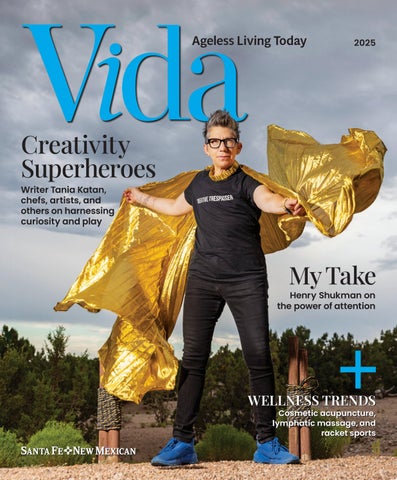
Ageless Living Today OWNER Robin Martin PUBLISHER Patrick Dorsey EXECUTIVE EDITOR Bill Church EDITORIAL Magazine Editor, Ashley M. Biggers abiggers@sfnewmexican.com Designer, Linda M. Peters linda@swelldesign.net Copy Editor, Peg Goldstein CONTRIBUTORS Gabriela Campos, Tracy Dingmann, Iris Fitzpatrick, Tira Howard, Lanee Lee, Jennifer Levin, Kelly Koepke, Gabriella Marks, Adele Oliveira, Jim Weber ADVERTISING Chief Advertising and Marketing Director, Wendy Ortega Classified Advertising Manager, Laura Harding ADVERTISING SALES Mayra Aldaz, Maria Lopez Garcia, Deb Meyers Veronica Rigales, Vanessa Ruedeman, Trina Thomas ADVERTISING ART DEPARTMENT Designers Elspeth Hilbert, Rick Artiaga, Justin Bixler PRODUCTION Operations Director, Robert Bauwens Prepress Manager, Anthony Welch Assistant Production Director, Brenda Shaffer DISTRIBUTION Circulation Director, Michael Reichard TECHNOLOGY Technology Director, Michael Campbell WEB santafenewmexican.com Office: 150 Washington Ave. #105 Hours: 8 a.m.–5 p.m. Monday–Friday Advertising Information: 505-995-3852 Delivery: 505-986-3010, 800-873-3372 For copies of this magazine, call 505-986-3010 or email circulation@sfnewmexican.com. ON THE COVER Tania Katan, author of Creative Trespassing and creator of the #ItWasNeverADress campaign, dons a superhero cape. Cover photo by Gabriella Marks
8
VIDA 202 5
Medical Aesthetics & Optimal Aging Management
Drs. Lesa Fraker & Julie Keiffer and their team of professionals invite you to ultiSkin’s premiere downtown location to experience luxurious & result-driven offerings:
ulti
™
• Hydrafacial™ ~ the most requested medical facial • Microneedling ~ best treatment for overall skin resurfacing • Botox & Dermal Filler ~ to create a liquid face lift • Morpheus8 ~ cutting edge skin tightening • BroadBandLight ~ treatment for pigmentation spots • CoolSculpting Elite ~ body sculpting at its best • PRP ~ your own blood naturally rejuvenates face & scalp
Call or email for information, pricing & appointments 119 East Marcy Street, Suite 100 • Santa Fe • 505.995.8584 • manager@ultiskin.com • ultiSkin.com
URGENT CARE Walk-ins 7 Days a Week at our Convenient Downtown Location
For all your Urgent Care needs including prescription refills when your PCP is not available and IV Therapy for Altitude, Hang-over & Immunity. 707 Paseo de Peralta in Santa Fe • 505.989.8707 • ultiMED.com AGELESS LIVING TODAY
9
Published September 21, 2025
Inside This Issue DEPARTMENTS 13
My Take
enry Shukman reflects on the transformative H power of attention.
17 Out on the Town Chef Fernando Ruiz went from incarceration
to his Santa Fe restaurant Escondido — and now he’s paying it forward.
20 23
26 46
Photos (from top): By Tira Howard (portrait and food), by Gabriella Marks, by Gabriela Campos
49 52 55
Aficionado
tart or expand your collection of southwestern S textiles with expert guidance.
Style at Any Age
remier home stager and designer Marty Wilkinson P uses every hue in her palette for interior design and in her personal style.
Money
ow to plan for and ride the tides of retirement, H even in tumultuous times
23
Wellness
he Alzheimer’s Association’s New Mexico chapter T shares tips on keeping your mind engaged while aging.
Health
L ymphatic drainage treatments promote health and wellness. Learn more about this trending technique.
Polish
osmetic acupuncture taps into holistic wellness C to improve facial tone.
Fitness
anta Fe Tennis and Swim Club pro emeritus S Jimmy Parker still teaches and plays his favorite sport.
31
17
FEATURES 31
39
43
55
Better Together
airs of jewelers, gallerists, and poets reflect on the P strengths of their creative intersections — and how the greatest inspirations sometimes come from finding their own ways. By Ashley M. Biggers | Photography by Gabriella Marks
The Simple Life
rtist Marietta Patricia Leis downsized her home/studio — A and found new inspiration along the way. By Tracy Dingmann | Photography by Tira Howard
Extra/Ordinary
self-proclaimed creative trespasser, Tania Katan has A made a career of going outside her comfort zone — and teaching people to tap into their own creativity. By Ashley M. Biggers | Photography by Gabriella Marks AGELESS LIVING TODAY
11
One we e
nly O d n ke
November 20th-23rd, 2025 St. Francis Auditorium
www.trimsantafe.org 12
VIDA 202 5
MY TAKE
Tuning In Henry Shukman reflects on the transformative power of attention. As told to Iris Fitzpatrick
Photography by Tira Howard
M
eeting a Zen Buddhist in Santa Fe isn’t exactly out of the ordinary thanks to a duo of Zen centers. But Henry Shukman — a Sanbo Zen teacher, poet, memoirist, and co-founder of a sleek new meditation app — is a monk cut from unusual cloth. Between leading international retreats and appearing on podcasts with audiences in the millions, Shukman has become one of the most compelling voices in modern mindfulness. Henry Shukman didn’t set out to become a Zen monk. A poet by training, the Oxford-born and -raised Shukman turned to meditation in his 20s after years of chronic pain, depression, and spiritual crisis. In healing his body, he uncovered deeper emotional wounds — and a way to meet them with balance. In 2010 Shukman was named a teacher in the Sanbo Zen tradition, a rare Japanese lineage that fuses structure and intensity with contemplative insight. Today he’s one of only a handful of Sanbo-authorized teachers in the world and is spiritual director emeritus of Mountain Cloud Zen Center in Santa Fe. His 2019 memoir One Blade of Grass traces his long road toward healing. His follow-up, 2024’s Original Love, reframes spiritual awakening as an ongoing, often tender process of becoming intimate with life. In 2024 he also launched The Way, an app in which he leads 10-minute meditations and guides users into daily practice with clarity, calm, and no spiritual jargon. Over coffee at La Mama in downtown Santa Fe, Shukman talked about mortality, aging, and the hardearned joys of slowing down and paying attention.
Zen teacher, poet, and memoirist Henry Shukman in his Santa Fe home
AGELESS LIVING TODAY
13
MY TAKE
Shukman, a poet and Zen master, has turned to podcasting.
Rather than think in terms of “aging,” I think in terms of gaining wisdom, kindness, and happiness, which are all deeply interlinked. As long as we feel ourselves growing wiser, kinder, and more joyful as we age, we can be assured we’re doing something right. Becoming older is a process of ripening and can be a powerful catalyst for awakening. Staying open to learning helps us uncover inner resources we didn’t know we had. As life goes on, we are bound to face unexpected, even unbearable pain. As long as we don’t check out, that pain will eventually harrow us and change us. The broken part leads to an open heart, you might say, and an open heart, in time, becomes a whole heart. Pain can change us if we meet it with curiosity and humility. At the heart of all of this is love. I believe that unconditional, foundational love is one of the most direct paths to shared human compassion. We all carry deep reservoirs of goodness waiting to be uncovered. Love, care, and calm are part of our natural design. But fear, aggression, and the impulse to harm are also part of being human. The real work lies in integrating the light and the dark. 14
VIDA 202 5
As we grow more aware of our darker impulses, we can also become more open to letting our brilliance rise. That is where transformation begins. Most of us drawn to healing eventually learn to navigate our limitations. Meditation is a powerful tool for building this kind of awareness. In Zen and other traditions, we learn to experience unease as a feeling in the body that must be met with patience and kindness. Through meditation, we can access a dimension of awareness that is always at peace. Over time, that unease begins to soften and release. It is never too late to connect with ourselves in this way. Any kind of spiritual practice, in some way, is a preparation for loss. It includes coming to terms with your own death. Ideally, it brings us to a reckoning and an acceptance that all of this is temporary. Until we accept the reality of death, we can’t truly live. As we get older, that awareness can bring a powerful sense of clarity. We feel freer to pursue what really matters. Even though our purpose may shift as we age, the sense of passion can stay with us. For me, it guided me into a career that has been deeply fulfilling.
Henry Shukman didn’t set out to become a Zen monk. A poet by training, the Oxford-born and -raised
Shukman turned to meditation in his 20s after years of chronic pain, depression, and spiritual crisis. In healing his body, he uncovered deeper emotional wounds — and a way to meet them with balance.
During the pandemic, I began posting guided meditations online and quickly realized how many people were longing to connect. Since then, I’ve focused on my app, The Way. I’ve had help from a team of people — many of them half my age — to create an app that offers a straightforward, accessible path, even for those completely new to meditation. I’ve been meditating for over 35 years, and this is my attempt to distill what I’ve learned into one place. The idea is that users don’t have to decide what to do — they just follow the path. Give yourself time to be truly alone, with nothing to do. Even if you do nothing else, spending just 10 minutes a day in mindful awareness can be life-changing. When we learn to balance the noise inside with the noise outside, the pressures of the world start to feel a little less heavy. Much of the pressure we feel is self-inflicted — the impulse to stay busy never seems to let up. Meditation helps us see that it is not only okay to pause; it is healthy to do nothing, on purpose, throughout the day. The phrase “living in the moment” can be misleading, and chasing it can drive us a little crazy. What it really means is being fully present with whatever life brings. We spend so much time futuretripping or getting stuck in the past, always looking for the next thing to do. But part of the practice is learning not to lean into the next moment. Just be with this one. Koans are short Zen sayings or stories that sound simple but are meant to stop your mind and point to something deeper. Here’s a good one about staying present. A student once asked a Zen master
what he taught. The master said, “When I sit, I sit. When I walk, I walk. When I arrive, I arrive.” The student replied, “I do that too.” But the master said, “No. When you sit, your mind is already on standing. When you stand, you’re thinking about walking. When you arrive, you’re already thinking about leaving.” We miss life by leaning into the next thing instead of being here. Forgiveness is a critical part of spiritual and personal growth and a key tenet of the world’s great religions. Forgiveness begins with ourselves, which isn’t easy. When we forgive ourselves we acknowledge our fallibility — not to maximize it but to be aware of it. From there, we do our best to do better, knowing that we’re human and therefore bound to make more mistakes as time goes on. If you want to tap into curiosity and wonder in your older years, the most important thing to do is slow down. That’s it. If we slow down, we can look at the world around us without having to know what it is and what it means. Most of the time we pass by a tree and never bother to glance at it. It’s much more enjoyable to slow down and study the tree, a bit like an artist intent on sketching a true likeness. Notice the room, the light, the movement of leaves — it becomes fascinating.
Based in Santa Fe, Iris Fitzpatrick is a freelance writer specializing in cultural coverage.
Shukman reaches a global audience of app subscribers from his Santa Fe home.
AGELESS LIVING TODAY
15
I’M DETERMINED TO GET THE CARE I NEED WHERE I NEED IT.
We’re determined to provide a range of care close to home. Our Santa Fe services include primary care, specialty care, pediatrics, urgent care, skin care, women’s health and more.
Call (505) SantaFe to schedule an appointment or visit phs.org/santafe for more information.
OUT ON THE TOWN
Hard Time to Haute Cuisine Chef Fernando Ruiz went from incarceration to Escondido — and now he’s paying it forward. By Lanee Lee I Photography by Tira Howard
Escondido executive chef-owner Fernando Ruiz.
AGELESS LIVING TODAY
17
OUT ON THE TOWN
W
alk into Escondido and you’ll smell it before you see it — the slow-braised beef, the toasted blue corn, the roasting poblano chiles. Many would never guess the chef behind it all once cooked with nothing but expired or donated groceries in a prison kitchen. But Fernando Ruiz doesn’t hide the past. He leads with it. “The best job in prison was the kitchen,” he tells me. “That’s when I knew: This is what I want to do.” That “what” is now Escondido, opened last August in an — to some — unorthodox location, far from the Plaza. And the 46-year-old chef with six children? He’s no overnight success. Raised between Arizona and Mexico, Ruiz learned to cook young. But his path veered into gangs, guns, and drugs, landing him in the Maricopa County Jail under Sheriff Joe Arpaio’s well-publicized prison regime. Despite that environment, Ruiz’s passion for cooking continued, eventually leading him to culinary school and running successful restaurants across New Mexico. Now? He’s a three-time Food Network champion (yes, he beat Bobby Flay with chiles en nogada on the show Beat Bobby Flay) and a 2025 James Beard Award nominee for Best Chef: Southwest. He also realized a years-in-the-making pursuit with the August 2024 opening
of Escondido, one of Santa Fe’s most intriguing new restaurants — with a waitlist to prove it. “I never said once, ‘I want my own restaurant or to be on TV.’ I just wanted to cook,” says Ruiz. “The rest — it still hasn’t really hit me.” Ruiz’s style is rooted in northern and coastal Mexican favorites, not the green or red chile–laden New Mexican cuisine often found here. At Escondido, that means dishes like saffron-marinated bay scallop ceviche — tender slices cured in citrus and saffron until they shine in a shocking orange color, like a mango. It means mahi and shrimp tostadas, punchy with acid and heat, and a stunning plate of chiles en nogada, stuffed with veal, pork, golden raisins, and pine nuts, and finished with a creamy almond-walnut sauce and pomegranate seeds. “But the dish that’s most me?” Ruiz says. “The beef short ribs. Braised 10 to 12 hours, it’s simple with an ancho chile sauce with blue corn polenta.” He’s right. These may be the best short ribs this food writer has ever had. The bar is equally inventive. Try the Mole Coctel, a riff on an oldfashioned that mimics the layered spice of Ruiz’s famous mole, with mezcal, tequila, pasilla chile, walnut liqueur, and sherry. For wine lovers, there’s an absolute allegiance to up-and-coming Mexican regions — think Baja, Valle de Guadalupe, and Queretaro.
The Escondido kitchen crew (left to right): Selvin Lopez, Roberto “Calle” Mendez, Isaac Sork, Chef Ruiz, Jesus Calderon, and Eliadia Cano.
18
VIDA 202 5
On weekends, the kitchen cranks out
50 to 60 plates of chiles en nogada to a dining room full of locals and out-of-town food
pilgrims who hope for a photo with the chef.
Left to right: The dish that made Ruiz a TV star — chiles en nogada. A grazing board of appetizers.
But Escondido doesn’t just stand out because of its food. Its mission also distinguishes it. Ruiz co-founded the Entrepreneurial Institute of Northern New Mexico (EINNM) with Española-based community activist Ralph Martinez, and Jamai Wallis Blivin, founder and CEO of the Santa Fe–based workforce development nonprofit Innovate+Educate. Through the EINNM, people in the New Mexico State Penitentiary learn knife skills, kitchen operations, and even nose-totail butchery. Isaac Sork, the restaurant’s first employee from EINNM, was dropped at Escondido’s door on Valentine’s Day. The program helps ease reentry for formerly incarcerated people, for whom attaining a job — let alone a well-paying one — can be challenging; the barrier can cause recidivism. Then there’s Becky, a trans student Ruiz met and educated inside prison. “She knows how to work a knife better than I do,” he grins. “She’s got a job here when she gets out this fall.” When they come to work, Escondido’s employees enter the kitchen off Agua Fria Street, deep in a residential pocket near Siler. “I don’t have to charge downtown prices. We’re one of the only places serving until 11 at night on the weekends. We have one of the biggest rooftops
in town, and there’s no fighting for parking,” he says proudly, pointing to his 84 parking spots. “We’ve been slammed since day one.” On weekends, the kitchen cranks out 50 to 60 plates of chiles en nogada to a dining room full of locals and out-of-town food pilgrims who hope for a photo with the chef. “This wasn’t supposed to happen like this. I was supposed to be dead by now,” Ruiz explains. “But Santa Fe is the kind of place where you can figure it out.” Even now, Ruiz says he still faces stigma for his criminal history — especially when trying to rent a home. But the city has shown him grace. Next up? Chef Ruiz brings his confident flair to the Santa Fe Wine & Chile Fiesta on September 24–28 — appearing at the Friday and Saturday Grand Tastings and hosting an already-sold out Mexican cuisine and wine dinner. And there’s buzz about an Escondido outpost in Albuquerque sometime next year. Escondido isn’t just a restaurant. It’s a judgement-free, come-asyou-are zone, where the food is bold, the staff are real, and the past isn’t erased — it’s reborn, one plate at a time. Lanee Lee is an award-winning food and travel journalist with 20 years of experience uncovering global flavors and far-flung adventures.
Escondido is open daily for lunch and dinner. Weekend brunch is available 11 a.m.–3 p.m.; 1101 Paseo Corazón, 505-316-4718, escondidosf.com.
AGELESS LIVING TODAY
19
AFICIONADO
Left to right: A Navajo blanket, circa 1880; a Hopi wearing blanket, circa 1860; and a Zuni Pueblo blanket, circa 1875.
Collector’s Guide By Kelly Koepke
Know the difference between a rug, blanket, and manta (shawl). Navajos primarily wove blankets to wear. Historic versions are thus older, rarer, and often more expensive than the rugs Navajos began to VIDA 202 5
weave for the tourist trade around 1900. Compton advises that a Diné rug will almost always have a border framing the design, unless it’s a Chinle weaving, whereas a blanket rarely does. By contrast, historically Hopis and Zunis rarely wove rugs, concentrating instead on blankets for themselves and to trade to other tribal groups, as well as smaller mantas worn as shawls. Examine weft and fringe to determine a textile’s provenance. “On a Navajo rug, the weft [the cotton or wool you see] is packed down tightly in what’s called a tapestry weave,” Compton says. “Pueblo blankets tend to be plain weave, where you can see 50/50 warp and weft, which makes the weaving lighter. Most Navajo textiles do not have fringe either. If they do, the fringe was added on after the rug was completed [Germantown style] or is on one end only [a Gallup throw].” Beware of copycats. Very good Mexican rugs, specifically those from the Zapotec region, often replicate authentic Native American ones. If you want to collect the latter, you don’t want to mistakenly end up with the former. Telling the two apart requires comparing weaving techniques, materials, and designs. “Navajo rugs typically feature continuous warps [the vertical threads between which the horizontal
Photos: Courtesy of James Compton Gallery
J
ames Compton, owner of his eponymous gallery, has been collecting Native American textiles for more than 30 years. The selftaught expert opened his downtown gallery in 2018 as a way to let go of his extensive collection of Navajo rugs and Pueblo (Hopi and Zuni) blankets. “I’m still a collector and buy and sell, so my inventory hasn’t reduced much because I love finding new material and meeting people who like this material,” he says. He knows from experience that judging the provenance, authenticity, and quality of southwestern Native American weavings can be complicated. A textile’s value depends not only on these factors but also on its age, size, and rarity. Price, which can range from hundreds to many thousands of dollars, can be confounding without this background knowledge. How can you find quality pieces worth investing in? Compton recommends considering the following:
20
How to shop for southwestern Native American textiles
cotton or wool is woven] and only have one warp on the borders, while Zapotec rugs tend to use a discontinuous warp and multiple border warps, making their edges thicker. Hopi and Zuni weavings use two parallel warps along the edges. Bend the edge sharply, 180 degrees, and look for individual warps to tell the difference,” Compton says. Check for imperfections, sectional lines, and color. Most Navajomade textiles purposefully incorporate one or more deliberate mistakes for spiritual reasons and as a reminder of human fallibility. These “imperfections” might appear as asymmetrical design elements or variation in design element size or color. Navajo rugs also often incorporate sectional diagonal lines, indicating changes in the weaver’s position; Mexican rugs do not. Zapotec rugs are also known for their vibrant colors, while many Native-made rugs use more muted tones, with the exception of Germantown weavings. For example, Navajo rugs from the Two Grey Hills region are known for black, gray, and white color schemes. Textiles from the Ganado area often are red, black, and white. Hopi and Zuni weavers also historically used more muted, natural wool tones. Buying directly from an artist or auction can save you money. Purchasing from galleries or trading posts can mean paying higher prices, although these sellers will usually have done their homework in evaluating a textile’s quality and provenance. Handle and look at as many pieces as you can, trusting what excites you visually. Compton’s ultimate advice is to buy what you like. Kelly Koepke writes from her Santa Fe home, where several woven textiles have places of honor on her walls.
End of Summer Sale!
Botox • Xeomin Fillers • Laser Treatments Ageless MD Solutions has joined
1012 Marquez Pl. Suite 101 Located within Santa Fe Lash and Beauty Call or text for an appointment
505-690-6333
AGELESS LIVING TODAY
21
A destination life plan community in historic Santa Fe.
At El Castillo, wellness begins your day, the Plaza is your backyard, and sunsets are your daily retirement ritual.
Explore the Lifestyle
elcastilloretirement.com 505.988.2877
STYLE AT ANY AGE
Color Wonder
Premier home stager and designer Marty Wilkinson uses every hue in her palette.
M
By Ashley M. Biggers I Photography by Tira Howard
arty Wilkinson knows about style pivots. As a sought-after home stager and owner/design principal of Metamorphosis in Santa Fe, Wilkinson takes cues from a home’s architecture to enhance its style, whether it’s a traditional adobe or a sleek contemporary. She stages around 50 to 60 residences at a time and hundreds every year. Launched in 2006, Metamorphosis was as natural an evolution as the name implies. She and her now ex-husband were flipping homes. As they remodeled, they staged the houses with furniture to bring out natural features, minimize less desirable ones, define the spaces, and help potential buyers envision how the rooms could be used. When realtor friends Linda and Joe Gammon called asking her to stage a residence for the Santa Fe Area Home Builders Association Parade of Homes, “it snowballed from there.” Wilkinson says, “I’ve been a designer all my life, but staging just came very naturally because it was just furnishing a home.” Without a client’s involvement, home staging is doing “what the house calls for.”
Her staging business has expanded to events. She’s provided setups for the Buckaroo Ball, the stage and green room at the Santa Fe International Literary Festival, and fundraising events at the Santa Fe Opera, to name a few. Her retail storefront features a variety of home goods — pillows, rugs, lamps, and other accessories — including some that have been retired from her staging operation, which she runs out of a warehouse behind the retail space. She also accepts consignments, which means the showroom’s collection is always changing. In her experience, home and personal style collide. When she takes on an interior design client, she asks to see their closets. “That will give me a good idea of their color palette and what colors they like to surround themselves with,” Wilkinson says. “My personal style is very colorful. If you looked at my closet, I have pinks, yellows, fuchsia, orange, and blue.” Marty Wilkinson pulls from an expansive warehouse to stage homes in any style — and from her closet to create any look for herself.
AGELESS LIVING TODAY
23
STYLE AT ANY AGE
Wilkinson says she keeps tabs on what’s trending in fashion as well as home design. “I’m 62 but feel like I’m still 28,” she says. “I just follow what fashion is. I pay attention to what people wear out in public and what looks good.” She enjoys collecting clothes. But since she lives in the homes she’s staging and moves frequently, her expansive wardrobe is her relocation nemesis. “There’s only 365 days in a year, and I have more than 365 outfits,” she laughs. Wilkinson is naturally gregarious and leads with her outfits. “As a designer, you have to present yourself nicely to the public. You have to be put together,” she says. However, she always opts for flat, comfortable shoes for the thousands of steps she walks each day, collecting staging items from the warehouse and overseeing their placement in homes. “No high heels anymore! But I’ve got very colorful shoes too,” she says. She enjoys browsing boutiques when she travels. Locally, she enjoys J Justice Necessities, where she bought a denim jacket with an embroidered cow skull on the back. With a busy work schedule, Wilkinson often shops online from the likes of Sundance and Boston Proper, where the clothing offers the color and personality she seeks. Whether designing a home or dressing for the day, “there’s not necessarily any rules,” she says. Ashley M. Biggers serves as magazine editor for “The New Mexican.”
Visit the Metamorphosis designer showroom and consignment center at 3005 S. St. Francis Drive, Suite 2A, and learn more online at stageyourlife.net.
Marty Wilkinson’s Style Tips • “ Personal style is personal style,” she says. Your home surroundings and clothing should make you happy.
o online for inspiration. Pinterest is one of Wilkinson’s go-to •G
places to see interior design and clothing trends. She recommends that her design clients peruse the site, especially if they’re having difficulty articulating their style. By collecting pictures, Wilkinson can see themes and help them choose a design direction.
• L ook at things in three dimensions. Wilkinson finds that when clients see two-dimensional mood boards, they often find the selections too bold. However, once placed in a room, a colorful chair pillow doesn’t seem so over the top when paired with a designed rug. “When you see it all together, it just works,” she says. The same goes for dressing. Wilkinson envisions entire outfits, from garments to accessories and shoes, to create a full look.
Wilkinson sees spaces — and outfits — in 3D.
24
VIDA 202 5
MONEY
The Retirement Roadmap
O
n April 2, 2025, the stock market plunged into its biggest oneday loss since 2020 amid President Donald Trump’s unveiling of tariffs and concerns that a global trade war would follow. The event had many near retirees and retirees considering cashing out their investments to cushion the blow of the stock market fall. The market later rallied; April and May brought three of the largest daily point gains in history. But that market volatility still has many people white-knuckling the investment roller coaster and pondering their retirement futures. “It’s been a really bumpy ride, so that causes a lot of anguish and anxiety for folks on a fixed income. The inflation scare can really impact retirees in particular,” says Silas Peterson, financial adviser and partner at Santa Fe’s Financial Partners (financialpartnersnm. com). “A lot of the conversations we’ve been having with clients have been reassuring them that they have a financial plan.” Peterson says that during market turbulence, the standard elements of financial planning become even more important. Having a plan in place based on your personal risk tolerance can help you ride the market roller coaster with more peace of mind and a long-term view. Retirement planning tools and modeling software can create plans with more detail than simple retirement calculators. Financial
26
VIDA 202 5
planners utilize these tools, and you can access similar software independently. The software analyzes market data from the past to project future earnings. It also assesses your current assets, including retirement investments, real estate, and insurance policies, and your retirement income sources, such as Social Security. It then forecasts those against future expenses based on your expected standard of living and potential outlays for travel, a child’s college tuition or wedding, or a legacy bequest. The software can also take into account the death of a spouse or the need for long-term care. Having a retirement plan in place can be reassuring even in stable economic times. “It’s not just an economic shift or a financial shift. [Retirement] is also a big psychological shift, when people have been working and receiving a paycheck that’s paying for their life, and now they’re no longer receiving a paycheck. That shift in mindset from accumulation . . . to spending can be really hard for people if they have no idea what’s going to happen 20 years down the road,” Peterson observes. Regardless of the stock market’s performance, here are items Peterson recommends considering — and discussing further with a financial planner — throughout the phases of retirement:
Photos (left to right): Deposit Photos, courtesy Financial Partners
How to plan, even in tumultuous times
SFCS Inc. offers competitive pricing for th th toner products and printing needs Having a plan in place based on your
personal risk tolerance can help you ride the market roller coaster with more
peace of mind and a long-term view. DURING YOUR 50s
• Most people in their 50s are still working and planning for retire-
ment. Individuals are also earning the most during this decade. When this time coincides with being empty nesters, it can result in extra income to invest. Peterson recommends using this income to max out tax-advantage accounts, including IRAs and 401(k)s.
New commited to to thethe support, survival NewMexico Mexicomust mustbebe commited support, survival and businesses throughout the the State. andgrowth growthofofsmall small businesses throughout State.
Please support Local New Mexico Businesses
SFCS Inc. offers competitive pricing for toner We areInc. grateful forcompetitive those that “Buy Newfor Mexico” SFCS offers pricing toner products and printing needs
products and printing needs
Locally Owned by Email: doris@santafecs.com Locally Owned by Email: doris@santafecs.com Doris Vigil McBride Office: 505.471.5308 Doris Vigil McBride Office: 505.471.5308 Cell: 505.501.3176 www.santafecs.com
Cell: 505.501.3176
www.santafecs.com
New Mexico, Woman-owned Minority Business SERVING SANTA FE SINCE 1988 New Mexico, Woman-owned Minority Business
SERVING SANTA FE SINCE 1988
• People should familiarize themselves with Medicare and Social Security so they can avail themselves of those benefits more easily when the time comes.
• If you haven’t already, think about estate planning, including creating a will or trust and establishing both financial and medical powers of attorney.
• Reduce debt. Any budget drain can be impactful when moving into a fixed income.
ENTERING RETIREMENT
• The first decade or 15 years of retirement is often referred to as the
go-go phase, when people have the time, income, and physical ability to check off some bucket list items. Having a plan in place informs how individuals can embrace this period, Peterson says. “It often makes sense to accelerate and spend more during the go-go years,” he says. But fearing that they’re going to run out of money often leads people to restricting their spending during these years, so they might miss out on a key period of enjoyment.
• The initial phase of retirement is ideal for converting traditional
retirement accounts, such as 401(k)s, into Roth IRAs. This requires paying income tax on the funds in the conversion year but allows future growth and withdrawals to be taken tax-free. Roth IRAs do not have required minimum distributions and can be passed on to beneficiaries tax-free.
Santa Fe Harvest Festival October 4–5 10 am–4 pm
LATER RETIREMENT
©Jane Phillips Photography
• After the go-go phase, retirees enter the slow-go and sometimes no-go phases. In these years, it’s important to revisit legacy plans.
• It’s also important to consider if and how to transition to assisted liv-
ing, to get help staying in your home, and to finance long-term care.
• Tune in to required minimum distributions. Starting at age 73, retirement accounts such as traditional IRAs have required minimum withdrawals. Not taking this money can result in penalties. Overall, Peterson says, “Make plenty of room in your plan for joy. Money is only there as a tool to serve our lives. We need to use our money to make our lives better.” — AMB Left: The Financial Partners team, including Silas Peterson (bottom right)
Fall Fun with Santa Fe’s Favorite Pumpkin Patch, Hayrides, Grape Stomping, Artisan Vendors & Entertainment All tickets must be reserved online!
scan for tickets
Partially funded by the city of Santa Fe Arts Commission and the 1% Lodgers’ Tax, County of Santa Fe Lodgers’ Tax, and New Mexico Arts.
AGELESS LIVING TODAY
27
Trust your hearing care to Santa Fe’s only comprehensive ENT physician-integrated audiology team. Hearing loss isn’t always just a natural part of aging or the result of loud noise exposure. It can also stem from an underlying medical condition like ear infections or benign tumors, which require expert medical diagnosis and treatment from an ENT doctor. At Southwestern Hearing & Balance, we’re proud to be Santa Fe’s only ENT-physician-integrated hearing health team. That means our audiologists work closely with four local ENT providers—Dr. David Brown, Dr. Nizhoni Denipah, Dr. Lily Love and Dr. David Gallegos—to provide comprehensive hearing care to patients. If our team suspects an ear-related medical issue is contributing to a patient’s hearing loss, we will refer them to one of our trusted ENT partners for further evaluation. Similarly, if one of our partner ENT doctors has a patient with a risk factor for hearing loss, such as high blood pressure or taking ototoxic (hearingdamaging) medications, they can easily refer them to Southwestern Hearing & Balance for a hearing test. This strong collaboration between our audiologists and local ENT physicians ensures every patient receives the most thorough and best coordinated health care possible.
28
VIDA 202 5
The Southwestern Hearing & Balance team not only monitors, maintains and improves your hearing but also identifies and treats any physical abnormalities or illnesses of your ear and auditory system. Our independent center is dedicated to the principle that hearing loss and balance issues are medical problems that require collaboration between ENT physicians and audiologists to provide patients with the best coordinated care. Our team dispenses hearing aids from the top manufacturers in the industry. These manufacturers provide not only technology but also excellent service based on our standards. We are committed to providing compassionate, comprehensive care for you and your family.
Southwestern Hearing & Balance Services Include: • • • • • •
Hearing aid dispensing and fitting using Real-Ear Verification Repair and maintenance of hearing aids from most manufacturers Hearing testing performed in soundproof booths by licensed doctors of audiology Follow-up care for rehabilitation of hearing loss Tinnitus evaluation and management strategies Vestibular diagnostic assessments
Ready to learn more about the latest hearing technology or take the first step toward treating your hearing loss? Southwestern Hearing & Balance is now accepting new patients. Call to schedule an appointment (505) 946-3955 or visit our website to learn more.
HEARING & BALANCE www.HearSantaFe.com
BETTER TOGETHER
Pairs of jewelers, gallerists, and poets reflect on the strengths of their creative intersections — and how the greatest inspirations sometimes come from finding their own ways. As told to Ashley M. Biggers
Photography by Gabriella Marks
Bracelets from Herndon Forge
AGELESS LIVING TODAY
31
Naomi and Mark Herndon
M
arried business partners Naomi and Mark Herndon are the creative force behind Herndon Forge (herndonforge.com and Instagram @herndonforge). The duo previously sold their line of bracelets, earrings, and necklaces in the Sundance catalog, but with the ability to reach customers directly via social media, they’re now selling exclusively online and many Saturdays at the Santa Fe Artists Market. They met in art school nearly 30 years ago and for two decades pursued their own careers. Naomi designed for other companies, including Barse Jewelry in Dallas, where many top department stores source their jewelry. In 2004 they relocated to Santa Fe, where Mark took a teaching job in the jewelry program at the Institute of American Indian Arts (IAIA). About a decade ago, when Naomi’s business blossomed, he left this gig to add his technical expertise to her design skills in Herndon Forge. Here they reflect on leaning into their individual talents and the collective value of creating their own spaces.
Either of us could make the entire piece,
like earrings, but
we have strengths. We just use that
to be more efficient.
We don’t need to talk as much. We can
just read each other. — MARK HERNDON
What do you each bring to Herndon Forge?
Naomi: I did more design work. I studied jewelry, the trends, the forecasting, the visuals. I know a lot about that, but I’m self-taught skills-wise. His brain is an engineer brain. I’ll think of something and he’ll research it, and maybe there’s no real way to do it yet, but he’ll figure it out. He turns my ideas into physical items.
had to acquire. It’s not something I ever thought I would need to know. When I first started out, it wasn’t in my wheelhouse. Now it’s second nature. Every time we make something, I’m already thinking about how we’re going to shoot it to capture that piece. Mark’s very good at the technical aspects of photography — how to get the right lighting or the right colors to capture the piece.
Mark: Sometimes I like to tell her that things are impossible to do. Then I do them, just to make me feel appreciated.
Mark: [Selling online] incorporates lifestyle. People want to know about you as a maker now, as opposed to, “Oh, that’s just a pretty piece.”
Tell me about your daily studio practice.
How has your creative process changed?
Naomi: We have separate studios in the same compound. His studio is more metalwork. I have more beadwork and assembly. It’s faster for us to do it in an assembly line. I’ll do the beadwork. Then I’ll hand it to him, and he’ll do the other part. Mark: Either of us could make the entire piece, like earrings, but we have strengths. We just use that to be more efficient. We don’t need to talk as much. We can just read each other. What’s it like working with your spouse?
Mark: We have the separate studios, so that’s helped — because we live together, we work together, we’re together all the time. But we’re not in the same space the whole day. We can come together at the end of the day and talk about what podcast or shows we listen to. At the end of the day, you’re seeing your partner again. We get family time at the end of the night. Naomi: On the weekends, we’ve been doing the Railyard Artisan Market. We hadn’t done any markets for five years, since COVID. I’m starting to remember that to be together when we’re working is also fun. How have you continued to learn in your field?
Naomi: We’ve [nearly] completely pivoted online for sales. With social media, that’s what some people do for a living, but for us makers, it’s really a skill we’ve
Naomi: When I first started, I was trying to be more broad and appeal to more people. I was trying to make pieces someone in New York would want to wear as much as someone in California. As time has gone on, I have felt more confident in my personal story. I’m embracing more of my culture, my [Indigenous/Mexican] heritage and what I personally like. Mark: Before, we were always looking at trends and forecasting. Now we have this direct connection with our customers. We can post a picture and see immediately if people are going to like something. We’ve cultivated a community. I have more confidence in my own design abilities as time goes on. I loved the problem-solving aspect of teaching because it brought me to a lot of processes and designs that I wouldn’t normally have done with my own work. A lot of that has carried over to what I make now and never would have discovered for our work if I hadn’t have been teaching for 12 years. Naomi: As you get older, the toll [jewelry making] takes on my hands, my body — I don’t want to waste time or my hands on the grind of production. I enjoy making more special, one-of-a-kind pieces. Maybe I’m lucky and I get another 50 years. That’s what I want to be doing, using my art and making it special and limited.
Naomi and Mark Herndon in their Santa Fe home/studio
AGELESS LIVING TODAY
33
AD
34
VIDA 202 5
Tonya Turner Carroll and Michael Carroll
M
arried couple and business partners Tonya Turner Carroll and Michael Carroll have a wealth of artistic bona fides. She graduated with honors from the University of North Carolina at Chapel Hill and previously worked at the Philadelphia Museum of Art, the Israel Museum, and Sotheby’s London. He studied art at Duke and elsewhere, is a certified member of the Appraisers Association of America, and is past president of the Santa Fe Gallery Association. They united their expertise in Turner Carroll Gallery (turnercarrollgallery.com) in 1991 and have pursued curatorial missions in Eastern European, Irish, Bay Area, New Mexican, and Mexican art. Their interest in women artists led naturally into activist and social justice art, the gallery’s current focus. They’ve pursued these passions while keeping the Canyon Road gallery’s lights on and riding the tides of economic recessions and changing political climates. Spending a couple months out of the year in southern Italy, where they swim in the ocean every day and ride their bikes 20 miles across the countryside to tour Neolithic dolmens (tombs), has sparked explorations into the region’s art and symbology. This has Tonya planning a book on the ancient association between female imagery and snakes. Here they discuss how curiosity drives them and how their own creative pursuits have reinvigorated their work. You experienced a pivot this year with the closure of CONTAINER. Tell me about that.
They united their expertise in Turner Carroll Gallery
in 1991 and have pursued curatorial missions in
Eastern European, Irish,
Bay Area, New Mexican, and Mexican art. Their
interest in women artists
led naturally into activist and social justice art,
the gallery’s current focus.
Tonya: Our mission with CONTAINER was to originate or accept museum exhibitions, underwrite a catalog, do the curatorial work, then loan them for free and have them travel. It was wildly successful. The Nadya Tolokonnikova [an artist and creator of the feminist protest art group Pussy Riot] exhibition went to Dallas, Austria, Bangkok, and Chiang Mai. Everything was going great until the election happened. Museums became frozen. The punishment for accepting diversity, equity, and inclusion exhibitions was being hurled down from Mount Olympus onto museums. It became clear that not only would they not have grant money to pay for shipping our shows, which is all we asked for from them, but they could risk being punished for having [the shows]. [Selling the CONTAINER building] was like some miracle from the art gods to protect us. They dropped an offer in our lap, and within one month the building was sold. At first we declined the offer. Then we realized we’re either going to have to change our mission or sell it. Which was really in our DNA? We weren’t going to change our mission. What’s driving your explorations in southern Italy?
Michael: We were having a conversation yesterday about being in older bodies. Death is certain, right? If you think about our life as a play, then the curtain drops at the end, and that’s death. So what keeps us going? It has to do with curiosity. That’s the real driver. There are so many questions about why and how. . . . Maybe at the end of the day, [the goal is] just to say “wow” a whole bunch of times over the course of the day. It seems like a great reason to me.
Tonya Turner Carroll and Michael Carroll in their Canyon Road gallery
Tonya: There’s so much opportunity in that there’s a giant well of history that we’re just beginning to replay. . . . The lens that we’re using now for women artists is really the same lens that we’re using in
history and in trying to understand: “Wait, we had this all wrong. It was based on a global miscalculation of how and why people did things.” It’s the same kind of animal. It’s really exciting to be at a Nadya show and know that I can reach back 5,000 years and see an arc of what it means for her to stand up to Putin. How do you think about and fuel your creativity in your curatorial work?
Michael: In the last couple of years, we’ve really doubled down on feeding ourselves and doing things for us. As an art dealer, you do things for your artists, right? But the big questions are still there. So the beginning is reigniting that for us. About five years ago, I started playing music in earnest — being a serious musician and playing in a band. I feed myself with that.
Tonya: After we started representing Virgil Ortiz and hearing the way he talked about clay as being alive, it just made me have to go experience it. I started doing pottery, and it feels like a newborn baby. It feels really alive. So I love to do that. I do yoga. I really have learned about myself that I learn not through reading, not through listening, but through seeing and doing. So part of my creativity is seeking out the thing I want to see to inspire my ability to make connections and to make sense of the world. How has your relationship with your curatorial practice changed over time?
Michael: You know, in Inca and Peru, they could see the Milky Way. But they didn’t connect the stars white to white. They put it together black to black. It was totally different. I didn’t know that 30 years ago — you’ve got to go into the field. Over time, the great bucket of awe has just grown larger.
AGELESS LIVING TODAY
35
Arthur Sze and Carol Moldaw at their Santa Fe home
Carol Moldaw and Arthur Sze
M
arried for nearly 30 years, Carol Moldaw and Arthur Sze have each established notable careers as poets. Moldaw has earned fellowships from the NEA and Lannan Foundation, as well as a Pushcart Prize. She’s the author of seven books, including her most recent, Go Figure (Four Way Books, 2024), which draws upon all the relationships and roles she’s experienced in her life and as a woman artist. A National Book Award winner for poetry and the first poet laureate for Santa Fe, Sze is also a translator and editor. In April, the professor emeritus of the IAIA creative writing program released his 12th poetry collection, Into the Hush (Copper Canyon Press), and his first book of prose and interviews, The White Orchard: Selected Interviews, Essays, and Poems (Museum of New Mexico Press). Here, speaking from their respective offices, they reflect on their creative practices — and where they’ve intersected and diverged.
Can you give us some insight into your creative practice?
Our residency at Merwin [Conservancy] was a
very special time for us, when we were living
together in a palm forest in Maui. It was such
a small space, but we each found a writing
space. To be in the same environment working —
but again, not necessarily showing each other
work — has been great.
Carol: I think there’s always an essential mystery to it. I tend to write my poems and let them develop over time. I might have some notations about an experience. I might write down something — a phrase I hear in my head or an image that occurs to me. And usually I’m going back over those kinds of notes and something strikes, and I work on it. I often find that time is a crucial element in writing to me. I work at different times of day. I have a fixed routine at my desk, but I don’t have a fixed moment when I have to be writing. It can be early, it can be late, it can be in between. Arthur: I also want to say writing is a mysterious process. You can’t just will it into being. It’s also a process of discovery for me over time. My writing process is slower. When I was young, I would often have an impulse and think I could just follow that to write the poem. And over time, I realize that oftentimes the real poem is at the periphery. . . . I follow my intuition and discover the real poem is sort of at the side that I didn’t immediately know beforehand. It requires changing direction or discarding drafts or making a mess of things. Eventually I get to a point where certain phrases start to coalesce, and they feel essential. Then I start to draw the phrases, the language together. I’m more regular in my writing habits. I like to write very early in the morning. I have a ritual where I like to make a thermos of coffee the evening before and sit down in the dark, like 5:30 in the morning, before sunrise, and when I’m not fully awake. [It’s] a really fertile time for me. My imagination is strong. I’m not really quite in control of the language, just like being in a dream state. That’s really helpful for me to write the main discoveries of the poem. I can do some revisions later in the day, but the really crucial part is that early in the morning. For me, it’s literal: the sun coming up and things emerging out of the darkness. And it’s also figurative: Things in the imagination that I couldn’t see start to emerge. How has your relationship with your creative practice changed over time?
Arthur Sze and Carol Moldaw at their Santa Fe home
Carol: When I was very young and just starting, I didn’t understand my process as well. It gave me a bit of a panic if I had finished a poem and I wasn’t immediately writing. I had a lot of insecurity how I
would start writing again. There’s been a development of trust and understanding of my own process and letting it unfold. When I was younger, I think I was more concerned about having a certain time of day and having that kind of routine. Raising a daughter is what changed that for me. When she was quite young, I would get up at 3:00 a.m. to work. I was grabbing time. When she started going to school, I couldn’t work in the morning. That’s really when I started to find other usable moments, just whenever I could have moments of clearing my mind. . . . Someone told me that when our daughter was young, I should just put my writing aside while she was growing up. There was no way on earth that I could have survived as who I am and have done that. So I did develop a kind of agility that I didn’t think I had. How have your creative processes intersected?
Carol: It’s something that changes over time. There was a time when we were each other’s first readers, and that was very fruitful for both of us. . . . We don’t collaborate; we’ve never had a joint project. Before [our daughter] was born, we gave readings together sometimes. There were many years where we didn’t read together at all because we didn’t travel together. We’ve recently read together again, and that’s been kind of wonderful. Arthur: Our residency at Merwin [Conservancy] was a very special time for us, when we were living together in a palm forest in Maui. It was such a small space, but we each found a writing space. To be in the same environment working — but again, not necessarily showing each other work — has been great. We both know how difficult and challenging it is to be a poet, to be a writer. What advice would you share with people about their creativity?
Arthur: You can’t defer your dream or the importance of pursuing a creative endeavor. You can’t be teaching full-time and say, “Oh, when I have my sabbatical in five years, I’m going to write my novel.” Or, “I’m working full-time in a law office, and in two years I’m going to take time off.” You have to figure out a way to find that time and space now. Otherwise I think secretly you’ll be frustrated. It’ll be gnawing at you. Time is precious. These answers have been edited for length and clarity. AGELESS LIVING TODAY
37
Where Quality, Knowledge, Craftsmanship, Experience and Value All Come Together With Santa Fe’s Graduate Gemologist for the last 45 years
FALL FALL PROGRAMS PROGRAMS FALL PROGRAM
Joe has traveled the world for 48 years in search and procurement of these rare Colored Gems and Diamonds, with an inventory unmatched in the Southwest. Joe has been honored by being chosen at AGTA International Spectrum Design Contest with his designs. deBella Fine Gems and Jewelry Arts specializes in wedding rings, certified colored gems, GIA diamonds, vintage and estate jewelry.
66 E. San Francisco St. | (505) 982-1908 info@debellajewelry.com | 38
VIDA 202 5
@debellajewelry
VIRTUAL VIRTUAL
WORKSHOPS WORKSHOPS
VIRTUAL
WORKSHOPS
REGISTER REGISTERNOW NOWFOR FOR REGISTER VIRTUAL VIRTUALNOW WORKSHOPS WORKSHOPS FOR VIRTUAL AND ANDWORKSHOPS A STUDIO STUDIOSESSIONS SESSIONSAT STUDIO ATANDERSONRANCH.ORG ANDERSONRANCH.ORG SESSIONS AT ANDERSONRANCH.O
Located Located15 15minutes minutesfrom fromdowntown downtown LocatedAspen 15 Aspen minutes ininSnowmass Snowmass from downtown Village, Village,Colorado Aspen Colorado in Snowmass Village, Co
THE SIMPLE LIFE
Artist Marietta Patricia Leis downsized her home/studio — and found new inspiration along the way.
D
By Tracy Dingmann I Photography by Tira Howard
epending on the day, you might find New Mexico artist Marietta Patricia Leis doing any number of things — writing poetry, painting for her next exhibition, overseeing the renovation of her Santa Fe art studio, or perhaps boxing up her papers to send to the University of New Mexico, which has requested her artistic archives. It would be a vigorous schedule for anyone, much less for a woman who turned 87 in August. But it’s par for the course for Leis, who has pursued many careers in places across the globe. Leis and her second husband, David Vogel, 80, a former health care administrator who consults and serves on many boards, moved to the City Different in 2022 after decades in Albuquerque. The couple, who have been married 31 years, downsized from their 2,600-square-foot home and 1,300-square-foot studio and now live in a 1,200-square-foot apartment in the La Secoya de El Castillo community near Fort Marcy Park. But the work overflows into a shared John Gaw Meem–
designed office steps away, and Leis’s efficiently organized art studio is also a few yards from home. Proximity was always part of the plan, Leis says. “We created this beautiful environment for ourselves so we could focus on our work with the energy that we have,” she says. “The fact that my studio is across the street from me means I can work forever.” They live independently, but if their needs change, they’ll have access to all a “continuing care retirement community” offers. “We basically asked, ‘How can we make this work, for the rest of our lives?’” Leis says it was important for them to move proactively and not expect their children — her son lives in Albuquerque, her daughter in Austin — to make decisions for them later, when they may be unable. “We didn’t want to burden my children because I’ve seen that,” she says. “We told them, ‘It’s all taken care of! All you have to do is give us emotional support. Well, and you have to love us of course.’”
Marietta Patricia Leis in her studio with indigodyed collaged fabrics with embroidery from her Beyond series and works in progress inspired by her residency at Lowell Observatory. Below: Apparition 2 from her series Trajectory, about migration.
AGELESS LIVING TODAY
39
THE WORK BEGINS
We created this beautiful environment for ourselves so we could focus on our work with the energy that we have. The fact that my studio is across the street from me means I can work forever. — MARIETTA PATRICIA LEIS
New Jersey–born Leis moved to New York City at 17 to dance and study acting with the famed acting coach Lee Strasberg. An interdisciplinary artist, she also painted and wrote poetry. She married an actor and moved to Los Angeles in 1963. She had two children and worked as a natural childbirth coach. While researching birth trauma, she met Dr. Arthur Janov, the founder of primal therapy. She eventually became assistant director of the Primal Institute in Los Angeles. Amid all these shifts in career and life, Leis says she never wavered in her goal of one day being a full-time artist. “I was still making art,” she says. “I feel like women’s lives have these chapters that are opening and closing. It all culminates as we get older, as we move through it more easily and make it happen.” By 1982 her kids were almost grown, and she wanted to earn an art degree. She looked around for an affordable university with a great fine art department and discovered the University of New Mexico. “So I got on a plane to New Mexico from LA, but first I took a year off and moved to Taos,” she says. “Just being in Taos, with the natural beauty and the inspiration all around, my life really came together in a meaningful way.” Leis did pursue that UNM art degree, which also took her to Italy. Over the next five years, she earned a master’s degree in studio art and began regularly showing her work. In the mid-1980s she created The Story of Marietta Robusti Tintoretto, an internationally staged exhibition that reframed the life of the Venetian Renaissance painter Marietta Robusti, daughter of famed painter Jacopo Robusti.
ON THE ROAD
Clockwise this page: The artist’s worktable. A concave bowl with oil on wood from the artist’s Reveals series. Leis in her studio.
40
VIDA 202 5
A major turning point in Leis’s career came in 2001 with The Blue Series, monochromatic paintings on wood panels exploring the color blue, inspired by her artist residency at Crater Lake National Park in Oregon. Her obsession with tonal shades of blue found in sea and sky fueled her works for many years, until a residency in Thailand, with its lush vegetation, turned her attention to green. “Marietta has taken on the challenge of continuous reduction of image, distilling the essence of a place, a temperature, an experience into a perfect pure color or a simple gesture or a repeating texture, such that
one is tempted to call her work minimal,” says Albuquerque Museum director Andrew Connors, who has known and observed her work for years. “However, her reductive analysis of a place or time of day is so refined that once we shake off our need for more information from an image, we understand exactly how her expression of a place or moment captures all the sensations we could feel in that environment. She keeps getting better at providing what seems to be less but is actually more than we can imagine.” Participating in artist residency programs became a hallmark of her career and served as a wellspring of inspiration for her natureinspired artworks and poems. Leis says the intense experiences afforded by the residencies allow her to filter out distractions and focus on the natural world, creating work she calls reductive. She estimates she’s participated in more than 20 residencies, including in Italy, Spain, Finland, and Iceland. She visited the latter in winter and was plunged into 24-hour darkness that revealed Earth’s real beauty. “When you’re out, it’s treeless. There are no cars, just the moon and the stars and of course the Northern Lights. You can see the curve of the Earth, the shape of our planet.” You can trace her inspirations from this residency and others via her five artworks in the Albuquerque Museum's group exhibition Abstracting Nature, on view through October 12. Her sculptural painting The Silent Road, graphite painted on Tyvek (yes, the housing insulation material), which appeared during the 2019 Venice Biennale, is also part of the museum’s permanent collection. Turner Carroll Gallery represents Leis’s work in Santa Fe. She completed her most recent residency in June 2024 at the Lowell Observatory in Flagstaff, Arizona, where she once again drew inspiration from the cosmos. Spending weeks gazing at stars and planets was a reminder that we are all migrants, looking for a place and a perspective, existing as small humans on a beautiful planet. And with Earth heating
Leis with her husband, David Vogel, in their shared Santa Fe office
up, more of us will need to migrate to find our own North Star — a place that is safe and habitable. Her current series Trajectory addresses migratory movement and is slated to tour several venues in 2026. She’s continuing to draw inspiration from the skies, stars, and magic of the universe for a body of work that will include poetry for a planned book. Because she is now in a small studio, Leis has learned to plan her installations with the aid of computer programs and the help of assistants in both Albuquerque and Santa Fe. At this phase of her life and career, by being focused on her intentions, Leis says inspiration comes more easily, without the distractions of market success. “Trying new mediums — stretching myself, not repeating myself — and engaging other disciplines has invigorated me
and prevented boredom,” she says. “For many years I told myself to leave the field if it no longer brings me joy. I’m still in the studio!” Leis says the confidence she’s gained with age and experience has allowed her to sustain a long career and keep evolving. “Before, there was always the rule of staying in your own silo or medium, but I always pushed against that. It wasn’t my modus operandi. I was sometimes rejected for not having a ‘style’ — a focus or a brand. So my career grew slowly.” Growing older has given her more resilience to rejection and more confidence in her path, she says. “To be authentic, I had to learn to do it my way and to find the words to explain why this is important to me as a person and artist. I knew I would burn out if I wasn’t true to
my instincts. I believe my evolving reductive work in any medium reflects my aesthetics. I believe in me. I believe in my truth. It is a good way to be at my age. I am very fortunate to live honestly in my work, which makes it easier to be honest in my life.” Vogel is by her side as he continues a full-time schedule of working on economic development projects in New Mexico and nationally. With a supportive husband, continuing demand for her art, and life planned out in her new adopted city, Leis says, “Life is good. It truly is.” Tracy Dingmann is a former newspaper reporter and longtime New Mexican.
AGELESS LIVING TODAY
41
A Home Equity Conversion Mortgage (HECM), also known as a reverse mortgage, is an FHA-insured loan that lets homeowners age 62+ tap into their home equity–to help cover bills and everyday expenses, eliminate monthly mortgage payments (you must meet your loan obligations, keeping current with property taxes, insurance, and maintenance), and much more
Contact John Ruybalid, your local Reverse Mortgage Specialist.
We’re your partner in supporting... the arts, health care access, land conservation, senior services, animal welfare, renewable energy, food security, cultural heritage, the vibrancy of
...our shared home. santafecf.org | 505.988.9715 | giving@santafecf.org
42
VIDA 202 5
E X T R A O R D I NA R Y A self-proclaimed creative trespasser, Tania Katan has made a career of going outside her comfort zone — and teaching people to tap into their own creativity. By Ashley M. Biggers I Photography by Gabriella Marks
Tania Katan at home wearing a beaded cuff "watch" that's meant to invite conversation about our dependence on devices.
AGELESS LIVING TODAY
43
T
ania Katan is often an outsider. She was a theater geek hired to work in a visual arts museum. She carried a flip phone to her job in a tech company. But her ability to harness her divergent perspective quickly became her superpower. “I knew I was an anomaly, but in short order I realized I was needed,” she says. Katan claims this talent and teaches readers to harness theirs in her book Creative Trespassing: How to Put the Spark and Joy Back into Your Work and Life (Penguin Random House, 2019), now in its second printing. The relatively new Santa Fe transplant also travels frequently to speak about the power of creativity and out-of-the-cubicle thinking for Fortune 500 companies such as Expedia, Amazon, Google, and Uber. Her perspective is grounded in her personal experience. She grew up with a social worker mother who traded teaching art for her kids' camp fees and a risk-taker father who loved playing craps in Las Vegas — even if his only winnings were steak dinners. “My parents were wonderful, feral, weird people. They instilled in me this sense of self-esteem. It’s kind of unbelievable. The reality is, I thought I was really cool growing up, but no one was an early adopter of me,” she laughs. Early on Katan found herself in what may be the most outsider experience of all — living in a sick body. She was diagnosed with breast cancer at age 21.
She survived, though without her breast. After her diagnosis, writing in her journal was both balm and inspiration. “It was a collaboration with language, spaces, and these absurd, intrusive moments that happen when you’re in a sick body. . . . It wasn’t awesome to have people poke and prod. Everywhere I went I had a pen and paper. Being able to document this story as it was unfolding . . . was both powerful for me and empowering for me,” she recalls. Cancer, she says, became an unlikely collaborator. “I was like: You suck cancer. You’re the worst collaborator ever. I didn’t even invite you to collaborate, right? And yet you show up.” Her collaboration coalesced in her memoir My One-Night Stand with Cancer (Alyson Books, 2005). She also adapted the memoir into a one-woman show, Saving Tania’s Privates, which traveled to theaters across the country. Her breast cancer recurred 10 years later, which led to a second mastectomy. She began running the Race for the Cure topless, with her mastectomy scars visible. As with any of her endeavors, she didn't aim to be a spectacle but rather to claim her journey — and invite others to do the same. “It wasn’t: Look at me! It was the opposite. I actually felt awkward and strange and scared. . . . I thought, What if I could show what a healthy body looked like in a different form? . . . There are these races for a cure, yet we didn’t see what the result of that looked like. Somehow we were invisible twice,” she recalls.
As the evangelist — aka the champion of a company who convinces others of its value — at the Scottsdale software company
Axosoft, she reimagined the ubiquitous women’s bathroom symbol as a cape-wearing superhero to encourage women in STEM.
44
VIDA 202 5
To some, her choice was brave and empowering. To others — including one race director who asked her to don a shirt — it was offensive. To Katan, the experience affirmed her gift. She’s often heard that she’s too much. She’s realized, “My real value and benefit is to uplift and enliven. That requires turning up, not down,” she says. Successful collaborations unfold when she finds welcoming spaces, as she did at the Scottsdale Museum of Contemporary Art, where she spent three years as curator of performing arts and storytelling, launching a multidisciplinary performance space. As the evangelist — aka the champion of a company who convinces others of its value — at the Scottsdale software company Axosoft, she reimagined the ubiquitous women’s bathroom symbol as a cape-wearing superhero to encourage women in STEM. The resulting #ItWasNeverADress campaign went viral, earning some 100 million organic impressions online (and counting) and being covered by national news outlets such as CNN, The New York Times, TIME magazine, and Yahoo! “Once I started to prove my value in being there . . . two things happened. One, [companies] realized: This is adding things we didn’t know we needed, and now we can’t live without it as a team, as an organization,” Katan says. “And then in me showing a different way of being in the workforce — that you didn’t have to be rigid, mean, or driven by promotions — people saw that you could have fun. You could experience joy. And actually, those things might make you more creative and productive in your work and in the world.” These experiences led her to the thesis of Creative Trespassing and her 300-and-counting keynote addresses: People need outsiders on the inside. Her book, keynotes, and consulting gigs illustrate that creativity shouldn't be siloed in artistic pursuits, but rather that it should be infused in the ordinary to drive innovation in every area of our lives. We can creatively trespass anywhere — and should. As she preaches about creativity, her own practice has evolved. Katan has long galvanized limitations — brainstorming game-changing ideas from a cubicle in a corporate office, for example. “If I had a job that started at 7 a.m. or 8 a.m., I would wake up at 5 a.m. and write at a local coffee house [or] on a coffee break I’d sneak in the car. I utilized constraints as a way to really create these precious moments of pressure.” Today, her practice centers collaboration — something she now sees as a throughline of her work from her early days playwriting through her cancer journey to speech writing. “Speaking on stage, even in front of thousands of people, is a collaboration in real time and space. I think deeply ahead of that in terms of thinking: Who am I writing this topic for?
How am I going to engage them in a creative exercise that makes them feel the thing I’m talking about so they leave knowing it . . . like they have it in their DNA,” she says. She finds ways to build collaboration into her creative process, such as calling friends to discuss what she’s working on and to hear about their endeavors. She makes these calls from Santa Fe, where she and her wife, acclaimed artist Angela Ellsworth, relocated during the pandemic. “It feels like being in Europe,” Katan says. “It’s a small town with a lot of big city thinkers and doers. . . . It’s a place where nature and commerce and city dwelling are entwined. . . . Where else could you go that everybody’s considering all the parts?” As local lore goes, Santa Fe either brings you in or spits you out. Katan says the city “snuggled us up.” But for Katan, who has made a career out of harnessing her differences, belonging isn’t something found in an exterior environment. She observes, “We bring belonging with us. . . . Like snails carry their homes on their backs, we too can carry our sense of home with us, everywhere we go. That’s my creative practice.”
Left to right: Katan in her office and with her latest book. Katan evokes her #ItWasNeverADress campaign with a superhero cape.
Learn more about Tania Katan at taniakatan.com.
AGELESS LIVING TODAY
45
WELLNESS
Mind Tricks How to keep your brain engaged while aging By Kelly Koepke I Photography by Jim Weber
T
here’s no getting around it: Everyone is aging. For some, adding another hashmark to their yearly tally means more opportunities to travel, explore new hobbies, and spend time with family and friends. For others, it can herald both physical and mental decline, the latter often exhibiting as dementia, an umbrella term encompassing a cluster of symptoms that involve changes in cognition, behavior, and memory. According to the National Institutes of Health, dementia affects more than six million Americans and accounts for more than 100,000 deaths each year. NIH researchers estimate that 42 percent of Americans over age 55 will eventually develop dementia, more than double previous estimates. As the general population ages, new dementia cases per year are on pace to double by 2060. “Many different diseases can cause dementia, with Alzheimer’s [disease] making up 60 percent of cases,” says Donald Smithburg, executive director of the Alzheimer’s Association’s New Mexico chapter. The nonprofit serves the estimated 46,000 New Mexicans with Alzheimer’s disease and their 67,000 unpaid family caregivers.
46
VIDA 202 5
Other diseases that involve dementia include (in order of prevalence) vascular dementia, Lewy body dementia, mixed dementia, frontotemporal dementia, Parkinson’s disease, Creutzfeldt-Jakob disease, and normal pressure hydrocephalus. The latter has been in the news lately as the reason singer Billy Joel canceled his concert tour. The New Mexico Aging and Long-Term Services Department predicts that by 2030, the state will have the fourth-highest proportion of seniors in the United States, which will lead to an inevitable rise in dementia diagnoses. “New Mexico is, unfortunately, a petri dish for Alzheimer’s [disease] because of the diversity of our population. Alzheimer’s goes after women more, and Hispanics, Native Americans, African Americans, and other persons of color more. There is no clear genetic reason for this, with scientists pointing to social determinants like lifestyle and diet as factors,” Smithburg adds. In February 2023, Charles Halsberg, Royce Stewart, and Jim Hallquist (left to right) exercise with a parachute at Life Circle, which offers programming for elders living with dementia in Santa Fe.
WARNING SIGNS
As people age, what signs should they watch for? The Alzheimer’s Association of New Mexico shares the following warning signs: Memory loss that disrupts daily life Challenges in planning or solving problems 3 Difficulty completing familiar tasks 4 Confusion with time or place 5 Trouble understanding visual images and spatial relationships 6 New problems with speech or writing 7 Misplacing things and losing the ability to retrace steps 8 Decreased or poor judgment 9 Withdrawal from work or social activities 10 Changes in mood or personality 1
2
“It’s important to look at the whole range of symptoms, which may start slowly,” says Julie Rogers, Alzheimer’s Association of New Mexico’s community engagement manager. She recommends that people discuss their symptoms with a physician to identify the underlying cause.
THE LATEST SCIENCE
In most instances, a buildup of proteins that create plaque in the brain causes dementia-related changes in cognition, behavior, and memory. Nothing can stop or reverse the diseases that cause dementia. But there is hope. Two FDA-approved drugs may delay cognitive decline and slow disease progression in patients with early or mild Alzheimer’s disease. These medications work by helping to clear plaque in the brain. Just this June, the FDA also approved a blood test to confirm the presence of the plaque that contributes to Alzheimer’s. This test is used in conjunction with cognitive diagnostic tests. However, the blood test and the two drugs have no application with other kinds of dementia. Smithburg says these new tools are encouraging, considering that Alzheimer’s represents the lion’s share of dementia cases. “The earlier you identify Alzheimer’s, the earlier you can start treatments to slow the progression and attempt an earlier intervention opportunity.”
GOOD MEDICINE: THE MIND-BODY CONNECTION
Keeping their bodies and minds engaged as they age can mitigate people’s risk for dementia-related changes, says Rogers. She recommends staying physically active, eating healthy, and getting enough sleep. “Your brain gets 25 percent of the blood from each heartbeat, so when you take care of your heart, your brain benefits. Cardiovascular health and brain health are like a buy one, get one proposition. This is common sense stuff really — but it really matters, especially over the course of a lifetime,” she says. Rogers offers these suggestions to keep your mind engaged: 1
e socially active. “Being social uses a tremendous amount of B your brain, especially when the social interaction is positive. This releases happy hormones. The effect can be doubled or tripled when you do activities with another person,” she says.
2 Acquire a new mental skill. Learning and practicing new things,
like languages, math and word games, musical instruments, and other mentally challenging hobbies, promotes new cognitive pathways in the brain, even when we’re not good at them or just beginning. These activities often include a social component too, increasing the benefit.
3 Keep physically active. As with learning a new mental skill, par-
ticipating in a sport (pickleball anyone?) or taking up an activity like gardening or birdwatching usually requires interacting with others. Not only does your body keep moving, but your brain gets a workout too.
4 Avoid head trauma. Research shows that serious head trauma is
strongly linked with future risk of cognitive decline. So wear your seatbelt, wear a helmet when you play sports, and “fall-proof” your home by removing clutter and potential trip hazards, ensuring adequate lighting, and adding handrails and grab bars.
As for taking a vitamin or supplement that touts the ability to boost memory or prevent cognitive decline, Rogers says they likely won’t hurt, but they don’t help either. “A 2019 study showed that no supplements affect someone’s risk of getting dementia. But if you have an existing nutrient deficiency, supplements may be helpful to bring you to a healthy state,” she says. From top: Peter Anders tracks a balloon as it floats out of bounds while playing games at Life Circle in May 2024. Royce Stewart (left) sings and plays the drum to some golden oldies at Life Circle in February 2023.
Kelly Koepke regularly plays word games, completes crossword puzzles in ink, and stays active by swimming and practicing Pilates.
AGELESS LIVING TODAY
47
Zuni Wearing Blanket, Circa 1875 69” by 57” Indigo blue, indigo green, synthetic red and carded natural wool.
your local nationally-acclaimed theater COMEDY
THE MELODRAMA Directed by Eliot Fisher
Sept 18 - 28, 2025 The tradition of the Melodrama lives on in the 103rd Annual MELODRAMA, which will continue evolving and honoring Santa Fe with fresh, locally-rooted satire.
DRAMA Kate Hamill’s
DRACULA:
A Feminist Revenge Fantasy Directed by Anna Hogan
Oct 16 - Nov 9, 2025 Navajo and Pueblo Weavings, Southwest Pottery, Native Artifacts, New Mexican Spanish Colonial Objects 131 W San Francisco St Santa Fe, NM 87501 505.699.0323 jamescomptongallery.com
Both terrifying and riotous, Kate Hamill’s imaginative, gender-bending “feminist revenge fantasy” is like no Dracula you’ve ever seen—exploring the nature of predators and reinventing the story as a smart, disquieting, darkly comic drama.
BUY YOUR TICKETS TODAY
FLE XPA SS & SAV E
HEALTH
Bodies of Water
Lymphatic drainage for health and wellness
Photo: By Kelly Maughan, courtesy P. Juliette Owen
P. Juliette Owen applies a lymphatic drainage stroke.
M
By Jennifer Levin
onths after undergoing breast cancer surgery and radiation, some people feel a golf ball–size swelling under their arm. In these cases, oncologists refer them to physical therapy, where a certified lymphedema therapist (CLT) uses a hands-on technique to reroute trapped fluid creating the swelling. “Once you’ve had a lymph node removed, you’ll be at risk for lymphedema the rest of your life,” says Deana Benjamin, clinical manager of Christus St. Vincent Sports Medicine and one of three CLTs on the hospital’s staff. “Even if you don’t have symptoms, we would love to educate you on what to look for and how to lower your risk going forward.” Lymphedema is the failure of the lymphatic system to move fluid through an area of the body. CLTs treat lymphedema with manual lymphatic drainage (MLD), a bodywork modality that resembles massage but in which “the focus is on the fluid,” explains Julie Strassburger, a CLT in private practice. Based on a technique developed in the 1930s
by Dr. Emil Vodder, MLD opens lymph collectors under the skin’s surface to encourage fluid flow and to reduce swelling. To better understand the process, imagine a body of water, Strassburger says. “If you go in hard and fast, it’s like hitting concrete. Going in slowly and gently, letting the water draw you in — that’s more the quality of a lymphatic stroke.” MLD is just one style of lymphatic drainage. It’s used primarily to treat patients with medically diagnosed swelling conditions; however, as the benefits of a healthy lymphatic system have become more widely known, its applications have expanded. Now some Hollywood celebrities use MLD and other lymphatic drainage techniques to reduce bloat before red carpet appearances. Athletes use it for faster workout recovery. Others use it to manage symptoms of chronic pain and illness, although it’s not a cure. Santa Fe–based practitioners offer lymphatic drainage services in clinical and nonclinical settings. AGELESS LIVING TODAY
49
HEALTH
“I see a lot of post-op patients after cosmetic surgery, liposuction, dental surgery, and any kind of breast surgery, which affects so many muscles and lymphatic structures,” says P. Juliette Owen, a licensed massage therapist. She practices Brazilian lymphatic drainage, which uses a faster, firmer stroke than MLD. “Better to move out that inflammation and anesthesia sooner rather than later so you can heal better and faster,” she says.
IS MLD RIGHT FOR YOU?
THAT GORGEOUS GLOW
“When [the lymphatic] system is functioning better, it’s going to have an impact on everything else in the body,” Strassburger says. That impact can be both medicinal and cosmetic. For instance, Owen offers a natural facelifting massage using a Japanese lymphatic drainage technique mixed with a Russian technique. “It stimulates blood flow, brings oxygen and nutrients to the tissue,” she says. “I’ve seen it open people’s eyes and lift their eyebrows. And it’s very relaxing.” Her myofascial remodeling massage gives clients a luxurious experience while releasing fine lines and wrinkles. “It’s about an hour of deep tissue work on the face. Some of those emotion lines can be fascial restrictions in the face, which are usually because of hypertonic muscle, or muscle that’s overly contracted,” Owen says. “And buccal [mouth] massage is an add-on — that’s the ultimate deep tissue face massage.” As for the results and how long they last, that varies by person, whether the work in on the face or the whole body. Owen says the more your body needs lymphatic drainage, the more you’ll feel and see the effects. “It’s not a magic potion, but it’s kind of like anti-aging in that you’re clearing out accumulated inflammation that can cause us to feel bloated and tired. Let’s call it aging well.” 50
VIDA 202 5
Owen treats a patient.
Manual lymphatic drainage (MLD) is just one style of lymphatic drainage. It’s used primarily to treat patients with medically diagnosed swelling conditions; however, as the benefits of a healthy lymphatic system have become more widely known, its applications have expanded.
Owen’s clients include brides-to-be, models preparing for photo sessions, and anyone else who wants to look their best. When she worked in Los Angeles, she often focused on beauty outcomes and event preparation, but in Santa Fe, “90 percent of people I see are for wellness. They tend to have that attitude that they’re here to feel as good as they possibly can. Looking great is just a byproduct.” Jennifer Levin is a freelance communications professional and an arts and culture writer in Santa Fe.
Photo: By Kelly Maughan, courtesy P. Juliette Owen
The lymphatic system is part of the body’s immune system. In a healthy body, “it’s picking up some waste, delivering it to your organs and your deep abdominal cavity. . . . It’s [doing] the daily housework of your body, helping to keep it clean and repaired. It responds to injuries, infections, and illness by creating more fluid,” Benjamin explains. “For instance, if you break a bone, you’ll have swelling. Or when you have a cold, the lymph nodes in your neck might swell. In the case of cancer treatment where lymph nodes are removed, that alters part of the lymphatic system, so you can get fluid buildup and swelling.” When considering lymphatic drainage, it’s crucial to understand that even when it’s performed outside of a clinical setting, it’s still a medical treatment. It might be contraindicated for those with active cancer, blood clots, liver disease, or kidney disease. If there’s evidence of a swelling condition or you’ve had cancer, both Strassburger and Owen require a doctor’s permission before beginning treatment. Benjamin echoes this caution: “Any kind of fluid accumulation, I would talk to your doctor and see if a referral to physical therapy would be right. At the clinic, we can determine if it’s a condition we can help with.” Lymphatic drainage can also benefit those with fibromyalgia, multiple sclerosis, irritable bowel syndrome, and heavy metal poisoning. It can even alleviate the physical effects of chronic stress and grief. Some patients report better hormonal balance, though evidence for that result remains anecdotal.
AGELESS LIVING TODAY
51
POLISH
Cosmetic acupuncture taps into holistic wellness to improve facial tone.
Janine Mahon, DOM, conducts cosmetic acupuncture on a patient.
52
VIDA 202 5
Photo: Courtesy Janine Mahon
Aging Gracefully
O
ver its 3,000-year history, acupuncture has proven effective at treating various illnesses and ailments, such as cancer, back pain, and seasonal allergies. Perhaps that’s why the versatile form of traditional Chinese medicine has risen in popularity over the past 40 years, with some 10 million treatments occurring in the United States annually. The technique works through balancing a patient’s qi, or energy, in part by stimulating points on the body via needles in the skin. Doctor of oriental medicine Janine Mahon uses traditional acupuncture approaches in the treatment of cosmetic concerns. She sees alignment between the two areas. Overall, acupuncture offers a holistic wellness approach that can translate to aesthetic changes. “If you’re feeling good, your body feels strong, you have energy, your emotions are balanced — that shows up on your face, right? You move through life differently,” she observes. Mahon completed specialty training in cosmetic acupuncture and offers this service and others in her Santa Fe and Mexico City offices. Although cosmetic acupuncture can provide results similar to those from cosmetic injections, Mahon draws differences between them. “My belief is we can bring about rejuvenation at any age without toxins and Botox. . . . Botox is like sitting on the sofa, never going to the gym. Cosmetic acupuncture is like reminding your skin what it knows how to do,” Mahon says.
Although needles factor into the treatment, the process doesn’t begin there. Instead, Mahon starts with talking to the client. “Chinese medicine is an energetic medicine. So the practitioner and the patient need to feel comfortable with each other. If you don’t, your body is going to defend itself. If it won’t relax, the treatment won’t work as well,” she observes. Mahon speaks with the patient about their lifestyle — how they spend their days, what they’re feeling, what foods they’re craving and eating, how they’re digesting that food, how they’re sleeping. Then she feels the patient’s pulse in both arms and looks at their tongue, all diagnostic measures for imbalances in the body in traditional Chinese medicine. Only then does Mahon discuss cosmetic goals. Typically, she’ll apply needles to both the body and the face. Placement is highly individualized. Mahon says that if potential clients are concerned about the needles and are feeling emotionally dysregulated in their lives, they should wait until they feel more settled for an initial treatment. Feeling stressed can make people more sensitive to the needles. However, many patients don’t feel the thin, high-grade Japanese needles she applies, and Mahon has never had a patient stop coming due to needle discomfort. After applying needles, she uses an LED light for red-light therapy. The patient then rests for 30 minutes, which is the time it takes for energy to make a complete circuit through the body. Mahon continues with gua sha, which involves moving a smooth-edged jade tool across the skin to improve blood flow and reduce tension. She applies an individualized oil and does a cupping treatment. Many people associate cupping, which involves using suction to bring blood flow to an area of the body, with athletes who have cupping bruises on their skin. Mahon says facial cupping is more gentle and is used to stimulate collagen and elastin and move qi through the face. She finishes with an ear and scalp massage to reduce tension and further balance the body. Every treatment ends with a discussion about how clients can support their overall health and the effects of cosmetic acupuncture with Chinese herbal medicine, topical treatments (Mahon has her own line of remedies), and dietary changes, such as eliminating gluten and dairy. After the first treatment, clients often have more glowing, welltoned skin. They may also feel more relaxed and sleep better. “It’s not plastic surgery. So you won’t get off the table the first time and go, ‘Wow, I look different,’” she says. However, over time, clients will see lifting around their cheeks, jowls, and eyebrows. She recommends five or six once-weekly treatments for the best results, plus maintenance treatments every four to six weeks. There is no downtime after the treatment — clients can walk out the door and into a meeting without any concern. She says the treatments can help anyone; however, she cautions that people who are pregnant should ensure they’re working with someone who is well trained. The treatments can be particularly helpful for perimenopausal and menopausal women, whose hormone shifts often coincide with changes to the skin. They may experience more skin sagging and dryness, which cosmetic acupuncture can address. “It’s all a reflection of what’s happening inside the body,” she says. Mahon also uses micro-needling, which is especially helpful in increasing overall collagen production. But her micro-needling treatments differ from those offered at a med spa in that she supports the treatments with Chinese medicine. “I’m not going to ask your body to do anything that I’m not going to provide it the resources to do,” she says. — AMB
My belief is we can bring about rejuvenation at any age without toxins and Botox. . . . Botox is like sitting on the sofa, never going to the gym. Cosmetic acupuncture is like reminding your skin what it knows how to do.
— JANINE MAHON
The placement of gems aids the holistic cosmetic acupuncture treatment.
Learn more about Janine Mahon — and take her self-guided courses in facial cupping and achieving radiant skin through diet — at drjaninemahon.com.
AGELESS LIVING TODAY
53
rs ars atte e y 40 ce M en eri p x
E
CLOSING SALE SALE CLOSING Saying Goodbye Goodbye with with Gratitude Gratitude Saying and One One Last Last Big Big Sale Sale –– and After many unforgettable years in business, After many unforgettable years in business, we have made the bittersweet decision to we have made the bittersweet decision to close our doors on October 31, 2025. close our doors on October 31, 2025. We are deeply grateful for the friendships, We are deeply grateful for the friendships, loyalty, and support we’ve received from this loyalty, and support we’ve received from this incredible community. You’ve been more than incredible community. You’ve been more than customers — you’ve been part of our family. customers — you’ve been part of our family. Before we say farewell, Before we say farewell, we invite you to join us one last time. we invite you to join us one last time.
Everything Must Must Go Go –– Closing Closing Sale Sale Everything Everything Must Go – Closing Sale August 15 15 –– September September 30, 30, 2025 2025 August 40% Off Storewide 35% Off Off Storewide Storewide 35% Sale excludes consignment pieces Sale excludes consignment pieces
Fixtures, equipment, and displays also available Fixtures, equipment, and displays also available First come, first served — while supplies last First come, first served — while supplies last Come share a smile, a memory, and perhaps Come share a smile, a memory, and perhaps find a treasure to take home as a keepsake of find a treasure to take home as a keepsake of our time together. our time together. Thank you for making these years so meaningful. Thank you for making these years so meaningful. We will miss you more than words can say. We will miss you more than words can say. With heartfelt thanks, With heartfelt thanks,
Natalie and Nelly-Joy Natalie and Nelly-Joy Casa Nova Gallery Casa Nova Gallery
530 S Guadalupe St, Suite E, Santa Fe, NM 87501 530 SHours: Guadalupe Santa Fe, NM 87501 10 AMSt, – 5Suite PM, E, Monday–Saturday Hours: 1011 AM – 5– PM, Monday–Saturday AM 4 PM, Sunday 11 AM – 4 PM, Sunday
Japanese Acupuncture Kototama Tradition Family practice including dietary counseling, herbal & homepathic therapy
FIQUET HANNA DUCKWORTH D.O.M. 505-982-9626
FAX 505-983-2320
1510 St. Francis Drive, Santa Fe, NM 87505
80, Love
FITNESS
Santa Fe Tennis and Swim Club pro emeritus Jimmy Parker still teaches and plays his favorite sport.
U
By Adele Oliveira I Photography by Gabriela Campos
nless and until one knows the way, the Santa Fe Tennis and Swim Club feels like a secret. The lush nearly 4-acre parcel is nestled near Sun Mountain in a residential neighborhood on the city’s southeastern side. On a warm June afternoon, cottonwood fuzz floated on the breeze and the soft, steady thwacks of balls against paddles could be heard from the club’s patio, where kids gathered for summer camp and adults sipped ice water between sets. Intimate, unassuming, and private, the grounds and those enjoying them embodied the luxury of pursing health and recreation in a bucolic corner of Santa Fe. Jimmy Parker, who easily looks a decade younger than his 82 years, is a familiar face at the Tennis and Swim Club, where he’s pro emeritus and still gives lessons to players aged 7 to 92. Tennis is the scaffolding of his life. He was born in St. Louis to a family of athletes; his parents were educators and accomplished amateur tennis players. He played
a wide range of sports as a child, and as the competitive 5-foot-7-inch high schooler realized he wasn’t getting a college basketball scholarship, he started taking tennis more seriously. “It wasn’t prestigious to be a good tennis player at that time,” Parker explains. Parker’s timing couldn’t have been more fortuitous: “As it turned out, I played the first open tennis match ever held in the United States at the U.S. Open in Forest Hills, New York, 1968,” he says. “The opening match was me playing Ken Rosewall, one of the greats of the era. That was the beginning of professional tennis in this country.” A month later, he was headed to Air Force service, but his love of tennis didn’t stop with his career. The International Tennis Federation ranks Santa Fe Tennis and Swim Club pro emeritus Jimmy Parker first in the over 80 group.
AGELESS LIVING TODAY
55
FITNESS
Jimmy Parker, who easily looks a decade younger than his 82 years, is a familiar face at the Tennis and Swim Club, where he’s pro emeritus and still gives lessons to players aged 7 to 92. Parker went on to become one of the highest-rated players in the world: the International Tennis Federation still ranks him first in the over 80 age group. This fall he’ll play with the U.S. team for the 33rd time at the ITF World Championships (held in Croatia this year) as part of the 80-plus squad. “It’s a thrill, because they don’t say, ‘Advantage Parker.’ They say, ‘Advantage USA.’ It feels different. It’s an honor to represent the U.S.,” he says. Parker and his wife, Ellen, visited Santa Fe regularly through the years and even played at the club during its first iteration. “I knew the guy that was building it,” he explains. “He was a good player himself.” The Sangre de Cristo Racquet Club, as it was then known, was founded in 1967 by Richard Mechem (cousin of Edwin Mechem, former U.S. senator and governor of New Mexico). Mechem lived at the property with his family and had to secure a zoning exception from the city’s Board of Adjustment to operate a club there. The board granted Mechem’s petition on two conditions: club memberships could not exceed 150, and the zoning exception would be null if the property was sold. In 1977 the zoning permit was expanded to allow for a pro shop, four more courts, and a swimming pool. When the ’80s rolled around, Mechem did want to sell, and he fought legally to have the special use permit altered. The case made it to the New Mexico Supreme Court, where in 1981 Mechem prevailed. In 1987 he sold the club to former members Mary Bush, Jackie Grab, and Fred Tiberi. In 2013 Austin-based David B. Garcia, who has a home in Santa Fe, bought the property at auction, spent three million dollars on improvements, and created the Santa Fe Tennis and Swim Club. The city subsequently allowed the club to increase its membership. Today the club offers year-round indoor and outdoor tennis (including one of the only clay courts in the state), recreational outdoor swimming from May through October, pickleball, and a café serving country club classics (Arnold Palmers) with southwestern flair (chicken fajitas). The club now has 200 memberships, including families, couples, out-of-towners, and singles. With weekly fundamentals clinics and advanced lessons, it caters to everyone from total beginners to seasoned pros. “People come here to have fun and be healthy, so it’s a very positive environment,” says general manager Justin McDaniel. Ninety-two-year-old Claire Zoeller takes lessons from Parker, who has been a pro at the club since 2008, when he and his wife, also a tennis player, retired to Santa Fe. Zoeller came to tennis when she was nearly 40 and lived in New York City. “We played in Central Park — you got a tennis permit and a punch card and were allowed to play once a day on a public court,” Zoeller explains. The right coach is essential, she says, and “I’m convinced the best teacher is Jim Parker. He’s just plain good. He’s thoughtful, witty, a wonderful player, down to earth, and encouraging, with a sense of humor. He’s a delight.” Zoeller and those like her are part of the reason Parker (and the United States Tennis Association) describes the game as the “sport of a lifetime,” accessible to players of all ages and skill levels. After eight decades in its study, Parker unsurprisingly calls tennis “the ideal sport.” He cites research from the Copenhagen City Heart Study, which observed that racket sports players tend to live six to nine years longer than sedentary people and several years longer than players of other sports. 56
VIDA 202 5
Parker hits the court. Below: The Santa Fe Tennis and Swim Club welcomes 200 member households for racket sports and more.
“There are three factors in this: One is just the exercise,” he says. “The second is that you’ve got to use your brain. You’ve got a ball coming at you; what are you going to do with it? Down the line, cross court, hit it hard, topspin — all these tactical decisions. And third, the social component, where you’re hanging out with other people that play tennis. In my case, I’ve been playing for so long. When I go to a tournament, I get to see my buddies. We played doubles together maybe 50 years ago. There’s a yarn-spinning aspect of it, like the older we get, the better we were.” “I’ve been playing since I was a kid,” Parker reflects, “And I don’t think I ever thought about what I’d be doing when I’m in my 80s. But here I am, playing tennis.” Adele Oliveira grew up in Santa Fe and lives here with her family.
Santa Fe Tennis and Swim Club offers four categories of annual membership — individual, family, out-of-town, and social. With a membership in hand, players can reserve court time online. Call to inquire about guest passes, which must be sponsored by a current member. 1755 Camino Corrales, 505-988-4100, santafetennis.net
C H R I S T U S S T. V I N C E N T R E G I O N A L C A N C E R C E N T E R
Now Open: Expanded Cancer Care, Close to Home CHRISTUS St. Vincent Regional Cancer Center is proud to welcome you to our new, state-of-the-art facility at 445 St. Michael’s Drive. We’ve brought expanded care and services under one roof, making it easier than ever for our community to access the expert care they deserve. With our new PET/CT machine, we’re enhancing diagnostic precision and treatment planning. Need to be seen quickly? Our specialists are available within 48 hours, because when it comes to cancer care, every moment matters. Come see how we’re redefining compassionate comprehensive cancer care right here in Santa Fe.
CHRISTUS St. Vincent Regional Cancer Center 445 St. Michael’s Drive, Santa Fe, NM 87505 (505) 913-8900
Preferred for Preferred RetailerRetailer for
Preferred Re
Preferred Retailer for for Preferred Retailer
Ceramic Nonstick Cookware
Beloved By Chefs Worldwide
Free of PFAS, PFOA, PTFE, lead, & cadmium
Heirloom-Quality Cast Iron Cookware All Those Things for the Kitchen!
Exceptional Precision & Design
Located in the heart of DeVargas Center, Santa Fe, NM 87501 505-988-3394 | www.lascosascooking.com | Locally Owned – Loyalty Program – Price Matching Policy