BAY TIMES S
A
N
F
R
A
N
C
I
S
C
O
LGBTQ News & Calendar for the Bay Area
CELEBRATING SIX DECADES Est. 1978
See pages 2–7
NRKBETA
KARA SWISHER ADAM PAWLUS
LEROY “ROY” F. AARONS
THE LADDER
RANDY ALFRED
JOSHUA AMOTZ
NLGJA/TROY DIGGS
KEN MIGUEL
ABC7 NEWS
SHARIF DURHAMS
CNN
NLGJA since 1990.
LZ GRANDERSON GIO BENITEZ
PENGUIN RANDOM HOUSE
JAMES B STEWART
EVAN URQUHART
ANDRÉ LEON TALLEY
XIOMARA A. SOSA
MARK SEGAL
COURTESY OF XIOMARA A SOSA
PHILADELPHIA GAY NEWS
CHARLES KAISER
DAVID SHANKBONE
ALAN LIGHT
CHRISTINA KAHRL
THE SABR OFFICE
ABC NEWS
BEA PHI
KNIGHT SCIENCE JOURNALISM
NLGJA
LILLI VINCENZ
San Francisco Bay Times
Recipient of the 2026 Legacy Award BAY TIMES S
A
N
F
R
A
N
C
I
S
C
O
LGBTQ News & Calendar for the Bay Area
CELEBRATING SIX DECADES Est. 1978
In recognition of
“an outlet, publication, or news organization that has exhibited innovative, high-quality, and sustained news coverage of the LGBTQ+ community over an extended period of time.”
Presented by the NLGJA
NLGJA’s Deep San Francisco Roots The story of NLGJA: The Association of LGBTQ+ Journalists is fundamentally woven into the cultural and civic fabric of San Francisco. In 1990, former Oakland Tribune executive editor Leroy “Roy” F. Aarons gathered a small group of open-minded reporters in his Bay Area living room. Driven by the urgent need for fair, accurate, and thoughtful coverage of the LGBTQ+ community during the height of the HIV/AIDS epidemic, Aarons and his local peers envisioned a sanctuary for media workers—a professional bridge connecting the radical visibility of the Bay Area’s queer rights movements directly to the nation’s most conservative newsrooms.
evolved since those early, quiet meetings.
That local spark quickly grew into a national movement, with San Francisco repeatedly serving as the organization’s symbolic anchor and meeting place. In 1992, NLGJA held its historic first national convention in the city, where 300 journalists gathered— many out publicly for the very first time— and major media leaders stepped forward to pledge equal partner benefits.
The San Francisco Bay Times is honored to have been selected as the recipient of the NLGJA’s 2026 Legacy Award, recognizing the nearly half a century of community service and historic local publishing of the paper. Uniquely, the award recognizes the entire team, so many Bay Times team members—representing its earliest years to the present—are planning to attend the award ceremony on the evening of September 12.
As the organization matured, returning to the City by the Bay marked key milestone anniversaries, including landmark gatherings in 2000 and 2010 that celebrated how much the landscape of American journalism had
Decades after its founding, that enduring connection returns full circle as San Francisco hosts the 35th Annual NLGJA National Convention from September 10–13, 2026, at the Hyatt Regency San Francisco along the Embarcadero waterfront. Bringing together more than 700 reporters, broadcast anchors, editors, and media executives, the gathering offers a vibrant platform for skill-building workshops, panel discussions on emerging press freedom challenges, and mentorship opportunities for student storytellers eager to carry the torch forward.
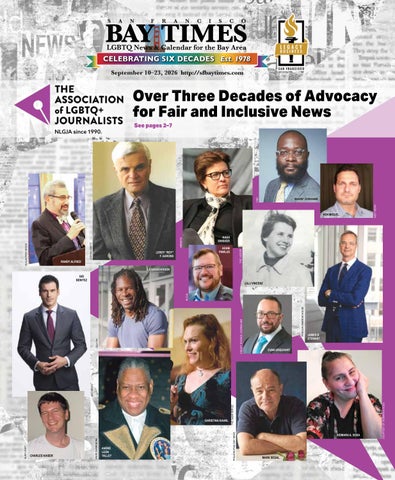
The cover of this issue shows just some of the many accomplished individuals nationwide who have been associated with the NLGJA: through governance, other support,
and as honorees. Included is Bay Times founding news editor Randy Alfred. He is a founding member and board director of the NLGJA, the co-creator of the first NLGJA stylebook, a lifetime member and advocate of the organization, and an inductee (2015) of the prestigious Journalists Hall of Fame. Take time to learn more about him and other NLGJA awardees at https://bit.ly/4x6DMz3 When the NLGJA was founded in 1990, the LGBTQ+ community was severely impacted by the height of the HIV/AIDS epidemic, facing devastating loss of life alongside widespread institutional neglect, medical discrimination, and societal fear. Additionally, queer individuals lacked basic legal protections against employment and housing discrimination, while pervasive cultural stigma and
anti-sodomy laws effectively criminalized LGBTQ+ identity and relationships. While immense progress has been made on all of these fronts, the LGBTQ+ community still faces a wave of legislative pushback— particularly targeting transgender rights through healthcare restrictions, school curriculum bans, and public accommodation limitations—alongside ongoing health disparities, systemic workplace discrimination, and rising rhetoric that threatens safety and mental well-being. The NLGJA therefore remains as needed and relevant as ever, with this year’s gathering in San Francisco reaffirming the enduring spirit of Aarons’ vision: that storytelling, grounded in truth and personal integrity, has the power to change both newsrooms and the world. https://www.nlgja.org/
A Timeline of Key Moments in the History of the NLGJA From 1990 to the Present 1990 - NLGJA Was Founded The American Society of Newspaper Editors, with the organization’s out gay executive director Lee Stinnett holding the reins, announced the results of its first-ever survey of gay and lesbian journalists at U.S. newspapers. Leroy “Roy” Aarons, the survey’s coordina- Lee Stinnett tor and then executive editor of the Oakland Tribune, presented the findings at the ASNE national convention in Washington, D.C., and publicly came out as gay. The landmark natives, NLGJA’s newsletter, was pubstudy, titled Alternatives: Gays and lished, providing a means of Lesbians in the Newsroom, communication among lesbian and revealed a significant undercurgay journalists working in newsrooms rent of bias in American news- Leroy “Roy” Aarons around the country. rooms. Shortly afterward, Aarons gathered five other journalists at his 1992 - First National Convention Piedmont, California, home to establish the NLGJA held its first national convention in National Lesbian and Gay Journalists San Francisco, bringing together approxiAssociation. mately 300 lesbian and gay journalists, many 1991 - Formal Incorporation and of whom were out publicly for the first time. Alternatives In a videotaped message to the convention, New York Times publisher Arthur Sulzberger, NLGJA was formally incorporated as a nonprofit organization. The first edition of Alter- Jr., promised that the newspaper would offer
member Steven Gendel became the first journalist to disclose that he was gay on a major television network when he came out during an NBC broadcast of the Stonewall commemoration.
domestic-partner benefits to employees.
1995 - Canadian Expansion and Broadcast Journalism Survey
Following meetings with NLGJA, NBC News reaffirmed in a memo to employees its policy against discrimination based on sexual orientation. By that time, NLGJA had grown to 13 chapters. NLGJA also established its Excellence in Journalism Awards to recognize outstanding journalism related to LGBTQ+ issues.
A Canadian organization affiliated with NLGJA was established, extending the association’s reach beyond the United States. NLGJA and the Radio and Television News Directors Foundation published Another Perspective: A Report on Gay and Lesbian Issues in Electronic Journalism, examining the quality and extent of coverage of gay and lesbian issues in electronic media.
1994 - Workplace Benefits and On-Air Visibility
1996 - Headquarters Moved to Washington, D.C.
NLGJA published Domestic Partner Benefits: At What Cost?, a guide designed to help news organizations institute domestic-partner health benefits. That same year, NLGJA
Michael Frederickson became NLGJA’s first full-time executive director. The organization moved its national headquarters from (continued on page 6)
1993 - NBC Reaffirmed Its Nondiscrimination Policy
S AN F R ANC IS C O BAY T IM ES
S EPT EM BER 10, 2026
3
Interview With Randy Alfred, Founding News Editor of the San Francisco Bay Times
The Philanthropic Mindset
Tom LeNoble: Randy, take us back to 1978. What was it like to be the founding news editor of the San Francisco Bay Times? Randy Alfred: It was an adventure. We were trying to do something that hadn’t been done on the West Coast, which was to have a newspaper produced jointly by lesbians and gay men. This was in the days before we had LGBTQ+. “Lesbians and gay men” were the then acceptable inclusive terms. The first Bay Times put out three issues and then sputtered out for lack of funding. [Editor’s Note: The publication shortly thereafter was reintroduced as Coming Up before going back to its original name.]
Randy Alfred
It’s nice to see it after all these years still pumping out every couple of weeks. Tom LeNoble: 1978 was an extraordinary year in San Francisco. Harvey Milk was in office. The Rainbow Flag debuted. The Briggs Initiative was being fought. By the end of the year, Harvey Milk and Mayor George Moscone had been assassinated. What did it feel like to be a journalist while history was unfolding around you? Randy Alfred: It was a year of ups and downs. We beat Briggs. Harvey’s partner, Jack Lira, committed suicide. And then the assassinations happened. There were lots of ups and downs. I and several other journalists in San Francisco were aware of just how unusual and historic the year was going to be. Just keeping up with what was happening was nearly impossible. Tom LeNoble: Tell me about producing The Gay Life on KSAN-FM. How did that opportunity surface?
Randy Alfred (second from right) served as a panelist at the NLGJA 2015 Convention held in San Francisco. 4
SA N FRANCISCO BAY T I ME S
S E PT E MB E R 1 0 , 2 0 2 6
Randy Alfred: In 1978, I was contributing to The Gay Life, but I became the producer in January of 1979. The producer of the show, Larry Lee, left KSAN for a job in television as an investigative reporter. The show didn’t have a producer, and I got called just about every month asking when it was going to come back on the air. In December, when I
PHOTO BY RINK
Randy Alfred is a pioneering LGBTQ+ journalist, founding news editor of the San Francisco Bay Times, and founding member and board member of the NLGJA: The Association of LGBTQ+ Journalists. He produced and hosted The Gay Life on KSANFM and challenged biased media coverage through groundbreaking journalism. A longtime advocate for fair, accurate reporting, Alfred was inducted into the NLGJA Hall of Fame in 2015.
PHOTO BY RINK
Tom LeNoble
Randy Alfred walked alongside Harvey Milk as they and others were photographed by San Francisco Bay Times photographer Rink on January 9, 1978. The group was en route from the Castro to San Francisco City Hall for the inauguration of Milk as District 5 Supervisor and George Moscone as Mayor.
called, they said, “Oh, it’s coming back in January.” And I said, “Great, who’s the producer?” They said, “You’re the producer.” I was suddenly the producer. Tom LeNoble: Who are some of the people you interviewed who remain with you today? Randy Alfred: I had an interview that we aired in January of 1982, in the very early days of what became known as AIDS. It wasn’t even named AIDS yet. I had an interview with Bobbi Campbell and interviewed both Drs. (Marcus) Conant and (Paul) Volberding, two of the leading and original researchers here in San Francisco. We did more than 250 hours of that show over six years, and they’re all available at the Historical Society’s website: https://bit.ly/4xJg9h3 I was going out and recording events in the community; for instance, the debates over whether we should close the bathhouses to reduce the transmission of AIDS (and) Christopher Isherwood’s speech, where he was asked about nomenclature. He didn’t like the word “gay.” He said, “Homosexual is such a mouthful.” He said, “I like the word queer. Queer is good.” This was in the early 1980s and well ahead of the wave of people beginning to say, yes, we can reclaim that word and make it ours and make it positive and inclusive. Tom LeNoble: What feedback did you
get from listeners about what it meant to hear LGBTQ+ lives and issues openly discussed on the radio? Randy Alfred: The most telling thing was that I would hear from people in rural areas who didn’t have access. It was an entrée into what was going on here in San Francisco and going on in the East Bay. The Stanislaus County Gay Alliance from the Central Valley sent me public service announcements to read, because the show was a public service show. They told me, “We don’t have a newspaper out here. We don’t have media. This is the way people connect.” And, for some of them, it was the first time that they heard about other people like them, that they were not alone. The media was not covering lesbians. Lesbians didn’t have role models out there, people whom they knew, like, “Oh, I’m not the only one,” and [this was also the case for] people of color. [It also was true for] people who did not look like the wellgroomed, well-dressed, sleek Manhattanite or San Francisco image of this is what gay culture is about. (continued on page 5)
Tom LeNoble: In 1980, you investigated the CBS Reports program Gay Power, Gay Politics. Your work contributed to CBS issuing a rare public apology. What troubled you about the broadcast? Randy Alfred: The broadcast— and I’m glad you used the word broadcast, because, in my mind, it wasn’t a documentary—it was a hit job.
party to support the organization. I bought a whole lot of extra tickets to the final night’s party where I was going to be inducted. I had an entourage, even, which isn’t something I’ve indulged in other times.
(Left to Right) Founding news editor Randy Alfred, distribution manager Susan Calico, Tom LeNoble: and contributor Cleve Jones presented a panel discussion in 2018 commemorating the What makes the To put that forward, they used deceitful edit40th anniversary of the San Francisco Bay Times held at the Gay and Lesbian Historical mission of NLGJA Society Museum. ing practices. For instance, when Mayor relevant today? Tom LeNoble: Tell me about your relaFeinstein apologized during a hard political supposed to be in playgroups where I was tionship with Leroy “Roy” Aarons and campaign, she apologized for remarks she Randy Alfred: We want all media—mainthe only boy and the others were all girls, your involvement in the founding of had made in the Ladies’ Home Journal about stream media, community media, our own because people would think I was a sissy. NLGJA. “gays must set standards for themselves.” LGBTQ+ media—to provide fair and I stopped writing poetry. It was only after I She did not receive applause when she said it Randy Alfred: At the time, I was on the accurate coverage. There are the newsroom came out of the closet, around age 26, 27, at the Alice B. Toklas Political Memorial issues of equal employment opportunities for board of Media Alliance, which was a group that I was writing poetry again. I went back Democratic Club meeting. hiring and advancement for LGBTQ people. of progressive journalists who got together and discovered that I stopped around age It’s important to have a social network that for mutual support. A fledgling organization Later, when she said that she would appoint eight. Age eight is also when I stopped being can provide support for journalists. called NLGJA asked if Media Alliance could a lesbian or gay police commissioner, that a scrawny little kid and became a nervous, be the fiscal sponsor of the new organizareceived applause. They edited that to make An important newsroom project is having chubby overeater. I know when I went into tion. I was the openly gay man on the board, it seem as if the apology for her remarks guidance, a style book to help journalists use the closet as well as when I came out. It’s an and there was at least one open lesbian. It about standards had gotten applause. the right language—no slurs, no lies, and unusual story. was thought that I should be the liaison to no double standards. [There should be] no Similarly, in a speech that Cleve Jones gave the new organization. double standard in coverage and promotions Tom LeNoble: Randy, after everything on the anniversary of the assassinations in you’ve witnessed and helped change, in the newsroom. I met Leroy Aarons. I started going to the November of 1978, where he talked about what gives you hope about the future of board meetings of NLGJA, not as a board the ability to walk down the street without Tom LeNoble: What do you think your LGBTQ+ journalism? member but as the liaison for Media Allifear of being beaten up, they took applause generation understood that you hope ance. Randy Alfred: The hope is that we’ve and put it after his line, “the ability to walk younger journalists don’t forget? found each other, and we’re organized, and down the streets holding hands.” I’m not the executive type. I’m the facilitaRandy Alfred: In the movie Milk, it opens we’re bringing up the younger generation. tive type and provided a form of what I like It was deceitful. It gave journalists a bad repwith a bar raid of the late 1950s, early I’ve been a mentor in the NLGJA mentor to call facilitative leadership. I’m good at utation. 1960s. I’d forgotten that, when I came supporting the leadership and making sure program. We’ve also made connections with out, half the people I met still had lived in I submitted it to the National News Council that things can run smoothly. And that was other minority groups like the Asian Amerithe era of bar raids, police coming in and and said that the show tended to demean, the role I wound up playing on the early can Journalists Association, the National Asbusting up pre-Stonewall. Everything I knew disgrace, and dishonor the entire journalistic board of NLGJA. Roy said, “If you join the sociation of Black Journalists, the National about quote-unquote homosexuals was that profession. We said these are not acceptable first year, you’re a co-founder.” Association of Hispanic Journalists. There’s they got busted and blackmailed and had practices. also a Native American journalists associTom LeNoble: You were inducted into careers ruined. ation [Indigenous Journalists Association]. CBS apologized. The on-air apology wound the NLGJA Hall of Fame in 2015. What I think that’s important to still remember, There’s a Trans Journalists Association. up running on my birthday that year, which did that mean to you? and it’s important to remember that Pride made me quite happy. There are three verbs that I think sum up Randy Alfred: It was a pleasure and a was once a protest march, or as they point the longer mission statement: connect, supTom LeNoble: Are there lessons from delight. It was an honor. It was a wonderful out, Stonewall was a riot. port, communicate. The rate of acceptance LGBTQ+ journalism in I think the important thing for and how high people have risen in the last the 1970s and 1980s that people to realize is how diverse a 35 years is heartening. I’m more worried journalists need to community we are and to be, not about the future of journalism, let alone the remember today? merely tolerant, but accepting of future of LGBTQ+ journalists within that. Randy Alfred: There are one another. Tom LeNoble is an international speaker, lessons that good journalists Tom LeNoble: Is there a should remember always, confidential advisor, and resilience stratstory from those early years which is an absolute respect egist who works with leaders navigating that people rarely ask you for the truth and a high meaningful inflection points in life and about? regard for the human dignity leadership. He has held senior leadership of every person whom they Randy Alfred: I have an even roles at MCI, Walmart.com, Palm, and interview or cover. earlier story. Facebook, and high growth startups. He is the author of the award-winning memThe entire history of jourI’m one of those people who oir “My Life in Business Suits, Hospital nalism in America has been knows when he went into the Gowns, and High Heels.” Through speakone of increasing the scope closet, as well as when he came of people about whom you out. Around the time I was eight, ing, coaching, and writing, he explores resilience, leadership, and the couldn’t lie. Before LGBTQ I received specific instructions. choices that shape how we show up for people, especially in the It wasn’t good for me to hug Randy Alfred (center) joined (left to right) noted photographer Dan Nicoletta, activist Medora others and for the communities we serve. South, newspapers and radio Payne, Milk Campaign manager Anne Kronenberg, and California State Senator Scott Wiener male friends. It was okay if they and TV felt free to lie about speaking at the Harvey Milk Birthday ceremony held at Jane Warner Plaza, May 19, 2013. were cousins or uncles. I wasn’t https://www.tomlenoble.com/ PHOTO BY RINK
Black people. And before that, they were lying about Jews. And, before that, they were lying about immigrants of any stripe.
S AN F R ANC IS C O BAY T IM ES
S EPT EM BER 10, 2026
5
PHOTO BY RINK
(continued from page 4)
TIMELINE (continued from page 3)
1998 - National Convention in Las Vegas NLGJA held its annual national convention in Las Vegas, attracting more than 500 attendees. The convention theme was “On A Roll: Dealing an Open Hand in the Newsroom.”
NLGJA celebrated its 10th anniversary at its national convention in San Francisco. The organization had grown to approximately 1,000 members in 19 chapters, with affiliates in Canada and Germany. NLGJA launched Lesbians and Gays in the Newsroom: 10 Years Later, a follow-up to the landmark 1990 newsroom survey. Pamela Strother became NLGJA’s third executive director in September. 2001 - Rapid Response Task Force NLGJA established its Rapid Response Task Force, a panel of working journalists from mainstream and LGBTQ+ media that responded to complaints about coverage considered unfair or inaccurate. The Gill Foundation awarded NLGJA a $100,000 grant, then the organization’s largest grant since its first award from the foundation in 1995. 2002 - Steven Petrow Was Elected President Steven Petrow was elected NLGJA president. During the year, NLGJA chapters continued advocating for workplace equality, while 6
SA N FRANCISCO BAY T I ME S
NLGJA celebrated its 15th anniversary with approximately 1,200 members, 24 chapters across the United States and affiliates in Canada and Germany. The organization established the LGBTQ+ Journalists Hall of Fame to honor pioneering journalists whose professional work and personal courage advanced fair and accurate coverage of LGBTQ+ people and issues.
NLGJA significantly expanded its Excellence in Journalism Awards, increasing the number of categories from 14 to 30 and adding recognition for areas including book writing, documentary work, and sports journalism.
2011 - NLGJA Joined UNITY
2017 - Spanish-Language Stylebook
NLGJA joined the UNITY Journalists’ Alliance, a strategic alliance that also included the Asian American Journalists Association, National Association of Hispanic Journalists, and National Association of Black Journalists. The partnership expanded NLGJA’s participation in broader efforts to promote diversity in American newsrooms.
NLGJA collaborated with the National Association of Hispanic Journalists and the National LGBTQ Task Force to produce an updated Spanish-language guide for journalists, El Manual de Estilo Sobre la Comunidad Lesbiana, Gay, Bisexual y Transgénero. The guide built on an earlier Spanish-language publication first produced by NLGJA and NAHJ in 2005.
2012 - Michael Triplett Elected President
2018 - Sharif Durhams Was Elected President
Michael Triplett became NLGJA’s seventh national president. During his tenure, Triplett played an important role in recognizing bloggers as members of the association, reflecting the rapidly changing media landscape.
2006 - CNN Established the Leroy F. Aarons Scholarship Endowment CNN donated $100,000 to NLGJA to establish an endowment for the Leroy F. Aarons Scholarship, honoring the organization’s founder and supporting LGBTQ+ students pursuing careers in journalism.
Sharif Durhams was elected president of NLGJA. During the year, the Ford Foundation supported an update of NLGJA’s strategic plan, and NLGJA introduced the Jeanne Córdova Award to rec- Sharif Durhams ognize the accomplishments of an LGBTQ+ woman in journalism.
2013 - New Leadership and the Heartland Project Following Michael Triplett’s death, Jen Christensen was affirmed as NLGJA president and completed the remainder of his term. NLGJA also partnered with the Asian American Journalists Association on the “Diverse and Inclusive: News of the Heartland” project, designed to strengthen coverage of diverse communities and LGBTQ+ issues in the nation’s heartland.
2007 - Leadership and Organizational Development NLGJA continued expanding its national programs, professional development initiatives, and membership network as the media industry underwent significant changes. The organization strengthened its efforts to support LGBTQ+ journalists and promote fair and accurate coverage.
2019 - Legacy Award Established NLGJA established its Legacy Award to recognize a news outlet, publication, or news organization that demonstrated sustained, innovative, and high-quality coverage of the LGBTQ+ community. The Washington Blade became the inaugural recipient.
2014 - Adam Pawlus Became Executive Director
2008 - Kay Longcope Scholarship Established
S E PT E MB E R 1 0 , 2 0 2 6
2016 - Expansion of Journalism Awards
NLGJA celebrated its 20th anniversary at the national convention in San Francisco, marking two decades of advocacy for LGBTQ+ journalists, newsroom diversity, and fair and accurate coverage.
Roy Aarons, NLGJA’s founder and a pioneering journalist and journalism educator, died at age 70. NLGJA also launched its Newsroom Outreach Project, which brought the organization directly to newsroom leaders to discuss NLGJA and issues surrounding LGBTQ+ coverage. Initial meetings took place in Washington, D.C., New Orleans, and Colorado.
The Kay Longcope Scholarship was established through a gift from the estate of Boston Globe journalist Kay Longcope. The scholarship provides financial assistance to an LGBTQ+ student of color pursuing a career Kay Longcope
Michael Tune became NLGJA’s executive director. NLGJA formed its Student Advisory Committee to expand outreach to journalism students, and developed educational initiatives with journalism schools. Later that year, Re:ACT, NLGJA’s official blog, launched and significantly expanded the organization’s presence and traffic on the web. 2010 - Twentieth Anniversary
KOSOVALINE.ORG
Xiomara A. Sosa
2000 - Tenth Anniversary and Newsroom Survey
2004 - NLGJA Mourned Passing of Founder Roy Aarons
2005 - Fifteenth Anniversary and Hall of Fame
COURTESY OF XIOMARA A SOSA
1999 - Xiomara A. Sosa Became Executive Director
NLGJA continued expanding its professional development, student outreach, and workplace-equality programs as its national network of journalists and chapters grew. The organization continued developing programs designed to improve newsroom coverage of LGBTQ+ communities and support the careers of LGBTQ+ journalists.
CNN
KOSOVALINE.ORG
NLGJA published Stylebook Addenda: Gay/ Lesbian Terminology, providing news organizations with guidance for accurate and respectful coverage. KarenLouise Boothe was elected NLGJA president. NLGJA also issued an updated domestic-partner benefits guide as more Karen-Louise Boothe news organizations began offering such benefits.
Xiomara A. Sosa became NLGJA’s second executive director and the first Latina and first lesbian to hold the position.
2009 - New Executive Director, Student Advisory Committee, and Re:ACT
2003 - Continued Growth and Advocacy
Adam Pawlus became NLGJA’s executive director, following an extensive search and numerous interviews conducted by the hiring committee. Pawlus continued in the position as NLGJA entered its 25th anniver- Adam Pawlus sary year. 2015 - Twenty-Fifth Anniversary NLGJA celebrated its 25th anniversary by
2020 - Thirtieth Anniversary and Virtual Convention
NLGJA
1997 - First Stylebook Addenda
returning to San Francisco for its “Coming Home” national convention and 11th annual LGBT Media Summit. The organization also created an Ally Membership category for people who supported NLGJA’s mission but did not otherwise qualify for traditional membership categories.
in journalism. NLGJA also continued expanding its recognition of journalists working in emerging forms of media.
major media organizations including the Associated Press, New York Daily News, and Belo Corporation expanded domesticpartner benefits for their employees.
Northern California to Washington, D.C.
NLGJA marked its 30th anniversary during a year transformed by the COVID-19 pandemic. Its national convention moved online, beginning a two-year period in which the organization’s major annual gathering was held virtually. 2021 - Student Conference and Continued Virtual Programming NLGJA launched its first standalone Student (continued on page 7)
(continued from page 6) 2024 - Record-Breaking National Convention in Los Angeles
Conference, a virtual gathering designed to connect LGBTQ+ student journalists with professional journalists, educators, and employers. The organization also held its national convention virtually for a second consecutive year. More than 450 journalists, media executives, communications professionals, and educators participated in the 2021 convention. 2022 - Ken Miguel Elected President and NLGJA Returned to Chicago Ken Miguel was elected NLGJA’s national board president. NLGJA held its first national convention since 2019 at the Drake
2023 - NLGJA Became NLGJA: The Association of LGBTQ+ Journalists
ABC7 NEWS
Hotel in Chicago, combining in-person and virtual programming and attracting approximately 720 attendees.
Ken Miguel
NLGJA updated its logo and branding to foreground “The Association of LGBTQ+ Journalists,” reflecting the breadth of its
membership. The organization explained that the change was a non-legal rebranding: its legal corporate name remained National Lesbian & Gay Journalists Association. The addition of the “+” followed the organization’s earlier adoption of “LGBTQ” in its public identity.
NLGJA held its national convention at the Loews Hollywood Hotel in Los Angeles. With 753 attendees, the 2024 gathering became the largest national convention in the organization’s history at that time. 2025 - Expanded Support for Emerging LGBTQ+ Journalists NLGJA continued expanding its fellowship and scholarship programs, including the Curve Fellowship for Emerging Journalists, presented in partnership with The Curve Foundation. The fellowship provided financial and professional support to emerging journalists whose work elevated the voices and stories of LGBTQ+ women, trans and nonbinary people.
S AN F R ANC IS C O BAY T IM ES
2026 - Thirty-Fifth Anniversary Year NLGJA marked its 35th anniversary year with continued programs supporting LGBTQ+ journalists, newsroom diversity, professional development, journalism education, and fair and accurate coverage. The organization is holding its 35th annual National Convention in San Francisco from September 10–13, returning to the city where its first national convention had been held in 1992. After 35 years, NLGJA continues the work begun by Roy Aarons and the journalists who gathered at his Bay Area home in 1990: advancing the careers of LGBTQ+ journalists, fostering diverse and inclusive newsrooms, and promoting fair, accurate, and responsible coverage of LGBTQ+ communities. https://www.nlgja.org/
S EPT EM BER 10, 2026
7
WWDD before judging others, and ask: WWDD: What Would Dolly Do? Elections Are Coming: More Ways to Help
people on a human level—which brings me to Dolly Parton.
In Case You Missed It Joanie Juster Greetings from the great state of Alaska. I am writing this while gazing out my window at the magnificent, snow-capped Chugach Mountains, which are also reflected in the placid lake outside the house. The waning moon is rising over the lake, and every now and then I can hear a loon calling. The setting is peaceful and serene; balm for my soul. I have traveled to this small town in Alaska so many times over the past 32 years that it has become my home-away-from-home. The work I do up here is integrally tied to the history and lore of this place. I share my work at the Alaska State Fair, which brings me into contact not only with the locals, but also with visitors from all over the country, and the world. And when I am up here, life takes on a different rhythm. This place is very different from life in San Francisco.
8
SA N FRANCISCO BAY T I ME S
Being here takes me outside my Bay Area bubble, and that is a very good thing. It is all too easy to get complacent when you are surrounded by people whose views and lifestyles are similar to your own. It becomes far too tempting to assume that everyone should think and vote like we do, or worse yet, to see those whose views are different as the “other.” Over the past two weeks I have had many delightful, meaningful conversations with people whose views may be very different from those of my usual social circle. We have found common ground on many things, and learned to enjoy and respect each other. This place reminds me to open my mind and my heart, and look for ways to connect with
S E PT E MB E R 1 0 , 2 0 2 6
The news of Dolly Parton’s passing hit while I was here in Alaska, far away from home. I will admit that I wasn’t very conversant with her life and career before she died, but I’ve been making up for lost time ever since. Her musical genius speaks for itself; the world will be singing her songs for many years to come. But what struck me in interview after interview, performance after performance, was her innate kindness. And by that I don’t mean her legendary philanthropy; the woman took generosity to a whole new level. No, I mean her kind spirit. She seemed to treat everyone with genuine kindness and respect, acknowledging the humanity in everyone. In a world where, too often, we hold each other to a litmus test of our political beliefs before we decide to trust one another, Dolly opened her heart and made everyone feel welcomed and valued. In these times when we are so highly polarized, retreating into our own increasingly narrow silos, I hope more of us will pause
As promised in our last edition, here are more organizations that would welcome your donations, your volunteer hours, or both to help make sure every eligible voter can vote in the upcoming midterm elections: Common Cause has been leading the fight for fair elections for over 56 years. They are a leader in fighting for democracy at the local, state, and national level. https://tinyurl.com/CCause56 States Win (formerly known as Sister District) has proven to be very effective at flipping state chambers. They are a grassroots organization that works hard to shift the balance of power, one state legislature at a time. https://tinyurl.com/StatesWin26 All In To Vote provides important resources for trans voters, including state-by-state info, and links to organizations that can help with ID issues. They offer solid, practical info for folks who may need assistance accessing their right to vote. https://tinyurl.com/AllIn2Vote Joanie Juster is a long-time community volunteer, activist, and ally.
Community Treasures From the GLBT Historical Society Archives
The Rainbow Flag Crosses the Atlantic
Photos courtesy of the GLBT Historical Society Museum
The original 1978 Rainbow Flag is now on view in Cork, Ireland. Our team traveled across the pond this month to personally courier and carefully install this historic artifact, as part of a four-month loan to coincide with the opening of the Cork Public Museum’s first permanent exhibition uplifting LGBTQ+ history, which we are immensely proud to be supporting. During the flag’s stay, it will be visited by thousands from across Europe who will be able to experience this piece of history firsthand. This is the first international loan and exhibition of the original Rainbow Flag outside of the United States—a partnership between the GLBT Historical Society, the Cork Public Museum, and the city of Cork, San Francisco’s sister city separated by an ocean and joined by a shared commitment to LGBTQ+ history. “As stewards of the original Rainbow Flag, created in 1978, we are entrusted with preserving its history and promoting greater awareness of its legacy,” said GLBT Historical Society Executive Director Roberto Ordeñana. “The Rainbow Flag’s
importance extends far beyond any one museum, city, or nation—our shared history belongs to all of us, regardless of borders.” While the Rainbow Flag is visiting Ireland, you can still learn about the history of the rainbow at our museum in the Castro. A new temporary exhibition has been installed to showcase materials from the Gilbert Baker Collection, including a reproduction of the original eight-striped flag created and signed by Baker in 1998 and a sewing machine listed among his supplies, alongside a medallion gifted to us by the city of Cork during its delegation’s visit to San Francisco earlier this year. Plan your visit to the GLBT Historical Society Museum at
https://www.glbthistory.org/
10
SAN F RANCISCO BAY T I ME S
S E PT E MB E R 10 , 2 0 2 6
San Francisco LGBTQ+ Timeline – Part Five Roland Schembari and Bill Hartman, Co-Founders Randy Alfred, Founding News Editor, 1978 Kim Corsaro, Publisher 1981-2011
Sorrow and Solidarity: San Francisco LGBT Timeline 1984–1989 Ka’ahumanu as a vice presidential candidate at the convention.
2261 Market Street, No. 309 San Francisco CA 94114 Phone: 415-601-2113 Email: editor@sfbaytimes.com www.sfbaytimes.com
Mobilization Against AIDS organized to fight against anti-AIDS initiatives, promote the development of new AIDS drugs, and draw attention to the growing worldwide AIDS epidemic.
____________________________
The Bay Times was the first newspaper in California, and among the first in the world, to be jointly and equally produced by lesbians and gay men. We honor our history and the paper’s ability to build and strengthen unity in our community. The Bay Times is proud to be the first and only LGBTQ newspaper in San Francisco to be named a Legacy Business, recognizing that it is a longstanding, community-serving business that is a valuable cultural asset to the city.
Faces from Our LGBT Past
Dr. Betty L. Sullivan/Jennifer L. Viegas
Dr. Bill Lipsky
Beth Greene, John Signer, Michael Delgado
(Editor’s Note: The following is part five of Bill Lipsky’s timeline of LGBTQ+ history starting with the 19th century. The first part ran in the June 11, 2026, issue of the San Francisco Bay Times.)
Co-Publishers & Co-Editors
Design & Production
Kate Laws Business Manager Kit Kennedy Poet-In-Residence J.H. Herren Technology Director Carla Ramos Web Coordinator Mario Ordonez Distribution Juan R. Davila Volunteer Coordinator ____________________________
CONTRIBUTORS Writers Rink, Sister Dana Van Iquity, Ann Rostow, Patrick Carney, Leslie Sbrocco, David Landis, Gary M. Kramer, Joanie Juster, Robert Holgate, Zoe Dunning, Eduardo Morales, Dennis McMillan, Tim Seelig, Rafael Mandelman, Jewelle Gomez, Rebecca Kaplan, Bill Lipsky, Beth Schnitzer, Rowena Brown, Kippy Marks, Ian Fullmer, Donna Sachet, Gary Virginia, Derek Barnes, Marcy Adelman, Jan Wahl, Stuart Gaffney & John Lewis, Brandon Miller, Howard Steiermann, Fernando Camino, Honey Mahogany, Kate Kendell Photographers Rink, Paul Margolis, Bill Wilson, Jerome Parmer, Michael Kirschner, Sandy Morris, Abby Zimberg, Joanie Juster, Ken Lew ____________________________
ADVERTISING Display Advertising Standard Rate Cards http://sfbaytimes.com/ or 415-601-2113 Custom ad sizes are available. Ads are reviewed by the publishers. National Advertising: Contact Bay Times / San Francisco. Represented by Rivendell Media: 908-232-2021 Circulation is verified by an independent agency. Reprints by permission only. ____________________________
© 2026 Sullivan Communications, Inc Join the San Francisco Bay Times Email List
12
SAN F RANCISCO BAY T I ME S
During the latter years of the 1980s, LGBT San Francisco had to fight against a returning, blatant homophobia from citizens, civil servants, and corporations; for AIDS research to combat the virus; and for the means to assist people with HIV who could no longer care for themselves, all while continuing the ongoing struggle for equal rights. 1984 The Department of Public Health issued an order to close the city’s 14 gay bathhouses. San Francisco’s Lesbian/Gay Freedom Day Parade was dedicated for the first time to people with AIDS. The Sisters of Perpetual Indulgence performed a ritual exorcism of extreme homophobic political activists Jerry Falwell and Phyllis Schlafly, attended by some 2,000 witnesses. On the day before the Democratic National Convention met in the city for the first time since 1920, the National March for Lesbian and Gay Rights took to the streets from the Castro to Moscone Center to protest the lack of federal action to combat AIDS. At Moscone Center, BiPOL, the nation’s earliest known bisexual political organization, held the first Bisexual Rights Rally, after registering and running pioneering “feminist bisexual queer activist” Lani S E PT E MB E R 1 0 , 2 0 2 6
First produced to show that there was a vibrant South of Market neighborhood, then threatened with urban redevelopment, the Folsom Street Fair over time became the world’s largest event to celebrate leather and kink. Educator and activist David Lourea, one of the founders of the San Francisco Bisexual Center in 1976, convinced the city’s Department of Public Health to include information about bisexual men in its official AIDS statistics, setting a national precedent. On Our Backs, the first magazine to feature lesbian erotica that was created by lesbians for a lesbian audience in the United States, began publication in San Francisco. When California Governor George Deukmejian vetoed Assembly Bill 1, which would have forbidden employers from discriminating against lesbians and gays because of their sexual orientation, hundreds of demonstrators gathered in the Castro to protest his action before marching to City Hall. 1985 Organized by Jerry Vallaire and Patrick Toner, winner of 1985’s International Mr. Leather contest in Chicago representing Chaps, a South of Market bar that featured leather entertainment, Up Your Alley premiered as a local block party specifically to celebrate the city’s lesbian and gay leather community. After she learned that a neighbor with AIDS had died from malnutrition, Ruth Brinker founded Project Open Hand to provide home-delivered meals, when no other social service did so, to residents living with HIV/ AIDS whom the disease made too weak or too impoverished to feed themselves. Sixty-three cyclists rode their bicycles from San Francisco to the Russian River in the first AIDS Bike-a-Thon, “Pedaling for Pride in ‘85.” Terry Thompson, manager of the Arena, and three friends published San Francisco’s first Bare Chest Calendar to raise funds “to assist those affected by the
AIDS epidemic.” Founded in San Francisco in 1975 by Randy Burns (Northern Paiute) and Barbara May Cameron (Hunkpapa Lakota), Gay American Indians, the first organization for LGBT Native Americans, created the GAI History Project “to collect the oral records and traditions of same-sex relationships as well as gender variance in Indigenous tribes.” When the Food and Drug Administration imposed a lifetime ban on blood donations from men who had sex with men, Lenore Chinn and other women from the Harvey Milk Lesbian and Gay Democratic Club organized the first annual Women’s Day Blood Drive, held at Most Holy Redeemer Catholic Church in the Castro, where more than 130 lesbians donated blood to join “with our brothers in fighting the AIDS epidemic.” 1986 Cleve Jones gathered a small group of friends to create a memorial, now known as the NAMES Project AIDS Memorial Quilt, for those who had died of AIDS, making the first panel to remember his friend Marvin Feldman.
Arvind Kumar and Suvir Das co-founded Trikone, the first South Asian LGBT social, cultural, and activist group in the world. Voters defeated Proposition 64, which would have separated and quarantined people with AIDS had it passed. 1987 Homosexuality completely stopped being classified as a mental disorder when the American Psychiatric Association published a revised Diagnostic and Statistical Manual. (Classification of “gender identity disorder” appeared as a label for transgender people for the first time in 1980 and would remain until 2013.) Anne Young became the first openly LGBT person hired to be a San Francisco firefighter. More than 6,000 people joined the first AIDS Walk San Francisco in Golden Gate Park. At a competition held in San Francisco, (continued on page 17)
GLBT Fortnight in Review Bravo Boomer I was surprised at how pleased I was when Congressman Seth Moulton lost the Democratic primary for Senate in Massachusetts. For one thing, I’m generally in favor of younger candidates. Incumbent Ed Markey, who effectively won another six-year term in office by beating the 47-year-old Moulton, is 80. We don’t need more octogenarians of either party in Congress, and Democrats, in particular, need youth and energy to take back the electorate from MAGA. Moulton is a moderate, presumably open to bipartisan compromise, which is something that I once found useful in a lawmaker. That said, I’m less sure that common ground with GOP legislators is worthwhile at the moment—although they all did pass a housing bill earlier this year. Those were two reasons I could have supported Moulton, but in a calculated move after the 2024 election, Moulton distanced himself from supporting transgender rights by telling The New York Times that he has two little girls and didn’t “want them getting run over on a playing field by a male or formerly male athlete.” This seemed a staged attempt to personify political courage, and Moulton added: “As a Democrat, I’m supposed to be afraid to say that.” In a follow-up essay for The Washington Post a few weeks later, Moulton doubled down, insisting that fellow Democrats have congratulated him behind the scenes and told him, “Thank you for saying that.” The comments were clearly meant to cause a stir and position Moulton as a brave Democrat willing to take on his party’s sacred cows. It worked for Bill Clinton, but not only was Moulton’s version contrived, it also betrayed his raw ambition. It was not a good look. While Democrats can’t let themselves be drawn into the catch-22 of turning the midterms into yet another set of culture wars, it is quite possible to focus on, let’s say, the cost of living, without attacking transgender girls. Moulton’s daughters are in no danger of being “run over on the playing field” by trans girls, let alone by “males,” who have never been allowed to play organized sports on female teams. His gratuitous attack on a handful of kids across the country was a self-serving publicity stunt, and it was satisfying to see him pay for it with defeat. It was even more satisfying because Ed Markey didn’t just sidestep the many aspects of transgender rights in his campaign; he championed them. Yes, he was running in Massachusetts, but still. Transgender rights, said Markey, “have become a defining issue in this race because Massachusetts voters believe it’s disqualifying if you don’t stand up for human rights everywhere and all the time.” That does not just apply to Massachusetts voters, we hope. What’s Happening Here? In late August, the U.S. Court of Appeals for the Second Circuit issued a one-line ruling that maintained a block against Trump’s attempt to get transgender health records from New York hospitals, so that’s good. And it came with no dissenting comment, compliments of two Trump appointees and a Biden judge.
By Ann Rostow
I know, I know. In our last column, we wrote about a 2–1 decision against our side out of the U.S. Court of Appeals for the Ninth Circuit, where the majority ruled that Trump and company could proceed with such subpoenas without violating health privacy laws. I am struggling to coordinate my coverage of these lawsuits, particularly the motions for injunctions and their trajectories up the court ladders. At a loss, I asked the Google AI bot what was going on and was told that “multiple federal lawsuits and legal challenges have been filed across the United States to block the Department of Justice from seizing private medical records of transgender youth.” And “at least seven federal judges have partially or entirely blocked or quashed DOJ subpoenas directed at hospitals and healthcare providers seeking sensitive patient data, resulting in multiple coordinated legal actions by families and civil rights groups.” The bot didn’t mention the Ninth Circuit ruling from earlier last month, but I didn’t ask it for further information. Oh, actually I did. I asked for “recent rulings,” and it told me to ask the American Civil Liberties Union. Now I’m torn between spending the next hour or so trying to reestablish a coherent picture of where we stand, and just telling you about the Second Circuit’s ruling and pledging “more to come.” More to come. Drag Shows Back in Texas I’ve resisted help from our new AI friends because I don’t really trust them. As for using AI to write, the problem is that the act of writing itself inspires thoughts and ideas; ergo, using a substitute writer would undermine the entire mission of capturing the soul of our community’s current place in politics and society. Plus, it’s fun to write, and although I’m on a deadline and constantly looking to procrastinate, I’m not a college student trying to bang out an essay. With those caveats in mind, it was an AI bot that told me a federal judge had just declared that the ban on drag shows in Texas was unconstitutional. I hesitated to believe this, given that the U.S. Court of Appeals for the Fifth Circuit ruled it was just fine and dandy a few months back. The notoriously conservative Fifth Circuit sent the case back to the lower court for reevaluation given its decision, and lo and behold, the lower court determined that the law could not survive constitutional review. I guess I had not looked closely at that Fifth Circuit opinion, which actually said that the constitutional issues had not been examined properly. As such, the appellate panel didn’t give the anti-drag law a green light, but a yellow one. I should have anticipated that the lower court could give us a win rather than assume the Fifth Circuit would prevail. Now, I assume the constitutional aspect of the decision will go back up the ladder, and if I pay attention, I’ll know what’s going on the next time this law rears its ugly head. Trump Asks SCOTUS to Skip to the Chase Meanwhile, while we’re on the subject of complicated litigation, the Justice Department has asked the Supreme Court to allow (continued on page 18) S AN F R AN C IS C O BAY T IM ES
S EPT EM BER 10, 2026
13
“What am I going to do? Stay home and watch Netflix?” —Diana Ross
By Donna Sachet
I
f any San Francisco event has it all—originality, pageantry, costuming, humor, suspense, heart, and more—it is the annual GAPA Runway. And this year did not disappoint! GAPA Runway 2026: Forces of Nature returned to the elegant Herbst Theatre on August 22, 2026, with emcees Jezebel Patel and Sir Whitney Queers, two of the best in the business and a big part of why people return year after year. The place was packed as an opening number gave the audience their first chance to see all eight contestants in elaborate costumes against a simple, but effective, full moon backdrop. Over the years, what may have started as a binary gender contest has evolved with its participants to embrace multiple titles. That’s right; don’t expect the Asian and Pacific Islander Community to fall asleep at the wheel! During the first act, the emcees explained some other changes to the pageant, including various rules and the percentage of points in each category. Right away, you knew this was a professional, well-rehearsed production. After that splashy introductory number, each contestant had their chance to present Royal Regalia and to answer a random question from a judge.
Friday, September 18 Hand to Hand Gala 2026 Project Open Hand’s annual event Live entertainment & awards dinner, silent & live auction, raffles, speakers SF Design Center Galleria 101 Henry Adams Street 6:30 pm $350 & up www.openhand.org
And speaking of judges, this was a top-notch group, including beautiful performer Lotus, educational leader Sanjay Makhijani, outspoken Qatari-American physician and activist Nasser Mohamed, radio and television personality Michelle Meow, popular international singer Tookta, strategic brand guru Jack S. Song, and award-winning author Willy Wilkinson. Indeed, this was an enviable panel of judges, and before the night was over, none of us wanted to be in their place with such intense competition. The audience gave undivided attention to each contestant, especially during the question segment, looking for all the characteristics that would make them the perfect titleholder. Many of the winners of the competition go on to become significant leaders in the community and beyond.
Saturday, September 19 Back to the Future: The Return of the Gays Imperial Court event reuniting Mr./Miss Gay titleholders Performances, interviews, raffles, & more Beaux, 2344 Market Street 5–8 pm Free! www.imperialcouncilsf.org
A short intermission gave everyone time to vote in the lobby for their favorites and to hobnob with their friends and associates. One quickly realized that those on stage were not the only ones dressed to the nines! That lobby could compete with Opening Night of the Opera! Another tradition of the GAPA Runway is the opportunity for each of the stepping-down titleholders to perform a final number, often sentimental and frequently emblematic of their year. Mx. GAPA The Indigo Menace, Mr. GAPA Seika Ryu, and Miss GAPA Quinn Amann each brought the crowd to their feet with creative and meaningful presentations. They will now join the nearly 40 years of GAPA Immortals, as they are called, who have represented the organization with these titles over the years.
Friday–Sunday, September 25–27 SF Grand Ducal Weekend The Century Club of California 1355 Franklin Street 6 pm $80 & up www.sfducal.org
The second act of the event picked up the pace a bit and gave the audience what they had truly come to see: the fantasy segment! Once again, each contestant manifested some aspect of their unique personality through an on-stage fantasy with the crowd roaring their approval. Emcees Jezebel and Whitney guided us through a wide spectrum of performances with their signature humor, even having fun with the addition of teleprompters this year. We wouldn’t dare try here to describe each fantasy number, but they were bigger, more unusual, and more eye-popping than ever! Those judges had a challenge on their hands.
The following Saturday, the Imperial Court produced Serenade: Unity in Song, led by Midas Munro, a bold new Donna Sachet and canine friend Peanut recently enjoyed a visit, along with Don Berger kind of event featuring all live singers and all live accompani- of Regency Limousine, to V. Sattui Winery in ment! The talent was incredi- St. Helena. President and Managing Partner Thomas Davies greeted them and later led a ble, the production was flaw- toast. More about this road trip is in the less, and the promotion August 27, 2026, issue of the San Francisco was excellent. We heard Bay Times. that over $2,000 was raised for Queer LifeSpace. Suffice it to say, this is an event that deserves repeating and Midas is a producer of events worth noting. Just when you think the Imperial Court has run out of ideas,
ELISE ARMITAGE, WHAT THE FAB MEDIA
With the competition at an end, several awards were presented, including audience favorite and contestant congeniality, but the sashes, crowns, and trophies were next. During the night, one could sense certain favorites as the audience responded, but each one received great applause and appreciation. Perhaps you’ve already read it elsewhere, but the winners are ... Mx. GAPA Sir Calum Cadian, Mr. GAPA Brent Baculi, and Miss GAPA Tala. Make plans now to attend next year’s GAPA Runway; you are guaranteed a splendid time!
Saturday, September 26 Magnitude Official Folsom Dance Party Hosted by Brian Kent SVN West 10 South Van Ness 9 pm–2 am $110 & up https://bit.ly/3SWZNSP Sunday, September 27 Folsom Street Fair Enjoy! www.folsomstreet.org along comes yet another. Meanwhile, dear readers, get ready for San Francisco summer and a panoply of events that we will try to keep you informed about. The fun never stops in San Francisco! Donna Sachet is a celebrated performer, fundraiser, activist, and philanthropist who has dedicated over two decades to the LGBTQ Community in San Francisco. Contact her at empsachet@gmail.com
PHOTO BY SHAWN NORTHCUTT
S AN F R AN C IS C O BAY T IM ES
S EPT EM BER 10, 2026
15
Riding Into Fall: Dykes on Bikes Connects Communities Across the West The second half of September will have us back on the road and out in the community. On Saturday, September 19, Dykes on Bikes will return to Guerneville to support our friends at Russian River Pride. Dykes on Bikes will be organizing the motorcycle contingent for the Russian River Pride Parade.
Dykes on Bikes® Tales From Two Wheels San Francisco Dykes on Bikes® (DOB) closed out August with a ride through Lake County led by patch-holder Ann, also known on the road as Scooby. The weather was hot on August 22, 2026, with temperatures well into the 90s for much of the day, but the climb up Cobb Mountain and rest at the top gave the riders a little relief from the heat. After stopping for lunch and winding their way down Highway 175, the group took a nice afternoon break at patch-holder Sue’s house. A few people took advantage of the pool and dipped their feet in before getting back on the road.
PHOTO COURTESY OF PHOTOGRAPHER CLARA, SAN FRANCISCO DYKES ON BIKES®
Thank you to Scooby for planning and leading the ride, and to Sue for welcoming a group of hot motorcyclists into her backyard to cool off.
Prospect Ruthie will be planning and leading the ride from Oakland to Guerneville that morning, giving Dykes on Bikes a chance to make the trip L–R: Patch-holder Scooby, Prospects Susanne and Mardi, Becky, and Patch-holder Sue on the Lake County DOB ride, together before we line up the other motorcycle riders for the August 22, 2026. singer-songwriter Deidre McCalla. It is sure enjoy the Fair. parade. to be a fantastic weekend on the Russian Meanwhile, some of us will be about 500 We have really enjoyed getting to know the River. miles north at Babes Ride Out, Oregon, leadership and members of Russian River If you ride a motorcycle and would like to from September 25 through 27. Since 2013, Pride. Earlier this summer they welcomed Babes Ride Out has been bringing together us during our 50th Anniversary retreat, and join the parade, we would love to have you ride with us. Visit the Russian River Pride new and seasoned riders and helping grow we partnered together for the Bikes, website ( https://russianriverpride.org/ ) to the women’s riding community. Dykes on Burgers & Beer fundraiser at the Surrey register or reach out to us via our website Bikes patch-holders went to Babes Ride Out Resort. We are happy to have the opportu( https://www.dykesonbikes.org/ ) for more Oregon in 2015 and had a fantastic time nity to return and help bring plenty of information. riding Oregon roads, camping beside the motorcycles to the Pride celebration. lake, meeting other riders, demoing the latThe final weekend of September will be After the parade, we will join everyone at est Harley-Davidson models, and spending especially busy, and Dykes on Bikes will the festival in Guerneville, headlined by evenings around the campfire. It was also manage to be in California and Oregon at cold—very cold. Speaking for myself, I the same time. learned a few things about late September Here in San Francisco, we will once again camping in the Oregon mountains and will be supporting the Folsom Street Fair on be arriving with a considerably warmer Sunday, September 27. Dykes on Bikes will provide motorcycle parking and gear check and will also be staffing one of the entry gates throughout the day. Providing motorcycle parking and gear check gives riders a place to leave their bikes and riding gear while they enjoy the Fair, and we are always happy to support Folsom Street Events. Folsom Street DOB patch-holders at Babes Ride Out, Oregon (October 2025). Fair has been sleeping bag. If you are headed to Babes part of San Francisco’s LGBTQ+ and Ride Out and would like to make the ride leather community for so many years, and north with us, please reach out. We would Folsom Street Events donates all of its net be happy to have you join us. proceeds from its events to nonprofit orgaSeptember is going to keep us busy. We are nizations working in public health, human looking forward to being back on the road, services, and the arts. supporting our community, and seeing plenIf you are riding to the Fair, enter motorcyty of familiar faces along the way. cle parking from Howard onto Dore. That puts you one block from The Playground, a Kate Brown, Ph.D., is the President of San space created for women of every kind and Francisco Dykes on Bikes® Women’s Motorcycle Contingent. all trans and nonbinary folks. Stop by, park https://www.dykesonbikes.org/ your bike, check your gear, and, of course,
SAN FRANCISCO DYKES ON BIKES®
By Kate Brown, Ph.D.
16
SAN F RANCISCO BAY T I ME S
S E PT E MB E R 10 , 2 0 2 6
LIPSKY (continued from pg 12) Judy Tallwing McCarthy of Portland, Oregon, was chosen to be the first International Ms. Leather. The United States Food and Drug Administration approved AZT (azidothymidine), making it the first antiretroviral drug authorized to treat HIV/AIDS. The 21st Street Baths, the city’s last gay bathhouse, closed. 1988 Art Agnos became the first San Francisco Mayor to ride in the city’s Pride Parade, then called the San Francisco Lesbian/Gay Freedom Day Parade. LYRIC, the second-oldest LGBT youth organization in the United States, began offering affirming services to young people, ages 10 to 24, who faced challenging circumstances. In an act of protest, civil disobedience, and compassion, volunteers established Prevention Point, officially sanctioned by the city in 1993, which became the country’s largest needle exchange program to help stop the spread of HIV/AIDS among intravenous drug users.
1989 Some 80 protesters unfurled a banner reading “Stop AIDS Now Or Else” on the Golden Gate Bridge, the first time a demonstration completely stopped traffic on the span. San Francisco voters passed a domestic partnership ordinance that provided legal recognition and protection for same-sex couples who registered with the city. During a protest by ACT UP/SF against the United States government’s continuing inaction against the ongoing AIDS pandemic, more than 200 members of the San Francisco Police Department, about half of all officers on duty at the time, marched shoulder-to-shoulder down Castro Street in an encounter with the community that eventually covered 7 city blocks and led to the arrests of 53 people. The Gay Asian Pacific Alliance, founded the year before, established the GAPA Community HIV Project, the first gay-identified Asian and Pacific Islander HIV/AIDS program in the United States.
Voters defeated Proposition 102, a ballot measure supported by Governor Deukmejian to abolish anonymous HIV testing and require everyone who tested positive for the virus to be reported to health authorities.
Tracker McDyke, the world-famous lesbian detective, solved the mystery surrounding the disappearance of local drag queen Tessy LaFemme in C. M. Ralph’s Caper in the Castro, the first LGBT video game.
Asian/Pacifica Sisters organized the first Asian and Pacific Islander lesbian contingent in the Gay Pride Parade, its banner proclaiming “For the Love of Women” in English, Chinese, Tagalog, Hawaiian, and Vietnamese.
Bill Lipsky, Ph.D., author of “LGBTQ+ Trailblazers of San Francisco” (2023) and “Gay and Lesbian San Francisco” (2006), is a member of the Rainbow Honor Walk board of directors.
Take Me Home with You! A Gentle Heart, Waiting Some dogs burst into your life with a leap and a wag. Marcus arrives more quietly. He takes his time, watches carefully, and waits to see whether you might be someone he can trust. At 10½ years old, the Lab mix knows what he enjoys: peaceful days, familiar faces, and a spot near the people he loves. Marcus dreams of a home where companionship can be as simple as resting beside someone who understands him. Marcus is friendly, calm, and well trained, and he may be comfortable living with another dog. What he needs most is an adopter who recognizes that affection should never be rushed. New people can make him uncertain, particularly when they reach to touch him before he is ready. A patient family willing to speak up for him and let him set the pace will see his gentle personality begin to shine.
Marcus
Winning Marcus over is not complicated. Give him space, offer a few favorite treats, and let trust grow one small moment at a time. The reward is a relationship built, not on instant chemistry, but on something even more meaningful: the moment a cautious dog chooses you. Marcus is living in a foster home and can be met through the Virtual Adoption Program. His adoption fee has been sponsored. Perhaps the best chapter of Marcus’s story is the one he will write beside you. The San Francisco SPCA’s Maddie’s Pet Adoption Center is located at 250 Florida Street. You can visit us Tuesday through Thursday from 1 pm to 7 pm, Friday and Saturday from 11 am to 7 pm, and Sunday from 11 am to 6 pm. https://www.sfspca.org/
S AN F R AN C IS C O BAY T IM ES
S EPT EM BER 10, 2026
17
ROSTOW (continued from pg 13) Hegseth and company to expel the 29 transgender troops who are suing for the right to serve in the DC-based Talbott case. The Court of Appeals for the D.C. Circuit ruled in June that a lower court injunction protecting the plaintiffs would stay in place. Subsequently, the lower court granted class action status in the case to all actively serving transgender military personnel, roughly 4,200 troops. Now, even though Talbott is scheduled for a January trial, the Trump administration has asked the justices to step in early and decide this question: “Whether a Department of Defense policy that generally disqualifies from military service individuals who have gender dysphoria, a history of the condition, or a history of related interventions—issued by Secretary of Defense Hegseth in implementing Executive Order No. 14,183—violates the equal-protection component of the Due Process Clause of the Fifth Amendment.” You may recall that last May, the High Court used its shadow docket to give the go-ahead for Hegseth to dismiss transgender service members when it lifted an injunction in Shilling v. U.S., the other big military case out of Washington state. The Shilling case is awaiting a decision on the merits out of the Ninth Circuit, and meanwhile, the administration continues to oust trans men and women from the armed forces. What will the Court do? Will it wait for the Ninth Circuit? Will it wait for the Talbott trial? Will it accept the petition for the session
starting in October? Will it combine the cases somehow? Will it rewrite the question? Will it duck the whole thing and leave the petition on its conference agenda for weeks on end? What was our catchphrase? More to come. Random Thoughts What was Hunter Biden talking about the other day when he said he was “48 percent gay”? I guess it was a joke of some sort on the Luke Beasley Show. I haven’t really followed Hunter lately. He’s a bit of a nut. But he did make me think about whether or not there’s a difference between being “bisexual” and being “48 percent gay.” I think there could be. Being “gay” is a thing. I can imagine, in theory, being half gay and half heterosexual. And it would feel different from being bisexual. I think of myself, for example, as being “gay” rather than “lesbian.” I’m not sure why; perhaps it’s a generational habit. But I like the word “gay” and feel as if it suits me. Now I’m reminded of the big hoopla over the word “queer” earlier this year after conservative gay thinker Matthew Vines wrote an op-ed decrying the Q word in The New York Times. “Queer,” said Vines, was adversarial and reflected a divisive shift in the LGBT movement from those who wanted to be part of society to those who wanted to revolutionize it; or it was something like that. I think the majority of people thought that everyone should use whatever words they like and stop pontificating in the Times. So what else is new, you ask? I don’t feel like talking about Trump, nor am I in the mood
for horrible stories out of Eastern Europe or people shooting each other. I’ve been seeing headlines about this woman who murdered her children, and I gather she’s on trial and the jury can’t decide what to do with her. I learned all of this through headlines alone. It’s too horrible to delve into the actual accounts, so I wonder what’s stopping the jury from sending her to prison, and yet I can’t bring myself to find out. My two main online vices at present are stories about Harry and Meghan (whom I’ve come to dislike) and the decline and fall of LIV Golf, a Saudi Arabian golf operation that relied on greedy pro golfers to give up their PGA Tour membership in exchange for tons of cash. Now the LIV tour is going bankrupt, and the PGA Tour won’t let the money-grubbers back unless they sit for a year and pay to return. Cry me a river, LIV golfers! Oh, and I ate five big bites of leftover cheese pasta that my wife just told me had mold on it. I didn’t see any mold. But I did stop eating it. Moving along, let me find one last LGBT story to end our fortnight recap. Toil and Trouble It’s been a while since we checked in on our pals at One Million Moms and their many complaints about Life in These United States. Apparently, the TV Land network, which has hitherto escaped our notice, has been airing PrEP Wisdom ads—public service announcements about HIV prevention—and the Moms are mad.
“These particular commercials are airing earlier and earlier in the day, as early as 4 pm, to be exact. In some areas, when this type of commercial airs early in the evening, family viewing time is ruined,” they protest. “Can you imagine what goes through the mind of a child, tween, or teen when seeing this ad? A parent never expects to discuss sexuality or homosexuality while sitting at home enjoying family time. “TV Land needs to know it is not acceptable to air mature ads when children are likely watching,” the Moms continue. “Also, the timing of these advertisements is extremely poor, airing during G-rated family-friendly shows such as The Andy Griffith Show.” Who exactly is enjoying “family time” by watching mid-century TV shows in the middle of the afternoon? Why aren’t the kids in school? And why would you start discussing sexuality because of these ads, which show happy people at parties and shopping? The Moms are also bent out of shape by a Disney show called Agatha All Along (or Coven), which features supernatural characters. “The Bible tells us clearly in Isaiah 8:19–22 that there is a spiritual realm that is not of God. It warns us not to take part in witchcraft or consult with mediums but to call on God. Deuteronomy 18:10–11 also warns us to avoid witchcraft in all forms.” Oops. Sorry, Mom. arostow@aol.com
Le Creuset 4.5-Quart Dutch Oven in New Color, Nectar Warmed by the sun and sweetened by nature, Nectar evokes the honeyed warmth of a late summer harvest. The iconic Le Creuset Dutch oven is indispensable in the kitchens of home cooks and professional chefs alike. $419.99 Mahogany 100% Indian Cotton Table Linens Beautiful hand-screened prints are on tablecloths in two sizes with matching placemats, table runners, and napkins also available. 60”x90” $59.99 and 60”x120” $67.99 Keep up with Cliff’s Variety news at Facebook ( https://bit.ly/4qh1Xbb ) & IG @hilario_sf 18
SAN F RANCISCO BAY T I ME S
S E PT E MB E R 1 0 , 2 0 2 6
Thank You for Supporting The San Francisco Bay Times The San Francisco Bay Times is the first and only LGBTQ+ media outlet in San Francisco to be named an official Legacy Business, recognizing that it is a long-standing community-serving business that is a valuable cultural asset to the city.
Thank you to all of our friends and supporters who are invaluable as they help keep the work of the San Francisco Bay Times team going. We appreciate you!
Founded in 1978 by gay men & lesbians working together, the San Francisco Bay Times welcomes your support.
www.usethenews.org Use The News Foundation Nonprofit Fiscal Sponsor
Dolly Rebecca Parton (1946–2026)
Revisiting Dolly Parton’s Last Concert in the Bay Area there was already plenty of excitement in the air that warm evening. During the drive to Mountain View, they listened to Parton’s music, with “Islands in the Stream” playing as they pulled into the parking lot and made their way into the amphitheatre.
Dolly Parton on September 24, 2016, performed what would become her last concert in the Bay Area. The show, at Shoreline Amphitheatre in Mountain View, California, was part of her Pure & Simple Tour. The San Francisco Bay Times publishers, Betty Sullivan and Jennifer Viegas, along with contributor Elaine Viegas ( Jennifer’s mother), attended the show—sitting in section 101, Row B, Seats 1–3. It was a splurge for them, but each had seen Parton previously and shared Southern roots with Parton. Sullivan is originally from Vicksburg, Mississippi, while Elaine’s family came from the Appalachian Mountains just a few hours away from Parton’s hometown of Locust Ridge and the famous “Rocky Top” mentioned in songs. Sadly, both Dolly and Elaine are no longer with us, giving memories of this concert added meaning.
Meanwhile, Dolly Parton was in her customized Prevost motorcoach, nicknamed the “Gypsy Wagon” preparing for the show. She and her team had performed two nights earlier at Northern Quest Casino Outdoor Venue in Airway Heights (near Spokane), Washington, on September 22. Betty, Jennifer, and Elaine saw the custom tour bus parked in the backstage loading dock area. Performers enjoy Shoreline as much as guests often do, since the venue allows buses to use power hookups that negate the need for vehicle idling. The parking area for performers also connects directly to the dressing room wing, green rooms, and loading dock. This allows them to walk straight from their tour bus into the backstage facility or directly onto the stage area without entering public spaces.
The adventure began with the promotional video for the concert, released around May, which led to months of anticipation before the show.
When Parton appeared on stage, she was bathed in light that gave her a fiery glow. It somehow captured her life force and it is often how we think of her now.
When Betty, Jennifer, and Elaine arrived at Shoreline on the evening of the concert,
The show was structured into two sets with an intermission, followed by an encore.
On August 1, 2025, Dolly Parton was featured on screen as the virtual host of a multimedia symphonic performance by the San Francisco Symphony of Dolly Parton’s Threads: My Songs in Symphony.
20
PHOTO BY BILL WILSON
SAN FRANCISCO BAY TIMES
SAN FRANCISCO BAY TIMES
This piece will look back on that night, from start to finish, to give those who did not attend some sense of what happened and to bring back memories for others reading this who were there.
For the performers, this was considered to be a “park, play, and roll out” show during the long tour, but performers with an impressive work ethic care about each show and moment and that was the case here. It is also likely that Parton was looking forward to her bigger shows in Southern California, an area that was like a second home to her. (Parton over the years owned various properties in and around SoCal.)
SAN F RANCISCO BAY T I ME S
S E PT E MB E R 10 , 2 0 2 6
BAY TIMES S
We Will Always Love You, Dolly!
A
N
F
R
A
N
C
I
S
C
O
LGBTQ News & Calendar for the Bay Area
CELEBRATING SIX DECADES Est. 1978
Set 1
Encore
1. “Hello Dolly”/”Train, Train” (Shorty Medlocke cover)
25. “I Will Always Love You”
2. “Why’d You Come in Here Lookin’ Like That” SAN FRANCISCO PARKS & RECREATION DEPARTMENT PHOTO
3 “Jolene” 4. “Pure & Simple” 5. “Precious Memories” ( John Wright cover) 6. “My Tennessee Mountain Home” 7. “Coat of Many Colors” 8. “Smoky Mountain Memories” 9. “Applejack” 10. “Rocky Top”/”Yakety Sax” 11. “Banks of the Ohio” (Traditional cover) 12. Medley: “American Pie” (Don McLean cover) “If I Had a Hammer” (Pete Seeger cover) “Blowin’ in the Wind” (Bob Dylan cover) “Dust in the Wind” (Kansas cover) “The Night They Drove Old Dixie Down” (The Band cover)
On October 2, 2005, Dolly Parton performed as a featured artist at the Hardly Strictly Bluegrass festival held in Golden Gate Park.
13. “The Seeker” 14. “I’ll Fly Away” (Albert E. Brumley cover) Set 2 15. “Baby I’m Burnin’”/”Great Balls of Fire”/”Girl on Fire” (Medley incorporating Jerry Lee Lewis & Alicia Keys)
When the show ended, the Gypsy Wagon headed off to Southern California for a performance at the Santa Barbara Bowl. Parton would then go on to perform six more shows during the tour before it ended in December. She was supposed to have a rest at home, but, towards the end of the tour, news reached her about massive wildfires impacting Eastern Tennessee. Parton donated her time to help organize and co-host the Smoky Mountain Rise: A Benefit for the My People Fund telethon on December 13, 2016. It raised over $9 million for the victims and their families. Nearly a decade later, on August 25, 2026, Parton died in her home state at age 80. She is widely recognized as having been one of the most prolific and impactful celebrity philanthropists of her time, and her legacy continues to benefit numerous charities. There is now an attempt to compile information about all of her philanthropy and public advocacy. One such summary is at Wikipedia: https://bit.ly/4xbMf40 To watch several videos taken at the Dolly Parton concert at Shoreline in 2016, go to: https://bit.ly/4cZ2rOE
16. “Outside Your Door” 17. “The Grass Is Blue” 18. “Those Memories of You” (The O’Kanes cover) 19. “Do I Ever Cross Your Mind” 20. “Little Sparrow”/”If I Had Wings” PHOTO COURTESY OF SKYSTAR WHEEL
21. “Two Doors Down” 22. “Here You Come Again” (Barry Mann cover) 23. “Islands in the Stream” (Bee Gees cover)
INDIVISIBLE EAST BAY/FACEBOOK
BAY AREA STREET PHOTOGRAPHY PHOTO/FACEBOOK PHOTO BY JUAN R. DAVILA
Highway 24, El Curtola overpass, Lafayette, California
SCREEN CAPTURE/KRON4
SCREEN CAPTURE ABC7
PHOTO BY BILL WILSON
24. “9 to 5”
S AN F R AN C IS C O BAY T IM ES
S EPT EM BER 10, 2026
21
BAY TIMES S
A
N
F
R
A
N
C
I
S
C
O
LGBTQ News & Calendar for the Bay Area
CELEBRATING SIX DECADES Est. 1978
DJ Rapture
DJ Rapture established Groove Theory, a nonprofit organization that hosts and celebrates dance events for the beauty of the LGBT+ community, but, most importantly, provides valuable developmental resources for creatives and artists aligned with mental health, nutrition, and general wellness.
he is also just as passionate about his regular gig at the Mission Community Market.
Life of the Music DJ Lamont
(Editor’s Note: This issue of the San Francisco Bay Times introduces a new column, “Life of the Music,” by DJ Lamont, a wellknown Bay Area DJ and educator who has instructed and mentored numerous DJs at Fingersnaps Media Arts in the Mission District. He is also an artist and photographer as well as the host of The Fingersnaps Salon on KPOO-FM 89.5. A mantra at Fingersnaps Media Arts is: “Create. Educate. Be Inspired!” The business was born in 2004 out of a spare bedroom DJ Lamont had and has since grown to become one of the most vibrant spaces in the city. While DJ Lamont is a favorite at many of the largest galas in the Bay Area,
His skills and enthusiasm carry through to his many students—past and present—who will be the focus of this column. For this initial article in the series, he introduces his first-ever student, DJ Rapture, who now has his own successful career in music and education.) On January 19, 2004, Fingersnaps Media Arts posted its first promotion on Craigslist, as a home-based DJ school business. Five days later, I received a call from a prospective new student inquiring about my services. The person said on the phone, “Hey, I have been looking for someone like you who teaches DJ lessons.” Ronnie Jones, aka DJ Rapture, was my first student. We worked together weekly for over a year in my DJ Studio. I gave her an overview of how the equipment worked, along with teaching beatmixing, scratching on turntables, and sharing philosophies of the art of the DJ mix. Within the year of learning, Rapture experienced a minor foot injury and was confined to home. She invited me to continue teaching her DJ skills at her apartment.
DJ Rapture
With my weekly visits, her first- and second-grade-aged boys would return from school. As I was guiding their mother’s hand on how to cue up a record and scratch, the boys would sit on my lap as we were all clustered around the turntables, learning together, making music. Today, DJ Rapture is on the board of directors of San Francisco Pride and is the co-producer and DJ for the Hip Hop Hooray Community Dance Stage. DJ Rapture and I founded the stage and have spun music for the revelers of Pride Sunday since 2006.
Rapture has since transitioned and is now referred to as he/him/ his, and his boys have served in the U.S. military. For More Information Groove Theory: https://bit.ly/3SV80qt Email: rjones@thegroovetheory.org Fingersnaps Media Arts is a DJ Studio in the heart and soul of the Mission District, San Francisco. DJ Lamont has been spinning music for over 47 years and has been teaching the art of the DJ mix for over two decades. Contact him via email at lamont@ fingersnaps.net and check out his website at: https://www.fingersnaps.net/
Dolly Parton and Anthony Bourdain: The More We Learn, the More We Love one of my favorite actors. He’s such an interesting character in the excellent Tony.
remarkable. She wrote a new song practically every day and used much of her money for literacy and childhood education—not bad for someone who went from rags to rhinestones, giving us an enduring cultural footprint.
Remarkable Dolly Since the passing of our wonderful Dolly Parton, I have seen a great many clips and interviews with this wonderful woman. Well-produced, entertaining documentaries have been playing, like Dolly Parton: Here I Am (2019), now available through PBS, and The Library That Dolly Built (2020), available on Apple TV. Even Ken Burns has praised her “unmatched” authenticity and generosity. I have always loved Dolly, but I find that, the more I know about her, the deeper my admiration becomes; her early embrace of all of us who feel like outsiders was
Anthony Bourdain Lived a Life Worth Studying How many Anthony Bourdain fans are there out there? I have been reading and watching Bourdain since he blew our minds with his book Kitchen Confidential and the premiere of his first TV show in 2002, A Cook’s Tour. After that, he had hit shows like No Reservations, The Layover, and Parts Unknown. Following this adventurous renegade of food and travel has always been a joy; now, we get to find out about his early years in the new movie Tony. This 2026 coming-of-age drama (with some comedy)
Anthony Bourdain
explores a formative summer in the early life of Chef Bourdain. A 19-year-old Bourdain travels to Provincetown and stumbles into the chaotic world of a restaurant kitchen. Dominic Sessa (The Holdovers) is perfectly cast as the insecure hustler, Tony. Anthony Bourdain lived a life worth studying, and after seeing Tony, I want to rewatch and reread everything about him. Tony also features a standout performance by Antonio Banderas as “Chef” José Vatel, a restaurant owner who hires Bourdain. He is at the beating heart of the film. Since his role in Philadelphia, Banderas has been
In 2017, a truly great documentary came out exploring the life and career of Steven Spielberg. Spielberg, available on Max and Amazon, takes us through his professional trajectory, tracing how his struggles with bullying and childhood experiences influenced recurring themes in his movies. We get the blockbusters—Jaws, E.T., Jurassic Park—alongside serious projects such as Schindler’s List and Saving Private Ryan. Spielberg himself opens up about his struggles, and stars like Tom Hanks, Harrison Ford, and Oprah Winfrey help us understand his art. It’s two and a half hours long, and it is worth every minute—like a great Spielberg movie! PEABODY AWARDS - ANTHONY BOURDAIN
Jan Wahl
U.S. AIR FORCE PHOTO
Off the Wahl
My favorite of her films is one of the best movies of the 1980s, 9 to 5, a comedy about three working women who get revenge on their sexist boss. Dolly was 34 when she filmed this classic, and it is impossible not to fall in love with her funny and warm character. Even Dolly Parton if you’ve seen it, see it again.
More Recommended Viewing: Spielberg
Jan Wahl is a Hollywood historian and film critic on various broadcast outlets. She has two Emmys and many awards for her longtime work on behalf of film buffs and the LGBTQ community.
S AN F R AN C IS C O BAY T IM ES
S EPT EM BER 10, 2026
23
Talking With Brydie O’Connor About Her Barbara Hammer Documentary director Brydie O’Connor spoke with me for the San Francisco Bay Times about her fabulous new documentary, opening September 17 at the Roxie. Gary M. Kramer: What was the first Barbara Hammer film you saw, and what do you remember about it?
Film Gary M. Kramer Barbara Forever is a warm, elegiac, and celebratory documentary about the groundbreaking lesbian avant-garde filmmaker Barbara Hammer, who passed away in 2019. Hammer documented herself and her lovers in her films and “opened a space for queerness” when there was little to no visibility for lesbians in cinema. Her shorts, such as Dyketactics, were invitations to explore female bodies and pleasure. Hammer’s significant body of work has been archived at the Beinecke Rare Book and Manuscript Library at Yale University, and Barbara Forever shows her spouse, Florrie Burke, managing that undertaking. The documentary also recounts Hammer’s claim that she “was born” when she became a lesbian. Hammer lived and worked in San Francisco and New York City, creating films that were as experimental as lesbian and queer lives. She had a breakthrough with her first feature film, Nitrate Kisses, in 1992, and continued to make shorts right up until her death from cancer. Hammer talks with candor about trying to find a work/life balance, and it is engaging to watch her negotiate with a lover about filming her or meditating on horses and dying. Barbara Forever is an illuminating portrait of the pioneering filmmaker. Out lesbian
24
SAN F RANCISCO BAY T I ME S
S E PT E MB E R 10 , 2 0 2 6
Brydie O’Connor: The first Barbara Hammer film I saw was Dyketactics, and it was on a compilation DVD that Barbara sent me of her 1970s films. I remember thinking, “This is Barbara Hammer. I am seeing her. She is in front of and behind the camera, and she is putting her life and her experimental way of figuring out how to be a lesbian and a woman in the world at the time.” I really responded to that and was excited by how different her films from the 1970s were, especially the 13 she made in a two-year span. She was trying things and exploring herself and her form, and she genuinely inspired me to make my own films. Gary M. Kramer: How did you work with Barbara and Florrie in shaping the film? What access did you have to her archive, and how did you select what episodes from her life you included? Brydie O’Connor: I met Barbara through writing my thesis as an undergraduate. I was researching her work at the time. When I graduated and moved to New York, I went to her formal archive at Yale. I was interested in her life and her work and how she did it. When I was making my first short film in January 2019, I emailed her. I invited her for a coffee. She wrote back that she was at the very end of her life and wished me the best of luck in my career. I wasn’t aware of how sick she was at the time. She passed in March 2019. I sent an email to Florrie to share my condolences and to let her know how much Barbara meant to me. Florrie and I met for coffee, and I suggested we collaborate on a short film together, Love, Barbara, which is (continued on page 36)
Gems of Queer Art in Mexico City
Photos courtesy of John Lewis and Stuart Gaffney
6/26 and Beyond Stuart Gaffney and John Lewis Mexico City is one of the art capitals of the world, with numerous museums housing the works of masters, such as the world-famous muralist Diego Rivera. And those artistic giants include many queer artists, none more beloved than the inimitable Frida Kahlo. Kahlo was married to Diego Rivera for much of her life, but her lovers included such luminaries as the Russian revolutionary Leon Trotsky, who lived in exile near Kahlo in Coyoacan, Mexico City; the renowned Japanese American artist Isamu Noguchi; actress Tina Mondotti; and folk singer Chavela Vargas. One of Kahlo’s masterpieces, The Two Fridas, is part of the collection of the Museum of Modern Art in Mexico City and is a double self-portrait displaying two versions of herself. One Frida appears in traditional Mexican attire and the other in European attire, reflecting her mixed heritage. The two images are linked together through medical tubing carrying blood between the two hearts (a reference to the many operations she endured throughout her life because of a serious bus crash). The tubing is cut and dripping blood on her white dress in one of the self-images, symbolizing among other things the pain she felt when she and Rivera were divorced for a short time before remarrying. The two images hold hands with each other in an act of self-comforting, and perhaps most importantly, both reveal Frida’s open heart (both literally and figuratively). Both also depict Frida’s mustache and her bold unibrow, which she did not hide. Kahlo’s dedication to freedom of expression, overcoming adversity, and living life with an open, loving heart have inspired other queer artists who came after her. Gay Chilean writers and artists Pedro Lemebel and Francisco Casas created their own version of The Two Fridas in 1989, when HIV/AIDS was ravaging the community. As the museum notes explain: “Holding hands and wearing only skirts reminiscent of the [native] dress and the Victorian gown, both artists posed with bare torsos and illustrations of their exposed hearts connected by a plastic tube. At the height of the HIV pandemic, this defiant image presents two sexually ambiguous bodies, joined by a blood transfusion, one of them wearing
Renowned Mexican artist and activist Nahum Zenil, with John Lewis and Stuart Gaffney
Pedro Lemebel and Franciso Casas, The Two Fridas, 1989, Museum of Modern Art, Mexico City
Frida Kahlo, The Two Fridas, 1939, Museum of Modern Art, Mexico City Detail of Roberto Montenegro’s mural Commerce and Labor, 1950–1952, Palacio de Bellas Artes
Nahum Zenil, Here Thinking, ca. 1978, Chopo University Museum
a condom. The act of bleeding themselves not only condemns the homophobia and stigmatization that associated HIV with the sex-dissident community, but also the violence, forced disappearances, and murders carried out by the [Chilean] military dictatorship.” Mar Coyol’s 2023 painting Uniforms adapts Kahlo’s The Two Fridas, to depict queer love and more generally the aspirations of the LGBTIQ+ community. It depicts two male lovers holding hands, just as the figures in Kahlo’s original work and Lemebel and Casas’ 1989 version. One lover also holds a large knife, written on it: “A place where we can all survive and flourish.” The work of one of the most important current Mexican gay artists Nahum Zenil is also in dialogue with Kahlo. Both Zenil and Kahlo employ their own images very frequently in their work to investigate the
Mar Coyol, Uniforms, 2023, Museum of Modern Art, Mexico City
interplay between their inner and outer selves. When an art critic observed this similarity years ago, Zenil, with humility, overtly began including visual references to Kahlo in his works. We had the opportunity to meet Zenil, now 79, at a retrospective of his work at Chopo University Museum. Like the work of Kahlo and the other artists mentioned here, an open heart, which bears the burdens of human suffering but remains open, is central to Zenil’s work. Among many other queer artists, Mexico City also features the exquisite work of Roberto Montenegro. Montenegro’s 1920s mural The Tree of Life or the Tree of Science is widely recognized as the first modern Mexican mural, which began a movement of monumental public art that still flourishes today. However, Montenegro’s original mural, which featured Saint
Sebastian in the key position in the mural from which the tree emerges, was censored because of its homoerotic imagery, and the artist was forced to replace it with the image of a man in armor. Beautiful homoerotic imagery, though, remains part of other elegant works by Montenegro. Through these and many other artists’ works, Mexico City shines with gems of queer art. John Lewis and Stuart Gaffney, together for over three decades, were plaintiffs in the California case for equal marriage rights decided by the California Supreme Court in 2008. Their leadership in the grassroots organization Marriage Equality USA contributed to making same-sex marriage legal nationwide in 2015. Today, they continue to educate and advocate for marriage equality and LGBTIQ+ rights worldwide.
S AN F R AN C IS C O BAY T IM ES
S EPT EM BER 10, 2026
25
BAY TIMES S
A
N
F
R
A
N
C
I
S
C
O
LGBTQ News & Calendar for the Bay Area
CELEBRATING SIX DECADES Est. 1978
Jewelle Gomez
have hair extensions and fake eyelashes, I guess as a way to not be so easily dismissed as lesbians. Not surprisingly, more WNBA players have come out than have NBA players, and recently there was an online chart claiming to show that WNBA teams with more out lesbians had better win records! I’m not betting any money on that, but why not?
understood that no one was dictating that lesbians had to adhere to one end of the spectrum or the other. Just as there are a myriad of ways to be a woman, there is a full spectrum of ways to be a butch or a femme. (See Cheryl Clarke’s classic poem “Of Althea and Flaxie.”)
Leave Signs Jewelle Gomez “Flamboyance and fortitude, femme and butch—not poses, not stereotypes, but a dance between two different kinds of women ... .” Joan Nestle wrote this in A Persistent Desire: A Butch/Femme Reader (1992). The book was a suitable response to a rising noise from some early lesbian feminists who felt the ideas of “butch” and “femme” were simply ways we copied heterosexual models of behavior. Butch and femme, to them, were “roles” we put on like our neckties or lipstick, not identities deeply embedded in who we are and what we desire. I was thrilled to have Joan’s exploration of an identity (femme) I’d always embraced, and her illumination of the idea of butches; these were the women I always scanned for whenever I entered a room. Over the decades, the femme/butch dyad has been more accepted, especially when women
I have, in the past, called femmes the agents of guerrilla warfare. Nobody sees us coming because this culture easily dismisses anyone (of any gender) who fulfills the “feminine” ideal. But butches are usually the lightning rod; they are the ones targeted by men on the street because their sexuality seems so obvious—although I’ve known many heterosexual butch women! Butches have been accosted for years in the women’s bathroom; the subtle blend of the two ends of the spectrum caused confusion then and now. Recently, my spouse Diane and I waited in line for a women’s restroom in one of those Broadway theaters that have elderly women attendants in the lavatory. As Diane waited for me at the door, a genteel white lady in her maybe 70s pointed out to Diane that this was the “ladies’ room” and the “gents’” was across the lobby. I then
Courtney Williams
Natisha Hiedeman
stepped out beside Diane before she could respond, and the attendant almost smiled as she said, “Oh, you’re a lady gent.” Somehow, she crossed whatever divides there were between us to create a word that was a nonjudgmental descriptor, while others in her position might have been calling security. As I immerse myself in the basketball games of the WNBA, I realize that watching women racing up and down a court in shorts, sweating, strong and skilled, is like a dream come true. The players come in many shapes and sizes. I long to just stand next to a woman who’s 6’7” just because. You can’t usually tell which player is a lesbian just by looking at her. So many of them
WIKIPEDIA PHOTOS
Fortitude
The phenomenon of the Stud Budz brings the image of butches to center court. Courtney Williams and Natisha Hiedeman are former teammates, friends, and podcasters who are out butch lesbians—sometimes with pink afros. Their presence, and that of others on the court like Brittney Griner (and I’ll toss Breanna Stewart in there, although I’m not sure), signal a new dawn for butch lesbians. Then there’s eminent producer/actor Lena Waithe, a dashing groundbreaker with the direct stare any butch would be proud of. I’m thrilled that the efforts to make lesbians invisible always fail and that butch lesbians can stand tall and be themselves—that is, beacons of accomplishment, charm, and pride. Jewelle Gomez is a lesbian/feminist activist, novelist, poet, and playwright. She’s written for “The Advocate,” “Ms. Magazine,” “Black Scholar,” “The San Francisco Chronicle,” “The New York Times,” and “The Village Voice.” Follow her on Instagram and X @VampyreVamp
Top of your stack Recommendations from Book Passage
Taipei Story (fiction - hardcover) by R.F. Kuang
From R.F. Kuang, the acclaimed #1 New York Times bestselling author of Katabasis and Yellowface, comes a wryly humorous and profoundly moving coming-of-age novel that grapples with grief, language, and culture shock—all set against the backdrop of an unforgettable summer in Taipei. As protagonist Lily struggles for answers to life’s biggest questions, her summer becomes a poignant search for understanding herself, her family, and the meaning of home. Exit Party (fiction - hardcover) by Emily St. John Mandel Emily St. John Mandel, the award-winning, bestselling author of Station Eleven and Sea of Tranquility, returns with a breathtaking novel of doubles, shadow worlds, and fractured timelines. In Los Angeles, 2031, a man disappears from a glittering party. What unfolds is a story that takes us from a future America splintered by civil war to the seaside cliffs of Greece, from the domed city of Paris to a colony on the moon. An unforgettable literary feat, this is a novel about the price of safety, the perils of the surveillance state, and a remarkable story of resilience in the face of cataclysmic change.
26
SAN F RANCISCO BAY T I ME S
Ply (fiction - hardcover) by Hernan Diaz
The Pulitzer Prize-winning author of Trust turns to the future with a novel that examines the place of technology in the American imagination. After rewriting America’s past with his two previous novels, Hernan Diaz defies expectations with his third and gives us a breathtaking glimpse into the future. A major achievement from a major contemporary writer, Ply questions the place of technology in the American experiment with a plot that grabs both heart and mind. Combining Dickensian odyssey, family drama, and scientific thriller, Ply poignantly charts the tenuous boundaries of selfhood and the distance that inevitably stands between us and those we love. Upcoming Events Wednesday, September 16 @ 6 pm (ticketed, Corte Madera store) Alex Snodgrass, Everyday Eats Known for her easy and healthy meals, Alex shares 100 delicious, low-stress recipes designed for simplicity. With short ingredient lists, a focus on pantry staples, and minimal cleanup, these recipes are perfect for any schedule. Alex will be joined in conversation with Corporate Natalie, co-host of the podcast Demoted.
S E PT E MB E R 10 , 2 0 2 6
Sunday, September 20 @ 11 am (non-ticketed, Corte Madera store) L. Flick Hatcher, Romancing Normal
Join L. Flick Hatcher in a celebration of his new novel, Romancing Normal. This poignant story follows Drew as he navigates his journey from straight to gay to grey. Along the way, Drew learns to love himself and fulfills a plan even greater than he had hoped for, proving that nice guys don’t always finish last. Sunday, September 20 @ 6 pm (ticketed, Corte Madera store) Helen Scheuerer, Kiss of the Black Flame Helen Scheuerer, the internationally bestselling author of the Legends of Thezmarr series, joins us to celebrate her new, epic romantasy trilogy, Kiss of the Black Flame. The series follows a gifted bookbinder and a cursed immortal general bound together by a dangerous magical bargain. Helen will be joined in conversation by bestselling author of paranormal romance, urban fantasy, and fantasy novels, K.F. Breene. https://www.bookpassage.com
BAY TIMES S
A
N
F
R
A
N
C
I
S
C
O
LGBTQ News & Calendar for the Bay Area
CELEBRATING SIX DECADES Est. 1978
When a Sarong Is So Right It is always a thrill for me to see one of my husband Bobby’s 80 or so concerts a year. He’s good. Eight years ago, just before we crashed headlong into each other’s lives, Bobby performed at a huge naturist gathering. They’ve been trying to get him back. It worked out for this summer, and he asked me to join him.
TLC: Tears, Laughs and Conversation Dr. Tim Seelig Warning: If you are offended by nakedness, move on. Over these ten-plus years of writing a column for the Bay Times, I feel we have gotten to know each other. Each month, our relationship deepens. I hope it has been as good for you as it has been for me. Sometimes, when articles come out, I can almost hear you say, “Amen up in there.” Even though you haven’t sent cards or flowers, I want you to know I don’t hold that against you. Our friendship is beyond that. We have shared my joys and sorrows, aches and pains. It is because of our closeness that I feel I can share this story.
Some of you can’t imagine there would be a question whether I would go. You are either new here or haven’t been paying attention. You certainly didn’t grow up in my house. We were reminded often that our bodies were the Temple of the Lord. That’s why we didn’t have candy lying around the house. It was made very clear that our temple was private. That temple could also betray you and lead you right down the slippery slope of sin, so you needed to keep it wrapped up. Maybe even a blindfold was needed. Little Tim and his brother Steve were never unclothed or unchurched. We had little Baptist bathrobes for trips to and from the bathroom. It was a cardinal sin
to come to the dinner table without a shirt—even outdoors for a summer picnic. No one in the family ever saw others’ family jewels. I was absolutely horrified when 10th-grade Bobby Jo Valentine and Dr. Tim Seelig P.E. included a going to say there is no checking out of shower. That’s a special level of hell. other people’s temples. But there were no Fast-forward 50-plus years, and my husband was inviting me to attend a gathering of 500 naked men, called GNI (Gay Naturists International). You can imagine this brought up some stuff like a plunger on a severely stopped-up toilet. I worked with my therapist. I asked her if it might help if I was naked for my Zoom appointment. She declined. Finally, with a forced, teeth-gritted smile, I said, “Of course, dear, I’d love nothing better.” It was the same smile he gave me when I asked him to jump out of a plane last year. [Editor’s note: They literally did, during a skydiving adventure chronicled in an earlier article.] Plans were made. I packed the smallest suitcase of my life: sandals, a sarong, and sunscreen. The camp is up in the Poconos. We walked into camp, and our host was looking for us. He was naked (of course). I made sure to hold his gaze—“eyes up here.” He checked us into our room. We stripped down, and, wearing only sunscreen, we ventured into one of the most beautiful camps I’ve ever seen: cabins, two swimming pools, a lake, forests, woodland creatures. It was idyllic. It was time for the Mr. Bare Bear contest down by the pool, so off we went. I was determined not to be naked and afraid. In two or three minutes, I was just another naked person laughing at the antics and feeling completely comfortable. I didn’t recognize myself. I felt instantly at home. Now, I know what you are thinking: back to that debauchery and sin I was warned about when I was probably 5 years old. It wasn’t that. You know the difference between naked and nekkid? Naked is being without clothes. Nekkid is being without clothes and up to something. These men were simply naked. There are some designated spots away from camp to get nekkid, of course. But that is not allowed in any public spaces. I’m not
28
SAN F RANCISCO BAY T I ME S
S E PT E MB E R 10 , 2 0 2 6
stares. It turns out that it wasn’t a competition at all.
In many ways, it was just like the countless summer church camps I went to as a child. The one thing missing was any reference to religion, guilt, or shame (especially of the body type). It was life-changing for me. I talk about walking into an LGBTQ+ chorus for the first time and the deep emotion you experience by being in a safe space. Well, this takes that to a brand-new level. Bobby was super excited to be back after an eight-year hiatus. Many of the men remembered him. They were sad he is now married! His concert was on the last night. When the time came, I took my seat, responsibly placing my sarong on the chair, and waited with anticipation with around 350 other anticipators. They announced the return of Bobby Jo, and he was met with thunderous applause—as he was after every song. His music is about the heart. It is about coming to terms with yourself and finding the beauty in life. It resonated deeply with this large group of men who are on the same journey toward wholeness. The crowd went wild. Bobby told them I am in my 40th year conducting queer choirs, and they loved that. After the concert, he was mobbed at his merch table. They had run back to their cabins for some form of payment. They just about wiped him out. The T-shirts went first, strangely! There were several folks from various choruses who came to the table to see me as well. It was pure delight. Then it was the ice cream social. On our drive back to the airport, we barely took a breath during the two-hour trip. We were so filled with the newness we had shared. I was filled with shedding 75 years of body shame that had been carefully and (continued on page 38)
30
SAN F RANCISCO BAY T I ME S
S E PT E MB E R 10 , 2 0 2 6
Bay Times Dines
BAY TIMES S
A
N
F
R
A
N
C
I
S
C
O
LGBTQ News & Calendar for the Bay Area
CELEBRATING SIX DECADES Est. 1978
The Room That Keeps Changing and Staying the Same Cocktails With Dina by Dina Novarr
brine replaces olive brine, and pickled vegetables join the garnish. On paper, it sounds like a bartender lost a bet. In the glass, it works. It tastes like something you already know, arrived at by a road you’ve never taken. This is exactly what The DeLuxe is doing at 1511 Haight Street. The DeLuxe reopened June 18, 2026, after three years dark. Beaulieu, a musician who spent years behind the bar at the old Club Deluxe, and Bordeleau, who runs Mr. Tipple’s Jazz Club, spent two years navigating permits, renovations and a community investment campaign to bring it back. Their central question was simple: What do you keep, and what do you change? Their answer: Follow the room. PENGUINRANDOMHOUSE.COM
At the center of The DeLuxe is a wall of Art Deco cutouts with original redwood pilings behind them. Instead of competing with it, the renovation followed its language. The new bar shelves, backstage drop, and street-facing windows all echo its geometry. The original glass blocks were polished and restored. They look new. They aren’t. Keep the bones, improve the lighting, and fix what is needed.
Dolly Parton would have understood. Parton spent her career pulling off essentially the same trick as The DeLuxe: changing constantly while remaining unmistakably herself. The hair got higher, the rhinestones got brighter, her bustline got bigger, but nobody wondered whether Dolly had lost the plot. That may be the best way to understand The DeLuxe. The building has been a creamery, a tailor shop, a gay bar, and a jazz club. It has changed owners, murals, crowds, and eras, yet somehow remained itself. Like Dolly, it understood an important rule of longevity: Keep the bones. Improve the lighting.
The cocktail program followed suit. The Spa Collins and Greyhound, legacy drinks from Club Deluxe, stayed. The upgrade was operational: The cocktails are now on tap so the bar can move faster. The classics stayed. If Dolly could change costumes fourteen times without becoming a different person, the Greyhound could survive a draft line.
Parton grew up in a one-room cabin in the Smoky Mountains, and rather than leave that identity behind, built a mythology around it. Dollywood exists because she believed where you come from is worth preserving, celebrating, and handing forward with a little extra sparkle.
The murals at The DeLuxe are where the philosophy becomes more meaningful. The building’s history as a gay bar in the late 1970s had largely disappeared from public memory. Beaulieu had heard stories about black-and-white murals from that era depicting a couple in a 1952 Chevy DeLuxe that broke down on the road. A mechanic arrives. The husband leaves with the mechanic. Those murals were later painted over.
Her Dirt Road Martini followed the same logic. Featured in Good Lookin’ Cookin’, the cookbook she wrote with her sister Rachel Parton George, it starts with a dirty martini and takes an unexpected detour: unsweetened iced tea replaces vermouth, giardiniera
When Jay Johnson opened Club Deluxe in 1989, he commissioned his own murals depicting his journey from Chicago to California, complete with the train and sky-blue landscapes longtime regulars remember. When the club closed, those murals left with
him. So, Beaulieu called muralist and musician Jon Weiss. Rather than tell one person’s story, they decided to tell the story of the room. The new murals move through the building’s history: Playland at the Beach, the creamery, tailor shops, the Gold Cane, the gay bar, the swing era and, in the final panel, Jay Johnson himself singing out toward the street with a train behind him. “There’s enough Grateful Dead imagery on the outside of buildings in this neighborhood,” Beaulieu said. “This is our version.”
If you’re wondering what to order, start with the Greyhound. It’s the old bus with cracked pleather seats, a questionable suspension, and the most interesting people you’ve ever met already onboard. Then Dolly climbs in, tells the driver to take the dirt road, and suddenly the classic route gets a lot more interesting.
The murals are not nostalgia. They’re stewardship. They put the gay bar back on the wall. They give Jay Johnson his final bow. And Beaulieu and Bordeleau buried their own chapter inside the building for someone else to find later. The idea of stewardship, Beaulieu says, came largely from Bordeleau: The DeLuxe belongs as much to its regulars and neighborhood as it does to its owners. After Club Deluxe closed, Beaulieu couldn’t bartend anywhere in the city without someone asking him about it. “At some point it clicked,” he said. “This thing is bigger than I realized.” The room had served the gay community. It became part of San Francisco’s swing revival. It became a neighborhood jazz club. It kept changing into whatever the present needed. That change, Beaulieu believes, is the tradition. Authenticity doesn’t mean looking exactly the same forever. It means changing so confidently that nobody mistakes you for anyone else. Opening a business in San Francisco in 2026, Beaulieu said, is like flying into the eye of a hurricane. He and Bordeleau are co-captains, but the ship was built long before they arrived. Their job isn’t to pretend they built it. It’s to keep it moving. Find out who you are and do it on purpose. Keep the bones. Add rhinestones when necessary.
PHOTO COURTESY OF DINA NOVARR
Before Christian Beaulieu and Jay Bordeleau opened a single bottle at The DeLuxe, they buried one inside the walls. Along with handwritten notes, they sealed a bottle of rye whiskey into 1511 Haight Street for whomever opens the place up next. It felt appropriate. During renovation, they uncovered redwood pilings, old newspapers, funky drawings, and a 1940s beer bottle beneath the walk-in cooler. On the cooler itself was a plate reading “installed in 1928.” The building had been leaving time capsules for nearly a century. They figured they owed it one back.
THE DELUXE/FACEBOOK
“Find out who you are and do it on purpose.” —Dolly Parton
Dolly’s Dirt Road Martini A dirty martini that took the long way home 2 oz. vodka 2 oz. unsweetened iced tea ¼ oz. Italian giardiniera brine (Dolly would prefer you use Mezzetta brand) garnish: Spanish queen olives and pickled vegetables Combine ingredients in an ice-filled mixing glass. Stir until chilled and strain into a coupe or martini glass, or over fresh ice. Garnish with olives and pickled vegetables. Sip slowly. Talk to a stranger.
At 1511 Haight Street, the room keeps changing. And somehow, it keeps staying itself.
(Recipe from Good Lookin’ Cookin’ by Dolly Parton and Rachel Parton George)
Dolly had been doing roughly the same thing for sixty years: new sound, new dress, new wig, but same Dolly. Neither Dolly Parton nor The DeLuxe seemed particularly interested in going quietly.
San Francisco-based Dina Novarr enjoys sharing her passion for fine wines, spirits, non-alcoholic craft beverages, and more with others.
S AN F R AN C IS C O BAY T IM ES
S EPT EM BER 10, 2026
31
BAY TIMES S
A
N
F
R
A
N
C
I
S
C
O
LGBTQ News & Calendar for the Bay Area
CELEBRATING SIX DECADES Est. 1978
After Almost a Century, Vella Has Emptied Their Last Vat of Cheese Over the years, the process was refined and perfected. The Vellas were known for rubbing their cheese in oil, cocoa powder, and black pepper, which made a distinctive hard rind. With lower moisture content than regular Monterey Jack, Dry Jack can age for up to four years. Fascinatingly, Dry Jack became a California alternative to parmigiano reggiano during World War II and has been beloved ever since.
Over the Rainbow Cheese Counter Gordon Edgar The big news in the cheese world right now is the end of almost a century of cheesemaking in Sonoma. Vella Cheese Company announced that it has stopped making cheese. Vella is one of the big names in California cheesemaking. Starting in 1931, it was in its fourth generation when the family decided to call it quits. Though they made lots of great cheese over the decades, they were best known for Dry Monterey Jack, one of the most historic cheeses made on the West Coast. One of the best things about food is that it can also teach us about history at the same time we are eating it. Like all cheeses with a history that is more than a couple of decades old, Dry Jack has a few conflicting origin stories. Most likely, it was created as a way for a distributor in the 1930s to avoid losing
Dry Jack is recognized as an American Original style of cheese by the American Cheese
Cheesemaker Ignazio “Ig” Vella (1928–2011)
Vella cheese wheels during the coating process
Society and is included in the Ark of Taste by the Slow Food Foundation. While one can’t fault a family for deciding not to run a business any longer, Vella Cheese Company’s closing ends a tradition of California cheesemaking that can’t be replaced. They were the last producer of this cheese on earth.
again after the cheese company hadn’t produced it for decades because he liked it so much. Ig Vella passed in 2011. In 2021, head cheesemaker Charley Malkassian—the only cheesemaker to work with all four generations of Vellas—died unexpectedly. Fourth-generation Vella Gabe Luddy has been making cheese for decades now, but these deaths and the business losses from COVID proved to be too large an obstacle to overcome.
My personal favorite Vella Cheese was always Mezzo Secco, a cocoa-rubbed, higher-moisture table-cheese version of Dry Jack that went with everything. Second-generation cheesemaker Ig Vella said he found the recipe handwritten by his father in the drawer of an old desk. Ig started making it
When I started working in cheese, meeting Ig Vella was a rite of passage. I got an introduction through the then-president of the American Cheese Society, and it was a huge honor to get a tour of the facility and then go to a meal together. I got to hear Ig speak at numerous Sonoma Valley Cheese Conferences put on by cheesemaker Sheana Davis, and those talks gave me an education in California cheesemaking history that formed a basis for my career in cheese.
Wheels of Vella Dry Jack being brined during production
PHOTOS BY SHEANA DAVIS
money on cheese that was too perishable to sell while still in great shape.
Wheels of Vella cheese aging on shelves
“Ig Vella was a mentor to not only myself, but to many cheesemakers over the years. He had an open-door policy to talk and help them achieve their goals. Over the decades I saw him help so many local cheesemakers find a niche for the cheeses they produce,” (continued on page 38)
September: The Season in Between
Johanna Klaiman September at the farmers’ market is arguably the most confusing, and one of the best, times of year to shop. Although the first day of fall is just over a week away, San Francisco is only now beginning to feel like summer has arrived. September is historically the city’s warmest month of the year, and as the rest of the country starts to layer up, San Franciscans are just beginning to feel the warmth. The produce at the Castro Farmers’ Market reflects this best-of-both32
SAN F RANCISCO BAY T I ME S
And while one may feel compelled to live in the binary and pick summer or fall, there is no rule saying that September 22 means we have to put away the tomatoes and reach exclusively for apples. The truth is, there’s no need to choose. These are the weeks for eating everything at once, and there may be no better place to do that than outside, at the intersection of fall and summer. Picnic season isn’t over just yet. In fact, September might be when it finally
S E PT E MB E R 10 , 2 0 2 6
tomatoes from Orozco Farm, and maybe a melon, still warm from the late-summer sun, can become a meal spread across a picnic blanket, with the city stretching out all around you.
PCFMA PHOTO
Farmers’ Market Finds
worlds moment. The market is caught somewhere between summer and fall. You can still find summer’s bright, juicy flavors in the tomatoes, melons, and stone fruit piled high. But scattered among them are the first signs of fall. Apples and grapes are here, and the colors and harvests of autumn will become increasingly plentiful in the weeks ahead.
feels like it should have begun all along. Whether you’re heading to Dolores Park for a sunny afternoon, Golden Gate Park for Opera in the Park or to bask in the music of the Flower Piano, or simply taking advantage of a warmer-thanusual day, the Castro Farmers’ Market has everything you need to turn a patch of grass into a dining room. A loaf of bread from Bernal Bakery, cheese from Pacheco Family Ranch,
Rosh Hashanah is just around the corner, too. The holiday’s tradition of eating apples and honey in hopes of a sweet new year offers another opportunity to bring the farmers’ market to the table. Apples from Allard Farms and honey from Alex’s Family Bee Farm bring a little local sweetness to the celebration. The Jewish New Year arrives in September, a month that lives in its own kind of beginning: summer is still here, but fall is already on its way. And as summer afternoons give way to school-day schedules, there is the lunch box. The loose and lingering days of summer abruptly shift to alarm clocks, packed backpacks, and hectic weekday mornings. As those routines start to settle in, the farmers’ market can offer a few ways to make the transition a little easier. Empanadas from Nucha’s Empanadas make an easy after-school snack. (continued on page 38)
BAY TIMES S
A
N
F
R
A
N
C
I
S
C
O
LGBTQ News & Calendar for the Bay Area
CELEBRATING SIX DECADES Est. 1978
“If you’re fond of sand dunes and salty air Quaint little villages here and there You’re sure to fall in love with old Cape Cod.” —“Old Cape Cod,” song by Claire Rothrock, Milton Yakus, and Allan Jeffrey (made famous by The Divine Miss M, Bette Midler) If you’re looking for a fun LGBTQ getaway, my husband Sean always says “head to the three P’s”: that would be Palm Springs, Puerto Vallarta, and Provincetown. Palm Springs and Puerto Vallarta are a nonstop flight away, but Provincetown has a unique, historic East Coast charm. We were the lucky recipients to be guests of our close San Francisco pals, Tony and Kip, who happen to own a beautiful home smack dab on the beach, and walking distance to town. How could we say no? Provincetown, like Puerto Vallarta (PV) and Palm Springs (PS), has a large, welcoming LGBTQ+ community of residents and visitors alike. In addition, like PV, there are inviting gay bars, tea dances, drag shows, restaurants, and shops. But unlike those other two West Coast destinations, Ptown (as the locals call it) is distinctly different: it was founded in 1620, has a small town feel, is bursting with blooming gardens, and is as American as lobster pie. I hadn’t been
PHOTO BY DAVID LANDIS
David Landis
The hot lobster roll with drawn butter at The Lobster Pot, Provincetown
there in 40 years, so it was high time I returned! So, how are the restaurants? To be honest, much of the food is, well, okay. There’s not a Michelin star in sight, but who cares? If (L-R) Steve Schnitzer and David Landis at JD’s restaurant in Provincetown you’re munching on a freshfeller (baked, with spinach, Pernod, and ly-caught lobster roll, sipping parmesan cheese) had an unexpected and a martini, and looking out at the ocean, delightful hollandaise topping that made what else matters? the dish sing. Those may be the best OysThe Gay Gourmet, always seeking the best ters Rockefeller I’ve ever had. The marfor my loyal readers, has several places to tinis are a healthy pour for only $15 and recommend, as follows: they don’t charge that infamous upcharge if you ask them to leave out the vermouth The Lobster Pot: At the top of the list is and garnish. Try the local Truro dry gin: the down-home restaurant made famous it’s a contemporary American local gin by bad boy/foodie Anthony Bourdain with a touch of sweetness. Plus, their marand claiming a resurgence now that Bourtinis are served with an additional sidecar dain’s movie, Tony, has been released. over ice. Insider’s tip: Go early, as the LobAlthough the reviews for the movie have ster Pot doesn’t take reservations. been mixed, this seemingly touristy hotspot is an A+. It is so good, in fact, that we The Red Inn: Our cute waiter Josh in his had to go twice on our short Ptown visit. short-shorts was half the fun at this longThe famed hot lobster rolls with drawn standing, upscale hotel/restaurant. It’s so butter are served on a traditional, toasted “on the water” that you’re afraid the waves New England-style split-top bun. And will break through the deck and the flooryes, darling, they live up to their reputato-ceiling windows overlooking Cape Cod tion: namely tender, fresh, and flavorful. Bay. Start with the medium-sized, local The deck provides panoramic bay views Wellfleet oysters. They taste bright, sharp, if it’s not too hot. Ask for welcoming host and deeply briny, backed by a plump, Sean or “Tantalizing Todd,” the friendlimeaty texture, a crisp mineral tang, as est waiter. The Wellfleet Oysters Rockewell as a clean, slightly sweet seaweed fin-
(L-R): Sean Dowdall, David Landis, pianist Jim Rice and vocalist Valerie Sneade-Roy in the Napoleon Room at Boston’s famed Club Café 34
SAN F RANCISCO BAY T I ME S
S E PT E MB E R 1 0 , 2 0 2 6
PHOTO BY DAVID LANDIS
ish. Move next to the surprisingly piquant crabmeat remoulade and the tasty lobster and artichoke fondue in a warm sourdough bowl. For the mains, I wouldn’t recommend the warm half lobster tail (a little too overcooked for my taste), but the scallops and local cod were big hits. JD’s is an outdoor, casual pub/restaurant/ cabaret space right on Commercial Street. And who knew? It’s owned by my fellow San Francisco Bay Times colleague Beth Schnitzer’s brother, Steve Schnitzer! It’s a great place for a drink, but the real surprise is the hidden sushi bar in the back, in the cabaret space where such luminaries as RuPaul’s Drag Race star Ginger Minj perform.
PHOTO BY DAVID LANDIS
The Gay Gourmet
PHOTO BY DAVID LANDIS
Provincetown: An LGBTQ+ Getaway
A 5-pound lobster at The Lobster Pot, Provincetown
Freeman’s in Ptown might be the hottest restaurant ticket in town, but our party found it hit or miss. We loved the white sturgeon caviar, set up with all the trimmings and potato chips; and my cold English pea soup with crème fraiche was a standout, as were the foie gras toasted sandwiches (smooth and creamy). But our friends complained that the halibut was overcooked. The striped bass had an overly complicated prep, and tasted a bit fishy. My advice? Stick to the starters here. What else to do in Ptown? There are always numerous drag shows. While in town, we caught drag superstar Varla Jean Merman’s latest show at the Crown and Anchor. She is a wonder. The show is titled Unlike a Virgin, (an homage to you-know-who). But I think it should have been called Mother, May I? because it’s truly a tribute to the many female influences in Merman’s life. After all these years, the famous tea dance at The Boatslip (on their waterfront deck) is still going strong from 4–7 pm daily. It’s a great place to catch up with locals, down a shot, and relax before dinner and a show. Shopping is terrific in this tiny town, too (leave it to the gays!). Anchor2Anchor, GreyScale, St33le, and Henry & Company are fun places to find some of the latest fashions to ready yourself either for the beach or a night on the town. You can easily walk the town or catch one of the many pedicabs available. Insider’s tip: The pedicab drivers tell you to “pay what you want,” but that means a minimum of $20/trip. Don’t forget to save time for a lazy beach afternoon, or a tour of the iconic sand dunes. Exploring both the bay side and the Atlantic side of this community will make you fall in love with old Cape Cod. (continued on page 35)
Speaking of Boston, we stayed there for a couple of days on both sides of our Ptown trip. Our home away from home? The luxurious, new Raffles Hotel (it’s the first and only Raffles in America), which is located in Back Bay and is walking distance to major shopping and attractions. Raffles defines first class from the moment you arrive. You have a personal butler who takes care of any whim. Our junior suite had a spacious living room, a wet bar, a separate bedroom, 1.5 bathrooms (with Guerlain amenities from Paris and La Bottega products from Italy), and a gorgeous downtown view. It’s modern, yet welcoming. Raffles has a couple of restaurants, but we opted to sit on the terrace of the Long Bar and Terrace since the weather was warm and the downtown view was expansive. Our well-trained waitperson Stephanie set the mood, with efficient, informative, and downright fun service. Our drinks arrived within minutes, so we knew we would have a satisfying experience. When we ordered the clam chowder (with chopped clams and cream, no cornstarch), the kitchen split the order without asking. We started with the shrimp cocktail. The prawns were plump and tender, and the accompanying homemade cocktail sauce had the perfect kick. The star of the show? The lobster meatballs: just like crab cakes, but with fresh lobster instead of the tried-and-true crab. On our return trip, we visited Boston’s legendary LGBTQ+ enclave, Club Café. It’s three spaces in one: the Napolean Room, where we had a delicious dinner alongside the most entertaining cabaret show (more on that later); a large bar/lounge; and a disco. For dinner,
Boston Bay Bay Raffles Residences
don’t miss the Maryland crab cakes (lump Maryland blue crabmeat with tartar sauce), and the filet mignon (cooked medium rare, with a mushroom demiglace reduction). The Napoleon Room is a gorgeous throwback to the cabaret rooms popular in the 80s. The performer that night, Valerie Seade (a protégé of our pal and Broadway star Karen Mason), not only sang classics from the American songbook, but also invited talented performers in the audience to the stage. When we left, there was a line around the block with young ‘uns waiting to get into the club! A fun evening was had by all. So, if you’re planning an East Coast or New England holiday, put Provincetown—and Boston—on your map! Bits and Bites Scott’s Seafood Grill & Bar is celebrating 50 years of exceptional dining with two exclusive anniversary offerings: a three-course prix fixe menu for $50 and signature $19.76 specials to honor its opening year of 1976. Both specials are available through the end of the year. Plus, there will be a 50% discount on all food from September 13 to September 30. Happy 50th! The Lobster Pot: https://www.ptownlobsterpot.com/ The Red Inn: https://theredinn.com/ JD’s: https://tinyurl.com/tp9sj997 Freeman’s: https://freemansptown.com/ The Boatslip: https://theboatslip.com/ Crown and Anchor: https://onlyatthecrown.com/ Raffles Hotel, Boston: https://www.raffles.com/boston/ The Long Bar & Terrace: https://tinyurl.com/mr93x2m6 Club Café: https://www.clubcafe.com/ Scott’s Seafood Grill & Bar: https://scottsjls.com/ David Landis, aka “The Gay Gourmet,” is a foodie, a freelance writer, and a retired PR maven. You can email him at: davidlandissf@gmail.com Or visit him online at: www.gaygourmetsf.com
PHOTO COURTESY OF RAFFLES BOSTON
(continued from page 34) There is one challenge to visiting Ptown. There are no direct flights from SFO. That means you have to stop in Boston, and either take a flight, a ferry, or an Uber to the far end of the Cape. We were going to take a flight, but there was a storm the day we left Boston for Ptown. The flights and the ferries got canceled, so we had to take an Uber. Oh, well: it’s just the trials and travails of travelling!
S AN F R AN C IS C O BAY T IM ES
S EPT EM BER 10, 2026
35
KRAMER (continued from pg 24) Barbara’s legacy through the lens of their love story. They were together for 31 years.
Barbara turn the camera on herself and use her life, her body, relationships, community, and direct surroundings as an alternative method of history-making and then translate that experience through experimental cinema? That was Barbara’s way of translating how it felt to live a life in her shoes. Everything in the film speaks to that larger idea. That made me confident to create my own piece separate from Barbara’s style and work. Everyone can find their entry point to Barbara Hammer and her work through Barbara Forever and by exploring her canon of work. There is so much more to be explored in her own films. It’s exciting to have Barbara Forever in conversation with her filmography as well.
In the process of making Love, Barbara, I found over 35 hours of audio recordings of Barbara talking about her life. I was digitizing footage that she left in her home and studio that didn’t go to Yale. She filmed everything and was so curious about the world around her. I would go over a day a week and have what Florrie called “Hammer love fests,” and talk about Barbara. It grew organically from making the short to knowing that I wanted to make a feature because of how much material I was finding. The genesis of Barbara Forever was that she could narrate her own documentary posthumously from the audio recordings. Gary M. Kramer: Your documentary mixes clips from her films and her life, interviews with her, and other narrative threads. Can you talk about how you assembled the film? Did you want to mirror Barbara’s style?
Gary M. Kramer: What observations do you have about her legacy? Brydie O’Connor: Whenever someone feels inspired by Barbara, her work, and her way of living and creating, they are inspired to create in a way that feels honest and curious about themselves and the world around them. In the blueprint for Barbara is her achieving her vision for the future to some degree. She created a canon of work and wanted to be recognized. She put everything into her work. The line between her life and work was so blurred. She wanted to be recognized for that, and to live and exist, and be able to support herself.
Brydie O’Connor: I knew from the beginning, when we were developing the project, that it would not be a cradle-tograve biography. We would be using primarily Barbara’s images. We structured the film through this idea of living a lesbian life, and what it means to live a lesbian life from birth to death. Barbara defined that for herself when she came out as a lesbian, and she envisioned living beyond her death. I was excited to queer this idea of a life. We originally started working with the archival chapters of her films, which use her image and voice, and weaving in contemporary scenes of us living in Barbara’s future and seeing ways her legacies play out—an installation that Barbara goes into or a poignant moment with Florrie. I was playing with both her absence and presence in her work by threading in the contemporary scenes.
She also had an expansive vision for the future of queer cinema and feminist art. She would be excited by all the things she didn’t have a chance to get to know about. One of the defining qualities of her as an artist is how curious she was and how open she was to the information she would receive. In that way, Barbara Forever is one piece of her legacy continuing, and everyone who sees it is a proliferation of her legacy continuing forward, which is why I’m excited to share the film.
There were over 400 hours of footage, so everything we cut was to the idea: Why did
Gary M. Kramer: Can you talk about her work/life balance? The personal
is political, and she was putting herself out there long before social media. Brydie O’Connor: Her archive felt so contemporary. I’ve been saying that, for Barbara, the personal was not only political but historical. So, to document the breadth of living a life and navigating the world and living and loving and pursuing a career and ambition and figuring it out, Barbara felt that documenting all of it was so important. That impulse was important to me to show in the film. It’s quite special and rare to have a collection that shows a lesbian life in such depth since the late 1960s and such a three-dimensional portrait of a person and an artist as a reading of that archive. I wanted Barbara to come across as she did in the world when she was alive. She had such a huge personality and was ambitious and pushy, but she was tender and very self-reflective and self-aware. There were elements of her personality that allowed her to continue working over the course of six decades and during periods when she wasn’t getting the recognition she thought she deserved. I was interested in what it was about the way she kept pushing forward with a mentality of how to become a lesbian icon when the world doesn’t necessarily want a lesbian icon. I spent the last ten years steeped in the Hammer world. I’m very grateful to get to know someone so intimately in such a specific way. I feel so close to Barbara, but I didn’t know her closely in her lifetime. I get to know her through her archive and the oral histories of people close to her. Gary M. Kramer: It is very brave how she confronts her mortality on film, but it is also very Barbara; she never shied away from presenting herself. She is introspective and outgoing. What are your thoughts on this?
Brydie O’Connor: Barbara talked about living with cancer and illness as a card she was dealt, and she faced it with the vitality with which she lived her healthy life. She was curious about her condition because she was living with it for 13 years. Much like in the 1970s, she felt she was showing something people didn’t want to look at— nude lesbians making love or existing— and this is another instance of that. She was breaking the invisible barriers of what people feel comfortable looking at on screen. It is uncomfortable to look at a woman who is sick, and her body is failing her, and she’s dying. It is part of the human condition, and she felt like sharing those pieces of her life and experience. She says, “If I can become you and you can become me, you would know what it’s like.” To create that shared experience through art and work creates locations of empathy and understanding and inspiration and breaks down the fear of what’s to come with sickness and one’s own mortality. We’re all dealing with that. It has opened up so many conversations when showing the film, and so many people relate so closely to that piece of what Barbara explored. It was very her to not shy away from things that make other people uncomfortable to engage with. It was so important to include—not as the end of Barbara Hammer, but as the way she approached her transition into becoming a part of our collective memory. She sped toward it with the same energy, curiosity, and depth of feeling that she did throughout her life. © 2026 Gary M. Kramer Gary M. Kramer is the author of “Independent Queer Cinema: Reviews and Interviews,” and the co-editor of “Directory of World Cinema: Argentina.” He teaches Short Attention Span Cinema at the Bryn Mawr Film Institute and is the moderator for Cinema Salon, a weekly film discussion group. Follow him on IG @garyemkramer
As Heard on the Street . . . What is a favorite getaway? compiled by Rink
Matty Zamora
36
Queen Cougar
“Geyserville wine tasting at Cāpo Creek Winery”
“The Madonna Inn at San Luis Obispo”
SAN F RANCISCO BAY T I ME S
S E PT E MB E R 10 , 2 0 2 6
Robert Mitchel “San Diego”
Carlos Medal “Napa”
John Weber
“Barcelona, my new happy place”
Sister Dana Sez: Words of Wisdumb from a Fun Nun
By Sister Dana Van Iquity Sister Dana sez, “Trump will NOT be attending the 25th Anniversary Ceremony commemorating the September 11th Attack on the World Trade Center in Ground Zero New York.” This is reportedly because Trump is not allowed to deliver a speech, according to The National September 11 Memorial Museum, which oversees the site and has worked tirelessly to keep the memorial nonpartisan and to focus on the gravity of that day. And, since 2011, it has barred any speeches by politicians. Instead, politicos stand down alongside their peers as families step onto a stage to read the names of thousands of dead over the course of hours. Vice President Vance will take Trump’s place while dictator Donald is expected to make his usual anti-Democratic, anti-DEI, hateful speech at The Pentagon. No thanks to Emperor Trump, he has raised our National Debt to an unbelievable 40 trillion dollars, while starting a war against Iran, giving tax breaks to billionaires, and redecorating everything in gold! Why is the National Debt always blamed on Congressional Democrats but never Congressional Republicans? Sister Dana sez, “We need to double our efforts to win the midterms and eventually dump Trump!” Fabulosa Books, 489 Castro Street, hosted yet another delightful Author Talks evening on August 25 with Love Is a Contact Sport by Frederick Smith. After dropping off his youngest child at college, recently divorced Brent D. King DuPree is on a journey to freedom, liberation, and living the life he put on hold for over twenty years to raise his family. But figuring out life as a newly out and newly single man, Brent is hesitant about stepping into the Bay Area gay scene until a chance reunion with his first real crush, and the guy he never quite forgot, his peer mentor and tutor in college, Renny Ross. Smith has given us an amazing Black gay romance story. If you, like me, are a sucker for rom-com, this is your book! Incidentally, the book title plays off the title of Whitney Houston’s “Love Is a Contact Sport.” Malignant narcissistic Trump has to rename everything. He wants to fight the court to put his name back onto the Kennedy Center. He changed the Gulf of Mexico to the “Gulf of America.” He is trying to change Lake Ontario to “Lake America.”
I just want to send a big thank-you shoutout to my friend Fred Williams, a computer whiz who lovingly made me a brand-new computer from scratch—because the old one was so old and sooo slow, and many times completely frozen. I am so grateful, as are—I bet—my editors in receiving my column submissions on time, despite my ancient “hamster-powered” ’puter! Rest in peace and power, Grand Ol’ Opry and human rights activist Dolly Parton and the transsexual from Transylvania Tim Curry! Sister Dana sez, “Why do the good people die, while the evil ones seem to live forever and ever?!” For instance, terrible Trump had the nerve to post an AI image of him arm-in-arm with the great, late Dolly. What a huge insult and offense to her legacy against basically anything that this anti-DEI idiot stands for. About 100 of us Dolly lovers and fans gathered in the Castro Station area to hold a suddenly announced vigil and memorial for Ms. Parton on the day she passed. Even though it was an extremely sad day, we honored her by joyfully singing some of her many, momentous hit songs. Hosted by 2026 Foxy Mary winner (at us Sisters’ annual Easter in the Park fundraiser) Dirty Carol (as in “Channing”), we sang along with her to such Dolly favorite hits as “I Will Always Love You,” “Here You Come Again,” “Nine to Five,” and “Jolene.” Carol gave a beautiful epitaph, saying, “If Dolly Parton had been voted for President of America, she would have won by a landslide!” Sister Roma (in an extremely rare just guy—not nun appearance—lacking her usual veil and makeup for lack of time) extolled Dolly and mentioned that we Sisters had proudly sainted her. Sister Dana (no makeup, no robe, only black and silver nun veil) even got a shout-out! I really must mention that Dolly was responsible for helping fund and promote the COVID vaccine—and after seven shots in my arm, I have never had the disease. Thank you and bless you, dearest Saint Dolly, defender of the LGBTQ community and HIV people!
Hakeem Jeffries, and President and CEO of the national civil rights organization National Urban League Marc Morial. Thousands marched, and one of my favorite T-shirts succinctly stated: “Democracy Isn’t Perfect; We Need To Vote Again!”
Dirty Carol and Sister Roma
PROJECT OPEN On Monday, August 24, 2026 Sister Dana Van Iquity joined with others in remembering HAND will host its Dolly Parton in a Sing Along, led by Dirty Carol and Sister Roma, at Harvey Milk Plaza. annual Hand to healing power of nutrition. Medically taiHand Gala on September 18, 6:30–10:30 lored nutrition is essential in addressing illpm at the San Francisco Design Center ness, supporting aging with dignity, and Galleria, 101 Henry Adams Street. Terrill reducing social disparities. Their nutrition Grimes of the Imperial Court will emcee, interventions improve and affirm the health and Speaker Emerita Nancy Pelosi and well-being of San Francisco Bay Area will be honored. Open Hand believes in the (continued on page 38)
Exactly 63 years to the date after Dr. Martin Luther King delivered his emotional, inspirational “I Have a Dream” speech, a new Washington, D.C., march took place on August 28 calling for the protection of voting rights (the Supreme Court having gutted them with its despicable Voting Rights Act) and civil rights. The Reverend Al Sharpton was one of the organizers. Also giving fiery speeches were Senator Bernie Sanders, Congresswoman Representative Alexandria Ocasio-Cortez, Martin Luther King III, granddaughter Arndrea Waters King, House Minority Leader Representative S AN F R AN C IS C O BAY T IM ES
S EPT EM BER 10, 2026
37
PHOTOS BY BILL WILSON
I have been to Mexico and Canada, which were delightful experiences. Mexico and Canada used to be our top two trading partners. Having become “bored” with his war against Iran, he is now at “war” with Canada—our close neighbor and best ally. Sister Dana sez, “I will NOT EVER be traveling to the Gulf of America or to Lake America! How about you?!”
TIM SEELIG (continued from pg 28) intentionally installed. I’m sure it is not completely gone. Portland is very open to nakedness. Next year, maybe we’ll do the famous naked bike ride through the city. So, back to you and me and our relationship. I battled with myself about whether to share this. Then I slapped myself and said, “Girl, that’s going backward! Let it go. The people who love you are applauding. The ones who can’t rejoice with you are just jealous or stuck and need to get naked!” We’ll
be back to GNI. I’m writing this naked, in fact. I haven’t asked Bobby about naked skydiving yet. By the way, the flight attendants weren’t thrilled with my huge life change. They were unmoved that I had brought my sarong to sit on! Dr. Tim Seelig is the Conductor Laureate of the San Francisco Gay Men’s Chorus. http://www.timseelig.com/
FARMERS’ MARKET (continued from pg 32) Eggs from Clara’s Egg Farm can start the morning. A handful of microgreens from Super Duper Microgreens can disappear into a sandwich or small salad, adding more nutritious greens to the busy day. The ambiguity of the month is not lost on us here at the Castro Farmers’ Market. The calendar says fall, the weather says summer, and the market says both. It’s a month of compelling contradictions where we get to enjoy the last tomato of summer with the first apple of fall. The seasons will sort themselves out eventually. For now, we get to enjoy the in-between. And if you’re looking for a way to eat a little bit of both seasons at once, pick up some grapes from Allard Farms or Kens Top Notch and try this recipe! Johanna Klaiman is the Social Media Specialist at the Pacific Coast Farmers’ Market Association.
Chile Lime Grape Sorbet
Sweet, tart, and spicy, this refreshing sorbet transforms plump farmers’ market grapes into the perfect September treat. Time: 20 minutes, plus freezing time Serves: 2 Featuring: Allard Farms, Kens Top Notch Ingredients 2 cups frozen grapes Juice of half a lime chili lime seasoning Freeze grapes for at least 2 hours or until frozen solid. Blend the frozen grapes with an immersion blender until smooth. Place in a serving bowl. Drizzle with freshly squeezed lime juice, sprinkle generously with chili lime seasoning, and serve immediately.
GORDON EDGAR (continued from pg 32) writes Davis. Indeed, founder Tom Vella also founded the Oregon creamery that became Rogue Creamery, which in 2019 became the first to produce an American cheese (Rogue River Blue) that won Best Cheese at the World Cheese Awards. Vella Cheese Company closing is truly a loss for Sonoma, California, and the greater world of cheese. But in this world of businesses that come and go, we should also be happy that we had them as long as we did. Gordon Edgar loves cheese and worker co-ops and has been combining these
infatuations as the cheese buyer for Rainbow Grocery Cooperative since 1994. He is Vice Chair of the American Cheese Society Judging and Competition Committee and is a member of the Guilde Internationale des Fromagers. Edgar has written two books on cheese—”Cheesemonger” (2010) and “Cheddar” (2015)—and lives in San Francisco with his adorable white mini schnauzer named Fillmore Grumble. He writes about grief, and sometimes cheese, at https://bit.ly/42IwYf0
SISTER DANA (continued from pg 37) residents. This special 34th annual gala celebrates 41 years of Project Open Hand and honors a major milestone: the delivery of their 30 millionth meal. Attendees can enjoy champagne, a seated dinner, a live auction, and community awards while supporting the organization’s nutrition programs for seniors, the sick, and individuals with disabilities. https://bit.ly/4hewUe2 GOLDEN GATE PARK BAND plays for you—Sundays at 1 pm, now through September 27, mostly at Spreckels Temple of Music (aka the Bandshell) in Golden Gate Park. GGPB is San Francisco’s Oldest Musical Organization. Founded in 1882, it continues a new era of music for San Fran38
SAN F RANCISCO BAY T I ME S
S E PT E MB E R 10 , 2 0 2 6
cisco and the Bay Area. All shows are free! All are welcome! German Gonzalez is the GGPB Music Director/Conductor. https://bit.ly/4Ahm52y National HIV/AIDS and Aging Awareness Day (NHAAD) is observed annually on September 18 to highlight the growing population of older adults living long, healthy lives with HIV. Established in 2008 by The AIDS Institute, the observance addresses the unique medical, social, and emotional needs of people aged 50 and older who are aging with HIV. Sister Dana sez, “Whatever your HIV status may be, live your life and celebrate National HIV/AIDS and Aging Awareness Day!”