��❌ Launched a war against Iran without congressional authorization and that is costing the U.S. an estimated one to two billion dollars per day and that has led to multiple casualties.
��❌ Withdrew from the Iran Nuclear Deal, a cornerstone of prior democratic administrations.
��❌ Abducted President Nicolás Maduro of Venezuela following the bombing of Caracas that was not authorized by Congress.
��❌ Withdrew the U.S. from the Paris Climate Accord, a move that abdicates global leadership on climate change and sets back years of work and progress.
��❌ Withdrew the U.S. from the World Health Organization, decreased U.S. participation in the United Nations, and alienated key NATO allies.
��❌ Mandated the termination of Diversity, Equity, and Inclusion programs across the federal government, which resulted in the dismantling of LGBTQ+ cultural competency training and support frameworks within federal agencies.
��❌ Undercut civil rights enforcement across multiple federal agencies.
��❌ Declared an “invasion” at the southern border and barred asylum claims on U.S. territory, effectively suspending the right to seek asylum.
��❌ Escalated U.S. Immigration and Customs Enforcement operations, which have led to the deaths of U.S. citizens, the injury and harassment without accountability of innocent individuals, fear and untold damage to communities of color, and other harms.
��❌ President Trump was found guilty by a New York jury of 34 felony counts of falsifying business documents.
��❌ President Trump has been recorded bragging about sexually harming women (“grab ‘em by the p---y”) and regularly socialized with convicted sex offender Jeffrey Epstein, such that Epstein hired young female employees of Trump-owned businesses.
��❌ At a “Stop the Steal” rally on January 6, 2021, Trump urged others to “fight like hell” against what he falsely claimed was a stolen election, which was followed by an attack on the U.S. Capitol by a mob that assaulted at least 174 police officers and led to five deaths.
��❌ Revoked several previous executive orders that had established federal non-discrimination protections based on sexual orientation and gender identity, and dissolved the White House Gender Policy Council.
��❌ Issued executive orders prohibiting government-funded health programs (such as Medicaid, CHIP, and TRICARE) from covering puberty blockers, hormone therapy,
or gender-affirming surgeries for minors. The administration also directed the Department of Justice to explore legal avenues against medical professionals providing such care.
Signed an executive order and directed the Department of Defense to ban transgender individuals from joining or continuing to serve openly in the U.S. Armed
Directed the Bureau of Prisons to house incarcerated individuals according to their sex assigned at overriding previous guidelines under the Prison Rape Elimination and barred federal funds from being used for gender-affirming medical treatments for inmates.
The Department of Housing and Urban Development advanced rules allowing federally funded, single-sex homeless shelters to turn away transgender individuals or force them to be housed according to their biological sex rather than their gender
Banned federal funds from being used to “promote gender ideology.” This has reportedly resulted in the withdrawal or denial of federal grants (such as Ryan White HIV/AIDS Program funds) for health centers and community organizations that provide inclusive services to transgender individuals.
��❌ Directed federal agencies to remove Sexual Orientation and Gender Identity demographic questions from hundreds of federal surveys, forms, and publicly-funded research projects.
��❌ The Departments of Justice and Education officially rescinded federal guidance that protected the rights of transgender students to use restrooms and locker rooms corresponding to their gender identity in public schools.
��❌ Terminated a substantial number of federal workers, including staff at the HHS, FDA, CDC, and NIH, putting human health and scientific research at direct risk.
��❌ Canceled significant amounts of foreign aid and grants, leading to increased deaths.
��❌ Imposed tariffs on numerous imported goods, dramatically increasing costs for consumers.
��❌ Weakened the Clean Water Act, dismantled environmental justice programs, rolled back vehicle efficiency standards, gutted endangered species protections, and other acts that put human lives at risk and devastate ecosystems.
��❌ Implemented significant cuts estimated at over a trillion dollars to healthcare funding that previously helped millions of Americans.
��❌ Weakened democratic norms and institutions, moving the U.S. toward authoritarianism and autocracy resulting in corruption, income inequality, and stagnation across many sectors.
San Francisco No Kings March and Rally on March 28 Expected to Be One of Nation’s Largest Demonstrations
As of this writing, organizers across the U.S. are planning for over 3000 marches and rallies on March 28, 2026, for the No Kings Day of Nonviolent Action. San Francisco’s march and rally, hosted by Indivisible San Francisco and allies, is expected to be one of the largest in the nation.
Details About the San Francisco No Kings March and Rally
Attendees will start gathering at Sue Bierman Park at 11:30 am. The march will begin at 12 pm and will move down Market Street toward Civic Center Plaza. The rally will take place at the Civic Center Plaza from 2–3:30 pm.
The San Francisco rally program will include speakers from the San Francisco Labor Council, Veterans Healthcare Policy Institute, GLIDE, People’s March, Indivisible San Francisco, California Nurses Association, 50501SF, writer Rebecca Solnit, and many others.
There will be an information fair from 12–4 pm at Fulton Plaza bringing together over 40 organizations ready to welcome No Kings 3 participants (this will be the third such march and rally) into a wide variety of actions that support democratic freedoms and civil rights, while building community.
About No Kings
No Kings is a mass, nonviolent movement
that has already mobilized millions—from over five million participants on June 14, 2025, to over 7 million people joining 2,700+ events across all 50 states and the District of Columbia on October 18, 2025—and is growing as communities unite to reject authoritarian power grabs and defend dignity and freedom.
gle-day nonviolent nationwide protests in U.S. history.
As Solnit told The Guardian: “Authoritarians like Trump love fear, defeatism, surrender. Do not give them what they want.”
No Kings protests are organized by a coalition of over 200 organizations, with leading roles played by Indivisible, the 50501 Movement, the American Civil Liberties Union, MoveOn, and various unions targeting the authoritarian overreach by the Trump administration.
A Growing Movement
The March 28 mobilization is the next step in the growing movement, with organizers anticipating it will be one of the largest sin-
“Just months ago, millions of people took to the streets across thousands of events to say no to Trump’s abuses of power, and today that movement is only growing. With every ICE raid, every escalation abroad, and every abuse of power at home, Americans are rising up in opposition to Trump’s attempt to rule through fear and force. Each day Trump crosses a new red line, and more people are deciding they’ve had enough,” said Ezra Levin, Co-Executive Director of Indivisible. “That is why people across the country are organizing, showing up for their neighbors, and making one thing unmistakably clear: we are done with the corruption, the cruelty, and the authoritarianism. This
Democracy Under Trump Administration Is Deteriorating at Unprecedented Rate, New Report Finds
Democratic backsliding is now happening in well-established democracies. Democracy in the U.S. is deteriorating at unprecedented speed, and media and journalists are increasingly targeted across the world. This, and more, is reported in the latest Democracy Report from the V-Dem Institute at the University of Gothenburg in Sweden.
Nearly a quarter of the world’s nations experienced democratic backsliding, or autocratization, in 2025, and six out of the ten new autocratizing countries identified in the 2026 Democracy Report are in Europe and North America. Among them are large and influential countries like Italy, the United Kingdom, and the U.S., according to the report authored by a team led by political scientist and V-Dem Director Staffan I Lindberg.
“The fact that many populous and economically powerful countries are autocratizing is especially worrying. Several of these countries have the economic and political weight to reshape international organizations, norms, and trade, effectively reshaping the global order. I think we are already seeing the effect of that,” Lindberg said.
Three Major Trends
The report finds three clear patterns in the current trend of democratic backsliding. The first one is the democratic backsliding in some traditionally stable democracies. The second is significant reversals and often breakdown of democracy in countries that successfully democratized during the late 20th and early 21st centuries. Thirdly, the deepening of autocracy is continuing in already autocratic states.
decline, and is the most common target among autocratizing leaders over the past 25 years.
“The second most common target are the liberal aspects of democracy, like rule of law, and checks and balances that prevent the abuse of powers, which are deteriorating in a worrying number of countries. For example, rule of law is deteriorating in 22 countries, including the U.S.,” Lindberg said.
U.S. Democracy Is Deteriorating at Unprecedented Scale and Speed
No Kings will be the largest protest in American history. We are all united in this fight to save our democracy from this administration, and we will win. From every corner of this country, we are all saying: ‘No Kings.’”
“On March 28, we will come together to show that our communities reject
(continued on page 20)
Freedom of expression, a core aspect of democracy, shows the most drastic global
Democracy in the U.S. is currently in a much faster deterioration process than any other democracy in modern times. Within only one year, the nation’s score on the V-Dem Liberal Democracy index has declined by 24 percent, while its world rank dropped from 20th to 51st place out of 179 nations, placing the U.S. between Slovakia and Greece. (Slovakia has some of the most restricted LGBTQ+ rights within Europe.)
This is happening primarily due to the rapid concentration of powers in the presidency, according to the report.
“The current U.S. administration has been undercutting institutionalized checks and balances, politicizing civil service and oversight bodies, and intimidating the judiciary, alongside attacks on the press, academia, civil liberties, and dissenting voices,” Lindberg explained.
He added, “The 2026 American midterm elections will be a critical test for the quality of elections, and democracy, in the United States. If election indicators also decline, the U.S. will fall even further.”
On a more positive note, the report shows that 18 nations worldwide (10 percent) are currently democratizing, with large countries such as Brazil and Poland continuing their democratization processes. In the majority of these countries, media freedom is improved. Botswana, Guatemala, and Mauritius are the three new democratizing countries identified in the 2025 data.
To download the report, and previous related reports, go to: https://bit.ly/4dIJJvI
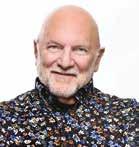
Staffan I Lindberg.
PHOTO BY PATRICK
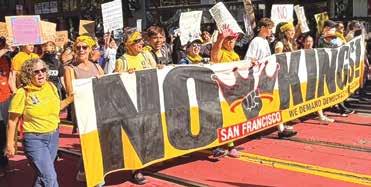
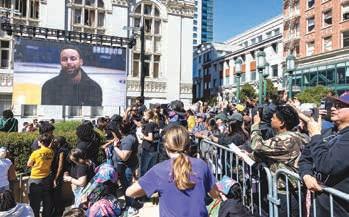
Organizers led protestors marching on Market Street on October 18, 2025 during the first No Kings March held in the Bay Area.
The Dangerous Case of Donald Trump
The book The Dangerous Case of Donald Trump: 27 Psychiatrists and Mental Health Experts Assess a President, authored by forensic and social psychiatrist Brandy Lee, concludes that President Donald Trump exhibits signs of malignant narcissism. Lee and many of the other experts define this as a mix of narcissism, antisocial personality disorder, paranoia, and sadism. Sticking just with narcissism, most of us directly know such a person who demonstrates an excessive love of self, grandiosity, a strong need for admiration, and a lack of empathy for others. Research and cultural trends suggest that narcissism is on the rise, but it may also be that narcissistic behaviors are simply becoming more visible. Narcissists frequently ascend to positions of leadership because of their high confidence, charm, and assertiveness, which can be mistaken for competence and visionary leadership. They are often raised to believe that they are born leaders and actively seek power to gain admiration and control, appearing as prototypes of leaders during uncertainty. Their ambition often outweighs their performance, yet they successfully project an image of being the best person for the job. They are also often impulsive, acting on their sudden desires and emotions—judging themselves to nearly always being superlative—with little regard to the views, feelings, and rights of others.
she remained until 2024.)
She writes: ‘Trump is now the most powerful head of state in the world, and one of the most impulsive, arrogant, ignorant, disorganized, chaotic, nihilistic, self-contradictory, self-important, and self-serving. He has his finger on the triggers of a thousand or more of the most powerful thermonuclear weapons in the world. That means he could kill more people in a few seconds than any dictator in past history has been able to kill during his entire years in power.”
Nearly 500 Attacks on LGBTQ+ People
The organization GLAAD has been monitoring President Trump’s LGBTQ+ record and history including executive orders, legislative support, nominations, and statements. Here is what has happened in just the past few days:
It seems like, every day, President Trump stoops to some new low that falls under these dangerous personality traits. After the recent death of former FBI Director Robert Mueller, Trump posted, in part, with his characteristic crass insensitivity: “Good, I’m glad he’s dead.” He previously mocked disabled New York Times reporter Serge Kovaleski, and has a long history of making derogatory, objectifying, and insulting comments about women, LGBTQ+ individuals, people of color, and more.
Narcissism is obviously nothing new, and perhaps your boss, co-worker, ex, a parent, or some other person(s) in your life exhibits related behaviors. What is changing in entities is the ability to more easily and rapidly concentrate power. This is partly due to a combination of technological advancements, economic shifts, and digital surveillance capabilities that enable unprecedented control over information, finance, and public behavior. Key factors include the rise of digital platforms that create natural monopolies, the ability to target individuals through data analytics, and the speed at which technology can be deployed to control communication and infrastructure.
Now, as forensic and social psychiatrist Brandy Lee did, consider the case of President Trump. (Lee taught at Yale Law School for 17 years while on the faculty of the Yale School of Medicine, before joining the Harvard Medical School faculty, where
- The Trump administration, citing a court ruling last year, is moving to rescind a directive to protect LGBTQ youth in the foster care system. The 2024 directive stipulated that providers affirm LGBTQ identity, receive training to support LGBTQ youth, and offer placements for LGBTQ youth that are safe and appropriate for their well-being. A proposed rule stated that the Administration for Children and Families is seeking to remove the requirements of the policy, claiming without evidence that it deters religious families from participating as foster families.
- President Trump claimed he will not sign any bills into law until Congress passes the so-called SAVE America Act, which would add restrictions on voting including showing proof of citizenship to register to vote, and showing identification that matches birth certificates, affecting every married woman who has changed her name, among others who change their name through their lifetime.
according to two recent reports tracking changes to LGBTQ data. Researchers say this is likely a conservative estimate that will grow. The majority of the changes removed gender identity demographics, although in at least 60 cases, government agencies went beyond Trump executive orders to eliminate sexual orientation data elements as well. Other changes include removing the ability for people to report harassment, discrimination, or bias based on their sexual orientation or gender identity.
To view the Trump Accountability Tracker, go to: https://bit.ly/41i3GCi
At a Critical Juncture
We have: “A republic, if you can keep it.”
–Benjamin Franklin
democracy and the future of humankind, or we lose everything. This is what Benjamin Franklin meant when he said, in 1787, that we have: ‘A republic, if you can keep it.’”
From basic human rights to environmental protections and more, so much is at stake. Protestors on March 28 will be at the rallies and marches for any number of reasons, but are united in the fight for democracy itself and the right to protest. The organizers hope that there will be a shift from “slogans to systems,” maintaining momentum through local community efforts long after March 28.
- The federal government has removed questions about sexual orientation and gender identity from at least 360 government surveys, forms, government-funded research projects, and other data collections since President Trump’s 2025 inauguration,
Lee in another work, The Psychology of Trump Contagion: An Existential Danger to American Democracy and All Humankind, writes: “There is now no more time. We have arrived at the juncture where either we face up to the challenge of our day, save our
That momentum must also carry through to elections. According to the organization Fair Vote, voter turnout in the U.S. is much lower than in other countries, hovering around 60% in presidential elections and 40% in midterm election years. As the Trump administration continues attempts to make voting more challenging—through scare tactics and tighter restrictions to supposedly prevent illegalities and interference—it is all the more important to exercise your right to vote.
The 2026 California Primary will be on June 2, and the last day to register to vote is May 18. Nationwide midterm elections will take place on November 3. It just takes 30 seconds to check your voter registration status. You can do so, and learn more about the upcoming elections, at https://www.vote.org/
“Gay amnesia!” was the response from LGBTQ+ activists to media images of candidate Donald Trump, during a 2016 rally in Greeley, Colorado.
We, the People
No Kings and Beyond
If the insanity gushing forth from The White House and Congress is bringing you down, I encourage you to look at the map on the website for the No Kings protest on March 28. From Kotzebue, Alaska, to Key West, Florida, over 3,000 No Kings protests are planned for Saturday, March 28. Communities large and small are coming together to speak up for democracy, and for a government that works for the people. Millions of Americans (and allies in other countries) will be taking to the streets to protest the authoritarian takeover of our country, and to support their communities. The cruelty and incompetence of this administration might lead you to despair, but, instead, focus on the courage, creativity, and sheer kindness of everyday people who are
going above and beyond the basics to help their neighbors, and build strong communities. This is what gives me hope, and that spirit will be on full display on March 28.
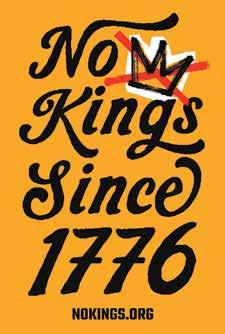
No Kings is a reminder that we, the people, ultimately hold the power to save our country from authoritarianism. Don’t miss this historic day. For information on a No Kings event near you, to receive training, to volunteer, or to support with a donation, go to: https://www.nokings.org/
And just a reminder: The No Kings events are exciting and empowering, but we must keep the work going every day, not just on No Kings days. There will be a resource fair in Civic Center Plaza at the No Kings event in San Francisco; learn how you can become more involved.
Trans Day of Visibility
Just in time for the Trans Day of Visibility (March 31), the Transgender District has released their 2025 impact report. Check it out, and see the good work that is being done here at home; you can find a link to
the report on the district’s Facebook page: https://tinyurl.com/TDIR25
The support to be found here in the Bay Area stands in stark contrast to much of the rest of our country. The ACLU’s website features an online tool that tracks anti-LGBTQ+ bills in all 50 states. Not all of them become law, thank goodness, but many of them do. Just seeing the sheer number of them tells us how hard the far right is fighting to demonize, delegitimize, and simply erase LGTBQ+ people from American life. (Seriously, don’t these lawmakers have more pressing business to attend to, like tending to the needs of their constituents?) In 2024, 533 bills were proposed. In 2025, encouraged by the virulent antiLGBTQ+, and specifically anti-trans directives coming from The White House, the number of bills rose to 616. And here we are, only three months into 2026, and there have already been 493 bills brought to state houses across the country. You can check out the ACLU bill tracker here for more details: https://tinyurl.com/ACLUtrack1
One of the most notorious is Kansas’ SB 244, the bill that was voted in (over the governor’s veto) on February 18. In a direct and vicious attack on the trans people living in Kansas (less than 1% of the population), the bill immediately invalidated the driver’s licenses of anyone whose current gender identity does not match the gender assigned
to them at birth, and limited their ability to update gender information on IDs and official records. This puts trans people at risk by forcing them to be outed against their will, and increases the possibility of facing discrimination in the workplace, when seeking housing, traveling, and much more.
But wait, there’s more! SB 244 not only restricts access to bathrooms and locker rooms in public buildings based on sex assigned at birth, but also encourages a bounty hunter mentality, allowing people to
(continued on page 12)
In Case You Missed It
Joanie Juster
Drag Queens and Self-Employment Taxes
Money Matters
Brandon Miller
It’s the early 2000s during Kentucky Derby season, and I’m dressed in full drag, water balloons handling the chest situation, when suddenly my left “breast” made a dramatic exit out the passenger side window. The soaked and extremely lopsided result was a useful reminder that, when you improvise too much, things can go sideways fast. The same is true with taxes. Stay with me here.
Professional drag performers navigate the same financial chaos every freelancer faces: unpredictable income, cash payments, Venmo tips, and receipts that would make accountants weep. At Brio, we help self-employed clients manage this kind of complexity all the time. The drag world just happens
to offer a surprisingly good framework for it.
Six Tax Lessons Every Self-Employed Drag Queen Knows
1. If it belongs on Main Street, it probably doesn’t belong on Schedule C.
One of the hardest parts of being self-employed is figuring out what actually counts as a deduction. For drag performers, wigs, costumes, and stage makeup are generally easier to justify because they exist for the performance and are not meant for ordinary daily life. The same basic principle applies across self-employment: if an expense is necessary and tied to your work, it may be deductible. That could include equipment, travel, software, supplies, or even a home office used regularly and exclusively for business.
2. Don’t get caught with your tuck undone. Performers who go pro learn fast that estimated taxes are due four times a year. Miss those payments and you’ll face penalties on top of whatever you owe, which often surprises people coming from W-2 jobs where taxes were automatically withheld.
We calculate what you owe each quarter and make sure those payments happen, so you’re not paying more than you need to.
3. In this act, you’re the star and the stage crew.
Drag involves a lot of jobs: hair, makeup,
(continued on page 12)
2026 Medi-Cal Long-Term Care in the Bay Area: Essentials for LGBTQ+ Families
Trust Essentials
Jay Greene, Esq., CPA
The New 2026 Medi-Cal Landscape
As of January 1, 2026, California reinstated the asset test for most long-term care MediCal programs. These cover nursing home and intensive in-home care.
For Bay Area residents—including seniors, couples, and chosen families—home equity and savings can now affect eligibility sooner than expected. In a region with high housing costs and complex households, this feels urgent.
With limits in place, the real challenge is practical. Apply for long-term care Medi-Cal
in a way that matches your actual household and estate plan.
Why Paperwork Matters as Much as
Planning
Good planning alone does not guarantee smooth enrollment. Incomplete or inconsistent documents can stall the process.
1. Bay Area families often manage accounts at multiple banks. Properties may span city or county lines. Household setups may not fit standard forms.
2. Illness or sudden care needs add pressure, making details easy to miss. Counties expect specific information.
3. Long-term care applications require a 30-month lookback on finances, plus detailed income, asset, identity, residency, and medical records.
4. Missing statements, unclear transfers, or vague medical notes can lead to delays or denials, even with good-faith planning.
5. A strong application starts with gathering 30 months of statements for bank, investment, and key accounts so the county sees the full picture.
6. Workers review for gifts or low-value transfers that might create penalty periods before
(continued on page 12)
Message from Leadership
Spring Into Growth With New Programs and Partnerships
By Aaron Boot-Haury
As spring arrives in the Bay Area, bringing longer days and renewed energy, the Golden Gate Business Association is experiencing a season of growth of its own. Just as the city begins to bloom, so too does our programming, expanding with new opportunities designed to educate, connect, and elevate our members and the broader LGBTQ+ business community.
In February, we proudly launched our Business Education Series with a strong and engaged turnout. Our inaugural session, led by GGBA member and President of KJS Consulting, Kate Sargent, provided valuable, practical guidance on how to leverage LinkedIn to grow your business and professional brand. It was an excellent example of the power of knowledge sharing within our community, and we are excited to continue building on that momentum.
April will be a particularly dynamic month for the GGBA, with three distinct opportunities to engage. Our Monthly Make Contact networking event will be hosted by our partners at the San Francisco Business Times on April 14, offering attendees a unique behind the scenes preview of this year’s Business of Pride issue and celebration (more on this in a bit). On April 21, we will host a GGBA Evening Salon at the San Francisco Law Library, where members can learn how to take full advantage of this valuable and often underutilized free resource. We will close out the month on April 29 with our next Business Education Series workshop, featuring Philipp Roessler, who will share practical strategies for navigating and succeeding in cross-cultural business environments.
We are energized by the expansion of our programming and remain committed to creating spaces where our members can learn, grow, and build meaningful connections. There are also active conversations taking place with other LGBTQ+ business organi-
zations in the region about collaboration and coordination of efforts to maximize our collective impact. If you are interested in sharing your expertise through a future workshop or event, we encourage you to reach out to us at ec@ggba.com
This season of growth extends beyond our monthly programming. As mentioned, we are proud to be collaborating with the San Francisco Business Times to enhance and expand the impact of their annual Business of Pride issue and awards celebration this June. This year’s event will continue to honor the Top 40 LGBTQ+ Owned Businesses and recognize OUTstanding Voices who are making a difference across our community.
In addition, we are excited to introduce two new components to this year’s celebration. The GGBA will host its first annual LGBTQ+ Business Expo, creating a platform for our members to showcase their businesses directly to corporate leaders, pro-
curement professionals, and fellow entrepreneurs. Alongside the Expo, we will also launch a new mentoring initiative designed to connect emerging entrepreneurs and growing businesses with some of the Bay Area’s most accomplished LGBTQ+ business leaders.
At the GGBA, we are deeply committed to fostering innovation, collaboration, and economic empowerment within our community. Through partnerships like this and the continued expansion of our programming, we aim to provide meaningful opportunities that help our members, and our community, thrive.
More details, including registration information for the Business Expo, mentoring program, and awards celebration, will be shared in the coming weeks. We encourage you to stay tuned and get involved.
Aaron Boot-Haury (he/him) is the President and CEO of the Golden Gate Business Association.
GGBA Member Spotlight Milo F. Hanke, CFP, of Hanke & Apolonio Wealth Advisors
Financial health so often is aligned with physical health, not just in the ability to pay for medical bills, but also in how it can promote a sense of well-being. As Milo F. Hanke, CFP, and Manny R. Apolonio, CFP, of Hanke & Apolonio Wealth Advisors share: “When your financial plan is clear, so is your peace of mind. We’re here to help you live the life you’ve worked hard for.” Their stats reveal the firm’s success, showing that they have at least $145 million assets currently under management and 120 clients nationwide. Together, Hanke and Apolonio have over 60 years of combined financial expertise.
Hanke, who is the firm’s Founding Partner, shares more about his work, how the firm has benefited from Golden Gate Business Association membership, and offers sage advice for those who are thinking of starting their own business.
GGBA: Tell us more about Hanke & Apolonio Wealth Advisors.
Milo F. Hanke: Good financial planning changes lives. We see it every day with our clients. The shift is technical and psychological, both supported within a “no-judgment zone.”
From our offices in Union Square, we serve 120 clients in the Bay Area and throughout the country. As an SEC-registered, fee-only fiduciary, Hanke & Apolonio Wealth Advisors is held to the highest standards of client care.
With clarity, clients better pursue their own vision of happiness—what they desire for self, family, and community. And they tend to have more fun. One couple, former money hoarders, now sends us postcards from abroad.
GGBA: Why did you decide to create your business?
Milo F. Hanke: In a bygone era, I had fled the corporate closet, desperate for economic survival, freedom, and dignity. Long past those slings and arrows, though, my North Star remained the same: a deep desire to develop for clients the independence I eventually built for myself through our firm. Because I am in the “future” and “capabilities” business, I must emphasize what carries me into the years ahead. This is a relationship business, a “we” business.
Together with Manny, my business partner, and Rafael Paschoal, our Manager of Operations, we are growing the firm revenue about 15 to 20 percent annually. We are also recruiting new talent to serve a growing client roster.
GGBA: Who are some of your role models, and especially those who
helped to influence your business?
Milo F. Hanke: Early in my career, I was forever influenced by Churchill C. Peters, an officemate who came to work into his nineties. I had an office at the investment firm he had opened in 1934. Church often spoke about guiding clients though the Great Depression, helping them rebuild while practicing early forms of financial planning. In 1946, a nervous client asked if the Dow Jones could stay at 200. (Recently the index surpassed 50,000.) His grounded optimism shaped how we later advised clients during the Great Recession and the COVID pandemic.
My nonagenarian mentor didn’t give a damn I was gay, particularly meaningful since I hadn’t been out to my parents. That was part of his magnanimous approach to life, an attribute that drew a diverse client base.
Church, who had driven tanks in World War I, regularly drove me home in his “Red Devil,” a garish Chrysler Imperial. On one of those rides, in a guy-to-guy manner, he asked me to keep an eye open for “young grandmas” he should meet. I miss Churchill C. Peters (1899–1993).
GGBA: Why did you decide to join the GGBA, and how long have you been a member?
Milo F. Hanke: The “gift of desperation” eventually brought me to the GGBA. I had moved to San Francisco, sight unseen, to
come out. That meant starting my own business, and GGBA encapsulated that quest.
The very first business card I handed out was at the GGBA’s tenth anniversary dinner in 1984. I sat at a dinner table hosted by a sign maker who later become my state senator, Mark Leno.
(continued on page 20)
Milo F. Hanke
Rafael Paschoal, Milo F. Hanke, and Manny R. Apolonio
Anjali Rimi: A Spark to Serve
The Philanthropic Mindset
(Editor’s Note: Tom LeNoble, as SF Pride’s Suzanne Ford shares, “has lived a big life.” He has held senior leadership roles at several of the nation’s top companies, co-founded the Taranga L.W. Foundation, been a drag queen and performer, and is a longtime HIV/AIDS and cancer thriver. Now a confidential advisor to founders and leaders, he is the author of an award-winning memoir: My Life in Business Suits, Hospital Gowns, and High Heels. This issue marks the launch of his new column in the San Francisco Bay Times, The Philanthropic Mindset.)
San Francisco is known for many things: innovation that reshapes industries, technology that changes how the world connects, entrepreneurs who build ideas into companies, artists who redefine culture, and neighborhoods filled with history, vibrant diversity,
and creative energy. It is a city comfortable with bold ideas. Yet, some of the most important work happening here rarely makes headlines. It happens in community centers, classrooms, shelters, rehearsal halls, health clinics, and neighborhood organizations across the Bay Area. It is the quiet work of people who choose to care. That choice is what I call The Philanthropic Mindset.
Most people think philanthropy begins with money, a check, a gala, or a name on a building. And sometimes it does, but the deeper truth is simpler. Philanthropy often begins with attention; a smile, a hello, or opening a door can be philanthropic gesture. It begins when someone notices a need and decides that indifference is not their role.
This monthly column explores that mindset through conversations with executive directors and leaders of Bay Area nonprofit organizations. It is not meant to promote their organizations, but to explore something more personal: the moment their commitment began.
Every leader in the nonprofit world carries a story behind their work: a moment that shifted their direction, a person who inspired them, or an experience that made standing on the sidelines impossible. Each month we will explore that story, because when we understand why people choose to serve, we
begin to see that philanthropy is not reserved for institutions or foundations. It belongs to people.
This month we are exploring the Philanthropic Mindset with Anjali Rimi, President of Parivar Bay Area.
Since 2018, Parivar Bay Area has been the first and only U.S. Kinnar Hijra-led and empowering organization centering Indian South Asian and Global South transgender, gender-diverse, and intersex immigrants and asylees. Based in San Francisco and with a global mindset, Parivar Bay Area is rooted in Indian heritage, trans leadership, and immigrant justice. It advances social, economic, and legal equity through advocacy, arts, direct support, and leadership development. Parivar aims to reclaim spaces beyond cisnormativity, confront systemic barriers, and build bold, affirming pathways where our communities thrive locally and globally grounded in dignity, belonging, and pride.
Tom LeNoble: What first opened your eyes to the work you now do?
Anjali Rimi: The struggle, suffering, and desperation that continued for folks with my same intersexual journey even twenty years after my experience. This got me to stand up and stop being on the sidelines.
Tom LeNoble: Was there a moment when helping others stopped being an idea and became a commitment?
Anjali Rimi: The idea of helping someone was instilled in me in the way I was brought up. It’s in my DNA. My inflection point was when I saw one of my trans daughters, an aspiring medical student, die trying to gain treatment access during the COVID pandemic. Then, locally, around the same time seeing a Kinnar matriarch in our community be robbed of her employment wages—observing how a society that claims to be progressive was disowning her and disapproving of her existence. It was a catalyst to get involved.
Tom LeNoble: Who modeled generosity for you growing up?
Anjali Rimi: Many folks, most with maternal influence. It started with my mother who was a victim of violence on the domestic front, yet she gave generously through loads of love and self-care. Also, from the ancestors at a temple near where I grew up in India. Finally, the leaders in San Francisco who do this work when they don’t have to.
Tom LeNoble: What keeps you hopeful when the work becomes hard?
Anjali Rimi: The smiles. The smile on someone who receives help. The belonging that someone finds in their home community. The ultimate gratification is to see that
someone is building a sustainable livelihood, has a stable immigration status, and is receiving respect. That keeps me focused on this work. I face headwinds, but I take the hate that comes my way and I three times it and turn it into love.
Tom LeNoble: And perhaps the most revealing question of all. If you were not doing this work, what would the world be missing?
Anjali Rimi: I am not indispensable. I am not the only leader doing this work. I bring a unique perspective of someone who has been on both sides of the policy line. I bring affirming and strong understanding of what it brings to blend the global south with the global north being from India, an immigrant, a woman, and a Kinnar. I am a successful public servant serving my community as a leader and as trans person in the United States of America. Hence, I hold with humility and responsibility these unique perspectives having been first on many fronts. These perspectives can change minds.
Tom LeNoble: What do most people misunderstand about this work?
Anjali Rimi: Folks think we are doing this work for a photo opportunity or for philanthropic social standing. The unsung heroes and leaders are doing this work because we want to make it better for someone else. It is misunderstood that those of us on the margins need to go through traumatic, violent, and unforgiving situations to be in a better place today. It is a misunderstanding that, because we are trans, an immigrant, and Brown, that we are supposed to suffer and survive before we thrive.
Tom LeNoble: What is unique about doing this work in the Bay Area?
(continued on page 9)
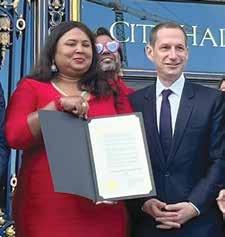
Anjali Rimi holds a proclamation from the City of San Francisco presented by Mayor Daniel Lurie.
Tom LeNoble
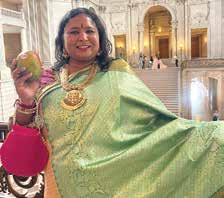
Anjali Rimi at San Francisco City Hall for a South Asian American Heritage Month celebration in July 2025
Photos courtesy of Anjali Rimi
Why Do Probates and Trust Administrations Take So Long in California?
By Deb L. Kinney
A loved one has died. The family is grieving. There is a trust, or a will, or maybe both. Families often expect that settling the estate will be relatively straightforward. Everyone knows roughly what is supposed to happen. And yet months pass, then a year, then two—and the estate still isn’t closed. Bills keep arriving. The house sits vacant. Beneficiaries are still waiting on their gifts.
This is not how it should work. And, frankly, it is a big part of why I started TrustParency PC.
Many assume assets will be distributed within a few months. In California, however, both probate cases and trust administrations frequently take a year or more, and sometimes significantly longer. Probates are necessary if: 1) someone has only executed a will or 2) has not done their estate planning. Trust administrations tend to take less time as the estate is not subject to the court requirements, but the process still requires time and patience. Delay has a price. Moving efficiently is not just a quality-of-life issue for the family; it is a fiduciary responsibility.
It took me years of doing this work to figure out why the Courts take so long, but once I realized that there are 40M people living in California with approximately 300,000 people passing each year I understood. As baby boomers age, this number is expected to get to 500,000 deaths per year. Those actuarial
(continued from pg 8)
Anjali Rimi: The Bay Area is a haven for all those who are very much part of humankind but may not be treated well elsewhere in this country or world. When we come to the Bay Area, we carry an intrinsic welcoming that this land offers, even if it is stolen land from the Ohlone folks.
It has affirmed my identity as a lone Kinnar leader, as a minority who is a Hindu, and as a woman. These identities have been collectively celebrated and uplifted in the Bay Area. I can’t fathom this happening anywhere else in this country at this moment.
The Bay Area is powerful in bringing us together as a community that can build collective trends and collective liberation to help each other out across identity, gender, cast, class, religion, and spaces.
Tom LeNoble: How has this work changed you personally?
Anjali Rimi: This work is hard! It has required me to grow over the years, to understand there is a balance to be achieved between helping someone and letting them consider you as their chosen family. I am a conduit to helping people on their journey whether about gender or as a migrant. It has helped me to be more strategic and organized in how I am able to scale and support thousands of people as a mortal, single, breathing human being. It has helped me understand the disparities in the system at large and how to overcome that in the reactive mode I need to be in when helping an individual.
numbers, combined with the reduction of budgets to the State Courts, indicates that estate settlement will even take longer and cause even more frustration for heirs.
Why I Started TrustParency PC
I built TrustParency PC around a few simple beliefs: Transparency is a very helpful tool in many cases. If each of the kids is to get 1/3 of the estate, there is no reason to hide what the estate is worth and how the process is going. Also, estate administration should not feel like a black box for the person nominated as trustee or executor. Families going through the loss of a loved one deserve a process that is organized, communicative, and as efficient as the law allows.
That means using technology thoughtfully— not as a gimmick, but as a genuine tool for keeping matters on track, sharing updates with beneficiaries, managing deadlines, and making sure nothing falls through the cracks. It means having the right network of providers in place from the beginning: appraisers, estate sale professionals, CPAs, and real estate agents who understand the specific demands of estate work. And it means treating com-
Tom LeNoble: What would surprise people most about you outside of this work?
Anjali Rimi: People are surprised to hear I’m a dirt bike and avid motorcycle rider. I love speed. I even rode my motorcycle in SF Pride leading the Dykes on Bikes in my Indian outfits.
Tom LeNoble: If you had an unexpected free day in San Francisco, where would you go?
Anjali Rimi: I would go around the whole city and taste all the ice cream and gelato places. I’d start naming a flavor for my communities, trans, Kinnar, and migrant. No doubt every flavor has been touched by an immigrant.
Tom LeNoble: Thank you, and readers, for joining me. I’ll see you here next month as we explore The Philanthropic Mindset of another Bay Area nonprofit leader.
Tom LeNoble is an international speaker, confidential advisor, and resilience strategist who works with leaders navigating meaningful inflection points in life and leadership. He has held senior leadership roles at MCI, Walmart.com, Palm, and Facebook, and high growth startups. He is the author of the award-winning memoir “My Life in Business Suits, Hospital Gowns, and High Heels.” Through speaking, coaching, and writing, he explores resilience, leadership, and the choices that shape how we show up for others and for the communities we serve.
munication with beneficiaries, not as an afterthought, but as a core part of the job. Legitimate delays can sometimes be caused by family disputes or complex assets; however, we have found that transparency and clarity can often assuage even the most skeptical beneficiary and eliminate having to lawyer up to preserve an interest.
A Word for Our LGBTQ Community
In the Bay Area’s LGBTQ community, estate administration can carry an extra layer of complexity. Many of our clients spent years—sometimes decades—building lives and families without the legal protections that marriage provides. Even for those who are now married, assets acquired before marriage, separate trusts, and chosen-family relationships that don’t fit neatly into legal categories can make administration more complicated.
We see families where a surviving partner of thirty, forty, or fifty years is navigating a process alongside biological relatives they barely know. We see married couples who never updated their documents. We see estates where the decedent’s wishes were clear to everyone in their life—and yet the document doesn’t quite reflect it. Although good estate planning can address these issues, human dynamics and grief are real.
The Probate Process Is Built to Protect Creditors and Beneficiaries
One of the primary reasons probate takes
time in California is that the system is designed to protect everyone with a legal interest in the estate. Probate is a court-supervised process that ensures the decedent’s debts are paid, assets are properly identified and valued, and beneficiaries receive the distributions to which they are entitled.
Trust administrations still have protections built in; however, the parties can often waive certain provisions if they choose or agree to move certain aspects along, like selling real estate without having to wait for court confirmation.
The families we work with often focus on the emotional toll of a prolonged administration—and that toll is real and significant. But the financial costs of unnecessary delay are also worth naming plainly.
Carrying costs of real property including reassessments of real property taxes accumulate, month after month. Assets sitting in estate accounts, rather than being distributed to beneficiaries, may miss investment opportunities or generate unnecessary taxable income. In some cases, delay in distributing assets can require additional interest payments that earlier action might have minimized. And when administration drags on long enough to become contentious, the cost
(continued on page 12)
LENOBLE
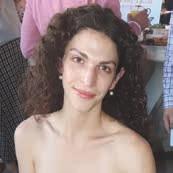
I’m a Young Transgender Woman Who is Thriving and Who Owes So Much to My Elders
By Chazzie Grosshandler
If there is one truth I’ve learned in my 19 years of life, it’s this: Stories matter. They often move people to think differently, so here’s mine. My name is Chazzie Grosshandler (she/her), and I’m currently a freshman at the University of Arizona studying political science with a dual emphasis in prelaw & public policy and a minor in Spanish. One day, I hope to become a policymaker. I have a huge passion for learning how to make the lives of those around me the best they can be through the levers of law and government.
I’m also a proud transgender woman and have lived my true authentic life as a woman for a decade now. When I was asked by two remarkable leaders and mentors—philanthropist, film producer, and interior designer Robert Holgate; and consultant and former Walter & Elise Haas Fund Executive Director Pam David—if I wanted to speak, along with my parents, about my family’s journey at the upcoming Alvin H. Baum Memorial Speaker Series at The University of San Francisco, in honor of Robert’s late husband Al (who, along with Pam, is from the same place I’m from, Highland Park, Illinois!) I told them I would be honored to do this.
Growing up, I always knew I was different from kids my age. I grew up in a household with my parents and three older brothers. Our family was known as the family of “four boys.” At age two, my favorite pastime was dancing in the kitchen wearing princess dresses with white T-shirts on my head like they were hair. I would wear these T-shirts everywhere ... the park, the grocery store, and I would even sleep in them! My parents saw this behavior evolving over time. And, while they were confused, they prioritized above all else the health and happiness of their kids.
Through the years, I gravitated to more stereotypical girl things like dolls, dresses, and sparkly clothes. This remained status quo until one morning in fourth grade. I remember it like it was yesterday. I was getting ready to go to school, and I came to my parents hysterically crying. They bent down to my height and said to me, “Honey, what’s wrong? Why are you so sad?” And I told them—with the hugest pit in my stomach—“I’m not just a boy who likes girly things. I am a girl, and I want you to know that.” I remember looking up at the faces of my parents, wondering what was going to happen to me. My parents looked at me, wiped away my tears, and said, “Honey, we believe you. We believe you. And we will do everything in our power to make sure you have the best life ever.”
That moment started our family down the greatest path. My parents saw how few resources there were for me, and for our family. We decided we wanted to try and help people on a national level understand that transgender and nonbinary kids are just like all other kids, so we started a storytelling
nonprofit with our dear friend Gearah Goldstein (she’s Auntie GG to me) called The GenderCool Project: https://gendercool.org/
GenderCool launched in 2017 with a simple mission: help replace misinformed opinions with positive experiences meeting transgender and nonbinary youth who are living their best lives.
Our work is now driven by 20 of my peers who live across the country. We are future teachers, doctors, elected officials, software engineers, and more. We’ve regularly appeared in national media, worked with forward-looking companies and even The White House (with its former occupant, of course). As “GenderCool Champions,” we are continuing to change hearts and minds, one calm, positive conversation at a time. I am deeply aware that none of this would be possible without those who’ve come before me. I must continue to give respect and voice to my LGBTQ+ elders, including the beautiful Black and Brown transgender women who sacrificed so much so I can thrive as myself: Stonewall leaders like Marsha P. Johnson and Sylvia Rivera, Chicago legend “Momma Gloria,” my dear
friend Elise Malary, who left us too soon, and my mentor, Commissioner Precious Brady-Davis, the first Black transgender woman to be elected and then reelected to office in my state.
I’m also so grateful to have had experiences with leaders of SAGE (Services & Advocacy for LGBTQ+ Elders), a national advocacy organization showcasing the lives of our proud LGBTQ+ elders. I was 13 years old when I heard about SAGE and was able to work with many LGBTQ+ elders, sharing my story and learning from them. I was overcome with emotion to hear the moving stories of these elders who paved so many rough roads so that my life could be easier. The truth is there are millions of young transgender and nonbinary people just like me in communities everywhere and in every corner of the world. My generation will not stop until all have equal opportunities to build the lives we were meant to have. Transgender and nonbinary people are here to stay. We are loved by our families, our friends, and our communities. We will keep living our lives with pride, honoring our elders every step of the way!
I feel so excited to be speaking at this meaningful memorial lecture series. I so wish I could’ve met Al. He was surely incredible from all the stories I’ve heard from his hus-
band, Robert, friends, and the community. The work he did to address the AIDS crisis, through supporting programs, policies, and communities, saved countless lives. I’m proud of him. And I hope to make him, Robert, Pam, and Camille Shira Angel (University of San Francisco Rabbi and Professor of Jewish Studies and Social Justice) proud when it’s my turn to take the baton.
The Alvin H. Baum Memorial Lecture Series
Sunday, April 19, 6:30 to 8 pm University of San Francisco, Xavier Auditorium, Fromm Hall
650 Parker Street
(Adjacent to St. Ignatius Church)
Chazzie Grosshandler (she/her) is a 19-yearold freshman studying political science and law with a minor in Spanish at the University of Arizona. She is a nationally-known advocate and the inspiration behind The GenderCool Project, a positivity-forward storytelling campaign helping people evolve their opinions by meeting transgender and nonbinary young people who are living their best lives. A GLAAD 20 under 20, she has been featured in national media including “TODAY,” “Good Morning America,” “Teen Vogue,” “USA Today,” AP, and ABC/Hulu, among other platforms. Loved by her parents and three older brothers, her dream is to become a policymaker to improve the lives of those around her so that they, too, can thrive.
Photos courtesy of The GenderCool Project
Chazzie Grosshandler with her parents John and Jennifer
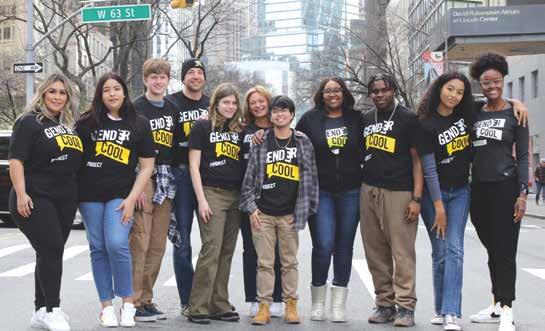
Leaders of The GenderCool Project and their parents in New York City for the filming of the 2023 ABC News special Our America: Who I’m Meant To Be
Dr. Marcy Adelman, a clinical psychologist, LGBTQ+ aging consultant, and policy advisor, oversees the San Francisco Bay Times Aging in Community column.
Alegre Home Care is proud to support Dr. Marcy Adelman’s Aging in Community column in the San Francisco Bay Times
The Fifth Annual Alvin H. Baum, Jr. Memorial Lecture
Delivered by GenderCool
“Positivity is Omnipotent: One Jewish Family’s Human Approach to Building Support for Transgender Youth”
SUNDAY,APRIL 19 • 6:30 PM–8:00 PM
Xavier Auditorium, Fromm Hall
650 Parker Street (Adjacent to St. Ignatius Church)
Our 5th annual Alvin H. Baum, Jr. Memorial lecture spotlights the GenderCool Project, a youth-led movement helping to replace misinformed opinions with positive experiences meeting transgender and non-binary young people who are living their best lives.
GenderCool was inspired by the powerful, positive story of one family. Known as an inspiring disrupter, this storytelling campaign is breaking through to millions of people who say they’ve never met a transgender or nonbinary young person.
We will also meet the recipient(s) of this year’s Robert Holgate Pride Fellowship Award in Queering Religion at the University of San Francisco.
file lawsuits for “damages” of at least $1,000 if they believe they have shared a bathroom with a transgender person. All of which is to say: the Trans Day of Visibility is needed more than ever. It is harder to demonize people once you get to know them. Visibility matters.
TDOV is commemorated each March 31 to celebrate the history and accomplishments of trans people, acknowledge their contributions to society, and raise awareness of the discrimination and challenges they face every day. There are a variety of events planned in the Bay Area, including a TDOV Festival on Sunday, March 29, from 3–5 pm in Boeddeker Park (246 Eddy Street, San Francisco). The festival promises live performances, music, and family-friendly fun. More info:
https://tinyurl.com/TDOVSF
Save the Dates
Our community organizations that support people with HIV/AIDS are under attack. Budgets are being slashed, and services will be diminished. Every day is a good day to support the organizations that serve this community, but here are two dates to add to your calendar: Dining Out for Life on April 16 supports the San Francisco AIDS Foundation and Project Open Hand.
https://tinyurl.com/DOFL26
And AIDS Walk San Francisco will be celebrating its 40th anniversary on July 19. Come out and support!
https://sf.aidswalk.net/
Joanie Juster is a long-time community volunteer, activist, and ally.
GREENE (continued from pg 6)
coverage starts.
(continued from pg 6)
wardrobe, booking, promotion, and cleanup. Self-employment works that way, too. When you work for yourself, there’s no employer covering part of your payroll taxes, which means you are responsible for the full self-employment tax. That tax is currently 15.3% of net self-employment income, on top of regular income tax. For people new to independent work, this is often the number that changes how they think about cash flow. On the plus side, half of that self-employment tax can be deducted when calculating adjusted gross income!
4. No queen relies on next week’s gig to pay last week’s bills.
Charisma can cover a lot on stage, but it can’t replace preparation. You still need the look, the timing, and the track ready to go before the music starts. Taxes are no different: you need to save ahead of time and be prepared to pay those tax bills. When income comes in unevenly, it’s easy to tell yourself you’ll save for those eventual tax payments once things settle down or once the next check hits. But tax money tends to disappear when it sits in the same pool as everything else. That’s why we help you build an intentional system, where we set aside a percentage of income as it comes in based on what you’re likely to owe.
5. Keep the glitter in one pocket, receipts in another.
Mixing personal and business finances is like throwing wigs, receipts, and loose glitter into one bag. A dedicated business checking account makes tracking dramatically easier, creates a clear paper trail, and eliminates the “was that personal or business” headache. We help you set this up so there’s no heavy lifting required. For most self-employed peo-
Understanding this window early helps decide which transactions need explanation. Discuss with an attorney before filing, if needed. Trusts, Transfers, and Telling a Clear Story Trusts and planning tools become part of the county’s review. If you funded a trust, refinanced property, or shifted ownership in the 30-month window, document and review those before applying. Show transfers as legitimate parts of a broader plan, done at fair market value when appropriate—not last-minute asset hiding. When trust language, financial statements, and the application align, caseworkers can follow your story easily.
Applications also require proof of income, current assets, identification, and California residency. Include benefit letters, property records, account statements, IDs, leases, or utility bills.
Medical Records and Long-Term Care Need
Medical records carry equal weight in long-term care cases. Doctors’ notes and care plans must explain why you need skilled nursing or in-home services at Medi-Cal levels, not just list diagnoses. Vague documentation makes approval hard under governing rules. Clear descriptions of needs ease review and reduce back-and-forth. If using a revocable living trust, align trust schedules and asset lists with county information. Matching records make the application coherent.
How Bay Area Applications Are Filed and Reviewed
Most file online through BenefitsCal, by mail, or in person at county human services agencies. San Francisco’s Human Services Agency and nearby offices handle local cases.
Processing takes 30 to 45 days usually. Disability or complex cases
ple, a separate business checking account is one of the simplest improvements they can make. Pair that with a basic bookkeeping system, and suddenly income and expenses are easier to categorize, review, and explain. Good records are not glamorous, but they make everything downstream easier.
6. The best looks don’t happen on accident. Performers who’ve been at this a while aren’t stressed about taxes because they know their numbers: what they’ve earned, spent, can deduct, and roughly what they’ll owe. That’s not magic; it’s preparation. That’s what we do for you, all year long.
You don’t have to be a drag queen (or have launched a water balloon out of a moving vehicle) to take these lessons seriously. If you’re self-employed or earning income outside of a traditional W-2, these principles apply directly to you. That’s the work we do at Brio: We help self-employed clients understand their tax exposure, organize the moving pieces, and build a system that works before deadlines hit.
The finale’s better when you’re not stressed about the numbers. Book a complimentary Make It Happen meeting and let’s build your system.
This material presented by Brio Financial Group (“Brio”) is for informational purposes only and is not intended to serve as a substitute for personalized investment advice or as a recommendation or solicitation of any particular security, strategy, or investment product. Facts presented have been obtained from sources believed to be reliable, however Brio cannot guarantee the accuracy or completeness of such information, and certain information presented here may have been condensed or summa-
may take longer.
Counties often request missing statements, transfer explanations, or updated medicals. Meet deadlines to keep your case moving.
Next Steps for LGBTQ+ and Allied Families
For LGBTQ+ and allied families, tailored trusts, updated paperwork, and prepared applications preserve autonomy, protect housing, and secure care in the expensive Bay Area. This matters for those relying on partners or chosen family.
Treat paperwork as core planning, not a crisis task. If long-term care looms, gather statements, review your trust or estate plan, and clarify household details this year—before health issues force rushed decisions.
A consultation can show how 2026 rules and trusts fit your situation. Contact Greene Law Firm, P.C. today. Call 415-905-0215 or email info@greenelawfirm.com— free initial assessment.
Statements in Compliance With California Rules of Professional Conduct
The materials in this article are for educational purposes only and are not legal advice. Consult an estate planning attorney for personalized guidance. Attorney Jay Patrick Greene, Esq., CPA, founded Greene Law Firm, P.C., which is licensed in California, Alabama, and Florida. He has over 15 years of experience in wills, trusts, probate, elder law, and asset protection. For more information, visit https://www.assetprotectionbayarea.com/
rized from its original source. This information may contain certain statements that may be deemed forward-looking statements. Please note that any such statements are not guarantees of any future performance, and actual results or developments may differ materially from those discussed. No investor should assume future performance will be profitable or equal the previous reflected performance. Any reference to an index is included for illustrative purposes only, as an index is not a security in which an investment can be made. They are unmanaged vehicles that serve as market indicators and do not account for the deduction of management fees and/or transaction costs generally associated with investable products. The S&P 500 Total Return Index represents U.S. stock returns. This includes 500 leading companies in the U.S. and is widely regarded as the best single gauge of large-cap U.S. equities, where dividends are reinvested. The holdings and performance of Brio client accounts may vary widely from those of the presented indices. Brio does not provide legal or tax advice, and nothing contained in these materials should be taken as legal or tax advice. Advisory services are only offered to clients or prospective clients where Brio and its representatives are properly licensed or exempt from licensure. No advice may be rendered by Brio Financial Group unless a client service agreement is in place.
Brandon Miller, CFP®, is a financial consultant at Brio Financial Group in San Francisco, specializing in helping LGBT individuals and families plan and achieve their financial goals. For more information: https://www.briofg.com/
(continued from pg 9)
of attorney fees—for both the trustee and the beneficiaries who eventually hire their own counsel—can erode the estate substantially.
What Good Administration Actually Looks Like
In a well-run estate administration, beneficiaries receive regular updates. They know what has been done, what is pending, and what to expect next. The trustee or executor is supported by professionals who handle their respective pieces efficiently. Tax obligations are identified early and addressed proactively. Personal property decisions are made with clear guidance rather than left to fester. And the whole process moves, not recklessly, but purposefully. This is achievable. It requires organization, communication, and a team that knows what it is doing. It does not require years of silence and frustration.
If you are a beneficiary wondering why nothing seems to be moving, or a trustee or executor feeling overwhelmed by the scope of what you have taken on, we would welcome a conversation. Estate administration does not have to be this hard—and with the right support, it usually isn’t.
Deb L. Kinney is a California attorney and founder of TrustParency PC, a Bay Area law firm focused on trust administration, probate, and estate planning. TrustParency serves clients throughout the San Francisco Bay Area, including San Francisco, Emeryville, and Marin County. Learn more at https://trust-parency.com/ or call 415-429-1290.
KINNEY
IN MEMORIAM
Former San Francisco Bay Times Columnist and City Commissioner Andrea Shorter
Andrea Shorter, a former San Francisco Bay Times columnist, longtime Commissioner on the San Francisco Commission on the Status of Women, and a revered LGBTQ+ activist, passed earlier this month, according to a statement released by her brother Lawrence Shorter. She was 60.
On March 22, 2026, he wrote: “It is with deep sadness that we share the passing of our beloved daughter, sister, auntie, partner, and friend, Andrea Shorter. She passed peacefully earlier this week, and we are still processing this profound loss. Andrea’s impact on her community and all who knew her was deep and lasting. We will be sharing details soon for a memorial to honor her life and the work she cared so deeply about. At this time, we ask for grace and privacy for our family and close friends as we begin to navigate this loss. Thank you for your love, support, and understanding.”
As an out Black lesbian, she described her life as being “a vigorous expression of the power of diversity at the intersections of race, gender, class, and sexual orientation.” She engaged in a dynamic and unique fusion of scrappy grassroots organizing, innovative nonprofit development, and dedicated public service.
Originally from Indianapolis, Indiana, Shorter grew up in the Inland Empire, and graduated from Whittier College with a B.A. in sociology in 1988. After college she worked for the California Assembly Legislature in Riverside County before eventually moving to San Francisco, drawn by the city’s LGBTQ+ community.
Her many achievements include co-founding the Bayard Rustin Coalition, serving as Director of the “And Marriage For All” public education campaign that helped achieve nationwide same-sex marriage equality, serving on the boards of the San Francisco LGBT Center and the Alice B. Toklas LGBTQ Democratic Club, serving for 20 years as a Commissioner (including President) of the Commission on the Status of Women, and being honored as a Grand Marshal of the SF Pride Parade.
In 1996, she was appointed by former Mayor Willie L. Brown, Jr., to the Board of Trustees of the San Francisco Community College District. At the time, Shorter was one of only three Black LGBTQ+ community college trustees in the nation. In 2009, she was awarded a prestigious Bohnett Fellowship for outstanding LGBTQ+ leaders to attend the Harvard Kennedy School’s Senior Executives in State and Local Government program. The following year, 2010, she was appointed by then Mayor Gavin Newsom to co-chair San Francisco’s census outreach committee during the bureau’s historic first attempt to count LGBTQ+ households.
In more recent years, she wrote the column “Cross Currents” for the San Francisco Bay Times, served as a strategic consultant, and was the Chief Executive of Atlas Leadership Strategies.
She was devoted to her family and served as a caregiver for relatives, particularly during the COVID pandemic. “I remain inspired by my late father’s love of learning, debate, and pride in the African American diaspora up from slavery,” she told the Bay Times. “I marvel at what he would have thought of Barack Obama as the first Black President of the United States, and Kamala Harris as the U.S. Vice President.”
Numerous tributes to her continue to come in, including this statement from the Bayard Rustin Coalition: “We lost a guiding light last week.
Our dear friend and community sister Andrea Shorter gave the Bayard Rustin Coalition its name during a small gathering overlooking Lake Merritt, a moment that shaped our path forward. Andrea believed deeply in coalition, in dignity, and in the quiet power of people working together for justice. Her spirit remains part of our foundation, and her guiding light continues in the work.”
PHOTO BY RINK PHOTO BY RINK
Andrea Shorter with her brother Lawrence
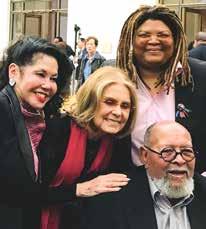
Janice Mirikitani, Gloria Steinem, Andrea Shorter, and Cecil Williams
Andrea Shorter and her mother
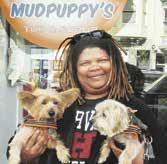
Andrea Shorter and two canine companions at Mudpuppy’s Castro
San Francisco Mayor London Breed and Commissioner Andrea Shorter
Andrea Shorter and Representative Barney Frank
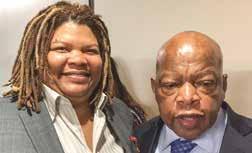
Andrea Shorter and Representative John Lewis
Andrea Shorter and Vice President Kamala Harris
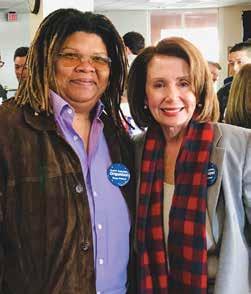
Andrea Shorter and Speaker Nancy Pelosi
Andrea Shorter and District Attorney Brooke Jenkins
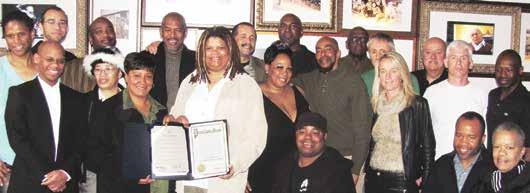
Leaders and supporters of the Bayard Rustin Coalition, including Andrea Shorter, displaying a proclamation during A Celebration of the Centennial of Bayard Rustin (2012)
Oakland City Council Reaffirms Commitment to Gender-Affirming Care
The Oakland City Council on March 16, 2026, passed a resolution to protect the rights of transgender, gender-nonconforming, intersex, and Two-Spirit (TGNCI2S) residents to access medically necessary healthcare. The resolution was introduced by At-Large Oakland Councilmember and San Francisco Bay Times columnist Rowena Brown along with Councilmembers Zac Unger and Charlene Wang.
The resolution responds to recent federal proposals to strip Medicare and Medicaid funding from hospitals providing gender-affirming care to youth. It also addresses local shifts in care, noting that, as of August 2025, Kaiser Oakland no longer provides gender-affirming surgeries for patients under 19.
“Gender-affirming care is life-saving care,” said Councilmember Unger. “Our health-
care providers must not crumble under Trump administration pressure. By safeguarding this care, we are reaffirming a community that values the wellbeing of all its residents.”
“At a time when the federal government is rolling back long-standing protections for the LGBTQ+ community, I strongly support this resolution reaffirming the importance of gender-affirming care in Oakland” said Councilmember Brown. “As a proud member of the LGBTQ+ community, I know firsthand how important it is that our city continues to defend the rights, dignity, and healthcare access of transgender and gender non-conforming people. As Oaklanders, we must do everything in our power to ensure that transgender and gender non-conforming individuals can live safely, exist freely, and thrive in our community. The resilience
of the LGBTQ+ community during these challenging times is deeply inspiring, and I am proud to continue the fight for a more just future for LGBTQ+ youth in Oakland and beyond.”
Key Actions of the Resolution
Demands Compliance: Healthcare providers and insurers must adhere to California laws, including the Unruh Civil Rights Act, which prohibits discrimination based on gender identity.
Condemns Preemptive Restrictions: The Council condemns providers for stopping or delaying state-protected care before any final, legally binding federal rules are implemented.
Supports State Advocacy: Oakland officially aligns with California
Bonta’s legal challenges against federal efforts to limit healthcare access.
Protest Held in Washington, D.C., by the Save HIV Funding Campaign
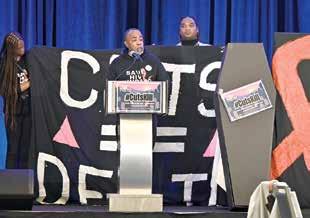
Long-term HIV survivors, health advocates, community health providers, and faith leaders gathered on March 16, 2026, in Washington, D.C., to hold a symbolic funeral protest and celebration of life service to sound the alarm over the growing instability in HIV prevention and care funding across the United States, and the impact on America’s national healthcare infrastructure. The event was organized by the Save HIV Funding Campaign and was held at the Renaissance Arlington Capital View Hotel.
Speakers and participants included Rev. Elder Carmarion D. Anderson, Minister for Congregational Leadership, United Church of Christ National Ministries; Jeremiah Johnson, Save HIV Funding Campaign Co-Founder and Executive Director of PrEP4All, who acted as the day’s “funeral director”; and Maxx Boykin, Campaign Manager for the Save HIV Funding Campaign. Additional speakers included Vincent Crisostomo, Director of Aging Services, San Francisco AIDS Foundation in
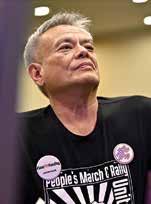
California; and San Francisco-based author and activist Paul Aguilar.
The speakers emphasized that the systems supporting HIV prevention, treatment, and care were built with bipartisan support over decades. They warned that weakening these programs not only puts vulnerable communities at risk but also dismantles a public health model pioneered by the HIV response that has guided how the U.S. responds to large-scale health emergencies.
https://savehivfunding.org/
Attorney General Rob
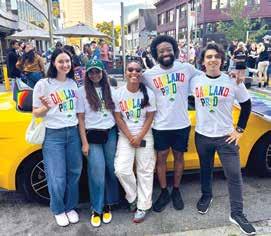
Oakland Councilmember Rowena Brown (center) with friends and colleagues at Oakland Pride 2025
Vincent Crisostomo
Photos courtesy of San Francisco AIDS Foundation
Troy Brunét: The Quiet Force Who Makes Love Visible
Practice Makes Love Easy
Some people lead with volume. Others lead with velocity. But, every so often, a leader emerges who leads with presence—the kind of grounded, generous presence that steadies a room, lifts a community, and reminds us that love is not a theory. Love is a practice. And practice, as we say, makes love easy.
Troy Brunét is that kind of leader. For years, Troy has been a stabilizing heartbeat in our LGBTQ+ and leather communities—never demanding the spotlight, yet always illuminating the path. His leadership is not transactional; it is relational. He shows up, not because it is convenient, but because it is right. And, in a world where so many people are performing care, Troy is one of the rare ones who actually practices it. For these reasons, it is my ultimate honor to recognize Troy Brunét as the fourteenth individual highlighted in this column.
Kippy Marks: How long have you been involved with the practicing of PMLE (Practice Makes Love Easy) values in your work?
Troy Brunét: I’ve always had that type of practice in my life from a young age from my parents, and it’s just rolled over into everything else that I do. It’s easier to be kind than it is to be mean and rude to people. That takes too much energy and no one should want to have negative energy spinning off into the world. There’s already enough negativity living in the world today. I prefer to share some joy to help bring some peace to someone’s day. Plus, it makes my day better and easier to get through.
Kippy Marks: Who or what motivated you to become the community activist you are today?
Troy Brunét: My parents were active community leaders, and, as some would say, “movers and shakers” in everything they did. With grace. Also, I’ve been blessed to be able to get the things that I’ve needed. Now, don’t get me wrong; life has not always been easy or bright and shiny, but I’ve always tried my best to get through it all as best I can. I’ve had battle after battle and am grateful to be able to rise up from them all. Thirty-two years ago. I found out I was HIV positive and thought I was on my way out of this world, but God had other plans for me. Nothing easy, but very challenging, for sure. Well, 26 years ago I went through the experience of having pneumocystis pneumonia (PCP), which is a serious, often fatal lung
infection caused by the fungus Pneumocystis jirovecii, primarily affecting individuals with compromised immune systems, such as those with HIV/AIDS, cancer, or organ transplants. It presents with fever, dry cough, severe fatigue, and difficulty breathing. I was blessed to have Dr. Judith Luce and her husband Dr. Jon Luce at San Francisco General Hospital care for me through a long battle fighting for my life. At that time, it wasn’t called Zuckerberg, San Francisco, General Hospital. I was in a coma for two months, in the hospital for almost four months, and then in recovery for a year plus from that. Then, I found out I have a vascular necrosis, which is deterioration of the bone, and with 19 surgeries later, I still stand. I’ve had hip replacement surgery. I’ve had both of my knees replaced. I’ve had three shoulder replacements—two on the left one and one on the right so far—three back surgeries and one foot surgery, yet there’s more to come. With all of that, there were agencies that helped me get back on my feet after the PCP/coma times that helped in ways that I can’t say enough times ... thank you.
Troy Brunét: I was 35 when I came through the pneumonia/coma situation. With the help that I got, I knew I had to give back and try to help someone not have to struggle like I did at the time. Also, I would never want anybody to live in pain like I do every day. It is not easy. Oh, honey, it’s not easy, but I try to do what I can where and when I can to get through the days and to hopefully help somebody not struggle through theirs. Finding joy is what life should be about for everyone, as it’s what helps me get through.
Kippy Marks: What advice would you give to others on how to practice love on the daily?
Brunét: These days I serve on several boards and committees for UCSF, the Department of Public Health, the National AIDS Memorial Grove and Quilt, AIDSWalk San Francisco, the San Francisco AIDS Foundation, Project Homeless Connect, Maitri Hospice, the Alzheimer’s Association, San Francisco-Marin Food Bank, Metropolitan Community Church of San Francisco, PRC, BACC Bay Area Cancer Connections, HRCHuman Rights Campaign, and Daybreaker SF daytime dance party, and wherever I may be needed or can help. My life is busy, but I’m always trying to make it better for myself and others.
My thank you for it all is to make sure that others can get the things they need with a bit of ease, so I volunteer where and when I can to help my community thrive. When I say my community, it’s not just the gay or HIV community; it’s the San Francisco community at large that helps bring joy into my life. I volunteered for the AIDS Emergency Fund, which is now a part of PRC, and the Breast Cancer Emergency Fund because they were intertwined and they were helping people survive and thrive through their battle of HIV and cancer. I’m still volunteering for both agencies that are now a part of other agencies. BCE is now part of BACC/Bay Area Cancer Connections and PRC as well as AEF. I volunteer for many, many agencies and causes. I’ve served on many boards and committees to try to share the love of life with others. For me, it’s all about finding joy and sharing joy with the world.
Kippy Marks: How old were you when you decided to dedicate so much time to the community?
Troy Brunét: When you go out into the world, try to treat people the way you would want to be treated: with kindness. Yes, sometimes it’s not as easy as just staying in, but once you start to practice kindness, spreading some love into the world, it can bring you a lot of joy as well as bring some joy to the people whom you interact with.
Kippy Marks: If you were granted two universal wishes, what would you wish for?
Troy Brunét: I wish for people to be kinder to one another, so we all could be better people together. I would also wish that I did not have to struggle with the body pain that I live with every day as well as not to have to stress financially through my life. There’s only so much you can do when you’re hurting, but I do my very best to push through it and find joy and share it as well.
Kippy Marks: What are some current practices that our readers may find useful, and please update us on what you are doing now.
My practices are ... God. I live for and by God’s hand guiding me through this crazy challenging world. For one, I read the daily prayers through the You Version Bible app. I read it every day. Mornings mostly. It gets me started; it helps me to focus on getting through the day and fighting through this pain that I deal with 24/7. I live by the word and through it. I feel so blessed to have it help me get through life’s craziness. I’m now reading the entire Bible as well, through that app with a group called The Bible Recap. It gives us two or three parts of the Bible to read daily. I’m now 78+ days in and have almost finished Deuteronomy. And I’m enjoying it.
The other is joy. I offer you the opportunity to find the joy in everything you do during your day, or at least some part of your day. Find that joy, because it’s there. You’ve just got to pay attention to it. And you’ll find that you can get through anything. Walk with your head held high, stay strong, be kind, and find joy, so you can have the freedom to enjoy a life full of love, happiness, and joy in peace.
Dubbed San Francisco’s “King of Strings”, Kippy Marks is a spirited solo entertainer whose shows are permeated with an infectious joy. His distinctive sound arises from his heart, through his 1822 violin consort, Izabella. Marks’ rare talent, broad smile, and radiant warmth will brighten any event to create lasting impact. He is also Grand Duke XL of The Grand Ducal Council of San Francisco. He is the first ever elected African-American Grand Duke.
Troy
Kippy Marks
Troy Brunét
Photos courtesy of Troy Brunét
Roland Schembari and Bill Hartman, Co-Founders
Randy Alfred, Founding News Editor, 1978 Kim Corsaro, Publisher 1981-2011
2261 Market Street, No. 309
SaN FraNciSco ca 94114
PhoNe: 415-601-2113
525 Bellevue aveNue oaklaNd ca 94610
e-Mail: editor@sfbaytimes.com www.sfbaytimes.com
The Bay Times was the first newspaper in California, and among the first in the world, to be jointly and equally produced by lesbians and gay men. We honor our history and the paper’s ability to build and strengthen unity in our community.
The Bay Times is proud to be the first and only LGBTQ newspaper in San Francisco to be named a Legacy Business, recognizing that it is a longstanding, community-serving business that is a valuable cultural asset to the city.
dr. Betty l. SullivaN/JeNNiFer l viegaS co-PuBliSherS & co-editorS
Beth greeNe, JohN SigNer, Michael delgado deSigN & ProductioN
Rink, Sister Dana Van Iquity, Ann Rostow, Patrick Carney, Leslie Sbrocco, Kate Kendell, Gary M. Kramer, Joanie Juster, Robert Holgate, Eduardo Morales, Dennis McMillan, Tim Seelig, John Chen, Rafael Mandelman, Jewelle Gomez, Phil Ting, Rebecca Kaplan, Philip Ruth, Bill Lipsky, Elisa Quinzi, Liam Mayclem, Beth Schnitzer, Rowena Brown, Andrew Freeman, Kippy Marks, Ian Fullmer, Catherine Stefani, Donna Sachet, Gary Virginia, Derek Barnes, Marcy Adelman, Jan Wahl, Stuart Gaffney & John Lewis, Brandon Miller, Jamie Leno Zimron, Howard Steiermann, Fernando Camino, Honey Mahogany, David Landis PhOTOgRaPheRS
Rink, Paul Margolis, Bill Wilson, Jerome Parmer, Michael Kirschner, Sandy Morris, Karina Patel, Abby Zimberg, Joanie Juster, Debra Reabock
aDVeRTISINg
Display Advertising Standard Rate Cards http://sfbaytimes.com/ or 415-601-2113
Custom ad sizes are available. Ads are reviewed by the publishers.
National Advertising: Contact Bay Times / San Francisco. Represented by Rivendell Media: 908-232-2021
Circulation is verified by an independent agency. Reprints by permission only.
Bravery might be coming back into fashion, or maybe the California State University System has always been brave, but the 23-campus organization has just sued the Trump administration in federal court days before a promised crackdown against San Jose State could be announced.
In January of this year, The New York Times reports, the Trump Department of Education demanded that San Jose State revise the record books to expunge a transgender volleyball player who played on the team in 2024. The athlete, Blaire Fleming, met NCAA standards at a time when transgender women were allowed to participate in team sports after a lengthy treatment period on hormones. The Trumpers also told San Jose State to apologize to Fleming’s teammates and pledge to recognize only birth sex from now on. Failure to act before an upcoming deadline would lead to loss of federal funds, the administration warned.
Unlike Penn State and other universities that have either acquiesced to Trumpy demands or tried to sidle past them, San Jose State has stood firm against the bully boys in D.C. In 2020, in a 6–3 majority opinion written by Justice Gorsuch, the High Court ruled that transgender and gay employees were protected by Title VII of the Civil Rights Act of 1964, which bans workplace discrimination “because of ... sex.” Since Title IX also bans discrimination “because of sex,” this time in public education, most legal analysts, including those in the Biden administration, determined that transgender women were also protected by its rules.
Those legal policies were dismantled by Trump on day one, but laws and Supreme Court precedent can’t be erased by a stroke of the executive pen. As San Jose President Cynthia Teniente-Matson wrote in an open letter: “We have followed the law and cannot be punished for doing so.” Indeed, a main point raised by the Cal State lawsuit notes that the Trump administration cannot reach back in time to litigate rules and regulations that were in place before Trump and company came into power.
The new lawsuit is not exactly preemptive, but it aims to position the California State Universities in advance of an expected showdown with the federal government. Speaking to a board meeting earlier this month, Cal State chancellor Mildred Garcia told trustees: “I can never say this enough. We are a welcoming institution, an inclusive institution. Inclusive excellence is perhaps our most fundamental and treasured core value. It is in our DNA.”
As Maine Goes, So Goes, Um, Half the Nation?
I’ve written about that 2020 opinion in Bostock and its implications for transgender rights outside the workplace before. Perhaps you recall my fascinating legal musings on the subject, particularly when the subject of Title IX has reared its head. And surely you remember what Maine Governor Janet Mills told Trump when he threatened to withdraw federal funds from the state unless Maine banned transgender women from the sports fields. “I’ll see you in court,” she replied, during a televised public dinner of some sort.
By Ann Rostow
I just looked up the status of litigation between Maine and the U.S., and received a brief from some kind of AI service on Google. The bot claims that Maine “initiated legal action to protect its education funding” after the February 2025 exchange between Trump and Mills (who is now running for Senate). In the next paragraph, however, I learn from another bot that the Department of Justice filed suit against Maine in April of last year and a trial date is set for April 1 of this year. Also, another bot says, the Department of Agriculture tried to freeze $3 million in school lunch programs for Maine over the same issue last May, but Maine sued on procedural grounds and the feds settled before any money was withheld. That sounds vaguely familiar. Oh, and I see that there’s an anti-trans referendum on the November ballot in Maine that would keep transwomen out of team sports.
My bots neglected to mention that the High Court recently heard arguments in two transgender athlete cases, one out of West Virginia and one out of Idaho. Since the Court announces all decisions prior to July 4, we can expect a ruling in a few months when the Court will not dictate a national policy on transwomen in sports, but will decide whether or not states can ban transgender players from joining public school teams without running afoul of the Constitution. Court watchers assume the conservatives will win the day, but that would not stop Maine from maintaining its trans-friendly policy if the Lobster State wins in court, and if Mainers vote down that referendum.
Monica the Magic Mom
It’s been a long time since I reported some of the tasteless advertising decisions that have drawn the ire of our friends at One Million Moms. I recognized that I was overdoing it with my Million Mom coverage, often delivered at the expense of some serious GLBT community news that lay unreported at the end of the day and forgotten by the time our next deadline rolled around. Also, it’s not as funny to laugh at the rightwing harridans when the world is falling apart around us.
Nonetheless, I think it’s time for a review. The latest target of Moms’ outrage is BUILT, a company that makes protein bars and is airing a commercial where a cartoon character tries a bite of marshmallow flavor and exclaims: “What the Puff!”
“Foul language (or implication of it) is not rewarding in this or any advertisement,” Moms’ fumes. “Everyone knows children repeat what they hear. BUILT Puff should be more responsible in its marketing decisions ... . Families have every right to expect advertisers to respect children and support decency rather than push the boundaries of what is acceptable in the living room. Let BUILT Puff know that, as a parent and a consumer, you are disgusted by its recent marketing choices.”
Disgusted? Strong word, Moms. I’m pretty disgusted by marshmallow protein bars in general, if you must know, but, last I checked, any link between “puff” and foul language is tenuous at best.
The Moms also have a problem with
Subaru’s Forester ad, which features a couple caught skinny dipping and celebrates “love of adventure” and one’s “wild side.” Shameful!
First, the Moms describe the action to their sensitive audience: “While the couple swims in the water, two raccoons take advantage of the situation by taking their clothes, leaving one sock, a sandal, and their vehicle keys. As the nude couple walk through the woods towards their SUV, a father and young son hiking on their way to fish cannot avoid seeing them. Stunned, the child waves while wearing a puzzled smirk on his face. Tree limbs and leaves partially hide the couple, but the lack of clothes is obvious.”
The shocking scenario “reveals nothing specific yet encourages mental images implying exactly what is intended.” Worse, the Moms continue, “the commercial is aired during the day when children are likely to watch. Subaru should be more responsible in its marketing decisions.”
Why on Earth would children be watching daytime TV? And who exactly are these humorless, mean-spirited, finger-wagging matriarchs? I have long assumed that One Million Moms actually add up to One Mom, Monica Cole, who is the nominal figurehead of this American Family Association operation. Cole signs off on all the amusing alerts and warnings, and there’s no sign of anyone else involved in the program. I just searched around for about ten minutes, and could not find out anything more. I guess several other GLBT groups and writers are also laboring
under the impression that Monica is running the show on behalf of an imaginary 999,999 other moms. Still, she’s pretty funny in her own sick way and worth her weight in publicity for her pet peeves.
Role Reversal
I just lost nearly an hour investigating diversity immigration visas and other programs that now require applicants to use their sex at birth, and possibly show birth certificates. In what, to my fading generation, feels like a jarring reversal, Germany has warned their non-binary and transgender citizens visiting the U.S. to be careful. Speaking to The Advocate, one German official said transgender and non-binary individuals who plan a trip here “should contact the responsible U.S. authorities prior to travel to the U.S. to inquire about current entry regulations.” Meanwhile, Germany has just made it even easier for their own transgender citizens, who can now change their designations on birth certificates and IDs through a simple notarized declaration submitted at any consulate or local registry office.
As baby boomers, we learned as children that Americans were good and Germans were bad. (Cue the little cricket noisemaker our troops used to identify themselves as they hid behind the hedgerows, listening as the oblivious Germans laughed and smoked cigarettes in their polished boots and fancy uniforms. “CaClick, CaClick. Throats slit. Achhhhhhh!” Small children applaud TV set.)
(continued on page 20)
Krewe de Kinque Bal Masque XXIII at The Café
The social/charitable club Krewe de Kinque, founded by Gary Virginia, held Bal Masque XXIII at The Café on March 15. The event, benefiting Openhouse, was the largest LGBTQ+ party in the Bay Area to celebrate the 98th annual Academy Awards.
Co-sponsored by the San Francisco Bay Times (along with The Café, Gay Club TV, and Sparky’s Balloons), the event included music by DJ Spazatron, a welcome by Virginia, Oscars’ predictions with Bay Times columnist and drag legend Donna Sachet and playwright Adam Sandel, a performance by Bay Times columnist and the “King of Strings” Kippy Marks and more than a dozen other live performances from other artists throughout the night, an array of delicious foods and drinks, and 12 screens running the Academy Awards broadcast.
There was also a Red Carpet Best Dressed Contest, a Second Line Parade led by Grand Marshal Queen Cougar, and an After Party with DJ Victor, go-go dancers, drink specials, and interactive photos by Daye Casper (David Wong).
The hosts for the event were King & Queen XXII John Brett and Olivia Hart along with Andrew Shaffer, who is the Development Director for Openhouse.
Watch for future Krewe de Kinque events at the group’s Facebook page: https://bit.ly/40M7xYb
Photos by Rink
KBy Donna Sachet
rewe de Kinque’s Bal Masque XXIII exceeded all expectations on Sunday, March 15, taking full advantage of that evening’s live telecast of The Academy Awards. The Café on Market Street near Castro was transformed into a creative blend of New Orleans Mardi Gras and Hollywood’s most glamorous night, as hundreds of attendees celebrated and raised money for the beneficiary, Openhouse, which addresses the needs of the aging LGBTQ+ community. King and Queen of the Krewe, John Brett and Olivia Hart, completed their year of parties and fundraising. Grand Marshal of the evening, Queen Cougar, the recently crowned Regent Empress of the Imperial Court, contributed to the festivities, and ongoing live entertainment and large screen monitors of the Oscar presentations kept the audience entertained. The event included a silent auction, delicious Cajun-inspired food and drinks, and plenty of colorful costumes leading up to the crowning of the new King and Queen of the Krewe de Kinque, King Hot Toddie and Queen Fabulosa. Watch for great things from them this year!
This past week, our attention turned to the time-honored tradition of Leather titles. Over 40 years ago, members of the growing Leather and BDSM community began to conduct contests where a person was selected to represent a bar or organization, as well as a city. Eventually, this led to national and international contests and titles, including International Mr. Leather, the wellknown contest held in Chicago each year. On Saturday, March 21, a panel of judges selected Mr. San Francisco Leather from four (4) qualified contestants. But let’s not get ahead of ourselves; the weekend began on Friday night, March 20.
Mr. S Leather is a retail store specializing in wardrobe and accessories appealing to the Leather community. It was founded by a legendary Leather personality whom we had the privilege of getting to know years ago, Alan Selby (the S in Mr. S). On Friday, Mr. S Leather hosted a meet-and-greet event for Mr. Leather San Francisco, including the contestants, judges, and the team running the contest. Last year, Ray Tilton, a popular titleholder and activist, took over the contest and again this year organized the several events of the weekend, including this first party. Coincidentally, this Friday was also a previously scheduled Customer Appreciation Night, resulting in an especially crowded and enthusiastic evening, definitely not for the lighthearted or uninitiated.
We were initially drawn to the Leather community by individuals, like Lenny Broberg, Gary Virginia, and others now deceased. It is a unique subset of the LGBTQ+ community with its own often misunderstood proclivities, as well as guidelines and traditions, populated by generous, caring people who find meaning in their shared experiences. We attended various local and eventually national events that made us aware of their powerful ability to raise money for common causes and to give their members a sense of belonging. And many members of this specialized segment of the community go on to become leaders in our movement for more equity and full civil right for all.
We were honored to be a part of a prestigious panel of seven judges who judged four contestants on Saturday. The day started with a pre-contest interview as we got to know each person and formed opinions of their abilities to serve the community. That evening, SOMArts was the host for the main event and hundreds of people came to support their favorite contestants and observe the competition. Through various categories, the judging panel assigned points that were then carefully tallied to arrive at a winner. Suffice it to say, all the contenders were qualified and each had enormous support from the audience. In addition to the competition, the emcees Don Mike from Los Angeles and Queen Cougar introduced all the previous Mr. and Miss SF Leathers present—including Mr. Cuero 2026 from Los Angeles Alberto Newman, Mr. Reno Leather 2026 Doc Elite, Ms. Golden Gate Leather 1996 Beth Bartlett Downey, Midori, and Ms. SF Leather 2025 Maddam Folly—giving us all a true sense of the historic significance of this 41st contest. When all was said and done, LA Johnny emerged as Mr. SF Leather and the house went wild.
“Don’t wait for all the lights to turn green; if you do, you’ll never leave your driveway.”
John C. Maxwell
Sunday, March 28
Investiture of the Imperial Court of SF Emperor John Brett and Regent Empress Queen Cougar Formal formation of the new court
The Café, 2369 Market
6–9 pm $25 & up www.sfimperialcouncil.org
Sunday, March 29
Sunday’s a Drag at Starlite
The return of a classic drag show
Beacon Grand Hotel, 450 Powell Street 6:30 pm www.beacongrand.com
Wednesday, April 1
Castro Farmers’ Market
Opening Market Street at Noe Ribbon-cutting by Donna Sachet 3 pm Free!
Donna Sachet is a celebrated performer, fundraiser, activist, and philanthropist who has dedicated over two decades to the LGBTQ Community in San Francisco. Contact her at empsachet@gmail.com
PHOTO BY SHAWN NORTHCUTT
Baseball season is here! Donna Sachet with Lou Seal, the official mascot of the San Francisco Giants PHOTO BY BILL WILSON
corruption, senseless war, and division,” said MoveOn Civic Action Executive Director Katie Bethell. “Instead, we welcome immigrants, believe in the rule of law, and stand up for an economy that works for everyone. More of us than ever before will rise up, because America does not belong to strongmen or those who rule through fear. It belongs to us, the people.”
“Americans may disagree on policy, but we agree on two fundamental values: that we should be governed by ourselves, not kings, and that there is a basic goodness at our core. That’s why I’m not surprised that millions of Americans refuse to be cowed by the federal government’s abuses of power and are saying ‘count me in’ for No Kings,” said American Federation of Teachers President Randi Weingarten. “America is at an inflection point. Our communities are hurting. People are afraid, and they can’t afford basic necessities. It’s time the administration listened and helped them build a better life rather than stoking hate and fear. That’s why record numbers of us will again take to the streets on March 28 to protect our neighbors, schools, and hospitals from the illegal actions of a wannabe king.”
“Last October, more than seven million Americans made history, making No Kings in October the largest single day of protest in America so far. On March 28, we’ll be out in even greater numbers,” said Deirdre Schifeling, Chief Political and Advocacy Officer for the American Civil Liberties
GGBA MEMBER SPOTLIGHT (continued from pg 7)
GGBA: How has being a member of GGBA helped your business over the years?
Milo F. Hanke: I couldn’t have started my business those decades ago without the GGBA. It represented my support group, my peeps—other gay men and lesbians who were in the same boat, people I could trust and who would indulge my sales pitches.
In those times, Corporate America was extremely hostile to queer folk (think Mad Men). There was a degree of trauma-bonding among GGBA members (more so with the AIDS onslaught). Selfemployment was the natural choice. Whether I was prepared or not, my business would be one more “start-out.”
GGBA: Do you go to the GGBA monthly Make Contact networking events? Have they benefited you and your business, and would you recommend them to others?
Milo F. Hanke: Absolutely—they are lifechanging.
I met my future business partner, Manny Apolonio, at a Make Contact event 17 years ago. He was an official greeter that day. Not long after, Manny contacted me to plot his exit from a frustrating banker’s position. Today, both names—Hanke & Apolonio— are on the front door.
Beyond business, the GGBA introduced me to many of my closest friends.
GGBA: What other advice would you give to someone who is thinking of starting their own business?
Milo F. Hanke: Talk to as many business owners as you can. Read a related book a week. Ponder these sagacious gems:
To discover who you are, start your own business. If you like stories, become a psychologist, minister, or financial planner.
Union. “This unprecedented mobilization is the American people saying no to President Trump’s violent, inhumane treatment of our immigrant neighbors, attacks on our freedom of speech and voting rights, and the weaponization of the federal government. The best way to defend our freedoms is to act free—now more than ever. See you on March 28th.”
Marches and Rallies Across the Bay Area and Nation
While San Francisco is expected to have one of the nation’s largest protests on March 28, other large marches and rallies are being planned for all across the Bay Area and beyond.
To find one near you, enter your zip code or address at the interactive map at: https://www.nokings.org/
Following No Kings 3, over 3,000 hosts will gather for a virtual debriefing on April 3 to strategize about next steps. As the organizers behind the movement shared: “No Kings is more than just a slogan; it is the foundation our nation was built upon. Born in the streets, shouted by millions, carried on posters and chants, it echoes from city blocks to rural town squares, uniting people across this country to fight dictatorship together. Because this country does not belong to kings, dictators, or tyrants. It belongs to We the People—the people who care, who show up, and who fight for dignity, a life we can afford, and real opportunity. No Thrones. No Crowns. No Kings.”
Anyway, it’s not clear to me how a U.S. gatekeeper would treat a transgender German tourist, who would normally not require any special visa for, let’s say, a two-week vacation, or a trip to watch a World Cup match. Or how about a masculine looking cisgender female tourist who arrives here with her passport but without a birth certificate? Will she be detained or something? None of it is clear to me, I am sorry to say. But I did learn I might be able to reside in Canada because my maternal great grandfather was born in Nova Scotia.
That’s So Gay!
What else is new, you might ask? Nothing fun. One article I read included three or four nasty pieces of legislation, including a bill headed to the Idaho state senate that would allow parents to sue doctors or teachers who fail to tell them about a child who displays even the vaguest sounding trans tendencies, including, for example, wanting to be called a new name. That bill, which easily passed the state house, would also carry fines up to $100,000 for professionals who keep such confidences.
I guess Florida has passed another Don’t Say Gay type bill that prohibits towns and counties from “promoting or adopting” programs that refer to diversity characteristics like race, gender, or sexual orientation. The same bill bans localities from contracting with companies that, well, protect against discrimination, it seems. And, according to The Advocate, the law will allow Ron DeSantis to oust local leaders who support minorities in a manner that might run afoul of this statute. This sounds like yet another piece of legislation that can’t possibly be constitutional, but who knows these days?
The Advocate coverage also featured a really ugly photo of DeSantis on the golf course with unattractive B-cup level man boobs. Talk about gender bending. Surely there’s a law in Florida that would allow us to sue him as a private citizens unless he tapes them down.
Finally, I just listened to a NASCAR driver, Daniel Dye, make fun of IndyCar driver David Malukas by using a lisping “gay voice” on a live stream. What a buffoon. The 22-year-old Dye was suspended from competition and ordered to take some sensitivity training.
Not wanting to work for others doesn’t count as a business plan.
Many businesses are launched by technicians undergoing an entrepreneurial seizure. If you lack sales ability, go back now.
Until your business sustains you, marry rich or take on a side hustle. Financial harikari doesn’t endear you to others.
Odds are your initial business idea will fizzle out within five years. If so, it’s not you personally who will have failed. Regardless of outcome, starting an enterprise in service of others will expand your capabilities. There too are unexpected gifts in meeting a wider swath of humanity.
GGBA: Given all of the challenges, did you ever think of quitting?
Milo F. Hanke: Not in 35 years, but there were moments. At one point, rent wasn’t getting paid. So, I sucked up my pride and, through a GGBA contact, began driving limousines for funeral homes.
Most mornings I drove a Cadillac full of sobbing strangers as we tailed a hearse into Colma cemeteries. The morning’s pathos magically catalyzed my afternoon sales. Within months, I was full-time among the living, making a living.
Today, Hanke & Apolonio Wealth Advisors is one of the largest LGBT-owned business in the Bay Area. Revenues are growing 15 to 20 percent annually, and we continue to enjoy immense client loyalty. In fact, our clients tend to stay with us for life.
Last month we opened an education account for Lily, a fourth-generation client. Her great-grandparents enjoy a robust retirement in Hawaii. Our firm will be here to serve the fifth generation.
And it’s a matter of time before the Dow Jones reaches 100,000. We’ll be here for that, too.
https://haawealth.com/
“I chose my words poorly and I understand why it upset people,” Dye said in a statement, apologizing to “anyone who was offended” and pledging to be a “better friend” to the GLBT community. “I have some close friends in the LBGT-plus community,” he said surprisingly. “In talking with them, I realized that a true friend would know better than to act the way I did and for that I need to be a better friend.”
To be honest, I don’t know anything about IndyCars or NASCAR. But, if I’m right, they’re the ones who go around and around and around in a circle for hours, which has to be an acquired taste. And, of course, I checked. David Malukas is not gay, but is said to be dating model Kamila Jurkus. He is a Lithuanian American and is very, very handsome. It makes me wonder if Daniel Dye hasn’t had his head turned a bit. arostow@aol.com
Cam
livestreaming views of The Castro Theatre, along with other landmarks. www.sfbaytimes.com/castro-street-cam/
Reviving Songs of Past Revolutions in Hopes of Helping Spark Another
TLC: Tears, Laughs and Conversation
Dr. Tim Seelig
My entire life, I have been aware of the power of music. Most of us have. We’ve known it from our earliest days on this planet, when those to whom our little bodies were entrusted did everything to soothe our fussing and crying. When all else failed, they finally remember to sing to us. Music found its mark and did its work when nothing else could.
I repeat this often in my teaching and writing: “Music is not the end. It is a means to an end.” There are many for whom music is all there is. It’s the end. The pursuit of perfection is enough. But, for others, it is a tool to move the hearts of humans. The only decision is where you want to move them. As children, we used music to entertain ourselves. In school, it was an educational tool. We learned our ABCs by singing them. We struggled to sing “The Star-Spangled Banner” along with every singer at every sporting event. In church, we were deeply indoctrinated by the music. It is one of the things Bobby Jo and I love to share. At the most random moments, we can burst into songs from our childhood in the church, “Deep and Wide” or “The B I B L E, yes, that’s the book for me.”
In church, music was the thing that prepared the crowd to receive the pastor’s sermon— getting them warmed up, as it were. When he finished (pronoun intentional), it was the music that brought the sinner to repentance with the umpteenth verse of “Just As I Am” or “I Surender All.” If we sang enough verses, waiting for one more soul to be moved, someone would finally give in just to get to go eat lunch.
Now that I am elder, I’m conducting an elder choir. It is so much fun. This is what brought me to ponder these things. We are doing a concert of music from our three birth decades, the ‘40s, ‘50s and ‘60s. The average age of our 100 singers is 69.5. You must be 55 to join. So, everyone was born before 1971!
Then, I came out and out went a lot of things, including the songs that had been like old friends. A lot of other old friends hit the road, too. Now, what? I began to learn about songs of protest—with different targets than just that old mean devil! It was a new world to me. I found that music had many other “ends” to the “means.” And we got to choose.
“One bright sunny morning in the shadow of the steeple, by the relief office I saw my people.
As they stood hungry, I stood there wondering if God blessed America for me.”
In the same year, Berlin countered with “When That Man Is Dead and Gone.”
“When that man is dead and gone
We’ll go dancin’ down the street Kissing everyone we meet What a day to wake up on What a way to greet the dawn When that man is dead and gone.”
Well, if that doesn’t strike a chord, maybe this one will. Not to be outdone, in 1942, Woodie Guthrie wrote, “All You Fascists Bound to Lose.”
“I’m gonna tell you fascists: you may be surprised
The people in this world are getting organized You’re bound to lose, you fascists bound to lose”
There is so much more in our protest songs in the ‘50s and ‘60s. There are just too many to discuss, such as how Pete Seeger brought “We Shall Overcome” to the forefront of the civil rights movement.
Along with the fun stuff, we are visiting the protest songs. I already knew the 1960s protest songs. I didn’t sing them myself, but had heard them. The first big concert my parents allowed me to attend, in 1968, was Peter, Paul, and Mary. They seemed like a wholesome young trio to my parents. Oh, Lord, help us!
The real shocker for me was what was going on leading up to the ‘40s. I think the surprising thing was how closely what was happening mirrored what is happening in the U.S. now.
In 1938, Irving Berlin revised his 1918 hit, “God Bless America,” in protest to Hitler’s rise. He was Jewish. He also did not believe in God. Kate Smith sang it on an Armistice Day radio program in 1938, and it became a household hit.
In 1941, Woodie Guthrie wrote “This Land Is Your Land” as a protest because he was sick of hearing “God Bless America.” It wasn’t the way he saw America. I previously wrote an entire article, “This Is Not Your Land,” about this song. He wrote two verses that referenced poverty and social disenfranchisement. They have been dropped.
We have much to learn from generations past. They were clear on what they hoped the impact of their music would be. They knew there was a powerful “end” to their efforts.
Today, people are rising up singing. Minneapolis brought a wave of new protest music including Bruce Springsteen’s “Streets of Minneapolis.” There is an entire movement “Singing Resistance Twin Cities” creating new protest songs in the wake of ICE. We did our part singing at the ICE Detention Center here in Portland.
We have a rich history of protest music. This is only scratching the surface. I’m excited to get to lead the Sage Singers in reviving some of the songs of past revolutions in hopes of helping to spark another. We know what the end to our means is: change, seismic change.
Dr. Tim Seelig is the Conductor Laureate of the San Francisco Gay Men’s Chorus.
The Castro Night Market—which features local food vendors, merchants, and live entertainment— returned on March 20, 2026, with the theme “Spring Fling.” Hosted by Jubilee, the event featured The Castro Dating Game, Castro Missed Connections Wall, a spring bouquet making station, live music by Careless Whisper, photos with Juan Davila at the San Francisco Bay Times booth, and more.
Held in the heart of the Castro on 18th Street between Collingwood and Hartford, the Castro Night Market is presented by CG Events, The Castro Merchants Association, and the Civic Joy Fund. Events are now scheduled for the third Friday of every month, with the next one scheduled for April 17. https://castronightmarket.com/
Queer Films Aplenty at the Sonoma Film Festival
Film
Gary M. Kramer
This year’s Sonoma Film Festival, March 25–29, 2026, will offer a dozen queer features, documentaries, and shorts. In addition, the festival will give moviegoers sneak peeks of several films directed by queer filmmakers scheduled for release this year including: Our Land, Lucrecia Martel’s potent documentary about the 2009 murder of Javier Chocobar, an indigenous community leader in Northern Argentina; François Ozon’s The Stranger, an adaptation of Albert Camus’ classic existential novel; and The Blue Trail, Gabriel Mascaro’s dystopian drama about a septuagenarian’s journey through the Amazon. The festival will also screen The Christophers, Steven Soderbergh’s new film starring out actor Ian McKellen as a bisexual artist whose children hire a forger to ensure they will have an inheritance.
One of the festival’s highlights will be Hafsia Herzi’s The Little Sister, (March 26 at 4 pm; March 29 at 10:30 am). This outstanding coming-of-age story—it won the Queer Palm at Cannes last year—concerns 17-year-old Fatima (Nafia Melliti), a
French-born Algerian. Fatima projects a tough exterior that masks her internal conflict about being a lesbian. She is reluctant to commit to her boyfriend who sees a future for them. She hangs out with guys at school and bullies a gay classmate when he clocks her as queer. Fatima starts investigating her sexuality by meeting women online to get both knowledge and experience. She soon connects with Ji-Na (Park Ji-Min) and begins an intense relationship with her. The Little Sister, which is based on Fatima Daas’ autofiction, traces Fatima’s life over the course of a year and includes a rollercoaster of emotions. It is an empowering story of emancipation, marvelously rendered, and Melliti delivers a knockout performance in her film debut.
The intense Mexican drama, On the Road (March 26 at 11:30 am; March 27 at 8:45 pm) has the gay Veneno (newcomer Victor Prieto Simental in a phenomenal performance), asking the straight Muñeco (Osvaldo Sãnchez Valenzuela), a trucker, for a ride. Veneno offers Muñeco, an addict, drugs as well as a percentage of what they get from selling coke on the road. When their friendship turns intimate, it scrambles Muñeco’s circuits. Veneno is, indeed, trouble; he is on the run having crossed a powerful man. On the Road is compelling as the relationship between Veneno and Muñeco unfolds, and the actors have an excellent rapport. But writer/director David Pablos’s film, which won the Queer Lion at last year’s Venice Film Festival, is not a cozy romance. It features moments of grim, gritty realism and savage violence, as well as dreamlike episodes that explain Veneno’s past. This tough, but mesmerizing, road trip is a helluva film for adventurous moviegoers.
(continued on page 36)
Tenderloin Tessie Free Easter Dinner
Tenderloin Tessie will serve up a free Easter dinner on April 5, 2026, from 1–4 pm at the First Unitarian Church at 1187 Franklin St @ Geary Boulevard. All are welcome.
The event will include live entertainment by a bluegrass band, free haircuts by LoveCuts, a popup barber shop, a free gift bag, free clothing from St. Anthony’s (a partner of Tenderloin Tessie’s), free pictures with the Easter Bunny (Juan Davila of the Bay Times!), and candy to fill up those Easter baskets.
Volunteer shifts are available on April 5 from 9–12, 12–4, and 3–6 pm. (Must show proof of vaccination and ID to volunteer.)
Volunteers are also needed on the preced ing Saturday, April 4, from 10:30 am to 3:30 pm, and on April 7 from 11 am to 1 pm. The latter two dates are for loading and unloading groceries and other items from the delivery truck.
To volunteer, please call Michael at 415-584-3252 (landline - no text) or email TenderloinTessie@gmail.com https://www.tenderlointessie.com/
Moments From My Years Working on Awards Shows, and Why You Should Read Liza’s New Autobiography
Off the Wahl
Jan Wahl
Friend and fellow film aficionado Adam Kent has been dishing with me about movies, celebs, my work over the years, and much more. Here is a continuation of our conversation.
Adam Kent: We got through the Oscars. Didn’t you tell me that you worked on the Oscars?
Jan Wahl: Jessie Buckley’s acceptance speech for Best Actress was better than the film Hamnet. The clothes this year were so boring that there must have been some note going around to dress with taste. That makes me sick. Think of Streisand’s see-through pajamas, Björk’s swan dress, and all things Mackie. Let’s bring back the outrageous!
Adam Kent: You’ve seen a lot of changes in the industry.
Jan Wahl: One change is the #MeToo movement. When I got in, men could come after all of us gals without getting in any trouble. One superstar with his own show gave out knee pads because that was the only way women could get in to see him. But, fortunately, I got into the Directors Guild of America in 1977. I was left alone after that. I felt sorry for the other women who were not protected by a union.
Adam Kent: You not only go to events, you also read about them.
Jan Wahl: I worked on a couple of Oscars as a Stage Manager/ Associate Director in the ‘70s. That meant I threw cues at the stars. For instance, when Sean Connery, Roger Moore, and Michael Caine presented together, I signaled them when to begin and end. They didn’t want to stop, so Sean Connery gave me the finger and everyone laughed. All three stars were loaded, and that made it more fun.
Adam Kent: Did you do other award shows?
Jan Wahl: Yes, my favorite was the 1976 Grammys; Ella Fitzgerald and Mel Tormé performed a scat-singing duet. I was standing right in front of them waiting to toss cues, and I literally forgot where I was—their singing was so amazing. But the director was yelling at me on the headset to get Paul Simon for the next performance. I couldn’t stop listening to Fitzgerald and Tormé’s swinging sounds. I got late to a pissed-off Paul Simon and was fired from all the other Grammy shows. But it was worth it!
Adam Kent: Were there exciting moments for you this year?
Jan Wahl: One of the best books I have ever read about show business is a book that just came out, Liza Minnelli: Kids, Wait Till You Hear This! This book, as told to Michael Feinstein, takes you on the journey through Liza’s iconic family, beginnings in show business, and drugs. I just started and can barely put it down. The last third almost reads like Step Four if you know AA. She is honest, detailed, and takes responsibility for her addiction. I went to a birthday party she gave at the Tonga Room, and that’s where I saw the struggle in her eyes. The book really is gutsy and quite amazing. I’m glad she survived.
Adam Kent: Yeah, last time you were telling me about growing up with famous movie star neighbors. I wonder what the life of their kids was like.
Jan Wahl: I grew up with children of famous people, and I am constantly in awe of how they survived. One of my distinct memories is Burt Lancaster’s daughter, who had me over to her house when (continued on page 38)
Sister Dana Sez: Words of Wisdumb from a Fun Nun
By Sister Dana Van Iquity
Sister Dana sez, “Welcome to spring, which began March 20. Hopefully it will NOT include record-beating heat waves and citywide power outages like March 20 in SF! Nor, I must protest, more senseless wars!”
The largest LGBTQ party in the Bay Area helped celebrate the 98th annual Academy Awards on March 15 in the largest nightclub in the Castro, The Café, where my Krewe de Kinque Bal Masque XXIII and stepping down KdK King & Queen XXII John Brett & Olivia Hart rolled out the red carpet, live-streaming the OSCARS on a huge wall of screens. So many, many past KdK Kings & Queens performed live. The Second Line Parade was led by Grand Marshal Queen Cou-
gar. And capping off the festivities was the crowning of KdK King XXIII Todd Hotty & KdK Queen XXIII Fabulosa
Each year on March 31, the world observes Transgender Day of Visibility (TDOV) to raise awareness about transgender people. It is a day to celebrate the lives and contributions of trans people, while also drawing attention to the disproportionate levels of poverty, discrimination, and violence the community faces compared to cisgender (non-transgender) people. For more info: https://glaad.org/tdov/
San Francisco Community Health Center, which for nearly 40 years has provided critical healthcare and social services in the Tenderloin and beyond, will hold its Show of Hope gala dinner on April 4, 5:30 pm in the Grand Ballroom of the Hyatt Regency San Francisco, 5 Embarcadero Center. Retired LGBT Center
Executive Director Rebecca Rolfe, Director of San Francisco Transgender Initiatives Honey Mahogany, and journalist Reggie Aqui will be honored there. A special tribute to the late Ward 86 social worker, Alberto Rangel , will honor his life, legacy, and unwavering commitment to the community. A performance by The Boy Band Project will close out the evening. Tickets for the gala, presented by Gilead Sciences, are available online
( https://sfcommunityhealth.org ) or by calling 415-646-1012.
We Sisters of Perpetual Indulgence are delighted to invite neighbors across the Bay Area to our Annual Easter Celebration, “Easter in the Park: Love Thy Neighbor,” on Sunday, April 5, on the north end of Mission Dolores Park near the tennis courts. Festivities will begin with Children’s Easter at 10 am, followed by the main stage celebration with live entertainment from noon to 4 pm. Note on our theme: “Love Thy Neighbor” is a joy-fueled reminder that our neighbors are not “others”—they are family. In a time when neighborhoods are being divided by fear and misinformation, the Sisters are calling communities back to the radical idea of love, showing up for one another, regardless of our differences. This is exactly what the Sisters’ mission has always stood for: universal joy, acceptance, and unapologetic solidarity with targeted communities.
But, before that, on Good Friday, April 3, from 6–8 pm, a new community-driven project will transform Room 204 at The LGBT Center at 1800 Market Street into a vibrant space celebrating the history of the Sisters of Perpetual Indulgence. The display, led by Novice Sister Lolly Gagg’N as part of a Novice Project, aims to educate visitors about the legacy, activism, and cultural impact of us Sisters. This is in collaboration with The LGBT Center’s Timothy Hampton, Tammy Pham, and Michael Pembridge. The project will feature curated historical images from the Sisters’ archives, selected in collaboration with original members and archive leaders. We are honored to have mixed media painter, sculptor, and installation artist Deidre Defranceaux displaying her Sister Artwork in the Rainbow Room. There will be a Queer Joy Unleashed: Afterparty,
9:30 pm–late at the Lookout, 3600 16th Street @ Market, 21+ w/photo ID.
The Magic Theatre, in partnership with Resident Company Play On Shakespeare, is thrilled to present the World Premiere production of Macbeth, a new version written by Migdalia Cruz and directed by Liam Vincent Macbeth will perform now through April 5 at the Magic Theatre (Fort Mason Center for Arts & Culture, 2 Marina Boulevard, Landmark Building D, 3rd Floor). Tickets range from $35–$75. https://bit.ly/3NYxMaU
And the national good news is that the Pentagon’s horrendous policy regarding the press has been ruled against by the U.S. District Court for Washington, D.C., having found that the policy that allowed officials to revoke credentials from reporters who sought or published unauthorized information, has violated the First Amendment , and that the federal government had “overly broad authority” to control access to the press corps. Sister Dana sez, “Sorry, Trump butt-smooching fake news reporters, but you now have to make room for those TRUE reporters who report The Real News!”
The national NO KINGS MARCH protest will begin on March 28, which is expected to be the largest in American history: 3,000 events are planned in all 50 states! Last June, NKM brought out 5 million demonstrators, and then another 7 million in October. https://indivisiblesf.org/
HUNKY JESUS, which premiered on March 18 at the London BFI film festival, is a feature documentary that explores the legacy of our San Francisco chapter of the Sisters of Perpetual Indulgence—queer and trans “nuns” who combat guilt, shame, and exclusion through joy, humor, activism,
(continued on page 36)
A photo-shoot with Cass Brayton (aka Sister Mary Media), Sister Dana Van Iquity, and Sister Roma
Alysa Liu Olympic Gold Medal Celebration in Oakland
Photos and Story by Jerome Parmer
Alysa Liu’s homecoming was full of sunshine and smiles as Oakland honored their own local Olympic champion at Frank Ogawa Plaza on Thursday, March 12, 2026. Word has it that Liu turned down an offer for a parade on Broadway because she preferred to celebrate up close with her friends and fans. Tickets to the city-sponsored event were gone in a flash, though premium up-front seating was reserved in advance for students from her former high school, the Oakland School for the Arts. The student’s excitement and energy were apparent from the beginning, and the teens quickly pressed forward to get a better view.
Sway Calloway emceed the program, which included appearances from a variety of local celebrities, business leaders, and politicians. Liu herself came down to the lower stage level to dance with the Turf Inc. company from East Oakland. She swayed along to the music during a performance of “Folded” by her favorite musical artist Kehlani. After ninety minutes, the party came to a close with the presentation of an impressive key to the city by Oakland Mayor Barbara Lee. Throughout the afternoon, Liu radiated the pride and love for her hometown that the crowd had also bestowed upon her.
Jerome Parmer is an Oakland-based photographer who has photographed political, LGBTQ+, music, and other events in the Bay Area. Follow his current work on IG @drj_oakland
Top of your stack
Love & Other Monsters (fiction - hardcover) by Emily Franklin
Emily Franklin’s new novel, Love & Other Monsters, brings us the untold origin story of Frankenstein. Set in the summer of 1816, the tale concerns a group of young writers who gather together in Switzerland. Claire Clairmont, stepsister of Mary Shelley is among them. This is her story.
Innamorata (fiction - hardcover) by Ava Reid
The first installment of Ava Reid’s new duology, Innamorata, begins a unique gothic fantasy. Lady Agnes carries the House of Teeth’s legacy. To avenge her family’s honor and learn the secrets of death magic, she must arrange the betrothal of her cousin to the heir of the conqueror’s throne in order to access the forbidden texts in the castle’s library.
Recommendations from Book Passage
My Grandfather, The Master Detective (fiction - hardcover) by Masateru Konishi
A cozy crime novel, My Grandfather, The Master Detective, follows the unlikely duo of grandfather and granddaughter as they “weave stories” to solve mysteries. This is the first novel in the Japanese series that is both mysterious and heartwarming. It is the perfect read for fans of The Thursday Murder Club.
Comedian Darcy Michael has written a laughout-loud memoir highlighting living as an adult with ADHD. Michael will be joined in conver-
sation with the other half of his comedic duo, Jeremy Baer.
Wednesday, April 1 @ 5:30 pm (non-ticketed - Ferry Building Store)
Michael Steinberger, author of The Philosopher in the Valley Journalist Michael Steinberger takes readers into the world of the secretive technology firm Palantir and its CEO, Alex Karp. Steinberger will be joined in conversation with Avram Kosasky.
Wednesday, April 8 @ 5:30 pm
(non-ticketed - Ferry Building Store) uruchan, author of UnOrdinary Volume 4: A Graphic Novel
Celebrate the epic finale of UnOrdinary Volume 4 with a special meet-and-greet opportunity including photos and personalization with the author uru-chan.
https://www.bookpassage.com
Beth’s Bay Area Sports Beat
After the Gold: The Olympic Spirit Lives on in the Bay Area
Like many sports fans, I’m still experiencing a bit of Olympic withdrawal, which made it all the more meaningful to see the Olympic spirit come home to Oakland.
As Spritz, my marketing agency, was working alongside Visit Oakland on Oakland Restaurant Week, the Visit Oakland team was also planning a major celebration rally for hometown hero Alysa Liu. I was so disappointed to miss it in person while attending a Visit California tourism conference in San Diego, but through media coverage and stories from friends and colleagues, I felt like I was right there.
Nearly 4,000 people gathered at Frank H. Ogawa Plaza for what can only be described as a true Oakland celebration: vibrant, diverse, and full of heart. From R&B star Kehlani to local performers and community leaders, the event reflected the spirit of the city that helped shape Liu’s journey.
Kristi Yamaguchi was there, along with team mascots including the Golden State Valkyries’ Violet and the Oakland Ballers, adding to the energy and pride of the moment. Mayor Barbara Lee presented Liu with the key to the city, while Andre Ward welcomed her home, and messages from Stephen Curry and Steve Kerr lit up the video board—a true Bay Area sports moment.
It was a reminder that Olympic greatness doesn’t end on the podium; it lives on in the communities that help build it.
Liu’s authenticity and joy have inspired a new generation, and I can’t wait to see the little girls she’s inspiring, perhaps even showing up to the rink with her now-iconic zebra hairstyle. While she has stepped back from competition, including withdrawing from the upcoming World Championships, it’s clear this is just the beginning. With Stars on Ice coming to San Jose this spring, featuring fellow U.S. Olympians, I can’t wait to see what’s next.
WNBA Momentum and a Landmark Agreement
Moments like these don’t just celebrate greatness, they fuel what comes next.
Spring Momentum: The Bay’s Next Sports Season
That momentum is playing out across women’s basketball, as the WNBA and its players have reached a long-awaited labor agreement. It was encouraging to see both sides come together, ensuring the upcoming season will move forward as planned.
While the agreement had not yet been formally signed at the time of this writing, reports indicate that key issues, including revenue sharing, salaries, and long-term league growth, have been addressed.
As Breanna Stewart shared, the goal is to build a system “where everyone is getting what they deserve and more.” It’s a powerful moment for a league that continues to grow in visibility, investment, and cultural impact. With that progress, the excitement continues here in the Bay Area. I’m looking forward to the upcoming season and watching the Golden State Valkyries build on the energy of their inaugural year.
That forward momentum extends well beyond the WNBA, reaching the global stage once again.
LA28: Tickets, Tech & the Future of the Games
While the Olympic spotlight recently shined in Milan and Cortina, attention is already turning toward the future of the Games in Los Angeles in 2028. Earlier this spring, organizers announced overwhelming demand for the initial ticket registration lottery, with millions of fans worldwide signing up for the chance to purchase seats when sales officially begin. I added my name to the list and encouraged family and friends to do the same—and can’t wait to see who will be selected for access when announcements are made.
Beyond the excitement of attending the Games, LA28 is also shaping up to be one of the most technologically innovative Olympics ever staged. Bay Area–based Archer Aviation, now an official partner of LA28, Team USA, and the Paralympics, is developing its piloted electric air taxi, “Midnight,” which could transport up to four passengers between venues via vertical takeoff and landing hubs in as little as 10 to 20 minutes.
Archer’s aircraft recently received federal approval to begin testing, alongside fellow Bay Area company Joby Aviation, marking
a major step toward making this vision a reality.
It feels a bit like the Jetsons coming to life—from driverless cars like Waymo to now the possibility of air taxis.
Archer’s aircraft are also expected to support emergency services and security operations during the Games, further showcasing how technology and sport are converging in real time. I look forward to possibly seeing test flights closer to home.
If successful, the LA Games will offer, not just world-class competition, but a glimpse into the future of how we move.
And, as the future of sport takes shape globally, the Bay Area’s own teams continue to build momentum right here at home.
Bay FC and March Madness Keep the Bay Buzzing
The Bay Area sports calendar isn’t slowing down anytime soon. Bay FC continues to build momentum in the National Women’s Soccer League, opening its season on Saturday, March 14, with an exciting win
over expansion team Denver Summit. With a new coach and a passionate fan base behind them, the club is quickly establishing a new standard for professional women’s soccer in Northern California. Upcoming home matches against Angel City FC and the Washington Spirit will keep that energy building as the season gets underway.
Meanwhile, March Madness has arrived— one of the most thrilling times on the sports calendar. I’ve already filled out both my men’s and women’s brackets, and there’s nothing quite like the excitement of buzzer beaters, breakout stars, and underdog stories unfolding on a national stage.
Mayor Barbara Lee presented the symbolic key to the City of Oakland to Olympian Alysa Liu.
Alysa Liu
Golden State Warriors’ Stephen Curry, projected on the big screen, delivered his personal message to Alysa Liu.
Beth Schnitzer
(continued from page 30)
It’s especially exciting that the Bay Area remains part of the tournament spotlight, with San Jose hosting Elite Eight action this year after San Francisco hosted in 2025.
On the women’s side, I’m keeping a close eye on UConn—a longtime favorite, thanks to my East Coast roots and family. On the men’s side, I’ll also be rooting for St. John’s—another East Coast team I always enjoy following. Some loyalties never fade.
FITNESS SF Trainer Tip
Power Up With Protein
By Carlos Palacios, FITNESS SF TRANSBAY
“Most people aren’t fueling their bodies with enough protein, and it’s quietly working against them. Try to hit at least 0.7 to 1 gram of protein per pound of bodyweight each day. It’s not just about building muscle; protein helps keep you full for longer, keeps your energy steady, and supports a healthy metabolism. Small changes like adding eggs to your breakfast, swapping a snack for Greek yogurt, or including grilled chicken or salmon at dinner can go a long way. Remember, you only get one body—take care of it, and it will take care of you.”
Troy Macfarland at FITNESS SF shares monthly tips that he has learned from colleagues, fellow professional trainers, and more. For additional information: https://fitnesssf.com/
From the professional pitch to the college hardwood, the Bay Area remains a vibrant center of the spring sports calendar. And, as spring sports momentum builds across the region, my next sporting stop will take me across the country ... to Boston.
Boston Marathon
As this column goes to print, my focus will soon shift from Olympic arenas and professional stadiums to one of the world’s most iconic road races: the Boston Marathon.
Later next month, my family will gather in Boston to cheer on my niece Lexi as she runs her first Boston Marathon on April 20. Qualifying for Boston is a remarkable accomplishment for any runner, and watching her balance the demands of coaching track and field at Rutgers University— including constant travel with the team— while carving out time to train, often in the early hours of the morning, has been incredibly inspiring.
The Boston Marathon has long represented more than just a race. It’s a celebration of endurance, resilience, and the power of community—qualities that define so many of the athletes we admire, whether on Olympic podiums or city streets. And, in this case, it’s especially meaningful to watch that journey through my niece, a former student-athlete who is now a coach, continuing to inspire others.
Our entire family will be there, lining the course and cheering her on every step of the way, joined by friends from New Jersey and Boston. And, while the finish line on Boylston Street marks the end of the race, it
also represents something greater: the courage to chase a goal and the joy of crossing the line surrounded by those who believe in you.
I can’t wait to see Lexi run.
Final Thoughts
From Olympic celebrations in Oakland to the next chapter of women’s sports, innovation, and competition across the Bay Area, this month reminded me that momentum in sport never stands still. It evolves, it connects, and it continues to inspire, from global stages to hometown streets.
Signing off from the Bay—where passion meets the play.
Beth Schnitzer, the former President of WISE (Women in Sports and Events), is the Co-Founder and President of Spritz: https://spritzsf.com/
Lexi Westley, who is training for the Boston Marathon on April 20, 2026
Dancers entertained the crowd awaiting the arrival of Olympic champion Alysa Liu.
Rally attendees displayed signs and flags at the Welcome Home Alysa Liu event held at Frank H. Ogawa Plaza in Oakland.
Keeping Doc’s Clock Ticking: Twenty Years, No Apologies
Cocktails With Dina by
We talk a lot about women in history as though their significance is safely in the past: trailblazers, alive only in portraits on walls.
Dina Novarr
Carey Suckow is a different kind of story: a woman doing the work right now, in the Mission, in real time, in a city that is simultaneously celebrated for its innovation and notorious for grinding just like the people who made history interesting. She is not turning the bar industry into something palatable. She exists inside it, on her own terms, and has done this for twenty years. And she’s raising daughters who will know what it looks like when a woman refuses to make owning the room an apology.
“Owning a business is something you can’t turn off,” she told me for the San Francisco Bay Times. “There is always some kind of issue that has to be dealt with.”
She says it matter-of-factly, the way you do when something has been true for so long it’s just assumed. But the weight of it lands anyway. Being a woman in the bar industry is its own particular gauntlet. Being an
owner in the bar industry, as a woman, for twenty years, means you have been navigating a space that was not designed for you, and doing it long enough to make it your own.
“Being a woman owner is tough, and has been tough for 20 years,” Suckow says. “My kids see how hard I work and I doubt they would want to go into this business for themselves.”
There’s something wry in the way she says it, but also something real. Her daughters are growing up watching their mom do the thing most women are quietly discouraged from doing: taking up space, owning something, and refusing to make themselves smaller for anyone’s comfort. That’s its own kind of curriculum.
Doc’s Clock isn’t just a bar. It’s a San Francisco Legacy Business and a certified San Francisco Green Business, designations that reflect a commitment to the city that goes beyond pouring good drinks. For two decades, Suckow has hosted Doggy Happy Hours to support local animal rescue
groups. This past October, Barbie Night’s proceeds went to Mission Action, a local community organization. Every year, a different cause gets the nod.
What is Barbie Night? It is an Unrealistic Beauty Standards & Gender Restrictive Norms Mutilation Night. Think dismembered limbs on a glitter-streaked table; a Barbie doll re-costumed as Frank N. Furter with a decapitated Ken head at her feet; a Black Barbie with a natural afro, fist raised, holding a sign that reads “Power to the People”; a clown-faced Barbie, eerie and beautiful and nothing like what she started as. Participants show up, pay a cover, get a Barbie kit, and go to town.
The event is participatory art, social commentary, and a community night out all rolled into one chaotic, paint-stained evening. And it’s happening in a bar in the Mission where people are drinking, laughing, and making something weirdly profound out of a plastic object that’s spent sixty-plus years telling little girls what they should look like.
The subversion is not accidental. Suckow is a female bar owner who closes up at 2 am and comes home to daughters she is actively trying to raise without the weight of impossible standards. Barbie Night is personal and political. It’s relatable, reflectable, and the type of event a neighborhood institution holds when they understand their constituents’ values.
Likewise, amid a city drowning in twelve-ingredient craft cocktails with house-made shrubs and Japanese ice programs, Carey Suckow’s Paloma is a quiet act of defiance: two ounces of Madre Mezcal, equal parts grapefruit juice and 7UP, served long in a Collins glass with a lime. That’s it. There’s a certain arrogance baked into the craft cocktail era and the implication that complexity equals quality, that a bartender’s intervention is always an improvement on simplicity. Suckow’s Paloma pushes back on that. It says: sometimes the work of time-tested, generationally-approved soda and fresh citrus is enough to move the needle. Sometimes the intervention is knowing when to get out of the way.
The choice of Madre Mezcal as the base is fitting in ways that go beyond flavor. Madre describes itself as a celebration of Mother Earth. It is an artisanal mezcal made in the rural hills of Oaxaca, crafted with intention using nature’s most intrinsic elements, reflecting the essence of nature in its purest form. It is a spirit that is about honoring the source: the agave, the land, the hands that made it. Nothing is added that doesn’t belong. The name itself, Madre, means mother. And here it is, being poured behind the bar of a woman who is, above all things, exactly that.
The pairing isn’t just thematic. It’s structural. Madre is built on the idea that something rooted, something that came from the earth without apology, is worth celebrating. So is Doc’s Clock. So is Carey Suckow.
Doc’s Clock Paloma
2 oz Madre Mezcal
2 oz equal parts grapefruit juice and 7UP Shake and pour over ice in a Collins glass and garnish with a lime.
San Francisco-based Dina Novarr enjoys sharing her passion for fine wines, spirits, non-alcoholic craft beverages, and more with others.
Carey Suckow
“Barbie Night” is a popular benefit at Doc’s Clock that supports local nonprofits.
By Roberta Klugman
“The more you use a good quality olive oil, the better your food will taste.”
—Rolando Beramendi, founder of Manicaretti and author of Autentico
Those are words to live by, deliciously and healthily!
Spring is the time to seek out the newest extra virgin olive oils—the current harvest from olives picked and milled in the previous fall and early winter. Look for a harvest date (month and year), use up older bottles, and make room for fresh oils that deliver bright flavors to your table.
With so many exceptional extra virgin olive oils available, this is just a start. Prices will vary from store to store to direct from the producer. Usage suggestions are just that, suggestions.
Delicate
(ideal for tender seafood, spring vegetables, fruit salads, and lighter sauces)
Olivaia OLA Estate Sevillano (Lindsay, CA) $28/375ml
This is a graceful oil that enhances fish and spring produce like fava beans, asparagus, and artichokes. Founders Giulio Zavolta and Rachelle Bross revived a century-old Central Valley grove—history in a bottle. https://www.olivaiaolive.com/
Enzo Olive Oil Company Delicate Arbequina (Clovis, CA) $26/500ml Widely available, approachable, and versatile for everyday use, this EVOO balances subtle zestiness with buttery notes. https://enzostable.com/
Refresh Your Pantry With These 2025 Harvest Extra Virgin Olive Oils
Marqués de Valdueza Merula Extra Virgin Olive Oil (Spain) $26/500ml
Fruity and fragrant, with a gentle finish, this estate-bottled oil is a blend of the rare Morisca olive with three local cultivars: Hojiblanca, Picual, and Arbequina
https://marquesdevaldueza.com/en/
Medium
(balanced and versatile, and able to liven up grilled vegetables and fruit, fuller-flavored fish, and vinaigrettes; also good for use in baking)
Spedalotto Tonda Iblea D.O.P. (Sicily)
$35/500ml
This EVOO is remarkable and rare, with a fetching aroma of tomato leaf and fresh herbs with green, grassy notes and full tomato flavor. It is excellent for dipping, drizzling, and finishing.
https://www.paternodispedalotto.it/
Bondolio Estate Blend (Winters, CA) $40 Made from Sicilian varieties, this oil is hand-harvested and milled within 90 minutes. It is elegant and aromatic, and Bondolio’s farm and mill are worth a visit.
https://www.bondolio.com/
Frantoi Cutrera and Partanna (Sicily)
These are reliable Italian producers offering several different styles at various price points.
(bold, peppery, intense, and complex; for finishing dishes and adding depth to hearty sauces, cheeses, meat off the grill, gelato, and they are magical on popcorn)
Frescobaldi Laudemio $28/250ml and $45/500ml (Tuscany)
A Tuscan classic, it dances on the tongue with everything green—just mowed grass, green tea, artichoke, green olives, and, like arugula, it is fresh, peppery and bitter all at once.
https://www.frescobaldi.com/en/
McEvoy Ranch (Petaluma) $40/375ml
McEvoy Ranch is a pioneer of California’s olive oil renaissance that introduced Tuscan varieties and traditions to California. It produces vibrant oils and welcomes visitors to its scenic ranch.
https://www.mcevoyranch.com/
Look for Coratina, a Southern Italian variety, such as from Grumpy Goats and Olive Truck. There are also several coming in from Greece.
For a taste of Spain, look for oils from the Picual olive, the most widely planted olive in Spain. In California, such oils are becoming known for their nuanced, distinctive flavors and their classic tomato leaf aroma.
Everyday ‘Workhorse’ Oil (dependable, high-quality oil for cooking to finishing)
Séka Hills Arbequina (Capay Valley, CA) $26/500ml
Balanced, fruity, and peppery with a touch of bitterness, Séka Hills Arbequina is produced by the Yocha Dehe Wintun Nation in the Capay Valley. The tasting room offers a beautiful setting amidst the olive orchard with views of the blue hills that inspired the name Séka Hills in the Tribe’s native Patwin language. In the tasting room you can sample their other, limited production oils.
https://www.sekahills.com/
Where to Purchase EVOOs in the Bay Area
In this piece I have highlighted just a few of the many excellent options from the 2025 harvest. Explore and discover your next favorites! Find these and other EVOOs at specialty food retailers and well-stocked markets, such as Bi-Rite, Cheese Plus, Rainbow Grocery in San Francisco, and Market Hall Foods Oakland. Several Bay Area restaurants also use these oils and call them out on menus.
Another place to visit is Gold Ridge Organic Farms in Sebastopol, where you can sample a range of their extraordinary oils.
https://www.goldridgeorganicfarms.com/
In San Francisco, stop by Olive This Olive That and explore the wonderful world of small-batch California olive oils. While tasting these oils, you will also hear about the stories and history of these dedicated artisans.
https://olivethisolivethat.com/
(continued on page 35)
Photos courtesy of Roberta Klugman
(continued from page 34)
Additional Online Sources
Market Hall carries most of these oils in the Rockridge store and many on their ecommerce site.
https://www.markethallfoods.com/ For Italian oils, check out https://www.olio2go.com/ Encompassing many olive oil regions, but not California, is https://oliveoillovers.com/
Roberta Klugman is a ceaseless champion of olive oil. Her work with producers, brands, retailers, and organizations has fostered awareness about the uses and benefits of extra virgin olive oil and helped build consumer preference for olive oil. She is a recipient of the California Olive Oil Council Pioneer Award, and serves as Co-Chair of the Good Food Awards Oil Committee.
Roberta Klugman receiving the 2017 California Olive Oil Council Pioneer Award
David Landis, The Gay Gourmet, is recovering from yet another shoulder surgery but will be back with tastebuds tingling later this spring.
An olive tree
SISTER DANA (continued from pg 28)
and irreverence, serving our communities while challenging bigotry and redefining spirituality. Each year, our irreverent Easter Sunday pageant (which many refer to by just one of our contests for “Hunky Jesus”) transforms a San Francisco park into sacred ground for seekers of all kinds: outsiders, misfits, and the spiritually curious who gather in search of belonging, inclusion, and divine fabulousness. This film by Jennifer Kroot brilliantly documents past “Hunky Jesus” contests with commentary by legendary George Takei and some Sisters. Included was our incredible 1987 “Exorcism” at Union Square during Pope John Paul II’s visit to San Francisco, shortly after he declared homosexuality an “intrinsic evil.” An added bonus is a haunting rendition of Depeche Mode’s “Personal Jesus” performed by the incomparable John Cameron Mitchell. I really hope this memorable film will be considered at our annual SF Frameline Film Festival and elsewhere!
Bad news: the Trump Madministration has doubled the number of U.S. ground troops deploying to the Middle East for the war with Iran. Another 2,500 troops
By Sandy Morris
were on their way on March 21. On March 19, Trump lied to the press, “No, I’m not putting troops anywhere; and if I was, I wouldn’t tell YOU!” Meanwhile he has requested $200 BILLION more for war. And another trillion bucks is being added to our National Debt every five months! Wake up, Republicans and fiscal hawks, who used to be so extremely concerned about “The Deficit”!
Also, it is imperative that true historians point back to another unnecessary and tragic war against Iraq in 2003, which took about 20 years to get out of there. Now Trump is doubling down on hints to “take Cuba.” Stop this power-hungry, narcissistic, warmonger president!
But the wars will cease as of April 1. Oh yeah, also APRIL FOOLS DAY is April first.
Sister Dana sez, “We ARE at war with Iran (4th week now) by choice of Commander-in-Stupidity DarnOld Trump! Is it an EXCURSION (as Trump said) or an INCURSION? I sincerely and sadly (angrily) believe that it is the latter! Stop the War!”
Women’s History Month
Sandy Morris has been making art for the last 60 years. She says, “My pen, ink, and pencil drawings usually start with no preconceived idea—just drawing a straight or curved line or two. From there, my imagination takes over. I build upon the piece. My works range from the whimsical to the political, to emotions, and everything in between.”
KRAMER (continued from pg 24)
Another gay film that will play at the festival, the Spanish feature, Maspalomas, about a gay man who hides his sexuality after suffering a stroke, was not available for preview.
Barbara Forever (March 28 at 4 pm) is a warm, elegiac, and celebratory documentary about the groundbreaking lesbian avant-garde filmmaker, Barbara Hammer, who passed away in 2019. She is first seen in director Brydie O’Connor’s film posing naked and flexing. It’s an apt metaphor for her life and work; she documented herself and her lovers in her films, and “opened a space for queerness” as there was little to no visibility for lesbians in cinema. Her shorts, such as Dyketactics, were invitations to explore female bodies and pleasure. Hammer’s significant body of work has been sold to the Beinecke at Yale, and Barbara Forever shows her partner, Florrie Burke, managing that undertaking. The documentary also recounts Hammer’s claim that she “was born” when she became a lesbian. She lived and worked in San Francisco and New York City creating films that were as experimental as lesbian and queer lives. She had a breakthrough with her first feature film, Nitrate Kisses, in 1992, and continued to make shorts right up until her death from cancer. Hammer talks with candor about trying to find a work/life balance, and it is engaging watching her negotiate with a lover about filming her or meditating on horses and dying. Barbara Forever is an illuminating portrait of the pioneering filmmaker.
Another documentary, State of Firsts ( March 28 at 1 pm), directed by trans filmmaker Chase Joynt, showcases Sarah McBride, the first out trans member of Congress. This admirable film shows that McBride is nobly focused more on representing her constituents in Delaware—and being seen as a “whole human”—rather than engaging with Republicans who foment hate, bigotry, and discrimination. The first half of the documentary features McBride on the campaign trail and she balances her hopes with pragmatism. She strategizes how to respond to Marjorie Taylor Greene’s attacks, which extend—after McBride is elected—to anti-trans bathroom bills. How McBride defends her position to comply with the bill shows her grace under pressure. Still, there is a backlash that hurts. State of Firsts illuminates how McBride must always smile to reflect pride not despair, and not rise to the MAGA bait, such as being misgendered in her new job. (Yes, the film features a clip of Keith Self disrespecting her.) Joynt’s film also captures several highlights, from an unexpectedly sweet encounter McBride has in a convenience store to her election night landslide, and a call from President Biden. State of Firsts is an inspiring chronicle of the start of McBride’s political career, which will hopefully continue for decades to come.
dies crashing into her house. After a dark eulogy, Gray and Fionn bond, and Gray gives up smoking, gets a haircut, and moves on from her ex, Alex (Timothy Sullivan). This short is slight, but it is satisfying.
The Deep Desire to Get Lost at Sea is a tender and heartfelt tale of gay love as Franco (Jovany Becera) awaits the return of his lover, Jorge (Kenneth Llanas), so they can decide about their future. Writer/director Marco Aguilar’s short is a poignant slow burn that packs an emotional wallop.
The Handyman is director Fábio Leal’s stylish music video starring a handsome, naked Italian carpenter he once hired. The handyman plays musical instruments— drums, guitar, and a piano (the latter with his penis!)—and is seen working on carpentry to his favorite song, “Take a Toke.” It is more cheeky than sexy, but the film is a fun if naughty five minutes.
Seniors is a cute short about Tom (Noah Pacht), a gay teen, going on a college tour of Vassar with his parents, Nancy (Brooke Bloom) and Pete (Matt Walton). When Pete asks the campus’ colorful tour guide (Dan Thompson) about the school’s LGBTQ community, it embarrasses Tom, but Pete is really trying to be supportive of his son— because there are tensions between Pete and his wife. Seniors mines its humor out of the awkwardness of its situation and the cast’s performances are perfectly pitched.
The Out and About Shorts Program (March 28, 9:30 pm) is a strong program featuring eight queer films:
A Bird Hit My Window and Now I’m a Lesbian is a charming animated short about Gray (Jordan Gantos), who meets Fionn (Cecelie Lopez) after a bird
Two Black Boys in Paradise, based on Dean Atta’s titular poem, and narrated by Jordan Stephens, chronicles the experiences of two lovers who feel free and happy and in love while in “paradise,” but less comfortable in “the real world,” where police harass them. This beguiling animated short conveys Black queer joy amid scenes of racial profiling that emphasize the power of love of both oneself and others.
Wannabe is a high-energy short from Ecuador about teenage Emilia (Martina Pachecho), who hopes to win two tickets to the Spice Girls concert in Miami. (It’s 1996.) She and her gay best friend Mateo (Gabriel Saltos) set out to make a video, but bullies interrupt them. Wannabe is all about dreaming about your best life especially as Mateo stops to fantasize about his crush, a guitarist who plays in Emilia’s brother band. While it wears its heart on its frilly sleeve, Wannabe does deliver a decent payoff and there is a fabulous dance sequence.
Two additional shorts, in the program, Hugs and Sunday Sauce, were not available for preview. For Sonoma Film Festival tickets and more information, visit: https://sonomafilmfest.org/
Gary M. Kramer is the author of “Independent Queer Cinema: Reviews and Interviews,” and the co-editor of “Directory of World Cinema: Argentina.” He teaches Short Attention Span Cinema at the Bryn Mawr Film Institute and is the moderator for Cinema Salon, a weekly film discussion group. Follow him on IG @garyemkramer
Sandy’s Sketches
The Male Patti, The Only Leon, and Japanese Tommy: ‘Hunky-Dory’ Minstrels
Faces from Our LGBT Past
His was a success story to which aspiring performers have longed for at least since Thespis trod the stones of the Theatre of Dionysus in 534 BC. One morning in 1887, acclaimed vaudevillian Tom Heath “sauntered into the post office at Wichita, Kansas” to ask the clerk if there was any mail for him and his troupe. A few days later, the entertainer who became renowned as Stuart, “the Male Patti”—his namesake being Adeline Patti, the “Queen of Voice”—was a singer with McIntyre and Heath’s Minstrels.
Born in Missouri on September 22, 1868— he later claimed it was 1875—Everett Stuart showed a promising talent for both singing and female impersonation at an early age. He grew up in Galena, Kansas, where his father, a Civil War veteran, worked as a lead miner, and he enjoyed wearing women’s clothes early on, attending a local masked ball dressed as a “female fashion model” when he was 14. Soon after, he was hired as the clerk of the Galena Post Office for $20 a month.
Stuart may have made his first appearance as a female impersonator in 1884, when he entered a talent contest dressed as a woman. From then on, the Joplin Globe shared that, after he died in Hollywood on January 5, 1937, he “liked to don female attire to visit skating rinks and other places and pose as a girl, singing in his rich soprano voice.” No one seemed concerned. When he turned 17, the Galena Weekly Republican reported, without disapproval or ridicule, that “Everett Stuart is very much a lady.”
that loved female impersonation more than any other. “They closed the box office just as the curtain went up,” the San Francisco Chronicle told readers in its review of the entertainment, “not having even standing room to dispose of.”
The Chronicle gave Stuart a good notice, but the show’s headliner was Francis Leon. Born Francis Patrick Glassey on November 21, 1844, he began his singing career as a boy soprano at New York’s St. Stephen’s Church when he was eight years old. He left home six years later to become a minstrel,
rival troupe owner in self-defense, newspapers reported that Leon “wept like an auntie” and “buried her face in silk shawls” in the courtroom.
After many years of touring the United States as the world’s highest paid female impersonator, the two men sailed for Australia in 1878, where their partnership ended two years later. Leon returned home, billing himself professionally as “The Only Leon” because so many performers not only were copying his act, but also using his name. Kelly, however, remained behind, now the lover of fellow American actor W. H. Leake; they are buried together in Adelaide.
Leon was not minstrelsy’s original female impersonator, only its greatest. Marshall S. Pike (1818–1901) was the first to trod the boards in woman’s attire—and whiteface—in 1843, as a member of the Albino Family. After the group changed its name to the Harmoneons and its makeup to burnt cork, he also was the first such performer to entertain at The
agreed he was “the best impersonator of a woman, [although he] has lost his voice and relies mainly upon his acting, which is capital.” He remained “the dean of minstrel female impersonators” until he retired in 1900. He died in Chicago on August 19, 1922.
Among the greatest performers Kelly and Leon ever hired for their troupe was Thomas Dilward, one of only two Black Americans known to have performed with otherwise all-white minstrel companies before the Civil War—and so the first to don female garb. Billed as “The African Tom Thumb”—he stood between 23 and 36 inches in height—and as “Japanese Tommy” for reasons lost to time, he was acclaimed as a versatile performer who sang, danced, and played the violin, often impersonating operatic prima donnas.
White House—where he amused President James Polk in 1847—and the last until Shi-Queenta Lee performed there in 2016, excepting, perhaps, J. Edgar Hoover.
Only a year after his discovery in Wichita, Stuart was a featured performer with Emerson’s Minstrels, appearing at the grand opening of San Francisco’s new Bijou Theatre at 729 Market Street on August 6, 1888. It was a promising debut in a city
rose to fame for his elegant, convincing female impersonations, then formed his own company with Edwin Kelly (1835–1898), his business partner and “great and good friend,” when he was 19.
Despite Leon’s “fragile” appearance— many considered him “effeminate and womanly” even in men’s clothes—and the fact that he and Kelly worked, lived, and traveled together for years, there was never a hint of scandal about their relationship, although there were occasional clues. In 1867, when Kelly was on trial for killing a
It was Leon, however, who revolutionized female impersonation in America, transmuting it from a comic burlesque of women into a true art form. “The first of the beautiful, totally feminine female impersonators,” he owned as many as 300 dresses—he refused to call them costumes—all in the latest fashion, costing as much as $400, heavily insured, and properly accessorized with fans, lace, shawls, and elegant jewelry. “Heaps of boys in my locality,” one reviewer enthused, “don’t believe yet it’s a man in spite of my saying it was.”
During his prime in the 1870s, the New York Clipper proclaimed Leon “the best male female actor known to the stage [because] he does it with such dignity, modesty, and refinement.” In its 1888 review, the Chronicle
Dilward’s last known appearance was with the Criterion Minstrels on March 5, 1887, the year that Stuart began his career. Among his other accomplishments, according to A Dictionary of Americanisms, published by John Russell Bartlett in 1877, he created the expression hunky-dory, meaning “superlatively good” and “said to be (or to be derived from) the name of a street, or a bazaar, in Yeddo,” now Tokyo, Japan. He died at the Colored Home and Hospital in New York on July 9, 1887. Stuart returned to San Francisco in 1894, four years after his debut, the star attraction at the Orpheum Theatre, 119 O’Farrell Street, for eight consecutive weeks. He left minstrelsy soon after to appear as Queen Isabella, “the Daisy Queen,” in a touring company of the comic burlesque 1492, which featured Lillian Sterling as Don Jose, Sadie Girard as Don Almo, and Stella Gilmore as Don Ferdinand. Stuart, the Wichita Daily Eagle reported on November 6, 1898, “carried himself with queenly dignity throughout the performance.”
One of the most popular stage productions of its era, 1492 featuring Stuart toured for years, then he turned to vaudeville. In 1904, after Leon had retired, the New York Dramatic Mirror hailed the man known as “the Male Patti”—because he “could hit high C like eating cake”—as “the premier impersonator of the fair sex of the present day.” His last public appearance was in an “Old Timer’s Act” in New York in 1932, 45 years after his professional debut. He never married.
Bill Lipsky, Ph.D., author of “LGBTQ+ Trailblazers of San Francisco” (2023) and “Gay and Lesbian San Francisco” (2006), is a member of the Rainbow Honor Walk board of directors.
Dr. Bill Lipsky
Francis Leon
Thomas Dilward
Everett Stuart
JAN WAHL
I was 13. We got into trouble, as little girls do, and I will never forget Mr. Lancaster yelling at us from the bottom of the staircase—just like Elmer Gantry. Another girlfriend could only see her mother when announced, to be sure her mom wasn’t being photographed. But restaurants were the place to find big stars: Cary Grant at Lawry’s, Danny Kaye at Madame Wu’s ... . Those two bisexuals should have gotten together. But one of the best restaurant memories takes me back to fashion. I sat at a restaurant next to Geraldine Jones, a sassy Southern woman also known as Flip Wilson. Her outfit was better than what I saw at this year’s Oscars!
Jan Wahl is a Hollywood historian and film critic on various broadcast outlets. She has two Emmys and many awards for her longtime work on behalf of film buffs and the LGBTQ community. Contact her at www.janwahl.com
Cuisinart 1.7 L Silver Electric Kettle
Protect your tea from over-brewing with the PerfecTemp Cordless Electric Kettle and its six preset temperatures optimized for every variety of tea. $199.99
Electric Fireplace Heater with 3D Flame
Add warmth and style to any space with this beauty. Only 17 inches tall, this petite heater will also fit into an old bricked-in Edwardian fireplace. Available in black, red, blue and yellow for $199.99
Keep up with Cliff’s Variety news at Facebook ( https://bit.ly/4qh1Xbb ) & IG @hilario_sf
Carolina Osorio
“Cherry Javier from the Office of Transgender Initiatives, who is a mother to be”
Let’s Go Home!
Agatha Christie the Observant Tabby and Hudson the Fetch-Enthusiast Pit Bull Terrier
Here are two of the many pets now available for adoption at Oakland Animal Services (OAS):
Agatha Christie is a young lady of quiet habits and impeccable whiskers—a 1-yearold ticked brown tabby whose story begins, as many good mysteries do, with a touch of reserve. At first meeting she may observe you thoughtfully, eyes taking in every detail like a seasoned detective sizing up a suspect. But, offer a gentle hand and a few soft pets, and the case quickly unfolds. Miss Christie warms to kind company with surprising speed, leaning in closer, her purr rising like a well-timed plot twist. Before long, she’s quite certain you’re no villain at all—merely the hero of her next chapter.
Hudson is a 2-year-old pit bull terrier mix weighing about 67 pounds. This fun-loving boy has an energetic spirit and a sweet, affectionate personality. Fetch enthusiast: Hudson absolutely loves playing fetch and chasing tennis balls. He’ll happily bring the ball back and trades it for a treat. People-oriented: Hudson checks in often with his people and leans in for pets and scritches. Food motivated: Hudson really loves treats and takes them very gently, which makes him easy to work with during training. Smart and playful: He enjoys games of chase and engaging playtime with his people.
The OAS adoption process focuses on matching you with a pet who is a good fit for you and your family. Come by during open adoption hours Thursdays 12–7 pm and Fridays/Saturdays/Sundays 12–3 pm to adopt your new best friend, or to learn more about the OAS adoption process. Please see the OAS website to learn more about how you can help by adopting, fostering, volunteering, and donating: www.oaklandanimalservices.org
Tawdry Hepburn
“Honey Mahogany, and Donna Personna”
“Transgender queer youth of color. Too often they are invisible, which is sad.”
“The
Suzanne Ford “Jupiter Peraza”
compiled by Rink
Paul Hepfer
transgender Admissions Nurse at Maitri Compassionate Care”