


LGBTQ News & Calendar for the Bay Area
CELEBRATING SIX DECADES Est . 1978







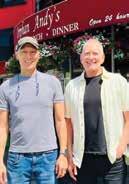
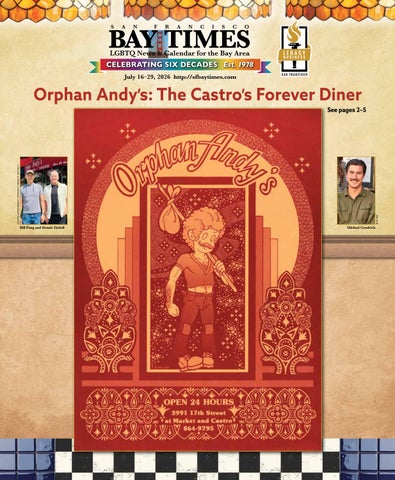
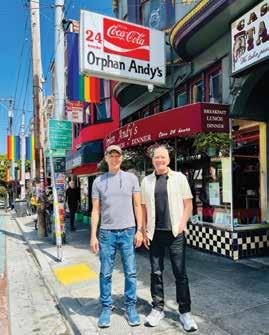
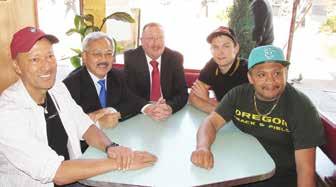
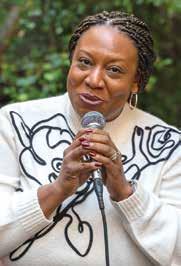
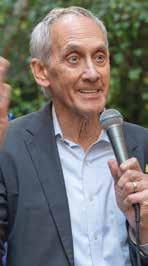
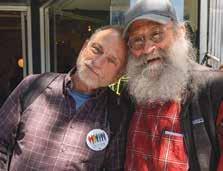
Bill Pung and Dennis Ziebell
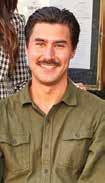
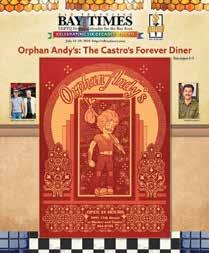
Michael Goodrich
LGBTQ News & Calendar for the Bay Area
CELEBRATING SIX DECADES Est . 1978
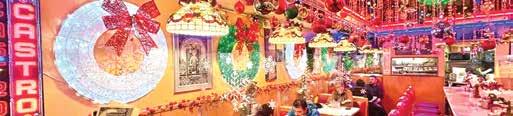
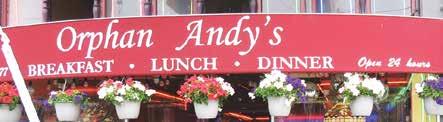
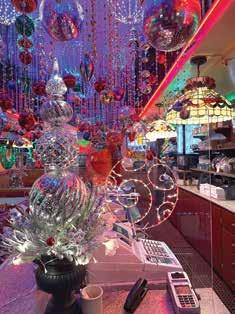
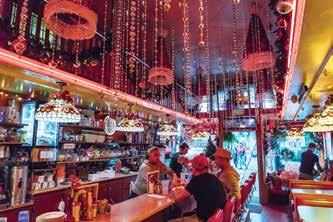
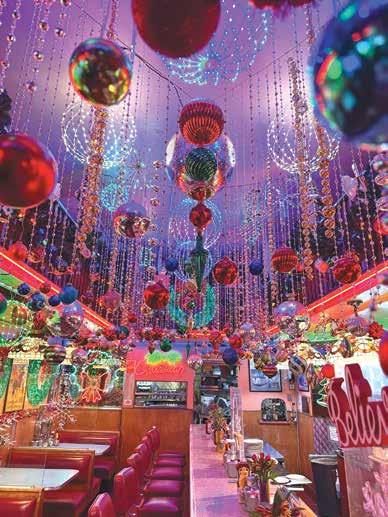
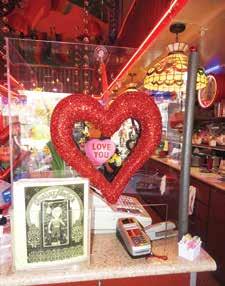
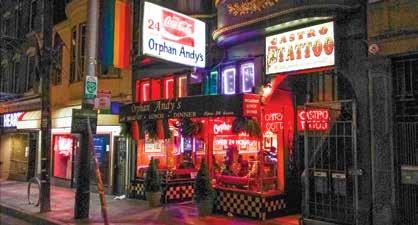
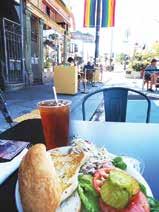
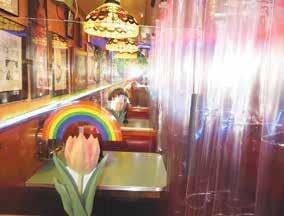
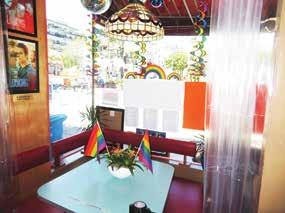
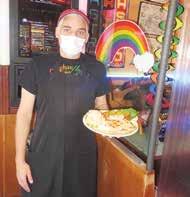
Eating at Orphan Andy’s at midnight is like stepping into a cozy, neon-lit sanctuary where the pulse of the Castro softens into pure comfort. Squeezing into one of the vintage red vinyl booths or grabbing a swivel stool at the counter, diners are immediately wrapped in the warmth of a classic 1950s
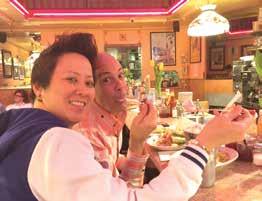
diner, complete with kitschy queer decor, twinkling strings of lights, and the comforting sizzle of the flat-top grill. All around is a democratic cross-section of San Francisco night owls—club-goers winding down, drag performers post-shows, San Francisco Bay Times columnists procrastinating over pan-
cakes, bartenders off shift, and other neighborhood regulars exchanging sassy banter with the staff over bottomless cups of coffee. When a plate of thick-cut French toast, a juicy cheeseburger, or a mountain of crispy French fries drops in front, the rest of the city fades away, leaving only the reassuring hum of late-night chatter and the timeless magic of a neighborhood institution that has always known exactly how to welcome visitors home.
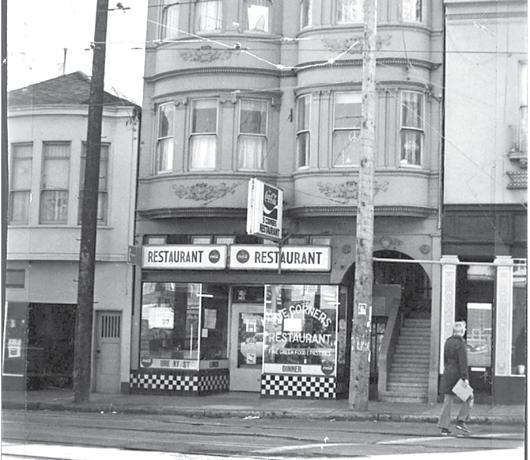
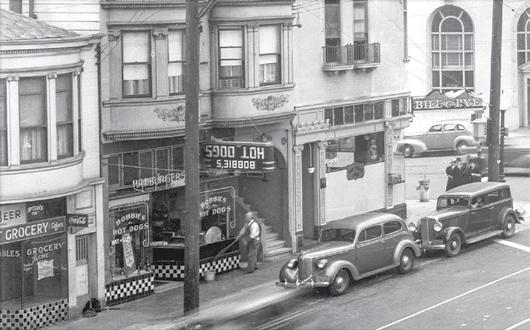
This home away from home for many in the Castro reflects the vision of Dennis Ziebell and Bill Pung, the couple who have owned and operated Orphan Andy’s for decades. Ziebell in 1977 purchased the business, which was originally known as the Five Corners Café and was a Greek-themed restaurant. Pung became a partner in the restaurant in 1978. On July 17, 2026, they will hand over the keys to Michael Goodrich, who is the General Manager of the Vietnamese fast-casual chain Bun Mee. Goodrich purchased Orphan Andy’s for $200,000 with the understanding that he would keep the existing staff and maintain as much of the food, decor, hours, and more as possible. Ziebell and Pung will stay on for a few weeks to help with the transition that marks an important turning point in their lives and in the lives of many who have frequented Orphan Andy’s over the years.
Nebraska Orphan Hitchhikes to San Francisco
The story of Orphan Andy’s begins in Nebraska, where Ziebell was orphaned at birth. Later adopted and resourceful, he did well at school and was accepted to the University of Nebraska. There he studied geology and was on track for a lucrative career in the oil industry (petroleum, not vegetable!).
In a moment of wanderlust and planning to study at UC Berkeley, Ziebell left the University of Nebraska in his senior year and hitchhiked to San Francisco in the fall of 1971. Deciding
that a traditional career in corporate America was not his calling, he got a job as a busboy at Andy’s Donuts that same year.
There really was an Andy behind the name—Andy McDougall—who opened the then famous 24-hour shop at 460 Castro Street. It was frequented by Harvey Milk and many others who later went on to strengthen the neighborhood’s evolving queer identity.
Just a year after Ziebell began working at Andy’s Donuts, an opportunity arose for him to purchase the business. He did so at age 22, and, for three years, successfully ran Andy’s Donuts. He sold it in the spring of 1975 before purchasing Boot Camp Bar in the fall of that year. Boot Camp, for its time, was a prominent gay leather bar located at 1010 Bryant Street in SoMa. It was known for its motorcycle culture and notorious “wild back room.”
creative and artistic, so over-thetop decorations became part of the mix.
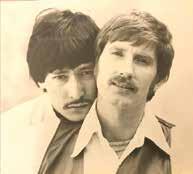
In the spring of 1976, Bill Pung—then employed at the shipping company Matson Lines—stopped by Boot Camp for a beer. Ziebell happened to be working that day and a bartender introduced the two men. In separate interviews with the San Francisco Bay Times, each recalled the moment as “love at first sight.”
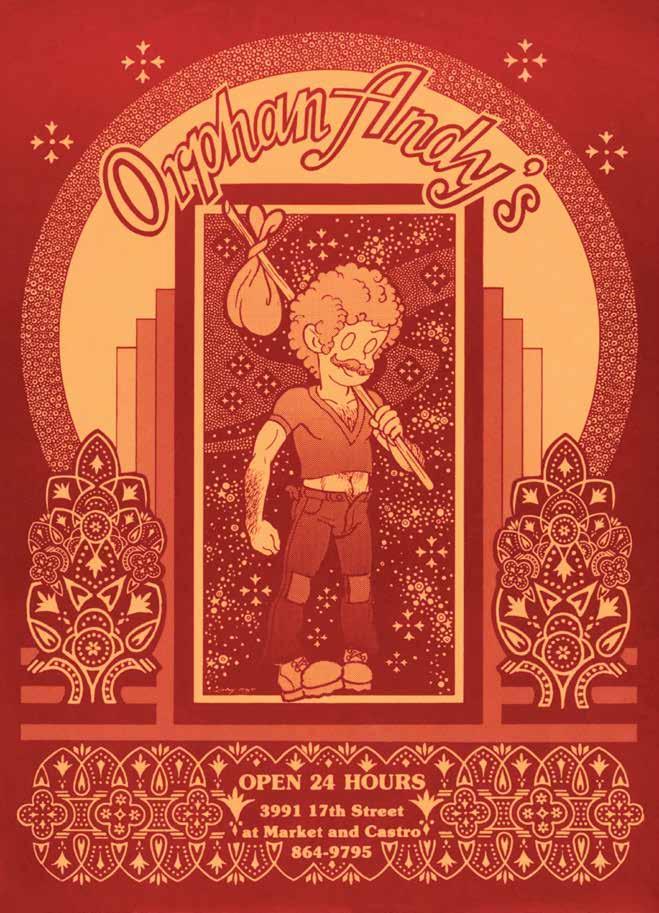
Self-described as “old-fashioned,” they dated for a while before Ziebell invited Pung to spend a weekend with him. To say that went well would be an understatement; they moved in together just a few months later. Partners in life and in business, they have been together ever since. They have also been equally wedded to their work, such that their longtime home is the apartment just above the restaurant, which Ziebell had named Orphan Andy’s after his former donut business and with him being an orphan. (He initially wanted to call it just “Andy’s,” but that fictitious business name had already been taken.)
Ziebell applied his 24-hour business model savvy from the donut shop to Orphan Andy’s. Pung to this day is a tireless baker, so baked desserts, such as their popular Hawaiian Wedding Cake With Pineapple and Coconut, became part of the menu. (Pung lived in Hawaii for several years, but the recipe for the cake actually came from Ziebell’s mother in Nebraska!) Both men are
The enduring success of Orphan Andy’s, however, is anchored in its understanding of the Castro district’s unique social rhythm. By anchoring the neighborhood with 24-hour service on its busiest days, the diner transforms from a standard eatery into a vital community crossroads. In a city where late-night dining options can be sparse, its open doors provide an essential safe space and gathering point. Whether it is an early morning breakfast for shift workers, a midnight recovery meal for club-goers, or a comforting refuge for neighborhood regulars, the schedule ensures the diner is always there exactly when the community needs it most.
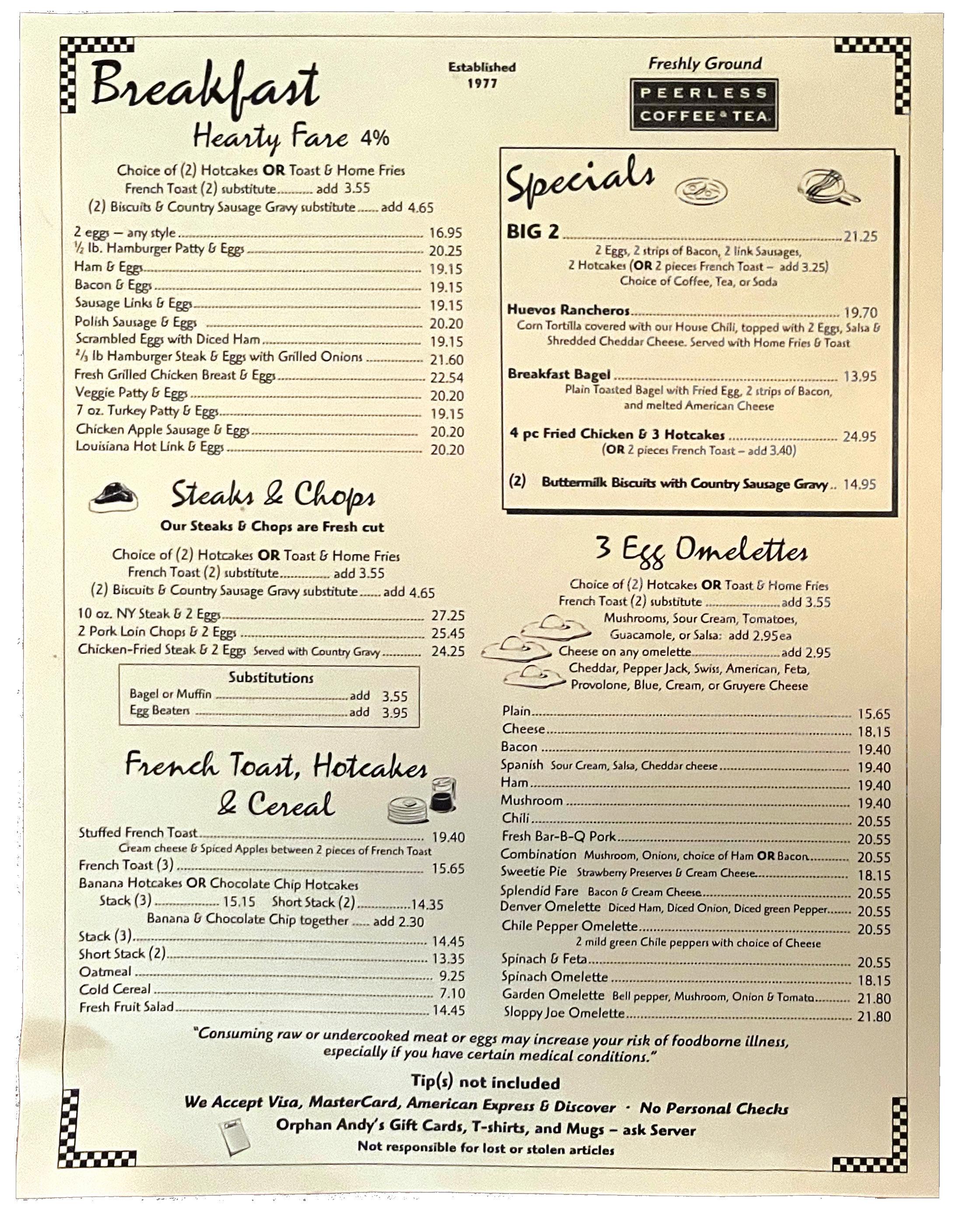
Complementing this reliable availability is a menu built entirely on the philosophy of unpretentious comfort. Orphan Andy’s doesn’t chase fleeting culinary trends; instead, it perfects the timeless appeal of the classic American diner. By serving hearty breakfast staples like omelets and biscuits alongside savory cheeseburgers, chicken-fried steak, and thick milkshakes all day and all night, the menu caters to cravings rather than the constraints of the clock. This predictability is precisely what makes it a triumph.
Ultimately, the combination of a late-night schedule and a nostalgic menu creates a powerful sense of equity. Inside the cozy space, the menu acts as a universal equalizer—a place where a drag queen, a tech worker, and a longtime resident can all sit at the same counter at 2 am, sharing the simple, unifying pleasure of a hot plate of eggs and a bottomless cup of coffee. By
(continued on page 3)
(continued from page 2)
remaining steadfast in its offerings and availability, Orphan Andy’s has secured its legacy as an indispensable piece of San Francisco’s cultural fabric.
The egalitarian nature of the customers is also reflected in the 18 staff members. Some have been university graduate scholars while others started full-time jobs early in life. Long gone but not forgotten is Herbie “Mother” Richards, who was among the most flamboyant queer managers of the restaurant. Pung once let Richards borrow one of his mother’s muumuus from Hawaii. Richards wore it to work. When Pung’s mother—good-natured like her son—found out, she was amused.
The blog SF Reporting in 2013 included part of an interview with Alex Kleinberg, who, at the time, had worked at Orphan Andy’s for two years during the late shift. Kleinberg said, “I’ve had like 15 jobs since I
was 13, but this is my first job here in San Francisco. When I walked in, I really liked the atmosphere here; it was busy, it felt comfortable.”
Gary Virginia, the former President of San Francisco Pride and the founder of Krewe de Kinque, immediately thought of Virginia “Ginny” Ramirez. She was a primary server at Orphan Andy’s who recently has been dealing with health challenges following two strokes. As Virginia shares, a GoFundMe has been set up to help
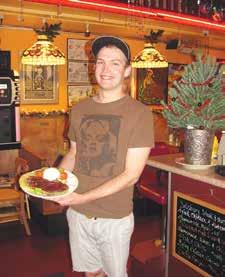
her ( https://bit.ly/4vmtrxU ).
During the first two years that Orphan Andy’s was open, there were dramatic highs and lows in the Castro. For those of us who were in the neighborhood at the time, it is
hard to explain how exciting and liberating it felt then. The LGBTQ+ community was expanding and strengthening at a fast pace, with Harvey Milk helping lead the way. The legendary lesbian bar Amelia’s opened in 1978 at 842 Valencia Street. Milk’s Castro Camera was flourishing for both photographers and budding filmmakers (later to be included in Frameline). The San Francisco Pride Band, San Francisco Gay Men’s Chorus, and the San Francisco Bay Times all started in 1978. The mood and forward momentum dramatically changed, however, when Milk and then Mayor George Moscone were assassinated on November 27, 1978. At Orphan Andy’s, which had become a late-night town square for the vibrant, politically charged community, guests came for a quiet meal
(continued on page 4)
(continued from page 3)
and to comfort each other.
Still more shifts happened as the 1980s and 1990s brought the devastating onslaught of the AIDS crisis. As the neighborhood grappled with unfathomable loss, Orphan Andy’s evolved into a quiet sanctuary. It was a place where people gathered, not just to eat, but to find comfort, share news, grieve, and look after one another when the outside world felt incredibly hostile.
At a time of fear and misinformation, when some businesses refused to serve HIV/AIDS patients, Ziebell and Pung welcomed them and others. Pung says, “We still have people come up to us to say ‘thank you’ for keeping the doors open during the worst years of the AIDS crisis.”
He and staff at Orphan Andy’s have similarly exhibited compassion for the district’s homeless individuals. Ziebell and Pung try to remember the first names of all visitors, such as DeShawn, who regularly came in for free cups of water. Jonathan Tufi, homeless in the Castro for many years, recently died on the street not far from the restaurant. The couple spent hours searching clues on the internet to determine Tufi’s full name and how to contact his relatives. When they finally reached one of his nieces in Georgia, she was extremely grateful and shared that Tufi’s mother was still alive at age 97. Thomas, another homeless man, used to yell all day outside the restaurant. After the owners and their team befriended him, Thomas would then scream, “Orphan Andy’s has the best pancakes!” Pung says, “He became our best PR guy.” He adds, “Others who lived on the streets but later got their act together have thanked us for not kicking them when they were down. We always try to put ourselves in their place and feel for what they are going through.”
As San Francisco transitioned into the dotcom booms of the late 1990s and the tech-fueled transformation of the 2010s, the Castro changed rapidly. Rising housing costs and gentrification altered the demographic fabric of the neighborhood, pricing out many artists and long-term residents.
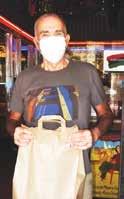
This economic shift directly impacted the city’s nightlife, causing a slow decline in San Francisco’s late-night culture. Tech workers with early morning schedules replaced some of the traditional night owls, and many of the Castro’s other 24-hour institutions closed their doors. Orphan Andy’s held the line, maintaining its round-the-clock weekend schedule as a stubborn reminder of the neighborhood’s gritty, nocturnal roots.

While many business owners promote celebrity visits, Ziebell and Pung have largely kept such information under wraps over the years. Nevertheless, many well-known people have dined at Orphan Andy’s. They include singer Sam Smith during his recent Castro Theatre residency (Smith later vlogged about its nostalgic charm and classic American diner food), Buster Posey of the San Francisco Giants, Sean Penn, Cameron Diaz, and Emile Hirsch.
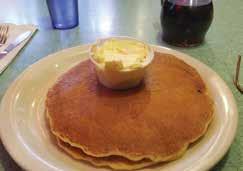
Music superstar Sylvester was a regular, and RuPaul stopped by at least once. Perhaps Orphan Andy’s greatest fan, however, was Prince. He already was a night owl and a pancake lover when he came to the diner. Putting the two together led to a lightbulb moment for the 7-time Grammy Award winner. He subsequently became famous for
serving pancakes after late night impromptu basketball games. In 2013, he even released the single “Breakfast Can Wait,” which featured a cover of Dave Chappelle dressed as Prince serving pancakes. That same year, Prince began officially hosting “Breakfast Experience Pajama Dance Parties” at his Paisley Park headquarters in Minnesota, where he served pancakes to fans starting at about 2 am.
Resilience and New Beginnings
Representing another boom to bust moment, the COVID-19 pandemic starting in 2020 brought unprecedented quiet to the usually bustling intersection. The diner was forced to navigate long closures, shifts to outdoor dining, and a slow recovery alongside the rest of the city. Ziebell had planned to retire at around that time, but the business survived and was a lifeline for many during and after the pandemic, so he and Pung forged on.
Now the two men are in their 70s. Ziebell says, “We don’t have an option to continue, so we put the business up for sale.”
They did so in March 2025, and, in the months that followed, received multiple offers. Pung, though, remembers the day when Goodrich came to meet with them. “At first I thought he was my nephew. He looked like family. Dennis and I both liked him and could see that he has got the energy to do what is needed.”
Orphan Andy’s will celebrate its 50th Anniversary soon. Pung says, “Fifty years is a lifetime. Dennis and I are so grateful for the support of the community. We have all gone through a lot, and survived a lot. Now we are in our fourth quarter of life and look forward not to have to live and breathe the restaurant from the moment we wake up to when we go to bed. We don’t have any big plans at present except to ease into retirement.”
And to keep cooking! Even as they were planning to hand over the keys to Goodrich, Pung was busy planning to bake some of his popular desserts for a nephew who is moving to Australia. The couple also enjoy supporting other Castro businesses, such as The Sausage Factory and The Castro Theatre. With Cliff’s Variety, they were also the first supporters of the Castro Street Cam presented by the Bay Times. It is hard to imagine the neighborhood without this kind and resilient couple, so all of us at the Bay Times are glad that they are staying here and that the home they created together for all of us, Orphan Andy’s, will remain open.
Orphan Andy’s
3991 17th Street (Ste A), San Francisco Open 24 hours Tuesday–Saturday, noon–9:45 pm Sunday, and 8 am–9:45 pm Monday 415-864-9795
As Orphan Andy’s begins a new chapter under new owner Michael Goodrich, the San Francisco Bay Times asked several local community leaders to share their thoughts about this storied Castro diner.
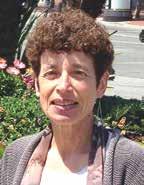
Andrea
Aiello,
Executive Director of the Castro Community Benefit District
“My memories of Orphan Andy’s are really memories of Dennis Ziebell and Bill Pung. These two men have given so much to the Castro that it’s hard to know where to begin. I only met them in 2008, but they’ve been giving back to this neighborhood for decades—probably going all the way back to the Andy’s Donuts days.
Some of my favorite memories are of working alongside them to create Jane Warner Plaza, back when we called it 17th Street Plaza. We all put a lot of sweat equity into transforming that odd little space the city had closed to traffic into something the community could truly enjoy. And it didn’t stop there—they also helped care for the plaza day after day, particularly taking care of the seating and helping it become a welcoming public space. They were, and are, true angels for the Castro.
Dennis joined the Castro CBD Board in 2011 and became Treasurer in 2012. We worked closely together for many years, and, somewhere along the way, we became good friends. I’ll really miss seeing Dennis and Bill on a regular basis. Their kindness, generosity, and love for this neighborhood have left a lasting mark on all of us.”
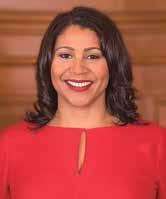
Breed, 45th Mayor of San Francisco
“Orphan Andy’s has always been one of my favorite places for a good hearty meal in the Castro.
Whether it is breakfast with friends or a late-night meal after an event, you can always count on delicious food, a warm welcome, and, my favorite, their fresh-squeezed orange
juice. It is a true Castro institution and a gathering place where countless memories have been made. I hope it will always be part of the heart and history of the neighborhood.”
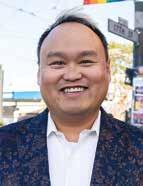
Michael Nguyen, Elected Member of the San Francisco Democratic County Central Committee and a Candidate for District 8 Supervisor
“I really love the vibes at Orphan Andy’s! My favorite meal there is Chicken Fried Steak and a biscuit with gravy. Coming from Texas, I am grateful for a taste of the South, right in the Castro! I am always thankful for the excellent service from the staff at Orphan Andy’s, and I look forward to my next meal there, even under new management! Oh, and the onion rings! Yum!”
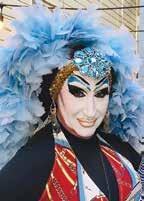
Sister Roma, The Most Photographed Nun in the World
“I have a confession to make: Whenever I agree to host or attend an event in the Castro, my first thought is, ‘Ooohhh, I can stop by Orphan Andy’s afterwards and order a cheeseburger and fries to take home and pig out!’ It’s also a go-to for breakfast, especially with visitors from out of town. I just love Orphan Andy’s!”
Barb Rush, former Castro resident and Nonprofit Technology Director
“I remember the first time I pushed open the door at Orphan Andy’s in the summer of 1981. The bell above the entrance gave a little jingle, the smell of bacon and grilled onions wrapped around me, and someone dropped another
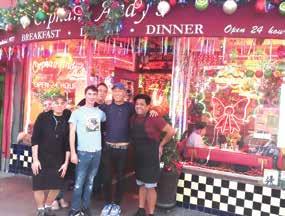
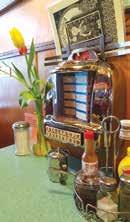
quarter into the tabletop jukebox. Back then, San Francisco felt alive twenty-four hours a day and the Castro had an energy unlike anywhere else in America. Today, when I walk into Orphan Andy’s, I don’t expect everything to be frozen in time. The neighborhood has changed. The faces have changed, and so have I. What remains is the feeling that has kept me coming back for more than forty years: the sense that everyone belongs for as long as they’re sitting at the counter or sharing a booth.”
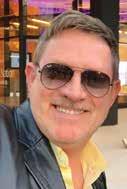
Don Spradlin, Founder & CEO of Joié de Vivré Homes
“After having a haircut at Louie’s Barbershop, I often enjoy going to Orphan Andy’s and sitting at a window seat. I always get a hamburger along with fries and a Diet Coke, which are a splurge. It’s a happy place for me with a lot of good memories.”
Gary Virginia, former President of San Francisco Pride and Founder of Krewe de Kinque
“For more years than I can remember, Virginia Ramirez, was the jewel of Orphan Andy’s who managed and served rowdy crowds on evening shifts into the wee hours of the morning. My drinking buddy Don Ho and I would stagger in and were always greeted with her big smile, as she’d find a way to get us seated quickly. Our conversations were as delicious as the great diner food magically prepared by one short order cook out of the extremely small kitchen. Sadly, ‘Ginny’ suffered two strokes in May that left her partially paralyzed. Her sister Linda set up a GoFundMe drive to help cover expenses as she recuperates in assisted living. May all the love she shared come back to her.”
https://bit.ly/3R0J5B2
Pride Month provided San Francisco with some high-profile examples of what leadership and true allyship should—and should not—look like.
First, thank you to everyone who marched in, volunteered for, and helped create the first-ever Trans Ally Rally on Saturday, June 27. A collaborative effort between San Francisco Pride, People’s March, Trans March, San Francisco Dyke March, Dykes on Bikes®, and Indivisible SF, the event drew a large, supportive crowd that marched up Market Street and through the Tenderloin, providing a great kickoff to the celebration in Civic Center.

The night before presented difficult choices. Valkyries Pride Night fell on the same evening as San Francisco Opera’s Pride Concert. Much as I adore the Valkyries, I chose the opera—and was rewarded with an evening that offered far more than just splendid singing by some of today’s top queer opera artists. It was an immersive celebration, from the rainbow lights inside and outside the Opera House to a display of panels of the AIDS Memorial Quilt in the upper lobby. Emcee Sapphira Cristál brought humor, history, fierce inspiration, and stunning gowns to the program, and legendary DJ and activist Juanita MORE! rocked the afterparty. Executive Director Matthew Shilvock spoke passionately about San Francisco Opera’s deep commitment to inclusion and equity, making it clear that SF Opera stands firmly with the LGBTQ+ community—and that this commitment extends from the top down through every level of the company.
Meanwhile, the Golden State Valkyries hosted a Pride Night that was, by all accounts, an exuberant celebration of inclusion, community, and pride. Every detail of the event made sure their LGBTQ+ fans, team, and staff all felt welcomed, valued, and celebrated. In her post-game press conference, Head Coach Natalie Nakase said, “Part of our culture is to allow everyone to be their authentic self ... . The beauty of that is that we don’t even really have to talk about it, the care and the love and acceptance is already within.” The Valkyries know who their fans are, and make sure their fans feel the love.
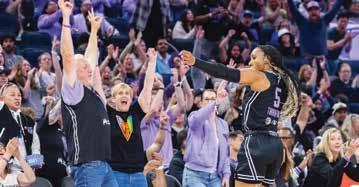
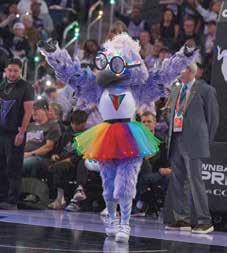
The message was clear and consistent from the front door to the front office: All are welcome here.
By contrast, the San Francisco Giants managed to tarnish their longstanding reputation as one of the most inclusive teams in professional sports. Yes, they planned festive Pridethemed events in coordination with some of San Francisco’s most prominent LGBTQ+ leaders. Everything was in place for a welcoming, inclusive night at the ballpark, but then they struck out, big time, because, once the game started, it became clear that not all the players were on board with the theme of Pride Night. As opposed to the Valkyries, who were all clearly excited to be playing a game that celebrated Pride, four of the Giants players chose to signal their opposition to the night’s theme, three of them by adding a biblical verse to their Pride caps, and a fourth by opting not to wear the Pride cap at all.
started holding annual Until There’s a Cure Days to raise money and awareness around HIV/AIDS, has been damaged. Their allyship now feels skindeep, instead of genuine. I’m a lifelong fan, having stuck by the Giants through thick and thin since they moved to San Francisco in 1958, but now it feels like the Giants have betrayed the city they call home. And, worse yet, it feels like they just don’t care.


Unfortunately, the cap debacle was just the beginning of the Giants’ screw-up. What followed was a weeks-long jaw-dropping example of incompetent crisis management. The reaction from Giants fans, both queer and straight, was fast and furious. It was clear that the actions of the four players caused damage to the community, and the community needed to hear from the Giants that they understood the damage that had been caused, and were working to heal the wounds. Yet, day after day, the Giants’ leaders—Manager Tony Vitello, President of Baseball Operations Buster Posey, and CEO Larry Baer—all showed a stunning lack of leadership by refusing to take the issue seriously, and even refusing to discuss it. The result? So much of the good will that the Giants had built up with the LGBTQ+ community over the past 32 years, since they
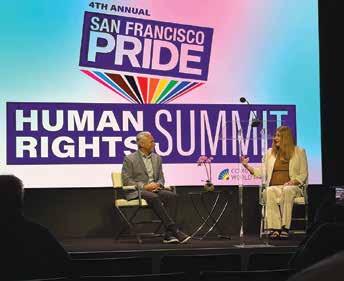
While the Giants’ public relations disaster was growing into a national news story, San Francisco Pride and the Commonwealth Club hosted the day-long Human Rights Summit on June 25. The day opened with an enlightening onstage discussion between San Francisco Pride President Suzanne Ford and the CEO of Philz Coffee, Mahesh Sadarangani. They shared the story of a public relations fiasco that resulted in strengthening community bonds—a stark contrast to the Giants’ leadership disaster. They walked us through what happened in April when Philz Coffee removed the rainbow flags that had long festooned their store in the heart of the Castro. The immediate, intense backlash from their employees and the community caught Sadarangani and his team by surprise when Ford led protests, the community rose up to denounce Philz, and outrage was expressed—but then something extraordinary happened: Ford and Sadarangani started talking to each other, and started listening to each other. They started building a relationship, and understanding each other’s point of view. Ford learned what had gone into the Philz decision to unify the look of their stores. Sadarangani learned just how much the Pride flags mean to LGBTQ+ people, and that his queer employees should have had a say in the decision. Mutual respect was earned. Real growth and change took place. The Giants could learn something from their example.
The celebration of the 250th anniversary of the signing of the Declaration of Independence offered starkly contrasting visions of what our country is, and where it should go from here.
On July 3, our current president chose to
stand in front of Mount Rushmore and deliver a dark, threatening speech in which he tried to convince listeners that the biggest threat to the United States is communism— and that Democrats, and, basically, anyone who doesn’t agree with him, are communists. “They don’t want good. They don’t love God and they don’t want God ... . They have no respect for law, justice, principle, tradition, or your God-given rights. It’s an ideology of mass theft, mass control, mass lies, and mass murders ... . You can be a communist or you can be a patriot. You cannot be both.”
The next day, New York Mayor Zohran Mamdani also gave a speech about our country’s 250th birthday, but it couldn’t have been more different. Surrounded by newly naturalized citizens, he walked listeners through 250 years of American history—the good, the bad, and the ugly. But, instead of giving in to despair and pessimism, he chose hope and encouragement:
“Those ideals upon which our nation was built—they are strong enough to endure any authoritarian regime, but only if we reach for them. Ours is a nation working each day towards the perfection in which it was conceived. A nation striving each day to better itself. Therein lies the work of America—the striving, the bettering, the reaching towards perfection ... . What a privilege each of us has, to live in a nation that every one of its inhabitants can shape. What a responsibility each of us possesses, to prove ourselves worthy of all those who came before. What power each of us holds, to bring America ever-closer to the greatness so many have seen when they looked upon these shores— the greatness that, for 250 years, has been America.”
Joanie Juster is a long-time community volunteer, activist, and ally.

By Joanie Juster
When AIDS Walk San Francisco began in 1987, we had no idea we would still need to do this work forty years later, and, yet, we do.
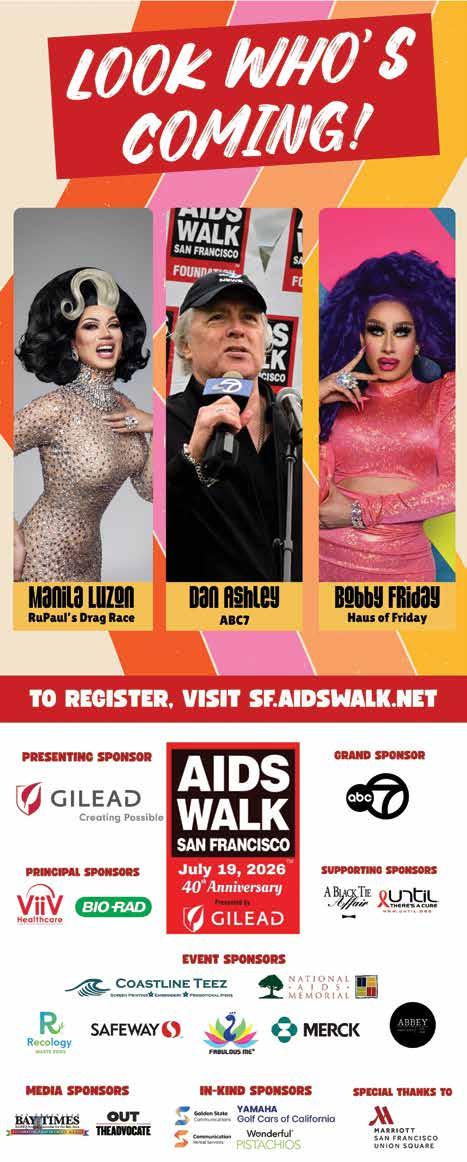
On Sunday, July 19, 2026, AIDS Walk San Francisco will mark its 40th anniversary of raising funds for Bay Area organizations that serve people with HIV and AIDS. This is a significant milestone, and we hope you will join us by walking with us in Golden Gate Park, or by donating.
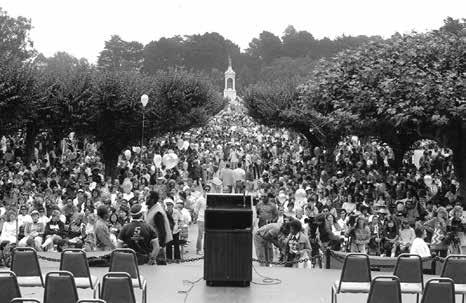
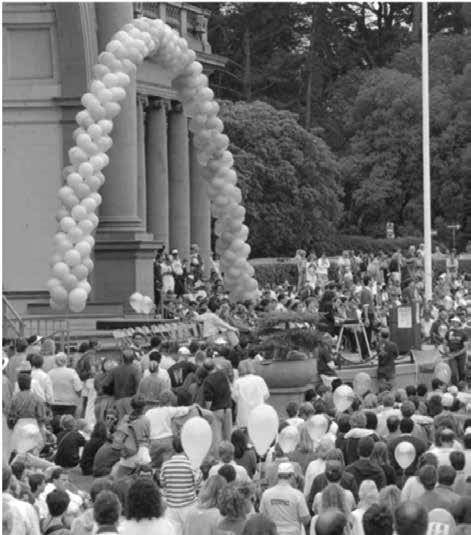
My first AIDS Walk was in 1988. I remember it being a somber affair—people walking quietly through Golden Gate Park’s foggy pathways, many of us crying, all of us carrying the emotional weight of loss, or worry for our friends and loved ones who were sick. Hope was in short supply: The government wasn’t inclined to help, and there was no sign of a cure on the horizon. Even the few medications that were available were hard to access, and many were either toxic or ineffective. In those early days of AIDS, with nowhere else to turn, the community rose up to take care of its own, building organizations and alliances to care for the sick and dying. They needed money, however, to be able to do their work, and, out of that need, AIDS Walk was born.
Over the years, as medical breakthroughs led to more people living full lives with HIV instead of dying, AIDS Walk San Francisco adapted to meet the changing needs of the HIV/AIDS community. By 2015, the event was focused on supporting the most urgent needs of people living with HIV/AIDS. These included the emerging issue of HIV and aging, plus issues that have long been major factors of the epidemic: hunger, homelessness, discrimination, and poverty.
Dedicated AIDS Walk funds made it possible for UCSF Zuckerberg General Hospital to open the Golden Compass program, a unit providing specialized care for HIV-positive people over age 50. And when COVID hit in 2020, causing disruptions in care to many with HIV, AIDS Walk pivoted once again to meet the needs of the most vulnerable.
Now, in 2026, as funding from both the government and corporate sources becomes scarcer, the funds raised by AIDS Walk take on increased importance. Thanks to AIDS Walk’s Co-Beneficiary program, and the hard work of the AIDS Walk production team, AIDS Walk has been able to grant back to the Co-Beneficiary teams 100% of what they had raised, plus additional grants. As anyone who has ever produced a fundraising event can attest, this is huge.
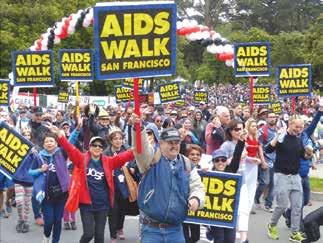
What drew me to this event in 1988 is what has kept me coming back year after year, decade after decade: it is at its heart a grassroots event where everyone can participate, no matter whether you raise $5 or
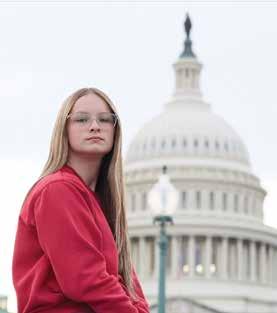
Late last month, the conservative Republican supermajority of the U.S. Supreme Court issued a deeply flawed decision, upholding state bans on transgender girls and women playing in school sports. Significantly, the ruling does not require all states to exclude trans athletes from girls’ sports; it only applies to states with such bans. But that still means that thousands of trans girls and women, like lead plaintiff Becky Pepper-Jackson, the wonderful West Virginia teen who brought her case when she was just eleven years old, will no longer be able to play the sports they love. Justice Brett Kavanaugh’s opinion for the majority was so unfounded, disrespectful, and callous that we felt a sense of grief reading it.
From the get-go, Kavanaugh misgenders Becky and all other trans girls and women who seek to play school sports, by referring
to them as “biological males” who, he says, “identify as female.” Becky is not a “biological male”—she is a girl.
Although Becky was born with male genitalia and assigned the sex marker “male” at birth, Becky’s brain, the part of the human body that determines a person’s fundamental comprehension of their sex, is unquestionably part of her “biology.” Becky recognized that she was female very early in life, and, because of her mom and dad’s unconditional love and care (and her older brothers and grandparents’ support), she has been able to live happily and authentically as the girl she is for years. Becky began taking medication very early on to prevent her from undergoing any aspect of typical male puberty and enable her instead to experience typical female hormonal puberty. In every possibly relevant sense of “biology” here, Becky is a girl.
Justice Ketanji Brown-Jackson in her dissent puts it simply and clearly: Becky’s home state of West Virginia’s categorical ban on trans girls and women in sports “forces” Becky “to live—in this case, to play—as a boy though she is a girl.” We consider transgender girls and women to be gifts to the world and to any school sport they choose to participate in. Discriminating against them clearly violates both Title IX, which prohibits educational institutions that receive federal funding from discriminating on the basis of sex in sports, as well as the equality guarantees of the U.S. Constitution. Sadly, the Supreme Court’s Republican
supermajority abdicated its role in upholding the Constitution and acted without sound legal or factual basis in what Justice Sotomayor characterizes as a “slapdash manner.” The Court’s decision validates, emboldens, and could even be considered part of the ongoing Republican social, political, and legal onslaught against trans people.
One example of the unsoundness of Kavanaugh’s analysis is his reliance on bans the NCAA (National Collegiate Athletic Association) and USOPC (U.S. Olympic & Paralympic Committee) imposed on trans women during the first half of 2025. As Sotomayor points out, Kavanaugh completely “ignores” the obvious political context in which the two organizations acted. After vilifying trans people in unprecedented ways in his presidential campaign, President Trump on his very first day back in office issued a sweeping executive order against them, which, as Sotomayor explains, “threatened to take away federal funding from any educational program that allowed transgender girls and women to participate on girls’ and women’s sports teams.” Less than three weeks later, the NCAA announced its new anti-trans policy, with the USOPC following suit four months later. This timing unquestionably undermines the credibility of these policies as factual bases for the Court’s decision.
We found the most disturbing part of the decision to be Kavanaugh’s 350-word concluding proclamation about “the nature and reality” of sports. He writes as if, just because he has coached girls’ basketball teams for years, he is the definitive authority on sports, in particular, women’s athletics, so much so that he can enshrine his subjective personal views as part of Supreme Court jurisprudence. They have no place there, and Kavanaugh does not offer even a single record citation to support them.
Kavanaugh also seems to characterize all girls’ school sports as brutal environments, in which self-interest predominates. At the outset, he declares school sports to be “highly competitive and generally zero sum,” in which “[a]t almost every turn, someone wins and someone loses.” With seeming approval, he describes girls “obsess[ing] about” winning.
Kavanaugh appears oblivious to the fact that the law before the Court is West Virginia’s categorical ban on trans girls participating “even in intramural or non-competitive sports” and mandates that trans girls “never participate in girls’ sports at any age or level of competition.” Becky herself offers a very different view of her experience playing school sports: “We learned about teamwork, having a positive attitude, and how to have fun while being competitive.”
Moreover, the legal question before the Court was the application of Title IX and the U.S. Constitution to West Virginia’s exclusion of trans girls and women in school sports under all circumstances. Title IX exists to ensure equality in sports in the context of their educational value. Kavanaugh provides not a shred of analysis as to how his
view of school sports furthers education. Finally, Kavanaugh’s last two sentences read to us like a dagger to the heart. They describe how student athletes “form lifelong friendships and lifetime memories” and “savor their athletic accomplishments” ... for years, even decades, after their playing days are over.” Kavanaugh extols the enduring value of school sports in an attempt to buttress the Court’s ruling. Instead, he exposes its cruelty: Becky and other trans girls in states with bans will be excluded from this very opportunity for joy and belonging. The Supreme Court and the state of West Virginia have unceremoniously cut Becky from her school track team and denied her the ability to continue to play sports with her friends and teammates she has known for one third of her life.
Despite this, Becky is showing us the way forward. As Becky’s mom Heather wrote in a USA Today op-ed the day of the decision, Becky often needs to remind her: “‘Don’t judge them like they judge us.’” She said Becky has “never flinched, and she’s still smiling.”
About a year ago, Becky had just finishing having dinner with her mom at a Chinese restaurant, and when she opened her fortune cookie it read: “Your involvement in sports will inspire others to reach for their dreams.” Even though the Supreme Court ruled against her, her fortune is still coming true. Becky is inspiring countless other trans people, athletes and nonathletes alike, to live as their true selves with pride, fearlessness, and joy. The world is a better place with her in it.

John Lewis and Stuart Gaffney, together for over three decades, were plaintiffs in the California case for equal marriage rights decided by the California Supreme Court in 2008. Their leadership in the grassroots organization Marriage Equality USA contributed to making same-sex marriage legal nationwide in 2015. Today, they continue to educate and advocate for marriage equality and LGBTIQ+ rights worldwide.
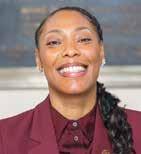
Oakland City Councilmember At-Large Rowena Brown
Now that San Francisco Pride Month has wrapped up and we are in the peak of summer, positive momentum is sweeping right across the bay: Oakland recently passed its mid-cycle budget alongside major community wins, including a historic 20% drop in homelessness—the city’s first decline in over a decade.
Furthermore, traffic fatalities have hit a multi-year low due to road safety overhauls, and the Oakland Police Department is finally nearing the end of its 23-year federal oversight. (It is on track now to end on September 29, 2026.) It’s a season of hard-
earned progress for the Town, and that spirit of resilience was on full display at this year’s Oakland Pride flag-raising ceremony.
Leading from Oakland City Hall also meant activating a tool from my past as a workforce development career coach. Some community stakeholders mentioned the desire to have a job fair in Oakland focused on creating a safe and welcoming space for LGBTQ+ job seekers and employers who are ready to hire.
So, in partnership with a colleague on the City Council, Councilmember Charlene Wang, the K-Stewart Foundation, Oakland’s LGBTQ Community Center, and other community partners, we hosted Oakland’s first LGBTQ+ Job Fair!
The job fair attracted more than 30 LGBTQ+-friendly employers, and we welcomed over 150 attendees of all ages. This event brought together employers from across the Bay Area, connecting job seekers with real opportunities in fields ranging from healthcare to tech to public service.
We also had community resources, free professional headshots, financial wellness workshops, and much more! Seeing our community show up for each other in this way—not just to celebrate, but to build economic security together—was one of the highlights of my June.
We have so many amazing things happening at Oakland City Hall, but let me be among the first to share these updates: Oakland

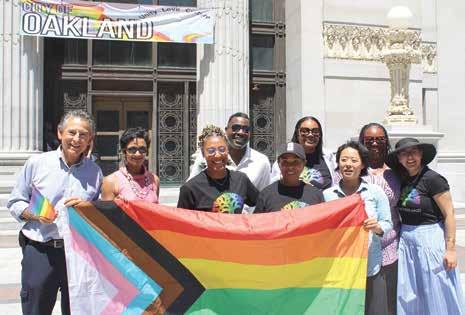
Pride is on Sunday, August 16, with celebrations and community activities happening throughout Downtown Oakland.
We will also hold space for the dedication of Moore Hope Plaza, located in Oakland’s LGBTQ Cultural District. This plaza naming will honor the legacy of two incredible Bay Area residents and longtime community activists, Peggy Moore and Hope Wood.
Stay tuned for details on the dedication ceremony and all things Oakland Pride!
Rowena Brown, elected in 2024 as Oakland’s At-Large City Councilmember, is an African American queer leader and lifelong East Bay resident. A former community organizer, civics educator, and State Legislative District Director, she has spent her career advancing equity, opportunity, and inclusive policies at both the local and state levels. As Councilmember, she is centering community voices and bridging grassroots movements with City Hall to build a more resilient, just, and thriving Oakland. https://bit.ly/4m3rMJ2




Roland Schembari and Bill Hartman, Co-Founders
Randy Alfred, Founding News Editor, 1978 Kim Corsaro, Publisher 1981-2011
2261 Market Street, No. 309
SaN FraNciSco ca 94114
PhoNe: 415-601-2113
eMail: editor@sfbaytimes.com www.sfbaytimes.com
The Bay Times was the first newspaper in California, and among the first in the world, to be jointly and equally produced by lesbians and gay men. We honor our history and the paper’s ability to build and strengthen unity in our community.
The Bay Times is proud to be the first and only LGBTQ newspaper in San Francisco to be named a Legacy Business, recognizing that it is a longstanding, community-serving business that is a valuable cultural asset to the city.
Dr. Betty l. SullivaN/JeNNiFer l viegaS co-PuBliSherS & co-eDitorS
Beth greeNe, JohN SigNer, Michael DelgaDo DeSigN & ProDuctioN
kate lawS BuS NeSS MaNager kit keNNeDy Poet-iN-reSiDeNce
J.h herreN techNology Director
carla raMoS weB coorDiNator
Mario orDoNez DiStriButioN
JuaN r. Davila voluNteer coorD Nator
WRITeRS
Rink, Sister Dana Van Iquity, Ann Rostow, Patrick Carney, Leslie Sbrocco, Kate Kendell, Gary M. Kramer, Joanie Juster, Robert Holgate, Eduardo Morales, Dennis McMillan, Tim Seelig, Rafael Mandelman, Jewelle Gomez, Rebecca Kaplan, Bill Lipsky, Beth Schnitzer, Rowena Brown, Kippy Marks, Ian Fullmer, Donna Sachet, Gary Virginia, Derek Barnes, Marcy Adelman, Jan Wahl, Stuart Gaffney & John Lewis, Brandon Miller, Howard Steiermann, Fernando Camino, Honey Mahogany, David Landis
PhOTOgRaPheRS
Rink, Paul Margolis, Bill Wilson, Jerome Parmer, Michael Kirschner, Sandy Morris, Abby Zimberg, Joanie Juster, Ken Lew
aDVeRTISINg
Display Advertising Standard Rate Cards http://sfbaytimes.com/ or 415-601-2113
Custom ad sizes are available. Ads are reviewed by the publishers.
National Advertising: Contact Bay Times / San Francisco. Represented by Rivendell Media: 908-232-2021
Circulation is verified by an independent agency. Reprints by permission only.



I Love Tenderloin Week—a neighborhood-wide celebration of the people, small businesses, and places that make the district one of San Francisco’s most diverse and vibrant communities—took place this year from June 21–27, 2026. This year’s events included The Taste of the Tenderloin Food Crawl (a self-guided neighborhood crawl featuring 12 participating restaurants with special tastings), Beats & Brews (live outdoor sets from local DJs alongside free morning coffee and pastries), outdoor dance performances, cleanups, and more.
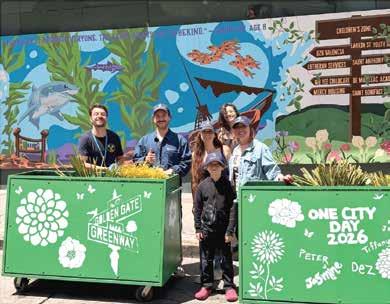
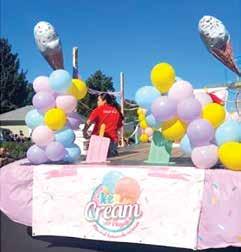
One of the week’s most popular events was a free Ice Cream Social for children and families hosted by St. Anthony’s on the Golden Gate Greenway on June 24. In addition to free ice cream served from a Mister Softee truck, there were games, a fire truck, and other family-friendly activities.
Community leaders and partners of the event included Mayor Daniel Lurie, St. Anthony’s CEO Dr. Larry Kwan, District Attorney Brooke Jenkins, Supervisor Bilal Mahmood, and the San Francisco Department of Public Health Director Daniel Tsai.

Dr. Kwan and his team shared: “For St. Anthony’s, the social continues an ongoing effort to create safe, welcoming public space for the Tenderloin’s youngest residents and to invite all San Franciscans to experience the neighborhood’s character for themselves.”
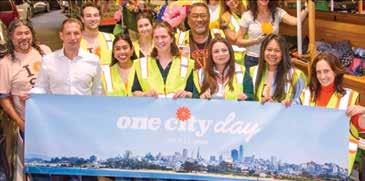
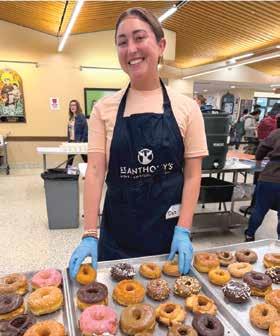
On July 11, St. Anthony’s was also involved in One City Day, San Francisco’s first-ever citywide day of service led by Mayor Daniel Lurie and First Lady Becca Prowda. They both helped serve meals at St. Anthony’s Dining Room. Dr. Kwan spoke at a kickoff event. Supervisor Mahmood helped volunteers with a block beautification effort, and there was a backpack drive with volunteers from St. Anthony’s and Dolby to fill 400 back-to-school backpacks for Tenderloin youth.
https://www.stanthonysf.org/

By Ann Rostow
As the Supreme Court wound down its 2025/2026 session, the justices released the court’s decision in the combined cases that asked whether states can ban transgender women and girls from playing sports for public schools and colleges. Surprise! The answer was of course they can. Justice Kavanaugh wrote the opinion for the six conservatives on the court, while Justice Sotomayor wrote a partial concurrence and a dissent for the three liberal members. Justices Thomas and Gorsuch wrote separately to concur with the majority, while Justice Jackson also wrote a concurrence and a dissent of her own.
There were two legal arguments raised by the plaintiffs in Idaho and West Virginia. Both plaintiffs argued that the law against trans sports participation violated the Equal Protection Act, while the West Virginia plaintiff also claimed the law ran afoul of Title IX’s ban on sex discrimination in federally funded schools. Even the liberals agreed that the anti-trans laws were allowed under Title IX, which basically requires equal treatment of men and women in sports and other aspects of education. But Sotomayor and the rest of our gang strongly disagreed with the casual dismissal of Equal Protection claims.
Let’s back up and remind ourselves that transgender rights issues are much more complicated than the comparatively simple fight for gay and lesbian equality. In terms of sports, I used to think that transgender girls who had undergone hormone treatments and reduced their testosterone levels to female norms should be eligible to play, period. Indeed, the NCAA and Olympic committees used to require a couple of years of such treatments before trans-women could compete. Now, however, trans-women are banned across the board by both groups, in part perhaps thanks to Trump’s birth sex executive order—his attempt to erase transgender men and women with a stroke of his pen.
But there’s another underlying question, and that’s whether transgender girls have a permanent advantage by virtue of going through male puberty or even simply due to their early years as males. Sotomayor’s main point was that this uncertainty was something that must be resolved, or at least studied, as a threshold question before claims of Equal Protection could be properly evaluated. The majority, by contrast, announced that the courts were not in the business of making scientific judgments and that, ergo, legislatures were free to come up with their own policies as long as the science was in dispute. Effectively, this decided the issue in favor of the idea that trans-girls can never be free of the (presumed) advantage of being born male.
No one thinks an untreated trans-girl can or should compete in high level sports against other women. And most people, I’m guessing, would agree that trans-girls should be able to play recreational sports for fun. The idea that cisgender girls would be put in danger by a transgender playmate is absurd and seems to be based on the stereotyped
assumption that cisgender girls are dainty flowers while transgender girls are brutal bullies. But the Court’s opinion made no distinction between levels of sports, instead writing that every trans-girl who wins a spot on a team takes one away from a deserving cis player—this despite the fact that many female teams have fluid rosters, particularly track teams, and, as we just said, many school sports programs are designed for exercise and fellowship.
A dilemma arises when it comes to championship athletics, mainly college but also some high-level high school sports. Sotomayor notes that evaluating players on a case-bycase basis, as has been the rule in the past, is hardly an onerous task given how few transgender women are actually found in the elite categories. Kavanaugh, in turn, seemed to think that such individual treatment would lead to chaos—if I may paraphrase—and that a blanket ban makes more sense under the circumstances.
Note that the opinion does not say that transgender bans are required. We still have 23 states that do not ban transgender girls from the arena, so we’ll see what happens to them. And, importantly, we still can’t assess which trans-girls might have a real advantage that would make their participation problematic.
Meanwhile, there are numerous differences in cisgender women that relate to sex and/or genetics, yet with few exceptions they are not examined and categorized nor should they be. Just as the bathroom bans are catching masculine looking cis-women in their wide nets, so these strict regulations on what standards to apply to female athletes can start to impact cisgender women as well. If they don’t pass the eye test, they may be subjected to tests or inspections that represent massive invasions of privacy.
Talk about chaos.
My esteemed cousin has sent me a few news items, including an article about a woman who arranged an elaborate celebration for the arrival of her son’s first tooth. Really? I know it’s not a gay thing, but my cousin and I have wide interests and make a point of drilling down on important issues that might otherwise fly below the news radar. The commentators seemed split between those who thought big parties were inherently fun regardless of the occasion, and those who thought “Instagram moms” were out of control. I suppose I could go either way, depending on the personality of the mother. Was the party all about her and her image, or was it a boozy extravagance using “Jacob’s First Tooth” as a random theme? I’d go to the second event.
She also sent me a clip about a man who chopped off his penis in public and stabbed himself to death as well. Thanks for that, Dear Cousin. We need not visit the details here.
More importantly, both items came from the renowned investigative reporters at The New York Post. While reading, I found a link to a
(continued on page 28)

THE RICHMOND/ERMET AID FOUNDATION PRESENTS

SUNDAY, AUGUST 2, 2026, 7:30PM
MARINES’ MEMORIAL THEATER: Concert (609 Sutter St.) & BEACON GRAND HOTEL: VIP after-party (450 Powell St.)
Benefiting Project Open Hand & REAF’s Small Emergency Grants Program
CAST MEMBERS FROM THE BROADWAY TOURING CAST OF
eauty & The Beast Plus



Photos by Michael Kirschner
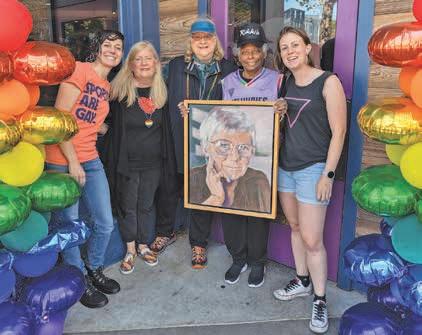
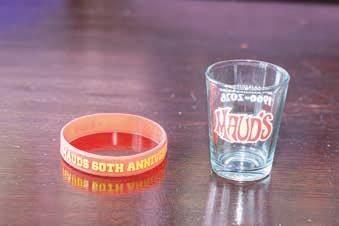
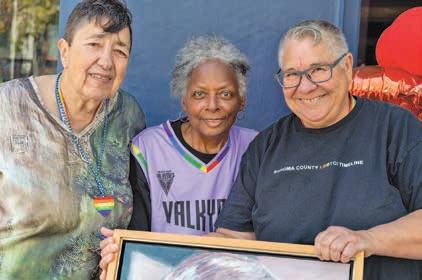
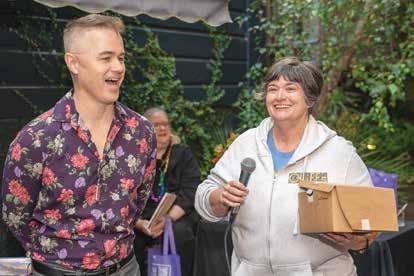
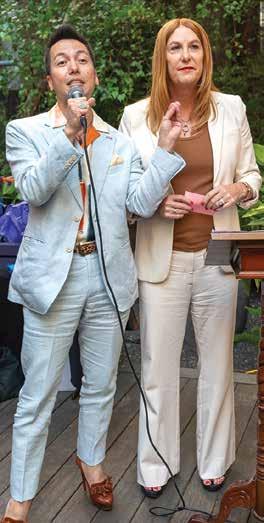
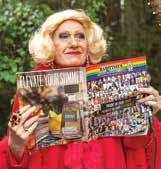
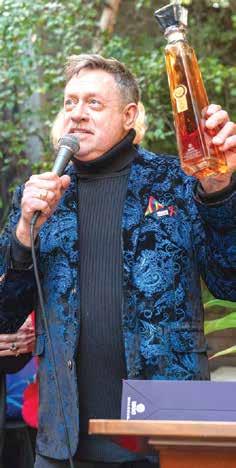
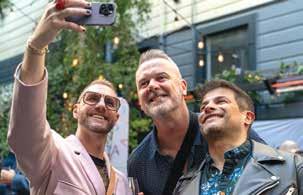
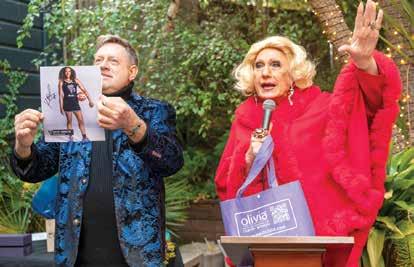
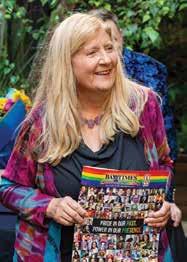
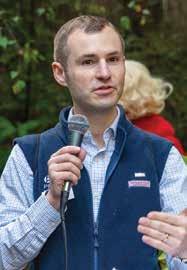
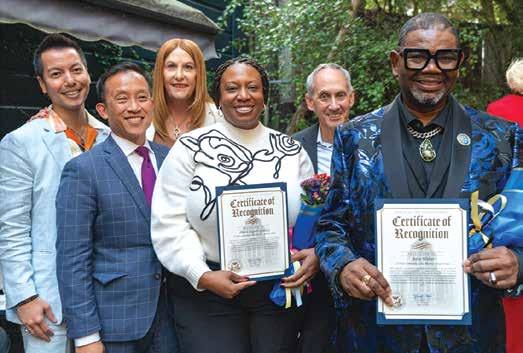
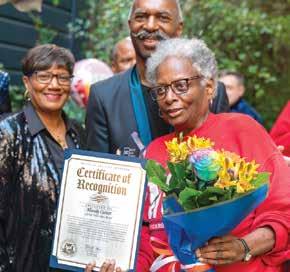
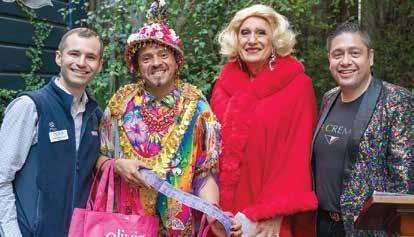
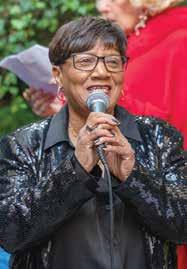
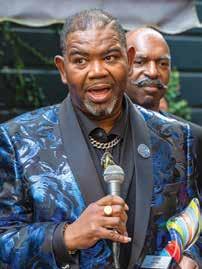
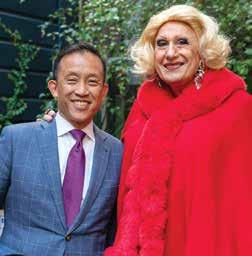
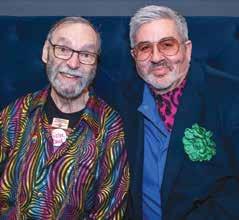
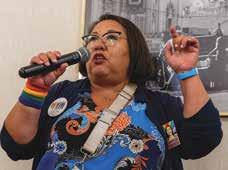
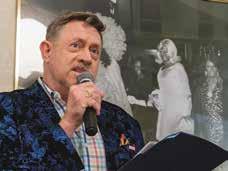
The San Francisco Bay Times, this year with co-hosts the Golden Gate Business Association (GGBA), Soul of Pride, and the Bayard Rustin Coalition, held its 6th annual Pride Kickoff Party on June 25, 2026, at The Academy SF. The event was emceed by Donna Sachet and included special guests Suzanne Ford, the Executive Director of San Francisco Pride; Community Grand Marshals Roger Doughty, Imani Rupert-Gordon, and John Weber; Nguyen Pham, the Director of Sponsorships of SF Pride; and activist Mandy Carter, who served as a national Co-Chair of Obama LGBT Pride and who traveled from North Carolina to attend this and other San Francisco Pride events. Carter is also a leader of the Maud’s Reunion group, which this year celebrated its 60th anniversary.
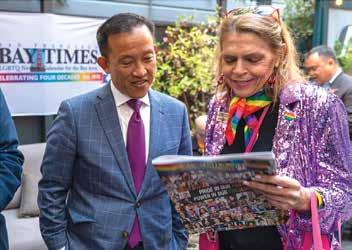
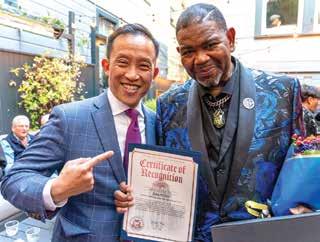
City Attorney of San Francisco David Chiu presented honors to Carter and the Grand Marshals, and thoughtfully remained for the entire program to help cheer everyone on.
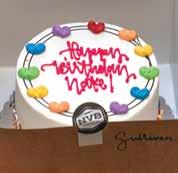
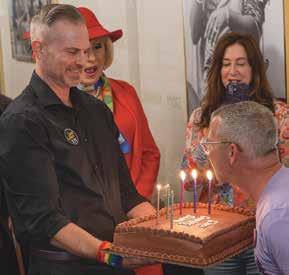
Music for the party was provided by Russell Deason and guest singers from Martuni’s. Sachet led a “Happy Birthday” singalong for The Academy SF Co-Owner Nate Bourg, whose birthday is June 25.
For their help in organizing the event, the Bay Times thanks GGBA President and CEO Aaron Boot-Haury; The Academy SF Co-Owners Bourg and Paul Miller; Soul of Pride Founder Lisa Williams; Bayard Rustin Coalition Co-Director Lawrence Shine. Thanks also go to the Bay Times volunteer team, which was led by Karen Bardsley, Juan Davila, and Leticia Lopezz. The Bay Times is further grateful for the additional volunteers, and to sponsors Tom LeNoble, San Francisco Pride, the Golden State Valkyries, 1800 Tequila, and V. Sattui Winery.



By Donna Sachet
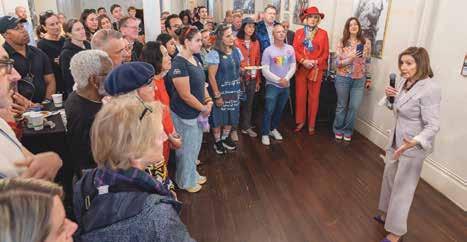
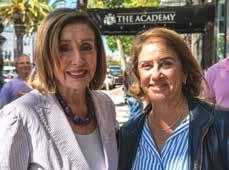
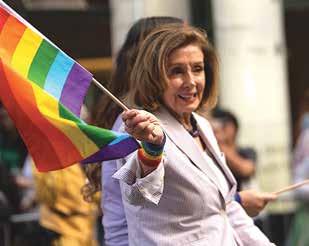
Speaker Emerita Nancy Pelosi hosted her last morning breakfast for her loyal volunteers as an incumbent member of Congress on Saturday, June 27, 2026, at The Academy SF and we were happy to attend along with Gary Virginia at the invitation of Gary McCoy. What an honor it was to be with this dedicated group the day before the San Francisco Pride Parade. The majority of the morning was spent socializing among this hard-working team, but at 10 am, her daughter Christine Pelosi started and emceed a short program. Dressed in our best Democratic pantsuit and heels, we spoke from the heart about a woman we have gotten to know over decades, most particularly through her participation in the annual Pride Brunch, which ran for 25 successful years, benefiting PRC and honoring the Grand Marshals of the Pride Parade.
Nancy Pelosi attended several times, and, each time, spoke beautifully to our amazed audience. We have watched her work tirelessly for San Francisco in Washington, D.C., and tried to make sure she felt appreciated. Gary Virginia then spoke of the great many awards and recognitions she has received for her tremendous work, including the Presidential Medal of Freedom and international awards as well. He added a bit of humor when mentioning her previous position as Congressional Whip and his previous title as Mr. SF Leather, much to everyone’s amusement.
Kim Tavaglione, Executive Director of the San Francisco Labor Council, then spoke powerfully about Pelosi’s firm support of labor and commended the commitment of the volunteers assembled. Finally, Gary McCoy shared some very personal memories of his time working with Pelosi and the thrill of learning from her. Surely she felt the love in the room and the appreciation that surrounded her.
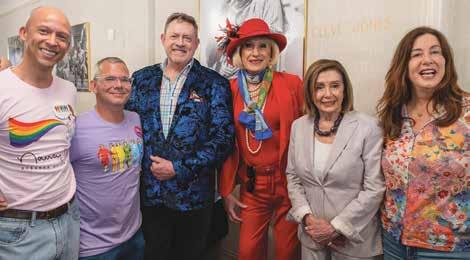
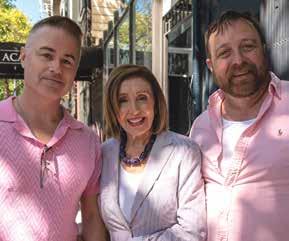
She closed out the program with thanks to all the speakers and audience and with her words demonstrated why so many admire her. Of special meaning to us, she spoke of a time she was about to be photographed with several drag queens. Some of those around questioned the wisdom of such a photograph, but she strongly corrected them, saying that she was proud to represent a large and diverse community. She has frequently said that, when speaking to opponents about the LGBTQ+ community, she is not asking that we be tolerated, but that we be celebrated.
Her gratitude to all of her loyal volunteers was evident, recognizing that their phone calls, door-to-door visits, and more often made the difference in campaigning. She also recognized and reiterated her endorsements of her daughter Christine Pelosi, Connie Chan, front row and center, and Gary McCoy in their upcoming campaigns. Finally, she graciously recognized Nate Bourg and Paul Miller of The Academy SF for hosting the event. Few members of Congress have played such a momentous role in the business of government or risen to the level of national leadership that she has. Nancy Pelosi’s impact will be felt for generations. And we will be forever grateful for her kind and gracious attention, both personally and to our LGBTQ+ community.
Donna Sachet is a celebrated performer, fundraiser, activist, and philanthropist who has dedicated over two decades to the LGBTQ community in San Francisco. Contact her at empsachet@gmail.com

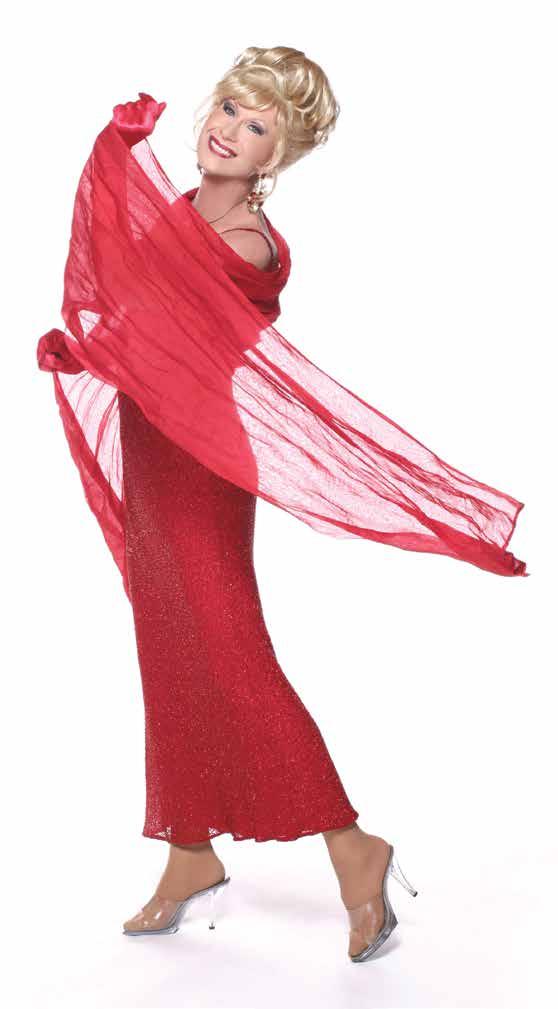
WBy Donna Sachet
e’ve just emerged from one of the busiest and most satisfying Pride Months of our 30-some years in San Francisco! And we attended or participated in more than our share of events; some might say too many. But what were we going to opt out of? Were we going to miss Rikki’s first year anniversary, the Gay Men’s Chorus’ Pride Concert, Nas Mohamed’s Love Is You, Broadway Bares at the Castro Theatre, REAF’s One Night Only with the cast of Phantom of the Opera, ALRP’s Garden Party at Hot Johnnie’s, Mark Rhoades’ VIP Pride Party, Pride Fashion Runway at Glide Memorial, Transgender VIP Party at the Hilton, the San Francisco Bay Times’ own Pride Kickoff at The Academy SF, San Francisco Opera’s Pride Concert, or the San Francisco Pride Parade itself? The choices were nearly overwhelming, but, as your intrepid social columnist, we did our best to cover them all!
Rikki’s anniversary on June 11 reflected its first year of tireless devotion to the memory of Rikki Stryker and the need for a place for San Francisco’s lesbians and their admirers to gather and socialize. With Christie James as DJ, the party was rocking and kudos go out to owners Sara Yergovich and Danielle Thoe for creating a “living room for lesbians” in San Francisco!
We attended the Gay Men’s Chorus’ Pride Concert with Ralph Hibbs, enjoying the chorus’ salute to Dolly Parton at the Curran Theatre. The music was lively and crowd-pleasing and the setting worthy of this fantastic chorus. They continued to pay tribute to outgoing Chief Executive Officer Chris Verdugo and introduced the new CEO Lane Sugata, whom we got to meet in the lobby while hobnobbing with so many chorus friends. Artistic Director Jacob Stensberg continues to take the San Francisco Gay Men’s Chorus to new heights!
Later that night, we joined a very diverse group of supporters of Dr. Nas Mohamed, the first openly gay Qatari, for Love Is You at the Old Mint. Love was truly in the air as dance music played, people of all backgrounds and nationalities mingled, and World Cup hype gave way to personal interaction and feelings of unity. Nas himself performed a special number at the height of the party, musically expressing his desire to unify through love. What a special night!
Sunday, June 14, saw the return of Broadway Bares, raising money for the Richmond/ Ermet Aid Foundation (REAF) and Broadway Cares/Equity Fights AIDS, while delighting a sold-out audience at the Castro Theatre with vignettes reflecting this year’s theme of computer games and characters. Weeks of rehearsal go into the very professional version of the original New York show, complete with fabulous, revealing costumes and impressive dance moves, which ended with personal visits into the audience and prodigious tipping.
The next night, REAF hosted its own event at the Marines’ Memorial Theatre, One Night Only with the traveling cast of Phantom of the Opera, produced by San Francisco’s favorite Christine from Phantom, Lisa Vroman. This was a triumphant return to San Francisco for Lisa, who had appeared in numerous REAF benefit shows and a full house welcomed her back. Various musical solos and group numbers kept us all engaged and the reception afterwards in the lobby was abuzz with accolades.
We were delighted to return to Hot Johnnie’s as hostess for AIDS Legal Referral Panel’s (ALRP) Garden Party, a small, but enthusiastic, get-together for supporters and Board members, featuring a couple of live auctions and a prize for best hat contest. The food was incredible, the guests were generous, and the weather was perfect for a Garden Party.
Mark Rhoades brought back his own VIP Pride Party later that same day and the attendance said it was a great idea. Reflective of his citywide involvement, the guest list was truly VIP and the setting of the beautiful Holbrook House glass atrium was perfect for everyone to reunite and celebrate. We shared the experience with Gary Virginia and caught up with Paula West, Sister Roma, Saul Sugarman, Mark Calvano, Winn Pham, Brent Marek, and so many others.
That brings us to the event of the season, Runway of Pride, second only to Built
This City, which was covered extensively in our last column. In 2025, Dr. Nas Mohamed with San Francisco Pride created a fashion show, Threads of Pride, using local personalities as models and local designers to originate their runway looks. The event took place at Yerba Buena Center for the Arts and caught many of us by surprise with its professionalism and sheer impact. This year, the show was produced by stylist Antonio Contreras and GLIDE Memorial was the hosting location. We were seated in a pew for the first time in ages with our friend Rusty Best. What a show! Stand-out models included Suzanne Ford, Tom LeNoble, Scott Wiener, Rafael Mandelman, Joel Goodrich, Honey Mahogany, Sister Roma, and the star of the show, London Breed, in a floor length red sequin gown with ruffled neckline! The coup d’etat was the appearance of legendary international model Pat Cleveland dressed in a golden ensemble and finishing
“Let’s
go, San Francisco!” Mayor Daniel Lurie
Saturday, July 18 Studio 456 Q-Bar & Lounge 456 Castro Street All vinyl disco DJs 5–9 pm www.qbar-sf.com
Sunday, July 19
San Francisco AIDS Walk 40th annual fundraiser Join hundreds of walkers www.aidswalk.net
Sunday, July 19
Roll for Charisma Game night & performances Hosted by Mx. Golden Gate Llewellyn The Willows, 1582 Folsom Street 4 pm Free! www.sfimperialcouncil.org
Saturday, July 25
An Evening with Ms. Imperial Leather Hosted by Bernadette The Stud, 1123 Folsom Street 4:30–7:30 pm Free! www.sfimperialcouncil.org
the show with a vocal performance that surprised everyone. Surely this event will become a regular part of Pride Month! Rounding out Pride was the Transgender VIP Party hosted by the downtown Hilton, the marvelous group assembled for the Bay Times Pride Kickoff Party at The Academy SF, partnering with the Bayard Rustin Coalition and Soul of Pride Awards, and a lovely evening of opera with soloists hosted by Sapphira Cristál of RuPaul’s Drag Race, followed by dancing in the lobby with DJ Juanita MORE!
We finished our Pride celebration and spent the last ounce of our energy riding in the double decker bus with the Bay Times team in the Pride Parade and finally relaxing at the VIP Party at the Asian Art Museum. Yes, it was a whirlwind of activities, but we wouldn’t do it any other way. Donna Sachet is a celebrated performer, fundraiser, activist, and philanthropist who has dedicated over two decades to the LGBTQ Community in San Francisco. Contact her at empsachet@gmail.com
San Francisco’s annual Trans March, recognized as one of the largest transgender empowerment events globally, took place on June 26, 2026, anchoring the start of Pride Weekend. The day began at Dolores Park with the Señora Felicia Flames Intergenerational Brunch for youth and elders, followed by an afternoon resources fair and live stage performances celebrating trans joy and resilience.
At 6 pm, numerous community members and allies gathered to march down Dolores Street, eventually proceeding along Market Street and concluding at the historic Transgender District near Turk and Taylor streets. There was an official After Party at El Rio to benefit the TGI Justice Project.
Marring this year’s Trans March was the arrest of five people for alleged vandalism and assault. On July 13, organizers of the march and supporters rallied at San Francisco City Hall declaring, “We need real solutions for community safety—not police!”
The day after the Trans March, on June 27, the inaugural Trans Ally Rally & March took place. It was organized by Indivisible San Francisco in partnership with several major LGBTQ+ organizations. Kicking off at 10 am, the demonstration had cisgender allies and community members marching from Embarcadero Plaza through the city’s Transgender District to a rally at the Civic Center Plaza.
The Trans Ally Rally & March served as a direct response to political attacks and discriminatory policies targeting the transgender community nationally. Protesters demanded that Mayor Daniel Lurie fully fund local trans youth and housing programs, safeguard gender-affirming care, and honor San Francisco’s standing commitment as a trans sanctuary city.
https://indivisiblesf.org/
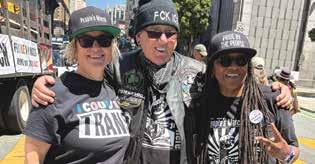
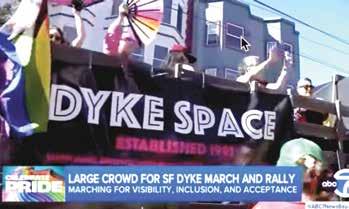
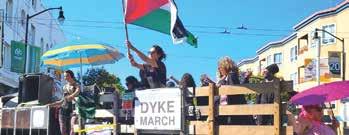
The 2026 San Francisco Dyke March—led by Project Director M Rocket, Advisory Committee Co-Chair Cyndi Vee, and other committee members—filled the streets of the Mission and Castro districts on Pride Saturday, June 27, reaffirming its foundational roots as an independent, grassroots political protest. The afternoon began with participants gathering at the intersection of 18th and Dolores streets for a high-energy community rally, featuring local activists and artists speaking on intersectional queer liberation and the preservation of historic lesbian spaces. At 5 pm, a sea of marchers took over the streets without corporate sponsorships or city parade permits, chanting and carrying banners that called for global human rights and local solidarity. This year’s demonstration stood out for its explicit, coordinated partnerships with the Trans Ally Rally and the People’s March, creating a unified front that highlighted the vital intersection of dyke and trans visibility.
https://www.thedykemarch.org/
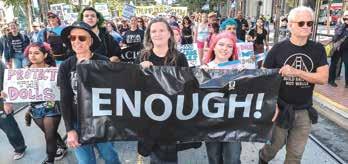
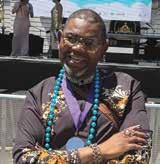
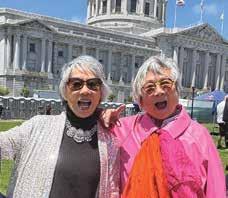

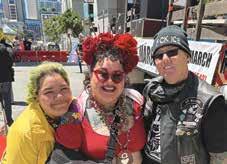
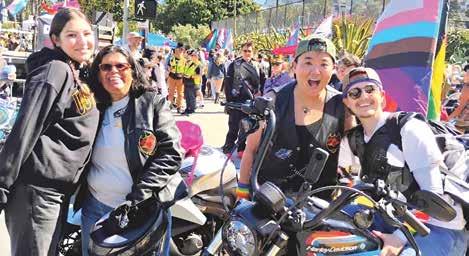

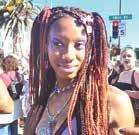
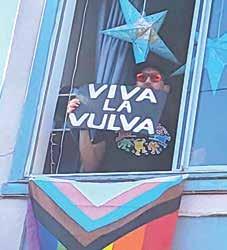


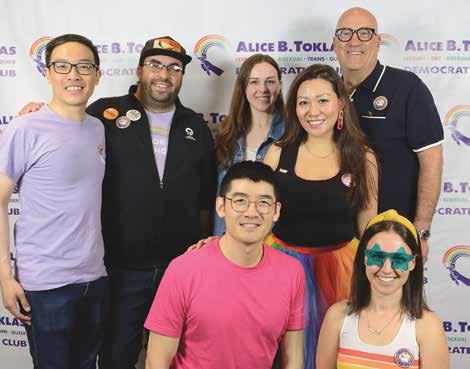
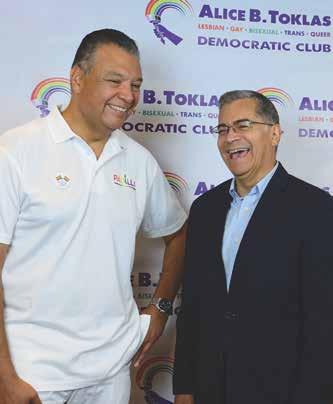
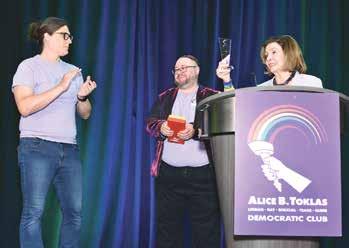
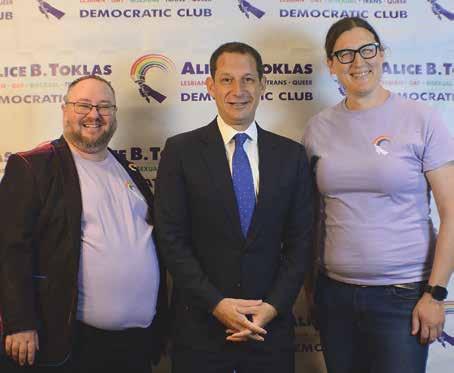
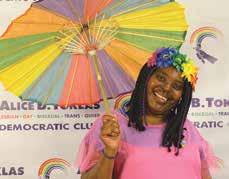
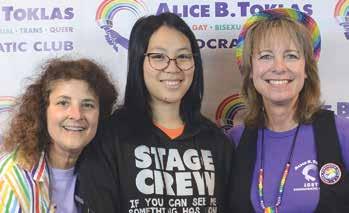
The 2026 Alice B. Toklas LGBTQ Democratic Club Pride Breakfast took place on Sunday morning, June 28, bringing together local, state, and national political figures for the country’s largest political Pride event. Held in the Hyatt Embarcadero Ballroom in San Francisco, the long-running annual fundraiser kicked off with doors opening at 8 am as attendees gathered over mimosas to support the club’s year-round advocacy for queer rights and representation.
Led by Co-Chairs Martin Rawlings-Fein and Jane Natoli, the high-profile breakfast served as a major platform for Democratic candidates ahead of the upcoming elections, featuring key organizational backing and sponsorships from prominent leaders including U.S. Senator Alex Padilla and City Attorney David Chiu. With a focus on defending LGBTQ+ rights against national conservative policies, the gathering reestablished Alice’s legacy as a cornerstone of queer political mobilization in the Bay Area.
https://alicebtoklas.org/

Tales From Two Wheels
What a weekend! As San Francisco Dykes on Bikes® (DOB) Women’s Motorcycle Contingent celebrated our 50th Anniversary, we were joined by nearly 50 members from chapters around the world. Riders came together from across the country and across the globe to honor our shared history, strengthen our international community, and ride proudly into the next 50 years.
The weekend began Friday evening with a meet-and-greet at Rikki’s, where everyone was excited to visit this incredible lesbian-owned small business in the Castro dedicated to celebrating women’s sports and serving the diverse and
By Kate Brown, Ph.D.
inclusive women’s sports community. It was the perfect place for members, patch-holders, prospects, friends, and supporters to reconnect and settle into an unforgettable Pride Weekend.
On Saturday, DOB helped lead the Trans Ally Rally, a powerful and necessary gathering focused on activating cis allies and standing in solidarity with our trans loved ones. The rally was held in partnership with Indivisible SF, SF Pride, People’s March & Rally, the San Francisco Dyke March, and San Francisco Dykes on Bikes® WMC.
For 50 years, SFDOB has led with our engines, our bodies, and our presence. We know what it means to take up public space when the world tells us to be quiet, smaller, or invisible. As the mother chapter for Dykes on Bikes chapters around the world, we are clear: We stand with our trans siblings. Trans people, including trans dykes, are part of our community, our movement, our families, and our future. At a time when trans people face legislative and judicial setbacks, and a concerted effort to erase their existence, allyship must be more than a word. It must be action, protection, and solidarity.
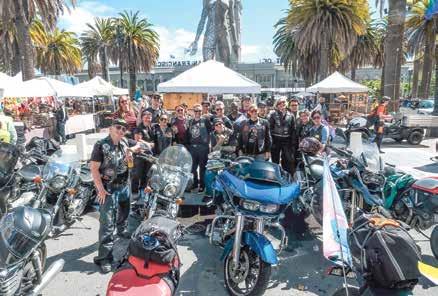
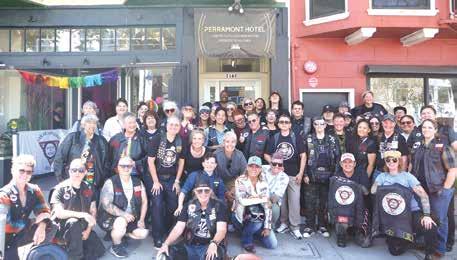
SFDOB and our members from chapters around the world were proud to show up on our motorcycles, providing the loud, engines-roaring visibility Dykes on Bikes is known for as we rallied for trans safety and recognized the urgent importance of protecting trans individuals, especially trans youth.
And the rally made a real impact. Organizers from Indivisible SF shared that the Trans Ally Rally helped drive more than 500 calls to Governor Newsom’s office and helped save $26 million in LGBTQ+ services in the state budget. For anyone interested in continuing to support this work, please visit I Could Be Trans ( https://www.icouldbetrans.org/ ) and consider purchasing an “I Could Be Trans” T-shirt, with proceeds going to the Trans March.
After the rally, we held our annual Pride Saturday fundraiser at The Academy SF. We were deeply honored to receive special recognition from Mayor Daniel Lurie’s office. In recognition of our golden milestone and how, for five decades, SFDOB has enriched San Francisco’s LGBTQ+ heritage and inspired riders and activists worldwide, Mayor Daniel Lurie issued a proclamation declaring June 27, 2026, as Dykes on Bikes Day in San Francisco!
A very special thank-you goes to The Academy SF for generously donating their beautiful space, and to DJ Page Hodel for keeping the afternoon moving with music, joy, and energy. We are deeply grateful to the businesses and individuals who donated items and services to our silent auction: Bay FC; Catch Seafood; Hand of God Winery; Paul Sears and Resilient Rover; Dr. Burg ART Chiropractor; El Dorado
Hotel & Spa in Sonoma; Prohibition Distillery; Emily Doskow Law; Dora Dome; Pam Quan; Judith Lizner, Goorin Brothers; Corner 103 Winery; Temescal Brewing; Cycle Gear; Beaux; Hi Tops; Stag & Manor; Blush Wine Bar; FreeBorn; Cliff’s Variety; Fabulosa Books; R3 Resort; Baked on the River; Surrey Resort; Bozo; Midnight Sun; Le Marais; and Super Duper. Our sponsors also included Orphan Andy’s, which will celebrate its own 50th Anniversary this fall. Links to our supporters and sponsors can be found at the SFDOB website ( https://www.dykesonbikes.org/ ).
After the fundraiser, many of us headed to Los Yaquis on Folsom Street for a “working dinner,” where we reviewed final details for Sunday’s Pride Parade.
And, of course, the Pride Parade on Sunday was incredible. Since 1976, when a group of dykes moved their motorcycles to the front of the parade and claimed their rightful place in history, the San Francisco Dykes on Bikes have roared down Market Street at the front of the world-famous San Francisco Pride Parade. What began as an act of courage and defiance has become one of Pride’s most iconic traditions, with the rumble of hundreds of motorcycles announcing the arrival of Pride itself.
Before 7 am, volunteers were already showing up for registration, crosswalk monitoring, lineup, rider support, and countless behindthe-scenes details. Our Road Captains, as always, played an essential role in keeping everyone safe during the ride. The parade may look effortless from the outside, but it takes tremendous preparation, coordination, and care to move hundreds of motorcycles safely down Market Street.
This year, more than 250 motorcycles came out to ride with us. Seeing that many riders gathered as part of our 50th Anniversary to (continued on page 28)
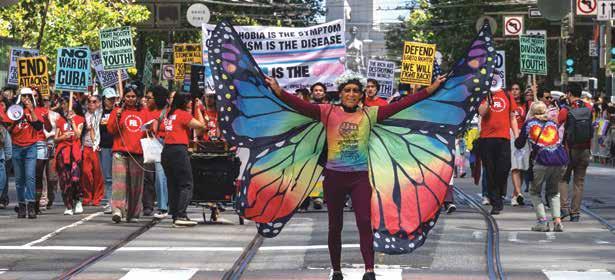
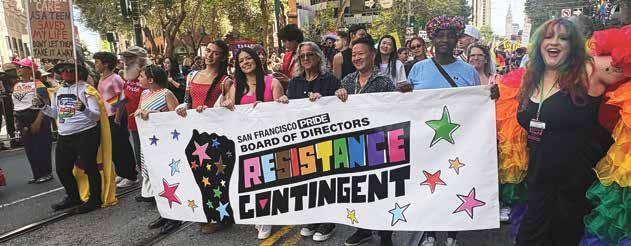
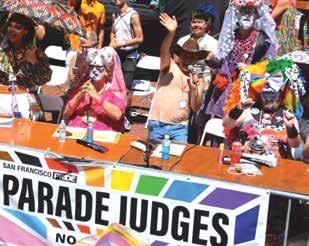
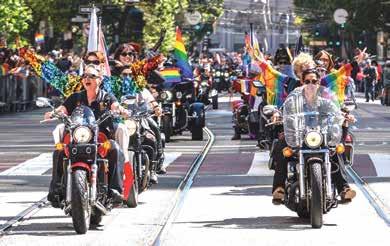
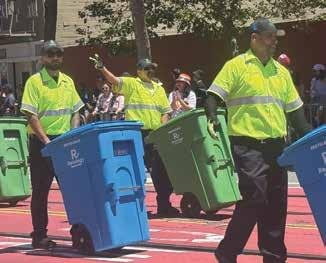
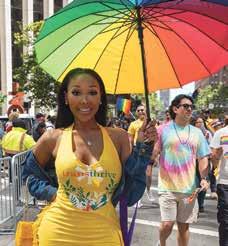
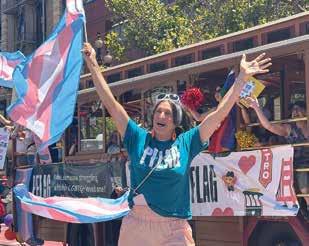
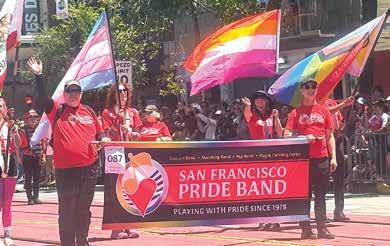
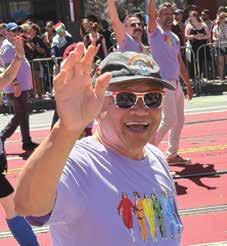
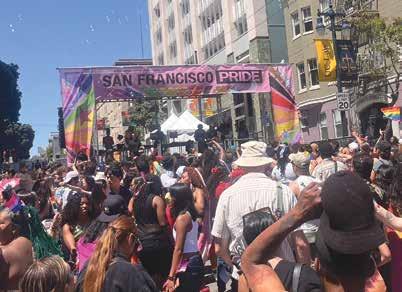
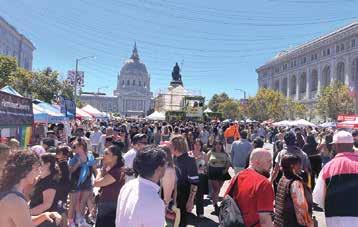
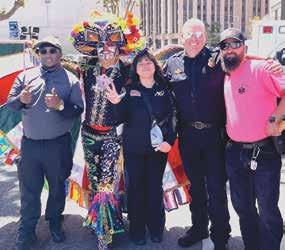
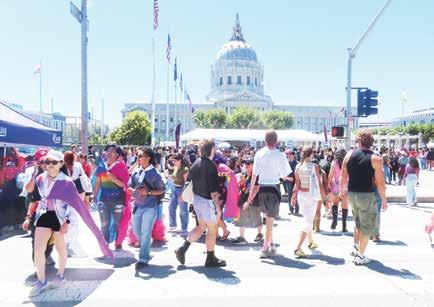
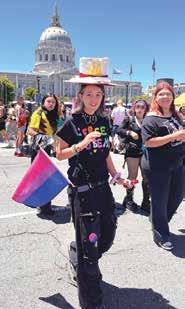
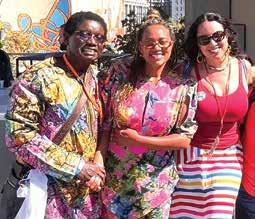
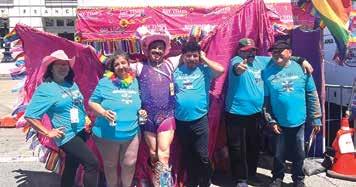
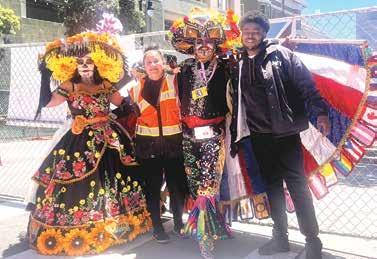
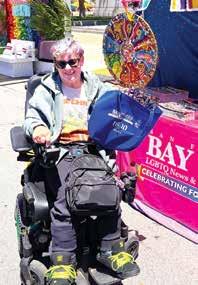
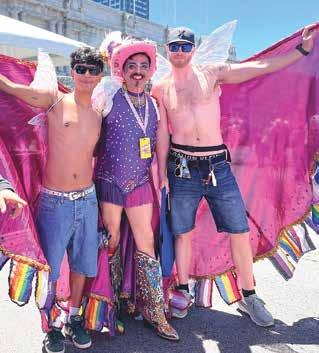
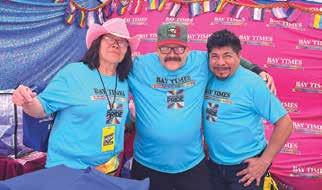
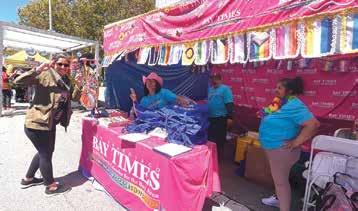
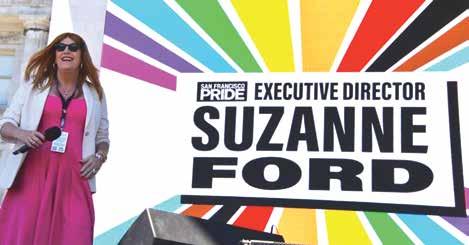
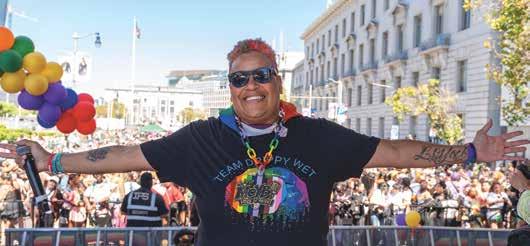
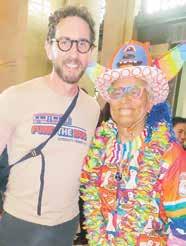
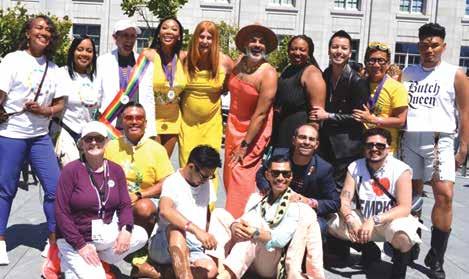
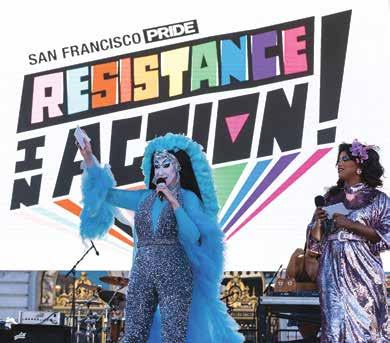

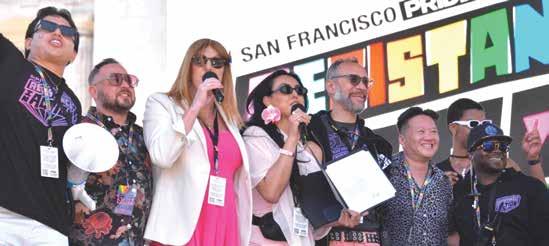
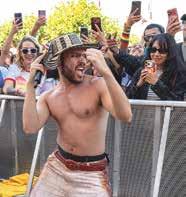
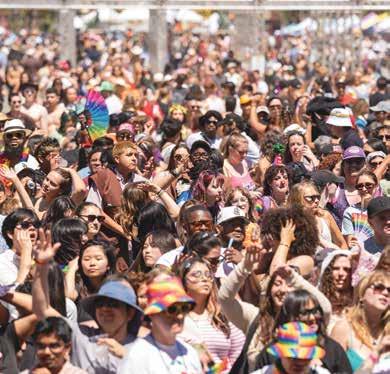
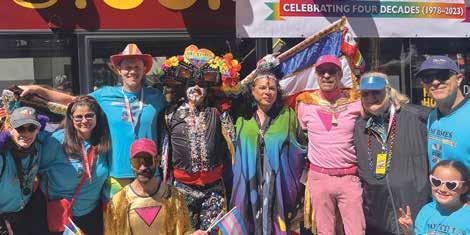
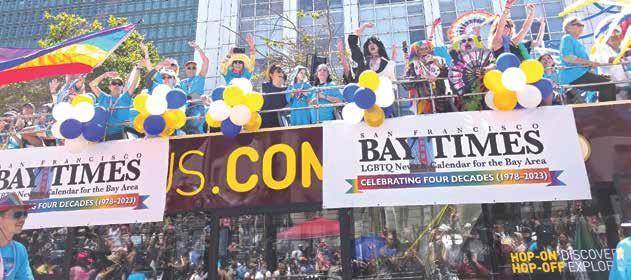
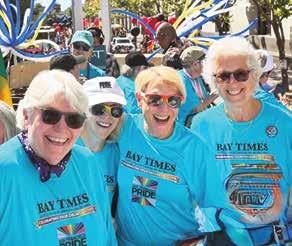
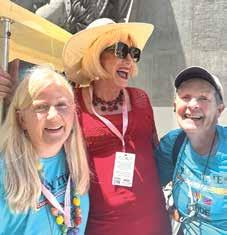
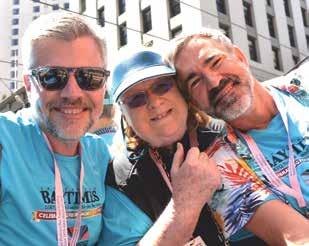
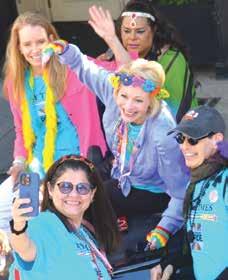
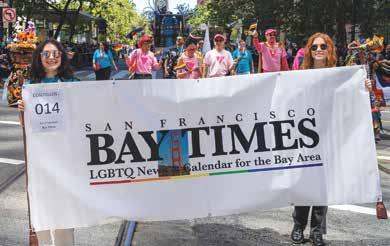
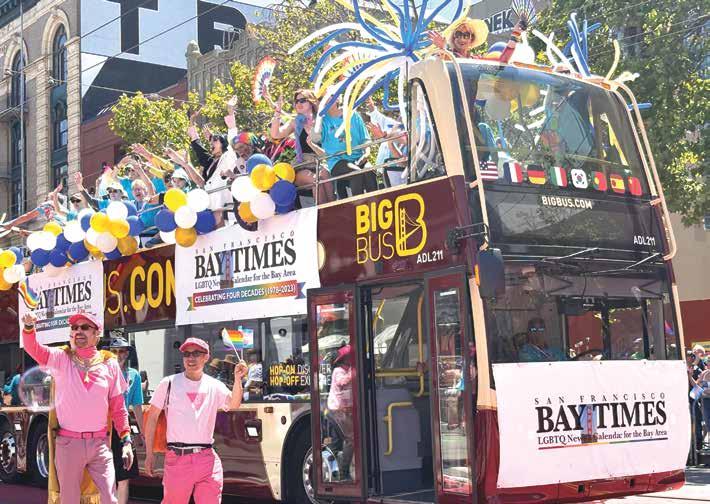
The 56th annual San Francisco Pride Parade and Festival drew an estimated 1.5 million visitors to the city over Pride Weekend, including around 56,000 who participated in the parade on June 28, 2026. The San Francisco Bay Times is honored to have been among the over 300 contingents that included local leaders, entertainers, businesses, community groups, nonprofits, and much more.
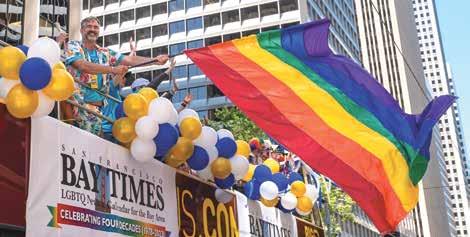
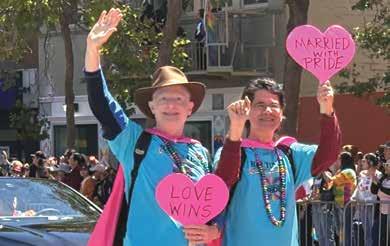
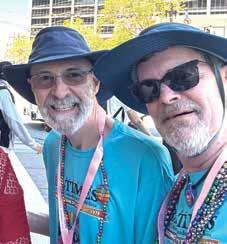
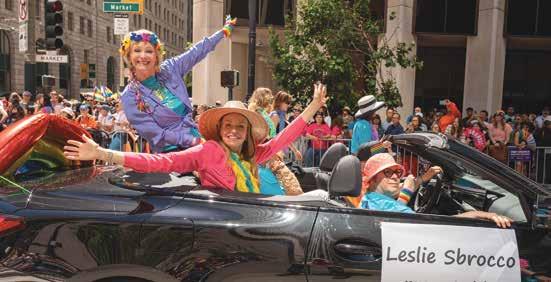
The theme of this year’s Bay Times contingent, Love Makes a Family, was evident in guests who included Megan Married Meagan presented by Olivia Travel, marriage equality leaders John Lewis and Stuart Gaffney, Pink Triangle installation founder Patrick Carney and his husband Dr. Hossein Carney, and Leslie Sbrocco. Leslie is the host of Check, Please! Bay Area (now in its 21st season on KQED), is a Today show regular, national host on PBS, and is known for her entertaining approach to food and wine. An ally and Bay Times columnist, Leslie was joined by her daughter Grace Sbrocco, who is an LGBTQ+ community member, Leslie’s sister Lauren Hartley, and other family members and friends.
Don Berger of Regency Limousine has attended the parade for several years as a viewer from the bleachers, but, until this year, had never participated. He was Leslie’s driver and dressed in festive rainbow colors to mark the occasion.
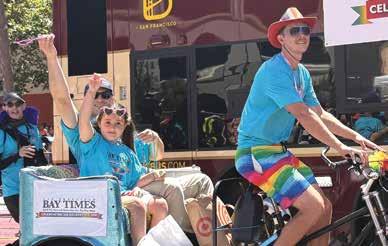
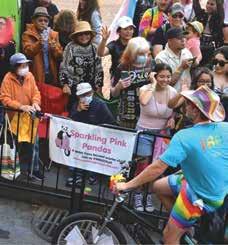
The family theme additionally carried over to the Contingent Managers, Warren Alderson and Steve Scheitlin, who are a married couple. Karen Bardsley also helped manage the contingent. Jimmy Consos, Co-Owner of the Grubstake Diner, rode a pedicab (cyclist Brady Bakay, who has been a part of the Bay Times contingent for years) with Jimmy’s daughter Eleni and they both gave out free Pride items to paradegoers.
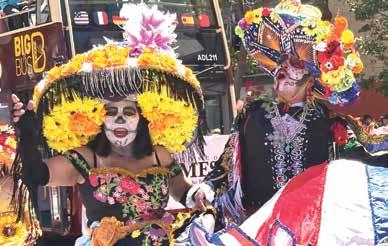
In addition to Warren and Steve, the volunteer team included Juan Davila and Leticia Lopezz—dressed in elaborate Day of the Dead costumes—Miguel Lopez, Jade Martner, Carol Steinkamp (Bus Seating Check-In Captain), Linda Schomaker (T-shirt Captain), and Monette Shirley, who skillfully helped manage the front of the contingent during the parade. Monette’s daughter Savannah rode in the contingent and brought great energy and style to the presentation.
Holding the Bay Times banner were Juliana Slater and Ariyana Vojdani, whom the Bay Times publishers met at Rikki’s only the day before the parade! These two UC Davis graduate students had never participated in the parade before, and did a fantastic job.
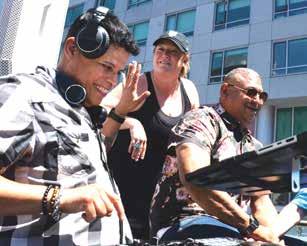
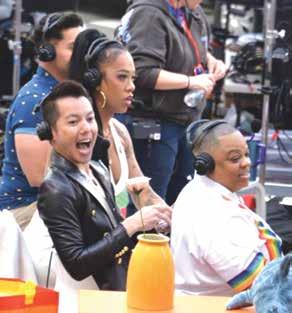
Music was provided by DJ Olga T, renowned for her work at Mango and other popular events, and DJ Manny of Bay Pro DJs who served as sound engineer and emcee. Sparky’s Balloons, run by Salvador Tovar and with Site Manager Samantha and their team, decorated the contingent’s BMW convertible and vehicle provided by Big Bus Tours. Only a few contingents in the parade featured Big Bus Tours buses—highlighted in Golden State Warriors parades and other major events—and the Bay Times again was honored to be one of them. John F. Kennedy was the driver, and, living up to his presidential-sounding name, JFK was an impressive boss from early in the setup until navigating the challenging traffic right after the parade. The organizers of the contingent wish to thank all of the sponsors and vendors: columnist and author Tom LeNoble, Olivia Travel, Boichik Bagels and founder Emily Winston, 1800 Tequila, and V. Sattui Winery. Wine Educator Ed Wyrabkiewicz and Wine Club Manager Stephanie Price of V. Sattui represented the winery in the contingent.



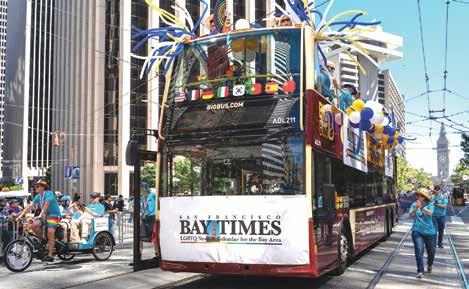
Photographer Bill Wilson, who frequently contributes to the Bay Times, rode in the contingent, while contributing photographer Michael Kirschner and columnist Joanie Juster took photos along Market Street during the parade. Lead photographer Rink was also on site and photographed the VIP Party at the Asian Art Museum following the parade.
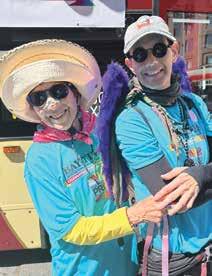
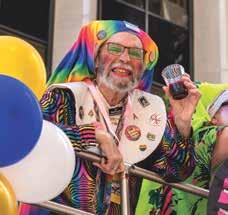
Additional participants who joined the contingent included Babs Daitch, Beth Schnitzer, Carol Batte, Brent Hensley and his husband Frank Marx (who dramatically waved a giant Pride flag from atop the bus), Baylee Decastro, Jenna Rosenthal, Debra Reabock, Madeleine Bronstone, Donna Sachet (who majestically stood at the front of the bus in trademark red), Kiersten Elzy-Loving and her partner Jen, Jade Martner’s wife Lynn Gold, Misha Cohen, Mai Dam (the mother of Nguyen Pham of San Francisco Pride, CHEER SF, and Mensa Foundation) and her sister Phuong, Sonoma County Dyke March
Co-Founders Pam Adinoff and Nancy Kelly, Sally Nichols, Chris Michaelson, and Bay Times columnist and longtime member of the Sisters of Perpetual Indulgence Sister Dana Van Iquity.
Still others either rode or marched in this year’s Bay Times contingent.
Thank you to San Francisco Pride Executive Director Suzanne Ford and her team, and again to everyone who participated in this year’s Parade and Festival. That also includes those reading this who attended the parade and tirelessly watched from the sides of Market Street. Such support and positive energy are just as important to the parade as the contingents. The synergy between the paradegoers and the participants is palpable and reminds why the San Francisco Bay Area remains one of the world’s most successful, diverse, and welcoming regions for the LGBTQ+ community and all those committed to upholding democracy and inclusion.


(continued from pg 7)
$100,000, whether you can walk the full route or are “walking” virtually from your living room, or from halfway around the world. I love the fact that smaller organizations that serve the HIV and AIDS communities—some of which can’t afford to have a development department, or host galas—can raise money through AIDS Walk that might be difficult for them to do on their own. For those smaller organizations, whatever they raise through AIDS Walk, however modest, can make a big difference in their ability to continue providing vitally needed services.
There is another reason why AIDS Walk continues to speak to me. In a world that has largely moved on from HIV & AIDS, that doesn’t acknowledge or remember the devastation is has caused—and continues to cause around the world—AIDS Walk provides a community of people who gather each year because they remember, they care, and they want to continue being part of the solution. Sections of the AIDS Memorial Quilt will once again be on display in Robin Williams Meadow, as a powerful reminder of all those we lost to this pandemic, but also of the community’s compassionate response to that tragedy.
So, join us at AIDS Walk San Francisco on July 19! To become a walker, form a fundraising team, or make a donation to support any walker or team, just click the link at the website ( https://sf.aidswalk.net/ ). We’d love to have you with us.
Joanie Juster is a long-time community volunteer, activist, and ally.
BROWN (continued from pg 21)
kick off the San Francisco Pride Parade was overwhelming in the very best way.
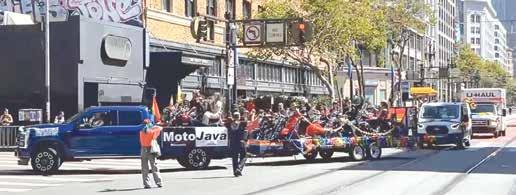
We are especially grateful to MotoJava and MotoMike for helping create a special experience for our VIPs. Through their support, honored guests and key members of our community were invited to ride down Market Street with us, including DOB General Counsel Brooke Oliver; civic activists Elba Rivera and Olga Talamante; Ali Marrero-Calderon, one of the original riders who first moved to the front of the parade in 1976 and our first emeritus member; Dr. Sheila Malone emeritus member and official DOB archivist; Christine Elliot, who designed the original version of the logo we fought all the way to the United States Supreme Court to defend; Ranell, emeritus member; and Judith, patch-holder and Board of Directors.
Words cannot fully capture what it felt like to make our way down Market Street. The engines roared, the crowd cheered, and the sound of hundreds of motorcycles created the glorious cacophony that helps kick off the world’s most famous Pride Parade. It was bold. It was joyful. It was defiant. It was San Francisco Dykes on Bikes celebrating 50 years in style.
After Pride, many of us continued north to Guerneville, California, for a much-needed weeklong retreat at the Surrey Resort. There, we had time to rest, ride, reconnect, and reflect as an international organization on what the next 50 years means for Dykes on Bikes®.
Our 50th Anniversary Pride weekend reminded us that Dykes on Bikes® is not only a tradition. It is a living, roaring, evolving community. Year after year, the rumble of our motorcycles announces the arrival of Pride itself, honoring generations of dykes, queer womxn, lesbians, and gender-expansive riders who have fought to be seen, respected, and celebrated. As hundreds of engines turned over on Market Street, the crowd heard more than noise. They heard 50 years of courage, defiance, joy, and community taking up space together.
Here’s to the next 50 years.
Kate Brown, Ph.D., is the President of San Francisco Dykes on Bikes® Women’s Motorcycle Contingent. https://www.dykesonbikes.org/
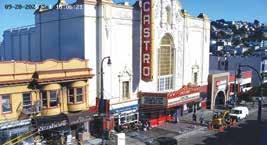
ROSTOW (continued from pg 13)
story that says scientists have only now managed to map the clitoral region in women, several decades after doing the same for the penis and its environs. Read this:
“For nearly three decades, researchers have had a detailed understanding of the nerve network that makes up the penis. But when it came to the organ responsible for female pleasure, they were largely flying blind. Now, a groundbreaking study has finally charted out those elusive sensory pathways, a breakthrough that experts say could have far-reaching implications, including helping surgeons preserve sexual function in women undergoing pelvic operations.”
What? I guess I always assumed that doctors, scientists, and researchers had long since taken a professional look at the inner workings of genitalia in both men and women. For God’s sake! What about cancer research? Sexual issues? This is the 21st Century.
The report said that Dutch researchers “used high-energy X-ray imaging to create detailed 3D scans of the pelvic regions of two deceased women who donated their bodies to science.” They learned that the clitoris extends beyond the diminutive lump we all know and love into an internal network of several branches. I knew that, which means this can’t be a new discovery, right? I wonder what those women thought would happen after they donated their bodies to science?
Here Come the Judges
Sliding back into legal news, Judge Ana Reyes, who is in charge of one of the two big lawsuits filed by transgender service members, granted class action status to the plaintiffs in her case, Talbott v USA. The details of the class were not available, but it will not include those who merely hope to join the military in the future.
Judge Reyes set a trial date for next January, but also chastised the transgender plaintiffs for slow walking discovery. The other case, Shilling v USA, is taking place in Washington state while Talbott is based in Washington, D.C.
And do you remember the complicated efforts by the Justice Department to get their hands on the personal medical records of transgender hospital patients? U.S. District Court Judge Katherine Failla recently issued a temporary restraining order against the Department that applies to all transgender patients in New York City, and there was a preliminary injunction on July 8.
According to a post by Chris Geidner in his LawDork substack report, Failla said the government’s request “‘shocks the conscience’ by seeking the ‘most personal and sensitive information a medical provider could hold’ without providing “any legitimate government interest“ that would justify the level of disclosure being sought by the government.”
I’m sure there are other legal news stories, (like the First Circuit’s ruling against a Christian school in Maine that I haven’t read), but let’s save some of them to enjoy in our next issue.
Graham Cracker
I was about to issue a mea culpa regarding my past support for Graham Platner. I blew off his Nazi tattoo, because he got rid of it and said he wasn’t aware of the symbol’s history. I overlooked the sexting story because his wife said it was back in the day and they’ve moved past it. Plus, he’s been open about the
emotional struggles he experienced when he returned from combat, so I chalked these and other red flags up to his PTSD. He appeared to be a forceful progressive voice and a charismatic campaigner who could send Maine into the Democratic column.
Um, I guess not. The guy’s a mess, a brute and maybe a narcissist. He finally withdrew from the Maine Senate race and I pray the Democratic Party picks a winner to replace him. Meanwhile, Michigan’s a worrisome toss-up and I’m not sure which primary candidate has a better chance in the general election. I just hope the loser (in August) rallies around the victor and unifies the ticket going forward.
I was thinking about, let’s say, toxic masculinity if you’ll excuse the trite expression, when I found a story from National Geographic about how female dolphins will avoid males who coerce females into sex. I guess there are some Platners in the dolphin world and females can recognize them as individuals and steer clear. They also tend to avoid males in groups, who have been known to surround a female and basically gang rape her until she gets free. There are also nice guy dolphins who pet and nuzzle, and these are often given preference.
Much as it pleases us to read about gay penguins and remind ourselves that our sexual orientation is part of nature’s plan, it’s disturbing to read about sexually abusive dolphins and chimps. Guys! Is this all about trying to reproduce? I have too many kind, generous, and thoughtful men in my life to believe that this type of aggression is an inherent characteristic of maleness. But it seems true for some males in every species. I’m just glad to see the females have come up with some defensive tactics. I know Flipper would never have behaved in this manner, but I see here on Google that Flipper was mainly played by two dolphins named “Kathy” and “Susie.” Voila
It
Finally, in a recent opinion piece in The New York Times, gay religious thinker Matthew Vines made the case that the GLBT movement did itself no favors when it moved from assimilation to activism. His piece, headlined “I’m Gay, Not Queer, It Matters,” suggests that the gay rights movement based its success on the idea that sexual orientation is not a choice. Since the success of marriage equality, he writes, “queer” activism has supplanted the winning strategies of yesteryear and turned us towards confrontation and a sense of victimhood.
I mention this in closing because the op-ed drew a lot of attention, and, like many others, I found it annoying. Back in the day, being gay was a perversion, so presenting sexual orientation as an innate characteristic was not just true, but a helpful way to win hearts and minds. Decades have passed. Queer, transgender, asexual, whatever—these categories have evolved as people have been able to come out of the closet at a young age and as society has seen the fluidity of sexual orientation and gender. We are now experiencing a conservative backlash, but presumably we will resume our forward march in time, perhaps with new vocabulary that will irritate people who like the word “queer.” Meanwhile, we can do without this kind of simplistic analysis and everyone is, and always has been, free to use whatever term suits them. arostow@aol.com
The inaugural Sonoma County Dyke March took place on June 21, 2026, marking an historic first for a region known for its deeply rooted LGBTQ+ population. Sparked by local resident Pam Adinoff and her partner, Nancy Kelly, the grassroots event was born out of a desire to combat the growing invisibility of aging lesbians at traditional Pride celebrations. Organizers deliberately framed the gathering as a “march” rather than a parade to maintain a political edge, directly protesting nationwide political attacks on queer and trans lives, reproductive freedom, and civil rights.
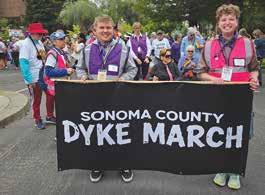
An estimated 600 participants gathered at Santa Rosa City Hall before embarking on a short, fully accessible sidewalk march to Old Courthouse Square.
A central focus of the march was building an intergenerational community by intentionally bridging the gap between older and younger generations. While the event reclaimed the word “dyke” as an historic symbol of pride and defiance, the volunteer committee worked closely with younger LGBTQ+ community members to ensure radical inclusivity for trans, non-binary, bisexual, and sapphic individuals. The march culminated in “Lez-A-Palooza,” a vibrant, interactive street fair featuring community booths, art creation, and games designed to transform the public square into a joyous, connected neighborhood village.
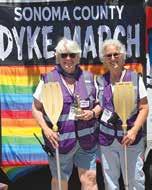
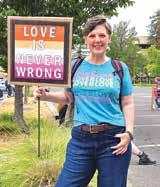
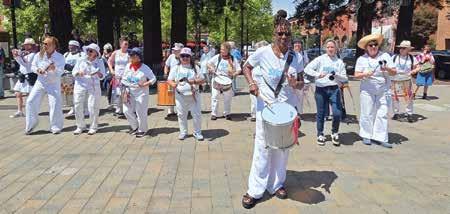
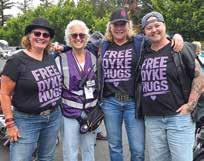
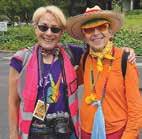
A week later, on June 28, Adinoff and Kelly were among those who rode in the San Francisco Bay Times Pride Parade contingent. https://socodykemarch.org/

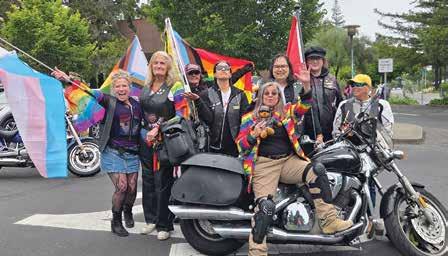

On Sunday, July 26, 2026, at 1 pm, the Roxie Theater and the GLBT Historical Society will mark ADA Day with a double feature and a live panel, co-presented with the California State Council on Developmental Disabilities and the Center for Independent Living. The afternoon will open with Sign 504 Now!, a 30-minute documentary that returns to 1977, when more than 150 disabled activists occupied San Francisco’s Federal Office Building for 26 days, the longest nonviolent occupation of a federal building in U.S. history.
Shot by the Queer Blue Light video collective and drawn from the Society’s archives, the film captures the cross-movement solidarity, from the Black Panthers to LGBTQ+ allies, which fueled the action.
Vivien’s Wild Ride will follow. It is a feature-length documentary about iconic local film editor Vivien Hillgrove’s experience with macular degeneration. As Vivien’s eyesight deteriorates, she grapples anew with questions of memory,
identity, and artistic survival. In this bold directorial debut, a legendary Bay Area cinematic voice learns to navigate a changing world, redefining belonging, family, and disability through a brilliant collage of sight and sound.
Between the screenings, a panel of disabled activists and artists will reflect on the films and their broader historical context, moderated by Jim LeBrecht and featuring Vivien Hillgrove, Dr. Victor Santiago Pineda, and Dr. Kevin Mintz.
Both films will be open-captioned. The showing of Vivien’s Wild Ride will offer audio description on request, and ASL interpretation will be provided for the introductory comments and the panel discussion.
The Roxie Theater is located in San Francisco’s Mission District. Learn more about this event, and other Society events, at our website ( https://bit.ly/4gC6WBu ) or follow the QR code on this page.


Greg Sarris is an accomplished author, scholar, and tribal leader who has dedicated his life to the preservation of Native American heritage, storytelling, and self-governance. He serves as the Tribal Chairman of the Federated Indians of Graton Rancheria and as the President of the Tribe’s Economic Development Board, such that his work is key to the Graton Resort & Casino in Rohnert Park that he helped create. Of Native American, Filipino, and Jewish descent, he was adopted at birth and has, for his entire adult life, lived openly as a gay man.
Given the demands of his tribal leadership work, he could solely focus on those efforts, but he is a prolific writer who has become a major voice in contemporary literature, film, and theater. He has authored widely acclaimed books, including the essay collection Keeping Slug Woman Alive and the short story collection Grand Avenue, which he adapted into an award-winning HBO miniseries co-executive produced by Robert Redford. His subsequent publications, such as Watermelon Nights, How a Mountain Was Made, and Becoming Story, highlight deep connections to ancestral places and oral traditions.
His creative contributions extend into public media, script doctoring with the Sundance Institute, and serving as the former Chair of the Board of Trustees for the Smithsonian National Museum of the American Indian. He currently serves on the UC Board of Regents and on the Sundance Institute Board. (Still more information about Sarris’s incredibly multifaceted work is at: https://www.greg-sarris.com/ )
A New Sprawling Epic
His latest novel, The Last Human Bear, is his third and is a highly anticipated work given that his previous novel was published 28 years ago. The Last Human Bear is a sprawling epic centered on Mary Hatcher, a young Native Pomo woman coming of age in 1930s California who grapples with a haunting and mysterious family legacy. Rumors surround Hatcher that her stepmother has passed down the ancient, inescapable ability to shapeshift into a “Human Bear”—a formidable being capable of menacing and poisoning its enemies.
Spanning from the Great Depression well into the twenty-first century, the novel follows Hatcher as she tenaciously carves out her independence while passing between Native and non-Native societies. As she navigates complex romantic entanglements and the shifting dynamics of both inherited and chosen family, she is constantly pursued by the internal fear of whether her inherited power dooms her to cause harm, a journey that ultimately culminates in a haunting final act.
Dedicated to His Mothers
The details of Sarris’s own life read like a novel, and one marked by great achievements along with tragedy. He dedicates the book to his birth mother Bunny Hartman, who was from a wealthy family but just 17 and unwed when she had
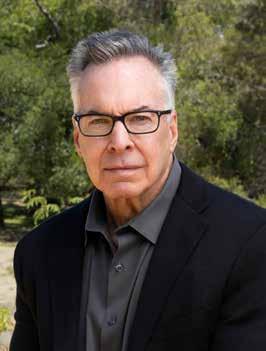
him and died shortly thereafter following a transfusion of the wrong blood type. The name of Sarris’s father was not included on his birth certificate.
In the early 1980s as a graduate student at Stanford University, Sarris learned that his biological father was Emilio Arthur Hilario. Hilario was of Filipino, Miwok, and Pomo descent. One of Hilario’s relatives on his father’s side, Tom Smith, was a well-known Pomo and Coastal Miwok healer. Sarris also dedicates the book to Mary Mape, who, with her husband George, adopted Sarris shortly after his birth. The couple later had three biological children. George was an alcoholic and abusive toward his adopted son, who was sent to live with various foster families, including some who were Native American. At the age of 12, Sarris met Pomo basket weaver Mabel McKay, who taught him about American Indian customs and tradition.
Strong women figure prominently in Sarris’s novels, and The Last Human Bear is no exception.
Excerpt From The Last Human Bear
Sarris’s latest work begins:
“I’m curious why you want to know about me. The Indians would say anyone listening to me got a lot of nerve, especially the old Indians. No end to the stories they’ll tell you about me and my numerous and abominable crimes.
The latest being I put a spell on John Benedict and evened the score after all these years. That’s what my sister’s granddaughter Darlene claims, and she ain’t even one of the old-timers. Yeah, Darlene claimed I done nothing less
than expected: poisoned. Poisoner, it’s what Indians here call a witch.
The detective didn’t believe it. Laughed, said John Benedict was old, ninety plus. Natural causes, what else. Wouldn’t laugh, say the old Indians. Wouldn’t laugh if he knowed what we know about this woman who calls herself Mary Hatcher. No, sir, wouldn’t laugh at all, not if he knowed she was a poisoner, but a poisoner of the worst kind, a Human Bear.
Me, I want to die. Or at least be able to. That’s why I’m talking. You see, that’s the agreement; I can’t go until I pass on this business. That’s the way it is for us kind of people. But as you’ll see, I’m the last link. I have no cape, no bearskin, to turn over to you. All that’s left is a story.
Here’s my predicament: What if the story stops with you? What if what I say falls on deaf ears? Still, a story has life, even if it’s slammed between the covers of a fat book; and if that’s true, then I only hope listeners will treat my story fair.
Understand, I’m not talking to plead my innocence, not in the death of John Benedict or whatever else I’m supposed to have done. No, sir. Neither am I tricking you, though I know that’s the way it is with poisoners.
I told you up front what I am and why I’m talking. I will say John Benedict figures in the story. He figures strong. Ha! A white man at the heart of an Indian’s story. But if I understand anything, it’s that the heart has no limits. It’s everywhere. At the same time, it’s no bigger or lesser than anything else. The hair on a man’s arm, for instance. You could trace things from that until you seen the web that is this world.
Funny, folks used to say a good poisoner is someone born with a broken heart. That wasn’t the case with me. I wasn’t born that way. Of course, you might not believe that. Not from her that’s got hell’s songs in the hollow of her throat. But try. That’s where the story starts.”
The first two chapters may also be read at https://bit.ly/4gxfWIa
Readers who continue will be transported to migrant field worker camps, Depression-era rancherias, and cinematic Sonoma landscapes as the life journey of Hatcher unfolds and reveals the loss of old Native cultures in the face of a slow genocide. The indelible final act, in which Hatcher must unburden herself in order to die, is gripping and thought-provoking.
See Sarris in Person
Sarris is participating in a number of readings and interviews concerning his latest work at several bookstores throughout the Bay Area over the next several months. He will be in San Francisco at City Light Books on July 23, and in Oakland at Clio’s Books on July 30. For more information about these and his other appearances, go to https://bit.ly/44Ub5JN

The 46th edition of the San Francisco Jewish Film Festival will open today, July 16, 2026, with out gay writer/director Moshe Rosenthal’s Tell Me Everything and will close on August 1 with a screening of the Catskills documentary, We Met at Grossinger’s. In between will be dozens of features, shorts, and documentaries about Jewish life and culture, including Nurith Aviv’s Given Names, which features interviews with a dozen subjects, including Judith, a queer activist who took the name Judon and

to track Meir down. Seeking solace with an older man in a cruising area, Boaz has a series of encounters that may provide him with some catharsis. Rosenthal and his superb cast deftly convey each character’s intense emotional state, creating a palpable sense of loss and longing. This is a sensitive, touching drama. Director Moshe Rosenthal is expected to attend.
Where To? (July 19, 8 pm, Jewish Community Center of San Francisco (JCCSF), and July 30, 6 pm, Piedmont) is a moving, episodic drama about Hassan (Ehab Salami), a Palestinian Uber driver in Germany. In May 2022, Hassan picks up Amir (Ido Tako), a gay Israeli, and his boyfriend Nils (Enzo Brumm) and watches the guys kiss in his mirror. Hassan then connects with Amir when he learns that they both grew up near each other in the Middle East. When Hassan picks up Amir a few months later, the two strangers become even more friendly, and Hassan helps Amir

familial, or for one’s country. In his feature directorial debut, Assaf Machnes generates emotion by capturing the silences and lingering on the faces of his characters, all of whom are processing intense feelings. This is a small, subtle, beautifully crafted film that yields many insights about the human conditions of longing and belonging. Director Assaf Machnes is expected to attend.
Director Mike Doyle’s modest, feel-better comedy-drama, Bookends, (July 20, 11 am, JCCSF) has budding novelist Nate (writer Noam Ash), moving in with his grandparents, Miriam (Caroline Aaron) and Saul (F. Murray Abraham), after he catches his boyfriend cheating on him. Anxious about his career, his heartbreak, and his future, Nate hopes to crash at Miriam and Saul’s retirement community until he “figures things out.” Nate’s despair lifts a bit when he starts seeing his grandparents’ hot, gay doctor, Daniel
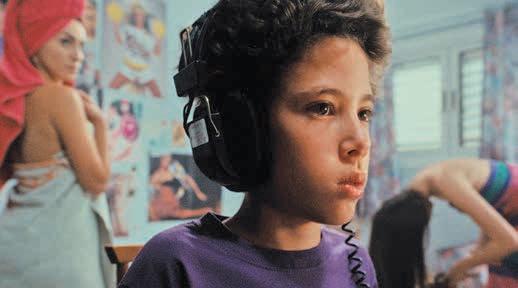
started to use he/him pronouns. Here is a rundown of the LGBTQ films that will be screening at this year’s San Francisco Jewish Film Festival.
Tell Me Everything (July 16, 6:30 pm, Herbst) is Moshe Rosenthal’s compelling drama about the fraught relationship between a father and son in Israel. The first half, set in 1987, has 12-year-old Boaz (Yair Mazor) drawing away from his dad, Meir (Assi Cohen), after he spies his father having sex with another man at their local swimming pool. Boaz actively resists Meir, avoiding his touch and even ignoring him—especially as news of the AIDS epidemic spreads and Boaz fears his father has the disease. As his bar mitzvah looms, Boaz begins to further question ideas of masculinity and manhood. Tell Me Everything then jumps to 1996, where Boaz, now a young adult (Ido Tako), tries to reconcile his unresolved feelings about his father. He expresses his pain in a homophobic manner toward a male sex worker but also tries
she knows where to place the camera— such as on a lazy Susan as friends dine out—and when to cut a scene for maximum dramatic impact. The stories range from absurdist, such as two gay men talking in funny accents, to downright uncomfortable as when a woman provides some honest feedback to her roommate. That the characters reveal themselves in just a few lines of dialogue, or a simple action, makes Human Theories incisive about human nature and helps move the film along when the episodes are less interesting. Director Zeidman is expected to attend.
Far From Maine (July 26, 2:30 pm, JCCSF), by out gay filmmaker Roy Cohen, is a thoughtful documentary about mem-
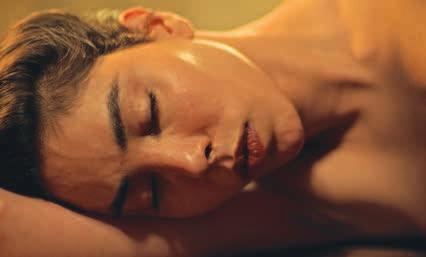
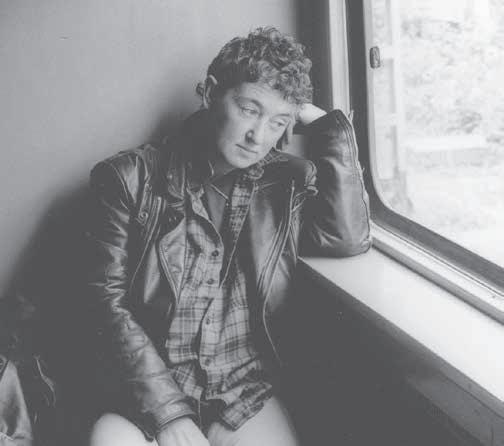
out another night when he sees the young Israeli is in trouble. Where To? also features a subplot about Hassan’s efforts to reconnect with his estranged daughter, Juman (Rama Nasrallah), as well as Sanah (Derya Durmaz), a woman he once loved. Where To? is all about love, be it gay, straight,
Green (out gay Charlie Barnett). As Nate takes care of other people, he realizes he can take care of himself. It is a sweet message, told in a sitcomic film featuring a cast that play the material a bit broadly. Nevertheless, Bookends offers charm and schmaltz in equal measure.
Human Theories (July 25, 3:30 pm, Roxie) depicts dozens of awkward encounters between various people in New York City. Each vignette lasts only a few minutes, and some of the actors reappear in other episodes. The strength of queer writer/director Jess Zeidman’s film is that
ory and the current political situation in Israel. As a 14-year-old, Cohen, an Israeli Jew with Arab heritage, met Aseel Asleh, a Palestinian living in Israel, at the Seeds of Peace camp in Maine. Cohen admired Asleh’s charisma, and they became friends. Three years later, Asleh would be murdered by Israeli police. Far From Maine uses letters Asleh wrote to Cohen to reflect on the optimism and friendship they shared decades earlier. In addition, Cohen revisits the camp and meets with other friends from that time, including Shurouq, who shares his concerns about raising children in Israel. (Cohen and his husband Toby are parents of a young girl, Alia, and the couple talk in the film about staying in Tel Aviv.) Cohen also dedicates a section of Far From Maine to Asleh’s unjust murder and its impact, explaining in a poignant
(continued on page 48)
Jan Wahl
Every neighborhood should have a bookstore or a library within easy reach. In college, I lived at Castro and 22nd and would hang out at A Different Light bookstore down the street. It’s now Fabulosa Books, and it is still very cool.
Owner Alvin Orloff makes sure it is well-stocked with queer memoirs, obscure literary gems, books for kids, coffee table art books, and more. Since I am a book nerd, I was thrilled to talk to the Assistant General Manager, Dylan Lalanne-Perkins. She started by telling me about a runaway hit at the bookstore: a gay hockey romance called Heated Rivalry (which inspired the HBO Max series) by Rachel Reid. It’s part of a series of books combining sports and romance. Dylan said that gays, lesbians, and allies enjoy this series equally. Another popular choice is Deep House: The Gayest Love Story Ever Told, a memoir of gay music and marriage history by Jeremy Atherton Lin.
I asked Dylan about one of my favorite authors, Oscar Wilde, and was excited to learn that there is a new biography called After Oscar: The Legacy of a Scandal by Merlin Holland. I will be ordering that from their online service ( https://www.fabulosabooks.com/ ) or by calling them ( 415-658-7015 ).
I love to buy books as gifts, including coffee table art books. Since I’ve been trying to get the Rainbow Honor Walk to highlight two amazing women who lived as out-of-the-closet lesbians, I asked about classic Hollywood director Dorothy Arzner and the diaries of Anne Lister, often called the first modern lesbian. It’s wonderful to have a resource such as Fabulosa Books, and they have a book club that meets every week, too!
Right now, I am joyfully digging into a book about Madeline Kahn—Madeline Kahn: Being the Music, A Life —by William V. Madison. This detailed biography answers my big question: What was Madeline thinking when she did the “I’m Tired” musical number from Blazing Saddles? At the same time, I’m reading City of Dreams: The Making and Remaking of Universal Pictures by Bernard F. Dick. Like I said, I’m a real book nerd.
One of my favorites is the Hollywood Scandal Almanac: 12 Months of Sinister, Salacious, and Senseless History by Jerry Roberts. From Bugsy Siegel’s killing to Tyrone Power’s on-set duel that killed him, every day brings some new crazy Hollywood story. Once in a while, I veer into the cold winds of Alaska and study the Gold Rush, if it’s juicy enough for me. Right now, I’ve got Klondike Fever: The Life and Death of the Last Great Gold Rush by Pierre Berton. My favorite look at this period is Lael Morgan’s Good Time Girls of Alaska Books open the world to all of us. How else could I go back to the 1800s and shake hands with Anne Lister, get to know the great Oscar Wilde, or understand how a major movie studio works? Books give it all to us.
Jan Wahl is a Hollywood historian and film critic on various broadcast outlets. She has two Emmys and many awards for her longtime work on behalf of film buffs and the LGBTQ community.
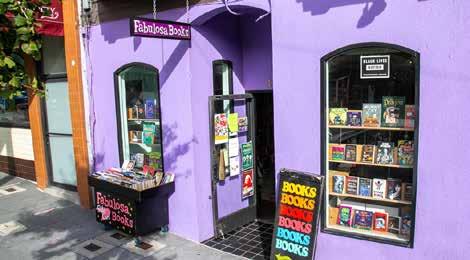
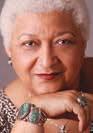
My most favorite thing to read is detective fiction; unlike life, it almost always has a satisfying resolution to the mystery. This has been true for me since I got my first library card and haunted the Bookmobile, which arrived in my tattered neighbourhood every Thursday at 4 pm. It wasn’t until I was much older that I realized I missed seeing myself (colored and queer) in the stories.
Then I read Valerie Miner’s Murder in the English Department (1983). Minor’s breakthrough novel drew ire from some for its depiction of a not-so-perfect, intrepid, acerbic lesbian professor in Berkeley fighting misogyny to gain tenure then fighting against a murder charge. The women’s


movement still felt too fragile to reveal our flaws. Then came Sarah Schulman’s murder mystery, After Delores, (1988) taking place in San Francisco. But a few short years and a more noirish setting made us embrace her funny and unpredictable characters.
I also like television murder mysteries, preferably with a British accent. But finding queer people of color in either medium hasn’t always been easy. Cheryl A. Head’s Motown lesbian detective series continues with Find Me When I’m Lost, and proves that ex-lovers can be a pain no matter how mature we are. In addition to murder, the book explores how complicated loyalty can be.
In this era spotlighting police brutality, it’s great to read Penny Mickelbury’s series about an urban Hate Crimes Unit led by a lesbian lieutenant who works with her Black journalist partner and experiences a hopeful
perspective on policing. Mickelbury, who is also a playwright, has several detective series, but the most recent in this series, You Can’t Die But Once, is my fave.
Lately, though, I’ve been reading mostly period mysteries as part of my research for my next novel that takes place in Victorian
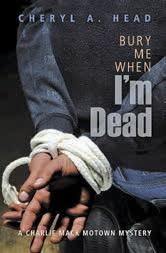
Cool Machine (fiction - hardcover) by Colson Whitehead
From the legendary bestselling author and two-time Pulitzer winner Colson Whitehead, Cool Machine is the magnificent final volume of his Harlem Trilogy. Set in 1980s New York, Whitehead paints a portrait of a city in transition, where shimmering skyscrapers rise to the heavens as displaced people huddle in abandoned tunnels below. In a dazzling display of protean imagination, in this New York, as in the lives of Whitehead’s vivid characters, it’s what’s below the surface that reveals the truth.

Country People (fictionhardcover) by Daniel Mason
After garnering much acclaim for his beloved 2023 historical fiction novel North Woods, Daniel Mason returns with Country People. The novel follows a family as they pack up and leave California behind for Vermont. Their new life is immediately invaded by a cast of characters as colorful as any Russian folktale, from a ghostly tree surgeon to a Shakespearean temptress. Set in a beautiful small town and its surrounding countryside, this delightful novel rolls along with life’s joyful mysteries, exploring the rhythms of marriage, parenthood, and the beauties of nature.
London and features people of color, criminals, and queer people. So, it’s been a lovely surprise to bump into queer characters in commercial Victorian era mysteries when I’ve not been expecting them. There hasn’t been as much luck in finding lesbians in mainstream mystery novels from this time period except what one can extrapolate when a woman is called a “bluestocking,” meaning she reads, supports social reform, rides a bicycle, and regularly attends political/literary salons.
Gay men seem to pop up more openly. Recently, I read a series by Grace Burrows, who generally writes historical romance, but her “Lord Julian” series features a physically and psychologically damaged titled soldier returning from fighting Napoleon who uses his tracking and deduction skills to solve mysteries in his country village. In several of the volumes, his brother, a Duke, appears; he’s the nearest thing to a king in the rural environs and is also a deeply closeted gay man. Number 4 in the series is delicately written as Lord Julian faces down a brutal blackmailer and reinforces the value of the love between the Duke and his longtime
(continued on page 48)

Some People (fiction - hardcover) by Parini Shroff
In this wonderful family saga from Parini Shroff, an injured mother, Malti Patel, believes she’s fine enough not to need in-home assistance as she recuperates, despite her doctor’s insistence. And the only person available for the job is Nathan, the man in the midst of divorcing Malti’s daughter, Kavya. Over the course of the week, as Malti grapples with the shadows of her past and Nathan ponders the wreckage of his marriage, they learn that they are the two people who know Kavya best—and the ones who have hurt her so deeply that she’s left them both. Rich with emotional depth, Some People paints a nuanced portrait of love, forgiveness, and our timeless quest for understanding and acceptance.
Friday, July 17–Sunday, July 19 (ticketed - Corte Madera store) Book Passage Mystery Writer’s Conference
In 2026, the Book Passage Mystery Writers Conference will celebrate its 32nd year, and its reputation among writers continues to grow. It covers everything mystery writers need, from developing ideas and writing skills to finding an agent and publisher. Participants and faculty spend time together in meals,
informal gatherings, and evening presentations, all geared toward honing the craft of mystery writing.
Tuesday, July 21 @ 5:30 pm (ticketed - Ferry Building store) Brooke Nevils with Jennifer Massoni Pardini, Unspeakable Things: Silence, Shame and the Stories We Choose to Believe
A powerful examination of the myths and stereotypes surrounding sexual harassment and assault, Nevils’ memoir has been praised by The Atlantic: “Just as much an investigator as a memoirist, Nevils attempts to tunnel through the lurid details and the #MeToo boilerplate and unearth something much knottier.” Nevils will be joined in conversation by Jennifer Massoni Pardini, Managing Editor of the Nob Hill Gazette.
Thursday, July 30 @ 6 pm (non-ticketed - Corte Madera store) Laura Sims, The Man
From the highly acclaimed author of How Can I Help You, a New York Times Best Thriller of the Year, comes a singular take on the psychological suspense novel that follows a 1960s housewife turned amateur photographer who begins to fear for her life when she notices the dark silhouette of a man in the background of her self-portraits. Sims will be joined in conversation by Sheri T. Joseph, the author of Edge of the Known World. https://www.bookpassage.com
Sister Dana sez, “Just because it is mid-July, and we are no longer celebrating Pride Month, doesn’t mean we queers are any less PROUD! LGBTQ Pride is all year long: 24/7!”
Way before the San Francisco Pride Parade, on June 18, San Francisco leaders held a rally at City Hall to support a bill expanding LGBTQ civil rights. The proposed bill would protect and make the city a refuge to shield LGBTQ Americans who live in the city from out-of-state convictions tied to gender-affirming care, abortion, or drag performance. City leaders said this proposal was an effort to counter a growing wave of laws criminalizing those activities in other states. “Laws that were once unimaginable are now being used to investigate and punish people simply for seeking healthcare or expressing who they are,” said SF Supervisor Bilal Mahmood “For generations, people have come to San Francisco seeking freedom and a chance to build a better life. Our city has always opened its doors, and we are here not about to let other states’ bigotry close those doors on them.” State Comptroller Malia Cohen , activist Honey Mahogany, and representatives from Planned Parenthood also spoke at this pre-Pride Parade demonstration.
The Frameline Film Festival for its landmark 50th year offered “50 Years of Queer Cinema” and featured the opening night of “Lady Champagne”—the riotous sequel of “S--t and Champagne ” at the Castro Theatre on June 17 with a fun after-party at The Foundry. Starring, written, and directed by former San Francisco Drag Laureate D’Arcy Drollinger alongside of a cast of clever drag queen villainesses, the titular dancing queen is framed for her husband’s murder. Drag hijinks carry on throughout the fiercely funny flick (although, in my less than humble opinion, in need of a touch more editing for length) and made this Sister howl out loud—especially when D’Arcy joins a convent and is dressed as a nun! Nuntastic!
“Oasis Lives! The Future of SF’s Iconic Queer Nightlife Venue” was held on June 24 at 220 Montgomery. KALW gave an interview of Oasis nightclub owner D’Arcy Drollinger and Princess producer Tito Solo moderated by reporter Stafford Hemmer. D’Arcy had already announced the good news at her Lady Champagne Castro
Theatre show that Oasis was set to reopen, so this was just icing on the cake!
On June 19 aka JUNETEENTH , the Castro Business District presented Castro Night Market between 18th and Collingwood streets with art, fashion, food, drink, merch, and live entertainment. Especially entertaining was the incomparable, belt-out singer Jason Brock accompanied by the delightful duet of Dee Spencer on electric piano. Electrifying! After his two sets, Jason and I had a great, slightly naughty chat and we took pix with Jason, Dee, and me. Mark your calendars for the next Castro Night Market on the third Friday of July 17.
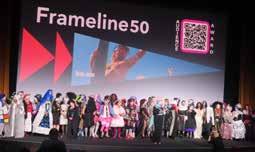
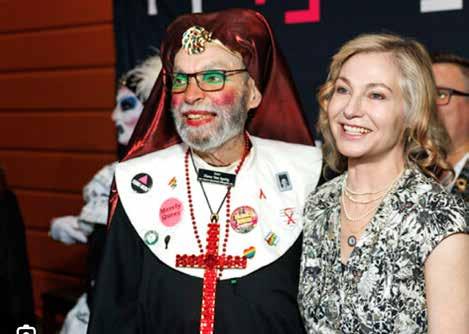
Created by Mark Kliem (also known as Sister Zsa Zsa Glamour), Lavender Lounge started as a weekly queer dance party in San Francisco before evolving into a pioneering ’90s TV broadcast. It documented the city’s nightlife, trans community, and LGBTQ events before YouTube and modern social media. The film appeared at the Frameline Film Festival on June 19 and again at Haight Street Art Center on June 20. Sister Dana was a frequent visitor to the Lounge back in the day, and this show brought back such lovely and wild memories.
Sister Dana sez, “Let us REFLECT upon the no-bid $16.65 million Lincoln Memorial Reflecting Pond that Trump tried to unnecessarily turn blue but has now become algae-green. Drain the swamp? Is not this a sign from the Universe Above to his ‘majesty’ to: ‘HANDS OFF OUR MONUMENTS, you green wannabe king!’”
On June 21 (Father’s Day) at 470 Castro Street, we honored and celebrated the Tenth Anniversary of STRUT, San Francisco’s home for queer healthcare, culture, and community. This lovely three-tiered (including an outside patio) house party was hosted by Honey Mahogany with Nikki Jizz. It also featured live performances, DJs, and queer art on the walls. I was so happy to wear my original MAGNET T-shirt emblazoned: “No Blame, No Shame” from ten years ago—when I helped christen Magnet then to become STRUT now Sister Dana sez, “Keep on struttin’, STRUT!”
Sister Dana sez, “As I blew out the candles on America’s 250th Birthday Celebration, I wished Trump had never been born. Happy Independence to all of us true patriots!”
U.S. Air Force officer Major Jason Watson was arrested on July 2 on the Capitol steps after participating in a protest while in uniform calling for Trump’s impeachment. Just prior to his arrest, his bold speech was so inspiring. “I’m calling on average
Americans everywhere to peacefully exercise your First Amendment rights every day until this administration is removed and our democratic republic is restored,” he said. “I believe in America. I believe in us. If just a nobody like me can take a stand for our Constitution and our democratic republic—then you can too. I hope you will join me in the defense of our republic!”
Department of Intelligence inexperienced, 2020 election denier, chief Bill Pulte, has nonintelligently begun firing dozens of experienced, qualified intelligence officials just a few weeks after Pulte’s arrival under orders
from Trump—because they were part of ‘The Deep State’ (that doesn’t exist). Sister Dana sez, “Smooth move, punk Pulte, because it’s only our safety at risk. What could possibly go wrong?!”
The day before INDEPENDENCE DAY, Trump the Tyrant visited historic Mount Rushmore after The White House had suggested his face should be added to that glorious past presidential mountainside memorial. Sister Dana sez, “Well, of course! As if we needed more T-rump names and faces and memorials
(continued on page 48)
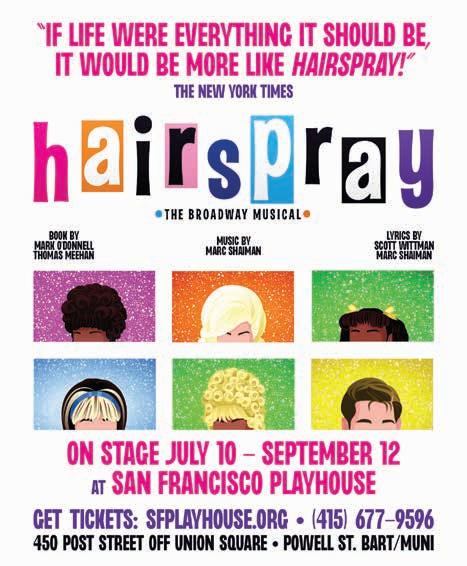
Dr. Tim Seelig
I am writing this on a big boat docked in the stunning harbor in Nice, France! In Texas, we would say, “That’s nice,” meaning, “Bless your heart,” or something not suitable for print. This is the third article about my Bucket List. You can read the other installments at the San Francisco Bay Times website ( https://sfbaytimes.com/ ).
Part Une is titled “Bucket List Equals Hope,” and Part Deux is titled, “A Father Son Trip to Bali.” The first two were surprise entries on the list.
Jumping out of an airplane was never a lifelong dream. I was watching Top Chef, they jumped, and I decided I could, too.
Bobby came along for the fun (?). Bali sounded exotic from the I first time I heard the song “Bali Hai” in the musical South Pacific. When I looked on a globe, it was too far away. You’d have to be Hai to want to travel that far. Then my son invited Bobby and me to take us there! I couldn’t turn that down. It is stunning.
Part Trois has been on my list for a very long time. I know that nobody wants to hear about what I did on summer vacation, see the slideshow or PowerPoint. Don’t worry, I’m no Rick Steves. I’ve been lucky to travel to Europe many times and lived there twice. I’m not climbing the Alps or walking the Camino any longer. How about a Mediterranean cruise? Yes, please. I just had to schedule it between cataracts, rotator cuff, and knee replacement surgeries. You didn’t ask for an organ recital. Moving on.
The bucket started off rough. Sing along, “There’s a hole in the bucket, dear Liza.” Poor Henry had no idea how to fix it as the hole got bigger.
I left Portland on Sunday, the 28th of June, headed through SFO to Rome. You all were busy priding. The flight was delayed. Then we sat on the tarmac another 45 minutes due to air traffic in San Francisco. Surprise. When we arrived, the United app said it was a 24-minute walk from D2
to G1. Boarding ended in 14 minutes. They knew I was coming. I made it in 18 minutes. As I approached, the agent said, “Tim Seelig?” I panted, “Yes.” “I’m sorry, they just closed the door.” I could see the jet bridge maybe 2 feet from the airplane. Nope. No turning back. She was able to book me that night through London arriving in Rome Monday night. I was grateful(ish).


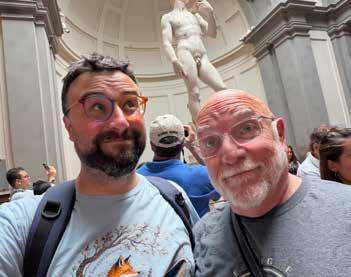
I got to Rome late Monday—baggage, customs, exited, and swelteringly hot. I then scheduled an Uber. The driver wasn’t at the meeting spot. He called me. He only spoke angry Italian. He canceled. I called another. He spoke very little English, but I found him—dragging my bags and sweating in all the places.
I fell into the backseat, grateful for air conditioning. At the hotel, I schlepped my bags into the lobby. They asked for my passport. I turned to my pile of bags. No backpack. I had left it in the Uber. Now don’t get all judgy on me, but it had my passport, wallet, laptop, credit cards, and everything I own except my phone, two suitcases, and neck pillow! Without a passport, I could not board the ship the next afternoon. Without a passport, I couldn’t leave Italy. Without paying the city taxes the next morning, I couldn’t leave the hotel!
Bobby’s bucket wasn’t going much better. He had been at a writing retreat in Ireland for the prior nine days. He was coming from Belfast. He had reserved a 2 am bus from Belfast to Dublin to catch a 6:30 am flight to Rome. When he arrived at the bus, it was oversold—filled with a youth soccer team! He had to take an Uber from Belfast to Dublin in the middle of the night! But he made it. I shared none of my travails with him. He didn’t need that.
The hotel clerk tried to contact someone at Uber. No luck. There are no humans there. No luck calling the driver. The U.S. Consulate opened at 8:30 am the next morning. A replacement passport takes a minimum of 24 hours. We would miss our cruise. I finally went to bed around 11 pm—no sleep, of course.
At 1 am, the hotel clerk knocked on my door. The Uber drive was downstairs with my backpack. He had just found it almost four hours later. I started singing, “Heaven came down and glory filled my
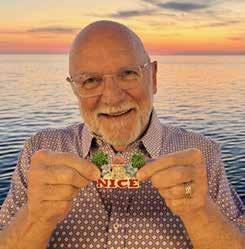
soul!” as I gave him the largest tip of his week. Maybe month. The hole had been plugged! Bless Henry’s heart.
On Tuesday, June 30, at 3:30 pm, we boarded our ship for an amazing 9-night cruise. In Naples it was legendary pizza! In Florence, we saw David (all of him). In Nice we ate mussels down by the seashore (different than David’s muscles) and scored an extravagant one-of-a-kind souvenir. It was very nice in Nice.
We will end our cruise with an extension of four days in Sitges and Barcelona. Part Trois has more than made up for the rocky start by being a slice of heaven.
Liza heard my prayer. The holes in our bouquets were miraculously fixed by Uber drivers in Belfast, Ireland, and Rome, Italy. Who knew? Gotta run now. Another French word—the buffet—is calling. And I’m still not going to Target (tar jay) when I get home.
If you do not have a Bucket List, start one. You can start with a tiny bucket: things I’d like to do in the next year. Make a 5-year list and then one you might start checking off when you’re 75! Y’all, in our crazy world, there is no time like the present! Get busy! Leave a few blank spots for the surprises.
Dr. Tim Seelig is the Conductor Laureate of the San Francisco Gay Men’s Chorus. http://www.timseelig.com/
The San Francisco Gay Men’s Chorus (SFGMC) and The Chan National Queer Arts Center in June appointed Lane Sugata as the organization’s next Chief Executive Officer, effective August 24, 2026. Selected through a North American search conducted with Arts Consulting Group, Sugata will serve an initial two-year term. They succeed Christopher Verdugo, who is step ping down after a successful 10-year ten ure and will consult during the transition to prepare the chorus for its upcoming 49th season. Sugata is also the first out nonbi nary individual appointed to serve as CEO of the SFGMC.
SFGMC Board Chair Tom Paulino said, “The word the Board of Directors would use to describe Lane is: visionary. Lane’s comprehensive, data-informed approach to problem solving coupled with their personcentered leadership style make for a potent combination that will prove most effective as the next Chief Executive Officer of the San Francisco Gay Men’s Chorus. Lane’s transformative work with Dance/NYC, and, most recently, the Ford Foundation— uplifting and collaborating with marginal ized communities—informs their strategy
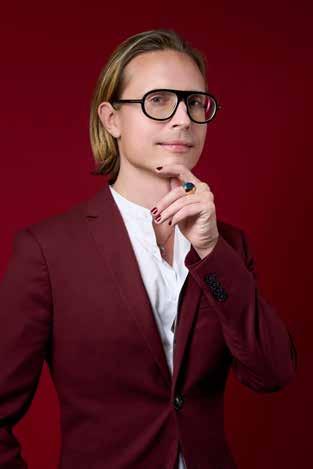
next leader who will meet this moment in our history and shepherd the mission of this institution to new and greater heights.”
Sugata, in turn, said, “The San Francisco Gay Men’s Chorus sits uniquely at the intersection of artistry, activism, and community—creating not only beautiful music, but refuge, visibility, and hope for generations of LGBTQ people. At a moment of heightened division and attack, I see tremendous opportunity for the chorus to expand its role as a force for free expression and community resilience—and to shape a more courageous and connected future. This role brings together so many parts of my life and work: my roots in the Bay Area arts community, my commitment to LGBTQ justice, and my belief in the power of culture to move people, build belonging, and inspire action. I’m deeply honored to join this extraordinary organization and excited to help shape an ambitious next chapter for the chorus and for queer cultural life in San Francisco and beyond.”
SFGMC Artistic Director Jacob Stensnoted, “Getting to know Lane has been an absolute joy, and I can’t wait
for our community to experience the vision, heart, and energy they bring to this role. Lane’s extraordinary leadership and deep commitment to artists, equity, and community will help propel the San Francisco Gay Men’s Chorus into an exciting new chapter. They are bold, magnetic, deeply collaborative, and unafraid to dream big. I truly believe great things are ahead for SFGMC!”
As the organization’s leaders mentioned, Sugata brings extensive experience in arts and philanthropy back to the Bay Area. While serving as a Senior Program Officer at the Ford Foundation, they managed more than $270 million in global grants to advance creativity, civic engagement, and LGBTQ justice. Previously, Sugata served as the Executive Director of Dance/ NYC and currently serves on the boards of Funders for LGBTQ Issues and the Association of Performing Arts Professionals. Sugata is a UC Berkeley graduate and former San Francisco Ballet student, so this appointment represents a major professional and personal homecoming.
https://www.sfgmc.org/
The San Francisco Gay Men’s Chorus, conducted by Jacob Stensberg, concluded their 48th season with Dolly! A Pride Show, a joyful tribute to the music and spirit of Dolly Parton. The production, presented during two shows at the Curran Theatre on June 13, 2026, featured choral arrangements of her greatest hits—seamlessly blending glitz, rhinestones, and powerful vocals—and a “Dolly look-alike contest.”
Parton remains a popular queer icon, such that El Rio held its 20th annual Dolly Parton Hoot just a few weeks later, on July 11. In December, Parton’s life story will be told in Dolly: A True Original Musical, a Broadway show that will be debuting at the St. James Theatre in New York City. Parton is now writing new material for the musical that hopefully will make it to San Francisco in future. https://www.sfgmc.org/
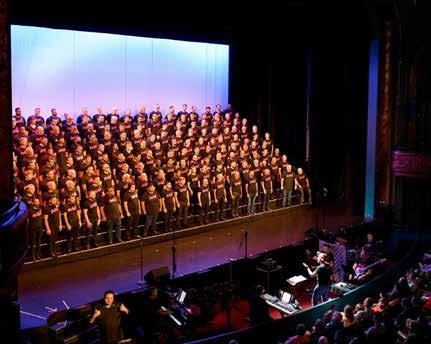
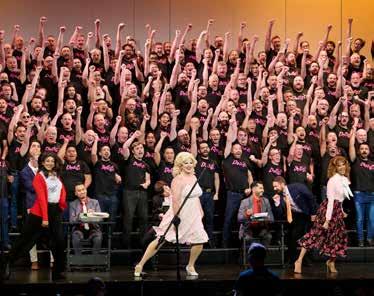
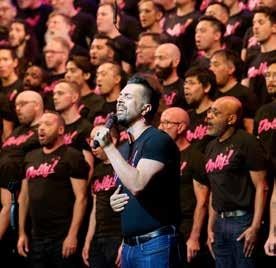
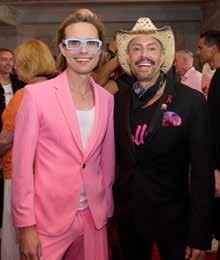

San Francisco Opera on June 26, 2026, held its annual Pride Concert, which this year featured music by Michael Tilson Thomas, Gounod, Giordano, Offenbach, Terence Blanchard, Michael Abels, Stephen Schwartz, k.d. lang, Brandi Carlile, Luther Vandross, Stevie Wonder, and more. The evening was hosted by Sapphira Cristál, with soloists Nikola Printz, Melody Moore, and Reginald Smith, Jr. It also included a pre-concert talk, the Rainbow Pride Flag Project, educational displays from the GLBT Historical Society, quilt panels from the National AIDS Memorial, and a post-show dance party with Juanita MORE!
https://www.sfopera.com/
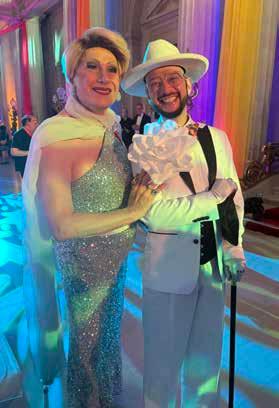




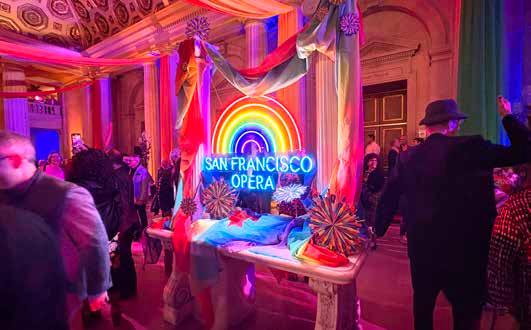







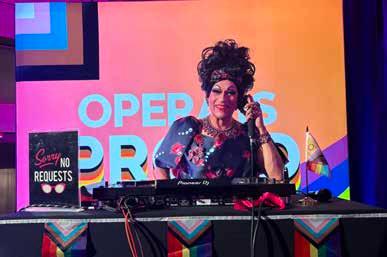
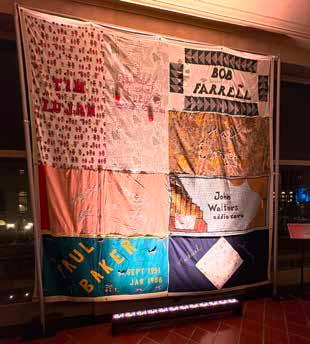
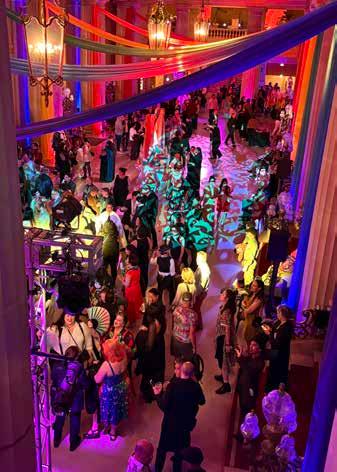
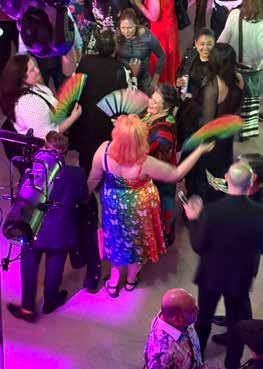
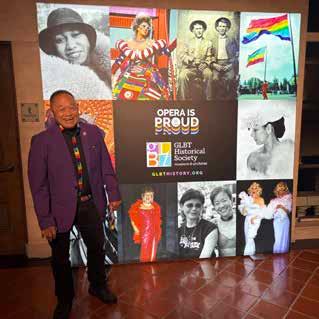
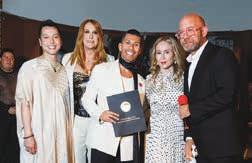
A highlight of Pride Month in San Francisco was Runway of Pride at GLIDE Memorial Church on June 23, 2026. A tour de force by producer Antonio Contreras, the fashion-focused event featured supermodel Pat Cleveland in a couture gown by Naeem Khan (and Cleveland also beautifully sang and danced!), State Senator Scott Wiener sporting a regal Mariya Milovidova ensemble, former Mayor London Breed in a stunning custom Vassily Vein red sequined gown, transgender leader Honey Mahogany in a striking Nuvaa original, Sister Roma looking like a boss in blue complete with a Sister Roma umbrella, and Rafael Mandelman, President of the San Francisco Board of Supervisors, wearing a faux white fur by Banana Republic. DJ Sergio Fedasz’s music and The GLIDE Memorial Choir perfectly complemented the runway action. The evening raised $20,000 benefiting San Francisco Pride and GLIDE.
This was the second year of the successful event, formerly known as Threads of Pride and originated by Dr. Nas Mohamed. Contreras is Banana Republic’s National Style Expert and brought together many local leaders of the Bay Area fashion world for this year’s fundraiser, emceed skillfully by Nguyen Pham, and that was also attended by San Francisco Pride Executive Director Suzanne Ford.
The entire event was recorded and may be viewed at https://bit.ly/3QQ0qwB
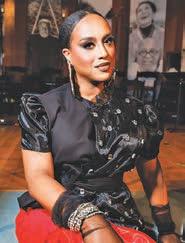
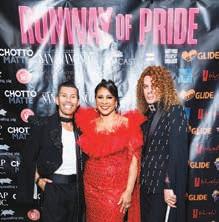
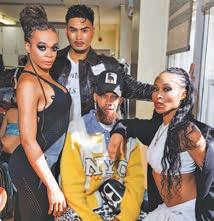
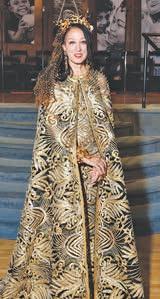
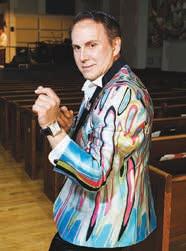


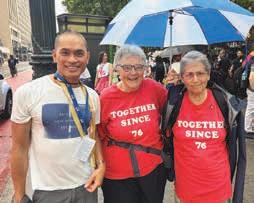
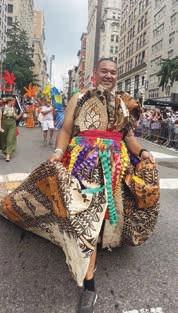
Photos by Fernando Camino
Fernando Camino, New York correspondent for the San Francisco Bay Times and the host of SuperFriends NYC livestreams on YouTube, covered Pride events in New York City including the NYC Dyke March on June 27, 2026, and the NYC Pride March on June 28 ( https://nycpride.org/ ).
For video highlights of the NYC Pride March and more, visit the SuperFriends NYC YouTube channel at https://bit.ly/3EdhLc9
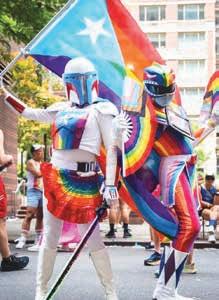
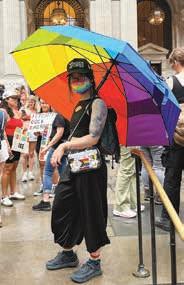
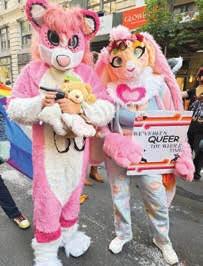
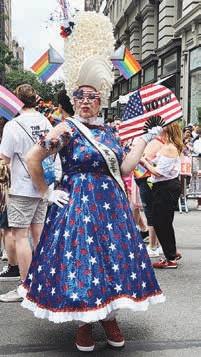
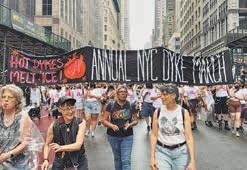

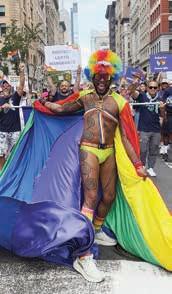
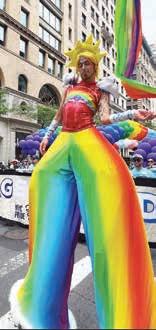

Old Hillside’s “Harlem Hellfighters” is a 112-proof bourbon-rye blend aged in French wine barrels for exactly 191 days. Why the precision? Because the plants in the ground and the liquid in the bottle tell the same story, one that certain people in Washington are currently trying to edit down to a sanitized highlight reel.
Old Hillside’s Harlem Hellfighters bottles serves as a liquid monument to the 369th Infantry Regiment, an all-Black unit that served on the frontlines in France for 191 days during World War I. That is longer than any other American regiment, full stop, and not just “longer than other Black regiments.” Because the U.S. Army refused to let white units serve alongside them, they fought under French command. The French, who had better things to do than invent a hierarchy of human worth in the middle of a war, awarded the entire regiment the Croix de Guerre. By aging this blend for 191 days in pinot noir oak from that same region, Old Hillside is doing what the National Park Service is being ordered not to do: connecting a physical place to the unvarnished truth of what happened there.
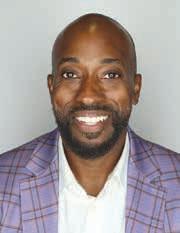
It’s the kind of career that teaches you exactly how institutions decide what gets funded and what gets shelved. When Old Hillside claims a bottle is “preserving history,” it is coming from someone who has spent his life inside the machinery of institutional memory, not someone bolting a history lesson onto a label as a marketing afterthought. Waters also grew up inside the story he’s now bottling. As the son of a retired Air Force lieutenant colonel and pastor, he spent parts of his childhood on bases in Japan and Germany. That global perspective is vital to a company built around honoring overlooked heroes. A kid who grows up on overseas military bases learns early that American history looks different depending on which flag you’re standing under, and that the version taught stateside rarely has room for the whole truth. Under his leadership, Old Hillside has become one of the fastest-growing emerging bourbon brands in the country, a testament to the fact that doing the historical homework is actually good business, even while federal agencies two thousand miles away are actively pulling that same homework off the walls.

The weight of that history is intentional, largely because of who is behind the label. Old Hillside was co-founded in 2020 by Emmanuel J. Waters, who now runs it as CEO. In an industry still dominated by a handful of legacy family names, a Blackowned and veteran-owned distillery is its own quiet statement. Waters didn’t come up through the traditional distilling circuit; he spent years negotiating complex acquisition programs for the Department of Defense before pivoting to advising Silicon Valley tech giants on corporate finance.
(Yields roughly 6 oz and the infusion time is 3 weeks. Combine all ingredients in a clean glass jar. Seal and shake daily for three weeks, keeping it in a cool, dark place. Strain through cheesecloth, then a coffee filter for clarity. Store in a dropper bottle indefinitely.)
2 tbsp dried yerba buena (Clinopodium douglasii ), the mint the whole city was originally named for
1 tbsp dried yarrow flower ( Achillea millefolium), for the bitter backbone
1 tbsp dried heal-all (Prunella vulgaris), earthy and faintly floral
1 tsp dried California sagebrush ( Artemisia californica), used sparingly, it’s assertive and slightly resinous
I first encountered Emmanuel’s story, not across a boardroom table, but behind a bar. We were both the only brown people pouring drinks at a tech meetup in the LinkedIn building (a “peak San Francisco” setting where half the room is “at work” and the other half is working the room). It was peak AI gold rush energy with pitch decks flying around with buzzwords like “agentic” on it while people were barely masking their tech-no[ne] skills. While the room chased AI ghosts, Emmaunuel and I, we were
2 tbsp dried beach strawberry leaf (Fragaria chiloensis), for a green, tannic edge
1 strip orange peel, pith removed
1 cinnamon stick, cracked
8 oz high-proof neutral grain spirit (100plus proof, so it can actually pull the bitterness out)
Every botanical in this recipe survives by doing the exact opposite of what current federal mandates are doing to public land signage. Yarrow doesn’t hide the wound; it treats it. Sagebrush doesn’t wait for permission to return after a burn. Beach strawberry doesn’t need approval to fruit in the sand. They are exactly where they have always been, regardless of who tries to edit the placard next to them. Note: Foraging in the Presidio is strictly prohibited. Please
dealing in glass bottle elixirs born from soil, grain, and grit. The real story didn’t need a pitch deck.
That connection to the land feels particularly urgent now, as the Presidio itself fights off its own version of a hostile takeover. In February 2025, an executive order directed the Presidio Trust to gut its operations “to the maximum extent consistent with applicable law.” Charter city enthusiasts immediately began pitching a “Presidio Freedom City,” envisioning 1,500 acres of federal parkland rezoned into a deregulated biotech playground. By April 2026, the entire board was fired by email. Their replacements weren’t historians or park rangers; they were tech lawyers and venture capital affiliates. While the 1996 Trust Act technically protects the landmark from becoming a casino, “technically illegal to fully sell off” isn’t the same as preservation. It’s just erosion with better legal representation.
This institutional erosion reveals a deeper, older reality that rarely makes it onto a commemorative tote bag: The Presidio and the country both turned 250 in
source these plants from a local native nursery to grow your own history at home. Fighting Hell the Old-Fashioned Way
This is my take on a classic Old Fashioned, a drink that, like the history it honors, requires patience and the right ingredients. Now this is the night cap ... the drink that brings this whole article together.
2 oz Old Hillside Harlem Hellfighters Bourbon or Rye
1 tsp brown sugar
3 drops Presidio Bitters
1 tsp water (omit if using simple syrup) orange twist for garnish
Dissolve the sugar in water (or use simple syrup) and add the bitters. Add the whis -
2026, and both foundings are built upon the same structural silences and missing names. When Juan Bautista de Anza’s party arrived in these dunes on June 27, 1776, they were a mosaic of Mexican, Indigenous, African, and European identities. They were founders, not guests. Seven days later, 56 men in Philadelphia signed a document regarding liberty just a few hundred feet from where nine enslaved people maintained the house where the president lived—two birthdays, one country, and the same structural blind spot since day one.
So, when I raise a glass of Harlem Hellfighters bourbon cut with Presidio dune bitters, I’m not just toasting a single anniversary. I’m toasting the overlap, the Presidio’s 250 years, America’s 250 years, and the 250 years Black Americans have been
(continued on page 48)
key and a large ice cube. Stir continuously for 15–30 seconds until well-chilled and properly diluted. Express the orange oils over the glass and serve.

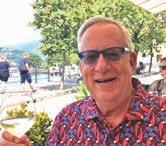
David Landis
When you walk into Full Proof Bottle Shop on 18th Street in the Castro, the first thing you see isn’t whiskey or tequila—it’s a carefully curated selection of non-alcoholic spirits. That intentional welcome says a great deal about owner Brad Levine, a former Peace Corps volunteer and U.S. Department of Labor grant manager who made a bold leap from government service to retail spirits. The Gay Gourmet recently sat down with Brad to talk about his unlikely path, his philosophy of education over salesmanship, and why the Castro felt like home.
The Gay Gourmet (David Landis): Brad, your career trajectory isn’t typical for a bottle shop owner. Can you tell us about your background?
Brad Levine: I always say I had two feet in two different worlds. I grew up being very civic-service minded. In high school in Massachusetts, my brother and I would volunteer at the local elementary school, helping kids with their homework. After college, I joined the Peace Corps in Honduras. My program was called Municipal Development. The whole point was to assist communities at the grassroots level, and we really did that. We built a real estate tax system from the ground up, which allowed the municipality to pay its employees on
time and qualify for federal grant matching. What I’ve seen on Facebook since is that the town has really flourished into something like an artist colony, with statues and murals all over. I was only a small part of it, but it was absolutely amazing.
David Landis: What brought you to San Francisco?
Brad Levine: It was a tumultuous time in my life when I was going through a transition. I found a position here with the U.S. Department of Labor doing grant management and compliance work. We ensured that money going to cities, counties, nonprofits, and municipalities was actually reaching the people it was supposed to serve. Two programs I especially loved were the re-entry program, which helped justice-involved individuals gain skills while still incarcerated. That way, they could transition to better-paying jobs. I also worked with YouthBuild, which took high school dropouts, and provided them with both a high school education and pre-apprenticeship experience. I was honestly ignorant of the amount of barriers incarcerated individuals face. These programs really helped people clear those hurdles.
David Landis: So how did you make the leap from government work to spirits?
Brad Levine: A couple of things happened at once. The Trump administration came in, DOGE happened, and there were reports that my department—the Employment and Training Administration—was slated for roughly 50% layoffs, with rumors of even more. Out of fear, I left on my own terms, and took the buyout. I had previously owned a liquor store in Washington State, which I absolutely loved. But I failed at one really important thing: delegation. For the better part of three years, I basically lived in that shop and burnt myself out. Ever since then, no matter what I was doing, I always kept an eye out for available liquor stores. When this
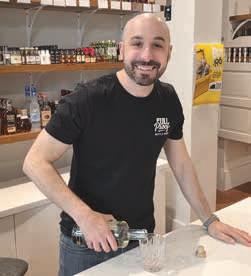
one in the Castro came up, it was sort of the perfect storm.
David Landis: What drew you specifically to the Castro?
Brad Levine: I could give you the canned answer that it’s vibrant, but I think the Castro is something more. It’s special. It’s not just the businesses here; it’s the people. Anywhere else in the city, you’re not going to get that same welcoming spirit. The Castro grew out of counterculture, and what that bred is a community of warmth and genuine friendliness. That’s what my partner and I loved about it.
David Landis: You let customers taste spirits before they buy. Was that willful?

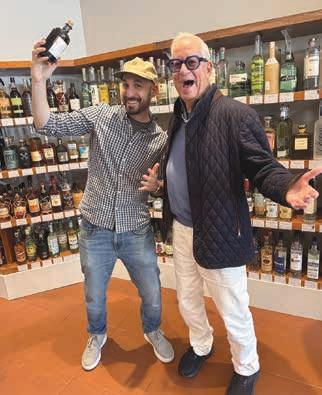
Brad Levine: Absolutely. First and foremost, Full Proof Bottle Shop is an educational place. We want customers to know everything about a spirit before they buy it, and sometimes that means offering a taste. When I was a customer myself, I would spend $100 on a bottle based on a salesperson’s recommendation. Half the time, I would come home disappointed. All of us have different palates. By educating our customers and letting them taste, we can ensure, to the best of our ability, that they leave us happy. Just recently, a customer walked in and said, “That’s a terrible brand.” I took the time to educate him about it, and he left with that very same bottle.
David Landis: The non-alcoholic spirits section right at the front of the store is a wonderful touch. Was that a deliberate choice?
Brad Levine: Completely intentional. We’re in the Castro, which is an inclusive place. We want everyone to feel welcome. Traditionally, a bottle shop draws you in with the alcohol. But we made a deliberate choice to put the NA (non-alcoholic) section front and center. No matter who you are, that’s the first thing you see. It’s for the people who don’t drink (alcohol), but still want that habit of relaxing with a sip after work. It’s really gratifying. A prominent activist in the
NA movement came in recently and was genuinely surprised by the breadth of our selection.
David Landis: You’ve really leaned into gins and amari. Was that your personal choice?
Brad Levine: Honestly, it wasn’t my first instinct. My plan was to fill about 70% of the shelves with standards and leave 30% open to community feedback. Typically, whiskey leads, then vodkas and rum, with gins and amari as secondary categories. But the community here told us loud and clear: gins and amari. So, we listened. Week by week, we hand-selected what we carry: classics everyone knows, plus some hidden gems that people may not have discovered yet but will love once they do.
David Landis: Do you have personal favorites among the spirits you carry?
Brad Levine: It’s like picking among my babies! For amari, it’s the Scarlet. I don’t usually like bitter, but this one balances bitter and sweet in a way that’s truly extraordinary. I can sip it on its own, serve it to guests, even pour it over ice cream. I saw it on the menu at a fine dining restaurant for $20 an ounce. Then there’s Gin Primo, a salt gin from Italy. When a rep first suggested it, I said, “Get it away from me.” I tried it, and it beautifully balanced classic gin flavors with a lovely salinity. I thought, if I don’t carry this, what am I doing? For whiskeys, Old Fitzgerald 7-year is
(continued on page 43)
(continued from page 42)
phenomenal, and The Fiddler is a real sleeper. It’s made in Indiana, which some people frown upon, but everyone who tries it says, “Oh, my god, that’s delicious.”
David Landis: Since I write a food column, I have to ask: Which spirits pair best with which foods?
Brad Levine: Whiskey and meat, that’s just an amazing combination. Rum pairs beautifully with anything tropical or Caribbean. Tequila and Mexican food are a classic for good reason. Vodka, I think, pairs wonderfully with a pre-dinner amuse-bouche. And gin is truly the most versatile of all. It pairs with fish, charcuterie, even sushi, or a curry. As for amaro, it’s the perfect digestif: just a small sip after dessert, and you’re done.
David Landis: What’s your favorite gin cocktail?
Brad Levine: I’ll go basic: the martini. But here’s why. With just two or three ingredients, changing the ratios will produce wildly different results every single time. You can make endless variations, and the best martini is probably the one you’re making at home, tuned exactly to your own taste.
David Landis: I understand Sam Smith’s crew was shopping with you during their run at The Castro Theatre. How has the theater’s reopening affected the neighborhood?
Brad Levine: Sam Smith’s crew were some of the nicest people you’ll ever meet, and we definitely saw an uptick when they were in town. The concert lines now stretch all the way down to 18th Street, which is just fantastic to see. What’s good for one business is good for us all.
David Landis: How has the broader Castro community welcomed you?
Brad Levine: Wonderfully. Michael from The Edge has accepted us with open arms, just incredibly kind and generous. And Gordy from 440 stops by, too. Whenever you see him, he brightens up the whole room. The bars in the Castro have been nothing but welcoming to us.
David Landis: Any plans for the future you’d like to share?
Brad Levine: We’re excited to eventually bring in winemakers and master distillers for educational events. We’ll create real symposiums on spirits and wine: how they’re made, and what makes them special. We’re still getting our feet under us, but give us a few months, and we’ll be ready to start planning. We’re also thinking about community events that bring people together in new ways. Getting out there can be hard, and we want Full Proof to be a place that helps make connections happen.
Bits and Bites
I just got finished reading Lost Treasures of San Francisco by Maria Lenhart (from Reedy Press)—and it was wonderful to revisit some of our city’s best restaurants, including: Blum’s, Ernie’s, Trader Vic’s, and Stars, among others. Do yourself a favor and buy the book for a wonderful trip down San Francisco’s culinary memory lane.
Gay Wine Weekend, one of the country’s most beloved LGBTQ+ wine and lifestyle events, proudly will return to Sonoma Valley for its 15th Anniversary Celebration July 17–19. The anniversary weekend will feature a full lineup of signature events and exclusive wine experiences. Highlights will include Winemaker Dinners and Wine Tours, and a Drag Queen Brunch & Wine Auction benefiting Face-to-Face, a local Sonoma HIV/AIDS nonprofit.
Full Proof Bottle Shop is located at 3978 18th Street in the Castro: https://www.fullproofsf.com/
Lost Treasures of San Francisco: https://tinyurl.com/yc8a6wfh
Gay Wine Weekend: https://www.outinthevineyard.com/
David Landis, aka “The Gay Gourmet,” is a foodie, a freelance writer, and a retired PR maven. You can email him at davidlandissf@gmail.com
Or visit him online at: https://gaygourmetsf.com/
When the San Francisco Bay Times lost its longtime wine sponsor a few years ago, the publishers desired a replacement that, not only produces quality delicious wines, but also is supportive of the LGBTQ+ community and inclusivity and is as eco-conscious as possible. After considering many wineries, and with the help of columnist and wine and beverages expert Leslie Sbrocco, a new sponsor meeting all of desired attributes was found: V. Sattui Winery.
For decades, V. Sattui— located in St. Helena in the heart of the Napa Valley— has produced award-winning wines, such as earning Double Gold for its 2022 Napa Valley Cabernet Sauvignon at the San Francisco Chronicle Wine Competition. V. Sattui has also led green initiatives that safeguard Napa Valley’s vineyards and land while addressing its broader global footprint. The winery prioritizes partnerships with suppliers and organizations that share its dedication to an eco-friendly future. It believes that collective effort is essential to protecting this fragile, beautiful ecosystem.
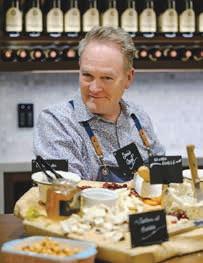


“Sustainability goes far beyond the land,” says V. Sattui President Tom Davies. “It is our livelihood. It is about caring for employees, vendors—everyone tied to the company. Our approach to ensuring the health and vitality of the wine industry takes all of this into account. We care for the land, and we care for the community.”
Grapes Were Here Before You Were
Grapes are inextricably tied to the California ecosystem. Four primary grape species are native to California and first emerged on this land roughly 50 million years ago. When Native Americans arrived starting around 13,000–20,000 years ago, they used these grapes extensively. They ate them as is, dried them into raisins, used grape vines to make twine, cordage, and baskets, and added them to medicinal remedies such as poultices and even haircare tonics.
Many indigenous communities in what is now the U.S. made fermented beverages out of agave, prickly pear, corn, honey, and more, with evidence building that they made grape wines too. Such products required more time and effort and appear to have been reserved for special rituals and ceremonies.
Naturally fermented beverages were produced natively on every inhabited continent on the planet, so there has been a thirst for such drinks over the millennia. Numerous large-scale studies show that light to moderate wine consumption can benefit human health, although the scientific community
V. Sattui has long embraced an inclusive culture where employees are encouraged to be their authentic selves. This carries over to the winery’s welcoming space, which offers a relaxed atmosphere that encourages diversity and an open-door policy that does not require reservations.
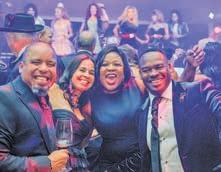
remains divided on why this is the case. Interestingly, studies of people who live to be over 100 reveal that many drink wine, especially in regions like Sardinia and Ikaria where they drink it moderately with meals and surrounded by friends as a daily ritual.
V. Sattui Values These Time-Honored Practices
V. Sattui Winery reflects these time-honored practices and is a world leader in holistic sustainability. They prioritize such efforts through 100% organic and regenerative farming techniques across 200 acres spanning four counties. By eliminating harsh chemicals like RoundUp and utilizing cover crops alongside grazing livestock, the winery naturally improves soil health, enhances biodiversity, and controls weeds. To conserve critical resources, they employ drought-resistant rootstocks, strategic irrigation, and traditional dry farming methods.
Operational eco-consciousness continues through aggressive waste reduction, carbon footprint mitigation, and regional land conservation. The marketplace (which is incredible and alone worth the trip to St. Helena) and winery minimize landfill waste by utilizing biodegradable utensils, cutting out plastic packaging, composting organic
waste, and offering water refill stations.
Incorporating Modern Innovations to Promote Sustainability
V. Sattui’s commitment to efficiency extends to energy conservation, anchored by a warehouse solar panel system installed in 2006. The business also transitioned 1,800 bulbs to LED lighting to dramatically lower annual power consumption.
To curb emissions, V. Sattui has integrated zero-emission electric tractors and hydraulic weeders into their farming. The winery also sponsors rideshare and vanpool programs for commuting staff. The winery’s dedication to the environment is additionally cemented through permanent land conservation, having protected over 550 acres of Napa Valley land from future development since 1999 to safeguard local wildlife and natural ecosystems in perpetuity.
With all of this and more, it is little wonder that V. Sattui is a Napa Green Certified Winery, a Napa Green Certified Vineyard, is CCOF (California Certified Organic Farmers) Certified Organic, and has received the Fish Friendly Farming certification. The business is even dogfriendly; leashed dogs are welcome on the winery’s expansive outdoor picnic grounds and lawns.
Over the past few years, several wineries have pulled out of LGBTQ+-related sponsorships, most notably scaling back support for major events like San Francisco Pride. This retreat follows broader corporate trends away from diversity programming and toward scaled-back budgets. Conversely, everyone the Bay Times has met and spoken with from V. Sattui has been extremely supportive of the LGBTQ+ community.
Like the team at Orphan Andy’s, featured in this issue of the Bay Times, the team at V. Sattui genuinely cares about its customers and surrounding community. The winery supports local schools, Meals on Wheels, and other nonprofits. SF Gate even recently reported that V. Sattui is offering free tastings of three wines, with a wine educator, for an hour on certain days. Children receive free grape juice flights (made from the same premium grapes as the wines and without added yeast) while adults taste the vino.
Here’s the Catch
V. Sattui Winery operates exclusively on a direct-to consumer model, which avoids distributor markups and ensures quality control. It also keeps the winery’s growth inherently in check, which further supports the sustainability goals. It additionally promotes wine drinking as a relaxed experience to savor.
The beautiful grounds in St. Helena feature the 8,000-square-foot artisan marketplace Mercato del Gusto with Italian-inspired small plates and charcuterie crafted by Chef Stefano Masanti, who operates a Michelin-starred restaurant in the Italian Alps. The picnic grounds are dotted with giant oak trees, which offer comforting shade. On weekends, the winery’s outdoor food truck fires up the grill, serving BBQ, brick-oven pizzas, and more.
The Napa Valley Wine Train stops at V. Sattui. A combination of BART, the San Francisco Bay Ferry (beautiful trip via the Vallejo Ferry Route) and bus takes visitors to a short, safe walk from the appropriately named Zinfandel Lane stop.
Visiting V. Sattui offers the best experience, but the highly acclaimed, small-lot release wines—many with 90+ point ratings—and additional related goods are also available for purchase at https://www.vsattui.com/

Gordon Edgar
It’s not really mozzarella season; it’s tomato season. The Early Girls are in. The Heirlooms are in. The cherry tomatoes are even at their best. Beecause of that, it’s the time of year where we sell about five times as much fresh cheese as we do the rest of the year: ciliegini, ovolini, burrata, stacciatela, mozzarella di bufala ... fresh cheese at its best. So, what are the differences? Here’s a guide to summer cheese.
Someone said “pasta filata” to me, What the heck does that mean?
Pasta filata in cheese translates to “pulled curd.” Bascially curds and cultures are heated so that they can be stretched, which gives you that beautiful stringy mozzarella

texture. (Provolone, scamorza, caciocavallo, etc. are also pasta filata cheeses.) The process of making mozzarealla is also why most fresh mozzarella is lactose free. The cheese must acidify quickly, and when you say “acidify” in cheesemaking, you are converting the lactose in the milk to lactic acid.
Isn’t all mozzarella “fresh”?
When we say “fresh mozzarella” it can be a little confusing because all mozzarella is young. “Fresh” means that the mozzarella is sold in water as opposed to “low moisture” mozzarella that is cut and wrapped. Fresh mozzarella is what you want with ripe tomatoes, olive oil, basil, and a bit of salt.
Wait, what are these other Italian words on the packages?
Mostly, the words will relate to the size of the mozzarella balls. You will see designations like “ciliegini” and “ovolini” on mozzarella packages. These simply refer to the size of the cheese. Ciliegini means cherry-sized. Ovolini means eggsized, etc. You can almost always see the size of the cheese you are buying, so no need to memorize.
What kind of milk is mozzarella made out of?
I once went to a local pizza place, ordered the “mozzarella di bufala” and was disappointed that it came with a cow milk cheese. I mean, I like all mozzarellas, but they didn’t even realize they were false advertising. They thought that was just Italian for fresh mozzarella! While there are great cow milk fresh mozzarellas—and we sell more of those than anything else—mozzarella di bufala is from the milk of water buffalo, which is traditional in Italy. We have some from Italy, some from Colombia, and—soon—some made in New Jersey from a Canadian herd. You won’t usually see any goat milk fresh mozzarella (though you can get low moisture) because the proteins in goat milk cannot handle the stretching that turns the curd into that beautiful texture you get with water buffalo or cow milk.
What about burrata (NSFW)?
Burrata is fresh mozzarella filled with cream. I can’t say this at work, but this is the Bay Times, right? A customer once came up to me after having burrata the first time and said, “It was like an angel came in my mouth.” There is a big trend these days to put burrata on everything. You do you, but it can make your pizza pretty soggy if you are not careful. Please note, we just started getting in our Italian burratas (Ignalat brand) for the summer, both regular and smoked.


How about stracciatella? I heard that’s even better!
Often described as the inside of a burrata, it’s probably more accurate to say it’s a chopped up burrata. Local fresh pasta pop-up Sfoglia Club based a whole dinner around this cheese. OMG, it’s good. We only get a little of this in from Italy every two weeks, so you may want to grab it if you see it.
Any other cheeses I should think about for summer?
Teleme, Always. This California original is my favorite cheese in the world. It’s good for everything, but tomato season is another reason to eat it. Then there’s crescenza, a fresh milky, sour, Italian cheese. No one makes this locally anymore, but you can think of it as a fresher teleme without the rind. And don’t sleep on another super perishable cheese, panela. We don’t get much in at a time, but this Mexican-style cheese is made in Brentwood, California, by the 3rd generation cheesemakers at Queso Salazar. This cheese is great fried in butter, and it goes really well with ripe tomatoes.
What are you waiting for? Remember, ripe tomatoes and fresh cheese can be a dinner if you eat enough of them.
Gordon Edgar loves cheese and worker co-ops and has been combining these infatuations as the cheese buyer for Rainbow Grocery Cooperative since 1994. He serves on the American Cheese Society Judging and Competition Committee and is a member of the Guilde Internationale des Fromagers. Edgar has written two books on cheese—”Cheesemonger” (2010) and “Cheddar” (2015)—and lives in San Francisco with his adorable white mini schnauzer named Fillmore Grumble. He writes about grief, and sometimes cheese, at https://bit.ly/42IwYf0
KRAMER (continued from pg 32)
voiceover that he “needed [Asleh’s] words to deal with his death.” This is certainly a personal story for Cohen, but the film’s themes about social justice and “finding one’s own way of living” will resonate with most viewers.
Two queer films are featured in the Narrative Shorts program, (July 28, 6 pm, Piedmont):
Bubbe and Tal is a sweet short about the trans Tal (Sylvie Tamar) taking their feisty grandmother Bubbe (Judy Rosenblatt) to the beach. They fight in the car on the way and during a pit stop as well as on the beach where Bubbe takes off her boot (cast) and collects shells. But Tal notices Bubbe is in pain and offers her a joint to ease her suffering. They soon bond over dinner and oysters while high. Bubbe and Tal reveals an unexpected commonality in its last act, which adds another layer of emotion to this sensitive film.
Photos of Her has Lidor (Lioz Levi) taking maternity photos of Shiri (Shaylee Atary) and her husband Doron (Tomer Machloof). But when Doron gets called away, Shiri and Lidor chat over a cigarette, and Lidor reveals she is trans. Shiri is surprised, but agrees to be photographed for Lidor’s artistic endeavors, leading to a session where both women get naked and pose.
Photos of Her captures a moment of non-sexual intimacy between Lidor and Shiri that is striking because of how they both embrace their bodies.
Two queer films are also featured in the From the Bay shorts program (August 1, 1 pm, Piedmont):
COCKTAILS WITH DINA (continued from pg 41)
the pulse of the story and not just what feels like a footnote or a February addendum, but as the foundation. From the Anza march to Henry Johnson’s 21 wounds to a Black CEO pouring drinks at a tech meetup, it’s all the same fighting spirit.
That is the real throughline of Bay Area culture right now, and you won’t find it in the official commemorations or the plaques being “reviewed” in D.C. You find it in the bitters recipe shared here, made from plants that have survived on this exact land since before anyone thought to name it. These botanicals don’t wait
Born Kicking is an inspiring documentary portrait of Jill Posener, an out lesbian activist, writer, and photographer—she was the photo editor for On Our Back s—as well as the founder of Paw Fund, a program for low- and no-income pet owners in the Bay Area. Posener talks about her life and experiences, her rebellious nature, and care for animals with candor, and her fabulous photographs illustrate her stories. She has oddly flown under the radar despite being out and proud and in-your-face in her life and work, but, as Born Kicking shows, Posener is getting her due with a recent exhibition of her work at the Tate gallery. This terrific short film helps get her the attention and respect she deserves. Director Lauretta Molitor is expected to attend.
Looking for Mr. Israeli , directed by Dan Wohlfeiler, about the filmmaker’s decades-old magazine crush, was not available for preview.
For tickets, showtimes, and more information, visit https://jfi.org/sfjff-2026
© 2026 Gary M. Kramer
Gary M. Kramer is the author of “Independent Queer Cinema: Reviews and Interviews,” and the co-editor of “Directory of World Cinema: Argentina.” He teaches Short Attention Span Cinema at the Bryn Mawr Film Institute and is the moderator for Cinema Salon, a weekly film discussion group. Follow him on IG @garyemkramer
JEWELLE GOMEZ
(continued from pg 34)
paramour, a country squire. It also spares no anxiety about what these two titled and entitled lovers must do to avoid complete censure (at best) in their community or the hangman’s noose (at the worst).
Another surprise for me was the “Colin Pendragon” series by Gregory Harris in which he cleverly calls to mind the quick-witted preternaturally gifted detective Sherlock Holmes and his chronicler, Dr. Watson. In this six-book series, however, Colin Pendragon is erudite, handsome, not a drug addict, and is unapologetically in love with his companion Ethan Pruitt. You can tell that as soon as they step into the same bathtub together. All these books are readily available, but the author seems not to be creating any more.
Each year when we march there’s always a sign that reads, ‘We Are Everywhere.’ And the truth is we are and we were from the beginning of time—rich, poor, of any ethnicity—we can always be found.
Jewelle Gomez is a lesbian/feminist activist, novelist, poet, and playwright. She’s written for “The Advocate,” “Ms. Magazine,” “Black Scholar,” “The San Francisco Chronicle,” “The New York Times,” and “The Village Voice.” Follow her on Instagram and X @VampyreVamp
(continued from pg 35)
stuck everywhere in America to remind us that he is King of Everything! Oh, hell NO!!!”
And Trump needs to stop rewriting history to suit his authoritarian impulses to make our American past get weaponized. Historic, award-winning documentary filmmaker Ken Burns said it best in his latest, stunning film, The American Revolution. In it, Burns elaborates, “The story of us is complicated, and it is not a single us. And it is authoritarian impulses to make history for this simple narrative and sow misinformation, disinformation, superstition, and conspiracies.”
Sister Dana sez, “No thanks to manic Musk and his disastrous DOGE cuts to worldwide healthcare, thousands upon thousands will perish. Switch the letters, and eliminating DEI means DIE!”
for permission to return after a burn, and they don’t need an official placard to justify their existence. They simply refuse to disappear.
Pour the bitters neat. Here’s the toast: to the Presidio at 250, to the country at 250, and to the Black Americans who have been holding both of these birthdays up the entire time, whether the official program mentions them or not.
San Francisco-based Dina Novarr enjoys sharing her passion for fine wines, spirits, non-alcoholic craft beverages, and more with others.
On Independence Day, our hallowed holiday of patriotism, hundreds of white nationalists marched at our Capitol in D.C. carrying confederate flags and chanting, “Reclaim America!” But, if they’re so proud, why did every one of them wear special white masks to only expose their eyes and matching caps with weird insignias on their heads? Wouldn’t white hoods be more appropriate? Sister Dana sez, “Hey, you creeps, this is America, not AmeriKKK!”
The GOLDEN GATE PARK BAND is presenting free concerts now through September 27, Sundays at 1 pm at the Bandshell in Golden Gate Park. https://goldengateparkband.org/
Master Sister Dana sez, “I command you to mark your calendars for DORE (UP YOUR ALLEY) FAIR coming to South of Market on Sunday July 26 to celebrate all things leather and BDSM! Do it now, submissives! Just kidding. Word. Safe word.”
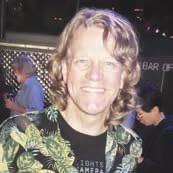
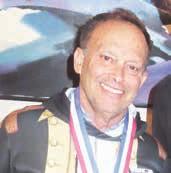
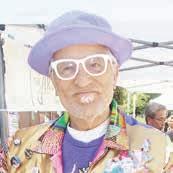
“The coldest winter I ever spent was a summer in San Francisco.”
Whether Mark Twain actually said it is another matter, but the line has become shorthand for the city’s famously fickle summers.
Fog lingers. The wind refuses to quit. Sunshine peeks through dense clouds in brief, glorious stretches. And yet, somehow, summer always finds a way.
Summer in San Francisco isn’t measured by the temperature. It’s measured by the foot traffic in Dolores Park, the timbre of human voices bouncing down Castro Street, and the parade of colorful produce arriving at the Castro Farmers’ Market. While the stone fruit at the market is delectable and the berries are incredibly juicy, it’s the arrival of melons that signal the true spirit of summer. Their sweet fragrance drifts through the market before they’re ever sliced open, evoking warm summer days even when San Francisco’s weather has other plans.
Of the many melons arriving at Bay Area farmers markets this summer, cantaloupes are proving to be the stars. Fifth Crow Farm expects to bring their harvest to the Castro by late July or early August. What many shoppers don’t realize, though, is that “cantaloupe” isn’t a single melon at all. It’s a family of varieties, each with its own flavor, texture, and personality. But every one of them requires patience. That patience proves itself during harvest season. Waiting until melons are ripe is usually a process of around ninety days from germination to harvest. For Javier Resendiz of Resendiz Farms, that means cutting at least ten melons to assess their skin, structure, and smell before deciding whether they’re ready for market. This year, that ninety-day journey was interrupted by swings between intense heat, cold snaps, and heavy rainfall. “The plants get stressed,” Resendiz explains. “They stop growing until the weather is established.”
Javier’s experience growing inland echoes what Teresa Kurtak of Fifth Crow Farm sees on the cool coast of Pescadero. Her farm has spent years working with and against the cold front Mark Twain so famously referenced.
“We’ve done a lot of trials over the years, and, in our cool climate, we’re not really an optimal growing climate. Melons love heat,” Kurtak says.
Climate shapes how melons grow. Harvest timing shapes how they taste. Because melons destined for grocery stores often need to withstand transportation and days in storage, they’re typically harvested before they’re fully ripe. You can spot the difference. A vine-ripened melon will usually have a small divot where it naturally separated from the plant. One harvested early often still bears part of the stem.
Every farm has its specialties, shaped by climate, soil, and experience. But a melon’s journey doesn’t end in the field. Farmers also choose which varieties to bring based on the communities they serve.
Resendiz grows several varieties of cantaloupe, including Sugar Rush, Arangina, and Sugar Cube, selecting which to bring based on the preferences of each market.
“We understand that each market is different. Some people like a bigger size, smaller size, or medium size. And that’s why we plan for different kinds of markets. At some markets, like in San Francisco, they don’t want a big melon, so we have to find a medium size or personal size variety for them.”
That’s one of the quiet joys of shopping at a farmers’ market. Instead of comparing labels under fluorescent lights, shoppers can simply ask the person who grew the fruit. Rather than searching for one universally “best” melon, both farmers encourage shoppers to trust the experts standing behind the table.
“I would ask your farmer what they think is the best-tasting melon they grow,” Kurtak says.
It’s advice that reflects the trust and camaraderie that define the farmers’ market, along with the shared goal of helping shoppers bring home the very best produce.
Whether they’re tucked into a tote bag, nestled in a basket, or simply carried home
by hand, melons are only part of what people take away from the Castro Farmers’ Market.
“Our staff love working that market,” Kurtak says with a smile. “Friendly customers, the community itself ... . It’s a fun market.”
San Francisco may never feel like the postcard version of summer. But, even when the fog rolls in before sunset and
you need to reach for a sweater, one bite into a cantaloupe from the Castro Farmers’ Market makes a convincing argument that summer was here all along.
Johanna Klaiman is the Social Media Specialist at the Pacific Coast Farmers’ Market Association. For information about the Castro Farmers’ Market, other local farmers’ markets, recipes, and more, visit https://bit.ly/4w2hI8J
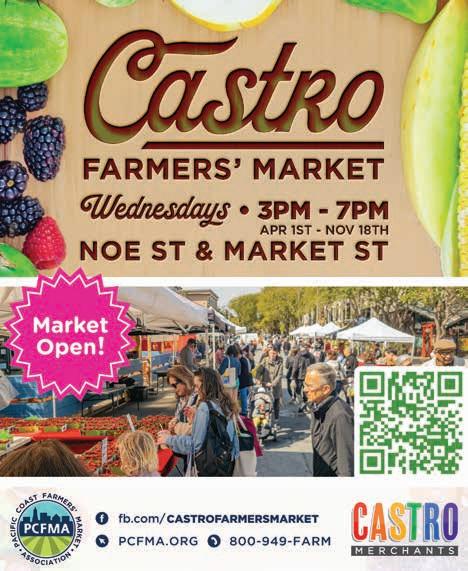
Frank Green Ceramic ‘Rainbow’ Reusable Bottle
Stay hydrated with this chrome ceramic reusable bottle in eye-catching rainbow colors. Frank Green products are designed in Melbourne, Australia, out of sustainable materials. $52.99

Picnic Time Blankets
Large and comfortable, these outdoor blankets are generous in size, durable, compact, and easy to carry. A convenient zippered storage pocket can safely hold your phone, keys, wallet, or other small essentials. These are crafted by the family-owned, Californiabased Picnic Time. $32.99
Keep up with Cliff’s Variety news at Facebook ( https://bit.ly/4qh1Xbb ) & IG @hilario_sf

The San Francisco Bay Times presented a gathering of Maud’s Reunion leaders at Rikki’s in the Castro on June 27, 2026. Among the attendees were Mandy Carter— who traveled from North Carolina to attend this and other San Francisco Pride events—Louette Colombano, Rebecca Prozan, and Megan Married Meagan sponsored by Olivia Travel. Carter and Colombano were among those who shared memories about Maud’s, which was a popular lesbian bar located at 937 Cole Street (now home to Finnegan’s Wake). The documentary Last Call at Maud’s ( http://lastcallatmauds.com/ ) also looks back at this legendary bar founded by Rikki Streicher, whose name inspired Rikki’s.