LGBTQ News & Calendar for the Bay Area

CELEBRATING FOUR DECADES Est . 1978

LGBTQ News & Calendar for the Bay Area
CELEBRATING FOUR DECADES Est . 1978
As long as there have been motorcycles, there have been women—and dykes—on bikes. Women, in fact, have made significant, often overlooked, contributions to motorcycle technology and culture. Key innovations include the development of Kevlar by Stephanie Kwolek for protective gear; improvements to electric motorbikes by Swedish mechanical engineer Eva Håkansson, who in 2014 became the world’s fastest woman on such a bike; and the pioneering achievements of mother-daughter duo Avis and Effie Hotchkiss, who were also skilled mechanics and completed an historic 9,000-mile round-trip ride in 1915 from New York to San Francisco and back on a Harley-Davidson motorcycle-sidecar combination. As Avis said about her talented daughter: “I do not fear breakdowns for Effie, being a most careful driver, is a good mechanic and does her own repairing with her own tools.”
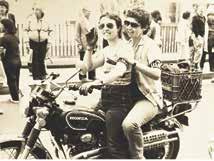
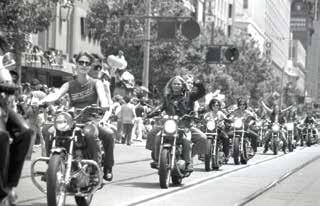
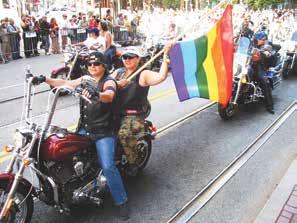
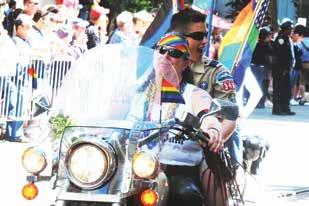
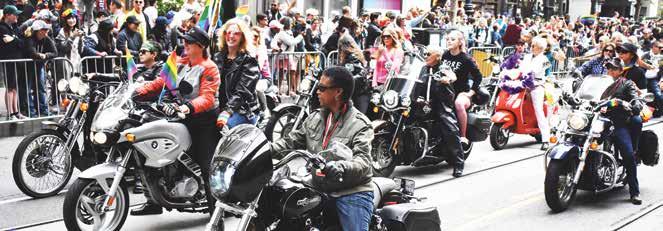
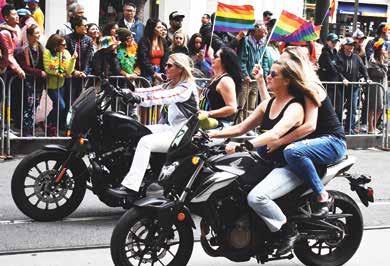
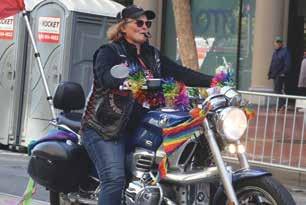
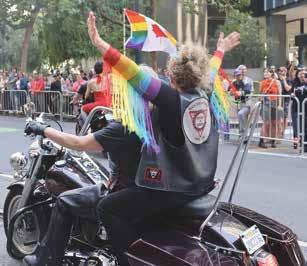
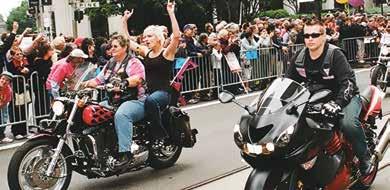
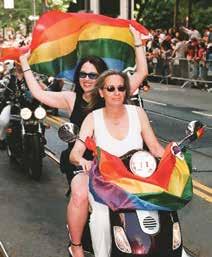
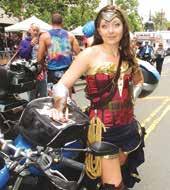
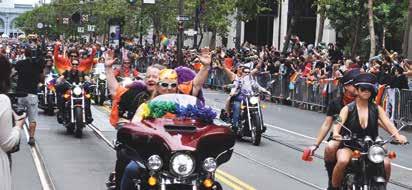
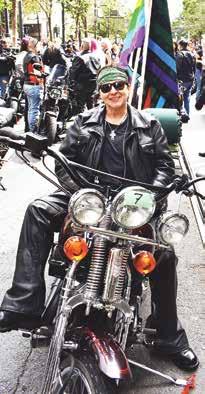
So it is that dykes on bikes have always been a part of Pride (often first called “Gay Freedom”) parades since the emergence of these events nationwide in the 1970s. In the early years, LGBTQ+ individuals and allies would ride their motorcycles and other bikes down the route, but it was not an organized effort.
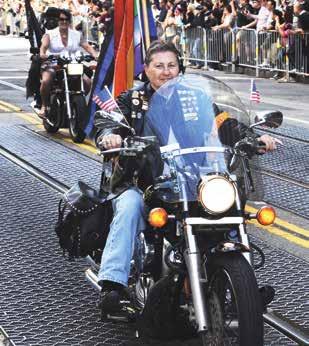
That changed in June 1976, when a group of 20–25 women motorcyclists decided to ride their motorcycles in the San Francisco Gay Freedom Day Parade. They quickly
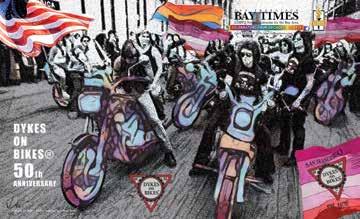
realized that their bikes could overheat if they had to idle for extended periods behind other slower-moving contingents, so they took their position at the head of the parade and dykes on bikes have been doing so ever since.
One of the riders noted them as being “dykes on bikes,” which was overheard and reported in the San Francisco Chronicle. The Women’s Motorcycle Contingent (WMC) emerged as the group grew and became more structured, but they were still known in the press and LGBTQ+ community as the dykes on bikes.
The San Francisco WMC was started by LB Gunn, Kalin Elliot-Arns, Christine Elliot, Sabine Balden, and Mel. The WMC name was used to make the group appeal to all

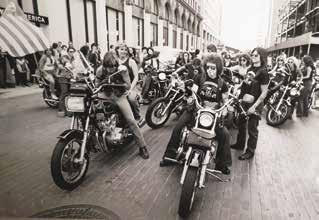
women motorcyclists. Their first meetings were held at a private home. They later moved the meetings to an upstairs room at Amelia’s, a lesbian bar. When Amelia’s closed, the meetings were moved again, this time to The Eagle Tavern, at 12th and Harrison streets. Joining them in 1978 was Vietnam War vet, businesswoman, and motorcycle enthusiast Soni Wolf (1948–2018), who helped strengthen the group and make it one of the most visible and empowering symbols of the LGBTQ+ community.
Supreme Court Win
Legally registering the group’s more familiar name proved to be an uphill battle as the term “dyke(s)” was deemed vulgar, offensive, and “scandalous” by the U.S. Patent and Trademark Office (PTO). Wolf and her
on Bikes® Tales From Two Wheels
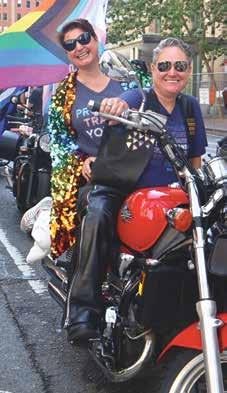
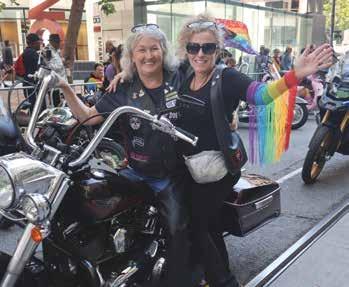
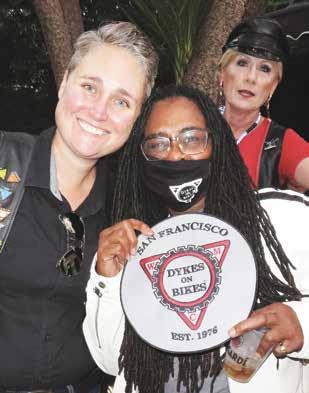
Spring has already brought San Francisco Dykes on Bikes® (DOBTM) plenty to celebrate with two beautiful rides behind us, an exciting May ride ahead, and a 50th anniversary celebration around the corner.
Our March ride brought together East Bay and San Francisco riders, who met in San Francisco before heading north across the Golden Gate Bridge and up the coast to Hog Island Oyster Company. There, our riders from Lake County joined us for a relaxing lunch of raw and barbecued oysters
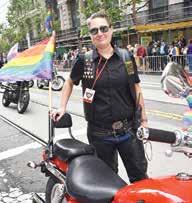
before we continued on to Sonoma.
By Kate Brown, Ph.D.
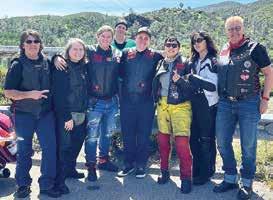
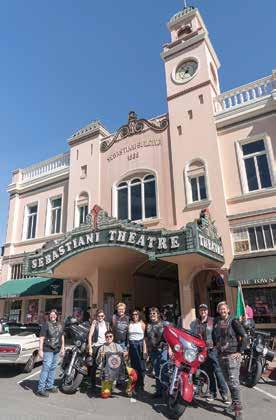
In Sonoma we attended a screening of Beyond the Rainbow, presented by Sonoma Valley Pride at the Sebastiani Theater. Following the documentary was a panel discussion featuring Suzanne Ford, Nguyen Pham, and the film’s director Antonio Contreras. The film offered a power look at the personal journeys of Ford and Pham, while the panel invited all of us to reflect on what it means to stand up in the moment, carry a movement forward, and be allies for one another.
Our April ride was just as memorable. Road Captain Maria led us on a “vineyards to views” ride in gorgeous weather. East Bay and San Francisco riders gathered in Vallejo, then rode up to Napa,
(continued on page 5)
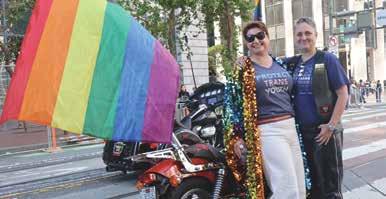
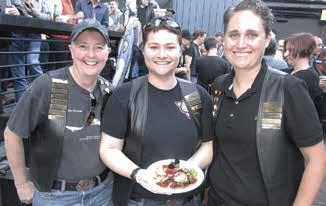
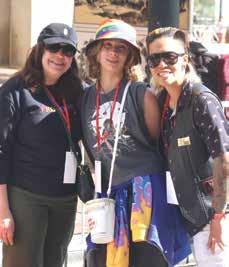
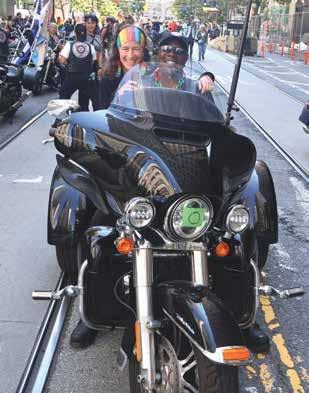
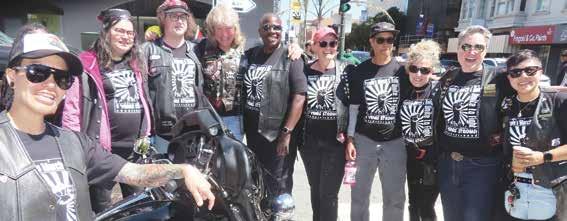
(right) San Francisco Dykes on Bikes® gathered in front of the Sebastiani Theater, which they went to for a screening of Beyond the Rainbow presented by Sonoma Valley Pride (March 15, 2026).
compatriots instead maintained that they had reclaimed “dyke” for the lesbian community, and even to signify empowerment. This led to a long legal battle spearheaded by lead counsel Brooke Oliver. In 2007, the Federal Circuit Court of Appeals affirmed the right of the San Francisco WMC to trademark “Dykes on Bikes,” rejecting claims that the name was disparaging. In July of that same year, the Supreme Court declined to hear the case, thereby allowing the victorious decision to stand.
But the challenges were not over. The PTO, the same agency that had first denied then accepted the name application years earlier, several years later denied the logo application for the same reason it had previously
(continued on page 5)
1976: A group of 20 to 25 women motorcyclists moved their bikes to the start of the San Francisco Gay Freedom Day March, now the Pride Parade. That moment became the beginning of what would become known worldwide as Dykes on Bikes®.
Middle to Late 1980s: As San Francisco Pride became more structured and the number of riders grew, the group formally organized as the Women’s Motorcycle Contingent (WMC) to manage parade logistics. In the press and in LGBTQ+ culture, they continued to be known as Dykes on Bikes®.
2003: The organizers voted to recognize the group’s long history by changing the name to the San Francisco Dykes on Bikes® Women’s Motorcycle Contingent (SFDOBWMC) and they filed an application with the United States Patent Trademark Office (USPTO) for DYKES ON BIKES. This began what would be a 13-year battle, spearheaded through the pro-bono legal leadership of Brooke Oliver (then of 50 Balmy Law, P.C., now at Procopio, Cory, Hargreaves & Savith LLP) to secure the wordmark DYKES ON BIKES and later the group’s logo to ensure each was preserved for nonprofit use in the LGBTQ+ community.
2004: The USPTO rejected the application on the grounds that “dyke” was disparaging to lesbians.
2005: San Francisco Dykes on Bikes® submitted declarations from more than two dozen expert witnesses arguing that “dyke” was not disparaging, but instead had become a self-referential term of pride and empowerment.
2007: Dykes on Bikes® was finally registered with the USPTO after years of litigation spearheaded by Brooke Oliver, and additional pro bono support from Shannon Minter of the National Center for LGBTQ Rights (NCLR) and Greg Gilcrest, then of Townsend and Townsend and Crew LLP, and a trip to the United States Supreme Court.
2015: The group later applied to register its logo, and the USPTO again denied registration on the grounds that the word “dyke” was disparaging.
2016: Under a pro-bono team again led by Brooke Oliver and including Shannon Minter from NCLR, Tobias Barrington Wolff, Michael Feldman, and Marke Lemley, the DOB filed an Amicus Brief in the U.S. Supreme Court case of Matal vs Tam, arguing that DOB has heightened protection for political speak under the First Amendment, including the self-referential term “dyke.”
2017: In a unanimous decision in Matal vs Tam, the U.S. Supreme Court held that it is unconstitutional for the USPTO to deny trademark registration based on allegedly disparaging language, striking down part of the Lanham Act.
2018: San Francisco Dykes on Bikes® mourned the passing of Soni S.H.S. Wolf, a founding member, longtime Secretary, and central figure in the movement’s history.
2026: Known widely for her critical work supporting artists, nonprofits, and social justice movements, Dykes on Bikes® General Counsel, Brooke Oliver, was recognized as a top global trademark attorney, and named to the World Trademark Review 1000 list for 2026. In the same timeframe, NCLR’s legal director Shannon Minter was recognized by TIME magazine as one of the Top 100 Most Influential People of 2026.
Today: With a national and international network, San Francisco is the mother chapter for Dykes on Bikes® chapters across the United States, Canada, the United Kingdom, Germany, Finland, Iceland, and Australia.
Kate Brown, Ph.D., is the President of the San Francisco Dykes on Bikes® Women’s Motorcycle Contingent. https://www.dykesonbikes.org/
By Kate Brown, Ph.D.

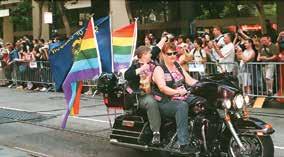
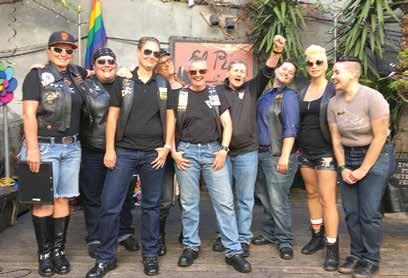
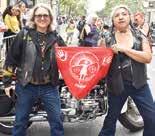

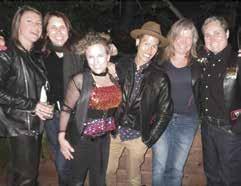
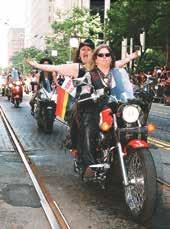
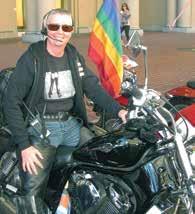
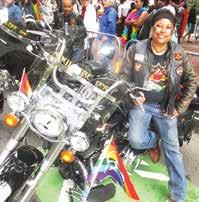
The San Francisco Dykes on Bikes® Women’s Motorcycle Contingent, founded in 1976, is the “Mother Chapter” of chapters that have since been established throughout the U.S. and internationally. Each is unique, reflecting the talents of members and the distinctiveness of the particular location, yet all are united by a shared basic mission that manifests the spirit of empowerment for all LBGTQIA+ communities.
Here, leaders and members of the mentioned chapters offer thoughts during this 50th Anniversary year of the San Francisco Dykes on Bikes® Women’s Motorcycle Contingent.
Dykes on Bikes® Boise
Dykes on Bikes Boise, an official chapter of Dykes on Bikes®, was officially formed in March of 2026. Being in the conservative state of Idaho, it was a rough start. We received lots of hateful comments, but it was totally worth it
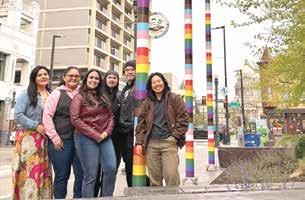

to find the few strong individuals to get the chapter going. The Boise chapter is committed to creating a safe environment for everyone by connecting isolated queer communities across Idaho. We are in the beginning stages of the chapter, but we are a dedicated group that is ready to show Idaho and the world what Dykes on Bikes® is all about. We look forward to making an impact in the community and connecting with other chapters near and far. See y’all in San Francisco for this year’s Pride!
Dykes on Bikes® Rehoboth Beach (Delaware)
The Dykes on Bikes Rehoboth Beach offers a different terrain—one where
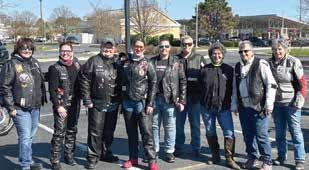
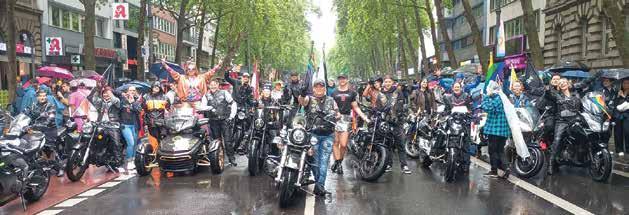
visibility lands closer, faster, and without distance. There is no blending into the crowd here. Every ride is local. Every appearance is relational. The same people who see the chapter at Pride see them again at the grocery store or a stoplight. Visibility doesn’t turn off. DOBRB builds impact through consistent, recognizable presence over time. At each gathering, we give supporters dyke road names— and they light up introducing themselves that way every time they see us again.
Rehoboth Beach adds another layer. As a long-standing LGBTQ+ destination, it brings a steady flow of visitors— some familiar with the legacy, others encountering it up close for the first time. The chapter is both a local anchor and national touchpoint.
It is also a retiree community. Older residents stop, watch, and share stories—recalling the first time they saw Dykes on Bikes® and what it meant. Recognition becomes memory, and memory becomes something felt again.
DOBRB is education-forward, training riders to be leaders who move with skill, discipline, and accountability. In a small state, the community learns what the patch means by how it’s worn. The message is clear: we ride fast, and we love harder.
San Francisco established the visibility. Delaware makes it personal.
London Dykes on Bikes® has had a short but colorful history, and not always in a good way. The first time we led the

Pride in London was in 2018 when we won Best Newcomers and we have been part of the parade ever since except during the COVID years when it was canceled, like all other things. We are currently a very small group focused on sistahood. We’re rebuilding slowly and our aim is always to be a trustworthy, kind, friendly, and inclusive organization.
Dykes on Bikes® Rhein-Weser (Germany)
We are Germany’s only officially recognized Dykes on Bikes™ chapter, and we are visible and active. In 2024, we were named among the Top 10 for the Bike Woman of the Year 2026 award (presented by bike & business), which recognizes outstanding women and initiatives in the motorcycle industry.
Last year, we honored renowned German soul singer, songwriter, and entertainer Esther Filly with an honorary membership in the chapter. She is the creator of her own musical style, “Ridstyle,” which is a blend of soul, pop, jazz, and Motown that represents freedom, joy, and self-determination. Our collaboration with her has resulted in the anthem “Ride With Pride - 50 Years Dykes on Bikes.” Produced through her label Wolkenschloss, the song is more than music; it is a powerful expression of identity and empowerment. The anthem represents a community that is loud, visible, and proud—on the road and beyond. Listen to it here: https://bit.ly/41KExR8
Newly founded in late 2025, the Townsville chapter of Dykes on Bikes® was established in regional North Queensland, more than 1,000 miles from the nearest chapter. Distance shapes our experience, as does the cultural landscape we ride within.
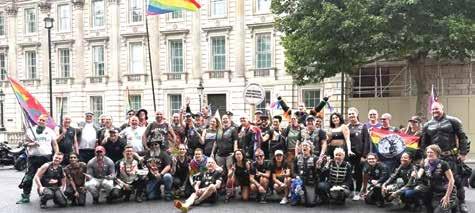
In a community where visibility can still carry risk, our presence matters. When we ride, we are part of the streets, the events, and the everyday life of this region. For some, that visibility offers recognition. For others, it provides a sense of possibility—a sign that there is space
(continued on page 5)
NATIONAL & INTERNATIONAL CHAPTERS (continued from page 4)
here for them too.
Our chapter is grounded in community connection, courage, kindness, and respect. These values guide how we engage with each other and with the wider community. We aim to be steady, visible, and inclusive in how we show up, whether through local events, advocacy, or simply being present.
As a newly formed chapter, we are building something meaningful in a place where that work carries weight. We are proud to be part of the global Dykes on Bikes® community and to contribute our own regional voice to its 50-year history.
Dykes on Bikes® Winnipeg (Canada)
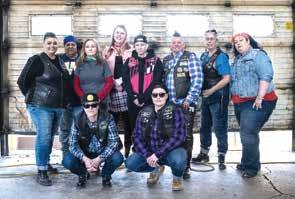

In a city better known for brutal winters than roaring engines, Dykes on Bikes® Winnipeg brings heat, heart, and horsepower to the Prairies. Based in Winnipeg, the capital of Manitoba—a central Canadian province located between Ontario and Saskatchewan—the group is the only Canadian chapter of this globally recognized movement rooted in 2SLGBTQ+ visibility and protest. They stand out for their uniquely community-driven spirit and prairie resilience.
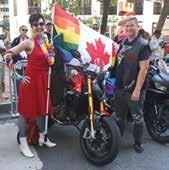
What makes this group special isn’t just the bikes;
refused the first name registration. This time the Supreme Court heard oral arguments for the case and unanimously found it unconstitutional to prohibit the trademark registration of a mark by the PTO based on what some may consider to be disparaging language. It is a fascinating case and we encourage you to read more, in the words of Oliver and co-authors, at this SCOTUS page: https://bit.ly/4mDOEkl
The San Francisco Bay Times interviewed Wolf over the years. In one of her last comments, for the 40th Anniversary of the Dykes on Bikes®—note the capitalization and trademark symbol!—Wolf said, “Having ridden with Dykes on Bikes® to start the parade for 38 years, celebrating our 40th Anniversary is realizing half of my dream/vision for this group of wonderful women has happened. I am extremely honored to be part of this extraordinary organization.”
New Leadership and a Worldwide Community
By the time of the 40th Anniversary, Kate Brown was already President of the organization. She then said, “Being a Dyke on a Bike® to me means having the freedom and courage to be who we are, regardless of how the world may perceive us.” She added, “We have become more organized in our efforts to support philanthropic endeavors in the LGBT and women’s motorcycle community at a local, national and international level and gained visibility, in part, through our legal battle to protect the name Dykes on Bikes®. However, at the core we are still a group of women who are not afraid, and indeed insist, on moving to the front of life’s Parade to be seen and heard, with the roar of our engines felt as we ride with Pride in who we are.”
Dykes on Bikes® chapters have been established through-
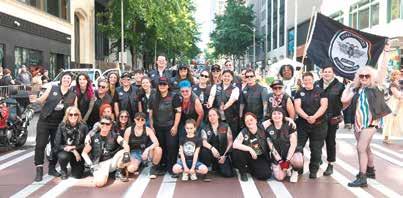
it’s the way they show up. Whether leading Pride parades, riding in solidarity for local causes, or providing a visible sense of safety at small-town and rural Pride events, these riders blend activism with approachability. The chapter includes, not only riders, but also dedicated ally and non-riding members who help organize, fundraise, and build community off the road—expanding their impact far beyond the ride itself.
Since 2019, Dykes on Bikes® Winnipeg has raised over $40,000 for the community. Their impact is especially felt through their commitment to education: the group offers post-secondary scholarships and provides bursaries for middle and high school PRISM clubs, supporting the next generation of 2SLGBTQ+ youth.
There’s a distinct prairie practicality to the group. These aren’t fairweather riders—they adapt, organize, and persist through short riding seasons and long, snowy winters.
out the U.S. and the world. Brown is a Bay Times columnist, and shares more news about the organization in this issue, which also includes statements from many of the chapters here in the U.S. and abroad.
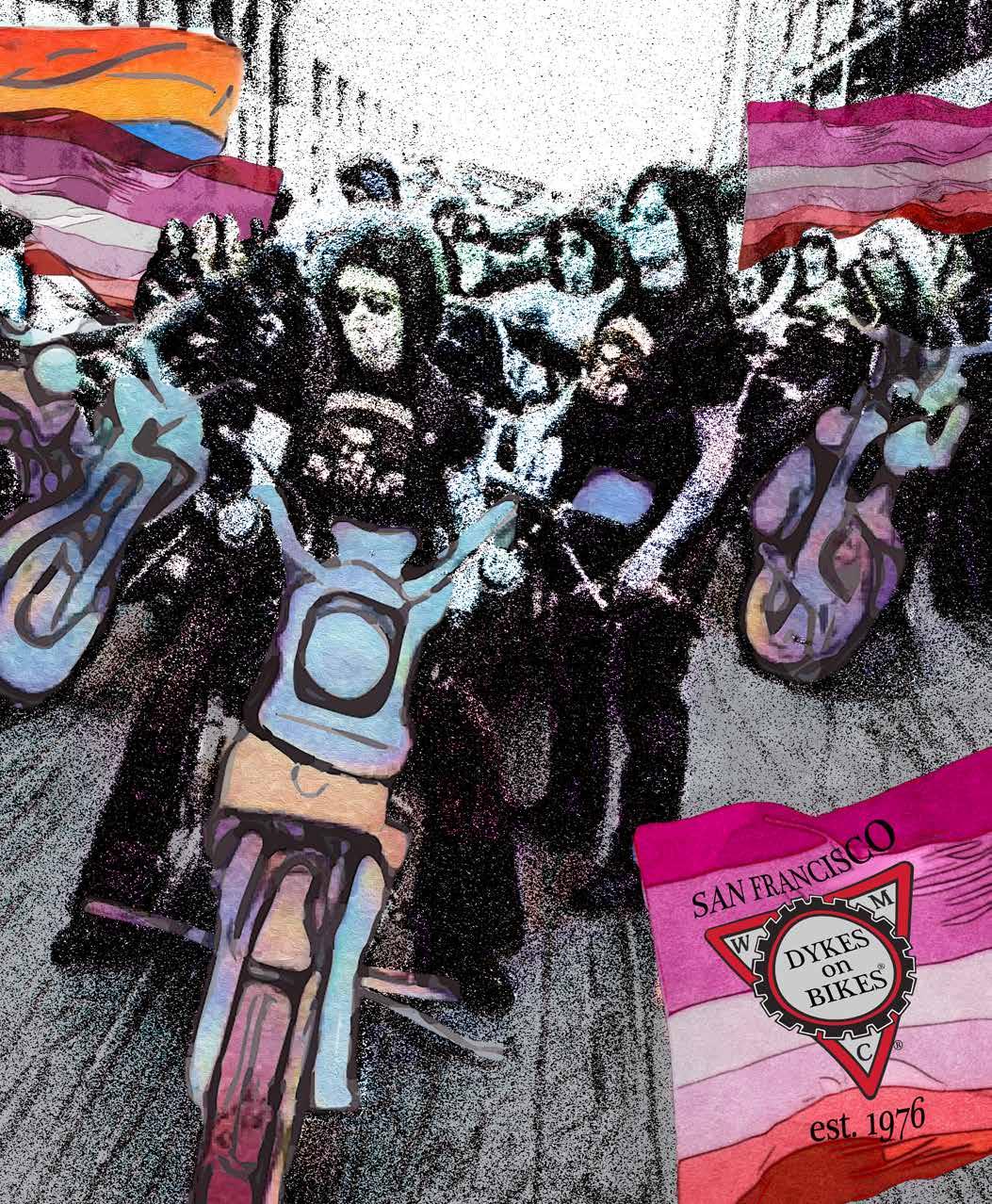
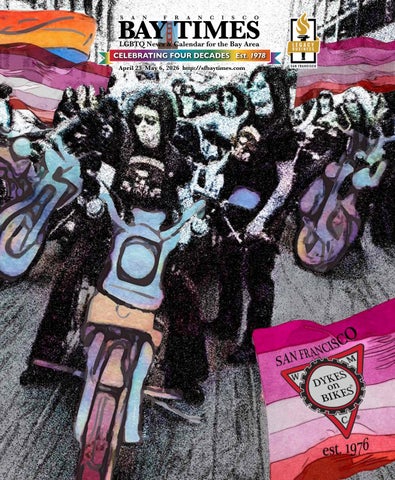
An Historic Collaboration for the Cover of This Issue
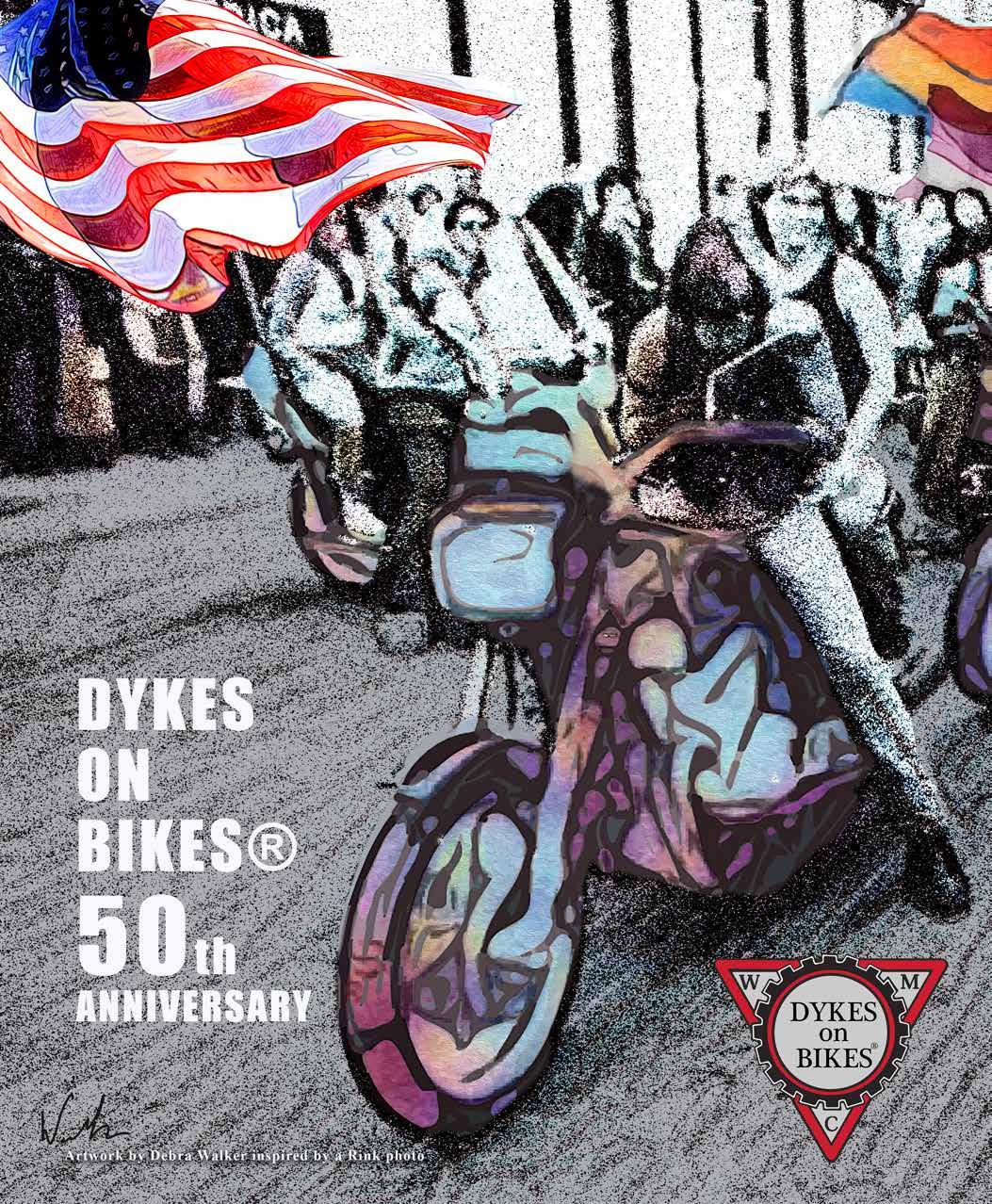
The cover of this issue of the San Francisco Bay Times was inspired by a 1984 photo of the Dykes on Bikes® taken by Bay Times lead photographer Rink. He has photographed every Gay Freedom and Pride Parade in San Francisco, and therefore has many historic images of the Dykes on Bikes® and more.
Debra Walker, an artist and city Commissioner on the Arts Commission, then created an original image based on Rink’s photo. It is a rare front-back image for the paper and Walker’s first for the Bay Times of this size. She has previously created other significant covers for the Bay Times, including the cover marking the Dykes on Bikes® 45th Anniversary: https://bit.ly/4ey8X0n
On April 24, 2026, the Friday of Lesbian Visibility Week and during a celebration co-produced by the Bay Times of the 50th Anniversary of the Dykes on Bikes® at Rikki’s in the Castro, Walker will be auctioning off a signed limited edition print of the image to benefit the Dykes on Bikes® and the Use the News Foundation, which is the fiscal sponsor of the Bay Times
The Bay Times encourages supporting the Dykes on Bikes® as they move toward their next half century of leading the Pride Parade, empowering and educating countless others, and engaging in philanthropic endeavors throughout the LGBTQ+ communities and beyond.
In Winnipeg, Dykes on Bikes® isn’t just a spectacle. They are a symbol of endurance, chosen family, and unapologetic pride.
Dykes on Bikes® Seattle
The Dykes on Bikes® Seattle chapter is an organization dedicated to empowering and uplifting our Western Washington communities and one another through our advocacy, education, donations, and actions. Our roots run deep in the history of LGBTQIA+ struggles for visibility, inclusion, civil rights, and chosen identity. We honor those who came before us with the creation and defense of queer spaces and the unapologetic ownership of dyke-identified motorcycle culture.
Thank you to Kate Brown, Angela Torres, Zephyr, Di Pine, Dori G., Maxine Capner, Jenn Rands, and the members of the mentioned Dykes on Bikes® chapters for contributing to this 50th Anniversary DOB edition of the “San Francisco Bay Times.”
where we were joined by our Lake County riders. From there, we traveled along Silverado Trail to Lake Hennessey and then on to the northwestern corner of Lake Berryessa. After taking in the lake views, we made our way down to Fairfield for a late lunch with patch-holders Michelle and Clara from Sacramento. It was one of those perfect spring riding days that remind us exactly why we love being out on the road together.
Looking ahead, our May ride will take place on May 2, 2026, as part of the 20th annual International Female Rider Day, when womxn riders across the world come together for a powerful day of visibility, presence, and riding in solidarity. Maria has planned a route through the Sacramento Delta, including several ferry crossings along the way. We are hoping the weather is just as gorgeous for May as it was for our March and April rides.
We are also eagerly looking ahead to April 24, when the San Francisco Bay Times and Rikki’s Women’s Sports Bar will co-host a 50th Anniversary celebration and fundraiser in honor of the San Francisco Dykes on Bikes®. It will be held during Lesbian Visibility Week, and the evening promises to be a very special gathering, with some incredible raffle and auction prizes. The event will begin at 6 pm, and seating is first come, first-served, so guests are encouraged to arrive early. We are deeply grateful to our co-hosts, the San Francisco Bay Times and Rikki’s, for helping us mark this milestone year. As we celebrate 50 years of riding, visibility, and dyke dignity, we are excited for what lies ahead and proud to keep moving forward together.
Kate Brown, Ph.D., is the President of San Francisco Dykes on Bikes® Women’s Motorcycle Contingent. https://www.dykesonbikes.org/
Joanie Juster
We have enjoyed more than our usual share of glorious weather this spring, with an abundance of jasmine, wisteria, roses, and more sweetening the air. All this beauty lies in stark contrast to the reality that, halfway around the world, our country is engaging in a pointless war, raining death and destruction upon countless innocent people and further dragging our country down a dark and dangerous path that isolates us from our former allies. And for what?
In need of positive inspiration, I went to Bruce Springsteen and the E Street Band’s “Land of Hope and Dreams” concert at Chase Center. The show opened with Springsteen speaking passionately about American ideals he believed in, and that he felt were under attack by the current administration. Then the band launched into a
fiery rendition of Edwin Starr’s classic antiwar anthem, “War (What Is It Good For).” The response to that provocative question is, of course, “Absolutely nothing!” Throughout the 3-hour show—part rock concert, part revival meeting—Springsteen kept urging the crowd to keep fighting against injustice and authoritarianism, and to practice peace, unity, and helping our neighbors.
Springsteen has a major platform, but he’s right: we all have a voice, and we all need to use it before it is too late. The recent election in Hungary should act as a catalyst for freedom-loving people everywhere: If Hungary could oust their thuggish leader, Viktor Orban, then why can’t we?
While it has been clear for a long time that our president’s mental condition is deteriorating rapidly, it is even more concerning to see the younger, stronger people around him acting irrationally. What Pete Hegseth is doing to our military should be setting off alarm bells for every American. Firing the most experienced and professional military leaders while our country is at war, and encouraging discrimination based on race, sex, religion, and more, should qualify him for impeachment—but, instead, in this administration he is encouraged to ratchet up the crazy even more. And one has to wonder just how the Christian Nationalists who are working to take over our country managed to convince, not just the President, but also the Vice-President and the Cabinet, that engaging in theological warfare with the Pope was a good idea. Even many MAGA
Christians have felt that a major line has been crossed. Let’s hope that the combination of pointless warmongering, blasphemy, and destruction of the economy might be enough to wake people up and turn the tide at last.
Multiple elections are right around the corner, and attention must be paid. On the very local level, five of the eleven seats on the San Francisco Board of Supervisors are up for election in November, but two of those seats (Districts 2 and 4), which were filled by mayoral appointments, are also being contested in a special election on June 2. The Board of Supervisors have a great deal of say over
issues that affect your daily life, so please take the time to get to know the candidates, and what they stand for.
With the balance of power in the Senate and House of Representatives on the line in Washington, there are major races heating up across the country. But there is plenty of election drama right here in California as well. When Rep. Eric Swalwell’s political career imploded recently over allegations of sexual harassment and assault, it threw California’s gubernatorial race into, not just a tailspin, but completely uncharted territory. As I write this, the jockeying for top spot among Democratic candidates is at fever
(continued on page 16)
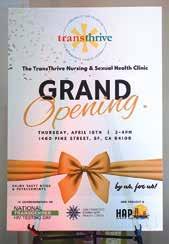
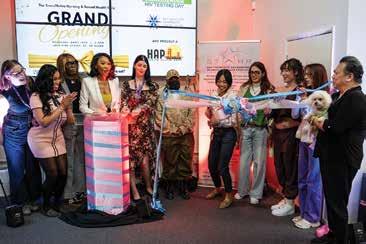
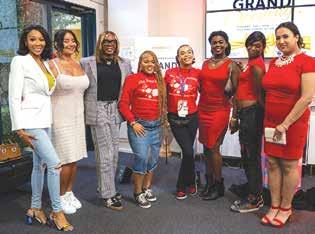
The grand opening of a new on-site clinic at TransThrive (1460 Pine Street) took place on April 16, 2026. Operated by the San Francisco Community Health Center, the clinic offers a comprehensive suite of healthcare services for transgender and gender-expansive individuals in San Francisco. The grand opening, which included a ribbon-cutting ceremony, was timed to coincide with National Transgender HIV Testing Day.
“Since working with the TransThrive team, there has been a clear need for folks to have low-barrier access to STI testing, and to prevention and treatment methods,” said TransThrive Program Manager Sage Hapke. “With everything going on politically right now, increasing fear, and additional challenges with getting connected to care, we want to be here for people who haven’t had a space like this and provide care that is explicitly trans-affirming.”
“Trans people have always faced barriers to care, to recognition, to simply being seen,” said Lance Toma, CEO of the San Francisco Community Health Center. “What is happening right now at the federal level is an attempt to erase trans people from public life, healthcare, and existence itself. That is not something we can stand by and watch. While we fight in the courts, we are also deepening our commitment on the ground through the TransThrive clinic.”
The new clinic operates on Tuesdays and Thursdays from 2–4:30 pm and will serve existing patients and new community members seeking care. This includes:
- full Sexually Transmitted Infection (STI) panel testing, including HIV, hepatitis-C, syphilis, gonorrhea, and chlamydia;
- long-acting injectables for HIV prevention and treatment;
- gender-affirming care and coordination;
- nursing and complex care coordination;
- and wound care.
For more information: https://bit.ly/3OQc35t


For decades, the City of San Francisco and the State of California have led the way to ensuring that places open to the public are smoke-free. We’ve collectively done so to protect people from the now indisputable harms of secondhand cigarette smoke. According to the Centers for Disease Control (CDC), over 480,000 people in the United States still die from the effects of cigarette smoking annually, with over 41,000 people losing their lives from the effects of secondhand smoke.
Through our elected officials, Californians have passed laws that mandate that our workplaces, hotels, children’s playgrounds—and indoor restaurants, cafés, and bars—are all smoke-free. State law also ensures that everyone may ride public transit without being exposed to secondhand smoke, both on the vehicle and while waiting at a bus stop or on a train platform.
In San Francisco we’ve gone further, with our Board of Supervisors in 2010 voting unanimously to mandate that all San Franciscans have smoke-free access to nearly all spaces open to the public across the city—whether it be while having a meal on a restaurant patio, taking a walk in the park, going to the farmers’ market, or waiting in line at an ATM. You can’t smoke while playing a round of golf on a public course, fishing off the pier, or taking in the view of Alcatraz from Fisherman’s Wharf. Public housing is smokefree, and common areas of multi-unit residences are as well. The laws are so comprehensive that you can’t even smoke in a tobacco shop or at a charity bingo event. Under city and state law, vaping is also prohibited in smoke-free public spaces.
We know firsthand the harms of being exposed to secondhand smoke daily in our lives, not only in the apartment building where we lived for 25 years and at the office, but in public spaces as well. And we know what a difference it makes to be free from it now nearly everywhere in the city.
that gap. Over 50 Bay Area cities, including Oakland and San Jose, already have laws ensuring these venues are smoke-free. It’s time for San Francisco to join them.
Particularly powerful evidence supporting Melgar’s ordinance is the scientific research documenting how unhealthy the air quality is in bar patios where smoking is permitted. A 2022 UCSF study, cited in the ordinance’s official findings, found that “six of the nine bar patios visited” for the research “had peak readings in the EPA ‘unhealthy’ air quality range, or higher,” and one patio, where cigar smoking was allowed, “registered in the ‘hazardous’ range.”

If we as a city protect our citizens from secondhand smoke in wide open outdoor spaces such as parks, golf courses, and city wharfs and piers—often sparsely occupied and subject to San Francisco’s famous fog and wind—it makes no sense to subject people who simply wish to go to a bar with friends and enjoy the outdoor patio to demonstrably unhealthy and sometimes hazardous levels of secondhand smoke. And it’s particularly harmful to bar employees, who are exposed to such smoke for hours on a daily basis and who may fear losing their jobs if they speak up for nonsmoking laws.
Particularly compelling, too, is the fact that we as a city already ensure that people may dine smoke-free at any restaurant or café with a patio or other outdoor eating space. If smoking is prohibited in these spaces—after all, a cigarette after dinner or smoking in a café while sipping coffee and reading (or writing) a great novel was once considered sacrosanct—it makes no sense to permit it at bar patios.
We understand how some bar owners may be particularly resistant to this change. Melgar’s ordinance acknowledges that many businesses feared that the city’s groundbreaking 1994 smoke-free legislation to protect workers from secondhand smoke would cost them customers. But, 32 years later, whether or not a business makes it in San Francisco has nothing to do with the 1994 ordinance. The city remains a culinary paradise and nightlife hub, with residents and visitors alike flocking to its innumerable eateries, clubs, and bars, even though they can’t smoke inside any of them.
But there’s a glaring exception to these life-saving smoke-free laws: patios at bars and taverns are not covered. A new ordinance, introduced on April 7, 2026, by Supervisor Myrna Melgar and co-sponsor Supervisor Danny Sauter, would close
Finally, the effect the new ordinance will have on future generations is perhaps the most compelling reason to pass Melgar’s legislation today. The ordinance notes how the 1994 legislation was considered “highly controversial,” but, three decades later, it’s simply the norm.
We remember the old days when smoking was ubiquitous. Smoking was permitted on airplanes. We once rode on an air-conditioned bus with windows that did not
open and had only one non-smoking row, wondering what the point of it really was. And we recall eating at restaurants where the people at the next table were smoking and hoping against hope that, after each cigarette, they would not light up again.
It was just the way it was. But today we’ve reached a new consensus, and young people would find the presence of smoking in such places and myriad others unimaginable. Creation of this new norm, along with public health education, has saved countless lives. Adult smoking rates have declined a whopping 73 percent over the last sixty years, according to the American Lung Association.
One lingering memory we have of days gone by is that of going to evening baseball games and seeing the stadium lights illuminate a blue-grey cloud of secondhand cigarette smoke hanging over the field in the late innings. Those clouds have become a thing of the past, and now’s the time to lift the blue-grey haze hovering over bar patios in San Francisco today. It’s a matter of simple common sense.
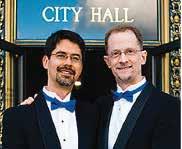
John Lewis and Stuart Gaffney, together for over three decades, were plaintiffs in the California case for equal marriage rights decided by the California Supreme Court in 2008. Their leadership in the grassroots organization Marriage Equality USA contributed to making same-sex marriage legal nationwide in 2015. Today, they continue to educate and advocate for marriage equality and LGBTIQ+ rights worldwide.

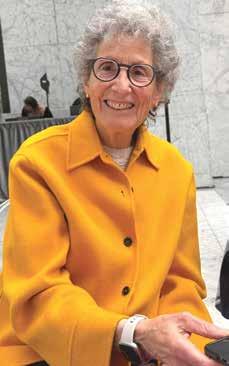
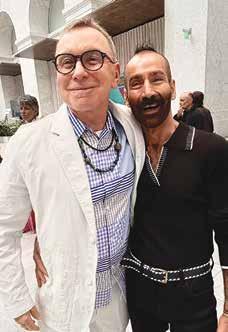
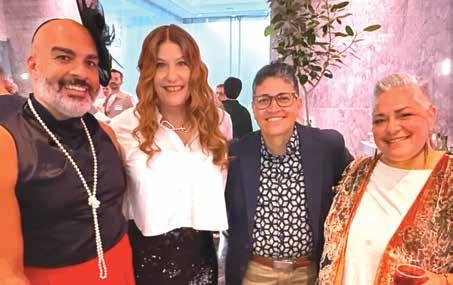
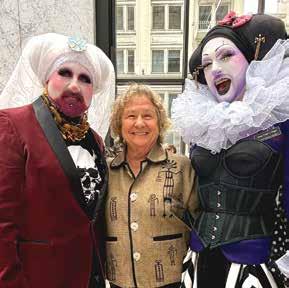
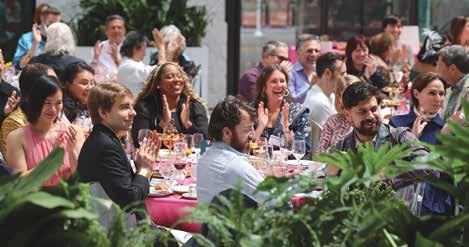
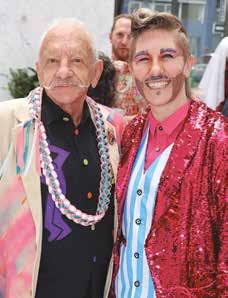
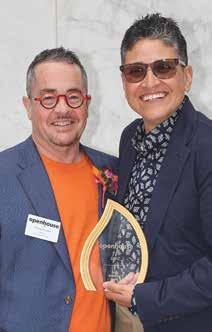
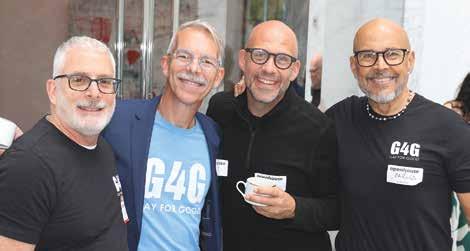
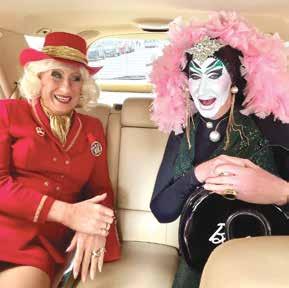
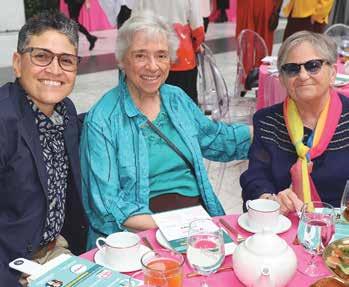
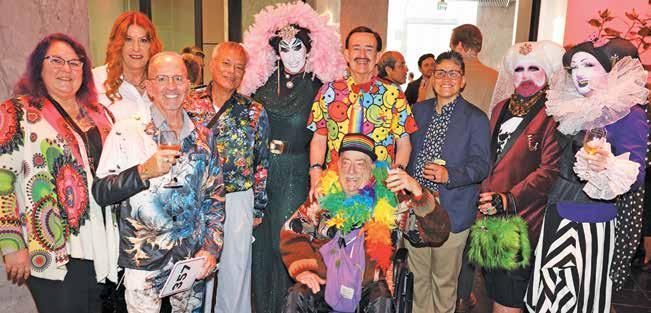
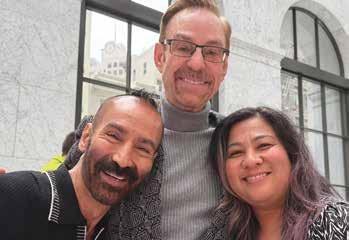
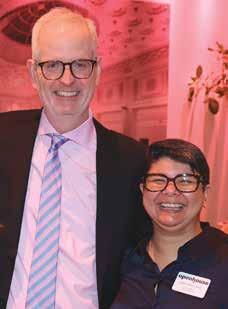
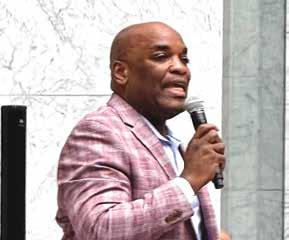
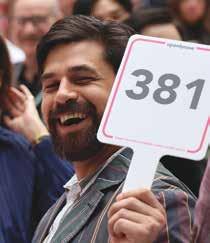
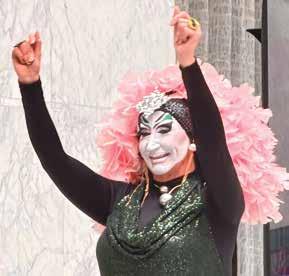
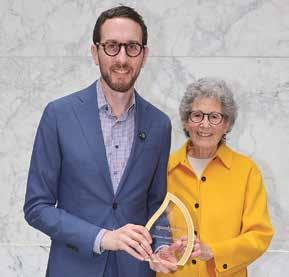
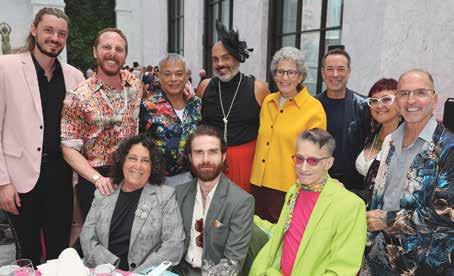
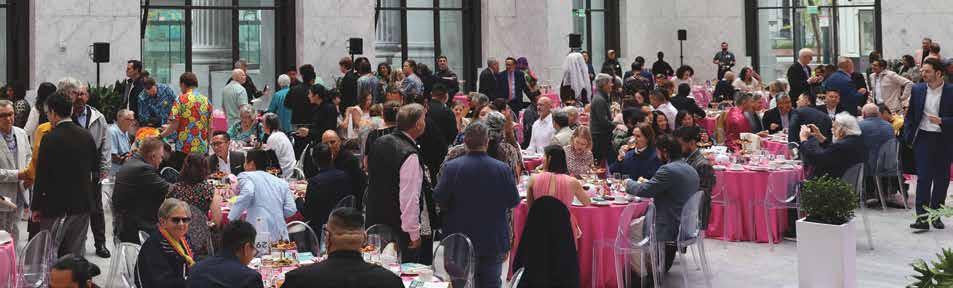
The annual Openhouse gala Spring Fling was held on April 12, 2026, at The Conservatory at One Sansome. Hosted by Sister Roma, the celebration and fundraiser included an elegant high tea service, live auction led by Michael Tate, and Senior Prom After Party. There was also a presentation of the organization’s Trailblazer Award to the nonprofit LYRIC, and the Adelman-Gurevitch Founders Award to State Senator Scott Wiener “in recognition of his work advancing protections for LGBTQ+ older adults.” Dr. Marcy Adelman, a San Francisco Bay Times columnist, was a co-founder of Openhouse with her late partner Jeanette Gurevitch. https://www.openhousesf.org/


Brandon Miller
Last week, I walked past a coffee shop I’d never been into. It’s four blocks from my house—four blocks.
I’ve lived in this neighborhood for years, and I’d never once walked through the door of this shop. It got me thinking: How much of my money leaves my community every single day without me even noticing? How much of yours does?
So, I built a challenge. I’m calling it Brio’s Neighborhood Scavenger Hunt: seven intentional money moves over seven days, designed to redirect your spending, giving, and investing back toward the community you actually live in.
Giving Is How You Close the Gaps
National organizations do important work, but local giving lets you see exactly where your money lands. Donate to a local land trust and you can walk the trail it preserved. Support a queer arts organization and you can sit in the audience on opening night.
One organization I love is the Horizons Foundation, which operates like a venture philanthropy fund for community nonprofits. They provide seed money to scrappy, early-stage organizations doing on-theground work that bigger funders haven’t discovered yet. Think angel investing, but for your neighborhood.
Join Brio’s Neighborhood Scavenger Hunt Challenge
Now for the part where I make you do something.
This is your Neighborhood Scavenger Hunt: Seven tasks, one week, and no rules about which day you do what. Think of it as a field trip for your wallet.
1. Grab your morning coffee from an independent shop. This is the one with the weird art on the walls and the barista who cares about getting your extra-soy-latte-non-fat-mocha black coffee order right.
(continued on page 16)
Jay Greene, Esq., CPA
Two major law changes are now in effect, and many Bay Area estate plans have not yet been reviewed to reflect them. If your plan has not been updated since 2024, it may be relying on rules that no longer exist.
The most important issue is timing. Your ability to update a plan depends on legal capacity. Once a serious illness, stroke, or cognitive decline takes that away, no attorney can create new authority documents, retitle property, or restructure your plan for you—no matter how urgent the need.
One legal change affects probate. The other affects Medi-Cal eligibility. Together, they create a practical message for Bay Area fam-
ilies: this is a good moment to review whether your current documents, title, and beneficiary designations still work the way you think they do.
California’s Probate Rules
Assembly Bill 2016 took effect April 1, 2025. It created a simplified court process for transferring a primary residence worth $750,000 or less and raised the small-estate threshold for certain non-real estate assets above the former $184,500 limit.
For many Bay Area households, however, that relief will be limited. Home values in San Francisco and surrounding communities often exceed the new cap. The law also applies only to a principal residence, requires agreement among heirs, measures value without subtracting mortgages or liens, and still involves a court process. For that reason, a properly funded living trust remains the strongest way to keep a home out of probate regardless of value.
A trust helps only if assets are actually in it. Refinancing is a common point of failure: lenders often remove a trust from title during the loan process, and homeowners are not always told that the deed was never transferred back. If your current deed lists only your personal name, rather than you as trustee of your trust, your home may still be
(continued on page 16)

By Aaron Boot-Haury
As the Bay Area moves into late spring and Pride season comes into view, the Golden Gate Business Association is preparing for one of the most significant moments in our recent history. June 2, 2026, will mark, not only our first annual LGBTQ+ Business Expo and our expanded partnership with the San Francisco Business Times on the Business of Pride celebration, but also the official unveiling of a refreshed GGBA brand. It is a milestone we have been working toward for some time, and we are energized to share it with our members and the broader community.
Let’s start with the Business Expo. Tables are now available on the GGBA events page for both GGBA members and non-member businesses. Space is limited, and interest has been strong, so we encourage any business considering a table to register as soon as possible. The Expo will open at 3 pm on June 2 and will be open to all, regardless of whether
you plan to attend the larger Business of Pride event later that evening. Whether you are an entrepreneur looking to connect with potential customers and partners, a procurement professional seeking to grow your supplier network, or a community member who simply wants to support LGBTQ+ owned businesses, we invite you to stop by.
Holding the Expo in tandem with the Business of Pride event is something we are especially excited about. It creates a natural audience of LGBTQ+ business supporters, corporate leaders, and community members who will be on site and ready to engage with the businesses in our community. Attendees of the Business of Pride event will also have the opportunity to network and learn directly from some of the most accomplished LGBTQ+ business owners in the Bay Area, including those recognized on the San Francisco Business Times’ Top 40 list. As a thank you to our members, the Business Times is generously offering GGBA members a coupon code for 40% off tickets to the Business of Pride event. Members should keep an eye on their inboxes for that code in
the coming days.
June 2 will also serve as the official launch of our refreshed GGBA brand. Over the past several months, our team and board have been working to clarify who we are, who we serve, and where we are going. The result is a refreshed mission, vision, and values statement, a new and exciting logo, and a redesigned website that will be live and ready for attendees to explore on June 2. The refresh is more than visual. It reflects a renewed commitment to our members, to the broader LGBTQ+ business community, and to the economic impact we can have together.
Alongside the brand launch, we will be announcing new incentives and discounts designed specifically for previous GGBA members whose memberships may have lapsed. If that describes you, I hope you will take a fresh look at what the GGBA is becoming—we would love to welcome you back. We will also be sharing several new strategic partnerships with other organizations as part of this re-launch, further expanding the opportunities and resources
Jenn T. Grace, M.S., is an award-winning author, nationally recognized speaker, and a savvy publishing strategist. She is the founder of Publish Your Purpose, a certified B Corp social enterprise that meets the gold standard of socially and environmentally-friendly business practices. Here she shares more about this acclaimed hybrid publishing company that not only gives first-time authors the secrets to getting their books written, but also helps them find an eager audience and mark their place in the publishing world.
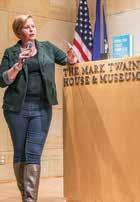
impact over vanity metrics.
GGBA: Why did you decide to create Publish Your Purpose?
Jenn T. Grace: I saw too many important stories and perspectives go unheard because traditional publishing pathways were inaccessible or misaligned. I started Publish Your Purpose and The Institute for Author Growth & Impact to provide a more empowering, transparent, and supportive path for authors who want their work to truly make a difference.
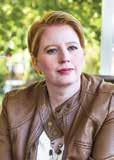
GGBA: Who are some of your role models, and especially those who helped to influence your business?
GGBA: Please tell us more about Publish Your Purpose and what your mission there is.
Jenn T. Grace: I run a publishing and thought leadership company that helps purpose-driven authors turn their ideas into impactful books and platforms. My mission is to amplify voices that create positive change, and my values center on integrity, inclusivity, collaboration, and meaningful
Jenn T. Grace: I’m inspired by authors, activists, and entrepreneurs who use their platforms for good. Many of my clients are role models in their own right, and peers in the LGBTQ+ business community have also shaped how I think about visibility, leadership, and impact.
GGBA: Why did you decide to join the GGBA, and how long have you been a member?
available to our members. You’ll want to be in attendance on June 2 to be among the first to hear these details firsthand—we have been saving some of the most exciting announcements for the room.
There is a lot happening, and it is all pointing toward June 2. Whether you come for the Expo, the Business of Pride event, or both, we would love to see you there. Visit the GGBA events page to reserve a table or learn more, and stay tuned as additional details continue to roll out in the coming weeks.
At the GGBA, we remain deeply committed to fostering innovation, collaboration, and economic empowerment within our community. This moment—a new brand, new partnerships, a new Expo, and a renewed invitation to everyone who has been part of our story—is one we have been building toward, and we are grateful to share it with you.
Aaron Boot-Haury (he/him) is the President and CEO of the Golden Gate Business Association.

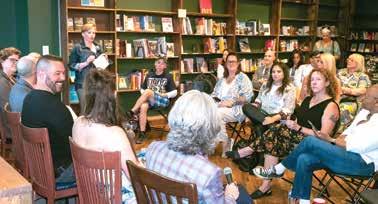
Jenn T. Grace: I joined the GGBA to be part of a values-aligned business community that prioritizes inclusion and economic opportunity. While I am new to GGBA, I have been part of NGLCC (National LGBT Chamber of Commerce) since 2006. The values of GGBA feel like a natural extension of both my personal and professional mission.
GGBA: How has being a member of GGBA helped your business so far?
Jenn T. Grace: GGBA has expanded my network in meaningful ways, leading to new relationships, collaborations, and visibility opportunities. It’s been especially valuable to connect with other LGBTQ+ business own-
ers who are equally committed to purpose-driven work.
GGBA: What advice would you give to someone who is thinking of starting their own business?
Jenn T. Grace: Start before you feel ready and focus on building relationships, not just offerings. Be clear on the impact you want to make, stay adaptable, and don’t underestimate the importance of learning how to talk about and sell your work with confidence.
GGBA: Is there anything else that you would like to share?
Jenn T. Grace: I believe books are one of the most powerful tools for change. When more diverse voices are supported in sharing their stories and expertise, it benefits all of us. I’m grateful to be part of a community like GGBA that helps make that possible.
https://publishyourpurpose.com/

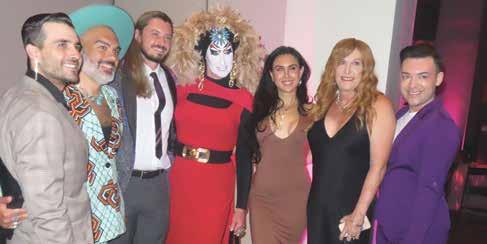
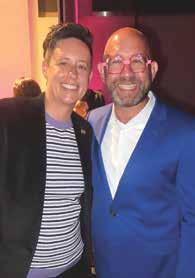
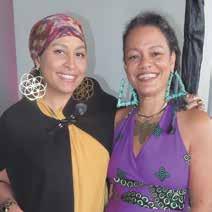
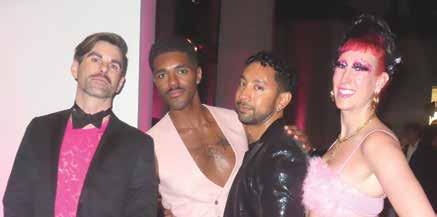
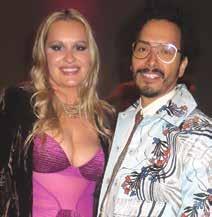
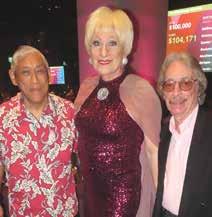
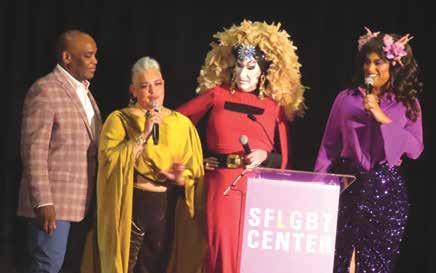
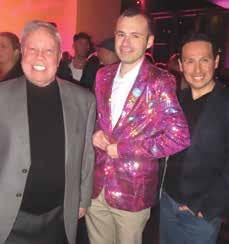
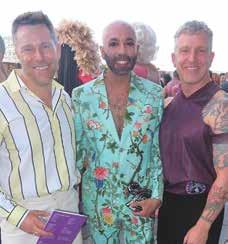
Soirée, the annual fundraising gala of the SF LGBT Center, took place on April 18, 2026, at City View at Metreon. Hosted by Sister Roma and Honey Mahogany, the event included a reception and dinner program, entertainment by Juanita MORE!, music by DJ LadyRyan, an auction led by Michael Tate, and an After Party.
The San Francisco Bay Times is a proud Media Partner of Soirée, which supports the center’s vital programs and services. https://sfcenter.org/

(continued from pg 8)
pitch. If Democrats don’t pull together and stand behind a candidate, we risk having two Republicans and no Democrats on the ballot in November—an unimaginable situation in such a deeply blue state, but that’s where we are at the moment, due to California’s election system.
If you think we are already being bombarded by campaign ads (thanks largely to two very deep-pocketed candidates), brace yourself; it’s going to get a whole lot worse very soon. These elections are important, and represent a sea-change in a lot of ways, as political generations are shifting. Please do your homework, and don’t forget to follow the money—it’s always enlightening to see where a campaign’s money is coming from.
LEATHER & LGBTQ Cultural District Safety Training
We all need to be extra aware these days, for our own safety and the safety of others. The LEATHER & LGBTQ Cultural District is holding a free presentation at their Safety Committee Meeting on May 5 covering ICE community defense, legal preparations, interactions with ICE agents, and evidence preservation. Also on the agenda is harm reduction, focusing on physical safety and chemsex. The meeting will take place on Tuesday, May 5, 6–8 pm at the Folsom Street Community Center (1286 Folsom Street).
TransThrive Nursing & Sexual Health Clinic Opens
Congratulations to the San Francisco Community Health Center on the grand opening of their TransThrive Nursing & Sexual Health Clinic on April 16. Especially in this time of relentless federal attacks on the trans community, this marks an important step in community-led health care, as the first of its kind: a trans/GNC-led care facility, including comprehensive sexual health testing, HIV pre-
MILLER (continued from pg 12)
2. Buy a book from a neighborhood bookstore. Tell the person behind the counter what kind of mood you’re in. Their recommendation will be better than the algorithm’s!
3. Have a meal at a local restaurant. Sit down, stay longer than you planned, and tip generously. Restaurants create gathering spaces, foot traffic, and jobs, and they’re the first to feel it when spending moves online.
4. Purchase something you need this week from a small business nearby. It could be a gift, a card, flowers, a candle, or something else. Whatever’s on the list, buy it from someone who lives in your zip code.
5. Swap one online order for a trip to an actual store. Pick the item that’s least urgent. You don’t need same-day delivery on dish soap. (Or maybe you do. I don’t judge.)
6. Make a first-time donation to a local nonprofit. Any amount counts. If you don’t know where to start, ask a neighbor what cause they care about. That conversation alone is worth something.
7. Open your investment portfolio and actually look at what’s inside. Do you know what companies you own? Do they reflect what you care about? If the answer is “no idea,” that’s not a problem. That’s a starting point.
Take the Challenge With Me
I ask myself a lot, “What’s the purpose of being on this planet if we don’t have community?” And the answer I keep landing on is that community isn’t something that just happens. It’s something we build
vention and treatment, gender-affirming hormone therapy, and wraparound nursing care. The facility will offer different services and testing on different days, so check the Community Health website for specific information. https://tinyurl.com/SFCHO
Save Some Dates
Missing the camaraderie and support of large-scale protests? There is never a shortage of protests being held in the Bay Area, but here are a couple of dates you will want to save:
May 1: “May Day Strong: No Work, No School, No Shopping”
Indivisible and other organizations are promoting a nationwide day of protest on May 1, the traditional day of protests: Basically, there will be no business as usual, as a means of peaceful non-cooperation. More info: https://tinyurl.com/MayDayInd
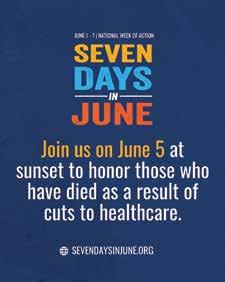
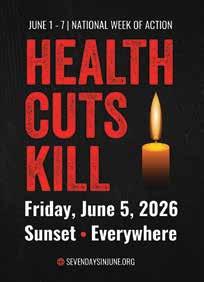
June 1–June 7: “Seven Days in June: Health is Primary”
Our country is experiencing a public health crisis, as healthcare has become unaffordable or even completely inaccessible for a growing number of Americans. Cleve Jones, in collaboration with national organizations, has announced “Seven Days in June,” a nationwide call to action taking place in cities and towns, community centers, places of worship and public spaces to demand that every candidate at every level must answer for where they stand on the health of the people they seek to serve. A candlelight vigil will be held on June 5; more details to come shortly, but here is a link to the website in the meantime: https://tinyurl.com/7DaysJune
Joanie Juster is a long-time community volunteer, activist, and ally.
with your time, your attention, and your money. If you take the challenge, tag @BrioFinancialGroup so we can cheer you on. And if you want to talk about aligning your full financial picture with the things you actually care about, the Brio community is here for you. Book a complimentary Make It Happen meeting ( https://www.briofg.com/contact ) to get started.
This material presented by Brio Financial Group (“Brio”) is for informational purposes only and is not intended to serve as a substitute for personalized investment advice or as a recommendation or solicitation of any particular security, strategy, or investment product. Facts presented have been obtained from sources believed to be reliable, however, Brio cannot guarantee the accuracy or completeness of such information, and certain information presented here may have been condensed or summarized from its original source. Brio does not provide legal or tax advice, and nothing contained in these materials should be taken as legal or tax advice. Advisory services are only offered to clients or prospective clients where Brio and its representatives are properly licensed or exempt from licensure. No advice may be rendered by Brio Financial Group unless a client service agreement is in place. For more information about our advisory services and fees, please refer to our ADV brochure found at https://adviserinfo.sec.gov/
Brandon Miller, CFP®, is a financial consultant at Brio Financial Group in San Francisco, specializing in helping LGBT individuals and families plan and achieve their financial goals. For more information: https://www.briofg.com/
(continued from pg 12)
exposed to probate.
This issue can be especially important for LGBTQ+ households, unmarried partners, and chosen families. Registered domestic partners are often treated similarly to spouses for Medi-Cal purposes, but only if the documentation is clear and current. If a partner, close friend, roommate, or caregiver is central to your support system, but not named in your legal documents, that gap can create confusion at exactly the wrong time. Good planning is not only about tax rules or court procedure. It is also about naming the right decision-makers, trustees, health care agents, and beneficiaries so that the people you trust are the ones who can actually act when needed.
California temporarily suspended asset tests for many Medi-Cal programs in 2024 and 2025. Beginning January 1, 2026, those tests return for non-MAGI Medi-Cal, including long-term care coverage. The limits are $130,000 in countable assets for one person, $195,000 for a married couple, plus $65,000 for each additional eligible household member.
In a high-cost region like the Bay Area, these numbers can affect more families than people expect. Skilled nursing in San Francisco can run roughly $13,000 to $16,000 per month. That means even middle-income households can face a painful gap between the cost of care and the point at which benefits begin.
When a person applies for long-term care Medi-Cal, the county reviews 30 months of financial history. Transfers for less than fair market value— including gifts to family members—can create a penalty period during which Medi-Cal will not pay. The federal annual gift-tax exclusion does not protect a transfer from Medi-Cal’s separate rules.
That distinction matters. A gift may be tax-free and still create benefit problems. Before making large gifts, changing title, or moving assets, it is wise to review the consequences first.
How Probate and Medi-Cal Intersect
Probate and Medi-Cal are often discussed separately, but they intersect in a very practical way. California can generally seek Medi-Cal estate recovery only from assets that pass through probate. Assets held in a properly funded living trust, in joint tenancy, or through a valid transfer-on-death arrangement often avoid probate and therefore may also avoid estate recovery when set up correctly.
That is one reason trust funding matters so much. The protection depends, not just on having a trust document, but on making sure the home and other intended assets are actually aligned with it.
Three Things to Do Now
Audit trust funding. Confirm that your home and key accounts are actually titled or designated the way your plan intends.
Review planned gifts or transfers before you act. The 30-month lookback means today’s decisions can affect eligibility years from now.
Update powers of attorney and health care directives. Without them, loved ones may face conservatorship before they can help.
A Short Review Now Can Prevent Bigger Problems Later
These changes do not affect only the wealthy. In the Bay Area, ordinary home values and ordinary savings can create extraordinary legal consequences when plans are outdated or incomplete.
If you live in San Francisco or the broader Bay Area, a short review of your plan against the current probate and Medi-Cal rules can confirm what is working and identify what needs attention while change is still possible.
Contact Greene Law Firm, P.C. today. Call 415-905-0215 or email info@greenelawfirm.com—free initial assessment.
Statements in Compliance With California Rules of Professional Conduct
The materials in this article are for educational purposes only and are not legal advice. Consult an estate planning attorney for personalized guidance.
Attorney Jay Patrick Greene, Esq., CPA, founded Greene Law Firm, P.C., which is licensed in California, Alabama, and Florida. He has over 15 years of experience in wills, trusts, probate, elder law, and asset protection. For more information, visit https://www.assetprotectionbayarea.com/



Roland Schembari and Bill Hartman, Co-Founders
Randy Alfred, Founding News Editor, 1978 Kim Corsaro, Publisher 1981-2011
2261 Market Street, No. 309
SaN FraNciSco ca 94114
PhoNe: 415-601-2113
525 Bellevue aveNue oaklaNd ca 94610
e-Mail: editor@sfbaytimes.com www.sfbaytimes.com
The Bay Times was the first newspaper in California, and among the first in the world, to be jointly and equally produced by lesbians and gay men. We honor our history and the paper’s ability to build and strengthen unity in our community.
The Bay Times is proud to be the first and only LGBTQ newspaper in San Francisco to be named a Legacy Business, recognizing that it is a longstanding, community-serving business that is a valuable cultural asset to the city.
dr. Betty l. SullivaN/JeNNiFer l viegaS co-PuBliSherS & co-editorS
Beth greeNe, JohN SigNer, Michael delgado deSigN & ProductioN
kate lawS BuS NeSS MaNager kit keNNedy Poet-iN-reSideNce
J.h herreN techNology director
carla raMoS weB coordiNator
Mario ordoNez diStriButioN
JuaN r davila voluNteer coordiNator
CONTRIBUTORS
WRITeRS
Rink, Sister Dana Van Iquity, Ann Rostow, Patrick Carney, Leslie Sbrocco, Kate Kendell, Gary M. Kramer, Joanie Juster, Robert Holgate, Eduardo Morales, Dennis McMillan, Tim Seelig, Rafael Mandelman, Jewelle Gomez, Rebecca Kaplan, Bill Lipsky, Liam Mayclem, Beth Schnitzer, Rowena Brown, Andrew Freeman, Kippy Marks, Ian Fullmer, Catherine Stefani, Donna Sachet, Gary Virginia, Derek Barnes, Marcy Adelman, Jan Wahl, Stuart Gaffney & John Lewis, Brandon Miller, Jamie Leno Zimron, Howard Steiermann, Fernando Camino, Honey Mahogany, David Landis
PhOTOgRaPheRS
Rink, Paul Margolis, Bill Wilson, Jerome Parmer, Michael Kirschner, Sandy Morris, Abby Zimberg, Joanie Juster
aDVeRTISINg
Display Advertising Standard Rate Cards http://sfbaytimes.com/ or 415-601-2113
Custom ad sizes are available. Ads are reviewed by the publishers. National Advertising: Contact Bay Times / San Francisco. Represented by Rivendell Media: 908-232-2021
Circulation is verified by an independent agency. Reprints by permission only.
CaLeNDaR
Submit events for consideration by e-mail to: calendar@sfbaytimes.com
© 2026 Sullivan Communications, Inc


By Ann Rostow
As usual, I’ve been procrastinating, clicking on ten random internet links for every one GLBT news headline. I mean, can you blame me?
“Australian man dies doing backflip to celebrate new life with partner.” “German Shepherd has a hilarious reaction to seeing a goat for the first time.” “Nurse who downed at least 15 tequila shots wins lawsuit against cruise line.” Compare those siren songs with an article on “Amending the Codes of Administrative Liability” in Belarus.
The German Shepherd link did not allow me to see a video, and the intoxicated nurse won $300,000 after falling down into the crew quarters by claiming that the bartenders should have cut her off. I didn’t read about the dead Australian because it sounded depressing, but, of course, I have the details about the new law, signed by Belarus President Alyaksandr Lukashenka on April 15. Among other things, it outlaws “the dissemination of information in any form aimed at forming in citizens the idea that homosexual relations, gender reassignment, childlessness, or the acceptance of pedophilia are attractive.”
There was one clickbait headline that gave me pause. From The New York Post: “The Big Sleep: Study reveals what you dream about just before you die.” I had the vague fear that just knowing about the death dream would make me have the dream itself. And then, even if I didn’t die at once, I’d still think about it. After all, this was an official “study,” according to the Post’s headline writers.
I shouldn’t have worried. According to researchers from Azienda USL-IRCCS iReggio Emilia, many people on the brink of death dream about (wait for it) a bright light, a tunnel, departed loved ones, or soothing symbols such as a “white horse galloping along the shoreline.” According to the 239 hospice and palliative care professionals who discussed their observations with the, um, scientists, some other dying people dreamt of frightening images; for example, (the Post described) “a monster with the face of their mother dragging them down.”
In other words, there’s no particular thing you dream about when you die and the Post has lured us into a faux study with a misleading headline. Team leader Elisa Rabitti admitted that many patients hesitate to report their dreams, which still “lack a clear cultural and clinical understanding.” I’ll say! This whole nothingburger was published in the journal Death Studies, a monthly academic journal out of England.
My wife is now suggesting we sign up for the Carnival cruise and select the “Cheers!” drinks package enjoyed by Diana Sanders, the nurse from Vacaville, who just walked away with that hefty jury award. I suspect, however, that Carnival is no longer offering the “Cheers!” promotion, which allowed each participant to consume 15 drinks every 24 hours. And, if they are, we’d probably have to sign many pages of documents taking full legal responsibility for any drunken mishaps, which would defeat the whole plan.
Moving right along, I only gave you a cursory account of the High Court’s ruling on conversion therapy in my last column and I feel remiss. And, yes, I can hear you. “Ann, we’ve heard enough about conversion therapy and bad rulings from the Supreme Court. Give it a rest and tell us more about the death dreams!”
Sorry, everyone, but I was bothered by the concurring votes from Justices Kagan and Sotomayor, and I didn’t leave myself the time or space to delve into why. The main opinion, as I’m sure you remember, insisted that a Colorado law against talk therapy aimed at dissuading people from being gay was a violation of Free Speech and was therefore subject to strict scrutiny—a level of review that the vast majority of laws will fail. Justice Jackson disagreed, and read her dissent from the bench. When speech is incidental to a behavior regulated by the state, it does not merit full constitutional protections. Speech is a large part of any medical or therapeutic practice, for example, and these professions are certainly subject to limitations under state or federal law.
Then came Justices Kagan and Sotomayor, who joined Justice Gorsuch and company in the 8–1 ruling, albeit with a different rationale. Kagan’s concurrence objected to the law because it singled out a particular viewpoint for disfavor, in this case, the view that being gay is changeable and undesirable. By implication, if the law had also banned therapy that supported gay people, Kagan and Sotomayor would not have objected.
Really? Since when is the question of whether one should change one’s sexual orientation a neutral matter of debate? Fine, change if you want, but a therapist who is actively hostile to gay kids and makes them feel demeaned does not just have “one way of looking at things” or “a matter of opinion.” Conversion therapy has been proven to harm kids, and adults, for that matter, and that’s why Colorado and many other states have banned it. What’s next? If we’re told to quit smoking do pulmonologists also have to remind us that cigarettes can be fun and look really cool in movies from the 1920s? I suppose Kagan and Sotomayor had some longterm strategic idea in mind when they constructed their concurrence, but they seem to have ceded a key principle of gay equality in the process.
Here’s a confession: Since the earlier stages of the whirlwind attacks on gay and trans Americans that began a year ago January, I’ve become confused about the two main transgender military lawsuits: one in Washington state and one in the District of Columbia. The San Francisco Bay Times legal department has been unable to help me sort things out because they themselves are perplexed. Plus, they’re never around. One member has been immersed in the new interpretation of the Federalist Papers, another one is “tired,” and the third is on an Olivia cruise.
(continued on page 24)

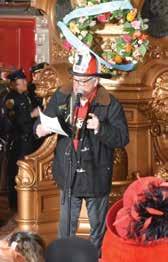
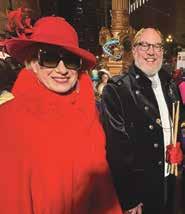
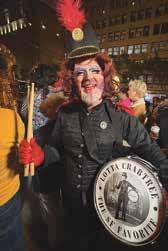
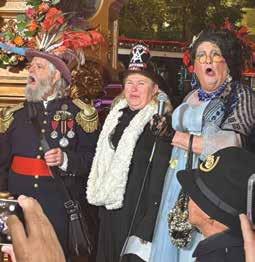
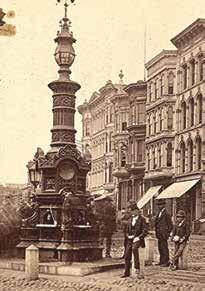
The 120th Anniversary of the 1906 Earthquake and Fire was commemorated with a pre-dawn ceremony at Lotta’s Fountain at the intersection of Market, Geary, and Kearny streets on April 18, 2026. The program was led by Bob Sarlatte, the “voice of the 49ers,” who led a riveting retelling of what happened during that fateful day and period in San Francisco’s history.
Following the storytelling program there was a ceremonial wreath-laying on the fountain, which dates to 1875 and was a significant meeting point in the aftermath of the earthquake and fire. “Lotta” refers to the actress Lotta Crabtree (1847–1924), who originally commissioned the fountain. Crabtree never married, often donned male attire, and was one of the wealthiest and most beloved entertainers of her time. (Her final public appearance was in 1915 when she came out of retirement to appear at Lotta Crabtree Day in San Francisco.)
At 5:12 am during the ceremony, there was a moment of silence, followed by a “Siren Salute” from a fleet of historic fire apparatus at the exact moment the earthquake began. For the first time since the 2006 centennial, the Guardians showcased the 1928 Kleiber Light Wagon 2, a rare, San Francisco-built treasure and the last truck of its kind in existence.
There was then a community sing-along of the city’s anthem, “San Francisco,” led by a living history interpreter portraying the legendary Lillie Hitchcock Coit (1843–1929). (Coit too enjoyed wearing men’s attire, and was the benefactor for the construction of another important landmark in the city: Coit Tower.)
The commemoration at this point moved to 20th and Church streets for the annual painting of The Little Giant—formerly known as The Golden Fire Hydrant—at 3899 20th Street, which famously saved the Mission District. San Francisco Bay Times columnists Rafael Mandelman, President of the San Francisco Board of Supervisors; Joanie Juster; and Donna Sachet joined former Mayor Willie Brown, Fire Chief Dean Crispen, Police Chief Derrick Lew, and other city leadership and participants for the ceremony.


IBy Donna Sachet
f you haven’t yet attended an event at the newly refurbished Castro Theatre, make plans now! In the short time it has been reopened, we have seen musical performers, classic films, and official opening ceremonies, and each time we are more and more impressed with this gorgeous venue. Imagine how close we came to losing The Castro Theatre, as an aging building badly in need of upgrades, improvements, and restoration! One need only look around at surrounding neighborhoods, many of which have empty shells of former movie palaces, painful derelicts of their former glory. Instead, we have a historic landmark, restored with loving attention and now programmed with a variety of community-appropriate events.
Our most recent visit was to see Alyssa Edwards of RuPaul’s Drag Race fame along with Gary Virginia, Deana Dawn, and Moxie Penn. We were dazzled by her costumes, intrigued by her stories, and fully engaged in her one-woman show, despite our lack of connection with the popular television sensation. She took full advantage of the deeper stage, extensive lighting, and proximity to the audience, even inviting one hesitant gentleman on stage for a funny dialogue. She invited one other person on stage briefly, introducing her as a student of her drag, and also shared the stage with a local guest star, Curve Ball, who delivered a high energy set, providing a nice pace to the total show.
Gala Season continues ... . We enjoyed the Openhouse mid-day Spring Fling at The Conservatory at One Sansome, the newly available sprawling window-lined space mentioned in this column before. Guests enjoyed “High Tea” and a program honoring LYRIC with the Trailblazer Award and State Senator Scott Wiener with the Adelman-Gurevitch Founders’ Award. Sister Roma emceed and Michael Tate served as auctioneer, bringing lots of funds into this worthy organization. We heard from San Francisco Pride’s Suzanne Ford and the beloved Dr. Marcy Adelman. The space then transformed into a Senior Prom setting especially conceived for those who missed such an event as kids.
We then dashed to Fabulosa Books in the Castro for a reading by popular author Mark Abramson from his newest book Fathers and Sons, where we saw many 440 Castro friends and had a delightful reunion with Leah Garchik whose writings in the San Francisco Chronicle remain an inspiration. Get your copy of Fathers and Sons today!
On Wednesday, April 15, we not only completed our tax filing, but also participated in the third installment of Serenade, an Imperial Court event featuring live singers and this time live accompaniment as well. Midnight Sun has hosted many karaoke events, but this was a next level event, really showcasing amazing talent, both vocally and instrumentally.
Imagine French horn, guitar, violin, and vocals all in one place!
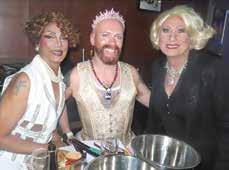
The following night we joined Frank Woo at a political fundraiser for Scott Wiener for Congress at a private home in Hayes Valley. And what a private home it was! This was a restored Victorian with soaring ceilings, elaborate detailing, and huge windows and the guest list guaranteed good results. It was great to catch up with Joe Sangirardi, Don Spradlin, Victor Ruiz-Cornejo, and many other politically active friends.
On Friday, the San Francisco Gay Men’s Chorus hosted an evening with the incredible Stephen Schwartz, which we attended with Khmera Rouge, at the Chan Center. This space continues to impress us with its versatility. Supported by guest stars Michael McCorry Rose, Taylor Iman Jones, and members of the chorus, Stephen took us on a very personal journey through his extensive body of work, thankfully including several nods to Wicked. His touching acknowledgment of outgoing Chief Executive Officer Christopher Verdugo left the audience in tears.
Then, after a quick nap, we arose with our adorable puppy Peanut for the annual Earthquake/Fire Commemoration at Lotta’s Fountain at 4:30 am. We see you shaking your head in disbelief, but indeed we were there along with Reigning Emperor John Brett, Christine Pelosi, Joanie Juster, SF Fire Chief Dean Crispen, Police Chief Derrick Lew, Board of Supervisors President Rafael Mandelman, and Mayor Willie Brown, to remember that tragic day and the impact it had on our nascent city. Make it a point to join us
“Enjoy the little things, for one day you may look back and realize they were the big things.”
Robert Brault
Friday, April 24
Dykes on Bikes
50th Anniversary celebration
Rikki’s on Market Street
Bay Times co-producing
DJ Christie James and many other special guests 6–10 pm
$15 and up suggested donation https://bit.ly/4dVmoHz
Saturday, April 25
SF Gay Men’s Chorus’ Crescendo
Elegant dinner, entertainment, awards, program
Hostess Monet X Change
DJ Modgirl
Westin St. Francis Hotel
335 Powell Street
$450 & up www.sfgmc.org
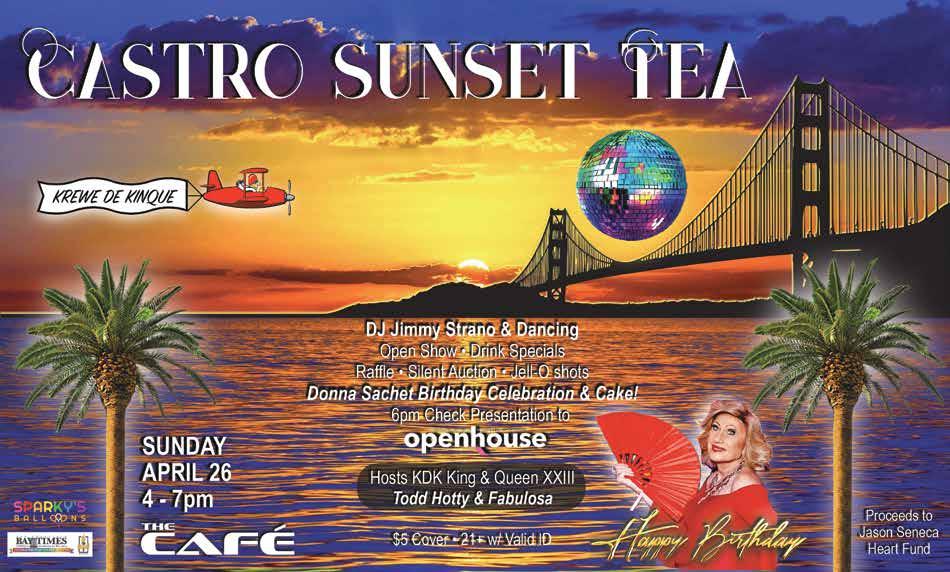
Sunday, April 26
Castro Sunset Tea
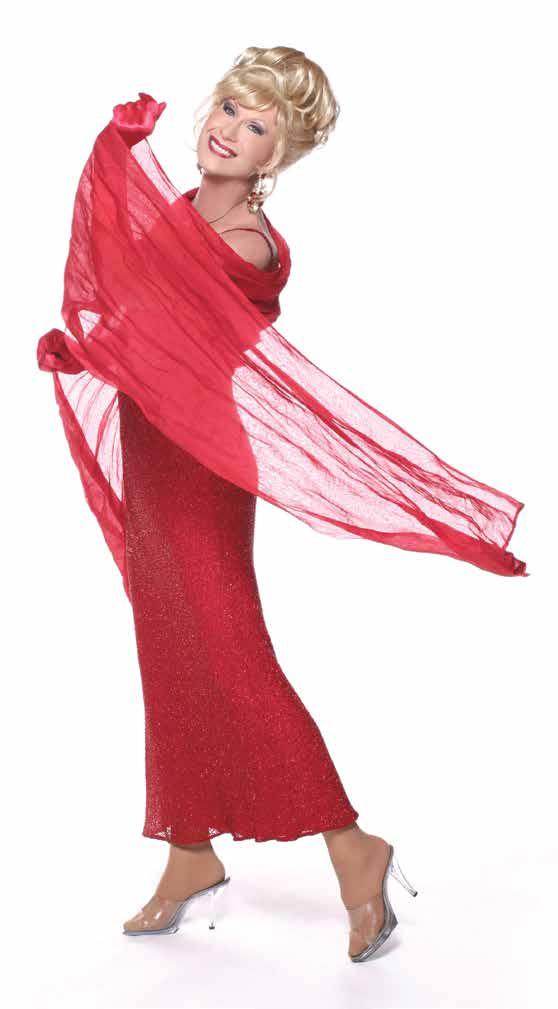
Donna Sachet birthday celebration & show Openhouse check presentation Krewe de Kinque benefit for Jason Seneca
The Café, 2369 Market Street 4–7 pm $5 cover
next year for the 121st anniversary! Next on the gala circuit was Soiree for the LGBT Community Center at City View at Metreon, where we joined delightful table captains Gary Nathan & David Gin
The crowd really dresses up for this event, emceed with finesse by Sister Roma and Honey Mahogany and featuring some real success stories of lives changed by the services this place provides. New Executive Director Jennifer Valles received a standing ovation from the supportive crowd. Michael Tate was again on hand for a spirited live auction and Juanita MORE! curated entertainment for the post-party as DJ LadyRyan brought partiers onto the dance floor.
Donna Sachet is a celebrated performer, fundraiser, activist, and philanthropist who has dedicated over two decades to the LGBTQ Community in San Francisco. Contact her at empsachet@gmail.com
Kippy Marks
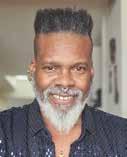
Some champions lead with volume. Others lead with velocity. But Patrick Gallineaux leads with presence—steady, intentional, and deeply rooted in love for his community. The fifteenth individual to be highlighted in this column, Patrik embodies the PMLE (Practice Makes Love Easy) truth that love is not a theory; it is a practice shaped by consistency, compassion, and the courage to show up even when no one is watching.
His impact stretches across decades of LGBTQ+ cultural preservation, nightlife stewardship, and community advocacy. He has been a bridgebuilder, a memorykeeper, and a quiet architect of spaces where people feel seen, safe, and celebrated. Whether he is uplifting queer artists, supporting grassroots organizers, or honoring the legacy of those who came before us, Patrik practices love as a form of service—never performative, always purposeful.
He reminds us that love does not have to be loud to be powerful. It can be gentle. It can be steady. It can be the quiet hand that keeps the door open for the next generation. His work reflects the PMLE philosophy at its core: when we practice love intentionally, we make it easier for others to practice it too.
Here we honor, not just what he has done, but also who he has always been—a custodian of culture, a champion of connection, and a living example of love in motion.
Kippy Marks: How long have you been involved with the practicing of PMLE values in your work?
Patrik Gallineaux: I believe [that I have done this] for most of my life. I come from a long line of teachers of academia and the arts at all levels, from working with the specially abled to pre-school through higher education (my mother had me onstage at the age of 5, and owns a dance studio in Western New York today, still teaching at 83!). I grew up witnessing what it means to have patience and compassion for others, plus the joy of uplifting via the arts, from a young age.
I remember at the age of 12 being in a locker room in junior high with dozens of boys yelling at me with a gym teacher trying to rip my clothes off because I refused to disrobe publicly. I always used a bathroom stall. I was holding onto a steel pole with both hands as tightly as I could with my eyes closed, and I heard a voice say, “Hold on, Patrik. Who you are is correct. Just hold on.” I believe that was the voice of our uni-
versal higher power that can be heard when one has a sense of compassion and love for others from a young age.
I ended up being sent to the school psychiatrist as well as the school principal to determine what was wrong with me, and, in fact, I was completely befuddled as to what was wrong with all these adults around me. Ultimately, while my father did not yet have the language to necessarily understand LGBTQ+ oppression, in his teacherly way he advised me to pen a letter to a liberal state senator about what was happening ... and I did. About 3 weeks later, I was called into the principal’s office and led to an old, seldom-used locker room that was mine alone for the rest of that school year. Not every kid is so blessed as to hear the voice I did (and have continued to hear, especially during challenging times, throughout my life), and
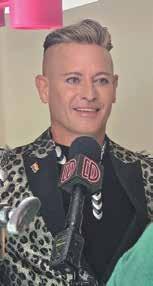
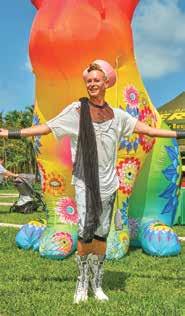
Follies, when I first moved in 2003 (The National Dance Council of America had banned same-gender couples in sanctioned competitive events until 2019) was a start to this. As I navigated the next few years twirling on ballroom dance studio floors by day and dance clubs at night, I started to become more aware of those around who were keeping our community strong and safe, such as Donna Sachet, one of my role models to this day; Sister Roma; and many more including bartenders, promoters, activists like Gary Virginia, musicians like Gypsy Love and so many drag warriors. One day, a remarkable 72-yearold man in leather pants, vest, and hat named Reverend Jim Johnson walked into my tap class at the amazing former Metronome Ballroom in Potrero Hill and student became the teacher over the next years as I learned about the power of manifestation (“what you see is what will be”).
I developed a sense of wanting to use the lessons and skills San Francisco had given me to do more for my community. One day, at the end of 2008,
I chose the one that was the most outside of my comfort zone and hardest for me personally: a role that would become Global LGBTQ+ Ambassador for a well-known company—but it was clearly the one that would give me the biggest guarantee to do work for our community far beyond my San Francisco dance floor bubble of safety as I had wished for not that long beforehand. Over the next 16 years, I took that title more seriously than anyone likely expected, always putting our community first, believing that is how one builds brands. I was able to use budgets to employ our nightlife, drag, and artistic communities wherever possible, and to get to connect with and support nonprofits and organizations locally and around the world such as The Richmond-Ermet Aid Foundation, The Stonewall Inn Gives Back Initiative, and The Harvey Milk Foundation (Harvey’s nephew Stuart remains a role model and friend to this day).
this is the foundation of what I know as a universal love that has uplifted me and I try my hardest through my work to impart to others.
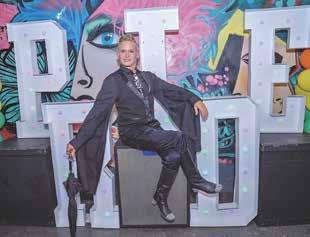
Kippy Marks: Who or what motivated you to become the community activist you are today?
Patrik Gallineaux: Honestly, it is my San Francisco journey that sparked my initial awareness of true activism. Like so many of us, we spend immense energy in our lives searching for our community and safe spaces after growing up in a world telling us we don’t belong ... and San Francisco is a beacon that needed to come into my life. But the city tests one along the way, as was no exception for me, experiencing at one point homelessness and struggle through which I persevered as I navigated work within ballroom dance and the arts.
Having had the chance to be a small part of the first same-gender ballroom dance competition in North America, called April
I closed my eyes and spoke to that universal voice, asking to be given the guidance to do great work for my LGBTQ+ community, to let that work involve travel globally, and for these wished to be enabled by some sort of work vehicle. And, almost immediately, I entered into a true “Golden Magic Zone” of manifestation, which resulted in creating Dancing With the Drag Stars, a 3-year live DWTS spin-off at Cheryl Burke Dance Studio, as a way to fuse ballroom dance and nightlife while showcasing the immense talents of our drag + ballroom communities. A new show called RuPaul’s Drag Race went on the air at the same time, and this helped gain attention of a couple of production companies in Los Angeles that began filming to pitch as a potential new reality show. As opportunities continued to come my way, I had to make a hard decision in 2010 as to which door to choose, and ultimately
I was able to create multi-national programs (always modeled on national musical theatre tours) uplifting out LGBTQ+ bartenders, community members, and, of course, our drag and trans communities. Creating Safe Spaces for others has become such a personal mission to me, whether for one night or long-term. I credit all those in the Bay Area who have inspired and supported my journey with any good I have been able to do, with gratitude of PMLE throughout my life for reasons mentioned further previously. This permitted me to endure the worst of corporate culture—and sometimes even my own community—while learning the skills necessary to act almost as something as an “inside activist,” never losing my sense of true self and always looking out for us first. I believe that, when a city like San Francisco gives one their wings, it is one’s duty to take them and fly—and to remain as unapologetically glittery and outspoken at every opportunity, whether onstage, in a boardroom, or within the media. Visibility is crucial for our activism, and to do so with joy is sometimes one of the greatest acts of defiance.
Kippy Marks: How old were you when you made that decision?
Patrik Gallineaux: Nice try, Kippy! Now, that would be revealing my true age, wouldn’t it LOL. But let’s just say that, in my 30s, I found a sense of self that today many likely find much sooner; I finally experienced a powerful sense of belonging and coming into my own power thanks to my San Francisco experience.
Kippy Marks: What advice would you give to others on how to practice love on the daily?
Patrik Gallineaux: Cowardice is contagious, but so is courage. That one thought, word, action you do in a day that might seem small can have a tremendous ripple effect for the world; never underestimate your power.
(continued on page 24)
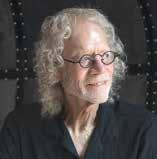
San Francisco has always been a city in motion. Ideas take shape here and often reshape what comes next.
But there is another rhythm here that moves more quietly. It does not announce itself or compete for attention. It shows up in everyday choices—a decision to stay a little longer, listen more closely, or offer something when it would be easier to keep moving. These moments do not make headlines, yet they shape lives in ways that are just as real.
If you pay attention, you begin to see them everywhere, a steady thread of care running through the city, carried by people who choose to respond rather than look away. That is a different kind of leadership, and it is everywhere here.
Most people think philanthropy is a check, a gala, or a name on a building. Sometimes it is, but, more often, it begins somewhere quieter, such as a moment when someone chooses to acknowledge another person instead of moving past them, or it is a smile, a hello, holding a door. These are small actions that communicate something simple and human: I see you.
That is where philanthropy begins. It is the moment someone notices a need and decides that indifference is not their role. This column is about that moment.
Each month, I sit down leaders of Bay Area nonprofit organizations, not to highlight their organizations, but to understand something more personal. When did this work become real for them? What shifted from awareness to action?
Every leader carries a story. There is always a turning point, a person, or an experience that made standing on the sidelines no longer an option. When we begin to understand why people choose to show up, something changes. Philanthropy moves out of institutions and into everyday life. When you look at San Francisco through that lens, you begin to see just how many people are making that choice every day.
This month we are exploring the Philanthropic Mindset with Olga Talamante. Olga Talamante is the Executive Director Emerita of the Chicana Latina Foundation (CLF), where she served from 2003 to 2018. She expanded scholarship support for Latina students and founded the Leadership Institute, graduating over 700 Latina social justice leaders. Before CLF, she spent more than 15 years with INROADS, rising to
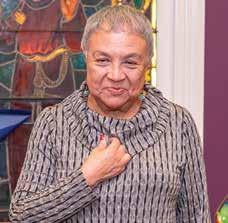
Regional Vice President and leading multiple regions, including opening offices in Seattle and Portland.
Born in Mexico and raised in Gilroy, California, her early experience as a farmworker shaped her lifelong commitment to social justice and the United Farm Workers movement. In the 1970s, she was imprisoned in Argentina for 16 months before an international campaign secured her release. She later led advocacy efforts that contributed to ending U.S. military aid to Argentina.
Olga continues to serve in leadership roles across social justice organizations and co-chairs Caravan for the Children. She has received honors including San Francisco Pride Community Grand Marshal, the Horizons Foundation Legacy Award, and the Commonwealth Club Distinguished Citizen Award. She holds a B.A. from UC Santa Cruz and an honorary doctorate from the University of San Francisco.
Tom LeNoble: What first opened your eyes to the work you now do?
Olga Talamante: It actually started when I was very young growing up as a farmworker. Those were the times I started to see inequity both in housing and the living conditions we had. [It was] me, my two brothers, and my parents in one room in a barn. I was 11 years old when I came here from Mexico. There was no inside plumbing or water. We had outhouses. It was there that I started learning about cross-class as I would babysit for the growers in their home. I could see they had air-conditioning and heating, and inside bathrooms and running water. I was struck by the power relations.
Tom LeNoble: Was there a moment when helping others stopped being an idea and became a commitment?
Olga Talamante: [It happened] as I read the applications of the students who were applying to the Chicana Latina Foundation Scholarship. I saw myself reflected in their
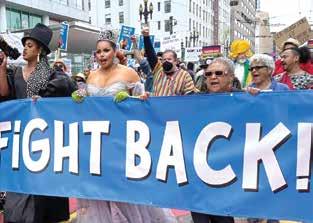
stories. It was then I became active as a volunteer, then a support member, and eventually the executive director. I really wanted to support them.
Tom LeNoble: Who modeled generosity for you growing up?
Olga Talamante: My parents. We were fairly low income, but I saw that they would always help other people. It continued when we moved to Gilroy, especially my mama when playing leadership roles in the church and in voting. They were my models.
Tom LeNoble: What keeps you hopeful when the work becomes hard?
Olga Talamante: I would say it is commitment to remain hopeful. My hopefulness and optimism have been tested in the last few years with Trumpism. I’ve had moments of anguish and despair. I continue to be uplifted by the examples of generations before me and the people around me, and by the fighters and warriors in our community who have struggled and given so much of themselves. I’m inspired by working with young people, college students, and just serving others. I see leadership in the younger generations of our movement. We are in good hands. I have faith in them.
Tom LeNoble: When you hear the word “philanthropy,” what does it mean to you personally?
Olga Talamante: At first philanthropy seemed to be something other people did— people of means and great resources. I’ve come to understand that my parents were philanthropists. There are great philanthropists in our communities, not because they have big bucks, but because they have a big heart and a big soul. I looked the word up at one point because I need to present a philanthropy award. I believe it is someone who puts the needs of others before their needs; the ones where buildings get named for them; and those who give $25 per month even when it is a stretch for them. It comes from the same intention.
Tom LeNoble: And perhaps the most revealing question of all: If you were not doing this work, what would the world be missing?
Olga Talamante: I am a good connector of people. I see connections with issues, movements, leaders, and practitioners of various professions. I am conscious of the fact that I connect and bring people together.
Tom LeNoble: What do most people misunderstand about this work?
Olga Talamante: These perceptions are changing. This work has been seen as charity and supporting the less fortunate. They see it
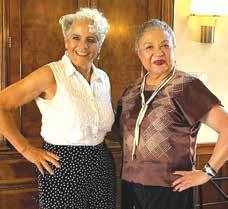
as something outside themselves. I appreciate the people who don’t see it this way and see it as good for the world they live in. I’d like to change the power relationship between the donor and receiver; the donor to see beyond what they need and become willing to be generous with others; to see giving as offering an opportunity to understand the impact they can have on people and on building the future.
Tom LeNoble: How has this work changed you personally?
Olga Talamante: I’ve gone from seeing myself as a farmworker in a farmworker family to seeing myself as a social activist wanting to create change and create new policies. It has made me expand and change the notion that I am a lone person grappling with these challenges of poverty or identity. My world is richer, more impactful, and more powerful doing this work.
Tom LeNoble: What is unique about doing this work in San Francisco?
Olga Talamante: What is unique is the long history of questioning authority and those who think they have all the answers and control. The Bay Area has given us so many examples of Native people who have been resilient over decades; LGBTQ people who were courageous to rise up and fight; movements like the farmworkers movement. We have a strong history of solidarity.
Tom LeNoble: What would surprise people most about you outside of this work?
Olga Talamante: I always wanted to be a Mariachi singer. I don’t have the talent or wherewithal to do it, but it’s a dream. And that I recently did drag and performed as the great devotee in Mexican and Latin American culture, Juan Gabriel. It was a
on page 24)
ROSTOW (continued from pg 19)
The district court judges in both the West Coast case and the East Coast case (Shilling and Talbott, respectively) put a hold on Trump and Hegseth, forbidding them from dismissing transgender troops while their hateful policy was under review. While the Ninth Circuit upheld the injunction in Shilling, the U.S. Court of Appeals for the District of Columbia recently put an end to the injunction in Talbott. Meanwhile, last May, the U.S. Supreme Court reversed the Ninth Circuit’s injunction in Shilling and allowed Hegseth to have his way. Got all that? You may remember the moron’s triumphant text: “Trans is OUT at the DOD.” Honestly, I don’t remember whether it was a text or exactly what he said; I just remember his belligerent idiocy.
At present, not only is Hegseth allowed to fire transgender troops, but also, he is in the process of doing so, informing the Talbott court that two of its 30 plaintiffs have been given letters of dismissal. Our lawyers in that case have asked the court for class action status, and have just filed papers to that effect. As for the Shilling case, it is once again pending at the Ninth Circuit, and I have asked my attorney colleagues to review the situation once Parker gets back from Roatán.
Bring Back the Iron Curtain
I’m not happy about the tedious GLBT stories on my list from eastern Europe. You remember the horrible law in Belarus? I’m also seeing eleven GLBT activists in Turkey on trial and possibly facing years in jail for posting something gay friendly on social media. I should do a deeper dive and find out exactly what they showed, but I don’t want to. And just listen to the first paragraph of this other thing on my list:
“The Oktyabrsky District Court in Saratov has fined the local news agency SaratovBusinessConsulting 500,000 roubles under a ruling regarding ‘LGBT propaganda’ on the internet, stemming from a review of the TV series Heated Rivalry. The court’s press service confirmed this to Mediazona.”
I guess you’re only allowed to release negative reviews of Heated Rivalry, which I tried to watch but stopped. I just wasn’t in the mood and I thought the first episode dragged. That said, I know it’s supposed to be a fantastic show, so I will watch it at some point with a better attitude.
You know, if we don’t take back Congress and start reversing some of the grotesque government abuses we’ve seen in red states and in the Trump administration, one of these days there’s going to be a lesbian reporter in Norway or Canada writing about a $10,000 fine for the San Francisco Bay Times and a three-year prison term for yours truly after I write that Heated Rivalry is a “joyful delight ... not to be missed.” And she’ll think it’s funny!
In good news here at home, the government has given up trying to remove the rainbow flag from the Stonewall National Monument in New York. After the National Park Service removed it for whatever Orwellian reasons, advocates raised another rainbow banner on the same pole and sued. That suit was quickly settled and the pride flag will be on permanent display.
And, speaking of rainbow flags, California’s Philz Coffee has done an about face after the supposedly gay-friendly business announced it
would take down the rainbow flags from its outlets as part of an “inclusive” no flags policy. As I’m sure you noticed, the flags are back and CEO Mahesh Sadarangani is apologizing to his Bay Area customers.
“I made a mistake and I am sincerely sorry,” said Sadarangani last week. “The Pride flag is a symbol of safety and belonging for people who don’t always find that in the world, and that is not something I want to take away from anyone who walks into a Philz.”
May the Force Be With Us
In more dispiriting news, on April 4, the Department of Education and the Department of Justice announced the formation of the “Title IX Special Investigations Team,” a suspiciously titled gang of Trumpy henchmen who will “protect students, and especially female athletes, from the pernicious effects of gender ideology in school programs and activities.”
It’s not at all clear from the joint press release what exactly this “SIT,” as they’re calling it, will do and under what authority. I suppose they will report trans-friendly schools to one or both of these cabinet departments and trigger some kind of threat or fine or lawsuit or something. Title IX, as you know, outlaws sex discrimination in public schools and colleges.
And speaking of Trumpy thugs, the administration’s budget proposal for 2027 includes extra cash for the FBI’s counter intelligence efforts, including money to fight people with extreme views on “migration, race, and gender,” and those who oppose “traditional American views on family, religion, and morality.” Those aren’t terrorists. Those are regular people, and the language here is right out of Belarus.
Check out reporter Ken Klippenstein’s April 5 Substack where the intrepid newshound looked inside the budget plans to unearth funding for a new center devoted to hunting down “domestic terrorists” like us. “If your political views are practically anything other than MAGA,” writes Klippenstein, “you’re on notice, courtesy of the FBI.”
Speaking of domestic terrorists, did any of you see the bodycam video of a 60-something woman wearing an inflatable penis costume at last October’s No Kings rally, and holding a sign that said: “No Dick Tator?” Police officer Andrew Babb of Fairhope, Alabama, seemed to be under the impression that Renae Gamble’s outfit was illegal. He demanded to know how he would explain the sight to his kids, and reminded Gamble she was in a family-friendly town. When Gamble didn’t react to his threats, he threw her to the ground and smushed her— still inside the penis suit—into his patrol car. She was charged with disorderly conduct, resisting arrest, disturbing the peace, and giving a false name to law enforcement after telling Babb her name was “Auntie Fa.”
On April 15, a municipal judge dismissed all charges against Gamble, but also let the officer off the hook, saying there might have been enough cause to arrest Gamble, but not to convict her. Gamble’s attorney said they are considering a countersuit against the police department.
Go get ‘em, Auntie. Make them pay. By the way, at the last No Kings Day, Gamble wore an inflatable eggplant. arostow@aol.com
MARKS (continued from pg 22)
Know that adversity can often be a gift; get knocked down nine times, stand up 10. The lessons learned gift empathy to be able to connect better to help others and build an inner strength able to help manifest greater joy in life by contrast. And, it is none of your business what anyone else says about you!
Kippy Marks: If you were granted two universal wishes, what would you wish for?
Patrik Gallineaux: 1 - That every person in the United States (and all countries, really), especially those who harbor fear of the “other” and have never left their area of birth, be empowered (required) to travel to another global destination at least once in their early lives, where they might get to experience the beauty and wonder of a foreign culture and understand that we are all just passengers on this big blue ball together. 2 - For every person who disparages and tries to harm our trans community to instantly be able to see the error of their ways and instead clearly know the resilience, magic, and beauty that is this remarkable community around the world.
Kippy Marks: Please share any current practices that our readers may find useful, and update us on what you are doing now.
Patrik Gallineaux: A practice I have learned is that one should remember that they are their own brand no matter who they work for. Recently, my 16-year company role as Global LGBTQ+ Ambassador for a major brand came to an end, but I have decided I will forever retain the title of “Global LGBTQ+ Ambassador” for our community and continue to use all I have learned to advance equality and opportunity with sparkle and joy.
I am currently serving as PR/Media Director (plus stage host and Captain of Parade Judges) for amazing Miami Beach Pride, which I have worked with since about 2016 in one capacity or another and am excited for many independent upcoming projects. I will be back in California at the end of this month to emcee a ballroom dance competition called Dance Stars Festival in San Jose (where April Follies actually began), and in Key West mid-May to host iconic Island House Key West’s official 50-year anniversary celebration weekend.
June 7 I am emceeing a brand-new Tony Awards Extravaganza at the glorious new Gray Box Theater in Wilton Manors, Florida, and then in New York City for Pride June 28 to co-produce and emcee a block party stage for the Gay Officers Action League and Boxers NYC, something I have collaborated on annually since 2019 with another one of your PMLE interviewees Leanne Borghesi, who herself has been a major part of my journey, along with her amazing wife Sharon.
Later this year, I plan to help bring back and host year 2 of If the Shoe Fits new national drag touring competition to find the new “Queen of New Year’s Eve” who will be the star of the iconic Key West Drag Queen High Heel Shoe Drop (I would love to bring this to San Francisco). I am working to bring back my website from years ago ( www.patrikpresents.com ), and, above all, will keep on dancing.
Dubbed San Francisco’s “King of Strings”, Kippy Marks is a spirited solo entertainer whose shows are permeated with an infectious joy. His distinctive sound arises from his heart, through his 1822 violin consort, Izabella. Marks’ rare talent, broad smile, and radiant warmth will brighten any event to create lasting impact. He is also Grand Duke XL of The Grand Ducal Council of San Francisco. He is the first ever elected African-American Grand Duke.
LENOBLE (continued from pg 23)
joyful experience and became a community singalong.
Tom LeNoble: If you had an unexpected free day in San Francisco, where would you go?
Olga Talamante: I would ride on the cable car. I’d go to the Embarcadero, eat oysters at Waterbar, and then head to SFMOMA. [I would then go] to Yerba Buena Gardens to see the Martin Luther King Jr., Memorial, and do some people watching in the Mission, and a restaurant to end the night.
Tom LeNoble: Thank you for joining me. I’ll see you, readers, here next month as we explore the Philanthropic Mindset of another Bay Area nonprofit leader.
Tom LeNoble is an international speaker, confidential advisor, and resilience strategist who works with leaders navigating meaningful inflection points in life and leadership. He has held senior leadership roles at MCI, Walmart. com, Palm, and Facebook, and high growth startups. He is the author of the award-winning memoir “My Life in Business Suits, Hospital Gowns, and High Heels.” Through speaking, coaching, and writing, he explores resilience, leadership, and the choices that shape how we show up for others and for the communities we serve.
A Perfect Companion Bunny and an Entertaining Dog Who Enjoys Showing Off Many Tricks
Here are two of the many pets now available for adoption at Oakland Animal Services (OAS):
Plover is a smart and affectionate bunny who is ready to find his forever home! Plover has been thriving in foster care, where he’s blossomed into a confident, people-loving companion. Plover has proven to be wonderful with kids and has grown more selfassured with each family he’s stayed with. He’s the perfect companion bunny—he loves keeping you company throughout the day and absolutely lights up during free roam time, exploring and enjoying his space.
Playful, wiggly, and full of fun, Kenji is just under 2 years old and weighs about 91 pounds. This big, wiggly boy has an entertaining personality and loves engaging with his human friends through play, affection, and showing off his charming tricks. He knows “sit” and proudly offers both “paw” and “other paw,” with an enthusiastic flourish. Kenji also enjoys chasing a tossed ball, pouncing on it, and bringing it back before spitting it out to you to keep the game going. Kenji would love to go home with you!


The OAS adoption process focuses on matching you with a pet who is a good fit for you and your family. Come by during open adoption hours Thursdays 12–7 pm and Fridays/Saturdays/Sundays 12–3 pm to adopt your new best friend, or to learn more about the OAS adoption process. Please see the OAS website to learn more about how you can help by adopting, fostering, volunteering, and donating:
www.oaklandanimalservices.org
Toni Newman
“Rebecca Rolfe”
Jennifer Valles
“Olga Talamante and Rosemary Gardner”
Kit-Cat Klock
The clock is ticking, but at least it’s catshaped! The original Kit-Cat Klock has been bringing joy to walls since 1932. Enjoy his rolling eyes, wagging tail, and cheeky grin in a variety of colors for $59–$69.

Momma Pots
Momma Pots has become our goto for durable garden pottery in an extraordinary range of colors at accessible prices. The Gemstone Collection features sleek and sturdy pots fashioned from high-quality porcelain. In sizes from 4-inches to 12-inches. $24 to $115 each.

Chive Porcelain Flowers
Enjoy a super bloom without trampling a national park! Use Chive’s handmade porcelain flowers to create a dramatic wall installation, add color to your potted succulents, or gift a flower that won’t fade. There are poppies, marigolds, daffodils, and more. Starting at $26.99, each flower comes individually gift boxed.

Keep up with Cliff’s Variety news at Facebook ( https://bit.ly/4qh1Xbb ) & IG @hilario_sf
Kathy Amendola
“Sally Ride, Barbara Jordan, and Rikki Streicher, who are on the Castro’s Honor Walk, an organization that I cofounded. Lesbian Visibility Week is an opportunity to honor all sexual and gender-diverse women.”
Bernadette Bubbles
“Georgia O’Keeffe and Frida Kahlo”
compiled by Rink
Chi Chi Munro-Hotty
“Queen Latifah and Tracy Chapman”


However, it is horrifying to see books being removed from the library, or for the garden the students grow being destroyed with chainsaws. First They Came for My College is an allegory for how efforts to change the culture start with destruction. It is guaranteed to make queer viewers’ blood boil.
The 2026 San Francisco International Film Festival will screen April 24 through May 5 at various Bay Area venues. There are several features, documentaries, and shorts by queer filmmakers or about LGBTQ themes including Give Me the Ball!, a documentary about Billie Jean King. Here is a rundown of three feature-length documentaries and six shorts from this year’s festival. First They Came for My College is director Patrick Bresnan’s galvanizing documentary about the hostile takeover of New College of Florida in Sarasota. This liberal arts honors college, once a community of radical acceptance, was tar-
geted by Florida Governor Ron DeSantis’ campaign to eliminate DEI. His efforts turned the school into a more conservative institution. Bresnan sits in on infuriating board meetings where decisions are made to fire the college president, deny tenure, and discontinue the Gender Studies programs. Students and parents and faculty are seen protesting, but, despite their inspirational efforts, it soon becomes clear that they are fighting a war of attrition. The various queer students do engage in efforts of resistance—such as hosting a screening of The Rocky Horror Picture Show— which provide them with a safe space on campus.

Adam’s Apple is a tender profile of Adam Sieswerda, a trans teen growing up in New Hampshire. Filmed by his mother, Amy, this personal documentary chronicles Adam’s life through birthdays and other milestones— from learning to drive and starting T, to getting a mastectomy and dating, as well as going off to college and getting a tattoo. Jenkins captures her son’s emotional arcs, from “wanting to do everything I can to just be one of the boys” to his debates with his parents over his deadname. The film shows how he comes to accept himself as he matures. Jenkins also includes her own reactions to her son’s growth from love and pride to fear and her own anxiety. A beautifully realized dual portrait, Adam’s Apple
will resonate with both trans teens and their parents alike.
The fantastic documentary Jaripeo immerses viewers in the hidden world of queer rancheros in Michoacán. Efraín Mojica, who codirected with Rebecca Zweig, explores the expectations around masculinity and sexuality in this rodeo culture. There are discussions of the secret
glances, flirting, and discrete behavior— usually after drinking— that these men engage in, but the men often fail to form lasting relationships. Jaripeo features interviews with a macho man, Noé, who only wants to be with other masculine men, as well as a guy who is more effeminate and feels he has the support of the community. One segment chronicles a performer
who dresses as a “sexy, cheeky lady” for the rodeo. Mojica, who is not out to his family, also talks with guys about the guilt and fear he and some of his fellow rancheros have regarding being open about their sexuality and how attitudes about masculinity, especially in remote areas, are passed down through one’s parents. In between these episodes, Mojica intersperses artfully made Super-8 segments of the rodeo culture, and there are many scenes of the rodeo itself— including bull roping and riding to the
dancing after the events. Jaripeo provides a fascinating glimpse into a little-seen subculture.
Shorts Program 1: Human
Flow features Drifting, South , director Di Zhang’s poetic meditation on a trio of lives in Guangzhou, China. A pregnant young woman, A Yi (Liang tiantian), is doing makeup for a queer dancer, Xiao Bei (Zhimin Liao), who invites her to see fireworks. However, she encounters a young boy, Enzo (Enzou Wu), and spends time with him, while Xiao Bei couples up with a fellow dancer. This beautiful quotidian short, shot in 16mm, is about its three characters drifting through life, making connections and seeking belonging.
Shorts Block 3: Shapes of Love includes Betty St. Clair, an amusing short about the titular character (Edric Young), a drag queen who gets manic backstage before performing at a senior center. Betty goes into panic mode when she recognizes
her grandfather (Victor Lim) is in the audience. The comedy comes from the anxiety Betty feels, but there is also some heart as she and her best friend Candace (Kay Bebe Queue) perform “Just for You” by REO Speedwagon. How Betty reacts to the crowd and how the crowd responds to Betty provide the film with its tension. Also in the program is Buckskin, non-binary filmmaker Mars (Marianne) Verrone’s elegiac documentary portrait of their grandfather, Dr. Carroll B. Williams, Jr., a forester who was one of the first Black men in the profession. Williams was nicknamed
(continued on page 39)
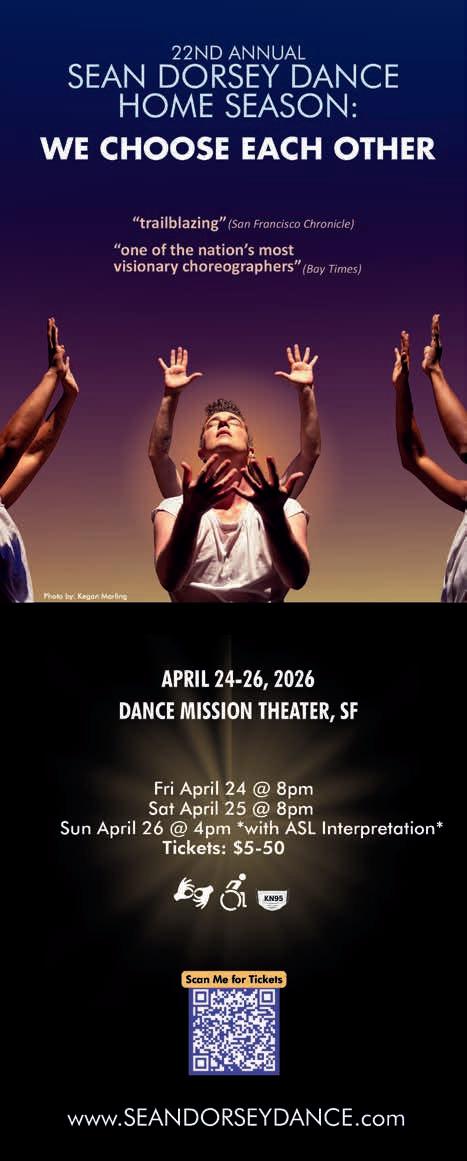

Center: ‘In Celebration and Defense of Our American Ideals’
Photos and Story
by
Jerome Parmer
Bruce Springsteen’s performance at the Chase Center in San Francisco on April 13, 2026, wasn’t just a concert; it was an example of what the American spirit can and should be all about. The Boss launched into an almost 3-hour non-stop high energy show belying his 76 years. He opened with the words, “Tonight I call upon the righteous power of art, of music, of rock and roll in dangerous times; we are here in celebration and defense of our American ideals.”
The band then launched into a cover of the oh so currently relevant protest song “War,” followed immediately by “Born in the USA.” Message received, Bruce! There were no giant video backscreens, pyrotechnics, or lasers for the Boss and the E Street Band. Instead, it was straight ahead four on the floor rock and roll. The joy and enthusiasm from the crowd for both the music and the message radiated fiercely in all directions.
Near the close of the evening, Bruce sat on a riser stair step and shared a plea for humanity and perseverance through these troubled times. He started his final soliloquy with: “It’s hard times, and the E-Street band is built for hard times, and we will make it through this. And there will be a better day. That is one thing I know.”
It is this belief that sustains us all, and it is true patriots like Bruce Springsteen who keep that light shining.
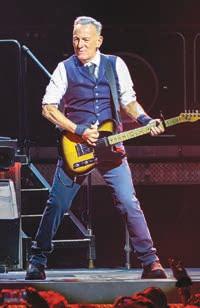

Jerome Parmer is an Oakland-based photographer who has photographed political, LGBTQ+, music, and other events in the Bay Area. Follow his current work on IG @drj_oakland

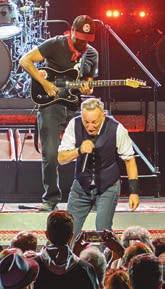

Author Mark Abramson discussed and read from his latest book, Fathers and Sons, at an event at Fabulosa Books on April 12, 2026. This 8th book in his Beach Reading series, as for the others, draws on local iconic figures, such as Sister Roma and San Francisco Bay Times columnist Donna Sachet, along with well-known locations in the Castro and other parts of the Bay Area. The book has been widely acclaimed as being a “sweet and sexy, a little bit scary, and sometimes laugh-out-loud funny tale.”
https://markabramson.net/
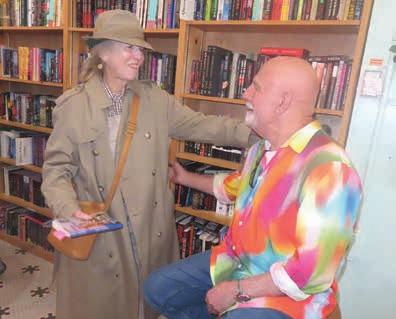


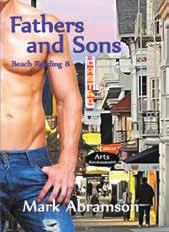
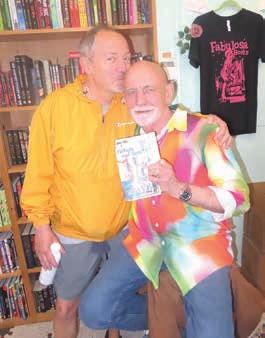
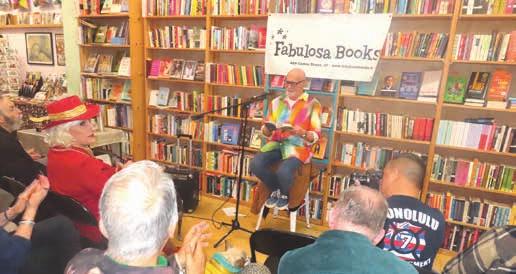
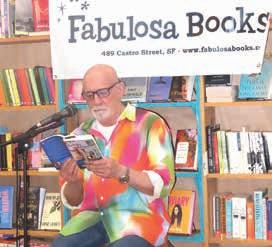
Go Gentle (fiction - hardcover) by Maria Semple
Maria Semple returns with a witty, humorous page turner. Go Gentle is about Adora Hazzard, a Stoic philosopher who lives her life by only desiring what she already has. Her carefully ordered life is thrown upside down by a chance encounter with a handsome stranger. This is a thrillingly crafted story of self-discovery.

American Fantasy (fictionhardcover) by Emma Straub
In this novel, a teenage fantasy comes to life. Annie is aboard a cruise ship along with all five members of the boy band of her youth. American Fantasy is a nostalgic and hilarious reflection on fame, getting older, and finding your joy.

London Falling (non-fiction - hardcover) by Patrick Radden Keefe
London Falling presents a riveting account of a family after the sudden loss of their 19-year-old son. In search of answers regarding their son’s suicide, Rachelle and Matthew uncover his hidden life posing as the fictitious son of a Russian oligarch. Their investigation leads them into the seedy underground of London in hopes of finally finding the truth.
Saturday, April 25 @ 11 am (non-ticketedCorte Madera store) Jane Smiley, author of Lidie: The Further Travels and Adventures of Lidie Newton
Celebrate Independent Bookstore Day at our Corte Madera location with author Jane Smiley as she discusses her new novel, Lidie: The Further Travels and Adventures of Lidie Newston. which
follows the story of two women fleeing America on the brink of civil war.
Monday, April 27 @ 5:30 pm (non-ticketed - Ferry Building store) Sara Hall, author of For the Love of the Grind
This is a meet and greet opportunity to connect with professional runner Sara Hall. For the Love of the Grind is a love letter to running, never giving up, and Hall’s growth as a woman, athlete, and mother.
Monday, May 4 @ 6 pm (ticketed - Ferry Building store) David Archuleta, author of Devout: Losing My Faith to Find Myself
Here is another meet and greet opportunity, this time to connect with David Archuleta in celebration of his memoir Devout. From a closeted Mormon teen to American Idol to an openly queer man, Archuleta chronicles his amazing journey in the new memoir.
https://www.bookpassage.com
Dozens of volunteers, including San Francisco Bay Times columnist Joanie Juster, participated in a special Community Volunteer Workday at the National AIDS Memorial Grove to honor, clean, and help preserve this sacred space for hope, healing, remembrance, and togetherness. The gathering within the grove at Golden Gate Park took place on April 18, 2026, just days before Earth Day on April 22 and during Earth Month.
Speakers shared stories about the grove and its importance. It was a powerful sight to see the many participants form a circle, concentrating their energy and thinking of those lost to HIV/AIDS who are memorialized at the beautiful, verdant grove that the volunteers continue to help maintain.
The next Community Volunteer Workday at the grove will be on May 16 from 8:30 am to 12:30 pm.
https://www.aidsmemorial.org/
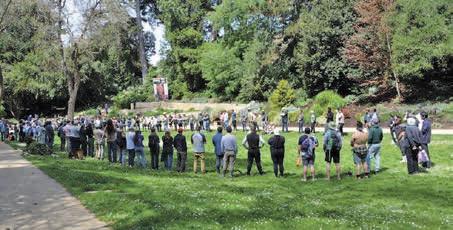

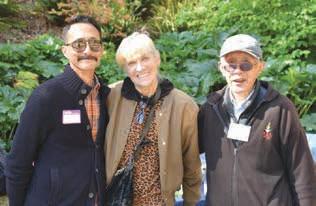
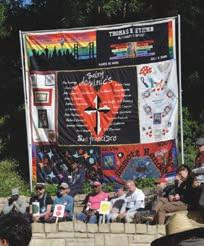

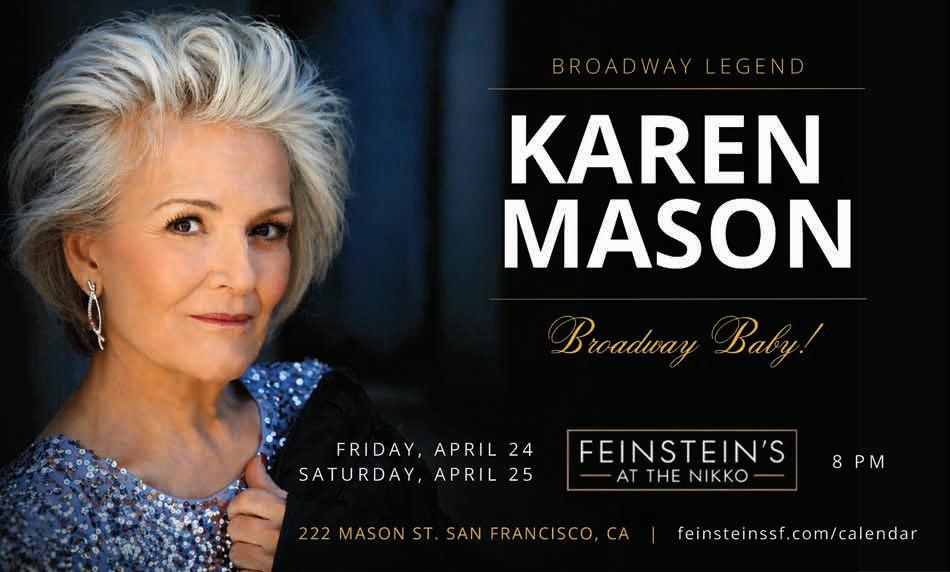
On a Sunday afternoon in April, transgender and gender-expansive young singers from across the Bay Area stepped onto the stage at the Community Music Center in San Francisco’s Mission District. And it was the first time they had performed in a choir created specifically with them in mind.
The Voices Taking Space concert marked the debut of the Transgender Youth Choir Project, a pilot collaboration between the professional treble ensemble 21V and New Voices Bay Area TIGQ Chorus, a community chorus for transgender adults. The program of contemporary choral music was a powerful reminder that choirs are places of belonging. For everyone gathered that day, the concert felt both celebratory and deeply meaningful.
21V was founded with two guiding ideas: sing the music of our time, and expand who belongs in the choir.
This professional ensemble performs only music written in the 21st century by composers from the Americas. Its singers perform treble (soprano and alto only) repertoire, but, unlike traditional treble choirs, the ensemble welcomes singers of all gender identities whose singing voices fall in those ranges.
That philosophy was part of the ensemble’s foundation from the beginning.
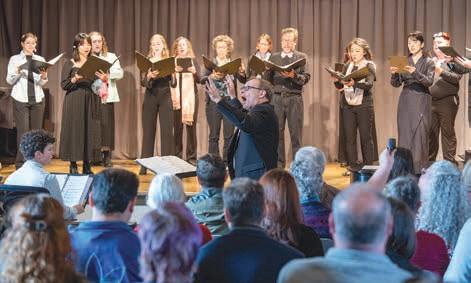
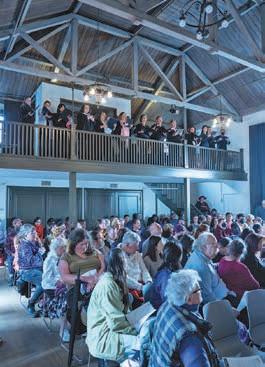
“I wanted to free the idea of a treble choir from gender expectations,” said Artistic Director Martín Benvenuto. “If someone sings soprano or alto, that’s the voice part. The rest of who they are belongs in the room with them.”
This approach has created an ensemble that reflects the diversity of contemporary choral singers while exploring music that speaks directly to the present moment.
The idea for the Transgender Youth Choir Project emerged from conversations within the Bay Area choral community.
Several youth chorus directors had approached 21V over the years asking whether similar ensembles existed specifically for young transgender and gender-expansive singers. Young people navigating vocal changes or gender identity questions sometimes find that traditional choir structures stifle gender exploration across voice types. They were looking for an ensemble that centered their unique needs.
“When I reached out to 21V singer Reuben Zellman, founder of New Voices, about that question, we realized there wasn’t a space like this that we knew of in the Bay Area,” Benvenuto recalled. “If the space didn’t exist,” Benvenuto said, “then we felt we should help create it.”
The Transgender Youth Choir Project grew from that simple idea.
by
21V singer Dylan Benander, who is non-binary, set about creating a space intentionally shaped to support young singers’ vocal exploration without gender-based notions of voice type.
In one early Zoom conversation, a young transfeminine singer defiantly shared that she could sing well in a treble range, relating that “I like to sing higher—I can sing for you if you don’t believe me.” Benander’s response was immediate and affirming: “I believe you. I understand.” In that moment, Benander was able to be the supportive, encouraging choir director they always wished they’d had as a young singer.
That exchange exemplifies the tone of the program—one grounded in trust, flexibility, and the conviction that each singer’s voice is their own to discover.
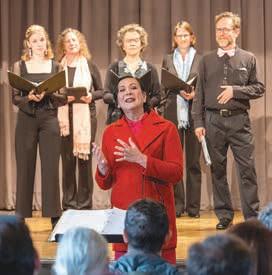
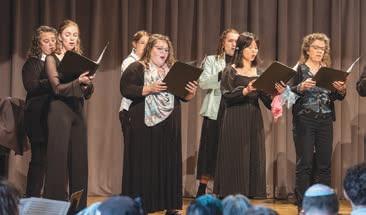
The Transgender Youth Choir Project debuted in the April 12 concert Voices Taking Space, taking the stage both independently and in collaboration with 21V and New Voices. After each choir was featured on its own, the concert culminated in all three ensembles singing a world premiere together.
21V had invited transgender Bay Area composer Robin Estrada to write a piece specifically for this concert. The resulting work, “Be Heard, Be Seen, Be Found,” is a powerful tour de force, with the title aptly capturing the spirit of the initiative.
The energy from the audience—families, educators, LGBTQ+ advocates, and supporters of contemporary music—felt both warm and electric. Moments of laughter and celebration mixed with quieter periods of reflection. “The repertoire embodied the resilience of the trans spirit,” an audience member said.
For many, the most moving aspect of the concert was seeing the young musicians of the Transgender Youth Choir Project claiming space in a musical tradition that has not always welcomed them. “Singing in a choir made up of people just like you is special,” one singer shared.
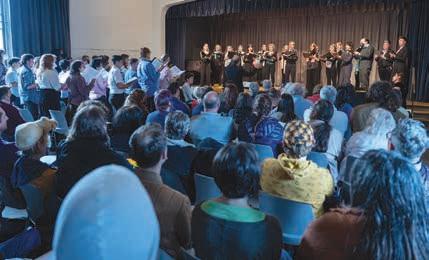
For 21V and New Voices, the Transgender Youth Choir Project represents a step toward a broader vision of what choral communities can become.
“Choral music is fundamentally about belonging,” Zellman said. “When people stand together and sing, they’re saying something about the kind of community they want to create,” New Voices Bay Area Co-Director Jessalynn Levine added.
On that Sunday afternoon in San Francisco, that vision was clearly visible. Singers stood proudly onstage. Families and friends filled the hall. And, together, they created a space where transgender youth voices were not simply welcomed—they were placed at the center. To quote Estrada’s piece, “We’re here. We’re here. We’re here.”
https://www.21vchoir.org/
By Sister Dana Van Iquity
Sister Dana sez, “Had anyone even HEARD of the Strait of Hormuz before that disastrous Donald declared War on Iran?!”
Is Trump insane? Yes, because now he is “at war” against The Pope! He posted an AI caricature depicting himself as Jesus the healer laying a hand upon a patient. Even some of his base called this act as being sacrilegious. Demented Donald said the Pope was “weak and a loser” and should stay out of politics—when Pope Leo merely quoted the Bible: “Blessed are the peacemakers.” Dictator Donald is NOT a peacemaker— no matter how many illegitimate trophies he received for the “peace prize.” Sister Dana sez, “Will Trump’s blatant blasphemy finally do him in?!”
Some good news: California Lawmakers have advanced State Senator Scott Wiener’s Bill to Protect Survivors of Conversion Therapy in the wake of the Supreme Court’s ghastly decision with Colorado— casting legal doubt on Youth Conversion Therapy Bans! In a vote of 10–2, the Senate Judiciary Committee passed Senator Wiener’s (D-San Francisco) SB 934, allowing survivors of conversion therapy to seek civil remedies and justice through malpractice lawsuits for the harm that was done to them, even years after the fake therapy occurred. The bill heads next to the Senate Appropriations Committee.
S ister Dana sez, “First we need Democrats to control Congress. When we do, we pass the No Kings Act. Also, we invoke the 25th Amendment on this insane, evil, narcissistic idiot Trump! No more wars!
Bad news: Trump’s 2027 budget will slash “radical left” pro-LGBTQ housing and HIV programs. Sister Dana sez, “Did Trump’s daddy scare him when he was just a boy into such drastic antiqueer rage?!”
The GLBT Historical Society Museum— open since January 2011—is the first standalone museum of LGBTQ history and culture in the United States. It celebrates San Francisco’s vast queer past through dynamic and surprising exhibitions and programming. THE CASTRO : The Story of San Francisco’s Best-Known LGBTQ+ Neighborhood was hosted by the GLBT HISTORICAL SOCIETY MUSEUM , 4127 18th and Castro streets, on April 9. There we found out how the world-renowned Castro neighborhood came
to be known as the most prominent “gayborhood” in San Francisco—transforming from a quiet Irish Catholic residential neighborhood to the center of LGBTQ+ activism and community in the Bay Area. In the museum, authors Jen Reck and Historical Society founding member Gerard Koskovich presented their new booklet, The Castro: The Story of San Francisco’s BestKnown LGBTQ+ Neighborhood. Tracing the neighborhood’s history back to the 1950s, this vital work covers LGBTQ+ community-building, cultural production, and political engagement; the forces of opposition that targeted it; and the struggles around diversity, exclusion, and belonging within the community itself. This night was a panel of four. Moderating was Tina V. Aguirre, who is Director of the Castro Cultural District in San Francisco, as well as being for four years Chair of the Board of Directors of the Historical Society; Koskovich has been active in the movement to create LGBTQ+ archives and museums for more than four decades; Reck is an Associate Professor of Sociology at San Francisco University and earned a Ph.D. in Sociology from UC Santa Cruz in 2005; and Devin McGeehan Muchmore is Managing Reference Archivist at the GLBT Historical Society. He holds a Ph.D. in American Studies from Yale University and a M.S. in Library and Information Science from Simmons University. As one can plainly see, these four are experts. Because I live in the heart of the Castro, this was an especially fascinating evening. Now I really know why I moved here decades and decades ago! Buy this amazing booklet at the museum!
Sister Dana sez, “Pardon-crazy Prez says he intends to pardon EVERY ONE of his criminal friends within 100 feet of the White House! Yep, he already pardoned every January 6 rioter (twice) and the awful, drug-trafficking, convicted ex-Honduran president. Well, OMG, pardon me!”
AB 1633, introduced by Assemblymember Matt Haney, imposes a 50 percent tax on the massive profits that corporations earn from ICE detention contracts in California and reinvests that revenue into immigration-related services. Companies like GEO Group and CoreCivic are being paid hundreds of millions of dollars by the federal government to detain people in cruelty, while Californians bear the moral and social cost. We can no longer allow corporations to get rich by causing real harm.
S ister Dana sez, “AB 1633 is about accountability, dignity, and making clear that in California, human lives are NOT profit centers!”
National Urban League has released a GUIDE FOR DEFENDING DEMOCRACY that includes info regarding upholding the Constitution, protecting civil and voting rights, rejecting discrimination and dehumanization, defending truth and the rule of law, expanding equal opportunity and fair access, strengthening democracy and public trust, and serving the entire American community.
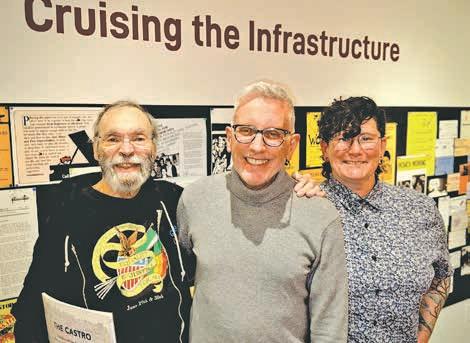
FA BULOSA BOOKS, 489 Castro Street, presented Fathers and Sons, the latest, greatest novel by Mark Abramson, on April 12. This best-selling author gave us yet another sweet and sexy, somewhat frightening, most times hilarious, pageturning tale. All the fave kooky characters from his first seven books in the Beach Reading Series come back for more. And guess who makes a cameo appearance? Drag dollies Donna Sachet and Sister Roma! Such a delight!
Sister Dana sez, “Congratulations to the Artemis II Astronauts becoming the first to travel to the Moon since 1972. They broke the record for farthest human travel from Earth!”
T he annual Soirée was back on April 18 at City View at Metreon. It was a triumphant evening celebrating the Center’s 24 years of service to our LGBTQ community. This year’s Soirée featured a dinner program followed by a vibrant after-party—with
(continued on page 39)
With Dina by Dina Novarr
April is Earth Month, which means it’s the one time of year when sustainability stops being background noise and becomes the entire conversation. So, consider this my contribution: an ode to the businesses quietly doing the work year-round, and the certification program that holds them to it.
Mission Rock Resort is one of those businesses. It operates as a two-story waterfront destination for up to 450 guests, alongside the casual ground-floor Rock Café, and is known for pristinely sourced seafood, oysters, and a waterfront happy hour that’s earned a devoted following.
When I visited this month, I ordered the Garden Party mocktail, a name that felt almost too on-theme for a piece about Earth Month. If a mocktail is going to serve as the origin story for an article about sustainability, it couldn’t have a better name. Sitting on the sunny, fog-defying shores of Mission Bay at Mission Rock Resort sipping something herbal, bright, and deeply optimistic, I knew this place was doing something right. It was not just the mocktail, but the whole operation.
Turns out, Mission Rock Resort is one of the largest restaurants certified by the San

Francisco Green Business Program, a designation that, if you haven’t been paying attention, is a bigger deal than a lot of people realize.
The San Francisco Green Business Program isn’t a sticker you buy at a farmers’ market. It’s a rigorous, city-backed certification administered through the California Green Business Network, a statewide coalition that holds businesses to consistent, verified environmental standards. In San Francisco, it’s a three-agency collaboration between SF Environment, the SF Department of Public Health, and the SF Public Utilities Commission.
To earn the designation, a business must demonstrate compliance across five pillars: waste reduction, water conservation, pollution prevention, sustainable transportation, and energy conservation. Auditors show up. They verify. And the recognition only lasts four years, meaning there’s no coasting on a decade-old plaque.
Since the SF Environment Department launched the program in 2004, over 900 businesses citywide have been certified. In the most recent major cycle from July 2022 through March 2024, 147 certifications
were awarded, one of the largest single-cycle counts in the program’s 20-year history. In 2023 alone, certified Green Businesses collectively saved over one million gallons of water and reduced greenhouse gas emissions by nearly 264,000 pounds, equivalent to the carbon sequestered by roughly 140 acres of forest in a single year.
That’s the aggregate power of individual businesses deciding to do the harder, smarter thing. Not all of those businesses are corporate towers. Some of them are places where you go on a Tuesday afternoon to eat oysters and watch the bay. A restaurant of Mission Rock’s size carrying a Green Business certification is meaningful at scale. The water, energy, and waste practices that certification requires, applied to an operation serving hundreds of guests daily, compound into real environmental impact. That’s math worth doing.
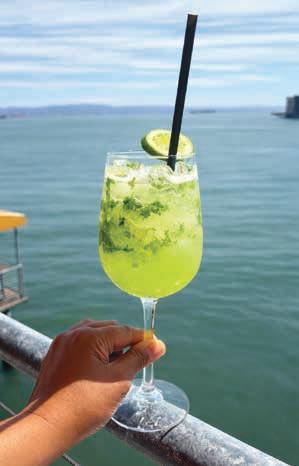
Consumer behavior moves the market. Choosing certified Green Businesses for dinner, for events, for anything, creates a direct financial incentive for more businesses to pursue certification. It closes a loop. For business owners, the process is designed to be accessible, built specifically for small and medium-sized businesses. The SF Green Business staff provide technical guidance, site consultations, and connections to rebates and incentive programs. The average timeline is three to four months.
The SF Green Business Directory lives at https://greenbusinessca.org/
The website is searchable by location and sector, and takes about thirty seconds to check before your next reservation or event booking. This Earth Month, it’s worth the time.
I started with a mocktail, but I want to end with a boozy version of it, because, if a drink called the Garden Party can sit at the confluence of sustainability and a sun-drenched afternoon in Mission Bay, it deserves to be sent off with a little spirit. It’s the kind of drink that makes you slow down, look at the bay, and appreciate what “doing it right” actually looks like in practice.
For this cocktail, I am featuring La Gritona Reposado, which is led by Melie Cardona and an all-women team out of Jalisco’s highlands. This additive-free tequila ages in recycled American whiskey barrels, ships in 100% recycled green glass, and keeps its production footprint lean without making a spectacle of it. It is clean, considered, and made without compromise.
Mission Green Spritz
1.5 oz La Gritona Tequila Blanco
0.75 oz fresh lime juice
0.25 oz St Elder Elderflower Liqueur
0.25–0.5 oz agave syrup (adjust based on desired dryness)
2 cucumber slices
3 mint leaves
2 small basil leaves
2–3 oz prosecco (Bortolomiol Prior Brut, which represents the heartbeat for this month)
2 drops saline solution (4:1 water to salt)
Add cucumber, mint, and basil to shaker and gently muddle. (Use organic or organically-grown produce and more whenever possible. In this case, I picked these ingredients from plants on my San Francisco Patio.)
Add tequila, lime, elderflower, agave, and saline solution. Shake lightly (quick, bright shake). Fine strain into a wine glass over fresh ice. Top with prosecco and gently, yet quickly, stir.
To find certified Green Businesses near you, visit https://greenbusinessca.org/
To learn more about certification, visit https://bit.ly/4cBNjpp
San Francisco-based Dina Novarr enjoys sharing her passion for fine wines, spirits, non-alcoholic craft beverages, and more with others.
David Landis
The Gay Gourmet is back! It’s been a couple of months, and I’ve got a repaired left shoulder (plus a new one on the right), but I am on the mend. That means good food is coming your way once again!
I know that a lot of my loyal readers love making the trek to the Big Apple. My husband and I do it at least once or twice a year to catch the latest and greatest theatre (just saw Two Strangers Carry a Cake Across New York; don’t miss it!). We journeyed there prior to my surgery. One thing I’m always on the lookout for is a good pre or post theatre restaurant in mid-town. Well, darlings, I found one! (Actually, my pal Sandy found this one for me.) It’s called 44 & X , because it’s on the corner of 44th Street and 10th Avenue in Hell’s Kitchen. Besides being delicious, it’s affordable, and, most importantly, LGBTQ+ friendly. As the kids say, it’s a “winner, winner, chicken dinner.”
So, I sat down with the new Owner/Proprietor Dan Taylor via Zoom to ask him
to give us the scoop. Herewith is our conversation:
David Landis: Tell me a little bit about your background. Running a restaurant is a somewhat new career for you, yes? And when did you take over 44 & X?
Dan Taylor: This is somewhat new, although I have plenty of restaurant experience from managing and waiting tables in the past. I’ve also owned my own companies for the last decade, so putting business and real-life experience together wasn’t hard.
David Landis: Are you from New York? Where did you grow up?
Dan Taylor: I’m originally from Arizona. I lived in the Midwest with my family for a few years, but, after visiting New York a few times, I fell in love with this city and decided to make the move 4 years ago.
David Landis: Your approach to dining makes the experience casual, yet whimsical. Tell me about that.
Dan Taylor: We want people to have a great experience. The dining experience is upscale, yet casual and friendly at the same time. People should feel comfortable having a conversation with family and friends, plus enjoy great service and food at the same time. The ambiance, friendly staff, and curated menus make the entire experience lovely.
David Landis: And the décor: it’s clean, white, modern—and the bathrooms are a bold pink with chandeliers! Who did the décor?
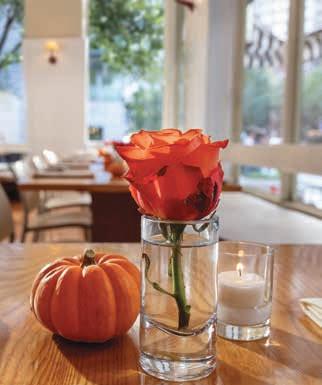
Dan Taylor: The previous owners had this in mind when they designed the décor to keep everything crisp, clean, and neutral—so that it can be livened up by eye-catching things such as the pink lights in the bathroom and chandeliers!
David Landis: I love that the waitstaff
have T-shirts that on one side say, “Heaven” and the other side they say “Hell.” I get the Hell (Hell’s Kitchen), but why “Heaven”?
Dan Taylor: The idea behind that is that the food is Heaven and we are in Hell’s Kitchen! Best of both worlds.
David Landis: Your cocktail menu caught my eye, since you’re in the theatre district and each beverage pays homage to a Broadway star, like “Ethel Mermosa,” “Idina Mezcal,” and “Bette Mitzer.” Who came up with this idea? Tell me more about these cocktails—and do you have a favorite?
Dan Taylor: The bar and wait staff all have a hand in curating “Broadway booze.” It’s a fun way to engage the customers with funny and catchy names for our cocktails based on new and timeless shows on Broadway. We have a lot of pre and post theatre diners that love to come in and enjoy cocktails, like our 9–5 honoring Dolly Parton or Liza with a Fiz honoring the great Liza Minnelli.
David Landis: It seems like your place is a gathering spot for celebrities. My pal Sandy caught up with Will & Grace star Eric McCormack. Are there others who frequent your establishment?
Dan Taylor: Yes! It’s a celeb fave! We’ve had Billy Porter, Jonathan Groff, Carson Kressley, and a few others come to dine. I recently had the privilege to sit down with Rosie O’Donnell as well. We’ll soon also be shooting an episode of Real Housewives of New York City in the restaurant.
David Landis: What’s your approach to curating the menu? I’d call it new American with a healthy twist. Who’s your current chef?
What do you like on the menu? What’s popular?
Dan Taylor: Our current Chef is Mujib Rahman. He’s been with 44 & X for about 20 years. I’m a meat and potatoes guy, so the go-to is always the filet! We serve so many different dishes and everyone has their favorite, but if I had to pick one that people love it’d be the short ribs. They are braised in a port wine reduction and have an amazing flavor. Our portions are sizeable and a good value as well.
David Landis: Your establishment is very LGBTQ+ friendly and it looks like you employ a number of LGBTQ+ folks. It’s nice to have a welcoming eatery like that when you’re headed to or from the theatre. And you’re also smack dab in the middle of Hell’s Kitchen, the New York version of The Castro. Is all of that intentional?
Dan Taylor: Absolutely. We employ a very diverse staff that are gay, lesbian, Hispanic, African-American, and Caucasian. People from all races, backgrounds,
(continued on page 37)
(continued from page 36)
religions, etc. are employed with 44 & X. Through history and even in current times, we need a safe space to enjoy good people, be comfortable with ourselves, and have a great meal without the pressures or judgments of the outside world weighing on us.
David Landis: You still have outdoor dining, yes?
Dan Taylor: We will! The restaurant has been doing outdoor dining for quite some time. We have our permit application in and are hoping to put those tables out soon!
David Landis: Tell us a bit about you personally. Do you have a spouse? Where do you live?
Dan Taylor: Not married, no children, and single! I live just outside of Manhattan in downtown Jersey City. I love the area. I’m 10 minutes away from the city but I get to enjoy a huge apartment, quiet neighborhood, great eats, and entertainment, but can always pop into the city easily for some fun as well!
David Landis: Have you been to San Francisco? Do you have a favorite restaurant out here? Can we ever expect a 44 & X outpost here?
Dan Taylor: SF is on my list! I’ve been wanting to visit for years, but haven’t
made it quite yet. Maybe 2026 will be the year! And who knows what the future holds? 44 & X may make an appearance on the West Coast at some point!
David Landis: How’s the response since you took over the reins at 44 & X?
Dan Taylor: Overwhelmingly positive! I took over not knowing how important this place was to the locals. I’ve been thanked and congratulated over the last 2 months for “saving” people’s favorite spot! It’s a good feeling to know that people appreciate the things that you do. I take pride in knowing we have a solid foundation.
David Landis: Anything else?
Dan Taylor: Nothing other than come visit! It’s a great spot, with amazing food and staff. Brunch is a very popular thing for us. It’s out of this world from the complimentary fresh baked muffins to the savory menu items, plus we’ve added bottomless mimosas and happy hour specials! 44 & X: https://44andx.com/
David Landis, aka “The Gay Gourmet,” is a foodie, a freelance writer, and a retired PR maven. You can email him at: davidlandissf@gmail.com Or visit him online at: www.gaygourmetsf.com

Sbrocco Sips
From April showers to May flowers, springtime is also swirl, swish, and sip time. I’ve selected a May festival that captures the tasty fun of wine country, a newly-released book on the treasures of Italy, and a white wine that’s like drinking sunshine in a bottle.
To Do:
The Healdsburg Wine & Food Experience
https://www.healdsburgwineandfood.com/
When it comes to local wine events, this is one of my top choices for savvy socializing. The festival runs from May 14–17 for
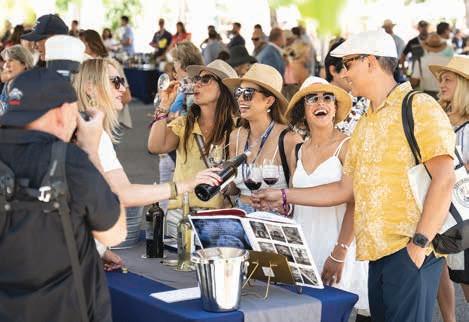
a four-day celebration of Sonoma County’s farmers, growers, winemakers, and chefs alongside acclaimed wines from leading regions around the world. There will be celebrities—such as Ray Isle, Executive Wine Editor of Food & Wine magazine, who will be showcasing 150 Years of Beringer Vineyards—along with Grand Tastings that will offer sizzling chef-driven fare; and aisles
book so much as a collection of more than 90 essays that are personal reflections, profiles of the people who put Italian wine on the global map, and a cultural journey sharing how Italians do libations differently from wines to coffee rituals and even the etiquette of enjoying a Spritz—Italian style.
To Sip:
2025 Garzón Reserva Albariño, Maldonado, Uruguay $25 https://bodegagarzon.com/en/
and aisles of world-class wines to sample. There will also be Sommelier Showdowns, and a Big Bottle Party at the Matheson with Chef Dustin Valette. Is music on your weekend menu? The outdoor concert at Rodney Strong Vineyards will feature Grace Bowers, the 19-year-old award-winning guitarist and singer. Food truck dinners will be available for purchase, with proceeds supporting Farm to Pantry. Do good and drink well!
To Read:
Italianity: The Culture of Italian Wine by Andrea Lonardi MW and Jessica Dupuy $49.95 (May 2026) https://www.italianity.wine
If you are a lover of all things Italian, this beautiful new book is one to aquire. Jessica Dupuy joins Andrea Lonardi MW to create a tome that reads like an Odysseus-style trek through and celebration of Italy. It’s not an academic

Bodega Garzón is Uruguay’s flagship wine property. Alejandro and Bettina Bulgheroni dreamed of creating a winery emblematic of modern winemaking in Uruguay and they did it with respect for the land and the environment. This stunning property is located near the Atlantic Ocean and is home to a wide range of complex and elegant wines from vineyards influenced by cooling ocean breezes. Seek out a slice of South American sunshine with their Reserva Albariño. The white grape is known in Spain and Portugal where it’s named Alvarinho. This white is zesty and bright with citrus notes, a rich texture, and a lingering finish. It’s a wine to sip on poolside to tableside with spicy fare, grilled fish, and fresh-from-the-garden salads.
Author, speaker, wine consultant, and television host Leslie Sbrocco is known for her entertaining approach to wine and food. She has won multiple Emmy Awards for her work on PBS, which includes hosting the series “Check, Please! Bay Area,” which is now in its 21st season; “Check, Please! You Gotta Try This!” and the nationally aired series “100 Days, Drinks, Dishes & Destinations.” www.LeslieSbrocco.com
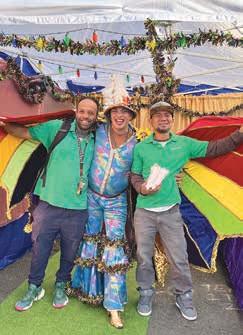

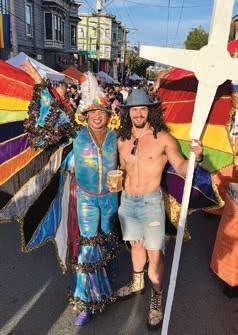
“buckskin” because of the color of his skin, Verrone shrewdly has footage of insects scavenging while Williams describes one episode of racism. The filmmaker features images of redwoods—because they are the masters of the forest and remind Verrone of their grandfather—as well as reflections by Williams to address issues of memory, knowledge, and conservation as well as thoughts on legacy and the end of life. Buckskin also uses text on screen, superimpositions, and visual colleges to make salient points about minorities and the environment—especially when Williams discusses his Kiowa heritage. This is a moving film that was lovingly made.
Shorts Block 4: Shades of Menace includes two gay-themed films. The fantastic short, Callback, written and directed by Matthew Puccini, has boyfriends and actors Max (Justin H. Min) and Will (Michael Hsu Rosen) come to some hard truths about their relationship when one gets a callback for a role. The “good news” sets off a chain of conversations, and an acting contest that lays bare the power dynamics of their relationship— which involve issues of control, jealousy, truth, and trust. Darkly funny and featuring crackerjack timing by the two leads, Callback is a sharp short that blurs the lines between being sincere and being polite. The Veil, directed and cowritten by Gabriel Motta, is an effective shocker from
live music, dazzling performances, dancing, locally-sourced food, an open bar, and a lively auction. Hosted by Sister Roma and Honey Mahogany with entertainment by Juanita MORE!, featuring music by LadyRyan , and Michael Tate as Auctioneer. It was also an opportunity to invest in the center’s services that help thousands of community members thrive.
Be sure to come to the 50th Anniversary of the Dykes on Bikes that will be celebrated on the Friday night of Lesbian Visibility Week! It’s on April 24, 6–10 pm at Rikki’s, 2233 Market Street.
Brazil about Ismael (Robson Lima Duarte), who runs a religious service where his son Junior (Phill) provides salvation to those troubled souls who sit with him under a giant veil. After a tragedy at the end of one session, Junior is reluctant to continue— especially when his encounter with a young man stirs up his same-sex desires. When Rebeca (Rafaela Lima) takes over, things really spin out of control. The Veil may be bloody, but it makes salient points about faith, homophobia, and how evangelicals proselytize. Both Puccini and Motta are expected to attend the post-screening Q&A.
Shorts Block 6: Youth Works includes Out of the Blue, Vivian Nguyen’s short (3 minutes) but sweet film that has Blue (Emi Harris) fantasizing about movie nights and a trip to Paris with a customer, Orange (Sophia Delmon), who is checking out with some groceries. The film mixes animation and some visual effects to create a dreamy possible romance.
© 2026 Gary M. Kramer
Gary M. Kramer is the author of “Independent Queer Cinema: Reviews and Interviews,” and the co-editor of “Directory of World Cinema: Argentina.” He teaches Short Attention Span Cinema at the Bryn Mawr Film Institute and is the moderator for Cinema Salon, a weekly film discussion group. Follow him on IG @garyemkramer
Also in celebration of Lesbian Visibility Week, the GLBT HISTORICAL SOCIETY MUSEUM is offering an additional FREE day— Sapphic Saturday —on April 25 for our community to explore their latest exhibition, Directory of Dreams. Their show traces the everyday labor of Bay Area lesbians who refused erasure and built community networks rooted in care, solidarity, and economic self-determination.
Sister Dana sez, “Celebrate LESBIAN VISIBILITY WEEK! Take a lesbian to lunch! Or take a dyke to dinner!”
a celebration. I was invited to join a dear friend’s 60th birthday at Oracle Park, where she gathered 25 of her closest friends for a night that felt equal parts ballgame and private party.
Last month, I wrote about spring momentum—how the Bay Area’s sports scene was building energy across leagues, venues, and communities. This month, that momentum feels real. I’ve experienced it firsthand— from a sun-soaked evening at the ballpark to navigating Olympic ticketing, and from meaningful moments in soccer’s past to the impact sports continue to make beyond the field.
Ballpark Energy: 25 Years In—and Still Reinventing the Experience
One of my favorite ways to kick off the season came, not just with baseball, but with
We had club level seats with access to a tucked-away outdoor deck—an intimate, semi-private space that made the evening feel incredibly special without being a full suite. And, in a generous touch, each guest received a $25 food and beverage credit— so, yes, the Giants peanuts and ballpark favorites were very much enjoyed. A few of us even showed up in personalized jerseys—mine a Schnitzer #17—adding to the festive, anything-but-ordinary feel of the night.
What struck me immediately, though, was how fresh everything felt. Entering from King Street, the upgraded LED lighting and new bar areas gave the ballpark an instant jolt of energy. As I made my way up the escalator, it was clear: even 25 years in, Oracle Park is continuing to evolve.
I found myself lingering in the club level far longer than expected—especially at the memorabilia exhibit, where I could have easily spent an entire afternoon. The 1951 display, marking the 75th anniversary of Willie Mays’ rookie year and “The Shot Heard ’Round the World,” was a standout, as was Global Gigantes, celebrating the team’s legacy in Latin America—Vamos Gigantes
It was also a night of subtle change. Like many longtime fans, I noticed the absence of longtime announcer Renel BrooksMoon’s familiar voice, adjusting instead to a new sound of the game.
The Giants topped the New York Mets on a picture-perfect San Francisco evening, but what stayed with me most was the atmosphere. Even with the stands only about half full,

our little corner of the ballpark was buzzing with its own energy—proof that sometimes it’s not just about the crowd size, but the experience you create within it. Twenty-five years later, Oracle Park still delivers—and, in many ways, it’s just getting started.
I was thrilled when my ticket lottery slot opened for LA28—mine was a Saturday morning, and I came prepared. Days in advance, I had multiple tabs open with detailed venue maps, session schedules, and sport-by-sport breakdowns. The planning
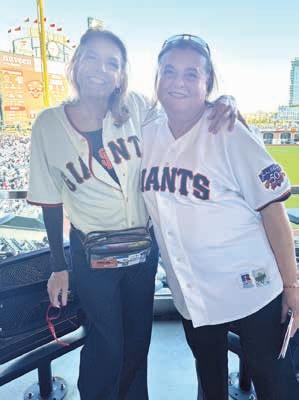
tools were impressive—clear, comprehensive, and thoughtfully organized.
But the experience quickly shifted.
After logging in, I was stuck in a queue, hit with repeated error messages, and couldn’t access my account on my computer—only my phone. I later heard similar stories from friends and fellow fans—multiple lockouts and repeated attempts just to get in.
When I finally entered the ticket portal, the bigger surprise came: availability. Many of the most popular events—gymnastics, swimming, basketball, beach volleyball— were either unavailable or only offered at premium price points. While LA28 has promoted accessibility, the reality in this first drop felt very different.
I ultimately focused on track and field (Athletics)—reliving one of my favorite experiences from Paris—and secured tickets to several medal sessions. But even those came at a steep cost, with service fees approaching 25% of the ticket price. Others shared similar sticker shock, with limited lower-tier inventory available during initial access windows.
There were bright spots. Venue “zones” were smartly designed, grouping nearby events to help plan my days. And I’m hopeful future ticket releases will open up more inventory—especially for newer sports like squash, which have yet to be fully released.
When I purchased tickets for Paris, I was able to build out my itinerary over time, buying in batches across multiple ticket drops. I’m hopeful that will be the case again for LA28, giving fans more opportunities to access a broader range of events. Still, for an event built on global unity and accessibility, the first fan-facing experience leaves room for improvement.
(continued on page 41)
(continued from page 40)
From ’94 to 2026: Soccer’s Legacy Comes Full Circle
As the countdown to the 2026 World Cup builds, one upcoming event feels especially meaningful—America SCORES’ Soccer Legacy Gala, a celebration of the sport’s past, present, and future.
For me, this one hit especially close to home. I had the opportunity to work on the LA Organizing Committee for the 1994 World Cup—an experience that didn’t just change soccer in this country, but also
changed the trajectory of my own career. Thirty years later, it remains one of the most formative and meaningful chapters of my professional life—one I will always treasure. It also brought me to the West Coast from New York, where the Bay Area has been home ever since. That tournament didn’t just elevate soccer in the U.S.—it sparked a movement.
This gala brings that story full circle, reuniting members of the 1994 U.S. Men’s National Team—players like Alexi Lalas, Cobi Jones, and Marcelo Balboa—for what truly feels like a once-in-a-lifetime moment. Even beloved mascot Striker will be part of the celebration, alongside influential figures who helped shape the tournament’s legacy. As Lalas shared, “The 1994 World Cup changed soccer in America forever ... what’s exciting now is seeing how the game continues to grow at the grassroots level.”
That growth is exactly what America SCORES Bay Area represents. Born out of the momentum of ’94 and now celebrating 25 years in the Bay Area, the organization continues to use soccer as a platform for youth development through teamwork, creativity, and service. Proceeds from the gala will support free after-school programs and initiatives like their “asphalt to turf” Field of Dreams—ensuring that the legacy of the World Cup continues to create opportunity for the next generation. From where it all began to where it’s going next, this is what a true sports legacy looks like.
Feeling Tight Through Your Upper Back? Try This Variation of a Restorative Resting Yoga Pose
By Phil Bamberg, FITNESS SF Fillmore
This is a variation of Child’s Pose designed to improve thoracic mobility and open up the rib cage. It’s especially helpful if you feel tight through your upper back or have shallow breathing.
Start in Child’s Pose with your hips back and arms extended forward. From there, slowly walk your hands to one side to create a stretch through the side body and ribs. Take a deep breath into the rib cage, expanding into the stretch, then fully exhale to sink deeper. Hold for 4–6 slow breaths per side. This helps open the intercostal muscles, improve breathing capacity, and increase thoracic rotation for better movement and posture.
Troy Macfarland at FITNESS SF shares monthly tips that he has learned from colleagues, fellow professional trainers, and more. For additional information: https://fitnesssf.com/
Another standout moment this season was attending the V Foundation’s Sonoma Epicurean weekend—one of my favorite events of the year. The Friday night Epic Party at Bacchus Landing was a beautiful event featuring an incredible lineup of food and wine tastings in a setting that felt both festive and refined.
From standout wineries like MacRostie, Lombardi, Bricoleur, and Stone Edge to exceptional culinary partners including Valette, Little Saint, SingleThread, and Montage, every detail was thoughtfully curated. Most importantly, the event raised an impressive $3.5 million for cancer research—proof that when the worlds of sport, hospitality, and philanthropy come together, the impact can be extraordinary.
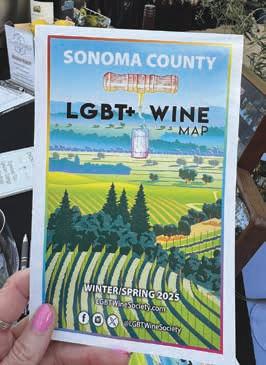
As I recently headed east for the Boston Marathon, I was reminded once again how connected the sports world truly is—from the Bay Area to the global stage and back again. This year, it is especially meaningful as I cheered on my niece, Lexi, with my family as she took on Boston—one of the most iconic races in the world. Moments like these are a powerful reminder of why we love sports in the first place: the passion, the perseverance, and the personal stories behind every finish line.
And at home, with the Valkyries set to tip off their second season in May, the energy here shows no signs of slowing down. I can’t wait for the home opener and the season ahead! From sold-out stadiums to family finish lines, the heart of sport is always the connection it creates. Signing off from the Bay, where passion meets the play.
Beth Schnitzer, the former President of WISE (Women in Sports and Events), is the Co-Founder and President of Spritz: https://spritzsf.com/

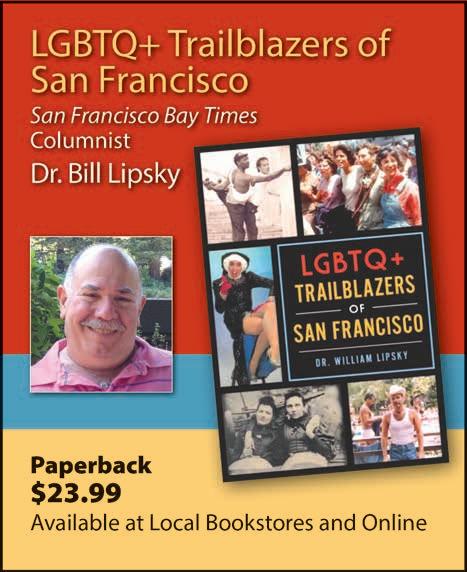
By Sandy Morris
Sandy Morris has been making art for the last 60 years. She says, “My pen, ink, and pencil drawings usually start with no preconceived idea—just drawing a straight or curved line or two. From there, my imagination takes over. I build upon the piece. My works range from the whimsical to the political, to emotions, and everything in between.”