A SETMYCAREER GUIDE
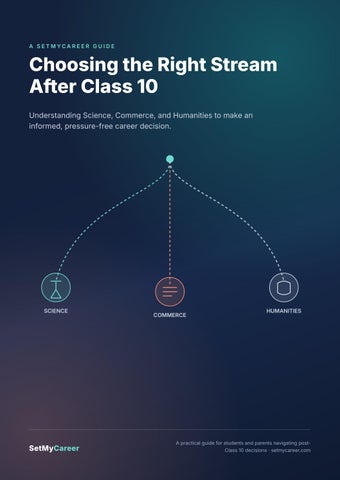
Choosing the Right Stream After Class 10 Understanding Science, Commerce, and Humanities to make an informed, pressure-free career decision.
SCIENCE
SetMyCareer
COMMERCE
HUMANITIES
A practical guide for students and parents navigating postClass 10 decisions · setmycareer.com
CHOOSING THE RIGHT STREAM AFTER CLASS 10
G E T T I N G S TA R T E D
Understanding the Three Streams After Class 10, most Indian schools ask students to choose between Science, Commerce, and Humanities (also called Arts). Each stream opens a different set of subjects, and eventually, a different set of higher-education and career pathways. Here is a plain-language overview of all three.
SCIENCE
Physics, Chemistry, Biology or Mathematics Typically combines Physics and Chemistry with either Mathematics (PCM) or Biology (PCB), alongside English and often a language or optional subject. Students who enjoy problem-solving, experiments, or understanding how things work often find this stream engaging. Fields students may explore: engineering, medicine and allied health sciences, pure sciences, research, computer science, architecture, and other technical or scientific pathways.
COMMERCE
Accountancy, Business Studies, Economics Usually combines Accountancy, Business Studies, and Economics, with Mathematics offered as a compulsory or optional subject depending on the school. Suited to students curious about how businesses, markets, and money work. Fields students may explore: commerce and accounting, business management, banking and finance, economics, entrepreneurship, and related professional pathways.
HUMANITIES / ARTS
History, Political Science, Psychology, Languages Offers the widest range of subject combinations — from History, Political Science, and Sociology to Psychology, Geography, and languages. A strong fit for students drawn to people, society, culture, or self-expression. Fields students may explore: social sciences, law, design and communication-related fields, education, public policy, and many other areas depending on further specialisation.
Before deciding: subject combinations, elective options, and admission requirements differ from school to school and college to college. Always check the specific subject list and eligibility criteria directly with the institutions you are considering — this guide offers a general orientation, not a substitute for that verification.
SetMyCareer
Page 2 of 8
CHOOSING THE RIGHT STREAM AFTER CLASS 10
STREAM DEEP-DIVE · 01
Science: Options and Considerations The Science stream is often chosen by students interested in how the physical and natural world works, and it supports a wide range of pathways beyond just engineering and medicine.
Common subject combinations Combination
Typical subjects
Often considered for
PCM
Physics, Chemistry, Mathematics (+
Engineering, architecture, computer science, pure
English)
sciences
PCB
Physics, Chemistry, Biology (+ English)
Medicine, allied health, life sciences, biotechnology
PCMB
Physics, Chemistry, Maths, Biology
Keeps both medical and engineering-type options
together
open
Possible pathways • Engineering and technology (multiple specialisations) • Medicine, dentistry, and allied health sciences • Pure sciences — physics, chemistry, biology, mathematics, environmental science • Computer science, data science, and information technology • Architecture and design-related technical fields • Defence, aviation, and other specialised technical services Good to know: different courses have different eligibility criteria — some medical and engineering programmes require specific subject combinations, minimum marks, or entrance exams. These requirements can change, so students and parents should verify current admission criteria directly with the relevant institutions or official exam bodies before finalising a decision.
Who tends to enjoy this stream Students who like asking "why" and "how," enjoy laboratory or hands-on work, are comfortable with logical and mathematical reasoning, or are curious about the natural and physical world often find Science engaging. That said, interest and effort matter more than any single personality trait — many students grow into strengths they did not expect to have.
SetMyCareer
Page 3 of 8
CHOOSING THE RIGHT STREAM AFTER CLASS 10
STREAM DEEP-DIVE · 02
Commerce: Options and Considerations Commerce introduces students to how businesses, markets, and economies function, and it leads to some of the most varied career pathways among the three streams.
Typical subjects • Accountancy — recording, reporting, and interpreting financial information • Business Studies — how organisations are managed and operated • Economics — how markets, trade, and policy affect people and businesses • Mathematics — offered as compulsory in some schools and optional in others; requirements vary by institution and by the specific course a student hopes to pursue later
Possible pathways Study & professional routes
Career-area examples
• B.Com, BBA, and related undergraduate
• Finance, banking, and investment-related
degrees • Chartered Accountancy, Company Secretary, Cost & Management Accountancy
roles • Business management and consulting • Entrepreneurship and business ownership
• Economics and public policy programmes
Good to know: some commerce-linked courses (such as certain B.Com honours programmes or professional certifications) have their own eligibility and entrance requirements. It is worth checking these directly with the institution or professional body, since requirements can be revised over time.
Choosing Commerce does not guarantee a particular job, income, or admission outcome — outcomes depend on the specific course, institution, effort, and skills a student builds along the way. Think of this stream as opening a set of doors, not a fixed destination.
SetMyCareer
Page 4 of 8
CHOOSING THE RIGHT STREAM AFTER CLASS 10
STREAM DEEP-DIVE · 03
Humanities / Arts: Options and Considerations Humanities is often the most flexible and subject-diverse stream, covering everything from history and psychology to languages and the arts — and it feeds into a surprisingly wide set of career areas.
Common subjects Depending on the school, students can typically choose from History, Political Science, Psychology, Sociology, Geography, Economics, Philosophy, Fine Arts, and a range of Indian and foreign languages. Most schools allow some mix-and-match within available electives.
Possible pathways • Social sciences, research, and public policy • Law (after further study and entrance examinations) • Journalism, media, and mass communication • Design, fine arts, and other creative disciplines • Education and teaching • Psychology and counselling-related fields • Civil services and public administration Good to know: pathways like law, design, or civil services often involve their own entrance exams or portfolio requirements, and eligibility can vary by institution. Verifying current requirements directly with the relevant college or examination body is an important step before committing to a plan.
A common misconception Humanities is sometimes seen as a "default" stream rather than a deliberate choice. In practice, it demands strong reading, writing, and analytical skills, and it opens pathways — from law to design to public policy — that depend entirely on the specific qualifications, skills, and experience a student builds, not on the stream label itself.
SetMyCareer
Page 5 of 8
CHOOSING THE RIGHT STREAM AFTER CLASS 10
DECISION FRAMEWORK
How to Choose the Right Stream There is no single "correct" stream — only the one that best fits a particular student's interests, strengths, and circumstances. Use the five factors below as a starting point for reflection, not a scorecard.
1
Subjects they enjoy. Which subjects does the student look forward to, engage with actively, or want to explore further — regardless of how "practical" they seem?
2
Academic strengths. Where do they naturally do well, and where would they like to improve with effort and support?
3
Career interests. Are there fields or kinds of work the student is curious about, even loosely? It is fine if this is still forming.
4
Learning style and circumstances. Do they prefer hands-on work, theory, or creative expression? Consider practical factors like available schools, commute, and support systems too.
5
Combinations & eligibility. Which subject combinations does their school actually offer, and what do target courses require? This is worth checking early, not after the decision is made. A note for families: marks, social pressure, parental expectations, and perceived prestige are common influences — but on their own, they are not reliable ways to choose a stream. A decision grounded in genuine interest and informed research tends to serve students better over time.
Quick reflection worksheet 1. Which three subjects do I enjoy the most right now, and why?
2. What kind of work or problems am I naturally curious about?
3. Do I prefer hands-on tasks, discussions, numbers, or creative work?
4. What subject combinations are actually available at my school?
5. Who can I talk to for more informed guidance on this decision?
SetMyCareer
Page 6 of 8
CHOOSING THE RIGHT STREAM AFTER CLASS 10
F O R FA M I L I E S
A Parent-Student Discussion Checklist Choosing a stream works best as a conversation, not a directive. This checklist can help families approach the decision together, calmly and practically.
Discuss interests without judgment. Let the student describe what genuinely interests them before evaluating whether it seems "practical." Explore more than one possible path. Most streams support several different careers — avoid narrowing to just one outcome too early. Research actual course and entrance requirements. Look up current, official information rather than relying on assumptions or anecdotes from a few years ago. Talk to teachers, counsellors, or relevant professionals. A teacher, school counsellor, or someone working in a field of interest can offer perspective that general research cannot. Consider practical constraints honestly. Available subject combinations, school options, and logistics are real factors — acknowledging them isn't a compromise, it's planning. Revisit the decision with reliable information. If new, credible information comes up, it's reasonable to reconsider rather than treat the first decision as final.
Every student's academic and career journey looks different, and that is entirely normal. Some students know their interests early; others take longer to find direction — both are valid paths, and a single stream choice at 15 or 16 rarely closes every other door permanently.
Take your time
SetMyCareer
Verify sources
Talk it through
Page 7 of 8
CHOOSING THE RIGHT STREAM AFTER CLASS 10
N E XT S T E P S
Your Action Plan Here is a simple five-step plan to move from uncertainty to an informed, confident decision.
1
List subjects and activities you enjoy — inside and outside the classroom.
2
Identify your strengths and areas of interest, being honest about both.
3
Research different streams and their associated career pathways using reliable, up-to-date sources.
4
Verify school, course, and admission requirements directly with the relevant institutions.
5
Seek informed guidance if you or your family would find it helpful — a second perspective often clarifies more than another week of deliberating alone.
Every student's journey is different. Explore your options, ask questions, and make an informed decision. Learn more about career counselling after 10th with SetMyCareer.
SetMyCareer setmycareer.com
This guide is intended for general informational purposes to support family discussion and does not constitute a guarantee of admission, employment, or specific outcomes. Course eligibility, entrance requirements, and career prospects vary by institution and change over time — always verify current details with the relevant schools, colleges, or official bodies before making a final decision. For personalised support, learn more about career counselling after 10th with SetMyCareer at setmycareer.com.
SetMyCareer
Page 8 of 8