Teach & Travel March 2026

Page 1


FEATURES

PUBLISHER OF TEACH & TRAVEL

SERENDIPITY MEDIA, LLC

www.serendipity-media.com | (866) 252-7108

THE TEAM

KASIE SMITH, President & Publisher

KRIS BISCHOF, Sales & Marketing Manager

COURTNEY VAN HAGEN, Art Director

CLAIRE CHAPIN, Graphic Designer

JOSH VEAL, Editorial Manager

HANNAH HOHMAN, Marketing Coordinator

MEGAN MARSHALL, Accounting & Operations Specialist

MAGGIE MUTCH, Communications & Event Coordinator

YOUR MEDIA CONSULTANTS (866) 252-7108

KARY MOENING, kary@serendipity-media.com

LILY MUNDELL, lily@serendipity-media.com

MEMBERS OF:

AMERICAN BUS ASSOCIATION

CIRCLE MICHIGAN

NATIONAL TOUR ASSOCIATION

ONTARIO MOTOR COACH ASSOCIATION

STUDENT & YOUTH TRAVEL ASSOCIATION

SUBSCRIPTION INFORMATION

Teach & Travel – The Official Publication of SYTA may be obtained by filling out the subscription card or calling 866-252-7108. Subscribe online at https://hello.teachtravel.org/teach-travel-subscribe. Teach & Travel is published bimonthly by Serendipity Media, LLC; 519 Ada Dr. SE, Ste 201, Ada, MI 49301. Subscription information may be obtained through the above address, by calling 866-252-7108, or by logging on to www.teachtravel.org.

POSTMASTER: Send address changes to Teach & Travel c/o Serendipity Media, LLC; 519 Ada Dr. SE, Ste 201, Ada, MI 49301.

All rights reserved. Teach & Travel content may not be photocopied or reproduced or redistributed without the consent of the publisher.

32 LEARNING HANDS-ON AND BEYOND in Central America

DEPARTMENTS

6 STAYING EDUCATED

Slow Down, Lean In: Crafting Immersive Experiences 8 PROFILE

Emily Dewberry: From Alabama to Around the World

Building Global Citizens: Planning International Travel

Discover New Life Paths in the Galapagos

The World is Full of Stories

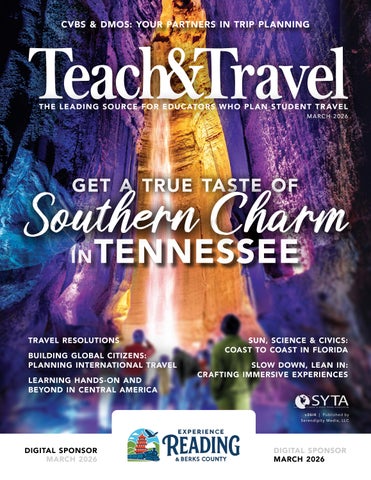
Cover Photo © Ruby Falls

inspiresport

AAs we move through the first quarter of 2026, it is encouraging to see the breadth of experiences that continue to define student and youth travel. From domestic destinations that offer depth and variety, to international programmes that open students’ eyes to entirely new ways of thinking, travel remains one of the most powerful learning tools we have.

What stands out to me in this issue is the emphasis on purpose. Whether it is STEM learning, cultural immersion, or performance based travel, the best programmes are those that challenge students, stretch their curiosity, and leave a lasting impact long after they return home. That focus on meaningful, well designed experiences sit at the heart of SYTA’s work and the values we continue to promote across our global community.

This issue, we’re exploring the natural beauty and STEM offerings of Florida, including not just Orlando but the whole state, from coast to coast. We also head to Tennessee, which is filled with learning and performance opportunities, plus plenty of fun in Nashville, Memphis, Pigeon Forge and beyond.

Beyond the States, we highlight just a few of the fantastic offerings across the vast and varied region of Central America, which is increasingly seen as a top option for student groups. Similarly, we talk with two teachers about their travel experiences, including one who took her students to the Galápagos Islands, which inspired many of them to change their career tracks.

To go along with this, you’ll also find tips on traveling internationally, from packing to safety, navigating language barriers and more. And we explore ideas for how to craft truly immersive experiences with your trips, going beyond simply crafting an itinerary and ensuring your students come away with lessons that stick.

Finally, check out our annual DMO and CVB guide to see how these local experts can take your trip to the next level while saving you time and money.

As you read through this issue, I encourage you to think about the outcomes you want your students to take away from their journeys. The destinations may differ, but the goal remains the same: creating experiences that inspire confidence, curiosity, and connection.

Thank you for the role each of you plays in making student travel safe, enriching, and relevant. Through thoughtful planning, strong partnerships, and a shared commitment to quality, we continue to raise the standard of what student travel can be.

Do your students have a story to tell about a favorite trip, and what they learned from it? Did they experience what it’s like to live in France, while visiting Paris with their high school French class? Did they gain a new appreciation for life through the eyes of another culture? Did they dive into Canadian history at one of the country’s museums or national monuments?

Students who write an essay describing what they learned and how they were affected by their travel experience could earn a scholarship of up to $1,500. They must be currently enrolled in a secondary public or private academic institution and in grades nine through 12.

Essay length should not exceed 525 words. The $1,500 scholarship and a commemorative plaque will be awarded to the author of the first-place winning essay.

Writers of the second-, third-, fourth- and fifth-place entries will receive a $1,000 cash scholarship. The SYTA Youth Foundation offers these scholarships to students who use their creativity to compose an article or speech that illustrates a student travel experience. All prizewinning essays will be featured in Teach & Travel magazine.

SYTA Youth Foundation 2026

WORLD IS A CLASSROOM ESSAY CONTEST 2026

The 2026 World is a Classroom Essay Contest is open through April 24, 2026. Results will be announced in June 2026.

Please contact SYF at info@sytayouthfoundation.org if you have questions.

MAKING THE CUT

Shear Madness has carved its name into American theatre history, not only as the Kennedy Center’s longest-running play but also as the third longest-running nonmusical production in the United States. Each night, audience members step into the role of armchair detectives— interrogating suspects, spotting clues, and ultimately voting on the culprit—ensuring that no two performances ever unfold the same way. Built on topical humor and spontaneous audience interaction, the show revels in the magic of live theatre, where the script bends and reshapes itself to the room, reflecting the moment and the crowd in real time.

That sense of immediacy has been at the heart of Shear Madness since actors and former teachers Marilyn Abrams and Bruce Jordan transformed Paul Pörtner’s participatory drama Scherenschnitt into a fast-paced American comedy, first staged during a summer run in Lake George before exploding into a phenomenon from Boston to Washington, D.C., and far beyond. With more than 3.2 million audience members in D.C. alone, the show has become a shared rite of passage and a fixture of the city’s cultural identity. Its appeal has proven universal as well, with productions touring globally, translated into 23 languages, and adapted for dozens of cities—each version infused with local flavor, but all driven by the same enduring joy of collective storytelling. Get your tickets at shearmadness.com.

FLY BY NIGHT

Dollywood Parks & Resorts [announced the largest attraction investment in the history of Dolly Parton’s beloved theme park in Pigeon Forge, Tennessee. “NightFlight Expedition”—a more than $50 million attraction—will open in a sprawling new building in the Wildwood Grove area of the park come spring 2026. This area of the park is also where park-goers can find its 2023 award-winning family roller coaster, Big Bear Mountain.

As the world’s first indoor family hybrid coaster and whitewater river raft ride, “NightFlight Expedition” will take guests on an unforgettable journey through the Smoky Mountains to search for bioluminescence in

Photo © Margot Schulman

the nation’s most-visited national park. During the five-and-a-halfminute experience, guests will soar on a nighttime flight over the scenic Smokies, enjoy a thrilling whitewater rafting excursion through more than 500,000 gallons of surging water, traverse a mountain ridge on a roller coaster, and navigate a mysterious shimmering lake by boat. Check it out at dollywood.com.

ASHEVILLE’S ASCENT

2026 is shaping up to be a banner year for Asheville, North Carolina, as the Blue Ridge city rides a wave of momentum fueled by record-breaking group travel, high-profile events, and standout new attractions. That growth signals a destination very much on the rise, buoyed by a calendar that includes the long-awaited return of the PGA TOUR, major collegiate championships, and continued

investment in infrastructure like the $400 million expansion of Asheville Regional Airport.

New experiences include Luminere—a multisensory nighttime transformation of Biltmore Estate featuring immersive projections and a custom score performed by the Asheville Symphony—and an exhibition spotlighting American Impressionism at the Asheville Art Museum. The food scene continues to shine, earning 15 Michelin Guide honors, while welcoming the return of beloved local spots like Sugar & Snow Gelato and Guajiro Cuban Comfort Food. Learn more at exploreasheville.com.

KEEPING CULTURE ALIVE

In partnership with eight Indigenous consulting curators, the Penn Museum unveiled its new Native North America Gallery, which is included with Penn Museum admission, last November.

A continuation of the Museum’s work with Native specialists for more than a century, This gallery explores the political, religious, linguistic, and artistic selfdetermination of Native peoples across the United States who are still thriving—despite a historic agenda to erase Indigenous identity, culture, and language.

Through more than 250 archaeological, historic, and contemporary items from the Penn Museum’s North American collections, the 2,000 square foot multisensory gallery‘s purposeful design fosters an immersive visitor experience—from its first-person videos, interactive stations, color palette and motifs to including Native languages throughout the interpretive text. Learn all about it at penn.museum.

NightFlight Expedition rendering © Dollywood Parks & Resorts

SLOW DOWN, LEAN IN: CRAFTING IMMERSIVE EXPERIENCES

CCrafting immersive and memorable student group travel experiences takes far more than assembling an itinerary and checking off famous landmarks.

At its best, student travel is an act of care—an intentional effort to understand what students need, where they are developmentally, and what might spark something lasting within them. Fun and information matter, but connection is the true goal. A powerful trip can help a student discover a new passion, imagine a future college major or career, or see themselves as an advocate, artist, or engaged citizen for the very first time.

That kind of impact doesn’t happen by accident. It often begins long

before the bus departs, through collaboration. Talking with other teachers ahead of the trip can deepen the experience by giving students context in advance, introducing historical moments, cultural movements, or big questions they’ll encounter on the road. When students arrive already curious, the destination becomes a place to explore rather than a list of facts to absorb.

One of the most common mistakes in student travel planning is the urge to “see everything.” This approach leads to what might be called fast-food tourism: rushed, surface-level experiences that leave students full but not nourished. Slowing down is essential. Fewer stops, thoughtfully chosen, allow experiences

to breathe and give students time to reflect, ask questions, and form personal connections.

Incorporating a unifying theme— whether it’s innovation, social justice, artistic expression, or identity—can also help students draw meaningful links between places and ideas, transforming isolated moments into a cohesive story.

Trust is another critical ingredient. Students engage more deeply when they feel respected and met where they are. Earning that trust allows them to lean in, to admit confusion, to share insights, and to take intellectual risks. This is where storytelling becomes especially powerful.

Effective storytelling isn’t a series

The best trips are supported by adults WHO GENUINELY ENJOY WORKING WITH STUDENTS AND ARE COMMITTED TO GUIDING THEM FROM WHERE THEY ARE TO WHERE THEY COULD BE, not those simply along for a trip of their own.

of mini-lectures; it’s a conversation. Asking open-ended questions encourages students to think critically, make connections, and arrive at their own conclusions. At the same time, literal storytelling still matters. Rather than reciting a list of facts, focusing on even one compelling detail told with genuine enthusiasm can make something like an “ordinary” bridge or building unforgettable. Authentic passion is key; students can always tell when an adult truly cares. Immersion is what makes these stories stick. Hands-on, ageappropriate, relatable experiences help students see themselves within the broader sweep of history and culture. Preparation beforehand and reflection afterward reinforce that sense of relevance. Passionate staff and chaperones play a vital role here as well. The best trips are supported by adults who genuinely enjoy working with students and are committed to guiding them from where they are to where they could be, not those simply along for a trip of their own.

Finally, immersive student travel is about more than knowledge acquisition. Cultural understanding builds empathy and self-esteem, particularly for students who may not yet feel they belong academically. Experiential learning opens doors that classrooms sometimes can’t. Even small moments—like visiting a college campus and participating in hands-on activities—can be transformative, helping students picture themselves in spaces they never imagined they’d occupy. In the end, the most memorable trips instill values as much as information, leaving students not just better informed, but more confident, curious, and connected to the world around them.

EMILY DEWBERRY: FROM ALABAMA TO AROUND THE WORLD

EEmily Dewberry is an Upper School History Teacher and History Department Coordinator at The Donoho School in Anniston, Alabama. She’s among Teach & Travel’s 2025 Traveling Teacher of the Year nominees, earning recognition from her peers for her passion for world history and culture—and introducing her students to these subjects through the lens of national and international travel.

Growing up in Alabama, Emily was fascinated with the American Civil

War from a young age. Her family encouraged her interest in history, and they regularly traveled to significant sites and battlefields, especially in Virginia where her grandad was originally from. This led her to study post-Civil War reconstruction, and she was in the midst of pursuing her master’s degree and writing her master’s thesis when she realized she needed to change paths.

Switching gears, Emily started working as a substitute teacher for middle- and elementary-school

students. Years later, she would realize that this experience was invaluable, and that just knowing about history wasn’t enough; she needed strategies to help her young students understand it. She went back to school, and, today, she teaches high school AP subjects, including European History.

Emily says she’s always loved traveling, and, as a child, she wanted to grow up to be a tour guide. Visiting plantation homes in Mississippi and Thomas Jefferson’s

Monticello in Virginia provided that spark, as did her first overseas trip to Paris when she was 16. Though she jokes that her tour guide dreams didn’t work out, she is, in a sense, fulfilling them as the lead organizer for student travel for her school.

“I remember visiting the Palace of Versailles, and I still get chills thinking about it” Emily says. “I was in the Hall of Mirrors where the Treaty of Versailles was signed and all of a sudden, I had this moment where I just started crying. Each place holds a moment of true understanding of a small moment of time; a connection to the people before us and who will come after us. As a teacher, anytime I travel, I try to have those moments, and I’ve used them all the time in class.”

Educational trips to D.C. and Disney World, as well as several overseas destinations, are part of The Donoho School’s Intersession program. In addition to traveling to iconic locales, there are also job shadow and community service paths available through the program. For Emily’s part, she primarily focuses on visiting Spain and France, as those coincide with language studies, but they have also have a “toss up” year, which was most recently to Italy.

In planning European trips, it could be easy to fall into a museum-heavy itinerary. But Emily knows that’s not necessarily student friendly. Or chaperone friendly either. So, she tries to balance educational activities with free time to allow students and faculty leaders to explore on their own. Sometimes that means having opportunities to practice language skills, or see a part of a city that’s off the beaten path, or just immerse in a culture that’s not their own—and get out of their bubble a little bit.

“I strive for all students to have their own individual experience during our travels,” Emily says. “It

You’re going to run into problems.
BEING FLEXIBLE, FINDING A POSITIVE SPIN, AND BEING ABLE TO SOLVE PROBLEMS are all part of it.

is my greatest joy to watch students have their ‘lightbulb’ moments. I never want to list out everything I know about a landmark or a piece of art or a specific place; I want students to tell me what they think about it or learned about it.”

Emily doesn’t do all the planning on her own, though. She’s enlisted a couple of different tour operators over the years, and, today, she finds she’s most happy with the one that allows her to make custom changes, adding in places she wants to see, or she feels will be especially meaningful to her students.

Finding the right partner is just one piece of advice that Emily offers to other teachers who are considering student travel. She also recommends starting small, such as planning a shorter trip closer to home. Some of her most successful trips have been to places she’s already been or ones she particularly likes. “I know where we’re going to go,” she says. “And that’s a comfort—and the more comfortable I am, the more comfortable I am with

taking my students there.” That extends to the parents’ confidence, too. Being knowledgeable and organized, knowing all the ins and outs, and having a strong track record builds that trust.

Emily also networks with other teachers that have traveled with students, and chooses her chaperones wisely. “Having the right people with me who are also going to be upbeat is crucial,” she says. “You’re going to run into problems. Being flexible, finding a positive spin, and being able to solve problems are all part of it.”

The most important takeaway that Emily shares is the outcome. “Travel helps make history and life real, and opens one’s eyes to this beautiful, diverse world,” she says. “It is imperative for students to understand their place in this world. While it is ever evolving and adapting to new technology, problems that plagued civilizations throughout time seem to occur again. To travel is to experience and to learn.”

BUILDING GLOBAL CITIZENS: PLANNING INTERNATIONAL TRAVEL

IInternational travel can be one of the most powerful educational experiences a student will ever have. It pushes learning beyond the classroom, builds cultural understanding, and fosters independence and confidence in ways few other opportunities can. But while the rewards are high, successful international student travel requires thoughtful preparation, clear expectations, and a willingness to plan for both the big picture and the small details.

The groundwork begins long before departure. Gaining buy-in from students, parents, and administrators is essential. Hosting information sessions or Q&As allows educators to outline the educational purpose of the trip, introduce the destination and itinerary, and address common concerns around safety, cost, and logistics. Transparency matters here—sharing timelines, payment schedules, fundraising options, and safety plans early helps families feel

informed and invested. Also consider how much you can actually experience and enjoy in the timeframe available, taking care not to overstuff the itinerary. Consider a “theme” for the trip to make planning simpler! Budget planning is often the biggest hurdle for international travel, but early and strategic planning can make trips more accessible. Breaking down costs clearly, offering manageable payment plans, and booking well in advance can help reduce sticker shock. Fundraising, crowdfunding, sponsorships, and scholarships all play a role in offsetting expenses and expanding access. Many successful programs begin planning 12–18 months in advance, allowing families time to prepare financially and students time to stay engaged and committed.

Once students are on board, preparation shifts to expectations and responsibilities. Clear rules and behavioral guidelines are critical , particularly when traveling in countries with different laws and social norms. Tipping, public behavior, wildlife interaction, and transportation etiquette can vary widely by destination, and students need to understand not just what the rules are, but why they exist. Establishing consequences for rule violations, and ensuring parents are aware of them, creates accountability before the trip ever begins.

Equally important is helping students set personal and group expectations for the experience. Encouraging them to reflect on what they hope to gain—whether cultural awareness, independence, language skills, or simply confidence navigating the unfamiliar—gives the trip purpose beyond sightseeing. Pre-trip discussions, journaling, and group research into cultural norms can help ease culture shock and foster curiosity rather than fear.

Logistics play a major role in keeping international trips running smoothly. Passports are required for all travelers and should be obtained as early as possible. Increasingly, passports are needed to even book tickets, and just one person can hold up the entire booking process! Depending on

the destination, visas, vaccinations, or additional documentation may also be required. Create a clear checklist and timeline for paperwork, money access, and cell phone plans, which helps families stay organized and reduces last-minute stress. It’s also important for group leaders to understand various border crossing laws, such as the Schengen Area in Europe.

Safety planning deserves special attention . Emergency contact lists should include student and family information, school representatives, medical facilities, transportation providers, and local emergency numbers for each destination. Chaperones should be clearly identified, properly trained, and equipped with international cell service—or satellite phones in remote areas. Establishing walking and supervision procedures, especially in busy cities or countries with different traffic patterns, can significantly reduce risk. Simple strategies like positioning chaperones throughout the group, performing regular headcounts, and breaking into smaller subgroups can make a big difference.

For the sake of affordability, consider hostels. There are many reliable options that are safe places for student groups, with private group bathrooms, the ability to keep all students on one floor, and facilities that lock up at night.

Health and daily comfort considerations are also part of responsible planning. Food allergies may be more difficult to accommodate in some countries, particularly where cross-contamination is common or ingredients are used differently. Students should understand these risks and plan

accordingly. Even bathrooms require preparation—facilities may be labeled differently, charge small fees, or operate under customs unfamiliar to students. Encouraging students to carry small amounts of local currency and approach these differences with flexibility helps prevent unnecessary stress.

Finally, partnering with an experienced student travel provider can ease the burden on educators. Reputable partners bring destination knowledge, safety protocols, and logistical support that allow teachers to focus on students and learning outcomes rather than troubleshooting abroad.

FFlorida’s great strength as a destination is its range.

Only so many places allow a group to ride cutting-edge attractions one day, debate government policy the next, and end the week standing inside centuries-old fortresses or along sunlit shorelines.

Orlando may get top billing, but Florida is far more than a onecity show. The Sunshine State offers a choose-your-own-adventure approach that works just as well for performance groups and STEM clubs as it does for history classes and leadership programs.

Here’s how Florida delivers big on fun and learning, from the panhandle to the Keys.

Photos © Visit Orlando

SUN, SCIENCE & CIVICS: COAST TO COAST IN FLORIDA

ORLANDO

No Orlando itinerary is complete without at least one deep dive into its headline-making theme parks—and for student groups, they offer far more than just thrills. Universal Orlando Resort has mastered the art of turning adrenaline into education. Through its programs, students can explore the real-world science behind gravity-defying coasters, unpack the mechanics of motion and force, and dig into the craft of storytelling.

And Universal Epic Universe, the newest addition to the lineup, raises the bar with sprawling, hyper-immersive lands connected by lush Celestial Park. Students can step through portals into The Wizarding World of Harry Potter – Ministry of Magic, SUPER NINTENDO WORLD, How to Train Your Dragon – Isle of Berk, and Dark Universe, each offering its own blend of narrative design, technology, and imagination.

Across town, Walt Disney World Resort delivers its own brand of magic, one that pairs unforgettable attractions with intentional, curriculum-driven experiences. At Disney Imagination Campus, students step behind the curtain to explore leadership, performing arts, and STEAM concepts through hands-on workshops designed to spark collaboration and creative thinking. Whether they’re breaking down the physics that brings roller coasters to life or learning choreography straight from a Disney production, students are actively engaging with the ideas that make storytelling move. Not to mention performance opportunities!

For groups drawn to science and sustainability, SeaWorld Orlando adds another powerful layer. Here, high-speed coasters share space

with meaningful marine science programming, behindthe-scenes animal care experiences, and conversations about conservation and environmental stewardship. Students gain a clearer understanding of the challenges facing marine ecosystems—and the innovative work being done to protect them.

Add in attractions like WonderWorks, where science experiments flip expectations upside down, and the Museum of Illusions, and students are learning even when they think they’re just playing.

Performance and arts groups can take center stage at the Dr. Phillips Center for the Performing Arts, while sports and recreation shine at Andretti Indoor Karting & Games or during an Orlando Magic game. For groups looking for a little more old-school fun, Fun Spot America delivers classic thrills without the massive footprint.

DAYTONA BEACH

Daytona Beach brings together Florida’s coastal beauty and a surprising depth of educational experiences.

Students can explore the legendary Daytona International Speedway, diving into the engineering and innovation behind motorsports, before slowing things down at the Marine Science Center or the Daytona Aquarium & Rainforest Adventure. History and culture come alive at Jackie Robinson Ballpark and the Museum of Arts and Sciences, while Ponce Inlet Lighthouse offers panoramic views and lessons in maritime navigation. For a sweet break between activities, the Angell and Phelps Chocolate Factory is a student favorite — equal parts delicious and educational. Add in outdoor exploration at Tomoka State Park , and Daytona becomes far more than just a beach stop.

ST. AUGUSTINE & PONTE VEDRA

Florida’s Historic Coast is a dream destination for history-focused student travel. In St. Augustine, the nation’s oldest city, students don’t just learn history — they walk through it.

The imposing Castillo de San Marcos anchors lessons in colonial conflict and preservation, while sites like the Oldest Wooden School House, Old Jail, and Oldest Store Museum Experience make early American life tangible. Quirkier stops like Ripley’s Believe It or Not! Museum keep energy high, while nature thrives at the St. Augustine Alligator Farm Zoological Park and Marineland Dolphin Adventure

When it’s time to exhale, Anastasia State Park and more than 42 miles of pristine beaches provide the perfect balance of reflection, recreation, and sunsoaked downtime.

TALLAHASSEE

For students eager to understand how government works, Tallahassee offers an unmatched, real-world classroom. As Florida’s capital city, it places students at the heart of the democratic process.

Visits to the Florida Historic Capitol Museum and modern Capitol complex bring civics lessons to life, while historical sites like Mission San Luis reveal the state’s deep cultural roots. Nature and science experiences at the North Florida Wildlife Center add another layer of learning, and recreational stops like Fun Station or the Morcom Aquatic Center keep the itinerary well-rounded.

This is where textbooks come to life and students walk away with a deeper understanding of how history, policy, and community intersect.

TAMPA BAY & BEYOND

On Florida’s Gulf Coast, adrenaline and academics go hand in hand. Busch Gardens Tampa Bay pairs worldclass roller coasters with animal conservation and zoology education, making it a favorite for science-minded groups.

Creative and career-focused students can explore pathways in media and technology through the Florida Film Academy and Florida Film & STEM Academy, while hands-on workshops from Animado Events offer immersive performing arts experiences tailored specifically to student groups.

Add stops like Old Town Kissimmee, the Florida Railroad Museum , or even a visit to the iconic Ron Jon Surf Shop, and students get a snapshot of Florida’s cultural diversity.

MIAMI

History and heritage are the highlights in Little Havana , where students can explore Cuban American culture through food, music, and neighborhood walking tours. Nearby, the Freedom Tower tells powerful stories of immigration and identity, making it a meaningful stop for civics and social studies groups.

Art and architecture shine at Vizcaya Museum & Gardens, where European-inspired design meets subtropical landscapes, and in the Wynwood Arts District, where vibrant street murals turn the neighborhood into an open-air classroom. Science and sustainability come into focus at the Phillip and Patricia Frost Museum of Science, offering hands-on exhibits in physics, biology, and technology, along with a planetarium and aquarium that deepen understanding of South Florida’s ecosystems.

For environmental and marine science groups, excursions to Biscayne National Park or the Everglades introduce students to one of the most unique wetlands in the world, emphasizing conservation, climate science, and human impact. Performance and media-focused groups can also tap into Miami’s creative energy through dance, music, and film workshops that reflect the city’s multicultural roots.

Photo © Greater Miami CVB

...CONTINUED FROM PAGE 17.

PPlanning a student trip is no small feat, with endless decisions to make about meals, transportation, and lodging. Luckily, local experts can simplify the process. That’s where Destination Marketing Organizations (DMOs) and Convention & Visitors Bureaus (CVBs) come in. These professionals offer insider knowledge to help your trip run seamlessly, from major attractions to hidden treasures.

WHAT ARE DMOS AND CVBS?

DMOs and CVBs often overlap in purpose, but they have distinct roles. DMOs are local experts dedicated to helping visitors explore a destination to the fullest, typically focusing on leisure travelers. CVBs, usually nonprofit organizations funded by hotel taxes or membership dues, are more businessoriented, offering support for conventions, meetings, and event permitting.

Many CVBs also double as DMOs, branding themselves with names like “Visit,” “Explore,” or “Experience.” Large cities often host both organizations, each offering reliable and impartial advice about local highlights. For nonbusiness travel groups, DMOs might offer a broader array of services, with teams of sales representatives, event coordinators, and service managers ready to assist.

HOW TO USE A DMO OR CVB

Most DMO or CVB websites feature sections specifically for group travel—and often even a menu tailored to student travel. Start there to spark ideas for itineraries that might include cultural sites, live performances, hands-on workshops, dining, lodging, and immersive museum or aquarium programs.

These websites typically provide contact information for attractions, transportation, and accommodations. Many also offer group-friendly suggestions, galleries of images, downloadable resources, and even videos showcasing event spaces. Some organizations go further, offering free digital and print sales kits to help with planning and promotion. Connect with staff online or by phone for expert guidance. Follow their social media accounts for updates, or subscribe to e-newsletters to stay informed about new opportunities in your destination.

HOW DMOS AND CVBS CAN HELP

• Safety Tips: Learn how to protect students, secure valuables, and respect local environments.

• Transportation Advice: Get guidance on the best ways to navigate— from public transit to motorcoaches.

• Local Rules: Understand area-specific regulations like parking and public space guidelines.

• Tour Options: From walking tours to Segway adventures, DMOs can map out the best sightseeing experiences, often with complimentary options.

• Accessibility: Access resources to accommodate group members with disabilities.

• Food Services: Find restaurants, caterers, or boxed meal providers that meet your schedule and dietary needs.

• Day Trips: Identify nearby destinations worth exploring and plan an efficient itinerary.

• What’s New: Discover must-see attractions and events unique to the area.

• Contact Lists: Gain a curated list of local contacts for seamless planning.

• Performance Opportunities: Access venues for parades, concerts, or workshops tailored to your group.

• Behind-the-Scenes Experiences: Arrange educational tours, master classes, or professional meet-and-greets to enrich your trip.

...CONTINUED FROM PAGE 21.

WORKING WITH A DMO OR CVB

These organizations often offer complimentary planning support, such as negotiating rates for restaurants, hotels, and attractions. Their expertise can streamline your itinerary, ensuring maximum value and efficiency. As Anjuli King of Visit Savannah puts it: “We ARE the city! A one-stop shop for all the contacts you’ll need.”

Reps can recommend licensed drivers, reputable vendors, and the best public transportation options. Many DMOs and CVBs also provide physical information centers in major cities, staffed with knowledgeable ambassadors who distribute brochures, maps, and personalized itinerary suggestions.

MAXIMIZE YOUR EXPERIENCE

Partnering with a SYTA member tour operator and a DMO or CVB ensures you’ll get the most out of your trip. Their mission is to help you enjoy a safe, unforgettable visit. Tap into their local expertise, and your group’s adventure could become the experience of a lifetime.

For a comprehensive list of SYTA DMOs and CVBs, consult the 2025 Educators’ Buyers Guide at teachtravel.org/educators-buyers-guide.

GET A TRUE TASTE OF

Southern Charm

IN TENNESSEE

IIf you’ve ever been on a road trip through the southern states, you’ve probably encountered billboards and painted barns with the message “See Ruby Falls.” Sure enough, Ruby Falls is something to see, and it’s just part of what awaits visitors to “The Volunteer State”. From music to Mountain Dew, natural beauty to barbeque, Tennessee has plenty to offer student groups. It’s bordered by eight U.S. states, making it easily accessible, and it’s home to museums, one-of-a-kind attractions, and historic sites, as well as sports teams, arts and culture, and outdoor recreation areas. Here, we’ve gathered some of the favorite Tennessee destinations and attractions.

Sevierville is located in East Tennessee near the Great Smoky Mountains National Park, which is a top draw to the area. Hiking the trails, spotting wildlife, and taking in waterfalls are just a few options in the park, plus checking out the historic structures at Cades Cove and panoramic views at Clingmans Dome. Soaky Mountain Waterpark (yes, you read that right!) is a fun place to splash and play, and SkyLand Ranch is a different kind of amusement park that offers rides, a chairlift, entertainment, shopping, and dining—all with the iconic mountains as a backdrop.

Be sure to make Rainforest Adventures Discovery Zoo part of your plans, too. It has more than 100 species of tropical and temperate animals from around the world, and they offer special programs for school groups. Tennessee Museum of Aviation is another popular spot, with its collection of aircraft, military vehicles, exhibits, and memorabilia housed in a 50,000 sq. ft. facility. Sevierville is also the birthplace of Dolly Parton, and a day spent at Dollywood Theme Park in nearby Pigeon Forge is a must for student groups.

Nicknamed “Music City” for its roots in country, rock ‘n’ roll, gospel, blues, and R&B genres, Nashville is overflowing with diverse options for student groups. Start out at the Country Music Hall of Fame® and Museum, which features a blend of learning and entertainment and also includes the Taylor Swift Education Center. In harmony is the National Museum of African American Music (NMAAM)—touted as the only museum of its kind dedicated to celebrating and preserving the history and legacy of Black music in the U.S. Madame Tussauds Nashville continues the tribute to music legends, with its lifelike wax figures of recording stars, interactive exhibits, and photo ops.

Next, take a departure from rollicking and melodious sounds and head to the serene Cheekwood estate. This massive, 1930s-era mansion rests amid 55 acres of gardens, and includes a woodland sculpture trail, an arboretum, and a museum with period rooms and art galleries. Also, not to be missed in Nashville is Andrew Jackson’s Hermitage. A 1,120-acre National Historic Landmark, it’s one of the largest, most visited presidential homes in the U.S. On site are walking trails, gardens, and 30-plus historic buildings. Chattanooga is where you can take in the aforementioned Ruby Falls, a 145-foot waterfall that cascades into a deep cavern within Lookout Mountain. Go on a guided tour that includes the waterfall, cave formations, and light and music effects. Afterward, take on the challenges at ZIPstream Aerial Adventure or ride The Incline, a funicular railway that climbs a steep, onemile track to the top of Lookout Mountain. There’s more enchantment to be had at Rock City, with natural rock formations, caves, a swinging bridge, observation points, hidden gnomes, and art installations.

Photos © Visit Sevierville, Ruby Falls

More itinerary builders are Tennessee Valley Railroad Museum and The Tennessee Aquarium. In addition to scenic train rides, the railroad museum has historic equipment and other exhibits on display, a restoration facility, and an on-site café and gift shop. The aquarium houses thousands of animals in two buildings: one for freshwater and one for saltwater. There’s also an IMAX 3D Theater and they offer two in-depth, add-on tours. And, for something completely different, be sure to visit the Lodge Cast Iron Museum to see the World’s Largest Cast Iron Skillet and learn interesting tidbits about this historic cookware.

The Sunsphere in World’s Fair Park is just one reason to put Knoxville on your list! A skyline stunner, the Sunsphere was built for the 1982 World’s Fair and has remained since. It has a 360-degree observation deck that overlooks the city, the mountains, and the Tennessee River. Other points of interest in and around town are the free Knoxville Museum of Art, East Tennessee History Center, and the Tennessee Theatre. There’s also Zoo Knoxville, known as the Red Panda Capital of the World, that has 1,500-plus animals and several paid and free animal encounters.

Knoxville is a hub for sports culture, being host to the Knoxville Smokies minor league basketball team, One Knox Soccer Club, the Knoxville Ice Bears hockey team, and a bevy of athletics at the University of Tennessee. They also have the Women’s Basketball Hall of Fame where you and your students can learn about trailblazing women athletes through exhibits and memorabilia, then shoot hoops on a full-sized court. For other recreation, step into Knoxville’s Urban Wilderness (KUW), an outdoor adventure area for hiking, climbing, biking, paddling, and more.

Don’t leave Tennessee without a trip to Memphis, “Home of the Blues” and hotspot for grabbing a plate of dry-rubbed ribs. One of the main highlights is National Civil Rights Museum, which was originally the Lorraine Motel where Dr. Martin Luther King, Jr. was assassinated. The museum serves as a chronicle of the Civil Rights Movement, and also explores global human rights themes and sparks conversations around freedom and justice. The STAX Museum of American Soul Music is another important landmark to visit, located at site of the “Soulsville, USA” studio and spotlighting all things related to the “Memphis Sound”.

The Fire Museum, situated in an historic fire engine house is also of interest to student groups, as is Bass Pro Shops at the Pyramid, which has aquariums, an indoor swamp with live animals (including alligators!), a 28-story elevator that takes you to an observation deck, restaurants, and, of course, the retail store itself. For more animal interactions, head to the Peabody Hotel for its famous Duck March, happening daily from 11:00 a.m. to 5:00 p.m. Also worth the trip are Memphis Zoo and Memphis Botanic Garden.

Photos © Chattanooga Tourism Co., Women’s Basketball Hall of Fame, Alex Shansky

CENTRAL AMERICA LEARNING HANDS-ON AND BEYOND IN

CCentral America is perfect for groups who want to engage, not just observe.

For student groups, travel through this region offers far more than sightseeing—it opens doors to meaningful cultural exchange, environmental learning, and handson experiences alongside local communities, schools, and Indigenous villages.

From practicing Spanish with peers to learning traditional dances, harvesting cacao, or paddling through wildlife-rich waterways, lessons in Central America take place in cloud forests, colorful markets, coral reefs, and ancient ruins.

COSTA RICA:

Where Biodiversity Becomes the Classroom

Costa Rica is a natural starting point for student travel, blending ecological diversity with immersive cultural experiences. A visit to a Costa Rican school allows students to meet local peers, practice Spanish, and compare daily life and education systems firsthand—often one of the most impactful moments of the trip.

Nature is the main act as groups travel to Tortuguero, home to winding waterways and astonishing wildlife. A banana plantation visit introduces discussions around agriculture and global trade, while Tortuguero National Park brings students eye-to-eye with hundreds of bird species, reptiles, amphibians, and mammals, all thriving in the dense rainforest canopy.

In Arenal, the iconic volcano looms large, offering lessons in geology and natural forces. Monteverde’s cloud forest, founded by Quakers in the 1950s, showcases conservation in action. A guided night walk through the Monteverde Cloud Forest Reserve reveals a completely different ecosystem after dark, where frogs, insects, and nocturnal mammals emerge beneath towering trees.

Manuel Antonio National Park perfectly marries beach and rainforest, making it easy to spot white-faced monkeys, sloths, colorful crabs, and sea turtles. Cultural connections continue in San José, where students learn traditional folklore dances like El Torito before watching professional performers bring Costa Rican traditions to life.

In Sarapiquí, agricultural learning continues with a pineapple farm visit, followed by a stop at Tirimbina Biological Reserve. Crossing suspension bridges, exploring former cacao plots, and sampling chocolate turns history, science, and sensory learning into one rich experience. Guanacaste rounds out the journey with national parks, river boat tours, and snorkeling that highlights Costa Rica’s marine ecosystems.

GUATEMALA:

History, Culture, and Living Traditions

Guatemala offers student groups a deep dive into living history. Antigua, a UNESCO World Heritage Site, feels like stepping into the pages of a history book. Students explore colonial landmarks like the Palacio de los Capitanes Generales, visit museums, and hike to Cerro de la Cruz for sweeping views of the city framed by volcanoes. Wandering artisan markets provides insight into local economics, craftsmanship, and daily life.

Beyond Antigua, visits to villages such as San Antonio Aguas Calientes and Santiago Zamora allow students to connect with Indigenous communities. Here, they learn about traditional textiles, Maya-Kaqchiquel culture, and share meals prepared by local women—experiences that foster genuine cultural exchange.

Chichicastenango’s legendary market is a sensory explosion of color, sound, and tradition. Students navigate stalls filled with textiles, flowers, masks, and carvings, while a visit to Santo Tomás Church reveals the blending of Catholic and ancient Maya spiritual practices. Around Lake Atitlán, towns like Panajachel and Santa Catarina Palopó showcase vibrant local dress and dramatic landscapes, with volcanoes rising above shimmering waters.

Ancient history comes alive at sites like Iximché and Tikal National Park, where towering temples and plazas offer a tangible connection to the Maya civilization. Along the way, experiences like macadamia nut plantation tours and salsa and merengue dance lessons keep learning dynamic and interactive.

PANAMA:

Where Cultures and Continents Connect

Panama’s unique position as a crossroads of the world makes it an exciting destination for student groups. In Panama City, students explore Panamá Viejo, the ruins of the original city destroyed by pirates, and stroll through the historic streets of Casco Viejo. The Biomuseo introduces the science behind Panama’s biodiversity, while the Amador Causeway offers a classic group photo backdrop.

A visit to the Miraflores Visitor Center at the Panama Canal brings global trade and engineering marvels into sharp focus. Boat rides on Gatun Lake pass through the heart of the canal, where students spot wildlife on Monkey Island while learning how this waterway reshaped global commerce.

Beyond the city, adventures await in El Valle de Antón and Chagres National Park. Hiking, canoeing on the Río Chagres, and day trips into lush rainforest environments emphasize conservation and ecology. Cultural immersion continues with visits to Emberá Indigenous villages, where students learn about traditional lifestyles, crafts, and music.

Panama also offers strong opportunities for service and citizen science. In places like the Mamoní Valley Preserve, students engage in conservation efforts, learn about biodiversity challenges, and build meaningful connections with local communities. Caribbean coast excursions add snorkeling and history, with stops at the Portobelo Ruins rounding out the experience.

BELIZE:

Ancient Ruins and Underwater Worlds

Belize delivers a powerful mix of Maya history and marine exploration. San Ignacio serves as a relaxed base for inland adventures, including a guided visit to Xunantunich. Climbing El Castillo rewards students with sweeping views—and stories of legends tied to the ancient city.

Adventure learning continues with canoeing through Barton Creek Cave, where archaeology and geology intertwine beneath the jungle canopy. At the Belize Zoo and Tropical Education Center, students encounter native wildlife while learning about conservation and habitat preservation.

Along the coast, Hol Chan Marine Reserve introduces students to coral reefs, mangroves, and seagrass ecosystems all in one place. Snorkeling in Shark Alley, where rays and nurse sharks glide by, is often a highlight. Cultural experiences round out the journey with visits to the Gulisi Garifuna Museum and the Maya Center, before concluding in Belize City.

https://teachtravel.org/

For young people, travel is an education in itself. It helps them build self-esteem, independence, tolerance and cultural understanding, while breaking down barriers to a child’s personal, educational and social development. Patterns and habits embraced when traveling at an early age are known to influence future decisions. The benefits of travel go beyond education. Increasingly, governments and businesses are recognizing the positive effects of youth travel as a powerful life experience that promotes economic development, job fulfillment and cultural understanding.

TRAVEL RESOLUTIONS

WWhenever a new year begins, one often sets resolutions to read more books, spend more time with family and friends, learn a new skill, or perhaps lose weight. These resolutions show your determination to do something different. Have you ever set travel resolutions? You may ask, what are travel resolutions? They are opportunities to re-focus overall life goals and create memory-making opportunities. They are goals that enhance future trips, focus on meaningful experiences, and make travel more intentional and impactful. To plan my own resolutions, I took a look at suggestions from four different articles.

“TRAVELFFEIN”

Article by Charity

» Start planning & saving for your next big trip

» Post inspiring photos and quotes of previous or future travels

» Stretch yourself-explore somewhere new

» Try a new experience

» Start a travel journal

» Pick a recipe from your travels and learn how to make it

by Amanda Williams

» Go to at least one new place

» Do one thing that makes you uncomfortable

» Try a “weird” local food

» Stay somewhere unique

» Use a different form of transportation

» Talk to strangers

“TRAVEL INSPIRATION”

Article by Asya Wilson

» Master at least five key local phrases before each trip

» Use public transport or bike in cities

» Stay somewhere unique

» Pick at least one local-led experience in each destination

» Buy artisan-made souvenirs

» Travel slow-stay longer in one place

» Journal

“TRAVEL BUZZ”

Article by a Jamie Gallerani

» Learn something new

» Visit a new destination

» Get outside more

» Practice mindfulness

» Cross off something from your bucket list

» Invest in yourself

» Prioritize experiences over things

“DANGEROUS BUSINESS” TRAVEL BLOG
Article

TRAVEL RESOLUTIONS

ENCOURAGE US TO keep dreaming about that next trip and the next experience. They help us to refocus, stay steadfast in our goals, and MAKE TRAVEL MORE MEANINGFUL AND IMPACTFUL.

When you compare the lists, there are five mentioned in all of them. First, travel to new places. Often, students want to explore the usual travel locations that many tourists visit or somewhere they have visited before. Encourage your students to think about unusual locations that are not as crowded or destinations that no one in the group has explored.

Second, have new experiences. Step outside of your comfort zone and try new things. This applies to both the educators and the students. Yes, trying new things comes with fear, possible failure, and perhaps even an unhappy experience. However, you might be surprised and discover that you and your students enjoyed this new experience.

Next, focus on local experiences in your destination. What is unique about your location? Have an authentic experience by focusing on the local traditions. Those will be the moments that will resonate with you long after the trip. Along with local experiences, adhere to the fourth resolution of supporting local. Yes, the students will want to buy the traditional T-shirt from the destination or trinkets reflective of a local landmark, but encourage them to seek out locally made crafts.

Finally, these articles suggest that one should journal about their travel experience. Journaling provides opportunities for students to reflect and write about their travel experiences from what they observed, what they learned, and they felt. The journal can be private and not shared, or it can become part of the group experience.

Now, I’m reflecting on these five travel resolutions on a recent trip I took to Seoul, South Korea. First, it was a new destination for me. Two friends traveled to South Korea and I enjoyed chatting about their experiences there. The more I read about Seoul, the more excited I became.

Next, try new things. While exploring Bukchon Village in Seoul, I noticed traditional Korea Teahouses. I love hot tea so I knew I had to experience it. When I entered the Teahouse, a lady directed me to a small room. She did not speak English so she pointed to my shoes, and I figured out that I had to remove them, sitting on the floor next to a small table.

Realizing that we had a language barrier, the lady purposely brought me several samples until I determined which tea I liked the best. There was one tea that I absolutely did not like—I had a look of disgust on my face. I was afraid that I offended her, but instead, she burst out laughing. I finally found a tea that I liked, and she brought me a full cup of it. She then offered to take photographs of me in the Teahouse, and I won’t ever forget this experience.

The third resolution is to focus on local experiences. The number one thing on my bucket list was to take the DMZ (Demilitarized Zone) Tour. This trip journeys to the heavily fortified border between North and South Korea. On my tour, we walked into the 3rd Infiltration Tunnel, saw North Korea from the Dora Observatory, visited Imjingak Park with monuments and the Freedom Bridge, and visited the DMZ Museum. What an informative and interesting experience.

Next, I supported the locals by purchasing traditional South Korean teas, stationery paper, chocolate, and a painting. Finally, journaling, done on social media. Years ago, I started posting trip photographs and educational facts on my Facebook page. When I return home, people often say how much they enjoy following my excursions. They say, “I feel like I am on the journey with you. Your photographs and comments educate others about the destination and your experiences.”

Travel resolutions encourage us to keep dreaming about that next trip and the next experience. They help us to refocus, stay steadfast in our goals, and make travel more meaningful and impactful.

DISCOVER NEW LIFE PATHS IN THE GALAPAGOS

AAs a science teacher at Crook County High School, Jessica Mumm runs a science club that takes students on educational trips across continents.

Each trip focuses on a new aspect: marine biology, ecology, conservation and environmental. Mumm strives to introduce her in Prineville, Oregon students to new science career options each trip.

One of her most recent trips brought her to the Galápagos with 15 students in grades 9-12, coordinated through SYTA travel planners, WorldStrides.

WHAT WAS A MAJOR HIGHLIGHT FROM THIS GALPAGOS TRIP?

Seeing them get to experience the actual aspects of evolution that we discussed in class and be able to snorkel allowing them to experience marine biology in real life. Many of my students ended up taking more advanced science classes when we came home.

Being able to see where the finches were at, in their environment—getting to see the locations of Darwin’s observations, seeing firsthand why he had the questions that he did, it really brought the concept to life for my students.

WHAT LED TO THE IDEA OF THIS TRIP IN THE FIRST PLACE?

Our science club has always wanted to take a trip to learn more about evolution and ecology, and this trip allowed us to learn more about Darwin’s studies while we were there, the environmental work being done to maintain their ecosystems, and the work being done to replenish the tortoise populations.

IT SEEMS LIKE A BIG UNDERTAKING! WERE THERE ANY PARTICULAR CHALLENGES YOU HAD TO OVERCOME?

One of the biggest issues we had was flight delays and their impact. For example, we were delayed all the way to Florida, at each stop, and if we missed our flight to Ecuador, we would have had to stay the night in the airport and catch the flight the following day. Trying to coordinate backup plans and how to divide students with chaperones if need be was my biggest challenge.

WHAT IS THE GREATEST LESSON YOU OR YOUR STUDENTS HAVE LEARNED FROM YOUR TRIPS?

Many of my students had the chances to experience different career fields that some of them were thinking about pursuing, and the variety of trips that we have taken have allowed them to realize that the considered career is not what they thought it was. I am so glad they got to know that prior to spending 4 years studying that field only to learn they didn’t want to be in that field.

WERE THERE ANY OTHER GREAT MEMORIES FROM THIS TRIP?

Of course the snorkeling was a huge highlight, the students loved being able to see the wildlife in the ocean, and snorkel with a playful sea otter and the lazy sharks. But another highlight for us was hiking up a volcano that provided amazing views and learning at the same time.

WOULD YOU SUGGEST GALAPAGOS TO OTHER EDUCATORS?

I would 100% recommend this trip to others! It was such an amazing experience for both my students and myself.

Photos © Jessica Mumm

THE WORLD IS FULL OF STORIES

II can’t help but stare at the crooked cobblestones below me, worn with time and speckled with rain. A drop lands on my nose and I look up. The sky is blanketed with clouds, but the sun breaks through in patches, illuminating the rusty rooftops above.

Colored buildings—blue, pink, yellow—with dark wooden beams, round doors, and shuttered windows line the streets. I’m standing in a quiet alley in Eguisheim, France. The scene is so picturesque, with the kind of small town charm movies are made of.

Truly, what movies are made of. The first building we saw when we arrived with our guide, Didier, was tall and narrow, with stairs leading to a small door and shuttered window.

“The movie producers came here and took some pictures,” Didier said in his French accent, “Then they rebuilt this building for the opening scene of Beauty and the Beast.” I run my fingers along a pink stone wall. I wonder who used to live in this house. What was their story? Didier explained that a house’s appearance said a lot about the residents. For instance, open shutters with a small heart meant that a young woman of marrying age lived there.

That moment taught me something no textbook ever could: THE WORLD IS FULL OF STORIES, AND TRAVELING ALLOWS YOU TO LIVE THEM.

“Now we look at our phones and see if we have a match, but you used to look at the house. Here is the beginning of Tinder,” Didier joked. “If I lived then with my daughters, I would close the windows and say ‘Nothing to see here!’”

The house color also signaled a resident’s trade—blue for fishermen, for example—since many couldn’t read. People now can renovate the inside of these homes, but never the exteriors to preserve the town’s history.

“Imagine this place in summer,” Mom whispered. I followed her gaze to the windows, imagining them overflowing with geraniums. I imagined adults haggling at the market, children weaving through the crowds and the air filled with the scent of freshly baked bread.

I hadn’t expected a single place to affect me so deeply. Earlier on our trip I’d marveled at the Eiffel Tower and Arch de Triumph in Paris, amazed by their grandeur. But this small, quiet town had stirred something inside me.

A carving above a door catches my eye- a signature from the original builder. I think of my house in the U.S.—comfortable and modern—but lacking stories like this one. This house has seen centuries of life. It whispers, “I have secrets you’ll never know.”

I hear Didier’s voice up ahead and realize I’ve fallen behind my family. My dad pauses and looks back at me. “Hey kid, you coming?”

“Yeah,” I smile. “I was just… listening to the rain.”

That moment taught me something no textbook ever could: the world is full of stories, and traveling allows you to live them. That’s why I want to keep exploring— not just to check countries off my bucket list, but to experience history and step into the lives of those who came before me.

Hansen, 17, is a junior at Homer High School in Homer, AK

Turn static files into dynamic content formats.

Create a flipbook