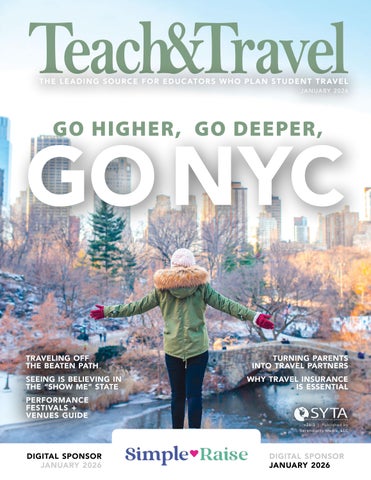
Teach&Travel THE LE A D I N G SOU RCE FO R E DUC ATO R S W H O PL A N S TU DE NT TR AVEL JA N UA R Y 2 0 2 6
GO HIGHER, GO DEEPER,
GO NYC TRAVELING OFF THE BEATEN PATH
TURNING PARENTS INTO TRAVEL PARTNERS
SEEING IS BELIEVING IN THE “SHOW ME” STATE
WHY TRAVEL INSURANCE IS ESSENTIAL
PERFORMANCE FESTIVALS + VENUES GUIDE
SYTA
S T U D E N T & Y O U T H T R AV E L A S S O C I AT I O N
v26 i3 | P u b l i s h e d by S e re n d i p i t y M e d ia, LLC
DIGITAL SPONSOR JANUARY 2026
DIGITAL SPONSOR T E JANUARY AC H T R AV E L .O R G2026 / S Y TA .O R G
1
2
T E AC H & T R AV E L M AG A Z I N E | JA N UA R Y 2 0 2 6
IN THIS ISSUE VOLUME 26 ISSUE 3 JANUARY 2026
PUBLISHER OF TEACH & TRAVEL SERENDIPIT Y MEDIA, LLC www.serendipity-media.com | (866) 252-7108
FE ATURES 12 GO HIGHER, GO DEEPER, Go NYC
20 SEEING IS BELIEVING THE TEAM K ASIE SMITH, President & Publisher KRIS BISCHOF, Sales & Marketing Manager
in the “Show Me” State
24 HEADING DOWN UNDER: Culture, Nature & Histor y in Australia and New Zealand
COURTNEY VAN HAGEN, Art Director CLAIRE CHAPIN, Graphic Designer JOSH VEAL, Editorial Manager HANNAH HOHMAN, Marketing Coordinator MEGAN MARSHALL, Accounting & Operations Specialist MAGGIE MUTCH, Communications & Event Coordinator
DEPAR TMENT S 6 STAYING EDUCATED Turning Parents into Travel Par tners
8 PROFILE Amy Harlan’s Capital Idea
YOUR MEDIA CONSULTANTS (866) 252-7108 K ARY MOENING, kary@serendipity-media.com LILY MUNDELL, lily@serendipity-media.com
10 SAFE TRAVELS Why Travel Insurance Has Become Essential for Student Group Trips
28 TRIP BEHAVIOR MEMBERS OF: AMERICAN BUS ASSOCIATION CIRCLE MICHIGAN NATIONAL TOUR ASSOCIATION ONTARIO MOTOR COACH ASSOCIATION STUDENT & YOUTH TRAVEL ASSOCIATION
SUBSCRIPTION INFORMATION Teach & Travel – The Official Publication of SYTA may be obtained by filling out the subscription card or calling 866-252-7108. Subscribe online at https://hello.teachtravel.org/teach-travel-subscribe. Teach & Travel is published bimonthly by Serendipity Media, LLC; 519 Ada Dr. SE, Ste 201, Ada, MI 49301. Subscription information may be obtained through the above address, by calling 866-252-7108, or by logging on to www.teachtravel.org.
Traveling Off the Beaten Path
30 EXPERIENCES How Carnegie Hall Transformed Our Orchestra
32 STUDENTS SPEAK Swimming with Survivors
NEWS + UPDATES 2 SYTA PRESIDENT’S LETTER 3 TRAVEL NEWS 4 DESTINATION UPDATES
POSTMASTER: Send address changes to Teach & Travel c/o Serendipity Media, LLC; 519 Ada Dr. SE, Ste 201, Ada, MI 49301.
SPECIAL SEC TION
All rights reserved. Teach & Travel content may not be photocopied or reproduced or redistributed without the consent of the publisher.
16 PERFORMANCE FESTIVALS + VENUES GUIDE
© 2026 Serendipity Media, LLC
T E AC H T R AV E L .O R G
/
S Y TA .O R G
1
N OT E | S Y TA P R E S I D E N T
BRENT IMRIE SYTA President Managing Director, Tour Time inspiresport New Zealand and Australia
K
Kia ora and greetings from Down Under. As someone who lives in this part of the world, with teams across New Zealand, Australia, and the United States, it is great to see NZ and Australia featured in this first issue of the year. This region offers an incredible range of student travel opportunities that go far beyond sightseeing, from exploring the Great Barrier Reef to high performance sports training, STEM and environmental science programmes, performing arts and music exchanges and deep cultural learning with Māori and Aboriginal communities. Educators and operators across New Zealand and Australia have been contributing to the global student travel landscape for many years. It is encouraging to see this part of the world highlighted alongside major North American destinations. The broader the range of experiences we showcase, the richer our industry becomes and the more meaningful the opportunities are for the students we all serve. In this first issue of 2026, we have our annual check-in with what’s new in New York City, a close look at the “Show-Me State” of Missouri, and an exploration of my home of New Zealand, as well as our neighbors in Australia. We also take a look at why travel insurance is so important, especially in the current climate after 2020, when the reality that anything is possible really set in. Plus: Tips on getting buy-in from parents to include them in the planning process, building anticipation and helping your trip run both smoothly and safely. If you’re involved in music education in any way, be sure to check out our Performance Festivals guide, highlighting festivals and venues across North America, and how you can be sure to get the most out of these experiences. As we begin 2026, I encourage you to keep expanding your view of what student travel can be. Whether your next journey takes your group to a coral reef, a concert hall, a science hub, a sports academy, or a cultural exchange on the other side of the world, every experience has the power to build confidence, curiosity, and global understanding. I look forward to working with all of you this year as we continue to strengthen SYTA’s reach and create safe, inspiring, and memorable opportunities for students across every corner of our industry. Ngā mihi.
S T R AT E G I C PA R T N ER S
PR E M I U M PA R T N E R S
2
T E AC H & T R AV E L M AG A Z I N E | JA N UA R Y 2 0 2 6
CO R P O R AT E PA R T N E R S
T H O U G H T L E A D E R PA R T N E R
TR AVEL NE WS
SYTA Youth Foundation
ROAD SCHOLARSHIP The SYTA Youth Foundation (SYF) established the Road Scholarship program in 2002 to award funds to youth who are unable to afford the cost of student group trips. Based on the belief that travel is essential for a complete education, it is SYF’s goal to make a positive difference, through travel, in the young lives of our global citizens. Since its inception, SYF has impacted more than 8,000 students. A Road Scholarship is financial aid granted to individuals or groups of five or more who have been nominated by a teacher or youth group leader and who meet criteria within five categories: ACHIEVEMENT • NEED • INITIATIVE/INVOLVEMENT • SERVICE/CITIZENSHIP • CONNECTION The grants are vetted and approved through the SYF Board of Trustees.
APPLICATION PERIOD: TRIPS AUGUST 2026 – FEBRUARY 2027 Application Opens Januar y 26, 2026 Application Closes March 27, 2026
TRIPS MARCH 2027 – AUGUST 2027 Application Opens September 21, 2026 Application Closes November 6, 2026
Announced the week of April 20, 2026
Announced the week of December 6, 2026
WH O C AN APPLY? Students in grades K-12 and 18 or younger at the time of travel will be considered. Nominations must be submit ted by an educator, program leader or designated school of ficial. Nominations submitted by parents or guardians will not be considered. H OW MUCH IS AWAR D E D? Up to $1,000 USD will be awarded to an individual and a maximum of $5,000 USD will be awarded to a group nomination. Nominations requesting an award higher than the maximum will not be considered.
FOR MORE INFORMATION, PLEASE VISIT: https://sytayouthfoundation.org/ road-scholarship
Questions, email info@sytayouthfoundation.org T E AC H T R AV E L .O R G
/
S Y TA .O R G
3
D E S T I N AT I O N U P DAT E S
RiseNY. Photo © Jeremy Daniel Photography
IN THE HEIGHTS For educators seeking an unforgettable field trip that blends learning with excitement, RiseNY stands out as a oneof-a-kind destination. This immersive experience takes students on a journey through New York City’s rich history, vibrant culture, and groundbreaking innovations—all under one roof. The adventure begins in a captivating museum-style exhibit where students explore the city’s evolution through engaging galleries on finance, fashion, music, television, and more. Each gallery offers interactive elements that bring lessons in history and the arts to life, sparking curiosity and conversation. The experience culminates in a breathtaking 4D, multi-sensory f lying ride that lifts students high above the skyline—soaring past landmarks like the Statue of Liberty, Central Park, and the Empire State Building. It’s a thrilling reminder of why New York remains an epicenter of creativity and ambition. With comprehensive lesson plans and an educational talkback series available, RiseNY offers a field trip that’s both inspiring and unforgettable—making it the perfect place for students to discover, dream, and rise. Book your trip at riseny.co.
RED WHITE & BLUE After officially claiming the title of “The Live Entertainment Capital of Missouri” in 2025, Branson aims to also become “The Most Patriotic Destination in America” in 2026 in honor of the 250th Anniversary of the United States. Though they can’t divulge all of their secrets just yet, this year is going to be packed full of patriotic celebrations. They even have their own Veterans Memorial
4
Museum, which is a national tribute to the American heroes who have served our country. The museum features over 2000 rare military artifacts that have been donated by veterans and their families. And if you’re looking for starspangled entertainment, Branson has you covered. With shows like Spirit of America at King’s Castle Theatre and Freedom Journey at Freedom Encounter, you can combine
T E AC H & T R AV E L M AG A Z I N E | JA N UA R Y 2 0 2 6
patriotic pride with unforgettable performances for a one-of-a-kind experience. Spring is also a fantastic time to head to the theatres in Branson, as March marks the beginning of a brand-new show season. The performers are refreshed after the winter break and excited to debut new songs, stunning costumes, and exciting choreography. Learn more about Branson at ExploreBranson.com.
Photo © Empire State Realt y Trust
THE FIGHT FOR FREEDOM The American Civil War Museum examines the causes, course, and consequences of the Civil War. Its award-winning exhibit, A People’s Contest: Struggles for Nation and Freedom in Civil War America features hundreds of original artifacts, dynamic theater experiences and compelling imagery. In Robins theater, the immersive short film emphasizes the most important outcome of the war—the abolition of slavery. Further adding to the experience is the site itself; the museum is built around the ruins of the Tredegar Iron Works and is situated across the street from the beautiful James River. Student programs provide an interactive means of exploring multiple topics: the Common Soldier, Medical Practices, and the Richmond Homefront. The Artifact Investigation Program encourages students to exercise their critical thinking skills as they discover lesser-known individuals from the past. The ACWM also operates the historic White House of the Confederacy, which served as the home of Confederate president Jefferson Davis. Educators guide students through two floors of the house, telling stories not only of the Davises but also of the enslaved and free servants who worked there and of President Lincoln’s visit. Learn more at acwm.org. LISTEN & LEARN For student groups exploring NYC, the prestigious New York Philharmonic is both electric and educational—offering group-friendly programming that ranges from enjoying a concert outing to working one-on-one with professionals. Traveling with a larger crew? The Philharmonic rolls out the red carpet for student groups: Generous Discounts: Save up to 20% on select performances. No Service Fees: Groups skip the
additional 12% in service fees. Priority Seating: Reserve seats before tickets go on sale to the public. Locked-In Pricing: Book early and protect your group from changing ticket prices. Flexible Planning: Adjust your reservation as needed up until final payment. Personalized Attention: Dedicated staff guide you through booking, seating, and recommendations. Looking for more? Check out the many educational offerings: Clinics: Philharmonic clinicians lead visiting ensembles through collaborative rehearsals—ideal for band, choir, or orchestra programs seeking hands-on growth. Pre-Concert Talks: Students explore repertoire, meet music professionals, and uncover what life in music careers really looks like. Post-Concert Q&As: Philharmonic musicians host lively conversations that let students ask questions, gain insight, and connect personally with the performers. Workshops for Pre-Professional Musicians: In two-hour workshops— with or without instruments— students work closely with Philharmonic musicians and guest professionals to strengthen technical and interpretive skills, ensemble performances, healthy habits, and strategies for teamwork. To make it happen, simply reach out to groupsales@nyphil.org.
MODERN MARVEL The Empire State Building Observatory Experience—voted the #1 attraction in New York City for the fourth consecutive year by Tripadvisor travelers—features an interactive museum with nine galleries and offers unmatched views from its iconic 86th and 102nd Floor Observatories. The reimagined Observatory Experience provides complimentary interactive lesson plans for student group visits to the building, in partnership with Bank Street College of Education. The curriculum follows New York State Learning Standards for STEAM (science, technology, engineering, arts, and mathematics) and social studies and features grade-appropriate learning plans and enrichment activities for elementary, middle, and high school students. Groups can continue to learn after their visit with ESB’s online education center. ESB invites approved choir groups of up to 60 members for iconic performa nces at the Obser vatory’s Gra nd Staircase, with a n electric pia no a nd music sta nd provided. Choir members will enjoy access to the immersive museum a nd 86th Floor Obser vatory included in their tickets. The Empire State Building Sales team provides tailored experiences for groups of all sizes and interests. Get in touch at esbnyc.com.
Photo © New York Philharmonic
T E AC H T R AV E L .O R G
/
S Y TA .O R G
5
S TAY I N G E D U C AT E D BY JOSH VE AL
TURNING PARENTS INTO TRAVEL PARTNERS
S
Student travel doesn’t happen without parents and legal guardians. Their trust, support, and partnership aren’t just nice to have—they’re the foundation that makes every trip possible. For many families, sending a child on a multi-day school trip (especially one out of state) brings a mix of pride, excitement, and nerves. It might be their student’s first time traveling without family, or even their first time away from home. That’s why the way you communicate with parents can make or break your trip’s success. Here are some tips for building that trust before, during, and after your adventure begins. PLANT THE SEEDS EARLY Start strong. As soon as the trip is approved, share clear, exciting information with families across every channel you can—your school website, newsletters, social media, letters home, and classroom announcements. Make sure parents know: » What the trip is » Why it matters » What you hope students will gain from it This early communication sets the tone and prepares families for the next step: the parent information meeting. HOST A PARENT INFO NIGHT THEY WON’T FORGET Nothing calms nerves and builds enthusiasm like an in-person meeting. This is your Shark Tank moment, a chance to show parents you’re both deeply knowledgeable and genuinely passionate about the experience you’re planning for their children. A memorable and inf luential parent night includes: » A warm welcome and introduction » The educational purpose behind the trip » Visuals—videos, photos, maps, student testimonials » Address potential “first time away” fears » Daily schedules and learning highlights » Safety protocols, supervision ratios, and emergency procedures » Fundraising options and payment timelines » Information about partners like your tour operator
6
T E AC H & T R AV E L M AG A Z I N E | JA N UA R Y 2 0 2 6
Photo © Adobe Stock
If possible, invite your tour operator to join you. They can confidently cover logistics, travel insurance, safety measures, finances, and more—reinforcing that families have a full team behind them. End your presentation with a Q&A. The goal isn’t to have all the answers immediately, it’s to show that you’re listening and that you take their concerns seriously. LEAD WITH SAFET Y AND STRUCTURE Safety has always been the top priority for student travel, but post-pandemic, parents think about it more than ever. Addressing it proactively shows families that you’re prepared and that you value transparency. Explain: » Chaperone-to-student ratios » Rooming arrangements and nightly check-ins » Behavioral expectations and curfews » Hotel security measures » Emergency contacts and communication plans » Any health or vaccination requirements » How medical situations will be handled If your group uses a communication tool like a trip app, highlight it early. Many parents find comfort in knowing they can access itineraries, hotel information, and realtime updates from their phone. BRING PARENTS INTO THE PROCESS Parents want to feel included, not kept at arm’s length. Beyond the informational meeting, consider ways to involve them in planning or preparation: » Recruit parent volunteers for fundraising or organizing » Ask for input on student needs, fears, and accommodations » Gather stories from past travelers to share with new families Remember, parents aren’t obstacles, they’re partners. You both want the same thing: A safe, transformative, joy-filled experience for their child.
T E AC H T R AV E L .O R G
/
S Y TA .O R G
7
PROFILE BY ALLISON K AY BANNISTER
T AMY HARLAN’S CAPITAL IDEA The eighth-grade trip to Washington, D.C. is a rite of passage for many students, creating memories that endure over decades. I was lucky enough to hop on a bus with my classmates roughly 40 years ago for just this experience. And, even today, when I hear a song from that time (one that was played though my Walkman headphones as I tuned the radio dial to the next city’s pop-rock station), I’m transported back to 1983. From Dorothy’s ruby slippers at the Smithsonian to burgers at the now-defunct Roy Rogers restaurant to the echoing halls of the capitol building… it all feels like yesterday. Amy Harlan knows all too well how much an excursion like this means to students. She’s one of Teach & Travel’s Traveling Teacher of the Year nominees for 2025, and she’s been the lead coordinator of the eighth-grade D.C. trip for East Jessamine Middle School in Nicholasville, Kentucky for several years.
8
T E AC H & T R AV E L M AG A Z I N E | JA N UA R Y 2 0 2 6
Like many of the teachers we’ve talked with, Harlan didn’t start out in the field of education. After completing her degree in Public Relations and Advertising, she joined the State Attorney’s Office in Florida, where coworkers encouraged her to pursue a career working with children. She went on to receive a Master of Arts in Teaching with a focus in Middle Grades Language Arts, and has taught in Florida, West Virginia, and now Kentucky, ever since. She says when she decided to become a teacher, everything clicked. “It just felt natural. It let me be who I was without trying to forge a path. It felt good, it felt right, and it was everything I expected the dream to be.” When Amy started at East Jessamine Middle School, she taught eighth grade, and was given the reins of planning the D.C. trip after the previous planner left and COVID restrictions were lifted. Even since switching to teaching sixth grade a couple of years ago, she’s still at the helm.
Photos © Amy Harlan
The school had been facilitating the D.C. trip for decades, so it wasn’t new to them. But, starting over after 2020, they needed to put their heads together to decide what it would look like going forward. They researched travel companies and took into consideration what their priorities were. Finding the right travel company turned out to be key, and the relationship Amy has formed over time with the travel company coordinator, Iris Keogh with Grand Classroom, has made it all the more valuable. While previous trips were two nights and three days, they’re now four nights and five days, providing a more comprehensive offering. “It’s like a Griswold trip,” Amy says. “We stop at everything, getting up early and arriving back to the hotel late. We walk upwards of 10 miles a day. It’s not an easy trip, by any means. But students feel really good about what they’ve experienced— even walking away from the trip a whole different person, which is pretty cool.” As Amy says, it isn’t easy. But, the more she plans ahead of time and expects the unexpected, the smoother everything goes—even through the mishaps, struggles, and frustrations. That planning isn’t just the itinerary, hotel, transportation, lodging, and meals; it’s about preparing the kids ahead of time. “We talk about how to deal with money, how to order food, how to be nice to your waitresses, even how to interact with docents at museums,” she says. “Just how to do life as an adult.” When students arrive, they aren’t thrown to the wolves. They know how to advocate for themselves, and few challenges come as a surprise. In turn, they get to see firsthand how their actions can have consequences, and how their experience can be enhanced just by their behavior. Being respectful and personable had earned Amy’s school groups once-in-a-lifetime opportunities on more than one occasion, including being able to participate in ceremonies at Arlington National Cemetery or have more in-depth conversations with the Sentinels who guard the Tomb of the Unknown Soldier. These have been some of the more memorable aspects of past trips, and they only happened because she or another member of the group had the gumption to ask. “Those were really pivotal moments for me,” Amy says. “They demonstrated
to my students that this is why you’re kind; this is why being conscientious, engaged, and determined matters.” For Amy, one of the more gratifying parts of taking these trips is seeing the students not just become individuals, but well-traveled individuals. At around age 14, they’re only a few years from being an adult—and what better way to set them up for success and independence than visiting new places and trying new things. “These trips are a stepping stone to getting out of their comfort zones, and getting out of our small, rural area,” she says. “And, just seeing something different and what life has to offer. For a lot of kids, they don’t know what’s out there, and to be the person to bring that to them is rewarding in and of itself.” And, that’s the last takeaway from our conversation: It requires a certain type of personality to put these trips together, as well as a lot of after-hours, unpaid time and teamwork with other school staff. While that’s not said as a deterrent, it is worth noting that it’s not for everyone. “These kids could go on a trip with a lot of different people, and their experience could be very different, depending on who coordinates,” Amy says. “I think that’s a big part of it. Knowing that the parents trust that you are going to provide safety and guidance is a responsibility and honor I don’t take lightly.”
T E AC H T R AV E L .O R G
/
S Y TA .O R G
9
SA FE T R AV E L S BY JOSH VE AL
WHY TRAVEL INSURANCE HAS BECOME ESSENTIAL FOR STUDENT GROUP TRIPS
A NEW STANDARD FOR GROUP TRAVEL For group travel, the conversation around insurance becomes even more important. Operators often communicate with a single organizer rather than every individual participant, which means the organizer’s personal stance on insurance can unintentionally inf luence dozens of travelers. We believe at this point in time, insurance should always be strongly encouraged. Pa rents a nd gua rdia ns appreciate knowing their student is protected, a nd it may be easier to get buyin on the trip when they know they have a n easy a nd affordable out. Travel insurance also delivers far more than just cancellation protection. Today’s plans often include:
I
In today’s travel landscape, insurance has transformed from a nice-to-have add-on into a necessity especially for student groups. Over the last few years, countless students have faced the heartbreak of canceling a long-awaited trip at the very last moment due to a positive COVID test, a family emergency, or an unexpected disruption. But those with solid travel insurance often received refunds for nearly every penny of their investment. “Nonrefundable” deposits, airfare, hotel stays, rental vehicles, tours—all covered. Before the pandemic, most travel insurance policies didn’t touch epidemics or pandemics. But after the tidal wave of cancellations in 2020, the industry pivoted. Today’s plans are far more comprehensive, with many providers offering robust COVID-related protections as well as the fan-favorite Cancel For Any Reason (CFAR) coverage. For parents hesitant about sending their kids across the country or globe, this assurance goes a long way. This shift ref lects a larger trend: Travelers want to protect their investment, especially if they’re planning international travel or other particularly involved/costly trips. One NerdWallet survey showed that before COVID, only 20% of U.S. travelers insured their leisure trips. Postpandemic, that number more than doubled.
10
T E AC H & T R AV E L M AG A Z I N E | JA N UA R Y 2 0 2 6
» Medical Protection: If a student becomes ill or injured, especially abroad, families could face steep upfront medical bills. Insurance helps bridge that gap. » Lost Bags or Theft: Policies can reimburse the cash value of lost or stolen items and cover fees to replace essentials like passports and credit cards. » Travel Assistance Services: 24/7 support can help locate medical facilities, track lost luggage, coordinate transportation, and more. » Interruption Coverage: If a student has to leave the trip early for any reason (or, even worse, the whole excursion comes to an end), this coverage keeps you from paying for experiences you never had. » Inconvenience Coverage: With attractions sometimes closing without warning, some plans offer “Inconvenience Bundles” that reimburse travelers for missed experiences. These expanded offerings—and the addition of illnessrelated cancellation and interruption coverage—have made many previously hesitant travelers far more confident in booking trips again.
Photo © Adobe Stock
GUIDANCE FOR TRIP LEADERS With traveler expectations rising, travel planners must also be cautious when explaining insurance coverage. Just like professional liability policies, travel insurance can sometimes have exclusions and limits that are tricky to interpret. To avoid giving incorrect or misleading advice, direct families to the insurance provider for detailed questions. But also remember, some insurance providers are more transparent, with more comprehensive coverage than others.
Mea nwh i le, educ ators a nd t r ip leaders c a n help bu i ld con f idence long before depa r t u re. W hen en rol l i ng st udents, d isc u ss i nsu ra nce opt ions upf ront, prov ide ea sy-to-read m ater i a ls t h at out l i ne coverage benef its, a nd emph a si z e how i nex pensive i nsu ra nce is compa red to t he tot a l cost of t he t r ip. T hese conversat ions reduce con f u sion, c a l m pa rent a n x iet ies, a nd help avoid t he f ra nt ic ref u nd requests t h at overloaded i nboxes back i n 2020.
T E AC H T R AV E L .O R G
/
S Y TA .O R G
11
U N I T E D S TAT E S | N e w Yo r k C i t y
GO HIGHER, GO DEEPER, GO NYC I
If your students could travel anywhere in the world to learn, explore, and have a blast doing it, New York City might just top the list. It’s the perfect place to expand their worlds in a huge way, with hundreds of skyscrapers all around, a vast tapestry of different cultures woven together, famous museums sparking big conversations, and best-in-class arts performances across dozens of stages. The city is buzzing with new views, new exhibits, and new ways for students to experience its legendary energy. Here’s what’s waiting for you in the City That Never Sleeps.
12
T E AC H & T R AV E L M AG A Z I N E | JA N UA R Y 2 0 2 6
Photos: Summit One Vanderbilt, Mercer Labs Museum of Ar t & Technology, Intrepid Sea, Air & Space Museum
BY JOSH VE AL
START AT THE TOP: NYC’S BEST VIEWS There’s no better introduction to the city than seeing it from above. Top of the Rock remains a classic, offering three levels of sweeping open-air decks at the pinnacle of Rockefeller Center, with the Skylift experience elevating guests a thrilling three stories higher for an unbeatable 360-degree perspective. Students can also step onto The Beam, rising 12 feet above the deck to recreate the famous “Lunch atop a Skyscraper” photo. For another unforgettable angle, One World Observatory places visitors atop the tallest building in the Western Hemisphere. Interactive displays, panoramic digital guides, and f loor-to-ceiling windows help student groups connect with the city’s past, present, and future—all from 102 stories up. Looking for a viewpoint that doubles as an adventure? Edge NYC in Hudson Yards is the highest outdoor sky deck in the United States, complete with a glass f loor that lets students peer 100 stories down. Over on 42nd Street, Summit One Vanderbilt transforms the skyline into a mirrored, multi-sensory world, where ref lections, art installations, and views blend together into a surreal exploration of height and light. And of course, the Empire State Building Observatory still stands tall as one of the world’s most iconic towers. With restored Art Deco interiors and observatories on the 86th and 102nd f loors, it’s a skyscraper story students won’t forget.
IMMERSIVE LEARNING & CIT Y WIDE FAVORITES RiseNY continues to be a student favorite, blending an uplifting f light-simulator ride with seven interactive galleries focused on New York’s cultural impact—from Broadway and finance to fashion and TV. Nearby, the Intrepid Sea, Air & Space Museum anchors history on the Hudson River, inviting groups onto the expansive USS Intrepid, which is home to dozens of military aircraft, the Space Shuttle Enterprise, a newly installed World War II FG-1D Corsair fighter-bomber, a Cold War-era submarine, and more! At Mercer Labs Museum of Art & Technology, students dive into futuristic worlds through VR, AI installations, kinetic sculptures, and digital storytelling. Hands-on workshops help them turn inspiration into experimentation. And at the American Museum of Natural History, the spectacular Richard Gilder Center is now open, featuring a soaring atrium, 3,000 collection objects, an expansive insectarium, and the state-ofthe-art Museum Library & Learning Center.
T E AC H T R AV E L .O R G
/
S Y TA .O R G
13
U N I T E D S TAT E S | N e w Yo r k C i t y
BY SEA AND SKY For groups ready to stretch their legs, the Statue of Liberty Crown has reopened, bringing back the bucket-list climb of 162 steps for stunning harbor views. Pair the visit with the Ellis Island National Museum of Immigration, where interactive exhibits illuminate the journeys of millions of people who helped shape the nation. Or, take to the water aboard a Circle Line or Liberty Cruise sightseeing tour. It’s a memorable way to learn about the city’s history from passionate local guides. ARTISTIC ICONS: MUSEUMS, MUSIC, & MORE A New York arts experience can be transformative, and the city’s institutions make it easy for students to connect across time, culture, and creativity. The Museum of Modern Art (MoM A) dazzles with six f loors of iconic masterpieces, hands-on spaces like the Creativity Lab, and affordable student pricing. Across Central Park, The Metropolitan Museum of Art remains one of the world’s greatest encyclopedic museums—and its renovated Michael C. Rockefeller Wing has become a standout destination. The reimagined galleries spotlight extraordinary art from Africa, Oceania, and the ancient Americas, making it an essential stop for global cultural understanding. For a taste of the performing arts, a night at The Met Opera immerses students in some of the world’s most powerful music and storytelling—whether attending a classic epic like La Bohème or a contemporary production designed to inspire new audiences. And Carnegie Hall, Radio City Music Hall, Grand Central Terminal, the Tenement Museum, and more offer endless ways to explore New York’s artistic history and architectural heritage.
14
T E AC H & T R AV E L M AG A Z I N E | JA N UA R Y 2 0 2 6
Photos: Sohrab Hura. The Coast. 2013 -2019. Archival pigment prints. Installation view of Sohrab Hura - Mother. © The Museum of Modern Ar t | Back to the Future. © Mat thew Murphy & Evan Zimmerman | Ar t of Score. © New York Philharmonic | NYC Ballet
LIVE PERFORMANCES: FROM PHILHARMONIC TO BROADWAY The legendary New York Philharmonic, the oldest symphony orchestra in the nation, presents a full season of concerts ranging from classical cornerstones like Dvořák’s Seventh to cinematic favorites such as Star Wars: The Empire Strikes Back in Concert. Groups of 15+ can access helpful benefits like waived fees and discounted tickets. New York City Ballet continues its mission of innovation, presenting more than 70 winter and spring performances — from Balanchine classics to modern choreographic showcases. And then there’s Broadway: booming with energy, packed with new hits like The Outsiders, Water for Elephants, and & Juliet, alongside blockbusters including Hamilton, Chicago, The Lion King, Aladdin, and more. Groups looking to dive deeper can book a workshop through Broadway Inbound, where working professionals lead educational sessions in dance, music, tech, and behind-the-scenes theater magic. SPORTS & CULTURE BEYOND THE CIT Y Academics aren’t the only way to learn on the road—sports can be a powerful cultural experience, too. Baseball-loving students can visit the National Baseball Hall of Fame and Museum in Cooperstown, just a day trip from NYC. Exhibits highlight legendary players, historic moments, and the evolution of the sport. Back in the city, nothing beats the thrill of attending a New York Mets or New York Yankees game. Whether sitting in the bleachers or touring the ballpark, students get an unforgettable look at America’s pastime in its most iconic setting.
T E AC H T R AV E L .O R G
/
S Y TA .O R G
15
SPECIAL SECTION
PERFORMANCE FESTIVALS + VENUES GUIDE Music festivals, are they wor th the ef for t? They can be some of the ver y best moments in shaping the musical development of students, as well as personal growth as an educator. Most festivals are sponsored by their state music education associations. These festivals allow groups the oppor tunity to progress through a tiered system, based on the outcome of their per formance rating or score. Of ten, a group will per form at a district level, then move on to the state level or they per form at preliminaries (prelims) and ultimately can have a chance to per form at finals.
7 WAYS FESTIVALS BENEFIT YOUR PROGRAM • Sharpen your students’ ability to sight read both as an individual and as par t of an ensemble. • Expose your program members to new literature and styles that they will likely fall in love with as they work towards the festival per formance experience. • Allow your students to see and hear their peers perform from across their district, state, region and potentially the nation. • Visit new destinations your students other wise may not have the oppor tunity to see. • Challenge each individual performer to enhance their technique, ar tistr y, and musicality. • Enable you with a rare opportunity to observe your peers in action and take inspiration for your program and teaching style. • Bring you, your students, and supporters closer together as a per forming fine ar ts community. If you have a younger, less experienced group, we recommend approaching your first festival more as a ‘discovery’ opportunity. Some festivals will allow your group to attend and perform for ‘comments only’, allowing you and your students to receive constructive critique without the pressure of scores from the adjudicators (judges). This way, everyone can relax and focus on enjoying the overall learning experience without undue pressure.
16
T E AC H & T R AV E L M AG A Z I N E | JA N UA R Y 2 0 2 6
6 TIPS TO ENHANCE FESTIVAL PERFORMANCE, ENJOYMENT, AND GROWTH • Consider starting with a local festival event to simplify fundraising and travel logistics. You also might consider combining with another music program at your school to optimize costs as well as planning and chaperone resources. • Prepare students to focus more on the music performance aspect of the festival experience, rather than just the score. Teach them ratings are an impor tant par t of the development journey, not a final judgment on their total abilities as a musician. • Select pieces that will challenge students to grow beyond their musical comfort zone. Literature choices should be well rounded for the individual and the ensemble —not an attempt to impress the adjudicators with composer notoriety and dif ficulty. • Schedule reflection time with your students post festival. Play back the per formance if the recording is
Photo © Adobe Stock
available plus ask them about the overall experience and discuss with you and each other what worked well and what could be even better the next time.
PERFORMANCE FESTIVALS + VENUES GUIDE ACCENT PERFORMANCES (708) 560-1431 www.accentperformances.com
CHOIRS OF AMERICA (970) 325-2500 www.vocalmusic.org
ALABAMA THEATRE (843) 272-5758 x4410 www.alabama-theatre.com
COUNTRY MUSIC HALL OF FAME & MUSEUM (615) 291-6746 www.countrymusichalloffame.org
• Communicate the success of your students’ festival performance. Brag on both the performance achievements AND learning journey successes to the school, district and community-at-large.
ANDREW JACKSON’S HERMITAGE (615) 889-2941 www.thehermitage.com
• Educate your students, parents, and other community stakeholders on the true meaning of the festival rating/scoring system. Help them understand that the score is just one assessment element in their student’s learning journey. Emphasize the positive growth experiences along with the honors and skill achievements the individuals and ensemble received at the festival.
ANNAPOLIS TOURS & CRUISES BY WATERMARK (410) 268-7601 x200 www.watermarkjourney.com
It’s pure joy to witness individual and ensemble growth through a festival experience. What are you waiting for? Make festivals your best friend ever! A well-suited festival experience will help you accelerate your student’s progress towards their goals. Your administrators/district leaders will see that success and excitement emanating from your program. It’s a win-win!
WRIT TEN BY JEFF DODD. Jeff Dodd is a retired educator from St. Johns County, Florida, where he taught band, choir, color guard/winterguard, piano, and musical theatre for 30+ years. He is now a Customer Education Specialist with CutTime and Simple Raise.
ANIMADO EVENTS (407) 345-4899 www.animadoevents.com
AT TR ACTIONS4US & MIAMI BOAT CRUISE (212) 512-0515 www.attractions4us.com BALTIMORE SYMPHONY ORCHESTR A (410) 783-8071 www.bsomusic.org BILLY GR AHAM LIBR ARY (704) 401-3200 billygrahamlibrary.org BILTMORE (828) 225-1400 www.biltmore.com BOSTON BALLET (617) 456-6366 bostonballet.org/groups BOSTON RED SOX (617) 226-6423 www.redsox.com/tours BOSTON SYMPHONY ORCHESTR A & BOSTON POPS (617) 638-9348 www.bso.org BR ANSON’S IMAX ENTERTAINMENT COMPLEX (417) 335-3533 x135 www.bransonimax.com BOCH CENTER (617) 532-1114 www.bochcenter.org CARNEGIE HALL (212) 903-9705 www.carnegiehall.org
CIRQUE DU SOLEIL ENTERTAINMENT GROUP (702) 481-0673 www.cirquedusoleil.com CLAY COOPER THEATRE (417) 337-7123 claycoopertheatre.com COLONIAL WILLIAMSBURG FOUNDATION (800) 228-8878 www.colonialwilliamsburg.org DANCE THE MAGIC! (714) 315-3632 www.dancethemagic.com DISNEY IMAGINATION CAMPUS (321) 230-9455 www.disneycampus.com DISNEY ON BROADWAY (212) 703-1040 www.disneytheatricalsales.com DOLLY PARTON’S STAMPEDE (865) 505-3320 www.dpstampede.com/pigeon-forge/groups-information DOLLY WOOD (865) 428-9674 www.dollywood.com DR. PHILLIPS CENTER FOR THE PERFORMING ARTS (407) 455-5550 www.drphillipscenter.org EPN TR AVEL SERVICES (888) 323-0974 www.epntravel.com FLORIDA FILM ACADEMY LLC (407) 782-4302 www.flfilmacademy.com FORUM MUSIC FESTIVALS / FORUM EDUCATIONAL TR AVEL (888) 763-6786 www.forummusicfestivals.com GATEWAY MUSIC FESTIVALS & TOURS (800-331-8579) www.musicfestivals.com
T E AC H T R AV E L .O R G
/
S Y TA .O R G
17
SPECIAL SECTION
GR ACELAND & GUEST HOUSE AT GR ACELAND (800) 238-2010 www.graceland.com GR AND OLE OPRY ENTERTAINMENT GROUP (615) 882-5451 www.opry.com/groups HARMONY TOURS / CHOIRS OF AMERICA / HARMONY PRODUCTIONS (800) 284-2177 www.Go2Harmony.com INTREPID MUSEUM (212) 381-5010 www.intrepidmuseum.org KINGS DOMINION (804) 449-0143 bit.ly/syta-kd KINGS ISLAND (513) 754-5733 bit.ly/syta-ki KNOT T’S BERRY FARM (714) 200-5147 bit.ly/syta-kbf LEGENDS AT TR ACTIONS (323) 376-8944 www.legends.net/global-attractions MANHAT TAN CONCERT PRODUCTIONS (212) 279-1147 www.mcp.us MEDIEVAL TIMES ENTERTAINMENT, INC. (469) 342-5055 www.medievaltimes.com MIRVISH PRODUCTIONS (800) 461-3333 www.mirvish.com MUSIC FESTIVALS & TOURS / MUSIC SHOWCASE FESTIVALS (800) 545-0935 www.musfestivals.com MUSIC USA (800) 654-3018 www.MusicUSA.org NATIONAL CONCERTS (917) 580-3020 www.nationalconcerts.com NEW YORK PHILHARMONIC (646) 661-1585 www.nyphil.org
18
NIAGAR A PARKS (905) 356-2241 x2219 www.niagaraparks.com O MUSEUM IN THE MANSION - THE SECRET DOOR MUSEUM (202) 496-2070 www.omuseum.org ORLANDO MAGIC (407) 916-2495 www.orlandomagic.com ORLANDOFEST, LLC (407) 770-5969 www.orlandofest.com PAR ADOX EXPERIENCE LAS VEGAS (702) 545-8502 www.lasvegas.paradoxexperience.com PACIFIC SYMPHONY (714) 755-5788 www.pacificsymphony.org PATRIOTS POINT NAVAL & MARITIME MUSEUM (843) 881-2727 www.patriotspoint.org/visit/groups PERFORMING ARTS CONSULTANTS FESTIVALS & TOURS (732) 475-6200 www.usafest.org PIER 39 (415) 705-5511 www.pier39.com ROCK THE BOAT CRUISES (407) 654-2500 www.rocktheboat-cruises.com RON JON SURF SHOP (321) 799-8880 x1048 www.ronjonsurfshop.com SEGERSTROM CENTER FOR THE ARTS (714) 755-0236 www.scfta.org SHAW FESTIVAL THEATRE (905) 468-2153 x2220 www.shawfest.com SILVER DOLLAR CIT Y / SHOWBOAT BR ANSON BELLE (417) 336-7170 www.silverdollarcity.com SIX FLAGS ENTERTAINMENT CORPOR ATION (704) 248-3114 www.sixflags.com/youth
T E AC H & T R AV E L M AG A Z I N E | JA N UA R Y 2 0 2 6
SMOK Y MOUNTAIN RESORTS / LIBERT Y RECEPTIVE TOURS (865) 908-3015 www.smokymountainresorts.com ST. LOUIS SYMPHONY ORCHESTR A (314) 286-4155 www.slso.org TENNESSEE PERFORMING ARTS CENTER (615) 782-4060 www.tpac.org THE ISLAND IN PIGEON FORGE (865) 441-0130 www.islandinpigeonforge.com THE METROPOLITAN OPER A (212) 362-6000 www.metopera.org TITANIC MUSEUM AT TR ACTION (800) 381-7670 www.titanicbranson.com TOBY’S DINNER THEATRE OF COLUMBIA (410) 730-8311 www.tobysdinnertheatre.com UNIVERSAL DESTINATIONS & EXPERIENCES (321) 436-4160 www.universalyouthprograms.com US SPACE AND ROCKET CENTER, HOME OF SPACE CAMP (256) 721-5432 www.rocketcenter.com VALLEYFAIR (952) 496-5338 bit.ly/syta-vf VIRGINIA ARTS FESTIVAL (757) 282-2819 www.vafest.org WORLDS OF FUN / OCEANS OF FUN (816) 454-4545 bit.ly/syta-wof
T E AC H T R AV E L .O R G
/
S Y TA .O R G
19
NORTH AMERICA | Missouri
20
T E AC H & T R AV E L M AG A Z I N E | JA N UA R Y 2 0 2 6
Photos: Berlin, Dresden, Munich | © Adobe Stock
SEEING IS BELIEVING F From baseball to barbecue, amusement parks to aquariums, monuments to museums, there are so many reasons to visit the Midwest state of Missouri. Each major city (and smaller ones, too!) has its own draw, with a variety of attractions to suit every student interest. Here we’ve covered the highlights. St. Louis is not only home to the famed Gateway Arch, it also hosts MLB’s Cardinals at Busch Stadium, a Six Flags theme park, and much more. Get started at City Museum, an artist-built playground and museum. Part funhouse, part architectural wonder, it has tunnels, slides, sculptures, installations, and interactive exhibits—plus a new fourth-floor labyrinth. It’s a “must-do” for student groups. Continue the excitement with thrill rides at Six Flags St. Louis, or head to Union Station, which is nothing short of an amusement park in itself. It has a 200-foot-tall Ferris wheel, carousel, rollercoaster, ropes course, mirror maze, and an abundance of dining options. Also on site is St. Louis Aquarium. A stop to view the Gateway Arch should be on any itinerary, and one of the best ways to take it all in is with a sightseeing or educational cruise aboard a riverboat. There’s also a tram ride to the top of the arch where there’s an observation deck. Combo tickets for a river cruise and tram ride are available, allowing student groups to experience the landmark from all angles. Another popular St. Louis destination is Forest Park. On the grounds of this 1,326-acre, nearly 150-year-old park is the Saint Louis Zoo, Missouri History Museum, Saint Louis Art Museum, Saint Louis Science Center, and The Muny (the Municipal Opera), the oldest and largest outdoor musical theatre in the U.S. And, keeping in the music theme, there’s also St. Louis Symphony Orchestra (SLSO), where students can enjoy a concert or performance, as well as tap into SLSO’s extensive education-focused programming. Before leaving St. Louis, be sure to stop at Ballpark Village, right across the street from Busch Stadium. This sports, entertainment, and dining district welcomes student groups and offers studentfriendly meal packages, public spaces for band and choir performances, and a number of events and shows. Located amid the Ozark Mountains, Branson has earned the title of “Live Entertainment Capital of Missouri.” Among the top student activities is a visit to Silver Dollar City. This 1880s-style theme park features rides, family-friendly live shows, seasonal festivals, and a crafts colony with artist demonstrations, such as pottery throwing, glass blowing, blacksmithing, candy and candle making, and leatherworking—to name a few.
BY ALLISON K AY BANNISTER
IN THE “SHOW ME” STATE
Aquarium at the Boardwalk is also a Branson favorite. It has 250-plus marine species, a walk-through coral reef tunnel, and interactive exhibits all within a building topped with an awe-inspiring 55-foot-tall, 34-ton stainless steel octopus sculpture. And, stay within the water theme by stopping at the Titanic Museum Attraction and traveling back to 1912. There are full-scale replicas of the ship’s grand rooms and more than 400 real artifacts, plus the opportunity to touch an iceberg and receive a boarding pass of an actual passenger.
T E AC H T R AV E L .O R G
/
S Y TA .O R G
21
NORTH AMERICA | Missouri
At WonderWorks, students will find a blend of science and imagination, with hands-on experiments and journeys into space, physics, and illusion. An indoor amusement park for the mind, it’s filled with engaging S.T.E.A.M. “edu-tainment.” For more indoor play, check out Fritz’s Adventure. From rock climbing and ziplining to tunnels, slides, and ropes courses, Fritz’s combines fitness with fun. For mostly outdoor activity, visit one—or all—of Branson’s Track Family Fun Parks. There are three locations in the city, and each has high-rise go-kart tracks as the main appeal, as well as a selection of other pursuits depending on the park. These include bumper cars and boats, thrill rides, mini golf, arcade games, laser tag, a spinning coaster, and a Ferris wheel. They have special group pricing both for All-Day Passes and 2-Hour Wristbands, exclusive add-ons and packages, and a kid-centric catering menu. Next stop, Kansas City! Widely regarded as the barbecue capital of the world, it has more than 100 barbecue restaurants, with the cuisine’s history dating back to the early 1900s. Aptly, there’s a Museum of BBQ where students can learn about the elements that go into making barbecue, as well as the diverse regional f lavors that extend well beyond Kansas City into Texas, Memphis, and the Carolinas. After exploring the museum, be sure to jump in the giant bean pit and finish the experience with lunch at one of the many Crown Center BBQ eateries. Also in the Crown Center district is Science City at Union Station, with 92,000 square feet of hands-on learning.
22
T E AC H & T R AV E L M AG A Z I N E | JA N UA R Y 2 0 2 6
From there, get immersed in yesteryear at the city’s top museums and memorials. Located in Independence, a nearby suburb of Kansas City is Harry S. Truman Presidential Library & Museum. Recently renovated, it covers Truman’s life, legacy, and role in several monumental moments in U.S. history, and houses thousands of pieces of memorabilia, important educational exhibits, and immersive theaters. In addition, there’s the National WWI Museum & Memorial—the only American museum dedicated solely to preserving the objects and history of World War I. Celebrating its 100th anniversary in 2026, its recently underwent a transformation of all the exhibits and galleries, and features the new Encounters exhibit with cutting-edge visual storytelling of first-person accounts of WWI events. Last stop, the Negro Leagues Baseball Museum and American Jazz Museum. Adjacent to one another in the 18th & Vine Historic District complex and sharing a lobby, they represent two of the city’s most acclaimed museums. At the Negro Leagues Baseball Museum, students can learn about the players and stories of the league, which originated after the Civil War and ended in the 1960s. The American Jazz Museum celebrates jazz as an original American art form and seeks to expand awareness and appreciation through listening stations, touchscreens, and custommixing soundboards.
Finally, there’s Hermann, Missouri. Not to be to be outdone by the state’s more recognized cities, this destination is known for its German heritage, festivals, architecture, and scenic views along the Missouri River. Of particular interest are Historic Hermann Museum; Deutschheim State Historic Site, an early Missouri settlement with restored 1840s and 1850s buildings; and Hermann Farm, which offers carriage rides with Shire horses and self-guided tours to see historic homes, barns,
and equipment. For a sweet treat after a day of exploration, hit up Sugar Momma’s dessert and candy shop, Ricky’s Chocolate Box, or Downtown Deli & Custard Shoppe. Or, blow off steam with the arcade games and pinball machines at Kugelblitz Gaming. Need souvenirs or want to shop books, gifts, and puzzles? Finish your trip at Chapter 3 bookstore.
T E AC H T R AV E L .O R G
/
S Y TA .O R G
23
I N T E R N AT I O N A L | A u s t r a l i a / N e w Z e a l a n d
HEADING DOWN UNDER:
CULTURE, NATURE & HISTORY IN AUSTR ALIA AND NEW ZEAL AND
F
For student groups with a hunger for hands-on, horizon-widening experiences, Australia and New Zealand deliver adventure on a cinematic scale. From turquoise seas to rainforests, outback legends, Māori cultural encounters, and cities stacked with modern marvels, a journey to Oceania blends environmental education, Indigenous history, outdoor discovery, and truly unique thrills unlike anywhere else. Here’s a look at just a small sampling of the many, many standout stops that bring learning to life Down Under.
24
T E AC H & T R AV E L M AG A Z I N E | JA N UA R Y 2 0 2 6
Photos © Adobe Stock
BY ALLISON K AY BANNISTER
AUSTRALIA Start in Cairns, a haven of sunshine, salt air, and tropical landscapes. Stroll the Cairns Esplanade, where open-air art, tidal pools, and broad boardwalks set the perfect stage for group downtime. Wander Wharf Street, lined with bustling cafés and waterfront views that shimmer pink at sunset. You can also venture out to the jungle-surrounded Crystal Cascades, a series of hidden waterfalls where students can study tropical ecosystems and soak their feet in cool mountain water. No science classroom can match the electric wonder of the Great Barrier Reef. Students can snorkel or cruise over kaleidoscopic coral gardens teeming with sea turtles, parrotfish, giant clams, and schools of shimmering silver. Marine educators help break down reef ecology, conservation efforts, and the delicate balance this UNESCO giant depends on. It’s an unforgettable lesson in environmental stewardship. In Brisbane, students can explore lush riverside parks, Indigenous cultural sites, and science-forward museums. Head north to the Sunshine Coast for surf lessons, tranquil beaches, and wildlife encounters—ideal for groups craving a blend of city and sea. Few cities embody Australia’s energy like Sydney. Here, groups can: Step inside the legendary sails of the Sydney Opera House, discovering backstage secrets and bold architectural engineering. Walk across the Sydney Harbour Bridge, an iconic image of Australia, taking in spectacular 360-degree views and learning more about the city’s history. Explore The Rocks, Sydney’s oldest neighborhood, with cobblestones and colonial-era buildings housing historic tales of early settlement. Wander through the lush Royal Botanic Gardens, studying native plants that have shaped Indigenous knowledge for thousands of years. Visit the Hyde Park Barracks Museum, a UNESCO site that illuminates convict life and Australia’s early penal system founded in British colonialism. Hop on a habour ferry to visit Taronga Zoo, home to over 5,000 animals of approximately 350 species across 69 acres, situated right in the harbor with lovely views.
Just outside Sydney, the Blue Mountains sweep outward with a stunning eucalyptus forest. Students can trek to scenic lookouts, study the region’s unique sandstone geology, and learn about the cultural significance of this landscape to the Dharug and Gundungurra peoples. In Australia’s capital city, Canberra, you’ll find a plenty of standout educational stops, including: The National Arboretum, a living museum featuring rare and endangered tree species from around the world— perfect for biology and sustainability-focused groups. The National Dinosaur Museum, home to fossils, skeletons, and interactive exhibits diving into Australia’s prehistoric giants. The Australian Institute of Sport, where students can step inside world-class training facilities and learn what it takes to become an elite athlete. Heading north, you’ll arrive in adventure-filled Queensland, where students can discover desert plains, star-filled skies, and the beautiful Gold Coast. The Qantas Founders Museum explores the birth of Australia’s iconic airline, complete with historic aircraft students can walk through. At the Australian Age of Dinosaurs, groups can examine real fossils and learn about some of the world’s most significant dinosaur discoveries. The Waltzing Matilda Centre—dedicated to Australia’s unofficial national song—brings music, folklore, and outback heritage to life. For a touch of adventure, climb to Captain Starlight’s Lookout, a legendary bushranger hideout offering sweeping views of red earth and endless sky.
T E AC H T R AV E L .O R G
/
S Y TA .O R G
25
I N T E R N AT I O N A L | A u s t r a l i a / N e w Z e a l a n d
NEW ZEALAND Adventures in New Zealand often start in its largest city, Auckland, which blends urban energy with natural beauty. Students can study volcanic craters, visit waterfront museums, explore Polynesian heritage, and wander vibrant neighborhoods that ref lect the multicultural identity. In Rotorua, geothermal wonders meet living Māori culture. Steam vents hiss from the earth, boiling mud pools bubble, and geysers erupt. Visits to Māori cultural centers offer students insight into traditional carving, storytelling, and welcoming ceremonies. Queenstown is famous for delivering high-adventure energy. Groups can dive into hands-on geography and environmental science while cruising Lake Wakatipu, explore Māori history and culture through local storytellers, or take in panoramic alpine vistas via gondola ride. Plus, jet boating, ziplining, and scenic hikes that spark curiosity. In the Bay of Islands, Paihia invites groups to wander sandy beaches, cruise to historic islands, and visit the Waitangi Treaty Grounds—one of New Zealand’s most important historical sites, pivotal to the nation’s founding.
Located in Wellington, Te Papa is New Zealand’s national museum and a student favorite. Interactive exhibits explore Māori culture, natural history, art, and the forces that shaped the islands—from earthquakes to migration to wildlife evolution. A city known for its resilient spirit, Christchurch blends English heritage gardens with innovative urban renewal. Students can explore botanical parks, take a punt ride along the Avon River, and learn about earthquake engineering through the city’s ongoing rebuilding efforts. Few places capture the power of nature like Kaikōura. Here, cold and warm currents meet to create one of the world’s richest marine ecosystems. Students can experience responsible whale watching, observe dusky dolphins, study marine conservation, and take in dramatic mountain-to-sea landscapes.
START PLANNING Our suggestions are just the start of two vast nations with so much to offer. Looking to see the best of Australia and New Zealand? Tour Time and Educating Adventures are both NZ-based SYTA travel planners happy to help with your inbound trips to both countries, while Student Horizons is all about experiential travel to the land Down Under, and Inspiresport specifically focuses on tailor-made sports development tours.
26
T E AC H & T R AV E L M AG A Z I N E | JA N UA R Y 2 0 2 6
THE LEADING SOURCE FOR EDUCATORS WHO PLAN STUDENT TRAVEL For young p e op le, travel is an e ducation in it self. It helps them build self- es te em, indep endence, to lerance and cultural under s t anding, while break ing dow n b arrier s to a child ’s p er sonal, e ducational and so cial developm ent . Pat terns and habit s embrace d when trave ling at an early age are k now n to inf luence f uture de cisions . T he b ene f it s of trave l go b eyond e ducation . Increasingly, governm ent s and businesses are re co gnizing the p ositive e f fe c t s of youth travel as a p ower f ul life e xp erience that promotes e conomic developm ent, job f ulf illm ent and cultural under s t anding.
Learn more at teachtravel.org
T E AC H T R AV E L .O R G
/
S Y TA .O R G
27
T R I P B E H AV I O R BY JULIE BECK
TR AVELING OFF THE BEATEN PATH
R
Robert Frost’s poem, “The Road Not Taken,” describes a person standing at a fork in the road unsure which path to take. The two roads symbolize the choices people must make. In the well-known poem, the speaker chooses the road less traveled, believing it made all the difference. Often, educators choose the familiar path when it comes to educational travel. It is so easy to choose a popular destination in the United States like New Orleans, Boston, Chicago, New York or Miami. Or, they opt to visit somewhere in Western Europe like London, Paris, Rome, Barcelona or Berlin. These are wonderful destinations, but face challenges like overcrowding and exorbitant prices. What if the teacher and the students chose the road less traveled and visited somewhere off the beaten path?! To prepare for an off-the-beaten-path destination, the group could brainstorm and find locations that align with the educational curriculum. That might mean incorporating agriculture (Italian or Iowa farms), unique landscapes (Greenland or Craters of the Moon in Idaho), historic sites (Cuba or Selma, Alabama), rock formations (Cappadocia in Turkey or Devils Tower in Wyoming), deserts (Namibia or Death Valley in California), medieval sights (Estonia or Boldt Castle in New York), religion (Israel or Salt Lake City, Utah) or one of the many islands (Faroe Islands or Ocracoke Island, North Carolina).
28
T E AC H & T R AV E L M AG A Z I N E | JA N UA R Y 2 0 2 6
Once a destination is chosen, the group can research possible experiences, transportation, guided tours, and logistics. I highly recommend that educators reach out to SYTA partners who can assist in this part of the planning process. Why would a n educator or students choose to visit a lesser-known destination? What a re the benef its of traveling to off-the-beaten-path destinations? First, these destinations offer unique experiences that a re not found in most tourist locations. They provide the students with opportunities to engage with loca ls a nd lea rn about their cultures a nd traditions. Another adva ntage is that it will not be as crowded, which ca n lead to more authentic travel experiences. When visiting unique locations, the students are more likely to encounter and interact with the locals. These interactions will foster connections and shared experiences. These off-the-beaten-path destinations create distinctive learning opportunities that provide insight into different cultures, histories, and ways of life. Lastly, these destinations reduce the footprint on a location. The most popular locales are overpopulated and overused by tourists, which harms the region, so choosing to visit an underrated destination provides a positive, not a negative, footprint on the area.
Photo © Adobe Stock
These off-the-beaten-path destinations create distinctive LEARNING OPPORTUNITIES THAT PROVIDE INSIGHT INTO DIFFERENT CULTURES, HISTORIES, AND WAYS OF LIFE.
I have led college groups for years. If I asked the students where they wanted to visit, they always chose the usual destinations, but if I pushed them a bit and asked them to think “outside of the box,” their eyes were opened up to unique destinations and experiences. One year, we planned to visit Chicago. My family lives in Northwest Ohio, and I gave the students a choice: (1) spend all six days in Chicago or (2) spend three days in Chicago, one day in Northeast Indiana, and two days in Northwest Ohio. The students voted for the varied itinerary. After three days of sightseeing in Chicago, we headed to Shipshewana, Indiana, home to a large Amish population. The students rode in horse & buggies, visited an Amish farm, and ate at an Amish restaurant. Then, we went to Bryan, Ohio, where my family resides. My cousins hosted a cookout and bonfire. The students loved interacting with the locals. The next day, we toured Northwest Ohio and visited Spangler Candy Company, home of the Dum Dums, visited Sauders Village, and ate dinner at the Barn Restaurant, a Mennonite restaurant. As we headed back to Chicago, we stopped and explored Notre Dame University. When we returned to the college campus in North Carolina, I gave a survey to the students. Hands down, their favorite part of the trip was the three days visiting the off-the-beatenpath locations. In fact, many said they would have skipped Chicago altogether and spent more time having authentic experiences.
What did the college students gain from this Northwest Ohio & Northeast Indiana adventure? They explored new places, engaged with the locals, learned about the Amish and Mennonite religions, and discovered hidden gems. On another trip, I took high school students to Germany. We visited Munich, but we also had the opportunity to visit small villages. The students loved exploring the medieval town of Rothenburg ob der Tauber, where they took a Nightwatchman’s tour, visited the Kathe Wohlfahrt Christmas store, and tried schneeball pastries. We also went to a tiny Bavarian village, Lengmoos, Germany, where the population is less than one hundred citizens. There was only one small store, a tractor dealership, a family hotel, and a famous chocolate store, Confiserie Josef Obermeier. While in Lengmoos, our students did a homestay and attended the nearby school. Despite the smallness of the village, the students enjoyed interacting and staying with the families, learning about and experiencing their educational system, and visiting the small grocery store and chocolate store. These “alternative” destinations provide opportunities to provide a positive impact not only on the region, but also on the students. As Robert Frost wrote, “Two roads diverged in a wood, and I took the one less traveled by, and that has made all the difference.”
T E AC H T R AV E L .O R G
/
S Y TA .O R G
29
EXPERIENCES BY JASON HOOPER, Orchestra Teacher at College Station High School.
HOW CARNEGIE HALL TRANSFORMED OUR ORCHESTRA
O
Over the last decade, travel has moved from an occasional enrichment activity to a strategic pillar of the College Station High School Orchestra program. Among our tours, one experience consistently rises above the rest for students and parents: Performing at Carnegie Hall in New York City. I have taken this trip with the CSHS Orchestra three times, once at a previous school, and it has become inseparable from our ensemble’s identity. Alumni routinely tell me that the New York tour, culminating on the most famous stage in the world, stands as a watershed moment in their musical and personal development. The memory endures, but more importantly, so do the habits it cultivates. From an instructional standpoint, a
30
prestigious, high-stakes performance exerts a clarifying pressure on ensemble culture. Rehearsal focus sharpens, sectional accountability tightens, and interpretive decisions become both musically compelling and teachable. The prospect of a Carnegie appearance effectively resets baselines for tone, intonation, and ensemble precision; students hear themselves differently in that acoustic and work backward to build those qualities at home. The shared preparation and travel consolidate social bonds and elevate norms, producing cohesion that persists long after the final bow. Just as crucial, the tour motivates students to generalize professional behaviors—punctuality, selfmonitoring, and resilient practice into daily rehearsals and non-musical domains. These observations align
T E AC H & T R AV E L M AG A Z I N E | JA N UA R Y 2 0 2 6
with well-established findings in education: authentic performance tasks, deliberate practice under meaningful constraints, and immersive learning environments enhance motivation, self-efficacy, and group cohesion—outcomes correlated with improved performance and retention over time. In short, the trip is not merely memorable; it is pedagogically productive. Our Carnegie Hall tours have been the single most effective engine for expanding parent engagement and strengthening our booster organization because they create a clear, meaningful objective that mobilizes families around concrete roles and timelines. In practice, parents move from sporadic volunteering to durable commitments as chaperones, logistics leads, fundraising captains, hospitality coordinators, and communications liaisons; these role definitions increase perceived efficacy and belonging, two factors consistently associated in the education literature with sustained volunteerism and donor retention. Another important component of these trips is that our itineraries are built around learning, not just sightseeing. Our travel planners, Director’s Choice, have supported musically coherent programming, protecting rehearsal schedules so that artistic integrity is never an afterthought. I’ve had fabulous travel guides on all of my trips that take care of everything for me from tickets, to logistics, to on-the-f ly adjustments. The Carnegie Hall tour advances three long-term aims of our program. First, it strengthens recruitment and
AD INDEX Photo © Jason Hooper
Bob Rogers Travel
retention by giving students a clear, aspirational target that rewards sustained commitment. When younger players watch veterans return from New York with new confidence and maturity, they choose to stay, and they choose to lead. Second, it elevates the program’s public value. A performance at a landmark venue draws attention to the discipline, artistry, and educational merit of school music, reinforcing community support for the arts. Third, it creates alumni continuity. Graduates describe the tour as formative, which is a keystone experience that anchors their identity as musicians and as members of a disciplined, hightrust team. That narrative extends the program’s inf luence well beyond high school.
C4
www.bobrogerstravel.com
Branson Convention & Visitors Bureau
Richmond Region Tourism C2
11
www.runningsubway.com
15
23
gatewayarch.com/plan-your-visit/groups
Jamestown-Yorktown Foundation
19
www.visitrichmondva.com
Rise NY
www.esbnyc.com
Gateway Arch & Riverboats at the Gateway Arch
31
www.grouptravelvideos.com
www.ExploreBranson.com
Empire State Building Observatory
PhotoVision, Inc.
Salem Historical Tours & Haunted Footsteps Ghost Tours
23
www.salemhistoricaltours.com
Shear Madness
23
www.shearmadness.com
3
www.jyfmuseums.org
Teach & Travel
26
www.teachtravel.org
MTD Research
29
www.mtdresearch.com
The Metropolitan Opera
11
www.metopera.org
New York City Ballet
C3
www.nycballet.com
Visit Huntsville
7
www.educationalescapes.org
New York Philharmonic
7
www.nyphil.org
T E AC H T R AV E L .O R G
/
S Y TA .O R G
31
STUDENTS SPEAK
SWIMMING WITH SURVIVORS
A
As I stood at the edge of the pool, gazing out at the crystal-clear water, I felt a thrill coursing through my veins. The water was whispering secrets, luring me to dive into its depths. I was about to snorkel with some of the most beautiful creatures I had ever laid eyes on— rescued stingrays and brilliantly colored parrotfish and glimmering silverfish were all gliding effortlessly through the silky saltwater. The St. Augustine Aquarium and Rescue was a place I had been wanting to visit, and now, as I prepared to take the plunge, I felt like I was on the verge of something truly special and unique. I slipped on my snorkeling gear and stepped into the pool, the warm water enveloped me like a gentle hug, comforting me in a way that I didn’t know I needed. I took a deep breath, and as I descended beneath the surface, the world above receded, and I found myself in an alien landscape of shimmering scales and undulating fins. The stingrays, with their majestic wingspans, glided past me like ghosts, their eyes seeming to hold a deep wisdom. The silly looking sliver fish pecked at my bare skin, perhaps hoping to find food on myself.
I KNEW THAT I NEEDED, OR, MORE SO, CRAVED TO KNOW MORE ABOUT THE DEEP BLUE. And with that realization came a sense of purpose—a desire to contribute, in some small or significant way, to the preservation and protection of this strikingly stunning ecosystem. 32
T E AC H & T R AV E L M AG A Z I N E | JA N UA R Y 2 0 2 6
BY CIAR AN TREINAN Treinen, 16, is a junior at Stewarts Creek High School in Murfreesboro, TN Photo © Ciaran Treinan
The parrotfish, with their vibrant colors and curious glances, darted and weaved around me, their presence a testament to the beauty and diversity of marine life. I felt excitement and sadness thrum through my heart in a chaotic symphony. I know that these animals have been injured or sickened by the human activities of today, and it pained me to realize that they would never get to go back the open ocean because of it. Snorkeling alongside these incredible creatures that held unparalleled majesty, I felt a sense of awe and wonder that I had never experienced before. It was as if I had stumbled into a hidden world, one that was both familiar but also more mysterious than the Moon. The more I observed these animals, the more I realized how much we still haven’t learned about the ocean and its inhabitants. I knew that I needed, or, more so, craved to know more about the deep blue. And with that realization came a sense of purpose—a desire to contribute, in some small or significant way, to the preservation and protection of this strikingly stunning ecosystem. When I left the aquarium that day, I felt this overwhelming sense of gratitude and wonder that has stayed with me to this day. However, I also felt guilt. I know that the reason why many of those sea creatures were at the rescue aquarium are human caused, and it struck my soul to know what we are doing to the precious beauties beneath the waves. The St. Augustine Aquarium had given me a gift—a glimpse into a world of beauty and curiosity and gave me a purpose that would stay with me for the rest of my life. I knew that I would never forget this experience, and that it would continue to inspire me as I am pursuing my dreams of working in marine rescue, hoping to save what we have hurt in this saltwater paradise.
T E AC H T R AV E L .O R G
/
S Y TA .O R G
33
34
T E AC H & T R AV E L M AG A Z I N E | JA N UA R Y 2 0 2 6
T E AC H T R AV E L .O R G
/
S Y TA .O R G
35