Vol. 64 No. 6 | Ocober/November 2026
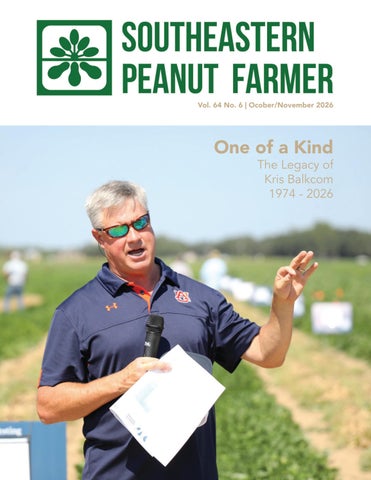
One of a Kind The Legacy of Kris Balkcom 1974 - 2026
October/November 2026 | Southeastern Peanut Farmer
1
2 Southeastern Peanut Farmer | October/November 2026
A Look Inside
October/November 2026
IN THIS ISSUE 10 | SOIL FERTILITY Four keys to next season's peanut fertility include soil testing, calcium, manganese and boron. A strong fertility program depends on samples, calculations and proper timing.
14 | PLA EXPLORES TEXAS Members of Class XIV of the Peanut Leadership Academy completed their third session of the program while exploring West Texas and strengthening their media relations skills.
22 | FLORIDA PEANUT BUTTER CHALLENGE KICKS OFF Thirty-eight Florida Extension offices are collecting peanut butter in October, which will be distributed to local food pantries in the communities they serve.
DEPARTMENTS 8 | CHECKOFF REPORT
Alabama Peanut Producers Association Florida Peanut Producers Association Georgia Peanut Commission Mississippi Peanut Growers Association
24 | WASHINGTON OUTLOOK 26 | SOUTHERN PEANUT GROWERS UPDATE
6 ONE OF A KIND
Kris Balkcom, area peanut specialist with Auburn University, passed away unexpectedly on Sept. 12, 2026. His loss has been felt throughout Alabama agriculture and across the Southeastern peanut industry. On The Cover Kris Balkcom, area peanut specialist with Auburn University, discusses his research trials at the Alabama Field Day in 2024. Photo credit: Joy Crosby.
SEPF TEAM Editor Joy Carter Crosby joycrosby@gapeanuts.com 229.386.3690
Director of Jessie Bland Advertising jessie@gapeanuts.com 229.386.3472
Contributing Peyton Woods Writing peyton@alpeanuts.com 334.792.6482
Southeastern Peanut Farmer is published six times a year (Jan./Feb., March, April, May/June, July/Aug., and Oct./Nov.) by the Southern Peanut Farmers Federation. The publisher is not responsible for copy omission, typographical errors, or any unintentional errors that may occur, other than to correct it in the following issue. Any erroneous reflection which may occur in the columns of Southeastern Peanut Farmer will be corrected upon brought to the attention of the editor. (Phone 229-386-3690.) Postmaster: Send address changes (Form 3579) to Southeastern Peanut Farmer, P.O. Box 706, Tifton, Georgia, 31793. Circulation is free to qualified peanut growers and others allied to the industry. Periodical postage paid at Tifton, Georgia and additional mailing office. Editorial Content: Editorial copy from sources outside of the Southern Peanut Farmers Federation is sometimes presented for the information and interest of our members. Such material may, or may not, coincide with official Southern Peanut Farmers Federation policies. Publication of material does not necessarily imply its endorsement by the Southern Peanut Farmers Federation. For editorial concerns call 229-386-3690. No portion of this or past issues of the Southeastern Peanut Farmer may be reproduced in any form whatsoever without the written consent of the editor. By-lined articles appearing in this publication represent views of the authors and not necessarily those of the publisher. Advertising: The Publisher reserves the right to refuse any advertisement. Corrections to advertisements must be made after the first run. All billing offers subject to credit review. Advertisements contained in this publication do not represent an endorsement by the Southeastern Peanut Farmer or the Southern Peanut Farmers Federation. Use of trade names in this publication is for the purpose of providing specific information and is not a guarantee nor warranty of products named. For advertising concerns call 229-386-3472.
October/November 2026 | Southeastern Peanut Farmer
3
Editor’s thoughts
Farmers Are Farmers, No Matter Where You Go
S
ometimes you have to travel halfway around the world to realize just how much farmers have in common. Recently, I had the opportunity to travel to Croatia for the International Federation of Agricultural Journalists (IFAJ) Congress. This year's meeting was especially meaningful as IFAJ celebrated its 70th anniversary. More than 20 members of the Agricultural Communicators Network joined agricultural journalists from around the world for several days of farm tours, industry visits and conversations about the challenges facing agriculture and the future of AI. Croatia was a beautiful setting, but it was the farmers and their stories that left the biggest impression on me. Our tours took us to farms, processing facilities and other agricultural businesses, providing a look at the diversity of Croatian agriculture. While the crops, landscapes and farming practices were different from what we see in the Southeast, many of the challenges sounded remarkably familiar. Croatian farmers worry about the weather. They worry about regulations. They worry about prices and markets. Sound familiar? No matter where they farm, producers are working to make the most of their resources while dealing with factors beyond their control. One of the things I enjoyed most was hearing directly from farmers about how they are adapting to those challenges. Some have joined cooperatives, pooling resources to strengthen their operations. We also saw farmers using European Union grants to invest in technology, including robots. You can sit at a table with someone who speaks a different language and discover they are trying to solve many of the same problems you hear about at home. You can visit a farm on the other side of the world and realize that the people working that land have many of the same hopes and frustrations as the farmers you know down the road.
That's what makes agricultural journalism so rewarding to me. We get to tell those stories. We meet people who may live and farm differently than we do and face different regulations and markets. But somewhere along the way, we usually find something that connects us. Farmers are farmers, no matter where you go. And sometimes you have to travel halfway around the world to appreciate just how true that is.
Events
Georgia Peanut Festival Oct. 17, 2026, Sylvester, Ga. For more information visit the festival's website at gapeanutfestival.org. Sunbelt Ag Expo Oct. 20-22, 2026, Moultrie, Ga. For more info visit sunbeltexpo.com. Florida Farm Bureau Annual Meeting Oct. 28-30, 2026, Hilton Daytona Beach Oceanfront Resort, Daytona Beach, Fla. For more info visit floridafarmbureau.org. National Peanut Festival Nov. 6-14, 2026, Dothan, Ala. For more info visit nationalpeanutfestival.com. Alabama Farmers Federation Annual Meeting Dec. 6-7, 2026, Montgomery, Ala. For more information visit alfafarmers.org. Georgia Farm Bureau Annual Meeting Dec. 6-8, 2026, Jekyll Island, Ga. For more information visit gfb.org. American Peanut Council's Winter Trade Conference Dec. 9-10, 2026, Atlanta, Ga. For more info visit peanutsusa.com. American Farm Bureau Convention Jan. 8-13, 2027, Charlotte, North Carolina. For more information visit fb.org. Georgia Peanut Farm Show Jan. 21, 2027, UGA Tifton Campus Conference Center, Tifton, Ga. For more information call 229-386-3470 or visit gapeanuts.com.
Joy Carter Crosby SEPF Editor
Georgia Young Farmers Association Annual Convention Jan. 22-23, 2027, Jekyll Island, Ga. For more information visit gyfa.org. Alabama Florida Peanut Trade Show Jan. 28, 2027, National Peanut Festival Fairgrounds, Dothan, Ala. For more information call 334-792-6482 or visit alpeanuts.com or flpeanuts.com.
Let us know about your event. Please send details to the editor at joycrosby@gapeanuts.com.
4 Southeastern Peanut Farmer | October/November 2026
October/November 2026 | Southeastern Peanut Farmer
5
One of a Kind
The Legacy of Kris Balkcom by Peyton Woods
F
or countless peanut growers across the Southeast, seeing Kris Balkcom pull into the field meant answers weren't far behind. Balkcom, who served as an area peanut specialist with Auburn University and the Alabama Cooperative Extension System, passed away unexpectedly on Sept. 12, 2026, surrounded by friends and family. His loss has been felt throughout Alabama agriculture and across the Southeast peanut industry, where he spent more than 25 years working alongside growers, researchers and industry leaders. Those who knew Balkcom say his commitment to agriculture was matched only by the care he showed the people around him. "He had a passion for helping growers and anyone he met. He had that same passion for his farm and his family," says William Birdsong, peanut grower and friend of Balkcom.
A Career Rooted in Agriculture Balkcom began his career in 1999 after earning a master's degree in agri-science from Auburn University. Throughout his career with Auburn University and the Alabama Cooperative Extension System, he served in a variety of roles before becoming an area peanut specialist. Though much of his work was centered in the Wiregrass, Balkcom's knowledge and willingness to help reached far beyond the region as he worked with producers across Alabama and throughout the Southeast to navigate the challenges of peanut production. His work included research projects, variety trials, field days,
Kris Balkcom, area peanut specialist with Auburn Univesity, passed away unexpectedly on Sept. 12, 2206. His loss has been felt throughout Alabama agriculture and across the Southeastern peanut industry.
production meetings, crop tours and one-on-one assistance with growers throughout the season. But those who worked with him say his impact could not be measured by job descriptions alone and his influence extended well beyond the farms he visited in Alabama. "As a peanut agronomist he transcended state lines and school loyalty. He was "our" agronomist and we respected his knowledge and experience; we treasured his friendship. Auburn will fill the peanut
6 Southeastern Peanut Farmer | October/November 2026
agronomist position with someone talented and motivated. But no one can ever replace Kris Balkcom," says Bob Kemerait, University of Georgia Extension plant pathologist.
A Resource for Growers From planting through harvest, Balkcom was a constant resource for peanut producers. Whether a grower had questions about disease or pest issues, variety selection, irrigation, harvest timing
or another production challenge, Balkcom had an answer for it, and if he didn't, he would find one. Balkcom was known for his constant desire to learn more so he could better serve growers. From the beginning of his time at Auburn until his final days, he was always asking questions, seeking new information and soaking in every bit of knowledge he could. For him, learning was never just about expanding his own expertise; it was about finding better ways to support peanut growers across the Southeast and help them succeed. William Birdsong, a peanut producer from Hartford, Alabama, remembers when he and Balkcom worked together at the Wiregrass Research and Extension Center.
Kris Balcom was a trusted voice for many Alabama peanut farmers and led several peanut pod-blast workshops, analyzed peanut samples and hosted production meetings across the state.
"I never had a brother," Birdsong says. "But the Lord placed us together, and we not only developed a professional relationship, but also a friendship, and that was just who he was. He wanted to see each and every grower successful."
"Him living it and being able to apply his research and knowledge first hand," Birdsong says, "that's what made him one of a kind."
Those relationships were at the center of Balkcom's work. He understood that recommendations made in a meeting room ultimately had to work in a farmer's field, and he never met a stranger.
Balkcom worked alongside researchers and fellow specialists on projects covering nearly every aspect of peanut production, helping bring research-based information directly to producers through outlets such as the Southeastern Peanut Farmer magazine, the Alabama Peanut Producers Association newsletter and research-focused podcasts.
"He had a passion for helping growers and anyone he met. He had that same passion for his farm and his family." William Birdsong Alabama farmer Balkcom's connection to agriculture extended far beyond his work with Auburn and Extension. He also farmed alongside his father-in-law and his son, Tanner, making agriculture not only his profession but a family tradition. That firsthand experience gave him a deep understanding of the decisions, challenges and uncertainties farmers face each season, and it allowed him to connect with growers not only as a specialist but as someone who truly understood the work because he lived it himself.
Peanut Production Impact
His work created a lasting, measurable impact. According to Alabama Extension's 2025 Agronomic Crops Team Impact Report, Balkcom led 28 peanut pod-blast workshops that helped 349 farmers determine the best time to dig their peanuts. Those workshops influenced more than 100,000 acres and generated an estimated $2.52 million in increased profits. His team also analyzed more than 450 peanut samples and hosted seven production meetings attended by 231 growers.
A Lasting Legacy As growers return to the field each season, the work Balkcom devoted his career to will continue. His influence
can be found in the recommendations producers use, the research projects he helped advance and the relationships he built with generations of farmers. For those who knew him best, however, his legacy will be much more personal. "Kris truly understood the clientele he served, and as a farmer, he personally stood behind the advice he gave," says Chris Parker, associate director at the Wiregrass Research and Extension Center and longtime friend of Balkcom. The peanut crop will continue to be planted, cared for and harvested each year. But for growers and agricultural professionals across Alabama and the Southeast, there will be an unmistakable absence in the fields. Kris Balkcom leaves behind his loving wife, Amy; his three children, Tanner Folger (Clara), Elizabeth Folger (Rashard) and Sela Balkcom; his grandson, Beau; countless friends and colleagues; and an agricultural community made better by the time, knowledge and friendship he so generously gave. In lieu of flowers, the family has requested that memorials be made in Kris’s memory, to the TJ Northey Memorial Foundation, P.O. Box 292, Abbeville, Ala. 36310, or to the Headland Methodist Cemetery Fund, 103 West King Street, Headland, Ala. 36345.
October/November 2026 | Southeastern Peanut Farmer
7
Checkoff Report
Investments Made by Growers for the Future of the Peanut Industry Florida Peanuts Producers Association sponsors field days The University of Florida Institute of Food and Agricultural Sciences hosted two key events for peanut producers in the Panhandle this August. The North Florida Peanut Field Day took place on Aug. 13 in Marianna, followed by the Extension Farm Field Day on Aug. 20 in Jay. Both field days offered valuable updates on a range of critical topics, including new peanut varieties, insect pest management, nutrient recommendations, and effective strategies for disease and weed control. Attendees also had the opportunity to participate in educational field tours, providing a firsthand look at ongoing research trials.
Ian Small, University of Florida researcher, updates Florida farmers about insect management in peanuts at the field day in Marianna.
The Florida Peanut Producers Association proudly sponsored both events, generously providing attendees with FPPA hats, roasted peanuts, and a peanut board for pod blasting.
Florida Peanuts Producers Association exhibits at Future of Pediatric Practice Conference
Shelby Askew with the Florida Peanut Producers Association exhibits at the Future of Pediatric Practice 2026 Conference to raise awareness about reducing peanut allergies.
The Florida Peanut Producers Association recently attended The Future of Pediatric Practice 2026 in Orlando, hosted by the Florida Chapter of the American Academy of Pediatrics. The conference gave the Florida Peanut Producers Association the opportunity to visit with pediatric healthcare professionals and share resources about peanut nutrition and early peanut introduction. The event was a great setting to share information about how early introduction may help reduce the risk of developing a peanut allergy. The Florida Peanut Producers Association was glad to be part of the conference and have the opportunity to educate healthcare professionals while representing Florida's peanut growers.
APPA exhibits at Pennsylvania School Nutrition Meeting The Alabama Peanut Producers Association exhibited at the Pennsylvania School Nutrition Conference in Lancaster, Pennsylvania. During the event, Morgan Flowers, APPA marketing director, connected with more than 400 school nutrition directors and specialists from Pennsylvania and Delaware. Flowers discussed the benefits of incorporating peanuts and peanut butter into school meals. A 1-ounce serving of peanuts is shelfMorgan Flowers, Alabama stable, helps meet protein requirements and provides Peanut Producers students with a convenient, enjoyable snack. Many Association marketing director, exhibits at the attendees expressed excitement about adding more Pennsylvania School peanut products to their menus, while several shared Nutrition Meeting. that their schools already serve peanuts or peanut butter. Flowers distributed individual packs of peanuts, giving attendees a firsthand look at an easy, nutritious option for school meal programs.
8 Southeastern Peanut Farmer | October/November 2026
APPA connects with Southeastern AgXperience The Alabma Peanut Producers Association welcomed visitors from the Southeastern The Alabama Peanut Producers Association AgXperience hosts 4-H members as part of their to their office during Alabama Ag the Southeastern Tour. The AgXperience tour. group visited the Wiregrass Research and Extension Center and Alabama Crop Improvement Association before stopping at the APPA office for lunch and continuing to Muleshoe Plantation in Gordon, Alabama. The visit provided an opportunity to share more about Alabama's peanut industry with 4-H members from Alabama, Florida and Georgia, and highlight the important role agricultural education plays in telling the story of peanuts and production agriculture.
National Peanut Festival Contestants learn about peanuts The Alabama Peanut Producers Association recently hosted contestants competing to become the next National Peanut Festival Queen for a field classroom focused on peanut production and harvest. Contestants learned firsthand how peanuts are grown and harvested, the importance of the crop to Alabama agriculture, and key facts about the peanut industry. The experience also helped prepare contestants for the peanut knowledge portion of the queen competition, giving them a better understanding of the crop, its nutritional benefits, and the farmers and industry they will represent. The National Peanut Festival will be held Nov. 6-15, 2026, in Dothan, Alabama.
Reports by
Georgia Peanut Tour showcases peanut belt The Georgia Peanut Commission, University of Georgia and the National Peanut Research Lab hosted the 38th annual Georgia Peanut Tour, Sept. 22-24, 2026, in Savannah, Georgia. Tour attendees began day one with a Hot Topics session highlighting an update on the 2026 peanut crop and a special focus on irrigation and climatic shifts: forecasting the During the 2026 Georgia Peanut future of peanut production. On the next two Tour, attendees take a look at days of the tour, stops were made at Greg freshly dug peanuts at a field stop Sikes Farm in Bulloch County and Dixon Farms in Bulloch County, Georgia. in Burke County, where participants were able to see peanut digging and picking up close. Tours also included a variety of businesses within the peanut industry including the University of Georgia Southeast Research Station in Midville, peanut buying point, Georgia Port Authority and MANA Nutrition. The last part of the tour included a session with representatives from John Deere, WECO, the American Peanut Shellers Association and Georgia Plant Food Educational Society, who covered topics ranging from technology on the farm to quality control in the shelling plant. The 2026 tour included 145 industry representatives from 16 states and four countries. To learn more about the 2026 tour stops, visit the tour blog online at georgiapeanuttour.com.
Georgia Peanut Bank Week celebrates peanut harvest The Georgia Peanut Commission and Georgia Bankers Association join forces Oct. 19-23, 2026, to promote the 50th annual Georgia Peanut Bank Week. More than 180 financial institutions and local banks across the state offered a tribute to Georgia's 4,000+ peanut farm families and the sustainability they provide to Georgia's state and local economies. The 2026 theme, "Peanuts: Georgia's Golden Investment" showcases the affordable and nutritious peanut. The banks celebrate throughout the week by distributing 103,600 packs of Georgia Peanuts.
Alabama Peanuts host area crop tours in August The Alabama Peanut Producers Association participated in the East Alabama Crops Tour in Society Hill and the Monroe-Escambia Crops Tour this summer, connecting with peanut growers and agricultural professionals in two different regions of the state. Both tours gave producers an opportunity to get into the field, see current crop conditions and hear timely updates from Extension specialists and industry experts. During the Alabama Crops Tour, farmers check out field conditions Topics focused on production practices, crop and receive timely updates from management and challenges growers were seeing Extension specialists. throughout the 2026 growing season. These tours are another way APPA helps connect Alabama peanut growers with valuable information and resources throughout the year.and industry they will represent.
K-12 school nutrition celebrate Georgia Peanut Day Schools across Georgia recognized Sept. 11 as Georgia Peanut Day for K-12 School Nutrition. School districts across the Georgia school districts state celebrated celebrate Georgia Peanut Day in September by the day with serving the new 1-ounce peanut butter and pack of Georgia Peanuts. peanuts, including 23,000+ of the new 1-ounce bags of Georgia Peanuts. Earlier that same week, GPC staff attended the Back to School Expo hosted by the Georgia School Nutrition Association. GSNA members hosted a breakout session highlighting ways to incorporate peanuts into school menus and how the new 1-ounce peanut pack can help. In October, GPC will attend a school tasting event, as well as a directors meeting hosted by the Georgia Department of Education.
Georgia Peanuts promoted through sporting events Georgia Peanuts are being promoted this fall through a variety of sporting events ranging from football to National Hot Rod Association events. Football promotions include the Ag Day Game with Georgia Southern and a variety of digital advertising with Georgia State University. Georgia Peanuts are also promoted through NHRA events across the United States with farmer Jeff Adkinson. The 5.5-ounce pack of Georgia Peanuts is available for purchase at concession stands at UGA’s Sanford Stadium and Georgia State University, along with high schools across Georgia. Youth clubs are encouraged to contact the Georgia Peanut Commission if they are interested in selling Georgia Peanuts in their concession stands or as a fundraiser.
October/November 2026 | Southeastern Peanut Farmer
9
Four Keys to Next Season's Peanut Fertility Soil Testing, Calcium, Manganese and Boron By Douglas Amaral Soil Fertility Specialist, Univeristy of Georgia
A
s harvest wraps up, now is the time to plan next season's fertility program. Peanut fertility doesn't need to be complicated, but mistakes with soil pH, calcium and micronutrients cost both yield and grade. This season's most common questions involved calcium sources, manganese deficiency and boron toxicity. Each answer starts the same way: test first, then apply the right nutrient at the right rate and time.
Start with the soil test Sample one to six months before planting, and test most fields every year. Pull 10 to 20 cores per management area and mix them. Keep different soil types and problem spots separate, and sample at a consistent depth and time. Target a pH of 6.0 to 6.5, and apply lime at least 60 days before planting so it can react. Avoid unnecessary lime, because high pH, especially on sandy soils, reduces manganese availability. Apply phosphorus and potassium according to soil-test results, since excess potassium competes with calcium in the pegging zone. Well-nodulated peanuts need no fertilizer nitrogen when the correct Bradyrhizobium inoculant is used.
soil calcium is below 500 pounds per acre or the calcium-to-potassium ratio is below 3:1. The standard rate is 1,000 pounds per acre at early bloom, usually 30 to 45 days after planting. Seed peanuts should receive gypsum regardless of soil-test level.
and healthy areas. If deficiency is confirmed, apply 0.5 pound of manganese per acre as manganese sulfate or 0.15 to 0.25 pound as chelated manganese, and repeat if symptoms persist.
Manage manganese and boron carefully
Peanuts need little boron, and the margin between enough and too much is narrow. The Georgia recommendation is 0.5 pound of actual boron per acre, usually split into two 0.25-pound applications between 30 and 60 days after planting. Calculate actual boron from each product label and count every product that contains it. Overlaps, double passes and slowing down at field ends can all cause toxicity. Toxicity begins as yellowing at leaf tips and margins and can progress to dead tissue. If you suspect it, stop further boron applications and sample both affected and normal areas.
Manganese deficiency is most common on high-pH sandy soils. New leaves turn yellow between green veins. Confirm the problem with soil and tissue samples from both affected
The bottom line: a strong fertility program depends on representative samples, accurate calculations and proper timing. Extra products cannot make up for a poor diagnosis.
Boron toxicity.
Manganese deficiency.
Gypsum is the preferred in-season source because it supplies soluble calcium without raising pH. Lime can supply calcium before planting when pH also needs correcting. Calcium chloride, calcium thiosulfate or liquid lime applied through irrigation can serve as a rescue treatment during pod fill, but none replaces a timely gypsum application. Foliar calcium does not reach developing pods in useful amounts.
Give calcium special attention Pods absorb calcium directly from the surrounding soil, and a routine fall sample may not represent this zone. Collect a pegging-zone sample 10 to 14 days after planting from the top 3 inches of soil beside the row. For runner peanuts, apply gypsum when
10 Southeastern Peanut Farmer | October/November 2026
October/November 2026 | Southeastern Peanut Farmer 11
Rooted in Faith, Growing a Farm Dixons Dubbed Alabama’s Outstanding Young Farm Family by Marlee Jackson Alabama Farmers Federation
Garrett Dixon with his wife, Robin, and two children, Chandler Jan and Cash, will represent Alabama during the American Farm Bureau Federation's Achievement Award contest in January.
W
hen the going gets tough, Garrett Dixon gets going — digging in, doubling down and asking God for guidance on his Lee County farm. "I love farming in spite of its challenges because you see the fruits of your labor," says Garrett, 35. "When you plant a tiny seed and then harvest a crop, it's satisfying knowing you were with that crop every step of the way." That tenacity helped Garrett and his wife, Robin, earn top honors in Alabama's Outstanding Young Farm
Family contest. The cotton and peanut farmers were recognized during the Alabama Farmers Federation Farm & Land Conference Aug. 8. "It truly is an honor to have been named the 2026 Outstanding Young Farm Family," Garrett says. "This has been a long but fruitful journey that wouldn't have been possible without the mentors and friendships made through the Alabama Farmers Federation. We are better farmers, advocates and citizens because of the impact Alfa has had on us."
12 Southeastern Peanut Farmer | October/November 2026
The OYFF contest gauges producers on farm growth, Federation involvement and civic service. The Dixons will receive $40,000 toward a Ford vehicle from Alfa Insurance; a lease on a tractor from John Deere, SunSouth and TriGreen; and a John Deere Gator from Alabama Ag Credit and Alabama Farm Credit. They'll represent Alabama during American Farm Bureau Federation's Achievement Award contest in January.
Planting Seeds Robin and Garrett have been stalwart teammates since their early days as students at Auburn University. "Garrett is the most driven person you'll ever meet," Robin says. "That inspires me daily. He gets up every day trying to get as much work done as possible." She adds, "He's also goofy. Anyone who knows Garrett knows he will pick and mess and joke." His farm, however, is no laughing matter. It's a labor of love Garrett built from the ground up, starting with a few head of cattle in high school. He found his true passion for farming in the row crop fields of Salem — land his ancestors toiled since the 1800s. A skip-generation farmer, Garrett started with 100 acres of soybeans in college before switching to a rotation of peanuts and cotton. The crops are more suited for sandy soil and thrive in hot weather, Garrett says. "As a peanut farmer, I help feed Alabama," Garrett says. "By growing cotton, we can clothe the world and state, too."
"Garrett is the most driven person you'll ever meet. That inspires me daily. He gets up every day trying to get as much work done as possible." Robin Dixon Spouse of Garrett Dixon Lee County, Alabama
wants to teach her to be responsible, to tithe and to take some ownership, albeit a small slice, at a young age," Garrett says. Robin's sphere of influence extends beyond their home. As an agriscience teacher and FFA adviser at Smiths Station High School, she ties on-farm experiences into curriculum standards. Her students calculate sprayer formulas after watching footage of Garrett driving machinery, discuss animal husbandry while clicking through slides of the Dixons' herd and even visit the farm to see agriculture in action.
Growing Grassroots The Dixons live a life of service to their community through deep involvement in church, the political arena and grassroots organizations. Garrett chaired the State Young Farmers Committee in 2019, serves on the Alabama Peanut Producers Association board and is a Lee County Farmers Federation board member. He graduated from A.L.F.A. Leaders Class V and the Peanut Leadership Academy. Both Dixons have held roles in Lee County Young Farmers. It's an impressive track record of service, said Federation Young Farmers Division Director Hunter McBrayer. "Garrett really gets the importance of getting involved and staying involved in organizations like the Federation," McBrayer says. "He's not only grown his farm over the last decade; he's grown his leadership skills, and that's paying dividends on his farm, with his family and in his community. Robin has been there every step of the way. Folks like the Dixons make this organization special, and I'm excited to honor their faithful work."
Cultivating Success In the last decade, Garrett has expanded acreage, installed irrigation and improved soil fertility while facing market and weather challenges. Garrett and Robin recently welcomed a new challenge by expanding the farm's cattle herd. The cattle spend summer grazing peacefully in pastures; they'll munch fields flush with cover crops this winter. The Dixons invest, too, in farmhands Chandler Jane, 4, and Cash, 2. They often visit Garrett at his shop, scout for bugs or hitch rides in the sprayer. This year, a sign sways in a field of cotton proclaiming CJ's Pickin' Patch. The handful of rows near Garrett and Robin's home is a classroom of sorts for the Dixons' daughter. "We'll take some of those proceeds and give to her to use as she October/November 2026 | Southeastern Peanut Farmer 13
Peanut leadership academy Class XIV Explores west Texas M
By Jessie Bland
embers of Class XIV of the Peanut Leadership Academy (PLA) completed the third session of the 18-month program Aug. 19-22, 2026, in Lubbock, Texas. A highlight for many PLA classes, this session provided participants with an opportunity to learn more about peanut production in West Texas, explore other sectors of agriculture, strenghen media relations skills and prepare for the class's upcoming legislative session in Washington, D.C.
The class began its time in Lubbock with a visit to the USDA AMS Cotton Classification Complex. This 30,000-square-foot, fully automated cotton classing facility processes approximately 50,000-60,000 cotton samples per day, making it one of the most technologically advanced classing operations in the country. Opened in 2022, the complex serves as a hub for modern classification, agricultural research, workforce development and technological innovation, while providing producers with faster, more detailed information about crop quality. From Lubbock, the class traveled to Brownfield to visit PLA Class XIII graduate, Kirk Martin and his famiy farm. A fifth-generation farmer in Terry County, Martin farms alongside his father and brother, producing cotton, peanuts and winter wheat, while also maintaining a cattle operation. The group then traveled to Seagraves to visit another PLA XIII graduate, Henry Froese. In addition to growing peanuts, Froese owns and operates Y Knot Vineyard and a diversified agricultural operation. The class enjoyed lunch at the vineyard and fellowship with Texas PLA alumni, before touring the operation. After leaving Seagraves, the group returned to the Brownfield area for a
PLA class members pictured with PLA Class XIII graduate, Kirk Martin and his family at Martin Farms in Brownfield, Texas.
visit to Addington Buffalo Company, led by Charles "Doc" Addington. The family-owned bison operation is based in Wolfforth, Texas, with additional bison located in southeastern Oklahoma. The operation includes bison production, premium bison beef, cow-calf production, and breeding and showing animals. Addington Buffalo Company also has connections to West Texas A&M University, including a partnership that helped raise "Sally," an orphaned bison calf that is now being developed as a university mascot. On the final day of the session, the class toured MTS Kimbell Manufactuing and Back to Nature Compost before turning its focus to media relations and preparation for the upcoming legislative session. Shelley Huguley of Southwest Farm Press led a media relations session focused on interviewing techniques, best practices for working with the media and the importance of building strong relationships with journalists. Her presentation included an open and engaging conversation that allowed each participant to gain a better understanding of communicating effectively with the
14 Southeastern Peanut Farmer | October/November 2026
media and representing the peanut industry. To conclude the session, Lorene Parker of The Redding Firm prepared participants for their upcoming visit to Washington, D.C., discussing expectations and ways to make the most of their time meeting with policy makers and other industry leaders. Sponsored by Syngenta Crop Protection and the American Peanut Shellers Association, and coordinated by the Southern Peanut Farmers Federation, the Peanut Leadership Academy provides leadership training for young farmers and sheller representatives within the U.S. peanut industry. Participants develop leadership skills while gaining insight into the issues, opportunities and challenges facing the peanut industry. The current PLA class includes participants from Alabama, Florida, Georgia, North Carolina, South Carolina, Texas and Virginia. Class XIV will travel to Washington, D.C., in 2027 for its final education session. Additional information about the Peanut Leadership Academy is available online at southernpeanutfarmers.org.
October/November 2026 | Southeastern Peanut Farmer 15
Make Plans for the 2027 Alabama-Florida Peanut Trade Show by Peyton Woods
P
eanut growers and industry partners from across the Southeast are invited to Dothan for the 2027 Alabama-Florida Peanut Trade Show on Thursday, Jan. 28, 2027, from 8:30 a.m. to 2 p.m. at the National Peanut Festival Fairgrounds. Hosted by the Alabama Peanut Producers Association and the Florida Peanut Producers Association, the annual event brings together peanut producers, agricultural businesses, researchers and industry representatives for a day focused on agriculture and the peanut industry. For growers, January is a time to look ahead. Decisions are being made
for the upcoming growing season, plans are taking shape and producers are evaluating the products, practices and resources that can help their operations succeed. The event offers an opportunity to gather valuable information and connect with the people and businesses serving peanut growers across Alabama, Florida and the Southeast. Throughout the day, attendees will have the opportunity to visit with a variety of agricultural exhibitors and learn more about the latest products, equipment, technology and resources available for their farming operations. From production inputs and machinery
January 28, 2027
National Peanut Festival Fairgrounds Dothan, Alabama Registration/Trade Show 8:30 a.m. Door Prizes Catered Lunch More than 60 exhibitors For more information contact: Alabama Peanut Producers Assn. Phone: 334-792-6482 www.alpeanuts.com
Florida Peanut Producers Assn. Phone: 850-526-2590 www.flpeanuts.com
16 Southeastern Peanut Farmer | October/November 2026
to research, services and new technology, growers can see what is available as they prepare for the 2027 crop year. For APPA and FPPA, the event is another opportunity to serve peanut producers and strengthen the connection between growers and the broader industry. Both organizations work throughout the year to promote peanuts, support research and education, represent the interests of peanut farmers and help ensure a strong future for peanut production in the region. Attendees are encouraged to take their time visiting exhibitors, asking questions and making connections throughout the day. Whether you are interested in seeing the latest equipment, learning about new technology, talking with industry representatives or simply catching up with fellow growers, there will be something for everyone. Lunch will be provided for attendees, offering another opportunity to visit with fellow producers and industry partners. Door prizes will also be awarded throughout the day, adding a little extra fun to the annual gathering. As the 2027 planting season approaches, the Alabama-Florida Peanut Trade Show provides a chance to start the year informed, connected and ready for the months ahead. Whether you have attended for years or are planning to make your first trip, APPA and FPPA encourage peanut growers from across the region to join us in Dothan. Come spend the day visiting with exhibitors, connecting with fellow growers and getting ready for another year in the peanut industry. Visit alpeanuts.com or flpeanuts.com for more information.
Florida Checkoff Supports new peanut reseach equipment by Brittany Green
T
he Florida Peanut Producers Association is proud to support the University of Florida peanut breeding program in Marianna with the purchase of a new KMC 3020 2-row peanut combine. The combine was delivered this summer and will be used during the 2026 harvest. The new combine replaces a decades-old peanut picker and will make harvesting research plots and increasing seed of new peanut varieties much more efficient.
The KMC 3020 allows researchers to weigh plots directly on the combine, collect grade samples, and return the peanuts to the basket without additional handling. The newer, heavier-duty machine will also help reduce clogging, maintenance and downtime. Barry Tillman, University of Florida peanut breeder, says the new equipment will make a significant difference in the breeding program. "The new KMC 3020 will improve our efficiency in harvesting research plots and the seed increases of new peanut varieties, and we are deeply appreciative to the Florida Peanut Producers Association for their support of the program," Tillman says. This investment is a great example of Florida peanut checkoff dollars working directly for Florida peanut producers. Supporting research and innovation today helps provide Florida growers with improved varieties, technology, and production tools for the future. "As peanut growers, we understand the importance of research and innovation to the future of our industry," says Phillip Melvin, Florida Peanut Producers Association
The Florida Peanut Producers Association donates a KMC 3020 2-row combine for use in University of Florida research plots. Pictured left to right Phillip Melvin, FPPA president; Brittany Green, FPPA executive director; Shelby Askew, FPPA staff; Jeff Fowler, FPPA board member; Jim McArthur, FPPA board member; Barry Tillman, University of Florida peanut breeder, and Kirk Brock, FPPA board member.
president. "We're proud to support UF's peanut breeding program and provide the tools needed to help develop better varieties for Florida farmers." Green agrees and thanks all growers for their support of the Florida peanut checkoff.
"FPPA would like to thank all Florida peanut producers who contribute to the checkoff," says Brittany Green, Florida Peanut Producers Association executive director. "Your support makes investments like this possible and helps keep peanut research moving forward."
October/November 2026 | Southeastern Peanut Farmer 17
Georgia Peanut Achievement Club Fifteen farmers recognized for 2025 high yields By Joy Crosby
F
ifteen farm families were recently announced by the University of Georgia Peanut Team for their high yielding peanuts in 2025. The high yields ranged from 4,156 to 6,794 pounds per acre. The winners were recognized at a dinner in August which was sponsored by the University of Georgia Peanut Team, Georgia Peanut Commission, American Peanut Shellers Association, National Peanut Buying Points Association, AMVAC, BASF, Bayer, Fine Americas and Nichino America. Many of the high yielding farmers agree that having a good rotation, good quality seed and good weather make all the difference with their yields. Additionally, the timing of applications for disease, weed and insect management are key in achieving high yields. "Many of the state winners combine their management strategies like crop rotation, variety, planting date and critical timing of applications of pesticides to reach these high yields," says Scott Monfort, University of Georgia Extension peanut agronomist. "The yields are counted for the entire farm, irrigated or dryland; and they continue to increase year after year." Another component of the farmers' success is following recommendations from the Extension service and asking questions. According to a report on the production practices of the 2025 winners, the majority use a 3-year rotation plan with other crops such as cotton or corn. Most of the winners plant in twin rows during the month of May. Another trait among the high yield winners is cultivar selection with many of the winners planting the Georgia06G cultivar. Other cultivars planted
The 2025 Georgia Peanut Achievement Club state winners were recognized at an awards ceremony Aug. 15, 2026, at Jekyll Island, Ga.
by the winners include TifNV-HG, Georgia-12Y and Georgia-16HO. The 2025 Georgia Peanut Achievement Club overall state winners are John Gaines Jr., Baker County, with 6,640 pounds per acre in the 100-299 acreage category; R&A Partnership, Mitchell County, with 6,794 pounds per acre in the 300-699 acreage category, and Sapp Bros. Farm, Mitchell County with 6,275 in the 700-plus acreage category. The District 1 winners are Mike Newberry of Hillside Farms, Early County, with 6,495 pounds per acre in the 100-299 acreage category, Gary Powell, Marion County, with 4,156 pounds per acre in the 300-699 acreage category, and Jimmy Webb, Calhoun County, with 5,731 in the 700plus acreage category. The District 2 winners are Bailey, Jhett and Reed Sapp, Mitchell County, with 6,633 pounds per acre in the 100-299 acreage category; Vic Fleet of
18 Southeastern Peanut Farmer | October/November 2026
Rolling Hills Farm, Miller County, with 6,296 pounds per acre in the 300-699 acreage category, and 4 Miller Farms, Seminole County, with 6,113 pounds per acre in the 700-plus acreage category. The District 3 winners are Tucker Cobb, Washington County, with 6,142 pounds per acre in the 100-299 acreage category, David Selph, Wilcox County, with 5,771 pounds per acre in the 300-699 acreage category and 3H Cattle Co. LLC, Washington County, with 5,663 pounds per acre in the 700plus acreage category. The District 4 winners are Jamie Jones, Brooks County, with 5,678 pounds per acre in the 100-299 acreage category, Jordan Harrison, Grady County, with 5,374 pounds per acre in the 300-699 category, and Franz & Daniel Rowland, Brooks County, with 5,367 pounds per acre in the 700-plus category.
Georgia Young Peanut farmer award nominations due dec. 4
N
marketing officer with AgGeorgia Farm Credit. "Farming is built on generations, and supporting young farmers today helps ensure a strong agricultural future for tomorrow."
ominations are now open for the Outstanding Georgia Young Peanut Farmer. The state winner will be announced at the Georgia Peanut Farm Show on Thursday, Jan. 21, 2027, in Tifton, Georgia. The award is sponsored by the Georgia Peanut Commission and Farm Credit Associations of Georgia. The Outstanding Georgia Young Peanut Farmer Award is based upon the applicant's overall farm operation; environmental and stewardship practices; and leadership, civic, church and community service activities. "We have so many young peanut farmers making a difference in their communities and I consider this awards program a great opportunity to recognize one young peanut farmer for their contributions to the agricultural industry," says Donald Chase, chairman of the Georgia Peanut Commission.
Applications are due to the GPC office by Friday, Dec. 4, 2026. The award application is available online at gapeanuts.com or by contacting Joy Crosby at 229-386-3690 or emailing joycrosby@gapeanuts.com. The award is open for any active Georgia peanut farmer who is not over 45 years of age, as of Jan. 21, 2027. An individual may receive the award only once. There is no limit on the number of applicants from each county in Georgia. "Farm Credit is proud to invest in the next generation of peanut farmers who are carrying Georgia agriculture forward," says Corey Cottle, chief
The 2026 award was presented to Will Anderson of Register, Georgia. The award winner receives registration and hotel accommodations to attend the 2027 Southern Peanut Growers Conference and a sign to display at his or her farm.
Download Application online at GApeanuts.Com.
October/November 2026 | Southeastern Peanut Farmer 19
2026
Southern Peanut growers conference in review
T
he 2026 Southern Peanut Growers Conference was held July 21-23, 2026, at Edgewater Beach Resort in Panama City Beach, Florida. The three-day event provided farmers with information relating to health and well-being on the farm, uncertainty of climate and technology to manage weather issues, legislative updates and more. The event also allowed farmers the opportunity to visit with multiple companies offering services or new products for the farm. The opening general session focused on an often-overlooked part of farm management: the health and well-being of the people who keep agricultural operations running. University of Georgia public health experts Stephen Correia, Jenay Beer and Christina Proctor discussed cognitive health, caregiving, stress management and practical ways farmers can protect their physical and emotional health. The second general session explored how weather, technology and research can help peanut growers manage production challenges, with Florida State University climatologist David Zierden discussing the Southeast drought and Auburn University's Simer Virk highlighting precision agriculture tools. Marshall Lamb of USDA’s National Peanut Research Laboratory, highlighted how decades of peanut research have driven yield gains and how advances in genetics, irrigation, crop rotation and production practices could fuel future improvements. The third general session focused on legislative activities and featured William "Bill" Beam, administrator with the USDA Farm Service Agency. Beam outlined several provisions that could provide additional support
By Joy Crosby and flexibility for peanut producers. Additionally, Bob Redding of The Redding Firm, provided an inside look at the issues shaping federal agricultural policy, discussed the latest developments in Washington and their potential impact on peanut farmers. Lastly, Jessie Bland, Peanut Leadership Academy coordinator, led a panel discussion with Southeastern farmers including Garrett Moore of Alabama, Jeffrey Pittman of Florida, Mary Katherine Harrington of South Carolina and Adam Curles of Georgia. The young farmers shared candid perspectives on the challenges and opportunities facing young farmers today. During the conference luncheon, Marshal Sewell of Mind Your Melon, delivered a message on mental health in agriculture. Drawing from his experience as part of a fifthgeneration fruit and vegetable farming family in Plant City, Florida, Sewell connected the pride of agricultural heritage with the pressures and uncertainties that come with carrying on a family operation. Awards were presented during the conference to deserving industry representatives and farmers. John Altom with Valent presented the 2026 Valor Award to Don Koehler. Koehler served as executive director of the Georgia Peanut Commission since 1986 and was appointed to senior executive director in 2026. Farm Press presented the 2026 Peanut Efficiency Awards during the breakfast on Saturday morning. The 2026 winners are: Upper Southeast: Babb Farms, Windsor, Virginia; Lower Southeast: Barksdale Farms, Sylvester, Georgia; Delta: Lonnie Fortner, Port Gibson, Mississippi; and Southwest: Henry Froese, Seagraves, Texas.
View Photos, speaker presentations and more at southernpeanutfarmers.org. 20 Southeastern Peanut Farmer | October/November 2026
Farmers listen attentively during the General Session III panel discussion featuring Southeastern young farmers at the Southern Peanut Growers Conference. The farmers shared candid perspectives on the challenges and opportunities facing young farmers today.
John Altom (left) with Valent, presents the 2026 Valor Award to Don Koehler (right) retired executive director of the Georgia Peanut Commission. Koehler retired after 40 years of service to the peanut industry.
The 2026 Farm Press Peanut Efficiency Award winners are (left to right) Marshall Lamb, research leader at the National Peanut Research Laboratory; Upper Southeast: Bryan Babb of Babb Farms, Windsor, Va.; Delta: Lonnie Fortner of Port Gibson, Miss.; Southwest: Henry Froese of Seagraves, Texas; Lower Southeast: Jason Barksdale of Barksdale Farms, Sylvester, Ga., and Brad Haire, executive editor of Farm Press.
Georgia Peanut Farm Show set for Jan. 21, 2027, in Tifton
Show includes exhibits, continuing education, awards and more
P
roducers can fine-tune their farming operation with information gained at the 50th annual Georgia Peanut Farm Show and Conference, held at the University of Georgia Tifton Campus Conference Center in January. The event will be held Thursday, Jan. 21, 2027, from 8:00 a.m. to 2:30 p.m. Peanut farmers and those involved in the peanut industry will be able to learn more about the latest products, services and peanut research at the 2027 Georgia Peanut Farm Show and Conference. The show is sponsored and coordinated by the Georgia Peanut Commission. The one-day show offers farmers the opportunity to view the products and services of nearly 100 exhibitors and continuing education for the 2027 production season. Farm Show chairman Rodney Dawson is looking forward to the 2027 show. "I encourage farmers to attend this one-day show in Tifton," Dawson says. "The knowledge they will gain from industry representatives and
The 2026 Georgia Peanut Farm Show is set for Jan. 21, 2027, at the University of Georgia Tifton Campus Conference Center.
seminars is an investment in the future of their farm." The University of Georgia Peanut Team will present an educational peanut production seminar on Thursday morning from 9:00 until 10:30 a.m. An industry seed seminar will also be held Thursday morning from 10:35 to 11:35 a.m. This event is sponsored
by the American Peanut Shellers Association, Peanut Foundation, Southern Peanut Farmers Federation and the Georgia Peanut Commission. Growers will be able to learn about farm-saved seed, peanut varieties available for 2027 and varieties on the horizon. Farmers will also have the opportunity to earn credit toward their private or commercial pesticide applicator certification. A free luncheon begins at noon for all attendees, with an opportunity for farmers to win more than $40,000 in door prizes afterward. The Georgia Peanut Commission will present a short program beginning at 12:15 p.m. that will cover award presentations and other special recognitions.
Georgia Peanut Farm Show January 21, 2027 UGA Tifton Campus Conference Center Tifton, Georgia Jan. 21, 2027 8:00 a.m. - Show Opens 9:00 - 10:30 a.m. - UGA Peanut Production Seminar 9:00 a.m. - 2:00 p.m. - Blood Drive 10:35 - 11:35 a.m. - Industry Seed Seminar Noon - Awards Luncheon 2:00 p.m. - Grand Door Prize 2:30 p.m. - Show Closes
The Georgia Peanut Commission, in cooperation with One Blood, will hold a blood drive from 9:00 a.m. to 2:00 p.m. at the UGA Tifton Campus Conference Center during the show.
Check out GaPeanuts.com for more info!
For more information on the show, contact GPC at 229-386-3470 or online at GaPeanuts.com.
October/November 2026 | Southeastern Peanut Farmer 21
Florida Peanut BUtter Challenge 38 Florida Extension Offices are collecting donations in October By Chris Vivian Univeristy of Florida
D
on't pass up those peanut butter sales—you can help fight hunger in your community. For the 15th year in a row, 38 of Florida's Extension service offices will be collecting the protein-packed favorite. All donations will be distributed to local food pantries to feed the communities they serve. The event is collaboration between University of Florida Institute of Food and Agricultural Sciences (UF/IFAS) Extension and Florida A&M University (FAMU) Extension Collection begins October 1 and runs through the month and, in some counties, into November.
2025 Donations resulted in
44,472 pounds of peanut butter
Enough to make 622,608 sandwiches!
"Extension cares for the people of Florida every day, providing programming to improve their lives," says Andra Johnson, director of the Florida Cooperative Extension Service. "The Peanut Butter Challenge lets them involve their whole community in that kind of support." Participating county Extension offices will collect sealed, unexpired peanut butter in any brand, size or type of container, from the individual cups to the big family-sized jars. The project has gained popularity every year with schools and organizations conducting friendly competitions to see who can collect the most. "What I love about the Peanut Butter Challenge is that it has become much bigger than an Extension competition," says Kevin Camm, county Extension director in Orange county, winner of the 2025 challenge. "Beyond our usual group, we've also brought in other divisions and departments from Orange County Government, as well as our 4-H, Future Farmers of America and Farm Bureau partners. We rely on our 4-H members to collect and get the peanut butter where it needs to go." The event began in the Florida Panhandle in 2012, and the event has expanded every year, sparking friendly competition between counties and
22 Southeastern Peanut Farmer | October/November 2026
giving schools and community groups a fun way to help their neighbors. The 2025 event resulted in 44,472 pounds of peanut butter donations, or roughly enough to make 622,608 sandwiches based on a 2-tablespoon serving size per sandwich. Peanut butter is a prized product for food pantries because it is nutrient-dense, shelf-stable and a great ingredient for sandwiches, snacks and other easy meals. It is also big business for Florida, as the state ranks third nationwide in peanut production (2024). In 2025, Florida's peanut growers harvested 167,000 acres, resulting in 651 million pounds of peanuts. "Last year, we donated to 17 food pantries across Orange County," notes Camm. "Hopefully, we can extend our impact further this year. The competitive spirit is there, sure, but the real point is neighbors supporting neighbors." The event is also supported by the Florida Peanut Federation and Florida Peanut Producers Association and community partners throughout the state. For more information about how to participate, contact your local Extension office or visit sfyl.ifas.ufl. edu/peanutbutter.
Mental Health & Wellness The Generation in the Middle When family needs you in both directions. By Lisa M. Renzi Hammond Institute of Gerontology | College of Public Health University of Georgia
T
his morning, I poured a cup of coffee, made sure my child had what she needed for school, called to check on my mom and aunt, and thought about sandwiches. Not the kind we eat. The kind we inhabit. Like many of you, I belong to the "sandwich generation." Right now, that generation is Gen-X. Baby Boomers held the title before us, and Millennials will inherit it as we age. For the next few columns in our series on Alzheimer's disease and related dementias, we're talking about what it means to be the "meat" in that caregiving sandwich: raising kids, caring for older loved ones, and somehow keeping the farm moving in between. If the older adults making up the top slice of bread in your sandwich are anything like mine, you've probably heard the words, "I don't want to be a burden," more times than you can count. You may have noticed that your loved one's memory and thinking have changed, but you're not quite sure what to do next. The answer is so simple: talk about it. Then, make the appointment. And the answer is so hard, all at the same time. Let's discuss why.
Cognitive screening is the first and most important step. If your loved one has Medicare, then they are also eligible for a cognitive screening every year, at no cost, as part of their annual wellness visit. Getting them through the doctor's office door, however, can be another matter entirely. With my own family, I find myself caught between two instincts. I respect my older loved ones
and don't want to push when they say they don’t want to go. But I also know that "I don't want to go" can sometimes mean "I'm afraid of what you might find, and how people will see me." Sound familiar? We are not alone. In the last few years, the University of Georgia CARE Center has made about 200 trips across Georgia's 159 counties, reaching residents in roughly 70 percent of the state, including growers from more than 75 counties. Again and again, we hear the same concern: families worry that their communities will see their older loved ones differently if they develop dementia. Many doctors face a similar dilemma. They may recognize dementia but hesitate to raise the issue because they worry about frightening or overwhelming families—especially when there is no cure. That leaves an important job for us, the generation in the middle of the sandwich: changing how we think and talk about dementia. If your father had arthritis from old injuries and back-breaking work, you'd help carry the load (and probably already do). If your mother had breast cancer, you'd be beside her through chemotherapy. We're a generation that shows up for our families. Alzheimer's disease should be no different. The injured organ is the brain, and that is how we should think about it. So, what can you do? Start the conversation. If you notice changes in memory, thinking, mood or daily functioning, talk about it. Tell your loved one about what you're
seeing and make an appointment with their doctor. Go with them. Offer to sit beside them during the appointment. Write down the changes you've noticed, when they started and how they are affecting everyday life. A second set of eyes and ears can make a big difference. Advocate. Not all doctors complete the cognitive screening, and plenty of doctors have the mistaken belief that Alzheimer's disease is "normal." Ask for the screening, more than once if needed. Get a second opinion if your loved one's doctor says the screening is unnecessary. You know your loved one best. Don't let fear make the decision. A cognitive screening does not necessarily mean a diagnosis of Alzheimer's disease. It is a starting point for understanding what is happening and finding possible causes—many of which may be treatable, from vitamin deficiency to drug interactions that affect the brain, to heart problems. And perhaps most importantly, change the conversation. Dementia is a disease, not a character flaw. A diagnosis does not mean your loved one is a different person, or less deserving of the respect they have always had. It simply means that their brain needs care, just as their heart, joints or lungs might. Taking the first steps is an act of bravery. That isn't being a burden. That's being a family.
October/November 2026 | Southeastern Peanut Farmer 23
Washington Outlook By Robert L. Redding Jr.
USDA Announces 2026 and 2027 Enrollment for Key Price and Revenue Safety Net Programs, Completes First Base Acre Increase in Two Decades Agricultural producers can begin enrolling in the Agriculture Risk Coverage (ARC) and Price Loss Coverage (PLC) programs, which the U.S. Department of Agriculture (USDA) recently updated to include more than 30 million new base acres. This expansion, the first in 20 years, was made possible by the Working Families Tax Cuts Act (One Big Beautiful Bill Act). Now that the base allocation process is complete, producers can make elections and enroll for the 2026 crop year from Sept. 16 through Dec. 11, 2026, and for the 2027 crop year from Nov. 2, 2026, through March 15, 2027. Because eligible acres exceeded the nationwide 30-millionacre cap, USDA's Farm Service Agency (FSA) is applying an across-the-board, prorated reduction of 3.69 percent to all newly allocated base acres.
Base Allocation Notifications The opportunity for landowners to review their base allocation summaries and take necessary action ended
Aug. 31, 2026. This included correcting inaccurate information, designating subsequent acres or opting out of adding base acres. Landowners did not lose base acres through the base allocation process. If landowners did not notify FSA of changes, the base allocation summary is considered accurate and complete; however, an across-the-board factor will apply. FSA determined the base allocation percentage reduction using all acreage reported as eligible, and new base acres will automatically be allocated to farms after applying the 3.69 percent reduction. Base allocation notifications will be available beginning Sept. 16, 2026. Landowners can access notifications online at fsa.usda.gov/arc-plc using a Login.gov account. Landowners who do not currently have a Login.gov account can contact their FSA county office to obtain their base allocation notification beginning Sept. 16, 2026.
Enrollment Period Producers can now change their
election and enroll in ARC-County (ARC-CO) or PLC, which both provide crop-by-crop protection, or ARCIndividual (ARC-IC), which protects the entire farm. Although election changes for 2026 are optional, producers must enroll through a signed contract each year. Existing multi-year contracts ended in 2025, but producers have the option to sign a new multi-year contract for 2026 through 2031. Producers who opt out of a multi-year contract can enroll for the 2027 crop year starting Nov. 2, 2026, through March 15, 2027. If producers do not submit their 2026 election by Dec. 11, 2026, their election remains the same as their 2025 election for crops on the farm, and the farm is ineligible for payments for the 2026 program year. Landowners cannot enroll in either program unless they have a share interest in the farm. Producers can make program elections and enroll either online at fsa.usda.gov/arc-plc using a Login.gov account or by making an appointment at their local FSA office.
U.S. Senate Agriculture Committee Passes Farm Bill U.S. Senate Agriculture Committee Chairman John Boozman recently introduced the Agricultural Act of 2026, or commonly referred to as "Farm Bill 2.0," building upon the traditional Farm Bill provisions included in last year's final passage of H.R. 1, the One Big Beautiful Bill Act (OBBBA). Additionally, this legislation includes many of the provisions recently included in the U.S. Housepassed H.R. 7567, the Farm, Food, and National Security Act of 2026. On Aug. 6, the U.S. Peanut Federation joined over 250 agriculture industry organizations in sending
a letter to urge the U.S. Senate Committee on Agriculture, Nutrition, and Forestry to advance a bipartisan farm bill out of committee. "As organizations representing a broad swath of food and agriculture, we urge you to advance the Agricultural Act of 2026 in a bipartisan manner out of the Senate Agriculture Committee," the letter states. "The time is now for a full five-year farm bill." The U.S. Senate Committee on Agriculture, Nutrition, and Forestry met on Aug. 6 to mark up
24 Southeastern Peanut Farmer | October/November 2026
the Agricultural Act of 2026. After more than four hours of discussion, Chairman Boozman called for a vote on the legislation, which failed by a vote of 10 ayes to 11 nays. On Sept. 16, the Committee reconvened to vote again and successfully passed the legislation by a vote of 12 ayes to 11 nays. This legislation will now need to be considered on the U.S. Senate floor. The U.S. Peanut Federation endorsed the Agricultural Act of 2026.
U.S. Peanut Federation Supports the Securing Agriculture's Workforce Act On June 30, U.S. House Agriculture Committee Chairman Glenn "GT" Thompson introduced legislation to provide reforms to H-2A agricultural workforce programs. H.R. 9535, the Securing Agriculture's Workforce Act, builds off the suite of bipartisan recommendations of the Agriculture Labor Working Group (ALWG), which was formed among U.S. House Agriculture Committee members in the 118th Congress. This legislation would make significant reforms to the H-2A agricultural guestworker program aimed at streamlining the application process, providing greater labor cost certainty for growers, modernizing wage calculations, and broadening the definition of agricultural labor. The Securing Agriculture's Workforce Act specifically addresses labor challenges in the peanut industry by broadening eligible H-2A activities to include the following key peanut industry activities: • the handling, planting, drying, packing, packaging, processing, freezing, or grading of any agricultural or horticultural commodity in its unmanufactured state, without regard to the ownership or location of such facilities or activities • the transportation and preparation for transportation of any agricultural or horticultural commodity, in its unmanufactured state from the farm to the place of storage, first processing or first marketing. The U.S. Peanut Federation (USPF) and Southern Peanut Farmers Federation have endorsed this legislation. Additionally, on Aug. 10, USPF joined over 450 agricultural organizations in sending a letter to Members of the U.S. House of Representatives to encourage their support of this bill. The letter stated, "Agricultural producers from across the country are facing unprecedented challenges. Over the last decade, America has lost nearly 200,000 farms, and many more are on the brink of ceasing operations. Chronic labor shortages and unsustainable increases in labor costs continue to be a driving force in this troubling trend. America's ability to maintain national security and feed itself is dependent upon farmers having access to a reliable workforce. Given the increasing unavailability of domestic workers, the H-2A Temporary Agricultural Worker Program is the only option for many agricultural producers to secure the workers needed to produce a crop." Peanut industry members are encouraged to contact their U.S. House Representative and request their co-sponsorship of this legislation.
Canada Announces CounterTariffs on Imports from the United States On Aug. 25, 2026, Canada announced retaliatory tariffs targeting approximately $20 billion worth of goods imported from the United States in response to recently imposed U.S. tariffs on Canadian imports. The affected U.S. agricultural products include dairy products, honey, molasses, dough and baking mixes, which represents more than $780 million in import value in 2025. Canada’s countermeasures took effect on Sept. 8, 2026.
On Sept. 8, 2026, President Trump announced signed five Proclamations pursuant to Section 338 of the Tariff Act of 1930 to ban certain products imported into the U.S. from Canada and modify the scope of the tariffs on certain Canadian products, including alcoholic beverages and dairy products. In a statement from the White House, "President Trump is taking decisive action to address Canada's additional and continued retaliation and discrimination against U.S. commerce to protect American farmers, manufacturers, and workers."
USPF Signs Agriculture Trade Association Checkoff Coalition Support Letter On Aug. 5, the U.S. Peanut Federation joined 25 members of the Agriculture Trade Association Checkoff Coalition in sending a letter to U.S. Senate Agriculture Committee leadership to emphasize the importance of agricultural checkoff programs and urging opposition to including checkoff-targeted amendments or legislation during the Senate Farm Bill process. The letter stated: "The 26 undersigned individual trade associations advocate for individuals significantly impacted by the
agricultural commodity research and promotion boards. The coalition is deeply concerned about the potential inclusion of the OFF Act, introduced by Senators Lee and Booker, in the Farm Bill, and urges your vigorous opposition. We believe the proponents of this problematic legislation are misguided and fatally misinterpret the vitality of the Checkoff. If passed, this legislation would have significant consequences for the farmers and ranchers who invest in our organizations and the industries we represent."
"Research and promotion boards exist to develop new markets and strengthen existing markets for specific commodities while conducting important research and promotional activities via pooled resources and stakeholder investments. Their sole purpose is to educate consumers and stakeholders on behalf of a particular commodity...For every dollar invested in a commodity checkoff, producers acquire exponential profit from increased marketing capabilities, product promotion, and researchdriven regulation."
October/November 2026 | Southeastern Peanut Farmer 25
1025 Sugar Pike Way · Canton, Georgia 30115 | (770) 751-6615 | lpwagner@comcast.net
Southern Peanut Growers exhibits at Georgia Extension Family & Consumer Sciences Meeting in August The Georgia Peanut Commission sponsored the lunch and exhibited at the Georgia Extension Association for Family and Consumer Sciences annual meeting in Augusta, Ga. on Aug. 26. There were close to 100 family and consumer science extension agents and 4-H agents in attendance for the program which featured updates from the University of Georgia system, presentations from agents on successful new programs, hands-on learning opportunities and an annual awards program. Leslie Wagner represented Georgia Peanuts and specifically promoted the new Georgia Peanuts Fundraising Program along with nutrition materials and early introduction to prevent peanut allergy materials. Several agents requested materials for upcoming programs which already have been provided. Diabetes management and prevention materials were particularly popular at this year's meeting.
Back to School with Peanuts Shelley Daniel, Glynn County School Nutrition Director, and Chynna Silvernale, Brooks County School Nutrition Director, led a session at the Georgia School Nutrition Association Expo on Sept. 10 on bringing peanuts and peanut butter back to K-12 school menus. Daniel addressed food allergy concerns and showcased the Glynn County Protein boxes featuring the 1 oz. bags of Georgia Peanuts or a Jif To-Go as a second-chance breakfast option. Silvernale shared new menu items created with Southern Peanut Growers including a PB&J Parfait and a Reese's-Style Overnight Oats.
Southern Peanut Growers exhibits at Atlanta Food & Wine Festival in September Georgia Peanuts were featured at the Atlanta Food & Wine Festival Sept. 10-13. Southern Peanut Growers partnered with DeKalb County Schools Culinary Arts program to develop recipes, prepare them for sampling, and staff the tasting tent each day of the festival. In all, three DeKalb County High School culinary programs Students from the DeKalb County Schools Culinary Arts and one DeKalb County High School baking & pastry program programs help promote Georgia Peanuts by developing and preparing recipes featuring Georgia Peanuts for participated in the festival. Each sampling at the Atlanta Food & Wine Festival. program provided one instructor, four students and 300-400 samples of their peanut and peanut butter creations for festival attendees. "Working with high school culinary programs is a win for Georgia Peanuts," says Leslie Wagner, executive director of Southern Peanut Growers. "Creating and serving peanut and peanut butter recipes help develop a love for our products that many in their age group missed out on because of food allergy concerns in schools. This new-found love for peanuts will not only carry on to their households but into the next generation of chefs as many of these students prepare to begin restaurant and hospitality careers."
Georgia Peanut Product Innovation Award The Georgia Peanut Product Innovation Award will recognize and reward the most unique and viable new product concept inspired by Georgia Peanuts. The contest was open to any new and unique food-related application of peanuts, whether the product idea is in the prototype phase or has been on the market for less than a year. A total of 28 entries were submitted! After an internal evaluation, five finalists will send samples to be presented to a panel of business professionals from the fields of agriculture, finance, education, retail and product/recipe development. The award and $10,000 cash prize will be presented to the winner by Georgia Agriculture Commissioner Tyler Harper and Donald Chase, chairman of the Georgia Peanut Commission at the Sunbelt Ag Expo, Oct. 22, in Moultrie, Georgia.
26 Southeastern Peanut Farmer | October/November 2026
October/November 2026 | Southeastern Peanut Farmer 27
Georgia’s Largest Commodity Show
January 21, 2027 8:00 a.m. to 2:30 p.m.
UGA Tifton Campus Conference Center Tifton, Georgia Free farmer lunch Pesticide applicator certification Nearly 100 Exhibits Door prizes
Learn more about the 2027 Georgia Peanut Farm Show by visiting
www.GaPeanuts.com 28 Southeastern Peanut Farmer | October/November 2026
For more information contact: Georgia Peanut Commission P.O. Box 967, Tifton GA 31793 Phone: 229-386-3470 Fax: 229-386-3501 Email: info@gapeanuts.com