What Is Search Intent Mapping? 2026 Strategy Guide
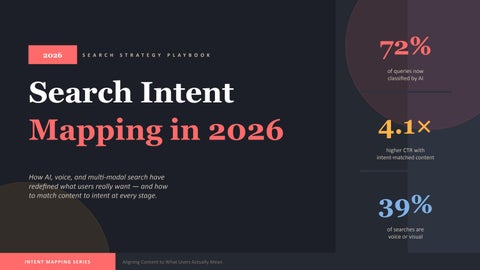
Search Intent Mapping in 2026
How AI, voice, and multi-modal search have redefined what users really want — and how to match content to intent at every stage.
72% of queries now classified by AI 4.1× higher CTR with intent-matched content 39% of searches are voice or visual
THE 2026 SEARCH INTENT TAXONOMY
Classic 4-type intent is obsolete. AI search introduced 3 new layers that reshape how content must be structured.
�� Informational
◆
�� Navigational
User wants to learn or understand something.
"how does RAG work" | "what is core web vitals"
User wants to reach a specific site or page.
"Anthropic Claude login" | "Nike running shoes site"
User intends to buy, sign up, or convert.
�� Transactional
⚖️Commercial
Conversational
"buy MacBook Pro 14" | "subscribe to Notion Pro"
User is comparing options before a decision.
"best CRM for startups 2026" | "Notion vs Obsidian"
User wants dialogue, not a document. Multi-turn intent.
"help me plan a product launch strategy"
User searches with an image, video, or voice input.
Google Lens: "what plant is this?" | "similar outfit"
AI proactively surfaces content before user queries.
Google Discover, Siri suggestions, AI digest emails
AI Overviews now answer 78% of informational queries — being cited is the new ranking.
Brand knowledge panels dominate. Own your entity in Google's Knowledge Graph.
AI shopping carousels handle 43% of product queries. Structured product data is critical.
Comparison content is now cited heavily in AI answers — high opportunity segment.
ChatGPT & Perplexity are primary channels. Anticipate multi-turn follow-up queries.
Visual search grew 65% YoY. Alt text, image schema, and video transcripts rank.
Freshness + topical authority drive proactive AI recommendations — no query needed.
Long-form guides, FAQ pages, definitions
Brand pages, login/portal pages, GMB
Product pages, landing pages, reviews
Comparison articles, listicles, rankings
Interactive tools, step-by-step guides, chatbots
Image SEO, video schema, alt-text optimization
Timely content, Google Discover optimization
HOW AI ENGINES
CLASSIFY SEARCH INTENT IN REAL TIME
Google and ChatGPT use multiple NLP signals — not just keywords — to detect what the user actually means.
�� QuerySyntaxAnalysis
Detects question words (what/how/why), transactional verbs (buy/download/schedule), and modifier words (best/cheap/near me) to infer category.
�� ContextualPersonalization
Search history, location, device type, and time of day shift intent classification. The same query can be informational for one user and transactional for another.
�� BERT&MUMModelling
Google's BERT and MUM models read full sentence context, not isolated keywords. Understands nuance: "running" = fitness or programming, depending on surrounding words.
�� Click&EngagementPatterns
If users consistently click product pages for a query, Google reclassifies it as transactional. Real-time behavioral feedback loops update SERP composition within days.
THE 2026 INTENT MAPPING FRAMEWORK
Map content to user intent across the full decision journey — from awareness to advocacy.
INTENT
Informational + Ambient
AWARENESS
CONSIDERATION
INTENT
Commercial + Conversational
CONTENT FORMATS
Blog posts
How-to guides
YouTube videos
Infographics
KEYWORD PATTERNS "what is..."
"how does..." "why does..."
KEY METRIC
Impressions
Brand searches
CONTENT FORMATS
Comparison pages
Case studies
Webinars
Review roundups
KEYWORD PATTERNS "best..." "X vs Y" "top... for..."
KEY METRIC
Time on page
Scrolled to bottom
DECISION
INTENT
Transactional + Navigational
CONTENT FORMATS
Landing pages
Product pages
Free trials
Pricing pages
KEYWORD PATTERNS "buy..." "pricing" "...coupon"
KEY METRIC CVR Sign-ups
RETENTION
INTENT
Navigational + Conversational
CONTENT FORMATS
Help docs
Onboarding flows
Email sequences
Community hubs
KEYWORD PATTERNS "login" "how to use..." "support"
KEY METRIC
Churn rate
Feature adoption
YOUR INTENT AUDIT: 6-STEP ACTION PLAN
Run this audit quarterly to realign your content library with how intent is shifting in 2026.
01 Pull Top 100 Queries from GSC
Export your top queries from Google Search Console. Note CTR, impressions, and avg. position for each.
Tool: Google Search Console → Performance
03 Audit Content–Intent Alignment
Check whether each landing page actually matches the intent. Mismatches cause high bounce rate and low CVR.
Tool: Screaming Frog + GA4 engagement data
05 Rewrite Misaligned Content
Prioritize pages with high impressions but low CTR — likely intent-mismatched. Update format and answer directness.
Tool: Surfer SEO, Clearscope, or manual rewrite
02 Classify Each Query by Intent
Tag each query as Informational, Commercial, Transactional, Navigational, Conversational, or Visual.
Tool: ChatGPT prompt: "Classify this keyword by 2026 intent type"
04 Identify Conversational & Visual Gaps
Flag queries answered by AI Overviews or ChatGPT. These need FAQ schema, structured answers, or new formats.
Tool: Semrush AI Overview tracker, SGE testing
06 Track Intent-Level KPIs Monthly
Move beyond organic sessions. Track intent-level CVR, AI Overview citation rate, and branded query splits.