SOLVING GUN CRIME BEFORE IT HAPPENS


Aurora police laud SAVE program that intervenes in young lives linked to gun and gang violence. Critics worry about stigma




















Aurora police laud SAVE program that intervenes in young lives linked to gun and gang violence. Critics worry about stigma
Hot enough for ya?
That used to prompt a smile when I was a kid picking melons and tomatoes in Manzanola. It’s not funny as more than 10,000 people in Europe drop dead from the heat, above the normal amount of heat-related deaths.
Records keepers expect the 1,200 or so normal U.S. heat-related deaths will swell this year, too. While climbing into a 120-degree car to go home from work is certainly a sharp reminder of what we’ve done to the planet, being hot and uncomfortable is not even the tip of the iceberg of when it comes to the existential threat human-caused global warming has and will bring down on our economy, health and lives.

For flat-earthers like President Donald Trump and Colorado GOP Congressperson Lauren Boebert, who calls all this bad weather, reality will be just as harsh.
These people and their minions are the idiots who say months-long killer heat waves are just problems created by woke thermometers.
The Trump administration’s climate strategy is to lie, deny and disparage.
This is a man so stupid he not only believes that windmills cause cancer, but he thinks it furthers his case of denial by repeating it.
Trump continuously calls climate change “a scam.” His administration has now revoked the EPA’s landmark finding that greenhouse gases endanger public health. It’s been the legal cornerstone of federal climate regulations for the past 17 years.
It’s like repealing the law of gravity because ladders make him nervous. The awkward part for Trump is that reality refuses to sign his nondisclosure agreement.
Scientists, the real ones, those irritating people who insist on measuring things over and over before tweeting about stuff, have spent years studying the connection between climate and human health.
More than 29,000 peer-reviewed studies have examined the issue. More than 5,000 focused on the United States alone. Most were published in just the last five years, the Associated Press reports.
Their conclusions aren’t subtle. Real peer-reviewed scientists are convinced that climate change is already making people sicker, killing

more people during extreme heat, worsening air quality, increasing disease risks, and displacing communities because of fires and storms.
And while that’s unnerving in real life during a horror movie, for those who shrug it off and think they’ll just turn up the A/C, there’s a very real cash cost that comes with all this.
The farmers and ranchers who don’t go out of business because of climate change have to find ways to keep their crops and cattle alive during endless heat domes amid increasing droughts. Don’t think for a second you won’t pay the price at the grocery store.
Loving that cheap, cheap house insurance here in Colorado? Oh, just wait.
And your already stupidly unaffordable and increasingly worthless health insurance? The cost of treating climate-change illnesses in increasingly expensive hospitals will make Trump’s disaster trip back to the White House seem like the goodold days.
The administration’s response to all this science and reality is lies, denials and when even Fox News runs the heat-wave death reels, it’s just “la

la la, I can’t hear you.”
Meanwhile, back on Earth, scientists continue documenting connections between rising temperatures and illnesses ranging from heat stroke to waterborne disease and mental health problems.
Sure, Boebert. It’s just a scam.
If you’re like her, shrugging and saying, “sucks to be them,” half of the state we live in is covered in combustible growth. And for those who don’t care about life in a burning state and being downwind of endless fires, remember back to the Marshall Fire in December 2021 that burned up 1,084 suburban homes on the plains.
Mid-term elections are coming up, and while all of the whack, sick, dangerous and unfathomable things Trump and his crony Republicans pull out of their orifices every day can’t keep you from looking away, take the time to push for answers about climate change.
Remember that atmospheric physics doesn’t care about wrestling matches on the White House lawn.
news@sentinelcolorado.com letters@sentinelcolorado.com events@sentinelcolorado.com sports@sentinelcolorado.com Advertising advertising@sentinelcolorado.com Circulation subscribe@sentinelcolorado.com Obituaries obits@sentinelcolorado.com



QUID HAS HEARD that there’s controversy brewing over who’s burning the beans in Aurora for the Republican nominee for governor. It seems that sometimes phone exorcist and sometimes GOP gubernatorial candidate Victor Don’t-Call-Me-Karl Marx is now a full time merchenary on the campaign finance down-low. The Next at 9News pests outed the Marx campaign for launching a donations website dressed up as a campaign merchandise store. Marx told people in this world and the next during a stream thing that his online merch store would allow for unlimited and unregulated campaign donations. “They can order as much as they want. That will really help us.” The report immediately prompted complaints with the Colorado Secretary of State, at least one from a fellow Republican, pointing out that Marx essentially admitted to trying to do an end-run around campaign contribution laws.
Quidnunc, whose name comes from the Latin “what now,” is out and about as often as possible to bring you news overheard in elevators, rest rooms and spied in various e-mail boxes. QUIDNUNC
The bigger news for local oglers of this incredible political poop show is the merchenary schwag show at victor2026merch.com. Marx does not X the spot anywhere on here. If you’re looking to proudly portray your Marxism for governor, fuhget about it. It’s all about Victor-ish branding so as not to confuse the confused who think a candidate few if any elected Colorado Republicans have agreed to endorse or support is a good idea. The store is chucked full of Victor t-shirts, caps and “dangerous conservative” stickers. Your affiant affirms extreme disappointment that there is not for sale on the schwag site any potions or apparatus for conducting exorcisms or enemas, live or on the phone. But one oddball schwag bag of coffee stands out. For $25 plus shipping, voters feeling Marxy can get themselves 12 ounces of The Victor Marx Brew. It’s tabbed as “a bold, premium coffee that means business.” And where do these beans, beans the magical fruits come from? Ethiopia and Guatemala by way of Aurora. Yup, someone in the land of endless Democrats and progressives is toasting Marxist beans in hopes of either giving Colorado back or taking it back or taking it out or something. The problem is, no one is spilling the beans on who’s that fired up for Marx right here in A-town. And that’s all the news that fits.
SendqualitygossipleadstoQuid@SentinelColorado.com.
Carbon dioxide has never attended a campaign rally, although there’s rarely a shortage of hot air at those things. Heat waves don’t “like” woke memes on social media. Wildfires don’t pick paths based on whether they want to burn through red districts or blue ones.
We aren’t arguing over tax rates, highway funding or whether poor people can use SNAP benefits for Snickers bars.
We’re arguing over whether decades of measurements, thousands of scientific studies, and observable events occurring in real time should be believed. Climate deniers don’t want better science, they want better slogans because slogans poll better.
Trump’s climate change denial and his insistence to step on the gas and make it worse is astonishing.
“It’s akin to insisting that the world is flat or denying that gravity is a thing,” Dr. Howard Frumkin, a physician and professor emeritus of public health at the University of Washington told the Associated Press. President George W. Bush appointed him to the National Center for Environmental Health. “Study after study documents that climate change endangers health, for one simple reason: It’s true.”
Follow @EditorDavePerry on BlueSky, Threads, Mastodon, Twitter and Facebook or reach him at 303-750-7555 or dperry@SentinelColorado.com



“WHILE WE ARE THANKFUL FOR THE REDUCTION OF VARIOUS CRIMES IN OUR CITY, THAT IN NO WAY CAN COMPENSATE FOR OR OFFSET ANY UNJUST INJURING OR KILLING OF THE MEMBERS OF OUR BLACK COMMUNITY.” — NAACP
shot before firing because Neely wanted to maintain an “element of surprise.”
BY MCKENNA HARFORD, Sentinel Staff writer
An Aurora police officer faces a murder charge for the fatal shooting of a Black man during a traffic stop last year.
On Aug. 3, an Arapahoe County grand jury indicted Aurora Police officer Matthew Neely, 54, on charges of second-degree murder and manslaughter related to the 2025 fatal shooting of Rajon Belt-Stubblefield. Neely is on unpaid administrative leave, according to the Aurora Police Department.
Neely is not being held in jail, having posted a $200,000 bond. His next court date is Aug. 17.
A statement from Aurora Police Chief Todd Chamberlain said he would not comment on the merits of the case, but did support police more generally. He thanked Aurora’s officers for keeping the community safe.
“Police officers are routinely called on to address – sometimes in seconds – dangerous and rapidly evolving situations they did not create,” Chamberlain said. “I am confident that all the facts will be fully examined through due process. As with any case, these filing charges are not a determination of guilt.”
Last year, Chamberlain created controversy at a press conference by defending Neely’s actions during the shooting.
The indictment alleges Neely did not tell Belt-Stubblefield that he was under arrest and Neely did not give an immediate warning to Belt-Stubblefield that he would be
In conclusion, the grand jury said in its indictment that “Mr. Belt-Stubblefield never verbally threatened to harm (Neely), nor made any overt acts to disarm (Neely) or to rearm himself.
The Aurora and Rocky Mountain NAACP commended the indictment in a joint statement, noting this is the start of a long legal process to get “equal justice under the law.”
“Our eyes and ears will remain alert to the legal process to ensure justice prevails for Rajon and our community that has suffered injustice for so long,” the statement reads.
“While we are thankful for the reduction of various crimes in our city, that in no way can compensate for or offset any unjust injuring or killing of the members of our Black community.”
A statement from the Epitome of Black Excellence and Partnership, a community group that has supported Belt-Stubblefield’s family after his death, said the indictment shows that “no badge should place a person above the law.”
“An indictment is not the end of the journey,” the statement said. “It is the beginning of a public process that will test whether our justice system is willing to apply the same standards to law enforcement that it applies to every other member of our community.”
Attorneys for Belt-Stubblefield’s family notified the city in February they intended to sue Aurora for wrongful death, seeking more than $20 million in damages.
City council members met in a suddenly called executive session Monday at noon
to discuss matters related to police litigation, including the Belt-Stubblefield family’s lawsuit against the city, according to city officials.
>>>>>Neely was previously accused of inappropriate actions as an officer
Neely was disciplined after an Arapahoe County judge found he and another officer gave testimony that was inconsistent with body-camera video during a hearing in a burglary case, according to an Aurora Police internal affairs investigation.
The investigation stemmed from a May 2, 2019, ruling by an 18th Judicial District Court judge, who concluded that Neely and Officer Paul Timmons were not credible witnesses during a motions hearing in a district court case.
“Officer Timmons and Officer Neely are not credible,” the judge said from the bench, according to an internal affairs summary obtained by the Sentinel in 2023. “They testified inconsistent with the video that the Court observed, so the Court finds that their other testimony regarding what happened when the video is not on is not credible and the Court is not willing to believe any of it.”
The judge also ruled that the defendant’s arrest was unlawful and that officers used a level of force that was not justified by the circumstances.
“The Court finds that those — just that a felony may have occurred is not specific enough facts for the officers to use the degree of force associated with an arrest such as what was used here,” the judge said.
The judge further found that officers vi-
olated the defendant’s constitutional rights by detaining, searching and questioning him without legal justification.
According to the judge and his ruling, the defendant was effectively under arrest before Neely got out of his patrol car and was immediately interrogated without the protections required under Miranda. The judge also found officers had no specific reason to believe the defendant was armed or dangerous before searching his pockets.
The Aurora Police Department opened an internal affairs investigation into possible violations of department policies governing truthfulness, conduct, job performance, use of force and constitutional requirements.
Aurora police investigators found that neither Neely nor Timmons had reviewed their body-camera footage before writing their reports or testifying in court. As a result, the investigation concluded, portions of their testimony did not match the video evidence.
The internal investigation also reviewed the officers’ use of force, which consisted of forcing the suspect to the ground twice. According to the report, the officers notified a supervisor as required by depart-
›› See GRAND JURY, 6
ABOVE: District Attorney Amy Padden announces the indictment of Aurora Police Officer Matthew Neely during an Aug. 3, 2026 press conference in Arapahoe County. SENTINEL COLORADO SCREEN GRAB FROM THE DENVER CHANNEL LIVESTREAM
GEO immigration detention operator claims new state law unfairly targets Aurora site
Lawyers for the private company that runs Colorado’s only immigration detention center told a judge that a new state law is unfairly discriminatory and should be struck down.
The GEO Group sued the state over House Bill 26-1276, a new law that requires more frequent health and safety inspections inside immigration detention centers and allows the state to impose civil penalties for noncompliance. GEO operates the facility in Aurora under a contract from U.S. Immigration and Customs Enforcement.
“This (case) isn’t about the general background of public health laws. This isn’t about creating a new inspection authority. This is about a state’s attempt to directly and specifically regulate, through targeted legislation, a single facility in the state,” Fred Yarger, one of GEO’s lawyers, told U.S. District Court Judge Daniel Domenico during a hearing Monday morning.
Yarger said that because there is only one facility in the state subject to the “bespoke” new law, it is discriminatory. The new regulations, he said, present an additional burden outside of existing public health inspection laws.
“It’s not simply the same (inspection) regime as before. If it was, the General Assembly would not have passed (the law),” he said.
The state cannot regulate the federal government, Yarger said, but it is circumventing that restriction by regulating the government’s contractor instead. The law specifically carves out facilities directly operated by the federal government and it instead applies to contractor-operated facilities that “house or detain individuals who are noncitizens for purposes of civil immigration proceedings.”
That can only apply to the GEO site in Aurora.
GEO is asking the court to issue a preliminary injunction against the new law, which Democrats in the Legislature passed this year. It sets a minimum number of yearly health and safety inspections at the facility, requires GEO to pay for those inspections and lets the attorney general bring civil penalties against the company for noncompliance. Its provisions also cover how minors can be detained, mental health worker staffing minimums and annual reporting requirements.
Yarger argued that the law directly conflicts with the detention center contract GEO has with ICE. That contract requires that medical workers, including mental health professionals, are available at all times, but the new law states that someone must be physically on site. The contract also requires that GEO abide by ICE’s determination about access. Domenico questioned why he shouldn’t assume those contractual provisions with ICE include the expectation that GEO will comply with state and local laws.
Yarger said “the notion that through this contract, the (U.S. Secretary of Homeland Security) consented to any state law … it’s not a fair reading of the contract.”
Talia Kraemer, representing the state, contended that there are no current or imminent threats to GEO, because the parts of the law that impose new requirements, such as around medical workers, have not undergone the rulemaking process through the Colorado Department of Public Health and Environment. That could take many months and would include an opportunity for input from GEO.
The company’s concerns are speculative, she said.
Kraemer said the state only views the section related to inspections as in effect. In fact, state lawyers said, GEO has had favorable treatment historically because it has faced fewer required inspections than other penal facilities like state prisons and county jails.
“The fact the General Assembly has imposed a minimum inspections … does not indicate that Aurora has been singled out,” state lawyer Gabriel Podesta said.
Domenico asked the state’s lawyers where the constitutional line is when it comes to regulations of federal contractors.
“What if the regulations the state wanted to impose were so onerous that, maybe it didn’t make it impossible, but … that would make it effectively that nobody could profitably operate one of these?” he said. “Does it make sense to say ‘Well, the federal government contracts, and they’re allowed to comply with their contractural provisions, and anything beyond that is interfering with the federal government’s chosen methods?”
Domenico said he will issue a written order on the matter “as soon as possible.”
The litigation coincides with GEO and ICE refusing to comply with a public health order issued by the Adams County Health Department around a confirmed tuberculosis case at the detention center. Federal officials are refusing access to local public health inspectors to complete an investigation that’s required by law.
“Adams County’s legal counsel, alongside the Colorado Attorney General’s Office, is actively working to preserve public health authority and ensure ACHD can continue fulfilling its statutory responsibilities in litigation arising from challenges brought by The GEO Group,”
ACHD Executive Director Kelly Weidenbach said in a statement. “While that legal process moves forward, ACHD’s responsibility remains unchanged. We will continue to follow the science, apply Colorado’s public health laws consistently, and work with our partners to protect the health of every person and every community we serve.”
— Sara Wilson, Colorado Newsline
Griswold and Hickenlooper vow action on gun violence ahead of Colorado November vote
Colorado attorney general candidate Secretary of State Jena Griswold and Sen. John Hickenlooper vowed to take more action to address gun violence and further regulate firearms at an Aurora panel discussion Friday.
Joined by former Congresswoman Gabrielle Giffords, Griswold, Hickenlooper, Colorado Rep. Monica Duran and Bianka Emerson, president of Colorado Black Women for Political Action, spoke about efforts to tackle gun violence at the federal, state and community level.
Democrats Griswold and Hickenlooper, who are both on the November ballot, railed against efforts from the federal government to repeal state gun laws, as well as called out federal immigration enforcement for making communities feel unsafe.
Griswold committed to protecting and strengthening state gun laws, saying taking on the National Rifle Association and other gun lobbyists would be her top priority as attorney general, if elected.
Griswold also called out the Trump administration for suing Colorado over its large-capacity magazine ban.
“As AG, I’m going to stand up to them. I’ve been taking on MAGA and Trump for
the last seven years and I’m just getting started,” Griswold said.
Griswold said she would support efforts at the state legislature to pass a more comprehensive assault weapon ban, adding election officials “should not be in the business of thoughts and prayers, they should be in the business of action.”
“You sit down with survivors of mass shootings, and if you’re not motivated to pass gun laws after that, then there’s something wrong with you,” she said. “We have to do more for people so they don’t become survivors in the first place.”
Duran touted the gun legislation the state legislature has passed, including gun storage bills, raising the legal age to buy a gun to 21, implementing an excise tax on gun sales to fund victim services and banning large-capacity magazines.
She committed to closing any gun law loopholes and expanding the assault weapons ban.
Emerson urged the elected officials to partner with community groups and listen to families most impacted.
“We need (elected officials) to show up, not just during election season, not after we hear about atrocities, like what happened a week ago at (Ultra Lounge),” Emerson said. “We need to invest in our programs and our communities.”
When thinking about public safety, Griswold said she also considers the violence being perpetrated during federal immigration efforts. She vowed to hold federal agents who break Colorado law accountable.
“The Trump administration is using ICE as a tool to terrorize cities and Americans into compliance, but it’s not working


and we have to stand strong,” she said. “I’ll make sure that if there are the travesties we’ve seen in Minnesota, Texas and across the country, where crimes are being committed and people are losing their lives, that we actually see a fair and transparent investigation.”
Hickenlooper also had harsh words for ICE officers, saying enforcement has turned “inherently un-American.”
“Our communities are being ripped apart by these soulless thugs who come in and are anonymous,” he said. “They’re in a mask, they have no name tags, no body cameras — all the things that pretty much every modern police department utilizes — and they’re pulling people out of their cars and beating them and shooting them on the street.”
›› See METRO, 7
Extending the Growing Season August 15, 9:30–10:15 a.m. Hudson Gardens
Demonstration Vegetable Garden 6115 S. Santa Fe Dr., Littleton | CO 80120
Register at: bit.ly/HGEGS

Arapahoe County encourages everyone to join in this observance and to recognize the important roles that parents, employers, and community members play in ensuring that all children have the financial support they need to thrive. Learn more at arapahoeco.gov/humanservices
Pollinators in the Garden August 8, 10 a.m.
Pea Patch CMG Demo Garden 2171 W. Shepperd Avenue, Littleton Join us for a free Community class about Pollinators and what you can do to attract them to your yard by providing food, shelter and water.


ment policy. The supervising sergeant, however, determined the force was reasonable because the officers used the “minimum force necessary to prevent injury in icy conditions.”
The report said the suspect was not injured and described him as agitated, uncooperative, refusing commands and asking officers to kill him.
Then-acting Police Chief Paul O’Keefe sustained some of the court allegations, stating that Neely violated department policies on conduct unbecoming and unsatisfactory performance.
However, O’Keefe did not sustain allegations that Neely violated police policies prohibiting false or untruthful declarations, governing use of force or requiring compliance with constitutional standards.
The internal affairs document did not specify the disciplinary action imposed on either officer.
At the time of the Sentinel investigation, Neely was not registered as an employed officer with the state POST board for any Colorado police agency. Aurora police officials said Neely was first hired in 2002 as a recruit and retired from the office in 2023. He was rehired in March 2024.
Multiple videos of Belt-Stubblefield’s shooting, including the officer’s body-worn camera, provided prolific detail of how the shooting unfolded, but raised numerous questions as well.
The Aug. 30 traffic-stop-turnedcar-crash and subsequent shooting of Belt-Stubblefield unfolded near East Sixth Avenue and Billings Street as numerous cars rolled past and witnesses inside and outside of cars watched events unfold.
The officer body cam video reveals a relatively brief and ag-
gressive encounter. From the time the officer pulls behind Belt-Stubblefield, until the officer fires the first shot, less than three minutes elapse.
Videos released confirmed not only how Aurora Police Chief Todd Chamberlain previously said the incident played out, but the videos also pose questions raised by the family and attorneys.
In a narrated video, Agent Matthew Longshore, public information officer for Aurora, stated that the officer attempted to pull Belt-Stufflefield over for speeding.
“An officer assigned to the traffic section was conducting speed enforcement along East Sixth Avenue as part of a Labor Day DUI operation,” Longshore said. “The officer was parked near Toledo Street when he observed a vehicle speeding.”
The officer pulls out onto East Sixth Avenue and attempts to initiate a traffic stop by turning on his lights and siren, Longshore said, which is also what is shown in the body-worn footage.
In the body camera footage, what appears to be Belt-Stubblefield’s car can be seen driving faster than the cars behind it, but when the officer pulls out, the camera does not have a view over the dashboard.
In the body-worn camera footage, the officer clicks something twice on his chest and reads out what sounds like a license plate number, but he does not call in any additional information to dispatch.
Longshore said the suspect’s vehicle does not immediately pull over after the officer activated his squad car lights and sirens, also seen in the officer body-cam video.
Previously, Chamberlain said the ensuing car crash did not come after a pursuit, but about 1 minute 20 seconds elapses from the time the officer pulls out to stop Belt-Stubblefield and when the officer drives up on the crashed car.

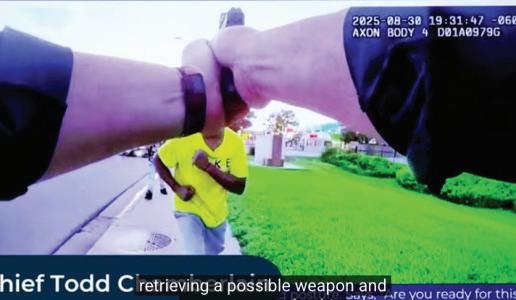
The video shows the officer speeding up and turning on full lights and sirens some time before arriving at the I-225 underpass.
In separate dash-camera footage provided to the police department by a civilian, Belt-Subblefield can be seen swerving and crashing into a vehicle, then hopping over the median in his vehicle and hitting a second oncoming vehicle.
The body camera footage shows the officer driving fast down East Sixth Avenue until he arrives at the Sinclair gas station, near Billings Street, where Belt-Stubblefield is sitting in his car in the oncoming traffic lane after he crashed.
The officer gets out of his vehicle and immediately approaches Belt-Stubblefield with his gun drawn and tells him to “stay in your car,” and “don’t move,” while Belt-Stubblefield’s car is smoking. The officer then radio’s dispatch to report the crash and its location.
As he’s still pointing the gun at
Belt-Subblefield, the officer tells him to “give me your hands, show me your hands, get your hands up, dude.” Belt-Stubblefield’s music is loudly playing in the car, and he opens his door as the officer is yelling commands.
Belt-Stubblefield gets out of the car and tells the officer, saying, “‘Don’t shoot me,” in what sounds like an almost casual or familiar way.
After Belt-Stubblefield gets out of the car, he starts walking away from the officer toward the side of the road, as the officer orders him to put his hands up again.
Belt-Stubblefield continues walking toward a grassy area, as shown in several camera footage angles, and he then throws a gun into the grass.
The officer grabs the man’s shirt and pulls him to the ground, trying to put him into a handcuffing position. There is some commotion that is difficult to distinguish, and then the camera footage shows Belt-Stubblefield getting up, standing over the officer, and then Belt-Stubblefield starts to walk away.
The officer gets up, points his gun at Belt-Stubblefield and yells, “Get on the ground, get away from that mother f****** gun.” He pushed Belt-Stubblefield and said, “Get on the ground now.”
Belt-Stubblefield looks back at his son, who was following him in a separate car and had walked to the scene, and he tells his son, “Get that shit,” while walking toward the officer. Belt-Subblefield says it about nine more times, while the officer says, “I’ll shoot you.”

Meanwhile, his son, behind him, says, “Dad, chill, no. Dad,” and then says, “Officer, chill.” Belt-Stubblefield turns again to say, “Get that shit,” as the officer punches him on the side of the head. Belt-Stubblefield gets into a fighting stance, as Chamberlain previously described, and he says, “Are you ready for this?” While his son kept saying, “Dad, no!” He asked the officer three more times if he was ready for it, and he sounds as if he is slurring his words. The officer told hom twice more to get on the ground, and the last time, he repeats it while backing up onto the street. He then shoots Belt-Stubblefield twice in
the chest. As Belt-Stubblefield stops, he stoots one more time at his head, and Belt-Stubblefield drops to the ground.
The officer stood pointing his gun at Belt-Stubblefield’s body as he called in to dispatch and says, “Shots fired.”
He stands there for a while as Belt-Stubblefield’s son moves around yelling in shock. As he begins to move the unconscious body of Belt-Stubblefield, a woman who looks like she might have a hospital badge clipped to her shirt offers a tourniquet to the officer as he stands over Belt-Stubblefield with his gun still drawn and pointed at him, but the officer refuses.
It takes two minutes for other officers to arrive at the scene and start performing life-saving measures on Belt-Stubblefield. The woman, who offered her help, is seen handing the officers the tourniquet and then attempting chest compressions on Belt-Stubblefield.
Most of the remaining footage reveals the trauma that many of the witnesses experienced during the unfolding of the scene.
The footage was released 72 hours after the family viewed it, as required by Colorado law. The police department stated that it would not provide any additional information once the footage was released.
A few days after the shooting, Chamberlain defended Neely, saying that Belt-Stubblefield prompted the shooting with his behavior.
“I wish that the suspect would have listened to what the officer said,” Chamberlain said during a press conference after the shooting. “Again, these are decisions, and these are things that he decided. This is not what the officer decided, it’s what the suspect decided.”
Aurora police are currently under a consent decree imposed by the state Attorney General Phil Weiser, after a 2022 investigation determined the department has for years exhibited “patterns and practices” of using excessive force against the public, especially people of color.
Padden’s office announced earlier this year she would take the case to a grand jury.
Hickenlooper encouraged the room to vote in the November elections, which he said are matters of “life and death.”
“If we allow Republicans to keep the House and we don’t flip the Senate, our lives and our neighbor’s lives are going to get significantly worse,” he said.
Giffords is co-founder of the national gun violence prevention organization GIFFORDS, which was created after she survived an assassination attempt in 2011 while elected to represent an Arizona congressional district.
— McKenna Harford, Sentinel Staff Writer
Want to help plan the future of Aurora’s libraries or give input about water conservation? Now is the chance — the city is hosting an informational town hall and recruiting volunteers for several boards and commissions that have open seats.
The town hall, scheduled for 6 p.m. to 7:30 p.m. Aug. 6 at the Aurora Municipal Center, will have representatives from 22 boards and commissions to provide information, answer questions and discuss their work and how to join. City staff will also be available for questions.
The event is free and open to the public with no need to register in advance.
Aurora’s boards and commissions range in topics, including housing, water, youth issues, public safety, arts and culture, planning and parks and recreation. They are made up of volunteers who review policies, programs and community issues to provide recommendations to city council.
Some boards with current openings include the Aurora Immigrant and Refugee Commission, the Election Commission, the Library Board and the Historic Preservation Board.
More information about the available opportunities, eligibility requirements and applications is available at www.AuroraGov.org/Boards.
In a press release about the town hall, Mayor Mike Coffman encouraged residents to attend and learn how they can get involved.
“Aurora residents taking an active role in city government is essential to building and maintaining a community that meets the needs of everyone who calls our city home,” Coffman said.
— Sentinel Staff
Aurora is replacing the Great Lawn at the Aurora Municipal Center with drought-tolerant Bermudagrass as part of a citywide effort to reduce water use and improve the sustainability of its parks, city officials said last week.
The city’s Parks, Recreation and Open Space Department, working with contractor Elite Industries, started the conversion this week by removing the existing Kentucky bluegrass, which requires significantly more water to maintain, officials said in a statement.
The change comes amid a record-breaking drought and citywide water restrictions imposed on both residential and commercial water users.
Aurora Water officials have set a 20% year-over-year reduction in overall water use as a goal.
So far, Aurora Water says the city is doing a good job reducing its water use,
with total demand for the year, including indoor use, down 8%, while outdoor irrigation is down 20%. Stage 1 drought restrictions call for a 20% reduction on outdoor irrigation.
City officials said the warm-season Bermudagrass is better suited to Colorado’s climate and is one of the few turf varieties approved by Aurora Water for installation during the current Stage 1 drought restrictions.
Drought and water use have been in the news since spring, when low-reservoir levels made headlines.
City officials in Aurora are considering penalties for Niagara Bottling, the city’s largest water consumer, for failing to reduce usage during a severe drought. While the plant has not yet exceeded its 178-million-gallon annual allocation, officials expressed concern that current production levels will lead to an overage. In response, the company announced plans to implement efficiency initiatives intended to significantly cut consumption by 2027.
Earlier this month, Mayor Mike Coffman created a stir when he highlighted grass he considered too green at a local high school and insisted on ensuring the school followed water restrictions.
All this has prompted city water officials to ask residential and commercial property owners to consider so-called “xeriscape” or lower water usage landscaping or replace water-thirsty grasses with varieties that need less water and are more tolerant to drought.
The “Great Lawn” project is part of the department’s “Back to Our Roots” initiative, a long-term program aimed at replacing high-water-use turf with more drought-tolerant alternatives.
According to the city, similar conversions can reduce water use in affected areas by as much as 70%, conserving millions of gallons of water over time.
The Great Lawn grass replacement is expected to continue through the end of August as crews remove the existing grass, prepare the site and install the new sod.
Visitors to the Municipal Center can expect construction equipment, temporary sidewalk closures, pedestrian detours and occasional noise during normal working hours while the work is underway.
Although the conversion is scheduled to finish in August, the Great Lawn will remain closed through September to allow the new grass to establish a healthy root system, officials said. Sidewalks surrounding the lawn are expected to reopen once construction is complete, and the lawn is expected to reopen to the public in October.
During the establishment period, residents may see watering outside the city’s typical overnight irrigation schedule. The city said the additional watering is temporary, permitted by Aurora Water under a sod permit and uses non-potable recycled water.
The cost of the replacement is estimated to cost about $200,000. The city pays have and half is paid for by a federal WaterSMART Water and Energy Efficiency Grants program, city spokesperson Ted Bryant said in a statement.
The Great Lawn conversion is one of eight slated for areas across the city as part of the grant program.
— McKenna Harford, Sentinel Staff Writer
Colorado’s free preschool faces calls for higher quality standards
Colorado’s free preschool program has been popular with families since it
launched three years ago, but state leaders need to raise the bar on quality.
That finding from a state-mandated evaluation of the $349 million program echoes concerns long raised by advocates that universal preschool started with minimal standards on class size, curriculum, and teacher training, among other things.
The evaluation, conducted by Child Trends and released in early July, provides the first comprehensive look at what’s gone well and what hasn’t in the universal preschool program’s initial two years. One of Gov. Jared Polis’ signature initiatives, the program provides 10 to 30 hours a week of tuition-free preschool to about 70% of the state’s 4-year-olds.
State officials rushed to roll out the preschool program in 2023, shortly after the state’s new Department of Early Childhood was created. The tight timeline meant more than 40,000 children were soon getting half- or full-day preschool for free — a relief for many families. But the fast pace contributed to some initial problems cited by the evaluation.
Those include confusion about enrollment processes, frustration over how state officials communicated about the program, and concern that the state didn’t prioritize quality.
The evaluation says the concern about quality is exacerbated by a report from the National Institute for Early Education Research showing that Colorado’s universal preschool program meets only two of 10 benchmarks meant to promote preschool quality.
“The optics of it are not good,” said Heather Tritten, president and CEO of the
Colorado Children’s Campaign, a Denver-based advocacy group. “You see the two out of 10, and you think, ‘Oh my gosh, that must not be a good program.’”
But the reality is more complicated, she said. That’s because some of the research institute’s benchmarks may not attainable or desirable in Colorado — for example, one that requires a bachelor’s degree for lead preschool teachers.
Other benchmarks include class size caps of 20 students, teacher-student ratios of 1 to 10, and a requirement that assistant teachers have a widely recognized credential called a Child Development Associate or the equivalent.
Tritten said state officials should spell out the quality standards they strive to hit.
“Without having our own set of standards or defining it within (the research institute’s) standards, we’re not communicating why our universal pre-K program is high quality,” she said. “I think that might be the biggest problem.”
Dawn Odean, Colorado’s universal preschool director, said the state is focusing on preschool quality, with several changes set to take effect in the next couple years.
They include requirements that universal preschool providers use either a state-vetted curriculum or an approach that meets certain state standards. They’ll also have to use an observation-based assessment to monitor preschool students’ skills and progress.
State officials will begin piloting a tool this coming year that will assess teacher-student relationships and interactions during in-person visits, Odean said.
Alma Wiley, who runs an in-home child care business in El Paso County and participates in universal preschool, likes that idea.
“From centers to family child care homes to school districts, having those relationships is what children thrive on,” ›› See METRO, 8







she said. “If we don’t have those bonding relationships in the first five years, we’re just not building the foundation for them.”
But Wiley, who cares for nine children including two children in the state-funded preschool program, thinks the program should require lower class sizes and teacher-student ratios. She unsuccessfully pushed for that as a member of a state council that advises the Colorado Department of Early Childhood.
Under state rules, universal preschool classrooms can have up to 22 students and a teacher-student ratio of 1 to 11 if providers have a Level 1 or Level 2 rating, the lowest two of five state ratings in the state’s Colorado Shine’s system. Providers with higher ratings can have up to 24 preschoolers and teacher student ratios of 1 to 12.
“They need one-on-one with the caregiver … to build those relationships, to build that foundation,” said Wiley, whom the children call Miss Alma. “So, having 12 kids in one classroom to a teacher, I don’t think is beneficial to a child at this age level.”
Of the more than 2,000 preschool providers in the state-funded program, 54% have the lowest two state ratings, according to the evaluation.
Odean said the state will unveil a five-year strategic plan for universal preschool in November.
“We have to show child outcomes,” she said. “That’s the point of this program. It isn’t just a subsidy,”
Odean said she expects the state’s preschool program to meet several of the 10 benchmarks recommended by the National Institute for Early Education Research in the coming years.
“Are we specifically, intentionally trying to hit a 10?” she said. “Not neces-
— Ann Schimke, Colorado Chalkbeat
Aurora crime rate drops 10.5% in first half of 2026. Chief credits technology, focus
In the first half of 2026, the city’s crime rate, including property and violent crimes, dropped 10.5%, continuing a two-year decline, police reported last week.
From January to June, violent crime has decreased 9% and property crime is down 11%, representing 665 fewer victims than the same timeframe last year, according to the Aurora Police Department. Almost all categories of crime, including assault, burglary, homicides, car theft, robbery and sexual assault, have seen declines in 2026.
In a press conference last Tuesday, Aurora Police Chief Todd Chamberlain credited a number of factors for the drop, including hot-spot policing, prevention programs, data-driven resource allocation and the use of technology like license plate readers and drones.
“We are specifically laser focused on addressing the individuals, places and events that are causing concern,” Chamberlain said. “We identify the patterns. We use crime analysis to ensure that we understand what the repeat locations are, who repeat offenders are, what the incident is and where it’s occurring and then we do hot spot policing.”
Chamberlain added “the one thing we don’t do is over-police.”
The chief emphasized the importance of technology in helping officers address crime. He called the technology, which in-
































cludes license plate readers, drones and real-time cameras, “a force multiplier.”
Homicide is down 59% compared to this time last year, while motor vehicle theft is down 38%, burglary and sex assault are both down 24%, aggravated assaults are down 7.5% and robbery is down 2.5%.
The drop mirrors a similar trend nationally. A 2026 report from the Council on Criminal Justice looked at 30 cities and found an 18% drop in homicides in the first half of 2026 compared to the first half of 2025. The report also found declines in robberies, assaults, burglaries and car thefts, though nationally there have been increases in domestic violence and sexual assault.
Chamberlain said one challenge area that remains is larceny, which has a smaller decline of 0.15%. He said the department is working with local businesses to address the retail theft.
In addition to the decline in homicide, Chamberlain highlighted the department’s clearance rate for homicides is 88%, which is above the national average. The clearance rate measures how many cases are linked to an arrest.
Crime is declining even as calls for service increase, the department said. Aurora police officers responded to 142,089 calls for service so far this year, which is 15,636 more calls compared to the first six months of 2025, an increase of about 12%.
Chamberlain said that the department has “drastically reduced” its response times, but he didn’t give details.
Chamberlain said that while he’s not “declaring victory,” he’s proud of the work his department has done to reduce the number of crime victims.
“I hope those percentages and numbers and statistics reflect the human element because that is what the individuals
that are behind me are for, what the officers out the street are for, what the crime analysts are for — to focus on reducing victimization,” he said. “One thing we will never apologize for: we are proactively and aggressively addressing individuals who victimize others.”
Chamberlain said he hopes being transparent about crime trends also helps change the community perception.
“What I can tell you is the community is far safer than it was two years ago,” he said.
This year’s declines are a continuation of a two-year trend. Since 2024, violent crime has declined 14%, property crime has dropped 27% and overall crime has dropped 25%, which the department says equates to 7,816 fewer victims.
The city is also at a five-year low for non-fatal shootings.
Chamberlain said the department has recorded the decreases even as it’s understaffed. He said that targeted retention and recruitment strategies have helped improve staffing since 2024, but positions remain vacant.
“We’re in a better position than we were, but there is still a lot of room for growth,” he said.
— McKenna Harford, Sentinel Staff Writer
Police said an unidentified juvenile shot and killed a teenage girl Aug. 1 at a west Aurora apartment complex.
Officers were called to what appears to be the Santana apartment complex on the 9800 block of East Alabama Drive at about 10:20 p.m. after reports of a shoot-
ing there.
“When officers arrived, a female teenager was found with a gunshot wound,” Aurora police spokesperson Katie Fisher said in a statement. “She was immediately transported to an area hospital for treatment but unfortunately succumbed to her injuries.”
Police said they arrested another unidentified juvenile “a short time later” in connection to the shooting.
No other details were released.
— Sentinel Staff
Accidental garage fire displaces 4 people, dogs, cats and iguana in Aurora. No injuries
Four people and several pets were displaced after an accidental garage fire damaged a home in central Aurora on Aug. 1.
No injuries were reported, according to Aurora Fire Rescue.
Residents at a house on the 14000 block of East Baltic Place said they were awakened at about 9 p.m. by a fire alarm.
“When they opened the door to their garage, they saw heavy fire and smoke coming from within,” Aurora Fire Rescue spokesperson Samantha Hickerson said in a statement. “They shut the door and quickly evacuated from the home and called 911.”
Fire fighters searched the home and determined no one was inside.
“The fire was brought under control by 9:20 p.m., about 10 minutes after crews arrived,” Hickerson said.
Investigators determined the fire was “accidental,” but fire officials did not release additional details about the cause.
Four people, two dogs, two cats and one iguana were displaced by the fire.
— Sentinel Staff




































Right: Jen Rahn spent the past seven years as an assistant principal at Rangeview High School and now moves into a role there that she’s long desired. Rahn has become the first female athletic director for Rangeview and the sixth all-time since the school opened in 1983.
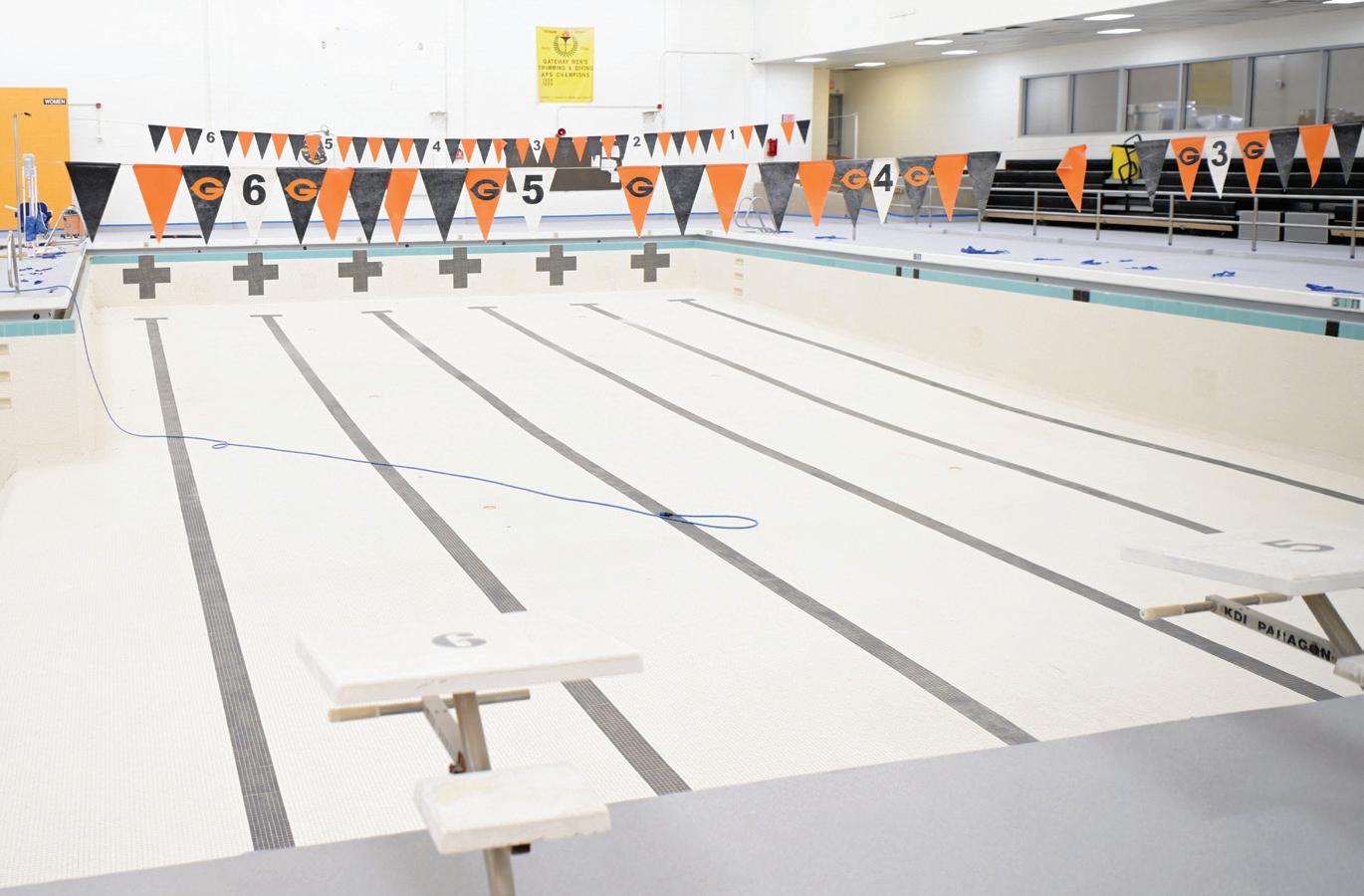
Below: Gateway High School is in the midst of a significant amount of construction and updates on its athletic facilities, both inside and outside the building. Some of the work is taking place in the swimming pool, which is being resurfaced and updated ahead of the girls swimming season in the winter.
PHOTOS BY COURTNEY OAKES/AURORA SENTINEL

When he stands just outside the back door of Gateway High School, Paul Jefferson can see the vision.
Since he took over the job as the athletic director in 2022, Jefferson has enjoyed the ability to easily view an expanse of athletic fields and courts configured unlike those at any other high school in Aurora.
Most significantly, Gateway will become the last high school in the district to get an artificial turf field, though that isn’t expected to be ready until sometime in October and will also include a new track surrounding it. In the meantime, football practices (which officially were allowed to begin Aug. 3) move to the outfield of the adjacent baseball fields once school begins.
DISTRICT NEWS
It was apparent those facilities needed to be updated, however, and that is currently what is happening, which has made Gateway the epicenter of change in Aurora Public Schools with the 2026-27 school year about to get underway.
Also happening outside is total reconstruction of the school’s tennis courts on the west edge of the campus, which will also have lights when they are completed.
“I had my fall coaches meeting and I told them ‘we’re almost there,’” Jefferson said as he gestured at the massive amount of work underway on the campus.
BY COURTNEY OAKES Sports Editor
“This is a long time coming. When you get frustrated that you can’t just jump on the field, understand we’re just a couple of months away from being maybe the best show in town in terms of facilities in APS.”
That is an uncommon position historically for Gateway, which opened its doors in 1973. The school has often been bypassed for major improvements in recent years, but no longer, with significant transformation inside the building and on a larger scale outside of it.
Inside, a fresh new look for hallway floors and lockers is immediately noticeable, while the school’s swimming pool and diving well are in the process of being resurfaced to get ready for the girls season in the fall.
The most noticeable difference is outside, where nearly all of the fields to the south of the school are currently in the process of a massive transformation.
Because of the work, there’s been a diaspora for summer workouts for Gateway sports — Jefferson tipped his cap to the district’s facility management office — as Aurora Public Schools Stadium has been used regularly by the football team, while other teams have been stationed at APS Avenues and Aurora Hills Middle School.
“Little by little, we keep moving forward,” Jefferson said. “I can’t wait to see it.”
Jefferson’s biggest hope is that the work — backed by APS athletic director Casey Powell and former principal Dr. Scott Fiske, who has been succeeded by Amanda McDonald — will continue the recent momentum of the athletic program.
He credits the Class of 2026 for helping making significant steps forward. In the spring alone, the boys volleyball team won its first-ever league championship and qualified for the Class 4A playoffs, the baseball team — which made the postseason in 2025 — made the Colorado League tournament for a fourth straight season, the girls soccer team posted a third consecutive winning season and the girls golf team won the league championship for a second time.
“With how things have turned around in the past few years, I believe this is the perfect time to give them updates like this,” Jefferson said. “I can’t wait for the athletes to get out here.”
In other facilities upgrades around APS high schools, Aurora Central had a new track installed at Illium Field, while it also will
have a new set of tennis courts, complete with lights.
“We are really grateful to Casey and APS for allocating the resources necessary to upgrade these facilities,” Aurora Central athletic director Ryan Widemon said. “This investment acknowledges the positive impact that athletics has on so many students.”
Vista PEAK Prep had its original turf field replaced and the new surface includes markings for flag football games.
District veteran Jen Rahn gets ‘dream job’ as athletic director at Rangeview
A decade ago, Jen Rahn’s vantage point at Mrachek Middle School used to afford her a view of things happening on the fields at adjacent Rangeview High School.
She was always impressed watching the school’s football team as well as the boys soccer team, which was coached by then-athletic director Vic Strouse, and envisioned herself in charge of the operation one day in the future.
After more than two decades in Aurora Public Schools at multiple schools in different capacities, that day has arrived as Rahn has been hired as Rangeview’s new AD.
“I’m still in awe in a lot of ways,” Rahn said of getting the job. “I used to bring my track athletes from Mrachek over to Rangeview, so I would always see the football team out there and I would always see Vic (Strouse) with his soccer team. I always thought that was my dream job.”
Rangeview’s turnover in the athletic director position is rare for a school that opened its doors back in 1983. Rahn becomes just the sixth person — and the first female — to serve as AD as the school enters its 43rd year.
Joe Burton, Tony Antolini, Strouse — who remains the boys soccer coach — Shawn Palmer and Erick Swanson (who held the position for the past three years) preceded Rahn, who is no stranger to the school. She’s been there for the past eight years and served as an assistant principal for the last seven.
“Obviously, these are big shoes to fill, but Rangeview is a really special place,” Rahn said. “There are so many people here that have such a legacy. ... They were athletes here, they graduated and now they are staff here. There is so much involvement.”
Rahn has a significant advantage in that her previous time helps her to understand the community and what it is about, however there are significant changes that will require learning for her and adjustment for a mostly veteran coaching staff.
A shift in bell schedule for APS high schools — with school beginning at 8:20 a.m. and ending at 3:50 p.m. — will cause a ripple effect in terms of scheduling of transportation to contests as well as timing of home games and practices. There are several other behind-the-scenes changes that also will need to take place.
“It’s definitely been a whirlwind so far, this is the best job, doing fun things with kids,” she said.
Rahn is looking forward to many things in the upcoming year, including the return of the Anvil football game between Rangeview and rival Gateway (where Rahn also spent time) and what school boys basketball star Archie Weatherspoon V will select. She said she will also focus on expanding female sports teams at Rangeview as well as take part in a district-wide initiative to focus on building up the participation of the incoming class of freshmen.
“One of my charges is getting more freshmen involved in athletics and activities,” Rahn said. “The more involved you are in your school, the better you do and the more well-rounded person you are.”
Rahn is part of a restructured administration team at Rangeview that includes a new principal in Lauryn Gray.
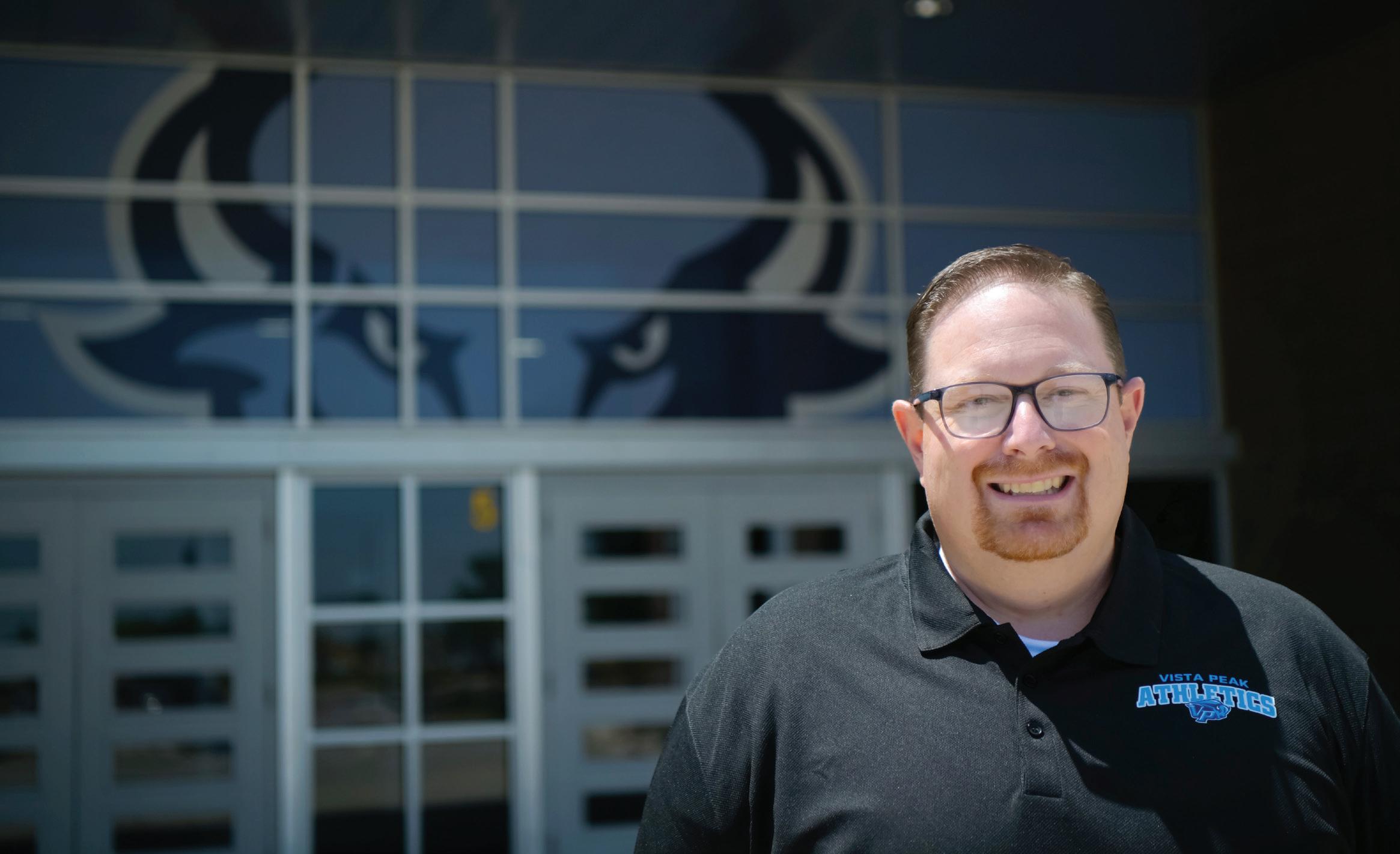
Matthew Koscove will try to take small scale successes to a bigger model as the new athletic director at Vista PEAK Prep.
Koscove made significant inroads over the past three years in the same role at Alameda in Jefferson County Schools, but has graduated to the “big” leagues of a school with more than three times the high school population.
He’s prepared himself for the challenge.
“I’ve always made sure because I was at a little school that it wasn’t going to hold me back,” Koscove said. “I was going to go to all these events and stick my nose in the places where the big boys were talking. I think that will really help.”
Koscove is proud of the accomplishments at Alameda, which were significant in recent years — he highlighted massive improvement from a girls softball program that near-

ly disappeared completely among others — but found increasing difficulties with the 55-mile round trip drive each day from his home in Green Valley Ranch.
When he saw the late opening at Vista PEAK Prep (which became available when Jordan Ivey moved into a full-time position as assistant principal) he pounced on the chance for more favorable geography as well as the opportunity to work at a place with an enrollment of 2,200 as opposed to the 960 he had at Alameda (which included seventh through 12th graders).
“I get to be at a bigger school and I get to be much, much closer to home, so this checked two boxes,” said Koscove, who has a son who attends DSST: Conservatory Green and competes in athletics at Northfield.
Koscove becomes the third athletic director at Vista PEAK Prep in the last three years, as David Benedict (who left for Smoky Hill) was followed last year by Ivey. Like his predecessors, he sees the untapped potential of the school, which continues to be bolstered as the area around it grows.
Koscove’s association with athletics is deep, as he is a former coach — even counting time working under late former Indiana University men’s basketball coach legend Bob Knight — and also worked in Denver Public Schools athletics.
His main goal is to recognize and celebrate the achievements of Vista PEAK Prep’s athletes and teams. He has begun to do that with a dedication to posting on social media, which he did abundantly at Alameda.
Koscove also is trying to come up to speed with the challenges created by the APS district’s new bell times for high schools and a new centralized data base created by the Colorado High School Activities that allows athletic directors to track the certifications of all of their coaches.
It’s a lot to take in at first, but Koscove expects things to smooth out soon.
“As soon as I can get the firehose out of my mouth, I can pay attention to details,” Koscove said. “I want to make sure things don’t slip through the cracks. I think the bumpiness will be the fall and we’ll get through it.”
season, which includes his effort Aug. 1 against the St. Louis Cardinals in which he allowed one run over 5 2/3 innings. He could make his first start for the Cubs on Aug. 6 against Toronto. Gausman helped Toronto reach the 2025 World Series, going 2-3 with a 2.93 ERA in six postseason starts.
The Major League Baseball trade deadline arrived Aug. 3 and one of the larger transactions included a former Aurora area prep star pitcher.
Grandview High School grad Kevin Gausman was dealt by the Toronto Blue Jays to the Chicago Cubs in exchange for minor leaguers Brett Bateman and Ty Southisen. Gausman joins a Chicago team that was 63-49 at the time of the trade and in the top spot in the National League wild card standings.
The Cubs now have acquired two former Aurora area prep star pitchers in just over a month, as they also dealt for ex-Regis Jesuit ace left-hander David Peterson on June 25. The 30-year-old Peterson is 3-1 since coming over.
Gausman, meanwhile, has a 5-10 record with a 4.38 ERA in 23 starts this
Gausman has pitched at least 174 2/3 innings and made at least 31 starts in each of the previous five years.The 35-yearold right-hander — originally drafted by the Baltimore Orioles and with stints with the Atlanta Braves, Cincinnati Reds, San Francisco Giants and Toronto — is eligible for free agency at the end of the season.
A member of Grandview’s original Hall of Fame class, Gausman is the Wolves’ alltime leader in career wins (17) and strikeouts (174), owns the single season strikeout record of 76 (set in 2010) and shares the single season high of seven wins with three other players.
FALL SPORTS Practices begin in boys golf, football
The 2026 fall prep sports season began on Aug. 3 as boys golf and football were allowed to start practices and
tryouts ahead of the respective starts to their seasons Aug. 5 and 20, respectively. The other fall prep sports (girls volleyball, boys soccer, softball, cross country, girls flag football, boys tennis, field hockey and gymnastics begin practice Aug. 10.
GOLF
Cherokee Trail grad Forte wins Junior America’s Cup Brayden Forte, who helped lead the Cherokee Trail boys golf team to the Class 5A state championship last fall, picked up a big individual title of his own July 30 in his final junior golf competition played in Carlsbad, Calif. Forte competed with Team Colorado at the boys Junior America’s Cup tournament and finished atop a field of 72 individuals after three rounds played on the South Course at Omni La Costa Resort. Forte fired rounds of 66, 68 and 68 to finish 14-under-par for the tournament and ahead of the second place finisher by five strokes.
Forte combined with future San Diego State teammate Miles Kuhl (formerly of Fairview) plus Ash Edwards and Nicholas Brooks to finish fifth as a team.

Bearly mid-summer, major ursa sightings are sky high in the metro area, but not in Aurora
“SO WE’RE SEEING MORE BEARS THERE THAN WE HAVE IN ANY YEAR”
BY DAVE PERRY | Sentinel Colorado Editor
As if the relentless heat and brown grass isn’t enough for Front Rangers these days, get ready for bears.
“So we’re seeing more bears there than we have in any year,” Colorado Division of Wildlife spokesperson Kara Van Hoose said Friday.
The Arapahoe County Sheriff Department relayed a bear sighting Thursday along the Highline Canal near the 6000 Block of South Franklin Street in Centennial.
Last week, there was a bear sighting in Lone Tree, one in Arvada, another in Littleton and many sightings closer to and into the foothills.
“So it’s not uncommon for us to have bears pop up in those locations, but it’s the time of year that’s unusual,” Van Hoose said. Not even August,”it’s happening earlier in the year, and it’s the quantity.”
Bears looking for big meals in the fall as they get ready for hibernation are pretty common sightings in the metro area. But not this early.
It’s the drought, Van Hoose and other wildlife officials point out. Low snowpack from last winter and the hot and dry spring and summer have made for a real lack of forageable foods that the bears normally eat.
And so the bears follow their noses to find dinner, in trash cans, cars and back yards.
Surprisingly, Aurora hasn’t had any reported bear sightings, she said.
Van Hoose said it’s likely because of how Aurora is kind of carved out of the metro area with interstates, 70, 225 and 25.
That’s not always been the case. A wandering and persistent bear in southeast Aurora in 2019 had even police and local deputies on a
manhunt for the bear.
After tracking the bear with drones and tailing it for a couple of days, Aurora police let it go.
“He didn’t commit any crimes, he didn’t steal any picnic baskets or anything so we didn’t apprehend him,” Aurora police spokesperson Officer Anthony Camacho said at the time. “We decided to just leave it be.”
That was in late September, when bears often go shopping for high-calorie meals.
This is different, Van Hoose said.
It’s time to go beyond best practices that prevent drawing bears and other unwanted animals to your house and step it up, she said.
Don’t just bring the bird feeders in at night, don’t set them out at all, she said. Thoroughly clean your barbecue grill after each use, and think twice about using it if you’ve seen bears around. Make sure your car doors are locked, as well as house windows and doors. Bears can easily push through window screens.
Bears are pretty smart and very determined, she said.
“But Bears are naturally skittish. They’re not really curious” and care not to hang around people and all the noises and oddities they surround themselves with.
So Van Hoose suggests capitalizing on that. If you see a bear nearby, set off the car alarm or trigger outdoor lights. Make noise by banging on something or even just “yelling whatever you want.”
“They’re more likely to run away,” she said.
If they don’t, don’t turn and run.
“First of all, you can’t see the bear,” Van Hoose said. And that can trigger an instinct in the bear that you’re prey.
Make noise. Raise your arms. Back away into your house or car.
Then call wildlife officials or 911 if the situ-
ation is critical.
Wildlife officials say that the number of sightings will only increase as the days grow shorter and the bears start looking even harder and further for food.
“We’re not even at the time period where we normally see high numbers for bears, so yeah, it’s keeping your trash locked away and not putting it out on the curb until morning of pickup.”
To report a bear sighting during business hours, call the Denver wildlife division at 303291-7227.
—DavePerry,TheSentinel
Co-existing with other wildlife
A rash of social media posts recommend the application of sticky-tape bands around tree trunks to prevent insects other garden pests from accessing tree canopies and munching on foliage. But those bands also catch caterpillars, butterflies, bees and birds, which would be difficult to free without ripping off their limbs or breaking their wings.
Similarly, glue traps are cruel devices, holding hostage everything from basement cave crickets to terrified mice and rats until they starve to death.
So-called “nuisance” animals, like squirrels, bats and raccoons, are just living their lives, as we are, and they need food, water and shelter, like we do. It’s not their fault that we chopped down their forested homes, paved over meadows and built neighborhoods in their habitat. They have nowhere else to go, so the least we could do is treat them humanely and share our (outdoor) space with them as much as possible.
When they enter indoor living spaces, however, that means evicting them, as I did. But prevention would have been better. Look for openings in attics, basements, and around win-
dows, doors and soffits, keeping in mind that a mouse can squeeze through a hole as small as the diameter of a pencil.
Check, too, for gaps under eaves, missing chimney caps and broken vents. Ensure there aren’t any animals indoors before sealing them. If you have unwanted residents, wait for them to leave or lure them out so they don’t die in your walls.
If you’re concerned about biting insects, there are better ways to control them than using pesticides, which can expose people, animals and groundwater to harmful chemicals and kill a variety of other insects that serve as an important food source for birds. The products also require repeated applications to maintain that control.
Instead, eliminate mosquitoes from your backyard by preventing them from breeding in the first place.
Don’t allow water to collect anywhere on your property. Get into the habit of emptying plant-pot saucers, overturned trash can lids, tires, children’s playsets and other receptacles after each rainfall (or irrigation session).
Add Bti (Bacillus thuringiensis israelensis), a naturally occurring bacterium sold as Mosquito Dunks and Mosquito Bits, to sources of standing water, such as birdbaths or still ponds, where the insects lay their eggs. The biological control prevents mosquito, gnat and black fly larvae from developing, but is considered harmless to humans, pets, wildlife, beneficial insects, fish and plants.
To discourage wild animals, avoid feeding pets outdoors, tightly secure trash can lids, and physically make your property as inhospitable as possible by sealing entry points, closing garage doors, installing fencing, etc.

Askkanwii’s Diasporic Film Festival bringing global stories,
understanding to Aurora t
The world regularly comes to Aurora, this time on the silver screen.
The third Colorado Diasporic Film Festival is coming to Aurora in August. As an initiative of the Askkanwii Filmmaking Incubator Hub, another Colorado-based nonprofit, the festival seeks to foster cross-cultural understanding and connection.
Askkanwii was founded in 2013 by Ousmane Ndoye, a Senegalese-born filmmaker and educator. Ndoye has spearheaded the Diasporic Film Festival and stewarded it into partnerships with the Sundance Institute and the Colorado Office of Film, Television and Media, as well as other film and media affinity groups in Colorado.
Ndoye said he was inspired to create both Askkanwii and the Diasporic Film Festival as a means of facilitating cross-cultural dialogue.
“I came here 29 years ago as an immigrant, and as a content creator,” Ndoye told the Sentinel. “My perspective was always to do films, write books, to tell stories. Then, when I came here, I realized that America has people from all over the world.”
Ndoye said that a common experience for people from diasporic backgrounds was a “fear of being judged and limited.”
“They stay in their comfort zone rather than coming out and sharing with our neighbors their own stories,” Ndoye said. “When I started college in 1999, to hone my English, I just wanted to write stories and films. That’s when I really observed networking… and realized that this country is built on a lot of immigrants, the diaspora, people from all over the world.”
Ndoye said it was then he considered using the arts, and film specifically, as a means of community building and allowing people to “tell their own story”.
Many of the events for the film festival are slated for businesses across Aurora along Colfax, including Downtown Aurora Visual Arts, Roshni Healing Arts Sanctuary, Ollin Cafetzin, the Fox Arts Center, the Vintage Theatre, Banh and Butter Bakery Cafe, Society 303 Wine Bar, Cerebral Brewing, Lavictoria Incubator Kitchen, and Mango House Cultural Food Court.
“Through the Diasporic FilmHub Village, we are creating a welcoming space where every culture has a seat at the table, every story matters, and every community can see itself reflected on screen,” Ndoye said. “By highlighting House of Kodo this year, we are also celebrating local Colorado filmmakers who are showing that powerful storytelling can begin here at home and travel across the world.
This year, the CDFF will highlight House of Kodo, a Colorado-based film
company created by Bruce Tetsuya and Drew Matsushima. The festival will be screening Tetsuya’s new short film, “End of Things”, following an ex-military project and his fears for his daughter’s safety after seeing a vision of the end of the world.
The programming for the festival features projects from 21 different countries and 18 different languages. This year’s submissions include documentaries, feature films, short films, animation, experimental work, student films, children’s shorts, and web/new media projects.
IF YOU GO
Dates: Aug 6 to Aug.9
Place: Screenings and activities span local spaces including DAVA, Aurora Fox Arts Center, Vintage Theatre, Roshni Healing Arts, and Ollin Cafetzin
Details and tickets: cdfilmfestival.com. Tickets include a $15 food voucher for any of the festival’s partner businesses.
Fox Flix: “Harold and Maude” at Aurora Fox Arts Center
The Aurora Fox Arts Center’s Fox Flix summer classic movie series presents Hal Ashby’s beloved 1971 dark romantic comedy classic “Harold and Maude.” The film explores the unlikely bond between a death-obsessed young man, Harold, and an eccentric, young-at-heart 79-year-old woman, Maude, whose zest for living transforms his perspective on life.
IF YOU GO:
Date: Aug. 6 at 7 p.m.
Place: Aurora Fox Arts Center, 9900 E. Colfax Ave.
Tickets: $5
Information: aurorafoxartscenter.org or 303-739-1970
“The Vintage Idiot” Stand-Up Comedy Series at Vintage Theatre
Local stand-up comedy comes to the Berg-Young Cabaret Stage every Thursday in August. Produced by “Borrowing Funny,” this recurring comedy night features rotating showcases of regional stand-up comedians, comedic acts, and themed performances in an intimate cabaret setting.
IF YOU GO:
Date: Thursday Aug. 6 at 7:30 p.m.
Place: Vintage Theatre, 1468 Dayton St.
Tickets: $15–$20
Information: vintagetheatre.org or 303-856-7830
“Dear Jack, Dear Louise” at Vintage Theatre
Tony Award-winning playwright Ken Ludwig weaves a heartwarming romantic comedy inspired by his parents’ real-life WWII courtship. The play tells the story of Jack, a U.S. Army doctor stationed in Oregon, and Louise, an aspiring performer living in New York City. As they exchange letters back and forth across the country, their pen-pal relationship deepens into love despite the uncertainty, distance, and historical chaos surrounding them. Filled with Ludwig’s signature wit, warmth, and nostalgic charm, the production offers a moving look at resilience and connection.
IF YOU GO:
Date: Through Aug 30
Place: Vintage Theatre, 1468 Dayton St.
Tickets: $20–$36
Information: vintagetheatre.org or 303-856-7830
“The Scarlet Pimpernel: An Old Time Radio Production” at ACAD / The People’s Building
Experience live audio drama staged in classic mid-century broadcast style. This production brings Sir Percy Blakeney’s daring rescues during the French Revolution to life through live sound effects, vintage voice acting, and period radio atmosphere in the heart of the Aurora Cultural Arts District.
IF YOU GO:
Date: Aug. 6; July 31 at 7:30 p.m., Aug. 6 at 7:30 p.m.
Place: The People’s Building, 9995 E. Colfax Ave.
Tickets: $20-28
Details: www.thepeoplesbuilding.co
David W. Kincannon II: “Typed Out – Parts We Play” at Vintage Theatre
Vocalist and performer David W. Kincannon II takes the stage for a onenight-only musical event exploring identity, classic theater selections, and personal storytelling. The cabaret-style production offers an intimate musical journey inside the Bond-Trimble Theatre space.
IF YOU GO:
Date: Aug. 5 at 7:30 p.m.
Place: Vintage Theatre, 1468 Dayton St.
Tickets: $24
Details:[vintagetheatre.org or 303-856-7830
“The 10½ Commandments” by One Night Stand Theater at Vintage Theatre
One Night Stand Theater presents a fast-paced evening of theatrical readings featuring short plays inspired by modern ethics, human vices, and ev-
eryday virtues. Local playwrights and actors collaborate to present diverse perspectives on moral dilemmas and contemporary life.
IF YOU GO:
Date: Aug. 9 at 7:30 p.m.
Place: Vintage Theatre, 1468 Dayton St.
Tickets: $12
Details: vintagetheatre.org or 303-856-7830
”Shadows & Secrets” at Vintage Theatre
Insight Colab Theatre presents *”Shadows & Secrets,” a staged multimedia mystery by playwright Nancy Wang that blends live theater with the style of a classic radio drama. Inspired by the real-life death of Wang’s grandfather, Chicago restaurateur Chin F. Foin, the play revisits a decades-old cold case set during the Prohibition era. As a live studio audience watches the fictional Mystery Radio Playhouse investigate whether Foin’s fatal fall down an elevator shaft was an accident—or murder—the story unfolds through suspense, historical intrigue and family memories. Set against the backdrop of 1920s Chicago, the production explores tong wars, corruption, greed and the search for long-bur-
ied truth. The 75-minute performance is recommended for mature audiences and is presented without an intermission.
IF YOU GO:
Date: Aug. 28-Aug. 30; performances Friday and Saturday at 8 p.m. and Sunday at 6 p.m.
Place: Vintage Theatre, 1468 Dayton St.
Tickets: $25-$35; student discounts available.
Information: insightcolab.org or 303-437-8917
“Live Music at The Local Drive’ at Stanley Marketplace
This ongoing live music series transforms the Stanley Marketplace hangar into a vibrant performance space featuring local and regional musicians. The programming spans genres—from indie and folk to jazz and rock—creating an eclectic soundtrack for Aurora’s creative community.
IF YOU GO:
Date: Fridays and Saturdays after 5 p.m.
Place: Stanley Marketplace, 2501 Dallas St.
Tickets: Free admission


• Great Burgers
• GreatBurgers
• GreatBurgers
• GreatCheesesteaks
• Great Philly Cheesesteaks
• GreatCheesesteaks
• 20 TV’s
• 20 TV’s
• 20 TVs
• Open St age EveryThursday
• Open St age EveryThursday
• Watch All NFL & MLB Games




• Saturdays:11:30AM-3PM FreeDomesticBeeror
• Saturdays:11:30AM-3PM FreeDomesticBeeror
• Open Stage



Soda With SandwichOrder
Soda With SandwichOrder
Give us a call for entertainment questions








































AURORA POLICE AND COMMUNITY AGENCIES TOUT PROGRAM TO MOVE TEENS LINKED TO GANGS, GUN-VIOLENCE IN A NEW DIRECTION. CRITICS AREN’T CONVINCED
BY MCKENNA HARFORD,
An Aurora community youth gun-violence prevention program is highlighting tension between a desire for safer communities and a lack of trust in police.
Aurora’s Standing Against Violence Everyday program, which identifies youth involved in gun violence and directs them to supportive services, has recently drawn both positive and negative attention.
Several times in recent months, progressive city council members have asked about the effectiveness of the program and requested more information, though no specific changes have been proposed. Additionally, an April city council meeting featured several public speakers who raised concerns about racial bias in the program.
Meanwhile, the SAVE program was chosen for a featured presentation at the 34th annual International Problem-Oriented Policing Conference in November. Aurora Police Chief Todd Chamberlain touts the success of the program, saying it’s evidence-based and effective.
The Sentinel took a deep dive examining the program and concerns around it. Here’s what we found.
The SAVE program is a youth gun-violence prevention program that officially started in September 2023. It presses police to identify youth tied to gun violence and gang ties and aims to direct them to supportive services and deter future violence.
APD’s Lt. Anna Bungartz said the department enacted the program after a spike in youth violence in 2021. She said they chose the program, which is a national model that has been adapted locally, because it combined “an actual genuine offer of help” with accountability.
“We want to get to them on the very front end to interrupt the cycle of gun violence,” Bungartz said.
The program is a partnership between the city’s Youth Vio-
lence Prevention Programs, the Aurora Police Department, Justice Works Case Management and four community organizations. The community organizations are Hazelbrook, Life-Line, Road Called Strate and Struggle of Love Foundation.
The police department’s SAVE team is led by Bungartz and Officer Jaime Gonzalez Dominguez.
Bungartz said the partnership element is crucial because though police want to be part of the solution, “we can’t be the only solution.”
“By the time that (police get involved), it’s very obvious to see that several other societal structures have failed,” she said.
The program was established through a partnership with the U.S. Department of Justice and the National Network for Safe Communities, a criminal justice research center. It is funded by a federal grant.
HOW SAVE WORKS
The criteria to be considered as a candidate for the SAVE program is threefold: the person is between 14 and 25 years old; they have connection to a gun violence crime, either as a suspect or victim; and the crime includes gang involvement.
Police examine incidents of gun violence, including illegal possession of a weapon and fatal and non-fatal shootings, weekly to identify possible candidates. Then a group of law enforcement officers and the community organizations involved review potential candidates for notification to make sure they fit the criteria, according to police and city staff.
Once a person has been identified, a group consisting of a SAVE detective, members of a community organization, a case manager and other police officers deliver a personalized letter to the recipient’s home in an unannounced visit. The letter can be delivered to family members if the intended recipient isn’t available.
Bungartz said the letter and conversations at the door are customized for each individual and their situation.
Between September 2023 and June 25, 2026, the SAVE program attempted to contact 372 recipients and successfully contacted 335
recipients, a 90% contact rate.
The letter includes connections to a variety of resources, such as educational tutoring, mental health support, substance use programs, skills training, food security, utility and rent support, peer mentorship and court navigation assistance. It can also include a warning about potential consequences for gun violence.
Since the program is voluntary, after a recipient gets the letter, what happens next is up to them, Bungartz said. Recipients can choose to seek help from the services available, continue connecting with the community organizations or not follow up at all. Bungartz noted the services are provided to families at no cost.
Bungartz said the community organizations follow up with recipients, but police involvement ends after the letter is delivered, unless there is another crime or arrest. She said police can share information about SAVE recipients with the court system.
“We would let the court know if they have been given the notification and the resources and then they continue to perpetrate violence in the community,” Bungartz said.
District attorneys for the 17th and 18th Judicial Districts said they take into account all mitigating and aggravating factors on a case-by-case basis when prosecuting crimes.
The police department keeps a list of the recipients, which it says is only accessible by the law enforcement members of SAVE. Individuals remain on the list for three years, after which they are purged from the list if they’re not involved in additional gun violence. Individuals that can’t be contacted or located are removed from the list after an 18 month pending period.
Should a recipient be charged with gun violence related crimes during the three-year period, it would reset, according to police.
“They will not be removed until three years of no new offenses,” police said in a follow-up email. “That is the point of the accountability piece and providing resources. If they are continuously of-
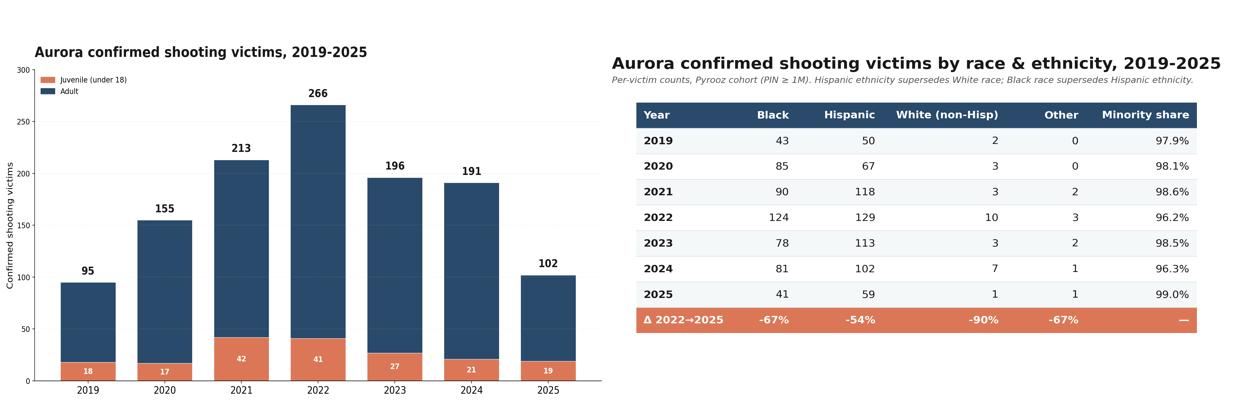
fending, we are not doing our jobs at some level of the criminal justice eco-system.”
Since the program was created in 2023, the list will have its first purge this September.
If a recipient agrees to be connected with services, representatives from the community organizations help facilitate that. The community organizations don’t provide police with information on recipients.
“It’s a one-way flow of information and we don’t ask the community based organizations for any information,” Bungartz said. Adherence for police is based on a future lack of criminal activity.
Since August 2025, 56% of SAVE recipients have actively engaged in supportive services, according to Timiya Jackson, division manager for the city’s Youth Violence Prevention Programs.
Jackson said that while the SAVE program notifies individuals, the resources and services are available to the whole family.
“We understand that part of the reason why a young person might be gang-involved or committing crimes is because of whatever is happening within the home, so being able to offer those supports and resources to the family at large, we hope will help put them on a different pathway,” Jackson said.
SAVE not only focuses on prevention, but intervention, which Jackson said is equally important to address.
“Once decisions have been made or young people have contact with law enforcement, it doesn’t necessarily mean things are over for them, there’s always an opportunity for them to choose to do something different,” she said.
While some people have chaffed at the tough love approach of SAVE, Jackson said the intent is to hold youth to “the highest expectations, but do so with love and grace.”
She added that the partnership between community organizations and police is necessary because “this is work that can’t be done by a sole entity.”
“This is doing something different,” Jackson said. “This is really being intentional around partnerships and collaboration for the next generation.”
JoJo Padilla, executive director with Denver Healing Generations, said he helped create the Voices of Honor Coalition, a group opposing the SAVE program, after hearing concerns that the program isn’t transparent and targets poor and minority families.
The Voices of Honor Coalition organized youth to speak at the April city council meeting to bring attention to their concerns with the SAVE program. In addition to speaking out at
meetings, Padilla said the group is working with SAVE recipients and encouraging local community groups not to collaborate on SAVE.
Padilla’s organization opposed a similar program that Denver was trying to create because of a lack of transparency.
“What they wanted is for us to go on ridealongs with the cops as they deliver a letter to the person you know saying ‘Hey, you’re on the list’ but (Denver) couldn’t answer any of our questions, like when did they get off the list or how do they get off the list,” he said.
Xavier Davis, Padilla’s co-chair for the Voices of Honor Coalition, worried about the potential impacts of a partnership between community groups and police.
“If (the community) starts thinking that we’re all siding with the Aurora Police Department and Aurora SAVE, they’re going to stop trusting us,” Davis said.
In addition to the lack of transparency, Padilla took issue with the “threatening” tone of the letter, saying these kinds of approaches “take away the humanity from somebody and convince people that they’re a criminal.”
18th Judicial District Attorney Amy Padden said she is encouraged by the outcomes and success she’s seen from SAVE, saying she doesn’t agree with concerns over the program’s approach.
“It’s not designed to be a punitive program, it’s designed to be a rehabilitative program,” Padden said. “This is looking for alternatives to putting someone in the court system.”
APD Chief Chamberlain defended the program from accusations of racial bias, noting that all participants have a connection to a documented crime.
“This is not about a scared straight,” Chamberlain said. “This is not about going and intimidating people. It’s not about profiling. It’s not about classifying people as a certain thing. The sole purpose is to stop the violence.”
APD’s Bungartz said the program is about deterring crimes by offering youth help, not defining participants as criminals. She added that it avoids bias by utilizing consistent criteria and data to select recipients.
“It’s very methodical and intelligence-driven,” Bungartz said. “We’re not doing a broad approach, we’re doing precision policing.”
While the police department did not provide demographic data specifically for SAVE recipients, it did say the breakdown would be similar to that of non-fatal shooting victims because the program requires candidates to have a connection to gun violence.
Police data shows that between 96% and 99% of non-fatal shooting victims each year from 2021 to 2025 were either Black or Hispanic.
Police said the demographics of shooting suspects “skew at rates similar to victims.”
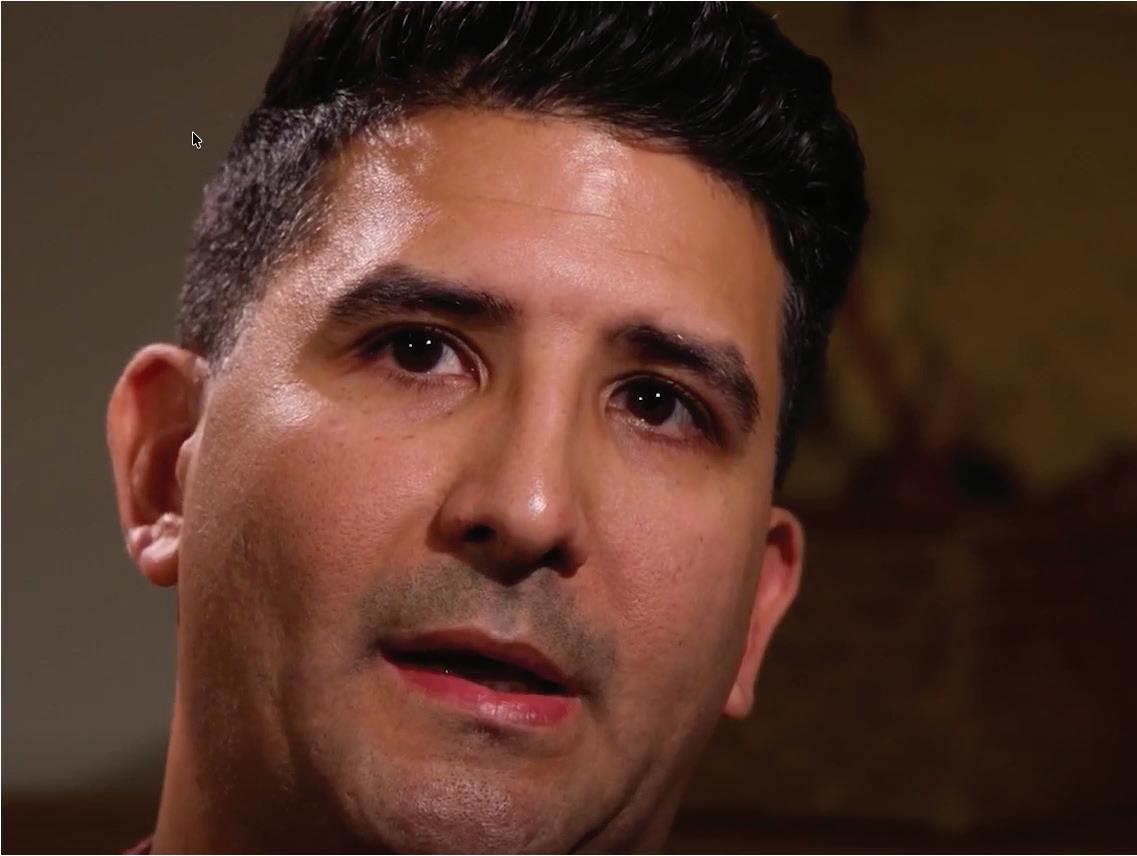

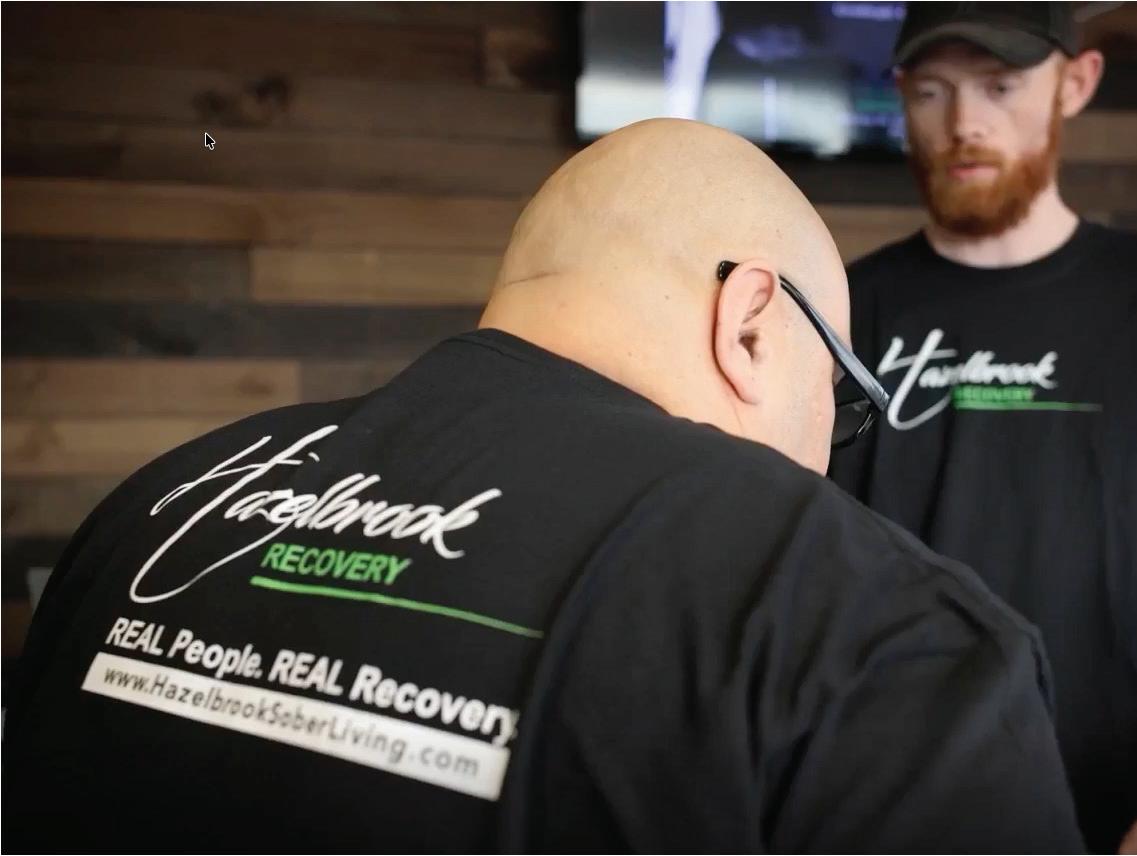

Alessandra Chavira, a coordinator at Denver Healing Generations, questioned how the program can be effective when the community doesn’t trust law enforcement.
“Aurora specifically has a lot of repairing to do with the community when it comes to their police department,” she said. “Until they do that restoration, the city of Aurora has a responsibility to provide those safety networks and programs
to youth without involving the police.”
APD has been under a state-mandated consent decree since 2021 to address excessive use of force and patterns and practices of racial bias against people of color. Triggered in part by the 2019 death of Elijah McClain, who died at the hands of police and rescuers after being stopped, unarmed, the decree mandates broad reforms in training, accountability, use-of-force policies, data




systems and community engagement.
Padilla supports investing in community violence intervention, but said that work should not include law enforcement.
“It’s not going to be done with more policing, it’s not going to be done with more criminalization of people in the name of safety. It just never works like that,” Padilla said.
Police said they have to be involved when a crime is reported and since SAVE recipients have a connection to illegal gun violence, either as a victim or suspect, law enforcement is an important component of the program.
Bungartz said she has seen a lot of success stories come from the program and thinks SAVE is helping rebuild trust between the community and police.
“The conversations that are occurring at the door are genuinely really good conversations that may not occur otherwise,” she said.
Both Padden and 17th Judicial District Attorney Brian Mason echoed that they have seen positive outcomes from the program.
“I’m encouraged by the conversations that I’ve had with some of the young men,” Mason said. “I think this is an example of government and community working together to address a serious public policy and serious public safety issue, and I’m proud of it.”
this program existed” or “I wish I had known sooner.” Road Called Strate, which has been around for 25 years, focuses on community re-entry programs for formerly incarcerated people. Thomas has been with the organization for almost three years.
Thomas said his lived experience has been instrumental in effectively communicating with youth. When Thomas was 19, he went to prison for 10 years.
“I’ll let them know that I’m not there to judge them, but I know how these things pan out, what the endgame looks like, but there’s other options,” he said. “It’s almost like I’m speaking to myself when I was 17 or 18 and I’m telling them something that I wish someone would have told me.”
Thomas understands why families may be hesitant around police and acknowledged that the community has a history of distrust with the police. However, he says working with police through SAVE allows him to help connect more people to services they might not have otherwise discovered or utilized.
“It’s initially a shock, but once they hear about the program and the services we’re offering, it opens them up,” Thomas said. “I think (police presence) can be used as leverage to convey the urgency and importance of the delivery.”
Thomas said the SAVE approach is focused on providing options and promoting self-advocacy. He said the outcomes he has seen through SAVE have been “phenomenal.”
“Whenever you can exchange a gun and replace it with a (job) certification they can be proud of and utilize to provide a life for themselves, then we’re doing our job,” Thomas said.
Wanting to see the impact of SAVE for herself, Councilmember Françoise Bergan went on a July ride-along to witness the SAVE custom notification process. She went out with APD and the community nonprofit Struggle of Love.
Bergan said the notification was done “very professionally” and she felt the interactions were positive even when the families were initially apprehensive.
“I think it’s a good program,” Bergan said. “I think (the reduction in gun violence) can be attributed to this type of program, which really helps to target individuals that were identified as at risk for gun violence, whether they’re involved or a victim.”
out question a huge component,” Chamberlain said at the July public safety committee meeting.
Looking specifically at the impact of the SAVE program, a sociology professor at the University of Colorado Boulder published a report that found the intervention prevented six fatal and non-fatal shootings in its first full year, according to an APD press release.
The police department said data on how many SAVE recipients are suspects or victims is “hard to define.”
“For example, if they’re in a car where a gun was recovered, we custom based on their proximity to the weapon/ crime, not always the role they played,” the department said in a follow-up email.
Of the 335 SAVE recipients contacted, only 10 have faced charges for gun violence after receiving a letter, which is a 3% recidivism rate. A 2020 study of a Florida gun violence intervention program found 33.6% of its participants reoffended after one year, while the recidivism rate for non-participants was 50%.
Looking at the success of the Aurora SAVE program, Democratic candidate Sarah Woodson, who is running to represent House District 42 in the state legislature, said she is inspired to propose a statewide version. If elected, Woodson plans to introduce legislation to implement standards and funding for a state model. Woodson does not currently face a challenger in November. Woodson said she wants to see solutions to gun violence prioritized and prevention and intervention programs are proven ways to tackle the issue.
“If we can use data and statistics to determine that African-Americans are more likely to die from gun violence or more likely to be in poverty, we should use statistics across the board to determine how to fix that,” Woodson said. “I truly believe in this program and I’m fine defending it because I’ve grown up in communities where there’s high crime and poverty.”
Woodson said she wants to hear directly from youth impacted by the program about what they would like to see and whether there’s a better way to initiate contact.
“I want to hear from the young people who experienced it about what would make it more approachable,” Woodson said. “At the end of the day, as adults, our priority is to make sure we’re providing services to children.”
For one 15-year-old boy, who spoke to the Sentinel on the condition of anonymity to protect his privacy, SAVE helped connect him with a mentor and a group of friends through the community organization Hazelbrook.
The 15-year-old said he had started hanging out with members of a gang and after he spent time in juvenile detention, his family received a letter from SAVE. He said he wasn’t at home when the SAVE group delivered the letter to his house in March, but his family shared the information with him and he connected with Hazelbrook.
Since then, he has enrolled in boxing classes and is working to get his driver’s license. He said he goes on almost weekly trips with his mentor and friend group, exploring places like Estes Park and enjoying Elitch Gardens amusement park.
“This is the first time in my life that I’m doing this stuff. It’s good because it’s getting me out of trouble,” he said, adding that he is excited to have found boxing and hopes to become a professional boxer.
He said he hasn’t hung out with the gang members he knew since being released from juvenile detention.
Many times when Tramell Thomas, a youth advocate at Road Called Strate, delivers the SAVE letters to families, they tell him: “I didn’t know
In addition to Bergan, Mayor Mike Coffman and council members Stephanie Hancock and Amy Wiles have also done ride-alongs.
Bungartz said the department knows the program is working because the data backs it up.
Aurora’s non-fatal shootings are at a five-year low in 2026, following a significant decline since 2021. In 2021, there were 213 non-fatal shootings, and following a spike at 266 in 2022, there have been steady declines. In 2025, there were 102 non-fatal shootings, and in the first half of 2026, there have been 27.
The homicide rate from 2025 to 2026 has declined 59%.
The drop mirrors a similar trend nationally. A 2026 report from the Council on Criminal Justice looked at 30 cities and found an 18% drop in homicides in the first half of 2026 compared to the first half of 2025. The report also found declines in robberies, assaults, burglaries and car thefts, though nationally there have been increases in domestic violence and sexual assault.
Aurora Police Chief Todd Chamberlain said prevention programs like SAVE are one of many factors contributing to the city’s decline in gun violence.
“The Aurora SAVE program in and of itself is not responsible totally for all of this, but it is with-
Cities across the country are seeing a decline in gun violence when they invest in community violence intervention programs, according to an April report from the Center for American Progress.
The report found that 17 of the country’s 50 most populous cities, including Aurora, saw gun violence decline by more than 50% from 2021 to 2025. The cities with the highest declines in gun violence took similar approaches, including investing in community violence intervention programs, coordinating multi-agency responses and utilizing focused deterrence strategies.
Focused deterrence strategies match police and community resources to high-risk people, groups and places.
Between 2021 and 2025, Aurora’s gun victimization rate declined 57.4%, which is the 12th highest decline of the cities studied. The report specifically credits the decline to Aurora’s investment in community violence intervention and multi-agency prevention programs, as well as new state laws further restricting guns.
The city with the largest decline in gun violence victimization from 2021 to 2025 is San Jose, California, which dropped 71.2%. Denver also saw a decrease of 58.2%.
The report says that all 17 cities with a decline over 50% have directly invested in community violence intervention programs.
“PEOPLE
AND THEY LIKE IT” — STEVE BROWN
and JOHN HANNA Associated Press
BY OWEN SWALLOW, For the
The U.S. Postal Service is emerging as a pivotal player in the midterm elections.
Postal workers in and near Aurora are making clear they’re energized to move into the public spotlight.
“People depend on the Post Office, and they like it,” Denver area postal worker Seve Brown told the Sentinel last week during the National Day of Action to Protect our Post Offices. Brown and others turned out to the Denver main postal service headquarters in northeast Denver for a local protest. “We want the public to become more aware of some of the threats we’re facing.”
Brown, a retired postal union worker, said that David Steiner, the Trump-appointed postmaster general, has “slowed down the mail.”
“Mail from Denver to Denver used to be overnight, from Denver to New York City used to be three days, and now going to the coast could be up to seven days,” Brown said.
Union members say Trump and his administration have pushed a false narrative to discredit vote-by-mail systems.
APWU National posted on social media that: “APWU members in Denver stood together during our National Day of Action to protect our public Postal Service. We’re fighting for a strong, universal USPS that serves every community, no matter how rural.”
Besides regular postal operations, President Donald Trump is seeking greater control over mail balloting while a change to how the agency processes mail is leading to criticism that it’s failing to deliver ballots on time.
Democratic officials have raised concerns over the past few weeks about how quickly the Postal Service will process ballots after tens of thousands of them in California and hundreds in Wisconsin arrived at local election offices too late to be counted in elections earlier this year.
A legal fight over Trump’s executive order on mail balloting is now before the U.S. Supreme Court.
Roughly five weeks before the first midterm ballots are mailed out, the U.S. Postal Service is emerging as a pivotal player in an election season that will determine control of Congress.
President Donald Trump is seeking greater control over mail balloting through an executive order while a change to how the agency processes mail is leading to criticism that it’s failing to deliver ballots on time.
At the same time, Trump is leveraging his political clout to push his SAVE Act through Congress, despite resistance even from some Republicans.
Democratic officials raised concerns two weeks ago about how quickly the Postal Service will process ballots after tens of thousands of them in California and hundreds in Wisconsin arrived at local election offices too late to be counted in elections earlier this year.
Top election offices in Kansas and Michigan are urging voters who want to cast their ballots early to avoid the mail and instead drop them
off in person.
The Postal Service replied to those concerns by saying it remains “committed to fulfilling our role in the electoral process.”
“We provide a secure, efficient, and effective way for citizens to participate when policymakers decide to use mail as part of their elections,” it said in a statement last week.
The Postal Service faced similar questions about mail delivery in 2024, but the scrutiny this year is heightened because of an executive order Trump issued in March that seeks to create a national voter list to guide the Postal Service in deciding who gets a mail ballot.
The order has sparked multiple lawsuits and federal court orders, leading to a case now before the U.S. Supreme Court in which the administration is asking the justices to allow it to impose its restrictions on mail balloting.
Trump has lied for years about voter fraud to try to explain away his loss to Democrat Joe Biden in 2020, and mail balloting is a favorite target, even though he has used the method himself. During a recent stop in Michigan, he falsely characterized mail balloting as “inherently corrupt” and added, “Hopefully there will be no mail-in ballots.”
A 2025 report from the research group Brookings identified about four cases of fraud for every 10 million mail ballots cast.
Despite Trump’s attacks, the method remains popular with voters of both major parties. In 2024, nearly 30% of U.S. voters cast their ballots by mail, according to federal data. In Michigan, where competitive U.S. House and Senate races could help determine the balance of power in Congress, the state said it has sent out more than 2 million absentee ballots for the state’s Aug. 4 primary.
Colorado, with some of the highest voter turnout rates in the country, has provided mail-ballot elections since 2014.
Colorado Secretary of State Jena Griswold, Gov. Jared Polis and Attorney General Phil Weiser have recently stood up for the accuracy and soundness of the state’s mail-ballot election system and rebuked Trump’s allegations and current plans.
“Trump will not be able to use the Postal Service to control which voters receive a mail ballot, and cannot use the DOJ to intimidate election officials into following his unlawful order,” Griswold said in a statement in June. “The Constitution is clear: States run elections, not Trump.”
Postal officials agree.
“We want to keep vote by mail. We want to protect it. We want to expand it,” said Jonathan Smith, president of the 200,000-member American Postal Workers Union, which launched a campaign in April promoting it and is opposed to turning the Postal Service into an election administrator. “Why? Because it works.”
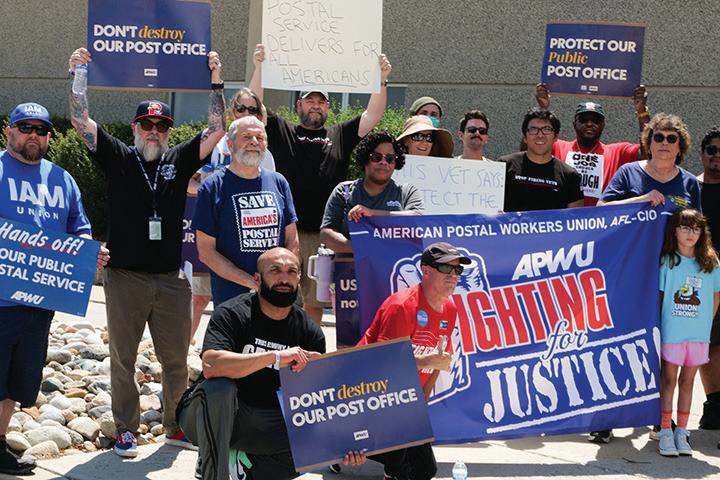
The Postal Service proposed a rule in June in line with Trump’s executive order that would create a national list of eligible voters, based on databases kept by other federal agencies. Only those on the list would be eligible to receive mail ballots.
Democratic officials in nearly two dozen states filed a federal lawsuit in Massachusetts. A federal judge there blocked Trump’s order last month, and an appeals court upheld that ruling, prompting Trump’s appeal to the Supreme Court. But the appeals court for the District of Columbia refused Tuesday to block the order in a separate case, calling a legal challenge premature.
Democratic senators and governors have written to the Postal Service urging it to abandon efforts to implement Trump’s order.
“Donald Trump has shown he’ll stop at nothing to meddle in our upcoming elections,” Wisconsin Sen. Tammy Baldwin said in a statement to The Associated Press. “At best, this new push will exacerbate already severe delays for mail-in voters and at worst, it will stop eligible Americans from casting their ballots.”
In a letter to Democratic senators earlier this month, the heads of the Postal Service said they were abiding by the court rulings that had halted the executive order. But Smith, of the postal workers union, told the AP on Tuesday that USPS information technology staffers who are union members are working on a planned portal for the list of eligible voters “behind the scenes.”
The Postal Service declined to respond to Smith’s statements and said it could not comment about whether it’s moving forward with work related to Trump’s order because of the litigation.
The postal workers’ union opposes the plan for a portal, a national list of eligible voters and using that list to determine who can receive a mail ballot. Smith said it shouldn’t be postal workers’ responsibility “to decide who can vote and who can’t vote.”
The Postal Service has been under financial stress for years and has been consolidating mail processing into fewer regional centers. Mail travels an average of 139 miles to reach one and sometimes 500 miles, according to a recent Brookings report.
In January, a group of mostly Democratic senators said it was concerned about a decision to end twice-daily mail dispatches from local post offices to regional processing centers. The result is that mail arriving after the only daily dispatch would go out the next day.
California officials said the change was a factor in the state rejecting more than 148,000 ballots from its June primary, with 63% of them arriving too late despite a seven-day grace period. Officials worried that some ballots were postmarked at processing facilities the day after they were dropped off at a post office, possibly invalidating them. Wisconsin officials also said hundreds of ballots from an election in April arrived late.
The Postal Service said postmarks generally are being applied with automated equipment at processing centers, “in the same manner and to the same extent as before.” It said someone who wants to make sure their ballot envelope gets a timely postmark can get a free one applied by a postal worker.
A report on the 2024 election by the USPS Office of Inspector General said the Postal Service handled more than 59 million pieces of ballot mail from Sept. 1 to Nov. 15 that year and that 97.3% arrived on time.
At least one Colorado legislator said she’s behind ensuring mail-balloting continues in Colorado and that the USPS continue its part. She thanked local union members for “stepping up to the plan and doing what needs to be done.”
Trump “will chip away and chip away, and now they don’t want mail in our ballots,” Littleton Democratic state Rep. Sheila Leider said at the Denver protest last week. “We cannot allow them to destroy our democracy.”
INVITATION TO BID
SECOND CREEK RANCH METROPOLITAN DISTRICT
52ND AVENUE – STRIPING AND SIGNAGE PROJECT
Notice is hereby given that the Second Creek Ranch Metropolitan District (“District”) seeks bids from qualified contractors for the construction of all pavement striping and roadway signage necessary for a four-lane arterial roadway, in compliance with the corresponding plans and specifications, for Green Valley Ranch East East 52nd Avenue, spanning from N. Picadilly Road to N. Tibet Road, located within the City of Aurora, County of Adams, Colorado (“Project”) as outlined in the Second Creek Ranch Metropolitan District – 52nd Avenue – Striping and Signage Project: Bid Documents, dated August 6, 2026 which can be obtained by contacting the District as follows:
Bram Paikuli Clayton Properties Group, Inc., Construction Manager 4908 Tower Road Denver, CO 80249
BPaikuli@OakwoodHomesCO.com (808) 989-3548
Sealed Bids are due by August 21, 2026 not later than 3:00 P.M. MT to the District at 4908 Tower Road, Denver, CO 80249 and/ or via e-mail sent to BPaikuli@OakwoodHomesCO.com. Bids not received by 3:00 P.M. MT will not be considered. Bids will not be publicly opened and read.
BY ORDER OF THE BOARD OF DIRECTORS: SECOND CREEK RANCH METROPOLITAN DISTRICT
Publication: August 6, 2026 Sentinel INVITATION TO BID
SECOND CREEK RANCH METROPOLITAN DISTRICT
TIBET ROAD PHASE 1 (EAST) – Asphalt PROJECT
Notice is hereby given that the Second Creek Ranch Metropolitan District (“District”) seeks bids from qualified contractors for the construction of all asphalt necessary for a four-lane arterial roadway, in compliance with the corresponding plans and specifications, for Green Valley Ranch East Tibet Road Phase 1 (East), spanning from 38th Avenue to Tributary T, located within the City of Aurora, County of Adams, Colorado (“Project”) as outlined in the Second Creek Ranch Metropolitan District – Tibet Road Phase 1 (East) – Asphalt Project: Bid Documents, dated August 6, 2026 which can be obtained by contacting the District as follows:
Bram Paikuli Clayton Properties Group, Inc., Construction Manager 4908 Tower Road Denver, CO 80249 BPaikuli@OakwoodHomesCO.com (808) 989-3548
Sealed Bids are due by August 21, 2026 not later than 3:00 P.M. MT to the District at 4908 Tower Road, Denver, CO 80249 and/ or via e-mail sent to BPaikuli@OakwoodHomesCO.com. Bids not received by 3:00 P.M. MT will not be considered. Bids will not be publicly opened and read.
BY ORDER OF THE BOARD OF DIRECTORS: SECOND CREEK RANCH METROPOLITAN DISTRICT
Publication: August 6, 2026 Sentinel INVITATION TO BID SECOND CREEK RANCH METROPOLITAN DISTRICT
TIBET ROAD PHASE 1 (EAST) – CONCRETE PROJECT
Notice is hereby given that the Second Creek Ranch Metropolitan District (“District”) seeks bids from qualified contractors for the construction of all concrete necessary for a four-lane arterial roadway, in compliance with the corresponding plans and specifications, for Green Valley Ranch East Tibet Road Phase 1 (East), spanning from 38th Avenue to Tributary T, located within the City of Aurora, County of Adams, Colorado (“Project”) as outlined in the Second Creek Ranch Metropolitan District – Tibet Road Phase 1 (East) – Concrete Project: Bid Documents, dated August 6, 2026 which can be obtained by contacting the District as follows: Bram Paikuli Clayton Properties Group, Inc., Construction Manager 4908 Tower Road Denver, CO 80249 BPaikuli@OakwoodHomesCO.com (808) 989-3548
Sealed Bids are due by August 21, 2026 not later than 3:00 P.M. MT to the District at 4908 Tower Road, Denver, CO 80249 and/ or via e-mail sent to BPaikuli@OakwoodHomesCO.com. Bids not received by 3:00 P.M. MT will not be considered. Bids will not be publicly opened and read.
BY ORDER OF THE BOARD OF DIRECTORS: SECOND CREEK RANCH METROPOLITAN DISTRICT
Publication: August 6, 2026 Sentinel INVITATION TO BID
Forest Trace Metropolitan District No.
Repair
The Project generally includes the following Work: Streambank stabilization and headcut repair, including earthwork, riprap placement, and revegetation.
For more information, contact Darah Fuller, WBA, PC, (303) 858-1800, or dfuller@ wbapc.com.
Bid packages will be available electronically starting August 6, 2026. To request a bid package, contact Darah Fuller at the information above and include your company name and contact information.
Bids must be submitted on the District’s forms and include a Bid Bond equal to five percent (5%) of the total bid amount.
Bids must be emailed to dfuller@wbapc. com by 2:00 p.m. MDT on August 27, 2026. Bids will be opened by Zoom at that time; the link is available on request.
The District may reject any or all bids, waive irregularities, negotiate with bidders, and accept the bid it believes is in the District’s best interest. The District may also hold bids open for up to sixty (60) days after the bid opening and may extend the bidding period if needed.
Questions about this bid are due in writing by 5:00 p.m. on August 20, 2026, to Darah Fuller, WBA, PC, (303) 858-1800, dfuller@ wbapc.com.
Publication: August 6, 2026 Sentinel
NOTICE OF HEARING BY PUBLICATION
PURSUANT TO § 15-10-401, C.R.S. Case No. 2026PR30622 In the Interest of: NATALLY LOZANO, Respondent
To: Yajaira Moreno and Joel Lozano Felix
Last known address, if any: Unknown
A hearing on the Petition for Approval of Settlement of Claims Pursuant to C.R.P.P.
62 for the personal injury settlement with a minor will be held at the following time and location or at a later date to which the hearing may be continued:
Date: September 9, 2026
Time: 4:00 p.m.
Courtroom or Division: 12 Address: VIA WEBEX using the below information:
To appear by computer or browser, please join by the link: https://judicial.webex.com/meet/D18ARAP-Div12
To appear by phone, please dial 720-6507664 and enter the meeting / access code.
Division 12 meeting / access code: 2598 388 7751
The hearing will take approximately 30 minutes.
Drew Thomas, Esq. #49916 Pearl Schneider Young LLC 165 S. Union Blvd., Ste. 466 Lakewood, CO 80228
Respectfully submitted this 20th day of July, 2026.
PEARL ♦ SCHNEIDER ♦ YOUNG LLC /s/ Drew Thomas, Reg. No. 49916 (Filed via CCEF – original signature on file at Pearl Schneider Young LLC pursuant to C.R.C.P. 121, § 1-26)
First Publication: July 30, 2026 Final Publication: August 13, 2026 Sentinel
NOTICE OF PUBLIC HEARING ON EXCLUSION OF PROPERTY
NOTICE IS HEREBY GIVEN to all interested persons that a Petition for Exclusion of Property (the “Petition”) has been or is expected to be filed with the Board of Directors of Eastern Hills Metropolitan District 10, City of Aurora, of Arapahoe County, Colorado (the “District”). The Petition requests that the property described below be excluded from the District. The Petition shall be heard at a public meeting on Tuesday, August 18, 2026, at 1:15 p.m..
Meeting Link: https://us06web.zoom. us/j/81314446447?pwd=mxD4V2Eqis9WAHZVbxxGWbBM21bNKC.1
Meeting ID: 813 1444 6447 | Meeting Passcode: 246161 | Call In Number: 720707-2699
The name and address of the Petitioner and a description of the property to be excluded are as follows:
Name of Petitioners: ACJ Partnership and Eastern Hills, LLC
Address of Petitioner: 3033 East First Avenue, Suite 725 Denver, CO 80206
General Description of Property: A parcel of land located in the southwest quarter of Section 15, Township 4 South, Range 65 West of the Sixth Principal Meridian, City of Aurora, County of Arapahoe
NOTICE IS FURTHER GIVEN to all interested persons that they shall appear at the public meeting and show cause in writing why such Petition should not be granted.
BY ORDER OF THE BOARD OF DIRECTORS OF EASTERN HILLS METROPOLITAN DISTRICT 10
By: WBA, PC
Attorneys at Law
General Counsel to the District
NOTICE OF PUBLIC HEARING ON EXCLUSION OF PROPERTY
NOTICE IS HEREBY GIVEN to all interested persons that a Petition for Exclusion of Property (the “Petition”) has been or is expected to be filed with the Board of Directors of Eastern Hills Metropolitan District No. 11, City of Aurora, of Arapahoe County, Colorado (the “District”). The Petition requests that the property described below be excluded from the District. The Petition shall be heard at a public meeting on Tuesday, August 18, 2026, at 1:15 p.m., via teleconference.
Meeting Link: https://us06web.zoom. us/j/81314446447?pwd=mxD4V2Eqis9WAHZVbxxGWbBM21bNKC.1
Meeting ID: 813 1444 6447 | Meeting Passcode: 246161 | Call In Number: 720707-2699
The name and address of the Petitioner and a description of the property to be excluded are as follows: Name of Petitioners: ACJ Partnership and Eastern Hills, LLC
Address of Petitioner: 3033 East First Avenue, Suite 725 Denver, CO 80206
General Description of Property: A parcel of land located in the southwest quarter of Section 15, Township 4 South, Range 65 West of the Sixth Principal Meridian, City of Aurora, County of Arapahoe
NOTICE IS FURTHER GIVEN to all interested persons that they shall appear at the public meeting and show cause in writing why such Petition should not be granted.
BY ORDER OF THE BOARD OF DIRECTORS OF EASTERN HILLS METROPOLITAN DISTRICT NO. 11
By: WBA, PC
Attorneys at Law
General Counsel to the District
Publication: August 6, 2026
Sentinel
NOTICE OF PUBLIC HEARING ON EXCLUSION OF PROPERTY
NOTICE IS HEREBY GIVEN to all interested persons that a Petition for Exclusion of Property (the “Petition”) has been or is expected to be filed with the Board of Directors of Eastern Hills Metropolitan District No. 9, City of Aurora, of Arapahoe County, Colorado (the “District”). The Petition requests that the property described below be excluded from the District. The Petition shall be heard at a public meeting on Tuesday, August 18, 2026, at 1:15 p.m., via teleconference.
Meeting Link: https://us06web.zoom. us/j/81314446447?pwd=mxD4V2Eqis9WAHZVbxxGWbBM21bNKC.1
Meeting ID: 813 1444 6447 | Meeting Passcode: 246161 | Call In Number: 720707-2699
The name and address of the Petitioner and a description of the property to be excluded are as follows: Name of Petitioners: ACJ Partnership and Eastern Hills, LLC Address of Petitioner: 3033 East First Avenue, Suite 725 Denver, CO 80206
General Description of Property: A parcel of land located in the southwest quarter of Section 15, Township 4 South, Range 65 West of the Sixth Principal Meridian, City of Aurora, County of Arapahoe
NOTICE IS FURTHER GIVEN to all interested persons that they shall appear at the public meeting and show cause in writing why such Petition should not be granted.
BY ORDER OF THE BOARD OF DIRECTORS OF EASTERN HILLS METROPOLITAN DISTRICT NO. 9
By: WBA, PC
Attorneys at Law General Counsel to the District
Publication: August 6, 2026
Sentinel
NOTICE OF PUBLIC HEARING ON THE AMENDED 2026 BUDGET
The Board of Directors (the “Board”) of the WHEATLANDS METROPOLITAN DISTRICT (the “District”), will hold a public hearing on AUGUST 13, 2026 at 6:00 P.M. at the Wheatlands Clubhouse, 6601 S Wheatlands Pkwy, Aurora, CO 80016 and via Zoom Teleconference, to consider adoption of the District’s adoption of an amendment to the 2026 budget (the “Amended Budget”).
The public hearing can be joined using the following teleconference information: https://us06web.zoom.us/ j/85614136041?pwd=ZkC4G1UHNwKb2tq5EsNpzgCB1gpSe7.1
Meeting ID: 856 1413 6041
Passcode: 579073
Call In Number: 1(720) 707-2699 or 1(719) 359-4580
The Amended Budget is available for inspection by the public at the offices of Marchetti & Weaver, 28 Second Street, Suite 213, Edwards, CO 81632.
Any interested elector of the District may file any objections to the Amended Budget at any time prior to the final adoption of the Amended Budget by the Board.
The agenda for any meeting may be obtained at https://www.wheatlandsmetro. org/ or by calling (303) 858-1800.
political subdivision of the State of Colorado /s/ WBA, PC
Publication: August 6, 2026
Sentinel
NOTICE OF VACANCY
ON THE BOARD OF DIRECTORS OF CORNERSTAR METROPOLITAN DISTRICT
TO WHOM IT MAY CONCERN, and particularly to the electors of the Cornerstar Metropolitan District (the“District”), City of Aurora, Arapahoe County, Colorado.
NOTICE IS HEREBY GIVEN, pursuant to Section 32-1-808, C.R.S., that one or more vacancies currently exist on the Board of Directors of the District. Any qualified, eligible elector of the District interested in serving on the Board of Directors for the District should file a Letter of Interest with the Board by 5:00 p.m., on August 16, 2026.
Letters of Interest should be sent to Cornerstar Metropolitan District, c/o WBA, PC, 2154 E. Commons Ave., Suite 2000, Centennial, CO 80122.
CORNERSTAR METROPOLITAN DISTRICT
By: /s/ WBA, PC Attorneys at Law
Publication: August 6, 2026
Sentinel
PUBLIC NOTICE
DENTAL RECORD DESTRUCTION
Aurora Dental Group: 724 Peoria St, Aurora, CO 80011 will be destroying dental records of patients who did not have any dental visits for 7 years, starting October 2017- July 2019. Patients who desire to keep these dental records please contact (303)745.2052 E-mail: auroradentalgroupllc@gmail.com before July 30th 2026
First Publication: July 30, 2026
Final Publication: August 20, 2026 Sentinel VEHICLES FOR SALE
2021 JEEP GRAND CHEROKEE VIN 617073
2003 FORD RANGER VIN A30675
2015 NISSAN ROGUE VIN 504489
2016 BMW 4 SERIES VIN 249591
Extreme Towing 303-344-1400
Publication: August 6, 2026
Sentinel
NOTICE TO CREDITORS BY PUBLICATION
PURSUANT TO §15-12-801, C.R.S. Case No. 2025PR309
Estate of ALLEN RAY CROW, Deceased.
All persons having claims against the above-named estate are required to present them to the personal representative or to District Court of Adams County, Colorado on or before November 30, 2026, or the claims may be forever barred. Chella Dawn Alarid, Personal Representative 12056 East Alaska Ave, Aurora, CO 80012
First Publication: July 30, 2026
Final Publication: August 13, 2026
Sentinel
NOTICE TO CREDITORS BY PUBLICATION
PURSUANT TO §15-12-801, C.R.S. Case No. 2026PR30543
Estate of ERL ERIC ERICKSON AKA ERL E. ERICKSON AKA ERIC ERICKSON AKA ERL ERICKSON Deceased.
All persons having claims against the above-named estate are required to present them to the Personal Representative or to the District Court of Arapahoe County, Colorado, on or before November 30, 2026, or the claims may be forever barred.
Sylvia Erickson
c/o Lori L. Kalata, Esq. Foster Graham Milstein & Calisher, LLP 360 S. Garfield St., Ste. 600 Denver, CO 80209 303-333-9810
First Publication: July 30, 2026
Final Publication: August 13, 2026
Sentinel
NOTICE TO CREDITORS BY PUBLICATION
PURSUANT TO §15-12-801, C.R.S. Case No. 2026PR30639
Estate of Jerry Paul Galloway aka Jerry P. Galloway aka Jerry Galloway aka Jerome Paul Galloway, Deceased.
All persons having claims against the above-named estate are required to present them to the Personal Representative or to the District Court of Arapahoe County, Colorado, on or before November 23, 2026, or the claims may be forever barred.
Sherri Sharp
Personal Representative 5774 Leon Young Dr. Colorado Springs, CO 80924
First Publication: July 23, 2026
Final Publication: August 6, 2026
Sentinel
NOTICE TO CREDITORS BY PUBLICATION
PURSUANT TO §15-12-801, C.R.S. Case No. 2026PR30689
Estate of Tara Michelle Benedict aka Tara Michelle Smith, Deceased.
All persons having claims against the above-named estate are required to present them to the Personal Representative or to the District Court of Arapahoe County, Colorado, on or before November 23, 2026, or the claims may be forever barred.
Nicole D. Weesner
Attorney for Personal Representative 19 Old Town Square #242 Fort Collins, CO 80524
First Publication: July 23, 2026
Final Publication: August 6, 2026
Sentinel
NOTICE TO CREDITORS BY PUBLICATION
PURSUANT TO §15-12-801, C.R.S. Case No. 2026PR30692
Estate of Rebecca Ann Brown, Deceased.
All persons having claims against the above-named estate are required to present them to the Personal Representative or to the Arapahoe County District Court on or before November 30, 2026, or the claims may be forever barred.
Marco D. Chayet
Jennifer R. Oviatt
Personal Representative 18th Judicial District Public Administrator’s Office P.O. Box 460749, Denver, CO 80246 (303) 355-8520
First Publication: July 30, 2026
Final Publication: August 13, 2026
Sentinel
NOTICE TO CREDITORS BY PUBLICATION
PURSUANT TO §15-12-801, C.R.S. Case No. 2026PR405
Estate of Janice Vanderhyde aka Janice Olive Vanderhyde aka Janice O. Vanderhyde, Deceased.
All persons having claims against the above-named estate are required to present them to the Personal Representative or to the District Court of Arapahoe County, Colorado, on or before November 30, 2026, or the claims may be forever barred. Michael Vanderhyde
Personal Representative 2286 S. Norfolk St. Aurora, CO 80013
First Publication: July 30, 2026
Final Publication: August 13, 2026 Sentinel
NOTICE TO CREDITORS BY PUBLICATION
PURSUANT TO §15-12-801, C.R.S. Case No. 2026PR30337
Estate of Jennifer Tucker aka Jennifer Leigh Tucker, Deceased.
All persons having claims against the above-named estate are required to present them to the Personal Representative or to the District Court of Arapahoe County, Colorado, on or before December 7, 2026, or the claims may be forever barred. Robert Eberly Tucker
Personal Representative 67505 E. Evans Pl. Byers, CO 80103
First Publication: August 6, 2026
Final Publication: August 20, 2026 Sentinel
NOTICE TO CREDITORS BY PUBLICATION
PURSUANT TO §15-12-801, C.R.S. Case No. 2026PR30377
Estate of Diane Jones aka Diane Veach Jones aka Diane V. Jones, Deceased. All persons having claims against the above-named estate are required to present them to the Personal Representative or to the District Court of Arapahoe County, Colorado, on or before November 23, 2026, or the claims may be forever barred. Attorney for Personal Representative Michael P. Sasin Kumpf Charsley & Hansen, LLC 9565 S. Kingston Court, Suite 100 Englewood, CO 80112 Phone:720-473-8000
First Publication: July 23, 2026
Final Publication: August 6,
DISTRICT COURT, ARAPAHOE COUNTY, STATE OF COLORADO CONSOLIDATED NOTICE OF PUBLICATION
Court. The Petition en-tered that the name of Magali Fernandes changed to Magaly Fernandez.
/s/ Clerk of Court/ Deputy Clerk
First Publication: July 23, 2026 Final Publication: August 6, 2026 Sentinel
PUBLIC NOTICE OF PETITION OF CHANGE OF NAME OF A MINOR ADAMS COUNTY COURT, COLORADO Case No. 2026DR30129
PUBLIC NOTICE is given on July 20, 2026, that a Petition was filed for a Change of Name of a Minor has been filed with the Adams County Court.
The Petition en-tered that the name of Aunalea Neveah Arenas Vongvichth changed to Aunalea Neveah Vongvichith. /s/ Judge
First Publication: July 30, 2026 Final Publication: August 13, 2026 Sentinel
NOTICE IS HEREBY GIVEN THAT IN THE FOLLOWING ACTIONS FILED IN THIS COURT UNDER THE “UNIFORM DISSOLUTION OF MARRIAGE” AND “UNIFORM CHILD CUSTODY JURISDICTION”
Publication: August 6, 2026
Sentinel
BY ORDER OF THE BOARD OF DIRECTORS: WHEATLANDS METROPOLITAN DISTRICT, a quasi-municipal corporation and
The Aurora police department’s greatest impediment to restoring badly needed public trust is a consistent and pervasive lack of transparency and candor as officers carry out duties, and too often become the center of some crisis.
The grand jury indictment this week of Aurora police officer Matthew Neely on murder charges in connection with the 2025 fatal shooting death of Rajon Belt-Stubblefield during a traffic stop exemplifies the ongoing problem at APD.
Aside from the fact that, clearly, officers have not all been successfully trained to avoid shooting and killing people of color they encounter in their duties, the department continues to cloud the public’s understanding of such shootings as they unravel.
This is a police department still under a state-mandate to fix problems that led to the determination that it has shown “patterns and practices” of using excessive force, especially on people of color.
This is a police department responsible for the grisly death of Elijah McClain. This is a department that clearly failed to successfully arrest Kilyn Lewis during a formulated encounter, and instead, fatally shot him because an officer mistook Lewis’ cell phone for a gun.
Aurora has paid out tens of millions of dollars in court settlements to families of Black people wrongly maimed or killed during interactions with Aurora officers. The burden continues to rest with the Aurora police department to prove to the public that all of its officers are capable of handling the difficult job of police work without regularly killing Black people during the course of duty.
It has yet to do that.
Instead, just days after Belt-Stubblefield was fatally shot, as he clearly harassed Neely during an encounter watched by numerous witnesses as it unfolded, Aurora Police Chief Todd Chamberlain defended Neely, saying that choices made by Belt-Stubblefield led to his shooting death.
In essence, Chamberlain told the public, he had it coming.
Clearly, an Arapahoe County grand jury, having seen all the evidence, disagreed.
Jurors agreed that, despite claims by Neely and APD, Belt-Stubblefield did not threaten Neely.
Within hours after the shooting, Chamberlain called a press conference to dispense details of the shooting, and much more.
“We are not going to hold back anything,” Chamberlain told reporters last September. “I ask the community to please realize we are going to provide real and factual information, and I ask for their support in this process.”
Immediately, Chamberlain held back the identity of the officer involved in the shooting. Sentinel sources unofficially identified Neely as a veteran cop who had previously been the subject of police, court and Sentinel investigations questioning his veracity and behavior.
While Chamberlain did provide some clear and factual details about the shooting, much of what he provided was conjecture.
Chamberlain repeatedly insisted his assumptions and conjecture were “facts” even before any real “facts” were gleaned and examined by an outside agency that is not under investigation for wrongly killing Black people it encounters.
Shooting-incident video made public by bystanders reveals what appears to be a heated argument between Belt-Stubblefield and the officer. At one point, the officer takes a swing at the man, hitting him in the face with the punch.
Chamberlain said the punch was the officer’s attempt to “de-escalate” what he described as a stand-off.
Police training experts say that officers are, indeed, trained to punch people in the face, but not as a “de-escalation” technique, rather as a critical maneuver to prevent a catastrophic event.
The misinformation turned out by APD during these crises undermines real efforts to restore good policing and credibility to the department.
The bottom line is that some of the people killed by Aurora police behaved wrongly and sometimes even criminally.
Clearly, neither the department nor the city’s elected officials and management has the will or power to make this self-destructive behavior stop. It not only undermines the city and department, it detracts from the credibility of the vast majority of Aurora police officers, who professionally and compassionately serve the community.
State lawmakers should step in and create a statewide regulation and system that prevents Aurora, and all police and sheriff departments in the state, from being the public face of officer-involved deaths. Currently, the state provides for Critical Incident Response Teams to, partially, independently investigate deaths caused by police. The Legislature should modify that system to ensure that an outside agency, such as the state attorney general’s office, acts as public spokesperson after these incidents and ensures the media and public get frank, accurate and timely answers to questions.
Aurora police must accept the reality that when an officer in Aurora, or anywhere, kills someone, the officer, and in Aurora’s case, the department, are suspects and parties to a potential crime.
While they, too, deserve the benefit of the doubt and rights to proper adjudications, they are in no way immune to the rule of law.


MIKE ROSEN, GUEST COLUMNIST
‘Democratic socialism’ just an opening act for communism
Inheriting a deep recession and hyperinflation from the failed Carter administration, Ronald Reagan’s bold measures of across-the-board tax rate cuts, deregulation, and disciplined monetary policy broke the back of inflation in record time and ushered in a robust recovery that spanned for two decades. This vindication of the power of unshackled capitalism prompted some to predict the end of socialist ideology.
Not a chance. So, why do socialists persist? You might as well ask why mosquitos persist. It’s what comes naturally. Socialism is a devil’s brew of delusional utopianism, economic malpractice, hatred of capitalism, and unlimited government control of every aspect of our lives. It’s a philosophy based on envy and resentment dressed up as “social justice.” Socialist ideology survives because capitalism, or any “ism” for that matter, can never deliver utopia. As Irving Kristol put it, capitalism may not be the best economic system of all imaginable worlds, just the best of all possible worlds. Capitalism is the economic dimension of liberty. And its track record produces the highest standards of living and individual freedom wherever it prevails.
Unable to impose full-fledged socialism all at once, Democrats in the past downplayed the “S” word and settled for a form of creeping socialism that has grown exponentially over decades. A cornucopia of federal “entitlement” programs and related programs of state and local governments now dominate overall government spending, culminating in today’s “welfare state,” driving the national debt to $39 trillion.
Now, in the Bernie Sanders and Zohran Mamdani era, the “S” word has been proudly resurrected with socialism’s modern-day Frankenstein’s monster, the Democratic Socialists of America (DSA). Its radical agenda is driving the feckless Democrat Party to its lunatic left. DSA calls for nationalization of railroads, utilities, manufacturing, agriculture, technology, insurance, real estate, finance, and hospitals along with government control of the media and internet. It would free prisoners, abolish prisons, disarm and defund the police, “demilitarize” the border, end detention and deportation of illegal immigrants, and eliminate ICE. On national defense and foreign policy, DSA would dramatically cut U.S. military spending, quit NATO, and close all U.S. military bases in foreign countries.
In a blatant affront to the U.S Constitution, DSA’s platform would also trash the institutions of checks and balances, and the separation of powers by elimi -
nating the presidency, the Senate, and the Supreme Court with all power vested in the House of Representatives. This moronic diatribe isn’t a “platform,” it’s a temper tantrum. Nonetheless, DSA is admired and taken seriously by the Democrat Progressive Caucus in Congress. The deafening silence you hear is from other Democrats who lack the courage to call the DSA out for the insurrectionists they are. Furthermore, the DSA platform declares, “Our fight is to end capitalist exploitation. In overwhelming the old barbaric, order of capitalism, the working class will not only liberate itself from its own shackles, but all of humanity from the parasitic deathdrive of capitalism.” It’s no coincidence that this is the language of Marx and Lenin. DSA’s notion of “democratic socialism” is only foreplay for outright communism. In the words of David Jenkins, a top leader of DSA, “Our goal is communism.”
But communism is a terrible model of government with an unbroken record of economic failure and repression of liberty in the communist dictatorships of the Soviet Union, North Korea, Cuba, and China. China’s repression of liberty is as bad as ever and it’s economic gains in recent years were mostly the result of opening up its economy to state capitalism and limited private enterprise. Mock elections in all of these states outlaw opposition political parties. The candidates of the Communist Party are their only choice. DSA’s vision of socialism and its inevitable evolution to communism is rooted in government control of everything. That’s the totalitarian model of all communist states. And a nation’s economy is far too complex to be efficiently controlled by a central government.
In equalizing compensation regardless of talent or effort, socialism misjudges human nature, imagining that individuals will work as diligently and creatively for the benefit of others as they will for themselves and their families. Humans aren’t bees in a hive or ants in a colony. By penalizing success and excellence with higher taxes, socialism gets less of that. By rewarding failure, mediocrity and sloth with redistributed income, socialism gets much more of that.
Echoing leftist Democrats, 62% of our young people now tell pollsters they favor socialism to capitalism. As George Will has observed, the trouble with the younger generation is they haven’t read the minutes of the last meeting.
LongtimeKOAradiotalkhostandcolumnistfor theDenverPostandRockyMountainNewsMike RosennowwritesforCompleteColorado.