

AURORA’S PRIMARY ISSUE


Nearly $2 million in outside spending has poured into Colorado’s Democratic primaries this year. Is it a problem?










State legislators run the home-school gravy train off the taxpayer tracks, finally
As if there’s a shortage of jaw-clenching news about government spending, programs and weirdness, check this out. Colorado’s dalliance with publicly funded homeschool enrichment programs has hit a wall of “really?” that channels Donald Trump’s entitled obsession with gilt and galore. State-taxpayer-funded fun clubs and activities for homeschool kiddos have reached Trumpian Ballroom proportions, according to an astounding investigation by Colorado Chalkbeat reporter Anne Schimke.

Thankfully, state lawmakers and Colorado education officials are finally acknowledging that the ERBOCES “fun school” operation in Monument has become a loophole-fueled machine that funnels millions of public dollars into programs that look less like education and more like subsidized lifestyle choices.
We’re not talking a couple of million bucks here.
According to Chalkbeat’s reporting, Colorado spends more than $100 million each year on about 19,000 students participating in parttime public school enrichment programs. Most are homeschooled students who attend only a fraction of the instructional hours required of traditional public school students. Yet these programs receive roughly half of the state’s full per-pupil funding amount — about $6,000 per student.
The news and the math should make every taxpayer’s blood pressure rise.
As state Sen. Jeff Bridges pointed out in the story, the state is effectively paying twice as much per instructional hour for many homeschool enrichment students as it does for children attending traditional public schools fulltime.
And what do taxpayers get for investing education tax dollars into this scheme?
Not math skills. Not literacy interventions. Not badly needed expanded science laboratories.

Nope. In many cases, taxpayers are underwriting activities that public school districts could never politically justify providing to every student.
The Chalkbeat story cites state-funded offerings that include horsemanship, taekwondo, golf, skiing and canyoneering trips.
Please.
I’m an avid downhill skier who believes the sport builds a long list of valuable skills. My parents paid the Jeffco Recreation District for me to learn to ski with a busload of financially struggling suburban kids who thought it all sounded

Quidnunc, whose name comes from the Latin “what now,” is out and about as often as possible to bring you news overheard in elevators, rest rooms and spied in various e-mail boxes.
QUID HAS HEARD that while most of the state freely understands why Colorado Republicans don’t have a prayer in getting their statewide candidates elected these days, GOP leaders are forcing their dwindling faithful to pay through the nose and the wallet to find out why or themselves. Seems that Republican Heidi Ganahl — who turned a successful dog-sitting business into a 38%-of-thevote wipeout four years ago while running for governor against Jared Polis — is back with another dubious offer for her fellow MAGAloids. Ganahl is planning a rightwing-palooza dubbed Rocky Mountain Freedom Fest at the Douglas County Fairgrounds next week. Ganahl’s pitch makes clear why Colorado Republicans
can’t have nice things or elect governors. The two-day bean-fest comes with having to pay between $45 and $5,000 to listen to “two unforgettable days of speakers” including five, nonstop hours of fun taking in the wisdom of Ganahl, endless District Attorney George Brauchler, the Douglas County commissioners and fresh out of prison and still out of her mind, Tina Peters! It appears that if you pay an extra $50 for the “Silver Pass” you don’t have to listen to GOP primary candidates like Victor Not-Sure-Who-I-Killed Marx or Scott Everybody’s-A-Pedo Bottoms. And just when you thought Colorado couldn’t get any bluer, these far-right Republicans are celebrating a move to “Back the Blue Bash” with Dog the Bounty Hunter and plates brimming with smoked patriotism. The main attraction not only includes a bouncy house, but late-nightFox-News-talker Greg Gutfeld with a total Trump tribute and willing to stand next to you for a photo for $5,000. Quid will report back on any survivors. AND QUID HAS HEARD that the public, the staff and the elected officials at City Hall have combined forces to solve the ghastly crime of Aurora Watergate. Seems the last year or so has produced regular grumbling from those who either have so much passion for
like fun. “Tow tickets” at the time were relatively pricey then at about 3 bucks.
Horseback riding is cool, but it’s not a fundamental educational necessity. Martial arts instruction is not a constitutional obligation of Colorado taxpayers. These are premium activities and they cost premium prices.
In virtually every Colorado school district, activities like skiing, golf, specialized camps and other expensive recreational programs are
›› See PERRY, 8
local government that they attend every city council meeting, or simply don’t have real lives. The grumbling comes from being stripped at the entrance to council chambers of anything clearly edible or potable. Your faithful affiant has heard the whining first-hand in this glorious newsroom from city-hall hacks who had to throw away quality cheese and pricey iced coffee before being allowed to witness a city council meeting in chambers, live and in person. It appears, however, that some of those in council chambers can sate their taste for liquids and others cannot. On Monday, Aurora’s Chief Complainer MiDian Shofner had her plastic, ocean-destroying plastic water bottle confiscated. Council Department of War Security guards told her that water must be contained in a fashionable, mighty metal or other suitable device. But just a short time later, another in-person council-watcher was admitted with a vulgar and tacky clear bottle of water, possibly imported. The fuse was lit for the big Watergate explosion by City Attorney Pete Schulte, who left the dais during the confabulation and returned with a tawdry water bottle and drank it in front of everyone. Deeply concerned witnesses in the chamber pointed out that if the threat to public and council
safety comes from lobbable devices, a Stanley water bomb is going to hurt a helluva lot more than 6 ounces of spring water in something only slightly thicker than Saran Wrap. Quid would point out the sheer inhumanity of the cataclysm raised if the SS guards were trying to prevent council meeting victims from tipping back a little vodka to get them through the marathons. After an emergency consultation, the world was relieved to hear that, from this day forward, water in a crude bottle or a $300 garish container are allowed in council meetings. Quid would remind the city’s electeds that, historically, the threat of making a painful point has come from ripe tomatoes, easily stashed in a pocket, or shoes. Recall then-U.S. President George W. Bush on Dec. 14, 2008, when Iraqi journalist Muntadhar al-Zaidi threw both of his shoes at the Commander in Chief during a press conference in Baghdad. Quid anticipates a new round of whining when hacks working for this rag have to go to council meetings barefoot. AND THAT’S ALL THE NEWS THAT FITS
news@sentinelcolorado.com letters@sentinelcolorado.com events@sentinelcolorado.com sports@sentinelcolorado.com Advertising advertising@sentinelcolorado.com Circulation subscribe@sentinelcolorado.com Obituaries obits@sentinelcolorado.com





A student skier takes a lesson managing moguls under the watchful eye of an instructor at the Winter Park. Students enrolled in ERBOCES ski programs won’t be able to use state school funds to pay for outings like this next year after a change in state law. AP Photo/Jack Dempsey
DAVE PERRY Editor
Homeless away from home
MAYOR
MIKE COFFMAN HAS BEEN SPENDING WEEKENDS SLEEPING, WORKING AND LISTENING AT THE CITY’S HOMELESS SHELTER. HE SAYS HE’S LEARNED A LOT
BY MCKENNA HARFORD, Sentinel Staff Writer
An elderly woman struggling with her mental health, a day laborer with inconsistent work and a man who lost his job and then his apartment are just a few of the people that Mayor Mike Coffman has gotten to know over the last few months during his overnight weekly stays at the Aurora Regional Navigation Center.
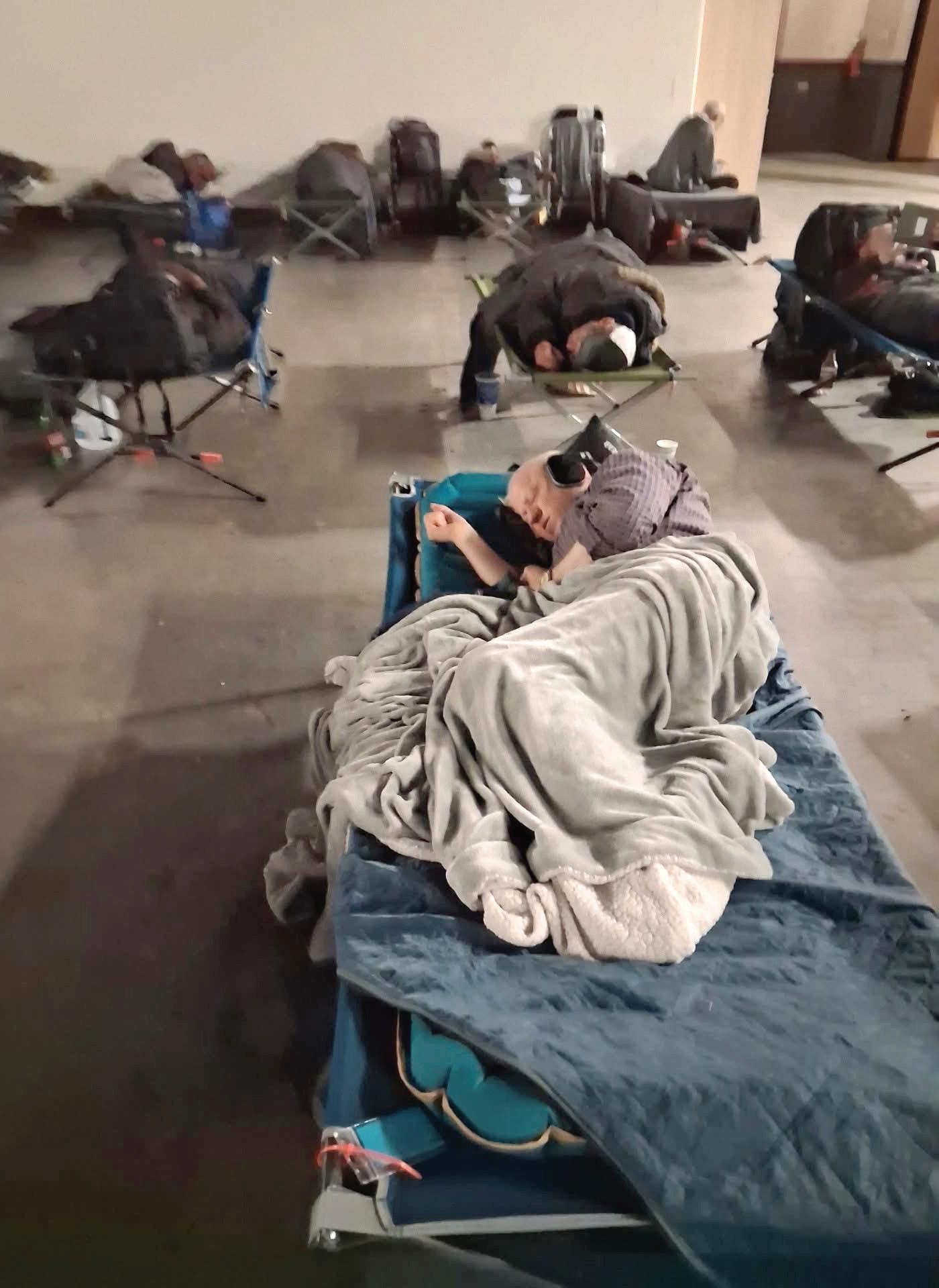
Since late February, Coffman has spent his Friday nights and Saturday mornings at the Navigation Center’s Tier One overnight shelter for homeless people. He doesn’t bring much with him because the shelter provides him with a blanket and a cot for the night — in the same spot every week — and he says “everyone sleeps in their clothes.”
The center offers a tiered system with additional benefits at each level. Tier One offers basic shelter services, Tier Two requires engaging with case managers and peer coaches and Tier Three offers long-term, independent living with additional commitments, including a requirement to hold a full-time job.
It was loud at first, but he has gotten used to the occasional din of barking dogs and the ambient sounds of dozens of men on cots. The noise is easier to overcome than the discomfort of wearing noise-canceling headphones, Coffman said.
In the mornings, Coffman hands out milk as part of the breakfast available for Tier One guests.
His experience at the shelter has been eye-opening, he said.
“One thing I’ve learned is how complex everything is, and individualized,” Coffman said. “You can’t categorize people in any particular group. You have to see them as individuals. Quite frankly, it’s made me more compassionate.”
Coffman said he started sleeping at the shelter because he wanted to see how the Navigation Center’s services were working and find out where improvements could be made.
Earlier this year, several people staying at the shelter told the Sentinel about issues ranging from plumbing failures and mold concerns to inconsistent rules, lack of services and difficulty advancing through the shelter’s tiered system. Since then, the city and Navigation Center have been working to address complaints.
During his weekends at the shelter, Coffman has seen the system help a lot of people, especially those needing job training and housing assistance, and he believes in the ability of the
Navigation Center to adapt to the needs of the people it’s serving.
However, he also has concerns that people are falling through the cracks because of the shelter’s limited capacity, particularly when it comes to people with more severe mental health and substance abuse needs. Coffman said the shelter receives “really hard cases from throughout the metropolitan area.”
“What I’m really trying to get out of this is who can we partner with? No one entity can be all things,” he said. “We need to refer the more serious mental health and addiction cases because we don’t really have the capacity to deal with those.”
The Navigation Center also serves a number of older clients, including some with disabilities, who would benefit from dedicated housing, Coffman said. He said he plans to set up meetings with the Aurora Housing Authority and Aurora Mental Health and Recovery to strengthen those partnerships and expand resources where possible.
The Navigation Center already works with both agencies, as well as several other community organizations to address things like healthcare, dental services, getting identification documents, applying for benefits and finding work.
Currently, the center serves an average of around 300 people per month in Tier One and Tier Two, according to a June update to the city’s housing committee. Tier Three, which includes 12 people, has been limited because of ongoing mold mitigation in the designated rooms.
Coffman said he’s watched people move through the tier system successfully and thinks Tier Two is particularly effective, but added that the system isn’t working for everyone.
“What I’ve observed is there are people that are just allowed to exist (in Tier One) and it seems up to them, so long as they obey the rules, that they could stay at that level and that’s not the intention of the program,” he said.
In addition to spending some nights at the Navigation Center, Coffman has been having conversations with the center’s staff, including case managers, and learning about the center’s intake process and resource capacity.
Coffman said he may propose changes to the case management process, such as adding a timeline to Tier One so people are incentivized to engage with the resources available.
“I’ve come to the conclusion that we need a time limit on Tier One just to understand where these cases are, so nobody just disappears,” he said.
Adding a time limit to Tier One would alter the shelter’s model, which is currently a “hybrid model” offering the “no strings” shelter, as well as the work-first housing in Tier Two and Tier Three.
“The whole goal of the program is about taking people to the highest level of self-sufficiency that they are capable of and that’s going to be different for everybody,” Coffman said.
Cathy Alderman, chief communications officer for the Colorado Coalition for the Homeless, said a time limit for shelter stays is only effective if supportive services are available for people to utilize.
“That kind of stipulation or requirement is only as good as the resources that you have to offer that person as they leave,” Alderman said. “When we know that our communities have very few helping resources, especially for those with the lowest income and living on fixed incomes, then I think it’s pretty unreasonable to expect that that person is going to be any better off leaving the shelter than they were when they first needed the shelter services.”
Alderman said the coalition supports the Navigation Center’s “one stop shop” model to help connect people to services and housing. She said she wouldn’t be opposed to adding a time limit if data showed that would help more people receive services, but noted that hasn’t been the case yet.
“I’ve just never seen data that says impos-
ing restrictions on people who have nothing, they’re somehow going to access everything within 30 days,” she said. “All the models say that you really need to make an investment in people on a long-term basis in order for them to stabilize, and that’s how you solve homelessness.”
When Coffman compares his Fridays at the Navigation Center to his previous attempt to learn first-hand about homelessness by temporarily camping outside and in shelters for a week in 2021, he said his consistent presence at the shelter has given him a different perspective.
“The people I see are much more desperate, it’s not a fad,” he said. “So one thing I learned is just how easy it is to lose your housing and how hard it is to get it back.”
Coffman’s past attempt drew widespread backlash from fellow elected officials and homelessness service advocates, especially a comment Coffman made to CBS4 calling homelessness “a lifestyle choice.” The episode earned the mayor a media moniker of “Homeless Mike.”
Researchers and experts say the causes of chronic homelessness are complex and can include poverty, mental illness, substance use, loss of employment, domestic violence, lack of affordable housing, medical expenses, criminal record and loss of family.
Coffman said he plans to continue sleeping at the shelter weekly until he feels “the system has adjusted to make sure that we’re meeting the challenges of everybody in Tier One and not forgetting people.”
Mayor Mike Coffman asleep on a cot at the Aurora Regional Navigation Center homeless shelter.
PHOTO VIA MIKE COFFMAN’S FACEBOOK
AROUND AURORA
Aurora Council approves initiative to review, boost family support and affordability
City lawmakers on June 22 approved an initiative to evaluate how the city can better support families and expand resources linked to livability and affordability.
Councilmembers Alli Jackson and Amy Wiles co-sponsored the resolution to direct the city manager to move forward the Family Plan Initiative. The measure would establish a working group to conduct community engagement, analyze city resources and programs for families and develop recommendations to address gaps or increase opportunities.
The council approved the plan on a 7-3 vote, with council members Françoise Bergan, Stephanie Hancock and Angela Lawson opposed. Bergan and Hancock called out the resolution for lacking a cost estimate and not being first heard by a city council committee meeting, although they said they had no problem with the substance of the resolution.
As part of evaluating existing programs, the resolution specifically calls on the working group to look at the Aurora SAVE program, which is intended to reduce youth violence and interaction with the justice system, and the Aurora Youth Commission, which gives recommendations to city council.
Jackson told the Sentinel before Monday’s meeting that the resolution is intended to kick off a process of gathering data and addressing some concerns from the community. The resolution does not allocate funds to the effort and utilizes existing staff for the working group.
“We’re just trying to get a good kind of grasp on what the needs of our families are and what they look like,” she said.
Jackson said she envisions the Family Plan Initiative as a multi-year project similar to the city’s Build Up Aurora effort, which evaluated the city’s infrastructure needs and ultimately recommended three bond measures to fund $264 million in projects.
The initiative calls for a wide range of targets, including analyzing childcare, transportation, recreation, housing, food security, public safety, civic engagement and intergenerational programming.
Some of the concerns Jackson has heard and hopes to address are a lack of childcare availability and potential issues with the Aurora SAVE program.
At an April city council meeting, several people alleged the SAVE program targets minority families. The Aurora Police Department said in a social media post about the SAVE program that it’s a “focused, intelligence-led initiative grounded in data and supported by proven research.” The post said every person contacted through the program has a connection to gun violence.
Jackson said focusing on families allows the city to examine a number of issues, including safety and affordability, while appealing to common political ground.
“I see it as a way to uplift the entirety of Aurora in addressing families because I think they’re left out of the conversation,” Jackson said. “All sorts of stuff touches families, so I just think it’s a nice neutral point to enter a conversation.”
At Monday’s meeting, Jackson’s conservative colleagues took issue with the process of bringing the resolu-
tion directly to council, which skipped over committee discussions, and not detailing the financial impact.
While the resolution doesn’t allocate funding and utilizes current staff, Bergan said she wanted more information about the impact to staff time. In response, city staff said they would update the council if the amount of staff time or resources used on the initiative would create a fiscal impact.
Hancock, who raised the process concerns, said she felt the initiative was being rushed by the new progressive Democrat council majority and worried it would “set a precedent.”
“Here’s my problem with this — we did not go to the appropriate committees to vet this and here we are on the floor vetting this thing,” Hancock said. “I’m trying to understand, what is the emergency that we had to come do this tonight?”
Councilmember Alison Coombs pushed back sharply on the accusation of precedent setting, pointing out that past councils, headed by a Republican majority, have altered the agenda on the weekend before the Monday meeting and have foregone fiscal notes.
“We should have conversations about procedure, but this body did not start with this precedent today,” Coombs said.
During the back and forth, Jackson urged the council to support the initiative so that the city can “start to create more avenues for Aurora families to participate in the civic actions.”
Since lawmakers approved the initiative, the plan is to start with a brief survey to understand the family demographics of the city and learn what needs exist.
—McKenna Harford, Sentinel Staff Writer
Arapahoe County, state election officials defend voting accuracy amid conspiracy theories
It’s voting season again, and controversy about voting accuracy, so it’s time for a rundown of what goes into an election in Colorado.
Some, like former Aurora City Councilwoman Danielle Jurinsky, have already cast some doubt and offered conspiracy theories on the accuracy of elections in Aurora.
Jurinsky created controversy in a Facebook post questioning why the Arapahoe County Clerk sent three ballots with return envelopes to her house for three voters, but one was a different color than the other two. Jurinsky intimated that it allowed for the clerk, a Democrat, to identify Republican voters. “Are Republican ballots being flagged?“ Jurinsky asked in her post.
Clerk officials posted a response on the Facebook missive, pointing out that there are no difference in color for Democrat and Republican return envelopes, only unaffiliated voter envelopes, so that election workers can ensure those voters comply with state law regulation primary elections and vote only a Democratic Party ballot or a Republican Party ballot, but not both.
Local and state election officials repeated that not only are Colorado elections secure, but that they are provably accurate.
Matt Crane, former Arapahoe County Clerk and current Executive Director of Colorado County Clerks Association, said he wanted Colorado voters to know that the voting process here is one of the most secure in the country.
“I think [Colorado’s election process] is very safe,” Crane, a Repub-
lican, said in an interview. “Our processes are amongst the most secure and mature for processing mail ballots in the country. In 2018, the Washington Post said Colorado was the safest state to cast a ballot because of all the security measures we do, both around eligibility and tabulation and chain of custody.”
Crane said that voter rolls are checked daily against other data sets from the Secretary of State, the DMV, local sheriffs, and county coroners to keep the rolls up to date.
Crane said voters should “vote with confidence that our process is safe and secure.”
Sentinel Colorado spoke with the election team at the Arapahoe County Clerk and Recorder’s office, who shed some light on the safety and procedures of Colorado elections.

There are 409 different voting precincts in Arapahoe County, meaning there are numerous ways ballots are configured based on state legislative districts, county commissioner seats, and other local elected positions.
Bill Mast, the director of Arapahoe County’s election division, said that once the county receives ballots, they are input into a machine called Agilis, which can “process about 18,000 envelopes an hour”. Agilis then starts the process of automatic signature recognition, where the program looks at all signatures on file for a voter, both from the secretary of state’s office, the department of voter vehicles office, and any other official signatures. The software used is similar to that used by banks to verify signatures on checks.
According to Mast, the machine typically clears about forty percent of
signatures, and those ballots are sent off to be counted. The other sixty percent then go into a three-tiered review process.
“[Signatures] that don’t pass the confidence threshold get sent to Tier 1 review,” Mast said. “That’s when a trained election worker is going to review it and say, ‘OK, I have the exact same signature the machine was looking at. This is the most recent signature, and I have the envelope that the voter returned.’”
If that election worker can’t say with confidence that the signature matches, the ballot goes on to Tier 2 review.
“That’s a bipartisan team of election judges,” explained Mast. “If one of the two says, ‘Yes, that signature
Offices Closed Arapahoe County Offices will be closed Friday, July 3 in observance of Independence Day.



Dealing with Drought Class at Aurora Central Library | June 25, 4–5 p.m.
With parts of the region in severe drought, every drop counts. In this free class, learn how to keep your landscape healthy with smart watering practices, drought-tolerant plant choices and simple strategies for conserving water.
Register now at bit.ly/CSU_Drought








looks good.’ The ballot proceeds to get counted.”
If one judge gives the ballot approval, the county sides with the voters’ ballot and sends it off to be counted; however, Mast said that in instances where both judges cannot confidently say that the signature belongs to the voter, the ballot moves to Tier 3. When a ballot hits Tier 3, the process becomes more involved. Voters will be sent a cure letter, allowing them to explain why their signature looks different and verify that the ballot is, in fact, the one they cast. Voters do this by sending a copy of their ID or going into an in-person voting station with
cure attempt at all, the case gets referred to the district attorney’s office, which will further investigate the matter.
Mast said his team “reviews every envelope that comes into the building within 72 hours” or the equivalent of three business days, adding that they typically do it within 24 hours of a ballot being received.
If the voter is subscribed to the ballot track system, which roughly twothirds of Arapahoe County voters are, they will receive either an email or a text on the status of the ballot.
“The vast majority of the cure responses come back digitally,” Mast said. “If their ballot is rejected for a curable reason, you’ll be able to click [a
phone, and they’re done.”
Other voters respond by mail or come into a physical location. Voters have until eight days after an election to get their ballot cured.
According to data from the Arapahoe County Clerk and Recorder’s office, they have currently received 40,293 ballots, with 190 awaiting cure. Voter turnout of the county’s 422,037 registered voters currently sits at about 9.5%.
The vast majority of ballots are sent via dropboxes or by mail. There are seven days left until the primary.
Despite frequent, unproven claims by President Donald Trump and other election deniers, research and evidence regularly shows that there is not
Only US citizens are allowed to vote in Colorado elections, and undocumented immigrants are not included in Colorado’s automatic voter registration process.
If you are registered to vote in one county, but drop off your ballot in another, it may still be counted. Counties in the Denver metro area exchange ballots daily with one another when they receive a ballot from another county, according to the Mast.
Colorado is a member of the Electronic Registration Information Center, a nonprofit, nonpartisan organization to assist states in maintaining voter rolls and detecting possible ineligible voting. As part of this organization, along with 26 other states and the District of Columbia, Colorado can identify when a voter moves to a different state or jurisdiction. The nonprofit is composed of a bipartisan group of election officials from each member state.


safety, road improvements and open space preservation.
The county made significant investments in public safety last year to improve the Arapahoe County Detention Facility and spent more than $21.5 million to support the 18th Judicial District, which transitioned to cover only Arapahoe County, with Douglas, Lincoln and Elbert separating into a new district.
“With this new structure [District Attorney Amy] Padden and her office are focused solely on Arapahoe County and can work more directly on local priorities, including diversion, juvenile justice and mental health and competency reform,” Commissioner Jessica Campbell said.
If you are interested, the Arapahoe County Elections Division offers public tours of the election facility, and both Mast and Crane encouraged voters to reach out to their county if they have questions regarding the voting pro-
Arapahoe County has also put out several videos going over the various procedures and tests that they go through to explain the voting process.
For details about local and state races, see the Sentinel Colorado 2026 Primary Election Voter Guide.
— Owen Swallow, For the Sentinel Arapahoe County commissioners
tout investments in public health and safety at State of the County event
At the 2026 State of Arapahoe County, commissioners touted recent investments across community services, housing, public health and safety, while thanking voters for repealing the county’s revenue cap.
The theme of the June 16 address centered around the ways the county has made good on its promises to improve the community and the five commissioners presented on a variety of accomplishments from the last year.
“Making good is not just a theme — it is a responsibility,” said Commissioner Leslie Summey. “It means making good on the trust people place in local government, making good on decisions we make on behalf of taxpayers, and making sure the county is delivering in ways people can see, feel and rely on.”
Summey said voters gave the county “breathing room in the budget” when, in 2024, they repealed the revenue cap imposed by the Taxpayers Bill of Rights. She added that the commissioners took that fiscal responsibility very seriously.
To oversee the new funds, the county created a 10-person Measure 1A Resident Advisory Committee. The committee unanimously approved this year’s investments.
The funding helped provide more than $1.5 million to the county’s Aid to Agencies program, which supports nonprofit organizations that provide food access, housing support, transportation, and mental health services.
“That investment matters because it helps us reach residents sooner, closer to home and it’s done through organizations they already know,” Commissioner Rhonda Fields said.
In 2025, the county approved a $571 million budget, with the largest expenditures in public health, public
Some of the more than $10 million in road safety and mobility improvements include safety enhancements along Arapahoe Road and infrastructure improvements to Dry Creek Road and Inverness Drive West.
In addition to investments, the county also worked with developers to bring in new affordable housing options, with two projects approved that will add 246 new income-restricted units and preserve 69 more.
A new $4 million fund will also help support affordable housing developments and Summey said the county plans to add $1 million to the fund annually.
In conjunction with housing investments, the county is expanding homelessness services, such as by making permanent the emergency rental assistance program, which helped 591 households last year.
From 2025 to 2026, the county saw a 35% drop in unsheltered homelessness in its annual Point-in-Time count.
Other accomplishments that commissioners shared touched on water conservation efforts, open space preservation, the creation of a five-year public health plan and launching a new Veterans Coffee Club with the Littleton Elks Lodge.
Summey and Commissioner Jessica Campbell are both running for re-election in November, and both face Democratic Party primary challenges June 30.
— McKenna Harford, Sentinel Staff Writer
Community engagement sought on Aurora data center concerns
City officials are planning what they’re calling a “data center town hall” meeting later this month to start a community discussion about how to address the developments.
City Councilmember Amy Wiles will hold the meeting 6 p.m. June 29 at the Aurora Central Library with the assistance of representatives from the city water department and Xcel Energy, as well as a data center spokesperson.
Wiles told the Sentinel that residents have requested that she push for a data center moratorium, but she said she wants to have community engagement on the topic before proposing policy. Wiles said the purpose of the meeting is to “hear concerns as well as share facts about current processes and restrictions.”
The meeting was called to address general concerns about data centers and is not linked to any pending project, according to Wiles and the meeting announcement.
“My ward is the most likely location for future data centers, and we ran on a
Another swell of outside political spending seeks to shape Democratic primaries in Aurora
Nearly $2 million in outside spending has poured into Colorado’s Democratic primaries this year.
BY OWEN SWALLOW for the Sentinel
As spending in state legislative primary races has swelled this cycle, much of it has been aimed at boosting more moderate candidates over progressive opponents, including Aurora incumbent representatives and local county commissioner candidates.
Nearly $2 million in outside spending has poured into Colorado’s Democratic primaries this year, much of it routed through organizations that do not disclose their donors, according to multiple recent media reports.
This year’s spending focuses on a handful of statistically safe Democratic seats across metro Denver. In the past few years, primary races in some of these safe “blue” seats have turned into some of the most expensive contests in the state. This effort highlights just how important Democratic statehouse and local primaries have become for the Colorado government. As Democrats hold on to their majorities at the state Capitol for almost a decade, these primary races now function as the main battleground for control of legislative priorities.
Experts and others watching say the trend appears to be an effort to persuade voters to choose Democratic candidates deemed friendly to business and less likely to support business and industry regulations.
Much of the recent swell of money is being spent on mailers and attack ads funded through a network of state-level super PACS and nonprofit organizations, some with names that resemble progressive grassroots political groups but critics say are not. This dark money has paid for ads and mailers in legislative and county-level races across the metro area and one race in the Western Slope, according to campaign finance reports filed for fundraising and spending through June 10.
The spending surge reflects an escalating ideological fight over the direction of Colorado’s dominant political party. Outside groups aligned with more moderate Democrats have poured money into a handful of safe Democratic districts, while labor-backed organizations have spent heavily to support candidates on the party’s more progressive wing.
Historically, candidates backed by One Main Street Colorado have gone on to join the newly formed Opportunity Caucus, a pro-business and entrepreneurship group of legislative Democrats, which is currently under investigation by the Colorado Independent Ethics Commission for allegedly accepting payment from One Main Street for luxury resort expenses from a retreat with lobbyists in Vail last October. The event and controversy were first

reported by The Colorado Sun.
In House District 41, for example, a committee called Fighting For A Better Aurora, which received money from One Main Street Colorado, has spent nearly $90,000 on mailers and advertisements supporting Aurora Public Schools Board of Education Member Anne Keke and opposing incumbent Rep. Jamie Jackson.
Keke currently serves on the Aurora Public Schools Board of Education, which she was re-elected to last year. Now running against State Rep. Jamie Jackson, she is primarying Jackson, who was appointed to represent HD 41 following a vacancy two years ago.
Keke answered a call from the Sentinel while canvassing homes in the district. She said that the debate over PAC spending has turned into “mudslinging”.
“The smearing, the mudslinging at me, I don’t respond because that’s not what voters want to see,” Keke said. “What they’re concerned about is how we can bring affordability back, costs of living down in Aurora, how we can safeguard healthcare, and how we can bring stability amongst ourselves.”
Keke said that she has filled out questionnaires sent by organizations such as One Main Street and the Working Families Party, but that she supports efforts to make political funding more transparent.
In an interview, Keke said she “believes that voters should know the original sources of funding behind” independent expenditures. Keke called the explosion of dark money in Colorado politics “unfortunate,” but hardly new or unique to her race, saying she has seen it support candidates across party and ideological lines.
“It’s on both sides of this race,” Keke added. “I would support all individual contributors to campaigns… [to be] reported. We require this for SDCs, PACs, and candidates, and I think we should do the same for the donors to C4s and unions.”
Keke said she had not communicated with One Main Street nor any independent expenditure groups supporting her campaign, but that she filled out “dozens of questionnaires for organizations that support or oppose my candidacy.” Keke added that she believes in communicating with “all interested parties, whether or not they would support me.”
In terms of campaign finance reforms, Keke said she would “require individuals’ contributions to SDCs and PACs be disclosed and ban lump-sum transfers into these accounts that lack any contributor details.” Keke further called for the Citizens United decision to be
overturned, but that is more of a federal issue than a state-level one.
Jackson, who has received the backing of Colorado Labor Action, pointed to recent reporting that One Main Street had received donations from a group funded by the oil and gas industry.
Jackson told the Sentinel she received a survey from One Main Street, but declined to fill it out, citing her belief that the organization takes oil and gas money.
Jackson said she was “looking at policies” being adopted in Hawaii as a way to curb corporate spending in politics.
Jackson told the Sentinel that pro-consumer bills she has worked on have died in committee, in part due to disagreements with the Opportunity Caucus. She was one of the prime sponsors of HB26 12-71 that would have created a fee on manufacturers and wholesalers of alcohol to fund impact and recovery projects across the state.
Jackson said that while she had “good working relationships” with Opportunity Caucus members, she found it “frustrating” when they could not align on policy.
Candidates in the Democratic primary in House District 42 tell a similar story. Sarah Woodson, a community activist and founder of The Color of Cannabis, which she describes as “the nation’s first licensed cannabis tours, transportation, and party bus company — is running against incumbent State Rep. Mandy Lindsay. Woodson said that, unlike Keke, she did not fill out a questionnaire from One Main Street, and that she also supports transparency measures.
“I definitely want to mandate that these independent expenditures disclose their donors,” said Woodson, who added that she was also looking at Hawaii’s new corporate spending laws.
In an interview with the Sentinel, Lindsay said that the public should have access to information on the original sources of funding behind independent expenditures.
“The public should be able to have that information, even candidates, we should be able to know… where this money is coming from because it can be so powerful in the outcomes,” Lindsay said.
In her race in particular, Lindsay said she thinks the amount of spending going in the race is unusual.
“This amount of money, I have not seen in HD-42 politics since I became active,” she said.
Lindsay argued that the spending itself signals a clear contrast between candidates.
“What [this spending] is doing is it is
showcasing that there is such a difference between myself and my opponent. Because if there wasn’t, if it were the same policy-wise, they would not be spending this money here, they would be spending it somewhere else in some other district,” Lindsay said.
Keke, Woodson, Lindsay, and Jackson have all been endorsed by one or more members of the Opportunity Caucus.
Network of PAC Funding
A similar funding war defined the 2024 primary in Colorado, which saw outside groups spend $5 million to influence the Democratic legislative races. This recent bout of spending is part of a larger tug-of-war for ideological control over Colorado’s dominant political party, which holds a near-supermajority in the state legislature.
”As someone who experienced almost $800,000 of untraceable dark money against me in 2024, personally, it is a very jarring experience to have gone to work for your community for years,” said Sen. Mike Weissman, who was the target of a dark money campaign in his bid for state Senate. “All of a sudden, there’s money pouring in from Washington, D.C. — super PAC or a shell corporation in Delaware trying to snuff you out, politically speaking.”
Weissman, as a House representative and member of the state Senate, has a long history of supporting legislation protecting the rights of consumers and promoting accountability among businesses and industries. He and other Democrats targeted by One Main Street say the PAC controversy is about businesses trying to do an end run on unsuccessful lobbying efforts using cash to influence elections.
One Main Street Colorado, has been the common denominator behind all of the dark money groups and state super PACs that have cropped up in the Democratic primaries, according to the group’s critics and state election records. The nonprofit doesn’t disclose its donors and has played a significant role in the Democratic primaries for election cycles going back to 2020. One Main Street, along with recently formed nonprofits Fair Economy for Coloradans and the Colorado Affordability Project, has been funding some of the state super PACs. Federal law, however, precludes election PACs from coordinating with candidates during campaigns.
The Sentinel reached out to Andrew Short, One Main Street’s executive director, but did not receive a response. During a 2024 primary, The Denver Post interviewed Short, and he
denied allegations that One Main Street was funded by the oil and gas lobby. Public filings, however, show past donations linked to groups in that industry.
During the 2024 election cycle, which saw similarly well-funded primaries, One Main Street was the largest recipient of donations from “Coloradans for Progress”, according to tax filings. That group has received $2.2 million from Chevron and $1.1 million from Coloradans for Responsible Energy Development. One Main Street has also had significant past donations from Xcel Energy and the Apartment Association of Metro Denver. Although some of One Main Street’s affiliated political committees have funding from several trade unions, like Plumbers Local 3, the bulk of its financial backing is not publicly disclosed.
Through June 10, the committee raised around $800,000 and has spent roughly $51,000.
According to campaign finance data compiled by The Colorado Sun, seven other groups backed by One Main Street and Fair Economy, which have often deployed naming conventions common in progressive circles, are:
• Colorado Mountain Progressives received roughly $150,000 from One Main Street PAC. It has primarily spent money running campaign ads in House District 13, which encompasses Grand and Summit Counties, but has also spent money opposing Lindsay.
• Fighting For a Better Aurora, which has received $250,000 from One Main Street super PAC. The committee has sent out mailers in House District 41 supporting Aurora Public School Board member Anne Keke’s campaign to unseat Rep. Jamie Jackson (D-Aurora. It has also supported Democrat Maya Wheeler in her race against Arapahoe County Commissioner Leslie Summey.
• Promoting Progressive Women received $180,000 from One Main Street Colorado’s super PAC and $50,000 from the Colorado Affordability Project nonprofit. The PAC is running ads opposing Rep. Mandy Lindsay of Aurora, who is currently running for reelection. The PAC is also running ads supporting
• Adams County United received $280,000 from Fair Economy for Coloradans to support state Rep. Jacque Phillips’ reelection against primary challenger Gabriel Cervantes, a liberal organizer.
• Blue Collar Progressive received $350,000 from One Main Street PAC. It has spent money in support of a variety of Democrats in various primaries: Jillaire McMillion, running in House District 19 in Boulder County; Cherry Creek School District Board Member Angela Garland, who is running to unseat incumbent Arapahoe County Commissioner Jessica Campbell; and Karen DeArguero, who is running for a seat on the Adams County Commission.
Colorado Mountain Progressives, Promoting Progressive Women, Adams County United, Denver Progressives United, and the Progressive Leadership Fund are all registered to Jimmy Dickson in Durango. Dickson has previously run the campaigns of two state lawmakers, including Westminster Democrat Shannon Bird, who is currently running for Congress. Bird co-found-
ed the Colorado Opportunity Caucus, which is also supported by One Main Street.
The Opportunity Caucus is currently involved in a lawsuit that claims it violated the Colorado Open Records Law when it denied a records request relating to its Vail retreat. Tensions between Opportunity Caucus members and more liberal Democratic members of the Legislature have risen after a bill attempted to force nonprofit caucuses to reveal their donors and spending.
Labor Group Spending
Although the public doesn’t know who is funding organizations like Fair Economy Coloradans, One Main Street Colorado, and the Colorado Affordability Project, there is money being spent to counter that is more transparent.
A state-level super PAC funded by unions, Colorado Labor Action, a coalition of some of Colorado’s largest labor unions, has sent more than $570,000 since May 1 to several of the contested Democratic statehouse primaries as a countermeasure to dark money campaigns. The interconnected PACs affiliated with One Main Street and Fair Economy for Coloradans have spent almost double that in their bid to back moderate candidates. A vast majority of the PAC’s money this cycle comes from the AFL-CIO ($100,000), Colorado Education Association ($350,000), American Federation of Teachers ($130,000), and the SEIU.
Union donations come from a voluntary contribution to unions’ Committee on Political Education Fund (COPE), as member dues can’t be used for campaign contributions. Dennis Dougherty, the executive director of the Colorado AFL-CIO, told the Sentinel that the AFL-CIO condemns what he described as an attempt by dark money to “take over” the Democratic Party.
“The Colorado AFL-CIO unequivocally condemns the infiltration of unaccountable corporate dark money’s coordinated attempt to take over the Democratic Party and prioritize the wants of corporations and billionaires over the needs of working people,” Dougherty said. “That kind of secret money doesn’t just corrupt politicians. It corrupts policy.”
“There is no doubt that if we continue to allow growing corporate influence over our elected officials, we will continue to see legislation that further erodes worker and consumer protections,” he continued. “We are proud to be backing candidates this cycle who are standing up for working people against dark corporate influence. Unlike these shady groups, we are transparent about our donors. We are confident voters would prefer candidates backed by working people to corporate-backed lies.”
Colorado Labor Action has spent more than $810,000 in this current election cycle, with money going to ads and materials for Halpern, Nguyen, Garcia Irlando, and Jackson. State legislators from Aurora, including Lindsay, Jackson, and Weissman, will be holding a virtual town hall on the subject of dark money in politics on June 23 at 5:30 PM.
The primary is June 30, and ballots have already been mailed to voters.
funded through parent fees, booster clubs, fundraising campaigns and private contributions. Students who cannot afford those activities are often assisted through “scholarships,” fee waivers or community support programs.
That’s how extracurricular opportunities have traditionally worked because there’s not enough money for public education to pay for even the most important parts of public education.
What has never been accepted is the idea that taxpayers should provide premium recreational opportunities to a select group of students while millions of dollars remain unavailable for the broader student population.
Strong public schools benefit everyone.
They create better-informed citizens. They strengthen local economies. They reduce crime. They improve public health outcomes. They build stronger communities and a
›› METRO, from 6
community-first platform which means we need to listen to the community on any concerns while we evaluate our policy for these businesses,” Wiles said in an email.
As of June 16, the agenda for the town hall hadn’t been finalized yet. Aurora already has five data centers, including the QTS Aurora Campus on Gun Club Road and the Flexential site near Cherry Creek Reservoir, according to the Data Center Map. In May, the Denver City Council unanimously approved a moratorium on data centers for up to a year while the city establishes new regulations for development. Denver currently has no zoning rules specific to data centers, as well as no energy or water regulations for the facilities.
According to 9News, Denver’s council passed the moratorium after significant community pushback over
more productive workforce.
Colorado’s public school system is one of the state’s most important civic institutions because its benefits extend to all of society.
Homeschooling families have every right to choose a different educational path. Colorado law allows parents to educate their children outside traditional public schools, and many families do.
But that choice has always come with the requirement that if parents withdraw from the public education system, they assume responsibility for providing and funding any alternative they prefer.
The ERBOCES model turns that principle upside down.
Instead of supporting public schools accountable to local voters, elected school boards and state education standards, taxpayers are increasingly financing programs operated by private contractors and organizations beyond the direct oversight traditionally applied to public schools.
the CoreSite DE3 data center under construction in Elyria-Swansea. Neighbors raised concerns about the site’s water usage and the potential impacts to air quality.
—McKenna Harford, Sentinel Staff
COPS AND COURTS
Man found dead outside Aurora homeless shelter, investigation underway
A 56-year-old man died outside of the Aurora Regional Navigation Campus homeless shelter last week.
In a statement, city spokesperson Joe Rubino said staff at the campus found the man around 7 a.m. June 14, and emergency responders determined he died prior to being found.
There were no signs of trauma and the case is not viewed as suspicious,



That is antithetical to the philosophy of public education.
Lawmakers appear to be finally reaching the obvious conclusion.
The Joint Budget Committee’s unanimous decision to pursue legislation limiting ERBOCES’ statewide reach was a welcome first step.
If homeschooling parents want their children to participate in sports, enrichment activities, clubs, field trips and specialized programs, they already have two perfectly reasonable options. They can participate through their local public schools when available. Or they can pay for those opportunities themselves, just like countless public-school families do every day.
The ERBOCES gravy train has run long enough. It needs to stop here.
Follow @EditorDavePerry on BlueSky, Threads, Mastodon, Twitter and Facebook or reach him at 303-750-7555 or dperry@SentinelColorado.com
Rubino said.
The Adams County Coroner’s Office identified the man as 56-year-old Humberto Morales of Denver. The cause of death is under investigation. Rubino confirmed the man was a participant in the Navigation Campus’ program.
“This is a tragic loss of a life,” Rubino said. “The ARNC is committed to helping those experiencing homelessness stabilize their lives. Unfortunately, many people from this population suffer from chronic health conditions and have often gone long periods without proper medical care. This is why the facility has partnered with Stride Community Health Center to host clinic space inside the facility. Our thoughts are with this individual’s friends and loved ones.”
—McKenna Harford, Sentinel Staff













































Editorials Sentinel
If Aurora doesn’t like the residency rules, change them, but stop pretending
Aurora has a problem it needs to solve, rather than ignore, no matter how banal and awkward it’s become.
The problem is that the city’s charter, which is akin to the nation’s constitution, says explicitly that the city manager has to live in Aurora, but he doesn’t.
Making this all the more awkward, knowing that City Manager Jason Batchelor lives outside the city, Aurora council members last year asked voters to repeal the residency requirement. Voters resoundingly said, “no,” with more than 8 out of 10 voters refusing to repeal the mandate.
City council can’t change the law themselves because it’s welded into the Aurora Charter. Only voters can change it.
Batchelor has worked for Aurora since 2009, working his way up to the top of the city’s organizational chart. He was appointed to the city’s top job in December 2023. Three months later, he rented a one-bedroom apartment in Aurora, keeping his home outside of the city, and he changed his voter registration to that apartment, a variety of state and county records show.
It’s unclear when, but city lawmakers say they were aware of the steparound, and that the city’s attorney said the apartment rental satisfies the residency requirement.
Last summer, however, the city council and management launched legislation that would refer a ballot question to voters, simply repealing the requirement for residency, which is imposed only on one employee in the city, the manager.
In a Sentinel story last week, City Attorney Pete Schulte pointed to city legislative notes indicating the timing of the measure was pegged to a Denver lawsuit. Denver employee residency restrictions, controversial for decades, ended in 1998 when Denver voters agreed to allow city employees to live anywhere in the six-county metro area. In 2001, Denver voters repealed the mandate completely.
All that came after the state legislature tried to prevent cities from imposing residency requirements. Denver sued and in 1990 the state Supreme Court struck down the state law, saying it’s a matter of local control.
Despite side-glances and hesitant explanations from a wide range of city officials, it’s clear that city lawmakers agreed to ask voters to repeal the law to accommodate Batchelor, and prevent the encumbrance on future city managers.
But voters overwhelmingly said no.
The dodgy problem here is that Aurora didn’t ask voters to end the requirement that the city manager reside in Aurora — unless he or she rents an apartment here. Yet just about every city lawmaker who talked to the Sentinel said they’re satisfied that the rental legally and ethically checks the residency box.
We doubt that any of the 57,631 voters who opposed the question would agree that renting an apartment while living somewhere else satisfies “the requirement that the City Manager reside within the city limits.” Pressing the point undermines the credibility of those who argue that it does.
Some of those defending the pretense make compelling arguments why Batchelor’s real residence has nothing to do with his performance as city manager.
We absolutely agree with that.
Batchelor has, in every position he’s held in Aurora, shown nothing but the utmost in competence, professionalism and dedication through his expanding leadership. Years of Sentinel reporters agree that Batchelor has consistently led by example.
But his allies and detractors inside and outside of city hall agree that’s not the case in this well-accepted residency contrivance.
Renting an apartment to get around the law is disingenuous and an absurd waste of money.
We agree with Aurora lawmakers who say that the city did a poor job of explaining to voters how inane the residency requirement is, but they would have had to have been upfront with voters, explaining the Batchelor conundrum.
City employees and others rightfully point out that Aurora residents, visitors and other city employees have to adhere to city codes and policies unless they’re changed or repealed.
At a time when Aurora, the state and the entire nation are struggling against the ethical and legal lapses of the Trump administration, it does the cause to bring back the rule of law no good to emulate something his regime would do.
City council should either find an ethical and suitably legal way to allow Batchelor to live outside of Aurora and not waste money on a contrived apartment or go back to voters with something they’ll approve, possibly allowing the city manager to live in adjacent or nearby counties.
But pretending no one who matters cares about this is the stuff Trump is made of, not Aurora.


Real history paints real picture of fight for sllumlords, not against them
Let’s take this journey fter Sentinel Editor Dave Perry in his June 18 column went down a dead end inferring that Mayor Mike Coffman somehow deserves credit or even a nod for backing a new city council measure to ensure Aurora landlords adhere to the law.
In 2023, United for a New Economy (UNE) was helping tenants at 1568 Nome St. organize against their slumlord, connecting them with city officials to bring the squalid conditions they were suffering through due to CBZ’s neglect to light. I and several of my colleagues were invited to tour the property, and documented what we saw through photographs and a lengthy email to the city attorney’s office. Ultimately, this led a few of us to introduce a rental registry ordinance crafted in partnership with UNE and the directly impacted tenants which would have created a system that allowed tenants to submit evidence to the city and provided a means for the city to crack down on slumlords before they become a larger problem for us all.
The ordinance would have doubled the number of code enforcement officers in the city, required regular property inspections (to include special inspections when ownership turns over) to be conducted by the city, and stiffened penalties with the goal of making business as usual for slumlords unprofitable and to make retaliation against tenants unlawful. The net benefit to renters would be a right to safe, clean, and dignified living conditions backed by the city, and all Aurorans would have benefited from a reduction in derelict properties owned by people just looking to extract as much wealth as possible from our neighbors.
This effort was shot down by the Republican majority at the time, with former Councilmember Danielle Jurinsky and Coffman being the most vocal opponents of the measure. Before this vote, Coffman saw the conditions the 1568 Nome St. tenants were living in. Despite this, he said that the current process was sufficient even though he and every member of the Aurora City Council knew what the conditions at the Nome property were like. Every. Member. Nome Street and other properties owned by CBZ were later used as a political prop by the Trump campaign, Jurinsky, and Coffman to propagate the lie of Aurora being “taken over” by gangs. Coffman later walked back his lies after receiving flack from the immigrant com-

munity in Aurora, but by then the damage had been done.
The only group Aurora has been “taken over” by are special interests groups seeking to profit off our collective labor while impoverishing more and more people, aided and abetted by the candidates they buy each election cycle, with Coffman being their highest return on investment.
Coffman is not a friend to tenants or working-class Aurorans. He hasn’t been over his nearly 40 years in office, and he hasn’t suddenly turned a new leaf now that he’s finally in the minority on council. He’s behaving in the same way he has during his whole political career –opportunistically changing his position in an attempt to brace against the political headwinds around the corner at our next municipal election, and in hopes that Aurorans will forget his complicity fueling the anti-immigrant lies that caused reputational and economic harm to our city.
Let’s give credit where it is due: to the voters of Aurora who in November 2025 elected four new council members not beholden to special interest groups, providing our city council with the political will for Mayor Pro-Tem Alison Coombs and Councilmember Ruben Medina to build on the work we began in 2023 and pass a long-overdue ordinance to crack down on slumlords operating in our city. This victory belongs to you.
Juan Marcano is the former Ward IV Council Member, current Colorado Transportation Commissioner, and prays that 2027 is the year when Mike Coffman’s teflon finally wears off.
JUAN MARCANO, GUEST COLUMNIST
Test scores show how Colorado schools are still falling well short
If you spent $15,000 on a new roof and it leaked, what would you say if the contractor replied, “Well, nearly half of your roof didn’t leak! And your roof actually leaks less than a roof we installed last year. So you should be thanking us!” I’m going to go out on a limb here and guess you would not be very satisfied with such service.
Yet, when it comes to public education, many Coloradans routinely accept abysmal results without so much as blinking.
Chalkbeat recently published preliminary results from the latest Colorado Measures of Academic Success (CMAS) tests. Here’s how the headline spins the results: “Student math proficiency rises but literacy results are mixed.” A more accurate headline would be, “Colorado student achievement remains in the toilet as schools utterly fail to educate many students in math and literacy.”
Sure, math proficiency “rose” this year—to 39% in fourth grade and 37.8% in eighth grade. This is like bragging that your F in class is slightly less bad than the last F you got. Hurrah, I guess. English proficiency was somewhat higher, at 47% in fourth grade and 42.2% in eighth grade. Put another way, over half of students cannot read at grade level.
True, the eleventh grade SAT, which uses different metrics, suggests that in language 59.6% of students who took the test are “college ready” (while in math only 31.6% of students are). For more context, see Colorado results from the National Assessment of Educational Progress.
Meanwhile, taxpayers are on the hook for $15,805 per student, for a total of $13,926 billion (as of the 2023–24 fiscal year), to finance the public school system. If a private roofing contractor performed so poorly, Phil Weiser probably would investigate the company for fraud. But I guess we have much higher standards for roofs than we do for the education of children.
I do think the CMAS results give us good reason to be alarmed about the state of the public schools. And we haven’t even seen this year’s disparities by race/ethnicity, which, judging from previous years, will be dramatic.
On the other hand, my comparison with roofs has some obvious limitations. Putting on a roof is a one-time, short-term job, and it’s either done right or not. Education is not like that. Education is a multi-year process, students move around a lot, some students are naturally more academically oriented, some students struggle with dyslexia or other neurological issues, and some students come from difficult family circumstances.
Plus, education is a multifaceted enterprise, so maybe standardized tests aren’t a good way to measure education achievement in any broad sense. A child may be excellent in music, sculpture, or empathetic treatment of friends and yet score poorly on a given test.
Plus, some students are doing quite well. I don’t think anyone worries about students managing Advance Placement classes or the International Baccalaureate program. And some schools have outstanding results. For example, in 2025, an astonishing 94.7% of students at Boulder’s High Peaks Elementary met or exceeded expectations in language, while 92.5% did in math.
Standardized tests are so unpopular that the legislature cut the social studies portion of the CMAS to a single grade. Another bill sought (per the summary) to “ensure that standardized summative assessments are administered to students to the minimum extent possible.” That bill lost. Plenty of people argue that standardized testing makes education worse by encouraging schools and teachers to “teach to the test” at the expense of other meaningful experiences. In the homeschooling world (my wife and I homeschool our ten-year-old), I’ve heard parents say that one reason they don’t like the regular schools is their
“drill and kill,” “teach to the test” atmosphere. I would respond that, insofar as we’re talking about taxpayer money, standardized testing is the only way to give taxpayers any meaningful information about how schools are performing.
Speaking of homeschooling, although my tenyear-old scores in the top one percent on the California Achievement Test, I don’t claim my family’s experiences are representative. In March, Brian Ray argued that on balance available studies “show homeschool students outperforming institutional school peers on academic tests.” But he acknowledges the limits of those studies.
What matters is not whether homeschoolers do better than other students (we have to account for selection effects) but under what conditions a particular student would thrive. Undoubtedly some students would do better moving from a school setting to a homeschool setting, while some homeschool students would do better academically if they switched to school. But, again, a lot more than test scores matter for a child’s development.
Ann Schimke writes for Chalkbeat (June 11) that various homeschool “enrichment programs cost the state tens of millions of dollars.” Another way to look at this is that homeschoolers saved the state tens of millions of dollars. Yet another way to look at this is that much of this money morally belongs to homeschooling families in the first place, and so to that degree the programs did not “cost the state” anything. Instead, the state is costing homeschoolers. But Schimke is entirely uninterested in such nuance.
According to the Department of Education, the state spends $15,805 per public-school student. As Schimke pointed out on May 19, enrichment programs cost “more than $100 million a year” at a per-student cost of “about $6,000 a year on average.” So homeschoolers are saving the state a boatload of money by using an enrichment program rather than attending regular public school.
Again whose money is it? Homeschooling families pay education-directed tax dollars just like everyone else. Do we (homeschooling families) have no moral right to use any of that money for the education of our own children?
The Census Bureau says that, of the nearly 2.5 million Colorado households (as of 2024), nearly 668,000 of them have “one or more people under 18 years.” So around 27% of all households have children, implying that maybe 20% of households have school-age children. This suggests (very roughly) that the average homeschool family spends over $3,000 per year in education-directed taxes.
How about this as a plan: We homeschoolers give up enrichment programs and instead just get to keep our own education-directed tax dollars. If anyone is tempted to say this would “cost” the state money, my retort is, it’s my family’s money!
How does this relate to standardized tests and to Colorado schools’ overall abysmal CMAS performance? When other people are forced to pay the bill, understandably they at least want some assurance that the funds are spent in reasonable ways. Many taxpayers want good test results, and many want to cut off questionable homeschool enrichment expenses.
Insofar as education involves forcing people to fund it, education becomes inherently political as taxpayers, legislators, bureaucrats, and recipients fight over how to spend the money.
We could try not forcing people to fund education, incentivizing parents to guard the effectiveness of their educational dollars. But, as everyone knows, that’s crazy talk.

YOUR LETTERS
Reject corporate money and embrace local accountability by voting for Phil Weiser
EDITOR: I am writing to urge readers to make their vote count and support Phil Weiser in the primary on June 30. We need a governor with real experience at the state level.
My registered neighbors and I received a full color glossy large size postcard (a pricey thing) from the other candidate. Two cards in the same week. Both cards had a section of little tiny print that said “Paid for by Rocky Mountain Way, Registered Agent.”
So now we know what dark money looks like, and how corporate entities lobby voters without disclosing who they are or what self-interests they are promoting. I don’t want my state governed by out of state money and unnamed corporate entities, thank you.
Phil Weiser is powered by local people making personal contributions that can be easily researched. That is accountability. That is what I want my next governor to be. And that is why I support Phil and urge others to do likewise.
—MollyMarkert, formerstaterepresentative andformermember,AuroraCity Council
Put Weiser in the State Capitol, keep Bennet in DC
EDITOR: Colorado voters will have to choose between Democrats Sen. Michael Bennet and Attorney General Phil Weiser in the upcoming June 30 Primary Election for gubernatorial nominee.
It is a critical imperative to understand the weighty problem of having to choose to bring Bennet back to Colorado. Voters have already sent him to Washington, and to date, he has little administrative experience except for a relatively short term as Denver Public Schools superintendent. Bennet’s recent naked rhetorical references would have us believe otherwise.
On the other hand, Weiser has served as Colorado’s attorney general since 2018. His constant work protecting Colorado citizens’ legal and constitutional rights should continue by electing him governor. Bennet should remain in Washington for the reasons we sent him there.
—BernieRogoff,GreenwoodVillage

The Magazine
Don’t get tick-ed off, but summer in Colorado comes with bad bites, too
WHAT TO KNOW ABOUT ALPHA-GAL SYNDROME, THE LIFE-THREATENING MEAT ALLERGY CAUSED BY TICK BITES
BY MATTHEW PERRONE AP Health Writer and Sentinel Staff Writers
It’s common knowledge that ticks can spread infections that cause serious illnesses, including Lyme disease. Now health officials are trying to raise awareness of a lesser-known problem: a life-threatening allergy to meat triggered by tick bites.
And for those who think tick season is a problem in the East and South, Colorado health experts offer warnings about tick issues close to home.
The new-ish growing problem, known as alpha-gal syndrome, was first linked to a particular species of ticks about 15 years ago. But cases are on the rise as more people report symptoms such as hives, diarrhea and itchiness after eating as little as a mouthful of meat and — in some cases — dairy. The allergy doesn’t impact consumption of seafood or poultry. Chicken, turkey and eggs are all OK to eat.
For years, the standard treatment has involved avoiding foods that come from cows, pigs and lambs while carrying an epinephrine injector in case of medical emergency. But regulators recently approved the first drug for the condition, and more therapies may be on the way.
Here’s what to know about alpha-gal syndrome:
What causes it?
Unlike other tick-borne illnesses, such as Rocky Mountain spotted fever, linked to Colorado, alpha-gal syndrome isn’t caused by a bacteria or a virus. Instead, it occurs when the human immune system triggers an allergic response to a type of sugar, known as alpha-gal.
Alpha-gal is found in the meat of most mammals, but not in humans or other primates. It’s also found in the saliva of certain ticks.
When eaten, the sugar is normally harmless. But when ticks bite through the skin, they can introduce the sugar directly into the bloodstream. That triggers the development of antibodies — immune system proteins that fight off foreign invaders — that quickly learn to identify and attack alpha-gal sugar molecules.
“It turns out that the skin is a fantastic way to make an allergic response,” said Dr. Scott Commins, an alpha-gal syndrome researcher
at the University of North Carolina. “If this all happened orally, and we were eating alpha-gal like we do with steaks or barbecue, then we wouldn’t become allergic.”
People that develop the antibodies will often experience a strong allergic reaction a few hours after consuming meat or dairy. But it can take weeks or months for the problem to develop, with the severity of symptoms often increasing over time.
Why are more people being diagnosed with alpha-gal syndrome?
Experts point to increased awareness among health professionals and the public.
“I think part of it is more people have learned about it and are on the watch for this syndrome,” said Maria Diuk-Wasser, a Columbia University researcher who studies tick-borne diseases.
But rising cases also reflect the expanding habitat range of the lone star tick, the primary source of the condition in the U.S. Often identifiable by a white dot on its back, the lone star tick is most common in the eastern and southern U.S. But in recent years it’s been reported in new parts of the country, including the Great Lakes region and as far north as Martha’s Vineyard in Massachusetts.
Researchers worry that other types of ticks, including blacklegged ticks, may also increasingly spread the condition.
Roughly 450,000 Americans are estimated to have developed the allergy, according to a 2023 study by the Centers for Disease Control and Prevention.
When should someone get tested?
People usually seek medical attention after experiencing worrisome symptoms, including hives, dizziness, difficulty breathing and swelling of the lips, throat, tongue or eyelids. Some people may only experience digestive issues, including diarrhea, stomach pain, vomiting and nausea.
Doctors diagnose the allergy based on results from a blood test, symptoms and other details report-

ed by the patient, including whether they recall any recent bug bites.
The blood test detects the presence of alpha-gal antibodies, but not all patients with a positive result develop the condition. Sometimes the test can also be wrong.
“The blood test in and of itself is great, but you can’t rely on that just for diagnosis. You need the actual symptoms too,” Commins said. “In the allergy world, we have a lot of trouble with false positives on blood tests.”
Which foods are off limits?
Doctors generally advise patients to avoid beef, pork, lamb and other meats from mammals. Some people are still be able to consume dairy products from these animals, including milk, cheese and butter. Those with particularly severe reactions may need to avoid foods made with other animal byproducts such as gelatin, which is found in marshmallows and gummy bears.
One rare exception: meat from a small number of pigs that have been genetically modified to not produce alpha-gal. Approved for consumption by the Food and Drug Administration in 2020, the pigs are bred as part of an experimental effort to harvest animal organs for transplantation into humans. Deactivating the alpha-gal gene was a critical first step to make sure the human immune system wouldn’t immediately reject the foreign organs. Meat from these so-called “GalSafe” pigs is available from a company called Amaroo Hills.
People with the syndrome may also have to avoid certain medical products and implants. For instance, many heart valves are made from cow or pig parts.
How long does it last?
The allergy can fade away in some people after several years.
Commins has seen that happen in about 15% to 20% of his patients. But it’s critical to avoid new tick bites.
What treatments are available?
In 2024, the FDA approved an injectable drug called Xolair for a variety of food allergies, including alpha-gal syndrome. The drug doesn’t reverse the condition but helps reduce severe allergic reactions after accidental exposure to meat.
The drug was first approved more than 20 years ago for patients with hard-to-control asthma. It works by reducing the release of biological chemicals that cause inflammation and other allergic reactions.
Commins and other researchers hope to study other previously approved drugs as new options for patients.
“There are certain (biologic drugs) out there nowadays that interfere with the allergic signaling,” Commins said. “We think that if you were on one of those — or if you got one quickly enough after a tick bite — perhaps it could interfere with the entire allergic response process.”
Closer to home
Residents in Aurora and across Colorado heading outdoors this summer should be aware of the ticks most commonly found in the state and region and the diseases they can transmit.
CSU Extension officials said that Lyme disease is not endemic in Colorado because the blacklegged ticks that transmit the disease are not found in the state. The Rocky Mountain wood tick is the species most often encountered by people and pets in Colorado, according to researchers with the Colorado State University Cooperative Extension. Found primarily in higher-elevation areas, the tick is responsi-
ble for transmitting several of the state’s most significant tick-borne illnesses.
The most common tick-borne disease in Colorado is Colorado tick fever, a viral illness that typically causes flu-like symptoms, including fever, headaches and fatigue. Some patients experience a second round of symptoms after an initial recovery. Most people recover fully within days or weeks.
The Rocky Mountain wood tick also can transmit Rocky Mountain spotted fever, a potentially serious bacterial disease that can cause fever, headaches, stomach upset and a rash. Although the disease can be life-threatening if untreated, CSU Extension officials say that cases remain rare in Colorado, with only a few reported annually.
Another disease linked to tick bites is tularemia, a bacterial infection that occurs more commonly through contact with infected animals but can also be spread by Rocky Mountain wood ticks and American dog ticks. Human cases are generally uncommon, though outbreaks have occurred in some Front Range counties.
Colorado is also home to a soft tick species, Ornithodoros hermsi, which can transmit tick-borne relapsing fever. The illness causes recurring cycles of fever, headaches and muscle aches. Cases are rare and are often associated with rustic cabins where rodents are present.
The Colorado Tick-Borne Disease Awareness Association also cautions residents about the lone star tick, which finds its way to Colorado on pets and other animals traveling from the eastern and Midwestern United States. The tick is not known to have established populations in Colorado but has expanded its range significantly in other parts of the country. Adult females are easily identified by a distinctive white spot, or “lone star,” on their backs.
This photo provided by the U.S. Centers for Disease Control shows an adult female lone star tick crawling on a blade of grass in 2023. Lauren Bishop/CDC via AP

Gaelic Storm at Arvada Center
scene & herd
“Broadside The Musical” at the Vintage Theatre
A messy breakup story set to music: Britain and America, once in harmony, fall out of sync in a war of words before the first musket is fired. In pre-Revolutionary Boston, broadsides were everywhere: they were sharp and fast, working like the first social memes, they could shape public opinion overnight. At the center is Paul Revere, an artisan whose etchings become weapons in a growing information war. Caught between worlds is Margaret Gage, navigating loyalty as tensions rise and neighbors turn into rivals. Broadside reveals how songs, satire, and rumor didn’t just reflect the conflict, they fueled it.
IF YOU GO:
Date: Friday and Saturday curtains at 7:30 p.m. and Sunday curtain at 2:30 p.m. July 3-July 19
Place: Vintage Theatre, 1468 Dayton St.
Tickets: $25
Information: vintagetheatre.org or 303-856-7830
The internationally known Celtic-rock band brings its energetic blend of Irish traditional music, folk and rock to the Arvada Center’s outdoor concert series. The group is known for lively performances and audience participation.
IF YOU GO:
Date: June 26
Place: Arvada Center for the Arts and Humanities, outside amphitheater, 6901 Wadsworth Blvd.
Tickets: $52-$108
Information: arvadacenter.org/ concerts or 720-898-7200
Aboriginal and Torres Strait Islander Art Exhibition at Denver Art Museum
The Denver Art Museum is presenting the largest exhibition of Aboriginal and Torres Strait Islander art ever shown internationally, featuring more than 130 works by 142 artists drawn from the National Gallery of Victoria in Melbourne. The exhibition explores contemporary Indigenous perspectives through painting, sculpture and mixed media.
IF YOU GO:
Date: Through July 26
Place: Denver Art Museum, 100 W. 14th Ave. Parkway
Tickets: With museum admission, free-$27
Information: denverartmuseum. org or 720-865-5000
‘The Book
Club Play’ at Vintage Theatre
Karen Zacarías’ fast-paced com-
edy celebrates books, friendship and the delightful chaos that erupts when a long-running book club becomes the subject of a documentary film. As cameras capture every discussion, disagreement and personal revelation, the arrival of a provocative new member throws the group’s carefully balanced dynamics into disarray. Directed by Brendan T. Cochran, the production blends literary humor with sharp observations about relationships, reading habits and the sometimes-surprising connections people form through books. Vintage offers a special Juneteenth performance with discounted admission.
IF YOU GO:
Date: June 12–July 19
Place: Vintage Theatre Productions, Bond-Trimble Theatre, 1468 Dayton St.
Tickets: Vary by performance; special Juneteenth performance tickets advertised at $19
Information: www.vintagetheatre. org or 303-856-7830
’SUMMA DAT BBC’ at The People’s Building
acceptance. Along the way, she encounters unexpected friendships and confronts difficult truths about identity, beauty and belonging. Featuring a score by Jeanine Tesori that blends folk, gospel and American roots music, the production is co-produced with the acclaimed disability-affirmative Phamaly Theatre Company.
IF YOU GO:
Date: Weekend night and matinee
curtains through June 28
Place: Aurora Fox Arts Center, 9900 E. Colfax Ave.
Tickets: $17–$45
Information: aurorafoxartscenter.org or call 03-739-1970
“Aurora Creates’ Exhibition at Aurora History Museum
The city’s annual community art exhibition highlights work by Aurora residents in a wide variety of media, including painting, photography, sculpture and mixed media. The exhibit offers a snapshot of the city’s creative talent and diverse artistic voices
“World’s
Largest Dinosaurs’ at Denver Museum of Nature and Science
This traveling exhibition explores how the largest land animals in Earth’s history lived and functioned. Rather than focusing solely on fossil bones, the exhibit examines the biology of giant sauropods, which are dinosaurs whose massive bodies required unique adaptations for breathing, circulation and movement. Through interactive displays, models and scientific research, visitors can learn how scientists study both fossils and modern animals to understand how these enormous creatures survived and thrived millions of years ago. The exhibition also explores the evolutionary advantages and challenges of extreme size, offering a deeper look at how the scale of these animals shaped their behavior and ecosystems.
IF YOU GO:
Date: Through Sept. 7
Place: Denver Museum of Nature and Science, 2001 Colorado Blvd. Tickets: $6-$9
• Great Burgers
• GreatBurgers
• GreatBurgers
1989
T. 1989
Following an acclaimed run at the 2025 Denver Fringe Festival, this provocative solo performance returns to Aurora for a limited engagement. Written and performed with a blend of comedy, music, dance and personal storytelling, ‘SUMMA DAT BBC’ examines sexuality, race and identity through the experiences of Katrina Mist, a drag artist whose larger-thanlife confidence conceals deeper questions about desirability, self-worth and authenticity. With original songs, sharp humor and candid reflection, the show explores the tension between empowerment and objectification while confronting stereotypes surrounding queer Black identity. Intended for mature audiences, the production contains themes of racial fetishization, simulated violence and sexual situations.
IF YOU GO:
Date: Through June 2026
Place: Aurora History Museum, 15051 E. Alameda Parkway.
Tickets: Free admission
Information: www.auroragov.org/ things_to_do or 303-739-6660
“Live Music at The Local Drive’ at Stanley Marketplace
This ongoing live music series transforms the Stanley Marketplace hangar into a vibrant performance space featuring local and regional musicians. The programming spans genres—from indie and folk to jazz and rock—creating an eclectic soundtrack for Aurora’s creative community.
Information: dmns.org or call 303-370-6000
The Improvised Shakespeare Company at Garner Galleria Theatre
No script, no rehearsal and no safety net: performers create a completely original Shakespearean comedy based on a title suggested by the audience. Every performance is different, blending Elizabethan language with spontaneous comedy.
IF YOU GO:
Date: Through July 26
Place: Garner Galleria Theatre, Denver Performing Arts Complex Tickets: $57
IF YOU GO:
•
• GreatCheesesteaks
• GreatCheesesteaks
• 20 TV’s
• 20 TV’s
•
• Watch
• Open St age EveryThursday
• Open St age EveryThursday
• Saturdays:11:30AM-3PM
• Open Stage
• Saturdays:11:30AM-3PM FreeDomesticBeeror Soda With SandwichOrder



Date: June 19–June 21 and June 26–June 28; performances at 7 p.m.
Place: The People’s Building, 9995 E. Colfax Ave.
Tickets: General admission $25; Pay-What-You-Can seating available with a $12 minimum Information: www.thepeoplesbuilding.com or 720-500-3251
“Ain’t Nothing But the Blues’
This acclaimed musical revue traces the evolution of the blues from Africa to the American South and beyond through a dynamic collection of songs and stories. Featuring music made famous by legendary blues artists, the production celebrates the genre’s enduring emotional power and influence on American music history.
IF YOU GO:
Date: Through June 21. Friday and Saturday curtains at 7:30 p.m., Sunday curtains at 2:30 p.m.
Place: Vintage Theatre, 1468 Dayton St.
Tickets: $20-$39
Information: www.vintagetheatre. org or call 303-856-7830
“Violet’ at Aurora Fox Arts Center
Tony Award-nominated musical
“Violet’ follows a young woman traveling by bus across the American South in the 1960s in search of healing and
IF YOU GO:
Date: Fridays and Saturdays after 5 p.m.
Place: Stanley Marketplace, 2501 Dallas St.
Tickets: Free admission
Information: stanleymarketplace. com or 720-941-7070
“The Deluge’ exhibition at Museum of Contemporary Art Denver
Artist Bethany Collins examines American history, language and identity in this multimedia exhibition that combines sculpture, sound, text and installation. Collins is known for transforming historical documents and cultural symbols into artworks that explore how stories about the nation are constructed and remembered. The exhibition includes pieces created from materials connected to historic monuments as well as works that reinterpret literature and music through erasure, repetition and sound. By reshaping familiar texts and symbols, the exhibition invites visitors to consider how narratives about race, justice and national identity continue to evolve over time.
IF YOU GO:
Date: Through July 5,
Place: Museum of Contemporary Art Denver, 1485 Delgany St.
Tickets: $8–$14; free for members
Information: mcadenver.org or call 303-298-7554
Information: www.denvercenter.org or 303-893-4100
“Still in Sound’ at the Clyfford Still Museum
This exhibition and sound-based experience invites visitors to encounter the abstract paintings of Clyfford Still through an immersive audio dimension, encouraging deeper reflection on color, scale and emotion within the museum’s galleries.
IF YOU GO:
Date: Through Feb. 14, 2027 Place: Clyfford Still Museum, 1250 Bannock St. Tickets: Free-$18
Information: clyffordstillmuseum.org or 720-354-4880
“Charles Sandison: Chamber’ at the Denver Art Museum
Commissioned by the museum, this immersive digital installation surrounds visitors with shifting projections and abstract visual environments that blur the boundaries between technology, language and art.
IF YOU GO:
Date: Through Aug. 10
Place: Denver Art Museum, 100 W. 14th Ave. Parkway Tickets: Included with museum admission
Information: www.denverartmuseum.org or 720-865-5000
Regis Jesuit senior shortstop Chase Massey (7) earned Continental League Player of the Year honors for a season in which he helped the Raiders win the Class 5A state championship. The Boston College signee earned a prominent spot on the 2026 Aurora Sentinel All-Aurora Baseball Team.
Below top: Senior infielder
Deion Cesario-Scott provided much-needed pop to a potent Regis Jesuit lineup and he powered his way onto the All-Aurora team.
Below bottom: Regis Jesuit got exceptional contributions offensively from senior Hudson Alpert, who then returned from injury to pitch in the crucial portion of the season that led to the 5A state title. Alpert made the All-Aurora team in all four of his seasons on the varsity team
PHOTOS BY COURTNEY OAKES/AURORA SENTINEL

At the end of a highly successful spring season for the 2025-26 school year — one that yielded team championships in baseball and boys volleyball and multiple individual titles in boys swimming and track & field — the Aurora Sentinel looks back on the best and the brightest of the Aurora area.
Here’s a look at the final set of Aurora Sentinel All-Aurora spring teams as compiled by Sentinel Sports Editor Courtney Oakes:
Spring wrap
BASEBALL
For the first time since 2019, the Class 5A state championship trophy came back to Aurora as Regis Jesuit — the last team to do it as well — claimed the program’s fourth all-around state title in the final event of the spring season.
BY COURTNEY OAKES Sports Editor
Several key figures of a Raiders team that defeated Arvada West 5-3 at All-Star Park in Lakewood appear on the 2026 Aurora Sentinel All-Aurora Baseball Team, which is picked by the Sentinelin conjunction with balloting of local coaches.
Twenty-one players from Aurora area teams earned all-league first team accoladees and 24 more were tabbed on second teams or honorable mention lists in a testament to city-wide talent.
Regis Jesuit had all the tools to win the state title that had eluded it the previous two seasons — both of which had ended with losses to Cherry Creek with the championship on the line — and took advantage of all of them in a 23-7 season.
Coach Matt Darr’s Raiders were strong everywhere, but especially on the mound, where they began the season without the services of senior ace Hudson Alpert, who was on the mend after
Tommy John Lite surgery, though he was able to hit and field from opening day. Alpert was cleared to pitch in late April and he gave Regis Jesuit exactly what it needed in terms of presence on the mound, even while he had a pitch limit in most outings. The Vanderbilt signee had a 3-2 record with a 1.91 ERA and 37 strikeouts in 25 2/3 innings. Two juniors who combined to shut down Arvada West in the championship game — righthanders Mikey Kroll and Cade Filleman — also made Aurora’s top group of arms. Kroll (who finished 3-1 with a save and a 2.73 ERA with 25 strikeouts in 25 1/3 IP) pitched four scoreless innings in the final before he had to come out due to a lengthy lightning delay when he gave way to Filleman (4-1, 2 saves, 3.53 ERA and 33 strikeouts in 35 2/3 innings), who finished it off.
On the infield, senior shortstop Chase Massey finished off a four-year varsity career in style as he earned Continental League Player of the Year honors. The Boston College signee led his team in RBI with 36 (most among Aurora area players) and runs scored with 34 (tied for most in the city) to go with a healthy .404 average. The power stroke of senior Deion Cesario-Scott proved crucial to the Raiders as he hit seven home runs, which included two on the opening week of the Championship Series. The left-handed slugger had a .427 batting average, knocked in 22 runs and scored 29 times.
In the outfield, senior Jacob Olson was a tone-setter as the University of Oregon recruit led Regis Jesuit with 40 hits (second-most locally) that included nine doubles, six home runs and four triples. That contributed to a .388 batting average, which was a large jump from his mark of .261 last season, while he also set career highs in homers, RBI with 28 and runs scored with 28, while he also stole eight bases.


Right:




A second member of Regis Jesuit’s outfield made the city’s top group in senior Eli Shappee, who played just one varsity season for the Raiders. Shappee — a Cornell recruit — added another effective left-handed bat to the lineup and he managed to hit .365, while he matched Olson’s total of 28 RBI and also scored 18 runs. The All-Continental League first team selection secured the clinching out in the state championship game with a running snare.
Grandview’s streak of 5A Final Four appearances ended at two when it was unable to advance through regionals, but coach Scott Henry’s Wolves were blessed with a talented staff led by megawatt standout Ethan Wachsmann.
A Wake Forest-bound right-hander, Wachsmann — who had been clocked as high as 100 miles per hour and had a group of scouts track each of his outings — won Centennial League Pitcher of the Year honors. He finished 6-2 with a 2.10 ERA and a whopping 66 strikeouts in 36 2/3 innings, while Wachsmann also hit .467 in 30 at-bats.
Whoever pitched for Grandview had the comfort of an experienced catcher behind the plate, as senior Kayden Bohmeyer started for a second straight season and was not charged with an error to go with 181 putouts and 18 assists. Bohmeyer was the tone-setter of Grandview’s offense, which scored the third-most runs of any Aurora attack. He led Wolves players with more than 30 at-bats with a .452 batting average, while he tied Regis Jesuit’s Chase Massey for the most runs scored locally with 34, a total helped by his city-best 30 stolen bases. Bohmeyer — a signee with Chandler-Gilbert Community College in Arizona — also had 19 RBI.
Vista PEAK Prep’s gradual evolution as a program continued with another step, as the Bison qualified for the 5A regional postseason for the first time. Seeded 20th in the 32-team field, coach Jake Rule’s team lost its only contest to No. 13 Chaparral to finish the season 15-9.
A solid pitching staff certainly helped with a four-win improvement, but so did a drastically more effective offense, which played just one more game and scored 68 more runs

than in 2025. A big key to Vista PEAK Prep’s offense was sophomore Karter Robertson, who was top three on his team in every offensive category save for stolen bases. He hammered seven home runs finish just two behind Regis Jesuit’s Chase Massey for the city lead, while he also topped his team in hits (34) and RBI (29, which tied him for third locally) in addition to 28 runs scored.
STATE CHAMPION WOLVES, RUNNER-UP RAPTORS MELD ON ALL-AURORA BOYS VOLLEYBALL TEAM
The balance of power in boys volleyball has shifted to the Aurora area of late, as two different local programs have now won the Class 5A state championship in the past two years.
This season, it was Grandview’s turn, as the Wolves were able to dethrone defending champion Eaglecrest in a mega-watt title match at Fountain-Fort Carson High School.
Much of the high-powered talent that helped Grandview and Eaglecrest take home trophies combines on the 2026 Aurora Sentinel All-Aurora Boys Volleyball Team, which is picked by the Sentinel in conjunction with balloting of local coaches.
ABOVE: Grandview fireballer Ethan Wachsmann won an Aurora-best six games and made the 2026 Aurora Sentinel All-Aurora Baseball Team.
BELOW TOP: Senior outfielder Jacob Olson led 5A state champion Regis Jesuit in hits with 40 on his way to a spot on the All-Aurora team. BELOW
BOTTOM: Vista PEAK Prep made the Class 5A baseball regional postseason for the first time with help from the slugging of sophomore Karter Robertson, who socked seven home runs and earned All-Aurora honors.
(Photos by Courtney Oakes/Aurora Sentinel)
›› ALL-AURORA, from 13
The Wolves had built momentum for the past two seasons and took the final leap forward in the wake of a coaching change that saw former assistant Jaren Graham take over the head job. Graham was blessed with a trio of stalwarts to build around and all three of those players — senior setter Devan Hall and junior outside hitters Alex Garcia and Connor Deickman — excelled on the championship run. An extra helping of chemistry between the three from club volleyball showed up all season long in big moments and statistically.
Hall — a University of California-Merced recruit — was the only setter in the state to break the 1,000-assist mark with 1,002, which gave him a whopping advantage of 214 over second place Chais Soderberg of Poudre. He passed the 2,000-assist milestone during the season and finished a three-year varsity career with 2,874. Hall’s senior season also saw him record career-highs in kills (52), digs (153) and blocks (52) as he earned a spot on the Colorado High School Activities Association’s 5A All-State team.
Garcia garnered 5A Player of the Year honors from CHSAA after a junior season in which he took advantage of
the extra sets played by the Wolves to rack up 500 kills, which was 124 more than his closest pursuer. Garcia — lauded by Graham for his uncommon understanding of the game’s strategy — had a sparkling 47.3 kill percentage and averaged 4.9 kills per set. The Centennial League Player of the Year passed the 1,000-kill mark during the season and has 1,245 to his credit in three varsity seasons, while he notched 70 service aces (second most among local players) and 158 digs. Teams couldn’t completely focus on trying to stop Garcia, however, as Deickman made them pay consistently. Also in his third year as a starter, the All-Centennial League first teamer and CHSAA All-State second team pick ranked sixth in the state regardless of classification with a career-high 342 kills, while he upped his service game with 56 aces (22 more than last season) and recorded 50 blocks, including 16 in the state tournament.
Revamped from last season’s championship squad, Eaglecrest rolled through the season undefeated and took the shortest route to the championship match with a win over Grandview in the championship semifinals. Depth and chemistry fueled coach Chad Bond’s Raptors (28-1), who earned a chance to play for the state title for the third time in four seasons.
Senior Dillan Ancheta (a Smoky Hill student who signed with Lake Forest College) played a vital role for Eaglecrest, primarily as a ballhandler — his 780 assists were second-most in the area — while he did many other things to benefit the team. Ancheta contributed 47 kills (primarily with well-timed dumps), while he had 46 service aces and 129 digs on his way to CHSAA 5A All-State first team and All-Centennial League first team distinction.
A well-balanced attack was headed by senior outside hitter Ashton Bond (also a 5A All-State first team selection), who has signed with Augustana College. Bond — a three-year varsity regular who also played in 46 matches as a freshman — led all Raptors in kills with 261, which set his career high by 47. He received the most serves and helped key Eaglecrest’s passing game with 167 digs, while

earn a spot on the
ABOVE: Grandview Devan Hall was the only setter in Colorado to surpass 1,000 assists on the season and he takes that spot on the
BELOW TOP: Eaglecrest senior Ashton Bond led a balanced offensive attack for the 5A state runner-up Raptors. BELOW BOTTOM: Senior Dillan Ancheta
ran the show for an Eaglecrest team that was undefeated until a loss in the 5A state title match. (Photos by Courtney Oakes/Aurora


LEFT: Junior outside hitters Connor Deickman, left, and Alex Garcia helped power the Grandview boys volleyball team to the Class 5A state champoinship and both made the 2026 Aurora Sentinel All-Aurora Boys Volleyball Team. MIDDLE LEFT: Grandview senior catcher Kayden Bohmeyer (3) led the Aurora area with 30 stolen bases to
All-Aurora team
All-Aurora team .
(13)
Sentinel)
also recorded 28 aces. In the back row, senior libero Max Chen again earned All-Centennial League honors for a season in which he racked up 247 digs.
WIDE RANGE OF AREA CLUBS REPRESENTED ON ALL-AURORA GIRLS SOCCER TEAM
It was something of an uncommon girls soccer season in a lot of ways in the city, as only two Aurora area teams had winning records and only two (Cherokee Trail and Regis Jesuit in Class 5A) earned spots in the postseason.
Those postseason qualifiers lend significant talent to a wide-ranging 2026 Aurora Sentinel All-Aurora Girls Soccer Team, which is chosen by the Sentinel in conjunction with balloting of city coaches.
The biggest struggles for city teams as a whole came in terms of scoring, as nine of the area’s 11 5A and 4A programs scored fewer goals than the previous season and five of those drops in production were by double-digit goals.
Cherokee Trail was the city’s top scoring team a year ago and repeated the feat in the first season under coach Chris Keller. Despite playing one more game than in 2025, the Cougars (8-3-6) tallied 10 fewer goals with 30 in a season that ended with an overtime loss to Rock Canyon in the second round of the state playoffs, where they hadn’t been since 2019.
Half of Cherokee Trail’s goal production came from senior midfielder Makayla Sellyei, who tallied a career-high 15 goals, which gave her more goals than five Aurora area programs scored combined for the season. A University of North Texas signee, Sellyei had four multiple-goal games — including a hat trick against Smoky Hill and fourgoal game against Vista PEAK Prep — and nearly doubled her total from her junior season (eight) en route to Centennial League Player of the Year honors. Sellyei created for teammates as well, especially later in the season, as she recorded all four of her assists in the final seven contests and finished with a total of 34 points, which also helped her net a spot on the Colorado High School Activities Association’s Class 5A All-State First Team.
The Cougars’ other major scoring threat was junior Selah Davis, a fleet-footed striker who stressed defenses tremendously. Davis accounted for all three of Cherokee Trail’s goals in two 5A state playoff games, scoring twice in a 2-1 upset of 12th-seeded Horizon in the first round and putting her team ahead in the second half off its second round overtime loss. Davis had two-assist games against Smoky Hill, Vista PEAK Prep and Arapahoe to finish one off the pace among Aurora area players



and the All-Centennial League second teamer finished with 18 points, fourth-most among locals.
While Cherokee Trail scored fewer goals than the previous season, it also allowed two fewer, as opponents only found the back of the net 15 times in 17 games. Some of that had to do with an outstanding back line as well as the presence of senior Izzy Becker in the goal. The Centennial League Player of the Year in softball in the fall, Becker made the All-Centennial League first team on the pitch with her command of the defense and athleticism that help defuse danger. Becker played more minutes than any other netminder in the city with 1,238 and finished third among locals with 121 saves, which included 15 in a 1-0 loss to eventual state champion Fossil Ridge on April 11 and 17 in the overtime loss to Rock Canyon in the playoffs. Her goals against average sat at a miniscule 0.582 for the season despite the Cougars’ difficult schedule that
featured a good number of teams that qualified for the postseason.
For spring AllAurora teams, visit sentinelcolorado. com/preps
Regis Jesuit was one of just two Aurora area teams to increase its scoring as coach Rick Wolf’s group tallied 29 goals in 15 games after it scored 24 in 16 games in 2025. Leading the way on the offense was senior Annabelle Turner, a tenacious midfielder and four-year varsity player. Turner — who will attend the University of Missouri, but not play soccer — led all Aurora area players with seven assists and also sat in the top 10 among locals with five goals, which gave her a team-leading 17 points. Turner had a goal or an assist in eight games, helping her team to a 5-1-2 mark when she recorded a point. Turner had an assist on the Raiders’ goal in an upset of Broomfield to open the state playoffs.
Smoky Hill finished with the same 4-10-1 record it had in 2025 despite scoring 12 fewer goals and allowing five more.
Junior midfield and captain Lau-
ren Nesbitt saw a slight drop in her production from the previous season, but she remained the catalyst for coach Tony Borkowski’s Buffaloes. The All-Centennial League first team performer notched seven goals — including a hat trick against Rangeview — and was credited with game-winning scores in two of her team’s four victories. Nesbitt added a pair of assists to give her 16 points on the season.
The only other player besides Sellyei at Cherokee Trail to tally double digits in goals this season was Gateway junior Sa’Mya Shazier, a tenacious striker who has been one of the Aurora area’s most prolific scorers over the past two seasons. Coming off a strong season on the basketball court in the winter, Shazier earned All-Colorado League first team honors to help the Olys, who joined Cherokee Trail as the only Aurora area programs with a winning record at 8-34, which included a 5-0 mark headto-head with other local teams.
Coach Kevin Morales’ team played very well on the defensive
end as it allowed just 12 goals (fewest among local programs), which allowed Shazier’s offensive impact to be magnified. She matched her total from her sophomore year with 12 goals and she accumulated them in nine games, which included two apiece in three straight contests. Shazier’s 24 points ranked second among local players.
Eaglecrest finished with the same total of three wins as in 2025, but made massive strides on one end of the field. Coach Jim Engel’s team shaved a whopping 30 goals off its total of goals allowed, as it ceded 31 in 15 games after it gave up 61 in the same number of contests last year. Helping the defensive improvement was the arrival of some talented freshmen, including Kaia Evans, who performed at an All-Centennial League first team level in her debut season. Evans provided a confident, physical presence on the back line that allowed the Raptors to stay in games like a 0-0 tie with Cherokee Trail. Eaglecrest scored just nine goals, however, which kept it from winning more games.
ABOVE LEFT: Gateway junior Sa’Mya Shazier (18) scored 12 goals for a second straight season to earn a spot on the 2026 Aurora Sentinel All-Aurora Girls Soccer Team. ABOVE RIGHT: Cherokee Trail senior Makayla Sellyei notched a city-best 15 goals and recorded 34 points on her way to a position on the All-Aurora Girls Soccer Team. LEFT: Junior Selah Davis (10) scored all three goals for Cherokee Trail in two Class 5A state playoff games and earned her way onto the All-Aurora team. (Photos by Courtney Oakes/Aurora Sentinel)
a hearing only on the above-referenced docket number at the following date, time, and location:
Date: August 12, 2026
Time: 9:00 a.m.
Location:
Virtual Hearing with Remote Access via Zoom
To participate virtually navigate to https:// ecmc.colorado.gov and click the hearing meeting link on the left side of the webpage.
Energy and Carbon Management Commission The Chancery Building 1120 Lincoln Street, Suite 801 Denver, CO 80203
PETITIONS
DEADLINE FOR PETITIONS BY AFFECT-
ED PERSONS: July 13, 2026
Any interested party who wishes to participate formally must file a written petition with the Commission no later than the deadline provided above. Please see Commission Rule 507 at https://ecmc.colorado.gov, under “Regulation,” then select “Rules.”
Please note that, under Commission Rule 510.l, the deadline for petitions may only be continued for good cause, even if the hearing is continued beyond the date that is stated above. Pursuant to Commission Rule 507, if you do not file a proper petition, the Hearing Officer will not know that you wish to formally participate in this matter and the date and time of the hearing may change without additional notice to you. Parties wishing to file a petition must register online at https://oitco.hylandcloud. com/DNRCOGExternalAccess/Account/ Login.aspx and select “Request Access to Site.” Please refer to our “eFiling Users Guidebook” at https://ecmc.state.co.us/ documents/reg/Hearings/External_EfilingSystemGuidebook_2023_FINAL.pdf for more information. Under Commission Rule 508, if no petition is filed, the Application may be approved administratively without a formal hearing.
Any Affected Person who files a petition must be able to participate in a virtual prehearing conference during the week of July 13, 2026, if a virtual prehearing conference is requested by the Applicant or by any person who has filed a petition.
ADDITIONAL INFORMATION
For more information, you may review the Application, which was sent to you with this Notice. You may also contact the Applicant at the phone number or email address listed below.
In accordance with the Americans with Disabilities Act, if any party requires special accommodations as a result of a disability for this hearing, please contact Margaret Humecki at Dnr_ECMC_Hearings_Unit@ state.co.us, prior to the hearing and arrangements will be made.
ENERGY AND CARBON MANAGEMENT COMMISSION OF THE STATE OF COLORADO
By /s/ Elias J. Thomas, Commission Secretary
Dated: June 10, 2026
Dunamis Energy Operating LLC
c/o Jamie L. Jost Kelsey H. Wasylenky Jost Energy Law, P.C. 3511 Ringsby Court, Unit 103 Denver, CO 80216
720-446-5620
jjost@jostenergylaw.com
kwasylenky@jostenergylaw.com
Publication: June 25, 2026 Sentinel DISTRICT COURT, ARAPAHOE COUNTY, COLORADO ORDER OF INTESTACY, DETERMINATION OF HEIRS AND FORMAL APPOINTMENT OF PERSONAL REPRESENTATIVE Case No. 2026PR30422
In the Matter of the Estate of: Dolores Anderson Meader, also known as Dolores A. Meader, also known as Dolores Meader, Deceased.
Upon consideration of the Petition for Adjudication of Intestacy and Formal Appointment of Personal Representative filed by Susan M. Meader on April 20, 2026.
THE COURT FINDS, DETERMINES, AND ORDERS:
1. The petitioner is an interested person and has filed a complete and verified petition.
2. The decedent died on February 14, 2026 (date) and 120 hours have elapsed since the decedent’s death.
3. The decedent was domiciled or resided in the City of Centennial County of Arapahoe, State of Colorado.
4. Venue is proper in this county.
5. The petition was filed within the time period permitted by law.
6. Any required notices have been given or waived.
7. The decedent did not leave a will. The prior informal finding as to testacy is set aside.
Name: Susan M. Meader
Relationship: Daughter
Share/Percentage of Estate: 50%
9. The following person is qualified to serve and is appointed or confirmed as personal representative: Name: Susan M. Meader The Nominee is 21 years of age or older.
Street Address: 2222 West Ridge Road City: Littleton State:CO
Zip Code:80120
Mailing Address, if different: City: State: Zip Code: Primary Phone: 303-902-7255
Alternate Phone: Email Address: smmeader@live.com
The prior informal appointment of (name) is set aside and the Letters are revoked.
10. The personal representative will serve without bond. with bond in the amount of $ . in unsupervised administration. in supervised administration as described in an attachment to this order.
11. Letters of Administration will be issued or previously issued letters are confirmed.
Date: May 29, 2026
First Publication: June 11, 2026
/s/ Judge
Final Publication: June 25, 2026 Sentinel
INVITATION TO BID
East Cherry Creek Valley Water & Sanitation District (ECCV) is soliciting electronic (PDF) Sealed Competitive Proposals for a Construction Manager at Risk (CMAR) Contractor to provide support services during design development and for consideration as the Contractor for construction of the Well DI-4 Brine Pipeline Project (Project) until 10:00 a.m. local time on July 24, 2026. Provide sealed proposals through QuestCDN virtual bid. An optional pre-proposal meeting will be at the Northern Water Treatment Plant Administration Building (21850 I-76 Frontage Road, Brighton, CO 80603) at 10:00 am on July 1, 2026.
The purpose of this Project is to install the necessary infrastructure to convey reverse osmosis reject water (brine) from the District’s brine transfer pump station located at the District’s water treatment plant (WTP), to the District’s new deep injection well (DI4) pump station. The new brine transfer pump station and DI-4 pump station will be designed and constructed by others. This Project includes the installation of approximately 5 miles of 12-inch PVC pipeline (including trenchless pipeline installation) and associated appurtenances, blowoffs, stainless steel valves, manholes, and site restoration.
Contract Documents may be obtained electronically starting on June 25, 2026, at www.eccv.org under the Resources and Information menu by clicking on Request for Bids. The user will then enter the bid number 10033830 into the search field and click the search button to find the project. Download the digital documents for $22. Contact QuestCDN Customer Support at 952-233-1632 or info@questcdn.com for assistance in membership registration, downloading digital project information and vBid online bid submittal questions. Project bid documents must be downloaded from QuestCDN which will add your company to the Planholder List and allow access to vBid online bidding for the submittal of your bid (which is required for this project). Bidders will be charged a fee of $42 to submit a bid electronically. For this project, bids will only be received and accepted via the online electronic bid service through QuestCDN.com
The Bidder to whom a contract is awarded will be required to furnish “Performance and Maintenance” and “Labor and Material Payment” bonds to the District. The “Performance and Maintenance” and “Labor and Material Payment” bonds shall be furnished in the amount of 100 percent of the contract, in conformity with the requirements of the Contract Documents.
The District reserves the right to reject any and all proposals, or to accept that proposal or combination of proposals, if any, which in its sole and absolute judgment, will under all circumstances best serve the District’s interest. No proposal will be accepted from any firm, person, or corporation, who is a defaulter as to surety or otherwise, or is deemed incompetent, irresponsible, or unreliable by the District Board of Directors. Contractor shall be prepared to participate in an interview if so desired by the Owner as soon as August 3 through August 7, 2026. No proposals will be considered which are received after the time indicated above, and any proposals so received after the scheduled closing time shall remain unopened.
East Cherry Creek Valley Water & Sanitation District
First Publication: June 25, 2026
Final Publication: July 2, 2026
Sentinel
LEGAL NOTICE - A106, D111, H102, J117
Rocky Mountain Self Storage Auction of Tenant’s Personal Property
A106 Sally Woods -tire rims
D111 Kristina Risch - misc household goods
H102 Frank Carrillo - misc tools, console video game
J117 Matthew Flynn - furniture Auctioneer: Storage Auction Solutions; www.storageauctionsolutions.com
Publication: June 25, 2026
Sentinel
NOTICE CONCERNING PUBLIC HEARING ON AMENDMENT OF 2025 BUDGET
NOTICE IS HEREBY GIVEN to all interested parties that the necessity has arisen to amend the Liverpool Metropolitan District’s 2025 Budget; that a copy of the proposed Amended 2025 Budget has been filed in the office of the District’s accountant: 2001 16th St Suite 1700 Denver, CO 80202, where the same is open for public inspection; and that adoption of a Resolution to Amend the 2025 Budget will be considered at a public meeting of the Board of Directors of the District to be held via Microsoft Teams: https://teams.microsoft. com/meet/28459261897157?p=f5jWY5uTExJgeOS8vO; Call: 720-547-5281; Conference ID: 897 312 190#, on June 26, 2026, at 2:00 p.m. Any elector within the District may, at any time prior to the final adoption of the Resolution to Amend the 2025 Budget, inspect and file or register any objections thereto.
LIVERPOOL METROPOLITAN DISTRICT
By: /s/ McKenna Lewis District Manager
Publication: June 25, 2026 Sentinel
PUBLIC NOTICE IN THE CIRCUIT COURT OF SUMNER COUNTY, AT GALLATIN, TENNESSEE OFFICE OF THE CIRCUIT COURT CLERK
CASE NO. 83CC1-2026-CV-331
YENSI ELIZABETH PAZ Plaintiff VS EDGARDO ANAEL PAZ Defendant
It appearing from the bill filed in this cause, which is sworn to, that the defendant has been unable to serve by certified mail, however his last known address was 11910 East Kansas Drive, Aurora, Colorado 80012 therefore he cannot be served with the ordinary process of law to bring him before the Court. It is therefore Ordered that the defendant, Edgardo Anael Paz, enter his appearance herein on or before the 10th day of August, 2026 and answer plaintiffs bill or the same will be taken as confessed as to him and the matter will be set for hearing exparte. A copy of this Notice will be published for four consecutive weeks in the Sentinel, a newspaper published in Aurora, Colorado.
KATHRYN STRONG- CLERK
THOMAS JAY MARTIN, JR.
ATTORNEY FOR PLAINTIFF
First Publication: June 18, 2026
Final Publication: July 9, 2026 Sentinel
SKY DANCE METROPOLITAN DIS-
TRICT NO. 2
NOTICE CONCERNING A 2025 BUDGET AMENDMENT
NOTICE IS HEREBY GIVEN to all interested parties that the necessity has arisen to amend the 2025 Budget of the Sky Dance Metropolitan District No. 2. A copy of the proposed Amended 2025 Budget has been filed at the District’s offices, 141 Union Boulevard, Suite 150, Lakewood, Colorado 80228, where the same is available for public inspection; and that the adoption of the Resolution Amending the 2025 Budget will be considered at a public hearing of the Boards of Directors of the District to be held on Monday, June 29, 2026 at 11:30 a.m. This District Board meeting will be held via Zoom without any individuals (neither Board Representatives nor the general public) attending in person.
Zoom information: https://us02web.zoom.us/j/5469119353?pwd=SmtlcHJETFhCQUZEcVBBOGZVU3Fqdz09 Meeting ID: 546 911 9353 Passcode: 912873 Dial In: 1-719-359-4580
Any interested elector of the District may, at any time prior to the final adoption of the Resolution to Amend the 2025 Budget, inspect the 2025 Amended Budget and file or register any objections thereto.
SKY DANCE
METROPOLITAN
DISTRICT NO. 2 By /s/David Solin Secretary
Publication: June 25, 2026
Sentinel
SOUTHLANDS METROPOLITAN DISTRICT NO. 1
for all work which has been substantially completed by said Contractor for the E. Smoky Hill Flower Bed Renovation Project for the Southlands Metropolitan District No. 1, all construction was within or near the boundaries of the District.
Any person, co-partnership, association of persons, company, or corporation that has furnished labor, materials, provisions, team hire, sustenance provender, or other supplies used or consumed by such Contractor or its Subcontractors or Suppliers in or about the performance of the work contracted to be done and whose claim therefore has not been paid by the Contractor or its Subcontractors or Suppliers at any time up to and including the time of final settlement for the work contracted to be done, is required to file a written verified statement of the amount due and unpaid on account of such claim with the District, Attention: Ann Finn, Public Alliance, 7555 E. Hampden Ave., Suite 501, Denver, Colorado, 80231 with a copy to Clint C. Waldron, Esq., WBA, P.C., 2154 E. Commons Avenue, Suite 2000, Centennial, CO 80122, at or before the time and date hereinabove shown. Failure on the part of any claimant to file such written verified statement of claim prior to such final settlement will release the District, its Board, officers, agents, and employees of and from any and all liability for such claim.
BY ORDER OF THE BOARD OF DIRECTORS SOUTHLANDS METROPOLITAN DISTRICT NO.1
By: /s/ Ann Finn District Manager
First Publication: June 25, 2026
Final Publication: July 2, 2026
Sentinel
NOTICE TO CREDITORS BY PUBLICATION
PURSUANT TO § 15-12-801, C.R.S. Case No. 2026PR58
Estate of Lynne T. Hull, Deceased. All persons having claims against the above-named estate are required to present them to the Personal Representative or to the District Court of Arapahoe County, Colorado, on or before September 19, 2026, or the claims may be forever barred.
Katy T. Hull
Personal Representative 3558 Akron Ct. Denver, CO. 80238
First Publication: June 25, 2026
Final Publication: July 9, 2026
Sentinel
NOTICE TO CREDITORS BY PUBLICATION
PURSUANT TO §15-12-801, C.R.S. Case No. 2026PR030082
Estate of Renia Renne Hungerford aka Renia R. Hungerford aka Renia Hungerford, Deceased.
All persons having claims against the above-named estate are required to present them to the Personal Representative or to the District Court of Adams County, Colorado, on or before October 16, 2026, or the claims may be forever barred.
Anna L. Burr, Esq. 2851 S. Parker Road, Ste. 230 Aurora, CO 80014
First Publication: June 11, 2026
Final Publication: June 25, 2026
Sentinel
NOTICE TO CREDITORS BY PUBLICATION
PURSUANT TO §15-12-801, C.R.S. Case No. 2026PR214
Estate of Anna Marguerite Bright, Deceased.
All persons having claims against the above-named estate are required to present them to the Personal Representative or to the District Court of Adams County, Colorado, on or before October 18, 2026, or the claims may be forever barred. Diane H. Jarred
Personal Representative 997 E. Davies Ave. Centennial, CO 80122
First Publication: June 18, 2026
Final Publication: July 2, 2026
Sentinel
NOTICE TO CREDITORS BY PUBLICATION
PURSUANT TO §15-12-801, C.R.S. Case No. 2026PR302240
Estate of ILA MARIE HUNDON aka ILA M. HUNDON aka ILA HUNDON, Deceased.
All persons having claims against the above-named estate are required to present them to the Personal Representative or to the District Court of Arapahoe County, Colorado, on or before October 18, 2026, or the claims may be forever barred.
Mark Hundon
c/o Zalessky Law Group, LLC 9725 E. Hampden Rd. Ste. 305 Denver, CO 80231
Phone: 303-900-5229
First Publication: June 18 2026
Final Publication: July 2, 2026 Sentinel
NOTICE TO CREDITORS BY PUBLICATION
PURSUANT TO §15-12-801, C.R.S. Case No. 2026PR30407
Estate of James Carter Ricks, Deceased.
All persons having claims against the above-named estate are required to present them to the Personal Representative or to the District Court of Arapahoe County, Colorado, on or before October 18, 2026, or the claims may be forever barred.
Penfield W. Tate III
Atty Reg #: 11518 Tate Law, P.C. 4155 E. Jewell Ave., Ste. 1008
Denver, CO. 80222
Phone: 720-419-6148
First Publication: June 18, 2026
Final Publication: July 2, 2026
Sentinel
NOTICE TO CREDITORS BY PUBLICATION
PURSUANT TO §15-12-801, C.R.S. Case No. 2026PR30458
Estate of Cynthia Anne Backhaus, Deceased.
All persons having claims against the above-named estate are required to present them to the Personal Representative or to the District Court of Arapahoe County, Colorado, on or before October 12, 2026, or the claims may be forever barred.
Richard Arthur Bowland
c/o Opfer|Campbell|Beck, P.C. 19751 E. Mainstreet, Ste. 215 Parker, CO 80138
First Publication: June 11, 2026
Final Publication: June 25, 2026
Sentinel
NOTICE TO CREDITORS BY PUBLICATION
PURSUANT TO §15-21-801, C.R.S. Case No. 2026PR30261
Estate of Linda Clinton aka Linda M. Clinton aka Linda Marie Clinton, Deceased. All persons having claims against the above-named estate are required to present them to the Personal Representative or to the District Court of Arapahoe County, Colorado, on or before October 18, 2026, or the claims may be forever barred.
Attorney for Personal Representative
Trish Mahre
Atty Reg #:33041 1525 Poplar Dr. Grand Junction, CO 81505
Phone: 970-241-1564
First Publication: June 18, 2026
Final Publication: July 2, 2026
Sentinel
NOTICE TO CREDITORS BY PUBLICATION
PURSUANT TO §15-12-801, C.R.S. Case No. 2025PR575
Estate of Binh Minh Thi Nguyen, Deceased.
All persons having claims against the above-named estate are required to present them to the Personal Representative or to the District Court of Adams County, Colorado, on or before October 31, 2026, or the claims may be forever barred. Son Nguyen
Personal Representative 10278 Quivas St., Unit 6 Thornton, CO 80260
First Publication: June 25, 2026
Final Publication: July 9, 2026 Sentinel
PUBLIC NOTICE OF PETITION FOR CHANGE OF NAME OF AN ADULT ARAPAHOE COUNTY COURT, COLORADO Case No. 2026CV199<\#13>/B>
PUBLIC NOTICE is given on June 1, 2026, that a Petition was filed for a Change of Name of an Adult has been filed with the Arapa-hoe County Court.
The Petition en-tered that the name of Grace Michelle Behrend be changed to Grace Michelle Skye.
/s/ Clerk of Court/ Deputy Clerk
First Publication: June 25, 2026 Final Publication: July 9, 2026 Sentinel




PUBLIC NOTICE OF PETITION FOR CHANGE OF NAME OF AN ADULT ARAPAHOE COUNTY COURT, COLORADO Case No. 2026C100457
PUBLIC NOTICE is given on May 19, 2026, that a Petition was filed for a Change of Name of an Adult has been filed with the Arapa-hoe County Court.
The Petition en-tered that the name of Sarah Megan Jones be changed to Sarah Megan Baty.
/s/ Clerk of Court/ Deputy Clerk
First Publication:
PUBLIC
PUBLIC NOTICE is given on May 22, 2026, that a Petition was filed for a Change of Name of an Adult has been filed with the Arapa-hoe County Court.
The Petition en-tered that the name of Cheryl Lyn Presley be changed to Cheryl Lyn Krebs-Presley. /s/


NOTICE IS HEREBY GIVEN to the per-
son herein after named and to all whom it may concern. The contents of the following units are subject to our lien for non-payment of rent and other charges.
Name: Daniel S. Meader
Relationship: Son
Share/Percentage of Estate: 50%
You are denied access to your unit. You can redeem such goods on or before 3pm on 7/10/2026. The goods you have stored after this time will be sold at auction to the highest bidder. The auction will run several days before and up to the date of the auction and will be held ONLINE at www. storageauctionsolutions.com. The facility/ auctioneer reserves the right to cancel a sale at any time for any reason.
E. SMOKY HILL FLOWER BED RENOVATION PROJECT
NOTICE OF FINAL PAYMENT
NOTICE IS HEREBY GIVEN that Southlands Metropolitan District No. 1, Arapahoe County, Colorado (hereinafter called the “District”) will make a final payment at the office of CliftonLarsonAllen, 2001 16th Street, Suite 1700, Denver, Colorado, on or after 3:00 p.m., on Monday, July 13, 2026, to:
Keesen Landscape Management, Inc. 3355 S. Umatilla Street Englewood, Colorado 80110






















Ted Del Duca, President Carolyn Renaud, Secretary BOARD
Luis Contreras, Treasurer Leaza Silver, Board Director
Mark Maryak, Vice President Jrace Walker, Board Director