The Sentinel not only cares deeply about bringing our readers accurate and critical news, we insist all of the crucial stories we provide are available for everyone — for free.
Like you, we know how critical accurate and dependable information and facts are in making the best decisions about, well, everything that matters. Factual, credible reporting is crucial to a sound democracy, a solid community and a satisfying life.
So there’s no paywall at SentinelColorado.com. Our print editions are free on stands across the region, and our daily email E-ditions are free just for signing up, to anyone. But we need your help to carry out this essential mission.
The cost of producing top-notch journalism is steep. We need readers like you to become partners and help us. Even if it’s a little, it means a lot.
Join our mission by providing even a few dollars a month, or more if you’re able. Whether you can or can’t give right now, go SentinelColorado.com to subscribe to our free daily email E-ditions. Click on the red bar on the top of the home page to contribute now.
The Sentinel is owned and operated by the non-profit, 501(C)(3) community-led group Aurora Sentinel Community Media. That means your donation may be tax deductible.
Donate one time or as an evergreen-sustaining member. Just choose “One Time or Monthly” and fill out our fast, easy and secure form.
DAVE PERRY Editor
Like the Mayor made clear, the state of the city is — changed
What a difference a year makes in Aurora.
This time last May, a small-and-mostly-gonenow part of the Aurora City Council was clappy-happy that Donald Trump was doing exactly what he promised he’d do if elected. He was rounding up thousands of brown immigrants and opening the throttle on local bogus claims that rogue Venezuelan death gangs must be dragged from Aurora, a city they said was under siege.
When nobody but Trump believed the clearly racist and xenophobic scam, local barkers dialed it back to just some parts of the city had been overrun by demon Tren de Aragua henchmen. Then it was just a couple of apartment buildings. When the facts came out, as they always do, it turned out that some nasty hoodlums, some from this country, some from others, might have had some ties with TdA, but mostly there were just two-bit criminals like ones that Aurora, like most cities, has dealt with for years.
In his State of the City Address on Tuesday, Mayor Mike Coffman talked about immigrants and refugees, but in a very different way. At an event where the mayor mostly gets to brag about the city, he chose to brag about how diverse the city is and how much effort it puts into creating a community that celebrates its differences, which truly come from all over the planet to live here.
“Twenty percent of the Aurora community was born outside the United States,” Coffman said.
Coffman has long been an avid proponent of not just accepting Aurora’s vast diversity, which has long been, or close to being, a majority-minority city, but embracing it. He grew up here and graduated from Central High School. As a congressperson who represented Aurora as part of his district, he learned Spanish. Much of the Ethiopian community here praises him and has campaigned for him as mayor.
In the 50 minutes or so Coffman talked to the packed ballroom at the Hyatt Regency on Colfax in north Aurora, he reflected on a city that sounded like the city we all live and work in.
Coffman took the time to shout out each fellow city lawmaker for projects they’ve focused on and, in his opinion, made serious progress with. Four of those lawmakers, Democrats from the opposing party, have been on the dais for only a few months.
Coffman lauded work done by Democrat Gianina Horton in working to remake parts of the old Lowry Air Force Base into a variety of housing that people can afford. He pointed to how the city took a 20-acre failed military parts factory site and turned it into the hugely successful Stanley Marketplace in north Aurora.
“Just think what we can do with 116 acres,” Coffman said.
He lauded Democrat Amy Wiles for working with Republican Francoise Bergan on pushing through a long-overdue widening project for Gun Club Road in east Aurora. He applauded Councilmember Ruben Medina for tirelessly pushing through programs that reach out to the city’s children and teens with all kinds of opportunities they’d miss if no one went to the trouble.
He touted Republican Angela Lawson’s
push for making youth violence prevention programs work and Councilmember Curtis Gardner’s efforts at finding ways for the city to help boost struggling businesses, bring in more entrepreneurs and fix broken streets and buildings. Everyone on the council got a nod for work that more often than not gets 10 votes these days.
Coffman said two projects truly stand out, however. He commended efforts made by Democrat Alison Coombs to ensure that Aurora rental properties are somehow inspected and unable to dissolve into the northwest Aurora apartment debacle that exploded into a nationally broadcast Trumpian dumpster fire. Blamed erroneously on Venezuelan gangs, in reality, it was the result of what Coffman himself once called “slumlords.”
Coffman also backed efforts by some lawmakers to push ahead with a yearslong effort to rid the city of its slummy fence canyons, pointing to miles of dilapidated wooden fences along main corridors that really do look like hell or, “a third-world country,” as he put it.
Coffman extolled the new city council and its clear effort to push away from public cat-and-dog fights that for the past few years have been riveting and revolting at some point during almost every bi-weekly dais derby.
To be sure, this is still a city council quick to snip, snipe or have Bible verse throw downs from the dais, like that’s a thing. This is still a city council that argues loudly and often grumpily about rules regulating how they can argue in public.
But the examples Coffman made illustrating the progress Aurora has been making was almost restorative, harkening back to a time when city lawmakers argued loudly and mightily and still found a way to reach a consensus, often overlapping party lines.
The story he told, however, most illustrative of real progress in the city focused on how he spends his weekends.
Coffman said he goes to Aurora’s nascent homeless shelter and rehab program, The Aurora Regional Navigation Campus, every Friday after work, usually staying the night and hanging out and helping the residents there.
Coffman was the leading force behind the large-hotel converted to a place where you have to get sober and find work to move from a cot, to a pod-like facility or even a private room.
For years, Coffman was steadfast in saying that the bulk of homeless people choose their predicament, often led there by drug or alcohol addiction.
For the past few months, Coffman has been listening closely to all kinds of people at the shelter. One man, Jim, wasn’t a drunk or druggie. He was a poor father of two who just couldn’t make enough money to make ends meet, and he lost his place to live.
Another woman, Tara, was like a shocking number of homeless people in the metro area who grew old and in some ways disabled and couldn’t make rent payments on Social Security alone.
Both of them, guests of his for the State of the City event, stood for applause as Coffman explained that, given the opportunity in a place like the Navigation Center, they could find a path forward and away from being just another homeless statistic.
Coffman later said Tara and Jim weren’t what he expected at the Navigation Center, but by being there, and listening, he’s seen first-hand how infinitely complicated, and hard, addressing homelessness is — yet possible.
Possible is good, and it’s a long part of Aurora history. The city has always had plenty of challenges, but as Coffman pointed out, right now, the state of the city is strong.
At the 2026 State of City Luncheon May 12, 2026, sponsored by the Aurora Rotary.
Aurora lawmakers consider asking voters for 0.3% sales tax hike for roads, safety, facilities
“THE BOND ISSUES WOULD FUND 65 PROJECTS ACROSS THREE AREAS, INCLUDING TRANSPORTATION, PUBLIC SAFETY AND CITY FACILITIES.”
BY MCKENNA HARFORD, Sentinel Staff Writer
The city will likely ask voters this November to approve a sales tax increase to fund $264 million in transportation, public safety and city facility capital improvement projects.
At a May 9 workshop, city council members moved forward a proposal to ask voters to approve three bond issues, totaling $264 million, and accompanying funding that amounts to a 0.325% sales tax increase, or about 3 cents on every $10 in purchases.
The bond issues would fund 65 projects across three areas, including transportation, public safety and city facilities, which includes parks, recreation centers and libraries. Some of the major projects include the replacement of the Peoria Street bridge, construction of a new fire station, library and recreation center, improvements to police and fire facilities and park renovations.
The projects were identified over a three-year process through the Build Up Aurora Infrastructure Task Force, which identified over $2 billion in infrastructure needs across the city. Through community engagement efforts and determining which projects are development ready, the task force narrowed the projects down to the ones included in the bonds.
Councilmember Curtis Gardner, who is a chairperson on the Build Up Aurora task force, said the proposed bond questions “meet a sweet spot” because they have strong polling, meet the city’s needs and the projects are within the city’s capacity to address.
Deputy City Manager Laura Perry said the total of
all the infrastructure needs in the bond questions and identified by Build Up Aurora “exceed what the city can afford to do within its annual budget,” which is why the city is turning to voters for bond funding.
One bond question would ask for voter approval for a 0.13% sales tax increase, or 1.3 cents on every $10, to fund $107.4 million in transportation projects, such as the construction of Gun Club Road and transportation improvements for the Aurora Reservoir.
Another bond question proposes a 0.13% sales tax increase to fund nearly $105 million in facilities projects, like building a new library and recreation center in northeast Aurora and the renovation of the Aurora Center for Active Adults.
The third bond question would ask for a .06% sales tax increase, or 0.6 cents per $10, for $52 million of public safety improvements, including upgrades to several fire stations, police facilities and the 911 call center, as well as building a new fire station.
All of the proposed sales tax increases would sunset after 30 years, which is the life of the bond issues, unless voters approve extensions in the future. The city has not had a sales tax increase since 1993.
If all of the bond measures are approved, Aurora’s total sales tax rate would be 8.825% in Arapahoe County and 8.325% in Adams County, up from 8.5% and 8% respectively. The city’s sales tax rate would still be behind Broomfield, Castle Rock, Commerce City, Denver and Fort Collins if the bond questions pass.
Perry said the projects listed in the bond questions
were chosen to prioritize ones with the greatest public benefit.
Public surveys show residents’ top concern is public safety, including crime and traffic safety, followed by improving transportation and parks and recreation. The surveys also found that residents want the city to focus on upgrading existing infrastructure, ensuring the benefits are citywide and improving accessibility and access to services.
Polling, done by Keating Research, on similar bond questions indicated broad voter support, with six different proposals receiving anywhere from 55% to 62% support of those polled. The strongest support was for bond questions funding public safety and transportation projects.
“The bottom line is Aurora voters strongly support these bond measures and we know that safety, traffic and bridge repairs are very important to voters,” Chris Keating, from Keating Research, told the council.
At the May 9 workshop, council members seemed to be unified in supporting the proposed bond questions.
Council members will discuss the proposed bond questions at its May 18 study session and vote on whether to put the questions on the ballot at the June 8 and June 22 meetings.
AROUND AURORA
Aurora Council seeks to oversee GEO ICE detention center via contracts, inspections
Progressive Aurora City Council members are working to strengthen the city’s oversight of the GEO Group’s ICE immigration detention center in the city.
At a May 5 study session, Councilmember Gianina Horton introduced a resolution that would give city council oversight on contracts with immigration enforcement and detention agencies, including Immigration and Customs Enforcement and GEO Group.
She also introduced an ordinance requiring detention facilities in the city to undergo regular city inspections.
City Attorney Pete Schulte said the city doesn’t currently have any contracts or pending contracts with the GEO facility, but any future contracts would be subject to the proposed resolution. Some potential examples for future contracts could be for trash services or snow removal.
Currently, the city manager, not city council, approves contracts under $50,000. Under the proposal, contracts with detention and immigration agencies of any amount would go to council.
“I don’t expect this to happen ever, or rarely if so, but it is a safeguard council can put in place,” Schulte said.
Councilmember Françoise Bergan called the resolution “performative,” saying she didn’t see the need for the change because the city doesn’t have contracts with the federal government and any memoranda of understanding already go before council. She also pointed out that the city does not have authority over federal government property.
Schulte confirmed that the city is limited in the authority it has over federal government property.
Similarly, with the proposed inspection ordinance, Bergan called the effort a waste of time because the city doesn’t have a health department to participate in inspections. Arapahoe, Adams and Douglas counties overlap the city, and each have their own health department. The GEO ICE detention center is in Adams County.
Schulte said the inspection ordinance is a key step to being able to enforce the city’s oversight abilities, but it will likely not automatically grant city officials access to federal facilities.
“We could show up at the door and say ‘hey, we’re here to do an inspection’ and they could say ‘bug off,’ … and we could regroup and figure out what our next steps are,” Schulte said.
Councilmember Curtis Gardner asked what the inspections would cost the city to do and questioned whether there would be redundancy with the county’s health inspections. Staff had not yet determined what the cost for inspections would be.
Councilmember Angela Lawson also raised concerns that lawsuits stemming from the resolution and ordinance would use taxpayer money.
The resolution and ordinance stem from a number of concerns with the health and safety of people detained at the GEO facility. Earlier this year, the Adams County Health Department reported that staff at
the GEO facility delayed and denied access to facility employees during an investigation about a potential flu outbreak.
Another report from the Colorado chapter of the American Friends Service Committee alleged the facility doesn’t provide enough food or adequate medical care, according to reporting from Colorado Newsline.
— McKenna
Harford, Sentinel Staff Writer
Ethics panel finds probable cause in complaint against Rep. Mandy Lindsay
A group of Colorado representatives on May 11 found probable cause that Rep. Mandy Lindsay violated ethical guidelines by mismanaging Democratic House caucus funds, but they do not suspect her of any criminal behavior.
The House Ethics Committee voted unanimously to make the probable-cause finding, which is not a determination that she is guilty, but rather that a violation may have happened. Lindsay, the caucus co-chair who represents parts of Aurora, now has the opportunity to request a formal hearing to go over evidence and question witnesses.
“When you’re managing other people’s money, the law imputes a fiduciary obligation,” Rep. Steven Woodrow, a Denver Democrat, said. “I think that that’s sufficient evidence to show that’s been established here and that it was breached. And then there’s sloppy bookkeeping probably amounting to gross negligence, and it is because of that sloppy bookkeeping that we’re unable to figure out exactly what happened.”
Lindsay told Colorado Newsline she intends to ask for a hearing so “all the questions can be answered, once and for all.”
“This is a complicated matter, with hundreds of documents and I understand how even at this point there are questions, and I am certainly happy to answer them,” she said. “The initial phase of the committee process doesn’t allow for questions (to the respondent) to be asked, which makes parsing out the details difficult.”
The committee received evidence including emails, bank statements, receipts and other accounting documentation.
The ethics complaint against Lindsay, filed by fellow Democrat Rep. Bob Marshall of Highlands Ranch, alleges that she improperly reimbursed herself from the caucus bank account and used that money for personal expenses. She wrote herself a check for more than $6,300 in December 2024 as a reimbursement for caucus retreat expenses, despite the caucus debit card being used for the same amount at the retreat hotel. She also used the caucus debit card to pay for a hotel room in Portland, and she wrote in her response to the complaint that the incident was a mistake she quickly corrected.
“In my four years in this position there have been a handful of incidents where a personal card was used when the caucus card wasn’t on hand, or in the reverse, when accidental charges were made to the caucus card,” she wrote. “When this has happened, the account has always been reimbursed and reconciled, and these occurrences are accounted for and/or documented with receipts.”
The Colorado Democratic Party conducted an audit of caucus accounting last year and found that the bank account was properly reconciled, but also suggested new policies and practices for handling caucus funds. Lindsay’s response to the complaint also included a spreadsheet of expenses from 2022 to 2025.
“What’s clear to me after the hours and hours I’ve spent poring over the documents is that I agree with part of the final assessment of the audit that the fund appears to have been used for its intended purpose and not for purposes of nefarious or ill intent,” Rep. Karen McCormick, a Longmont Democrat,
›› See METRO, 6
• GreatBurgers
• GreatBurgers
• GreatCheesesteaks
• GreatCheesesteaks
• 20 TV’s
• 20 TV’s
• Open St age EveryThursday
• Open St age EveryThursday
• Saturdays:11:30AM-3PM
• Saturdays:11:30AM-3PM
FreeDomesticBeeror
FreeDomesticBeeror
Give us a call for entertainment questions
Soda With SandwichOrder
Soda With SandwichOrder
ARAPAHOE COUNTY
Pickling Grape Tomatoes
Learn how to can high-acid foods. This in-person workshop will be held at the CSU Extension Arapahoe County office in Centennial, May 27, 6–8 p.m
Register at bit.ly/CSU_GrapeTomatoes
Neighbor-to-Neighbor: Navigating County Resources Together
Thursday, May 21, 2026
5–6:30 p.m. at CentrePoint Plaza 14980 E. Alameda Dr., Aurora
Rhonda Fields
Commissioner District 5
Pollinator-Friendly Gardening Open House
Drop by 17 Mile House Farm Park and learn the basics of pollinator-friendly gardening. The farm’s beekeeper will also be onsite with a demo hive. Featured activities: seed-planting and free guided nature walk at 10 a.m.
Saturday, May 30, 2026 9 a.m.–12 p.m.
8181 S. Parker Rd, Centennial, CO 80016
Registration: arapahoeco.gov/17milehouse
said. “I do see clear evidence of poor practice of record keeping and accounting of the fund, possibly going back years and involving more than one person.”
The bipartisan, five-member ethics committee emphasized that it is possible the caucus had historically poor accounting practices before Lindsay’s tenure, now being brought to light because of Marshall’s complaint. The important thing is to now put guidelines in place, they said.
“It could absolutely be the case that over the course of a decade or more, that whoever has been the caucus chair, they have been sort of cavalier with the money. Maybe that is the norm,” said Rep. Javier Mabrey, a Denver Democrat. “Maybe as it was passed off to Rep. Lindsay, it wasn’t super serious and maybe leadership didn’t have a set of protocols and say ‘Hey, you’re a fiduciary. This is really serious, track everything.’”
If Lindsay withdraws her request for a hearing, the committee will meet once more to write a final report and discuss any recommendations they have for House leadership.
—
Sara Wilson, Colorado Newsline
SCHOOLS AND EDUCATION
Cyberattack hits
Canvas system used by Cherry Creek, thousands of US schools
Tens of thousands of students studying for final exams around the
world Friday regained access to a key online learning system after a cyberattack knocked it offline, throwing schools and universities into chaos.
Cherry Creek schools Elevation program was affected, school officials said.
“Our impact was that the Canvas system was put into maintenance mode yesterday and unavailable for our students to complete their work,” Cherry Creek schools spokesperson Lauren Snell said in a statement. “We have confirmed that Cherry Creek Elevation was on the attackers’ list. However, it is currently unclear what, if any, Canvas student data was breached. “
Snell said the district is working with Canvas officials and waiting for details about the attack.
The district sent a message to Elevation students and families informing them about the attack.
Aurora Public Schools officials said their school district received similar messages from Canvas officials, as well as an outage and word that no personal student data was at risk.
Community College of Aurora officials said the college does not use Canvas and was unaffected.
“We use Desire2Learn as our learning management software,”
CCA spokesperson Courtney Butler said in a statement Friday about the Aurora school and all parts of the state’s community college system.
“Luckily, none of our 13 community colleges were hit.”
A hacking group called ShinyHunters claimed responsibility for the breach at Canvas, said Luke Connolly, a threat analyst at the cybersecurity firm Emsisoft. Instructure, the
company behind Canvas, said in an update late Thursday that the system was available for most users.
Canvas is used to manage grades, course notes, assignments, lecture videos and more. The hacking group posted online that nearly 9,000 schools worldwide were affected, with billions of private messages and other records accessed, Connolly said.
Screenshots Connolly provided showed that the group had been threatening to leak the trove of data. By Friday, Instructure and Canvas had been removed from a dedicated leak site created by the ransomware group on the dark web to publish stolen data, he said.
Canvas went down last week at the worst possible time, which came as no surprise to Huseyin Can Yuceel, the security research lead at Picus Labs.
“Timing is everything, because they want to inflict pain as much as possible,” he said, “so they can extort money out of it.”
Rich in digitized data, the nation’s schools are prime targets for farflung criminal hackers, who are assiduously locating and scooping up sensitive files that not long ago were committed to paper in locked cabinets. Past attacks have hit Minneapolis Public Schools and the Los Angeles Unified School District.
Instructure has not posted about the attack on its social media. The company didn’t immediately respond to emails from The Associated Press asking whether it paid a ransom and inquiring about what happened with the compromised data.
Students quickly took to social media, with many panicking that they
could no longer view course materials housed within the platform to study for their final exams.
Teachers said they were having to find workarounds to help students study for exams and submit final assignments. And some schools, such as the University of Texas at San Antonio, announced they were pushing back finals scheduled for Friday in response to the outage.
Schools like Princeton University turned to the social platform X late Thursday to announce that Canvas appeared to be working and information technology staff was monitoring the situation.
Rhongho Jang, a computer science professor at Wayne State University in Detroit, was finalizing grades for a class of 94 students when the system went down. He keeps paper copies of the student exams, but all of the semester assignments were done online.
“That’s 50% weight for the final grading,” Jang said.
If those assignments and grades could not be recovered, Jang would have given his students full credit.
“I didn’t want to penalize them,” he said. “We cannot judge based on the data we don’t have. The final responsibility is still on the server.”
Although he was sure the data was saved and would be recovered, Jang was relieved when Canvas came back up.
Allan Liska, of the cybersecurity firm Recorded Future, said the outage did appear deliberate, not a glitch, and that Instructure was trying to figure out how widespread the problem was and make sure the hackers were no longer inside its system.
“There’s no indication at this point that any ransom has been paid,” Liska said. “And it likely is still a little too early for a ransom to have been paid. You know, normally these negotiations kind of drag on for a while.”
Liska said nothing big has been leaked yet, but said that is common. “Once they’ve leaked, they’ve lost their leverage.”
Connolly said the Canvas attack is strikingly similar to a breach at PowerSchool, which also offers learning management tools. In that case, a Massachusetts college student was charged.
Connolly described ShinyHunters as a loose affiliation of teenagers and young adults based in the U.S. and the United Kingdom. The group also has been tied to other attacks, including Live Nation’s Ticketmaster subsidiary.
ShinyHunters, or an offshoot, also was behind a previous smaller breach of Instructure, Liska said. He added that the group or someone pretending to be ShinyHunters issued a statement Friday indicating that it had nothing to say.
“It’s very weird,” Liska said, noting that the group is “normally a very talkative bunch.”
— Sentinel and AP staff
Colorado lawmakers kill bill to fund childcare for low-income families
More than 14,000 kids living in poverty across Colorado will continue waiting for a childcare slot after lawmakers this week sidelined a bill that would have created a state fund to help low-income families afford
›› See METRO, 7
the rising cost of childcare.
Senate Bill 180 was one solution proposed by a bipartisan group of lawmakers looking for a way to reopen access to a government assistance program that helps many of Colorado’s poorest families secure childcare.
Enrollment for the program, called the Colorado Child Care Assistance Program, is currently paused in more than 25 counties, where the families of 14,155 children wonder when they’ll be able to snag a spot in a childcare center. That’s according to data released May 1 by the Colorado Department of Early Childhood, which in March estimated the state needs an annual $127 million to end program waitlists and enrollment freezes.
State Sen. Scott Bright, a Greeley Republican and bill sponsor who owns 20 childcare centers that serve kids benefiting from CCAP, said the termination of the bill is “disheartening.” Lawmakers in the Senate Appropriations Committee voted Wednesday to postpone the bill indefinitely, which effectively kills it this year. It’s the latest legislative hit to childcare funding. Another bill approved by lawmakers will delay measures meant to make CCAP more affordable for families for two years, saving the state about $11 million.
Families who need government aid for childcare “have to weigh between two bad options,” Bright told The Colorado Sun. “One is to not work, not be able to put food on the table, and the other option is to go to work and put their child in a potentially not safe place.”
Senate Bill 180, introduced last week, would have set up a state fund by creating an investment performance authority, a government-run nonprofit overseen by a board that would invest funds and allocate part of the earnings to childcare for low-income families.
Investments from a range of state enterprises would have fueled the childcare fund. Those enterprises — businesses formed by the government that charge fees and use them to operate programs and provide services — include higher education institutions, the 988 Crisis Hotline Enterprise, the Air Quality Enterprise, the Capitol Parking Authority, Colorado Parks and Wildlife, the State Fair Authority, the State Lottery and the Veterans Community Living Centers.
Investing would have been optional for state enterprises under the legislation. Those who chose to participate would have been able to invest money they didn’t need right away into the investment performance authority. The investment performance authority would have used those dollars to make slightly risky investments that could lead to a higher rate of return. The enterprise would have aimed to receive its original dollar amount back along with part of the interest made on their investment. Any remaining interest would have landed in the state fund for childcare.
Lawmakers behind the bill said their funding plan would keep childcare dollars outside the realm of the Taxpayer’s Bill of Rights, which limits the amount of money the state government can spend each year on services.
The legislation also met opposition from some lawmakers and childcare advocates with a range of
concerns. Some argued the bill was unconstitutional. Others worried that it posed too high of a financial risk, that it wouldn’t send funding to families in need of childcare immediately and that legislators were rushing a plan at the last minute.
Bright, whose bill was the only proposal tackling the CCAP funding hole this year, said he is not deterred. He’s already looking ahead to next year’s legislative session with plans to introduce another version of the bill, whether it includes the funding approach he pitched this year or a new idea.
In the meantime, finding a way to resume CCAP enrollment will come down to individual cities and counties taking another look at their financial projections and calculations to see if they can find any “spare change” to help more families, Bright said.
The lurch families are left in without more state funding for childcare nags at other childcare advocates like Mathangi Subramanian, director of early childhood policy for the nonprofit Colorado Children’s Campaign. But Subramanian said she also holds optimism that the legislation is a stepping stone.
“The momentum behind the bill is a reason for hope,” Subramanian wrote in a text to The Sun. “There is clearly a strong political will to support and fund childcare that we believe will eventually turn into positive action.”
— Erica Breunlin, Colorado Sun
COPS AND COURTS
Aurora man charged with assault after accidental shooting injures neighbor
An Aurora man faces assault charges after he inadvertently fired a handgun inside his apartment, shooting the neighbor in the unit below in the legs, police said.
Officers were called to the apartment complex in the 1300 block of Peoria street at about 8 a.m. May 9 after reports of a shooting there.
“When officers arrived, they located an adult man who sustained gunshot wounds to both lower legs,” Aurora police spokesperson Gabby Easterwood said in a statement. “The man was taken to a local hospital for treatment and is expected to be okay.”
An investigation revealed that the man living in the apartment unit above him, Oscar Becerra-Gonzalez, 21, was “handling” his handgun when it went off, firing a round into the floor, Easterwood said.
“The round traveled through the floor and into the unit below, striking the victim,” Easterwood said. “The suspect and victim do not know each other.”
Becerra-Gonzalez was arrested at his apartment and now faces a charge of second-degree assault.
— Sentinel Staff
BEYOND AURORA
GOP candidates challenge semi-open primaries in last-minute lawsuit
A last-minute lawsuit filed by three Republican candidates for office in Colorado claims allowing unaffiliated voters to participate in the GOP’s upcoming primary election
violates their constitutional rights.
The lawsuit seeks a ruling that the state’s semi-open primaries violate the 1st and 14th Amendments to the U.S. Constitution and the Colorado Constitution. The plaintiffs want the court to issue an order prohibiting unaffiliated voters from participating in the June 2026 primary election.
The suit was filed by Ron Hanks, a former state representative and candidate in Colorado’s 3rd Congressional District; Scott Bottoms, a current state representative and candidate for governor; and David Wilson, a candidate for attorney general.
“Unaffiliated voters are not members of the Republican Party, and we respect their choice to remain outside either major party,” Hanks said in a statement. “But unaffiliated voters should not then be forcibly allowed inside our party primary, where their ballots dilute the votes of dedicated Republican members who maintain the party and uphold our principles.”
The new lawsuit comes shortly
after a federal judge shot down a similar request from the Colorado Republican Party to block unaffiliated voters from participating in its primary. Plaintiffs in the Denver lawsuit say the federal court did not issue a ruling related to candidate-specific injury.
Both lawsuits challenge state statute implemented after voters approved Proposition 108, a 2016 ballot measure that allows voters not registered with a political party to choose to vote in either major party’s partisan primary elections. Colorado Gov. Jared Polis and Secretary of State Jena Griswold, both Democrats, are named as defendants.
Judge says unaffiliated Colorado voters can participate in Republican primary election
The lawsuit argues the state law burdens the “the associational rights” of political parties, affiliated members and candidates within the parties, and dilutes the voting strength of affiliated voters.
The suit claims Hanks himself
has suffered because of unaffiliated voter participation in Republican primaries, arguing that he would have won a June 2022 U.S. Senate primary against candidate Joe O’Dea if only Republican voters had participated.
Polis spokesperson Eric Maruyama said in a statement that it’s concerning candidates are trying to exclude voters from participating in elections. Griswold said the Republican Party’s similar effort failed in federal court, so she expects this lawsuit will fail, too.
“The content of the June Primary Ballot is certified, and Unaffiliated voters should be able to make their voices heard in accordance with Colorado law,” Griswold said in a statement.
A hearing in the case is scheduled for May 14. County clerks are able to begin giving mail ballots to eligible voters who request one from their office starting on May 16.
— LINDSEY
TOOMER, Colorado Newsline
‘Micro’ nuclear power generator, wildfire resources focus of annual Buckley Space Force review
BY OWEN SWALLOW, For the Sentinel
Installing a “micro” nuclear power generator at Buckley Space Force Base and preparing for what could be a challenging wildfire season were among top issues federal and local leaders focused on during a fourth year of annual consultation on the “Future of Buckley.”
“Today, we talked about the future of power. How do we make sure that we actually deliver the power that’s necessary to perform the missions?” Aurora Democratic Rep. Jason Crow told reporters May 8 after the annual conference among himself, base leaders, Colorado senators Michael Bennet and John Hickenlooper, Lt. Gov. Dianne Primavera and Aurora Mayor Mike Coffman. “We talked about military housing and affordability, and how the surrounding communities can be a better support to our military families. We talked about health care for our service members and how we can deliver better health care, and we talked about the very important firefighting mission, as we head into what could be a very challenging fire season for Colorado.”
The group discussed a recent announcement that federal officials plan on installing a nucle-
ar-reactor to generate electricity for the base.
Crow said Buckley has been designated a “preferred site” for the Advanced Nuclear Power for Installations program, which includes the installation of a small, modular nuclear micro-reactor.
The reactors, which experts say are roughly the size of a truck bed trailer, are being developed and operated by Radiant Industries, based in El Segundo, Calif.
Crow said the reactor initiative was started under the previous administration and that, with the base being one of the most “power-consumptive” in the United States military, a micro-reactor is considered essential to the mission.
“The other important thing is that getting a small modular reactor would be really important for Colorado ratepayers as well,” Crow said. “The amount of power that Buckley consumes takes off of the civilian grid right now, so relieving that burden and allowing power to stay on the civilian grid would be helpful for ratepayers and reduce increased costs for Coloradans.”
Crow said that the delegation is conducting and will continue to conduct oversight into the safety and efficacy of these reactors, and he is arranging for sending a staff
delegation to the manufacturing facility.
Crow said a preliminary timeline indicates these micro-reactors could be operational sometime in 2028.
The Buckley task force has convened regularly since its inception in 2023 to connect federal, state, city and base leaders to advocate on behalf of Buckley and its role in American national security.
Crow said discussions at the base on Friday were multifaceted and covered updates on how the base is able to support its personnel, wide range of missions and, currently, whether National Guard units are ready to handle a potentially demanding wildfire season as 2026 saw one of the driest and warmest winters on record.
The three Colorado members of Congress said the annual updates allow them to better navigate legislation affecting the military, and especially Buckley.
“This annual meeting that Congressman Crow hosts is just so important because it allows us to meet with leaders from the community and the base to align our support,” Bennet said.
The base employs 3,100 active duty members from across every branch of the military, is host to about 4,000 National Guard per-
sonnel and Reservists, and provides jobs to about 2,400 civilians and 2,500 different contractors. Last year, city and state officials reported that Buckley contributed about $2.4 billion to the local economy.
“Consider the Space Force missions that are here, the intelligence missions that take place here, and the National Guard mission here. This is really unique in the United States of America,” Bennet said. “I would just mention the importance of making sure that we have as modern an airframe as possible that’s flying in Buckley and that we continue to support the work of the Colorado National Guard here, and that we’re ready for the next generation of aircraft to come to Buckley.”
He said the Colorado congressional delegation will work together with state officials “to make sure the people in the DOD understand how important the mission is” at Buckley.
Colorado’s other senator said he agrees.
“This is one of the greatest concentrations of defensive elements in the United States,” Hickenlooper said. “So we have to make sure that we have the latest, most upto-date aircraft possible is essential.”
Included in some of the wide variety of missions based at Buckley include providing space-based missile warning capability, space surveillance, and communications-based projects.
Additionally the base hosts cryptologic support units from the U.S. Marines and Coast Guard.
Bennet said Aurora Mayor Mike Coffman was part of today’s meeting with Buckley and that the delegation had underscored the importance of frequent communication among Buckley leaders, Space Force officials and the governments of Aurora and Colorado.
The House Armed Services Committee will be debating the National Defense Authorization Act markup for this year over the coming months, and a spokesperson for Crow said that the congressman will highlight additional resources and funding for Buckley Space Force Base when it comes up.
“Buckley is not just a major economic driver for our community, it’s also a key facility keeping Coloradans and Americans safe,” Crow said in a statement. “I look forward to taking what we heard today to ensure Buckley has what it needs to fulfill its mission and to ensure the service members and families here are taken care of.”
SCHOOL HANG UPS
Aurora schools offering evolving student cell phone policies while teachers say less is best
OWEN SWALLOW, FOR THE SENTINEL
Aurora Hills Middle School teacher Tracie Jansen, for the most part, has her students work on classroom assignments with pencils and paper. The old school technology in her sixth-and-seventh-grade language arts class, free of cell phones, has breathed new life into the classroom, she said.
“My students are more engaged and enabled to access learning without distraction,” Jansen says, adding that the phoneless classroom has done wonders for her students learning English as either their first or second language
Aurora Public Schools rolled out a nophone pilot program district officials are calling “away for the day” in March 2025.
This change came after state lawmakers passed House Bill 25-1135 last year, requiring all Colorado school districts, not including non-district charter schools, to adopt, implement, and publish policies “concerning communication devices” during the school day. Every district must meet this deadline before July 1.
The state isn’t dictating cell phone usage in schools, but it’s requiring schools across the state to focus on cell phones in classrooms as schools across the country debate, adopt, or turn back cell phone bans.
Marisa Vasquez, operations director for middle schools at APS, doesn’t describe the policy they have been trial running as a “cellphone ban”.
“We have a developmentally age-appropriate policy for kids who are in pre-school through eighth grade, and then we have a separate policy that is applied to our high schoolaged students,” Vasquez says. “Some people do call it a ban, but what it means is that the phone is away during the entire instructional day, starting when the students enter the threshold until they leave school for the day at the end of the day.”
Nationally, 77% of U.S. schools say they prohibit cellphones at school for non-academic use, according to the National Center for Education Statistics.
A spokesperson for Cherry Creek School District, Arapahoe County’s largest public school district, says that “each school determines the cell phone protocols that best support their students.”
Elementary schools, including Sunrise Elementary School and Meadow Point, insist that cell phones must be silent and stored at all times while students are at school. Violations result in confiscation of phones, which only parents can retrieve, according to those schools’ websites.
Most Cherry Creek middle schools with publicized cell phone policies allow students to use them at lunch or during breaks.
Most Cherry Creek high schools require students to stow and silence phones during instructional time.
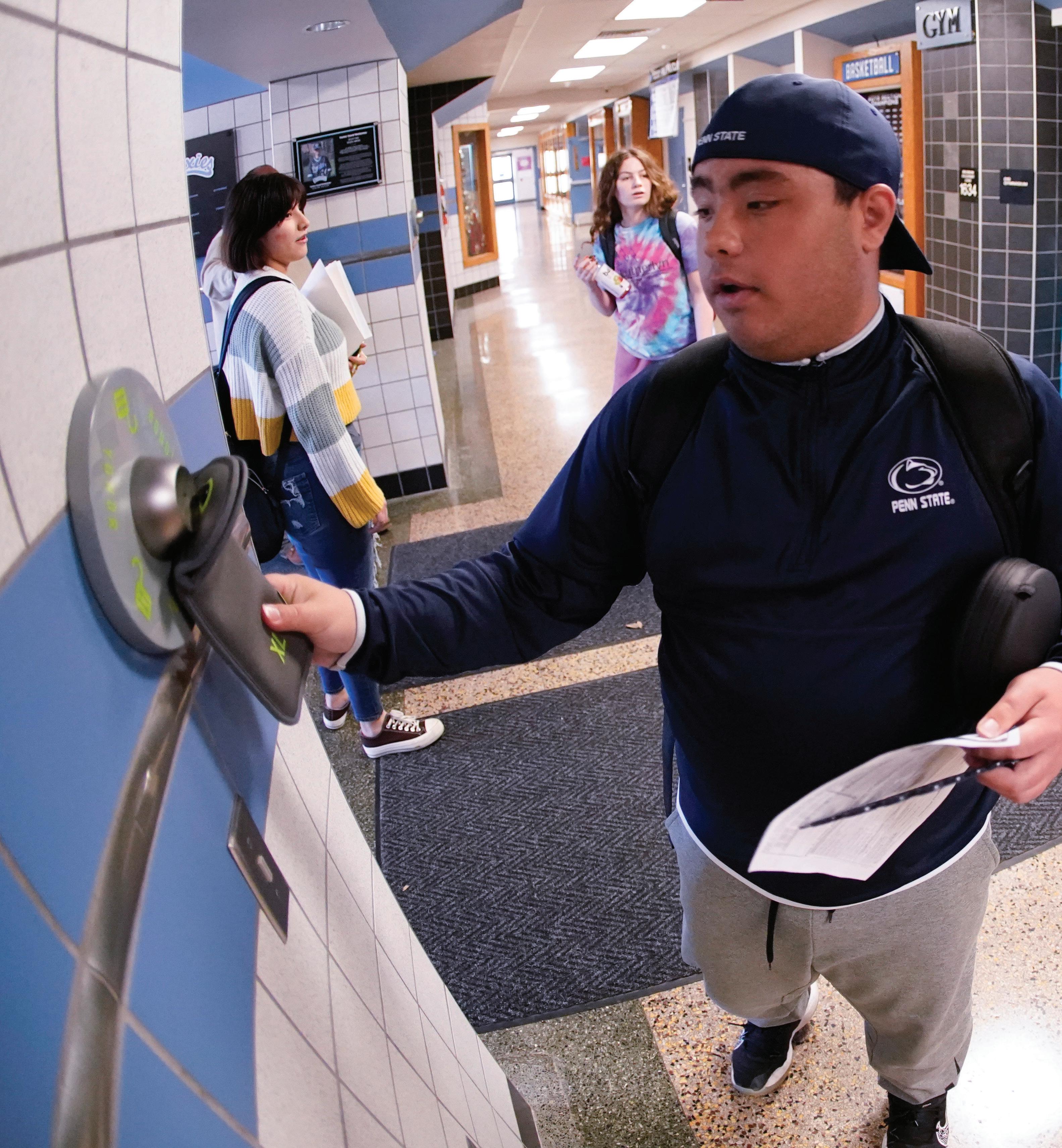
Vasquez says APS has implemented a variety of enforcement systems, including Yondr magnetic pouches, which have become popular at comedy shows and concerts, but it really depends on a school-by-school basis.
“[The policy] is school-specific,” Vasquez says. “We have some schools like some of our P-8 schools, that have maybe a hundred kids at each of the middle school grade levels, which is where we most see the need for [the pouch] policy. Some schools manage the ‘away for the day’ policy as meaning phones in backpacks, and don’t have the need for the
magnetic pouches.”
Vasquez calls the pouches “an assist” for larger middle schools where there are several hundred students per grade level.
Vasquez said that she has seen a marked change in the students in their pilot schools.
“For students, we’ve seen a very significant increase in their ability to regulate their emotions, and that’s measured by something we call the ‘Connection, Belong, and Regulation’ survey that we have students take several times throughout the school year.”
According to Vasquez and data from the self-reported survey, students reported a 7% increase — from 68.9% to 76% — in positive regulation of their emotions from October of 2025 to January of 2026.
Jansen says that she has seen the difference in her classrooms.
“There are students who are not in a hurry to run out of the classroom — excusing themselves to the bathroom — because they’re trying to see any sort of information that they received on their phone,” Jansen says. “They’re not able to check on any concerning information from a friend or to spread gossip. I’ve noticed a lot of students having less behavioral concerns. A lot of bigger fights, a lot of them, were spread via text.”
Importantly, Jansen says her students are more focused on the lesson at hand.
“Students are more likely to be engaged in lessons and to be more aware for longer periods of time,” Jansen adds. As a teacher, “if you weren’t as quick as a TikTok video, then you had lost their engagement immediately. But a lot of students are willing to go through a lot of harder work to access their learning.”
Jansen says that having her students’ full attention is critical, especially since she teaches multi-language learners and has a mix of kids in her classroom. Most importantly, she says her students have been enjoying reading and talking to each other more since the policy was rolled out.
Although district officials say they have not seen a distinct change in academic performance, Vasquez says that they are hopeful that “with students able to regulate their emotions at a stronger level,” and that the lack of distractions will translate to the end-of-year
summative assessments.
Some parents have voiced concerns that they might have difficulty contacting their students in the case of an emergency. Jason Maclin, APS’s director of high school operations, says that they had heard those concerns through their parent focus groups, which the district has used to craft their policy language.
But Maclin says that the district had convened stakeholder focus groups with students, parents, and staff.
“Overwhelmingly, our parents were concerned with school safety and said, ‘we’re very much in support of a distraction-free environment, but we’re not in support of a completely phone-free’ with school safety being one of the reasons,” Maclin says.
Parents reportedly told the district that they would like to have the ability to reach their children in the event of an emergency.
National school safety organizations, like the National Association of School Resource Officers, have said that students are safer when they don’t have their phones during the school day.
A spokesperson for the Aurora Police Department’s school resource officer team told the Sentinel: “The schools put out various messaging to parents with accurate and vetted information to limit the possibility of disinformation being disseminated during an emergency, either intentionally or inadvertently. And phone service and school wi-fi can be strained if many students are communicating at the same time, which can affect the ability and performance of school safety equipment…”
For the most part, Aurora Public Schools officials say high schools have proposed less strict policies for students, while some elementary schools insist phones are off or even stored while students are in class.
Recent research on the outcomes of phone bans is varied. Scholars at Stanford University, Duke University, the University of Michigan, and the University of Pennsylvania published their findings with the National Bureau of Economic Research. The NBER study found several key findings: •Phone bans work. Teacher surveys in schools that banned phones bell-to-bell
found that the share of students reporting using phones in class for personal reasons fell from 61% to 13%. And GPS data suggest phone usage dropped dramatically — a “large and persistent decline” on campuses with bans, researchers noted. These schools saw a roughly 30% drop in total device pings during school hours by the third year after pouch adoption. This change, however, can’t necessarily be read as a direct measure of the change in student phone use, researchers say, since the data also includes use by adults. And pings are often recorded when phones are on but not in use. But the data still suggest that the sheer impact on student use is substantial and that it can be read as a “conservative lower bound” on the magnitude of cell phone policies.
• Discipline worsened, then improved. In the first year of adoption, schools that banned phones saw about a 16% increase in suspension rates — both in- and out-of-school — but this effect faded in subsequent years, researchers found. The uptick likely reflects the fact that many schools took enforcement seriously — and that students turned to other disruptive behaviors.
• Student well-being dipped, then bounced back. Subjective well-being declined in the first year of adoption, then rebounded, researchers found. It turned positive by the second year.
• Academic achievement gains were minimal. Average effects on standardized test scores were “consistently close to zero” across the first three years after adoption, with similar findings across subjects. Attendance, attention, and bullying were largely unaffected. Effects on attendance were “close to zero” — researchers also found no measurable improvements in perceived online bullying or self-reported classroom attention. Still, these findings are just a glimpse into the early days of phone bans, experts say. Phone-free policies certainly do what they are meant to: drive down student phone use.
The APS Board of Education will be voting on approving the student communication device policy proposal to be fully adopted at their next board meeting on May 12, which is available via YouTube or Zoom.
A middle school student unlocks a Yondr pouch on an unlocking base at Bayside Academy while others wait in line for their turn to unlock their pouch at the end of the school day Aug. 16, 2024, in San Mateo, Calif. Lea Suzuki/San Francisco Chronicle via AP
The Magazine
Call for artists: Colfax Canvas 2026 to showcase new murals and music
BY SENTINEL STAFF WRITERS
The Colfax Canvas mural festival will return to Aurora this summer, bringing a weeklong celebration of public art, music and community events to the Aurora Cultural Arts District as city leaders push for renewed investment along the East Colfax corridor.
“Colfax Canvas is more than a mural festival, it’s a reflection of Aurora’s identity and a catalyst for its future,” said Aaron Vega, festival founder and producer at The People’s Building on Colfax. “This year, we’re celebrating not just incredible art, but the people, cultures, and partnerships that already exist and make this district thrive.”
The 2026 festival is scheduled for Aug. 29 through Sept. 4 and comes as Aurora’s newly formed Downtown Development Authority and a strengthened Aurora Cultural Arts District board seek to boost economic development and cultural activity in the area, organizers said in a statement.
The Colfax development authority is a special district that will be overseen by an appointed board with the ability to levy taxes with the goal of revitalizing the area. Voters approved the Colfax development authority last November after years of conversation about how to renew the East Colfax area.
Last week, the city named finalists for the new Colfax Downtown Development Authority board with interviews scheduled through the end of the month.
The city council will appoint six candidates to the board in May or June, according to city officials. They will join Councilmember Alli Jackson to make up a sev-
en-person Colfax DDA board.
The new board’s first major responsibility will be to refine and adopt the Colfax Community Vision and Action Plan as the authority’s legally required plan of development, with final approval by city council, city officials said earlier this year. The draft plan was shaped by extensive community engagement with more than 870 attendees at 24 public events and input collected from more than 100 residents, business owners, property owners and organizations.
City officials say the authority and its board will work in tandem with a proposed nonprofit Community Development Corporation that would pursue additional funding streams and support a broader set of initiatives in and around the corridor. Together, these entities are intended to help improve public spaces, support small businesses and foster economic growth while preserving neighborhood character.
Muralists from across the region and the nation will create new works throughout the district during the festival, adding to what organizers describe as a growing collection of public art along East Colfax Avenue.
Applications for mural artists for the program can be submitted through May 31. Organizers said artists of all backgrounds are encouraged to apply, with selections made by a panel of local business owners, residents and former festival artists.
The festival will begin Aug. 29 in conjunction with Aurora Pride and continue Aug. 30 alongside Latin Pride events, highlighting the district’s diversity and inclusive
culture.
Aurora’s growing annual Pride event last year moved from the Aurora Reservoir to the Aurora Arts District. Last year’s Aurora Pride offered a wide range of music alartists, drag performers, and DJs from Colorado and beyond. The event coordinated with Ballet Folklorico Sangre de México and brought headliner drag queen Jaymes Mansfield of Ru Paul fame to the stage.
This year, the public will be able to watch artists paint murals in real time and are encourage to check out the neighborhood’s arts and restaurant scene.
Now in its sixth year, the festival will conclude Sept. 4 with a local music celebration in partnership with Manos Sagrados, expanding the Aurora Cultural Arts District’s regular First Friday programming with additional live performances. Organizers said artist and music lineups will be announced in July.
Festival attendees also will be able to participate in a bingo-style promotion during the Sept. 4 festivities. Participants who collect stamps from participating district businesses will be entered into a drawing for prizes featuring experiences and products from local merchants.
Organizers said the event is expected to transform the neighborhood into an open-air gallery through partnerships with artists, businesses and community organizations.
Follow along for event updates and opportunities to get involved on Instagram @ColfaxCanvas and @AuroraCulturalArtsDistrict and look for details at ColfaxCanvas.com
Spectators on a walking tour of the Colfax Canvas and Mural Project grab photos on their phones of one of the murals, Aug. 1, 2020.Photo by PHILIP B. POSTON/Sentinel Colorado
“Live Music at The Local Drive” at Stanley Marketplace
scene & herd
“Bohemian Rhapsody: Arts for a Better Tomorrow” with the Aurora Symphony Orchestra
The Aurora Symphony Orchestra closes its season with a vibrant concert celebrating individuality and musical expression. Highlights include a symphonic arrangement of Queen’s “Bohemian Rhapsody,” selections from Puccini and Strauss, and contemporary works. The performance blends classical tradition with modern influences in an accessible, community-focused program.
IF YOU GO:
Date: May 16 at 7:30 p.m.; May 17 at 4 p.m.
Place: Gateway High School Auditorium, 1300 S. Sable Blvd.
Tickets: From free–$22
Information: aurorasymphony.org or 720-262-3850
“Destination Freedom Black Radio Days: ‘Marvin Booker – A Letter From a Denver Jail’”
No Credits Productions presents a powerful live audio drama as part of its “Destination Freedom Black Radio Days” series, examining contemporary issues impacting communities of color. This original production, written by Terrance “Big T” Hughes and directed by donnie l. betts, tells the story of Marvin Booker through a compelling dramatic format blending performance and radio storytelling. Featuring a talented cast and broadcast live on KGNU, the evening also includes a post-show panel discussion with community leaders addressing themes such as justice, housing and systemic inequality.
IF YOU GO:
Date: May 19, 7 p.m.
Place: Aurora Fox Arts Center Studio Theatre, 9900 E. Colfax Ave.
Tickets: $15
Information: aurorafoxartscenter.org or 303-739-1970
“Felipe Peláez in Concert” at Stampede
Latin Grammy-winning Colombian singer-songwriter Felipe Peláez brings his signature vallenato and Latin pop sound to Aurora for a high-energy live concert. Known for romantic ballads and danceable rhythms, Peláez’s performances blend traditional Colombian influences with modern Latin music styles.
IF YOU GO:
Date: May 15, 9:30 p.m.
Place: Stampede, 2430 S. Havana St.
Tickets: Varies
Information: stampedeclub.net or 303-696-7686
This ongoing live music series transforms the Stanley Marketplace hangar into a vibrant performance space featuring local and regional musicians. The programming spans genres—from indie and folk to jazz and rock—creating an eclectic soundtrack for Aurora’s creative community.
IF YOU GO:
Date: Fridays and Saturdays after 5 p.m.
Place: Stanley Marketplace, 2501 Dallas St.
Tickets: Free admission Information: stanleymarketplace.com or 720-941-7070
Havana Street Night Market
Aurora’s global street festival returns for the 2026 season, transforming the Havana Street corridor into a vibrant open-air celebration of food, art and community. Centered outside Leezakaya, the monthly night market features an eclectic mix of vendors offering handmade goods, clothing, jewelry and international crafts. Live music, dance performances, games and giveaways add to the festive atmosphere, making it a lively gathering for all ages. A major highlight is the rotating lineup of food trucks and culinary vendors serving global street fare— from Korean barbecue and Mexican tacos to African specialties and inventive fusion dishes—creating a dynamic, ever-changing dining experience.
IF YOU GO:
Date: Last Saturday of the month beginning May 30; continues monthly through September from 6 p.m.-10 p.m.
Place: Leezakaya, 2710 S. Havana St.
Tickets: Free admission Information: onhavanastreet.com or 303-360-7505
“Contemporary Photography Exhibition” at Center for Visual Art
This exhibition showcases the work of emerging and established photographers exploring themes such as identity, environment and storytelling. Through a range of styles and techniques, the featured artists offer compelling visual narratives that invite viewers to reflect on their own perspectives.
IF YOU GO:
Date: Through May
Place: Center for Visual Art, 965 Santa Fe Dr.
Tickets: Free Information: msudenver.edu/cva or 303-294-5207
Ecosystems: Opening Reception at Downtown Aurora Visual Arts
Celebrate the opening of “Ecosystems,” a printmaking exhibition at Downtown Aurora Visual Arts reflecting biodiversity and environmental dialogue through the medium of print. The show features work by local and guest artists, and the opening reception invites the public to engage with innovative techniques and thematic depth.
IF YOU GO:
Date: 10 a.m.– 5 p.m. weekdays through May 15
Place: Downtown Aurora Visual Arts, 1405 Florence St.
Tickets: Free Info: www.davarts.org or call 303-367-5886
“The Deluge” exhibition at Museum of Contemporary Art Denver
Artist Bethany Collins examines American history, language and identity in this multimedia exhibition that combines sculpture, sound, text and installation. Collins is known for transforming historical documents and cultural symbols into artworks that explore how stories about the nation are constructed and remembered. The exhibition includes pieces created from materials connected to historic monuments as well as works that reinterpret literature and music through erasure, repetition and sound. By reshaping familiar texts and symbols, the exhibition invites visitors to consider how narratives about race, justice and national identity continue to evolve over time.
IF YOU GO:
Date: Through July 5,
Place: Museum of Contemporary Art Denver, 1485 Delgany St.
Tickets: $8–$14; free for members
Information: mcadenver.org or call 303-298-7554
“The Muppet Movie” at Aurora Fox Arts Center
Jim Henson’s beloved musical comedy returns to the big screen in this family-friendly screening as part of the Aurora Fox’s Fox Flix series. Featuring Kermit the Frog, Miss Piggy and the rest of the Muppets, the film follows the troupe’s cross-country journey to Hollywood, blending comedy, music and heartwarming adventure. Packed with memorable songs and celebrity cameos, the classic film remains a celebration of creativity, friendship and show business dreams.
IF YOU GO:
Date: May 16, 2 p.m.–4 p.m.
Place: Aurora Fox Arts Center, 9900 E. Colfax Ave.
Tickets: $5
Information: www.aurorafoxartscenter.org or 303-739-1970
“Chosen Family” with Denver Rock Orchestra at The People’s Building
The Denver Rock Orchestra pres-
ents a Pride-themed concert celebrating identity, acceptance and community through symphonic rock arrangements. The program features music by artists including Lady Gaga, Chappell Roan and Queen, performed with a full orchestral twist in Aurora’s historic People’s Building.
IF YOU GO:
Date: May 29–May 30, 7:30 p.m.
Place: The People’s Building, 9995 E. Colfax Ave.
Tickets: $20-$25
Information: www.thepeoplesbuilding.com or 720-476-8888
“Ain’t Nothing But the Blues”
This acclaimed musical revue traces the evolution of the blues from Africa to the American South and beyond through a dynamic collection of songs and stories. Featuring music made famous by legendary blues artists, the production celebrates the genre’s enduring emotional power and influence on American music history.
IF YOU GO:
Date: Opens May 22 - June 21. Friday and Saturday curtains at 7:30 p.m. Sunday curtains at 2:30 p.m.
Place: Vintage Theatre, 1468 Dayton St.
Tickets: $20-$39
Information: www.vintagetheatre.org or call 303-856-7830
“Miscast 2026” at Roaming Gnome Theatre
This inventive theatrical showcase turns traditional casting expectations upside down, inviting performers to sing songs and perform roles they would not typically be cast to play. The annual event celebrates creativity, inclusivity and unexpected artistic interpretation in a lively cabaret-style format.
IF YOU GO:
Date: May 29 and Amy 30, 7 p.m.
Place: Roaming Gnome Theatre, Aurora Cultural Arts District
Tickets: $10-$15
Information: www.auroraculturalartsdistrict.org or 720-819-6680
“Jazz Jam” at Cerebral Aurora Arts
Musicians of all ages and experience levels are invited to participate in this community-centered jazz session celebrating improvisation and collaboration. Hosted at Cerebral Aurora Arts, the event creates an inclusive environment where emerging and seasoned performers can share the stage and explore jazz traditions together.
IF YOU GO:
Date: May 31, 1 p.m.–3 p.m.
Place: Cerebral Aurora Arts at Cerebral Brewing, 9990 E Colfax Ave.
Tickets: Free
Information: cerebralbrewing. com/ or 720-819-6680---
“World’s Largest Dinosaurs” at Denver Museum of Nature and Science
This traveling exhibition explores how the largest land animals in Earth’s history lived and functioned. Rather than focusing solely on fossil bones, the exhibit examines the biology of giant sauropods, which are dinosaurs whose massive bodies required unique adaptations for breathing, circulation and movement. Through interactive displays, models and scientific research, visitors can learn how scientists study both fossils and modern animals to understand how these enormous creatures survived and thrived millions of years ago. The exhibition also explores the evolutionary advantages and challenges of extreme size, offering a deeper look at how the scale of these animals shaped their behavior and ecosystems.
IF YOU GO:
Date: Through Sept. 7
Place: Denver Museum of Nature and Science, 2001 Colorado Blvd.
Tickets: $6-$9
Information: dmns.org or call 303-370-6000
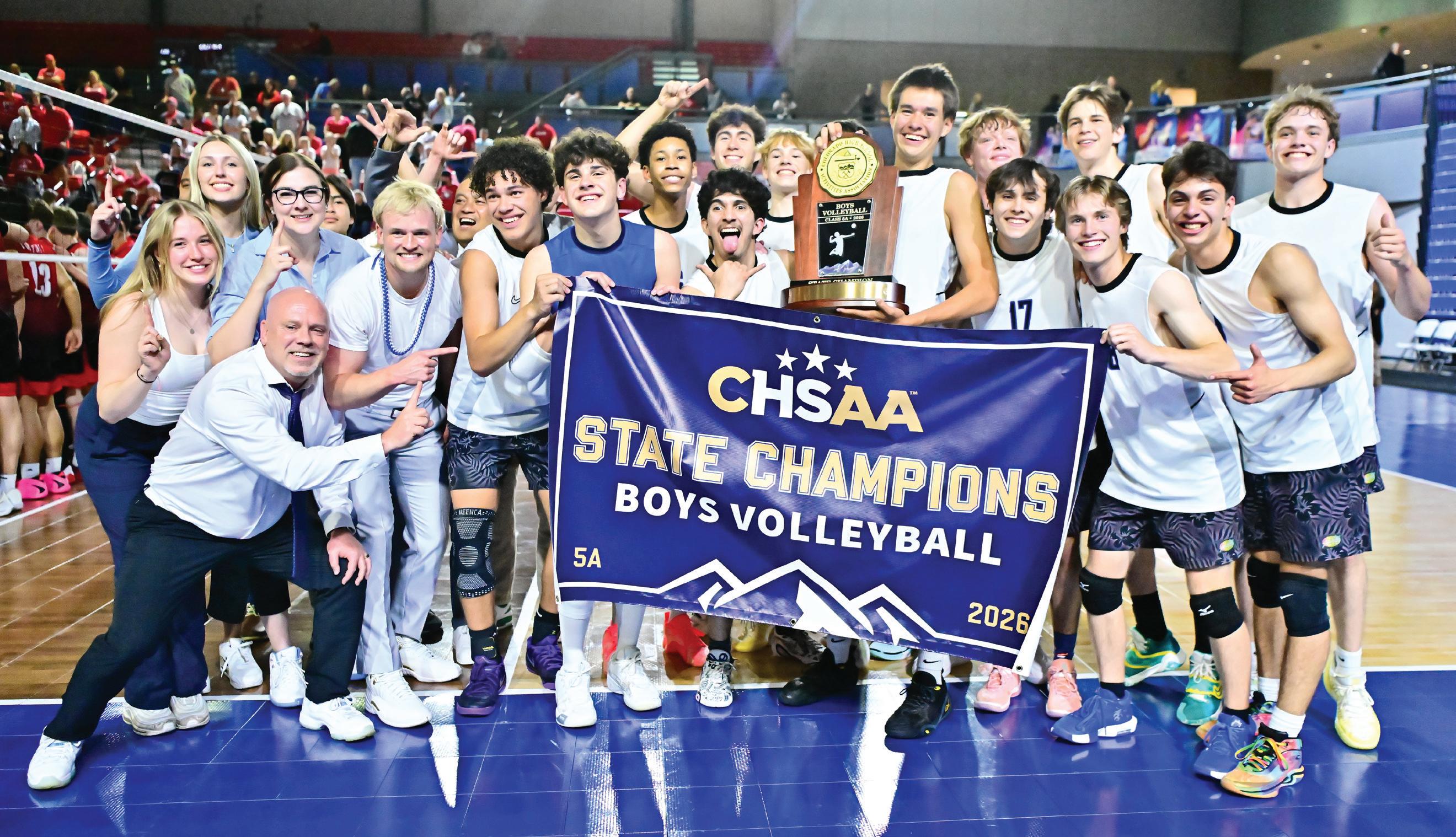
Right: Players and coaches with the Grandview boys volleyball team pose with the Class 5A state championship trophy they won with a fourset victory over previously undefeated Eaglecrest on May 9 at Trojan Arena on the campus of Fountain-Fort Carson High School.
Middle: Grandview junior Alex Garcia exhorts the crowd after his 21st and final kill to deliver the program’s first state championship.
Below: Eaglecrest junior Dallin Anderson celebrates a point for the Raptors during their third set rally against Grandview in the 5A state final. Eaglecrest finished the season 28-1.
The seemingly inevitable collision of the Eaglecrest and Grandview boys volleyball teams happened and this time, the Wolves were ready.
The two powerhouse Aurora area programs had met four times on various occassions, but it was a fifth that carried with it the largest stakes: the Class 5A state championship.
The Raptors needed a sweep to repeat as state champions and complete an undefeated season, but the Wolves took the lessons learned from previous losses and came through with a 25-19, 2521, 22-25, 25-21 victory May 9 in an electric environment at Trojan Arena at Fountain-Fort Carson.
four sets in the championship semifinals as both teams won their first two matches. “This time, we thought if we win the first set, we were going to be in control. The boys executed that today.”
Indeed, the Wolves were charged up from the opening serve and blitzed their way to victory. The set was punctuated by a walk-off ace from junior Alex Garcia, which sent the team and a boisterous crowd into hysterics with the winning serve.
“That first set was easily the best volleyball we’ve ever played,” junior Connor Deickman said. “Even into the second set, rolling through against a team that is that insanely good is crazy. They deserve all the props they get, but we just played a different level tonight.”
Grand champs
BY COURTNEY OAKES Sports Editor
“Those are some great players on the other side of the court and they went undefeated for a reason, but each time we played them, we started to chip away more and more,” Grandview senior setter Devan Hall said. “We figured it out. ...We played as a team, we trusted each other so much and we had every belief that we would win. That’s what we did.”
It would have been easy to have some doubt for Grandview given its track record against Eaglecrest (28-1), which dealt it four of its seven losses on the season.
The first two meetings between the teams that sit just two miles away from each other in the Aurora area finished as sweeps for Eaglecrest, which took a 3-0 Centennial League regular season win and swept two sets in the Legend Tournament. The Wolves made some inroads at the Centennial League Challenge final with a loss in a fifth game that went all the way to 20-18 before the Raptors held on.
“We had a couple of match points in that and that’s how good they are, they hadn’t had a match point against them until that point,” said first-year head coach Jaren Graham, whose team also lost in
Buoyed by excellent preparation, Garcia (who had a match-high 22 kills) and Deickman (who had 11 kills plus five blocks) were nearly unstoppable, while senior Cooper Bird Bear played big in the middle and freshman libero Creed Kingsbury helped lock the defense down in the back row.
Deickman’s massive putaway sealed a second set win for the Wolves before Eaglecrest showed championship mettle with an answer in the third set.
Grandview continued its ultra-aggressive approach in the fourth set and it paid off when Garcia elevated for a smash that secured the program’s first state championship.
“In these kind of matches, you have to go all out,” said Garcia, who averaged 20 kills in five state tournament matches. “You have to work as hard as you can and be as aggressive as you can. You could see the other team was timid in moments since they hadn’t been in that position. That’s what makes our team different, we go for it no matter what.”
Coach Chad Bond’s Eaglecrest team — which made the state championship match for the third time in the past four seasons — got 13 kills from junior Dallin Anderson 13, 12 from junior Will George 12 and 11 from senior Ashton Bond.
Graham got himself a state championship to match the one his father Rob — his assistant on the boys team — got as the Ponderosa girls coach back in 2019.
BOYS VOLLEYBALL
PHOTOS BY COURTNEY OAKES/AURORA SENTINEL
TThe Regis Jesuit boys swim team had a smaller contingent than usual at this season’s Class 5A state swim meet, but it was still plenty mighty.
he Regis Jesuit boys swim team had a smaller contingent than usual at this season’s Class 5A state swim meet, but it was still plenty mighty.
Coach Nick Frasersmith had just 12 individual qualifiers for the May 8-9 meet at the Veterans Memorial Aquatic Center, however the points came plentifully for the Raiders. Shut out in the chase for individual state titles last season, Regis Jesuit made up for it with four — three of which involved sophomore Treyvn Krauss — en route to a runner-up result.
Coach Nick Frasersmith had just 12 individual qualifiers for the May 8-9 meet at the Veterans Memorial Aquatic Center, however the points came plentifully for the Raiders.
Grandview — which graduated a pair of two-event state champions from last season’s team in Oliver Schimberg and Gherman Prudnikau — got off to a quality start with the performance of junior Hunter Bull in the 1-meter diving competition. Bull, the area’s only state qualifier, finished in sixth place (up from 14th last season) to get the ball rolling.
Shut out in the chase for individual state titles last season, Regis Jesuit made up for it with four — three of which involved sophomore Treyvn Krauss — en route to a runner-up result.
Grandview — which graduated a pair of two-event state champions from last season’s team in Oliver Schimberg and Gherman Prudnikau — got off to a quality start with the performance of junior Hunter Bull in the 1-meter diving competition. Bull, the area’s only state qualifier, finished in sixth place (up from 14th last season) to get the ball rolling.
In the last season under outgoing coach Dan Berve, the Wolves continued the momentum with a third-place finish from the 200 yard medley relay of seniors Mason Shutter, Caleb Nelson, Christian Burgeson plus junior Greyson Connett.
In the last season under outgoing coach Dan Berve, the Wolves continued the momentum with a third-place finish from the 200 yard medley relay of seniors Mason Shutter, Caleb Nelson, Christian Burgeson plus junior Greyson Connett.
Making waves
Making waves
BY COURTNEY OAKES Sports Editor
BY COURTNEY OAKES Sports Editor
Powerhouse Cherry Creek piled up 388.5 points, while Regis Jesuit comfortably took the runner-up spot for a second straight season with 338.5. Joining the Raiders in the top 10 among Aurora area programs were Grandview (eighth place with 163 points) and Smoky Hill (10th place with 134.5), while Cherokee Trail’s 104.5 put it 15th in a field of 30 scoring teams.
Powerhouse Cherry Creek piled up 388.5 points, while Regis Jesuit comfortably took the runner-up spot for a second straight season with 338.5. Joining the Raiders in the top 10 among Aurora area programs were Grandview (eighth place with 163 points) and Smoky Hill (10th place with 134.5), while Cherokee Trail’s 104.5 put it 15th in a field of 30 scoring teams.
Krauss dominated the distance freestyle events at the meet, as he won the 200 freestyle by a second and a half (with a time of 1 minute, 37.72 second) and had an even wider margin in the 500 freestyle (five-plus seconds, as he touched the wall in 4:26.98). To cap the meet, Krauss teamed with fellow sophomore Spencer Greene, junior Nathaniel Spencer and senior Nolan Kohl in a big win in the 400 freestyle relay.
Krauss dominated the distance freestyle events at the meet, as he won the 200 freestyle by a second and a half (with a time of 1 minute, 37.72 second) and had an even wider margin in the 500 freestyle (five-plus seconds, as he touched the wall in 4:26.98). To cap the meet, Krauss teamed with fellow sophomore Spencer Greene, junior Nathaniel Spencer and senior Nolan Kohl in a big win in the 400 freestyle relay.
Greene got a state title of his own, as he ruled the 100 yard butterfly.
Connett — who transfered to the program from Regis Jesuit — helped accumulate significant points for Grandview. His first individual event produced a third place finish in the 100 butterfly, while he finished as the state runner-up in the 100 backstroke. Schimberg had won the backstroke in the past three seasons and Connett had a chance to continue the program’s streak of dominance in the event, but Valor Christian’s Josh Heydt beat him to the wall by nearly a full second.
Connett — who transfered to the program from Regis Jesuit — helped accumulate significant points for Grandview. His first individual event produced a third place finish in the 100 butterfly, while he finished as the state runner-up in the 100 backstroke. Schimberg had won the backstroke in the past three seasons and Connett had a chance to continue the program’s streak of dominance in the event, but Valor Christian’s Josh Heydt beat him to the wall by nearly a full second.
Berve relished the meet given how many of his swimmers — especially seniors such as Shutter, Nelson and Burgeson — scored for the first time after appearing at state several times. Shutter, in fact, won the consolation heat of the 100 breaststroke and also scored in the 200 individual medley.
Greene got a state title of his own, as he ruled the 100 yard butterfly.
Aurora’s other area programs didn’t have any state champions, but had several close calls between them.
Aurora’s other area programs didn’t have any state champions, but had several close calls between them.
Walkup won two events at the Centennial “A” League Championships as a precursor and followed that up with two outstanding individual performances at the state meet. He finished in a tie for second place in the 200 yard individual medley with another Aurora area competitor in Cherokee Trail senior Tyson Walker, while he also secured seventh place in the 100 freestyle. Adams, meanwhile, had his best showing in the 100 breaskstroke with a fifth place result, while he also finished ninth in the 200 freestyle. To cap the meet, the duo teamed with freshman Ethan Abele and junior Carl Johnson to place fifth.
Walkup won two events at the Centennial “A” League Championships as a precursor and followed that up with two outstanding individual performances at the state meet. He finished in a tie for second place in the 200 yard individual medley with another Aurora area competitor in Cherokee Trail senior Tyson Walker, while he also secured seventh place in the 100 freestyle. Adams, meanwhile, had his best showing in the 100 breaskstroke with a fifth place result, while he also finished ninth in the 200 freestyle. To cap the meet, the duo teamed with freshman Ethan Abele and junior Carl Johnson to place fifth.
Berve relished the meet given how many of his swimmers — especially seniors such as Shutter, Nelson and Burgeson — scored for the first time after appearing at state several times. Shutter, in fact, won the consolation heat of the 100 breaststroke and also scored in the 200 individual medley.
Coach Scott Cohen’s Smoky Hill team got some particularly outstanding performances from young swimmers in sophomores Cooper Walkup and Marshall Adams, who made two championship event finals apiece and keyed the 400 freestyle relay, which finished in fifth place.
Coach Scott Cohen’s Smoky Hill team got some particularly outstanding performances from young swimmers in sophomores Cooper Walkup and Marshall Adams, who made two championship event finals apiece and keyed the 400 freestyle relay, which finished in fifth place.
Cherokee Trail remains in search of the program’s first all-time state champion and had hoped the Walker could be the one to break the seal. The Centennial League’s Swimmer of the Year gave it his best effort, but came up just short. In addition to his tie with Walkup for second in the 200 IM — a full two seconds behind Columbine’s Joey Sudermann — Walker was by himself as the runner-up of the 100 breaststroke, which was won by Cherry Creek’s Kian Lihalaka, who did not swim the vent the previous week at the league meet. Junior Anderson Hardin boosted the Cougars’ coffers with a fifth-place result in the 50 freestyle plus an eighth in the 100.
Cherokee Trail remains in search of the program’s first all-time state champion and had hoped the Walker could be the one to break the seal. The Centennial League’s Swimmer of the Year gave it his best effort, but came up just short. In addition to his tie with Walkup for second in the 200 IM — a full two seconds behind Columbine’s Joey Sudermann — Walker was by himself as the runner-up of the 100 breaststroke, which was won by Cherry Creek’s Kian Lihalaka, who did not swim the vent the previous week at the league meet. Junior Anderson Hardin boosted the Cougars’ coffers with a fifth-place result in the 50 freestyle plus an eighth in the 100.
BOYS SWIMMING
ABOVE: Regis Jesuit sophomore Treyvn Krauss takes a breath on his way to winning his preliminary heat of the 500 yard freestyle at the Class 5A boys state swim meet on May 8 at the Veterans Memorial Aquatic Center. The Krauss won the state championship in the event along with the 200 yard freestyle, while he also helped secure a victory in the 400 yard freestyle relay. Photo by Courtney Oakes/Aurora Sentinel. BELOW: Regis Jesuit team bers pose with the Class 5A state runner-up trophy they won May 9. Photo courtesy Regis Jesuit Boys Swim & Dive
BOYS SWIMMING
ABOVE: Regis Jesuit sophomore Treyvn Krauss takes a breath on his way to winning his preliminary heat of the 500 yard freestyle at the Class 5A boys state swim meet on May 8 at the Veterans Memorial Aquatic Center. The next day, Krauss won the state championship in the event along with the 200 yard freestyle, while he also helped secure a victory in the 400 yard freestyle relay. Photo by Courtney Oakes/Aurora Sentinel. BELOW: Regis Jesuit team members pose with the Class 5A state runner-up trophy they won May 9. Photo courtesy Regis Jesuit Boys Swim & Dive
Preps
GIRLS TENNIS
Regis Jesuit No. 1 doubles team places at 5A state
The lone Aurora area qualifier to make it to the third and final day of play at the Class 5A girls individual state tennis tournament was the Regis Jesuit No. 1 doubles team of junior Abigail Puschaver and freshman Samantha Garcia Lucero.
The Raiders’ duo won their first two matches at the Denver Tennis Park to make it to the May 8 semifinals, where they were stopped by eventual state champions Mataya Farling and Harlowe Lutz from powerhouse Ralston Valley. Puschaver and Garcia Lucero bounced back to win a playback semifinal and battled Valor Christian’s Sofia Yaron and Ella Bohling for three sets before they fell 6-4, 4-6, 7-5 to finish in fourth place.
While Garcia Lucero made her state tournament debut, Puschaver placed fourth for a second straight season as she garnered the same spot with former partner Brooklyn Craven at No. 3 doubles in 2025. Coach Jenn Armstrong’s Regis Jesuit team had all seven lines qualified, but the other six positions were all eliminated after the opening day and did not get playback chances. Cherokee Trail had its No. 4 doubles team of seniors Aspen Cedeno Visit sentinelcolorado.com/preps for full results and coverage.
GIRLS LACROSSE
Regis Jesuit moves into Class 5A state semifinals
For the third time in four seasons, the Regis Jesuit girls lacrosse team made it to the semifinals of the Class 5A state tournament and did so in impressive fashion.
The second-seeded Raiders outscored their first two opponents — No. 15 Columbine in the first round and No. 7 Arapahoe in the second round —by a combined total of 43-11 to join No. 1 Valor Christian, No. 5 Colorado Academy and their semifinal foe — No. 6 Kent Denver — in the final four teams remaining.
The 5A girls lacrosse state championship game is scheduled for 7:30 p.m. May 15 at Peter Barton Stadium.
Visit sentinelcolorado.com/preps for updated tournament coverage.
TRACK & FIELD
Healthy Aurora area group qualifies for state meet
Three days of competition at Jefferson County Stadium at the spectacle that is the state meet is ahead May 14-16, with a large Aurora area contingent set to compete according to the list of qualifiers released by the Colorado High School Activities Association May 11.
Twenty-eight individuals and eight relay teams from a combined seven programs (Cherokee Trail, Eaglecrest, Grandview, Rangeview, Regis Jesuit, Smoky Hill and Vista PEAK Prep) will be part of the Class 5A boys state meet, with a contingent led in total numbers by Cherokee Trail — the three-time defending state team champion — with eight individuals to go with a full compliment of four relay teams. Grandview
has the most individuals with nine (plus a relay), while Eaglecrest’s contingent of six includes Cameron Bell, who is the state record holder in the long jump and also the top seed in the 300 meter hurdles, plus state-leading triple jumper Bryson States.
Regis Jesuit has three qualifiers, while a pair is qualified from Vista PEAK Prep — including Joshua Gallien, who made it in the 100, 200 and 400 meters — while Rangeview and Smoky Hill have one each.
On the girls side, Eaglecrest — last season’s 5A runner-up — has a handful of individuals qualified, including Zenobia Witt, who is returning from injury and looking to add to her collection of five event state championships from the previous two seasons. The Raptors also will look to extend a streak of state titles in the 4x200 meter relay that is at four years.
Vista PEAK Prep has five individuals (plus a relay team) and could be in line for a haul of points from Tajah Eugene (the No. 1 seed in the high jump) plus Elazia Patton, who is qualified in the 100, 200 and 400 meters. Grandview has four individuals and two relay teams in the mix, while Cherokee Trail has all four relay teams qualified to go with a trio of individuals, including distance standout Madison Lange, the No. 1 seed in the 3,200 meter run.
Overland (sprint standout Lezlee Napier) and Regis Jesuit (distance ace McKenna Groen) have one qualifier apiece. For a full list of Aurora area qualifiers by school, plus daily coverage and results from the state track meet, visit sentinelcolorado.com/preps.
BOYS LACROSSE
Regis Jesuit moves on in Class 5A state playo s Regis Jesuit remains alive in the Class 5A boys lacrosse state playoffs, while Cherokee Trail and Grandview made exits in the second round May 9.
The third-seeded Raiders had an opening round bye, but exhibited little rust in their second round home game against No. 19 Northfield, as they rolled to a 17-6 victory and passage into the state quaterfinals. Four goal performances from Marco Walsweer and William Wilson, plus three goals and five assists from Will Cornell helped Regis Jesuit (14-2), which earned a home quarterfinal against No. 6 Fairview (13-3) on May 13 (results unavailable at press time).
Aurora’s two other 5A qualifiers — No. 12 Cherokee Trail and No. 13 Grandview — both won their first round contests, against No. 21 Chatfield and No. 20 Boulder, respectively, before they lost in the second round. The Cougars battled with ffith-seeded Lakewood before falling 107, while fourth-seeded Arapahoe downed the Wolves 18-3. Cherokee Trail and Grandview both finished 10-7.
Visit sentinelcolorado.com/preps for updated tournament coverage.
GIRLS SOCCER
Cougars, Raiders fall in 5A state second round
Twenty-first seeded Cherokee Trail and No. 24 Regis Jesuit created some havoc in the Class 5A girls soccer state tournament with upsets of top-12 seeds in the opening round and then lost close second round contests backto-back May 9 at The Stadium at Redstone Park.
In a game delayed to May 8 by weather, the Cougars earned a 2-1 road win over No. 12 Horizon (with two goals from Makayla Sellyei, both assisted by Selah Davis) and turned around the next day to challenge No. 5 Rock Canyon. Davis scored a breakaway goal early in the second half that had Cherokee Trail ahead inside the final two minutes until the Jaguars tied it on a perfectly-placed free kick and won it in overtime. The Cougars — whose postseason win was their first since 2019 — finished the season 8-3-6.
Regis Jesuit waited an extra day for its opening round visit to No. 9 Broomfield and it came away with a 1-0 victory on an early set piece goal from Izzy Meyer. The Raiders — coming off a first playoff win since 2022 — fell 1-0 in a rematch with fellow Continental League member and eighth-seeded Mountain Vista in the second round to finish a 6-6-3 season.
BOYS LACROSSE
Smoky Hill falls in 4A 1st round in postseason bid
For the first time in 13 years, the Smoky Hill boys lacrosse team earned the chance to play in the postseason and was in position to move on May 5.
A snowstorm hit during the 21st-seeded Buffaloes’ matchup with No. 12 Golden at Trailblazer Stadium and the Demons prevailed 9-4. Jason Jaster had a hat trick in the first half for Smoky Hill, which ceded a go-ahead goal inside the final 10 seconds of the first half and couldn’t catch up to end its season 9-7. It was the most wins for the program since an 11-win campaign in 2013.
BASEBALL
Grandview claims Centennial League title ahead of postseason
The Grandview baseball team continued its hot finish to the regular season with a 6-4 win over rival Cherry Creek May 9 to secure the Centennial League championship and improved its spot in the upcoming postseason.
The Wolves won their first 10 games in league play to set up a visit to oneloss Cherry Creek May 8 that could have decided the title, however the Bruins found a way to get past Grandview senior ace fireballer Ethan Wachsmann to force a winner-take-all rematch.
Senior Logan Hurtado came up big for the Wolves, as he allowed four runs (three earned) over six innings, while junior Diesel Bernosky pitched a clean final inning to save a 6-4 victory for coach Scott Henry’s team. Wachsmann knocked in two runs to help the offense for Grandview, while seniors Kayden Bohmeyer, AJ Maroni and Jakson Bush also had RBI.
The win pushed Grandview (16-7) to No. 15 in the Colorado High School Activities Association Seeding Index before regional pairings and brackets were to be released May 13. Sitting at No. 4 is Continental League champion Regis Jesuit (17-6), which lost its last two games of the regular season. Vista PEAK Prep won three of its last four games to get to 15-8 and is in the No. 20 slot as the only other Aurora area squad seemingly in position to make the 32-team postseason.
Visit sentinelcolorado.com/preps for complete regional pairings.
GIRLS GOLF
Thirteen Aurora area players make 5A state
The Colorado High School Activities Association revealed the list of qualifiers for each of the upcoming girls state golf tournaments May 11 and Aurora area programs earned a combined 13 spots, a good sized rise from last season.
Four-player teams from Cherokee Trail, Grandview and Regis Jesuit — plus an individual from Smoky Hill — are among those headed to play in the Class 5A state tournament, which is scheduled to be played May 18-19 at Thorncreek G.C. in Thornton.
Regional state qualifying tournaments were eliminated prior to this season, so players qualified based on rankings of scores aggregated through a required number of rounds played throughout the season.
FAR LEFT: Vista PEAK Prep sophomore Ace Kelly celebrates a double that drove in two runs during the Bison’s 11-1 City League baseball win over Denver East May 9 at All-City Stadium. ABOVE LEFT: Regis Jesuit freshman Samantha Garcia Lucero makes a return as she helps the No. 1 doubles team claim fourth place at the Class 5A girls individual state tennis tournament May 9 at the Denver Tennis Park. FAR LEFT BELOW: Cherokee Trail senior Tyson Walker, right, takes a breath on his way to winning his heat of the 100 yard breaststroke in the prelims of the Class 5A boys state swim meet May 8 at the Veterans Memorial Aquatic Center. Walker finished second in the event May 9. LEFT: Smoky Hill freshman Erianna Perez — here celebrating an eagle at a Centennial League girls golf tournament at South Suburban G.C. is one of 13 players from Aurora area programs to make the field for the Class 5A girls state golf tournament May 18-19 at Thornton G.C.. BELOW CENTER: Cherokee Trail’s Selah Davis, left, cuts off a Rock Canyon player during the first half of a Class 5A girls soccer second round state playoff game on May 8 at The Stadium at Redstone Park. Davis’ goal early in the second half gave the lead to the Cougars, who eventually fell 2-1 in overtime. BE-
LOW: Cherokee Trail’s Cooper Bernard, right, wheels on a Chatfield defender to try to take a shot during a Class 5A boys lacrosse state playoff game played at Legacy Stadium. The Cougars won the game and then fell to Lakewood in the second round. (Photos by Courtney Oakes/Aurora Sentinel)
imum number of rounds to qualify for the 4A state tournament.
Visit sentinelcolorado.com/preps for state times when they are put out, plus tournament coverage.
WEEK PAST
The week past in Aurora prep sports
For more on these stories, visit sentinelcolorado. com/preps
Headed to the state tournament for Cherokee Trail are seniors Saruul Gantulga and Maya Patel along with juniors Brinnon Cook and Marisa Vialpando, while Grandview also has a senior duo in Charly Ashworth and Jean Lim plus juniors Elizabeth Chang and Jacqueline Cho. Regis Jesuit’s state contingent is made up of senior Natalie Furgason (a three-time state qualifier), juniors Molly Amman and Emily Gott and sophomore Claire Pariset. Freshman Erianna Perez also made the field, giving Smoky Hill its first state qualifier since Sophia Stiwich placed second in 2023.
Missing out on the postseason is Vista PEAK Prep senior Sophia Capua, a three-time state qualifier and two-time top-10 placer who did not play the min-
MONDAY, MAY 11: The lone regular season game on the docket was played by the Smoky Hill baseball team, which lost 11-1 to Douglas County to cap a 5-18 regular season. ...SATURDAY, MAY 9: The Vista PEAK Prep baseball team rolled to an 11-1 victory over Denver East in a City League tournament contest at All-City Stadium behind a big twoway performance from Ace Kelly. Kelly allowed just two hits over five innings on the mound, while he also doubled twice and drove in a pair of runs. Brody Brancato had three hits and two RBI, while Abel Salinas had a pair of hits for the Bison. ...Colten Burch went 4-for-4 with two RBI and earned the win with 1/3 inning of relief for the Rangeview baseball team in an 11-8 win over DSST: Montview. Wyatt De Jesus drove in four runs, while Fabian Amaya added three for the Raiders. ...The Overland baseball team played in the championship game of the Colorado League tournament and fell 10-0 on the road at Adams City. ...The Eaglecrest girls track team won the Centennial League championship by more than 50 points with its performance at LPS Stadium, which included eight event titles. Rhyan Gadlin swept
the hurdles events, while Jenna Winn, Zenobia Witt, Haley Brinkman and Giannah Bighorn also won events individually to go with 4x400 and 4x800 relays for the Raptors. Third-place Cherokee Trail took the 4x100 and 4x200 meter relays, while fourth-place Grandview had event winners in Alexis Fischer and Taylor Delgado Lezlee Napier won the 100 and 200 meters for Overland. The Cherokee Trail boys finished as the league runners-up behind Cherry Creek with a point total that included championship wins from Joshua Stewart, Prince David Ajibade and William Mines, while third-place Eaglecrest saw Cameron Bell win the 300 hurdles and long jump to join Bryson States as individual event winners to go with the 4x200 meter relay. Fifth-place Grandview’s two wins came in field events from William Smith III in the pole vault and Quentin Dorsey in the discus, while seventh place Smoky Hill ruled the 4x400 meter relay. ...FRIDAY, MAY 8: The Grandview baseball team tried to secure the Centennial League title, but dropped a 4-1 visit to Cherry Creek. Ethan Wachsmann allowed two runs (one earned) over four innings for the Wolves, who scored first in the second inning, but not again. ...THURSDAY, MAY 7: Brian Moreland turned in a complete game effort with 12 strikeouts for the Eaglecrest baselball team in a 13-3 Centennial League road win at Arapahoe. Moreland, Joe Ostrander and Tanner Steadman drove in two runs apiece to pace the Raptors offense. ...Connor Thrush threw 5 1/3 innings of three-hit baseball to help the Cherokee Trail baseball team to a 3-2 road win at Mullen. Landon Ellis dou-
bled twice and drove in all three runs for the Cougars. ...Octavio Sanchez turned in six strong innings of work for the Overland baseball team in a 7-6 road win over Skyview in a semifinal contest of the Colorado League tournament. Kevin Uribe got a save for the Trailblazers, who capitalized on six errors and got two hits apiece from Ruben Luna and Dante Villanueva Selah Davis scored both goals for the Cherokee Trail girls soccer team in a 2-1 overtime win at Horizon to open the Class 5A state playoffs. Izzy Becker and Peyton Mathews had assists for the Cougars. ...The Aurora West College Prep Academy girls soccer team defeated Bennett 5-2 at Aurora Public Schools Stadium in a Class 3A first round state playoff contest. Maria Gutierrez Benitez and Destiny Martinez scored two goals apiece to lead the Spartans, who got 10 saves from Emily Mascorro. ...The Regis Jesuit boys track team finished in a tie for 10th place among 30 teams at the Denver East Fritz Fulton Memorial meet at AllCity Stadium, while the Raiders were 26th in the girls competition. ...In a rescheduled Class 5A boys lacrosse first round state playoff game, Mason Kelly had seven goals and Jack Cole added five as the Grandview downed Boulder 16-8. ...The Regis Jesuit girls lacrosse team rolled past Columbine 23-6 to begin the Class 5A state playoffs as Natalie Chilton and Delaney Sitzmann scored four goals apiece. ...WEDNESDAY, MAY 6: The entirety of the day’s competition was canceled due to a snowstorm that caused the closure of both Aurora area school districts and Regis Jesuit.
NOTICE TO CREDITORS BY PUBLICATION
PURSUANT TO §15-12-801, C.R.S.
Case No. 2025PR30304
Estate of James Bruce Poirier aka James B. Poirier, Deceased.
All persons having claims against the above-named estate are required to present them to the Personal Representative or to the District Court of Arapahoe County, Colorado, on or before August 30, 2026, or the claims may be forever barred.
PURSUANT TO §15-12-801, C.R.S. Case No. 2026PR030317
Estate of Martin Hayes, Deceased.
All persons having claims against the above-named estate are required to present them to the Personal Representative or to the District Court of Arapahoe County, Colorado, on or before September 10 2026, or the claims may be forever barred.
Attorney for Personal Representative
Anna L. Burr, Esq.
2851 S. Parker Road, Ste. 230 Aurora, CO 80014
First Publication: May 7, 2026
Final Publication: May 21, 2026
Sentinel
NOTICE TO CREDITORS BY PUBLICATION
PURSUANT TO §15-12-801, C.R.S. Case No. 2026PR030397
Estate of Charlotte Elizabeth Wickham aka Charlotte E. Wickham aka Charlotte Wickham, Deceased.
All persons having claims against the above-named estate are required to present them to the Personal Representative or to the District Court of Arapahoe County, Colorado, on or before September 14, 2026, or the claims may be forever barred.
Attorney for Personal Representative
Kailie H. Wilson, Esq.
2851 S. Parker Road, Ste. 230 Aurora, CO 80014
First Publication: May 7, 2026
Final Publication: May 21, 2026
Sentinel
NOTICE TO CREDITORS BY PUBLICATION
PURSUANT TO §15-12-801, C.R.S. Case No. 2026PR224
Estate of Michael Leslie Smith aka Michael L. Smith aka Mike Smith, Deceased. All persons having claims against the above-named are required to present them to the Personal Representative or to the District Court of Arapahoe County, Colorado, on or before August 31, 2026, or the claims may be forever barred.
Alan Lynn Smith
Personal Representative
9948 Spring Hill Dr. Highlands Ranch, CO 80129
First Publication: April 30, 2026
Final Publication: May 14, 2026 Sentinel
NOTICE TO CREDITORS BY PUBLICATION
PURSUANT TO §15-12-801, C.R.S. Case No. 2026PR237
Estate of Gary Duane Gregory, Deceased.
All persons having claims against the above-named estate are required to present them to the Personal Representative or to the District Court of Arapahoe County, Colorado, on or before September 7, 2026, or the claims may be forever barred. Craig Gregory
Personal Representative 4255 S. Buckley Rd., #178 Aurora, CO 80013
First Publication: May 7, 2026
Final Publication: May 21, 2026 Sentinel
NOTICE TO CREDITORS BY PUBLICATION
PURSUANT TO §15-12-801, C.R.S.
Case No. 2026PR269
Estate of JoAnn E. Deneff, Deceased.
All persons having claims against the above-named estate are required to present them to the Personal Representative or to the District Court of Arapahoe County, Colorado, on or before September 7, 2026, or the claims may be forever barred.
Pamela J. Barela
Personal Representative 1057 Granby St. Aurora, CO 80011
First Publication: May 7, 2026
Final Publication: May 21, 2026 Sentinel
NOTICE TO CREDITORS BY PUBLICATION
PURSUANT TO §15-12-801, C.R.S. Case No. 2026PR30321
Estate of Billie Jean Taylor aka Billie J. Taylor aka Billie Taylor, Deceased.
All persons having claims against the above-named estate are required to present them to the Personal Representative or to the District of Arapahoe County, Colorado, on or before August 29, 2026, or the claims may be forever barred.
Brittany Allen Personal Representative 4054 E. Tonopah Ave. Las Vegas, NV 89115
Attorney for Personal Representative
David A. Imbler, Esq.
Atty Reg #: 52038
Spaeth & Doyle, LLP
501 S. Cherry St., Ste. 700 Glendale, CO 80246
Phone: 303-385-8058
First Publication: April 30, 2026
Final Publication: May 14, 2026
Sentinel
NOTICE TO CREDITORS BY PUBLICATION
PURSUANT TO §15-12-801, C.R.S.
Case No. 2026PR30378
Estate of Maryanne Thompson Keller, Deceased.
All persons having claims against the above-named estate are required to present them to the Personal Representative or to the District Court if Arapahoe County, Colorado, on or before September 7, 2026, or the claims may be forever barred.
Susanne Burke
c/o Zalessky Law Group, LLC
9725 E. Hampden Rd. Ste. 305 Denver, CO 80231
Phone: 303-900-5229
First Publication: May 7, 2026
Final Publication: May 21, 2026
Sentinel
NOTICE TO CREDITORS BY PUBLICATION
PURSUANT TO §15-12-801, C.R.S.
Case No. 2026PR30425
Estate of Barry Howard Silvestain aka Barry H. Silvestain aka Barry Silvestain, Deceased.
All persons having claims against the above-named estate are required to present them to the Personal Representative or to the District Court of Arapahoe County, Colorado on or before September 7, 2026, or the claims may be forever barred.
Attorney for Personal Representative
James L. Parke
Atty Reg #: 39203
Minor Keele Parke, LLC
2809 E. Harmony Road, Ste. 100 Fort Collins, CO 80528
Phone: 970-818-8198
First Publication: May 7, 2026
Final Publication: May 21, 2026
Sentinel
NOTICE TO CREDITORS BY PUBLICATION
PURSUANT TO §15-12-801, C.R.S. Case No. 2026PR30373
Estate of HOWARD LEE NIELSEN, aka HOWARD L. NIELSEN, aka HOWARD NIELSEN ,Deceased.
All persons having claims against the above-named estate are required to present them to the Personal Representative or to the Arapahoe County District Court on or before August 31, 2026 or the claims may be forever barred.
Marco D. Chayet
Jennifer R. Oviatt
Personal Representative 18th Judicial District Public Administrator’s Office P.O. Box 460749, Denver, CO 80246 (303) 355-8520
First Publication: April 30, 2026
Final Publication: May 14, 2026
Sentinel
NOTICE TO CREDITORS BY PUBLICATION
PURSUANT TO §15-12-801, C.R.S. Case No. 2026PR30440
Estate of Andrew S. Deitel, Deceased.
All persons having claims against the above-named estate are required to present them to the Personal Representative or to the District Court of Arapahoe County, Colorado, on or before September 15, 2026, or the claims may be forever barred. Steven S. Deitel
Personal Representative 6814 E. 10th Ave. Denver, CO 80220
First Publication: May 14, 2026
Final Publication: May 28, 2026
Sentinel
NOTICE TO CREDITORS BY PUBLICATION
PURSUANT TO §15-12-801, C.R.S. Case No. 2026PR30452
Estate of Robert Joseph Ross aka Robert J. Ross aka RJ Ross,Deceased.
All persons having claims against the above-named estate are required to present them to the Personal Representative or to the Arapahoe County District Court on or before September 14, 2026 or the claims may be forever barred.
Ruth E. Ross
Personal Representative c/o Chayet & Danzo LLC
650 S. Cherry St., #710 Denver, CO 80246
(303) 355-8520
First Publication: May 14, 2026
Final Publication: May 28, 2026 Sentinel
NOTICE TO CREDITORS BY PUBLICATION
PURSUANT TO §15-12-801, C.R.S. Case No. 2026PR30401
Estate of Vivian H. Thomas aka Vivian Henry Thomas aka Vivian Thomas aka Viv H. Thomas aka Viv Henry Thomas aka Viv Thomas, Deceased.
Aurora should bring down the curtain on GEO ICE jail’s lack of transparency
Aurora city lawmakers are right to push for greater oversight of the GEO Group’s ICE immigration detention center, and they should not be intimidated by critics who dismiss the effort as “performative.”
The real performance has been the years-long pretense by the Department of Homeland Security, Immigration and Customs Enforcement and GEO Group that the Aurora detention facility operates safely, humanely and transparently.
The evidence and records are clear. It does not.
The GEO detention center in Aurora has long been dogged by allegations of abuse, neglect, medical indifference and dangerous conditions. Reports from immigrant advocates, members of congress, health officials and former detainees have painted a grim picture for years. Detainees have described inadequate food, poor sanitation, denial of medical treatment and retaliation against those who complain. Multiple people held there have died following allegations of negligent or cruel treatment.
All this isn’t conjecture or “political theater” as conservative critics on the council dais insist. It is a matter of well-documented public concern, and it‘s right here in Aurora.
Last week during a city council meeting Aurora lawmakers proposed establishing a basic level of accountability by requiring council review of contracts involving detention and immigration agencies and by creating a process for regular inspections of detention facilities inside the city.
There’s only one, and it’s the GEO ICE center.
Critics of the proposal argue that Aurora lacks authority over any federal facility. Technically, that may be true — in some respects. But cities routinely exercise oversight over private facilities operating within their boundaries, especially facilities that affect public health and safety. The GEO center is not some untouchable diplomatic compound. It is a privately operated jail planted in an Aurora neighborhood.
If any other private business in Aurora repeatedly faced allegations of unsafe conditions, obstructed health investigations or endangered the lives of people inside its walls, city officials would hardly shrug their shoulders.
If a nursing home denied access to investigators during a disease outbreak, the city and county would intervene immediately. If a hotel or warehouse ignored fire safety standards, city fire inspectors would arrive without hesitation. If a jail operated by a local contractor had a history of deaths and medical complaints, there would be relentless demands for accountability.
Florida-owned GEO Group, which operates the jail for ICE, should hardly receive special treatment.
They’ve been enjoying special status only because of politics and fear.
Under the Biden administration, Americans have been repeatedly asked to trust immigration officials and federal agencies despite a record of misinformation, exaggeration and outright deception surrounding immigration policy. The administration has routinely distorted crime statistics involving immigrants, mischaracterized deportation operations and demonized asylum seekers for political gain.
The Trump administration has zero credibility.
The federal government’s very actions and misdeeds make the need for scrutiny at the jail only more critical.
This year, Adams County health officials reported that GEO staff delayed and denied access to investigators attempting to examine a potential flu outbreak at the facility, the Sentinel reported. Another recent report alleged detainees were not receiving adequate food or medical care.
Disease outbreaks inside detention centers do not stay neatly contained there. Fire hazards inside detention facilities threaten employees, emergency responders and surrounding neighborhoods. Negligent medical care creates humanitarian crises that taxpayers inevitably will probably absorb.
The city should push aggressively for inspection access in coordination with Adams County health officials, fire inspectors and members of Colorado’s congressional delegation.
If GEO or federal officials refuse entry, that refusal itself becomes valuable public information. Americans deserve to know whether a private prison contractor operating in their city welcomes oversight or hides from it.
Colorado’s congressional delegation should work with Aurora and county officials to establish regular inspections and transparent reporting requirements for the facility.
Federal detention centers should be subject to the same scrutiny expected of hospitals, schools, nursing homes and every other institution entrusted with human lives.
Arguing that such efforts might provoke lawsuits or cost taxpayer money ignores the point. Public oversight is not free. Neither are fire departments, building inspectors or health agencies. Cities spend money enforcing standards because failing to enforce them costs far more in human suffering and public danger.
No matter where someone was born or what their immigration status is, and no matter what government agency detained them, people held inside Aurora’s GEO facility are people.
Stop calling the state Legislature’s RTD scheme ‘transit reform’
Istill have my first bus pass. It’s on my wall, a symbol of the independence and freedom RTD gave me as a kid. I can close my eyes and trace the blue-and-white schedule pamphlets for the 38, 76, 44 and the D/C Line on the backs of my eyelids. I remember when RTD was the lifeblood of the region – you could live your life without a car. Now, most folks don’t believe that’s possible. But it was real. And it was here.
I’m a lifelong RTD rider. I’ve served on the RTD Advisory Board for Disabilities. I ran to represent Aurora on the RTD Board of Commissioners. I’ve organized as a disability and transit advocate. When the proto-version of Senate Bill 26-150 (Modernizing RTD), went through the legislature in 2024 and failed, I presented the case against it.
So yeah, at the risk of sounding self-important: My voice, and the voices of people like me, should have been included in any serious conversation about RTD reform.
We weren’t included in the conversation about SB-26-150, which passed this week. Why?
Transit organizers and advocates opposed this bill. The City of Aurora and the City of Denver opposed this bill. Local officials familiar with RTDstyle elections opposed it. They all raised concerns about SB26-150: reduced representation, increased risk of service cuts, and harm to the communities that rely on RTD.
They were ignored. Why? Because this bill isn’t about us, local elections, or even transit. It’s about advancing a political farce designed to empower the same people who are approving it — not the people who rely on transit. Any transit rider can tell you: RTD is circling the drain.
We’re facing a massive budget gap and 20-30% service loss. That means fewer buses, longer waits, routes disappearing entirely.
Most people couldn’t tell you who sits on the RTD board, and that’s not an accident. Transit has been treated like an afterthought for years. People are pushed away from using public transit, and the people who rely on it have almost no platform to push back.
Lawmakers could change that.
They could invest in transit. Promote it. Make it accessible. Prioritize it.
Instead, they’ve pushed a bill that changes who gets to decide who gets to decide… but not what gets done. The sponsors of this bill will tell you, “I don’t know how to fix RTD, but at least I did something.”
“Something” is a silly little dance that lawmakers do to check a box on a campaign mailer and move on when they don’t want to do anything real or substan-
tial. This dance performance is quietly locking people like me and you out of the conversation. It gives politicians more patronage jobs to dole out to their friends. This bill makes it harder for regular people to have any say in public transit. Bigger districts. More expensive campaigns. More power handed to appointments. If you depend on transit, you can’t reasonably run for RTD now. The remaining elected seats will go to whoever can afford to run large-scale campaigns. The appointed seats will go to whoever is willing to stay in favor with the very same Senators that are giving themselves the power to appoint. They call it “modernization”. I call it rearranging deck chairs on the Titanic. It is distraction at best; consolidation of power in a Senatorial patronage game at worst.
Instead of stopping the collapse of RTD, lawmakers are fiddling with titles and résumé lines for their loyalists. While the people with the power for actual reform are distracting you with appointment fluff, they are letting the system fall apart.
Lawmakers could:
• Invest in reliable, frequent service people can depend on
• Create real accountability for how transit funding is spent
• End or restructure failing public-private partnerships
• Expand routes to match where people actually live, work, and play
• Remove unnecessary fare barriers to increase ridership
• Actually promote transit; use public platforms to encourage people to ride
• Invest in staff, maintenance, and rider experience so the system feels usable and reliable
• Make RTD elections more accessible and visible, not hidden behind appointments
• Empower the board with the authority and expectation to deliver results
• Land use reform to prevent developer sprawl into districts too large for transit
• Prevent the 20% service cuts
None of that is in this bill. This bill doesn’t “modernize” transit. It doesn’t improve service. It doesn’t build trust. It just gives people already in power even more power – while disempowering anyone who challenges them, including transit users.
ALY DEWILLS-MARCANO GUEST COLUMNIST
ANNE KEKE, GUEST COLUMNIST
Running while immigrant: Public education, purity politics and the cost of nuance
Idid not come to public life through ideology. I came through classrooms.
Before politics, I worked alongside students, families, and educators, many of them immigrants like me, navigating a public education system that can be both a ladder and a barrier. My work has always been grounded in two questions: What actually improves outcomes for students? And just as importantly: What are families looking for when they are trying to build a better future for their children and their communities?
That is the lens I bring to this race for state office. And it is also where I sometimes find myself reflecting on how our current political debates are framed.
Because too often, we find ourselves debating systems instead of focusing on outcomes, even as we all recognize that those systems have real challenges and are not working for every family. That’s where I think we have more common ground than we often acknowledge.
In the schools and districts I have worked in, we focused on what research, and experience, consistently show matters: teacher stability and student completion. That meant increasing teacher pay as a retention strategy, not a talking point. When educators stay, students benefit.
It also meant investing in targeted supports, early warning systems, expanded counseling, and culturally responsive family engagement, to improve graduation rates.
And we saw results: higher retention, stronger graduation rates, and deeper trust between schools and families.
But here is the part our politics sometimes struggles to hold: those gains did not come from one model of schooling. They came from expanding options and meeting families where they are.
Because families, especially immigrant families, are not asking ideological questions. They are asking practical ones:
Where will my child feel safe?
Where will they be supported?
Where will they graduate?
Sometimes the answer is the neighborhood school. Sometimes it isn’t. And yet, at the state level, we often frame education policy as a binary choice—particularly when it comes to charter schools.
This is where I believe we have an opportunity to do better.
The truth is simple, even if it is uncomfortable: charter schools are not a monolith. Some are delivering strong outcomes, especially for historically underserved students. Others are not. The same is true of traditional
public schools.
So the responsibility of state leadership is not to defend a system. It is to ensure quality, accountability, and results, across all schools.
In community meetings, in school hallways, in conversations with parents, I hear the same thing again and again: We just want a good school.
Not a label. Not a system. A good school.
And as a state leader, that has to be the standard we organize around.
That means holding all schools, traditional and charter, to high expectations. It means investing in what works. And it means being willing to act when schools, of any type, are not delivering for students.
It also means moving beyond false choices.
We can hold two truths at once:
Traditional public schools are foundational to our education system and must be fully funded and supported.
Families, including immigrant families, benefit from having access to multiple high-quality options, including charter schools, when those options deliver results.
This is not a contradiction. It is a commitment to reality.
There is also a deeper issue, one that shapes who gets to lead.
As an immigrant candidate, I have felt the pressure to stay within predefined political boundaries. To represent my community, but only in ways that align with existing narratives.
But leadership requires something different. It requires the willingness to speak to complexity and to hold space for nuance, even when it would be easier not to.
Because at the center of this debate are not systems. They are students.
Students who deserve teachers who stay.
Students who deserve to graduate.
Students who deserve schools that work for them. If we are serious about equity at the state level, we have to be serious about outcomes. That means building an education system that is accountable to results— and responsive to the families it serves.
And if we start from that shared understanding, from that common ground, we can build something better together.
That is the work I am committed to. And that is why I am running.
Anne Keke, PhD, is a Aurora Public Schools board director and a Democratic primary candidate for House District 41.
Colorado deserves a fighter in the Senate: It’s Julie Gonzales
In over thirty-five years in Colorado politics, I learned something: when things get hard, many legislators fold. When the votes aren’t there, when leadership’s against them, when the room full of lobbyists and donors is telling them to wait, many of them fold, lower their expectations, and move on. A few don’t.
Julie Gonzales doesn’t fold. I’ve watched her work, and I know the difference.
Colorado families are being squeezed from every direction. Rent has become something most young people no longer can afford. A trip to the emergency room can wipe out a family’s savings. Trump is dismantling the constitutional protections that keep families safe, running up costs, stripping rights and the Senate, the institution with the most power to respond, has largely watched. Too many of them have never had to fight for their seat at the table. They were invited. They don’t know what it looks like to win a room that never wanted you there. Julie knows.
The skills you need to lead an effective resistance, organizing, building coalitions, knowing when to apply pressure and when to change the rules themselves are exactly the skills you develop when you spend your career succeeding in institutions that weren’t designed to include you. The daughter of a rancher and a second grade teacher, Julie has spent twenty years doing exactly that. It has made her the most effective legislator I’ve seen come through this state; she has passed over 200 pieces of
legislation in the past eight years. Like me, Julie has succeeded as a state senator not because the institution was designed for women like us, but because in many ways, it wasn’t.
Julie passed Colorado’s Reproductive Health Equity Act before the Supreme Court overturned Roe v. Wade. She didn’t react. She anticipated. She looked at a federal judiciary being methodically stacked against reproductive freedom, and she went to work building state-level protections while there was still time to do it on her own terms. She read the threat before the room was ready to, understanding how power moves, and acted. Coloradans still have the right to make their own health care decisions because Julie did that work.
When corporate landlords started using algorithm-based tools to coordinate rents and price families out of their homes, Julie went after the algorithms. She authored Just Cause for Eviction protections. She pushed transparency on hospital prices and prescription drug costs. These aren’t symbolic votes. They’re the moves of someone who has learned exactly where the leverage points are and has the discipline to use them.
That is what the U.S. Senate is missing. Not more people who are willing to issue strongly worded statements, there is no shortage of those. What’s missing are people who know how to win in rooms that weren’t set up for them to win. People who have had to be strategic because they couldn’t afford not to be.
I say this as someone who has lived it. I served as Senate President at a time when that wasn’t what anyone expected of
someone like me. I know what it takes. I know what it costs. And I know that it produces a kind of tactical clarity you don’t get any other way.
When Julie goes to Washington, Colorado families will have a Senator who will fight to bring down drug prices, hold corporate landlords accountable, and stand up to an administration that is using federal power to punish its enemies and reward its donors. Because she is someone who has been doing this work for two decades, winning even in rooms that didn’t always want her to succeed.
Colorado cannot afford another cautious voice when we need doers, not backbenchers or seat warmers, running for office. Julie Gonzales is not a backbencher, she is a battletested leader who doesn’t shy away from a fight, but still manages to leave her door open to those with whom she disagrees. We need someone who has spent her whole career mastering the art of winning where she wasn’t expected to and who will bring that exact skill set to the most important fight of our lifetimes.
Please join me in casting your ballot for Julie Gonzales in the Democratic Primary on June 30th, she is exactly what this country needs.