

THE ROAD TO AURORA’S $2 BILLION QUESTION



After years of scrutiny, city leaders say they’re close to creating a long list of capital needs and way to pay for them

WHERE COLORADO LEARNS TO SKI
Just 53 miles from Denver, Loveland's beginner-only area and unbeatable prices make it the perfect place to fall in love with skiing and riding, for the rst time or all over again.
We’re different.
So are you.
The Sentinel not only cares deeply about bringing our readers accurate and critical news, we insist all of the crucial stories we provide are available for everyone — for free.
Like you, we know how critical accurate and dependable information and facts are in making the best decisions about, well, everything that matters. Factual, credible reporting is crucial to a sound democracy, a solid community and a satisfying life.
So there’s no paywall at SentinelColorado.com. Our print editions are free on stands across the region, and our daily email E-ditions are free just for signing up, to anyone. But we need your help to carry out this essential mission.
The cost of producing top-notch journalism is steep. We need readers like you to become partners and help us. Even if it’s a little, it means a lot.
Join our mission by providing even a few dollars a month, or more if you’re able. Whether you can or can’t give right now, go SentinelColorado.com to subscribe to our free daily email E-ditions. Click on the red bar on the top of the home page to contribute now.
The Sentinel is owned and operated by the non-profit, 501(C)(3) community-led group Aurora Sentinel Community Media. That means your donation may be tax deductible.
Donate one time or as an evergreen-sustaining member. Just choose “One Time or Monthly” and fill out our fast, easy and secure form.







DAVE PERRY

leaders to act
It doesn’t have to be this hard.
Some state and city lawmakers are either agonizing or just outright resisting efforts to hold federal immigration agents accountable when they violate the law and the Constitution.
As you read this, there is a smattering of state legislative bills focusing on protecting Colorado residents in the aftermath of the Trump administration’s ICE debacle in Minnesota.
Senate Bill 26-005, whose prime sponsor is Aurora Democratic state Sen. Mike Weissman, would allow anyone in Colorado whose civil rights are violated by federal agents to recoup damages from offending federal agents upon winning their claims in a federal district court.
If the measure passes, the bill would clarify what’s already reality: Federal agents are not immune to federal laws. If an ICE agent attacks and injures a lawful protester here in Aurora, he or she would be liable for the injuries as well as personally liable for having violated the protester’s right to peaceably protest.
Same thing for documented or undocumented immigrants. If a Trump administration ICE agent attacks and injures an immigrant, that agent would not be immune from being prosecuted for their actions.
The concept is not hard to understand nor is it objectionable.
The Supreme Court has on more than one instance established that anyone in the United States, citizen or not, enjoys Constitutional protections, especially when it comes to due process, free speech and equal protection issues.
It really is the law of the land. All of the land.
And the idea that federal agents, or any agents, or anyone is above the law or immune to it is absurd and deeply offensive to the philosophy of the American government.
Local police, right here in Aurora and everyone, are accountable for their actions as police officers. Just ask the former Aurora police officer imprisoned after being convicted of killing unarmed Black resident Elijah McClain.
There is no logical reason to think, unless you get your information from Fox News or Trump’s boom scroll, that federal police should be held to a lesser standard, especially Trump’s “Operation Aurora” goon squads of incompetent, poorly trained and questionably hired ICE agents.
Even more to the point, House Bill 261275, also sponsored by two Aurora lawmakers, Weissman and Democratic state Sen. Iman Jodeh, would forbid federal or local police from wearing masks to conceal their identity, or not wear identifiable uniforms or other gear to make clear they are, indeed, local or federal police.
The bill compels local police to uphold that law against any offenders, including Trump’s ICE squads.
Each year, while the Legislature is in session, city lawmakers consider the hundreds of bills floating around the state Capitol and decide which to give a thumbs up, or a thumbs down, or a thumb of nose.
You won’t be surprised to hear that Aurora Team Blue council members who have been critical of the mess made by ICE agents in Minnesota, and even here in Aurora, are pretty enthused about these and similar measures.
Council Trumpers and never-liberals? Not so much.
But being at least cogent enough to understand, especially after the last city election, that the vast majority of Aurora residents are either minorities, immigrants, children of immigrants or supporters of immigrants, outright chants of “lock them up” haven’t happened.
Yet.
But what Team Red has said from the dais and in council committee meetings recently is that city support of these and similar bills is nothing but “posturing” and “political theater.”
Their complaint is that these are not “local” issues, but federal and kinda sorta state problems.
Set aside, for a moment, that some of these same “oh please” naysayers were mightily charged and even sponsors of an October 2024 city council resolution con-
demning the Oct. 12 Hamas attack on Israel. The proposal drew hundreds of passionate residents from both sides of that issue to rock council chambers for hours.
Clearly, some political theater is not equal to others.
The ICE problem, however, affects all of us, not just some local residents who are direct victims of congressional malfeasance and racist corruption rampant among the Trump administration.
For the yawners on city council who see this as “whatever,” realize that if these bills pass, Aurora police could, and would, be directed to include federal agents when enforcing the law. Got a mask on, Officer ICEey, while you’re shoving protesters on the sidewalk? That’s assault, menacing and impersonating a police officer. You’re under arrest.
For real, folks.
That’s not political theater. It’s accountability.
Can you even imagine if a different administration takes the wheel of the nation and through bigly populist efforts insists that wealthy tax dodgers are an imminent and harrowing threat to this nation? Why, it might not be hard for some to see that such deadbeats, cheating the national til, undermine the wellbeing of the U.S. military, creating a national security risk.
Yup, yup, yup.
Better mask up the IRS and send them out to round up the un-American 1040 and 1120 criminals. Due process? Tell it to the judge from your clogged-toilet-cell at the new GEO IRS Detention facility in Highlands Ranch.
I’m pretty sure backing state bills keeping the IRS in court and not armed and masked at the Cherry Creek Country Club wouldn’t be political theater.
This isn’t them vs us. Them is us, folks. And we need to stick together not as a matter of politics, but as an element of who we all are and what for 250 years that’s stood for. We’re Americans and must treat all of us the same.
Follow @EditorDavePerry on BlueSky, Threads, Mastodon, Twitter and Facebookorreachhimat303-750-7555ordperry@SentinelColorado.com





A federal agent stands watch outside an apartment complex during a raid Wednesday, Feb. 5, 2025, in east Denver. AP Photo/David Zalubowski
e path to a more accessible Aurora council chambers is about $1million away
“SINCE THE CHAMBERS IS WHERE THE PUBLIC IS INVITED TO BE, IT’S SUCH A PRESSING MATTER FOR IT TO HAVE TO BE ADA COMPLIANT.”
BY CASSANDRA BALLARD, SENTINEL STAFF WRITER
Aurora’s City Council chambers are not the most accessible for people with disabilities and have been out of compliance with the Americans with Disabilities Act since a ruling in 2010.
Getting to an updated design, however, will cost the city nearly $1 million.
During the city council’s winter workshop meeting, lawmakers addressed the ongoing issue of the lack of accessibility in the Paul E. Tauer Aurora City Council Chamber and agreed to update the ADA approved 2023 design simultaneously with the citywide ADA transition plan, aiming for completion by summer.
Funding for reconstructing the chambers, however, remains unidentified.
“Since the chambers is where the public is invited to be, it’s such a pressing matter for it to have to be ADA compliant,” Councilmember Alli Jackson said. “Out of any of the rooms or construction projects we could continue to invest throughout this larger plan to make the city of Aurora more accessible and ADA compliant, I think the city chambers is a great next step, and especially given the community voice that has continually been advocating during public invite to be heard.”
The issue has been ongoing for years, with Aly Dewills-Marcano, the wife of former city Councilmember Juan Marcano, regularly re-
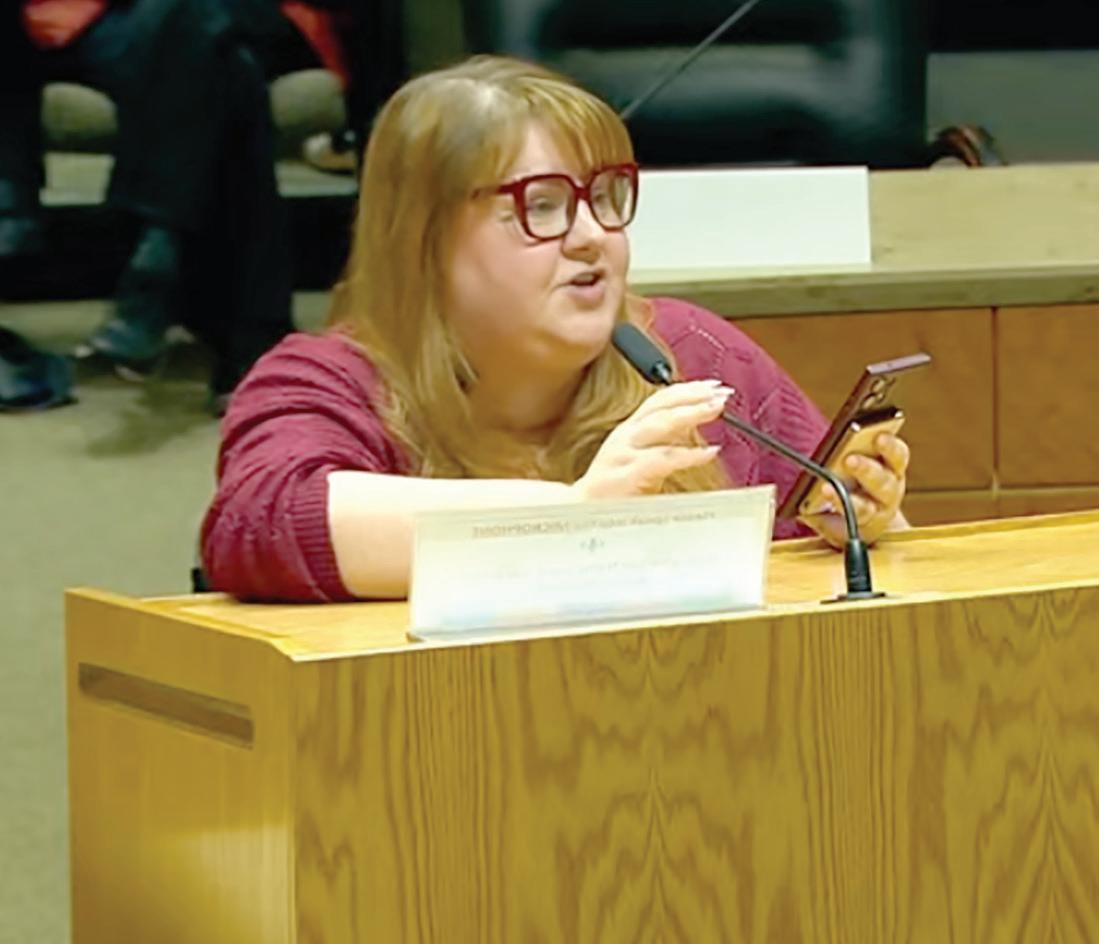
cently speaking out at city council meetings. She points out how she needs to have city staff assist her in taking her electric wheelchair into a small elevator so she can reach the lectern on the council chambers floor to speak during the public invited to be heard sessions.
Dewills-Marcano and her husband, Juan Marcano, originally worked to get an ADA approved plan for the chambers in 2021 when he was on city council.
The elevator serving people with disabilities in the council chambers can only fit one person at a time, and during a recent meeting Dewills-Marcano got stuck making her way to the first floor.
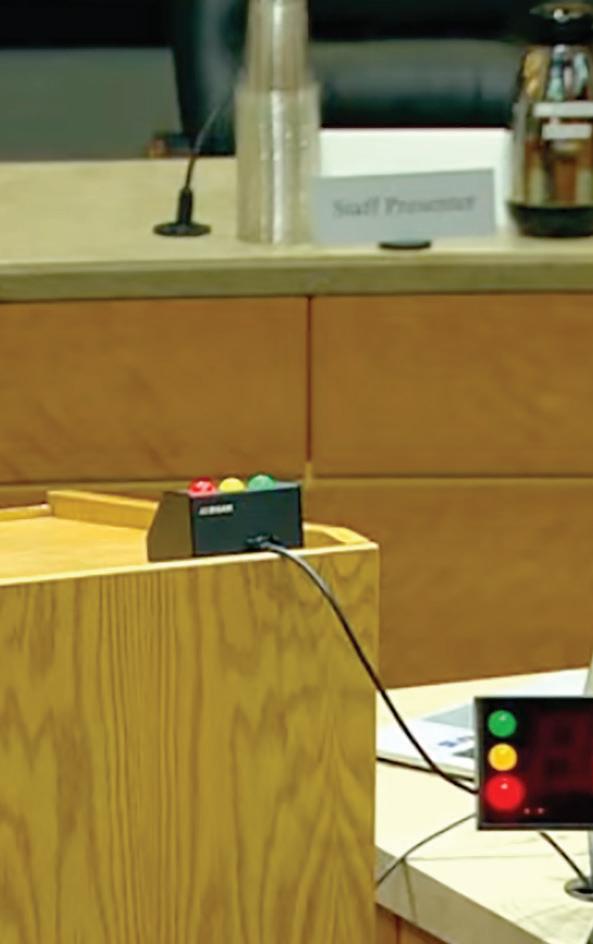
“If you’ll give me just a second before the clock starts, just to center myself,” she said during a previous meeting. “I just got stuck in the elevator, and there’s something really terrifying about being stuck in a box and having to yell for someone to let you out.”
Accessibility improvements to the council chambers were first identified in 2021 through a city space study, according to Deputy City Manager Laura Perry. At the time, $750,000 in federal pandemic relief funding was earmarked for design and construction. The plans proposed to add ramps from the chamber entrance to the floor, along with creating accessible seating on the chamber floors and improving access to the council dais.
The design package was bid out in November 2023, and in February 2024 the council voted to defer construction amid broader conversations about ADA priorities citywide. If the city were to construct the 2023 design today, Perry said the estimated cost would be approximately $975,000, which is now significantly higher than the original estimated price.
Perry said that the city would need to reach back out to the architects who wrote the plans. Having them update the information could take three to four months, and it could take four to six months if they have to get new architects.
Additional improvements and consulting an ADA expert for additional on site could take longer as well, Perry said.
“ADA regulations are incredibly complex, and you need experts in interpreting those regulations,” City Manager Jason Batchelor said. “I think one of the things we’ve learned is that you really do need that kind of expertise, looking over, making sure that all of the regulations are being met.”
The actual construction would take an estimated eight months and would require a full closure of the chambers because of demolition and dust, officials said.
Since the city council deferred the plans to coincide with the transition plan, the city has begun updating its ADA self-evaluation and transition plan. Phase one focused on public
rights-of-way, including sidewalks, curb ramps and pedestrian crossings. Now their assessments are focusing on all city facilities.
In December, the city’s ADA consultant determined that the council chambers do not meet current ADA standards.
When the chambers were built in 2004, they complied with the 1991 ADA guidelines, but updated federal standards in 2010 require facilities to meet more stringent requirements. City consultants identified necessary modifications to the existing design plans, including adjustments to ramps, handrails, landings and signage, Perry said.
Perry gave city council two main options: identify approximately $100,000 from the capital projects fund to update the design plans now and obtain a revised construction estimate, or wait until the full ADA transition plan, including recommendations and prioritization for all city facilities, is complete before advancing the chambers project.
Perry said both options could also proceed simultaneously.
While funding for the design update is available within existing capital funds, no construction funding has been identified, as Councilmember Angela Lawson pointed out. Perry said city staff would return to city council with
Aly DeWills-Marcano addresses the Aurora City Council Jan. 12. 2026 from the city council well about the lack of accommodations for people with physical disabilities. SENTINEL SCREEN GRAB
AROUND AURORA
Activist, city settle First Amendment lawsuit; Aurora must maintain public comment sessions
Local activist Midian Shofner and the City of Aurora will settle a nearly year-long First Amendment lawsuit, which both sides say will mandate a “public invited to be heard” segment be held during city council meetings for three years.
“As a result of this settlement agreement, for the next three years, Aurora will continue to hold in-person meetings with a public comment period preceding the meeting, allowing at least one hour of public comment per meeting and up to three minutes of public comment per participant,” a joint statement from both parties said.
The settlement agreement, which was released by both parties, states that Shofner will also receive $75,000 for her lawyer fees.
The city had already resumed the public-comment session late last year.
In June 2025, Shofner filed a lawsuit against the City of Aurora, claiming the city and the city council violated her First Amendment rights to speak during “public invited to be heard” by repeatedly voting to limit, and later fully eliminate, the public speaking session between January and June 2025.
The settlement will now mandate city council to keep “public invited to be heard” without restrictions, while allowing a community-created code of conduct.
Shofner, and many other protestors, including family members and friends of those killed by Aurora Police, would chant and disrupt the council meetings by yelling or bringing large groups of people to the lectern with them. The disruptions became a regular battle between protesters and city lawmakers at every meeting for over a year.
“This settlement represents an important affirmation of something far greater than the resolution of a lawsuit; it affirms the fundamental right of Aurora residents to use their voices in the democratic process without fear of suppression or retaliation based on viewpoint,” Shofner said to the Sentinel.
Shofner has been an advocate for families in Aurora and the surrounding areas who have lost family members and friends, particularly Black men, to fatal Aurora police-involved shootings. Many of the people Shofner defends were unarmed when they were shot and killed by local police. Shofner has been protesting and demanding change from Aurora police and lawmakers for more than two years, mainly highlighting the deaths of Kilyn Lewis, Rajon Belt-Stubblefield and Jalin Seabron, who was killed in Douglas County.
Many of the city council majority members at the time, who were conservatives or Republicans, regularly spoke out against Shofner and other protesters with her, because they felt her tactics were disruptive and halted city business. When the city council voted to restrict and eliminate public listening sessions, Shofner and others would actively disrupt the rest of the public comment session during parts of the meeting.
In July, city lawmakers agreed to resume the public speaking session, but it was limited to a half hour, and people were only allowed two minutes to speak. In December, the Aurora City Council political majority flipped from Republican to Democrat, and the newly
elected Democrats voted to bring “public invited to be heard” back for a full hour, while giving people the opportunity to speak for three minutes.
The lawsuit settlement between Shofner and the city stipulates three years of an hour-long “public invited to be heard,” and three minutes of speaking time for each speaker, according to the joint statement and settlement documents obtained by the Sentinel.
“I am encouraged that this outcome helps ensure that the citizens of Aurora will continue to have meaningful access to public comment and engagement with their elected officials,” Shofner said. “It also creates an opportunity for the City to thoughtfully cultivate how community and leadership engage one another moving forward.
The settlement also states that the city will be doing community outreach to create a code of conduct for the public during meetings.
“Aurora will also continue to have the Ad Hoc Rules Committee work in good faith on a code of conduct that will govern City Council meetings, and the public will have meaningful input in that process,” a joint statement from both parties said. “Ms. Holmes and Aurora are thankful to reach this resolution that affirms the value of the community’s perspective in the democratic process.”
Shofner’s maiden name, Holmes, was used in the lawsuit.
“Despite public attempts, including by Mayor Mike Coffman, to characterize this matter as being motivated by financial gain, this case was never about money or personal benefit. It was always about principle,” Shofner said. “The goal was to protect the constitutional right of residents to speak openly, especially when advocating for justice in moments of profound community harm. The resolution reached makes clear that public voices, even uncomfortable ones, cannot simply be silenced.”
The Executive Director of the Colorado Freedom of Information Coalition, Jeff Roberts, said that public comment is a crucial way for public officials to hear from their community members, even though it sometimes makes meetings harder to manage. He said that this settlement can be an impactful way for city officials and the community to reach an agreement that sets an example for other cities to follow.
“Who knows what they’ll come up with?” Roberts said. “I mean, maybe they’ll come up with a way to do this that gives everybody the chance to say what they want to say while still allowing meetings to be conducted in a way that lets everybody get the business done that they need to get done.”
The settled Aurora controversy goes in opposition to one in Douglas County, which recently started restricting public comment after receiving similar outbursts and protests from Shofner and the family of Seabron after he was shot and killed by a Douglas County sheriff.
Currently, there is no state legislation requiring public government meetings to include a public listening session, and state open meetings laws do not require them either.
“I remain committed to continuing this work in partnership with community members to ensure Aurora grows into a city where engagement is welcomed, dissent is respected, and justice is pursued openly,” Shofner said.
— Cassandra Ballard, Sentinel
Staff Writer
updated cost estimates and funding options once the design revisions are complete.
The majority of city council members said they supported moving forward with the design update while continuing the broader ADA transition planning process.
Councilmember Gianina Horton requested cost estimates for alternative meeting locations, such as using a large meeting room at the city library, should the chambers close during construction.
“I’m for doing both simultaneously,” Horton said. “I think if we’re going to do this, or at least consider doing it, we should at least do it right
and as updated as possible, so that the conversation doesn’t have to be revisited for years to come.”
There was a general consensus to proceed with updating the design while aligning future construction decisions with the city’s annual budget process later this summer, as directed by Batchelor. He said the city hopes to integrate the full ADA transition plan into upcoming budget discussions, allowing city council to consider funding options holistically.
Perry said that the ADA transition plan is a long-term roadmap that guides both operational and capital improvements across Aurora’s facilities. Each phase includes public meetings and a formal hearing before council, as required by the U.S. Department of Justice.
“It sounds like there’s general consensus,” Batchelor said. “We’ll move forward with that design. We’ll come back to you all, probably later this summer, and then I think we’ll also work on final timing for the transition plan.”
Dewills-Marcano has repeatedly told city lawmakers that the improvements have been shelved long enough.
“My body is degrading faster than this chamber is getting fixed, and disabled residents should not have to sacrifice their health to attend their own government,” DeWills-Marcano said during a previous meeting. “Do not wait for disabled residents to crawl back up to this lectern again to remind you.”
ARAPAHOE COUNTY

Spring forward
Daylight saving time starts Sunday, March 8. Be sure to set your clocks ahead one hour Saturday night.



Fermentation: Sauerkraut Workshop March 12, 6–8 p.m.

Learn the art and science of fermenting your own sauerkraut. This hands-on workshop includes prepping a jar of kraut to ferment at home. Register at bit.ly/CSU_Sauerkraut


Sign up for job alerts
Arapahoe County is always hiring and now we’re doing it through a new system. Visit jobs.arapahoeco.gov to see current job postings or sign up to receive email alerts for new postings. Even if you signed up to receive Arapahoe County job alerts in the past, you need to re-sign up on the new site.
Aurora police chief forms community advisory group amid oversight pressure
Aurora’s police chief has created a new community advisory group amid recent political pressure from a changed City Council majority seeking to establish an independent police oversight mechanism.
The change and review comes even as the department remains under a sweeping state consent decree prompted by findings of excessive force against people of color.
Police Chief Todd Chamberlain on Thursday announced the formation of the Chief’s Community Response Team, a panel of residents, faith leaders, business owners and advocates who will meet bimonthly with police leadership to discuss public safety priorities, department initiatives and critical incidents.
“Our goal is simple: to strengthen our understanding of the community while ensuring residents are informed about the operations, training and personnel dedicated to serving and protecting them,” Chamberlain said in a statement.
The move comes as police oversight again moves toward the spotlight at city hall. A new majority on the Aurora City Council has signaled interest in creating some form of independent civilian oversight to monitor the police department, an idea that has surfaced repeatedly in recent years but has yet to materialize.
The effort, led by city council members Gianina Horton and Amy Wiles, has held three public meetings focused on what kind of independent police oversight structures exist across the country, and which would serve Aurora best.
“I wasn’t aware from a council perspective that this group was being formed,” Wiles said. “I had heard brief discussions about it as a former member of the community advisory council for the consent decree. I think that community engagement and voices are always important and should be heard by all levels of city leadership, including
Wiles said she would suggest a more open process would benefit the move.
“I wish that this group had been created with more transparency with regards to community input,” Wiles said. “It’s great to have community leaders who agree with your decisions, but equally important are the voices who don’t agree, and I’m not sure if this group will provide those varying voices without any insight into how members were chosen.”
Last week, they hosted a meeting with a special presenter, the Fort Worth Police Monitor Bonycle Sokunbi, who spoke about her relationship and oversight of the Fort Worth Police Department.
Aurora police have been operating under a consent decree since 2021, when then-Colorado Attorney General Phil Weiser imposed the mandate following a state investigation that found the department engaged in “patterns and practices” of using excessive force, particularly against people of color. The decree was triggered in part by the 2019 death of Elijah McClain, who died after being stopped by police while unarmed.
The consent decree requires broad reforms in training, accountability systems, use-of-force policies, data collection and community engagement. It is overseen by an independent monitor and is scheduled to last five years.
Chamberlain said the new Community Response Team is intended to “usher in a better unified communication pipeline” between police and residents and to foster “meaningful, candid conversations about challenging incidents and hard topics.”
Members of the new panel include: Malissa Murdock, Judith Padilla, Rick McLean, Pastor Samuel James, Salvation Army Lt. Carl Esquivel, Brandon Wright, Tyg Taylor, Rachel Walker, Tramell Thomas, Diana Higuera, Harry Budisidharta, Jen Dubrow, Pastor Al Combs, Pastor Debbie Stafford and Paul Galloway.
“It was important for me to join the Chief’s Community Response Team because it allows members to better understand the facts of incidents,” Esquivel said in a statement.
According to police, the team was
selected in January after the chief’s office solicited interest from community leaders through its Community Relations Section.
The meetings are not open to the public, police said.
The group will receive current information following critical incidents when appropriate and will publish a public summary report after its first year, according to Aurora police spokesperson Joe Moylan.
Former police Chief Nick Metz assembled his own community panel, composed of police officers and select community members. The structure was frequently criticized by community leaders who said it was not a substitute for independent oversight nor a transparent light into police policy making.
The new panel is in addition to the city’s previous Community Advisory Council, which was created in 2022 as part of the consent decree process. That group was intended to give feedback to police from key minority and immigrant communities, review reform efforts, provide feedback and relay information to the broader community.
It’s unclear what the meeting status of that committee is and who currently sits on it.
The advisory council was frequently at odds with police and city officials and the independent monitor over its role and authority.
Some members said they were sidelined or required to sign non-disclosure agreements despite not having access to confidential materials. Others criticized what they described as a lack of transparency in how reform progress was rated. Some members were particularly critical of how the city handled Chamberlain’s hiring 18 months ago, which was conducted without public notice or consultation with the advisory panel. Members argued that selecting a chief without community input undercut the spirit of reform.
Several former members publicly have repeatedly called for a fully independent, city-funded civilian oversight office to replace or supplement the monitor once its contract ends. That proposal is now resurfacing as the new council majority weighs options for permanent oversight beyond the life of the
consent decree.
The new panel echoes another Aurora committee, the Key Community Response Team, created by diversity and equity activist Barbara Shanon Bannister. That group advised police and city officials on matters of race and diversity and drew input from what were described as “key” members of ethnic and immigrant communities. The purpose of that team, served as a conduit between law enforcement and underrepresented communities, mirrors the mission outlined for Chamberlain’s newly announced panel. Unlike the consent decree’s Community Advisory Council, which was formally tied to the state-mandated reform process and reported to the independent monitor, the Chief’s Community Response Team will meet directly with police leadership and is housed within the department.
The department said the new citizen panel will focus on education, relationship-building and dialogue about policing practices and public safety concerns. It did not specify how the group’s recommendations, if any, would influence policy decisions.
— Cassandra Ballard, Sentinel Staff Writer
Aurora approves controversial high-density housing project on open land
The Aurora City Council this week approved rezoning approximately 4 acres of open space south of East Jewel Avenue and South Joliet Street to allow for a controversial multi-family project.
City staff and the Planning and Zoning Commission recommended approval of the site, while a group of local residents opposed allowing higher-density housing on the pasture-like space.
The proposed development by Urban Cottages LLC includes 30 paired homes or duplex units, down from an initial 40-unit proposal after neighborhood feedback and site plan revisions. The site plan was unanimously approved by the Planning and Zoning Commission in September 2025.

Councilmember Curtis Gardner said Monday that Aurora is missing middle housing, especially for-sale housing.
“We have a lot of affordable, lowcost housing; we have a lot of higher-end housing,” Gardner said. “We don’t have a lot in the middle.”
The residents who spoke in opposition to the development said they were concerned about neighborhood compatibility, traffic safety, drainage, infrastructure capacity, developer experience and density. Some residents said the rezoning would alter the neighborhood’s character.
Gardner said the plan is consistent with surrounding zoning. Councilmember Francois Bergan pointed out that a site plan accompanying the rezoning request would have addressed many of the complaints and that a denial could lead to a higher-density apartment proposal in the future.
City council approved the zoning map amendment in a 9–1 vote, with Councilmember Stephanie Hancock opposed.
— Cassandra Ballard, Sentinel Staff Writer
SCHOOLS AND
makers want to reduce the time Colorado students in grades 3-8 spend on state standardized tests.
State Sen. Chris Kolker, a Centennial Democrat, said he talked to superintendents and principals across the state and heard complaints about the disparities in testing time among grades. The state estimates students will spend about eight to 11 hours on required Colorado Measures of Academic Success, or CMAS, math and reading tests. Meanwhile, high school students spend about three and a half hours on the PSAT and SAT.
The purpose of a bill Kolker is sponsoring, Senate Bill 68, is “to shorten the seat time for third through eighth graders on our CMAS,” he said. But the bill wouldn’t do that outright. Instead, it would set up a review committee to study the idea because he wants to get educator input about possible changes.
The bill is sure to add fuel to the ongoing debate about the state’s school accountability system and how it tests students. Kolker sponsored a similar bill about three years ago that failed.
Already, Colorado education advocacy groups have questioned the necessity of the new bill. The state is still in the midst of a comprehensive review of its school accountability system ordered by a bipartisan 2023 law, and some groups think that review should wrap up before lawmakers propose additional changes to standardized tests.
The so-called 1241 task force met for over 150 hours and dozens of meetings and created 30 recommendations, including a call to modernize the state’s CMAS exams. The recommendations included offering the standardized test in Spanish as well as English, getting test results to teachers faster, and breaking CMAS into smaller sections.
The implementation is still underway, with another bill approved in 2025 enacting or phasing in some of the recommendations while calling to further study others. The 26-member committee never recommended shortening exam times.
Kolker said his bill would create a separate 12-member review committee. He wants shorter tests that still meet federal requirements. The guidelines don’t say how long these tests should take, but mandates reading and math tests in grades 3-8 and at least once in high school.
Jamita Horton, who is the executive director of Teach Plus Colorado, said Colorado already tests students near the federal minimum requirements. Teach Plus Colorado is the state affiliate of a national nonprofit that trains teachers to advocate for policy change.
She said she understands the bill’s intent, but the 1241 task force didn’t tackle the testing times because it wasn’t viewed as a problem.. The teachers she works with aren’t as concerned about it, she said. (Teach Plus’ former executive director served on the task force.)
The state should instead build a better system that proves to families that tests are an important part of the classroom experience, she said. Recommendations from the 1241 task force seek to create less administrative burden and get usable information back to teachers faster. She doesn’t want the state to lose focus on that work.
“I think it’s important that we honor those conversations,” she said.
But Kolker said he hopes shorter tests could lead to fewer parents opting out their kids from the exam and cost savings because the state would spend less money on administering the ›› See METRO, 7
tests. He said that would help the state during a time when it faces budget challenges.
He also has a personal tie to the bill’s goals. His daughter needs test accommodations, and she spends more time on average on exams than other students, he said.
For some students with disabilities, he said the test is “just a nightmare.”
Colorado Children’s Campaign also has expressed skepticism about whether this is necessary right now. The nonprofit organization advocates for policies that focus on helping kids.
Madi Ashour, the state affiliate’s director of K-12 education policy, said standardized tests are important because they help educators and families understand where learning deficiencies exist among different groups of students.
“We did a lot of work to come to consensus recommendations. We’re still implementing and studying,” Ashour said. “I don’t know if it would produce a different result.”
Others disagree. Prairie School District R-11J Superintendent Chris Burr said he’s long been skeptical of the time spent on standardized tests and supports the review.
He said too much time passes between when the students take the test and when teachers get the results, making them unhelpful for targeting instruction. He’s skeptical about whether students should take the exams but certain the state can test students “in way less time.”
The bill is scheduled to be heard on March 9. Other sponsors include state Sen. Byron Pelton, a Sterling Republican, and state Reps. Eliza Hamrick, a Centennial Democrat, and Lori Garcia Sander, an Eaton Republican.
— Jason Gonzales of Chalkbeat Colorado
COPS AND COURTS
Man indicted for stalking, killing estranged wife in staged suicide in Bennett
An Arapahoe County grand jury last week indicted a man on first-degree murder charges, alleging he stalked his estranged wife for months in and disabled her home security system before fatally shooting her and attempting to stage the scene as a suicide.
Ronald Elton Lowry, 52, of Wiggins, was arrested last week following a years-long investigation by the Arapahoe County Sheriff’s Office into the October 2023 death of Richelle Lowry, 52 at her Bennett home.
The Feb. 27 indictment charges Ronald Lowry with first-degree murder, stalking, and tampering with evidence.
Prosecutors said in a statement Friday that the slaying was the culmination of a pattern of domestic violence that began in July 2023, shortly after Richelle Lowry initiated divorce proceedings.
In court documents leading to Ronald Lowry’s arrest, investigators highlighted a bevy of witnesses saying “red flags” threw doubt on death by suicide and led them to see Ronald Lowry as a murder suspect.
The investigation began Oct. 26, 2023, when Richelle Lowry’s work supervisor requested a welfare check from police at her home in Bennett. The supervisor told deputies it was “very unusual” for Richelle, a reliable medical sales employee, to miss an important
meeting.
Deputies forced their way into the house and found Richelle lying face down on her master bathroom floor with a single gunshot wound to the head, according to police reports. A black Glock 9mm handgun lay near her right shoulder, and her arms were tucked beneath her body. Wedding photos were found scattered across the dining room table and the master bedroom bed.
While the scene indicated a self-inflicted shooting, investigators immediately noted “red flags,” according to court documents.
Richelle’s cellphone was found in a bowl of water in the bathroom, what investigators said was a likely attempt to destroy digital evidence. The home’s camera security system showed a man matching Ronald Lowry’s description prowling the exterior on the night of Oct. 24, but at one point the recording abruptly stopped.
Forensic analysts later determined the system had been manually disabled, investigators reported.
Investigators in a narrative affidavit indicated Ronald was obsessed with his wife’s new life. According to the affidavit, he had been surreptitiously following Richelle to golf lessons and dates with her drum instructor, whom she was then having a relationship with.
In early October 2023, Ronald allegedly filmed Richelle and the instructor hugging at a golf course. He then shared the video with his family members, including his sister and mother, via text.
Investigators said he had deleted the videos from his phone, but technicians recovered them.
“So I wanted to share this with you as I’ve done with the rest of the family,” Ronald wrote in one text message. “This is Chelle and the guy she’s been with behind my back… you can see Chelle at the beginning grabbing his butt and then at the end they kiss.”
Texts deleted and recovered from Ronald’s mobile phone said, “I’m so glad I’m FREE of that NARCISSIST, MANIPULATIVE LYING, CHEATING PERSON.” He said, “Thank GOD I sucked as much money out of her that I could.”
Several witnesses painted a picture of Richelle financially supporting the both of them during their marriage, and Ronald taking advantage of the arrangement. Friends of Richelle and other witnesses said it was Ronald who pressed for divorce and strayed from the marriage before their breakup.
In the weeks before her death, Richelle Lowry told friends, family, and even a Realtor that she feared her husband would kill her.
A neighbor told deputies that Richelle told her on Oct. 12, 2023, about finding nails placed behind her car tires in the garage. Richelle told witnesses she also suspected Ronald had used a hammer to smash an expensive piece of medical equipment linked to her work.
“If anything happens to me, Ronald would be responsible,” Richelle reportedly told the neighbor, saying that she was “very adamant” she would never kill herself.
A real estate agent and friend who was helping Richelle find a new home for her husband n Wiggins told investigators that Richelle requested all communication go through her work email so Ronald wouldn’t find out.
“I realized in my gut that he would take me out,” Richelle told the Realtor, describing a moment in Ronald’s truck where she saw a look in his eyes that she said terrified her. Richelle predicted he would try to make her death look like a “drowning” while fishing or a “hunting
accident.”
Following the discovery of Richelle’s body, Ronald allegedly tried to establish a narrative that Richelle was mentally unstable. He told investigators and neighbors that Richelle had recently stopped taking antidepressants and was “paranoid” and “delusional.”
Police said that a friend and neighbor who had for years been a dogwatcher for Richelle’s beloved “fur baby,” Butters, said she was alarmed when Ronald contacted her on the day of Rochelle’s death, saying Rochelle wanted him to come get the dog, months after the couple had separated.
The neighbor “found this ‘odd, very odd’ because not only was she much closer but had been tasked with caring for the dog while Richelle had been out of town,” investigators reported. She “felt that Richelle would have contacted her first as she did not want Ronald around her residence and this request was not consistent with former conversations they had.”
On the night Richelle’s body was found, Ronald sat in his truck with Richelle’s sister and said if it turns out Richelle “used a gun, I’m going to jail.”
Investigators said the couple’s financial records suggest a significant motive for the killing. As of March 2024, Ronald stood to gain approximately $1.33 million if Richelle’s death were ruled a suicide, investigators reported. This included two life insurance policies totaling $500,000 where he was the sole beneficiary, plus marital assets and property.
Insurance investigators told detectives the case set off a “red flag” for them when Ronald had not contacted the insurance company until months after the death. Usually, the insurance investigators said, beneficiaries contact the company within days.
Under Colorado law, a person held criminally responsible for another’s death is prohibited from life insurance proceeds or estate inheritance. In January 2026, a judge officially disinherited Ronald from Richelle’s estate, police said.
The timeline constructed by the Sheriff’s Office alleges Ronald killed Richelle on the evening of Oct. 24, 2023.
Richelle had just returned from a business trip to St. George, Utah. Security footage from 6:44 p.m. that evening showed a man walking near the garage while wearing a “Terry Black’s Barbeque” hat, which was later found in Ronald’s truck.
At the same time, Ronald’s cellphone went “off-network” for four and a half hours, either turned off or placed in airplane mode, investigators said. This was a departure from his typical heavy phone use during evening hours, police said.
A neighbor reported hearing an “unusual” gunshot between noon and 1 p.m. that day, though the autopsy determined the time of death was likely later that evening.
When Richelle failed to go to work the next day, work associates and others contacted police, who found her body.
More than two years later, prosecutors say Richelle was murdered and her killer will now go to trial.
“This case is the result of extraordinary dedication and perseverance by the investigators with the Arapahoe County Sheriff’s Office,” Assistant District Attorney Ryan Brackley said in a statement. “They left no stone unturned in their pursuit of the truth, carefully examining every piece of forensic, digital, and testimonial evidence over the course of this investigation. Their commitment to seeking answers and refus-
ing to give up has been instrumental in bringing this case forward.”
Ronald Lowry is currently being held at the Morgan County Jail.
— Sentinel Staff Boy, 15, fatally shot in west Aurora Friday night after street altercation, police say
A 15-year-old boy was fatally shot Feb. 27 in west Aurora after a brief altercation on the street with the shooting suspect, police said.
Officers were called to 22 Lima St. at about 11 p.m. after reports of a shooting there, police said.
a nonprofit, we rely on you to keep local, trusted journalism free for all.
“When officers arrived, they located a 15-year-old male with apparent gunshot wounds,” Aurora police spokesperson Joe Moylan said in a statement.
“Officers performed lifesaving actions on the victim until medical responders arrived at the scene. The victim was taken to a local hospital, where he later died from his injuries.”
The investigation so far revealed that the boy and unidentified suspect were acquaintances.
The boy and the shooting suspect “walked toward each other from opposite sides of Lima Street, engaged in a brief conversation before there was an argument, followed by shots being fired,” Moylan said.
The shooter ran from the scene.
“No arrests have been made,” Moylan said. “The investigation is active and ongoing.”
Police said anyone with information can call Metro Denver Crime Stoppers at 720-913-7867. Tipsters can remain anonymous and still be eligible for a reward of up to $2,000, police said.
— Sentinel Staff
Man convicted in metro burglary ring targeting Asian business owners
A jury has convicted a 45-year-old man for his role in a large-scale organized burglary ring that targeted Asian business owners across the metropolitan area, according to the 18th Judicial District Attorney’s Office.
“This was not random or opportunistic crime,” Senior Deputy District Attorney Osama Magrebi said in a statement. “Through painstaking investigative work across multiple jurisdictions, law enforcement was able to dismantle this operation and hold this defendant accountable.”
Freddy Giovanni Castro Garzon was found guilty Thursday following a threeweek trial that featured testimony from dozens of witnesses and more than 900 exhibits, judicial district spokesperson Eric Ross said in a statement.
Prosecutors said the case stemmed from a long investigation into a pattern of residential burglaries that began in late 2023 and continued into early 2025.
The burglaries spanned multiple jurisdictions, including Adams and Arapahoe counties, as well as the cities of Arvada, Aurora, Broomfield, Denver, Fort Collins, Lakewood, Longmont, Parker, Thornton, Westminster and Windsor. Authorities said the homes primarily belonged to Asian business owners and that significant amounts of cash, expensive jewelry and designer items were stolen.
Investigators identified more than a dozen suspects who participated in spying on businesses such as liquor stores, restaurants and nail salons before following owners home and target-
ing their residences. Once a home was selected, members of the burglary ring often broke in through rear windows or sliding glass doors, prosecutors said.
Police said the group used “sophisticated methods” to avoid detection, including disabling or disrupting Wi-Fibased security systems, using multiple vehicles, switching or displaying fictitious license plates and conducting coordinated surveillance before attempted break-ins.
On March 18 last year, in Watkins, a car associated with Garzon’s gang traveled to the home of a liquor store owner whose business had previously been scoped out, according to evidence presented at trial.
Prosecutors said the vehicle circled the property and drove into a nearby field while assessing the home but did not carry out the burglary, likely because several cars were parked outside, indicating someone was home, Ross said in a statement.
Automated license plate reader systems placed vehicles tied to earlier burglaries near multiple crime scenes and casing locations, Ross said. Detectives documented that the suspect vehicle frequently changed license plates, a tactic regularly used to evade police identification.
Investigators also obtained a warrant to install electronic tracking devices on vehicles connected to the burglary ring.
Tracking data showed repeated travel between suspect residences, targeted businesses and the homes of business owners across several jurisdictions, prosecutors said.
Police conducted extensive physical surveillance and reviewed hours of video from residential neighborhoods and commercial areas, which authorities said linked coordinated movements between multiple vehicles before and after burglary-related activity.
Additional evidence included pawn shop records involving valuable jewelry shortly after burglary incidents, prosecutors said. Detectives reviewed pawn records and surveillance footage to establish timelines and corroborate the broader pattern of activity.
The jury convicted Garzon on multiple felony counts, including racketeering and conspiracy; six counts of second-degree burglary, Class 3 felonies; one count of theft between $100,000 and $1 million, a Class 3 felony; two counts of theft between $20,000 and $100,000, Class 4 felonies; and one count of theft between $2,000 and $5,000, a Class 6 felony.
Assistant Chief Deputy District Attorney Johnny Lombardi said the verdict shows that “sophisticated criminal tactics will not shield offenders from justice.”
“We believe the evidence shows this crime ring went to great lengths to avoid detection, but the jury saw the pattern,” Lombardi said. “They saw the preparation and they saw the overwhelming evidence tying Garzon to this organized burglary enterprise.”
Garzon faces up to 72 years in prison. Sentencing is scheduled for later this year.
District Attorney Amy Padden said the case required extensive collaboration among agencies.
“Cases like this are extraordinarily complex and require relentless dedication from our law enforcement across multiple jurisdictions,” Padden said. “Without that commitment and collaboration, justice simply would not have been possible.”
Solving the $2 billion question
BY CASSANDRA BALLARD Staff Writer
As Aurora continues to grow, so does the strain on its roads, parks, public safety facilities and community spaces.
City officials say years of deferred maintenance, combined with rapid development, have left the city with nearly $2 billion in infrastructure needs that can no longer be postponed.
Now, the city is sorting out a longterm capital-improvement plan called Build Up Aurora, asking residents which investments they think are worth paying for to shape Aurora’s future.
Deputy City Manager Laura Perry said during a recent city council workshop that the city has been working on its long-term strategy, rooted in public input, fiscal discipline and, if necessary, new financing tools, such as possible bond issues.
“A rising tide doesn’t raise people who don’t have a boat,” Perry said, reading a quote. “We have to build the boat for them. We have to give residents the basic infrastructure to rise with the times.”
City leaders have said they know they cannot complete every project on the list. The $1.9 billion plan is intentionally “unconstrained,” meaning it reflects needs rather than available funding, Perry said.
The goal is to create a list of priorities and a plan to pay for them.
Over the past month, Aurora has hosted public meetings, surveys and outreach events, and now the Infrastructure Task Force will develop recommendations, including a possible bond proposal for voters to consider.
“What matters most isn’t what we think should be on the ballot,” City Manager Jason Batchelor said to city council members during the Feb. 7 Winter Workshop. “What matters is what voters believe is important enough that they’re willing to invest in it.”
If voters approve some kind of bond issue election, projects would likely be built over the next six to seven years, Batchelor said.
Why is there such an expensive infrastructure need?
Aurora is currently facing a dual challenge: building new regional infrastructure to support growth while maintaining what it already owns. With a growing population of more than 400,000 people and areas still expanding, the city needs to improve what projects exist while building new ones.
The city maintains more than 140 city facilities, 103 developed parks, 10 undeveloped parks, five municipal golf courses, seven recreation or community centers, five public libraries , 17 fire stations, three police districts with two substations, more than 4,313 miles of roadway lanes, more than 380 traffic signals, 98 bridges or large box culverts, and the Regional Navigation Campus, serving homeless people for the greater Aurora region. All of these assets must be balanced within a constrained capital budget. Aurora sets aside about $3 million annually for citywide capital improvement repairs. A single major failure costing $1 million can derail
Aurora’s
making a long list of capital needs and how to pay for them
other planned improvements.
“One thing you will note is that the cost estimate on our infrastructure needs to exceed what we can afford to do within our annual budget. Our building repair for the entire city is only $3 million a year,” Perry said.
Tools the city has to fund capital spending include:
• Pay-as-you-go funding covers routine needs such as street paving, playground replacements, and traffic signal maintenance through the annual budget. An average of $3 million a year is spent on these costs.
• Impact fees, assessed on new development, help fund growth-related infrastructure.
• Grants and partnerships, particularly federal transportation funds made available after the 2021 infrastructure law, Perry said, have helped advance design and construction for several projects, but those funds are limited, and rarely cover facilities like fire stations.
• Multi-year financing, include general obligation, or GO bonds, revenue bonds and certificates of participation, or COPs.
GO bonds require voter approval and can be used only for specific projects approved by voters. Revenue bonds, similar to loans, are usually used to finance city-run services, such as utilities, and are repaid from the revenue generated by those services. Certificates of Participation let the city borrow money by using a specific building, such as a new fire station, as collateral, and they don’t require a public vote, Perry said.
The city is close to its borrowing limit with COPs, officials said.
“We really are effectively at our limits,” City Manager Jason Batchelor said, echoing Perry. “We probably have a little bit of authority here and there, and some things we can do with COPs. But I will tell you that when you see that larger list, we are not going to make a dent in this on COPs.”
Transportation
Infrastructure 10-year capital project needs
Transportation was ranked as a top priority in both the city’s first-ever comprehensive transportation master plan, “Connecting Aurora,” and in broader “Build Up Aurora” engagement, Perry said.
Concerns the city heard people in Aurora had included safer pedestrian crossings, sidewalk gaps, traffic calming and speed control, road congestion and multimodal access for bikes and transit.
The estimated cost for all current transportation infrastructure needs is $568.2 million.
Some of the proposed transportation projects in the draft 10-year plan include:
• Peoria and Sand Creek Bridge replacement for $35 million.
• The reconstruction of Alameda Avenue over Interstate 225 for $45 million.
• Multimodal improvements along 13th Avenue and Montview Boulevard for $25 million and $35 million.
• Widening and upgrading Gun Club Road for $34 million, a Tower
Road extension for $71 million and Tower Road widening for $13 million.
• High-priority missing sidewalks for $6 million, and completing paving of Northwest Aurora alleys for $36 million.
• Investing in intersection upgrades and traffic calming, which includes roundabouts for $15 million, and traffic signal technology, signs and marking maintenance for $8 million.
“It always becomes a cost-benefit analysis on federalization,” Perry said. “To federalize a project, it tends to cost 30% more, and it takes you a little bit longer to implement it, because there’s all, there’s tape, there’s administrative requirements, there’s bidding requirements, reporting requirements, so there’s a little bit more that goes into that, but we’re consistently assessing all of our projects for federal funding opportunities to make sure that our squeezing the infrastructure funding limit as tight as we can get as much juice out of it.”
Parks, Recreation and Open Space 10-year capital project needs
The community also expressed strong support for improvements to parks and recreation, Perry said.
Some of the proposed parks, recreation and open space projects in the draft 10-year plan include:
• Renovating the Aurora Center for Active Adults for $5 million.
• Upgrades at the Aurora Reservoir, including renovations and expansion for $30 million.
• Expanding the existing Sports Park for $20 million, construction for master planned parks for $28 million and the construction of a new sports complex, which is yet to be determined.
• Renovation of aging neighborhood parks for $28 million and community parks for $60 million.
• Construction of a new recreation center in northeast Aurora for $50 million.
• Improvements at the Plains Conservation Center for $35 million, and recreation center facility improvements for $3.5 million.
The recreation center proposal comes after the closure of the Beck Recreation Center, which created a service gap in the northeast, Perry said. A feasibility study is underway to assess programming needs and location options.
The overall estimated cost for parks, recreation and open space capital needs is $259.5 million.
Libraries, Arts and Culture 10-Year capital project needs
Aurora’s library and cultural services master plans revealed strong demand for modernized, flexible community spaces, Perry said.
Residents asked the city for comfortable furniture, updated interiors, more electrical outlets and access to technology, expanded and improved teen, community and family spaces, and better restrooms and lighting.
Some of the proposed libraries, arts and culture projects in the draft 10-year plan include:

• Creating an outdoor courtyard for the Aurora Fox for $2.8 million and renovating the lobby for $2 million.
• Expanding the Bicentennial Arts Center for $820,000.
• The Meadowood Gym and lobby conversion for $4.8 million.
• Studying long-term options for the Aurora History Museum
• Renovations at Central Library for $2.7 million, Hoffman Heights $1.3 million, Tallyn’s Reach Library Remodel for $1.4 million and Mission Viejo libraries for $800,000.
• Branch facility upgrades systemwide for $10.9 million.
• A new northeast Aurora Library for $18 million.
The overall estimated cost for libraries, arts and culture capital improvement needs is $57.1 million.
Public Safety 10-Year capital project needs
Public safety was also another top priority in community surveys, Perry said. Residents frequently mentioned concerns about emergency response times, facility upgrades and coverage across the city.
Aurora recently completed a public safety facilities master plan that evaluated the condition of police and fire stations, operational needs, and future population growth.
Some of the public safety projects in the draft 10-year plan include:
Fire department improvements
• Construction of Fire Station 19 near Smoky Hill Road and Powhaton Road to serve the growing Southshore area for $22.3 million.
• Rebuilding or remodeling several aging fire stations, such as Station 2 for $6.1 million, Station 3 for $6.7 million and Fire Station 8 land acquisition and a new station for $17.7 million.
• Upgrades to fire station roofs, kitchens, concrete and mechanical systems for $5 million.
Police department projects
• A new district police station in northeast Aurora to support growing neighborhoods there for $46.4 million.
• Renovations to existing district stations for $5 million and Aurora 911 Tallyn’s Reach facility improvements for $1 million.
• A public safety training complex, potentially expanding the city’s existing training campus for both police and fire departments for $221.5 million.
• APD Headquarters Replace-
ment for $240.5 million, an APD Special Operations building and land acquisition for $83.7 million and Real-Time Operations Center, Phase 1 and land acquisition for $119.7 million
• A city-owned impound lot and support buildings for $59 million.
The overall estimated cost for public safety capital needs is more than $882.7 million.
Police Chief Todd Chamberlain said that infrastructure plays a direct role in emergency response, and additional facilities will be necessary as the city continues to expand. His plan includes a centralized evidence facility that replaces the current system, in which evidence is stored across four buildings.
The decentralized system creates security and liability risks, Chamberlain said.
Additional proposals include a special operations building for SWAT, canine units and investigators, a real-time operations center integrating emergency dispatch, traffic management and emergency response systems and a potential city-owned impound lot, which could improve accountability and reduce reliance on third-party operators, according to City Attorney Pete Schulte.
Other City Facilities 10-Year Capital Project Needs
The capital plan also includes improvements to:
• The municipal courthouse, including new security and surveillance systems for $2.3 million, Aurora Municipal Court facility improvements for 3.1 million and Aurora Detention Center facility improvements for $2.1 million.
• ADA city facilities improvements, animal shelter improvements and Aurora Regional Navigation Campus Capital Renewal are to be determined.
• Southeast Aurora Maintenance Campus (Phase II Expansion) for $80 million, Central facilities expansion for $36 million and Central facilities rehabilitation for $23 million.
• Public works maintenance yards and snow-plow facilities expansion for $23 million and rehabilitation for $9.3 million.
• The aging Aurora Municipal Center has about $42 million in identified repair needs.
The overall estimated cost for other facilities’ capital needs is more than $231.3 million.
The estimated cost for all current transportation infrastructure needs is $568.2 million. Some of the proposed transportation projects in the draft 10-year plan include: Peoria and Sand Creek Bridge replacement for $35 million.



Aurora’s new Food Bank of the Rockies center aims to meet rising food insecurity
‘A LOT OF PEOPLE ARE HAVING TO MAKE SOME OF THOSE TOUGH DECISIONS BETWEEN, DO I PAY FOR GROCERIES, OR DO I PAY MY UTILITY BILL?’
BY LINUS LOUGHRY, Bucket List Community Cafe
Patricia Garland has been picking up food from Food Bank of the Rockies on behalf of Restoration Outreach Programs, a partner organization, since 2008. But when she arrived at the nonprofit’s new distribution center in Aurora earlier this month, she noticed something was different.
“Here it doesn’t seem like we really have to wait,” Garland said. “I think it’s because it’s spread out more than at the other place. You’re not so crowded.”
On Feb. 5, Food Bank of the Rockies opened a new 270,000-square-foot distribution center at 20600 E. 38th Ave., replacing two smaller facilities the organization had outgrown. Steve Kullberg, chief of staff at Food Bank of the Rockies, said the main issue was a lack of space.
“We had inadequate space in just about every aspect, so it made our work less effective,” Kullberg said. “The ability to store [food], handle it and organize it has been huge.”
The new purpose-built space has allowed Food Bank of the Rockies to increase efficiency across the board. The organization can now transfer packages of food more quickly to partner agencies at its loading docks. Expanded storage and refrigerated capacity also allow the nonprofit to store more food, accept more donations and accommodate more volunteers, all of which come at a time when food insecurity in the region has reached its highest level in over a decade.
“It’s a combination of inflation, higher cost of living that’s outpacing wages, as well as the increasing cost of food,” said Joanna Wise, Food Bank of the Rockies’ press relations manager. “A lot of people are having to make some of those tough decisions between, do I pay for groceries, or do I pay my utility bill?”
The Food Bank of the Rockies’ leadership claims that the new facility allows them to serve more people because it has 67% more storage capacity, twice as much refrigerated space and three times as many volunteers, all while saving an estimated $500,000 per year.
According to Kullberg, one of the most significant improvements is the new distribution center’s ability to facilitate more effective staging. Staging is the process of giving, receiving and organizing packages of food at loading docks. When trucks would deliver food to the old facilities, a lack of staging space created efficiency issues.
“We had such inadequate staging that we were having to spend most of our time rearranging things at the dock,” Kullberg said. “When a truck came in, we’d have to stop, clear all the space, kind of try to get that all received and organized and put away, and by then, another truck would already be there, and so it was just a constant game of Tetris.”
The new staging area includes a 60-foot zone that gives workers in forklifts adequate space to move large packages in and out of loading docks. There are more than 30 doors where small hunger relief partner organizations park to pick up boxes of food.
“It means our drivers, instead of spending their time maneuvering on the dock, are spending their time doing more deliveries,” Kullberg said, “which is what our partners need, and what I think our neighbors need in the community.”
Michael McReavy works for Fellowship Covenant Church, another partner of Food Bank of the Rockies. He recalls being at one of the old facilities, where people lined up to wait for a semitruck to exit the parking lot.
“It’s been good in that regard as far as traffic,”
McReavy said. “There is a lot less competition to be able to get in and out with a delivery or pickup.”
Kullberg said another major improvement is increased refrigerated space, which can now hold multiple truckloads of fresh food. Kullberg explained that the old facilities lacked sufficient refrigerated space, causing food package handling to be slow.
“We’d get a truckload of something,” Kullberg said. “It would then take up almost all our space, so that everything else we’re doing is kind of working around that.”
With enough space for multiple truckloads, workers can easily maneuver around refrigerated food without it being in the way of their operations. Fresh food can then be stored for the appropriate time, rather than being removed to make room for new truckloads.
The new distribution center also includes three rooms dedicated to volunteer work. One room is designated for repacking food from large boxes into family-sized containers in a sanitary way. The old facilities had only one volunteer room, where staff would need to set up and break down different operations throughout the day. Having a designated repacking room allows Food Bank of the Rockies to expand the types of foods it can repackage.
“I’m excited about frozen vegetables,” Kullberg said. “So a pallet-sized container of cauliflower or broccoli or something that we can then break down into family-sized portions. That’s something we couldn’t do at all.”
Kim and Phil Willett have been volunteering with the Food Bank of the Rockies for nine years. Kim explained that at the previous facility, volunteers would adapt one room to meet various needs, which required their own time and labor.
“If we had to change what we were doing, like, we got one project done in the old space, and we wanted to switch to a different project,” Kim said, “we had to take down the first project to set up the second project. Now we have two rooms that we can specifically do that in.”
Phil said volunteers can now complete separate tasks simultaneously without taking time to reconfigure workspaces.
“It’s time effective,” Phil said. “It’s not wasting the time of the volunteers.”
At the old distribution center, Kullberg said Food Bank of the Rockies was often forced to turn away donations that it couldn’t store or rush to find partner organizations to accept excess food.
“Almost always juggling.” Kullberg said. “People working the phones to say, “Hey, can you take a few extra pallets of this thing?””
The additional space in the new facility enables the organization to distribute food based on priority rather than urgency, which was previously limited by storage. Smaller partner organizations often have limited storage capacity of their own, making it essential for the food bank to hold supplies until they are ready for pickup.
As food insecurity climbs across the region, that added storage capacity gives Food Bank of the Rockies more room to respond to growing need without rushing supplies out before partners are ready to receive them. For Food Bank of the Rockies employees and partner organizations, the new distribution center is a step toward meeting the community’s growing needs.
“This center will allow us to really be able to grow into those possibilities,” Wise said, “and really be able to meet the needs, not just for years to come, but for generations.”
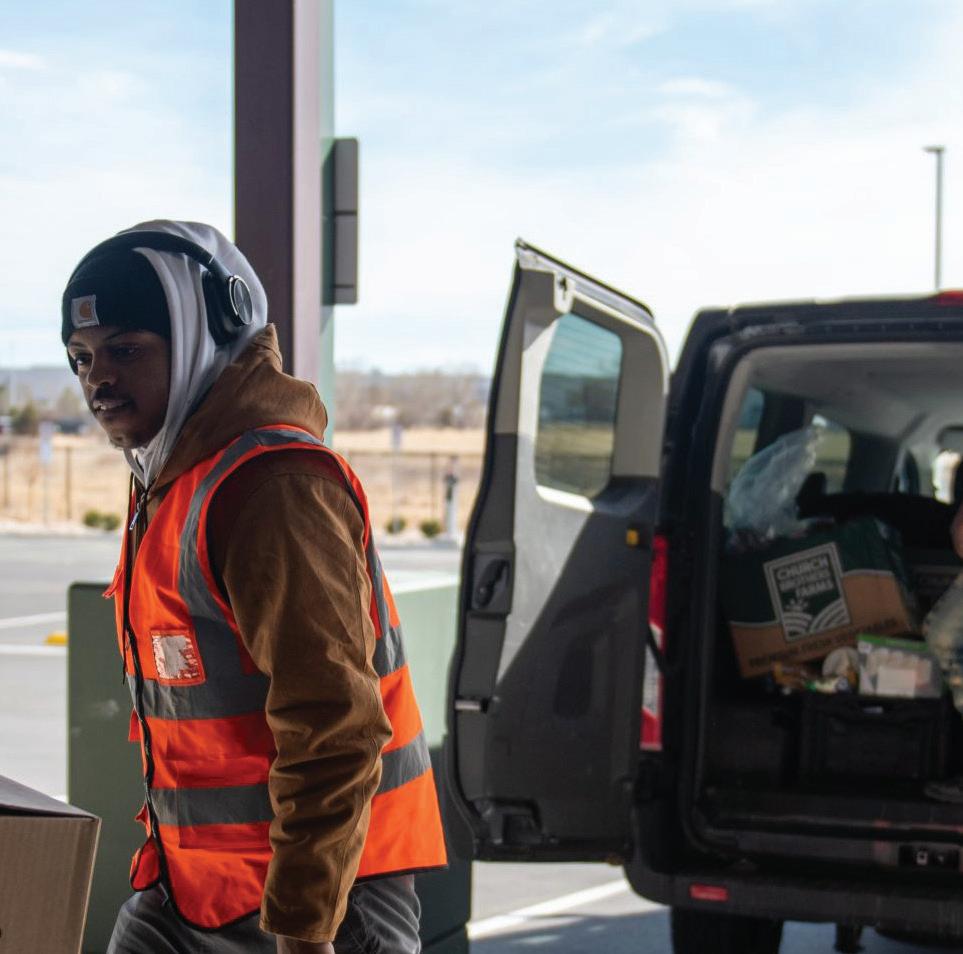
Members of a partner hunger relief organization picking up boxes of food from the new Food Bank of the Rockies distribution center in Aurora, CO, on Monday, Feb. 23, 2026.

Tickets: $28–$45
Info: www.vintagetheatre.org or call 303-856-7830
Spring Into Action Music Showcase — Manos Sagrados
scene & herd
9 to 5: The Musical — Vintage Theatre
Inspired by the beloved 1980 film, “9 to 5” returns to the Vintage Theatre stage with music and lyrics by Dolly Parton and book by Patricia Resnick. The story centers on three female office workers fed up with workplace inequality who fantasize about overthrowing their sexist boss. Packed with infectious songs and dynamic choreography, this upbeat musical celebrates ambition, female empowerment and camaraderie in the workplace, with plenty of heart and hilarity along the way.
IF YOU GO:
Dates: Evening and matinee curtains on Fridays, Saturdays and Sundays through March 29.
Place: Vintage Theatre, 1468 Dayton St., Aurora, CO
Celebrate live performance in this cross-genre showcase featuring influential local and regional artists blending jazz, hip-hop, blues and experimental sounds. While the venue is known for small gigs, this evening spotlights community expression and collaboration, with proceeds benefiting local nonprofits supporting immigrant rights and cultural equity.
IF YOU GO:
Date: Sat., Mar. 14, 7 p.m.– midnight
Place: Manos Sagrados, 9975 E. Colfax Ave.
Tickets: Varies
Details: www.manossagrados.com
Fox Flix: “Vertigo” film screening
— Aurora Fox Arts Center
Classic cinema fans can catch Alfred Hitchcock’s 1958 suspense thriller “Vertigo” as part of the Fox Flix series at the historic Aurora Fox Arts Center. The screening is a chance to appreciate one of the most psychologically complex and beautifully shot films in cinematic history on the big screen, complete with original score and chilling performances that have influenced decades
of storytelling. Following the “Vertigo” screening, film enthusiasts are invited to stay for a moderated panel discussion exploring Hitchcock’s filmmaking techniques, psychological themes, and the cultural impact of the film. Hosted by local academics and cinephiles, the conversation adds depth to the cinematic experience
IF YOU GO:
Date: Thu., Mar. 5, 7 p.m.–8:30 p.m.
Place: Aurora Fox Arts Center, 9900 E. Colfax Ave.
Tickets: $5
Info: www.aurorafoxartscenter.org or call 303-739-1970
“Bella Bella” at the Vintage Theatre Cabaret Stage
In this raucous, poignant solo play by acclaimed writer and performer Harvey Fierstein, audiences meet Bella Abzug — a larger-than-life political icon awaiting election night results in a Manhattan hotel bathroom. Fierstein’s signature blend of humor and heart illuminates Abzug’s fierce wit and political courage as she navigates the chaos of life, ambition and identity in 1970s New York.
IF YOU GO:
Dates: Most weekdays with curtain at 7:30 p.m. through March 18
Place: Vintage Theatre, 1468 Dayton St.
Tickets: $30–$45
Info: www.vintagetheatre.org or call 303-856-7830
Fox Flix Film Series — “The Little Mermaid” Sing-Along at Aurora Fox Arts Center
Classic Disney animation meets communal fun in this “Little Mermaid” sing-along screening. Families and film fans are invited to memorize the lyrics, sing along with their favorite songs, and relive Ariel’s underwater journey from mermaid princess to human dreamer. This family-friendly event at the Fox brings nostalgic joy for both young and old in Aurora’s Cultural Arts District. Before the “Little Mermaid” sing-along screening, families can meet costumed characters from the beloved Disney classic. Photos with Ariel and friends bring storybook magic to life and heighten the theatrical fun for young attendees. Costuming starts at 1 p.m.
IF YOU GO:
Date: Sat., March 7, 2 p.m.–4 p.m.
Place: Aurora Fox Arts Center, 9900 E. Colfax Ave.
Tickets: $5
Details: www.aurorafoxartscenter. org or call 303-739-1970
First Fridays — Stanley Marketplace Art Walk & Showcase
Local artists fill the halls of Stanley Marketplace with vibrant works each First Friday, showcasing everything from prints and paintings to sculptures and mixed media. Gallery strolls, artist conversations and visual surprises await visitors — making this a monthly highlight for community engagement with visual arts.
IF YOU GO:
culinary artistry.
IF YOU GO:
Date: March 6, 6 p.m.–9 p.m.
Place: Stanley Marketplace, 2501 Dallas St., Aurora, CO
Tickets: Even is free but materials fees vary
Details: www.stanleymarketplace.com or call · 303-800-9975
Reservas Nacionales del Perú Exhibit — Aurora History Museum
In honor of 200 years of diplomatic relations between the United States and Peru, “Reservas Nacionales del Perú” presents a vibrant exhibition of Peru’s ecological reserves, showcasing the country’s biodiverse landscapes and indigenous cultural heritage through photographs, artifacts and multimedia installations. ([Aurora, CO][5])
IF YOU GO:
Dates: Through March 7
Place: Aurora History Museum, 15051 E. Alameda Parkway
Tickets: Adults $5; Children $1
Details: www.AuroraMuseum.org or call 303-739-6660
Aurora Public Library
Jigsaw Puzzle Competition — Tallyn’s Reach Library
• Great Burgers
• GreatBurgers
• GreatBurgers
14 & 15
Date: March 6, 6 p.m.–9 p.m.
Get your thinking caps on at this free community puzzle challenge. Teams of up to four race to complete a 500-piece puzzle in a timed competition that brings together families, friends and puzzle lovers of all ages. While not a traditional arts performance, this event celebrates problem-solving creativity and community. ([Aurora, CO][5])
• Great Philly Cheesesteaks
• GreatCheesesteaks
• GreatCheesesteaks
• 20 TV’s
• 20 TV’s
• 20 TVs
• Open St age EveryThursday
• Open St age EveryThursday
• Watch All NFL & MLB Games
BA D CA NDY FEB 21 & 22 8PMI CL ASSIC ROCK CROSSFIRE & ALMOST FA MOUS
• Open Stage
• Saturdays:11:30AM-3PM FreeDomesticBeeror
• Saturdays:11:30AM-3PM FreeDomesticBeeror
2 8 & 2
Soda With SandwichOrder
Soda With SandwichOrder
Give us a call for entertainment questions
MARCH 6 8PM ETHYL & THE REGULARS Americana MARCH 7 8PM | JIM HYATT BAND Classic/Country MARCH 13 8PM AFTERSHOCK Classic Rock MARCH 14 8PM GALEN CRADER Irish Music MARCH 20 8PM BUCK SARGEANT Country MARCH 21 8PM | TBD

Ecosystems: Opening Reception at Downtown Aurora Visual Arts
Celebrate the opening of “Ecosystems,” a printmaking exhibition at Downtown Aurora Visual Arts reflecting biodiversity and environmental dialogue through the medium of print. The show features work by local and guest artists, and the opening reception invites the public to engage with innovative techniques and thematic depth.
IF YOU GO:
Date: Mar. 6, 4 p.m.–9 p.m.
Place: Downtown Aurora Visual Arts, 1405 Florence St.
Tickets: Free
Place: Stanley Marketplace, 2501 Dallas St.
Tickets: Free
Details: www.stanleymarketplace.com or call 303-800-9975
Grabados y Gustación: Printmaking & Mezcal —
Stanley Marketplace
IF YOU GO:
Date: March 7, 2 p.m.–4 p.m.
Place: Tallyn’s Reach Library, 23911 E. Arapahoe Road, Aurora, CO
Tickets: Free with registration Details: www.AuroraGov.org/ LibraryPrograms or call · 303-739-BOOK
Manos Sagrados Visual Art and Studio Open House
2300 S. Chambers Rd,Aurora CO |SECorner of Chambers&Iliff 303-696-6131|www.sheabeenirishpub.com
2300 S. Chambers Rd,Aurora CO |SECorner of Chambers&Iliff 303-696-6131|www.sheabeenirishpub.com
Info: www.davarts.org or call 303-367-5886

An evocative printmaking session paired with taste experiences — “Grabados y Gustación” invites guests to learn about traditional and contemporary print techniques while enjoying curated mezcal tastings. Local printmakers will demonstrate processes on presses and screens, inviting participation and dialogue across visual arts and
Honest Journalism
A strong community depends on access to trusted news. Please help us continue that mission with a donation.
You can’t put a price on quality local journalism. So we didn’t. Sentinel Colorado offers free website access. The Sentinel Street Edition is free across the region.
Join our mission. Every donation of $25 or more includes a subscription sent to your home, office or as a gift for someone else. Access to Honest Journalism for everyone depends on you.
Please take a moment to go to SentinelColorado.com and click on “Donate 4 Sentinel” in the navigation bar to find out more and to donate. To donate by check, send your contribution to Sentinel Colorado, 3033 S. Parker Road, Suite 208, Aurora, CO 80014
Manos Sagrados, a creative hub in the Aurora Cultural Arts District, periodically hosts open studio meet-ups where visitors can explore the artist co-op space, view ongoing projects, and meet local creatives who utilize its studios for painting, printmaking, and multimedia art development.
IF YOU GO:
Dates: Mar. 7 and Sat., Mar. 14 (times vary)
Place: Manos Sagrados, 9975 E. Colfax Ave.
Tickets: Free drop-in Details: www. manossagrados.com
The Pond Ice Rink
Bundle up and glide into the spring season as The Pond Ice Rink opens for another year of outdoor skating in Aurora. Families and friends can enjoy public sessions under the lights, complete with music, hot chocolate and cozy fire pits. The seasonal rink has become a favorite local hangout, offering lessons, hockey sessions and themed skate nights throughout the season. Whether you’re a beginner or a pro, it’s the perfect place to celebrate late winter fun.
IF YOU GO: 6155 S. Main St. $15 admission includes skates and rink time. Details at thepondicerink.com.

Longtime coach Jeff Mielnicki has seen the bond of his Cherry Creek co-op team strengthen all season long.
He’s witnessed the group — comprised primarily of players from Cherry Creek plus some from Cherokee Trail, Eaglecrest and Smoky Hill — build connection with significant time on the ice, but at various events as well when they chose to gather together on their own.
“Ever since the season started back in August, we knew we had something special going on here,” said senior captain Owen Kulczewski, formerly of Grandview, now at Cherry Creek.
Added Lopez: “Every game we played, we got better. We raised it more every single shift. That’s what we knew we needed to do to win.”
Not that there weren’t some hiccups along the way, specifically against the Poudre School District team the Bruins faced in the final.
True team title
On March 2, Mielnicki got to see them collectively hoist the Class 5A state championship together in the wake of a thrilling 5-3 victory over top-seeded Poudre School District in front of a packed house at Magness Arena.
BY COURTNEY OAKES Sports Editor
“This is one of the closest units I’ve ever coached in 35 years,” Mielnicki said. “I look through some of their Instagrams and every Thursday, they are at a different house with a family meal. They are always together. I see 20 guys going to a movie, 20 guys going to a football game or something else.
“It’s not always like that, but it helped us come through today to beat such a phenomenal team. I couldn’t be more proud of this group.”
Fueled by a three-goal performance by versatile senior Matthew Lopez, plus goals from juniors Brady Sullivan and Liam Corcoran and an outstanding 34-save performance from senior netminder Mason Banks, the Cherry Creek program won its first state championship since 2015 and fifth all-time. Even with a two-decade hiatus until a return for the 2012-13 season, Cherry Creek is now alone in third place in Colorado history for total state championships behind only Regis Jesuit (7) and Cheyenne Mountain (16).
The championship justified the belief that began when the team first hit the ice together.
The Stars — with a whopping 20 seniors and with Fort Collins area schools Colorado Early College, Fort Collins, Fossil Ridge, Loveland, Rocky Mountain, Severance, Timnath and Windsor represented — put the state on notice early in the season and rolled past Cherry Creek 7-1 at NoCo Ice Arena.
“That was just a learning opportunity,” Kulczewski said. “We knew we needed to bounce back and we knew one day we were going to beat these guys when it mattered.”
Mielnicki strategically scheduled two meetings with the PSD team before winter break and the second one went much better, as they played to a 1-1 tie 15 days later. That allowed the Bruins to turn the page on the first contest and enter the second half of the season with a new mindset.
It worked, as Cherry Creek went 9-2 the rest of the way, with both defeats coming to 2025 state champion Valor Christian. Fittingly, it was the Eagles who the Bruins saw in the semifinals.
Cherry Creek posted a 3-1 win Feb. 28 at Ed Robson Arena in Colorado Springs to snap Valor Christian’s streak of six straight finals appearances and earn its own title shot.
“Valor is our No. 1 competitor and to go through them to get here is exactly what we wanted to do,” Lopez said. “It meant so much beating Valor and we knew we were going to take it home today because nothing was going to stop us.”

Indeed, the Bruins came out with obvious jump and took the lead when Lopez attacked the puck that PSD goalie Tucker Lourance tried to play behind the goal and fed it out to Sullivan, who scored into an empty net.
The Stars fought back with two goals in the second period, only to be victimized twice by Lopez in the final two minutes. First, he finished a setup from junior Ari Gelfand to tie the score with 1:23 left in the second period, then tallied a power play goal through traffic 1:02 later.
The hat trick was completed early in the third period when Lopez kept a puck from leaving the zone with the Bruins on a power play and rifled it five-hole on Lourance for what ultimately turned out to be the game-winning goal.
The goals were the flashy part, but Lopez did a little bit of everything to typify the grit that the Cherry Creek team believes is needed to win.
“I will do anything I can to put my body on the line to get a state championship and that’s what I did,” he said. “It really is surreal.”
Mielnicki relished all that went into winning the title and it reaffirmed his love for the game.
“High school hockey is the place to be,” he said. “To any player thinking about playing a high level of club and spending a lot of money, you can get everything you want out of it here and more and you’ll never get a crowd like this anywhere else.”
Note: The majority of the team is made up of players from Cherry Creek, but players from Eaglecrest (Solomon Kim), Cherokee Trail (Matthew Parker, Austin Tucker and Gavin Clay) and Smoky Hill (Reilly Gregory) were on the roster. Kim and Parker got minutes during the championship game.
ICE HOCKEY
ABOVE: Members of the Cherry Creek-cop ice hockey team — which includes players from Cherry Creek, Cherokee Trail, Eaglecreset and Smoky Hill — pose after its 5-3 win over Poudre School District in the Class 5A state ice hockey championship game March 2 at Magness Arena. BELOW: As a group, players put hands on the 5A state championship trophy. Photos by Courtney Oakes/Aurora Sentinel
Right: Junior Archie Weatherspoon V knocks down one of the Rangeview boys basketball team’s 15 3-pointers in an 84-63 win over ThunderRidge on March 3 that earned the third-seeded Raiders a trip to the Denver Coliseum to play in the Class 6A Great 8 March 6.
Middle: Grandview senior Noah Sevy (2) first helped the 13th-seeded Wolves defeat No. 20 Cherokee Trail and then go on the road to upset No. 4 Arvada West to earn a spot in the March 6 Great 8.
Below: Junior Celie Dangler (4) and the Regis Jesuit girls basketball team earned a spot in the Class 6A girls
Sweet 16 with a 68-48 home win against Overland Feb. 28. The 11th-seeded Raiders went on the road March 4 seeking a win and a spot in the March 6 Great 8.
PHOTOS BY COURTNEY OAKES/AURORA SENTINEL
The Aurora area’s presence in the Class 6A boys and girls state basketball tournaments has shrunk a bit since the potseason began, but the Denver Coliseum — site of the Great 8, Final Four and championship rounds — still could include local representation.
BASKETBALL
At press time, the Sweet 16 rounds were still ongoing, but at least three area teams — the Grandview and Rangeview boys and either the Cherokee Trail or Eaglecrest girls — were assured of moving on.
One of the other Great 8 contests includes Grandview, which pulled off the upset of the tournament thus far by knocking out fourth-seeded Arvada West. Coach Ryan Turk’s Wolves trailed the Wildcats inside the final minute, but senior Noah Sevy’s three-point play put them ahead and Sevy sealed a 62-58 victory with some free throws.
The win moved Grandview past the round that stopped it last season and sends the program to the Denver Coliseum for the first time since 2020, when the Wolves advanced to the then-5A semifinals before the last three games of the tournament were wiped out by the onset of the coronavirus pandemic.
Moving on up
The 6A boys Sweet 16 took place March 3 and the three remaining Aurora-area teams that made it through the second round — No. 3 Rangeview, No. 13 Grandview and No. 18 Regis Jesuit — went a combined 2-1 with passage to the March 6 Great 8 round on the line.
The only one of the trio that played at home was Rangeview, which rolled past No. 35 Erie 7337 in the second round Feb. 27 to set up a home Sweet 16 contest against No. 14 ThunderRidge.
BY COURTNEY OAKES Sports Editor
Coach Shawn Palmer’s Raiders — with a cast that included a significant number of players that returned from a run to last season’s 6A state semifinals — were more than equal to the task against the Grizzlies, who had eliminated another Aurora area teams (No. 19 Overland) in the previous round. Rangeview rolled to an 84-63 home victory in front of a packed house that also included an appearance from Denver Nuggets guard Christian Braun.
Sophomore Marceles Duncan did major damage from beyond the 3-point arc for Rangeview, as he knocked down six triples on his way to a game-high 24 points. The Raiders had 15 in 3-pointers in all on the night — spread among seven different players — and junior Archie Weatherspoon V tallied 23 points and senior Anthony Andrew 13.
Rangeview is scheduled to meet No. 6 Cherry Creek in one of four March 6 Great 8 contests with game times yet to be solidified and announced by the Colorado High School Activities Association.
Grandview opened the playoffs with a 5940 second round home win over rival and 20th-seeded Cherokee Trail Feb. 27. Sevy tallied 14 points, senior Matthew Samson had 13 and senior Charlie Atkinson added 10. Despite the defeat, coach Brandon Brown’s Cherokee Trail team had its first winning season in the past decade, as it finished 15-8 and with its most wins since a 19-win 201516 season.
Regis Jesuit made its way to at least the Sweet 16 for a seventh straight season as it earned a 70-63 upset win at No. 15 Denver South Feb. 27. Juniors Anthony Lynett and Michael Price had matching 20-point efforts to supplement 18 from senior Eric Fiedler for coach Ken Shaw’s team, which then went to No. 2 Ralston Valley for a Sweet 16 contest. The host Mustangs were too much for the Raiders (15-10) in a 60-43 victory.
The March 6 6A Girls Great 8 will include one area team at minimum, as top-seeded Cherokee Trail and No. 17 Eaglecrest were set for a rematch March 4 (results unavailable at press time). The Cougars — who edged the Raptors by four points in Centennial League play — rolled to a 61-16 win over No. 32 Boulder in the opening round, while Eaglecrest got there a much different way. The Raptors got a buzzer-beating jumper from sophomore Avery Jones to knock off No. 16 Ralston Valley 54-53 and move them into the Sweet 16 for the first time since 2023.
Another Sweet 16 contest featured 11th-seeded Regis Jesuit making a trip to No. 6 Denver East. The Raiders came into the matchup following a 68-48 victory over No. 22 Overland in a home second round game Feb. 28.
Visitsentinelcolorado.comforupdated6A boysandgirlsscoreboardsandschedules


BOYS BASKETBALL
Eaglecrest’s Class 6A title defense ends with 2nd round loss to Liberty
Completely reshaped by graduation and transfer, the reconstituted Eaglecrest boys basketball was unable to defend the Class 6A state championship won by its predecessor.
The new cast for coach Jarris Krapcha’s Raptors had a strong season with 17 victories, but a postseason one is not in that total, as they lost to Liberty 70-59 on their home floor Feb. 27 in at 6A second round playoff contest.
The 21st-seeded Lancers got up big and held on in crunch time to top 12th-seeded Eaglecrest, which had been to at least the Sweet 16 round of the postseason for 13 consecutive seasons and to at least the Great 8 in four of the last five.
Junior Demari Manns Davis scored 25 points, while junior Reece Brown and sophomore Clayton Kalimba had 11 apiece for the Raptors, who finished the season 17-7. Liberty (17-7), meanwhile, heads to a March 3 Sweet 16 contest against fifth-seeded Rock Canyon.
In the first postseason meeting between the programs in at least 23 years — and maybe ever — the visiting Lancers came out hot and managed to built a six-point lead at halftime. Kalimba played a big role in keeping Eaglecrest close, as he scored what turned out to be all 11 of his points in the opening two periods.
The Raptors shaved a point off the deficit in the third quarter — thanks to Manns Davis, who went 9-for-9 from the free throw line and had 11 of his team’s 15 points — and went into the final period down 48-43.
Eaglecrest got within two points in the first minute of the 4th quarter at 48-36 on Jayden Bradley’s 3-pointer, but a deep triple by junior reserve Cameron Cunningham (who had a team-high 18) answered immediately for Liberty. A Brown 3-pointer made it a 56-53 game with 5:35 left, but the Lancers were able to slowly edge away and get their lead to double figures with two minutes left.
Eaglecrest saw its earliest postseason exit since a second round loss to Fountain-Fort Carson back in 2012.
BOYS BASKETBALL
Overland, Vista PEAK Prep fall in 6A playoffs
The Overland and Vista PEAK Prep boys basketball teams have been eliminated from the Class 6A state playoffs after road defeats.
The 38th-seeded Bison — the only one of the Aurora area qualifiers to have to play in the first round — lost 62-53 on the road at No. 27 Centaurus in the opening round despite 17 points from Julian Williams. Vista PEAK Prep, which won the City League Silver Division tournament to earn its way into the postseason, finished 7-17.
As the No. 19 seed, the Trailblazers were in the group that had first round byes and drew a road game at No. 14 ThunderRidge. Despite 19 points from Demetrius Lambert, 18 from Darian Proctor and 11 from Mehki McNeal, Overland fell to the Grizzlies 81-71 to finish 12-12 in the last season under Danny Fisher, who is retiring as coach after 14 seasons.


GIRLS BASKETBALL
Defending 6A champion Grandview falls 2nd round
A new Class 6A girls state basketball champion will be crowned after Grandview lost to visiting Fort Collins Feb. 28.
With a roster changed greatly by graduation — including the departure of McDonald’s All-American Sienna Betts — the 15th-seeded Wolves didn’t have the firepower to stave off the 18th-seeded Lambkins, who prevailed 61-44 in a second round playoff contest.
The loss for coach Josh Ulitzky’s Grandview team is incredibly early in the last decade-plus as it will be the first time the Sweet 16 doesn’t include the Wolves since way back in 2011. Since a second round loss that season, Grandview has won five state championships, made seven state finals and made it to at least the Great 8 12 times in that span.
Junior Sorrelle Kamgang scored 16 points, while junior Ava Chang added nine and junior Kendall Tracy had seven as the Wolves finished the season 13-10.
Fort Collins’ win prevented a Centennial League rematch in the Sweet 16, so it will be the Lambkins (17-7) who head to second-seeded Arapahoe (222) for a trip to the Great 8.
Fort Collins raced out to a 9-2 lead, only to see Grandview go on an 8-0 burst to close the opening quarter that featured four points from Kamgang, plus transition baskets off steals from sophomore K’Dence Thomas and Chang.
A 3-pointer from Annika VanDalen
(who had a game-high 19 points) got Fort Collins off to a good start in the second quarter and the Lambkins build themselves a double-digit lead by halftime as the Wolves went cold offensively.
Grandview cut the deficit into single digits three times in the third quarter — the last at 32-23 on a midrange jumper from Kamgang — but the Wolves never got closer in the key junction of the game.
Junior Taylor Alcaraz hurt Grandview repeatedly in the last two quarters as she made all four of her 3-pointers — and half of Fort Collins’ total of eight — and the Lambkins went 8-for-10 from the free throw line in the final two minutes to close the contest out.
GIRLS BASKETBALL
GIRLS
BASKETBALL
Aurora Central falls in 2nd round of 5A playoffs
The Aurora Central girls basketball team went on the road Feb. 28 for a second round contest in the Class 5A state playoffs and fell to host Thompson Valley 71-38. The 22nd-seeded Trojans and 11th-seeded Eagles both had first round byes, but the hosts managed to build a double-digit lead by the end of one quarter. Aurora Central couldn’t pull Thompson Valley back and finished the season 16-7. It was the most wins for the program in at least two decades.
BOYS BASKETBALL

ABOVE:
round of the Class 6A state playoffs Feb. 28. (Photos by Courtney Oakes/Aurora
ICE HOCKEY
Regis Jesuit downed by PSD in 5A semifinals
The Regis Jesuit ice hockey team made it to the Frozen Four for the 17th time since 2008, but fell short of its first state championship game appearance since 2024. The-fourth seeded Raiders — who won a 4-3 four-overtime win over Denver East in the quarterfinals — fell 3-1 to top-seeded Poudre School District Feb. 28 at Ed Robson Arena in Colorado Springs. SPRING SPORTS
Regular season gets underway for all March 5
The full compliment of spring prep sports could begin regular season play on March 5, as the Colorado High School Activities Association permits them to join the smattering of small sports that had already begun. Baseball, boys and girls track & field and boys and girls lacrosse can get going, following the lead of boys swimming, girls soccer, girls tennis, girls golf and boys volleyball.
WEEK PAST
The week past in Aurora prep sports
2nd round
Smoky Hill, Vista PEAK Prep see seasons come to end in 6A
Fresh off its first postseason victory since 2013, the Smoky Hill girls basketball team got knocked out of the Class 6A state playoffs with a 91-83 second round loss at Northfield Feb. 28. The Buffaloes finished a resurgent season 14-11. Vista PEAK Prep also went down in the second round, as the No. 24 Bison — who were aiming to make the Sweet 16 for a third time in four seasons — instead suffered a 67-30 loss to host and ninth-seeded Legend. Vista PEAK Prep — which got seven points apiece from Knakai Starks and Amaya Nance to lead the way — fell behind 13-0 in the opening quarter and never got the deficit into single digits as its season came to an end at 11-13.
Vanguard Classic East, Lotus School postseason bound in 2A, 3A brackets
The Colorado High School Activities Association issued postseason brackets for lower classifications over the weekend and two Aurora area boys basketball teams were included. The 2A state tournament is comprised of a field of 32 teams, which includes Vanguard Classical East, which is the No. 21 seed. The Hawks (14-7) were set to play 12th-seeded Front Range Christian (15-8) at 6:30 p.m. March 6 at Dakota Ridge High School, with the winner moving into the Sweet 16 March 7. The 3A tournament has the same number of teams and Lotus School For Excellence is the No. 16 seed, which gave it a home game against No. 17 Highland at 7:30 p.m. March 6 with a spot in the March 7 Sweet 16 at stake.
THURSDAY, FEB. 26: The Cherokee Trail boys volleyball team dropped its opening set of the season, but roared back to secure a 25-27, 25-19, 25-21, 25-17 road win at Rock Canyon. ...The Smoky Hill boys swim team picked up a 134-25 Centennial League dual meet home win against Overland, which included a sweep of all events. Cooper Walkup and Marshall Adams had two wins apiece for the Buffaloes, who also got victories from Aiden Ball, Nam Tran, Alex Harris and Alex Saindon and achieved six Class 5A state meet cuts. ...The Grandview boys swim team dropped a 96-80 Centennial League home dual meet to open the season. Mason Shutter and Greyson Connett earned individual wins — along with diver Hunter Bull
and the 200
ley and 200 yard freestyle relays were also victorious.
—
yard med-
LEFT: Eaglecrest junior Demari Manns Davis (4) puts up a short shot over Liberty’s Steven McCallister during the second half of the Raptors’ 70-59 loss in the Class 6A second round Feb. 27. BELOW LEFT: Overland junior Michaela Halton (4) scored a game-high 25 points in the Trailblazers’ 68-48 Class 6A second round playoff loss at Regis Jesuit Feb. 28.
Junior Sorrelle Kamgang, right, puts up a short shot during the opening half of the Grandview girls basketball team’s 61-44 home loss to Fort Collins in the second
Sentinel)
Editorials Sentinel
Court settlement makes clear that public comment is linked to free speech
The long and costly legal skirmish between activist Midian Shofner and the Aurora City Council is finally over.
A court settlement, announced this week, requires the city to provide at least an hour of “public invited to be heard” before each meeting for the next three years, with up to three minutes per speaker.
On its face, this appears to change little.
The newly elected Democratic majority of the city council restored the full public comment period in December after taking control of the council.
In practice, Aurora had already resumed public comment late last year.
But the agreement matters profoundly.
The settlement solidifies something that should never have been in doubt. Government meetings must be public, and a critical component of transparency and accountability is the ability of citizens to directly address their elected representatives.
There is no state law requiring public comment at local government meetings. The Colorado Open Meetings Law does not mandate it. Yet the expectation is clear and deeply rooted in democratic tradition. Public address and redress are foundational, not ornamental, features of local government.
This settlement underscores that.
It also clarifies what was too often obscured in months of political brinkmanship. That there is a First Amendment dimension here. Shofner, who filed the First Amendment lawsuit against Aurora, argued that limiting and then eliminating public comment in early 2025 violated her constitutional rights.
The city has now stipulated, in effect, that it cannot pick and choose when the public may speak based on discomfort or inconvenience.
Free speech in this context is, in many ways, about equal time.
When elected officials sit elevated at the dais, they’re armed with the bully pulpit and microphones. The public’s opportunity to counter, criticize, laud or demand answers, even briefly, mirrors the spirit of the First Amendment. It levels the playing field, if only for three minutes at a time.
That principle is worth affirming.
What is not worth celebrating is the $78,000 in legal fees Aurora taxpayers must now pay to Shofner’s attorneys. This was money that did not need to be spent.
Cooler and more mature heads among the previous council majority could have resolved this dispute without a lawsuit. Instead, a protracted game of procedural cat-and-mouse escalated tensions and hardened positions. The council restricted comment to half an hour. It reduced speaking time. It eliminated the session altogether. Each move provoked further disruption.
Taxpayers are now footing the bill for what was a good example of failed leadership.
The disruptions themselves cannot be ignored. For more than a year, activists protesting the fatal police shooting of Kilyn Lewis, who was shot by Aurora Police SWAT officer Michael Dieck, regularly interrupted meetings with a wide range of stunts and contrivances.
The controversy over Lewis’ death and the decisions by then-District Attorney John Kellner and Police Chief Todd Chamberlain not to pursue charges or discipline fueled raw and understandable anger.
But the months of disruptions manufactured by some activists were a detriment not only to their cause, but to the public process itself. City government cannot function when meetings devolve into shouting matches and theatrical standoffs.
The settlement wisely includes a commitment to develop a community-created code of conduct. That effort must be undertaken in good faith and with meaningful public input. Without decorum, voices are lost in the din.
Workable rules of decorum are not tools of suppression. They are safeguards to ensure everyone can be heard, and they must be heard.
Part of being an elected official is accepting that reality. Lawmakers must let the public speak, even if they refuse to actually listen.
Aurora’s leaders, current and future, should treat this settlement not as a nuisance resolved but as a constitutional reminder. Public comment is not a courtesy extended at the pleasure of the majority. It is an expectation embedded in the very idea of self-government.

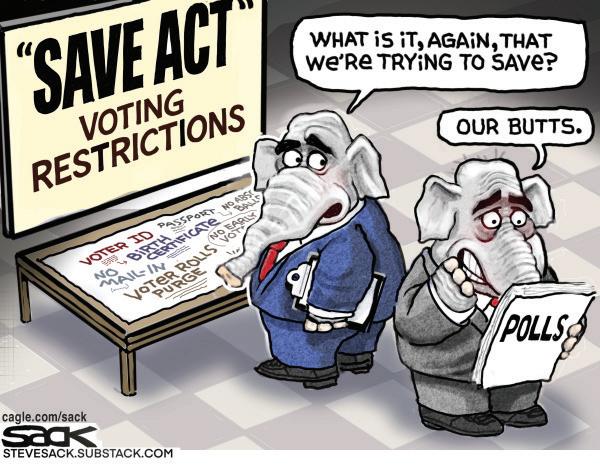
Aurora Navigation Campus charting real progress in solving homelessness
Asemi-private sleeping pod inside the Aurora Regional Navigation Campus, 15500 E. 40th Ave., near Chambers Road and Interstate 70. Photo by Cassandra Ballard, Sentinel Colorado.
When a community decides to boldly confront homelessness, it should expect complexity and challenges. What matters most is whether real progress is taking root. In Aurora, it is.
Aurora’s Regional Navigation Campus represents one of the most ambitious efforts in Colorado to address homelessness in a comprehensive way. In fewer than 90 days since opening, the campus has already become a lifeline for hundreds of men and women — providing shelter, stability, and coordinated support to people who desperately need help. At the same time, we have encountered operational and facility challenges that we are working urgently to resolve.
Both things are true.
Launching a campus in a repurposed, decades-old hotel is not simple. Plumbing repairs, security upgrades, construction delays, and phased service rollouts have required close coordination with the city as we move toward full operations. Some issues were anticipated; others were not. Each has required attention while we built case management teams, hired and trained staff, implemented safety protocols, and served individuals in crisis.
It is important to remember who we are serving. Many who arrive carry years of trauma, untreated mental illness, addiction, chronic health conditions, or prolonged instability. Progress is rarely linear. Some guests relapse. Some must build new skills to gain employment. Others arrive after years of living unsheltered, deeply distrustful of institutions. Helping people regain stability requires patience, structure, accountability, and time.
This is not a hotel. It is a structured pathway toward self-sufficiency — integrating housing navigation, employment programming, addiction recovery support, and case management under one roof. The goal is not dependency. It is dignity restored through stability, opportunity, and clear expectations.
This approach is not theoretical. In San Antonio, Haven for Hope — a campus combining shelter, treatment, and workforce development — reduced unsheltered homelessness in its downtown area by more than 70 percent over time. In Colorado, El Paso County has seen meaningful reductions through a similar coordinated model. These results were not achieved in weeks or months. They required sustained focus, operational refinement, and community resolve.
The human impact in Aurora is already visible.
Oscar came to Colorado determined to start over but found himself riding buses overnight to stay warm and picking up day labor when he could. At the Navigation Campus, he entered employment programming and began charting a path toward stability and independence. For the first time in years, he sees a future he can build.
Roger spent months staying awake on the streets to protect his wife, Lisa, whose serious health challenges and limited vision made traditional shelters impossible. At the Navigation Campus, Roger can finally sleep while Lisa receives consistent medical care. Their dream is simple — a small piece of land, a cabin, and a garden where she can grow flowers. That dream reflects what this campus is truly about: dignity, not dependency.
Stories like theirs do not erase the challenges we are addressing. Facility improvements are ongoing. Staffing continues to expand. Operations are being refined. But transformation is not built in its first quarter. It is built through persistence, course correction, and sustained community commitment.
Addressing addiction, trauma, mental illness, and long-term homelessness in a coordinated way takes time. But people in need are far better served by a comprehensive, structured approach than by the fragmented quick fixes that have failed in the past.
The Aurora Regional Navigation Campus remains in its earliest phase. Yes, there have been setbacks, and we are confronting them directly. But those challenges should not overshadow what is working. People who once had nowhere to go now have safety, structure, and a plan.
The growing crisis of homelessness and addiction called for courage and action. Leaders from across political and ideological lines came together to create the Aurora Regional Navigation Campus. That spirit of unity remains essential as we navigate early challenges and help people like Oscar and Roger move toward the lives they have long hoped for — and deserve.
The measure of this effort will not be the first 90 days. It will be whether, over time, fewer people are living unsheltered, more individuals are working, more families regain stability, and our community sees measurable reductions in chronic homelessness.
That is the goal. That is the commitment.
This work is hard. It is complex. And with sustained resolve, Aurora can build a model that delivers both compassion and results.
JAMES GOEBLEBECKER, GUEST COLUMNIST
A look at how we should or shouldn’t decriminalizing sex work in Colorado
Prostitution is one area where the old “fusionism” between religious conservatives and libertarians shows special wear. The former say it goes against God’s law and social order, while the latter say consenting adults have a right to control their own bodies. I advocated for legal prostitution as far back as 2008 in the Rocky Mountain News, and my idea was no more successful than the paper’s future. At the same time, libertarians often also are at odds with progressives, who worry prostitution inherently exploits sex workers. This is one area where conservatives and progressives often agree on a prohibitionist regulatory approach.
I was surprised, then, to see a bill come up in the legislature this year to “Decriminalize Adult Commercial Sexual Activity,” as Senate Bill 26-097 is titled. As introduced on February 11, SB 97 declares, “An adult who engages in consensual commercial sexual activity with another adult does not violate state law or an ordinance, resolution, regulation, or code adopted by a statutory or home rule city, town, city and county, or county.”
I agree with the bill’s rationale: “Criminalizing prostitution endangers adults who engage in consensual sexual activity. Fear of criminal punishment among consenting adults engaged in commercial sexual activity encourages physical, emotional, and structural violence against sex workers, subjects them to economic crimes, and increases resistance to harm-reduction practices. Sex workers are less likely to report these crimes or seek medical help following an assault.”
Largely the bill is about wiping out existing statutes on the matter; hence “decriminalization.” However, the bill does leave pimping as a Class 3 felony. But if people have the right to become sex workers, don’t they also have the right to work with others to help coordinate, uh, gigs? Making prostitution legal while outlawing pimps is a little like keeping house sales legal but outlawing real-estate agents.
Ridiculously, the bill invokes the emergency “safety clause” to evade a potential referendum.
Obviously the big push-back will be from counties and municipalities, many leaders of which will argue that they should be able to outlaw prostitution outright in their communities or at least heavily regulate it. My sense is a bill like this will go nowhere unless it preserves substantial local control, including the ability of localities to keep prostitution illegal.
On its face, SB 97 is about sex among consenting adults. Obviously forcing anyone into sex remains a crime under the bill. And no one thinks minors have the capacity to consent to sex work.
Still, former sheriff and senator John Cooke, who was surprisingly sympathetic to the idea of decriminalization, nevertheless expressed worries about the bill.
As Sherrie Peif reports for Complete Colorado, Cooke shared the concern (in Peif’s words): “It would likely make child trafficking worse because it would shift traffickers attention away from adult victims to more children.” Sex trafficking of children, horrifically, remains an ongoing concern, as a report from the Common Sense Institute indicates.
I don’t think the claim is true, however. My guess is that most people who pay for sex with someone who has been trafficked (forced into it) don’t really want to have sex with a trafficked person; they just want to have sex.
Yes, there are some deranged sickos out there who intentionally seek sex specifically with children. We should consider that a very-serious crime worthy of lengthy prison sentences. The answer to that is robust enforcement and prosecution, and maybe some legislative tightening (see Scott Bottoms’ bill, for example).
But I think, for the most part, decriminalizing prostitution would shift most of the demand away from trafficked people, including children (who may be minors presented as adults), to consenting sex workers. Aside from the empirical point, conservatives do not generally recognize the legitimacy of restricting the liberties of adults because of potential effects on children. Republicans such as Bottoms don’t usually go around saying things like, “Sure we should limit
adults’ ability to buy guns because that might protect children.” Instead, Republicans tend to say things like, “What part of ‘shall not be infringed’ do you not understand!?”
As for Cooke, he conceded to Peif (Peif’s words) that “a lot of time and police resources were put into investigations of commercial sex operations where it simply didn’t seem necessary.” Cooke said, “I kind of go both ways on some of it. After they [two prostitutes] got arrested, I was like how much are we going to spend? All these resources? For that? I mean you can’t legislate morality. But then on the other hand, are the women trapped in this and can they get out?”
Bill Masters, recently retired sheriff of San Miguel County, the longest-serving sheriff in Colorado history, and a one-time Libertarian, also shared mixed feelings, although he came down on the side of decriminalization.
Masters told me: “This issue is certainly an uncomfortable one I am certain the legislature and other public officials would wish would just go away. But it never has and never will.
“Passing laws that prohibit private conduct between two consenting adults is a fool’s game and a waste of taxpayer money.
“Legalization may solve some of the blatant display and community discontent over street walking by allowing individual workers to arrange for exchange of money and services online rather than on the street.
“There is no easy solution to this issue that will make everyone happier and safer. However, being a libertarian at heart, I would support the legalization as an experiment to other states and see how it works out.”
Okay, but is prostitution morally wrong?
Generally, we do not outlaw something just because it is morally wrong. Lying to your mother is morally wrong, but it doesn’t carry criminal penalties unless it involves fraud. So maybe prostitution, although morally wrong, should be legal.
Interestingly, Michael Huemer of the University of Colorado, among the world’s leading libertarian philosophers, argued recently that prostitution is morally okay.
He writes: “Some people think prostitution is wrong. I don’t get it. It seems like the simplest solution to a serious, widespread problem. Like other market transactions, we should presume that it leaves both parties’ desires better satisfied (in the absence of fraud), since otherwise they would not accept the transaction. Some would say that prostitution is exploitative . . . [but it’s] obtaining a benefit from someone by giving them something they want in return, and being completely up front about what you’re offering.”
For most of us, though, prostitution fails the test, “Would you want your daughter to grow up to do this?” There’s something unsettling, at least, about prostitution at least in many contexts.
On the other hand, after I saw the 2012 film “The Sessions,” about a quadriplegic man who hired a woman to have sex with him, I could not come up with a reasonable argument against sex work in that context.
In general, I think people do much better to keep sex within an intimate, caring relationship. We humans are evolutionarily built for sex to play a strong role in pair bonding, which obviously is useful for successfully raising labor-intensive offspring. So I think for most people prostitution is the wrong way to go. Cheating on your spouse with a prostitute certainly is wrong. But I do believe that consenting adults have the right to control their own bodies and to engage in “capitalist acts“!
In many ways Colorado always has been on the libertarian frontier, with our Western “live and let live” attitudes (with many exceptions, of course). It’s time to seriously consider the decriminalization of sex work, even if localities retain more leeway than what Senate Bill 97 envisions.

YOUR LETTERS
Aurora chose action to address homelessness instead of standing still
EDITOR: Big challenges test a community’s willingness to act.
Homelessness is one of those challenges. It’s complex, personal, and deeply human. It affects individuals who are struggling and it affects the broader community that cares about how we respond.
That’s why the Regional Navigation Campus in Aurora matters.
This campus represents a decision: to approach homelessness with structure instead of fragmentation. For years, responses often meant moving people from one location to another without creating a consistent path forward.
The Navigation Campus was designed to change that, to create a centralized place where individuals can come indoors and connect with case managers.
That shift is significant.
Having a defined location creates consistency. It allows outreach teams to focus their efforts.
It provides individuals experiencing homelessness a stable place to begin taking next steps, rather than navigating crisis alone.
Mayor Mike Coffman has been clear that ignoring the issue was
not acceptable. Choosing a coordinated, service-based model required leadership and a willingness to try something different. Not every city is willing to do that.
In conversations throughout Aurora, what I hear most often is a desire for balance; compassion for those facing hardship and thoughtful stewardship of our community.
The Navigation Campus reflects that balance. It acknowledges that homelessness cannot be solved by enforcement alone, or by good intentions alone. It requires a plan.
This initiative is still evolving, as any serious effort does. But what it represents is important: Aurora choosing to confront a difficult issue directly, with structure and purpose.
Progress on complex challenges doesn’t happen overnight. It happens when a city commits to a strategy and works steadily to strengthen it.
Aurora has made that commitment, and I plan on moving it forward with everything in my being. Please do not hesitate to reach out to me if you have questions or a vision for this issue or beyond: randrews@auroragov.org
– Aurora Councilmember Rob Andrews, At-Large

NOTICE TO CREDITORS BY PUBLICATION
PURSUANT TO §15-12-801, C.R.S. Case No. 2026PR30003
Estate of Joseph Eric Mares aka Joseph E. Mares aka Joseph Mares aka Eric Mares, Deceased.
All persons having claims against the above-named estate are required to present them to the Personal Representative or to the District Court of Adams, Colorado, on or before June 26, 2026, or the claims may be forever barred. Jennifer Mares Personal Representative 8066 Bryant St. Westminster, CO 80031 Attorney for Personal Representative David A. Imbler, Esq. Atty Reg #: 52038 Spaeth & Doyle, LLP 501 S. Cherry St., Ste. 700 Glendale, CO 80246 Phone: 303-385-8058
First Publication: February 26, 2026
Final Publication: March 12, 2026
NOTICE TO CREDITORS BY PUBLICATION
PURSUANT TO §15-12-801, C.R.S. Case No. 2026PR300600
Estate of Dennis Earl Williams aka Dennis Williams, Deceased. All persons having claims against the above-named estate are required to present them to the Personal Representative or to the District Court of Adams County, Colorado, on or before July 5, 2026, or the claims may be forever barred.
Shari D. Williams
Personal Representative 6569 S. Cook Way Centennial, CO 80121
First Publication: March 5, 2026
Final Publication: March 19, 2026
Sentinel




NOTICE TO CREDITORS BY PUBLICATION
PURSUANT TO §15-12-801, C.R.S. Case No. 2026PR30130 Estate of Harold Leroy Hockett aka Harold L. Hockett aka Harold Hockett, Deceased. All persons having claims against the above-named estate are required to present them to the Personal Representative or to the District Court of Arapahoe County, Colorado, on or before July 5, 2026, or the claims may be forever barred. Sharon J. Curtis
Personal Representative 4606 E. Peakview Ave. Centennial, CO 80121
First Publication: March 5, 2026
Final Publication: March 19, 2026 Sentinel
NOTICE TO CREDITORS BY PUBLICATION
PURSUANT TO §15-12-801, C.R.S. Case No. 2026PR42
Estate of Valerie Renee Green, Deceased.
All persons having claims against the above-named estate are required to present them to the Personal Representative or to the District Court of Adams County, Colorado, on or before June 26, 2026, or the claims may be forever barred.
Sonia Aileen Risley
Personal Representative
3614 Golden St. Evans, CO 80620
First Publication: February 26, 2026
Final Publication: March 12, 2026 Sentinel
NOTICE TO CREDITORS BY PUBLICATION
PURSUANT TO §15-12-801, C.R.S. Case No.2026PR28
Estate of Margaret Lucille Webb aka Margaret L. Webb aka Margaret Webb, Deceased.
All persons having claims against the above-named estate are required to present them to the Personal Representative or to the District Court of Adams County, Colorado, on or before June 26, 2026, or the claims may be forever barred.


Jamie Christine Medina
Personal Representative 4927 Rocky Mountain Dr. Castle Rock, CO 80109
First Publication: February 19, 2026
Final Publication: March 5, 2026
Sentinel
NOTICE TO CREDITORS BY PUBLICATION
PURSUANT TO §15-12-801, C.R.S. Case No. 2026PR63
Estate of Jill Marie Caraway aka Jill M. Caraway aka Jill Caraway, Deceased. All persons having claims against the above-named estate are required to present them to the Personal Representative or to the District Court of Adams County, Colorado, on or before July 6, 2026, or the claims may be forever barred.
Rebecca Blazquez, Esq.
Jorgensen Brownell & Pepin 8001 Arista Place, Ste. 415 Broomfield, CO 80021
Phone: 303-678-0560
First Publication: March 5, 2026
Final Publication: March 19, 2026
Sentinel
PUBLIC NOTICE OF PETITION FOR CHANGE OF NAME OF A MINOR ARAPAHOE COUNTY COURT, COLORADO
Case No. 2026C100145
PUBLIC NOTICE is given on Feb-ruary 9, 2026, that a Petition was filed for a Change of Name of a Minor has been filed with the Arapahoe County Court.
The Petition entered that the name of Harmony Zaneeah Kay Jeanette Vickers be changed to Zaneeah Kay Jeanette Sawyers.
First Publication: March 5, 2026
Final Publication: March 19, 2026 Sentinel
DISTRICT COURT, ARAPAHOE COUNTY, STATE OF COLORADO CONSOLIDATED NOTICE OF PUBLICATION
NOTICE IS HEREBY GIVEN THAT IN THE FOLLOWING ACTIONS FILED IN THIS COURT UNDER THE “UNIFORM DISSOLUTION OF MARRIAGE” AND “UNIFORM CHILD CUSTODY JURISDICTION” ACTS, due diligence has been used to obtain personal service within the State of Colorado and further efforts would be to no avail; therefore, publication has