

AYE, IN THE SKY



Aurora police take to the air with drones, fulfilling promises and drawing criticsm




GET REAL — Crow, Bennet invite State of the Union guests countering Trump delusions
If you’ve spent any time at all following the headlines since Donald Trump became president again just more than a year ago, or been unable to avoid them, Tuesday’s State of the Union speech offered little suspense.

DAVE PERRY Editor
Between insulting his political enemies and blaming former President Joe Biden for things Trump falsely says he’s fixed, he debased minorities and immigrants as he pointed out how real Americans are fabulously happy with everything and, especially, a stock market at 49,174.50.
No one’s ever seen anything like it.
Two Colorado Democratic members of Congress, Aurora Rep. Jason Crow and Sen. Michael Bennet, might agree. No one has ever seen anything like Trump 2.0, nor have they wanted to.
A growing majority of Americans agree. Trump’s meager approval ratings last year have tanked, hovering near the 30% mark.
To counter Trump’s expected glee over big-fat tax breaks for big-fat-bankaccount Americans, Crow brought, as his State of the Union speech guest, an Aurora restaurant owner whose businesses have been decimated by Trump’s disastrous, and now clearly illegal, tariff tantrums.
Bennet brought as his guest a woman who has been fiercely fighting against Trump’s equally lawless torment of minorities and immigrants, his staff announced.
Both Crow and Bennet said their guests offer Colorado and the nation deeply personal and compelling insights into the damage Trump has inflicted on the “Union” in just over 13 months in office.
Crow sat with Jay Park, who owns restaurants in Aurora and Parker.
“Over the past year, he has seen the price of his imported goods skyrocket, had to pay more for goods for his restaurants, and heard from Coloradans about not being able to dine out because they can’t afford it,” Crow said in a statement.
“Mr. Park’s staff, who have been legally employed, have been unfairly targeted by Immigration and Customs Enforcement and President Trump’s mass deportations.”
Park said last year he couldn’t sustain a third area restaurant because of the increased business costs and pressures.
“My small businesses have continued to face rising prices because of tariffs, making it harder to pay bills and make ends meet,” Park said. “Our country’s immigration policies have also unfairly targeted my employees who are in the U.S. legally.”
He said he was obliged to Crow for his defending people who have been hurt by Trump’s economic and immigration bedlam, which includes the vast majority in Aurora.
“I appreciate Congressman Crow for helping to share my story and stand up for Colorado,” Park said.
Crow, who has had seemingly endless battles with Trump and his administration since Inauguration Day last year, said he’s not letting up on any of the numerous fronts in what has become a constant fight against the Trump chaos regime.
“President Trump’s tariffs have raised prices and squeezed small businesses,” Crow said. “As someone who came to this country in search of a better life, and now owns and operates small businesses, Jay shows us how immigrants make our nation stronger. This president’s mass deportations of non-violent people and inflammatory rhetoric not only demonize immigrants like Jay, but also harm our state’s economy.”
Bennet agrees.
His guest at the State of the Union speech wase Andrea Loya, executive director of Casa de Paz. It’s a metro-based nonprofit group that provides a variety of assistance to refugees, asylum seekers and immigrants, helping them especially when they’re released from Aurora’s ICE detention center.
“Loya is an immigrant herself and
came to the United States when she was a young child,” according to a statement released by Bennet’s staff. “She navigated the complexities of the immigration system on her own and understands the uncertain, isolating nature of being new to this country.”
Loya said she appreciates the opportunity to offer details about the plight of immigrants amid the bedlam created by Trump.
“The Trump Administration has brought fear and chaos to Colorado and across the country with their cruel immigration policies, leaving community members to pick up the pieces,” Bennet said. “Organizations like Casa de Paz and leaders like Andrea are setting the example for how Coloradans work together, stand up for each other, and protect our neighbors in the face of danger and uncertainty.”
The guest list for Crow and Bennet for Trump’s State of the Union speech and their bravado highlights how the Republican dominated congress has groveled at the president’s real and threatened wrath. The complicity and cowardness has left Democrats to slog through federal courts, and those of public opinion, for meager and often tentative victories.
Congressional Republicans having ceded their arm of government to Trump. So the nation anxiously awaits to see whether the GOP will work to save its ineffectual House and Senate majorities by resisting Trump’s extortion threats to besiege any Republican who defies him.
Given the predictable histrionics and prevarication the nation has come to expect from the Trump shows, the only suspense now comes from how motivating stories like those of Andrea and Jay will be for Americans increasingly prepared to watch the president drive his second term off the cliff of history.
Tune in for more this week.
Follow@EditorDavePerryonBlueSky, Threads, Mastodon, Twitter and Facebook or reach him at 303-750-7555 or dperry@SentinelColorado.com





Rep. Jason Crow, D-Colo., speaks during a rebuttal to President Donald Trump’s State of the Union hosted by Defiance.org, the Portland Frog Brigade, and COURIER, at the National Press Club, in Washington, Tuesday, Feb. 24, 2026. AP Photo/Cliff Owen















Aurora prepares for potential drought as snowpack remains low
“THIS YEAR IS SO FAR UNRAVELLING AS ANOTHER SEVERE DROUGHT YEAR.”
BY CASSANDRA BALLARD, Sentinel Staff Writer
Aurora’s water sources aren’t in dire straits, yet, but city officials are starting to prepare for a possibly severe drought this summer.
Tim York, Aurora’s water department manager, offered up the highs and lows of the city’s current water situation in Aurora during the study session Feb. 9. With the record-breaking lack of snow this winter, there will probably be restrictions this summer unless key parts of the state are hit by an increasingly unlikely snowmaggedon.
“It’s pretty dry out there,” York said. “Snow pack has not been good.”
With out-of-town current reservoirs at 60% capacity, York said, the Aurora reservoir is pretty much full. Spiney Reservoir, however, a main Aurora water source, was recently measured at the second-lowest it has ever, at only 40%. Spiney Mountain Reservoir is Aurora owned and located in Park County, is the main storage reservoir for all of Aurora’s Colorado and Arkansas River rights.
“That will continue to go down until we get to, hopefully, some runoff,” York said.
In a historical look at Aurora’s reservoir levels, York said Aurora’s reserves are above 2002 levels, but the outlook is not off to a good start because this winter’s snowpack is below 2002 levels. 2002, for context, was the last most extreme drought year in more than 20 years. Think severe water restrictions on things like irrigation and even car washing.
This year is so far unravelling as another severe drought year, and without substantial snowfall in March and April, the city could struggle to replenish supplies, York said.
This is all compounded by drought conditions in the mountain basins that feed Aurora’s water sources, including the Colorado, Arkansas, and South Platte Rivers. Portions of these regions
are experiencing extreme to exceptional drought, meaning the very areas that supply Aurora’s water are under the most strain.
The outlooks for February and April project continued drought statewide, with warmer and drier conditions than normal, he said, and the city should start preparing for a dry year.
The city’s Water Supply Watch Team has increased its meeting frequency from monthly to biweekly as conditions worsen, and city officials are preparing for early public messaging, particularly as warm weather has already prompted some large irrigation systems to turn on sooner than usual, York said.
No drought stage, a creature of the West, has been declared yet, he said. The current discussion focused on updating the Water Shortage Response Plan so it aligns with the city’s Integrated Water Master Plan and can be implemented quickly if needed.
When a drought stage is announced, it will affect how often people water their lawns, ranging from two days a week to no outdoor watering.
Other places that might be impacted include, in Stage 1, restaurants serving water only upon request, and Stage 3 could bring severe restrictions, potentially affecting indoor water use.
Even under normal conditions, water waste enforcement is active, York said. Water monitors respond to complaints and educate residents about violations. Most issues are resolved after an initial warning, but repeated violations can result in fines, surcharges or even service suspension in extreme cases.
Residents can report water waste through the city’s Access Aurora app, website or water conservation email.
Aurora offers approximately 24 water conservation programs, including landscape conversion incentives such as xeriscaping, educational work-



shops, and water-use assessments, York said.
In new development, water-wise landscaping is on the rise, and 52% of new homes built in 2025 feature zero front yard lawn, even though it is not required by ordinance.
“We are embarking on a new kind of machine learning vegetation cover project this year, which will give us a better look at the entire city,” York said.
Councilmember Curtis Gardner asked about backyard ducks, which require access to fresh water, and whether they align with conservation goals. Staff agreed to examine how water feature rules apply to such uses under different drought stages.
York said that businesses, including car wash-
es, would be subject to restrictions during severe drought stages.
Councilmember Françoise Bergan asked about Accessory Dwelling Units (ADUs) and their water impact, and York said they have had little impact on overall water demand so far. Most ADU-related use is indoor, which has allowed water recovery through the sewer system, York said. March and April are traditionally the state’s biggest snow months. York said substantial snowfall during this period would be needed to significantly improve conditions.
York said that if restrictions are implemented, the city has the authority to reverse them if weather patterns improve, as has happened in past years, as Bergan mentioned.
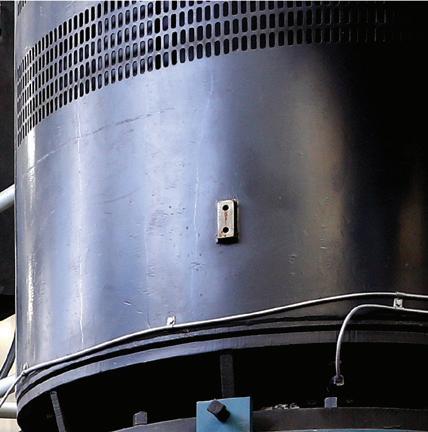
The Otero Pump Station moves water from Twin Lakes to the front range using ten pumps. The water is pumped to Spinney Reservoir where it flows down the South Platte River Basin.
File Photo by Gabriel Christus/ Aurora Sentinel
AROUND AURORA
Aurora lawmakers OK making a big deal over Big John’s firefighting heritage
The Aurora City Council unanimously gave a big nod to Big John this week.
Lawmakers on Feb. 23 agreed to bestow special historical honors on a 1955 Seagrave fire engine known affectionately as “Big John,” recognizing the vintage apparatus for its engineering innovation and decades of service to the community.
Lawmakers sealed the fire engine’s designation as a local landmark, citing its significance for its lasting contributions to Aurora’s fire service heritage and for its engineering design, state of the art in the 1950s.
Its nickname is believed to have been inspired from the early 1960s song “Big John” by Jimmy Dean, a nod to the truck’s imposing presence.
Custom-ordered in 1955 by the then-Aurora Volunteer Fire Department, Big John is a Seagrave Series 900 model equipped with a 1,000-gallon-per-minute pump and the largest V-12 engine available at the time.
The fire engine was part of the celebrated “70th Anniversary” line produced by Seagrave Fire Equipment Corporation, widely recognized as the oldest manufacturer of fire apparatus in the United States, according to Mike Ackman, a retired Aurora firefighter leading the charge to honor Big John.
City officials said the engine’s now-uncommon open cab design gave fire officers clear visibility upon arriving at emergency scenes, improving response in an era before modern communication and navigation technology. The truck also featured a large pump, sizable engine and an array of equipment standard for the day, including ground ladders, hoses, nozzles, warning lights and a siren.
Known for its power and rugged build, Big John also developed a reputation among firefighters as difficult to handle, Ackman said. With limited braking capacity and unsynchronized gears, it required skill to operate but could reach high speeds once in motion.
Originally assigned to Aurora’s initial Station 1 on East 16th Avenue, the engine served as Aurora’s primary fire apparatus before being reassigned to other stations, including Stations 4 and 5, where it often became the first engine housed at newly opened locations.
The fire engine was retired from service in the 1970s.
Over time, Big John has become a fixture by trucking through community events, appearing in parades, firefighter funerals and public gatherings.
The engine’s Aurora cultural legacy extends further. Each year, Aurora’s Dry Dock Brewing Company partners with Local 1290 to host a homebrew competition in which the winning firefighter’s recipe is dubbed “Big John Ale.”
Physically, the custom red engine retains much of its original character, including steel running boards, a Mars warning light on the hood, a “Roto Ray” triple rotating light atop the windshield, a bell mounted on the passenger side and the lettering “Number 5” on the hood with “Aurora FD Fire Dept.” on its doors.
In the 1980s, the original hose bed was removed to add bench seating for parade appearances, one of the few alterations made to the vehicle.
Council members agreed that preserving the engine as a historic landmark will ensure that it remains a tangible link to Aurora’s early days of fire service and a symbol of generations of firefighters who served the city.
— Sentinel Staff
POLICE: Aurora’s hightech police hub aids in recovering stolen cars, catching thieves
Aurora Police say its new Real Time Information Center is already reshaping how officers respond to crime, reporting dozens of arrests and hundreds of cases supported in the 90 days since the hightech hub fully launched.
The center, unveiled Nov. 19, integrates city-owned security cameras, Flock Safety license plate readers and the department’s drones-as-first-responders program into a centralized operation powered by Axon’s Fusus platform.
The system gives officers access to live and historical video, vehicle data and mapping tools as calls unfold.
Deputy Chief Phil Rathbun said the center is designed to reduce victimization and speed up investigations.
“This is not simply about numbers or reducing crime statistics,” Rathbun said. “Behind every number is a person, a family and a life impacted by crime.”
In its first three months, analysts and officers assigned to the center assisted in 132 arrests, gathered real-time evidence in 460 cases, recovered 69 stolen vehicles and cleared 118 calls for service without dispatching an officer, Aurora police spokesperson Joe Moylan said in a statement.
Police said that has freed patrol officers to respond more quickly to in-progress emergencies.
In one recent case, real-time analysts monitoring city cameras spotted an auto-pedestrian crash in a marked construction zone near East Sixth Avenue and Airport Boulevard. Real-time center staffers broadcast a call for service before anyone at the scene dialed 911, expediting medical and police response.
The pedestrian did not suffer serious injuries, police said.
The unit also worked with the U.S. Marshals Service to identify and locate a wanted fugitive’s vehicle traveling through Aurora, leading to the suspect’s arrest.
Moylan said using license plate readers and drones, analysts helped recover five stolen vehicles in the past week alone, arresting four people, including what police described as a “prolific car thief” previously arrested seven times by Aurora officers.
Police Chief Todd Chamberlain said the technology has been a “force multiplier” amid an overall crime decline.
The city recorded nearly a 25% reduction in crime in 2025 compared with 2024, resulting in about 3,700 fewer victims, according to the department.
Through the first seven weeks of 2026, crime is down 24.2% compared with the same period last year, with six of seven major index crime categories showing decreases. Robbery is the only category up so far, with 34 incidents reported, four more than at this time in 2025.
The new police center and philosophy comes amid a substantial drop in a variety of crimes, across the nation, across the metro area and across Aurora.
“The city of Aurora experienced a nearly 25% reduction in crime in 2025, resulting in 3,700 fewer victims than in 2024,” said Aurora Police Department Chief Todd Chamberlain. “This progress reflects first and foremost the dedication and commitment of our officers, who work every day to protect those we serve.”
National crime experts say much of the reduction seen across the nation is the result of extraordinary crime rates that soared during the pandemic receding to pre-pandemic levels.
Some experts say cities like Aurora and Denver have reported post-pandem-
ic increases in patrolling and becoming more visible, leading to a reduction in crimes.
“But technology has also been a critical force multiplier in our public safety efforts,” Chamberlain said, “and we will continue using every available tool to strengthen community safety and protect the people of Aurora.”
Data collected from 35 American cities showed a 21% decrease in the homicide rate from 2024 to 2025, translating to about 922 fewer homicides last year, according to a new report from the independent Council on Criminal Justice.
The report, released last month, tracked 13 crimes and recorded drops last year in 11 of those categories including carjackings, shoplifting, aggravated assaults and others. Drug crimes saw a small increase over last year and sexual assaults stayed even between 2024 and
2025, the study found.
Aurora police began piloting elements of the real-time system over the past year, combining nearly 100 cameras, license plate readers and drone deployments with live analysts who monitor priority 911 calls. Drones can launch in less than 90 seconds and stream video directly to responding patrol cars, allowing officers to assess scenes before they arrive.
Supporters say the system improves response times and investigative efficiency.
Critics of similar programs nationwide have raised privacy concerns, particularly over aerial surveillance and data-sharing with private camera owners.
Aurora police leaders have said the technology is used reactively and under existing legal guidelines.
— Sentinel Staff
Nearly all signatures for Eric Nelson’s HD 42 primary race deemed invalid by state Eric Nelson, Democratic candidate for Colorado House District 42, failed to submit the required number of signatures to appear on the State Primary ballot in June, according to the Secretary of State’s Office.
Nelson’s campaign submitted 1,635 signatures to the Secretary of State, and 1,606 of those signatures were rejected, with only 29 accepted, according to state records.
“It’s unfortunate, it’s disappointing,” Nelson’s campaign director Jose Silva said. “But we, like many campaigns, have to sometimes pivot, and that’s what we’re going to do.” ›› See METRO, 6
ARAPAHOE COUNTY


Scholarships available for high school seniors
The Colorado County Clerks Association is accepting submissions for its 2026 scholarship program. Contest winners will receive $1,500 or $1,000 scholarship awards to cover expenses at universities, colleges, junior community colleges, or technical institutions. To learn about selection criteria and apply, go to clerkandrecorder.org/scholarship
Quarterly Community Update
We’re investing in Arapahoe County to improve everyday life for residents. Check out Arapahoe in Action and see where those investments are making the biggest difference this quarter.
Visit: arapahoeco.gov/investing


Nelson said Thursday evening he was trying to take in the news and was unclear how so many rejected signatures would have been submitted.
Secretary of state officials said personnel did not recall a disqualification rate this high in recent memory.
To make the ballot, Nelson would have needed 1,000 valid signatures, or 30% of the votes cast in the last election, whichever is fewer, according to a statement from the Secretary of State.
State records show that of the 1,636 signatures submitted, more than 940 examined had no links to voter records in Colorado.
Nelson reported to state election officials that a national contractor, TouchStone, was his paid circulator for his signatures. The Washington DC-based company did not immediately return calls requesting comment.
“We instilled our trust in a third-party organization and company to assist with the petition gathering,” Silva said. “Obviously, the results of that speak for themselves.”
He said the relationship between Nelson’s campaign and the circulator have since “ceased” and that a non-disclosure and confidentiality agreement prevents him from commenting further at the time.
Silva said Nelson would attempt to go through an Arapahoe County March 3 Democratic Party caucus process to collect enough delegate support to still make the ballot.
Nelson served on the Aurora Public Schools board from 2013-2017. After launching an unsuccessful campaign for a seat in the Colorado House of Representatives in 2016, discrepancies in his
public biography came to light and the board launched a formal investigation.
A report presented to the board found that Nelson had falsified much of the information on his resume. He did not have any of the four degrees he claimed to have, and several diplomas he provided were faked, the report said. He also represented himself as having been a decorated officer in the Air Force, but was only in active duty for two months in 1998 and did not receive any awards. Of the 40 organizations he listed himself as a member of, many could not be reached or said that he was not a member or only had minor involvement, the report said.
He was formally censured by the board but refused calls to step down.
Then-Congressman Mike Coffman also urged the U.S. Attorney’s Office to investigate Nelson under the federal Stolen Valor Act for making false claims about military service.
Nelson began a campaign for the House District 42 seat two years ago, but withdrew from that.
Also running for the House District 42 seat are incumbent Democratic Rep. Mandy Lindsay and challengers Sarah Woodson and Megan Siffring.
— Cassandra Ballard, Sentinel Staff Writer
Rep. Crow vows at Aurora town hall to
fight for democracy and accountability
Aurora Democratic Rep. Jason Crow’s Feb. 18 town hall had fewer participants in the audience than other recent meetings, but participants said they felt like there was more hope.
“The good news is I’m here and not currently incarcerated by the Trump








































administration,” Crow said in his introduction.
During the two-hour event at Hinkley High School, Crow fielded questions on veterans’ benefits, immigration detention oversight, threats to research funding, media freedom and the role of the military in domestic affairs.
Crow has been among a small group of Democrats making headlines recently as targets of the Trump administration.
A grand jury in Washington last week refused to indict Crow and other Democratic lawmakers in connection with a video in which they urged U.S. military members to resist “illegal orders,” according to a person familiar with the matter.
“Donald Trump’s DOJ just tried — and failed — to indict me in front of a grand jury,” Crow said in a statement last week. “Americans should be furious that Trump and his goons tried to weaponize our justice system again against his political opponents. His attempts to intimidate and silence us will always fail.”
The Justice Department opened an investigation into a video featuring Crow, Democratic Sens. Mark Kelly and Elissa Slotkin and three other Democratic lawmakers urging U.S. service members to follow established military protocols and reject orders they believe to be unlawful. All the lawmakers previously served in the military or at intelligence agencies.
Grand jurors in Washington declined to sign off on charges in the latest of a series of rebukes of prosecutors by citizens in the nation’s capital, according to the person, who spoke on the condition of anonymity because they were not authorized to publicly discuss the matter. It wasn’t immediately clear whether prosecutors had sought indictments against all six lawmakers or what charge or charges
prosecutors attempted to bring.
On Wednesday night, Crow said again that he would not turn away from the fray.
“It is my job as a member of Congress to make sure that the executive branch follows the law, that the military follows the law and that federal law enforcement follows the law,” Crow said. “Our service members’ allegiance is to the Constitution, not any one person.”
He described the move by Trump as an attempt to “send a message” that dissent will be punished, and if you exercise your First Amendment rights, if you organize, you protest, and you mobilize, that you’ll be crushed.”
“We are not going to stop, we’re not going to back down from this,” he said.
People from the audience were selected at random by a numbered system to ask questions. One of the first questions asked was about what punishments can be given to those “changing democracy.”
Crow said he is not focused on vengeance, but on accountability, which is always helpful in healing a nation when leaders break the law, and that accountability will be based in the legal systems of government.
“The comeback is starting,” Crow said. “It’s starting. The tide is turning. You see what’s happening around the country. The sentiment is shifting. The tide is turning. People are engaging in a significant way. So I think our comeback is happening.”
One questioner asked what Crow is doing about the conditions of immigration detention in Colorado.
Crow filed a lawsuit against the Department of Homeland Security last year for allegedly limiting congressional access to immigration detention centers,






































































including the GEO ICE facility in Aurora. He recently obtained a temporary restraining order allowing him to conduct oversight visits without having to give extended notice.
There are 70,000 people in immigration detention around the country, over 100 over 150 Americans, US citizens, have been unlawfully arrested, detained, and some deported, Crow said.
“There have been over 30 deaths in ICE custody in 2025, which is the highest level in two decades,” Crow said, “And abuses that we see with our own eyes.” Crow called the situation “an assault on the Constitution.” He is currently supporting Rep. Pramila Jayapal, D-Washington, in an effort to ban private immigration detention centers nationwide, and he said that “a profit motive for detaining human beings leads to bad outcomes.”
Crow asked constituents to share with his office any specific detainee cases they are concerned about so staff can pursue privacy waivers and follow up directly.
Midway through the town hall, a crowd member had a loud outburst, confronting Crow about taking donations from Palantir, which develops data integration and analytics platforms that enable government agencies, militaries, and corporations to combine and analyze data from multiple sources.
Some of this data has been used by ICE for immigration enforcement. Crow said last week, along with John Hickenlooper, he will turn all donations from Palantir to charities, according to reporting in the Colorado Sun.
The tech company has become a
See METRO, 7
























controversial topic for many in Colorado. Many critics question the company’s ethics and its surveillance capabilities.
The company announced Feb. 17 that it will be moving its headquarters to Miami to avoid protests, strict artificial intelligence regulations, and to reduce tax burdens.
Another question came from a veteran who was worried about proposed VA rule changes and wanted to know Crow’s position.
A local Veterans of Foreign Wars member asked about a new preliminary rule from the Department of Veterans Affairs that could reduce disability ratings and, ultimately, benefits.
Crow said he “would fiercely oppose” any effort to retroactively cut benefits. He said he would also pledge oversight of the Rocky Mountain Veteran Affairs hospital in Aurora, with federal workforce reductions affecting veterans.
“If you raise your right hand and serve, we have a moral obligation to take care of you and your family,” he said.
An attendee who said she was a medical startup founder and is funded by the National Institutes of Health and the National Science Foundation said that grants are being frozen and that employees may face layoffs.
She asked what could be done about research funding cuts.
Crow called NIH “one of the best investments the American taxpayer makes,” because of research it creates an economic impact, stating that every dollar that is invested creates more than $3 of economic activity.
He said he is “fighting hard to preserve what’s there” in NIH funding and
is working to build bipartisan support to protect funding streams and to stabilize visa programs for international researchers working on campuses such as the Anschutz Medical Campus.
“We’re trying to create a coalition to protect that funding stream for you and thousands of others,” he said.
Right-to-repair and consumer protections
An auto repair shop employee said he has had increasing difficulty accessing parts and software and asked Crow for help.
Crow said he supports “right to repair” legislation to ensure consumers and independent shops can access parts and diagnostic tools. He also criticized Pentagon procurement contracts that prevent in-house or field repairs, calling the system “wasteful and inefficient.”
One audience member, who said he was supposed to ask a question for his wife but changed his mind, asked if Crow would be participating in an alternative State of the Union and join an alternative Democratic response.
Crow said he plans both to participate in an alternative address and to attend the official speech on the House floor.
“You elected me to sit on that floor, to vote and to bear witness,” he said.
Attendees wanted to know what Democrats can do for the midterm elections, fearful that waiting until the election might be too late, given how quickly the Trump Administration is changing things.
Crow said Democrats must “hold firm, avoid appeasement,” and use every tool available, such as litigation, oversight, appropriations, public organizing and media engagement.
“Bullies punch down,” he said emphasizing the power of grassroots mobiliza-
tion. “There’s strength in numbers.”
Crow said that Democrats must counter what he described as a “flood the zone” information strategy, which is overwhelming the public with misleading or inflammatory information, with facts and consistent messaging, but without abandoning democratic norms, such as breaking laws, lying or attacking institutional norms. He also said that people should not stop paying taxes as a form of protest for the current administration.
One audience member asked about the media consolidation of 9News and freedom of the press, along with cuts to organizations such as NPR and overseas organizations such as Radio Free Europe.
Crow said he is co-sponsoring legislation with Sen. Chris Murphy, dubbed the No Political Enemies Act, which would allow individuals and entities to sue if federal action is taken against them for political reasons.
Broader democracy reform legislation is being drafted to strengthen guardrails at agencies such as the FCC and the Federal Election Commission, he said.
“Consumers have power too,” he said, urging constituents to consider how they “vote with their wallet.”
A veteran asked about National Guard deployments and the legality of certain military actions.
Crow said there were three categories of concern: presidential authority to act without Congress, whether operations are conducted lawfully and the domestic use of troops.
Drawing on his experience as a combat veteran, Crow said he believes it is essential to train service members on lawful orders and constitutional obligations.
“We’re having that conversation publicly about what we expect our military to
do,” he said.
Closing the evening, Crow acknowledged the risks facing democratic institutions but stayed optimistic.
“We are in great danger, don’t get me wrong,” he said. “There’s a path through it.”
While fear can spread quickly, “courage is a lot more contagious,” he said. With organizing, oversight and what he called “relentless” work to protect free and fair elections, Crow said he believes the country will “recapture our democracy.”
“I believe we will get through this, and I do believe that,” he said. “I don’t believe it’s a given. I don’t believe it’s going to happen on its own, and that it’s inevitable. I do believe you can remain in danger as a society, as a democracy, but there is a path. A path that’s widening because, as I indicated earlier, the tide is turning.”
— Cassandra Ballard, Sentinel Staff Writer
Aurora settles lawsuit with shuttered ‘Edge at Lowry’ apartment owners for $300K
The City of Aurora has reportedly settled a lawsuit filed against the owners of the Edge at Lowry apartments, which gained national notoriety in 2024 when some city officials claimed — without evidence — that it was overrun by gangs, according to city sources.
“The agreement requires Five Dallas Partners to pay the city $300,000 as a partial reimbursement for costs the city suffered in responding to, closing, maintaining and securing the buildings in the company’s absence over the last two years,” city officials said in a statement.
“The agreement also requires Five Dallas Partners to hire a professionally licensed and insured company to provide security until the closing date of the sale of the property, or until the property is returned to commercially viable habitable use.”
News of the settlement today was first reported by 9News. The Sentinel reported that the settlement was imminent earlier this month.
A civil trial involving allegations by the city that the apartment complex was grossly neglected by owners CBZ Management was slated to begin Jan. 27 for a 10-day trial, but the trial date was vacated as Aurora and building owners work toward a settlement, according to city officials.
CBZ Management garnered national attention by alleging for more than two years that three of their Aurora properties were taken over by Venezuelan gangs.
The management company avoided paying Aurora’s estimated $800,000 bill stemming from the landlords’ alleged neglect, which turned the five-building apartment complex into a public nuisance, city officials said. The estimate was provided by the city when it closed the building nearly a year ago, and the fees the company quoted covered temporarily taking over and closing the four buildings.
The settlement amount was $300,000, according to city officials.
One of the property managers and brother of the owner of CBZ Management, Zev Baumgarten, still has a separate, pending criminal case with the city that is not included in the settlement, Aurora spokesperson Joe Rubino said in a
›› See METRO, 27
WHERE COLORADO LEARNS TO SKI
Just 53 miles from Denver, Loveland's beginner-only area and unbeatable prices make it the perfect place to fall in love with skiing and riding, for the rst time or all over again.
The Magazine

Shining light on the dark of Amache
THESE HIGH SCHOOL STUDENTS ARE THE CARETAKERS OF ONE OF THE NATION’S MOST DISTURBING CHAPTERS
BY ERICA MELTZER, Chalkbeat
The black-and-white photographs show neat rows of young men wearing old-fashioned football uniforms and leather helmets. As elementary students jostled around the museum display, Granada High senior Emersen Hernandez explained that the Amache Boys’ Club team only ever played one home game, against nearby Holly.
Amache won that game. But most other teams in the region did not want to play at Amache — or play against them at all.
“Why?” one boy interrupted.
Emersen paused before answering. But she didn’t shy away from the reason. “At the time, there were a lot of racists in the area, and they did not want anything to do with the Japanese Americans.”
The younger students, many in their purple Cheraw Wolverines T-shirts, had traveled an hour by yellow school bus for their October field trip to Amache. Located in southeast Colorado just outside the tiny town of Granada, it was one of 10 sites where the U.S. government imprisoned tens of thousands of its own citizens during World War II.
Under the leadership of teacher John Hopper, the site and its stories have for more than three decades had an unusual set of caretakers: Granada High School students like Emersen.
Students have sifted through dirt to find discarded children’s toys and broken glass bottles of lithium-laced Cheer Up soda. They’ve recorded firsthand stories from survivors and their families. They’ve mowed the grass and tended the cemetery.
Amache represents the kind of difficult American history that many teachers are wary of broaching in the classroom. Addressing it
wasn’t popular back in the 1990s either, when Hopper first had his students send questionnaires to survivors.
“I had a lot of pushback from locals. ‘Leave it alone,’” Hopper recalled. “I was getting letters. I was getting phone calls. I was not very well-liked.”
Over time, Hopper’s Amache course became a sought-after elective at Granada High School, and the Amache Preservation Society became an elite club with its own letter jackets.
The work done by Hopper’s students helped lay the foundation for Amache officially becoming a national historic site in 2024. That put the federal government in charge of the site. Hopper ensured Granada students would keep control of the small independent museum they run out of a converted bank in town. At this de facto visitor center, they give tours to school groups and tourists filling their National Parks Passports.
This is sensitive work. Few people today believe this history should be ignored. But exactly how it should be told, and what lessons this episode holds for the current political moment, have divided people for decades.
The Granada students have always steered clear of partisan politics while sharing those stories. But the Trump administration’s push for schools and national parks and museums to present a positive view of America’s past has made politics more challenging for students to sidestep.
QR codes went up last summer at Amache and every National Park Service site advising visitors to report anything “negative about either past or living Americans.”
The National Park Service has since removed a slavery exhibit from a Philadelphia
home where George Washington lived, though a federal judge ordered it restored. The Pride flag came down at Stonewall National Monument, though New Yorkers promptly raised it again. The park service has plans to remove signs at more than a dozen other sites.
Hopper is getting questions again, from both visitors and locals. “What are you going to do about your museum? It’s mostly DEI.”
Amache museum tells story of Japanese American internment
Today at Amache, you can find a reconstructed water tower, community center, barracks building, and watchtower. Sage and blue grama have reclaimed much of the site, though elms planted by those incarcerated here still dot the landscape.
But between 1942 and 1945, this site was the 10th largest city in Colorado. In total, roughly 10,000 people of Japanese descent, most of them U.S. citizens, lived here behind barbed wire and under constant military guard, in hastily constructed barracks that afforded little privacy or protection from the wind and dust and cold.
“It just scared the living daylights out of me when we went by it on the highway,” said Sandra Ellis, who grew up in a nearby town. “We assumed they were locked up because they were dangerous.”
Plans to round up people of Japanese descent in the event of a war had been laid years earlier. After the Empire of Japan attacked Pearl Harbor, President Franklin Roosevelt invoked the Alien Enemies Act to arrest non-citizen immigrants and community leaders.
Then on Feb. 19, 1942, Roosevelt signed Executive Order 9066, authorizing exclusion zones from which military authorities could order the removal of civilians. Military officials first imposed curfews only on Japanese Americans, then encouraged them to leave the West Coast voluntarily, and then ordered their removal and detention in the U.S. interior.
The Amache Museum tells this story. There are posters ordering people of Japanese ancestry to report for evacuation and suitcases into which they crammed what they could carry.
“Little kids, like you guys, they couldn’t bring their toys,” Emersen, her dark hair pulled back in small braids, told the Cheraw students. “They had to take things that their families needed, so extra sheets, extra jackets, sweaters.”
Faculty and graduate students from the Amache Community Archeology Project, based at the University of Denver, helped Granada students learn how to catalog artifacts and display them in meaningful ways.
There are kimonos and traditional Japanese instruments, cards produced by Amache’s silk screen shop, and a wedding cake topper that was used again and again. There are loyalty tests that marked some for transfer to harsher camps and passes that allowed those deemed low-risk to leave the camp for work.
These items shape students’ discussions with visitors. Emersen recalled one person who questioned whether people at Amache were truly incarcerated.
“I was explaining how they could leave with permission and get passes and IDs to go into town, so one man asked me, ‘If they can leave and go in and out, they’re not really
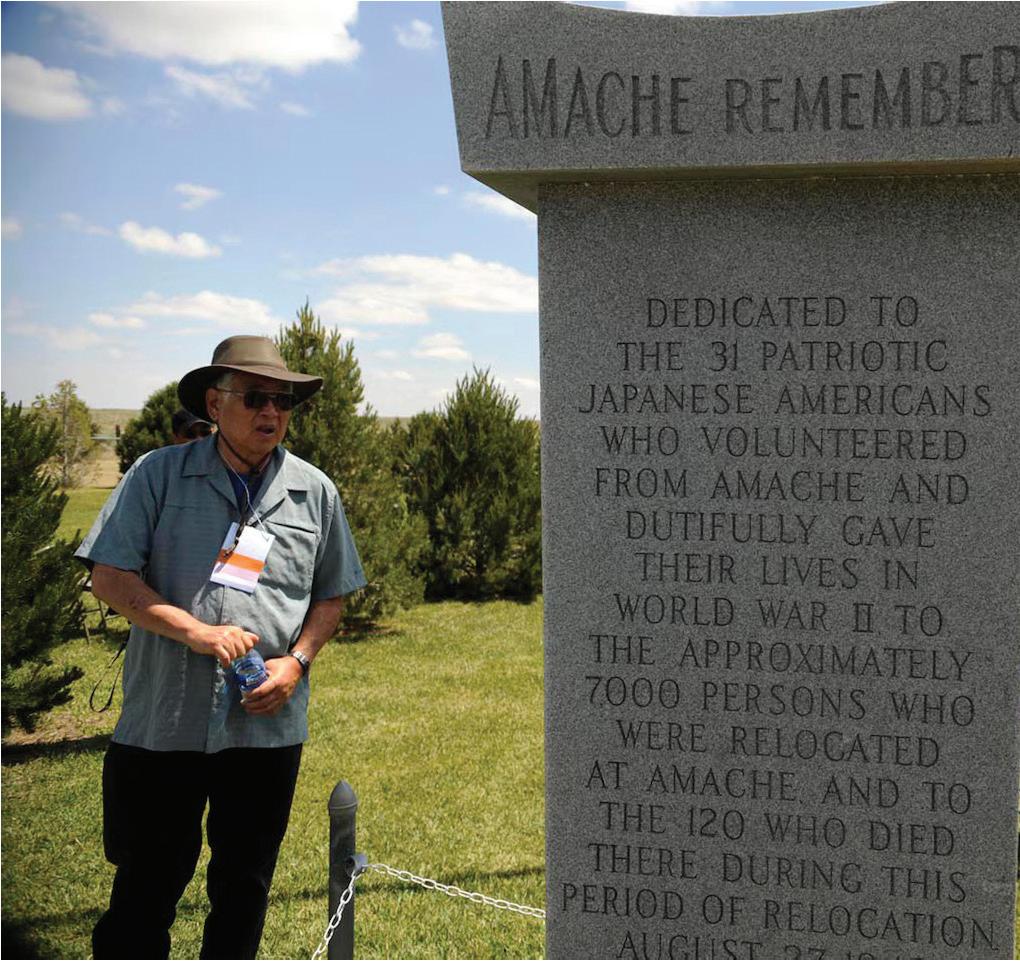
Hisao Homma, left, and Kumiko Hasegawa, right, look at the Amache Remembered memorial during a 2008 visit. The marker commemorates soldiers from Amache who died in combat as well as people who died while incarcerated. Hisao Homma was 8 years old when his father died at Amache.
Helen H. Richardson / The Denver Post
Colorado
BIG AND LITTLE BROS:
Vista PEAK Prep senior boys
basketball standout Julian Williams, right, poses with brothers Quincy, left, Jamir Anderson, center, and Jamar Anderson in the gym at Vista PEAK Prep before practice on Feb. 10. Julian Williams picks up his little brothers from elementary school daily and brings them back to stay with him at practice while he works on his game, which has helped the Bison make a late surge to the Class 6A state playoffs.

The pickup line at most elementary schools features a collection of soccer moms, business professionals and assorted others, who wait to collect their children at the end of classes.
BOYS BASKETBALL
Mixed in the after school pickup procession daily at Edna & John Mosley P-8 school in east Aurora is Julian Williams, a Vista PEAK Prep senior basketball standout, who has much more on his plate.
cures them in their car seats, he brings them back to Vista PEAK Prep to stay with him during practice until it is time to go home.
His mother couldn’t appreciate it more.
“Julian is my backbone,” she said. “He’s had to grow up fast and he really steps up and helps me. He never complains, he just gets it done...To say I’m proud of him is an understatement.”
Home court
BY COURTNEY OAKES Sports Editor
The eldest child of a single mother of four, Williams has to do what it takes to help out for the last two years. That now includes waiting in line for younger brothers, 7-yearold Jamar and 9-year-old Jamir Anderson, when they get out of school.
“It’s very weird,” Williams said of being in the line every day. “I’m the only kid picking up my little brothers along with a bunch of parents. It’s crazy.”
Crazy, but definitely necessary given the dynamics of his household. The death of his father a couple of years ago created a void that Williams has done his best to fill in whatever capacity that is to help his mother, Marcona Anderson.
So his mother can do what she needs to work and provide financially for the family, Williams’ days consist of getting up early, going to Vista PEAK Prep to get in some shots and picking up his brothers to take them to school before heading to school himself. Toward the end of the day, Williams focuses to finish his school work so he can leave early, get in his car — sometimes with company from his other brother, Quincy, 15 — and make the 6 1/2-mile, roughly 13-minute trek to pick up his brothers. After he se-
Vista PEAK Prep assistant coach John Campbell first started coaching Williams on junior varsity in his sophomore year — when the Bison were a 5A Final Four team — and came to learn his backstory as he got to know him.
Knowing all that and what he has overcome, Campbell is in awe of what he sees on and off the court from Williams daily.
“When I was in high school (he played at Grandview), there’s no way in heck that I would have woke up early, come to the gym and then did anything for anybody but myself,” Campbell said. “Let alone have responsibility to take care of my younger siblings and get them where they needed to go, then come back and be a highly above average student and then an exceptional player.”
Williams has a lot to balance academically, athletically and in life at a young age and he is doing so tremendously, though he acknowledges that it can stumble him at times.
As such a large figure in his younger brothers’ lives, he came to realize missteps he made would be reflected in them.
“There were some times when I was talking back at home and not being a good model for them and they they started to do it, too, so I knew I had to change my ways,” Williams said. “As soon as I cut it out and made the change myself, I got on them about it and things went well.”
Added his mom: “Julian’s not one of those kids that goes out and gets in trouble.
He has his days and I give him that space, but he and his brothers seem to be coming together a lot more these days.”
Even with bigger offcourt demands than the majority of his peers, Williams plays a vital leadership type of role for his Vista PEAK Prep team as well.
Head coach Jordan Carter leans on Williams a lot, especially in scoring, as four of the teams’ top five scores from last season departed via graduation or transfer. A 6-foot guard, Williams also is tied for the team lead in assists per game (2.9) and paces the Bison in steals at 2.3 per contest.
Williams (who averaged 4.4 points per game last season) has delivered, as he averaged just under 20 points per game for the first 15 contests and has been even better since then, when Vista PEAK Prep finished on a winning streak that got it into the Class 6A playoffs. Williams poured in 24 points in a win over Manual to start the City League Silver Division tournament and added 25 in a semifinal win over DSST: Green Valley Ranch to bring the Bison to the final.
Needing a win to qualify for the postseason, Vista PEAK Prep earned a 79-62 victory Feb. 21 and a day later, ended up as the No. 38 team among 40 in the 6A playoffs. The Bison were set for a 6A 1st round visit to No. 27 Centaurus in the first round Feb. 24, with the winner set to play at No. 6 Cherry Creek in the Feb. 28 second round.
As rooted as he is, Williams also is now turning an eye towards the future, where he hopes to play in college. The Vista PEAK Prep coaching staff is doing its best to find a place for him that will still work in the family dynamic.
“My coaches are like my father figures on and off the court and their putting together film and doing what they can to help me get recruited,” said Williams, who hopes to play as long as he can, but also has an interest in one day becoming an athletic trainer so he can stay attached to sports.

ABOVE: Julian Williams (1) focuses before a free throw attempt during the Vista PEAK Prep boys basketball team’s win Feb. 17 at Manual High School. BELOW: Williams talks with his brothers, who attend basketball practice with him every day after he picks them up from school. (Photos by Courtney Oakes/Aurora Sentinel)

PHOTO BY COURTNEY OAKES/AURORA SENTINEL
Right: Vista PEAK Prep
junior Khloe Yizar, right, reacts in amazement after she finished off a win in the 235-pound championship match at the Class 5A girls state wrestling tournament Feb. 21 at Ball Arena.
Middle: Regis Jesuit junior Remington Zimmerer, top, holds down Widefield’s Amaya Hinojosa on her way to a seond straight 5A state championship at 120 pounds.
Below: Vista PEAK Prep
senior Amelia Bacon, right, has her arm raised as she repeated as 5A girls 125-pound state champion and completed a perfect season.
PHOTOS BY COURTNEY OAKES/AURORA SENTINEL

The Amelia Bacon effect is real.
For a Vista PEAK Prep girls wrestling team that continues to build its foundation, the championship won by Bacon a year ago proved to the program and those in the wrestling room that it belonged in competition in the highest levels of Class 5A.
GIRLS WRESTLING
That proved itself Feb. 21 when a wrestler other than Bacon — though she also came out on top — won a state championship on the big stage at Ball Arena.
for her third career state championship match with ease with two pins — including one that secured her 150th career victory — and a semifinal win by technical fall.
That put her back in the spotlight as a defending state champion with a matchup against a first-time qualifier in junior Bella Arellano-Gandy of Coronado. Never really threatened, Bacon got up early and finished off a 7-3 decision.
“This was my last time on the mat (in high school), so I just wanted to go out and wrestle hard,” she said. “It’s definitely bittersweet.”
Trio of titles
Junior Khloe Yizar, who didn’t even win her regional tournament previous week, became the program’s second all-times state champion with a win by fall in the 235-pound title match.
“Amelia inspires me so much,” Yizar said of her teammate, who later won her second state championship at 125 pounds.
BY COURTNEY OAKES Sports Editor
“This year, I thought I’m going to be like Amelia. I can be up here with her and now I really am.”
Indeed Yizar ended up on the top of the medal podium at the end of a 29-8 season that culminated in a state run that included two wins by fall and a pair of major decisions.
Bacon (47-0) didn’t have twin brother Ian in the finals like last season, as he finished third in 5A at 120 pounds, but Yizar’s win flooded her emotions.
“Last year, I was freaking out because I won and this year Khloe, my teammate, got the dub,” Bacon said. “It’s always an emotional rollercoaster. I’m always so stressed and so relieved when it’s over.”
Bacon never showed any signs of stress, nor did Regis Jesuit junior Remington Zimmerer, who showed total poise in the 120-pound state championship match in which she faced the same opponent as in 2025 in Widefield’s Amaya Hinojosa.
For more on all three 5A girls titles and more, visit sentinelcolorado. com/preps
She unseated 2025 state champion Mariah Gonzalez of Poudre — who missed most of the season with a knee injury — by major decision in the semifinals and then outlasted another first-time finalist in Central of Grand Junction’s Polutu Savea to win the title.
“Khloe’s been wrestling strategically for the entire tournament and she’s been technical and on her feet and moving,” Vista PEAK Prep coach Ashley Jaramillo said.
“Something clicked for her and it was perfect.”
Perfection also can be used to describe Bacon, whose run to the state championship at 125 pounds was entirely more predicatable than that of Yizar.
Even better than she was a year ago when she joined the elite echelon in the state, Bacon qualified
One of Zimmerer’s two losses on the season came to Hinojosa, though it came via forfeit at the Ice Queen tournament in December. The two met a week before this season’s state tournament in the Region 2 championship match and Zimmerer won a 3-0 decision, which put them on opposite sides of the state tournament bracket.
They came together again and Zimmerer was even better in a 7-0 decision.
“I thought I she was going to take her shot a lot more and I was she surprised she didn’t, but I was working on my handfighting with that,” Zimmerer said. “I was pretty much ready. I was very confident going in and super excited for the chance.”
Regis Jesuit coach Zach Zimmerer noted how calm his daughter has become in big moments, which has allowed him to just sit back and enjoy.
“Even though she won last season, she’s not sitting back taking it easy, she’s always pushing and that makes her super fun to work with,” he said.


(


TOP: Members and coaches of the Grandview boys wrestling team pose with the Class 5A state runner-up trophy they won on Feb. 21 at Ball Arena. The Wolves earned 176 points to come in behind Pomona for the best finish in program history.
ABOVE: Cherokee Trail junior Cooper Mathews holds up two fingers to signify his second career state championship after he won an all-Aurora 126-pound final against Grandview’s Kyle Menuez Feb. 21. BELOW: Grandview junior JR Ortega gestures to supporters in the stands his second state title after he won the 126-pound title Feb. 21.
)

Two became the prime number for Aurora area boys wrestlers on the final night of the Class 5A state tournament Feb. 21.
Two as in the number of state championships now owned by juniors JR Ortega of Grandview and Cooper Mathews of Cherokee Trail and the number in the team standings achieved by the Wolves for the first time in program history.
BOYS WRESTLING
At the conclusion of a successful three-day tournament for the Aurora area at Ball Arena, Ortega and Mathews emerged with wins among five finalists and Grandview departed with a trophy.
finalists for Grandview, which saw senior Gunner Lopez (165) and juniors Kyle Menuez (132) and Leland Day (285) finish as runners-up.
A repeat finalist, Day had to go to overtime with Legend’s Alexander Rose, who ended dealing him a second loss of a 44-3 season with a win by fall. Lopez finished his career with four top-six finishes in as many years, but his shot at a state title escaped with a heartbreaking 5-2 loss to Pomona’s Emmitt Munson, while Menuez was unable to derail Mathews’ quest for a second career state title. Mathews was the 106-pound state champion as a freshman in 2024, but had his bid to become a two-time champion derailed with an all-Aurora 120-pound championship match loss to Vista PEAK Prep’s Ian Bacon last season.
It takes two
“It was a heck of a ride this weekend,” Grandview coach Ryan Budd said. “I’ve never been a part of a team this good. Winning became contagious and I’m just really proud of everyone we had down here.”
BY COURTNEY OAKES Sports Editor
Eleven Grandview wrestlers qualified and nine of the place top-six at their respective weights on the way to 176 points, which far surpassed every other team in 5A save for a record-setting Pomona team that won nine bracket championships and set the state scoring record with a staggering sum of 303.5 points.
Only five non-Pomona wrestlers won championships and one of those was Ortega, who finished an absolutely dominant junior season with the 126-pound crown.
A day after a 15-point win over Pomona’s Zaidyn Quinonez in the semifinals, he pinned Castle View’s Jacob Ness to join Fabian Santillan (2018, 2019) as the only multiple-time state champions in Grandview history.
“I’m thankful to come out here and show off my skills to my family and friends,” said Ortega, whose first state title came last season at 113 pounds.
“I just let go of the outcome and focused scoring points. That’s my main goal in every match.”
Ortega pinned his first two opponents at the state tournament, won the semifinal by a tech fall and finished a 50-1 campaign with another pin. He was voted 5A’s Most Outstanding Wrestler in the process.
It turned out to be the only title from a total of four
In his third different weight class in as many seasons, Mathews posted a 13-4 major decision over Menuez to become the first two-time state champion in history for Cherokee Trail.
“Last year was a match I should have won, but inconsistent training leads to inconsistent results,” Mathews said. “This year, I focused on going hard even on the bad days and being consistent. That really helps. ...I’ll be back next year ready to get a third.”
Buck — who was thrilled with his team’s fifth-place finish as five of the seven qualifiers earned top-five places — was glad Mathews got the program over the hump in terms of multiple titles.
“We’ve had a few in the finals with a chance, but never able to get it done,” Buck said. “The good news about Cooper is that he’s a junior.”
Twelve other Aurora area boys earned their way onto medal podiums with top-six results. The majority of those came with third-place finishes, which came from seniors Richard Avila of Regis Jesuit (113 pounds), Ian Bacon of Vista PEAK Prep (120), Grandview’s Jonathan Montes Gonzales (157) and Cherokee Trail’s Youdas Aghouiles (285), Smoky Hill junior Jovani Galvan (138) and Cherokee Trail sophomore Elijah Van Horn (106). Grandview junior Christian Skov (175) placed fourth, while fifths went to Grandview juniors DJ Snider (120) and Anthony Segura (138) and Cherokee Trail senior Ryan Everhart (157) with sixths to Cherokee Trail senior Renzo Lubuguin (150) and Grandview sophomore Marques Lawrence (215).
Photos by Courtney Oakes/Aurora Sentinel

Acalender shift that pushed the Class 5A girls state swim meet back had an effect, but Aurora area teams still put on a pretty good show in the Feb. 18 finals at the Veterans Memorial Aquatic Center.
A 1o-day gap between the end of league championship meets and the state meet due to a rotation of the three state meets held at the same venue gave teams more rest, but might have taken some of the competitive edge off as not a single state record went down.
Regis Jesuit certainly had veteran contributions, as senior Lexi Stramel ended an outstanding career with two championship finals apperances. She tied for sixth in the 500 freestyle and seventh in the 200 freestyle while swimming on both freestyle relay teams, while she was joined as a two-event championship finalist by junior Ava Terella (sixth in 100 backstroke and seventh in 200 freestyle) and sophomore Elsa Osborne (fourth in 50 freestyle and seventh in 100 freestyle).
Pool power
As far as results, it didn’t slow Cherry Creek, which won its sixth straight state title with an 144-point margin for the second straight season. This time, however, it didn’t come over Regis Jesuit, which had a three-year streak of runner-up finishes come to an end with a surprising perfromance from Fairview.
BY COURTNEY OAKES Sports Editor
Coach Nick Frasersmith’s Raiders — who finished 37 points in the wake of the Knights — got a tremendous amount of scoring from a remarkable freshman class, which saw four frosh earn a combined six consolation and championship swims and contribute to three fourth-place relay teams.
“We had a lot of young kids out there and it was good for those swimmers to get that experience,” Frasersmith said. “I think a lot of them were a little bit more nervous than a regular high end club meet because there’s a whole differnet focus when swimming for a team and with all the people in the stands cheering. It adds a different nervousness, but it was a great learning experience.”
While the Raiders improved, they weren’t able to overcome the gains made by Fairview, which had a state champion in Lexi Byrn and moved up nearly double-digit spots in all three relays from pre-meet seeding.
“Fairview really stepped up and had a really good meet through and through,” Frasersmith said. “We gained some points prelims to final, but they gained more than us.”
While Regis Jesuit’s place in the standings dipped from a year ago, Smoky Hill made a significant climb.
Junior Lyla Bailey got coach Scott Cohen’s Buffaloes off to a great start with a seventh-place finish in the morning diving competition. She was the last diver cut before the final round last season, but she made it easily this season (the only one of the Aurora area’s nine state qualifiers to do so) and became the first Smoky Hill diver to score since her coach — Jaclyn Santiago — in 2019. It was the program’s highest finish on the diving podium since Paige Gaydos took sixth in 2009.
For full state meet results and top 20 placers, visit sentinelcolorado. com/preps
Leading the way among Regis Jesuit’s freshmen was Aria Thomas, who posted a third-place finish in the 200 yard individual medley and fourth place in the 100 butterfly. She made significant jumps in each, as she leaped 10 spots from pre-meet seeding in the IM and four spots in the butterfly, while she also swam legs of the 200 and 400 freestyle relays. First-year scorers individually also included Vivian Hutcheson in two events, plus Bella Aguirre and Zoe Larson, while Natalie Worden swam on the 200 medley relay.
Boosted by those points before entering the water for swimming, the Buffaloes — already coming off its best league championship performance in 15 years — finished with 147 points to come in seventh, which was its highest position since 2011 when it was sixth. It was also the most points scored by the Buffaloes in at least that long.
A large share came from the senior duo of Mya Noffsinger and Cameryn Walkup, who made two championship finals apiece individually. Noffsinger had the highest finishes of all, as she secured fifth place in both the 200 yard individual medley and 100 yard backstroke, while Walkup grabbed ninth in the 200 and 500 freestyles.
In their last time in the state pool, Noffsinger and Walkup teamed with fellow senior Greta Smolenski and junior

Caroline Kaiser — a consolation finalists in two events — for an eighth-place finish in the 400 freestyle relay. In its first season under coach Kelly Mullin, Grandview tied for ninth on the strength of three placing relays — including two that made the championship finals — plus the contributions of the individual duo of junior Makenna Dyk and sophomore Paige Gust.
Dyk, Gust, senior Emma Busta and freshman Talia Burleson produced the Aurora area’s best result and tops for its team as well in the 200 freestyle relay with a thirdplace finish. The Wolves were two seconds faster in prelims than they had been all season and then dropped another second in the finals to come in just 0.01 of a second behind second-place Arapahoe.
Dyk made the championship finals in both sprint freestyles, topped by a fifth-place showing in the 50 free and then eight in the 100 free, while Gust made a huge climb in the 100 butterfly from 21st in pre-meet seeding to 12th to go with a ninth-place finish in the 50 freestyle.
Cherokee Trail had hopes of a first state champion, but junior Natalie Daum’s quest to make history came up a little bit short in her first season with the program.
Daum had the top seed in the 100 breaststroke (1:02.16) going into the meet and was fastest in prelims (1:02.82), but a full second improvement by Cherry Creek’s Sydney Fernstrom in the finals brought her to the wall nearly a second before Daum, who was also fourth in the 200 IM.
Senior Aria Clouse scored in two consolation finals to support for coach Kipp Meeks’ Cougars, who also scored in all three relays. The 200 medley relay team of Daum, fellow juniors Grace Peterson and Emir Saliger and senior Lily Rosh swam faster in the finals of the state meet than they had in the season, but slipped a few spots from
to
seventh.
premeet seeding
finish
GIRLS SWIMMING
ABOVE: Cherokee Trail junior Natalie Daum, fourth from right, stands on the medal podium as the runner-up in the 100 yard breaststroke at the Class 5A girls state swim meet on Feb. 18 at the Veterans Memorial Aquatic Center. Daum nearly became the Cougars’ first-ever state champion, but she was edged by Cherry Creek’s Sydney Fernstrom, center. BELOW: Smoky Hill senior Mya Noffsinger earned fifth-place finishes in both the 200 yard individual medley and 100 yard backstroke to help the Buffaloes to their highest finish at the 5A state meet since 2011. Photos by Courtney Oakes/Aurora Sentinel
BOYS BASKETBALL
Seven Aurora area teams qualify for 40-team Class 6A state postseason
The Colorado High School Activities Association put out the 40-team bracket for the Class 6A boys basketball playoffs Feb. 22 and seven Aurora area teams were in the field.
Only one of the qualifiers — 38th-seeded Vista PEAK Prep — had to play in the opening round Feb. 24 (results unavailable at press time), while the other six (No. 3 Rangeview, No. 12 Eaglecrest, No. 13 Grandview, No. 18 Regis Jesuit, No. 19 Overland and No. 20 Grandview all head byes in the opening round and advanced to second round matchups Feb. 27.
Rangeview won the City League Gold Division to close the regular season — capped by an 83-51 win over George Washington Feb. 21 at Manual High School. The Raiders (who enter the postseason at 20-3) defeated DSST:Conservatory Green in the opening game of the tournament, during which junior Archie Weatherspoon V scored his 1,000th-career point, then downed Denver East in the semifinals. Rangeview will play host to No. 35 Erie at 6 p.m. Feb. 27.
In City League Silver Division play, Vista PEAK Prep won the championship with a 79-62 defeat of DSST: Montview Feb. 21 at Manual High School. The Bison also got past Manual and DSST: Green Valley Ranch and managed to earn a spot in the playoffs, which resulted in a road trip to play No. 27 Centaurus in the first round, witih the winner headed to a Feb. 27 visit to sixth-seeded Cherry Creek.
Grandview finished as the Centennial League Challenge runner-up with a 40-38 loss to Cherry Creek Feb. 21 at Smoky Hill High School. The Wolves had the highest finish among the Aurora area teams in the tournament as Overland finished third, Eaglecrest finished fifth, Cherokee Trail sixth and Smoky HIll eighth.
The way the seeding ended up, Grandview and Cherokee Trail will face each other in a second round matchup, which is scheduled for 6 p.m. Feb. 27 on the Wolves’ home floor. Eaglecrest — last season’s 6A state champion —play host to No. 21 Liberty at 7 p.m. Feb. 27, the same time Overland pays a visit to No. 14 ThunderRidge and Regis Jesuit goes to No. 15 Denver South. Visit sentinelcolorado.com.preps for updated Class 6A boys basketball state playoff scoreboard and schedule.
BOYS BASKETBALL

ABOVE: Rangeview senior Aidan Perez, right, skies towards the basket on his way to a layup during the opening half of a City League Gold Division boys basketball first round playoff game Feb. 17 at Rangeview High School. The Raiders went on to win the game and the tournament and ended up as the No. 3 seed in the Class 6A state playoffs. TOP
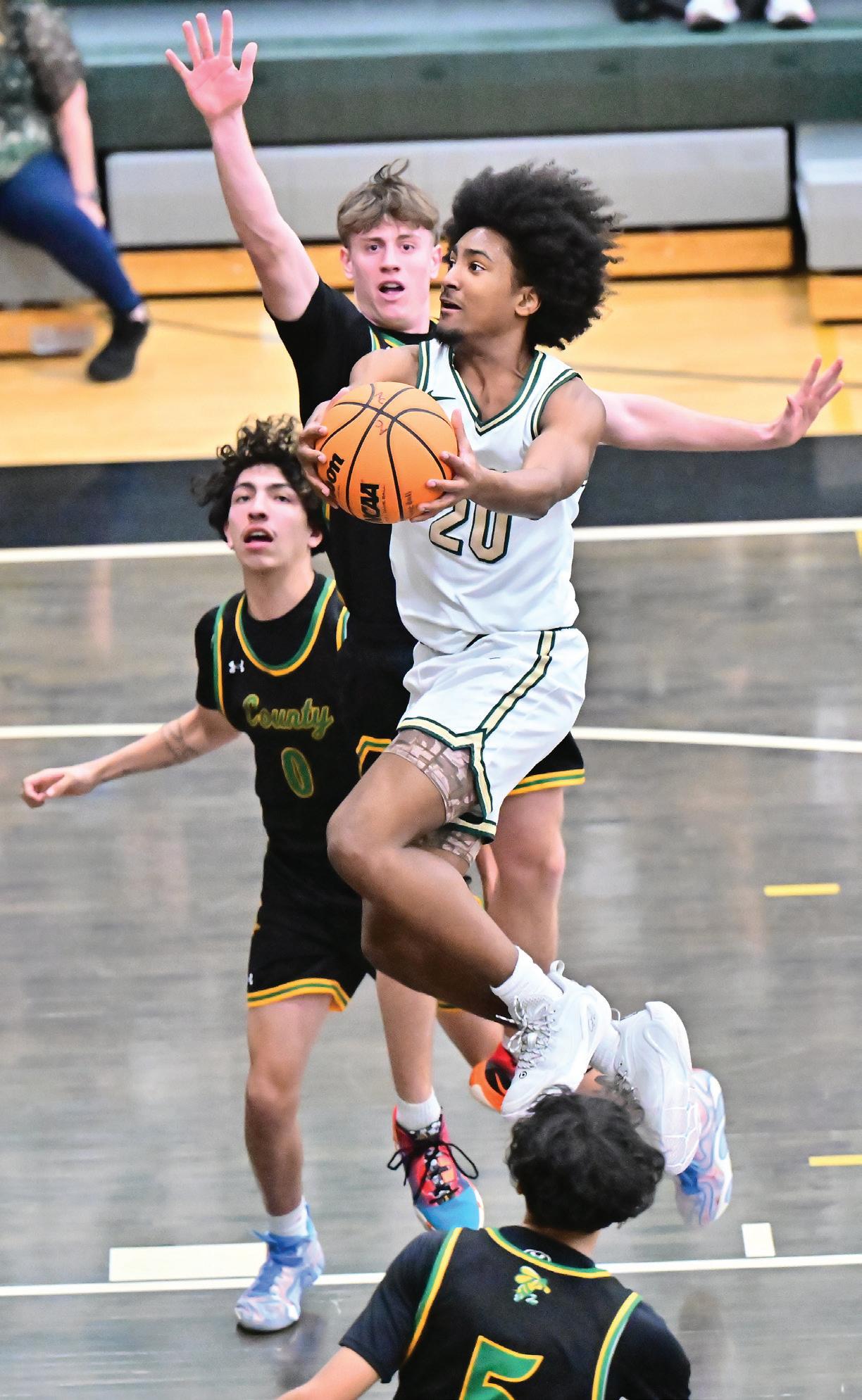
RIGHT: Aurora Central senior Jonties Brewer (20) gets through a thicket of Pueblo County defenders on his way to a layup during the second quarter of the Trojans’ 57-51 Class 5A boys basketball first round playoff loss on Feb. 24 at Aurora Central High School.
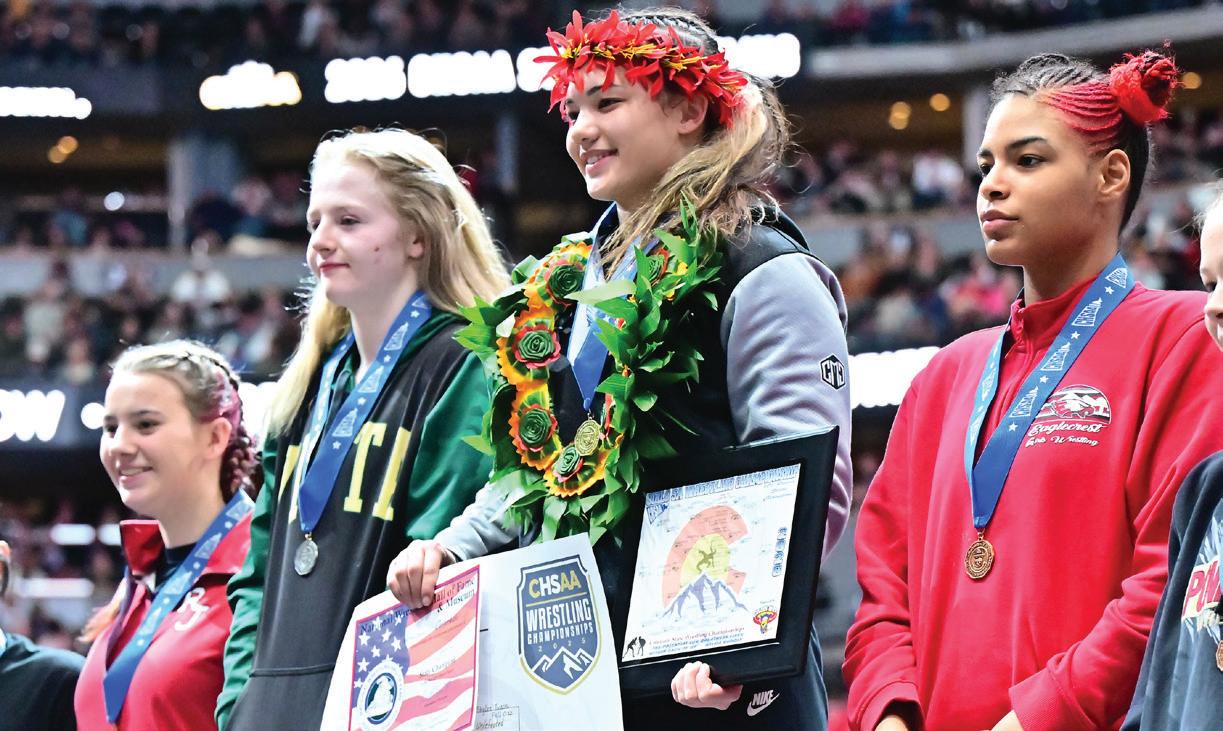
RIGHT: Eaglecrest senior Parice Jones, right, and Regis Jesuit’s Alexandra Zimmerer, left, finished third and fourth, respectively, at 170 pounds at the Class 5A girls state wrestling tournament Feb. 21 (see story, page 10). (Photos by Courtney Oakes/Aurora Sentinel)
qualify for the 5A state playoff bracket that was put out by the Colorado High School Activities Association Feb. 22.
GIRLS BASKETBALL
Cherokee Trail lands top seed, seven area teams eaern spots in 6A playoffs
SPRING SPORTS
5A state playoffs
Aurora Central falls in 1st round of
The Aurora Central boys basketball team got a home game to open the Class 5A boys basketball playoffs, but went no further in a 57-51 loss to Pueblo County Feb. 24.The hot-shooting and 33rd-seeded visitors took a double-digit lead with help from its 3-point shooting, then held on as the 32nd-seeded Trojans closed within three points in the fourth quarter before the rally fell short.
Jonties Brewer scored 12 points, Sohaieb Sufi-Mohamed added 11 and Deon Davis Jr. nine to lead Aurora Central, which finished the season 14-10 and remains looking for its first postseason win since 2021. The Trojans were the lone Aurora area team to
Despite a loss in its final game of the regular season, Cherokee Trail earned the No. 1 seed in the Class 6A girls basketball state playoffs in the bracket put out Feb. 22 by the Colorado High School Activities Association.
The only Aurora area qualifier set to play in the Feb. 25 first round (results unavailable at press time) was No. 28 Smoky Hill, which had a home game against No. 37 Fairview. The Buffaloes (13-10 after a sixth-place finish in the Centennial League Challenge) snapped a four-year postseason drought and could move into a Feb. 28 visit to No. 5 Northfield with a victory.
For more on all these stories, visit sentinelcolorado. com/preps
The Cougars lost to Arapahoe 56-51 Feb. 21 at Overland High School in the Centennial League Challenge title game, but just their third loss of the season in 23 games didn’t cost them anything in playoff positioning. Cherokee Trail position moved it on to the Feb. 28 second round along with five other Aurora area qualifiers in No. 11 Regis Jesuit, No. 15 Grandview, No. 17 Eaglecrest, No. 22 Overland and No. 24 Vista PEAK Prep.
Aurora area qualifiers with home games for the second round are Cherokee Trail — which awaits either No. 33 Rocky Mountain or No. 32 Boulder — Regis Jesuit, which welcomes in Overland for a noon area matchup and Grandview (the defending 6A champion, which opens at 11 a.m. against No. 18 Fort Collins). Eaglecrest heads to No. 16 Ralston Valley for a 1 p.m. contest, while Vista PEAK Prep visits No. 9 Legend at 3 p.m.
Second round winners move into the March 3 Sweet 16.
Visit sentinelcolorado.com.preps for updated Class 6A boys basketball state playoff scoreboard and schedule.
ICE HOCKEY
Quarterfinal doubleheader set in 5A playoffs for Regis Jesuit, Cherry Creek
As top-four seeds, the Cherry Creek co-op and Regis Jesuit ice hockey teams finally know their opponents for the quarterfinal round of the Class 5A state playoffs.
In a doubleheader set for Feb. 25 at South Suburban Sports Complex, the third-seeded Bruins skate first at 5:10 p.m. against sixth-seeded Mountain Vista, which topped No. 11 Lewis-Palmer 3-1 in the opening round. The fourth-seeded Raiders then go against No. 5 Denver — a 6-0 winner over Castle View — at 7:40 p.m.
Quarterfinal winners move on to the Feb. 28 semifinals at Ed Robson Arena in Colorado Springs. Cherry Creek and Regis Jesuit are on opposite sides of the bracket, so would not meet unless it was in the 5A state championship game March 2 at Magness Arena.
Official practice begins for spring sports season
The last of the three prep sports seasons of the school year — spring — began for boys swimming and boys volleyball on Feb. 16, as those sports were allowed to begin practice as they work towards the opening of competition Feb. 26.
The remainder of spring sports got going Feb. 23, as the Colorado High School Activities Association allowed baseball, girls soccer, boys and girls track & field, boys and girls lacrosse, girls tennis and girls golf to join the mix with practices.
The girls golf regular season can begin on the same date as boys swimming and boys volleyball, while girls soccer can kick off Feb. 28 and the rest swing into action March 5.
Last spring was very successful in the Aurora area, especially in track & field, where the Cherokee Trail boys have won three Class 5A state championships in a row, while the Eaglecrest boys volleyball team is the other defending state team winner.
HIGHER CALLING FOR AURORA POLICE
Cops say drones give crime-fighting a new advantage. Critics say it needs regulation
BY CASSANDRA BALLARD, Sentinel Staff Writer
Last summer, Dr. P.J. Parmar and his friends noticed a drone frequently flying around Mango House in Aurora and the nearby Martin Luther King Library on East Colfax Avenue.
At first, they had no idea who was flying the drone and why, but they felt like they were being watched.
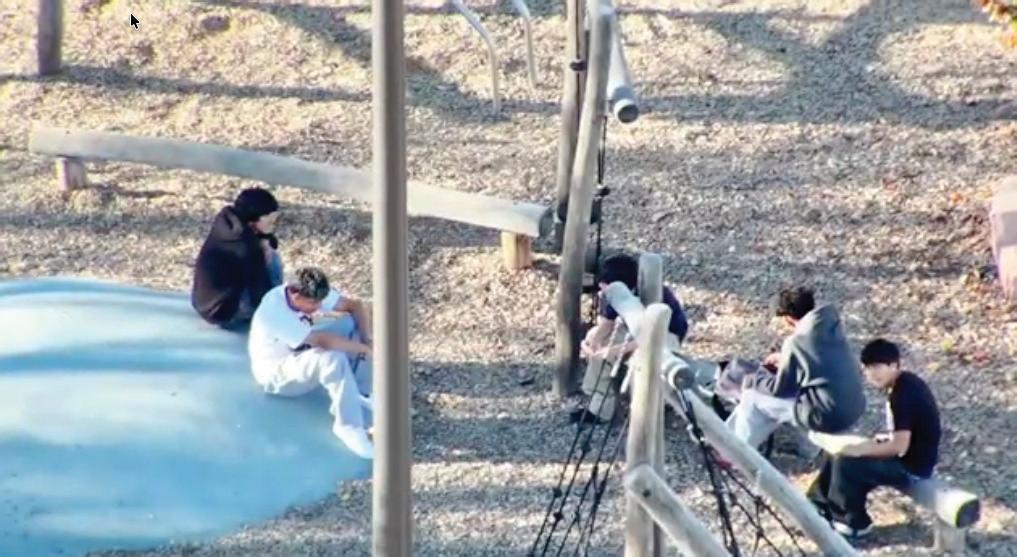
One day, Parmar’s friend, who spoke with the Sentinel after asking to keep her identity confidential, noticed the drone hovering over her for long periods while she was playing basketball on private property. She plays in a private location across from Mango House, which Parmar owns. The shopping and restaurant plaza is also home to his clinic, which provides healthcare to the region’s immigrant and refugee community. She said it felt like the drone was spying on her.
Soon after, Parmar and his friends learned the drone belonged to Aurora police.
Parmar and his friend, along with a healthcare worker who also works with Parmar at Mango House, Jan Kalkus, were not reassured by the fact that the police department took months to announce the new drone to the public. Kalkus figured out how to track the drone using publicly available information, and they grew more concerned about the routes it took and where it hovered, suspecting it was not just flying for first-responder calls like the Aurora Police Department said it was.
When they asked the police department about it, they said they felt like they weren’t taken seriously.
The Sentinel, through open records requests, acquired video from a day Parmar indicated they saw the drone at length. It did not reveal any camera shots of the basketball court or even the Mango House building.
The news, and even seeing the drone, did little to reduce Parmar’s suspicion, a growing problem across the country as police de-
partments acquire drones. Public skepticism comes as police departments like Aurora say drones are excellent tools for officers to better protect the public, especially faster than ever before.
Police departments, including Aurora Police, have been quietly introducing new hardware, technology and accessories to support policing amid a period without regulation, raising concerns about transparency and the long-standing question of surveillance versus safety.
Police say drone use can help with monitoring crime hotspots, reduce the chances of an officer-involved shooting of a civilian, and reduce injuries and other damage from a police pursuit. Drones can act as first responders or assist with patrolling and getting officers into dangerous areas without endangering themselves or others. Since the drone has been added to the Aurora Police Department, it has recovered five stolen vehicles, aided in locating a wanted fugitive for the U.S. Marshals Service, and tracked down a suspect in a fatal hit-and-run, according to the Aurora Police Department.
Critics, however, question the risks to public privacy when police buy into the technology.
“The industry that provides technology to law enforcement is one of the most unregulated, unexamined and consequential in the United States,” Electronic Frontier Foundation Senior Policy Analyst Matthew Guariglia said in a statement.
The Electronic Frontier Foundation is a nonprofit that defends civil liberties in the digital world. They collaborate with the University of Nevada, Reno, Reynolds School of Journalism on a police surveillance database called the Atlas of Surveillance.
There is little to no legislation governing much of the new technology police departments are using, and that’s what seems to be the biggest problem for those concerned
about how it will be used. The Aurora Police were never required by city council nor state lawmakers to tell the public that they bought a drone or that they plan to have six more throughout the city in the coming months.
The Aurora Police, however, appear to have done a better job than many police departments across the nation in creating policies for transparency and oversight of their new and ever-improving technology, without being required to do so by lawmakers. Even the publicly available transparency portal, which shows flight paths from the previous week and a flight dashboard, was voluntarily created.
Denver also quietly announced their drone program featuring a voluntary transparency portal showing flight paths from earlier in the day.
Police are also not required to inform the public about any add-on technology to the drones, such as license plate readers, although Aurora Commander Patrick Shaker said any add-ons in Aurora would be addressed with the public. He said that much of the reason the department did not immediately disclose its drone use was that it was still testing them and deciding which drone company to sign a contract with.
Any government use of artificial intelligence linked to facial recognition in Aurora must be reported to the city council and the public, per state Senate Bill 22-113.
“We’ve been very open and transparent about all the stuff that we’ve been doing with these technologies, and we want to make sure that we’re being completely forthcoming with everybody,” Shaker said. “So that would be part of that process, is, hey, here’s what we’re doing. Here’s why we’re doing it.”
The city signed a contract last year with Flock for its drones, allowing them to use add-ons at a future date that also integrate with Flock’s camera capabilities. The only current abilities the department has, ac-
cording to Shaker, are thermal imaging for low-light or night use, integrated city mapping and automatic flight options for preplanned flights.
“Once you have a camera on almost anything, you can retroactively apply all sorts of biometric analysis, like face recognition,” said Senior Investigative Researcher for the Electronic Frontier Foundation Beryl Lipton. “It’s very easy to update software at this point and update these sorts of AI-driven analyses in a way that doesn’t necessarily require new hardware or require some sort of public oversight.”
Shaker said that, based on his current knowledge, Aurora drone footage is stored for 90 days for investigative purposes and is not being integrated with the rest of the Flock system.
“Clearview AI does not have access to closed sources like our Body Worn Cameras, city-owned cameras or drone footage,” said Aurora Police Public Information Officer Matt Wells-Longshore in an email. “The footage is stored on CJIS-compliant cloud servers where APD retains 100% ownership and control of the data. If there is footage captured of evidentiary value, the pilot will download such footage from the drone and upload that footage into Axon in accordance with policy.”
Lipton added an example of how Real Time Crime Center distributors, such as Axon Fuses, promote a feature they enjoy publicizing: Departments can ask the system to look up a red Ford Focus, and the system can search its available data.
“We know, as consumers, that’s technologically possible, and it’s a thing that they are doing in the Aurora Real-Time Information Center,” Lipton said. “So it’s not conspiratorial to think like you could do that with faces, too. They can do it with almost anything, and it’s just a matter of sort of the public appetite for getting to that point.”
An Aurora police drone’s eye view of boys on a playground in northwest Aurora. Date of the video still is unknown.
Wells-Longshore said that drone footage can not be fed into Aurora’s Real Time Information Center in that specific way.
Until 2025, the New Orleans Police Department worked with a private nonprofit group called Project NOLA, which still operates a network of more than 200 cameras using live, real-time facial recognition. The program was the first known real-time facial recognition system used in the United States and was halted in May 2025 after it was deemed in violation of city ordinances.
The partnership was considered to be a loophole around the ordinance until city officials were alerted.
“Communities really need to be thinking about and having some policy around and making it really explicit, because, otherwise, it’s really unclear sometimes where that data goes, or who they think owns it, or what the appropriate use cases are for, footage or possibly audio or other pieces of information that are just gathered through police surveillance,” Lipton said.
Internal sharing of data between police departments, federal and state agencies, and even data brokers currently lacks legal guidelines. Colorado’s Department of Motor Vehicles, for example, is known for selling information to data brokers, according to media reports. Lipton said there are many ways for different agencies to allow access to their crime center data, including password sharing, ongoing access, and collaborations.
Currently, the Aurora Police Department does not share its drone footage with any other agency unless a specific drone video is requested for an investigation, police said. There is no ongoing standing or general access. Shaker said there are also individual passcodes for each employee, which help account for who is taking what actions.
As for federal agencies, Shaker said there are only two that they share data with.
“There are safeguards in place to require them to basically identify the reason why they’re getting that access, and we prohibit as an agency, them from doing any kind of civil immigration enforcement specifically with that data,” Shaker said. “So that’s not what that data is for. Currently, there are only two agencies federally that we share with, and that is Wright Patterson Air Force Base and the US Postal Service, but we also have the capability here at Aurora, anytime we wish, we can turn off access to any federal agent or to all federal agencies.”
All data and information collected is exclusively for official law enforcement purposes and must adhere to all Colorado State laws, Wells-Longshore said.
Flock and many other technology companies that have been advertising to police departments nationwide have been notorious for overpromising, making unsubstantiated claims, and manipulating statistics, according to the Center for Justice Journalism, the Electronic Frontier Foundation and the Independent Intelligence for Physical Security.
Drones are used by fire departments and police departments, mainly as first responders and for
patrolling for incidents including fires, car accidents and even drug overdoses. More than 1,200 law enforcement agencies in the United States operate a drone program, according to the Atlas of Surveillance.
Flock, a $7.5 billion company, previously promised in its advertising that its license plate readers would “eliminate crime” and that 10% of reported crime in the United States is solved using its tools.
An investigation by Forbes in 2024 highlights multiple academic reviewers who said many of Flock’s claims were “problematic,” and one of the researchers who was cited on the claim as providing “oversight” said he would have done the study differently himself and that the data is too inconsistent to make a meaningful statistical analysis, according to 404 Magazine.
“Most Americans would rightfully be horrified to know how many decisions about policing are made: not by public employees, but by multi-billion-dollar surveillance tech companies who have an insatiable profit motive to market their technology as the silver bullet that will stop crime,” Guariglia said in a statement.
Other cities seem to be testing the waters with what they have added to their surveillance technology.
In January, the Baton Rouge Police Department introduced a 16-foot military-grade drone to its fleet, capable of conducting longrange surveillance.
Internally at the Aurora Police Department, there are many public-facing policies and safeguards in place to prevent the misuse of the drone and other Flock technology. Shaker also said they have a city auditor who audits only the police department.
“We’ve recently stood up our Office of Constitutional Policing, through Chief (Todd) Chamberlain’s direction,” Shaker said, which is part of a quality assurance unit that is made up of a sergeant as a technical expert on law enforcement, data analysts and a manager of the unit, who has a background in the auditing and assessment of agencies and their policies and practices.
“That is something that we’re going to continually monitor, because they will do either in-depth or dives into the information, the data we have to make sure that we’re following our policies and procedures, and we are doing what is best practice, not only for us, but as well across the nation,” Shaker said.
The drone pilot is located inside the Real Time Information Center at the Aurora Police Department. The pilots are accompanied by their supervisor and several other employees who monitor the Flock cameras and other technology in the crime center. So, past incidents, such as an officer using a police database for personal use, are far less likely to occur with witness oversight and regular audits.
All surveillance technology is also subject to Fourth Amendment protections against unreasonable searches and seizures, Shaker said. One policy that Aurora police and many police departments use is to aim their cameras at the horizon as they move to the next location, so as not to record into people’s private property.


Although they will “patrol” heavily populated streets and roadways, Shaker said it is primarily for responding to car accidents and other crimes they might encounter while flying along. Hot-spot policing, in which officers monitor highcrime areas, is also part of the department’s drone-use policy.
Experts say laws regulating police activity make no distinction between patrolling and surveillance. Police in squad cars, unmarked cars or using drones are unrestricted as long as they are in public spaces.
“If we had a drone that wasn’t going to a call for service and we didn’t have a specific hotspot that we were concentrating on, we most commonly see it along Colfax Avenue,” he said. “The operators will fly it over Colfax, and they’ll look down at Colfax as they’re going along, because it’s a public street. I heard the other day that they caught an accident out there.”
The Sentinel acquired drone video footage from the day when Parmar’s friend was playing basketball through a public records request. Parmar, Kalkus and their friend were able to see what the drone was looking at, and although it did not seem to be watching his friend play basketball, it did not ease their suspicions.
The footage obtained from the police on that day did not include time or date stamps, raising questions for Parmar about whether it was the correct footage. The footage also starts and stops abruptly, making it hard to tell if the footage was edited.
Wells-Longshore said that irregular flight patterns and extended hovering could be due to training, testing, waiting for the next location, observing a subject farther away, or assisting with patrol at a distance.
“They are expected to monitor computer-aided dispatch calls for service, listen to the radio, be aware of what’s currently happening inside of the (Real Time Information Center), and much more, all while monitoring their altitude, wind speeds, local air traffic, weather conditions, and the condition of their drone,” Wells-Longshore said. “There is no training simulator to learn how to fly these drones. Officers, after receiving their licenses, must spend time in the (Real Time Information Center) with a drone pilot and practice flying the drones and learning how they operate. This is typically several 4-6 hour “fly-along” shifts, but can be longer depending on the pilot.”
The footage obtained by the Sentinel mostly showed what ap-
peared to be training and testing, along with some patrolling, such as one instance in which the drone followed a car crash. Another portion in the video from that day depicts the drone watching a man smoking a substance that Wells-Longshore said looked like “crack rocks.” Despite the extended video recording of the man, about six minutes, no police action was taken against the man.
Police said the video provided to the Sentinel covers all flights in that three-hour period. It elicited no comfort from Parmar.
“The big picture is that it doesn’t matter if it’s everything. I don’t think getting the videos does much for the main problem, which is that no one wants to feel like they are being watched on their own property, which is what we felt like was happening,” Parmar said. “We observed the drones overhead for long periods of time, repeatedly, over private property. The point isn’t to play a cat and mouse game with the videos trying to find that. It is the feeling of being watched, when we can see the drones overhead, in a historically low trust situation (of the police). If it sticks to the main roads and public places like parks/schools, and does not hover over private property, that would be great.”
A heat-camera view of northwest Aurora from an Aurora police drone.
A police drone in Georgia surveys the scene just after a bank robbery there. AP FILE PHOTO

prisoners, right?’”
“But if you have to get permission to leave and you have to come back,” Emersen said she told him, “you’re not free.”
Students let Amache visitors make up their own minds
A large group had just left the museum last summer when the students found something alarming tacked up in a semi-private cubicle where survivors and their descendants leave handwritten remembrances.
Next to note cards describing how one person’s mother had to report for removal a week after giving birth, and how another’s parents met at Amache, were the words “WE HAVE LEARNED NOTHING” and articles and photos about “Alligator Alcatraz,” the immigrant detention center recently built in the Florida Everglades.
The students don’t know if someone from that group put up the Alligator Alcatraz display, or if any visitors saw it.
“The person probably thought, ‘Oh, the people who work here or the people who are coming to visit, they would agree with what we’re putting up,’” Emersen said. “But the museum is supposed to be about the Japanese Americans, and putting up stuff like that takes away from what people are trying to learn.”
Out at the camp, next to the QR code, another visitor left their sarcastic take on what a positive version of the incarceration story might look like.
“It was the Spring of 1942 and President Roosevelt decided to treat people of Japanese descent to a fabulous free vacation at one of ten fantastic luxury resorts built just for the occasion,” it began.
Students worried that visitors might take it at face value.
“When people go there, they don’t expect something sarcastic,” said Destiny Garcia, also a senior at Granada High School and a member of the Amache Preservation Society. “So some people might have taken it serious, and that’s misinformation being spread.”
Granada students don’t see their
work as political. They also believe Amache has lessons for today. “This can happen again,” Emersen said. “The Constitution hasn’t changed. Everything you see here, it could happen to another person again.”
A former Japanese American incarceration site at Fort Bliss in Texas has been reopened as an immigrant detention site. Several states are using an obscure law, last used to identify Japanese immigrants for relocation, to bring criminal charges against unauthorized immigrants who fail to register.
Today a majority of Granada students are Hispanic. Destiny said she worries about people being questioned or detained based just on their appearance. But the goal of the Amache Preservation Society is to present historical facts, not tell people what to think.
“We leave political opinions for the visitors to conclude,” Destiny said.
Amache offers students the chance to be historians
Hopper knew about Amache back when very few people talked openly about it. He grew up about an hour away, and a friend of his parents had been interned there. And whether people talked about it or not, signs of that history were everywhere.
The town used portions of the Amache site as a landfill and a fairgrounds. The physical materials of Amache, auctioned off after it closed, were scattered around the region. The Amache hospital laundry became the school district’s bus barn. Some residents grew up eating out of Amache’s soup bowls.
Hopper, who sports a mustache, has a quality particular to the best teachers, who can command kids’ attention and get them to do things they didn’t think were within their reach. But when he was young and inexperienced, he was looking for ways to make history more engaging. He was also curious about Amache, so he put his students on the case.
Starting with just a few addresses, they sent questionnaires to survivors. These interviews expanded the his-
Americans to leave the West Coast, Mitch Homma’s grandfather Kyushiro Homma lost a thriving dental practice in Los Angeles that served Hollywood actors and University of Southern California football players. He died in Amache, most likely of a heart attack or stroke, at just 44 years old.
Homma’s father, Hisao, was 8 years old at the time.
Homma is now the president of the Amache Alliance, a California-based group that represents survivors and descendents. He didn’t learn much about his family’s story until his grandmother died in 2004, and he uncovered a trove of photographs — prewar family photos that church friends had saved and camp images his grandfather had taken with cameras smuggled in with his dental equipment.
Digital copies of those photographs — a rare find in a community forced to abandon family albums and restricted from taking new photos in camp — are now part of the Amache Museum’s collection. A panel tells the Homma-Wada family story.
Exploring that story wasn’t easy. Homma’s first trip to Amache with his father opened old wounds.
torical record of what happened there and slowly built trust with people who had not always been welcomed back when they started making pilgrimages in the 1970s.
Working with the school’s math teacher, students built a scale model of Amache. They calculated the slope of the site and measured barracks’ foundations to get it right. Drawing on his graduate school archeology experience, Hopper taught the students how to build sifters and took them to look for artifacts.
Students loved the chance to be historians and not just read about history. They formed bonds with survivors and their descendants, who entrusted them with artifacts and sought their help in researching family stories.
“It’s not just state standards this, state standards that,” Hopper said. “It’s practical knowledge of how to do things and how to do it correctly and how to use critical thinking skills to figure it out.”
Hopper got a tip after a local rancher died that the camp’s old water tank was in a field some 20 miles away, where it had been used to water cattle. But the estate was tied up in probate, and things were getting ugly.
Hopper gave the job to a student because he knew it would be harder to say no to a kid.
“He had to call 43 different people from that family,” Hopper said. “He called cousin Eddie and cousin Betty. He called this person and that one to get to the right person. And that person said, ‘It’s yours, but you got to get down there now and get it off.’
So that’s what we did.”
The restored water tower is now one of the site’s defining features. Ellis, who felt scared when she drove past as a child, can see it from her window. Now it fills her with awe.
“They got to have been very strong and courageous people to be plunked down in the middle of that prairie and do what they did,” she said. “And then to find out they were American citizens.”
Granada students’ work changed minds at home
When the Army ordered Japanese
An Interior Department spokesperson denied that changes underway at other sites involve diluting or rewriting history. In an email, the spokesperson said the National Park Service is doing routine reviews and maintenance “to ensure accuracy, honesty, and alignment with shared national values” to comply with President Donald Trump’s executive order on “Restoring Truth and Sanity to American History.”
Visitor comments in response to the QR code reviewed by Chalkbeat overwhelmingly supported telling the full history of Amache.
“I think our country is strong enough to understand the history of our nation in its totality, and I think that anything less than that makes us weak,” one person wrote.
Changes are coming for Amache, though. Existing signage includes a mix of materials put up by the Amache Preservation Society, Colorado Preservation Inc., and others over the years. Some signs are sunbleached and hard to read.
“When Dad got off the bus, and I saw the look on his face, I thought I was the worst son in the world,” Homma said. “You could see all the memories coming back. When I pushed and probed, he would remind me: ‘Amache took my father.’”
President Ronald Reagan apologized for Japanese American incarceration in 1988 — the result of decades of Japanese American activism that sometimes divided the community.
But anti-Japanese sentiment from the war years remained widespread when Hopper started this work.
Then-Granada mayor Alan Pfeiffer told the alternative weekly Westword in 2001 that he didn’t see much value in learning about Amache. Pfeiffer’s father had been at Pearl Harbor and “didn’t have a good taste for the Japanese up to the day he died,” he said.
At one point, Hopper said, a woman came all the way from Idaho to confront him while he was working with students at the cemetery. She demanded to see his curriculum. He told her it was public knowledge, and she was welcome to review it.
In the face of skepticism and hostility, Hopper urged his students to stick to the facts. Their presentations were backed by primary source documents and vetted by survivors. Everything they told people about Amache, they could explain how they knew it to be true.
Slowly, attitudes changed. When Amache became a national historic site, Granada Mayor Argie Thrall Jr. issued a statement of support.
“It was the kids who changed the minds of their parents and other people in their region,” Homma said. “I always refer to them as little educators.”
Amache story remains in the hands of students and descendants
So far, no changes have been made at any of the six Japanese American incarceration sites in the NPS system, according to both parks supporters and the Interior Department, which oversees the National Park Service.
Now that Amache is a national historic site, Japanese American organizations, academic experts, and others are working with the National Park Service on planned updates. Homma worries about the park service’s larger educational mission, but he said initial reviews of new material have gone well.
Advocates for Amache are choosing their language carefully. They don’t want to sanitize the story and risk people “thinking it was a YMCA summer camp,” Homma said. Nor do they want to “jab the government in the eye.”
“The site’s not there to make people feel horrible about what happened,” Homma said. “It should never happen again. I’m not trying to water that down. But there are great stories of resiliency.”
Those incarcerated at Amache coaxed vegetables from the soil with farming techniques brought from California. They published newspapers and formed dozens of clubs. Young men and women volunteered for military service at the highest rate of any camp.
That perseverance is a message Tanner Grasmick also hopes to impart on visitors. As a student, talking directly to people who were “uprooted from their home and had to move to the middle of nowhere and make the best of it” made a deep impression on him.
Inspired by Hopper, Grasmick became a teacher and returned to Granada. Hopper is officially retired, though he still works part-time, and Grasmick has taken over running the Amache Preservation Society. Students are already talking to him about wanting to join next year.
The museum remains in the control of the Amache Preservation Society, so the federal government won’t dictate the stories it tells. And as Grasmick steps up to guide students, Hopper said he’s playing the role of the superintendent who had his back when he was a young teacher. If there’s any heat to be taken, he’ll take it.
Grasmick said he feels supported by a community that once wanted Hopper to back off.
“We tell the story as it is, regardless of how uncomfortable it might be, regardless of anything,” Grasmick said. “If that’s the story that happened, we’re going to tell it how it was.”
The Amache Museum collection includes posters ordering people of Japanese ancestry to report for evacuation and suitcases that community members carried on the journey. Granada students research artifacts and write interpretive text with support from graduate students and faculty from the University of Denver. Michael Noble Jr. for Chalkbeat
scene & herd

“Rite and Rach” with Symphony of the Rockies
Two towering masterpieces anchor an evening of music and legacy as Symphony of the Rockies partners with the Colorado Women’s Hall of Fame for a special concert Saturday, Feb. 28, at Gates Concert Hall. Billed as “Rite and Rach”, the program pairs Sergei Rachmaninoff’s virtuosic “Piano Concerto No. 3” with Igor Stravinsky’s groundbreaking “The Rite of Spring”, offering audiences a night of sweeping emotion and rhythmic intensity.
The concerto will be performed by pianist Jiarui Cheng, the 2024 Gold Medalist of the International Keyboard Odyssiad and Festival and a rising international star. Widely regarded as one of the most technically demanding works in the piano repertoire, Rachmaninoff’s Third Piano Concerto blends lyricism with dazzling athleticism, giving soloist and orchestra alike a chance to shine.
The second half of the program features Stravinsky’s “The Rite of Spring”, the primal, pulse-driven masterpiece that forever altered the course of 20th-century music. Known for its driving rhythms and bold orchestration, the work remains one of the most thrilling experiences in the symphonic canon.
In honor of the start of Women’s History Month, concertgoers are invited to arrive early and explore a special exhibit curated by the Colorado Women’s Hall of Fame in the Gates Concert Hall lobby. The display highlights a diverse selection of inductees — including teachers, scientists, social activists, philanthropists, authors, artists, aviation pioneers, a Cheyenne princess and a symphony conductor — whose achievements helped shape Colorado and beyond. The exhibit will be available before the performance and during intermission.
IF YOU GO
Date: Feb. 28 7:30 p.m.
Place: Newman Center for the Performing Arts, Gates Concert Hall, 2344 E. Iliff Ave.
Tickets and details: $14 online at www.symphonyrockies.org
”The Langston Hughes Project: Ask Your Mama (12 Moods for Jazz)”*
Langston Hughes’ kaleidoscopic jazz poem suite takes center stage when the Lakewood Cultural Center hosts “The Langston Hughes Project: Ask Your Mama (12 Moods for Jazz).”
The event features the award-winning Ron McCurdy Quartet, the dynamic multimedia production blends spoken word, live jazz, history, poetry and visual art in a sweeping tribute presented in conjunction with Black History Month. Named “Live Experience of the Year” at the 2016 JazzFM Awards in London, the production brings Hughes’ masterwork to vivid life. Written in
the early 1960s, “Ask Your Mama” is a homage in verse and music to the struggle for artistic and social freedom at home and abroad. Through words, sound and imagery, the piece captures a pivotal cultural moment bridging the Harlem Renaissance, the Beat Writers’ coffeehouse movement and the Black Arts performance explosion — a vibrant and tumultuous era whose influence continues to resonate. Kabin Thomas, classical music host for Colorado Public Radio, lends his voice to Hughes’ powerful text as part of the performance.
Trumpeter and scholar Ron McCurdy, Ph.D., followed Hughes’ original musical cues — rooted in blues, gospel and Latin rhythms — to compose an original score for the poem. Joined by piano, bass and drums, McCurdy and his quartet create a richly textured accompaniment that makes heads bob, fingers snap and feet tap as audiences are immersed in this multifaceted work.
The concert is accompanied by a broader community celebration of words and art. The Cultural Center’s North Gallery will present “Words Matter: Works Inspired by How the Written and Spoken Language Shapes Our Lives”, a group exhibition running from late January through March.
IF YOU GO:
Date: 7:30 p.m. Feb. 28. A free public gallery reception at 6 p.m. will feature additional youth performances and opportunities to meet the exhibiting visual artists.
Place: Lakewood Cultural Center, 470 S. Allison Parkway
Tickets: $33–$50 at Lakewood.org/LCCPresents or call 303-987-7845.
“The Runner Stumbles” at The People’s Building
A gripping dramatic thriller unfolds at The People’s Building as “The Runner Stumbles” explores forbidden love, human frailty and moral ambiguity in a remote Michigan parish. Written by Milan Stitt, this intimate production alternates courtroom testimony with flashbacks that reveal the complexity of relationships between a priest and a nun, leading to emotional revelations and narrative twists that keep audienc es questioning justice, faith and human desire.
IF YOU GO:
Date: Feb. 26, 7:30 p.m.–9 p.m.
Place: The People’s Building, 9995 E Colfax Ave.
Tickets: $10–$18
Info: www.thepeoplesbuilding.com or 720-819-6680
9 to 5: The Musical — Vintage Theatre
Inspired by the beloved 1980 film, *9 to 5* returns to the Vintage Theatre stage with music and lyrics by Dolly Parton and book by Patricia Resnick. The story centers on three female of fice workers fed up with workplace inequality who fantasize about over throwing their sexist boss. Packed with infectious songs and dynamic cho reography, this upbeat musical cele brates ambition, female empowerment and camaraderie in the workplace, with plenty of heart and hilarity along the way.
IF YOU GO:
Dates: Fri., Feb. 27 & Sat., Feb. 28 at 7:30 p.m.; Sun., Mar. 1 at 2:30 p.m.
Place: Vintage Theatre, 1468 Dayton St., Aurora, CO
Tickets: $28–$45
Info: www.vintagetheatre.org or call 303-856-7830
Fox Flix: “Vertigo” film screening — Aurora Fox Arts Center
Classic cinema fans can catch Alfred Hitchcock’s 1958 suspense thriller *Vertigo* as part of the Fox Flix series at the historic Aurora Fox Arts Center. The screening is a chance to appreciate one of the most psychologically complex and beautifully shot films in cinematic history on the big screen, complete with original score and chilling performances that have influenced decades of storytelling.
IF YOU GO:
Date: Thu., Mar. 5, 7 p.m.–8:30 p.m.
Place: Aurora Fox Arts Center, 9900 E. Colfax Ave.
Tickets: $5
Info: www.aurorafoxartscenter. org or call 303-739-1970
“Bella Bella” at the Vintage Theatre Cabaret Stage
In this raucous, poignant solo play by acclaimed writer and performer Harvey Fierstein, audiences meet Bella Abzug — a larger-than-life political icon awaiting election night results in a Manhattan hotel bathroom. Fierstein’s signature blend of humor and heart illuminates Abzug’s fierce wit and political courage as she navigates the chaos of life, ambition and identity in 1970s New York.
IF YOU GO:
Dates: Mar. 3 and Mar. 4, 7:30 pm.–9 p.m.
Place: Vintage Theatre, 1468 Dayton St.
Tickets: $30–$45
Info: www.vintagetheatre.org or call 303-856-7830
Ecosystems: Opening Reception
at Downtown Aurora Visual Arts
Celebrate the opening of “Ecosystems,” a printmaking exhibition at Downtown Aurora Visual Arts reflecting biodiversity and environmental dialogue through the medium of print. The show features work by local and guest artists, and the opening reception in-
IF YOU GO:
Date: Mar. 6, 4 p.m.–9 p.m.
Place: Downtown Aurora Visual Arts, 1405 Florence St.
Tickets: Free
Info: www.davarts.org or call 303-367-5886
Library Teen Roundup: Black History Jeopardy at Aurora Public Library
Teens ages 12-18 are invited to test their knowledge of Black history in a game-show style Jeopardy competition. Participants will play in teams or individually, answering questions drawn from Black history, culture and achievements, with snacks and prizes provided. This engaging activity builds knowledge and community among youth.
IF YOU GO:
Date: Thursday, Feb. 26, 4 p.m.–5:30 p.m.
Place: Aurora Public Library –Central Activity Room, 14949 E. Alameda Parkway
Cost: Free Info: 303-739-6600 and auroraco.libnet.info/events
9 to 5: The Musical — Vintage Theatre Opening Night
Based on the iconic film, this musical comedy features songs by Dolly Parton and celebrates female empowerment with high-spirited choreography and humor. Its February launch makes it a perfect Valentine’s weekend outing.
IF YOU GO:
Date: Fri., various curtains through March 29.
Place: Vintage Theatre, Aurora Tickets: $28–$45
Info: www.vintagetheatre.org or call 303-856-7830
Lunar New Year
Celebration at Stanley Marketplace
Stanley Marketplace invites the community to celebrate the Year of the Horse with lion dancers, festive music, cultural performances, family activities, and more. This annual event showcases tradition, community spirit, and a lively multicultural program suitable for all ages.
IF YOU GO:
Date: Feb. 28, 4 p.m.–6 p.m.
Place: Stanley Marketplace, 2501 Dallas St.
Tickets: Free Details: www.stanleymarketplace.com or call 303-800-9975
• Great Burgers
• GreatBurgers
• GreatBurgers
• Great Philly Cheesesteaks
• GreatCheesesteaks
• GreatCheesesteaks
FEBRUARY 27 8PM WALKER WILLIAMS Country FEBRUARY 28
• 20 TV’s
• 20 TV’s
• 20 TVs
• Open St age
EveryThursday
• Open St age EveryThursday
• Watch All NFL & MLB Games
8PM | CHRIS SHONKA Acoustic Bday Show MARCH 6 8PM ETHYL & THE REGULARS Americana MARCH 7
• Saturdays:11:30AM-3PM
• Saturdays:11:30AM-3PM
• Open Stage
FreeDomesticBeeror
FreeDomesticBeeror
8PM JIM HYATT BAND Classic/Country MARCH 13
Soda With SandwichOrder
Soda With SandwichOrder
Give us a call for entertainment questions
8PM | AFTERSHOCK Classic Rock MARCH 14

8PM | GALEN CRADER Irish Music

NOTICE TO AMEND THE 2025 BUDGET
EAST BEND METROPOLITAN DISTRICT
NOTICE IS HEREBY GIVEN that the Board of Directors of the East Bend Metropolitan District, of the County of Arapahoe, State of Colorado, will consider amending the District’s 2025 budget at a regular meeting to be held on Thursday, March 12, 2026, at 2:30pm. The meeting will be held virtually via Zoom Videoconference. A copy of the proposed Budget Amendment is on file at the office of the District located at 7995 E Prentice Ave, Suite 100, Greenwood Village, CO 80111, and is available for public inspection. Any interested elector of East Bend Metropolitan District may file any objections to the Resolution at any time prior to its adoption by the Board of Directors of the East Bend Metropolitan District at the above-stated meeting. The meeting is open to the public. Zoom Meeting Link: https://us06web.zoom.us/ j/83201931916?pwd=OdBIaoE4kp2HWZBOxMmrtLR3rEcche.1
Meeting ID: 832 0193 1916 Passcode: 697395
BY ORDER OF THE BOARD OF DIRECTORS OF THE EAST BEND METROPOLITAN DISTRICT /s/ COMMUNITY RESOURCE SERVICES OF COLORADO
Publication: February 26, 2026 Sentinel SECOND CREEK RANCH METROPOLITAN DISTRICT
NOTICE OF FINAL PAYMENT
Re: Public Works Construction/Improvement Contract Streetlight Design and Installation Tibet Road Phases 2 and 3 Project Pro Systems Professional Electrical Systems, Inc.
CONTRACT DATED: August 21, 2023
Notice is hereby given that the SECOND CREEK RANCH METROPOLITAN DISTRICT (the “District”), Adams County, Colorado, will make final payment on or after the March 15, 2026 to Pro Systems Professional Electrical Systems, Inc. (the “Contractor”), for all work done by said Contractor for the above-referenced project concerning construction work performed.
Any individual, corporation, government or governmental subdivision or agency, business trust, estate, trust, limited liability company, partnership, association, or other legal entity that has furnished labor, materials, sustenance, or other supplies used or consumed by such Contractor or
its subcontractors, in or about the performance of the work contracted to be done or that has supplied laborers, rental machinery, tools or equipment to the extent used in the prosecution of the work, and whose claim therefor has not been paid by the Contractor or its subcontractors, at any time up to and including the time of final settlement for the work contracted to be done, is required to file a verified statement of the amount due and unpaid, and an account of such claim, to the SECOND CREEK RANCH METROPOLITAN DIS-
TRICT, c/o Schedio Group, LLC, 809 14th Street, Suite A, Golden, Colorado, 80401
Attn: Graham Gevirtz, with a copy to: Icenogle Seaver Pogue, P.C., 4725 South Monaco Street, Suite 360, Denver, Colorado 80237, on or before the date and time hereinabove shown. Failure on the part of any claimant to file such verified statement of claim prior to such final settlement will release the District, its Board of Directors, officers, agents, and employees of and from any and all liability for such claim.
BY ORDER OF THE BOARD OF DIRECTORS SECOND CREEK RANCH METROPOLITAN DISTRICT
First Publication: February 26, 2026
Final Publication:March 5, 2026 Sentinel
VEHICLE FOR SALE
2024 KIA EV6
VIN-204683
Extreme Towing
303-344-1400
Publication: February 26, 2026 Sentinel
NOTICE TO CREDITORS BY PUBLICATION
PURSUANT TO §15-12-801, C.R.S. Case No. 2025PR17
Estate of Mody Diop, Deceased.
All persons having claims against the above-named estate are required to present them to the Personal Representative or to the District Court of Arapahoe County, Colorado, on or before June 19, 2026, or the claims may be forever barred. Salimatou Diop
Personal Representative 49160 Antelope Dr. W Bennett, CO 80102
First Publication: February 19, 2026
Final Publication: March 5, 2026 Sentinel
NOTICE TO CREDITORS BY PUBLICATION
PURSUANT TO §15-12-801, C.R.S. Case No. 2025PR30888
Estate of Alice Lorraine Wilson, Deceased.
All persons having claims against the above-named estate are required to present them to the Personal Representative or to the District Court of Adams County, Colorado, on or before June 12, 2026, or the claims may be forever barred.
Attorney for Personal Representative
Catherine Anne Seal
Atty Reg #: 26908
The Gasper Law Group LLC 101 N. Cascade Ave., Ste. 100A Colorado Springs, CO 80903
Phone: 719-227-7779
First Publication: February 12, 2026
Final Publication: February 26, 2026
Sentinel
NOTICE TO CREDITORS BY PUBLICATION
PURSUANT TO §15-12-801, C.R.S. Case No. 2025PR31100
Estate of Richard Cenedella, Deceased.
All persons having claims against the above-named estate are required to present them to the Personal Representative or to the District Court of Arapahoe County, Colorado, on or before May 31, 2026, or the claims may be forever barred.
Attorney for Personal Representative
Chris McGowne PO BOX 1659
Hays, KS 67601
720-878-7688
First Publication: February 12, 2026
Final Publication: February 26, 2026
Sentinel
NOTICE TO CREDITORS BY PUBLICATION
PURSUANT TO §15-12-801, C.R.S. Case No. 2025PR638
Estate of Linda M. Olson, Deceased.
All persons having claims against the above-named estate are required to present them to the Personal Representative or to the District Court of Arapahoe County, Colorado, on or before June 12, 2026, or the claims may be forever barred. Dean Zimmerman Personal Representative 1210 Glynwater Lane Waxhaw, NC 28173
First Publication: February 12, 2026
Final Publication: February 26, 2026 Sentinel
NOTICE TO CREDITORS BY PUBLICATION
PURSUANT TO §15-12-801, C.R.S. Case No. 2026PR0000075
Estate of John Foster Vaughan, Deceased.
All persons having claims against the above-named estate are required to present them to the Personal Representative or to the District Court of Arapahoe County, Colorado, on or before June 19, 2026, or the claims may be forever barred. Marian Jeanene Vaughan
Personal Representative 19910 E. Linvale Place Aurora, CO 80113
First Publication: February 19, 2026
Final Publication: March 5, 2026
Sentinel
NOTICE TO CREDITORS BY PUBLICATION
PURSUANT TO §15-12-801, C.R.S. Case No. 2026PR27
Estate of Andrew Mel Hansen, Deceased.
All persons having claims against the above-named estate are required to present them to the Personal Representative or to the District Court of Arapahoe County, Colorado, on or before July 1, 2026, or the claims may be forever barred. Shianne Saunders
Personal Representative 3004 Southmoor Ct. Fort Collins, CO 80525
First Publication: February 19, 2026
Final Publication: March 5, 2026 Sentinel
NOTICE TO CREDITORS BY PUBLICATION
PURSUANT TO §15-12-801, C.R.S. Case No. 2026PR30003
Estate of Joseph Eric Mares aka Joseph E. Mares aka Joseph Mares aka Eric Mares, Deceased.
All persons having claims against the above-named estate are required to present them to the Personal Representative or to the District Court of Adams, Colorado, on or before June 26, 2026, or the claims may be forever barred.
Jennifer Mares
Personal Representative 8066 Bryant St. Westminster, CO 80031
Attorney for Personal Representative
David A. Imbler, Esq.
Atty Reg #: 52038
Spaeth & Doyle, LLP
501 S. Cherry St., Ste. 700 Glendale, CO 80246
Phone: 303-385-8058
First Publication: February 26, 2026
Final Publication: March 12, 2026
Sentinel

NOTICE TO CREDITORS BY PUBLICATION
PURSUANT TO §15-12-801, C.R.S. Case No. 2026PR42
Estate of Valerie Renee Green, Deceased.
All persons having claims against the above-named estate are required to present them to the Personal Representative or to the District Court of Adams County, Colorado, on or before June 26, 2026, or the claims may be forever barred.
Sonia Aileen Risley
Personal Representative
3614 Golden St. Evans, CO 80620
First Publication: February 26, 2026
Final Publication: March 12, 2026
Sentinel
NOTICE TO CREDITORS BY PUBLICATION
PURSUANT TO §15-12-801, C.R.S. Case No.2026PR28
Estate of Margaret Lucille Webb aka Margaret L. Webb aka Margaret Webb, Deceased.
All persons having claims against the above-named estate are required to present them to the Personal Representative or to the District Court of Adams County, Colorado, on or before June 26, 2026, or the claims may be forever barred.
Jamie Christine Medina
Personal Representative 4927 Rocky Mountain Dr. Castle Rock, CO 80109
First Publication: February 19, 2026
Final Publication: March 5, 2026 Sentinel
NOTICE TO CREDITORS BY PUBLICATION
PURSUANT TO §15-12-801, C.R.S. Case No. 2026PR30068
Estate of Vivian S. Lamb aka Vivian Lamb aka Vivian Sue Lamb, Deceased.
All persons having claims against the above-named estate are required to present them to the Personal Representative or to the District Court of Arapahoe County, Colorado, on or before June 12, 2026, or the claims may be forever barred. Karen L. Fleeger
Personal Representative 304 Timber Ridge Road Marysville,
Honest Journalism
A strong community depends on access to trusted news. Please help us continue that mission with a donation.
You can’t put a price on quality local journalism. So we didn’t. Sentinel Colorado offers free website access. The Sentinel Street Edition is free across the region.
Join our mission. Every donation of $25 or more includes a subscription sent to your home, office or as a gift for someone else. Access to Honest Journalism for everyone depends on you.
Please take a moment to go to SentinelColorado.com and click on “Donate 4 Sentinel” in the navigation bar to find out more and to donate. To donate by check, send your contribution to Sentinel Colorado, 3033 S. Parker Road, Suite 208, Aurora, CO 80014
No more kidding. Aurora on the right track trying to keep vapes from children
The Aurora City Council is right to move forward with a tough new licensing and inspection ordinance aimed at curbing youth access to tobacco and other age-restricted products.
At a time when state and national leaders have failed to stem the tide of nicotine addiction among teenagers, Aurora is stepping into the breach. It should be applauded and emulated.
A lot is at stake. Vape and other nicotine use by juveniles is a scourge. It is not a harmless rite of passage or a phase that kids outgrow. It is a sophisticated, well-funded industry pushing highly addictive products into the hands of children.
Far too often, those products are insidiously marketed with youth-oriented branding that includes cartoon characters, candy flavors and colorful packaging that resemble toys or sweets. It’s not accidental. It is predatory.
And this predation disproportionately harms communities of color. For decades, tobacco and nicotine companies have targeted minority neighborhoods with aggressive marketing and retail saturation. Minority teens are bombarded with advertising and have easier access to these products in their own communities, research shows.
The result is a pipeline of addiction that begins early and tightens its grip for life. When Aurora lawmakers talk about “reducing youth access,” they are talking about interrupting a cycle that has devastated families, and particularly families of color, for generations.
The data cited by city licensing officials should worry every parent in Aurora. In a local survey of roughly 1,400 students, the overwhelming majority reported not being refused a tobacco sale due to age when attempting to obtain products.
Even if that statistic does not prove that 85% of retailers sold to minors, it proves something just as troubling: Most kids know exactly where to go to get these addictive substances. One in four students who reported tobacco use obtained products directly from retailers.
We also know from national research that most smokers begin before the age of 18. That is not a coincidence. It’s a strategy. Nicotine is highly addictive. Adolescent brains are particularly vulnerable, wiring themselves around repeated exposure. What begins as experimentation with a cartoon-clad vape cartridge can become a lifelong dependency on nicotine.
And lifelong nicotine dependency often leads to lifelong disease, including lung illness, heart disease, stroke, and cancer. These are not abstract risks. They are debilitating and, in many cases, lethal outcomes.
The cost of that addiction does not fall solely on the individual user. Tobacco-related illnesses are a significant cost driver in the American health care system. When someone develops chronic obstructive pulmonary disease, cardiovascular disease or cancer tied to nicotine use, the medical bills ripple outward. Families bear them. Insurers bear them. Taxpayers bear them. Public programs strain under them. Every American pays for the consequences of addiction that often began with a teenager buying a product from a neighborhood store that made the same illegally.
Critics have dismissed parts of Aurora’s proposed ordinance as overreach, even invoking outdated scare tactics in the process. That misses the point entirely. Colorado law already restricts the sale of tobacco, Kratom and certain hemp-derived THC products to those 21 and older. Yet state licensing does not comprehensively cover all product categories, and state agencies have limited resources for compliance checks. The result is a patchwork system riddled with enforcement gaps.
When higher levels of government fail to adequately protect children, local governments not only have the right but the responsibility to act. Aurora’s proposal would establish city-level licensing, conduct compliance checks twice a year and impose a far more meaningful penalty structure than the state’s current system. A fourth violation within 36 months could mean revocation of a license to sell these products.
That is accountability.
When it becomes harder for a 15-year-old to casually walk into a nearby shop and purchase a vape pen, fewer will start. And if fewer start, fewer will become addicted.
There is, however, one missing piece. Regulation alone cannot solve this problem. Aurora’s leadership should spark a broader regional or statewide cooperative effort focused on education.
Teens and their families need clear, sustained messaging about the risks of nicotine and other psychoactive products. Schools, health departments, faith groups and youth organizations should be enlisted to encourage children to shun these products, and to empower them to encourage their peers to do the same.
Social norms matter. When teens see nicotine use as manipulative corporate exploitation rather than rebellion, the culture shifts.
Aurora’s proposed ordinance is a measured, data-driven governance rooted in a simple principle: Children should not be easy targets for addictive substances. If the state and federal governments will not close the loopholes and fund robust enforcement, cities must take up the task.
Aurora will start soon. Other Colorado cities need to watch and follow.


Trump’s failed war
For people who believe only straight, heterosexual white men should be in charge, these are interesting times.
Currently, the most powerful and influential social conservative in the world resides once again in the White House and seems as determined as a bulldog to expunge supposedly “amoral” and “unfair” diversity policies from American society.
In 2023, the Supreme Court outlawed affirmative action policies in university admissions. A growing list of American companies, from Ford to Goldman Sachs, have sharply relented from their commitment to previous corporate principles of diversity, equity, and inclusion (DEI). Meanwhile, the Trump administration continues to wage war upon and dismantle DEI rules that have “supposedly lowered standards” and “limited economic productivity” in politics, trade, and education.
Promoting diversity has been a recent priority that emerged after the eruption of anti-racist activism that Black Lives Matter and George Floyd’s murder ignited in 2020. But DEI’s values have always been a tense fit within capitalism’s social Darwinist spirit, where humanitarian intentions are far less important than making money and satisfying shareholders. Now that the political climate has dramatically changed, such efforts are being aggressively dismissed.
After taking office in 2025, Trump targeted DEI initiatives and transgender-athlete participation in sports and is working to undermine safeguards in place long before DEI or woke became part of the vernacular. It’d shouldn’t have been much of a shock, since the plans were outlined before the election in Project 2025.
Last April, Trump signed an executive order to revoke the theory of disparate impact, an approach that allows policies to be assessed not just on whether their intent is to discriminate but also on whether their effect is discriminatory. Disparate impact has been a crucial weapon for civil rights enforcement since the mid-1960s.
The Justice Department’s Civil Rights Division is also being increasingly dismantled and has been redefined around right-wing causes, such as nonsensical, disproven claims of voter fraud during the 2020 election. And the administration is arrogantly attempting to erode post–Civil War constitutional amendments.
Andrea Lucas, the irascible head of the Equal Employment Opportunity Commission, posted the following on X to review complaints: “Are you a White male who’s experienced discrimination at work based on your race or sex? You may have a claim to recover money under federal civil rights laws.”
Trump isn’t the first to unleash attacks on diversity programs. During the 1980s, the Reagan administration attempted to abolish the federal government’s affirmative action program and slashed funding for the agency
against DEI
that ratified equal opportunity employment law. But his efforts were quickly stalled by fierce opposition from some Republicans, while big business provided ample support for diversity policies.
Today, the relentless forces of white male supremacy have a more ruthless right-wing media on their side. Trump and other reactionary populists have made their intentions clear to resist compromising their culturally exclusionary agendas compared to their more fair-minded conservative forebears.
However, with various facets of multiculturalism considerably more deeply etched into American and global society, nullifying diversity policies will be far more arduous to accomplish than Trump has arrogantly been trying to do with his executive orders. Although not given much mainstream media attention, opposition is successfully sustaining.
Numerous corporations have found ways to remain inclusive. From the outset, in 2025, Apple shareholders voted against ending the company’s diversity program. Other companies have simply rebranded their DEI initiatives, despite considerable consternation from certain right-wing outfits.
CEOs, corporations, and stakeholders are not stupid. If diversity policies increase profits, then even the most racially motivated anti-DEI campaign is unlikely to succeed.
It also doesn’t help these regressive policies seem devoid of clarity. Are supporters advocating for a society where straight white men dominate? Do they accept the reality of a diverse society, as long as diversity doesn’t influence it?
Even the bigoted Trump occasionally acknowledges American diversity’s presence and importance. Last year, during his inauguration speech, he elatedly recited his “increase of support from . . . young and old, men and women, Black Americans, Latino Americans, Asian Americans, and other traditionally democratic groups . . .” Not surprisingly, all of these groups returned to the Democratic Party in November 2025.
Given the economy’s current state, renewed outrage concerning the Epstein files, and the increasing infighting on the political right, many conservative factions are probably feeling politically anxious at the moment.
Things are in the early stages, but people’s emotions and wallets are in high gear and appear to be poised for rapid change. Such political restlessness more likely than not does not bode well for Republicans.
ElwoodWatsonisaprofessorofhistory,Black
ELWOOD WATSON, CONTRIBUTING COLUMNIST
statement earlier this month.


At one point, the controversy over Tren de Aragua Venezuelan gang members at some of the apartments garnered national media attention. City and police officials argued over who was responsible for deplorable conditions in and near the apartment complex.
Police and city management officials have maintained that there were some gang-related crimes linked to the buildings, among other numerous crime problems, but that the problems making headlines were caused by documented mismanagement and absent management on site. CBZ officials said gang and crime elements chased off management and that Aurora police did not stop it, according to past emails and other city documents.
Mayor Mike Coffman at one point called the apartment owners “slumlords.”
City officials have maintained that one of the buildings was linked to violent immigrants who were exploiting other immigrants living in the apartment because of the neglect of the owners, not the reverse, as the CBZ owners have alleged.
The civil lawsuit was used by the city to evict everyone living there at the time and shutter the buildings at the Edge at Lowry property on Dallas Street in February 2025 after months of controversy.
The city claims in the lawsuit that it accrued $800,000 in costs from maintaining some of the properties’ responsibilities, including trash collection and relocating residents who had the required documents to lease a new apartment, after CBZ management abandoned all of their Aurora properties.
Aurora City Attorney Pete Schulte previously told the Sentinel that the city worked for months to get the property managers into court to first take care of the buildings, and then, as they deteriorated, to close the complex.
The controversy has played out in both the local and national media, eventually drawing the attention of the Trump campaign in fall of 2024.
It’s unclear who actually has title to the buildings now, and what the plans are for the future. County documents available online show the buildings are still linked to CBZ ownership.
CBZ’s former attorney, Stan Garnett, had taken over the case as it neared trial, but CBZ is now represented by Tyson and Mendes LLC, a national insurance defense law firm based in Greenwood Village.
One of the property managers and brother of the owner of CBZ Management, Zev Baumgarten, still has a separate, pending criminal case with the city that is not included in the settlement.
“The latest developments in the Five Dallas Partners LLC civil case have no bearing whatsoever on the seven criminal code violation cases filed against Zev Baumgarten,” City spokesperson Joe Rubino said in an email earlier in February. “Nothing will change with the criminal charges until Mr. Baumgarten returns to court. He has failed to appear for mandatory court appearances, and the municipal warrants for him remain in place.”
Baumgarten’s missed motions hearing court date prompted Aurora Munici-

Puzzles
pal Court Judge Brian Whitney to issue a $2,000 cash bench warrant for each of Baumgarten’s seven summonses.
If Baumgarten turns himself in, the warrant can be converted to public recognizance bonds, Whitney told Baumgarten’s lawyers during his previous hearing, June 11.
— Cassandra Ballard, Sentinel Staff Writer
>SCHOOLS AND EDUCATION
Former Aurora schools
Superintendent Rico Munn to lead CSU system
Former Aurora Public Schools Superintendent Rico Munn has been confirmed as the next chancellor of the Colorado State University System, beginning his next year, CSU officials said in a statement.
“The Board of Governors unanimously agrees that Rico Munn is an outstanding choice for CSU’s next chancellor — his breadth and depth of experience, commitment to education at all levels, and strong network across Colorado will benefit CSU and our state for years to come,” Board Chair John Fischer said.
Munn will serve as executive vice chancellor of the university system until June 30, 2027, when current chancellor Tony Frank retires.
“The institutions of the CSU System have an extraordinary legacy of serving Colorado — a legacy I am honored and excited to help carry forward,” Munn said in a statement.
Munn said that over the next year he’ll make a keen assessment of the needs of the university community, listening to stakeholders.
“I’ll also work to develop a clear-eyed understanding of the external challenges ahead so that our institutions are positioned to respond thoughtfully and strategically on behalf of the state and communities we serve,” Munn said.
The CSU chancellor is the chief executive officer of the university system, which is based in Denver, and includes three campuses: the flagship campus in Fort Collins, Colorado State University, led by President Amy Parsons; Colorado State University Pueblo, where Dr. Rhonda Epper was recently named president; and the fully online Colorado State University Global, where Dr. Audra Spicer serves as interim president.
“Rico Munn is a dedicated educational leader and public servant with years of advocacy and legal work in Colorado,
” Gov. Jared Polis said in a statement. “Munn’s extensive experience in education and proven leadership makes him a great fit to lead CSU and higher education into a new era.”
The chancellor works closely with the CSU board of governors on overall leadership and management of the system and spearheads government relations on behalf of the system and its campuses.
The board named Munn as sole finalist for the position on Feb. 6.That announcement drew criticism by some university members because it followed an internal search by the board that was only open to current CSU employees. Some faculty said that the internal search lacked transparency and failed to meet national best practices for a public institution.

Under Colorado law, a mandatory 14-day notice and waiting period follows the announcement of a finalist before the board can enter into an employment agreement. The process for defining the employment agreement, including a start date, will begin now that Munn has been officially appointed.
A longtime Colorado education leader, Munn currently serves as CSU’s vice president for Metro Denver Engagement and Strategy, having recently concluded a nearly yearlong tenure as interim president of the Pueblo campus. He previously served as superintendent of Aurora Public Schools from 2013 to 2023. During his tenure, the district eliminated graduation equity gaps and saw a 25% overall increase in graduation rates, a 50% decline in dropout rates, a 70% decline in expulsions, and gains in academic achievement and college readiness. In 2019, he was named Colorado’s “Superintendent of the Year” and Aurora’s “Man of the Year.”
Earlier in his career, Munn served as executive director of the Colorado Department of Higher Education from 2009 to 2011 and as executive director of the Colorado Department of Regulatory Agencies from 2007 to 2009, overseeing divisions including Civil Rights, Banking, Real Estate, Insurance, Financial Ser-
vices, Securities, Professional Licensure, Public Utilities and Consumer Counsel.

He also spent more than a decade as a litigator and trial attorney with a national law firm and served as chief of staff to Parsons. Munn has served on the board of The Denver Foundation and co-founded the Denver Urban Debate League. He was principal author of the Denver Police Department’s first policy against biased policing. He also was a founding board member of the San Francisco-based Center for Justice and Accountability and volunteered for years with Amnesty International, serving in national and international leadership roles, including representing the organization in Los Angeles; Cape Town, South Africa; and Santiago, Chile.
Munn earned a bachelor’s degree in secondary education from Midland Lutheran College, now known as Midland University, in Fremont, Nebraska, where he was named Student Teacher of the
Year in 1993. He received his Juris Doctor from the University of Denver Sturm College of Law and was named a Chancellor’s Scholar for his commitment to public interest service. He hails from the Security-Widefield area south of Colorado Springs and previously served six years as a member of the CSU System Board of Governors after being appointed in 2013 by then-Gov. John Hickenlooper. — Sentinel Staff