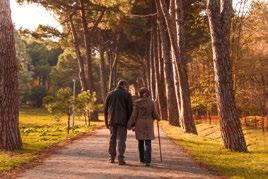
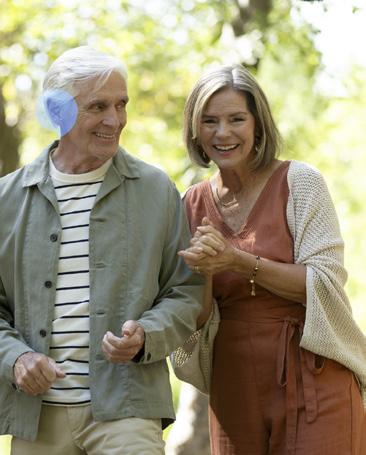
From 1 March 2026, only a valid in-date Free Travel PSC will be accepted
Check your card expiry
Still using a paper Free Travel Pass? Time to switch!
From the 1st March 2026 any expired Free Travel Public Service Cards or Paper Passes will no longer be valid for travel. Apply
Editorial
Advertising:
Contributors:
of
News Now
Minister for Health publishes diabetes policy and services review
The Minister for Health has launched The Diabetes Policy and Services Review: A Strategy for Better Care.
This is Ireland’s first national strategy for diabetes and sets out recommendations for action in relation to type 1 diabetes, type 2 diabetes, diabetes in pregnancy, and paediatric diabetes.
Minister for Health, Jennifer Carroll MacNeill, said:
“There have been substantial advances in the delivery of diabetes care in recent years, including the introduction of the National Framework for the Integrated Prevention and Management of Chronic Disease.This has supported the rollout of the Chronic Disease Management Programme and the establishment of community-based specialist teams for people living with type 2 diabetes. This strategy aims to ensure that people living with all types of diabetes, regardless of their location, have equitable access to a consistently high standard of care."
The Government has committed to developing a new strategy for diabetes care in its Programme for Government, ‘Securing Ireland’s Future.’ The strategy marks a major milestone in diabetes care in Ireland, representing the development of a unified approach to the delivery of diabetes care.
HSE Chief Clinical Officer, Dr Colm Henry, said:
“I welcome the completion of this report and look forward to working with colleagues to ensure its effective implementation.Diabetes represents a major challenge for those living with the condition and ensuring effective and consistent care across the country will make a significant difference in their lives. It will also help to ensure that care is delivered at the most effective level possible, thereby also ensuring the most effective use of the resources of the health system.”
Diabetes Ireland, Professor Hilary Hoey, Chairperson, said:
“I am delighted to welcome the publication of this strategy for diabetes care. Diabetes Ireland is happy to have collaborated with the Department of Health and the HSE to develop the strategy; implementation of its recommendations will make a difference in the lives of people living with diabetes in this country."
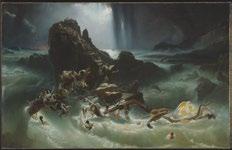
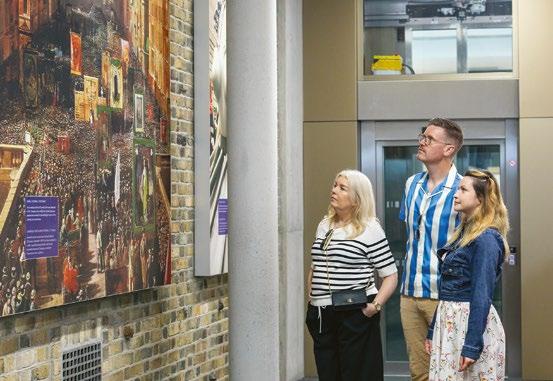
Wexford artist Francis Danby featured on show as part of National Gallery of Ireland exhibition
The work of nineteenth century Wexford artist Francis Danby (1793 – 1861) features as part of the National Gallery of Ireland’s major exhibition William Blake: The Age of Romantic Fantasy. This loan exhibition from Tate, curated in partnership with the National Gallery of Ireland, presents a selection of Blake’s most iconic works of art, alongside paintings and drawings by his contemporaries. It offers a rare opportunity to encounter one of the most visionary figures in art and literature. The exhibition runs until Sunday 19 July 2026 at the Gallery.
Francis Danby, who was born on 16 November 1793 in county Wexford, went on to become a prominent figure in Romantic art. Danby played a central role in the group of artists known as the Bristol School, and became celebrated for his dramatic canvases inspired by biblical imagery. Danby’s large-scale oil on canvas, The Deluge, painted around 1840, is on display in the ‘Horror and Peril’ section of this exhibition. The unearthly light and
monumental scale of this work give it an emotional intensity like to that of his famous 1828 painting, The Opening of the Sixth Seal, part of the permanent collection at the Gallery.
Wildly unconventional in terms of both technique and thought, William Blake developed a distinctive visual language to explore opposing forces of creation and destruction, reason and imagination, and is a singular force in the history of art. Opening with a selection of Blake’s iconic large colour prints, William Blake: The Age of Romantic Fantasy immediately immerses visitors in the drama and visionary intensity that defines his work.
These striking images introduce the exhibition’s central themes, which unfold across a series of sections that place key works by Blake alongside paintings and drawings by the artists he admired and those who were inspired by him. By placing Blake in a wider context of originality and experimentation, the exhibition offers a
compelling insight into a transformative moment in European art.
Tickets cost from free/€0 to €16 for an adult. Concessions apply. Friends of the National Gallery of Ireland receive free unlimited entry to all exhibitions. Tickets are free for children (18 and under), international protection applicants, refugees and carers. There is free entry to the exhibition for all on Wednesday mornings (until 11.30am). Adult tickets are €5 on weekday mornings up to 9.45am and on Thursday evenings from 17.00pm19.15pm.
Discover the Colour of Cobh
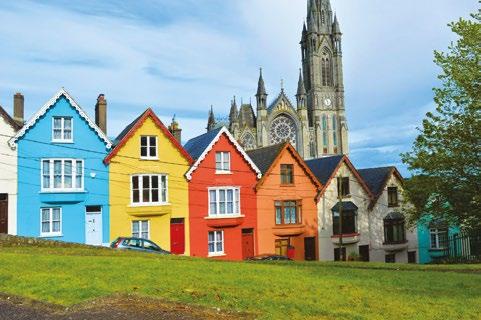
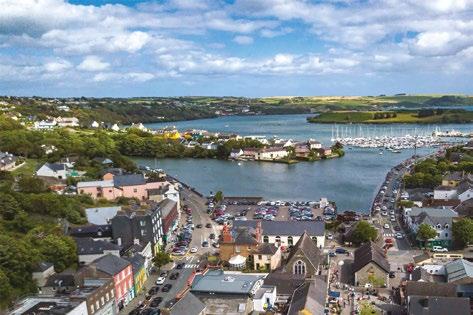
culture and coastal discovery. Cobh in Co. Cork uniquely blends maritime history, waterfront attractions, vibrant streetscapes and excellent dining. This summer, experience the character and vibrancy that make Cobh Ireland’s must-see unique, historic, colourful coastal town.
Set on the edge of the second largest natural harbour in the world, Cobh (pronounced Cove) is instantly recognisable. Home to around 15,000 people, Cobh is situated on an island and has long been shaped by the sea. Previously known as Queenstown, it was from here that more than 2.5 million people emigrated to America, Canada, Australia and the Caribbean from 1848 until 1950, creating powerful ancestral connections that still draw visitors back to the town today. The Colour of Cobh is more than paint on the walls. Its vibrancy lives in the stories carried through its streets, the warmth of its cafés and pubs, the rhythm of local life, and the sense of welcome that fills the bustling tourist town through the summer months.
To help you plan your visit, here are some moments that capture the Colour of Cobh you won’t want to miss:
1. The Deck of Cards
Probably the most photographed view in Cobh, the Deck of Cards is one of Ireland’s most instantly recognisable streetscapes. The row of 23 brightly coloured, gravity-defying terraced houses climbs steeply towards St Colman's Cathedral, creating a striking scene synonymous with the town itself. Overlooking the harbour below, the houses appear almost stacked on top of one another, following the dramatic gradient of the hill. Visit Spy Hill or West Point Park to snap a picture of what is arguably one of the most visually iconic views along the Irish coast.
2. St Colman’s Cathedral and the view above the harbour Towering above the town, St Colman’s Cathedral is one of Cobh’s defining landmarks. Construction began in 1868 and continued for almost five decades before completion in 1915, resulting in the striking Gothic Revival structure seen today. Its carillon bells ring across the harbour, while panoramic views stretch towards Spike Island, Haulbowline and the wider harbour beyond.
3.Walking Through Titanic, Lusitania and Emigration History
At Titanic Experience Cobh, visitors can explore the story of the Titanic’s final port of call in the original White Star Line ticket office, before stepping out into the town itself on the Titanic Trail. Nearby, Cobh Heritage Centre, home to the Queenstown Story, traces Ireland’s emigration story alongside connections to the Titanic and Lusitania, grounding these stories
from England and docked to pick up mail, provisions and passengers hoping to forge new lives overseas, making ancestry tourism a major draw for visitors today.
4.View from the water – Cobh Harbour
Taking to the water offers a different view of the town. From here, the terraces stack clearly above the waterfront and the cathedral anchors the skyline, giving a sense of how tightly everything sits together. Self-drive boat experiences, guided harbour tours and high-speed RIB trips allow visitors to experience the harbour from another perspective, with routes taking in Haulbowline Naval Base, the fortifications guarding either entrance to the bay, and stories stretching from the Napoleonic Wars to Irish War of independence.
5. A Journey to Spike Island
A short prebooked ferry trip to Spike Island brings you across the harbour in minutes, but into a very different setting. Visitors can book guided tours and ferry crossings to explore the island’s layered history as fortress, monastery and prison. By the mid-1800s, Spike Island had become one of the largest prisons in the world, at one stage holding more than 2,000 prisoners. Today it is an award winning and highly rated tourist attraction.
6. Colour in the Details: The Art Trail
Beyond the big views, Cobh’s colour is also found up close throughout its streets, prom, parks and playgrounds. Murals, sculptures and installations, brought together by Cobh Tidy Towns through the Cobh Art Trail, add texture and personality across the town. Community efforts help keep Cobh looking vibrant yearround, from painted railings and floral displays to carefully maintained streets and waterfront spaces.
7. Cruise Days, Markets and Summer Pageantry
When cruise liners dock, the atmosphere of the town shifts dramatically. These vast ships arrive directly alongside the quays, creating a spectacle that draws visitors and locals alike to the waterfront. Summer weekends bring added energy through the Saturday Farmers Market with 14 stalls and the Sunday Prom Market featuring more than 26 stalls, children’s entertainment, live music and performances at the bandstand. Throughout the season, animation teams in historical costume add to the pageantry, while the Cobh Confraternity Band famously serenades departing cruise ships from the quayside. August also sees the return of the long-running Cobh Regatta Festival, filling the harbour with colour, celebration and activity.
Visit www.visitcobh.com/ and to see what dates cruise liners dock visit www.portofcork.ie/ cruise-schedule/
Achieving travel without barriers
Click&Go Holidays is encouraging travellers with accessibility and mobility requirements to seek expert advice when planning their next holiday, highlighting the important role travel agents play in helping customers travel with confidence and without barriers.
As demand for accessible travel continues to grow, with an ageing population and travellers with additional needs, Click&Go Holidays is highlighting the support and options available throughout the holiday journey – from airports and airlines to transfers, accommodation and destinations. Travellers with a wide range of requirements, including wheelchair users, mobility scooter users, and those travelling with autism or sensory needs, can benefit from personalised travel planning that takes their individual circumstances into account.
Airport
Many airports offer dedicated assistance services, mobility support, accessible facilities and sensory-friendly environments for passengers requiring additional support.
Flights
Airlines can accommodate a wide range of accessibility needs, from wheelchair assistance and priority boarding to support for passengers travelling with medical equipment or mobility devices.
Transfers
Ensuring suitable transportation is available between the airport and accommodation is an important consideration and should be discussed during the booking process.
Hotel
Accommodation requirements can vary significantly, from accessible bathrooms and walk-in showers to fully adapted rooms and mobility-friendly facilities.
Destination
The accessibility of local attractions, beaches, restaurants, public transport and excursions can have a major impact on the overall holiday experience. For customers seeking accessible accommodation, Click&Go Holidays are working with a number of hotels in Lanzarote that have developed strong reputations for their accessibility facilities, including:
• Nautilus Lanzarote Aparthote
• Ilunion Costa Sal Aparthotel
• Seaside Los Jameos Hotel
• Aequora Lanzarote Suites Hotel
For more information on accessible holiday options, customers are encouraged to contact Click&Go Holidays directly on 01 539 7777.
Don’t miss the highly acclaimed ‘Peace Heroines’ exhibition featuring until August 31st, 2026. This exhibition captures a diversity of voices and perspectives, featuring thirty women’s involvement in the peace process in Northern Ireland.
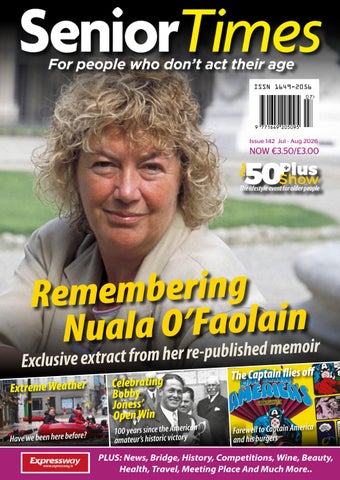
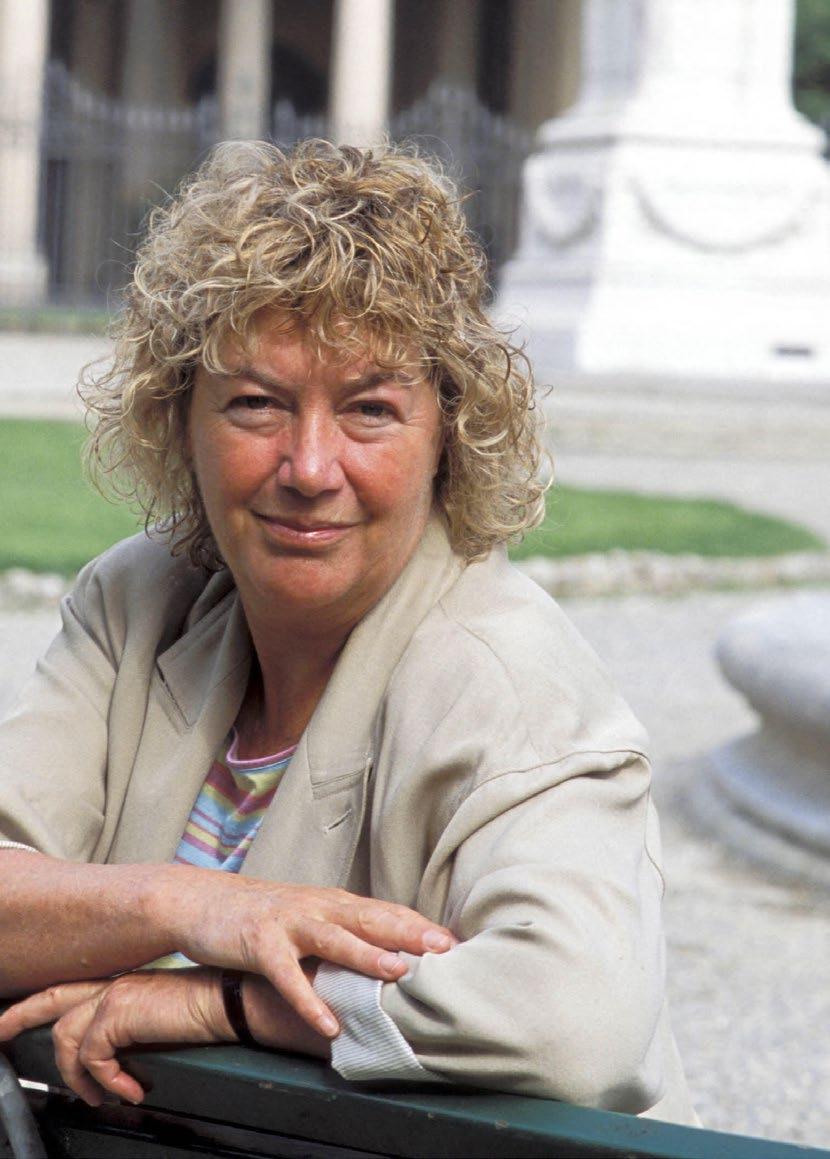
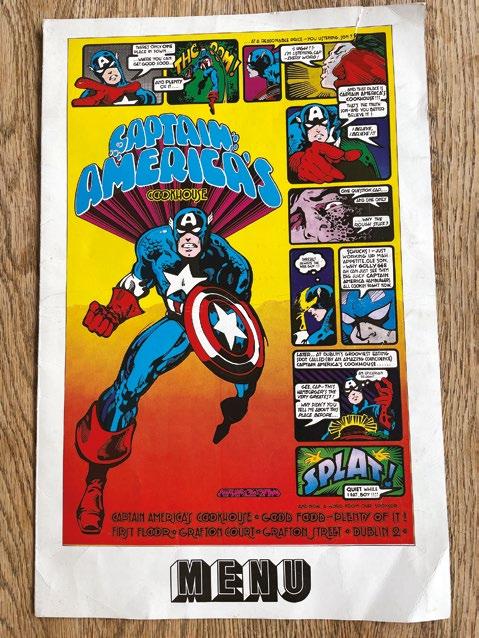
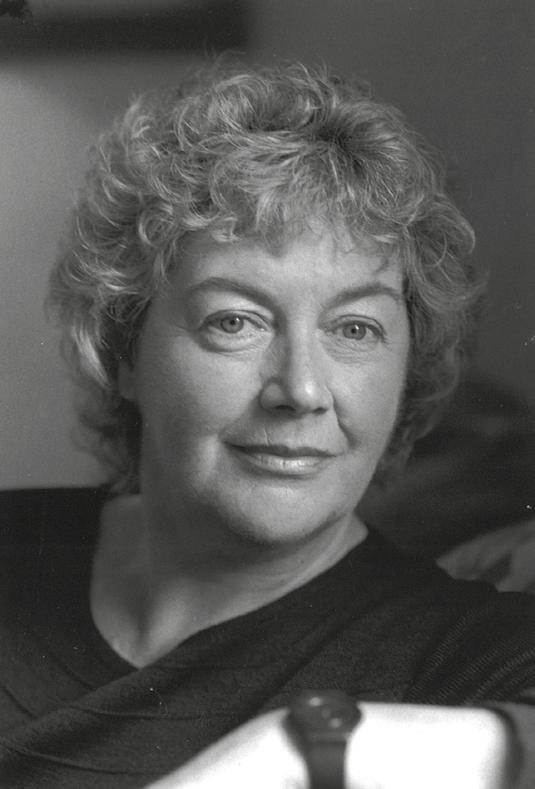
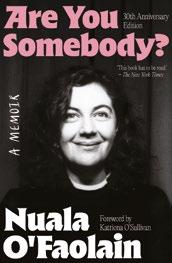
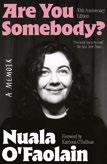
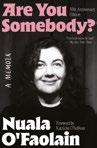
In this opening extract from the re-published, 30th anniversary edition of 'Are You Somebody', Nuala O'Faolain remembers her ‘packed and clamorous’ Dublin house’, life at UCD and early employment in a Dublin furniture store
‘One of the reasons I was doing my best to be a normal girl and a good Catholic was the terrible shock of losing my virginity’
Chaos and culturee
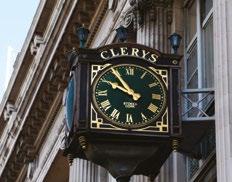
I left school after the Leaving Cert, when I was seventeen. I hoped to go to college, but it would be a while before I could do the entrance scholarship exam, and another while until I would know whether I’d won a scholarship. I also hoped I wouldn’t get into college so I could get a job as an assistant in Clery’s, like my friend.
At that time, young men as well as young women, worked behind the counters in the old wooden-floored Clery’s, where the cash zinged around the shop on pulleys and burst up from vacuum pipes. The shopworkers seemed to me to have the best of fun. I had a job, but I had no company in it, working as a clerk in the hirepurchase office of a furniture shop in Grafton Street. Hirepurchase was for the very poor, then. The customers walked down a long room to the hatch where I sat. I saw from the way they walked towards me how bitter it was for them to be still paying out for things they’d got long ago. Money was dominating me, too. I was living at home but I was giving money up. From leaving school on, how to earn enough money to keep myself was my biggest single problem for years and years.
‘I also hoped I wouldn’t get into college so I could get a job as an assistant in Clery’s, like my friend. At that time, young men as well as young women worked behind the counters in the old wooden-floored Clery’s, where the cash zinged around the shop on pulleys and burst up from vacuum pipes’.
In that interval between school and college, I was as devout as I was ever going to be. I joined the Legion of Mary in Dublin – we had a barrow displaying pious literature near O’Connell Street, and we had a special mission to street-walkers. I said prayers every day, and I went to Mass. I did read during the tedious bits of Mass – a ploy discovered in Monaghan, where we were sometimes marched through the town –longingly past the sweetshops and the chipper – and up the hill to the cathedral, across from its twin hill where
hunched figures prowled the paths of the lunatic asylum. I read, concealed in my Missal, anything that was a bit religious – the poems and sermons of John Donne, for instance. I was a member of the Pioneer Total Abstinence Association: when I did take my first drink I went back to it, and then again, and again. I went to confession a lot, to help me with boys.
One of the reasons I was doing my best to be a normal girl and a good Catholic was the terrible shock of losing my virginity. A while earlier, home on holidays from school, I’d been messing with a boyfriend on a sofa in his house. His mother was upstairs. Lionel Hampton was on the record player, plinking out ‘So High the Moon’. My panties were off. The boy suddenly, terrifyingly, pushed into me, all the way. I ran along the suburban streets to home, panting, crying, praying out loud not to get pregnant. I locked myself in the bathroom to wash off the blood and kneel, in privacy, to beg Our Lady to save me. Some of the girls I hung around with had come up the stairs to the bathroom door and were taunting me through it – I must have said something when I ran the
gauntlet of them, sitting on the wall outside. ‘What happened to your knickers?’ they shouted, like the Furies. ‘What happened to your knickers?’ The fear and revulsion drove me almost into believing that I had a vocation to be a nun. But the more lasting effect was that I was enthusiastic with boys from about the waist up, but the rest of me was so selfconscious that I wouldn’t even say that I wanted to go to the Ladies.
When I knew that I’d got the scholarship to UCD I went on holidays to my aunt, who had been such fun when I was a child. She was living in someone else’s house in a dreary east coast seaside resort where the sea went out so far at low tide that you couldn’t see it. We sat at night under the seawall in our coats, and she drank whiskey from the naggin bottle of whiskey she always had, by now, in her handbag. She was like a loving child, herself. But she had become baffled. She knew she loved her own children, and us, her sister’s children. But she didn’t know why she was married at all or why to the particular man who was her husband or why she was afraid of Grandad or why anything. She was always called ‘wild’.
Visit the Spain stand at the 50 Plus Show Cork September 8th & 9th
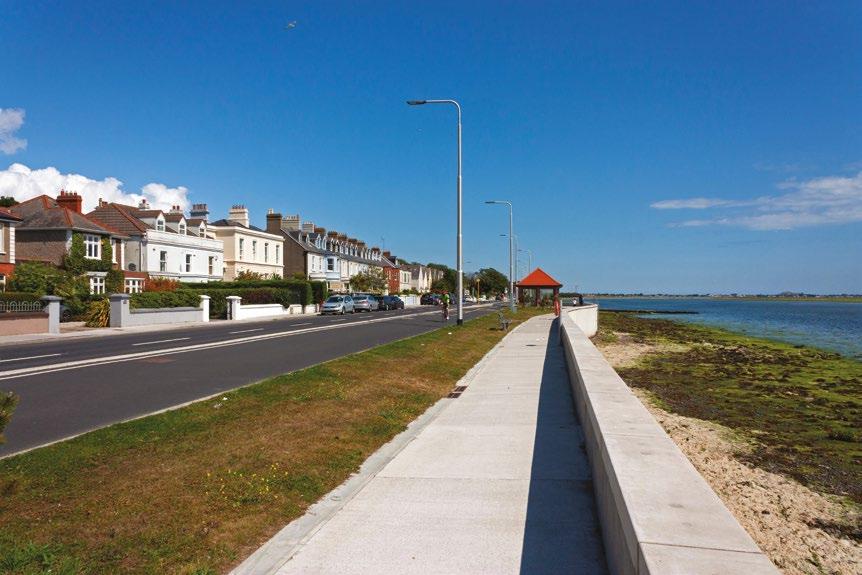
Clontarf Road. ‘My family’s house in Clontarf was packed and clamorous’.
Her husband worked abroad. She was summoned off to live with him from time to time. More than once, she drank the ticket money, so as to get out of going. But then her husband and her father would arrange her deportation over her head.
Nuala’s father, Terry O’Sullivan, wrote the popular Dubliner’s Diary for the Evening Press
My family’s house in Clontarf was packed and clamorous. My father was ‘Terry O’Sullivan’ through and through now – the idealistic schoolteacher and lieutenant in the Army, Tomás O’Faolain, who had written to his ‘chroidhe dhil’ with such affection and energy about the arrangements for the moving of their little family to Donegal, had been overtaken by another identity. Partly it was the size the family grew to, along with my mother’s refusal to be satisfied with serving it, that killed his enthusiasm. But mostly, he was alienated from a domestic role by the opportunity which Lemass’s Ireland happened to present to him. He was not a journalist in the ordinary meaning of the word. He was a small god in the world, which was then very new and innocent, of people who wanted publicity.
His successor on ‘Dubliner’s Diary’, the distinguished journalist Michael O’Toole, talks in a reminiscence he published about the way my father made semimajestic entrances into this or that event around town. Holding himself aloof, he would wait, with melancholy calm, for the customary adulation. He would have risen in our house out on the seafront in Clontarf around two in the afternoon, and freshly washed and shaved, and often wearing evening clothes, he would have stepped into the car from the Press when the driver brought it to the gate to read his invitations under the special reading light that had been installed over the back seat. He would make a round of social events until settling down to write, around midnight, a ‘Dubliner’s Diary’ for the next day’s Evening Press. Restaurateurs would send exotic meals under silver cloches, and wines, and brandy, in to the office. He banged out the Diary on his old typewriter, come what may, with the discipline that was his second nature.
He wouldn’t have spent more than a couple of hours, awake, in his home. When he was a young father, an old woman who worked for my parents told me recently, he always spoke Irish to Grainne and me, the two eldest. Now, he had no time to speak much to his children in any language. When he was a young husband – this woman told me, unwittingly – he and my mother were very close. ‘I think they must have fought a lot,’ this woman said to me. ‘When he came home from work he used to tell me to take you children out for a walk and not come back for an hour.’ Nobody knows the interior of other people’s marriages,
and the one and only thing my mother was confident about all her life was the perfection of their physical relationship. But he avoided home. Even on Christmas Day, when we had charming rituals to do with the tree and presents and champagne – things we’d always done, like a family in a book – he eventually went out. He often took a child or children or his wife to a function, or arranged a treat for them from some grateful hotelier or the like. But he never spent a full day at home. And my mother wasn’t at home much, either. She went up to the pub two times in the day. One was in the evening, till closing time. The other was at lunchtime, when she went up to get the messages. And to steady herself, to face him.
Who knows where he got to? He had lots of things going on. All of us were dependent on him. Grainne – ‘Grainne’s the pretty one,’ my mother would always say – was exceptionally smart and attractive and had jobs as personal assistant to various managing directors: this was as high as a young woman could expect to go in the world of work at the time. ‘Nuala’s the brainy one,’ my mother would say – I had temporary jobs and my scholarship was coming up. My next sister down, Deirdre – ‘Deirdre’s the nice one,’ my mother would say, thus finishing off any general confidence the three of us might have had – was engaged to be married, and had an office job. But emotionally, we were in thrall to him.
Then there were the brothers, always in difficulty or in trouble, then my little sisters and then my youngest brother. None of them got much attention. But
For women with
Dryness and sensitive skin and membranes
• Scientifically documented
• Suited for vegetarians and vegans
Vaginal dryness, dry eyes and dry mouth are issues women typically experience around and after menopause. BioActive Omega 7 Pharma Nord is a formula developed to help maintain healthy and well hydrated mucosa at this stage of life.
BioActive Omega 7 Pharma Nord contains the SBA24 extract that is made from both the berries and seeds of Sea Buckthorn to ensure the widest spectrum of beneficial nutrients.
• With vitamin A that supports normal skin, vision and mucous membranes
Sea Buckthorn is one of nature’s richest sources of vitamin A, a nutrient that is best known for its ability to maintain normal skin, vision, and mucous membranes.
they were members not just of a family but of quite a self-consciously distinct – even a superior – family, all the same. I have a brother who used to be in the British army. He sits in a room in London now, and drinks and reads. ‘I loved my mother and revered my father when I was a boy,’ he has written to me, in a letter that captures all our confusion. ‘They were Mother and Father, and does a child know any different? Sure it made me bed-wet when he came home pissed and pummelled my mother. Her cries for help were heartrending, and made me try to sleep in a chest of drawers. You didn’t get to see father much, but I loved him from afar.’
The stranger would see my father’s suave manners, his detachment, his humour, and think he was a modern type, and that things must be lovely for us at home. And so they often were. He was usually delightful. And he was the head of the family, even if the family was going to ruin. His iron will created a version of a home life for himself. When he came in at night he would go out the back to the roses he grew and inspect them in the dark. He took his own clothes to the cleaners and polished his own shoes. He was invariably dapper and almost always cheerful. He whistled beautifully while he shaved. Nothing would have stopped him from surviving.
He drove my mother into a frenzy: ‘I’ve asked your mother to come to the Wexford Festival with me,’ he’d say airily – or a garden party, or a reception. ‘But she informs me she has nothing to wear. Isn’t that so, Katherine? I gave you carte blanche to go into Brown Thomas – tell them to send the bill to me – and get something nice, but still, apparently, you claim you have nothing to wear …’ She choked with frustration, unable to find the words to say that she wasn’t able to do things like that, and he knew it: that she had no good underwear or shoes even if she had a dress, that she was too shy of shops to tell them to send bills, that one of the children was mitching again, that he hadn’t said how long they’d be going for and who was supposed to be minding the house and whether he’d give her money for herself when they were there or she’d be waiting for him to buy drinks all the time – she was unable to say what she felt: that he was mocking her in her cage. She would be dying for him to get the hell out to work, so she could go up to the pub and get a quick double gin down her to stop the shaking.
But even his cruelty to her was not simple. A couple of times, when I went up to his bed to give him a message, I
‘Even when I was doing the entrance scholarship for UCD at Earlsfort Terrace, I had to get off the bus at the North Strand and walk the rest of the way because I hadn’t the full fare’.
saw Rosary beads under his pillow. He must have prayed by himself. He must have felt helpless, sometimes, under his apparent insouciance. During the next few years, when I was gradually getting away, the house – four bedrooms, ten of us –vibrated with all the different individuals who lived there, each fighting to have some, at least, of their needs met. The hot press in the kitchen was a hopeless chaos of jumpers and socks, and sugar crunched underfoot in the kitchen. I brought home an English actor I had a crush on. No one had cleaned up the pools of tea on the table – crusts in them had gone soggy and looked like snails. ‘Good God!’ he said. ‘It’s like a set for an O’Casey tenement!’
At night, the house was completely undefended. Gangs of boys used to come at least as far as the stairs. The local gurriers knew they could take liberties. There was no one there to care for my little sisters and brothers. My little sisters made a regular life for themselves. They put themselves to bed at nine. They tried to fix the clock to go off to get them to school on time. I remember the beds. My aunt’s children often slept in Clontarf, too. There were so many of us that there were beds on the landing and in a windowless box room. The bedclothes were supplemented by coats. There were only torn pieces of sheet – enough to put under your chin, to soften the rough coats. I do remember my mother pausing to fix a strip of cotton under some sleeping child’s cheek. I never remember my father doing anything like that.
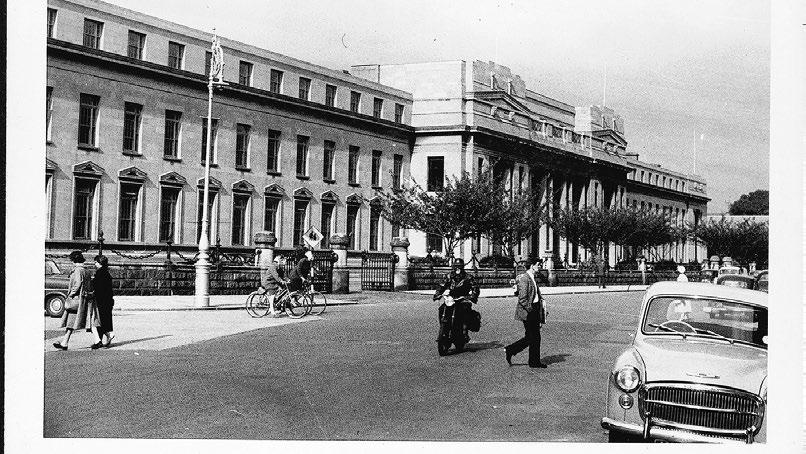
We all hated asking for money. I often stood on the landing outside my parents’ bedroom trying to work up the courage to knock on the door and wake them to ask for it. Even when I was doing the entrance scholarship for UCD at Earlsfort Terrace, I had to get off the bus at the North Strand and walk the rest of the way because I hadn’t the full fare. Yet we were not poor by the standards of the time.
Many years later, I was interviewed on television, by Anthony Clare, in a series about Irish people. I said I was poor when I was a student and, so as not to seem to be making exceptional claims for myself, I said that lots of people in UCD then were poor. Eamon Dunphy reviewed the series, and I’ve just tracked down his piece. ‘Watching Nuala O’Faolain depict herself as poor,’ he said, ‘I longed to kick the television set.’ He said, ‘Nuala’s Daddy was one of Ireland’s most celebrated journalists, Terry O’Sullivan. Was she “poor”, was “everyone in UCD”, poor? As anyone who was actually poor in the 1950s knows, the answer is no. No, no, no. In fact, nobody who went to UCD in those bleak years was poor. They were only playing at poverty …’
This is true, in a way. In the late 1950s, there were big marches of unemployed men in Dublin. They looked and they were desperate. They had no alternative to emigration.
Four copies of Are You Somebody? to be won
Senior Times, in association with the publisher, New Island Books, is offering four copies of Are You Somebody as prizes in this issue’s crossword competition. (See end of magazine)
Beyond the 1% Savings Trap: How Irish Over-50s Secure Retirement Cash Flow
For generations, the traditional Irish retirement plan was simple: clear the mortgage and leave your remaining cash in a "safe" bank account.
But in 2026, with the S&P 500 hitting historic milestones around 7,400, leaving wealth in a 1% or 2% bank deposit is a guaranteed way to lose purchasing power against real-world inflation.
For the over-50 demographic, the focus must shift from high-risk speculation to wealth preservation, consistent cash flow, and protecting a financial legacy.
"True retirement security isn’t about hiding cash in a low-yield account out of fear. It is about using institutional-grade data to control global assets with absolute risk mitigation."
The Power of Algorithmic Screening You do not need to spend retirement glued to financial news or trying to navigate complex apps.
At ShareNavigator, we strip human emotion completely out of the market using our proprietary software, EquityScan. The platform utilizes three defensive pillars to guide your decisions:
■ Isolating Maximum Upside: The system automatically sifts through thousands of blue-chip global stocks to find companies showing the strongest mathematical upside based on structural market floors.
■ Aggregated Analyst Targets: EquityScan cross-references your watchlists with live, consolidated data from Wall Street’s top research desks, ensuring your capital aligns with institutional smart money.
The software calculates a precise target sell price before you allocate a single euro. You have a definitive, mechanical exit strategy to lock in profit without guesswork.
Shielding Your Legacy
From the 33% Tax Drag
The biggest hidden leak for Irish portfolios isn't a bad market day—it’s structural tax inefficiency. Standard Capital Gains Tax (CGT) can swallow up to 33% of your investment growth.
We teach our members how to execute their stock and option setups inside institutional platform architectures like IG Index.
By configuring your system within structured spread betting frameworks, UK and Irish residents can legally optimize their portfolios for tax-free growth.
The Investor Kickstart Pack — Only €149
Take absolute control of your retirement roadmap with 4 private, 1-on-1 mentoring sessions (In-office or via live web meetings).
■ Master EquityScan to find high-upside stocks.
■ Lock in target sell prices & tax efficiencies using IG Index
■ Includes lifetime access to your recorded video sessions.
Built on Your Terms
We reject faceless automation and unhelpful customer service chatbots. Whether you are located in Dublin, Cork, Galway, or right down the road from us in Meath, we provide a rare hybrid: institutional software backed by genuine human accountability.
■ In-Person Accountability: Visit our headquarters at Rath Cross Business Park in Ashbourne (across from the Ashbourne Retail Park) to sit down with an expert face-to-face.
■ Interactive Web Meetings: If you live further afield, execute your training via live, private video consultations from home.
Best of all, every single coaching session is fully recorded and delivered to you. You build a permanent, personal video library to review over and over at your own pace.
Education
DCU's Age-Friendly University initiative - exemplifying a forward-thinking approach to education
Dublin City University's (DCU) Age-Friendly University (AFU) initiative is a pioneering model for inclusivity and lifelong learning. Launched in 2012, DCU's AFU is dedicated to promoting the concept of universities as lifelong learning institutions that cater to the needs of older people. This initiative aligns with DCU's broader mission to transform lives and societies by engaging with the community, fostering a culture of inclusivity, and making higher education accessible and relevant for people of all ages.
The AFU initiative at DCU was influenced by the WHO's Age-Friendly Cities Programme and emerged from recognising demographic shifts and the growing importance of lifelong learning and supporting age inclusivity in higher education. As populations age, there is a need for higher educational institutions to adapt and provide opportunities for older people to continue their intellectual, social, and personal development. The primary objectives of the AFU initiative include:
Promoting Lifelong and Intergenerational Learning: DCU aims to offer educational programs accessible to older people, ensuring that learning continues throughout life. AFU promotes interactions between younger and older students, creating a dynamic learning environment that benefits all ages.
Research and Innovation: The university encourages research on ageing and related fields, fostering innovation that can improve the quality of life for older people.
Community Engagement: DCU seeks to engage with the broader community, offering resources and programs that address the needs and interests of older people.
DCU's AFU offers a range of programs and activities designed to meet the diverse needs of older learners. These include formal degree programs, lectures, short creative courses, workshops, and seminars on various topics. A vast range of modules is offered from the undergraduate and masters programmes, which can be taken without the need to sit exams or submit assignments. The university also provides opportunities for older people to participate in research projects and contribute their knowledge and experience to the academic community. One notable program is the "Love of Lifelong Learning" series, which includes lectures, discussion groups, and cultural activities tailored to the interests of older people. This series enhances knowledge and promotes social interaction, new friendships and community building among participants.
DCU's commitment to social inclusion and research on ageing is a cornerstone of the AFU initiative. The university supports various research projects exploring various aspects of ageing, from health and well-being to social inclusion and technology. This research not only contributes to academic knowledge but also informs the development of policies and practices that can improve the lives of older people. DCU's AFU unit is crucial in this research effort, focusing on older people's educational needs and experiences. Additionally, the university collaborates with national and international partners to advance ageing and lifelong learning research.
A key aspect of the AFU initiative is the promotion of intergenerational learning. DCU creates opportunities for younger and older students to learn from each other, fostering mutual respect and understanding. This approach enriches the educational experience for all participants and helps break down age-related stereotypes. Intergenerational projects at DCU include collaborative research, joint coursework, and community service activities. These initiatives enhance learning outcomes and build stronger, more inclusive communities.
DCU's AFU initiative has gained international recognition and is a model for other universities worldwide. In 2012, DCU led the establishment of the Age-Friendly University Global Network, which now includes over 136 universities committed to the Ten Principles of an Age-Friendly University developed by DCU. This network promotes the exchange of best practices, collaborative research, and the development of age-friendly policies and programs. DCU has influenced the global conversation on ageing and higher education through its leadership in the AFU movement. The university's efforts have highlighted the importance of creating educational environments that are inclusive, supportive, and responsive to the needs of older people.
DCU's Age-Friendly University initiative exemplifies a forward-thinking approach to education that embraces lifelong learning and inclusivity. By providing opportunities for older people to engage in meaningful educational experiences, DCU enhances individual lives, strengthens communities, and fosters intergenerational understanding. As populations continue to age, the AFU model offers a valuable blueprint for universities worldwide, demonstrating the vital role that higher education can play in promoting age diversity in higher education, lifelong learning and social inclusion.
For more information on DCU's AFU, visit www.dcu.ie/agefriendly
Email: afuinfo@dcu.ie
Call: Grainne Reddy - 0874952547 or 01 700 5454.
Participants at the Taste of DCU Open Day 2025
Want to learn something new?
A warm welcome awaits you at Dublin City University - Ireland's first Age-Friendly University.
Did you know you can choose from a broad range of modules offered under the AFU programme without the need to take exams or assignments?
In addition, the Lifelong Learning Programme offers a selection of customised modules such as Geneaology, Life Writing, English, History, Botanical Art, Choir and more...
There are also opportunities to engage in contributing to research, social, cultural and wellness programmes, attend guest lectures and engage in intergenerational exchange.
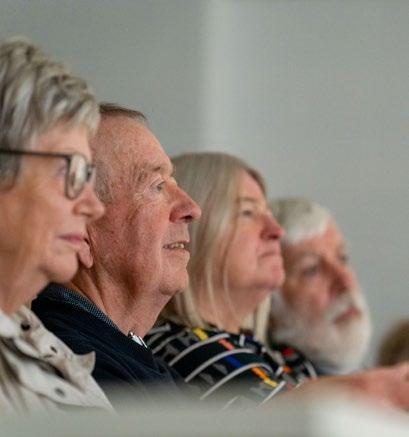
If you would like to hear more about how to get involved in DCU's Age-Friendly programmes come along to the "Taste of DCU" on Monday, August 31st from 9.30 - 4 pm where you can experience being a student for the day, take a tour of the campus and hear more about the work of the AFU.
For more information visit: dcu.ie/agefriendly/news
E: afuinfo@dcu.ie
T: 00 353 1 700 5454
Age-Friendly University Global network
Voyage discoveryof
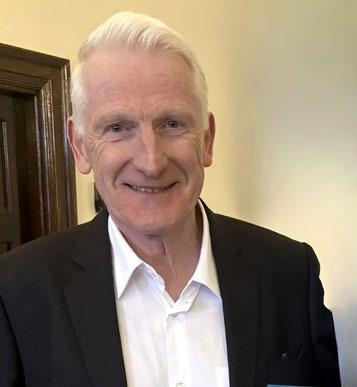
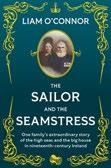
Colette Sheridan meets Liam O’Connor who has just published a book based on his genealogical research into his seafaring great grandfather and seamstress great-grandmother
With spare time on his hands having taken early retirement in 2015 from teaching, Dingle-born Liam O’Connor became immersed in family genealogy which has resulted in a book, ‘The Sailor and the Seamstress.’
The Dingle-born former school principal, who worked in Dublin before moving with his wife Frances to her original parish in Aghada, County Cork, says he never thought there was a book in him. What sparked his interest as a four year-old boy was a photograph of an elderly couple in his maternal grandmother’s home in Dingle. The man had medals pinned on his chest.
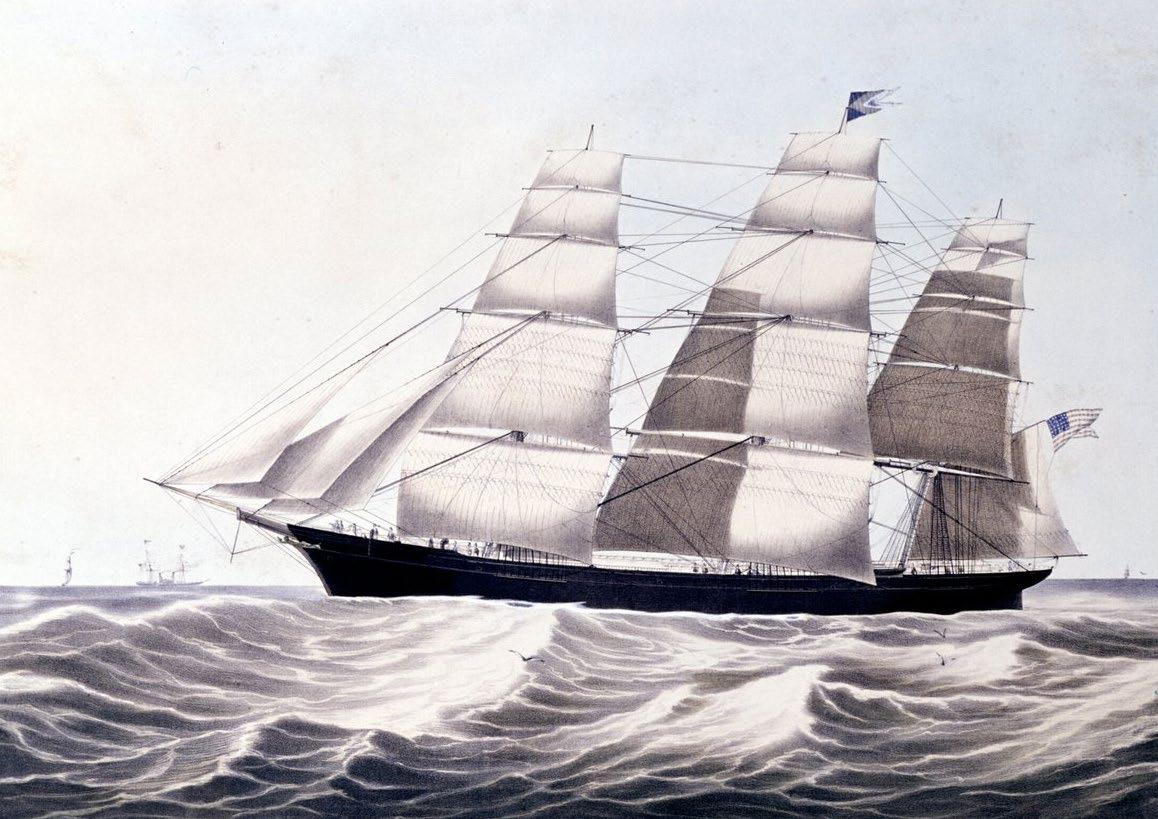
Liam asked his grandmother about these two people. They were her grandparents, making them Liam’s great grandparents, William Kennedy and Norry Grady. The stories of William, a sailor, on the high seas all over the world ignited in Liam an abiding interest in this couple. Norry was a seamstress. The pair, whose marriage was arranged, married in 1859. They lived through nineteenth century Ireland, a time of great social and political upheaval. Tragically, seven of their nine children predeceased them.
With a family tree being put together, showing the line of descent of William and Norry, Liam only intended his research to be for family members.
“But I was uncovering more and more information on the internet about the ships William sailed on,” says Liam. “There were journals written by the officers that he had served under, giving information about events that William was involved in. My research evolved into a small booklet and then, eventually a much longer manuscript emerged. I decided to write a book. I made a few attempts and then parked it as a bad job. To me, it seemed a bit too academic. I came back to it after a year and decided to present it in a more interesting way. I figured that there must have been a time when my grandmother was sitting down with her parents and they were telling her their stories. So I
Liam O’Connor: ‘Years back, what used to really annoy me were people giving out about their school days and Peig Sayers. The abuse that poor Peig got with people saying their teenage years were ruined because of that old woman’.
decided to place William and Norry as the narrators in the book.” A friend of Liam’s, who runs an editorial service, “put a bit of discipline on the manuscript making it presentable so that it could be submitted to publishers.”
Liam sent his book to about seven publishers before it was finally accepted by Gill Books. Most of the material is based on actual records, found in births, marriages and deaths registries. “There were gaps in the records, particularly in Norry’s life, so I had to fictionalise situations that tied all the loose ends together. About 30% to 40% of the book is fiction. For example, I decided to put
Norry as being in service at Trabolgan House. The reason for that is because I was conscious that her life and William’s life were very hard. They had a lot of sadness, losing most of their children. I wanted to put Norry in a period of time when things were going nicely for her. The family who lived in Trabolgan House, the Burke-Roches, were very nice and helpful to tenants during the Famine years. They gave a lot of money to local efforts to feed people. They were big supporters of Daniel O’Connell. I decided to put Norry into their house. It’s fictional because there were no records of Norry apart from her baptism records, those of her children and her marriage record.”
William enlisted in the Navy in 1854. Joining the Navy or the military was “a no-brainer” for people from landless labouring backgrounds, says Liam. There were three choices for William. He could have continued as a landless labourer which didn’t have a future; he could have got on board a famine ship, or join the Navy or military.
“For young men from coastal areas, the Navy had an obvious attraction. You got a suit of clothes, a pair of boots and three square meals a day. You got a pension after ten years. In those days, the emigrant ship brought you far away forever. But with the Navy, there was a chance you could get back home every so often.”
Norry wouldn’t have had a dowry because she was from a labouring family with no land. “Her marriage had to have been an arranged marriage. Who arranged it, nobody knows. So I fictionalised, writing that it was her employer that arranged it. Her employer had a liking for her and wanted to secure her future. Being of the labouring class, marriage to a Royal Navy sailor would have been seen as a good match.”
Liam believes that William and Norry had a happy marriage. “That’s the feeling I got from my grandmother’s stories and later on, from my aunt , who continued the stories.” But losing most of their children was obviously heartbreaking for the couple. William later joined the coastguard, being transferred from station to station with Norry every few years. The transfers were essential lest a coast guard operator became too familiar with the locals. This reserve of the Royal Navy conducted rescue missions at sea, intercepting smuggling which was dying out at that stage. William was finally posted to Dingle with his wife.
His Navy service saw him voyaging from the Baltic Sea to the Black Sea, the Far East and the Pacific. On a home voyage, from Vancouver Island, William became seriously ill with a severe throat infection. “I found out about that in the medical journal belonging to the ship’s surgeon. There were two pages devoted to William’s health condition. In one entry in the journal, the surgeon wrote that William was not expected to survive the illness.” (William was to live until he was nearly eighty years old.)
Liam writes about William and his colleagues patrolling the American coast. “The government and the colony feared an American invasion, especially since the discovery of gold. British Columbia was rich in natural resources. Huge areas of forest held all the lumber needed to build ships and towns. There was an abundance of wildlife, and the fishing grounds were so rich the fish were nearly jumping into the boats. But in 1863, the Americans were busy slaughtering each other in their civil war, so the fear of invasion receded. Our duties now turned to the comings and goings of prospectors and Indians. The Indians, God help us, were falling like flies. The smallpox had been killing thousands of them. There were some brave souls, doctors and religious people among them, who did all they could to bring some kind of relief to those unfortunate people.”
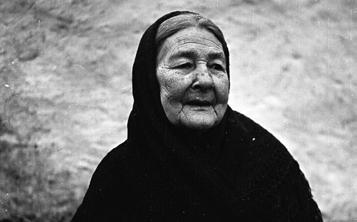
With his deep appreciation of history, Liam has little tolerance for people who dismiss the accounts of the social history that resulted in the book on the life of Kerry woman, Peig Sayers
much maligned Peig Sayers
(1873-1958). The text was often the bane of secondary school pupils for whom the book was compulsory until 1995.
“Years back, what used to really annoy me were people giving out about their school days and Peig Sayers. The abuse that poor Peig got with people saying their teenage years were ruined because of that old woman. Peig’s story was a social document of Ireland at the time. Being from the Dingle peninsula in West Kerry, I have a feel for Peig’s story. I didn’t want, in years to come, if my book ever reached publication, people giving out about my great grandmother. So I wanted to put Norry into a period of time when things were going nicely for her, hence Trabolgan House.”
There is considerable interest in genealogy with TV programmes showing people going back to their roots. It’s no doubt because the internet has made research so much more accessible. “Without the internet, you’re poring through pages and pages of parish documents. It’s needle in haystack work.”
Both William and Norry are buried in Dingle. Their burial place had fallen into disrepair over the years. William had erected a headstone for two of his daughters. “In the last few years, I made it a project to raise the headstones.” Liam has two sons. While they’re interested in family history, “they wouldn’t engage in it like I do.” Liam and Frances taught at primary school level in Dublin. They transferred to Aghada. “Serendipitously William left this parish in 1854 to join the Navy. The girl I met on my first day teaching was Frances who came from the same parish as William.”
Frances, who has passed away, would have been proud of her husband’s book. “She was the reader in the family. She read ‘Wuthering Heights’ when she was ten or eleven. She was never without a book in her hand. My role in the family was bringing the lads to football training. I didn’t have as much time for reading as Frances did. I tend to read historical stuff, about World War 1 and the Second World War. I also read a lot of Irish history.”
These days, Liam has more time to indulge his interests. He is a selector for Dingle GAA. And now, he has added ‘author’ to his life story, chronicling his ancestry for posterity.
‘The Sailor and the Seamstress’ by Liam O’Connor is published by Gill Books. €18.99.
The
“There was nowhere left to run”
Little Ivana’s escape… and how a lifeline from Ireland is reaching Lebanon’s wounded children.
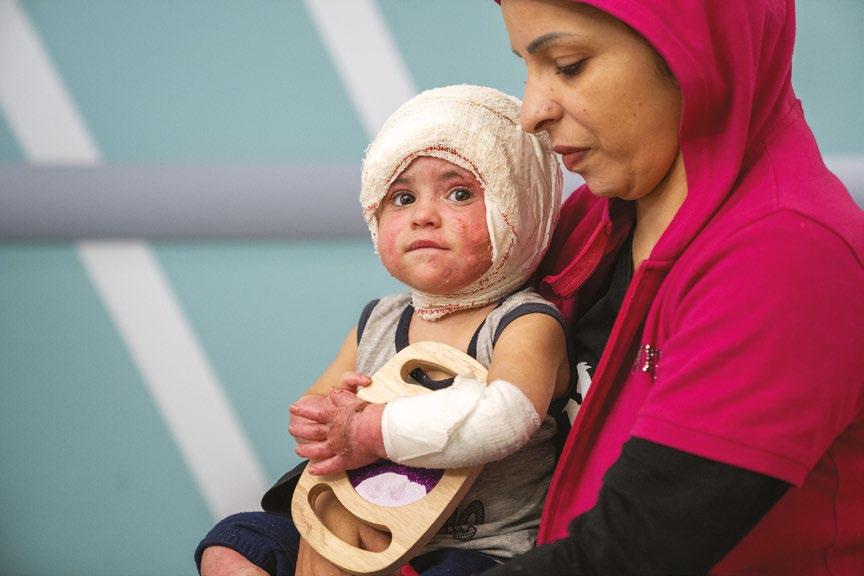
The morning the missile struck, Fatima was preparing breakfast.
Her daughters were playing on the balcony. Her car already packed, just in case they needed to evacuate.
This is the kind of fragile normality families in southern Lebanon live with every day.
But this time, there was no warning. There could be no planned escape.
In an instant, Fatima and her daughters were fighting to survive.
“The house was burning. I was burning. There was nowhere left to run,” she recalls. The bomb blast tore through the building, swallowing her home in smoke and flame.
Instinct took over. She ran to the balcony, grabbed her daughters — seven year old Rafah and two year old Ivana, and did the only thing she could.
“I threw the first one, then the second, and then I threw myself.”
Her daughters survived the fall. Rafah spent 20 days in hospital. But little Ivana, suffering from severe burns now lies in a hospital bed. Her limbs and face wrapped in bandages, having had to undergo skin graft surgery.
When Fatima touches her; she feels her daughter tense with pain.
“I’m exhausted, broken, and my heart aches for them,” she says.
Fatima’s story is just one among thousands in Lebanon.
UNICEF is delivering medical supplies where it’s needed most
Since the escalation of the conflict on 2nd March, 177 children have been killed and 704 injured in Lebanon. Behind each number is a child like Ivana — wounded, frightened, and suddenly dependent on a health system pushed far beyond its limits.
Lebanon’s hospitals and clinics are dealing with a surge in burn injuries, shrapnel wounds, fractures, respiratory complications and psychological trauma.
UNICEF is central to the medical response in supporting the Ministry of Health and has delivered over 140 tons of essential medications and medical supplies to primary healthcare centres and hospitals.
Our lifesaving organisation has supported the admission of 184 newborns and children to ICUs across 11 governmental hospitals. It has delivered vital equipment, including incubators to neonatal and paediatric intensive care units as well as pain killers, bandages and medical supplies. UNICEF has also helped set up mobile health centres for families who are displaced and convoys of aid is delivering vital supplies into dangerous areas where the risk of deadly attacks remains..
Our teams are treating outbreaks of scabies and lice in overcrowded shelters. They’re also protecting children from
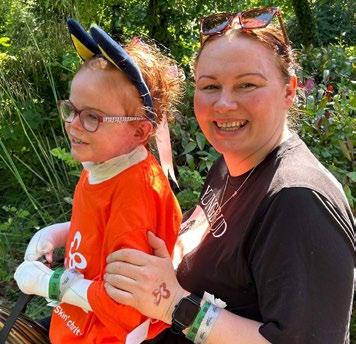
Ivana sits quiely on her mother's lap despite the pain from the raw burn wounds.
preventable diseases like measles and polio, and have already vaccinated nearly 20,000 children.
A lifeline for Lebanon’s wounded children
At the heart of UNICEF’s medical response is the Assistance and Care for War Wounded and Affected Children (ACWA) programme which is Lebanon’s most critical lifeline for children injured during the war.
Since 2nd March, ACWA has provided life-saving surgical interventions for 30 severely injured children, including seven critical paediatric cases. Under the programme children will have a tailored pathway of care providing physiotherapy, disability aids as well as the mental and psychosocial supports to support their recovery beyond their surgery.
For a child like Ivana, severely burnt, traumatised and months of recovery ahead of her, access to the ACWA is the bridge between injury and survival, giving her the treatment she needs for as long as she needs it.
A lifeline from Ireland delivering for generations
Since 1948, UNICEF has worked through conflict, displacement and economic hardship to protect children and support families in Lebanon. That long standing presence has only been possible because of people who believe every child deserves protection and hope.
And among the most steadfast supporters are the people of Ireland.
Irish peacekeepers, Irish aid workers and Irish donors who have stood with Lebanon’s children for decades. That unwavering support in sending generous donations, including gifts left in Wills, has helped fund clinics, strengthen hospitals and ensure that when emergencies strike, UNICEF teams already on the ground, can respond quickly and save children’s lives.
And as Ivana begins her long recovery, UNICEF’s work will continue, just as it has for more than 75 years in Lebanon. And UNICEF is offering Irish people to continue to be that lifeline in the decades to come, by inviting you to join our Bucketful of Dreams community.
Get your Bucketful of Dreams legacy pack
UNICEF’s Bucketful of Dreams makes creating or updating your Will easier. In Ireland, many people first think about making a Will for practical reasons: to spare family difficult decisions later, to tidy loose ends, to make sure wishes are clear. UNICEF Ireland’s Bucketful of Dreams begins there, but it also offers something more meaningful.
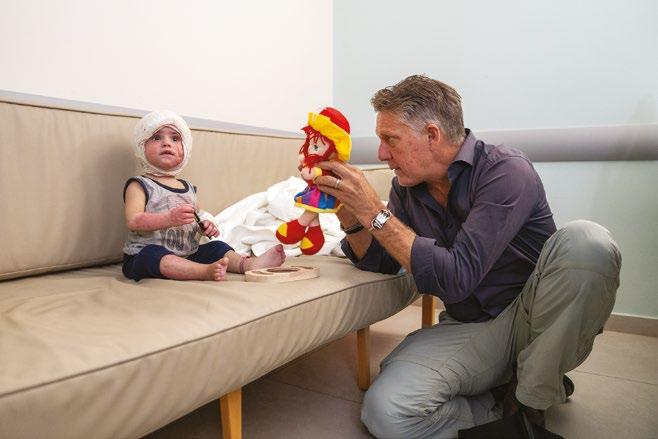
James Elder UNICEF Spokesperson, playing with two-year-old Ivana when he visited the hospital in Beirut where she is being treated for burns.
UNICEF Ireland’s Legacy Gifts Manager. “It’s part journal, part keepsake, and invites you to consider leaving something extraordinary to help children.”
“It is a free, no pressure invitation to reflect on your life, your values and your next chapter,” says Pauline Murphy,
[Please detach form]
Get in touch with our Legacy Manager to talk in confidence about your Will.
You receive a journal where you can reflect and record what matters most to you, capture your dreams, as well as personal memories and messages. It also includes practical sections for the details families often search for later. And in your pack, you will receive a Legacy brochure and Will Planner which will be useful
when preparing to meet with your solicitor.
What to do next
To start filling your Bucketful of Dreams and receive your legacy information pack, visit unicef.ie/bucket. If you’d prefer to talk to someone, you can call Pauline Murphy, UNICEF Ireland’s Legacy Manager, on 01 878 3000 or complete and return the form below.
I would like to receive updates on how my support has helped children and information on other ways to help:
If you prefer not to be contacted by post in the future, please contact us at info@unicef.ie Visit unicef.ie/about/privacy-policy for information about UNICEF’s data management practices. Phone Email
Details you need to include a gift in your Will to UNICEF:
Climate change? Maybe, but we’ve been here before..
Climate change and extreme weather are now part of our daily vocabulary. But as Michael Fewer observes, it is far from being a modern phenomenon..
In the media and in general conversation, One hears mentions of Global Warming almost every day now. It’s just as well, because it seems that it is crucially important that we do something radical about the matter, rather than continue like lemmings racing for the cliff. How long, however, has global warming being going on, I wonder.
I noticed recently a thought-provoking editorial that appeared in The Irish Times: ‘According to the US Commerce Department, which has been collecting statistics on the subject, the world, at least the northern end of it, is getting warmer. The Arctic ice is retreating. Open water is to be found at latitudes far north of anything previously known. Vast glaciers have been melted away by a summer of exceptional length and warmth. Polar bears, seals and other fur-bearing animals and certain fish have been driven by this unexpected heat wave from their normal summer haunts into the North…It is one of the interesting attributes of the terrestrial globe that, while, in fact, nothing out of the way has happened to it for thousands of years, anything may happen. If the Northern ice-cap is to melt away and leave the Pole as hospitable as Picardy, and Terenure as torrid as Timbuctoo, the change is likely to take fifty thousand years than five months –but there is always the possibility that it may take five months. A slight divergence from the absolute in the movement of the earth or sun or some intruding planet could frizzle the earth to a white ash or turn it as cold as a stone. It has not happened, and we human ants presume that it will never happen.’
Believe it or not, the date of this editorial was November 16, 1922, ninety-eight years ago. Is it a hint that global warming has been creeping up on us for longer than we had thought? Only the older amongst us, however, will remember extreme weather events that occurred long before the term was invented. The snows of 1947 and 1963, the heatwave of 1976 and the severe winter of 1986 were just called ‘extreme weather’ when they happened. Admittedly, we haven’t had our rivers freeze over since January 1881, when mini ice bergs flowing down the river Barrow destroyed the bridge at New Ross. Early in the twentieth century, six years before that Times editorial, an extreme weather event caused a major tragedy in
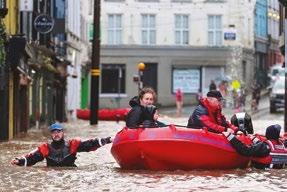
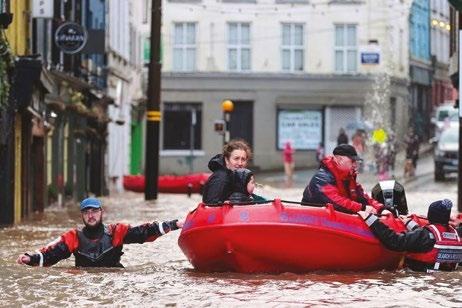
Extreme weather conditions, now generally blamed for flooding at Enniscorthy is typical of the results of severe weather conditions The snows of 1947 and 1963, the heatwave of 1976 and the severe winter of 1986 were just called ‘extreme weather’ when they happened.
my family. On the night of 16 November 1916 Ireland was struck by a severe storm. The south of the country was hit by what the newspapers called hurricane winds, and the Lee valley was heavily flooded, inundating many houses and creating a great lake stretching westwards from Cork city. Livestock was swept away, and six people were drowned in floods across the country. with widespread damage to buildings and towns. My grandfather, Thomas Sheridan, was living at the time on the Quay in Waterford with his wife Margaret, three young sons, and an infant daughter. During the storm a particularly strong gust of wind dislodged the chimney of the house next door, and tons of masonry collapsed with a great crash onto his house. The roof fell onto the third floor which, like a pack of cards, collapsed onto the second floor. In a chaos of masonry and timber and choking clouds of dust, Thomas, Margaret and the little boys were pinned in their beds by timber and masonry. Margaret held baby Mary in her arms, but couldn’t move a limb. Four brave dockers of the Clyde Shipping Company, Martin Alleyne, Joseph Colfer, John Brown and James Hayes, rushed across the Quay, and in spite of the danger of fire and falling masonry and detritus, they managed to enter the building. Digging through the rubble, plaster and twisted timbers, they managed to locate all the family and bring them out. Thomas, Margaret, Gerard, the eldest boy and the baby Mary survived, but the two youngest boys, three-year-old Thomas and eighteen months old Patrick, died.
My grandparents probably never completely came to terms with the disaster that occurred that November, but I believe that generation were no strangers to tragedy, and they soldiered on, somehow. The baby Mary survived to become my mother and lived a long and happy life, surviving many other weather events, and died at the age of 79, leaving four children, nine grandchildren, and seventeen great-grandchildren. It is easy to forget that the climate, as measured by the long-term distribution of temperature, rainfall sunshine and weather conditions generally, is always changing, and in a person’s lifetime the changes may be so small compared to the ordinary day-to-day and year-to-year variations that they are hardly noticed, or a large fluctuation is very much noticed.
During the last 2,000 years western Europe has experienced eight major changes in climate, including our recent ‘climate change’. By the middle of the last century BC, when Ceasar invaded Britain, it had been mainly wet and cold for about 400 years, and it remained so until about AD 100, when a warmer spell set in for almost a century. There followed a bit more than a century and a half of wetter weather, before it reverted to warmer and drier. This dry spell became very dry indeed between AD 600 and 800, during which a number of severe droughts occurred. It should be remembered that the grape vine, brought to Britain by the Romans, flourished in the Vale of Gloucester from around Ad 400 to 1200. After a stormy 13th century which dragged on until the 15th century, a period of extremely variable weather occurred, from wet years to dry ones and from bitter cold to very warm ones. Between 1650 and 1850 European winters became very cold, and it was during this period that frost fairs, the subject of many contemporary paintings, took place on rivers and lakes.
The English diarist Samuel Pepys wrote extensively about the harsh winter of 1683 to 1684, and there were another series of severe winters between 1794 and 1810: the last frost fair was held on the Thames in the winter of 1813-1814. From about 1850 to 1950 the weather became milder overall: parts of Greenland and Norway, previously frozen since the Viking era, became free of ice and were again used for cultivation. As winter temperatures increased, however, summers became less reliable.
No one has discovered, as yet, the basic reasons for the past climate changes, but it seems certain that our present situation, facing yet another summer of extreme temperatures, is simply due to mankind’s complete and arrogant disregard of nature.
tel: +353 (0)42 9392999
Email: museum@louthcoco.ie
Bridge
Michael O’Loughlin has enjoyed teaching bridge for over 40 years; his book, “Bridge: Basic Card Play” is available from the Contract Bridge Association of Ireland (01 4929666), price: €10.
Calling all Novices –Intermediates!
Calling all Novices – Intermediates
by Michael O’Loughlin
With two suits to explore, you’ll show five-four
Holding (3) you open 1♥ [the only exception to the open-higher-ranking-suit with-two-equal-length-suits is when you hold exactly four cards in hearts and four cards in spades]. If partner responds, say, 2♣ , you must rebid 2NT (balanced, 15-16), not 2♠ – which would show 5 cards in hearts.
Holding (4) you open 1♠ and rebid 2♥ over 2♣ , in spite of the poor suit quality, thereby showing your five ♠ and four ♥ shape.
Bridge by Michael O’Loughlin
Holding (5) you open 1♣ and rebid 1♠ in reply to a 1♦ or 1♥ response by partner: rebidding a cheaper four-card suit is preferable to repeating a sixcard suit.
Dealer: South None Vul
With two suits to explore, you’ll show five-four
If you bid two suits, you are showing (at least) a five-four shape. Say you open 1♥: initially you’re only showing four cards in the heart suit. But say partner responds 1♠ and you now rebid 2u. You’re now showing a 5-4 shape: by bidding a different suit, your heart will now suddenly become five cards. Let’s see why.
If you bid two suits, you are showing (at least) a five-four shape. Say you open 1♥ : initially you’re only showing four cards in the heart suit. But say partner responds 1♠ and you now rebid 2♦ . You’re now showing a 5-4 shape: by bidding a different suit, your heart will now suddenly become five cards. Let’s see why. (1) (2)
8 2
A K 9 2
6 3
With (1) you would open 1♥ (with a 4-card major and a 4-card minor the modern recommendation is to open the major); however, you would not rebid 2u over, say, a 1♠ response. You would rebid 1NT (15-16, balanced). The only time you would open 1♥ with just a 4-card suit is with a balanced hand and those hands will rebid notrumps unless partner either supports your hearts or partner responds 1♠ and you also have 4 cards in spades. Therefore, 1♥ - 1♠ - 2u shows a hand such as (2): five cards in hearts and four cards in diamonds.
With (1) you would open 1♥ ( with a 4-card major and a 4-card minor the modern recommendation is to open the major); however, you would not rebid 2♦ over, say, a 1♠ response. You would rebid 1NT (15-16, balanced). The only time you would open 1♥ with just a 4-card suit is with a balanced hand and those hands will rebid notrumps unless partner either supports your hearts or partner responds 1♠ and you also have 4 cards in spades. Therefore, 1♥ - 1♠ - 2♦ shows a hand such as (2): five cards in hearts and four cards in diamonds.
Look at the ditty another way: you would not introduce a second suit unless you have five (+) cards in your first suit. Consider these three hands:
(1) Avoid a yucky 2NT. Respond a suit to a suit. (2) Showing five ♥ and four u (3) Now knowing of the eight-card fit. By supporting at the three-level, North is showing 10-12 points.
Contract: 4♥ Opening Lead: ♠3
Look at the ditty another way: you would not introduce a second suit unless you have five (+) cards in your first suit.
Consider these three hands: (3) (4) (5)
On our 4♥ deal, West led the ♠3, East played the ♠K and declarer held up the ♠A. At trick two, East returned the ♠J and declarer perforce won with the ♠A. Declarer has lost one spade, must lose one heart and therefore can only afford to lose only one diamond trick. At trick three, declarer deliberately lost a diamond trick by ducking, i.e., playing a low diamond from each hand. West won with the u9 and tried the ♠Q. Declarer ruffed with the ♥3 and then cashed the ♥A and ♥K.
Leaving the ♥Q out – leave out the master trump – declarer now played the uK, the uA and ruffed the u7 with dummy’s 6. Declarer would not have minded if any of these diamonds had been ruffed/trumped with an opponent’s ♥Q because the Q was guaranteed to win a trick sooner or later, being the master trump, i.e. the highest remaining trump (the ♥A and K having been played earlier). 4♥ made.
Holding (3) you open 1♥ [the only exception to the open-higher-ranking-suitwith-two-equal-length-suits is when you hold exactly four cards in hearts and four cards in spades]. If partner responds, say, 2♣ , you must rebid 2NT (balanced, 15-16), not 2♠ – which would show 5 cards in hearts.
Holding (4) you open 1♠ and rebid 2♥ over 2♣ , in spite of the poor suit quality, thereby showing your five ♠ and four ♥ shape.
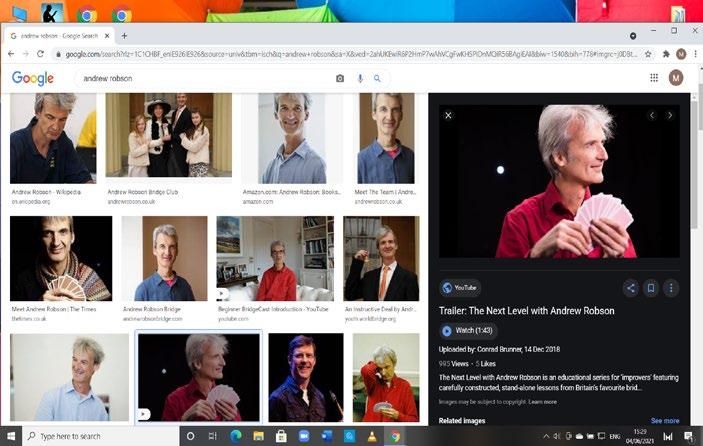
More tips for Intermediate players can be https://www.andrewrobson.co.uk/ andrew/tips_for_intermediates/ https://www.andrewrobson.co.uk/andrew/tips_for_intermediates
Holding (5) you open 1♣ and rebid 1♠ in reply to a 1♦ or 1♥ response by partner: rebidding a cheaper four-card suit is preferable to repeating a sixcard suit.
Dealer: South None Vul
Free bridge emails
If you wish to receive three times per week free bridge emails which include lessons, videos & quizzes, please email me: michaelolough@yahoo.com
Dealer: South None Vul
Introduction to bridge: Mini-bridge
Bridge is a trick-taking game. This means you are trying to win as many tricks as possible. A trick is made up of four cards, one card from each of the four players, played clockwise round the table.
Four players sit at a square table. Using the points of the compass, the four players are designated as North, South, East & West. Bridge is a Partnership Game. North & South sit facing each other and are Partners. Similarly, their opponents, East & West sit facing each other and are Partners.
1 - Shuffle and deal
Each player picks a card. Whoever picks the highest card becomes the dealer. The pack should be shuffled (randomly mixed) and cut for dealer. Dealer deals out the cards clockwise one by one to the players, so that they have 13 cards each. Dealer for the second game will be the next player clockwise and so on. Please note that sometimes teachers will provide you with pre-dealt hands.
2 - Sorting the hand
The players sort the cards in their own hand into suits and into sequence within each suit, without showing the cards to the other players.
Step-by-Step Sorting Method
• Count the cards: Before looking at the faces, ensure you have exactly 13 cards. You can do this by counting them face down.
• Separate by suit: Sort all your Spades, Hearts, Diamonds, and Clubs.
• Alternate colours: Arrange the suits alternating red and black (e.g., Spades / Hearts / Clubs / Diamonds).
• Order by rank: Within each suit, arrange the cards in descending order from highest to lowest: (A, K, Q, J, 10, 9, 8, 7, 6, 5, 4, 3, 2).
• Create a fan: Hold the bunched cards in your palm, and use your thumb and index finger to spread the top corners evenly. Higher-ranking cards should sit neatly on the left side of your fan so they are easy to see.
3 - Counting points
Counting points
Counting points
3 - Counting points
3 - Counting points
Getting started: for Absolute Beginners
player announces how many points his or her hand contains. The partnership with the most points becomes the declaring side who decide the contract. The other pair are the defending side, who try to prevent the contract being made by making tricks themselves. There is a re-deal if the point distribution between the partnerships turns out to be equal, i.e. 20:20.
5 - The declaring side
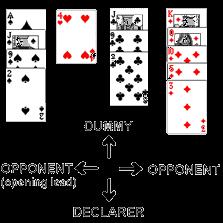
The player with the higher number of points in the declaring side becomes ‘declarer’, and their partner becomes ‘dummy’. If they both have the same number of points, the player who announced their points first is declarer. Dummy then lays their hand down face up on the table to face declarer, with the suits arranged in columns.
6 - Deciding the contract
The player with the higher number ‘declarer’, and their partner becomes number of points, the player who Dummy then lays their hand down the suits arranged in columns.
6 - Deciding the contract
If declarer has 8 or more cards in and dummy – she nominates that have 8 or more cards in a particular – she chooses to play in No Trumps.
If declarer has 8 or more cards in a particular suit – between her own hand and dummy – she nominates that suit as the Trump Suit. If declarer does not have 8 or more cards in a particular suit – between her own hand and dummy – she chooses to play in No Trumps.
value of the hand is worked out by counting up the high card points held, the following scale:
The value of the hand is worked out by counting up the high card points held, using the following scale:
value of the hand is worked out by counting up the high card points held, the following scale:
4 points
4 points
= 2 points
The value of the hand is worked out by counting up the high card points held, using the following scale:
The value of the hand is worked out by counting up the high card points held, using the following scale:
Ace = 4 points
Ace = 4 points
Ace = 4 points
Queen = 2 points
Queen = 2 points
Next declarer states what her trick target is, i.e. how many tricks she must win in order to make her contract. Declarer adds her points to those in her partner’s (dummy’s) hand to arrive at a total number of points for their side. Suppose, for example that that total number is: 22. Declarer divides that number by 3, ignores any fractions in order to arrive at her trick target. In this example the answer is 7. Therefore, declarer has to win 7 tricks in order to succeed in making her contract. If declarer is playing in a Suit Contract, she adds 1 to this target because playing in a Suit Contract is an advantage and usually generates 1 extra trick. Therefore, with 22 points in total, declarer’s trick target is 7 when playing in No Trumps and 8 when playing in a Suit Contract with either Spades, Hearts, Diamonds or Clubs as the trump suit. If declarer chooses a trump contract, the cards in dummy in the chosen suit are moved to be on the dummy’s right-hand side (the left-hand end as declarer looks at them).
7 - Play begins
King = 3 points
King = 3 points
King = 3 points
King = 3 points = 2 points
Queen = 2 points
Jack = 1 point
Jack = 1 point
Jack = 1 point
King = 3 points
Jack = 1 point
Jack = 1 point
that there are 40 points in total between the four hands in each deal. Announcing points
Note that there are 40 points in total between the four hands in each deal.
that there are 40 points in total between the four hands in each deal. Announcing points
Note that there are 40 points in total between the four hands in each deal.
Note that there are 40 points in total between the four hands in each deal.
4 - Announcing points
4 - Announcing points
4 - Announcing points
Beginning with the dealer, and then in clockwise order, each player announces how many points his or her hand contains. The partnership with most points becomes the declaring side who decide the contract. The pair are the defending side, who try to prevent the contract being made making tricks themselves. There is a re-deal if the point distribution between the partnerships turns out to be equal, i.e. 20:20. declaring side
Beginning with the dealer, and then in clockwise order, each player announces how many points his or her hand contains. The partnership with most points becomes the declaring side who decide the contract. The pair are the defending side, who try to prevent the contract being made making tricks themselves. There is a re-deal if the point distribution between the partnerships turns out to be equal, i.e. 20:20. declaring side
Next declarer states what her trick in order to make her contract. Declarer partner’s (dummy’s) hand to arrive Suppose, for example that that total number by 3, ignores any fractions example the answer is 7. Therefore, succeed in making her contract. If adds 1 to this target because playing usually generates 1 extra trick. Therefore, trick target is 7 when playing in No Contract with either Spades, Hearts,
If declarer chooses a trump contract, are moved to be on the dummy’s declarer looks at them).
7 - Play begins
If you wish to receive three times per week free bridge emails which include lessons, videos & quizzes, please email me:
Beginning with the dealer, and then in clockwise order, each
Beginning with the dealer, and then in clockwise order, each player announces how many points his or her hand contains. The partnership with the most points becomes the declaring side who decide the contract. The other pair are the defending side, who try to prevent the contract being made by making tricks themselves. There is a re-deal if the point distribution between the partnerships turns out to be equal, i.e. 20:20.
Beginning with the dealer, and then in clockwise order, each player announces how many points his or her hand contains. The partnership with the most points becomes the declaring side who decide the contract. The other pair are the defending side, who try to prevent the contract being made by making tricks themselves. There is a re-deal if the point distribution between the partnerships turns out to be equal, i.e. 20:20.
5 - The declaring side
5 - The declaring side
The player on declarer’s left plays the first card, i.e. makes the ‘opening lead’. Play is in clockwise order and players must follow to the suit led whenever possible. The highest card played wins the trick (unless, in a suit contract, it is beaten by a trump, since trumps outrank the other three suits). Players must follow suit which means if a Diamond is led, then each player must play a Diamond. Only if a player does not have a Diamond may s/he play a card of a different suit. If several rounds of a suit are played and a player runs out of cards in that suit, s/he may discard a card from another suit (which cannot win the trick), or in a trump contract can choose to play a trump (which will win the trick unless it is beaten by a higher trump).
TO BE CONTINUED.
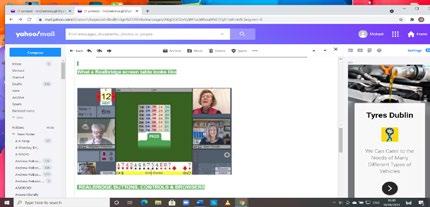
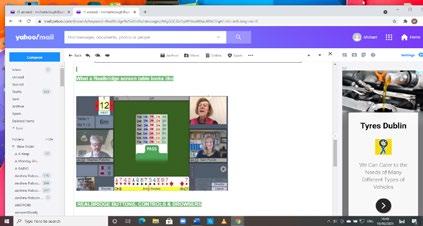
• See and speak to your partner and opponents - just like face-
• Connect with everyone at the table. Bid and play and go over the hands afterwards to learn from the post mortem. If you wish to try RealBridge for free, just email me:
just like face-to-face bridge.
• Connect with everyone at the table. Bid and play and go over the mortem.
Living on the edge
Zoe Devlin reflects on how fortunate we are in our immense choice of geographical features and habitats.
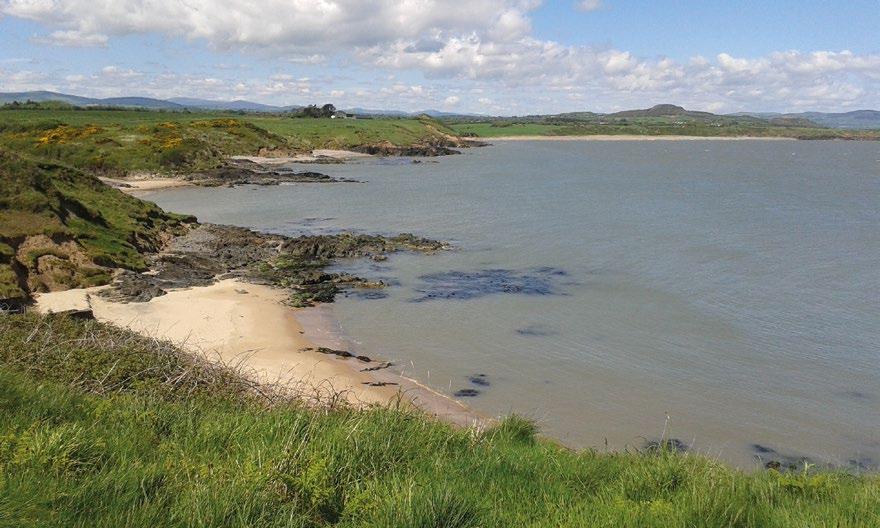
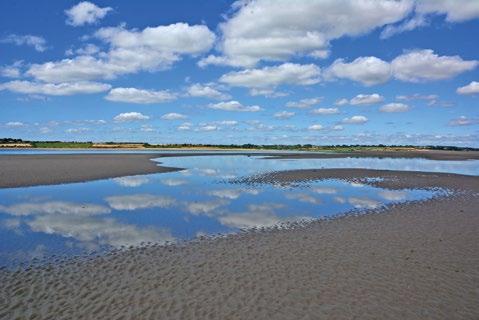
In Ireland, we are extremely lucky with our natural environment. Our island has numerous habitats, from bogland to mountains, freshwater to woodland, from meadows to hedgerows and more besides. Within those rough headings are many subdivisions, with possibly the most varied collection of all being in the habitat that surrounds our island – the coast. There are rocky headlands, sea cliffs, sand dune systems, tidal mudflats, saltmarsh, machair grassland and coastal lagoons and so the variety of biodiversity we can expect to find in these maritime environments is immense.
A rough measurement of the island’s coastline comes in around 7,500 km but this can only be taken as an estimate. By the mighty power of the Atlantic ocean, the west coast has been carved into, causing deep inlets, creating islands by wrenching land from the greater landmass and leaving long wide estuaries. The east coast is more sheltered because of the gentler action of the Irish Sea although some areas are suffering badly from erosion. This has been experienced in particular in counties Dublin and Wicklow and, in County Wexford’s Rosslare, significant loss of land has already occurred due to the recent winter storms.
As a child, I loved visits to the seaside, long summer days spent with bucket and spade or paddling in the ridged shallows of the beach, falling asleep on the way home, full of sunshine and sea air. As I grew up and started to take a more focussed interest in what lay around us, I also began to appreciate all that the coast, in particular, had to offer. Not just
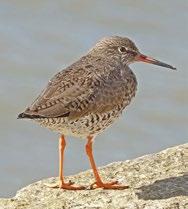
a playground but an environment full of the natural world’s wonders. Among these are the coastal dwelling birds, specialists in the avian world – the waterfowl – that thrive on the nutrients in mudflats, grazing slowly with measured pace, their bills probing deep pulling out worms and other invertebrates. In the saltmarshes, Grey Herons, tall elegant stalkers that slowly hunt for their dinner, standing like statues, their razor sharp beaks primed to pounce on some poor crustacean, fish or frog, about to be turned into a ready meal.
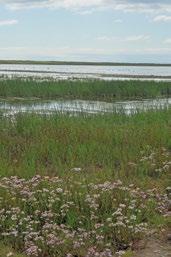
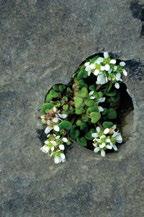
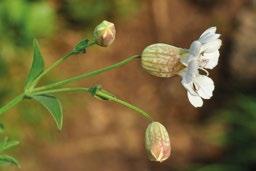
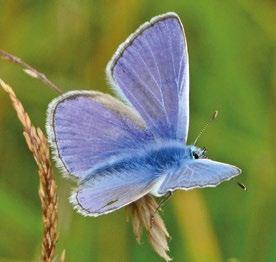
Then, back from the water’s edge, in the shingle or the ups and downs of dunes or clifftops is a myriad of the butterflies, moths and other insects that flourish, their needs being filled by a miscellany of wildflowers. And those flowers themselves – species that evolved over millennia to withstand the destructive and drying effect of salt-laden winds, many of them becoming fleshy and tough, somewhat like cactus plants. This modification gave them the ability to retain much needed moisture in order to survive in the severe and harsh maritime conditions.
East Coast Seascape
Bannow Island
Sea Aster
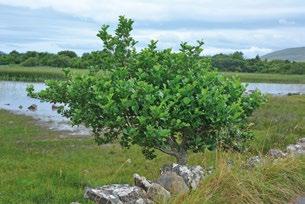
Alder
✓
✓
Meander along the coast
To look more closely at these superb habitats, why not take a meander along the coast and look at some of the spots that are most giving when it comes to finding nature’s treasures. There is plenty to see in sand dune systems such as that in County Wexford’s Ballyteigue Burrow Nature Reserve, a stone’s throw from the little fishing village of Kilmore Quay. This is a Special Protection Area (SPA) and a Special Area of Conservation (SAC) with not only the dunes but saltmarsh and the estuary of the Duncormick river. Both these designations – SPA and SAC – are principally focussed on wildlife.
A portion of the environment that is deemed an SPA has been given this label where there is a need to protect wildfowl and their habitats, whereas an SAC is there to care for a habitat considered to be important on a European as well as an Irish level such as a sand dunes or estuaries. In this nature reserve, several scarce plant species are scattered across the grassland behind the dune slacks as well as the dunes themselves. Dune slacks are low-lying depressions created by the wind within the sand dune systems and these contain many specialist wildflowers.
Along this gorgeous stretch of County Wexford, I have seen the creamy bellshaped flowers of Wild Asparagus in summertime, followed by its luscious scarlet berries in autumn. Standing on the grassy slopes that face the sun are small native orchids, only a few inches high, well camouflaged and not easy to spot. These little gems have the very appropriate name of Autumn Lady’s-tresses as they display their greeny-white flowers in beautiful tapering spirals. Here and there, dotted in the grass, like tiny matchsticks, are the
really miniscule shocking-pink flowers of Lesser Centaury, and, if you are really lucky, you might be occasionally joined in your ramble by the delightful Small Copper butterfly.
Lady’s Island
Also in County Wexford, Lady’s Island Lake is a large lagoon just a couple of miles from Carnsore Point. This is a peaceful spot, home to many breeding birds such as Shovelers feeding on small molluscs and insects around the lagoon. The plumage of this waterfowl is one of the most colourful with shiny green heads and rusty-chestnut bellies. Several interesting plant species also thrive in this, to some, inhospitable spot with harsh winter storms featuring regularly.
For example, there is Cottonweed, a lowgrowing wildflower with stems and leaves covered with downy silvery hairs and flowerheads like small yellow, fluffy buttons, best seen in August. This is one
of Ireland’s rarest native plants with only a dozen or so still managing to survive in the wild but, thanks to the combined efforts of the National Parks and Wildlife Service (NPWS) and the National Botanic Gardens, massive efforts are ongoing to save the species.
On the sandy banks surrounding the lake, the stunning orange-yellow flowers of the Yellow Horned-poppy manage to hang on to their petals throughout the summer, displaying long seedpods which give them their common name.
Wild Asparagus
Small Copper Butterfly
Autumn Lady’s-tresses
Cottonweed
Shoveler
Donegal
As every school child knows, the prevailing wind in Ireland blows from the southwest. These winds are Atlantic-driven, bringing mild, moist air that results in a temperate maritime climate with frequent rain and moderate temperatures year-round. The west coast gets more than its share of downpours but in many ways, that is something that can also give a softness to the landscape. I’m thinking of the coast of Donegal, with its intriguing machair habitat found in Derrybeg and on the shingle bar that connects the townland of Carnboy to the mainland.
Wild Thyme, Thrift, Sea Campion and Harebells are typical plants that thrive in this fertile coastal grassland, a particular type of environment that is only found in Ireland and Scotland, particularly the Outer Hebrides. Machair is listed as a priority habitat within the EU Habitats Directive, which means that its conservation is of international significance. The terrain is flat and sandy, a landscape created of tiny fragments of calcareous shells that were carried in on the wind over millennia to form this rare type of soil.
And mention of the Hebrides reminds me of the lucky day I came across a very uncommon plant – the Hebridean Spotted-orchid. This little gem was standing on a bank on Cruit Island, on a very ‘soft’ Donegal day. A small island, Cruit is in the Rosses area of the county and is connected to the mainland by a bridge. It is considered to be one of the richest sites for butterflies in western Donegal with 21 species including the Small Heath and the elusive Grayling. This latter creature is one that is probably the most maddening of all the butterflies for anyone wishing to see what it looks like with its wings open! It has a particular habit of fluttering all around the place
but when it settles, it promptly closes its wings, tilting itself sideways so all that is on view is the cryptic pattern of their undersides, another perfect example of camouflage.
A spot with plenty to fascinate birdwatchers is on the west coast of County Clare where the limestone slabs of the Burren meet the Atlantic. Kittiwakes and Guillemots lay their eggs on the rocky ledges by the ocean while Redshanks and Curlews feed on the tidal flats at nearby Bishop’s Quarter. A seabird bird that finds its fish supper along the side of Black Head is the Great Northern Diver. Common Blue butterflies dance in the summer air and for the wildflower lover, a ramble through the dunes reveals small groups of Pyramidal Orchids while later in the year, on the clifftop is the rare sight of some Autumn Gentians. Just beware of electric fences, they can give a nasty shock – especially when you’re not expecting it!
Pyramidal Orchids
Great Northern Diver
The Burren meets the Atlantic
Tacumshane (Our Lady's Island)
Common Blue Butterfly
Sea Campion
Redshank
Hebridean Spotted-orchid Scurvygrass
Ireland’s newest National Park
Further down the west coast, the rugged coastlines of Kerry and west Cork have many rich treasures to offer. Ireland’s newest National Park is Páirc Náisiunta na Mara, on the Dingle peninsula, and it is here that a breeding plan is in place to preserve our rarest amphibian, the natterjack toad. Not unlike a frog, the natterjack toad is somewhat smaller with a yellow stripe down the middle of its back. Unlike frogs that hop, these toads run instead. Just a couple of years ago, 500 junior toads were released into the wild, having been bred in Dingle Oceanworld, in a volunteer breeding programme in conjunction with the NPWS. My fingers are crossed they didn’t end up on the dinner menu for foxes, otters or any other mammal that spots them!
On County Kerry’s Iveragh peninsula lie the estuary, dunes, beaches and village of Derrynane and, of course, Derrynane House, the ancestral home of ‘the Liberator’, Daniel O’Connell. This splendid area, just a couple of miles off the scenic Ring of Kerry route, offers the nature lover a diverse range of habitats with saltwater marshes, woodland and a small harbour where, as a child, I spent umpteen happy hours trying to catch the tiny crabs that scuttled across the adjoining beach. Badgers, Irish stoats and the rare Lesser Horseshoe Bat also call this area their home. One of the most stunning of our native orchids, the Irish Marsh-orchid can also be seen here during May and June when it displays its intense magenta purple spike of small flowers.
Ring of Beara
I would suggest that a couple of hours gentle driving from County Kerry would be well worth it to get onto Ring of Beara a road throughout the rugged landscape of the Beara Peninsula. With less busy roads than those in Kerry, magnificent scenery and much to explore, this is an absolute treasure. As the route takes you towards the tip of this headland, pause and enjoy the pretty village of Allihies with its colourful houses, continue on to village of Eyeries and spend a while at the Copper Mine Museum. This tells the history of the seven copper mines, a story that began in 1812 and drew to a close in 1962. The remains of the workings are still in evidence and are now home to those remarkable members of the Crow family with their glossy black plumage and scarlet beaks and legs, the remarkable, acrobatic Choughs.
These are just snapshots of a coastline that is rich in biodiversity, social history and archaeology. Further suggested reading:
Ireland’s Seashore : Lucy Taylor & Emma Nickelsen : The Collins Press
Birds of Ireland : Jim Wilson & Mark Carmody : Gill Books
The Irish Butterfly Book : Jesmond Harding : www.vibesandscribes.ie
Webb’s An Irish Flora : Editors John Parnell & Tom Curtis : Cork University Press
The Wildflowers of Ireland (Second edition) : Zoë Devlin : Gill Books
Chough
Allihies Copper Mine
Ring of Beara
Médecins Sans Frontières/ Doctors Without Borders (MSF) is an international humanitarian organisation providing medical care in more than 70 countries. From our paediatric nurses to our logisticians,
are experts at working in fast-moving and highlyinsecure environments, like Ukraine, Yemen and Gaza.
Artificial Intelligence in Everyday Life: You've probably already used AI today
Pause for a moment and think about when you might have encountered Artificial Intelligence (AI) recently. The truth is, you've probably already used an AI system today without even knowing it. AI technology is now part of everyday life, from the weather apps and maps on our phones to the movies we watch online. Let's have a think about where you might have already used it.
What Is Artificial Intelligence?
Artificial Intelligence is about making machines ‘smart’ enough to do things that normally need a human mind - like understanding language, spotting patterns, making decisions and solving problems. AI ‘learns’ as it goes. A task that might take a person several hours, AI can often do in seconds.
AI doesn't think or feel the way a person does. It's a tool that finds patterns in information it has gathered from many different sources. Like any tool, it isn't perfect and can sometimes get things wrong.
AI in Everyday Life
Have you used a Maps app recently to get somewhere? Apps like Google Maps or Apple Maps use AI and upto-date information from other drivers on the road to work out the quickest route and to warn you about traffic, accidents or delays ahead.
Did you check the weather forecast before deciding whether to grab an umbrella before heading outdoors? AI helps to make those forecasts more accurate by looking at huge amounts of historical and current online weather information to make predictions.
Or did you watch something on Netflix or YouTube lately? AI provides recommendations for you, based on what you've watched before.
Maybe you've had a go at Generative AI (GenAI) - the newest AI kid on the block. Unlike the other examples above, which work quietly in the background, tools like ChatGPT, Gemini or Claude are the ones you actively interact with. You can ask these tools a question by typing it into the online chat or using the microphone option, and the system will respond by generating a response based on the information it has been given to learn from.
As you can see, AI is already a part of daily life. Most of the time, the AI system is working quietly in the background. Understanding how it works means you're better placed to make sense of its decisions - from your bank using it to check a payment, to a website recommending a product and systems in healthcare and other services you may rely on.
Get involved
What you have read here is a taste of the Age-Friendly AI initiative's 'Introduction to Artificial Intelligence' training workshop. Throughout 2026, Age-Friendly AI is visiting every county in Ireland, bringing free workshops to public libraries near you. It's a relaxed, friendly space to ask questions, try Artificial Intelligence out and learn at your own pace — no prior background in AI is needed. Keep an eye on agefriendlyai.ie/events to find out when we're coming to your area, or send an email via agefriendlyai@adaptcentre.ie.
In the next SeniorTimes issue, we will take a closer look at Generative AI - stay tuned.
Spain’s Only Irish Fleadh Launched in Dublin
Spain’s only Fleadh, hosted in Cáceres, cemented its international profile by strengthening institutional and cultural ties between Spain and Ireland
The event will take place from the 17th to the 20th of September 2026, once again turning Cáceres into the capital of traditional Irish music
The Embassy of Spain in Ireland was the chosen venue for the official launch of the 2026 Cáceres Irish Fleadh International Festival. The event served to consolidate the excellent institutional relations between both countries and highlight the
An Established Track Record and High Hopes for September
During the speeches, the successful track record of the Cáceres Irish Fleadh was reviewed—a festival that has managed to perfectly blend the historic heritage of the Extremaduran city (a designated UNESCO World Heritage Site) with the purest folk music of the Emerald Isle.
The organisers took the opportunity to outline the main highlights of this year’s programme, which will run from the 17th to the 20th of September 2026. This new edition adds an extra day to the schedule, Thursday the 17th, and will once again flood the squares, partner pubs, and iconic spaces of Cáceres with top-tier concerts, workshops, sessions, and traditional Irish dance showcases.
The gathering was attended by a prominent delegation of over thirty musicians and dancers from various parts of Ireland, who brought the distinctive sound and rhythm of the festival, alongside key figures in international relations between Spain and Ireland.
The launch in Dublin marks the start of the countdown to one of Europe’s most highly anticipated cultural dates, which this year promises to exceed all attendance expectations and tighten, even further if possible, the bond between Irish culture and the
Partnerships with the Belfast TradFest
Furthermore, during the Cáceres Fleadh organisation’s stay in Ireland, they will attend the official launch of the 2026 edition of the Belfast TradFest, taking place in Northern Ireland. Musician and festival organiser Dónal O’Connor also attended the official launch of the Cáceres Irish Fleadh. These meetings enable cultural and tourism exchanges and strengthen the bonds between Spain and Ireland through music. For more information:
Pat Keenan reports on happenings in and around the capital
Captain America flies off and leaves us with our cool memories
When Captain America's Cookhouse and Bar opened on Grafton Street in 1971, the US President was Richard Nixon, at home RTE was planning to introduce broadcasting in colour and a time when, perhaps, our view of America was more likely to be informed by comics or the cinema
Travel was more restricted back then. It was before the internet or social media and long before news came from all over the world as it happens, non stop, 24 hours a day. Now 55 years have passed and Captain America's in Grafton Street
The Captain introduced us to whopping American style burgers as an antidote to ‘wimpy’ Wimpy fare
has closed and the US President is Donald Trump ... enough said.
Captain Americas in Grafton Street was set up by Mark Kavanagh, who later sold it on while he went on with planning and setting up the booming Irish Financial Services Centre, Dublin’s primary financial district in the Custom House Docks area north of the River Liffey.
When Captain Americas first opened in Grafton Street, it was Ireland’s first cookhouse & bar and introduced us to all American culinary delights; the full
American Burger followed by chocolate sundaes and deep pan apple pie, all accompanied with an exciting blast of Rock'n'Roll and surrounded with all the colourful artistry of American style comic characters but noticeably careful not to infringe on actual American comic heroes.
Marvel Comics apparently one time tried suing Captain America's Grafton Street restaurant for breach of copyright but our Captain Americas is carefully rendered by Irish Artist Jim Fitzpatrick in his own original unmistakable style and is not at all like the Marvel Comics Captain.
The cool, low-lit
Independent information for your phone, broadband and postal services
ComReg is the Commission for Communications Regulation. We are an independent public body with powers under the law.
We regulate the electronic communications sector, which includes phone, broadband and we also regulate postal services like An Post.
We can support you in several ways
For example, we:
• Explain your rights so you can make informed decisions about choosing and using a service or switching provider.
• Ensure service providers set out information about their customer service arrangements in their customer service charter, including the levels of quality of their customer service and compensation schemes.
• Help resolve complaints you can’t solve with your service provider.
• Monitor and enforce service provider compliance with their regulatory obligations.
• Ensure measures are in place to make phone and broadband services easier for people of all ages, abilities and disabilities to access, understand and use.
Common issues we deal with
We deal with queries and complaints such as:
Billing: Have you been overcharged? Or billed for a service you don’t recognise?
Contracts: Are you confused by a price change or contract term?
Service issues: Have you experienced a loss of service or mobile coverage? Are you experiencing broadband speeds below those set out in your contract?
Switching: Have you encountered a delay in changing provider or loss of your phone number?
Missed or delayed installation appointment: Did a technician fail to show up at the agreed time slot?
Accessibility: Have you concerns about the accessibility of a service?
Postal services: Has an important letter or parcel been delayed or gone missing?
Consumer Care can help
Complaints about phone and broadband services
Our Consumer Care Team can give you advice and information about your phone and broadband service.
If you have a complaint, we can review it and contact the provider for you if:
1. You’ve already followed your provider’s complaints process, and
2. Your complaint hasn’t been resolved after receiving a response from your provider, or if your provider has not responded to your complaint.
Complaints about postal services
If you are having issues with your postal service provider, Consumer Care can also provide advice on how to make a complaint.
Complaints about accessibility
Providers must make their services accessible for people of all ages and abilities. If your complaint is about the accessibility of a service, you can contact Consumer Care directly.
Visit comreg.ie for more information
Contact Consumer Care
Monday to Friday: 8am to 8pm, Saturday: 9am to 1pm
Phone: 01 8049668
Email: consumerline@comreg.ie
Text: COMREG or ASKCOMREG to 51500 to receive a call or text back (standard SMS rates apply)
Post: Consumer Care team, ComReg, One Dockland Central, Guild Street, D01 E4XO
Webchat and online form: comreg.ie
Irish Sign Language: Facility available on request
Text Relay: Contact us through the Irish Text Relay Service. See more at ITRS.ie
Access Officer: access@comreg.ie
The NYX Hotel in Portobello, a notable addition to Dublin’s
NYX Hotel opens in Portobello
Thinking of visiting Dublin? We who don't act our age might just benefit from a few days at the NYX Hotel in Portobello... and it might even some take years off. They have introduced 'Ireland’s first-ever in-room beauty and wellness hotel experience, what they call Ireland’s first “Glow Up Package” in partnership with Déesse PRO and iS Clinical. What's to lose... You might even become a bit more handsome, dignified, more elegant, perhaps.
Available from June 4th to September 2026. €40 add-on for solo guests / €80 for two guests sharing At the centre of the experience is the award-winning PRO by Déesse PRO LED mask, bringing professional-grade LED light therapy directly into the hotel setting. Developed using NASAinspired light technology and engineered with clinically recognised wavelengths, the mask is designed to support visible improvements in skin tone, texture, redness and overall skin rejuvenation. The device has become renowned within the beauty industry for merging advanced science with sophisticated design, offering guests a results-driven treatment experience in a completely new and accessible way.
The Glow Up Package is available to book now and will be available until September 2026 exclusively at NYX Hotel Dublin, Portobello Instagram: @NYXHotelDublin TikTok: @NYXHoteldublin
All aboard for the Baldoyle Bloomsday bus
All aboard
We celebrated Bloomsday as usual with our H1 bus from Baldoyle and Luas from abbey Street to Duke Street to join the crowds alternating between The Baily and Davy Byrnes or just standing chatting, all as usual dressed in all our Edwardian Bloomsday finery. Men, bow tied, straw boaters or bowler hats. The ladies in full-length dresses, perhaps shawls, wide-brimmed hats or parasols.
This year the unexpected Bloomsday pub conversation was about the television quiz show "Who Wants to Be a Millionaire" Some had watched live or some Goggleboxed. All reflecting on the contestant who actually won a million by answering the question: “Used since 1876, which trademarked logo is described in the James Joyce novel Ulysses and depicted in works by Manet and
Picasso?” And how he immediately answered correctly...admitting he had never actually read Ulysses. The four possible answers were: Bass Ale, Famous Grouse, Coca-Cola or Stella Artois. Turned out the contestant was no Joycean. He had once seen Édouard Manet’s painting at a bar in the Folies-Bergère in Paris and remembered the distinct Bass red triangle on the bottles.
This year also brought the launch of Desmond J Green's new book on his vast collection of Joyceana and celebrated by hosting an event called New Perspectives on Irish English, a biennial conference first held in 2010 at UCD. Frank McNally, he of 'An Irish Diary' in The Irish Times fame and wit and a major authority on the works of Joyce was asked to say a few words in an eveof-conference workshop on “Irish-English in the real world”. Entertainingly, Frank wrote: "So I turned up and, not knowing anyone, sat at the back of the room with the rest of the audience" Prof Corrigan began to introduce a group who had taken their seats alongside her. Frank then realised that someone called “Frank McNally” was supposed to be among them and only then realised that the empty chair on stage was his.
Frank wrote: "Somewhat to the amusement of the audience, I left my seat at the back and, sheepishly interrupting the professor, said “I just realised I’m on the panel.” Frank added,"Happily, all I had to do was briefly explain my interest in Irish-English,...once started, I found, the biggest challenge was to shut up".
James Joyce: A Life in Books: The Desmond J. Green Collection is published by Martello Publishing We did celebrate Joyce but also a thought for our other great Dublin writer Jonathan Swift, this year celebrating the 300th anniversary of the publication of 'Gulliver’s Travels' first published in 1726.
hotel offerings
the Baldoyle Bloomsday bus
Danny Mullin Ambassador to Leopardstown
Recently, The 1878, the Exclusive Private Members Club at 3Arena, played host to a racehorse 'Comfort Line' and Leopardstown Racecourse ambassador Danny Mullins, marking the renewal of its partnership with the famous Dublin racecourse.
Leopardstown Racecourse, located just six miles from Dublin city centre, is home to some of the country’s most celebrated fixtures, including the Dublin Racing Festival and the Irish Champions Festival.
Founded in 1888, is one of Ireland’s premier racing venues, renowned for its rich heritage and world-class horse racing. Hosting 23 race days annually, Leopardstown showcases the best of both Flat and National Hunt racing and remains the only racecourse in Ireland to stage both Grade 1 and Group 1 races. It hosts some of Ireland’s most iconic fixtures, including the Bulmers Live at Leopardstown, the Christmas Festival, the Irish Champions Festival, and the Dublin Racing Festival.
Another accolade for The Little Museum of Dublin
You will know I'm a big fan of the The Little Museum of Dublin and delighted to hear it is now ranked among top 10 attractions in Europe. The announcement by TripAdvisor, the bible for travellers worldwide, places it 7th in Europe, ahead of the Louvre Museum and Notre-Dame Cathedral Paris and the Van Gogh Museum, Amsterdam. The announcement by TripAdvisor sees the Little Museum of Dublin in their top ten
attractions in Europe and at number 12 in the world in their 2026 Travellers’ Choice Awards - the first time that an Irish attraction has featured so prominently in their ‘Best of the Best’ awards.'
Located in the heart of Dublin on St Stephen’s Green, the Little Museum of Dublin is a city museum with a collection created through public donation. The museum’s collection is entirely curated from objects donated by the people of Ireland. Each artefact tells a story, creating a rich and personal narrative of Dublin life across generations. Visitors can explore carefully designed exhibitions that highlight defining moments in Irish history, from everyday life to pivotal national events, including the Easter Rising.
Dr. Daryl Hendley Rooney, Deputy Curator of the Little Museum of Dublin, called it an an "extraordinary achievement that speaks to the generosity of Irish people, who helped to build our collection, and the support of our patrons in Failte Ireland, Dublin City Council and the Department of Culture."
Another accolade for the Little Museum of Dublin
Leopardstown Racecourse ambassador
Danny Mullins with Comfort Line at the 1878
The Cost of Living in Retirement:
What Has Changed Since 2020?
There was a time, not so long ago, when retirement planning felt relatively straightforward. You worked, saved, contributed to your pension, paid off your mortgage and looked forward to a retirement where your biggest financial decisions might involve choosing a holiday destination or deciding whether to spoil the grandchildren. Then came 2020.
Few of us could have predicted the changes that would follow. A global pandemic, supply chain disruptions, rising energy prices, higher interest rates and a period of inflation not seen for decades have all had a significant impact on household finances. For many retirees and those approaching retirement, the question is no longer simply, "Have I saved enough?" but rather, "How much will my retirement actually cost?" I sat down with two of my clients who are 6 years retired this year to see how their life has changed.
A Familiar Story
Mary and John retired in 2020, both looking forward to a new chapter after decades of work. They had done many of the right things: their mortgage was paid off, they had built up pension savings, and they felt reasonably confident about their finances.
Six years later, their situation remains secure, but they admit that retirement has cost more than they expected.
"It's not one big thing," Mary explains. "It's a hundred little things."
Their energy bills are higher. Groceries cost more. Insurance premiums seem to increase every year. They are helping a daughter with childcare costs and occasionally contributing towards activities for their grandchildren. At the same time, they want to enjoy retirement while they are healthy enough to travel and make the most of their freedom. "We're not struggling," John says. "But we've realised that retirement isn't a static thing. What worked financially in 2020 needs to be reviewed in 2026."
Their experience is increasingly common. Many retirees are finding that while they may have planned carefully for retirement, the world around them has changed more quickly than expected.
The New Reality of Everyday Expenses
One of the biggest challenges facing
retirees today is that many everyday costs have increased substantially over the past five years. Take energy bills. For many households, particularly those spending more time at home, heating and electricity costs have become a much larger part of monthly spending.
Food shopping has also changed. While inflation may have slowed from its peak, anyone pushing a trolley around their local supermarket knows that many items remain significantly more expensive than they were in 2020. Healthcare costs, insurance premiums, home maintenance and car expenses have all risen too. Individually, these increases may seem manageable. Combined, however, they can place considerable pressure on a fixed retirement income.
The Hidden Challenge: Lifestyle Inflation
Interestingly, not all retirement spending pressures come from rising prices, many retirees are simply doing more. Today's retirees are healthier, more active and often more adventurous than previous generations. Travel, hobbies, sporting activities, cultural events and lifelong learning have become important parts of retirement life.
This is undoubtedly positive. After all, retirement should be about enjoying the freedom you've worked hard to achieve. However, it does mean that retirement spending patterns are changing. The traditional image of retirement as a period of reduced spending is becoming less accurate for many people.
In fact, some retirees find they spend more in the first ten to fifteen years of
retirement than they ever anticipated.
Supporting Family Has Become More Common
Another significant change since 2020 has been the growing financial support many parents and grandparents provide to younger generations. Whether it's helping with childcare, contributing towards education costs or assisting adult children with a house deposit, family support has become an increasingly important part of retirement finances.
Many people are delighted to help if they can. Yet these decisions deserve careful consideration. A gift made today should not compromise your own financial security tomorrow. Finding that balance is becoming one of the defining financial challenges of modern retirement, and a key consideration for Financial Advisors.
A Good Retirement Plan Is About More Than Numbers
When people think about retirement planning, they often focus solely on pension values, investment returns or savings balances. Yet the most successful retirement plans usually begin with a different question:
"What kind of life do I want to live?"
The answer will be different for everyone. For some, it means extensive travel. For others, it means spending more time with family, volunteering, pursuing hobbies or simply enjoying the freedom to choose how each day is spent. Once those priorities are clear, financial decisions become easier.
Money is not the goal. It is simply the tool that helps create the life you want.
Looking Forward
Retirement today looks very different from retirement in 2020. The world has changed. Costs have changed. Family dynamics have changed. Expectations have changed. But one thing remains constant. People want confidence. They want to know that they can enjoy their retirement without constantly worrying about money. They want the freedom to support loved ones, pursue their interests and navigate life's surprises with confidence.
That is why regular financial reviews have never been more important. Because retirement is not a single event. It is a journey that can last decades, and like any journey, it benefits from reviewing the map from time to time.
A Simple Retirement Health Check
If you haven't reviewed your financial position in the past two years, now may be a good time to ask yourself a few simple questions:
. Has my spending changed since I retired?
. Am I drawing income from my savings and pensions in the most efficient way?
. Have rising costs affected my long-term plans?
. Have my family circumstances changed?
. Does my financial plan still reflect the lifestyle I want to enjoy?
Retirement planning is not about predicting the future perfectly. It is about adapting to change and ensuring your finances continue to support the life you want to live.
If this article has prompted questions about your own retirement plans, consider arranging a financial review with a qualified adviser. A fresh perspective can often identify opportunities, risks and practical steps that help you move forward with greater confidence.
We are happy to help at Ulysses Financial Services
01 564 5844
www.ulyssesfinancial.ie
adam.orourke@ulyssesfinancial.ie
"The goal of retirement planning isn't simply to accumulate money. It's to create the freedom to spend your time, energy and resources on what matters most. After all, true financial independence is not about wealth—it's about choice."
Winners Of The 2026 Get Sunsmart! Art Competition Announced
The competition, which received entries from across the country, was run by Healthy Ireland in partnership with the National Cancer Control Programme in the Health Service Executive (HSE). It forms part of the annual SunSmart campaign, which promotes awareness and adoption of skinprotective behaviours.
The winners for 2026 are:
· Pre-schools – Frances Jean Dalisay Sulangi Age 4 from Cork
· Junior Infants to 1st Class – Amelia Barry Age 7 from Dublin
· 2nd to 4th Class – Raheem Amir Age 9 from Sligo
· 5th and 6th Class – Olivia Tong Age 11 from Westmeath
Depending on their age group, children were asked either to colour in the Healthy Ireland SunSmart 5Ss picture or to create their own SunSmart Superhero Squad, using the SunSmart 5Ss as inspiration.
Minister Murnane O’Connor said: “Congratulations to all our winners on their amazing artwork, I was so impressed with the level of talent and creativity of all the entries. Every one of you should be so proud of your achievements, and I am so grateful to you all for helping to spread the SunSmart message."
“Skin cancer is the most common cancer in Ireland, with over 11,000 new cases each year. We know that children’s skin is
particularly vulnerable to sun damage, and that severe sunburn during childhood can have a huge impact in skin health later in life. That is why I would like to thank all the parents and teachers who encouraged and facilitated the children to enter the competition. Starting these conversations with children can help establish lifelong habits that will protect your children’s skin in the future.”
To be SunSmart, follow the 5Ss of the SunSmart code from April to September, even on cloudy days:
Slip on clothing that covers your skin, such as long sleeves and collared t-shirts.
Slop on broad-spectrum, water-resistant sunscreen with UVA and UVB protection. Use SPF 30+ for adults and SPF 50+ for children, and reapply regularl
Slap on a wide-brimmed hat to protect your face, ears and neck.
Seek shade, especially if outdoors between 11am and 3pm. Use a sunshade on a buggy or pram, and keep babies and children out of direct sunlight.
Slide on sunglasses to protect your eyes.
Visit www.gov.ie/getsunsmart
Senior Times Wants To Hear From You!
Senior Times welcomes contributions from you. Short stories should be up to 1750 words long . Articles on any subject likely to be of interest to our readers should also be 1750 words long. We also welcome poetry which should be up to six works and no longer than 750 words. You should email your contributions to : john@slp.ie Regretfully we cannot accept ‘hard copy’ contributions.
Adam O’Rourke QFA , Ulysses Financial Services LTD
Explore the 1916 Easter Rising and Modern Irish History
The GPO (General Post Office) is one of Ireland’s most famous buildings and the awardwinning GPO Museum is a must-see on any visit to Dublin! Witness Ireland’s history from revolution to modern times dramatically unfold before your eyes!
This year the museum celebrates its tenth anniversary, and it is a popular choice for both local and international visitors of all ages who wish to learn about the key events of modern Irish history.
The building was the headquarters of the 1916 Easter Rising which set in motion a chain of events which would ultimately lead to the creation of the Irish Republic. Key moments that shaped Ireland’s history are brought to life through electronic touch screens, film, video, audio visual booths, sound, and authentic artefacts.
Until August 31st, the museum will feature the acclaimed ‘Peace Heroines’ exhibition which was launched by Herstory Education Trust in partnership with the National Museums NI and the Department of Foreign Affairs. This exhibition celebrates the pivotal role of women in the peace process of Northern Ireland.
Afterwards relax in our café overlooking the courtyard or browse the gift shop which stocks an array of quality gift items. Both the café and gift shop are open to the public.
For further information visit www.gpomuseum.ie.
Museum Opening Times: Monday-Saturday 10:00 am -5:00 pm last admission at 4:00pm (Closed Sunday, Public Holidays and Christmas Eve) Café closes at 4:00 pm
‘A year of considerable impact’ –Croi Annual Report
The Croí’ Annual Report 2024 captures a year of considerable impact and transformation for the organisation, driven by the strength of it's community and their unwavering mission to prevent heart disease and stroke, save lives, and support recovery across the West of Ireland and beyond’.
Chies Executive Mark O’Donnell writes:
effervescent energy and generosity are at the everything she does for Croí. She gives her freely—not just as a volunteer, but as someone understands what it means to rebuild life cardiac event.
‘In 2024, Croí reached more people than ever before through innovative programmes in prevention, recovery, and advocacy. A truly transformative catalyst for change came with the extraordinary legacy gift from the Joe and Helen O’Toole Charitable Trust, which enabled us to launch our state-of-the-art Mobile Health Vehicles and complete the construction of a new Community Stroke Hub. These investments have already begun to change lives, breaking down barriers to access and bringing vital services directly into communities.'
own experience, she has helped feel less alone and more their recovery.
far beyond offering support— instrumental in ensuring that the and the power of lived experience places where they matter trained facilitator for Activate Your psycho-education programme, and member of Croí’s advocacy alliance, Voice Ireland, she has helped confidence and their place
With Mary, you always know where you stand. She’s a straight talker—if we ask her to do something and she can, she will. If she can’t, she’ll tell us, no fuss, no excuses, just honesty. It’s a quality we value enormously because it makes working with her so easy and so real.
‘Alongside these milestones, we delivered thousands of free health checks across the country, expanded our stroke recovery programmes, supported over a hundred families through our Croí Courtyard Apartments, and launched Croí’s first comprehensive three-year Strategy (2024–2027). Each achievement reflects our commitment to meeting people where they are and ensuring no one faces cardiovascular disease or stroke alone.'
(Public and Patient Involvement ambassador, she represents Croí and on academic research sure real-life experiences conversation. She has even been NIPC academic paper—a the difference she is making in patient voice in cardiovascular matter the setting, Mary is always Croí’s mission.
Mary first came to Croí as a patient over a decade ago, and since then, she has become an essential part of the team. Whether assisting at reception, volunteering at the Croí Cycle, speaking on a panel, or showing up for her weekly exercise class, she is part of the fabric of the Croí family. Her impact is felt in so many ways, and we appreciate all that she has done—and continues to do—for others.
‘This progress is only possible thanks to the extraordinary efforts of our staff and volunteers, the leadership of our Board, and the continued trust and support of our partners, donors, and stakeholders. Whether through collaboration, support, advocacy, or engagement with our services, your role in this journey is deeply valued.'
‘I encourage you to review the enclosed report, which demonstrates the impact of our work and our ambition for what lies ahead.’
Croí, the West of Ireland Cardiac & Stroke Foundation, Ltd. –a company limited by guarantee.
Main T: 091-544310 | Mobile: 087 2825156 | www.croi.ie
Croí Annual Report 2024
Communication
Croí’s social media platforms have grown, strengthening our role as a leading voice in cardiovascular health and stroke prevention.
In 2024, Croí significantly expanded its communication efforts, strengthening its digital presence, media outreach, and direct engagement with communities. Our strategic approach has reinforced our role as a leading voice in cardiovascular health and stroke prevention.
Croí’s
This aligns with Croí’s new three-year strategy, which sets out a clear vision to enhance cardiovascular health awareness, prevention, and support services.
social media platforms have continued to grow in followers, impressions, and engagements across Facebook, LinkedIn, Instagram, X (formerly Twitter) and YouTube.
Too Little,
On Two Wheels
John Feehan charts the demise of Britain's great motorcycle industry...
For much of the twentieth century, Great Britain was the undisputed leader of the global motorcycle industry. British manufacturers produced some of the most respected and successful motorcycles in the world, exporting their machines across Europe, North America, Asia, and the Commonwealth.
Brands such as Triumph, Norton, BSA, Matchless, and Royal Enfield became symbols of engineering excellence and performance. During the 1950s, British motorcycles dominated international markets and racing circuits alike. Yet within a few decades, this commanding position had largely disappeared. By the late 1970s, most major British motorcycle manufacturers had collapsed, merged unsuccessfully, or ceased production. The decline of Britain’s motorcycle industry was not caused by a single factor. Instead, it resulted from a combination of technological stagnation, poor management, labour disputes, changing consumer preferences, and increasing competition from foreign manufacturers, particularly those from Japan. Together, these factors transformed Britain from the world’s leading motorcycle producer into a minor player in the industry it once dominated.
The Golden Age of British Motorcycles Britain’s motorcycle industry emerged in the late nineteenth and early twentieth centuries, benefiting from the country’s strong industrial base and engineering expertise. During both World Wars, British manufacturers
supplied motorcycles for military use, strengthening their production capabilities and international reputation. After World War II, the industry entered a period of remarkable success. Economic recovery created strong demand for affordable transportation, and motorcycles provided a practical alternative to cars. British manufacturers capitalized on this opportunity by producing reliable and relatively inexpensive machines that appealed to domestic and international buyers.
Companies such as BSA, Triumph, and Norton became major exporters, especially to the United States. Racing success further enhanced their prestige. Triumph twins and Norton racing motorcycles earned international recognition, helping establish Britain as the center of motorcycle innovation and performance. By the 1950s, British motorcycles dominated world markets, and the industry employed tens of thousands of workers. However, beneath this success, significant weaknesses were beginning to emerge.
Failure to Innovate
One of the most important reasons for the industry’s decline was its inability to innovate quickly enough. Many British manufacturers continued to rely on designs developed before or shortly after World War II. While these motorcycles had proven successful, they changed little over time. British companies often focused on minor improvements rather than developing entirely new technologies. Many
motorcycles still suffered from oil leaks, vibration problems, unreliable electrical systems, and kick-start-only engines. Meanwhile, foreign competitors invested heavily in research and development. Japanese manufacturers introduced more advanced technologies, including electric starters, overhead-cam engines, improved reliability, and modern production methods. Their motorcycles offered superior performance and required less maintenance.
Many British executives underestimated the importance of these innovations. By reputation alone they believed customers would remain loyal to traditional British brands. Instead, consumers increasingly viewed British motorcycles as outdated .
Management Problems and Industry Fragmentation
Poor management also contributed significantly to the industry’s decline. The British motorcycle sector consisted of numerous independent companies competing for market share. Rather than cooperating on research and development, many firms duplicated efforts and competed against one another in increasingly crowded markets. Management often prioritised shortterm profits over long-term investment, delayed modernising factories and introducing new models, leaving them vulnerable. Financial resources that could have been used for innovation were frequently insufficient or poorly allocated. Attempts to solve these problems through mergers were largely unsuccessful. During the 1960s and
Triumph's Bonneville and Norton's Commando topped the sales charts...until Honda unleashed the CB 750 and the rest , as they say, is history...
1970s, several struggling manufacturers combined to form larger organizations, including Norton-Villiers and NortonVilliers-Triumph. These mergers were intended to create stronger, more competitive businesses, but they often combined existing weaknesses rather than eliminating them. As financial difficulties mounted, companies lacked the resources needed to modernise production or develop motorcycles capable of competing with their new foreign rivals.
Labour Relations and Industrial Unrest
The British motorcycle industry also suffered from labour disputes and declining productivity. During the 1960s and 1970s, strikes and conflicts between management and trade unions became increasingly common throughout British manufacturing. Many motorcycle factories operated with outdated equipment and inefficient work practices. Productivity often lagged behind that of competitors abroad, particularly in Japan. Frequent disruptions reduced output, delayed deliveries, and increased costs.
Industrial unrest damaged the reputation of British manufacturers in export markets. Dealers and customers became frustrated by inconsistent supply and long waiting times. As reliability and customer service became increasingly important, these problems encouraged buyers to seek alternatives. The workerled occupation of the Triumph factory
at Meriden during the 1970s became one of the most famous examples of industrial conflict in Britain. Although it demonstrated the determination of employees to preserve jobs and production, it could not overcome the broader economic and competitive challenges facing the industry.
The Japanese Challenge
During the late 1950s and 1960s, companies such as Honda, Yamaha, Suzuki, and Kawasaki began expanding into global markets. Initially, many British executives dismissed Japanese motorcycles as low-quality imitations. However, Japanese manufacturers rapidly improved their products and soon offered motorcycles that were more reliable, technologically advanced, and competitively priced than their British counterparts.
The introduction of Honda’s CB750 in 1969 marked a turning point. Featuring a four-cylinder engine, electric starter, front disc brake, and exceptional reliability, it set a new standard for motorcycle design. British manufacturers struggled to match its combination of performance, quality, and affordability. Japanese firms also excelled in mass production and quality control. Their factories produced motorcycles more efficiently and consistently than many British facilities. Consumers increasingly preferred motorcycles that started easily, required minimal maintenance, and offered modern features.
As Japanese brands gained popularity, British market share declined sharply. The United States, once a crucial export market for British motorcycles, became dominated by Japanese manufacturers during the 1970s.
Changing Consumer Preferences
Consumer behavior was also changing. In the years immediately following World War II, motorcycles were often purchased as practical transportation. By the 1960s and 1970s, rising incomes enabled more people to buy cars, reducing the motorcycle’s role as an everyday necessity.
To remain competitive, manufacturers needed to appeal to recreational riders seeking performance, comfort, and modern styling. Japanese companies adapted successfully by offering a wide variety of motorcycles designed for different types of customers.British manufacturers were slower to respond. Many continued producing traditional models aimed at existing enthusiasts rather than attracting new riders. As younger consumers entered the market, they increasingly chose motorcycles that reflected modern technology and design.
demise of Britain’s motorcycle industry was the result of multiple interconnected failures. While the country possessed world-class engineering talent and globally recognised brands, many manufacturers failed to adapt to changing market conditions just as international competition intensified.
The rise of Japanese manufacturers exposed these weaknesses. Britain’s motorcycle industry serves as a powerful reminder that industrial leadership cannot be maintained through reputation alone. Success depends on continuous innovation, investment, and adaptation to changing consumer demands. Although several historic British brands have since experienced revivals, the collapse of the industry during the 1970s remains one of the most significant examples of how a worldleading industry can lose its crown.
The
Striking workers found time to play cards...
...while their wives took to the streets in support
Not even an appearance from David Essex could revive the situation
Creative Arts
The world of Ruairí O’Shea
Eileen Casey talks to the ‘itinerant’ singer-songwriter ahead of their upcoming appearance together
Ruairí O’Shea: ‘Years ago, I was broke and hungry so one day I went busking. Then just kept performing in various venues and exploring other opportunity avenues.’!
Culture Night takes place in September each year (for 2026 it’s Friday 18th) offering loads of family friendly, free arts events.
These include historic walkabouts, access to museums and archives and evening opportunities to attend theatre. It’s the one night of the year when the city reaches out to invite its citizens to enjoy a fly on the wall view of what’s happening in the world of the arts. Dublin castle’s stunning architecture can be admired or the 1,200 year old manuscript that is the Book of Kells (Trinity College). All those museums and galleries you’ve been promising to go to, well, there’s no time like Culture Night. There’s a buzz in the air that comes from a shared perspective, a love of the spoken or written word. Perhaps you’ve dabbled in painting or watched enthralled as dancers spun their bodies into impossible shapes. Where would we be if we didn’t have art? Late summer is the best time to explore the Culture Night portal (available online) and it’s worth bearing in mind that some
events need to be booked rather than just turned up to (which applies to a lot of the gems on offer).
Circus acts are very popular too for both young at heart and young in years. Circus act artists are capitalising on their ability to entertain via tightrope walking, juggling or simply ‘clowning around’!
Aerial Circus Workshops hosted by groups such as ‘Taking Flight’ provide an inter-active 45 minute session which
allows participants to try out circus apparatus like the rope, trapeze and hoop. Who isn’t fascinated by the circus? Who doesn’t remember The Flying Wallendas? Or closer to home, Fossetts’ Circus led by the late great Marion Fossett who passed away a few months ago.
But it’s not just the Capital that art venues opens their doors. It’s a countrywide phenomenon. So for one glorious night, the entire country is united in its desire for art. Around May usually, each County Council sends a call out to artists to submit a Culture Night celebration event idea and funding is given to those selected. The remit covers all ages too, so children and seniors are adequately catered to. The general idea is sound. Engaging with Culture Night activities opens the pathway for further opportunities throughout the year. Most small towns have a cultural arena, whether it be a theatre or community centre. So venues are no object.
Over the last few years I personally have enjoyed collaborating with other
Sarah Fossett, all the fun of the fair at Culture Night
artists on Culture Night, thanks to the support of Offaly County Council Arts Office. Last year, it was a pleasure to host a workshop on collagé at Birr Theatre & Arts (‘Song of Myself’) and later that evening, launch Jackie Lynch’s gorgeous book of haiku ‘Light Chains’. Another year, ‘Palimpsest’ exhibition was held in collaboration with Visual Artist Emma Barone. This year, it’s my pleasure to read my poetry with musician Ruairí O’Shea. a fellow Midlander.
Shinrone, a townland in County Offaly, is a village of historical importance; not least the discovery in Cangort Bog of an early 19th century gown (The Shinrone Gown), its 17th century glassmaking history (boasting the only surviving wood-fired glass furnace of its kind in Europe and its Barack Obama Connection. Just to mention a few. Shinrone is also the birthplace of Ruairí O’Shea, my guest this issue and prospective arts companion for this year’s Culture Night. He spent his formative years in this charming village in the Irish midlands but is now based in Dublin.
‘It’s fair to say that music is my whole way of life,’ he tells me and there’s no reason to doubt his sincerity. Having performed in public myself (reading prose and poetry), I know the horrors of being self-conscious. I ask Ruairí if he also suffered from shyness in the beginning and how he overcame it. ‘Years ago, I was broke and hungry so one day I
went busking. Then just kept performing in various venues and exploring other opportunity avenues.’ I couldn’t agree more, having done the same thing myself. Practice makes perfect so they say. It also helps calm the nerves!
It’s one thing singing and playing for pleasure but it’s another kettle of fish earning a living from one’s talent. Fortunately, Ruairí has found an outlet for his music which also provides a livelihood…and brings health and happiness to others. ‘My main work is in Arts and Healthcare,’ he says, ‘bringing participatory ballad singing sessions to healthcare facilities.’ Ruairí works mainly with older communities living in nursing homes or day care services. Having visited a sister while she was in a step down nursing home some years ago and knowing how much the weekly music sessions meant to her, I ask Ruairí about the benefits of these sessions in real terms, i.e. how do folk with dementia react to his music. He immediately mentions how ballads ‘have an incredible capacity to reach people with dementia.’ Having researched the subject, I’m happy to report that musical memories are deeply encoded across multiple regions of the brain. According to this research, musical memories (songs from youth in particular) are highly resistant to decay. People with advanced dementia have the ability to recall songs accompanied by profound emotional responses. He agrees that it is indeed very satisfying to illicit such a response. He can actually
witness recognition on the faces of people who heretofore might have kept such memories locked inside.
Aside from this very important work, Ruairí performs publicly (grist to every singer songwriter’s mill), runs ballad singing sessions for groups who wish to include singing in their activity repertoire and interestingly, he also presides over sound bath sessions. In short a sound bath session is where the participant is immersed in particular sounds (bells for instance), the resulting healing effect bringing about an inner sense of peace. In Dublin there are lots of such outlets i.e. Bikram Yoga Dublin/Hot Yoga Dublin (Dublin City and Dundrum). There’s also the opportunity to receive sound healing privately by certified practitioners (Sonas Sound Healing). Ruairí’s introduction to sound bath healing began with him collecting instruments like gongs, singing bowls, chimes (around 2019 or so).
Covid hit and thus ended his public sound bath sessions yet, for a number of years, he still maintained this gorgeous activity for his own sense of well-being. However, his friend Daryl Noonan, who conducts Breath work workshops, invited Ruairí to create a collaboration ‘Anáil agus Fuam (Breath and Sound).
‘We have been doing these at Loughcrew Megalithic Centre. They create a powerful combination.’ Ruairí brings a bit of a Celtic flavour into the sound bath by adding Sean Nós singing and traditional mandolin.
Splendid public buildings all around the country, such as Kilkenny Castle, will host events on Culture Night
Graham Greene once said that ‘There is always one moment in childhood when the door opens and lets the future in.’ In Ruairí’s case it’s a primary school teacher called Catriona Cullinane who opened this door. ‘She helped me fall in love with traditional music at a young age. She played accordion and taught her class the tin whistle.’ I can understand how such encouragement works. When one of my own sons started learning the guitar, there was nothing else in the world for him. Every waking hour was spent playing and singing. It’s glorious to see such blossoming. In Ruairí’s case, he plays a lot of stringed instruments; guitar, bouzouki, mandolin. ‘I’m increasingly getting into the bodhrán also,’ he says with a twinkle in his eyes. It also follows that learning one instrument can facilitate the learning of another, making it easier to accumulate proficiency with different instruments. However, Ruairí is not following in any family footsteps, musically…he’s the first of his tribe to plough a musical furrow. He also feels that taking up an instrument isn’t confined to a particular age, that it can be done at any stage of life which is a powerful philosophy.
Another ‘string’ to Ruairí’s bow is his ability to write songs. The source of such inspiration comes from our Irish folksong tradition, which was first brought to Ireland by the Celts 2,000 years ago. Traditional music began as an oral tradition, passed down from generation to generation by listening, learning by ear and without writing the tunes down on paper. Listening and paying acute attention sharpens the memory, especially when having to learn a full programme of songs for
performance. But having such rhythms and rhymes also enables innate song writing ability. Which begs the question who are the artists Ruairí most admires, the answer to which is readily given; ‘Favourite artists include Lankum, The Wran (phonetic pronunciation of the bird wren), Lisa O’Neill, Ye Vagobonds, Varo, Junior Brother, Landless.’ These artists deliver a fresh perspective, an experimental approach, to traditional tunes i.e. The Wild Rover (Lankum). Ruairí’s songwriting abilities extends to him giving workshops to teens under the umbrella of Cruinniu na N-óg (Tullamore). He’s a great believer in everyone’s ability to sing and won’t entertain anyone saying they ‘can’t sing’. In his opinion, ‘people sing beautifully together.’
Ruairí also enjoys an itinerant lifestyle in that he has a van which takes him around the country to attend festivals (both as onlooker and performer). As well as travelling around Ireland, he’s recently been to Scotland and Wales, trips he describes as ‘incredible.’ Electric Picnic/Wild and Well Festivals are on the map for this year also. Possessing a ‘free spirit, the world is literally his oyster. Ruairí also likes upgrading his van, making it as roadworthy as possible. He enjoys working with wood, it’s ‘mentally absorbing and generates a feeling of relaxation.’
As regards future goals as a musician? ‘To continue to make a good living from my music but in a way that provides a meaningful experience to people.’ Also included is the desire to ‘expand my ballad singing circles to reach more demographics and of course, record an album.’ All very doable and Ruairí is
certainly well on the way to achieving his goals.
Ruairí O’Shea and yours truly will perform at Teach Ceoil on Culture Night, 2026 in Birr Theatre & Arts, Birr, County Offaly, 9pm – late. Poetry and music, two very complimentary forms, hopefully, should provide a pleasant event of Ceoil agus Caint. I’ll end on a poem I wrote when Paddy Maloney (The Chieftains) passed away and which subsequently appeared in The Irish Times.
The Uileann
Piper (i.m. Paddy Maloney)
Hard timber, soft leather and banter bellows under arms pumping air, at the heart of this instrument the chanter; a pipe through which music meanders surrounded by an apparatus of blare. Hard timber, soft leather and banter,
bold as bold brass – coppering no scanter –contraptioning music with dare. At the heart of this instrument the chanter.
His limbs like an octopus in canter stretch octaves out long as they’ll bear. Hard timber, soft leather and banter
lead a trio of drones out for dander, add bass with precision and flair.
At the heart of this instrument the chanter.
It’s not easy on the eye all this blather, such deep, full-throated glare.
Hard timber, soft leather and banter. At the heart of this instrument, the chanter.
Graham Greene ‘There is always one moment in childhood when the door opens and lets the future in.’
Ruairí is a great fan of singer Lisa O’Neill...
Western Ways
George Keegan on happenings in and around the Western Seaboard
Celebrating organist and conductor John Dexter
Organist, conductor, pianist, teacher and composer John Dexter was born in Guilford, Surrey and at the young age of eight years became a choir boy in the Cathedral there under Barry Rose who was renowned for his cathedral music and choir training. Between the ages of 13 and 17 he attended the Royal College of Music Junior Department. Following his student days at Oxford University John then became an organ Scholar in St. Paul’s Cathedral, London for two years. While organist there he played at the Queen Elizabeth’s Silver Jubilee Thanksgiving service held in 1977.
In July of that same year he moved to Ireland where he was offered the full time job of organist and Master of Choristers at St. Patrick’s Cathedral.
Among the many achievements in what has been an outstanding career in music includes, conducting several well-known choirs and orchestras for many years. In 1980 a vinyl record ‘Organ Music from the Island of Ireland’ was released which featured the first ever recording of ‘Sonata Celtica’ by Irish composer Charles Villiers Stanford. On this record John played his own arrangement of the
‘Derry Air’. He conducted the Guinness Choir (1984-1991) which was the largest of the Dublin choirs at that time.
John and his wife Alison have a large family all of whom sing and play instruments, he told me. “In the days when they all lived with us, we began to give regular concerts, some for charity and some just for fun. We named it the Dexter Family Ensemble”. The group continued performing for some 7 years. Television appearances can be viewed on You Tube.
The couple now reside not far from Westport town so he plays the organ at Sunday services in both Holy Trinity Church, Westport and Christ Church Castlebar on a regular basis. He travels each week to Dublin where he is also kept busy conducting both the Dublin County Choir and the Goethe Choir.
Before the end of our chat, I asked John if he has a favourite piece of music. “As a professional I get great satisfaction from persuading my audience, sometimes God, that the music I am performing, or drawing from the people in front of me, is the greatest ever written - that in turn
convinces me that the score in front of me truly is my favourite”. The conductors he most admires are those who do the hard work in rehearsal and do very little in the actual performance. One example he gave me is the late and much acclaimed Dutch conductor and violinist Bernard Haitink (1929-2021), who led many International orchestras. “He conducted mostly with his eyes shut”, adding with a smile, “however I wouldn’t risk that”.
The Goethe Choir
In recent years John became conductor of the Goethe Choir which just last month performed a series of concerts around the country taking in the Town Hall Galway, Holy Trinity Church Westport and St. Ann’s Church, Dawson Street Dublin. The choir presented a world premiere cantata about the historic meeting between Queen Elizabeth 1 and Grace O’Malley (the alleged pirate Queen of Ireland), which took place in 1593. The piece combined classical Elizabethan choral music, traditional Irish music (uilleann pipes, whistle and harp) as well as some choral works by Belfast born Shaun Davey. There were new works by contemporary Irish composers Ciara
John Dexter now lives in Westport where he regularly plays the organ
Holy Trinity Church, Westport: John Dexter regularly plays the organ here
John Dexter is a great admirer of the celebrated Dutch conductor Bernard Haitink
McElholm, Jean AC Finch, Mary Kelly and Brian McIvor featured.
Also included in these concerts were professionally narrated descriptions of both women’s lives and their historic meeting. Special guests were Éamonn Galldubh who played both whistle and uilleann pipes, harpist Mary Louise O’Donnell, plus actors Niamh McAllister and Ashleigh Dorrell. I was fortunate to attend one of them and from the first note to the last thought it was superb. The Goethe Choir was founded in 1965 at the request of the Director of the German Cultural Institute at the time. This was to enable engagement with choral music by singers and audiences in Dublin.
Ireland West marks 40 years
On the 28th May Ireland West Airport Knock marked a major milestone when several hundred people gathered in the airport terminal for a special 40th Anniversary Celebration Night. Hosted in partnership with Mid West Radio the attendance included the local community, airport supporters, public representatives, staff and stakeholders. The guests enjoyed a programme of live entertainment with performances by many well celebrities including Michael English, Gerry Carney, Bernadette Ruddy, Pete Costello and the Moy Singers.
Mention was made of the fact that over the past forty years Ireland West Airport has played a transformative role in regional connectivity, tourism, business, plus employment and access for the wider West of Ireland. The figures certainly speak for themselves as over 17 million passengers have used the airport since it first opened and currently there is direct access to twenty one destinations across the UK and Europe.
Speaking after the special event Joe Gilmore, MD of the airport, said that it was a very special and emotional occasion for everyone associated with the airport, adding “The airport was built on vision, faith, determination and community support and those values remain at the heart of everything we do today”.
Holy Trinity Church organ
The quite unique organ in the Protestant Holy Trinity Church in Westport which John Dexter plays at Sunday morning services, was made in 1852 by Telford, a prominent organ building firm in Dublin.
It was renovated just once, twenty years later. This was the time when it was moved from the old church in the Westport House Demesne to a brand new church, now located along the town’s Newport road. “This organ is a national treasure and should be preserved at all costs”, John says.
He explained to me that unlike other old organs around the country it has not
been modernised in 150 years and is purely mechanical with no electric parts. That is, apart from the blower which replaced the process of pumping the bellows. The pipes are just as they were in 1852. “It is certainly challenging to play, I call it an obstacle course “, he jokes.
He also points out that many churches now use digital organs which sound very similar to the real thing. Some even have fake pipes in front of speakers. “But will they last longer than a laptop – the Telford in Westport has lasted 174 years”. When funds allow,, the parish plans to repair as soon as possible the area above and beside the organ which is in a very poor condition.
Fact file on The Wild Atlantic Way
Did you know that it stretches from the Irishwomen Peninsula in Donegal to Kinsale in County Cork – a distance of 2,500 km.
It takes in 9 counties and is divided into different stages making it easy to navigate.
The route was launched in 2014 and became an instant tourism success story. There are 150 special Discovery Points along the route highlighting the most iconic sites in each particular area. There are over twenty major towns and numerous picturesque villages to pass through on your journey.
Along The Wild Atlantic Way are many iconic lighthouses to visit.
In the County Donegal town of Ballyshannon there is a life size bronze statue commemorating the legendary rock guitarist Rory Gallagher, who was born there.
In Drumcliff, County Sligo you can visit the grave of the poet W.B. Yeats situated
Church.
At Killary Harbour along the Mayo/ Galway border is Ireland’s only fjord. In the charming town of Newport you can view the last stained glass window made by the famous Irish artist Harry Clarke in St. Patrick’s Church.
That Mayo is the 3rd largest county in Ireland offering the longest coastline, highest sea cliffs and largest island. Galway is the largest city/town on the route.
In the beautiful picturesque village of Ballyvaughan with its stunning Burren landscape you can rent a traditional Irish cottage, then spend time exploring the limestone region visiting the Aillwee Cave, Cliffs of Moher and other popular attractions.
It’s possible to buy a TFI Leap Card on line and receive a 30% discount on all Single Cash Fares. Further information at www.thewildatlanticway.com or www.discoverireland.ie
The Wild Atlantic Way stretches from Kinsale..to the Inishowen Peninsula
Wogan’s World
It’s hard to believe Terry Wogan died ten years ago. Aubrey Malone recounts the life, career and wit of one of the most successful broadcasters of our time.
Terry Wogan died ten years ago. The son of a grocery shop owner, he was born in Limerick in 1938 and went to school in Dublin’s Belvedere College. While he was there he stayed with relatives in Sandymount. I used to think of him when I first came to Dublin, staying with my relatives in Sandymount, and attending “Belvo.”
Tel wasn’t too impressed with the beach at Sandymount. “You’d be half way to the Isle of Man,” he recalled, “before the water came up to your knees.” How true. His first job was in the Royal Bank but, like Gay Byrne after him, he hankered for a way out of the nine-to-five penpushing. He left it to work in RTE in shows like “Jackpot.” I wonder how many “Senior Times” readers remember this. It was the show where the phrase “Stop the lights” entered the language. You have to a member of a very select club to remember “Stop the lights.” Some young people still say it today but most of them don’t know where it came from. You can google it if you like.
Terry commuted to England for joint work with the BBC when he was cutting his teeth in RTE, again like Gaybo. He
took to it like a duck to water despite being, as he confessed, “painfully shy.” As a child he’d hid behind the couch anytime he was asked to sing at a party. At dances he’d sit in the corner “waiting for someone ugly to ask me onto the floor.” This leads us to deduce that broadcasting, like acting, is the “shy man’s revenge.” He married someone anything but ugly in 1965. That was the model Helen Joyce, who died last year.
Afterwards Terry joined the BBC fulltime, hosting shows like the Eurovision Song Contest, which he professed to hate. It was hard to believe him. Like Gay with the Toy Show, it became a kind of pose.
Terry was a big hit over the pond, as we all know. One wonders if Ryan Tubridy could in our modern era. Maybe he’s not Oirish enough. Terry was able to send the Irish – and himself – up. It worked a treat. He warmed himself into the hearts of people with his affectionate blarney.
As time went on he expanded his repertoire, doing shows like “Children in Need” and “Blankety Blank” in the seventies and eighties.
The fact of him going to England wasn’t a surprise. He’d been fascinated by things English since childhood, as he related in his autobiography, immersing himself in programmes like “Mrs Dale’s Diary” and “Hancock’s Half Hour” amongst others. “I was a right little Brit,” he confessed.
He became something of an authority on the culture clash between the two countries. English reserve found its antithesis in Terry’s blathering. (Maeve Binchy noticed this too when she went there. When she started talking to people at bus stops, she said, “They gradually moved away from this mad woman with verbal diarrhoea.”)
“The main reason the English get on so well with the Irish,” Terry reflected once, “is that they don’t know from their accents whether they’re posh or common.” It’s an interesting thought. One would think Terry was posher than he was by his tone, especially after it became anglicised. Something else that differentiated the English from the Irish, Terry noticed, was their conception of time. He threw a lot of parties with Helen. Whenever he wrote on an invitation card that the starting time was
Terry Wogan with his wife Helen who died last year
nine, he was aghast to see people arriving at the door at precisely that time. He’d be just getting out of the bath.Because he was Irish, nine meant ten or eleven, if the departure time was midnight, the Irish guests would only be warming up then. “An Irish person doesn’t know how to say goodbye,” he said. That’s also true. Our goodbyes often last longer than our visits. Terry’s anglicisation would appear to have become complete by the time his Eurovision broadcasts started referencing the English as “we” instead of them. Okay, so he was living there and didn’t want to be schizoid. But did he have to make it so blatant? (Graham Norton did likewise in a later Eurovision era). Terry didn’t come back to Ireland as much as one might have expected. “The country I left had an inferiority complex,” he said, “The one I came back to has a superiority one. It’s slightly less endearing.”
He went ahead in leaps and bounds in the Beeb but claimed never to be awed by it or blind to its faults. Its favourite maxim, he said once, was, “If it ain’t broken, break it.” But he loved doing “Wake Up To Wogan,” a show that made him the most listened-to broadcaster in Europe.
By the late 1970s it was commanding eight million listeners per morning. He tried not to let his head swell, saying, “Those who live by figures like that also die by them. Maybe there are eight million people listening to you but there are another 50 million that haven’t the foggiest who you are.” His remark makes it clear to us just how different the populations of both countries are. Ireland doesn’t even have eight million people in it altogether. Terry never got a big head. Maybe he wasn’t allowed to. On a trip back to the bank he worked in one year he ran into an old colleague who said, “You left at the wrong time. Do
Terry was awarded an OBE in 1997
you remember Mick Murtagh? Well he’s manager in Timoleague now!” Terry’s reaction to this revelation hasn’t been documented.
“Wogan” was another show he did on the Beeb. It began in 1985 and ran for seven years. A half hour chatting to celebrities with wit and wisdom was gold in the ratings. He thrived on it. It ran until 1992. By that time he’d become tired of the formula. He felt he’d done some good interviews but wondered if people noticed. “After seven years of chatter three times a week at peak time,” he reflected, “all that will probably be remembered is George Best being drunk as a skunk one night yakking on about how many women he bedded.”
Terry was awarded an OBE in 1997. His bluff manner and refusal to take himself too seriously were still continuing to endear the public to him, and vice versa. He also remained close to Helen. Their marriage stood the test of time in an
He took out dual citizenship that year. It was long overdue. He was also knighted. By now he’d become a “character,”, a man who wrote mildly funny books and who referred to his more senior listeners as TOGS (Terry’s Old Geezers).
In his later years he seemed to talk as much about food as anything else. As well as eating too much, he wasn’t the type to go to the gym. “Why should I exercise?” he pointed out, “The tortoise is the longest living animal.” He started to show his age in the last years of his life. Book signings became arduous for him. In the old days he said he was in danger of getting repetitive strain injury from all the times he had to write his signature on books. With the advent of mobile phones that had cameras on them, he now risked lockjaw with all the smiling he had to do. Terry had a horror of retirement. He pictured himself sitting around the house all day with his pipe and slippers watching re-runs of shows he did and saying to himself, “Was that really me?” Or in a supermarket following his wife around with a trolley and saying to her, “Why are we buying this?”
and I’ll take you out on the town. Love, Ter.’
He did eventually retire, in 2009, but continued to dispense wisdom from the sidelines. This, as ever, was peppered with fun. He once said his maxim for a happy life was, “God grant me the senility to forget the people I never liked, the good fortune to run into the ones I do, and the eyesight to tell the difference.” He didn’t quite follow Helen round the supermarket during these years, squirreling himself away in his country mansion with her and his children instead. To people who called him a “legend” he said, “That’s a euphemism for “Past it” or “Forgotten but not gone.” He died of prostate cancer on the last day of January, 2016. On his gravestone he said he wanted the following words to be written: “He didn’t know what he was doing.”
Winter Sun & Christmas Cheer on the Costa del Sol
Festive escapes at Sunset Beach Club, Benalmádena
inter on the Costa del Sol means blue skies, fresh sea air and the chance to unwind, explore, shop and enjoy the best of Spain without the crowds. Discover local markets and shops, visit the fascinating city of Málaga, or simply stroll along the seafront to Benalmadena Marina. Early evening head back to the hotel’s Panorama Bar to take in the spectacular views at Happy Hour.
Keep Active & Make New Friends …
Ease into the day with gentle yoga or stretching by the sea, part of our winter activities programme designed especially for seniors. Try petanca, darts or even a fun cookery session, which all provide the perfect opportunity to meet fellow guests.
Flexible Food & Drink Options
At Sunset Beach Club, we combine the convenience of self catering accommodation with hotel services. All rooms have a fully equipped kitchenette, and there is a large supermarket & bakery on-site, which is well-stocked with international products for when you prefer to eat in.
Our Buffet Breakfast and Dinner can be booked along with your accommodation at a special rate (make sure to book Bed & Breakfast or Half Board rate), or you can simply pay on the door each time you wish to join these meals. A la carte meals are also available, either in a section of the Oasis Restaurant or in the outdoor La Terraza restaurant (lunch). There are also plenty of cafés and beach restaurants just a short stroll away.
Something for Everyone
Whether you want to relax by the pool with a good book or join in organised activities, there’s something for everyone. You can sip a drink at Happy Hour, enjoy the sunrise with breakfast on your terrace, or watch your favourite sports at the Panorama Bar.
Our flexible facilities make us the perfect choice for your Winter Break.
See you soon!
Why Choose Sunset Beach Club?
• Beachfront location with stunning views and direct access to the promenade
• Apartment-style accommodation with kitchenettes and private terraces
• Flexible dining options, including buffet, à la carte, and self-catering
• Winter activities programme and live entertainment
• On-site supermarket and bakery
• Great value long-stay offers (21+ nights)
• Only 20 minutes from Málaga Airport
• Warm Irish hospitality from FBD Hotels & Resorts
Festive Highlights
Traditional Christmas Lunch
Celebrate Christmas Day in style with our muchloved traditional Gala Christmas Lunch. Expect festive decorations and a feast featuring classic favourites, seasonal treats and all the trimmings.
New Year’s Eve Celebrations
Ring in the New Year with a memorable evening of fine dining, live entertainment and a party atmosphere. Enjoy a special gala dinner, music, dancing and a sparkling countdown to midnight. This is the perfect way to welcome the year ahead on the Costa del Sol.
Early December Shopping Breaks
Take advantage of great-value early December rates, ideal for a winter sunshine escape combined with Christmas shopping. Explore Málaga’s boutiques, local markets and festive lights, all without the crowds, and return to the comfort of Sunset Beach Club each evening.
See sunsetbeachclub.com for further details and menus.
Sipping Summer
When the sun finally comes out, and its time to go al fresco with lunch or dinner, Mairead Robinson suggests changing your tipple to something sunnier!
Singer-songwriter and producer Lee Hazelwood sang ‘Summer Wine’ with Nancy Sinatra back in the 60s, and it always comes to my mind at this time of year. Well the summer has been a long time coming this year, and at the same time winter stayed around a long time since last Christmas.
So now its time to burst into song as we finally we get a taste of bright warm weather and we are out the door like a shot to enjoy the great outdoors! There is nothing in life more pleasant than sitting out in your garden – with your sun hat and SPF on, sipping a glass of something chilled and enjoying your favourite company.
There are so many lovely wines to enjoy in the summer weather, but Rose seems to be the most popular for many people, as it is a drink that we rarely enjoy in the winter months, and so it has a real summer identity for us. I have had the pleasure
of tasting and highlighting some great celebrity wines over the years. It seems that more and more famous people are turning their attention to growing vines and making wine. There are worse things they could be doing! Two of my favourite celebrities who have turned their hand to wine are Graham Norton and Amy Huberman. You will find their wines in most of the big supermarkets, and unlike the wines that are endorsed by some well known names, these two brands really hit the spot and are impressive tipples. They are also priced at a reasonable figure, so you are not just buying the name, but a good wine that is worth the price.
And so back to our Summer Wine – Amy Huberman has some rosé wines that are perfect for our sunshine tipple. Top of the list is a rosé Cava which marries the rose aspect to the summer bubbles perfectly. Serve well chilled in a champagne flute and perhaps with some pre-dinner nibbles for a perfect summer aperitif. The Ah Cava Brut Rosé is priced at E24.99 It is a very refreshing and not too sweet summer tipple. Also from Amy Huberman is a
Now my love live forever of dogs will
Now my love live forever of dogs will
Now my love live forever of dogs will
“What I love about dogs is that their love is unconditional. So I want my love to live forever, with a gift in my Will.
Now my love live forever of dogs will
“What I love about dogs is that their love is unconditional. So I want my love to live forever, with a gift in my Will.
“What I love about dogs is that their love is unconditional. So I want my love to live forever, with a gift in my Will.
“What I love about dogs is that their love is unconditional. So I want my love to live forever, with a gift in my Will.
When we were making our Wills, it was an easy decision to leave a gift to Dogs Trust. Now it feels really good, to know that when I’m gone I can still help dogs.”
Gifts in Wills help Dogs Trust be there for abandoned and surrendered dogs, through this dog crisis, and long into the future.
Gifts in Wills help Dogs Trust be there for abandoned and surrendered dogs, through this dog crisis, and long into the future.
Gifts in Wills help Dogs Trust be there for abandoned and surrendered dogs, through this dog crisis, and long into the future.
Will you leave a gift in your Will today?
When we were making our Wills, it was an easy decision to leave a gift to Dogs Trust. Now it feels really good, to know that when I’m gone I can still help dogs.”
When we were making our Wills, it was an easy decision to leave a gift to Dogs Trust. Now it feels really good, to know that when I’m gone I can still help dogs.”
Gifts in Wills help Dogs Trust be there for abandoned and surrendered dogs, through this dog crisis, and long into the future.
Will you leave a gift in your Will today?
Ruth, Dogs Trust Ireland Supporter
Ruth, Dogs Trust Ireland Supporter
Ruth, Dogs Trust Ireland Supporter
When we were making our Wills, it was an easy decision to leave a gift to Dogs Trust. Now it feels really good, to know that when I’m gone I can still help dogs.”
Ruth, Dogs Trust Ireland Supporter
Will you leave a gift in your Will today?
To find out more or to have a conversation about leaving a gift in your Will, call Katie on 01 879 1845 or visit DogsTrust.ie/Legacy
Will you leave a gift in your Will today?
To find out more or to have a conversation about leaving a gift in your Will, call Katie on 01 879 1845 or visit DogsTrust.ie/Legacy
To find out more or to have a conversation about leaving a gift in your Will, call Katie on 01 879 1845 or visit DogsTrust.ie/Legacy
To find out more or to have a conversation about leaving a gift in your Will, call Katie on 01 879 1845 or visit DogsTrust.ie/Legacy
classic clear Cava Brut Reserva, which would be among my favourite summer wines. I have always been a serious fan of Cava, preferring it to Champagne, much to the surprise of friends! Different grapes, different experience and at a much more affordable price than most Champagnes.
Another Rosé from Amy’s collection is a lovely light rose with a delicate pink due and fresh flavours of red berries and strawberry for a long smooth finish. This comes in at 11.5% alcohol, so again is perfect for summer sipping. Serve well chilled also. If you prefer white wine to rose, there are also plenty of options from Amy’s collection, including her Sauvignon Blanc – RRP E17.95 which is a lend specified by Amy and her friends at the vineyard. She works there with Covinas which is a cooperative of local farmers who all have vineyards in the heart of the Comunidada Valenciana in Spain.
Of course when enjoying a tipple outside in the warm sunshine, it is important to remember not to over-indulge. So if you are having friends and family around to enjoy the al-fresco summer dining, it is a good idea to make sure you have some alcohol free drinks, and also some that are low in alcohol. Back to our summer Rosé, there is a lovely Montgras early harvest rosé from Chile, that comes in at just 8% which is a great choice. Again
served chilled and you can even put a cube or two of ice in the glass. And moving from France to Chile and now to New Zealand where there is another stand-out wine to enjoy this summer that I would recommend. Blush Sauvignon Blanc from Villa Maria is the one. While it is a Sauvignon Blanc, it has a delicate pink hue and fresh flavours of passion fruit and cranberry. Blush is aptly described as a toast to moments of joy!
And finally back to Graham Norton, whose own rosé – Norton Rosé Pink By
Design, is standout a top summer wine. So if you thought your did not like rosé wines, that perhaps thought they they were too sweet, I urge you to try some of the best ones out there. In the past we were just familiar with the Rosé from California, which did tend to be sweet. But these days there are some serious pink wines out there which make for excellent summer sipping and tend to go extremely with light summer food. Summer Wine indeed!
Keeping the family updated with Digital Photo Sharing…..
If you have a large extended family living in far flung parts of the world - or maybe they live just up the road and just don’t always have the time to keep you up to date on family life, you might want to consider a Digital Photo Sharing Picture frame.
We looked at one of the more popular photo sharing frames on the market... The Pix-Star LUX 10" is a Wi-Fi (ie. connects to your broadband), cloud-connected (ie. pictures can be accessed and stored separately from your own device) digital photo frame aimed at families who want easy photo sharing without any subscription fees.
It’s ideal for non-technical users (parents, grandparents), families wanting remote photo sharing, and anyone who wants no ongoing fees and allows you to keep your family (wherever they live) updated with the latest occasions and events. Designed to look less like a gadget and more like décor with a traditional photo frame, photo’s can be sent to the frame from anywhere, (each frame has its own email) so multiple family members can send pictures.
I set my parents up with the Pix Star which was straightforward; once Wi-Fi is connected and the frame is linked to an account, photos can arrive automatically.Menus are functional and very easy to do and when we took a family picture on our phone we sent it to the frame and this can be done no matter where
password. What’s more the LUX 10 also comes with a full suite of built-in features, all free of charge: music, web radio, brain games, a personal agenda, and lifetime free cloud storage with no additional subscription required
It’s particularly suited for parents or grandparents who want photos to “just appear” without touching anything. The LUX 10” Wi-Fi & Cloud Digital Photo Frame retails for €122.95
For more information, visit their product page: https://shop.pix-star.com/collections/pix-star-products/ products/lux-10-wi-fi-cloud-digital-photo-frame
A Clearer Way to Hear: How Hidden Hearing Is Supporting Better Hearing Health This
Summer
Hearing well plays a vital role in staying connected and independent, yet it’s often something people only think about once changes become noticeable. For many people over 50, small changes in hearing happen gradually, making them easy to overlook. That’s why initiatives that make hearing care more accessible can make a real difference.
Hidden Hearing has long focused on supporting people at every stage of their hearing journey, combining clinical expertise with a patient-first approach.
Hearing loss or maybe just earwax?
One simple but often underestimated aspect of hearing health is earwax. While it’s a natural part of protecting the ear, a build-up can impact hearing clarity, leading to discomfort or a feeling of heaviness in the ear. To encourage people to take that first step, Hidden Hearing is offering free earwax removal in July, normally valued at €70. For those who have been putting off doing something about their hearing, having your ears checked for earwax build-up is a simple step to keeping your ears healthy and clear. Gentle removal techniques like microsuction and irrigation often provide instant relief.
For individuals who do require ongoing support, advancements in hearing technology mean solutions today are more effective, and more discreet, than ever before. Hidden Hearing’s state-of-the-art Oticon Zeal, reflects this progress, bringing a modern, discreet approach to hearing support that prioritises both clarity and comfort.
Designed with real-life listening situations in mind, the almost invisible Oticon Zeal works to make every day sounds feel more balanced and natural. Tucked neatly in the ear, it connects easily to Bluetooth® devices and offers up to 20 hours of battery life on a single charge. Whether it’s following conversation in a busy café or simply tuning into the world around you, Zeal uses second generation AI to prioritise speech from noise, to make listening feel more intuitive again.
What sets Hidden Hearing apart is not just the technology, but the experience that surrounds it. From comprehensive, 7-step hearing assessments to a lifetime of aftercare, the focus remains on ensuring each person feels supported and confident every step of the way. It’s a reminder that hearing care isn’t a one-off event, but an ongoing partnership.
Importantly, addressing hearing changes sooner rather than later can help maintain communication, support cognitive wellbeing, and enhance overall quality of life. Just as we prioritise regular eye tests or general check-ups, hearing deserves the same level of attention.
For anyone who has noticed changes, or simply wants reassurance, taking the first step doesn’t have to be difficult.
Whether it’s availing of the free earwax removal this July or booking a full hearing assessment, small actions now can have a meaningful impact. In a busy world, staying connected to the people and moments that matter most is essential. With the right support, clearer hearing - and the benefits that come with it - is well within reach.
Hidden Hearing will attend this year’s 50 Plus Shows in Sligo, Radisson Blu, July 1st & 2nd and Cork, Radisson Blu, September 8th & 9th and provide free earwax checks to attendees.
Golf
As the sport prepares to celebrate the centenary of amateur Bobby Jones’s historic win in the British Open win in 1926, Dermot Gilleece recounts the remarkable achievements of this golfing giant
Celebrating Bobby’s centenary
By way of marking this, the centenary of Bobby Jones’s triumph in the Open Championship at Royal Lytham and St Annes, Dr Steven Reid, a long-time member there, has compiled a charming anthology of the great American’s historic breakthrough. The work involves this piece about a highly celebrated golf shot. The shot, with a mashie-iron – a four-iron by today’s configuration - was played by Jones at the penultimate hole at Lytham and has been described as a golfing miracle. Indeed it was so memorable as to prompt the great English professional, Henry Cotton, to suggest a plaque being placed on the course to mark the spot. Meanwhile, ever mindful of his responsibilities to the golfing public, Jones later presented the mashie to Charles MacFarlane, a golf writer with the “London Evening News”, who in turn, gave it to Royal Lytham, where it hangs to this day. Dr Reid takes up the story: “By good fortune, Jones, then a member of the American army, spent a week in the USAAF base at nearby Warton in 1944, awaiting a flight home. He played each day at the course which meant so much to him. “He identified the location and subsequently the plaque was discreetly positioned. It was the first such plaque to be placed to mark a single stroke on any course anywhere in the world.”
The author goes on: “At the end of the week, Jones played his last golf in Britain. Four years later [1948], the creeping onset of his syringomyelia [back ailment] prevented him from ever playing golf again.” Dr Reid then details the aftermath of the 1926 Open. This single shot, he claims, transformed Bobby Jones on the world stage from failure to success. “Back in the United States, he was transformed from being close to achieving his potential to exceeding whatever it might have been by some margin,” he writes.“But was it really a transformation? Let’s look at the figures. At that time, the Majors were the Opens and Amateur championships in the USA and Great Britain, each as difficult to win as any of the others. Before the 1926 Open at St Annes, he had played in 17 such championships – Opens and Amateurs –on the two sides of the Atlantic, and won just three.
The shot, with a mashie-iron – a four-iron by today’s configuration - was played by Jones at the penultimate hole at Lytham and has been described as a golfing miracle. Indeed it was so memorable as to prompt the great English professional, Henry Cotton, to suggest a plaque being placed on the course to mark the spot.
“After the transformation, he played in 14 and won an amazing 10 – three British Opens, one British Amateur, three US Amateurs and three US Opens. And of the four he did not win, he lost in the final of the 1926 US Amateur and lost the 1928 US Open in a play-off. “No man before or since ever dominated the big four events of his time for such a sustained period and in such an emphatic way. Not Ben Hogan, not Jack Nicklaus, not Tiger Woods.
“After his 1926 transformation, Bobby Jones had become a golfing colossus. In 1930, having conquered every summit, he retired from the immense strain to which he subjected himself to enjoy a well-deserved peace. That was indeed a transformation.”
In describing the famous approach shot to the 71st green, Jones himself wrote: “I had to hit a shot with a carry of close to 175 yards and hit it on a good line and stop
One of many bronzes of Bobby Jones who shot to [prominence when reached the quarter finals of the US Amateur championship in 1916 at the age of 14
Bobby Jones with the famous claret jug after his historic British Open win in 1926
the ball very promptly when it reached the green – if it reached the green. This, off dry sand, though the ball luckily lay clean ….. Anyway, I played the shot and it came off, and the ball stopped nearer the pin than Al’s (his rival Al Watrous), and he took three putts.”
As it happened, 1926 was a very significant staging of the championship. A year previously, its spiritual home of Prestwick held it for the last time before being abandoned by the Royal and Ancient largely because of serious crowd problems. So, the venue which had launched the world's premier golf event in 1860, was removed from the championship rota. Another major decision arising out of the 1925 staging was that when the event went to Royal Lytham for the first time the following year, admission charges were introduced. It was a move which would bring about one of the most extraordinary happenings in the history of sport.
By 1926, the championship had grown in popularity to such an extent that it was considered appropriate by the R and A to introduce a qualifying process. This was staged at Sunningdale where, in the opinion of his biographer, O B Keeler, Jones played the finest round of his career. As Keeler wrote: "There have been lower scoring rounds, Bobby himself had scored better, but his card of 66 was played with a precision and a freedom from error never attained before or after by the greatest perfectionist of them all; incomparable in steadiness and execution."There was just one single error in the round. At the 13th hole, a one-shotter of 175 yards, Bobby's iron shot rolled into a shallow, pot bunker, from which he chipped and holed the putt. The mistake did not cost him anything, but it was a single flaw in a perfect round.
"He had no assistance from luck and needed none. He played the first nine
in 33 and the last nine in 33. He had 33 putts and 33 other shots. He had neither a two to bring his score down, nor a five to mar it. The course is 6,472 yards around on the card, but it was a great deal longer, from some of the back tees used for this competition."It is especially lavish with long, two-shot holes, the toughest pars. Bobby used his mashie [five iron] only twice and his mashie-niblick [seven iron] once, his second shots continually requiring a full iron and occasionally a brassie. He holed only one long putt of 25 feet and to pay for it, he missed two putts of five feet, each for birdies."
While at Sunningdale, Jones picked up a beautifully-modelled driver from the resident professional Jack White, who named it Jeannie Deans, which is a Scottish endearment. From then on, Jones never played with any other driver in competition: indeed he used it when carding a second qualifying round of 68 at Sunningdale. Bernard Darwin was moved to comment in the London Times: "After a reverential cheer at the final green, the crowd dispersed awestruck, realising that they had witnessed something they had never seen before and would never see again." We are told that the great man stayed that night at the Wheatsheaf Hotel on the edge of Windsor Park, while Lloyds slashed their odds down to an unprecedented 3/1 against Jones going on to win the Championship. Lengthy as Sunningdale may have seemed, Jones never anticipated anything like Lytham's 600yard 11th hole, played into the wind. "It was a new experience for me to bang three wood-shots as hard as I could and then have a pitch left to the green," he said later.
Accounts of the 1926 British Open inform us that despite the introduction of an admission charge of 2s 6d per head (12.5 pence in today's money), a total of 10,623 tickets were sold, producing gate receipts of
£1,365 of which £413 went in expenses. First prize was £75.
Henry Longhurst and Tom Scott shared the coverage on BBC radio, transmitting reports through post-office lines at a total cost of £6 7s 6d. Staggering though it may seem in the context of today's courtesy cars and general, red-carpet treatment of the game's leading players, Jones actually paid into Royal Lytham so as to compete in the final round. Apparently, when he got back to the course after a break for lunch following the third round, he found he had forgotten his player's badge and, not recognising the aspiring champion, the commissionaire at the gate refused to admit him to the course. The aftermath of the championship was almost as spectacular as the event itself. We are told that Walter Hagen, who had boasted of being "the first golfer to make a million and the first golfer to spend it", left in an open Rolls Royce, bouncing golf balls off the road, to the delight of onlookers. Meanwhile, as an amateur, Jones received no payment for his victory, which meant departing the event actually out of pocket, quite apart from his hotel and travelling expenses. But according to Keeler, there were wonderful memories. He wrote: "It seemed that every great figure in British golf was in that big room [in the Lytham clubhouse], coming over to clasp the hand of the young American amateur, and not infrequently slapping him on the back or hugging him in the most un-British manner. 'Bobby is the world's most lovable sportsman,' they said. 'This is the most popular golfing victory ever seen in Great Britain.'
"And the happiest part of the trip home was the 50-mile ride through a soft English twilight from St Anne's to Liverpool!” With an unwavering eye on tradition, the R and A announced earlier this year that for the first time since 2012, the Open will be returning to Royal Lytham in 2028.
We are told that the great man stayed that night at the Wheatsheaf Hotel on the edge of Windsor Park
The daunting bunker-guarded 17th at Royal Lytham St Annes and the plaque commemorating Bobby Jones’ shot
copies of Are You Somebody? by Nuala O’Faolain be won!
Senior Times, in association with the publishers, New Island Press, are offering four copies of the 30th Anniversary edition of Nuala O’Faolain’s explosive memoir, in this issue’s crossword puzzle prize. A best seller in its day, this memoir recounts Nuala’s chaotic upbringing, her time at UCD, her early employment record and her personal relationships.
Name:
Address:
Phone:
Email:
your entry to
Crossword Competition,
PO Box 13215, Rathmines, Dublin 6.
first four entries drawn are the winners. Deadline for receipt of entries is 18th August 2026
Crossword
Crossword
ACROSS
1 There’s no disease at this coastal shore! (7)
5 The lovely warm light of summer (8)
9 Notable achievement (4)
12 Smooth and debonair (5)
16 Musical beat (5)
17 Normandy beach of D-Day invasion (5)
18 Would you rob gals in this Glasgow area? (7)
19 Extreme greed for material wealth (7)
20 Make castles of this at 1 Across (4)
21 She is an ideal cookery writer, ___ Smith (5)
22 Spread by scattering (5)
23 Beneath (5)
24 She’s a woman who likes teak! (4)
29 & 30 Across. They help to build a 20 Across castle (6,3,5)
30 See 29 Across
32 Film actor, Sir ___ Guinness (4)
33 Perhaps she strode through this English county! (6)
37 Severe and stark (7)
39 Type of mammal whose female has a pouch (9)
41 There are the ‘haves’ and the ‘___-___‘ (4-4)
45 Sound made by crows (3)
46 She faced coffee, without caffeine! (5)
47 A baker’s ___ is thirteen (5)
48 Poisonous (5)
49 British politician, Sir ___ Starmer (4)
55 One of 16 in a pound (5)
56 Reduce to ashes (7)
57 Sounds like the playwright could render a song? (5)
58 Maybe Pa stole from this follower! (7)
60 Small short-haired canine, trained to hunt (7)
61 Accumulate or gather (5)
63 Incapable of reproducing (7)
64 Swelling or bump (5)
65 Inis Oirr is the smallest of this trio of islands (4)
67 Catcher of rats in Hamelin, the Pied ___ (5)
68 19th c. Norwegian composer, Edvard ___ (5)
69 Take your ease (5)
71 Swine’s pen, found in a pasty? (3)
77 Yacht with three hulls (8)
78 Inhabitant of Islamabad (9)
79 One assisting a minister in liturgical service (7)
81 Postpone indefinitely (6)
82 Depression in land surface such as ___ of Clara (4)
84 US golfer, Jack ___ (8)
86 Insect such as deathwatch ___ (6)
90 Capital of Peru (4)
92 Steinbeck wrote ‘The Grapes of ___’ (5)
93 Small piece of cutlery (5)
95 Official at entrance of courtroom (5)
96 Lacking sensation - stunned (4)
102 Keep apart or quarantine (7)
103 Vivid red with an orange tinge (7)
104 Defence by accused (5)
105 Doglike mammal that is always laughing (5)
106 Flavouring such as cinnamon or ginger (5)
107 Melody or strain (4)
108 Snack food such as BLT (8)
109 The ‘L’ in the sandwich (7)
1
2
3
Locations for buildings (5)
Annual that gives weather forecasts (7)
Smooth or press fabric (4)
4 French-built guided missile (6)
5 They’re all around our railway lines (8)
6 The came in, 2 by 2, into his ark (4)
7 Early evening meal, not low (4,3)
8
Does this Scandinavian snore? (5)
10 Kernel or perfume (7)
11 County town of Co Kerry (6)
12
13
14
Close a door violently (4)
Author of ‘Hotel du Lac’ ___ Brookner (5)
Would Eve rest on this mountain! (7)
15 Writer ___ Fleming or actor ___ McKellen (3)
25 Actor ___ Jacobi or harpist ___ Bell (5)
26 Old Testament’s father of Jacob & Esau (5)
27 Waterway such as Grand or Royal (5)
28 Compiler of well-known thesaurus (5)
29 Doughy white bread bun from Waterford (4)
31 Train making only a few scheduled stops (7)
34 Range or kitchen appliance (5)
35 This location (4)
36 Steer or direct carefully (8)
38 Wrench for twisting a nut (7)
40 Points gained in a game (5)
42 Magician or wizard (8)
43 One who looks after a property (9)
44 Now and again - occasionally (9)
50 Photograph or painting of a person (8)
51 Lukewarm (5)
52 Author of ‘Bonjour tristesse’, Francoise ___ (5)
53 Finger next to thumb (5)
54 Entrance hall or reception area (5)
56 A rival can enjoy this festival! (8)
59 Author of ‘War and Peace’, Leo ___ (7)
62 Native inhabitant of Belgrade? (7)
63 Cleaned with a broom (5)
66 Pertaining to birds (5)
70 Unfortunately - unluckily - regrettably! (4)
72 Large saddle animal of desert regions (5)
73 Quite a regal type of drink! (5)
74 Male relative (5)
75 Frozen mass that travels around the sun (5)
76 Singer songwriter ___ Seeger (4)
80 One who makes or repairs firearms (8)
81 Soldier/politician, died 1922, Michael ___ (7)
83 Skilled craftsman or tsarina? (7)
85 Thickened or coalesced, as in cream (7)
87 Canadian prime ministers, Pierre & Justin ___ (7)
88 Determine one’s position, in the east? (6)
89 Affable, cordial (6)
91 Ethnic minority living in New Zealand (5)
94 Bohemian dance in fast time (5)
97 Poet and painter, William ___ (5)
98 Walk through shallow water (4)
99 Prohibit (3)
Dress worn by Hindu woman (4)
Informal conversation (4)
Staying safe and looking good in the sun
Mairead Robinson Stresses while we need to protect our skin from sun damage, we want to ‘look cool’ in the heat!
It is that time of year again, and as we venture outside into warmer weather, it is more important than ever to make sure that we are using sunscreen. Not just for ourselves, but for the whole family, and not just when away on foreign holidays but also in our own back gardens, and finally not just for women – but for men also!
The same message comes along every year, but unfortunately, the number of people diagnosed with melanoma in Ireland is rising every year also. The reality is that most Irish people are not using enough sun protection, and some not using any at all. A recent study showed that only twenty four per cent of adults say they use SPF daily, and males make up a much smaller percentage at a very low number of just thirteen per cent.
Now SPF stands for Sun Protection Factor, and this is key when it comes to choosing the sun cream that is best for you. These days everybody should
be aware that SPF is vital for everyone and protecting your skin from sun all year around with the proper sun care is extremely important. Without doubt, it will reduce your risk of skin cancer, protect you against sunburn and help you to avoid inflammation and redness and can prevent the early onset of wrinkles and fine lines. And as mentioned above, as women are more inclined to use skin creams that contain an SPF, it is often men who are most vulnerable.
Women are more aware of an SPF in their moisturiser and foundation, and this is often applied every day. Dermatologists recommend using SPF on your face every day of the year, even here in Ireland. However, while this is certainly a positive step, the amount of SPF in make-up and moisturiser is generally not enough these days. It is recommended that you apply a sun cream or foundation with an SPF of 50 every day. This is what we put on our children, but we should also be putting it on our own faces and hands. The reality
more exposed skin. So when spending time at the beach or in the garden, it is important to re-apply the sun cream every couple of hours and after getting out of the sea or pool. It is also a good idea to wear a sun hat, and it is great to see both men and children wearing wide brimmed hats when out in the sun.
The good news is that there are many excellent products out there now at affordable prices to suit every type of skin. This includes babies and young
children and those with sensitive skin and skin allergies. When applying skin protection to yourself and others, do remember to put plenty on the nose!
I have recommended Australian Brand Bondi Sands in the past, and the Aussies are no strangers to the damaging effects of UVA and UVB rays and the importance of protecting the skin with daily sunscreen application. They also have a fragrance free range, including lightweight face products that can be worn alone or under makeup, delivering up to seventy two hours of hydration for nourished protected skin. The Australians certainly know how to protect fair skin when on the beach, the barbecue and just out and about in the sunshine!
Along with skin protection at this time of year, we want to look our best and it is always great to come across a new collection of skincare products that will do just that. Clarins are a brand favourite for many and their new collection Cryo Crush is a must have this summer. Described as ‘a refreshing breeze to cut through the heatwave this summer. I particularly like the brand-new bronzing powder with 98% natural-origin ingredients, including organic coconut
oil to leave skin nourished and extracts of safflower to prime skin for a longerlasting tan. The two shades are designed to be mixed and the silky, weightless texture lets skin breath with zero caking. A summery scent to keep skin beautifully fragrant.
Their new lip oil and lip balm are just perfect for the warmer weather also, particularly the Cyro-Pumping Lip Oil which is a favourite if your looking for subtle colour and intense shine. Together with the Cyro-Plumping Lip Oil Balm these two products will give you the lips you had as a child and will restore the fuller lips look that often thins as we age.
And if you do want to hide that red nose – the best cream to use is Rosalique Its a five in one anti-redness miracle formula which is a scientific solution for sensitive and red skin. And most importantly, it is SPF 50, so wear it every day to both protect your skin and look great this summer!
Nature’s 'Vitamin P’ Arrives in Ireland...
Many people are embracing a more active lifestyle well into their 60s, 70s and beyond, whether that’s walking, gardening, golfing, travelling or spending time with grandchildren. However, staying active often means paying greater attention to circulation, connective tissue health and overall wellbeing.
One ingredient attracting growing interest in this space is grape seed extract, a natural source of plant compounds known as proanthocyanidins (OPCs), sometimes referred to as “Nature’s Vitamin P”. These compounds have been studied for their role in supporting vascular function, collagen formation and protecting cells from oxidative stress. Procydin®, a new-toIreland supplement formulated with concentrated grape seed extract alongside vitamins C and E, has recently launched in pharmacies nationwide. Designed to support circulation, connective tissue health and overall wellbeing, it offers a simple
addition to a healthy lifestyle for those looking to remain active and independent as they age.
Emerging research suggests that proanthocyanidins may:
• Support healthy circulation and vascular function
• Help manage oxidative stress and inflammation
• Contribute to collagen formation and connective tissue health
• Support immune function and recovery
The product will be available exclusively through pharmacies across Ireland, offering consumers a trusted retail environment for guidance and reassurance.
Procydin® is priced at €19.95 RRP for a month’s supply, positioning it as an accessible option within the premium supplement category.
Meeting Place
QUESTION AND QUERIES
If you have a question or a query regarding Meeting Place, e.g. how to post and reply to an advertisement, email your query to john@slp.ie or telephone 087 2312640
EAST MUNSTER GENT mid 70s widower retired NS occasional SD WLTM nice lady of similar age for friendship Enjoy travel and exploring new places, country music, walking, concerts, eating out, weekends away. I enjoy a good conversation and I am a very good listener. REPLY TO BOX NUMBER. B1
LIMERICK-BASED RETIRED WIDOW WLTM a caring, interesting, gent mid 70's +, who has a GSOH and enjoys some similar interests ; travel, good conversation, socialising, reading, theatre, gardening and new adventures.
REPLY TO BOX NUMBER B2
DUBLIN MAN MID-60s very young at heart WLTM a cheerful lady for socialising, breaks and good times. ‘Life is sweeter when shared with summer friends.’. REPLY TO BOX NUMBER B3
GREAT EXPECTATIONS. North Co Dublin widow 70s NS, SD. Outgoing personality. WLTM kind, considerate gent with old school values for friendship and companionship. Interests include afternoon drives, visiting places of interest , theatre, listening to music . concerts, etc. REPLY TO BOX NUMBER B4
SOUTH DUBLIN RETIRED PROFESSSIONAL WIDOWER. Mid 70s, GSOH, enjoy the good things in life like dancing, music, theatre, most sports, good conversation, long walks, meeting friends, travelling abroad. WLTM lady with similar interests to share and enjoy life together. REPLY TO BOX NUMBER B5
CARLOW-KILDARE BORDER BASED LADY mid-60s. NS, SD, GSOH enjoys life, travel, theatre, cinema. Considered attractive and sincere. Love socialising, walking, music. Currently studying Spanish. WLTM gent mid 60s to mid 70s from anywhere in the country REPLY TO BOX NUMBER B6
NORTH CO DUBLIN LADY 70s slim, medium height WLTM gent 70s. Interests include travel, theatre, art, walking, dancing , classical music REPLY TO BOX NUMBER B7
RETIRED WATERFORD MAN 70s seeks mature male (60-80) for friendship, ideally
NB: When replying to advertisements give only your phone number and/or your email address. Do not give your postal address!
Waterford-area based..Interests include walking, gardening, , current affairs etc. I am a non-smoker and a social drinker.
REPLY TO BOX NUMBER B8
NORTH MIDLANDS GENT, 70, NS, SD. Very active, living alone with no ties. I enjoy the finer things in life such as good conversation and fine food. Like to travel in Ireland and abroad. Like gardening and most types of music and sport . WLTM a kind and caring lady for companionship and perhaps relationship..
REPLY TO BOX NUMBER O1.
CORK LADY EARLY 60s, divorced WLTM nice gent of similar age. Enoy travel and exploring new places. I enjoy lively conversation, all types of music, cinema, meeting for coffee or a social drink. I am upbeat, artistic, and looking for a new connection.
REPLY TO BOX NUMBER O2
NORTHEAST LADY DIVORCEE 65 in good health and with a zest for life. WLTM a gent who has a GSOH. I enjoy golf, walking, theatre, films, and a good book. I also enjoy eating out and nice red wines. I enjoy travel but single supplement is a pain!. So if you are the one to lift that burden, get in touch! It might be one of the perks of getting to know me, ha, ha!
REPLY TO BOX NUMBER 03
SOUTH DUBLIN PROFESSIONAL
GENT 73. Divorced, own home, car, part of a music groups. I sing and play banjo.. Interests Include earing out, theatre, cinema, bridge, reading, social dancing, travel at home and abroad, gardening. GSOH. WLTM outgoing kind lady with whom I could share some of my interests which may lead to a long-term relationship
REPLY TO BOX NUMBER O4
VIVACIOUS SOUTH DUBLIN LADY (country background).60, Kind, caring GSOH. NS, SD, practising Catholic. I like all types of music from Leonard Cohen to Pavarotti, singing, trad sessions, live theatre and musicals and travel. WLTM a kind, gentle, well-behaved gentleman with a glass half full outlook, aged 50-70 with a view to a long-term relationship. Open to any geographical location.
REPLY TO BOX NUMBER O5 SINGLE
DUBLIN GENT MID 60s fit and healthy, GSOH. WLTM a lady like me who believes that laughter is the best medicine. Have a well-developed funny bone, cheerful with a positive attitude. I love sun holidays, 70s music and live concerts. If you’re that lady
that love spontaneity and cherishes new experiences I would love to hear from you for a chat.
REPLY TO BOX NUMBER V1
THE WEDNESDAY CLUB is a social club based in Stillorgan, Co Dublin for widows/widowers, single people age 55 and over. Activities include dining out, theatre, cinemas, golf, snooker, bridge, poker and occasional trips away. We are currently open for applications from those who would be active contributors to the club. For more information email wednesdayclub01@gmail.com or reply to:
REPLY TO BOX NUMBER V2
SOUTH EASTERN LADY, single, no ties, no family. Retired professional, considered attractive. Have varied interests including music, golf, writing, theatre, concerts, dining out and theatre. WLTM a nice genuine gent mid-60S
REPLY TO BOX NUMBER V3
MID 70s DUBLIN GENT, NS, SD WLTM single lady for companionship that brings joy, comfort and connection to share coffee, chats, walks, nature, theatre and concert’s.
REPLY TO BOX NUMBER V4
SOUTH DUBLIN WIDOWER, 70s WLTM a nice lady for friendship and for sharing good times together. Interested in all types music, eating out, walks in the country Looking for friendship and maybe more.
REPLY TO BOX NUMBER V5
CORK GENT LATE 60s looking to meet lady with similar interests which include all type of music, cooking, eating out, trips away. I live alone since my divorce some years and miss the company of a nice woman
REPLY TO BOX NUMBER V6
CORK CITY LADY from a rural background, outgoing, sociable. Enjoy all types of music, theatre, nature, and walking, etc. Interested in meeting a gent to share good times.
REPLY TO BOX NUMBER V7
REMEMBER YOUR CONTACT DETAILS! When sending in a reply to an advertisement ensure that you include your phone number or email address. But do not give your postal address
DUBLIN GENT 70s
retired professional, NS, SD GSOH, height 180cm, medium build. I play music and sing. Many other interests include walking , social dancing, travel home and abroad, eating out, current affairs, bridge, reading, gardening, . WLTM kind, educated, lady with some of these interests.
REPLY TO BOX NUMBER V8
SOUTH DUBLINLADY early 60s, NS, occasional SD, wide range of interests WLTM a good , kind- hearted and good natured gentleman of similar age with whom to share good conversation, pleasant company and quality time together. I’m seeking friendship, companionship, and possible long term relationship.
REPLY TO BOX NUMBER V9
I AM A SINGLE NORTH WEST WOMAN looking for a gentleman for companionship around the west of Ireland. Friendship to begin with and see where it goes. I would like to meet someone who is interested in similar hobbies as myself, walking, nights out, all kinds of music, cinema, weekends away, cooking and eating out. I am a quiet woman who is retired and wants someone to share life with. If interested, please get in touch.
REPLY TO BOX NUMBER V10
CONNAUGHT-BASED FORMER SALES REP looking to make contact with former sales reps in the Connaught Region who called to Agribusiness or Hardware Customers. Life on the road was all about deadlines and targets and there was never enough time. But now life is a little less hectic, so if you fancy meeting for a coffee and a chat get in touch.
REPLY TO BOX NUMBER V11
NORTHSIDE DUBLIN WOMAN, LATE SIXTIES, tall by Irish standards WLTM gent of similar age. Now I am in the process of organising our 1st ever school reunion. As Victor Meldrew would say " I Don't Believe it". 50 years left school. Retired early to look after our mother, worked in a family business for 28 years. When my Mam passed, I joined MovieExtras.ie, I wanted to do something totally different. Still doing the films and the odd TV add. I joined a book club, which thankfully has introduced me to books I might never have read. All my life I have been involved in sport, playing coaching etc I play golf now. Major rugby fan, love to dance when the knees allow, not a big drinker, but like a G&T. The ball is in your court now, cheers.
REPLY TO BOX NUMBER V12.
RETIRED TIPPERARY PROFESSIONAL LADY
This was the heading of an advertisement | placed over a year ago. I had a nice reply from a gentleman in North County Dublin. Unfortunately I lost his details. If he
sees this and is still interested perhaps, he could reply to the box number below. REPLY TO BOX NUMBER GI
DUBLIN GENT MID 70s fit and healthy, average height and build. Interests include reading, walking, travel in Ireland and abroad, dining out, theatre, films. WLTM lady of similar age and with similar interest’s. REPLY TO BOX NUMBER G2
SINGLE PROFESSIONAL LADY MID60s, RC, WLTM a tall single gent 5ft 116ft, 66-76in. Interests include social outing and dancing and concerts, theatre, world travel, cinema, GAA and all sports. Other interests include charity work, swimming, cooking, baking, current affairs, animals, reading, ballroom dancing. A big plus if you can dance. Must be of a generous nature.
REPLY TO BOX NUMBER C1
CONNAUGHT-BASED RETIRED
PROFESSIONAL LADY 70 active, healthy, widowed, with a very positive attitude to life and enjoys good company. Interests include, golf, bridge, dancing, reading, current affairs and travel. Home and abroad. WLTM a like-minded gentleman of similar age for friendship, companionship and come shared interests.
REPLY TO BOX NUMBER D1
SOUTH DUBLIN WIDOWER 70 WLTM a nice lady to spend good times together. I’ve had a good life with a lot of travelling. Italy has been my go-to destination over the years. I like all sports and enjoy the outdoors with walks etc. I play music as my main hobby. Get in touch if you feel I can enrich your life.
REPLY TO BOX NUMBER D2
GENT WICKLOW AREA, 60S GSOH, average height, and friendly. Interests include music, theatre, outdoor pursuits such as walking. Easy going, good perople person. WLTM A LADY OF SIMILAR AGE AND INTERESTS, Prepared to travel to meet REPLY TO BOX NUMBER D3
MID WEST WIDOW, caring, a good listener having a positive outlook, enjoying travel, gardening, art, current affairs, armchair sports and socialising.. WLTM a good natured, kind happy and interesting good humoured NS gent 66 - 76 for developing friendship and companionship and shared activities. REPLY TO BOX NUMBER K1
FEMALE WLTM other females to socialize in Dublin and surrounding areas interests include all types of music, walks in th country and fireside chats, and doing things in general such as meeting for a coffee and chat. Age group 60s to 70s.
REPLY TO BOX NUMBER Q1
DUBLIN GENT 62 Single , healthy, respectful, neat dresser and young at heart.
Enjoy socialising, weekends away, sun holidays, concerts and sports and having the craic and always open to new adventures and most important of all a wonderful sense of humour. WLTM a lady who enjoys a full life and laughter. Ladies always remember if you’re not having fun, you’re doing something wrong. So why not put pen to paper! REPLY TO BOX NUMBER Q2
TO PLACE AN ADVERTISEMENT
If you are interested in meeting someone of the opposite or same sex, send your advertisement, with four stamps (which is the average reply rate) enclosed in the envelope, to:
Meeting Place, Senior Times, PO Box 13215, Rathmines, Dublin 6
Or email: john@slp.ie
NOTE: When submitting advertisements ensure you include your surname as well as your christian name.
IMPORTANT
Ensure you give your approximate age and the area you live, noting your interests. The advertisement should not be more than 60 words.
If you are replying to the advertisement via Senior Time’s email, ensure you include your postal address for those not on the Net.
(Only Senior Times will have these details).
Deadline for receipt of advertisements for the next issue is 10th August 2026.
TO REPLY TO AN ADVERTISEMENT
Each reply to an advertisement should be enclosed in a plain, stamped envelope, with the box number marked in pencil so that it can be erased before being forwarded to the advertiser. Send these envelopes in a covering envelope to the address , above, so that we can forward them to the advertiser. There is no limit to the amount of advertisements to which you can reply, provided each one is contained in a plain, stamped envelope. Ensure you give your approximate age and the area you live.
For those submitting their advertisements by email ensure that you also supply Senior Times with your postal address so that we can post replies from those who have replied by post. (Only Senior Times will have your postal address).
Golf Holidays in Fuengirola & the Costa del Sol – Stay, Play & Enjoy the Sunshine
For golf lovers looking to escape the rain and enjoy year-round sunshine, Fuengirola on the Costa del Sol is one of the most popular destinations in Europe for a golf holiday.
Known as the ‘Costa del Golf’ this stunning stretch of southern Spain offers more than 70 golf courses, providing an incredible variety of layouts for players of all abilities — from beginners looking for an enjoyable round to experienced golfers seeking championship challenges.
In this issue we are delighted to feature the ever popular resort of Fuengirola which provides an excellent base for golfers thanks to its central location between Marbella, Puerto Banús, Mijas, and Málaga, giving golfing visitors easy access to most of the best courses in the region. Alongside fantastic golf, Fuengirola offers beautiful beaches, a
lively promenade, excellent bars and restaurants, and a relaxed atmosphere making it ideal for enjoying your time both on and off the course.
Recommended Golf Courses Near Fuengirola
Mijas Golf – Los Lagos & Los Olivos
Located just a short drive from Fuengirola, Mijas Golf is one of the most popular golf destinations on the Costa del Sol. The resort features two excellent courses:
Los Lagos – A spacious Par 72 course designed with wide fairways, large greens and water features (hence the name Lagos which means lakes) that provide an enjoyable challenge while allowing players to appreciate its beautiful surroundings.
Los Lagos
Los Olivos – The course is currently undergoing a complete reformation which was started over 2 years ago and will be completed by the end of this year. The changes will include turning it from a Par 70 into a Par 72 like its sister course Lagos. We can’t wait to get out and play it once it re-opens in 2027.
Both courses offer a great experience for golfers of all abilities and are perfect for those staying in Fuengirola.
Santana Golf
Situated around 15 minutes drive from Fuengirola, Santana Golf is a beautiful Par 72 championship course known for its excellent condition and scenic setting. Designed around natural landscapes including rivers and native vegetation the course offers a memorable round with wide fairways and a fair but challenging layout.
La Cala Golf Resort – America, Asia & Europa
One of the most famous golf resorts on the Costa del Sol, La Cala Golf offers three championship courses surrounded by the Andalusian countryside:
Campo Asia – A shorter but highly strategic course requiring careful shot selection.
Campo America – Known for impressive views and wide fairways.
Campo Europa – A more forgiving course with generous landing areas. With a luxury hotel, spa, restaurants and practice facilities La Cala Golf Resort is ideal for golfers looking for a complete golf resort experience. Amongst the many offers we have available at La Cala Golf we have very competitively priced packages for groups of golfers who might wish to play all 3 courses during their golf trip.
El Chaparral Golf Club
Located close to Fuengirola, El Chaparral Golf is a beautifully maintained Par 72 course set among pine trees and natural landscapes. The course combines wide fairways with challenging holes requiring accuracy and good course management. The layout of the course is based on 6 Par 3’s, 6 Par 4’s and 6 Par 5’s.
Miraflores Golf
A popular choice for visitors staying in Fuengirola, Miraflores Golf offers an enjoyable Par 71 layout with stunning views over the Mediterranean. It is a great option for golfers wanting a relaxing round of golf without a Marbella price tag.
Recommended Hotels Near Fuengirola for Golf Holidays
Fuengirola offers a wide choice of accommodation from beachfront hotels to luxury resorts making it easy to find one which suits your requirements and budget.
4* Hotel Options
Hotel IPV Palace & Spa Fuengirola
A luxury beachfront hotel with excellent facilities, ideal for golfers wanting comfort, relaxation, and easy access to nearby courses.
Occidental Fuengirola
A modern beachfront option close to restaurants and the promenade, perfect for golfers who also want to enjoy the town’s atmosphere.
Ilunion Fuengirola
A well-located hotel overlooking the Mediterranean with comfortable rooms and easy access to local amenities.
3* Hotel Options
Las Rampas Fuengirola
This charming Andalusian-style hotel is centrally located just 150m from the beach and promenade.
El Puerto Fuengirola
One of the most popular choices for our golfing clients it is in an excellent location overlooking the beach, promenade and port and boasts a rooftop pool and bar.
Why Choose Fuengirola for Your Golf Holiday?
Fuengirola is the perfect golf base because it offers:
Over 70 golf courses within easy reach Sunshine and mild weather throughout much of the year
Excellent restaurants and nightlife
Beautiful beaches and a famous seaside promenade
Easy access to Marbella, Puerto Banús, Mijas, and Málaga
Accommodation options for every budget
Whether you are planning a golf weekend with friends, a couples’ getaway, or a longer golfing escape, Fuengirola provides the ideal combination of great courses, quality hotels, and the relaxed Mediterranean lifestyle that makes the Costa del Sol one of the world’s favourite golf destinations.
Crafts
Connie McEvoy reflects on the beauty of a stone
I found this little stone while walking up Tubbertoby lane on the morning of July 3rd 2025, as I wiped it on the misty grass growing near the hedge I could see the shape of a dog lying restfully and my Father’s word serendipity sprung to mind immediately so I took my find into my kitchen for a good wash.
My brother Pat Kelly was about to celebrate his 70th birthday on July 13th and his family had invited me to a meal/party in Bunclody in order to celebrate the occasion. Pat is a farmer who loves his sheep dogs and assures us all that they lie at his feet each night as he watches television and that they understand every word that he speaks to them so I decided that my find might be an appropriate gift. At very short notice I asked my son Jerome to mount this stone suitable to be placed near the television.
He upcycled the marble base of an old 75mm X 75mm sports trophy. Jerome glued a chrome ring to the centre of the marble base and then glued the stone to that.
Competition results from last issue
CROSSWORD
Three copies of Encounters
Rosemary Lee, Cork
Tom Burke, Dublin 16
H O’Neill, Waterford
Over 200 people came together in Meath as part of the biggest gathering of Ireland’s 'butterfly skin' community to date.
An average of 300 people in Ireland live with epidermolysis bullosa (EB), the inherited and extremely painful skin condition.
Also known as ‘butterfly skin’, it is caused by missing proteins between the skin layers, often resulting in painful blisters at the slightest touch or contact.
More than 200 people from the EB community across Ireland came together for two days of connection, fun and friendship at the Pillo Hotel in Ashbourne and Emerald Park on June 20–21.
“This event is now firmly established as one of the highlights of the Debra calendar and our Summer Extravaganza was the biggest and best yet," said Alejandra Livschitz, Head of Communications for Debra, the national charity supporting those living with EB.
“There's something about being in a room where you don't have to explain anything - where the bandages, the questions and the careful hugs all just make sense.
“That's what this weekend is about - connection, kids being kids and parents finding people who just get it.”
On Saturday, attendees gathered for an afternoon of research talks, including a presentation from two members of the Debra International Youth Council. Lena Riedl from Austria and Ida Steinlein from Norway shared their experiences of living with EB and highlighted the work young people are doing to advocate for the community on a global stage.
“Lena and Ida’s presentation was a reminder of just how much the next generation of the EB community has to say, as well as how valuable it is for young people to support each other across borders,” said Ms Livschitz.
For more information on EB, visit debra.ie
Freedom for children. Peace of mind for adults.
Safety in every detail. Made for adventure.
Xplora’s award-winning children’s smartwatches help families stay connected through calls, messages and GPS, giving children the freedom to explore the world their way. School Mode, SOS and parental controls provide added peace of mind, while no internet, social media or unwanted calls help keep communication safe, simple and age-appropriate.
Available to buy in store and online, at www.harveynorman.ie