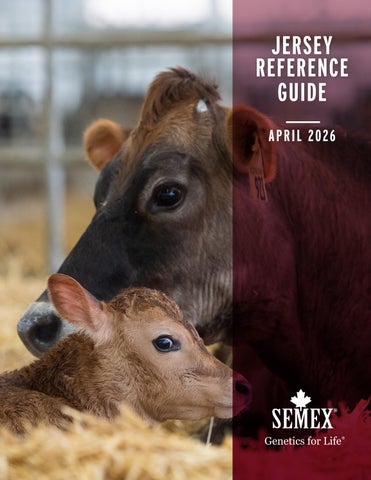
JERSEY PROOF GUIDE
TAKE THE GUESSWORK OUT OF BEEF x DAIRY DECISIONS
GAIN & FEED EFFICIENCY
and finish
Efficient, Fast-Growing Calves for High-Value Carcasses Demanded by Supply Chains
Citation: Kovacs, M., Renaud, D., Keunen, A., & Steele, M. (2026). Health and performance of Holstein versus dairy × beef calves: A retrospective single-cohort study. Journal of Dairy Science. https://doi.org/10.3168/jds.2025-27748. Martín N, Schreurs N, Morris S, López-Villalobos N, McDade J, Hickson R. Sire Effects on Carcass of Beef-Cross-Dairy Cattle: A Case Study in New Zealand. Animals (Basel). 2021 Feb 27;11(3):636. doi: 10.3390/ani11030636. PMID: 33673584; PMCID: PMC7997217.
High Quality, Balanced Calves for Feeder Profitability
The Economic Choice for Proven Genetics
Difficult calvings can reduce milk yield by
500–700 kg/ 1100-1540 lbs per lactation
Day-old calf sales Or feeding to finish
Citation: Roche SM, Ross JA, Schatz C, Beaugrand K, Zuidhof S, Ralston B, Allan N, Olson M. Impact of Dystocia on Milk Production, Somatic Cell Count, Reproduction and Culling in Holstein Dairy Cows. Animals (Basel). 2023 Jan 19;13(3):346. doi: 10.3390/ani13030346. PMID: 36766235; PMCID: PMC9913294.
PowerMixTM is heterospermic semen which contains the semen of three different sires in one straw and this combination is proven to improve conception rates.
ANGUS POWERMIX 144 0200PS00144
ANGUS POWERMIX 146 0200PS00146
ANGUS POWERMIX 147 0200PS00147
LIMFLEX POWERMIX 142 0200PS00142
SIMANGUS POWERMIX 143 0200PS00143












Les Paul


JX Palm{6} JX
JX Ramsey{5}

Silverado-PP
Samba DULET SAMBA
JX Tomahawk{5}
0200JE01591

0200JE01481 GOLDORAK 10
0200JE01498
0200JE01516 JOEDIFFIE 12
0200JE01519 GROK 11
0200JE01534 SOBE 19
0200JE01544 JX EXCALIBUR{5}-P 10
0200JE01545 JX STINGRAY{6} 19
0200JE01546 MR BROWN 15
0200JE01556 SLIVER .............................. 18
0200JE01567 DUCATI 9
0200JE01570 TICKETMASTER 20


0200JE01571 SKYBLAST 18
0200JE01572 SUNBEAM 20
0200JE01574 JX MANOWAR{5} ............... 13
0200JE01575 MOONSTORM 15
0200JE01576 JX PALM{6} 16
0200JE01577 MOONSTAR 15
0200JE01591 ZEPPLIN 22
0200JE01594 JX COLDPLAY{6} 7
0200JE01599 SIMBA 18
0200JE01600 SAMBA .............................. 17
0200JE01603 JX PROPHET{6} 16
0200JE01609 JX MOZZ{6} 15
0200JE01617 CUPID 7
0200JE01620 INFINITY 11
0200JE01621 DEBONAIR ........................... 8
0200JE10034 JX CHIEF{6} 6
0200JE10075 MARGIN 13
0777JE00925 MESMERIZE 14
0777JE00926 DANZIG 8
0777JE01374 JX WAYLON{5}-P 22
0777JE01422 JX CINNAMON{6} 6
0777JE01449 JX STARSKY{6} .................. 19
0777JE01454 SNAKE EYES 18
0777JE01461

DR. SHANNON BEARD PHD, SEMEX RESEARCH GENETICIST
A Genetic Tool for Managing HPAI H5N1 in Dairy Herds
Proven For Fewer Treatments & Faster Recovery
When highly pathogenic avian influenza (HPAI H5N1) enters a dairy herd, the most immediate and costly consequence is not mortality: it is milk loss. Abrupt drops in production, prolonged recovery periods, and uneven impacts across cows have made this emerging disease especially challenging for producers to manage. As the industry adapts to this emerging challenge, understanding what drives disease severity has become increasingly important.
A recent peer-reviewed study published in the Journal of Dairy Science Communications by researchers at Semex and the University of Guelph now provides the first large-scale evidence that immune response genetics significantly influence how dairy cows experience and recover from HPAI H5N1 infection under commercial farm conditions.
HPAI H5N1: A New and Costly Challenge for Dairy Herds
HPAI H5N1 has recently emerged as a new and unexpected challenge for the dairy industry. In March 2024, the USDA confirmed the first documented spillover of HPAI H5N1 into dairy cattle, marking the first time the virus had been identified as the cause of clinical disease in lactating cows.
Following the initial detection, additional cases were identified across multiple states, indicating that the virus can spread efficiently within and between dairy herds.
As of December 2025, 1,084 dairy herds across 19 U.S. states have reported confirmed infections (USDA-APHIS, 2025). However, the true number of affected herds is likely higher because testing and reporting requirements vary among states.
Clinical Expression and Production Consequences
Clinical signs of HPAI H5N1 include reduced feed intake and rumination, lethargy, respiratory symptoms, and abnormal milk appearance and consistency (Caserta et al., 2024). The most economically important consequence, however, is an abrupt decline in milk yield, which occurs soon after clinical signs appear. Average herd-level losses are approximately 5.7%, equivalent to $504 USD per affected cow (Rodriguez et al., 2025), while individual losses can reach 22% or as much as $950 per cow (Peña-Mosca et al., 2025; Rodriguez et al., 2025). In many cases, reduced production persists for several weeks.
Once HPAI H5N1 enters a herd, exposure is widespread because of efficient transmission through shared environments such as bedding, flooring, and milking equipment (Caserta et al., 2024). Management and biosecurity remain critical, but they cannot fully eliminate risk once the virus is present. This reality has increased interest in tools that can help reduce the severity and production impact of disease.
Objective:
Assess if Immunity+ genomic selection improves resilience to HPAI H5N1 in commercial dairy herds.
Immunity+®: A Genetic Tool to Reduce Disease Impact
Semex’s Immunity+ is a scientifically proven strategy that enhances broad-spectrum disease resistance by identifying cows and bulls with superior immune response. With a robust health index supported by data from other industry disease evaluations, Immunity+ directly measures both antibody- and cell-mediated immune responses to pathogens.
Proven benefits include not only reduced disease incidence, but also improved hoof health, reproductive performance, vaccine response, milk and colostrum quality, and heifer growth rates (Wagter et al., 2000; Thompson-Crispi et al., 2013; Cartwright, 2017; Larmer and Mallard, 2017). As the industry navigates emerging disease challenges like HPAI H5N1, Immunity+ provides a sustainable path to healthier herds, improved productivity, and long-term profitability.
Evaluating Immunity+ Genetics During HPAI H5N1 Outbreaks
Newly published research from Semex and the University of Guelph analyzed treatment and production data from six large commercial dairy herds in the United States with confirmed HPAI H5N1 outbreaks. Treatment records from 15,286 cows were evaluated, along with daily milk yield records from cows that required supportive treatment.
Treatment in this study was producer-driven and based on observable clinical signs, with vitamin B supplementation given to individually affected animals serving as a proxy for illness severity.
To evaluate the association between Immunity+ breeding values and resilience to HPAI H5N1, the study examined both the likelihood that cows required supportive vitamin B treatment during an outbreak and the amount of milk lost during the recovery period after treatment.
post-treatment (1068 vs. 1363
STUDY CONTEXT
STUDY CONTEXT
Emerging threat: HPAI H5N1 has spilled over into dairy cattle, threatening herd health and milk production in North America.
METHODS
Objective:
Assess if Immunity+ genomic selection improves resilience to HPAI H5N1 in commercial dairy herds.
METHODS
15,386 cows from 6 U.S. dairy herds with confirmed HPAI outbreaks.
ANALYZED:
Likelihood of needing supportive treatment
KEY RESULTS
METHODS
15,386 cows from 6 U.S. dairy herds with confirmed HPAI outbreaks.
High Immune Response Cows:
ANALYZED:
Likelihood of needing supportive treatment
Milk loss and milk fluctuation duration after treatment
CONCLUSION Genetic for immune
COMPARED HIGH, AVERAGE, AND LOW IMMUNITY GEBV COWS. Immunity+ reduced
Lost ~295 lbs less milk post-treatment (1068 lbs vs. 1363 lbs)
Lower Treatment Risk and Reduced Milk Loss with Immunity+
Cows with high Immunity+ breeding values were significantly less likely to receive supportive treatment for HPAI H5N1 than cows with low Immunity+ breeding values. After accounting for parity, days in milk, and herd effects, high immune responder cows were approximately 24% less likely to require treatment.
COMPARED HIGH, AVERAGE, AND LOW IMMUNITY GEBV COWS.
Immunity+® cows have lower reduced milk loss during HPAI
15,386 Cows
Milk loss and milk fluctuation duration after treatment treatment production STRENGTHENS resilience Were 24% less likely to require treatment (Odds Ratio = 0.76; 95% CI: 0.64–0.90)
For cows that required treatment, immune response genetics also influenced production outcomes during recovery. Daily milk yield data showed that cows with low Immunity+ breeding values experienced substantially greater milk losses during the post-treatment recovery period than cows with high Immunity+ breeding values. On average, low immune responder cows lost more than 1300 lbs of milk during this period, while high immune responder cows lost closer to 1060 lbs. Although the duration of recovery was similar across immune response groups, cowswithstrongerimmuneresponsegeneticsmaintained production closer to expected levels throughout the recovery window.
24% HIR cows
$950 est cost/clinical
STUDY CONTEXT
Building Resilience for What Comes Next
Emerging threat: HPAI H5N1 has spilled over into dairy cattle, threatening herd health and milk production in North America.
These results are particularly relevant because milk loss is the primary driver of economic impact during HPAI H5N1 outbreaks. Reduced production can persist for weeks, creating lasting effects on herd performance and profitability. The study demonstrates that immune response genetics affect not only whether cows exhibit clinical signs, but also the amount of production lost when illness occurs.
KEY RESULTS
KEY RESULTS
High Immune Response Cows:
Immunity+® cows have lower treatment risk and reduced milk loss during HPAI H5N1 outbreaks
The genetic solution designed to enhance broad-based disease resistance in dairy cattle by identifying bulls and cows with superior immune response
Taken together, the results provide peer-reviewed evidence that Immunity+® delivers meaningful benefits during emerging disease challenges such as HPAI H5N1. While genetics cannot prevent exposure to infectious agents, this study demonstrates that Immunity+ is associated with reduced disease severity and significantly lower milk losses during outbreaks.
ROBUST HEALTH INDEX:
- Individual response to bacteria & viruses
Objective:
Assess if Immunity+ genomic selection improves resilience to HPAI H5N1 in commercial dairy herds.
Were 24% less likely to require treatment (Odds Ratio = 0.76; 95% CI: 0.64–0.90)
- Directly evaluates antibody-mediated and cell-mediated immune response
- Genetic health data from CDCB and Lactanet
In a disease landscape where new threats can emerge rapidly and unpredictably, Immunity+ offers a proven tool to protect herd productivity, reduce economic risk, and build more resilient dairy systems.
THE DATA IS IN
Lost ~295 lbs less milk post-treatment (1068 lbs vs. 1363 lbs)
CONCLUSION
STUDY CONTEXT
METHODS
15,386 cows from 6 U.S. dairy herds with confirmed HPAI outbreaks.
KEY RESULTS
CONCLUSION
Genetic selection for immune response:
METHODS
GENETIC SELECTION FOR IMMUNE RESPONSE:
ANALYZED:
REDUCES treatment needs
Emerging threat: HPAI H5N1 has spilled over into dairy cattle, threatening herd health and milk production in North America.
LIMITS production loss
Likelihood of needing supportive treatment Milk loss and milk fluctuation duration after treatment
High Immune Response Cows:
15,386 cows from 6 U.S. dairy herds with confirmed HPAI outbreaks.
ANALYZED:
STRENGTHENS economic resilience during outbreaks
Likelihood of needing supportive treatment
Objective:
References
Assess if Immunity+® genomic selection improves resilience to HPAI H5N1 in commercial dairy herds.
COMPARED HIGH, AVERAGE, AND LOW IMMUNITY+® GEBV COWS.
Beard, S.C., M.E. Carson, B. Mallard, M.Lohuis, and F. Malchiodi. 2025. High immune responder cows have lower treatment risk and reduced milk loss during highly pathogenic avian influenza H5N1 outbreaks. JDS Communications. Article in Press. https://doi.org/10.3168/ jdsc.2025-0869.
Were 24% less likely to require treatment (Odds Ratio = 0.76; 95% CI: 0.64–0.90)
Milk loss and milk fluctuation duration after treatment
Cartwright, S. L., L. R. Schaeffer, E. B. Burnside, and B. A. Mallard. 2012. Adaptive immune response, survival, and somatic cell score between postpartum Holstein and Norwegian Red × Holstein first-calf heifers. J. Anim. Sci. 90:2970–2978. https://dx.doi.org/10.2527/jas.20114233.
COMPARED HIGH, AVERAGE, AND LOW IMMUNITY GEBV COWS.
Caserta, L.C., E.A. Frye, S.L. Butt, M. Laverack, M. Nooruzzaman, L.M. Covaleda, A.C. Thompson, M.P. Koscielny, B. Cronk, A. Johnson, K. Kleinhenz, E.E. Edwards, G. Gomez, G. Hitchener, M. Martins, D.R. Kapczynski, D.L. Suarez, E.R. Alexander Morris, T. Hensley, J.S. Beeby, M. Lejeune, A.K. Swinford, F. Elvinger, K.M. Dimitrov, and D.G. Diel. 2024. Spillover of highly pathogenic avian influenza H5N1 virus to dairy cattle. Nature 634:669–676. https://dx.doi.org/10.1038/ s41586-024-07849-4.
Larmer, S. G., and B. A. Mallard. 2017. High immune response sires reduce disease incidence in North American large commercial dairy populations. Cattle Pract. 25:74–81.
Lost ~134 kg less milk post-treatment (484.46 kg vs. 618.10 kg)
Peña-Mosca, F., E.A. Frye, M.J. MacLachlan, A.R. Rebelo, P.S.B. de Oliveira, M. Nooruzzaman, M.P. Koscielny, M. Zurakowski, Z.R. Lieberman, W.M. Leone, F. Elvinger, D.V. Nydam, and D.G. Diel. 2025. The impact of highly pathogenic avian influenza H5N1 virus infection on dairy cows. Nat. Commun. 16: 6520. https://doi.org/10.1038/s41467-025-61553-z.
Rodriguez, Z., C. Picasso-Risso, A. O’Connor, and P.L. Ruegg. 2024. Hot topic: Epidemiological and clinical aspects of highly pathogenic avian influenza H5N1 in dairy cattle. JDS Communications 5:S8–S12. https://dx.doi.org/10.3168/jdsc.2024-0650.
15,386 Cows 24% HIR cows $950 est cost/clinical Immunity+® cows have lower reduced milk loss during HPAI
REDUCES treatment needs LIMITS production loss STRENGTHENS economic resilience during outbreaks
Thompson-Crispi, K. A., F. Miglior, and B. A. Mallard. 2013. Incidence rates of clinical mastitis among Canadian Holsteins classified as high, average, or low immune responders. Clin. Vaccine Immunol. 20:106–112. https://dx.doi.org/10.1128/CVI.00494-12.
USDA-APHIS. 2025. HPAI confirmed cases in livestock herds. https://www.aphis.usda.gov/ livestock-poultry-disease/avian/avian-influenza/hpai-detections/hpai-confirmed-caseslivestock.
THERE’S ONLY ONE HEALTH INDEX THAT MATTERS.
Immunity+® gives you what you’ve been looking for - A genetic solution to herd health.
Wagter, L. C., B. A. Mallard, B. n. Wilkie, K. E. Leslie, P. J. Boettcher, and J. C. M. Dekkers. 2000. A quantitative approach to classifying Holstein cows based on antibody responsiveness and its relationship to peripartum mastitis occurrence. J. Dairy Sci. 83:488–498. https://dx.doi. org/10.3168/jds.S0022-0302(00)74908-3.
15,386 Cows studied from six US herds
24% HIR cows less likely to require treatment
$950 est cost/clinical care
Using Immunity+ is your best choice to naturally strengthen your herd against bird flu and everyday diseases.
Ϙ A robust health index with CDCB, Lactanet, Zoetis1, Semex data, and the bull’s response to bacteria and viruses
Ϙ IM+ cows have 30% less mastitis than herd mates
Ϙ High-reliability, permanent genetic solution
1 Zoetis information is male only

Ϙ Cumulates like milk, fat & other traits with each generation
Ϙ Female genomic results & herd rankings with Elevate®
Ϙ A decade of proven on-farm results