SEMCORP TECHNICAL WHITEPAPER SERIES
SEMCORP
PROCESS & VACUUM SYSTEMS PVT LTD
https://semcogroups.com
ISO 9001:2015
ISO 45001:2018
ASME SECTION VIII
TEMA STANDARDS
ENGINEERING SPECIFICATION & TECHNICAL WHITEPAPER
Determining the Number of Stages in an Industrial Distillation Column
McCabe-Thiele Graphical Analysis, Fenske-Underwood-Gilliland Correlation, and Murphree Tray Efficiency DOCUMENT ID SEMCORP-WP-2026-08
DISCIPLINE Mass Transfer & Fractional Distillation
AUTHOR SEMCORP Technical Cell
CLASSIFICATION Public Whitepaper
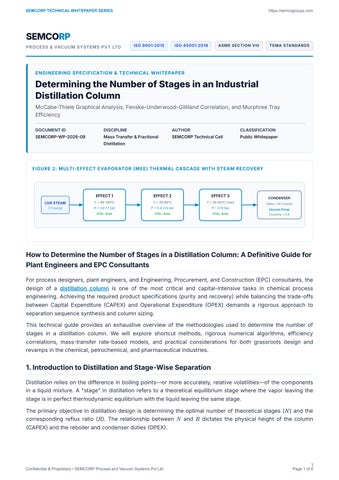
FIGURE 2: MULTI-EFFECT EVAPORATOR (MEE) THERMAL CASCADE WITH STEAM RECOVERY
LIVE STEAM 3-5 bar(g)
EFFECT 1
EFFECT 2
EFFECT 3
T = 95-105°C P = 0.8-1.1 bar
T = 78-85°C P = 0.4-0.5 bar
T = 55-62°C (Vac) P = 0.15 bar
HTA₁: Area
HTA₂: Area
HTA₃: Area
CONDENSER Water / Air Cooled Vacuum Pump Economy > 2.8
How to Determine the Number of Stages in a Distillation Column: A Definitive Guide for Plant Engineers and EPC Consultants For process designers, plant engineers, and Engineering, Procurement, and Construction (EPC) consultants, the design of a distillation column is one of the most critical and capital-intensive tasks in chemical process engineering. Achieving the required product specifications (purity and recovery) while balancing the trade-offs between Capital Expenditure (CAPEX) and Operational Expenditure (OPEX) demands a rigorous approach to separation sequence synthesis and column sizing. This technical guide provides an exhaustive overview of the methodologies used to determine the number of stages in a distillation column. We will explore shortcut methods, rigorous numerical algorithms, efficiency correlations, mass-transfer rate-based models, and practical considerations for both grassroots design and revamps in the chemical, petrochemical, and pharmaceutical industries.
1. Introduction to Distillation and Stage-Wise Separation Distillation relies on the difference in boiling points—or more accurately, relative volatilities—of the components in a liquid mixture. A "stage" in distillation refers to a theoretical equilibrium stage where the vapor leaving the stage is in perfect thermodynamic equilibrium with the liquid leaving the same stage. The primary objective in distillation design is determining the optimal number of theoretical stages (N ) and the corresponding reflux ratio (R). The relationship between N and R dictates the physical height of the column (CAPEX) and the reboiler and condenser duties (OPEX).
Confidential & Proprietary • SEMCORP Process and Vacuum Systems Pvt Ltd
1
Page 1 of 8