Address: Unit 4/2 Enterprise Drive, Bundoora Vic 3083
E: admin@selfstorage.com.au
Connect with us online!
10 SSAA 2026 DIRECTOR INSIGHTS
12 2026 TRENDS OF THE YEAR
McCrindle outlines five shifts shaping the year ahead
14 2025 INDUSTRY SNAPSHOT
Demand drivers shaping self storage
16 SEO TRENDS
How AI is reshaping the search for self storage
18 SET YOUR BUSINESS UP FOR SUCCESS IN 2026
Practical advice on legal, governance and operators
20 A GLOBAL PERSPECTIVE
What does self storage look like around the world? 22 DESIGNING A BETTER STORAGE JOURNEY
The importance of customer experience (CX) SSAA AWARDS FOR EXCELLENCE 2025
EXCELLENCE IN INDUSTRY FINALISTS / WINNER
EXCELLENCE IN SUSTAINABILITY
/ WINNER 39 NEW SERVICE MEMBERS
Insider magazine (Insider) is published bi-monthly by the Self Storage Association of Australasia Limited (ABN 23 050 341 725). This publication may not be reproduced or transmitted in any form, in whole or in part, without the express, prior written permission of the publisher. While every care has been taken in the preparation and publication of Insider, none of the Insider’s publisher, editor nor any of the publisher’s employees, subcontractors or contributors give any warranty as to the completeness or accuracy of the publication’s content, nor do any of them assume any responsibility or liability for any loss, damage or expense which may result from, or arise in connection with, any inaccuracy or omission in the publication. The views or opinions expressed in Insider are not necessarily those of Insider’s publisher or editor. Furthermore, Insider has the right to accept or reject any editorial and advertising material. All letters addressed to Insider will be regarded as ‘for publication’ unless clearly marked ‘Not for Publication’. All submissions to Insider may be edited for reasons of space or clarity and opinions expressed in
in Insider are those of the author, not of Insider’s publisher or editor.
Michael Alafaci Chairman SSAA
What’s fuelling change for self storage in 2026? I always look forward to this edition of Insider. Each year it provides fresh thinking and a valuable opportunity to pause, reflect and set the tone for what’s to come. In particular, it is inspiring to see
Makala Ffrench
Castelli
CEO SSAA
Ihope you are feeling refreshed and ready for another big year in self storage. As we begin 2026, our focus is firmly on delivering practical support, meaningful engagement and trusted resources to help members navigate the year ahead.
This year, we’ll roll out an expanded member-only engagement program designed
what is shaping the thinking of our SSAA Board of Directors in 2026, and how leadership is continuing to evolve across the sector.
For me, customer-centricity is a common thread that stood out through this edition. Whether it’s creating seamless experiences, responding to customer needs through technology, designing welcoming and functional spaces, or making it easier for customers to find and choose your business online, delivering a strong end-to-end customer experience is increasingly important.
Our Board of Directors met in February for a day of strategic planning to ensure your association continues to meet
the needs of members, both now and into the future. Good governance remains a priority, particularly as regulatory and consumer expectations continue to rise. Maintaining strong industry standards and supporting members to operate with confidence will remain a key focus.
With a blockbuster start to 2026 in the transaction landscape, there is no doubt change continues to accelerate in our sector. Understanding and navigating the impact of this rapid industry consolidation will be an important consideration for the year ahead.
I hope this Trends edition challenges your thinking, sparks new ideas and helps set your agenda for the year ahead. l
to support operators across Australia and New Zealand. Members are already enjoying more regional networking events and facility tours, alongside fresh online education and training through our SSAA Unlocked webinar series. These sessions will continue to focus on operational efficiency, risk management, technology, compliance and smarter ways of doing business.
Major projects are also progressing across the year. In 2026, we will deliver the first release of StorIntel, our industry intelligence project with QUT and Building 4.0 CRC, and State of the Industry, our biennial benchmarking study, providing members with deep insights into performance, trends and emerging opportunities across the sector. Advocacy will also remain central to our work, with continued engagement across an increasingly
complex development and compliance landscape.
Internationally, we look forward to taking members on the road, with SSAA representation at SSAAsia in Bangkok and FEDESSA in Wiesbaden, providing exposure to global best practice, investment insights and emerging operating models.
The year will culminate with BNE26, our flagship convention, taking place from 10-12 November at The Star Brisbane. As always, this is the biggest week on the self storage calendar , bringing together education, networking and connection across the self storage community.
We look forward to supporting you throughout the year and delivering a program that provides fresh perspectives, practical insights and ideas that support your business decisions in 2026. l
PROVEN WORLDWIDE. PREFERRED
Stellar™ Storage Containers has supplied over 500,000 units across 66 countries, earning the loyalty of customers worldwide who choose Stellar year after year. Now celebrating 20 years of industry leadership, we continue to set the standard. Once you choose Stellar, you won’t settle for anything less.
SAVE THE DATE
2026 SSAA Engagement Calendar
SSAA Member Engagement
SSAA Member Engagement Calendar 2026
SAVE THE DATE: Mark your calendar and join us throughout 2026 for a practical mix of education and social get-togethers designed to learn, connect and exchange ideas.
2026
MAR 11 MAR 26
Networking Event SYD APR 23
Operator Call ONLINE MAY 19 - 22 MAY 14
New Zealand Exchange
The SSAA NZ Exchange brings New Zealand’s self storage community together for a oneday industry forum in Auckland.
Regional Networking
We’ve expanded our networking program this year, bringing facility tours and social get-togethers to even more regions. Catch-up with fellow owners and operators over a casual drink, swap ideas, and share what’s happening in your local market.
SSAA Unlocked
JUN 4 Adelaide Networking Event ADL
JUN 25
JUN 25
JUL 23
AUG 6
AUG 20
AUG 27
Perth Networking Event PER
Brisbane Networking Event BNE
Victoria Regional Networking Event VIC
Newcastle Networking Event NTL
Operator Call ONLINE
SEPT 3 Christchurch Networking Event CHC
SEPT 22 - 25
NOV 10 -12
NOV 26 NOV 25
25
26
DEC 8
Our member education series is back in 2026, with practical sessions for owners and operators focused on risk management, technology, smarter operations, compliance and growth. View the 2026 program and register to attend via our website.
Global Events
In 2026 we’ll head to Bangkok for the SSAAsia Conference, connecting members with fast-growing APAC markets. Then it’s off to Europe for the FEDESSA Conference in Wiesbaden, Germanywith exposure to global best practice, investment insights and innovative operating models, it’s the premier event for the European sector.
SSAA Convention
Save the date for the 2026 self storage event of the yearBNE26! This year’s Convention will be held 10 - 12 November at the Star Brisbane.
For more information visit the SSAA Events page and stay tuned for updates throughout the year.
VALE John Eastwood
The self storage industry was saddened to hear of the passing of John Eastwood in December 2025. John was the founder of U-Store-It in Adelaide, a foundation member of the SSAA, a life member, former board member and a leading Adelaide accountant.
John’s journey into self storage began more than 40 years ago, inspired by his father-in-law who was in the motel business. Seeking a business that did not need his personal attention on a day to day basis, John identified self storage as an emerging opportunity.
His first facility, after a factfinding mission to the United States of America was on Hampton Road, close to the Adelaide CBD. Like many pioneers in the sector, the early days were not without challenges. Demand was slow to build and people would visit but not rent a space. John tried a new tactic by locking all sizes but one
unit, sparking a sense of scarcity and leading to good rent up!
John went on to develop further locations across Adelaide under the unmistakable “U-Store-It” brand with buildings painted in bright yellow. Paint suppliers reportedly had to organise special production runs to meet his demand, as was the case for the large main building at the U-Store-It Lonsdale location.
SSAA Life Member Dallas Dogger recalls “I remember being there the day John bought the property and the bank manager was there. We were walking around in a vast warehouse, and the bank manager was wondering how it would ever fill up – but John knew it would. These were tricky times to get financing, so building the case with the bank was very important”. John’s confidence in the sector never wavered, and time proved him right.
A good mate of Jim Miller (Millers Self Storage), through their shared interest in the stock and station
“ John was the champion of transparency and assisted in developing the financial foundations and governance of the SSAA.
industry, convinced John to be an integral part of the SSAA and he served a term on the SSAA Board from 1992 to 1995. John was the champion of transparency and assisted in developing the financial foundations and governance of the SSAA. Through this vital early role, he developed many enduring friendships with key members of the industry where business could be discussed and ideas shared in a non-competitive way.
John also valued learning from the ground up. Dallas shared that “In the early days, John would often work as the cleaner at his Clovelly branch so he could watch how customers used the site and listened to what customers would say, gleaning information on how to improve the business”.
A strong believer in innovation, John and his team focused on the early adoption of technology to enhance his sites and visited many overseas self storage conferences to learn about the latest in technology and operations.
The Eastwood family legacy continues through his son Andrew, who has guided U-Store-It through its next phase of growth and prominence in Adelaide, reminiscent of so many family businesses in the self storage industry today.
Our industry is a better place for the efforts of John, who not only served the SSAA but developed a thriving family business, generously sharing his knowledge and creating a legacy that both his family and the industry can be very proud of.
Our sincere condolences are extended to Dawn, with whom he shared 56 years or marriage and their children, Andrew, Mardi and Jayne and their families. l
× 2350D × 2300H mm
× 2200H mm
panel centre opening with Infra-red safety device and 120 minute fire rating.
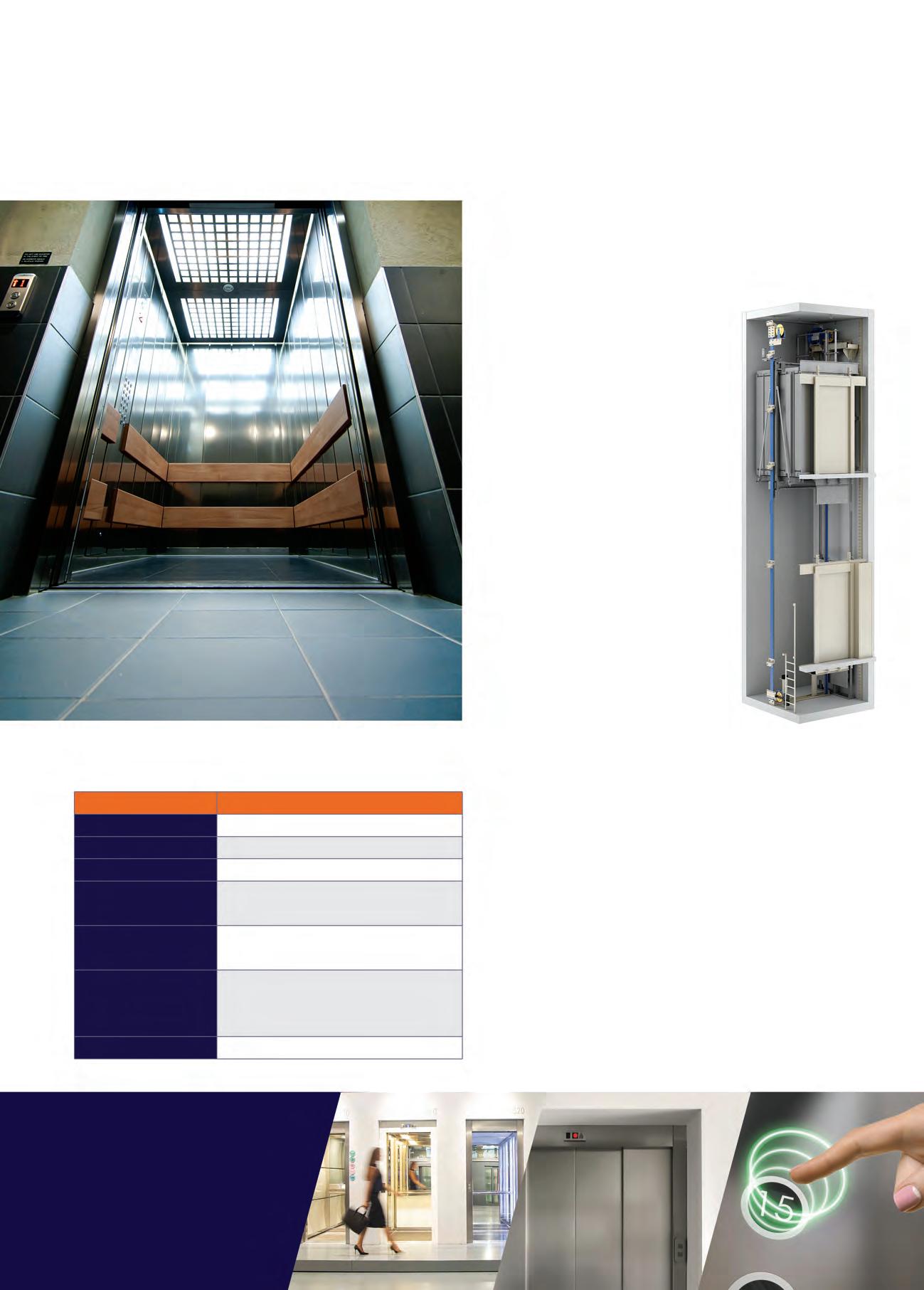
Southwell Lifts & Hoists delivers engineering excellence with robust, dependable solutions, perfect for the Self Storage industry. The ideal traction lift, combining high capacity with cutting-edge technology for outstanding performance.
HIGH CAPACITY: Rated for 2500 kg (33 Passenger), maximising what your customers can move.
SPACE OPTIMISATION: Our design maximises the car size to suit EN81-20 standards, ensuring you get the most usable space.
FAST & EFFICIENT: Fast speed of 1m/ second and compliant to 180 starts per hour.
SUPERIOR BUILD: Built tough, built to last. Featuring a durable and stylish finish, specifically designed for premium self storage requirements, including stainless steel bump rails for wall protection.
ENERGY EFFICIENT: Premium quality gearless motor and state-of-the-art inverter provide exceptionally low energy consumption and sound levels.
ENGINEERING EXCELLENCE
Locally designed and engineered solutions. European partners with high-quality products and parts. Factory-trained technicians for dedicated service support.
Guaranteed operational, on-time, on budget, with no hassles.
Director Insights
Insider asked the SSAA Board of Directors to reflect on what leadership looks like in self storage in 2026. From leadership style and decision-making to mindset and priorities, we explore what makes our industry leaders tick, and what’s shaping the sector in the year ahead.
Michael Alafaci MINDSET
In 2026, one mindset I’m committed to is intentional disconnection while on leave. Stepping back from the day-to-day isn’t just about switching off emails - it’s about creating the space to rest, reset and return with fresh perspective and energy. It’s easy to fall into the temptation of a sneaky look at emails or “just checking in,” but I’m aiming to treat time away as an investment in clearer thinking and stronger leadership when I return. I think I will find this easier said than done, but I will be giving it my best shot…wish me luck!
Aaron Alsweiler MINDSET
The mindset I am adopting this year is to ensure all our company decisions are built around the single concept of the word care. If we do that then I believe it will help to make both our workplaces and customer experience even better than they currently are.
Brent Hayes LEADERSHIP
In 2026, I think self storage leaders will need to focus less on “set and forget” and far more on doing business exceptionally well. Customers today have more choice than ever. With more facilities coming online and new investors entering the sector, people can shop around even more. And when customers have options, their expectations lift automatically, not just around price, but around the experience. How easy is it to move in? How quickly do we respond? Is it clean, maintained, secure and feel professional?
For me, it’ll also come down to the one percenters, the small things that add up. Making sure every detail of the customer experience is on point and feels simple. It’s more important than ever to deliver a quality experience and real value, consistently.
Sam Kennard DECISION MAKING
If I could highlight one significant shift operators should be paying more attention to this year it would be to consider Australasia’s economic slowdown and increased competition. There are strong signals that the Australian economy is slowing and New Zealand is already limping along. Rampant government spending with high taxes, heavy regulation and no productivity gains is a terrible cocktail for the economy. Interest rates are going up too. Ordinary households are suffering as their real living standards go backwards. The risks of Australia suffering slow or no growth, maybe even contraction is high. If you add the amount of new supply in the pipeline to arrive along with an anaemic consumer, there will be difficulty in our sector to brace for.
Ivor Morgan DECISION MAKING
In 2025 I saw that speed without clarity creates rework and frustration. The lesson for 2026 is to slow down with planning. Get the problem definition right. Agree on what success looks like. Then move fast with confidence. I will push for clear task owners, clear timelines, and simple measures that the team can actually influence.
Anthony Regis MINDSET
In 2026, I’m looking to adopt a mindset focused on actively seeking out tools, processes and services that make site selection and construction more seamless and accessible for new self storage investors. By reducing complexity and improving clarity, this approach can help investors make more informed, confident decisions from the outset.
Lizzy Rutland LEADERSHIP
One lesson from 2025 (and the Covid years more broadly) is that leadership isn’t situational - it’s lived. I’ve become more aware that leadership is about alignment: how we make decisions, how we treat people, and how consistently our actions reflect our values. Abby Wambach, USA Soccer Legend, describes leadership not as a position to earn, but as an inherent power to claim - not the privilege of a few, but the responsibility of all.
‘Leader’ is not a title the world gives you; it’s an offering you give to the world. It shows up everywhere – in supporting a colleague, encouraging a friend, volunteering at the local school, or holding the hand of a dying parent. In 2026, this perspective will continue to shape my leadership and business decisions by placing greater emphasis on clarity, care, and consistency, making decisions that honour people as well as outcomes.
Thomas Whalan DECISION MAKING
One lesson from 2025 that will shape my approach to decisionmaking in 2026 is the importance of staying disciplined in our longterm strategy while remaining agile in execution. Market conditions will continue to shift, but the fundamentals of good operations, strong team culture and financial discipline don’t change. 2026 will be about doubling down on what works while being smart about where we innovate and seek growth opportunities.
Adrian Wylde LEADERSHIP
What’s shaping my thinking right now is just how strong and accessible the self storage network is. The best ideas I’ve picked up lately haven’t come from a book – they’ve come from conversations, site visits, and operator catch-ups. I’d encourage everyone to reach out, meet in person, swap notes, and support or mentor each other. l
TECH TRENDS TO WATCH IN 2026
In 2026, the operators who move fastest - and smartest - on technology will have a clear edge. Directors pointed to smarter systems, faster response times and better use of data as key differentiators in the year ahead.
“
ADRIAN WYLDE highlighted the shift toward automation and data-driven revenue management, including dynamic pricing and AI-led enquiry handling. “We’re focused on tracking missed calls and after-hours leads daily then refining our voice AI + chatbot flows weekly so common questions and bookings are handled 24/7, freeing the team for complex sales and customer care.”
“
THOMAS WHALAN emphasised investing in technology that genuinely improves customer experience and operational efficiency. To a similar end, Ivor Morgan warned against treating technology as a bolt-on if it doesn’t remove friction, either for staff or customers.
“LIZZY RUTLAND shared that trends are often what we choose to prioritise. “For some operators that will mean greater adoption of AI and automation, which can be powerful when used well. For others, an equally important shift is paying closer attention to the peripheral problems customers face – the moments around storage where people need clarity, reassurance, or support.”
Key takeaway: Technology will drive efficiency, but the operators who win will keep the human experience at the centre.
Five shifts shaping the year ahead
As Australia moves beyond post-pandemic reactions, a new set of foundational expectations is taking shape. Rising cost pressures, demographic change and declining trust are influencing how people live, work and engage with organisations.
McCrindle’s Trends of the Year 2026 outlines five intersecting shifts that reflect how Australians are responding to uncertainty by seeking greater control, clarity and connection.
As you scan the five trends, consider what’s already showing up in your customers and your team. Which of these shifts feels most immediate for your business in 2026, and where do you need to respond first?
TREND #01
Supply–Demand Squeeze
HOUSING SHORTAGE MEETS POPULATION GROWTH, ERODING THE AUSTRALIAN DREAM
TREND #02
Intentional Living
A SHIFT FROM PASSIVE ENGAGEMENT TO ACTIVE CHOICE, WHERE PEOPLE ARE LIVING LIFE ON THEIR TERMS
The Supply–Demand Squeeze reflects mounting pressure on housing, infrastructure and personal resources. Population growth continues to outpace housing supply, while rising costs of living are stretching household budgets and reshaping expectations around ownership, mobility and security.
McCrindle’s research shows growing frustration with the traditional pathway to home ownership, particularly among younger generations. This pressure is not only financial but emotional, contributing to a sense that long-held milestones are becoming harder to reach. The result is a broader shift in how people define stability and progress, setting the context for the trends that follow.
Intentional Living reflects a move away from automatic participation and towards deliberate decision-making. As external pressures increase, people are becoming more selective about how they spend their time, energy and attention.
McCrindle’s data shows Australians are prioritising relationships, boundaries and a slower pace of life. Work is increasingly viewed as a tool to support life, rather than the central focus of it. This shift is particularly evident among younger generations, who are more likely to prioritise flexibility, purpose and alignment with personal values.
Rather than disengagement, Intentional Living represents a rebalancing. People are actively choosing what matters most and designing their lives accordingly.
TREND #03
Productivity Pivot
INTEGRATING AI THROUGH WORKFLOW REDESIGN, UNLOCKING AI-DRIVEN PRODUCTIVITY
The Productivity Pivot marks a transition from AI experimentation to integration. Rather than simply adopting new tools, organisations are rethinking workflows to embed AI in ways that enhance efficiency and output.
McCrindle emphasises that productivity gains are strongest when AI complements human capability. Decision-making, creativity and judgement remain human strengths, while AI supports speed, accuracy and scale. This human–machine collaboration is reshaping how work is structured and how value is created.
As expectations around efficiency continue to rise, the Productivity Pivot highlights the importance of redesigning work itself, not just digitising existing processes.
Source: McCrindle Research – Trends of the
Graphics
TREND #04
Personality Premium
AMIDST DECLINING TRUST, CONSUMERS ARE LOOKING FOR UNIQUE AND RELATABLE BRAND PERSONALITIES TO ENGAGE WITH
TREND #05
Hope Under Strain
CULTIVATING AGENCY IN AN UNCERTAIN WORLD
The Personality Premium reflects a growing disconnect between consumers and traditional institutional brands. In an environment of declining trust, people are gravitating toward organisations that feel human, authentic and valuesled.
McCrindle identifies a clear shift away from generic, corporate brand identities towards those that are creative, relatable and emotionally resonant. This change is most pronounced among younger generations, for whom brand personality plays a critical role in engagement and loyalty.
As consumers seek connection over conformity, personality has become a differentiator, not an embellishment.
While optimism is under pressure, hope has not disappeared. Instead, McCrindle finds it has become more personal and more practical. In an uncertain environment, people are focusing on what they can control rather than relying on external institutions.
Gen Y are the most likely to feel they have agency to shape a positive future, followed closely by Gen Z. This sense of ownership is centred on building skills, protecting wellbeing and acting in alignment with personal values. By focusing inward, individuals are reducing their reliance on systems they perceive as unstable.
Hope under strain does not lead to passivity. It drives action, resilience and a belief that the future can be shaped through deliberate choices. l
2025 Industry Snapshot: Demand drivers shaping self storage
The SSAA explores the key demand drivers for self storage into the next decade in the Association’s biennial research report, the 2025 Industry Snapshot.
The life stages driving a decade of demand
At SYD25, Demographer Simon Kuestenmacher said we can expect family and downsizer households to dominate the next decade, underpinning long-term demand for storage.
Population growth across Australasia is projected to remain high in the coming decade, with forecasts pointing to around 360,000 net new residents each year in Australia and 42,000 in New Zealand. More people means more demand for space and self storage is set to be a direct beneficiary of this long-term demographic momentum.
Slowing birth rates mean natural increases are contributing less to population growth, and migration will continue to do the heavy lifting. Despite public anti-migration narratives, Australia is structurally positioned to maintain high migration levels due to workforce and fiscal pressures.
A number of converging trends will shape the workforce profile in the next decade. The large Baby Boomer cohort is retiring, Gen Z is entering the workforce later, international students are contributing unevenly to labour supply, all while Millennials are cycling through parental leave and family commitments. With fewer workers supporting more non-workers, Australasia’s dependency ratios will continue to tighten.
In practical terms, migration remains one of the only realistic levers to stabilise workforce size and support economic activity, given federal budget reliance on income tax.
In the 2025 Industry Snapshot, it’s clear much of this projected population growth is concentrated in two life stages with strong storage demand drivers: the highconsumption mid-40s cohort and the downsizing mid-70s cohort.
Movement of People
Population growth, international, inter- and intra-state migration and housing turnover all increase demand for self storage.
2025 TRENDS
l Sustained population growth
l Steady migration rates
l Housing transfers return to positive levels
Density
An increase in urban densification including growth in apartments, townhouses and reduction in dwelling sizes all contribute to demand for self storage.
l Apartment approvals on the rise
l Average dwelling size continues to decline
l Average site area for new houses continue to decline
Families in their 30s to 40s accumulate bulky, seasonal and sentimental items, while downsizers seek storage solutions to manage the belongings they can’t fit into smaller homes. Sustained population growth and the age profile of that growth point to a long runway of demand for self storage.
Housing costs remain a strong tailwind for self storage
High population growth is only part of the story. The other is price and space.
As long as homes, land and larger floorplates remain expensive, Australians and New Zealanders will continue to rent incremental space rather than buy it in the form of an extra bedroom, a bigger garage or a larger block.
Understanding the long-term outlook for housing prices is important when considering demand for self storage, and the signals point firmly toward sustained high costs, reinforcing the role of self storage as an accessible, flexible alternative.
Governments primarily control the key levers to house pricing, including zoning, land release, migration, taxation and lending settings. For decades, policy decisions have tilted systems toward rising values. Generational voting maths suggests it will take another 20 years before this political cycle shifts.
In the meantime, a wide range of influential stakeholders all have financial or political incentives tied to expensive housing. With so many interests aligned, structural downward pressure on prices is unlikely in the near or medium term.
Disruption
Severe weather, changing geopolitical conditions and black swan events often necessitate swift changes which drives demand.
Discretionary Spending
Higher spending sees consumers buying more, increasing the need for storage. Conversely, if spending capacity is limited, consumers may seek an alternative to paid storage.
Family Dynamics
Changing family dynamics including births, deaths, marriage, divorce and the way we live & work all contribute to lifestyle changes that drive the need for storage.
l Fewer major natural disasters in 2025, however there has been a significant increase in localised severe storm activity
l Geopolitical instability continues
l Cost of living crisis impacting certain market segments
l Consumer confidence starting to rebound
Taken together, high population growth and entrenched housing costs form a strong demand engine for self storage.
As space becomes more precious, the sector is well positioned to continue its expansion as a resilient asset class aligned with Australasia’s demographic and economic trajectory. l
l Declining birth rates offset by rising death rates
l Work-from-home still in play
l Desire for decluttered lifestyle continues
Business Environment
The continued rise of online retail, supply chain challenges, distribution logistics and the rising costs of doing business contribute to the need for flexible storage solutions.
l Online retail trends continue
l Exploration of last mile logistics
l Increasing costs of doing business
“ High population growth and entrenched housing costs form a strong demand engine for self storage.
From rankings to recommendations
How AI is reshaping search for
self storage
Search as we know it is changing and in 2026 success will be about more than just showing up.
As search journeys fragment across Google, maps and AI-driven tools such as Chat-GPT and Gemini, many of the fundamentals driving traditional SEO, such as rankings and visibility, will now become a first step. What matters next, is whether your self storage business is clearly understood and confidently recommended. This decisive shift from ranking pages to understanding and recommending brands is what will set businesses apart in the year ahead.
Insider chats with Harry Hart, Head of Digital at R6 Digital, about what search looks like in 2026 and beyond. In particular, how AI is shaping the future of search in self storage.
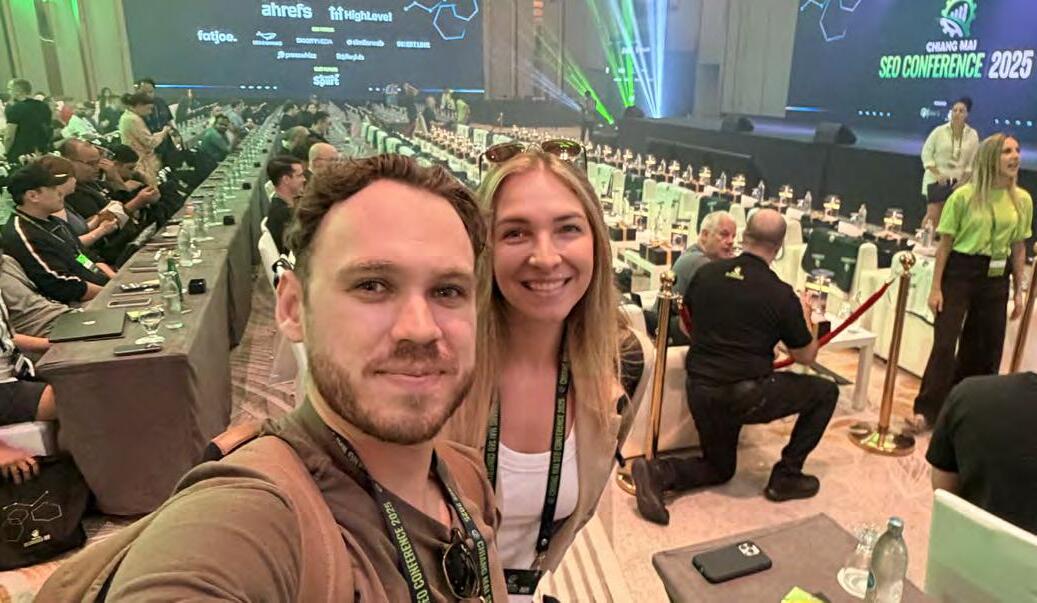
Harry joins us hot-off-the-tarmac from the Chiang Mai SEO Conference (CMSEO) in Thailand. This exclusive annual event brings together the world’s leading SEO practitioners for five days of learning. Attendees include specialists who consistently rank sites in the most competitive global markets, and whose thinking helps shape the way search evolves.
So what can Harry tell us about this fast-changing tool in your marketing mix?
QIs traditional SEO dead?
Not entirely. Many of the fundamentals that underpin traditional SEO remain relevant to current search algorithms and can also help you appear in AI search tools (like Chat-GPT and Gemini).
Those fundamentals now need to be approached a bit differently. They are no longer just about just making you visible, and increasingly influence how your brand is interpreted and recommended by AI platforms.
QWe often hear “Content is King” and “keywords drive rankings”. How has this changed?
Content is still critical, but quality will now beat quantity every day of the week - across both AI and traditional search. Google and LLMs (large language models) reward information that is clear, factual, well-structured and easy to interpret.
Long-form content still has value, but only when it serves a purpose. Machines no longer “read” in the way people do. Instead, they extract facts, relationships, and signals of trust. For self storage, this means the pages on your website that bury key information under unnecessary fluff or keyword stuffing are increasingly ignored.
Q
I keep seeing the term user experience (UX). How important is this?
It’s critical. SEO without UX rarely converts, and poor UX actively reduces trust signals.
If customers struggle to find pricing, unit sizes, or location details, that friction doesn’t just affect enquiries. Search engines and AI systems will take notice too. In today’s environment, a confusing website is as much a visibility issue as it is a conversion issue.
“ In this new search environment, reputation and sentiment matter just as much as being found.
This principle extends beyond your website. Google Business Profiles, customer reviews and consistent business information across the web now play a major role in how brands are assessed. Reviews and third-party validation influence not only rankings, but also how AI tools describe and recommend businesses - not just in self storage, but across local service industries more broadly.
Q
Why is AI and online sentiment so important for self storage?
So, when someone searches for a “storage business near me,” AI tools may reference your business frequently, but being mentioned isn’t always positive. If your brand carries a negative sentiment, that visibility can actually work against you.
In this new search environment, reputation and sentiment matter just as much as being found. With that in mind, my advice to operators is to manage how your business is perceived, not just how visible it is.
A less discussed but very real risk is misrepresentation. If your location or service information is unclear or inconsistent online, AI systems can fill in the gaps, and often they will get it wrong! We’ve already seen cases where incorrect pricing, services, or positioning are presented in AI-generated answers.
Operators with clean, well-structured location pages, strong review profiles, simple navigation, and clear pricing consistently perform better. It’s about clarity. Search engines and AI systems reward businesses that make it easy to understand who they are, where they operate, and what they offer.
Q
Are operators investing in AI search?
They sure are. We’re working with clients across many industries, including self storage, who are already seeing strong results from investing in AI search.
Leads coming from AI platforms are converting at amazing rates. When done right, these platforms not only drive traffic but can help convince a lead that you’re great before they even reach your site. While the volumes are not huge yet, we are seeing them grow fast. Operators who delay will likely need to spend far more to catch-up and win hot leads.
QHow is search changing in 2026?
We understand that Australasia tends to follow global search and technology trends with a short delay. Looking ahead into 2026, several trends are already taking shape:
l Search journeys will fragment further across Google Search, AI assistants, maps, and brand-owned channels l AI-driven discovery will increase, particularly for research and comparison-style queries.
l Zero-click behaviour will continue to grow, especially for local services
l Reviews and online reputation will play a stronger role in visibility and recommendations.
l Brands with inconsistent, outdated, or unclear information will lose share of voice
l Operators who invest early in clarity and structure will build long-term advantage
In short, being “findable” will no longer be enough. Being clearly understood will be the differentiator as search continues to shift from ranking pages to understanding and recommending brands.
QHow can operators ensure their brand stands out?
Some operators are already adjusting their digital foundations to better align with how modern search and AI systems work. This gap is likely to widen over the next 12–24 months.
Standing out in the next phase of search is all about trust. Here’s what consistently works:
l Clear positioning and messaging
l Strong, actively managed reviews
l Evidence of experience, scale, and legitimacy
l Simple, intuitive user journeys
l Content that answers real customer questions directly
In this changing search landscape, winning is no longer about ranking alone - It is about becoming the brand that both customers and AI systems feel confident choosing. l
Harry’s practical tips for self storage websites:
→ Make location pages easy to find, navigate and understand.
→ Clearly explain pricing, unit sizes and availability.
→ Answer common customer questions directly on your site.
→ Keep all information accurate, up-to-date and reflective of real-world operations.
SET YOUR BUSINESS UP FOR SUCCESS IN 2026
At the 2025 Convention, SSAA CEO Makala Ffrench Castelli led a practical workshop on legal, governance and compliance, with a clear takeaway: strong processes protect both customers and operators alike. As regulators increase scrutiny of the sector, 2026 is the year to tighten agreements, strengthen internal processes and embed transparency and visibility for customers from day one.
The sector is now more visible than ever to both regulators and to the public. In 2025 the SSAA updated the Self Storage Agreement Suite to address concerns raised by the ACCC. The changes focused on three key areas: liability and risk allocation, default actions, and pricing.
To support your business we’ve outlined some practical steps that reinforce clear contracts, transparent communication and fair treatment of customers, making your rights easier to enforce when issues arise. These steps can reduce the risk of misleading conduct, improve trust and lessen the likelihood of regulatory complaints.
Liability and risk
One of the clearest themes from the ACCC’s feedback was the need for plain, balanced wording around liability. The updated Agreement Suite is designed so operators are indemnified only for risks they did not cause or contribute to, and storers are not asked to cover loss that is operator-caused.
Importantly, the revised agreement also spells out how Australian Consumer Law interacts with contractual terms. The principle is straightforward: if an operator did not cause the loss, the agreement supports them. If loss arises from an operator’s action or inaction, contractual protection may not hold.
TAKEAWAY: Communications should be clear rather than clever.
Using the latest Agreement is essential – If you haven’t already, download the 2025 Agreement Suite from the Member Portal
Default processes
Customer complaints about lack of awareness around arrears and disposal are a top issue for the sector. The good news is they are also among the most preventable. Consistent processes, backed by clear communication, reduce confusion and support fair outcomes for both the storer and operator.
Practical steps include:
l Use the current Agreement as written
l Follow the Arrears Management Guide and issue notices on time
l Explain clearly at sign-up (and through ongoing communications) what occurs if fees are not paid
l If enforcement is required, record an inventory in detail rather than vague descriptions, keep contemporaneous notes and demonstrate reasonable steps to achieve a fair sale price.
TAKEAWAY: Clear communication, supported by records, narrows the scope for disagreement and places operators in a stronger position if matters escalate.
Download the Arrears Management Guide from the Member Portal
If you’re planning a price increase, ensure it’s reasonable and supported by a clear business rationale:
l Keep a record of the timing and reasons for each increase
l Provide at least 28 days written notice and remind storers of their right to end the agreement
Advertising and promotions should follow the same principles of clarity and consistency.
l Use promotional offers only when the conditions are explicit
Price transparency and advertising
Price transparency starts at the first point of contact. When customers can clearly see what they are agreeing to (and what may change over time), complaints drop and trust rises.
Fees and charges should be transparent and defensible:
l Show the real price at the outset, including GST and unavoidable fees
l Ensure late, admin and default fees reflect genuine cost recovery
l Avoid hidden or automatic amounts that resemble penalties
l Display fees clearly in agreements and on invoices
l If using introductory pricing, disclose clearly how and when rates will change so customers understand the path from promotional to standard pricing
l Avoid absolute claims, unsupported superlatives and pressure tactics
l Discounts and savings should be genuine
l Check that your website, advertising and software all present the same information
TAKEAWAY: Consistency across channels is a practical risk reducer. It also supports trust, which has a direct impact on customer satisfaction and retention.
Download our Compliance Checklist on the member portal
What does self storage look like around the world?
Self storage will always be a local service. But the way operators attract, sign-up and serve customers is increasingly influenced by what’s happening globally.
That was the message from our Global Perspectives panel at Convention, where Rennie Schafer, Helen Ng and Terry Bagley shared what’s shaping self storage in their regions.
ASIA: vertical builds and five-minute expectations
In parts of Asia, density and digital behaviour are shaping the customer experience. With limited land and high urban concentration, self storage is often built vertically and designed to maximise efficiency within a small footprint. But the bigger story is the pace of customer communication and the expectation of convenience.
Many markets here are mobile first and comfortable with automated and remote models. App-based access and cashless payments are the norm. In China, the entire customer journey often sits inside a single super-app known as WeChat. In Singapore, Japan and Hong Kong, operators blend app flows with more conventional web touchpoints.
Helen Ng, Chair of SSA Asia and CEO of General Storage Company in Singapore, noted that in many markets, customers expect operators to be accessible 24/7. “Customers expect to reach you on WhatsApp and get a reply within five minutes,” she said. “That changes the way operators staff enquiries, manage leads, and design customer journeys.”
UNITED STATES: digital onboarding, automation and the discounting trap
In the United States, the cycle has cooled. New development has slowed, demand growth has eased, and listed REITs have reported steadier revenue alongside higher operating costs, putting pressure on margins. At the same time, scale is pushing operators to find efficiencies through technology and leaner operating models.
Terry Bagley from Janus International shared that Public Storage now sees the majority of customers onboard digitally, reflecting a broader shift towards online leasing, remote support and automation. Larger platforms are also using tools like electronic locks, centralised operations and remote oversight to manage costs and improve consistency, while early use of voice AI is helping to triage calls and route enquiries faster.
The message to operators was that digital tools can support both customer convenience and operational efficiency.
Terry pointed out that in the US heavy discounting has drawn criticism and trained customers to focus on the lowest price, making rate recovery slower. It’s a reminder that promotions should be used thoughtfully, with a clear purpose and end point.
EUROPE: sustainability shaping development
Across Europe, sustainability is increasingly influencing how facilities are designed, financed and upgraded. Energy efficiency features are becoming widespread, and the conversation around ESG continues
“ People don’t come to you because they need space. They come because they have a problem you need to solve.
RENNIE SCHAFER OUTGOING CEO OF FEDESSA
to influence decisions on new builds and capital investment.
The FEDESSA European Self Storage Industry Report 2025 notes high adoption of practical sustainability measures such as LED lighting (89%) and solar panels (35%). It also reports that 65% of operators consider sustainability improvements somewhat or very important, even as some reassess priorities in a higher-cost environment.
Europe is also seeing growth in digital self-service, with app usage increasing and more operators enabling customers to complete booking and payment fully online.
The common thread is the need to meet customers where they are. As Rennie Schafer, outgoing CEO of FEDESSA observed, “People don’t come to you because they need space. They come because they have a problem you need to solve.”
That shift towards personalisation isn’t a branding exercise. It shapes how you communicate, how you design your digital pathways, and how quickly you can respond when a customer is ready to act. l
Designing a better storage journey
In today’s rapidly evolving self storage landscape, customer experience (CX) is emerging as a critical driver of differentiation and loyalty.
From first click to final move out, customer experience (CX) has become one of the strongest differentiators in self storage. As expectations rise and journeys become increasingly digital, the brands that stand out will be those designing storage experiences that feel easy, trustworthy and human.
Insights from KPMG’s latest Customer Experience Excellence Report FY25-26, point to a significant shift in customer expectations, and offers a practical guide for the self storage sector. While location, price and availability still matter, taking this approach alone is no longer enough. Research shows customers now want their journey to be seamless, responsive and human, whether delivered in person, online or through digital tools.
More than ever, these experiences are being shaped by AI systems working behind the scenes, coordinating decisions, interactions and responses across the customer journey. KPMG frames Customer Experience Excellence as a long-game - an organisational mindset that connects strategy, culture and execution.
For an industry that supports people through times of disruption and major life transitions, these lessons are especially relevant. Whether you are reviewing your customer experience strategy or thinking about it for the first time, it’s worth taking seriously in 2026.
The six pillars and why they matter
At the heart of the KPMG report is its long-standing framework, the Six Pillars of Customer Experience Excellence. Together, they describe what customers value most and what drives advocacy and loyalty. While self storage is not assessed as a standalone sector, these pillars map closely to everyday storage interactions. And in the years ahead, it’s likely many of these pillars will be delivered through a combination of human judgement and AI enabled systems.
1 2 3 4 5 6
INTEGRITY is about trust. In storage, we see this in transparent pricing, clear contracts, plain language explanations and doing what you say you will do.
TIME AND EFFORT is about simplicity. Customers want to book quickly, access easily, and resolve issues.
RESOLUTION measures how well issues are handled when something goes wrong, shaping lasting perceptions and filtering through to referrals and reviews.
EXPECTATIONS are set early and reinforced often. Clear onboarding, upfront communication and consistent follow through help avoid surprises.
PERSONALISATION is about making sure customers feel understood, not processed. Don’t overengineer the experience, instead focus on making it relevant.
EMPATHY is the ability to recognise a customer’s situation and respond with care and clarity.
KPMG reports that improvements in Australia’s overall CX score were driven by gains in Empathy, Resolution and Expectations. For self storage operators, these three pillars are often built or broken through everyday communication and frontline interactions.
Self storage is already a CX business
Unlike some industries racing to retrofit customer centricity, self storage starts from a strong base. The industry has long relied on face-to-face interactions, problem solving and reassurance.
What has changed is how customers want to engage. More journeys begin online, with people expecting self service options, digital access and instant confirmation. The challenge is balancing this with the human need for reassurance, because customers still want to know help is available when they need it.
This is where KPMG’s concept of Total Experience (TX) is useful. TX is the idea that customer experience is shaped by the whole business working in harmony with the customer.
That includes:
l the customer experience itself
l the employee experience, including tools, systems and empowerment
l digital and physical channels
l internal processes and operating models
Customers feel the outcome of internal alignment or misalignment, even if they never see it directly. In other words, a smooth customer journey is usually the result of joined-up systems, clear roles, empowered staff and technology that supports, rather than complicates, delivery.
AI increasingly plays a coordination role here, connecting systems and data so experiences feel seamless to customers, even when complexity sits behind the scenes.
In self storage, that might mean the website, call scripts, access systems and billing processes all tell the same story. Technology should remove hassle and reduce admin, while keeping customer support in easy reach.
The rise of agentic AI
Unlike traditional automation or chat tools, agentic systems are designed to act on behalf of customers, anticipating needs, making decisions and completing tasks across a journey.
In a self storage context, this could mean AI guided unit selection, automated billing adjustments or early identification of access or security issues. The value is in relevance and timing as well as speed.
Reduce friction without losing the human touch
One of the clearest themes in the report is how customers reward brands that make life easier. Leaders in CX invest in technology and operating models that make journeys feel effortless.
“ KPMG’s 2025
findings highlight Integrity as the single most influential pillar driving customer experience outcomes, including advocacy and loyalty. That is a strong reminder that trust sits at the centre of modern customer experience.
For self storage, that can mean clear online pricing, digital onboarding and identity verification, app based access where suitable, automated reminders, and clear pathways when help is needed.
These automations can free teams from repetitive tasks to focus on moments that matter, like supporting a nervous first time customer or resolving an access issue.
Trust is in the detail
KPMG’s 2025 findings highlight Integrity as the single most influential pillar driving customer experience outcomes, including advocacy and loyalty.
In self storage, trust can be built through small, cumulative signals. Clear explanations of pricing, straightforward descriptions of customer protection products, visible commitment to privacy, and consistent communication all play a role.
These moments rarely feel dramatic in isolation, but together they shape how customers talk about a brand, and whether they recommend it.
Personalisation doesn’t require complexity
Personalisation can sound expensive, but often the most effective is timely and contextual. For storage operators, this can include tailoring communications to where someone is in their journey, providing clear next steps at key moments, rewarding loyalty, and remembering customer preferences such as contact method or access requirements.
Make the best of a bad situation
Resolution is a powerful driver of loyalty because it shows customers they can rely on you. Handled well, any problem can become a trust building moment. Handled poorly, it can become a lasting reputational risk.
KPMG’s research suggests agentic AI will increasingly help identify issues early, trigger responses and escalate to humans when care or judgement is required. In self storage, issues might include billing queries, access problems, or disputes around contract terms. Operators who perform well in Resolution tend to take ownership, respond quickly, communicate clearly and close the loop.
Make CX your strategic advantage
People will always need space, but who they choose to trust with their belongings is increasingly shaped by the customer journey. For self storage operators navigating tighter competition, rising costs and shifting customer behaviour, a strong CX mindset is a practical advantage. l
Excellence in Industry
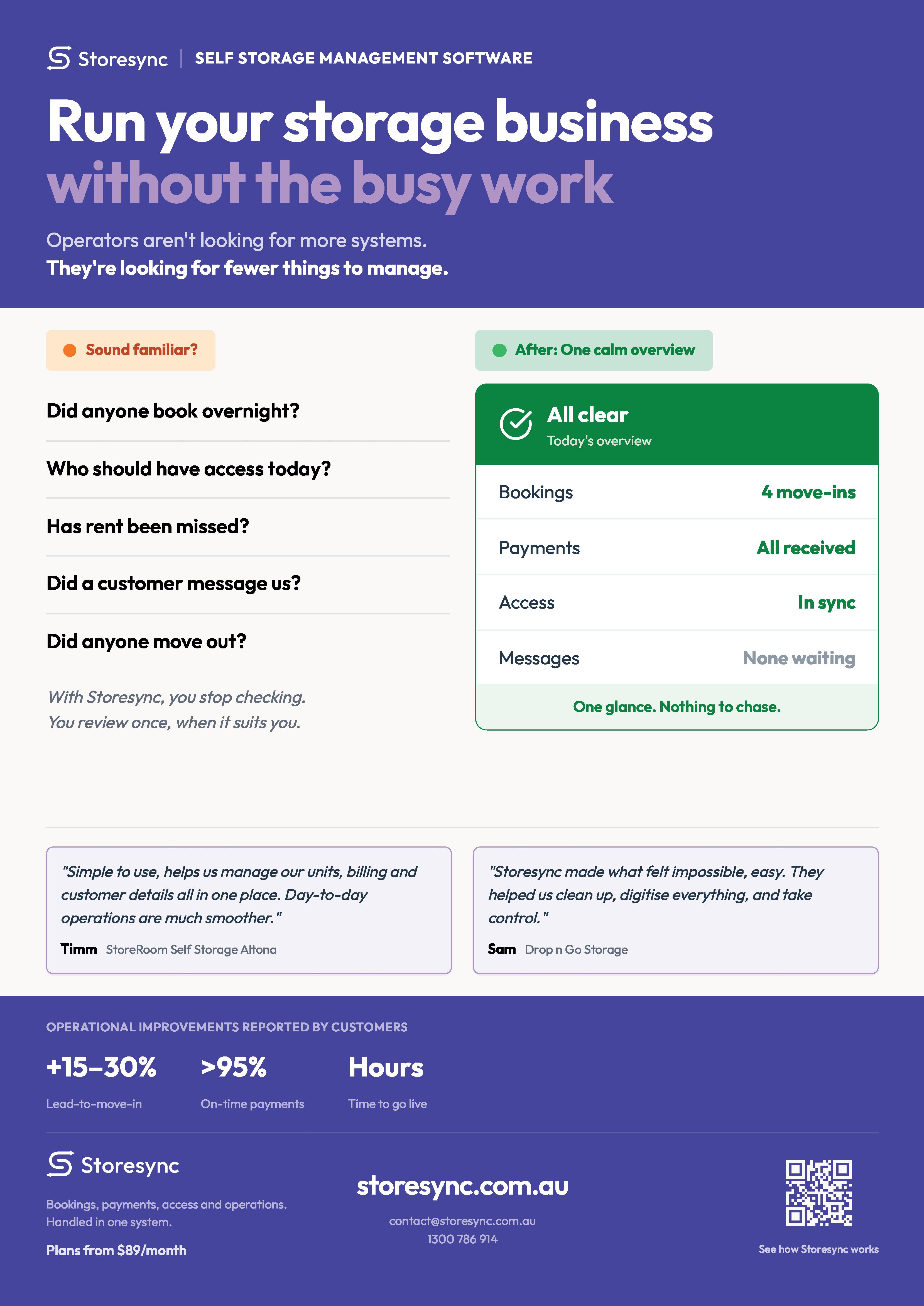
FINALIST Storesync
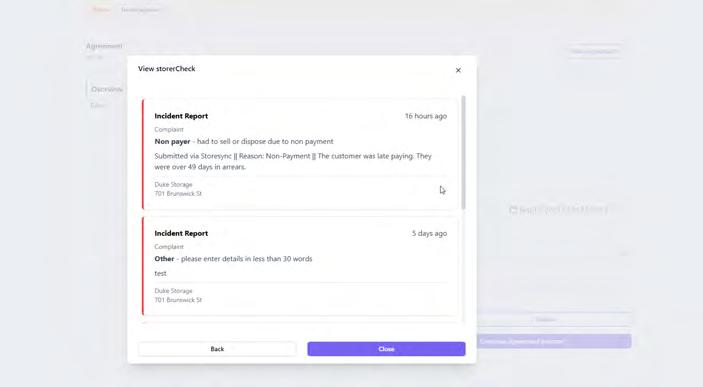
Storesync has been named a finalist for Excellence in Industry for its work in standardising StorerCheck across the sector and embedding best practice into everyday workflows. By integrating StorerCheck into agreement and termination processes, the system removes friction, improves compliance, and ensures high-quality screening becomes the default across SSAA member facilities.
The initiative began with a clear problem: StorerCheck often sat outside normal processes, leading to checks being skipped, completed at the wrong stage, or creating extra work after agreements were signed. Storesync identified an opportunity to eliminate these issues by placing StorerCheck within the tools staff use every day and timing incident reporting precisely at the point an agreement truly ends.
The resulting workflow is simple but transformative. All new agreements pause in Needs Approval, requiring staff to complete the StorerCheck review inside Storesync before any signing link is released. Customers receive their digital agreement only after approval, preventing accidental progress to signature. At move-out, a create incident step appears on the final invoice screen and is submitted only after the invoice is sent. This prevents early or duplicated reports, protects customers from premature flagging, and ensures data quality for the shared SSAA database.
This approach has made a measurable difference. Across SSAA member sites using Storesync, 100%
Sponsored by
“By integrating StorerCheck into agreement and termination processes, the system removes friction, improves compliance, and ensures high-quality screening becomes the default across SSAA member facilities.
of new agreements are screened before signature, and incidents are recorded at the correct moment. Operators report fewer reversals, fewer disputes, and clearer audit trails. Staff avoid duplicate data entry, and the guided workflow makes training and onboarding easier.
Development focused on reliability and ease of use, including API integration, queuebacked retries, permission controls, and recorded consent. Because the new steps sit naturally inside existing screens, most teams required no formal training. Neutral customer messaging, such as “Contact the store to continue,” protects dignity and maintains
a positive brand experience when approval is pending.
For operators, the daily impact is substantial. Tasks are streamlined, productivity is higher, and staff have fewer clicks and no repeated data entry. Approvals occur before signing, eliminating postsignature reversals. Incident reports contain more accurate context, linked directly to termination data, improving close-out quality and reducing the need for SSAA follow-up. Stronger compliance, supported by clear audit histories, gives facilities greater confidence and reduces risk across locations.
The industry-wide impact is equally significant. The initiative encourages consistent adoption of StorerCheck, particularly among smaller operators who previously avoided it due to workflow friction. Cleaner shared data strengthens collective insights, while accurate and fair screening builds trust with customers and the broader community. Storesync’s approach demonstrates how thoughtful design can raise standards across the self storage industry.
As a finalist for Excellence in Industry, Storesync shows how well-designed systems can unify practice across an entire sector, supporting operators, improving data quality, and strengthening outcomes for customers and the SSAA community. l
Excellence in Industry
FINALIST
U-Store-It, SA
U-Store-It has been recognised as a finalist for Excellence in Industry for its comprehensive employee training and support ecosystem, designed to strengthen skills, enhance career opportunities, and raise service standards across the self storage sector. Their integrated approach sets a benchmark for how operators can build confident teams, deliver consistent service, and create long-term pathways for staff development.
At the core of this initiative is U-Store-It University, a digital learning platform offering structured industry-specific training through interactive modules, written resources, and video content. Staff begin with induction modules and continue through a progressive series covering industry processes, safety, customer service, SSAA training modules, and leadership skills. The platform ensures staff – across all locations and levels – receive consistent,
Complementing the University is the Leadership Development Program, a structured pathway enabling employees to progress from entry-level roles into management. The program incorporates hands-on training, coaching, and courses delivered in partnership with Business SA, enabling emerging leaders to earn formal qualifications and strengthen their long-term career prospects. This creates a clear internal pipeline for talent and reduces turnover by giving team members a future in the industry.
Another significant component is the S.A.S. Hub – a centralised helpdesk providing IT support, overflow call management, troubleshooting assistance, and customer-service backup for all sites. This ensures frontline staff feel supported during busy periods and prevents operational delays caused by technical issues or complex enquiries. The Hub improves efficiency, response times, and consistency of service across locations.
The project originated from the organisation’s identification of four key challenges: inconsistent training, overwhelmed frontline teams, technology delays, and difficulty maintaining consistent customer service. By addressing these issues, U-Store-It has built a system that improves workforce capability,
engagement, and retention. Staff now experience clearer expectations, better mentoring, faster problem resolution, and a stronger sense of professional purpose.
The impact on the business has been substantial. Staff report feeling more engaged, supported, and equipped to perform at a high standard. Customer experience has benefited from reduced wait times and improved service quality, supported by the S.A.S. Hub and a stronger emphasis on customercentred decision-making. The company has also seen staff progression, with more employees undertaking leadership training and stepping into advanced roles, reinforcing its position as an Employer of Choice within the self storage sector.
Financially, the investment has delivered returns through reduced errors, more efficient operations, improved retention, and reduced recruitment pressure. The initiative strengthens both the organisation and the broader industry by ensuring workforce skills and knowledge continue to grow.
As a finalist for Excellence in Industry, U-Store-It demonstrates how thoughtful training, genuine staff support, and long-term workforce planning can uplift an organisation while setting a higher benchmark for the self storage community. l
Excellence in Industry
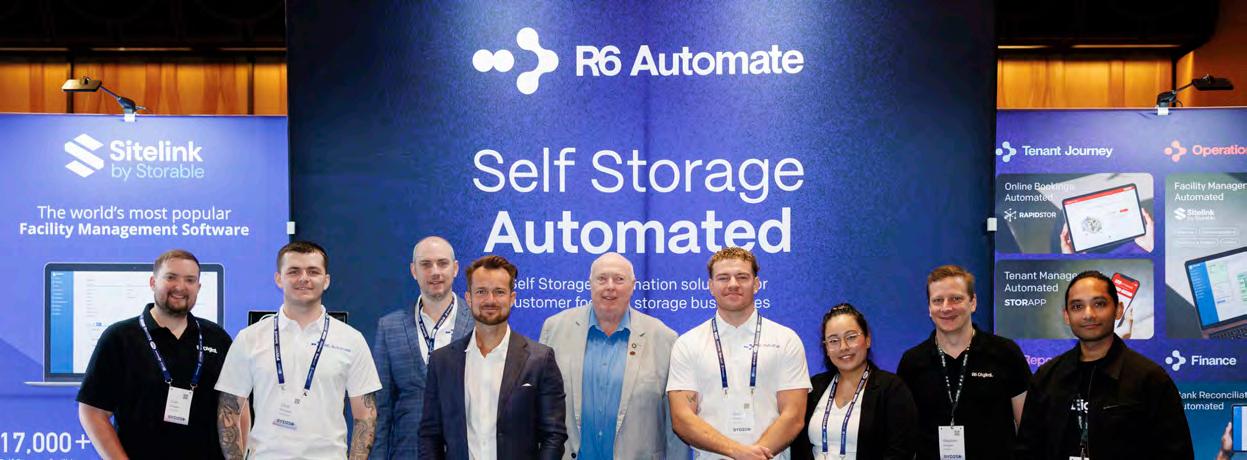
WINNER R6 Automate
Sponsored by
“ The Remote Management Guide has helped operators better understand and implement remote management models.
Leading the shift to remote management in self storage
R6 Automate has taken a leading role in shaping the self storage industry’s next era – one defined by a shift towards hybrid operating models, stronger digital infrastructure and more efficient customer experiences. While technology now enables facilities to operate with fewer onsite staff, the most successful operators recognise that human involvement remains essential.
The R6 Automate Remote Management Guide, created as an open educational resource, has become an influential tool for operators navigating this transition. Practical, accessible and industry-focused, its impact has extended far beyond the organisation itself.
At a time when operators are seeking clarity and confidence in adopting new technologies, R6 Automate chose to share its expertise widely. The result is a resource that has strengthened industry knowledge, supported operators of all sizes and contributed to raising standards across Australia, New Zealand and beyond.
A guide designed for an evolving operating model
Remote management has been gaining traction globally as operators look for ways to streamline operations, reduce labour pressures and deliver modern customer experiences. With the launch of StorApp, R6 Automate saw proactive operators adopt remote-friendly systems quickly, while a larger group were willing to modernise but were uncertain where to begin.
The Remote Management Guide was created to close that knowledge gap. It brings clarity to the evolving operating landscape and recognises that operators can reallocate people to where they add the most value while being supported by systems that automate routine tasks. It also outlines the benefits and challenges of remote management and provides details on the technology that underpins it. The guide covers:
l remote access control
l monitoring and reporting
l communication systems
l staffing considerations
l customer experience impacts
l implementation pathways
The document functions as a starting point for those new to remote management and a refinement tool for established operators looking to optimise. Built as a “living document”, it is updated regularly to reflect changes in technology, operating models and industry trends.
Understanding the challenges operators were facing
As R6 Automate continues to support remote transitions across Australia and New Zealand, Asia, Europe and the US, the team saw common concerns emerge. Operators questioned customer acceptance, required technology, day-to-day operational impact and whether remote models were suited to small or large facilities.
The guide was developed to offer clear, grounded answers to these questions.
Instead of promoting a single system or product, R6 Automate chose a platform-agnostic approach focused on principles, frameworks and practical steps. This ensured the document could be used by any operator, regardless of size, location or technical capability. Their philosophy – that a rising tide lifts all boats – shaped the intent: to raise education and confidence across the industry.
Development backed by global experience
The guide was created in-house by R6 Automate’s product, strategy and marketing teams, drawing on years of real-world implementation across diverse markets. The team prioritised accessibility, clarity, practical relevance and minimal commercial bias, ensuring the guide supported operators regardless of existing systems. Once complete, it was launched online as a free resource and promoted through events, webinars and social media, signalling a commitment to industry-wide education.
Impact on the wider industry
The Remote Management Guide has helped operators better understand and implement remote management models. It has improved decision-making, reduced uncertainty and encouraged modernisation at a manageable pace. For existing operators, it provides structure and reduces risk through a clear transition pathway. For new entrants, it offers confidence at the earliest stages of planning.
By introducing shared terminology – including fullservice, assisted-service and self-service models – R6 Automate has helped create a common language for the industry, making conversations more productive and reducing misunderstandings. The guide has also supported industry bodies by offering reliable, practical material that can be shared with members.
Long-term influence
Beyond its immediate educational purpose, the guide has become a framework for deeper industry conversations and has helped raise the level of technical knowledge across the sector. It has also led to speaking opportunities at self storage conferences in Australia and Asia for CEO Michael Dogger, further extending its reach. Internally, the development process improved team training, aligned best practices and strengthened consistency across departments.
Ultimately, the Remote Management Guide has become a cornerstone resource in the industry’s shift towards modern operating models – and a clear example of how open knowledge can drive collective progress. l
We understand self storage and we’ve been working with SSAA members for two decades.
Our advice protects you and your business Contact us today to find out how. If
Excellence in Sustainability
FINALIST Mornington Peninsula Boat and Caravan Storage, VIC
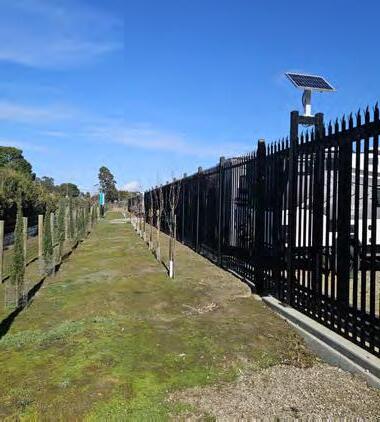
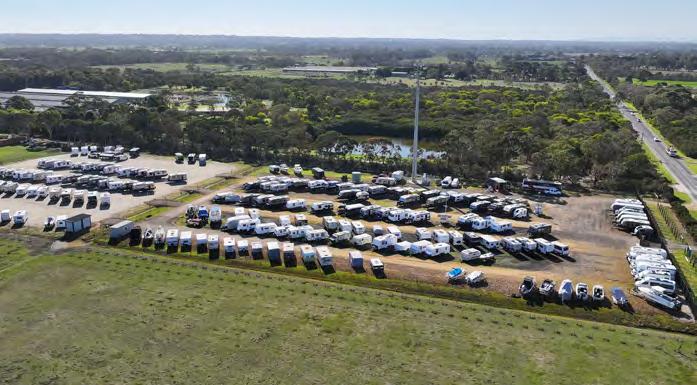
Mornington Peninsula Boat and Caravan Storage has been recognised as a finalist for Excellence in Sustainability for developing a fully off-grid facility that demonstrates how small operators can achieve meaningful environmental outcomes without compromising security, functionality, or customer care. Sustainability has been embedded into every stage of development, creating a model that supports the environment, the local community, and long-term operational resilience.
The project began on flood-prone land, presenting both a challenge and an opportunity. Rather than opting for traditional construction, the owners designed a site that prioritised recycled materials, responsible land engineering, and
water-sensitive systems. Solar panels and battery storage now power the entire facility, including the gate system, CCTV, office equipment, and automation. This off-grid approach eliminates reliance on external energy sources and significantly reduces emissions.
More than 300 trees have been planted across the property, supporting biodiversity, providing shade, and improving site aesthetics. Combined with the natural drainage layout, these plantings prevent erosion and reduce heat absorption. Rainwater management systems protect the surrounding environment, contributing to healthier soil and vegetation. No toxic materials or processes were used during construction, reinforcing a commitment to low-impact development from the outset.
The initiative grew from the owners’ desire to create a sustainable family income during COVID while responding to rising local demand driven by council parking restrictions. Their solution was a facility that delivers value to customers while remaining environmentally responsible and financially self-sufficient. Recycled fencing was repurposed for the facility’s 1,000-kg customised palisade gates and other security infrastructure, demonstrating a practical approach to material reuse.
The environmental benefits are clear. Solar energy powers operations, eliminating electricity bills and preventing carbon emissions. Engineered drainage has resolved historic flooding issues, while the expanding tree canopy improves comfort for users and strengthens the local ecosystem. These improvements also support business performance, with customers valuing the facility’s integrity and thoughtful design, enabling growth through word of mouth rather than traditional advertising.
This project elevates sustainability standards within the self storage industry. It shows that environmentally responsible facilities do not require extensive capital and that small operators can achieve strong outcomes through creativity, careful resource use, and clear values. Practical choices –from recycled materials to off-grid automation – benefit customers, operators, and the environment simultaneously.
With a near-debt-free build, negligible energy costs, and limited reliance on paid marketing, thanks to strong community trust, the financial returns have been compelling. The project demonstrates how practical, well-considered development decisions can deliver long-term resilience and set a forwardlooking benchmark for self storage operators. l
FINALIST
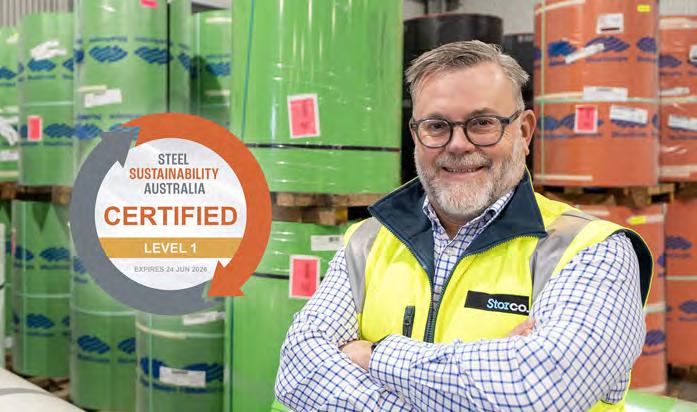
Storco has been recognised as a finalist for Excellence in Sustainability for its longstanding commitment to environmental responsibility, grounded in a Kaizen philosophy of continuous improvement. Rather than relying on a single flagship initiative or large-scale investment, Storco has embedded sustainability into its business – from factory layout and energy use to waste reduction, procurement, and partnerships. This whole-of-business approach demonstrates how iterative, team-driven improvements can deliver meaningful environmental outcomes for manufacturing and the self storage sector.
The foundation of Storco’s sustainability journey is its purposebuilt factory, designed around a LEAN manufacturing flow model that prioritises efficiency, flexibility, and the smooth movement of materials through production. By reducing handling and minimising the potential for damage, the factory
cuts rework and reduces wasted materials. Approximately one-third of the site’s total energy use now comes from on-site solar, lowering emissions and reducing reliance on non-renewable power sources.
Storco’s sustainability achievements are externally validated through its Level 1 certification with Steel Sustainability Australia (SSA). This independent audit confirms that Storco’s steel feedstock is sourced from responsible manufacturers that meet environmental, governance, and safety standards. The certification also verifies that Storco’s internal processes align with industry best practice. Storco’s products contribute points towards the Green Building Council’s Responsible Products Framework, providing added value to customers seeking sustainable solutions.
A significant aspect of Storco’s sustainability impact comes from partnerships with local recycling vendors. In the 2024–25 period alone, approximately 180,000 kilograms of metal, 500 kilograms of timber, 400 kilograms of heavyweight steel coil cardboard, and a projected 600 kilograms of packaging cardboard were diverted from landfill. These materials are repurposed into new products, including garden fertiliser made from heavyweight coil cardboard that traditional recycling
facilities cannot process. This approach minimises waste, reduces landfill pressure, and extends the useful life of materials that would otherwise be discarded.
Storco’s Kaizen approach empowers employees at all levels to identify opportunities for improvement. Innovations emerge across the business – from logistics teams reducing material handling, to procurement teams championing audits, to site managers identifying community uses for waste cardboard. This ground-up model ensures improvements are practical and supported by those implementing them, while reinforcing a culture where sustainability is everyone’s responsibility.
Industry-wide, Storco’s approach highlights the importance of taking responsibility for supply-chain elements manufacturers can directly influence. While steel production remains carbon intensive, Storco demonstrates that sourcing, handling, waste management, efficiency, and local partnerships can be improved through consistent action.
The return on investment is strong. Leaner processes reduce rework, lower material costs, and improve productivity. Recycling partnerships turn waste into revenue, while solar power reduces energy costs and exposure to price volatility. Together, these gains create long-term value.
Storco illustrates how steady, incremental change — supported by engaged staff and disciplined resource management — can deliver measurable environmental progress while strengthening operational performance across both manufacturing and the self storage sector. l Sponsored by
Excellence in Sustainability
WINNER
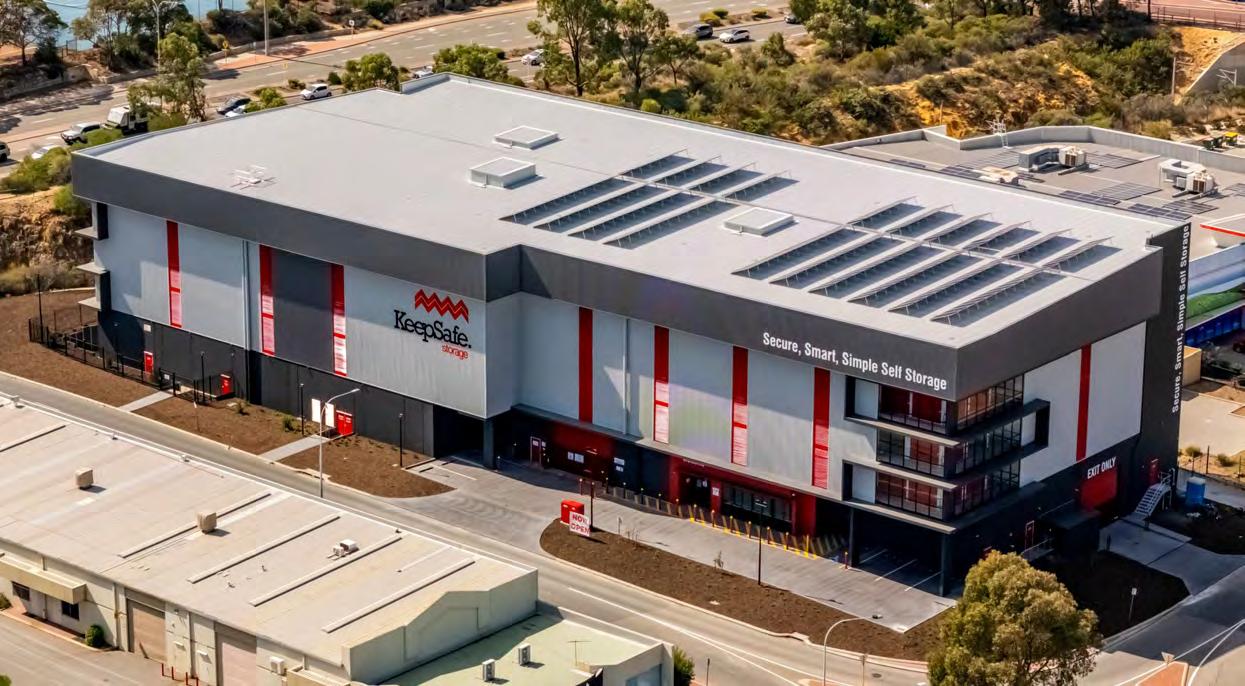
KeepSafe Joondalup, WA
Raising the sustainability benchmark in self storage
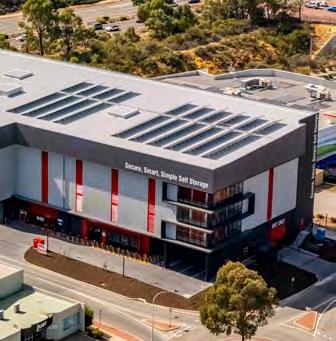
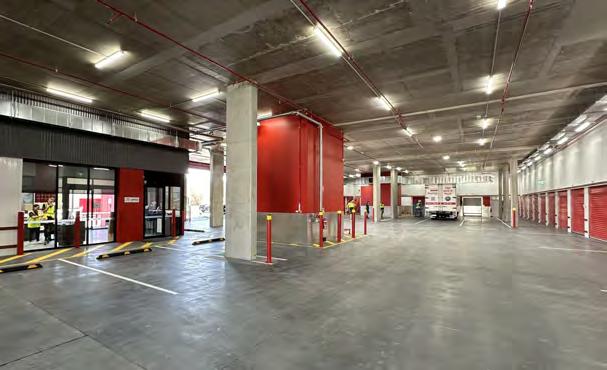
KeepSafe Storage Joondalup has demonstrated how renewable energy can be meaningfully integrated into modern self storage infrastructure, proving that sustainability and commercial performance can work hand in hand. Its solar and battery installation is one of the most comprehensive systems implemented at a local facility, delivering measurable environmental and economic value through thoughtful investment. With a 100kW solar PV system paired with 100kW of battery storage and three-phase smart inverter technology, the project stands out for both its scale and its impact.
The initiative has sharply reduced reliance on grid electricity, lowered operating costs, and significantly cut carbon emissions, all while maintaining uninterrupted functionality for customers. It provides a clear example of sustainability initiatives delivering real operational benefits rather than symbolic outcomes. As energy prices continue to rise and environmental expectations increase, the project demonstrates what is possible for storage operators willing to invest strategically.
A sustainability project with clear purpose
The decision to proceed was driven by two pressures shaping the sector: rising energy costs and growing community expectations around environmental responsibility. Multi-level facilities with lifts and extensive lighting typically carry a high energy burden, and KeepSafe Joondalup was no exception. Rather than simply absorb increasing costs, the team identified an opportunity to turn energy use into a competitive advantage and sustainability showcase.
The project aligns with broader ESG expectations from customers, communities, and investors. It positions KeepSafe ahead of a market in which customers increasingly favour businesses that can demonstrate tangible environmental responsibility, while also reinforcing long-term strategic positioning within the self storage sector.
Designing a system for real operational demands
The solar and battery system was designed following a detailed energy audit conducted by a specialist contractor. This ensured the system matched the facility’s actual load profile and operational requirements.
The site includes three lifts operating on three-phase power, creating significant demand that needed to be supported without compromising safety or performance.
The installation includes 100kW of solar PV, 100kW of battery storage, three-phase smart inverter technology,
Sponsored by
advanced monitoring systems, and load-shifting and peak-shaving capability. Importantly, the system allows the facility to continue operating during grid outages, providing operational continuity and increased customer confidence.
Installation was carefully staged to minimise disruption and delivered within budget. Ongoing monitoring enables real-time tracking of energy generation, consumption, and efficiency, supporting long-term performance and system optimisation.
Measurable environmental outcomes
The system generates approximately 180,000 kWh of renewable energy each year, reducing reliance on grid electricity by more than 90%. For a high-demand, multi-level facility, this represents a substantial shift in energy sourcing. The environmental impact is equally strong, with an estimated 80 tonnes of CO2 emissions avoided annually.
These outcomes are measurable, repeatable, and ongoing. Rather than adopting superficial sustainability measures, KeepSafe Joondalup has embedded renewable energy into everyday operations. Customers can see tangible investment in environmental responsibility, while staff benefit from working in a facility that prioritises responsible energy use.
Strengthening performance and reducing risk
The project delivers strong financial benefits alongside environmental gains. The 90–95% reduction in grid electricity use has generated five-figure cost savings and reduced exposure to future price volatility. Battery storage enables peak-load shaving, lowering demand charges that often drive commercial power costs.
Business resilience has also improved. While gridreliant facilities remain vulnerable to outages, KeepSafe Joondalup can continue operating lifts, lighting, and core systems using solar generation and stored energy. This enhances operational continuity during grid instability or extreme weather events.
With a projected payback period of 3.9 years and an estimated return on equity of around 26%, the commercial case is compelling. The project has also delivered an estimated $700,000 uplift in asset valuation, reinforcing the link between sustainability investment and long-term business value.
Industry leadership and scalability
KeepSafe Joondalup’s initiative sets a benchmark for sustainability within the local self storage sector. Many facilities face similar energy demands, and this project demonstrates how renewable energy can be integrated even within complex, multi-level sites. It provides a practical reference point for operators considering their own upgrades and strengthens the sector’s credibility in ESG discussions.
The approach is scalable across self storage, commercial property, and regional facilities. With careful planning and experienced delivery, similar systems can be adapted to different building profiles and locations. As energy costs continue to rise, the business case for solar and battery integration is likely to strengthen further.
A long-term commitment
This initiative is not a one-off upgrade but part of a broader commitment to continuous improvement. Real-time monitoring supports ongoing optimisation, while the system’s flexibility allows for future expansion as technology evolves. The project has also built internal capability, increasing technical understanding and confidence in managing renewable systems.
KeepSafe Storage Joondalup has demonstrated that integrating renewable energy into operational infrastructure delivers genuine environmental and commercial outcomes. By addressing energy costs, reducing emissions, and strengthening resilience, the project sets a high benchmark for sustainability in self storage and shows what is achievable when environmental responsibility is embedded into core business operations.
KeepSafe Storage Joondalup has demonstrated that integrating renewable energy into operational infrastructure delivers genuine environmental and commercial outcomes.
Dear Help Desk
QWe’ve been notified that a Storer has passed away. Family members are asking for access to the storage unit. What are our obligations and how should we proceed?
The death of a Storer can be a sensitive and challenging situation for not only the people involved but for the Facility to manage. While empathy is essential, it is equally important to follow the correct legal process to protect both the Facility and the estate.
No automatic right of access
A Storer’s death does not automatically give family members the right to access the storage unit. The storage agreement remains in force, and the Facility must only deal with a person who has the legal authority to act on behalf of the deceased.
Who can deal with the account?
Facilities should request formal documentation before granting access or releasing goods. This will usually be:
l a Grant of Probate (where there is a Will), or l Letters of Administration (where there is no Will). Until this authority is provided, access should not be granted,
even if the person is a spouse, child or next of kin.
What about small or urgent requests?
If a family member requests access to retrieve documents (such as a Will believed to be stored in the unit), Facilities should proceed cautiously. In some cases, limited supervised access may be appropriate, but only after taking steps to verify the purpose of access and documenting the process carefully.
Storage fees and the account
Storage fees continue to accrue while the goods remain in storage. These fees become a debt of the deceased estate. Facilities should continue issuing invoices and notices to the Storer’s last known address, and once identified, to the executor or administrator.
Payment default still applies
If fees remain unpaid, the standard arrears and default process under the storage agreement and applicable legislation can still be
followed. However, Facilities should be mindful that estates can take time to finalise, and a measured, well-documented approach is recommended.
Key takeaways
l Do not grant access without legal authority
l Request probate or letters of administration
l Keep communication factual, respectful and well documented
l Continue issuing notices in accordance with the agreement
The SSAA has recently updated Deceased Estates guidelines, available on the SSAA Member Portal. The resource provides practical guidance and examples for Facilities managing these situations.
If you are unsure how to proceed in a deceased estate matter, or the situation becomes complex, the SSAA Help Desk can assist with guidance on next steps. l
Payday Super: What self storage operators need to know before 1 July 2026
Amajor change to Australia’s superannuation framework is coming, and it will affect every self storage operator who employs staff. Known as Payday Super, the reform changes not just when super is paid, but how often, how it is calculated and how quickly compliance is enforced.
From 1 July 2026, employers will be required to pay superannuation at the same time as wages. Rather than quarterly deadlines, super contributions must be received by an employee’s super fund within seven business days of each payday, with limited exceptions for new employees.
What is changing
Under the current system, super guarantee contributions can be paid quarterly, with strict but infrequent deadlines. Payday Super replaces this with a much tighter cycle. Super will be calculated at 12% of qualifying earnings (QE) – a new term that brings together ordinary time earnings and certain additional payments – and paid alongside payroll on every pay run.
The enforcement framework is also changing. Late payments will trigger the super guarantee charge far sooner than before. Interest will compound daily at the general interest charge rate, and administrative uplift penalties may apply based on an employer’s compliance history. While the charge will become tax deductible, penalties of 25% or 50% of unpaid super can still apply, making accuracy and timing critical.
Single Touch Payroll reporting will expand to include both qualifying earnings and super liability, increasing transparency and reducing the margin for error.
Why this matters for self storage operators
Many self storage businesses operate with lean teams, flexible rosters and variable payroll cycles
“ Payday Super means payroll is no longer a once-a-quarter compliance task – it becomes a pay-dayby-pay-day obligation.
across site management, customer service and maintenance roles.
Payday Super means payroll is no longer a once-a-quarter compliance task – it becomes a pay-day-by-pay-day obligation.
Cash flow management will be particularly important. Operators who wait until July 2026 to transition may face a short-term cash squeeze, with multiple months of super effectively falling due in a condensed period. Starting early allows businesses to smooth this transition and avoid unpleasant surprises.
What operators should be doing now
Preparation should start well before the commencement date. Key steps include reviewing payroll systems to
Ewen Fletcher is the Director of Progress Accounting and a self storage facility owner. He and his team support self storage businesses with compliance, tax and reporting, cash flow management, business structure and business financial health checks. This work helps owners better understand performance, manage risk and plan for growth, transition or succession with confidence.
ensure they can support automatic super payments, confirming all employee super fund details are accurate, and transitioning away from the Small Business Superannuation Clearing House, which closes permanently on 30 June 2026.
Operators should also review internal payroll processes and build new habits that align super payments with wage cycles. Testing systems early helps identify data errors, fund mismatches or processing delays before compliance becomes mandatory.
A chance to get ahead
While Payday Super introduces tighter timeframes, it also offers benefits. More frequent payments reduce the risk of large quarterly liabilities, improve accuracy through repetition, and provide employees with faster access to their entitlements. For operators, it is an opportunity to modernise payroll processes and strengthen compliance confidence.
This reform will impact every employer, regardless of size. Self storage operators who plan early, update systems and adjust cash flow settings now will be best placed to meet the change smoothly when 1 July 2026 arrives. l
Four evolving work health and safety expectations
2026 OHS trends shaping self storage in Australia and New Zealand
By
Rachel Campbell.
As the self storage sector continues to grow across Australia and New Zealand, expectations around work health and safety (WHS) are evolving. Regulators and insurers increasingly expect operators to move beyond reactive compliance and demonstrate practical, proactive risk management that reflects how storage sites actually operate.
Four risk areas are especially relevant in 2026: lone work, lithium–ion battery fires, heat exposure and psychosocial safety. Together, they point to a simple shift – anticipate predictable hazards and show visible controls.
1
Lone work moves into the spotlight
Lone work is routine in self storage. Site managers open and close facilities, cleaners and contractors work after hours, and callouts happen at short notice. Regulators allow lone work, but treat it as higher risk, which means controls must be stronger, documented and understood by staff.
Operators are increasingly moving from manual call-ins to digital lone worker systems. Using mobile apps or wearables, these systems can prompt check-ins, detect falls or extended inactivity, and escalate alerts if a worker does not respond. For sites with extended hours and lean staffing, this technology is often a practical way to reduce risk without adding headcount.
2
Lithium–ion batteries: a hidden fire risk
Lithium–ion batteries are now commonplace. Customers may store e-bikes, scooters, tools and spare packs, and may not realise that damaged, recalled
“ 2026 is about tightening everyday controls around known risks. Self storage perators who do so will be better positioned to protect their people, customers and business.
Rachel Campbell OHS Consultant.
Practical controls include rescheduling physical tasks, providing shade and water, encouraging breaks, and training staff to identify early signs of heat illness and act early.
4
or poorly handled batteries can fail. Fire authorities have highlighted that lithium–ion incidents can be intense, produce toxic gases and re-ignite after appearing to be extinguished.
Key risk scenarios for self storage include charging inside enclosed units, damaged or altered batteries, and dense storage that delays detection. Many operators are responding by prohibiting charging in units, restricting loose or damaged batteries, updating agreements and signage, and training staff to recognise warning signs. Staff should also be instructed to prioritise evacuation and emergency response rather than attempting to extinguish a lithium–ion battery fire. For further support see the SSAA’s Batteries and Self Storage update in the member portal.
3
Psychosocial safety in lean operations
Lean staffing can increase psychosocial risks, including isolation, aggressive customer interactions and irregular hours. Regulators across Australia and New Zealand expect these risks to be identified and managed alongside physical hazards. Useful controls include clear escalation pathways, de-escalation training, and regular welfare checkins, particularly for staff working alone.
For self storage operators, 2026 is about tightening everyday controls around known risks. Operators who implement practical measures for lone work, lithium–ion storage, heat stress and psychosocial hazards will be better positioned to protect their people, customers and business. l
Heat stress becomes a core WHS issue
Heat exposure is no longer a seasonal nuisance. Working in hot conditions – indoors or outdoors – is a foreseeable hazard that must be managed. Self storage sites face particular challenges in summer, including metal-clad and drive-up units that retain heat, roof and plant room inspections, and manual handling during heatwaves.
The OH&S Help Desk has been established by SSAA to support members with safety questions and concerns. Call 1800 067 313 (AU) or 0800 444 356 (NZ) or email membership@selfstorage.com.au to access the OH&S Help Desk.
Human resources changes that affect your business
Workplace laws continue to shift and evolve across Australia and New Zealand, and the message is clear – people management needs to be fair, practical and well communicated. Below is a summary of key changes introduced in Australia last year that may affect your business. New Zealand operators may also wish to note these developments, as similar changes may apply locally.
One of the biggest developments is the increased focus on mental health and safety at work. New Victorian regulations now require employers to proactively identify and manage psychosocial risks, such as high workloads, unclear roles, lack of support, bullying or aggressive customer behaviour. While these rules are being reinforced in Victoria, they reflect a national and international direction. For self storage businesses, this may include checking staffing levels during peak times, ensuring lone workers know how to get help, and providing staff with guidance on handling difficult customers. Regular check-ins and small adjustments can prevent stress from turning into injuries or claims.
Flexible work is another area under close scrutiny. Recent Fair Work Commission decisions emphasise that employers must take these requests seriously. You
“ One of the biggest developments is the increased focus on mental health and safety at work.
must respond in writing within 21 days, genuinely consider the employee’s situation, and clearly explain your decision if you refuse the request. For small businesses, having a simple process and a consistent way to respond can make this manageable and reduce the risk of disputes.
Pay compliance remains a strong focus for the Fair Work Ombudsman. They have issued many fines to employers advertising wages below legal minimums. Job ads must always align with the correct Award, Agreement or National Minimum Wage, and visa holders must be treated the same as other employees. Checking carefully before advertising a role can prevent costly mistakes and unwanted attention from regulators.
Another important change is the Right to Disconnect, which came into force in August 2025. This gives employees the right to ignore work messages outside their normal hours unless the contact is reasonable. What is considered
Careta Marmarinos HR Consultant, HR Central.
reasonable depends on urgency, the employee’s role, and whether they are paid to be available after hours. For self storage businesses that deal with emergencies or after-hours access, it is important to clearly define who is on call, when, and what counts as urgent.
Privacy laws have also tightened. Employees can now take legal action for serious invasions of privacy, including intrusive surveillance, such as excessive camera monitoring or employee tracking, or mishandling personal or sensitive information. Employers can be held responsible even if the breach is caused by a staff member. Reviewing surveillance practices, limiting access to employee data, and reminding managers about confidentiality are simple but effective steps you can take to improve compliance in this area.
Finally, obligations around the Casual Employment Information Statement continue. All casual employees must receive it when they start, and larger employers must reissue it regularly. Keeping track of this helps ensure transparency and compliance.
Small businesses that focus on good communication, sensible processes and regular reviews will be in the strongest position going forward. l
If you would like any further
When a signed agreement goes missing: what happens next?
Most people have experienced the panic of losing their keys or wallet. But what happens when a signed storage agreement goes missing? Ellorie Mercer, Viv Williams and Zhara Bedewi-Hayes explain.
In the (hopefully) rare instance when both a storage facility and a storer have misplaced their copies of a signed storage agreement, a tricky situation arises that requires careful handling. Understanding the legal implications can help both parties navigate the issue and avoid unnecessary stress.
When a signed agreement cannot be located, facilities and storers may struggle to prove the terms were agreed to. This makes it difficult – and in some cases impossible – to rely on the contractual protections ordinarily provided by the agreement.
Can an agreement still be enforced?
The good news is that all hope is not lost. A facility may still be able to enforce the agreement if it can prove that a copy was provided to the storer (even if unsigned or unreturned) and that:
l the storer indicated their intention to be bound by continuing to pay storage fees and use the space, or l the storer agreed through written communication to be bound by the terms.
In other words, the facility may contend that the storer accepted the terms of the agreement through express intention (for example, in an email chain) or through their conduct. This may result in some or all of the terms becoming binding, even in the absence of a signed copy.
What should you do?
If it appears that an agreement is missing, you should review your communications with the storer to determine whether an agreement was issued at any stage of the enquiry. Check emails, phone records and any written correspondence, as these communications could prove crucial. The facility should also ensure their insurer is promptly notified so its interests are protected should a claim eventuate. Timely action is essential, as insurers often impose strict notification requirements.
The downsides
Any argument that an agreement remains binding, despite having lost a signed copy, relies heavily on the facts of each situation. As a result, without a signed agreement, there is no certainty that the parties are bound unless and until a court determines the issue – a process that is often lengthy and expensive. To minimise the risks and costs of litigation, facilities may wish to explore commercial solutions to resolve any disputes that arise.
Relying on uncollected goods legislation
Where no signed agreement can be located and there is insufficient evidence to establish that contractual terms apply, facilities may also consider whether it is necessary to rely on uncollected goods legislation. These laws differ between jurisdictions and are often
very prescriptive, so facilities should refer to the CSA Guidelines or contact the SSAA Help Desk.
Prevention is better than a cure
The stress and hassle of losing an agreement highlight why robust record-keeping is essential. Strengthen document management by:
l maintaining digital copies of all agreements
l using cloud-based storage systems
l providing customers with electronic copies of their agreements.
These strategies, alongside regular document audits, can help prevent the complications associated with a lost agreement. l
Next-generation protection for Australia’s self storage industry.
ADT Security is proud to join the SSAA community, bringing a modern, intelligence-driven approach to protecting the self storage sector. With more than 150 years of security expertise and national coverage across metro, regional and remote areas, delivered by direct ADT staff, not subcontractors. They provide a level of consistency and reliability the industry has been asking for.
Self storage operators face a unique set of risks: after-hours intrusions, forced-entry attempts, tailgating, illegal dumping, fire hazards inside units, and increasing insurance scrutiny around loss events. ADT resolves these challenges with ADT Guard, the AI-enabled video monitoring platform designed to detect, verify and intervene before incidents escalate.
Stora
Stora is a self storage platform designed to help operators streamline operations and boost revenue. The platform is now available in Australasia and currently supports 25% of the UK’s storage businesses, processing more than 100,000 bookings worldwide every year, positioning it as one of the industry’s most trusted solutions.
Stora brings bookings, payments, customer management, site operations and reporting into a single, easy-to-use system. This reduces reliance on multiple tools, minimises drop-offs and helps convert more customers from browsing to booking.
The system is designed to be quick to learn and
Using advanced analytics and real-time monitoring from the A1-Grade Monitoring Centres, ADT Guard identifies unauthorised activity the moment it occurs. Operators issue live audio warnings,
simple to manage, whether operators are running a single site or overseeing multiple locations.
Online booking flows are built to eliminate friction, with automated pricing that can be easily adjusted based on demand. Payments are processed smoothly and reliably, while the advanced checkout experience makes reservations fast and intuitive.
The platform also creates multiple opportunities to upsell, helping operators increase revenue with every booking. Stora’s public API allows seamless integration with other tools and systems, providing greater flexibility and automation across the business. With real-time visibility across availability,
initiate police response, and stop offenders before damage is done. This proactive model has already supported police with over 200 arrests nationally, preventing significant loss for operators.
What makes ADT different is the fully integrated, national workforce, allowing them to deliver monitoring, maintenance, mobile patrols, alarm response and guarding as one seamless, cost-effective ecosystem. No subcontracting means streamlined communication, predictable pricing and faster outcomes.
ADT also supports self storage operators with early fire detection options, complianceready reporting, and technology engineered for multi-site portfolios. With ADT, you gain a security partner built for today’s risks, and tomorrow’s challenges.
bookings and operations, teams gain greater control, reduced administrative workload and clearer insights to support smarter, faster decision-making.
In-depth reporting and analytics make it easy to identify trends, track performance and make
confident decisions around pricing, availability and growth. Together, these features help operators fill units faster, reduce time spent on administration and grow their business more efficiently.
www.stora.co
Unapologetically tough. Smart latch, perfected.
1,000s Installed Worldwide. Zero Equals. Why compromise with inferior smart latches?
The ProEdge Smart Latch simplifies door security for both operators and tenants with its next-generation Bluetooth technology that provides keyless access, automated rental possibilities, and overlocking functionality. With many customers worldwide, this one latch is all that is needed to accommodate left or right latch mounting and is designed for both flat and corrugated doors. Tenants just need to swipe left on the app to unlock the latch.
DUAL-METHOD ACCESS
Tenant access controlled using next-gen bluetooth via the StorID app, or via keypad if they do not have their phone.
TAMPER RESISTANT BREAKAWAY TAB
A breakaway tab, with onboard accelerometer, mitigates forced entry efforts and notifies both tenant and owner in real-time.
DIGITAL KEY SHARING
Using the StorID app, tenants can easily provide other users with access to their unit for a specific period of time or indefinitely.
STORLOGIX CLOUD INTEGRATION
StorLogix Cloud connectivity through a robust mesh network provides operators with information on tenant access and overlocking capabilities.
3 YEAR BATTERY PERFORMANCE
A single lithium manganese dioxide battery performs up to 3 years.
2 YEAR WARRANTY
All PTI products including ProEdge come with a 2-year warranty from the installation date, giving you complete peace of mind.
StorLogix Cloud, ProEdge gateway, and ProEdge subscription required. Contact PTI Sales for further information.
Custom Projects. Custom Pricing. Speak to your local PTI installer for more details.