PROS AND CONS OF PV PANELS SIX-YEAR PAYBACK IN CO FERMANAGH
102
PV INTEGRATED WITH HEAT PUMP IN CO MEATH
107
PV WITH EV CHARGER IN CO ANTRIM
87 OVERVIEW / 94 HOW PV AFFECTS THE ENERGY RATING 112 LOWDOWN ON PV GRANTS IN ROI
sponsored content
Green-House Renewables
Power your home, no matter the roof.
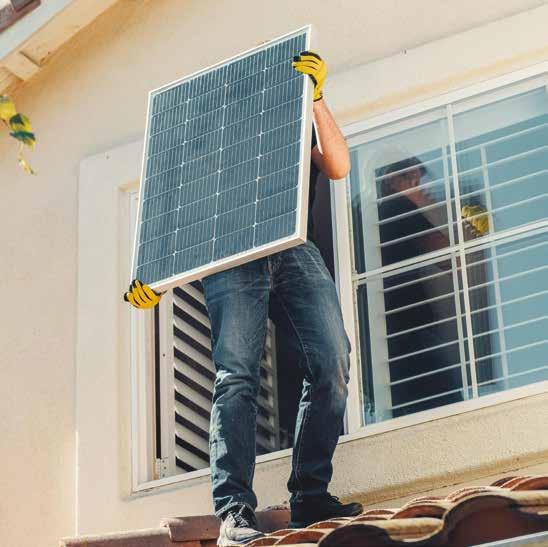
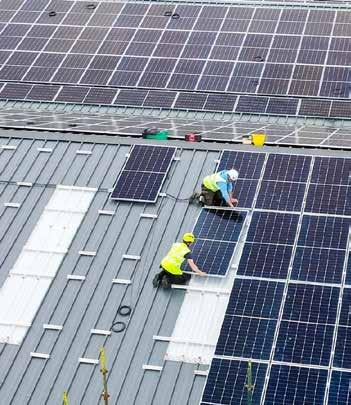
Nowadays, solar panels can be installed safely on any roof covering, be it slate, tile, metal or even a flat roof. There’s a way to bring clean energy to every build.
That’s because today’s mounting systems are designed to adapt to virtually any roof type. Flat roofs use ballasted systems that don’t require drilling, while pitched roofs benefit from discreet brackets that preserve aesthetics and weatherproofing.
Even complex or irregular roof shapes can be accommodated with custom layouts and flexible panel configurations.
Panel types
Solar PV systems today are more adaptable than ever. Discreet integrated panels can replace roof tiles for a seamless finish, while slimline frames allow panels to sit neatly above existing roofs without compromising design.
Beyond compatibility, solar panels offer long-term savings and energy independence. With rising electricity costs and generous government incentives, investing in solar is a smart move for new builds and retrofits alike. Plus, panels now come in sleek, low-profile designs that blend beautifully with your home’s architecture.
Design
If you’re planning a self-build or renovation, consider solar early in the design process. This allows for optimal panel placement, wiring integration, and futureproofing your home’s energy needs.
Even if your home faces less-
Green-House Renewables: your allin-one renewable energy partner
From design to installation, Green-House Renewables delivers a seamless clean energy solution tailored to your home.
• Grant-ready expertise: The SEAI grant process is made simple, helping you secure the maximum financial support for your upgrade.
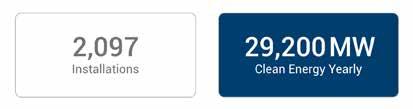
• Trusted by thousands: With 18+ years’ experience and over 2,800 successful installations, you can rely on proven professionals.
• Integrated heating solutions: Combine PV with a heat pump and underfloor heating to cut costs, boost comfort, and futureproof your home.
• Cleaner energy, lower bills: Renewable systems that shrink your carbon footprint while increasing long-term home value.
than-ideal orientations, clever mounting systems and optimised inverters can ensure you still capture maximum sunlight and energy savings.
And with battery storage options, you can maximise your solar investment by using clean energy day and night.
Solar isn’t just for sunny climates – it’s for smart homes. No matter your roof, there’s a solar solution ready to power your future. Green-House offers a full renewable solution for your home, offering bespoke designs. These include heating systems such as heat pumps.
Green-House Renewables have been an outstanding partner on several of our projects. Their Solar PV, heat pump, and underfloor heating installations are consistently delivered with precision, efficiency, and a deep understanding of modern sustainable design. Their professionalism and technical expertise make them a trusted contributor to high-performance, low-energy buildings. I would highly recommend Green House Renewables to anyone who is undertaking an upcoming construction project.
Cameron Lee
B.Arch., BSc Arch., RIAI Accredited
For more about Green House
Solar Special
Solar power
What are the component parts of a photovoltaic (PV) system in Ireland and how much can you expect to pay?
PV systems convert sunlight into electricity using semiconductor materials. For a typical residential installation in Ireland, where sunlight levels are moderate but now viable for solar energy, costs will vary depending on system size, supplier and set-up.
Your quote will include all of the elements you need for a PV installation, including panels, inverter, wiring/cabling and monitoring system.
Judging by online quotes in ROI, a 4.4 kWp system (about 10 panels) costs around €5,500-€7,300 after the grant depending on technology option progressed, supplier warranty etc. One quoted €7,500 for a 10-panel system, €5,700 after the grant.
An installer in ROI says you can budget around €6,500€8,200 after the grant for a complete array on a 6kWp system depending on the technology, supplier warranty, etc.
In NI prices are similar, ranging between £5,200 to £6,700 for 10 to 12 panels; overall a set up can cost between £3,500 and £9,000. There are no grants in NI for solar panels. Also note that in NI, without investing in a battery, the amount of solar panels you can install without a battery will be limited. This is to help NIE Networks balance the grid; a 3.68kW system is typically the limit without a battery.
Currently there is a tax break in ROI for exporting to the grid, and there is a generous export credit currently available of 18.5c to 20.5c which makes exporting attractive. However, this isn’t a
contracted amount and could fall significantly in the coming years.
This means PV panels are often combined with other tech. They work well with heat pumps, for example, which convert one unit of electricity into four units of heat, and are often fitted with a hot water diverter, whereby excess electricity generated is dumped in the hot water tank.
The set-up may include an EV charger outlet to charge your electric car; batteries are also popular to store the excess electricity the panels produce until it’s needed.
PV Panels
PV panels are the most visible part of the system. They contain cells made primarily from crystalline silicon, which generate direct current (DC) electricity when exposed to sunlight.
Panels are typically mounted on pitched roofs at angles between 30° and 40° to maximise energy capture. Modern panels are monocrystalline; N-type monocrystalline is preferred over P-type.
Panels are framed with weather-resistant aluminium and covered by tempered glass designed to withstand wind, rain, and occasional storms.
In terms of certification the panels must have IEC 61215 and IEC 61730; good to have are IEC 1853 (real-world performance rating), IEC 61701 (for coastal areas) and IEC 62716 (for farms).
You may have heard of manufacturers being Tier 1
on the BloombergNEF list and modules being in PVEL’s “Top Performer” list.
Metrics such as these are meant to be an indication of financial stability, but many Tier 1 manufacturers have made losses so above all, do check how many years your installer has been installing the technology, their experience,
the warranties and manufacturer quality.
Inverter
This is the most important piece of kit; it converts the solar panel’s DC electricity into alternating current (AC) to use in the house. There are three main types: string inverters, hybrid
Celebrating 10 Years in business
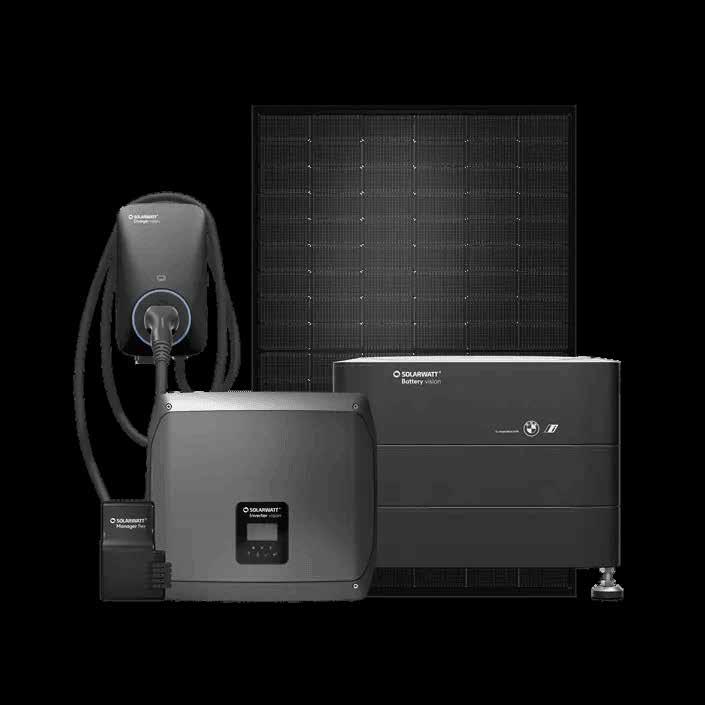
Local Power is proud to launch the BMW-backed, Solarwatt Home solar PV, energy management and battery storage solution for Irish homes.
To celebrate 10 years in business, and the launch of the cutting-edge Solarwatt Home, Local Power are giving you the chance to win a premium 7.2 kWp system with 10.2kWh of battery storage and EV Charger.
The Local Power team look forward to your enquiry:
Scan QR code to enter
inverters, and battery inverters. Hybrid inverters allow you to install a battery down the line even if you don’t choose to do so at the start.
In Ireland, string inverters are common due to cost but microinverters are becoming increasingly popular where roofs have shading from chimneys or tall trees. Inverters also maximise output by tracking the optimal operating point of the panels.
Microinverters can be good, but aren’t compatible with batteries and, if there is a fault, require roof access to address. If shading is an issue, optimisers can be added, but all modern panels have bypass diodes which help with shading and modern inverters have algorithms to calculate maximum power point in shade conditions, so they are only necessary in specific instances.
A reputable installer will ensure compliance with all of the requirements, such as the inverter being CE-marked (ROI) or UKCA marked (NI) and compliant with EU/UK safety requirements, certified to EN 50549-1 (grid connection standard for micro-generation) and approved by ESB Networks / NIE Networks for grid connection. In ROI the inverter should appear on the ESB Networks approved equipment list.
As with all electrical installations, in ROI the installation must be carried out by a Safe Electric (RECI)
registered electrician and meet ET101 wiring regulations; in NI the installer must be a registered, competent electrician following BS 7671 wiring regulations.
In ROI for grant eligibility, the system must be installed by an SEAI-registered installer using compliant equipment. In NI for quality assurance, systems are typically installed using Microgeneration Certification Scheme (MCS) certified equipment.
Your supplier will give you the certificates of conformity, commissioning certificate and proof of grid notification or approval.
Again, do check how long the inverter company has been in business, how long the installer has been installing this technology and their experience with performance and warranties.
There are shiny inverters on the market every year offering very long warranties. Do check this. Sometimes the company is only in business two or three years yet offers a 10-year warranty.
Fixings and Cabling
Mounting hardware secures the panels to the roof, ensuring stability in wind and rain. On pitched roofs, installers use rail-based systems that attach to rafters through weather-sealed brackets.
Ireland’s building regulations require robust mounting due to
Solar Special
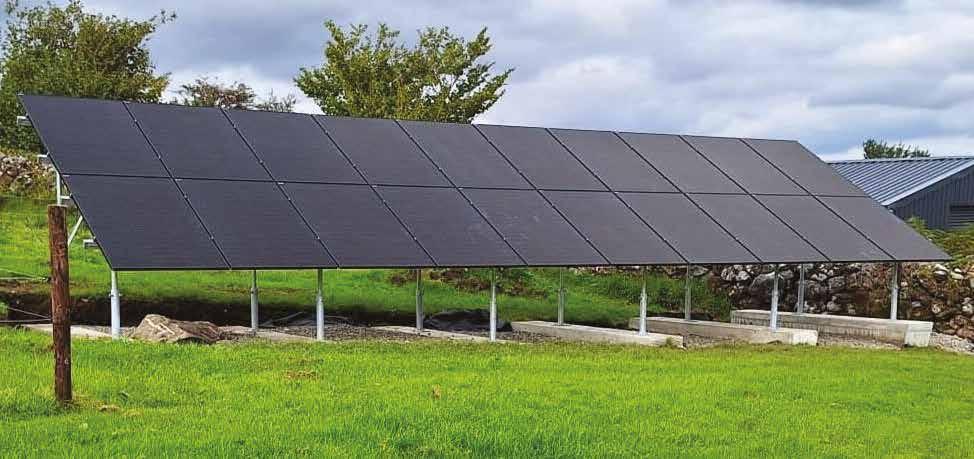
high wind zones, particularly along the west coast. Groundmounted systems are also an option for rural properties with ample land. Materials are typically corrosion-resistant, crucial for Ireland’s humid climate.
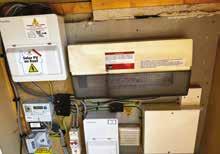
Specialised cabling links panels to the inverter (DC cabling) and the inverter to the home’s electrical system (AC cabling). Outdoor DC wiring must be UV-resistant and rated for high temperatures.
All cables are routed securely to prevent damage from weather or wildlife. Electrical protections such as isolators and surge protectors are required under Irish standards to ensure safety and facilitate maintenance.
Battery Storage
Cost: €/£1,700-€/£4,000 for lithium-ion batteries depending on capacity, technology option, performance, warranties etc.
You can add a battery to supply electricity to the house when the panels aren’t producing any, e.g. for evening use. In Ireland, the most common solar-battery choice is the lithium-ion battery, especially lithium iron phosphate (LiFePO₄). Older lead-acid batteries exist but are now rare due to bulk, short life and lower usable capacity.
Before buying, check battery capacity (kWh) against daily usage, depth of discharge, warranty cycles, and compatibility with the inverter.
Efficiency
Advances in technology mean PV panels are more affordable than they used to be, and more efficient. However, efficiency is still relatively low as the best panels only convert around 20 per cent of the sunlight that hits them into useable electricity.
Consider whether the system is expandable, includes smart monitoring, and meets Irish grid standards.
Some batteries will only discharge to 20 per cent; that’s the equivalent of buying a 5kWh battery that in practice is a 4kWh battery.
As with the PV panels, reliable installers and after-sales support are essential for longterm performance.
Monitoring System
Many modern inverters include built-in monitoring systems that allow homeowners to view energy production and consumption through mobile apps. This data helps homeowners adjust energy usage, like running appliances when solar output is highest, to reduce grid dependence. Smart monitoring systems, which optimise energy use, may come at an extra cost.
Solar panels: how they’re rated
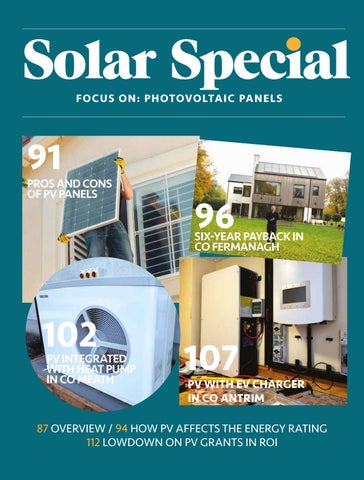
Pros and cons of solar panels
Over recent years the cost of generating electricity from our homes has fallen and for many, solar panels are a way of making their homes ‘greener’. Here’s what you need to know about them.
Costs and payback
Although costs are falling, solar panels that generate electricity are not a cheap addition to your home.
The average cost in Ireland is between €5,000 and €9,000. This includes installation and materials such as roof mounts and inverters. To mitigate costs, there are grants available (see page 112) in ROI.
Battery costs vary according to how many of them you need or want but add substantially to the price. On average, solar panels usually take between seven and 10 years to pay for themselves. The payback time can be lower depending on the set-up.
Indeed, depending on your lifestyle and how this matches with the ’free’ electricity you are generating, and how much you can sell back to the grid, storing excess power will be costly.
Ideally, you should work from home and consume all your electricity as it is generated (on sunny days) or install smart plugs to automatically turn on appliances when generation is high.
Andrew Stanway Author of Managing Your Build
Smart Energy For Smart Living
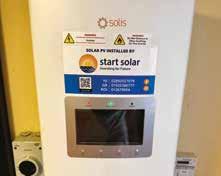
Empowering homes and businesses with innovative solar solutions to cut electricity costs and reduce carbon footprint.
Solar PV
Significantly reduce your energy bills with clean, renewable energy. Our in-house team ensures expert installation of solar panels designed for maximum efficiency and minical carbon footprint.
We are Driving the Future of Renewable Energy
At start solar, we’re dedicated to revolutionising the way you benefit from renewable energy. Specialising in the design and installation of cutting-edge solar solutions, our mission is to make solar energy accessible and affordable for everyone. By meticulously managing our costs, we ensure that the savings are passed directly to you, our valued customers.
Battery Storage
Store solar energy for use whenever you need it, reducing your reliance on the grid and cutting your energy costs. Our reliable battery systems provide you with a peace of mind, knowing you have a dependable energy backup.
EV Charging & Heat Pumps
Power your electric vehicles and efficiently heat your home using renewable energy. Our solutions offer convenience, sustainability, and significant cost savings, all while promoting a cleaner, greener environment.
Solar batteries cost about €4,000/£4,500, and a large home can easily spend twice this. The cost of batteries depends on their capacity, chemical composition and their lifecycle. But however you do it, adding battery storage is expensive and adds significantly to the payback time for the whole system.
Once you do have the batteries you can reap the maximum rewards by using them to charge your EV overnight, run your washing machine, and so on.
Space requirements and orientation
panels can be an effective solution. Many people don’t want panels on the front roof of their house because of the appearance but this may be the only surface that has exposure to enough light to be effective.
A way around this can be to use a flat surface such as a garage roof, or have them on the ground, but this can cost more and may produce a lower output.
On that point, solar panels don’t cope well with shading. Whilst you’ll get some power from your panels at any time of day, even when the sun isn’t shining, they don’t like shade.
Lifespan
Solar Special
Although it is claimed that many solar panels last for 25 to 30 years, it is hard to know how realistic this is as the tech behind them is constantly changing and, by definition, no modern panels have been around for ‘more than 30 years’.
to separate the valuable components, and even then they don’t have a high value. And the methods for recycling these panels are still in their infancy.
Solar panels are indeed green in the sense that you are reducing your reliance on the grid and producing your own electricity. To boost your green credentials, therefore, invest in a good quality system that is as efficient as possible and that will last as long as possible.
Maintenance
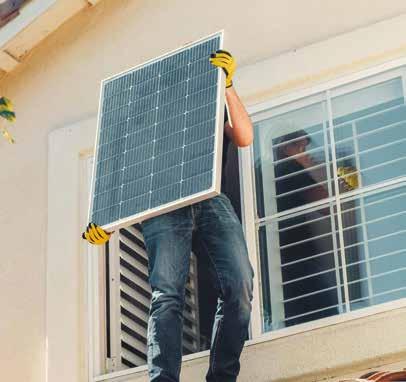
Given each panel takes up about two square metres and you’ll need many of them, you’ll need room on your roof to accommodate them. And the roof will have to be well enough built to take their weight.
Solar companies who will quote for the project will come to your house to check how easy it will be to install your panels. As the person who is visiting is essentially trained in sales, make sure to highlight any concerns, e.g. type of roof covering or roof strength, and have those elements reflected on the quote.
It’s sensible to have a surveyor look at your roof’s structure before even talking to a solar company. S/he will be able to tell you if the roof will take the load and advise what to do if you have very old tiles. Ideally, the panels need to be installed on a surface facing south. But west- or east-facing will still produce some electricity, depending on where you are in the electricity; in fact a combination of east-west
This is why your solar panels will be positioned so that they are completely clear of shadows between the hours of 10:00 and 16:00. This can be restricting, especially if there are neighbouring buildings or large trees.
Efficiency
Despite major advances, solar panels are inefficient when compared to other energy sources. The best achieve only about 23 per cent efficiency. Technological advances will increase this over the coming years.
Note that solar panels produce power best when there is plenty of light, although any daylight will produce some power. This means that with cloudy weather and, of course, during the night, their output falls.
Most manufacturers claim their panels will produce at least 80 per cent of their rated power at 25 years. But only the best quality ones, properly maintained, achieve these standards so make sure you go with a trusted supplier.
Environmental credentials
It’s easy to feel a bit smug when buying PV panels. But things are not what they appear. OK, they’re ‘green’ at the point of use, like an electric vehicle, but the journey from where they’re produced, usually China, to your home in Ireland is a long and environmentally unfriendly one.
There’s the embodied carbon from transport. And the materials used, many of which are not sustainable, together with the manufacturing processes and the wastage, are all far from ‘green’.
Disposal is also an issue. Recycling a PV panel costs 20 times that of putting it into landfill. It is very hard
There is an upside to all the rain we get in Ireland; it naturally washes the panels. However over time, dirt will still build up and the likes of bird droppings will require a rinse from time to time to ensure optimal output. If this is required, contact your installer to do it (going up on the roof requires specialist equipment; falls from a height are the main cause of deaths and injury on construction sites). Coastal areas (salt spray) may require more frequent cleaning. Another benefit of solar panels is that the system will come with an app which will alert you to performance issues.
Ideally, the panels need to be installed on a surface facing south. But west or east-facing will still produce some electricity...
Solar Special
Ciarán Hegarty Energy assessor and technical advisor chegartyenergy.ie
Energy rating uplift
How much of an uplift can you expect to your building energy rating if you add PV panels? Ciarán Hegarty does the maths.
Photovoltaic (PV) panels are becoming increasingly popular for many obvious reasons. They provide free energy to the home by converting sunlight into electricity and limit our reliance on fossil fuels. And they can lower the energy rating of your home significantly.
But how much of an uplift in your building energy rating (BER) can you expect from solar panels? When your BER is being calculated, a wide range of factors are taken into account. These include the size and exposure of the building, material used for construction, thermal insulation, ventilation, lighting types, efficiency of heating system, hot water use, solar gain through glazed openings and renewable or alternative energy generating technologies. The combination of these factors determines the BER.
Based on these parameters, the BER will calculate energy consumption for the dwelling in kWh per sqm per year. As long as the house is built as seen on paper you know that the better the rating, the lower the energy consumption. Therefore, if you are generating your own energy to power your appliances or lighting for example, you are decreasing the energy consumption required.
This, along with an energy efficient heating system and high thermal insulation will lead
to a lower BER. Let’s take a look at the scenarios below for an idea of how much PV panels can improve your rating.
Retrofit scenario
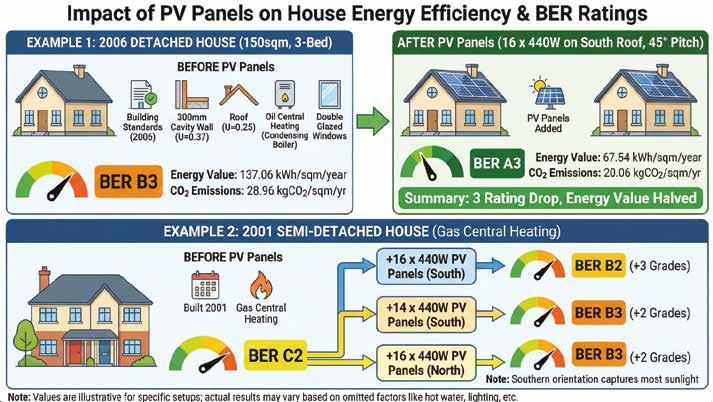
If we take a 150sqm three bedroom detached house built in 2006 and assume proper building standards at this time, we can expect a 300mm cavity wall with a U-value of 0.37W/sqmK, a floor U-value of 0.37W/sqmK and finally a roof U-value of 0.25W/sqmK.
We’ll include an oil central heating system with a condensing boiler and double glazed windows of that time. This particular setup would return an energy value of 137.06kWh/sqm/year and a BER of B3.
Of course, this is not going be the same for all houses of this size and setup; I have omitted any hot water values, lighting types, etc. If I was to add 16 x 440W PV panels to the south roof of this house and
assume the roof has a pitch of 45deg, the energy value will drop 67.54kWh/sqm/year and lower the BER to an A3. This is a significant drop in both values. The house will also drop its carbon dioxide emissions from 28.96kgCO2 per sqm per year to 20.06kgCO2 per sqm per year. As you can see from this example, this house has dropped three ratings and halved the energy value.
If we take another example, you can see that gas central
Image from frreepik.com
heating follows a similar vain. A semi detached house built in 2001 with a gas central heating system would return a typical BER of a C2.
The addition of 16 x 440W PV panels would improve this rating by three grades and would return a rating of a B2. The addition of 14 x 440W PV panels would improve it by two grades and return a B3 rating.
Orientation is important here as the same number of panels on the north side of this sample house will only improve the BER to a B2. The southern orientation will always capture the most sunlight.
However, it is also important to point out that the indoor environment has not gotten any warmer or more comfortable. A lot of people assume that if the house has an A rating, that it must be
warm and comfortable. As this example shows, that’s not always the case.
Other than installing the PV panels, the outside fabric remains untouched. The same heat is going to escape through the fabric of the building prior to PV installation. The energy balance has swung favourably in the renewable technology’s favour but the heat loss remains the same.
New build scenario
If we take a new build, constructed to building regulation standards and current best practice, we will find the insulation thicknesses has increased, the orientation of the building has been optimised (or at least taken more into consideration than it would have had decades before) and the glazing made more strategic in terms
of increasing solar gain (providing more heat and light).
The heating system is typically a heat pump which relies on electricity to run as opposed to fossil fuels, and without PV panels, most modern day houses will still reach an A2 to A3 rating.
With the addition of PV panels, this will increase to an A1. You now have a relatively self-sustainable house whereby the space and water heating is provided by a heat pump which is powered by electricity which is generated on site through your PV panels.
The heat you produce is kept inside the fabric of the house because the insulation is so high and the envelope so airtight that little heated air escapes.
Holistic view
PV panels will not generate as much during the winter months, no one can argue with this. So when looking at your payback period and energy rating, do not look at your energy bills on a monthly basis but on an annual basis instead. Look at the balance throughout the year.
Six-year payback
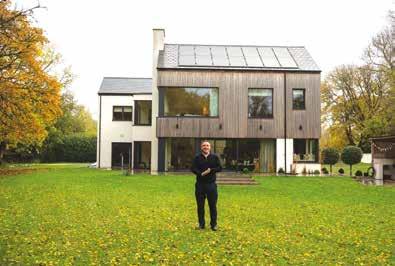
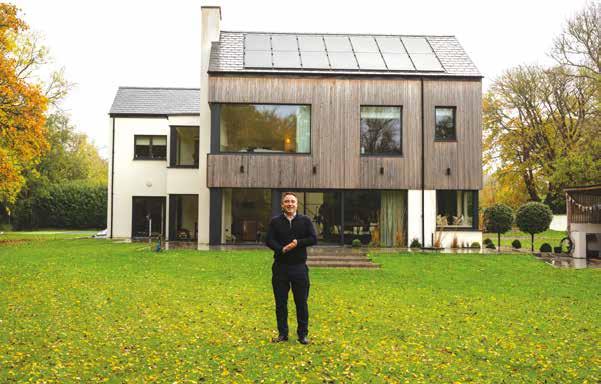
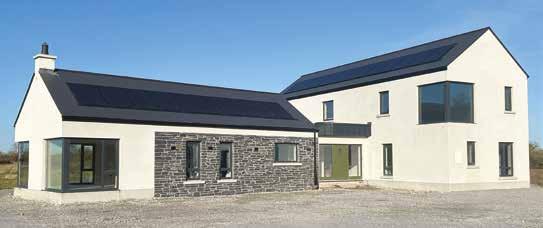
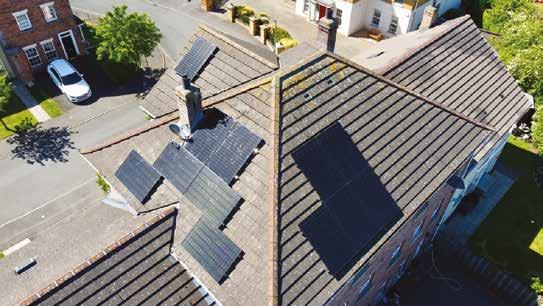
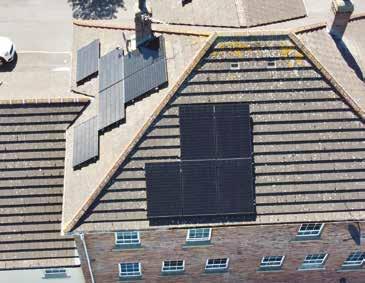
Nick Finlay installed 5kWp solar panels on his self-built modern home in Co Fermanagh, and he’s on track to see the system pay for itself within six years.
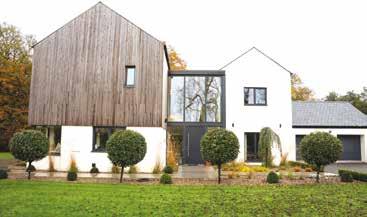
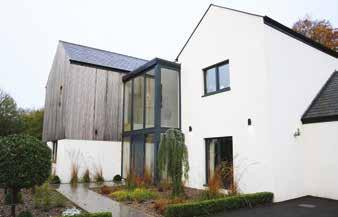
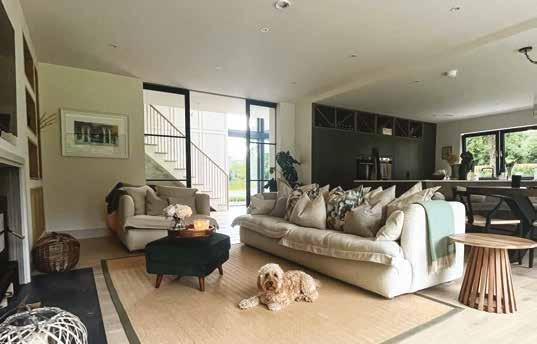
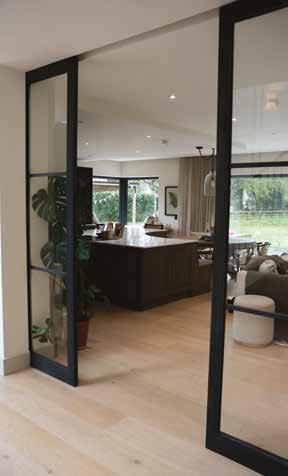
Nick Finlay’s house in Co Fermanagh couldn’t be in a better location; surrounded by mature trees beside a flowing river, it’s the perfect setting for a contemporary home.
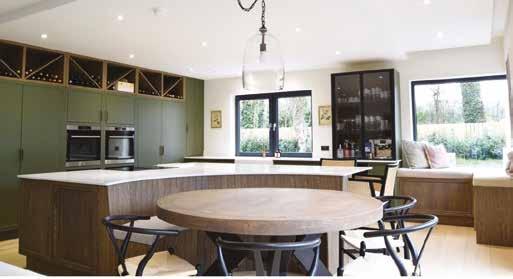
From the outside it’s strikingly modern and inside, the warm and inviting interiors instantly make you want to settle in, pour a coffee, and watch the sun shine through the rain.
For Nick, building a home is in his blood. Growing up, he was captivated by construction; his father built several houses and nurtured a love for the craft.
After 10 years working as a quantity surveyor, and now working with the family estate agency, Nick was ready to take the plunge into self-build. This project was his second.
“I really enjoy the process,” he says. “My dad project managed the build, bringing in trades. My wife found this plot, and as an estate agent, I’ll never hear the end of it,” he laughed.
Building fabric
The house blends contemporary design with meticulous attention to energy efficiency. In fact Nick’s passion for renewables played a key role in shaping the build. “As part of my degree, I studied renewable energy, and my uncle, who is an architect, gave great advice on focusing on the fabric of the building,” he explains.
Plot size: 1.5 acres
House size: 3,000 sqft
Heating: air to water heat pump
Ventilation: centralised mechanical with heat recovery
Build method: traditional block build
EPC (SAP): A (97)
PV and heat pump installation cost: £12,000
“Investing in insulation, airtightness, and triple-glazed windows ensures the house is energy efficient and will pay off in the long run.”
Solar system
A central element of that strategy was installing photovoltaic (PV) panels and a heat pump. Having worked with their renewables supplier before, Nick knew their expertise would be invaluable.
Expert opinion
Because this home already has a very high energy efficiency rating, the opportunities for Nick are to increase his generation and selfsufficiency.
Increasing his solar array to 10kWp and adding 20kWh of battery storage would enable more self-generated consumption (see next page for analysis).
If Nick considers an electric vehicle (EV) in the future, his expanded array would mean his car would become another energy store for his home and run on free energy. Nick mentions solar heat gain in his property. Finding out things like this come from lived experience, and I would suggest retrofit measures for his home might include automatic blinds or adaptive heating controls.
For a new build, orientation of the property, and therefore the heat gain potential, is worth considering with your installer.
Neil Elliott from Future Renewables, futurerenewables.net
Solar Special
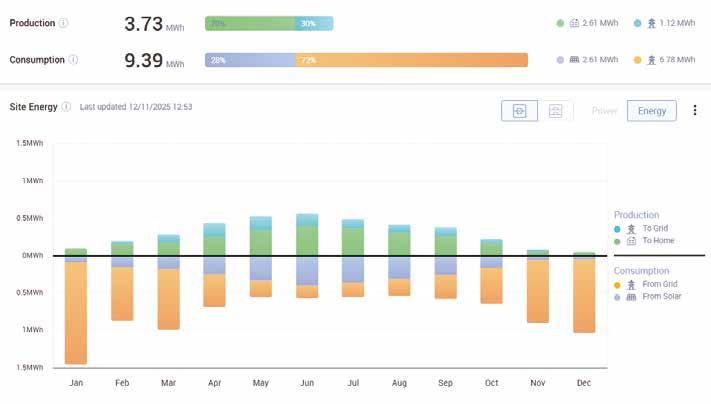
Actual PV energy production and consumption (28 per cent self-consumption)
This consumption and production profile is real data, based on Nick’s 5.18kWp array, gathered in 2024 (full calendar year from Jan 1 to Dec 31).
Note: As there is no battery storage, exports to the grid happen when the house cannot consume all of the electricity the panels generate in real time.
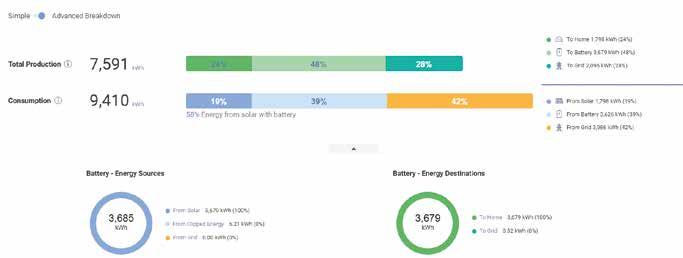
Optimal scenario for Nick’s house (58 per cent self-consumption)
This consumption and production profile shows how Nick’s production and consumption profile would change with an array increase to 10kWp and a 20kWh battery set-up.
Note: The batteries allow both excess solar and night-rate battery charging for use when the solar panels are not generating electricity.
“They guided us on what could be implemented. With the house already highly airtight and efficient, the solar panels take the edge off running costs,” he says.
Selecting the right renewable technology involved careful research. Nick explored tidal, geothermal, and wind options,
but solar proved the most suitable for this location.
“We’re really pleased with how it turned out. The combination of insulation, air sealing, and solar panels makes it very easy to run,” he notes.
The installation process itself was seamless, because they involved the company early.
“Early involvement allowed for a flush, neat finish on the roof. The process was stress free. They’ve also been excellent in servicing the heat pump,” says Nick.
He’s confident in recommending this approach: “The best advice is to spend on the fabric of the building first:
system commissioned February 2023 Heat pump installed
insulation, glazing, airtightness. Then add technologies like solar panels to take the edge off long-term running costs.”
Reflecting on the build, Nick acknowledges a few small tweaks he might make in the future. With the house so airtight and energy efficient, solar gain can push indoor
Solar Special
temperatures up on warmer days, so an air conditioning unit could be beneficial.
Payback period
Nick expects the solar setup to pay for itself in around six years; in fact from May to September
he’s generating about the same as he’s consuming in electricity.
“Our next step would be to add a battery to charge overnight on night rates, the savings would be even greater,” he says.
In a scenario with a notional battery added (array increase
to 10kWp and 20kWh battery, at an additional cost of approx. £10k) would see the house moving from 28 per cent selfconsumption to 58 per cent, as the battery allows both excess solar and night-rate battery charging.
For anyone considering a self-build, Nick has one piece of advice: “You’ve got to live and breathe the process. Research every detail, talk to people who’ve done it before, and take their knowledge on board.”
solar system and Mitsubishi air to water heat pump installed by Future Renewables, futurerewables.net
Floor: Standard solid floor build-up with underfloor heating, U-value 0.11W/sqmK
Roof: Metal standing seam warm roof with standard build-up, U-value 0.12W/sqmK
Windows: triple glazed, overall U-value 0.6W/sqmK
Solar components
5.18kWp SolarEdge PV system
To divert excess electricity: myenergi eddi water heater
Solar Special
PV integrated with heat pump
This home in Co Meath shows how a well-designed, allelectric home can achieve real energy independence.
John and Anne Graham of Co Meath set out to build their home with a very clear idea in mind. “We were lucky to be building on a greenfield site in a rural area, in a gorgeous location. However, considering how remote we are, we knew we’d need to do some futureproofing. And that’s why energy independence was high on our list of priorities,” says John.
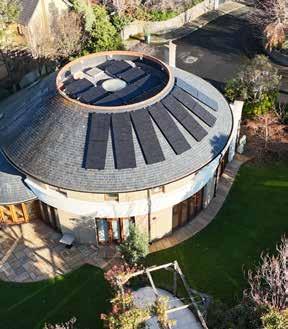
“Photovoltaic (PV) panels were a no-brainer, but we didn’t want them to detract from the look of the house. So that was part of the design brief we gave our architectural designer, from the very start. We wanted to make a feature out of them.”
The couple installed solar panels integrated with a heat pump, a top of the range battery and a high tech monitoring system. The result is a smart, integrated energy ecosystem that adapts automatically to the seasons.
“From the outset we knew we wanted to create a fully electric home that could generate, store and manage its own clean energy,” adds John. “All with a view to reducing our reliance on the grid and keep running costs under control.”
“We wanted a system that would be able to run the heat pump as cheaply and efficiently as possible, maximising its use
The couple installed solar panels integrated with a heat pump, a top of the range battery and a high tech monitoring system. The result is a smart, integrated energy ecosystem that adapts automatically to the seasons.
of PV. And we wanted robust storage capacity to weather the storms and enhance our energy independence.”
System details
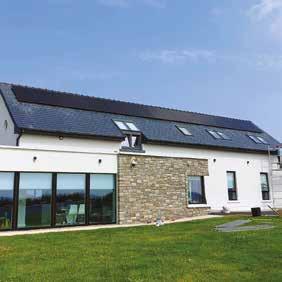
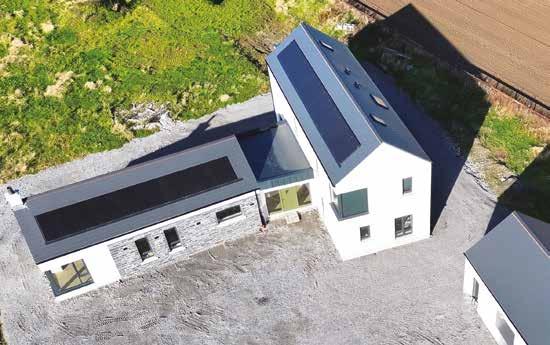
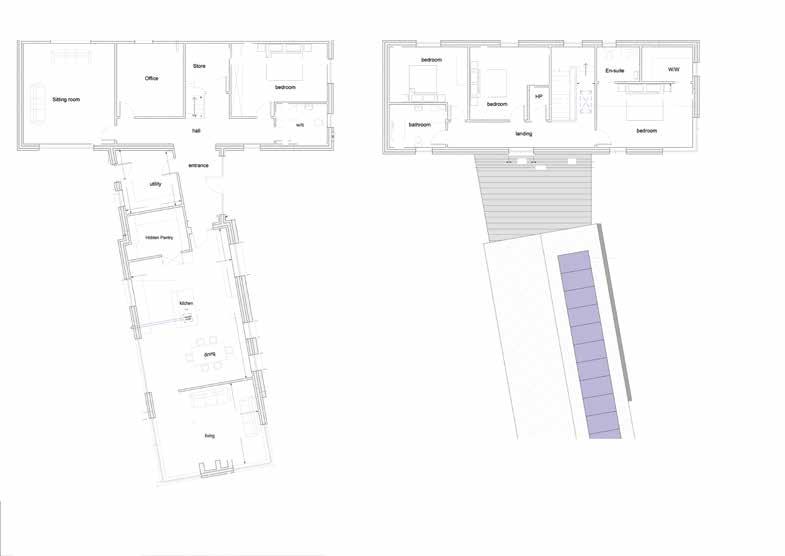
The PV system was carefully sized to meet household demand while comfortably supporting the heat pump. Installed across south-southwest and east-south-east roof slopes, the solar panels generate energy from morning through to evening, maximising yield across the day.
“The company that installed our system looked at the size of the house, heating requirements, roof space and other prospective electrical loads,” explains John. “They designed the system around these parameters and installed it while we were at roofing stage. They came back to complete the first fix and second fix electrical work as our build progressed.”
“They handled all the ESB Networks paperwork, liaising with them on grid connection. It was all pretty seamless and we didn’t have to think about it too much, which was very welcome as bandwidth can be low in the middle of a build.”
Built using bifacial cell technology, the panels capture reflected light and maintain performance, even in diffuse Irish conditions. Their double-glass construction (2 mm front and back) offers
excellent durability and corrosion resistance – vital for coastal or exposed sites.
“The system is backed by a 30-year product and performance warranty, Fire Class A panels and batteries designed and backed by a high-end car brand,” adds John. “When it comes to safety and expected performance, these warranties and standards have given us real peace of mind.”
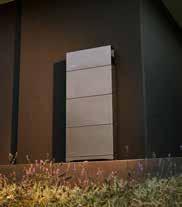
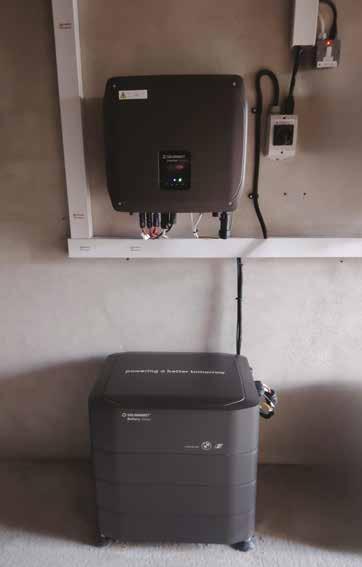
With the ability to discharge up to 5kW, the battery can easily support high-demand loads such as the heat pump or EV charger. Crucially, it can discharge down to 0 per cent, meaning the full 10.2 kWh of energy storage is usable.
“We saw some batteries that could only discharge at 2.5 kW or where only 80 per cent of capacity was accessible,” John says. “We wanted to be able to run the whole house, and the car, directly from stored power.”
A key innovation in this system is the DC-to-DC connector, which allows the PV array to charge the battery directly from the DC side, bypassing the inverter. This means higher efficiency, lower conversion losses and, when generation allows, the ability to charge the battery at more than 5kW, further boosting flexibility and responsiveness.
Overview
Plot size: 1 acre
House size: 282sqm
Bedrooms: 4
Construction: cavity wall (blockwork)
Heating and hot water: air to water heat pump
Ventilation: centralised
mechanical with heat recovery
Preliminary BER: A2
Solar Special
AI integration
At the heart of the system sits the smart energy management hub that connects and coordinates the PV inverter, battery and heating system. It continuously analyses real-time data on generation, storage, household demand and electricity tariffs, then automatically decides when to generate, store or release power. This intelligence extends to the heating system. The
homeowners’ air-source heat pump communicates directly with the smart energy manager via an Internet Service Gateway (ISG).
Together, they create a fully synchronised energy loop that optimises when the heat pump operates, pre-heating water in the tank when solar generation is high or off-peak tariffs are available.
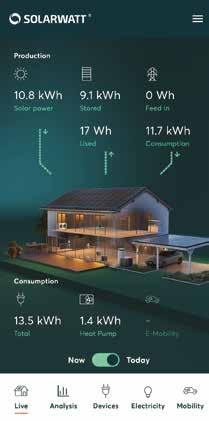
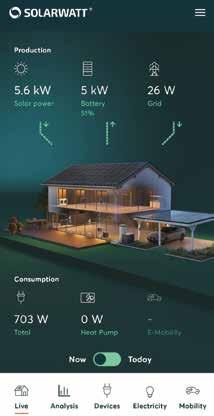
All this activity is displayed clearly on the energy manager portal, where the homeowners
can view PV generation, battery charge, heat pump operation and total energy flow in real time.
“Basically the smart energy manager talks to our inverter, battery and heat pump to ‘optimise’ our behaviour. Optimisation involves building smart operating profiles for devices to switch them on when there’s excess solar PV, or an off-peak tariff period. Using smart shelly plugs or SGready devices we can optimise a whole host of things, i.e. dishwasher, washing machine etc.”
The system can be expanded with a smart power diverter (to use excess electricity to pre-heat the water in the hot water tank), an EV Charger (so the car can charge directly from excess solar power or off-peak tariffs), and more to allow for a fully integrated smart home solution, designed to operate on as much cheap and clean solar power as possible.
Automatic backup power
A key feature of this system is its integrated backup capability. If a power cut occurs, the battery can provide 5kW of power on the spot, which means that high consumers like the heat pump can be run if necessary.
The panels can also be wired so they generate in backup mode, for when there is no grid power. How many days they last will depend on battery size, the amount of panels and how much they generate plus the size of the electrical load.
Turning off high consumers during a blackout and focusing on essentials can significantly increase this period. “So if you are charging your car, you might get a couple of hours,” says John. “However, if you are only running essential circuits, perhaps a few days.”
For rural properties, it’s a reliable home energy safety net that keeps comfort and functionality intact even when the grid is down. “Investing in the best system we could get was a priority for us,” John says. “It made sense in the long run, and we were keen to have a system that would be able to weather storm seasons.”
Performance
“The system went live shortly after we completed the build, and the performance has already exceeded expectations,” says John. “Based on simulation data and experience to date, we expect our electricity bills to be around 60 per cent lower than they would have been without solar.”
The ability to charge the battery overnight on cheaper rates and discharge during the day avoids peak-time tariffs and further enhances savings. “We’re still learning how best to use it,” says John. “But even now, the difference is huge.
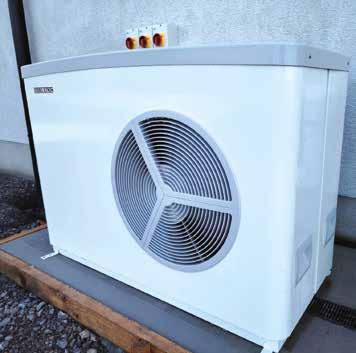
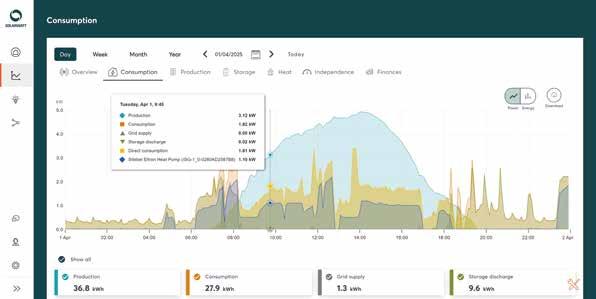
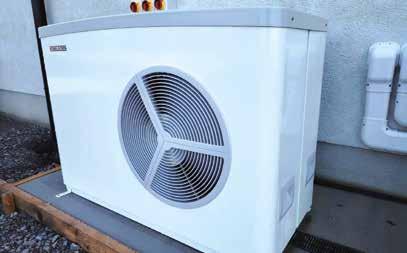
The air source heat pump is run off the PV panels through a smart energy manager
A typical day in April: The heat pump consumption (dark blue) aligns with PV production (light blue); at night time the battery storage discharge capability (dark green) covers the heat pump requirements. Other household consumption can be seen in yellow.
The panels can also be wired so they generate in backup mode, for when there is no grid power. It depends on the set-up but if you are only running essential circuits, the battery could last for a couple of days.
The savings are real, and it’s great to know we’re running the house largely on our own power.”
One of the system’s greatest strengths is its adaptability. In winter, the battery charges overnight on off-peak electricity, then discharges during the day to power the heat pump and daily loads, maintaining low costs despite reduced daylight.
By summer, the system switches to full solar self-
consumption, with the smart energy manager prioritising household and hot water loads at times of peak generation. Efficiency also comes from optimising the settings on the system, says John. “I’ve heard of other people saying their heat pump system made their house too warm. I think that must have to do with the system not having been commissioned correctly at the start, or just poor heating controls. Because I have to say
the comfort level of our home couldn’t be any better.”
“We can control how warm we want it through the monitoring system; it’s really easy to use. What we have now is an incredibly comfortable space and with the ventilation system, the excellent air quality is palpable. I’d never lived in a house like this before and it’s really something else.”
October 2023
Build start
August 2024
Integrated PV kit and panel system installed
September 2024
First fix electrical including AC, DC and Cat 6 cabling installed and run from panel array to inverter location
May 2025
Heat pump installed
August 2025
Build end, moved in
September 2025
PV system commissioned
August 2025
Heat pump commissioned
September 2025
PV inverters, second fix, installed and commissioned
Note: The lag between the initial installation of the PV panels and commissioning was down to factors during the build such as the ESB Networks connection, rather than anything specific to the PV system. The installation itself only took a few days in total.
Spec
Walls: 150mm cavity wall with PIR full-fill insulation, U-value 0.18W/sqmK
Roof: 150mm mineral wool insulation and 63mm insulated plasterboard (PIR), U-value 0.12 W/sqmK, roof finish black natural slate
Floor: standard build up with 140mm PIR insulation (2x70mm overlapping), U-value 0.13W/sqmK
Windows and doors: triple glazed aluclad windows, overall U-value 0.73W/sqmK; sliding doors triple glazed aluclad, U-value 1.2W/ sqmK; front and side doors engineered timber and steel U-value 1.1W/sqmK
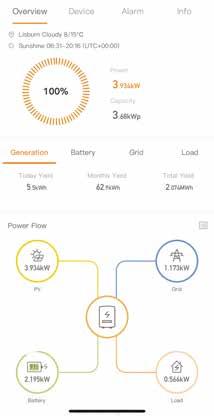
Energy manager portal showing real time data
Solar Special
(glass-glass modules) AM 4.5 (420 Wp each)
5kW SOLARWATT Inverter Vision 10.2 kWh SOLARWATT Battery Vision SOLARWATT Manager flex, the smart energy management hub
STIEBEL ELTRON WPL HK 230 Premium air-source heat pump communicates directly with the SOLARWATT Manager flex via the STIEBEL ELTRON Internet Service Gateway (ISG) and EM.trend software
HSBC tank, which is a STIEBEL ELTRON integral cylinder system that combines a domestic hot water tank and a buffer tank into a single space-saving unit
PV with EV charger
Retirement pushed Roger Gillespie to rethink his Co Antrim home’s energy future. His solar retrofit, set to pay back in roughly five years, now keeps costs down and gives him genuine energy confidence.
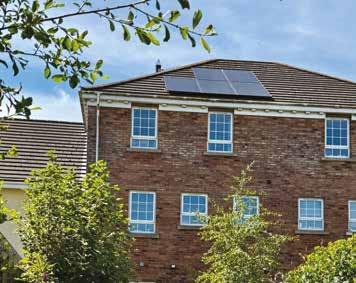
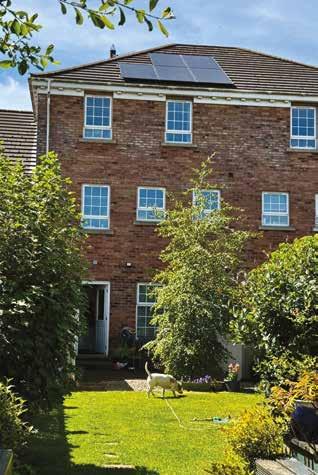
After retiring in December 2024, Roger finally turned his long-held idea of installing solar panels into something actionable. He and his wife live in a 17-year-old, three-storey townhouse facing southeast –an orientation he once thought unsuitable for solar.
But as they committed to staying put long term and began thinking about futureproofing their home, he decided it was time to reassess what solar could offer. The rising unpredictability of electricity charges only solidified the decision.
Solar switch
“I’d been considering solar for
Size of house: 1,440 sqft
Bedrooms: 4
Heating: Gas combi boiler with radiators
EPC (SAP): C (appealing)
Ventilation: Natural
Build method: Block work
cavity walls
PV installation: Less than £8,000
Solar Special
quite some time,” he says. “In March 2025, I started looking at it more seriously as an investment. The banks weren’t offering much interest on our savings, so it made sense to explore other options.”
He began by researching and contacting several companies to see if solar was even viable on their property. Some dismissed it because of the scaffolding required, but he wasn’t put off.
A big motivation, he says, was their transition to an electric vehicle (EV). “We’d had a plug-in car before, and that really got me interested in the electric side of things.”
At that stage, their monthly electricity bill was about £180 on a payment plan, and he wanted to bring it down.
With a long career in sales, he’s used to working with figures, so he dug deep into the research, comparing systems and offers. “A couple of installers told me it wasn’t feasible, and two others made the usual ‘special offer’ pitches, which I ignored.”
Through a community group, he eventually found
an installer who took a more collaborative approach. By then Roger already knew he wanted a larger battery, specifically a 10kWh unit, despite its hefty 100-kilogram weight.
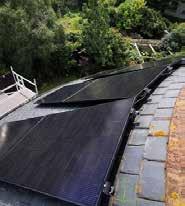
The final system includes 12 panels, split between the rear and side roofs in a five to seven configuration. “Andrew, the installer, planned for the optimal capacity our grid allows in NI where the inverter is limited to 3.68 kW, but the array’s potential is about 5.28 kW.”
Because NI grid rules cap the inverter at 3.68kW, Roger’s system can occasionally produce more power than the inverter can process. On bright summer days, that extra generation is simply ‘clipped’, meaning the inverter limits the output to its maximum capacity.
This isn’t a flaw; mild clipping is normal in well-designed systems and actually allows the panels to perform better in low-light conditions throughout the year.
Battery benefits
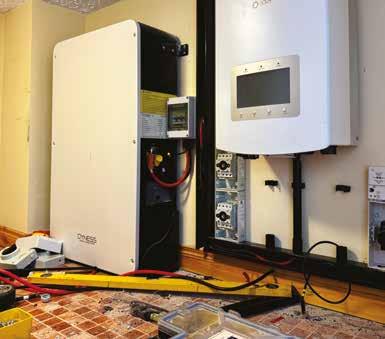
Pairing the array with a larger 10.24kWh battery was Roger’s way of making the most of his EV charger
setup. The bigger battery lets him store more of the energy produced during the day, reduce reliance on the grid and take full advantage of off-peak night rates to keep running costs low – especially important with an EV in the mix. It also futureproofs the home, giving him more control over his energy use in retirement.
Performance was a key priority, especially with the EV and their new energy tariff. “I take advantage of lower nighttime rates to top up the battery, so we barely use any daytime electricity from the grid. Even on cloudy days, the house runs off the battery almost exclusively.”
He is tracking all the numbers for a full-year review, but even after seven months the savings are clear. While no solar PV company can give a precise projection, his own research suggests a payback period of around five years. He also ensured all warranties were firmly in place: 10 years for both inverter and battery, and a 30year performance guarantee for the panels.
The installation itself was straightforward. The townhouse already had a modern distribution board, and the two-person team worked efficiently – one on electrical work, one on roofing. “They even cleaned up meticulously afterwards,” says Roger.
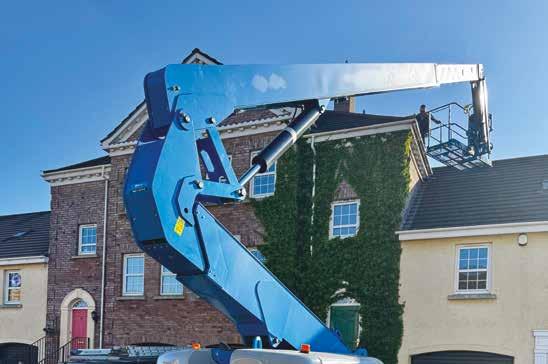
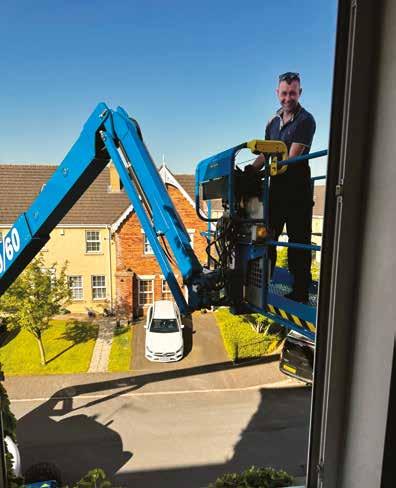
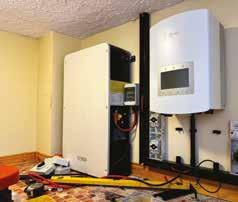
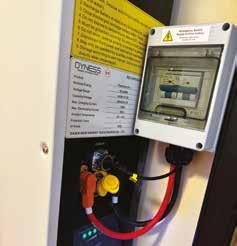
The battery is attached to the wall in a third-floor storage area that was easy enough to access. “Because the house is three storey, we have a window fire escape and the battery was lifted through it with a cherry picker,” explains Roger. “They were going to try to bring it up the stairs but this was much manageable seeing how the battery weighs 100kg.”
Many people place their battery in a garage or on the ground floor, but with Roger’s house layout, and a full garage, the storage room made more sense.
And he wasn’t concerned about the battery being indoors. “There’s often debate about whether to have lithium batteries indoors or outdoors. Personally, I prefer them inside because batteries don’t like the
cold weather.”
“I see people insulating and waterproofing outdoor batteries, but it’s not my preference. I’m driving around in a full EV with a 64-kilowatt lithium battery under me, so I don’t worry too much, but I understand why some do.”
They did consider placing the battery in the garage, but it would have taken up space and complicated wiring from the panels to the inverter. Instead, the installation team delivered a neat, well-shielded setup.
Everyday savings
Since the system went live in May 2025, he has used off-peak settings to keep bills extremely
Cherry picker to transport the battery
Solar Special
low. “From June to August, our net cost was only £7.46 per month – even with charging the car. Winter is a bit higher; last month it was £72, mostly because of the EV. Without the car, it would have been around £7 or £8.”
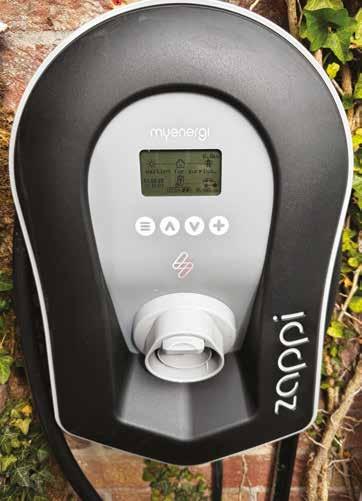
Grid registration and export paperwork were handled by Andrew. “Some installers leave you to do this yourself, but not ours,” says Roger. He has since upgraded to a smart EV charger, allowing excess solar energy to flow directly into the car. “The flexibility with solar and the smart charger has been excellent.”
So far, the savings have met or exceeded his expectations, especially between May and September. Payback varies by location, but based on his
research and real world results, he expects theirs to be fully paid off within five to five and a half years.
He also switched electricity providers. “When we first installed the solar PV system, PowerNI was the only provider paying for exported energy, and the rate wasn’t great.”
“But in June, new competition entered the market, and I switched to a new provider. They buy exported electricity at the same rate as they charge for electricity during off-peak (night) hours – specifically, at a rate of 13.9 pence per kilowatt-hour, which is about 30 per cent higher than the local competitor.”
“This means that for any electricity you export back to the grid, the company credits you
at this same night-rate price. As a result, if you are topping up your battery or using energy during off-peak times, the cost is balanced out by the amount you export at the same price, making your household energy use close to net-zero in cost when balanced well.”
Choosing a long-established, stable solar PV company was important to Roger. “I dealt directly with Andrew, the owner – not transient salespeople.”
Comparable systems were being quoted around £8,500, though prices have continued to fall as the technology improves.
Maintenance is minimal. “The panels are self-cleaning; rainfall takes care of them. The only critical thing is warranty validity – any changes need to go through the original installer.”
The team provided clear instructions on how to monitor the system, and showed Roger how the inverter is optimising power generation and consumption. “I’m into the technical side of things so was interested to see how it all works, and make tweaks if needs be,” he says.
Roger says the aim is to keep the battery topped up at the night electricity rate, both in summer and winter, although when he’s at peak production during the summer months there are times when there’s more produced than the battery can take. In that case the inverter diverts the electricity to the car, then to the grid.
“During the summer months, if the battery isn’t full by evening time, it’s charged with a very
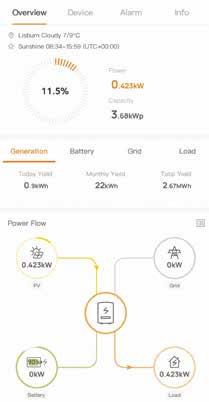
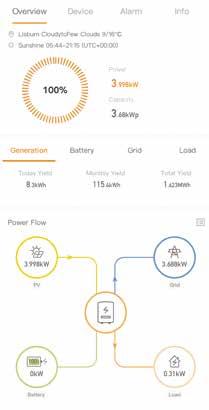
Energy manager portal
small amount of electricity –just one amp. Switching to higher ampage (50amp) is particularly useful in winter because it keeps the battery full at the cheaper rate without overloading it or causing unnecessary wear,” adds Roger.
“When the battery is topped up, it won’t try to draw down and discharge as quickly,
which helps manage energy use efficiently when sunlight is less available.”
“This training gave us more control, so we can optimise our energy use and keep the system running smoothly through the winter. Overall, I found the process much easier than expected,” continues Roger.
With careful planning
and a knowledgeable team, disruption was minimal. “For anyone considering a retrofit like this, it’s important to know just how manageable the installation can be. Now we’re not only reducing costs, but we’re futureproofing our home and supporting the move toward renewables.”
Because NI grid rules cap the inverter at 3.68kW, Roger’s system can occasionally produce more power than the inverter can process.
PV grants in ROI
Who’s eligible, how much can you get and how to apply.
The PV grant in ROI is a government initiative that forms part of the Microgeneration Support Scheme which helps reduce electricity costs and promotes the use of renewable energy.
The grant is administered by the Sustainable Energy Authority of Ireland (SEAI), among many other grants such as insulation measures and solar thermal panels (which generate
hot water instead of electricity).
The PV grant is available to all homeowners, including landlords, and applies to homes built and occupied on or before December 31, 2020. The home needs to have an MPRN (electricity meter number) and you cannot avail of the grant if previous funding for PV has been secured at your MPRN.
To get the grant, you must go through one of the 500+
contractors registered with the SEAI; the full list of registered PV contractors is available on seai.ie.
How much can you get?
The following rates for PV panels are applicable in 2026, as announced by government; note that there are no grants available for batteries (these were axed in 2022):
• €700 per kWp up to 2kWp, e.g. €1,500 for 2.5kWp solar panels
• €200 for every additional kWp up to 4kWp, e.g. €1,600 for 3kWp solar panels
The maximum grant amount is €1,800 for 4kWp solar panels. These grant amounts are to reduce by €300 a year, so unless the current grant amount is extended in 2027, the maximum amount will reduce to €1,500 in
1 2 3 4 5 6
Shop around
Contact suppliers from the SEAI list of approved contractors and get at least three quotes; each estimate will include peak generation capacity of your solar PV system in kilowatts (kWp).
What to find out:
• How much energy the PV system produces in a year
• The total cost
• Ongoing ser vice and maintenance costs
• What warranty they provide
• Whether your roof and electricity demand is suitable for PV
• Company credentials/references
Sanit y check
Based on the quotes and production estimates, check if your home is suitable for PV with the SEAI’s payback calculator; look for a payback of less than 10 years
Get a finalised quote from your preferred installer
You must select an SEAI registered company. Get a written contract detailing the works, prices, time, payment terms and warranties Once you ’ve signed your contract with the PV company, they may ask for a deposit to secure the booking.
Apply for your grant online
Go to seai.ie and follow the links for individual energy upgrades Depending on the contract, you will specify how you want the payment made, either to yourself or to your installer
Get your Grant
You will receive your Grant Offer via email. Check the company carr ying out your installation is the company referenced in your letter of offer and that all details, including installation size, are correct You have eight months from the Grant Offer to complete the works and submit the Declaration of Works
Contact your installer
Once you have received your Grant Offer, contact your installer to let them know work can begin. They will do the final site sur vey and system design.
2027 and to €1,200 in 2028.
Two years ago, government sources confirmed the grant would be axed in 2029 but that could change.
What is the PV company responsible for?
Once you’ve selected your installer, you will sign a contract. The PV company is responsible for ensuring your installation meets best practice, along with the required
installation and technical standards of the grant scheme.
They are also responsible for arranging for an SEAI registered installer to complete your installation, and submit all relevant documentation to the SEAI.
The installer will complete the installation, declare that the solar PV installation meets this grant scheme requirements and will complete and sign the Declaration of Works Form.
7 8 9
ESB Net works Connection
Before the installer arranges a time to do the actual installation, they will apply to ESB Networks to get you connected to the electricity grid.
Installation
Once ESB Networks has done its bit, the PV installation will take place; this usually takes a day, up to three days for complex installs
Get the BER done
As soon as you have your installation date, organise your post-works BER assessment to be done straight after. The inspection takes no more than an hour, but the final cer tificate could take up to a week to upload on the national register It must be carried out by a registered SEAI BER assessor; the full list of assessors is on seai.ie.
Keeping track
You must apply online via seai.ie; through this portal you can log in at any time to check how your application is progressing. For instance, once your documents have been submitted by your PV Company, you can check the status of your request for payment. It’s also the place to double check the bank account details are correct. Bank details must be for your account (the applicant) or the solar PV company's account, depending on the terms of payment you’ve agreed.
Get the P V documentation
Your PV company will give you the documentation related to your installation, including the safety file. They will also submit copies to the SEAI electronically Ensure they do this as soon as the installation is complete, within one to three days. Final payment is due to your supplier once all is in order
Submit your request for payment
Your BER is automatically logged into the national database (your BER assessor publishes it ) and the rest of the documentation is to be submitted by your supplier
The grant amount is paid into your nominated bank account, or to your supplier, once the forms have been received and the post-works BER has been published by your BER assessor
Solar Special
How do you pay the PV company?
Make sure the terms of payment are clear from the start, i.e. when the deposit is to be paid, when the balance is to be paid, and what retention applies if any.
The payment terms should be included in the contract you sign with the company.
You will be expected to pay a deposit at the point of signing the contract with your installer. The balance is either paid on completion of works or shortly after installation, after issuing final paperwork.
To avail of the grant, you either:
• Pay your supplier in full and have the SEAI pay you the grant at the end, or
• The grant amount is deducted from your invoice and the supplier claims the grant amount from the SEAI.
If the supplier is paid by the SEAI directly, you effectively assign the grant to them. The SEAI pays the installer directly after the work is completed. Remember, the SEAI only pays the grant once the installation is complete and all required documents (including BER) are submitted and verified.
Consider a One Stop Shop
If you plan to carry out other
energy upgrades on the entire house, i.e. get it to a B2 energy rating with insulation and other measures, and have a bit of a budget to do so (a full retrofit costs tens of thousands even after the grant), it’s worth investigating going through a One Stop Shop.
A major benefit of opting for a One Stop Shop is that windows as well as ventilation system upgrades are subsidised. The other benefit is that the One Stop Shop looks after the entire retrofit project from start to finish and your grants are deducted upfront which helps with cash flow.
Grant Offer
Make sure the details in your letter of grant offer are correct. Your grant is only payable for the measure, size of installation, named company and grant amount in the offer letter.
To change your chosen company, you’ll need to cancel your existing application by contacting solarpv@seai.ie. You can then reapply with the correct company. This can only be done if the works have not started.
To change the size or type of installation, email that same address before works begin; you won’t need to cancel the application but you must get
Eight months from the date of the letter of offer, the grant expires and will be not be paid.
approval from the SEAI before starting otherwise you won’t get the grant payment.
Note that if you cancel an application and then recreate a new application, and the grant amounts have changed in the meantime, you will be eligible for the grant amount in effect at the time of creating the new application.
Eight months from the date of the letter of offer, the grant expires and will be not be paid.
Documents to submit to get paid
Your PV company must submit the following for you to make a request for payment:
• Declaration of Works (completed and signed by the installer)
• Photographs of the installation as described in the Declaration of Works
• Inspection, Test and Commissioning Certificate
• Safe Electric (‘RECI’) copy of Certificate
• Completed ESB Networks NC6 Form
• Invoice describing the works completed
You are responsible for getting your post-works BER done, i.e. you must hire the assessor and supply them with the information they need to carry out the assessment.
Once done, your BER assessor will publish the results on the National BER Register and no further action is required (no need to provide copies, it just needs to be published on the register).
Before paying the grant, the SEAI will review all documents submitted and will verify your
installation meets the scheme requirements.
Buyer beware
Only get quotes from SEAI registered installers; the grant won’t be paid if you don’t go with an SEAI installer. However, remember that hiring someone from the list is not a guarantee of good workmanship. The most recent data available for quality assurance shows most SEAI grant scheme operators are not working to the best standards. You must therefore do your due diligence by checking how long the company has been in business and their credentials. The SEAI does not approve, guarantee, or warranty any company or their works, even if they are on their register.
Inspections
Some PV installations will be inspected by the SEAI, as part of its quality assurance (QA) programme. If your home is chosen you’ll be asked to produce all invoices, receipts and documents of completion of works for presentation to SEAI personnel. Regardless of whether or not the house is inspected, it’s good practice to keep a copy of these documents, for resale purposes.
If your home is inspected and reworks are necessary, your contractor will need to make a return visit. Once inspections reworks are complete, payment will be processed two weeks after.
For any technical advice or queries, the SEAI technical team is on tel. 012776977 or email solarpv@seaiauditing.ie.
Your
With
That means lower bills, greater comfort and more independence from the grid.
We design and install fully-integrated solutions combining trusted brands and our renewable engineering expertise – after all, we’ve been in business since 2009.
As qualified engineers, we deliver systems that work together — built for efficiency and durability.
All with install warranties and product guarantees. Plus, we service and provide engineer call-outs at competitive rates.