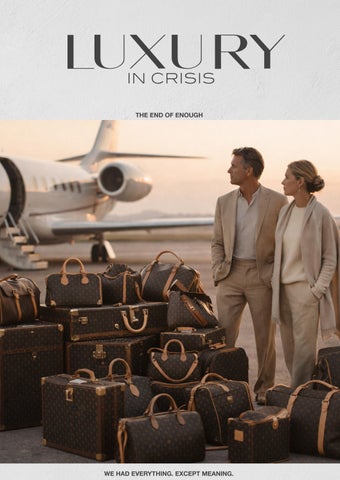
LUXURY IN CRISIS
THE END OF ENOUGH
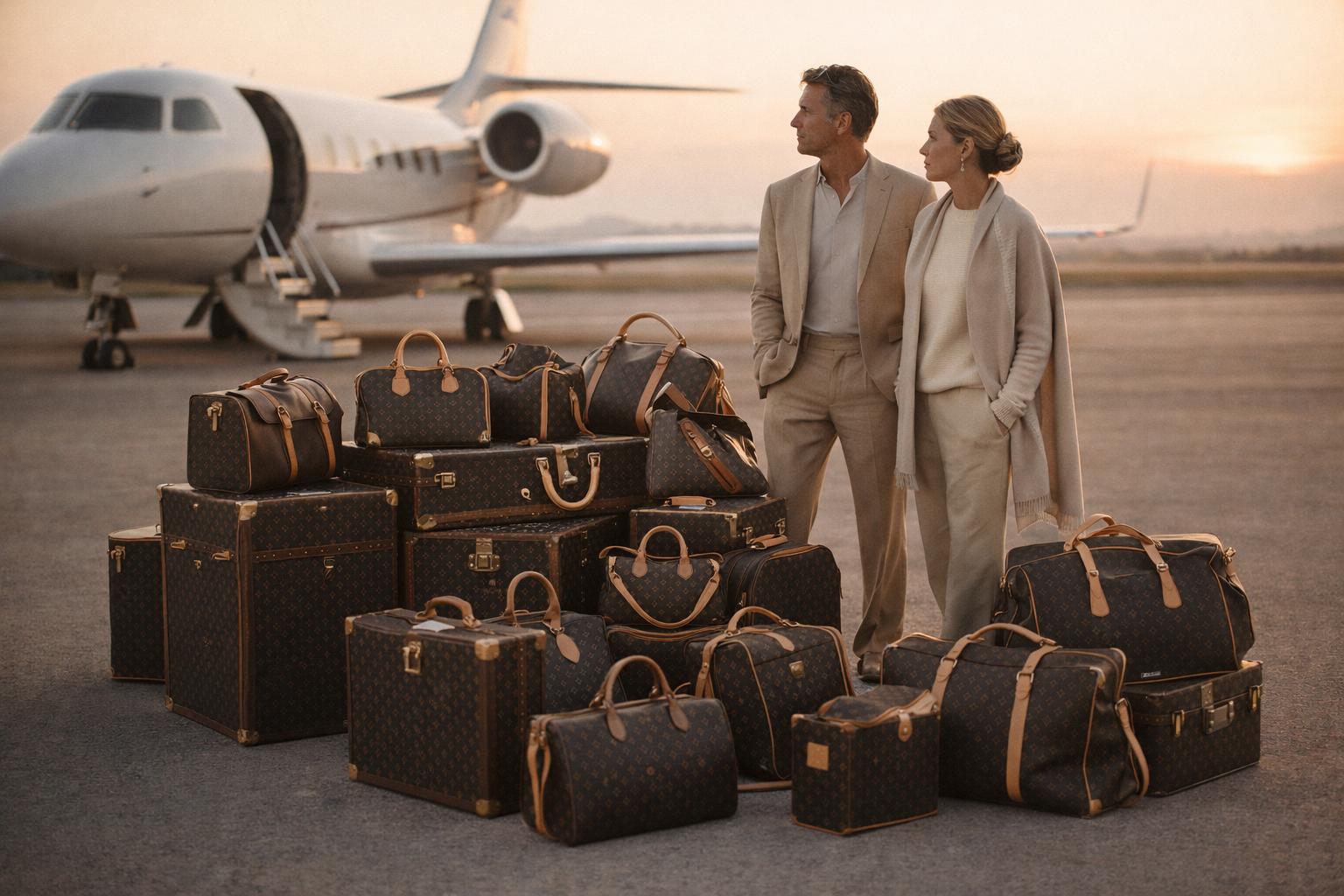

THE END OF ENOUGH
Yet over the past two decades, it expanded—geographically, demographically, and commercially—into a system increasingly driven by visibility, scale, and acceleration. What was once rare became accessible. What was once symbolic became repeated.
TODAY,
The current moment should not be misunderstood as a downturn. It is a structural realignment, revealing deeper questions around value, relevance, and purpose.
THIS PAPER SEEKS TO DISTILL THESE SHIFTS AND TRANSLATE THEM INTO A FORWARD-LOOKING PERSPECTIVE PARTICULARLY FOR HOSPITALITY, TRAVEL, AND EMERGING FRAMEWORKS SUCH AS AGRILUXURY WHERE THE NEXT CHAPTER OF LUXURY IS QUIETLY BEING WRITTEN
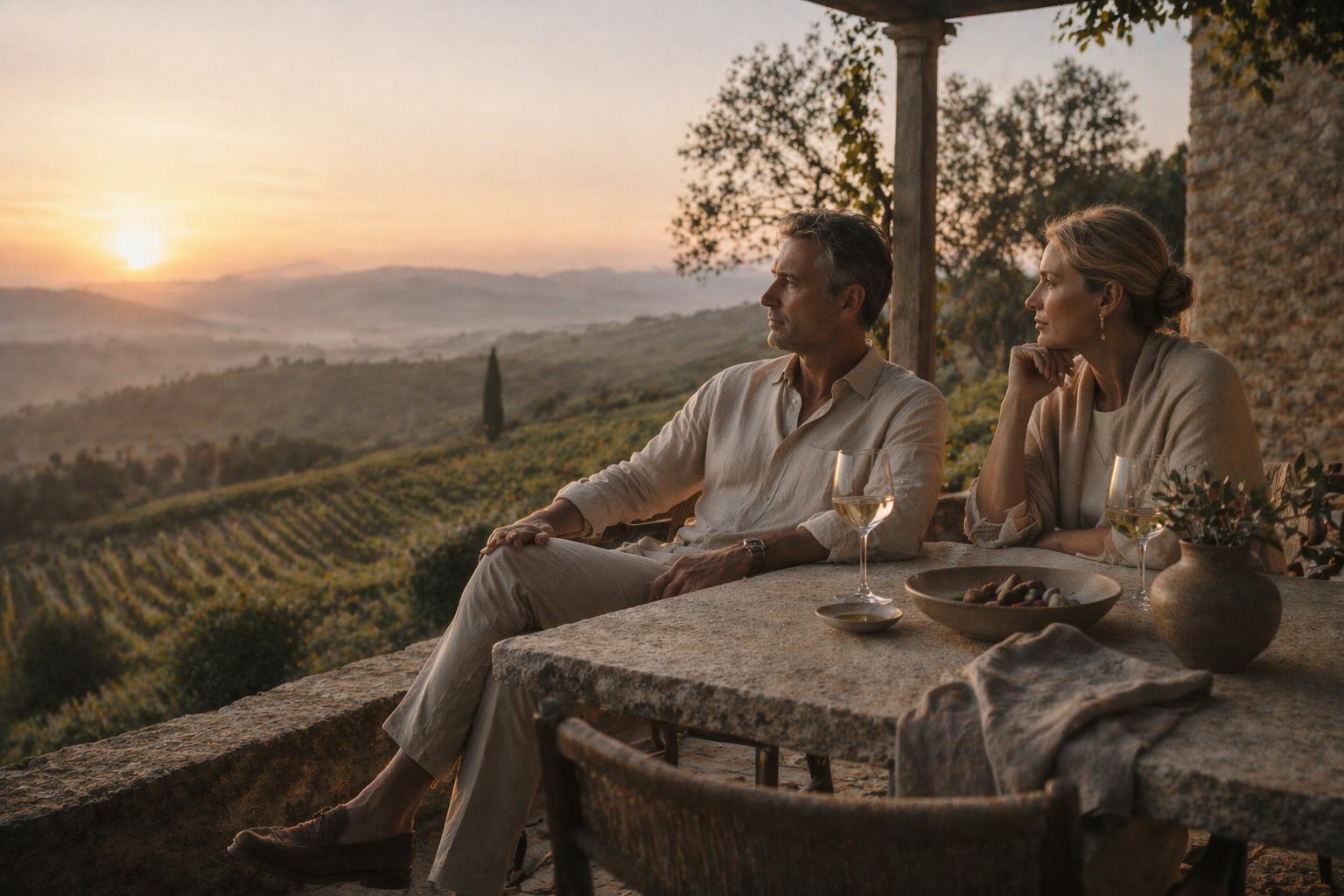
For decades, luxury was considered a near-guaranteed growth engine.
Recent market signals—slowing growth, declining segments, and increased volatility—indicate not a loss of demand, but a rebalancing of expectations. The industry’s historic reliance on continuous expansion, particularly through broader accessibility, has reached its natural limits.
Luxury, by definition, resists scale. And where scale becomes dominant, meaning tends to dilute.
A significant share of recent growth has been driven by the so-called aspirational client—a consumer engaging with luxury occasionally, emotionally, and often symbolically.
This segment is now retreating. More critically, it is reassessing.
The emerging question is no longer “Can I afford this?”
But rather:
“Is it worth it?”
This shift introduces a new level of scrutiny—one that challenges pricing strategies, perceived value, and ultimately, brand credibility.
Luxury has long relied on recognition. Today, recognition alone is no longer sufficient.
A clear transition is underway:
• from visibility to authenticity
• from product to experience
• from ownership to meaning
This does not signal the end of product-based luxury—but it does redefine its role. Products are no longer the destination. They are becoming entry points into broader narratives.
Luxury is evolving from something one acquires to something one lives and remembers.
Post-pandemic pricing strategies have pushed many categories into new territory.
While partially justified by rising costs, the cumulative effect has created a widening gap between price and perceived value
Luxury has historically commanded high prices.
But it has always justified them through:
• craftsmanship
• scarcity
• cultural relevance
• emotional resonance
Where this justification weakens, price becomes exposed.
And exposure, in luxury, is rarely desirable.
Particularly among younger generations, a distinct shift in mindset is becoming evident:
• Increased awareness of sustainability and impact
• Preference for individuality over brand conformity
• Blending of high and low, vintage and contemporary
• Reduced emphasis on ownership as a status marker
Luxury is no longer used to signal belonging to a group. It is used to express personal identity
This transformation does not diminish luxury. It redefines its role.
One of the clearest signals for future growth lies beyond the product itself.
Experiences—particularly those that are:
• authentic
• place-based
• culturally anchored
• difficult to replicate are gaining increasing relevance.
This includes:
• travel and hospitality
• wellness and longevity
• curated, once-in-a-lifetime encounters
In this context, luxury shifts from transactional to transformational
It is no longer about what is purchased.
It is about what is felt, remembered, and internalized.
Within this transformation, hospitality assumes a central role.
Not as an adjunct to luxury—but as one of its most credible expressions.
Unlike products, hospitality has the inherent ability to integrate:
• place
• culture
• human interaction
• time
When executed with coherence and intention, it creates something that cannot be replicated at scale:
A notable undercurrent in this shift is a renewed focus on origin.
Where things come from.
How they are made.
What they are connected to.
This is where agricultural, cultural, and territorial narratives gain strategic importance.
Not as decorative storytelling—but as foundational truth.
Within this context, emerging frameworks such as AGRILUXURY articulate a direction where:
• land is not a backdrop, but a protagonist
• sustainability is not a claim, but a condition
• hospitality is not an overlay, but an extension of place
This represents not a niche—but a structural evolution of luxury itself.
The industry now faces a fundamental set of choices:
1. Contraction toward exclusivity
Focusing on a narrow, ultra-high-end clientele, preserving scarcity but limiting reach.
2. Re-expansion toward accessibility
Re-engaging broader audiences at the risk of further dilution.
3. Repositioning toward meaning (emerging path)
Building ecosystems that integrate product, experience, and purpose into a coherent whole.
The third path requires more discipline. But it also offers greater resilience.
Periods of uncertainty often reveal underlying truths.
In this case, the truth is simple:
Luxury cannot rely indefinitely on perception alone.
It must reconnect with substance.
This does not require reinvention from scratch. It requires realignment with its original principles:
rarity
authenticity
craftsmanship
emotional depth
The current moment is not a crisis of luxury. It is a crisis of definition. And within that lies opportunity. An opportunity to move:
• from expansion to intention
• from visibility to discretion
• from possession to meaning
Luxury, at its best, was never about excess.
It was always about essence.
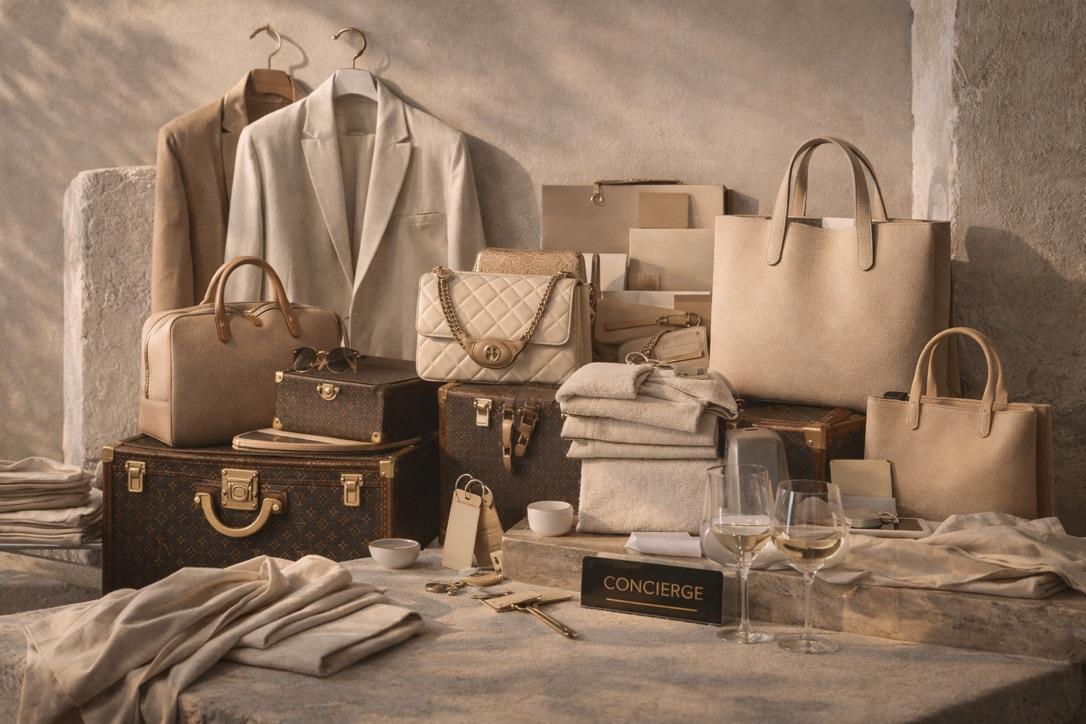

And then we removed everything that wasn't essential...
MOVED
FASTER ITS OWN
COULD FOLLOW.