UNITED KINGDOM
Helping build more peaceful communities through dialogue
G
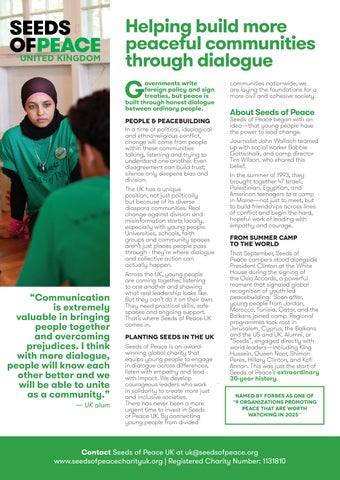
“Communication is extremely valuable in bringing people together and overcoming prejudices. I think with more dialogue, people will know each other better and we will be able to unite as a community.” — UK alum
overnments write foreign policy and sign treaties, but peace is built through honest dialogue between ordinary people.
communities nationwide, we are laying the foundations for a more civil and cohesive society.
PEOPLE & PEACEBUILDING In a time of political, ideological and ethno-religious conflict, change will come from people within these communities talking, listening and trying to understand one another. Even disagreement can build trust; silence only deepens bias and division. The UK has a unique position, not just politically but because of its diverse diaspora communities. Real change against division and misinformation starts locally, especially with young people. Universities, schools, faith groups and community spaces aren’t just places people pass through - they’re where dialogue and collective action can actually happen. Across the UK, young people are coming together, listening to one another and showing what real leadership looks like. But they can’t do it on their own. They need practical skills, safe spaces and ongoing support. That’s where Seeds of Peace UK comes in.
Seeds of Peace began with an idea—that young people have the power to lead change. Journalist John Wallach teamed up with social worker Bobbie Gottschalk, and camp director Tim Wilson, who shared this belief. In the summer of 1993, they brought together 47 Israeli, Palestinian, Egyptian, and American teenagers to a camp in Maine—not just to meet, but to build friendships across lines of conflict and begin the hard, hopeful work of leading with empathy and courage.
PLANTING SEEDS IN THE UK Seeds of Peace is an awardwinning global charity that equips young people to engage in dialogue across differences, listen with empathy and lead with impact. We develop courageous leaders who work in solidarity to create more just and inclusive societies. There has never been a more urgent time to invest in Seeds of Peace UK. By connecting young people from divided
About Seeds of Peace
FROM SUMMER CAMP TO THE WORLD That September, Seeds of Peace campers stood alongside President Clinton at the White House during the signing of the Oslo Accords, a powerful moment that signaled global recognition of youth-led peacebuilding. Soon after, young people from Jordan, Morocco, Tunisia, Qatar, and the Balkans joined camp. Regional programmes took root in Jerusalem, Cyprus, the Balkans and the US and UK. Alumni, or “Seeds”, engaged directly with world leaders—including King Hussein, Queen Noor, Shimon Peres, Hillary Clinton, and Kofi Annan. This was just the start of Seeds of Peace’s extraordinary 30-year history. Named by Forbes as one of “9 Organizations Promoting Peace That Are Worth Watching In 2025”
Contact Seeds of Peace UK at uk@seedsofpeace.org www.seedsofpeacecharityuk.org | Registered Charity Number: 1131810
A Movement for Dialogue and Peacebuilding For more than 30 years, Seeds of Peace has brought young people from divided communities together to listen deeply, speak honestly, and build trust. Young people from the UK and the US have long been part of this work, developing understanding, empathy, and a sense of shared responsibility. Recognising the need for these conversations closer to home, Seeds of Peace has expanded into local programmes across the US, India, Pakistan, Israel, Palestine— and now the UK—creating safe, structured spaces where young people can challenge prejudice, understand difference, and develop the skills to lead with care. With the right support, these young people go on to make change where it matters most - in their families, schools, workplaces and communities. We see the impact in everyday actions: difficult conversations handled with empathy, local initiatives led with confidence, and career choices shaped by a commitment to peace and social responsibility. Through your support, Seeds of Peace will continue to deliver local leadership programmes, convene young leaders globally, and sustain a growing international alumni network committed to dialogue and long-term peacebuilding, but with a new emphasis on the UK.
Our Approach & Impact Our programme is rooted in a simple but powerful belief: change starts with conversation. Building Peace Through Dialogue We use facilitated dialogue, shared experiences and practical leadership tools to help young people talk honestly about differences—safely and with respect. This isn’t about agreement. It’s about giving young people the skills and confidence to listen, handle disagreement, and to challenge division and hate when they encounter it. Participants learn how to apply these skills in real life—in their schools, peer groups and communities. They practise how to handle difficult conversations, and take action where they live. This is where learning sticks: when difference becomes something to engage with, not avoid. Our local and virtual programmes are co-created with participants, adapted to their context, and delivered by trained professional facilitators. We also train teachers and community leaders, extending the impact well beyond each cohort. We support young people beyond a single programme. Through local and international gatherings and active alumni hubs - supporting a lifelong journey of connection, leadership and impact.
Our Global Impact Seeds of Peace is supported by a global network of more than 8,800 alumni across 27 countries. Every day, these young leaders are working for change in their own communities. Our alumni—known as “Seeds”— include educators, journalists, entrepreneurs, creatives and public leaders. Together, they have reached more than 10 million people, from classrooms and councils to boardrooms and communities affected by conflict. Our impact is backed by evidence. Researchers at the University of Chicago Booth School of Business have studied our programmes for over a decade. Their findings show clear, lasting changes in participants’ attitudes, behaviours and leadership— including stronger relationships, greater ability to navigate difference, and increased confidence to lead change locally. What the research shows • 76% of Seeds go on to actively work to address conflict • 87% lead or spark dialogue in their schools and communities • 90%+ form strong, lasting connections—building trust, empathy and confidence in their ability to make change
Voices from our community “My goal is to build trusting relationships so people feel safe sharing their stories. Being part of Seeds of Peace has shaped how I work and lead.” —Zamzam, Filmmaker & Alumna
“I learned how to listen to people, even when I don’t agree with them.”
—Shai, Youth Participant
“I now believe I can push for change in my community.”
—Ameer, Youth Participant
Building Seeds of Peace UK As an organisation, we’re committed to delivering the Seeds of Peace model in the UK, and building a strong, relevant offer for young people, teachers and community leaders. Our work is grounded in impact evaluation and designed by listening closely to the lived experiences of those we serve, ensuring programmes respond to real needs and have lasting impact.
London Pilot ProgramME In May 2025, we launched our new UK partnership programme with a three-day pilot workshop in London, delivered in collaboration with Future Leaders, an award-winning organisation that empowers underrepresented young people to drive change. From over 100 applicants, 25 young people (aged 16-18) were selected to take part in this three-day immersive experience focused on dialogue, leadership, and identity. Participants will continue to receive ongoing support to lead change locally and will join the global Seeds of Peace alumni network. The impact was immediate. Participants were supported to step outside their comfort zones, challenge assumptions and reflect on how they relate to others and their wider communities. Learning from this pilot is directly informing the design of our next programme in March 2026. What participants told us: • “Now I will respect people’s views even when they are completely opposite to mine.”
•
“I have a deeper understanding of how I interact with others, and more control over my own mindset.” • “It reminded me that leadership isn’t about having the loudest voice, but about making space for every voice.” Programme feedback: • 100% would recommend the programme to a friend • 100% want to continue taking part in dialogue activities • Most common feedback: “Make it longer.” Dialogue Academy We are developing a UK-based Dialogue Academy, building on an impactful model already delivering strong results in our South Asia programmes. Delivered online, the Academy equips participants with practical, real-world skills often missing from the classroom— including critical thinking, emotional awareness, and the ability to engage constructively across differences. Through guided reflection, young people gain tools they can apply immediately in their
schools, communities, and online spaces. The online format of the Dialogue Academy also allows us to reach a far broader and more diverse group of young adults. UK Regional Camp We are establishing a UKbased residential camp lasting two to three weeks. Building on 30 years of expertise in delivering residential dialogue programmes in the US, this programme will bring together young people from across the country to share perspectives, build relationships and develop leadership skills they can take back to their schools and communities. The UK camp will offer participants the opportunity to learn alongside others with different life experiences, deepening their understanding of themselves and the world around them. The camp will also be a pathway into deeper engagement with Seeds of Peace’s wider network and programmes. National Scale-Up Our mission in the UK is to build a national community of young people, educators and local leaders equipped to respond thoughtfully in moments of division or crisis. In building
our programming we are prioritising access, quality and sustainability. The UK model is being designed to scale—open to young people from all backgrounds, adaptable to local contexts and capable of being replicated across the country. This approach allows Seeds of Peace UK to grow responsibly while maintaining the depth and integrity of its work.
Investing in Peace The work of Seeds of Peace has been made possible by a global community of generous supporters who believe that investing in young people builds the strong leaders of tomorrow—leaders equipped to navigate division and strengthen understanding. We are now building on that foundation to grow Seeds of Peace in the UK We’re inviting early supporters to help grow and deepen the impact of Seeds of Peace here in the UK. We’re seeking contributions of £2,000 - £5,000 from our Foundational Circle, and we would warmly welcome larger gifts and partnerships from those keen to go further with us. Early funding will support critical, foundational work including:
UK Programmes: Delivering our first year of UK programmes, reaching 50–100 young people, informed by learning from the London pilot (Budget - £60,000). Facilitator Training: Training three UK-based facilitators, including teachers and community leaders, to deliver dialogue locally (Budget £30,000). UK Foundations: Establishing the core capacity to deliver and grow—including a UK Country Director, essential IT and CRM systems, clear safeguarding and evaluation processes, and the coordination needed to support programmes and donors (Budget - £60,000). We’re not just looking for donors —we’re looking for partners who want to help shape the future of Seeds of Peace UK. We are building the Foundational Circle: a small community of supporters who come together to learn, connect and support this work. Members will be invited to informal gatherings sharing food, hearing directly from young leaders, and seeing the impact first-hand. Peace is built through relationships and shared commitment. Thank you so much for considering being part of this next chapter.