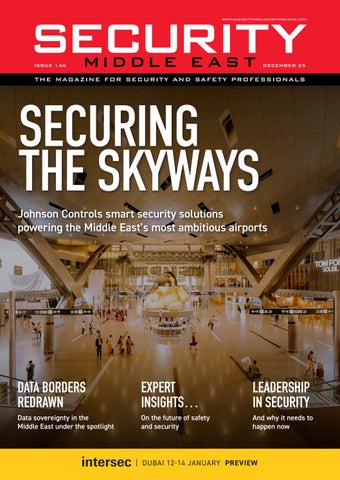
Issue 127146 ISSUE
July/August DECEMBER 2522
SECURING THE SKYWAYS Johnson Controls smart security solutions powering the Middle East’s most ambitious airports
DATA BORDERS REDRAWN
EXPERT INSIGHTS…
LEADERSHIP IN SECURITY
Data sovereignty in the Middle East under the spotlight
On the future of safety and security
And why it needs to happen now
| DUBAI 12-14 JANUARY PREVIEW
Era is the first series of compact outdoor stations with advanced access control functions, specifically designed for residential applications. It can be expanded up to 4 users or in a version with numeric keypad and includes a proximity reader with MIFARE/NFC technology as standard. It is a product entirely designed and manufactured in Italy.
Up to four apartment
Codelock
MIFARE/NFC
Bluetooth
RS485
Dip switch configuration
Voice assistance
IP65
IK09
Download for free
Videx Virtual Fob
videx.it
Videx Electronics S.p.A. - Via del Lavoro, 1 - 63846 - Monte Giberto (FM) - info@videx.it - T.+39 0734 631 669 - F.+39 0734 6332 475
CONTACT US EDITORIAL Publisher Barry Bebbington +44 1708 229354 barry@pubint.co.uk
Editor Cora Lydon +44 7834 244613 cora.lydon@securitymiddleeastonline.com
ADVERTISING Worldwide
Mike Dingle +44 1752 267330 mike@securitymiddleeastonline.com
Ryan Bickerton +44 1752 265802 ryan@securitymiddleeastonline.com
Gareth Driscoll +44 1752 260603 gareth@securitymiddleeastonline.com
Rahul Vara +44 1752 604352 rahul@securitymiddleeastonline.com
Will Russell +44 7800 513300 will@securitymiddleeastonline.com
Digital Editor Britt Jones
britt@securitymiddleeastonline.com
Marketing Manager Mark Doyle +44 7517 452283
mark@securitymiddleeastonline.com
PUBLISHED BY Publications International Ltd +44 1708 229354 166 Front Lane, Upminster, Essex, RM14 1LN, UK This publication may not be reproduced or transmitted in any form in whole or in part without the written consent of the publishers. ©Publications International Ltd. 2026 For subscriptions and advertising enquires, or for further information
UP FRONT As we step into a landmark year for the security sector, the momentum across the Middle East shows no sign of slowing. Rising optimism, rapid digital transformation and an ever-expanding infrastructure pipeline are shaping a region where innovation and security are increasingly inseparable. In this issue, we explore that intersection — starting with our cover story from Johnson Controls (page 12), who are powering the Middle East’s airport boom with intelligent, scalable and sustainable technologies. Their work exemplifies how smart systems integration can underpin national ambitions for safer, smoother travel experiences. We also bring you an exclusive eightpage supplement from AMAG Technology, delving into its leadership in intelligenceled, identity-first security solutions, its Symmetry V10 product and the major transformation of its manufacturing facility (page 39). With Intersec Dubai now on the horizon, our dedicated section (page 74 onwards) offers a complete preview — including an exclusive welcome from the show director and a guide to must-see speakers and exhibitors. Security Middle East will be on the ground throughout the event, reporting live and connecting with partners and readers. Come say hello to us on stand SA-D48 – we’d love to see you there. You can also find us hosting the brand new Intersec Pulse Studio from the main concourse – where we’ll be diving deeper
into the hottest topics with the sector’s thought leaders. Beyond that, this edition reflects the pulse of a rapidly evolving industry. From rethinking data sovereignty (page 32), to understanding how network audio is transforming retail environments (page 27) and uncovering the myths around firewall protection (page 28), our contributors offer bold perspectives on what’s next. Also in cybersecurity, we tackle leadership in a data-saturated world (page 47), the hidden risks of third-party breaches (page 57) and the real-world challenges of DDoS mitigation (page 50). Each piece underscores how resilience today demands vision as much as vigilance. As always, we hope these insights inspire dialogue, innovation and collaboration across our reader community. And with Intersec around the corner, there’s never been a better time to exchange ideas and shape the secure, connected future the region deserves. Enjoy the issue — and see you in Dubai.
Cora Lydon Editor cora.lydon@securitymiddleeastonline.com smemag Security Middle East Magazine
on the magazine visit our website at: securitymiddleeastmagazine.com SECURITY MIDDLE EAST | DECEMBER 2025 | 3
17
CONTENTS
innovation
secure
finance
ISSUE 146 DECEMBER 2025
REGULARS
tourism
03 Up front
proactive
Foreword from the Editor
06 News Monitor
strategic
The latest regional and international security news
integration
09 Market Monitor
A roundup of the latest security products and solutions
12 Cover story: Johnson Controls
Find out how Johnson Controls is powering the Middle East’s airport boom
FEATURES
threat
57 28 The firewall fallacy
17 Future-proofing security
As economic growth and innovation accelerate across the region, security professionals are redefining their strategies to meet the future challenges of corporate, community and commercial protection
22 From insight to action
Discover the must-attend event where security leaders collaborate to stay ahead: The Security Middle East Conference, coming to Riyadh in April 2026
27 Audible results
Assim Khedr, Axis Communications, explores how network audio has the potential to revolutionise the retail experience and boost security
32
50 9 challenges of DDoS mitigation efforts
Kris Voorspoels, Director of Products & Solutions at OPSWAT, looks at how financial institutions are leaving doors wide open
Dr Emad Fahmy, NETSCOUT, explores how to overcome common hurdles to maximise distributed denial-of-service (DDoS) protection
32 Data borders redrawn
57 The breach you didn’t see coming
Data Sovereignty is rewriting how global enterprises operate in the Middle East, according to Tim Bell, VP of Sales (EMEA & APJ), Hexnode
55 Designing security
The architects and engineers at Sterling Presser explore how purposeful design and technical synergy can turn security from a boundary into an integrated architectural experience
83 Short sighted security
Arno van der Merwe, Entersekt, looks at how the Central Bank of the UAE’s security mandate could trip up local banks
CYBERSECURITY
Find out why third-party risk needs to shape enterprise security, according to Karl McGowan, Co-Founder, FrontierZero
60 Data sovereignty: why it matters for physical security
Firas Jadalla, Genetec, explores the risks of cross-border data transfers and highlights how sectors are adapting
62 Data as an anchor
Chris Royles, Field CTO EMEA, Cloudera, looks at navigating digital infrastructure shocks with agility and sovereignty
62
47 Leadership in cybersecurity – and cybersecurity in leadership
Ioannis Fragkoulopoulos, Cybersecurity Consultant, argues that in an AI driven, data saturated world, cyber leaders must move from servicing the business to actively shaping its strategic direction
4 | SECURITY MIDDLE EAST | DECEMBER 2025
impact
42
CONTENTS
DUBAI 2026 Everything you need to successfully navigate the forthcoming exhibition and get the most out of your attendance
74
Welcome from show director
76
Meet the speakers
78
Meet the exhibitors
INDUSTRY MONITOR 73 PSSA: Practical support, professional development and partnership in action As Intersec Dubai returns to the region, the Professional Security and Safety Alliance (PSSA) will be on site to turn strategy into action
THIS ISSUE’S PARTNERS & CONTRIBUTORS Ioannis Fragkoulopoulos Cybersecurity Consultant
Ioannis serves as the Cybersecurity and Data Protection Director at KPMG Saudi Arabia, and has over 18 years of experience across Europe and the Middle East.
Karl McGowan
Co-Founder, FrontierZero
Karl is the Co-Founder, Strategy and Commercial Lead for FrontierZero with a specialty in relationship building and new business.
Mohammed Murad
Vice President of Sales and Business Development, Iris ID
Mohammed is an international business and technical leader with extensive experience in global identity management and also serves on the board of the International Biometric Identification Association (IBIA).
85 Interview: emergency preparedness
Matthew M. Porcelli, Security Management Specialist, spoke with Meshal Aljohani, Security Operations Specialist
86 Diary
Diary dates for forthcoming security exhibitions, conferences and events
VOCO HOTEL, RIYADH | 28.04.2026
39 AMAG
AMAG is leading the way in intelligence, identity-first security solutions. Find out more about their solutions and plans for the future
Limited spaces available, register your interest today to secure your space at Saudi Arabia’s leading conference for security leaders. securitymiddleeastconference.com
PROMOTIONAL FEATURES
Supporters
10 PL Solutions 15 Braniff 31 Panasonic 36 Vega Systems 49 Intertech Vision ME 64 Progress Security Systems 67 Blackbox 71 Iris ID 72 ICT SECURITY MIDDLE EAST | DECEMBER 2025 | 5
MONITOR NEWS SAUDI CYBERSECURITY MARKET TO REACH US$7.5 BILLION BY 2034
THALES AND UAE CYBER SECURITY COUNCIL AGREE TO BUILD SPACEFOCUSED CYBER CENTRE Thales and the UAE Cyber Security Council (CSC) have signed a memorandum of understanding (MoU) to form a long-term partnership that will lead to the creation of a Cyber Centre of Excellence in the UAE. The agreement was announced during the Dubai Air Show and will focus on enhancing national expertise in space-related cybersecurity. The collaboration includes three major projects. The first is a Space META-SOC, a specialised security operations centre which will connect to the national SOC and feature advanced monitoring tools, along with training modules on satellite constellations and ground systems. The second initiative is a Cyber Evaluation Lab, which will test and assess software and hardware for critical sectors, beginning with the space industry. The third project is a Crypto Lab, focusing on post-quantum cryptography and quantum key distribution. Led by CSC head Dr Al Kuwaiti, the Cyber Centre of Excellence aims to advance the UAE’s technological sovereignty and build long-term Emirati expertise in space cybersecurity. Thales Executive Vice President for Secure Communications and Information Systems, Christophe Salomon, said: “This partnership with the UAE Cyber Security Council marks a major milestone in our joint commitment to advancing the UAE’s sovereign, secure and sustainable cybersecurity ecosystem. Together, we combine our complementary expertise and shared ambition to shape the future of cybersecurity, starting with the space domain.”
Saudi Arabia’s cybersecurity market is projected to grow from US$2.9 billion in 2025 to US$7.5 billion by 2034, according to new figures from IMARC Group. The forecast revealed a compound annual growth rate of 11.32 per cent between 2026 and 2034, which is caused by rising cyber threats and major statebacked digital transformation initiatives. The Kingdom’s Vision 2030 is a key factor behind the increase, reports the findings. The National Cybersecurity Authority (NCA) is another factor, as it continues to expand programmes such as CyberIC, which has trained more than 13,000 professionals, while new accelerators have supported the launch of over 60 cybersecurity start-ups. AI adoption is also playing its part, as automated systems in banks are cutting threat-response time by up to 70 per cent. However, ransomware remains a major component as to why businesses are spending more money on prevention tactics, with Saudi firms suffering 88 attacks in 2024. As a result, demand for nextgeneration firewalls, zero-trust models and cloud-based security are inching higher and higher.
Global Cyber Security Forum calls for stronger international cooperation World leaders and senior policymakers have urged greater global cooperation on cybersecurity during the Global Cyber Security Forum (GCF) Yearly Meeting 2025, held in Riyadh. The event brought together government, industry and academic representatives to discuss shared
6 | SECURITY MIDDLE EAST | DECEMBER 2025
challenges, where UN Secretary-General António Guterres called for collective action to ensure that cyberspace “serves the common good”. He stressed the need for investment in skills, digital inclusion and humancentred policy in his speech, while former European Commission President José
Manuel Barroso said there needs to be deeper cross-border collaboration. The forum also announced new programmes which build on existing global initiatives by Saudi Arabia, including Child Protection in Cyberspace and Women Empowerment in Cybersecurity.
MONITOR NEWS
IN BRIEF
KUWAIT RANKS FOURTH IN ARAB CYBERSECURITY MARKET
BAHRAIN
Kuwait has become the fourth-largest cybersecurity market in the Arab world for 2025, with spending reaching US$620 million, according to new data from Kaspersky. Analysts say the figure could exceed US$1 billion by 2030 as the country increases its efforts to strengthen national cyber readiness. Despite ranking fourth in market size, Kuwait currently places third in overall cybersecurity preparedness. Currently, Saudi Arabia remains the region’s largest cybersecurity market at US$4 billion in 2024, followed by Egypt.
Saudi companies adopt AI for cybersecurity, Cisco finds More than half of companies in Saudi Arabia are now using artificial intelligence to strengthen their Realizing the Value of AI cybersecurity measures, according to Cisco AI Readiness Index 2025 new research from the Cisco AI Readiness Index. The study shows that 51 per cent of organisations in the Kingdom have already introduced AI into their security operations. A further 60 per cent of respondents reported a high level of awareness of AI-related cyber risks, as the technology becomes more deeply embedded in business systems. Cisco’s report found that 91 per cent of Saudi organisations plan to deploy AI agents, with 40 per cent anticipating that these systems will work alongside human employees within the next year. The findings follow a June study from Elon University, which reported that 80 per cent of Saudi adults use AI tools, with one in three using them regularly. According to Cisco’s survey, 39 per cent of organisations are integrating AI into identity and security systems, and another 39 per cent say they are fully prepared to manage and secure AI agents. © 2025 Cisco and/or its affiliates. All rights reserved.
Paramount and Bahrain’s National Cyber Security Centre (NCSC) have signed an agreement to deliver its MITRE D3FEND Cybersecurity Training during the Arab International Cybersecurity Conference and Exhibition (AICS), to enhance regional cyber defence capacity and professional development to businesses.
UAE The UAE Cybersecurity Council announced a major advancement in national post-quantum readiness at CyberQ 2025. The Council shared that this progress is due to its collaboration with QuantumGate, which has shifted its position from planning to large-scale implementation so the nation can prepare for quantum decryption threats.
SAUDI ARABIA Riyadh hosted the Black Hat Middle East and Africa (MEA) 2025 conference which ran from December 1-3 and aimed to be a regional cybersecurity hub. The event saw overwhelming success with its international turnout.
BAHRAIN The end of 2025 saw the first ever Space Cybersecurity Hackathon, which was created under the patronage of His Royal Highness Prince Salman bin Hamad Al Khalifa, the Crown Prince and Prime Minister, the BSA and the National Cyber Security Centre (NCSC).
KUWAIT Pakistan’s ambassador, Zafar Iqbal, suggested the digital corridor to Kuwait as a way to strengthen its collaboration, cybersecurity, digital infrastructure and technology. Iqbal stated it could mean a joint effort in cyber resilience.
UAE Cyber Security Council warns against using public phone-charging ports The UAE Cyber Security Council has urged the public to avoid using unsecured public charging ports, warning that they can expose travellers to serious data risks. According to the Council, 79 per cent of travellers unknowingly put their personal information at risk when relying on public charging stations. Officials explained that some ports may contain hidden malware capable of accessing personal data, including passwords and photos. The council told WAM that 68 per cent of companies have been targeted through compromised charging ports, leading to data breaches and damage to digital infrastructure.
SECURITY MIDDLE EAST | DECEMBER 2025 | 7
WE’RE WITH YOU EVERY STEP OF THE WAY As the industry leader in power and data transmission innovation, Altronix designs and manufactures electronic products that ensure security systems run at optimal performance. We pride ourselves on providing the best technical and customer support in the business. That’s the Altronix advantage.
™
© 2025 Altronix Corporation. All rights reserved.
altronix.com
MONITOR MARKET
ACRONIS ANNOUNCES CYBER PROTECT LOCAL TO DELIVER UNIFIED CYBER RESILIENCE FOR ON-PREMISES AND SOVEREIGN IT/OT ENVIRONMENTS Acronis has launched Acronis Cyber Protect Local, a solution delivering natively integrated cyber resilience for on-premises, sovereign private cloud, and air-gapped IT and operational technology (OT) environments. Designed for organisations where cloud deployment is not an option, the solution combines backup, recovery, cybersecurity and endpoint management in a single platform, enabling compliant IT and OT operations while reducing costs and operational complexity. Acronis Cyber Protect Local keeps the data securely within the customer’s perimeter, ensuring full data sovereignty and regulatory compliance. The solution supports legacy systems and modern hypervisors including Windows XP, OT/ICS environments, Nutanix, Proxmox, VMware
and Hyper-V to ensure complete coverage across mixed infrastructures. “Despite the broad adoption of cloud-based applications, there is critical infrastructure that requires on-premises deployment and protection,” said Gaidar Magdanurov, President at Acronis. “The systems that ensure we have access to water, electricity, technology, healthcare and transportation are vulnerable targets for cyberattacks due to their reliance on
outdated software and hardware. In 2025, over 50% of OT organisations reported at least one cybersecurity incident. Acronis Cyber Protect Local brings the power and innovation of our trusted cloud cyber protection platform directly on-premises, running on a dedicated management server within the customer’s internal networks to meet strict security and data location requirements.” acronis.com
NETWAY SPECTRUM Hardened PoE Switches & Fiber Media Converters • Deploy IP devices at remote locations with or without local power • Supports up to 90W per port • Rapid battery charging provides extended power backup • 115/230VAC or 277VAC input • Manage and reset devices remotely with LINQ™ Network Power Management • Lifetime warranty
™
© 2025 Altronix Corporation.
altronix.com
PROMOTIONAL FEATURE
Access security in 2026 Smart cabinets, intelligent gates and the next generation of protection As the security industry moves into 2026, access control is shifting toward predictive, connected and autonomous ecosystems. In the region — one of the world’s fastest adopters of physical security innovation — smart locks and intelligent gates are evolving into data-driven platforms that enhance security, optimise flow and enable real-time decision making. At PL Solutions, we are deeply embedded in this transformation — supported by partners who are engineering tomorrow’s standards ahead of global adoption. Our 2025 deployments across education, fitness and mixed-use developments proved our capability to deliver future-ready foundations with measurable impact: Our 2025 deployments demonstrate foundational capability: • Over 1,000 intelligent gate systems across the region’s campuses — facial recognition (1:1), time-bound QR passes and AI tailgating detection achieving 30% fewer unauthorised entries within 60 days.
• Nearly 7,000 smart locks in different industries — different identification methods such as Biometric, Keypad, RFID and mobile credentials. • Access points in premium facilities — Biometric / RFID credentials, real-time occupancy tracking.
Looking ahead: What defines 2026 security innovation
With a proven foundation in place, the next phase of physical security is shaped by four defining shifts: Trend #1: Predictive Access Control AI evolves from identification to behaviour forecasting, enabling proactive intervention. Trend #2: Zero-Touch, Multi-Modal Authentication Airports and high-security facilities are adopting layered identity — face, mobile ID RFID and behavioural AI. Trend #3: Unified Smart Gates
Gateways now act as mission-control nodes, merging flow analytics, safety checks and automated rule enforcement. Trend #4: Smart Locks Smart electronic locks have evolved into powerful security components — offering advanced protection, seamless access integration and reliable performance across modern workplaces and critical facilities.
Future-ready by design
With strong global partnerships and a track record of high-impact 2025 deployments, PL Solutions continues to deliver access ecosystems that are interoperable, scalable and engineered for the next era of security.
solutions plsolutions.ae
Recognise and Analyse Is he on a watch list for banned persons?
Is she old enough?
How often was he here this month?
Premier face recognition technology for real-time video surveillance, recorded video investigation, crowd detection, and anonymous people analytics www.cognitec.com | sales@cognitec.com
When and where did she enter?
Does he appear in videos recorded last week?
MONITOR MARKET
Riverbed launches Aternity Cloud hosted in KSA Riverbed has announced the launch of its Riverbed Aternity Cloud solution hosted incountry for the Kingdom of Saudi Arabia. With this development, Riverbed becomes the first technology provider in the Kingdom to deliver a SaaS-based Observability platform with integrated AI capabilities designed to meet Saudi Arabia’s data sovereignty and compliance requirements. Elie Dib, Senior Vice President EMEA, Riverbed, said: “Riverbed has been a trusted partner to Saudi Arabia’s public and private sectors for decades, helping organisations enhance visibility and performance across complex IT environments. Riverbed’s new locally hosted observability cloud offering builds on that legacy, enabling enterprises to benefit from the latest AI capabilities in IT operations while maintaining full compliance with national data policies. It aligns perfectly with Saudi government mandates for data residency and provides a secure foundation for future innovation.” The Riverbed Aternity Cloud for KSA is a proven enterprise-scale Digital Employee Experience (DEX) platform that delivers full-spectrum visibility into the digital experiences of employees and customer interactions. Riverbed Aternity captures technical telemetry from millions of devices, business applications and cloud-native services, offering real-time insights into what users are actually experiencing. riverbed.com ®
Panomera V8: 180° view for smart analytics on large areas With the new Panomera® V8, Dallmeier presents a new camera that combines state-of-the-art multifocal sensor technology and artificial intelligence in one system. With eight lenses, eight sensors, and eight AI chips, the Panomera® V8 achieves a 180-degree field of view and enables coverage of a very large area with just one camera. The eight systems are integrated into one comprehensive overview image, and the neural networks are logically linked.
This allows a wide variety of areas, from marketplaces to logistics areas to airport aprons, to be captured and evaluated. “With Panomera® V8, the camera becomes an important source of data,” said Christian Linthaler, Chief Sales Officer at Dallmeier. “Our customers benefit not only from maximum security, but also from valuable insights into their processes – a double added value that goes far beyond classic CCTV.” dallmeier.com
SANDBOXAQ LAUNCHES AQTIVE GUARD AI-SPM SandboxAQ is now delivering an endto-end AI security posture management solution with complete visibility, risk analysis and compliance monitoring The company announced an AI-SPM offering that offers full visibility into where AI is being used in organisations’ tech stacks and evaluates AI assets for exploitable weaknesses, insecure dependencies and exposure risks such as prompt injection, data leakage and unauthorised access. The offering is purpose-built to help organisations address the rapidly growing threat of shadow AI before it leads to material breaches. Recent SandboxAQ research reveals that while 79 per cent of organisations are running AI in production, 72 per cent have never completed a full AI security assessment and only six per cent have implemented a comprehensive AI-native security strategy. “AI is transforming a lot of industries and simultaneously expanding the attack surface faster than traditional security tools can keep up,” said Jack Hidary, CEO at SandboxAQ. “We’re seeing attackers weaponise AI tools to exfiltrate sensitive data, manipulate internal systems and automate large-scale intrusions. If organisations don’t have clear visibility into how AI and agents are being used across their environment, they’re operating blindly. Security teams need to act now before an unmanaged AI system becomes the source of their next breach.” sandboxaq.com
SECURITY MIDDLE EAST | DECEMBER 2025 | 11
COVER STORY | JOHNSON CONTROLS
SECURING THE SKYWAYS How Johnson Controls is powering the Middle East’s airport boom and Senior Director Tony Nasr’s thoughts on the company’s ambitious growth plans The Middle East is entering one of the most ambitious aviation growth cycles in its history. Rapid passenger expansion, national development strategies and major infrastructure investments are transforming the region’s airports into global super-hubs. According to IATA, Middle Eastern airlines’ traffic rose 9.4% in 2024. As airports scale, security systems must match unprecedented operational demands — delivering unlimited scalability, seamless platform integration, robust resilience and safe, efficient passenger flow.
50+ years of aviation security leadership
Johnson Controls has been a trusted partner in aviation security for over five decades. The journey began with Software House solutions in US airports and expanded through CEM Systems, which pioneered the first aviation-specific access control solution more than 35 years ago at Belfast International Airport. Today, CEM Systems’ technology secures some of the world’s most complex airports — including Heathrow, Gatwick, Hong Kong, Vancouver and Indira Gandhi International — through its AC2000 Airport platform, purpose-built for the unique demands of aviation security.
Driving security for the Middle East’s leading hubs
CEM Systems is trusted by leading airports across the Middle East — including Dubai, Bahrain, Qatar, and Oman — and
12 | SECURITY MIDDLE EAST | DECEMBER 2025
safeguards the top three regional airports, as ranked by Skytrax 2025. A key milestone this year was the opening of Hamad International’s Concourses D and E, where Johnson Controls deployed AC2000 Airport integrating access control, biometrics, fire detection and video into one unified security platform. Globally, Johnson Controls now protects 1.4 billion passengers annually across 150+ airport sites.
A purpose-built airport security ecosystem
AC2000 Airport is an end-to-end security platform designed for the complexity and scale of airports, offering: Fully integrated access control, biometrics, video, fire and third-party systems Unlimited scalability across doors, devices and servers Intelligent passenger-flow optimisation and advanced gate-room management 24/7 resilient architecture with proven failover Because Johnson Controls designs both software and hardware, integrations
can be deeply tailored to each airport’s operational model. For example, at Dubai International, a customised Boarding & Deplaning Route Management (BDRM) solution controls passenger movements and segregates arrival/departure flows for dynamic gate allocation.
Intelligent hardware for airports
Johnson Controls offers an intelligent reader portfolio – including biometric devices, the emerald IP access terminal and the portable S3060 handheld reader. Features such as offline databases for zero-downtime door operation, LCD touch screens for staff interaction and gate-room management applications, enable airports to achieve operational efficiencies that go beyond security. Terminals can also provide staff time and attendance, manage passenger segregation, control fixed-ground power and display messaging or advertising.
Supporting the next era of aviation
Johnson Controls sees first-hand that airports are increasingly operating like 24/7 cities. Security is no longer a
COVER STORY | JOHNSON CONTROLS
In Conversation with Tony Nasr, Senior Director – Emerging Markets, Security at Johnson Controls Q: You’ve been with Johnson Controls for a year now, during a time of rapid growth in the Middle East and Africa. How has the experience been so far, and how is the company investing in the region? A: It’s been an incredibly energising and rewarding first year. Joining Johnson Controls at such a pivotal moment for the Middle East & Africa has been a privilege. I’m fortunate to lead a passionate and talented regional team whose deep understanding of local challenges and customer needs continues to impress me. Their expertise and dedication are central to our success in delivering tailored, high-impact solutions. We’re making significant investments to support our customers and partners. A standout initiative is our newly refurbished training centre, which provides free, hands-on learning for consultants and integrators. It’s a key part of our broader commitment to building long-term partnerships and empowering the ecosystem with the knowledge and tools needed to thrive. Intersec Dubai is always a highlight, and I’m especially looking forward to reconnecting with former colleagues and industry peers. Having worked in the region for many years, I bring a deep understanding of the security landscape and a strong network built on trust and collaboration. It’s a fantastic opportunity to showcase how Johnson Controls is driving innovation — made even more rewarding by doing so alongside such a talented team. Q: What distinguishes Johnson Controls from other providers, particularly in the Middle East and Africa? A: Johnson Controls is supported by a diverse portfolio of trusted brands. What truly sets us apart is our deep experience in delivering integrated solutions tailored to the region’s unique needs. From smart cities and homes to critical infrastructure, our ability to provide end-to-end systems from a single source simplifies procurement and ensures seamless interoperability for customer operations. We also understand the importance of reliability, scalability and regional compliance. Q: Johnson Controls is known for its integrated product range. Could you elaborate on how your security products work together? A: Integration is the key to unlocking the full potential of building security. Our strength lies in the depth and breadth
standalone system – it is a backbone for smooth, safe, autonomous operations. Globally trusted by major hubs – including 90% of UK airports, representing 92% of UK passenger traffic (CAA 2024) – Johnson Controls delivers a unified, scalable aviation ecosystem.
of our portfolio spanning security, fire protection and building controls — all designed to work together seamlessly. Rather than relying on standalone systems, we create connected environments where data flows freely between platforms to enable smarter decision-making. Q: Which sectors show the most potential? A: We’re seeing strong momentum in aviation, government, hospitality and data centres — sectors where complexity and security demands continue to rise. Airports, for example, represent some of the most challenging environments, and our global experience enables us to deliver highly integrated, scalable solutions that bring multiple systems together. We’re also seeing growth driven by innovation in intrusion technology. Our award-winning IQ intrusion system, integrated with PowerManage for remote monitoring and management, reflects a broader trend towards smarter, more connected security ecosystems. Combined with PowerG wireless peripherals — offering encrypted communication, extended range and exceptional reliability — this solution meets evolving needs across residential and commercial spaces. Q: What’s next for Johnson Controls in the region? A: Looking ahead, our strategy in the Middle East and Africa focuses on deeper integration, AI-driven analytics and cloud platforms for predictive threat detection and faster response. Compliance and resilience will also remain key priorities. With stringent local standards such as SIRA in Dubai, we’ll continue investing in certified solutions that meet regulatory requirements while embedding robust cybersecurity measures. Combined with a focus on sustainability and smart city initiatives, our approach ensures future-ready security that supports the region’s vision for connected, secure, and sustainable environments.
As the region accelerates towards its next phase of aviation expansion, Johnson Controls remains committed to securing the Middle East’s gateway infrastructure – ensuring airports are efficient, resilient and ready for the future.
VISIT US AT INTERSEC STAND S1, C19
SECURITY MIDDLE EAST | DECEMBER 2025 | 13
PROMOTIONAL FEATURE
The ghost in the machine: Why static hardware identity is a liability In an era of total surveillance, the only true security is a moving target. Introducing Braniff’s Dynamic Hardware Identity Rotation For the modern operative, diplomat or ultra-high-net-worth individual, standard encryption is no longer enough. We have spent the last decade obsessed with software security — end-to-end encryption and zerotrust architectures. At Braniff Enterprises, we recognise that while these technologies safeguard the content of your communications, they fail to protect the most critical asset of all: Context. Your adversaries — whether foreign intelligence services, advanced persistent threats (APTs) or corporate espionage rings — no longer need to break your encryption to neutralise your operations. They simply need to track your Pattern of Life (POL). And the beacon broadcasting that pattern is the one variable you thought you couldn’t change: your International Mobile Equipment Identity (IMEI).
The metadata trap
Every mobile device has a unique fingerprint. The IMEI is a 15-digit serial number hardcoded into the deviceʼs cellular modem. Traditional OPSEC (Operational Security) suggests that simply swapping SIM cards protects your identity. This is a fatal misconception. When an operative inserts a new SIM into a phone with a static IMEI, the cellular network — and any hostile International Mobile Subscriber Identity (IMSI) catcher or ‘Stingray’ in the vicinity — instantly links the new number to the old, tracked device. You have not become a new person; you have simply attached a new alias to the same targeted hardware.
The Braniff solution: Dynamic hardware identity
True anonymity requires the ability to sever the digital tether between the user and the hardware. This is where Braniffʼs proprietary randomised IMEI rotation shifts the paradigm from defense to stealth. Our latest secure architecture introduces Braniff Hyper-Cycling™ Technology. This feature allows the device to generate a cryptographically valid, randomised IMEI upon every reboot or at user-defined critical intervals. By spoofing the hardware identifier at the baseband level, the device presents itself to the network as a completely new, factoryfresh unit every time it connects.
Strategic advantages for high-value assets 1. Countering Pattern of Life (POL) analysis Intelligence agencies build targets based on repetition. They map where a device sleeps, where it works and who it meets. By rotating the IMEI, Braniff technology shatters the continuity of data. The network sees a thousand different devices passing through a location once, rather than one device returning a thousand times. The pattern dissolves into noise. 2. Defeating IMSI catchers Hostile entities deploy IMSI catchers in sensitive zones (embassies, conflict zones, financial districts) to harvest identifiers. A static phone is a sitting duck. A Braniff device with IMEI rotation
is a ghost — appearing and disappearing from the RF spectrum before an actionable profile can be built. 3. The ‘Burner’ without the waste Historically, deep cover required physical ‘burner’ phones that were used once and destroyed. This is logistically heavy and a security risk if discarded improperly. With Braniffʼs IMEI spoofing capability, a single enterprise-grade device becomes an infinite supply of virtual burner phones. One piece of hardware, unlimited digital identities.
The new standard of privacy
In the high-stakes world of intelligence and enterprise security, a static identity is a vulnerability you cannot afford. To remain static is to be targeted. To rotate is to survive. Braniff Enterprises doesn’t just protect your data. We protect your existence.
Secure your operations
Static defence is obsolete. Contact Braniff Enterprises today for a confidential briefing and demonstration of our dynamic hardware identity solutions. Seeking qualified customers and distributors with existing government contracts. Contact us for a demo with our Subject Matter Experts at sme@braniffenterprisesllc.com
braniffenterprisesllc.com
Regulatory compliance & sales restriction disclaimer Use with Authority: The capabilities described herein, specifically IMEI modification/spoofing, are powerful tools designed for sovereign, military, intelligence and authorised enterprise applications. Restricted Sales: Braniff Enterprises restricts the sale of devices featuring Hyper-Cycling™ Technology strictly to vetted and authorised purchasers, including government agencies, military organisations and qualified corporate entities. Legal Compliance: The use of IMEI changing technology may be regulated or prohibited in certain jurisdictions for general consumer use. It is the sole responsibility of the purchasing organisation to ensure that the deployment and use of Braniff devices comply with all applicable local, national and international laws and regulations relevant to their area of operation. Braniff Enterprises assumes no liability for the misuse of this technology contrary to local law.
SECURITY MIDDLE EAST | DECEMBER 2025 | 15
Built to Perform. Proven to Last. Hochiki: The Gold Standard in Life Safety Trusted for unmatched reliability, global certification, and intelligent fire safety design.
Reduce false alarms with precision detection
Designed and manufactured in Japan, the UK, and the USA
Lower lifetime cost without compromising performance
Networking capabilities for complex and scalable projects
0.001% manufacturer failure rate
International network of trusted installers
Simple installation and low maintenance design
Trusted globally by leading developers and consultants
We Do Fire. Better. Visit our Middle East team at Intersec Dubai, Hall 4 - Stand B22 to learn more and specify Hochiki devices for your next project.
www.hochikieurope.com/middleeast sales@hochiki.ae
SECURITY PREDICTIONS | EXPERTS
innovation
secure
finance
tourism
proactive strategic
integration threat
impact
As economic growth and innovation accelerate across the region, security professionals are redefining their strategies to meet the future challenges of corporate, community and commercial protection Security is at the forefront of transformation across the Middle East, where cutting-edge innovation and unique regional challenges are shaping tomorrow’s landscape. As construction, tourism, finance and technology sectors continue to accelerate, security professionals must adapt faster than ever — whether safeguarding major hospitality investments, securing smart infrastructure, mitigating cyberthreats or rethinking community environments. Security Middle East magazine has asked leading industry experts from across the region to share their perspectives on the future of corporate and community investigations, tourism and hospitality security, commercial protection, advanced access control, integrated systems, Crime Prevention Through Environmental Design (CPTED), and the evolving world of cybersecurity. Together, their insights highlight how collaboration, innovation and
tailored strategies are set to redefine security throughout the Middle East in the years ahead.
What’s next for the future of corporate and community investigations?
“From 2026 onward, investigations will no longer sit in the background of corporate governance. They will define it. The Middle East is entering an era where digital intelligence, ethical oversight and community engagement merge into one decisive capability: proactive investigative readiness. Driven by Vision 2030, organisations in Saudi Arabia are indicating maturity levels in demonstrating transparent, valuesbased inquiries. The real disruption with the strategic value will come from investigators who are empowered to challenge assumptions, question systems and elevate truth above hierarchy. Such investigators – who blend technology
with cultural intelligence – will transform investigations from a procedural requirement into a strategic engine for trust, resilience and societal impact.” Sameeha Assayari, Security Middle East Ambassador and Senior Manager of Security Investigations at Red Sea Global
What’s the future of tourism and hospitality security in KSA and the GCC?
“It will be defined by smart integration, sustainability and collaboration. As giga projects transform the region’s tourism landscape, security will evolve from a reactive function to a proactive enabler of guest confidence and operational excellence. Advanced technologies, AI analytics, biometrics and smart surveillance, will blend with culturally aware human engagement to create seamless, secure experiences.
SECURITY MIDDLE EAST | DECEMBER 2025 | 17
SECURITY PREDICTIONS | EXPERTS
“The winners will be those who fuse intelligence, operations and leadership into adaptive systems” Cross-sector partnerships between government, private operators and local communities will be vital to sustaining resilience. Ultimately, the next era of tourism security will balance innovation with empathy, ensuring safety enhances rather than disrupts the visitor journey.” Tawfeeq Alsadoon Security Middle East Ambassador and Group Head of
only simplifies processes but gives administrators far better visibility and control, especially when managing multiple sites. The days of juggling disconnected systems are fading fast. Going forward, the ability to integrate access control easily and completely within a broader ecosystem will be a key differentiator. This simplified, connected approach is shaping the future of how secure operations are managed.”
Security at Red Sea Global Roshin Roy
What’s next for the future of commercial security in KSA?
“Commercial security is shifting toward a hybrid, service-driven model that blends human presence with advanced technology and managed operations. Companies are increasingly moving toward long-term outsourcing contracts, partnering with specialised providers who deliver integrated security, monitoring and cybersecurity solutions. This evolution enhances efficiency and resilience but requires strong governance, transparent SLAs, and investment in national workforce training to sustain quality and compliance. The future belongs to organisations that can balance technology, human capital and policy — transforming security from a cost centre into a strategic enabler of trust and business continuity.” Turki Almalki Security Middle East Ambassador and Security Facilities & Vigilance Manager at Riyadh Air
What’s next for access control?
“One of the strongest trends we’re seeing across industries is deeper integration in access control. Organisations increasingly want to manage everything from a single, unified platform — where every component communicates seamlessly. This not
18 | SECURITY MIDDLE EAST | DECEMBER 2025
What’s next for the future of Crime Prevention Through Environmental Design
“Rapid urbanisation across Asia, Africa and the Middle East is creating dense environments that increase risks of crime, disorder and terrorism. Conflicts and climate change will continue to fuel mass migration, adding pressure on borders and urban infrastructure. Security is now a strategic pillar, with ambitious urban projects prioritising eco-friendly ecosystems. In the Middle East, Crime Prevention Through Environmental Design (CPTED) is gaining momentum as the best approach to align security with UN Sustainable Development Goals. Success will depend on multidisciplinary teams integrating Social Sciences and Humanities (SSH) to deliver strategies that enhance societal impact and build safer, inclusive communities.”
Regional Director – Middle East and Africa, Traka www.traka.com
Boguslawa Motylska Security Middle East
Security 2026: Integration, intelligence and influence
“By 2026, security will no longer hinge on walls or perimeters but on foresight, integration and trust. Physical and digital domains will merge into a single, fluid battlespace, where drones, data and deception operate side by side. The contest between defender and disruptor will accelerate, defined by tempo, resilience and decision speed. Across the Middle East, nations and organisations will interlink infrastructures into nervous systems — swift, sensitive, yet exposed to both cyber and geopolitical tremors. Regional realignments, shifting trade routes and evolving alliances will shape security postures as much as technology will. The winners will be those who fuse intelligence, operations and leadership into adaptive systems that combine human judgment with algorithmic precision. Embedding resilience by design, integrating geopolitical awareness and transforming vigilance into insight will turn security from a defensive cost into a decisive source of strategic advantage.”
Ambassador and Founder and Director of CPTED-UK
Cyberthreats to watch out for in 2026
“The most urgent cybersecurity threat heading into 2026 is the accelerating impact of generative AI on the creation of zero-day malware that traditional defences simply cannot recognise. Until recently, developing malware required significant technical skill, and only a small portion of those with that capability ever used it for criminal activity. Today, an inexperienced bad actor can craft well-engineered prompts and generate entirely new malicious code in minutes. By definition, systems that rely on denying only known threats will fail to catch these attacks. As a result, one of the defining shifts of 2026 will be organisations moving toward Zero Trust architecture that defaults to denying all code except what is explicitly known, verified and approved, while blocking everything else until it can be safely reviewed.”
Chady Daccache
Danny Jenkins
Partner at Kearney Middle East &
CEO and Co-Founder
Africa – Mobility, Defense, and
of Threat Locker
Advanced Industries Practice
www.threatlocker.com
www.kearney.com
How will the event security landscape evolve in the coming years and what is driving the change?
“The security landscape of events is evolving rapidly, and the coming years will be shaped by how well organisers and organisations adapt to a more complex and fast-moving risk environment. Geopolitical volatility, greater operational complexity and the acceleration of digital threats are converging, which means security planning can no longer operate as a background function but needs to evolve into an integrated function that brings together real-time intelligence, medical preparedness and clear escalation pathways. Today’s events take place in an environment where reputational impact and Duty of Care obligations are more prominent. Organisations that invest early in stronger situational awareness, coordinated command structures, and well-trained onthe-ground teams will be best positioned to deliver safe, and resilient events.” Michael Tutte Regional Security Manager, International SOS Middle East, www.internationalsos.com
What will drive cybersecurity strategy in the UAE in 2026?
“We are witnessing a splintering of the global cloud market (and hence an expansion in the attack surface) as neoclouds supplant hyperscale infrastructure as the home of computeheavy workloads such as AI. Abu Dhabi’s G42 is rapidly positioning itself as a regional leader in this arena having already announced a US$15.2-billion investment from Microsoft. More recently, G42 and Microsoft promised an “(acceleration of) the nation’s digital transformation” through a planned
200-megawatt (MW) expansion of datacentre capacity to align with the Abu Dhabi powerhouse’s neocloud strategy. In 2026 expect to see competition heat up in UAE industries as businesses rapidly deploy new digital experiences and hyperscalers respond by also offering the GPU-centric bare-metal performance and simplified pricing needed by AI-hungry organisations.”
monitoring
convergence
neoclouds
analytics
access control
finance
ai malware
volatility
urbanisation
SECURITY PREDICTIONS | EXPERTS
patrols and incident response. They integrate with VMS, access control, and AI analytics to enhance situational awareness across wide or inaccessible areas.” Andrew Long Security Middle East Ambassador and Principal Consultant - Security Risk Management, WSP
Christopher Hills Chief Security Strategist at BeyondTrust www.beyondtrust.com
What does the future hold for physical security?
“Artificial intelligence (AI) stands out as a game-changing force in physical security. AI integration elevates the role of physical security within organisations. Rather than being viewed merely as a necessary cost centre, security operations can demonstrate tangible value through improved efficiency, enhanced risk management and direct contributions to business continuity. Natural language processing and decision support algorithms allow automated triage and escalation of security events. The convergence of physical and digital security measures currently are integrated security systems that help detect threats that span multiple domains. The future trends are to establish localised or regional controls over online spaces. Along with this convergence OT Security and IT will become converged, this will progress alongside AI and ML. Drone surveillance systems will become widely used. They are already being used in critical infrastructure. They use autonomous or remotely piloted aerial platforms equipped with cameras, sensors and communication systems to conduct real-time monitoring, perimeter
Looking ahead to builtenvironment security
“The next frontier of built-environment security lies in AI-driven integration. As our cities grow denser and more complex, traditional siloed systems, such as video surveillance, access control and command and control, will struggle to meet demands. AI has the potential to shift security from reactive monitoring to predictive risk management, identifying anomalies before they escalate, improving response coordination and providing new efficiencies in our operational teams. Certainly, many system providers now cite ‘AI’ capabilities, but these are often a response to market interest in the term rather than true AI potential. The future therefore demands robust governance, testing and human oversight. The challenge for us is to have future foresight, while ensuring flexibility in scalable security that works with today’s technology. The organisations that succeed will be those that can adopt smarter collaboration between designers, technology and operators to define their AI roadmaps clearly.” Craig Ross Security Middle East Ambassador and Security Strategy & Design Associate Director, Diriyah Company
SECURITY MIDDLE EAST | DECEMBER 2025 | 19
WWW.SECUSCAN.COM
UNDER VEHICLE INSPECTION SYSTEM
MADE IN GERMANY
12. – 14. January 2026 Dubai, UAE
MEET US AT OUR BOOTH SA-G11
SURFACE MOUNT - NO ROADWORKS COLOR IMAGING FOR MOBILE AND PERMANENT USE FULL VIEW OF UNDERCARRIAGE CLEANING SYSTEM AUTOMATIC COMPARISON FEATURE EXTREMELY ROBUST - HEAVY DUTY COVER HIGH RESOLUTION
| SECURITY MIDDLE EAST CONFERENCE 2026
FROM INSIGHT TO ACTION “The conference curates a programme featuring regional Strategic value for 2026 and global experts Launched in Riyadh and aligned with Saudi Vision 2030, the Security Middle who sit at the centre East Conference has grown quickly in scale, ambition and influence, drawing of transformation in C-suite leaders, government stakeholders and innovators from across the Middle security” East and beyond. The 2026 edition – its
Discover the must-attend event where security leaders collaborate to stay ahead The Security Middle East Conference is fast becoming a strategic platform where government entities, regulators, industry leaders and project owners collaborate directly with regional and international experts to shape the next decade of security in the Middle East. Designed as a working forum rather than a traditional conference, it builds policy direction, practical solutions and long-term partnerships in line with Saudi Vision 2030 and wider national development agendas. Built around high-calibre speakers, vital strategic topics and powerful networking, it is designed to accelerate standards, shape best practice and connect the people who are redefining safety across the Middle East.
22 | SECURITY MIDDLE EAST | DECEMBER 2025
fourth edition – builds directly on this momentum as a bigger, better event, offering expanded opportunities for highlevel engagement and strategic outcomes for attendees and partners. For government ministries, authorities and regulators, the conference offers a controlled, high-level environment to engage directly with security stakeholders from giga projects, national
champions and critical infrastructure operators. Agendas are closely aligned with Saudi Vision 2030, supporting national goals on resilience, infrastructure modernisation, tourism growth and investment attraction through better security and life safety outcomes.
| SECURITY MIDDLE EAST CONFERENCE 2026
Senior officials benefit from curated sessions that translate global best practice into the regional context, enabling them to benchmark policy, codes and enforcement approaches against what leading jurisdictions and multinational operators are already implementing.
Collaboration
The conference features interactive formats like panel debates, workshops and live case studies to foster genuine dialogue on integrated security for giga-projects, regulatory enforcement, emergency preparedness and technology governance. Cross-sector sessions align security strategies with economic diversification, smart city programmes and critical infrastructure protection, accelerating consensus on standards, certification and interoperability. By convening policymakers, regulators and industry on neutral ground, it drives practical collaborations that support national priorities. The conference curates a programme featuring regional and global experts who sit at the centre of transformation in security, from national security firms and major end users to leading technology providers and standards bodies. Previous editions have showcased keynote addresses and technical deep dives from senior figures at organisations such as Saudi Aramco, SAFE and other major institutions, ensuring that every session delivers practical insight, strategic perspective and real-world lessons attendees can apply immediately.
Networking and relationship building
The Security Middle East Conference is deliberately intimate, structured to maximise high-value interaction rather
than volume, with hundreds of C suite and senior decision-makers attending from government, utilities, critical infrastructure, aviation, healthcare, hospitality, industry and major developments. Structured networking breaks, hosted lunches and evening receptions give attendees dedicated time to build trusted relationships with decision makers from giga projects, national utilities, real estate developers and global solution providers. The event actively supports the kind of trusted relationships that translate directly into collaborations, pilots, investment and long-term partnerships. Beyond formal sessions, the conference offers informal spaces for side meetings, helping officials explore partnerships, pilot projects and investment opportunities in a focused setting. These repeated touchpoints enable continuity of dialogue year on year, turning one-off meetings into strategic, long term collaborations that support national security and safety objectives.
Best practice and knowledge transfer
Education is a core pillar for the event, with the day’s programme built around keynote addresses, technical sessions and panel discussions led by regional and international experts in security. Those in attendance can gain exposure to lessons learned from major projects and incidents, as well as emerging approaches in fields such as AI enabled surveillance, resilient digital infrastructure and integrated emergency response. Case studies from giga projects and critical infrastructure sites illustrate how standards, codes and operating procedures are implemented on the ground, offering practical models that can inform regulation and oversight. CPD
style, future focused content helps sector leaders stay ahead of evolving threats and technologies, strengthening institutional capacity to govern increasingly complex risk landscapes.
Ambitious plans for 2026 and beyond
For 2026, the organisers are scaling the conference with more educational sessions, expanded content and stronger advisory boards to ensure the discussions remain tightly aligned to market needs and regional priorities. With a clear vision to become the premier meeting place for security leaders in the Middle East, the conference offers investors, sponsors and participants a unique opportunity to influence the agenda, showcase innovation and help raise standards at a pivotal moment for the region’s safety and security landscape. Security Middle East Conference 28 April 2026 Voco Hotel, Riyadh, KSA
securitymiddleeast conference.com
SECURITY MIDDLE EAST | DECEMBER 2025 | 23
END-TO-END SECURITY CHECKPOINT TECHNOLOGY
PROTECTING HIGH-THREAT FACILITIES & CRITICAL INFRASTRUCTURE Secure your checkpoint with our industry-leading X-ray inspection, optical inspection, and radiation detection technologies that help to uncover threats and identify and authenticate vehicles and occupants. With our comprehensive checkpoint security solutions, we can help you maximize threat detection and operational success. rapiscan.com
VISIT US INTERSEC DUBAI
BOOTH S3-B20
NETWORK AUDIO | RETAIL SECURITY
Audible results Assim Khedr, Engineering & Training Manager – Middle East at Axis Communications, explores how network audio has the potential to revolutionise the retail experience and boost security
Retail in the Middle East is fast becoming more intelligent and immersive. Alongside the growth of food and non-food retail segments in the region, the sector is being driven by trends such as ‘quick commerce’ and ‘phygital’ experiences, where the lifestyles of residents demand quick, convenient access to products and younger consumers seek out more interactive, tech-driven retail environments. At the same time as retail companies ride this growth wave, sound and audio solutions are emerging as not only market differentiators but also as a means to enhance the in-store experience with upgraded levels of efficiency, convenience, safety and security. By going from analogue to digital, network audio is transforming the customer experience. It’s no longer just about playing background music while patrons shop for their daily groceries. It’s about creating real-time connections with those patrons, unlocking new business
insights and linking technologies to create end-to-end solutions.
Network audio in retail
Network audio can be used as a means to upgrade safety and security across locations. Importantly, these solutions do not require operators to increase the number of on-site personnel, leading to enhanced functions such as: Improved loss and proactive crime prevention: When integrated with surveillance cameras, network speakers can issue automated warnings and instructions, deter misbehaviour and criminal activity, and remind patrons and staff of security protocols and procedures. Emergency systems: In the event that an incident takes place in a store, speakers can issue instructions for patrons and staff to evacuate or move to designated areas, keep them safe and away from any potential threat. Communication and custom messaging: Devices can supply staff
with real-time alerts or operational updates, as well as deliver custom messages related to safety and security.
Central to success: Network management
A big part of the innovation behind network audio is the ability to do more with less, while gaining a heightened level of remote control. Today’s leading solutions offer centralised management capabilities, meaning that retail operators can oversee multiple stores and facilities from a single location. Additionally, the IP-based nature of those solutions means they can easily be integrated into existing audio and network surveillance infrastructure. The future of retail will be the result of intelligent, digital technologies that operators leverage to their full potential. What your patrons hear over the speakers, and the added value those speakers offer your business, are a great place to start working towards that future. axis.com
SECURITY MIDDLE EAST | DECEMBER 2025 | 27
BANKING & FINANCE | DATA DIODES
The firewall fallacy Kris Voorspoels, Director of Products & Solutions at OPSWAT, looks at how financial institutions are leaving doors open
In today’s financial world, connectivity is everything. Whether checking your balance at an ATM, executing a trade from a mobile app, or receiving instant alerts about stock movements, each seamless experience depends on tightly integrated networks. Banks are now woven into a vast ecosystem linking payment gateways, market data providers such as Bloomberg and Reuters, and partner systems across borders. All this is essential to deliver speed, accuracy and convenience for their customers.
28 | SECURITY MIDDLE EAST | DECEMBER 2025
BANKING & FINANCE | DATA DIODES
But this same interconnectivity that powers modern finance, also broadens the attack surface. Every new API, data feed or digital service adds another potential entry point. The result is a financial system that is more capable than ever before, but also more exposed.
The growing threat to financial institutions
The evidence is clear. The IBM Cost of a Data Breach Report 2024 found that the financial sector suffered the secondhighest average breach costs of any industry, at US$5.9 million per incident. In the Middle East, this interconnectedness has accelerated rapidly and with this surge in digitalisation, from mobile banking to instant payments and AI-driven trading, comes a dramatic increase in data exchange and therefore a wider attack surface for threat actors to exploit. In such a scenario, financial institutions deploy a multi-layered security strategy: endpoint protection, intrusion detection, encryption, zero trust frameworks and, of course, firewalls.
Familiar, but flawed
Firewalls have been the foundation of IT security for decades. Their strengths are well known. They act as gatekeepers, inspecting and filtering incoming and outgoing traffic based on pre-set rules. They are flexible, widely understood by IT teams and scalable. It’s no surprise they are a default component in almost every financial institution’s perimeter defence. But herein lies the problem. Because they are so familiar, and because they have largely stood the test of time, many organisations lean too heavily on them. The thinking seems to be: if it isn’t broken, why fix it? Unfortunately, it may well be broken, or at the very least, badly frayed.
Why firewalls alone fall short
Overreliance on firewalls creates a significant blind spot. Firewalls were not designed to meet the sophisticated threats financial services now face. Attackers have developed a host of techniques that evade or even exploit firewalls, such as applicationlayer attacks, encrypted malware and insider threats. Firewalls are software-based, which makes them susceptible to
“Overreliance on firewalls creates a significant blind spot” misconfiguration. This is a common problem in complex environments. They also operate bi-directionally by default. That’s fine when you trust both sides of the connection, but dangerous when an attacker has already breached one side and is using the firewall to exfiltrate sensitive data. Ultimately, a firewall’s job is not to guarantee data integrity or enforce strict one-way flows. It’s simply to filter according to rules. And those rules can be bypassed.
When digital defences need a physical layer
Decades of digital transformation have left many believing that everything can be solved digitally. But just as banks still need both physical branches and mobile apps to fully serve their customers, protecting critical networks requires more than just digital tools. There are physical elements of infrastructure that are equally, if not more, important in keeping data safe. This is where data diodes come in. A data diode is a hardware-based security device that allows data to flow in only one direction. Unlike a firewall, which relies on software rules and configurations, a diode is a physical mechanism. By immutable design, they make it impossible for data to flow back. There is no reverse channel to exploit, no configuration error to undo years of planning. For many in finance, data diodes are still unfamiliar. They are often perceived as slow or overly rigid for the high-speed world of trading. But that perception is outdated. Modern hardware-based diodes, such as those from OPSWAT, can securely transfer data at up to 10 gigabits per second. That’s roughly equivalent to downloading a full-length HD movie in less than a second. That means they can easily handle the demands of real-time trading, risk analysis and regulatory reporting without slowing performance or compromising protection. Of course, it’s worth noting that because data diodes enforce strict
one-way communication, they are not appropriate for every scenario. But for several, high-risk use cases, they are unmatched in their ability to protect sensitive systems while still enabling essential data flows.
Where data diodes shine
Financial institutions can deploy data diodes anywhere sensitive systems must send information out, but never receive data back. For example, they can ensure secure, one-way transfer of market feeds from Bloomberg or Reuters into trading systems, move operational data into backup archives, or send compliance reports to regulators without exposing internal networks. They’re also invaluable in fraud detection or transaction monitoring, where data needs to be streamed into analytics tools like SPLUNK for real-time analysis without risking a two-way link. Even cloud migration can be made safer by using data diodes to replicate data outward while keeping core systems fully isolated.
Rethinking risk reduction
Firewalls, antivirus tools and other well-established defences have served financial institutions faithfully for decades. But relying solely on these familiar tools is no longer enough. As attackers evolve, the tools and mindsets defending against them must evolve too. What worked in the past may now represent the weakest link. Comfort zones are what cybercriminals are most likely to exploit. True resilience in the financial sector demands fresh thinking and layered security models that combine digital and physical safeguards. Data diodes represent one such paradigm shift. In an environment where trust underpins every transaction, it’s time to move beyond the firewall mindset. Incorporating hardwarebased isolation like data diodes isn’t about replacing what works. Rather it’s about reinforcing it with certainty. opswat.com
SECURITY MIDDLE EAST | DECEMBER 2025 | 29
Panasonic CCVE Solutions Reliable Surveillance Made Affordable From retail and hospitality to government and infrastructure, Panasonic CCVE cameras deliver powerful, intelligent protection tailored to the region’s unique needs. With smart analytics, night-time clarity, rugged weatherproof design, and advanced human-vehicle recognition, all at an affordable price point. Panasonic ensures uninterrupted surveillance, day and night.
www.panasonic.com
PROMOTIONAL FEATURE
Panasonic strengthens its CCTV line-up Find out about Panasonic’s tailored solutions for the region’s evolving security needs For more than a century, Panasonic has built a global legacy for innovation, quality and trust in the security industry. With long-standing technology partnerships with governments, enterprises and critical industries for over two decades, the brand has strengthened its portfolio of security cameras, control systems, video monitoring and evidence collection. The line-up of purpose-built solutions serves the region’s industrial, commercial and public-sector requirements. These new models will be showcased at Intersec 2026, where customers can explore the full ecosystem firsthand. Security stakeholders across the GCC and wider Middle East face unique challenges, like extreme temperatures, large-scale industrial zones, high footfall retail environments, wide road networks and the increasing need for AI-driven monitoring. Panasonic’s new CCVE solutions directly respond to these realities. Whether it is retail stores prioritising clear night-time imaging, logistics companies requiring precise vehicle identification, or government projects demanding round-the-clock reliability, Panasonic has engineered its portfolio to excel where it matters most. Each camera series addresses a distinct operational need.
E-Series: Protection for everyday use
The Economy Series is tailored for retail, hospitality and small business environments that require dependable surveillance without heavy infrastructure investment. Offering 2MP to 8MP resolutions, fixed lenses, essential smart analytics and IP67 weatherproofing, the E-series brings Panasonic-class performance at an attractive price point. E-Series’ smart analytics offers features like line crossing that detects objects
crossing a virtual line, and intrusion detection alerts when someone enters a defined area, offering proactive security. This makes it a worry-free monitoring solution with easy deployment and intuitive management for run-rate business, chain stores and distributed sites.
V-Series: Smarter surveillance for growing security demands The Value Series responds to a rising customer demand across the region for mid-tier cameras that combine enhanced clarity with intelligent features. With IR and white-light smart illumination, fixed and varifocal lens options, 24/7 true colour imaging and advanced AI analytics for human/vehicle detection, the V-series dramatically reduces false alarms – an essential need in busy environments such as malls, schools, residential communities and public areas. Dual-system backup ensures uninterrupted operation even in the rare event of system corruption, reflecting Panasonic’s commitment to reliability.
P-Series: High-performance intelligence for large-scale projects
For strategic projects — smart cities, government facilities, oil & gas, airports and infrastructure — the Project Series, Panasonic’s first thermal camera, offers the highest grade of performance and intelligence. This includes ANPR cameras for vehicle recognition up to 120 km/h, fisheye cameras with heat maps and crowd density analytics, PTZ and multisensor cameras and face recognition capabilities. Engineered for harsh conditions from -50 degrees to 65 degrees Celsius, the P-series is ideal for the region’s outdoor and industrial environments. Combined with Panasonic’s advanced AI ISP and video metadata capabilities, these
cameras provide deeper insights, stronger situational awareness and smarter operational planning.
A complete ecosystem of NVRs, VM and analytics
Panasonic’s NVR range – available from 8 to 128 channels – supports H.265 compression, RAID options, redundant PSU, face matching and human/vehicle attribute search. It pairs seamlessly with the Panasonic VMS platform, offering unified centralised monitoring, multisite management, AI-based analysis and enhanced cybersecurity. This integrated ecosystem ensures customers have end-to-end protection, from capture to management to evidence retrieval.
Panasonic’s new CCTV line-up at Intersec 2026
At Intersec 2026, visitors will be able to explore Panasonic’s full CCVE ecosystem at an interactive, solution-driven stand. The booth will feature live demos of the new E/V/P series, real-time analytics simulations, ANPR and True Color showcases, and Panasonic’s AI-powered VMS environment. Visitors will gain first-hand experience of how Panasonic’s new models are setting a new benchmark for reliable, intelligent and affordable surveillance, and how the company is reinforcing its commitment to the region by expanding its CCTV business with purpose-built, future-ready solutions.
panasonic.com
SECURITY MIDDLE EAST | DECEMBER 2025 | 31
DATA SOVEREIGNTY | ENTERPRISE STRATEGY
Data borders redrawn
Data Sovereignty is rewriting how global enterprises operate in the Middle East, according to Tim Bell, VP of Sales (EMEA & APJ), Hexnode Data sovereignty has become one of the defining technology and policy themes in the Middle East. What began as a compliance conversation is now redrawing digital borders, influencing policy and redefining the way global enterprises operate in the region. Across the Gulf, the question of “who controls data” has shifted from legal debate to national agenda. As countries
32 | SECURITY MIDDLE EAST | DECEMBER 2025
rethink their digital dependencies, new laws and alliances are emerging to anchor data within domestic jurisdiction. In today’s context, controlling data now means controlling key infrastructure, artificial intelligence and ultimately, digital sovereignty. Saudi Arabia’s Personal Data Protection Law (PDPL) is now fully enforceable, while UAE’s Federal PDPL
alongside the Dubai International Financial Centre (DIFC) and Abu Dhabi Global Market (ADGM) rules are tightening expectations around data residency, cross-border flows and cloud infrastructure. With national security and strategic autonomy driving this momentum, the region’s emphasis on data residency is reshaping cloud strategies, influencing
DATA SOVEREIGNTY | ENTERPRISE STRATEGY
capacity at record speed. AWS, Microsoft and Oracle are anchoring infrastructure in Riyadh, Abu Dhabi and Doha, while local providers like G42’s OneCloud are helping governments retain control without giving up agility. Crucially, the mandate for data sovereignty extends well beyond compliance; this shift now carries profound financial and operational implications for businesses. A data breach stemming from a sovereignty lapse isn’t just about potential regulatory fines, it threatens market access and organisational stability. Non-compliance jeopardises key client relationships and tarnishes reputations in a region where trust defines long-term success. For many enterprises, demonstrating commitment to data sovereignty is no longer a regulatory checkbox, it’s a key market differentiator.
Beyond compliance: The operational reality
vendor partnerships, and accelerating the rise of sovereign data centres and homegrown AI ecosystems. Analysts estimate that the Middle East’s total datacentre capacity could triple by 2030, powered by this convergence of regulatory enforcement, strategic investment and digital ambition.
What’s changed and why it matters?
The Middle East’s sovereignty movement didn’t appear overnight. It was shaped by a series of digital wake-up calls, from the Pegasus spyware revelations that exposed the region’s digital vulnerabilities to a surge of ransomware and data breaches across Saudi and Emirati institutions,
where confidential data began surfacing on dark web forums. These incidents reinforced a hard truth for policymakers: reliance on foreign clouds and crossborder data flows was no longer a viable option. In response, Gulf nations moved quickly to build local cloud capacity, demand greater transparency from providers, and tighten control over how and where data is stored. Saudi Arabia’s approach is among the most stringent, while Qatar, Bahrain and others continue to strengthen their own frameworks. This shift has also spurred an unprecedented wave of investment. Hyperscalers and sovereign cloud alliances are now expanding local
For enterprises, the question is no longer “whether sovereignty applies”, but “how it can be operationalised”. Keeping data onshore is no longer sufficient. Regulators now expect traceability, transparency and ongoing visibility across every system and endpoint. Sovereignty isn’t just about where data sits; it’s about how it moves, who touches it, and what happens at the edge. In an era of hybrid work and connected operations, every mobile device, laptop and IoT sensor becomes a potential border crossing for regulated data. The foundation therefore lies in data discovery and classification. Before investing in infrastructure, organisations must build a live inventory of data, which includes identifying which datasets contain personal or sensitive information, what jurisdictions cover them, and where they’re processed or backed up. Building upon the visible data landscape, technology takes precedence. Having solid endpoint control, where enterprises retain full visibility and authority over every device that interacts with regulated data, has emerged as one of the strongest operational levers for enforcing sovereignty. Tools such as Unified Endpoint Management (UEM) help enforce boundaries by ensuring that data created, accessed or stored on endpoints stays within approved regions. They also enable continuous monitoring, patching and compliance reporting, giving organisations a clear
SECURITY MIDDLE EAST | DECEMBER 2025 | 33
DATA SOVEREIGNTY | ENTERPRISE STRATEGY
“Despite these inherent challenges and the drive for independence, Gulf nations cannot innovate in isolation” line of sight into device integrity and data movement. Sovereignty now increasingly necessitates that the Identity and Access Management (IAM) infrastructure itself, including certificate authorities, key management services and even hardware security modules (HSMs) that protect cryptographic keys, must also be localised. This ensures the entire access chain, from the user’s login to the data itself, remains auditable and controlled within the sovereign border. Data Loss Prevention (DLP) and Zero Trust architectures build on that control. Together, they enforce a “never trust, always verify” model, continuously checking device health, user behaviour and access permissions before granting entry. Modern threat detection tools, such as Extended Detection and Response (XDR), build on this control by utilising in-region telemetry and behavioural analytics to detect anomalies early and mitigate threats in real-time, ensuring sensitive data remains within its authorised borders. Sovereign and hybrid cloud architectures are also taking shape,
34 | SECURITY MIDDLE EAST | DECEMBER 2025
blending in-region hosting with tightly controlled, policy-driven crossregion processing. Techniques like tokenization and pseudonymisation allow organisations to perform global analytics without moving raw personal data beyond national boundaries. Governance completes the picture. Appointing a Data Protection Officer (DPO) or a compliance lead adds the human oversight needed to align technology with accountability and trust.
The next frontier: Sovereignty in the age of AI
As the Gulf nations’ digital ambitions expand, the sovereignty debate is moving from “where data resides” to “what is built and trained on it”. Controlling information is one thing; controlling the intelligence derived from that information is another. Across the region, national AI programmes, from Saudi Arabia’s SDAIA, which aims to make the Kingdom a leader in responsible AI, to the UAE’s Falcon and G42, which reflect the country’s push toward sovereign AI, are redefining what digital independence looks like. But AI sovereignty brings a new set of dilemmas. Training models on
local data may ensure independence, yet it also raises hard questions about transparency, bias and oversight. Who decides what’s ‘ethical’ for an algorithm trained on national datasets? How much control should a government exert over the systems that increasingly influence its people’s lives? The answers will shape not only the region’s technology landscape but its social contract. Despite these inherent challenges and the drive for independence, Gulf nations cannot innovate in isolation. The strongest models today emerge from shared research and global datasets. Too much independence risks limiting progress; too much reliance erodes control. The real challenge, therefore, is building frameworks that protect local values while enabling essential collaboration. To succeed, the Gulf’s AI journey will have to balance control with trust. It’s not enough to build powerful models or secure data within borders; citizens and businesses must also trust the systems that govern them. Achieving this balance will require clearer standards, transparent audits and an ongoing commitment to privacy and accountability. hexnode.com
VOCO HOTEL, RIYADH | 28.04.2026 PIONEERS OF TODAY, SHAPING TOMORROW
REGISTER NOW securitymiddleeastconference.com
PROMOTIONAL FEATURE
LEADING THE FUTURE OF CYBER-SECURE REDUNDANCY How Vega Systems Inc. is redefining reliability for next-gen security infrastructures
As cities, airports and enterprises across the Middle East grow more connected, the pressure on video and security infrastructure has never been tighter. Reliability is no longer a luxury — it’s a necessity. Yet, as the digital landscape becomes more complex, traditional redundancy methods that once guaranteed uptime are now becoming cybersecurity liabilities. For years, the industry has relied on SQL replication to maintain service continuity between primary and secondary data centres. The idea was simple: if one server fails, another, containing an identical database, instantly takes over. But in today’s AI-driven threat environment, that same architecture can spread the very compromises it was meant to prevent.
The hidden flaw in traditional redundancy
SQL replication works at the byte level — copying every change, good or bad. If ransomware encrypts or corrupts a database, replication ensures the damage is faithfully mirrored across every redundant site. Instead of protection, the system achieves synchronised failure. “Traditional replication assumes trust between sites,” explained Thejaswi Bharadwaj, Founder and CEO of Vega Systems. “But attackers now exploit that trust to move laterally across data centres. The challenge isn’t just uptime anymore — it’s secure uptime.” This realisation led Vega Systems to rethink redundancy from the ground up, asking a fundamental question: Can we maintain continuity without exposing systems to shared risk?
36 | SECURITY MIDDLE EAST | DECEMBER 2025
A new approach: Redundancy through APIs
Many modern physical security platforms — including VMS and access control systems — now provide powerful APIs that can read and write every meaningful configuration element. Instead of replicating raw database files, the Redundancy Management Framework from Vega Systems (RMF) leverages these APIs to synchronise objects — devices, users, recording rules
and permissions — across sites. The result is a cyber-secure redundancy model that transmits only applicationlevel data rather than blind binary copies. At present, RMF supports Milestone XProtect, one of the most API-rich VMS platforms in the market, where Vega has implemented its object-level synchronisation model. Future versions will extend the same approach to additional applications.
PROMOTIONAL FEATURE
and cybersecurity need not be in competition. By augmenting/replacing database replication with intelligent, object-based synchronisation, Vega delivers a system that remains operational even under sophisticated attacks. For system integrators, IT architects and security leaders, it represents a new class of infrastructure — one in which continuity is protected by design, not assumed through replication.
How it works
RMF continuously reads from one system via its API and then writes to another site through that site’s API. This architecture offers two key advantages: Isolation from corruption: The API is opaque to many types of corruption. For example, if ransomware encrypts one database, this encryption does not reach the redundant copy. Zero-trust design: Unlike SQL mirroring, the API method doesn’t require deep or persistent trust between sites. Instead, it operates through a lightweight service that connects the two sites over a narrow communication channel with limited privileges. Together, these principles create a network of independent yet synchronised systems — each capable of continuity even when another is compromised.
Beyond replication — toward intelligent resilience
The benefits go beyond cybersecurity. Because RMF understands data
semantically, it can detect configuration drift and synchronise selectively. As physical security infrastructure scales to thousands of cameras and servers, object-aware synchronisation becomes indispensable.
Built for the era of connectedness
Middle Eastern cities are rapidly investing in smarter, more autonomous security ecosystems — from airports and metros to critical utilities and smart communities. These environments demand systems that are not just available, but trustworthy even under attack. “Cyber-secure redundancy is now a core design pillar,” said Vega Systems’ Bharadwaj. “We’ve seen a shift from simply backing up data to defending integrity at the architectural level.” RMF’s API-driven approach aligns perfectly with the region’s smart-city vision, where security, automation and resilience must coexist seamlessly.
Redundancy redefined
Vega Systems’ Redundancy Management Framework demonstrates that availability
Final thoughts
Byte-for-byte failover copies everything — including malware-altered data, rogue accounts and corrupted tables. Traditional clustered architecture widens the attack surface by relying on shared SQL ports, shared credentials and deep trust relationships. RMF takes a different path. Because it synchronises via the application’s API — which cannot return encrypted or malformed database content — SQL-level corruption fails to cross the boundary. RMF then adds a layer of object-level selectivity, ensuring that only intentional, validated configuration objects are ever synchronised. Granular control – Operators can allow, block or quarantine specific roles, devices or configuration objects during synchronisation. Safer architecture – No open SQL ports, no database mirroring and no shared admin-level replication accounts. Failover-ready – By keeping the redundant site free from unintended changes, it remains clean and ready for promotion at any time. Reduced trust surface – Independent sites, connected only through authenticated API calls, sharply limit opportunities for lateral movement.
Ready to see it in action?
Contact Vega Systems at www.vega25.com to schedule a live demo, run a proof-ofconcept in your environment or receive a detailed risk-reduction assessment tailored to your deployment.
vega25.com
SECURITY MIDDLE EAST | DECEMBER 2025 | 37
UNIFYING ACCESS. UNIVERSAL READERS FOR ANY APPLICATION.
YOUR BENEFITS AT A GLANCE Our truly universal readers are defined by their agnostic strategy, meaning
Runs on LF and HF and with NFC and BLE
they can support multiple technologies, frequencies and protocols. They are designed with a universal foundation
Support of 99 physical and mobile credentials
that includes multi-level interfaces, open standards and supported by a
Remotely configurable and updatable
robust software package, ensuring easy integration, customization and
Compatible with 60+ transponder technologies
interoperability across various systems and applications. ELATEC’s universal readers set the standard, offering
Quality at 22 locations worldwide
seamless integration, remote updates, and the flexibility to meet changing
Certified in up to 110 countries
market demands.
ELATEC MIDDLE EAST TRADING FZE P.O. Box 16868, Dubai United Arab Emirates elatec.com
MEET ELATEC AT INTERSEC DUBAI January 12-14, 2026 | Dubai, UAE German Pavilion | Booth SA-G17
in association with
Where access meets intelligence Meet Symmetry V10 – the smart upgrade
NPSA standards raise the bar for security
UK hosts new manufacturing hub
SECURITY MIDDLE EAST | DECEMBER 2025 | 39
AMAG TECHNOLOGY | ACCESS CONTROL
Leading the way in intelligent, identity-first security solutions For more than 50 years, AMAG Technology has been empowering organisations worldwide to protect their people, property and data through innovative, integrated security solutions. AMAG designs and manufactures a unified suite of access control, video management, identity management, visitor management and command-and-control technologies, creating intelligent systems that work seamlessly together to secure today’s complex environments. With offices in the United States and the United Kingdom, AMAG serves customers around the globe
across multiple industries, including data centres, critical infrastructure, healthcare, education and enterprise. At the heart of AMAG’s portfolio is the Symmetry Security Management System, a scalable platform that unifies access control, video, intrusion and identity management. Complementing this core solution are Symmetry CompleteView Video Management, Symmetry CONNECT Identity Management, Symmetry GUEST Visitor Management and Symmetry Control Room, a powerful command and control platform that provides real-time situational awareness and centralised security operations. AMAG’s identity-first approach ensures that every decision begins with who a person is, not just what they have access to. By linking identities to physical and logical access privileges, organisations can achieve stronger compliance, greater
operational efficiency and a more proactive security posture. Built on open architecture, AMAG’s solutions give security directors and integrators the flexibility to design systems that evolve with their customers’ needs. From small businesses to global enterprises, AMAG delivers the intelligence, automation and interoperability needed to simplify management, reduce risk, and enhance awareness. More than a technology provider, AMAG is a trusted partner, offering expert training, design guidance and lifecycle support to help integrators and end users succeed. With a commitment to leadership, integrity and innovation, AMAG Technology continues to shape the future of security through its connected, identityfirst vision. Learn more at www.amag.com.
This is Jean.
See how easily she accesses your building.
See her quickly get on your network.
Identity management closes the door on unwelcome risk. Data center employees, contractors, and visitors come and go every day. Manual access audits are slow and error-prone. AMAG Technology's Symmetry CONNECT identity management solution automates control of the who, where, when, and why of threat prevention. The world’s most critical data facilities trust us to help close vulnerabilities, streamline compliance, and say goodbye to identity risk for good. © 2025 AMAG Technology
Thing is, you fired Jean two weeks ago.
AMAG TECHNOLOGY | ACCESS CONTROL
Why Symmetry V10 is the smarter upgrade Real-time health, smoother ops, and mobile access with Symmetry Wallet If you’re deciding whether to upgrade your access control platform, Symmetry Access Control V10 from AMAG Technology makes a compelling business case. It is not just a version bump, it is the start of a new, predictable release cadence and platform direction that emphasises visibility, resilience and a modern user experience. That means clearer roadmaps, stronger backward compatibility planning, and features that directly reduce operational risk and cost. A standout in Symmetry V10 is the System Health Dashboard, designed to give security and IT teams live, actionable insight into the entire ecosystem. From panels and readers to disk utilisation and server services, you can see what is healthy, what is trending the wrong way, and where to act before users feel pain. Real-time status, at-a-glance metrics, and configurable views help operators spot anomalies faster, triage confidently and shrink mean time to resolution. The results: fewer surprises, cleaner audits and better uptime.
Why does that matter? Traditional ‘run until it breaks’ models are expensive. Unplanned outages disrupt entry, frustrate employees and visitors and force rushed (and often expensive) fixes. Symmetry V10’s health monitoring flips the script from reactive to proactive. By surfacing early indicators (e.g., a service that’s down, storage nearing limits, a panel going offline), teams can remediate on their schedule, not the incident’s, reducing overtime, truck rolls and reputational risk. In short, the dashboard is not a nice-tohave widget; it is a risk-reduction tool that pays for itself in avoided downtime and cleaner operations. Symmetry V10 also ushers in a modern access experience with Symmetry Wallet, AMAG Technology’s mobile credential solution that replaces plastic cards with secure credentials on the devices people already carry. Administrators can issue, manage and revoke mobile credentials natively; no printing queues, no shipping delays and no re-badging events when roles change. End users enjoy a fast,
contactless tap-to-enter flow that works across your sites, improving throughput at turnstiles and doors while cutting badge programme overhead. Operationally, Symmetry Wallet reduces friction across the credential lifecycle. Provision instantly for new hires, push updates in real time and reclaim access the moment someone departs, all without physically collecting a piece of plastic. Because the solution is integrated into the Symmetry platform, you avoid third-party bolt-ons and keep management in one place. Paired with Symmetry V10’s visibility, security teams get both the ‘how healthy is my system right now?’ view and the ‘who can go where, with what and when?’ control, making governance and compliance simpler. The bottom line is: choose Symmetry V10 to reduce risk and raise satisfaction. The proactive System Health Dashboard keeps your environment stable and auditready, while Symmetry Wallet modernises access for users and administrators alike. Together, they transform access control from a cost centre into a responsive, data-driven service that scales with your business. If you are mapping your upgrade path for the next 12–24 months, V10 is the right foundation to build on.
SECURITY MIDDLE EAST | DECEMBER 2025 | 41
AMAG TECHNOLOGY | MANUFACTURING HUB
AMAG Technology builds a future-ready manufacturing hub in Tewkesbury, UK AMAG Technology has completed a major transformation of its Tewkesbury manufacturing facility, marking a significant milestone in its ongoing commitment to innovation, quality and customer service. The upgrade reimagines the plant’s layout, introduces cutting-edge automation, and strengthens its workforce, positioning AMAG as a leader in efficient, customer-focused manufacturing.
“Our goal was to build a facility that is not just faster, but smarter and truly customerfocused,” said AMAG Technology President, David Sullivan. “This investment demonstrates our commitment to our people, customers and future.” Reimagining the plant One of the most striking aspects of the transformation is the complete redesign of the shop floor. Previously, products were moved inefficiently between workstations, often being hand-carried back and forth, a process that slowed production and increased the risk of quality issues. By reorganising production into a streamlined, linear flow, AMAG eliminated unnecessary movement, reduced manual handling, and maximised available space. The result is a safer, more agile and bettercoordinated environment that enhances efficiency and morale. “By redesigning the shop floor, we eliminated waste and unlocked both speed and efficiency,” Sullivan explained. “The layout now supports automated processes and enables our teams to work more effectively together.”
42 | SECURITY MIDDLE EAST | DECEMBER 2025
Technology and automation at the core Technology is at the heart of the Tewkesbury upgrade. Each new system and software solution was chosen to add measurable value to customers through improved speed, precision and reliability. Key additions include: Dual Fuji Aimex III Surface Mount Technology (SMT) Machines – Installed in series with modular feeder carts, these machines tripled throughput and reduced changeover times by over 90%. Nexim Software Integration – This system provides real-time production scheduling, inventory tracking and reporting while integrating directly with AMAG’s ERP system. It gives supervisors complete visibility across production stages. Vitronics Centurion Reflow Oven – With a 10-zone configuration and automated adjustments, this oven improves process reliability and reduces waste. CyberOptics SPI/AOI/CMM Inspection Systems – These systems provide 100% in-line inspection of printed circuit
board assemblies (PCBAs), instantly detecting and correcting defects. Automated PCB Handling and Laser Marking – Automation of material movement and labelling reduces manual intervention and improves traceability. Upgraded Through-Hole (PTH) Automation – Enhanced placement systems improve accuracy and speed while reducing reliance on manual labour. “These upgrades don’t just make us faster; they make us smarter, with higher first-pass yield and more resilient production,” said Sullivan. Each improvement complements the next, creating a cohesive, tightly integrated manufacturing environment. The facility can now efficiently produce both small and large batches while maintaining flexibility for product complexity and variation. People and continuous improvement While new equipment has transformed operations, AMAG’s leadership emphasises that the real change lies in its people and culture.
AMAG TECHNOLOGY | MANUFACTURING HUB
“Technology alone isn’t enough,” Sullivan said. “Sustainable transformation requires engaged, empowered and aligned people.” The company has introduced a robust skills matrix and cross-training programmes that allow employees to move seamlessly between manufacturing, warehousing and logistics departments. This flexibility improves coverage, encourages collaboration and ensures teams can respond quickly to customer needs. Morale across the plant has risen sharply as employees see the impact of their work, from reduced manual handling to faster, smoother production cycles. Every team member is encouraged to identify improvements, helping embed a culture of continuous learning and shared ownership. “When people feel trusted to solve problems, innovation happens daily on the shop floor,” said Sullivan. Delivering measurable benefits for customers The transformation results are already visible in the quality, speed and consistency of AMAG’s output. The upgrades enable: Faster Delivery – Increased throughput and reduced changeover times mean customers receive products more quickly. Higher Quality – In-line inspection and automated handling reduce errors and improve product reliability. Flexibility – The plant can easily accommodate small batch sizes and custom requests. Cost Stability – Improved efficiency and control help offset fluctuations in supply chain and energy costs.
Keeping production in-house remains a key strategic advantage for AMAG Technology. Many competitors rely on contract manufacturers, a model that can introduce risk during times of global component shortages or shifting demand. “Keeping production in-house allows us to prioritise our customers and adapt rapidly, even in volatile markets,” said Sullivan. “It gives us complete control over our supply chain and ensures that we can always deliver on our promises.” Collaboration across teams Another critical upgrade component has been tighter collaboration between manufacturing, engineering and product development. With production and design teams working side-by-side, new products can be optimised for manufacturability early in the process. This ‘one-team’ approach accelerates time to market, reduces cost and ensures consistent alignment across departments. “Our one-team philosophy ensures shared goals and smooth delivery for customers,” Sullivan noted. “When development and manufacturing work harmoniously, we can bring products to market faster and with fewer obstacles.” Local pride, global reach While Tewkesbury may be steeped in history, the plant’s impact reaches far beyond the UK. Products manufactured at the facility are shipped globally, from EMEA to APAC and North America. The plant’s modernised capabilities allow it to produce next-generation PCBAs for complex security and identity management products, reinforcing AMAG Technology’s role as a trusted global provider.
“Advanced manufacturing excellence can thrive locally while competing globally, and that’s exactly what we’ve achieved in Tewkesbury,” said Sullivan. The plant is a source of pride and opportunity for the local community, demonstrating that worldclass manufacturing can flourish in Gloucestershire, UK, while supporting jobs and innovation. Looking forward The Tewkesbury upgrade is part of AMAG Technology’s long-term vision for growth. Future plans include automation, enhanced inspection systems and expanded workforce training. “Invest in people, embed continuous improvement and never lose sight of the customer; everything else follows,” Sullivan said. “By combining cutting-edge automation with a customer-obsessed culture, we’re ready to meet today’s demands and tomorrow’s challenges.” Recognising the team Sullivan credited the success of the project to the dedication and expertise of the Tewkesbury team: “This upgrade would not have been possible without our fantastic team; their commitment and skill truly make AMAG Technology exceptional,” he said. “They’ve embraced change, adapted quickly and proven that together, we can achieve extraordinary results.”
SECURITY MIDDLE EAST | DECEMBER 2025 | 43
AMAG TECHNOLOGY | NPSA STANDARDS
NPSA: The UK standard that’s raising the bar for global security leaders When security leaders talk about “assurance,” they’re really talking about proof; evidence that the technology protecting their people, assets and data will stand up to sophisticated threats. In the United Kingdom, that proof has a name: the National Protective Security Authority (NPSA). Increasingly, NPSA’s approach to assurance is resonating far beyond the UK, especially across the Middle East, because it blends cyber resilience with physical protection and bakes operational rigour into how systems are designed, built and maintained. This article unpacks what NPSA is, why it matters and how its Cyber Assurance of Physical Security Systems (CAPSS) and Automated Access Control Systems (AACS) schemes translate into real value for buyers. We also look at how AMAG Technology has operationalised these principles through Symmetry® Access Control and the Symmetry M2150 OSDP controller and secure cabinet, bringing
44 | SECURITY MIDDLE EAST | DECEMBER 2025
NPSA accreditation into day-to-day deployment What is NPSA? NPSA is the UK government’s national technical authority for physical and personnel protective security. It develops threat-led guidance and evaluates security technologies against rigorous criteria, then publishes outcomes in the
Catalogue of Security Equipment (CSE). For security leaders, the value is twofold: authoritative, practical guidance on how to design and operate resilient systems, and a transparent list of technologies that have been evaluated against nationally set standards. Crucially, NPSA’s work is not an academic exercise. It is built around the operational realities of critical national
AMAG TECHNOLOGY | NPSA STANDARDS
infrastructure (CNI), government and highconsequence commercial environments where failures are unacceptable. That is why NPSA focuses on features and endto-end performance, secure development practices and lifecycle resilience. CAPSS and AACS: Cyber + physical, end to end Two NPSA programmes matter most to access control decision-makers: CAPSS (Cyber Assurance of Physical Security Systems) validates that a vendor’s development practices and product architecture embed cybersecurity into the product’s DNA, not as an afterthought. CAPSS considers secure design, patching, logging, administration and how systems interact with other security subsystems like CCTV and intrusion detection. AACS (Automated Access Control Systems) provides high-level and detailed guidance on designing, commissioning, operating and maintaining access control systems that manage ‘who can go where and when’, including integration with manual controls and authentication technologies. Guidance covers network security, design features, token selection and lifecycle, user training and maintenance for sustained assurance. Together, CAPSS and AACS address the full chain of trust; hardware, software, communications and operations, ensuring that the same system that keeps intruders out also resists cyber compromise and insider threat. NPSA in practice: Symmetry Access Control + Symmetry M2150 OSDP NPSA’s impact is most meaningful when you can buy and deploy accredited solutions. AMAG Technology has achieved NPSA accreditation for Symmetry Access Control as well as the Symmetry M2150 OSDP controller and its secure cabinet. The result is end-to-end assurance that spans software and hardware, including the physical enclosure you mount on the wall. There are three reasons this matters to security leaders: 1. Assured by default, not bolt-on. The NPSA accreditation is part of the standard, off-the-shelf product from AMAG Technology. That means project teams start on the right foot: the baseline system already aligns to CAPSS and the highest AACS level, reducing
the need for aftermarket hardening and lengthy exceptions during governance reviews. 2. A complete chain of trust. On the software side, CAPSS alignment affirms secure development practices, patching cadence, role-based administration and logging controls you rely on when integrating with HR, visitor management, video or PSIM. On the hardware side, the Symmetry M2150 OSDP controller enforces secure reader-to-panel communications using OSDP, supports strong authentication patterns, and, when paired with the secure cabinet, maintains physical integrity of the control point. The combined stack addresses common attack paths: network, credential and enclosure within one accredited design. 3. Faster, clearer procurement. Because NPSA publishes evaluated products in the CSE and defines what ‘good’ looks like across design and operations, specifiers can point to a nationally recognised reference during tender, and owners can show boards and auditors a verifiable alignment to best-in-class standards. Why NPSA matters to security leaders Independent assurance you can show to stakeholders Security leaders are under pressure to justify investments and demonstrate measurable risk reduction. NPSA’s government-backed evaluations provide objective, third-party assurance. The CSE listing shortens due diligence and procurement cycles and gives stakeholders a defensible reference point. Cyber-physical alignment, not silos Modern estates are converged environments: readers, controllers, video, building systems and identity platforms share networks and data. CAPSS forces vendors to engineer for secure deployment and lifecycle management, closing the gap between ‘IT secure’ and ‘physically secure’. That reduces the likelihood that a cyber weakness undermines physical control or vice versa. Operational resilience over time NPSA guidance stretches beyond the installation. It prescribes commissioning, privilege management, training and maintenance practices that sustain
resilience after day one, critical in organisations where staffing changes, integrations evolve and attack surfaces expand. Why NPSA accreditation matters in the Middle East The Middle East is racing ahead on smart cities, airports, industrial megaprojects and digital transformation, exactly the kind of highly connected environments where cyber and physical risks blend. Regional media and industry analysis highlight the convergence challenge: interconnected building systems, OT and IT networks, and AI-enabled security create new pathways for attackers unless controls are engineered and operated to an integrated standard. NPSA accreditation delivers practical advantages: 1. Procurement clarity for megaprojects. With hundreds of stakeholders and aggressive schedules, large projects benefit from the CSE’s clear, validated product listings. Specifiers can reduce rework and variation orders by insisting on evaluated components from day one. 2. Cyber-physical resilience for smart infrastructure. CAPSS-aligned development and AACS-aligned operations help ensure that access control, often connected to identity, HR and building platforms, does not become the weak link. That is particularly relevant as attackers target OT networks and building automation to pivot into enterprise systems. 3. Stakeholder confidence and auditability. Projects overseen by ministries, regulators and international partners need transparent, defensible standards. NPSA gives security leaders a common language of assurance backed by a national technical authority. The bottom line NPSA-aligned solutions offer a practical path to documented assurance, smoother procurement and stronger, auditable resilience against cyber and physical threats. As vendors respond, integrating CAPSS expectations into product development and aligning deployments to AACS guidance, the value to buyers is tangible: less risk, less friction and clearer evidence of security done right.
amag.com
SECURITY MIDDLE EAST | DECEMBER 2025 | 45
™
CYBERSECURITY | LEADERSHIP
Leadership in cybersecurity — and cybersecurity in leadership Leadership in cybersecurity is no longer just a boardroom talking point; Ioannis Fragkoulopoulos, Cybersecurity Consultant, argues that in an AI driven, data saturated world, cyber leaders must move from servicing the business to actively shaping its strategic direction For nearly two decades, I have worked in the cybersecurity domain, largely within multinational cybersecurity providers and alongside global organisations operating across multiple geographies. My work has consistently been situated at the intersection of business strategy, technology and cyber risk. At the same time, I have participated actively in global industry bodies and professional associations, observing patterns that extend beyond individual companies or sectors. Over the years, two ideas have emerged with increasing clarity: first, the rapid and ongoing evolution
of cybersecurity itself; and second, the rising expectations placed on leaders to internalise and champion cybersecurity principles. Yet despite the strong emphasis on ‘cybersecurity in leadership’, I have seen far less progress in what I consider the more fundamental requirement: genuine leadership in cybersecurity. This distinction matters. It defines not only how organisations respond to risk, but how they create longterm resilience. To understand why this distinction is important, let’s look at the evolution of cybersecurity. In the late 2000s,
cybersecurity was dominated by compliance. Organisations interpreted regulatory frameworks independently, and cybersecurity effort was heavily tied to the implementation of abstract standards. The outputs were familiar: policies drafted to satisfy auditors, processes mapped to checklists, and system-hardening activities aimed at avoiding non-compliance. Cybersecurity was a governance exercise, anchored in documentation rather than operational capability. The second phase emerged as digital transformation accelerated and
SECURITY MIDDLE EAST | DECEMBER 2025 | 47
CYBERSECURITY | LEADERSHIP
networks became more interconnected. Heterogeneous technologies had to be secured despite limited interoperability, and the expansion of broadband connectivity exposed critical systems to open environments for the first time. Employees, customers and partners were suddenly interacting with corporate systems across porous network boundaries. Cyber risks grew in parallel with the internet itself. The focus shifted toward cybersecurity engineering, building security architectures and deploying real-time monitoring capabilities that could keep pace with the changing threat landscape. The next phase began as organisations moved the bulk of their operations online. Data volumes soared, business processes became digital end-to-end and exposure to the internet increased proportionally. Cybersecurity teams responded with enhanced awareness programmes and advanced detection and response technologies, such as EDR and XDR platforms. Threat protection matured, but the surface area expanded faster. The profession became more technically sophisticated, but also more reactive, as attackers exploited new opportunities created by digital expansion.
What comes next?
Today, we are entering a new phase shaped by AI and data. Many organisations aim to transform every operational layer into data flows or models, making security not just a question of protecting systems but of safeguarding prompts, training data and the integrity of AI-assisted decisionmaking. The cybersecurity outcomes required in this era are still emerging. Secure AI prompts, protections against data poisoning and models for trusted AI governance have not yet fully crystallised. Cybersecurity is no longer a discrete function within compliance or IT; it has become a horizontal capability that stretches across the entire enterprise — from cloud protection to brand monitoring, from third-party ecosystems to customer-facing services. The boundaries of cybersecurity have dissolved, leaving organisations with vast and complex responsibilities. This evolution brings us to the central problem. Despite all progress, cybercrime continues to rise. The sophistication, speed and scale of adversaries increase at a pace that often surpasses defensive innovation. But, no board wishes to hear that a cybersecurity programme is struggling because attackers innovate
48 | SECURITY MIDDLE EAST | DECEMBER 2025
“Despite all progress, cybercrime continues to rise.” faster. Boards expect resilience, not excuses. Security and privacy programmes are expected to cover protection, detection, response and recovery. They are expected to deliver continuity of operations even under severe stress. This expectation has sparked a surge in interest in ‘cybersecurity in leadership’ — the idea that executives across the business must embrace cybersecurity principles. While this trend is positive, it sometimes masks a subtle dynamic: the redistribution of responsibility. Cybersecurity professionals hope upper management will share the burden, while executives expect security teams to protect the organisation despite mounting challenges. This tension creates a gap between aspiration and reality. What is missing is not more cybersecurity embedded in leadership, but more leadership embedded in cybersecurity. As cybersecurity becomes more complex, interconnected and missioncritical, the function requires strong leadership. Cybersecurity now touches data governance, AI ethics, operational resilience, regulatory strategy, supplier ecosystems and customer trust. It influences mergers and acquisitions, product design and organisational culture. It cannot be managed purely as a technical discipline. Instead, it requires leaders who can integrate cybersecurity with business objectives, shape strategic direction and guide organisations through uncertainty.
Shifting mindset
This shift is accelerated by the increasing adoption of managed cybersecurity operating models. Security capabilities are becoming service-driven, automated and scalable. In some organisations, provisioning cybersecurity will soon resemble provisioning cloud resources: fast, modular and centrally orchestrated. Yet even as cybersecurity becomes more service-oriented, strategic leadership does not disappear; it becomes more important. Someone must decide what to prioritise, how to allocate resources, how to evaluate risks and how to integrate cybersecurity with broader business objectives. That responsibility cannot be outsourced. It must be owned by
cybersecurity leaders, supported by executives but not replaced by them. Leadership in cybersecurity therefore demands a different skill set from that traditionally associated with security teams. Cyber leaders must learn to translate technical issues into business language that boards can understand and act upon. They must articulate a strategic vision that aligns with long-term organisational goals rather than reacting to individual threats or compliance events. They must show calm and clarity during crises, guiding cross-functional teams and providing reliable direction when stakes are high. Their influence must extend beyond their direct reporting lines, shaping decisions in product teams, legal departments, procurement, cloud operations and customer-facing functions. They must empower highly specialised technical teams, creating environments where expertise can scale rather than bottleneck. And they must strike a careful balance between innovation and risk, enabling the organisation to move forward without exposing itself unnecessarily.
United front
Cybersecurity service providers also have a role in this leadership-driven model. The industry cannot limit itself to deploying tools or selling solutions. Providers must help clients envision the future of their security capabilities, accept responsibility for measurable outcomes, communicate effectively and respond to challenges with resilience and creativity. They must collaborate closely with internal teams, understanding business priorities and tailoring services accordingly. Leadership is not a byproduct of technology; it must be engineered into service models. Ultimately, cybersecurity has evolved faster than the leadership structures designed to manage it. If organisations continue to rely only on cybersecurity in leadership, they will remain reactive. The next decade requires a deeper transformation: cultivating genuine leadership within cybersecurity itself. This is not a shift in tools or frameworks, but a shift in mindset. Cybersecurity must not simply follow the organisation; it must help lead it.
PROMOTIONAL FEATURE
Technology with a human touch Find out why Intertech Vision ME puts operators first In today’s world of artificial intelligence and automation, it’s easy to get swept up in the excitement of what’s next. But for Intertech Vision Middle East (ITV), innovation has always had a deeper purpose: to empower people, specifically, control room operators. For over 25 years, we’ve been delivering cutting-edge control room solutions that don’t just keep up with the industry – they elevate it. But we’ve never lost sight of our guiding principle: Put the operator first.
People first, always
Whether you’re overseeing border security, utility management, critical infrastructure or emergency services, the operator’s role is pivotal. They are the human link between systems, data and decisions. That’s why ITV’s approach has never been about overwhelming users with features. It’s about creating intuitive, reliable tools that make their job easier, faster and safer.
Purpose-built tools that fit any mission
We’ve built a suite of products designed specifically for control room environments, starting with DNA (Dynamic Nano Appliance). This compact yet powerful video wall controller delivers real-time visualisation to mission-critical operations. Whether deployed in mobile command centres or traditional control rooms, DNA ensures seamless, highperformance visuals that help operators stay situationally aware. Then there’s ITVision, our operator interface designed for visual clarity and collaboration. It brings multiple data feeds together in a way that’s logical, easy to navigate and tailored to each team’s unique needs. And for teams on the move, OTG brings command-and-control capabilities into the field. Whether it’s border operations, airfields or disaster zones, OTG ensures operators have the same clarity and
control on the ground as they would in a central command centre.
Intelligent software that adapts to people
Our human-first philosophy is also evident in the RAMsys Suite from our software partner, Intertech Software Development (ISD). With solutions like RAMsys Sentrl, RAMsys Cntrl, and RAMsys View+, we enable organisations to manage alarms, control video streams and monitor data, all through highly adaptable, operatorfriendly software. The latest version RAMsys Sentrl 3.0 introduces Ask RAMsys, an AIpowered assistant, that transforms the way operators interact with the system. Instead of navigating through complex dashboards, they can simply ask questions or issue prompts. Whether it’s querying alarm trends, triggering workflows or switching camera feeds, Ask RAMsys empowers every user, regardless of technical skill level. And thanks to a new widget-based interface, users can now build dashboards that fit their specific role. From security officers to senior decision-makers, each person gets the exact tools they need – nothing more, nothing less.
Innovation without losing focus
of Barco in the region. Our collaboration with Barco allows us to integrate the latest in video wall technology and control software, such as Barco CTRL, into our operator-first environments. Yet while we embrace AI, cloud technology and remote access tools, we never let innovation overshadow usability. We aren’t chasing trends; we’re setting standards, by ensuring that every technological advancement serves a real operational need.
Staying true to our roots
We recognise the direction the industry is heading, and we’re fully aligned with the future of AI-assisted control rooms. But we also understand why we started in the first place: to serve the human at the centre of the control room. At ITV we don’t just build systems, we design experiences. We design for the person watching the screen, making the call and carrying the responsibility. The future is automated, but leadership is human. That is where our commitment begins and ends.
sales@itv-me.com itv-me.com
ITV is proud to be the official distributor
SECURITY MIDDLE EAST | DECEMBER 2025 | 49
CYBERSECURITY | DDOS ATTACKS
9 challenges of DDoS mitigation efforts Dr Emad Fahmy, Director of Systems Engineering for the Middle East at NETSCOUT, explores overcoming common hurdles to maximise distributed denial-of-service (DDoS) protection In the first half of 2025, NETSCOUT’s Threat Intelligence Report observed more than eight million DDoS attacks worldwide, including 3.2 million in EMEA. Within this, the Middle East stood out as one of the hardest-hit regions, with Saudi Arabia, Egypt and the United Arab Emirates experiencing hundreds of thousands of attacks targeting critical industries. Cyber adversaries are getting more sophisticated. With powerful malware, ransomware and other cyberattacks continually getting more evasive and malicious, cybersecurity teams need to stay alert. Another type of cyberattack that is increasing in complexity is the DDoS attack. These attacks are getting larger, smarter and more destructive. The Threat Intelligence Report illustrates the sheer scale of this problem — showing where and how often attacks
50 | SECURITY MIDDLE EAST | DECEMBER 2025
occur. But scale is only half the story. To understand why defending against DDoS remains so difficult, we looked to IDC’s study, which identifies the top challenges organisations face when mitigating these attacks.
1
DDoS as a tactic to obscure or enhance other data theft/ intrusion/extortion attempts
In the Middle East, where critical infrastructure of respondents like telecom, finance and energy are frequent targets, a large-scale attack can divert attention at the exact moment attackers attempt to exfiltrate sensitive data or compromise systems. DDoS attacks are often used as a smoke screen to distract teams from other
41%
nefarious activities. While the network and security teams are busy fighting to get key services and applications back online during a DDoS attack, adversaries can exploit other areas of the network to gain access and carry out stages of a full-scale cyberattack or extract data.
2
Security gaps/ blind spots due to complexity of environment
Scalability is key to a holistic DDoS protection 39% solution. If you cannot of respondents see into every area of the network and application layers, then there are places there that attackers can exploit. Regional telecom operators in Saudi Arabia and the UAE, which recorded some of the highestvolume and longest-running DDoS attacks
CYBERSECURITY | DDOS ATTACKS
in the region, illustrate the challenge of maintaining oversight across massive, interconnected environments.
3
High frequency of attacks results in excessive costs for mitigation
Most organisations get their DDoS attack 37% protection from a of respondents managed security services provider. Many of these services charge their customers an attack mitigation fee that is applied per attack. The more attacks, the higher the costs. With Saudi Arabia alone recording over 270,000 attacks — roughly one every 90 seconds — organisations face mounting costs from both incident response and downtime. This frequency makes cost efficiency and scalable protection especially critical.
4
Stealthy application layer attacks that avoid triggering detections
Application layer attacks, also known as 34% layer 7 DDoS attacks, of respondents are often smaller in volume, but are equally or more destructive than their largescale volumetric relatives. Not having dedicated DDoS protection solutions that monitor these smaller-volume attacks can be detrimental to application availability, because many ISP-provided or other solutions function based on thresholds, and if an attack is smaller in size it may not trigger mitigation. Enabling protection at the application layer that looks for anomalies and other telltale signs of a DDoS attack customised to your environment can help prevent these devastating attacks from being successful. In Egypt, where attacks against education and data services lasted more than three hours, smaller application-layer campaigns have proven just as capable of degrading services as their larger volumetric counterparts.
5 30% of respondents
Large-scale volumetric attacks overwhelm existing defences
Saudi Arabia recorded a one terabit-per-second strike — the largest in the region to date — capable
of overwhelming defences and cutting off connectivity nationwide. In the UAE, peak attacks exceeded 430 Gbps, underscoring the escalating scale. Adequate scrubbing and mitigation capacity cannot be undervalued as volumetric attacks continue to get larger and larger.
6 29% of respondents
Widely distributed attacks targeting a broad range of IP addresses to avoid detection, such as a carpet-bombing attack
“The Middle East is experiencing some of the most challenging conditions anywhere in the world when it comes to DDoS defence”
Carpet-bombing DDoS attacks can be devastating to large enterprise and service provider networks. Having holistic, adaptive DDoS defences that can block attacks as they change targets within your IP range can automatically detect and mitigate these attacks should DDoS misuse traffic be detected across the entire network, not just on a per-host basis. With the Middle East’s heavy reliance on satellite, cloud and telecom networks, this technique poses a growing risk to regional operators tasked with defending vast IP ranges.
7
Multi-vector attacks complicate detection and mitigation efforts
Whether the different attack vectors target a host 25% or network simultaneously of respondents or change from one to another as they are blocked, a solution that can handle the full gambit of DDoS attack vectors and evolves as the attack matures and gets smarter is a necessity. In Saudi Arabia, some campaigns combined as many as 24 different attack methods simultaneously. This level of complexity makes it harder for defenders to distinguish attack traffic from legitimate use and forces them to adapt in real time.
8
Specific protocols require specialised protection, such as DNS
Domain Name System (DNS) DDoS protection 22% is imperative to ensuring of respondents DNS water torture/ NXDOMAIN attacks are not successful. DNS disruptions pose significant risks in the UAE’s finance and cloud sectors.
9
Short-burst/ rapid-fire attacks that exploit long detection time
Some DDoS protection solutions have duration 22% thresholds for mitigating of respondents attacks. This can lead to successful short-burst attacks — or worse, a series of successful rapid-fire attacks that connect to render key services and applications unavailable for extended periods of time. This trend is increasingly observed in the Middle East, where shorter attacks are often layered alongside prolonged strikes — as seen in Egypt’s record three-hour attack that was paired with a series of smaller bursts. The Middle East is experiencing some of the most challenging conditions anywhere in the world when it comes to DDoS defence. With Saudi Arabia, Egypt and the UAE all facing record volumes, longer durations and increasingly complex attack techniques, the region highlights why defending against DDoS is no longer a purely technical issue but a strategic priority for business and national resilience. netscout.com
SECURITY MIDDLE EAST | DECEMBER 2025 | 51
VOCO HOTEL, RIYADH | 28.04.2026 The growth of the Security Middle East Conference has been driven by the huge appetite for learning, development and innovation being rolled out across the region’s security industry.
CUT THROUGH THE NOISE Attending and sponsoring the conference gives you the opportunity to connect directly with the key decision makers in Saudi Arabia today. For the past three years, the Security Middle East Conference has been the highest-quality forum for security professionals from across the Middle East.
PREVIOUS SPONSORS
5,200+ ongoing projects in Saudi Arabia
The Security Middle East Conference is the gateway for your company to approach this dynamic market
2025 HIGHLIGHTS
390+
200+
invite-only delegates
companies represented
PARTICIPATE & SPONSOR NOW – CONTACT ONE OF OUR TEAM Ryan Bickerton +44 1752 265802 ryan@securitymiddleeastonline.com
Will Russell +44 1400 221726 will@securitymiddleeastonline.com
Rahul Vara +44 1752 604352 rahul@securitymiddleeastonline.com
securitymiddleeastconference.com
ARCHITECTURE | ENGINEERING SECURITY
The architects and engineers at Sterling Presser explore how purposeful design and technical synergy can turn security from a boundary into an integrated architectural experience Across cities worldwide, the relationship between design, engineering and security is redefining how we shape the spaces we live and work in. As threats become more complex and expectations of comfort and openness grow, the challenge is no longer simply to build safe environments — but to create places that inspire trust, encourage connection and stand resilient in the face of change. To achieve this, architecture and engineering must work hand in hand to embed security seamlessly into the fabric of design. It’s only with integrated thinking that we can shape safer, smarter spaces.
Embedding security within design Embedding security begins long before construction starts. You need to analyse how people move through a space, where vulnerabilities may arise, and how architecture can guide safe, intuitive behaviour. Controlled access zones, resilient façades and discreet surveillance lines are designed in parallel with form and structure. A laminated glass façade, for example, can withstand high impact while remaining transparent and elegant. Landscape elements such as raised planters, water features or shared corridors often double as natural barriers, enhancing deterrence without visual intrusion.
Guiding principles The following principles help ensure that architecture and engineering can together deliver environments that inspire confidence, foster wellbeing and embody resilience at every level. Integration is not merely a methodology – it is a mindset. 1. Integrate early. Security is most effective when embedded from the conceptual stage. 2. Collaborate across disciplines. Engineers, architects and security
The aim is to make protection invisible yet effective. This could mean integrating monitoring systems, access control and building management tools into one cohesive platform. This interconnected network allows for faster responses, greater awareness and longterm operational resilience — all while maintaining architectural clarity.
Technical synergy for safer spaces
Engineering and architecture converge most meaningfully when technical systems reinforce spatial design. For example, hybrid structures and modular façade assemblies that balance strength, flexibility and environmental performance. These solutions not only resist impact but also regulate temperature and light, key considerations in hot, urban climates. Architectural strategies further enhance visibility and deterrence. This may include carefully shaping sightlines, lighting and spatial hierarchy to promote natural surveillance and psychological
consultants must work together, not in sequence. 3. Balance visibility and control. Transparency can be protective when designed intentionally. 4. Leverage technology thoughtfully. Integrated systems enhance performance without dominating design. 5. Design for dual value. Security elements should contribute to both safety and sustainability.
comfort. In our experience, environments that feel open and connected tend to be safer and more welcoming for their occupants.
Regional context: Lessons for the Gulf
Working across the Gulf and the Middle East brings the intersection of security, climate and rapid urban growth daily. Resilience means more than just protection – it includes adaptability to heat, dust and density. High-performance façades and energy-efficient systems must also withstand physical threats, while shaded walkways and public areas offer safety and comfort. We see growing momentum in the region for projects that combine symbolic openness with practical security. This reflects a shared understanding that safety and innovation can coexist – and that regional identity can be expressed through resilient, sustainable architecture. sterlingpresser.com
SECURITY MIDDLE EAST | DECEMBER 2025 | 55
Introducting Zenitel Cloud RMM The Cloud Based Remote Monitoring and Management for Zenitel Connect Pro
eg Int
ra t e d S e c u r
it y
m
un
tio a c i
n
PSIM
Zenitel Connect Pro
ed
Co
m
Video Management System
U ni f
Access Control Public Address & Voice Alarm
Unified Critical Communication Elevated by Cloud
IPBX
Intercom Radio
Monitor
Manage
Control
info.mea@zenitel.com zenitel.com
BREACHES | THIRD PARTY RISKS
The breach you don’t see coming Why third-party risk needs to shape enterprise security, according to Karl McGowan, Co-Founder, FrontierZero If you look across the major cyber incidents of the past two years, a quiet pattern emerges. The organisations that were breached didn’t fall because their own systems were weak. They fell because someone else’s were. The recent Jaguar Land Rover incident is a clear example. Attackers didn’t target JLR directly; they came in through a leaked username and password from an external supplier. That single connection led to five weeks of operational disruption and an estimated £500 million in impact, followed by a £1.5 billion government loan guarantee to steady the business. And incidents like this are appearing in the headlines more often.
Different industries. Different budgets. Same story
Attackers aren’t using complex malware or zero-days to get in. They don’t need to. A single reused or leaked password from an employee, vendor or supplier is often enough to open the door. And because most organisations don’t track what ‘normal’ looks like for their external users – their usual login times, locations, devices or data usage – these accounts can behave abnormally for weeks without anyone noticing.
Why third-party risk has become the most reliable way in
No company can operate without partners.
To improve profitability and efficiency, we share more data with more organisations than ever before. And while internal security has strengthened with identity platforms, MFA, segmentation and mature processes, these controls raise the bar only for attacks aimed at employees. Vendors, suppliers, partners and even customers sit outside those controls. They inherit trust, access and data without inheriting the same scrutiny. Qantas learned this the hard way when a third-party breach exposed sensitive staff information, and the financial fallout was significant enough that senior executives saw reductions in their own compensation.
SECURITY MIDDLE EAST | DECEMBER 2025 | 57
BREACHES | THIRD PARTY RISKS
“None of this is a criticism. It’s the natural consequence of rapid growth and technological ambition” It’s a reminder that the consequences of third-party incidents don’t stay confined to IT; they reach leadership and the business directly. From all the recent breaches, three things stand out: 1. Every vendor has different access, sometimes more than employees. A single leaked username and password can unlock high-value systems. Whether it’s to support HR, manage marketing platforms, run logistics integrations or troubleshoot critical applications, external partners often receive permissions that would never pass an internal review. 2. They authenticate in ways most security teams don’t monitor well. OAuth grants, API tokens, platformspecific logins. These routes don’t always appear in the core identity system. Once approved, they can remain active for years with no visibility. 3. The number of external connections grows faster than internal teams can track. Every new tool, consultant, system upgrade or integration creates another access path. It’s good for the business. It’s a burden for security. This is why third-party attacks scale so effectively: they bypass the front door entirely. And once an attacker has that initial foothold, the situation can escalate quickly. Most companies don’t track the pattern of life of their suppliers: when they normally log in, what they access, how much data they move, or whether their usage has changed. Without that baseline, abnormal behaviour looks perfectly ordinary. That’s the real exposure. The credential is just the trigger; the unseen connection and
58 | SECURITY MIDDLE EAST | DECEMBER 2025
the unnoticed deviation from normal is what turns it into a breach. And once an attacker has access, the options available to them grows dramatically. The rise of Ransomware-as-a-Service means smaller threat actors no longer need sophisticated tools. They simply rent them. With access in hand, often from a single leaked vendor password, they can outsource the ransomware itself to larger groups, typically giving up 10–20% of the payout, for high-quality, targeted ransomware, which they couldn’t create on their own. This elevates the core problem. A leaked vendor password is dangerous, but only because it’s attached to an external connection the organisation doesn’t track, review or even realise is still active. The credential is the spark, the unseen access path is the fuel.
The Middle East is particularly exposed, and not because of weakness
Across the GCC, digital adoption is moving at an extraordinary speed. Banks, airlines, retailers, government entities, energy companies and manufacturers are integrating cloud platforms at a pace rarely seen elsewhere. With this comes
enormous opportunity, but also a rapidly expanding dependence on external services. Two things make this region uniquely vulnerable: Your company’s ecosystem is expanding faster than the governance around it. In the GCC, SaaS adoption is growing at over 15% annually, with new tools onboarded in hours and integrations added in a day. Yet security reviews and oversight often take weeks. Without continuous external visibility, organisations face mounting risks as their reliance on third-party services accelerates. From Canva for marketing to Expensify for finance plus all of those contractors. Regulatory expectations are rising Whether in finance, aviation or government, regulators increasingly expect organisations to understand and manage vendor access. Not only during onboarding, but throughout the relationship. The message is clear: visibility is not optional. None of this is a criticism. It’s the natural consequence of rapid growth and technological ambition. But it does mean
BREACHES | THIRD PARTY RISKS
organisations need a more honest view of the risks that accompany this progress.
Can organisations track their suppliers and vendor teams?
A common misconception is: “Our MFA is strong. Our IAM is centralised. Our network is segmented. We’re covered.” Unfortunately, these controls only defend the single systems they are active on. Your Microsoft may be secure, but what about HubSpot or Jira? Most organisations don’t track the pattern of life of their suppliers at all. A quarterly review tells you they were fine that day, but it won’t catch a login at 3am from a new device the very next morning. A single compromised vendor user account bypasses all of it, as Qantas found out. If an external user holds elevated privileges inside your SaaS applications, your IAM won’t stop them from using those privileges, as JLR found out. If a third-party platform stores your customer data, no internal policy prevents attackers from accessing it through that platform. If an OAuth connection grants a marketing tool access to your CRM, an attacker compromising that tool inherits the same access. Put simply: in today’s hyper-connected world, internal strength does not compensate for external weakness.
Boards are now asking a new question
For years, the question was: “How secure are we?” Now it has become: “How secure are the people we trust?” And that shift brings new responsibilities. Organisations must be able to answer: Who are our third-party users? Which systems can they reach? What data can they access? Do they still need that level of access? How quickly can we revoke it? Are we monitoring their activity with the same seriousness we apply internally? And visibility isn’t just knowing who has access. It’s knowing how they normally behave, so you can see when something isn’t right. Many would struggle to provide a clear answer. That is precisely where attackers operate.
“When a vendor is breached, your window to respond is short.” Practical steps companies can take right now
The good news: tackling third-party risk doesn’t require dramatic reinvention. It requires structure, clarity, consistency and most importantly, VISIBILITY. Here are the steps that matter most: 1. Build a living inventory of external access Not a spreadsheet that gets updated once a year. A continuously maintained view of all: vendor accounts API tokens SSO links service accounts external users SaaS applications with integrations into core systems Most organisations underestimate this landscape by a wide margin. 2. Apply least privilege, but do it properly Vendors rarely need permanent admin rights. Set the minimum access required for their job. Make elevated privileges temporary. Review permissions on a regular basis, daily, weekly and monthly as a rule, not a reaction. 3. Revisit OAuth and API permissions These are now among the most common entry points in real-world breaches. Know what each integration can see, modify or export. 4. Treat vendor offboarding as seriously as employee offboarding When a contract ends, access must end the same day. No exceptions. Dormant vendor accounts are one of the highestrisk access paths. 5. Monitor external behaviour continuously Look for: unusual login locations high-risk permissions being used unexpectedly
data exports that don’t match normal patterns logins outside operational hours sudden privilege escalations The aim is simple: build a clear picture of each external user’s pattern of life, so abnormal activity stands out immediately rather than blending into the noise. External activity deserves the same level of scrutiny as internal activity. 6. Prepare a response plan for vendor compromise When a vendor is breached, your window to respond is short. Have a clear process covering: immediate token revocation system isolation communication protocols with the vendor enhanced monitoring while the investigation unfolds Minutes matter in these scenarios.
A more honest understanding of modern risk
The nature of cyber risk has changed. We are long past the point where companies can rely solely on their own controls. The modern enterprise is an ecosystem, and every part of that ecosystem can be targeted. The breach you fear may not come from inside your organisation. It may come from a vendor you onboarded years ago, through a connection nobody remembers creating. Middle Eastern organisations, in particular, sit at a critical moment. The region’s rapid growth means the number of external connections will only increase. That growth brings opportunity, innovation and competitive advantage, but without visibility and governance, it also brings exposure. Strengthening internal security was the first phase of digital transformation. Strengthening the extended ecosystem will be the next step. frontierzero.io
SECURITY MIDDLE EAST | DECEMBER 2025 | 59
PHYSICAL SECURITY | DATA SOVEREIGNITY
DATA SOVEREIGNTY: WHY IT MATTERS FOR PHYSICAL SECURITY Firas Jadalla, Regional Director META, Genetec, explores the risks of cross-border data transfers, outlines what organisations should look for in a technology partner and highlights how sectors such as public safety, healthcare, government and higher education are adapting
When most physical security leaders think about risk, they focus on preventing theft, protecting facilities or ensuring people are safe. Increasingly, though, the risks also involve the data generated and stored by physical security systems. Surveillance video, access control logs and IoT sensor readings are among an organisation’s most sensitive assets. As more systems move into the cloud, hosted in data centres around the world, the question of data sovereignty (where that data resides, who governs it, and how it can legally be used) has become a central concern for the physical security industry. This is not only a matter of meeting privacy regulations; it’s also essential for ensuring operational resilience,
60 | SECURITY MIDDLE EAST | DECEMBER 2025
protecting national security interests and maintaining stakeholder trust in an era of globalised digital threats.
The risks of crossing borders
Why does it matter where data is stored? Because once information crosses national borders, it becomes subject to different, sometimes conflicting, laws. This can introduce certain risks, such as: Compliance penalties: Regulations such as GDPR in Europe, the CCPA in California, India’s Digital Personal Data Protection Act and the Australian Privacy Principles (APP) impose strict guidelines on how personal data can be transferred internationally, and
non-compliance can result in large fines. Loss of control: Data stored outside a jurisdiction may be accessible to foreign authorities, creating uncertainty about who can demand access and under what conditions. Geopolitical exposure: This loss of control particularly matters in times of political tension, when the flow of data across borders can create points of vulnerability, especially for critical infrastructure and other data of national interest. Operational disruption: If a regulator restricts access to data stored abroad, organisations may lose visibility into incidents just when they need it most.
PHYSICAL SECURITY | DATA SOVEREIGNITY
“ Systems that can adapt to evolving requirements give organisations confidence that they will remain compliant over time” move quickly. Systems that can adapt to evolving requirements give organisations confidence that they will remain compliant over time. This includes the ability to demonstrate where data is stored, both primary and redundant copies and how it is managed, even if regulations shift.
Practical steps for strengthening data sovereignty
What to look for in a technology partner
Meeting data sovereignty obligations is not just about an organisation’s internal policies. It also depends on the technology partners they select. When evaluating vendors, there are several areas physical security leaders should pay close attention to: Built-in privacy safeguards: Security systems should incorporate features such as role-based access controls, anonymisation tools and detailed audit trails. These capabilities ensure that sensitive data is handled responsibly from the start, rather than being bolted on after deployment. Deployment flexibility: Organisations need options. In some cases, storing all data on-premises makes the most sense. In others, cloud hosting is appropriate. Often, certain workloads are kept locally while others are processed in the cloud, which provides the right balance. The important point is that systems should allow for choice rather than forcing a one-sizefits-all model. Alignment with global regulations: Laws can change and, when technology is involved, things could
For physical security leaders, there are clear actions that can help strengthen data sovereignty: Map the legal environment: Identify which regulations apply to your organisation across all the regions where you operate. Physical security data should be included in this assessment alongside IT data. Ask providers the right questions: Where will the data be hosted, including backups? How will it be processed? What are the options for local residency? Can you demonstrate compliance with applicable laws? What are their policies about accessing data when requested by government entities? Plan for change: Assume that regulations will evolve. Choose technologies and architectures that can adapt without requiring complete replacement. Invest in governance: Establish internal policies that cover how data is accessed, shared and retained. This will help ensure consistency across sites and departments.
How organisations are adapting
Across industries, many organisations are reshaping their security strategies with data sovereignty in mind. Public safety agencies, for example, host investigative data within national borders to comply with local privacy laws. That same thinking is influencing decisions in higher education. At the University of British Columbia (UBC), for example, data sovereignty was central to their evaluation of Genetec
Cloudrunner™, a cloud-native vehiclecentric investigation system that helps public safety agencies and security teams detect, analyse and respond to vehiclerelated crime. “One of our primary considerations during the evaluation of Cloudrunner was ensuring that all collected data would be securely stored and remain within Canadian borders,” said Jeff Joyce, Manager – Parking Services at UBC. “Data sovereignty was a non-negotiable priority for us, as it not only addresses regulatory requirements but also reinforces our commitment to protecting sensitive information and upholding the trust of our campus community.” Enterprises in transportation and energy are also rethinking vendor selection criteria. They increasingly expect systems to provide clear options for local hosting and to demonstrate compliance with multiple regulatory frameworks. In practice, this means evaluating platforms not only for technical capability but also for how well they support governance and accountability.
A shared responsibility
With more than 130 countries now enforcing some form of data protection law, data sovereignty has become a collective responsibility. IT, physical security, executive leadership and regulators all play a role in ensuring that sensitive information is protected and compliant with local requirements. Physical security teams are at the centre of this evolution. Alongside their core mission of protecting people and assets, they now need to ensure the sensitive data generated in the process is governed appropriately. That means making careful technology choices that can stand up to changing regulations. As cloud adoption accelerates and privacy laws continue to evolve, data sovereignty will only become more important. The organisations that succeed will be those that make it a strategic pillar of their cyber and physical security posture. genetec.com
SECURITY MIDDLE EAST | DECEMBER 2025 | 61
DIGITAL RESILIENCE | DATA MANAGEMENT
DATA AS AN ANCHOR Chris Royles, Field CTO EMEA, Cloudera, looks at navigating digital infrastructure shocks with agility and sovereignty The recent disruption of Red Sea submarine cables served as a stark reminder of the fragility of our global digital infrastructure, degrading internet services across parts of the Middle East, India and Pakistan. While repair and rerouting efforts were underway, the event underscored a critical lesson for businesses worldwide: in an increasingly interconnected yet unpredictable world digital resilience is paramount. The incident prompts us to re-evaluate our approach to data management and infrastructure design. Organisations that are vulnerable often have gone ‘all in’ with a single vendor, rather than adopting a multi-cloud strategy for their data platforms. An hour of internet outage can
62 | SECURITY MIDDLE EAST | DECEMBER 2025
cost millions in critical sectors such as banking, retail and aviation; there are severe consequences for those who are not prepared for such disruptions.
Resilience in the face of disruption
During this event, organisations working with specialists such as Cloudera reported no disruptions in their systems. This resilience is attributed to multi-region control planes. Many organisations bring their compute workloads to their data within their own sovereign platforms, which are not impacted by systems and resources managed by third parties. This experience reinforces the critical business need for data agility to
withstand internet infrastructure shocks. The Red Sea disruption highlights the importance of understanding that things will change beyond our control, and proactive planning and mitigation are essential.
The imperative of digital sovereignty
Beyond immediate disruptions, the incident amplifies growing concerns about digital sovereignty. Many European enterprises are heavily dependent on importing digital technologies and services from other countries, including non-European cloud providers. This dependence raises questions about potential economic policy interference,
DIGITAL RESILIENCE | DATA MANAGEMENT
Automated Workload Placement: An intelligent decision framework that automatically places or moves workloads in response to changing circumstances ensures continuous, optimal delivery, balancing cost and performance. 100% Data Access: Organisations need secure access to 100% of their data, in all forms and locations, to make fully informed decisions and fuel AI initiatives.
Future implications: Innovation with responsibility
“companies must integrate flexibility and agility into their solutions, recognising change as a constant” where cloud services could become an economic pawn, leading to serious consequences for European customers. Digital sovereignty is about enabling businesses to freely decide where they store and process their data, whether on-premises, in a private cloud, a public cloud, or a sovereign cloud operated independently within a region or country. Retaining maximum control over data allows companies to more easily implement compliance requirements and ensure their data remains secure and accessible, regardless of geopolitical tensions or infrastructure failures.
Building resilient and agile data foundations
To navigate these challenges, companies must integrate flexibility and agility into their solutions, recognising change as a constant. This means embracing a modern data architecture built on a unified hybrid data platform. Such a platform combines data management, analytics, transactional and data science services across both public and private clouds, as well as edge environments. Key elements for building this resilience include:
Highly Distributed Cloud Model: An effective hybrid cloud platform seamlessly spans private, multi-cloud and edge environments, functioning as a single, unified platform. This allows data and workloads to move frictionfree between environments without costly rewrites or refactoring, bringing AI to data wherever it lives. Portable and Interoperable Data Services: A hybrid data platform offers data services that span the entire data lifecycle, from ingestion to AI, making these services seamlessly portable across clouds. Separation of Compute and Storage: This architectural principle allows each component to scale independently and flexibly, a key to cloud-native agility and competitiveness. Consistent Governance Everywhere: Compliance and strong security must be built-in, not an afterthought. A hybrid data platform provides consistent security and governance across all platforms, ensuring that sensitive information is protected through comprehensive encryption and tokenization, and enabling a zero-trust architecture.
The ability to strategically utilise data is becoming a guarantee of economic survival. In challenging times, innovation, driven by trusted data-based decisions and new business models, is more crucial than ever to secure future competitiveness. Intelligent data analysis not only fosters growth but also helps save costs, increases efficiency and makes supply chains more resilient. The rise of agentic AI, designed to autonomously execute tasks without human intervention, further underscores the need for robust data foundations. While agentic AI promises immense benefits, its reliance on vast amounts of personally identifiable data raises significant privacy concerns. More than half (53%) of IT leaders cite data privacy as their main barrier to implementing the technology. Therefore, investing in secure, well-governed data platforms from the start is essential for responsible AI adoption. By laying these foundations, organisations not only withstand infrastructure shocks and meet growing regulatory requirements such as DORA, but also pave the way for future technologies. A modern data architecture underpinned by a unified data platform enables businesses to optimise processes, drive innovation and maintain their digital sovereignty, ensuring that confidence in AI begins with trusted data. Ultimately, the goal is to operate more beautifully, quickly and innovatively. This requires a proactive approach that values flexibility, prioritises digital sovereignty and builds robust, unified data platforms capable of adapting instantly to any disruption. By doing so, businesses can transform uncertainty into an opportunity for sustained competitive advantage. cloudera.com
SECURITY MIDDLE EAST | DECEMBER 2025 | 63
PROMOTIONAL FEATURE
Data centres in 2026 Reinforcing the foundations of physical security in the region As digital infrastructure expands across the Middle East, data centres are taking on a central role in national growth. The UAE, Egypt, Qatar and Saudi Arabia are all investing heavily in cloud capacity, highdensity computing and large-scale digital services. With this momentum comes a renewed focus on the physical protection of these facilities — protection that must evolve as quickly as the environments themselves. For Progress Security Systems, the past year has been one of the strongest in terms of delivery, scale and long-term partnerships. The work completed in 2025 now forms the base from which the company enters 2026 with confidence and clarity.
A year marked by major deliveries
Throughout 2025, Progress supported several of the region’s largest and most demanding data centre programmes. These projects required full integration of physical protection systems, continuous coordination with client teams and strict adherence to operational timelines. Across the GCC, Progress successfully: • Secured more than 220,000 m² of data hall and technical space; • Installed 1,200+ controlled access points; • Deployed over 6,000 surveillance units with intelligent monitoring capabilities; • Built more than 20 Security Operations Centres for DC operations; • Delivered fully coordinated perimeter and environmental protection systems. These accomplishments reflect not only technical capability but also the trust built with regional operators as they continue to expand capacity.
Strengthening partnerships and expanding reach
Progress entered 2025 with a growing portfolio and ended the year with deeper relationships across multiple markets. The company’s record of consistent delivery and disciplined coordination has opened the door to new work for 2026.
64 | SECURITY MIDDLE EAST | DECEMBER 2025
“Our teams have earned the confidence of our clients by showing commitment at every stage,” said Joseph Faraj – Progress CEO. “As operators increase their regional footprint, we expect to take on more work with larger scopes and more complex environments.”
2026: A turning point for integrated security
Data centre security in 2026 will be shaped by integration. Operators are moving away from isolated systems toward unified platforms that bring together access control, surveillance, environmental sensors, perimeter detection and centralised oversight. This shift is driven by the need for faster response, clearer visibility and stronger operational continuity. Progress is already preparing for several large-scale deployments in 2026, which include: • Securing four new high-density campuses across the region. • Installing more than 10,000 new monitoring and sensing devices. • Building cross-country command centres for multi-facility management. • Designing resilient security infrastructures with built-in redundancy to avoid downtime. The aim is simple: ensure that every site operates with continuous protection and clear situational awareness.
Expanding perimeters through the edge
As organisations shift computing closer to the user, edge facilities are multiplying. While smaller in size, they carry significant operational importance and require robust security despite their distributed nature. Progress has begun rolling out compact, reliable solutions that allow operators to monitor remote sites with the same confidence as their primary campuses.
People remain central to secure operations
Technology alone cannot safeguard a data centre. Progress continues to invest in
training, drills and operational readiness programmes to ensure that personnel remain equipped to manage incidents, maintain systems and apply best practices across all facilities.
Looking ahead
The coming year marks a major step forward for digital infrastructure in the Middle East. As capacity grows, so does the responsibility to safeguard the facilities that power national services and economic activity. With a record year behind them and strong demand ahead, Progress Security Systems enters 2026 prepared to support operators with dependable, future-ready protection. The company remains committed to building security systems that are resilient, coordinated and built to serve the region’s expanding digital landscape.
progress-security.com
DISCOVER THE NEW FEATURES OF
Exterro’s FTK Imager PRO FTK Imager Pro brings together iOS advanced logical collection, encryption detection and decryption, and direct-decrypted live data all in one lightweight tool designed for digital investigators, field agents, and forensic analysts.
iOS Advanced Logical Collection
Encryption Detection and Decryption
Direct-Decrypted Live Data
Acquire photos, messages, app data, call logs, and more from iOS devices using an intuitive, fast collection process.
Detect encrypted images like BitLocker and prompt for credentials to decrypt them to view the data.
Skip the delays of full disk imaging, instantly view or acquire live decrypted BitLocker data directly from the target device.
BUY NOW FTK IMAGER PRO
www.exterro.com
PROMOTIONAL FEATURE
Internal threats The overlooked cyber risk in control rooms Control rooms are at the very centre of mission-critical operations, from transportation, and defence, to broadcast operations and industrial plants. All of these rely on control rooms to operate safely around the clock. Companies spend a fortune on cybersecurity to keep out intruders, but they pay surprisingly little attention to the far more common and serious risk inside the room: insider vulnerability. Indeed, the true threat isn’t necessarily someone breaching the perimeter; it’s that the operators are relying on systems and workflows that were never intended to withstand the weight of the digital complexity we live in today. This blind spot is more than theoretical. Historical incidents like Three Mile Island and Chernobyl were not failures of perimeter security. They were man-made disasters of appalling dimensions caused by human error, information overload and confusing system interfaces. Today, modern control rooms face a similar if not greater challenge. As analog systems have given way to interconnected digital environments, the risk profile expands dramatically.
The human factor: A built-in weakness
Operators are expected to absorb enormous amounts of information from multiple systems: SCADA, CCTV, ERP platforms, maintenance dashboards and many more. Each system typically has its own interface, keyboard, logins and alarm logic. Operators juggle dozens of simultaneous information streams while trying to make split-second decisions that carry national-scale consequences. The result can lead to cognitive overload. Alarm fatigue compounds the risk. Poorly configured or legacy systems can generate an unnecessary number of alarms daily. In a 12-hour shift, operators may be interrupted by noise, darkness, foot traffic and environmental discomfort. Under these conditions, even the best-trained personnel become vulnerable to mistakes, mis-prioritisation and delayed reaction times. In mission critical environments,
hesitation, if even for seconds, can result in operational failure.
The digital backdoor: Invisible cyber exposure
While operators battle information overload, the systems themselves may quietly harbour exploitable weaknesses. Many control room technologies rely on outdated protocols, unpatched Linux® components and legacy services such as RDP running on exposed internal ports. TLS certificates sometimes remain valid for decades, long after teams who created them have retired. Core web services often lack basic protections such as ContentSecurity-Policy headers. These vulnerabilities are rarely intentional. They emerge when environments evolve faster than teams can standardise access and governance. A single misconfigured device or endpoint becomes the perfect foothold for internal misuse or external actors who breach the perimeter.
A systems problem, not a personnel problem
Internal vulnerability is seldom the fault of individual operators. The real issue lies in systemic decisions made long before the operator’s shift begins. Too many control rooms are designed as office spaces with high-tech equipment added afterward,
rather than purpose-built environments integrating human performance, cybersecurity and system architecture from the outset. Mitigation demands a holistic approach centred on Human Factors Engineering (HFE). This includes: • Designing operator workstations and sight lines based on real tasks and not assumptions; • Structuring alarm systems around cognitive load thresholds; • Standardising interfaces and access paths to reduce mental switching; • Integrating cyber governance into design rather than relying on periodic audits; • Providing structured training and simulated emergency testing; • Allocating the required space and power for future expansion rather than forcing ad hoc upgrades. When organisations treat the control room as an operational ecosystem rather than a mis-matched collection of equipment, internal vulnerabilities shrink dramatically.
blackbox.com
SECURITY MIDDLE EAST | DECEMBER 2025 | 67
The Security Paradox: Why Digital Fortresses Outperform Physical Islands In the high-stakes world of cybersecurity for control rooms, organizations face a fundamental choice: build an isolated island or construct an impenetrable fortress. While airgapping (physically isolating systems from external networks) appears to offer bulletproof protection, it creates a dangerous paradox that many security professionals overlook.
The island mentality: strong walls, empty interior Airgapping operates on a simple premise: if there’s no bridge to the island, no one can cross. This approach focuses entirely on perimeter defense, creating what security experts call a “hard shell, soft center” architecture. However, this fortress-like exterior masks a troubling reality. Creating a truly airgapped environment has become increasingly difficult. Most contemporary systems need a physical connection to another network, for example for compliance reasons. Additionally, once an attacker gains physical access to the building, they encounter virtually no resistance.
The fortress approach: layered digital defense In contrast, well-designed digital security operates like a fortress with multiple defensive layers. Rather than relying on a single perimeter, it assumes that breaches will occur and prepares accordingly. Each system component acts as a locked door, requiring separate authentication and authorization. Modern zero-trust architectures embody this philosophy: “never trust, always verify.” Every user, device, and application must continuously prove its legitimacy, regardless of its location within the network. This creates a scenario where even if an attacker gains initial access, they face a series of increasingly sophisticated barriers.
The connectivity advantage Then there is also the aspect of efficiency. In today’s interconnected world, control rooms often need to coordinate with multiple external partners, regulatory bodies, and remote experts. Airgapped systems force organizations to maintain parallel infrastructures, creating operational inefficiencies and increasing the overall attack surface. Connectivity also enables rapid response capabilities. When threats are detected, security teams can immediately implement countermeasures across the entire network. In Barco’s Global Control Room Research 2024 (a large poll involving over 2,000 control room professionals), there is a clear correlation between control room efficiency and connectivity. Of the profes-
sionals describing their control rooms as ‘efficient’, 80% are connected to the outside world. In contrast, only 48% of professional
Barco’s view on airgapping So, where does Barco stand in this debate? When building Barco CTRL – the company’s all-in-one KVM over IP platform for control rooms – cybersecurity was the most important factor in the design process. Using Security by Design principles, Barco built a secure foundation, ready for zero-trust connected environments. The goal is to seamlessly couple security with usability. Does this mean that Barco CTRL is not able to work in an airgapped system? Not at all. It is perfectly possible to have a completely offline installation of Barco CTRL. A more efficient way of working is to use the socalled ‘integration at the glass’. This means that there are two separate systems, that are only integrated at the presentation layer – while being completely isolated on the physical layers. They thus come together on the operator’s virtual workspace but are still completely independent. The user has the convenience of having all applications in one environment, while upholding network separation. Although this is not a 100% airgapped system, it does propose a good compromise.
Conclusion Modern threats require sophisticated, multi-layered defenses that assume compromise will occur and prepare accordingly. While airgapping may seem like the ultimate security solution, it creates a false sense of security that can be catastrophically breached. The fortress approach, with its emphasis on layered digital defenses, provides both superior security and operational flexibility. By implementing comprehensive security measures throughout the infrastructure, organizations create resilient systems that can withstand both external attacks and internal threats.
Find What Matters. Faster. Tired of scrubbing hours of footage to find a single moment? AI Smart Search allows you to speak naturally to your video system and instantly locate the video image snapshots you’re looking for across all sites with unmatched speed and accuracy. From empty shelves to unattended cash, our new AI based Smart Search platform enables you to locate key footage in seconds not hours — no guesswork, no hassle.
Visit stand SA-C25 at Intersec Dubai to see how the next generation of AI-powered video technology is reshaping security operations.
marchnetworks.com
PROMOTIONAL FEATURE
Advanced identity authentication: Iris ID’s vision for the future As the security industry accelerates toward contactless and digital identity solutions, biometrics have become central to safeguarding access and protecting sensitive data. Mohammed Murad from Iris ID shares insights into how the company is responding to this demand — delivering innovation rooted in privacy, performance and trust. Mohammed on… Meeting the rise of contactless biometrics
“Iris ID has been a leader in iris recognition research, development and production since 1997. As a company, we have always been forward-thinking and look to provide real solutions in the non-contact biometric space. We have pioneered iris-based solutions and now have developed multimodal fusion solutions to include simultaneous iris and face image capture and identification. Our solutions are timely, meeting the industry where it stands today while decisively setting the stage for what comes next. We design our platforms with a clear philosophy: pair the most accurate biometric, iris, with the most convenient, face, to deliver unmatched performance, usability and long-term value. This is captured in our tagline: “Advanced Identity Authentication”. Iris ID products are built to futureproof our customers’ investments in biometric applications. As the world accelerates toward a digital identity driven marketplace, organisations need technologies that not only safeguard sensitive data but also evolve with emerging standards, regulations and interoperability requirements. Our solutions provide exactly that. They offer enhanced privacy, robust security and superior user experiences, ensuring that enterprises can adapt without rearchitecting systems or replacing major hardware investments.
For customers deploying our platforms in access control, workforce management and identity verification environments, Iris ID delivers proven cost efficiency, scalability and seamless integration with existing infrastructures. Our technology gives organisations the confidence that their identity systems are built not just for today’s challenges, but for the future of digital identity. Furthermore, Iris ID has a long-standing legacy of innovation, delivering complete biometric ecosystems that power secure immigration and border management, protect critical infrastructure through advanced access control, and enhance workforce management at scale. Our technologies also support law enforcement agencies by enabling fast, accurate and safe identity verification in the field. With the global shift toward noncontact identity solutions, Iris ID is uniquely positioned to deliver the next generation of innovation, combining accuracy, convenience and operational efficiency. Our commitment is to provide customers with cutting-edge, future ready biometric capabilities that meet the evolving demands of modern security and identity applications.”
Mohammed on… Prioritising privacy and anti-spoofing confidence
“Iris ID solutions are engineered with a strong focus on privacy, security and
informed user consent. To protect the integrity of biometric authentication, all Iris ID devices incorporate advanced Presentation Attack Detection (PAD) technology, tested and validated through iBeta compliance, ensuring that only a live individual can be authenticated. Any attempt to use photos, videos or other spoofing artifacts is automatically detected and rejected. Access to the system requires explicit opt-in enrollment, with each user providing informed consent prior to participation. Biometric enrollment is mandatory before the system can be used. During enrollment, all biometric data is immediately encrypted and transformed into a mathematical template that cannot be reversed or reconstructed into the original eye image. This ensures the biometric template remains secure throughout its entire lifecycle. Importantly, Iris ID maintains a strict policy: we do not collect, retain or store end-user biometric data. Full ownership and control of all biometric information remain with the deploying organisation, supporting compliance with global privacy standards and regulatory requirements. These measures, combined with our iBeta tested PAD, strong encryption and robust consent practices, underscore Iris ID’s commitment to delivering solutions that uphold the highest levels of privacy, security and trust across every deployment.” irisid.com
SECURITY MIDDLE EAST | DECEMBER 2025 | 71
PROMOTIONAL FEATURE
Meet ICT at Intersec Dubai Integrated Control Technology (ICT) is showcasing its latest integration capabilities at Intersec Dubai, marking the two-year anniversary of its Dubai office. For its third consecutive appearance at the event, ICT will join its channel partners, Ingram Micro and Mobius, on their stand, offering live demonstrations and providing a valuable opportunity to connect with the broader ICT team. Key representatives such as Gaurav Mahajan, Sales Director for Middle East and Africa, and Thomas Napora, Vice President and General Manager EMEA, will be present to discuss how a unified access control and intrusion detection platform can address both security and operational pain points. ICT’s scalable and open access control platform stands out for its suite of software licenses, straightforward licensing model, and flexible mix of physical and mobile credentials. This approach empowers customers to expand their security systems in line with their
growing needs, all while managing capital investments efficiently. A commitment to interoperability is central to ICT’s design philosophy. With the Protege GX platform, users benefit from an open system capable of synchronising numerous databases, from HR records to booking platforms, and integrating with third-party security, building automation and operational solutions. The result is not only a more robust and adaptive security system, tailored to each end-user’s requirements, but also an improved operational efficiency. The openness of ICT Protege platform has paved the way for a growing ecosystem, with organisations from healthcare and property management to automation and control integrating their solutions with Protege GX. Our ICT marketplace is a hub to discover more about this evolving network, and Intersec Dubai offers the perfect venue to explore these integrations.
We invite you to visit ICT at Intersec Dubai, January 12-14, 2026, S1, Stand H18 and E18, to see what’s possible when security is made easy, scalable and truly customisable.
Secure Your Success Access Control Intrusion Detection Building Automation
With ICT, every door opens to better outcomes. From protecting students and staff day-to-day, to streamlining school operations. ICT’s customisable solutions provide built-in access control, intrusion detection, mobile credentials, and extensive integrations. Beyond security, ICT Protege helps you optimise operations so most resources can be spent on education. Secure your success with ICT. Protege GX Interface
TSL Multi-Technology Card Reader
Find out more
emea-info@ict.co info.ict.co/sme-edu
PSSA | INTERSEC DUBAI
PRACTICAL SUPPORT, PROFESSIONAL DEVELOPMENT AND PARTNERSHIP IN ACTION As Intersec Dubai returns as the region’s premier security and safety show, the Professional Security and Safety Alliance (PSSA) will be on site to turn strategy into action. Building on a year of growth and collaboration, PSSA’s presence at Intersec will focus on three priorities: equipping professionals with the skills they need, promoting practical compliance, and expanding industry partnerships that remove barriers to training and certification. PSSA’s practical programme for Intersec reflects what the alliance has delivered all year. In 2025, three high-impact webinars captured industry attention: “Exploring the Case of AI: Friend or Foe”, “Essential Competencies for Future-Ready Security Leaders” (in collaboration with IFPO), and “Site Risk Assessments: Do’s and Don’ts”. These sessions revealed the growing appetite for operational guidance and up-skilling across all levels, from field officers to senior managers. At Intersec, PSSA will bring those themes directly to attendees through short briefings, Q&A sessions and one-to-one meetings with PSSA representatives. A tangible outcome of PSSA’s partnership activity this year is the sponsored training seats provided by the International Foundation for Protection Officers (IFPO). IFPO has sponsored 13 Certified Protection Officer (CPO) and 10 Certified Security Supervision & Management (CSSM) places for PSSA members. At Intersec, PSSA will host a registration desk where eligible members can secure remaining sponsored places, learn about upcoming course dates and receive guidance on integrating certification into professional development plans. On the regulatory front, PSSA will also conduct compliance briefings tailored to private security operators, hotel and resort security teams and in-house risk managers. These compact sessions translate recent regulatory expectations into practical steps — from surveillance
system checks to documentation and staff competency — helping organisations prepare for on-site inspections and internal audits. Intersec will also highlight PSSA’s partnerships and expanding network of collaborators. The Alliance now works closely with 11 international and regional partners, with the Association of Security Consultants (ASC), International Foundation for Protection Officers (IFPO), Security Middle East Magazine (SME), and Security on Screen (SoS – Netherlands) being particularly active in advancing shared goals. This expanding network also includes Seraph Protection Group (Seraph), International Professional Security Association (IPSA), Security Institute (SI), IQC Security (France), Nice Gulf FZE, and Elite Academy Ltd. These partnerships strengthen the professional community, align global standards and ensure that learning and certification remain accessible to all. With a membership base of over 6,300 professionals, PSSA continues to expand its reach through its key departments — professional development, regulatory affairs and community engagement — each playing a crucial role in driving training, partnerships and awareness campaigns across the UAE and the region. During Intersec, new and existing members will have the opportunity to learn more about these departments and explore ways to contribute to the growing network.
Finally, PSSA representatives will be available for industry meetings to explore joint initiatives, share resource packs and discuss how public-private collaboration can further raise operational standards. For press or to arrange a meeting during Intersec, contact Meghan — info@pssa.global. PSSA’s Intersec programme is intentionally practical: short briefings, direct access to sponsored training, clear compliance guidance and open dialogue with partners. The goal is simple — equip people, support organisations and accelerate adoption of best practice across the private security sector. pssa.global
SECURITY MIDDLE EAST | DECEMBER 2025 | 73
| DUBAI 2026
INTERSEC 2026 TO SET THE STAGE FOR A TRANSFORMATIVE YEAR IN SECURITY, SAFETY AND FIRE PROTECTION Dishan Isaac, Show Director, shares more about what visitors can expect at the Intersec Dubai 2026 show As the 27th edition of Intersec approaches this January, attention is increasingly drawn to the significant shifts occurring across the global security, safety and fire protection sectors. The rapid pace of geopolitical, technological and environmental changes has intensified, emphasising the industry’s need for clarity, shared purpose and a renewed commitment to resilience. Intersec has always been shaped by the people who participate in it. The strategic thinkers, operational experts, innovators, responders, regulators and industry leaders whose collective expertise defines the trajectory of our fields. This year, however, holds particular significance. The operational environment has undergone substantial changes, and the challenges and opportunities facing us are now more complex, interconnected and consequential than ever before.
74 | SECURITY MIDDLE EAST | DECEMBER 2025
Keeping pace
We operate in a world where complexity is no longer rare; it has become the norm. The rapid pace of technological change, global uncertainty, climate volatility and converging physical–digital threats are pushing organisations to rethink their approaches to preparation, response and innovation. In this context, Intersec 2026 has expanded not only in size but also in responsibility. This edition will cover 67,000 square metres, marking our largest footprint yet, and will welcome over 1,400 exhibitors from more than 60 countries. The scale indicates the level of demand; it also conveys a clear message: throughout our sectors, the demand for collaboration, knowledge sharing and preparedness has reached unprecedented levels. At the core of Intersec is the ability to unify an entire ecosystem. The industries
we serve, including commercial security, fire and rescue, emergency response, cybersecurity, health and safety, homeland security and policing, once operated within clearer boundaries. Today, those boundaries have blurred. No organisation can think in silos, and neither can an event like ours. This reality has shaped the 2026 programme from the ground up, ensuring every feature reflects the interconnected world in which we operate. The International Security Leaders’ Summit exemplifies one of the most significant platforms within Intersec. It has evolved into a forum where senior leaders address the realities of modern risk, drawing on practical experience rather than theoretical constructs. Discussions on crisis leadership are particularly relevant because they directly address the human aspect of the industry.
| DUBAI 2026
Testing a nation
The record rainfall the UAE experienced in April 2024, the heaviest since national records began in 1949, reminded all of us how quickly environments can shift. It was a moment that tested systems, stretched coordination and proved that leaders must be ready to make decisions with incomplete information and unwavering calm. This year, we will hear from professionals like David Warham from Dubai Airports, who will bring this into sharp focus. His reflections on preparation, trust and multi-agency collaboration offer lessons that extend far beyond aviation. The same applies to the voices joining us from national infrastructure, government ministries, global corporations and academic institutions. These leaders are facing the same pressures many of our visitors encounter: talent shortages, digital convergence, aligning with national strategies, managing cultural complexity and navigating the realities of AI and quantum technologies. Intersec provides them with a platform to exchange honest, transparent and highly valuable practical insights.
Evolving threats
Cybersecurity plays a significant role in that conversation. In recent years, it has evolved from a specialised discipline to the thread connecting every operational environment. At Intersec, this evolution is captured in the InCyber Briefing, which brings together global and regional specialists to tackle the next wave of digital risk. With the UAE’s cybersecurity market set to grow significantly by 2030, the conversations around supply-chain resilience, AI-powered threats, regulatory complexity and board-level reporting are not abstract; they are urgent. What inspires me is seeing how these sessions move beyond buzzwords into practical guidance that security and IT leaders can implement immediately. Fire and rescue professionals will also find a dedicated space to examine the challenges shaping their sector. Urban density, climate change, new materials and rising expectations for building safety have all shifted the demands placed on fire services and life-safety specialists. The Fire & Rescue Conference explores AI-enabled fire prediction, evolving fire dynamics, human behaviour under
“This edition will cover 67,000 square metres” stress and global case studies that offer invaluable insights into preparedness. The inclusion of Passive Fire Day, led by the Association for Specialist Fire Protection, demonstrates a renewed push to professionalise a sector that has historically been underestimated despite its lifesaving potential. This is exactly the kind of forward movement Intersec aims to champion.
Health and safety under the spotlight
Health and safety also continues to play a critical role, particularly as organisations navigate a changing workforce, new technologies and heightened expectations around wellbeing. This year’s HSE programme emphasises the psychological dimensions of work, the human factors behind automation and the cultural foundations that underpin strong safety performance. The conversations span construction, occupational road risk, industrial environments and the emerging responsibilities that come with digital transformation. Another defining feature this year is the emphasis on developing the control room of the future. The new Control Room Innovation Theatre demonstrates how AI, cognitive design and human-centred environments can enhance operator performance and decision-making under pressure. Control rooms serve as the central hubs of modern security and safety operations, and this initiative highlights their increasing strategic significance.
From concept to application
Of course, Intersec is also a marketplace, one of the largest and most diverse in the world for security, safety and fire protection solutions. With over 1,400 exhibitors and a strong presence of international pavilions, the show floor is where global innovation becomes accessible. Whether it’s next-generation surveillance, advanced access control, cyber-physical convergence tools, fire-engineering technologies, PPE advancements or emergency response equipment, the exhibition floor brings together practical solutions with futurefocused thinking.
This is where visitors can walk from concept to application within minutes, meet the teams behind emerging technologies, and discover ideas that can transform their operations. Celebrating the people behind these innovations is equally important. The Intersec Awards return this year with 17 categories, our most comprehensive line-up yet, recognising excellence across fire protection, safety, homeland security, commercial security, cybersecurity, consultancy, leadership and Emirati talent. We have seen an encouraging rise in submissions, a sign that companies and individuals are eager to showcase their contributions to global best practice. Honouring this progress matters because it helps set the standards that will carry our industries forward.
Welcome to Dubai
All of this unfolds in a city uniquely positioned to host such a gathering. Dubai’s continued ranking among the world’s safest countries reflects a longterm national commitment to readiness, innovation and collaboration. Intersec aligns with these goals: raising industry standards, supporting national objectives and connecting international stakeholders responsible for protecting people, assets and infrastructure. The aim for visitors at Intersec 2026 extends beyond technology and conference sessions. It is to foster clarity amidst prevailing uncertainty. Attendees are encouraged to establish connections with partners they can depend on in the long term. Ultimately, the goal is to leave with reinforced confidence, grounded in understanding and preparedness, and with a shared sense of purpose. Our industries carry an extraordinary responsibility. We protect what matters most: people, communities, critical infrastructure, national capability and the trust that underpins our societies. Intersec exists to support that mission. It is my pleasure to welcome you to Dubai World Trade Centre from 12–14 January 2026, and I look forward to shaping the next chapter of global security, safety and fire protection together.
SECURITY MIDDLE EAST | DECEMBER 2025 | 75
| DUBAI 2026
Danny Chan
Glen Schoen
Abdullah S. Al-Shemaly
Ibrahim Yasir Abuawwad
David Warham
INTERNATIONAL SECURITY LEADERS SUMMIT HIGHLIGHTS Tuesday 13 January
11.35am
O N STAG E CO N V E R SAT I O N
Monday 12 January
11am
T H O U G H T L E A D E R S H I P PA N E L
Elevating security to a board-level business enabler Security does not have to be a sunk cost. This panel demonstrates real-world cases where security creates new revenue, faster clearances, protected brand value, premium services or insurance advantages. Featuring: Dr Jorge J Roman, Strategic Planning Advisor, Environment Agency – Abu Dhabi (moderator); Salem M AlEssa, General Manager of Emergency & Crisis Management, Ministry of Municipalities & Housing; Malcolm Smith, Public Safety Excellence Director, Royal Commission of AlAula; Kanwal Kishore, Head Facility Management, Larsen & Toubro Realty; Jake Phillips, Group Security Director, IHS Towers; and Ibrahim Yasir Abuawwad, Vice President of Technology & Cybersecurity, Mitsui E&P
Monday 12 January
1:05pm
PA N E L D I S C U SS I O N
Crisis leadership through lived experience Featuring: Glenn C Schoen, Expert CNN Commentator, Bestselling Author, CEO, Boardroom@Crisis BV (moderator); Amira G AlMutairi, Director, Governance, Risk Management & Compliance, Ministry of Communications & Information Technology; Peter O’Connell, Regional Security Director MESSA – Global Security, AtkinsRealis & Chair, Security Institute Mid East Members Group (MEMG); Navaid Ahsan, Head of Aviation Security Operations, Etihad Airways; and David Warham, Head – Response & Recovery Planning, Dubai Airports
76 | SECURITY MIDDLE EAST | DECEMBER 2025
Responsible intelligence – building secure & ethical AI frameworks for critical operations Featuring: Abdullah S. Al-Shemaly, Director of Security Operations, Saudi Aramco
Tuesday 13 January
2:40pm
P R E SE N TAT I O N
Collaboration 360 – Success factors for effective public-private partnering Featuring: Glenn C Schoen, Expert CNN Commentator, Best-selling Author, CEO, Boardroom@Crisis BV
Tuesday 13 January
3:20pm
PA N E L D I S CU SSI O N
Securing the crypto frontier – public-private partnership in action The Secure Communities Forum will present key lessons and early results from its international Public-Private Partnership (PPP) Working Group on Crypto Crime Prevention initiative, demonstrating how collaboration between public safety agencies and blockchain companies is vital to global security. Featuring: Lt. Sultan AlDahbashi, Head, Permanent Alliances Development Branch, International Affairs Bureau, UAE Ministry of Interior & Secretariat, Secure Communities Forum (moderator); Lt. Col. Abdulrahman Ahmed Al-Tamimi, Deputy Director General, International Affairs Bureau, UAE Ministry of Interior; Danny Chan, Regional Chief Security Officer, Mastercard Asia-Pacific; and Arushi Goel, Policy Advisor on Digital Assets.
Held under the patronage of H.H. Sheikh Mansoor bin Mohammed bin Rashid Al Maktoum, Chairman of Dubai Ports and Borders Security Council
12 – 14 January 2026 Dubai World Trade Centre
The world’s premier event for Security, Safety and Fire Protection.
50,000+
140+
Visitors
Visiting Countries
1,400+
60+
Exhibitors
Exhibiting Countries
SCAN THE QR CODE TO GET YOUR COMPLIMENTARY VISITOR PASS intersec.ae.messefrankfurt.com
intersec@uae.messefrankfurt.com
| DUBAI 2026
IQSIGHT
STAND
SA-E23
IQSIGHT is a new intelligence-first security company built to meet the evolving demands of today’s critical environments. Backed by decades of trusted Bosch engineering, IQSIGHT delivers advanced video solutions that help organisations see clearly, respond faster and operate with confidence. IQSIGHT moves beyond traditional video surveillance by transforming video data into real-time, actionable intelligence. By combining high-performance camera hardware with advanced analytics, Generative AI and cloudenabled services, IQSIGHT helps customers detect risk earlier, reduce blind spots, and improve decision-making across fastmoving environments. IQSIGHT solutions are designed to support organisations operating in government, critical infrastructure and smart city applications – where safety, continuity and operational performance are tightly linked. By turning sight into understanding, IQSIGHT enables organisations to move from reactive security to proactive improvement. iqsight.com
JOHNSON CONTROLS
STAND
S1-C19
Discover Seamless the future of Integrated Security security – live Solutions at our stand. Innovation meets intelligence in the complete security solutions we’re showcasing to elevate protection and streamline operations. iSTAR G2 – Our cloud-ready access control platform, integrating effortlessly with your existing infrastructure for unmatched flexibility and scalability. C•CURE 3.10 IQ – The latest in unified security intelligence, delivering smarter insights and enhanced situational awareness. Edge AI – See real-time analytics and intelligent monitoring in action with our advanced video surveillance technology. IQ 4 Family – Our award-winning intrusion solution, offering flexibility and reliability, with full support for PowerG+ peripherals and remote management through the PowerManage platform. Visit us and experience how our future-ready security ecosystem can take your business to the next level. johnsoncontrols.com Intrusion
video Surveillance
Access Control
johnsoncontrols.com
The power behind your mission
78 | SECURITY MIDDLE EAST | DECEMBER 2025
COMMPORT TECHNOLOGIES
STAND
S3-B11
At the 2026 Intersec Dubai Show, CommPort Technologies will be demonstrating advanced field-proven under vehicle inspection systems (UVIS) with image scanning systems for eliminating bottlenecks at ports, borders, airports and other high-volume vehicle inspection needs. As the original authority and industry leader for specialised UVIS, the company will be at stand S3-B11. Offering best-of-breed products since 1998, Comm Port continues to bring high performance and field-proven UVIS technology with the CPAS and HH-300 product lines. Our sales team and technical engineers will be on site to answer any needs for special requirements on your next UVIS systems. cpuvis.com
SECUSCAN
STAND
SA-G11
The SecuScan® Under Vehicle Inspection System, equipped with highly efficient scanning technology, enables the fast and straightforward detection of hazardous objects — without disrupting the flow of traffic at checkpoints. The new SecuScan® EVO represents the next generation of undervehicle inspection systems, offering both mobile and stationary installation options without requiring any roadwork. Its lightweight and compact design allows for easy transport and quick, permanent setup. Despite its reduced size and weight, the system delivers the same high optical performance that defines the SecuScan® product line, providing high-resolution, detailed colour images essential for precise under-vehicle inspections. secuscan.com
| DUBAI 2026
FRONTIER PITTS MIDDLE EAST
STAND
S3-B10
Frontier Pitts Middle East is pleased to announce its participation in Intersec Dubai 2026, where the company will highlight a comprehensive range of advanced security solutions and industry-leading innovations. Visitors to the exhibition will have the opportunity to explore Frontier Pitts Middle East’s latest product developments, including new ISO-certified systems, world-class Hostile Vehicle Mitigation (HVM) technologies, and a showcase of significant global project achievements. In addition, the stand will feature expert discussions on the newest LPS 1175-rated products, offering insights into their applications, performance and suitability for high-security environments. Attendees are encouraged to meet with Frontier Pitts Middle East’s technical engineers, who will be available to provide indepth information and professional guidance. fpgulf.com
IRIS ID
STAND
S1-C22
The future of access control lies in incorporating technologies driven by AI to deliver frictionless, multi-layered biometric experiences with principle focus on security. This translates into security ecosystems that are built to operate in a fusion mode thereby increasing safety. The inclusion of more than one biometric acts as a failsafe and is absolutely necessary to have considering the advanced threats that organisations face. Next generation identification and authentication must feature machine learning – based PAD (presentation attack detection) techniques to detect and prevent fraudulent spoofing attempts. More importantly, access control must be approached from a 3-pronged lens of maximum privacy, security and convenience. Evolving the industry to factor in maximum privacy, security, and convenience will only happen when all stakeholders get on board to pass comprehensive regulations such as GDPR and others, embrace transparency and believe that the user really is first and has rights that must be protected. irisid.com
HOCHIKI
STAND
4-B22
Built to perform. Proven to last. Hochiki: The gold standard in life safety. With over 100 years of expertise, Hochiki Middle East delivers intelligent life safety solutions trusted worldwide for their unmatched reliability, global certification and precision engineering. From commercial high-rise towers to complex industrial facilities, Hochiki systems are designed to protect, perform and last. At Intersec Dubai 2026, discover why professionals say: We do fire. Better. Visit our Middle East team in Hall 4 – Stand B22 to explore our latest fire detection and emergency lighting innovations – and specify Hochiki devices for your next project. hochiki.com
VEGA SYSTEMS
STAND
SA-A18
Stay online, protected, and connected. Vega Systems delivers cyber-resilient redundancy, smooth, risk-free migration, and simplified edge infrastructure that reduces costs. For critical infrastructure, enterprise sites, and smart-city operations, Vega keeps your security systems running when it matters most. vega25.com
SECURITY MIDDLE EAST | DECEMBER 2025 | 79
| DUBAI 2026
INTERTECH VISION ME
STAND
S2-F23
At Intersec 2026, Intertech Vision Middle East is proud to showcase its industry-leading technologies built for mission-critical environments. Visitors will experience OTG, our mobile command centre; DNA, our compact yet powerful video wall controller; and ITVision, our intuitive display interface for streamlined decision-making. We’ll also feature the full RAMsys suite (Sentrl, Cntrl and View+) from our trusted technology partner ISD, built to elevate control room performance. Additionally, our long-standing partner Barco will be on hand to demonstrate the power of Barco CTRL and its seamless integration with our platforms. Join us as we reimagine the future of control room solutions. itv-me.com
MARCH NETWORKS
STAND
SA-C25
March Networks is driving the next generation of intelligent video. At Intersec Dubai, we’re showcasing advanced AI-powered analytics and our enhanced AI Smart Search — designed to help organisations find critical insights faster and streamline investigations. Explore powerful multi-site management capabilities, new models in our EL Series NVR portfolio and our Cloud Suite, built to unify operations across finance, retail and transit environments. From boosting security and loss prevention to unlocking data-driven business intelligence, March Networks delivers reliable, enterprise-grade solutions that help customers work smarter, respond faster and elevate the overall customer experience. Visit us to see how intelligent video can transform your organisation. marchnetworks.com
80 | SECURITY MIDDLE EAST | DECEMBER 2025
AXXONSOFT
STAND
S1-B25
AxxonSoft will showcase the powerful, new generation of its intelligent video management platform, Axxon One. It is specifically engineered to deliver advanced security, seamless distributed federated architecture, and robust cloud capabilities. Visitors will discover innovative features: Visitor Control, Multicamera Tracking, Person Attribute Search, rapid Meta-search, Traffic Analysis, Occupancy Detection and many others. The platform combines exceptional performance with an open, flexible architecture that supports seamless camera integration. We will also demonstrate specialised, industrytailored solutions for safe cities, retail, venues and critical infrastructure, emphasising automation and scalability across large deployments. axxonsoft.com
ALTRONIX
STAND
S2-D20
The Altronix NetWaySP4TCW53 is a 4-port hardened PoE switch designed for outdoor and remote security deployments such as parking garages, campuses, perimeters and transportation facilities. Housed in a NEMA 4/4X, IP6611 rated enclosure, it delivers up to 60W per port (240W total) to power high-demand IP cameras, access control devices and edge equipment. Integrated EBC48 rapid battery charging enables power from existing lighting circuits with seamless backup during outages. With LINQ™ Network Management, users can remotely monitor system health, reduce service visits and keep critical security systems online 24/7. altronix.com/products/NetWaySP4TCW53
| DUBAI 2026
HID
STAND
S1-A23
HID is a global leader in trusted identity solutions, with over 30 years of experience enabling secure access to physical and digital spaces, safe transactions and seamless travel. Headquartered in Austin, Texas, and part of ASSA ABLOY, HID operates in 100+ countries, including the Middle East and Africa since 2010. With expertise in Physical Access Control Solutions, HID helps governments, organisations and institutions protect assets, streamline operations and enhance user experiences. Visit our stand, S1-A23, to see the latest facial recognition readers, ecofriendly credentials, class-leading Mobile solutions including Wallet integrations and more. hidglobal.com
RAPISCAN
STAND
S3-B20
Rapiscan is an industry leader in security checkpoint technology, providing screening systems to help borders, ports, airports, military, high-threat locations and law enforcement combat terrorism, smuggling and trade fraud. Our broad array of scanning systems leverages X-ray inspection, optical inspection and radiation detection technologies to address each customer’s unique security application requirements. Customers can further enhance inspection capabilities and operational efficiencies with our analyst assist tools and data integration platform to automate manual processes, control workflows and deliver targeted, actionable intelligence. Visit us at Intersec where we will demonstrate a range of our checkpoint security technology, including facial recognition, vehicle classification, vehicle and baggage X-ray screening, under-vehicle inspection, metal detection and more. rapiscan.com
2026 FEATURES FEBRUARY ISSUE The Integrated Security Landscape: A forward-looking piece on the convergence of systems. The Future of Access Control: The latest in biometric technology, mobile credentials, and unified platforms. Perimeter Security in a Digital Age: How is technology enhancing the security of borders and critical infrastructure?
APRIL ISSUE AI in Action: A deep dive into the realworld applications of AI and machine learning in security. Beyond the Camera: Advanced video analytics and how data is being used for actionable intelligence. Protecting the Connected City: The security challenges of smart city infrastructure. Security Middle East Conference Preview
JUNE ISSUE Securing the Cloud: The challenges and best practices for cloud-based security solutions. The Evolving Threat: A look at the latest cybersecurity threats targeting physical security systems.
The Human Element: The importance of training and human-led security in a tech-driven world. Security Middle East Conference Review
SEPTEMBER ISSUE The Critical Infrastructure Focus: A detailed exploration of securing energy, water and transportation assets. Data Security for Security Systems: A technical look at how security data is protected from breach and manipulation. The Rise of Thermal and Radar: Advanced sensor technologies and their applications. Intersec Saudi Arabia
DECEMBER ISSUE The Year in Review: A summary of the biggest security trends and developments from the past year. Top Trends for the Year Ahead: Industry leaders on their predictions for the coming year. Integrated Security: The convergence of physical and cybersecurity, building management and IT. Regulatory Watch: Summarises new regulations, accreditations, or changes to standards across key Middle Eastern markets – both already implemented and those still in the works. Intersec Dubai
PLUS Access Control: From biometrics and smart credentials to integrated physical access and identity management. Video Surveillance: Beyond CCTV to cover video analytics, facial recognition, thermal imaging and cloud-based VMS. Perimeter & Physical Security: Focus on fencing, sensors, barriers and drone/UAV detection. Cybersecurity & Data: Protecting security systems from cyber threats, with a focus on IoT devices and the cloud. Smart Cities & Critical Infrastructure: Securing largescale urban developments, utilities and transportation networks.
REGULARS Diary News pages Event previews/reviews Case studies Cybersecurity Interviews Sector focus Tech deep dive – A regular technical feature that unpicks a single technology, such as a new standard in encryption, a type of sensor, or a specific software platform.
securitymiddleeastmag.com
BANKING | SECURITY MANDATE
Short sighted security Arno van der Merwe, Group Product Manager at Entersekt, looks at how the Central Bank of the UAE’s security mandate could trip up local banks The Central Bank of the UAE’s (CBUAE’s) mandate requiring all financial institutions to adopt stronger authentication technologies has been designed to tackle growing and more sophisticated security threats. Unfortunately, the response from many institutions has been to simply add more authentication steps to legacy systems, and this ‘add-on’ mindset is quickly becoming a business impediment – especially as the UAE positions itself as a global leader in banking innovation.
Why incremental security isn’t enough
A more robust approach to securing UAE consumers was necessary. Fraud and scams rose 43% year-on-year in the UAE with a Global Anti-Scam Alliance report finding that more than 40,000 victims had lost an average of $2,194 in 2023. However, most UAE banks have responded to the regulatory deadline of phasing out One-Time Passwords (OTPs) by March 2026 by bolting new layers of authentication onto existing processes. While this approach allows rapid compliance, it creates several issues. Firstly, it increases friction for customers. Every new verification step adds time, complexity and potential confusion, undermining seamless digital banking journeys. Secondly, it will often just mask the underlying vulnerabilities of legacy systems, creating opportunities for attackers to exploit weaknesses across channels. Finally, a quick-fix option makes it challenging for banks to get the full benefit of new tools such as digital identity platforms, mobile biometrics or risk-based authentication.
Impeding progress
Banks operating with outdated core systems and rigid, decades-old technology stacks often struggle with slow and costly integrations, requiring additional skills and adding layers of
complexity and risk. This can put technical and business leaders off adopting a more holistic solution. Customer education is also seen as a hurdle, with new authentication methods like passkeys or risk-based triggers remaining unfamiliar to many, making widespread adoption a challenge. These dynamics have led to a patchwork of partial solutions that succeed in checking regulatory boxes, but fall short of delivering on the Central Bank’s bigger vision for digital innovation and a frictionless banking ecosystem.
Risk-based and context aware authentication
Rather than demanding the same authentication steps for every customer and every transaction, the best approach will use a rich blend of contextual signals, such as device fingerprints, behavioural analytics or location data to assess risk in real time. For everyday transactions that fit a customer’s normal pattern, authentication can be fast and almost invisible. However, should something unusual occur, such as a new device, time, or location, the system automatically steps up security, requiring only information that’s truly necessary. Not only does this produce a dramatically better customer experience, but it also means that banks are always focused on where threats are most likely
to appear, making security both proactive and adaptive. Importantly, this approach could easily incorporate digital identity solutions like the UAE Pass, creating seamless verification processes for everything from onboarding to password resets and high-risk payments. Plus, providing an orchestration layer that brings together all available tools means UAE banks can serve their customers securely, and in full compliance with UAE regulations.
Building for rapid deployment
Historically, rolling out new security functionality has meant months of heavy technical lifting, but leaning into a SaaS model underpinned by unified APIs and packaged SDKs, (including pre-built native UI modules), means banks can accelerate time-to-market. The UAE, and the CBUAE in particular, are charting an ambitious path for the local banking industry. But this requires banks and their channel partners to move beyond a quick-fix mentality. A single, secure platform to combat fraud and friction that marries advanced authentication mechanisms with orchestrated, context-aware user journeys will give local banks the ability to meet regulatory requirements for years to come, while still delivering the best banking experience in the short term. entersekt.com
SECURITY MIDDLE EAST | DECEMBER 2025 | 83
Protecting a Sacred Landmark Frontier Pitts Middle East Secures the Madinah Al Munawarah Mosque “Protecting a site as sacred as the Madinah Al Munawarah Mosque is both an honour and a responsibility. Our goal was to deliver strong security that respects the beauty and spiritual significance of this cherished landmark.” - Ali Al-Sohaini, General Manager, Frontier Pitts Middle East-
Madinah Al Munawarah Mosque, Kingdom of Saudi Arabia
A Place of Deep Spiritual Meaning
Preserving Atmosphere and Heritage
The Madinah Al-Munawarah Mosque is one of the most sacred locations in the world, drawing millions of worshippers every year. Protecting such a spiritually important site requires more than security expertise. It demands respect, cultural understanding and a careful approach that preserves the peaceful environment worshippers expect.
Working near a religious landmark requires humility. The installation was carried out with care to avoid interrupting worship and daily movement. The static design of the bollards ensures long-term protection with minimal intervention, helping maintain the uninterrupted flow of visitors.
Why Protection Is Essential Large religious sites face a unique challenge. They must remain open and welcoming while ensuring the safety of the people who gather in great numbers. Today, Hostile Vehicle Mitigation, or HVM, plays a vital role in safeguarding public spaces from vehicle-related risks. At the mosque, HVM protection helps maintain a secure perimeter so that visitors can pray and move freely with peace of mind.
Strength for Today and Generations Ahead Security in sacred places must be built to last. The durability of the bollards ensures that they continue to serve quietly in the background for many years. This long-term reliability helps preserve both safety and the integrity of the holy site, ensuring that future generations can continue to visit and worship without worry.
A Commitment to Faith and Community For Frontier Pitts Middle East, supporting the safety of the Madinah Al-Munawarah Mosque is an honour. Protecting a place of such significance means protecting the experience, tradition and peace that it represents for millions. Our commitment is to provide security that strengthens safety while preserving the reverence of this sacred environment. Visit www.fpgulf.com to learn how we can help secure what matters most.
INTERVIEW | EMERGENCY PREPAREDNESS
Industry Interview Matthew M. Porcelli, CPP, MSI, Security Management Specialist, spoke with Meshal Aljohani, CPP, PSP, PCI, Security Operations Specialist Can you tell us about your journey in security and what interested you to work in this field? My journey in the security industry was more of a calling rather than a profession. To fully understand that calling, I began as an entry level security officer and worked my way up. In a short time, I moved up into security operations management overseeing clients from international airlines, corporate headquarters, executive protection details and everything in between along with managing 350 security officers/ supervisors across 57 private and nationally diverse client portfolios. Since 2017, I have been employed with Harvard Protection Services as a Security Manager overseeing the security operations for two class A corporate buildings along the Hudson River in New Jersey. Since my career in security started nearly 20 years ago, I have been blessed to be invited to speak and write at and for global security conferences and publications respectively on topics from security leadership and strategic risk and security crisis management.
What are the most critical components of an effective emergency preparedness plan, and how should organisations prioritise them?
Proactive and recurrent training and communication, without a doubt! Natural and manmade serious incidents or crises are an inevitability in the security and risk management sector. Training and communication, whether it be with a contract security team, in house security department or company-wide, must be done proactively and in advance of the serious incident or crisis. Also, keep your security and emergency response plans current and up to date. An Enterprise Security Risk Management (ESRM) model can help organisations productively and proactively plan for serious
incidents or crises because it supports the organisation’s strategy and in turn presents the security and risk framework under more of an advisory capacity under those organisation’s objectives while drafting and implementing emergency management plans that can be tailored to the business model.
What role does risk assessment play in preparing for emergencies?
Risk assessments are crucial because they help paint a picture of what risks or threats, (natural or manmade), an organisation may be susceptible to and what steps must be taken to mitigate them. Just as any student is better prepared to sit for an examination the more time they study, this applies the same principle when preparing for emergencies. Vulnerability assessments are also important for preparing for emergencies as they hone in on specific areas within the organisation, (i.e. cyber or physical infrastructure), that may be exploited at any stage of the serious incident or crisis.
What role does crossdepartmental communication play in emergency response, and how can organisations ensure it remains effective under pressure? Cross-departmental communication is imperative; however, it needs to be established prior to an emergency. First responders such as frontline security officers, for example, create an important visual for responding to emergency services, management and company stakeholders, but the information needs to be clear and concise amidst any chaos. This all begins with holding regular meetings and tabletop exercises and trainings with each leader of a particular department or vendor associated with the organisation’s crisis management team/plan. Moreover, there is a wealth
of knowledge to be learned from other vendor services that often go unnoticed (i.e. maintenance, food service, engineering).
With evolving threats and technologies, what trends do you foresee shaping the future of emergency preparedness?
Threats never stay stagnant and are always evolving. One trend that will shape emergency preparedness’ future is the use of drones and other forms of robotics to gather data and assist their security and risk management counterparts in coming up with mitigation strategies to better protect organisations and individuals. For instance, while security personnel are identifying and gathering information about certain risks and vulnerabilities to better protect their organisations, drones and robotics could work in tandem to do the same in areas that humans could not safely occupy.
SECURITY MIDDLE EAST | DECEMBER 2025 | 85
INDUSTRY MONITOR | EVENTS
2026 January
February
April
May
September
12–14 January
9–10 February
22–23 April
5–9 May
9–12 September
INTERSEC
GLOBAL AI SHOW Malfa Hall, Riyadh
SAHA 2026 INTERNATIONAL DEFENCE & AEROSPACE EXHIBITION
SECUTECH
Dubai World Trade Centre
COMMERCIAL UAV FORUM
intersec.ae. messefrankfurt.com
27–29 January MECOC EXPO
RAI Amsterdam
Istanbul Expo Centre, Türkiye globalaishow.com
forumuav.com
sahaexpo.com
March
28 April
12 May
SECURITY MIDDLE EAST CONFERENCE
ENBANTEC CYBERSECURITY CONFERENCE & EXHIBITION
Rixos Marina, Abu Dhabi, UAE
Voco Hotel, Riyadh, KSA
Hanoi, Vietnam
secutechvietnam.tw. messefrankfurt.com
October
Istanbul, Türkiye securitymiddleeastconference. com
mecocexpo.com
11–13 March
28–30 April
SECUREX KAZAKHSTAN
MILIPOL ASIA PACIFIC
Almaty, Kazakhstan
Marina Bay Sands Expo & Convention Centre, Singapore
securex.kz
milipolasiapacific.com
6–8 October INTERSEC SAUDI ARABIA Riyadh, KSA
intersec-ksa.ae. messefrankfurt.com
16–18 June
19–20 October
THE SECURITY EVENT
CRITICAL COMMUNICATIONS WORLD
OFSEC
thesecurityevent.co.uk
86 | SECURITY MIDDLE EAST | DECEMBER 2025
June
28–30 April
NEC Birmingham, UK
Please check the event websites for the most up-to-date details as dates can change all the time.
enbantec.com
Excel London, UK
Oman Convention & Exhibition Centre, Muscat, Oman
critical-communicationsworld.com
ofsecevent.com
Built For What’s Next progress
Security That Powers the Region’s Digital Future
Trusted By Leading Operators. Driven By Reliability. Prepared For 2026 And Beyond.
T
N EME NAG K MA HICLE PAR E CAR STILE V O N H IO & IGAT MIT s tem
CE LAN VEIL SURmeras ras
Ca me `` IP al Ca erm alytics s `` Th s eo An System `` Vid ol Room gement ntr Mana `` Co curity tems `` Se Sys illance dar `` Ra Surve bile `` Mo
rk Sys y Pa rs `` Pa Barrie ers PR `` AN Rated Scann ash le `` Cr Vehic der `` Un llards ckers `` Bo ad Blo `` Ro
ISED STEMS CIAL SPE RITY SY U SEC Scanners
L&
TRO CON ESS ACC COM ol `` R ntr INTEprise Access Co
OURIONS SOLUT
Enter trics nce enda me d Att `` Bio e an ercom Video `` Tim dio and ment Int Au nage `` IP tel Ma `` Ho
s Ray tector `` Xtal De `` Me rs da `` Ra es tion on ofing Detec `` Dr rusion Bullet Pro tems d `` Int Sys st an tion Tools `` Bla unica mmers mm Ja Co cy `` quen `` Fre
RMS AV & TIONS U SOL
tdoor `` r - Ou Indoo s ns Scree d System cing un nferen `` So eo Co nage `` Vid ital Sig s tem `` Dig ss Sys TV IP `` Addre blic `` Pu
E TUR RUC IT AST INFR E NTR
sign A CE g & De DAT eerin Engin y, ltanc
ing g twork d Cablin `` Ne rage ucture `` Str prise Sto ions ter Solut `` En reless `` Wi ephony Tel `` IP
nsu `` Co
Abu Dhabi | UAE +971 2 628 1967
Dubai | UAE +971 2 628 1967
Sharjah | UAE +971 2 628 1967
Doha | Qatar +974 4 4810787
Cairo | Egypt +20 2 3749 6119
Riyadh | KSA +966 11233 6976
follow @progress-security www.progress-security.com