Securities Exchange Act Class Action Litigation Exposure of Public Corporations was $80.5B During 3Q’18 and Rose to $91.7B in 4Q’18
Aggregate Securities Class Action Litigation Exposure of Public Corporations to Claims That Allege Violations of The Exchange Act
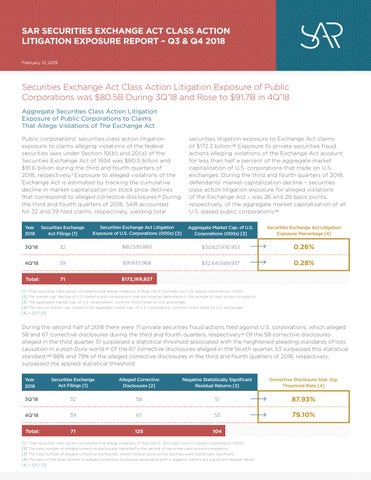
Public corporations’ securities class action litigation exposure to claims alleging violations of the federal securities laws under Section 10(b) and 20(a) of the Securities Exchange Act of 1934 was $80.5 billion and $91.6 billion during the third and fourth quarters of 2018, respectively. i Exposure to alleged violations of the Exchange Act is estimated by tracking the cumulative decline in market capitalization on stock price declines that correspond to alleged corrective disclosures. ii During the third and fourth quarters of 2018, SAR accounted for 32 and 39 filed claims, respectively, yielding total
securities litigation exposure to Exchange Act claims of $172.2 billion. iii Exposure to private securities fraud actions alleging violations of the Exchange Act account for less than half a percent of the aggregate market capitalization of U.S. corporations that trade on U.S. exchanges. During the third and fourth quarters of 2018, defendants’ market capitalization decline – securities class action litigation exposure for alleged violations of the Exchange Act – was 26 and 28 basis points, respectively, of the aggregate market capitalization of all U.S.-based public corporations. iv
$30,621,976,953
$32,641,689,937
During the second half of 2018 there were 71 private securities fraud actions filed against U.S. corporations, which alleged 58 and 67 corrective disclosures during the third and fourth quarters, respectively.v Of the 58 corrective disclosures alleged in the third quarter, 51 surpassed a statistical threshold associated with the heightened pleading standards of loss causation in a post-Dura world.vi Of the 67 corrective disclosures alleged in the fourth quarter, 53 surpassed this statistical standard.vii 88% and 79% of the alleged corrective disclosures in the third and fourth quarters of 2018, respectively, surpassed the applied statistical threshold.
Securities Exchange Act Class Action Litigation
Exposure of Large Cap Corporationsviii
The Securities Exchange Act class action litigation exposure of large cap corporations was $71.5 billion during the third quarter and it increased by 14.7% to $82.0 billion during the fourth quarter of 2018.ix There were 13 and 19 large cap corporations sued for alleged violations of the Exchange Act during the third and fourth quarters of 2018, respectively. Securities Exchange Act class action litigation exposure of large cap corporations during the second half of 2018 amounted to $153.5 billion.
The aggregate market capitalization of U.S.-based large cap corporations, according to the market capitalization range of the S&P 500® Index during the third and fourth quarters of 2018, was $28.3 and $30.3 trillion, respectively. During the third and fourth quarters of 2018, defendants’ securities class action litigation exposure to alleged violations of the Exchange Act was 25 and 27 basis points of the aggregate market capitalization of all large cap corporations that trade on U.S. exchanges.
$28,328,513,480
$30,320,314,135
Securities Exchange Act Class Action Litigation Exposure of Mid Cap Corporationsx
The Securities Exchange Act class action litigation exposure of mid cap corporations was $6.6 billion during the third quarter and it increased by 25.1% to $8.3 billion during the fourth quarter of 2018.xi There were 9 and 10 mid cap corporations sued for alleged violations of the Exchange Act during the third and fourth quarters of 2018, respectively. Securities Exchange Act class action litigation exposure of mid cap corporations during the second half of 2018 amounted to $14.9 billion. The aggregate market
capitalization of US-based mid cap corporations, according to the market capitalization range of the S&P MidCap 400® Index during the third and fourth quarters of 2018, was approximately $1.6 trillion for each of the two three-month periods. During the third and fourth quarters of 2018, defendants’ securities class action litigation exposure to alleged violations of the Exchange Act was 42 and 53 basis points of the aggregate market capitalization of all mid cap corporations that trade on U.S. exchanges.
$1,575,924,577
Securities Exchange Act Class Action Litigation Exposure Of Small Cap Corporationsxii
The securities class action litigation exposure of small cap public corporations was $2.4 billion during the third quarter and it decreased by 43.57% to $1.4 billion during the fourth quarter of 2018. There were 10 mid cap corporations sued for alleged violations of the Exchange Act during each of the third and fourth quarters of 2018. Securities class action litigation exposure of small cap corporations during the second half of 2018 amounted to $3.8 billion. The aggregate
market capitalization value of small cap corporations, as represented by members of the S&P SmallCap 600® Index during the third and fourth quarters of 2018 was $745.5 and $947 billion, respectively. During the third and fourth quarter of 2018, defendants’ securities class action litigation exposure to alleged violations of the Exchange Act was 33 and 18 basic points of the aggregate market capitalization of all small cap corporations that trade on U.S. exchanges.
Securities Exchange Act Class Action Litigation Exposure of Small Caps
Defendants’ 10b-5 Exposure (000s)
$2,401,332
$1,355,019
Aggregate Market Cap. of Small Caps (000s)
$729,671,047
$745,451,195
Any reprint of the information or figures presented in this quarterly report should reference SAR, LLC. Please direct any questions to: Stephen Sigrist 202.891.3652 stephen@sarlit.com. SAR is a software, technology, and data analytics company that actively monitors and analyzes every private securities fraud action that is filed for alleged violations of the Exchange Act of 1934. Through the SCADA cloudbased platform, users and subscribers can attain on-demand results of statistical and quantitative analyses for filed and potential claims that allege violations of Section 10(b) and 20(a) of the Securities Exchange Act of 1934. For general inquiries please call 202.436.9994 or send an e-mail to info@sarlit.com.
i Measures of exposure exclude market capitalization declines of international companies that have been sued for violations of the U.S. federal securities laws and trade on U.S. exchanges through American Depository Shares.
ii Federal securities class action complaints are tracked and screened for allegations that specifically include violations of Rule 10b-5 and define a specific inflationary period of the corresponding company’s stock price.
iii The enumeration methodology consolidates securities class action complaints by defendant companies. Only the alleged corrective disclosures presented in the first identified complaint against each defendant company are used to estimate the cumulative decline in market capitalization.
iv The ratio of market capitalization losses to the aggregate market capitalization value of U.S.-domiciled corporations that trade on U.S. exchanges.
v 15 securities class actions were filed against defendant companies that had already been sued for allegations of securities fraud under Section 10(b) and 20(a) of the Securities Exchange Act of 1934. Estimates of exposure exclude market capitalization losses that correspond to allegations in class action complaints other than the first identified complaint against a defendant company.
vi Dura Pharmaceuticals, Inc. v. Broudo, No. 03-932, 2005 WL 885109 (U.S. April 19, 2005)
vii A single-firm multivariate regression analysis with a minimum of 100 observations (if a full 252 observations is unattainable) for a Control Period is applied to evaluate the statistical significance of the logarithmic residual stock price decline on the trading day(s) affected by an alleged corrective disclosure(s) (or the alleged corrective event). Statistical significance is measured by computing the t-statistic of the residual stock price decline during the trading session that is affected by the alleged corrective information. (This statistical exercise is also known as a t-test. If the t-statistic is greater than the t-statistic value of plus or minus 1.96, the likelihood that the residual return could have been caused by random volatility is less than 5%.) The Control Period ends a trading day prior to the start of the Class Period presented in the corresponding FIC.
viii Large cap companies are the sub-set of defendant corporations that have market capitalizations within the range of the greatest and least market capitalization value of the constituent members of the S&P 500® Market Index at the time when the first identified complaint was filed.
ix As of January 31, 2019, the lowest market capitalization for a company on the S&P 500® Index was $3,673,060,200.
x Mid cap companies are the sub-set defendant corporations that have market capitalizations within the range of the greatest and least market capitalization value of the constituent members of the S&P MidCap 400® Market Index at the time when the first identified complaint was filed.
xi As of January 31, 2019, the lowest market capitalization for a company on the S&P MidCap 400® Index was $1,263,132,200.
xii Small cap companies are the sub-set defendant corporations that have market capitalizations within the range of the greatest and least market capitalization value of the constituent members of the S&P SmallCap 600® Market Index at the time when the first identified complaint was filed.
xiii As of January 31, 2019, the lowest market capitalization for a company on the S&P SmallCap 600® Index was $92,376,000.
Sources: Bloomberg Finance L.P., S&P Dow Jones Indices, PACER.